Podcast Episode 78

Episode 078 32 min

Invisible Security: The Future of Authentication and Trust

with Deepak Dutt

0:00 / 32:00

Also on Spotify, Apple Podcasts, YouTube, Podbean, Player FM

Episode 78 of The Security Podcast of Silicon Valley. Host Jon McLachlan, co-founder of YSecurity, talks with Deepak Dutt, founder and chief executive of Zighra, an Ottawa company that has spent more than a decade on continuous behavioral authentication: recognizing a person by how they hold, touch and move a device, with the model built and kept on the device itself. Deepak explains how an AI-powered lock screen reached 25,000 downloads in five weeks, why explainable models and privacy by design were the first requirements rather than the last, how the same anomaly-detection philosophy now watches the electromagnetic spectrum for jamming and spoofing in defense work, why he believes the next attacks target people rather than servers, and why Zighra has been profitable for four years. Published September 23, 2025. About 32 minutes.

Episode notes

Deepak Dutt, founder of Zighra, reveals how continuous behavioral authentication is changing the game—from stopping $200M fraud schemes to securing military operations.

Hosted by Jon McLachlan — co-founder of YSecurity.

The deep dive

Who is holding the phone right now?

Deepak Dutt has spent more than a decade teaching a phone to recognize its owner by grip, touch and motion, with the model built on the device and never sent anywhere. Ten months after we recorded, Visa paid $2.4 billion for the best-known company in his field, passkeys passed a third of sign-ins at the services FIDO tracks, and Zighra took the same anomaly detection into Canada's drone and electronic-warfare market. Here is what continuous authentication actually solves, what it doesn't, the numbers behind every claim on the tape, and four tools you can run on your own setup.

A minute into this conversation, before I had asked a real question, Deepak Dutt brought up a video call.

“I remember there was a breach not too long ago. It involved two hundred million dollars in a transfer and a fake Zoom call and a deepfake, and there it goes. We started off the journey a long time ago, but I think what’s happened now is, you know, the same tools are available to everybody. And the barriers to entry have been lowered so much that now you can have AI-powered attacks at scale.”

Deepak Dutt, founder and chief executive of Zighra, at 1:03

The call was real. In February 2024, Hong Kong police described a finance worker who had joined a video meeting with what looked like his chief financial officer and several colleagues, all of them deepfakes, and then sent HK$200 million, about US$25.6 million, in fifteen transfers (CNN). Three months later the engineering firm Arup confirmed it was the victim (CNN, via ABC 17). Deepak’s “two hundred million” is the Hong Kong dollar figure. The point he was making survives the currency conversion: the person on the call had every signal a human uses to decide who they are dealing with, and every one of those signals was fake.

Listen · Deepak on episode 78, from 1:03
About 23 seconds: the fake Zoom call, and the same tools being available to everybody. The clip stops on its own. Read the full transcript.

That is the whole episode in one exchange. Deepak has spent more than a decade on a different question than “does this person look right?” His question is “does this person still behave like themselves?”, asked continuously, answered by the device in your hand, without the data ever leaving it. This page is what I wish I had known before we hit record: what his approach actually does, where it sits next to passkeys and device-bound credentials, what has happened in the thirteen months since we spoke, and the numbers behind every claim on the tape. There are four things to try along the way: a quiz on the episode, a scorecard for your own sign-in setup, a timeline you can filter, and a small calculator for the friction you are paying right now.

The call that cost HK$200 million

The Arup case is worth sitting with, because it is the cleanest example of the thing every identity product is now up against. The employee received an email asking for a secret transaction and suspected phishing, which is the right instinct. Then he joined a video call, saw faces and heard voices he recognized, and dropped the doubt (CNN). Every check that a reasonable person would run came back clean, because every check was about appearance.
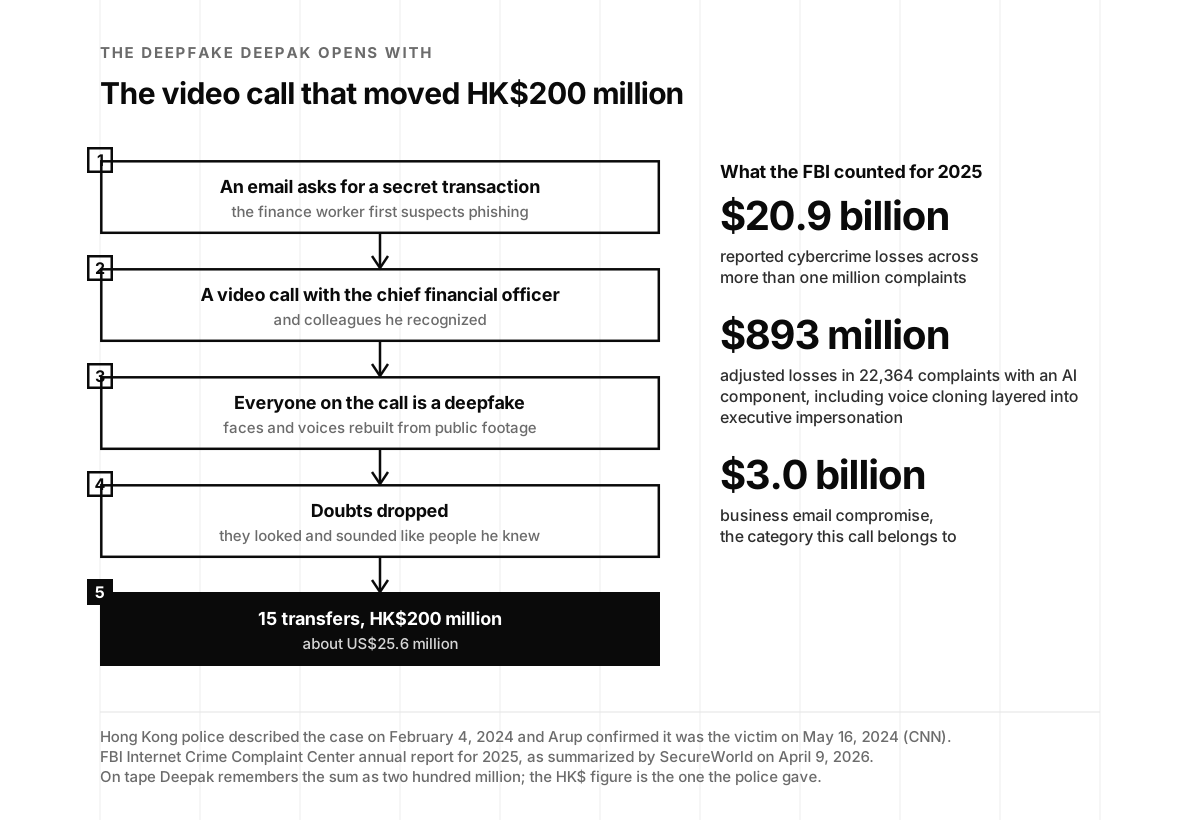
Five numbered steps: an email asks for a secret transaction, a video call with the chief financial officer and colleagues, everyone on the call is a deepfake, doubts dropped, and a filled final box reading 15 transfers, HK$200 million, about US$25.6 million. Beside it, FBI figures for 2025: $20.9 billion in reported losses, $893 million in AI-related complaints, $3.0 billion in business email compromise.
The anatomy of the Hong Kong deepfake call, and what the FBI counted for 2025. Police described the case on February 4, 2024 and Arup confirmed it in May.

It is no longer a one-off. The FBI’s Internet Crime Complaint Center counted $20.877 billion in reported losses for 2025 across more than a million complaints, with 22,364 complaints carrying an AI component and $893 million in adjusted losses, and it noted that “voice cloning is now being layered into these attacks” as follow-up calls that impersonate executives (SecureWorld, summarizing the IC3 report). Business email compromise alone was $3.046 billion. The Hong Kong call is the business-email-compromise playbook with a video layer on top.

The day the Financial Times named the company. View on X.

When the story hit Hacker News, the thread ran to 339 comments, and most of the useful ones were about process rather than technology: agree a challenge phrase with your executives, require more than one channel for a sum that size, double-check every order (Hacker News). Those are good rules. They are also rules that depend on a stressed person following them on a Thursday afternoon with a convincing boss on the screen. We had Ben Colman of Reality Defender on episode 71 on detecting the fakes, and Jasson Casey of Beyond Identity on episode 92 arguing that detection is a losing race and the fix is cryptographic proof of who is on the line. I wrote up that argument in Deepfake attacks keep working because we keep detecting instead of proving. Deepak’s answer sits between the two: don’t ask whether the face is real, ask whether the hands on the device behave like the person who owns it.

A gate or a flow

Here is how he described the founding idea, when I asked what started the company.

“Starting early on, our biggest thing was how do you detect who’s the right person behind a device or a transaction, in a very transparent fashion, without having to go through hoops to prove who you are. And we said, can we do that in a very invisible fashion, without bringing in all the friction involved with security?”

Deepak Dutt at 1:40

Almost everything we call authentication is a gate. You arrive, you prove something once, the gate opens, and from that moment the session is trusted on the strength of that single moment. A password is a gate. A one-time code is a gate. A passkey is a much better gate. None of them have anything to say about who is holding the device twenty minutes later, which is exactly the moment a stolen session cookie, a borrowed laptop, or a help-desk reset gets used.
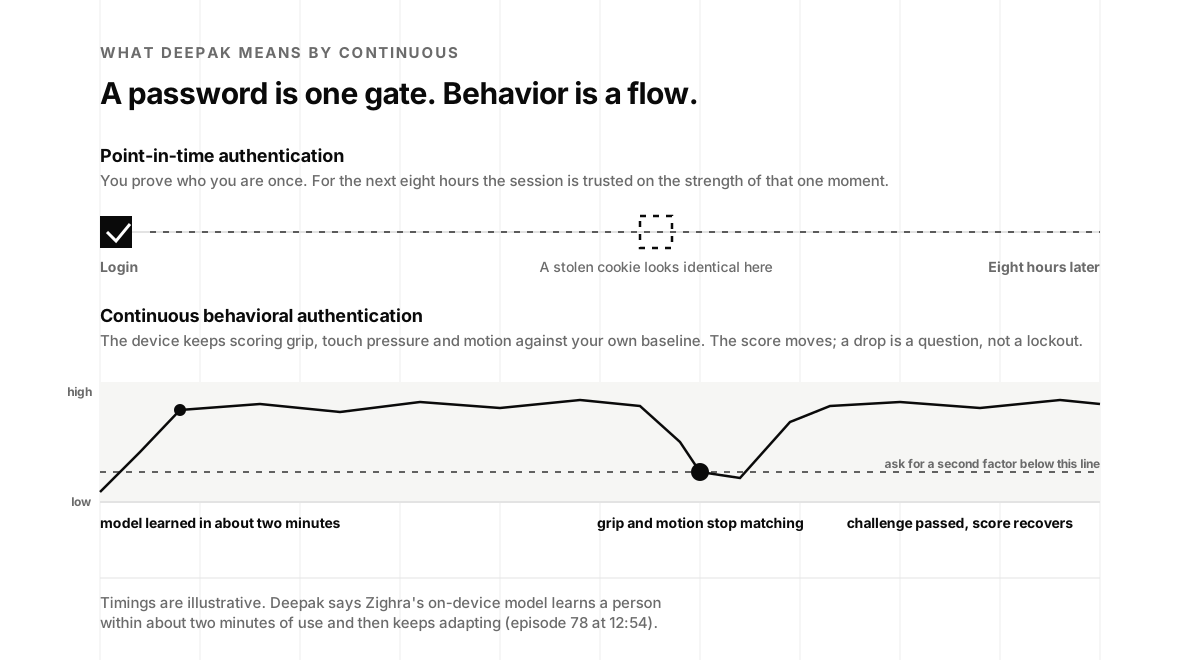
Two timelines. Point-in-time authentication: one filled check at login, then a dashed line for eight hours, with a dashed square in the middle labeled a stolen cookie looks identical here. Continuous behavioral authentication: a confidence line that climbs in the first two minutes, holds high, drops below the ask-for-a-second-factor line when grip and motion stop matching, and recovers after a challenge is passed.
A gate checks once. A flow keeps scoring. The second line is what Zighra sells: a score that moves with your behavior, where a drop is a question rather than a lockout.

I tried to summarize it back to him on tape as “passive, adaptive, dynamic… That’s continuous. It’s not like a point in time where you do an action, you have a proof,” and he took it one step further: the score is tied to a specific application. Your banking app, your payments app, or, in the work Zighra does now, a military one. “How do you know it’s still the right user continuously using it, without them having to go through all kinds of hoops?”

The first public test of the idea is the detail I keep repeating to people. Zighra built an AI-powered lock screen, put it on the Google Play Store when Android still let an app replace the lock screen, and watched.

“So we created an AI-powered lock screen, put it on the Google Play Store, and within five weeks we had around twenty-five thousand downloads across seventy different countries, on seven hundred different device types.”

Deepak Dutt at 1:40

Seven hundred device types is the number that matters for a founder. It means the model had to work on sensors it had never seen, on phones with wildly different accelerometers and touchscreens, with no central dataset to fall back on. That constraint, chosen in the first product, is the reason the same software could later run in places with no network at all. We will get to that.

Twelve years before this episode: Deepak demonstrating KineticID, Zighra's first product, at FinovateFall in New York in September 2013. Six and a half minutes. Watch on YouTube.

The field has a name, behavioral biometrics, and it got its biggest validation ten months after we recorded. On August 3, 2026, Visa agreed to buy BioCatch, the best-known company in the category, for $2.4 billion in cash. BioCatch analyzes about 18 billion user sessions a month for more than 350 financial institutions, protecting some 760 million users, and says it prevented $4 billion in fraud in 2025 (Finovate). Visa’s rationale, in the words of its value-added services president Andrew Torre, is to stop fraud “before it reaches the point of payment” (bne IntelliNews). That is Deepak’s thesis, bought by a card network: the signal that matters is upstream of the transaction, in how the session is being handled.

The fintech analyst Simon Taylor on the day of the deal. "People being coached through a transfer by a stranger on the line" is the Hong Kong call, seen from the bank's side. View on X.

Two caveats, so this reads as analysis and not a brochure. First, behavioral biometrics has had a privacy problem since banks started quietly deploying it. When The New York Times reported in 2018 that banks and retailers were tracking how people type, swipe and tap, the Hacker News thread was mostly about consent, and one commenter raised the attack Deepak’s design has to beat: malware on a compromised device could record a person’s behavioral data and replay it (Hacker News). Deepak’s answer to the first concern is in the privacy section below. His answer to the second is that the model keeps changing, so a replay goes stale, which is a good answer and not a complete one. Second, the big deployments are at banks with hundreds of millions of users. A thirty-person startup is not going to license BioCatch next quarter. The useful question for you is which of these ideas you can borrow with the tools you already have, and that is what the scorecard further down is for.

What the phone already knows

Deepak listed the signals on tape without being asked, which tells you how long he has been explaining this.

“So we looked at how you deal with your devices: mobile devices, laptop, desktop, or any sensor-based device. And we took a look at how you hold the device, the angle you hold it, the pressure you apply on the touchscreen, and the acceleration with which you move, because all these sensors are used for different purposes by applications, be it for gaming or be it for locating where you are. And we take a look at that and look at unique patterns that people have.”

Deepak Dutt at 1:40
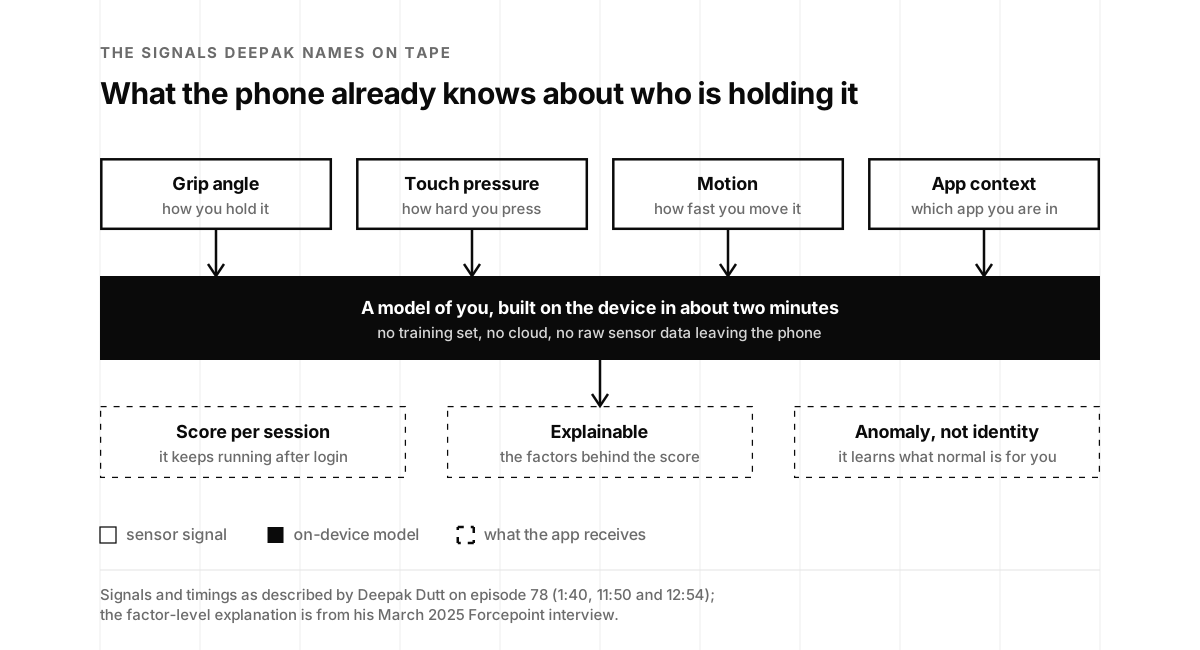
Four outlined boxes, grip angle, touch pressure, motion and app context, feed a filled box reading a model of you, built on the device in about two minutes, which feeds three dashed boxes: score per session, explainable, and anomaly, not identity.
The signals Deepak names on the tape, the model that consumes them, and what the application actually receives. The application never sees the sensor stream, only a score and the factors behind it.

On Forcepoint’s To The Point podcast in March 2025, six months before ours, he went a level deeper: Zighra runs a fusion engine that combines a device engine, a contextual engine, a network engine, a bio-behavioral engine and a social engine, so that an attacker has to defeat several layers at once, and the on-device model can run continuously for a couple of days on about 1% of battery, producing a score in milliseconds (Forcepoint). The 1% figure is his claim, not a measurement I can check, but it answers the first objection every mobile engineer raises.

The part I find most useful for founders is what the application receives. Not a face, not a fingerprint, not the raw motion data. A score, and the factors behind the score. That shape, a continuous confidence number that your own code can act on, is something you can build toward with ordinary tools: device posture, session binding, a step-up check when the risk changes. The phone already knows. Most products just never ask.

The credential pile got bigger while nobody looked

Deepak dated the shift to the moment the password breaches stopped being countable.

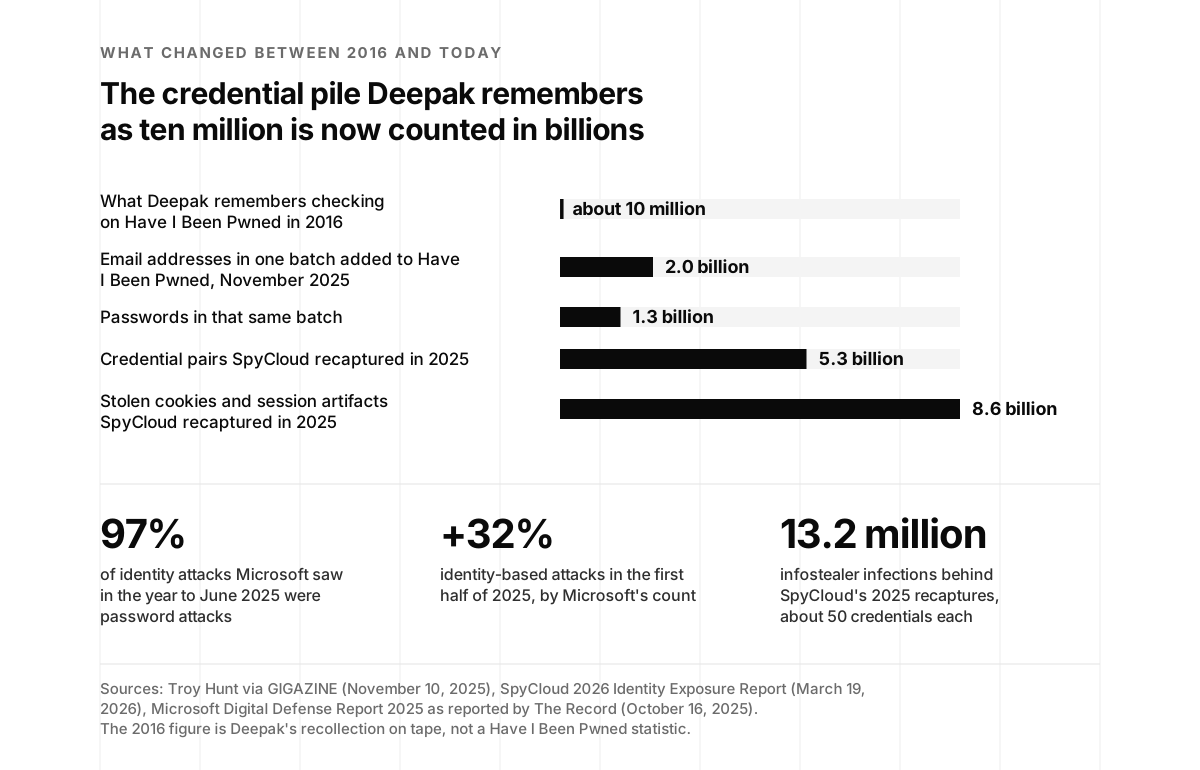
“So back in 2016, when we looked at this site called haveibeenpwned.com, I think there was maybe 10 million passwords or something like that that was breached. Today, when you look at it, billions and billions of passwords. So that entire space has kind of changed.”

Deepak Dutt at 5:38

His 2016 number is a memory, and Have I Been Pwned was already well past ten million by then, so treat it as a feeling rather than a statistic. The feeling is right. In November 2025 alone, Troy Hunt loaded about two billion email addresses and 1.3 billion passwords from one dataset supplied by the firm Synthient (GIGAZINE). A month later he was helping the FBI process another 630 million passwords seized from a suspect.

Eighteen billion queries a month is every password change on earth checking whether the new one is already in a breach. View on X.
Horizontal bars. About 10 million, Deepak's memory of Have I Been Pwned in 2016, is a hairline. Then 2.0 billion email addresses and 1.3 billion passwords in one batch added to Have I Been Pwned in November 2025, 5.3 billion credential pairs and 8.6 billion stolen cookies and session artifacts recaptured by SpyCloud in 2025. Below: 97 percent of identity attacks were password attacks, identity attacks up 32 percent in the first half of 2025, and 13.2 million infostealer infections.
The scale Deepak was pointing at. The 2016 bar is his recollection on tape. Everything else is from Have I Been Pwned, SpyCloud and Microsoft.

The number on that chart that should change how you build is not the passwords. It is the 8.6 billion stolen cookies and session artifacts SpyCloud recaptured in 2025, alongside 642 million credentials from 13.2 million infostealer infections and 18.1 million exposed API keys and tokens (SpyCloud). We had SpyCloud’s Trevor Hilligoss on episode 86 explaining why almost none of those infostealer infections was aimed at anyone. A stolen session cookie walks straight past your login gate, however good the gate is, because the gate already opened for the real user an hour ago. That is the dashed square on the first figure, and it is the case continuous authentication was built for.

Microsoft’s view of the same year: identity-based attacks rose 32% in the first half of 2025, and more than 97% of them were password attacks, mostly bulk attempts with leaked credentials, with help-desk impersonation scams rising alongside (The Record). The help-desk path is the one that worries me most for startups, because it defeats multi-factor authentication without touching it.

No malware, no zero-day. A phone call to the help desk and a new MFA device on somebody else's account. View on X.

Read that alert next to Deepak’s design and the point lands. A newly enrolled MFA device is a new gate. A behavioral model that has watched the real employee for months would see the new device being used by somebody who holds it differently, and the score would drop. I am not saying that would have stopped every Scattered Spider intrusion. I am saying it is the only layer in that story that looks at the person rather than the credential. If your own questionnaire answers say “MFA enabled” and you have never checked what can still sign in without it, read Enabled isn’t enforced before your next deal, and read the case for device-bound credentials for why the secret moving at all is the root problem.

”We are not passwords,” a year later

This is the line from the episode that people quote back to me, and for the record, it is mine, not Deepak’s.

“I believe that we are not passwords. We can do better. I would love a piece of technology that matched all of the great advancements that we’ve had along the way. And so I think, does this need to exist? This absolutely needs to exist, because we are not passwords.”

Jon McLachlan at 15:46

Deepak’s reply was more careful: “I think we are constantly hearing the days of passwords are over. I think people are on the journey. We’ll see. But every year we are hearing more and more passwords getting compromised.” A year later the data says he was right to hedge, and right about the direction.
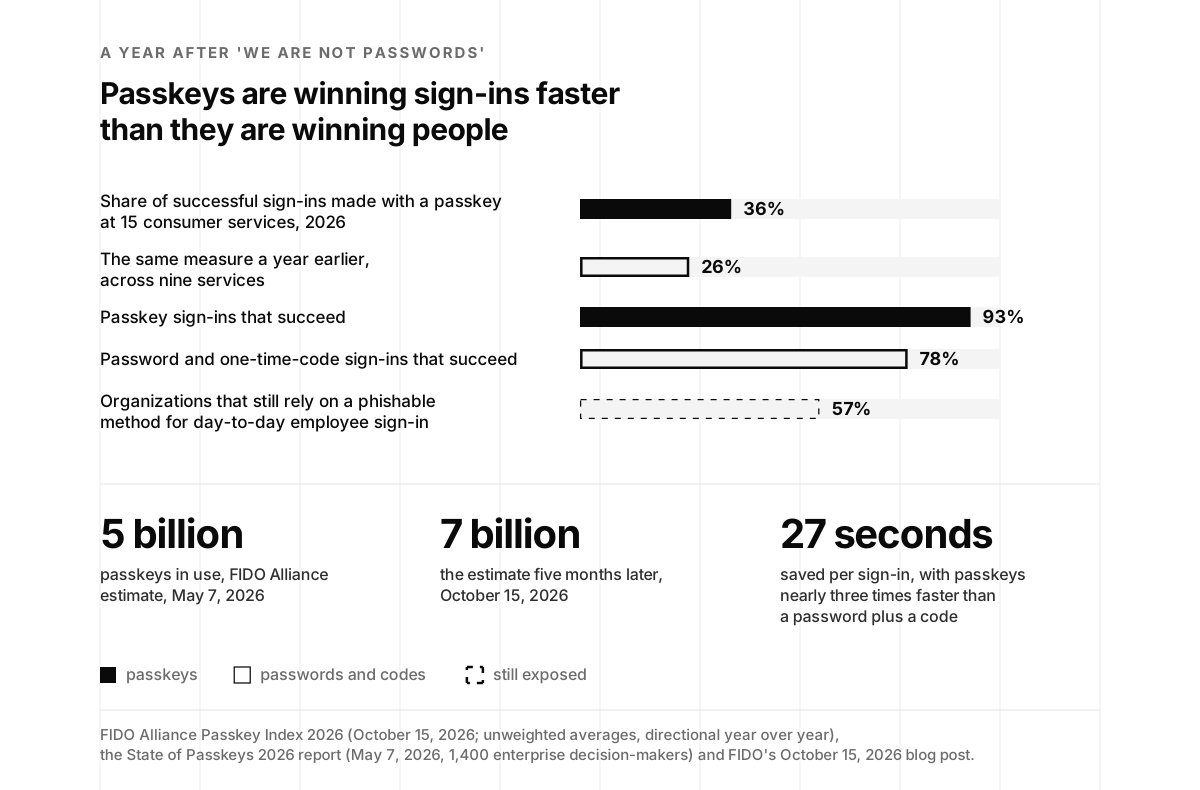
Horizontal bars: 36 percent of successful sign-ins at 15 consumer services used a passkey in 2026, 26 percent a year earlier. 93 percent of passkey sign-ins succeed against 78 percent for passwords and one-time codes. 57 percent of organizations still rely on a phishable method for employee sign-in. Below: 5 billion passkeys in use in May 2026, 7 billion by October 2026, and 27 seconds saved per sign-in.
Passkeys are winning the sign-ins they are offered on, and most companies still leave a phishable door open for their own employees.

The FIDO Alliance’s Passkey Index for 2026, published October 15, reports that 36% of successful sign-ins at fifteen participating consumer services used a passkey, up from 26% a year earlier, that passkey sign-ins succeed 93% of the time against 78% for passwords and one-time codes, and that they are nearly three times faster, saving about 27 seconds each (FIDO Alliance). FIDO’s estimate of passkeys in use went from 5 billion in May to 7 billion in October (FIDO Alliance). On the workforce side, 68% of organizations surveyed in April 2026 had deployed or were deploying passkeys for employees, and 57% still relied on a phishable method for day-to-day sign-in (FIDO Alliance). Those two numbers are both true of the same companies.

The part FIDO’s press releases don’t dwell on is that a lot of people hate the experience, and they said so in public this summer.

More than 4,200 likes, and a 785-comment Hacker News thread the same day. View on X.

"The entire setup/enrollment/add a passkey to your account processing is DMV inspired."

IceHegel, on Hacker News, July 22, 2026

"Passkeys are a vector for locking your logins to Big Tech ecosystems."

coldpie, on Hacker News, July 22, 2026

Both complaints are about friction and control, which is exactly the ground Deepak was fighting on in 2013. His whole pitch is that the best authentication is the kind you never notice. I think passkeys and continuous behavioral scoring are allies rather than rivals, and the honest way to put it is this: a passkey fixes the moment of login, which is where phishing lives. It does nothing for the hours after login, which is where stolen sessions, shared laptops and help-desk resets live. A behavioral score covers the hours. Neither one asks you to remember anything.

If you have ever been asked to produce the magic fairy dust: the FIDO Alliance's 85-second explainer of what a passkey actually is. Watch on YouTube.

Taher Elgamal, who designed SSL, made the longer version of this argument on episode 61: passwords were a shortcut taken in the 1990s to keep the internet moving. I said something similar to Deepak near the end of this episode, that a shared secret was the right trade at the time and that “now we have a different problem on our hands, because everyone’s on the internet.” His own version of the regret is sharper, and it comes up in the founder notes below.

Explainable, small data, and the bias question

I asked the question I ask every AI founder now: how do you secure the model, and where does its data come from? Deepak’s answer was that Zighra wrote its own stack rather than fine-tuning somebody else’s, for one reason.

“See, when we started up with the AI space, we kind of wanted to build our entire AI stack from the ground up, because the core tenet was: how do you make it explainable, day one? Because we didn’t like the fact that it was a black box, and we didn’t really understand what was going on inside.”

Deepak Dutt at 11:50

The reason is commercial as much as ethical. His customers are banks and defense departments, and “they don’t want to make a decision that says, it’s a black box, they made a decision. How do you stand behind that decision? So if you get challenged, you need to be able to explain, tell this to your citizens, what you’re actually doing.” If you sell into regulated buyers, that sentence is your next security questionnaire. The buyer will not ask whether your model is accurate. They will ask whether you can explain a single decision it made about one of their customers, and whether you can show it treats people fairly.

Which led to the question I was most curious about. Military user bases skew heavily male. Does a behavioral model trained in that world work as well for women?

“Absolutely. See, the key for us is to work with small amounts of data. So when you, let’s say, take the phone and start interacting with it, we’re building the model on the fly. It’s not like we have trained it on…”

Deepak Dutt at 12:54

I finished the sentence for him, “because you’re looking at doing anomaly detection,” and he agreed three times. Each model is built for one person from their own use, within about two minutes, and then keeps adapting. There is no population model to inherit a skew from, because there is no population. “Whatever they bring to the table, whatever their experiences, however they hold the phone, whatever their tics are, can be baselined, essentially.”

That is a cleaner answer to the bias question than most AI companies can give, and it is worth understanding why it works. A classifier trained on a crowd learns what the crowd looks like and flags people who don’t fit. An anomaly detector trained on you learns what you look like and flags moments that don’t fit. The second one cannot be biased against a group, because it has never met a group. It can still be wrong about an individual, on a day they have a broken wrist or a new phone, which is why the score has to be a question and not a verdict, and why Deepak keeps saying the word “adaptive.” If you are building any product that scores people, the authorization post is about where those scores should and should not be allowed to act.

Privacy that was designed in

The sentence I would put on the wall of every startup that touches sensor data:

“So I think it’s about thinking through the technology, and being very empathetic about your approach to building things. So then privacy is not something that you bolt on.”

Deepak Dutt at 16:35

Listen · Deepak on episode 78, from 16:35
About 72 seconds: why the model stays on the device, and what the sensor data would reveal if it didn't. The clip stops on its own.

He was specific about what the data would give away: “the sensor data is highly, highly sensitive, because it tells you if you’re sitting, standing, walking, where are you” at a given point in time. I made the joke that accelerometer data might end up treated as personal information under European privacy law, and it is less of a joke than it sounds. Under the General Data Protection Regulation, biometric data processed to uniquely identify a person is a special category that needs an explicit legal basis, and a behavioral profile used to identify you is biometric data by definition. Zighra’s answer is architectural rather than legal: keep the raw data on the device, learn there, infer there, and let only a score move.
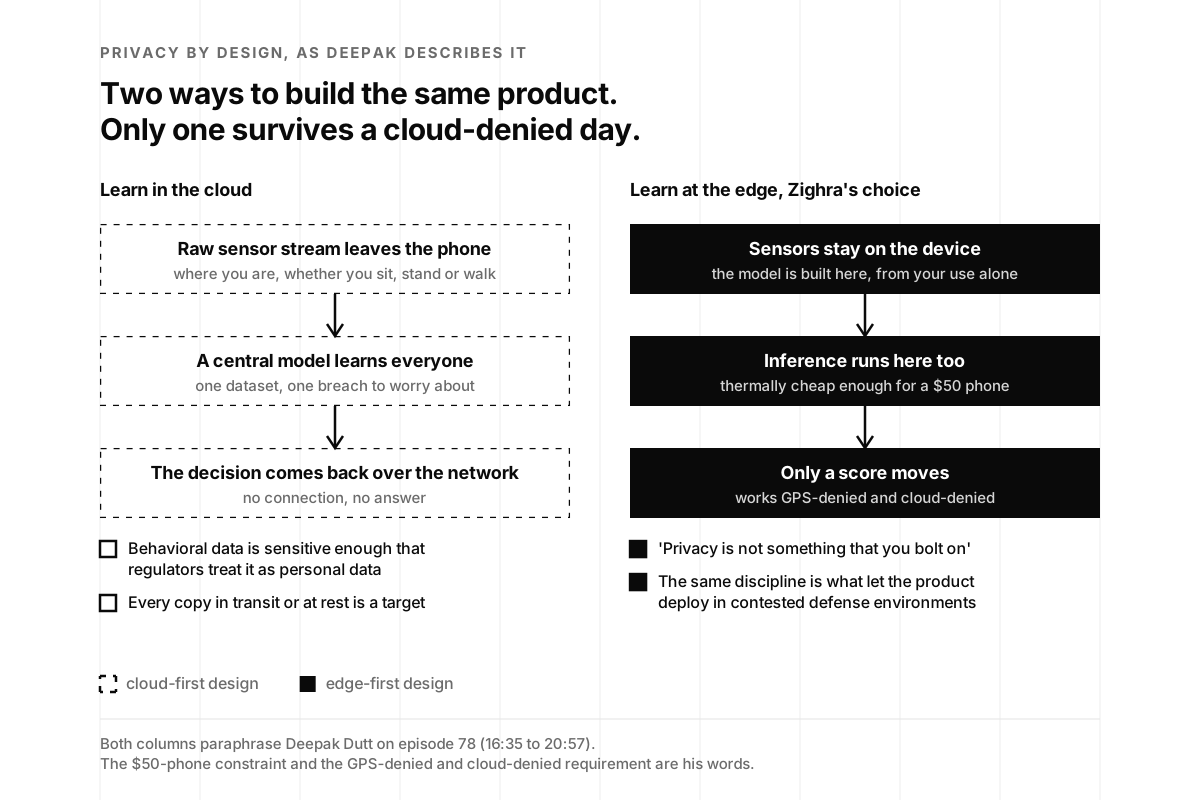
Two columns. Learn in the cloud: dashed boxes for the raw sensor stream leaving the phone, a central model learning everyone, and the decision coming back over the network. Learn at the edge, Zighra's choice: filled boxes for sensors staying on the device, inference running there too, and only a score moving. Notes under each column about sensitivity and about privacy not being bolted on.
The same product, two architectures. The right-hand column is the harder engineering problem and the only one that works when the network is gone.

The engineering cost of that choice is real, and Deepak did not pretend otherwise. “It has to be highly thermally efficient to be able to run entirely at the edge, on the device. So how do you learn at the edge? How do you infer at the edge, without having any of that sensor data coming back onto the cloud?” The failure mode he described is the one I see in most AI products: build in the cloud first, then try to push the model to the device later and find it is too heavy. It has to run on “a $50 phone to a thousand-dollar phone plus,” and the sensors on those phones are not the same. When I suggested the mobile device would probably catch fire, he did not disagree.

Here is the part founders should underline. The privacy decision was made in 2013 for reasons of trust, and it became a sales requirement a decade later for reasons of war.

“Can you work in highly contested environments, GPS-denied environments, cloud-denied environments? Can you work in these kinds of scenarios? And you can say, yeah, absolutely.”

Deepak Dutt at 20:35

A product that never needed the cloud to make a decision could be dropped into a defense environment where the cloud is not available on purpose. Nobody planned that in 2013. Designing for the user’s privacy produced a product that survives an adversary’s jamming. I cannot think of a better argument for doing the harder thing early, and it is the same argument I make to AI startups about where their models run and whose data they can see: a cheap decision now is an expensive migration later, and the buyers who matter will ask.

From phones to the electromagnetic spectrum

The turn in the conversation I did not expect was from touchscreens to satellites.

“But in the defense context, now the electromagnetic spectrum is a huge space, because these are all invisible spaces where there could be drones, there could be jamming happening, there could be spoofing happening, but these are all driven by sensors. It’s a world driven by sensors.”

Deepak Dutt at 7:11

The logic is the same as the phone. Model what normal looks like, then flag the deviation: “Somebody’s jamming me. Am I losing positioning because of that jamming? Or somebody’s spoofing my location, and suddenly it shows me like I’m somewhere else.” And then the line from this episode that I have quoted most since:

“Today’s wars are initially started off with cybersecurity and electronic warfare, because you can do this from afar.”

Deepak Dutt at 8:38
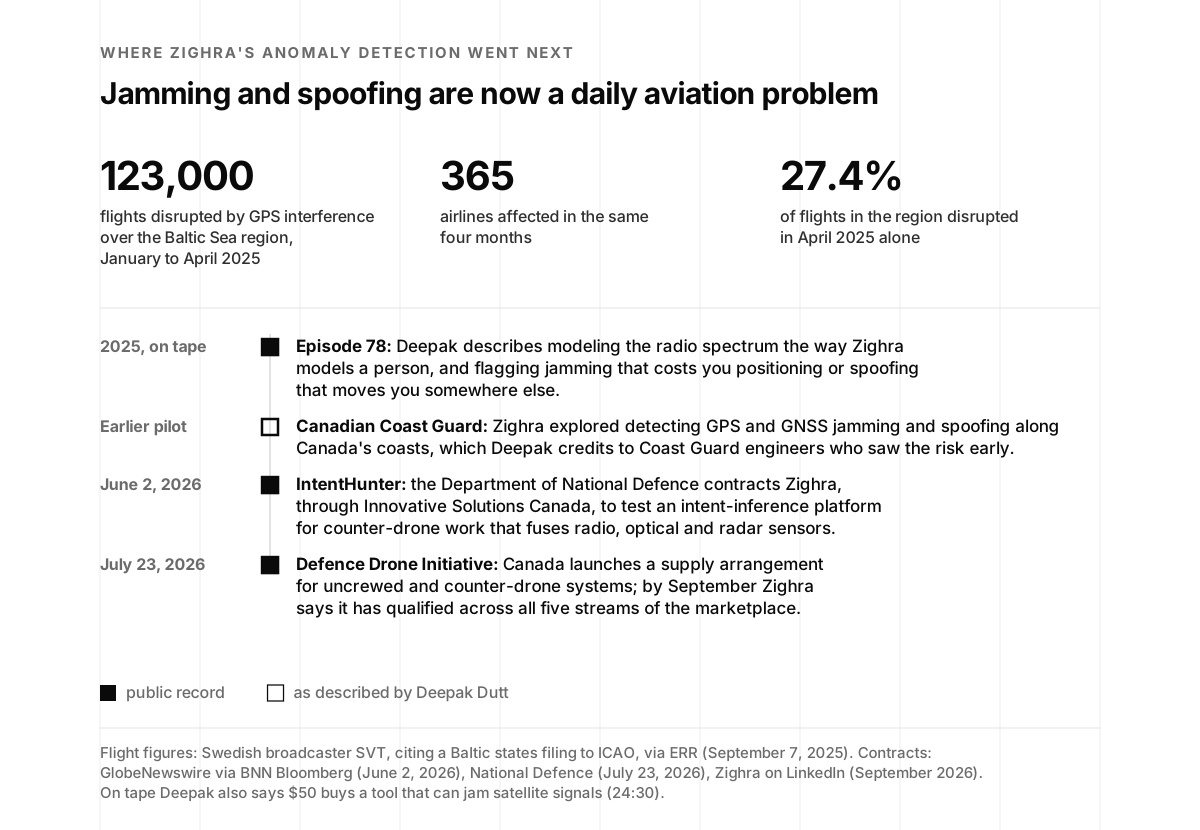
Three statistics: 123,000 flights disrupted by GPS interference over the Baltic Sea region from January to April 2025, 365 airlines affected, 27.4 percent of flights disrupted in April alone. Below, a timeline: episode 78 on tape in 2025, an earlier Canadian Coast Guard pilot on GNSS jamming and spoofing, the June 2, 2026 IntentHunter test contract from the Department of National Defence, and the July 23, 2026 Defence Drone Initiative with Zighra qualifying across all five streams by September.
What "invisible spaces" look like in practice, and where Zighra's anomaly detection went in the year after we recorded.

The scale of the jamming problem is easy to underestimate from California. According to a filing Baltic states made to the International Civil Aviation Organization and reported by Sweden’s SVT, nearly 123,000 flights by 365 airlines were affected by GPS disruption over the Baltic Sea region between January and April 2025, with 27.4% of flights in the region disrupted in April alone (ERR, citing SVT). Deepak’s version of the barrier to entry: “Tools are available today for $50. You could buy, and you could start jamming the satellite signals.”

Spoofing is the subtler cousin. In January 2026, the researcher Nariman Gharib published telemetry from a Starlink terminal inside Iran during an internet shutdown that showed the dish detecting eighteen GPS satellites with a valid lock and still switching on its anti-spoofing countermeasures, because the signals were fake.

Nearly 6,000 likes. The satellites were real. The signals were not. That is the spoofing case in one screenshot. View on X.
Seven minutes from Flightradar24 on how jamming and spoofing show up in aircraft tracks, with more than 260,000 views. Watch on YouTube.

When we recorded, Zighra’s defense work was already its main business. “More recently, over the last few years, it’s been primarily in the defense space.” The public record since then: in December 2022 the company had an Innovative Solutions Canada contract to test a sensor identity network with Royal Canadian Navy partners (PR Newswire). In May 2024 Shared Services Canada contracted its DeepSense product for continuous identity validation testing (Biometric Update). On June 2, 2026, the Department of National Defence announced it would test IntentHunter, Zighra’s intent-inference platform for counter-drone work, which fuses radio-frequency, optical and radar sensors and infers what a drone is trying to do from its behavior rather than matching it against a library of known signatures (GlobeNewswire via BNN Bloomberg). Deepak’s line in that release: “Drone warfare has changed the problem.” Then on July 23, 2026, Canada launched the Defence Drone Initiative, a supply arrangement meant to speed up uncrewed and counter-drone systems for the Canadian Armed Forces and Coast Guard (National Defence), and by September Zighra said it had qualified across all five streams of the marketplace.

Zighra has qualified across all five streams of Canada's Defence Drone Initiative (DDI) Marketplace.

The five streams span uncrewed and Counter-UAS systems, C2/communications/data/EW/cyber, systems integration, testing and evaluation, and innovation and experimentation.

For us, the breadth matters. Because the future of uncrewed and Counter-UAS capability will not be solved by any one sensor, platform or system.

Zighra · Company post · September 2026
A year after "primarily in the defense space." The anomaly detection that started on a lock screen now bids on electronic warfare work. View on LinkedIn.

If the defense market interests you, we have covered it from the founder’s side: Garrett Smith of Reveal Technology on episode 90, the guide to building a defense tech startup, and how counter-drone technology works and where the openings are. The compliance side, ITAR and CMMC Level 2, is where most founders lose a year, and it is work we do.

Protect the human endpoints

I asked Deepak to pick a point in the future and name the hardest security problem waiting there. He did not pick a technology.

“But at the end of the day, I mean, how do you protect every single person in an invisible fashion, right? I think otherwise humans become that core weak point where the attacks can permeate from. So I think in the future, I think we need to have these agents that are protecting every single person, avoiding them to become the starting points of new kinds of cyber attacks.”

Deepak Dutt at 24:30

Listen · Deepak on episode 78, from 25:30
About 53 seconds: protecting every single person in an invisible fashion, and the human endpoints. The clip stops on its own.

He framed the shift as back end to front end: “we currently think about protecting the back end, data and the servers and stuff. But I think the challenge would be to protect the endpoints, not the… the human endpoints.” The data agrees with him. Verizon’s 2026 Data Breach Investigations Report put the human element in 62% of breaches, with credential abuse appearing somewhere in 39% of them even as vulnerability exploitation became the most common way in (Abnormal AI, summarizing the 2026 DBIR). The Hong Kong call, the Scattered Spider help-desk calls, the infostealer on a developer’s laptop: each one goes through a person, and each one looks legitimate to every system that only checks credentials.

What I did not expect is where Deepak took the idea a year later. His recent writing is about agents rather than people: a legitimate AI agent, with valid credentials and real permission, following an instruction planted in content it read, and buying something its customer never asked for. His framing is four questions, identity, authority, behavior and intent, and the observation that “every individual check can pass while the activity serves someone else’s objective” (Deepak Dutt on LinkedIn). That is the exact failure Jesse Anglen described on episode 106, seen from the fraud team’s side of the glass, and it is why an inventory of what your agents can touch and a named human who signs for each one are not paperwork. Behavior is the only signal left when the credentials are real and the instruction is not.

The founder notes

This is a founder show, and Deepak gave the most useful answers on the business in a while. In order:

Profitable for four years. “We’ve raised a couple of rounds of funding early on, and over the last four years, I think we’ve been profitable.” The public trail: a FinovateFall debut in 2013, a Barclays Techstars accelerator in 2016 that led to a Barclays pilot, a $1 million seed round in December 2016 led by the Investment Accelerator Fund, Export Development Canada and the Business Development Bank of Canada, with six employees at the time (Finovate). Then, in his words, “we were lucky enough to get to a stage where we could self-fund the company from that point onwards.” His explanation for how a small team stays profitable in a market with hundreds of millions of users is that they threaded AI into their own operations early: “Everything that we do is highly efficient.” On tape I called it “the old-fashioned building-a-business thing, where you operate in the green.”

Patents took five years. “It took us five years plus to get our first patents.” They came with a co-founder he met at school who is “a co-author on every single patent that I’ve put together, except one,” an academic who brought the mathematics and a philosophy of applying how biological systems self-heal to security. By 2021 Zighra had sixteen patents issued or pending, more than 100 forward citations, and its citations appearing in applications by Google, Mastercard, PayPal, IBM and Microsoft (Biometric Update). Those citations were the signal that pushed him from research to commercialization: “We have all these large companies that are looking at our patents and making it part of their forward citations. So we said, must be something very, very, very interesting.”

The proudest days were people days. First customer, first patent, first defense customer. “But at the end of the day, it’s about bringing the right people around… It’s very hard problems that we are trying to solve, and the technological risks are extremely high.”

The culture test is one question.

“So when we build something, the first question we ask is: does it need to exist? Sure, if it does need to exist, great. If not, then maybe not us.”

Deepak Dutt at 15:04

And the daily version, for every task on the board: “are there tasks there that you’re working on that don’t have any impact? If it doesn’t, maybe it shouldn’t be there.”

The hardest problem is distribution, not the model. Hiring is the hardest day-to-day problem. Running on very lightweight devices is the hardest technical one. But the one he says he is still solving is where a behavioral biometric belongs: “it can come in at the device level, it could go into the chip level, it could go into the operating system level, it can go into the application level.” Applications are fastest, through an SDK, and every application is turning into a payments application, so the surface keeps growing. “That would be our biggest challenge: get this in the hands of as many people as possible.” If you are a deep tech founder nodding at this, what is deep tech and building a cybersecurity startup are the two posts we point people to.

Advice to a younger self: secure the inflection points.

“Or you go back and say, from a security cap on, you say, shouldn’t have used passwords day one. So that’s why I said you could take each inflection point of technology and say, this is the way you should do it. Well, when they put together the GPS satellites, we should have put more security into them, so that these signals could be secured.”

Deepak Dutt at 27:54

“Now we’re solving the symptoms,” he said. The civilian GPS signal was designed in the 1970s with no authentication, which is why a $50 transmitter can lie to a $100 million aircraft. Kevin Kane made a parallel argument about encryption on episode 96: a post-quantum algorithm doesn’t make a product quantum safe unless the construction around it is done correctly.

The problem he would pay someone else to solve: traffic. “It’s a problem that is omnipresent everywhere in the world… So the journey is all about the user experience and making things frictionless. Traffic is one of those friction points.” It is the same instinct as the lock screen.

Did you catch it? A six-question quiz

Interactive · six questions

Did you catch it?

Six questions on what Deepak actually said, with the timestamp for each answer. The answers are under each question for anyone reading without JavaScript.

  1. How long does Deepak say Zighra's on-device model needs before it has learned a new person?

    1. About two weeks of normal use
    2. One full working day
    3. About two minutes

    c. "We learn extremely fast, within two minutes. That's how fast we can learn. And then we adaptively learn beyond that." Transcript, 13:08.

  2. Who said "we are not passwords" on this episode?

    1. Deepak Dutt
    2. Jon McLachlan
    3. Both of them, in the same breath

    b. It was Jon: "I believe that we are not passwords. We can do better." Deepak's reply was more careful: "the days of passwords are over. I think people are on the journey. We'll see." Transcript, 15:46.

  3. Where does Zighra keep the raw sensor data it learns from?

    1. On the device. Only a score leaves it.
    2. In Zighra's cloud, encrypted
    3. In the customer's cloud, under their keys

    a. "How do you infer at the edge, without having any of that sensor data coming back onto the cloud? That's a thought process. That's the philosophy that you've got to implement day one." Transcript, 18:27.

  4. Deepak says a $50 purchase can do what?

    1. Clone a voice well enough to fool a bank
    2. Buy a month of a rented botnet
    3. Jam satellite signals

    c. "Tools are available today for $50. You could buy, and you could start jamming the satellite signals." Transcript, 24:30.

  5. What was the actual sum in the deepfake video-call case Deepak opens with?

    1. US$200 million
    2. HK$200 million, about US$25.6 million
    3. HK$25 million

    b. Deepak remembered "two hundred million." Hong Kong police put it at HK$200 million, about US$25.6 million, in fifteen transfers. The company was Arup. See the first section.

  6. Which of these did Deepak name as the hardest ongoing challenge for Zighra?

    1. Distribution: chip, operating system, device or app
    2. Raising the next round
    3. Explaining the model to regulators

    a. "Then distribution becomes an extremely challenging kind of prospect... That would be our biggest challenge: get this in the hands of as many people as possible." Transcript, 21:22.

Would your sign-in survive this episode?

Most of what Deepak described is out of reach for a thirty-person company this quarter. The principles are not. This scorecard asks eight questions about your own setup, each one tied to a point on the tape, and tells you which of the three gaps an attacker would use first.

Scorecard · eight questions

Would your sign-in survive this episode?

Answer for the company, not the ideal. Weighted toward the attacks in this episode: the stolen session, the help-desk reset, the convincing video call.

  1. Can anyone sign in to your main systems with a password plus a code sent by text or email?

    • Yes, that's our normal path
    • Only for a few accounts or fallbacks
    • No, every path is phishing-resistant

    Microsoft counts more than 97% of identity attacks as password attacks. A code by text is a gate a phishing page can hold open. Enabled isn't enforced has the ten-minute check.

  2. If someone steals a session cookie from a laptop, does it work from another machine?

    • Yes, until it expires
    • For some apps, not others
    • No, sessions are bound to the device

    SpyCloud recaptured 8.6 billion stolen cookies and session artifacts in 2025. The gate already opened. Device-bound credentials explains the fix.

  3. Can your help desk reset a login or add a new MFA device after a phone call?

    • Yes, a convincing caller gets it done
    • Only with a manager's say-so
    • Only after a verified in-person or video step with a known device

    The FBI's June 2025 alert on Scattered Spider: impersonate an employee, talk the help desk into adding an MFA device. No malware required.

  4. Does anything notice when a logged-in session starts behaving differently: new device, new location, new hours, an unusual download?

    • Nothing, a session is a session
    • Some alerts, nobody owns them
    • Yes, with a step-up check or a page to a person

    This is the whole episode: the score after login. You do not need behavioral biometrics to start. You need one signal, one threshold and one owner. Monitoring and response is how we staff it.

  5. For a wire, a payroll change or a vendor bank-detail change, is there a verification step that a video call cannot satisfy?

    • No, a call from the boss is enough
    • A call-back to a known number
    • A second channel plus a second person, written down

    The Hong Kong employee saw faces and heard voices he knew. The only defense that survived was a rule that did not depend on recognizing anyone.

  6. Do your AI agents and service accounts have their own credentials, with a named human who owns each one?

    • They share keys and nobody owns them
    • Separate keys, unclear owners
    • Separate, scoped, owned and inventoried

    Deepak's 2026 framing: a legitimate agent with valid credentials following somebody else's instruction. The agent credential inventory is the starting point.

  7. If a regulator or a customer asked why your system blocked or allowed one specific login, could you show them?

    • No, the vendor's model is a black box
    • Partly, with logs and a vendor ticket
    • Yes, per decision, with the factors

    "How do you stand behind that decision?" Deepak built his own stack to answer it. Your buyers will ask you the same thing about yours.

  8. Does any raw behavioral, location or sensor data about your users leave their device for a model you run?

    • Yes, and we have not mapped where it goes
    • Yes, mapped and minimized
    • No, or only derived scores

    "Privacy is not something that you bolt on." Behavioral data used to identify someone is biometric data under European privacy law.

The gate is the whole defense

A phishing page, a stolen cookie or a help-desk call gets in, and nothing after login would notice. Fix the top two questions first: phishing-resistant sign-in everywhere, and sessions that die when they leave the device. Then write the wire rule down. Those three close most of this episode.

Good gate, quiet hallway

Login is in decent shape. The hours after it are not watched, and the human paths, help desk and finance, still trust a familiar voice. Pick one post-login signal, give it a threshold and an owner, and make the help desk's reset flow require something a caller cannot fake.

You would survive this episode

Phishing-resistant sign-in, bound sessions, a wire rule that does not depend on faces, and someone watching behavior after login. What is left is the explainability question and the data-residency question, which are exactly what your enterprise buyers will ask next.

The friction you are paying today

Deepak’s lock screen was built on a bet that nobody would accept more friction for more security. The FIDO numbers now put a figure on the friction: a passkey sign-in saves about 27 seconds against a password plus a code, and succeeds 93% of the time against 78% (FIDO Alliance). Put your own team into that arithmetic.

Calculator

The friction you are paying today

Hours a year your company spends at the gate, and what a sign-in that just works would give back. Rough by design. Change the numbers to yours.

–hours a year at the gate
–what those hours cost
–hours given back by a faster sign-in

At these numbers your company spends hours a year proving who it is. Deepak's point is that the better version is also the safer one.

Working days are counted as 250. The 27 seconds saved is the FIDO Passkey Index 2026 figure for consumer services, and the 45-second default follows from its finding that passkey sign-ins are nearly three times faster. Your workforce numbers will differ, which is the point of the sliders. Failed sign-ins and resets are not counted, so the real number is higher.

Thirteen years on one line

Everything on this page sits on one timeline, and filtering it is the fastest way to see how a privacy decision in 2013 became a defense contract in 2026 while the attacks caught up with everybody else.

Timeline · 2013 to 2026

Thirteen years on one line

Filter by thread. Dates are from the public record except where marked as Deepak's own account on the tape.

  1. KineticID at FinovateFall

    Zighra demonstrates its first product, a mobile authentication system that evaluates how a person physically interacts with the device (Finovate).

  2. "Twenty fourteen."

    Asked how long he has been doing this, Deepak dates the continuous authentication work to 2014, with research partners at the University of Waterloo and Carleton.

  3. The lock screen experiment

    An AI-powered lock screen on the Google Play Store reaches about 25,000 downloads in five weeks across 70 countries and 700 device types, by Deepak's account.

  4. Barclays Techstars, then a $1 million seed

    Zighra graduates from the Barclays accelerator, lands a Barclays pilot, and closes a $1 million seed round in December led by the Investment Accelerator Fund, Export Development Canada and the Business Development Bank of Canada, with six employees (Ottawa Business Journal).

  5. "Banks and retailers are tracking how you type, swipe and tap"

    The New York Times reports on behavioral biometrics in banking, and the Hacker News thread is about consent and about replaying a stolen behavioral profile (Hacker News).

  6. FIDO certification

    Zighra's on-device behavioral biometrics are certified by the FIDO Alliance, which the company calls a first for the category (Biometric Update).

  7. U.S. patent 11,057,413

    A patent for removing passwords through continuous biometric authentication across applications, with sixteen patents issued or pending and more than 100 forward citations (Biometric Update).

  8. Royal Canadian Navy test contract

    An Innovative Solutions Canada contract to test Zighra's sensor identity network for the Department of National Defence (PR Newswire).

  9. The Hong Kong deepfake call

    Police describe a finance worker sending HK$200 million after a video call in which every participant was a deepfake. Arup confirms it was the victim in May (CNN).

  10. "Passkeys: a shattered dream"

    William Brown's post on platform lock-in tops Hacker News with 773 comments, the argument the passkey debate is still having two years later (Hacker News).

  11. Shared Services Canada

    A contract to test Zighra DeepSense for continuous identity validation across government networks (Biometric Update).

  12. 123,000 flights

    Baltic states tell ICAO that nearly 123,000 flights by 365 airlines were affected by GPS disruption in four months, 27.4% of flights in the region in April (ERR, citing SVT).

  13. FBI alert on Scattered Spider

    Help desks talked into adding MFA devices to compromised accounts, now aimed at airlines (FBI on X).

  14. Episode 78

    This conversation. Profitable four years, primarily in defense, "today's wars are initially started off with cybersecurity and electronic warfare."

  15. Two billion addresses in one batch

    Have I Been Pwned loads about 2 billion email addresses and 1.3 billion passwords from a single Synthient dataset (GIGAZINE).

  16. Spoofing a Starlink dish in Iran

    Terminal telemetry shows eighteen satellites locked and anti-spoofing countermeasures engaged: the signals were fake (Nariman Gharib on X).

  17. 8.6 billion stolen cookies

    SpyCloud's 2026 report: 8.6 billion session artifacts, 5.3 billion credential pairs, 13.2 million infostealer infections in 2025 (SpyCloud).

  18. Five billion passkeys

    World Passkey Day: 5 billion passkeys in use, 75% of consumers have enabled one, 57% of organizations still rely on a phishable sign-in (FIDO Alliance).

  19. IntentHunter

    The Department of National Defence will test Zighra's intent-inference platform for counter-drone work (BNN Bloomberg).

  20. "Magic fairy dust"

    Nikita Bier's post on passkeys and the consumer brain draws 4,200 likes and a 785-comment Hacker News thread (Hacker News).

  21. Canada's Defence Drone Initiative

    A supply arrangement to speed up uncrewed and counter-drone systems for the Armed Forces and Coast Guard (National Defence).

  22. Visa buys BioCatch for $2.4 billion

    The largest behavioral biometrics company, 18 billion sessions a month, bought to stop fraud before the point of payment (Finovate).

  23. All five streams

    Zighra qualifies across all five streams of the Defence Drone Initiative marketplace and shows "From Spectrum to Intent" at GCXpo in Ottawa (Zighra on LinkedIn).

  24. 36% of sign-ins, 7 billion passkeys

    The FIDO Passkey Index 2026 (FIDO Alliance).

What to do this week

Four things, in the order an attacker who has read this page would try them.

  1. Close the phishable gate. Find every path into your main systems that still accepts a password plus a code by text or email, including the fallback paths. Make the primary path a passkey or a device-bound credential. Enabled isn’t enforced has the five questionnaire answers that turn on this.
  2. Make a stolen session worthless. Bind sessions to the device where your identity provider allows it, shorten the ones you cannot bind, and alert on a session that changes device, location or hours. That alert is your first behavioral signal. Give it an owner.
  3. Write the rule the video call cannot satisfy. For wires, payroll changes and vendor bank-detail changes: a second channel and a second person, written down, no exceptions for the boss. Deepak’s phrase for the goal is “invisible.” The rule should be boring enough that nobody thinks about it until it saves twenty-five million dollars.
  4. Count the agents. Every AI agent and service account gets its own scoped credential and a named human. Then ask Deepak’s four questions about each one: who, what authority, what behavior, what intent. The agent credential inventory is the worksheet.

Deepak’s last answer on the tape was about traffic, and his first was about a fake video call, and they are the same answer. Both are friction problems. Security that gets in the way gets switched off, and then a convincing stranger walks through. Security that is invisible, continuous, and built on the device in your hand is the kind people keep. Twelve years after a lock screen on the Play Store, a card network just paid $2.4 billion for that idea, and a navy is testing the same math against drones. Does it need to exist? It does. The full transcript is below, with timestamps, and the guest and source notes follow it.

Key takeaways

  1. Authentication can be a flow, not a gate

    Zighra's models learn how a specific person holds, touches and moves a device (the angle, the pressure on the screen, the acceleration) and keep scoring the session after login. On tape Deepak calls the goal recognizing the right person "in a very invisible fashion, without bringing in all the friction involved with security." The first public test was an AI-powered lock screen on the Google Play Store: about 25,000 downloads in five weeks, across 70 countries and 700 device types.

  2. The same tools now serve both sides

    Deepak opens with a deepfake video-call transfer he remembers as two hundred million (the Arup case was HK$200 million, about US$25.6 million) and says the barrier to entry has dropped so far that AI-powered attacks now run at scale. His own framing of the future threat: tools for $50 can jam satellite signals, social engineering scales, and "humans become that core weak point where the attacks can permeate from."

  3. Explainable, small-data models were the first requirement

    Zighra built its own AI stack so that every decision could be explained to a customer, a regulator or a citizen. Because each model is built on the fly for one person, within about two minutes of use, there is no large training set to inherit bias from, which is how Deepak answers Jon's question about whether it works as well for women as for the men who dominate military user bases.

  4. Privacy by design made the defense work possible

    Sensor data says whether you are sitting, standing or walking and where you are, so Zighra decided on day one to learn and infer at the edge and never send raw sensor data to the cloud. That thermal and compute discipline, from a $50 phone up, is what later let the same software run in GPS-denied and cloud-denied environments for defense customers.

  5. From phones to the electromagnetic spectrum

    Drones, jamming and spoofing are all sensor problems, so Zighra models what normal spectrum behavior looks like and flags the anomalies: a jammer costing you positioning, a spoofer moving you somewhere else. Deepak's line is that today's wars start with cybersecurity and electronic warfare because both can be done from afar. A year after this recording Zighra qualified across all five streams of Canada's Defence Drone Initiative marketplace.

  6. Profitable for four years, and 'does it need to exist?'

    Two early rounds, a Barclays Techstars accelerator in 2016, bank fraud work as the first use case, then self-funding. The culture test Deepak describes for every product is whether it needs to exist, and the daily test for every task is whether it has impact. His hardest problem is not the technology but distribution: chip, operating system, device or application, and getting it into as many hands as possible.

Chapters

Tap a chapter to play from there.

Pull quotes

“And we said, can we do that in a very invisible fashion, without bringing in all the friction involved with security?”

Deepak Dutt ·

“The same tools are available to everybody. And the barriers to entry have been lowered so much that now you can have AI-powered attacks at scale.”

Deepak Dutt ·

“Today's wars are initially started off with cybersecurity and electronic warfare, because you can do this from afar.”

Deepak Dutt ·

“So when we build something, the first question we ask is: does it need to exist? Sure, if it does need to exist, great. If not, then maybe not us.”

Deepak Dutt ·

“I believe that we are not passwords. We can do better.”

Jon McLachlan ·

“So then privacy is not something that you bolt on.”

Deepak Dutt ·

“How do you protect every single person in an invisible fashion, right? I think otherwise humans become that core weak point where the attacks can permeate from.”

Deepak Dutt ·

“When they put together the GPS satellites, we should have put more security into them, so that these signals could be secured.”

Deepak Dutt ·

About the guest

Deepak Dutt, Founder and Chief Executive Officer, Zighra

Deepak Dutt is the founder and chief executive of Zighra, an Ottawa company whose patented, on-device behavioral biometrics continuously authenticate a person from how they hold, touch and move a device, and whose anomaly-detection platform now watches radio-frequency and sensor data for jamming, spoofing and drone activity in defense work. He spent close to a decade at Nortel as a technical lead and lead architect, co-founded the cloud security startup Recognisec, and is named on more than 15 granted patents. Zighra demonstrated its first product, KineticID, at FinovateFall in 2013, graduated from the Barclays Techstars accelerator in 2016, was certified by the FIDO Alliance in 2021, and has held Innovative Solutions Canada contracts with the Royal Canadian Navy, Shared Services Canada and the Department of National Defence.

About the host

Jon McLachlan is co-founder of YSecurity, the on-demand cybersecurity team for startups, and of Cyberbase.ai. The Security Podcast of Silicon Valley is hosted by Jon McLachlan and Sasha Sinkevich. Jon McLachlan on LinkedIn ↗

Context and sources

  • Hong Kong police described the deepfake video-call fraud on February 4, 2024: a finance worker joined a video call with what looked like the chief financial officer and colleagues, all of them deepfakes, and sent about HK$200 million (US$25.6 million) in 15 transactions. Source ↗
  • CNN, May 16, 2024: Arup confirmed it was the company in the Hong Kong case. Source ↗
  • Zighra demonstrated KineticID at FinovateFall 2013; a December 2016 seed round of $1 million followed a Barclays Techstars accelerator and a Barclays pilot. Source ↗
  • Biometric Update, May 5, 2021: Zighra's on-device behavioral biometrics certified by the FIDO Alliance; July 8, 2021: U.S. patent 11,057,413 granted, 16 issued and pending patents, more than 100 forward citations. Source ↗
  • December 15, 2022: Innovative Solutions Canada contract to test Zighra's sensor identity network with Royal Canadian Navy partners for the Department of National Defence. Source ↗
  • May 29, 2024: Shared Services Canada contracts Zighra DeepSense for continuous identity validation testing; Zighra joined the Pathway to Commercialization program in 2023. Source ↗
  • June 2, 2026: the Department of National Defence will test Zighra's IntentHunter, an intent-inference platform for counter-drone work, under Innovative Solutions Canada. Source ↗
  • Forcepoint's To The Point podcast, March 24, 2025: Deepak on the fusion engine, on-device models that run for days on about 1% of battery, and GNSS jamming and spoofing detection. Source ↗
  • Visa agreed on August 3, 2026 to buy the behavioral biometrics company BioCatch for $2.4 billion in cash. Source ↗
  • FIDO Alliance Passkey Index 2026 (October 15, 2026): 36% of successful sign-ins at participating consumer services used a passkey, up from 26%. Source ↗
  • FIDO Alliance, October 15, 2026: "FIDO now estimates that 7 billion passkeys are in use worldwide." Source ↗
  • SpyCloud 2026 Identity Exposure Report: 8.6 billion stolen cookies and session artifacts and 642.4 million credentials recaptured from 13.2 million infostealer infections in 2025. Source ↗
  • Microsoft Digital Defense Report 2025: identity-based attacks up 32% in the first half of 2025; more than 97% of them are password attacks. Source ↗
  • FBI IC3 2025 annual report: $20.877 billion in reported losses; 22,364 complaints with an AI component and $893 million in adjusted losses. Source ↗
  • Swedish broadcaster SVT, citing a Baltic states filing to ICAO: nearly 123,000 flights and 365 airlines affected by GPS disruption in the Baltic Sea region from January to April 2025. Source ↗
  • National Defence announced the Defence Drone Initiative on July 23, 2026; Zighra said in September 2026 it had qualified across all five streams of the DDI marketplace. Source ↗

Transcript

Automatic transcription; speaker labels were assigned by ear (no diarization on the tape). Names and product names were normalized where the recognizer misheard them (Zighra, Deepak Dutt, Jon McLachlan, YSecurity, Carleton, Techstars, haveibeenpwned.com, lock screen). Bracketed words are best guesses where a syllable was lost. Timestamps are the start of each turn to within a couple of seconds.

Read the full transcript 6,388 words

Jon McLachlan

Hello, everyone, and welcome to another episode of The Security Podcast of Silicon Valley. I am your host, Jon McLachlan, part of YSecurity, and we have an amazing [guest] today: Deepak Dutt, the founder and CEO of a visionary AI-powered cybersecurity startup called Zighra. Welcome to the show, Deepak.

Deepak Dutt

Thank you, Jon. Happy to be here.

Jon McLachlan

Great to have you. I'm super excited to hear about Zighra. It's an AI-powered cybersecurity startup that specializes, as I understand it, in behavioral biometrics and adaptive security?

Deepak Dutt

That's right. We kind of started off in the behavioral biometric space and worked from there into the overall adaptive security space, because we deal a lot with sensors. And the early days was all about recognizing people on their devices and transactions. Because in a highly digital world, how do you know who you're dealing with? And that's how we kind of started off in the behavioral biometric space.

Jon McLachlan

Very good question. Now, with all of the AI, deepfakes and everything...

Deepak Dutt

Those are important questions. I remember there was a breach not too long ago. It involved two hundred million dollars in a transfer and a fake Zoom call and a deepfake, and there it goes. We started off the journey a long time ago, but I think what's happened now is, you know, the same tools are available to everybody. And the barriers to entry have been lowered so much that now you can have AI-powered attacks at scale.

Jon McLachlan

That's right. Available to a very wide range of both sides of the battlefield, let's say.

Deepak Dutt

Absolutely. Absolutely.

Jon McLachlan

So you mentioned you've been doing this for a hot minute. I'm super curious, what inspired your entrepreneurial journey?

Deepak Dutt

Starting early on, our biggest thing was how do you detect who's the right person behind a device or a transaction, in a very transparent fashion, without having to go through hoops to prove who you are. And we said, can we do that in a very invisible fashion, without bringing in all the friction involved with security? And we started taking a look at how you behave in a very normal fashion. Can we take that and create unique [signatures] for you, so that we can say that's you, without you having to explicitly prove that every single second, if you may. So we looked at how you deal with your devices: mobile devices, laptop, desktop, or any sensor-based device. And we took a look at how you hold the device, the angle you hold it, the pressure you apply on the touchscreen, and the acceleration with which you move, because all these sensors are used for different purposes by applications, be it for gaming or be it for locating where you are. And we take a look at that and look at unique patterns that people have. We created an AI-powered lock screen. It was a long time ago, right? And we put it onto the Google Play Store. And in those days, Google let you actually bypass the lock screen if you had the right credentials, if you could prove who you are. So we created an AI-powered lock screen, put it on the Google Play Store, and within five weeks we had around twenty-five thousand downloads across seventy different countries, on seven hundred different device types.

Jon McLachlan

Oh, that's incredible. That's spectacular. So if I may try to summarize, just from the sidelines and hearing about all of this now, it's almost like passive, adaptive, dynamic. That's continuous. It's not like a point in time where you do an action, you have a proof: okay, this is probably Jon, or this is probably Deepak. And instead, it's just, over time, a flowing percentage of, yep, it still kind of seems like Deepak is holding the phone, playing with the device, or whatever.

Deepak Dutt

Exactly, exactly. And tying it to a specific application, if you may, right? So your mobile banking application or payment application, or it's a military application, right? How do you know it's still the right user continuously using it, without them having to go through all kinds of hoops?

Jon McLachlan

And you've been doing this since...

Deepak Dutt

Twenty fourteen.

Jon McLachlan

Okay. So did this start, like, in school as a research endeavor, and then it morphed into a company? What's the story of Zighra there?

Deepak Dutt

Early days we were in academia. We were collaborating with a couple of universities, one is the University of Waterloo, and Carleton here in Canada. And early days was all about research in that space. The idea was to eventually come up with a thesis and a scientific paper. But what happened over time was we put together a lot of patents in the space. And we said, oh, that's incredible. We've got a lot of patents. Maybe it's time to take it and commercialize it. And what we noticed was we had 100 plus citations on our patents at that point. I said, that's interesting. We have all these large companies that are looking at our [patents] and making it part of their forward citations. So we said, must be something very, very, very interesting. So if we could authenticate all those in a very passive manner, the implications of this technology are tremendous. And that's where we started taking it, and went through the Barclays Techstars Accelerator back in 2016, and started working with some of the largest banks and financial institutions in solving the problem of fraud. I think that became our first use case. And early days was all around fraud detection and continuous authentication. And more recently, over the last few years, it's been primarily in the defense space. So can we take it and apply it to the defense space, high security areas, that we can use it for both digital and physical security? [Taking the] technology into the defense space, where it's very relevant today.

Jon McLachlan

I could imagine identity is such a hard spot. And, you know, especially in military operations, you do want that. I could see high security value in a continuous feedback loop, instead of just one point in time.

Deepak Dutt

Absolutely. And I think this is kind of becoming now the core of any zero trust initiatives within enterprises as well. You need to continuously prove that, because as you mentioned, digital identity is kind of the core. And how do you make sure that everybody who's using the application, or the desktop, or where they're getting access to, that they are the real person and not somebody who's stolen your credentials? And that's what's kind of changed. So back in 2016, when we looked at this site called haveibeenpwned.com, I think there was maybe 10 million passwords or something like that that was breached. Today, when you look at it, billions and billions of passwords. So that entire space has kind of changed. That really showcased the need for this kind of continuous monitoring capability, to say, okay, you've logged in, but I need to make sure that's actually you. So this kind of makes life easy, makes it very passive, behind the scenes, without degrading the user experience. I think that's the efficiency that this kind of technology brings onto the fore.

Jon McLachlan

No, that's awesome. And I love that you went from a little bit more of the experimental, the zero to one, the research space, brought it to the financial industry, probably working with Royal Bank of Canada, big names like that, and then saturated the market. Now you're on to defense. That's a spectacular entrepreneurial story. And you've been doing this for so long. So [props] to you, that takes hard work and dedication, focus and grit and drive, all of those things.

Deepak Dutt

Absolutely. See, our vision was to say: how do you make it available for any sensor-based device? So we [started] around the mobile space, authentication, fraud detection, where our core capabilities are. But then, if you look at what sensors are telling you, and what kind of stories we can build out of that, what kind of models we can build out of that, and today you're just flush with sensors. So when you look at some of these spaces, we are saying, can it apply to cybersecurity? Obviously, it's one of the spaces. But in the defense context, now the electromagnetic spectrum is a huge space, because these are all invisible spaces where there could be drones, there could be jamming happening, there could be spoofing happening, but these are all driven by sensors. It's a world driven by sensors. And then how can we apply the same kind of technology and philosophy that we learned in the cybersecurity world into the electronic space? How do we look at satellite data? How do we look at data coming from the sensors embedded inside drones? Or is it data coming from the RF spectrum? Because you're able to model the spectrum and say, this is how the behavior looks like, and these are anomalies I'm seeing. Somebody's jamming me. Am I losing positioning because of that jamming? Or somebody's spoofing my location, and suddenly it shows me like I'm somewhere else. And in the last few years, this has become very important, as we are seeing a very geopolitically charged environment all over the world.

Jon McLachlan

My goodness. Yes. Yeah, everywhere. Dangerous. Geopolitically charged environment.

Deepak Dutt

Right. And this kind of technology becomes very important, because today's wars are initially started off with cybersecurity and electronic warfare, because you can do this from afar. I think that's where a lot of innovation is going today, because defense becomes highly important. And when AI becomes powerful, you need to have tools to defend against that in a very fast fashion, if you may, or accelerated fashion.

Jon McLachlan

Exactly, exactly. So, I'm super curious. Do you have any co-founders?

Deepak Dutt

Yes, I do.

Jon McLachlan

How did you meet them? What's that story?

Deepak Dutt

We met them in school. So we kind of started off early. They were doing their research. We kind of partnered up together. And this person's a co-author on every single patent that I've put together, except one. I kind of started off in the IP business early on, so I crafted my first patents, and then he kind of joined in, and we started crafting all these patents together.

Jon McLachlan

So do you guys find that you're bringing different strengths to the table, and there's a pretty healthy balance?

Deepak Dutt

Absolutely. My co-founder comes from a very academic kind of background, very much into the math side of things, and around this philosophy around security, of applying the power of biological systems to security. So how do biological systems do self-healing? How do you bring that kind of capability into the security space? So I think that's where the main contribution comes in, where he's highly technical, comes up with these algorithms and the deep learnings within these kinds of algorithms. So that's very complementary skills.

Jon McLachlan

So did you guys raise money?

Deepak Dutt

We've raised a couple of rounds of funding early on, and over the last four years, I think we've been profitable.

Jon McLachlan

Wow. Congratulations. That's almost unheard of. Like, you're doing the old-fashioned building-a-business thing, where you operate in the green.

Deepak Dutt

Yeah. See, you need that early funding to take you to a certain level. That kind of propelled us into a direction where we eventually got into the defense space. And now that becomes a space where they need these kinds of technologies early on. We were lucky enough to get to a stage where we could self-fund the company from that point onwards.

Jon McLachlan

That's spectacular, to be profitable and still be able to tackle some of these extremely regulated, very difficult markets to get into.

Deepak Dutt

I think that's what you're probably going to see going forward, because AI has kind of made companies extremely efficient. So you're able to do so much more with these kinds of technologies. And we adopted these kinds of technologies very early in our life cycle. Everything that we do is highly efficient. How AI comes into it, it's kind of threaded into the different engines of our systems early on. So we get all those efficiencies that we built in early on. But I think the rest of the industry is now catching up on those kinds of efficiencies.

Jon McLachlan

Yeah, I mean, a lot of times there'll be AI startups out there, they'll be building new AI things, and they not only have to deal with all of the traditional security questions around, like, if you have a SaaS, how are you securing the data, [the] cloud, that's very traditional security. But then on top of that, you also have all of these new concerns around, like, how is the model trained? Where's the data for that coming from? How do you secure the model against different types of LLM-level injections or attacks?

Deepak Dutt

Exactly, exactly. See, when we started up with the AI space, we kind of wanted to build our entire AI stack from the ground up, because the core tenet was: how do you make it explainable, day one? Because we didn't like the fact that it was a black box, and we didn't really understand what was going on inside. So our thought was: can we make it explainable? And to the industries that we work in, this was very important, because they don't want to make a decision that says, it's a black box, they made a decision. How do you stand behind that decision? So if you get challenged, you need to be able to explain, tell this to your citizens, what you're actually doing, and how you're threading your AI capabilities. Does it have the right kind of ethics, the right kind of safety mechanisms, and the right kind of security systems in play, so that it doesn't have bias, it doesn't show discrimination?

Jon McLachlan

Yeah, I really appreciate that. So how do you deal with that at Zighra? There must be, like, biases. Or if you have mostly, like in the military, I imagine that there's a lot of guys, right? So does it work just as well for women?

Deepak Dutt

Absolutely. See, the key for us is to work with small amounts of data. So when you, let's say, take the phone and start interacting with it, we're building the model on the fly. It's not like we have trained it on...

Jon McLachlan

[I] see, because [you're] looking at doing anomaly detection.

Deepak Dutt

Exactly, exactly, exactly. So we don't have those biases that we have taken from previous [data] and kind of built it into a [pre-trained] model. We're learning from scratch, very quickly. And we learn extremely fast, within two minutes. That's how fast we can learn. And then we adaptively learn beyond that. But because of that nature of things, we don't [have] bias already implemented into the models.

Jon McLachlan

No, that's incredible. I love that approach. And so it's a tailored approach for each individual.

Deepak Dutt

Exactly, exactly. And whatever they bring to the table, whatever their experiences, however they hold the phone, whatever their tics are, can be baselined, essentially.

Jon McLachlan

[It's] part of our identity, in some very concrete sense. So, yeah, I love that. No, thank you for sharing. What's been the proudest day so far for you as an entrepreneur?

Deepak Dutt

I think as an entrepreneur, you kind of enjoy every part of the journey. Different times when you feel proud. You feel proud when you got your first customer. You got your patents, for example. It took us five years plus to get our first patents. So that was, it took us a long time to just get to our first [patent]. I think beyond that, it was when we got our first defense customer. I think that was an amazing day. So I think it's been stitching together all these different dots along the way. I think each of these moments have been quite transformational, if you may. But it's about, at the end of the day, it's about bringing the right people around. So we have some capable people. It's about high-quality people. So each time we bring some of these kind of very core people on board, I mean, those are extremely great days for us. It's very hard problems that we are trying to solve, and the technological risks are extremely high.

Jon McLachlan

Yeah. I love the connection to people, and just bringing on amazing people, passionate people, people with the expertise [who] can hit the ground running. I mean, what is a company except for just a group of people trying to make a difference?

Deepak Dutt

Yeah, and it's a way of thinking, right? When you're looking at solving AI problems, there's different ways to go about it. There's the traditional deep learning, and you're kind of entrenched in that world. But when you want to take it and make it work in a very different way, because when people are running in a certain fashion around large models and lots and lots of data, as a startup, how do you think differently and work with small amounts of data, make it explainable? And then how do you have the right ethical thought processes? So when we build something, the first question we ask is: does it need to exist? Sure, if it does need to exist, great. If not, then maybe not us. But that's the thought process, and that's part of the culture that you bring into the people that [you] work [with] along the way. And that's what makes it all exciting.

Jon McLachlan

Yeah. And I love that question: does it need to exist? And I think for this in particular, like, I've had a personal vendetta my entire career around, you know, insecurity. I believe that we are not passwords. We can do better. I would love a piece of technology that matched all of the great advancements that we've had along the way. And so I think, does this need to exist? This absolutely needs to exist, because we are not passwords.

Deepak Dutt

Exactly. No, I think we are constantly hearing the days of passwords are over. I think people are on the journey. We'll see. But every year we are hearing more and more passwords getting compromised.

Jon McLachlan

And now, like, MFA is required on everything and is required everywhere. So we're starting to acknowledge that we have a problem, that we're moving towards better things and a brighter future. And I totally could see a future where, you know, continuous, passive, behavioral biometric authentication is built into everything that we're doing.

Deepak Dutt

I think that would be great, if we can be constantly protected, and keeping it locally under our control, so it's not centralized and it's not prone to the same kind of attacks. So I think it's about thinking through the technology, and being very empathetic about your approach to building things. So then privacy is not something that you bolt on. You kind of think about, okay, you know, how do you protect what you're building? And as you asked, right, where are you storing the models? How are you securing the models? Right? These things become [part] of the design, because again, you want to keep this decentralized, under the control of the user. So again, it's not so much if you compromise the models, because it's continuously changing, but it's about the trust that is being laid down in these kinds of technologies. Having that kind of builds trust with the user, so they are willing to use it, and they're not kind of saying, oh, you're staying behind and looking at everything I'm doing. Because the sensor data is highly, highly sensitive, because it tells you if you're sitting, standing, walking, where are you [at a given] point of time. So you don't want that kind of behavioral data out there. But that's where being very conscious of where you're securing it, storing it, and leveraging it becomes very important.

Jon McLachlan

Who knew the future? Like, our accelerometer data is now maybe going to be considered as PII, like, under GDPR. That changes things, doesn't it?

Deepak Dutt

No, so, yeah, I mean, if you can tie it to the device, tie it to the user, then it becomes, okay, you know, that's the first thing.

Jon McLachlan

Yeah, that's exactly what authentication is. It's the answer to the question, who are you?

Deepak Dutt

Exactly. Exactly. And if you have that kind of tie-in, I think that becomes an important factor, and which is why we've been always advocating for saying you need to do this in a very thoughtful process of: why do you have to take it up into the cloud? Why not process it at the edge?

Jon McLachlan

Does it stay on the device? Is it a SLM-type setup?

Deepak Dutt

Yeah. So, so, yeah. So if you look at it, it has to be highly thermally efficient to be able to run entirely at the edge, on the device. So how do you learn at the edge? How do you infer at the edge, without having any of that sensor data coming back onto the cloud? That's a thought process. That's the philosophy that you've got to implement day one. [Build] it in, and then do all that, and then say, now I've got to push it back. Well, now I can't push it back, because the models are too heavy, because you haven't thought through that design process of designing it on a thermally efficient, or thermally constrained, device at the edge. So a lot of people, what they do is they learn, they try to push it back, and then, you know, when you try to do that kind of heavy compute on that...

Jon McLachlan

Mobile device probably catches fire.

Deepak Dutt

This needs to work on a large number of devices. It needs to work everywhere.

Jon McLachlan

It needs to work on airplanes too, where, I mean, it needs to work.

Deepak Dutt

Yeah. Yeah. On a $50 phone to a thousand-dollar phone plus. And these sensors are all very different. So how do you make it work? And that itself becomes a huge technical challenge. But you can't say, I won't do it because I don't care about privacy. Privacy is absolutely important.

Jon McLachlan

It is. It's really foundational to everything that we think about in terms of security. Like, what is data security except just privacy? You're just controlling who has access to the data. So at some very fundamental level, that's what all security people, every layer of security, often goes back to: just protect the piece of data.

Deepak Dutt

Exactly. See, you do it for that, but at the end of the day, today it helps us out, because we're able to deploy at the edge, even in defense scenarios where you are in highly contested environments. Because we had that as part of our philosophy, we can now say, yeah, put it at the edge, it's going to work. And you don't have to have this kind of continuous communications capability for it to work accurately. And that is now, we are seeing it in a whole bunch of scenarios where that is the case.

Jon McLachlan

Yeah. It takes vision to be able to see that from the early days, before you realize, like, hey, how do we approach this? Should we beam everything back up to the cloud? And so props to you for the foresight, and to everyone really at Zighra. I'm sure you had many, like, internal intense discussions around that.

Deepak Dutt

As I said, right, that's the discussion that we have before we even start building. What are the core capabilities that we need from a design standpoint? And that's kind of part of the culture: yeah, that is the way we've been doing things, for a specific reason. But now the reasons become very obvious, because that is part of the requirements now. Can you work in highly contested environments, GPS-denied environments, cloud-denied environments? Can you work in these kinds of scenarios? And you can say, yeah, absolutely.

Jon McLachlan

Oh, that's extremely challenging to get to. So props to you, and props to the team. And thank you, all of the gratitude in the world, for thinking through these problems. I'm just always so grateful that super smart people are working on making the world a better place.

Deepak Dutt

Absolutely. Absolutely.

Jon McLachlan

So may I ask, what's been the most challenging day that you've faced so far as an entrepreneur?

Deepak Dutt

Again, that's a loaded question, because entrepreneurs have a lot of challenges that kind of come through, as you can attest to it. And when you take each and every system and say everything is challenging, so from fundraising to the technical challenges that you're kind of dealing with on a design standpoint or engineering standpoint, making it work seamlessly for customers in highly contested environments. So the challenges kind of roll through from multiple perspectives. And if you ask me, okay, what's your biggest challenge on the HR side of things? Hiring the right kind of talent is the highest challenge. Whereas you go into something like, how do you get it to work on these kinds of very, very lightweight devices? That's a technical challenge that we're going to deal with. So some of those, depending on the day, kind of changes. And then it comes to, when you come to sales and marketing, what is the distribution challenge that we've been having? I think that becomes a huge thing, because this kind of technology, just even from a behavioral biometric standpoint, it can come in at the device level, it could go into the chip level, it could go into the operating system level, it can go into the application level. Then distribution becomes an extremely challenging kind of prospect, and say, okay, we have all these different options, which one's probably the best for us to kind of take and run? The applications are probably the fastest. You can build an SDK, get it embedded in, and kind of drive that. So the most challenging part would be to kind of take this and say: where do you apply this to have the biggest impact for humanity? And I think that's the way I look at those challenges, and say, can you make it deliver for those kinds of environments? That would be our biggest challenge: get this in the hands of as many people as possible. I think that's still a challenge I'm trying to figure out and solve.

Jon McLachlan

[It's a] journey, right? I always like to think of, you know, it's always very fun to play with new technologies, and it's great to build things. But if the things that we end up building are not easy for other people to adopt... Easy is the right word. Easy for other people to adopt. And that means, like, for a B2C play, that means individuals. For a B2B play, that means businesses. And for B2G, that means, like, government counterparts. If it's not easy for the folks that we have in mind to adopt, it's not innovation. It is not going to change the world. You're not going to get any traction. It's not going to be adopted. And it's going to be fun. You can have fun with it and play with it. You can learn a lot.

Deepak Dutt

I think at the end of the day, it's the impact you want to get to your customers, to get to your team, right? So I think every day for us is that impact kind of question. And again, that kind of drives the entire team. The fun challenge that we have is: are there tasks there that you're working on that don't have any impact? If it doesn't, maybe it shouldn't be there. So having everybody think through that impact on a daily basis becomes a fun part, where people can self-prioritize and then jump forward.

Jon McLachlan

But you trust people. I love that. I love that. Surround yourself with incredibly gifted and talented folks, and just invite them to marinate on super challenging problems, and trust that they're going to think through those things.

Deepak Dutt

Absolutely.

Jon McLachlan

All right, let's go into the future together. And I'll let you decide how far into that future we should travel together. But imagine a future, and you see this future. What do you think will be the most challenging security problem that the security community will face in the future?

Deepak Dutt

I think security folks are always facing that kind of challenge on a daily basis, right? I mean, there's all kinds of problems coming at them. And most recently, it's about AI and generative AI, and all those kinds of AI-generated attacks that are coming, that, as I see, right, is just reducing the barrier to entry. And it happens both in the digital world and the physical world, or in the electromagnetic space. Tools are available today for $50. You could buy, and you could start jamming the satellite signals. I mean, so these kinds of challenges exist, and there's these kinds of disruptions that are caused intentionally. But what I'm concerned about the most, and probably going into the future, is what are the unintended interferences that can happen. And part of that is happening today from a social engineering perspective. People are social engineering their way into your lives, to kind of create that kind of disruptions. So how do you protect each and everybody from these kinds of attacks? And attacks could be scam-based attacks. I mean, on the higher end, you could think about all these automated machines going and creating, at scale, doing attacks at scale. But at the end of the day, I mean, how do you protect every single person in an invisible fashion, right? I think otherwise humans become that core weak point where the attacks can permeate from. So I think in the future, I think we need to have these agents that are protecting every single person, avoiding them to become the starting points of new kinds of cyber attacks. So I think that's the way I'm going to characterize it, just because if you have seven or ten billion people, eight billion people plus, right? So if each becomes a vector of attack, that's problematic. And all the devices around them. How do security folks craft those kinds of tools that can protect every single person? I think, rather than, you know, we currently think about protecting the back end, data and the servers and stuff. But I think the challenge would be to protect the endpoints, not the... the human endpoints.

Jon McLachlan

Human endpoints, yeah. The people, what matter at the end of the day. Does [Zighra] engage that challenge directly, as you guys grow and as you guys continue?

Deepak Dutt

I think that's always been something that's driving us: how do you get to that? But when you kind of think about it today, you are kind of looking at, how do you scale this company to get to that eventual space, where you can help small communities and customers and the defense folks. But eventually, I think it needs to go into a space where you're protecting a consumer. So I have a lot of people that come and tell me about the password problems they're having, the scam problems they're having. At the end of the day, how do you build something that's kind of omnipresent like that? Do you do it in such a fashion that it's in everything that they do, by embedding this into all the applications and tools and devices they're using? Or do you have another way of doing it, directly into the consumer side? That would be the level of impact that we would like to hit. Right now, we're looking at applications. You embed this within applications, and mass many applications. But then applications are just going through the roof, because every application is now becoming a fintech application, if you think about it. Now, how do you protect all those applications? And being able to kind of scale to get to those applications would be one way of kind of doing it. But again, not being able to get to that impact level of 7 billion plus people, or 8 billion people. So I think that's something that's always on top of mind. And how do you get there would be quite interesting.

Jon McLachlan

That's the question. That's the journey. I love that you're thinking through it, though. If you could travel back in time and meet your younger self, would you? And what advice would you have for your younger self?

Deepak Dutt

I think connecting the dots back, I think it's easier to kind of say, you know, how you kind of think through it. And because again, if you just look at AI, it's gone through so many iterations and waves. It goes into the winter, then comes into the summer, keeps going, right? One simple way of doing it is: okay, you go back and say, okay, you need to build these kinds of agentic systems early on. Or you go back and say, from a security cap on, you say, shouldn't have used passwords day one. So that's why I said you could take each inflection point of technology and say, this is the way you should do it. Well, when they put together the GPS satellites, we should have put more security into them, so that these signals could be secured. When you go back from a technology perspective, those are the kinds of things that you can kind of tell and say, oh, you could have solved these problems a long time ago, but you kind of let them permeate through, and now we're solving the symptoms.

Jon McLachlan

Yeah, yeah, we're solving pain points. These are the symptoms of all the decisions that were laid before us. But I mean, like, yeah, yeah, I appreciate that. I get it. I mean, technologically speaking, of course, of course. I mean, in some sense, like, you know, when the internet was just being bubbled around, and someone was like, oh, I have a service now on the internet, and they're like, oh, I would love to do something just as you. And it's like, well, how do I identify that that's you? And it's like, well, do you know any secrets? Like, just tell the secret to the computer. If you're the only person in the whole world that knows that secret, then that must be you. So welcome to the system, you know. And at the time, maybe that was the right thing to do, to keep things moving and keep things moving fast. And now we have a different problem on our hands, because everyone's on the internet. And it's not just... compute has become incredibly cheap, and memory is incredibly cheap. And software is writing itself now. It's incredible.

Deepak Dutt

Yeah, no, I think it is a fair point, right? Because if you think about it, I mean, mobile devices that didn't have sensors in them. If mobile devices weren't there, then there was no point of having sensors. And if there was no point of having sensors, then there was no concept of security, or continuous security, required. So I think we have had inflection points throughout. And yeah, I think today we have a very different kind of inflection point. And we'll see where this kind of journey takes us. I think we have to take that into context when we go back in the journey.

Jon McLachlan

Yeah, and I'm excited that there's really incredibly smart, gifted, talented, focused people thinking through all of these new problems that we have.

Deepak Dutt

No, absolutely, absolutely. I think every generation, or every new inflection point, has a lot of brilliant people that come and solve the problems that require to get solved at that point in time. I mean, we have a whole set of different problems today, and we're going to have different types of innovators coming and solving those.

Jon McLachlan

So let me ask you a little bit of a leading question. We have a lot of founders, entrepreneurs that listen to this show, and you'll see why this is a leading question. But do you wish that someone would just step forward and solve one particular pain point that just nags at you, and you've seen over and over again? And you'd be very happy to pay money to someone else to have this problem solved. They could just go off and solve it. What would that be?

Deepak Dutt

It's the traffic problem. The problem of traffic, having to deal with traffic. It's a problem that is omnipresent everywhere in the world. It's a problem that's going to keep growing. Every city has to kind of deal with it, be it Toronto, or be it Ottawa, be it the Bay Area, right? I think this is a problem that, if solved, can scale. Because again, you're impacting a lot of people. It's coming back to impact. I mean, there's lots and lots of problems, but the problem of traffic I'm saying is because if we can solve that, we alleviate a lot of issues. So the journey is all about the user experience and making things frictionless. Traffic is one of those friction points. Somebody can apply and start solving those problems. That'll be amazing. The impact of that is immediate and huge.

Jon McLachlan

It would be incredible. That would be so nice. That would be perfect. Well, Deepak, thank you so much for joining on this episode of The Security Podcast of Silicon Valley. I'm one of the hosts, Jon McLachlan. It's been an absolute honor and pleasure to hear about your entrepreneurial journey there at Zighra, as founder and CEO, towards the direction of actually a profitable company. Like, congratulations on that. That's huge.

Deepak Dutt

Thank you, Jon. Appreciate your time, and enjoyed the conversation today.

Jon McLachlan

We will have to do it again. And also, thank you to all of our listeners for tuning in to another episode of The Security Podcast of Silicon Valley. This has been a YSecurity production, and please stay tuned for the next one.

FAQ

Questions this episode answers

What is continuous behavioral authentication?
Instead of proving who you are once, at login, the device keeps checking that the person using it still behaves like the person who logged in: how they hold the phone, the angle, the pressure of their touch, the way they move. Deepak describes building a unique signature from those sensor patterns so that the system can say "that's you" without asking you to prove it every second, and tying the score to a specific application such as mobile banking, payments or a military app.
Does behavioral biometric data leave the phone?
Not in Zighra's design. Deepak says the sensor data is highly sensitive because it reveals whether you are sitting, standing or walking and where you are, so the model is learned and run at the edge, on the device, and raw sensor data does not go back to the cloud. He frames that as privacy that was designed in rather than bolted on, and as the reason the software later worked in GPS-denied and cloud-denied defense environments.
How does Zighra avoid bias in its models?
By not starting from a large pre-trained model. Each person's model is built on the fly from a small amount of their own data, Deepak says within about two minutes, and then adapts. Because it is anomaly detection against your own baseline rather than a population model, there is no inherited bias toward whoever dominated a training set.
What does a behavioral biometrics company have to do with GPS jamming?
Deepak's answer is that both are sensor problems. The electromagnetic spectrum is invisible, and drones, jamming and spoofing all show up as changes in sensor data, so the same approach that models a person's normal behavior can model normal spectrum behavior and flag anomalies: losing positioning to a jammer, or being moved somewhere else by a spoofer. Zighra's recent work has been mostly in defense.
What does Deepak Dutt think the hardest future security problem is?
Protecting people, not servers. He expects AI-generated attacks to keep lowering the barrier to entry in the digital world, the physical world and the electromagnetic space, and says the attacks that worry him most are social engineering and scams aimed at each of eight billion people. His answer is invisible, always-on agents that protect every person so that humans stop being the starting point of attacks.
Is Zighra venture-backed?
It raised a couple of early rounds and went through the Barclays Techstars accelerator in 2016, which led to work with large banks on fraud. On tape Deepak says the company has been profitable for about the last four years and has self-funded from that point, including its move into defense.
What would Deepak Dutt tell his younger self?
That every technology inflection point was a chance to build security in: not using passwords on day one, and putting security into the GPS satellites when they were designed so the signals could be secured. His view is that the industry let those problems permeate and is now solving the symptoms.
What problem does Deepak Dutt wish someone else would solve?
Traffic. He calls it omnipresent, growing and present in every city from Toronto to Ottawa to the Bay Area, and frames it the same way he frames security: the journey is about user experience and removing friction, and traffic is one of the biggest friction points left.
Keep reading on the YSecurity blog
New episodes every other Tuesday

Got a story like this one?

We're always looking for practitioners who've been in the room when it mattered.