
Podcast Episode 79

Episode 079 38 min

AI at Brinks Home: Lower costs, better customer support

with Veronica Moturi

0:00 / 38:00

Also on Spotify, Apple Podcasts, YouTube, Podbean, Player FM

Episode 79 of The Security Podcast of Silicon Valley, published October 7, 2025 and recorded in mid-2025. Hosts Jon McLachlan and Sasha Sinkevich, co-founders of YSecurity, talk with Veronica Moturi, then senior vice president of customer experience and now senior vice president and chief customer officer of Brinks Home, the Dallas home security and alarm monitoring company. Veronica explains why customer experience starts with employees, how Brinks Home chases a North Star of a better customer experience at a lower cost to serve, and how she brought more than 300 frontline agents along with AI by being very transparent about it. She describes the voice AI agent Brinks Home built with Cresta, named Veronica in her honor, which verifies callers and walks them through troubleshooting before handing harder calls to a person. She also covers consent and security for customer data, the shift from sensors and panels to video and home automation, security as a painkiller or a vitamin, promoting a leader who started as an agent, chess instead of checkers, and the future of home security after SimpliSafe and Ring.

Episode notes

Cutting support costs usually tanks experience—unless you redesign the system. Veronica Moturi shares how Brinks built an AI “first line,” kept humans for nuance, and improved accuracy by unifying data, verification, and troubleshooting. If you’re scaling support, this is your roadmap to trust, speed, and measurable unit economics.

Hosted by Jon McLachlan and Sasha Sinkevich — co-founders of YSecurity.

The deep dive

An AI agent named Veronica

Veronica Moturi started on the phones and now runs every customer-facing team at Brinks Home, where a voice AI agent named after her answers the first line. Here is our 2025 conversation with the public record beside it: employees first, one first impression, a North Star of better service at a lower cost to serve, consent before data, the agent that walks a caller through a low battery, and why she thinks the next generation won't buy a sensor.

Veronica Moturi’s whole philosophy of customer service fits in one sentence, and she said it before we ever got to the AI.

“I’m a big advocate of: customer experience starts with your employees. So no matter how good the company product is, no matter how good the marketing is, at the end of the day, when you’re in security, it’s the person on the other end of the phone that kind of has your family and your house in their hand.”

Veronica Moturi, at 4:14

Listen · Veronica on episode 79, from 4:14
About 23 seconds: the product, the marketing, and the person on the other end of the phone. The clip stops on its own. Read the full transcript.

Veronica is the senior vice president and chief customer officer of Brinks Home, the Dallas home security and alarm monitoring company with more than a million customers across North America (Brinks Home). When Sasha and I talked with her she was senior vice president of customer experience, and her org already covered “anything that’s customer-facing outside of sales”: technicians, frontline agents, retention and chat. Brinks Home’s own bio says she began her career as a customer service phone agent, joined the company in 2012 and now runs a team “committed to the shared goal of fostering a best-in-class customer experience.” Security Systems News put her on its 40 Under 40 list, and Industry Tech Outlook named her one of its 10 Most Admired Women Leaders of 2024 (Brinks Home). In March 2025, Women We Admire named her one of the Top 50 Women Leaders of Dallas (LinkedIn).

We recorded this in mid-2025, a few months before her 13-year mark at Brinks Home, and it aired on October 7, 2025. Where we sit, so you can weigh what follows: YSecurity helps companies secure the AI they put in front of their customers, so I listen to a rollout like this one for what the agent can reach, what it keeps and how it proves who’s calling. Veronica’s numbers are labeled as hers, and the public record sits beside them. I opened with the description I’d give anyone who asked what Brinks Home does.

“Good old-fashioned, let’s secure a physical layer.”

Jon McLachlan, at 0:10

“Yes, yes,” she said. “Mostly residential and small and medium business.” Then she told us how a call center agent ends up running the whole customer side of a security company.

From a phone agent to chief customer officer

Sasha asked how long she’d been with Brinks. “So I will hit my 13-year mark in September. I have been in the industry for about sixteen years now.” She started where a lot of security careers quietly start, answering the phone, and she was good at it from the first day.

“It was very easy for me to work in the call center back then and easily kind of stand out from a metric perspective, because it came second nature.”

Veronica Moturi, at 0:43

Her LinkedIn fills in the shape. Her first job in the industry was customer service at ADT Security Services from February 2010, taking more than 80 inbound calls a day, and from May 2011 she was an operations supervisor at Devcon Security, over the cancellation department (LinkedIn). The tape tells you how each step happened, and it’s mostly one director who noticed her. He came up to her desk, pulled her into his office and asked what she wanted to do. She said accounting, because “I’ve always enjoyed math,” and because she had a plan: “I want to be rich and an executive when I’m thirty.” She laughed about it with us. “Well, fast forward, I will never do accounting.”

When that director moved to “another startup security company,” she followed him as his admin. Within about six months, the reports she was bringing him, on “why certain KPIs aren’t being met,” turned into a new job: “I’m going to go have you work in this other department and manage these people and go help me fix this issue.” That was her first team. When he moved again, to the company that’s now Brinks Home, she followed him a second time, and he had a specific problem for her.

“And he was like, look, we need somebody that can handle this complaint department and take our Better Business Bureau rating to an A plus. And I already had an established relationship with the Better Business Bureau.”

Veronica Moturi, at 2:22

“So I started as a manager here, managing a team of about 15 people that handled complaints, and got the Better Business rating back up to an A.” Her LinkedIn has her starting in September 2012 as manager of the executive response team in Irving, Texas, handling escalations from the Better Business Bureau, state attorneys general and social media, then consumer affairs and relocations, then customer retention as a director from 2017 and a vice president from 2019, and senior vice president of customer experience from September 2022 (LinkedIn). In December 2025 she became chief customer officer.
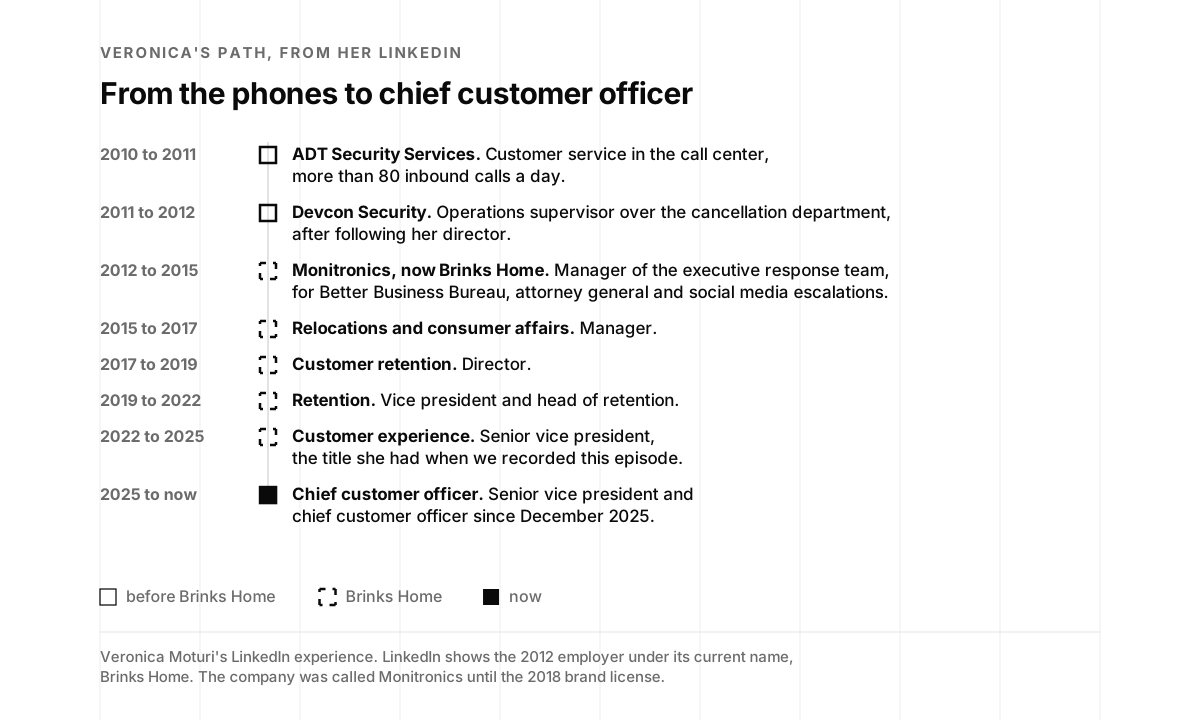
A timeline of eight roles. 2010 to 2011, ADT Security Services, customer service in the call center, more than 80 inbound calls a day. 2011 to 2012, Devcon Security, operations supervisor over the cancellation department, after following her director. 2012 to 2015, Monitronics, now Brinks Home, manager of the executive response team for Better Business Bureau, attorney general and social media escalations. 2015 to 2017, manager of relocations and consumer affairs. 2017 to 2019, director of customer retention. 2019 to 2022, vice president and head of retention. 2022 to 2025, senior vice president of customer experience, her title when we recorded this episode. Filled, 2025 to now, senior vice president and chief customer officer since December 2025.
Eight roles, and nearly all of them facing the customer. Source: Veronica's LinkedIn.

She describes the rest as compounding trust: “year after year, I’ve been given more and more responsibility, which has now propelled me to basically be over all of our customers, whether it’s technicians, frontline agents, our retention strategy, chat, you name it.” The complaints desk turns out to be a good place to learn a business. You see every way it fails a customer, in writing, with a regulator copied.

Which Brinks is Brinks Home?

One line from her story needs a footnote, because it confuses almost everyone, including the AI assistants people ask. Her mentor, she said, “worked at the original Brink’s for probably close to 15 years at that point.” There are two companies behind the name.

The original is The Brink’s Company, founded by Perry Brink in 1859 and best known for armored transport. It started selling home security alarm systems in 1982, spun the home business off in 2008, and that business renamed itself Broadview Security in 2009 and was sold to Tyco, then ADT’s owner, for $2 billion in 2010, adding Broadview’s 1.3 million customer accounts to ADT (Wikipedia).

Brinks Home is the other one. It’s Monitronics International, founded in Dallas in 1994 to monitor alarms for customers and dealers, bought by Ascent Media in December 2010, the buyer of the do-it-yourself company LiveWatch for $67 million in 2015, and since a 2018 trademark license with Brink’s, the company that sells security under the Brinks Home name (Wikipedia). So the short answer is that Brinks Home licenses the Brink’s name, and the company behind it is Monitronics, with its headquarters in Dallas.
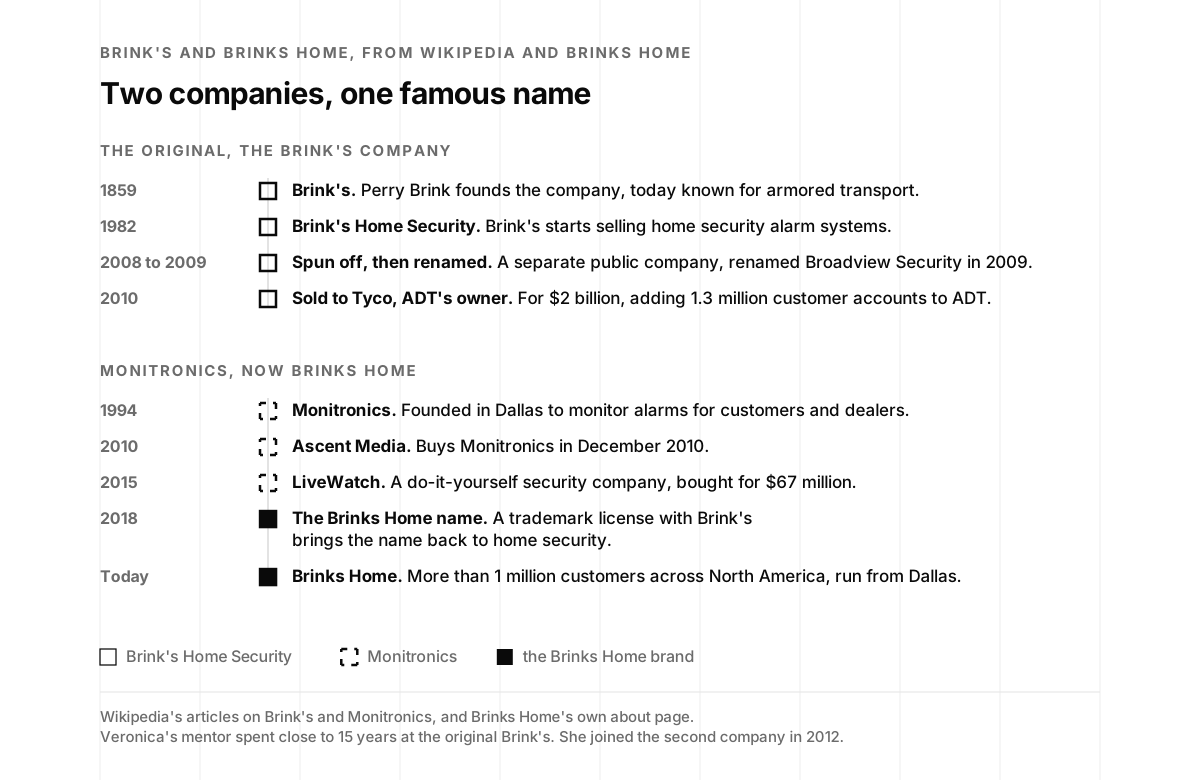
Two timelines. The original, The Brink's Company: 1859, Perry Brink founds the company, today known for armored transport. 1982, Brink's starts selling home security alarm systems. 2008 to 2009, the home security business is spun off as a separate public company and renamed Broadview Security. 2010, it is sold to Tyco, then the owner of ADT, for 2 billion dollars, adding 1.3 million customer accounts to ADT. Monitronics, now Brinks Home: 1994, founded in Dallas to monitor alarms for customers and dealers. 2010, Ascent Media buys it in December. 2015, it buys LiveWatch, a do-it-yourself security company, for 67 million dollars. Filled, 2018, a trademark license with Brink's brings the name back to home security. Filled, today, Brinks Home has more than 1 million customers across North America and is run from Dallas.
Two companies, one name. Sources: Wikipedia's articles on Brink's and Monitronics, and Brinks Home.

That history matters to the rest of the conversation in one specific way. The brand’s whole promise is a person who answers when something goes wrong, and most of what Veronica describes is how to keep that promise at a lower cost per call.

Customer experience starts with your employees

Sasha set up the central question of the episode: “And we know that trust is super important for a security company. Why is customer experience also very important for a security company?” Veronica’s answer, quoted at the top of this page, flips the usual org chart. The experience isn’t a department, it’s the sum of the people taking the calls.

“So when you think of trust and you think of customer experience, it all boils down to the frontline agent and the agents that are working at the company that really drive the best experience. People think it’s the opposite, right? Customer experience is the customers. You know, it’s a product of what the employees actually provide to the customers.”

Veronica Moturi, at 4:14

I heard it as a scaling argument. “It’s the extension, because that’s what it means to scale, really,” I said. You take the experience, the idea and what the brand represents, and you push it through every touch point between the company and its customers. The employees are the pipe it goes through.

She has kept saying it since. In an October 2026 profile, CX Current quoted her version: “Your customers are at the root of your foundation, but the employees come first” (CX Current). CMSWire’s July 2026 interview with her ran under the headline “The Chick-fil-A of Home Security” (CMSWire), and CX Current spells out the comparison she uses: Chick-fil-A and McDonald’s both sell chicken and fries, and the experience is what customers remember.

One first impression, and that’s it

Security raises the stakes on every one of those touch points, because most customers only call when something has gone wrong.

“Yeah, I mean, it’s definitely because we’re a security company, right? You have one first impression, and that’s it. And so each critical touch point that goes throughout that customer journey, our company has to be aligned on what’s most important, but then our actions also have to do that.”

Veronica Moturi, at 5:44

Then she gave us the order of operations she runs her organization by, and it’s the clearest statement of priorities I’ve heard from a customer experience leader.

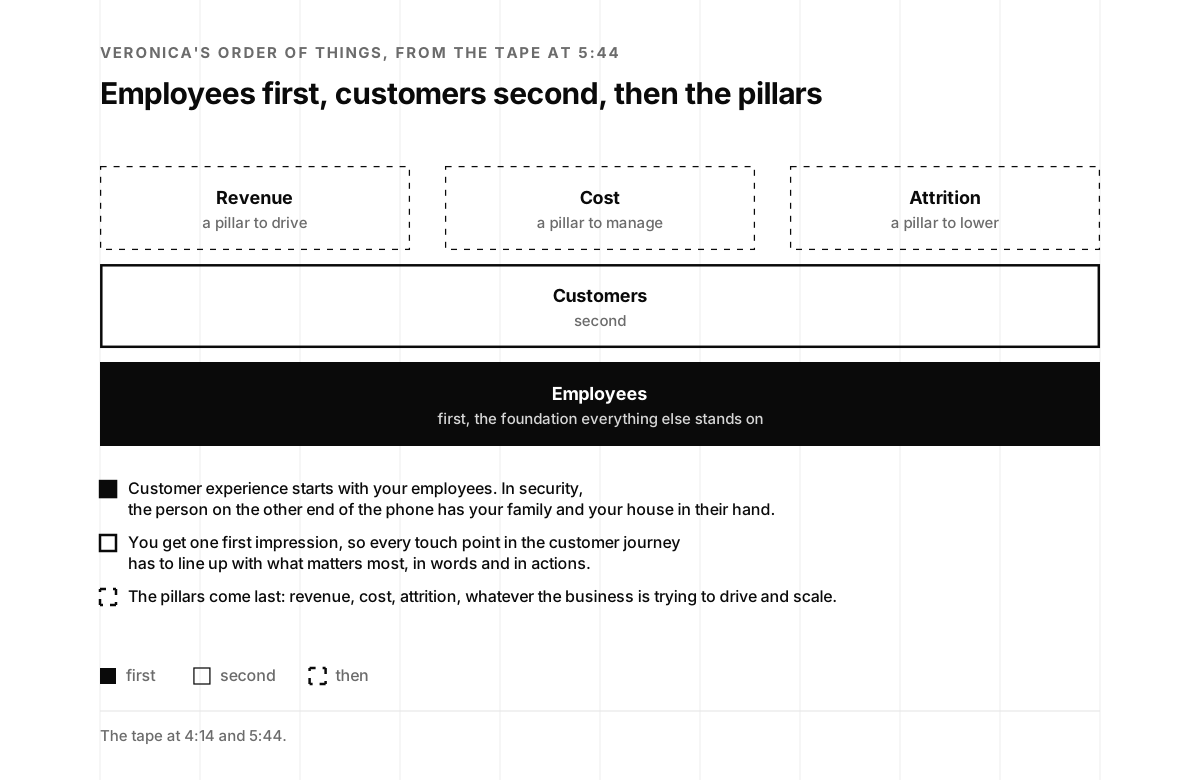
“So our foundation is very much set by, it’s employees first, then it’s customers, and then it’s your pillars of whatever you’re trying to drive and scale: revenue, cost, attrition, what have you. But your foundation is set first on your employees and your customers second.”

Veronica Moturi, at 5:44
Listen · Veronica on episode 79, from 6:17
About 16 seconds: employees first, customers second, then revenue, cost and attrition. Read the full transcript.
Three tiers. At the top, three dashed boxes, the pillars: revenue, cost and attrition. In the middle, outlined, customers, second. At the bottom, filled, employees, first, the foundation everything else stands on. Below: customer experience starts with your employees, because in security the person on the other end of the phone has your family and your house in their hand. You get one first impression, so every touch point in the customer journey has to line up with what matters most. The pillars come last, revenue, cost, attrition, whatever the business is trying to drive and scale.
The foundation, then the pillars. Source: the tape at 4:14 and 5:44.

“No, I love that,” I said, and I meant the security version of it too. In our world the employees are also the first line of defense. The agent who can tell a real customer from someone pretending to be one is doing security work, whatever their title says.

A better experience at a lower cost to serve

I asked her for a moment that surprised her, one where she wondered how they’d recover and came out proud of the team. She answered with the program she’s been running for four years.

“Yeah. So Brinks has been going through a transformation for four years now. And the transformation has been: how do we continue to evolve with technology, leveraging any kind, like AI, efficiency-gain technology, things to make people better, smarter, et cetera?”

Veronica Moturi, at 7:10

The goal has a name inside the company, and it’s the trade-off every support leader lives with, stated as a refusal to make it.

“And all of that focus has become the Brinks culture of what we’re, our North Star, is how do we increase our customer experience but lower our cost to serve. Everything’s unit economics, everything’s about doing the right thing. We can easily make customer experience great but blow out the budget. And vice versa, you can easily lower cost and make it really crappy customer experience. But we have been very deliberate as a leadership team to say that’s too easy.”

Veronica Moturi, at 7:10

Listen · Veronica on episode 79, from 7:30
About 39 seconds: the North Star, unit economics, and why either half alone is too easy. Read the full transcript.

“If we want to do it, we have to do it right. It’s by balancing both.” The newest piece of it, in the year before we talked, was AI, and it landed on her desk as a very concrete assignment: “how do I create a virtual assistant that is equivalent to the experience that my frontline agents are, to help improve our experience and lower our cost?” The technology turned out to be the easy part. The hard part was the people it was meant to help.

“Well, if you think about that, a frontline agent does not understand what that truly means outside of, oh, it’s going to take my job. And so that has been probably the biggest hurdle, is, I’ve got over 300 frontline agents, have 40-plus leaders that are managing people day in and day out.”

Veronica Moturi, at 7:10
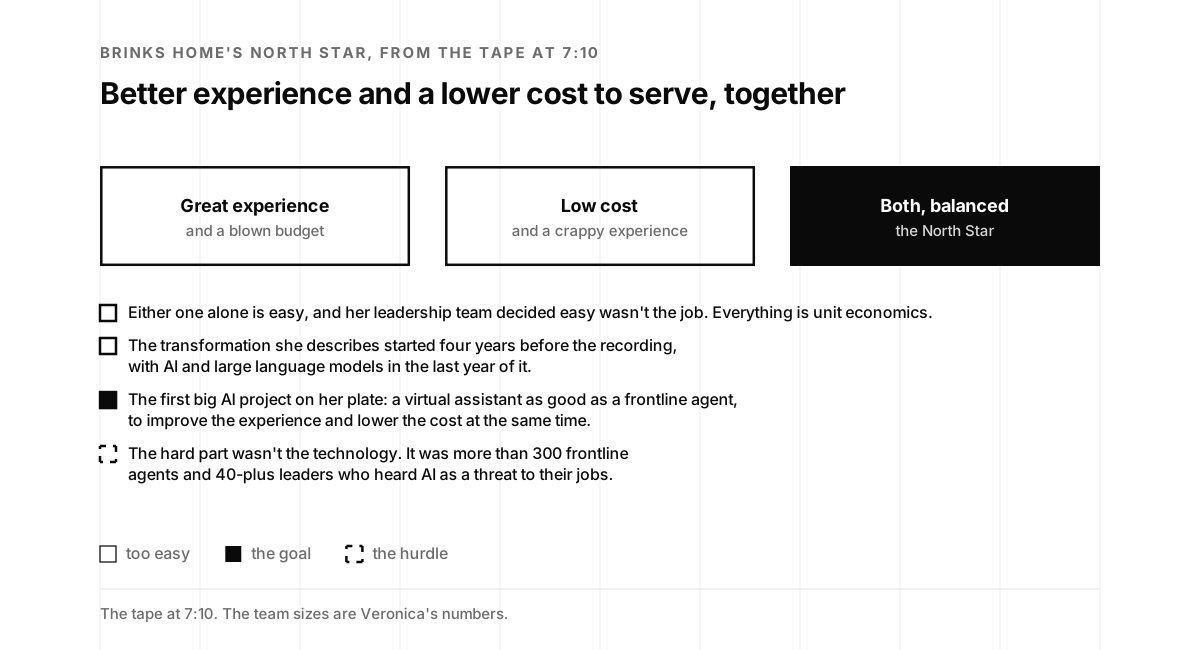
Three boxes. Outlined, great experience and a blown budget. Outlined, low cost and a crappy experience. Filled, both, balanced, the North Star. Below: either one alone is easy, and her leadership team decided easy wasn't the job, because everything is unit economics. The transformation started four years before the recording, with AI and large language models in its last year. The first big AI project was a virtual assistant as good as a frontline agent, to improve the experience and lower the cost at the same time. Dashed, the hard part was more than 300 frontline agents and 40-plus leaders who heard AI as a threat to their jobs.
Either half is easy. The North Star is both. Source: the tape at 7:10.

You’re either on board or you’re out

Sasha asked the question every leader in her position has to answer: “And how do you communicate that message?” Her answer was two words, and then a blunt explanation of why.

“Very transparently. You’re either on board or you’re out, right? You have got to figure out how to have AI become your best friend versus your enemy, because that’s where you become replaceable.”

Veronica Moturi, at 9:09

Listen · Veronica on episode 79, from 9:09
About 13 seconds: very transparently, and AI as your best friend instead of your enemy. Read the full transcript.

It sounds harsh in a pull quote and kind on the tape. Her point is that the threat isn’t the tool, it’s refusing it: “There’s people out there that are more than happy to embrace technology and do the job we’re doing today.” And she draws a clear line on what transparency means: “Doesn’t mean I tell all the details of what I get in the boardroom down to the frontline agents.” It means she’s “the voice for the overall umbrella,” and her leaders repeat the message.

Sasha put the payoff in one sentence: “And LLMs have this excellent talent of sifting through a big volume of data and figuring out what is actually important.” The public record shows how she ran the rollout. CX Current reports that Brinks Home’s launch of AI agent assist opened with a video from Veronica telling the floor plainly that the company was adopting it, and that she took the jobs question first instead of waiting for it. Her answer there: “But it hasn’t taken anyone’s job” (CX Current). Sasha wrote about the same choice, adopting AI without the drama, in The Art and Zen of Adopting AI.

I grew up in a Brinks home

This one is personal for me, and I told her so.

“I grew up in a Brinks home. So I’m very familiar with Brinks as the brand, and we had the little keypad on the door next to the garage. And it always felt very safe, and I always appreciated it.”

Jon McLachlan, at 10:25

A neighbor would come over, forget the system was armed and open the door, and the thing would go off. “And then you get the call. [It’s] always a human being. There was no such thing as like automated phone systems back then.” It was always a friendly conversation, someone making sure everything was okay. That memory is the bar for the AI, and it’s the reason I don’t think the technology takes the human out of it. I said it on the tape: “I don’t see this stuff taking anyone’s jobs. Like, it will make people faster.” Veronica corrected me, in the best way.

Not only faster, more accurate

“Not only faster, but it makes you more accurate, because then you can pull all that data together and make a distinct decision without trying to funnel through multiple screens to decipher what to do. So accuracy is probably the biggest benefit.”

Veronica Moturi, at 11:52

Listen · Veronica on episode 79, from 11:55
About 15 seconds: faster, then more accurate, without funneling through multiple screens. Read the full transcript.

Her explanation of why that matters to a security customer is the best plain-language case for AI in an alarm business I’ve heard. The point isn’t automation for its own sake. It’s “giving it to a human to make a more sound decision than reacting in the moment.” She used my front door as the example: “Well, what if I knew that you were home? Right? There’s cell phones, there’s cameras, there’s all this technology of verifying certain things before you actually act.” The act she means is the expensive one, “dispatching police or the like.” CMSWire reports that Brinks Home’s separate alarm response team handles roughly 180 alarm events a minute and dispatches police and medical help directly (CMSWire). At that volume, a better decision on each one is the whole game.

The multiple screens are a real number, too. She told CMSWire the team consolidated agent tools from 12 systems down to two, and CX Current reports that a new hire once trained on 14 applications before taking a call, work that now runs in one view of the customer relationship system (CMSWire, CX Current).

Sasha took the next step, to the data itself. Agents and AI working together means customers sharing “a lot of sensitive information with the company,” Sasha said, and in a home that can mean video, audio and “analytics about the behavior of people that are part of that safety net.” How do you keep earning trust with that? Her answer starts with consent, before any technology.

“I think first, you have to be very upfront and transparent on exactly what information you’re pulling in and using internally. That’s the customer’s proprietary information. Their consent, as we go deeper and deeper into data and technology, is number one.”

Veronica Moturi, at 13:33

Listen · Veronica on episode 79, from 13:32
About 19 seconds: transparency about what you pull in, and consent as number one. Read the full transcript.

Then the security team: “Foundationally, you’ve got to have a really good cyber team and an IT team to secure that data, right?” She named the failure she’s designing against, information leaving “from an ex-employee or something like that,” and the controls against it, “your controls and security and your redundancies for that data and access points.” And then a third step most security conversations skip, making the data usable. “The term analysis paralysis, right, could be very easy as you continue to get more and more data trying to find an answer.” Her fix is classification and indexing, so the data “becomes something that’s intentional, that can take action.” Sasha agreed and added the AI angle: “this is where LLMs and SLMs do give you a lot of benefit in connecting the dots.”

The company’s own engineering write-up shows the same instincts built into the agent. Philip Kolterman, Brinks Home’s chief information officer, wrote that “security is job one,” that cyber and data security were embedded in the AI agent from the start, that every API endpoint is rigorously managed, and that the agent’s experience is “both deeply informed and anonymous.” She “never has or retains actual identification of the customer,” he wrote, and Brinks Home works only with providers that have passed thorough inspections (Cresta).
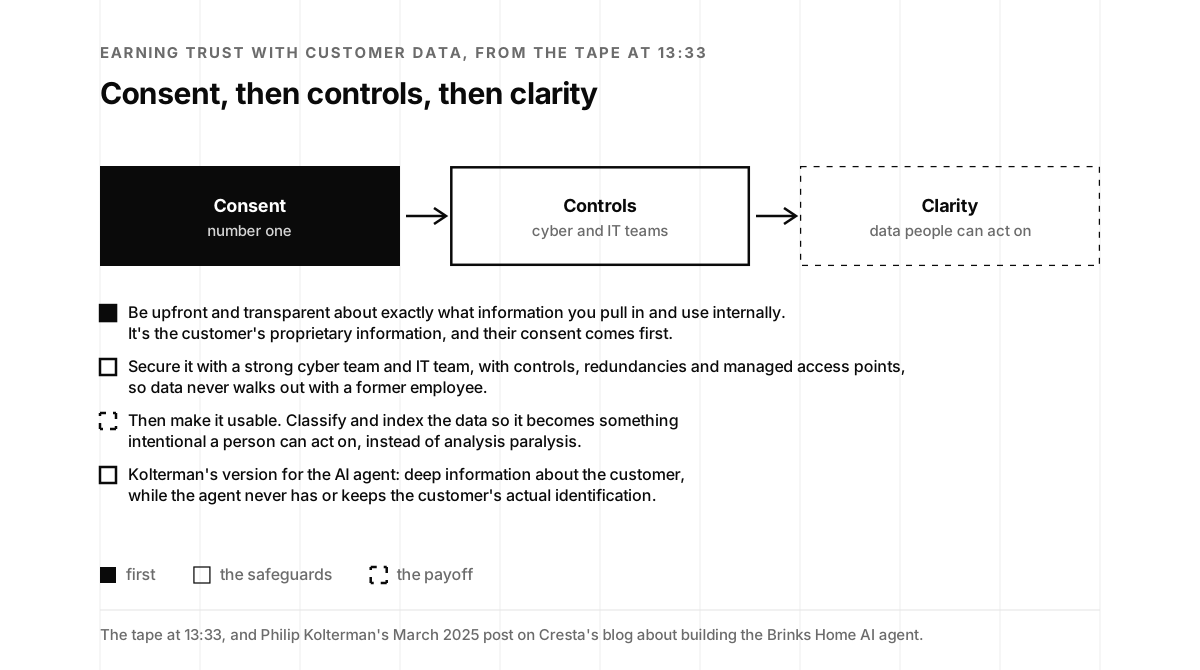
Three boxes joined by arrows. Filled, consent, number one. Outlined, controls, cyber and IT teams. Dashed, clarity, data people can act on. Below: be upfront and transparent about exactly what information you pull in and use internally, because it is the customer's proprietary information and their consent comes first. Secure it with a strong cyber team and IT team, with controls, redundancies and managed access points, so data never walks out with a former employee. Then make it usable, classifying and indexing the data so it becomes something intentional a person can act on, instead of analysis paralysis. Philip Kolterman's version for the AI agent: deep information about the customer, while the agent never has or keeps the customer's actual identification.
Consent first, then controls, then clarity. Sources: the tape at 13:33 and Philip Kolterman's post on Cresta's blog.

This is the part of an AI rollout we spend the most time on with clients, and her order is the right one. Write down what the agent sees and what it keeps before you argue about the model. Our AI data bill of materials is one way to do it, and call transcripts are exactly the kind of data our training data scrubbing work is built for.

Who had the insight

I wanted to know who inside Brinks first saw what AI could do for the customer experience. She gave the credit away three times.

“You know, our visionary, top visionary, I give big kudos to our CEO, William Niles. William Niles was our general counsel for, gosh, don’t quote me, but maybe 15 years before he became our CEO. He is big on technology. He embraces it.”

Veronica Moturi, at 15:34

Her 15 years holds up. Brinks Home’s bio for William Niles has him as executive vice president and general counsel of Ascent Media Group from January 2002 to the end of 2010, and in the same roles at Ascent Capital Group, Monitronics’ former parent, from September 2008 until he became Ascent’s chief executive in March 2018. He joined Brinks Home in September 2019 as a director and chief transformation officer before becoming chief executive (Brinks Home), and Wikipedia dates that to March 2020 (Wikipedia).

The second name was Philip Kolterman, “who is now our CIO,” hired “as our digital transformation leader.” She describes their partnership as a balance: “Sometimes he’s five years ahead of where I can even think of where to go,” and she grounds it in “what can we implement to start to see the needle move.” His bio says he joined in 2021 to digitalize the customer experience and credits his team with the security industry’s first voice digital agent, the launch of BHX and a cloud ERP system, which together grew self-service from 14 to 55 percent of transactions (Brinks Home). The third was her boss, Bob Reedy, the chief operating officer, “a great enabler,” who joined in February 2019 after operational transformation roles at CenturyLink and 19 years at Windstream (Brinks Home).

A partner called Cresta

“It sounds incredible,” I said, “and like there’s really strong alignment to move into the future and to do it together.” So did they build it in-house or buy it?

“We found an excellent partner that we started to work with a little over three years ago. Their name is Cresta, and they were big in agent assist through large language models. But we have continued to spin up new use cases, and time and time again, they prove out to work and become scalable.”

Veronica Moturi, at 17:07

Cresta’s own account puts the start in 2023, with agent assist guiding human agents through processes in real time (Cresta). The company was born at Stanford’s AI Lab in 2017, co-founded by Sebastian Thrun with Tim Shi and Zayd Enam, and its chief executive since 2023, Ping Wu, co-founded Google’s Contact Center AI (Cresta). That’s the background Veronica had in mind when she said “their leadership team came from Google.”

The first results are in Cresta’s customer story. Before Cresta, she told them, “We were very reactive. We were very old school,” with in-house agents and outsourced partners on different platforms. After the rollout, Cresta reports a 30-point increase in net promoter score, quality management costs cut in half, transfers down from 30 percent of calls to 8, and handle time down 8 percent, within six weeks of implementation. Her summary: “It’s night and day from where we were before” (Cresta).

Cresta's customer story from March 2024, 1 minute 45 seconds, on bringing agent assist and quality management to Brinks Home's contact centers, including the older phone systems. Watch on YouTube.

Kolterman’s post adds the part vendor case studies usually leave out. Before going back to Cresta for the voice agent, Brinks Home tried a proof of concept on off-the-shelf contact center software and its own in-house ChatGPT setup, and ran into voice lag, model drift and trouble keeping a consistent personality (Cresta). The partner came after the experiment, not instead of it.
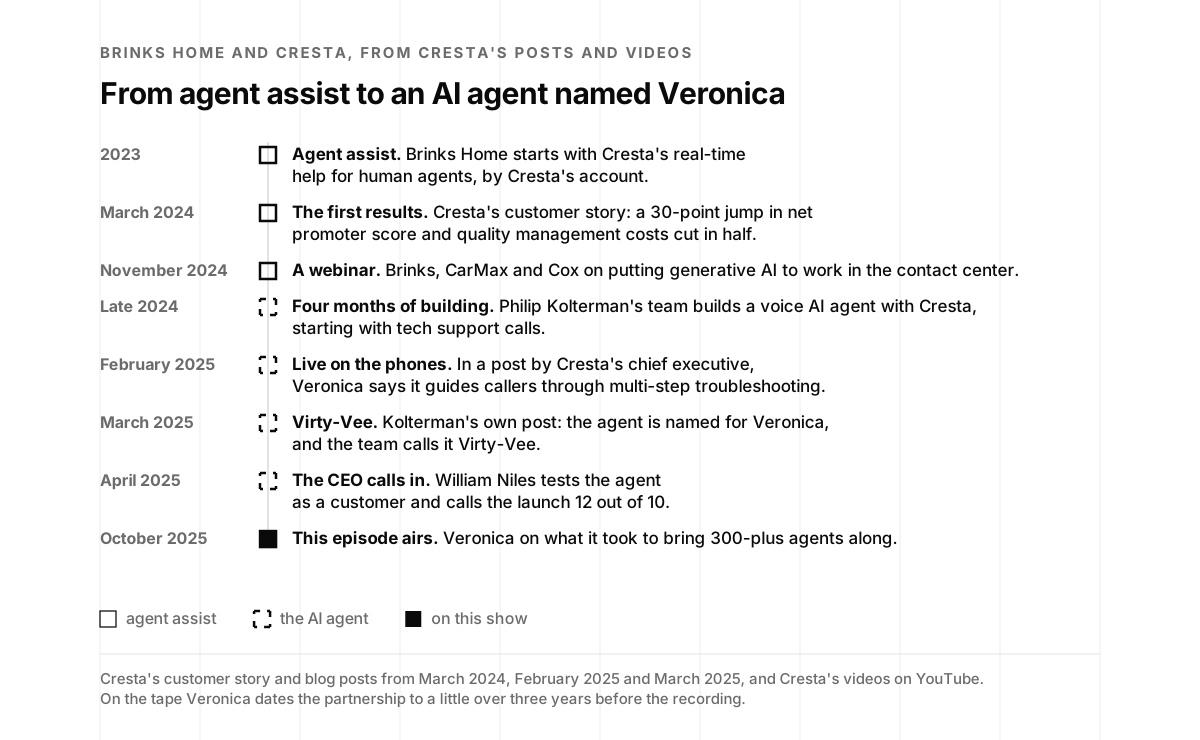
A timeline of eight entries. 2023, Brinks Home starts with Cresta's real-time help for human agents, by Cresta's account. March 2024, Cresta's customer story reports a 30-point jump in net promoter score and quality management costs cut in half. November 2024, a webinar with Brinks, CarMax and Cox on putting generative AI to work in the contact center. Dashed, late 2024, four months of building, Philip Kolterman's team builds a voice AI agent with Cresta, starting with tech support calls. Dashed, February 2025, live on the phones, and in a post by Cresta's chief executive, Veronica says it guides callers through multi-step troubleshooting. Dashed, March 2025, Kolterman's own post says the agent is named for Veronica, and the team calls it Virty-Vee. Dashed, April 2025, chief executive William Niles tests the agent as a customer and calls the launch 12 out of 10. Filled, October 2025, this episode airs.
From agent assist in 2023 to an AI agent on the phones. Sources: Cresta's posts and videos, and the tape.

We named her Veronica

The agent Cresta helped build sits in the phone system itself, the interactive voice response menu every caller hits first, “to answer every single phone call.” I asked who answers. Her reply got the biggest laugh of the episode.

“Yeah, so we named her Veronica.”

Veronica Moturi, at 17:51

“Veronica. Okay,” Sasha said. “Just a random name,” she said. “Phil did that. Phil went out and, I feel like he did it on purpose just to play with me.”

Listen · Veronica on episode 79, from 17:52
About 12 seconds: the AI agent's name, and who picked it. Read the full transcript.

It wasn’t random. Phil Kolterman’s own post says the team named the agent Veronica “in honor of Veronica Moturi,” that the shared name got confusing, and that the team took to calling the digital one Virty-Vee (Cresta). The human Veronica described what went into her namesake: “she feeds in a lot of our data of like processes and what we want to say, how we want to say it. You know, we worked on a personality, empathy, and active listening. Courtesy is very important in the security realm.”

In April 2025, Cresta published a video of William Niles putting the agent to the test by calling in as a customer. The description quotes his verdict on the launch, “12 out of 10,” and the video ends with a live demo with Veronica, the agent (YouTube). The player below opens at the demo.

Brinks Home's chief executive on the launch, from Cresta, April 2025, 4 minutes 54 seconds. It starts at 2:59, the live demo with Veronica. Watch on YouTube.

My sensor’s not working

Before the details, a detour. “I’m super curious, does Brinks have a presence in Europe by chance?” I asked. “No, we don’t.” I offered her an out, “Not yet, is what you mean, right?” and she gave the actual footprint: “We just got back into Canada, but that’s it.” Cresta’s customer story describes customers in the U.S. and Puerto Rico, and by October 2026 CX Current lists the U.S., Canada and Puerto Rico (Cresta, CX Current).

Then the question I really wanted answered. If I call the support line and get Veronica the agent, does she know what’s going on in my home? The answer is the clearest description of an AI first line I’ve heard from someone who runs one.

“Yeah, so like right now, one of the big use cases is troubleshooting. So you called from your phone number, we would know your caller ID, we would be able to connect it to your account. We do all of our verification to make sure it’s really you before we start to go into detail.”

Veronica Moturi, at 19:08

Then the agent does what a good human agent does, it looks before it asks.

“But she’s doing a really good job of identifying a trouble condition, knowing something’s low battery, not communicating, not recording, or the like. She pushes that information up in the conversation. So it’s like, my sensor’s not working. Oh, I see it’s a low battery. Let’s start the troubleshooting steps together.”

Veronica Moturi, at 19:08

Listen · Veronica on episode 79, from 19:25
About 19 seconds: the trouble condition, the low battery, and the steps together. Read the full transcript.

Starting with troubleshooting was a deliberate choice, and an unusual one. Kolterman wrote that self-service normally begins with simple care and billing, and that his team started with technical support anyway, because “knowledge-intensive scenarios are actually a natural place to start” for large language models (Cresta). The people get the rest. “The amazing team of 350 folks that you have underneath you get to deal with more interesting, like more intricate problems that require maybe a little bit more creativity, a little bit more human connection,” I said, and she agreed: “Yep. Exactly.”

Cresta’s chief executive, Ping Wu, wrote in February 2025 that Brinks Home’s agents liked losing the mundane parts of the job, like authentication and summarizing calls, and that the AI agent hands calls off with full contextual summaries. One of the first customers to use it said it was “the best virtual assistant I’ve ever experienced” (Cresta). In that post Veronica describes the agent guiding customers “through complex, multi-step troubleshooting scenarios.”
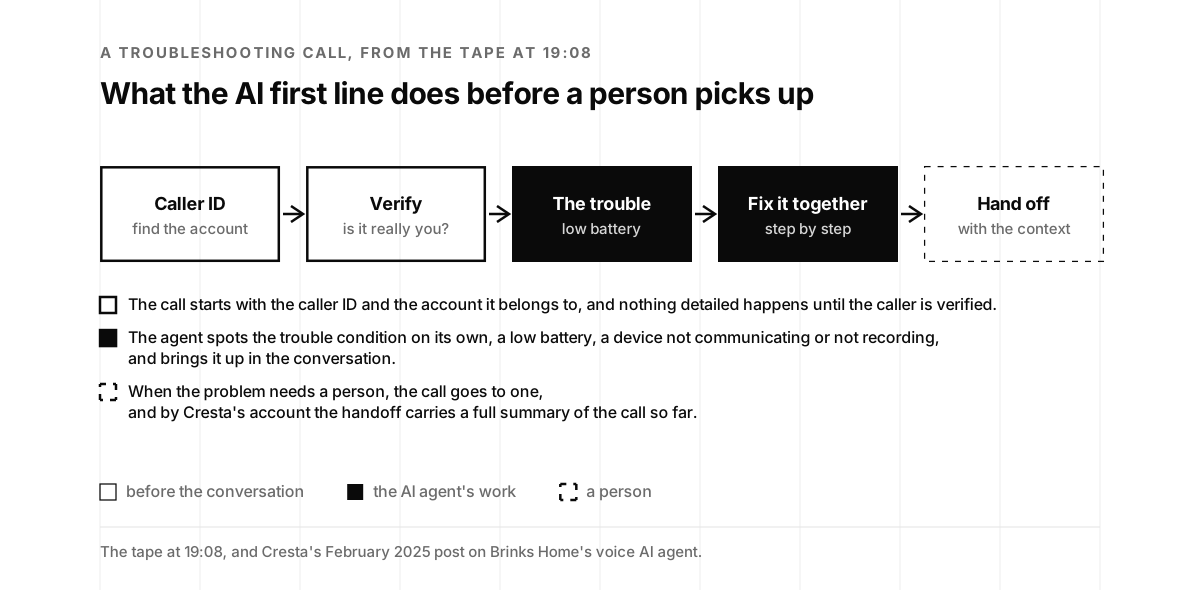
Five boxes joined by arrows. Caller ID, find the account. Verify, is it really you. Filled, the trouble, a low battery. Filled, fix it together, step by step. Dashed, hand off, with the context. Below: the call starts with the caller ID and the account it belongs to, and nothing detailed happens until the caller is verified. The agent spots the trouble condition on its own, a low battery, a device not communicating or not recording, and brings it up in the conversation. When the problem needs a person, the call goes to one, and by Cresta's account the handoff carries a full summary of the call so far.
Look first, then fix it together, then hand off with the context. Sources: the tape at 19:08 and Cresta's February 2025 post.

The security sentence in her answer is the one about verification, “to make sure it’s really you before we start to go into detail.” A voice agent is a front door, and voices can now be cloned. Vijay Balasubramaniyan of Pindrop spent episode 57 on what attackers do to contact centers, and our post on why deepfake attacks keep working makes the case for proving the caller instead of judging the voice. Matching the caller ID to the account and verifying before any detail is the right order.

Governed on our side

I asked the build-or-buy question more precisely: “did they build on behalf of Brinks, and so now Brinks owns and has the rights to the software? Or did you jump on a platform that maybe already existed and was meant for this customer experience?” Her answer is a good model for anyone writing their first AI vendor contract.

“It’s a bespoke relationship of what we’re building. It is on their platform. It is leveraging, everything’s kind of governed on our side, and then we connect to their platform to create that experience. But they are kind of the brains behind creating and leveraging large language models with a virtual agent.”

Veronica Moturi, at 20:30

“I’m just a people leader and an executor over here,” she said, and Sasha wasn’t having it: “You’re not just a people leader.”

Kolterman’s post is the engineering side of “governed on our side.” The agent rests on three assets his team built over years: a rebuilt knowledge base, high-quality data and a fully API-enabled CRM. Giving the agent hands in those systems takes work, because “it requires real IT work to bridge the gap with APIs,” and the goal is for the agent to perform every call center function in the CRM through those APIs. Voice adds its own constraint, since “every millisecond counts.” His team tests the agent with automated regression tests, powered by large language models, that simulate and score voice calls, and he warns that managing an AI agent “demands the same level of precision and continuous quality assurance” as managing a person (Cresta).

That’s the shape we’d recommend, and the order matters. Knowledge first, then reading customer data, then one write action at a time, each through an API you can scope and log. We wrote the rungs out in Are You Actually Going to Give the Agent Write Access? and the reasoning behind them in why agents need least privilege more than humans ever did.

Three Cresta customers, Brinks, CarMax and Cox Communications, on evaluating and rolling out generative AI in the contact center. A Cresta webinar from November 2024, 36 minutes 49 seconds. Watch on YouTube.

They want to see their dogs eating

Sasha asked about the long view: “What do you think will be the greatest challenge in the security space over the next five years?” “It’s a good one,” she said, and then she made the case against her own industry’s oldest product. What most of us grew up with “is the traditional: I have a sensor on something that’s opening and closing, I have a panel that tells me that it’s not working.” She’s watching the people coming next instead: “I am a huge advocate of following the generations that are coming into the marketplace.”

“I fundamentally feel that sensors, panels, those type of hardware type of things are not going to be the default of choice. It’s going to be home automation. It’s going to be the instant gratification of seeing things in your home.”

Veronica Moturi, at 21:15

She called them “the thumbers,” the people who “just constantly look at the shorts, what’s at their fingertips of knowledge today,” and she’s clear about what they’ll pay for.

“They don’t care about a sensor or a motion. They want to see their dogs eating. They want to see that their best friend’s at the front door. They want to see that their boyfriend opened the door, whatever. They want that connection of knowing who and what is happening now.”

Veronica Moturi, at 21:15

Listen · Veronica on episode 79, from 22:48
About 20 seconds: the dogs, the best friend at the front door, and knowing who and what is happening now. Read the full transcript.

So the hurdle, in her words, is whether “the security industry start to taper off of more of the traditional type of setup and evolve into more of what the newer generation is looking for.” Brinks Home’s own marketing a year later reads like her answer. In August 2026 its National Dog Day post led with the camera, not the sensor.

The dogs she mentioned, as the headline use case for an indoor camera. View on X.

The panel isn’t gone, though. It’s becoming the hub. A month earlier the company introduced a new one, sold on speed and features rather than on the sensor it listens to.

The panel as the hub of a connected home, July 2026. View on X.

Veronica summed the episode up herself a week after it aired, resharing our clip on this exact point.

Home security isn’t just about technology—it’s about people. I enjoyed joining this conversation to share how Brinks Home is evolving beyond hardware to deliver connected experiences that keep customers close to what matters most. The future of home security is personal, connected, and built on trust.

Veronica Moturi · October 17, 2025
Her own one-line version of the episode, on top of our clip about moving from old hardware to connected experiences. View on LinkedIn.
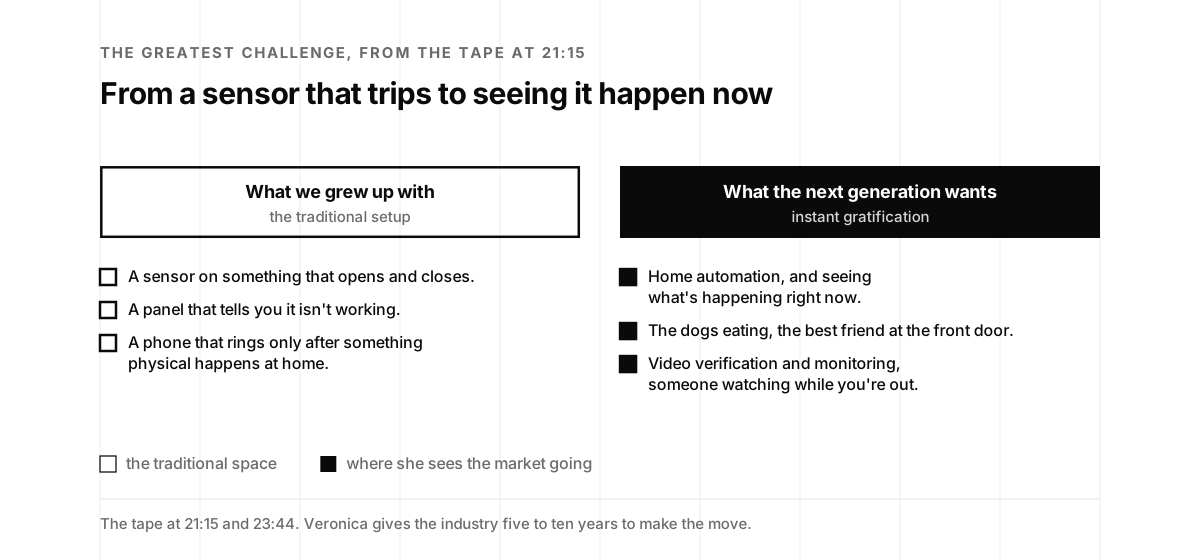
Two columns. Outlined, what we grew up with, the traditional setup: a sensor on something that opens and closes, a panel that tells you it isn't working, and a phone that rings only after something physical happens at home. Filled, what the next generation wants, instant gratification: home automation and seeing what's happening right now, the dogs eating and the best friend at the front door, and video verification and monitoring, with someone watching while you're out.
What the next generation wants from a security company. Source: the tape at 21:15 and 23:44.

Painkiller or vitamin

Sasha connected it to the oldest problem in our industry: “security has been seen as an overhead by many companies, by many people.” The question is where the value shows up. Hers is video: “the value add to me goes deeper into cameras and camera monitoring,” and “the future could be more of video verification and video monitoring.” Today, she said, she’s “reliant on something happening physically in my home to get my phone to ring.” She’d rather pay someone to watch, and she made the case with the most relatable line of the episode.

“Time and time again, people that understand that security is important, they’ll pay for it. It’s top of the line, just like mine’s pest control. I don’t ever want to see a freaking roach in my house, right? So I pay for that. That’s on top of my list.”

Veronica Moturi, at 23:44

Listen · Veronica on episode 79, from 24:39
About 25 seconds: pest control, the bottom of the budget list, and the value nobody sees. Read the full transcript.

The risk is the customer trimming the budget who asks, “what am I actually paying for? Because nothing has happened to get me to understand the value add.” Her fix is to make the value visible: “And I think you could flip that with that video.” Sasha named the test every product has to pass.

“And to narrow it down, there’s a question of whether it’s a painkiller or a vitamin. The product that you have, does it solve a pain point? Or is it just one of those good to have?”

Sasha Sinkevich, at 25:06

Every security program has the same problem, and it’s a happy one: when it works, nothing happens. The fix is the one she described, show the work. For a home, that’s the camera. For a company, it’s the evidence you put in front of the board, which is what the security slide your board deck is missing is about. Brinks Home has been selling the visible version for a while, too.

Brinks Home's 50-second explainer from November 2018 on video monitoring, seeing what's happening at home when you can't be there. Watch on YouTube.

Her proudest moment

I asked for her proudest day professionally. She didn’t pick a promotion of her own.

“So I have a leader that has been with me under my umbrella for almost 13 years, for about 12 of the 13 years. And she’s the longest one that has been under my leadership. And I recently just promoted her to vice president. And she started as an agent.”

Veronica Moturi, at 25:30

Listen · Veronica on episode 79, from 25:31
About 18 seconds: 12 years together, and a vice president who started as an agent. Read the full transcript.

She did it again for a second leader, who’d been with her about four years and was promoted at the same time. “So just being able to give back what someone gave to me, I think, is my proudest moment.” It’s the director at her desk all over again, handed forward. “Like, your proudest moment is your ability to share those incredible moments with people who really stepped up to the plate and demonstrated their leadership,” I said. The agent-to-leader path is also a retention strategy, and the numbers say it works. She told CMSWire that career pathing, where every agent starts at the same level and can choose a track toward higher pay and more skills, is a big part of why annual turnover fell from 150 percent to 22 (CMSWire).

Leading leaders who are already there

The challenge she picked was a quieter one. Before she reported to the chief operating officer, she ran “the retention departments, which was about 100 employees,” and the complaints team she’d had since the start, and they had all grown up together. Now she was inheriting experienced leaders: “two new departments under my org two weeks ago, and one’s a VP and others are senior directors.”

“So that’s probably been the biggest hurdle of like, am I doing what I’m supposed to do as a senior leader to support somebody that’s already senior in their role?”

Veronica Moturi, at 27:05

“Their amount of experience in their role is sometimes equivalent to how old I am,” she said. The job changes from teaching tricks of the trade to finding where you add value: “being able to connect with them on a level to plug in certain expertise that I could provide, without looking at it as a net new employee that I need to grow and develop up to this certain level.” My answer was that asking the question is most of it: “even just considering them, you know, with those questions in mind, I think is the perfect start, right?”

Chess, not checkers

Then I asked her to meet her younger self, “an opportunity to meet little Veronica,” and offer some advice. The advice was about timing. “So earlier on, I had zero filter.” It built a reputation she’s kept, “Veronica tells it like it is type of thing,” but she’s learned that “there’s a time and a place, and there’s also kind of your political capital. You don’t have to fight every single battle.”

“What I use now is, it’s chess, not checkers. So we’re in the chess game, we’re not in the checkerboard game.”

Veronica Moturi, at 29:35

Listen · Veronica on episode 79, from 30:12
About 15 seconds: political capital, and chess instead of checkers. Read the full transcript.

The context makes it land. “I was low twenties as a manager, working with people that were 50, 60 years old, and that was their career,” she said, and you can imagine what they thought of “the little whippersnapper that was coming in, thinking that she could change the world overnight.” Sasha pushed back on regret itself.

“Often, if you don’t make mistakes, it means you haven’t done enough.”

Sasha Sinkevich, at 31:15

She agreed, “That is true,” and turned it over: “And if I’m happy where I am now, could I have altered something? Probably. But maybe that would have made me too passive, right?” I admitted the trap in my own question. “That’s why it’s a two-stage question.” The answer to whether you could improve is always yes, but going back means changing who you are. “But I like who I am today.”

Robots, quantum and the camera doorbell

I asked her to look as far ahead as she liked. She started with the companies that changed her market.

“I think the question that always comes to mind, I mean, when SimpliSafe and Ring entered into the marketplace, they really changed the game, offering a DIY solution, self-monitored, offering, you know, what became very much standardized as the camera doorbell and creating that community.”

Veronica Moturi, at 32:55

SimpliSafe was founded in Boston in 2006 by Chad and Eleanor Laurans, and Ring started in 2013 as Doorbot, founded by Jamie Siminoff, with Amazon as its parent since 2018 (Wikipedia, Wikipedia). From there she went big: “things like enabling with quantum,” and “we could have little robots running around becoming our security providers.” Her bet is that “transportation will be the biggest thing that takes off first. But with transportation, I think what’s in your home comes next.” Any of it “could either transform this market, it could kill this market, or it could just be another service that’s provided in the traditional space,” and she compared it to phones: at first everybody who could afford one had one, then “if you didn’t have one, it’s like, are you just off the grid?”

I answered with the adoption curve, and with the book every founder knows. “Like you cross the chasm, and all of the entrepreneurs out there are familiar with that Crossing the Chasm book.” Geoffrey A. Moore published Crossing the Chasm in 1991 (Wikipedia). My take, from the tape, was that the camera doorbell and the monitored system answer different questions. A video tells you what happened, and I said bluntly of a doorbell on its own, “It’s not going to call the police.” Her point was the other half, and I think she’s right about it: the people buying now want the video too. The companies that pair a person who responds with the live view will own the next decade. “So it’ll be interesting over the next five to ten years what happens,” she said.

An intrapreneur inside a big company

“And I think, like, even the big, traditional, well-established companies will have a very important role to play in all of that going forward,” I said. Sasha took it to the people who make that happen.

“Agreed. And it’s important to have people like yourself who drive the innovation and make sure that the company adapts to the changes that will continue to happen.”

Sasha Sinkevich, at 36:45

“That can be sometimes the most challenging place for that to happen,” Sasha added, “inside of a big company where you have rules and you have established like guidelines and you have culture and you have precedents.” So I gave her the label I think fits. “And so, props to you for being an intrapreneur, of pushing out something new inside of a big organization like Brinks.” “Thank you,” she said.

What happened after the tape

The year after the episode reads like a confirmation of everything she told us. In December 2025 she became chief customer officer.

I’m happy to share that I’m starting a new position as Chief Customer Officer at Brinks Home! ✨ Feeling Grateful and Thankful ✨ As I step into new responsibilities and challenges at Brinks Home, I’m taking a moment to reflect on the journey that brought me here — and the people who made it possible.

Veronica Moturi · December 2, 2025
The new title, and a thank-you to the leaders who placed their trust in her. View on LinkedIn.

In February 2026, USA TODAY named Brinks Home to its America’s Best Customer Service list for the second year in a row, after the 2025 list in the consumer services industry (LinkedIn). Her post gave the credit to her leaders and frontline teams, and named the tools.

I'm proud to see Brinks Home recognized as America’s Best Customer Service 2026 by USA TODAY Co., Inc. for the second year in a row. This recognition belongs to our customer experience organization, the leaders -Elizabeth, Dustin, Latoya, Jonathan, Josh, Rick & Allen and frontline teams who have transformed how we serve. From implementing tools like Cresta & VOZIQ AI to improving response times and simplifying support, their work is reshaping the customer journey. Great service is built through every interaction, and this recognition reflects the trust that customers place in our teams every day.

Veronica Moturi · February 17, 2026
The award, credited to the people first and the tools second, in that order. View on LinkedIn.

In July 2026 she sat down with CMSWire’s Beyond the Call, and the interview is the best public scorecard of the program she described to us (CMSWire). As she described the figures there, a virtual agent now answers every incoming call, and an automated quality tool reviews every call agents handle, rather than the small sample supervisors could check by hand. Average handle time isn’t one of her frontline measures, first call resolution is. Net promoter score went from negative to 55, and her goal is 90: “I want to compete with Apple and Tesla.” A universal agent model cut transfers to below 10 percent, self-service pushed billing from the second most common reason to call to the sixth, and the team works remotely around Dallas-Fort Worth. “We didn’t see any of our KPIs go backwards,” she said. CMSWire also reports that her agents use AI-assisted tools including Claude, ChatGPT and Copilot, and that the team has run predictive churn models for six years.
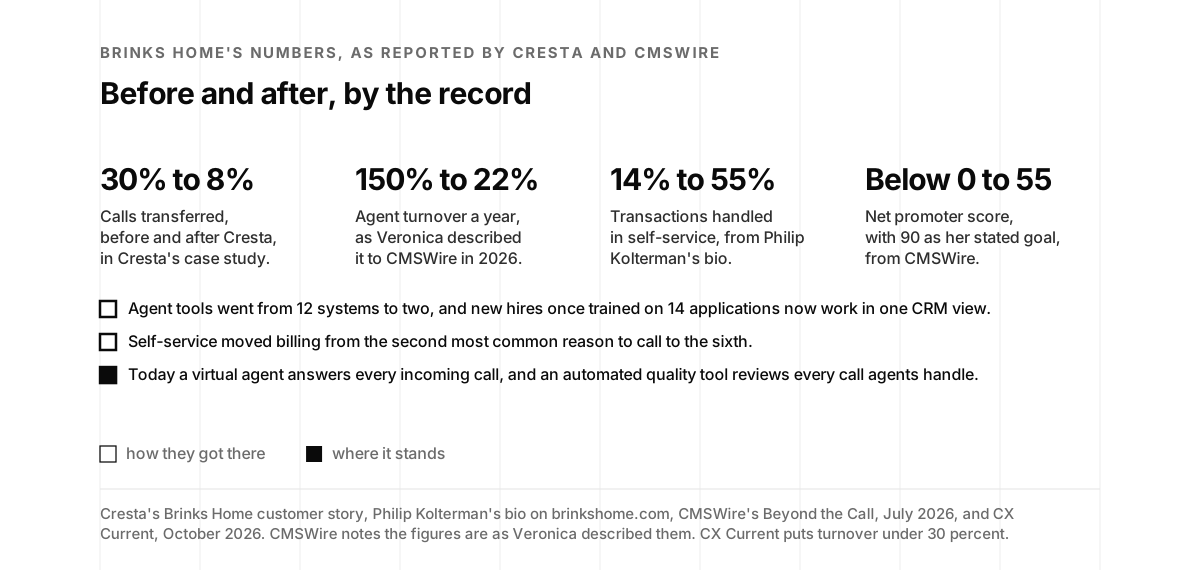
Four statistics. Calls transferred went from 30 percent to 8 percent before and after Cresta, in Cresta's case study. Agent turnover a year went from 150 percent to 22 percent, as Veronica described it to CMSWire in 2026. Transactions handled in self-service went from 14 percent to 55 percent, from Philip Kolterman's bio. Net promoter score went from below zero to 55, with 90 as her stated goal. Below: agent tools went from 12 systems to two, and new hires once trained on 14 applications now work in one view of the customer relationship system. Self-service moved billing from the second most common reason to call to the sixth. Filled, today a virtual agent answers every incoming call, and an automated quality tool reviews every call agents handle.
The program, by the numbers she and Cresta have published. Sources: Cresta, Brinks Home, CMSWire and CX Current.

In October 2026, CX Current, Cresta’s publication, named her one of its Top 50 Leaders Transforming CX, in the category it calls The Trust Builders, and followed with a profile titled “Employees First” (CX Current).

I'm honored to be named one of CX Currents Top 50 Leaders Transforming CX! Our Brinks Home Customer Care team makes this work possible every day, and I'm proud to celebrate it with them. Thank you to Cresta, and congratulations to my fellow honorees.

Veronica Moturi · October 12, 2026
The honor, credited to the team again. Brinks Home's post underneath says her goal is to compete on service with the best brands in any industry. View on LinkedIn.
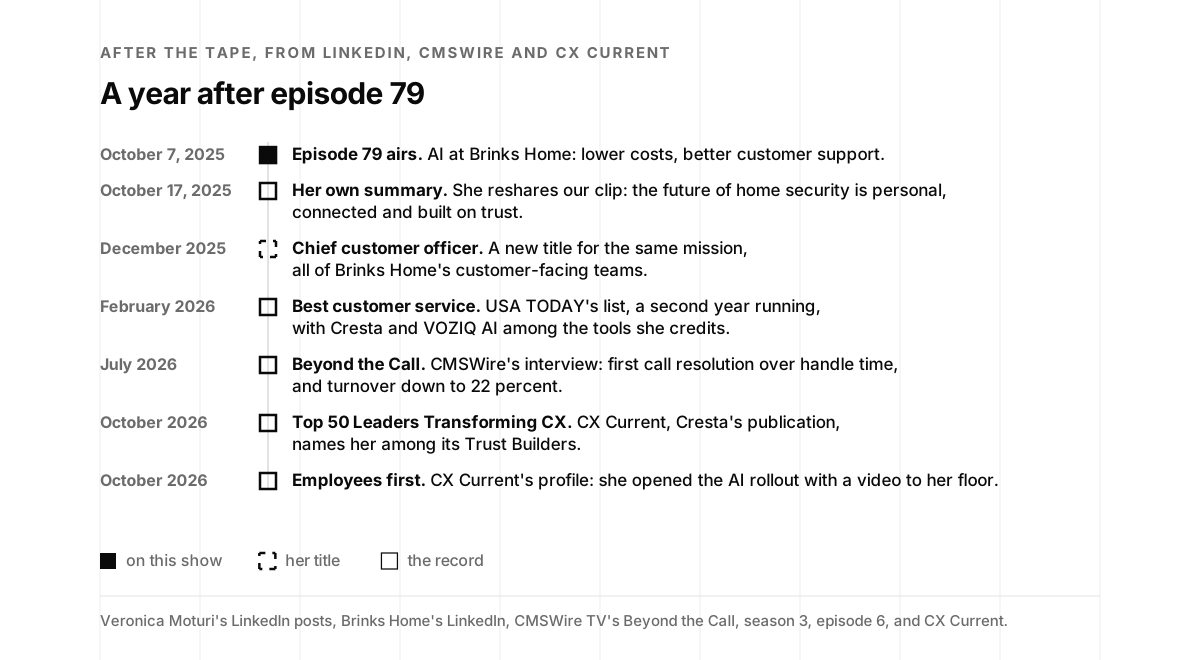
A timeline of seven entries. Filled, October 7, 2025, episode 79 airs. October 17, 2025, she reshares our clip, writing that the future of home security is personal, connected and built on trust. Dashed, December 2025, she becomes chief customer officer, over all of Brinks Home's customer-facing teams. February 2026, USA TODAY's list of America's best customer service names Brinks Home a second year running, and she credits tools including Cresta and VOZIQ AI. July 2026, CMSWire's Beyond the Call interview, on first call resolution over handle time and turnover down to 22 percent. October 2026, CX Current, Cresta's publication, names her one of its Top 50 Leaders Transforming CX, among its Trust Builders. October 2026, CX Current's profile, which says she opened the AI rollout with a video to her floor.
A year after episode 79. Sources: Veronica's LinkedIn, Brinks Home, CMSWire and CX Current.

The phrase I keep from this episode is her first one. Customer experience starts with your employees, and so does the AI. Brinks Home gave the agent a name, a personality and a narrow first job, told the people it was meant to help exactly what it was for, and kept the hard calls for humans. The agent is named for the leader who started on the phones, and that may be the most honest description of the program there is.

Did you catch it? A six-question quiz

Interactive · six questions

Did you catch it?

Six questions on what Veronica, Sasha and I actually said, with the timestamp for each answer. The answers are under each question for anyone reading without JavaScript.

  1. Where does Veronica say customer experience starts?

    1. With the product
    2. With your employees
    3. With the marketing

    b. "customer experience starts with your employees." Transcript, 4:14.

  2. What is Brinks Home's North Star, in her words?

    1. Lower the cost to serve, whatever it takes
    2. Make the experience great, whatever it costs
    3. Increase the customer experience and lower the cost to serve

    c. "how do we increase our customer experience but lower our cost to serve." Transcript, 7:10.

  3. How did she communicate the AI change to her frontline agents?

    1. Very transparently
    2. Quietly, through a small pilot
    3. Through the vendor

    a. "Very transparently. You're either on board or you're out, right?" Transcript, 9:09.

  4. What name did Brinks Home give its AI agent?

    1. Ally
    2. Veronica
    3. Phil

    b. "Yeah, so we named her Veronica." Transcript, 17:51.

  5. What does the AI agent check before it goes into detail on a call?

    1. That it's really you
    2. Your payment history
    3. Whether a human agent is free

    a. "We do all of our verification to make sure it's really you before we start to go into detail." Transcript, 19:08.

  6. What does Veronica compare paying for security to?

    1. Car insurance
    2. A gym membership
    3. Pest control

    c. "It's top of the line, just like mine's pest control." Transcript, 23:44.

Is your support line ready for an AI first line?

Veronica’s answers make a good checklist for anyone putting an AI agent on the phones. This scorecard asks eight questions about yours, from how it verifies a caller to who owns its quality after launch.

Scorecard · eight questions

Is your support line ready for an AI first line?

Answer for the AI agent you run or plan to run on phone, chat or both. If two answers fit, pick the lower one.

  1. Before the agent goes into detail on a call, how does it know who it's talking to?

    • It doesn't check, it helps whoever calls
    • The same knowledge questions on every call
    • Caller ID matched to the account, plus a stronger check before anything sensitive

    "We do all of our verification to make sure it's really you before we start to go into detail." See My sensor's not working.

  2. What can the agent change in your systems?

    • Whatever its service account can reach
    • It reads data, plus a few write actions nobody has reviewed
    • Named APIs only, reading first, with each write action scoped and logged

    Brinks Home's agent reaches its systems through APIs, built one integration at a time. See Governed on our side.

  3. What does the agent keep about the people who call?

    • Full recordings and transcripts, with no end date
    • Recordings, under a retention policy
    • Only what the task needs, with identifiers kept out of what it remembers

    Kolterman's design goal: an agent that knows a lot about the customer and never has or keeps their actual identification.

  4. Do your customers know what data you use, and have they agreed to it?

    • It's somewhere in the terms
    • A privacy notice covers it
    • Plain-language consent before any deeper use of their data

    "Their consent, as we go deeper and deeper into data and technology, is number one." See Consent is number one.

  5. How do you test the agent before each release?

    • A few people call it and see how it sounds
    • A test script, run by hand
    • Automated tests that simulate real calls, plus someone trying to talk it into things

    Brinks Home runs automated regression tests that simulate and score voice calls.

  6. When the agent can't solve the problem, what does the person who picks up get?

    • A cold transfer, and the caller starts over
    • The account, already pulled up
    • A warm handoff with a summary of the call so far

    Cresta's account of the rollout: the AI agent hands calls off with full contextual summaries.

  7. How did your frontline team hear about the AI agent?

    • When it went live
    • From their managers, after the decision
    • From the top, first, with the jobs question answered plainly

    "Very transparently." See You're either on board or you're out.

  8. Who owns the agent's quality after launch?

    • Nobody in particular
    • The vendor
    • A named owner who reviews it the way you'd review a human agent

    Managing an AI agent takes the same precision and quality assurance as managing a person, in Kolterman's experience.

Start with the front door

The agent is ready to talk before it's ready to know who it's talking to. Start there: verify every caller before any detail, list what the agent can reach, and tell your frontline team what it will and won't do before it goes live.

A good first line, getting better

The basics are in place, and the next wins are around the agent: write down what it keeps, scope each write action to a named API, test every release with simulated calls, and give the handoff a summary so the person who picks up starts ahead.

Ready to answer every call

Your agent verifies, stays inside its lane and hands off well. Now spend the time on what Veronica measures: first call resolution, and the harder calls your people get back. Then have someone outside your team try to talk the agent into things.

What does an AI first line give back?

Veronica’s measure of success is the calls her people get to spend on the harder problems. This calculator estimates the hours an AI first line hands back, with your own numbers.

Calculator

What does an AI first line give back?

Your monthly call volume, the share the AI agent resolves end to end, how long a person spends on one of those calls, what an agent hour costs and how many agents you have.

–calls a month the AI first line resolves
–agent hours back a month
–a year, at your hourly cost
–full-time agents' worth of time

With 20% of calls resolved end to end by the AI first line, at 8 minutes each, your team gets back 1,333 hours a month, about $480,000 a year at $30 an hour. That's 8 full-time agents' worth of time for the calls that need a person, out of a team of 300.

Every default is a placeholder, not a Brinks Home number, except the 300, which is Veronica's count of her frontline agents. A month here is 160 working hours. The estimate counts only the calls the AI resolves without a person, not the time saved when it hands off with a summary, and her own scorecard puts first call resolution ahead of handle time.

From Brink’s Home Security to Virty-Vee

Everything on this page sits on one timeline, from the original Brink’s alarm business to an AI agent that answers the phone. Filter it by thread.

Timeline · 1859 to 2026

From Brink's Home Security to Virty-Vee

Filter by thread. Dates are from the public record except where marked as Veronica's own account on the tape.

  1. Brink's

    Perry Brink founds the company behind the name (Wikipedia).

  2. Brink's Home Security

    Brink's starts selling home security alarm systems (Wikipedia).

  3. Crossing the Chasm

    Geoffrey A. Moore's book on the adoption curve (Wikipedia).

  4. Monitronics

    Founded in Dallas to monitor alarms for customers and dealers (Wikipedia).

  5. Net promoter score

    Popularized in Fred Reichheld's Harvard Business Review article (Wikipedia).

  6. SimpliSafe

    Founded in Boston by Chad and Eleanor Laurans (Wikipedia).

  7. Broadview Security

    The spun-off Brink's Home Security takes a new name (Wikipedia).

  8. ADT Security Services

    Customer service in the call center, more than 80 inbound calls a day (LinkedIn).

  9. Broadview joins ADT

    Sold to Tyco, then ADT's owner, for $2 billion (Wikipedia).

  10. Ascent Media

    Buys Monitronics (Wikipedia).

  11. Devcon Security

    Operations supervisor over the cancellation department (LinkedIn).

  12. The complaints desk

    Manager of the executive response team, and a Better Business Bureau rating to fix (LinkedIn).

  13. Ring

    Founded as Doorbot by Jamie Siminoff (Wikipedia).

  14. LiveWatch

    A do-it-yourself security company, bought for $67 million (Wikipedia).

  15. Cresta

    Born at Stanford's AI Lab (Cresta).

  16. Customer retention

    Director (LinkedIn).

  17. The Brinks Home name

    A trademark license with Brink's brings the name back to home security (Wikipedia).

  18. Amazon and Ring

    Amazon becomes Ring's parent (Wikipedia).

  19. Bob Reedy

    Joins as executive vice president and chief operating officer (Brinks Home).

  20. Head of retention

    Vice president (LinkedIn).

  21. William Niles

    Joins as a director and chief transformation officer, then becomes chief executive (Brinks Home).

  22. Philip Kolterman

    Joins to digitalize the customer experience (Brinks Home).

  23. Customer experience

    Senior vice president (LinkedIn).

  24. Agent assist

    Brinks Home starts with Cresta, by Cresta's account (Cresta).

  25. The first results

    Transfers from 30 percent of calls to 8, in Cresta's customer story (Cresta).

  26. A webinar

    Brinks, CarMax and Cox on generative AI in the contact center (YouTube).

  27. A voice AI agent

    Live on the phones, guiding callers through troubleshooting (Cresta).

  28. Top 50 Women Leaders of Dallas

    Named by Women We Admire (LinkedIn).

  29. Virty-Vee

    Kolterman's post: the agent is named for Veronica (Cresta).

  30. America's Best Customer Service

    USA TODAY's 2025 list, in consumer services (LinkedIn).

  31. The CEO calls in

    William Niles tests the agent as a customer (YouTube).

  32. We record episode 79

    "customer experience starts with your employees."

  33. Episode 79 airs

    This conversation.

  34. Her own summary

    The future of home security is personal, connected and built on trust (LinkedIn).

  35. Chief customer officer

    A new title (LinkedIn).

  36. A second year running

    America's Best Customer Service, with Cresta and VOZIQ AI among the tools she credits (LinkedIn).

  37. A new IQ Panel

    The hub of the system (X).

  38. Beyond the Call

    Turnover from 150 percent to 22, and a virtual agent on every call (CMSWire).

  39. National Dog Day

    The indoor camera, sold on checking in on the dog (X).

  40. Top 50 Leaders Transforming CX

    Named by CX Current among its Trust Builders (LinkedIn).

  41. Employees first

    CX Current's profile (CX Current).

What to do this week

Five things, in the order Veronica’s story suggests.

  1. Call your own support line as a customer. William Niles did. Listen for the moment it verifies you, and notice everything it tells you before it has.
  2. Write down what your AI agent can see, keep and change. The knowledge base, the customer data, every API and which of them write. If a write action isn’t on the list, take it away until it is.
  3. Put consent in plain language. Tell customers what you pull in and use before you go deeper into their data, and set an end date for call recordings and transcripts.
  4. Tell your frontline team first. In plain words, from the top: what the agent will do, what it won’t, and what it means for their jobs. Then close the loop and ask them whether it’s actually helping.
  5. Test the agent like a new hire, every release. Simulated calls for every change, a summary on every handoff, and once a quarter, someone outside your team trying to talk it into things it shouldn’t do.

Key takeaways

  1. Customer experience starts with your employees

    Veronica's foundation: no matter how good the product or the marketing, in security it's the person on the other end of the phone who has your family and your house in their hand, so the experience is a product of what employees provide.

  2. One first impression

    A security company gets one first impression, so every touch point in the customer journey has to line up with what matters most, in words and in actions.

  3. Employees first, customers second, then the pillars

    Her order of operations puts employees first, customers second and the business pillars, revenue, cost and attrition, after both.

  4. A North Star with both halves

    Brinks Home's goal is to increase the customer experience and lower the cost to serve at the same time. A great experience that blows the budget, or a low cost with a crappy experience, is in her words too easy.

  5. The hurdle was fear, not technology

    Her first big AI assignment was a virtual assistant as good as a frontline agent. The hardest part was more than 300 frontline agents and 40-plus leaders who heard it as a threat to their jobs.

  6. Bring the floor along very transparently

    She communicated the change very transparently: figure out how to make AI your best friend instead of your enemy. CX Current reports she opened the rollout with a video to her floor and answered the jobs question first.

  7. Accuracy is the biggest benefit

    AI makes agents faster, but Veronica says the bigger win is accuracy: pulling the data together so a person makes a more sound decision, instead of funneling through multiple screens.

  8. Consent comes first

    With customer data, be upfront about exactly what you pull in and use, treat it as the customer's proprietary information, and make their consent number one, backed by strong cyber and IT teams.

  9. Make the data something people can act on

    More data can become analysis paralysis. Classification and indexing turn it into something intentional that can take action, in terms a user understands.

  10. Verify before detail

    Brinks Home's AI agent matches the caller ID to the account and verifies the caller before it goes into any detail, then spots trouble conditions like a low battery on its own.

  11. Start the AI agent on troubleshooting

    Brinks Home started its voice agent on technical support, not billing, because knowledge-intensive calls suit large language models. People get the more intricate problems.

  12. Built on a platform, governed on our side

    The agent is a bespoke build on Cresta's platform, with everything governed on Brinks Home's side and connected to Cresta for the experience.

  13. The next generation wants to see it now

    Veronica expects sensors and panels to stop being the default. The next generation wants home automation and the instant gratification of seeing their dogs, their front door and who is home.

  14. Make security's value visible

    People who understand security pay for it like pest control, but a budget-trimming customer asks what they're paying for when nothing happens. Video verification and monitoring can flip that.

Chapters

Tap a chapter to play from there.

Pull quotes

“It was very easy for me to work in the call center back then and easily kind of stand out from a metric perspective, because it came second nature.”

Veronica Moturi ·

“And he was like, look, we need somebody that can handle this complaint department and take our Better Business Bureau rating to an A plus.”

Veronica Moturi ·

“I'm a big advocate of: customer experience starts with your employees.”

Veronica Moturi ·

“at the end of the day, when you're in security, it's the person on the other end of the phone that kind of has your family and your house in their hand.”

Veronica Moturi ·

“You know, it's a product of what the employees actually provide to the customers.”

Veronica Moturi ·

“It's the extension, because that's what it means to scale, really.”

Jon McLachlan ·

“You have one first impression, and that's it.”

Veronica Moturi ·

“So our foundation is very much set by, it's employees first, then it's customers, and then it's your pillars of whatever you're trying to drive and scale: revenue, cost, attrition, what have you.”

Veronica Moturi ·

“And all of that focus has become the Brinks culture of what we're, our North Star, is how do we increase our customer experience but lower our cost to serve.”

Veronica Moturi ·

“We can easily make customer experience great but blow out the budget. And vice versa, you can easily lower cost and make it really crappy customer experience.”

Veronica Moturi ·

“Very transparently. You're either on board or you're out, right? You have got to figure out how to have AI become your best friend versus your enemy, because that's where you become replaceable.”

Veronica Moturi ·

“And LLMs have this excellent talent of sifting through a big volume of data and figuring out what is actually important.”

Sasha Sinkevich ·

“I grew up in a Brinks home. So I'm very familiar with Brinks as the brand, and we had the little keypad on the door next to the garage.”

Jon McLachlan ·

“Not only faster, but it makes you more accurate, because then you can pull all that data together and make a distinct decision without trying to funnel through multiple screens to decipher what to do.”

Veronica Moturi ·

“That's the customer's proprietary information. Their consent, as we go deeper and deeper into data and technology, is number one.”

Veronica Moturi ·

“Foundationally, you've got to have a really good cyber team and an IT team to secure that data, right?”

Veronica Moturi ·

“Yeah, so we named her Veronica.”

Veronica Moturi ·

“You know, we worked on a personality, empathy, and active listening. Courtesy is very important in the security realm.”

Veronica Moturi ·

“We do all of our verification to make sure it's really you before we start to go into detail.”

Veronica Moturi ·

“So it's like, my sensor's not working. Oh, I see it's a low battery. Let's start the troubleshooting steps together.”

Veronica Moturi ·

“It's a bespoke relationship of what we're building. It is on their platform. It is leveraging, everything's kind of governed on our side, and then we connect to their platform to create that experience.”

Veronica Moturi ·

“They don't care about a sensor or a motion. They want to see their dogs eating. They want to see that their best friend's at the front door.”

Veronica Moturi ·

“It's top of the line, just like mine's pest control. I don't ever want to see a freaking roach in my house, right?”

Veronica Moturi ·

“And to narrow it down, there's a question of whether it's a painkiller or a vitamin.”

Sasha Sinkevich ·

“So just being able to give back what someone gave to me, I think, is my proudest moment.”

Veronica Moturi ·

“What I use now is, it's chess, not checkers.”

Veronica Moturi ·

“Often, if you don't make mistakes, it means you haven't done enough.”

Sasha Sinkevich ·

About the guest

Veronica Moturi, Senior Vice President and Chief Customer Officer, Brinks Home

Veronica Moturi is senior vice president and chief customer officer of Brinks Home, the Dallas home security and alarm monitoring company with more than a million customers across North America, where she leads every customer-facing team, from field technicians to call center agents. She began her career as a customer service phone agent at ADT Security Services in 2010, became an operations supervisor at Devcon Security, and joined Monitronics, now Brinks Home, in 2012 to run its executive response team for escalated complaints. She went on to lead consumer affairs, relocations and retention, became senior vice president of customer experience in 2022 and chief customer officer in December 2025. Under her, Brinks Home rolled out Cresta's agent assist and a voice AI agent named Veronica in her honor, and was named to USA TODAY's America's Best Customer Service list in 2025 and 2026. Security Systems News named her to its 40 Under 40, and CX Current named her to its 2026 Top 50 Leaders Transforming CX.

About the host

Jon McLachlan and Sasha Sinkevich are co-founders of YSecurity, the on-demand cybersecurity team for startups, and of Cyberbase.ai. The Security Podcast of Silicon Valley is hosted by Jon McLachlan and Sasha Sinkevich. Jon McLachlan on LinkedIn ↗Sasha Sinkevich on LinkedIn ↗

Context and sources

  • Veronica Moturi's LinkedIn experience: ADT Security Services customer service from February 2010, Devcon Security operations supervisor from May 2011, and at Brinks Home since September 2012, from manager of the executive response team to chief customer officer in December 2025. Source ↗
  • Brinks Home, Veronica Moturi, Senior Vice President and Chief Customer Officer: began as a customer service phone agent, joined Brinks Home in 2012 as manager of consumer affairs, Security Systems News 40 Under 40 and Industry Tech Outlook's 10 Most Admired Women Leaders 2024. Source ↗
  • Brinks Home, William Niles, Chief Executive Officer: joined in September 2019 as a director and chief transformation officer, chief executive of Ascent Capital Group from March 2018, and general counsel at Ascent Media Group and Ascent Capital Group from 2002 to 2018. Source ↗
  • Brinks Home, Philip Kolterman, Senior Vice President and Chief Information Officer: joined in 2021 to digitalize the customer experience, the security industry's first voice digital agent, BHX, a cloud ERP, and self-service growing from 14 to 55 percent of transactions. Source ↗
  • Brinks Home, Bob Reedy, Executive Vice President and Chief Operating Officer: joined in February 2019, previously at CenturyLink and Windstream. Source ↗
  • Brinks Home, About Us: more than 1 million customers throughout North America, and award-winning customer care by phone, text and chat. Source ↗
  • Wikipedia, Monitronics: founded in Dallas in 1994, sold to Ascent Media in December 2010, LiveWatch bought for $67 million in 2015, and the 2018 Brinks trademark license behind the Brinks Home name. Source ↗
  • Wikipedia, Brink's: founded in 1859, home security alarm systems from 1982, spun off in 2008, renamed Broadview Security in 2009 and sold to Tyco, then ADT's owner, for $2 billion in 2010. Source ↗
  • Cresta, Brinks Home customer story: a 30-point increase in net promoter score, a 50 percent cut in quality management costs, transfers from 30 percent of calls to 8, and Veronica on the reactive, old-school call center before. Source ↗
  • Cresta, How Brinks saves time, cuts costs, and drives improvement with Cresta, March 15, 2024, by Nicky Budd-Thanos. Source ↗
  • Cresta, How Brinks Home is Redefining Automation with Cresta AI Agent, February 27, 2025, by chief executive Ping Wu: agent assist from 2023, and Veronica on the voice AI agent guiding customers through multi-step troubleshooting. Source ↗
  • Cresta, Our Own Zero to One: Lessons Learned in Building The Brinks Home AI Agent, March 18, 2025, by Phil Kolterman: the agent named for Veronica, Virty-Vee, starting with technical support, APIs, automated testing and security built in. Source ↗
  • Cresta, About: born at Stanford's AI Lab in 2017, co-founded by Sebastian Thrun with Tim Shi and Zayd Enam, and Ping Wu, co-founder of Google's Contact Center AI, chief executive since 2023. Source ↗
  • YouTube, Cresta: How Brinks Home saves time, cuts costs, and drives results with Cresta, March 15, 2024. Source ↗
  • YouTube, Cresta: Brinks Home CEO on Launching Cresta AI Agent, April 9, 2025, with William Niles and a live demo of the agent named Veronica. Source ↗
  • YouTube, Cresta: Brinks, CarMax, and Cox: Shaping the Future of the Enterprise Contact Center with AI, November 14, 2024. Source ↗
  • YouTube, Brinks Home: Video Monitoring From Anywhere, November 27, 2018. Source ↗
  • CMSWire TV, Beyond the Call, season 3, episode 6: From Call Center Agent to Chief Customer Officer, July 2026. Turnover from 150 to 22 percent, net promoter score from negative to 55, a virtual agent on every incoming call and automated quality review of every call, as Veronica described them. Source ↗
  • CX Current, Employees First: How Brinks Home Builds a Service Advantage, October 20, 2026: the Top 50 Leaders Transforming CX, first call resolution, one view for agents and the AI rollout that opened with a video from Veronica. Source ↗
  • Veronica Moturi on LinkedIn, October 17, 2025: her reshare of our episode 79 clip. Source ↗
  • Veronica Moturi on LinkedIn, December 2, 2025: starting as chief customer officer. Source ↗
  • Veronica Moturi on LinkedIn, February 17, 2026: America's Best Customer Service 2026 from USA TODAY, a second year in a row, with Cresta and VOZIQ AI among the tools. Source ↗
  • Veronica Moturi on LinkedIn, October 12, 2026: named one of CX Current's Top 50 Leaders Transforming CX. Source ↗
  • Brinks Home on LinkedIn, April 2, 2025: USA TODAY's America's Best Customer Service 2025, in the consumer services industry. Source ↗
  • Brinks Home on LinkedIn, March 3, 2025: Veronica named one of the Top 50 Women Leaders of Dallas for 2025 by Women We Admire. Source ↗
  • Brinks Home on X, August 26, 2026: National Dog Day and the indoor camera. Source ↗
  • Brinks Home on X, July 16, 2026: the new IQ Panel. Source ↗
  • Wikipedia, SimpliSafe: founded in Boston on August 11, 2006, by Chad and Eleanor Laurans. Source ↗
  • Wikipedia, Ring: founded on November 15, 2013, as Doorbot by Jamie Siminoff, with Amazon as its parent since 2018. Source ↗
  • Wikipedia, Crossing the Chasm: Geoffrey A. Moore's 1991 book on marketing high-tech products to mainstream customers. Source ↗
  • Wikipedia, Net promoter score: developed by Fred Reichheld of Bain & Company and popularized in his 2003 Harvard Business Review article. Source ↗
  • Wikipedia, Interactive voice response: automated telephony systems that interact with callers and route calls. Source ↗

Transcript

Automatic transcription. There is no diarization on the tape, so speaker labels were assigned from the content with help from speaker-embedding labels and word-level pitch, and a few short lines may sit with the wrong speaker, most likely between the two hosts. Names and product names were normalized where the recognizer misheard them (Jon McLachlan, Sasha Sinkevich, Veronica Moturi, Brinks Home, Cresta, William Niles, Philip Kolterman, Bob Reedy, SimpliSafe, YSecurity). The recognizer heard Brinks as Brains, Brings and Bricks. Short backchannels such as "mm-hmm" and "yes" are left out. Words in [brackets] are best guesses where the audio is unclear.

Read the full transcript 6,277 words

Jon McLachlan

Hello, everyone, and welcome to another episode of The Security Podcast of Silicon Valley. I'm one of the hosts, Jon McLachlan. I'm joined today with the other host, Sasha Sinkevich.

Sasha Sinkevich

Hi, everyone.

Jon McLachlan

And we have an amazing guest, Veronica Moturi, who is the Senior Vice President of Customer Experience at Brinks Home, the security company. Good old-fashioned, let's secure a physical layer.

Veronica Moturi

Yes, yes. Mostly residential and small and medium business.

Jon McLachlan

It's great to have you on the show. Thank you so much for joining.

Veronica Moturi

Of course. I'm happy to be here.

Sasha Sinkevich

Would you like to share with our guests a little bit of your background? How long have you been with Brinks?

Veronica Moturi

So I will hit my 13-year mark in September. I have been in the industry for about sixteen years now. I've always been focused on, you know, when people need help, you just have a conversation with them, see what you can do, and resolve their issues. It was very easy for me to work in the call center back then and easily kind of stand out from a metric perspective, because it came second nature. So with that exposure, I had the director back then come up to my desk, pull me into his office, and it was like, what do you want to do? Well, when I left college, my last choice was business finance, because I've always enjoyed math. So when he brought me into his office, I was like, I want to be in accounting, right? Because I had this goal that one day I would be an executive before I turned thirty. I didn't know how I was going to get there. It was just, when I was in my twenties, I was like, I want to be rich and an executive when I'm thirty. So I told him I wanted to be in accounting. Well, fast forward, I will never do accounting. But that director back then ended up moving to another startup security company, and this is really where my opportunity and career kind of took off. So when he left, I followed him, and he was actually looking for an admin. And so I was like, well, I can do that, right? That's not a hard job. I wanted to get out of the company that I was working with. And I really liked him. He was a good kind of mentor and kind of walked me through things.

Jon McLachlan

But was he the founder of the company?

Veronica Moturi

He wasn't. No, he worked at the original Brink's for probably close to 15 years at that point. He had a great personality, he was very personable, all that kind of fun stuff. And so he just opened up a conversation of my career, so I kind of took advantage of building that relationship with him. So anyway, I became his admin for probably a solid six months. And as I was going in there, showing him all of these reports of, you know, why certain KPIs aren't being met, he easily found, like, okay, you don't need to do what you're doing now. I'm going to go have you work in this other department and manage these people and go help me fix this issue. So that was my introduction into managing direct employees. So I was a supervisor. I went from an admin of his to a supervisor. When I ventured over into Brinks Home, he went, so I followed him again. And he was like, look, we need somebody that can handle this complaint department and take our Better Business Bureau rating to an A plus. And I already had an established relationship with the Better Business Bureau. So I started as a manager here, managing a team of about 15 people that handled complaints, and got the Better Business rating back up to an A. Fast forward, it's just been year after year, I've been given more and more responsibility, which has now propelled me to basically be over all of our customers, whether it's technicians, frontline agents, our retention strategy, chat, you name it. Anything that's customer-facing outside of sales is underneath my org.

Sasha Sinkevich

And we know that trust is super important for a security company. Why is customer experience also very important for a security company?

Veronica Moturi

I'm a big advocate of: customer experience starts with your employees. So no matter how good the company product is, no matter how good the marketing is, at the end of the day, when you're in security, it's the person on the other end of the phone that kind of has your family and your house in their hand. And so they have to keep focus and attention on everything that's critical in that moment to ensure that we do our part to keep their home and their property secure. So when you think of trust and you think of customer experience, it all boils down to the frontline agent and the agents that are working at the company that really drive the best experience. People think it's the opposite, right? Customer experience is the customers. You know, it's a product of what the employees actually provide to the customers.

Jon McLachlan

Well, I totally get that. It's the extension, because that's what it means to scale, really. You have to take like the experience, you have to take the idea, you have to take like what the brand represents and the touch points between that company and all of the customers, especially in a B2C. Yeah, it sounds like there's a little bit of B2B in Brinks as well, but that has to scale. And as we're interacting as employees of a company with our customers, that shows. That's the image that you're going to be left with. That's the feeling. So that makes total sense. And I love the comprehensive approach.

Veronica Moturi

Yeah, I mean, it's definitely because we're a security company, right? You have one first impression, and that's it. And so each critical touch point that goes throughout that customer journey, our company has to be aligned on what's most important, but then our actions also have to do that. And so as I've grown in leadership and as I've gotten more and more mature leaders under me, that kind of mantra and mentality, and our culture that we have, is rooted on that. So our foundation is very much set by, it's employees first, then it's customers, and then it's your pillars of whatever you're trying to drive and scale: revenue, cost, attrition, what have you. But your foundation is set first on your employees and your customers second.

Jon McLachlan

No, I love that. And so taking care of people that are in-house also is a way that we take care of our customers. You know, it sounds like you've had an incredible journey so far, and you're still already like so very young, and you'll have like lots of experiences. But up to date, till right now, has there been anything that has kind of happened that you have been like surprised by, and you're like, oh no, like, how are we going to recover from this one? And then you've been pleasantly surprised, and you've just been really proud of the people around you and how the situation was handled?

Veronica Moturi

Yeah. So Brinks has been going through a transformation for four years now. And the transformation has been: how do we continue to evolve with technology, leveraging any kind, like AI, efficiency-gain technology, things to make people better, smarter, et cetera? And all of that focus has become the Brinks culture of what we're, our North Star, is how do we increase our customer experience but lower our cost to serve. Everything's unit economics, everything's about doing the right thing. We can easily make customer experience great but blow out the budget. And vice versa, you can easily lower cost and make it really crappy customer experience. But we have been very deliberate as a leadership team to say that's too easy. And if we want to do it, we have to do it right. It's by balancing both. So over the past year, we have been transforming into artificial intelligence and large language models. And so one of the newest things that have fallen onto my plate is: how do I create a virtual assistant that is equivalent to the experience that my frontline agents are, to help improve our experience and lower our cost? Well, if you think about that, a frontline agent does not understand what that truly means outside of, oh, it's going to take my job. And so that has been probably the biggest hurdle, is, I've got over 300 frontline agents, have 40-plus leaders that are managing people day in and day out. How do I get them to grasp the future of the company and this vision that we have without being scared to take on AI face forward?

Sasha Sinkevich

And how do you communicate that message?

Veronica Moturi

Very transparently. You're either on board or you're out, right? You have got to figure out how to have AI become your best friend versus your enemy, because that's where you become replaceable. There's people out there that are more than happy to embrace technology and do the job we're doing today. If you combat that, then I don't see how you make it a year to two years from now, because it's not going anywhere. And if anything, it's aggressively getting faster in what's being accessible in the world and how we use it. And so I'm an extremely transparent leader. Doesn't mean I tell all the details of what I get in the boardroom down to the frontline agents. But as we strategize and as we pivot to do things differently, it's very important for me to be the voice for the overall umbrella, and then have my team continue to replicate that message.

Sasha Sinkevich

And the goal is to improve the user experience. And LLMs have this excellent talent of sifting through a big volume of data and figuring out what is actually important. And that can actually assist your frontline agents to deliver better quality services to the customers.

Jon McLachlan

I grew up in a Brinks home. So I'm very familiar with Brinks as the brand, and we had the little keypad on the door next to the garage. And it always felt very safe, and I always appreciated it. Like, if we ever had an accident, there were times when, like, I don't know, a neighbor would come over and didn't realize the security system was on, open the door, and then the thing goes off. And then you get the call. [It's] always a human being. There was no such thing as like automated phone systems back then. And you had a friendly conversation. They just wanted to make sure everything was okay. And it always felt very good. It was always a very positive experience. And I'm sure, you know, just thinking through those childhood memories of like growing up in a Brinks home and understanding how LLMs operate today, I could see how you could really accelerate a lot of things, because LLMs are just, they're so good with like massive amounts of data. And I imagine that, you know, centralizing operations and all of the monitoring of all of the homes and all of the small businesses, that's a ton of data. And you mentioned your team was, what, 350 folks? And just being on the very front lines of LLMs and the intersection of LLMs and security, I don't see this stuff taking anyone's jobs. Like, it will make people faster.

Veronica Moturi

Yeah. Right. Yep. Not only faster, but it makes you more accurate, because then you can pull all that data together and make a distinct decision without trying to funnel through multiple screens to decipher what to do. So accuracy is probably the biggest benefit. If you're trying to explain this to your customers of why it's okay for a security company to embrace AI and technology in that sense, is because you're pulling together so much of that data and content and then giving it to a human to make a more sound decision than reacting in the moment of, your example, my front door's off. Well, what if I knew that you were home? Right? There's cell phones, there's cameras, there's all this technology of verifying certain things before you actually act and make it more critical in the sense of, you know, dispatching police or the like.

Jon McLachlan

Right, exactly, exactly.

Sasha Sinkevich

You mentioned a lot of different types of data that goes into this decision-making process, whether or not there is an incident or whether or not we have to investigate further by involving AI agent and then frontline human agent. It means that your customers share a lot of sensitive information with the company. How do you continuously build that trust between the home, things that happen inside the home? It could be video, it could be audio, and just analytics about the behavior of people that are part of that safety net that Brinks Home protects, and the company itself.

Veronica Moturi

I think first, you have to be very upfront and transparent on exactly what information you're pulling in and using internally. That's the customer's proprietary information. Their consent, as we go deeper and deeper into data and technology, is number one. Foundationally, you've got to have a really good cyber team and an IT team to secure that data, right? We don't want to be like others that you've seen in the news, where that information gets disseminated from an ex-employee or something like that. So your controls and security and your redundancies for that data and access points are, outside of getting your consumer's consent to leverage it, so I would say those two are probably most critical. And then realizing that data has to be understood on how to use it, right? The term analysis paralysis, right, could be very easy as you continue to get more and more data trying to find an answer. You have to break it down to what becomes something that's intentional, that can take action, and that is some sort of layman's term for the user to understand what it means. The data mining and the data classification and indexing and stuff that has to be done is very critical. That way it's just not used in an unorganized way, I guess is how I'd say it.

Sasha Sinkevich

One hundred percent. And in general, there is a lot of noise in data, because, as you pointed out, the more data you collect, the more volume of unprocessed data you have. And it's important to identify, okay, so this is the type of data that makes sense connecting with this type of data, and this is where LLMs and SLMs do give you a lot of benefit in connecting the dots.

Jon McLachlan

I'm super curious, who inside Brinks had that insight? Did you bring that insight to the table of like, hey, here's AI and here's LLMs, and it's going to change everything, and we could really like improve our customer experience if we embrace this?

Veronica Moturi

You know, our visionary, top visionary, I give big kudos to our CEO, William Niles. William Niles was our general counsel for, gosh, don't quote me, but maybe 15 years before he became our CEO. He is big on technology. He embraces it. He understands that it's the future. He understands it's for the greater good of people and leveraging it to be more efficient. So the vision came directly from him. To enable us to get there, we hired Philip Kolterman, who is now our CIO, as our digital transformation leader. And him and I work very close every single day, and we balance each other. He's very, very big visionary. Sometimes he's five years ahead of where I can even think of where to go. And I kind of ground from an operational and experience standpoint of what can we implement to start to see the needle move and the experience go in the right direction. So there's a lot of kudos on his side of being that visionary of bringing it in. And then I've got a boss, Bob Reedy, who's our COO, and he's a great enabler to ensure that we're successful to make all these things happen.

Jon McLachlan

It sounds incredible, and like there's really strong alignment to move into the future and to do it together and to do it as a team. I'm super curious, did you build [it] in-house, or did you go to a vendor? Did you find a partner? Or how did you handle the technology?

Veronica Moturi

We found an excellent partner that we started to work with a little over three years ago. Their name is Cresta, and they were big in agent assist through large language models. But we have continued to spin up new use cases, and time and time again, they prove out to work and become scalable. So that company is actually the one that's helping build this virtual agent that we're putting into our IVR system to answer every single phone call.

Jon McLachlan

So it's the first line, like this phone, this new system that's being built out, or that is already built out? It's rolled out today?

Veronica Moturi

Yes. Yep.

Jon McLachlan

And is it the AI agent that makes the first phone call?

Veronica Moturi

Yeah, so we named her Veronica.

Sasha Sinkevich

Veronica. Okay.

Veronica Moturi

Just a random name. Phil did that. Phil went out and, I feel like he did it on purpose just to play with me. But no, she answers the phone, and she feeds in a lot of our data of like processes and what we want to say, how we want to say it. You know, we worked on a personality, empathy, and active listening. Courtesy is very important in the security realm. But yeah, when you call, [she'll] answer the phone every single time and help you as far as she can go before she gets a physical agent on the phone.

Jon McLachlan

Awesome. I'm super curious, does Brinks have a presence in Europe by chance?

Veronica Moturi

No, we don't.

Jon McLachlan

Not yet, is what you mean, right? Not yet.

Veronica Moturi

We just got back into Canada, but that's it. We're very small right now in Canada, but we haven't branched to any other country.

Jon McLachlan

That's fair. That's fair. So if I'm a Brinks customer and I call up the customer support hotline and I get the pleasure to talk with Veronica, the AI agent, not the human, does the AI agent know about what's going on and what has happened in my home in terms of the security system that I have installed?

Veronica Moturi

Yeah, so like right now, one of the big use cases is troubleshooting. So you called from your phone number, we would know your caller ID, we would be able to connect it to your account. We do all of our verification to make sure it's really you before we start to go into detail. But she's doing a really good job of identifying a trouble condition, knowing something's low battery, not communicating, not recording, or the like. She pushes that information up in the conversation. So it's like, my sensor's not working. Oh, I see it's a low battery. Let's start the troubleshooting steps together. Which has actually been really successful in that use case, to get her to help with troubleshooting steps with our customers.

Jon McLachlan

Spectacular. And then the amazing team of 350 folks that you have underneath you get to deal with more interesting, like more intricate problems that require maybe a little bit more creativity, a little bit more human connection.

Veronica Moturi

Yep. Exactly.

Jon McLachlan

No, I love that. And so you mentioned that you partnered with a company called Cresta. And we don't have to get into this if this is tricky, but I'm super curious, did they build on behalf of Brinks, and so now Brinks owns and has the rights to the software? Or did you jump on a platform that maybe already existed and was meant for this customer experience?

Veronica Moturi

It's a bespoke relationship of what we're building. It is on their platform. It is leveraging, everything's kind of governed on our side, and then we connect to their platform to create that experience. But they are kind of the brains behind creating and leveraging large language models with a virtual agent. And they have, I mean, their leadership team came from Google. And I mean, they're just, you know, all these PhDs and all that kind of fun stuff that goes over my head. I'm just a people leader and an executor over here.

Sasha Sinkevich

You're not just a people leader. What do you think will be the greatest challenge in the security space over the next five years?

Veronica Moturi

It's a good one. We have to, as a security industry, been around for 30, 40, 50 years, depending on what company's out there, right? What we've grown up with, and my home had Brinks as well, is the traditional: I have a sensor on something that's opening and closing, I have a panel that tells me that it's not working. I am a huge advocate of following the generations that are coming into the marketplace. They are not the generation that we support today, which is more of the traditional space. What's going to be most challenging as a security industry is getting out of the old and progressing into the new. I fundamentally feel that sensors, panels, those type of hardware type of things are not going to be the default of choice. It's going to be home automation. It's going to be the instant gratification of seeing things in your home. I mean, today people live and breathe, and I'm not a social media person. I continue to be anti-social media just so I don't get spun up into that world. But they're the thumbers, right? They just constantly look at the shorts, what's at their fingertips of knowledge today. That is going to translate into the marketplace as we progress five to ten years from now. And so as that new generation comes in, you want to continue to expand your market presence. They don't care about a sensor or a motion. They want to see their dogs eating. They want to see that their best friend's at the front door. They want to see that their boyfriend opened the door, whatever. They want that connection of knowing who and what is happening now. And so that's going to be the biggest hurdle, is will the security industry start to taper off of more of the traditional type of setup and evolve into more of what the newer generation is looking for, of instant gratification in the security space?

Sasha Sinkevich

If we were to connect it to a bigger picture, security has been seen as an overhead by many companies, by many people. And it's important to give it real-life use cases that not only see it as an overhead, but as a value add. And then there's a bigger question: where do you look for that value add?

Veronica Moturi

Yeah, the value add to me goes deeper into cameras and camera monitoring. So think about like right now, if I'm home and I've got cameras everywhere, I've got dogs and, you know, a lot, what have you, I'm reliant on something happening physically in my home to get my phone to ring, that I need to be aware of something. The future could be more of video verification and video monitoring. So if I want to make sure that, you know, my, I don't have a Hummer, but my Hummer in the front of my house doesn't get broken into at night, and I want to pay for that service because that's valuable to me, well, then I start to see that if I can have somebody watch that as I'm out doing whatever I need to do, that becomes more of the benefit for what you're paying for. Time and time again, people that understand that security is important, they'll pay for it. It's top of the line, just like mine's pest control. I don't ever want to see a freaking roach in my house, right? So I pay for that. That's on top of my list. But others, as they're looking at trimming down their finances, you don't ever want to be at the bottom of the list and say, what am I actually paying for? Because nothing has happened to get me to understand the value add. And I think you could flip that with that video.

Sasha Sinkevich

And to narrow it down, there's a question of whether it's a painkiller or a vitamin. The product that you have, does it solve a pain point? Or is it just one of those good to have?

Jon McLachlan

Maybe as you think through your transformation and all of your leadership there at Brinks, and even beyond Brinks, just Brinks, what's been the proudest day that you've ever had professionally?

Veronica Moturi

You know, I recently just had one. So I have a leader that has been with me under my umbrella for almost 13 years, for about 12 of the 13 years. And she's the longest one that has been under my leadership. And I recently just promoted her to vice president. And she started as an agent. She has a very similar story as I have, and getting to that point, because I understood how I felt when I got to that point. But being able to see her grow for the past 12 years and follow a lot of the footsteps of what I did, of taking on new responsibility and challenges and leadership challenges, and continuing to do that to continue to progress her career, has probably been the proudest moment. And I've done that to a second employee, who I haven't worked with directly so long, but he's been with me for about four years and also got promoted with her. So just being able to give back what someone gave to me, I think, is my proudest moment.

Jon McLachlan

I love that. Like, your proudest moment is your ability to share those incredible moments with people who really stepped up to the plate and demonstrated their leadership. And it's funny too, because you mentioned four years isn't a long time, but to me, like, four years is, wow, I could go through like two or three different things in four years.

Veronica Moturi

Well, post-COVID, I swear the years are not the same as they were.

Jon McLachlan

Time flies, doesn't it? How about maybe you'd be open to sharing a challenging moment in all of your time?

Veronica Moturi

Prior to me reporting to the COO four years ago, I was responsible for the retention departments, which was about 100 employees, retention strategy for the organization, and then that complaint department that I've always had since I started. So we were all kind of born and raised and in that group together. So, you know, weeded out some of the lower performers and people that shouldn't be on your leadership team. But then, as I progressed into new departments, and even now, I just recently got two new departments under my org two weeks ago, and one's a VP and others are senior directors. They're very mature in their career. So as I've progressed with my leadership team, early on we were all kind of immature in our way of learning the corporate America and way to manage and all that kind of fun stuff. But getting new leaders that are, you know, they could be older than you in their career, of time that they've had in the industry or in their role, being able to adapt on like, where do I provide value to them to be successful in their role? And it's not bringing somebody on brand new and trying to teach them tricks of the trade and progress them in their career. They're already there. So that's probably been the biggest hurdle of like, am I doing what I'm supposed to do as a senior leader to support somebody that's already senior in their role? And, you know, their amount of experience in their role is sometimes equivalent to how old I am. I mean, it's that big of a, oh wow, I was not even born at the time that you started this job type of thing. You know what I mean? So being able to connect with them on a level to plug in certain expertise that I could provide, without looking at it as a net new employee that I need to grow and develop up to this certain level.

Jon McLachlan

Yeah, I mean, even just considering them, you know, with those questions in mind, I think is the perfect start, right? What if we could go back in time and you could meet your younger self, an opportunity to meet little Veronica? Would you take that opportunity? And if you would, would you have any advice for your younger self?

Veronica Moturi

Yeah, so my younger self had, what I've tried to develop as a skill set, and I've done a much better time year and year again, is when to say something and when to withhold, what doesn't need to be said. So earlier on, I had zero filter. So it was just like thought came out, and it established a good kind of character that I've been able to hold on to as I've been here, of just, Veronica tells it like it is type of thing. But there's a time and a place, and there's also kind of your political capital. You don't have to fight every single battle. What I use now is, it's chess, not checkers. So we're in the chess game, we're not in the checkerboard game. And so I try to create that type of mentality with my leaders, to say not everything has to be that you step on the gas until you get what you want. Look a little bit bigger picture. Is it time now to press on that from a political capital? Or do you want to hold that and maybe use it in a different angle? I would have probably earned a lot more respect earlier on. I was low twenties as a manager, working with people that were 50, 60 years old, and that was their career. So you could just imagine the words that were in their brain that never were said about probably the little whippersnapper that was coming in, thinking that she could change the world overnight. So that's probably the one thing I would alter.

Jon McLachlan

I mean, we can always be the change that we want to see in the world, right?

Sasha Sinkevich

Yeah, what you just shared made me think that it's true we could have done things differently, but at the same time, it's important to do enough such that we don't say later, oh, I wish I've done more. Often, if you don't make mistakes, it means you haven't done enough.

Veronica Moturi

That's true. That is true. Yeah, it's the balance of, do you change the past knowing that there could be a different trajectory of yourself? And if I'm happy where I am now, could I have altered something? Probably. But maybe that would have made me too passive, right? And I wouldn't have been looked at as being able to take on more challenges. So, yeah, it's that balance of how much do you really change to know if it would have impacted where you are today?

Jon McLachlan

That's kind of not a fair question because of that. That's why it's a two-stage question. The first part of the question is like...

Sasha Sinkevich

We could get so philosophical.

Jon McLachlan

Like, because the answer to the question, can I improve myself, is always yes. Like, it is for me. But then to go back in time means to actually like change who you are today. But I like who I am today. So it's interesting.

Sasha Sinkevich

Yep, it's interesting.

Jon McLachlan

So, okay, but Veronica, if you look into the future, there's probably going to be lots of like interesting things that we bump into as a security community, maybe professionally as leaders. When you look into that future, what do you think will be the most challenging piece? And we can go as far into the future as you'd like.

Veronica Moturi

I think the question that always comes to mind, I mean, when SimpliSafe and Ring entered into the marketplace, they really changed the game, offering a DIY solution, self-monitored, offering, you know, what became very much standardized as the camera doorbell and creating that community. You know, it'll question what becomes next, with things like enabling with quantum. I mean, I don't know, we could have little robots running around becoming our security providers. I mean, that's how big of a transformation we could really get into. I think transportation will be the biggest thing that takes off first. But with transportation, I think what's in your home comes next. So the sky's the limit. And not to get political or anything, but we definitely have the leaders out there that are pushing to enable us to get more and more into this space. So that's probably going to be challenging, because it could either transform this market, it could kill this market, or it could just be another service that's provided in the traditional space. Again, I think very similar to, I used this the other day, like cell phones, right? At some point, it was everybody that could afford it had it. And then it became, if you didn't have one, it's like, are you just off the grid? And so I think that it'll take time for us to get there. [It'll] be flips of generation and kind of weeding out people that never experienced this level of technology. But 30, 50 years from now, it's going to be totally different than it is today. And it's going to be because people want to adopt the newer sense of technology that's available for security, or could be available.

Jon McLachlan

Yep, I love seeing new things come into play. You know, I guess there's always an adoption curve with technology. You're going to have those risk takers right on the cutting edge. Not everyone can adopt that stuff, though. It just moves too quickly. Not secure, right? Has other problems, like we're still figuring out like new things. But then, if you look down the adoption curve, like, more and more people will adopt a piece of technology as it stabilizes, let's say. Like you cross the chasm, and all of the entrepreneurs out there are familiar with that Crossing the Chasm book. And then I see Brinks as like a very traditional, big, well-established, zero-risk type of company. If you want a security system for your small business or your home, like, why are you messing around with those doorbells? Like, seriously, like, that's not a security system. It's not going to call the police. It's not going to actually help if anything really happens. Like, yeah, sure, you'll have a video. You can put it on YouTube. But it's those sorts of things that, yeah, I don't know. I don't know what the future will hold. But I think all of those things will be in play, and people do, you know, especially younger generations, like you point out, they do want to use new models. They want to play with new ideas. They want to know if their friend is at the front door, or if it's the UPS person or your new Amazon thing that has arrived, or like if someone's trying to break into the backyard. Like, maybe that's not something that they think about, or if that is on top of most people's minds, which I think is a good thing. But on that off chance that it happens, you're not just hung out to dry.

Veronica Moturi

So it'll be interesting over the next five to ten years what happens.

Jon McLachlan

It will be. And I think, like, even the big, traditional, well-established companies will have a very important role to play in all of that going forward.

Sasha Sinkevich

Agreed. And it's important to have people like yourself who drive the innovation and make sure that the company adapts to the changes that will continue to happen. Right. And that can be sometimes the most challenging place for that to happen, is inside of a big company where you have rules and you have established like guidelines and you have culture and you have precedents.

Jon McLachlan

And so, props to you for being an intrapreneur, of pushing out something new inside of a big organization like Brinks.

Veronica Moturi

Thank you.

Jon McLachlan

That's tricky. That's hard, hard to do. So, well, thank you so much for joining us for a show of The Security Podcast of Silicon Valley. Veronica Moturi, the Senior Vice President of Customer Experience at Brinks Home. It's great having you, Veronica.

Veronica Moturi

Yes, thanks for having me. This was fun.

Jon McLachlan

I'm Jon McLachlan, one of the hosts. I was joined by Sasha Sinkevich, the other host. This has been a YSecurity production. Oh, and thank you for all of our listeners for tuning in to this awesome episode. And please stay tuned for another. Thank you, everyone.

FAQ

Questions this episode answers

Who is Veronica Moturi?
Veronica Moturi is senior vice president and chief customer officer of Brinks Home, where she leads every customer-facing team, from technicians to call center agents. She began her career as a customer service phone agent, joined the company in 2012 to run its complaints team, led retention and became senior vice president of customer experience in 2022 and chief customer officer in December 2025.
Is Brinks Home the same company as Brink's?
No. Brinks Home is Monitronics International, a home security company founded in Dallas in 1994 that has used the Brinks Home name under a trademark license with The Brink's Company since 2018. The original Brink's Home Security, started in 1982, was spun off, renamed Broadview Security and sold to ADT's owner in 2010.
Why does Veronica say customer experience starts with employees?
Because in security the person on the other end of the phone has the customer's family and house in their hand. She sees customer experience as a product of what the employees provide, so her organization puts employees first and customers second.
What is Brinks Home's North Star for customer experience?
To increase the customer experience while lowering the cost to serve. Veronica says either half alone is easy, and her leadership team chose to balance both, because everything comes down to unit economics.
How did Brinks Home introduce AI to its frontline agents?
Very transparently. Veronica told more than 300 frontline agents and 40-plus leaders to make AI their best friend instead of their enemy, and her leaders repeated the message. CX Current reports the rollout opened with a video from her that took the jobs question head on.
Which company built the Brinks Home AI agent?
Cresta, which by its own account has worked with Brinks Home since 2023, starting with agent assist. Veronica describes the voice agent as a bespoke relationship on Cresta's platform, with everything governed on Brinks Home's side. Brinks Home's chief information officer, Philip Kolterman, led the build.
Why is the Brinks Home AI agent called Veronica?
On the show Veronica calls it a random name chosen by Phil Kolterman. Kolterman's own post on Cresta's blog says the team named the agent in her honor and nicknamed it Virty-Vee to tell the two apart.
What does the Brinks Home AI agent do on a call?
Its biggest use case is troubleshooting. It matches the caller ID to the account, verifies the caller before going into detail, spots trouble conditions like a low battery or a device not communicating, and walks the customer through the fix before handing harder calls to a person.
How should a security company handle customer data when it uses AI?
Veronica's order: be upfront and transparent about exactly what you collect and use, make customer consent number one, secure the data with strong cyber and IT teams, and classify and index it so it becomes something people can act on instead of analysis paralysis.
What does Veronica see as the biggest challenge for the security industry?
Moving from the traditional setup of sensors and panels to what the next generation wants: home automation, video and the instant gratification of seeing what's happening at home right now. She expects that shift over the next five to ten years.
How does YSecurity help companies putting AI agents in front of customers?
YSecurity tests customer-facing AI agents the way an attacker would, maps what each agent can reach and keep, checks how it verifies callers and helps keep customer data out of what models learn from. The episode and the deep dive on this page are editorial, with Veronica's figures labeled as hers and the public record cited beside them.
Keep reading on the YSecurity blog
Related episodes
New episodes every other Tuesday

Got a story like this one?

We're always looking for practitioners who've been in the room when it mattered.