
Podcast Episode 92

Episode 092 39 min

The Real Problem Isn't Deepfakes. It's Identity

with Jasson Casey

0:00 / 39:00

Watch on YouTube Listen on Spotify, Apple Podcasts, Podbean, Player FM

Episode 92 of The Security Podcast of Silicon Valley, published April 7, 2026 and recorded in the fall of 2025. Host Sasha Sinkevich, co-founder of YSecurity, talks with Jasson Casey, co-founder and chief executive of Beyond Identity, about why identity, not infrastructure, is the real security boundary. Jasson explains that the trouble with passwords, API keys, access tokens and session cookies isn't how long they live but that they move, through load balancers, content delivery networks, proxies and service meshes that re-terminate TLS, citing a password-reuse study, Cloudbleed and Secret Blizzard. They cover the secure coprocessors already in phones and laptops, TPMs, Secure Enclave and TrustZone, Battlefield 6 and Secure Boot, why asking whether something is a deepfake is the wrong question, valid uses for deepfakes, attestation, identity at every call, email and commit, device management and heterogeneous enterprises, the identity bridge, the identity questions for AI agents, designing for the end user as your parents, keeping users out of identity rollouts, the four personas in an enterprise sale, Flowgrammable, run-ins with state actors, shifting left on the NIST framework, agent identity as program identity, pricing in fraud, and a customer whose login success rate went from 80% to 95%. About 39 minutes.

Episode notes

You can have perfect infrastructure—and still be talking to the wrong person.

In this episode, Jasson Casey (Beyond Identity) breaks down why identity—not infrastructure—is the real security boundary, how passwords created today’s vulnerabilities, and what a future without “moving secrets” looks like. If you’re building or scaling a company, this is a shift you can’t ignore. Listen now.

Hosted by Sasha Sinkevich — co-founder of YSecurity.

The deep dive

The secret that never moves

Jasson Casey, co-founder and chief executive of Beyond Identity, thinks the trouble with passwords, tokens and session cookies isn't how long they live. It's that they move at all. On this episode he tells Sasha why asking whether a call is a deepfake is the wrong question, how the chip already inside a laptop can prove who sent a message or a commit, why identity is the bridge everything crosses, and how the same questions apply to AI agents. Here is the conversation with the public record beside it.

Most of the security industry treats a stolen password as a problem of time. Rotate it faster, expire the token sooner, add one more prompt. Jasson Casey treats it as a problem of motion. A password, an API key or a session cookie leaves the browser, passes through a proxy, a content delivery network, a load balancer and a service mesh, and sits in memory at every stop along the way. On this episode he put the whole idea in three sentences.

“And so, our kind of take on all of this when we first got started was, it’s not necessarily that long-lived and rotation is the problem. Like, that’s also a heuristic to the problem. The problem is that it moves in the first place.”

Jasson Casey, at 7:52

Listen · Jasson on episode 92, from 7:52
About 15 seconds: Why rotation and short lifetimes are heuristics, and why the real problem is that the secret moves at all. The clip stops on its own. Read the full transcript.

Jasson is the co-founder and chief executive of Beyond Identity. His LinkedIn shows him as its chief technology officer from September 2019, interim chief executive from July 2023 and chief executive since October 2023 (LinkedIn). The company’s own page lists him as Jasson Casey, PhD, and its board includes chairman and co-founder Jim Clark, co-founder Tom Jermoluk, and Taher Elgamal, the father of SSL, who comes up on the tape (Beyond Identity). Before Beyond Identity, Jasson was chief technology officer of SecurityScorecard from 2016 to 2019, and before that vice president of engineering at IronNet Cybersecurity. He founded Flowgrammable, a nonprofit research organization for software-defined networking, in 2013, and Compiled Networks, which built network appliances for service providers and enterprises, in 2008. His first jobs were in telecom: business development at Level 3 Communications, where he developed its first SIP trunking product, product strategy at Alcatel, and building and running the voice over IP business unit at CenturyTel. He is a fellow in advanced cyber studies at the Center for Strategic and International Studies and a visiting fellow at the National Security Institute at George Mason University’s Antonin Scalia Law School (LinkedIn). His LinkedIn headline today reads “Retiring the credentials attackers exploit” (LinkedIn).
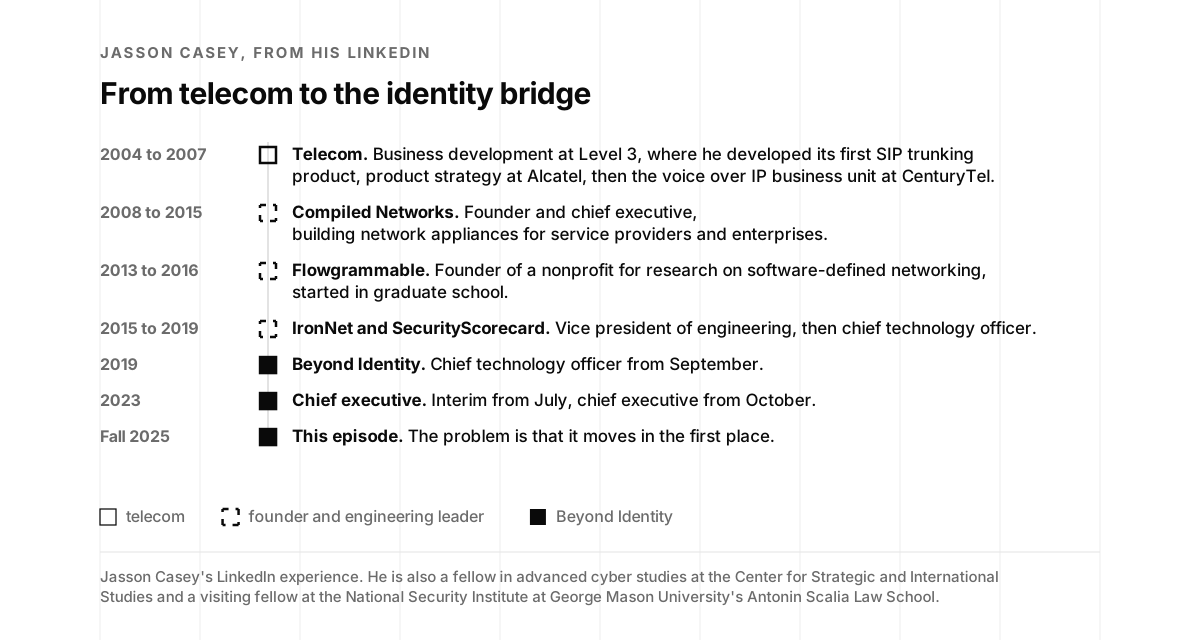
A timeline of seven entries. Open, 2004 to 2007, telecom, business development at Level 3, where he developed its first SIP trunking product, product strategy at Alcatel, then the voice over IP business unit at CenturyTel. Dashed, 2008 to 2015, Compiled Networks, founder and chief executive, building network appliances for service providers and enterprises. Dashed, 2013 to 2016, Flowgrammable, founder of a nonprofit for research on software-defined networking, started in graduate school. Dashed, 2015 to 2019, IronNet and SecurityScorecard, vice president of engineering, then chief technology officer. Filled, 2019, Beyond Identity, chief technology officer from September. Filled, 2023, chief executive, interim from July, chief executive from October. Filled, fall 2025, this episode, the problem is that it moves in the first place.
Jasson's path to Beyond Identity, from his LinkedIn.

Where we sit, so you can weigh what follows: YSecurity helps startups pass the security reviews enterprise buyers run, and identity is where most of those reviews begin, with how employees sign in, which devices are trusted and who can approve what. Sasha Sinkevich hosted this one alone, and my voice is only in the sponsor reads. We recorded in the fall of 2025, around the time Battlefield 6 came out, and the episode aired on April 7, 2026. In the sign-off, Sasha says the show was brought to you by YSecurity and Beyond Identity. The video went up on our YouTube channel on June 17, 2026.

It surrounds us

Sasha started with Jasson’s years in telecom and the question underneath every call and every connection: how do you know you’re talking to a trusted party? Jasson answered with a line from Star Wars about the Force, then with the problem.

“There’s nothing that you do that shouldn’t involve secure communications in some way, shape, or form. And the reality is, you’re not actually getting it.”

Jasson Casey, at 2:45

His first example is the login form. Most websites still take a username and a password, and most developers send that password as clear text inside TLS, trusting the encrypted connection to keep it private. The catch is that the connection rarely runs end to end. A modern site sits behind a third-party load balancer and a content delivery network, many enterprises run proxies that open and re-terminate TLS to inspect it, and inside the cluster a service mesh may do it again.

“So, like, there are all of these scenarios where TLS, certainly not end-to-end, and generally being opened and re-terminated by third parties.”

Jasson Casey, at 3:32

Every one of those hops is a moment when the password exists in plain text, in memory that someone else operates. That’s the surface area Jasson is describing. It isn’t the login page. It’s every machine the secret passes through, and most of those machines belong to companies you’ll never audit.
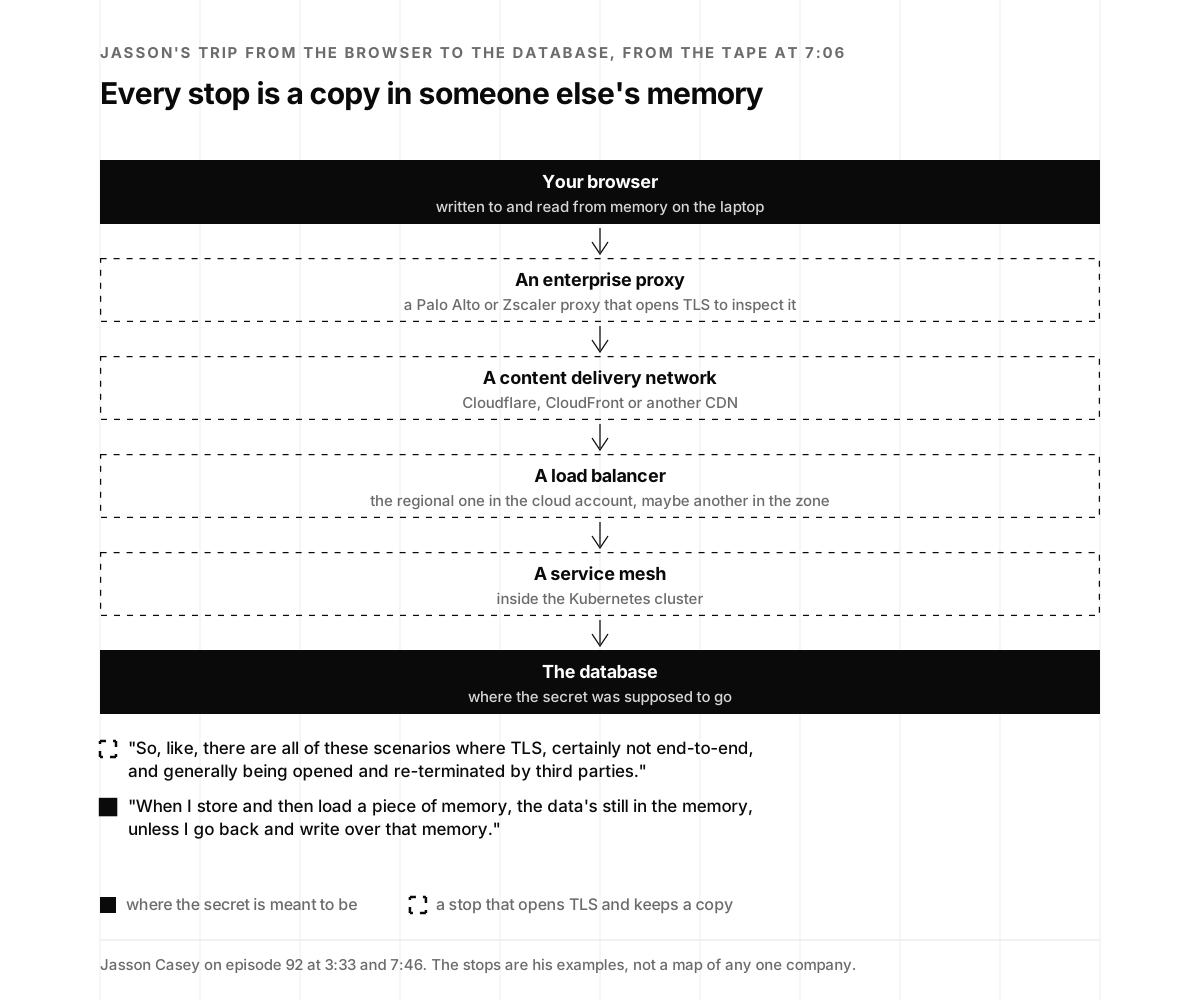
Six boxes stacked top to bottom, joined by arrows. Filled, your browser, written to and read from memory on the laptop. Dashed, an enterprise proxy, a Palo Alto or Zscaler proxy that opens TLS to inspect it. Dashed, a content delivery network, Cloudflare, CloudFront or another CDN. Dashed, a load balancer, the regional one in the cloud account, maybe another in the zone. Dashed, a service mesh, inside the Kubernetes cluster. Filled, the database, where the secret was supposed to go. Below, two lines. So, like, there are all of these scenarios where TLS, certainly not end-to-end, and generally being opened and re-terminated by third parties. When I store and then load a piece of memory, the data's still in the memory, unless I go back and write over that memory.
The trip a password takes after the login form, as Jasson lays it out later in the episode.

Definitely double digits

Jasson gave three examples of what goes wrong in those hops, each a different kind of failure.

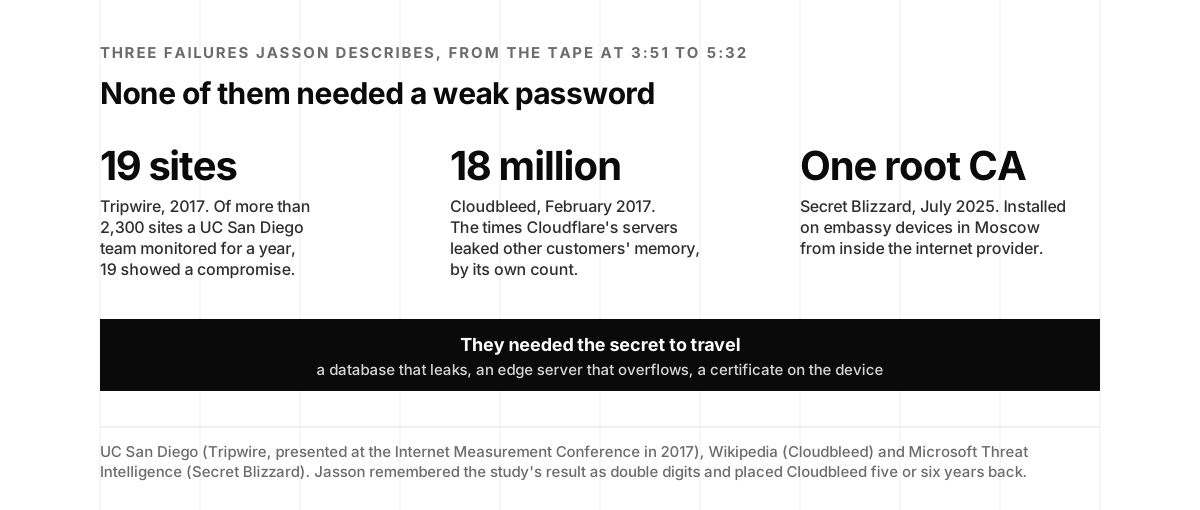
The first was a study he half-remembered from the academic world. Researchers created accounts on online services, never logged in again, and watched for the passwords to be used somewhere else. Anything above zero or 1% would have surprised him, he said, “And it was definitely double digits.” The study that matches his description is Tripwire, from a team at UC San Diego, presented at the Internet Measurement Conference in 2017. In a pilot that monitored more than 2,300 sites for a year, the team detected 19 site compromises (UC San Diego). Nineteen is a double-digit count of companies whose users’ passwords got out.

The second was a mistake at the most sophisticated company in the path.

“if you sent the right kind of crafted packet to Cloudflare, you got a 4096-byte dump of somebody else’s TLS connection.”

Jasson Casey, at 4:37

That was Cloudbleed, a buffer overflow in Cloudflare’s edge servers that Google’s Project Zero disclosed on February 17, 2017. The leaked memory held other customers’ HTTP cookies, authentication tokens and POST bodies, and by Cloudflare’s own count it happened more than 18 million times before the fix (Wikipedia). Jasson placed it five or six years before our recording. It was closer to eight and a half, which only strengthens his point that even old news is still the current design.

The third was happening as we recorded. Jasson couldn’t remember which research team had published it, and guessed at the Russian agency behind it.

“And the way they do it is their malware is dropping kind of a CA that they control into the target device, but then it deletes itself, just leaves the CA, or browser plug-in and some other versions, and kind of opens the connection and copies everything out.”

Jasson Casey, at 5:10

The report was Microsoft Threat Intelligence’s, from July 31, 2025. It describes Secret Blizzard targeting embassies in Moscow from an adversary-in-the-middle position at the internet service provider, with custom malware called ApolloShadow that installs a trusted root certificate so devices trust sites the attackers control. Microsoft notes that CISA attributes Secret Blizzard to Center 16 of Russia’s Federal Security Service (Microsoft), the same unit a 2023 joint advisory tied to the Snake malware (Wikipedia).
Listen · Jasson on episode 92, from 4:31
About 55 seconds: Cloudbleed and Secret Blizzard, two ways a protected connection gives up what's inside it. The clip stops on its own. Read the full transcript.
Three numbers side by side. 19 sites, Tripwire, 2017, of more than 2,300 sites a UC San Diego team monitored for a year, 19 showed a compromise. 18 million, Cloudbleed, February 2017, the times Cloudflare's servers leaked other customers' memory, by its own count. One root CA, Secret Blizzard, July 2025, installed on embassy devices in Moscow from inside the internet provider. Below, a filled box. They needed the secret to travel, a database that leaks, an edge server that overflows, a certificate on the device.
Three of the failures Jasson describes, with the public record for each.

None of the three needed a password to be weak. They needed it to travel.

Almost like an iceberg

Sasha’s reply widened the frame to the parts of a system nobody sees.

“It’s almost like an iceberg. When you communicate with a platform or with a system, it may seem that on the surface things are [peachy], but you don’t really know what happens under the hood.”

Sasha Sinkevich, at 5:35

Sasha added the supply chain, the packages under the hood that the end user of a system never gets to control, and then brought up a past guest. Taher Elgamal, known as the father of SSL, told us on episode 61 that passwords are holding us back. Sasha asked what the solutions look like.

It was a coincidence, Jasson said. He had talked to Taher two hours earlier.

“He’s on our board, and he was an early advisor in the company.”

Jasson Casey, at 6:21

Beyond Identity’s site lists Taher on its board of directors alongside Jim Clark and Tom Jermoluk (Beyond Identity). Jim Clark founded Silicon Graphics and Netscape, and his Wikipedia entry records that in 2020 he announced a Series A round for Beyond Identity, for a phone-resident, certificate-based way to sign in that eliminates passwords (Wikipedia). The company was built around the idea Taher described on our show.

Static, it’s long-lived, you can rotate it

Jasson’s first move was to make the question bigger than passwords.

“So it goes deeper than passwords, would be my first point. Access tokens, API key, session cookies.”

Jasson Casey, at 6:24

All of them are shared secrets, a string that proves who you are to anyone who holds a copy. Tying a session to an IP address, he said, is “a very brittle and silly concept, and certainly a security heuristic.” And the attacks that end in session hijacking all come down to the same move.

“When you look at classes of attacks that ultimately result in session hijacking, what are they doing but copy and pasting some sort of symmetric secret, right, or shared secret, from one location into another?”

Jasson Casey, at 6:36

Sasha summed up the usual answer in six words, and Jasson pushed past it.

“Static, it’s long-lived, you can rotate it.”

Sasha Sinkevich, at 6:46

“Well, I would argue it’s even more fundamental than that. Imagine it wasn’t long-lived. Imagine it was short-term use. The fact that it moves is where the original surface area comes from.”

Jasson Casey, at 6:48

Listen · Sasha and Jasson on episode 92, from 6:46
About 15 seconds: Sasha's summary of the usual fix, and why Jasson thinks it misses the point. The clip stops on its own. Read the full transcript.

This is the center of the episode, and it’s worth slowing down on. Shorter lifetimes, rotation and IP pinning all assume the secret will be copied and try to make the copy less useful. Jasson wants to make copying impossible. We wrote the practical side of this up in Why Passwords Still Get Stolen: The Case for Device-Bound Credentials, the companion post to this episode, which covers how device-bound and synced passkeys differ and how a startup rolls them out.

A series of bits

To show how far a secret travels, Jasson borrowed the opening of Tron: Legacy, imagining himself as a series of bits moving through the microprocessor, and followed a session cookie or an access token from the browser to the database. It’s written and read from memory on the laptop. In an enterprise it probably passes through a Palo Alto or Zscaler proxy. Then a content delivery network such as Cloudflare or CloudFront, then the regional load balancer in the cloud account, maybe another load balancer in the zone, then a Kubernetes service mesh. Then he went back to how computers work.

“When I store and then load a piece of memory, the data’s still in the memory, unless I go back and write over that memory.”

Jasson Casey, at 7:46

Listen · Jasson on episode 92, from 6:59
About 55 seconds: The trip from the browser to the database, and why every stop keeps a copy. The clip stops on its own. Read the full transcript.

That’s the part that’s easy to forget. Each hop doesn’t just see the secret go by. It holds it in memory until something overwrites it, which is exactly what Cloudbleed exposed. Rotation shortens how long a stolen copy is useful. It doesn’t reduce the number of copies.

What if we could guarantee it didn’t move?

The first answer, Jasson said, is trivial.

“Yeah, you could adopt some sort of asymmetric cryptography, use a private key for signing, and then the only thing that has to move is the public key, which gives away nothing.”

Jasson Casey, at 8:10

That’s how TLS and SSH already work on the server side, and it’s how passkeys work for people. The second answer is the one Beyond Identity was built on.

“But then one of our guys came up with this stronger idea, which is, what if we could guarantee it didn’t move?”

Jasson Casey, at 8:18

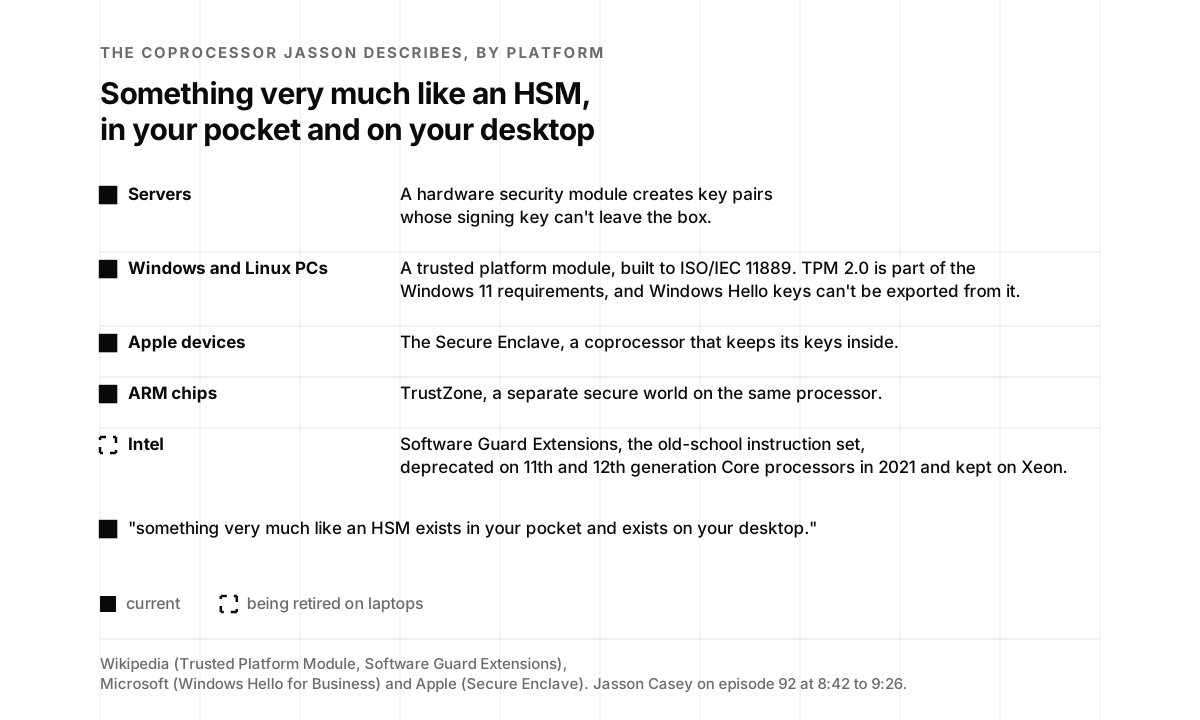
The engineer’s observation was that servers already have hardware security modules, which create key pairs whose signing key can’t leave the box. And from mobile payments he knew that something very much like an HSM, in Jasson’s words, “exists in your pocket and exists on your desktop.” Chipmakers prefer to build one product line rather than many, so almost every modern processor now ships with a secure cryptographic coprocessor.

“And if it never moves, it can never be copied, it can never be stolen. And so, like, a class of problems gets eliminated.”

Jasson Casey, at 9:07

Listen · Jasson on episode 92, from 8:17
About 55 seconds: From hardware security modules in servers to the chip already in your laptop and your phone. The clip stops on its own. Read the full transcript.

The chips have names. A trusted platform module, or TPM, is a secure cryptoprocessor built to the ISO/IEC 11889 standard, first deployed in 2003, and TPM 2.0 is part of the system requirements for Windows 11 (Wikipedia). Microsoft’s documentation for Windows Hello for Business says the private key it creates is protected by the TPM and can’t be exported (Microsoft). Apple devices have the Secure Enclave (Apple), ARM chips have TrustZone, and Intel had Software Guard Extensions, the old-school instruction set Jasson mentions, which Intel deprecated on its 11th and 12th generation Core processors in 2021 while keeping it on Xeon (Wikipedia). Sasha put the shared idea in one sentence.

“And then you hold the secret inside that secure enclave, and then you have a guarantee that nothing moves out.”

Sasha Sinkevich, at 9:28

The standards have caught up with this. NIST’s current digital identity guidelines require that authentication at the highest assurance level use a phishing-resistant authenticator with a non-exportable key (NIST). What Jasson describes as a design choice is now the federal definition of strong.
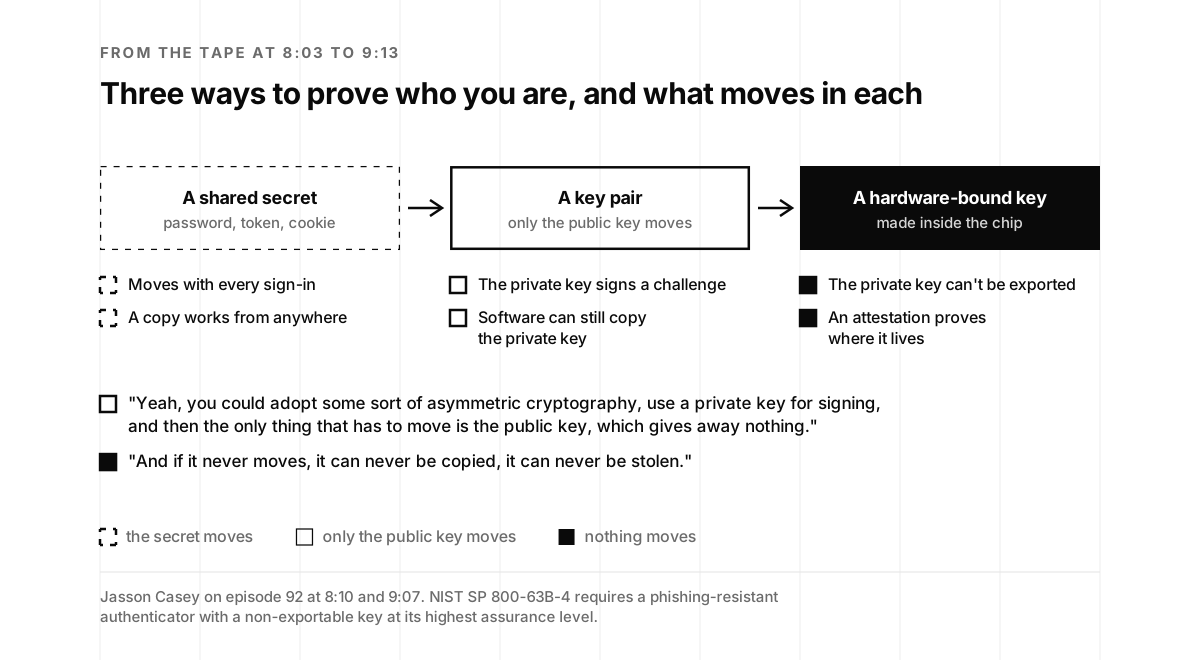
Three boxes in a row, joined by arrows. Dashed, a shared secret, password, token, cookie, which moves with every sign-in, and a copy works from anywhere. Open, a key pair, only the public key moves, the private key signs a challenge, and software can still copy the private key. Filled, a hardware-bound key, made inside the chip, the private key can't be exported, and an attestation proves where it lives. Below, two lines. Yeah, you could adopt some sort of asymmetric cryptography, use a private key for signing, and then the only thing that has to move is the public key, which gives away nothing. And if it never moves, it can never be copied, it can never be stolen.
Three ways to prove who you are, from Jasson's answer on the tape.
Five rows. Filled, servers, a hardware security module creates key pairs whose signing key can't leave the box. Filled, Windows and Linux PCs, a trusted platform module, built to ISO/IEC 11889, TPM 2.0 is part of the Windows 11 requirements, and Windows Hello keys can't be exported from it. Filled, Apple devices, the Secure Enclave, a coprocessor that keeps its keys inside. Filled, ARM chips, TrustZone, a separate secure world on the same processor. Dashed, Intel, Software Guard Extensions, the old-school instruction set, deprecated on 11th and 12th generation Core processors in 2021 and kept on Xeon. Below, one line. Something very much like an HSM exists in your pocket and exists on your desktop.
Where the chip lives, by platform.

Battlefield 6

His surprising example of the same hardware in the wild was a video game. The observation of one of Beyond Identity’s early engineers, he said, was that the chips existed and almost no one used them for anything but mobile payments. Then he named the game that had just come out.

“So what they’re doing is they’re making the kernel prove at load time that there’s no unauthorized drivers that some of the guys who come up with mods make”

Jasson Casey, at 9:56

Battlefield 6 came out on October 10, 2025, and it uses EA’s kernel-level anti-cheat, Javelin, which requires Secure Boot to be turned on in the computer’s firmware (Wikipedia). The requirement caused a fuss among players, which, Jasson admitted, is the only reason he knew about it. Sasha turned it into a business lesson.

“This is actually super cool, because this is a perfect example of security solving a very specific and painful issue for a business.”

Sasha Sinkevich, at 10:16

Cheaters bypass the controls that make people buy things, and that shows up in revenue. Jasson agreed, and gave the line that runs under the rest of the episode.

“I mean, at the end of the day, security is there to serve the business.”

Jasson Casey, at 10:50

Listen · Jasson on episode 92, from 10:49
About 30 seconds: Security in service of the business, with a game studio as the example. The clip stops on its own. Read the full transcript.

Every so often, he said, security is the business, as it is for Beyond Identity. Most of the time it exists so that everyone else has a good experience, whether that’s a multiplayer game or a customer portal. That framing comes back at the end of the episode with a number attached.

Five seconds, ten seconds

Then Sasha turned to the question the episode title promises.

“It takes about five seconds, 10 seconds for a really accurate representation of your voice and your image generated by AI.”

Sasha Sinkevich, at 11:33

Jasson is a public figure who has been on a lot of shows, Sasha pointed out, which means there is plenty of his voice and face to train on. At that point it’s hard to know whether you’re talking to the actual person on the other end of the TLS connection the conversation had just spent ten minutes on. So how do you know?

We’ve had the detection side of this question on the show too. Ben Colman of Reality Defender talked about how startups can fight deepfake fraud on episode 71, and Vijay Balasubramaniyan of Pindrop on voice on episode 57. Jasson came at it from the other direction.

Knife fights and phone booths

He started, as engineers do, by asking whether the problem was framed right.

“They think that’s the problem. That always kind of didn’t sit well with me. And I was trying to figure out why.”

Jasson Casey, at 12:17

The problem most of the industry had picked was “is this a deepfake?” He found two reasons it bothered him. The first was engineering. Detection felt like another heuristic.

“I probably can detect the artifacts of how you generate deepfakes, but how long will it last? Is it stable? Could you use me to train another generator?”

Jasson Casey, at 12:31

A detector learns the artifacts of the generators that exist today, and every detector can become training data for the next generator. Choosing that fight, he said, felt like choosing a career in knife fights in phone booths. The outside evidence points the same way. When Australia’s national science agency, CSIRO, tested 16 leading deepfake detectors in 2025, it found that many struggled with deepfakes outside their training data (CSIRO). Jasson’s alternative is a rule for business as much as for engineering.

“You want unfair fights. You only want to show up where it’s almost impossible for you not to win, or solve the problem, or whatnot.”

Jasson Casey, at 12:51

Listen · Jasson on episode 92, from 12:30
About 25 seconds: Why deepfake detection feels like a fair fight, and why you only want unfair ones. The clip stops on its own. Read the full transcript.

A realistic mustache

The second reason was stranger, and to me it’s the more convincing one. If everyone is right that AI is about to be in everything, then a lot of synthetic video will be legitimate. Jasson listed his own examples: trying out a realistic mustache before growing one, translating himself into Spanish in real time because he doesn’t speak it, or covering an injury he’d rather not discuss on a call.

“So if AI is really around the corner, we know there’s valid uses for deepfakes, right?”

Jasson Casey, at 13:27

“And if all these tools have decided they’re going to work on deepfake detection, then how does it work against valid use?”

Jasson Casey, at 13:36

A detector that works perfectly would still flag the colleague using a translation filter. Whether a video is synthetic stops being the same question as whether it’s an attack the moment synthetic media becomes normal, and that moment is close.

Listen · Jasson on episode 92, from 13:01
About 40 seconds: Valid uses for deepfakes, and why detection can't tell them apart from fraud. The clip stops on its own. Read the full transcript.

Who’s on the other end?

So Jasson changed the question.

“The right question is, who’s producing this content right now, from what computer, with what level of authenticity and trust?”

Jasson Casey, at 13:45

The same chips that keep keys from moving can answer it, through a mechanism called attestation. In the moment, the device produces a mathematical proof about itself.

“under the assumption that the foundry that made this coprocessor hasn’t been violated, I can prove to you I’m this device, made in this location, with this configuration, and this is the programmed user that’s running”

Jasson Casey, at 14:10

The proof can cover more than the device. It can say the user unlocked it with a biometric, that endpoint protection is running, that the system has been hardened. How to show all that to a person, he said, is a security UX question, small emblems, an audit log, the details on demand. The core of it is that nothing in the answer depends on what a face looks like.
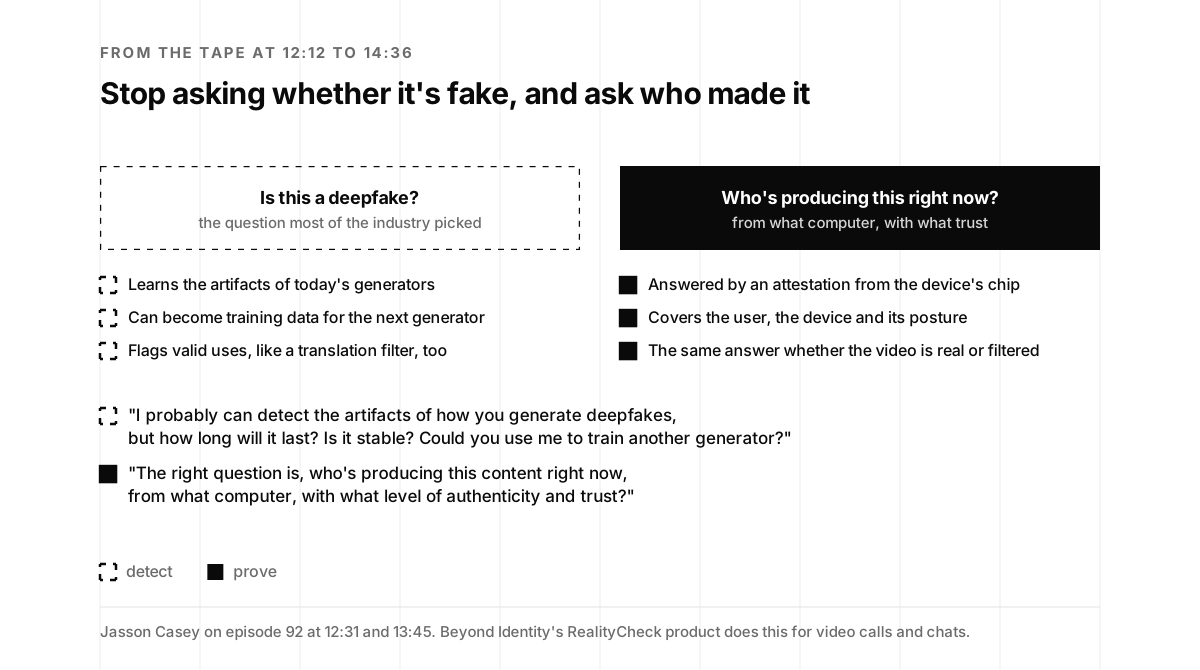
Two boxes side by side. Dashed, is this a deepfake, the question most of the industry picked, which learns the artifacts of today's generators, can become training data for the next generator, and flags valid uses, like a translation filter, too. Filled, who's producing this right now, from what computer, with what trust, which is answered by an attestation from the device's chip, covers the user, the device and its posture, and gives the same answer whether the video is real or filtered. Below, two lines. I probably can detect the artifacts of how you generate deepfakes, but how long will it last? Is it stable? Could you use me to train another generator? The right question is, who's producing this content right now, from what computer, with what level of authenticity and trust?
The question most of the industry asked, and the one Jasson asks instead.
Listen · Jasson on episode 92, from 13:42
About 55 seconds: The right question, and how a coprocessor can answer it with an attestation. The clip stops on its own. Read the full transcript.

Beyond Identity sells this today as RealityCheck. Its product page pitches it as making deepfakes irrelevant rather than detecting them, by verifying both the user and the device behind the camera at login and during the meeting (Beyond Identity). Our companion post, Deepfake Attacks Keep Working Because We Keep Detecting Instead of Proving, walks through what a proof step proves and what a startup should change first.

I mean commit the code

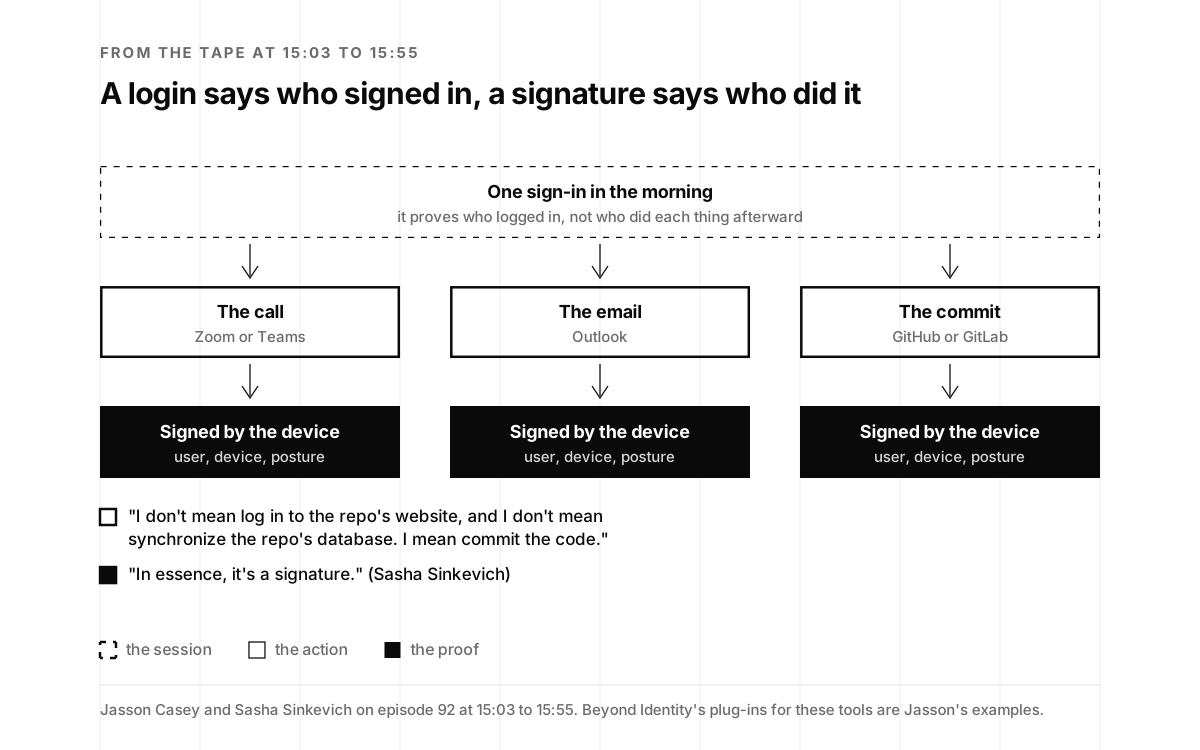
Beyond Identity built the answer into the tools people already use, Jasson said: plug-ins for Zoom, Teams and Outlook, and for GitHub and GitLab. Each answers the same question at a different moment. Who is the person, on what device, with what posture, on this call? Who sent this email? And for code, something more specific than a login.

“I don’t mean log in to the repo’s website, and I don’t mean synchronize the repo’s database. I mean commit the code.”

Jasson Casey, at 15:16

Developers type git commit, git pull and git push without thinking, but each one has its own authentication and authorization model.

“And just because you log into the website using something secure doesn’t mean you really know where that code came from.”

Jasson Casey, at 15:32

Sasha put the mechanism in plain words, and Jasson added the part that makes it flexible.

“In essence, it’s a signature.”

Sasha Sinkevich, at 15:37

“It’s a signature over a series of properties that you can kind of decide what level of trust you want to assign.”

Jasson Casey, at 15:47
Listen · Jasson on episode 92, from 14:55
About 40 seconds: One question asked at the call, the email and the commit, and why a login isn't the same as a commit. The clip stops on its own. Read the full transcript.
A dashed box across the top, one sign-in in the morning, it proves who logged in, not who did each thing afterward. Arrows lead down to three open boxes, the call, Zoom or Teams, the email, Outlook, and the commit, GitHub or GitLab. Each has an arrow down to a filled box, signed by the device, user, device, posture. Below, two lines. I don't mean log in to the repo's website, and I don't mean synchronize the repo's database. I mean commit the code. In essence, it's a signature, said by Sasha Sinkevich.
Identity asked at each action, not once at sign-in.

This is the idea I’d hand to a startup preparing for its first enterprise security review. Buyers increasingly ask who can change production and how you know. A login log answers who signed in. A signature from a registered device on the commit, the deploy or the wire approval answers who did the thing.

Some dude in the room

Sasha guessed that this would fit neatly into a company that already runs mobile device management. Jasson agreed, with a story that anyone who has run an enterprise deployment will recognize.

“And then there’s some dude in the room that won’t make eye contact anymore.”

Jasson Casey, at 16:27

Every organization starts the same way, he said: a hardened environment, everything managed, endpoint protection everywhere, no exceptions. Then, around the second or third meeting, the exceptions come out. Some devices don’t have device management. There are PR partners, legal partners, outsourced developers, an outsourced call center.

“And so the reality of, like, an actual enterprise is always heterogeneous.”

Jasson Casey, at 16:44

So Beyond Identity built for both worlds from the start. With device management, the best part is distribution. Their integration can package and ship the authenticator and also enroll the users automatically, “to where they don’t even have to be part of the rollout,” and it can feed what device management sees into each decision. Without it, the same checks still have to work.

Listen · Jasson on episode 92, from 16:13
About 40 seconds: The hardened environment every company describes, and the exceptions that show up in the third meeting. The clip stops on its own. Read the full transcript.

The identity bridge

The reason it can work without device management is the line I’d put on a poster.

“Because identity is the thing that everything crosses.”

Jasson Casey, at 17:19

Employee or contractor, business partner, managed device or personal laptop, everyone crosses the same bridge to reach an application.

“So the identity bridge is really the best point of enforcement to understand who, on what device, is asking for what, and for how long.”

Jasson Casey, at 17:29

Listen · Jasson on episode 92, from 17:19
About 15 seconds: Why identity is the best place to enforce, for every kind of user and device. The clip stops on its own. Read the full transcript.

That shaped one more design decision. The authenticator had to run without elevated privilege, because nobody wants to install a privileged work tool on a personal device, and Beyond Identity didn’t want the power to remote-wipe anyone’s phone. Jasson expected pushback on how much you can see without privilege, and he had an answer ready: think about how malware works, because it starts without privilege too.
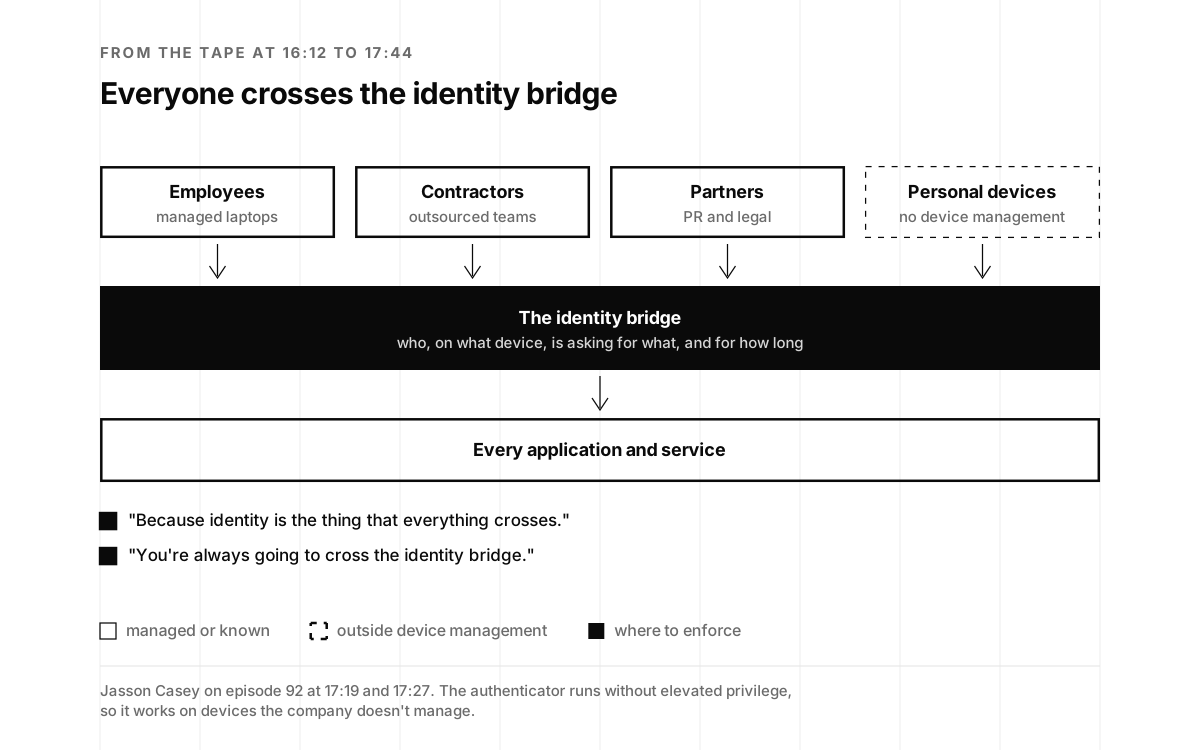
Four boxes in a row. Open, employees, managed laptops. Open, contractors, outsourced teams. Open, partners, PR and legal. Dashed, personal devices, no device management. Arrows lead down from all four to one filled box, the identity bridge, who, on what device, is asking for what, and for how long. An arrow leads down to an open box, every application and service. Below, two lines. Because identity is the thing that everything crosses. You're always going to cross the identity bridge.
Everyone crosses the identity bridge, on managed devices and unmanaged ones.

AI in our toothpaste

Then Jasson tied it back to AI, with the line our social team turned into a quote card.

“We now have AI in our bread, we have AI in our toothpaste, everybody’s AIing all the things.”

Jasson Casey, at 18:10

Some of those things will become businesses, he said. In all of them, developers paste secrets and credentials where they shouldn’t. “It’s a new game, but all the same injuries.” Sasha said the classical security principles still apply, and Jasson named the injuries: credential sprawl, devices and services that don’t meet policy, data sprawl, and data classes that mix. A company may have a part of the business under CMMC, a part under FedRAMP, and services that clearly aren’t approved for either.

That list is the one we see in startups adopting AI quickly, and it’s why we wrote Your Agents Share One API Key and the AI agent credential inventory. The fix starts with knowing where each secret lives.

What user, on what device, with what posture

Jasson’s next answer is, to me, the most useful paragraph in the episode for anyone deploying agents. Start from first principles, he said. Even in an AI system there’s a user on a device and an agent that runs either on that device or on a cloud workload, and the agent has access to services, vector databases, MCP servers and the rest.

“I want to know what user, on what device, with what posture, is using what agent, running what model, on what device, with what posture, and has been given permissions to what services, for how long.”

Jasson Casey, at 19:03

“These are the classic identity questions.”

Jasson Casey, at 19:15

He wants the answer every time, tamper-proof and attested, so he can audit and enforce, and so his team can keep putting AI in toothpaste without putting the company’s CMMC compliance at risk. He comes back to these questions near the end of the episode and turns them into a vector.

Listen · Jasson on episode 92, from 18:46
About 50 seconds: The identity questions for an AI agent, from first principles. The clip stops on its own. Read the full transcript.

If your parents can’t do it

Sasha asked how much seamlessness matters in security products, which are often complex to deploy and maintain. Jasson split the audience in two. The IT administrator will live, breathe and sweat your product, and there’s complexity you can’t hide from them. The end user is different.

“If you only have a soundbite, the end user is your parents. So, if your parents can’t do it, you’re going to fail.”

Jasson Casey, at 20:16

The lesson Beyond Identity learned the hard way was to keep those two people apart in the design.

“We merged those concepts a little bit too much up front.”

Jasson Casey, at 20:42

They oversimplified things for administrators and didn’t simplify enough for end users. Treating end users like your parents means remembering that their job isn’t technical. They work in finance, accounting or medicine, and use technology to do it. Every time a product asks them to take part in something that doesn’t help them do that job, he said, it’s a small self-inflicted wound, and at a company with 80,000 employees that adds up fast.

Listen · Jasson on episode 92, from 20:14
About 35 seconds: The IT administrator, the end user, and a lesson from getting the two mixed up. The clip stops on its own. Read the full transcript.

Asking a user to change their password

The biggest example is how identity products roll out.

“the standard operating procedure in the identity world is to involve the entire workforce in rollouts. That’s horrible.”

Jasson Casey, at 21:21

It’s also, he said, why identity products rarely get replaced. Sasha added the practical side: you depend on people who are busy, unavailable or on vacation, and who come back to a full inbox. Jasson’s example is so familiar that nobody questions it.

“asking a user to change their password is asking a user to be part of a deployment update for a technical control.”

Jasson Casey, at 21:53

“But I put the failure more on the system designers, like us.”

Jasson Casey, at 22:24

A password lives in someone’s brain, so the person has to be part of every change to it. A credential that lives in the device doesn’t need them. The guidance has moved the same way. NIST’s current rules say verifiers “SHALL NOT require subscribers to change passwords periodically,” and force a change only when there’s evidence of compromise (NIST).

Listen · Jasson on episode 92, from 21:50
About 50 seconds: Why a password change is a deployment you outsource to every employee. The clip stops on its own. Read the full transcript.

Beyond Identity’s rule after that, Jasson said, was to find the absolutely necessary things end users have to do, and nothing else.

The champion, the budget holder, the administrator and the user

Sasha connected it to a startup basic, knowing your ideal customer profile and its specific pain, and asked whether Beyond Identity embeds engineers with customers. Their most successful deployments work exactly that way, Jasson said, and then he added a warning for founders trained on consumer software.

“The champion, the budget holder, the administrator, and the user. These are all very different people, and they can all shut you down for different reasons.”

Jasson Casey, at 23:47

What sells the product to one of them can work against it with another, which is why he says UX, product management and product marketing have to move in lockstep in enterprise infrastructure. And enterprise administrators expect a vendor that’s critical to their business to be in the trenches with them, however new and exciting the product is. Not every customer wants that, though. Some, in his words, want you to deliver the equipment to a parking lot on a given day and leave the rest to them.

Listen · Jasson on episode 92, from 23:29
About 25 seconds: Why an ideal customer profile isn't one person in an enterprise sale. The clip stops on its own. Read the full transcript.

Flowgrammable

Sasha asked about the proudest day of Jasson’s career. He said he likes building things from scratch, and teams from scratch, and that many of the people he works with now he has worked with on and off for half his career. The project he picked came from graduate school.

“We did a thing back when I was in grad school called Flowgrammable that I was very proud of.”

Jasson Casey, at 25:11

Software-defined networking was the big idea of the moment. His LinkedIn describes Flowgrammable as a nonprofit research organization that maintained a knowledge base, open source tools and research on the protocols, which he founded in May 2013 and recruited with industry engineers and university researchers (LinkedIn). On the tape he describes a team of PhD, master’s and undergraduate students who built kernel drivers and user space applications and entered reference design competitions against open source software supplied by the industry, and beat all of them but one. It took everything you know about how a computer works: the CPU, the cache, what the compiler won’t figure out for you, and six versions of a protocol that nobody wants to be the developer’s problem.

“Only so many developers are going to read a thousand-page spec.”

Jasson Casey, at 25:56

Listen · Jasson on episode 92, from 25:11
About 30 seconds: Flowgrammable, a team of students and a thousand-page spec. The clip stops on its own. Read the full transcript.

Everyone from that team, he said, now works with him at Beyond Identity, worked with him at SecurityScorecard or IronNet, or landed at big tech companies on the West Coast with his help. He knows the counterculture against calling work a family. He doesn’t share it, and said so: “startups aren’t families, but they kind of are.”

Run-ins with state actors

Sasha said a company is just a collection of people, and that the best part of a startup is iterating on one problem quickly and protecting organizations that serve millions of people. Jasson took the thread further.

“But a little further in that story is, we’ve had a couple of run-ins with state actors, and our product performed, and our team performed exceptionally.”

Jasson Casey, at 27:23

He didn’t name the actors or the customers, and neither will we. What he described is what it feels like when a design meets the adversary it was built for.

“It’s one thing to do something and know intellectually, like, why you do it and what you’re doing it, but it’s a whole nother thing to actually see it do its job”

Jasson Casey, at 27:47

Two incident response teams and red teams credited the product afterward, he said, and the company came out of it with relationships it didn’t have before.

Listen · Jasson on episode 92, from 27:23
About 40 seconds: The proudest day: a product that held up against state actors. The clip stops on its own. Read the full transcript.

Shift left on the spectrum

Sasha brought the conversation back to the start. Trying to identify deepfakes is chasing the problem, Sasha said, a reactive function, when the systems we all want to build are proactive and prevent the event instead of analyzing it afterward. Jasson put that in historical terms.

“And it was, hey, we’re all compromised. We now live in a post-compromised world. How do we find the bad guy and evict them?”

Jasson Casey, at 28:43

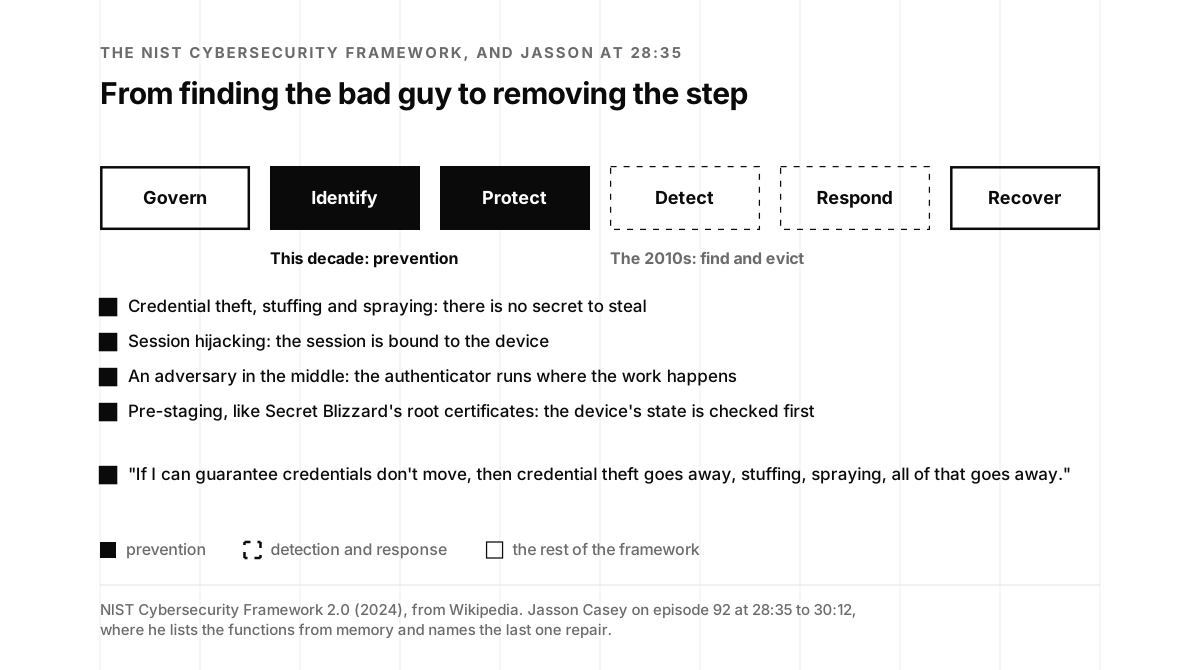
That was the strategic choice of the 2010s, he said, the rallying cry that endpoint detection and response was built around. This decade is a chance to shift left. He reached for the NIST Cybersecurity Framework and listed its functions as identify, protect, detect, respond and repair, then corrected himself that the last one is something else. It’s recover. Version 2.0, released in 2024, added a sixth function, govern, so the framework now reads govern, identify, protect, detect, respond and recover (Wikipedia). His point stands either way: most of the money went to detect and respond, and the opportunity now is in identify and protect.

“If I can guarantee credentials don’t move, then credential theft goes away, stuffing, spraying, all of that goes away.”

Jasson Casey, at 29:28

If the authenticator runs on the device where the work happens, it can spot an adversary in the middle and prevent session hijacking. If it carries a small sensor and asks whether the device is safe enough for what it’s asking for, it can stop the pre-staging tactics he described at the start, the root certificates and browser plug-ins Secret Blizzard used.

“if you pull up your MITRE chart, there’s a ton of squares now that have X’s through them”

Jasson Casey, at 30:02
Listen · Jasson on episode 92, from 29:17
About 15 seconds: Shifting left, from detect and respond to identify and protect. The clip stops on its own. Read the full transcript.
Six boxes in a row, the functions of the NIST Cybersecurity Framework. Open, govern. Filled, identify. Filled, protect. Dashed, detect. Dashed, respond. Open, recover. Under identify and protect, this decade, prevention. Under detect and respond, the 2010s, find and evict. Below, four filled items. Credential theft, stuffing and spraying, there is no secret to steal. Session hijacking, the session is bound to the device. An adversary in the middle, the authenticator runs where the work happens. Pre-staging, like Secret Blizzard's root certificates, the device's state is checked first. Then one line. If I can guarantee credentials don't move, then credential theft goes away, stuffing, spraying, all of that goes away.
Where the attention went in the 2010s, and where Jasson thinks it can go now.

The part I’d underline for a small team is his closing note on it: “Simpler things are easier to maintain. Fewer moving parts are easier to maintain.” Removing a class of attack is also removing work.

Single digits in production

Sasha then raised the AI adoption gap. Companies have invested billions in AI and built workflows meant to make everything better, but the share that reaches production is small.

“From 100%, only single digits are deployed in production.”

Sasha Sinkevich, at 30:50

One of the core reasons, in Sasha’s telling, is that companies don’t trust the system enough and can’t audit whether it did what it was meant to do. Jasson didn’t claim to know all the reasons, but he hears one version of it from customers again and again. A defense contractor has to keep its CMMC accreditation. A federal civilian business has to keep FedRAMP. A retailer has PCI DSS.

“How do I make sure, if I’m going to turn on this agentic system and give it access to some of my controlled data, that the controls will flow with the data?”

Jasson Casey, at 31:26

That fear slows those organizations down, he said, while their developers are already pulling in whatever AI tool helps. Beyond Identity knows the compliance side from its own work. It announced FedRAMP Moderate authorization through the SMX Elevate platform on April 8, 2025 (Beyond Identity). For startups selling into those markets, our CMMC Level 2 and FedRAMP readiness work starts with the same question Jasson’s customers ask: which identities touch the controlled data, and can you prove it?

Identity sees everything

Jasson’s answer to those customers starts with the fundamentals of computer science.

“every process, whether it’s a daemon, a scheduled thing, or run by a human, has a user ID.”

Jasson Casey, at 32:03

The user ID may or may not belong to a person, but there’s always an identity. Connect processes across a distributed system and identity shows up again, either implicitly, as the cross product of all those identities, or explicitly, because someone designed it into the data model.

“So if identity is involved in everything, that means identity sees everything.”

Jasson Casey, at 32:24

AI systems, he said, mostly look alike: an orchestration layer that calls open source or public models, MCP servers and AI services, data stores old and new, all running on machines that have a posture. So ask the basic questions about every one of them. The only new thing is the shape. It’s no longer client and server, but client, an AI party, and server, sometimes with several servers and several agents.

The vector

Then came the most precise definition of agent identity I’ve heard on the show.

“Well, an agent, fundamentally, it’s a program.”

Jasson Casey, at 33:27

An agent senses its surroundings, builds a model, decides, acts and measures the result, or it’s simply a workflow that gathers information and writes a report. Either way it’s a program, and we already know how to identify programs. That’s what a software bill of materials is for.

“And so, to us, agent identity is really just tying in the SBOM to the device identity that’s executing it, to the provider identities that we’re attaching to it.”

Jasson Casey, at 33:51

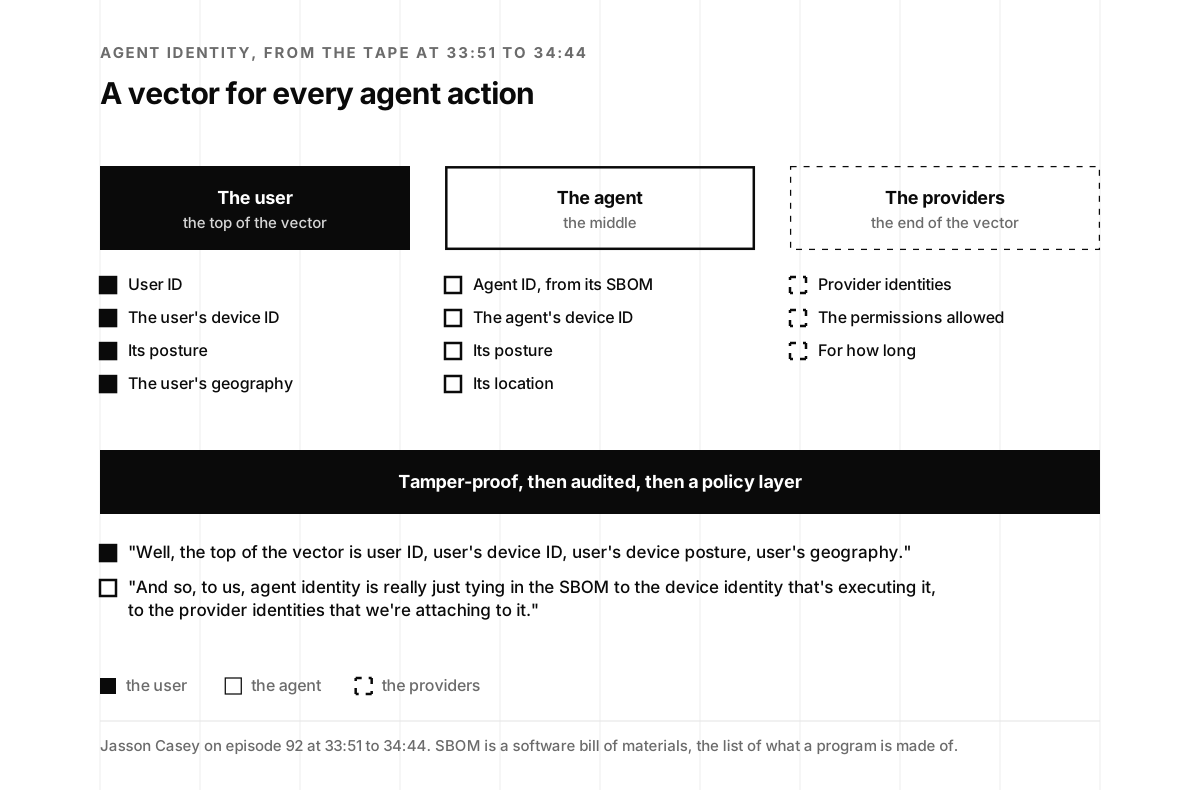
Then he laid it out as a vector, since everyone in AI likes vectors. The top is the user: user ID, the user’s device ID, its posture and the user’s geography. The middle is the agent: agent ID, the agent’s device ID, posture and location, sometimes the same machine as the user’s. The bottom is the providers: their identities, and the permissions you’re actually allowing.

“Well, the top of the vector is user ID, user’s device ID, user’s device posture, user’s geography.”

Jasson Casey, at 34:04
Listen · Jasson on episode 92, from 34:00
About 25 seconds: Agent identity as a vector: the user, the agent, and the providers it calls. The clip stops on its own. Read the full transcript.
Three boxes in a row. Filled, the user, the top of the vector, with user ID, the user's device ID, its posture and the user's geography. Open, the agent, the middle, with agent ID, from its SBOM, the agent's device ID, its posture and its location. Dashed, the providers, the end of the vector, with provider identities, the permissions allowed and for how long. Below, a filled box. Tamper-proof, then audited, then a policy layer. Then two lines. Well, the top of the vector is user ID, user's device ID, user's device posture, user's geography. And so, to us, agent identity is really just tying in the SBOM to the device identity that's executing it, to the provider identities that we're attaching to it.
Jasson's three-part vector for every agent action.

Make it tamper-proof and you can audit it. Audit it and you can add a policy layer that decides who can do what. Collect it and you have an intelligence source for everything happening in your AI infrastructure. There’s endpoint detection and response, and identity threat detection and response, and, he guessed, there’s probably an AIDR coming. Sasha finished the thought: the acronyms change, and the core principles of security don’t. For a startup putting agents into production, this vector is a good checklist for the questionnaire that’s coming, and it’s the same chain we argue for in Who Signs for the Agent?.

They price in fraud

Security is always a scale, Sasha said. You can make something perfectly secure and nobody will use it. Jasson put a price on the trade.

“What’s the cost of being wrong versus the benefit of being right?”

Jasson Casey, at 35:13

A scaled business measures that precisely, he said. Banks set their investment from their balance sheets.

“They price in fraud. And only when fraud passes a certain level do they increase their investments in fraud detection and prevention.”

Jasson Casey, at 35:21

From 80% to 95%

Sasha asked for his words of wisdom, and Jasson’s first two were the episode in miniature.

“Fundamentals matter. You still kind of need to know how a computer works.”

Jasson Casey, at 35:37

“I think there’s this implicit assumption the industry has, you can only run detection and response. I think it’s time to actually challenge that.”

Jasson Casey, at 35:40

Move to credentials that can’t move, with Beyond Identity or anyone else, he said, and you’ll see fewer help desk tickets and fewer security incidents. Done right, it isn’t a productivity loss. It’s a gain. Then he gave the number.

“One of our customers is using our technology for their customer side of the business, and they’ve seen the success login rate of their customers go from 80% to 95%.”

Jasson Casey, at 36:16

The customer did it to stop fraud and account takeover, and was running reports to work out what the extra successful logins meant for revenue.

Listen · Jasson on episode 92, from 36:15
About 30 seconds: A customer's login success rate, from 80% to 95%. The clip stops on its own. Read the full transcript.

“So, like, this is one of those rare times where doing the right thing from a security perspective is actually a better experience, and, depending on your business, can actually contribute to the top line.”

Jasson Casey, at 36:36

Sasha closed on the same note: plenty of security problems can be lined up with revenue growth or a better user experience, which leads to revenue anyway. You can try the arithmetic on your own sign-in numbers in the login calculator further down.

What happened after the tape

The months after the recording read like the episode turned into a product plan. In February 2026 Jasson went on Legitimate Cybersecurity, hosted by Frank Downs and Dustin Brewer, to talk about what breaks in identity and access when software can reason, plan and act.

Jasson on Legitimate Cybersecurity, February 15, 2026, 38 minutes: delegated authorization, agents that call tools and APIs, and what identity has to prove when software acts on a person's behalf. Watch on YouTube.

Two days later Beyond Identity opened a public preview of Ceros, which Jasson called its agentic AI trust layer. His post makes the argument from this episode about agents.

Trying to detect every bad behavior is a losing strategy. The leverage point is identity.

Jasson Casey · February 17, 2026
Jasson opening the public preview of Ceros: every agent action bound to a verified human authorization, on a verified device, with no shared secrets. View on LinkedIn.

In March, during RSAC week, he wrote that Beyond Identity was working with his alma mater on identity for drones, using the same primitives it uses for AI systems: hardware-rooted identity, attestation and policy.

Proud to be working with my alma mater, Texas A&M University, on bringing identity to drones.

Jasson Casey · March 25, 2026
Jasson on extending hardware-rooted identity, attestation and policy to drones and other autonomous systems, with the Texas A&M Global Cyber Research Institute. View on LinkedIn.

This episode aired on April 7. In June, at Identiverse, Ceros launched.

Beyond Identity launching Ceros at Identiverse. The post lists the identity it checks on every agent session: who runs it, how they authenticated, whether the device is compliant, which tools the agent can reach, and the configuration it launched with. View on X.

That list is close to the vector Jasson described on the tape. The same day he shared an article from Cyber Insurance News that asks whether a company can account for its AI agents, in which he’s quoted saying underwriters “can’t insure what they can’t measure.”

How do you handle agents for cyber insurance? Here is a conversation around just that topic.

Jasson Casey · June 16, 2026
Jasson on launch day at Identiverse, sharing the case that agent identity is becoming an underwriting question. View on LinkedIn.

The episode’s video went up on our YouTube channel the next day. Beyond Identity’s AI trust layer page now describes keys for agents that never leave hardware, discovery of every MCP server, continuous posture checks, and a trace of the full identity chain for every agent action, which agent, which device, which tool and which user (Beyond Identity). And on November 3, 2026, Jasson reposted a keynote on drone identity that Ligeia Zeruto of Beyond Identity gave at DRON8, with a first line that could stand as this episode’s summary.

Securing identity against human and AI adversaries starts with first principles. Device-bound identity is foundational to getting it right.

Jasson Casey · November 3, 2026
Jasson sharing a DRON8 keynote on identity for drones, where most components carry no hardware root of trust today. View on LinkedIn.
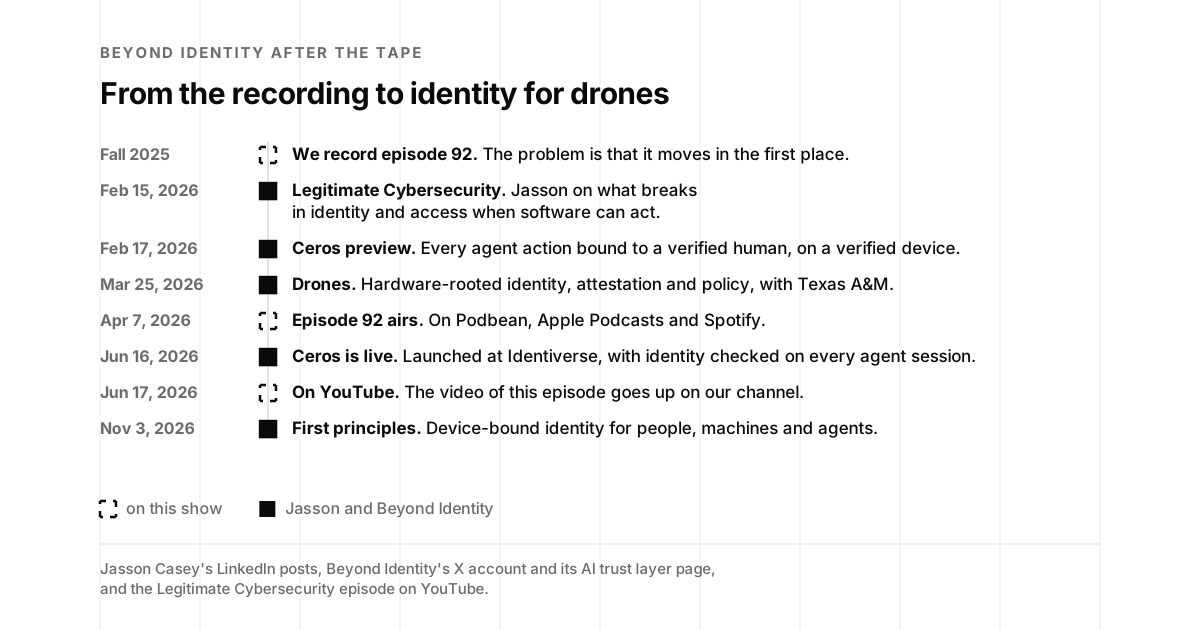
A timeline of eight entries. Dashed, fall 2025, we record episode 92, the problem is that it moves in the first place. Filled, February 15, 2026, Legitimate Cybersecurity, Jasson on what breaks in identity and access when software can act. Filled, February 17, 2026, Ceros preview, every agent action bound to a verified human, on a verified device. Filled, March 25, 2026, drones, hardware-rooted identity, attestation and policy, with Texas A&M. Dashed, April 7, 2026, episode 92 airs, on Podbean, Apple Podcasts and Spotify. Filled, June 16, 2026, Ceros is live, launched at Identiverse, with identity checked on every agent session. Dashed, June 17, 2026, on YouTube, the video of this episode goes up on our channel. Filled, November 3, 2026, first principles, device-bound identity for people, machines and agents.
Beyond Identity after the tape, from Jasson's LinkedIn, Beyond Identity's X and its site.

Read together, the arc is consistent. On the tape, Jasson’s answer to stolen passwords, deepfaked executives and over-permissioned agents was the same one: stop asking whether something looks right, and ask the hardware to prove who did it, from where, in what state. Within a year his company had applied it to agents, to drones and to insurance. For a startup the practical version is smaller and just as useful. Find the secrets that travel, and make the important ones stop.

Did you catch it? A six-question quiz

Interactive · six questions

Did you catch it?

Six questions on what Jasson and Sasha actually said, with the timestamp for each answer. The answers are under each question for anyone reading without JavaScript.

  1. What does Jasson say is the real problem with passwords, tokens and session cookies?

    1. They live too long
    2. They aren't rotated often enough
    3. They move in the first place

    c. "The problem is that it moves in the first place." Transcript, 8:03.

  2. Which game does Jasson use as an example of a company using the chip in your computer?

    1. Battlefield 6
    2. Fortnite
    3. Valorant

    a. "What's the game that just got released? Battlefield 6." Transcript, 9:46.

  3. What does Jasson say is the right question to ask instead of "is this a deepfake?"

    1. Does this face match the one on file?
    2. Who's producing this content right now, from what computer, with what level of authenticity and trust?
    3. Has this video been edited?

    b. "The right question is, who's producing this content right now, from what computer, with what level of authenticity and trust?" Transcript, 13:45.

  4. Why does Jasson call identity the best point of enforcement?

    1. It's the cheapest control to buy
    2. Device management covers every device
    3. It's the thing everything crosses

    c. "Because identity is the thing that everything crosses." Transcript, 17:19.

  5. Who does Jasson say the end user is, if you only have a soundbite?

    1. Your parents
    2. An engineer
    3. The IT administrator

    a. "If you only have a soundbite, the end user is your parents." Transcript, 20:16.

  6. What happened to one customer's login success rate?

    1. It held steady at 95%
    2. It went from 80% to 95%
    3. It dropped while fraud fell

    b. "One of our customers is using our technology for their customer side of the business, and they've seen the success login rate of their customers go from 80% to 95%." Transcript, 36:16.

How far do your secrets travel?

Jasson’s test for any credential is whether it moves. This scorecard asks eight questions about how your company signs in, approves and deploys, from passwords to AI agents. It takes about two minutes.

Scorecard · eight questions

How far do your secrets travel?

Answer for the systems that hold customer data and the people and agents who can change them. If two answers fit, pick the lower one.

  1. How do employees sign in to the tools that hold customer data?

    • Passwords, with codes or push approvals on top
    • Passkeys for some people and some tools
    • Phishing-resistant, device-bound credentials for everyone, with no password to type

    "The problem is that it moves in the first place." See Static, it's long-lived, you can rotate it.

  2. If someone copied a session cookie or an access token from a laptop, could they use it from another machine?

    • Yes, until it expires
    • For a short time, because we rotate and expire them quickly
    • No, sessions and tokens are bound to a key held in the device

    "Imagine it wasn't long-lived. Imagine it was short-term use." See A series of bits.

  3. When someone asks over a call or a chat to move money, change bank details or reset access, what proves who asked?

    • A familiar face, voice or name
    • A call back to a number we already have
    • An approval signed from a registered device, with a second approver for large amounts

    "The right question is, who's producing this content right now, from what computer, with what level of authenticity and trust?" See Who's on the other end?.

  4. Can you tell who committed a change to production code, and from what device?

    • We know which account pushed it
    • Some commits are signed
    • Commits and deploys are signed with keys held in registered devices

    "I mean commit the code." See I mean commit the code.

  5. Do contractors, partners and unmanaged devices go through the same identity checks as employees?

    • They use shared accounts or sit outside the policy
    • They have their own policy, and it covers some of them
    • Everyone crosses the same checks, with or without device management

    "Because identity is the thing that everything crosses." See The identity bridge.

  6. How much does an employee have to do when you roll out a new way to sign in?

    • Everyone installs and enrolls by hand
    • Device management ships the software, and people still enroll themselves
    • They're enrolled automatically and aren't part of the rollout

    "the standard operating procedure in the identity world is to involve the entire workforce in rollouts. That's horrible." See Asking a user to change their password.

  7. For each AI agent you run, can you name the user it acts for, the device it runs on, the services it can reach and for how long?

    • We don't have a list of our agents
    • We have a list, but not the chain from user to device to permission
    • Every agent session ties to a user, a device and permissions that expire

    "These are the classic identity questions." See The vector.

  8. How often do you make people change their passwords?

    • On a schedule
    • Only when there's evidence of compromise
    • There's no password left to change

    "a password lives in someone's brain." NIST's current rules say not to force periodic changes. See Asking a user to change their password.

Secrets still travel

Your most important accounts still depend on secrets that can be copied, phished or replayed, and approvals that rest on a face or a voice. Start with the accounts that could end the company: move their sign-in to device-bound passkeys, and put money movement behind signed approvals from registered devices.

Some secrets stay put

You've anchored part of the picture. Close the gaps attackers reach next: sessions and tokens that can be replayed elsewhere, contractors and unmanaged devices outside the checks, and agents without a clear chain from user to device to permission.

Nothing left to copy

Credentials stay in hardware and actions carry proof of who did them. Keep it that way as you add agents: give each one an identity tied to a user and a device, and make its permissions expire.

What is a sign-in worth?

Jasson’s customer saw its login success rate rise from 80% to 95% after a change made for fraud reasons. Put in your own numbers to see what that kind of change is worth in completed sign-ins and revenue.

Calculator

What is a sign-in worth?

Four estimates for your customer-facing product: how many sign-ins people attempt in a month, how many succeed today and with phishing-resistant passkeys, and what a completed sign-in is worth to you on average.

–more completed sign-ins a month
–of failed sign-ins gone
–a month from the extra sign-ins
–a year

Going from 80% to 95% completes 15,000 more sign-ins a month and removes 75% of the failed ones. At $3 a sign-in, that's about $45,000 a month, or $540,000 a year, before you count the help desk tickets and fraud you no longer have.

The 80% to 95% change is one Beyond Identity customer's result, as Jasson describes it on the tape. Your numbers will differ. The point is that a sign-in that fails is a customer who didn't get in.

From voice over IP to agent identity

Everything on this page sits on one timeline, from the first TPM to drone identity. Filter it by thread.

Timeline · 2003 to 2026

From voice over IP to agent identity

Filter by thread. Dates are from the public record except where marked as part of this show.

  1. The first TPM

    Version 1.1b of the trusted platform module ships, conceived by the Trusted Computing Group (Wikipedia).

  2. Level 3 Communications

    Director of business development, developing the company's first SIP trunking product (LinkedIn).

  3. CenturyTel

    Builds and runs the voice over IP business unit, for consumer, enterprise and carrier markets (LinkedIn).

  4. Compiled Networks

    Founder and chief executive of a company building network appliances for service providers and enterprises (LinkedIn).

  5. Flowgrammable

    Founds a nonprofit research organization for software-defined networking, the project he calls his proudest (LinkedIn).

  6. IronNet Cybersecurity

    Vice president of engineering, later on the advisory board (LinkedIn).

  7. SecurityScorecard

    Chief technology officer until August 2019 (LinkedIn).

  8. Cloudbleed

    Google's Project Zero discloses a buffer overflow that leaked other customers' cookies and tokens from Cloudflare's memory (Wikipedia).

  9. Tripwire

    A UC San Diego pilot monitors more than 2,300 sites for a year and detects 19 compromises (UC San Diego).

  10. Beyond Identity

    Jasson joins as chief technology officer (LinkedIn).

  11. A Series A

    Jim Clark announces Beyond Identity's Series A, for certificate-based sign-in that eliminates passwords (Wikipedia).

  12. SGX steps back

    Intel deprecates Software Guard Extensions on 11th and 12th generation Core processors (Wikipedia).

  13. Chief executive

    After four months as interim chief executive (LinkedIn).

  14. NIST CSF 2.0

    The Cybersecurity Framework adds a sixth function, govern (Wikipedia).

  15. Episode 61

    Taher Elgamal, the father of SSL and a Beyond Identity board member, on why passwords are holding us back (episode 61).

  16. FedRAMP Moderate

    Beyond Identity announces its authorization through the SMX Elevate platform (Beyond Identity).

  17. Secret Blizzard

    Microsoft reports a campaign against embassies in Moscow that installs a trusted root certificate from inside the internet provider (Microsoft).

  18. Battlefield 6

    Released with EA's Javelin anti-cheat, which requires Secure Boot (Wikipedia).

  19. We record episode 92

    "The problem is that it moves in the first place."

  20. Legitimate Cybersecurity

    Jasson on what breaks in identity and access when software can act (YouTube).

  21. Ceros preview

    Beyond Identity opens a public preview of its agentic AI trust layer (LinkedIn).

  22. Identity for drones

    Work with Texas A&M on hardware-rooted identity for autonomous systems (LinkedIn).

  23. Episode 92 airs

    This conversation, on Podbean, Apple Podcasts and Spotify (Podbean).

  24. Ceros is live

    Launched at Identiverse, with identity checked on every agent session (X).

  25. On YouTube

    The video of this episode goes up on our channel (YouTube).

  26. First principles

    Jasson on device-bound identity for people, machines and agents, sharing a DRON8 keynote (LinkedIn).

What to do this week

Five things, in the order Jasson’s argument suggests.

  1. Find the secrets that travel. List where passwords, API keys, tokens and session cookies live and every system they pass through on the way, starting with the accounts that could end the company. The scorecard above is a quick first pass.
  2. Anchor the important sign-ins. Move administrators, finance and anyone with production access to phishing-resistant, device-bound passkeys first, with a second authenticator for recovery. Our companion post on device-bound credentials has the rollout plan.
  3. Prove the action, not just the login. Put wire approvals, bank detail changes, access resets and production deploys behind a signature from a registered device. A face on a call doesn’t count as proof.
  4. Keep users out of the rollout. Use device management to ship and enroll automatically, and stop scheduled password changes, which NIST’s current guidelines no longer ask for.
  5. Give every agent an identity. For each agent, write down the user it acts for, the device it runs on, the services it can reach and when that access ends. If you want a second pair of eyes on any of this, our product security and AI access control audit teams do this work every week, and you can book 15 minutes with us.

Key takeaways

  1. The problem is that secrets move

    Jasson Casey argues that the trouble with passwords, API keys, access tokens and session cookies isn't that they live too long. Rotation and short lifetimes are heuristics. The problem is that a shared secret moves at all, and every system it passes through holds a copy in memory.

  2. TLS rarely runs end to end

    Most websites still send passwords as clear text inside TLS, but load balancers, content delivery networks, enterprise proxies and service meshes open and re-terminate the connection, so the password sits in memory at third parties nobody audits.

  3. Three failures with one cause

    A 2017 UC San Diego study found 19 compromised sites among more than 2,300 it monitored for a year, Cloudbleed leaked other customers' memory from Cloudflare in 2017, and Secret Blizzard installed root certificates on embassy devices in Moscow in 2025. None of them needed a weak password, only one that traveled.

  4. The hardware already exists

    Servers have hardware security modules, and almost every phone and laptop now has a secure cryptographic coprocessor, such as a TPM, Apple's Secure Enclave or ARM's TrustZone. A key created inside one can't be exported, and the chip can prove where the key lives.

  5. If it never moves, it can never be copied

    Beyond Identity's founding idea was to go beyond asymmetric keys and guarantee the private key never leaves the device. A credential that can't move can't be copied or stolen, which removes a whole class of attacks instead of shortening their window.

  6. Security serves the business

    Jasson's example is Battlefield 6, whose anti-cheat requires Secure Boot so the machine proves what loaded. Stopping cheaters protects purchases and revenue. Security exists to give customers a good experience, not for its own sake.

  7. Deepfake detection is a fair fight

    Detecting deepfakes means learning the artifacts of today's generators, and a detector can become training data for the next one. Jasson only wants unfair fights, where it's almost impossible not to win.

  8. Deepfakes have valid uses

    If AI is about to be everywhere, synthetic video will often be legitimate: a trial mustache, real-time translation, covering an injury. A detector that flags all of it can't tell a filter from fraud.

  9. Ask who produced it

    The right question isn't whether content is fake but who is producing it right now, from what computer, with what level of authenticity and trust. That question has a cryptographic answer.

  10. Attestation proves the device

    A secure coprocessor can produce a mathematical proof, in the moment, that it is a specific device with a specific configuration, used by a specific person who passed a biometric, with endpoint protection running. Those properties can be checked in real time.

  11. Identity at every action

    Beyond Identity built plug-ins for Zoom, Teams, Outlook, GitHub and GitLab so each call, email and commit carries proof of who did it, on what device, with what posture. A secure login doesn't tell you where a piece of code came from.

  12. Every enterprise is heterogeneous

    Companies describe a hardened, fully managed environment, and by the third meeting the exceptions appear: unmanaged devices, PR and legal partners, outsourced developers and call centers. Identity products have to work in both worlds.

  13. Device management is distribution

    The best use of device management, in Jasson's view, is shipping the authenticator and enrolling users automatically, so they don't have to take part in the rollout at all.

  14. Enforce at the identity bridge

    Employees, contractors, partners, managed and unmanaged devices all cross the identity bridge, which makes it the best place to decide who, on what device, is asking for what, and for how long.

  15. A new game, the same injuries

    AI is in everything now, and developers paste secrets and credentials into all of it. The injuries are the classic ones: credential sprawl, non-compliant devices and services, data sprawl and mixed data classes across CMMC and FedRAMP boundaries.

  16. The agent identity questions

    For any AI system, ask what user, on what device, with what posture, is using what agent, running what model, on what device, with what posture, with permissions to what services, for how long. They are the classic identity questions.

  17. Design for your parents

    Separate the IT administrator, who will live with the product's complexity, from the end user, who should see none of it. Beyond Identity's early lesson was that it had merged the two.

  18. Keep users out of rollouts

    Asking every employee to change a password is asking them to deploy a technical control. Jasson puts that failure on system designers, and says device-bound credentials remove the need for it.

  19. Four buyers in every enterprise

    The champion, the budget holder, the administrator and the user can each stop a deal for different reasons, and what sells one can work against another. UX, product management and product marketing have to move together.

  20. Shift left toward prevention

    The 2010s assumed compromise and built detection and response around it. If credentials can't move, credential theft, stuffing and spraying go away, and session hijacking and adversary-in-the-middle attacks lose their footing.

  21. An agent is a program

    Agent identity is program identity: tie the agent's software bill of materials to the device running it and the provider identities it uses. Make the user, agent and provider vector tamper-proof and you can audit it, then enforce policy on it.

  22. Security can grow revenue

    Credentials that can't move reduce help desk tickets and incidents without a productivity loss. One Beyond Identity customer saw its customer login success rate rise from 80% to 95% after a change made for fraud reasons.

Chapters

Tap a chapter to play from there. The play icon beside it opens that moment on YouTube.

Pull quotes

“There's nothing that you do that shouldn't involve secure communications in some way, shape, or form.”

Jasson Casey ·

“So, like, there are all of these scenarios where TLS, certainly not end-to-end, and generally being opened and re-terminated by third parties.”

Jasson Casey ·

“And it was definitely double digits.”

Jasson Casey ·

“It's almost like an iceberg.”

Sasha Sinkevich ·

“So it goes deeper than passwords, would be my first point.”

Jasson Casey ·

“Static, it's long-lived, you can rotate it.”

Sasha Sinkevich ·

“Well, I would argue it's even more fundamental than that.”

Jasson Casey ·

“The fact that it moves is where the original surface area comes from.”

Jasson Casey ·

“When I store and then load a piece of memory, the data's still in the memory, unless I go back and write over that memory.”

Jasson Casey ·

“The problem is that it moves in the first place.”

Jasson Casey ·

“But then one of our guys came up with this stronger idea, which is, what if we could guarantee it didn't move?”

Jasson Casey ·

“So you can not just create material where something doesn't move, but in the construction of that material, you can provide a proof that it doesn't move.”

Jasson Casey ·

“And if it never moves, it can never be copied, it can never be stolen.”

Jasson Casey ·

“I mean, at the end of the day, security is there to serve the business.”

Jasson Casey ·

“I probably can detect the artifacts of how you generate deepfakes, but how long will it last?”

Jasson Casey ·

“You want unfair fights.”

Jasson Casey ·

“You only want to show up where it's almost impossible for you not to win, or solve the problem, or whatnot.”

Jasson Casey ·

“So if AI is really around the corner, we know there's valid uses for deepfakes, right?”

Jasson Casey ·

“And if all these tools have decided they're going to work on deepfake detection, then how does it work against valid use?”

Jasson Casey ·

“And so we took a step back and we said, that's not the right question.”

Jasson Casey ·

“The right question is, who's producing this content right now, from what computer, with what level of authenticity and trust?”

Jasson Casey ·

“And, like, so all of these security properties can actually be attested to in real time.”

Jasson Casey ·

“I mean commit the code.”

Jasson Casey ·

“And just because you log into the website using something secure doesn't mean you really know where that code came from.”

Jasson Casey ·

“In essence, it's a signature.”

Sasha Sinkevich ·

“It's a signature over a series of properties that you can kind of decide what level of trust you want to assign.”

Jasson Casey ·

“And then there's some dude in the room that won't make eye contact anymore.”

Jasson Casey ·

“And so the reality of, like, an actual enterprise is always heterogeneous.”

Jasson Casey ·

“Because identity is the thing that everything crosses.”

Jasson Casey ·

“You're always going to cross the identity bridge.”

Jasson Casey ·

“So the identity bridge is really the best point of enforcement to understand who, on what device, is asking for what, and for how long.”

Jasson Casey ·

“And my counter-challenge is, think about how malware works. It initially doesn't have privilege.”

Jasson Casey ·

“We now have AI in our bread, we have AI in our toothpaste, everybody's AIing all the things.”

Jasson Casey ·

“It's a new game, but all the same injuries.”

Jasson Casey ·

“The classical security principles still apply.”

Sasha Sinkevich ·

“These are the classic identity questions.”

Jasson Casey ·

“If you only have a soundbite, the end user is your parents.”

Jasson Casey ·

“So, if your parents can't do it, you're going to fail.”

Jasson Casey ·

“We merged those concepts a little bit too much up front.”

Jasson Casey ·

“But when you think about it, asking a user to change their password is asking a user to be part of a deployment update for a technical control.”

Jasson Casey ·

“But I put the failure more on the system designers, like us.”

Jasson Casey ·

“These are all very different people, and they can all shut you down for different reasons.”

Jasson Casey ·

“Only so many developers are going to read a thousand-page spec.”

Jasson Casey ·

“So, like, that was a lot of fun, because, you know, startups aren't families, but they kind of are.”

Jasson Casey ·

“We kept the goods away from the bad guy, so to speak.”

Jasson Casey ·

“It's a reactive function, versus the systems that we all aspire to build are proactive.”

Sasha Sinkevich ·

“If I can guarantee credentials don't move, then credential theft goes away, stuffing, spraying, all of that goes away.”

Jasson Casey ·

“Simpler things are easier to maintain. Fewer moving parts are easier to maintain.”

Jasson Casey ·

“So if identity is involved in everything, that means identity sees everything.”

Jasson Casey ·

“Well, an agent, fundamentally, it's a program.”

Jasson Casey ·

“Core principles of security don't really change.”

Sasha Sinkevich ·

“What's the cost of being wrong versus the benefit of being right?”

Jasson Casey ·

“They price in fraud.”

Jasson Casey ·

“Fundamentals matter. You still kind of need to know how a computer works.”

Jasson Casey ·

“While these are security actions, they don't actually come at a productivity loss.”

Jasson Casey ·

“So, like, this is one of those rare times where doing the right thing from a security perspective is actually a better experience, and, depending on your business, can actually contribute to the top line.”

Jasson Casey ·

About the guest

Jasson Casey, Co-Founder and Chief Executive Officer, Beyond Identity

Jasson Casey is the co-founder and chief executive of Beyond Identity, the New York identity security company that replaces passwords with hardware-bound credentials. He joined as chief technology officer in September 2019, became interim chief executive in July 2023 and chief executive in October 2023. Before Beyond Identity he was chief technology officer of SecurityScorecard from 2016 to 2019, and vice president of engineering and then an advisory board member at IronNet Cybersecurity. He founded Flowgrammable, a nonprofit research organization for software-defined networking, in 2013, and Compiled Networks, which built network appliances for service providers, in 2008. He began in telecom, in business development at Level 3 Communications, in product strategy at Alcatel and running the voice over IP business unit at CenturyTel. He is a fellow in advanced cyber studies at the Center for Strategic and International Studies and a visiting fellow at the National Security Institute at George Mason University's Antonin Scalia Law School, and he calls Texas A&M University his alma mater.

About the host

Sasha Sinkevich is co-founder of YSecurity, the on-demand cybersecurity team for startups, and of Cyberbase.ai. The Security Podcast of Silicon Valley is hosted by Jon McLachlan and Sasha Sinkevich. Sasha Sinkevich on LinkedIn ↗

Context and sources

  • Jasson Casey's LinkedIn experience: Beyond Identity chief technology officer from September 2019, interim chief executive from July 2023 and chief executive since October 2023, visiting fellow at the National Security Institute at George Mason University's Antonin Scalia Law School since March 2019, fellowship in advanced cyber studies at CSIS since February 2017, chief technology officer of SecurityScorecard from November 2016 to August 2019, IronNet Cybersecurity vice president of engineering from June 2015 and advisory board member to August 2019, founder and executive director of Flowgrammable from May 2013, founder and chief executive of Compiled Networks from January 2008, CenturyTel vice president of VoIP product development, Alcatel staff engineer and Level 3 Communications director of business development. Source ↗
  • Jasson Casey on LinkedIn: chief executive and co-founder of Beyond Identity, retiring the credentials attackers exploit, in the New York City area, with Texas A&M University. Source ↗
  • Beyond Identity, About: Jasson Casey, PhD, chief executive, Louis Marascio, chief technology officer, and a board of Jim Clark, chairman and co-founder, Taher Elgamal, Hilarie Koplow-McAdams and Forest Baskett of NEA, Tom Jermoluk, co-founder, and Jasson Casey. Source ↗
  • Beyond Identity on LinkedIn: computer and network security, headquartered in New York, founded in 2020, 51 to 200 employees, with hardware-bound cryptographic credentials that eliminate passwords and continuous device trust. Source ↗
  • Wikipedia, James H. Clark: founder of Silicon Graphics, Netscape, myCFO and Healtheon, who in 2020 announced Beyond Identity's Series A for phone-resident, certificate-based authentication that eliminates passwords. Source ↗
  • UC San Diego, Tripwire: Inferring Internet Site Compromise, presented at the Internet Measurement Conference in 2017: a pilot monitoring more than 2,300 sites for a year detected 19 site compromises. Source ↗
  • Wikipedia, Cloudbleed: a buffer overflow in Cloudflare disclosed by Google's Project Zero on February 17, 2017, which leaked other customers' cookies, authentication tokens and POST bodies more than 18 million times by Cloudflare's count. Source ↗
  • Microsoft Threat Intelligence, July 31, 2025: Secret Blizzard's adversary-in-the-middle campaign against embassies in Moscow at the internet service provider level, using ApolloShadow malware that installs a trusted root certificate. CISA attributes Secret Blizzard to Center 16 of Russia's Federal Security Service. Source ↗
  • Wikipedia, Turla: also known as Secret Blizzard, tied by FBI and Justice Department affidavits and a May 2023 joint advisory to Center 16 of Russia's Federal Security Service. Source ↗
  • Wikipedia, Trusted Platform Module: a secure cryptoprocessor built to ISO/IEC 11889, first deployed as version 1.1b in 2003, with TPM 2.0 part of the Windows 11 system requirements. Source ↗
  • Microsoft Learn, how Windows Hello for Business works: the private key is protected by the TPM and can't be exported. Source ↗
  • Apple Platform Security, the Secure Enclave. Source ↗
  • Wikipedia, Software Guard Extensions: Intel's trusted execution instructions, deprecated on 11th and 12th generation Core processors in 2021 and continued on Xeon. Source ↗
  • NIST SP 800-63B-4: authentication at AAL3 requires a phishing-resistant authenticator with a non-exportable key, and verifiers shall not require periodic password changes. Source ↗
  • Wikipedia, Battlefield 6: released October 10, 2025, with EA's kernel-level Javelin anti-cheat, which requires Secure Boot. Source ↗
  • CSIRO, March 2025: many current deepfake detectors struggle with deepfakes that fall outside their training data. Source ↗
  • Wikipedia, NIST Cybersecurity Framework: version 2.0, released in 2024, adds govern to identify, protect, detect, respond and recover. Source ↗
  • Beyond Identity, RealityCheck: verifying the user and the device behind the camera at login and during the meeting, so deepfakes don't need to be detected. Source ↗
  • Beyond Identity, AI trust layer: hardware-bound agent identity, MCP server discovery, continuous posture verification, agent activity tracing and policy-based tool authorization. Source ↗
  • Beyond Identity, April 8, 2025: FedRAMP Moderate authorization through the SMX Elevate platform. Source ↗
  • Legitimate Cybersecurity on YouTube, February 15, 2026: Jasson Casey with Frank Downs and Dustin Brewer. Source ↗
  • Jasson Casey on LinkedIn, February 17, 2026: the public preview of Ceros, Beyond Identity's agentic AI trust layer. Source ↗
  • Jasson Casey on LinkedIn, March 25, 2026: working with Texas A&M University on identity for drones and other autonomous systems. Source ↗
  • Beyond Identity on X, June 16, 2026: Ceros is live at Identiverse. Source ↗
  • Jasson Casey on LinkedIn, June 16, 2026: agent identity as an underwriting question for cyber insurance, on the day Ceros launched. Source ↗
  • Jasson Casey on LinkedIn, November 3, 2026: securing identity against human and AI adversaries starts with first principles, sharing a DRON8 keynote on drone identity. Source ↗

Transcript

Automatic transcription. Sasha Sinkevich hosts this episode alone. There is no diarization on the tape, so speaker labels were assigned from the content and checked passage by passage against reference recordings of each voice, and a few short lines may sit with the wrong speaker. Names and product names were normalized where the recognizer misheard them (Jasson Casey, Sasha Sinkevich, Taher Elgamal, Beyond Identity, YSecurity, Cloudbleed, Cloudflare, CloudFront, Secret Blizzard, SVR, Zscaler, TrustZone, SGX, Battlefield 6, CrowdStrike, GitHub, GitLab, MDM, CMMC, FedRAMP, MCP, Flowgrammable, SecurityScorecard, IronNet, NIST, MITRE, PCI DSS, SBOM, AIDR). Words in [brackets] are best guesses where the audio is unclear, and the two sponsor reads are summarized in brackets. Answers are transcribed as spoken, with repeated words and false starts trimmed. Short backchannels such as "yeah", "exactly" and "absolutely" are left out where they overlap the other speaker.

Read the full transcript 7,356 words

[Sponsor read: YSecurity, the sponsor of the show. Forty-plus security engineers from Apple, Uber, Microsoft, Robinhood and Brex, rented by the hour with a monthly cap, for SOC 2, ISO and HIPAA. Book a free strategy call, and the first eight hours are free at ysecurity.io/startups.]

Sasha Sinkevich

Welcome, everyone, to another episode of The Security Podcast of Silicon Valley. Today's honorable guest is Jasson Casey. Jasson, welcome to the show.

Jasson Casey

Thanks for having me.

Sasha Sinkevich

Where are you calling in from, Jasson?

Jasson Casey

I am in the beautiful place of upstate New York.

Sasha Sinkevich

Awesome. Have you always been on the East Coast? Have you started your career on the East Coast?

Jasson Casey

No, I started my career in Texas, believe it or not. And I'd say I worked the first half of my career in Texas, and then I migrated east. You know, growing up, I always thought I'd end up in California. And I remember when I was dating my wife at the time, it's like, you got to be able to work in California. And I guess I'm the one eating crow, because A, we moved east, and B, we actually moved for her job. I was largely flying to California on a plane anyway. But yeah, moved to DC, lived there for a while, then moved to New York, and left the city to experience the countryside during the pandemic, and kind of fell in love.

Sasha Sinkevich

Awesome. I know you started your career in the telecom space. And it's very interesting, because telecommunications are very important for any business to be successful, or for anyone to be successful in today's world. You have to be able to connect with people. You have to be able to connect with organizations. Now we are in this ever-evolving space of the importance of secure communications. Where do you see the security communications today? And what's the biggest pain point in secure communications, making sure that you speak with a trusted party?

Jasson Casey

It's honestly like a line from Star Wars, right? It surrounds us, it binds us, it touches everything. There's nothing that you do that shouldn't involve secure communications in some way, shape, or form. And the reality is, you're not actually getting it. For instance, most websites, when you log in, still use a username and password. And the developers, whether they rolled something themselves or even used some common open source tooling, are largely passing your password as clear text over what they believe is giving them privacy, integrity, and authenticity, i.e., TLS or HTTPS. And the reality is, we've kind of forgotten that the modern development practice is to use a third-party load balancer, is to use a third-party content distribution network, that most enterprises run local proxies to actually open and reterminate TLS connections. Maybe we have a Kubernetes cluster, right, with a service mesh. So, like, there are all of these scenarios where TLS, certainly not end-to-end, and generally being opened and re-terminated by third parties. So, like, your surface area, knowing where confidential information exists, whether it was securely deleted, how it's tracked, is kind of exponential, combined with the fact that it's not really trackable. You can't really defend it. You know, there was a famous paper maybe 10 or 15 years ago in the academic community where they were testing the security of various online providers by creating an account, never logging in again. And their premise was, could they judge who had decent back-end security services by seeing that password get reused on third-party services? I forget the exact numbers, but anything larger than like zero or 1% would be surprising. And it was definitely double digits. The way you can explain that is twofold. Number one, these sites are constantly getting rolled. But number two, the way we communicate with each other isn't actually as secure as we think. You know, there's a lot of examples of that that have come about because of mistakes, right? So, if you remember Cloudbleed from five or six years ago, without getting into all the details, because it's old news, but if you sent the right kind of crafted packet to Cloudflare, you got a 4096-byte dump of somebody else's TLS connection. And that was a mistake, but clearly the most sophisticated, Cloudflare, can make these sorts of mistakes, so certainly the others can. And then right now, I can't remember if it was Unit 42 or I forget what researcher was reporting on this, but you've got a threat actor, Secret Blizzard. So it's Russian, likely SVR, targeting diplomatic corps operating within Russia or Russian-influenced partners, basically capturing and man-in-the-middling TLS connections. And the way they do it is their malware is dropping kind of a CA that they control into the target device, but then it deletes itself, just leaves the CA, or browser plug-in and some other versions, and kind of opens the connection and copies everything out. So a bit of a long response, but the security communications is kind of important in almost everything we do because of how much information and data we share. And we're almost never getting it.

Sasha Sinkevich

It's almost like an iceberg. When you communicate with a platform or with a system, it may seem that on the surface things are [peachy], but you don't really know what happens under the hood. And you touched on this a little bit. You have the entire attack vector of the supply chain. You don't really know what packages are being used under the hood. And you don't actually get to control it, being the end user of that system. Passwords are still around. I recently spoke with Taher, the father of SSL, and his goal was to eliminate the passwords in general, because we have secure browser experience because of the TLS that exists today, but the password is still around. What are some of the solutions that you see for that pain point?

Jasson Casey

So it's funny you called out Taher. I was talking to him just two hours ago. You probably know this. He's on our board, and he was an early advisor in the company. So it goes deeper than passwords, would be my first point. Access tokens, API key, session cookies. The idea that you're going to [device-bind] something based on an IP address is kind of a very brittle and silly concept, and certainly a security heuristic. When you look at classes of attacks that ultimately result in session hijacking, what are they doing but copy and pasting some sort of symmetric secret, right, or shared secret, from one location into another?

Sasha Sinkevich

Static, it's long-lived, you can rotate it.

Jasson Casey

Well, I would argue it's even more fundamental than that. Imagine it wasn't long-lived. Imagine it was short-term use. The fact that it moves is where the original surface area comes from. Let's make a terrible analogy. The opening for, like, Tron: Legacy, I imagined I was a series of bits traveling through the microprocessor. But if we were to think like that, imagine I'm a piece of data traveling from the browser that you're typing something in on, or the browser that's storing a session cookie or an access token, all the way back to the database on the back end. You're getting written and read from memory on the local system. If you're in an enterprise, probably in a Palo Alto or a Zscaler reverse proxy or forward proxy, and a content distribution network, right? So, probably in Cloudflare or CloudFront or one of the other CDNs. Probably in the ALB if you're in Amazon, right? Whatever the regional ALB is for your architecture. Maybe in another load balancer in your zone. Probably in a Kubernetes service mesh. So, like, you've now traveled through all of these things. Think back to fundamentals, right? Load-store architecture. When I store and then load a piece of memory, the data's still in the memory, unless I go back and write over that memory. And so, our kind of take on all of this when we first got started was, it's not necessarily that long-lived and rotation is the problem. Like, that's also a heuristic to the problem. The problem is that it moves in the first place. And so we asked ourselves, is there a world in where it didn't have to move? And of course, the answer is trivial, right? Yeah, you could adopt some sort of asymmetric cryptography, use a private key for signing, and then the only thing that has to move is the public key, which gives away nothing. But then one of our guys came up with this stronger idea, which is, what if we could guarantee it didn't move? And the observation he made was, look, HSMs give you a way to attest, to create key pairs in servers, to where you know the signing key can't move. And so it's, you know, a really good model for establishing a certificate. Why can't we do that for clients? He had also been following the world of mobile banking and mobile payments. They're called something slightly different, but something very much like an HSM exists in your pocket and exists on your desktop. In fact, microprocessor vendors don't like to make a lot of varied products. They like to make similar products, because from them, there's no increasing cost. So they rolled almost all of their processors now with these secure crypto coprocessors. So you can not just create material where something doesn't move, but in the construction of that material, you can provide a proof that it doesn't move. And if it never moves, it can never be copied, it can never be stolen. And so, like, a class of problems gets eliminated. And of course, I'm speaking of things like TPMs, trusted protection modules. That's one class, this type of coprocessor. There's other classes. ARM calls theirs, I think, TrustZone. There's the old-school SGX instruction set.

Sasha Sinkevich

It's some type of secure enclave, essentially. And then you hold the secret inside that secure enclave, and then you have a guarantee that nothing moves out. It can do operations. It can do some type of proof operations, but that's as far as it goes.

Jasson Casey

And the observation of one of our early engineers was, hey, this exists and no one takes advantage of it for anything that's not a mobile payment. What's the game that just got released? Battlefield 6.

Sasha Sinkevich

Is it Battlefield 6? I didn't realize Battlefield 6 was using such an important piece of technology.

Jasson Casey

So it's part of their anti-cheats campaign. So what they're doing is they're making the kernel prove at load time that there's no unauthorized drivers that some of the guys who come up with mods make, that can do, like, cheat injection during runtime play. It's actually quite clever when you think about it, and it's caused quite the controversy in the gaming community. That's the only reason I know about it. I wish I had time to play games.

Sasha Sinkevich

This is actually super cool, because this is a perfect example of security solving a very specific and painful issue for a business. Because if someone is using cheat codes, they probably are bypassing all of the controls that are meant to make people purchase things. And if people don't, then you as a business lose money. Your revenue goes down, your stock doesn't look as interesting as it should be. I think this is a very important subject in general, where we as security professionals have to align with business needs and solve those pain points.

Jasson Casey

Absolutely. I mean, at the end of the day, security is there to serve the business. You can get lucky every now and then, and security is the business, like us, which is kind of fun, right? It gets to be front and center. But you still can't forget it, because our customers, and really all businesses, they exist for some reason that's generally larger, right? Battlefield 6 is, you know, we're doing this massively multiplayer online gaming and entertainment. And the purpose of security there is to just ensure that everyone has a great experience. It's not unto itself. And I think that's no different in most companies.

Sasha Sinkevich

100%. The question of identity is becoming ever more interesting and challenging with developments in AI. I've been recording a lot of podcasts. You've been on a lot of shows. You're a very public figure yourself. It takes about five seconds, 10 seconds for a really accurate representation of your voice and your image generated by AI. And at that point, it's really hard to distinguish whether or not you're speaking to the actual person on the other end of that TLS wire that we just spoke about. How do you answer the question of how do I ensure that the person on the other end is the actual person?

Jasson Casey

I love this question. So there's a couple of really cool things about this question. One is, so let's back up again. So I've always believed, on the engineering side, the person who describes the problem the best is generally the person... that well-defined problem kind of begets its solution. And so in there is, like, well, what's the right question that we should be solving? I think a ton of the industry has kind of jumped on to "is this a deepfake?" They think that's the problem. That always kind of didn't sit well with me. And I was trying to figure out why. And I finally realized that there's two kinds of reasons, and they're very different from each other. So, from an engineering perspective, it felt like another heuristic. I probably can detect the artifacts of how you generate deepfakes, but how long will it last? Is it stable? Could you use me to train another generator? Like, there are all of these questions that make it feel like I've decided my new career is knife fights and phone booths. Probably not going to live very long. And so, you know, whether it's a business or even engineering, like, you don't want fair fights. You want unfair fights. You only want to show up where it's almost impossible for you not to win, or solve the problem, or whatnot. And the idea of this deepfake certainly doesn't fit that. And then there was this other problem, which is, well, wait a minute. Everyone's telling me AI is around the corner, and AI is going to be in my toothpaste. It's going to be in my sandwiches. Everybody's going to be, like, pasting AI on everything. If that's true, let's believe them for a minute. Then why wouldn't I be wearing a realistic mustache before I actually grew mine out, to see what it was like? Why wouldn't I be real-time translating into Spanish, because I don't speak Spanish? Why wouldn't I have reconstruction done, because I had a massive injury this weekend and I'm not comfortable sharing it? So if AI is really around the corner, we know there's valid uses for deepfakes, right? We've seen them all over the place. Why wouldn't that show up everywhere? And if all these tools have decided they're going to work on deepfake detection, then how does it work against valid use? And so we took a step back and we said, that's not the right question. The right question is, who's producing this content right now, from what computer, with what level of authenticity and trust? Or, getting back to, like, the way you phrased it, who's on the other end of this TLS connection? And that's kind of the beauty of these secure enclaves or crypto coprocessors. They have this ability to do something called an attestation. So, very much in the moment, you can kind of force a mathematical proof. That mathematical proof will come back and can kind of tell you, like, hey, under the assumption that the foundry that made this coprocessor hasn't been violated, I can prove to you I'm this device, made in this location, with this configuration, and this is the programmed user that's running, and they've used a biometric and possession, and, you know, CrowdStrike's running, and the system has been hardened. And, like, so all of these security properties can actually be attested to in real time. And how that gets consumed is kind of an interesting question, but that shifts us more into, like, security UX, I think, than, like, security kind of core architecture, which is challenging in itself. But, like, you know, you can turn it into small little emblems. You can keep an audit log. You can display the details. But we think that's more of the natural approach to that problem. So we've built a series of plug-ins into, like, Zoom and Teams and Outlook, and even GitHub and GitLab, to be able to answer questions like, who is the person, and on what device, with what posture, am I talking to on Zoom? Who is the person, and on what device, with what posture, sent me this email? Who is the person, and with what posture, did they actually commit this code to the repo? I don't mean log in to the repo's website, and I don't mean synchronize the repo's database. I mean commit the code. As developers, we all kind of go through these things really quickly: git commit, git pull, git push, et cetera. But the authentication and authorization model are very, very different for each one of these operations. And just because you log into the website using something secure doesn't mean you really know where that code came from.

Sasha Sinkevich

In essence, it's a signature. You allow your device to sign how authentic the communication is, and the other party on the receiving end can validate the signature is true.

Jasson Casey

It's a signature over a series of properties that you can kind of decide what level of trust you want to assign.

Sasha Sinkevich

And I bet it's super cool for any organization that already has some type of MDM, because you can essentially hook your solution alongside with MDM, and that will ensure that only corporate trusted devices are used for the communications between the parties within the same org, or the outbound communications.

Jasson Casey

So that's absolutely true. One of the things we found, that probably won't surprise you, is organizations almost all start with, hey, we have a super hardened environment. We hardened to this spec, everything's MDMified, everything's got EDR, we're perfect, we have no exceptions. And then there's some dude in the room that won't make eye contact anymore. And this won't usually happen in the first meeting. It's like the second or the third meeting. It's like, well, yeah, they do this. They don't have MDM on these devices. And we have PR partners, and we have legal partners, and we have outsource developers, and we have an outsource call center. And so the reality of, like, an actual enterprise is always heterogeneous. So we actually built our system from the beginning to kind of work in both environments. The great thing about MDM, in our opinion, is distribution. We built an integration with the MDM where we can not just have ourselves packaged and shipped out, but also auto-enroll the users, to where they don't even have to be part of the rollout. Pretty slick. The other thing that we've done with MDM is we can enrich decision making with based on what the MDM sees. But more interesting than that is, in all of these exceptional scenarios, we figured out how to make our stuff work without the MDM. Because identity is the thing that everything crosses. It doesn't matter: employee, contractor, business partner, managed device or unmanaged device. You're always going to cross the identity bridge. So the identity bridge is really the best point of enforcement to understand who, on what device, is asking for what, and for how long. And so it was really important for us to, number one, make sure our authenticator didn't require privilege, because nobody wants to install a privileged thing that's work-related on personal devices. So, like, we wanted to make sure we couldn't do things like remote wipe and blah, blah, blah. But you can do a lot without privilege in terms of security understanding. A couple of you may challenge that statement right now. And my counter-challenge is, think about how malware works. It initially doesn't have privilege. Anyway, there's a lot you can do without privilege. And so that was really, really important to us, is to make sure that we figured that out. It also translates into the AI question as well, right? Tying it back to the AI topic from a minute ago. We now have AI in our bread, we have AI in our toothpaste, everybody's AIing all the things. And in some of those things, maybe there will be businesses. But in all of those things, we see developers pasting secrets, pasting credentials. It's funny, right? It's a new game, but all the same injuries.

Sasha Sinkevich

The classical security principles still apply.

Jasson Casey

Exactly. And so these injuries are, like, credential sprawl, non-compliant device use or non-compliant service usage, data sprawl, mixing data classes. I may have a CMMC part of the business, I may have a FedRAMP part of the business, and I may have services that are clearly not FedRAMP supported. And so, take a step back, first principles. Even if I'm building an AI system, I've got a user on a device, I've got an agent, maybe on the user's device, maybe actually on cloud workload. That agent's going to have access to services, right? Like vector databases, MCP services, and whatnot. So, what are the questions I want to know? I want to know what user, on what device, with what posture, is using what agent, running what model, on what device, with what posture, and has been given permissions to what services, for how long. These are the classic identity questions. I want to be able to answer that every time. I want it to be tamper-proof. I want these attestation properties that I just talked about. And if I have that, I can audit and I can enforce, and I can let my team figure out how to put AI in toothpaste without worry about losing my CMMC compliance. Anyway, that is kind of how it kind of comes back together.

Sasha Sinkevich

Yeah, you mentioned something very interesting. You mentioned UX. Security solutions in their nature are often very complex and complicated to deploy, to maintain, and to make sure that you get all of the benefits. What is your take on the importance of having very seamless solutions in the security space?

Jasson Casey

I would say the first thing is you have to understand enterprise architecture, and you have to understand the life cycle of the IT admin who's going to basically live, breathe, and sweat your product. So there's some sort of level of complexity that you can't hide from them, because they have to administer it. And then below that, obviously, you can hide it. Then there's another level, which is the end user. If you only have a soundbite, the end user is your parents. So, if your parents can't do it, you're going to fail. But what they have to do and what the IT admin has to do are different. So, I would say lessons learned. What are the things that we screwed up early on that kind of were big lessons for us? Was making a super clear separation between the IT admin and the end user, and treating the end user like our parents, and treating the IT admin like an engineer, right? We merged those concepts a little bit too much up front. And so we, like, oversimplified things on the IT admin, but didn't simplify things enough for the end user. Another lessons learned, you got to think about the end users as your parents. What do I actually mean by that? I mean, their job is not technical by nature. They use technical tools to do their job, but their job is finance. Their job is accounting. Their job is doctoring, right? Their job is that kind of stuff. But more importantly than that, it also means that every time you ask them to get involved in an operation that doesn't help them do their job, pick up a knife and stab yourself once. You're probably not going to die, but you're not going to feel good doing it. And now go sell to a company with 80,000 employees. That's a lot of self-inflicted wounds. Big lessons learned from us were, hey, the standard operating procedure in the identity world is to involve the entire workforce in rollouts. That's horrible. It's also the reason why identity products don't turn over regularly. So we had to come up with a way around that. How do we not involve the end users?

Sasha Sinkevich

You depend on a human factor. Someone might not be available, or someone is in vacation. When they are back from vacation, maybe installing a new package is not the most top priority on their to-do list at that point in time, because they have to catch up with a bunch of emails, or whatever that function is.

Jasson Casey

So, a simpler way of thinking about it is, like, just asking a user to change their password is an example where we don't even interpret that as something strange, because that's just how computers work. But when you think about it, asking a user to change their password is asking a user to be part of a deployment update for a technical control. You're basically asking everyone in your workforce, all of your parents, to go help you, person in charge of IT or security, change or update a security control in the business. And the answer is obvious why you do it, because it says to do it on the sheet of paper. But I put the failure more on the system designers, like us. Why did we come up with a system where the end user has to be involved, critically so, in what is fundamentally a technical operation? And the answer is, well, wait a minute, a password lives in someone's brain. If they're not involved, what are you even talking about? I'm being a little coy, but with device-bound credentials, with device possession and whatnot, you actually can get away from that. Yeah, that was a key learning. What are the absolute necessary things I need the end users to do, and nothing else? Being laser-focused on that was pretty key.

Sasha Sinkevich

So essentially, it's always important in any product to understand who is your ICP, what's the specific pain point that ICP has, and work together with them to solve that pain point. Have you guys done some type of forward-deployed programs, where you embed your engineers, your close partners together in a very closely embedded circle, where those discussions can flow a lot easier and just more natural?

Jasson Casey

Our most successful deployments, we do that exactly. On the ICP thing, though, I would actually give it a little bit more nuance. So a lot of startup folks trained in kind of, like, the general consumer SaaS business, I think, don't really understand enterprise architecture. And they come at this problem and they think of ICP as a bit of a monoculture, and they don't really think about the ICP in terms of the selling process. The champion, the budget holder, the administrator, and the user. These are all very different people, and they can all shut you down for different reasons. And the way that you make your product sell to these different ICPs, or these different personas within your ICP of a customer, can actually be at odds with each other. That's also something that I think, at least if you're going into enterprise SaaS and enterprise infrastructure, your UX, your product management, and your product marketing have to be in lockstep on those problems, and really embracing the nuance. And when it comes to deployment, it almost doesn't even matter if you're just the new magical hot stuff. Enterprise administrators have grown up and expect that if you are critical infrastructure to their business, you're going to be available and be in the trenches with them. And so, yeah, we found our best deployments go that way. We try and make all of our deployments go that way. But you have to work within the culture of your customers. And not all customer cultures are embracing. Some of them are very much, you know, you deliver the equipment on this day at this parking lot, and I'll take it from there.

Sasha Sinkevich

What's been the most proud day in your career?

Jasson Casey

Most proud day in my career. I wish I thought about this more. The days that I felt the best, I like building things from scratch. I like building teams from scratch. A lot of the core folks that I've worked with here, I've worked with off and on, maybe, if not my whole career, certainly at least for the last half of it. We did a thing back when I was in grad school called Flowgrammable that I was very proud of. The gist of it was, software-defined networking was a big deal at the time. I worked in the service provider industry for the first part of my career, on both sides of the road, building equipment and then operating it. We took a team of PhD, master, and even undergraduate students, and basically built kernel drivers and user space applications that basically competed in reference design competitions against industry-supplied open source software, and, like, beat all of them but one. It was a lot of fun. It was a big hairy problem. It required all of your knowledge of how the computer works. How does the CPU actually work? How does a cache actually work? What are the things the compiler is not going to figure out for you? How do you make all of this craziness between six different versions of a protocol not be the developer's problem? Only so many developers are going to read a thousand-page spec. That was fun because it was technically challenging. And I think every person who went through that with me either now works with me at Beyond Identity, or at a previous company, SecurityScorecard or IronNet, or I helped get them into their positions at some other companies out in the West Coast, some big, big tech companies. So, like, that was a lot of fun, because, you know, startups aren't families, but they kind of are. And I know there's a lot of kind of counterculture on, oh, work's not family, and work-life balance, and whatnot. I don't know. I fallen into the bucket where, like, I love this. This is who I am. I'm totally okay with it. And there's a group of people where I think also agree with that statement. You spend so much time with people working, there is a relationship there. You have to like them. There has to be something that you enjoy about spending time together. And so, like, you know, these shared values of creating something from nothing, building something that solves a hard problem, solving a problem with purpose, protecting the livelihoods of people's organizations, of people's companies. These are really unifying and bonding things, and they certainly make me proud of that team.

Sasha Sinkevich

At the end of the day, company is just a collection of people. A hundred percent. If that's all it makes, company is just people. And the cool part about startups is you get to iterate over solutions for a specific problem super fast. And you get to solve pain points that not only protect the livelihood of people, it protects the livelihood of organizations and companies that serve millions of people, millions of the consumers.

Jasson Casey

Oh, yeah. But a little further in that story is, we've had a couple of run-ins with state actors, and our product performed, and our team performed exceptionally. We kept the goods away from the bad guy, so to speak. We learned a lot in the process, and we built relationships we did not have before that incident, or series of incidents. I think it also helped us understand the importance of what we do as a group, as a team, as a product, and as a company. That was a pretty proud day. It's one thing to do something and know intellectually, like, why you do it and what you're doing it, but it's a whole nother thing to actually see it do its job, and come in contact by a very sophisticated actor, and essentially, you know, get credited by not one, but two incident response teams and red teams after the fact, basically saying, yeah, this is one of the reasons [they] couldn't get [past].

Sasha Sinkevich

In the beginning of the show, we talked about trying to identify deepfakes, which is in itself a sort of chasing the problem. It's a reactive function, versus the systems that we all aspire to build are proactive. Instead of doing the root cause analysis of the event, we much rather prevent the event from happening in the first place. 100%. And it sounds like you just had exactly that experience with one of the customers.

Jasson Casey

So if you think about the 2010s, the 2010s was all about kind of making a strategic choice, at least in enterprise security. And it was, hey, we're all compromised. We now live in a post-compromised world. How do we find the bad guy and evict them? And so, like, EDR was built around that rallying cry. Defense in depth was popularized as a phrase, even though the concept existed already. And I think now in this decade is a unique time where we could maybe shift left a little on the security spectrum. I always like going back to NIST, right? So the NIST framework is identify, protect, detect, respond, repair. Maybe not repair, but, like, something else. Doesn't matter. That usually means call the insurer. And respond is basically, you know, what we do with EDRs and MDRs and XDRs and whatnot. I think this decade is interesting because we can shift a lot of our attention now from that segment a little bit left to kind of identify and protect, which is really more about prevention. If I can guarantee credentials don't move, then credential theft goes away, stuffing, spraying, all of that goes away. If my authenticator is running on the device that the work is happening from, whether it's human or non-human, then I can actually detect man in the middle, and I can prevent session hijacking. I can prevent [sign-in flow] attacks. If I built a small lightweight sensor into the authenticator and made and joined these questions of who are you and are you safe enough for what you're asking for, I could eliminate this whole class of kind of, like, pre-staging attacks, the Secret Blizzard tactics that we talked about, where they're dropping the CA or the plug-ins. I just rattled off a few things, but if you pull up your MITRE chart, there's a ton of squares now that have X's through them, in terms of, like, you've basically eliminated something from the architecture to be exploited in the first place. Simpler things are easier to maintain. Fewer moving parts are easier to maintain. If I'm not spraying credentials all over the place, I think I have fewer moving parts.

Sasha Sinkevich

It's a cool concept. Something about the least privilege, and the less variables you have in that authentication story, the easier it is to control it. There's a very interesting concept of investment in AI. A lot of corporations have invested billions of dollars in AI adoption and have built a lot of workflows, have built a lot of solutions that meant to add value and optimize existing processes and, in general, make it better for everyone, internally and externally. But the numbers are quite interesting. From 100%, only single digits are deployed in production. One of the core reasons for that is not trusting the system enough, not having ability to audit or to understand that the system did exactly what it was meant to do.

Jasson Casey

So I don't know if I can speak to all of the number of why is it so low, but we have this conversation with our customers, as well as kind of new prospects and partners. And they keep coming back to these questions of, like, I have defense business, I need to maintain my CMMC accreditation, or I have federal civilian business, I need to maintain my FedRAMP, or I'm a retailer, I've got PCI DSS. How do I make sure, if I'm going to turn on this agentic system and give it access to some of my controlled data, that the controls will flow with the data? So that is a very real concern and fear, and certainly a back pressure on those organizations on how fast they go. Meanwhile, if they have developers, you know exactly what the developers are doing, right? Pull it out, push it in, give me some of that AI toothpaste. We're trying to help our customers answer those questions, or kind of give them the easy button, because the premise that we keep coming back to is it doesn't matter if the identity is driven by a human or driven by a non-human. So, when we think about just the fundamentals of computer science, every process, whether it's a daemon, a scheduled thing, or run by a human, has a user ID. Now, the user ID may be tied to a human or not, but it has a user. There's a concept of an identity. All processes have a concept of identity. In a distributed world where I'm connecting all of these things together, a similar concept arises, either implicitly, which is just kind of like the cross product of all of those identities, or explicitly, because someone designed it into their data model. So if identity is involved in everything, that means identity sees everything. We think, for the large part, they're pretty common. There's a core orchestration layer. That core orchestration layer will pull in various models, either off-the-shelf open source models or public models. There's MCP servers and AI services that they'll integrate with. There's data store services, either kind of old-school stuff or new-school, like vector DB sources. And they run on machines that have a posture. So why not ask the basic questions? What end user, on what device, with what posture, and what geography, interacted with what agent? So agent identity, we think, is a thing. I'll come back to that in a minute. But what agent, running on what machine, with what posture, was authorized to use what model, with what permissions, what services, what MCP services, AI services, API services, data services, et cetera, with what permissions, and for how long? I would argue, number one, those are kind of fundamental security questions that any audit or compliance process, you have to answer that. And the only thing that's new in AI is it's no longer client-server. There's kind of like client, AI party, server. And there can be multiple servers, and there can even be multiple agents. Agent identity, what do we mean? Well, an agent, fundamentally, it's a program. It's truly like an agent: like, sense the surrounding, build a model, decide a course of action, take the action, measure the result, watch and repeat. Maybe it's just a workflow. Like, go gather this information, refine it, find these sub-questions, package a report, and ship it off. Doesn't really matter. These are programs. We already know how to determine the identity of programs. In fact, this is the fundamentals of secure bill of materials, or understanding SBOM. And so, to us, agent identity is really just tying in the SBOM to the device identity that's executing it, to the provider identities that we're attaching to it. And so you can almost think of it as, like, you know, in AI, everybody likes to talk about their vectors. Well, the top of the vector is user ID, user's device ID, user's device posture, user's geography. The middle part of the vector is like, all right, what's the agent ID? What's the agent's device ID? What's the agent's device posture? What's the agent's device geo? And sometimes those can be combined. And then the final part of the vector is, who are the provider identities, and what permissions are you actually allowing? How do I make that tamper-proof? And if I can audit it, then start to see, I could probably introduce a policy layer there and start deciding who can do what. Clearly, if I'm doing all of that, I have this great intel source. From an intelligence perspective, what are all the activities now happening in my AI infrastructure? We've traditionally had EDR and ITDR. There's probably an AIDR. Maybe it's going to be a new acronym, because sometimes we like to retire the old ones.

Sasha Sinkevich

Introduce new ones, but nothing really changes under the hood. Core principles of security don't really change. The goal is to protect what's the most important there is at the specific time, and it can be a different answer to different organizations, while not introducing too much friction. Because security is always a scale. You can make things as secure as possible, but no one will want to use it, because it's impossible.

Jasson Casey

Yeah. What's the cost of being wrong versus the benefit of being right? And if you have a scaled business, you actually measure that precisely. The banks make their investment based on literally, like, balance sheets. They price in fraud. And only when fraud passes a certain level do they increase their investments in fraud detection and prevention.

Sasha Sinkevich

If there is something that you would like to share with our listeners, words of wisdom, I think this would be a great opportunity to do so right now.

Jasson Casey

Fundamentals matter. You still kind of need to know how a computer works. I think there's this implicit assumption the industry has, you can only run detection and response. I think it's time to actually challenge that. And getting back to that analogy where you could actually simplify your architecture by moving to immovable credentials, whether with us or someone else. But if you move to an architecture that makes that simplification, you're going to see a reduction in help desk tickets. You're going to see a reduction in security incidents. This will translate as a benefit to you in a couple of different ways, depending on how you run your business. While these are security actions, they don't actually come at a productivity loss. And in fact, if you do it right, we've seen productivity gains. One of our customers is using our technology for their customer side of the business, and they've seen the success login rate of their customers go from 80% to 95%. That's huge. They were doing this for the reasons of fraud and ATO, but now they're running reports to try and figure out what that turns into in terms of revenue increases. So, like, this is one of those rare times where doing the right thing from a security perspective is actually a better experience, and, depending on your business, can actually contribute to the top line.

Sasha Sinkevich

There's so many opportunities in the security space to align solutions to a problem with the revenue growth, or with the better user experience, which then ultimately will lead to the revenue growth. Jasson, it's such a great honor to have you on the show. Thank you for joining The Security Podcast of Silicon Valley. And today's show was brought to you by YSecurity and Beyond Identity.

Jasson Casey

Thank you for having me, and it was a lot of fun.

Sasha Sinkevich

Awesome. Thank you, Jasson.

[Sponsor read: YSecurity. SOC 2 and ISO as keys to enterprise deals and regulated industries, done right the first time, a referral program for founders who need it, and the first eight hours free at ysecurity.io/startups.]

FAQ

Questions this episode answers

Who is Jasson Casey?
Jasson Casey is the co-founder and chief executive of Beyond Identity, where he was chief technology officer from 2019 and became chief executive in October 2023. Before that he was chief technology officer of SecurityScorecard and vice president of engineering at IronNet Cybersecurity, and he founded Flowgrammable, a nonprofit for software-defined networking research, and Compiled Networks. He started his career in telecom, at Level 3 Communications, Alcatel and CenturyTel.
What is Beyond Identity?
Beyond Identity is an identity security company in New York, founded in 2020, whose board includes chairman and co-founder Jim Clark, co-founder Tom Jermoluk and Taher Elgamal. It replaces passwords with hardware-bound cryptographic credentials, checks device posture continuously, and sells products for workforce sign-in, customer authentication, deepfake prevention on calls and identity for AI agents.
Why does Jasson Casey say the real problem with passwords is that they move?
Because every system a password, token or cookie passes through, from the browser's memory to proxies, content delivery networks, load balancers and service meshes, holds a copy. Rotation and short lifetimes make a stolen copy useful for less time, but they don't reduce the number of copies. A credential that never leaves the device has nothing to copy.
What is a device-bound credential?
A credential whose private key is created inside a device's secure hardware, such as a TPM or Apple's Secure Enclave, and can't be exported. The device signs a challenge, and only the signature travels. Jasson Casey says if it never moves, it can never be copied or stolen.
Is rotating passwords and tokens enough?
Jasson Casey calls rotation a heuristic. Shorter lifetimes and rotation make a stolen secret useful for less time, but the secret still moves, and every place it moves through is a place it can be taken.
What is a TPM?
A trusted platform module is a secure cryptoprocessor built to the ISO/IEC 11889 standard. It can create keys that never leave the chip and attest to how the device booted. TPM 2.0 is part of the Windows 11 system requirements, and Apple devices, ARM chips and some Intel processors have their own equivalents.
Why is deepfake detection the wrong question?
Jasson Casey gives two reasons. Detection is a heuristic that learns today's generators and can train the next one, and if AI is about to be everywhere, many deepfakes will be legitimate, from translation filters to a trial mustache. A detector can't tell those apart from fraud.
How can you tell who is really on a video call?
Ask who is producing the content right now, from what computer, with what level of authenticity and trust. A device's secure coprocessor can attest to the device, its configuration and the person who unlocked it, and that answer doesn't depend on what the face or voice looks like.
What is device attestation?
A mathematical proof produced by a device's secure coprocessor that it is a specific device, made in a specific place, with a specific configuration, used by a specific person. Jasson Casey describes it as a way to attest to security properties in real time.
What is the identity bridge?
Jasson Casey's name for the point every user and device crosses to reach an application, whether employee or contractor, managed or unmanaged device. Because everyone crosses it, it's the best place to enforce who, on what device, is asking for what, and for how long.
How do you roll out passwordless sign-in without involving employees?
Use device management for distribution: package the authenticator, ship it and enroll users automatically so they aren't part of the rollout. For devices without device management, the authenticator has to work without elevated privilege.
Should companies make employees change passwords regularly?
No. NIST SP 800-63B-4 says verifiers shall not require periodic password changes and should force a change only when there's evidence of compromise. Jasson Casey goes further: asking users to change passwords makes them part of a deployment, and device-bound credentials remove the need.
What is agent identity?
Jasson Casey defines an agent as a program, so agent identity is program identity: the agent's software bill of materials tied to the device running it and the provider identities it uses. Together with the user's identity, device and posture, that forms a vector you can audit and enforce.
What questions should you ask about an AI agent's access?
What user, on what device, with what posture, is using what agent, running what model, on what device, with what posture, and has been given permissions to what services, for how long. Jasson Casey calls them the classic identity questions.
Can better security increase revenue?
Jasson Casey says it can. Moving to credentials that can't move reduces help desk tickets and incidents without a productivity loss, and one Beyond Identity customer saw its customer login success rate go from 80% to 95%.
Keep reading on the YSecurity blog
Related episodes
New episodes every other Tuesday

Got a story like this one?

We're always looking for practitioners who've been in the room when it mattered.