
Podcast Episode 93

Episode 093 45 min

The Conversation Nobody’s Having About AI

with Jacob Andra & Stephen Karafiath · Talbot West

0:00 / 45:00

Watch on YouTube Listen on Spotify, Apple Podcasts, Podbean, Player FM

Episode 93 of The Security Podcast of Silicon Valley, published April 21, 2026 and recorded in the second half of 2025. Hosts Jon McLachlan and Sasha Sinkevich, co-founders of YSecurity, talk with Jacob Andra and Stephen Karafiath, co-founders of Talbot West, an AI-first digital transformation firm in Salt Lake City. Jacob describes the firm as the overlap of business process consulting and AI expertise, and explains why they map an organization's dependencies before recommending any technology, from an aerospace client's CMMC Level 2 decisions to the APEX method that ranks AI opportunities in three rounds and the 2030 thesis of total organizational intelligence. Stephen, who spent almost 17 years at Oracle, compares the moment for large language models to the dot-com boom and bust, calls coding agents a drunk junior developer, and lays out the trade-off between efficiency and security. They talk about why AI projects stall, failures that persist across model releases, neurosymbolic AI, governance for a 500-person startup, where 10x gains are real, and when on-prem buys flexibility. About 45 minutes.

Episode notes

The biggest AI mistake companies make isn't picking the wrong tool,  it's not understanding the dependencies underneath it. Jacob and Stephen from Talbot West share how they map entire organizations to find the right AI entry point, why LLMs are overhyped, and what technologies are actually underrated right now.

Hosted by Jon McLachlan and Sasha Sinkevich — co-founders of YSecurity.

The deep dive

The map before the model

Jacob Andra and Stephen Karafiath co-founded Talbot West to work where business process consulting and AI expertise rarely meet. Here is our conversation with the public record beside it: mapping dependencies before choosing a tool, APEX and the 2030 thesis, why the failures of large language models look structural, the drunk junior developer, efficiency against security, and when on-prem buys you flexibility.

Most of the AI projects that disappoint people were decided before anyone looked at the plumbing. Jacob Andra and Stephen Karafiath built a consulting firm around looking at the plumbing first.

“And often, these two circles don’t overlap. They’re two different skill sets, and we sit right at the intersection to kind of bring both to bear to help companies modernize and adopt technology.”

Jacob Andra, at 1:59

Listen · Jacob on episode 93, from 1:37
About 30 seconds: what Talbot West is, as two overlapping circles. The clip stops on its own. Read the full transcript.

Jacob is the chief executive of Talbot West, which he started in Salt Lake City in April 2024, and Stephen, who joined him that September, leads its solutions architecture practice as senior vice president of AI solutions architecture (Jacob on LinkedIn, Stephen on LinkedIn). Stephen spent almost 17 years at Oracle, from 2006 to 2023, the last four as director of its Developer Innovations Team. Jacob ran a paint and plaster company for 11 years, then marketing at a string of companies, then his own content firm, before Talbot West. The firm sells no software: Jacob founded it, in its own words, with “no software to resell and no platform commissions to collect” (Talbot West). Both sit on the AI advisory board of 47G, the Utah-based aerospace, defense and hard tech industry group (47G), and Jacob hosts a podcast of his own, The Applied AI Podcast (appliedaipod.com).

Where we sit, so you can weigh what follows: YSecurity has no business relationship with Talbot West that I know of. We work on the same question from the other side. They map an organization before it picks its AI, and we secure what it picks, from the governance program to the compliance work that regulated buyers ask for. Sasha and I hosted. It aired on April 21, 2026, and the tape dates itself to the second half of 2025: I mention Windsurf’s sale as something that “just happened,” and Cognition signed its deal for Windsurf in July 2025 (Cognition), and Jacob cites the MIT report on AI returns, which came out that summer.

Two circles that rarely overlap

Jacob’s description of the firm on the tape is short: “Talbot West is an AI-first digital transformation.” Then he draws it. One circle is traditional business process consulting, “deep understanding of business systems and processes.” The other is AI expertise. In his experience the two rarely sit in the same firm, and Talbot West’s whole pitch is the overlap.
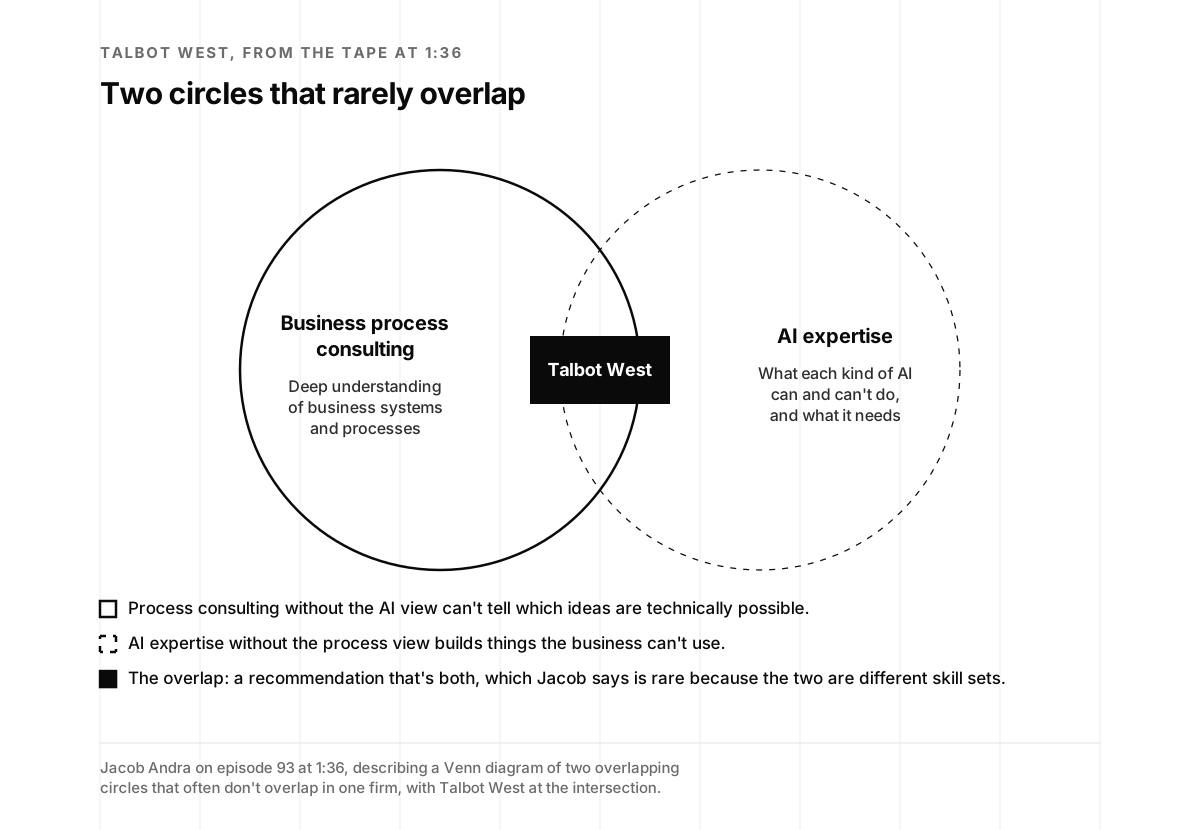
Two overlapping circles. The left circle is business process consulting, a deep understanding of business systems and processes. The right circle, dashed, is AI expertise, what each kind of AI can and can't do and what it needs. A filled box labeled Talbot West sits where they overlap. Below, three lines. Process consulting without the AI view can't tell which ideas are technically possible. AI expertise without the process view builds things the business can't use. The overlap is a recommendation that's both, which Jacob says is rare because the two are different skill sets.
Two skill sets that usually live in different firms, as Jacob drew them on the tape. The overlap is where a recommendation can be both technically possible and useful to the business.

The firm’s own pages say the same thing more formally today. Its about page describes senior expertise across strategy, architecture, engineering, AI, data, governance and operations, and says the firm picks the mechanism after it defines the outcome: “We do not resell software or depend on a particular technology being selected” (Talbot West). AI is one valid answer on that page. So are conventional software, process redesign, an existing platform, delay and, in its words, non-consumption. The name comes from the Talbot, a hunting hound known for holding a scent across rough ground, and the West stands for working at the frontier, where technology changes faster than investment cycles.

Stephen added one line before he handed the question back: “I mean, I think that’s a really good kind of overview of the bridge between the, uh, technical and the business.” Then he turned the interview around and asked about us, which is how I ended up describing YSecurity as a team that steps in “really early in a company’s life cycle before, you know, usually you even hire your first your first security person.” Stephen saw the niche from his Oracle years, where security came with million-dollar contracts, and from startups, where it often doesn’t:

“Then moving into the startup world, it’s like nobody thinks about security because we don’t have the budget for it and everything’s shoestring architecture and all of that. And then, you know, decisions that could have been made early aren’t made until later and it’s very painful.”

Stephen Karafiath, at 3:21

Jacob’s reply was four words, “Might as well bake the best practices in early, right?” Mine was that the trick is focus: “Can you focus on how security can be part of your go-to-market engine and really use it as a market distinguisher, which leads to amazing outcomes like closing deals faster, closing deals in new regulated markets, maybe even leading to more attractive M&A terms.” Then Sasha joined us, a little late and right on time for the first real question.

Friends first, co-founders later

Plenty of founders who listen to the show ask us how to find a co-founder, so I asked how these two found each other. Jacob’s answer is the one most people don’t want to hear, because it can’t be hurried:

“We’ve been friends for a long time on a personal level before ever doing business together. And Steve’s watched me build other businesses.”

Jacob Andra, at 11:36

The record behind “other businesses” is long. Jacob owned and ran TerraFirma Paint & Plaster from 2003 to 2014, then ran marketing at Advanced Composites, U.S. Translation Company and One Click Retail, was chief marketing officer of SOMA in Helsinki, and from 2019 ran CustomerFaucet.com, a copywriting and site architecture firm, before starting Talbot West in April 2024 (LinkedIn). He credits Stephen “hugely for even the launch of Talbot West,” and says he eventually “poached” him as a co-founder.

Stephen’s side of the story starts at the top of a big company. He had worked his way through Oracle “from starting as a developer into consulting into product development, finally landing in sales engineering,” and ran the Developer Innovations Team, which built minimum viable products for Fortune 500 customers without having to carry them into production. “It felt like I’d made it,” he said. What moved him was watching the company’s pace on AI, and the experience of a startup afterwards:

“And then trying out the startup ecosystem, like you guys are allergic to. One of my friends who went and managed a big team at Google and some of my other friends from Oracle. We kind of banded together and made some pretty incredible strides even before ChatGPT 3, on some RAG-based architectures when it was new, but it quickly became apparent: wait, like, SaaS isn’t where it’s at anymore.”

Stephen Karafiath, at 13:07

His LinkedIn shows the startup years: he was vice president of AI solution engineering at Morfius from April 2023 to October 2024, and before Oracle he led a developer team at Global Exchange Services from 2002 (LinkedIn). The models to scale what they built, he said, kept turning into bespoke consulting for the big customers they were selling to, which was exactly the work Jacob was doing. He called it “a hand in glove fit,” and he described his co-founder as someone who can “intuitively load a huge amount of context in his head, almost like an AI.”
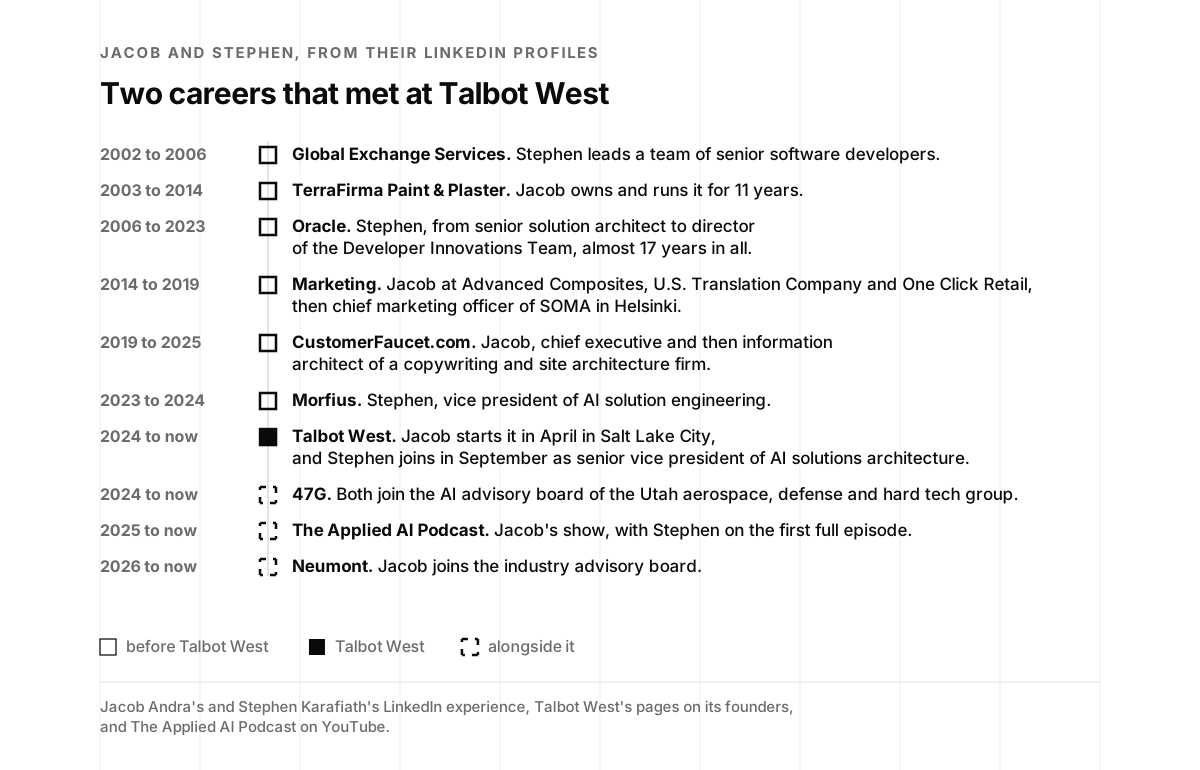
A timeline of ten entries. 2002 to 2006, Global Exchange Services, where Stephen leads a team of senior software developers. 2003 to 2014, TerraFirma Paint and Plaster, which Jacob owns and runs for 11 years. 2006 to 2023, Oracle, where Stephen goes from senior solution architect to director of the Developer Innovations Team, almost 17 years in all. 2014 to 2019, marketing, Jacob at Advanced Composites, U.S. Translation Company and One Click Retail, then chief marketing officer of SOMA in Helsinki. 2019 to 2025, CustomerFaucet.com, Jacob as chief executive and then information architect of a copywriting and site architecture firm. 2023 to 2024, Morfius, Stephen as vice president of AI solution engineering. Filled, 2024 to now, Talbot West, which Jacob starts in April in Salt Lake City and Stephen joins in September as senior vice president of AI solutions architecture. Dashed, 2024 to now, 47G, whose AI advisory board both join. Dashed, 2025 to now, The Applied AI Podcast, Jacob's show, with Stephen on the first full episode. Dashed, 2026 to now, Neumont, where Jacob joins the industry advisory board.
Two careers that met at Talbot West, from their LinkedIn profiles. The dashed entries run to today.

Two of their own conversations are worth watching next to ours. On the first episode of The Applied AI Podcast, Jacob and Stephen talked through how the firm approaches digital transformation, and a few months later they went deep on large language models and what they keep getting wrong.

Jacob and Stephen on The Applied AI Podcast, August 21, 2025, about 40 minutes, released the day the show launched. Watch on YouTube.

We are not security experts

I asked whether they think of themselves as security people. Jacob didn’t hedge: “We are not security experts, so we do love to bring in people like yourselves for specific security stuff.” Stephen’s answer was more interesting, because it described a career of security as a default setting rather than a job title:

“Yeah, I think to answer your question, having spent decades at Oracle, secure by default, encrypting data at rest, data [in] transport, all of that, those concerns were always paramount. So I’ve always been security adjacent. I’ve run security related teams, but it’s never been my focus.”

Stephen Karafiath, at 5:20

He had spent most of his career steering clear of public sector work and federal security rules, he said, until Jacob pulled him into a digital transformation for a company that does “a lot of high-tech aerospace contracting to the DoD.” That meant dusting off what he knew about Level 2 of the Cybersecurity Maturity Model Certification (CMMC), the Defense Department’s program for contractors that handle federal contract information or controlled unclassified information, and about secure enclaves and cloud regions authorized under FedRAMP, the federal program for cloud services. His own conclusion was the one we’d give any client: “I would prefer to let experts handle it the same way as I could do my own taxes, but I think security expert or tax expert will do it better than I would.”

That’s a healthy instinct, and it’s also the reason this conversation belongs on a security show. The decisions Talbot West maps are the ones that decide what security work a company will need later.

Forking pathways

With the aerospace client, Jacob said, the job isn’t to solve the security questions. It’s to show where they sit:

“We’re trying to shine a strong spotlight on the decision-making pathways, the dependencies and which ways those dependencies flow and how all of this stuff ties together because it it turns into such a tangled rat’s nest.”

Jacob Andra, at 6:28

Listen · Jacob on episode 93, from 6:22
About 19 seconds: the decision-making pathways, and the tangled rat's nest. Read the full transcript.

One of their recommendations was to bring in “a firm that’s an expert in CMMC 2 compliance and security issues.” The rest was a map of forks: many of the company’s decisions, he said, would be “gated by whether they’re going to do a GovCloud or on-prem,” and Talbot West’s role was to show those forks, not to answer them. Stephen had described the same fork from the other end. The client might have been saving money with on-prem deployments, “but really they need like a FedRAMP-certified GovCloud.”
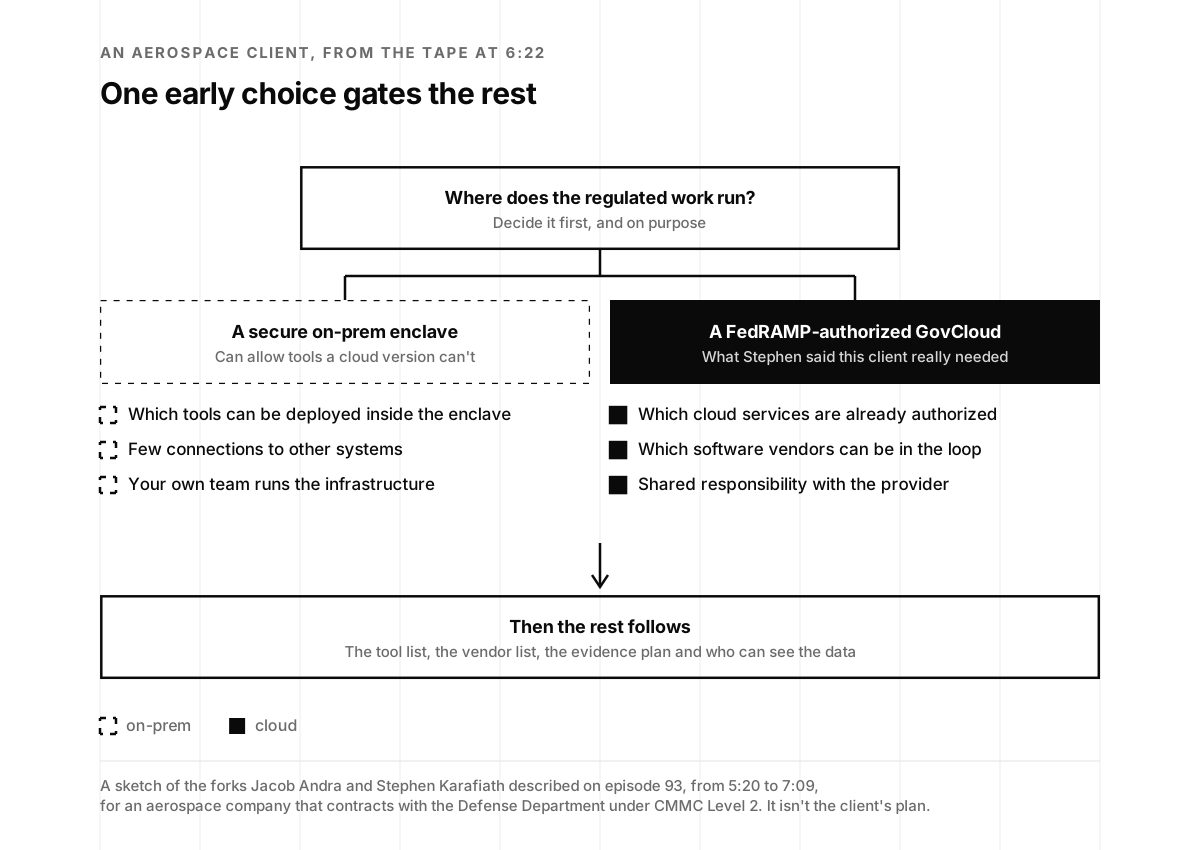
A decision tree. At the top, an open box asks where the regulated work runs, and says to decide it first and on purpose. It forks into two boxes. Dashed: a secure on-prem enclave, which can allow tools a cloud version can't, with three consequences below it, which tools can be deployed inside the enclave, few connections to other systems, and your own team runs the infrastructure. Filled: a FedRAMP-authorized GovCloud, what Stephen said this client really needed, with three consequences below it, which cloud services are already authorized, which software vendors can be in the loop, and shared responsibility with the provider. An arrow leads to a final box: then the rest follows, the tool list, the vendor list, the evidence plan and who can see the data.
One early choice gates the rest. A sketch of the forks Jacob and Stephen described for the aerospace client, not the client's actual plan.

This is the cheapest kind of security work there is, and the one most companies skip. Once the hosting decision is made, half of the compliance plan is made with it: which tools are allowed, which vendors can be in the loop, which audit evidence you’ll need and who can see the data. A map that shows the forks before the commitment hardens is worth more than a remediation plan after it. It’s the same reason we tell defense startups that compliance is both the barrier to entry and the moat, in our post on building a defense tech startup.

Sasha asked the follow-up every regulated company asks, how a modern technology stack helps with the moats in organizations that have been around a long time. Jacob handed it to Stephen (“Why don’t you take that one, Steve?”), and Stephen’s answer was that the news is better than it used to be. So much now comes “on-demand as a service,” already certified in a FedRAMP environment, that a company can outsource more of the legwork, “as long as you’re careful to not run afoul of the regulations.” His general rule: “instead of trying to reinvent the wheel, go out and figure out the best practices, see what other companies have done, see what other offerings are new to the market.”

One or two degrees

Jacob took the other half of Sasha’s question, the inefficiency inside big organizations. “The bigger the organization, the more inefficiency,” he said, government and private sector alike, and no one gets it to zero. The point is that at that size you don’t need to:

“On a large organization, if you can even move the needle one or two degrees, you’re talking massive impact on bottom line and profitability and all of that.”

Jacob Andra, at 9:02

What he described next is the method, and it’s the heart of the episode. Talbot West looks “in a very holistic system of systems way, not just plugging an isolated solution in and thinking that’s going to solve it.”

“Because again, back to this idea of dependencies, you’ve got to map it. You’ve got to showcase the impact of how this depends on that. You got to have your data sources right, address those at the root level and all of this.”

Jacob Andra, at 9:26

Listen · Jacob on episode 93, from 9:26
About 26 seconds: map the dependencies, fix the data at the root, then pick the initiative. Read the full transcript.

The order matters. Most of the time goes into the evaluation, and only “once we have clear pathways established and can show ROI” does a specific initiative go ahead, one that solves a specific pain point “now that we understand how it relates to all these other things.” It’s the discipline the MIT numbers reward, and we wrote it up at length in why 95% of enterprise AI projects fail. Talbot West has since published its own version, a guide to the dependencies that have to be true before an AI initiative can work (Talbot West).

If it ain’t broke

I asked what inefficiency they run into first, almost like clockwork, and whether AI had changed it. Stephen’s answer spanned his whole career. The biggest inefficiencies “as, um, organizations tend to get larger are the growing pains,” from emailing a spreadsheet back and forth, to a first SaaS-based CRM, to outgrowing that. Then the legacy processes nobody updated and “the technical debt that has come from previous implementations.” The older the company, the bigger the pile:

“I mean, when we work with some of these large telecoms that have been around for like 70 years, it’s like their internal system is like a web portal, the best technology that like 1992 had to offer.”

Stephen Karafiath, at 10:37

The reason it survives is human, not technical, and it’s the line from this episode I hear in most security engagements too:

“Like if it ain’t broke, don’t fix it. Even if it’s taking literally 100x the effort that like some of the modern AI systems that Jacob is helping these guys realize they need, there doesn’t seem to be that motivation there until you really feel the pain.”

Stephen Karafiath, at 11:07

Listen · Stephen on episode 93, from 11:07
About 14 seconds: nobody moves until it breaks. Read the full transcript.

In security the pain usually arrives as an incident or a lost deal. The cheaper way to feel it is on purpose, before either: a penetration test that breaks the old portal while nobody’s depending on it being whole, or an enterprise security questionnaire answered honestly in a draft before it’s answered for real.

One of eight shapes

Sasha asked how they decide which pain point deserves a solution when every client sees the world from a different angle. Stephen’s answer comes from decades of Fortune 500 meetings at Oracle and the consulting since:

“Every customer, especially these big guys, they all think that they’re a unique snowflake with their pain points. They’re like, oh, you need to understand me.”

Stephen Karafiath, at 17:36

Once you’ve seen a hundred companies, he said, the hundred and first arrives with its unique pain points, and some really are unique. “But a lot of these things that you think are unique to you are not actually unique to you. You’re like literally like one of eight different shapes.”

Listen · Stephen on episode 93, from 17:36
About 29 seconds: the unique snowflake, and the eight shapes. Read the full transcript.

We see the same thing in security programs, which is why a startup’s first SOC 2 doesn’t have to be invented from scratch. The shapes repeat. What doesn’t repeat is the detail of a company’s data, vendors and people, and that’s what the sitting down is for. Stephen said this kind of deep snapshot of a customer “would not have been possible before AI came out,” and handed it to Jacob to explain the system they built for it.

APEX: three rounds to one first move

Jacob’s clients, he said, often have “500 different directions they want to run,” initiatives they’ve started around AI and ones that have stalled out. It’s overwhelming, and the answer Talbot West built is a method with a name:

“It’s called APEX, that stands for AI Prioritization and Execution. And it essentially maps, it maps their entire business, all their systems and processes, and then it maps all the ways AI could be applied within that ecosystem. And it prioritizes them against five key metrics.”

Jacob Andra, at 18:55

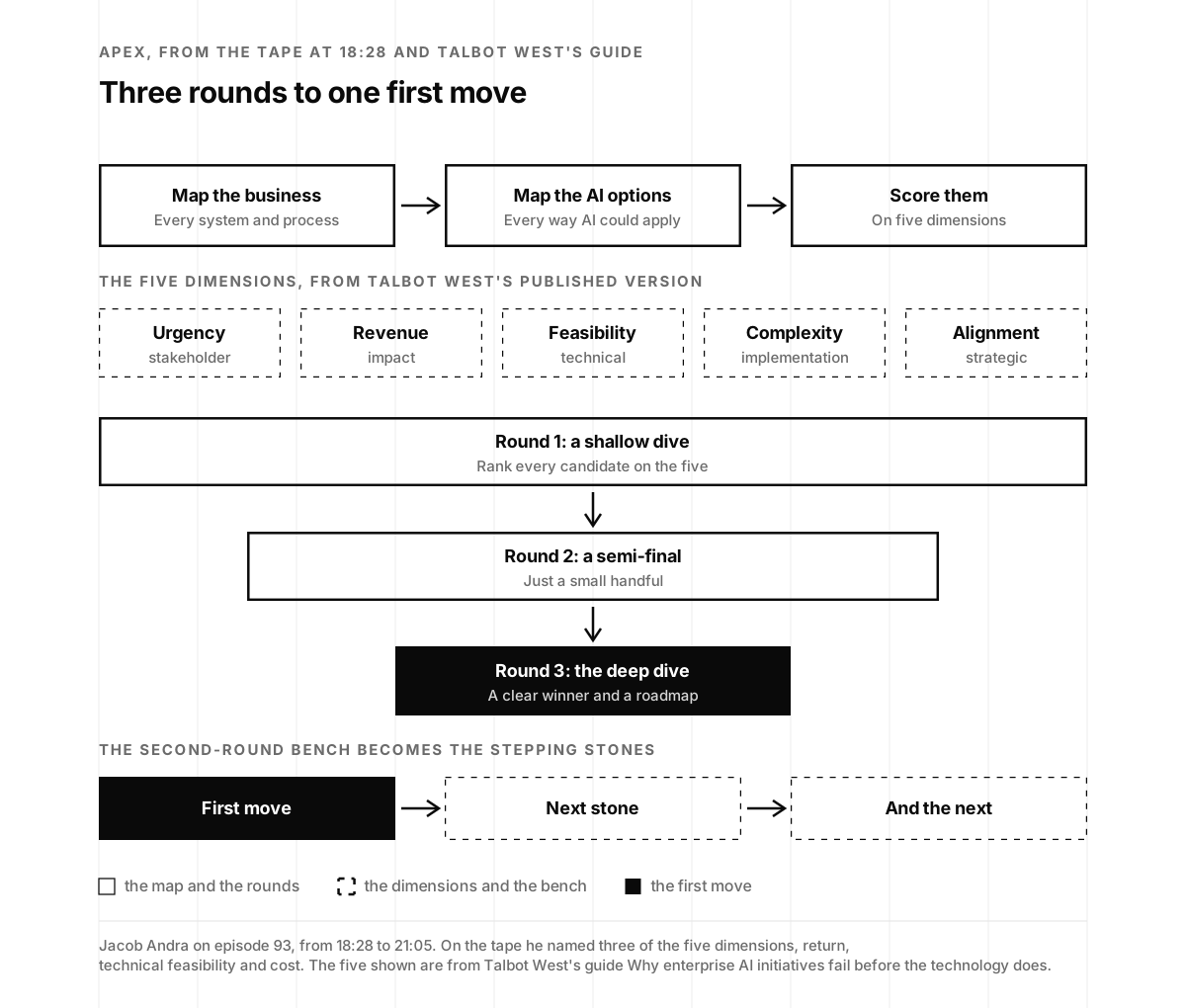
On the tape he named three of the five, highest return on investment, technical feasibility and cost, and pointed to the website for the rest. Talbot West’s published version lists the five dimensions as stakeholder urgency, revenue impact, technical feasibility, implementation complexity and strategic alignment, scored through three rounds of competitive elimination, and says the first round is the most important because it removes the exciting ideas that score poorly on feasibility or alignment (Talbot West). The rounds work like a tournament:

“So one round is more of a shallow dive across all these, ranking them across these five criteria. Then there’s kind of almost a semi-final round where you have just a small handful and out of that there’s a clear winner and you do a really deep dive on that and provide a pretty comprehensive roadmap on what that one would look like to implement, what it would drive in ROI and all that. And it’s very obvious where you should start.”

Jacob Andra, at 19:25
Listen · Jacob on episode 93, from 19:23
About 24 seconds: three rounds, a clear winner, and a roadmap. Read the full transcript.
APEX as a flow. Three open boxes joined by arrows: map the business, every system and process, then map the AI options, every way AI could apply, then score them on five dimensions. Five dashed boxes list the dimensions from Talbot West's published version: stakeholder urgency, revenue impact, technical feasibility, implementation complexity and strategic alignment. Below, three rounds narrow down. Round 1, a shallow dive that ranks every candidate on the five. Round 2, a semi-final with just a small handful. Round 3, filled, the deep dive, a clear winner and a roadmap. At the bottom, the second-round bench becomes stepping stones: a filled first move, then a dashed next stone, then the next.
APEX as Jacob described it, with the five dimensions from Talbot West's published version. The runners-up don't disappear: they become the next stepping stones.

The part I’d steal is what happens to the runners-up. After the winner, there’s “your second-round bench,” and the candidates are “tied together in a kind of stepping-stone format.” Jacob made the same point on LinkedIn in August 2026, in a sentence worth pinning above any AI roadmap.

The highest-ROI investment may not be the best first one. Every company feels the pull to modernize. Run a model showing the ROI of various initiatives and pick the highest-scoring one, right? Wrong. Projects aren't independent. Some unlock others.

Jacob Andra · August 18, 2026
Why the best first project isn't always the highest-scoring one. View on LinkedIn.

Security work sequences the same way. The first control you put in should be the one that makes the next three cheaper: an identity provider before access reviews, an inventory before shadow AI detection, a logging pipeline before anyone promises an auditor evidence.

The 2030 thesis

The stepping stones lead somewhere, Jacob said, and the firm has a name for where:

“We actually have a thesis of where we think this is going. It’s called our 2030 thesis. And we think that the industry and businesses are moving toward more of an integrated total organizational intelligence, and that in the future that’ll drive tremendous competitive advantage.”

Jacob Andra, at 20:02

Listen · Jacob on episode 93, from 20:02
About 41 seconds: the 2030 thesis, from siloed today to orchestrated tomorrow. Read the full transcript.

Today’s landscape, in his words, is “very siloed and very fragmented.” He thinks competitive pressure and technology “make that an inevitability,” so each project should be a step toward it, and the steps start “bolting together” over a few years. He sees Talbot West as the quarterback. When I put it back to him as a field that’s changing, with AI driving it, he widened it: “it’s not just AI, it’s a lot of other things,” data orchestration layers among them, and the exact year matters less than direction. “The point is companies that work with us are going to be much closer to that through working with us than they would have been on their own.”

Stephen’s LinkedIn describes the same idea as “a central nervous system for your company,” a system of systems with subsystems in every role and department (LinkedIn). Talbot West’s architecture discipline for the multi-part systems underneath it is Cognitive Hive AI, or CHAI, which organizes different AI components into decision structures with explicit interfaces and authority rules. Its own summary of the goal is a good one: “The point is not to assemble more agents” (Talbot West).

Seen from security, total organizational intelligence is also a total data map, and that cuts both ways. The orchestration layer that lets insight flow across the company is the layer an attacker would most like to reach, so it needs its own identity, its own permissions and its own logs from the first stepping stone, not the last.

A skeleton, then meat on the bones

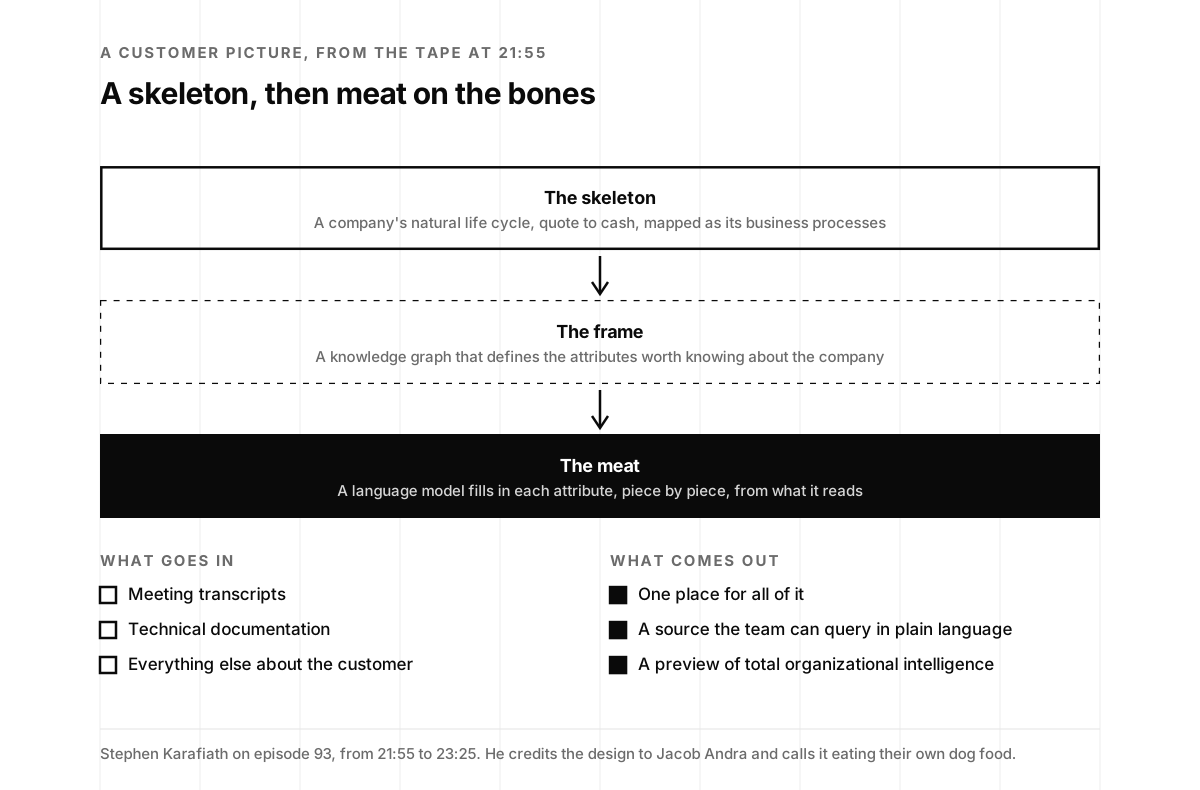
Stephen said they’re already running a preview of that future, on their own customers. Talbot West builds an internal intelligence source on each client, fed by meeting transcripts and technical documentation, that the team can query in natural language. The design was Jacob’s idea, he said, and it’s a clean picture of how they combine the two kinds of AI:

“What are the natural life cycles of most companies? So whether that’s everything from quote to cash or like what is the business process involved, let’s map that whole thing out and let’s stand that up like a skeleton, and then we can use neurosymbolic AI to create a knowledge graph, to create a framework that defines the attributes that we want to know about this company. And then we can use the latest LLM technology that understands natural language to go through that piece by piece and kind of start putting meat on those bones.”

Stephen Karafiath, at 22:42
Listen · Stephen on episode 93, from 22:42
About 31 seconds: the life cycle as a skeleton, the knowledge graph as the frame, the language model as the meat. Read the full transcript.
Three stacked layers joined by arrows. Open, the skeleton: a company's natural life cycle, quote to cash, mapped as its business processes. Dashed, the frame: a knowledge graph that defines the attributes worth knowing about the company. Filled, the meat: a language model fills in each attribute, piece by piece, from what it reads. Below, what goes in: meeting transcripts, technical documentation and everything else about the customer. And what comes out: one place for all of it, a source the team can query in plain language, and a preview of total organizational intelligence.
The customer picture Stephen described, in three layers: a business life cycle as the skeleton, a knowledge graph as the frame, and a language model filling in attributes from the transcripts and documents.

Most companies, he said, probably won’t reach total organizational intelligence “for a couple of years,” but this is “eating our own dog food” today. It’s also a useful pattern for anyone building on customer data: the structure decides what the model is allowed to fill in, and every attribute it fills has a place, a source and an owner. If those transcripts include other companies’ confidential information, as consulting transcripts do, the structure is also where you decide who can query what.

Why AI projects stall

Sasha asked the question that sits behind a lot of AI budgets: how do you keep adoption going after the excitement wears off, when the old technology stack quietly wins again? Jacob answered in two parts. The first is scoping, and the MIT report:

“So this whole MIT report where only ninety, you know, ninety-five percent of AI projects fail to see any meaningful ROI. I mean, we think that that’s largely driven by improper scoping and lack of understanding the dependencies and all of the things required for a technical implementation to succeed.”

Jacob Andra, at 24:05

Listen · Jacob on episode 93, from 24:05
About 37 seconds: the MIT number, improper scoping, and the human element. Read the full transcript.

He means the report from MIT’s NANDA initiative, The GenAI Divide: State of AI in Business 2025, which found that about 95% of organizations were getting no measurable return on generative AI (MIT NANDA). His reading is that most of those projects were trying to “shallowly fit a solution in without understanding the landscape.” The second part is people: “Are you properly training the people, doing your change management and all of that?” Talbot West’s own postmortems point the same way. In its guide to why AI initiatives fail, the decision that sank a project is usually made early, by the wrong person, and never revisited (Talbot West).

Jacob also said Talbot West sees “a much higher success rate than that with our clients.” That’s their claim, and the record doesn’t let me check it either way. What I can say is that the two causes he named are the ones we can see from the security side too. A pilot with no owner for its data and no training for the people downstream fails the same way whether the risk is a bad answer or a leak.

Jacob with Cydni Tetro on why AI initiatives fail, The Applied AI Podcast, February 3, 2026, about 31 minutes. Watch on YouTube.

Failures that don’t scale away

The second half of Jacob’s answer is the one the episode title points at. There’s “such a frenzy right now over large language models and a fundamental misunderstanding of what their actual capabilities are and aren’t,” he said, and he’s cataloguing the ways they fail:

“And these ways are persistent across releases, leading me to believe that it’s fundamentally structural to the way that these neural networks function. It’s not something that they’re going to throw more compute, more scaling laws at and outgrow it.”

Jacob Andra, at 25:00

Listen · Jacob on episode 93, from 24:42
About 34 seconds: the failures that persist across releases. Read the full transcript.

He said he planned to publish a paper mapping the categories of error, logical and otherwise. I haven’t found a paper under that description on Talbot West’s site yet. The nearest public version is the conversation he and Stephen recorded for their own podcast in October 2025, whose description lists formatting errors that swing between extremes, logical inconsistencies across large bodies of text, fabricated citations, and habits no prompt seems to remove, including the em dash, which is why you won’t find one on this page.

Jacob and Stephen on the failure modes of large language models and the case for neurosymbolic AI, The Applied AI Podcast, October 17, 2025, about 35 minutes. Watch on YouTube.

The practical consequence is a scoping question, asked before any tool is chosen. “Is this a task for a large language model? Is this a task for some type of machine learning solution? Is this an ensemble job where it’s complex enough, you decompose it into subtasks and you bring in multiple different capabilities and kind of orchestrate them together?” And Jacob’s patience with the alternative is short: when people “conflate large language model with AI” and claim it can do everything, “I just roll my eyes, you know, like that’s not serving clients, that’s not steering them properly.”
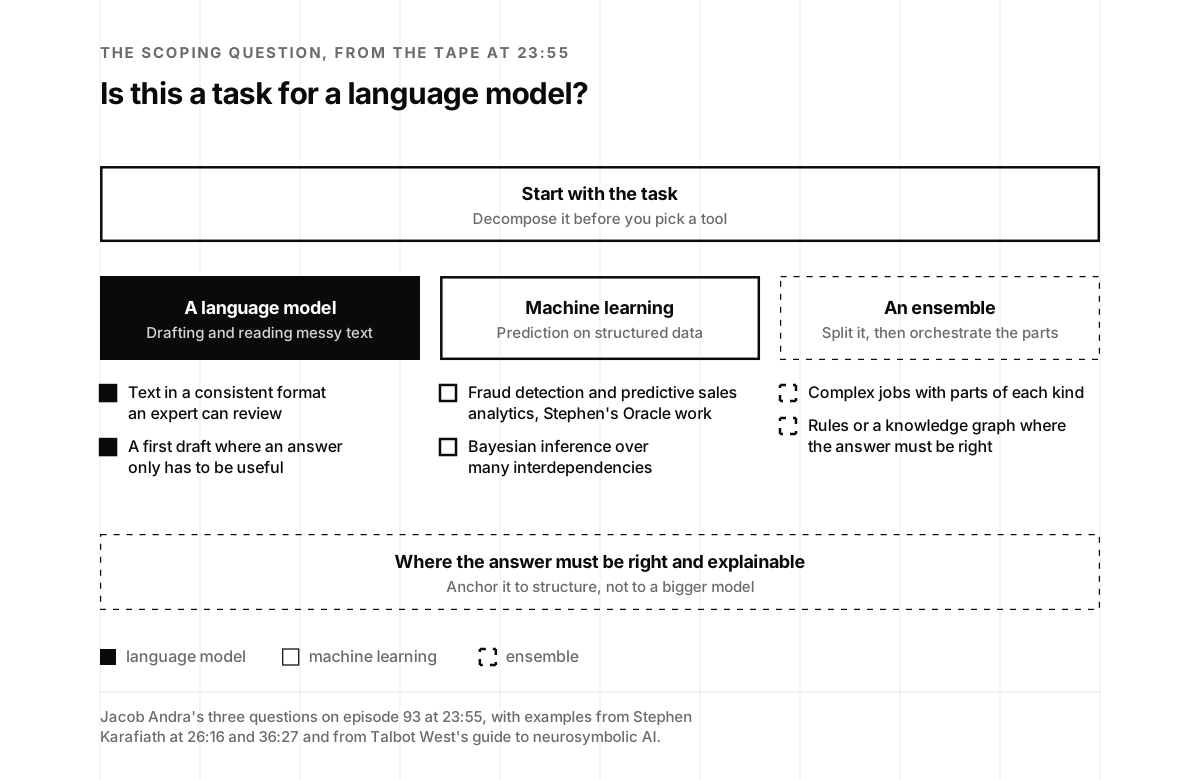
An open box at the top says to start with the task and decompose it before picking a tool. Three columns follow. Filled, a language model, for drafting and reading messy text, such as text in a consistent format an expert can review, or a first draft where an answer only has to be useful. Open, machine learning, for prediction on structured data, such as fraud detection and predictive sales analytics, Stephen's Oracle work, and Bayesian inference over many interdependencies. Dashed, an ensemble, where you split the task and orchestrate the parts, for complex jobs with parts of each kind and rules or a knowledge graph where the answer must be right. A dashed box at the bottom says that where the answer must be right and explainable, you anchor it to structure, not to a bigger model.
The scoping question Jacob asks before any tool is chosen, with the kind of work each answer fits. A summary of the episode and Talbot West's published guidance, not a rule.

Talbot West’s company page put the same view in a better metaphor in July 2026.

Large language models are not all of "AI" any more than electric scooters are representative of "transportation." They're getting outsize attention because we love to anthropomorphize and a machine that sounds like us plays on that tendency.

Talbot West · July 20, 2026
Talbot West on why a large language model is one tool among many, and why a custom harness makes it far more useful. View on LinkedIn.

A dot-com moment

Stephen picked up the hype thread with the view of someone who has been through one bubble already. He credits Jacob with “a middle of the road approach. Not overly pessimistic, not overly optimistic,” and then he made a historical call:

“And to answer your initial question, my own personal view is we’re probably in the equivalent of the dot-com boom and bust of the late 90s. I think especially around LLMs, I’m seeing those same patterns coming up.”

Stephen Karafiath, at 26:32

Listen · Stephen on episode 93, from 26:32
About 17 seconds: the dot-com boom and bust, again. Read the full transcript.

For scale, the Nasdaq Composite rose about 600% from 1995 to its peak on March 10, 2000, and had fallen 78% from that peak by October 2002 (Wikipedia). The internet survived the bust, and so did most of what it made possible. That’s the shape of Stephen’s argument too: a correction in the investment, not in the technology.

He admitted he’d been a believer. “I even drank into the Kool-Aid,” he said, once the Transformer paper from Google came out in 2017 and translation got good almost overnight. That paper, “Attention Is All You Need,” by eight researchers at Google, introduced the architecture behind today’s large language models (Wikipedia). “They weren’t just passing the Turing test, they were obliterating the Turing test,” he said, and for a while, through GPT-2, GPT-3 and 3.5, it looked like scaling might simply continue like Moore’s Law. Then the balloon deflated, at least for him: “The idea that LLMs specifically are going to be this artificial general intelligence, I think that balloon has been deflated for me at least. Jacob’s helped me see that as well.”

The more useful half of his answer is what people are missing while they stare at chatbots:

“You know, the stuff that I did historically with Oracle back when we did fraud detection for major credit cards, or when we’re doing predictive sales analytics. You know, we weren’t using any neural networks for any of that, but it was about like mapping with logic, you know, a lot of different interdependencies and making predictions based on that and like Bayesian inference algorithms. All of that stuff is ripe to be combined with the natural language of LLMs to be bigger than the sum of its parts.”

Stephen Karafiath, at 28:04

He wouldn’t be surprised by “a bust in the investment into just scaling LLMs and data centers,” and he’d welcome a pause. “Jacob and I could use a breath of fresh air if the pace of AI development just stagnated for let’s say five years, awesome.” His reason is practical: when the landscape shifts every month, it’s harder for companies to plan or start implementing. That’s true for security programs too. A control written for last quarter’s model integration is often already describing the wrong thing.

The flywheel, in theory

I pushed back with the strongest version of the other side: AI as a flywheel that keeps increasing its own velocity. Stephen said he subscribes to it in theory, a machine smart enough to improve itself, given unlimited resources, could run away, and “we can start talking singularity, basilisk, all of that stuff.” Then he described the practical thing in front of us:

“Then I look at the practical thing in front of us, which is the LLM, which is like an autocomplete engine of like, what’s the next word that might sound like an answer?”

Stephen Karafiath, at 30:07

He’s impressed by “how close [these] things that aren’t actually answers come to being answers,” and Sasha finished his sentence for him: “When it’s wrong.” Stephen agreed and kept going. “Like its hallucinations are convincing.” When he and Jacob push the models with long context and many things to hold at once, “the cracks around the edges and the little hallucinations turn into chasms.” If there’s another discovery on the scale of the Transformer paper, he said, everything is back on the table. Until then he’s “less and less convinced and/or worried that LLMs are going to be the thing to get us there.”

Wrangling a drunk junior developer

The best evidence Stephen offered was his own work. He writes code with AI tools every day, and his description is the one I’ll be quoting for a while:

“And it plays out like even in my own coding, like using Claude Code or using Cursor, like these things are impressive. I can get 10 hours worth of coding done in one hour. I still have to play senior [developer]. It’s like wrangling a drunk junior developer, but, like, it can do work really quickly and if it’s not the wrong work and if it didn’t hallucinate, then it’s amazing.”

Stephen Karafiath, at 31:07

Listen · Stephen on episode 93, from 31:07
About 21 seconds: ten hours of coding in one, with a senior developer still in the chair. Read the full transcript.

The fast part and the senior developer part belong together. A coding agent is software that does what its prompts, tools and permissions let it do, so the useful question is what it can touch while it works. The more semi-complicated the task, Stephen said, the more often “it falls on its face,” and he wasn’t worried yet about it writing better than human code and improving itself. “But let’s get on again in a year and maybe I’ll have updated my prediction.”

For a security team, “drunk junior developer” translates into a short list. Give the agent its own identity, read access by default, write access to a branch rather than to production, and a review step a person owns. Jacob wrote the operations version of the same rule on LinkedIn in August 2026, about AI tools that write back to legacy systems:

When modernizing infrastructure, be careful about granting AI tools write permissions to legacy systems. When new software writes back to core databases without proper validation, small definition conflicts can stall production lines or corrupt inventory states.

Jacob Andra · August 13, 2026
Jacob on mapping integration risk by blast radius, with Talbot West's guide to separating read-only tools from write-back. View on LinkedIn.

The guide behind that post sorts integrations into three tiers by blast radius: read-only advisory tools with zero write access, human-in-the-loop execution where the system prepares a change for an operator to approve, and automated write-back to core systems, which it rates as severe risk because errors compound before a person can step in (Talbot West). Between the AI layer and the systems of record it puts a validation and rollback boundary, with one rule: “Capability layers must never bypass the validation gate to reach systems of record.”
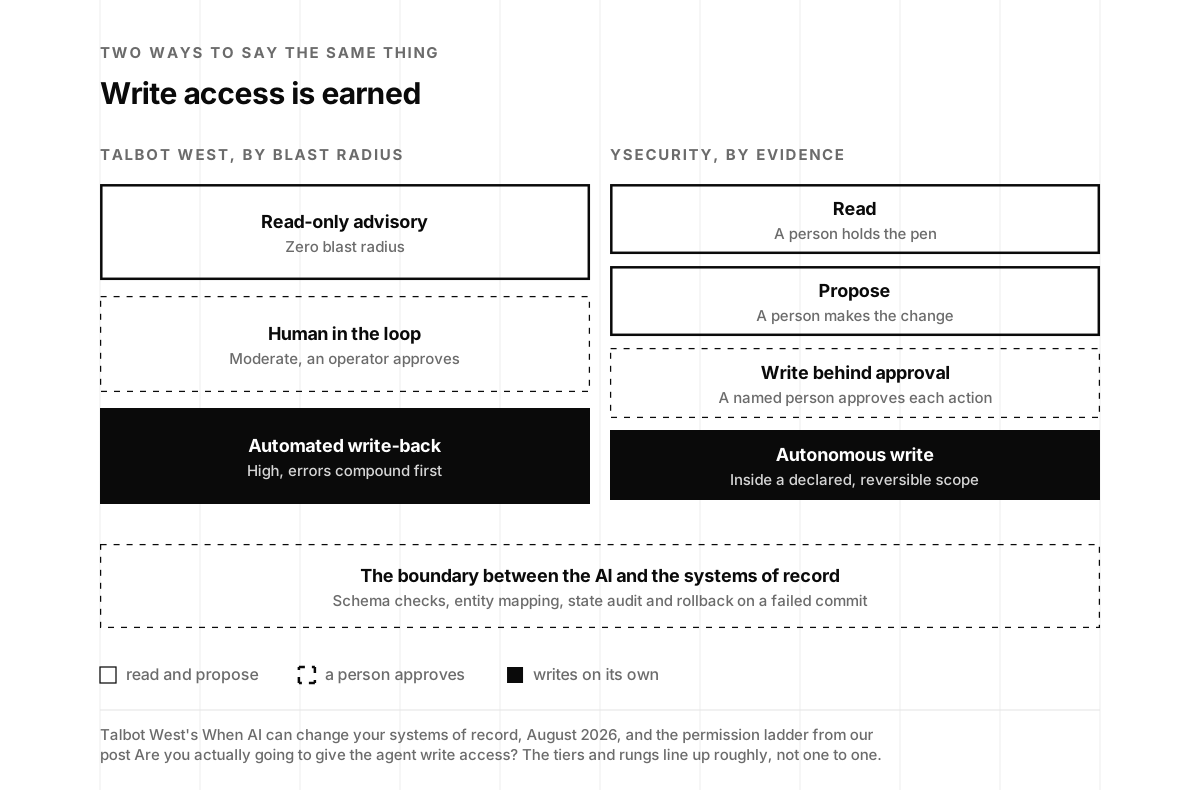
Two columns. On the left, Talbot West's three tiers by blast radius: open, read-only advisory, zero blast radius. Dashed, human in the loop, moderate, where an operator approves. Filled, automated write-back, high, where errors compound first. On the right, the YSecurity ladder by evidence: open, read, where a person holds the pen. Open, propose, where a person makes the change. Dashed, write behind approval, where a named person approves each action. Filled, autonomous write, inside a declared, reversible scope. A dashed box across the bottom describes the boundary between the AI and the systems of record: schema checks, entity mapping, state audit and rollback on a failed commit.
Talbot West's three tiers of integration risk next to the permission ladder we use for agents. Different words, the same idea: write access is earned, and the boundary does the checking.

That’s close to the ladder we use with clients, read, propose, write behind approval, then autonomous write inside a declared reversible scope, which we laid out in are you actually going to give the agent write access? and in the blast radius playbook. The value of seeing it from an operations firm is the failure example: an agent that writes a routing change with a stale part number doesn’t look like a security incident, and it can still stop a production line.

A looseness that is both its strength and its undoing

Jacob gave the cleanest description of the problem I’ve heard on this show:

“There seems to be something inherent to the neural network archetype that is very kind of loose in its logical structure. And that’s the best way I can describe it: a looseness that is both its strength and its undoing.”

Jacob Andra, at 31:50

Listen · Jacob on episode 93, from 31:50
About 28 seconds: why neural networks generalize so well, and why that's the same reason they drift from reality. Read the full transcript.

The looseness is what lets the model generalize and make connections that “rigid and brittle machine learning or AI technologies wouldn’t be able to do.” It’s also why “it’s not very anchored or tethered to reality.” The path forward he described is the one Stephen had mentioned earlier, neurosymbolic AI: “certain rigid ontological structures that anchor the neural network to a sense of reality,” while the network keeps its flexibility for the parts it does well. Talbot West’s longer write-up is careful not to oversell it. Its opening line reads, “Neurosymbolic AI is one approach to constraining generative AI and rendering it more reliable,” and it says the approach is valid for some use cases and not others, a design decision rather than a company-wide choice (Talbot West). Our own explainer of the architecture is neuro-symbolic AI: why enterprises need more than large language models.

The security reading is direct. Anywhere a decision has to be right and explainable, an access decision above all, the answer should come from something that can show its work, a policy engine or a rule, with the language model translating at the edges.

The easiest win

I asked where a company new to AI should start. Jacob gave two answers, and he was honest about the first: “One is hire Talbot West to do our APEX process and we’ll tell you your easiest win.” The second is free:

“But short of that, you know, just start playing with ChatGPT. Know where to use it, know where not to use it.”

Jacob Andra, at 33:34

ChatGPT, Claude, Gemini, “this batch of, you know, chatbots,” used in a narrow scope with custom GPTs for certain knowledge tasks, “not putting sensitive data in them, et cetera, et cetera,” and “you can be up and running in one day, provided your people know how to do it.” Some clients ask Talbot West to teach them exactly that. The limit is expectations: “help me make ChatGPT do this very complicated data analysis thing and integrate with all these other things. Like, yeah, it’s not going to do that.”

The one clause in there that carries the security program is “not putting sensitive data in them.” It’s also the clause most often skipped, which is why the first job of any AI policy is to say in plain words which data can go where, and the second is to find out what people already did before the policy existed. That second job is what shadow AI detection is for.

Governance, champions and one set of tools

Then I asked the question I hear from late-stage startups every month. Five hundred people, no formal program, everyone using something different. Some people on Augment Code, some on Cursor, some on Windsurf. What should leadership do?

“Yeah, so usually that’s a comprehensive governance framework combined with an internal initiative to find the internal champions, find the tools that are working, consolidate on one set of tools, get everyone on board that one set of tools, work with the internal champions to kind of evangelize to everyone else, put a training program in place, et cetera.”

Jacob Andra, at 35:04

I’d sign every word of that. The order is the part people get wrong: find the champions and the tools that already work before writing the rules, so the rules describe how good work gets done instead of banning it. Consolidating on one set of tools is also the cheapest security decision a company can make about AI, because one tool means one contract, one set of data terms, one admin console and one place to look. For an organization that wants the governance to stand up to a buyer’s review, ISO 42001 is the management system standard built for it, and our AI governance maturity model shows where most companies sit before they start.
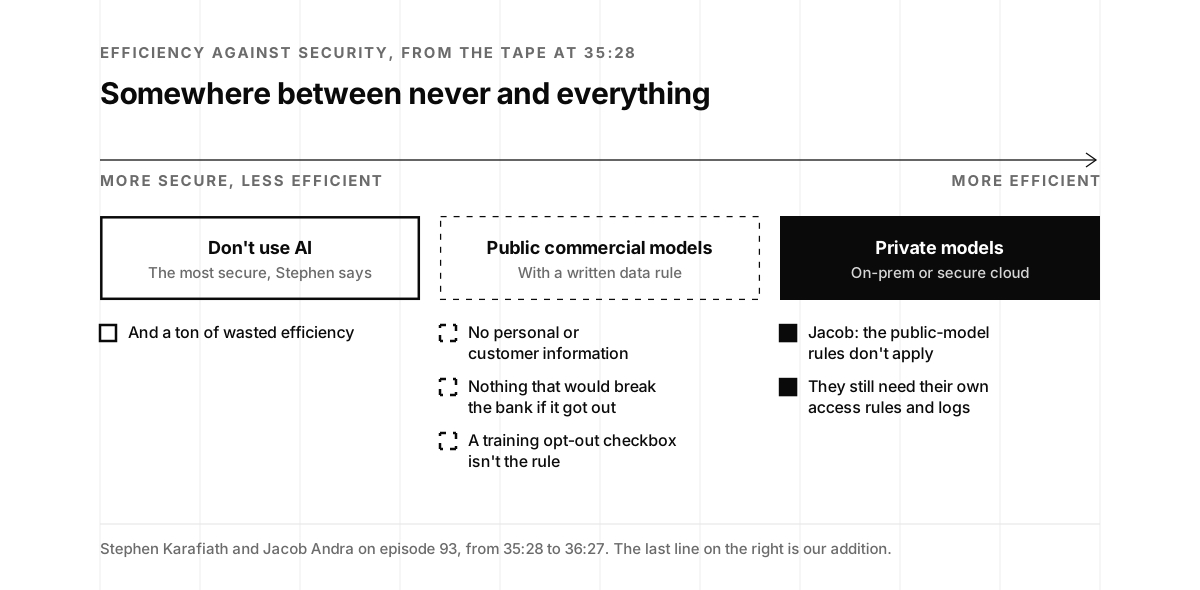
A line runs from more secure and less efficient on the left to more efficient on the right. Three boxes sit on it. Open, don't use AI, the most secure option, Stephen says, and a ton of wasted efficiency. Dashed, public commercial models with a written data rule: no personal or customer information, nothing that would break the bank if it got out, and a training opt-out checkbox isn't the rule. Filled, private models, on-prem or secure cloud, where Jacob says the public-model rules don't apply, and which still need their own access rules and logs.
Stephen's trade-off as a line, with Jacob's distinction marked on it: the rules for public commercial models aren't the rules for private ones.

Efficiency against security

Stephen then drew the trade-off he and Jacob talk about with clients, for our benefit, since “you guys are security guys”:

“And the most secure thing that companies could do with AI is just not use it. But also, you’re going to trade off, um, [a] ton of wasted efficiency to not use it at all.”

Stephen Karafiath, at 35:39

Listen · Stephen on episode 93, from 35:39
About 32 seconds: not using AI is the most secure option, and the most expensive. Read the full transcript.

His policy line is a cost test. As long as there’s no personally identifiable information or customer information involved, and what you’re sharing isn’t “something that’s going to break the bank if it gets out anyway,” you can move into big efficiencies quickly. He’s skeptical of the checkbox that says a provider won’t train on your data, and called trusting it “fanciful.” That’s his view, and the safer habit it points to is the same either way: decide what can leave the building by what it would cost you if it got out, then read the contract for the tools you approve.

Jacob drew the line that keeps the trade-off honest. Stephen was talking about “public commercial large language models,” he said, “because obviously there are a ton of AI solutions that everything you’re saying doesn’t apply because it can be completely private, on-prem or secure cloud, right?” Stephen: “Absolutely.” The rules for a model you rent by the prompt aren’t the rules for one running inside your own boundary, and a good policy says which is which.

Sasha and I have made the same argument from the security side, that a leader who says yes with guardrails ends up knowing more about where the data goes than one who says no and gets shadow AI. Episode 95 with Bedrock Data is the long version, and our post on shadow AI governance is the short one.

Where 10x is real

With that distinction made, Stephen named the quickest wins with large language models, and his test is the most practical idea in the episode:

“And especially if it’s something where the amount of work to produce it is large, but the amount of work to review it is low and you still have your expert humans reviewing it, like you can get 10x efficiency gains on these things.”

Stephen Karafiath, at 36:49

Listen · Stephen on episode 93, from 36:49
About 28 seconds: expensive to produce, cheap to review, with an expert still reviewing. Read the full transcript.

He listed the candidates: text in a templatable, relatively consistent format that “could save hundreds of hours worth of work in half an hour,” from creative writing and marketing content “all the way up to like RFP proposals, understanding them, responding to them, getting that stuff double checked,” and contracts and law review in the legal field. That’s why so many software products already sit on those tasks.
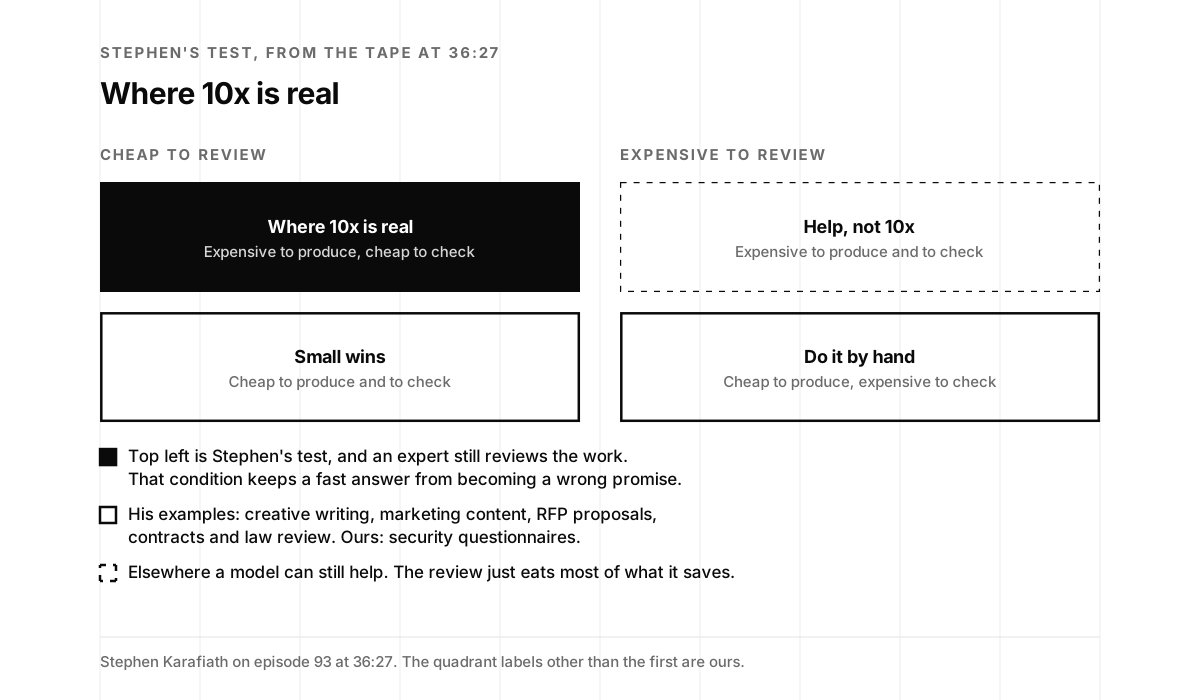
A two-by-two grid with cheap to review on the left and expensive to review on the right. Top left, filled: where 10x is real, expensive to produce and cheap to check. Top right, dashed: help, not 10x, expensive to produce and to check. Bottom left: small wins, cheap to produce and to check. Bottom right: do it by hand, cheap to produce and expensive to check. Below, three lines. Top left is Stephen's test, and an expert still reviews the work, which keeps a fast answer from becoming a wrong promise. His examples are creative writing, marketing content, RFP proposals, contracts and law review, and ours is security questionnaires. Elsewhere a model can still help, but the review eats most of what it saves.
Stephen's test as a two-by-two. The gain is real where producing the work is expensive and checking it is cheap, and an expert still does the checking.

Security questionnaires are the example we live with. Answering a 300-question review from scratch takes days. Checking a draft built from your own policies, your SOC 2 report and your last answers takes hours, if the person checking knows the program. That last condition is Stephen’s, and it’s the one that keeps a fast answer from becoming a wrong promise in a contract. The calculator below runs his test on your own numbers.

When on-prem buys flexibility

I asked how regulated markets, healthcare with HIPAA and HITRUST, defense with CMMC Level 2, get the benefits of AI when the path is unclear. Jacob’s answer was pragmatic: partnerships, and “many solutions emerging to abstract, you know, abstraction layers that take out all of that or mask it,” chosen against what each regulation actually requires, and, when the right solution isn’t on the market yet for a given sensitivity, “steering them away from that or guiding them toward an on-prem solution.”

Stephen added a twist I didn’t expect from someone who spent years moving Oracle customers to the cloud:

“And in some ways, to answer your question, with, like, stuff like CMMC Level 2 environments, with, like, say, a secure on-prem enclave, sometimes you actually buy yourself more flexibility than trying to find either SaaS provided or stuff that can be hosted in the cloud that meets that regulation.”

Stephen Karafiath, at 39:03

If the regulation is mainly about a secure enclave, an on-prem deployment of something like a risk management platform with few connections to other systems may be acceptable where the software-as-a-service version isn’t. “I’ve given up on trying to figure out the reason behind a lot of these onerous federal regulations,” he said, “and just try to advise clients on what they’re allowed to do that will be most useful to them.” I said I was torn, since we just moved everything into the cloud, and he was emphatic about the general case:

“Let me be clear. There’s almost nothing that I would recommend that an enterprise client who’s not subject to secure federal regulations would run in their own on-prem environment. The security of your hosted private cloud [is] going to be far better than anything you’re doing on-prem.”

Stephen Karafiath, at 40:11

Listen · Stephen on episode 93, from 40:11
About 28 seconds: the cloud for almost everyone, and the federal exception. Read the full transcript.

“But when the federal government and regulations are involved, sometimes things get backward.” I’ve seen that once or twice myself, as I said on the tape. The useful version for a defense contractor is the one Jacob described for the aerospace client: decide the enclave question first, on purpose, because the tool choices, the vendor list and the evidence plan all follow from it. Our CMMC Level 2 and FedRAMP readiness work starts there, and a healthcare company has the same fork with AI and HIPAA.

Jacob at the Naval Postgraduate School, on AI and national security, including standards for interoperable, modular AI. View on X.

The hardest days

I asked about the most challenging day as an entrepreneur. Jacob passed it to Stephen (“I love every day, so it’s a hard one for me to answer”), and Stephen’s answer was a programmer’s: the worst moments come when he thinks he’s onto a revolutionary architecture, the bugs turn into a rat’s nest, and then the problem underneath turns out to be philosophical rather than technical.

“There is a fundamental philosophical problem with doing this whole thing unstructured in a natural language and it’s not just, you know, oh, we just need a better LLM or a better machine learning algorithm. It’s like this is fundamentally not going to work.”

Stephen Karafiath, at 41:44

He said Jacob reassures him that they’re doing research, and research sometimes doesn’t work out. That’s an unusually honest thing to say about AI products, and it’s the same conclusion as the rest of the episode from a different direction: some problems need structure, and no amount of fluent text supplies it. Some of the architectures he loves most are in BizForesight, the M&A advisory platform Talbot West is building as a side venture out of its consulting hub. Jacob introduced it on his own podcast in September 2025.

Jacob with Bill McCalpin, chair of the Alliance of Merger and Acquisition Advisors, on AI in M&A and the BizForesight launch, The Applied AI Podcast, September 2, 2025, about 53 minutes. Watch on YouTube.

Jacob’s hardest day is one that hasn’t happened: “the worst day, is if a client was totally unhappy, if for any reason a client didn’t have like an amazing outcome.” He knows the weight he puts on it, and said so. “But I do feel like this strong commitment to that.” Sasha’s reply was the right one: “Well, I mean, it sounds like you’re a true partner.” It also matches the one rule on Talbot West’s about page, which starts, “Do right by the client.”

Earlier, Stephen had described the business model behind that commitment. They call it escape velocity, enough contracts at enough margin to get past “the gravity that would pull us back down,” so the consulting hub funds side ventures that could be home runs. Jacob’s version was shorter. Asked when they sleep, he said, “It’s all about the right team and delegation.”

Advice to a younger self

My last question was what they’d tell their younger selves. Stephen went first:

“I think if I could go back to like all of the younger versions of myself, it would be mainly a message of, like, compassion and acceptance of: it might be hard now, but like it’s all gonna be okay. And a lot of the things that you’re catastrophizing or worried about are gonna work out.”

Stephen Karafiath, at 42:53

Jacob agreed and added his own: “put myself first a lot sooner. Don’t put up with other people’s BS and let their agendas run my life and actually make that decision way sooner. Do what’s right for me.” For founders who listen to this show, that’s the co-founder story in one line. They were friends first, and each of them got to the company on his own terms.

What happened after the tape

The episode aired on April 21, 2026, and Jacob shared it that evening, along with YSecurity’s post about it.

Thanks, Jon McLachlan and Sasha Sinkevich, for having Steve and I on the podcast. It was great to talk about embedding AI capabilities into real company systems and workflows with you guys and Stephen Karafiath.

Jacob Andra · April 21, 2026
Jacob's note the day the episode came out, sharing YSecurity's post about it. View on LinkedIn.

The video version followed on our YouTube channel on June 17, 2026. In the months after, Talbot West published much of what the tape describes. In June it argued that the model layer is commoditizing and the advantage moves to the harness, the custom structure around a model: “The harness is where durable advantage lives” (Talbot West). In August came the guide to why AI initiatives fail, with APEX’s five dimensions, the guide to modernization dependencies, and the blast radius taxonomy for AI that writes to systems of record. Jacob has been teaching the harness idea too.

Jacob at Neumont College of Computer Science, where he joined the industry advisory board in January 2026. View on X.

He also kept doing what he describes on the tape, warning people off the hype. In March, Talbot West posted about an appearance on a go-to-market podcast on spotting AI snake oil.

What executives should ask to tell real AI value from snake oil. View on X.

The regulated world moved too. On July 13, 2026, the Defense Department suspended Phase II of CMMC, the step that would have required third-party Level 2 assessments from November 10, 2026, and began a review of the program. The department’s CMMC page is clear about what didn’t change: “All Phase I self-assessment requirements remain firmly in place” (DoD CIO). DefenseScoop’s report quoted the department’s chief information officer, Kirsten Davies, on the companies that had already done the work: “Every dollar spent on security is a wise dollar spent” (DefenseScoop). For the aerospace client on the tape, and for anyone like it, the enclave decision is still the first fork, and the self-assessments still count.

Talbot West itself has grown into something bigger than the “AI-first digital transformation” Jacob described. Its site now talks about enterprise coherence and modernization capital, and in October 2026 it published the first field report of its American Industrial Capability Project, Beyond the Obvious in Defense Production (Talbot West). The method underneath is the one from the tape. Map the system, find the dependencies, then choose the move. Jacob put it in one line on LinkedIn in September: “Reality rewards one thing only: what works” (LinkedIn).
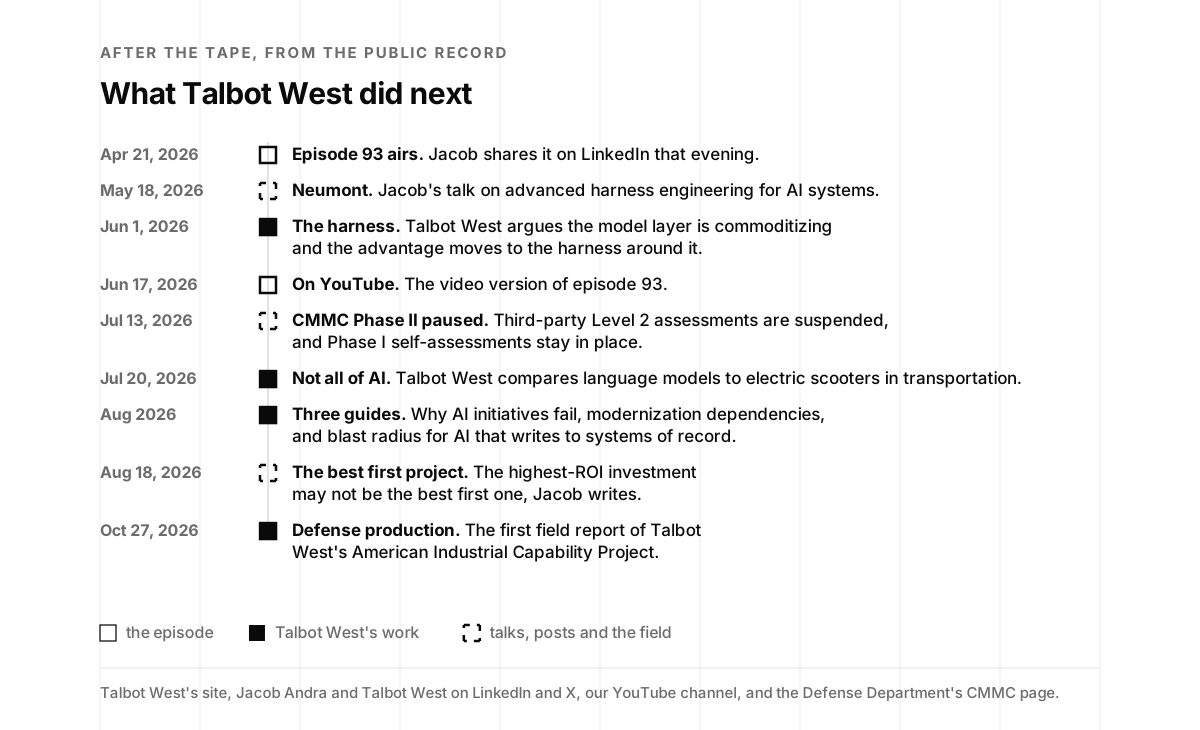
A timeline of nine entries. April 21, 2026, episode 93 airs, and Jacob shares it on LinkedIn that evening. Dashed, May 18, 2026, Neumont, Jacob's talk on advanced harness engineering for AI systems. Filled, June 1, 2026, the harness: Talbot West argues the model layer is commoditizing and the advantage moves to the harness around it. June 17, 2026, the video version of episode 93 on YouTube. Dashed, July 13, 2026, CMMC Phase II paused: third-party Level 2 assessments are suspended, and Phase I self-assessments stay in place. Filled, July 20, 2026, not all of AI: Talbot West compares language models to electric scooters in transportation. Filled, August 2026, three guides: why AI initiatives fail, modernization dependencies, and blast radius for AI that writes to systems of record. Dashed, August 18, 2026, the best first project: the highest-ROI investment may not be the best first one, Jacob writes. Filled, October 27, 2026, defense production, the first field report of Talbot West's American Industrial Capability Project.
The months after the tape, from Talbot West's site, LinkedIn, X, YouTube and the Defense Department's CMMC page.

Did you catch it? A six-question quiz

Interactive · six questions

Did you catch it?

Six questions on what Jacob, Stephen, Sasha and I actually said, with the timestamp for each answer. The answers are under each question for anyone reading without JavaScript.

  1. How much does Jacob say you need to move the needle in a large organization to see a massive impact?

    1. Ten percent
    2. One or two degrees
    3. Half of the workforce

    b. "On a large organization, if you can even move the needle one or two degrees, you're talking massive impact on bottom line and profitability and all of that." Transcript, 8:42.

  2. What does APEX stand for?

    1. AI Prioritization and Execution
    2. Automated Process Execution
    3. Applied Performance Excellence

    a. "It's called APEX, that stands for AI Prioritization and Execution." Transcript, 18:28.

  3. What era does Stephen compare the current moment for large language models to?

    1. The space race
    2. The arrival of the smartphone
    3. The dot-com boom and bust of the late 90s

    c. "And to answer your initial question, my own personal view is we're probably in the equivalent of the dot-com boom and bust of the late 90s." Transcript, 26:16.

  4. What does Stephen say coding with AI tools is like?

    1. Wrangling a drunk junior developer
    2. Pair programming with a senior architect
    3. Autocomplete with a better memory

    a. "It's like wrangling a drunk junior developer, but, like, it can do work really quickly and if it's not the wrong work and if it didn't hallucinate, then it's amazing." Transcript, 30:25.

  5. Where does Stephen say you can get 10x efficiency gains from large language models?

    1. Anywhere you can remove the human reviewer
    2. Where the work to produce something is large, the work to review it is low, and experts still review it
    3. Only in software development

    b. "And especially if it's something where the amount of work to produce it is large, but the amount of work to review it is low and you still have your expert humans reviewing it, like you can get 10x efficiency gains on these things." Transcript, 36:27.

  6. What does Stephen recommend for an enterprise that isn't subject to federal security rules?

    1. Move AI workloads back on-prem
    2. Split everything evenly between cloud and on-prem
    3. Almost nothing on-prem, because a hosted private cloud will be far more secure

    c. "There's almost nothing that I would recommend that an enterprise client who's not subject to secure federal regulations would run in their own on-prem environment." Transcript, 40:11.

Is your AI use case ready to ship?

Jacob and Stephen kept returning to the same order of operations: map the dependencies, pick the right kind of AI, decide what it may change, and only then ship. This scorecard asks eight questions about one use case you’re planning or already running.

Scorecard · eight questions

Is your AI use case ready to ship?

Answer for one use case. If two answers fit, pick the lower one.

  1. Before you chose the tool, did you map what the use case depends on?

    • We chose the tool first
    • We listed the systems it touches
    • We mapped the data, processes and people it depends on, and fixed the data at the root

    "Because again, back to this idea of dependencies, you've got to map it." See One or two degrees.

  2. How did you decide a large language model is the right tool for the task?

    • We assumed it was
    • The task is mostly language, so it seemed right
    • We asked whether it's a job for a language model, classical machine learning or an ensemble, and where the answer has to be right

    Jacob's scoping questions come before any tool. See Failures that don't scale away.

  3. What can the AI change on its own?

    • It writes to production systems with no check
    • A person approves each change
    • Read-only or proposals by default, with a validation and rollback step before anything writes

    Talbot West sorts integrations by blast radius, and we use a ladder that earns write access. See Wrangling a drunk junior developer.

  4. Which data can go into public commercial models?

    • Whatever people paste
    • There's a policy, but nobody checks
    • A written rule on which data can go where, and the approved tools' terms reviewed

    Stephen's cost test: nothing with personal or customer information, and nothing that would break the bank if it got out. See Efficiency against security.

  5. Who checks the output before it counts?

    • Nobody, it ships
    • Whoever is around
    • An expert who can check it faster than they could have written it

    The 10x gains come with "your expert humans reviewing it." See Where 10x is real.

  6. How many AI tools does the team use for the same job?

    • Everyone picks their own
    • A short approved list
    • One set of tools, with champions who show the rest and a training program

    Jacob's answer for a late-stage startup. See Governance, champions and one set of tools.

  7. Why this use case first?

    • It was the loudest idea in the room
    • It had the highest projected return
    • It scored well on urgency, value, feasibility, complexity and alignment, and it makes the next project cheaper

    The highest-return project may not be the best first one. See APEX: three rounds to one first move.

  8. If you're in a regulated market, did you settle the hosting question first?

    • Not yet
    • We're working it out tool by tool
    • Yes, the enclave or cloud decision came first and the tool list followed, or we aren't regulated

    One early choice gates the rest. See Forking pathways.

Tool first, map later

The tool arrived before the map, which is how most AI pilots start. The next step costs a few hours: draw what this use case depends on, decide what it may change, and write down which data can go into it. Most of the risk shows up on the drawing.

Scoped, not yet safe to ship

You know what you're building and why. The open items are usually in the boundary: what the AI can write, who checks its output, and how many tools the team spreads the same data across. Close those and the pilot can become a system.

Ready to be a stepping stone

Mapped, scoped, bounded and reviewed. Use it as the evidence for the next project: the map you drew, the review step and the data rules are what your buyers and auditors will ask to see, and they make the second use case cheaper than the first.

Where is 10x real for you?

Stephen’s test is that the gain is real where producing the work is expensive, checking it is cheap, and an expert still checks it. This calculator runs the test on one kind of document your team writes over and over, like security questionnaires, proposals or contracts.

Calculator

Where is 10x real for you?

How many documents a month, how long one takes to write by hand, how long an expert takes to review an AI draft, how long the fixes take, and what an hour of that expert's time costs.

–hours a year by hand
–hours a year drafting with AI and reviewing
–times faster per document
–hours a year given back
–a year, at the expert's hourly cost

20 documents a month at 6 hours each is about 1,440 hours a year by hand. With an AI draft that an expert reviews in 30 minutes and fixes in 20, it's about 200 hours, roughly 7.2 times faster, which gives back 1,240 hours, or $148,800 at $120 an hour.

Every default is a placeholder, not a number from the episode. A year here is 12 months of the same volume, and the estimate leaves out the time to set up the drafting, the templates and the source documents, which is real work the first time. If review and fixes take longer than writing it by hand, the gain is zero, and that's Stephen's test telling you this isn't the task for it.

From plaster and Oracle to the 2030 thesis

Everything on this page sits on one timeline, from Stephen’s first developer team to Talbot West’s first field report. Filter it by thread.

Timeline · 2000 to 2026

From plaster and Oracle to the 2030 thesis

Filter by thread. Dates are from the public record except where marked as part of this show.

  1. The dot-com peak

    The Nasdaq Composite tops out, then falls 78% by October 2002 (Wikipedia).

  2. Global Exchange Services

    Stephen leads a team of senior software developers (LinkedIn).

  3. TerraFirma Paint & Plaster

    Jacob owns and runs it for 11 years (LinkedIn).

  4. Oracle

    Stephen joins as a senior solution architect, the start of almost 17 years there (LinkedIn).

  5. Marketing director

    Jacob runs marketing at Advanced Composites, then U.S. Translation Company and One Click Retail (LinkedIn).

  6. The Transformer paper

    Attention Is All You Need, by eight researchers at Google (Wikipedia).

  7. SOMA

    Jacob is chief marketing officer, based in Helsinki (LinkedIn).

  8. Developer Innovations Team

    Stephen becomes its director at Oracle (LinkedIn).

  9. CustomerFaucet.com

    Jacob becomes chief executive of the copywriting and site architecture firm (LinkedIn).

  10. ChatGPT

    OpenAI releases it (Wikipedia).

  11. Morfius

    Stephen leaves Oracle to be vice president of AI solution engineering (LinkedIn).

  12. Talbot West

    Jacob starts it in Salt Lake City (LinkedIn).

  13. Stephen joins

    As senior vice president of AI solutions architecture (LinkedIn).

  14. Cognitive Hive AI

    Talbot West first publishes CHAI, its architecture for multi-part AI systems (Talbot West).

  15. 47G

    Both are on its AI advisory board by November 2024 (LinkedIn).

  16. Windsurf

    Cognition signs a deal to acquire it (Cognition).

  17. The GenAI Divide

    MIT NANDA finds about 95% of organizations getting no measurable return on generative AI (MIT NANDA).

  18. The Applied AI Podcast

    Jacob's show launches, with Stephen on the first full episode (YouTube).

  19. BizForesight

    The M&A advisory side venture, introduced on the podcast (YouTube).

  20. Neurosymbolic AI

    Jacob's guide to using constraints where the consequences demand them (Talbot West).

  21. The shortcomings of LLMs

    Jacob and Stephen on their own show, on failure modes and neurosymbolic AI (YouTube).

  22. We record episode 93

    "Like if it ain't broke, don't fix it."

  23. CMMC Phase 1

    Contract enforcement begins, with self-assessments at Levels 1 and 2 (DefenseScoop).

  24. Lucidity Sciences

    Jacob becomes a digital transformation advisor to the company (LinkedIn).

  25. Neumont

    Jacob joins its industry advisory board (LinkedIn).

  26. Naval Postgraduate School

    Jacob on AI and national security (X).

  27. Episode 89

    Graham Neray on agents that delete your database (episode 89).

  28. AI beyond the hype

    Jacob moderates a Silicon Valley panel (X).

  29. Episode 93 airs

    This conversation.

  30. Episode 95

    Bedrock Data on security leaders who enable AI instead of blocking it (episode 95).

  31. The harness

    Talbot West argues the advantage moves from the model to the harness around it (Talbot West).

  32. Episode 93 on YouTube

    The video version (YouTube).

  33. CMMC Phase II paused

    Phase I self-assessments stay in place (DoD CIO).

  34. Why AI initiatives fail

    Talbot West publishes APEX's five dimensions and three rounds (Talbot West).

  35. Blast radius

    Three tiers of integration risk for AI that writes to systems of record (Talbot West).

  36. Episode 102

    Chris Kirschke on why a veteran CISO won't give an AI agent write access (episode 102).

  37. Beyond the Obvious in Defense Production

    The first field report of the American Industrial Capability Project (Talbot West).

What to do this week

Five things, in the order Jacob and Stephen would do them.

  1. Map one use case before you pick its tool. On one page: the data it needs, the processes before and after it, the people who review it, and the number that’s supposed to change. Fix the data problems you find at the root.
  2. Ask the scoping question. Is this a job for a language model, for classical machine learning, or for an ensemble of parts? Mark the steps where the answer has to be right, and keep those away from a model that only has to sound right.
  3. Put every AI integration on a blast radius tier. Read-only, proposes for a person to approve, or writes on its own. Move anything in the third tier behind a validation and rollback step, and give each agent its own identity.
  4. Write down which data can go where. Stephen’s cost test is a fine first draft: nothing with personal or customer information goes into public commercial models, and nothing that would break the bank if it got out.
  5. Pick the first project for what it unlocks. Score your candidates, then ask which one makes the next three cheaper. That’s your first stepping stone.

Key takeaways

  1. Two skill sets in one firm

    Talbot West calls itself an AI-first digital transformation firm, business process consulting with an AI-native focus. Jacob Andra draws it as two overlapping circles, a deep understanding of business systems and processes on one side and AI expertise on the other, and says the two rarely overlap. The firm sells no software, so it can pick the mechanism after it defines the outcome.

  2. Map the dependencies before the tool

    Talbot West looks at an organization as a system of systems instead of plugging in an isolated solution. "Because again, back to this idea of dependencies, you've got to map it." Data sources get fixed at the root, most of the time goes into evaluation, and a specific initiative goes ahead only once the pathways and the return are clear.

  3. One early choice gates the rest

    For an aerospace company that contracts with the Defense Department, Talbot West didn't try to answer the security questions. It mapped the decision-making pathways, showed how many decisions would be gated by whether the company chose a GovCloud or on-prem, and recommended bringing in a firm that specializes in CMMC.

  4. Nobody moves until it breaks

    Stephen Karafiath has seen telecoms around for 70 years running internal portals built on what 1992 had to offer. Legacy processes and technical debt survive because "if it ain't broke, don't fix it," even when the old way takes 100 times the effort, until someone really feels the pain.

  5. APEX ranks AI ideas in three rounds

    APEX, AI Prioritization and Execution, maps a company's systems and processes and every way AI could apply, then scores the candidates. A shallow round ranks them all, a semi-final narrows to a small handful, and a deep dive produces a roadmap for the clear winner. Talbot West's published version scores five dimensions: stakeholder urgency, revenue impact, technical feasibility, implementation complexity and strategic alignment.

  6. Stepping stones toward total organizational intelligence

    Talbot West's 2030 thesis is that competitive pressure and technology will push companies toward integrated, total organizational intelligence, with data and insight orchestrated across the whole organization. Each project should be a stepping stone toward it, and the runners-up from APEX become the next stones.

  7. A skeleton, a knowledge graph, then a language model

    Talbot West builds an internal intelligence source on each customer: a business life cycle such as quote to cash as the skeleton, a neurosymbolic knowledge graph that defines the attributes worth knowing, and a language model that fills them in from meeting transcripts and technical documents.

  8. Most AI projects fail on scoping

    Jacob reads the MIT finding, that about 95% of organizations saw no meaningful return on generative AI, as mostly a scoping failure, "improper scoping and lack of understanding the dependencies." The second cause is people: training and change management.

  9. Some LLM failures don't scale away

    Jacob is documenting categories of errors that persist across model releases, which leads him to think they're structural to neural networks and not something more compute will outgrow. So the first scoping question is whether a task belongs to a language model, classical machine learning or an ensemble of parts.

  10. A dot-com moment, not the end of AI

    Stephen thinks large language models are in the equivalent of the dot-com boom and bust, and wouldn't be surprised by a bust in the investment in scaling them. He sees untapped value in other kinds of AI, such as the logic-based fraud detection and Bayesian prediction he built at Oracle, combined with the natural language of language models.

  11. Fast code, with a senior developer in the chair

    Stephen gets 10 hours of coding done in one with Claude Code or Cursor, and says it's like wrangling a drunk junior developer. The more complicated the task, the more often it falls on its face, so a person still plays senior developer.

  12. Governance, champions and one set of tools

    For a 500-person startup with no formal AI program, Jacob's answer is a governance framework plus an internal initiative: find the champions and the tools that work, consolidate on one set of tools, have the champions bring everyone else along, and put a training program in place.

  13. Efficiency against security

    Not using AI is the most secure option and the most wasteful one, Stephen says. His rule for public commercial models is a cost test, no personal or customer information and nothing that would break the bank if it got out. Jacob adds that private models, on-prem or in a secure cloud, play by different rules.

  14. Where 10x is real

    The quickest wins with language models, Stephen says, are tasks where the work to produce something is large, the work to review it is low, and expert humans still review it, from marketing content to RFP proposals and contracts.

  15. On-prem for the federal exception

    In CMMC Level 2 environments, a secure on-prem enclave can sometimes allow more than cloud software that meets the rules, Stephen says. Otherwise, there's almost nothing he'd recommend an enterprise run on-prem, because a hosted private cloud is far more secure.

Chapters

Tap a chapter to play from there. The play icon beside it opens that moment on YouTube.

Pull quotes

“And often, these two circles don't overlap. They're two different skill sets, and we sit right at the intersection to kind of bring both to bear to help companies modernize and adopt technology.”

Jacob Andra ·

“Then moving into the startup world, it's like nobody thinks about security because we don't have the budget for it and everything's shoestring architecture and all of that.”

Stephen Karafiath ·

“Might as well bake the best practices in early, right?”

Jacob Andra ·

“Can you focus on how security can be part of your go-to-market engine and really use it as a market distinguisher, which leads to amazing outcomes like closing deals faster, closing deals in new regulated markets, maybe even leading to more attractive M&A terms.”

Jon McLachlan ·

“We are not security experts, so we do love to bring in people like yourselves for specific security stuff.”

Jacob Andra ·

“I would prefer to let experts handle it the same way as I could do my own taxes, but I think security expert or tax expert will do it better than I would.”

Stephen Karafiath ·

“We're trying to shine a strong spotlight on the decision-making pathways, the dependencies and which ways those dependencies flow and how all of this stuff ties together because it it turns into such a tangled rat's nest.”

Jacob Andra ·

“In general, there's a lot of moats, especially in organizations that have been established for a very long time.”

Sasha Sinkevich ·

“So I think what we've found as a general rule is instead of trying to reinvent the wheel, go out and figure out the best practices, see what other companies have done, see what other offerings are new to the market.”

Stephen Karafiath ·

“On a large organization, if you can even move the needle one or two degrees, you're talking massive impact on bottom line and profitability and all of that.”

Jacob Andra ·

“Because again, back to this idea of dependencies, you've got to map it.”

Jacob Andra ·

“Like if it ain't broke, don't fix it.”

Stephen Karafiath ·

“We've been friends for a long time on a personal level before ever doing business together.”

Jacob Andra ·

“Every customer, especially these big guys, they all think that they're a unique snowflake with their pain points.”

Stephen Karafiath ·

“You're like literally like one of eight different shapes.”

Stephen Karafiath ·

“It's called APEX, that stands for AI Prioritization and Execution.”

Jacob Andra ·

“And it's very obvious where you should start.”

Jacob Andra ·

“And we think that the industry and businesses are moving toward more of an integrated total organizational intelligence, and that in the future that'll drive tremendous competitive advantage.”

Jacob Andra ·

“And then we can use the latest LLM technology that understands natural language to go through that piece by piece and kind of start putting meat on those bones.”

Stephen Karafiath ·

“I mean, we think that that's largely driven by improper scoping and lack of understanding the dependencies and all of the things required for a technical implementation to succeed.”

Jacob Andra ·

“It's not something that they're going to throw more compute, more scaling laws at and outgrow it.”

Jacob Andra ·

“And so a big piece of this is not falling into the large language model frenzy, properly scoping the right tool for the right task.”

Jacob Andra ·

“And to answer your initial question, my own personal view is we're probably in the equivalent of the dot-com boom and bust of the late 90s.”

Stephen Karafiath ·

“All of that stuff is ripe to be combined with the natural language of LLMs to be bigger than the sum of its parts.”

Stephen Karafiath ·

“Then I look at the practical thing in front of us, which is the LLM, which is like an autocomplete engine of like, what's the next word that might sound like an answer?”

Stephen Karafiath ·

“When it's wrong.”

Sasha Sinkevich ·

“Like its hallucinations are convincing.”

Stephen Karafiath ·

“It's like wrangling a drunk junior developer, but, like, it can do work really quickly and if it's not the wrong work and if it didn't hallucinate, then it's amazing.”

Stephen Karafiath ·

“And that's the best way I can describe it: a looseness that is both its strength and its undoing.”

Jacob Andra ·

“But short of that, you know, just start playing with ChatGPT. Know where to use it, know where not to use it.”

Jacob Andra ·

“Yeah, so usually that's a comprehensive governance framework combined with an internal initiative to find the internal champions, find the tools that are working, consolidate on one set of tools, get everyone on board that one set of tools, work with the internal champions to kind of evangelize to everyone else, put a training program in place, et cetera.”

Jacob Andra ·

“And the most secure thing that companies could do with AI is just not use it.”

Stephen Karafiath ·

“And especially if it's something where the amount of work to produce it is large, but the amount of work to review it is low and you still have your expert humans reviewing it, like you can get 10x efficiency gains on these things.”

Stephen Karafiath ·

“The security of your hosted private cloud [is] going to be far better than anything you're doing on-prem.”

Stephen Karafiath ·

“There is a fundamental philosophical problem with doing this whole thing unstructured in a natural language and it's not just, you know, oh, we just need a better LLM or a better machine learning algorithm.”

Stephen Karafiath ·

“Well, I mean, it sounds like you're a true partner.”

Sasha Sinkevich ·

“it might be hard now, but like it's all gonna be okay.”

Stephen Karafiath ·

“Do what's right for me.”

Jacob Andra ·

About the guests

Jacob Andra, Chief Executive Officer, Talbot West

Jacob Andra is the founder and chief executive of Talbot West, which he started in Salt Lake City in April 2024 as a strategy, technology and engineering practice that sells no software and takes no platform commissions. He developed APEX, Talbot West's AI Prioritization and Execution method, which maps a company's systems and processes and ranks AI opportunities in three rounds, and FRAME, its method for mapping complex operations and sequencing change. Before Talbot West he owned and ran TerraFirma Paint & Plaster for 11 years, led marketing at Advanced Composites, U.S. Translation Company and One Click Retail, was chief marketing officer of SOMA in Helsinki, and ran CustomerFaucet.com, a copywriting and site architecture firm. He hosts The Applied AI Podcast, sits on the AI advisory board of 47G and the industry advisory board of Neumont, and advises Lucidity Sciences.

Stephen Karafiath, Senior Vice President of AI Solutions Architecture, Talbot West

Stephen Karafiath is a co-founder of Talbot West and, since September 2024, its senior vice president of AI solutions architecture, leading solutions architecture, engineering and data. He spent almost 17 years at Oracle, from 2006 to 2023, as a senior solution architect, a managing senior solution engineer in the Enterprise Solutions Group and, from 2019, director of the Developer Innovations Team, which built minimum viable products for Fortune 500 customers. He was vice president of AI solution engineering at Morfius from 2023 to 2024, and before Oracle he led a team of senior software developers at Global Exchange Services. He focuses on advanced data engineering, neurosymbolic AI and retrieval architectures, teaches development teams to use AI coding tools with guardrails, and sits on the AI advisory board of 47G.

About the host

Jon McLachlan and Sasha Sinkevich are co-founders of YSecurity, the on-demand cybersecurity team for startups, and of Cyberbase.ai. The Security Podcast of Silicon Valley is hosted by Jon McLachlan and Sasha Sinkevich. Jon McLachlan on LinkedIn ↗Sasha Sinkevich on LinkedIn ↗

Context and sources

  • Jacob Andra's LinkedIn experience: chief executive of Talbot West since April 2024, board of advisors at Neumont since January 2026, digital transformation advisor at Lucidity Sciences since December 2025, AI advisory board member at 47G since November 2024, CustomerFaucet.com from 2019 (chief executive, then information architect), chief marketing officer of SOMA 2018 to 2019, marketing director at One Click Retail, U.S. Translation Company and Advanced Composites 2014 to 2018, and owner and operator of TerraFirma Paint & Plaster 2003 to 2014. Source ↗
  • Stephen Karafiath's LinkedIn experience: senior vice president of AI solutions architecture at Talbot West since September 2024, AI advisory board member at 47G since October 2024, vice president of AI solution engineering at Morfius 2023 to 2024, Oracle for 16 years and 10 months (senior solution architect from 2006, managing senior solution engineer from 2013, director of the Developer Innovations Team 2019 to 2023), and senior software developer team lead at Global Exchange Services 2002 to 2006. Source ↗
  • Talbot West, About: the firm's commitments, including choosing the mechanism after defining the outcome and reselling no software, the origin of the name, and its one rule. Source ↗
  • Talbot West, Jacob Andra: founder with no software to resell and no platform commissions to collect, author of FRAME and developer of APEX, host of The Applied AI Podcast, on the board of 47G, industry advisor to Neumont. Source ↗
  • Talbot West, Stephen Karafiath: co-founder who leads the solutions architecture practice, his Oracle career and his focus on data engineering, neurosymbolic AI and retrieval architectures. Source ↗
  • Talbot West, Why enterprise AI initiatives fail before the technology does (August 1, 2026): APEX's five dimensions and three rounds of elimination. Source ↗
  • Talbot West, Modernization dependencies: what has to be true for an AI initiative to work (August 6, 2026). Source ↗
  • Talbot West, When AI can change your systems of record (August 13, 2026): three tiers of integration risk by blast radius and a validation and rollback boundary. Source ↗
  • Talbot West, Neurosymbolic AI: use constraints where the consequences demand them (September 20, 2025). Source ↗
  • Talbot West, CHAI starts where modular AI stops: Cognitive Hive AI, its architecture discipline for multi-part AI systems. Source ↗
  • Talbot West, AI models are commoditizing. Your harness is the advantage. (June 1, 2026). Source ↗
  • Talbot West, Beyond the Obvious in Defense Production, American Industrial Capability Project field report No. 1 (October 27, 2026). Source ↗
  • 47G, the Utah-based aerospace, defense and hard tech ecosystem. Source ↗
  • The Applied AI Podcast, hosted by Jacob Andra. Source ↗
  • The Applied AI Podcast on YouTube, August 21, 2025: Jacob Andra and Stephen Karafiath on applied AI and how Talbot West is driving digital transformation. Source ↗
  • The Applied AI Podcast on YouTube, September 2, 2025: AI in M&A, and introducing BizForesight, Jacob Andra with Bill McCalpin. Source ↗
  • The Applied AI Podcast on YouTube, October 17, 2025: Neurosymbolic AI and the shortcomings of LLMs, Jacob Andra and Stephen Karafiath. Source ↗
  • The Applied AI Podcast on YouTube, February 3, 2026: Why do AI initiatives fail? Cydni Tetro and Jacob Andra. Source ↗
  • Jacob Andra on LinkedIn, April 21, 2026: thanks for having Steve and him on the podcast, sharing YSecurity's post about episode 93. Source ↗
  • Talbot West on LinkedIn, July 20, 2026: large language models are not all of AI. Source ↗
  • Jacob Andra on LinkedIn, August 13, 2026: be careful about granting AI tools write permissions to legacy systems. Source ↗
  • Jacob Andra on LinkedIn, August 18, 2026: the highest-ROI investment may not be the best first one. Source ↗
  • Jacob Andra on LinkedIn, September 21, 2026: reality rewards one thing only, what works. Source ↗
  • Jacob Andra on X, February 18, 2026: AI and national security at the Naval Postgraduate School. Source ↗
  • Talbot West on X, March 31, 2026: Jacob Andra on AI snake oil and what executives should ask vendors. Source ↗
  • Jacob Andra on X, May 18, 2026: a talk at Neumont on advanced harness engineering for AI systems. Source ↗
  • MIT NANDA, The GenAI Divide: State of AI in Business 2025, about 95% of organizations getting no measurable return on generative AI. Source ↗
  • Cognition, July 2025: Cognition's acquisition of Windsurf. Source ↗
  • Wikipedia, Dot-com bubble: the Nasdaq Composite rose about 600% from 1995 to its March 10, 2000 peak and fell 78% by October 2002. Source ↗
  • Wikipedia, Attention Is All You Need: the 2017 paper by eight researchers at Google that introduced the Transformer. Source ↗
  • Defense Department CIO, Cybersecurity Maturity Model Certification: the July 13, 2026 suspension of Phase II, originally scheduled for November 10, 2026, with all Phase I self-assessment requirements in place. Source ↗
  • DefenseScoop, July 13, 2026: DOD halts cybersecurity requirements for CMMC Phase 2. Source ↗

Transcript

Automatic transcription. There is no diarization on the tape, so speaker labels were assigned from the content with help from speaker-embedding labels, and a few short lines may sit with the wrong speaker. Names and product names were normalized where the recognizer misheard them (Jon McLachlan, Sasha Sinkevich, YSecurity, BizForesight, APEX, FedRAMP, GovCloud, CMMC Level 2, HITRUST, ChatGPT, Claude Code, Cursor, Augment Code, Windsurf, RAG, M&A, aerospace, basilisk). Words in [brackets] are best guesses where the audio is unclear, and the two sponsor reads are summarized in brackets. Short backchannels such as "mm-hmm" and "yeah" are left out.

Read the full transcript 8,009 words

[Sponsor read: YSecurity, the sponsor of the show. Forty-plus security engineers from Apple, Uber, Microsoft, Robinhood and Brex, rented by the hour with a monthly cap, for SOC 2, ISO and HIPAA. The first eight hours are free at ysecurity.io/startups.]

Jon McLachlan

Hello everyone and welcome to another episode of The Security Podcast of Silicon Valley. I'm your host, Jon McLachlan. I'm joined today with two very special, amazing guests, Stephen and Jacob. Welcome, the co-founders of Talbot West.

Jacob Andra

It's great to be here.

Jon McLachlan

No, thanks for joining. Would you like to share with us and all of our listeners what do you guys do at Talbot West?

Jacob Andra

Yeah, thanks, Jon. Talbot West is an AI-first digital transformation. And so, what I mean by that is we do business process consulting, but with an AI-native focus. So, if you can picture Venn diagram of two overlapping circles, one is your traditional business process consulting, deep understanding of business systems and processes. And then the other is like the AI expertise. And often, these two circles don't overlap. They're two different skill sets, and we sit right at the intersection to kind of bring both to bear to help companies modernize and adopt technology. Would you add anything to that, Steve?

Stephen Karafiath

I mean, I think that's a really good kind of overview of the bridge between the, uh, technical and the business. I'm sure we'll get more into it. Right. Thank you so much for that. Jacob was giving me a little bit of background, but you guys co-founded this company?

Jon McLachlan

Yeah, so Sasha and myself, we co-founded YSecurity together maybe two years ago. We just used it as a vehicle to start helping folks in our network, who [are] amazing people out there starting companies, needed a little bit of security help, but it made absolutely no business sense to hire even just one person full time. And so we could step in and we could provide some of that guidance, some of that leadership, some of that where that rubber hits the road just really early in a company's life cycle before, you know, usually you even hire your first your first security person. And then word got around that we were doing this and it kind of took off. Here we are, you know, two years later, thirty-five folks on the team. It's kind of like a [vCISO], but we bring with us an entire team of experts who can jump in on an on-demand basis and help you.

Stephen Karafiath

I can really see the niche that that filled because, you know, working for Oracle when security was paramount, but you know, these are million dollar contracts with Fortune 500 companies. Then moving into the startup world, it's like nobody thinks about security because we don't have the budget for it and everything's shoestring architecture and all of that. And then, you know, decisions that could have been made early aren't made until later and it's very painful. So to be able to start to even proactively architect, let alone implement that stuff early, I see tremendous value there.

Jacob Andra

Might as well. Might as well bake the best practices in early, right?

Jon McLachlan

You have to. It's the only way to do this. You can delay it, but then it becomes very apparent and very costly. And I think the trick is really to focus on the business need. There's a way to do security just for the sake of security. Like if you give a security person a budget, yeah, sure, they can burn it. But the really interesting piece, and the piece that, like, really just drives us, is can you focus on what matters? Can you focus on how security can be part of your go-to-market engine and really use it as a market distinguisher, which leads to amazing outcomes like closing deals faster, closing deals in new regulated markets, maybe even leading to more attractive M&A terms. Sasha, welcome to the party.

Sasha Sinkevich

Hi guys, a little bit late, hopefully not too late to the party.

Jon McLachlan

Not at all. Not at all. Well, it's great to have you, Sasha. Stephen and Jacob here are the co-founders of Talbot West. I was sharing with them a little bit about YSecurity, but I think it's just a great opportunity for all of us to get to know each other. And these two, you're broadcasting from Salt Lake City, right?

Jacob Andra

That's correct.

Jon McLachlan

In terms of security, do you guys think of yourself as security people?

Jacob Andra

We are not security experts, so we do love to bring in people like yourselves for specific security stuff. There is obviously a strong overlap between all of this, and so, for example, Steve, this might be a good time to talk about one of our aerospace clients. What do you think? That, uh, there is a strong security tie-in.

Stephen Karafiath

Yeah, I think to answer your question, having spent decades at Oracle, secure by default, encrypting data at rest, data [in] transport, all of that, those concerns were always paramount. So I've always been security adjacent. I've run security related teams, but it's never been my focus. And spent most of my career trying to steer clear of, say, public sector and a lot of the federal security regulations, stay away from FedRAMP, all of that. But, you know, Jacob here has sucked me into some of these large digital transformation contracts for a company that does a lot of high-tech aerospace contracting to the DoD. So, you know, dusting off my knowledge of CMMC Level 2 compliance, secure enclaves, the ways that we need to, like, [help] them see how they might have been saving some money by having these on-prem deployments, but really they need like a FedRAMP-certified GovCloud. So I can delve into security, but, um, I would prefer to let experts handle it the same way as I could do my own taxes, but I think security expert or tax expert will do it better than I would.

Jacob Andra

Yeah. And so with this particular aerospace client, for example, we're not exactly trying to solve their security issues. We're trying to shine a strong spotlight on the decision-making pathways, the dependencies and which ways those dependencies flow and how all of this stuff ties together because it it turns into such a tangled rat's nest. And really our recommendation, I mean, we're making a variety of recommendations to them, but one is to engage a firm that's an expert in CMMC 2 compliance and security issues. And we're kind of showing how a lot of their decisions are going to be gated by whether they're going to do a GovCloud or on-prem, et cetera, et cetera, and just showcasing these forking pathways and dependencies to them, really like not trying to conclusively answer those questions for them, convince them to hire the right people for that.

Sasha Sinkevich

In general, there's a lot of moats, especially in organizations that have been established for a very long time. And when I hear government, when I hear aerospace, I hear a lot of opportunities for improvements in the process itself. How do you guys see modern technology stack help to address some of the biggest moats that large organizations have today?

Jacob Andra

Why don't you take that one, Steve?

Stephen Karafiath

Sure. Well, I think the good news is today, with so much on-demand as a service, things that are already being certified in a FedRAMP environment, not as much of the legwork has to be done, say, internally by your own team as it used to. You can outsource a little bit more of it as long as you're careful to not run afoul of the regulations, which I think is as you're alluding to, the huge opportunity comes from the onus of the huge amount of sometimes conflicting regulation that's there. So I think what we've found as a general rule is instead of trying to reinvent the wheel, go out and figure out the best practices, see what other companies have done, see what other offerings are new to the market. Especially in the AI space, a lot of things around threat detection, whether you're going to have some of these packet sniffers running at different levels of your network and what's actually going to happen with that data. Where is it going to be logged? There's stuff out there now that literally didn't exist a year ago. So hiring you guys, hiring us, hiring experts who live and breathe that every day makes people realize that there's solutions out there that they never even dreamed of.

Jacob Andra

Yeah. And I understand, I think, part of Sasha's question, Sasha, correct me if I'm wrong, is just around the inefficiencies in these organizations. And this is government, this is private sector. The bigger the organization, the more inefficiency. And that's a big focus of ours is helping to shine a light on that. And of course, you're never going to get it perfectly [efficient]. On a large organization, if you can even move the needle one or two degrees, you're talking massive impact on bottom line and profitability and all of that. So we're just looking to showcase the ways in which AI and adjacent technologies, automations, different types of solutions can be brought to bear. And we look in a very holistic system of systems way, not just plugging an isolated solution in and thinking that's going to solve it. Because again, back to this idea of dependencies, you've got to map it. You've got to showcase the impact of how this depends on that. You got to have your data sources right, address those at the root level and all of this. And so there's a lot of time spent on the evaluation part. And then once we have clear pathways established and can show ROI, it's, you know, then let's move ahead with a specific initiative that solves a specific pain point now that we understand how it relates to all these other things.

Jon McLachlan

I'm super curious. What do you think is, like, [the] biggest inefficiency that you guys bump into maybe almost regularly or like clockwork, it's like the first thing that you look at, that maybe, um, and maybe has that changed with the advent of AI?

Stephen Karafiath

Well, I think just spanning my entire career, the biggest inefficiencies we see as, um, organizations tend to get larger are the growing pains that started from, well, we used to email an Excel spreadsheet back and forth. And now we kind of finally started to get our first like SaaS-based CRM. But then we outgrew that. And so it's the legacy processes that have not been updated, the technical debt that has come from previous implementations. And the older the company, the bigger it is. I mean, when we work with some of these large telecoms that have been around for like 70 years, it's like their internal system is like a web portal, the best technology that like 1992 had to offer. You know, they're running back end, you know, JSPs still, things like that. And those things combined with stagnated business processes create massive amounts of inefficiency that sometimes they're still getting away with. And eventually it takes like actually breaking something before they're willing to look at it. Like if it ain't broke, don't fix it. Even if it's taking literally 100x the effort that like some of the modern AI systems that Jacob is helping these guys realize they need, there doesn't seem to be that motivation there until you really feel the pain.

Jon McLachlan

We have a lot of entrepreneurs who listen to the show and some of them are first time founders, multiple time founders, but there's always a question of like, do I have a co-founder? You know, and how did I meet? And I'm super curious, how did you two meet?

Jacob Andra

We've been friends for a long time on a personal level before ever doing business together. And Steve's watched me build other businesses. And, you know, then when I started Talbot West, he was very encouraging and watched from the sidelines and actually gave a lot of great advice. In fact, I credit him hugely for even the launch of Talbot West. And then when I eventually poached him to come over and join me as a co-founder, and then he brought his formidable technical expertise to bear. And of course, that's also a huge asset.

Stephen Karafiath

Yeah. I think, you know, it was a formative experience for me. I'd been living the cushy corporate lifestyle at Oracle. I'd gone through everything there from starting as a developer into consulting into product development, finally landing in sales engineering, and then even more towards the sales side, which, you know, I'm being tied closer to revenue at a big organization with huge margins, got to run the developer innovations team there, and, you know, it felt like I'd made it. It's like I've got, you know, a large team of people who I can apply to build MVPs for big Fortune 500 customers. And we don't actually have to see these things through to consult to production or actually do the support on them. We can move on to another interesting project. Amazing. But when we started to see how stagnant Oracle was being when it came to AI, when everything else is really starting to take off, you know, and this was starting like six years ago. I think Jacob had been in parallel building all these businesses, which I was frankly impressed with. And then trying out the startup ecosystem, like you guys are allergic to. One of my friends who went and managed a big team at Google and some of my other friends from Oracle. We kind of banded together and made some pretty incredible strides even before ChatGPT 3, on some RAG-based architectures when it was new, but it quickly became apparent: wait, like, SaaS isn't where it's at anymore. And the models to scale this are quickly turning into bespoke consulting for all of the big customers we're trying to sell into anyway, which is when, you know, Jacob meanwhile is rising like a meteor doing the exact type of consulting that I see is in demand from all of these customers. It was like, you know, a hand in glove fit with his business acumen, his drive, the ways that he can kind of intuitively load a huge amount of context in his head, almost like an AI. Very impressive to me being a nerd. And so I was happy to come in, come and help bolster the kind of technical chops from the technical consulting side.

Jon McLachlan

I'm super curious, when you look into the future as entrepreneurs, and you're thinking about Talbot West, like what does success look like for you?

Jacob Andra

Yeah, and there's actually a future prediction, you know, just for where we see AI going, that I'd like to address as well while we're on the topic of predictions. But in terms of Talbot West, I would just like us to be a very well established name in AI consulting, business process consulting with successful side ventures. We're doing a hub and spokes model. So Talbot West is our core crucible where we refine ideas, learn what the market wants, and then we launch side projects out of that. It's kind of bypassing the whole product-market fit thing because we'll know if we're doing the same type of solution for multiple customers, we know what the market wants. And so we actually have a side project right now we're doing. It's called BizForesight, and it is an M&A advisory platform. And we'll probably end up launching several more of these, bringing on the right partners to do the right type of lifting to get those going so we're not spread too thin. And so that's really good. We're providing the technical architecture and expertise behind it and have the right team in place for that. So that's a really fun project. We anticipate doing several more of those, but always keeping Talbot West as the core hub of all of this because it's doing the market research, solving the pain points and actually understanding the market and the customers. And it's very good to be in the trenches like that.

Jon McLachlan

That's incredible. When do you guys sleep? You're building another company on top of this?

Jacob Andra

It's all about the right team and delegation.

Stephen Karafiath

Honestly, Jacob's being a little bit humble. We used to describe like Talbot West, the core business, the consulting, we had a term called escape velocity, which is reaching the right amount of contracts at the right amount of margin in order to essentially get past like the gravity that would pull us back down into the place that like orbit is happening almost naturally and like we can take off from there to other directions. You know, and even as he was reaching that, you know, Jacob, who I like to describe as like a 10x-er, someone, like, usually that's used to describe developers. But for Jacob, it's just he's had such a passion for work his whole life that he lives and breathes and eats this stuff. So, frankly, I and our customers are amazed with the amount of work product that he puts out and even like, you know, an hour or two's worth of time. To kind of answer your question about how we define success, it is that stable hub of Talbot West as a consulting with enough revenue that at the margins we have, it's more than self-sustaining so that we can take flyers on these like lower percentage kind of pitches, but that could be home runs and that we're already fortunate enough [to] build. That, honestly, makes me on the technical side more confident than ever that this isn't just going to be another consulting company. Like, we are going to build a business empire here. It's pretty exciting.

Sasha Sinkevich

You guys see a lot of different viewing points your partners have. And I'm sure that list of different pain points is huge. How do you sit down? How do you decide that this is the pain point for which we will create a solution because no one else has created one?

Stephen Karafiath

I just want to highlight from both decades in Oracle, meeting with Fortune 500 companies, and then into all of the consulting that we've done through Talbot West, it's like, every customer, especially these big guys, they all think that they're a unique snowflake with their pain points. They're like, oh, you need to understand me. So, and I'm like, I've seen so many of you now. Like, once I've seen a hundred companies and the hundred and first comes with their set of unique pain points, yes. Some of them are unique to you, and let's call those out. But a lot of these things that you think are unique to you are not actually unique to you. You're like literally like one of eight different shapes. We can already kind of predict what some of those things are going to be, but then also sitting down with presence, and I think Jacob will speak to this, to really get an accurate picture of that company and their pain points. And Jacob, maybe you want to talk about kind of some of the system and process we've developed to create this kind of snapshot of a customer that's deep in its understanding. It would not have been possible before AI came out.

Jacob Andra

Yeah, so that's all great to solve this exact issue, because a lot of these clients have, you know, 500 different directions they want to run, and all these different initiatives, initiatives they've started around AI and maybe have, you know, stalled out, initiatives they've thought about pursuing all these different ways they can apply AI in their companies. And it's overwhelming and they don't know what to do with all of the opportunities. And so we developed our own methodology around this. It's called APEX, that stands for AI Prioritization and Execution. And it essentially maps, it maps their entire business, all their systems and processes, and then it maps all the ways AI could be applied within that ecosystem. And it prioritizes them against five key metrics. I won't go over all five, but it's things like what's gonna deliver the highest ROI, what's technically feasible, what's it gonna cost. I mean, you know, it's on our website, but after doing this evaluative process, and we do it in three rounds, so one round is more of a shallow dive across all these, ranking them across these five criteria. Then there's kind of almost a semi-final round where you have just a small handful and out of that there's a clear winner and you do a really deep dive on that and provide a pretty comprehensive roadmap on what that one would look like to implement, what it would drive in ROI and all that. And it's very obvious where you should start. And then you have your second-round bench of, you know, after you do your one, here's how these others, and they're tied together in a kind of stepping-stone format, because this is another differentiator of Talbot West, is we don't look at problems and pain points and implementations in isolation. We actually have a thesis of where we think this is going. It's called our 2030 thesis. And we think that the industry and businesses are moving toward more of an integrated total organizational intelligence, and that in the future that'll drive tremendous competitive advantage. You can imagine if data and insights are orchestrated across the entire organization, the level of efficiency and emergent capabilities that would deliver. And of course, we're a long ways from there because today the landscape is everything's very siloed and very fragmented. But we think it's going to move toward there, that competitive pressures and technological capabilities make that an inevitability. And so, all of this is orchestrated with that in mind. Let's help you find a stepping stone that is going to get you a step closer to that future vision, and then another step, and these are going to start bolting together and creating something that starts looking a lot more like that over a few years' time. You can arrive at that. And we see ourselves as a quarterback to help companies get to that.

Jon McLachlan

So you're stepping in, you're the quarterback. The field is changing. Everything is changing. By 2030, like, we're going to have a very different landscape and that change is going to be driven by AI.

Jacob Andra

Largely, uh, AI integrations, the ability to like create data orchestration layers. I mean, it's not just AI, it's a lot of other things. But yeah, it's all converging on that. Uh, whether or not the year 2030 is the exact right target, the point is companies that work with us are going to be much closer to that through working with us than they would have been on their own. And they'll be much more on track to be competitive a few years from now when that is the big differentiator, you know, whether or not you have this level of orchestration and coordination across your company.

Stephen Karafiath

Yeah, I think just to dwell on that for a second, the kind of total organizational intelligence that Jacob's building these roadmaps for, you know, that's a little farther in the future than some of the first steps. But the cool thing is, we're seeing a preview of that with our own internal kind of AI-driven intelligence on our customers. So we're essentially using the latest cutting edge and our own research on top of neurosymbolic AI in order to create an internal picture that we use to get all of the information in one place about customers and whether that's being fed from all meeting transcripts, technical documentation, everything else. We're creating our own natural language queryable kind of intelligence source on these customers. And Jacob's had what honestly was a pretty brilliant idea to kind of prop these up by: what are the natural life cycles of most companies? So whether that's everything from quote to cash or like what is the business process involved, let's map that whole thing out and let's stand that up like a skeleton, and then we can use neurosymbolic AI to create a knowledge graph, to create a framework that defines the attributes that we want to know about this company. And then we can use the latest LLM technology that understands natural language to go through that piece by piece and kind of start putting meat on those bones. So even ahead of the total organizational intelligence vision, which honestly most companies probably won't get to for a couple of years, we're starting to see, eating our own dog food, organizational intelligence about our customers today.

Sasha Sinkevich

How do you ensure that sustainable and continuous adoption of new technologies? Oftentimes, when the new tech shows up, there is a lot of hype, there is a lot of excitement, and there is initial in the adoption and investments, adoptions and excitement, but then over time it just stagnates over and things go back to normal where we keep grinding through the old technology stack. We are okay with that, uh, unless it breaks, just like you guys mentioned earlier.

Jacob Andra

I'll address that in two ways. Road mapping and scoping it correctly, this whole APEX process, we're making sure we apply it to the right things. So this whole MIT report where only ninety, you know, ninety-five percent of AI projects fail to see any meaningful ROI. I mean, we think that that's largely driven by improper scoping and lack of understanding the dependencies and all of the things required for a technical implementation to succeed. And we certainly see a much higher success rate than that with our clients. So I think part of that is just improper scoping. You're just trying to shallowly fit a solution in without understanding the landscape. And then there's the human element. Are you properly training the people, doing your change management and all of that? And then the other piece of that is just there's such a frenzy right now over large language models and a fundamental misunderstanding of what their actual capabilities are and aren't. And one of the things I'm doing right now is documenting a lot of the very specific categories of ways they just fail, and they do. I mean, and these ways are persistent across releases, leading me to believe that it's fundamentally structural to the way that these neural networks function. It's not something that they're going to throw more compute, more scaling laws at and outgrow it. And so I'm documenting these and eventually we'll publish a paper that I think will be the most comprehensive sort of mapping of the different categories of error, you know, logical, different types of errors that they make. And so a big piece of this is not falling into the large language model frenzy, properly scoping the right tool for the right task. You know, is this a task for a large language model? Is this a task for some type of machine learning solution? Is this an ensemble job where it's complex enough, you decompose it into subtasks and you bring in multiple different capabilities and kind of orchestrate them together? And so I think that's a big part of it too, is not buying into the hype and actually steering clients correctly. And when I hear the sort of rhetoric that, you know, people conflate large language model with AI and they'll say, all of these claims about AI, by which they mean a large language model, and then they're just claiming it can do all this stuff. I just roll my eyes, you know, like that's not serving clients, that's not steering them properly.

Stephen Karafiath

Yeah, I think something that I really appreciate that Jacob is always bringing us back towards is kind of a middle of the road approach. Not overly pessimistic, not overly optimistic, but delivering our clients what we actually discern to be the state of the landscape today. And to answer your initial question, my own personal view is we're probably in the equivalent of the dot-com boom and bust of the late 90s. I think especially around LLMs, I'm seeing those same patterns coming up. And that one was exciting because that was towards the beginning of my career and so much fun, even the bust. But LLMs being overly hyped. I even drank into the Kool-Aid. Like, once that Transformer paper from Google came out in 2017, and all of a sudden we could translate all sorts of languages almost immediately. And all of a sudden, like the machines really were, they weren't just passing the Turing test, they were obliterating the Turing test. So, like, by those metrics, I'm like, maybe, like, maybe if we just throw more vectors at this thing, maybe if we just [throw] more scaling, it'll be like Moore's Law. And that was happening for a while back towards like GPT-2, GPT-3, 3.5. And so I was kind of thinking maybe we are going to get to a more generalized intelligence, like an AGI that could literally just take a single sentence and like execute on tasks and actions reliably and be like more reliable than a human. And in some ways, in some limited cases, we are getting close to that. The idea that LLMs specifically are going to be this artificial general intelligence, I think that balloon has been deflated for me at least. Jacob's helped me see that as well. But I think the counterpoint to that is there's a lot of other AI technologies that people are totally ignoring. You know, the stuff that I did historically with Oracle back when we did fraud detection for major credit cards, or when we're doing predictive sales analytics. You know, we weren't using any neural networks for any of that, but it was about like mapping with logic, you know, a lot of different interdependencies and making predictions based on that and like Bayesian inference algorithms. All of that stuff is ripe to be combined with the natural language of LLMs to be bigger than the sum of its parts. I will not be surprised to see a bust in the investment into just scaling LLMs and data centers and throwing more GPUs at these things, I think there is a lot of demand for it, but the idea that it will keep outperforming itself at the same scale that it has seems fanciful at this point. And honestly, maybe this is just my own hope, but Jacob and I could use a breath of fresh air if the pace of AI development just stagnated for let's say five years, awesome. We've got plenty of work to do and plenty of ways to implement the technologies that are currently available to help customers almost when the landscape's shifting on a monthly basis, I think it's harder for companies to predict or start implementing. So that's about where I think we're at: is some amount of bust-boom on LLMs, but actually tons of untapped potential in other fields of AI that nobody's talking about or hyping.

Jon McLachlan

Yeah, no, that's super interesting. So you don't subscribe at all to this idea that like AI is a flywheel and it's gonna keep on hitting and increasing its own velocity and increasing at an increasing rate and it's just gonna keep on?

Stephen Karafiath

I do subscribe to that idea to some degree, but I keep backing off of it and I'm seeing the trend of backing off from it more and more. And some of it has been, I subscribe to it in the theory, like the theoretical idea of a machine that's smart enough to increase itself, and if you give it unlimited resources to prove itself and it becomes smarter than the human, then it will become a runaway and we can start talking singularity, basilisk, all of that stuff. I don't disagree with those in theory. Then I look at the practical thing in front of us, which is the LLM, which is like an autocomplete engine of like, what's the next word that might sound like an answer? And honestly, it's frankly impressive how close [these] things that aren't actually answers come to being answers. But it's when Jacob and...

Sasha Sinkevich

When it's wrong.

Stephen Karafiath

Yeah. Exactly. Like its hallucinations are convincing. With Jacob and I actually pushing the envelopes on pushing their context windows, pushing them into more complicated things to try to ask them to hold at the same time, like the cracks around the edges and the little hallucinations turn into chasms. And I think where I'm going with this is if there is another revolutionary discovery in the AI field on the order of magnitude or larger than, say, that Transformer paper from Google, I, um, you know, researched earlier some of the stuff that came out through DeepMind, then, yes, like all of that stuff's back on the table. But I'm less and less convinced and/or worried that LLMs are going to be the thing to get us there. And it plays out like even in my own coding, like using Claude Code or using Cursor, like these things are impressive. I can get 10 hours worth of coding done in one hour. I still have to play senior [developer]. It's like wrangling a drunk junior developer, but, like, it can do work really quickly and if it's not the wrong work and if it didn't hallucinate, then it's amazing. And so, hugely productive. The more that I ask it to do even like semi-complicated coding tasks and it falls on its face. No, I'm not worried about it like writing this exceptionally better than human level code and improving itself yet. But let's get on again in a year and maybe I'll have updated my prediction.

Jacob Andra

There seems to be something inherent to the neural network archetype that is very kind of loose in its logical structure. And that's the best way I can describe it: a looseness that is both its strength and its undoing. It allows it to be very generalist and to make connections and do things that much more kind of rigid and brittle machine learning or AI technologies wouldn't be able to do. But at the same time, it's not very anchored or tethered to reality. Steve mentioned neurosymbolic AI earlier, and we think that's a potential path forward where using certain rigid ontological structures that anchor the neural network to a sense of reality, but then allow the neural network to still have the flexibility to be a generalist and to make these inferences and do all the things it does so well. And so we're exploring that as a potential path forward of essentially compensating for this looseness and tendency of the neural networks to just not be that great at, like, reality or heavy data analysis or all of these things where they just fall on their face so much.

Jon McLachlan

Yeah, that's a really interesting take, and I appreciate that. Seeing all of the change and all of that unfold like so quickly, you don't get into this like with all of your clients, right? This is sort of the properties of our underlying technology that's driving all of this change, but, you know, appreciation of the fundamental technology. What do you think is the easiest win that you see for an organization to just be like, hey, I'm new at AI. I can see that there's a lot of change happening. I don't want to be left out. Where do I start? Where do I begin?

Jacob Andra

Two different answers. One is hire Talbot West to do our APEX process and we'll tell you your easiest win. But short of that, you know, just start playing with ChatGPT. Know where to use it, know where not to use it. ChatGPT, Claude, you know, Gemini, et cetera, this batch of, you know, chatbots. There are amazing easy efficiencies you can get by knowing how to create custom GPTs, leverage them properly for certain types of knowledge tasks, not putting sensitive data in them, et cetera, et cetera. And so using them in a very narrow scope way in a company, you can be up and running in one day, provided your people know how to do it. And you can find all this stuff on YouTube. And we do have clients that they're like, hey, we don't want to have to learn this stuff. Come in and just help us learn ChatGPT really well. And so we can do that as well. Some of our engagements involve that. But yeah, that's a great one. As long as you know the right application of these tools and you don't expect them, you know, some clients don't have a realistic expectation. They're like, help me make ChatGPT do this very complicated data analysis thing and integrate with all these other things. Like, yeah, it's not going to do that.

Jon McLachlan

So what if I'm the leader of an organization? Maybe I'm the CEO of an organization. I don't know. Maybe I have like five hundred plus folks in this, a late-stage startup, and I know that people are starting to adopt AI. We don't have a formal program. They're using it. And, you know, just to take the example of coding for a second, like maybe some people are using Augment Code and other people are using Cursor and then Windsurf, what just happened, they got bought or whatever. How do you suggest, like, leadership approach AI adoption within their organization?

Jacob Andra

Yeah, so usually that's a comprehensive governance framework combined with an internal initiative to find the internal champions, find the tools that are working, consolidate on one set of tools, get everyone on board that one set of tools, work with the internal champions to kind of evangelize to everyone else, put a training program in place, et cetera. Did you want to say any more about that, Steve?

Stephen Karafiath

Yeah, I think, you know, you guys are security guys. So I like drawing this trade-off that Jacob and I often say of like efficiency versus security in some ways. And the most secure thing that companies could do with AI is just not use it. But also, you're going to trade off, um, [a] ton of wasted efficiency to not use it at all. And so, how can you, through this governance policy, come up with, all right, as long as there's not PII or customer info, like don't trust these big guys that you click some box and says don't train on my data and somehow your data's not there. Like, that's fanciful. But if it's not something that's going to break the bank if it gets out anyway, like you can move into some big efficiencies quickly. But helping our...

Jacob Andra

I think, Steve, you're talking specifically about using large language models, you know, public commercial large language models, because obviously there are a ton of AI solutions that everything you're saying doesn't apply because it can be completely private, on-prem or secure cloud, right?

Stephen Karafiath

Absolutely. So yeah, I think with that distinguished, probably the quickest wins that a lot of these organizations can get is with the LLMs, and it is with finding a use case where quickly generating natural language text in a format that could be templatable and is relatively consistent could save hundreds of hours worth of work in half an hour. And especially if it's something where the amount of work to produce it is large, but the amount of work to review it is low and you still have your expert humans reviewing it, like you can get 10x efficiency gains on these things. And that could look anything like creative writing exercise, marketing content, all the way up to like RFP proposals, understanding them, responding to them, getting that stuff double checked. You know, in the legal field, contracts, law review, you know, those sorts of things are ripe. And that's why you already see so many SaaS solutions popping up around those things.

Jon McLachlan

I'm super curious. I mean, in the beginning of the show, we were talking about, you mentioned the defense space and the CMMC Level 2. And my mind is just thinking here: in the healthcare space, we have HIPAA. HITRUST. We have all of these things and I'm sure that all of the important work being done and companies being built and innovation being experimented with in these other markets, regulated markets, also want to jump in and take advantage of all of the benefits that you can have with AI. Um, and so if there is an unclear path forward, you know, of how do you mash your, the regulations and the responsibilities that you take on as an organization for the data, the types of, like, controls that are required to be successful in those regulated verticals with AI. Like, how do you think about that?

Jacob Andra

Yeah, I mean, we have partnerships with different companies and there are many solutions emerging to abstract, you know, abstraction layers that take out all of that or mask it. Essentially, you just have to, again, understand what those regulations are, what those requirements are, and guide our clients or help them deploy the right types of solutions. If those solutions aren't yet ready or haven't hit the market for a specific sensitivity, then steering them away from that or guiding them toward an on-prem solution. I mean, there's a lot of ways it can go depending on the specifics of the situation.

Stephen Karafiath

Yeah, I think it's funny, because, you know, I spent a lot of my career at Oracle during the transition from on-prem to cloud, even with FedRAMP, pub cloud, all of that, even government moving to cloud. And in some ways, to answer your question, with, like, stuff like CMMC Level 2 environments, with, like, say, a secure on-prem enclave, sometimes you actually buy yourself more flexibility than trying to find either SaaS provided or stuff that can be hosted in the cloud that meets that regulation. So you can actually, I don't want to say get away with a lot, but you know how kind of onerous these regulations are. And if the regulations are mainly about creating a secure enclave within your on-prem environment and you're able to deploy an on-prem version of something like a risk management platform that might not need a bunch of touch points to other things, that is acceptable under the regulation to deploy on-premise. Whereas the SaaS solution of that may not be able to be deployed and it might not make sense from a logical standpoint, but I've given up on trying to figure out the reason behind a lot of these onerous federal regulations and just try to advise clients on what they're allowed to do that will be most useful to them.

Jon McLachlan

I'm torn because it feels like we just moved everything into the cloud and now the answer of like how do we get it to be more secure is something that's not...

Stephen Karafiath

Let me be clear. There's almost nothing that I would recommend that an enterprise client who's not subject to secure federal regulations would run in their own on-prem environment. The security of your hosted private cloud [is] going to be far better than anything you're doing on-prem. So it's asinine, in my opinion, especially for some of these smaller companies, that somehow that ends up being a path forward. But when the federal government and regulations are involved, sometimes things get backward.

Jon McLachlan

I hear you. I've seen that once or twice myself. I'm super curious, what's been the most challenging day for both of you as an entrepreneur?

Jacob Andra

Do you have anything there, Steve? I love every day, so it's a hard one for me to answer.

Stephen Karafiath

Right? Jacob eats, [lives] and breathes this stuff. Like, sometimes he'll get knocked down, but it's just like an opportunity to go get more stuff. I think for me, the most challenging times have been when I thought, technically, I was on to a, like, new revolutionary architecture, which, like occasionally, now with some of the new ways that things are out with unstructured data and using natural language, there are opportunities. Like some of our products he was talking about for this other kind of side venture we started, BizForesight, I do think are revolutionary kind of architectures and technologies. And that's so much fun. I get so much value out of that, like as a programmer. But the downside to that is when I think that something's going to work really well, and then you know, it seems like just a rat's nest of bugs I need to sort out. But as I start going down that rat's nest, it's like, oh, wait a second. There's like, there is a fundamental philosophical problem with doing this whole thing unstructured in a natural language and it's not just, you know, oh, we just need a better LLM or a better machine learning algorithm. It's like this is fundamentally not going to work. And I know that's part of exploring and pushing the envelope. And you know, Jacob reassures me that like we're trying to do research here. So like sometimes stuff's not going to work out. But it can get really frustrating to me if I thought we were right on the cusp of something and then like I have to go a totally different direction.

Jacob Andra

But yeah, I thought for me, uh, what it would be, this hasn't actually happened, but this is what would be, like, the worst day, is if a client was totally unhappy, if for any reason a client didn't have like an amazing outcome. I think that I would personally have a hard time with that. And I realize to a level that's not totally psychologically healthy. I need to disconnect myself from that. But I do feel like this strong commitment to that.

Sasha Sinkevich

Well, I mean, it sounds like you're a true partner.

Jon McLachlan

Well, we've talked a little bit about the future. And I'm very curious: if you had the opportunity to meet your younger self, would you take that opportunity? And if you would, would you have any advice for yourself?

Stephen Karafiath

That's a great question. I think if I could go back to like all of the younger versions of myself, it would be mainly a message of, like, compassion and acceptance of: it might be hard now, but like it's all gonna be okay. And a lot of the things that you're catastrophizing or worried about are gonna work out.

Jon McLachlan

Yeah, that's a beautiful message.

Jacob Andra

I think I do similar. I think, in addition to having a lot of compassion for myself and the challenges I was going through, it would be a message of: put myself first a lot sooner. Don't put up with other people's BS and let their agendas run my life and actually make that decision way sooner. Do what's right for me. And that would have actually set me up a lot better.

Jon McLachlan

No, that's amazing. I really appreciate that. You guys make a great team. Thank you so much for joining on our show today. And thank you for all of our listeners for tuning in to another episode of The Security Podcast of Silicon Valley.

Jacob Andra

Thanks for having us.

Stephen Karafiath

Yeah, I appreciate it. It's been lovely talking to you guys today.

Sasha Sinkevich

Thank you, guys. Absolute pleasure.

Jon McLachlan

Huge thank you. I'm your host, Jon McLachlan. I was joined with the other host, Sasha Sinkevich, and this has been a YSecurity production.

[Sponsor read: YSecurity. SOC 2 and ISO as keys to enterprise deals and regulated industries, done right the first time, a referral program for founders who need it, and the first eight hours free at ysecurity.io/startups.]

FAQ

Questions this episode answers

Who is Jacob Andra?
Jacob Andra is the founder and chief executive of Talbot West, an AI and modernization consulting firm in Salt Lake City that he started in April 2024. He developed APEX, Talbot West's AI Prioritization and Execution method, hosts The Applied AI Podcast, and sits on the AI advisory board of 47G and the industry advisory board of Neumont. Before Talbot West he ran TerraFirma Paint & Plaster for 11 years, led marketing at several companies, and ran CustomerFaucet.com.
Who is Stephen Karafiath?
Stephen Karafiath is a co-founder of Talbot West and its senior vice president of AI solutions architecture since September 2024. He spent almost 17 years at Oracle, the last four as director of the Developer Innovations Team, and was then vice president of AI solution engineering at Morfius. He focuses on data engineering, neurosymbolic AI and retrieval architectures.
What is Talbot West?
Talbot West is a Salt Lake City consulting firm that Jacob Andra describes as an AI-first digital transformation firm, business process consulting with an AI-native focus. It maps an organization's systems, data and dependencies before recommending technology, sells no software and takes no platform commissions. Its methods include APEX for prioritizing AI opportunities and Cognitive Hive AI for multi-part AI systems.
What is APEX?
APEX stands for AI Prioritization and Execution. It maps a company's systems and processes and all the ways AI could be applied, then ranks the candidates in three rounds: a shallow dive across all of them, a semi-final with a small handful, and a deep dive with a roadmap for the clear winner. Talbot West's published version scores stakeholder urgency, revenue impact, technical feasibility, implementation complexity and strategic alignment, and the runners-up become later stepping stones.
What is Talbot West's 2030 thesis?
It's the firm's view that businesses are moving toward integrated, total organizational intelligence, with data and insights orchestrated across the whole organization, and that competitive pressure and technology make it inevitable. Talbot West picks each project as a stepping stone toward that, and sees itself as the quarterback for getting there.
Why do most AI projects fail, according to Jacob Andra?
Jacob attributes most of the failures in MIT's report, where about 95% of organizations saw no meaningful return on generative AI, to improper scoping and a lack of understanding of the dependencies a technical implementation needs. The other causes he names are the human element, training and change management, and a frenzy over large language models that misjudges what they can and can't do.
Are large language models enough for enterprise AI?
Not by themselves, in Jacob's and Stephen's view. Jacob says there's something inherent to neural networks that is loose in its logical structure, both its strength and its undoing, and that the errors persist across releases. They scope each task first, a language model, classical machine learning or an ensemble, and use structure such as rules or knowledge graphs where the answer has to be right.
What is neurosymbolic AI?
Neurosymbolic AI combines neural networks, such as large language models, with symbolic structures like rules, ontologies and knowledge graphs. Jacob describes using rigid ontological structures that anchor the neural network to a sense of reality while it keeps its flexibility. Talbot West calls it one approach to making generative AI more reliable, valid for some use cases and not others.
How should a company start with AI?
Jacob's easiest win is to use chatbots like ChatGPT, Claude or Gemini in a narrow scope, with custom GPTs for certain knowledge tasks and no sensitive data in them. For a larger company with no formal program, he recommends a governance framework, internal champions, one consolidated set of tools and a training program.
Should regulated companies run AI on-prem?
Sometimes. Stephen says that in CMMC Level 2 environments a secure on-prem enclave can allow tools that cloud software meeting the regulation can't, and Jacob says partnerships and abstraction layers, or on-prem when no solution is ready, can fit a given sensitivity. Outside federal regulation, Stephen says there's almost nothing he'd recommend an enterprise run on-prem, because a hosted private cloud is far more secure.
What changed for CMMC after the episode?
On July 13, 2026, the Defense Department suspended Phase II of the Cybersecurity Maturity Model Certification program, originally scheduled for November 10, 2026, which would have required third-party Level 2 assessments, and began a review of the program. Its CMMC page says all Phase I self-assessment requirements remain in place.
What does YSecurity do here?
YSecurity is the on-demand cybersecurity team behind this podcast. For companies adopting AI, we map what a use case depends on and which integrations should stay read-only, audit AI access, detect shadow AI, and build the governance and compliance programs regulated buyers ask for, including ISO 42001 and CMMC Level 2. The first 8 hours are free at ysecurity.io/startups. The episode and the deep dive on this page are editorial, with the public record cited beside the tape.
Keep reading on the YSecurity blog
Related episodes
New episodes every other Tuesday

Got a story like this one?

We're always looking for practitioners who've been in the room when it mattered.