Podcast Episode 94

Episode 094 42 min

How one unsecured printer can take down 11,000 devices

with Jim LaRoe · Symphion

0:00 / 42:00

Watch on YouTube Listen on Spotify, Apple Podcasts, Podbean, Player FM

Episode 94 of The Security Podcast of Silicon Valley. Host Jon McLachlan, co-founder of YSecurity, talks with Jim LaRoe, founder and chief executive of Symphion, the Dallas print fleet cybersecurity company that has been in business since 1999. Jim explains why, by his count, about 20 percent of enterprise endpoints are printers and 99 percent of those sit at factory defaults with a published administrator password and every port open, how Symphion grew out of a configuration management database built after a credit card outage, what a printer holds, from a hard drive and built-in web, FTP, fax and email servers to stored credentials for email, file servers and LDAP that offer lateral movement, why the printer grew up owned by supply chain and procurement instead of IT, a managed print industry with no line item for security, finding an owner who will set and enforce a policy, a group purchasing organization that redlined security out of a five-year contract, a health system with 11,000 devices hacked through a printer that planned to wait two years, printers that phone home, technicians who reset devices to factory defaults after service, the IMACD process and new devices nobody configured, the mass printer hacks of the last decade, the dearth of printer CVEs, NIST IR 8023 and the DISA STIG, certificates, firmware and end-of-life devices, SIEM logs full of tray-empty events, IP cameras and SNMP, the supply chain from the HVAC vendor at Target to lawyers and accountants, Symphion's board-ready assessment and evergreen inventory, AI as gasoline on a raging fire, Capital Factory and two Air Force SBIR awards, his path from engineer to trial lawyer to founder, and Truman's line about history. Published May 5, 2026. About 42 minutes.

Episode notes

Your printers know your passwords. They store credentials for your email server, your file shares, and your LDAP. Jim LaRoe, founder of Symphion, explains why 99% of enterprise printers sit at factory defaults, and what a single forgotten device actually costs you.

Hosted by Jon McLachlan — co-founder of YSecurity.

The deep dive

A server in the middle of the floor

One in five enterprise endpoints is a printer, and Jim LaRoe says almost all of them sit at factory defaults with a published administrator password. The founder of Symphion explains why the printer grew up outside IT, why nobody owns its security, how a technician's reset undoes the best configuration on Earth, and why a health system hacked through a printer planned to wait two years before fixing anything. Here is the conversation with the record checked, ten years of strangers printing to the world's printers, what the standards already say, and four tools to run against your own fleet.

Walk past the printer on the way to the kitchen and you are walking past a server.

“And it’s sitting out in the middle of your floor, with walk-up access to it, and it’s got all these capabilities.”

Jim LaRoe, at 34:24

Listen · Jim on episode 94, from 34:24
About 38 seconds: everything you would protect in the data center, with system administrators and monitoring, out on the floor instead. The clip stops on its own. Read the full transcript.

Jim LaRoe is the founder and chief executive of Symphion, a Dallas company that has been in business since 1999 and that he calls the world leader in print fleet cybersecurity. Symphion protects fleets from 300 printers to more than 30,000, a lot of them in large health systems, and it got there by accident, from a database it built for a credit card outage. Jim was an engineer first and a trial lawyer second, and he talks about printers the way a good litigator talks about evidence: what is in the room, who touched it last, and who is responsible. We published this on May 5, 2026, and the show notes were 42 words. This page is the rest of it: one in five endpoints, the outage that started the company, what a printer actually holds, why nobody owns its security, the contract that redlined the security out, the technician’s reset, ten years of strangers printing to the world’s printers (Jim’s memory folds several of them into one, and the record makes his point stronger), a default password anyone can work out, what the standards already say, the tray-empty event in your SIEM, the cameras that are next, the supply chain, the assessment, AI as gasoline, a trial lawyer’s path into security, and what Symphion did after we hit stop. There are four things to try along the way: a quiz, a scorecard for whether your fleet has a program or a hope, a calculator for how many of your printers are sitting at factory defaults today, and a timeline you can filter.

One in five endpoints

I asked Jim the question I ask most guests who sell to big companies: who buys this, and is it the regulated industries? His answer started somewhere else.

“That’s a great question. One of the, you know, complacency is the enemy of cybersecurity, right? Across all the industries, 20% of their endpoints are typically printers.”

Jim LaRoe, at 5:23

I said “Wow,” and he kept going.

“And 99% of those are unprotected, sitting at factory defaults with a published administrator password on the network, all the ports open. Then you’ve got 360, all it takes is one of them to compromise the enterprise.”

Jim LaRoe, at 5:35

Listen · Jim on episode 94, from 5:23
About 25 seconds: one in five endpoints, almost all of them at factory defaults, and it takes one. The clip stops on its own. Read the full transcript.

Both numbers are Jim’s, from a company that sees large fleets from the inside every day, and he offers them as what Symphion finds rather than as a census. The independent data points the same way. Quocirca, which has surveyed print security for years, asked 400 IT decision makers in the UK, France, Germany and the US for its Print Security Landscape 2026, and 67% of them said they “have had a print-related data loss in the past year, up from 56% in 2025,” while 81% “expect print security spend to increase in the next 12 months” (Quocirca). Losses are going up and budgets are following them, which is the moment a program gets funded.
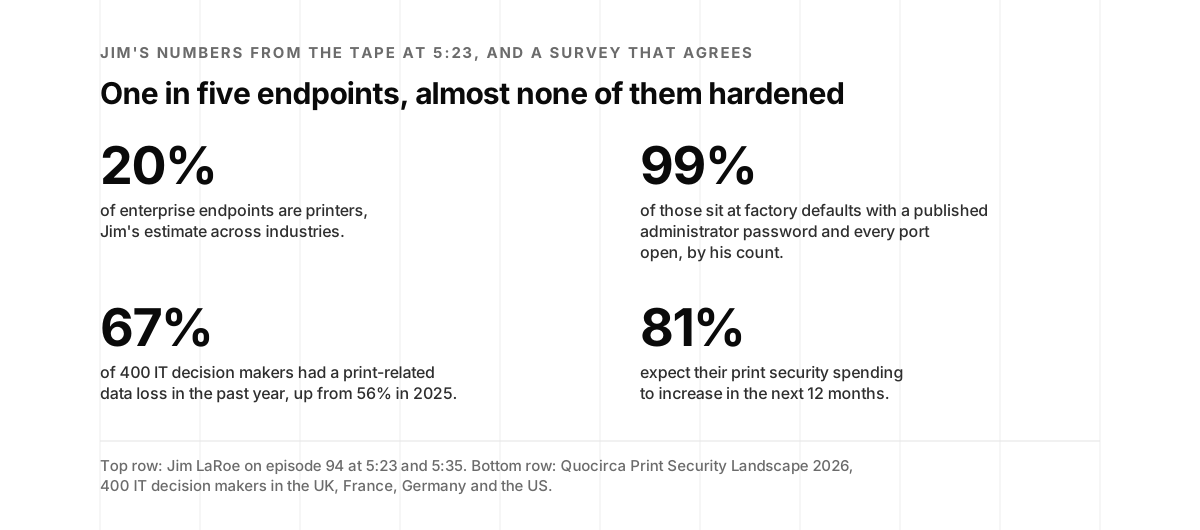
Four numbers in a two by two grid. 20 percent of enterprise endpoints are printers and 99 percent of those sit at factory defaults with a published administrator password, both Jim LaRoe's estimates on the episode. From Quocirca's Print Security Landscape 2026, a survey of 400 IT decision makers: 67 percent had a print-related data loss in the past year, up from 56 percent in 2025, and 81 percent expect print security spending to increase in the next 12 months.
Jim's estimates on top, a 400-person survey underneath. Both say the same thing.

What makes one printer worth an attacker’s time is what it touches. Jim described a “360-degree threat landscape” on every device:

“They receive, transmit, process, and store the most sensitive data of the enterprise, and they offer lateral movement, from our red hat guys that are out there doing ethical work, ethical hacking.”

Jim LaRoe, at 5:35

They store credentials for the email system, the file server and the directory, “and oftentimes that administrator, godlike privileged level, stored in the printer. So they’re like a gold mine of data and access and lateral movement capability for the bad guys, you know, both internal and external.” That last part matters. A printer is not only an internet problem. Anybody who can walk up to it or reach it on the network can try the same doors. Our companion post, How One Unsecured Printer Becomes Your Weakest Link, walks the attack path one step at a time.

The credit card outage that started it

Symphion did not set out to secure printers. In 1999 an alpha customer in the Dallas and Fort Worth Metroplex needed what it called a configuration manager database, because of a very specific bad day.

“they had an incident where somebody took down a server for maintenance, and it was really integral to their credit card processing worldwide, so they couldn’t process credit cards for about four hours on a Saturday two weeks before Christmas.”

Jim LaRoe, at 2:23

Nobody had a shared map of which infrastructure ran which application, so Symphion built one, a CMDB, kept the intellectual property, and then built agentless scanning to “fill that up and keep it filled.” Then it launched a managed CMDB service, software it makes and people it deploys to run it remotely, which went over well with the large IT outsourcers who have to report every asset, configuration and version to their customers, especially in healthcare. One of the big printer manufacturers asked Symphion to sell the service to its own customers, and in 2015, by Jim’s account, Symphion got into printers. He walked into what he called “this alternative universe of the printer endpoints, and how it’s grown for almost 40 years outside of IT and IS. And it’s really a forgotten endpoint from a cybersecurity standpoint.”

The rest of the company followed from that discovery. Printers are “IoT devices with disparate operating systems and different manufacturers’ hidden entry point API accesses with their own software,” so Symphion wrote software that controls the security settings across every make, model, brand, age and firmware version, and put it inside a managed service. The CMDB origin is the useful part for everyone else. The first problem Jim found in print fleets was the same one his first customer had at Christmas: nobody could say what was there.

If you want the longer version of the business model, Louella Fernandes of Quocirca interviewed Jim about print fleet cybersecurity as a service in March 2025.

March 24, 2025: Louella Fernandes of Quocirca with Jim on why print security evolved along its own path and what a vendor-agnostic service looks like, about thirty-one minutes. Watch on YouTube.

A server in the middle of the floor

I told Jim that endpoint security, in my head, means laptops: employees, contractors, interns. Printers, at a startup, get filed under good problems to have. His answer is the reason this episode exists. Printers came out of analog, and the belief that everything is getting digitized away hasn’t come true. In a hospital, printers are tier one application support for admissions, discharge, the pharmacy and the labs, and “you can’t process patients without the printers.” One health system Symphion works with has more than 30,000 printers and 150,000 other IoT endpoints.

For forty years the manufacturers competed by adding business features, and every feature is a service: a giant hard drive, FTP, fax, email, a web server, “all sorts of servers built into it, all these ports and capabilities open.” The security features to harden all of it are there too. They are just off when the device lands on the network.

“They’re this sleeping dog over there that’s lying, waiting for something to happen.”

Jim LaRoe, at 7:00
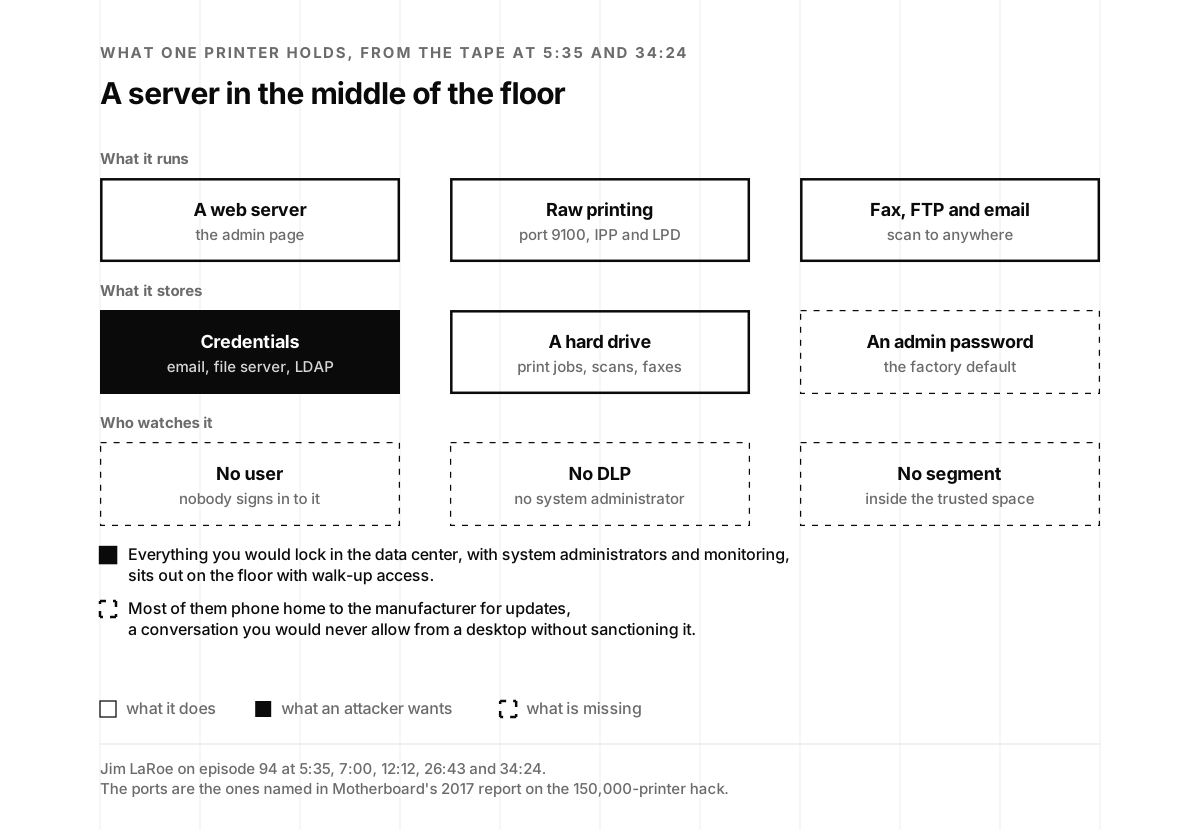
Three rows of three boxes. What a printer runs: a web server for the admin page, raw printing on port 9100, IPP and LPD, and fax, FTP and email for scanning anywhere. What it stores: credentials for email, the file server and LDAP, filled, a hard drive with print jobs, scans and faxes, and an administrator password, dashed, still at the factory default. Who watches it, all dashed: no user signs in to it, no data loss prevention or system administrator, and no network segment, because it sits inside the trusted space. Below, Jim's point: everything you would lock in a data center sits on the floor with walk-up access, and most printers phone home to the manufacturer.
Every row is a reason to treat it like a server. The bottom row is why nobody does.

The credentials are the part to remember. To scan to email, a printer logs in to the mail system. To scan to a folder, it logs in to the file server. To look up a name, it logs in to the directory. Researchers at Rapid7 have shown how that turns into a way in, with an attack called a pass-back. In February 2025 they disclosed two on the Xerox VersaLink C7025: change the directory server’s address in the printer’s settings, trigger a lookup, and the printer hands its stored credentials to the attacker’s machine. Rapid7 wrote that this “would allow them to capture credentials for Windows Active Directory,” after which “they could then move laterally within an organization’s environment” (Rapid7). In June it disclosed the same class of flaw on a Konica Minolta bizhub, with a plain requirement: “This attack requires access to the MFP printer admin account” (Rapid7). On a printer at factory defaults, that account’s password is published.

Jim added one more habit that would never pass review on a laptop:

“I mean, these devices are set to phone home back to the manufacturer on the network most of the time, for updates and things. Like, when would you ever do that with a [desktop]?”

Jim LaRoe, at 12:12

Nobody would allow unmonitored traffic off the network from a product manufacturer unless it was sanctioned, he said, and it happens on printers every day. Later he gave the analogy that opens this page. A printer is a server with server-class capabilities and a hard drive. If it were in the data center you would protect it physically, monitor its communications and assign it system administrators. “But you don’t.”

Nobody owns the printer

If printers are servers, why isn’t IT running them like servers? Because, Jim said, IT never had them. The endpoint grew up owned by supply chain and procurement, “not by IT, like your PCs, your laptops.” Information security has its hands full, is “blamed for everything, responsible for everything,” and is not sleeping at night. So the printer “has grown up in its own fiefdom, outside of IT’s purview and outside of information security.”

Around it sits an industry that is good at what it is paid to do. Jim put the managed print services business at forty billion dollars a year, supplying the devices, the toner, the paper and the break-fix. “They don’t have a line item for security of the devices. They haven’t had a line item.” So the security team does the reasonable thing with the tools it has. It runs the vulnerability scanner built for desktops, “your Rapid7, Qualys, Tenable, something like that,” against the printers, finds the outward vulnerabilities, and says, “Mr. IT, Mr. CIO, go fix it.” Then everyone discovers there is no budget for the fix and an awkward conversation with the people in procurement who have run the fleet for years.

“So the first thing they need to do is find an owner for it that’s willing to sponsor it, set a policy, and then enforce it. So it’s easier said than done, but that’s kind of where we’re at in that market.”

Jim LaRoe, at 7:00
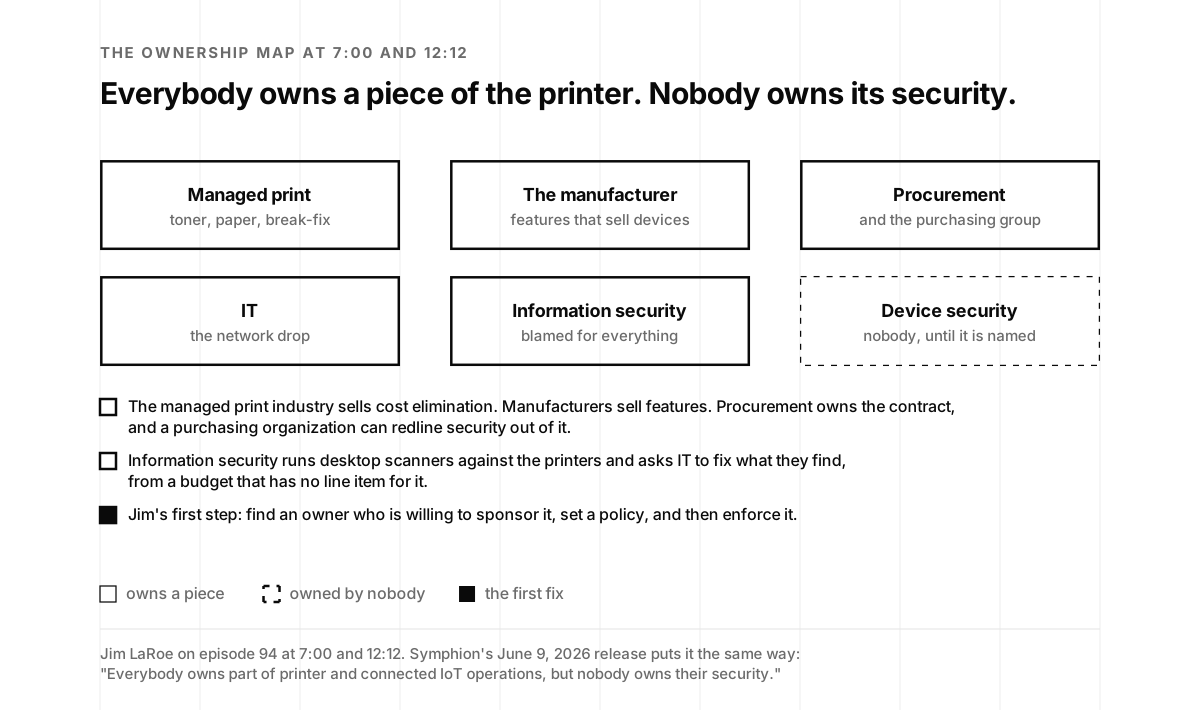
Two rows of three boxes for the parties around an enterprise printer: managed print services, which supply toner, paper and break-fix, the manufacturer, which sells features, procurement and the group purchasing organization, IT, which owns the network drop, information security, which is blamed for everything, and device security, dashed, owned by nobody until someone is named. Below, how the gap opens and Jim's first step: find an owner who will sponsor it, set a policy and enforce it.
Five owners and a gap. The fix is a name, a policy and the authority to enforce it.

This is the cheapest fix on the page, and it is the one most companies skip. At a startup, the owner can be one engineer with the authority to say what a device must look like before it gets an address on the network. Whether that person is on staff, fractional, or a partner team is the choice we walked through in In-House, On-Demand, or YOLO?, and a virtual chief information security officer is often the one who writes the printer policy for the first time. Symphion’s own line, from a June 2026 release, is the best summary of the problem: “Everybody owns part of printer and connected IoT operations, but nobody owns their security” (PR Newswire).

Redlined out of the contract

Jim told two stories back to back, and they belong together. The first was a call with a big hospital system and its chief information security officer. The print fleet had about 15,000 printers, “15 to 16,000. That’s a big difference, right?” A partner was selling the system a five-year managed print contract worth millions, and the security team said it had to include security: how would anyone harden, monitor and patch all those brands, models and locations? The partner brought in Symphion, and the call went well. Then the contract went to procurement.

“The GPO, the group purchasing organization that’s in charge of that, redlines the security out. And the CISO has no juice on that, because the supply chain has owned it.”

Jim LaRoe, at 12:12

The second story is the one in the episode title, and he told it in one breath.

“You know, big system, 11,000 devices, hacked through a printer. We love you, Symphion. We want to go with you. Well, we’re going to wait two years for a managed print service contract to be negotiated to include you in on that, before we do a single thing.”

Jim LaRoe, at 12:12

Listen · Jim on episode 94, from 14:27
About 20 seconds: 11,000 devices, a printer, and two years. The clip stops on its own. Read the full transcript.

Jim doesn’t name the organization, and nothing on the tape says what was taken or how the attacker got from the printer to the rest of the network. What he is describing is a timing problem, and it is a common one. The security fix is cheap, the contract is expensive, and the contract sets the calendar. Other customers, he said, loved the whole program but could only buy the inventory and password pieces of it.

Both stories end the same way: the contract decided the security. The practical lesson for anyone about to sign one is to put the security in the document before procurement sees it, with named controls, reporting and remediation times, the same way a buyer’s security exhibit puts obligations on you. A contract that says “secure” without saying how is how a feature ends up enabled but not enforced.

The technician resets it to factory

The best story about configuration in this episode has no attacker in it. Jim was walking through what Symphion checks in an assessment, the electronic settings and then the processes around them, and he got to the one habit that undoes everything else.

“In the print industry, the human behavior is, when somebody works on a device, they reset it back to factory. So they could have the best configuration on the planet Earth, and a technician who’s been trained in doing this for even five, ten years, they’re going to reset it back to factory defaults after they work on it. And how long does it take you to discover that?”

Jim LaRoe, at 22:27

Listen · Jim on episode 94, from 23:55
About 32 seconds: the best configuration on the planet, a service visit, and back to factory. The clip stops on its own. Read the full transcript.

That is the printer’s version of clicking a link in an email, and it is nobody’s fault. The technician is doing the job well, and a clean reset is the fastest way to a working device. The question is the one Jim asked: how long until you know? Symphion’s answer is within hours, with “[a] standing change order [to] remediate the same day,” and the same logic covers the device nobody told security about. “Our software discovers [a] device on [a] subnet within an hour.”

New devices are the other half of it. Every fleet runs what the industry calls the IMACD process, the install, move, add, change and delete work of an IT shop, and Jim’s version on the tape is “the install, you know, move around device, add, delete process.” His point was about what falls through it.

“The big problem that these big fleets have is they have newly added devices that aren’t configured or patched or under the purview of the program.”

Jim LaRoe, at 22:27

Printers get swapped in and out. They are not in a data center with system administrators, and they don’t have a user assigned the way a laptop does, so a spare can sit on the network unconfigured for months. Sometimes it is there “because the network drop doesn’t communicate with the security group.” A program that only checks a printer when it is installed will always be behind.
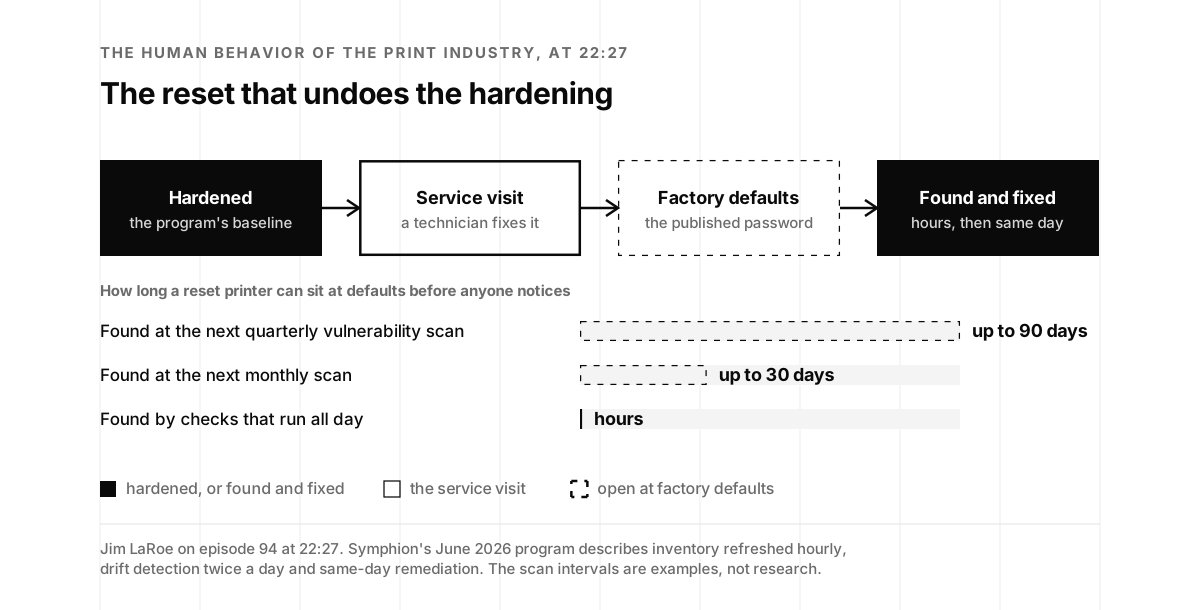
Four boxes in a row: hardened, the program's baseline, filled, a service visit where a technician fixes the device, factory defaults, dashed, with the published administrator password back, and found and fixed, filled, within hours and remediated the same day. Below, three bars for how long a reset printer can sit at defaults: up to 90 days if it is found at the next quarterly scan, up to 30 days at a monthly scan, and hours with checks that run all day.
The hardening is only as good as the time between the reset and the next check. The calculator below puts your own numbers on it.

Hardening, then, is not a project. It is a state you check for, every day, on every device, which is the whole difference between a scan and a program. The calculator further down turns your fleet size, service visits and time to discovery into the number of printers sitting at factory defaults on an average day.

Ten years of printing to strangers

Jim reached back a decade for the evidence that this is not theoretical.

“Ten years ago, there were highly published hacks, where hacktivists went out there, and they found, like, one of them found 800,000 unprotected printers in the United States, and sent out some anti-Semitic stuff to all the universities across the country, to 150,000 of them, to print.”

Jim LaRoe, at 16:12

“And then there was another one, where Cybernews did a pick, twenty-eight thousand of them, and printed out how-to-protect-your-printer manuals on that.” Every number he gave is real, and they come from at least four different events. The record is better than his version, because it shows the same thing happening again and again.

  • March 2016. Andrew Auernheimer, the troll known as weev, sent an anti-Semitic flier to printers across the United States and claimed it reached about 20,000 of them, many at colleges and universities, over port 9100, the raw printing port. A Shodan search by Motherboard that week found more than 14,000 printers at US colleges and universities open to anyone (Motherboard).
  • February 2017. A teenager calling himself Stackoverflowin said he sent a printout to about 150,000 printers telling their owners the printer was “part of a flaming botnet,” through the printing ports, LPD, IPP and 9100 (Motherboard). The 150,000 is his.
  • November 2018. A hacker calling himself TheHackerGiraffe found printers with Shodan, used the open-source Printer Exploitation Toolkit, and printed a message telling people to subscribe to PewDiePie on 50,000 of them. He told Engadget he thought about 800,000 printers were exploitable (Engadget).
  • August 2020. Cybernews found more than 800,000 printers with network printing enabled and reachable from the internet, picked 50,000, and printed a short guide to securing printers on 27,944 of them (Cybernews). This is the one Jim named, and his number is right.
  • November 2021. Receipt printers at businesses around the world started printing an antiwork manifesto that opened “ARE YOU BEING UNDERPAID?” (Motherboard). GreyNoise first saw the traffic on November 24 and counted more than 60 source addresses in about a week, with the cause in one sentence: “Printers, when exposed to the Internet over port 9100, will print any plaintext received” (GreyNoise).
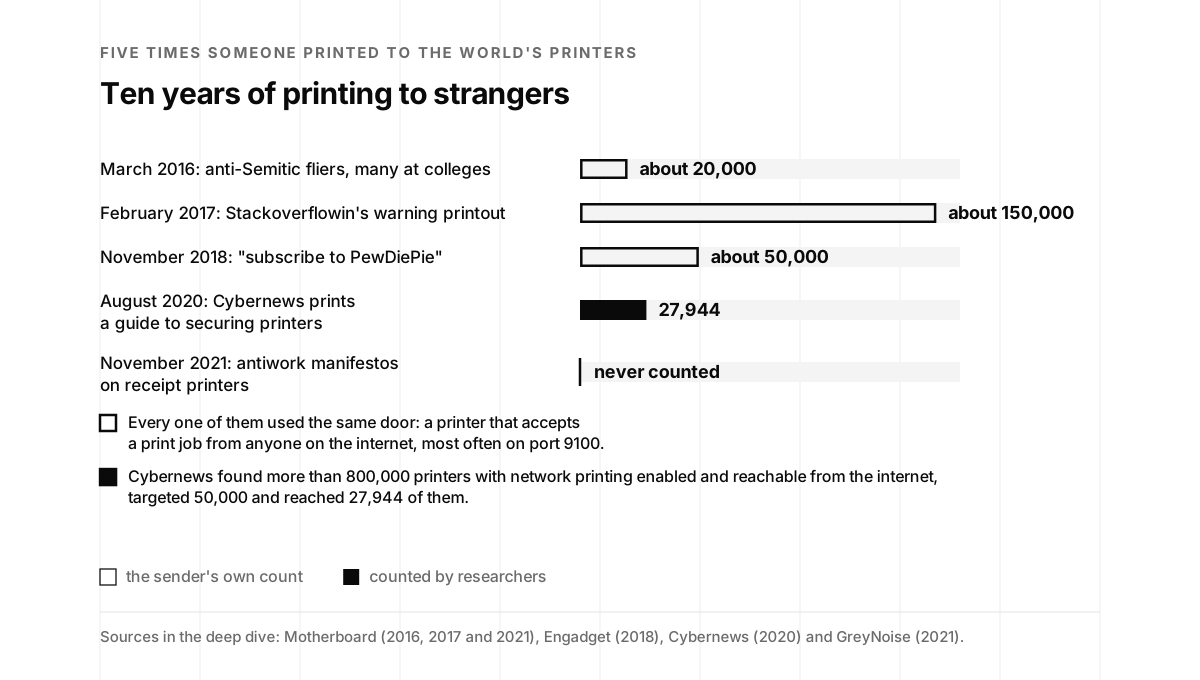
Five horizontal bars for printers that printed a stranger's message. March 2016, anti-Semitic fliers, many at colleges, about 20,000 by the sender's claim. February 2017, Stackoverflowin's warning printout, about 150,000 claimed. November 2018, subscribe to PewDiePie, about 50,000 claimed. August 2020, Cybernews printed a guide to securing printers on 27,944, counted by the researchers, filled. November 2021, antiwork manifestos on receipt printers, never counted. Below: all used printers that accept jobs from anyone on the internet, most often on port 9100, and Cybernews found more than 800,000 such printers.
So "800,000" is Cybernews and TheHackerGiraffe, "anti-Semitic" and "universities" are 2016, "150,000" is 2017, and "28,000" is Cybernews in 2020.

The 2018 one is the version most people remember, because it was funny for about a day.

The YouTuber Grandayy, the morning the PewDiePie printouts spread. More than 41,000 likes. View on X.

The joke had been around for years by then. When the 150,000-printer story reached Hacker News in February 2017, one reader summed up the whole category in seven words.

"The "S" in IoT stands for security :)"

milesf, on Hacker News, under "UK Teen Hacked 150,000 Printers," February 2017

The research community took it seriously the same year. At the IEEE Symposium on Security and Privacy in 2017, Jens Müller, Vladislav Mladenov, Juraj Somorovsky and Jörg Schwenk of Ruhr University Bochum tested 20 printer models from different vendors and found every one of them vulnerable to at least one attack, from simple denial of service to pulling print jobs and system files off the device, and released the Printer Exploitation Toolkit as open source (Ruhr University Bochum). That is the same toolkit TheHackerGiraffe used a year later. Open tools cut both ways, and the good way is simple: the checks an attacker would run are the checks a penetration test that includes your printers runs first, with permission.

The 2021 wave got the reaction a lot of engineers had to all of them.

Matthew Garrett, the Linux kernel and security developer, the week the receipt printers started talking. The joke lands because the printers were sitting on the public internet, ready for any message at all. View on X.

None of these needed a zero day. Each one needed a printer that would accept a job from anyone, and a list of where to find them. Jim’s conclusion was about what comes next: “They didn’t even need AI back then. And now it’s off the chain.”

A default password anyone can work out

Three times on the tape Jim described the administrator password on a printer as published. On a lot of models, he said, it is something “like 0123456, published on the internet at default.” In June 2025 researchers showed a worse version, where the password is unique to each device and still easy to get.

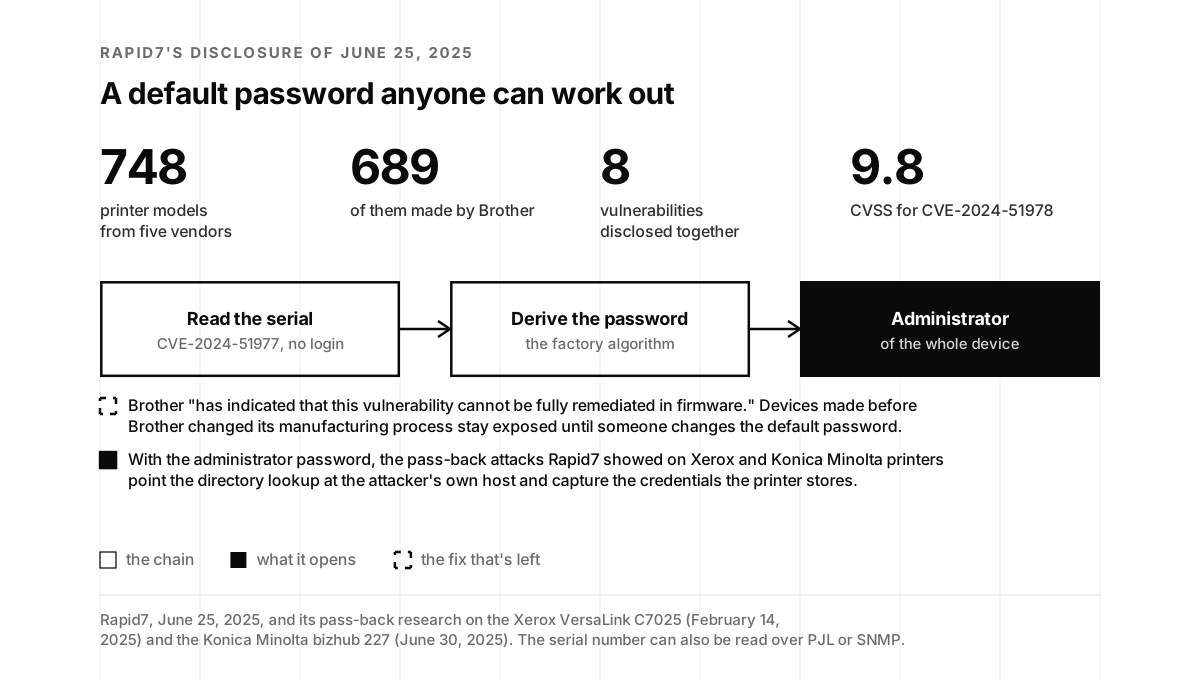
Rapid7 disclosed eight vulnerabilities affecting 748 printer and multifunction models across five vendors, 689 of them from Brother, plus 46 from Fujifilm Business Innovation, 6 from Konica Minolta, 5 from Ricoh and 2 from Toshiba. The critical one, CVE-2024-51978, rated 9.8, is in how the default administrator password is made: during manufacturing, a procedure “transforms a serial number into a default password.” Anyone who learns the serial number can work out the password, and a second flaw, CVE-2024-51977, leaks the serial number to an unauthenticated attacker over the web interface or IPP, with PJL and SNMP as fallbacks. The fix is the hard part. Rapid7 reported that Brother “has indicated that this vulnerability cannot be fully remediated in firmware,” because the password comes from the factory, so only devices made after a change to the manufacturing process are fully fixed (Rapid7).

The Verge, five days after the disclosure. For a device already on your network, "unpatchable" means one thing to do: change the administrator password. View on X.
Four numbers in a row from Rapid7's June 25, 2025 disclosure: 748 printer models from five vendors, 689 of them made by Brother, 8 vulnerabilities disclosed together, and a CVSS score of 9.8 for CVE-2024-51978. Below, three boxes in a chain: read the serial number without logging in, through CVE-2024-51977, derive the default password with the factory algorithm, and become administrator of the whole device, filled. Then: Brother says it cannot be fully fixed in firmware, so older devices stay exposed until the default password is changed, and with administrator access a pass-back attack can capture the credentials the printer stores.
The chain from a serial number to the credentials stored on the printer. The defender's step is free.

Put this next to the pass-back research earlier on the page and Jim’s whole argument is in one chain: a default administrator password, the settings page it unlocks, and the directory credentials the printer hands over. The good news is that the defender’s version of the chain is short. Changing the administrator password to a unique one on every device, and keeping it changed after every service visit, breaks it at the first link.

What the standards already say

I asked Jim whether there is an ISO standard or another prescriptive framework that makes a big organization get its printers audited. “Yes and no,” he said, and started with the vulnerabilities.

“They don’t self-report that much, and there’s a dearth of CVEs on the printers. It’s just what the printer manufacturers decide they’re going to do, right?”

Jim LaRoe, at 26:43

Printers don’t have the competitive disclosure culture of other endpoints, he said, and so the scanner has less to find. That is changing because researchers are looking harder. The Brother disclosure alone added eight CVEs across five vendors, and every pass-back above has a CVE of its own. The guidance has been there longer. “NIST came out in 2015 with an IR, I think it’s IR 8023. It was a standard just for replication devices, okay?” He has it right: NIST Interagency Report 8023, Risk Management for Replication Devices, published in February 2015, covers copiers, printers, scanners and multifunction devices (NIST). Jim’s read is that later NIST guidance folded it into its general controls without naming printers. The Defense Information Systems Agency also keeps a Security Technical Implementation Guide for multifunction devices and network printers, the checklist the Department of Defense applies to its own (DISA STIG), and Symphion builds both into its program.

“There are others out there, but, man, it’s, this is blocking and tackling. I mean, it’s just like, inventory, okay, passwords, shut down the unused ports and protocols of communications.”

Jim LaRoe, at 26:43
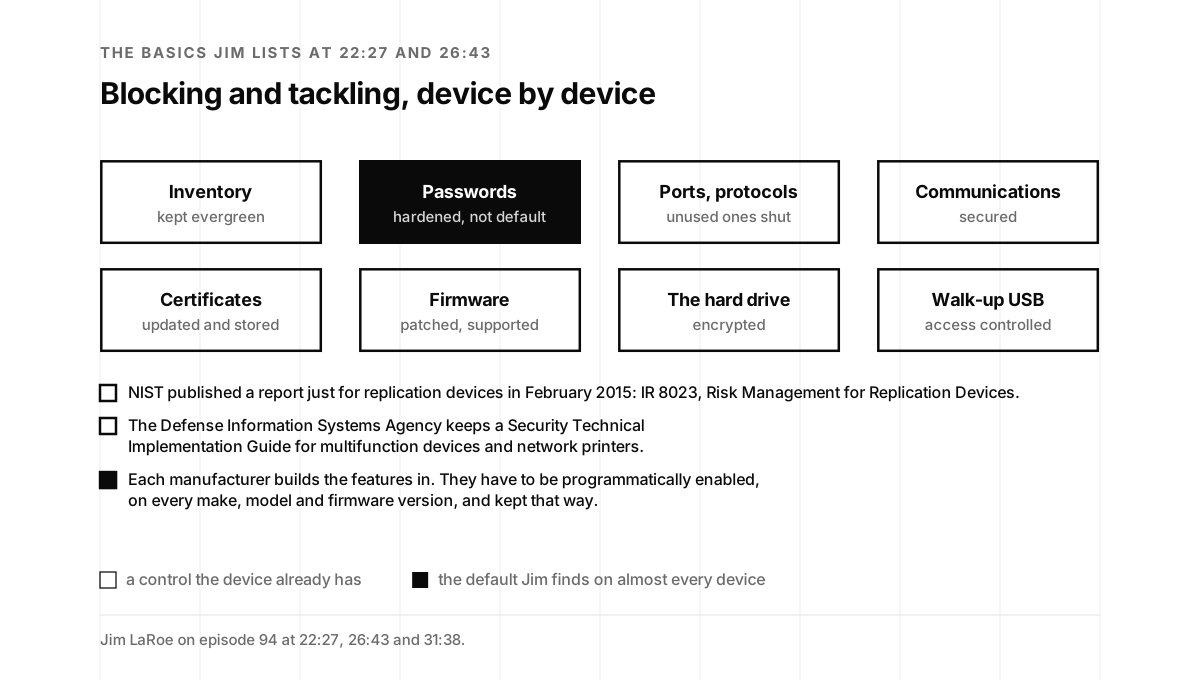
Two rows of four boxes for the basics of printer security: inventory kept evergreen, passwords hardened rather than default, filled, unused ports and protocols shut, communications secured, certificates updated and stored, firmware patched and supported, the hard drive encrypted, and walk-up USB access controlled. Below, the standards: NIST IR 8023 from February 2015 and DISA's guide for multifunction devices and network printers, and Jim's point that the features are built in but have to be enabled on every make, model and firmware version.
Eight controls every printer already has. The work is turning them on and keeping them on.

Then come the parts that make printers different. Certificates have to be updated and stored, and “we’re narrowing the time limit on certificates now, because they’ve got to be changed.” For publicly trusted certificates that is literal: the CA/Browser Forum’s 2025 ballot cut the maximum validity to 200 days from March 15, 2026, then 100 days in 2027 and 47 days in 2029 (DNSimple). Most printers use internal certificates, but the direction is the same, and a fleet that renews by hand will fall behind. Firmware notes are thin, because one update can cover the scanner, the sorter, the operating system or security, and people keep printers long after the manufacturer stops making firmware for them. The result is a category Jim described in one line: “unpatched, unsupported, end-of-life devices sitting out there, with no users, no systems looking at it, no DLP, no nothing.” They are not segmented, and they are trusted, because they have to reach the email system, the file server and the directory to do their jobs. “They’re right there inside your most, like, trusted inner space.”

He ended the answer on why there are so few printer breach statistics. “Nobody’s talking about root cause now, man.” Companies rarely publish how they were breached unless they are blaming someone, so he can’t tell anyone the odds of being hacked through a printer, only that the doors are open. That is also why the controls above are worth doing without waiting for a statistic. They are cheap, they are built in, and every one of them closes a door that has already been used.

My tray is full

When Symphion first got into printers, customers asked the obvious question: can you connect this to my SIEM, the security information and event management system? Symphion talked to IBM about QRadar and others, turned logging on, and found the problem every security team finds.

“the logs are filled on a printer with non-security events, you know, just tons of non-security events that are like, my tray is full or empty.”

Jim LaRoe, at 34:24

Even when the one security event is in there, someone has to find it, open a help desk ticket, and wait for a service vendor to send a truck to the device. “What’s the time limit on that, man?” Symphion’s answer is to watch the configuration instead of the log: “We see it happen, we remediate it back, standing change control.” The lesson travels. Send your SIEM the handful of printer events that matter, an administrator login, a configuration change, a firmware change, a device nobody has seen before, and leave the paper trays out of it. Alan Braithwaite of RunReveal made the same case about all logs on episode 50, and our 24/7 monitoring and response is built around exactly that short list: new arrivals, configuration drift and outbound traffic that should not exist.

Jim also put the cost side plainly. Against the cost of the risk, the security is “nothing,” because a breach brings ransom, notification, lawsuits and regulators. “Just look at GDPR. Just look at CCPA. You steal private information, it’s expensive to recover from that.”

Cameras are next

Printers, in Jim’s phrase, are “the top of Mount Everest of complexity for IoT, Internet of Things devices,” forty years of features on a different operating system from each manufacturer. If you can run a program for printers, the rest of the building is easier, and Symphion is already “doing cameras, we’re doing power supplies, things like that, that are all hackable and entry points into the network out there as well.” When I asked what success looks like, he ended up at the cameras.

“How many IP cameras do you have on your network? You know, they have an administrator password that needs to be hardened. They communicate via old, arcane SNMP versions that are unhardenable.”

Jim LaRoe, at 31:38

SNMP, the Simple Network Management Protocol, is how a lot of devices report status, and its older versions authenticate with a community string sent in the clear. Version 3 added user-based authentication and encryption in 2002 (RFC 3414), and plenty of devices are still set up with the older versions. Then Jim cited a ranking: Becker’s Healthcare, he said, reported that “the number one and two IoT endpoints getting hacked in healthcare systems are the cameras and the printers.” We could not find that Becker’s article, and we did find published research that matches it. In April 2023, Armis analyzed the devices it monitors in clinical environments and ranked IP cameras as the riskiest IoT device, with 56% carrying critical severity unpatched CVEs, and printers second, with 37% carrying unpatched CVEs and 30% critical (Armis).
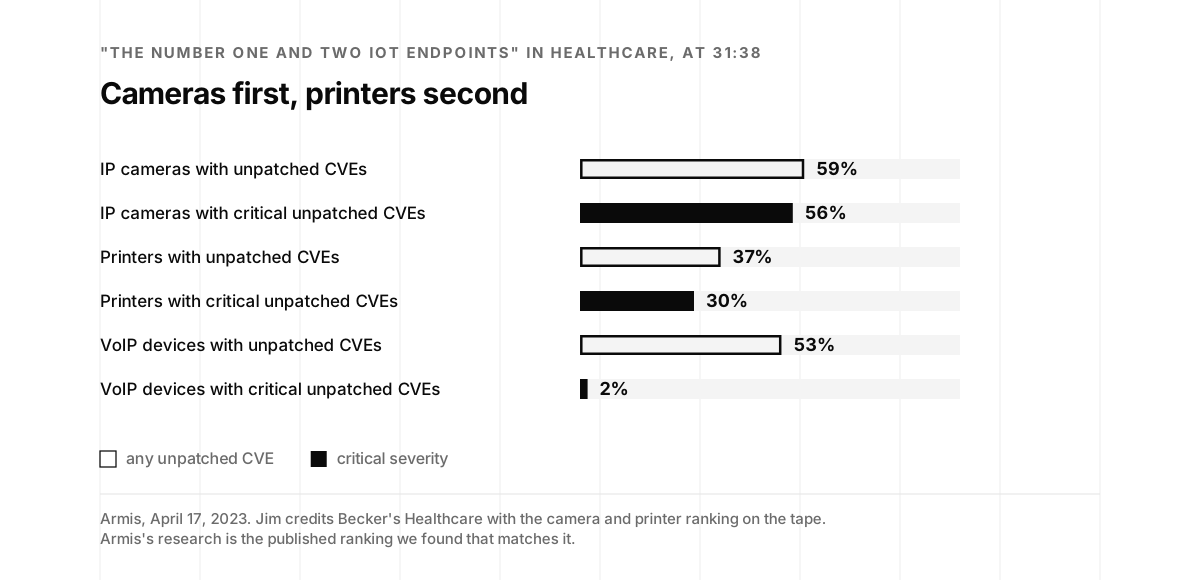
Six horizontal bars from Armis's April 2023 analysis of devices in clinical environments. IP cameras, the riskiest IoT device: 59 percent with unpatched CVEs and 56 percent with critical severity unpatched CVEs. Printers, second: 37 percent with unpatched CVEs and 30 percent critical. VoIP devices, third: 53 percent with unpatched CVEs but only 2 percent critical.
The ranking Jim remembered, from the research we found. Cameras first, printers second.

His fix for all of it is the least exotic advice in security, and that is a compliment.

“Let’s just use the built-in features. Each manufacturer has incredible features built into devices to protect them. They’re just not being used, and they have to be programmatically enabled.”

Jim LaRoe, at 31:38

No traffic sniffer, no new appliance. “It takes work to set that stuff up. You got to do some work.” The whole class of forgotten devices, and a 30-day program sized for a startup, is in our companion post, IoT Device Security.

Everybody uses printers

I said what I believe about this: you are only as secure as your weakest link, and printers sneak in with the best intentions in the world, even at a small private practice or a dental office that needs to print patient information. Jim widened it to the supply chain.

“Not just the vendors, like the HVAC vendor at Target or something like that, but you got all the vendors, and it’s all the way into the supply chain, and everybody uses printers.”

Jim LaRoe, at 30:56

The Target reference is the classic one. In 2014 Brian Krebs reported that the attackers behind Target’s breach first got in with network credentials stolen from its heating, ventilation and air conditioning contractor (Krebs on Security). Jim’s point is that the confidential information supply chain is bigger than the vendors with network access. It includes “your lawyers, you got your accountants,” everybody who handles the data, and every one of them has a printer. The big push on supply chain at the Department of Defense and in financial services is where this lands first. A defense supplier working toward CMMC Level 2 has to account for the printer in the office as much as the laptops, and a practice under HIPAA has the same printer holding the same patient records.

Measure before you cut

Not every customer believes the risk is there. Some have, in Jim’s words, “the hard case board member that can’t believe that our printers are at risk,” and for them Symphion built an assessment.

“we do electronic assessment, process assessment, give them a board-ready report in plain English that shows them the risk, you know, scoring for how bad it is.”

Jim LaRoe, at 21:17

I said it sounded like measuring before you cut. “Yeah, it’s, we’ll fail everybody.” The assessment has twenty points. Ten are electronic, checked on a 500-device swath of the fleet: the passwords inside the device, the encryption of the hard drive, the USB port for walk-up access, the configuration ports. Ten are about process, how the fleet handles installs and changes, the CMDB, and how a reset gets caught. The second offering is the light version for the same reluctant customers, an evergreen inventory, life cycle management of every device, plus full password management, “settings for timeout, lockout, all that kind of stuff that is not being done,” at a lower price point “[to] try to stimulate the complacency movement.” Symphion announced both, the Enterprise Assessment and a lighter package it calls PFCSAAS Lite, in a release dated December 8, 2025 (PR Newswire).

The plain English report is the part to copy, even if you never buy one. A board doesn’t need port numbers. It needs the fraction of devices at defaults, who owns them and the date it will be fixed, which is the same shape as the security slide your board deck is missing.

Gasoline on a raging fire

The printer problem is old, and Jim thinks the timing just changed. The hacks of a decade ago didn’t need AI, and now attackers have it. “It’s like putting gasoline on a raging fire already, because you’ve got these vulnerabilities sitting there that are wide open.” The people Symphion talks to on the offensive side already know where to start.

“They’re like, man, if I want to fail somebody, I go after the printers every time.”

Jim LaRoe, at 16:12

“AI is just going to make everything happen that what’s going to happen anyway is going to happen much more quickly.”

Jim LaRoe, at 17:25

That is a sober way to say it. AI doesn’t create the open door, it shortens the time between someone listing the doors and someone walking through one. Jesse Anglen made the attacker’s version of the same argument on episode 106, and our post on AI agents on both sides of the breach covers the defender’s. Jim’s answer was modest on purpose: “let’s put at least speed bumps in for what’s going on with the AI.” The printers are essential, numerous and risky. “We can’t just ignore them, you know, continue to ignore them. It’s just going to be our downfall to do that.” The defender’s speed bump is the same kind of automation, every device checked every hour, so the window an attacker can find keeps closing.

An engineer who went to the dark side

I asked Jim about his proudest day as an entrepreneur. “No, we’re still looking forward to the proudest days.” Every day brings successes and challenges, he said, and the work is building processes, adapting them, hiring smart people and empowering them. Was Symphion bootstrapped?

“You know, we’re making money, man. And we’ve been in business 25 years. We’re a very profitable company.”

Jim LaRoe, at 18:20

They did go through an accelerator in Austin, Capital Factory, a few years back, and talked to some of the printer manufacturers about investing, but the terms weren’t right. The best thing the accelerator gave them was an introduction to the Small Business Innovation Research program, and Symphion won two. The public record shows two Air Force Phase I awards in 2021, each for $49,723 and both naming James LaRoe as principal investigator, one for print fleet cybersecurity and one for critical infrastructure cybersecurity (Print Fleet Cybersecurity, Critical Infrastructure Cybersecurity). Jim said the chief information security officer of one of the armed forces was ready to take them straight to the third stage, until a new chief technology officer arrived with a different approach, and that the work meant adapting the technology and process to the government’s multiple layers of confidentiality. “But we, yeah, we won two of them, man.”

Before any of it, he was a lawyer. “Lawyer. Trial lawyer. Trial lawyer.” I guessed he must be brutal in negotiations, and he deflected: he is an engineer by training. “Yeah, I engineered first and then went to the dark side.” I have a lot of friends who made that move, because the logic of computer science carries over to law well. Jim’s version was about people: the hard part is “figuring out the human piece of it, you know, the complacency piece in cybersecurity.”

The history you don’t know

My last question was the one I ask everyone: if you could meet your younger self, what would you say? Jim has four children, two sons and two daughters, and gives them that advice all the time. For himself, maybe get on this risk sooner, “but it’s, it’s gotta marinate.” We are the sum of our experiences, he said, in an industry that is always focused on the latest technology, “especially out where you are.” Then he reached for Truman.

“The only thing new in the world is the history you don’t already know.”

Jim LaRoe, at 38:48

Listen · Jim on episode 94, from 38:47
About 27 seconds: Truman, and why the printer's risk is not new. The clip stops on its own. Read the full transcript.

The usual version of the line is shorter, “The only thing new in the world is the history you don’t know,” as the Christian Science Monitor collected it among Truman’s aphorisms (Christian Science Monitor). Jim’s point survives either way. The printer has a long history, and it is not new that it is a risk. What changed, he said, is that Symphion decided to talk about the risk more, because its partners approach it differently and customers need to know how easy it is to fix.

“You can’t eliminate the bad stuff, but you can sure mitigate it, and with some basic steps.”

Jim LaRoe, at 38:48

I told him I loved how he put that, that it is so easy to fix. “It is.” Then the line that ends the conversation: “It’s an easy, it’s an easy button.”

What happened after the tape

Five weeks after the episode aired, on June 9, 2026, Symphion announced the Symphion Managed Endpoint Cybersecurity Operations Program for Printers and Connected IoT, which reads like the conversation turned into a service: an inventory refreshed every hour, drift detection twice a day, and remediation the same day. Its release carried the ownership line quoted earlier, and one more: “Organizations don’t need more tools or staffing burdens” (PR Newswire). At the end of July, Jim posted the test that the scorecard below is built on.

Most orgs say, “we do what we can” on their printers and connected IoT like cameras.

Very few have a real, governed control.

Quick test:

Can your printer protection and governance program be described clearly in one breath?

A real program can always answer:

What’s in scope
What “protected” means
How do you know devices are in that state
Who is accountable when they are not

If the answer is a tool name or a contract clause, it isn’t a program.

It’s hope.

Jim LaRoe · July 29, 2026
Four questions a real program can always answer. The scorecard below turns them into eight you can score. View on LinkedIn.

In October he sat down with Cyber Insurance News for a longer version of the same argument, including the service reset that undoes the hardening and the pass-back attacks that turn a printer into a credential leak.

October 28, 2026: Jim on Cyber Insurance News on factory defaults, the technician's reset and why one printer can expose a company's credentials, a little over an hour. Watch on YouTube.

“If the answer is a tool name or a contract clause, it isn’t a program. It’s hope.” That is the episode in two sentences, three months after it aired.

Did you catch it? A six-question quiz

Interactive · six questions

Did you catch it?

Six questions on what Jim actually said, with the timestamp for each answer. The answers are under each question for anyone reading without JavaScript.

  1. Across industries, what share of enterprise endpoints are printers, by Jim's count?

    1. About 5 percent
    2. About 20 percent
    3. About half

    b. "Across all the industries, 20% of their endpoints are typically printers." And 99% of those, he said, sit at factory defaults. Transcript, 5:23.

  2. What does a printer technician usually do after working on a device?

    1. Installs the latest firmware
    2. Files a change ticket with security
    3. Resets it back to factory defaults

    c. "when somebody works on a device, they reset it back to factory." Even after the best configuration on the planet. Transcript, 22:27.

  3. Who took the security out of a health system's five-year managed print contract?

    1. The group purchasing organization
    2. The chief information security officer
    3. The printer manufacturer

    a. "The GPO, the group purchasing organization that's in charge of that, redlines the security out." Transcript, 12:12.

  4. Which NIST publication did Jim cite as the standard written just for printers and copiers?

    1. NIST SP 800-53
    2. NIST IR 8023
    3. The NIST Cybersecurity Framework

    b. "NIST came out in 2015 with an IR, I think it's IR 8023." It is Risk Management for Replication Devices, February 2015. Transcript, 26:43.

  5. Which two IoT endpoints did Jim say are hacked most in healthcare systems?

    1. Infusion pumps and badge readers
    2. Thermostats and smart TVs
    3. Cameras and printers

    c. "the number one and two IoT endpoints getting hacked in healthcare systems are the cameras and the printers." Armis's 2023 ranking matches. Transcript, 31:38.

  6. What did Jim do before he became an entrepreneur?

    1. He was a trial lawyer, and an engineer before that
    2. He ran a printer dealership
    3. He was an Air Force officer

    a. "Lawyer. Trial lawyer. Trial lawyer." He was an engineer by training before that. Transcript, 20:52.

Is your print fleet a program or a hope?

Jim’s test is whether your printer program can be described clearly in one breath: what is in scope, what protected means, how you know the devices are in that state, and who is accountable when they are not. This scorecard asks eight questions about the fleet you have today, in the order the episode raises them, and tells you whether you have hope, part of a program, or the whole thing.

Scorecard · eight questions

Is your print fleet a program or a hope?

Answer for every printer and multifunction device on your network, including the spares, the ones at the front desk and the ones a landlord or a vendor plugged in. Answer for how things run today, not the policy.

  1. Can you say how many printers you have, where they are, and what firmware they run?

    • No, or only roughly
    • A list that gets updated when someone remembers
    • An inventory that refreshes itself, at least daily, and catches new devices

    Jim's first customer, in 1999, had the same problem with servers. A health system that thinks it has "15 to 16,000" printers has a finding before the scan starts.

  2. Who owns the security of the printers?

    • Nobody, or the managed print vendor
    • IT, informally
    • A named person with a written policy and the authority to enforce it

    "find an owner for it that's willing to sponsor it, set a policy, and then enforce it." A virtual chief information security officer can hold it until you hire one.

  3. What is the administrator password on your printers right now?

    • The factory default, or nobody knows
    • Changed, but the same on every device
    • Unique per device, stored in a password manager, and checked

    On hundreds of Brother models the default can be worked out from the serial number. Changing it breaks the whole chain.

  4. Which services are open on the printers?

    • Whatever shipped: web, FTP, telnet, raw printing on 9100
    • Some closed on newer devices
    • Only what you use, on every device, and nothing reachable from the internet

    Every mass print job of the last ten years used a printer that accepted jobs from anyone, most often on port 9100. Five of them, with sources.

  5. When a technician resets a printer to factory defaults, how long until you know?

    • We would not know
    • At the next scan, weeks or months later
    • Within hours, with a standing change to fix it the same day

    "And how long does it take you to discover that?" The calculator below turns your answer into printers sitting open on an average day.

  6. How are firmware updates and end-of-life printers handled?

    • Updated when something breaks, and old models stay until they die
    • Some models patched, unsupported ones still in service
    • Patched on a schedule, and unsupported models retired on a date

    "unpatched, unsupported, end-of-life devices sitting out there" are the ones nobody is watching. Retiring them is a security control.

  7. What account does the printer use for scan-to-email, scan-to-folder and directory lookups?

    • A privileged account, even a domain administrator
    • A shared service account with broad access
    • A dedicated least-privilege account for each function, rotated

    A pass-back attack hands over whatever account the printer uses. Rapid7's advice is to keep privileged domain accounts out of it.

  8. Does your managed print contract say who secures the devices, and how?

    • There is no security line item
    • Security is mentioned, not measured
    • Named controls, reporting and remediation times are in the contract

    Security redlined out of a five-year contract stays out for five years. Write it in before procurement does, like a security exhibit.

Hope, with a tool name

Nobody can say exactly how many printers there are, the administrator passwords are whatever shipped, and a reset would go unnoticed until the next scan. That is the fleet Jim says he finds almost every time, and the fix starts this week: name an owner, find every device, and change every administrator password to a unique one.

Part of a program

There is an owner and an inventory, but the checks happen at installation or at the next scan, so service visits and spares reopen the doors in between. Add a daily configuration check, close the services you don't use, move scan-to-email and the directory to least-privilege accounts, and put the controls in the next contract.

A program you can describe in one breath

What is in scope, what protected means, how you know, and who is accountable, all answered. Keep it that way: check after every service visit, retire unsupported models on a date, and extend the same program to the cameras and the rest of the building.

How many printers are open today?

Jim’s question about the technician’s reset was “how long does it take you to discover that?” This calculator answers it for your fleet: how many printers go back to factory defaults in a year, how many are sitting at defaults on an average day while you wait for the next scan, and how much of that goes away when the check runs all day. Change the numbers to yours.

Calculator

How many printers are open today?

A fleet, how often a technician works on each device, how often that ends in a factory reset, and how long a reset device waits before someone notices.

–resets to factory defaults a year
–printers at defaults on an average day
–printer-days at defaults a year
–on an average day with all-day checks
–times fewer open printers

With 2000 printers, 2 service visits each a year and 50 percent of visits ending in a factory reset, about 2,000 printers a year go back to their defaults. If it takes 90 days to notice, about 493.2 printers are sitting at factory defaults on an average day, 180,000 printer-days a year. Catching a reset within 12 hours brings that to about 2.7, roughly 180 times fewer.

The average day count is resets a year times the days each one stays open, divided by 365. It assumes resets are spread evenly through the year and that a printer at defaults is open until it is found. The 2,000 printers, two visits a year, 50 percent reset rate and 90-day wait are placeholders, not research. Jim's account is that technicians reset after they work on a device, so use your own service records. Symphion says it finds a reset within hours, and its June 2026 program checks for drift twice a day.

A quarter century of printers on one line

Everything on this page sits on one timeline, from the credit card outage that started Symphion to the week this page was written. Filter it by thread.

Timeline · 1999 to 2026

A quarter century of printers on one line

Filter by thread. Dates are from the public record except where marked as Jim's own account on the tape.

  1. A credit card outage

    A server taken down for maintenance stops card processing for four hours two weeks before Christmas, and Symphion builds a CMDB.

  2. Target, through the HVAC contractor

    The attackers' first credentials came from a heating and air conditioning vendor (Krebs on Security).

  3. NIST IR 8023

    Risk Management for Replication Devices, the report Jim cites (NIST).

  4. Into printers

    A printer manufacturer asks Symphion to sell its managed CMDB to its customers, and "a forgotten endpoint" appears.

  5. Fliers to about 20,000 printers

    Anti-Semitic fliers, many at colleges, over port 9100, by the sender's claim (Motherboard).

  6. About 150,000 printers

    Stackoverflowin's printout calls each printer "part of a flaming botnet" (Motherboard).

  7. Twenty models, twenty vulnerable

    Ruhr University Bochum at IEEE Security and Privacy, and the Printer Exploitation Toolkit (RUB).

  8. Subscribe to PewDiePie

    About 50,000 printers, found with Shodan, by the sender's claim (Engadget).

  9. 27,944 security guides

    Cybernews finds more than 800,000 exposed printers and prints a how-to on 27,944 (Cybernews).

  10. Two Air Force SBIR awards

    Phase I, $49,723 each, print fleet and critical infrastructure cybersecurity (Inknowvation).

  11. Receipt printers start talking

    Antiwork manifestos over port 9100 from more than 60 addresses (GreyNoise).

  12. Cameras first, printers second

    Armis ranks the riskiest IoT devices in clinical environments (Business Wire).

  13. Pass-back on a Xerox

    Change the directory server, capture Active Directory credentials (Rapid7).

  14. Print fleet cybersecurity as a service

    Jim with Louella Fernandes of Quocirca (YouTube).

  15. 748 models, one serial number away

    Eight vulnerabilities, five vendors, a default password Brother can't fully fix in firmware (Rapid7).

  16. The assessment and the light version

    The Symphion Enterprise Assessment and PFCSAAS Lite (PR Newswire).

  17. Losses up to 67%

    Quocirca's Print Security Landscape 2026, from 56% a year earlier (Quocirca).

  18. 200-day certificates

    The first step of the CA/Browser Forum schedule that ends at 47 days in 2029 (DNSimple).

  19. Episode 94 airs

    This conversation. "It's an easy, it's an easy button."

  20. A managed operations program

    Inventory every hour, drift checks twice a day, remediation the same day (PR Newswire).

  21. "It's hope."

    Jim's one-breath test for a printer program (LinkedIn).

  22. The printer is a door

    Jim on Cyber Insurance News (YouTube).

What to do this week

Four things, in the order Jim would do them.

  1. Name the owner, then count. Write down one person who owns printer security, with the authority to set and enforce the policy. Then find every printer, copier and multifunction device on every subnet and compare the list with what you think you have. Every gap is a finding, and so is every spare nobody told security about.
  2. Change every administrator password. Make it unique per device and keep it in your password manager. Close the services you don’t use, from FTP and telnet to raw printing, and make sure no printer accepts jobs from the internet.
  3. Catch the reset. After every service visit, check the configuration. Better, check every device every day, and send your SIEM only the events that matter: administrator logins, configuration and firmware changes, and devices you have never seen before.
  4. Write it into the contract. At the next managed print renewal, put named controls, reporting and remediation times in the document before procurement sees it, and move scan-to-email, scan-to-folder and the directory lookup to least-privilege accounts.

Key takeaways

  1. One in five endpoints is a printer

    Across industries, Jim says, "20% of their endpoints are typically printers," and 99 percent of those are "sitting at factory defaults with a published administrator password on the network, all the ports open." It takes one of them to compromise the enterprise. Quocirca's 2026 survey of 400 IT decision makers found 67 percent had a print-related data loss in the past year.

  2. A printer is a server on the office floor

    Forty years of features put a hard drive and web, FTP, fax and email servers inside every printer. If it were in the data center you would monitor it and assign it system administrators. "And it's sitting out in the middle of your floor, with walk-up access to it, and it's got all these capabilities."

  3. It holds the keys to other systems

    Printers store credentials for the email system, the file server and the directory, often at administrator level, which is why they offer lateral movement. "So they're like a gold mine of data and access and lateral movement capability for the bad guys, you know, both internal and external."

  4. Nobody owns its security

    The printer grew up owned by supply chain and procurement, "not by IT, like your PCs, your laptops," in a managed print industry that supplies devices, toner, paper and break-fix with no line item for security. Security teams scan printers with desktop tools and tell IT to fix them, with no budget for the fix.

  5. Name an owner, set a policy, enforce it

    "So the first thing they need to do is find an owner for it that's willing to sponsor it, set a policy, and then enforce it." It is the cheapest control on the list and the one most companies skip.

  6. Contracts decide the security

    A health system's chief information security officer wanted security in a five-year managed print contract worth millions. "The GPO, the group purchasing organization that's in charge of that, redlines the security out." Another system, hacked through a printer across 11,000 devices, planned to wait two years for its print contract before doing anything.

  7. The technician's reset undoes the hardening

    "In the print industry, the human behavior is, when somebody works on a device, they reset it back to factory." The best configuration on the planet goes back to a published password after a service visit, so what matters is how long until someone notices. Symphion says it finds a reset within hours and fixes it the same day.

  8. New devices fall through the process

    "The big problem that these big fleets have is they have newly added devices that aren't configured or patched or under the purview of the program." Spares and swaps land on the network unconfigured, sometimes because the network drop doesn't talk to the security group.

  9. Strangers have printed to the world's printers for ten years

    Jim's memory folds several events into one, and the record makes his point stronger: about 20,000 printers in 2016, about 150,000 in 2017, about 50,000 in 2018, 27,944 counted by Cybernews in 2020, and receipt printers in 2021, all through printers that accept a job from anyone on the internet.

  10. The standards already exist

    NIST published IR 8023, Risk Management for Replication Devices, in February 2015, and DISA keeps a STIG for multifunction devices and network printers. "this is blocking and tackling. I mean, it's just like, inventory, okay, passwords, shut down the unused ports and protocols of communications."

  11. Send the SIEM the events that matter

    Printer logs are "filled on a printer with non-security events, you know, just tons of non-security events that are like, my tray is full or empty." Watch configuration, administrator logins, firmware changes and new devices, and fix drift with a standing change instead of a truck roll.

  12. Cameras are next

    Printers are "the top of Mount Everest of complexity for IoT, Internet of Things devices," and IP cameras have the same administrator passwords, old SNMP versions and firmware to update. Jim credits Becker's Healthcare with ranking cameras and printers first and second in healthcare, and Armis's 2023 research ranks them the same way.

  13. Use the features the devices already have

    "Let's just use the built-in features. Each manufacturer has incredible features built into devices to protect them. They're just not being used, and they have to be programmatically enabled." He calls it "an affordable, quick, no operational lift win" for security teams.

Chapters

Tap a chapter to play from there. The play icon beside it opens that moment on YouTube.

Pull quotes

“Across all the industries, 20% of their endpoints are typically printers.”

Jim LaRoe ·

“And 99% of those are unprotected, sitting at factory defaults with a published administrator password on the network, all the ports open.”

Jim LaRoe ·

“So they're like a gold mine of data and access and lateral movement capability for the bad guys, you know, both internal and external.”

Jim LaRoe ·

“They're this sleeping dog over there that's lying, waiting for something to happen.”

Jim LaRoe ·

“So the first thing they need to do is find an owner for it that's willing to sponsor it, set a policy, and then enforce it.”

Jim LaRoe ·

“The GPO, the group purchasing organization that's in charge of that, redlines the security out.”

Jim LaRoe ·

“You know, big system, 11,000 devices, hacked through a printer.”

Jim LaRoe ·

“They're like, man, if I want to fail somebody, I go after the printers every time.”

Jim LaRoe ·

“In the print industry, the human behavior is, when somebody works on a device, they reset it back to factory.”

Jim LaRoe ·

“You're only as good, or as secure, as your weakest link.”

Jon McLachlan ·

“Let's just use the built-in features. Each manufacturer has incredible features built into devices to protect them.”

Jim LaRoe ·

“And it's sitting out in the middle of your floor, with walk-up access to it, and it's got all these capabilities.”

Jim LaRoe ·

“You can't eliminate the bad stuff, but you can sure mitigate it, and with some basic steps.”

Jim LaRoe ·

About the guest

Jim LaRoe, Founder and Chief Executive Officer, Symphion

Jim LaRoe is the founder and chief executive of Symphion, Inc., a Dallas, Texas company in business since 1999 that delivers print fleet cybersecurity as a managed service. Symphion started with a configuration management database for an alpha customer after a credit card outage, built agentless scanning and a managed CMDB service for large IT outsourcers, and moved into printers in 2015 when a printer manufacturer asked it to sell that service to its customers. Its vendor-agnostic software controls security settings across the makes, models and firmware versions of printers and other connected IoT devices such as cameras, for fleets from 300 printers to more than 30,000, many in large health systems. Symphion went through the Capital Factory accelerator in Austin and won two Air Force SBIR Phase I awards in 2021, for print fleet cybersecurity and critical infrastructure cybersecurity, with Jim as principal investigator. Trained as an engineer, he was a trial lawyer before founding the company.

About the host

Jon McLachlan is co-founder of YSecurity, the on-demand cybersecurity team for startups, and of Cyberbase.ai. The Security Podcast of Silicon Valley is hosted by Jon McLachlan and Sasha Sinkevich. Jon McLachlan on LinkedIn ↗

Context and sources

  • Quocirca's Print Security Landscape 2026, a study of 400 IT decision makers in the UK, France, Germany and the US: 67 percent had a print-related data loss in the past year, up from 56 percent in 2025, and 81 percent expect print security spending to increase. Source ↗
  • Rapid7 on the pass-back vulnerabilities in the Xerox VersaLink C7025, CVE-2024-12510 and CVE-2024-12511, February 14, 2025: changing the printer's LDAP or SMB server address captures stored credentials, which could be used to move laterally. Source ↗
  • Rapid7 on CVE-2025-6081, an LDAP pass-back vulnerability in the Konica Minolta bizhub 227, June 30, 2025. The attack requires the printer's administrator account. Source ↗
  • Rapid7's disclosure of eight vulnerabilities in 748 printer and multifunction models from five vendors, 689 of them Brother's, June 25, 2025, including CVE-2024-51978, a default administrator password derived from the serial number that Brother says cannot be fully remediated in firmware. Source ↗
  • The Verge on X, June 30, 2025: hundreds of Brother printer models have an unpatchable security flaw. Source ↗
  • Symphion's December 8, 2025 release announcing the Symphion Enterprise Assessment, a 20-point assessment of up to 500 printers, and PFCSAAS Lite, an evergreen inventory with password management. Source ↗
  • Symphion's June 9, 2026 release announcing the Symphion Managed Endpoint Cybersecurity Operations Program for Printers and Connected IoT, with hourly inventory, twice-daily drift detection and same-day remediation. Source ↗
  • Motherboard, March 29, 2016: after Andrew Auernheimer's anti-Semitic fliers reached about 20,000 printers by his claim, a Shodan search found more than 14,000 printers at US colleges and universities open over port 9100. Source ↗
  • Motherboard, February 2017: a teenager calling himself Stackoverflowin says he reached about 150,000 printers through LPD, IPP and port 9100. Source ↗
  • Hacker News discussion of the 150,000-printer story, February 2017, where a reader wrote that the S in IoT stands for security. Source ↗
  • Engadget, November 30, 2018: TheHackerGiraffe used Shodan and the Printer Exploitation Toolkit to print a message asking people to subscribe to PewDiePie on 50,000 printers, and estimated about 800,000 were exploitable. Source ↗
  • Grandayy on X, November 30, 2018, the morning the PewDiePie printouts spread. Source ↗
  • Cybernews, August 2020: more than 800,000 internet-accessible printers with network printing enabled, 50,000 targeted, and a security guide printed on 27,944. Source ↗
  • GreyNoise, December 3, 2021, on the coordinated campaign that sent antiwork messages to receipt printers over port 9100 from more than 60 source addresses, first seen November 24, 2021. Source ↗
  • Motherboard, December 2, 2021, on the antiwork manifestos printed on business receipt printers. Source ↗
  • Matthew Garrett on X, November 29, 2021, on the receipt printer messages. Source ↗
  • Müller, Mladenov, Somorovsky and Schwenk, SoK: Exploiting Network Printers, IEEE Symposium on Security and Privacy 2017: all 20 printer models tested were vulnerable to at least one attack, and the Printer Exploitation Toolkit was released as open source. Source ↗
  • NIST Interagency Report 8023, Risk Management for Replication Devices, February 2015. Source ↗
  • DISA's Multifunction Device and Network Printers Security Technical Implementation Guide. Source ↗
  • The CA/Browser Forum's ballot SC-081, approved in April 2025, cuts the maximum validity of publicly trusted TLS certificates to 200 days from March 15, 2026, 100 days from March 15, 2027 and 47 days from March 15, 2029. Source ↗
  • Armis, April 17, 2023, ranking IP cameras as the riskiest IoT device in clinical environments, 56 percent with critical severity unpatched CVEs, and printers second, 37 percent with unpatched CVEs and 30 percent critical. Jim credits a similar ranking to Becker's Healthcare on the tape. Source ↗
  • RFC 3414, the user-based security model for version 3 of SNMP, December 2002. Source ↗
  • Krebs on Security, February 5, 2014: Target's attackers broke in with network credentials stolen from its HVAC contractor. Source ↗
  • Symphion's Air Force SBIR Phase I award for print fleet cybersecurity, 2021, $49,723, with James LaRoe as principal investigator. Source ↗
  • Symphion's Air Force SBIR Phase I award for critical infrastructure cybersecurity, 2021, $49,723. Source ↗
  • Truman's line as the Christian Science Monitor collected it in 2012: the only thing new in the world is the history you don't know. Source ↗
  • Jim LaRoe on LinkedIn, July 29, 2026, on whether a printer program can be described in one breath. Source ↗
  • The Printer Is A Door, Jim LaRoe on Cyber Insurance News, October 28, 2026. Source ↗
  • Symphion, Print Fleet Cybersecurity as a Service, Jim LaRoe with Louella Fernandes of Quocirca, March 24, 2025. Source ↗

Transcript

Automatic transcription, with speaker labels assigned by ear (there is no diarization on the tape). Names and product names were normalized where the recognizer misheard them (Jon McLachlan, Jim LaRoe, Symphion, CMDB, Rapid7, Qualys, Tenable, Capital Factory, SBIR, IMACD, NIST IR 8023, DISA STIG, SCAP, LDAP, SNMP, SIEM, QRadar, Cybernews, Becker's Healthcare, HVAC). Bracketed words are best guesses where a syllable was lost. The two sponsor reads are summarized in brackets. Timestamps are the start of each turn to within a couple of seconds.

Read the full transcript 6,631 words

[Sponsor read: YSecurity, the sponsor of the show. Security engineers from Apple, Uber, Microsoft, Robinhood and Brex, rented by the hour with a monthly cap, for SOC 2, ISO and HIPAA. The first eight hours are free at ysecurity.io/startups.]

Jon McLachlan

Hello, everyone, and welcome to another episode of The Security Podcast of Silicon Valley. I'm your host, Jon McLachlan. And I am joined today with a very special guest, Jim LaRoe, the CEO and founder of Symphion. Welcome to the show, Jim.

Jim LaRoe

Thanks for having me, Jon.

Jon McLachlan

So would you like to share with our audience, what is Symphion? What do you guys do?

Jim LaRoe

Sure. Hello everybody, we're Dallas, Texas [based]. We've been in business since 1999. We're currently the world leader in print fleet cybersecurity, protecting the printer endpoints across the United States, predominantly. We're protecting print fleets that have over 30,000 printers in them, for large healthcare systems, down to print fleets with 300. It's a big gap in cybersecurity, so we thought that it would be important for your audience to hear some about that.

Jon McLachlan

No, thank you so much for joining us, and, and giving that nice succinct summary of, of the type of cybersecurity that you guys think about and you guys tackle head on. And you mentioned you've been doing this since 1999.

Jim LaRoe

Yes.

Jon McLachlan

That's a hot minute.

Jim LaRoe

Well, we started with the CMDB. You know, you got a technical audience, right? So we had an alpha customer here in the Metroplex that needed what they described as a configuration manager database, which they, anecdotally, they had an incident where somebody took down a server for maintenance, and it was really integral to their credit card processing worldwide, so they couldn't process credit cards for about four hours on a Saturday two weeks before Christmas. So they needed something to put everybody on the same page for what infrastructure mapped to which application. So we built them a CMDB, with owning all the intellectual property rights to it, and then we moved out from there with all sorts of scanning techniques that we developed to do agentless scanning, fill that up and keep it filled. And then we got into the printers in 2015. We launched a managed CMDB service. Okay, so we manufacture the software and we deploy the people to operate it remotely. So that really went over very big with the large IT outsourcers, who have reporting responsibilities to their customers, especially in healthcare. You know, they have to keep track of all the assets through their life cycle, and their configurations, and their versions. So you've got all that forward. One of the big printer manufacturers said, hey, can you come sell that to our customers? And we got into this alternative universe of the printer endpoints, and how it's grown for almost 40 years outside of IT and IS. And it's really a forgotten endpoint from a cybersecurity standpoint. And it has all sorts of issues with it from a protection standpoint that don't correlate to its brethren of PCs and servers and other network element type endpoints. So that's how we kind of got to that space. And then we developed some software that will control the settings across all the makes, models, brands, ages, firmware versions of printers, because they're IoT devices with disparate operating systems and different manufacturers' hidden entry point API accesses with their own software. So we built the software and put it in a managed service to deliver a whole program of cybersecurity, cyber hygiene, basically, for that endpoint.

Jon McLachlan

That's really interesting. I've always thought of, like, endpoint security, in my mind just instantly goes into, like, laptops, employee laptops, contractor laptops. How do we manage, like, interns? Printers, though, in the startup space, maybe sometimes get thrown into that category of, like, good problems to have. What's your ICP? Do you notice, like, a lot of highly regulated industries have strong security requirements around their printer endpoints?

Jim LaRoe

That's a great question. One of the, you know, complacency is the enemy of cybersecurity, right? Across all the industries, 20% of their endpoints are typically printers.

Jon McLachlan

Wow.

Jim LaRoe

And 99% of those are unprotected, sitting at factory defaults with a published administrator password on the network, all the ports open. Then you've got 360, all it takes is one of them to compromise the enterprise. And there are a number of ways, with a 360-degree threat landscape on each one of those. They receive, transmit, process, and store the most sensitive data of the enterprise, and they offer lateral movement, from our red hat guys that are out there doing ethical work, ethical hacking. That, you know, they store credentials for ancillary systems, like your email system and your file server system and your credential system, and oftentimes that administrator, godlike privileged level, stored in the printer. So they're like a gold mine of data and access and lateral movement capability for the bad guys, you know, both internal and external.

Jon McLachlan

Wow. So I'm smelling things like a vulnerability life cycle management remediation requirement creeping in here, as well as virus detection and, and endpoint AV systems, like, maybe even being scoped to printers. Or if I'm operating a large organization, we have several offices, and each office has, like, physical printers. As a security leader, how should I be thinking about printers?

Jim LaRoe

It's a big question. Let's jump into that. So we've got some time here on your plan. It's like, look, we got 40 years of these devices growing out of analog. They came from analog. And then you've got the belief everything's getting digitized away, right? And it's not really happening like that. I mean, they're tier one app support in hospital systems. You know, you can't process patients without the printers. They're supporting admissions, discharge, the pharmacy, the labs, all the stuff that's out there. And its legacy, you know, built in. I mean, some of these systems have, got one with over 30,000 printers in it, you know, 150,000 other IoT endpoints. That kind of stuff that's out there that's really big. It's been traditionally owned by supply chain and procurement, this endpoint, not by IT, like your PCs, your laptops, your other, what you would consider mainstream endpoints, right? IS has got their hands full. They're information security, yeah, they're, they're busy, yeah, they're blamed for everything, responsible for everything, and, you know, not sleeping at night and stuff. And so this endpoint really has grown up in its own fiefdom, outside of IT's purview and outside of information security. So it's kind of grown up where the manufacturers have competed with laying all these features on this camera and this paper sorter, that are, you know, business enabling features, like giant hard drive, FTP, fax, email, web, all sorts of servers built into it, all these ports and capabilities open. [They have] the security features available to harden them, but when they get placed on the network, they're not hardened. So we start the program with basic blocking and tackling. How many do I have? We go into it, we're on calls all day, every day, and it's like, you know, I've got fifteen thousand devices, I think. I don't know where they are, what they are. I don't have an accurate inventory. It needs to be maintained evergreen. We talked about IT asset life cycle management, that's a challenge. Security configuration management, patching, you know, blocking, like, basic blocking and tackling for cyber hygiene, certificate management, monitoring, remediation, all that's out there. And the thing that comes in, that, that printers are really the top of Mount Everest of complexity for IoT, Internet of Things devices, okay? Because they've got 40 years runway of all this configurability and business-enabling built-in solutions. They're this sleeping dog over there that's lying, waiting for something to happen. They have different, each manufacturer has a different OS, for even in the same model sometimes. And they don't allow access to security settings or capabilities beyond their own software to manage them. Your security professional knows it's out there, okay? How do I, and it hasn't been a budget line item, because the whole, there's a forty billion dollar a year industry that manages the printers. It's called the managed print service industry. And it's a big one. And they supply the devices, the toner, the break-fix, paper, all, you know, [care and] feeding of that print service. They don't have a line item for security of the devices. They haven't had a line item. So what the IS folks are charged with is, they've got, and they usually are challenged with budget arguments and board proof and risk, and how do you prioritize this risk? And, you know, printers don't really, oftentimes, make it to the top of the list. And we've got some ways to help them with that, but it's 20% of their endpoints. So what we see a lot of them doing is running their vulnerability scanning software, like your Rapid7, Qualys, Tenable, something like that, that's designed for the desktops, against the printers, looking at the outward vulnerabilities, and then saying, Mr. IT, Mr. CIO, go fix it. And then they have issues of finding budget for doing that, where there has been none. And they've got sometimes arguments, politically, with the supply chain and procurement that's been running that for a while. So the first thing they need to do is find an owner for it that's willing to sponsor it, set a policy, and then enforce it. So it's easier said than done, but that's kind of where we're at in that market.

Jon McLachlan

Wow. No, that's incredible. It's just something that I don't think crosses a lot of people's minds, maybe until it's too late. And, you know, those smart devices, you can log into them. I'm sure they're just running, like, variants of some Unix-based system.

Jim LaRoe

Yeah.

Jon McLachlan

You know, they have to stay online. That means, like, SSH is on there. Who is going to take the time to strip down, like, all of those vulnerabilities? And then a printer, you just think of it as, like, oh, it's that little thing that's over there. It sits there. And then, like, as the zero days come out, and as all of the other vulnerabilities come out, like, there's that thing that's like, you never really update it. You never really, unless you have, like, a deliberate, intentional program, it sounds like. Do you help take care of a lot of that?

Jim LaRoe

So we take the lift, no operational lift. We'll do all the blocking and tackling required to, and we do three-year contracts, per device pricing, inclusive. They can change the pricing out for the devices when they get new ones. It's huge value. We just designed the program to fit the gap. And the challenge is the customer, politically. I'll give you some examples. We were on a call with 15,000 printers in the print fleet. They thought, you know, 15 to 16,000. That's a big difference, right? To not know where you have what you're using, and everything. And those guys, it was on with the CISO of the company, and as a big hospital system. And our partner basically put the brakes on and said, hey, we've gotta have a security profile, because our partner's trying to sell them a five-year managed print service contract that's millions of dollars, and they're saying we've gotta have security. How are you gonna secure all these disparate brands and models and locations, and how you're going to harden them, monitor and patch them, all the basic stuff that you need to do for cyber hygiene? How are you going to do that? They said, well, we are partners with Symphion, and they're the world leader in this space. So they get us on the call, and they're like, man, this is the best thing we've had, you know, it's fantastic. Well, then they start negotiating their management, and they said, we're not starting anything [until we get Symphion] straight. So then they start negotiating their contract through supply chain and procurement. The GPO, the group purchasing organization that's in charge of that, redlines the security out. And the CISO has no juice on that, because the supply chain has owned it. So, you know, they're coming back around, but it's a, the whole managed print service industry is selling cost elimination in the print service, because of [the] perception of digitization. And then you've got the whole printer manufacturers. Their job is to move their factory, and that includes move their devices and their toner and the things they manufacture, right? [They've] got those, and they build in features to do that, and sell the features, but they don't enact themselves, enable themselves. So they have to be constant[ly]. We've got other examples where they've been hacked through a printer. You know, big system, 11,000 devices, hacked through a printer. We love you, Symphion. We want to go with you. Well, we're going to wait two years for a managed print service contract to be negotiated to include you in on that, before we do a single thing. So, yeah, and it's really, you know, this is a, for your audience, your IS audience, it's a quick win. I mean, think about it. You've got 20%, and we can give you published [stats]. I mean, these devices are set to phone home back to the manufacturer on the network most of the time, for updates and things. Like, when would you ever do that with a [desktop]? You're not gonna allow the unmonitored communications off your network by a product manufacturer unless it's sanctioned and you, you, you rule that, right? We've had others where they love the whole program, but they can only do passwords, only inventory and passwords components of it. So it's very clearly the forgotten endpoint. And this is where IoT is headed. I said it's the Mount Everest. Other IoT devices, you know, you've got, we're doing cameras, we're doing power supplies, things like that, that are all hackable and entry points into the network out there as well. You know, it's, what can they do? They can make the company aware of it, establish controls, a policy, and then enforce it.

Jon McLachlan

Sure, sure, sure. And there's a business case to be made, right, if you have, like, PHI, if you have classified information. If you have, like, I could imagine all sorts of things. Anything that's not basically a totally air-gapped space, you have risk, right?

Jim LaRoe

So it's all that way, though. Ten years ago, there were highly published hacks, where hacktivists went out there, and they found, like, one of them found 800,000 unprotected printers in the United States, and sent out some anti-Semitic stuff to all the universities across the country, to 150,000 of them, to print. You know, you can print on the printer. You can, and it, you're on the network. And then there was another one, where Cybernews did a pick, twenty-eight thousand of them, and printed out how-to-protect-your-printer manuals on that. If that's ten years ago, think about it now. I mean, this is, they're looking for weak spots. They didn't even need AI back then. And now it's off the chain. And it's kind of like, you know, I told one gal the other day on a show, it's like, look, it's like putting gasoline on a raging fire already, because you've got these vulnerabilities sitting there that are wide open, you know, with a published administrator password on a lot of them on the network, based upon the model. We're on the protect side, you know, so we don't talk about hacking the device or anything like that, but the ethical hackers do the job. I mean, they've got it. They're like, man, if I want to fail somebody, I go after the printers every time.

Jon McLachlan

Yeah. Yeah.

Jim LaRoe

Yeah, no, it's real. AI is just going to make everything happen that what's going to happen anyway is going to happen much more quickly. So that increases the risk, that increases the cost of these breaches. And it's just going to happen much more quickly now, too.

Jon McLachlan

Yes.

Jim LaRoe

But that's why the risk is going to go up.

Jon McLachlan

Curious, though. What's been your proudest day as an entrepreneur?

Jim LaRoe

No, we're still looking forward to the proudest days. You know, every day we have successes, and we have challenges. You know, from an entrepreneurial standpoint, you've got all sorts of different challenges every day that arise. And you build processes, you stay with the process, you adapt the process, you empower, you hire really good, smart people and empower them to do their work. I mean, all those things. Yeah, you still have challenges, but.

Jon McLachlan

Of course, of course. Are you guys entirely bootstrapped?

Jim LaRoe

You know, we're making money, man. And we've been in business 25 years. We're a very profitable company.

Jon McLachlan

I mean, no outside investment? Did you guys take outside investment?

Jim LaRoe

With an accelerator. Yeah. [In] Austin, called Capital Factory, a few years back, and [worked] with them a little bit, but the terms were not right for the investment community to dive in. We talked to some of the OEM manufacturers, the folks out there, 'cause it's in their industry, you know, but they're, they have their own politics of software that they develop and things like that. And that's been a few years. That was a good experience, though. Capital Factory, out of Austin.

Jon McLachlan

Yeah. Entrepreneurial activities just in general, they're just, they're tough. They're really gritty. And there's lots of really high highs, and there's lots of really low lows. And, like, incubators and accelerators, those are all, like, great ways to just ground ourselves, focused on the right problems as entrepreneurs. You know, if it was easy, like, everyone would do it, right, and it wouldn't be a big deal, but I think it is a big deal.

Jim LaRoe

So one of the best things we got out of the [incubator], Jon, was they introduced us to the Small Business Innovation Research awards.

Jon McLachlan

The SBIR?

Jim LaRoe

Yeah, yeah. We won.

Jon McLachlan

Yeah, that's perfect. Did you guys go for one of those SBIR awards? Congratulations, that's amazing.

Jim LaRoe

The CISO for one of the armed forces was going to take us to stage three immediately, and then, the CTO [was] our sponsor for that armed forces, that armed force, and then a new one came in and had a different approach that they wanted to take. I'm not sure they've done anything yet, but, you know, it's still, we still have the SBIRs, one for print fleet cybersecurity as a service, and the other, you know, it's the same platform for IoT devices, IoT information as a serv[ice], or cybersecurity as a service. And it's a comprehensive program, just like that. So we have to adapt our technology and process to the multiple layers of confidentiality in the government for them to be able to adopt it. So that was the super [thing] for us. But we, yeah, we won two of them, man. So we still have those. And that was a great introduction from the incubator there that we got. We got dialed into the federal government a little bit.

Jon McLachlan

Excellent. Amazing. Amazing. What did you do before you were an entrepreneur?

Jim LaRoe

Lawyer. Trial lawyer. Trial lawyer.

Jon McLachlan

Wow. So I bet you're just brutal with those negotiations.

Jim LaRoe

Oh, I don't know about that. I'm an engineer [by training].

Jon McLachlan

You're an engineer at heart, yeah.

Jim LaRoe

Yeah, I engineered first and then went to the dark side.

Jon McLachlan

Yeah. I see. I have lots of friends that did that. That, you know, the computer science and, like, being good with, like, logic cuts over to law really well.

Jim LaRoe

I guess, man. I don't know. It's, you know, it's a challenge. I mean, figuring out the human piece of it, you know, the complacency piece in cybersecurity. You know, we see this giant gap, and it's like, it's huge. And it's like, you know, we've gotten the price down where it's all inclusive and affordable. And, you know, we've got some, just, it depends on their maturity, I guess. You know, some are just like, yeah, we got to have it, now let's go. And others are like, are you serious? There's no risk there or something, even though it's 20% of your endpoints. And we, we launched two new services, [we're] putting the press release out this week. One is an enterprise assessment. So the ones that have the hard case board member that can't believe that our printers are at risk, you know, we do electronic assessment, process assessment, give them a board-ready report in plain English that shows them the risk, you know, scoring for how bad it is.

Jon McLachlan

That sounds like a great starting point. Like, just like measure before you cut, sort of thing.

Jim LaRoe

Yeah, it's, we'll fail everybody. I mean, it's just.

Jon McLachlan

So do you have, like, a red team member, like, in the house that helps with some of that risk assessment?

Jim LaRoe

We'll do that, because we know what should be placed in the protection bucket, right? We know that these, it's a 20-point assessment. Ten points are electronic, on a five-hundred-device swath of the print fleet. And we'll take it soup to nuts, from everything from, like, hardening of the passwords internal to the device, the hardening encryption of the hard drive, the USB port access for walk-up access to the device, they all have that on them, you know, for the Sony type hack. And then, you know, and password hardening, you know, all the configuration ports, things like that. And we'll develop that against our model. And then we look at the process too, because when they're adding it, you know, they call it the IMACD process, the install, you know, move around device, add, delete process, you know, change the devices. What's their process? How are they recording that? The big problem that these big fleets have is they have newly added devices that aren't configured or patched or under the purview of the program. So our program, you know, we investigate that process, how they're doing it now, and, you know, look at their CMDB, how they're maintaining that, things like that. How are they enforcing? Like, a big deal in the industry, you know, you got personal behavior, like, you know, clicking on an email or something that we all know about, right? In the print industry, the human behavior is, when somebody works on a device, they reset it back to factory. So they could have the best configuration on the planet Earth, and a technician who's been trained in doing this for even five, ten years, they're going to reset it back to factory defaults after they work on it. And how long does it take you to discover that? We discovered, our solution, we discover it within hours, and we have [a] standing change order [to] remediate the same day. So it's like, you know, how do you know that you've got a newly discovered device? Our software discovers [a] device on [a] subnet within an hour. So it's like, we look at the change in the devices, the change in the configuration of the devices. We investigate that and give them a report, because those things make them vulnerable, right? They make them at risk. They increase their risk. We score it, give them a report. [They] go to work, you can build some consensus like that. And then the other offering we have to address that complacency is, [we've] got a light version, which is inventory, called Evergreen Inventory, which is life cycle management of the devices, which with printers is really challenging, because they swap them in and out. They're not in a data center like a server is, with system administrators or anything like that. They're not PCs, like, users assigned to them, or laptops or something like that, that can see it. You know, they're, they're, they're swapped out, and that device may be unconfigured, you know, it's sitting on the network and they don't know about it. Or, you know, they've got a spare they added or something like that, because the network drop doesn't communicate with the security group. We mesh all that together to give them that sort of information. So we've got everything, inventory and password management. So everybody understands passwords. You know, I mean, it's, even though it's a, it's an administrator-level password that's usually set out there like 0123456, published on the internet at default. You know, hardening the password, full password management, settings for timeout, lockout, all that kind of stuff that is not being done. So we got them at a lighter price point on that, [to] try to stimulate the complacency movement.

Jon McLachlan

Yeah. I'm curious, I don't know off the top of my head, but is there, like, an ISO standard, or any sort of prescriptive security standard that covers all of these types of devices, and that, like, is something that some of these larger organizations try to achieve, and then they have to come in and get an auditor, and they have to use Symphion to help manage, like, this huge influx of printers and random endpoints on their devices, or on, on their networks?

Jim LaRoe

You know, yes and no, okay. Yes and no, okay. So NIST is, you know, let's start with the CVEs, what you were talking about earlier. You know, the scanning vulnerabilities. Yeah. They don't self-report that much, and there's a dearth of CVEs on the printers. It's just what the printer manufacturers decide they're going to do, right? It's not like the competitive environment that other endpoints have, [in the] National Vulnerability Database, or anything like that, or SCAP-type scanning. NIST came out in 2015 with an IR, I think it's IR 8023. It was a standard just for replication devices, okay? And then they subsumed that into the current NIST, without really referencing the printer specifically. So it's an overall basic cyber hygiene approach to, to cybersecurity. I mean, so we're, we know, we're [a] standards-based program. We've got NIST, we've got the DISA STIG for the government built into it. You know, there's a STIG on it, too. So, you know, that's pretty solid guidance that we're basing that on, for sure. There are others out there, but, man, it's, this is blocking and tackling. I mean, it's just like, inventory, okay, passwords, shut down the unused ports and protocols of communications. You know, is this, is it secured communic[ation]? Is it, are certificates updated and involved and stored? You know, because we're, we're narrowing the time limit on certificates now, because they've got to be changed. I mean, are they being patched? Okay, and firmware in the printer space is little, is a lot different, because the firmware is not, you know, they got the README file and the firmware to document it, but it's really not copiously documented, because it could be something about the camera, the, the operation of the sorter, or the, the OS, or it could have security updates, maybe. So, and people tend to hang on to their printers for a long time, past the time when they're making firmware for them, too. You know, they've got a lot of devices out there that are unsupported. I mean, think about your IS audience. I mean, unpatched, unsupported, end-of-life devices sitting out there, with no users, no systems looking at it, no DLP, no nothing. And they don't know whether it's communicating off the network. They're not segmented. They're right there inside your most, like, trusted inner space. Yeah, and they are trusted endpoints, because they're trusted to communicate with your email system. Somebody scanned something to email it, scan it to file it, your file server system, your credentials, your LDAP system, it's got to communicate to that. So who's, who's looking at that? Where are you going to find those printer security experts? It's a daunting task that gets pushed down in priorities, 'cause it's not sexy, like AI or anything like that. We've seen the hacks across the board on the printers. Nobody's talking about root cause now, man. So it's like, I can't lay you statistics about how, how likely I might get hacked from my printer. I just, I, I can't do it. It's, you know, root cause is not published anymore. It's, the lawyers hide it for a couple of years. [I] exaggerate, of course, but it's not really at the forefront. You're [not] gonna put it in a press release unless you're blaming somebody for it, you know?

Jon McLachlan

Right, right, right. Yeah, I getcha. I hear you. And it's interesting. It's like, these are businesses, right? So, yeah. Even as a security professional, you're part of the business, and you have to connect business success to your security programs that you're building. And it's really intriguing for me to hear about all of these things. And I'm sure it is for all of our listeners too, because I think it's one of these pieces that, you know, when we put our, just our security hats on, forget about the business for a second, like, the security hat couldn't go on. You're only as good, or as secure, as your weakest link. And, and it's these things, like printers, that kind of sneak in there, someone, like, with all of the great intention of the world, like, oh, we need to be able to print out, like, all of this patient information or whatever, like, even for a smaller, like, private practice, a dental office or something. And then, boom, there it is. That's your in as a security hole.

Jim LaRoe

Yeah, and it's supply chain too, Jon, because, you know, the big push, like, at DOD right now, and, and other, like, in the financial industry, is supply chain. You got your lawyers, you got your accountants, you got everybody in the confidential information supply chain. Not just the vendors, like the HVAC vendor at Target or something like that, but you got all the vendors, and it's all the way into the supply chain, and everybody uses printers.

Jon McLachlan

So let me ask you, if we fast forward into the future a little bit, I'll let you decide how far into the future you'd like to go, what does success look like just going forward? You're already the world leader in helping secure all of these.

Jim LaRoe

Well, we want to be the de facto choice for everybody. We want to be the first name that they think of when they think of printer security, and, you know, it's, man, it's like [boiling] the ocean. We have to make people aware of it. I mean, even you, you're a security podcast professional, and your audience is the top information security people around, okay? And it's an alternate universe to you. So, you know, we're having, we're having to go and talk a ton to raise this, [with] articles, you know, a whole lot of effort to get the word out about it. And it's, they're not being digitized. They are, to a certain extent, but, and many, the volumes are up in, in the print. But it's not just that. That's tip of the iceberg. The other IoT devices, think about the cameras. How many IP cameras do you have on your network? You know, they have an administrator password that needs to be hardened. They communicate via old, arcane SNMP versions that are unhardenable. They have, you know, firmware that has to be updated. Those are things. And that's the number, Becker's Healthcare, the, the big, you know, periodical for, for healthcare, they said the number one and two IoT endpoints getting hacked in healthcare systems are the cameras and the printers, you know. And then you've got all sorts of, you know, with the proliferation of wireless, you've got all sorts of endpoints coming on the network that have to be protected. I mean, it's [not a] gimmick, it's not exotic, where I've got to have something sniffing the traffic on the network to identify something or anything. Let's just use the built-in features. Each manufacturer has incredible features built into devices to protect them. They're just not being used, and they have to be programmatically enabled. It takes work to set that stuff up. You got to do some work.

Jon McLachlan

Yeah, so a little bit of work. Gotta maintain your security operations, your security programs.

Jim LaRoe

Cost effective too, Jon. Nobody's gonna do anything unless it's a cost-effective approach. And it's, I submit that it's a very quick win. It's an affordable, quick, no operational lift win for the IS professionals to get behind.

Jon McLachlan

No, I love it. And I, and I love that there's incredibly smart people and dedicated folks like yourself, like, thinking through and grappling with these, as you put it, like, less sexy problems. It's not the, the latest and greatest, I think, but it's important. I, I, but people don't even think about it when we go to the doctor's office, when we're calling up our broker, if we still have one of those. Like, there are printers in those offices, and those are just as much part of the cybersecurity ecosystem as the laptops that have access to all sorts of incredible systems in themselves.

Jim LaRoe

Absolutely. You know, we make the analogy all the time that, you know, you've got, if you, your printer is not in the data center, but it's [a] server that [is] comprised of all these server-class capabilities in the hard drive, that would be something that you would want to protect physically in your data center, and, you know, with all the technologies to monitor its communications, and system administrators assigned to it, [the] care and feeding that you would have with your servers. But you don't. And it's sitting out in the middle of your floor, with walk-up access to it, and it's got all these capabilities. So it's like, you know, and, and we're really the, the voice in the industry, because the manufacturers, you know, they're selling their devices, they're selling features, and the managed print industry, the big industry, is driving costs out of it. And security is, you know, if you put it in terms of the cost of the risk, it's nothing, right? You know, because the risk is incredible, for a ransom, or a hacker, you know, notifying people that you, you know, the lawsuits, the regulatory [violations]. Just look at GDPR. Just look at CCPA. You steal private information, it's expensive to recover from that. And they don't know what they've got. You know, I mean, look at your, just look at a, like, you know, [when] we first got into it, it's like, hey, man, can you connect to my [SIEM], you know, security and incident event management system, you know? And we started talking to IBM about QRadar and some of the others, and it's like, you know, the logs, we, we turn logging on, but the logs are filled on a printer with non-security events, you know, just tons of non-security events that are like, my tray is full or empty. It's not a security thing that you need in your SIEM, or, you know, and it's just a ton of non, non-actionable events. And then, you know, what are you gonna do? Am I gonna sort through that log file and find that event, you know, and then send a, a ticket to the ticket, you know, the help desk, who's gonna get some service vendor to manage, you know, to go out in a truck roll to the device and do something about it, you know? What's the time limit on that, man? You know, I mean, it's like, with us, we're monitoring it. We see it happen, we remediate it back, standing change control. So it's like, you know, the idea is, look, let's put at least speed bumps in for what's going on with the AI. You know, I mean, let's put, we can't do without the printers. They're essential, you know. They're, they're numerous, they're risky, you know. We can't just ignore them, you know, continue to ignore them. It's just going to be our downfall to do that. So, you know, I'd give a big shout out to the print industry to, you know, look, I mean, let's get beyond brand a little bit, and let's talk about this, and with customers, unify that.

Jon McLachlan

Yes, very good, very good. I know, I really appreciate all that. That's, it's a good perspective.

Jim LaRoe

I throw a lot at you there, Jon. I'm sorry.

Jon McLachlan

It's, no, no, no, nothing to be sorry about. Like, it's good. It's good. I'm super curious. You know, with everything that you've seen, and everything that you've built, and all of the success that you've, like, you've worked really hard towards, and the amazing future that you see in front of you as well. If you could go back in time and meet your younger self, would you? And would you have any advice for yourself?

Jim LaRoe

You know, I've got four children, Jon, so I give them all that advice all the time. Two sons, two daughters. You maybe get on this risk sooner, you know, but it's, it's gotta marinate. I mean, it's, it's just like anything else. We had to go through everything that we went through to get to this point. So, that's a great question, though. I don't know, I have to think about that and get back to you for next time or something.

Jon McLachlan

Yeah, you know what? Like, I think you answered it really beautifully. The journey is what matters.

Jim LaRoe

That's a good point. I mean, it's, it really, you know, we're the sum of our experiences, right? It's like everybody's focused on new this, latest technology this, latest technology that, especially out where you are, right? I mean.

Jon McLachlan

Especially here in Silicon Valley, yeah. You're in Texas, so.

Jim LaRoe

It really, like, the, the Truman quote, right? The only thing new in the world is the history you don't already know. So it's like, it's absolutely true. I mean, there's, you know, a ton of history with this particular endpoint, and it's not new that it's a risk. It's been a risk for a long time. And, you know, we learn from the sum of our history and innovate with that. So it's like, I see this as no different from that. I mean, hopefully we learn. We're hesitant to go hard on the risk. You know, everybody does that, selling fear, uncertainty and doubt, and it's risk. We said, look, we're going to step it up this year and start talking about the risk more, because our partners are, they have different approaches to it, and customers need to be aware of this, and how easy it is to fix this. You can't eliminate the bad stuff, but you can sure mitigate it, and with some basic steps.

Jon McLachlan

I love that. I love how you just phrased that. Like, it's so easy to fix this.

Jim LaRoe

It is. [Quick wins.] That's a quick one. It's an easy, it's an easy button.

Jon McLachlan

Well, thank you so much, Jim. This has been amazing. The CEO of Symphion, also the founder, right?

Jim LaRoe

Yes, sir.

Jon McLachlan

Yes. Yeah. Amazing. And thank you also to all of our listeners for tuning in to another episode of The Security Podcast of Silicon Valley. I'm the host, Jon McLachlan, and this has been a YSecurity production.

Jim LaRoe

Thank you.

Jon McLachlan

Huge thank you, Jim.

Jim LaRoe

Thank you.

[Sponsor read: YSecurity. SOC 2 and ISO done right the first time, a referral program for founders who need it, and the first eight hours free at ysecurity.io/startups.]

FAQ

Questions this episode answers

What share of enterprise endpoints are printers?
About 20 percent across industries, by Jim LaRoe's estimate from Symphion's work with large fleets, and he says 99 percent of those sit at factory defaults with a published administrator password and all the ports open. Independent data points the same way: in Quocirca's Print Security Landscape 2026, 67 percent of 400 IT decision makers reported a print-related data loss in the past year, up from 56 percent in 2025.
Why are printers a security risk?
A modern printer is a server. It has a hard drive and built-in web, FTP, fax and email services, it receives, transmits, processes and stores sensitive data, and it stores credentials for email, file servers and the LDAP directory, often at administrator level. That makes it a path for lateral movement, and it usually sits unsegmented inside the trusted network with walk-up access and no one watching it.
Who should own printer security?
One named person with a written policy and the authority to enforce it. Jim's first step for any organization is to "find an owner for it that's willing to sponsor it, set a policy, and then enforce it," because printers usually belong to procurement and a managed print provider, neither of which owns their security.
Why do printers end up back at factory defaults?
Because technicians reset them after service. "In the print industry, the human behavior is, when somebody works on a device, they reset it back to factory," so a hardened device can return to a published administrator password after a routine visit. The fix is to check configuration continuously and remediate drift the same day.
What happened with the 11,000 devices hacked through a printer?
Jim described a large organization with 11,000 devices that was hacked through a printer and then chose to wait two years for a managed print contract to be negotiated before doing anything. He did not name the organization or describe what was taken. His point was that contracts, not risk, were setting the security calendar.
Have attackers really printed to thousands of printers at once?
Yes, repeatedly. In March 2016 anti-Semitic fliers reached about 20,000 printers by the sender's claim, many at colleges. In February 2017 a teenager calling himself Stackoverflowin said he reached about 150,000. In November 2018 a message telling people to subscribe to PewDiePie reached about 50,000. In August 2020 Cybernews printed a security guide on 27,944 of more than 800,000 exposed printers, and in November 2021 receipt printers printed antiwork manifestos. Most used port 9100, which prints whatever it receives.
Is there a security standard for printers?
NIST Interagency Report 8023, Risk Management for Replication Devices, published in February 2015, covers printers, copiers, scanners and multifunction devices, and the Defense Information Systems Agency maintains a Security Technical Implementation Guide for multifunction devices and network printers. Jim calls the controls blocking and tackling: inventory, passwords, unused ports and protocols, secured communications, certificates and patching.
Should printer logs go to a SIEM?
Only the security events. Printer logs are mostly non-security events like a tray being full or empty, which bury the few that matter. Send administrator logins, configuration changes, firmware changes and new devices, and fix configuration drift with a standing change rather than a ticket and a truck roll.
What does the 2025 Brother printer vulnerability mean for a fleet?
Rapid7 disclosed eight vulnerabilities across 748 printer and multifunction models from five vendors in June 2025, 689 of them Brother's. On affected Brother models the default administrator password is derived from the serial number, which another flaw leaks, and Brother said the issue cannot be fully remediated in firmware. Changing the administrator password to a unique one on every device breaks the chain.
What does Symphion do?
Symphion, founded in Dallas in 1999, runs print fleet cybersecurity as a managed service: vendor-agnostic software and people that keep an inventory, harden and monitor printer configurations, manage passwords, firmware and certificates, and remediate drift, for fleets from 300 printers to more than 30,000. It also offers a 20-point enterprise assessment, a lighter inventory and password package, and since June 2026 a managed operations program for printers and connected IoT.
Keep reading on the YSecurity blog
New episodes every other Tuesday

Got a story like this one?

We're always looking for practitioners who've been in the room when it mattered.