
Podcast Episode 95

Episode 095 40 min

Stop Saying No: How Security Leaders Enable AI Instead of Blocking It

with Pranava Adduri & George Gerchow · Bedrock Data

0:00 / 40:00

Watch on YouTube Listen on Spotify, Apple Podcasts, Podbean, Player FM

Episode 95 of The Security Podcast of Silicon Valley, published May 19, 2026 and recorded in early 2026. Host Jon McLachlan, co-founder of YSecurity, talks with Pranava Adduri, co-founder and chief technology officer of Bedrock Data, and George Gerchow, its chief security officer, about data-first security and enabling AI instead of blocking it. Pranava traces Bedrock to AWS customers asking which part of a hundred petabytes to back up, and to the ransomware work at Rubrik that turned data protection into data security. George explains why Sumo Logic and MongoDB forgot about the data, how the CISO's reporting line moved from corporate infrastructure toward the CTO, and why the business, not the CISO, owns the data. They cover why being the office of no does not work, shadow paths and personal GPT tenants, good brakes that help you go faster, data provenance and ISO 42001, a data bill of materials, the gap analysis in Bedrock's ArgusAI between what goes into a model and what its guardrails block, a new office in San Mateo, the four days after SVB failed, CISOs who don't want to see the problem, mentors and Winners Dream, the data echo chamber, and an invisible layer at the speed of machine.

Episode notes

Security incidents don't end when the threat is contained. They end when you can confirm no sensitive data left the building and most teams can't confirm that. Pranava Adduri and George Gerchow of Bedrock Data joined the show to talk through what data visibility actually looks like at enterprise scale, why the office of no is dead, and what a DBOM has to do with AI compliance. Together they make the case that data-first security isn't just a better posture, it's the only posture that survives an AI-driven enterprise.

Hosted by Jon McLachlan — co-founder of YSecurity.

The deep dive

Who really owns the data

Pranava Adduri, co-founder and CTO of Bedrock Data, and George Gerchow, its chief security officer, with Jon on a hundred petabytes and no way to pick what to back up, the ransomware work at Rubrik that turned data protection into data security, why being the office of no does not work, shadow paths and personal GPT tenants, CISOs who report to the CTO, who really owns the data, good brakes that help you go faster, data provenance and ISO 42001, a data bill of materials, Argus and the gap between what goes into a model and what its guardrails block, a new home in San Mateo, four days of SVB, CISOs who don't want to see the problem, Winners Dream, an invisible layer at the speed of machine, and being fully present.

Episode 95 of The Security Podcast of Silicon Valley aired on May 19, 2026, with Jon McLachlan hosting. The guests were Pranava Adduri, co-founder and chief technology officer of Bedrock Data, and George Gerchow, its chief security officer. Bedrock Data, which started out as Bedrock Security, describes itself as data-centric security, governance and data management (Bedrock Data): it finds and classifies what data a company has, and with its ArgusAI product, which data its AI models and agents reach. George set the stakes in his first answer.

“you go through a security incident, what’s the first thing that pops into mind is, like, did any sensitive data ever get out?”

George Gerchow, at 3:25

The conversation was recorded in early 2026. The tape places it: Pranava says Argus “was actually something that we launched right before re:Invent,” and George’s best day was the day before, when Bedrock “opened up a new HQ here in San Mateo.” Bedrock announced ArgusAI on November 17, 2025 (Bedrock Data). Its press releases carried a Menlo Park dateline through December 30, 2025 (Bedrock Data), and the next one, on March 19, 2026, is datelined San Mateo (Bedrock Data). The last section below covers what Bedrock has done since.

This page is the rest of it: a section for each part of the conversation with the sources beside it, fourteen figures, sixteen clips from the tape, a LinkedIn card, the full transcript, and four tools: a quiz, a scorecard for whether your team can say yes to an AI request, a calculator for what gets through your guardrails, and a timeline from Box to ArgusAI.

A note on the numbers before the sections. The hundred petabytes was a customer’s question at AWS, not a measurement, and George’s 100, 200, 500,000 people was a thought experiment about how data piles up. The percentages that are Bedrock’s come from its own survey, and they’re labeled that way where they appear.

A hundred petabytes and nothing to pick with

Jon asked what Bedrock Data does, and Pranava answered with where the idea started.

“But I was actually thinking about Bedrock when I was formerly an Amazonian. I was sitting at AWS. AWS sees some of the largest customer environments in terms of data volumes.”

Pranava Adduri, at 2:00

Amazon Web Services is the Amazon subsidiary that sells on-demand cloud computing platforms and APIs on a metered, pay-as-you-go basis (Wikipedia). Pranava’s LinkedIn has him there from March 2019 to July 2020 as a software development manager for data protection services, in Seattle (LinkedIn). The customers he described were worried about ransomware, the kind of malware that holds a victim’s data hostage until a ransom is paid (Wikipedia), and the standard advice was to back up the data that matters.

“But then the natural follow-up question is, if I have a hundred petabytes of data, what data do I back up? I can’t back up everything. So there has to be a risk-based approach to doing this.”

Pranava Adduri, at 2:29

Listen · Pranava on episode 95, from 2:12
About 25 seconds: Pranava on the question AWS customers asked once they had a ransomware plan. The clip stops on its own. Read the full transcript.

Picking requires knowing what each piece of data is, and that’s where the tools ran out.

“Except none of the technologies that were available at the time could handle those volumes of data in any reasonable cost, or even had the ability to scale to those sizes.”

Pranava Adduri, at 2:37

He left AWS in July 2020 to be an entrepreneur in residence at Greylock, one of the oldest venture capital firms, founded in 1965 (Wikipedia), and his LinkedIn dates Bedrock from January 2022. Bedrock’s own account says the need came out of conversations with dozens of CISOs and data teams, and that the founders and the Greylock team worked closely together from there (Bedrock Data). Pranava put the goal in one sentence.

“So how do we enable that? That’s what we started Bedrock with the idea of doing.”

Pranava Adduri, at 3:06
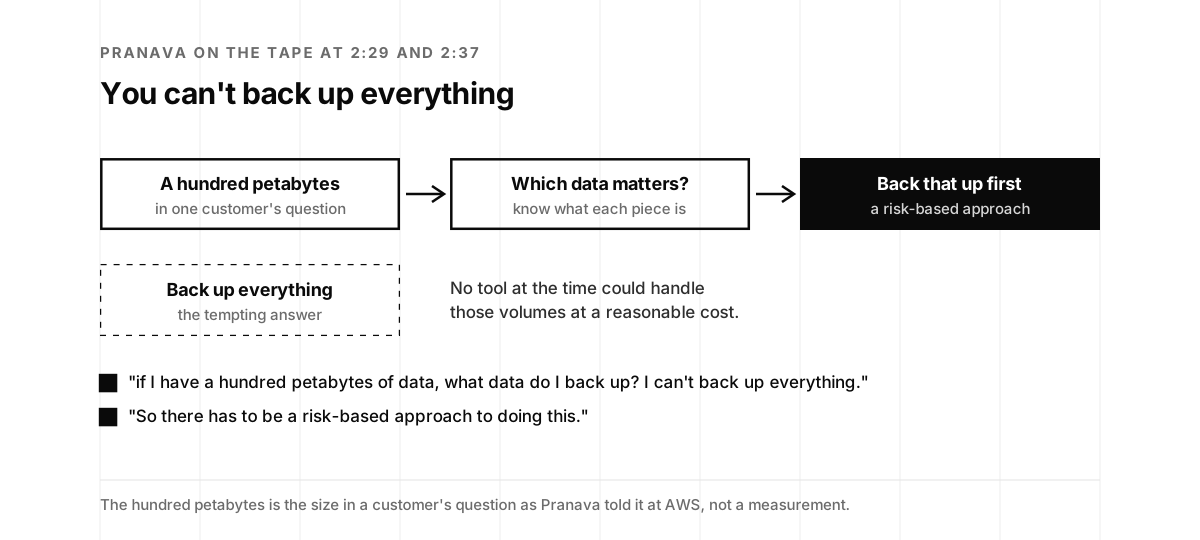
Three boxes in a row. A hundred petabytes, in one customer's question, leads to which data matters, know what each piece is, which leads to a filled box, back that up first, a risk-based approach. Below, a dashed box, back up everything, the tempting answer, with the note that no tool at the time could handle those volumes at a reasonable cost. Two quotes from Pranava: if I have a hundred petabytes of data, what data do I back up? I can't back up everything. So there has to be a risk-based approach to doing this.
A hundred petabytes and one question: you can't back up everything, so you have to know which part matters.

From Rubrik’s ransomware team to data security

Jon brought up the startup before AWS.

“You’re one of the founding engineers at Rubrik, another security company, right?”

Jon McLachlan, at 6:29

Rubrik is a cloud data management and data security company in Palo Alto, founded in January 2014, and listed on the New York Stock Exchange since its April 2024 public offering (Wikipedia). Pranava joined in April 2015 as a founding engineer and later managed engineering there until March 2019, by his LinkedIn. He described the company’s turn in the same terms as his own.

“And so Rubrik started as a data protection journey. But when ransomware really started becoming a boardroom priority, telling that story, making sure that people were resilient against it, that’s what took Rubrik in the direction of security as well.”

Pranava Adduri, at 6:50

“I was actually part of the team that shipped the first version of ransomware discovery and response. That was kind of the foray from data protection into data security for me.”

Pranava Adduri, at 7:01

Before Rubrik he spent three years at Box, the Redwood City company that sells cloud content management and file sharing to businesses (Wikipedia), as a backend engineer from May 2012 to April 2015. His LinkedIn lists a metadata service and a patented geofence encryption feature from that time, and internships at Salesforce in 2011 and VMware from 2008 to 2011. Since January 2019 he has also been a programming director at Advancing Women in Product. Startups were the habit from the start.

“I would say I’d mostly been at startups right after graduating.”

Pranava Adduri, at 6:12

“And it was very formative in terms of culture, in terms of working with a talented pool of engineers, and really learning what you could do if you sprinted with a group of smart people.”

Pranava Adduri, at 6:41
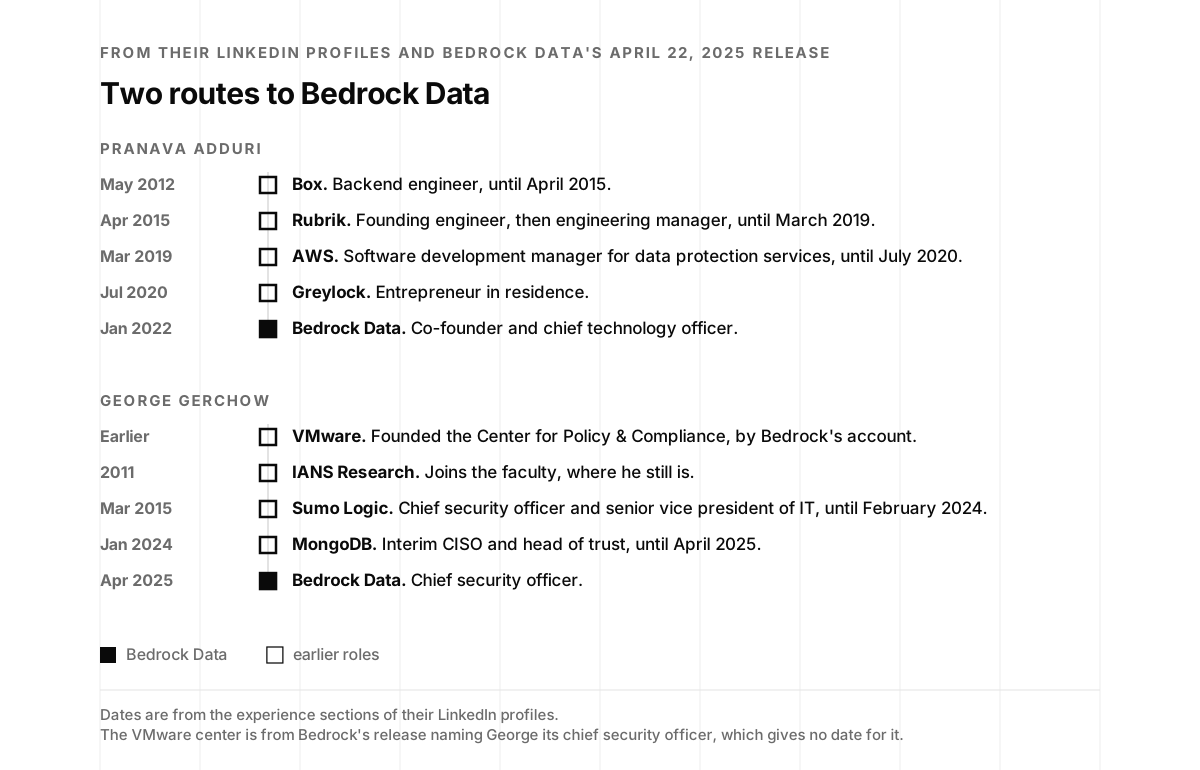
Two timelines. Pranava Adduri: May 2012, Box, backend engineer until April 2015. April 2015, Rubrik, founding engineer, then engineering manager, until March 2019. March 2019, AWS, software development manager for data protection services, until July 2020. July 2020, Greylock, entrepreneur in residence. Filled, January 2022, Bedrock Data, co-founder and chief technology officer. George Gerchow: earlier, VMware, founded the Center for Policy and Compliance, by Bedrock's account. 2011, IANS Research, joins the faculty, where he still is. March 2015, Sumo Logic, chief security officer and senior vice president of IT, until February 2024. January 2024, MongoDB, interim CISO and head of trust, until April 2025. Filled, April 2025, Bedrock Data, chief security officer.
Two routes to the same company: Pranava's through Box, Rubrik, AWS and Greylock, and George's through VMware, Sumo Logic and MongoDB.

Ransomware as a business

Jon’s reaction to the Rubrik story was about the attackers’ side of the market.

“It’s interesting the sorts of things that attackers will come up with in ransomware, kind of falls into that bucket of just, like, really nasty, like, trying to make a business out of the malware”

Jon McLachlan, at 7:13

George took it a step further.

“Yeah. They’re starting to talk, too, more and more.”

George Gerchow, at 7:33

“And there’s so many different threat actor groups that are getting together and doing that.”

George Gerchow, at 7:38

Ransomware as a service is that business model with a name: developers write and sell the malware to other criminals, often called affiliates, who launch the attacks and don’t need technical skill of their own (Wikipedia). For a defender, the effect is the one Pranava’s AWS customers felt: more attackers with the same tools, and a backup plan that only works if you know what to back up.

We forgot about the data

George’s first answer explained why he joined a company this young.

“No, I think it’s a great description. You know, data security in general and just understanding data has been a problem for a long time, Jon.”

George Gerchow, at 3:13

“Great people like Pranava, Ganesh, and Bruno. So I’m super happy to be here this early on.”

George Gerchow, at 3:41

Those are the three co-founders: Bruno Kurtic, president and CEO, Pranava as CTO, and Ganesha Shanmuganathan, chief architect (Bedrock Data). Bedrock announced George as its chief security officer on April 22, 2025. The release lists nine years as chief security officer and senior vice president of IT at Sumo Logic, through its IPO and its FedRAMP work, a stint as interim CISO at MongoDB, the Center for Policy & Compliance he founded at VMware, and more than fourteen years on the IANS Research faculty (Bedrock Data). Sumo Logic is a cloud-based data analytics company focused on security analytics and observability (Wikipedia), and MongoDB, Inc. makes the MongoDB database for unstructured data (Wikipedia). He said both companies made the same mistake.

“we just always kind of, like, forgot about the data. Those are two very data-driven companies and data-driven customers.”

George Gerchow, at 7:53

“But we always, like, sort of protect the endpoint or try to manage everything through identity. And why not just go after the data itself? Who’s interacting with the data? How’s the data being used? When was the last time that it was touched?”

George Gerchow, at 7:59

Listen · George on episode 95, from 7:53
About 15 seconds: George on protecting the endpoint and the identity, and forgetting the data itself. The clip stops on its own. Read the full transcript.

Endpoint security protects a network where laptops, phones and other devices connect to it (Wikipedia), and identity and access management makes sure the right users have the right access (Wikipedia). Both are about the routes to data. George’s questions are about the data, and his problem was scale, along with a line between his job and someone else’s.

“I think the scale part was always where I struggled. You know, it was like, I wasn’t necessarily the owner of the data. It was always someone like a Pranava, a CTO type that owned it, but I was responsible for the stewardship or protection of that data. But the scale was just out of control.”

George Gerchow, at 8:14

The cost of not knowing shows up at the end of an incident.

“And then closing the incident, Jon, and going, oh my goodness, like, did I close it?”

George Gerchow, at 8:36

“And now all of a sudden someone’s going to put it, you know, like, on social media that they actually exported the data out of the environment. I just didn’t know.”

George Gerchow, at 8:41

The new gold

Jon had started from the threat model, which in his telling is always about the data.

“Like, all of those layers of security are to protect the most sensitive assets, the most sensitive data. And that’s really the core of threat modeling, of, like, what are we protecting? It’s not the compute so much, right?”

Jon McLachlan, at 3:55

Then he turned to the direction of travel.

“I see it, you know, 10x-ing, 100x-ing, especially now that it’s kind of the new gold.”

Jon McLachlan, at 8:57

“And at its very core, it’s data. And so as the value of data is going up, I imagine that the value associated with securing that data is also just skyrocketing.”

Jon McLachlan, at 9:24

Bedrock’s own numbers point the same way. Its 2025 Enterprise Data Security Confidence Index, announced on December 30, 2025, found that 82% of the organizations it surveyed have trouble finding and classifying their data, and that 60% of security teams have taken on AI governance (Bedrock Data). Those are Bedrock’s survey figures, and the report has the method.

You can’t have AI without data

Jon asked whether Bedrock felt the value of securing data going up. Pranava said yes, and split his answer in two: how companies should look at data, and how security and engineering get along.

“But fundamentally, to your point, you can’t have AI without data. That’s kind of, like, the foundational mantra.”

Pranava Adduri, at 9:58

“But in order to be competitive with AI, to be competitive as a company and innovate at the rate of your peers, you need to first have an understanding of what data you can use to enable that.”

Pranava Adduri, at 10:04

He listed three ways companies use their data for AI, from the lightest to the heaviest.

“We see people trying to be competitive at the copilot level, where they want to connect a copilot to all their SaaS repositories and now operationalize that knowledge.”

Pranava Adduri, at 10:19

“We see people trying to build in-house agents that are taking some of the data and their infrastructure and all the historical data that they have to create better client experiences on the product side as well. And then for the hardcore teams, they’re training their own models as well.”

Pranava Adduri, at 10:28

A copilot connected to company documents usually works by retrieval-augmented generation, where a large language model looks things up in a set of documents before it answers (Wikipedia). Microsoft Copilot, the chatbot Microsoft launched in February 2023, is one example (Wikipedia). Each step down Pranava’s list gives the AI more of the company’s data, and more ways for it to come back out.
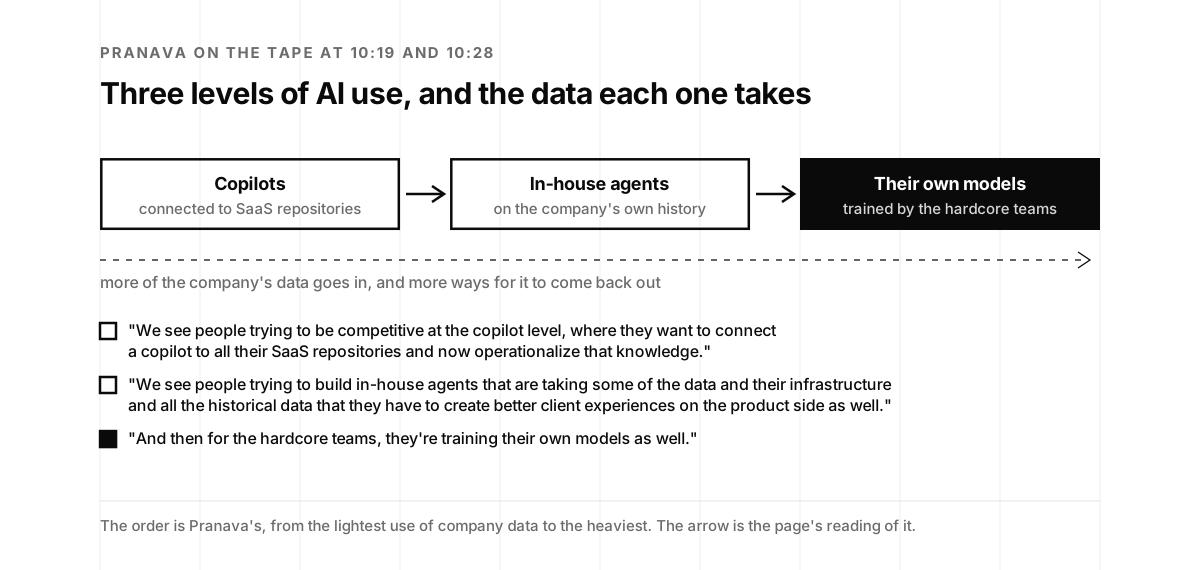
Three boxes from left to right. Copilots, connected to SaaS repositories. In-house agents, on the company's own history. Filled, their own models, trained by the hardcore teams. A dashed arrow underneath: more of the company's data goes in, and more ways for it to come back out. Pranava's three quotes, one for each level.
Pranava's three levels of AI use, and how much of a company's data each one touches.

The office of no does not work

The second half of Pranava’s answer was about what security does with all that pressure.

“The pressure to consume these tools and capabilities to be competitive is so high from a business perspective. If you don’t have a sanctioned path, they will come up with a shadow path to do it, right?”

Pranava Adduri, at 10:56

“They will spin up a personal tenant of GPT and connect it to whatever upstream SaaS they need to get their job done.”

Pranava Adduri, at 11:07

Listen · Pranava on episode 95, from 10:50
About 25 seconds: Pranava on the shadow path people take when there is no sanctioned one. The clip stops on its own. Read the full transcript.

Shadow IT is the old name for this: systems a department deploys to get around the central IT team’s limits, which can help people get work done and also adds security and compliance risk (Wikipedia). With AI, the system is a chat window and the data is whatever someone pastes in. Pranava’s conclusion was about the goal, not the tool.

“So the name of the game here is not how do you block, it’s how do you enable, and how do you give people the right guardrails to run faster, right?”

Pranava Adduri, at 11:14

“How do I enable the business, not how do I say no?”

Pranava Adduri, at 11:23

We wrote up the leadership side of this in Stop saying no and the shadow path itself in shadow AI governance. The scorecard below asks the questions that decide which way a request goes.
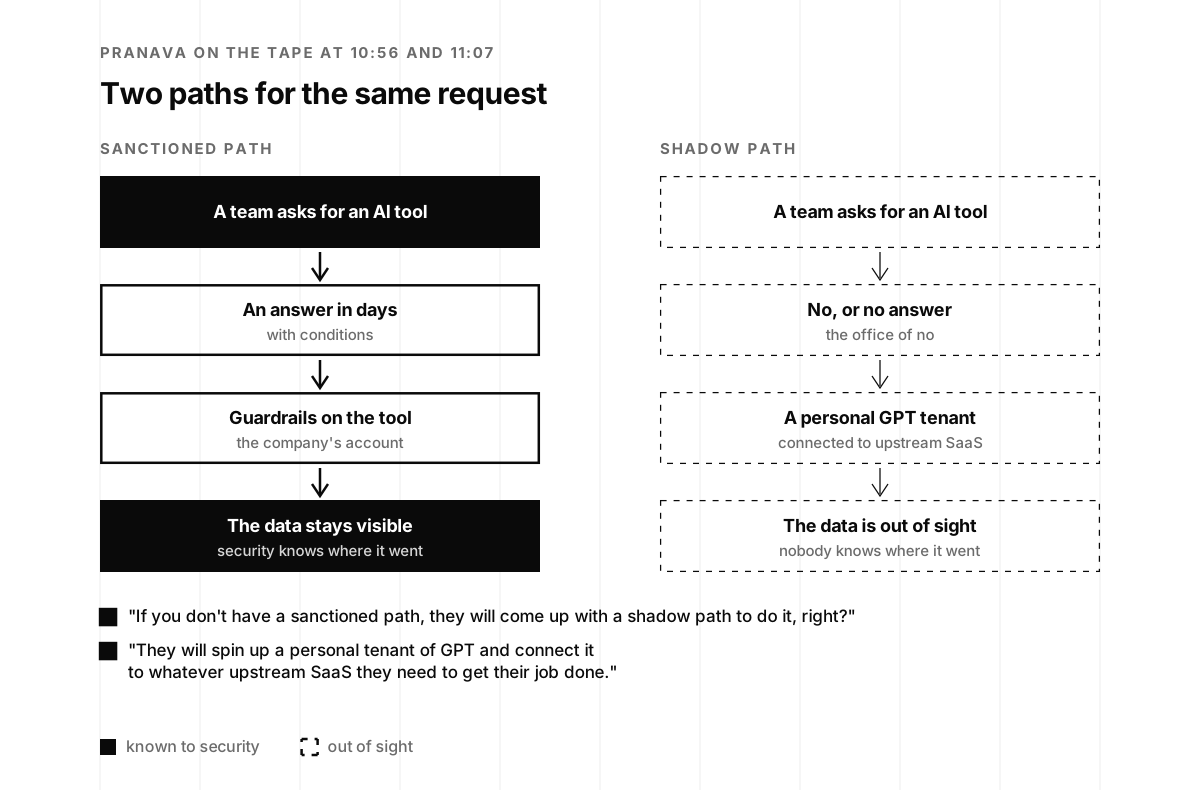
Two columns of four boxes. The sanctioned path: a team asks for an AI tool, an answer in days with conditions, guardrails on the tool in the company's account, and filled, the data stays visible, security knows where it went. The shadow path, all dashed: a team asks for an AI tool, no or no answer, the office of no, a personal GPT tenant connected to upstream SaaS, and the data is out of sight, nobody knows where it went. Two quotes from Pranava: if you don't have a sanctioned path, they will come up with a shadow path to do it, right? They will spin up a personal tenant of GPT and connect it to whatever upstream SaaS they need to get their job done.
Two paths for the same request: a sanctioned path with guardrails, or a shadow path through a personal account.

Use what you know about the data

Pranava’s next point turned data security into a source of ideas, not just a list of risks.

“In fact, use the fact that we know the data to actually enable finding data to build new initiatives. If you’re trying to build a new model and you didn’t know you had customer data in this form factor in a certain environment, well, your models are not going to be as effective, right?”

Pranava Adduri, at 11:34

The same knowledge is what lets someone stop a project before it’s a problem.

“hey, you’re building fast, but this particular model might be in trouble because of the data it’s exposing, right?”

Pranava Adduri, at 11:57

“So kind of this idea of how do you actually enable the business, actually build more, but also give the scaffolding and guardrails to allow them to catch themselves in the one or two off chances that something risky is about to happen.”

Pranava Adduri, at 12:02

Data governance is the set of policies, standards and practices that decide how data is created, managed and reused (Wikipedia). Pranava’s version runs both ways: the same inventory that tells you a model is exposing customer data tells you where the data for the next model is.

Stay out of my stuff

Pranava handed the second half of the question to George, who answered with the history of the job.

“Yeah, no, absolutely. I think you said something that was very key about not being the office of no.”

George Gerchow, at 12:15

In George’s telling, through his years at VMware and companies like it, the chief information security officer, the executive responsible for the strategy and program that protect a company’s information (Wikipedia), reported into corporate infrastructure and had a lot of friction with engineering. VMware is the Palo Alto virtualization and cloud company Broadcom bought on November 22, 2023 (Wikipedia). Then the cloud came.

“And then when cloud started coming out, engineers really started doing most of the security. You know, they were like, stay out of my stuff. And then CISOs were like, no, no, no, slow down, cloud, like, slow all these things down.”

George Gerchow, at 12:35

AI, he said, changed the arrangement again.

“because of the amount of data and because engineers are trying to move fast, I’m seeing a shift to where CISOs, progressive CISOs, are now starting to report to the CTO.”

George Gerchow, at 12:53

Listen · George on episode 95, from 12:34
About 30 seconds: George on the CISO's reporting line, from corporate infrastructure to the cloud to the CTO. The clip stops on its own. Read the full transcript.

“And what that does is it gives the CTO now the responsibility of, hey, I got to move fast, but I also have to be secure.”

George Gerchow, at 13:03

“And personally, like, Jon, I welcome it. You know, like, I want the business to move forward. I want the right guardrails to be in place. But we have to, as security people, get out of this traditional bucket that we’ve been in and start thinking like engineers.”

George Gerchow, at 13:21

Jon took the thought one step further.

“Thinking, like, almost like product people, of how do we use security to enable the business to just, like, supercharge it into the future of AI.”

Jon McLachlan, at 13:32

The reporting line George described isn’t universal, and he didn’t claim it was: it’s what he’s seeing among the CISOs he calls progressive. The companion post Stop saying no puts survey numbers beside it.
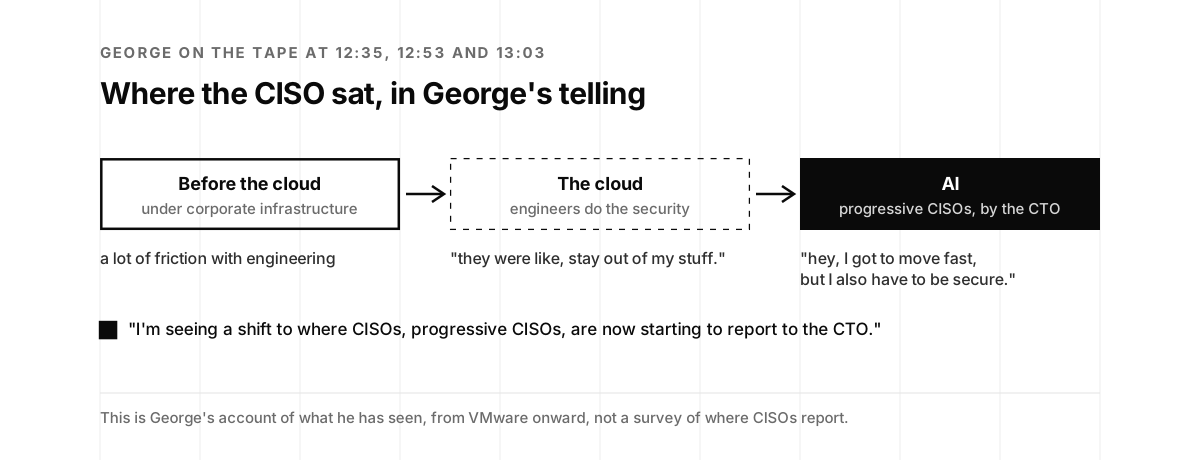
Three boxes from left to right. Before the cloud, under corporate infrastructure, with a lot of friction with engineering. Dashed, the cloud, engineers do the security, they were like, stay out of my stuff. Filled, AI, progressive CISOs, by the CTO: hey, I got to move fast, but I also have to be secure. George's quote underneath: I'm seeing a shift to where CISOs, progressive CISOs, are now starting to report to the CTO.
Where the CISO sat, in George's telling: under corporate infrastructure, then sidelined by engineers in the cloud, and now, at some companies, beside the CTO.

I’m kind of his customer

George’s own arrangement at Bedrock is an example of what he described.

“Yeah, exactly. I mean, that’s so well said, you know. And, you know, like, coming from MongoDB, that was kind of the structure there. And then now, like, working with someone like Pranava is like, I’m kind of his customer in a lot of ways, you know.”

George Gerchow, at 13:40

“I was about to say, you’re the customer of Bedrock, right?”

Jon McLachlan, at 13:51

Jon asked whether that made George “the product strategist, not just the CISO,” and George said it did.

“In a lot of ways, yes. In a lot of ways, my needs affect what we’re building, and what I’m seeing with customers”

George Gerchow, at 14:02

His LinkedIn describes the internal side of the job: he runs Bedrock’s program on AI agents, chairs its AI governance committee as the company works toward ISO 42001, and runs its trust center (LinkedIn). At MongoDB, where he was interim CISO and head of trust from January 2024 to April 2025, he set up the company’s first trust advisory board, by the same account. A security leader who is also the first customer gets to shape the product before it ships, which is the same argument Jon made about security and product people.

Who really owns the data

Jon asked what it feels like to get to full visibility of a company’s data as a CISO. George’s answer started with ownership.

“It feels so good in the way that now it’s not just about the security of that data, but I feel like I can also enable innovation by the business. Because who really owns the data? It is not the CISO that owns the data. It is the business that owns the data.”

George Gerchow, at 14:27

Listen · George on episode 95, from 14:27
About 25 seconds: George on who owns the data, and why the business needs it. The clip stops on its own. Read the full transcript.

“And the business needs that data to be able to make predictive decisions and drive innovation for customers to be able to leverage products better.”

George Gerchow, at 14:44

He stopped short of calling it peace of mind.

“I wouldn’t say peace of mind, because we’re paranoid people, you know, just by the nature of what we do. Got my tinfoil hat, you know. Have it right over here.”

George Gerchow, at 14:56

“Put it on. I’ll put it on sometimes.”

Jon McLachlan, at 15:05

“Yeah. Exactly. But it gives you this level of confidence and risk reduction, which we’ve never had before. Like I said before, we’ve always tried endpoint, identity, perimeter, and all these things.”

George Gerchow, at 15:06

Then he gave Jon’s opening point back to him.

“it’s about the data. So why not look at it from a data-first perspective?”

George Gerchow, at 15:21

The split George drew, an owner in the business and a steward in security, is the one his earlier story turned on: at Sumo Logic and MongoDB someone like a CTO owned the data, and he was responsible for protecting it. Ownership decides what the data may be used for. Stewardship makes sure the answer is known and enforced.
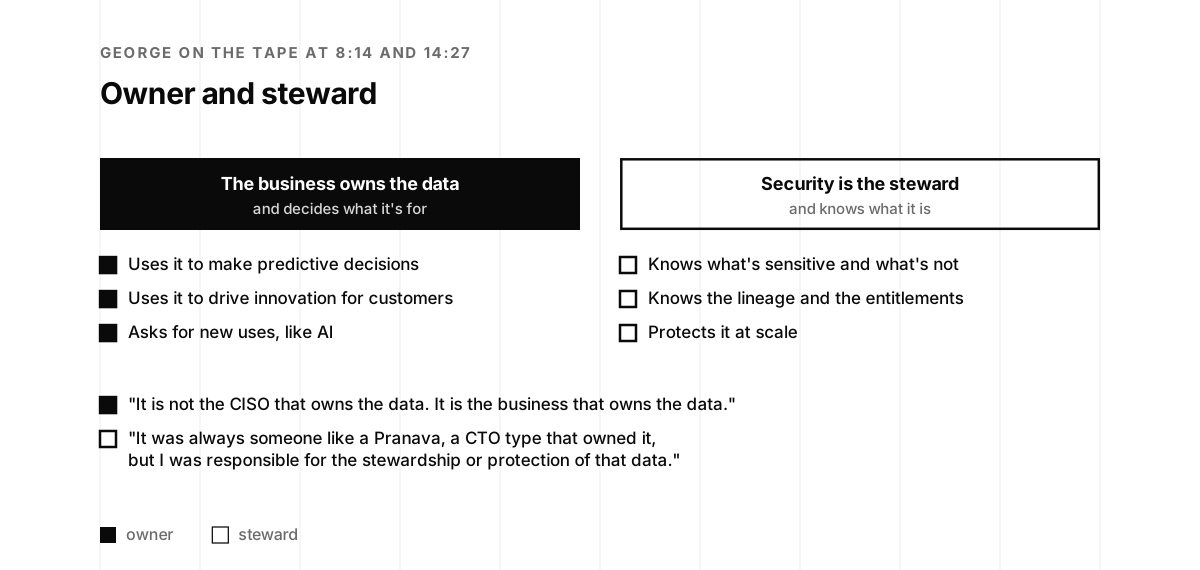
Two columns. Filled, the business owns the data and decides what it's for: uses it to make predictive decisions, uses it to drive innovation for customers, asks for new uses, like AI. Outlined, security is the steward and knows what it is: knows what's sensitive and what's not, knows the lineage and the entitlements, protects it at scale. Two quotes from George: it is not the CISO that owns the data. It is the business that owns the data. And: it was always someone like a Pranava, a CTO type that owned it, but I was responsible for the stewardship or protection of that data.
Owner and steward: the business owns the data and decides what it's for, and security keeps the record of what it is and who can reach it.

How many pictures are on your phone

George’s way of explaining the scale problem to people outside security starts with their own phones.

“And I love having these conversations with laymen, like people who aren’t in our industry. And I’m always like, how much email do you have? Like, how much email do you accumulate? How many pictures do you have on your phone?”

George Gerchow, at 15:30

“And so I’m like, you never go back and delete anything. So I explained it to them that way. And I’m like, now stop and think about an enterprise. And now all of a sudden you have 100, 200, 500,000 people, and how much data just stacks up there.”

George Gerchow, at 15:46

Listen · George on episode 95, from 15:30
About 30 seconds: George's thought experiment, from one phone to an enterprise. The clip stops on its own. Read the full transcript.

Then he listed what visibility has to include.

“When you have visibility of that data, know the lineage, the entitlements of that data, how it works, what’s sensitive, what’s not”

George Gerchow, at 15:58

Each word in that list has a plain meaning. Data classification sorts data into categories by attributes like its type, content or metadata, and labels them (Wikipedia), which is how you know what’s sensitive and what’s not. Lineage tracks how data is created, transformed and moved across systems over time (Wikipedia). Entitlements are who and what may reach it, and the principle of least privilege says each part of a system should reach only what it needs for its job (Wikipedia).
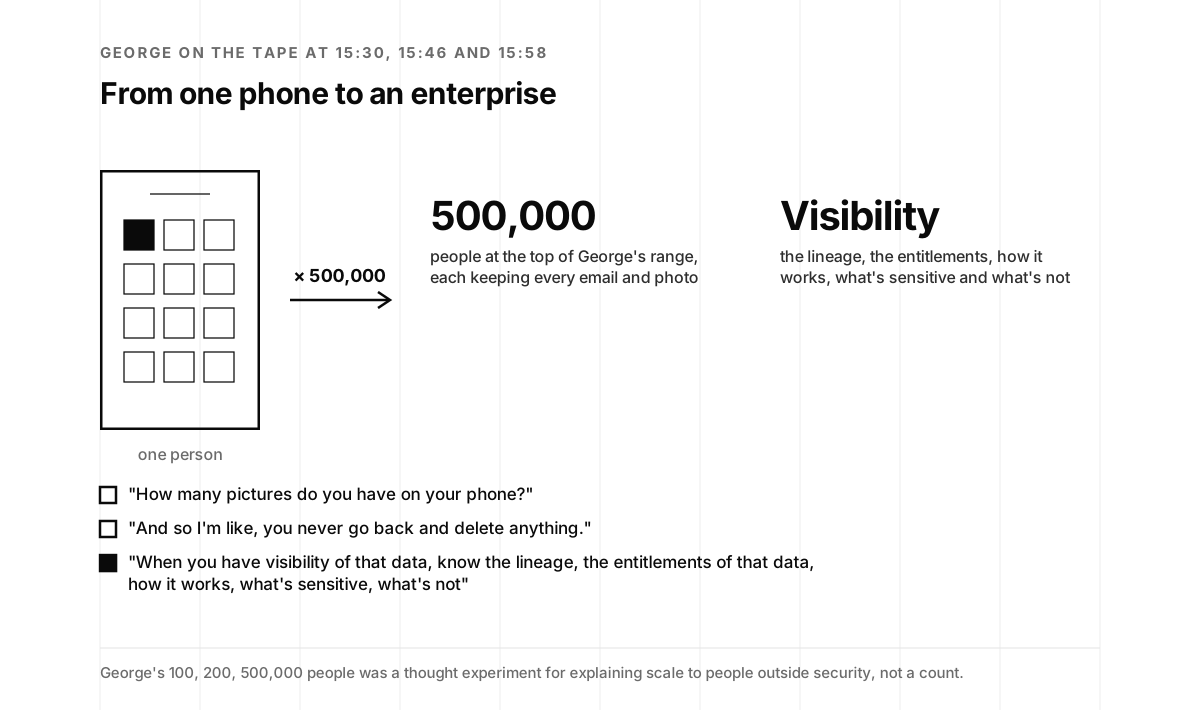
A phone drawn as an outline with a grid of photos, labeled one person, and an arrow marked times 500,000 to a large figure: 500,000 people at the top of George's range, each keeping every email and photo. Then: visibility, the lineage, the entitlements, how it works, what's sensitive and what's not. Three quotes from George: how many pictures do you have on your phone? And so I'm like, you never go back and delete anything. When you have visibility of that data, know the lineage, the entitlements of that data, how it works, what's sensitive, what's not.
George's thought experiment: the email and photos one person never deletes, multiplied by a company of half a million people.

Good brakes help you go faster

Pranava picked up where George stopped, with what visibility makes possible.

“I like to think about this adage of, like, good brakes help you go faster.”

Pranava Adduri, at 16:13

Brakes are what let a driver go into a corner at speed, and the conversations he has with companies, he said, start from the opposite position.

“A lot of the conversations that we have now, they take on a similar tune to, we are rolling out AI. As we roll out this AI, we want to use it to be competitive, but we don’t know what data is going in, right? And as a result, we can’t control necessarily what’s coming out.”

Pranava Adduri, at 16:16

Listen · Pranava on episode 95, from 16:13
About 20 seconds: Pranava on good brakes, and the companies rolling out AI without knowing what data goes in. The clip stops on its own. Read the full transcript.

“And so usually the conversation then evolves to, can you please help me understand what AI I have at play? Like, what have I deployed?”

Pranava Adduri, at 16:31

“And then, can you help me understand what data I’m sending to it, right? So then I can begin to understand what’s okay, right? As we’re sprinting, which projects are okay and which projects are putting me at risk.”

Pranava Adduri, at 16:39

What a CTO gets from that, in his account, is a sorted list.

“here are the ones that are doing well. Here are the ones that we need attention to in terms of reshaping, in terms of reworking some of the data.”

Pranava Adduri, at 17:01
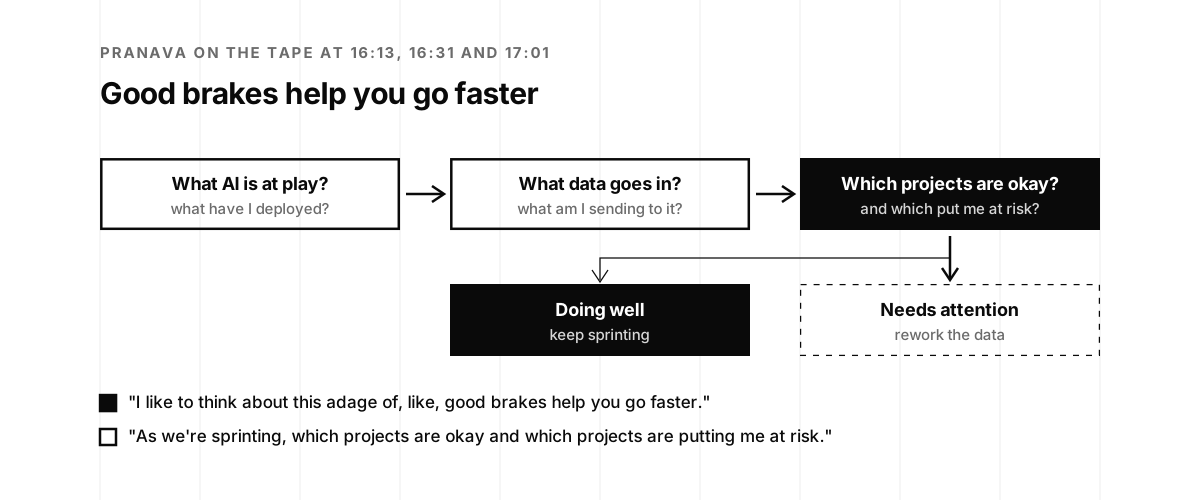
Three boxes from left to right. What AI is at play? What have I deployed? Then what data goes in? What am I sending to it? Then, filled, which projects are okay and which put me at risk? Below, two outcomes: filled, doing well, keep sprinting, and dashed, needs attention, rework the data. Two quotes from Pranava: I like to think about this adage of, like, good brakes help you go faster. As we're sprinting, which projects are okay and which projects are putting me at risk.
Good brakes help you go faster: an inventory of AI and its data sorts the projects into ones that can keep going and ones that need their data reworked.

Where did the data come from?

Jon brought the same question in from the compliance side. He hears it on sales calls.

“I’ve been on many potential new customer calls where I’m discussing with another potential customer’s security team, like, okay, so here’s an AI product. You’ve done some training. Where did the data come from? Do we know what type of data is in there?”

Jon McLachlan, at 17:26

“And if you look at, you know, to go back to the GRC a little bit, there’s new standards out there, like the ISO 42001. This is the new AI safety, safe, ethical, and secure AI.”

Jon McLachlan, at 17:44

Listen · Jon on episode 95, from 17:44
About 30 seconds: Jon on ISO 42001 and where training data comes from. The clip stops on its own. Read the full transcript.

ISO/IEC 42001:2023 sets out requirements for an AI management system, and ISO calls it “the world’s first AI management system standard” (ISO). GRC is governance, risk and compliance, the program side of security. Jon’s point was that an auditor’s question and an engineer’s question have become the same question.

“but where is the data coming from? And what type of data is going into that training? Data provenance, right?”

Jon McLachlan, at 18:12

Data provenance, or lineage, is the record of where data came from and what happened to it on the way (Wikipedia). YSecurity runs ISO 42001 programs, and the training data question is one of the first a certification body asks.

From cradle to grave

George’s version of provenance covers what happens after data is created.

“Yeah, you’re speaking our language, you know. It’s copies of data. When it comes to data provenance, you know, like, from cradle to grave, when data is created, but how does it move? And what are the copies? And does it still have the same entitlements to it?”

George Gerchow, at 18:29

Then he gave the example that makes it personal.

“manages 50 people and all of a sudden starts putting all of the reviews or comments inside of ChatGPT and then says, okay, spit something out that helps me give a yearly review on this person? You laugh, but is it happening out there? And do we know that?”

George Gerchow, at 18:55

Listen · George on episode 95, from 18:55
About 15 seconds: George's example of a manager pasting performance reviews into ChatGPT. The clip stops on its own. Read the full transcript.

“I’m sure it is.”

Pranava Adduri, at 19:10

“Yeah, and that’s a little bit scary, because that’s going to end up in the training set”

Jon McLachlan, at 19:11

Jon then imagined the same check at the other end, inside an AI company deciding what to train on.

“maybe for the purposes of building a better future, building a more private LLM that’s just as good, maybe we don’t want to have that in our training set, right?”

Jon McLachlan, at 19:32

Information privacy covers how data about people is collected and shared, and the expectations and law around it (Wikipedia). A performance review is personal data twice over, about the employee and from the manager. George’s question wasn’t whether it happens. It was whether anyone would know.
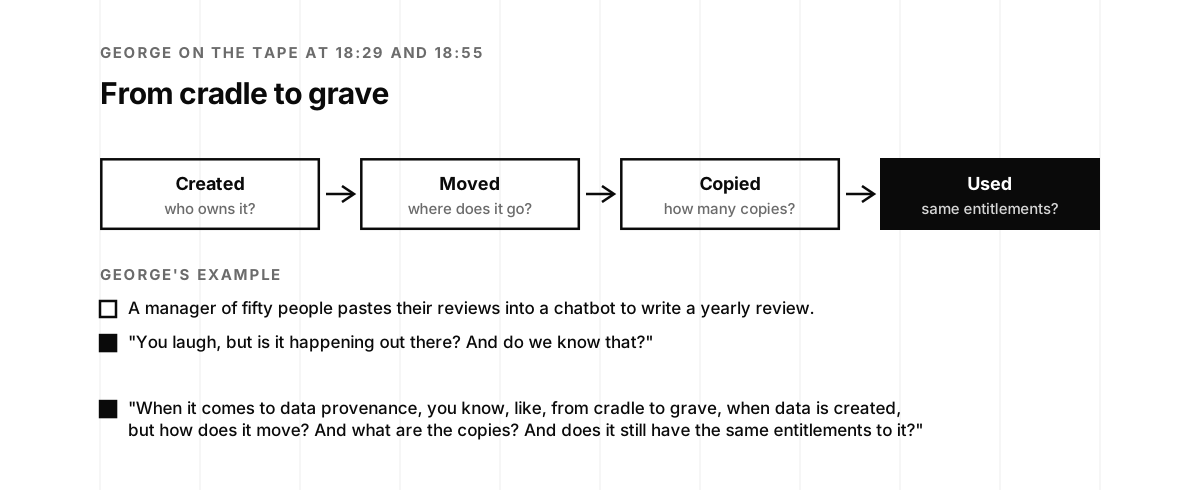
Four boxes from left to right: created, who owns it? Moved, where does it go? Copied, how many copies? Filled, used, same entitlements? George's example: a manager of fifty people pastes their reviews into a chatbot to write a yearly review. You laugh, but is it happening out there? And do we know that? And his question: when it comes to data provenance, you know, like, from cradle to grave, when data is created, but how does it move? And what are the copies? And does it still have the same entitlements to it?
From cradle to grave: data is created, copied and moved, and the question at each step is whether the entitlements came with it.

A data bill of materials

George handed the question to Pranava.

“Yeah, Pranava, actually, that’s kind of, like, where Argus fits in in a lot of ways, too, you know, if you want to describe that a little bit.”

George Gerchow, at 19:43

Pranava started from software.

“I liken this to SBOM and software, right? You have your binary that you’re vending. There’s the software dependencies of those binaries, and then there’s the downstream dependencies of those binaries as well, and libraries as well.”

Pranava Adduri, at 20:07

“And so in that same way, models have a DBOM, a data bill of materials. What data made its way into the training phase? Where did that data come from?”

Pranava Adduri, at 20:17

Listen · Pranava on episode 95, from 20:07
About 20 seconds: Pranava on the data bill of materials, by analogy with the software one. The clip stops on its own. Read the full transcript.

A software supply chain is the components, libraries, tools and processes used to build and publish a piece of software, named by analogy with the supply chains of physical goods (Wikipedia), and a software bill of materials lists them. Pranava had written the data version down in July 2024: “A DBOM is a comprehensive inventory of” all data going into a model in training and fine-tuning, and all data a model can reach at inference, such as retrieval and copilots (Bedrock Data). On the show he added the controls a DBOM should show.

“Then, in most organizations, they have controls or requirements that say that data has to be anonymized before it can get to the training phase. But if it doesn’t, that’s a potential source of the model getting tainted.”

Pranava Adduri, at 20:34

“For example, in certain domains where the company might be procuring data from data vendors, there might be terms around what granularity of data can be used when training a model, right?”

Pranava Adduri, at 20:51

Data anonymization removes personally identifiable information from a data set so the people in it stay anonymous (Wikipedia). The vendor terms are the part people forget: purchased data comes with a contract, and the contract follows the data into the model. Pranava’s last step was the inventory itself.

“So how do you start with the inventory of your AI workloads, whether it’s agents, copilots, et cetera? How do you look at the data supply chain that’s going into it? And that snapshot is what we call the DBOM.”

Pranava Adduri, at 21:07

“A DBOM. I love it. I love it.”

Jon McLachlan, at 21:17

The companion post AI data bill of materials has the field list and how to start one, and Bedrock’s DBOM page has the vendor’s version.
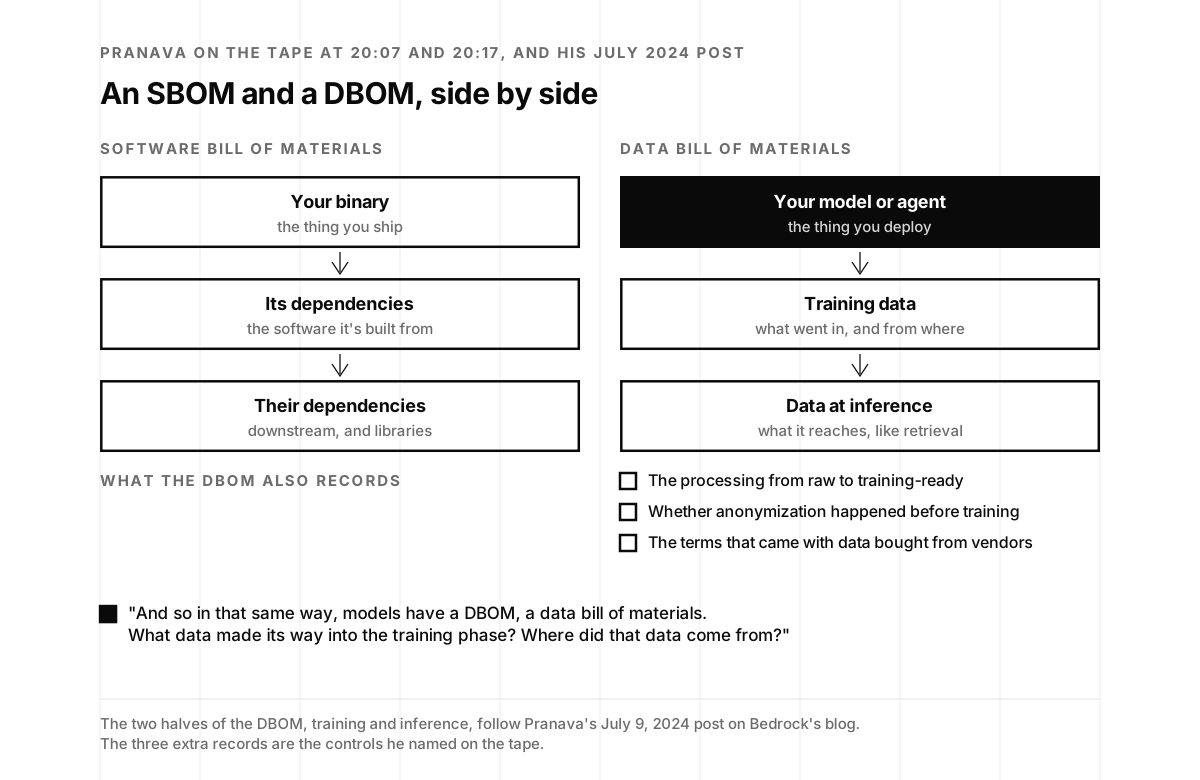
Two columns of three boxes. Software bill of materials: your binary, the thing you ship, its dependencies, the software it's built from, their dependencies, downstream, and libraries. Data bill of materials: filled, your model or agent, the thing you deploy, training data, what went in and from where, data at inference, what it reaches, like retrieval. Underneath, what the DBOM also records: the processing from raw to training-ready, whether anonymization happened before training, and the terms that came with data bought from vendors. Pranava's quote: and so in that same way, models have a DBOM, a data bill of materials. What data made its way into the training phase? Where did that data come from?
An SBOM and a DBOM side by side: what went into the binary, and what went into the model.

Argus and the gap

Then Pranava described the product George had mentioned.

“And to what George was talking about, Argus was actually something that we launched right before re:Invent.”

Pranava Adduri, at 21:20

“And the idea is, when you look at a model, on the left side, compute the DBOM, what all went into it. And on the right side, look at the guardrails to figure out what the guardrails enable, what do they block, and what do they allow? And that gives you a gap analysis.”

Pranava Adduri, at 21:25

Listen · Pranava on episode 95, from 21:24
About 25 seconds: Pranava on Argus: the DBOM on one side, the guardrails on the other, and the gap between them. The clip stops on its own. Read the full transcript.

“Based on what’s going into the model, or the agent or the copilot, you have this potential of what might be coming out.”

Pranava Adduri, at 21:38

“And it’s a way of coming back to what I was originally talking about, which is responsibly enabling innovation. How do you let people run fast while monitoring the gap analysis and seeing where you might be getting in trouble?”

Pranava Adduri, at 21:49

Bedrock’s launch release, on November 17, 2025, describes the same two halves: ArgusAI shows what data a company’s AI models and agents reach in training and inference, and checks whether the guardrails in place stop sensitive data from leaking. The release puts the problem in one line: “the constraint has shifted from deploying AI to governing it” (Bedrock Data). The same day, Bedrock announced a $25 million Series A led by Greylock (Bedrock Data). The calculator below runs the gap analysis on example numbers.
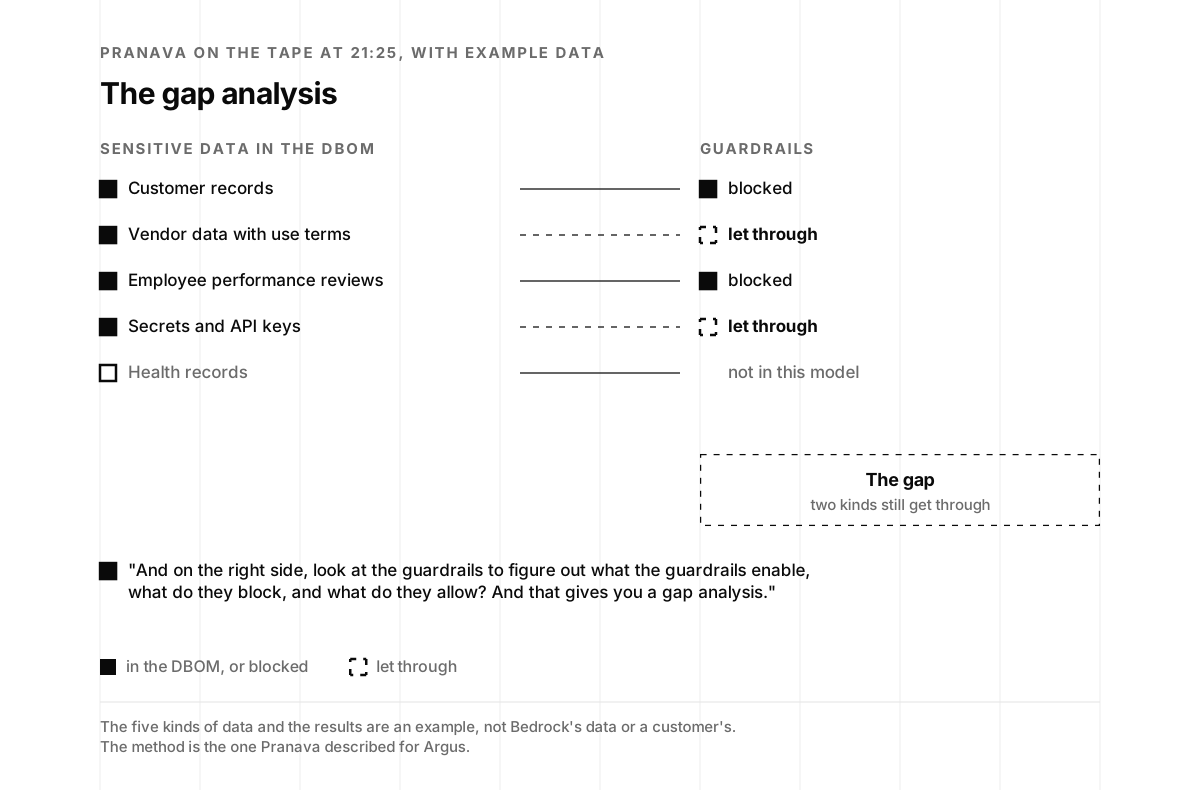
On the left, five kinds of sensitive data in a model's DBOM, and on the right, what its guardrails do with each. Customer records, blocked. Vendor data with use terms, let through. Employee performance reviews, blocked. Secrets and API keys, let through. Health records, not in this model. A dashed box marks the gap: two kinds still get through. Pranava's quote: and on the right side, look at the guardrails to figure out what the guardrails enable, what do they block, and what do they allow? And that gives you a gap analysis.
The gap analysis: sensitive data classes that went into a model on the left, what its guardrails block on the right, and what still gets through.

Innovation has to change the world

Jon stepped back from the product to the larger point.

“That’s beautiful. I love solutions to ginormous, extremely difficult problems that you could just drop into place.”

Jon McLachlan, at 21:59

“It’s like, innovation, I think, in order for it to really be innovation, it has to have the potential to change the world. If it doesn’t have the potential to change the world, I’m hesitant to put it in the category of innovation.”

Jon McLachlan, at 22:40

“we have to think about what it means for the technology not just to work and to be magical, but to be adopted. And I think that adoption piece is where security and data provenance and the controls and thinking about social impacts, maybe even, of what’s going on really comes into play here.”

Jon McLachlan, at 23:00

“So it’s a massive enabler to help everyone move fast.”

Jon McLachlan, at 23:18

“We love that. Enabling. We love it.”

George Gerchow, at 23:26

“This is a community thing. And so building an entire company to just nail it just seems spot on. Right place, right time. Congratulations.”

Jon McLachlan, at 23:34

A new home in San Mateo

Jon asked both guests for their best day so far. George went first.

“I’ll go first, because Pranava’s will probably be more profound. Mine was yesterday.”

George Gerchow, at 23:50

“Yeah. Well, yesterday we opened up a new HQ here in San Mateo. And the feeling I got, Jon, when I walked in, I was just overwhelmed with emotion and happiness, gratitude, which you’ve said a few times, to be part of this”

George Gerchow, at 23:57

The details were the ordinary ones of a startup moving in.

“there was, like, furniture mismatched all over the place, a ping pong table in the back that didn’t really have a net set up, but we were all excited putting it all together. Pranava dorking out inside of server rooms, closets, with the wiring and everything else.”

George Gerchow, at 24:21

“Like, we did great stuff at re:Invent. We’ve released great products. And when I first met the team, it was fantastic. But yesterday was just my best day.”

George Gerchow, at 24:43

Pranava agreed it was up there.

“Walking the office for the first time yesterday and just kind of seeing, like, you know, this is our first proper home, right?”

Pranava Adduri, at 24:56

Bedrock’s press releases moved with them: the December 2025 releases are datelined Menlo Park, and the March 19, 2026 release about ArgusAI is datelined San Mateo, as is the April 22, 2026 release that followed it.

Four days in March 2023

Pranava’s other best day was the end of his worst weekend.

“I think an equally high-emotion moment for me, funny enough, was there was a scare we had a couple of years ago when SVB went under. And I remember the entire weekend thinking, what am I going to do? Like, I have to make payroll.”

Pranava Adduri, at 25:04

Silicon Valley Bank failed on March 10, 2023 after a bank run, the third-largest bank failure in United States history and the largest since the 2008 financial crisis (Wikipedia). Bedrock had its money there.

“And when we found out that we would be getting our funds back, that was kind of like a new lease on life.”

Pranava Adduri, at 25:21

“Yeah, I imagine that would have been just absolutely terrifying as a founder, to have a major operational piece like your bank just go belly up and then end up in the news for all the wrong reasons.”

Jon McLachlan, at 25:47

The planning he did in those days outlasted the scare.

“In hindsight, it was such an interesting four days, because I remember I got on the phone with my co-founder, and we basically just said, what if we only get this much back? What if we only get this much back? And we had, like, four levels of what do we do if we only get this much money back.”

Pranava Adduri, at 25:58

Listen · Pranava on episode 95, from 25:58
About 30 seconds: Pranava on the four-level plan he and a co-founder made while SVB's fate was unknown. The clip stops on its own. Read the full transcript.

“And it turns out that plan was the plan we should be executing all along anyway, because it was a much more focused plan. It forced us to really cut out a lot of projects that weren’t in the critical path, right?”

Pranava Adduri, at 26:24

“Well, good job turning something from a scare into a win”

Jon McLachlan, at 26:35
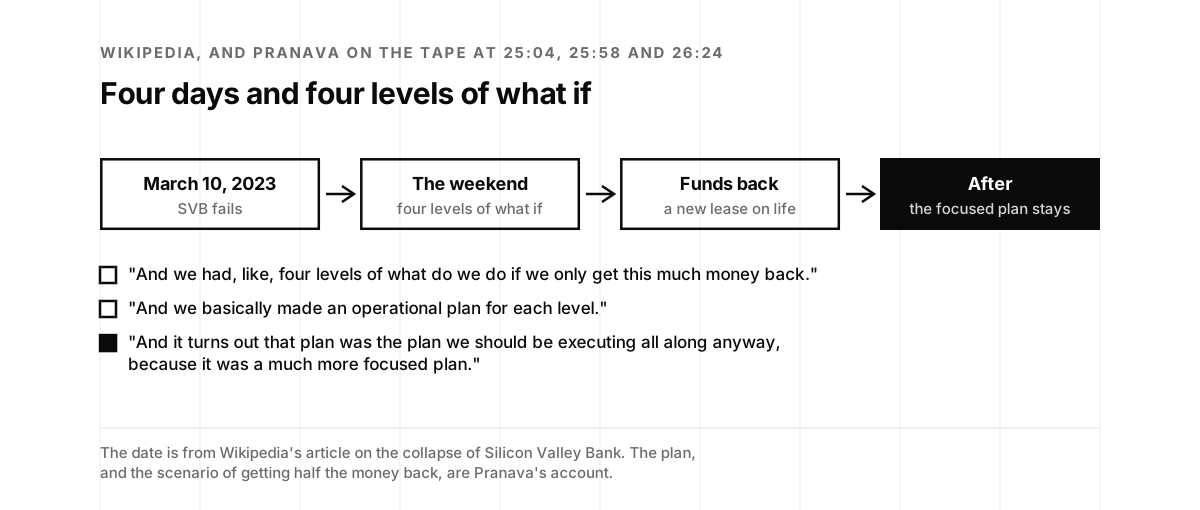
Four boxes from left to right: March 10, 2023, SVB fails. The weekend, four levels of what if. Funds back, a new lease on life. Filled, after, the focused plan stays. Three quotes from Pranava: and we had, like, four levels of what do we do if we only get this much money back. And we basically made an operational plan for each level. And it turns out that plan was the plan we should be executing all along anyway, because it was a much more focused plan.
Four levels of what if: the plan for getting only half the money back turned out to be the focused plan the company should have been running anyway.

CISOs who don’t want to see it

Then Jon asked for the hardest day.

“What about the most difficult day along your journey so far?”

Jon McLachlan, at 26:51

George went first again, and his answer was about his own profession.

“I would probably say the most difficult day was early on, trying to talk to traditional CISOs about what we do.”

George Gerchow, at 27:00

“And the reason why is because I find that sometimes in the CISO world, you show them a problem and they’re like, I don’t want to see that problem. No one’s asking me about that problem.”

George Gerchow, at 27:10

Listen · George on episode 95, from 27:09
About 35 seconds: George on showing CISOs sensitive data in lower environments, and the ones who didn't want to know. The clip stops on its own. Read the full transcript.

“And especially, like, in AWS environments, when we find, like, sensitive data in lower environments. My expectation was that they would be like, I’m solving this problem. I’m so glad I know now. I’m going to go get it.”

George Gerchow, at 27:31

Lower environments are the development, test and staging copies of a system, where production data tends to end up without production’s controls. George’s worry was about why someone would rather not know.

“And Jon, that, like, is disturbing in some ways, because when I came up in this industry as a security person, it was a strong ethical thing that we had, you know, like, a very strong ethical component to being a CISO.”

George Gerchow, at 27:57

He tied it to the legal pressure CISOs have been under, court cases included, and asked the question directly.

“is it getting to a point now to where the CISO is trying to reduce their own risk as much as the company’s risk, if not more?”

George Gerchow, at 28:23

Jon answered with values.

“The CISO is being run over by other leadership in the organization, by the board of directors, by wanting to take risks. That can be hard. But we have a core set of values, and you have to ask yourself, why did you get into security? Like, why are you taking on this leadership role?”

Jon McLachlan, at 28:42

The hardest days

Pranava’s first answer was a joke about the calendar.

“The cheeky answer to your question is four days ago, four days prior to that.”

Pranava Adduri, at 29:05

“It went from the worst day to the best day, like, four-day span right there.”

Jon McLachlan, at 29:10

Then the real one.

“But jokes aside, honestly, days where you have to let people go are always the hardest days. Because at a startup, there’s a very specific type of person that is well suited for early stage, right?”

Pranava Adduri, at 29:16

“And if it’s not working out, it’s always better to have that conversation earlier rather than later, but it never gets easier, right?”

Pranava Adduri, at 29:29

“Necessary, but not easy.”

Jon McLachlan, at 29:36

Pranava said he still has good relationships with the people the company parted ways with, and one told him it worked out.

“And I remember I was catching up with one of them not too long ago, and he actually said that for him, he actually retooled afterwards, and he’s actually way happier now. So you’re right, it actually does end up being better in the longer run for all parties involved.”

Pranava Adduri, at 30:01

A hardcore boss and Winners Dream

Jon asked about the people who shaped them.

“I know I absolutely would not be where I am if it weren’t for a lot of amazing folks that I’ve had the great honor and pleasure to work with and work under and work alongside of.”

Jon McLachlan, at 30:21

George went back to VMware.

“there was a guy when I first got to VMware that was so hardcore in his feedback and the way that he just would tell me I was doing something stupid. And I needed it. I needed it at that time.”

George Gerchow, at 31:19

Listen · George on episode 95, from 31:19
About 25 seconds: George on a boss at VMware whose feedback he needed. The clip stops on its own. Read the full transcript.

“And a lot of it goes to what Pranava was saying about letting people go and doing hard things. I think that guy, more than anyone, taught me how to do hard things that would have, like, potentially good outcomes for everyone.”

George Gerchow, at 31:49

Pranava named his father first, and then a book.

“I would say one for sure is my dad, but also there’s a lot of authors that taught me how to think about certain problems, right? One called Winners Dream by Bill McDermott.”

Pranava Adduri, at 32:05

“I think it really taught me what it means to be relationship first and be very genuine in how you approach a sale. It really taught me how to look at it from a perspective of how to do right by the customer.”

Pranava Adduri, at 32:15

Bill McDermott has been CEO of ServiceNow since November 2019 and was CEO of SAP before that. He wrote Winners Dream: A Journey from Corner Store to Corner Office with Joanne Gordon, and it won a gold medal for business memoir of the year from the Axiom Business Book Awards (Wikipedia). A CTO taking his lesson from a sales memoir fits the rest of what Pranava said: the security question and the customer question keep turning out to be the same question.

An invisible layer at the speed of machine

Jon asked what success looks like, as far into the future as they wanted to go.

“When we look into the future, and I’ll let you decide, like, how far we’d like to travel into the future, could you help us see what is that vision?”

Jon McLachlan, at 32:41

George’s answer was about his peers.

“it’s going to be just trying to set an example for a lot of my peers as to how to be more open-minded, how to enable a lot of the technology that we’re seeing today, how to have the gumption to stand up to the board when the board is saying, how are we using AI, which is the wrong question”

George Gerchow, at 33:05

“And then I marry that with Bedrock Data and just being around a lot of great people that are highly determined, like Pranava, to do the right thing and bring value to our customers in a responsible way.”

George Gerchow, at 33:25

Pranava’s answer was a layer.

“I think for me, from a vision perspective, there needs to be a layer that understands what data an enterprise has”

Pranava Adduri, at 33:47

“All of that needs to be powered by something. And right now, it’s human best judgment.”

Pranava Adduri, at 34:10

The reason it can’t stay human is the loop he called the data echo chamber.

“So I think going forward, especially, I use the term data echo chamber. There’s the data you have, goes into AI, people ask prompts, it puts out new data”

Pranava Adduri, at 34:15

“As you enter into this, like, rapid acceleration, there has to be a layer that’s understanding what’s going on at the speed of machine, not at the speed of human, to keep up with it.”

Pranava Adduri, at 34:26

Listen · Pranava on episode 95, from 34:17
About 20 seconds: Pranava on the data echo chamber, and a layer that keeps up at the speed of machine. The clip stops on its own. Read the full transcript.

He gave a talk with that name, The Data Echo Chamber: Governance in the AI Era, at Web Summit on November 12, 2025, and a second one the next day called Saying “No” is Your Best Friend for Getting to PMF (Bedrock Data). The second title is about product-market fit, the degree to which a product meets a strong market demand (Wikipedia), and it’s a fair counterweight to the rest of this page: a founder still has to say no to most product ideas. Researchers have a name for one version of the echo chamber too, model collapse, the degradation of models trained on uncurated synthetic data or on other models’ outputs (Wikipedia). Pranava didn’t use the term, and the page adds it only as context.

“And kind of where I see this going is, I kind of see Bedrock as being this invisible layer that understands your data, that injects that context into every aspect of a business, right?”

Pranava Adduri, at 34:35

“And it’s not just about building another single source of truth, as beautiful as I think our product is. It’s about meeting the customer where they’re doing their work.”

Pranava Adduri, at 35:02

His examples were a just-in-time access portal, a data annotation process and a security workflow, each getting Bedrock’s context where people already work.

“So I see it as the invisible layer that permeates the business, understands what data is present, and helps turbocharge every single workflow that’s there with that data context.”

Pranava Adduri, at 35:32
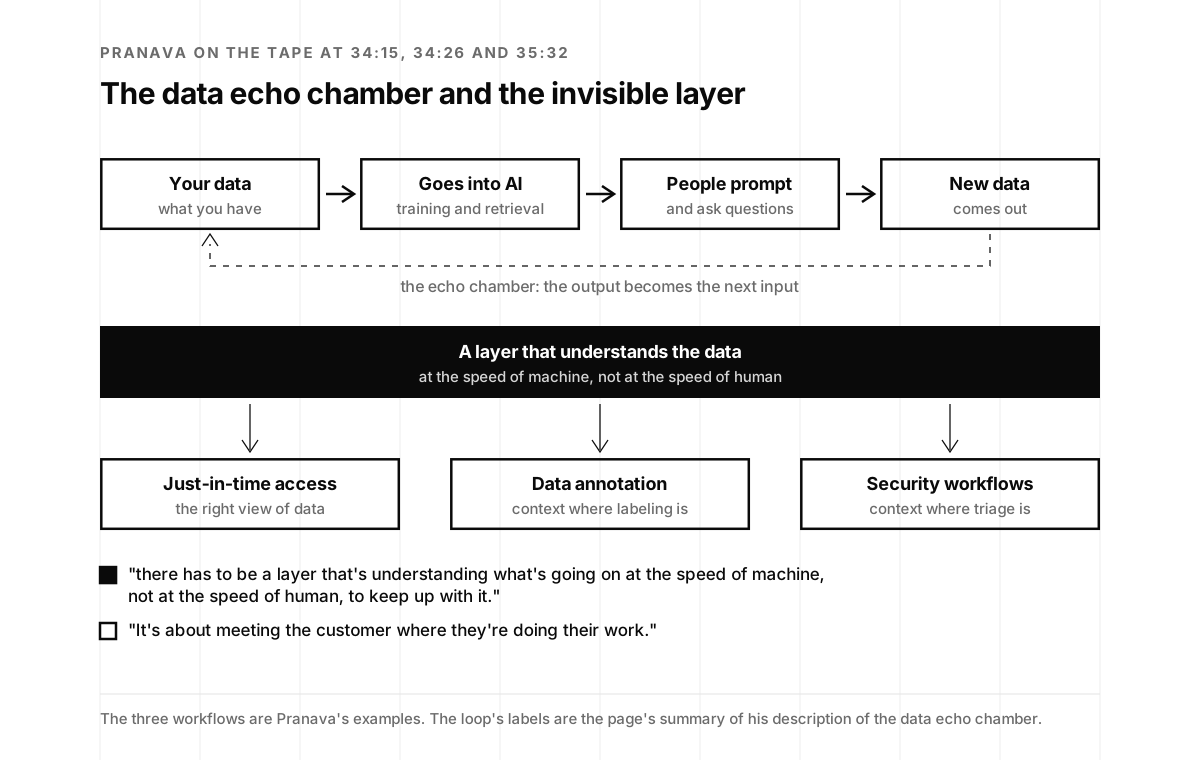
Four boxes in a loop: your data, what you have, goes into AI, training and retrieval, people prompt and ask questions, new data comes out, and a dashed line back to the start: the echo chamber, the output becomes the next input. Below, a filled bar: a layer that understands the data, at the speed of machine, not at the speed of human. It feeds three boxes: just-in-time access, the right view of data. Data annotation, context where labeling is. Security workflows, context where triage is. Two quotes from Pranava: there has to be a layer that's understanding what's going on at the speed of machine, not at the speed of human, to keep up with it. It's about meeting the customer where they're doing their work.
The invisible layer: data goes into AI, prompts produce new data, and a layer that understands the data feeds context into the workflows people already use.

Be fully present

Jon’s last question was the show’s usual one.

“If you could go back in time and meet your younger self, would you? And would you have any advice for yourself?”

Jon McLachlan, at 35:50

“And the advice I would give myself would be more on the personal front than the professional front.”

George Gerchow, at 36:02

“and just savor every single second and moment that I have with them”

George Gerchow, at 36:16

Pranava started with the obvious answer and moved past it.

“And beyond telling myself to buy more Apple and Google stock, I actually think George said it really well, right?”

Pranava Adduri, at 36:43

Listen · Pranava on episode 95, from 36:43
About 25 seconds: Pranava on doing whatever you take on fully. The clip stops on its own. Read the full transcript.

“I think at the end of the day, whatever you take on, whether it’s spending time with your family, whether it’s being very, whether it’s building a project that you’re super passionate about, being 150% there and doing it fully”

Pranava Adduri, at 36:52

“I would say it’s about being more fully present.”

Pranava Adduri, at 37:15

“I think at the end of the day, productivity is an emotional output, right?”

Pranava Adduri, at 37:30

“Be present.”

George Gerchow, at 37:53

“Be present, yeah. Be in the moment.”

Jon McLachlan, at 37:54

What happened after the tape

Bedrock kept building the layer Pranava described. Some of it was announced before the episode aired, and some since.

The AI risk surface. On March 19, 2026, Bedrock expanded ArgusAI beyond mapping AI systems to their data and checking guardrails. It now covers what the company calls the enterprise AI risk surface, “the full exposure chain” across the AI agents a company deploys, the Model Context Protocol servers and connectors that give them access to systems and data, and the sensitive data itself (Bedrock Data).

More agents. On April 22, 2026, Bedrock said ArgusAI governs AI agents built on Google Vertex AI Search and Dialogflow (Bedrock Data).

On air. Episode 95 went out on May 19, 2026, and the video version on YouTube on June 11, 2026 (YouTube). George joined the board of advisors of Cofense in May 2026, by his LinkedIn.

Remediation. In late October 2026, Bedrock announced that its AI-assisted remediation is generally available, with Jira and ServiceNow integrations (LinkedIn).

Entitlements in 2027. On November 3, 2026, Bruno Kurtic posted the third of his predictions for 2027, about identity and entitlements.

A video from Bedrock Data: Bruno Kurtic's third prediction for 2027, that reconciling identity through entitlements to classified data becomes the foundational data security and AI security initiative of the year.

Bedrock Data · November 3, 2026

His argument in the post is about the entitlements George listed on the tape: nobody can enforce a rule like keeping third parties away from personal data without knowing whether that data is in what a third party’s agent can reach. The next day, November 4, 2026, George spoke three times at the IANS Charlotte Forum, on MCP and agentic AI, on deepfakes and social engineering, and on a keynote panel about vulnerability management in an age of AI-assisted discovery (LinkedIn).
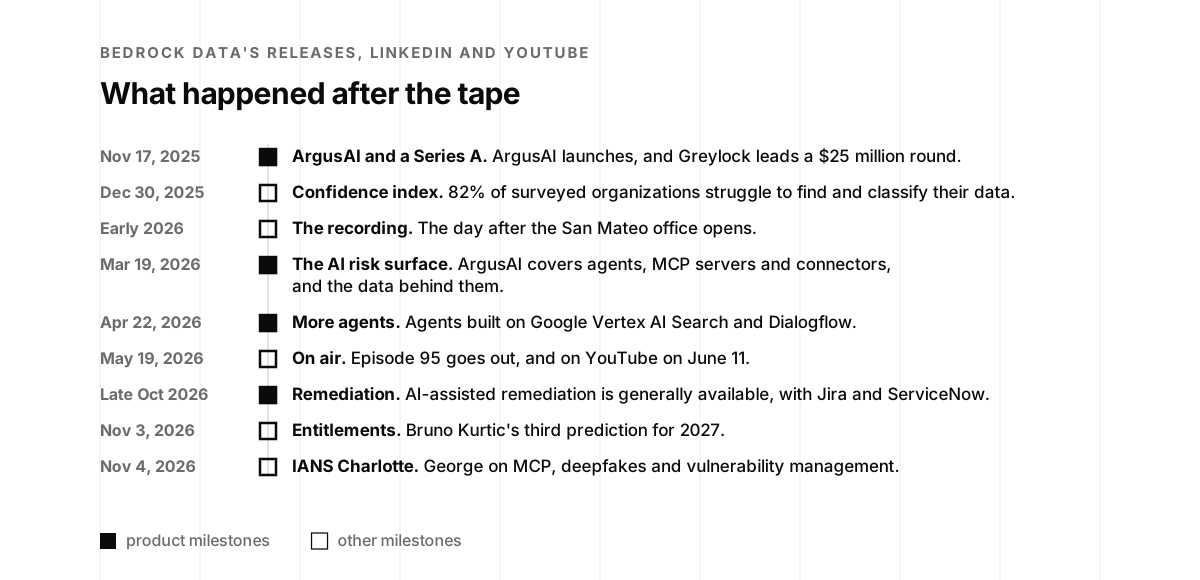
A timeline of nine entries. Filled, November 17, 2025, ArgusAI and a Series A: ArgusAI launches, and Greylock leads a 25 million dollar round. December 30, 2025, confidence index: 82% of surveyed organizations struggle to find and classify their data. Early 2026, the recording, the day after the San Mateo office opens. Filled, March 19, 2026, the AI risk surface: ArgusAI covers agents, MCP servers and connectors, and the data behind them. Filled, April 22, 2026, more agents: agents built on Google Vertex AI Search and Dialogflow. May 19, 2026, on air: episode 95 goes out, and on YouTube on June 11. Filled, late October 2026, remediation: AI-assisted remediation is generally available, with Jira and ServiceNow. November 3, 2026, entitlements: Bruno Kurtic's third prediction for 2027. November 4, 2026, IANS Charlotte: George on MCP, deepfakes and vulnerability management.
What happened after the tape, from the ArgusAI launch to the 2027 predictions.

The part of the conversation that aged best is the plainest. Know what data you have and who owns it. Write down what went into each model, and compare it with what the guardrails block. And when the business asks for something, have a path that says yes, because the people asking will find a path either way.

Did you catch it? A six-question quiz

Six questions from the episode. Each answer links the moment in the transcript.

Quiz · six questions

Did you catch it?

Pick an answer for each. The explanation shows once you choose.

  1. How much data did Pranava's example AWS customer have, the question that started Bedrock?

    1. A hundred terabytes
    2. A hundred petabytes
    3. Ten exabytes

    b. "if I have a hundred petabytes of data, what data do I back up?" Transcript, 2:29.

  2. What did Pranava say people do when there's no sanctioned path to an AI tool?

    1. They come up with a shadow path
    2. They wait for security to approve it
    3. They stop using AI

    a. "If you don't have a sanctioned path, they will come up with a shadow path to do it, right?" Transcript, 11:03.

  3. Who did George say really owns the data?

    1. The CISO
    2. The cloud provider
    3. The business

    c. "It is the business that owns the data." Transcript, 14:42.

  4. What adage did Pranava use for visibility and guardrails?

    1. Trust, but verify
    2. Good brakes help you go faster
    3. Move fast and break things

    b. "I like to think about this adage of, like, good brakes help you go faster." Transcript, 16:13.

  5. What does Bedrock call the snapshot of the data supply chain going into an AI workload?

    1. A DBOM, a data bill of materials
    2. An SBOM
    3. A data map

    a. "And that snapshot is what we call the DBOM." Transcript, 21:15.

  6. How many levels did Pranava's plan have while SVB's fate was unknown?

    1. Two
    2. Ten
    3. Four

    c. "And we had, like, four levels of what do we do if we only get this much money back." Transcript, 26:09.

Can you say yes?

Pranava’s test for a security team was whether it can say yes to an AI request and know what it agreed to. Eight questions on how close your team is.

Scorecard · eight questions

Can you say yes?

Answer for your company as it works today. If two answers fit, pick the lower one.

  1. Can you list every AI workload that touches company data: copilots, agents and models you train?

    • No, not with any confidence
    • The ones that went through an approval
    • Yes, from an inventory that updates itself

    "can you please help me understand what AI I have at play? Like, what have I deployed?" See Good brakes help you go faster.

  2. For your most important model or agent, can you say what data went into it and what it can reach?

    • No
    • Roughly, from the team that built it
    • Yes, from a written record of sources and processing, a DBOM

    "What data made its way into the training phase? Where did that data come from?" See A data bill of materials.

  3. Is your sensitive data classified, with its lineage and entitlements known?

    • No
    • Classified in the main systems, without lineage
    • Classified everywhere, including copies and lower environments, with lineage and entitlements

    "know the lineage, the entitlements of that data, how it works, what's sensitive, what's not" See How many pictures are on your phone.

  4. Do you know which sensitive data your AI guardrails block and which they let through?

    • We don't test the guardrails
    • We tested them once, at launch
    • We compare what goes in with what the guardrails block, and recheck when either changes

    "And that gives you a gap analysis." See Argus and the gap.

  5. When a team asks to use a new AI tool, what happens?

    • The answer is no, or there's no one to ask
    • A review that takes weeks
    • A sanctioned path with an answer in days, conditions included

    "If you don't have a sanctioned path, they will come up with a shadow path to do it, right?" See The office of no does not work.

  6. Who owns each important dataset?

    • Nobody in particular, or security by default
    • IT
    • A named owner in the business, with security as the steward

    "It is the business that owns the data." See Who really owns the data.

  7. Is data anonymized before it's used for training, and does anyone check?

    • We don't train, or we don't know
    • There's a rule, and nobody checks it
    • There's a rule, and the record for each model shows it was followed

    "they have controls or requirements that say that data has to be anonymized before it can get to the training phase." See A data bill of materials.

  8. Where does security sit when engineering starts something new with AI?

    • It hears about it at launch
    • It reviews the design when asked
    • It works with the CTO from the start, as a partner in the product

    "I'm seeing a shift to where CISOs, progressive CISOs, are now starting to report to the CTO." See Stay out of my stuff.

The office of no

Without an inventory, every yes is a guess, so the answer is no and the work moves to a shadow path. Start with a list of AI workloads and the data each one reaches, and open one sanctioned path with a published answer time.

Yes, with guesses

You say yes to some requests, but you can't always say what you agreed to. Write a DBOM for your three most exposed models, name an owner for each dataset, and test what your guardrails let through.

Good brakes

You know what data you have, what each model took in and what the guardrails stop, so you can say yes quickly. Keep the inventory automatic, recheck the gap when models or guardrails change, and keep security in the room from the start.

What gets through your guardrails?

Pranava’s gap analysis compares two lists: the sensitive data that went into a model, and what its guardrails block. The calculator runs that comparison across your AI workloads with example numbers. Put in your own.

Calculator

What gets through your guardrails?

Four numbers: your AI workloads, the kinds of sensitive data that reach each one, the share of those the guardrails block, and the share of workloads you have a DBOM for.

–paths from sensitive data into AI
–blocked by the guardrails
–still let through
–workloads with at least one gap
–paths you can see in a DBOM
–paths nobody has written down

Your 12 AI workloads give sensitive data 48 paths in. If the guardrails block 75% of them, 12 still get through, and about 8 of the 12 workloads have at least one. With a DBOM for 25% of the workloads, you can see 12 of the 48 paths, and 36 are a guess.

The defaults are an example, not figures from the episode. A path is one kind of sensitive data, such as customer records or vendor data with use terms, reaching one workload. The count of workloads with a gap assumes each kind is blocked independently at the same rate, the simplest version of the gap analysis in Argus and the gap. Real guardrails are uneven, which is why Pranava's version compares the actual lists.

From Box to ArgusAI

Everything on this page sits on one timeline, from the year Greylock was founded to Bedrock’s predictions for 2027. Filter it by thread.

Timeline · 1965 to 2026

From Box to ArgusAI

Filter by thread. Dates are from the public record except where marked as part of this show.

  1. Greylock

    One of the oldest venture capital firms is founded, the firm that would later lead Bedrock's Series A (Wikipedia, on this show).

  2. Box

    Aaron Levie and Dylan Smith found the company where Pranava would work from 2012 (Wikipedia, on this show).

  3. IANS faculty

    George joins the IANS Research faculty, where he still is (LinkedIn, on this show).

  4. Box

    Pranava starts as a backend engineer, until April 2015 (LinkedIn, on this show).

  5. Rubrik

    The Palo Alto data management and security company is founded (Wikipedia, on this show).

  6. Sumo Logic

    George becomes chief security officer and senior vice president of IT, until February 2024 (LinkedIn, on this show).

  7. Rubrik

    Pranava joins as a founding engineer, and later manages engineering, until March 2019 (LinkedIn, on this show).

  8. AWS

    Pranava manages software development for data protection services in Seattle, until July 2020 (LinkedIn, on this show).

  9. Greylock

    He becomes an entrepreneur in residence (LinkedIn, on this show).

  10. Bedrock

    Pranava co-founds the company with Bruno Kurtic and Ganesha Shanmuganathan (LinkedIn, Bedrock Data, on this show).

  11. SVB fails

    Silicon Valley Bank fails after a bank run, the third-largest bank failure in United States history (Wikipedia, on this show).

  12. VMware

    Broadcom completes its purchase of VMware, where George met the boss whose feedback he needed (Wikipedia, on this show).

  13. ISO/IEC 42001

    The standard for AI management systems is published, which ISO calls the world's first (ISO, on this show).

  14. MongoDB

    George becomes interim CISO and head of trust, until April 2025 (LinkedIn, on this show).

  15. Rubrik goes public

    Rubrik lists on the New York Stock Exchange (Wikipedia, on this show).

  16. The DBOM

    Pranava writes down the data bill of materials as an inventory of what goes into a model and what it can reach (Bedrock Data, on this show).

  17. A chief security officer

    Bedrock names George its CSO (Bedrock Data, on this show).

  18. The data echo chamber

    Pranava talks about governance in the AI era at Web Summit, and the next day about saying no on the way to product-market fit (Bedrock Data, on this show).

  19. Series A and ArgusAI

    A $25 million Series A led by Greylock, and the launch of ArgusAI (Bedrock Data, on this show).

  20. Confidence index

    Bedrock's survey finds 82% of organizations struggle to find and classify their data (Bedrock Data, on this show).

  21. The recording

    Jon talks with Pranava and George the day after Bedrock opens its San Mateo office (on this show).

  22. The AI risk surface

    ArgusAI expands to agents, MCP servers and connectors, and the sensitive data behind them (Bedrock Data, on this show).

  23. More agents

    ArgusAI governs agents built on Google Vertex AI Search and Dialogflow (Bedrock Data, on this show).

  24. Cofense

    George joins Cofense's board of advisors (LinkedIn, on this show).

  25. Episode 95 airs

    The episode goes out on Podbean, Apple Podcasts and Spotify (Podbean, on this show).

  26. On YouTube

    The video version goes up (YouTube, on this show).

  27. Entitlements

    Bruno Kurtic's third prediction for 2027, on reconciling identity through entitlements to classified data (LinkedIn, on this show).

  28. IANS Charlotte

    George speaks on MCP, deepfakes and vulnerability management at the IANS Charlotte Forum (LinkedIn, on this show).

What to do this week

Five things, in the order the episode suggests.

  1. List your AI. Write down every copilot, agent and model that touches company data, the three levels Pranava described, and where each one gets its data. If you can’t, that’s the first answer to his question, “what have I deployed?”
  2. Write a DBOM for three. For your three most exposed workloads, record the data sources, the processing between raw and training-ready, whether anonymization happened, and any vendor terms. The companion post on the AI data bill of materials has the fields.
  3. Run the gap analysis. Compare each DBOM with what the workload’s guardrails block, and fix the gaps that carry customer or regulated data first. The calculator above shows why the count is usually higher than it feels.
  4. Open a sanctioned path, and name the owners. Publish how a team asks for a new AI tool and how fast it gets an answer, and put a named business owner on each important dataset, with security as the steward. The scorecard covers the rest.
  5. Get help with the parts you can’t staff. Our Training Data PII & Secret Scrubbing team can clean what goes into a model, our Corporate Shadow-AI Detection & Mitigation work finds the shadow paths, our ISO 42001 program turns the records into an audit, and you can book 15 minutes with us.

Key takeaways

  1. Know the data before you pick what to protect

    Pranava's AWS customers asked which part of a hundred petabytes to back up for a ransomware plan. You can't back up everything, so protection needs a risk-based approach, and that needs to know what each piece of data is.

  2. Ransomware turned data protection into data security

    At Rubrik, ransomware becoming a boardroom priority moved a data protection company toward security, and Pranava was on the team that shipped its first ransomware discovery and response.

  3. Endpoints and identities are routes, the data is the target

    George said Sumo Logic and MongoDB protected the endpoint and managed identity but forgot the data itself: who interacts with it, how it's used and when it was last touched.

  4. You can't have AI without data

    Pranava's foundation: to compete with AI, a company first needs to know what data it can use, whether it connects a copilot to its SaaS tools, builds in-house agents or trains its own models.

  5. The office of no creates shadow paths

    Without a sanctioned path, people spin up a personal GPT tenant and connect it to whatever SaaS they need. Pranava's goal for security is guardrails that let people run faster, not blocks.

  6. Use what you know about the data to build

    The same inventory that shows a model is exposing customer data also shows where the data for the next model is, so data security can feed new projects as well as stop risky ones.

  7. The CISO's seat is moving

    In George's telling, CISOs reported into corporate infrastructure, engineers took over security in the cloud, and now progressive CISOs report to the CTO, which makes one leader answer for moving fast and staying secure.

  8. The business owns the data, and security is the steward

    George said it isn't the CISO who owns the data. The business owns it and needs it for decisions and innovation, and security's job is to know what it is and protect it.

  9. Visibility has a definition

    George's list for visibility is the lineage of the data, its entitlements, how it works, and what's sensitive and what's not. A list of data stores without those isn't visibility.

  10. Good brakes help you go faster

    Pranava's adage: an inventory of the AI in play and the data it receives sorts projects into ones that can keep sprinting and ones whose data needs reworking.

  11. Buyers ask where the training data came from

    Jon hears it on sales calls with prospects' security teams: where did the training data come from, and what type of data is in it. He pointed to ISO 42001 as the standard where that question now sits.

  12. Write a data bill of materials

    By analogy with a software bill of materials, a DBOM records what data went into a model's training, where it came from, how it was processed, whether it was anonymized, and what terms came with purchased data.

  13. Compare what goes in with what the guardrails block

    Argus puts the DBOM on one side and the guardrails on the other. The gap between them is the sensitive data that can still come out of a model, agent or copilot.

  14. Plan for the bad case, then keep the focused plan

    When SVB failed, Pranava and a co-founder planned four levels of what if. The plan for getting half the money back turned out to be the focused plan they should have been running anyway.

  15. Understanding data has to happen at the speed of machine

    In what Pranava calls the data echo chamber, AI puts out new data from prompts, so the understanding of what data a company has can't stay with human judgment. He sees it as a layer inside the workflows people already use.

Chapters

Tap a chapter to play from there. The play icon beside it opens that moment on YouTube.

Pull quotes

“But I was actually thinking about Bedrock when I was formerly an Amazonian.”

Pranava Adduri ·

“AWS sees some of the largest customer environments in terms of data volumes.”

Pranava Adduri ·

“But then the natural follow-up question is, if I have a hundred petabytes of data, what data do I back up?”

Pranava Adduri ·

“I can't back up everything. So there has to be a risk-based approach to doing this.”

Pranava Adduri ·

“Except none of the technologies that were available at the time could handle those volumes of data in any reasonable cost, or even had the ability to scale to those sizes.”

Pranava Adduri ·

“You know, data security in general and just understanding data has been a problem for a long time, Jon.”

George Gerchow ·

“Great people like Pranava, Ganesh, and Bruno.”

George Gerchow ·

“It's not the compute so much, right?”

Jon McLachlan ·

“And so Rubrik started as a data protection journey.”

Pranava Adduri ·

“I was actually part of the team that shipped the first version of ransomware discovery and response.”

Pranava Adduri ·

“That was kind of the foray from data protection into data security for me.”

Pranava Adduri ·

“And there's so many different threat actor groups that are getting together and doing that.”

George Gerchow ·

“But we always, like, sort of protect the endpoint or try to manage everything through identity.”

George Gerchow ·

“And why not just go after the data itself?”

George Gerchow ·

“I think the scale part was always where I struggled.”

George Gerchow ·

“But the scale was just out of control.”

George Gerchow ·

“I just didn't know.”

George Gerchow ·

“I see it, you know, 10x-ing, 100x-ing, especially now that it's kind of the new gold.”

Jon McLachlan ·

“And at its very core, it's data.”

Jon McLachlan ·

“But fundamentally, to your point, you can't have AI without data.”

Pranava Adduri ·

“And then for the hardcore teams, they're training their own models as well.”

Pranava Adduri ·

“The pressure to consume these tools and capabilities to be competitive is so high from a business perspective.”

Pranava Adduri ·

“If you don't have a sanctioned path, they will come up with a shadow path to do it, right?”

Pranava Adduri ·

“They will spin up a personal tenant of GPT and connect it to whatever upstream SaaS they need to get their job done.”

Pranava Adduri ·

“So the name of the game here is not how do you block, it's how do you enable, and how do you give people the right guardrails to run faster, right?”

Pranava Adduri ·

“How do I enable the business, not how do I say no?”

Pranava Adduri ·

“And then when cloud started coming out, engineers really started doing most of the security.”

George Gerchow ·

“You know, they were like, stay out of my stuff.”

George Gerchow ·

“And personally, like, Jon, I welcome it.”

George Gerchow ·

“But we have to, as security people, get out of this traditional bucket that we've been in and start thinking like engineers.”

George Gerchow ·

“Thinking, like, almost like product people, of how do we use security to enable the business to just, like, supercharge it into the future of AI.”

Jon McLachlan ·

“And then now, like, working with someone like Pranava is like, I'm kind of his customer in a lot of ways, you know.”

George Gerchow ·

“Because who really owns the data?”

George Gerchow ·

“It is not the CISO that owns the data. It is the business that owns the data.”

George Gerchow ·

“Got my tinfoil hat, you know.”

George Gerchow ·

“But it gives you this level of confidence and risk reduction, which we've never had before.”

George Gerchow ·

“So why not look at it from a data-first perspective?”

George Gerchow ·

“How many pictures do you have on your phone?”

George Gerchow ·

“And so I'm like, you never go back and delete anything.”

George Gerchow ·

“I like to think about this adage of, like, good brakes help you go faster.”

Pranava Adduri ·

“As we're sprinting, which projects are okay and which projects are putting me at risk.”

Pranava Adduri ·

“You've done some training. Where did the data come from? Do we know what type of data is in there?”

Jon McLachlan ·

“And what type of data is going into that training? Data provenance, right?”

Jon McLachlan ·

“Yeah, you're speaking our language, you know. It's copies of data.”

George Gerchow ·

“And does it still have the same entitlements to it?”

George Gerchow ·

“You laugh, but is it happening out there? And do we know that?”

George Gerchow ·

“And so in that same way, models have a DBOM, a data bill of materials.”

Pranava Adduri ·

“What data made its way into the training phase? Where did that data come from?”

Pranava Adduri ·

“But if it doesn't, that's a potential source of the model getting tainted.”

Pranava Adduri ·

“And that snapshot is what we call the DBOM.”

Pranava Adduri ·

“A DBOM. I love it. I love it.”

Jon McLachlan ·

“And to what George was talking about, Argus was actually something that we launched right before re:Invent.”

Pranava Adduri ·

“And that gives you a gap analysis.”

Pranava Adduri ·

“How do you let people run fast while monitoring the gap analysis and seeing where you might be getting in trouble?”

Pranava Adduri ·

“If it doesn't have the potential to change the world, I'm hesitant to put it in the category of innovation.”

Jon McLachlan ·

“This is a community thing.”

Jon McLachlan ·

“Yeah. Well, yesterday we opened up a new HQ here in San Mateo.”

George Gerchow ·

“Walking the office for the first time yesterday and just kind of seeing, like, you know, this is our first proper home, right?”

Pranava Adduri ·

“Like, I have to make payroll.”

Pranava Adduri ·

“And it turns out that plan was the plan we should be executing all along anyway, because it was a much more focused plan.”

Pranava Adduri ·

“No one's asking me about that problem.”

George Gerchow ·

“And especially, like, in AWS environments, when we find, like, sensitive data in lower environments.”

George Gerchow ·

“Necessary, but not easy.”

Jon McLachlan ·

“But jokes aside, honestly, days where you have to let people go are always the hardest days.”

Pranava Adduri ·

“And I needed it. I needed it at that time.”

George Gerchow ·

“One called Winners Dream by Bill McDermott.”

Pranava Adduri ·

“It really taught me how to look at it from a perspective of how to do right by the customer.”

Pranava Adduri ·

“All of that needs to be powered by something. And right now, it's human best judgment.”

Pranava Adduri ·

“So I think going forward, especially, I use the term data echo chamber.”

Pranava Adduri ·

“It's about meeting the customer where they're doing their work.”

Pranava Adduri ·

“I would say it's about being more fully present.”

Pranava Adduri ·

“I think at the end of the day, productivity is an emotional output, right?”

Pranava Adduri ·

“Be present, yeah. Be in the moment.”

Jon McLachlan ·

About the guests

Pranava Adduri, Co-founder and Chief Technology Officer, Bedrock Data

Pranava Adduri is the co-founder and chief technology officer of Bedrock Data, which he started in January 2022 with Bruno Kurtic and Ganesha Shanmuganathan after a stint as an entrepreneur in residence at Greylock. He managed software development for data protection services at AWS from March 2019 to July 2020, was a founding engineer and then an engineering manager at Rubrik from April 2015 to March 2019, where he was on the team that shipped the first version of its ransomware discovery and response, and was a backend engineer at Box from 2012 to 2015. He has been a programming director at Advancing Women in Product since January 2019. In July 2024 he wrote down the idea of a data bill of materials for AI, and in November 2025 he spoke at Web Summit on what he calls the data echo chamber.

George Gerchow, Chief Security Officer, Bedrock Data

George Gerchow has been the chief security officer of Bedrock Data since April 2025, where he runs the company's program on AI agents, chairs its AI governance committee as it works toward ISO 42001, and runs its trust center, by his LinkedIn. He was interim CISO and head of trust at MongoDB from January 2024 to April 2025, where he set up its first trust advisory board, and chief security officer and senior vice president of IT at Sumo Logic from March 2015 to February 2024, through its IPO and FedRAMP work. Earlier he founded the Center for Policy & Compliance at VMware. He has been on the IANS Research faculty since 2011, and has sat on the advisory boards of Bugcrowd since July 2024 and Cofense since May 2026.

About the host

Jon McLachlan is co-founder of YSecurity, the on-demand cybersecurity team for startups, and of Cyberbase.ai. The Security Podcast of Silicon Valley is hosted by Jon McLachlan and Sasha Sinkevich. Jon McLachlan on LinkedIn ↗

Context and sources

  • Pranava Adduri's LinkedIn experience: co-founder and CTO of Bedrock Data since January 2022, entrepreneur in residence at Greylock from July 2020, programming director at Advancing Women in Product since January 2019, software development manager for data protection services at AWS from March 2019 to July 2020, founding engineer and engineering manager at Rubrik from April 2015 to March 2019, backend engineer at Box from May 2012 to April 2015, and internships at Salesforce and VMware. Source ↗
  • George Gerchow's LinkedIn experience: chief security officer of Bedrock Data since April 2025, Cofense board of advisors since May 2026, IANS Research faculty since 2011, Bugcrowd advisory board since July 2024, interim CISO and head of trust at MongoDB from January 2024 to April 2025, chief security officer and senior vice president of IT at Sumo Logic from March 2015 to February 2024. Source ↗
  • Bedrock Data, who we are: data-centric security, governance and data management, the co-founders Bruno Kurtic, Pranava Adduri and Ganesha Shanmuganathan, George Gerchow as chief security officer, and the company's start in conversations with dozens of CISOs and data teams, worked out with Greylock. Source ↗
  • Bedrock Data, April 22, 2025: George Gerchow named chief security officer, with nine years at Sumo Logic through its IPO and FedRAMP work, interim CISO at MongoDB, the Center for Policy & Compliance he founded at VMware, and more than fourteen years on the IANS Research faculty. Source ↗
  • Bedrock Data, Securing Generative AI: The Role of a Data Bill of Materials, by Pranava Adduri, July 9, 2024: a DBOM as an inventory of the data that goes into a model in training and fine-tuning and the data it can reach at inference. Source ↗
  • Bedrock Data, AI Data Bill of Materials (DBOM): the company's use-case page for governing and auditing the datasets behind AI training and inference. Source ↗
  • Bedrock Data, November 11, 2025: Pranava Adduri at Web Summit, The Data Echo Chamber: Governance in the AI Era on November 12 and Saying "No" is Your Best Friend for Getting to PMF on November 13. Source ↗
  • Bedrock Data, November 17, 2025: ArgusAI and Natural Language Policy, to show what data AI models and agents reach in training and inference and check whether guardrails stop sensitive data from leaking. Source ↗
  • Bedrock Data, November 17, 2025: a $25 million Series A led by Greylock. Source ↗
  • Bedrock Data, December 30, 2025: the year's Series A, the ArgusAI launch and executive hires, and the 2025 Enterprise Data Security Confidence Index, with 82% of organizations reporting trouble finding and classifying their data and 60% of security teams taking on AI governance. Datelined Menlo Park. Source ↗
  • Bedrock Data, 2025 Enterprise Data Security Confidence Index: the survey report. Source ↗
  • Bedrock Data, March 19, 2026: ArgusAI expanded to the enterprise AI risk surface, the AI agents a company deploys, the MCP servers and connectors that give them access, and the sensitive data behind them. Datelined San Mateo. Source ↗
  • Bedrock Data, April 22, 2026: ArgusAI governs AI agents built on Google Vertex AI Search and Dialogflow. Datelined San Mateo. Source ↗
  • Bedrock Data on LinkedIn, November 3, 2026: a video of Bruno Kurtic's third prediction for 2027, reconciling identity through entitlements to classified data. Source ↗
  • Bedrock Data's LinkedIn posts: AI-assisted remediation generally available with Jira and ServiceNow in late October 2026, and George Gerchow's three sessions at the IANS Charlotte Forum on November 4, 2026. Source ↗
  • ISO, ISO/IEC 42001:2023, AI management systems: requirements for an AI management system, which ISO calls the world's first AI management system standard. Source ↗
  • YouTube, 95. Stop Saying No: How Security Leaders Enable AI Instead of Blocking It, uploaded June 11, 2026. Source ↗
  • Podbean, the episode page, published May 19, 2026. Source ↗
  • Wikipedia, Amazon Web Services: the Amazon subsidiary selling on-demand cloud computing platforms and APIs on a metered, pay-as-you-go basis. Source ↗
  • Wikipedia, Ransomware: malware that holds a victim's data hostage until a ransom is paid. Source ↗
  • Wikipedia, Ransomware as a service: a cybercrime business model in which developers sell ransomware to affiliates who launch the attacks. Source ↗
  • Wikipedia, Rubrik: a cloud data management and data security company in Palo Alto, founded in January 2014 and public on the New York Stock Exchange since April 2024. Source ↗
  • Wikipedia, Box, Inc.: the Redwood City company behind cloud content management and file sharing for businesses, founded in 2005 by Aaron Levie and Dylan Smith. Source ↗
  • Wikipedia, Greylock Partners: one of the oldest venture capital firms, founded in 1965. Source ↗
  • Wikipedia, Sumo Logic: a cloud-based data analytics company focused on security analytics and observability. Source ↗
  • Wikipedia, MongoDB, Inc.: the company behind the MongoDB database for unstructured data. Source ↗
  • Wikipedia, VMware: the Palo Alto virtualization and cloud company Broadcom acquired on November 22, 2023. Source ↗
  • Wikipedia, Data security: protecting digital information from destructive forces and from unauthorized users. Source ↗
  • Wikipedia, Endpoint security: protecting networks where laptops, phones and other devices connect to them. Source ↗
  • Wikipedia, Identity and access management: policies and technologies so the right users have the right access. Source ↗
  • Wikipedia, Chief information security officer: the executive responsible for the strategy and program that protect a company's information. Source ↗
  • Wikipedia, Retrieval-augmented generation: a technique that lets large language models look things up in external documents before answering. Source ↗
  • Wikipedia, Microsoft Copilot: the generative AI chatbot Microsoft launched in February 2023. Source ↗
  • Wikipedia, Shadow IT: systems a department deploys to get around central IT's limits, which can help productivity and add security and compliance risk. Source ↗
  • Wikipedia, Data governance: the policies, standards and practices for the creation, management and reuse of data. Source ↗
  • Wikipedia, Data classification: organizing data into labeled categories by attributes such as type, content and metadata. Source ↗
  • Wikipedia, Data lineage: tracking how data is generated, transformed, transmitted and used across systems over time. Source ↗
  • Wikipedia, Principle of least privilege: each part of a system may reach only the information and resources its legitimate purpose needs. Source ↗
  • Wikipedia, Information privacy: the collection and sharing of data and the expectations, norms and law around it. Source ↗
  • Wikipedia, Software supply chain: the components, libraries, tools and processes used to build and publish software, the subject of a software bill of materials. Source ↗
  • Wikipedia, Data anonymization: removing personally identifiable information from data sets so the people in them stay anonymous. Source ↗
  • Wikipedia, Collapse of Silicon Valley Bank: SVB failed on March 10, 2023 after a bank run, the third-largest bank failure in United States history. Source ↗
  • Wikipedia, Bill McDermott: CEO of ServiceNow since November 2019, formerly CEO of SAP, and author with Joanne Gordon of Winners Dream: A Journey from Corner Store to Corner Office. Source ↗
  • Wikipedia, Product-market fit: the degree to which a product satisfies a strong market demand. Source ↗
  • Wikipedia, Model collapse: the degradation of machine learning models trained on uncurated synthetic data or on the outputs of other models. Source ↗

Transcript

Automatic transcription. Jon McLachlan hosts this episode with Pranava Adduri and George Gerchow of Bedrock Data. There is no diarization on the tape, and Jon's and Pranava's voices are close, so speaker labels were assigned from the content and checked passage by passage against reference recordings of each voice from this episode and by pitch, and a few short lines may sit with the wrong speaker. The sponsor reads at the start and end are summarized in brackets. Names and product names were normalized where the recognizer misheard them (Jon McLachlan, Pranava Adduri, George Gerchow, Bedrock, Ganesh, MongoDB, Argus, DBOM, SBOM, AWS, re:Invent, Winners Dream, YSecurity), as were two terms the recognizer misheard (provenance, brakes). Words in [brackets] are best guesses where the audio is unclear. Answers are transcribed as spoken, with repeated words and false starts trimmed. Short backchannels such as "yeah", "yes" and "mm-hmm" are left out where they overlap the other speaker.

Read the full transcript 7,507 words

[Sponsor read: YSecurity, the sponsor of the show. For the moment a customer's legal team asks what happens if you get hacked: forty-plus security engineers who've done security at Apple, Uber, Microsoft, Robinhood and Brex, rented by the hour with a monthly cap, for SOC 2, ISO and HIPAA. Book a free strategy call, and the first eight hours are free at ysecurity.io/startups.]

Jon McLachlan

Hello, everyone, and welcome to another episode of The Security Podcast of Silicon Valley. I'm the host, Jon McLachlan, and I'm joined today with two very special guests from Bedrock Data: Pranava Adduri, the co-founder and CTO, and George Gerchow, the chief security officer. Welcome to the show, guys.

Pranava Adduri

Thank you.

Jon McLachlan

No, it's great to have both of you. We were just chatting a little bit before the show, and George, it sounds like you're calling in from a hotel room here in the peninsula.

George Gerchow

And I am, for now. But you're in San Francisco.

Jon McLachlan

Yeah. For all of our listeners who are maybe not as familiar with Bedrock Data as we are, like, would you like to share a little bit about what we do there?

Pranava Adduri

Absolutely. George, why don't I start, and then you can bring it home. But I was actually thinking about Bedrock when I was formerly an Amazonian. I was sitting at AWS. AWS sees some of the largest customer environments in terms of data volumes. And oftentimes, when people would ask us, hey, if I'm going to roll out a zero-ransomware strategy, we want to make sure that our most sensitive data is protected, how do we do that? Well, the answer is, go back it up, right? Go make sure that there are resiliencies in play so that if it goes down, if the data gets ransomed, you can get back up and running. But then the natural follow-up question is, if I have a hundred petabytes of data, what data do I back up? I can't back up everything. So there has to be a risk-based approach to doing this. Except none of the technologies that were available at the time could handle those volumes of data in any reasonable cost, or even had the ability to scale to those sizes. And so we started the company because we felt that there had to be a better way with modern environments to keep up with that data and to make sense of that data, so that at any given point in time, an organization can understand what data is most important to me and what are the correct ways to ensure that the organization can, at the end of the day, you want to be productive with that data, but you also don't want to shoot yourself in the foot, right? So how do we enable that? That's what we started Bedrock with the idea of doing. George, I'll hand it off to you to kind of add more color to that.

George Gerchow

No, I think it's a great description. You know, data security in general and just understanding data has been a problem for a long time, Jon. And that was, like, the attractive thing to the company for me, especially coming this early on, was, you know, you go through a security incident, what's the first thing that pops into mind is, like, did any sensitive data ever get out? You know, is that data being misused, mishandled? And then business cases around data, too. You want to use the power of data to be able to drive innovation forward. So it was a super attractive opportunity. Great people like Pranava, Ganesh, and Bruno. So I'm super happy to be here this early on.

Jon McLachlan

Yeah, I know. Thank you for that. I love the focus on data. You know, whenever I'm with an organization, we're talking about security, we're talking about threat models, it really is about the data. Like, all of those layers of security are to protect the most sensitive assets, the most sensitive data. And that's really the core of threat modeling, of, like, what are we protecting? It's not the compute so much, right? It's because if the compute is compromised, then the data can be compromised. And there's been more than one occasion where I've stepped into some roles, and you can look around the ecosystem and you're just overwhelmed with how much data is out there and how much responsibility is really on your shoulders as a security leader or as a security professional, like, trying to protect all of this data. So that problem can definitely be overwhelming.

George Gerchow

No doubt about it.

Jon McLachlan

I have all the gratitude in the world that there are amazing, dedicated, smart, focused people, like, slugging through the details and the grit underneath the hood. But maybe Pranava, like, being one of the co-founders, there must have been something, or maybe an experience or a story that you bumped into that really instigated this entrepreneurial journey. Did you feel this problem personally, and, like, in a past life?

Pranava Adduri

In terms of where we saw the problem and kind of the inspiration slash the understanding for the need for something like this, it really was during my time at AWS, where we would constantly be speaking to some of the largest companies out there, right? Like, you know, every one of the Fortune 500s is there, and the largest [of the] large. And so it really did, like, I think the idea really did start taking root when it came to thinking about how do you enable these teams to become more productive with that data, right? When they have these super large volumes, it gets siloed. There's different teams working on different things. And in terms of being able to make sense of that data at scale and doing it in a way that's responsible, I think, to answer your question, I think the idea that this was actually a big problem was taking root while I was there. And then, like, once the business problem was clear, then it became a question of, like, okay, well, what can we do from a technological standpoint to enable this, right? And how do we keep up with that data as we see the next order of magnitude of growth, or multiple orders of magnitude of growth? I think the time at AWS was really formative in terms of seeing the largest of large customers and then the problems that they were dealing with. And then, I guess, in terms of having the itch to do a startup, I think that's, I was there ever since college. I would say I'd mostly been at startups right after graduating. That was very formative in terms of, like, the culture that I wanted to bring to a company. And yeah, I think after the time at AWS and understanding the business case, that's when the time [felt] right.

Jon McLachlan

Yeah. And, you know, you had been in other [startups] before. You're one of the founding engineers at Rubrik, another security company, right?

Pranava Adduri

That's right. Rubrik really was the place that, like, I mean, I joined there much earlier stage than I joined my previous startup. And it was very formative in terms of culture, in terms of working with a talented pool of engineers, and really learning what you could do if you sprinted with a group of smart people. And so Rubrik started as a data protection journey. But when ransomware really started becoming a boardroom priority, telling that story, making sure that people were resilient against it, that's what took Rubrik in the direction of security as well. I was actually part of the team that shipped the first version of ransomware discovery and response. That was kind of the foray from data protection into data security for me. And that continued at AWS as well.

Jon McLachlan

Wow. No, that's incredible. It's interesting the sorts of things that attackers will come up with in ransomware, kind of falls into that bucket of just, like, really nasty, like, trying to make a business out of the malware and [turn] a profit themselves, just like all of the legitimate businesses who are actually providing, like, legitimate services. And they're talking a whole marketplace.

George Gerchow

Yeah. They're starting to talk, too, more and more. Like, ransomware as a service is [home] now. And there's so many different threat actor groups that are getting together and doing that. You know, you said something that was very key, Jon, too, about feeling the pain, and then Pranava and Ganesh and Bruno coming up with the solution. I think, you know, like, in my [stint] at Sumo Logic and [then] MongoDB, we just always kind of, like, forgot about the data. Those are two very data-driven companies and data-driven customers. But we always, like, sort of protect the endpoint or try to manage everything through identity. And why not just go after the data itself? Who's interacting with the data? How's the data being used? When was the last time that it was touched? Like, all of these things, and trying to do it at scale, you know, get a better understanding at scale. And I think the scale part was always where I struggled. You know, it was like, I wasn't necessarily the owner of the data. It was always someone like a Pranava, a CTO type that owned it, but I was responsible for the stewardship or protection of that data. But the scale was just out of control. And so that's why, like, I think a solution like ours is just so attractive to someone like me who's been through public security incidents and felt this pain, you know. And then closing the incident, Jon, and going, oh my goodness, like, did I close it? And now all of a sudden someone's going to put it, you know, like, on social media that they actually exported the data out of the environment. I just didn't know.

Jon McLachlan

Right. Things that keep up security leaders at night, right? You know, you talk about scale, and I don't see data getting any smaller. I see it, you know, 10x-ing, 100x-ing, especially now that it's kind of the new gold. You know, we have all of this AI change that's just unfolding right before our eyes. And it's being driven by data, like those improvements in the LLMs, all of this amazing capabilities that are just bubbling up, that we had no idea, like, just a couple of years ago, how incredibly fast things would start to change. And at its very core, it's data. And so as the value of data is going up, I imagine that the value associated with securing that data is also just skyrocketing. Do you guys see that or feel that at Bedrock Data?

Pranava Adduri

Yes. And I'll say two things about this. I'll first speak to the way I think organizations need to start looking at data going forward and the interplay of how security factors into that. And it also speaks to, I think, the changing relationship between security and engineering as well. And I think we can start with the first, and then George can help me take it home with the second part. But fundamentally, to your point, you can't have AI without data. That's kind of, like, the foundational mantra. But in order to be competitive with AI, to be competitive as a company and innovate at the rate of your peers, you need to first have an understanding of what data you can use to enable that. And so we see all variants of this. We see people trying to be competitive at the copilot level, where they want to connect a copilot to all their SaaS repositories and now operationalize that knowledge. We see people trying to build in-house agents that are taking some of the data and their infrastructure and all the historical data that they have to create better client experiences on the product side as well. And then for the hardcore teams, they're training their own models as well. And so across the entire spectrum, the name of the game is, how do we use the data that we have to become competitive, to become more competitive? And so when we think about it from a security lens, I think now more than ever, being the office of no does not work. The pressure to consume these tools and capabilities to be competitive is so high from a business perspective. If you don't have a sanctioned path, they will come up with a shadow path to do it, right? They will spin up a personal tenant of GPT and connect it to whatever upstream SaaS they need to get their job done. So the name of the game here is not how do you block, it's how do you enable, and how do you give people the right guardrails to run faster, right? And that's really the objective that we should be aiming for. How do I enable the business, not how do I say no? And so from that perspective, I think the way we look at it is, start by understanding what data you have, [paired] with the visibility of understanding how that data is being consumed by different AI systems. In fact, use the fact that we know the data to actually enable finding data to build new initiatives. If you're trying to build a new model and you didn't know you had customer data in this form factor in a certain environment, well, your models are not going to be as effective, right? So use the fact that the platform can understand what data you have to make your models even better. And then, as you're doing that innovation, also use the understanding of how that data should be used to say, hey, you're building fast, but this particular model might be in trouble because of the data it's exposing, right? So kind of this idea of how do you actually enable the business, actually build more, but also give the scaffolding and guardrails to allow them to catch themselves in the one or two off chances that something risky is about to happen. But George, I don't know if you wanted to add more to that.

George Gerchow

Yeah, no, absolutely. I think you said something that was very key about not being the office of no. You know, like, coming up through this, you know, all my years at VMware and technical companies like that, there was, like, this thing that was going on where CISOs sort of reported into a corporate infrastructure, and they just always had a lot of friction with engineering. And then when cloud started coming out, engineers really started doing most of the security. You know, they were like, stay out of my stuff. And then CISOs were like, no, no, no, slow down, cloud, like, slow all these things down. And then IT's [footprint] was reduced and all that. But AI has brought a different mechanism to this whole ballgame now, which is, because of the amount of data and because engineers are trying to move fast, I'm seeing a shift to where CISOs, progressive CISOs, are now starting to report to the CTO. And what that does is it gives the CTO now the responsibility of, hey, I got to move fast, but I also have to be secure. And then it's got to take a progressive CISO, too, who's, like, AI ready, you know, who's like, how can we get this done and provide the proper guardrails instead of saying no and blocking all this? And so we're seeing a dramatic shift in that way. And personally, like, Jon, I welcome it. You know, like, I want the business to move forward. I want the right guardrails to be in place. But we have to, as security people, get out of this traditional bucket that we've been in and start thinking like engineers.

Jon McLachlan

Thinking, like, almost like product people, of how do we use security to enable the business to just, like, supercharge it into the future of AI.

George Gerchow

Yeah, exactly. I mean, that's so well said, you know. And, you know, like, coming from MongoDB, that was kind of the structure there. And then now, like, working with someone like Pranava is like, I'm kind of his customer in a lot of ways, you know.

Jon McLachlan

I was about to say, you're the customer of Bedrock, right? So do you double as the, you know, the product strategist, not just the CISO?

George Gerchow

In a lot of ways, yes. In a lot of ways, my needs affect what we're building, and what I'm seeing with customers, and what I want to accomplish [as a] goal, too. So my role has a major impact on that.

Jon McLachlan

Yeah, definitely. What's the most exciting piece about having the visibility of where all of your data is, what type of data it is, and how to protect it? What does that feel like when you get to that place as a CISO?

George Gerchow

It feels so good in the way that now it's not just about the security of that data, but I feel like I can also enable innovation by the business. Because who really owns the data? It is not the CISO that owns the data. It is the business that owns the data. And the business needs that data to be able to make predictive decisions and drive innovation for customers to be able to leverage products better. And so it gives you, like, this, I wouldn't say peace of mind, because we're paranoid people, you know, just by the nature of what we do. Got my tinfoil hat, you know. Have it right over here.

Jon McLachlan

Put it on. I'll put it on sometimes.

George Gerchow

Yeah. Exactly. But it gives you this level of confidence and risk reduction, which we've never had before. Like I said before, we've always tried endpoint, identity, perimeter, and all these things. When you said it at the beginning, Jon, it's about the data. So why not look at it from a data-first perspective? And then it's not going to go away, right? The volumes of data are going to continue to come all the time. And I love having these conversations with laymen, like people who aren't in our industry. And I'm always like, how much email do you have? Like, how much email do you accumulate? How many pictures do you have on your phone? And just the amounts of data as an individual.

Pranava Adduri

Yeah. Totally.

George Gerchow

And so I'm like, you never go back and delete anything. So I explained it to them that way. And I'm like, now stop and think about an enterprise. And now all of a sudden you have 100, 200, 500,000 people, and how much data just stacks up there. When you have visibility of that data, know the lineage, the entitlements of that data, how it works, what's sensitive, what's not, it's just a very powerful, [pretty] feeling.

Pranava Adduri

I think having that visibility, it's the foundation for being able to then build the right [guardrails], right? I like to think about this adage of, like, good brakes help you go faster. A lot of the conversations that we have now, they take on a similar tune to, we are rolling out AI. As we roll out this AI, we want to use it to be competitive, but we don't know what data is going in, right? And as a result, we can't control necessarily what's coming out. And so usually the conversation then evolves to, can you please help me understand what AI I have at play? Like, what have I deployed? [Give me] visibility into that. And then, can you help me understand what data I'm sending to it, right? So then I can begin to understand what's okay, right? As we're sprinting, which projects are okay and which projects are putting me at risk. And to come back to your question about the visibility, that's really what it's enabling. It's enabling the peace of mind that, of all the initiatives that we have out there, like, as a CTO, of all the initiatives that we're building out, here are the ones that are doing well. Here are the ones that we need attention to in terms of reshaping, in terms of reworking some of the data.

Jon McLachlan

Yeah, I think data provenance is, you know, the answer to that question, like, where's all of the data coming from? And then, like, what type of data is going into a certain engine or system, or maybe, like, a training set? Like, these are coming up in even, like, the most basic GRC conversations. I've been on many potential new customer calls where I'm discussing with another potential customer's security team, like, okay, so here's an AI product. You've done some training. Where did the data come from? Do we know what type of data is in there? And if you look at, you know, to go back to the GRC a little bit, there's new standards out there, like the ISO 42001. This is the new AI safety, safe, ethical, and secure AI. And part of that is understanding, how did the LLM get trained? What makes it better than previous versions of the LLM? And not just, like, how do we test this and make sure that this continues to get better, for some definition of better, like, we get to define what that means, but where is the data coming from? And what type of data is going into that training? Data provenance, right? And so, yeah, absolutely critical for adoption of all of this new technology for large enterprises, for large organizations, for folks that really have to care deeply about all this stuff.

George Gerchow

Yeah, you're speaking our language, you know. It's copies of data. When it comes to data provenance, you know, like, from cradle to grave, when data is created, but how does it move? And what are the copies? And does it still have the same entitlements to it? It's just so much around that. And then you were talking about training LLMs, too. And even the way that people are using generative AI, are they using it in an ethical way? You know, is someone, like, manages 50 people and all of a sudden starts putting all of the reviews or comments inside of ChatGPT and then says, okay, spit something out that helps me give a yearly review on this person? You laugh, but is it happening out there? And do we know that?

Pranava Adduri

I'm sure it is.

Jon McLachlan

Yeah, and that's a little bit scary, because that's going to end up in the training set if you're just using the vanilla [app].

George Gerchow

Yep. That's right.

Jon McLachlan

My goodness. Well, if Bedrock was used at OpenAI, I don't know if that's one of your customers or not, but if it is, then you could actually flag that coming into the training data set and be like, well, you know, maybe for the purposes of building a better future, building a more private LLM that's just as good, maybe we don't want to have that in our training set, right?

George Gerchow

Yeah, Pranava, actually, that's kind of, like, where Argus fits in in a lot of ways, too, you know, if you want to describe that a little bit.

Pranava Adduri

Yeah, absolutely. And so the notion that you're talking about, and this kind of comes to the data provenance, and these are elements that could be used for organizations going up for ISO audit as well, in terms of knowing what data is going in and where that data came from upstream. I liken this to SBOM and software, right? You have your binary that you're vending. There's the software dependencies of those binaries, and then there's the downstream dependencies of those binaries as well, and libraries as well. And so in that same way, models have a DBOM, a data bill of materials. What data made its way into the training phase? Where did that data come from? What sets of processing did that data go from original data to refined data to get it to a stage where it was training ready? Then, in most organizations, they have controls or requirements that say that data has to be anonymized before it can get to the training phase. But if it doesn't, that's a potential source of the model getting tainted. One example, like I just mentioned, is when it comes to sensitive data corresponding to your customers. But there's also other requirements. For example, in certain domains where the company might be procuring data from data vendors, there might be terms around what granularity of data can be used when training a model, right? And so again, how do you know that all those controls are being adhered to? DBOM is one way we think about that, right? So how do you start with the inventory of your AI workloads, whether it's agents, copilots, et cetera? How do you look at the data supply chain that's going into it? And that snapshot is what we call the DBOM.

Jon McLachlan

A DBOM. I love it. I love it.

Pranava Adduri

And to what George was talking about, Argus was actually something that we launched right before re:Invent. And the idea is, when you look at a model, on the left side, compute the DBOM, what all went into it. And on the right side, look at the guardrails to figure out what the guardrails enable, what do they block, and what do they allow? And that gives you a gap analysis. Based on what's going into the model, or the agent or the copilot, you have this potential of what might be coming out. What are the guardrails block? And then what are they still let through? And it's a way of coming back to what I was originally talking about, which is responsibly enabling innovation. How do you let people run fast while monitoring the gap analysis and seeing where you might be getting in trouble?

Jon McLachlan

That's beautiful. I love solutions to ginormous, extremely difficult problems that you could just drop into place. So taking a step back and looking at the bigger picture, you know, I have all the gratitude in the world that there are incredibly talented, smart, focused people thinking through all of these problems. And it gives me hope that the future will be just filled with magical new technology that is not just magical and new, but it will actually be safe and secure. And one of the things, too, to bring kind of that lofty statement back to earth a little bit, I don't think of innovation as just anything that's magical and can sort of do a magic trick up on stage. It's like, innovation, I think, in order for it to really be innovation, it has to have the potential to change the world. If it doesn't have the potential to change the world, I'm hesitant to put it in the category of innovation. And that means, like, the new technologies that we're building as folks really on that cutting edge here in Silicon Valley, we have to think about what it means for the technology not just to work and to be magical, but to be adopted. And I think that adoption piece is where security and data provenance and the controls and thinking about social impacts, maybe even, of what's going on really comes into play here. So it's a massive enabler to help everyone move fast.

George Gerchow

We love that. Enabling. We love it.

Jon McLachlan

I mean, you need it. It needs to be done. And it's the same problem everywhere. We're all going to face it. This is a community thing. And so building an entire company to just nail it just seems spot on. Right place, right time. Congratulations.

George Gerchow

Thank you.

Jon McLachlan

May I ask, what's been the best day so far for both of you on your journey?

George Gerchow

I'll go first, because Pranava's will probably be more profound. Mine was yesterday.

Jon McLachlan

Yesterday?

George Gerchow

Yeah. Well, yesterday we opened up a new HQ here in San Mateo. And the feeling I got, Jon, when I walked in, I was just overwhelmed with emotion and happiness, gratitude, which you've said a few times, to be part of this, to see, like, our leadership team there, you know, all of us there working together in our new space. And, you know, like, there was, like, furniture mismatched all over the place, a ping pong table in the back that didn't really have a net set up, but we were all excited putting it all together. Pranava dorking out inside of server rooms, closets, with the wiring and everything else. We, you know, like, all went to dinner afterwards, just a short walk. And I just was so overwhelmed with positive emotion that yesterday was my best day. Like, we did great stuff at re:Invent. We've released great products. And when I first met the team, it was fantastic. But yesterday was just my best day. Being in our new HQ was amazing.

Jon McLachlan

That's really special.

Pranava Adduri

Yeah. I got to say, that is definitely up there. Walking the office for the first time yesterday and just kind of seeing, like, you know, this is our first proper home, right? So that's definitely up there. I think an equally high-emotion moment for me, funny enough, was there was a scare we had a couple of years ago when SVB went under. And I remember the entire weekend thinking, what am I going to do? Like, I have to make payroll. I have to have a responsibility to all of our employees, right? And when we found out that we would be getting our funds back, that was kind of like a new lease on life. It was kind of like, okay, let's go, right? And so it was just a very intense moment of thankfulness that we had an opportunity to continue telling our story. And also kind of, like, a strong moment of recommitment of, like, I can't, you know, we have to use this. We just got another lease on life. Let's go. So it was just a very powerful moment for me.

Jon McLachlan

Yeah, I imagine that would have been just absolutely terrifying as a founder, to have a major operational piece like your bank just go belly up and then end up in the news for all the wrong reasons.

Pranava Adduri

In hindsight, it was such an interesting four days, because I remember I got on the phone with my co-founder, and we basically just said, what if we only get this much back? What if we only get this much back? And we had, like, four levels of what do we do if we only get this much money back. And we basically made an operational plan for each level. And it turns out that plan that we made, where we had a scenario where we assumed we would only get half the money back, right? And it turns out that plan was the plan we should be executing all along anyway, because it was a much more focused plan. It forced us to really cut out a lot of projects that weren't in the critical path, right? And so it turns out that was actually a great exercise anyway.

Jon McLachlan

Well, good job turning something from a scare into a win, you know, like a focus, I think, is one of those things that it is really difficult to get, and you have to be intentional and deliberate about it every day. And it's easy to lose it. What about the most difficult day along your journey so far?

George Gerchow

So I'll [go] first again, too, because since Pranava is a founder, he's been around since the beginning. I would probably say the most difficult day was early on, trying to talk to traditional CISOs about what we do. And the reason why is because I find that sometimes in the CISO world, you show them a problem and they're like, I don't want to see that problem. No one's asking me about that problem. So we put all this time and effort into illuminating, like, hey, like, this is a real issue with the way the data is moving. And especially, like, in AWS environments, when we find, like, sensitive data in lower environments. My expectation was that they would be like, I'm solving this problem. I'm so glad I know now. I'm going to go get it. And in the very beginning, my eyes were opened a little bit to, like, some people just want to, like, oh, I saw that, but no one's asking me for it, so therefore I'm not going to take any action. And Jon, that, like, is disturbing in some ways, because when I came up in this industry as a security person, it was a strong ethical thing that we had, you know, like, a very strong ethical component to being a CISO. And I'm starting to sometimes wonder now, like, because of all the pressure a CISO is under, you know, to minimize risk, you know, we know some of the court cases and DOJ stuff that's happened with Joe Sullivan and some other people, too, is it getting to a point now to where the CISO is trying to reduce their own risk as much as the company's risk, if not more? And so, like, right in the beginning, I'd say, like, that first or second week, when I started seeing that a little bit, I was like, oh, wow, okay, we may have, like, a bigger problem.

Jon McLachlan

Yeah, that's a really good point, actually. The CISO is being run over by other leadership in the organization, by the board of directors, by wanting to take risks. That can be hard. But we have a core set of values, and you have to ask yourself, why did you get into security? Like, why are you taking on this leadership role?

Pranava Adduri

I think the cheeky answer to your question is, one of the biggest modes of gratitude I had was when we got our money back. The cheeky answer to your question is four days ago, four days prior to that.

Jon McLachlan

It went from the worst day to the best day, like, four-day span right there.

Pranava Adduri

But jokes aside, honestly, days where you have to let people go are always the hardest days. Because at a startup, there's a very specific type of person that is well suited for early stage, right? And if it's not working out, it's always better to have that conversation earlier rather than later, but it never gets easier, right?

Jon McLachlan

Necessary, but not easy. And, you know, even though sometimes those conversations can be, like, very painful in that moment and in the short term, maybe in the long term it actually works out much better for both sides.

Pranava Adduri

You know, invariably, I think the answer to that is always yes. Oftentimes it absolutely can hurt in the moment, but for the folks that we've gone separate ways with, we actually have good relationships with them still. And I remember I was catching up with one of them not too long ago, and he actually said that for him, he actually retooled afterwards, and he's actually way happier now. So you're right, it actually does end up being better in the longer run for all parties involved.

Jon McLachlan

There you go.

George Gerchow

Yep, yep, yep.

Jon McLachlan

Even though they can be difficult in the moment.

Pranava Adduri

Absolutely.

Jon McLachlan

Yeah. I know I absolutely would not be where I am if it weren't for a lot of amazing folks that I've had the great honor and pleasure to work with and work under and work alongside of. And at some point, you know, I started my career as an engineer and quickly shifted more into leadership roles. But it's always been about a focus on people. And I'm curious if maybe there's anyone in your guys' lives that kind of stands out as, like, oh, you know, had a mentor, or maybe they taught you something. And you don't have to share who they are. But if you had sort of a guide as you've grown and you've become the amazing leaders that you guys are today.

George Gerchow

You know, I've had people who I've just so close to and remained close to over a pretty long career, but it's those that make sometimes, like, a huge impact. Like, there was a guy when I first got to VMware that was so hardcore in his feedback and the way that he just would tell me I was doing something stupid. And I needed it. I needed it at that time. And I pushed back, too. Like, in the beginning, I was a little bit shocked, but then I would push back in certain areas where I felt. But, you know, I needed that at that time so desperately. So when you just asked me that, I don't know why it took me kind of back to him, but I know that in my career, I needed it. And a lot of it goes to what Pranava was saying about letting people go and doing hard things. I think that guy, more than anyone, taught me how to do hard things that would have, like, potentially good outcomes for everyone.

Pranava Adduri

Yeah. I think for me, I don't know, I wouldn't say that there's any one person particularly, but I think it's a mix of influences. I would say one for sure is my dad, but also there's a lot of authors that taught me how to think about certain problems, right? One called Winners Dream by Bill McDermott. I think it really taught me what it means to be relationship first and be very genuine in how you approach a sale. It really taught me how to look at it from a perspective of how to do right by the customer. I don't think anyone quite put it in that perspective for me in the past. So I think a mixture of different influences have helped me a lot.

Jon McLachlan

That's amazing. That's really great to sort of have that drive and that focus and the EQ and the awareness, the self-awareness. When we look into the future, and I'll let you decide, like, how far we'd like to travel into the future, could you help us see what is that vision? What does that success look like for yourselves, or even for Bedrock?

George Gerchow

I guess I'll go first again, too, because Pranava's will be much deeper than mine, most likely. But, you know, for myself, and I'll marry the two together, it's going to be just trying to set an example for a lot of my peers as to how to be more open-minded, how to enable a lot of the technology that we're seeing today, how to have the gumption to stand up to the board when the board is saying, how are we using AI, which is the wrong question, and just, like, leveraging the right technology to solve hard problems. And then I marry that with Bedrock Data and just being around a lot of great people that are highly determined, like Pranava, to do the right thing and bring value to our customers in a responsible way. Like, those things are just so meaningful in today's day and age that that's kind of, like, where I see the future going. And I have, like, full confidence that that's what's going to continue to happen.

Pranava Adduri

I think for me, from a vision perspective, there needs to be a layer that understands what data an enterprise has, so that they can use that data to be productive, so that they can use that to govern, so that they can use that to ensure that their customers' data is adhering to privacy law, so that they can ensure that all the contracts that they sign are being followed correctly. All of that needs to be powered by something. And right now, it's human best judgment. So I think going forward, especially, I use the term data echo chamber. There's the data you have, goes into AI, people ask prompts, it puts out new data, and that will get [fed] back in as well, right? As you enter into this, like, rapid acceleration, there has to be a layer that's understanding what's going on at the speed of machine, not at the speed of human, to keep up with it. And kind of where I see this going is, I kind of see Bedrock as being this invisible layer that understands your data, that injects that context into every aspect of a business, right? So if I need data to do a certain experiment, Bedrock can tell me if, given the context of what I need to use it for, that's what's allowed, and gives you the right view of that data, not just whether it's allowed or not, right? So depending on every which use case that there is, something needs to know about the data. And so I think that's the opportunity here, right? And it's not just about building another single source of truth, as beautiful as I think our product is. It's about meeting the customer where they're doing their work. So if they already have an existing gateway, or sorry, if they already have, like, an existing just-in-time portal for getting access to something, Bedrock's context should be integrated there so they get access to the right data. And if they have an existing data annotation process, Bedrock should be injecting its context there to meet them where they are. If they have an existing security workflow, Bedrock's context should be injected there. So I see it as the invisible layer that permeates the business, understands what data is present, and helps turbocharge every single workflow that's there with that data context. I think that's how I see the future of enabling data in an AI world.

Jon McLachlan

Amazing. No, I love it. That gives me a lot of hope for the future. If you could go back in time and meet your younger self, would you? And would you have any advice for yourself?

George Gerchow

I would do it for sure. There's no doubt in my mind that I would do that. And the advice I would give myself would be more on the personal front than the professional front. And it would just be to have my eyes wider open, pull in the people that I love even more, you know, and just savor every single second and moment that I have with them, you know, more. On the personal front, without a doubt, that's where I would do it, and I would do it. And that would be, like, my core value, would be to just try to get more time with my loved ones.

Jon McLachlan

Truly meaningful.

Pranava Adduri

Yeah. Yeah. I actually think I would, first of all, yes, I would absolutely go back and meet myself. And beyond telling myself to buy more Apple and Google stock, I actually think George said it really well, right? I think at the end of the day, whatever you take on, whether it's spending time with your family, whether it's being very, whether it's building a project that you're super passionate about, being 150% there and doing it fully, because I think at the end of the day, that's actually what matters most. And if you are there fully in whatever procedure you're doing, it will have fruit. [Not] necessarily about working harder. I would say it's about being more fully present. And at the end of the day, that is what will give you that exemplary result. And so whether that exemplary result is in spending time with your loved ones and having meaningful time, or whether it's being heads down working on something, I think at the end of the day, productivity is an emotional output, right? And so really telling myself that in whatever pursuit I did take on, you know, bring it your 150, because at the end of the day, that's what you'll remember. I think that is what I would tell my younger self as well.

Jon McLachlan

Amazing.

Pranava Adduri

Yeah, very inspirational. Show up, basically.

George Gerchow

Be present.

Jon McLachlan

Be present, yeah. Be in the moment. Well, this has been an absolutely amazing conversation. Pranava and George, thank you so much for sharing your insights, your time, your vision, yourselves with all of us.

George Gerchow

Thank you for having us. Really appreciate it.

Pranava Adduri

Thank you, Jon.

Jon McLachlan

Thank you to all of our listeners for tuning in to this episode of The Security Podcast of Silicon Valley. And please stay tuned for another episode. You can find links to things referenced in today's show in the description, along with the LinkedIn of all of the amazing guests today. So stay tuned for another episode. This has been a YSecurity production. Thanks, everyone.

Pranava Adduri

Thank you, folks.

[Sponsor read: YSecurity. SOC 2 and ISO as keys to enterprise deals and regulated industries, done right the first time by 40-plus engineers from Apple, Uber, Microsoft, Robinhood and Brex, a referral program for founders who need it, and the first eight hours free at ysecurity.io/startups.]

FAQ

Questions this episode answers

Who is Pranava Adduri?
Pranava Adduri is the co-founder and chief technology officer of Bedrock Data, which his LinkedIn dates from January 2022. Before that he was an entrepreneur in residence at Greylock from July 2020, a software development manager for data protection services at AWS from 2019 to 2020, a founding engineer and engineering manager at Rubrik from 2015 to 2019, where he worked on the first version of its ransomware discovery and response, and a backend engineer at Box from 2012 to 2015.
Who is George Gerchow?
George Gerchow is the chief security officer of Bedrock Data, named in April 2025. He was interim CISO and head of trust at MongoDB from January 2024 to April 2025 and chief security officer and senior vice president of IT at Sumo Logic for nine years, through its IPO and FedRAMP work. He founded VMware's Center for Policy & Compliance and has been on the IANS Research faculty since 2011.
What is Bedrock Data?
Bedrock Data, which started as Bedrock Security, describes itself as data-centric security, governance and data management. It was co-founded by Bruno Kurtic, Pranava Adduri and Ganesha Shanmuganathan, raised a $25 million Series A led by Greylock in November 2025, and makes ArgusAI, which maps what data AI models and agents reach and checks whether their guardrails stop sensitive data from leaking.
Why did Pranava Adduri start Bedrock Data?
At AWS, customers planning for ransomware asked which of their data to back up, at volumes like a hundred petabytes. They couldn't back up everything and needed a risk-based approach, but no technology at the time could handle those volumes at a reasonable cost. Bedrock started to keep up with that data and make sense of it.
Why doesn't being the office of no work for AI?
Pranava said the pressure to use AI tools to stay competitive is so high that if security doesn't offer a sanctioned path, people take a shadow path, such as a personal GPT tenant connected to whatever SaaS they need. The goal is guardrails that help people run faster, not blocks.
What is shadow AI?
Shadow AI is the AI version of shadow IT: AI tools people use outside what the company has approved, often through personal accounts. Pranava's example was a personal tenant of GPT connected to upstream SaaS. Company data goes in, and security can't see where it went.
Should the CISO report to the CTO?
George said he sees progressive CISOs starting to report to the CTO, so that one leader is responsible for moving fast and for staying secure. He described it as what he's seeing, not a rule. Earlier, by his account, CISOs reported into corporate infrastructure and clashed with engineering.
Who owns the data in a company?
George's answer was the business, not the CISO. The business needs the data to make predictive decisions and drive innovation, and security is the steward, responsible for knowing what the data is and protecting it.
What does good brakes help you go faster mean?
It's Pranava's adage for security that enables. Brakes let a driver go fast with control. For AI, knowing what AI is deployed and what data goes into it lets a company see which projects are fine and which are putting it at risk, so the rest can keep moving.
What is data provenance?
Data provenance, or lineage, is the record of where data came from and how it was transformed and moved. Jon said the question of where training data came from comes up in sales calls and basic GRC conversations, and George added the copies and whether they keep the same entitlements, from cradle to grave.
What is ISO 42001?
ISO/IEC 42001:2023 sets out requirements for an AI management system. ISO calls it the world's first AI management system standard. Jon raised it on the episode as the standard behind questions about how a model was trained and what data went in.
What is a data bill of materials (DBOM)?
A DBOM is an inventory of the data behind an AI model: the data that went into training and fine-tuning, and the data the model can reach at inference, such as through retrieval. Pranava said it should show where the data came from, how it was processed, whether it was anonymized, and any vendor terms.
How is a DBOM different from an SBOM?
An SBOM lists the software dependencies behind a binary, and their dependencies and libraries. A DBOM lists the data behind a model, what went in and where it came from. Pranava used the first to explain the second.
What is Bedrock Data's ArgusAI?
ArgusAI, which Bedrock launched on November 17, 2025, puts a model's DBOM on one side and its guardrails on the other and shows the gap: what the guardrails block and what they still let through. In March 2026 Bedrock expanded it to AI agents, MCP servers and connectors.
What happened to Bedrock Data when SVB failed?
Pranava said he spent the weekend thinking about payroll. He and a co-founder made a plan for each of four levels of how much money they might get back. They got their funds back, and the plan for getting half back turned out to be the more focused plan they should have been running anyway.
What is the data echo chamber?
It's Pranava's term for the loop in which a company's data goes into AI, people prompt it, and it puts out new data. He gave a talk on it at Web Summit in November 2025. His point was that understanding the data has to happen at the speed of machine, not the speed of human.
Keep reading on the YSecurity blog
New episodes every other Tuesday

Got a story like this one?

We're always looking for practitioners who've been in the room when it mattered.