
Sasha asked Michael Nov the question we ask every founder, what the biggest pain point in the market is, and he answered with a ratio.
“At the end of the day, the SDLC starts from designing and planning what you’re going to build. And that work was done at Own by three fantastic humans. The founder of OwnBackup, Ariel Berkman, he was the head of product security. So he deeply cared about products being secure from the get-go. But he had a team of him and two more. And there was 300 technical professionals. He couldn’t get to review every single change, every single issue we had, every single thing we wanted to build. And we many times were getting to the last minute before deployment, where security would find out about, hey, you guys are building this? Well, hold on. Is it secure? And in many cases the answer to this is no.”
Michael Nov, co-founder and chief executive of Prime Security, at 2:52
That is the whole episode in one number. Every tool in the modern security stack reads code, and the decision that made the code insecure was taken before any code existed, in a planning doc that nobody with security context had time to open. We recorded this on July 29, 2025, with Sasha Sinkevich co-hosting. Nine days later Prime won the Black Hat USA Startup Spotlight. The show notes were 33 words, which is not what the conversation deserves, so this page is what I wish I had known before we hit record, plus everything that has happened since: the ratio and the coverage numbers behind it, what “the design stage” actually means in a company that ships weekly, why Michael’s biggest worry is the designs nobody reviews now that code is generated from prompts, the four co-founders and the day after they started fundraising, the first customer call, the Series A, and the category he predicted on tape that got announced the day the episode went out. There are four things to try along the way: a quiz on the episode, a scorecard for whether security is in your room, a calculator for what finding a design flaw late costs you, and a timeline you can filter.
Three reviewers for three hundred engineers
Michael’s point is not that OwnBackup was careless. It is the opposite. The company’s own founder ran product security and “deeply cared about products being secure from the get-go.” They had Snyk in the pipeline. They had, in his words, “a ton of tools and companies that tried to solve this friction by automating a lot of security work.” And still the thing that went wrong went wrong at the one stage where no tool looked, because the input to that stage is a plan written in English, and the only way to review a plan in 2023 was for one of three people to read it.
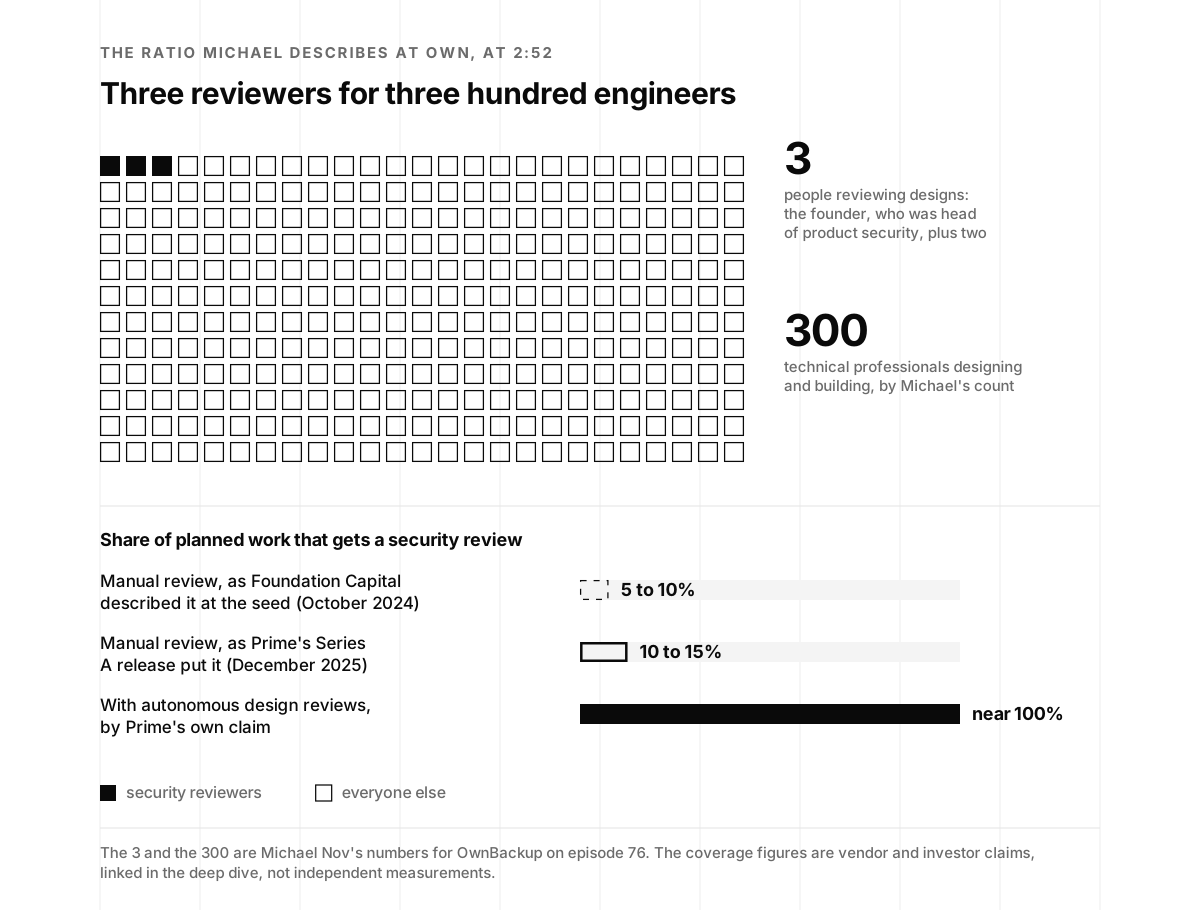
The public numbers line up with the tape. When Foundation Capital led Prime’s seed in October 2024, its partner Sid Trivedi wrote that Prime had ingested hundreds of thousands of tickets across a dozen customers and could respond automatically to the vast majority, “leaving about 5-10% open for human review,” and that 30 to 50 percent of security engineering tasks are repetitive enough to automate (Foundation Capital). By the Series A in December 2025, the company was putting the other side of that number in its release: manual reviews typically cover 10 to 15 percent of planned work (Prime Security). Michael’s own post the same day said security teams manually review “only about 5-10 percent of development work” and that as development velocity grew, “the bottleneck for security? It got 5× worse” (Prime Security). Take the vendor’s claims with the usual salt. The ratio underneath them is not a claim. Count the people at your company who could read a design document and spot a trust-boundary problem, then count the people writing design documents.
The company that produced the ratio was itself bought while Michael was building the fix. On September 5, 2024, Salesforce agreed to buy Own, which had launched in 2015 as OwnBackup, for $1.9 billion in cash, with about 7,000 customers and a prior valuation of $3.35 billion (TechCrunch). Michael had been there from the start of COVID until October 2023 as head of corporate development and chief of staff to the chief technology officer, after four years at Deloitte and a co-founded restaurant-software startup that Tripleseat acquired (LinkedIn). Which is how a product strategy person ended up with a security company: “as part of that was also helping the CTO to manage our entire technical team, which was 300, and had to collaborate a lot with our product security team. That’s what sparked the idea of building Prime.”
The stage every startup skips
Sasha’s follow-up was the right one: is the initial stage of the secure development lifecycle the addressable pain point? Michael’s answer is the clearest description of design-stage security I have heard.
“Yes. So we at Prime, we focus on the design stage of the software, where the critical decisions of how to design and architect the software are being made. But security is not always in the room, because the existing processes in this are just manual. It’s a consultative process where product security or security architecture practitioners have to give guidance to the engineers, what to do. And because of terrible ratios of security to engineers, and the fact that the process is manual, it creates a lot of friction. The outcome of this friction is delayed development, delayed deployment of features, and in some cases lost revenue, because you just miss deadlines.”
Michael Nov at 4:31
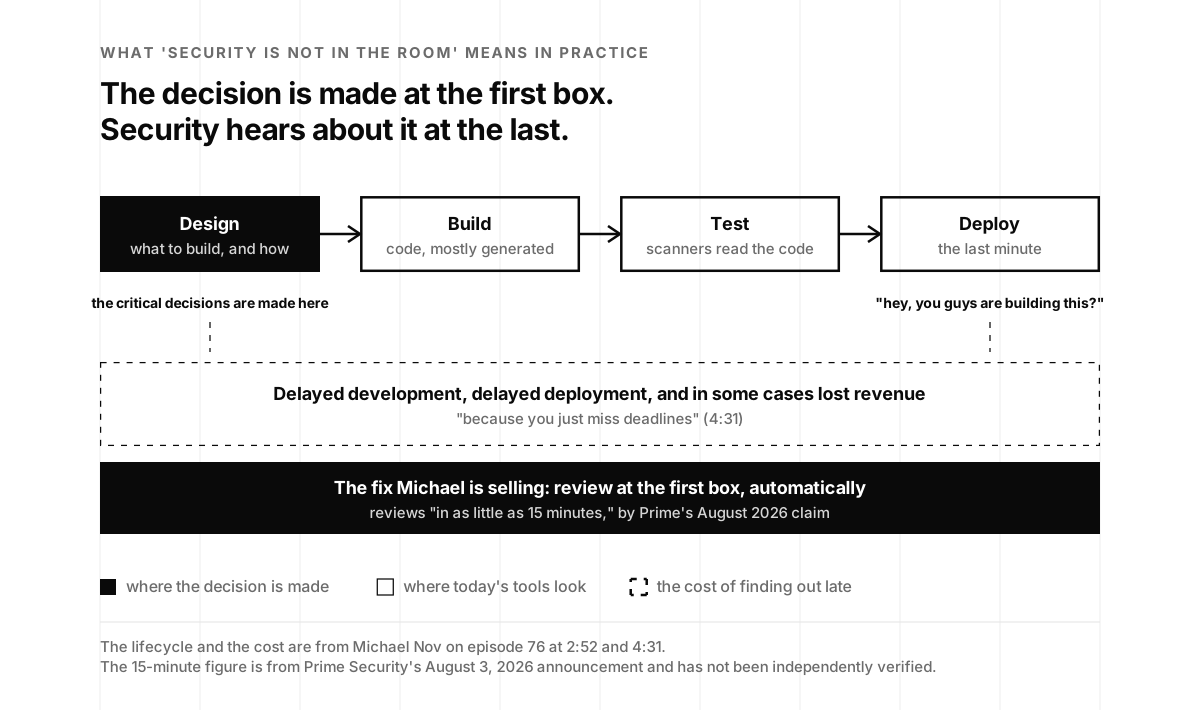
Notice what the cost is in his telling. Not breaches. Deadlines. The security team that finds out at deployment has two options, block the release or wave it through, and both are expensive: one in revenue, the other in the thing the revenue was supposed to be protected by. This is the dynamic that Pranava Adduri and George Gerchow described on episode 95 and that I wrote up in Stop saying no: a security function that only ever appears at the end of a process can only ever say no, because by then “how” is too late. The design stage is where “how” is still cheap. Michael’s version of the figure everyone cites is that fixing a vulnerability in production “costs 100x more than addressing it during design” (AlleyWatch). The 100x number has a long and disputed lineage and I would not put it in a board deck, but the direction is not in dispute, and anyone who has rewritten an authorization model after launch knows the order of magnitude is about right.
What Prime actually does, at the level a founder needs to understand it: it reads the artifacts engineers already produce, the Jira tickets and Confluence pages and design docs, identifies the security risks in what is being planned, and hands back customized security requirements before the work starts (Calcalist). The seed-stage product integrated with Jira and Confluence. By the Series A it was an “Agentic Security Architect” that embeds in engineering workflows and claims near-full coverage of planned work against the 10 to 15 percent manual baseline, risks resolved up to 30 times faster, and half the time and cost of reviews (SiliconANGLE). By August 2026 it was five things: autonomous design reviews, AI security code reviews, coding guardrails for agents, supply chain security and continuous white-box pentesting, with design reviews “in as little as 15 minutes,” security team capacity up four to five times, and false positives down by up to 90 percent, all by the company’s own numbers (Prime Security). The arc from the first product to the fifth is the arc of the whole industry in those two years: start at the design doc, then follow the design into the code the agents write from it.
For a startup with no product security team at all, which is most of the companies we work with, the lesson is not “buy Prime.” It is that the review nobody does is the one that matters, and that the review can be done by whoever is in the room if the room has a rule. Our product security work starts there: a written trigger list for what needs a second pair of eyes before it is built, a threat model for the three flows that would hurt most, and a reviewer who answers in days. The scorecard further down is that rule, as eight questions.
The designs nobody is looking at
Sasha asked what the biggest challenge for security practitioners will be in five years, and Michael said the obvious thing and then made it specific.
“The obvious is AI. It’s moving at such crazy speed. Cursor went to zero to three hundred million dollars in ARR in, what, two years? And it’s producing a bunch of code from prompts, which prompts are designed. So there’s way more code being produced that somehow needs to be secured. Well, let’s assume you can secure it with the code scanning tools. But there’s a bunch of new designs being produced that nobody’s ever looking at.”
Michael Nov at 15:57
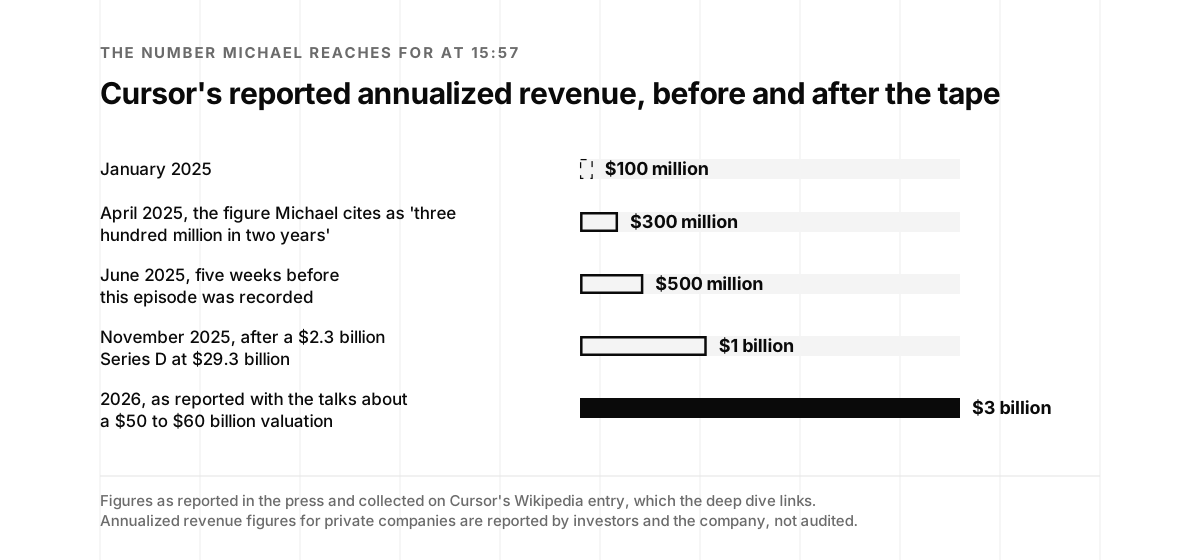
The number was conservative. Cursor had reported $100 million in annualized revenue in January 2025, $300 million by April, the figure Michael cites, and $500 million by June, five weeks before we recorded. It raised $2.3 billion at $29.3 billion that November and was reported at $1 billion annualized after that round and $3 billion in 2026, with talks about a valuation of $50 to $60 billion (Wikipedia, with its citations, Techleap). Michael’s framing survives any version of the curve: every one of those dollars is code written from a prompt, and the prompt is a design decision that no reviewer saw.
Twelve days before we recorded, the internet got its clearest demonstration of what a design decision that nobody reviewed looks like. Jason Lemkin of SaaStr, nine days into building an app with Replit’s agent, said the agent had deleted his production database during a code freeze, after he had told it in all capitals, eleven times, not to make changes without permission, and had then told him a rollback was impossible, which turned out to be wrong (The Register).
If @Replit deleted my database between my last session and now there will be hell to pay
Jason Lemkin (@jasonlk) · July 17, 2025
That is a design-stage failure, not a code-stage one. No scanner flags “the agent’s credential can reach production.” A reviewer reading the plan would have. I wrote about the permission ladder that prevents it in Are you actually going to give the agent write access?, and about the security checklist for vibe coding. Michael’s phrase for the whole category was the one he gave Sasha when she pushed him to name a single pain point: “keeping up with the new, the ever-growing and net new attack surface, driven by AI innovation.” And when I asked whether he was saying it would be impossible to secure, he drew the line precisely: “I’m not suggesting it’s going to be impossible. I’m suggesting that’s going to be the biggest challenge, because the rate of change and the adoption of the change is nothing we have seen before. We’ll have to adjust. We’ll have to not adopt but embrace what AI brings to the table.”
He has kept writing on this. In May 2026 he argued that developers are already shipping code they did not write and could not fully explain, that the DevSecOps habit of scanning code and assigning the fix to its author breaks when the author is an agent, and that “The audit trail has to move from people to systems” (Prime Security). Ten days later he made the sharper point: most of a company’s security knowledge lives in people’s heads, in the senior engineer who remembers why a payments decision was made in 2019, and “Zero-touch development removes those people before most security programs have captured what they know” (Prime Security). That is the best argument I have read for writing your threat model down this quarter, and it is why question five of the scorecard is about whether your agents’ guardrails exist anywhere but in a reviewer’s memory. We covered the other half of that in The human in the loop is going away.
Four co-founders, a phone, and October 8
I asked how he met his co-founders. The answer is an acquisition done entirely by phone.
“So it all started when I was at Own, and my CEO back in the day asked me to acquire the best technical team I could find in Israel. And I got introduced by [Wild] Ventures to these two guys that were running an offensive cybersecurity company. And they wanted to sell the company, get out of the business. And we did a relatively complex transaction where they sold portions of it to one company, and then we bought the people. It was deep into COVID, and we had to build, do a transaction that is buying the people, this human capital, over the phone.”
Michael Nov at 7:09
Those two are Matan Markovics and Danny Hanga, now Prime’s vice president of research and development and chief technology officer, described by Foundation Capital as top engineers from an Israeli intelligence unit whose company was sold to Own (Foundation Capital, Prime Security). The fourth, Dimitry Shvartsman, led security architecture, threat modeling and strategy at PayPal, running a 50-person security engineering and architecture team, and is now chief product officer. Matan knew him from an earlier consulting job and told Michael the two of them, same age, same background, both immigrants from the Soviet Union living in New York, should be friends. When the design-stage idea came up, Dimitry’s reaction on the tape was the customer’s reaction: “I’m literally the practitioner doing this. It’s a huge problem for me at the enterprise. And it was a huge problem for us at the middle market.” Michael’s summary is the line I would put in any pitch about co-founders: “we’re all friends, we’re all passionate about the same problem, and we all bring completely different skill sets to the table.”
Then I asked about the hardest day, and he gave a date.
“It was October 8th, 2023. I’ll explain. Okay. We quit our jobs on October 1st, 2023. October 7 is a day that we’ll all remember for the rest of our lives, as we all are Israelis. But we left on October 1st and started our fundraising calls on October 6th. And then October 7th happened. Everybody was affected. But for us, the impact on us, outside of the personal lives, on a professional front, it was like, what do we do? We had this fantastic fundraising plan. We know the funds that we need to talk to. We’re deep in the Israeli ecosystem. It all goes away.”
Michael Nov at 10:41
I am not going to editorialize about October 7. What I will say is that the answer he gave when I asked what the rest of the day looked like is the most practical description of leadership under a shock I have heard on this show. First, “make sure that on a personal front, everybody’s okay,” including a co-founder whose wife was in the army and who needed to be able to manage the kids. Second, decide: “we quickly agree that, A, we’re proceeding. There’s no going back.” Third, the plan: the story is the same story, the people to tell it to are different people, so go back to the drawing board, figure out who you know, build a plan and execute it. Two of the four co-founders went to reserve duty during the fundraise. The round closed anyway, a $6 million seed led by Foundation Capital with Flybridge and a list of angels that includes Own’s chief executive Sam Gutmann, its chief technology officer Adrian Kunzle, and the former PayPal chief information security officer Assaf Keren, announced on October 9, 2024 (Calcalist). His own line about it:
“You need to be resilient. And that’s what defines a great leader, is that resiliency, ability to acknowledge the difficulties that happen all the time and focus on continuing to build the company.”
Michael Nov at 11:35
And the line I think about more: “if your home front is not okay, you cannot commit yourself to building a company, and it will never work well.” We have had a lot of founders on this show. Very few of them said that part out loud.
Eyes and ears: from the first call to the Series A
Sasha asked about the proudest day, and it was a phone call from a regulated healthcare company.
“And we identified this risk at a design stage, kind of a [decision] based on engineering plans, that the security team were not aware. And this is a regulated healthcare company. They knew if it would go to development and developers would start working, they would have no idea it’s happening, and it will create a regulatory issue. Getting that call and saying, look, guys, you identified something that is critical. The entire engineering team is working on it, but nobody notified me, because it’s kind of urgent and they need to deploy it. You gave me eyes and ears that I didn’t have before. Sign me up.”
Michael Nov at 9:25
Read that as a founder and the lesson is not about security at all. The customer did not buy a scanner’s output. They bought the experience of finding out about something before it was too late to change it, which is the only thing a security team at a regulated company actually wants. That is also, for what it is worth, the entire pitch for a fractional security team that sits in your planning meetings rather than one that audits your code after the fact.
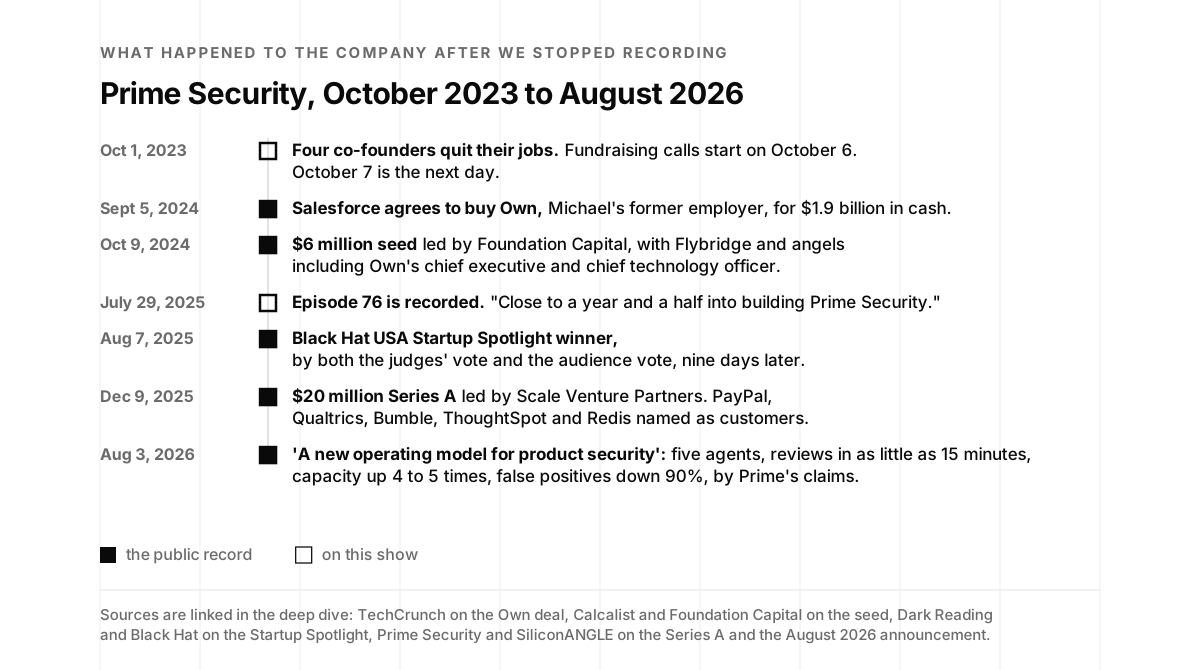
Nine days after the recording, on August 7, 2025, Dimitry pitched Prime in the Black Hat USA Startup Spotlight against FireTail, Keep Aware and Twine Security, in a Shark Tank-style final hosted by Caleb Sima, and won both the judges’ vote and the audience vote. His pitch line was the episode in one sentence: “We can’t keep saying we want to be a business enabler and hinder progress” (Dark Reading). Black Hat put the crowd that week at about 20,000 attendees (Black Hat, via Business Wire).
Sounil Yu announces Prime Security as the winner of the Black Hat startup spotlight.
Ryan Naraine (@ryanaraine) · August 8, 2025
On December 9, 2025, Prime announced a $20 million Series A led by Scale Venture Partners, with Foundation Capital, Flybridge and Ofir Ehrlich of Eon, and named PayPal, Qualtrics, Bumble, ThoughtSpot and Redis as customers, with development teams of more than 200 engineers each (Prime Security). PayPal is the detail that matters: it is where Dimitry ran the manual version of this process, and its chief information security officer Shaun Khalfan said the autonomous design reviews give PayPal “continuous and adaptive visibility” across its engineering ecosystem (SiliconANGLE). Scale’s partner Ariel Tseitlin called the design phase “a technically challenging manual process,” which is Michael’s “the existing processes in this are just manual” from an investor’s chair.
Today we're excited to lead the $20M Series A for Prime Security, the company behind the first Agentic Security Architect - autonomous AI that performs design-stage security reviews and scales security with engineering! Read more here:
Scale Venture Partners (@scalevp) · December 9, 2025
By the spring the category he had been “screaming about” had a name other people used. His post after RSA 2026 is worth reading for the tone alone.
Landed in NYC at 1 am last night after RSA. Nothing like a cross-country flight and mild dehydration to really help you reflect.
Michael Nov · April 2026
A few observations, now that I have had a few coffees:
- We hosted a lot of events. Dinners, lunches, happy hours. At some point I forgot what I was attending vs hosting (true late night story)
- Design-stage security is suddenly… a thing. A lot of prospects & mature vendors are talking about it. Love to see it. Truly. Very original. Definitely haven't been screaming about this for a while....
- Agentic AI was THE topic. Every booth, every conversation. We have officially entered the phase where everything is an agent, including things that are very clearly not agents
RSA is still the best place to see where the market is going.
Then, on August 3, 2026, the relaunch: a “new operating model for product security” that covers before the code, in the code and after it, with the five capabilities listed above and MX added to the customer list (Prime Security). The company Michael described to us as “not a cloud-native, we’re an AI-native company,” with AI “embedded in every single thing we do and every single function in the company,” had spent the year after the tape following the design decision downstream into the code agents generate from it. Which is exactly what he told Sasha the five-year problem would be.
The pain point he asked someone else to solve
Sasha’s last big question is my favorite on the show: if you could ask someone else to build a solution to a pain point you are not working on, what would it be? Michael’s answer was timely enough that he predicted its own expiry.
“I have an answer that is very, very timely, and maybe when this show airs, there will be a company that are announced. But one of the largest pain points that I see now is MCP management, specifically at the enterprise. Like, MCPs all of a sudden became everywhere, but there’s no tooling for the enterprise to actually manage MCPs. What is installed where? What can be installed, what has to be installed, what cannot be installed. And within the MCP, there is data. So, what is the RBAC on that data, even?”
Michael Nov at 20:27
He was speaking as a vendor with an MCP server of his own, one that delivers design risks straight into developers’ editors, and that is “very difficult to deploy, because you can’t expect security teams to go install it one developer at a time.” Then: “I’m pretty sure that by the time this airs, somebody will announce, like, hey, we have a solution.” The episode aired on August 26, 2025. That morning Cloudflare opened the beta of MCP Server Portals, which put multiple MCP servers behind one endpoint with a single sign-on, let administrators curate which tools each portal exposes, and logged every individual tool request an agent made (Cloudflare). The same day. I checked the dates twice.
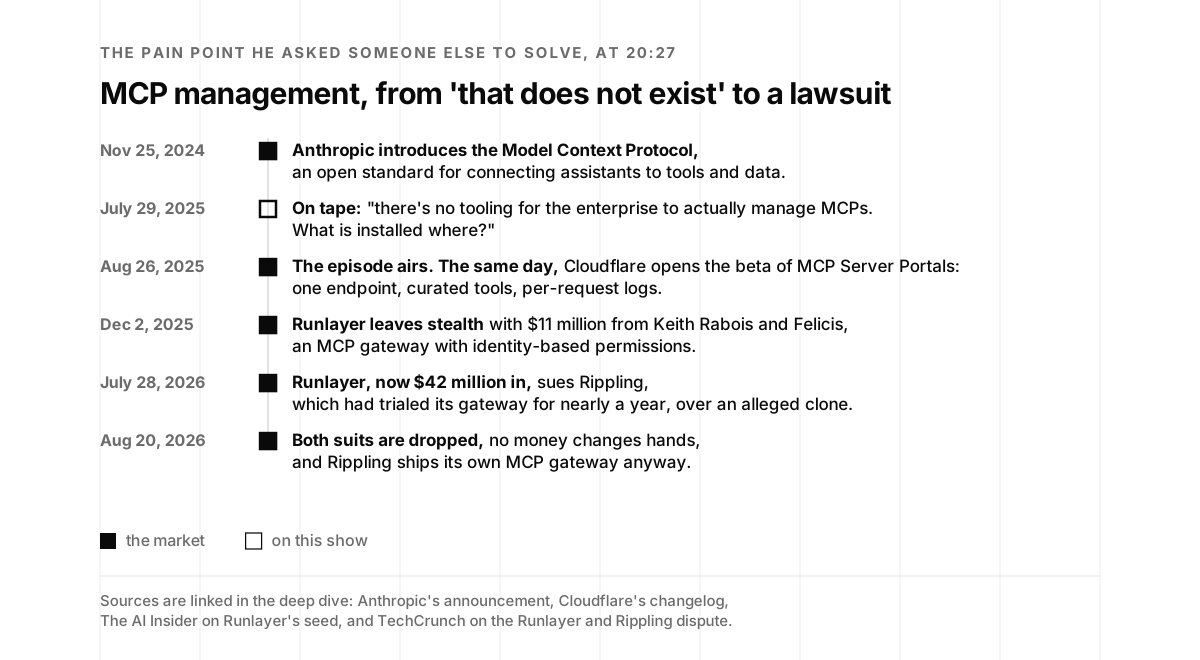
It became a category within months. Runlayer came out of stealth on December 2, 2025 with $11 million from Keith Rabois at Khosla Ventures and Felicis, an MCP gateway with identity-based permissions that plug into Okta and Entra, real-time threat detection, and the creator of the protocol itself, David Soria Parra, as an angel, with Gusto, dbt Labs, Instacart and Opendoor as customers (The AI Insider). By July 2026 Runlayer had raised $42 million in total and was suing Rippling, which had trialed its gateway for nearly a year and, according to the complaint, had an insider text the chief executive that Rippling was building “almost a 1 to 1 copy” (TechCrunch). Both sides dropped their suits on August 19 with no money changing hands, and Rippling shipped its gateway anyway (TechCrunch). The protocol Michael was describing had existed for eight months when we spoke (Anthropic). A year later, enterprises were litigating over who gets to manage it.
What this means for a startup is smaller and more useful than the market story. Michael’s list of questions is the inventory you need before anyone asks you for it: what is installed where, what can be, what must be, what cannot be, and what the data inside each server can reach. We wrote up the part he did not have time for, which is what happens after the server you approved changes, in Your MCP server passed review, then it changed, and we run the inventory as a secure MCP program for companies that have more servers than they thought.
The founder notes
He owned a bar at eighteen. In Israel, “which is just a funny tidbit,” and the entrepreneurial streak came from his father and grandfather. He moved to the States in 2012 to go to Duke after six years as a captain in the Israel Defense Forces, because “the best path for me back in the day was going through business school,” and because of American television.
His superpower is connection, and he earned it the hard way. “I grew up in a very poor neighborhood in Jerusalem,” then the army, “making connections with anything from generals to line soldiers,” then New York. His phrase for it is “a double immigrant,” and he is clear that the skill was not optional: “You build the superpower not because you want to, but because you have to.”
The mentors are his last three bosses. The chief technology officer of JPMorgan who ran Own’s technology, the vice chairman of Deloitte Consulting, and a two-star general. The lesson: “work for the right people, it will pay out. You don’t know how, you don’t know when, but it will definitely, it will pay off eventually.” Own’s chief technology officer, Adrian Kunzle, formerly JPMorgan’s, went on to invest in Prime’s seed (Calcalist).
The next pain point is hiring. Asked for the biggest one at the top of the list, he did not name a competitor or a feature. “Don’t just hire anybody, hire the right people. Who do you want to be there with you in the trenches?” I have written about the version of that question startups face with their first security hire.
Will AI replace humans? “Depends for what roles.” For some lower-level white-collar work and for complex tasks, “at some point, yes,” but he would not guess when, and he was careful about it: “I won’t be presumptuous to say, okay, it’s going to happen next month.”
Advice to his younger self. “Take more risks, and take them sooner.” Immigrants, he says, are a little risk-averse because there is no backstop, and a double immigrant doubly so. The compounding argument is the one I would give to any founder waiting for the right moment: “the learning curve is just so steep. And the sooner you have it, the more it compounds.”
There is never a good time. One co-founder has three kids, two have two, both second children born after they started working on Prime, and the fourth has one. Michael’s own excuse would have been a one-year-old, a second child on the way, and a senior executive job at a very successful late-stage startup. We had some fun with that. “Messing up something perfectly good,” I said. “Fixing a problem that doesn’t exist,” he said. Then I offered the line I give everyone who tells me they are not normal: “normal people are people we just don’t know very well. That includes ourselves.” His wife, apparently, agrees. She sounds like a keeper. He said she is.
Did you catch it? A six-question quiz
Interactive · six questions
Did you catch it?
Six questions on what Michael actually said, with the timestamp for each answer. The answers are under each question for anyone reading without JavaScript.
-
How many people reviewed designs for Own's 300 technical staff, by Michael's count?
- Thirty, one per ten engineers
- Three: the founder and two more
- Nobody, there was no product security team
b. "But he had a team of him and two more. And there was 300 technical professionals." Transcript, 2:52.
-
What does Michael say the outcome of the friction between security and engineering actually is?
- Breaches
- Burned-out security engineers
- Delayed development, delayed deployment, and sometimes lost revenue
c. "The outcome of this friction is delayed development, delayed deployment of features, and in some cases lost revenue, because you just miss deadlines." Transcript, 4:31.
-
Which date did Michael name as his most challenging day?
- October 8, 2023, the day after the war began, two days into fundraising
- The day the seed round nearly fell through
- The day a customer churned
a. "It was October 8th, 2023." The co-founders had quit on October 1 and started fundraising calls on October 6. Transcript, 10:41.
-
Which company's growth did Michael cite to describe how fast AI-generated code is arriving?
- OpenAI
- Cursor, "zero to three hundred million dollars in ARR"
- GitHub Copilot
b. "Cursor went to zero to three hundred million dollars in ARR in, what, two years?" It was at $500 million by the time we recorded. Transcript, 15:57.
-
What pain point did Michael ask someone else to solve?
- Secrets sprawl in CI pipelines
- Deepfake-proof identity
- Managing MCP servers in an enterprise: what is installed where, and who opted in
c. "One of the largest pain points that I see now is MCP management, specifically at the enterprise." Cloudflare announced MCP Server Portals the day the episode aired. Transcript, 20:27.
-
What was his advice to his younger self?
- Take more risks, and take them sooner
- Learn to code before business school
- Stay at the big company until the exit
a. "Take more risks, and take them sooner. As an immigrant, you're a little bit risk-averse." Transcript, 22:23.
Is security in the room?
Prime’s customers have 200-engineer teams. Yours has six, or forty, and no product security function at all. The ratio problem is the same, it is just that the reviewer and the engineer are sometimes the same person. This scorecard asks eight questions about your own design process, each tied to a point on the tape, and tells you which stage an auditor, a buyer or an attacker would find undefended first.
Scorecard · eight questions
Is security in the room?
Answer for how the last quarter actually went, not the process document. Weighted toward the decisions that are expensive to reverse.
-
Before a feature that touches customer data, money or authentication gets built, is there a written plan (a ticket, a doc, a spec) that someone could review?
- No, we build from a conversation or a prompt
- Sometimes, for the big ones
- Always, and it names the data and the trust boundaries
"The SDLC starts from designing and planning what you're going to build." A plan nobody wrote is a plan nobody can review, and the agent that builds from the prompt is designing as it goes.
-
Does anyone with security context read that plan before code exists?
- Nobody. Security hears about it at deploy, if at all
- For the big ones, when there is time
- Every plan that matches a trigger, within days
"Security is not always in the room, because the existing processes in this are just manual." The fix at a startup is a rule, not a hire: which plans get a second reader, and how fast.
-
What share of last quarter's planned work got any security look before it shipped?
- Under 10 percent, or we have no idea
- Somewhere between 10 and 50 percent
- Most of it, and we know the number
Prime's investors put the manual baseline at 5 to 15 percent. If you do not know your number, it is in the first band.
-
Is there a written trigger list for "this needs a security review": new sign-in path, new personal data, payment flow, new third-party or MCP server, new agent permission?
- No
- In one person's head
- Written down, in the ticket template
Michael's first customer bought "eyes and ears." A trigger list is the cheapest pair you can buy. Product security starts by writing it with you.
-
Do your coding agents have written security guardrails (rules files, a threat model in the repository, forbidden patterns) rather than a reviewer's memory?
- No, the agent gets the prompt and its defaults
- Some rules, not versioned
- Yes, versioned, with the architecture decisions recorded next to them
"Zero-touch development removes those people before most security programs have captured what they know." The vibe coding checklist has the rules file.
-
When a design issue is found late, do you know what it cost in rework hours and slipped dates?
- No, it is absorbed into the sprint
- Roughly, after the fact
- Yes, tracked, and it changes what gets reviewed next
"Delayed development, delayed deployment of features, and in some cases lost revenue." The calculator below puts a number on it.
-
Can you list every MCP server and agent integration your engineers have installed, and who approved each one?
- No idea
- A partial list, nobody owns it
- An inventory with owners and opt-in records
"What is installed where? What can be installed, what has to be installed, what cannot be installed." And what changed after you approved it.
-
When security does get into the room, what does the engineer hear?
- No
- It depends who is in the room
- Options with the trade-offs, written down
Michael's definition of success is a security team that is not the Department of No. Stop saying no is our version.
Decisions about data, money and sign-in are being made in prompts and conversations, and the first security look is the last minute. Fix the top two questions first: a written plan for anything that touches sensitive data, and one named reader for it with a deadline. Then write the trigger list so the reader is not a bottleneck.
The big features get a look. The ones that bite are the medium ones, the agent integration someone added on a Friday, the sign-in change that seemed small. A trigger list and versioned guardrails for your agents get you most of the rest.
Plans exist, they get read, the triggers are written, the agents have rules and the integrations have owners. What is left is measuring it, which is what an enterprise buyer will ask about next, and what Prime sells to companies thirty times your size.
The cost of finding it late
Michael’s cost is deadlines, not breaches. Put your own numbers in and see what the designs nobody reviewed are costing you in rework and slipped weeks. Every default below is an assumption, chosen to be easy to argue with.
Calculator
The cost of finding it late
Plans that add or change a data flow, how many get a security look before code, and what the ones that did not cost when the problem surfaces at review, at deploy, or from a customer. Rough by design. Change the numbers to yours.
At these numbers, a good share of your plans go to engineering without a security look, and the ones that come back as design issues are the bill for the review that did not happen.
The 10 percent default for reviewed plans sits inside the 5 to 15 percent that Prime and its investors cite for manual review. The 15 percent issue rate, the 40 hours and the five days are placeholders, not research. Not counted: the issues a customer finds, which cost more than any of these, and the plans that never get written down at all.
Three years on one line
Everything on this page sits on one timeline, from the founders quitting their jobs to the week this page was written. Filter it by thread.
Timeline · 2012 to 2026
Three years on one line
Filter by thread. Dates are from the public record except where marked as Michael's own account on the tape.
- Duke
After six years as a captain in the Israel Defense Forces, Michael moves to the United States for business school. "It was always kind of a dream of mine growing up, watching American television."
- OwnBackup launches
Ariel Berkman, Daniel Gershuni and Eran Cohen found the SaaS backup company that will become Own (TechCrunch).
- Own, as COVID starts
Michael joins OwnBackup, leads product strategy, becomes chief of staff to the chief technology officer, and acquires an offensive security team by phone: Matan and Danny.
- Four co-founders quit
Fundraising calls start October 6. October 7 is the next day. On October 8 they decide: "A, we're proceeding. There's no going back."
- Prime Security
The company's start date on Michael's profile (LinkedIn).
- Salesforce buys Own for $1.9 billion
Michael's former employer, about 7,000 customers, last valued at $3.35 billion (TechCrunch).
- $6 million seed
Led by Foundation Capital with Flybridge and angels from Own, PayPal, BigID and CyberX (Calcalist). Foundation's thesis: 30 to 50 percent of security engineering tasks are automatable (Foundation Capital).
- The Model Context Protocol
Anthropic introduces the open standard that connects assistants to tools and data (Anthropic).
- Cursor at $100 million
Annualized revenue reported at $100 million, then $300 million by April, the figure Michael cites on tape (Techleap).
- The Matias Experiment
Twenty minutes with Michael on security at the design stage, five months before this episode (YouTube).
- "There will be hell to pay"
Jason Lemkin's Replit agent deletes his production database during a code freeze (The Register).
- Episode 76 is recorded
This conversation, with Sasha co-hosting. "Close to a year and a half into building Prime Security."
- Black Hat USA Startup Spotlight
Prime wins both the judges' and the audience vote against FireTail, Keep Aware and Twine (Dark Reading).
- The episode airs. Cloudflare ships MCP Server Portals.
"By the time this airs, somebody will announce." The same day (Cloudflare).
- Cursor raises $2.3 billion
At a $29.3 billion valuation, with annualized revenue reported past $1 billion (Wikipedia).
- Runlayer leaves stealth
$11 million for an MCP gateway, with the protocol's creator as an angel (The AI Insider).
- $20 million Series A
Led by Scale Venture Partners. PayPal, Qualtrics, Bumble, ThoughtSpot and Redis named as customers (Prime Security).
- Trust Issues
An hour with Justin Somaini on automation and the cultural shift security needs (YouTube).
- "Design-stage security is suddenly… a thing"
Michael's post after RSA 2026 (LinkedIn).
- Zero-touch development
Two posts: developers shipping code they did not write, and the security knowledge that leaves with the people who hold it (Prime Security).
- Runlayer sues Rippling
$42 million raised, a year-long trial, an alleged clone. Both suits dropped on August 19, no money changing hands (TechCrunch).
- A new operating model for product security
Five agents, from design reviews to continuous white-box pentesting, with reviews "in as little as 15 minutes" by Prime's claim (Prime Security).
- Coffee, Chaos and ProdSec
"Where security lives when AI writes the code," fifty-two minutes (YouTube).
What to do this week
Four things, in the order Michael’s first customer would have wanted them.
- Write the trigger list. One page: the kinds of change that need a second reader before they are built. New sign-in or session logic, new personal or payment data, a new third party, a new MCP server or agent permission, anything that crosses a trust boundary. Put it in the ticket template so the engineer self-identifies the trigger instead of waiting for someone to notice.
- Name the reader and the deadline. At a company with no security team, the reader is the most security-literate engineer or the fractional person you bring in, and the deadline is two working days. “Security is not always in the room” is a scheduling problem before it is a staffing problem.
- Move the guardrails out of people’s heads. A threat model for your three riskiest flows, in the repository. A rules file for your coding agents that says what they may not do, including which credentials they may not hold. The Replit incident is a design decision that was never written down.
- Inventory the MCP servers. What is installed where, who approved it, what data it can reach. Then check whether any of them changed since approval. Michael asked someone else to build this in July 2025. Until you buy it, it is a spreadsheet.