
Podcast Episode 75

Episode 075 37 min

How to Use AI Without Giving Up Your Data

with Jonathan Mortensen

0:00 / 37:00

Also on Spotify, Apple Podcasts, YouTube, Podbean, Player FM

Episode 75 of The Security Podcast of Silicon Valley, published August 12, 2025 and recorded in early August 2025. Hosts Jon McLachlan and Sasha Sinkevich, co-founders of YSecurity, talk with Jonathan Mortensen, founder and chief executive officer of Confident Security, which had come out of stealth a few weeks earlier with a provably private AI inference service. Jonathan explains why AI magnifies privacy, why a zero data retention clause is a promise and not a guarantee, and why a contractual promise probably isn't enough for proprietary data. They cover running models yourself versus a remote service, a guarantee that the provider can't see the data, contracts with unlimited liability for data breaches, Apple's Private Cloud Compute as the reference architecture, swapping an OpenAI-compatible endpoint, the compliance questions of where data ends up and who can access it, encrypted model weights, Signal for AI, privacy on billboards, data as the new oil, keys generated inside a confidential environment, secure against us as a threat model, attestation, paying for privacy, crypto agility and post-quantum cryptography, bit.io's $22 first sale, building your own evaluations, agent permissions and relabeled IAM, why companies are bought and not sold, the BATNA, what will drive privacy adoption, and advice to a younger self. About 37 minutes.

Episode notes

Contracts aren’t controls. Jonathan Mortensen, CEO of Confident Security, lays out a practical path to provably private AI—confidential compute, attestation, and encrypted weights—so you can swap your OpenAI-compatible endpoint, keep crown-jewel data out of vendor training, and still close enterprise deals. Listen to learn how founders can pass security reviews, avoid GPU sprawl, and turn privacy into a sales advantage.

Hosted by Jon McLachlan and Sasha Sinkevich — co-founders of YSecurity.

The deep dive

Secure against us

Jonathan Mortensen started Confident Security after selling his last company to Databricks, on the idea that a contractual promise isn't enough for proprietary data. On this episode he tells Jon and Sasha why the service is built so it can't see the data, why Apple's Private Cloud Compute is the reference, why the contracts carry the same guarantee, and why companies are bought, not sold. Here is the conversation with the public record beside it.

Jonathan Mortensen took his time getting to the product, and he said so himself. Asked what prompted him to start Confident Security, he started with the problem.

“I think there’s now a lot of proof points that say privacy is important, but it’s only being magnified with AI.”

Jonathan Mortensen, at 1:13

Listen · Jonathan on episode 75, from 1:13
About 25 seconds: Jonathan on why AI raises the stakes for privacy. The clip stops on its own. Read the full transcript.

Jonathan is the chief executive officer of Confident Security, which he has led since November 2024, and a Founder Fellow at South Park Commons (LinkedIn). Before that he spent a year at Databricks as a staff software engineer, folding in the technology of bit.io, the serverless Postgres company he founded in July 2019 and ran as chief technology officer until Databricks acquired it in June 2023. Unite.AI describes bit.io as a multi-cloud, multi-region service that supported hundreds of thousands of databases (Unite.AI). Earlier he founded Gyroscope Software, which BlueVoyant acquired in February 2018, and then led data science and data engineering for BlueVoyant’s threat intelligence work. He started out as a data scientist at Nuna, the health data company, after a PhD in biomedical informatics at Stanford University.
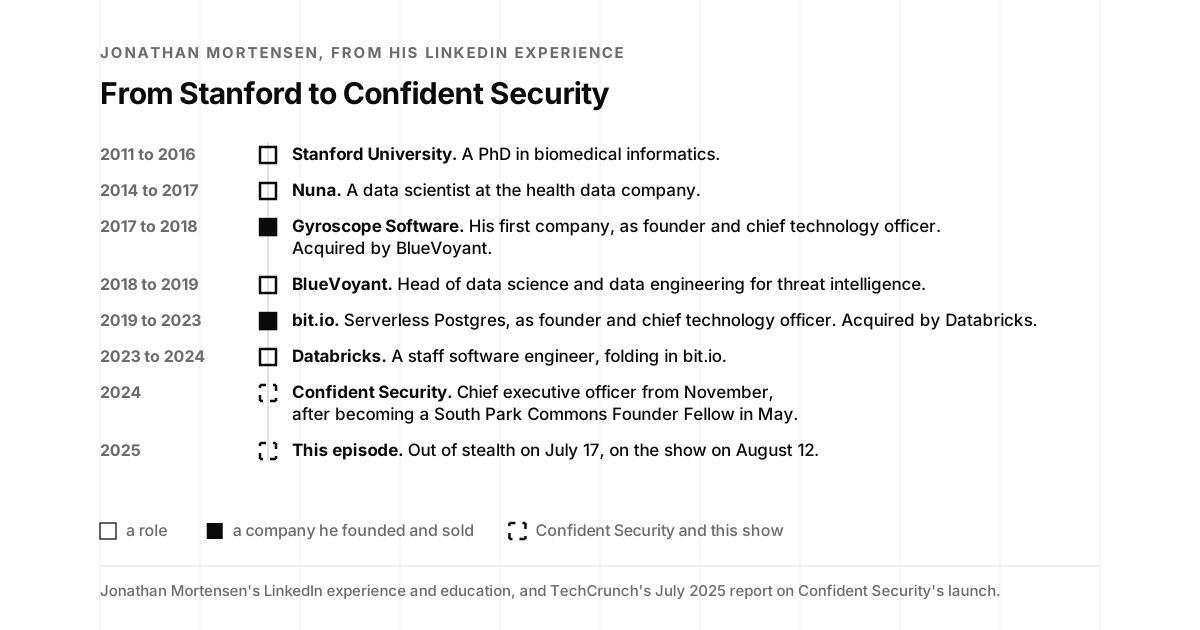
A timeline of eight entries. Open, 2011 to 2016, Stanford University, a PhD in biomedical informatics. Open, 2014 to 2017, Nuna, a data scientist at the health data company. Filled, 2017 to 2018, Gyroscope Software, his first company, as founder and chief technology officer, acquired by BlueVoyant. Open, 2018 to 2019, BlueVoyant, head of data science and data engineering for threat intelligence. Filled, 2019 to 2023, bit.io, serverless Postgres, as founder and chief technology officer, acquired by Databricks. Open, 2023 to 2024, Databricks, a staff software engineer, folding in bit.io. Dashed, 2024, Confident Security, chief executive officer from November, after becoming a South Park Commons Founder Fellow in May. Dashed, 2025, this episode, out of stealth on July 17, on the show on August 12.
Jonathan's path to Confident Security, from his LinkedIn experience.

Confident Security came out of stealth on July 17, 2025, with $4.2 million in seed funding from Decibel, South Park Commons, Ex Ante and Swyx. TechCrunch’s headline called it “the Signal for AI,” and the story described its product, CONFSEC, as an end-to-end encryption tool that wraps around foundation models, modeled on Apple’s Private Cloud Compute (TechCrunch). Today the company’s site offers a verifiably private inference API with an OpenAI-compatible interface, built on OpenPCC, the open-source standard it released in November 2025, and it says, “We take financial responsibility for any breach or misuse” (Confident Security).

Where we sit, so you can weigh what follows: YSecurity helps startups pass the security reviews enterprise buyers run, and Confident Security is one of the teams that work with us. Its logo is on our penetration testing page. Jon McLachlan and Sasha Sinkevich host the show together. The episode aired on August 12, 2025, and was recorded in early August, a few weeks after Confident Security came out of stealth. Our companion post, The Health System Security Review Your BAA Won’t Pass, turns the episode’s idea into a plan for digital health founders. This page stays with the tape.

Two sides of the debate

Jonathan counts Confident Security as his third company. The second, bit.io, went to Databricks, and this one, he said, was very much about privacy. He began with the old argument about it.

“And I think that for many years there’s been kind of two sides of the debate around privacy. It’s like, well, what do you have to hide? Privacy is not important, whatever.”

Jonathan Mortensen, at 1:01

For years the worry was a leaked Social Security number or a leaked password. AI adds a second kind of loss, he said, because what you hand a model can be used to train it, and what you hand it is often how you work.

“But now that your privacy, you know, is even more important, because the data that you’re giving to the AI could be used to train the AI, right? And maybe that data is private, like it’s a healthcare record, but maybe that data is also how you do your job.”

Jonathan Mortensen, at 1:25

For a person, that is the fear of training the thing that replaces you. For a business, it’s the fear of handing over the data that sets it apart.

“And it’s certainly maybe on a personal level, but for businesses, they still have highly proprietary data sets that are internal, and they don’t want those to be used to remove their competitive advantage.”

Jonathan Mortensen, at 1:45

No option out there

When he left Databricks, Jonathan went looking for a large model that a business could control and that came with real guarantees. He had worked at a cybersecurity company before, BlueVoyant by his LinkedIn.

“So when I left Databricks, I was very interested in privacy, and I worked at a cybersecurity company before, and just saw that there wasn’t a large model that you could control that gave you actual privacy and security guarantees. There was no option out there.”

Jonathan Mortensen, at 1:55

Listen · Jonathan on episode 75, from 1:55
About 15 seconds: Jonathan on the gap he saw after Databricks. The clip stops on its own. Read the full transcript.

So he built the option.

“And so I said, why? Why shouldn’t there be something that is really privacy-first AI? And that’s what we built Confident Security to do.”

Jonathan Mortensen, at 2:17

Over the wall

Sasha asked for the problem in a single sentence, and offered one.

“So if we were to boil it down to a single-sentence problem statement, would it be you lose control over data and how the data is being used once you send it to an LLM vendor or LLM provider?”

Sasha Sinkevich, at 2:24

Jonathan agreed, and put it in the image the rest of the episode keeps coming back to.

“Yeah, once you throw it over the wall, you have no idea what’s happening behind the scenes. And they can make you assurances, but those assurances don’t always follow through.”

Jonathan Mortensen, at 2:38

Sasha sharpened it into the difference between a promise and a guarantee.

“So, in other words, there are a lot of contractual commitments and obligations that a vendor might claim or state, that there’s zero retention data, but from a technical point of view, there is no guarantee that that will be the case.”

Sasha Sinkevich, at 2:50

Jonathan’s answer was about incentives. A zero data retention clause is a promise, he said, while the incentive runs toward training on the data, because the open data loses value as every vendor uses it.

“That’s right. And the incentives are not aligned toward that, right?”

Jonathan Mortensen, at 3:05
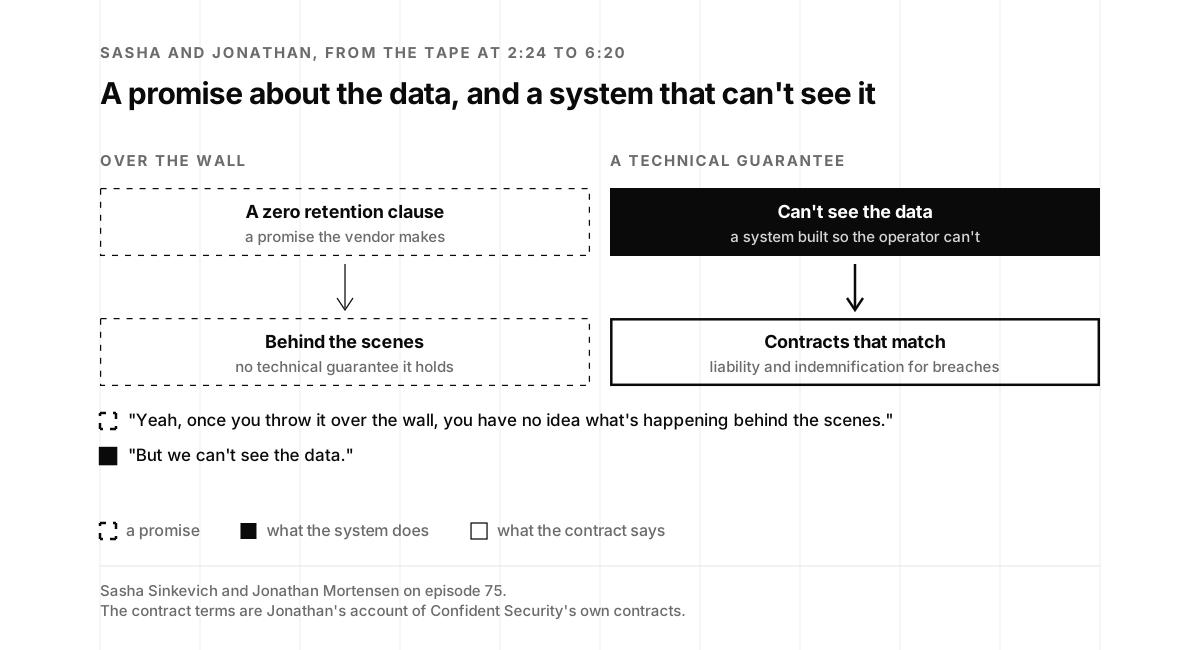
Two columns. On the left, over the wall: a dashed box, a zero retention clause, a promise the vendor makes, leads down to a dashed box, behind the scenes, no technical guarantee it holds. On the right, a technical guarantee: a filled box, can't see the data, a system built so the operator can't, leads down to an open box, contracts that match, liability and indemnification for breaches. Then two quotes. Yeah, once you throw it over the wall, you have no idea what's happening behind the scenes. But we can't see the data.
A promise about the data, and a system that can't see it.

None of this makes a retention clause worthless. It’s still the first thing a buyer asks for, and the major model providers publish their terms. If you’re the one answering that question for a customer, our post on questionnaire answers that look true but aren’t shows how to state the promise precisely, which providers, what they keep and for how long.

A contractual promise isn’t enough

Sasha laid out what large companies do today when they want AI and can’t risk the data. They run something in-house, so nothing leaves.

“Today, when these enterprises want to use LLMs or AI technology in general, they often have to deploy something in-house in order to guarantee that that data is not being trained on, or there is no retention on that data. But there is a better version of that approach, or there is a better approach in general.”

Sasha Sinkevich, at 3:41

Jonathan’s version of the better approach keeps the model remote and makes the guarantee technical. He picked two big names to show who it’s for.

“If you’re Disney or you’re Pfizer, a contractual promise probably isn’t enough for your proprietary data. And so, yeah, they either have to buy a bunch of GPUs and run it themselves, or figure out some other service that can manage that all for them.”

Jonathan Mortensen, at 4:12

What he’s heard from folks is that running it yourself is easy at the start. One open model on one machine is easy. The cost arrives with everything a real deployment needs.

“Like, just simple open model, it’s like running Ollama. But the second that you want to do anything more complicated, I mean, you have a lot of different model weights, you’re trying to serve it to everyone in your organization, any sort of production-level thing, suddenly, like, that little VM with an attached GPU that was running Ollama is no longer, like, what you want, and you end up spending a lot of money for that.”

Jonathan Mortensen, at 4:44

Ollama is a popular open-source tool for running language models on your own machine (Wikipedia). His point is about scale, not the tool. Serving many models to a whole company is an infrastructure project of its own.
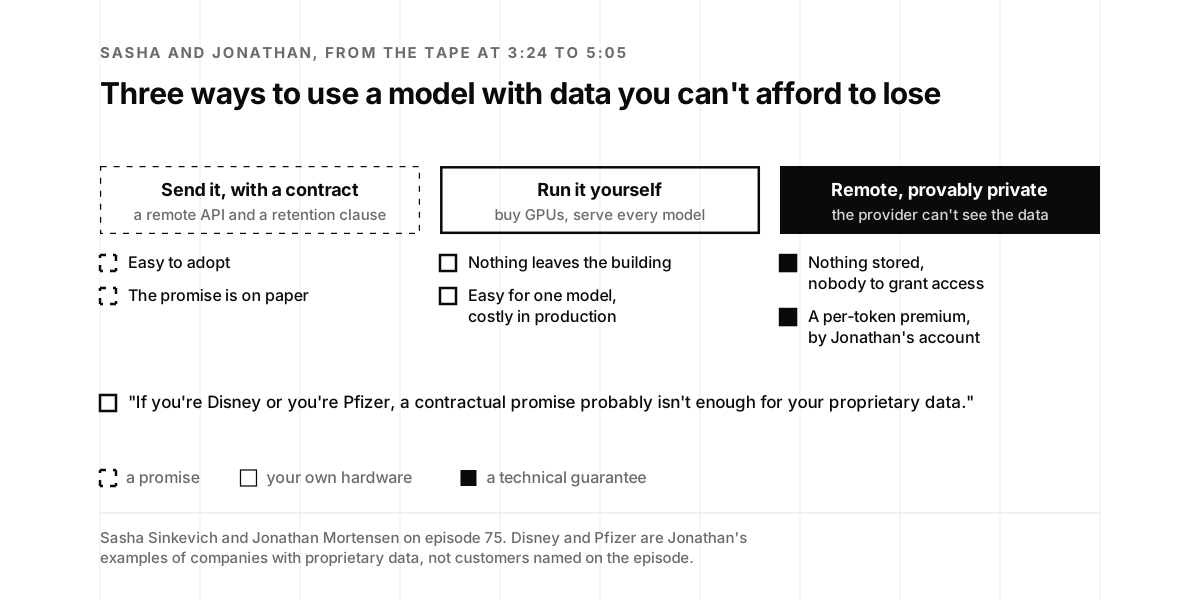
Three columns. Dashed, send it, with a contract, a remote API and a retention clause: easy to adopt, and the promise is on paper. Open, run it yourself, buy GPUs, serve every model: nothing leaves the building, and it's easy for one model, costly in production. Filled, remote, provably private, the provider can't see the data: nothing stored and nobody to grant access, and a per-token premium, by Jonathan's account. Below, a quote. If you're Disney or you're Pfizer, a contractual promise probably isn't enough for your proprietary data.
Three ways to use a model with data you can't afford to lose.

We can’t see the data

Jon put the pitch back to him as he’d heard it, the managed model services companies already use, with rigorous technical controls added for privacy. Then he named the part that matters.

“Because at a very core level, it’s impossible for Confident Security to see the requests, the contents of the requests coming in, right?”

Jon McLachlan, at 5:42

Jonathan confirmed it, and added that he’d been holding the product back on purpose.

“Yeah, I’ve been kind of not directly answering what the product is yet. I’ve kind of been motivating the problem. But yes, we essentially make a guarantee that we can’t see the data”

Jonathan Mortensen, at 5:50

The contracts say the same thing, he said. Confident Security’s liability and indemnification clauses reflect the guarantee, with unlimited liability for data breaches in its contracts. Jon’s reaction was immediate.

“I was about to say, that’s totally unheard of and unprecedented.”

Jon McLachlan, at 6:10

Jonathan’s reasoning is that the paper has to match the system. If the company can’t see the data, it can sign for what happens to it.

“But we can’t see the data. And it feels like if we say that we have a technical control and our contracts don’t reflect it, like, what’s the point?”

Jonathan Mortensen, at 6:14

Listen · Jonathan on episode 75, from 6:13
About 15 seconds: Jonathan on why the contracts carry the same guarantee as the system. The clip stops on its own. Read the full transcript.

The company’s site makes the same promise today, in the line quoted at the top of this page. Liability terms are only as good as the rest of the contract, so a buyer will still read them closely. But a vendor offering them is telling you where it thinks the risk sits.

Apple’s reference architecture

Then Jonathan described what the product is.

“So our product is based off the same reference architecture of Apple’s Private Cloud Compute. We call it a provably private AI inference engine. And we use all the same techniques that Apple’s PCC architecture uses.”

Jonathan Mortensen, at 6:21

Apple described Private Cloud Compute on June 10, 2024, as the cloud system behind Apple Intelligence, and set out five core requirements for it: stateless computation on personal user data, enforceable guarantees, no privileged runtime access, non-targetability and verifiable transparency. “Security and privacy guarantees are strongest when they are entirely technically enforceable,” Apple wrote (Apple Security Research).

Confident Security’s site lists the same five requirements and the eight technologies it uses to meet them: Oblivious HTTP, blind signatures, remote attestation, a Trusted Platform Module, a transparency log, secure boot with a hardened operating system, confidential virtual machines and reproducible builds (Confident Security). Most of these have a public definition worth reading: confidential computing protects data while it’s in use, a trusted execution environment is the protected area of the processor where that happens, and Oblivious HTTP lets a request reach a server without any single party seeing both who sent it and what it says.
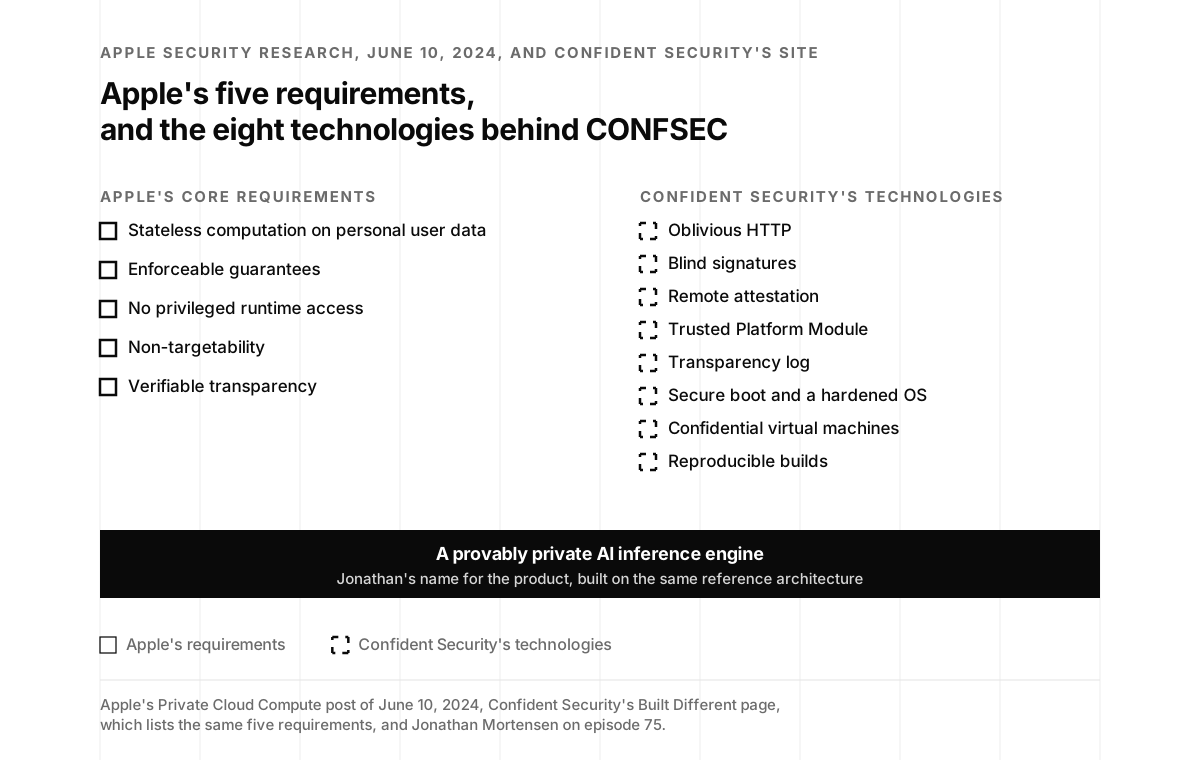
Two lists. On the left, Apple's core requirements for Private Cloud Compute: stateless computation on personal user data, enforceable guarantees, no privileged runtime access, non-targetability and verifiable transparency. On the right, Confident Security's eight technologies: Oblivious HTTP, blind signatures, remote attestation, a Trusted Platform Module, a transparency log, secure boot and a hardened OS, confidential virtual machines and reproducible builds. Below, a filled box: a provably private AI inference engine, Jonathan's name for the product, built on the same reference architecture.
Apple's five requirements and the eight technologies Confident Security uses to meet them.

Jonathan’s plain-language version of all of it fit in three sentences.

“we can’t see your data, we can’t leak your data. Only you can see it, only you can encrypt and decrypt it. But we can run the model.”

Jonathan Mortensen, at 6:40

And the guarantee extends to the model itself.

“So if you had a custom model you wanted to run at scale, we could guarantee that that remains proprietary too.”

Jonathan Mortensen, at 6:49

Swap your endpoint

Jon brought it down to the founders who listen to this show. You’ve built an AI product, you’re selling into a regulated industry, and the security questionnaires keep coming.

“And I’m being bombarded with questions around privacy and security guarantees and technical controls to help protect all of that sensitive data that’s passing through my innovative AI startup, I could use Confident Security to help gain a lot of those technical controls at the LLM level.”

Jon McLachlan, at 7:22

Jonathan said the switch is meant to be small, because the interface is the one most AI products already call.

“Exactly. So if you have those concerns, your customers, you’re in healthcare, finance, legal, you’re selling into healthcare, finance, legal, you can swap your endpoint, right? We are a standard OpenAI API endpoint, right?”

Jonathan Mortensen, at 7:46

Listen · Jonathan on episode 75, from 7:47
About 10 seconds: Jonathan on swapping the endpoint for founders selling into regulated industries. The clip stops on its own. Read the full transcript.

That’s the founder’s version of the whole pitch. You keep your product, you change where the model calls go, and the answers on the questionnaire change with them. Our companion post on the health system security review walks through the questions a hospital’s team asks about where your AI sends patient data, and our secure AI development team helps startups get those answers right.

No and no

What changes on the questionnaire, Jonathan said, is that the two questions most frameworks are built on stop having anything to point at.

“So any sort of compliance framework, there’s no at-rest things to worry about, there’s no access control to worry about. And those are kind of the fundamentals of most of the compliance stuff, which is like, where does the data end up? Who can access it? And the answer is no and no.”

Jonathan Mortensen, at 8:17
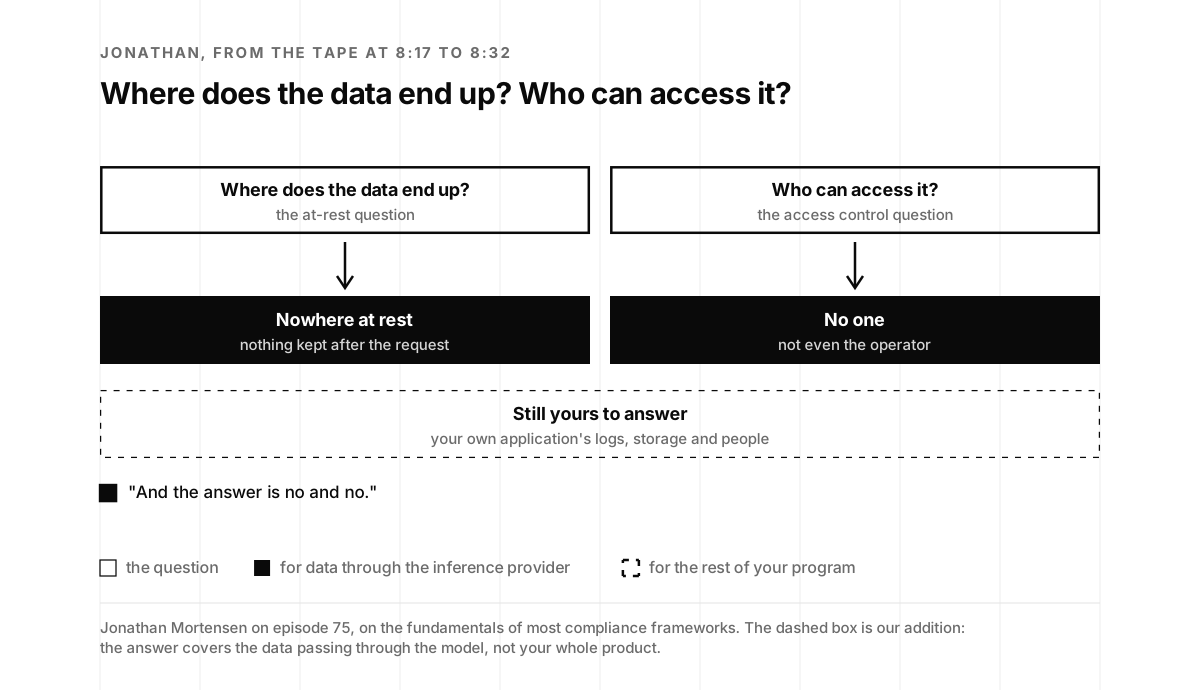
Two open boxes at the top: where does the data end up, the at-rest question, and who can access it, the access control question. Arrows lead down to two filled boxes: nowhere at rest, nothing kept after the request, and no one, not even the operator. Below, a dashed box across the width: still yours to answer, your own application's logs, storage and people. Then a quote. And the answer is no and no.
The two questions behind most compliance work, for data that passes through an inference provider that can't see it.

That’s a strong claim, and it’s scoped to the data passing through the model. Your own application still stores and logs data, your own people still have access, and a reviewer will still ask about both. A SOC 2 report covers those parts of the program. What a provider like this changes is one of the hardest rows on the list, the one about where your prompts go. Our post on the AI security questions enterprise buyers will ask in 2027 has one-sentence answers for that row and the rest.

Encrypted weights

Jon asked about teams that train their own models. Could they bring those too?

“I can actually upload those models into Confident Security.”

Jon McLachlan, at 8:44

They can, Jonathan said, with a person in the loop for now.

“You can. Now, it’s a white glove service right now. Yeah, so it’s not as easy as just clicking a button in the UI. But yes, in fact, you encrypt the weights yourself and then give us the encrypted weights.”

Jonathan Mortensen, at 8:47

The key to those weights travels with the requests, so only the confidential environment ever sees the model in the clear.

“And then when you make requests, you include that decryption key for us to verify, so that the confidential environment can use those weights without showing us the weights, to get it into the confidential environment.”

Jonathan Mortensen, at 8:59
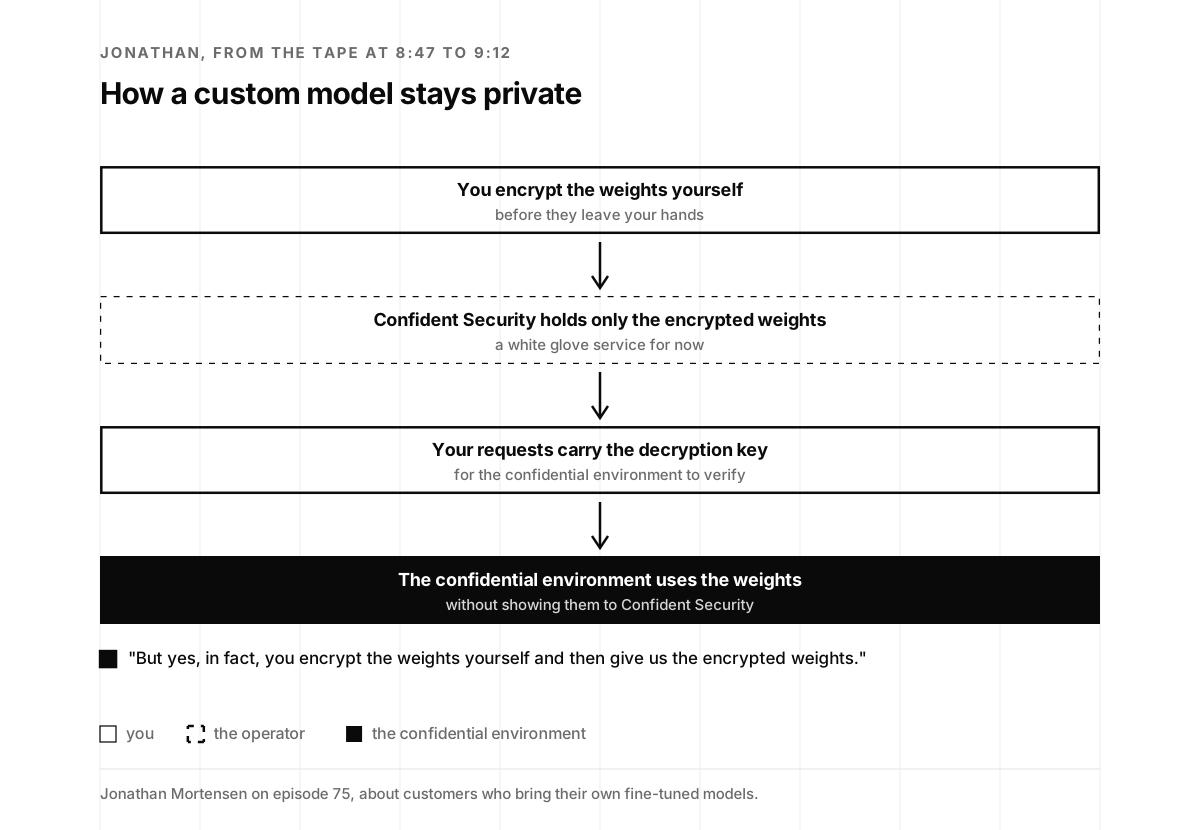
Four boxes in a column, joined by arrows. Open, you encrypt the weights yourself, before they leave your hands. Dashed, Confident Security holds only the encrypted weights, a white glove service for now. Open, your requests carry the decryption key, for the confidential environment to verify. Filled, the confidential environment uses the weights, without showing them to Confident Security. Then a quote. But yes, in fact, you encrypt the weights yourself and then give us the encrypted weights.
How a custom model stays private, as Jonathan described it.

Jon called that critical for business-to-business deals. Confident Security’s site now has a section on it, saying customers can “Host, manage, and even sell your own custom models” with the same guarantees (Confident Security).

Signal for AI

Jon asked about consumers. Jonathan’s answer started with how people talk to these systems.

“Yeah, I think people are increasingly sharing increasingly private data, right? Sensitive personal data, because of the value of the LLM, right? And I think partially because we anthropomorphize it, it’s like a little more human. And the interface is so human.”

Jonathan Mortensen, at 9:25

The signal he’d gotten was that consumers still don’t care that much about privacy, at least not when it means waiting. Most people choose the thing they need now over a privacy cost that arrives later.

“If you have to make a trade, you want something now, you need something now, versus dealing with privacy consequences later, including getting your data trained on, you’re going to make the trade as a consumer.”

Jonathan Mortensen, at 10:07
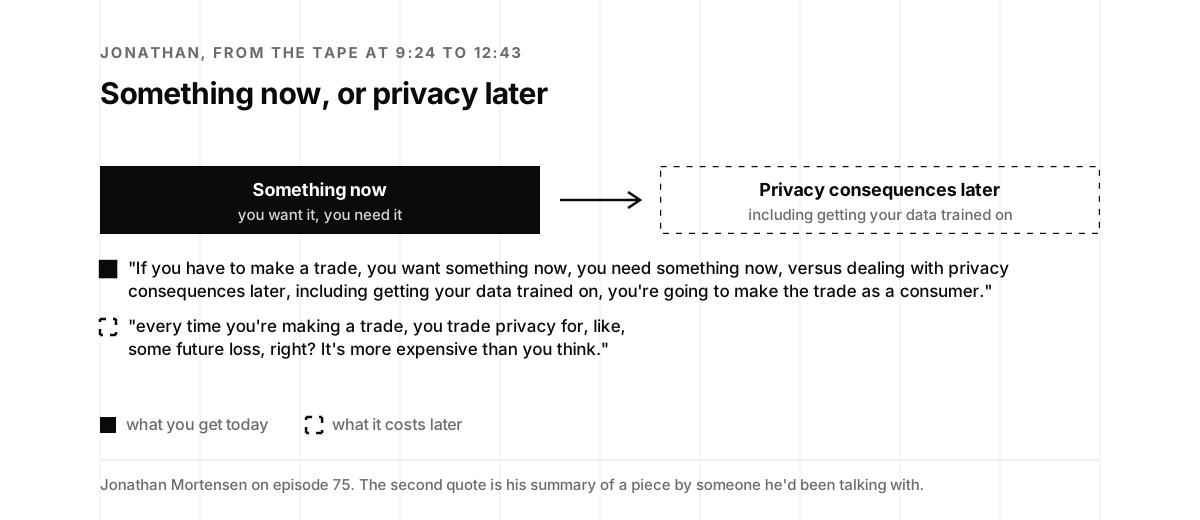
A filled box, something now, you want it, you need it, with an arrow to a dashed box, privacy consequences later, including getting your data trained on. Then two quotes. If you have to make a trade, you want something now, you need something now, versus dealing with privacy consequences later, including getting your data trained on, you're going to make the trade as a consumer. Every time you're making a trade, you trade privacy for, like, some future loss, right? It's more expensive than you think.
The consumer trade, as Jonathan put it.

He’d still like to be the default for the products where privacy is the point, the way Signal made end-to-end encryption the default for messaging.

“It would be awesome, for example, if we were in Signal.”

Jonathan Mortensen, at 10:29

“I’d love to be in a world where everyone gets this level of privacy, where you’re controlling what data you’re giving to whom, and the default is no one else can see it but you.”

Jonathan Mortensen, at 10:44

Jon liked the phrase.

“Signal for AI. I love that. That’s just a nice little one-liner zinger.”

Jon McLachlan, at 10:53

Listen · Jonathan on episode 75, from 10:28
About 30 seconds: Jonathan on Signal for AI, and Jon's reaction. The clip stops on its own. Read the full transcript.

It was already a headline. TechCrunch had used “the Signal for AI” for Confident Security’s launch a few weeks before the recording.

Privacy on the billboard

Sasha asked why privacy moved from the fine print to the front of the ad.

“On billboards, when you see Apple’s billboards, you can see privacy almost usually the first word on the billboard. Why do you think that is the case? Why do people and companies start to care about privacy more so than they used to 10 years ago?”

Sasha Sinkevich, at 11:11

Jonathan’s first answer was the business model. A premium product doesn’t need to make money from your data, and a cheap one often does.

“Well, Apple does it to differentiate itself in the market. I think that’s one major thing. And because they’re a premium product, they’re not getting value from your data, or they don’t need to get value from your data, right? When you sell something cheap, you’re essentially reselling the user to someone else for ads or other reasons.”

Jonathan Mortensen, at 11:28

Listen · Jonathan on episode 75, from 11:28
About 20 seconds: Jonathan on why a premium product can sell privacy. The clip stops on its own. Read the full transcript.

His second answer was breaches. He pointed to the 2024 attacks on Snowflake customers, which he said came down to two-factor enforcement rather than Snowflake itself. Our blast radius playbook walks through that case: the attackers logged in with stolen passwords to accounts that didn’t require multi-factor authentication. His third answer was AI, and what it makes your data worth to someone else.

“And I was actually talking with someone else recently who wrote a piece on this so directly, which is like, every time you’re making a trade, you trade privacy for, like, some future loss, right? It’s more expensive than you think.”

Jonathan Mortensen, at 12:26

You are the product

Sasha answered with an old saying.

“There is a saying that if you don’t pay for the product, you are the product. And often, if you get service for free, you usually trade something for that free service, and usually that’s your data.”

Sasha Sinkevich, at 12:43

Data as the new oil is an old line by now. The British mathematician Clive Humby is credited with coining “Data is the new oil” in 2006 (Wikipedia). Sasha’s point was that 2025 made it literal for AI, because the open supply is running out.

“We’re recording this in 2025. There are a lot of papers out there that talk about the fact that we’ve exhausted all of the publicly available information for the training, or for the future training, of the models. And at this point, it’s the proprietary data that very few companies have their hands on that is extremely valuable.”

Sasha Sinkevich, at 13:08

Data remains the proprietary thing

Jonathan agreed and took it a step further. He said the newest models are incredibly good, and that in five years they may be close to interchangeable. What a provider will hold then is the data its users gave it.

“And the models otherwise would be identical. And the reason why you stay is because of your data, the special context that they have about you and the special training data that they have. So, as always, data remains the proprietary thing.”

Jonathan Mortensen, at 14:14

Listen · Jonathan on episode 75, from 14:16
About 10 seconds: Jonathan on why data stays the advantage when the models converge. The clip stops on its own. Read the full transcript.

That’s the incentive he described at the start, seen from the other side. If your data is what keeps a customer, you want as much of it as you can get. A provider that can’t see it has given that lever up on purpose.

Secure against us

Jon described what that design does to the future. A company can change its terms of service, he said, and decide to monetize the data it already holds. Confident Security can’t, because of how it was built.

“But even Confident Security is putting itself in a position where it will not be able to retroactively change anything. Anything that comes in sounds ephemeral and protected with cryptographic mechanisms that just ensure privacy both today but also well into the future.”

Jon McLachlan, at 14:47

Jonathan explained why it would be impossible. The keys never leave the place the data is processed, and that place doesn’t last.

“Yeah, it would be impossible. We don’t hold the private keys, and the private keys are generated inside of a confidential environment we can’t access. And so once the data is encrypted with those keys, it can only be decrypted in that confidential environment, and that environment is thrown out after the request.”

Jonathan Mortensen, at 15:04
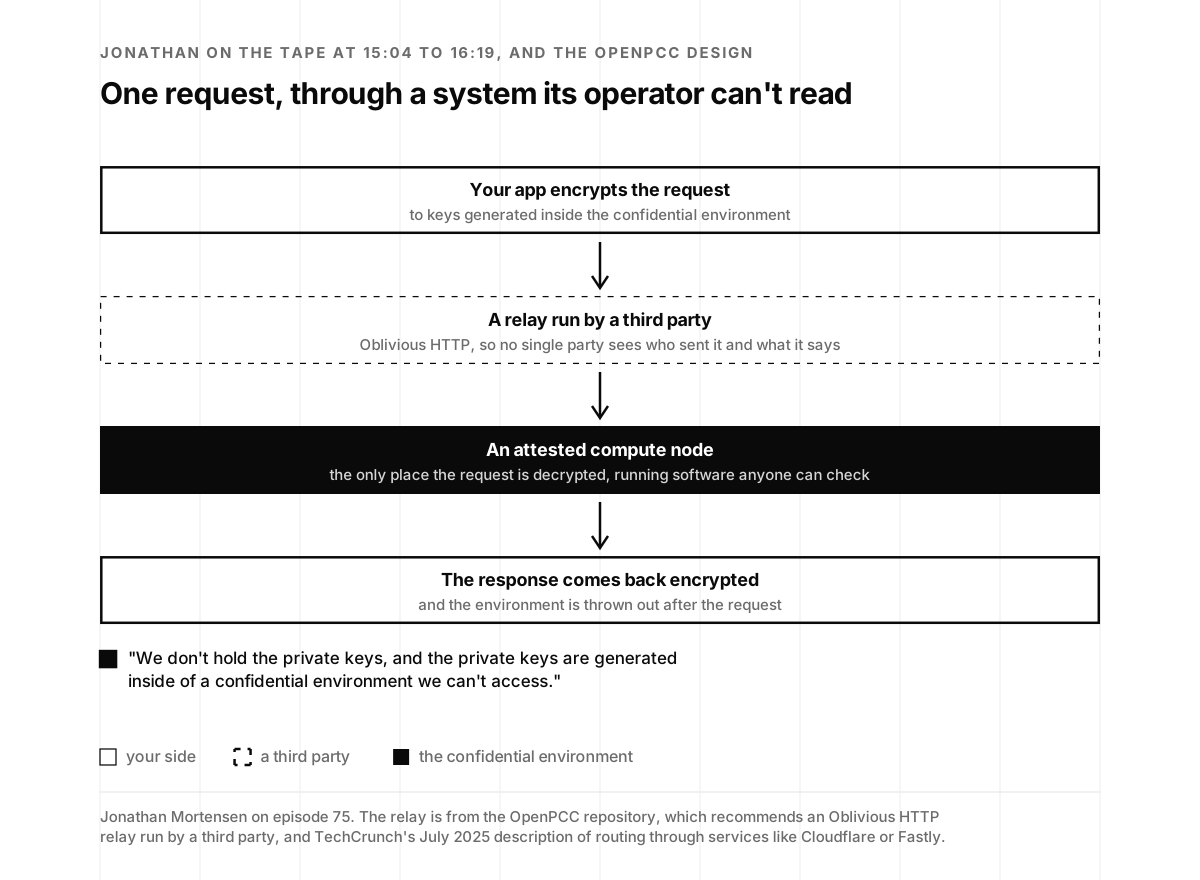
Four boxes in a column, joined by arrows. Open, your app encrypts the request, to keys generated inside the confidential environment. Dashed, a relay run by a third party, Oblivious HTTP, so no single party sees who sent it and what it says. Filled, an attested compute node, the only place the request is decrypted, running software anyone can check. Open, the response comes back encrypted, and the environment is thrown out after the request. Then a quote. We don't hold the private keys, and the private keys are generated inside of a confidential environment we can't access.
One request through a system built so its operator can't read it, as Jonathan and Confident Security describe it.

He mentioned the one exception people always raise, and put it where it belongs.

“So yes, we couldn’t log it and then, like, decrypt it later on, unless we had a giant, you know, quantum computer in the future. But that’s several threat models deep.”

Jonathan Mortensen, at 15:21

Jon asked the question every security review comes down to.

“Sure, sure, sure. You know, I guess everything always comes back to the threat model, asking the question, secure against who or what?”

Jon McLachlan, at 15:32

Jonathan’s answer gave this page its title.

“And for us, we’re saying it’s secure against us, right? The primary threat model that we’re selling to have solved is that we can’t tamper with your data. And so all the things that we do make it so that it’s as hard for us to see your data as it would be for any third-party attacker.”

Jonathan Mortensen, at 15:40

Listen · Jonathan on episode 75, from 15:39
About 20 seconds: Jonathan on the threat model Confident Security is built against. The clip stops on its own. Read the full transcript.

Most vendors list outside attackers as the threat and themselves as the trusted party. Putting the operator on the list of threats is the idea behind Apple’s requirement of no privileged runtime access, and it changes what a buyer can check. You stop asking whether the vendor’s staff are trustworthy and start asking whether the system lets them in at all.
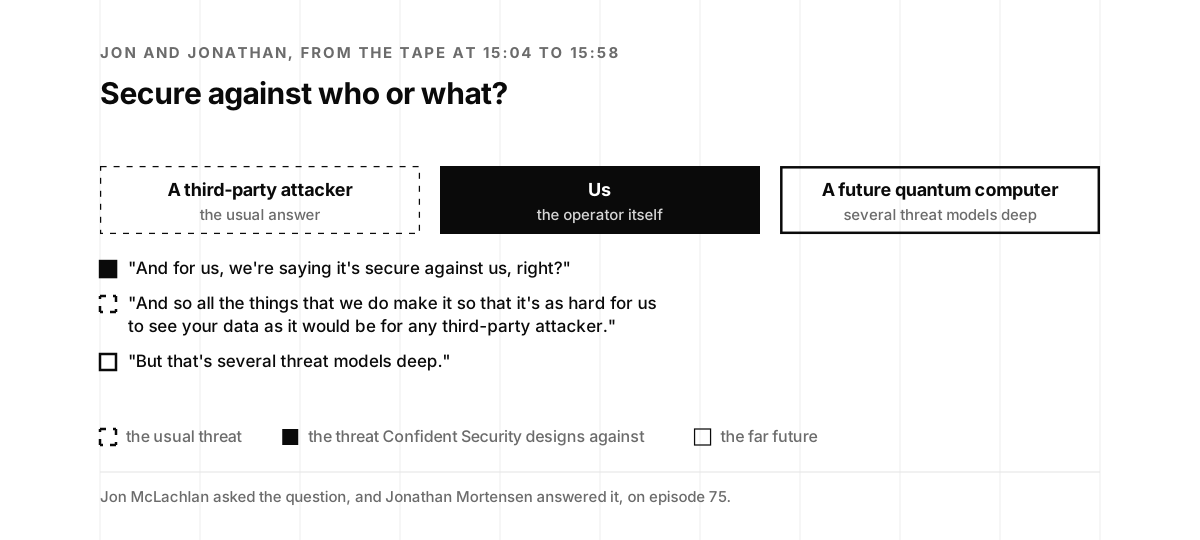
Three boxes in a row. Dashed, a third-party attacker, the usual answer. Filled, us, the operator itself. Open, a future quantum computer, several threat models deep. Then three quotes. And for us, we're saying it's secure against us, right? And so all the things that we do make it so that it's as hard for us to see your data as it would be for any third-party attacker. But that's several threat models deep.
Secure against who or what? The three answers from this part of the conversation.

Attested to

Sasha restated the claim, and Jonathan added the part that makes it checkable.

“Yeah, so essentially saying nothing in the infrastructure itself can see inside the confidential compute module.”

Sasha Sinkevich, at 15:58

“Yep. And what’s inside the confidential compute module is attested to. So we know exactly what’s running in there. And you can check what’s running in there. And what’s running in there is not log all of your data. That’s the most important thing.”

Jonathan Mortensen, at 16:08

Listen · Jonathan on episode 75, from 16:08
About 10 seconds: Jonathan on attestation, the part a customer can check. The clip stops on its own. Read the full transcript.

Remote attestation is how a machine proves to someone else what software it’s running, using hardware that signs a measurement of its own state (Wikipedia). TechCrunch described the last step of Confident Security’s design the same way: the software running inference is publicly logged and open to review, so experts can verify the guarantees (TechCrunch). The company’s code for this is on GitHub. Its organization holds the compute node component and libraries for attestation on AMD processors and NVIDIA GPUs (GitHub).

For a buyer, attestation changes the question from whether the vendor promises to whether you can see what’s running, and a security reviewer can actually answer that one.

The crown jewels

Sasha put the episode in business terms. Every company has to adopt AI to keep up, and the safe options have been thin.

“And if you are an existing company and you would like to participate in the future economical benefits of using AI, you have to start adopting. But maybe there are not a lot of good options to do it safely and securely in order to protect the crown jewel, the data sets that you have.”

Sasha Sinkevich, at 16:38

Jonathan agreed, and was direct about the price.

“Essentially, it’s like you need the value of AI, but you’re blocked from adopting it because you don’t want to give out the crown jewels. You can use Confident Security and not have to make that trade-off. Now, just to be clear, we charge a little bit more on a per-token rate for the AI, but I think that that upcharge is way less than the cost of giving up your proprietary data”

Jonathan Mortensen, at 17:05

Listen · Jonathan on episode 75, from 17:07
About 25 seconds: Jonathan on the crown jewels, and on paying for privacy. The clip stops on its own. Read the full transcript.

Then he caught himself mid-thought and landed on a line worth keeping.

“No, it’s good to pay for privacy, I think. It aligns incentives.”

Jonathan Mortensen, at 17:30

It ties back to the start of the conversation. When the customer pays for the privacy, the provider’s business is keeping the data private, not using it. The company’s pricing page describes base fees pinned to current market prices per model (Confident Security).

Everyone was putting stuff out there

Jon agreed it aligns incentives, and looked back at how we got here.

“No one had any idea. Like, there was no foresight into looking into the future and, you know, realizing all of that could be harvested in the future by these AI models that we have today, to actually train models against your voice, against your tone, you know, the essence of who you are.”

Jon McLachlan, at 17:46

He thinks the shift away from that is already underway.

“But it doesn’t mean, like, we have to continue down that road going forward. We can be much more privacy conscious, security aware. And I really feel like that shift is happening right now, right underneath our feet.”

Jon McLachlan, at 18:17

Jonathan said AI makes the trade easier to see, because the value is so obvious that a business can justify paying for it.

“And so it’s like, okay, I’m making a very clear trade, and, like, I know what I want to pay a premium for this thing, because it just gives me so much value.”

Jonathan Mortensen, at 19:22

Crypto agility

Sasha came back to the quantum computer Jonathan had mentioned, and explained why it isn’t a big worry.

“So it’s something that, even though people talk about quantum [breaking] all of the encryption, et cetera, I’m not really concerned about it that much, because if you have crypto agility built into your product, you can adapt to threats fairly quickly.”

Sasha Sinkevich, at 19:53

Jonathan said where Confident Security stands, and what it’s waiting on.

“Yep, that’s right. We’re not post-quantum right now, but once the vTPMs support post-quantum, we’re in.”

Jonathan Mortensen, at 20:08

A vTPM is a virtual Trusted Platform Module, the software version of the security chip that holds keys and measurements for a machine (Wikipedia). Jon asked Sasha to define crypto agility for listeners.

“On a high level, it’s just the ability to plug in any algorithms moving forward, and you can ensure that data is safely guarded using new type of encryption. And you can do it on the fly without breaking changes.”

Sasha Sinkevich, at 20:17

Listen · Sasha on episode 75, from 20:17
About 20 seconds: Sasha's definition of crypto agility, and Jon's one-line summary. The clip stops on its own. Read the full transcript.

“Super important feature at the cryptography level for any product.”

Jon McLachlan, at 20:33
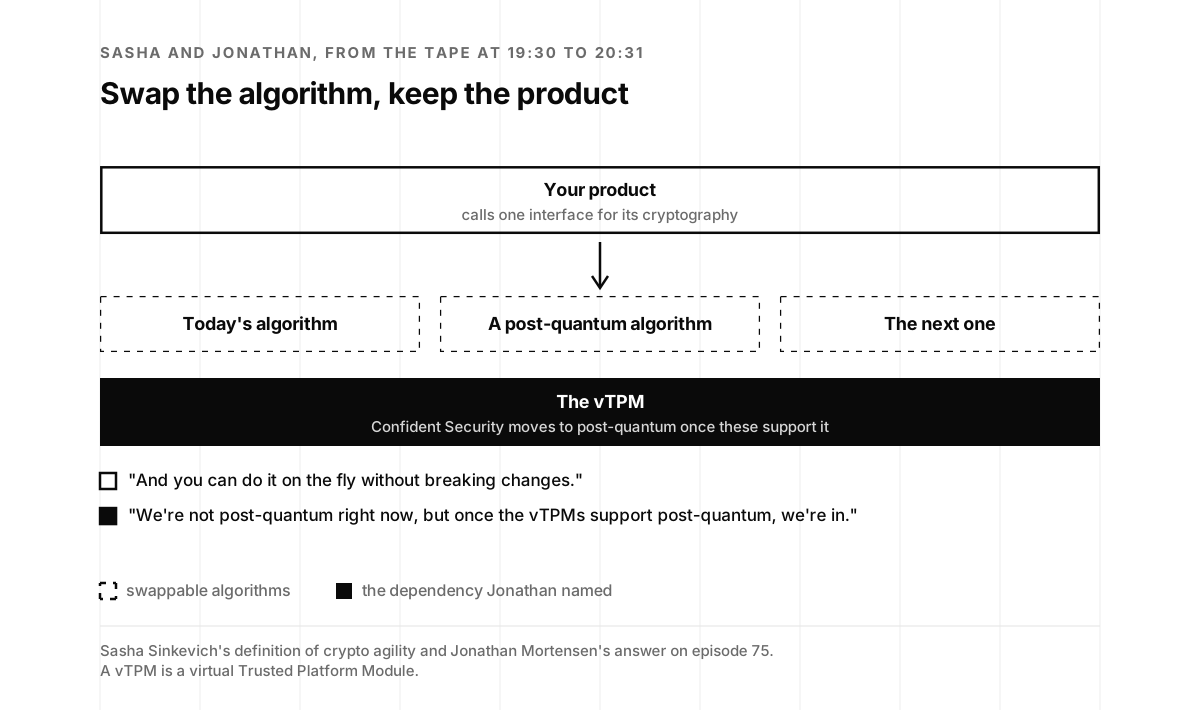
An open box, your product, calls one interface for its cryptography, with an arrow down to three dashed boxes: today's algorithm, a post-quantum algorithm and the next one. Below, a filled box: the vTPM, Confident Security moves to post-quantum once these support it. Then two quotes. And you can do it on the fly without breaking changes. We're not post-quantum right now, but once the vTPMs support post-quantum, we're in.
Crypto agility, and the dependency Jonathan named.

The textbook definition is the ability to switch between cryptographic primitives (Wikipedia), and the reason it matters is post-quantum cryptography. Our guide to harvest now, decrypt later explains which data is exposed first and puts crypto agility third in a four-step migration plan.

A $22 sale

Jon asked about Jonathan’s proudest day as a founder. The answer came from bit.io, a serverless Postgres company that he said was possibly before its time.

“So the company I did before this was bit.io. It was a serverless Postgres company before its time, possibly, but with the recent acquisition of Neon and Crunchy Data by Databricks and Snowflake, respectively.”

Jonathan Mortensen, at 20:50

Both deals were only a few months old. Databricks agreed to buy Neon in May 2025, for about $1 billion by CNBC’s report, and Snowflake announced its purchase of Crunchy Data in June for about $250 million (Wikipedia, Wikipedia). Jonathan’s proudest moment was much smaller than either.

“But the most proudest moment, I think the team was firing on all cylinders, and we got our first sale for $22. It had just been the culmination of a ton of effort from everyone on the team. I think that was probably my proudest moment.”

Jonathan Mortensen, at 21:25

Listen · Jonathan on episode 75, from 21:26
About 10 seconds: Jonathan on the first $22 sale at bit.io. The clip stops on its own. Read the full transcript.

It would have been monthly recurring revenue, he said, $22 of it. What mattered was that someone paid.

“So we had created something of value, right? Somebody was willing to pay for this thing.”

Jonathan Mortensen, at 21:44

Sasha took the founder’s lesson from it.

“And it’s important to stick with it. It’s important to grind through all of the difficulties and challenges, because let’s be honest, when you start a company, there are a lot of those, and it’s how you react to challenges is what matters.”

Sasha Sinkevich, at 22:17

Jonathan remembered what the months before it felt like, and Jon described what the sale changes.

“Before that first sale, you’re like, are we doing the right thing?”

Jonathan Mortensen, at 22:31

“And then when you land the sale and you get the market confirmation, you start getting the feedback from all of your new customers, that’s really special. It’s an important mark.”

Jon McLachlan, at 22:42

Jonathan made sure the credit went to the team, and explained why he thinks that way.

“Yeah, I played a lot of soccer when I was a kid, and the team analogy is what works for me, right? We’re all playing different positions on the field while trying to score a goal.”

Jonathan Mortensen, at 23:02

On the cusp of accurate enough

Sasha asked about the biggest pain point in using AI responsibly over the next year, the one nobody has addressed. Jonathan started with the word.

“A responsible manner is an interesting word there. But I think that right now we’re on, for a lot of use cases, on the cusp of something being accurate enough.”

Jonathan Mortensen, at 23:39

The newest models had finally convinced people about coding, he said, noisy and imperfect but a net positive. Many other uses are right on the edge, and the work that gets them over it is your own measurement.

“Whether it’s building a system to put in accuracy or fine-tuning your models, coming up with a data set to do evaluations, your own personal evaluations, and not relying on just the benchmarks”

Jonathan Mortensen, at 24:07

The classic line he paraphrased is Goodhart’s law, often stated as “When a measure becomes a target, it ceases to be a good measure” (Wikipedia). A public benchmark is a target for everyone who builds a model. Your own evaluation set, built from your own data, is a measure nobody else is aiming at.

“So I think creating your own benchmarks internally. And I know a lot of folks who are doing that.”

Jonathan Mortensen, at 24:27

Garbage in, garbage out

Sasha tied accuracy back to the data, and the data back to the controls around it.

“And you mentioned accuracy, which is tightly coupled with data inputs. In general, it’s garbage in, garbage out, which is where the proprietary data sets and the quality of the retrieved data makes a lot of sense.”

Sasha Sinkevich, at 24:32

“And it’s a full circle back into the data governance. How do you ensure that data that you share with models stays private and stays secured?”

Sasha Sinkevich, at 24:57

The better your own data, the better your model works, and the more it costs you if it leaks. That’s the same data set Jonathan said you should build your evaluations from, which makes it worth protecting twice.

Chaos for the next year

Jonathan’s other answer was agents.

“Yep. And with this whole agentic thing, I feel like where you put the security controls and how you delegate permissions for what things those agents can access is going to be chaos for the next year.”

Jonathan Mortensen, at 25:07

Listen · Jonathan on episode 75, from 25:07
About 30 seconds: Jonathan on agent permissions, and relabeled IAM. The clip stops on its own. Read the full transcript.

He’d noticed a wave of identity and access management vendors rebranding for it.

“Actually, there’s so many seem to have just relabeled their IAM product as agentic IAM. Like, how do you even keep track of what agent is doing what, where, and when it should have permission to do it and access what data?”

Jonathan Mortensen, at 25:21

Jon wasn’t sure what to call the new users.

“This new market here, all of these agentic users, they’re really not even users. I’m not sure what to call them. Machines.”

Jon McLachlan, at 25:44

More than a year later, the question is still open. Our posts on why agents need least privilege more than humans ever did, whether you’re actually going to give the agent write access and agents that share one API key take it from there.

The tea company

Sasha had seen this kind of relabeling before, in a different hype cycle.

“There was a tea company that added the word crypto to its name or to its product, and then the valuation of that company just exploded. I feel like we are in a similar space, but in the technology.”

Sasha Sinkevich, at 26:08

The company was Long Island Iced Tea Corp., and the word it added was blockchain. On December 21, 2017, it announced it would rebrand as Long Blockchain Corp., and its stock price spiked as much as 380 percent. Four months later Nasdaq told it the stock would be delisted, and by then it had dropped its plan to buy Bitcoin mining equipment (Wikipedia). The lesson carries over to AI labels. A new word on the pitch deck changes the valuation faster than it changes the product, so a buyer’s security review still has to look at what the product does.

Bought, not sold

Jon asked about the hardest day. Jonathan’s first answer was every day before the first sale.

“Any day before we got the first sale. Every one of those days was so challenging.”

Jonathan Mortensen, at 26:32

The most stressful, he said, were the two acquisitions, because everyone else in the room had done far more of them than he had.

“You know, I’ve sold two companies. The M&A process is certainly pretty stressful.”

Jonathan Mortensen, at 26:52

“You know, everyone else at the table has done N of these, and I’ve done two of them.”

Jonathan Mortensen, at 27:02

Sasha asked what he took from it.

“What’s the biggest learning from that M&A process? You’ve done two of them.”

Sasha Sinkevich, at 27:34

“Well, companies are bought, not sold. That’s the most classic line, right? Don’t seek to get your company sold. Wait for the call. Wait for the call.”

Jonathan Mortensen, at 27:38

Listen · Jonathan on episode 75, from 27:37
About 25 seconds: Jonathan on M&A, and why you need a BATNA. The clip stops on its own. Read the full transcript.

The rest of his answer was negotiation theory. A BATNA is the best alternative to a negotiated agreement, the course you can take if the talks fail (Wikipedia).

“And the most important thing with any negotiation is to have a BATNA, the best alternative to a negotiated agreement. Because if you don’t have the BATNA, particularly for those situations, you have no way to say no, essentially, right?”

Jonathan Mortensen, at 27:51

His example was a buyer offering a dollar with nobody offering two. Sasha finished the thought.

“The market value is what the highest bidder is willing to pay.”

Sasha Sinkevich, at 28:15

“And unfortunately, like, it’s a trade, and in those trades, you have to know what your value is and have alternatives.”

Jonathan Mortensen, at 28:35
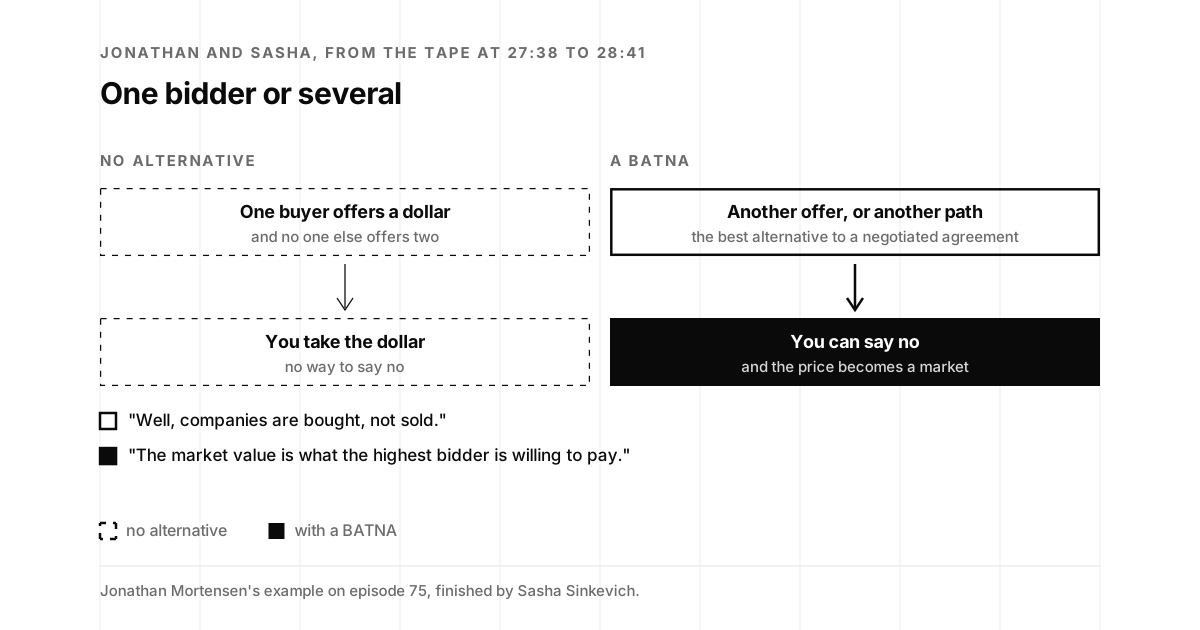
Two columns. On the left, no alternative: a dashed box, one buyer offers a dollar and no one else offers two, leads down to a dashed box, you take the dollar, no way to say no. On the right, a BATNA: an open box, another offer or another path, the best alternative to a negotiated agreement, leads down to a filled box, you can say no, and the price becomes a market. Then two quotes. Well, companies are bought, not sold. The market value is what the highest bidder is willing to pay.
One bidder or several, from Jonathan's answer on M&A.

It’s the same lesson as the rest of the episode, in a different setting. In a negotiation, and in a contract with an AI vendor, the party with no alternative takes whatever terms it’s offered.

A catalyst for privacy

Jon asked what legacy Jonathan would like to leave, in business or in life. He answered for the company.

“I’d love for Confident Security to be a catalyst for having a bunch more privacy around AI.”

Jonathan Mortensen, at 28:57

He meant all of it, the model vendors, the GPU resellers, the software platforms and the big businesses running their own GPUs, doing their inference privately, whether Confident Security provides it or spurs everyone else into it.

“I think everyone will benefit from privacy, or at least the choice around privacy and what they share.”

Jonathan Mortensen, at 29:28

Listen · Jonathan on episode 75, from 28:56
About 35 seconds: Jonathan on the legacy he'd like Confident Security to leave. The clip stops on its own. Read the full transcript.

Regulation, or a leak

Sasha asked what will actually move businesses and consumers toward privacy.

“What do you think will incentivize businesses or consumers to opt in for more services that are privacy aware or built around privacy?”

Sasha Sinkevich, at 29:32

Jonathan’s first answer was regulation, with a caution about how regulators treat the tools.

“I think regulations is going to be one. Now, privacy is like a double-edged sword, right? In the same way that encryption generally is kind of a double-edged sword around regulatory frameworks, right? A lot of people don’t want encryption. I tend to be on the side of encryption is better.”

Jonathan Mortensen, at 29:54

His second answer was an incident nobody wants.

“there’s going to be some situation where someone accidentally retained the data that they said they weren’t going to, and then either accidentally trained on it or someone leaked it, and it was super proprietary, but they needed the value from AI.”

Jonathan Mortensen, at 29:55

Sasha added the engineering answer to that fear. If the data is encrypted from the start, a backup that outlives its welcome is still unreadable once the key is gone.

“you can guarantee secure deletion by destroying the keys.”

Sasha Sinkevich, at 30:49

The practice has a name, crypto-shredding, which renders encrypted data unusable by deleting the keys (Wikipedia). Jonathan agreed, and said regulation would still be the main push, because companies can put a number on what their data is worth.

“And again, I think corporations kind of understand, unlike consumers, can kind of quantify the value of their proprietary data and make informed business decisions based on that.”

Jonathan Mortensen, at 30:59
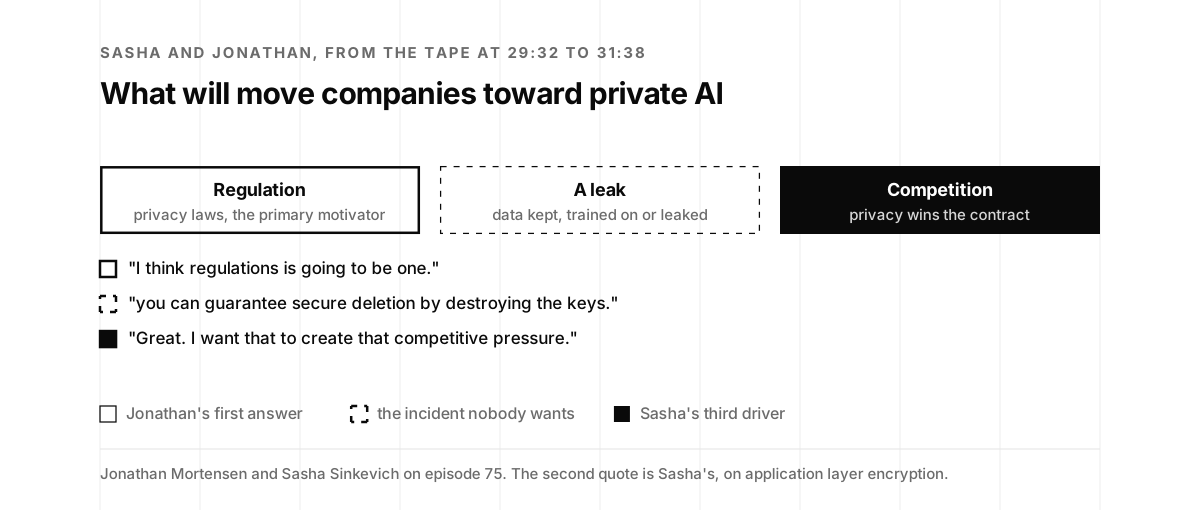
Three boxes in a row. Open, regulation, privacy laws, the primary motivator. Dashed, a leak, data kept, trained on or leaked. Filled, competition, privacy wins the contract. Then three quotes. I think regulations is going to be one. You can guarantee secure deletion by destroying the keys. Great. I want that to create that competitive pressure.
What will move companies toward private AI, by the account of everyone in this conversation.

Differentiators

Sasha named the third driver, the one founders feel first.

“We see it more and more often in the space, in the marketplace, where the security and privacy controls are becoming differentiators. When two products are being considered for the same function, products with more security and more privacy built into the product tend to win contracts over those that don’t have those.”

Sasha Sinkevich, at 31:13

“Great. I want that to create that competitive pressure.”

Jonathan Mortensen, at 31:34

Listen · Sasha on episode 75, from 31:11
About 25 seconds: Sasha on privacy as a differentiator, and Jonathan's answer. The clip stops on its own. Read the full transcript.

This is the part of the episode closest to our own work. In an enterprise deal, the security review is often where two similar products separate, and the product that can answer the hard questions with evidence is usually the one that gets the contract.

Maybe you shouldn’t put it on the internet

Jon told a story on himself.

“When I was in graduate school, I received a phone call from a news reporter who wanted to comment. She looked me up, and she saw I was a security person at the University of Minnesota.”

Jon McLachlan, at 31:46

The reporter asked about people posting on Facebook and then suffering a huge data leak, one of the site’s first.

“And I said something along the lines of, well, if you want your stuff private, maybe you shouldn’t put it on the internet.”

Jon McLachlan, at 32:15

Jonathan allowed that it was true. Jon has since changed his mind about the answer.

“There’s truth to this, but it’s also dismissive, I think, and almost blaming the victim. I think that there are ways to build technology that respects people’s privacy.”

Jon McLachlan, at 32:23

Listen · Jon on episode 75, from 32:23
About 10 seconds: Jon on the answer he'd take back from graduate school. The clip stops on its own. Read the full transcript.

Jon said he’s happy to pay a little every month for a service that adds value and doesn’t advertise at him, and the same goes for AI. Jonathan raised the catch.

“Now, this assumes that you have the money to pay for the privacy versus the free version, right? And you need this technology to not get left in the dust.”

Jonathan Mortensen, at 33:17

“I think that’s a very important question, and I could have a whole show just on that one question.”

Jon McLachlan, at 33:27

It’s a fair question to leave open. Privacy you pay for works best for the people who can pay, and Jon thought it deserved a show of its own.

Trust past J-Mo

Jon asked what advice Jonathan would give his younger self. He started with a motto.

“I think I like to have a phrase which is like, trust past J-Mo, which is like, I probably made a decision in the past that made sense.”

Jonathan Mortensen, at 34:11

“But maybe there should also be a trust future J-Mo line.”

Jonathan Mortensen, at 34:20

Then three pieces of advice. For the companies, spend sooner on selling.

“I’d go back and be like, spend more money on marketing and sales.”

Jonathan Mortensen, at 34:43

For college, take the class that has nothing to do with the degree.

“On a personal level, if I go back to college years, I would say take more classes for fun.”

Jonathan Mortensen, at 34:46

“I should have stayed in that aerospace class. That was really interesting.”

Jonathan Mortensen, at 35:03

Listen · Jonathan on episode 75, from 34:49
About 25 seconds: Jonathan on the aerospace class he should have stayed in. The clip stops on its own. Read the full transcript.

And the last one surprised the hosts, from a man who’d just credited soccer for how he thinks about teams.

“Or play another team sport that is less damaging to your musculoskeletal system.”

Jonathan Mortensen, at 35:24

What happened after the tape

The episode aired on August 12, 2025. In September Confident Security launched its blog, The Dead Drop, and in October Jonathan announced a month of open-source releases, one a week (LinkedIn). First came twoway, an encrypted request and response library built on hybrid public key encryption. Then go-nvtrust, a Go library for NVIDIA GPU and NVSwitch confidential computing attestation. Then Go implementations of Binary HTTP and Oblivious HTTP, the protocol Jonathan said he first learned about in 2024 while reading Apple’s Private Cloud Compute post (LinkedIn). Oblivious HTTP is RFC 9458, published in January 2024 (Wikipedia).

On November 5, 2025, the month ended with OpenPCC, which Jonathan called an open-source standard to protect data from LLMs. It’s released under the Apache 2.0 license with no contributor license agreement, a choice he said makes it possible for OpenPCC to become a standard.

I'm thrilled to introduce OpenPCC, an open-source standard to protect data from LLMs.

Jonathan Mortensen · November 5, 2025
Jonathan introduces OpenPCC, the open-source framework Confident Security's managed service is built on. View on LinkedIn.

Axios had the launch as an exclusive the same day, describing the team as former Apple and Databricks engineers (Axios). The OpenPCC repository describes a framework inspired by Apple’s Private Cloud Compute but “fully open, auditable, and deployable on your own infrastructure,” using encrypted streaming, hardware attestation and unlinkable requests, and it recommends routing requests through an Oblivious HTTP relay run by a third party (GitHub). The repository had 956 stars when we checked in November 2026. CONFSEC, the company’s managed service, is based on it.

In December Jonathan sat down with Unite.AI. His answer to why AI needs a different approach to privacy was the episode in two sentences: “trust isn’t enough. They need proof” (Unite.AI). He put it more bluntly on LinkedIn the next day.

Here's a hot take: privacy should work like math.

Jonathan Mortensen · December 4, 2025
Jonathan on his Unite.AI interview about OpenPCC. View on LinkedIn.

That’s the thread from the tape to today. In August 2025 Jonathan described a service built so its operator can’t see the data and contracts that sign for it. By the end of the year he had published the pieces as open source, so anyone can check the work.
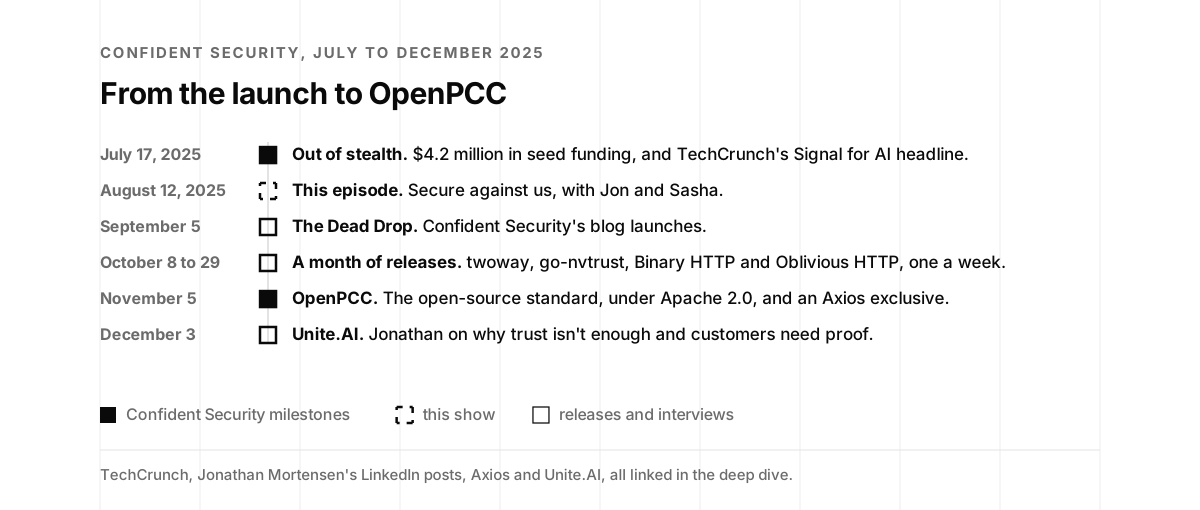
A timeline of six entries. Filled, July 17, 2025, out of stealth, $4.2 million in seed funding, and TechCrunch's Signal for AI headline. Dashed, August 12, 2025, this episode, secure against us, with Jon and Sasha. Open, September 5, The Dead Drop, Confident Security's blog launches. Open, October 8 to 29, a month of releases, twoway, go-nvtrust, Binary HTTP and Oblivious HTTP, one a week. Filled, November 5, OpenPCC, the open-source standard, under Apache 2.0, and an Axios exclusive. Open, December 3, Unite.AI, Jonathan on why trust isn't enough and customers need proof.
The episode and what followed, from Confident Security's launch to OpenPCC.

Did you catch it? A six-question quiz

Six questions from the episode. Each answer links the moment in the transcript.

Quiz · six questions

Did you catch it?

Pick an answer for each question, then check your score.

  1. Whose reference architecture did Jonathan say Confident Security's product is based on?

    1. A database company's
    2. Apple's Private Cloud Compute
    3. A chip maker's reference design

    b. "So our product is based off the same reference architecture of Apple's Private Cloud Compute." Transcript, 6:21.

  2. Which two questions did Jonathan say most compliance frameworks come down to?

    1. Who signed it, and when
    2. How fast you respond, and to whom
    3. Where the data ends up, and who can access it

    c. "which is like, where does the data end up? Who can access it? And the answer is no and no." Transcript, 8:28.

  3. How does a customer's own model stay private, by Jonathan's account?

    1. The customer encrypts the weights and sends the key with requests
    2. The model runs only on the customer's own GPUs
    3. The weights are split across several vendors

    a. "But yes, in fact, you encrypt the weights yourself and then give us the encrypted weights." Transcript, 8:53.

  4. Who did Jonathan say the system is secure against, as its primary threat model?

    1. Nation states only
    2. Confident Security itself
    3. A future quantum computer

    b. "And for us, we're saying it's secure against us, right?" Transcript, 15:40.

  5. What was bit.io's first sale worth?

    1. $22
    2. $2,200
    3. $22,000

    a. "the team was firing on all cylinders, and we got our first sale for $22." Transcript, 21:27.

  6. What did Jonathan call the most classic line about selling a company?

    1. Always run a process
    2. Price is what you pay
    3. Companies are bought, not sold

    c. "Well, companies are bought, not sold. That's the most classic line, right?" Transcript, 27:38.

Over the wall, or provable?

Eight questions on what happens to your customers’ data when your product sends it to an AI model. Each one links the part of the episode it comes from.

Scorecard · eight questions

Over the wall, or provable?

Answer for the product you ship today, not the plan. If two answers fit, pick the lower one.

  1. Do you know every party that can see a customer's prompt?

    • Not really
    • We know our model provider
    • Every party is listed, including logging and monitoring tools

    "Yeah, once you throw it over the wall, you have no idea what's happening behind the scenes." See Over the wall.

  2. What stops your model provider from keeping or training on that data?

    • We assume it doesn't
    • A zero data retention or no-training clause
    • A clause, plus a technical control we can show a buyer

    "If you're Disney or you're Pfizer, a contractual promise probably isn't enough for your proprietary data." See A contractual promise isn't enough.

  3. Where do prompts end up at rest?

    • We don't know
    • Our logs and our provider's, for a set number of days
    • We can name every store and its retention, or there are none

    "And the answer is no and no." See No and no.

  4. Who can read a prompt while it's being processed?

    • Engineers at more than one company
    • A small, named group, and access is logged
    • No one, and the system is built to prove it

    "And so all the things that we do make it so that it's as hard for us to see your data as it would be for any third-party attacker." See Secure against us.

  5. Can a buyer check what software handles their data?

    • No
    • They can read our security documentation
    • They can verify an attestation or a public log

    "So we know exactly what's running in there." See Attested to.

  6. Do your contracts match your technical controls?

    • We've never compared them
    • Mostly
    • Every promise in the contract points at a control we can show

    "But we can't see the data." See We can't see the data.

  7. How do you know a model is accurate enough for your customers?

    • Public benchmarks
    • Spot checks by the team
    • Our own evaluation set, built from our data

    "So I think creating your own benchmarks internally." See On the cusp of accurate enough.

  8. Could you swap the encryption your product uses without breaking clients?

    • No
    • With a rewrite
    • Yes, it sits behind one interface

    "And you can do it on the fly without breaking changes." See Crypto agility.

Over the wall

Your customers' data probably goes somewhere you can't fully describe. Start with two moves: list every party that sees a prompt and how long each keeps it, and read each provider's retention and training terms.

Promises on paper

You have the clauses. Close the gap between them and the system next: point every contract promise at a control you can show, and ask your providers what a buyer can verify for themselves.

Provable

You can probably show a buyer where the data goes and who can see it. Keep it that way as you add models and vendors, and put the cryptography behind one interface so the next change is a configuration, not a rewrite.

How many copies of a prompt?

Every party that keeps a copy of a prompt is a place a buyer will ask about. Put in your own numbers.

Calculator

How many copies of a prompt?

Three estimates: how many prompts your product sends to a model each day, how many parties keep a copy (your own logs, the model provider, a monitoring tool), and how many days each keeps it.

–copies at rest on a typical day
–places a buyer will ask about
–copies written in a year
–at rest if the model provider can't see or keep them

On a typical day about 450,000 copies of your customers' prompts sit at rest in 3 places, and 5,475,000 get written in a year. With a model provider that can't see or keep them, the copies at rest drop to 300,000.

A rough model, not a measurement. It counts the model provider as one of the parties and assumes each party keeps every prompt for the full period. Your own logs are usually the easiest copies to shorten, and every copy you remove is one less answer on a security questionnaire.

From Stanford to OpenPCC

Everything on this page sits on one timeline, from Jonathan’s PhD to OpenPCC. Filter it by thread.

Timeline · 2006 to 2025

From Stanford to OpenPCC

Filter by thread. Dates are from the public record except where marked as part of this show.

  1. Data is the new oil

    Clive Humby is credited with coining the phrase (Wikipedia).

  2. Stanford

    A PhD in biomedical informatics, to 2016 (LinkedIn).

  3. Nuna

    A data scientist at the health data company, to February 2017 (LinkedIn).

  4. Gyroscope Software

    Jonathan's first company, as founder and chief technology officer (LinkedIn).

  5. Long Blockchain

    A tea company adds blockchain to its name, and its stock spikes as much as 380 percent (Wikipedia, on this show).

  6. BlueVoyant

    Gyroscope is acquired, and Jonathan leads data science and data engineering for threat intelligence (LinkedIn).

  7. bit.io

    A serverless Postgres company, with Jonathan as founder and chief technology officer (LinkedIn, on this show).

  8. Databricks

    bit.io is acquired, and Jonathan stays a year as a staff software engineer (LinkedIn).

  9. Oblivious HTTP

    RFC 9458 is published (Wikipedia).

  10. South Park Commons

    Jonathan becomes a Founder Fellow (LinkedIn).

  11. Private Cloud Compute

    Apple publishes the design and its five core requirements (Apple Security Research).

  12. Confident Security

    Jonathan's role as chief executive officer begins, by his LinkedIn (LinkedIn).

  13. Databricks and Neon

    Databricks agrees to buy the serverless Postgres startup (Wikipedia).

  14. Snowflake and Crunchy Data

    Snowflake announces it will buy the Postgres provider (Wikipedia).

  15. Out of stealth

    $4.2 million in seed funding, and "the Signal for AI" (TechCrunch).

  16. Episode 75 airs

    "And for us, we're saying it's secure against us, right?" (Transcript).

  17. The Dead Drop

    Confident Security launches its blog (LinkedIn).

  18. A month of announcements

    It starts with twoway, an encrypted request and response library (LinkedIn).

  19. go-nvtrust

    A Go library for NVIDIA GPU confidential computing attestation (LinkedIn).

  20. Binary HTTP

    A Go implementation of the message format (LinkedIn).

  21. Oblivious HTTP

    A Go implementation of RFC 9458 (LinkedIn).

  22. OpenPCC

    The open-source standard, under Apache 2.0 (LinkedIn, Axios).

  23. Trust isn't enough

    Jonathan's Unite.AI interview on OpenPCC (Unite.AI).

What to do this week

Five things, in the order Jonathan’s argument suggests.

  1. List every party that sees a prompt. Write down each place a customer’s prompt goes when your product calls a model, including your own logs and any monitoring tool, and how long each keeps it. The scorecard above is a quick first pass, and the calculator shows what each copy adds up to.
  2. Point every promise at a control. For each line in your contracts and security questionnaires about AI, retention or training, write the control that keeps it. Where there isn’t one, change the system or the sentence. Our post on questionnaire answers that look true but aren’t shows how to word the AI answers precisely.
  3. Ask your providers what you can verify. Ask each model provider the two questions from the episode, where the data ends up and who can access it, and then ask what a buyer can check for themselves, such as an attestation, a public log or published terms. Our health system review guide has the questions a hospital’s security team asks about AI vendors.
  4. Build your own evaluation set. Collect a few hundred real examples from your own data, with the answers you expect, and run every model change against them before it ships. It’s the measure no public benchmark can be tuned to.
  5. Put your cryptography behind one interface. Keep algorithm choices in configuration so the post-quantum change, when it comes, is a setting and not a rewrite. If you’d like a second pair of eyes on any of it, book 15 minutes with us.

Key takeaways

  1. AI raises the stakes for privacy

    Jonathan Mortensen says privacy has always had two sides of a debate, and AI magnifies it. What you give a model can be used to train it, and what you give it is often how you do your job. For businesses, that means proprietary data sets that set them apart.

  2. A promise is not a guarantee

    Once you throw data over the wall to a model vendor, you have no idea what's happening behind the scenes. Sasha Sinkevich put it as contractual commitments, such as zero data retention, with no technical guarantee behind them, and Jonathan added that the incentives aren't aligned toward keeping the promise.

  3. Big companies need more than a contract

    If you're a company with valuable proprietary data, Jonathan says, a contractual promise probably isn't enough. The usual alternative is to buy GPUs and run models yourself, which is easy for one open model and expensive at production scale.

  4. Build it so you can't see the data, and sign for it

    Confident Security makes a guarantee that it can't see customer data, and Jonathan says its contracts reflect that with liability and indemnification clauses, including unlimited liability for data breaches. If a technical control isn't reflected in the contract, he asks, what's the point?

  5. Apple's Private Cloud Compute is the reference

    The product follows the reference architecture of Apple's Private Cloud Compute, which Jonathan calls a provably private AI inference engine. Confident Security can't see or leak your data. Only you can encrypt and decrypt it, and it can still run the model.

  6. For founders, swap the endpoint

    A founder selling into healthcare, finance or legal can swap the model endpoint, since the service is a standard OpenAI-compatible API, and get the liability terms and technical controls with it. For the data passing through, the two compliance questions, where does it end up and who can access it, have the answer no and no.

  7. Custom models stay private too

    Teams with their own fine-tuned models encrypt the weights themselves and hand over only encrypted weights. Requests carry the decryption key, so the confidential environment can use the weights without showing them to Confident Security. For now it's a white glove service.

  8. Consumers make the trade, so make privacy the default

    Jonathan's read is that consumers still don't care that much about privacy when they need something now. He'd like Confident Security in products like Signal, and a world where the default is that no one else can see your data but you. Jon called it Signal for AI.

  9. Data remains the proprietary thing

    As public training data runs out, the data a provider holds about its users becomes the advantage. In five years the models may be close to identical, Jonathan says, and the reason you stay will be your data. That's why a provider that can't see it has given up a real lever.

  10. Secure against the operator

    Asked the threat model question, secure against who or what, Jonathan answered that Confident Security is secure against itself. The keys are generated inside a confidential environment it can't access, the environment is thrown out after each request, and it should be as hard for the company to see your data as for any third-party attacker.

  11. Attestation makes it checkable

    Nothing in the infrastructure can see inside the confidential compute module, and what's running inside it is attested to. Customers can check what's running, and what's running doesn't log their data.

  12. Paying for privacy aligns incentives

    Confident Security charges a little more per token, and Jonathan says the upcharge is far less than the cost of giving up proprietary data. Paying for privacy is good, he adds, because it aligns incentives.

  13. Build crypto agility in

    Sasha isn't too worried about quantum computers breaking encryption, because crypto agility, the ability to plug in new algorithms on the fly without breaking changes, lets a product adapt. Confident Security isn't post-quantum yet, Jonathan says, but will be once the vTPMs it relies on support it.

  14. Measure accuracy on your own data

    Many AI uses are on the cusp of being accurate enough. Jonathan's advice is to build your own evaluation sets and benchmarks rather than relying on public benchmarks, which stop being useful once they become the target.

  15. Agent permissions are the next mess

    Where you put security controls and how you delegate permissions to AI agents will be chaos, Jonathan predicts, and many identity vendors have simply relabeled their products as agentic IAM. Jon wasn't sure the agents are even users.

  16. Companies are bought, not sold

    Jonathan has sold two companies. His lesson: don't seek to sell, wait for the call, and always have a BATNA, the best alternative to a negotiated agreement. Without one you have no way to say no, and you lose all power.

  17. Regulation, a leak and competition will drive privacy

    Jonathan expects privacy laws to be the primary motivator, with a high-profile incident as the push nobody wants. Sasha added competition: when two products do the same job, the one with more security and privacy built in tends to win the contract.

Chapters

Tap a chapter to play from there.

Pull quotes

“I think there's now a lot of proof points that say privacy is important, but it's only being magnified with AI.”

Jonathan Mortensen ·

“And maybe that data is private, like it's a healthcare record, but maybe that data is also how you do your job.”

Jonathan Mortensen ·

“So when I left Databricks, I was very interested in privacy, and I worked at a cybersecurity company before, and just saw that there wasn't a large model that you could control that gave you actual privacy and security guarantees. There was no option out there.”

Jonathan Mortensen ·

“Why shouldn't there be something that is really privacy-first AI? And that's what we built Confident Security to do.”

Jonathan Mortensen ·

“So if we were to boil it down to a single-sentence problem statement, would it be you lose control over data and how the data is being used once you send it to an LLM vendor or LLM provider?”

Sasha Sinkevich ·

“Yeah, once you throw it over the wall, you have no idea what's happening behind the scenes. And they can make you assurances, but those assurances don't always follow through.”

Jonathan Mortensen ·

“So, in other words, there are a lot of contractual commitments and obligations that a vendor might claim or state, that there's zero retention data, but from a technical point of view, there is no guarantee that that will be the case.”

Sasha Sinkevich ·

“That's right. And the incentives are not aligned toward that, right?”

Jonathan Mortensen ·

“But there is a better version of that approach, or there is a better approach in general.”

Sasha Sinkevich ·

“If you're Disney or you're Pfizer, a contractual promise probably isn't enough for your proprietary data.”

Jonathan Mortensen ·

“We make it really easy for them to run remotely, but have real technical guarantees.”

Jonathan Mortensen ·

“Because at a very core level, it's impossible for Confident Security to see the requests, the contents of the requests coming in, right?”

Jon McLachlan ·

“But yes, we essentially make a guarantee that we can't see the data”

Jonathan Mortensen ·

“I was about to say, that's totally unheard of and unprecedented.”

Jon McLachlan ·

“And it feels like if we say that we have a technical control and our contracts don't reflect it, like, what's the point?”

Jonathan Mortensen ·

“So our product is based off the same reference architecture of Apple's Private Cloud Compute. We call it a provably private AI inference engine.”

Jonathan Mortensen ·

“Only you can see it, only you can encrypt and decrypt it. But we can run the model.”

Jonathan Mortensen ·

“So if you had a custom model you wanted to run at scale, we could guarantee that that remains proprietary too.”

Jonathan Mortensen ·

“you can swap your endpoint, right? We are a standard OpenAI API endpoint, right?”

Jonathan Mortensen ·

“Like, we can't see the data. It's effectively like we never saw it.”

Jonathan Mortensen ·

“which is like, where does the data end up? Who can access it? And the answer is no and no.”

Jonathan Mortensen ·

“But yes, in fact, you encrypt the weights yourself and then give us the encrypted weights.”

Jonathan Mortensen ·

“And I think partially because we anthropomorphize it, it's like a little more human. And the interface is so human.”

Jonathan Mortensen ·

“If you have to make a trade, you want something now, you need something now, versus dealing with privacy consequences later, including getting your data trained on, you're going to make the trade as a consumer.”

Jonathan Mortensen ·

“It would be awesome, for example, if we were in Signal.”

Jonathan Mortensen ·

“I'd love to be in a world where everyone gets this level of privacy, where you're controlling what data you're giving to whom, and the default is no one else can see it but you.”

Jonathan Mortensen ·

“Signal for AI. I love that. That's just a nice little one-liner zinger.”

Jon McLachlan ·

“When you sell something cheap, you're essentially reselling the user to someone else for ads or other reasons.”

Jonathan Mortensen ·

“every time you're making a trade, you trade privacy for, like, some future loss, right? It's more expensive than you think.”

Jonathan Mortensen ·

“There is a saying that if you don't pay for the product, you are the product.”

Sasha Sinkevich ·

“And at this point, it's the proprietary data that very few companies have their hands on that is extremely valuable.”

Sasha Sinkevich ·

“So, as always, data remains the proprietary thing.”

Jonathan Mortensen ·

“But even Confident Security is putting itself in a position where it will not be able to retroactively change anything.”

Jon McLachlan ·

“We don't hold the private keys, and the private keys are generated inside of a confidential environment we can't access.”

Jonathan Mortensen ·

“and that environment is thrown out after the request.”

Jonathan Mortensen ·

“But that's several threat models deep.”

Jonathan Mortensen ·

“You know, I guess everything always comes back to the threat model, asking the question, secure against who or what?”

Jon McLachlan ·

“And for us, we're saying it's secure against us, right?”

Jonathan Mortensen ·

“The primary threat model that we're selling to have solved is that we can't tamper with your data.”

Jonathan Mortensen ·

“And so all the things that we do make it so that it's as hard for us to see your data as it would be for any third-party attacker.”

Jonathan Mortensen ·

“And what's inside the confidential compute module is attested to. So we know exactly what's running in there. And you can check what's running in there.”

Jonathan Mortensen ·

“Essentially, it's like you need the value of AI, but you're blocked from adopting it because you don't want to give out the crown jewels.”

Jonathan Mortensen ·

“No, it's good to pay for privacy, I think. It aligns incentives.”

Jonathan Mortensen ·

“And I really feel like that shift is happening right now, right underneath our feet.”

Jon McLachlan ·

“if you have crypto agility built into your product, you can adapt to threats fairly quickly.”

Sasha Sinkevich ·

“We're not post-quantum right now, but once the vTPMs support post-quantum, we're in.”

Jonathan Mortensen ·

“On a high level, it's just the ability to plug in any algorithms moving forward, and you can ensure that data is safely guarded using new type of encryption.”

Sasha Sinkevich ·

“the team was firing on all cylinders, and we got our first sale for $22.”

Jonathan Mortensen ·

“So we had created something of value, right? Somebody was willing to pay for this thing.”

Jonathan Mortensen ·

“It's important to grind through all of the difficulties and challenges, because let's be honest, when you start a company, there are a lot of those, and it's how you react to challenges is what matters.”

Sasha Sinkevich ·

“We're all playing different positions on the field while trying to score a goal.”

Jonathan Mortensen ·

“But I think that right now we're on, for a lot of use cases, on the cusp of something being accurate enough.”

Jonathan Mortensen ·

“So I think creating your own benchmarks internally.”

Jonathan Mortensen ·

“In general, it's garbage in, garbage out, which is where the proprietary data sets and the quality of the retrieved data makes a lot of sense.”

Sasha Sinkevich ·

“how you delegate permissions for what things those agents can access is going to be chaos for the next year.”

Jonathan Mortensen ·

“Actually, there's so many seem to have just relabeled their IAM product as agentic IAM.”

Jonathan Mortensen ·

“I'm not sure what to call them. Machines.”

Jon McLachlan ·

“Well, companies are bought, not sold. That's the most classic line, right? Don't seek to get your company sold. Wait for the call.”

Jonathan Mortensen ·

“And the most important thing with any negotiation is to have a BATNA, the best alternative to a negotiated agreement.”

Jonathan Mortensen ·

“The market value is what the highest bidder is willing to pay.”

Sasha Sinkevich ·

“you have to know what your value is and have alternatives.”

Jonathan Mortensen ·

“I'd love for Confident Security to be a catalyst for having a bunch more privacy around AI.”

Jonathan Mortensen ·

“I tend to be on the side of encryption is better.”

Jonathan Mortensen ·

“you can guarantee secure deletion by destroying the keys.”

Sasha Sinkevich ·

“When two products are being considered for the same function, products with more security and more privacy built into the product tend to win contracts over those that don't have those.”

Sasha Sinkevich ·

“Great. I want that to create that competitive pressure.”

Jonathan Mortensen ·

“There's truth to this, but it's also dismissive, I think, and almost blaming the victim. I think that there are ways to build technology that respects people's privacy.”

Jon McLachlan ·

“Now, this assumes that you have the money to pay for the privacy versus the free version, right?”

Jonathan Mortensen ·

“I think I like to have a phrase which is like, trust past J-Mo”

Jonathan Mortensen ·

“On a personal level, if I go back to college years, I would say take more classes for fun.”

Jonathan Mortensen ·

About the guest

Jonathan Mortensen, Founder and Chief Executive Officer, Confident Security

Jonathan Mortensen is the founder and chief executive officer of Confident Security, the San Francisco company behind CONFSEC, a provably private AI inference service built on the reference architecture of Apple's Private Cloud Compute, and OpenPCC, the open-source standard it released in November 2025. He is a Founder Fellow at South Park Commons. Before Confident Security he founded bit.io, a serverless Postgres company, and ran it as chief technology officer until Databricks acquired it in 2023, then spent a year at Databricks as a staff software engineer. Earlier he founded Gyroscope Software, acquired by BlueVoyant, where he led data science and data engineering for threat intelligence, and he started out as a data scientist at Nuna after a PhD in biomedical informatics at Stanford University.

About the host

Jon McLachlan and Sasha Sinkevich are co-founders of YSecurity, the on-demand cybersecurity team for startups, and of Cyberbase.ai. The Security Podcast of Silicon Valley is hosted by Jon McLachlan and Sasha Sinkevich. Jon McLachlan on LinkedIn ↗Sasha Sinkevich on LinkedIn ↗

Context and sources

  • Jonathan Mortensen on LinkedIn: CEO of CONFSEC, two exits, ex-Databricks, Stanford, in the San Francisco Bay Area. Source ↗
  • Jonathan Mortensen's LinkedIn experience and education: chief executive officer of Confident Security since November 2024, Founder Fellow at South Park Commons since May 2024, staff software engineer at Databricks from June 2023 to May 2024, founder and chief technology officer of bit.io from July 2019 to June 2023 (acquired by Databricks), head of data science and data engineering for threat intelligence at BlueVoyant from February 2018 to May 2019, founder and chief technology officer of Gyroscope Software from February 2017 to February 2018 (acquired by BlueVoyant), a data scientist at Nuna from June 2014 to February 2017, and a PhD in biomedical informatics from Stanford University, 2011 to 2016. Source ↗
  • TechCrunch, July 17, 2025: Confident Security, the Signal for AI, comes out of stealth with $4.2 million in seed funding from Decibel, South Park Commons, Ex Ante and Swyx. Its product, CONFSEC, is an end-to-end encryption tool that wraps around foundation models, modeled on Apple's Private Cloud Compute, routing through services like Cloudflare or Fastly and publicly logging the software that runs inference. Source ↗
  • Confident Security: a verifiably private inference API with an OpenAI-compatible interface, built on OpenPCC, with the company taking financial responsibility for any breach or misuse, support for custom models, and base fees pinned to current market prices per model. Source ↗
  • Confident Security, Built Different: the guarantees that prompts are never logged, used for training, sent to third parties or tampered with, the eight technologies that deliver them, and the five requirements CONFSEC meets, from stateless computation to verifiable transparency. Source ↗
  • Apple Security Research, June 10, 2024: Private Cloud Compute, a new frontier for AI privacy in the cloud, with five core requirements: stateless computation on personal user data, enforceable guarantees, no privileged runtime access, non-targetability and verifiable transparency. Source ↗
  • OpenPCC on GitHub: an open-source framework for provably private AI inference, inspired by Apple's Private Cloud Compute, with encrypted streaming, hardware attestation and unlinkable requests, and a recommended Oblivious HTTP relay run by a third party. Licensed Apache 2.0. Source ↗
  • Confident Security on GitHub: the compute node component of OpenPCC, Python and JavaScript SDKs, and libraries for attestation on NVIDIA GPUs and AMD processors. Source ↗
  • Jonathan Mortensen on LinkedIn, October 8, 2025: a month of announcements, starting with twoway, an encrypted request and response library built on hybrid public key encryption. Source ↗
  • Jonathan Mortensen on LinkedIn, October 15, 2025: Confident Security open-sources go-nvtrust, a Go library for NVIDIA GPU and NVSwitch confidential computing attestation. Source ↗
  • Jonathan Mortensen on LinkedIn, October 29, 2025: Oblivious HTTP, which he learned about in 2024 while reading Apple's Private Cloud Compute post. Source ↗
  • Jonathan Mortensen on LinkedIn, November 5, 2025: introducing OpenPCC, an open-source standard to protect data from LLMs, released under Apache 2.0 with no contributor license agreement. Source ↗
  • Axios, November 5, 2025: an exclusive on the OpenPCC launch, describing the team as former Apple and Databricks engineers. Source ↗
  • Unite.AI, December 3, 2025: an interview with Jonathan Mortensen on OpenPCC and why AI needs proof rather than trust, with his background at bit.io and Databricks. Source ↗
  • Jonathan Mortensen on LinkedIn, December 4, 2025: privacy should work like math, on his Unite.AI interview. Source ↗
  • Wikipedia, confidential computing: protecting data in use, alongside encryption of data at rest and in transit. Source ↗
  • Wikipedia, trusted execution environment: a secure area of a main processor that protects the confidentiality and integrity of the code and data inside it. Source ↗
  • Wikipedia, Oblivious HTTP: an IETF protocol, RFC 9458, published in January 2024, that keeps any single party from seeing both the content of a request and who sent it. Source ↗
  • Wikipedia, Trusted Computing: remote attestation and the hardware roots of trust behind it. Source ↗
  • Wikipedia, Trusted Platform Module: the security chip standard behind the virtual TPMs Jonathan mentions. Source ↗
  • Wikipedia, cryptographic agility: the ability to switch between multiple cryptographic primitives. Source ↗
  • Wikipedia, crypto-shredding: rendering encrypted data unusable by deleting the encryption keys. Source ↗
  • Wikipedia, Clive Humby: the British mathematician credited with coining the phrase data is the new oil in 2006. Source ↗
  • Wikipedia, Goodhart's law: often stated as when a measure becomes a target, it ceases to be a good measure. Source ↗
  • Wikipedia, Long Blockchain Corp.: formerly Long Island Iced Tea Corp., which announced its rebrand on December 21, 2017, after which its stock spiked as much as 380 percent, and which received a Nasdaq delisting notice in April 2018. Source ↗
  • Wikipedia, best alternative to a negotiated agreement: the most favorable course of action a party can take if negotiations fail. Source ↗
  • Wikipedia, Databricks: the agreement to acquire the serverless database startup Neon in May 2025, for about $1 billion according to CNBC. Source ↗
  • Wikipedia, Snowflake Inc.: the June 2025 acquisition of Crunchy Data for about $250 million, and the 2024 campaign against Snowflake customer accounts. Source ↗

Transcript

Automatic transcription. Jon McLachlan and Sasha Sinkevich host this episode, and they call their guest by his nickname, J-Mo. There is no diarization on the tape, so speaker labels were assigned from the content and checked passage by passage against reference recordings of each voice from this episode, and a few short lines may sit with the wrong speaker. Names and product names were normalized where the recognizer misheard them (Jon McLachlan, Sasha Sinkevich, Jonathan Mortensen, Confident Security, YSecurity, Ollama, bit.io, BATNA, vTPM, IAM). Words in [brackets] are best guesses where the audio is unclear. Answers are transcribed as spoken, with repeated words and false starts trimmed. Short backchannels such as "yeah" are left out where they overlap the other speaker.

Read the full transcript 6,590 words

Jon McLachlan

Hello, everyone, and welcome to another episode of The Security Podcast of Silicon Valley. I'm one of the hosts, Jon McLachlan. I'm joined today with Sasha Sinkevich, our other host. And we have an amazing guest, Jonathan Mortensen, the founder and president, CEO of Confident Security.

Jonathan Mortensen

Thanks, Jon. Thanks, Sasha, for having me.

Sasha Sinkevich

Welcome, J-Mo.

Jon McLachlan

So, I know starting a company can be a little bit challenging sometimes, and you gotta be a little bit crazy to do it. And it's amazing that you're starting one here in the security space, and it's kind of the intersection of security and AI. Maybe you'd like to share a little bit with our listeners about exactly what prompted you to start Confident Security and what you guys do there.

Jonathan Mortensen

Yeah, thanks for asking. Well, first I would say I've always been entrepreneurial, and this is my third one. I sold my last company to Databricks. This one was very much about privacy. And I think that for many years there's been kind of two sides of the debate around privacy. It's like, well, what do you have to hide? Privacy is not important, whatever. I think there's now a lot of proof points that say privacy is important, but it's only being magnified with AI. And the reason why is we're worried about social security numbers leaking and all of your passwords leaking. But now that your privacy, you know, is even more important, because the data that you're giving to the AI could be used to train the AI, right? And maybe that data is private, like it's a healthcare record, but maybe that data is also how you do your job. And so training the AI to do your job is maybe something that will be on the minds of certain people. And it's certainly maybe on a personal level, but for businesses, they still have highly proprietary data sets that are internal, and they don't want those to be used to remove their competitive advantage. So when I left Databricks, I was very interested in privacy, and I worked at a cybersecurity company before, and just saw that there wasn't a large model that you could control that gave you actual privacy and security guarantees. There was no option out there. You could use Meta if you wanted a large open model, but there's no privacy there. You could use Apple, but it's only their models, you don't control it. And so I said, why? Why shouldn't there be something that is really privacy-first AI? And that's what we built Confident Security to do.

Sasha Sinkevich

So if we were to boil it down to a single-sentence problem statement, would it be you lose control over data and how the data is being used once you send it to an LLM vendor or LLM provider?

Jonathan Mortensen

Yeah, once you throw it over the wall, you have no idea what's happening behind the scenes. And they can make you assurances, but those assurances don't always follow through. So, you know, once you throw it over the wall, who knows what they do with your data?

Sasha Sinkevich

So, in other words, there are a lot of contractual commitments and obligations that a vendor might claim or state, that there's zero retention data, but from a technical point of view, there is no guarantee that that will be the case.

Jonathan Mortensen

That's right. And the incentives are not aligned toward that, right? It's not just this contractual saying, zero data retention, but OpenAI [has] an incentive to train on the data, right? That's going to be their core competitive advantage as all of the open data becomes less valuable and used by all the vendors.

Sasha Sinkevich

You mentioned a very interesting point about enterprises, and enterprises having lots of proprietary data, and that data is extremely valuable. We started talking about data being the new oil or new gold. It's something that is extremely valuable. And today, when these enterprises want to use LLMs or AI technology in general, they often have to deploy something in-house in order to guarantee that that data is not being trained on, or there is no retention on that data. But there is a better version of that approach, or there is a better approach in general.

Jonathan Mortensen

Yeah, I mean, there's a variety of approaches. Confident Security is doing an approach that allows those enterprises to still use a remote service, but have a guarantee, a technical guarantee about what's happening with their data. If you're Disney or you're Pfizer, a contractual promise probably isn't enough for your proprietary data. And so, yeah, they either have to buy a bunch of GPUs and run it themselves, or figure out some other service that can manage that all for them. And that's what we do, right? We make it really easy for them to run remotely, but have real technical guarantees. What I've heard from folks is that it's easy if you just want to take an open model and run it internally on your data. Easy. Like, just simple open model, it's like running Ollama. But the second that you want to do anything more complicated, I mean, you have a lot of different model weights, you're trying to serve it to everyone in your organization, any sort of production-level thing, suddenly, like, that little VM with an attached GPU that was running Ollama is no longer, like, what you want, and you end up spending a lot of money for that. For a good reason, I think there's a lot of value to unlock.

Jon McLachlan

There's scale questions. But no, it almost sounds like at Confident Security, you're taking the services that are offered maybe by Bedrock, maybe Vertex AI, Google, or maybe even, like, Fireworks.ai, and just using rigorous security controls, technical security controls, to provide a layer of privacy so that people can confidently use the service without worrying about, oh, what are there going to be, the legal ramifications? Where's my data going to end up? Because at a very core level, it's impossible for Confident Security to see the requests, the contents of the requests coming in, right?

Jonathan Mortensen

Yeah, I've been kind of not directly answering what the product is yet. I've kind of been motivating the problem. But yes, we essentially make a guarantee that we can't see the data, and our liability and [indemnification] clauses reflect that, right? So we have unlimited liability and [indemnification] for data breaches in our contracts, which is unheard of.

Jon McLachlan

I was about to say, that's totally unheard of and unprecedented.

Jonathan Mortensen

But we can't see the data. And it feels like if we say that we have a technical control and our contracts don't reflect it, like, what's the point? So our product is based off the same reference architecture of Apple's Private Cloud Compute. We call it a provably private AI inference engine. And we use all the same techniques that Apple's PCC architecture uses. And I'm happy to describe what PCC is for some of the viewers. But yeah, so you think about it as we can't see your data, we can't leak your data. Only you can see it, only you can encrypt and decrypt it. But we can run the model. And in fact, we can also guarantee that the model is private. So if you had a custom model you wanted to run at scale, we could guarantee that that remains proprietary too.

Jon McLachlan

That sounds really powerful. I know that there's a lot of interesting fine-tuned models out there, a lot of them proprietary. And to double-click on the problem, so if I'm a founder of a company, you know, and we have an AI innovation, a new AI product out there, and I want to be able to guarantee to the customers that I'm selling to, maybe those are B2B customers, maybe it's a regulated industry, you know, those large enterprise deals, and I'm being bombarded with questions around privacy and security guarantees and technical controls to help protect all of that sensitive data that's passing through my innovative AI startup, I could use Confident Security to help gain a lot of those technical controls at the LLM level.

Jonathan Mortensen

Exactly. So if you have those concerns, your customers, you're in healthcare, finance, legal, you're selling into healthcare, finance, legal, you can swap your endpoint, right? We are a standard OpenAI API endpoint, right? Everything's standard. You can swap your usage of any other model provider to us and get those amplified liability and indemnification clauses, as well as the technical controls that say essentially we're beyond compliant, right? Like, we can't see the data. It's effectively like we never saw it. So any sort of compliance framework, there's no at-rest things to worry about, there's no access control to worry about. And those are kind of the fundamentals of most of the compliance stuff, which is like, where does the data end up? Who can access it? And the answer is no and no.

Jon McLachlan

Amazing. And then if I have this amazing team of researchers and they're churning through new models, and we're fine-tuning and we're training our own in-house models, I can actually upload those models into Confident Security.

Jonathan Mortensen

You can. Now, it's a white glove service right now. Yeah, so it's not as easy as just clicking a button in the UI. But yes, in fact, you encrypt the weights yourself and then give us the encrypted weights. And then when you make requests, you include that decryption key for us to verify, so that the confidential environment can use those weights without showing us the weights, to get it into the confidential environment.

Jon McLachlan

And I can see how this is absolutely critical for B2B deals. But what if I was building something that was more B2C aligned? I could imagine that there's gonna be some use cases out there too.

Jonathan Mortensen

Yeah, I think people are increasingly sharing increasingly private data, right? Sensitive personal data, because of the value of the LLM, right? And I think partially because we anthropomorphize it, it's like a little more human. And the interface is so human. Like, oh, I could just share this picture, or I can just share my agenda for the week or whatever. We're, like, I think a little more free in that, for a variety of reasons. The signal that I've gotten is that consumers still don't care that much about privacy. Obviously, people use WhatsApp, people use Signal, people use Telegram, although I would not say that Telegram is anywhere near. But that's still a small proportion. A lot of people, right? If you have to make a trade, you want something now, you need something now, versus dealing with privacy consequences later, including getting your data trained on, you're going to make the trade as a consumer. So we would be happy to help any B2C company who says, hey, we actually want to make really strong guarantees to our customers, or where security is a primary feature of our product. It would be awesome, for example, if we were in Signal. And then it's kind of like, if you think of Signal as end-to-end transmission, like, we're Signal for AI, right? Where it's an end-to-end encrypted bit to an AI model. We'd be happy to help, but we haven't been targeting that audience. I'd love to be in a world where everyone gets this level of privacy, where you're controlling what data you're giving to whom, and the default is no one else can see it but you.

Jon McLachlan

Signal for AI. I love that. That's just a nice little one-liner zinger.

Sasha Sinkevich

Very recently, privacy has become front and center. Maybe it's not front and center yet, but it's becoming more and more popular. People start talking about privacy a lot more often. On billboards, when you see Apple's billboards, you can see privacy almost usually the first word on the billboard. Why do you think that is the case? Why do people and companies start to care about privacy more so than they used to 10 years ago?

Jonathan Mortensen

Well, Apple does it to differentiate itself in the market. I think that's one major thing. And because they're a premium product, they're not getting value from your data, or they don't need to get value from your data, right? When you sell something cheap, you're essentially reselling the user to someone else for ads or other reasons. I think that's one thing. There's also been a ton of high-profile data breaches over the last couple of years. Now, the Snowflake breaches weren't really Snowflake's faults, kind of, around two-factor enforcement. But that was pretty massive in terms of the amount of leak. Earlier this year, DeepSeek leaked like a million-plus records of data of chat logs with DeepSeek. That's one thing. And like I said before, I think it's this heightened level that such a direct value from your data. If I let you watch how I work every day and give up that privacy, you can train on it and then hopefully not put me out of a job, but, like, that's the risk. And so I think some people haven't been explicitly saying that. And I was actually talking with someone else recently who wrote a piece on this so directly, which is like, every time you're making a trade, you trade privacy for, like, some future loss, right? It's more expensive than you think. So I think that's why privacy is becoming more important. But I don't know, what have you guys heard?

Sasha Sinkevich

There is a saying that if you don't pay for the product, you are the product. And often, if you get service for free, you usually trade something for that free service, and usually that's your data. Data, we hinted on this a little bit earlier, that data is the new gold, it's the new oil, it's the new trade currency. And that is especially true in this age. We're recording this in 2025. There are a lot of papers out there that talk about the fact that we've exhausted all of the publicly available information for the training, or for the future training, of the models. And at this point, it's the proprietary data that very few companies have their hands on that is extremely valuable.

Jonathan Mortensen

Yeah, I think I just saw, I mean, YouTube is a great example, right? Google's got a huge advantage. They have like a huge amount of YouTube data. Some of it's publicly available, but certainly they're in an advantageous position to place it. But I heard that Meta is now going to start training on your feeds, like all of the private stuff maybe that you've sent, and your chats and other things, because they need a differentiation. It's funny, because I think everyone, or for me, at least, I was like, oh, AI is changing everything. These new crazy models, OpenAI and Anthropic's models are, like, incredibly good. But in five years, like, they're going to be, again, the value that OpenAI and Anthropic is going to hold is the data that they've captured from these users using it right now that the competitor doesn't have. And the models otherwise would be identical. And the reason why you stay is because of your data, the special context that they have about you and the special training data that they have. So, as always, data remains the proprietary thing.

Jon McLachlan

It's absolutely becoming more and more valuable every day with all of the new opportunities, and we're exhausting the amount of publicly available data. And so, like, now all of the private data is becoming much more valuable, and maybe companies may feel compelled to monetize, you know, change terms of service, maybe monetize all of the data. But even Confident Security is putting itself in a position where it will not be able to retroactively change anything. Anything that comes in sounds ephemeral and protected with cryptographic mechanisms that just ensure privacy both today but also well into the future.

Jonathan Mortensen

Yeah, it would be impossible. We don't hold the private keys, and the private keys are generated inside of a confidential environment we can't access. And so once the data is encrypted with those keys, it can only be decrypted in that confidential environment, and that environment is thrown out after the request. So yes, we couldn't log it and then, like, decrypt it later on, unless we had a giant, you know, quantum computer in the future. But that's several threat models deep.

Jon McLachlan

Sure, sure, sure. You know, I guess everything always comes back to the threat model, asking the question, secure against who or what?

Jonathan Mortensen

And for us, we're saying it's secure against us, right? The primary threat model that we're selling to have solved is that we can't tamper with your data. And so all the things that we do make it so that it's as hard for us to see your data as it would be for any third-party attacker.

Sasha Sinkevich

Yeah, so essentially saying nothing in the infrastructure itself can see inside the confidential compute module.

Jonathan Mortensen

Yep. And what's inside the confidential compute module is attested to. So we know exactly what's running in there. And you can check what's running in there. And what's running in there is not log all of your data. That's the most important thing.

Sasha Sinkevich

Essentially, you enable large enterprises or any size business that understands that they have to evolve and change to the new technology that is taking over. Everything that we touch on daily basis is using some type of flavor of AI. And if you are an existing company and you would like to participate in the future economical benefits of using AI, you have to start adopting. But maybe there are not a lot of good options to do it safely and securely in order to protect the crown jewel, the data sets that you have. Hence, we enter the market with the company and with the product that you guys built.

Jonathan Mortensen

Yeah, yeah. Essentially, it's like you need the value of AI, but you're blocked from adopting it because you don't want to give out the crown jewels. You can use Confident Security and not have to make that trade-off. Now, just to be clear, we charge a little bit more on a per-token rate for the AI, but I think that that upcharge is way less than the cost of giving up your proprietary data, is essentially the way I think about it. Oh, sorry. No, it's good to pay for privacy, I think. It aligns incentives.

Jon McLachlan

It absolutely does. You know, I look back and look at just, like, the macro view of the internet, and Facebook came out, and MySpace, even before all of that stuff, and everyone was just putting stuff out on the internet. No one had any idea. Like, there was no foresight into looking into the future and, you know, realizing all of that could be harvested in the future by these AI models that we have today, to actually train models against your voice, against your tone, you know, the essence of who you are. And I think a lot of people put a lot of stuff on the internet without realizing the long-term implications there. And now it's all out there. But it doesn't mean, like, we have to continue down that road going forward. We can be much more privacy conscious, security aware. And I really feel like that shift is happening right now, right underneath our feet. People are more aware of what's going on on the internet, more concerned about their privacy, more willing to pay for a service instead of [being] the product, you know, with advertising and all of that connected data largely being used to advertise back to consumers. I think people are just done with it and are happy to pay for services that add value to their lives, and then professionally as well, in the workspace. So I totally get it.

Jonathan Mortensen

I mean, you start to see, with AI, the trade-off is so much clearer, in that, like, if I pay 20 bucks a month for, like, Augment or something like that, like, the value is so high that the business can very easily justify it. And so it's like, okay, I'm making a very clear trade, and, like, I know what I want to pay a premium for this thing, because it just gives me so much value.

Sasha Sinkevich

On the consumer side, you mentioned something earlier about quantum computer threat model. And I was thinking about it, but I'm not really concerned about it, because I'm sure you guys build crypto agility as part of your product, meaning that you can plug different crypto-resistant algorithms as that becomes more and more pronounced threat. So it's something that, even though people talk about quantum [breaking] all of the encryption, et cetera, I'm not really concerned about it that much, because if you have crypto agility built into your product, you can adapt to threats fairly quickly.

Jonathan Mortensen

Yep, that's right. We're not post-quantum right now, but once the vTPMs support post-quantum, we're in.

Jon McLachlan

Well, just for all of our listeners, Sasha, what is crypto agility?

Sasha Sinkevich

On a high level, it's just the ability to plug in any algorithms moving forward, and you can ensure that data is safely guarded using new type of encryption. And you can do it on the fly without breaking changes.

Jon McLachlan

Super important feature at the cryptography level for any product.

Jonathan Mortensen

Hopefully the entire internet has it, you know, we'll see when that day arrives.

Jon McLachlan

Yeah, we can hope for that. J-Mo, what's been the proudest day that you've had so far as an entrepreneur?

Jonathan Mortensen

Great question. So the company I did before this was bit.io. It was a serverless Postgres company before its time, possibly, but with the recent acquisition of Neon and Crunchy Data by Databricks and Snowflake, respectively. Anyhow, we built a serverless Postgres product, and really, I think, like building a confidential inference platform, building a serverless database is a non-trivial amount of infrastructure and software engineering, which is kind of my style, I guess. I like really getting into the complicated stuff, infrastructure stuff. But the most proudest moment, I think the team was firing on all cylinders, and we got our first sale for $22. It had just been the culmination of a ton of effort from everyone on the team. I think that was probably my proudest moment. Like, we took a lot of time. But it was 22 of MRR, or ARR, or, it would have been MRR. So we had created something of value, right? Somebody was willing to pay for this thing. We had helped them along with their software journey and gave them a place to store state really quickly.

Sasha Sinkevich

Which is a very important point. You mentioned firing on all cylinders. The point here is it takes a lot of work to get that first sale. But once you start seeing the sale cycle increase, it's a proud moment. You know that you have a product people willing to pay for, and all of the time that you spent prior to that moment is starting to pay off. And it's important to stick with it. It's important to grind through all of the difficulties and challenges, because let's be honest, when you start a company, there are a lot of those, and it's how you react to challenges is what matters.

Jonathan Mortensen

Before that first sale, you're like, are we doing the right thing? I mean, even when you do it, you still kind of think that, but all before that, yeah, you're just hoping and believing that what you're building is valuable.

Jon McLachlan

And then when you land the sale and you get the market confirmation, you start getting the feedback from all of your new customers, that's really special. It's an important mark.

Jonathan Mortensen

But for everyone, the team too. I mean, the team put in a ton of work.

Jon McLachlan

Yeah, no, I love the focus on the team and how that's a shared, proud moment with the entire team.

Jonathan Mortensen

Yeah, I played a lot of soccer when I was a kid, and the team analogy is what works for me, right? We're all playing different positions on the field while trying to score a goal.

Jon McLachlan

Yep, yep.

Sasha Sinkevich

No, I get that entirely. Bay Area is where a lot of innovation is happening right now. What do you think will be the biggest pain point using AI in the next year that has not been addressed yet?

Jonathan Mortensen

The biggest barrier to using AI over the next year?

Sasha Sinkevich

In order to adopt AI technology in a responsible manner, what is the biggest pain point that should be addressed that has not been addressed yet?

Jonathan Mortensen

A responsible manner is an interesting word there. But I think that right now we're on, for a lot of use cases, on the cusp of something being accurate enough. What I mean by that is, like, Claude 4 and OpenAI o3 are just, like, I think everyone has finally been like, okay, yes, like, this is going to be incredible for coding. And of course, it's noisy and it makes errors, but it's like, you know, net positive. Like, this promise that we've been seeing is getting there. I think there's still a lot more use cases that are right on the edge. Whether it's building a system to put in accuracy or fine-tuning your models, coming up with a data set to do evaluations, your own personal evaluations, and not relying on just the benchmarks, which, there's that classic line, which is like, once, [I'm] paraphrasing, but once it becomes a measure, it's no longer, like, valuable, right? If that's what you're trying to strive to. So I think creating your own benchmarks internally. And I know a lot of folks who are doing that.

Sasha Sinkevich

And you mentioned accuracy, which is tightly coupled with data inputs. In general, it's garbage in, garbage out, which is where the proprietary data sets and the quality of the retrieved data makes a lot of sense. And then the question is, how do you handle the data controls around this, or security controls around the data sets that go into the models? And it's a full circle back into the data governance. How do you ensure that data that you share with models stays private and stays secured?

Jonathan Mortensen

Yep. And with this whole agentic thing, I feel like where you put the security controls and how you delegate permissions for what things those agents can access is going to be chaos for the next year. Now, there's a lot of companies that are coming out to try to tackle that. Actually, there's so many seem to have just relabeled their IAM product as agentic IAM. Like, how do you even keep track of what agent is doing what, where, and when it should have permission to do it and access what data? I think that's gonna be complicated.

Jon McLachlan

That's a funny thought to think, like, oh, all of these IAM companies managing, oh, no one's using our products, so maybe the agents will use our product. This new market here, all of these agentic users, they're really not even users. I'm not sure what to call them. Machines.

Sasha Sinkevich

It's funny that you mentioned companies add agentic to their pitch, and that is meant to change what the company does. Back when crypto was just exploding, by crypto I mean the cryptocurrency. When I say crypto, I usually mean cryptography, but in this context, it's the cryptocurrency. There was a tea company that added the word crypto to its name or to its product, and then the valuation of that company just exploded. I feel like we are in a similar space, but in the technology.

Jon McLachlan

So, how about the most difficult day that you've had as an entrepreneur so far, J-Mo? What was that day on your journey?

Jonathan Mortensen

That's another good question. I mean, was it any day before we got the first sale? Any day before we got the first sale. Every one of those days was so challenging. Every day seems to get, there's just more new challenges. You keep thinking that you're gonna, like, oh, now I know how to handle this thing. So it's hard to pinpoint a specific day. You know, I've sold two companies. The M&A process is certainly pretty stressful. There's, like, a lot of lawyers and everyone else lining up contracts. You know, everyone else at the table has done N of these, and I've done two of them. It's just like fundraising, where the investor has done N fundraises and you've certainly done much less than N. And so it's a lot to learn really quickly with a lot at stake. So those, I remember those as maybe the most stressful. I don't know if that's the same thing as most difficult, but certainly stressful, when you can't really know the exact right answer.

Sasha Sinkevich

What's the biggest learning from that M&A process? You've done two of them.

Jonathan Mortensen

Well, companies are bought, not sold. That's the most classic line, right? Don't seek to get your company sold. Wait for the call. Wait for the call. And when you have a buyer who's interested, now you have a price on the market. And the most important thing with any negotiation is to have a BATNA, the best alternative to a negotiated agreement. Because if you don't have the BATNA, particularly for those situations, you have no way to say no, essentially, right? If someone says, I'll buy you for a dollar, and no one else says, I'll buy you for $2, then at some point, if you need to take the $1.

Sasha Sinkevich

The market value is what the highest bidder is willing to pay.

Jonathan Mortensen

Of course. Exactly. I mean, but it's so important that you recognize that the second that you give away your ability to have a BATNA, or if you don't seek one, and understand what the cost of that all is, then you essentially lose all power. And unfortunately, like, it's a trade, and in those trades, you have to know what your value is and have alternatives.

Jon McLachlan

What legacy would you like to leave, J-Mo?

Jonathan Mortensen

Wow. Okay. That's a good, that's a good one. In business or in life?

Jon McLachlan

I mean, it could be you personally, in business or in life, or it could even be, like, Confident Security, in the context of Confident Security.

Jonathan Mortensen

I'd love for Confident Security to be a catalyst for having a bunch more privacy around AI. If everyone, all of the major AI model vendors, all of the GPU resellers, all of, like, the SaaS platforms and big businesses who all own their own GPUs or reselling access to GPUs, which effectively is what everyone's doing, is doing that with private inference, and Confident Security either provided that functionality or spurred on everyone doing that functionality, I'll be happy. I think everyone will benefit from privacy, or at least the choice around privacy and what they share.

Sasha Sinkevich

What do you think will incentivize businesses or consumers to opt in for more services that are privacy aware or built around privacy? Will it be some type of economical units? Will it be compliance or regulations? What do you think will drive privacy adoption?

Jonathan Mortensen

I think regulations is going to be one. Now, privacy is like a double-edged sword, right? In the same way that encryption generally is kind of a double-edged sword around regulatory frameworks, right? A lot of people don't want encryption. I tend to be on the side of encryption is better. So I think regulation is one, and then I think, you know, there's going to be some, unfortunately, there's going to be some cost, some data leak, or some, you know, like I said earlier, you know, OpenAI has a case that has caused them to retain data. Like, I don't think that case is going to cause an issue per se, but there's going to be some situation where someone accidentally retained the data that they said they weren't going to, and then either accidentally trained on it or someone leaked it, and it was super proprietary, but they needed the value from AI.

Sasha Sinkevich

Yeah, and there's a lot of value in using essentially application layer encryption, where even if there are backups of data, even if the data is not [ephemeral] but is encrypted at the initiation state, you can guarantee secure deletion by destroying the keys.

Jonathan Mortensen

Yep, absolutely. So I think, I suspect that will be the primary motivator. It's just privacy laws. And again, I think corporations kind of understand, unlike consumers, can kind of quantify the value of their proprietary data and make informed business decisions based on that. Generally, obviously not everyone.

Sasha Sinkevich

And I think this is an excellent point. We see it more and more often in the space, in the marketplace, where the security and privacy controls are becoming differentiators. When two products are being considered for the same function, products with more security and more privacy built into the product tend to win contracts over those that don't have those.

Jonathan Mortensen

Great. I want that to create that competitive pressure. Yeah, that's interesting.

Jon McLachlan

I love that, and I love us moving towards a future that's more secure than where we've come from. I don't know, it kind of reminds me. When I was in graduate school, I received a phone call from a news reporter who wanted to comment. She looked me up, and she saw I was a security person at the University of Minnesota. And she asked me the question, what I thought about people posting stuff on Facebook and then suffering a huge data leak. They had gone through one of their very first data leaks, like when I was back in graduate school. And I was kind of overly simplistic, you know, maybe a little bit too sharp. And I said something along the lines of, well, if you want your stuff private, maybe you shouldn't put it on the internet.

Jonathan Mortensen

Well, it is true.

Jon McLachlan

There's truth to this, but it's also dismissive, I think, and almost blaming the victim. I think that there are ways to build technology that respects people's privacy. As a security person, I'm sure you feel this responsibility too. It's like, how do we build that future, where you can put stuff on the internet, you can share things with your family or your loved ones, and not have to worry about constantly being advertised to? You know, if that world requires me to pay a little bit every month for the service, like, and it adds value to my life, like, I'm super happy to do that. Same for all of this new AI technology. You're going to be way left in the dust if you're in a white-collar job and you're not using AI services or AI-augmenting platforms to help accelerate what you're doing. Like, just feels like you're at a huge disadvantage.

Jonathan Mortensen

Now, this assumes that you have the money to pay for the privacy versus the free version, right? And you need this technology to not get left in the dust. But that's more of a societal topic.

Jon McLachlan

I think that's a very important question, and I could have a whole show just on that one question. I love that you ask that question, because it does instigate, like, a lot of the responsibility and social, societal, economic, like, forces at play here. So these are complex topics, for sure. Though, J-Mo, I'm super curious. You know, we've done a lot of talking about the future, but maybe we talk about the past for a second. If we could go back in time and you could meet your younger self, and I'll let you decide how far back in time you'd like to meet your younger self. Would you meet your younger self? Would you take that opportunity to meet yourself? And if you would, what advice would you have?

Jonathan Mortensen

Would I meet my past self? Probably. I think I like to have a phrase which is like, trust past J-Mo, which is like, I probably made a decision in the past that made sense. And so, like, there's a reason why we're here. But maybe there should also be a trust future J-Mo line.

Jon McLachlan

Love that. Trust past J-Mo.

Jonathan Mortensen

Yeah, I mean, he probably thought, I can't even prove I exist, but, like, whatever thing is a constant is time. So, like, anyhow, maybe past kind of version of me did something rational, but then you have to sometimes disagree with your past self. Anyhow, where would I go? I mean, I'd go back, I already told you one item, I'd go back and be like, spend more money on marketing and sales. On a personal level, if I go back to college years, I would say take more classes for fun. So, like, while I was in it, at least, and maybe other people feel this, I was like, I need to get the grade so that I can get the degree so that I can move on. And then the second that I got the degree, I was like, oh, but I didn't take that, I should have stayed in that aerospace class. That was really interesting. Why didn't I stay in that? But at the time, I was like, it's rational. I don't have time to do this aerospace class. This has nothing to do with my degree. So that's that. And I think then the last one is, and I know I said I played a lot of soccer and I like the team analogy, but don't play soccer.

Jon McLachlan

Oh, really? Don't play soccer?

Jonathan Mortensen

Or play another team sport that is less damaging to your musculoskeletal system.

Sasha Sinkevich

A lot of tackles that tend to get you closer to the ground.

Jonathan Mortensen

Yeah. And if you're competitive, you know, you're gonna play hard. So, and I am competitive. But being physical is good for our mental health and other things. It just, maybe there's a version of soccer that I can be competitive at and not ruin my body.

Jon McLachlan

All right. Well, thank you so much for such vulnerable shares, such insightful advice. It's been an honor to have you on the show, J-Mo.

Jonathan Mortensen

Yeah, thanks for having me. It's my honor. Thanks for asking all the questions. And fingers crossed, when we talk again, there's a bunch more privacy out there.

Jon McLachlan

I'm looking forward to that future, but it's not just going to show up. It's going to be super smart folks, super dedicated folks like yourself building that future. And so all of the gratitude in the world for tackling these hard problems. I'm excited to see that future become a reality. And a huge, huge thank you to all of our listeners for tuning in to another episode of The Security Podcast of Silicon Valley. I'm Jon McLachlan, one of the hosts, joined with Sasha Sinkevich, the other host. And this has been a YSecurity production. Thank you, everyone.

Sasha Sinkevich

Thanks. Excellent show, J-Mo.

FAQ

Questions this episode answers

Who is Jonathan Mortensen?
Jonathan Mortensen is the founder and chief executive officer of Confident Security and a Founder Fellow at South Park Commons. He founded bit.io, a serverless Postgres company Databricks acquired in 2023, and before that Gyroscope Software, acquired by BlueVoyant. He holds a PhD in biomedical informatics from Stanford University.
What is Confident Security?
Confident Security is a San Francisco company that runs a provably private AI inference service, CONFSEC, built on the reference architecture of Apple's Private Cloud Compute. It came out of stealth on July 17, 2025, with $4.2 million in seed funding, and in November 2025 it released OpenPCC, an open-source standard for private AI inference.
Why isn't a zero data retention clause enough?
Because it's a promise, not a technical guarantee. Once data goes over the wall to a vendor, you can't see what happens to it, and Jonathan argues the vendor's incentives point toward using the data. For companies with valuable proprietary data, he says, a contractual promise probably isn't enough.
What does provably private AI inference mean?
It means the service is built so the operator can't see the data, and customers can verify that. Requests are encrypted to keys generated inside a confidential environment the operator can't access, that environment is thrown out after each request, and what runs inside it is attested to so customers can check it.
What is Apple's Private Cloud Compute?
Private Cloud Compute is the system Apple published on June 10, 2024, for running Apple Intelligence requests in the cloud with privacy guarantees. Apple set five core requirements: stateless computation on personal user data, enforceable guarantees, no privileged runtime access, non-targetability and verifiable transparency. Confident Security uses the same reference architecture.
What does secure against us mean?
It's Jonathan's answer to the threat model question. Confident Security's primary threat model is that it can't tamper with or see customer data itself, so the system is designed to make it as hard for the company to see your data as for any outside attacker.
How does a founder use this to pass a security review?
Jonathan's answer is to swap the model endpoint. The service is a standard OpenAI-compatible API, so a founder selling into healthcare, finance or legal can route model calls to it and point to its technical controls and liability terms. The rest of the product still needs its own controls for its own logs, storage and access.
Can a company run its own fine-tuned model privately?
Yes, by Jonathan's account. The customer encrypts the model weights and hands over only the encrypted weights, then includes the decryption key with requests so the confidential environment can use the weights without Confident Security seeing them. On the episode he described it as a white glove service.
What is remote attestation?
Remote attestation is a way for a machine to prove to someone else what software it's running, using hardware that signs a measurement of its state. Jonathan said what runs inside Confident Security's confidential compute module is attested to, so customers can check exactly what's running there.
What is crypto agility?
Crypto agility is the ability to switch cryptographic algorithms without re-architecting a product. Sasha described it as being able to plug in any algorithm moving forward, on the fly, without breaking changes, which is why a post-quantum migration needn't be a crisis.
Is Confident Security post-quantum?
Not at the time of the episode. Jonathan said the company isn't post-quantum yet but will move once the virtual Trusted Platform Modules it relies on support post-quantum algorithms.
What is a BATNA?
A BATNA is the best alternative to a negotiated agreement, the course you can take if a negotiation fails. Jonathan says it's the most important thing in any negotiation, including selling a company, because without one you have no way to say no.
What was bit.io's first sale?
Jonathan's proudest moment as a founder was bit.io's first sale, $22 of monthly recurring revenue. It mattered because somebody was willing to pay for what the team had built.
What will drive companies toward private AI?
Jonathan expects regulation, meaning privacy laws, to be the primary motivator, along with an incident where retained data gets trained on or leaked. Sasha added competition, since products with more security and privacy built in tend to win contracts.
What is OpenPCC?
OpenPCC is an open-source framework for verifiably private AI inference that Confident Security released on November 5, 2025, under the Apache 2.0 license. It's inspired by Apple's Private Cloud Compute and uses encrypted streaming, hardware attestation and unlinkable requests. It came after the episode, which aired in August 2025.
Keep reading on the YSecurity blog
Related episodes
New episodes every other Tuesday

Got a story like this one?

We're always looking for practitioners who've been in the room when it mattered.