
Podcast Episode 74

Episode 074 38 min

Augment Code: AI Agents, Engineered to Ship

with Scott Dietzen

0:00 / 38:00

Also on Spotify, Apple Podcasts, YouTube, Podbean, Player FM

Episode 74 of The Security Podcast of Silicon Valley, published July 29, 2025. Hosts Jon McLachlan and Sasha Sinkevich, co-founders of YSecurity, talk with Scott Dietzen, who led Augment Code as chief executive from 2023 to 2025 and before that ran Pure Storage from 2010 to 2017. Scott calls Augment the anti-vibe coding company, built for the hundred-million-line code bases that run the world, and explains why the developer's role is becoming a tech lead for a team of agents, why every step from code completions to agents needs more context, and why Augment stayed a plug-in instead of forking VS Code. He talks about proof of possession and how AI can leak intellectual property, the questions customers ask about their source code, agents that wake up when production breaks, why fine-tuning and long context fall short of a context engine, and the lessons of five startups, from trusting your instincts to radical transparency. About 38 minutes.

Episode notes

AI isn’t just writing code—it’s joining the team. Scott Dietzen, Board Member at Augment Code, explains how Augment’s AI agents are changing the way enterprise software is built, secured, and scaled. These aren’t copilots for toy projects—they’re context-aware agents designed for real-world codebases and real production work.

Hosted by Jon McLachlan and Sasha Sinkevich — co-founders of YSecurity.

The deep dive

A tech lead for a team of agents

Scott Dietzen helped take Pure Storage from 15 people to a billion dollars in revenue and an IPO, then joined Augment Code as chief executive in 2023 to build AI for the code bases that run the world. Here is our 2025 conversation with the public record beside it, from the anti-vibe coding thesis and the case for a plug-in over a fork of VS Code to proof of possession, the four data questions to ask any AI coding vendor, and agents that wake up when production breaks, plus four tools for your own team.

Scott Dietzen thinks the job of a software engineer is about to change shape, and he has a name for the new one.

“the role of the developer is going to move to being a tech lead for a team of agents.”

Scott Dietzen, at 2:37

Listen · Scott on episode 74, from 2:45
About 16 seconds: a tech lead for a team of agents, and why the best developers already know the job. The clip stops on its own. Read the full transcript.

Scott, “Dietz” to almost everyone, was the chief executive of Augment Code, the company building AI for software teams with large code bases, from April 2023 to July 2025, and he has stayed on its board (LinkedIn). Before Augment he ran Pure Storage from September 2010 to August 2017, as it grew from 15 employees to nearly 2,000 and from zero to a billion dollars in revenue through its IPO, then chaired its board, and he is its vice chairman today (Augment Code). Before that he was president and chief technology officer of Zimbra, which Yahoo bought in 2007, and he spent two years at Yahoo running applications. His PhD is in computer science from Carnegie Mellon, where Geoffrey Hinton taught his introductory AI class. We recorded in 2025, after Augment’s ISO 42001 certification at the end of May, and published the episode on July 29, 2025, with 47 words of show notes. This page is the rest of it: a section for each part of the conversation with the sources beside it, nine figures, seven clips from the tape, four videos, two posts from X, the full transcript, and four tools: a quiz, a scorecard for the AI coding assistant on your team, a calculator for how long a task your agents can take on next year, and a timeline.

A disclosure before we start. YSecurity ran Augment’s SOC 2 Type 2 and ISO 42001 programs, I wrote Augment’s post announcing the ISO 42001 certification (Augment Code), and Scott thanks us at the end of the tape. So his claims are labeled as his below, and the public record sits beside them. My co-host Sasha Sinkevich is on this one too.

The anti-vibe coding company

I asked Scott for the short version of Augment and its mission, and he gave it to me in one line.

“You can think of us as the anti-vibe coding company, if you like.”

Scott Dietzen, at 0:27

Listen · Scott on episode 74, from 0:27
About 13 seconds: the anti-vibe coding company, and the first look at large language models four years before. The clip stops on its own.

Vibe coding is the name for describing what you want to an AI and accepting the code it writes without reading it closely, which works beautifully for a weekend project. Augment was built for the other end of the job. In his telling, the team first looked at large language models about four years before we recorded and saw their potential for the hardest kind of software work, the large enterprise systems with “many tens of millions of line code bases” that are, in his words, “the ones that run the world.” Then came the line that is the whole thesis.

“In fact, you could say there’s no simple change in a hundred-million-line code base, right? It just doesn’t exist.”

Scott Dietzen, at 0:27

He has written the same idea down. In a January 2025 post on Augment’s blog he put the size of the problem in numbers, from more than 30 million lines in Chromium to more than 90 million at Uber and more than two billion in Google’s largest repositories, and gave it an image: if programming is a toy airplane, software engineering is “constructing an Airbus A380 and continually remodeling it in flight” (Augment Code). What makes an AI useful in that setting, he said on the tape, is exactly what makes the setting hard for people: “AIs are actually phenomenally good at managing detail across really large pieces of information,” so they make “a great co-conspirator” for the engineers who have to evolve those systems.

The talk Scott's January post links for the two billion lines, Rachel Potvin of Google at @Scale in September 2015, about 31 minutes: what it takes to work productively in a code base that size. Watch on YouTube.

The reason to bother is that the software in those systems isn’t as good as it should be, and he didn’t soften it.

“because most software in the world disappoints, right? It’s not as reliable as it should be. It has security vulnerabilities. It doesn’t have all the features that we want. It can be hard to use.”

Scott Dietzen, at 0:27

He put a price on it from memory: “We’ve had, I believe last year, $2.5 trillion lost in the US economic output solely due to software failures.” The record makes his point with a slightly smaller and slightly older number. The estimate he means is the Consortium for Information and Software Quality’s 2022 report, which put the cost of poor software quality in the United States at “at least $2.41 trillion” that year, with technical debt alone at about $1.52 trillion (CISQ). His own January 2025 post cites the same report as $2.4 trillion. Either way, it is about a trillion dollars more than the world spends on software engineering salaries in a year, which Augment’s launch release put at more than $1 trillion, citing Gartner (Augment Code).
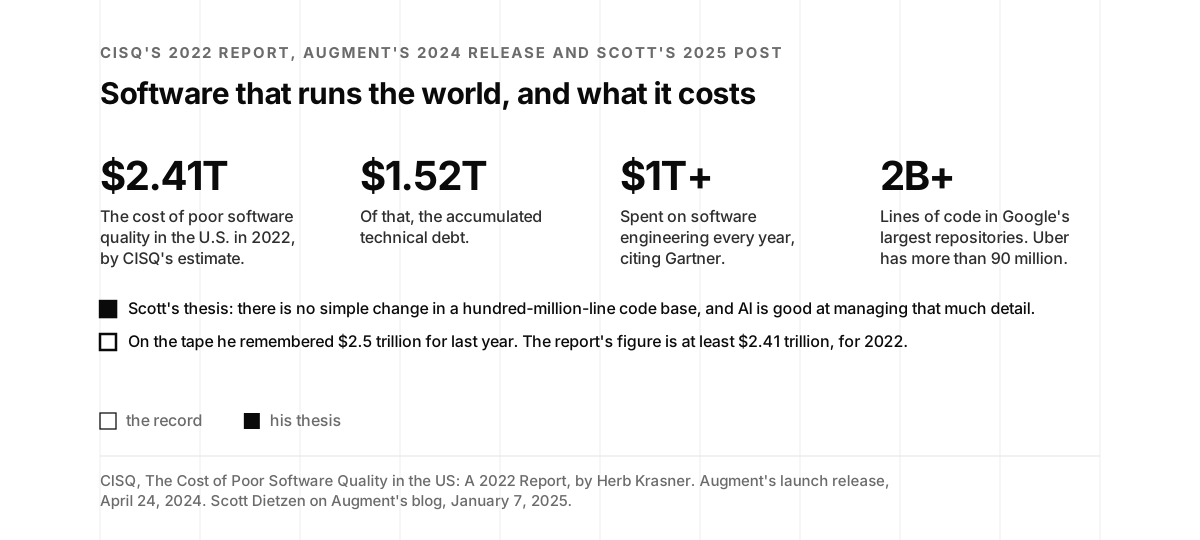
Four numbers. 2.41 trillion dollars, the cost of poor software quality in the U.S. in 2022, by CISQ's estimate. 1.52 trillion dollars of that, the accumulated technical debt. More than 1 trillion dollars spent on software engineering every year, citing Gartner. More than 2 billion lines of code in Google's largest repositories, with more than 90 million at Uber. Below: Scott's thesis, that there is no simple change in a hundred-million-line code base and AI is good at managing that much detail, and a note that he remembered 2.5 trillion dollars for last year on the tape, while the report's figure is at least 2.41 trillion dollars, for 2022.
The size of the problem Augment was built for. Sources: CISQ's 2022 report, Augment's April 2024 launch release and Scott's January 2025 post.

I tried to say it back to him in one sentence, “The anti-vibe coding co-conspirator for all engineers everywhere working on, like, ugly, large, legacy code bases connected to big enterprise systems.” He took it. “That’s it. In a nutshell.”

A tech lead for a team of agents

Then I asked where Augment was on its journey, and his answer was the year’s big change.

“So, the big disruption that’s happened over the course of this year is agents.”

Scott Dietzen, at 2:37

The best developers, he said, are already ready for it: “the most sophisticated developers are already very comfortable in that kind of role, because they do it today for humans.” A tech lead hands out tasks, checks the work and keeps the design in their head. With agents, the same person can have “a suite of agents at your beck and call” for the less fun, more tedious work, “and being able to tee up a bunch of them in parallel and then check on their work.” He wrote the same promise into Augment’s agent launch post that May, that agents would “turn every engineer into a tech lead, commanding a team of autonomous AIs,” and named the catch in it too: when agents misunderstand what you meant, fail the task or break existing systems, “they become a liability rather than an asset” (Augment Code).

That is also where the company’s name comes from.

“[We] named the company Augment because we think we are still a long ways from not needing human insight and intellectual guidance to yield ideal results.”

Scott Dietzen, at 2:37

The decisions that stay human, in his list, are the quality of the code, the architectural approach, the data model, the database, which cloud service, whether to go to microservices, and above all checking the results. Augment’s launch release in April 2024 had Dion Almaer, then its vice president of product and a guest on episode 43, say it the same way: “The best software comes from augmenting developers, not replacing them” (Augment Code).

He was bullish on the size of the change, by his own estimate: “we’re no longer talking about 30, 40% improvements, right? We’re talking about 300, 400% productivity improvements with the introduction of agents.” Those are his figures, from Augment’s customers as he saw them, not a study we could check. Sasha added the reading of the name that I’d put on a slide, “It’s the extension of the human force, hence the augmentation of the workforce,” and steered us toward the part nobody talks about, the data that goes into an agent: “It’s important to provide really good data as an input in order to have a good output.”
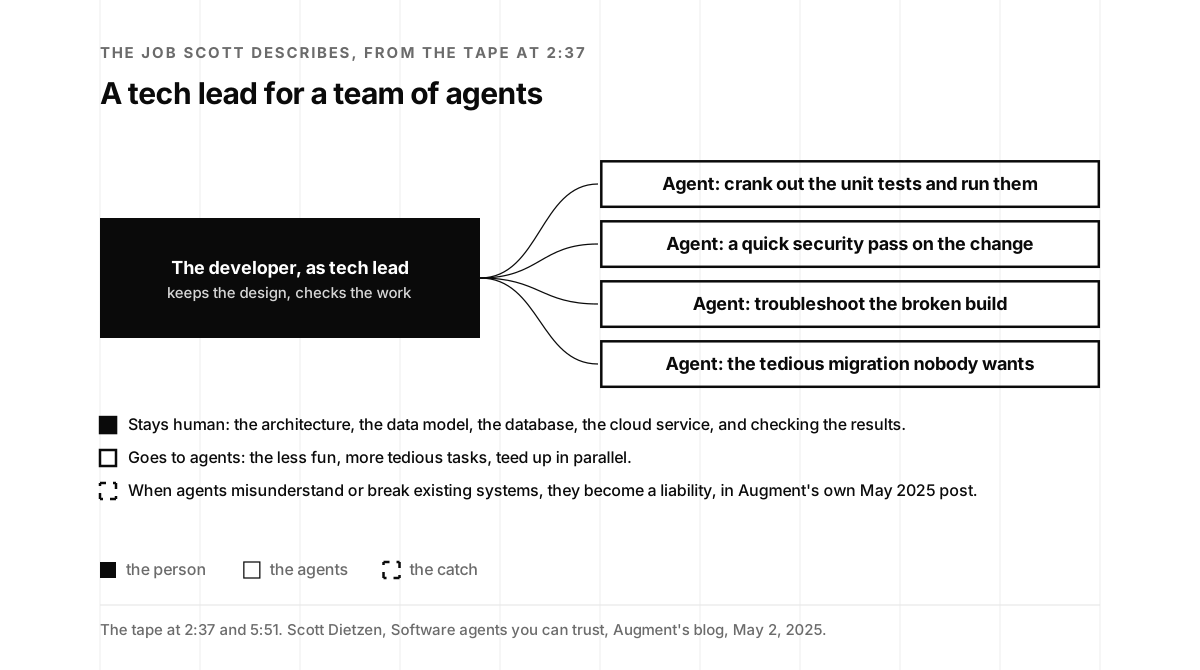
A filled box for the developer as tech lead, who keeps the design and checks the work, connected to four outlined boxes, each an agent with one task: crank out the unit tests and run them, a quick security pass on the change, troubleshoot the broken build, and the tedious migration nobody wants. Below: what stays human, the architecture, the data model, the database, the cloud service and checking the results. What goes to agents, the less fun, more tedious tasks, teed up in parallel. And a caution from Augment's own May 2025 post, that when agents misunderstand or break existing systems they become a liability.
The job he describes: hand out the tedious work in parallel, keep the design decisions, check the results. Sources: the tape at 2:37 and Augment's May 2025 post on agents.

Every step up the abstraction hierarchy

Sasha’s point about data is the one Scott spends the most time on, because it is the one Augment was built on. He walked the history of AI coding tools as a ladder.

“These AI assistants started with code completions, where context was helpful, right? You wanted to reuse code rather than add new code.”

Scott Dietzen, at 4:27

Then chat, where you ask questions about a complex code base. Then next edit.

“Next edit is where the AI watches you make a change and then infers what else you might need to change along that journey.”

Scott Dietzen, at 4:27

Augment shipped Next Edit for VS Code in February 2025, for the change every engineer knows, where one new field means “updating SQL queries, tests, and type definitions to match” all over the code base (Augment Code). Agents are the next rung, and each rung asks for more understanding of the program than the one below.

“Agents need more autonomy, and that autonomy depends on their having knowledge of what’s happening inside the software in order to make the right call.”

Scott Dietzen, at 4:27

His claim is that the years Augment spent on that understanding paid off when agents arrived. He called it the context engine, built “to be able to handle large, complex code bases,” and said it was “now paying us back many times over in the land of agents, where our agents are vastly better than the alternative software engineering agents on the market.” The record has one benchmark from that spring. On March 31, 2025, Augment reported a 65.4 percent success rate on SWE-bench Verified, the top published score for an open-source agent at the time, and open-sourced the approach (Augment Code). Augment Agent itself launched on April 2, built for anything “from a brand new app to a monorepo with over 100k files” (Augment Code).
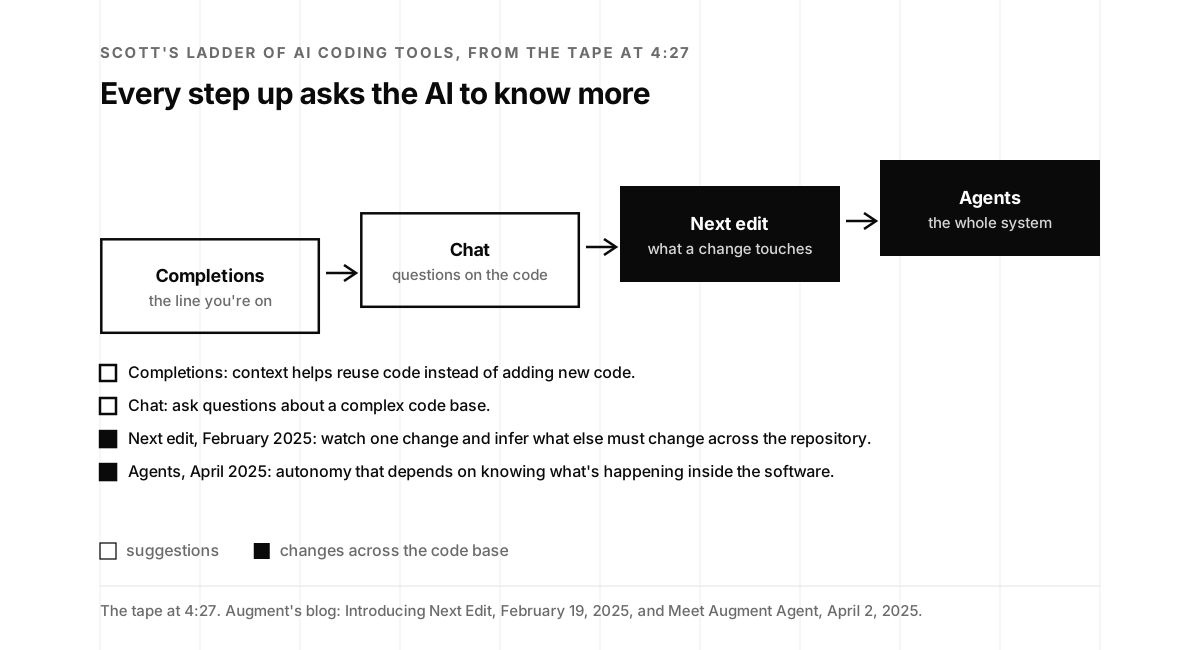
Four boxes rising like stairs from left to right, joined by arrows. Completions, about the line you're on. Chat, about questions on the code. Next edit, filled, about what a change touches. Agents, filled, about the whole system. Below: completions use context to reuse code instead of adding new code. Chat answers questions about a complex code base. Next edit, from February 2025, watches one change and infers what else must change across the repository. Agents, from April 2025, have autonomy that depends on knowing what is happening inside the software.
Each step up asks the AI to know more about the program. Sources: the tape at 4:27 and Augment's posts on Next Edit, SWE-bench Verified and Augment Agent.
Augment's co-founder Guy Gur-Ari plays a new developer on Augment's own code base, from launch day in October 2024, about 6 minutes: exploring the repository, suggested edits, and a change carried across the code. Watch on YouTube.

He finished with the kind of work it frees people from: spec out a new implementation, then “crank me out a bunch of unit tests and run them,” do “a quick security pass,” and when something breaks in the build pipeline, “you can have an agent troubleshoot it, so that humans don’t have to go through a lot of the manual, tedious work.”

Chat with the code base

Security was my way in. When we run a red team exercise or a penetration test, we always ask for the code.

“What we’ve seen is, like, during a red team exercise or a penetration exercise, we always prefer to give those white hat hackers access to the code base of whatever it is that they’re looking at.”

Jon McLachlan, at 6:23

Static analysis tools are part of that, and “Augment is certainly not a replacement for those things,” I said. But with an AI that understands the whole code base in the mix, a tester can ask for a very high-level, very detailed read of it and check for “paradigms that seem a little bit fishy or that might be able to be exploited.” Even before any agent does anything, the reconnaissance gets better: you can chat with the code base.

Scott took it somewhere broader. Most of the talk about coding AI is about productivity, he said, and “I don’t think we focus nearly enough on higher quality, more feature-rich software that results, right?” Then he named what is new for security.

“These large language models, they’re not deterministic. So, you know, we can’t necessarily test all the code paths and know where the vulnerabilities are. And we can’t try every possible prompt and know how the LLM is going to behave.”

Scott Dietzen, at 7:20

So, in his view, the defense has to use the same tools, to “further harden our applications against new security vulnerabilities that are going to come as just an inherent result of AI being an integral part of the software system.” He had a line for the security leaders listening, “CISOs everywhere are going to be challenged to make sure that these new systems are secured,” and a reminder that “attackers may bring AI to bear in trying to hack into our systems. So we’ve got to do, you know, a better job of defense than we ever have.”

Augment's own demo from October 2024, about 3 minutes: authentication and authorization added across an app, routes secured, and best practices enforced with the AI's help. Watch on YouTube.

This is the side of the conversation I’d underline for a startup. The same understanding that lets an agent change a hundred-million-line code base lets a tester read it, which means your code review, your penetration test and your threat model can all go faster and deeper. Our AI penetration testing guide has the practical version, and episode 84 with Jack Cable is about what gets missed when nobody reviews the code.

Proof points, attestation points

I congratulated him on the certifications, and I should say what I knew.

“As I understand it, Augment was the first coding platform to achieve SOC 2 Type 2 out there, and that was last year. And then this year, the very first coding platform to achieve ISO 42001 certification.”

Jon McLachlan, at 8:34

The record agrees on the dates and uses the company’s own words for the firsts. Augment received its SOC 2 Type II attestation on July 10, 2024, after an audit window from April 1 to July 1 “during which we did not have a single issue,” as Scott wrote that September (Augment Code), and Augment’s ISO post calls it the first dev tool to reach that standard (Augment Code). ISO/IEC 42001, the standard for an AI management system, followed on May 29, 2025, certified by Coalfire, whose release was headlined as the first for an AI coding assistant (Coalfire). We ran both programs, and the case studies are public: SOC 2 Type 2 in five months and ISO 42001 in 93 days.

Scott didn’t take the credit for the paperwork. He took it for the years before.

“I see the certifications as recognition of work that’s been going on for a very long time.”

Scott Dietzen, at 9:16

The company came together, he said, with a strong AI research team from places like Google, Meta and NVIDIA and “an extremely strong systems team, people that helped design Snowflake, that helped design Databricks.” Customers were trusting Augment with their software, so it needed “a very mature attitude about what it was going to take to build a highly secured cloud service” from the start. Being first, in his words, “with each of those proof points, attestation points along the way,” was a sign of how security was designed in rather than added. It is the same lesson episode 77 with Augment’s founding engineer Dirk Meister tells from the inside, and the reason the audits were quick: the controls were already in the system.

No way for intellectual property to leak

Sasha asked the question every buyer of these tools asks first.

“What is the most common question that you hear from the prospects and customers around data privacy, especially and explicitly their source code?”

Sasha Sinkevich, at 10:18

Customers want state-of-the-art protection, Scott said, and something simpler under it.

“They want to understand that there’s no way for intellectual property to leak.”

Scott Dietzen, at 10:26

He drew the ethical line in two steps. Defaulting a customer into sharing code for training at least implies the vendor uses it internally. Turning around and selling that code to a third party for training is the step he called “a very unethical behavior,” and he said Augment had heard reports from model providers that some competitors were doing it. We couldn’t verify that, so we’ll leave the who out. His rule needs no names: never take on any behavior “where somebody’s proprietary IP is crossing a boundary into another organization without their knowledge.”

Four days after his post on agents, he turned the rule into four questions anyone can ask a vendor, in a May 2025 post titled “4 Essential data questions for your AI coding platform” (Augment Code). Augment posted them as a thread the same day.

The four questions, as Augment posted them. The fourth is the one most teams forget, because one engineer's checkbox can opt the whole code base in. View on X.

The post publishes Augment’s own answers, no, yes, no and yes, and then gives the advice I’d give any founder, “We strongly recommend getting these answers in writing,” before any AI indexes your code. Behind the questions it lists what a buyer should expect to see, a contract that rules out training and retention, SOC 2 and ISO 27001 audits, indemnification for your IP and proof of possession, and it borrows an old idea about software, core and context. Core is the code with “unique, material value,” the trade secrets and patented algorithms. Context is everything around it. A company might happily trade context code for a better model, the post says, but in practice there’s no clean way to separate the two, so the safe default is to protect it all, and to try a new tool on lower-risk code bases first.
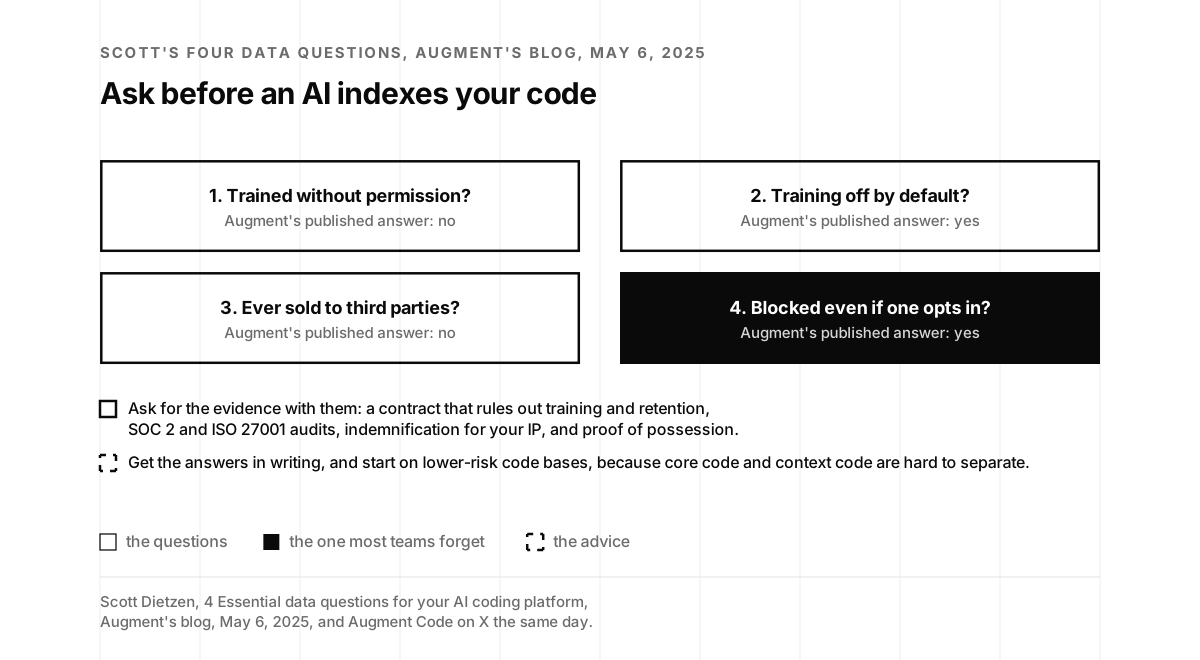
Four boxes in a grid, one per question, each with Augment's published answer. One, have you ever trained models on my software without permission, answer no. Two, is training on our code off by default, answer yes. Three, have you ever sold our data to third parties for training, answer no. Four, filled, can you keep our code from being shared even if one engineer opts in by mistake, answer yes. Below: ask for the evidence with them, a contract that rules out training and retention, SOC 2 and ISO 27001 audits, indemnification for your IP, and proof of possession. Get the answers in writing, and start on lower-risk code bases, because core code and context code are hard to separate.
Four questions to ask before an AI indexes your code, and the evidence to ask for with them. Source: Scott's May 2025 post on Augment's blog.

The scorecard further down turns those questions and four more into a score for the assistant your team uses today.

Data is the new gold standard

Sasha had the one-line version of why vendors want the code.

“At this point, it’s pretty clear that data is the new oil. All of the models that are available on the market have been trained on all of the publicly available information. And at this point, data is the new gold standard.”

Sasha Sinkevich, at 11:20

Scott agreed and went to the question underneath it.

“Yeah, I think the open question is, are models going to start to plateau because we’ve tapped all of the publicly available software data in the world?”

Scott Dietzen, at 11:35

There weren’t real algorithmic or compute advantages between the large model providers, in his view, so data was the difference. Synthetic data could help, but only with “really strong evaluation functions,” and software doesn’t have one built in. His comparison was Go: the space of program designs is like the space of Go strategies, “But with Go, there’s an outcome that you see, whether you win or lost the game. We don’t necessarily have that with software.” He expected the progress to continue “through next year” and wondered whether it would flatten after that.

He had made the same bet in public that February, in six predictions for 2025. The first was that the moat around large language models would shrink and value would move to applications. The second was that enterprises would invest in specialized models as the general ones level off, “as the curve inevitably flattens” (Augment Code). For a security team the practical reading is the same either way. If data is the gold, your code is part of the vault, and the four questions above are the lock.

Don’t disrupt the developer

Sasha asked what matters most for winning over the people who use the tool, the developers with “a lot of pain points” and “a lot of tickets.” Scott had two answers. The first was about where the product lives.

“One, I think it starts with, don’t disrupt the developer unduly. So we have structured our product as a plug-in to their existing development environment.”

Scott Dietzen, at 13:03

If a developer is on VS Code “in the Microsoft ecosystem with the Microsoft marketplace and all the Microsoft security and support,” Augment keeps all of that. The second answer was context again, with the sharpest version of the anti-vibe coding line.

“Without context, it’s all you can do is vibe code. With context, then the engineer has a true partner.”

Scott Dietzen, at 13:03

An AI with context “may understand the code base better than that engineer does,” he said, and that is the difference between an AI for software engineering and the tools that only cut it for new projects started from scratch.

Meeting developers where they work goes past the editor, too. Scott’s January 2025 post argued that software development happens beyond the IDE and described engineers pulling Augment into a Slack thread about an error message, where it answered from the code base and suggested the fix (Augment Code).

Augment in Slack, from launch day in October 2024, about 2 minutes: questions about how a system works, answered from the code base, without pulling an engineer off their work. Watch on YouTube.

It basically puts you in the IDE business

The plug-in choice had a security story, and I couldn’t resist telling mine. When I first saw other AI coding platforms fork VS Code, one word came to mind.

“I think the word that came to mind when I saw that was, whoops.”

Jon McLachlan, at 14:01

A fork starts easy, I said, and then it diverges, and keeping up with Microsoft’s changes and your own engineers’ at the same time “just becomes more and more challenging as time goes forward.” Scott put it in one sentence.

“Agreed. I mean, it basically puts you in the IDE business.”

Scott Dietzen, at 14:33

Listen · Scott on episode 74, from 14:33
About 15 seconds: the team that builds VS Code is bigger than most AI coding startups. The clip stops on its own.

The team behind VS Code, he said, “is not small,” larger than most AI coding startups’ entire staffs, and keeping a fork current with what Microsoft and JetBrains ship is “going to be very painful over time.” He had argued the whole case in March 2025, in a post titled “To fork or not to fork?” (Augment Code). GitHub Copilot and Augment are plug-ins inside the standard IDEs, VS Code, the JetBrains family and Vim, while two of Augment’s best-known competitors had modified VS Code’s source instead. A fork, in his list, costs its users a switch of IDE, Microsoft’s support, the plug-ins Microsoft licenses and certifies, the shared marketplace and timely access to new VS Code features. He gave the forks their due too, a head start in the market while Augment perfected a harder-to-build plug-in, and noted with a wink that one of those forked editors was among Augment’s most popular places to try the plug-in.

Sasha added the attacker’s view, which is the one I’d keep.

“When you fork something and you cannot keep up with the maintenance of the project, there is an exposure.”

Sasha Sinkevich, at 14:59

AI tools help red teams and would-be red teams find vulnerabilities much faster, he said, so a project that falls behind its upstream invites “a little bit more discovery activities by members of society.” Scott closed it with the reason most enterprises pick an ecosystem in the first place: “Microsoft has a large security team that does due diligence on their software, and that’s why people opt into the Microsoft ecosystem.”
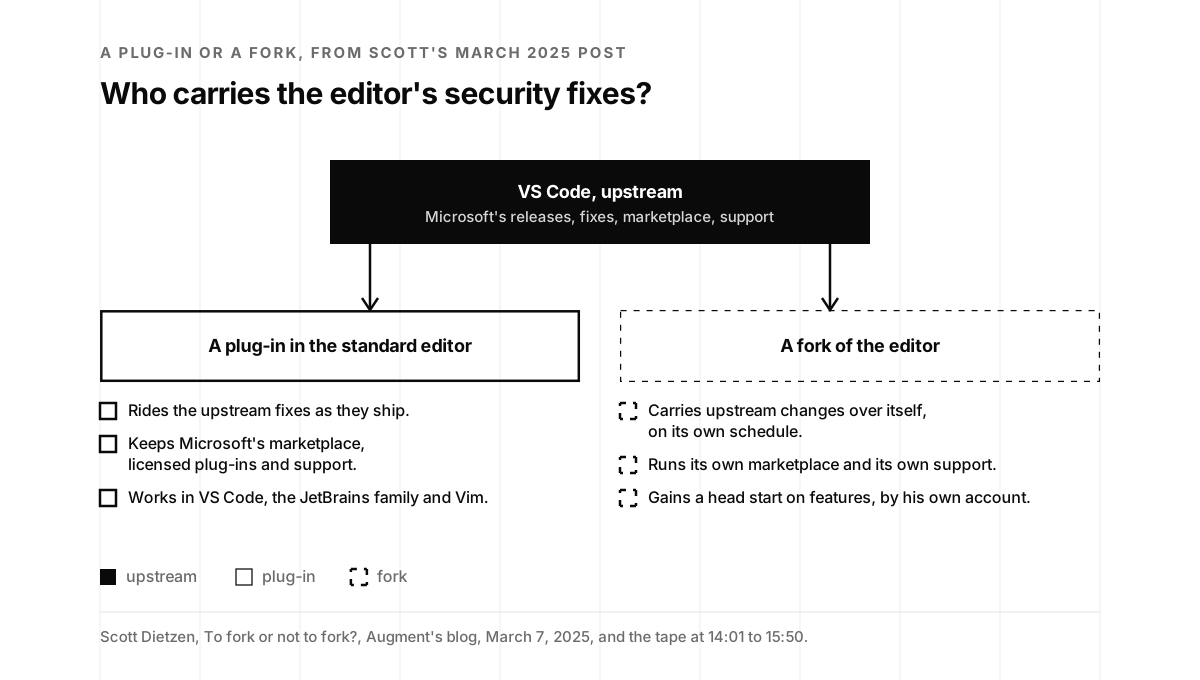
A filled box at the top for VS Code upstream, with Microsoft's releases, fixes, marketplace and support, and two arrows down. On the left, outlined, a plug-in in the standard editor, which rides the upstream fixes as they ship, keeps Microsoft's marketplace, licensed plug-ins and support, and works in VS Code, the JetBrains family and Vim. On the right, dashed, a fork of the editor, which carries upstream changes over itself on its own schedule, runs its own marketplace and support, and gains a head start on features, by Scott's own account.
A plug-in rides the upstream editor's fixes. A fork has to carry them over itself. Sources: Scott's March 2025 post and the tape at 14:01 to 15:50.

The useful question for your own team is not which tool to buy. It’s how your editor gets its security fixes, and how quickly. If the answer is whenever the vendor gets around to it, that belongs in your risk register next to the four data questions.

It needs to be easy to adopt

I thanked him for taking security seriously, because the thing I care about most as an entrepreneur is getting new technology into people’s hands, and “it needs to be easy to adopt.” He had learned that the hard way.

“I think all new tech has got to be easy to adopt. This is one of the lessons I learned early in my career, with some software that was very hard to use and wasn’t necessarily robust.”

Scott Dietzen, at 16:27

He came out of graduate school “very naive about how easy and reliable commercial software had to be,” and he has carried the lesson to every company since: “it’s got to be unbelievably easy, or you’ll never get the mass adoption that we startups aspire to.” Security is part of easy. A control nobody can live with gets turned off, and a plug-in that keeps the editor a developer already trusts is security a team will actually keep.

Do you already have that data?

There was one design I wanted listeners to hear about, because it could only have been built in on day zero. Augment’s retrieval asks a different question before it shows anyone a piece of code.

“The answer to the question, are you allowed to see this piece of data, is actually driven by the answer to the question, do you already have that data?”

Jon McLachlan, at 16:57

If you already have the file, of course you’re authorized to see it. That is proof of possession, and it “solves tons of engineering questions,” like how to deduplicate what the whole team shares, while keeping what only one engineer has out of everyone else’s results. Scott named the risk it answers, and it’s one most buyers haven’t thought about.

“And people don’t realize that AI can be a way for intellectual property to leak. And so if the AI I’m working with is informed by code that I’m not allowed to see, all of a sudden I get insight into algorithms that I’m not supposed to be privy to.”

Scott Dietzen, at 17:51

Listen · Scott on episode 74, from 17:51
About 16 seconds: how an AI can leak the algorithms you were never allowed to see. The clip stops on its own.

The design is written up in public. Augment’s January 2025 post on its real-time index, by Dirk Meister and Markus Rabe, has the editor prove it holds a file by sending a cryptographic hash of its contents (Augment Code), and Scott’s May post lists proof of possession among the basics, “so the AI cannot inadvertently share your most secure code.” Dirk walks through it on episode 77, including why a stolen token reaches the service but not the code. For any assistant you evaluate, the question to ask is the same one: when it retrieves code to answer someone, does it check that this person could already see that code?

Going well faster than that

Sasha brought a prediction to test.

“That’s right. There is an interesting study that predicts that about 50% of all of the enterprise software engineers will use ML-powered coding tools by 2027.”

Sasha Sinkevich, at 18:18

The study is a Gartner prediction, and Augment’s own launch release in April 2024 quoted it: “by 2027, 50% of enterprise software engineers will use ML-powered coding tools” (Augment Code). Gartner had a newer forecast by then. On April 11, 2024 it said that by 2028, 75 percent of enterprise software engineers would use AI code assistants, up from less than 10 percent in early 2023, and that 63 percent of organizations were already piloting, deploying or running them (Gartner). Scott’s answer was shorter.

“I think it’s going well faster than that.”

Scott Dietzen, at 18:41

A survey from the same year backs him. In Stack Overflow’s 2025 Developer Survey, with more than 49,000 responses from 177 countries, 84 percent of respondents were using or planning to use AI tools in their development process, up from 76 percent the year before, and 51 percent of professional developers used them every day (Stack Overflow). The same survey has the reason the tech lead’s review still matters: the most experienced developers were the most cautious, with the lowest rate of high trust in AI output, 2.6 percent, and the highest rate of high distrust, 20 percent.
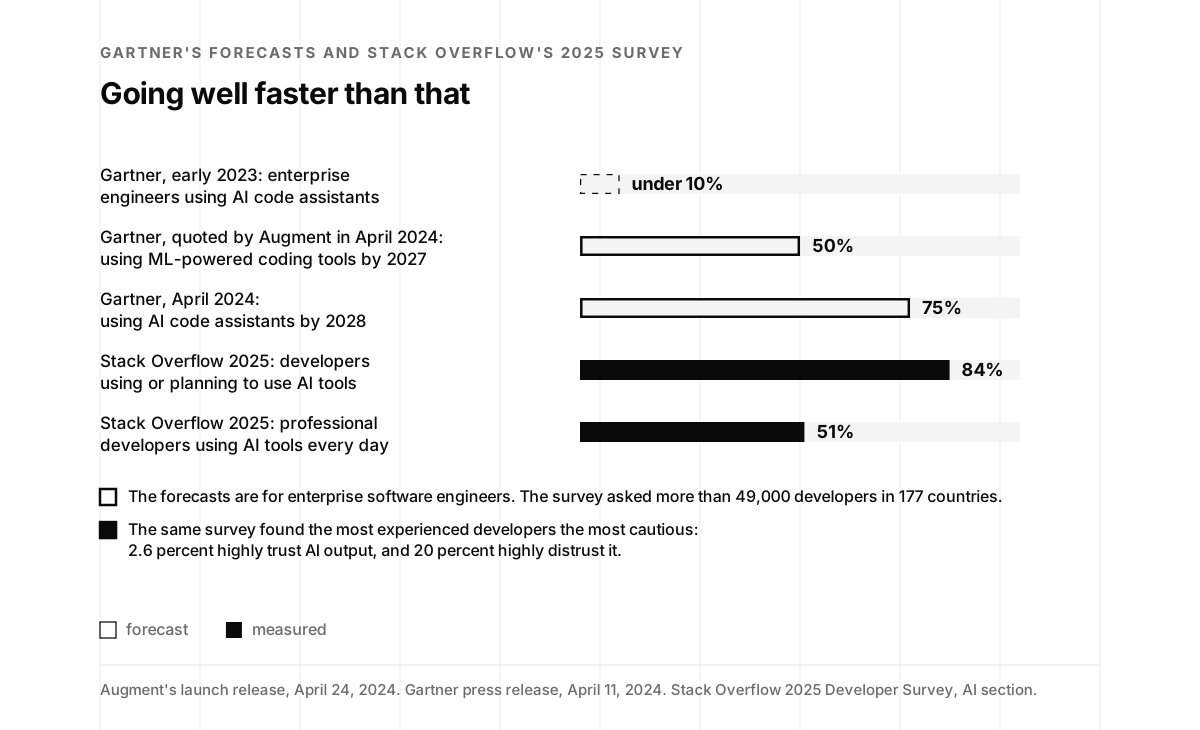
Five bars. Gartner, early 2023, under 10 percent of enterprise engineers using AI code assistants. Gartner, quoted by Augment in April 2024, 50 percent using ML-powered coding tools by 2027. Gartner, April 2024, 75 percent using AI code assistants by 2028. Stack Overflow 2025, 84 percent of developers using or planning to use AI tools. Stack Overflow 2025, 51 percent of professional developers using AI tools every day. Below: the forecasts are for enterprise software engineers, and the survey asked more than 49,000 developers in 177 countries. The same survey found the most experienced developers the most cautious, with 2.6 percent highly trusting AI output and 20 percent highly distrusting it.
The forecasts, and where developers already were in 2025. Sources: Gartner via Augment's April 2024 release, Gartner's April 2024 forecast and Stack Overflow's 2025 Developer Survey.

His own numbers are from Augment’s customers and are his account: 40, 50 and 60 percent productivity gains in the early days, which he dated to about nine months before we recorded, and “two, three X kinds of improvements” with agents, with the best developers getting the most out of it. The public record has one customer’s number from the launch, a chief executive quoted at “a >40% increase in developer productivity across the board” (Augment Code). The part of his answer I’d frame is where the gains go. Every piece of software has a wish list of architecture work, debt, features and security fixes.

“What if we could pay that all down? What if we could deliver, you know, all the software we aspire to?”

Scott Dietzen, at 18:41

The security fixes are on that list. A team that pays its backlog down with agents can finally get to the vulnerability tickets that have been waiting since the last penetration test.

A first seven-figure deal

I asked for his proudest day so far at Augment. He couldn’t pick one.

“I can’t point to one single day. There’s been a bunch of customer victories. Our first six-figure deal, our first seven-figure deal, those are natural milestones.”

Scott Dietzen, at 20:14

The one he chose was self-service: “getting the product to the point where we were comfortable that every developer that wanted to try it in the world would have a good experience.” That is a quality bar before it is a sales channel. Augment Code launched for teams on October 24, 2024 (Augment Code), the “nine months ago” he kept coming back to, and by April 2025 anyone could start a free trial of its agent (Augment Code). It also fits the lesson from his grad school days. Software that anyone can try has to work for anyone who tries it.

Agents that wake up

Then I asked what success looks like, as far out as he wanted to look. The first answer was the market he’d always named: to be “the leading product for real software engineers,” the people looking after “the tens of millions of lines existing production code bases.” The second was bigger, and he was careful about one word in it.

“You know, we see agents as being able to help automate the full software development lifecycle, not unassisted, right? So our vision is that it is the combination of human intellect and agent, machine intellect.”

Scott Dietzen, at 21:02

Developers do a lot more than write code, so the agents have to help “all the way along the journey.” Then he described the agents I think most teams will meet first, the ones that don’t wait to be asked.

“Like, there’ll be agents that wake up in the event of a site failure or a break in [a] CI/CD pipeline. Agents can be, or a security attack, right? The agents can wake up and start doing work”

Scott Dietzen, at 21:02

Listen · Scott on episode 74, from 21:54
About 24 seconds: agents that live in the cloud, wake up when something breaks and report what they found. The clip stops on its own.

They report back on what happened and what they recommend. Augment had started down that road that spring. Its Remote Agent, announced on May 7, 2025, ran the agent in the cloud to work through “we’ll-get-to-it” tickets in parallel (Augment Code), and on June 5 it was generally available in VS Code, letting engineers “run multiple development tasks concurrently in the cloud” (Augment Code). The security version of his picture is worth writing down before it arrives. An agent that wakes up during an attack needs to know what it may touch, who it reports to and when it must stop and ask, and those answers belong to people, written before the night it wakes up.

The anti-vibe coding case from one of Augment's backers. Eric Schmidt, Google's former chief executive, is a founding partner of Innovation Endeavors, which invested in Augment's Series B. View on X.

He also put a number on how fast the agents were growing up.

“Six months ago, you would struggle to have an agent do something that took you 10, 15 minutes. Now I think an agent could take on an hour, 90-minute kind of task.”

Scott Dietzen, at 21:02

Next year, he hoped, “that doubles and doubles again.” That is faster than the best public measurement, though not by much on recent models. METR, the research group that measures how long a task AI agents can finish, found in March 2025 that the length of task frontier agents complete with 50 percent reliability had been doubling about every seven months for six years, and faster than that when it fit only the 2024 and 2025 models (METR). Fifteen minutes to an hour or more in six months is two doublings, which is his account of Augment’s agents rather than METR’s average. The calculator further down runs the same curve on your numbers.
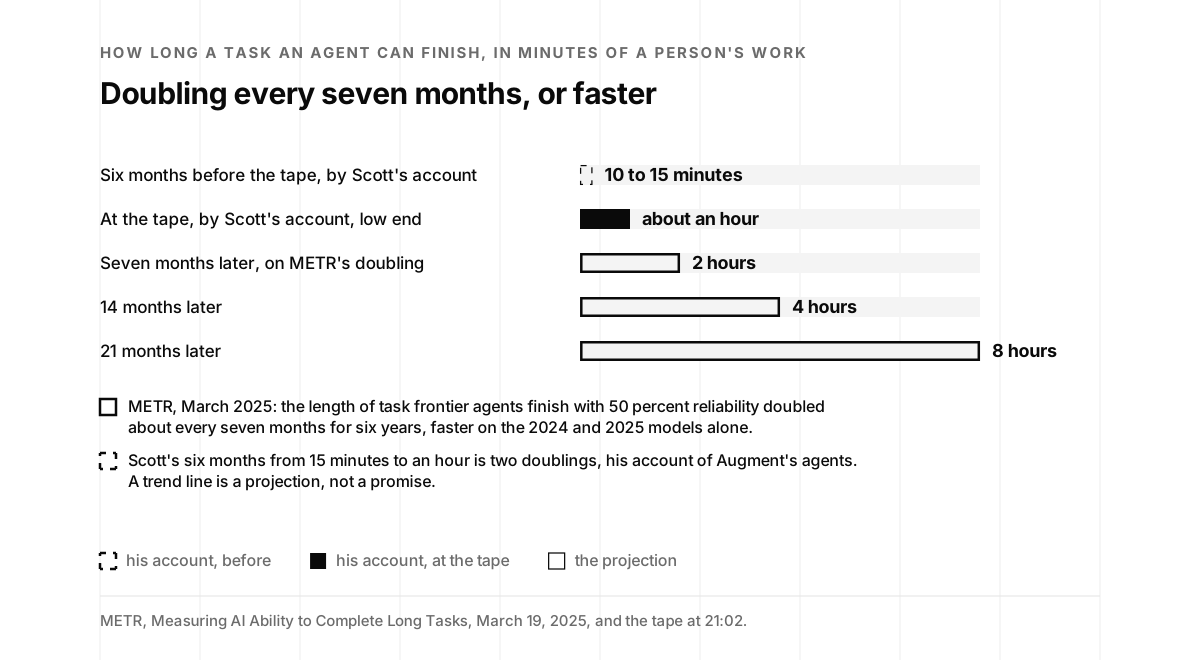
Five bars for the length of task an agent can finish, in minutes of a person's work. Six months before the tape, by Scott's account, 10 to 15 minutes. At the tape, by his account at the low end, about an hour. Seven months later on METR's doubling, 2 hours. 14 months later, 4 hours. 21 months later, 8 hours. Below: METR found in March 2025 that the length of task frontier agents finish with 50 percent reliability doubled about every seven months for six years, faster on the 2024 and 2025 models alone. Scott's six months from 15 minutes to an hour is two doublings, his account of Augment's agents, and a trend line is a projection, not a promise.
How long a task an agent can take on, on METR's seven-month doubling and on Scott's six months. Sources: METR, March 2025, and the tape at 21:02.

The last part of his answer is the one I’d send to every board that asks how many engineers AI will let them cut.

“These businesses that use this as sort of a private equity [play] to cut their teams and do the same work with fewer are missing a colossal opportunity”

Scott Dietzen, at 21:02

Every software-dependent business he knows could grow substantially with better software, and “the software abundance opportunity” is what he called the investment thesis. He’d made the same prediction in February, that “Coding AIs increase demand for software engineers” (Augment Code), and in January he argued that once AI makes software investment predictable, companies will spend more on it, not less (Augment Code).

The context costs the square of its length

Sasha came back to the context engine, and how much the quality of what goes in decides what comes out. Scott explained why Augment built one instead of taking either of the shortcuts of the time.

“Yes, you know, there were naive approaches where some people thought they would fine-tune these models on company software.”

Scott Dietzen, at 24:02

Fine-tuning a model on a company’s code has two problems in his telling. People get nervous about leaking IP, and, “much more so,” the code changes constantly while training is expensive. Nobody is going to train a new model every time someone pulls a branch, and “You want your AI to be current.” The other shortcut was to pass the whole code base to a model with a very long context window.

“You know, these models, of course, the context costs the square of its length. And so any notion of passing in that much context is ludicrous. It will be horrifically slow.”

Scott Dietzen, at 24:02

The square is the attention mechanism inside a transformer, which compares every token with every other, so doubling the context roughly quadruples the work. His human analogy is the better argument. If you had read a hundred-million-line code base and then got asked random questions about it, “you would have to refer back,” and so do the models. Hence retrieval: find the right few pieces of the code for each question and pass those. He had predicted in February that retrieval would beat fine-tuning (Augment Code), and in June Augment published how it kept retrieval fast on code bases of more than 100 million lines, an approximate search that keeps “more than 99.9% fidelity” to the exact results and made real-time features like completions more than 40 percent faster on its hardest cases (Augment Code).

Retrieval is also where the security lives. Whatever decides which pieces of code reach the model also decides what one user’s question can expose, which is why the possession check from earlier sits in the same pipe.

Metaprogramming

I asked what stands between here and his future. “Truthfully, there’s a lot of developer education that still needs to happen,” he said. The most forward-leaning developers were having huge success, and the rest of the market hadn’t seen yet how capable the tools were. The biggest change was in how the best of them worked.

“Many of the developers on Augment have moved to what I call metaprogramming, where they don’t necessarily directly manipulate the code themselves anymore. They count on the AI to do it for them.”

Scott Dietzen, at 25:34

They spec out to the AI what they want, let it generate the code, look at it and tweak it, all through the AI. It is a different paradigm, and some developers have to watch a colleague do it before it clicks, which is where he reached for an old line.

“And so there’s that old quote: the future is already here, but it’s not evenly distributed.”

Scott Dietzen, at 25:34

The quote is usually credited to the science fiction writer William Gibson, and Quote Investigator traces the earliest full version in print to a 1992 newspaper article that attributed it to him (Quote Investigator). Scott had written the same split into his February predictions, that AI-augmented engineers “will toggle between programming and meta-programming” (Augment Code).

Sasha had the picture for it: “So instead of molding and building a Lego piece, you can actually build a whole model out of many Legos.” Scott made it a ship.

“Yes. And do it in parallel, right? You can have one agent work on, whatever, the hull to your ocean liner, and others could start building the cabin and the engine and the propellers.”

Scott Dietzen, at 27:02

Seeing how the pieces fit together is still human insight, he said. Programming is tedious because computers need an extremely precise description of what you want, and most programs have no specification apart from themselves: “The spec is the software itself.” An AI that can read that specification and help evolve it is “incredibly powerful.” For security, the spec point is the one to keep. If the code is the only specification, then the security requirements had better be written somewhere an agent will read them, in the repository, next to the code.

The biggest productivity unlock

Sasha put it in the history of programming. Everyone used to work at the level of the compiler, then Java promised one language that could run everywhere, and now we’re “moving up another stack, where you can speak the human language.” Scott has been around for most of that climb.

“Yes, I’ve been around long enough that I’ve, you know, I wrote some BLISS and some machine code early on.”

Scott Dietzen, at 28:19

BLISS is a systems programming language built at Carnegie Mellon around 1970, by W. A. Wulf, D. B. Russell and A. N. Habermann, and perhaps the best-known systems language until C took over (Wikipedia). He’s a believer in the third- and fourth-generation languages, and he ranked the newest step above all of them.

“But I do think AI is the biggest productivity unlock that we will see in this industry, you know, throughout its entire history. And it may be the last one that we need in terms of improving how we get software into the world.”

Scott Dietzen, at 28:19

He made the comparison in writing in August 2024, when he predicted that the next decade would see the biggest leap in software quality and team productivity “since the advent of high-level languages” (Augment Code).

Testing was what users were for

Students ask me what to study now, so I asked him for advice for young engineers facing all this change early in their careers. He started with a belief.

“I am still a big believer in human intelligence and the role that human insight has in complementing machine intelligence.”

Scott Dietzen, at 29:23

He gave a talk at his alma mater about 12 years before, he said, when the big worry was that all the interesting work in computer science had been done, “And I just found that, like, to be the most preposterous statement.” Then he told the story of his own career as a lesson in how hard software is.

“Augment is the fifth startup that I’ve gotten to be part of. All of them depended on large-scale software. And the first four, horrific pain.”

Scott Dietzen, at 29:23

He hadn’t understood, before the real world, how hard it is to make software “reliable enough, easy to use enough, secure enough,” and he named the reason.

“You know, I had come out of a grad school where testing was what users were for, not something that we had to do in advance.”

Scott Dietzen, at 29:23

Listen · Scott on episode 74, from 30:19
About 15 seconds: the grad school lesson that he says cost him four startups of pain. The clip stops on its own.

The rest of his path is in his own August 2024 post. He spent “a decade at CMU collecting degrees,” with Geoffrey Hinton teaching his introductory AI class and a front row seat for the old debates between symbolic reasoning and neural networks, and wrote “a dissertation on a programming language theoretic approach to machine learning” (Augment Code). On the tape he called it “a thesis in machine learning, albeit a long time ago,” and said the fun of Augment is seeing that thread and large-scale software finally meet. After Pure Storage he wasn’t sure he’d work again. Augment’s early team invited him into their research sessions while he was “on the beach,” as he put it in the post, and he joined in early 2023.

“I had a major fear of missing out in terms of these two threads, machine learning and large-scale software, coming together.”

Scott Dietzen, at 29:23

For a student, I’d take two things from that. The interesting work is never done, and the discipline that will matter most is the one he learned last, making software reliable and secure before a user finds out it isn’t.
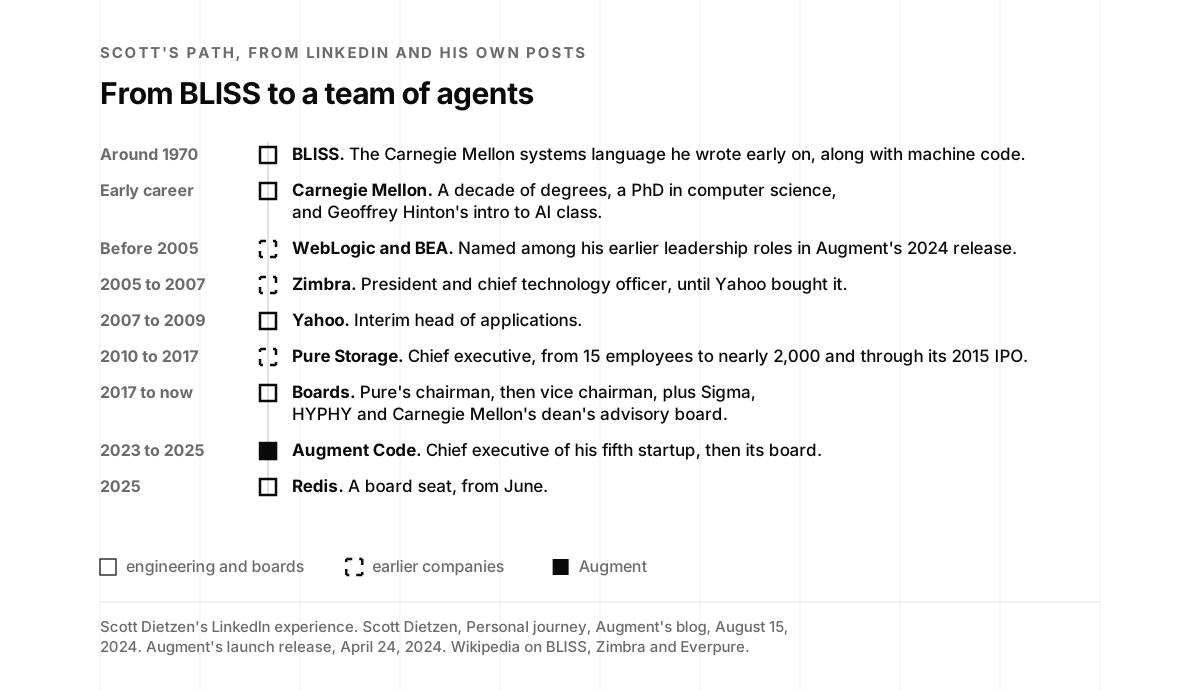
A timeline of nine entries. Around 1970, BLISS, the Carnegie Mellon systems language he wrote early on, along with machine code. Early career, Carnegie Mellon, a decade of degrees, a PhD in computer science and Geoffrey Hinton's intro to AI class. Before 2005, WebLogic and BEA, named among his earlier leadership roles in Augment's 2024 release. 2005 to 2007, Zimbra, president and chief technology officer until Yahoo bought it. 2007 to 2009, Yahoo, interim head of applications. 2010 to 2017, Pure Storage, chief executive, from 15 employees to nearly 2,000 and through its 2015 IPO. 2017 to now, boards, Pure's chairman then vice chairman, plus Sigma, HYPHY and Carnegie Mellon's dean's advisory board. 2023 to 2025, Augment Code, chief executive of his fifth startup, then its board. 2025, Redis, a board seat from June.
Five startups, by his count, and the boards since. Sources: Scott's LinkedIn, his August 2024 post, Augment's April 2024 release and Wikipedia.

Trust your instincts

I asked what he’d tell his younger self. The first lesson was the one from his first startup.

“At the first startup, I learned how hard it is to make software commercially viable. You know, to get mass adoption, software has to be really easy, and it has to not break and do things wrong.”

Scott Dietzen, at 31:12

“Ironically, as software ages, it can grow a lot of hair, right?” His example was the Oracle database, painful to adopt today and “incredibly easy to build and deploy” in its early days. Another was Linux.

“I remember sharing with my Windows friends that we had Linux servers that had been up for years and never been rebooted, and they were just like, how is that possible?”

Scott Dietzen, at 31:12

The second lesson was harder to learn. That first startup “went sideways for a while,” with customers but no inflection, and five years in he told his mentor he could see two endings and had missed the third.

“I knew we could hit the moon, I knew we could crash and burn, but I didn’t know we’d be somewhere in between.”

Scott Dietzen, at 31:12

If he had trusted his instincts, he’d have seen sooner that they were missing the target. “And so, trust your instincts. Of course, hone them through hard work and good luck.”

Radical transparency

Sasha asked which lessons he carried into an AI startup, for the team, the culture and the market. “Entrepreneurship is a team sport,” Scott said, and his first rule follows from it: check your ego at the door and avoid politics, because “politics kills organizations.” Keep the team looking outward, at serving customers and winning business, and trust that the pie will be fairly shared. Then two practices I haven’t heard a chief executive describe this plainly.

The first is about pay. At his companies, he said, people are told they don’t need to negotiate their own offers, because a leadership team that works hard to get rewards right shouldn’t reward negotiation. He has heard managers at larger Silicon Valley companies tell an engineer to bring a competing offer before they can give a deserved raise.

“That’s a ludicrous behavior to me, because you should reward people for the quality of their work, not the fact that they could potentially defect somewhere else.”

Scott Dietzen, at 33:02

The second is about information.

“Another thing I like is radical transparency.”

Scott Dietzen, at 33:02

Listen · Scott on episode 74, from 34:26
About 19 seconds: why information passed selectively down the tree becomes a source of power. The clip stops on its own.

When information passes selectively down the tree, it becomes power that can be used politically. So broadcast as much as you can.

“One of the things we do at Augment is we share our board decks with the entire company, as well as the results of the conversations, because we want everyone to have insight into not just what’s going well, but what we need to work on.”

Scott Dietzen, at 33:02

A chief executive who only cheerleads, he said, misses “a huge, huge opportunity.” Sasha connected it to our side of the work: “It’s the internal trust, but internal trust, it transitions into the external trust that is established between the company and customers.” That is the most useful sentence in the episode for a security program. A company that shares bad news inside will report an incident honestly outside, and buyers can tell. Scott agreed, and added the weight of it at Augment’s scale, a challenge “when you’ve got hundreds of thousands of developers using your product all around the world.”

Stone soup

I had a confession to make. I joined Pure Storage after Scott had moved on, “but it stuck,” the culture he left, and it spoils people because it’s so good. He gave the credit away with a folk tale.

“It was very much a team effort, right? I used the stone soup analogy. I didn’t build the Pure culture or define it myself. But I did bring the pot, and I talked about the importance of culture”

Scott Dietzen, at 36:32

In the story, hungry strangers get a whole town to add a little of what it has to a pot of water with a stone in it, and everyone eats (Wikipedia). At Pure, by his telling, everybody showed up and chipped in, “and, you know, we kept the best and shed the rest and ended up with a really good culture.” It is a good model for a security culture too. Nobody can impose one. Someone brings the pot and keeps talking about why it matters, and the team fills it.

We ended on thanks in both directions. “I could not be more thrilled to have YSecurity on this journey with Augment,” he said, which is the disclosure from the top of the page in his words.

What happened after the tape

His LinkedIn has the rest. In June 2025, a few weeks before this episode aired, he joined the board of Redis, part time. His time as Augment’s chief executive ended in July 2025, the month the episode went out, and he has stayed on Augment’s board, alongside seats he already held at HYPHY, as vice chairman of Pure Storage and on the dean’s advisory board of Carnegie Mellon’s School of Computer Science (LinkedIn). His seat on the board of Sigma, the analytics company, ran from March 2018 to May 2026, the month he posted that it had closed an $80 million Series E at a $3 billion valuation (LinkedIn). Pure Storage itself took a new name in February 2026 and is Everpure now (Wikipedia), still with Charles Giancarlo, the chief executive Scott recruited to succeed him in 2017, at its head.

For Augment, the certification he called a proof point became a public one too. On August 5, 2025, a week after the episode, Coalfire announced Augment’s ISO/IEC 42001 certification as a first for an AI coding assistant (Coalfire). And on September 10, 2025, Augment’s founding engineer Dirk Meister came on episode 77 to walk through the architecture Scott keeps pointing at, proof of possession, customer managed keys and access that opens only with a reason. The two episodes are a pair. Scott’s is why the code base is the hard part. Dirk’s is how you keep it safe while an AI reads it, and episode 43, with Evan Driscoll and Dion Almaer in 2024, is where the story starts.
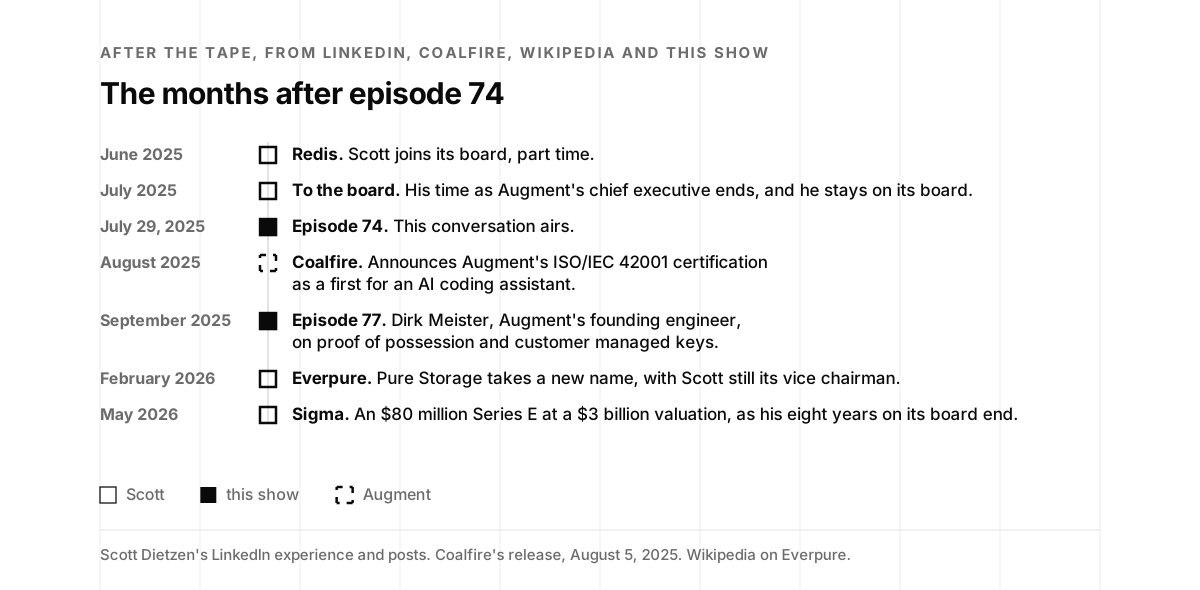
A timeline of seven entries. June 2025, Scott joins the board of Redis, part time. July 2025, his time as Augment's chief executive ends and he stays on its board. July 29, 2025, this conversation airs as episode 74. August 2025, Coalfire announces Augment's ISO/IEC 42001 certification as a first for an AI coding assistant. September 2025, episode 77 with Dirk Meister, Augment's founding engineer, on proof of possession and customer managed keys. February 2026, Pure Storage takes a new name, Everpure, with Scott still its vice chairman. May 2026, Sigma's 80 million dollar Series E at a 3 billion dollar valuation, as his eight years on its board end.
The months after the tape. Sources: Scott's LinkedIn, Coalfire, Wikipedia and this show.

The phrase from this episode I hear founders use most is his first one. A developer as a tech lead for a team of agents is a job with security built into its description: hand out the work, keep the design, and check every result before it ships. The teams that write those checks down now, along with what each agent may touch, are the ones whose buyers will trust their agents later.

Did you catch it? A six-question quiz

Interactive · six questions

Did you catch it?

Six questions on what Scott, Sasha and I actually said, with the timestamp for each answer. The answers are under each question for anyone reading without JavaScript.

  1. How does Scott describe Augment in one line?

    1. The copilot for every developer
    2. The anti-vibe coding company
    3. The IDE built for agents

    b. "You can think of us as the anti-vibe coding company, if you like." Transcript, 0:27.

  2. What does Scott say the developer's role will become?

    1. A reviewer of pull requests written by AI
    2. A prompt engineer
    3. A tech lead for a team of agents

    c. "the role of the developer is going to move to being a tech lead for a team of agents." Transcript, 2:37.

  3. Forking VS Code, in Scott's words, basically puts you in which business?

    1. The IDE business
    2. The marketplace business
    3. The security patch business

    a. "Agreed. I mean, it basically puts you in the IDE business." Transcript, 14:33.

  4. With proof of possession, the question "are you allowed to see this piece of data?" is answered by which question?

    1. Is your manager on the access list?
    2. Do you already have that data?
    3. Did you sign in from a trusted device?

    b. "is actually driven by the answer to the question, do you already have that data?" Transcript, 16:57.

  5. What does Augment share with the entire company, by Scott's account?

    1. Every customer contract
    2. Each engineer's salary
    3. Its board decks, and the results of the conversations

    c. "One of the things we do at Augment is we share our board decks with the entire company, as well as the results of the conversations" Transcript, 33:02.

  6. Which number startup is Augment for Scott?

    1. The fifth
    2. The third
    3. The second

    a. "Augment is the fifth startup that I've gotten to be part of." Transcript, 29:23.

Is your AI coding assistant ready for the code that matters?

Scott’s four data questions are the start of an evaluation, not the end of it. This scorecard asks eight questions about the AI coding assistant your team uses today, from what it may train on to how your editor gets its security fixes and what an agent may do without asking.

Scorecard · eight questions

Is your AI coding assistant ready for the code that matters?

Answer for the assistant or agent your engineers use most, on your most sensitive repository. If two answers fit, pick the lower one.

  1. Has the vendor told you whether it trains models on your code?

    • We haven't asked
    • Yes, on its website or in a sales call
    • Yes, in our contract, with training and retention ruled out

    Scott's first question, and his advice: get the answers in writing. No way for intellectual property to leak has the four.

  2. If one engineer opts in to sharing code for training, what happens?

    • Our code is shared from then on
    • Training is off by default, but each person can turn it on
    • An admin setting blocks it for the whole organization

    The fourth question in Augment's thread, and the one most teams forget.

  3. Has your code, or data about it, ever gone to a third party for training?

    • We don't know
    • The vendor says no
    • The contract says no, and lists every subprocessor that sees our code

    The step Scott called "a very unethical behavior" is the one you can rule out on paper.

  4. When the assistant retrieves code to answer someone, does it check that this person could already see that code?

    • No, or we can't tell
    • It respects repository permissions
    • Yes, with proof of possession or an equal check, file by file

    Otherwise the AI can share "algorithms that I'm not supposed to be privy to." See Do you already have that data?

  5. How does the editor your team uses with it get security fixes?

    • It's a fork, and we don't know how far behind upstream it runs
    • It's a fork that tracks upstream on a published schedule
    • It's a plug-in in a standard editor we already patch

    Sasha's point: "When you fork something and you cannot keep up with the maintenance of the project, there is an exposure."

  6. What can its agent do without asking a person first?

    • Anything the developer can
    • Edit files, but commands and integrations need approval
    • Only what we wrote down for each task, with approval for commands, snapshots to roll back and least-privilege credentials

    Augment's own agent shipped with a manual mode that pauses for approval, and snapshots for one-click rollback.

  7. What evidence have you seen from the vendor?

    • A security page
    • A SOC 2 Type 2 report
    • A SOC 2 Type 2 report, plus ISO 27001 or ISO 42001 and indemnification for our IP

    Scott's May 2025 post lists the same evidence. Read the report's scope, not just its cover.

  8. Where did you start using it?

    • Everywhere at once, including our core code
    • On core code, with a pilot team
    • On lower-risk code bases first, then the core once the answers were in writing

    Core is the code with "unique, material value," in Scott's post. Start everywhere else.

Get the answers in writing first

The assistant may be excellent, and you don't know yet what it does with your code. Start with the paper: send the four questions to your vendor, put the answers in the contract, and turn training off at the organization level. Then check whether retrieval respects who can see what, and keep it on lower-risk code until it does.

Ready for a careful rollout

The data questions are mostly answered. The next layer is the agent: write down what it may do for each kind of task, require approval for commands and integrations, give it credentials scoped to the task, and find out how quickly your editor gets upstream security fixes.

Ready for the code that matters

Your contract, your settings and your vendor's architecture all keep the code where it belongs, and your agents have written limits. Now test it: ask the assistant, as a user without access, about code that user shouldn't see, and write down what came back.

How long a task can your agents take on next year?

Scott’s estimate was that agents went from 10 or 15 minute tasks to an hour or 90 minutes in six months, and he hoped for “doubles and doubles again.” METR measured a doubling about every seven months. This calculator projects the curve forward from where your agents are today, and shows how much review each task will need.

Calculator

How long a task can your agents take on next year?

The longest task, in minutes of a person's work, that your agents finish reliably today, how often that doubles, how far ahead to look, and how many minutes of review a person spends per hour of agent work.

–doublings in that time
–hours of work in one agent task
–times longer than today
–minutes of review per task

If your agents finish 60-minute tasks today and that doubles every 7 months, in 12 months one task is about 3.3 hours of work, 3.3 times longer, and needs about 33 minutes of a person's review at 10 minutes per agent hour.

The seven-month default is METR's March 2025 measurement for frontier agents at 50 percent reliability, which was faster on the 2024 and 2025 models alone. The 60-minute default is the low end of Scott's estimate on the tape, and the review rate is a placeholder for yours. A trend line is not a promise, and longer tasks are where the tech lead's checks matter most.

From BLISS to a team of agents

Everything on this page sits on one timeline, from a systems language at Carnegie Mellon to agents that wake up on their own. Filter it by thread.

Timeline · 1970 to 2026

From BLISS to a team of agents

Filter by thread. Dates are from the public record except where marked as Scott's own account on the tape.

  1. BLISS

    A systems programming language built at Carnegie Mellon, and one Scott wrote early on (Wikipedia).

  2. "The future has arrived"

    The earliest full version in print of the line credited to William Gibson (Quote Investigator).

  3. Zimbra

    President and chief technology officer (LinkedIn).

  4. Yahoo buys Zimbra

    And Scott runs applications at Yahoo until October 2009 (Wikipedia).

  5. Pure Storage

    Chief executive until August 2017, from 15 employees to nearly 2,000 (Augment Code).

  6. The IPO

    Pure Storage lists on the New York Stock Exchange (Wikipedia).

  7. Chairman

    Charles Giancarlo becomes chief executive, and Scott chairs the board, then becomes vice chairman in 2018 (LinkedIn).

  8. $2.41 trillion

    The cost of poor software quality in the U.S., by CISQ's estimate (CISQ).

  9. Augment is founded

    By Igor Ostrovsky and Guy Gur-Ari (Augment Code).

  10. Chief executive

    Scott joins Augment, after sitting in on its research sessions (LinkedIn).

  11. 75 percent by 2028

    Gartner's forecast for AI code assistants, up from less than 10 percent in early 2023 (Gartner).

  12. Out of stealth

    A $227 million Series B at a $977 million valuation, $252 million in all (Augment Code).

  13. Evan Driscoll and Dion Almaer on this show

    Augment's first episode with us (episode 43).

  14. SOC 2 Type II

    After an audit window from April 1 to July 1 (Augment Code).

  15. A personal journey

    Hinton's intro to AI class, a decade at CMU, and an AI that deletes code (Augment Code).

  16. Augment Code launches

    Developer AI for teams, the "nine months ago" on the tape (Augment Code).

  17. No such thing as a simple change

    An Airbus A380, remodeled in flight (Augment Code).

  18. Six predictions

    Retrieval over fine-tuning, metaprogramming and more demand for engineers (Augment Code).

  19. Next Edit

    The ripple effects of a change, across the repository (Augment Code).

  20. To fork or not to fork?

    The case for a plug-in (Augment Code).

  21. A seven-month doubling

    The length of task agents finish, measured over six years (METR).

  22. 65.4 percent

    On SWE-bench Verified, the top published open-source score at the time (Augment Code).

  23. Augment Agent

    From a new app to a monorepo with more than 100,000 files (Augment Code).

  24. Four data questions

    What to ask any AI coding vendor, in writing (Augment Code).

  25. ISO/IEC 42001

    Certified by Coalfire, with YSecurity running the program (Augment Code).

  26. Redis

    A board seat, part time (LinkedIn).

  27. Remote Agents

    Generally available in VS Code, many tasks at once in the cloud (Augment Code).

  28. 100 million lines

    Retrieval more than 40 percent faster on the largest code bases (Augment Code).

  29. 84 percent

    Of developers using or planning to use AI tools, and 51 percent of professionals using them daily (Stack Overflow).

  30. To the board

    Scott's time as chief executive ends, and he stays on Augment's board (LinkedIn).

  31. Episode 74 airs

    This conversation. "a tech lead for a team of agents."

  32. A first, by Coalfire's headline

    The ISO/IEC 42001 certification, announced (Coalfire).

  33. Dirk Meister on this show

    Augment's founding engineer, on why security starts at line one (episode 77).

  34. Jack Cable on this show

    Corridor, on what gets missed when nobody reviews the code (episode 84).

  35. Everpure

    Pure Storage takes a new name (Wikipedia).

  36. Sigma's Series E

    $80 million at a $3 billion valuation, as Scott's eight years on its board end (LinkedIn).

What to do this week

Five things, in the order Scott would ask for them.

  1. Send the four questions. Ask the vendor of every AI coding tool your engineers use whether it has trained on your code without permission, whether training is off by default, whether your data has ever gone to a third party, and whether you can block opt-ins for the whole organization. Get the answers into the contract.
  2. Turn training off at the top. Find the admin setting that keeps any one engineer from opting your code base in, and turn it on. Then check who else can change it.
  3. Test what retrieval shows. Sign in as someone without access to your most sensitive repository and ask the assistant about it. Whatever comes back is what proof of possession, or its absence, means for you.
  4. Find out how your editor gets its fixes. If your team uses a forked editor, learn how far behind its upstream it runs and how fast security fixes arrive, and put the answer in your risk register.
  5. Write the agent’s job description. For each agent, write down what it may touch, when it must stop and ask, who it reports to and how to roll back its work. Start it on incremental, well-defined tasks in lower-risk code, the way Scott recommends, and widen the scope as it earns it.

Key takeaways

  1. The anti-vibe coding company

    Scott describes Augment as the anti-vibe coding company, built for the large enterprise code bases that run the world rather than new projects started from scratch. In a hundred-million-line code base, he says, there is no simple change, and AI is good at managing exactly that much detail.

  2. Most software in the world disappoints

    Software is less reliable than it should be, has security vulnerabilities, misses features and can be hard to use. He remembered the cost as $2.5 trillion a year in the U.S. The estimate he means, CISQ's 2022 report, puts the cost of poor software quality at no less than $2.41 trillion for 2022.

  3. A tech lead for a team of agents

    Agents were the big change of 2025, and the developer's role moves to being a tech lead for a team of them: tee up tedious tasks in parallel, then check the work. The most sophisticated developers already do that job for people.

  4. Augmented, not replaced

    The company is named Augment because human insight still decides the architecture, the data model, the database and the cloud service, and humans still check the results. Scott's own estimate for the gains with agents was 300 to 400 percent, his figure rather than a study.

  5. Every step up needs more context

    AI coding tools went from code completions to chat to next edit, which infers what else must change after one edit, to agents. Each step asks the AI to understand more of the program, and agents need knowledge of what's happening inside the software to make the right call.

  6. Chat with the code base

    Penetration testers do better with the code, and an AI that understands a whole code base makes that reconnaissance faster and deeper. It doesn't replace static analysis, but it can flag paradigms that look fishy or exploitable.

  7. Models that aren't deterministic are a new attack surface

    Because large language models aren't deterministic, teams can't test every code path or try every prompt, so they'll need AI to help harden applications against the vulnerabilities AI brings with it. Attackers will use AI too, so defense has to get better than it has ever been.

  8. Certifications recognize years of work

    Augment received its SOC 2 Type II attestation in July 2024 and its ISO 42001 certification in May 2025, both run by YSecurity. Scott sees them as recognition of security designed in from the start by a systems team that helped design Snowflake and Databricks.

  9. No way for intellectual property to leak

    The most common customer question is about source code. Scott's rule is that no one's proprietary code should cross into another organization without their knowledge, and his May 2025 post turns it into four questions: training without permission, training on by default, data sold to third parties, and organization-wide blocks on opt-ins. Get the answers in writing.

  10. A plug-in, not a fork

    Augment stayed a plug-in in standard editors because forking VS Code puts you in the IDE business. A fork has to carry Microsoft's changes and security fixes over itself, and, as Sasha says, a fork you can't keep up with is an exposure.

  11. Proof of possession keeps AI from leaking code

    An AI informed by code a user isn't allowed to see can leak the algorithms in it. Augment's proof of possession answers whether someone may see a piece of code by checking whether they already have it.

  12. Agents that wake up need written limits

    Scott expects agents to live in the cloud and wake up on a site failure, a broken build or a security attack, then report what they found and recommend. He saw the length of task an agent can take on go from 10 or 15 minutes to an hour or more in six months.

  13. A context engine beats the shortcuts

    Fine-tuning a model on company code risks leaking IP and goes stale as the code changes, and passing a whole code base as context is slow because the context costs the square of its length. Retrieving the right context for each question is the approach he expects to pay back for the life of the company.

  14. Radical transparency builds trust outside

    Scott's companies tell people they don't need to negotiate their offers, and Augment shares its board decks with the whole company. As Sasha put it, internal trust turns into the external trust between a company and its customers.

Chapters

Tap a chapter to play from there.

Pull quotes

“You can think of us as the anti-vibe coding company, if you like.”

Scott Dietzen ·

“In fact, you could say there's no simple change in a hundred-million-line code base, right? It just doesn't exist.”

Scott Dietzen ·

“AIs are actually phenomenally good at managing detail across really large pieces of information.”

Scott Dietzen ·

“because most software in the world disappoints, right?”

Scott Dietzen ·

“So, you know, the role of the developer is going to move to being a tech lead for a team of agents.”

Scott Dietzen ·

“[We] named the company Augment because we think we are still a long ways from not needing human insight and intellectual guidance to yield ideal results.”

Scott Dietzen ·

“It's the extension of the human force, hence the augmentation of the workforce.”

Sasha Sinkevich ·

“Agents need more autonomy, and that autonomy depends on their having knowledge of what's happening inside the software in order to make the right call.”

Scott Dietzen ·

“These large language models, they're not deterministic.”

Scott Dietzen ·

“I see the certifications as recognition of work that's been going on for a very long time.”

Scott Dietzen ·

“They want to understand that there's no way for intellectual property to leak.”

Scott Dietzen ·

“And at this point, data is the new gold standard.”

Sasha Sinkevich ·

“Without context, it's all you can do is vibe code. With context, then the engineer has a true partner.”

Scott Dietzen ·

“Agreed. I mean, it basically puts you in the IDE business.”

Scott Dietzen ·

“When you fork something and you cannot keep up with the maintenance of the project, there is an exposure.”

Sasha Sinkevich ·

“And people don't realize that AI can be a way for intellectual property to leak.”

Scott Dietzen ·

“Like, there'll be agents that wake up in the event of a site failure or a break in [a] CI/CD pipeline.”

Scott Dietzen ·

“But I do think AI is the biggest productivity unlock that we will see in this industry, you know, throughout its entire history.”

Scott Dietzen ·

“You know, I had come out of a grad school where testing was what users were for, not something that we had to do in advance.”

Scott Dietzen ·

“Another thing I like is radical transparency.”

Scott Dietzen ·

About the guest

Scott Dietzen, Board Member and former Chief Executive Officer, Augment Code

Scott Dietzen, known as Dietz, was the chief executive of Augment Code, the company building AI for software teams with large code bases, from April 2023 to July 2025, and remains on its board. He was chief executive of Pure Storage from September 2010 to August 2017, as it grew from 15 employees to nearly 2,000 and from zero to a billion dollars in revenue through its 2015 IPO, then chaired its board, and he has been its vice chairman since 2018. Earlier he was president and chief technology officer of Zimbra, which Yahoo bought in 2007, and ran applications at Yahoo until 2009, and Augment's 2024 launch release lists WebLogic and BEA Systems among his earlier leadership roles. He sits on the boards of Redis and HYPHY and on the dean's advisory board of Carnegie Mellon's School of Computer Science, where he earned his PhD in computer science with a dissertation on a programming-language approach to machine learning. Augment is the fifth startup he has been part of.

About the host

Jon McLachlan and Sasha Sinkevich are co-founders of YSecurity, the on-demand cybersecurity team for startups, and of Cyberbase.ai. The Security Podcast of Silicon Valley is hosted by Jon McLachlan and Sasha Sinkevich. Jon McLachlan on LinkedIn ↗Sasha Sinkevich on LinkedIn ↗

Context and sources

  • Scott Dietzen's LinkedIn experience: Augment Code chief executive from April 2023 to July 2025 and board member since April 2023, Redis board since June 2025, Pure Storage chief executive from September 2010 to August 2017, chairman to August 2018 and vice chairman since, Sigma Computing board from March 2018 to May 2026, HYPHY board since May 2022, Carnegie Mellon School of Computer Science dean's advisory board since November 2017, Cloudera and rPath boards, Yahoo from 2007 to 2009 and Zimbra president and chief technology officer from 2005 to 2007. Source ↗
  • Scott Dietzen, Personal journey: reimagining software engineering through AI, Augment Code, August 15, 2024: a decade at Carnegie Mellon, Geoffrey Hinton's intro to AI class, a dissertation on a programming language theoretic approach to machine learning, Pure Storage from 15 to nearly 2,000 employees and from zero to $1 billion in revenue, and joining Augment in early 2023. Source ↗
  • Augment Code, Augment Code raises $227 Million to empower software teams with AI, April 24, 2024: a $227 million Series B at a $977 million post-money valuation, $252 million in total, founders Igor Ostrovsky and Guy Gur-Ari, Scott's earlier roles at Pure Storage, Yahoo and WebLogic and BEA Systems, Gartner's 2027 prediction, and a customer quoted at more than 40 percent higher productivity. Source ↗
  • Scott Dietzen, How coding AIs will support large-scale software engineering, Augment Code, January 7, 2025: no such thing as a simple change in large systems, an Airbus A380 remodeled in flight, Chromium, Uber and Google code base sizes, and $2.4 trillion in annual software failure costs, citing CISQ. Source ↗
  • CISQ, The Cost of Poor Software Quality in the US: A 2022 Report, by Herb Krasner: at least $2.41 trillion in 2022, with accumulated technical debt of about $1.52 trillion. Source ↗
  • Scott Dietzen, The rise of specialty models: 6 predictions for AI in 2025, Augment Code, February 7, 2025: the LLM moat shrinks, specialization as general models flatten, more demand for engineers, retrieval over fine-tuning, metaprogramming and agents for software engineering. Source ↗
  • Scott Dietzen, Software agents you can trust, Augment Code, May 2, 2025: every engineer a tech lead for a team of AIs, agents as a liability when they misunderstand, manual and auto modes, snapshots for rollback, memories and MCP integrations. Source ↗
  • Scott Dietzen, 4 Essential data questions for your AI coding platform, Augment Code, May 6, 2025: the four questions with Augment's answers, getting them in writing, contract, audit, indemnification and proof-of-possession expectations, and core versus context code. Source ↗
  • Augment Code on X, May 6, 2025: the four questions to ask before integrating an AI coding tool. Source ↗
  • Scott Dietzen, To fork or not to fork?, Augment Code, March 7, 2025: plug-ins versus forks of VS Code and the costs of a fork for its users. Source ↗
  • Augment Code, Introducing Next Edit, February 19, 2025: suggestions for the ripple effects of a change across the code base. Source ↗
  • Augment Code, #1 open-source agent on SWE-Bench Verified by combining Claude 3.7 and O1, March 31, 2025: a 65.4 percent success rate. Source ↗
  • Augment Code, Meet Augment Agent, April 2, 2025: an agent for anything from a new app to a monorepo with more than 100,000 files, with a free trial. Source ↗
  • Augment Code, Remote Agent clears your backlog while you plan what's next, May 7, 2025. Source ↗
  • Augment Code, Production-ready AI: Remote Agents now available for VS Code, June 5, 2025. Source ↗
  • Augment Code, How we made code search 40% faster for 100M+ line codebases, June 11, 2025: approximate search with more than 99.9 percent fidelity. Source ↗
  • Dirk Meister and Markus Rabe, A real-time index for your codebase: secure, personal, scalable, Augment Code, January 2025: the editor proves it holds a file by sending a cryptographic hash of its content. Source ↗
  • Augment Code, Meet Augment Code: Developer AI for teams, October 24, 2024. Source ↗
  • Scott Dietzen, Augment Code achieves SOC2 Type II, Augment Code, September 5, 2024: the attestation on July 10, 2024, after an audit from April 1 to July 1. Source ↗
  • Jon McLachlan, Augment Code achieves ISO/IEC 42001 certification for its AI management system, Augment Code, May 29, 2025. Source ↗
  • Coalfire's August 5, 2025 release: Augment Code becomes the first AI coding assistant to achieve ISO/IEC 42001 certification from Coalfire Certification. Source ↗
  • YSecurity case study: SOC 2 Type 2 for Augment Code in five months. Source ↗
  • YSecurity case study: ISO 42001 for Augment Code in 93 days. Source ↗
  • Gartner, Gartner Says 75% of Enterprise Software Engineers Will Use AI Code Assistants by 2028, April 11, 2024: up from less than 10 percent in early 2023, with 63 percent of organizations piloting or deploying them. Source ↗
  • Stack Overflow 2025 Developer Survey, AI: 84 percent using or planning to use AI tools, 51 percent of professional developers using them daily, and the trust gap among experienced developers. Source ↗
  • METR, Measuring AI Ability to Complete Long Tasks, March 19, 2025: the length of task frontier agents finish with 50 percent reliability doubled about every seven months for six years. Source ↗
  • Quote Investigator, The future has arrived, it's just not evenly distributed yet: the line credited to William Gibson and its earliest full version in print, in 1992. Source ↗
  • Wikipedia, BLISS: the systems programming language developed at Carnegie Mellon around 1970. Source ↗
  • Wikipedia, Zimbra: bought by Yahoo on September 17, 2007, and the name's origin in the Talking Heads song, per Scott Dietzen. Source ↗
  • Wikipedia, Everpure: formerly Pure Storage, renamed in February 2026, with Charles Giancarlo as chief executive since 2017. Source ↗
  • Wikipedia, Stone Soup: the folk story Scott uses for building a culture. Source ↗
  • Scott Dietzen on LinkedIn, May 2026: Sigma's $80 million Series E at a $3 billion valuation. Source ↗

Transcript

Automatic transcription. There is no diarization on the tape, so speaker labels were assigned from the content with help from speaker-embedding labels and word-level pitch, and a few short lines may sit with the wrong speaker. Names and product names were normalized where the recognizer misheard them (Jon McLachlan, Sasha Sinkevich, Scott Dietzen, Augment, SOC 2 Type 2, ISO 42001, AuthZ, Pure Storage, YSecurity, BLISS, CI/CD, VS Code, JetBrains, Snowflake, Databricks, NVIDIA). Short backchannels such as "mm-hmm" are left out. Words in [brackets] are best guesses where the audio is unclear.

Read the full transcript 6,389 words

Jon McLachlan

Welcome, everyone, to another episode of The Security Podcast of Silicon Valley. I'm one of the hosts, Jon McLachlan. I'm joined [by] the other host, Sasha Sinkevich. And we have an amazing guest to share with everyone today, Dietz, the CEO of Augment Computing.

Scott Dietzen

Jon, Sasha, great to be with you.

Jon McLachlan

Maybe for all of our listeners out there, would you like to share a brief overview of Augment and the mission?

Scott Dietzen

You can think of us as the anti-vibe coding company, if you like. We first looked at LLMs four-ish years ago. We saw the potential to disrupt software engineering. You know, companies, generally large enterprises that have many tens of millions of line code bases, it's a really difficult task to evolve these large software systems, you know, the ones that run the world. In fact, you could say there's no simple change in a hundred-million-line code base, right? It just doesn't exist. AIs are actually phenomenally good at managing detail across really large pieces of information. And so they become a great co-conspirator for software engineers to work with in trying to build and evolve these complex systems. So that was what we set out to do. We set out to crack the problem of how we can teach these coding AIs to understand these Herculeanly large, complex legacy systems and make the software engineering job much more pleasurable, much more productive, and yield higher quality software, because most software in the world disappoints, right? It's not as reliable as it should be. It has security vulnerabilities. It doesn't have all the features that we want. It can be hard to use. We've had, I believe last year, $2.5 trillion lost in the US economic output solely due to software failures. So, how can we make our software so much better? I think if we can all deliver higher quality, easier to use software with all the features we want, it will unlock an unbelievable amount of economic potential.

Jon McLachlan

The anti-vibe coding co-conspirator for all engineers everywhere working on, like, ugly, large, legacy code bases connected to big enterprise systems.

Scott Dietzen

That's it. In a nutshell.

Jon McLachlan

You know, from the outside, like, it looks spectacular. Where do you see Augment on this journey?

Scott Dietzen

So, the big disruption that's happened over the course of this year is agents. So, you know, the role of the developer is going to move to being a tech lead for a team of agents. And the most sophisticated developers are already very comfortable in that kind of role, because they do it today for humans. But having a suite of agents at your beck and call to do, you know, say less fun, less tedious tasks, and being able to tee up a bunch of them in parallel and then check on their work. And this is critical, right? [We] named the company Augment because we think we are still a long ways from not needing human insight and intellectual guidance to yield ideal results. You know, the quality of the code, the decision making about what architectural approach, what data model, database technology, which cloud service, microservices architecture, you know, the aspirations for the software are still motivated by humans, and humans still need to check the results of the work. [I] think we are seeing, you know, we're no longer talking about 30, 40% improvements, right? We're talking about 300, 400% productivity improvements with the introduction of agents.

Sasha Sinkevich

Agents are very interesting. It's the extension of the human force, hence the augmentation of the workforce. Very few people talk about the importance of the data that goes into the agent logic, the context engine. It's important to provide really good data as an input in order to have a good output.

Scott Dietzen

Yeah, I think this is a theme that's going to continue, right? These AI assistants started with code completions, where context was helpful, right? You wanted to reuse code rather than add new code. But with every higher level of abstraction, as you go into chat to ask questions about a complex code base, or you think about next edit, a context... Next edit is where the AI watches you make a change and then infers what else you might need to change along that journey. Every step up that abstraction hierarchy, and agents are the next logical step, requires more insight into how the program works, how it's built, why. Otherwise, the systems can't be effective, right? Agents need more autonomy, and that autonomy depends on their having knowledge of what's happening inside the software in order to make the right call. You know, this research work that, you know, we spent years honing the context engine of Augment to be able to handle large, complex code bases, it's, you know, now paying us back many times over in the land of agents, where our agents are vastly better than the alternative software engineering agents on the market because of that deep understanding of the code that they're working on.

Sasha Sinkevich

Right, so there is a very strong foundation to build that accelerated augmented force to continue the business initiatives, whatever the customers want to execute on.

Scott Dietzen

Agreed, and it makes the software engineering role much more fun, right? You can spec out a new implementation and then say, hey, crank me out a bunch of unit tests and run them. And, you know, do a quick security pass over this to see if you see any concerns. Right. I mean, if something breaks in the build pipeline, you can have an agent troubleshoot it, so that humans don't have to go through a lot of the manual, tedious work that has historically been associated with these large software projects.

Jon McLachlan

Yeah, that's spectacular. You mentioned security a little bit. What we've seen is, like, during a red team exercise or a penetration exercise, we always prefer to give those white hat hackers access to the code base of whatever it is that they're looking at. And traditionally, like, there's some security tools out there, there's some static analysis things out there. You can run those things. Augment is certainly not a replacement for those things. But now, in addition to that, with Augment in the mix, you can actually ask it to do very high-level, very detailed analysis of [the] code base and check, like, paradigms that seem a little bit fishy or that might be able to be exploited. Even just in that recon space, without even getting into the delicious stuff that all of the agents bring to the table, you can chat with your, the code base. It really comes to life nicely with that context agent, the context window.

Scott Dietzen

I think it's a great point. Most of the discussion around coding AIs is centered on software engineering productivity. I don't think we focus nearly enough on higher quality, more feature-rich software that results, right? And I think these LLMs are going to be a phenomenal tool for helping us measure and improve software quality. You know, I do think there are new attack vectors that we have with AI, right? These large language models, they're not deterministic. So, you know, we can't necessarily test all the code paths and know where the vulnerabilities are. And we can't try every possible prompt and know how the LLM is going to behave. So we're going to have to use systems like Augment in order to help further harden our applications against new security vulnerabilities that are going to come as just an inherent result of AI being an integral part of the software system. And so, you know, I think this is the next level up for security. CISOs everywhere are going to be challenged to make sure that these new systems are secured. You know, we have to keep in mind that attackers may bring AI to bear in trying to hack into our systems. So we've got to do, you know, a better job of defense than we ever have.

Jon McLachlan

And I have to say, congratulations on that department. As I understand it, Augment was the first coding platform to achieve SOC 2 Type 2 out there, and that was last year. And then this year, the very first coding platform to achieve ISO 42001 certification. And so it sounds like security is absolutely top of mind. It is a priority. Just in the traditional SaaS, you know, here's a SaaS service, let's secure the data, let's secure all of the endpoints. There's a lot of traditional security requirements for hosting a SaaS service, but now there's all of these AI questions in the model.

Scott Dietzen

I see the certifications as recognition of work that's been going on for a very long time. The company came together not just with great AI research, because we do have a very talented AI team that joined us from places like Google and Meta and NVIDIA, but we had a really, and we continue to have, an extremely strong systems team, people that helped design Snowflake, that helped design Databricks. And so, you know, from the outset, we had a very mature attitude about what it was going to take to build a highly secured cloud service, you know, given customers are entrusting us with their software. And so we need to lead in that regard. So the fact that we've been first with each of those proof points, attestation points along the way, I think is really reflective of how we designed security into the solution from the start, and why security has been very much part of that journey. We're grateful for all of your contributions and helping us build the most secure AI coding platform on the market today.

Sasha Sinkevich

What is the most common question that you hear from the prospects and customers around data privacy, especially and explicitly their source code?

Scott Dietzen

So, they want to understand that state-of-the-art protection is being brought to bear. They want to understand that there's no way for intellectual property to leak. We have had reports from the model providers that some of our competitors are actually selling customer code to the large model providers for training. We think that that practice is very unethical. Defaulting some customer into sharing their software for training sort of implies maybe you're going to use it internally. But then if you turn around and sell their code to a third party for them to train, that feels like a very unethical behavior. And so we've tried at every juncture to offer state-of-the-art protection, and then never taken on any sort of behavior which would be considered unethical, where somebody's proprietary IP is crossing a boundary into another organization without their knowledge.

Sasha Sinkevich

At this point, it's pretty clear that data is the new oil. All of the models that are available on the market have been trained on all of the publicly available information. And at this point, data is the new gold standard.

Scott Dietzen

Yeah, I think the open question is, are models going to start to plateau because we've tapped all of the publicly available software data in the world? Because there aren't really algorithmic advantages today, or compute advantages, that are material between the different large language model providers. I do think there's an opportunity around synthetic data, but for that to help us to improve these models further, we need really strong evaluation functions, right? So the space of possible program design is not unlike the space of Go programs, you know, Go gaming strategies. But with Go, there's an outcome that you see, whether you win or lost the game. We don't necessarily have that with software. And so until we can have a good quality measure, I think it's hard to think that we can get a big return on synthetic data to continue to improve the models. And so I'm thrilled with all the progress the models have made, and it certainly looks like we can continue this runway through next year. But then I wonder if the models are going to start to plateau in their capabilities.

Sasha Sinkevich

What do you think is the most important connection with the end user? How can we capture the interest of the developers? Where do we need to meet developers in order to add value to their daily... Right, they have a lot of pain points, they have a lot of tickets, they have to execute a lot of tasks that are in hand. How can we add value to those developers?

Scott Dietzen

Two primary things. One, I think it starts with, don't disrupt the developer unduly. So we have structured our product as a plug-in to their existing development environment. So, you know, if somebody's using VS Code in the Microsoft ecosystem, with the Microsoft marketplace and all the Microsoft security and support, we can preserve that. The second thing comes back to the context. You know, if you're vibe coding, you don't need context, right? Because it's a new problem from scratch that you're specking out right there, and you're playing around. Without context, it's all you can do is vibe code. With context, then the engineer has a true partner. The AI understands what the engineer is doing, may understand the code base better than that engineer does, and so can help that engineer be more effective. And so, you know, these are the kinds of things that an AI for software engineering is capable of, that these coding, vibe coding solutions just can't cut it.

Jon McLachlan

No, I love that. And I remember seeing the first time that I noticed that some of the other platforms had forked VS Code. I think the word that came to mind when I saw that was, whoops. Because, you know, good luck trying to stay up to date with all of the changes that all of your amazing engineers are pushing into the product at the same time of what's coming out of Microsoft, and those two products. Like, it's easy at first, but then they diverge, and then it just becomes more and more challenging as time goes forward. It's a huge risk to undertake.

Scott Dietzen

Agreed. I mean, it basically puts you in the IDE business. You know, I mean, the team that builds VS Code is not small. It's [a] larger engineering team than most of what the AI coding startups have on their entire staffs. The work required to keep their forks of VS Code current with the capabilities that Microsoft and JetBrains are offering to the marketplace, I think, is going to be very painful over time.

Sasha Sinkevich

It is painful, 100%, but also there is lost opportunity in terms of what else you could be doing with that resource. When you fork something and you cannot keep up with the maintenance of the project, there is an exposure. AI is an amazing tool. AI is used everywhere. It's used in healthcare and finance, in government, et cetera, but it's also used by attackers. There's a lot of, uh, red team members, or aspired red team members, who want to find vulnerabilities, and AI tools enable people to do that much faster. When you fork something and you're not able to maintain that project up to date, you're exposing yourself to a little bit more discovery activities by members of society.

Scott Dietzen

Agreed, right? I mean, Microsoft has a large security team that does due diligence on their software, and that's why people opt into the Microsoft ecosystem. So I do think enterprises should be careful before they make this decision to opt out.

Jon McLachlan

You know, I just have to say, like, thank you. Thank you for taking security so seriously. It goes back to one of these things, because as an entrepreneur, and as someone who just enjoys, like, bringing new things into this world, I think that one of the really important pieces of that is being able to adopt all of that new magical technology. And to really have an impact and to really change the world, it needs to be easy to adopt.

Scott Dietzen

I think all new tech has got to be easy to adopt. This is one of the lessons I learned early in my career, with some software that was very hard to use and wasn't necessarily robust. And I was a new grad student coming into the workforce, and I was very naive about how easy and reliable commercial software had to be. So that's a lesson I've taken and brought to every company that I've been part of, is that, you know, it's got to be unbelievably easy, or you'll never get the mass adoption that we startups aspire to.

Jon McLachlan

And I really love that dedication to the security that you were mentioning, that really was there from day zero. There are things in Augment that you just couldn't add on at later points in time. And one of them, just to point out, is that proof of possession mechanism, which is part of the AuthZ. The answer to the question, are you allowed to see this piece of data, is actually driven by the answer to the question, do you already have that data? Right. And so if you already have that data, of course you're authorized to see it. As just a nice, beautiful example, well thought out, well engineered, security conscious architecture that would be impossible to add later on. And it solves tons of engineering questions around, like, hey, how do you dedupe? There it is. Proof of possession.

Scott Dietzen

And people don't realize that AI can be a way for intellectual property to leak. And so if the AI I'm working with is informed by code that I'm not allowed to see, all of a sudden I get insight into algorithms that I'm not supposed to be privy to. And so this proof of possession architecture really prevents the AI from inadvertently informing users [of] things that they're not privileged to have access to.

Sasha Sinkevich

That's right. There is an interesting study that predicts that about 50% of all of the enterprise software engineers will use ML-powered coding tools by 2027. What are your thoughts on that prediction? And what do you see as the biggest hurdle for the organizations to adopt AI?

Scott Dietzen

I think it's going well faster than that. You know, when the early days, which now we're talking about nine months ago, right, we were discussing customers, our customers were seeing 40%, 50%, 60% productivity improvement with the product. Now, with agents, you know, we're talking about factors, like two, three X kinds of improvements, especially, you know, for the best developers, [who] seem to be getting the biggest bang for the buck and seem to be the ones that love our product the most, because they see that increased productivity. I mean, the industry can't afford to ignore those kinds of improvements. You know, it's not, again, like any piece of software that I've ever been aware of has a long wish list associated with it of architectural enhancements, debt that needs to be paid down, new features that should come, you know, security vulnerabilities that should be followed up on. What if we could pay that all down? What if we could deliver, you know, all the software we aspire to? You know, if we just fix our current software, it's going to create all these other ideas about other software that we would like to have in the world. And so I just see so much potential for these tools to not just make software engineering a lot more fun and more productive, but to deliver all the software that a business could use to help itself grow and proliferate and thrive.

Jon McLachlan

Maybe you'd like to share with everyone, what's been your proudest day so far on the journey with Augment?

Scott Dietzen

I can't point to one single day. There's been a bunch of customer victories. Our first six-figure deal, our first seven-figure deal, those are natural milestones. I was tremendously enthusiastic about self-service, getting the product to the point where we were comfortable that every developer that wanted to try it in the world would have a good experience. I would say that probably is my single favorite thing so far.

Jon McLachlan

No, that's incredible, and thank you for sharing, too. Curious, as you look into the future, like, there've been so much progress made in, even thinking about, like, nine months is like a long time ago. If you look into that future, and I'll let you decide how far we'd like to look into the future, what does success look like? What is the end game here with Augment?

Scott Dietzen

So, first and foremost, success would be that we are the leading product for real software engineers, the people that are looking after, we say, the software that runs the world, the tens of millions of lines existing production code bases. We would like to deliver the best and leading solution into that marketplace. So I think there's a supreme amount of work to continue to do better in that regard. You know, we see agents as being able to help automate the full software development lifecycle, not unassisted, right? So our vision is that it is the combination of human intellect and agent, machine intellect. That powerful combination can allow us to streamline all of software engineering, all of software development, because developers do a lot more than write code. And so we want to be able to help them all the way along the journey. And we think the agents are going to grow up and live independently in the cloud of engineers. Like, there'll be agents that wake up in the event of a site failure or a break in [a] CI/CD pipeline. Agents can be, or a security attack, right? The agents can wake up and start doing work and then report into their human masters on exactly what's been going on and what they recommend in any given situation. So this division of many cooperating agents to look after all of the production software, I think, is going to make the job of caring [for] and maintaining and evolving these large software systems so dramatically better. I don't think there's a single point when we hit that, but we're certainly seeing that inflection already, where agents can take on work. Six months ago, you would struggle to have an agent do something that took you 10, 15 minutes. Now I think an agent could take on an hour, 90-minute kind of task. Next year, hopefully, that doubles and doubles again. And so we continue to build up our capability so that agents are able to do ever more without human assistance. But there's no shortage of problems to solve. These businesses that use this as sort of a private equity [play] to cut their teams and do the same work with fewer are missing a colossal opportunity, because every business I know that's software dependent could grow substantially if it had better, more capable software. And so we think the investment thesis, the abundance of, you know, the software abundance opportunity, is going to come as a result of these coding AIs. And that's the world we want to help deliver, where all the software that you want and aspire to is available to you.

Sasha Sinkevich

And this is again where the context engine is super important. How relevant the information that you extract from the knowledge, from the source code, and feed it into the logic that produces the output, is super important.

Scott Dietzen

Yes, you know, there were naive approaches where some people thought they would fine-tune these models on company software. First, people get nervous that there's a potential for leaking IP. But much more so, the software changes constantly, and training models is expensive. And so the idea that you're going to, every time you pull a branch or do a check-in, you're going to train a special model for those engineers that are working on it, right? You want your AI to be current. It can't be looking back in time, because it won't help you make the right decisions about the work you're doing inside of the software. And then the other naive approach was the long context folks that wanted to pass a hundred-million-line code base in as context to a large language model. You know, these models, of course, the context costs the square of its length. And so any notion of passing in that much context is ludicrous. It will be horrifically slow. It's not like the model can assimilate that much data at once anyway, right? Just think as a human, if you had to read a hundred-million-line code base and then started getting asked random questions about particular parts of it, you would have to refer back. You would have no chance of having memorized the entire code base. And these models are the same way. And so the approach we've taken, building the context engine, we think is absolutely the right one, and it's going to continue to pay back for the lifetime of the company.

Jon McLachlan

Yeah, I really see that, and love the analogies to the human side of things. What do you think might be the most challenging piece to get to that vision, to get to that future?

Scott Dietzen

Truthfully, there's a lot of developer education that still needs to happen. You know, what we see is the most forward-leaning developers, so the ones that jump on the next latest and greatest thing every time to try it out, they are having huge success and, you know, just falling in love with the platform. I would say there's still a lot of opportunity to educate the rest of the marketplace [on] how capable these tools are and how to take advantage of them. Many of the developers on Augment have moved to what I call metaprogramming, where they don't necessarily directly manipulate the code themselves anymore. They count on the AI to do it for them. So they spec out to the AI what they want. They let the AI generate the code, then they look at it and they tweak it, but they do it through the AI rather than directly manipulating the code. It's a very different paradigm for developers. And some of them even need to see it in action by watching another developer, how productive they are through taking advantage of all of these capabilities. And so there's that old quote: the future is already here, but it's not evenly distributed. I think there's a huge opportunity for the rank and file engineer to embrace these productivity returns from the new tech.

Sasha Sinkevich

So instead of molding and building a Lego piece, you can actually build a whole model out of many Legos.

Scott Dietzen

Yes. And do it in parallel, right? You can have one agent work on, whatever, the hull to your ocean liner, and others could start building the cabin and the engine and the propellers. You know, seeing how the pieces all fit together, that's still human insight. But being able to be an architect, to orchestrate a bunch of agents to do this work much faster and much less painfully. You know, there's... Programming is very tedious, because computers need an extremely accurate description of the behavior that you want. Most of our programs don't even have any abstract specifications, right? The spec is the software itself. And so the fact that the AI can assimilate that specification and then bring it to bear in helping you evolve the software is incredibly powerful.

Sasha Sinkevich

Yeah, we're moving up the stack. Everyone used to work on the compiler level. Then Java came along at some point, claiming to be the universal language that can compile into all of these different platforms. But now we're moving up another stack, where you can speak the human language and have the certainty and trust in a platform to produce the results that will align with [the] company's vision and company's current posture.

Scott Dietzen

Yes, I've been around long enough that I've, you know, I wrote some BLISS and some machine code early on. So I, you know, [am] a huge believer in the third and fourth generation languages, in terms of the higher levels of abstraction that they bring to bear. But I do think AI is the biggest productivity unlock that we will see in this industry, you know, throughout its entire history. And it may be the last one that we need in terms of improving how we get software into the world.

Jon McLachlan

No, I love that, and I really see that as well. Back in school, I studied computer science, and of course, because I'm a security guy, I zoomed right in on all of the security pieces of computer science. But if you are a young person today, and here we are, we're entering this world, maybe you're studying computer science, maybe electrical engineering, but something in that engineering space, and you're surrounded by all of this change with AI, would you have any advice for all of those students out there who are facing this change as well, like with us, but they're earlier in their careers?

Scott Dietzen

I am still a big believer in human intelligence and the role that human insight has in complementing machine intelligence. I gave a talk at my alma mater, probably 12 years ago, where the big concern was all the interesting work had been done in computer science. And I just found that, like, to be the most preposterous statement. Clearly, AI has unlocked that, but there's so much more in the science of information, and so on. I think it's a wonderful discipline. It's obviously been very rewarding for me. Augment is the fifth startup that I've gotten to be part of. All of them depended on large-scale software. And the first four, horrific pain. I did not understand, before getting into the real world, how hard it is to make software reliable enough, easy to use enough, secure enough. You know, I had come out of a grad school where testing was what users were for, not something that we had to do in advance. And so that naivete caused me to be very recognizing [of] the amount of pain necessary to deliver great software. And so it's so much fun, given I did a thesis in machine learning, albeit a long time ago, to see those two threads come together, to see machine learning constructively brought to bear in making our software. Post Pure Storage, I wasn't sure I was going to work again, but I did not want to miss... I had a major fear of missing out in terms of these two threads, machine learning and large-scale software, coming together. I did not want to miss this [one].

Jon McLachlan

I'm curious, if you could meet your younger self, and if you could bring to your younger self any piece of advice, would you meet your younger self, and what advice would you have?

Scott Dietzen

I think I hit one of the themes earlier, right? At the first startup, I learned how hard it is to make software commercially viable. You know, to get mass adoption, software has to be really easy, and it has to not break and do things wrong. Ironically, as software ages, it can grow a lot of hair, right? If you look at the Oracle database, today it's a very painful product to use and adopt. But in the early days, I could tell you, it was really easy, incredibly easy to build and deploy those applications, and they just ran, you know. And similarly, open source with Linux. I remember sharing with my Windows friends that we had Linux servers that had been up for years and never been rebooted, and they were just like, how is that possible? They just didn't understand that software could be done and be that reliable. So I think the expectation of what software needs to get that broad commercial adoption was something that I learned painfully at the first startup, but then I've been able to exploit it ever since. I guess the other thing I would say is, trust your instincts. That first startup went sideways for a while. We had customers, but it never took off. It never inflected up. I remember saying to my mentor, you know, boy, five years in, I knew we could hit the moon, I knew we could crash and burn, but I didn't know we'd be somewhere in between. And, you know, if I'd really trusted my instincts, then I would have realized that we were missing the target more dramatically than I knew. And so, trust your instincts. Of course, hone them through hard work and good luck.

Sasha Sinkevich

Are there any lessons in that journey that you translate into the AI-driven startup, especially in terms of building the team, shaping the culture, navigating the market?

Scott Dietzen

I would say across the boards, yes. Entrepreneurship is a team sport. So getting everyone to check their ego at the door and focus on building the best possible team and the best possible solution, avoiding politics. You know, politics kills organizations, when you start seeing people talk, managers talk about I, me, and how they carve up the pie relative to other managers. This seems to happen along the journey, and it's so horrifically painful, because if you can keep the team viewing the company through external lenses, how do we better serve customers? How do we better compete and win business in the marketplace? And then trust that the pie is gonna be fairly apportioned. One of the things we strive to do, and tried to do at every company, is tell people they don't need to negotiate their own offers, because you've got a leadership team that's going to try to really work hard to try to get rewards right. Because you don't want to reward negotiation. I know some of the larger companies in Silicon Valley, I've heard managers tell engineers, I'd love to give you a raise because you deserve it, but you need to go get an offer from a competitor before I can give it to you. That's a ludicrous behavior to me, because you should reward people for the quality of their work, not the fact that they could potentially defect somewhere else. Another thing I like is radical transparency. Something that happens in many organizations is information is used politically, because it's passed selectively down the tree. If I, in the CEO role, have some piece of information and I share it with certain people but not other people, then that information becomes a source of power that can be used politically. It's much better to broadcast as much information as you can, so that everybody has access to it. One of the things we do at Augment is we share our board decks with the entire company, as well as the results of the conversations, because we want everyone to have insight into not just what's going well, but what we need to work on. Where are the issues that we need to get better? And you can arm a team by giving them that insight. If you just think your job is to cheerlead and not point out where the company needs to get better, you end up missing a huge, huge opportunity.

Sasha Sinkevich

And that culture, growth, the trust. It's the internal trust, but internal trust, it transitions into the external trust that is established between the company and customers. And that is a very important part of the entire relationship between organizations.

Scott Dietzen

100% agreed. And I will say it's a challenge when you've got hundreds of thousands of developers using your product all around the world. You know, you've got to do everything in your power to make sure that each of them are having a great and safe, you know, trustworthy experience.

Jon McLachlan

But it's amazing to have that feeling of we're all in the same boat together, and we're traveling through this future and to this destination, and everyone has each other's backs.

Scott Dietzen

That culture is always the aspiration. As I said, entrepreneurship is a team sport. And so it's all about the team and never about the individual.

Jon McLachlan

That legacy was left at Pure Storage as well. So I joined Pure Storage after you had gone on to your next thing, but it stuck. And I like to say that that culture, it kind of spoils people, because it's so good. It's so positive. It's so productive. So thank you.

Scott Dietzen

It was very much a team effort, right? I used the stone soup analogy. I didn't build the Pure culture or define it myself. But I did bring the pot, and I talked about the importance of culture, and then everybody showed up and [chipped in] different things. And, you know, we kept the best and shed the rest and ended up with a really good culture.

Jon McLachlan

All the gratitude in the world. And I'm so thankful that such smart individuals are focused on these really challenging, really interesting problems of how do we make AI adoptable? How do we make it fun? How do we get it into all of the products and all of the engineering processes that already exist today in real enterprises? So, all the gratitude in the world.

Scott Dietzen

And vice versa. I could not be more thrilled to have YSecurity on this journey with Augment. You've contributed hugely. We would not have come so far, so fast, so well without you guys. Thank you.

Jon McLachlan

It's humbling, and it's exciting, and we're grateful to be part of the journey.

Sasha Sinkevich

Ditto.

Jon McLachlan

And with that, a huge thank you for joining us for this episode of The Security Podcast of Silicon Valley. I'm Jon McLachlan, one of the hosts, joined with Sasha Sinkevich, the other host, and we had the great honor and pleasure to hear from Dietz, the CEO of Augment, today.

Scott Dietzen

Thanks again for having me. Great fun.

FAQ

Questions this episode answers

Who is Scott Dietzen?
Scott Dietzen, known as Dietz, was the chief executive of Augment Code from April 2023 to July 2025 and is on its board. He was chief executive of Pure Storage from 2010 to 2017, then its chairman, and is its vice chairman. Before that he was president and chief technology officer of Zimbra, which Yahoo bought in 2007. He holds a PhD in computer science from Carnegie Mellon and calls Augment the fifth startup he has been part of.
What does "anti-vibe coding" mean?
Vibe coding is describing what you want to an AI and accepting what it writes, which works for new projects started from scratch. Scott calls Augment the anti-vibe coding company because it was built for large existing code bases, where an AI needs context about the whole system to be useful. In his words, without context all you can do is vibe code, and with context the engineer has a true partner.
What did Scott Dietzen mean by a tech lead for a team of agents?
That the developer's job is moving from writing every line to handing out tasks to AI agents in parallel, keeping the design decisions and checking the results, the way a tech lead does for a team of people. He said the most sophisticated developers are already comfortable in that role.
Why didn't Augment Code fork VS Code?
Because, in Scott's words, forking basically puts you in the IDE business. His March 2025 post argues that a fork costs its users Microsoft's support, the plug-ins Microsoft licenses and certifies, the shared marketplace and timely access to new VS Code features, while a plug-in works inside VS Code, the JetBrains family and Vim. On the tape, Sasha added that a fork you can't keep current is a security exposure.
What questions should you ask an AI coding vendor about your code?
Scott's May 2025 post lists four: have you ever trained models on our code without explicit permission, is training disabled by default, has our data ever been sold to third parties for training, and can we enforce organization-wide restrictions even if someone opts in by mistake. The post recommends getting the answers in writing and asking for a contract that rules out training and retention, SOC 2 and ISO 27001 audits, indemnification and proof of possession.
What is proof of possession in Augment Code?
A check that answers whether someone is allowed to see a piece of code by asking whether they already have it. The editor proves it holds a file by sending a cryptographic hash of its content, so code everyone shares can serve the whole team while code only one engineer has stays out of everyone else's results. Scott says it keeps an AI from leaking algorithms to people who aren't supposed to see them.
How much does poor software quality cost the U.S. economy?
The Consortium for Information and Software Quality's 2022 report estimated at least $2.41 trillion in 2022, with accumulated technical debt of about $1.52 trillion. On the tape Scott remembered the figure as $2.5 trillion a year.
How fast are AI agents improving at long tasks?
METR found in March 2025 that the length of task frontier AI agents can finish with 50 percent reliability had doubled about every seven months for six years, and faster on the 2024 and 2025 models alone. On the tape, Scott said Augment's agents went from 10 or 15 minute tasks to an hour or 90 minutes in six months.
Why not fine-tune a model on your code base, or pass the whole code base as context?
Scott calls both naive approaches. Fine-tuning on company code makes people nervous about leaking IP, and the code changes faster than anyone can afford to retrain. A whole code base as context is slow because the context costs the square of its length, and a model can't take in that much at once any more than a person could. Augment's answer was a context engine that retrieves the right pieces for each task.
Is YSecurity connected to Augment Code?
Yes. YSecurity ran Augment Code's SOC 2 Type 2 and ISO 42001 programs, Jon McLachlan wrote Augment's post announcing the ISO 42001 certification, and Scott thanks YSecurity at the end of the episode. The case studies are public on ysecurity.io.
Keep reading on the YSecurity blog
New episodes every other Tuesday

Got a story like this one?

We're always looking for practitioners who've been in the room when it mattered.