
How Long Does a SOC 2 Audit Take? Timelines, Phases and a Five-Month Case Study
The audit fieldwork and report for a SOC 2 Type 2 typically take about two months. Reaching a first report takes considerably longer, because readiness work and an observation window come first. This article sets out the duration of each phase, the factors that extend them, and how Augment Code reached SOC 2 Type 2 in five months with zero deviations.
Enterprise buyers increasingly require a SOC 2 Type 2 report before they will sign with a software vendor. For a company that does not yet have one, the first practical question is how long it will take, and published answers vary widely, from a few weeks to well over a year.
The variation is mostly explained by which part of the process is being measured. The auditor’s fieldwork and report follow a fairly consistent schedule. The time before the audit, spent on readiness work and on the observation window that a Type 2 requires, varies a great deal from one organization to another.
This article sets out typical durations for each phase, using figures published by audit firms and industry surveys. It then describes the factors that most often extend a first SOC 2 and walks through one engagement in detail: Augment Code, which reached SOC 2 Type 2 in five months with zero deviations.
How long does a SOC 2 audit take?
The audit itself, meaning fieldwork and reporting, typically takes about two months. A first SOC 2 Type 2 report typically takes between five and fifteen months from the start of readiness work, with most of that time falling before the auditor begins testing.
Published estimates from audit firms are consistent on the audit phase and vary more on the end-to-end figure:
- Schellman advises clients to expect “anywhere from 12 to 15 months of calendar time” from readiness through a Type 2. Testing takes “2-4 weeks for Type 2 examinations,” and reporting can “commonly require 2 to 3 calendar weeks” (Schellman).
- A-LIGN puts fieldwork at “2-6 weeks,” with the draft report “within three weeks of completing the fieldwork” and the final report “one to two weeks after the draft has been approved” (A-LIGN).
- Linford & Co states: “For a first-year company starting from scratch, plan on 6 to 12 months to get a Type 2 report in hand” (Linford).
- Lazarus Alliance, reviewing 75 of its own completed examinations, found that end-to-end timelines “commonly range from 3 to 9 months” (Lazarus Alliance 2026 SOC 2 Audit Benchmark).
The spread in these figures reflects differences in starting point. An organization with mature controls and automated evidence collection will be near the low end; one starting without documented policies will be near the high end.
Readiness and the observation window
A SOC 2 Type 2 has two time-dependent phases before the audit, and only one of them can be compressed.
Readiness covers selecting the Trust Services Criteria in scope, assessing current controls against them, writing or revising policies, implementing missing controls, and establishing how evidence will be collected. Depending on the starting point, this takes anywhere from a few weeks to most of a year.
The observation window, also called the audit period, is the period over which controls must operate and over which the auditor will later test them. A Type 1 report has no window, since it addresses the design of controls as of a single date. A Type 2 report, as the AICPA’s Journal of Accountancy describes it, adds “an opinion on the operating effectiveness of the controls” “throughout a specified period” (Journal of Accountancy).
There is no fixed minimum length for the window. CPA firm Schneider Downs explains that AICPA guidance “does not mandate a minimum testing and reporting period,” but “suggests a reporting period of at least six months,” and that for a first report “an auditor may agree to a shorter reporting period” (Schneider Downs). Schellman notes that periods typically run “anywhere from 3 months (often times for first-time reports) to 12 months” (Schellman). Firm policies differ; Linford, for example, recommends “at least a six-month Type 2 report.”
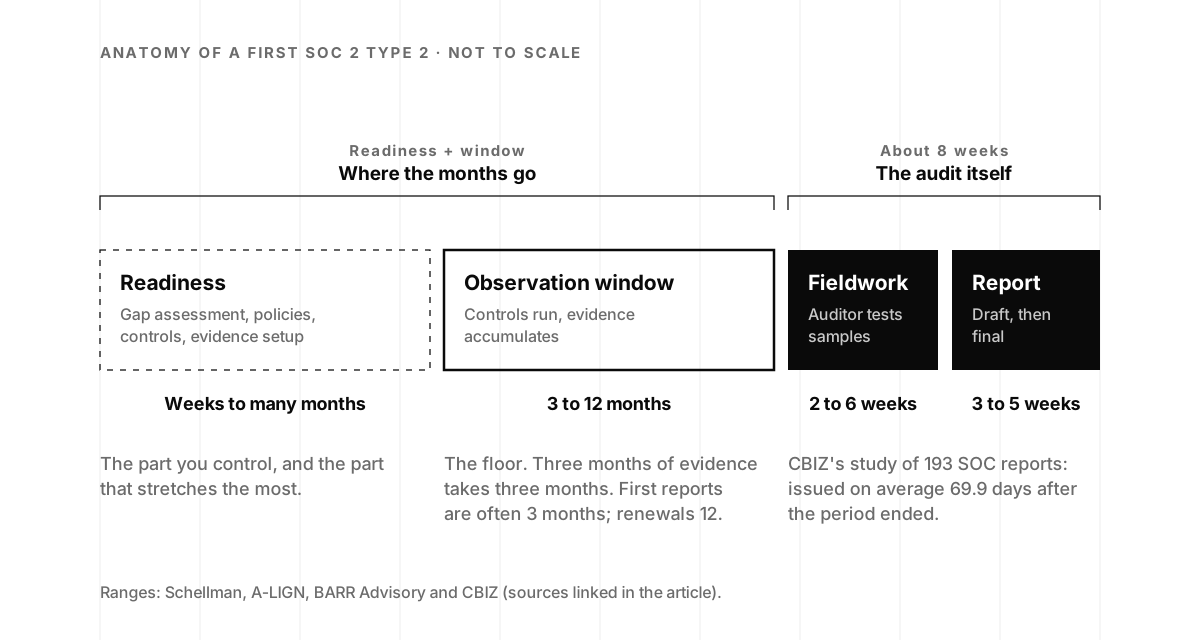
The window itself cannot be shortened: three months of operating evidence requires three months. What can be shortened is the readiness phase that precedes it, since the window cannot begin until controls are in operation, and the audit that follows it, since the duration of fieldwork depends heavily on the state of the evidence.
For a detailed comparison of the two report types, including cost, see SOC 2 Type 1 vs Type 2. For an introduction to SOC 2 itself, see What Even Is a SOC 2?
Factors that extend the timeline
Long SOC 2 programs are rarely long because the audit is difficult. In our engagements, the additional time almost always comes from four sources.
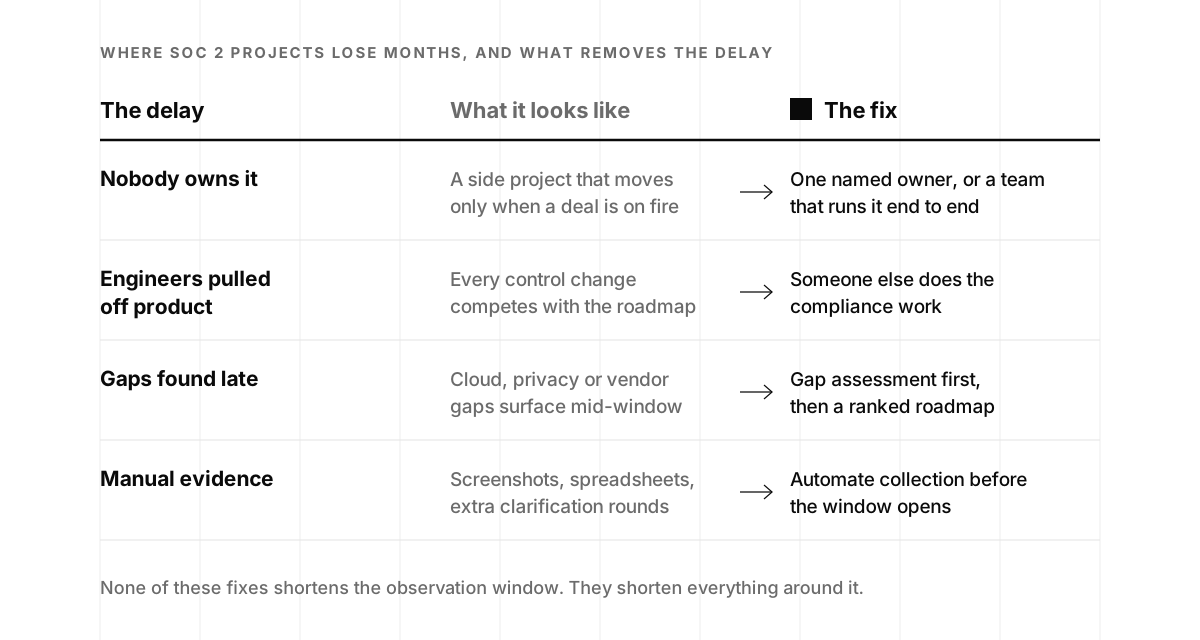
1. No single owner. SOC 2 is often assigned to a senior engineer in addition to existing responsibilities. Without someone accountable for the program, work tends to advance only when a specific customer deal requires it.
2. Engineering time diverted from product work. Control changes such as branch protection, access reviews and centralized logging compete with roadmap commitments. Vanta’s 2025 survey of 2,500 business and IT leaders found that teams already spend about “12 weeks/year on compliance” (Vanta State of Trust 2025). In a smaller company, that time is usually taken from product development.
3. Gaps identified late. When gaps in cloud configuration, vendor management or privacy practices are found after the observation window has started, the organization must either accept exceptions in the report or restart the window.
4. Manual evidence collection. Evidence assembled from screenshots and spreadsheets takes longer to produce and generates more follow-up from the auditor. In Lazarus Alliance’s benchmark, first-time examinations “required longer median fieldwork (9 vs 7 weeks) and more clarification cycles (2.1 vs 1.3)” than renewals. Issuance after the window also takes time: CBIZ’s study of 193 SOC reports found that “the average issuance duration was 69.9 days” after the period ended (CBIZ).
Our free SOC 2 readiness checklist takes about four minutes and identifies which gaps an auditor or a customer’s reviewer is most likely to find first.
Case study: Augment Code
Augment Code is an AI-powered development platform built for engineering teams working with large, complex codebases. The account below is drawn from our published Augment Code SOC 2 Type 2 case study.
The problem. According to the case study, Augment’s “product was gaining traction, but security concerns kept stalling procurement.” The company “had the engineering talent—but not the bandwidth or expertise to lead compliance in-house,” and needed “a partner who could own execution and move fast without breaking focus.”
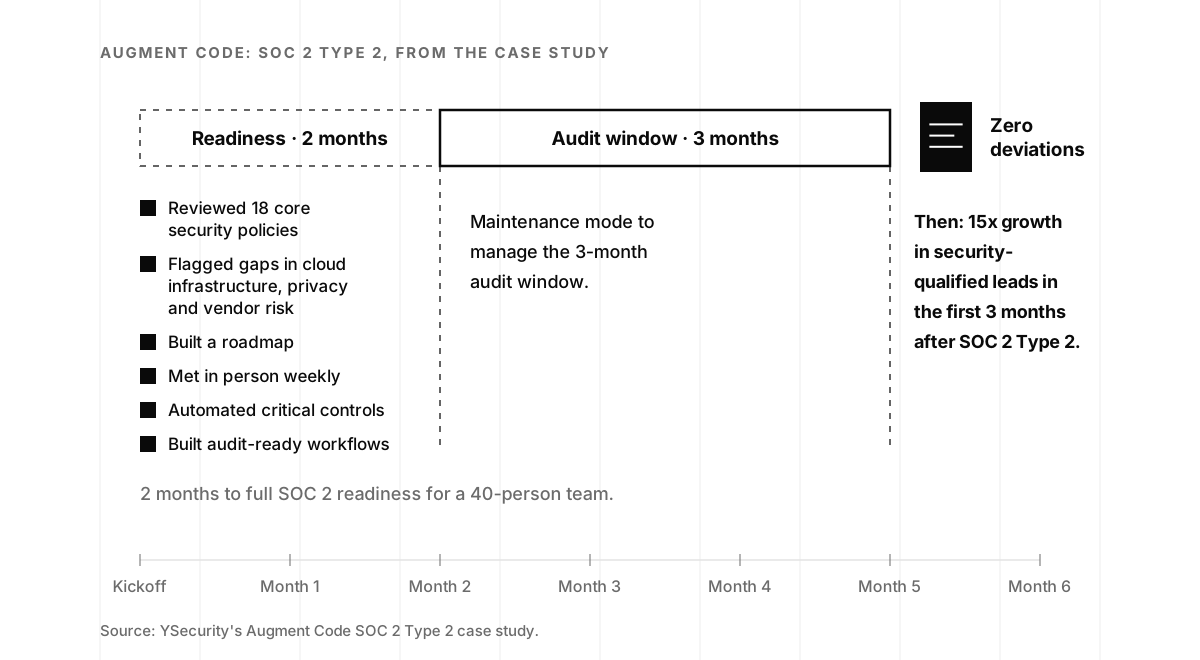
Readiness: two months. YSecurity “operated as Augment’s security team: mapping gaps, prioritizing what mattered, and running execution end-to-end.” The case study notes that Augment “had a strong start with Product Security, but key compliance areas were missing.” Together, the teams “reviewed 18 core security policies, flagged gaps in cloud infrastructure, privacy, vendor risk, and built a roadmap that gave every team clarity and direction from day one.” During execution, “We met in person weekly, automated critical controls, and built audit-ready workflows without disrupting engineering. In just 2 months, their 40-person team was fully SOC 2 ready.”
The audit window: three months. After readiness, “We entered maintenance mode to manage the 3-month audit window.”
Outcome. “Augment passed their audit with zero deviations — clean, fast, and ready for scrutiny.” In the case study’s words, “Five months later, Augment wasn’t just compliant—they were closing enterprise deals and turning security into a competitive advantage.”
Dirk Meister, a founding engineer at Augment, discussed the company’s approach to security on episode 77 of our podcast. He observed that “too often security is checkboxes,” but that when the fundamentals are in place, “even though those are just checkboxes, you can land them much more quickly.”
What shortened the timeline
Augment completed a full three-month audit window and passed with zero deviations. The elements of the engagement described in the case study correspond to the four factors set out above:
- Ownership. YSecurity “operated as Augment’s security team,” “running execution end-to-end.”
- Engineering time. The work was carried out “without disrupting engineering.”
- Gaps identified early. Gaps in cloud infrastructure, privacy and vendor risk were flagged, and the roadmap “gave every team clarity and direction from day one.”
- Automation. The team “automated critical controls, and built audit-ready workflows.”
A related issue is becoming more common in audits of engineering organizations that use AI coding agents. It raises a question for change management (SOC 2 control CC8.1): whether a given change was reviewed and approved by a person, an agent, or both. Paddy Roberts, who leads governance, risk and compliance at Augment, describes how Augment runs agentic code review in Agentic Code Review and SOC 2 Type 2. Organizations adopting coding agents should resolve this before their observation window begins.
Unusually short timelines and report quality
As SOC 2 has become a common sales requirement, a market has developed around accelerating it. Some of that acceleration is legitimate; automation platforms do reduce the manual evidence work described above. Other claims have raised concerns within the accounting profession about whether the resulting reports reflect meaningful testing.
In February 2026, the AICPA’s Journal of Accountancy reported that practitioners were “seeing indications that ‘fast and easy’ may come at the expense of quality and objectivity,” in the words of Sean Linton, chair of the AICPA’s SOC 2 Working Group. The article also described “the volume of SOC reports being signed, often within days or weeks,” and tool providers that “may promise compliance (a term never used in SOC 2 examinations) in mere weeks — or even just hours.” In April, the AICPA’s ethics staff identified “tool provider-driven deadlines that require completion within a fixed time frame” as a threat to auditor independence. In May, the AICPA directed peer reviewers to raise their risk assessment when “engagement timelines appear unreasonable.”
In March, TechCrunch reported that the compliance startup Delve had been “accused of misleading customers with ‘fake compliance’.” Delve responded that final reports “are issued solely by independent, licensed auditors, not Delve.” The following day, its investor Insight Partners removed its investment announcement about the company (TechCrunch).
These developments matter for buyers as well as vendors. A-LIGN has stated that “a SOC 2 can’t be completed in 14 days without any preparation” (A-LIGN), and a vendor-risk reviewer who receives a report produced on an unusually short timeline can reasonably be expected to examine the issuing firm and the extent of testing more closely. We describe what reviewers look for in Is Your SOC 2 Real?
The practical distinction is between reducing delay and reducing work. A five-month program with a full observation window and no deviations is fast because the readiness work was completed efficiently. A report issued within weeks of starting, without an operating period, does not provide the assurance a Type 2 is meant to provide.
Estimating your own timeline
The estimator below gives an approximate timeline based on four characteristics of your program. The assumptions behind the calculation are shown beneath the results.
When could you have a SOC 2 Type 2 report?
An approximate estimate based on published audit-firm ranges and our own engagements. It is not a quote.
Thank you. Check your email for a confirmation from us.
Something went wrong. Email hello@ysecurity.io and we'll prepare an estimate directly.
Options before the first report is issued
Customer timelines do not always align with audit timelines. Where a customer needs assurance before a first Type 2 report is available, the following options are commonly used:
- Confirm what the customer will accept. Some customers will accept a Type 1 report with a commitment to a Type 2 within a defined period; others will not. This should be confirmed in writing before choosing an approach. Our Type 1 vs Type 2 guide includes a decision guide for this situation.
- Provide a readiness letter. A short letter from the security lead or compliance partner describing the program’s status, the start date of the observation window and the expected report date.
- Respond fully to the security questionnaire. A complete and accurate questionnaire response often carries significant weight with a reviewer. For background, see What Is a DDQ?
- Offer a call with the customer’s security team. A direct conversation often resolves outstanding questions more efficiently than further correspondence. This is a substantial part of the work our Sales Support team does.
- Agree a delivery commitment. Some customers will sign with a contractual commitment to deliver the Type 2 report by a specified date.
Bridge letters, sometimes suggested in this context, serve a different purpose. A bridge letter (or gap letter) covers the period between the end of one report’s audit period and the issuance of the next report, so it applies only once an organization already has a SOC 2 report. It is “signed by the service organization, not the service auditor,” and “most bridge letters typically cover a period of no more than three months” (Linford). Grant Thornton notes that “bridge letters are not audit deliverables” (Grant Thornton). Because it is a representation by management, it should be prepared with the same care as the report itself.
A forthcoming article will cover how to communicate an in-progress SOC 2 to customers. In the meantime, the Founder’s Security Cheat Sheet includes suggested wording.
After the first report
A SOC 2 report is primarily a means of enabling customer relationships. For Augment, according to the case study, the clean audit “won new enterprise sales calls and drove 15x growth in security-qualified leads in the first 3 months after achieving SOC 2 Type 2.”
Three ongoing obligations follow the first report:
- Annual renewal. A SOC 2 report “does not technically expire but is typically considered valid for 12 months from its issuance date” (The Pun Group), and customers generally expect continuous coverage. Most organizations move to a twelve-month audit period, with each period beginning where the previous one ended. Renewal examinations typically proceed more quickly than first examinations.
- Continued questionnaires. Whistic found that 68% of buyers are likely to request additional documentation even after receiving a SOC 2 or ISO 27001 report (Whistic 2023). In Augment’s case, “We still support Augment on DDQs, diligence calls, and GTM reviews.”
- Additional frameworks. A-LIGN’s 2026 benchmark found that “nearly all organizations (97%) now conduct at least two audits annually” (A-LIGN). For companies building AI products, the next is frequently ISO 42001, which Augment Code went on to earn in 2025 (case study).
For guidance on the period immediately after issuance, including distribution of the report and typical follow-up requests from customers, see The Week After Your SOC 2 Report Lands.
Summary
The SOC 2 audit itself typically takes about two months. The time required to reach a first Type 2 report depends primarily on readiness and on the length of the observation window, and for most organizations starting without established controls it falls between five and fifteen months.
The difference between the shorter and longer ends of that range is largely determined by four factors: clear ownership of the program, the extent to which engineering time is diverted, whether gaps are identified before the window begins, and whether evidence collection is automated. Augment Code reached full SOC 2 readiness in two months, completed a three-month audit window, and passed with zero deviations.
Our SOC 2 Type 2 team works as an embedded security function: we run readiness, manage the observation window, coordinate with the auditor, and continue to support questionnaires and customer security reviews after the report is issued. Our clients maintain a 99% audit pass rate, and we bill in 15-minute increments with no retainers or minimums.
To discuss a timeline for your organization, book a 15-minute call or review the full Augment Code case study. Startups can claim their first 8 hours free.
Download the SOC 2 readiness checklist (PDF)
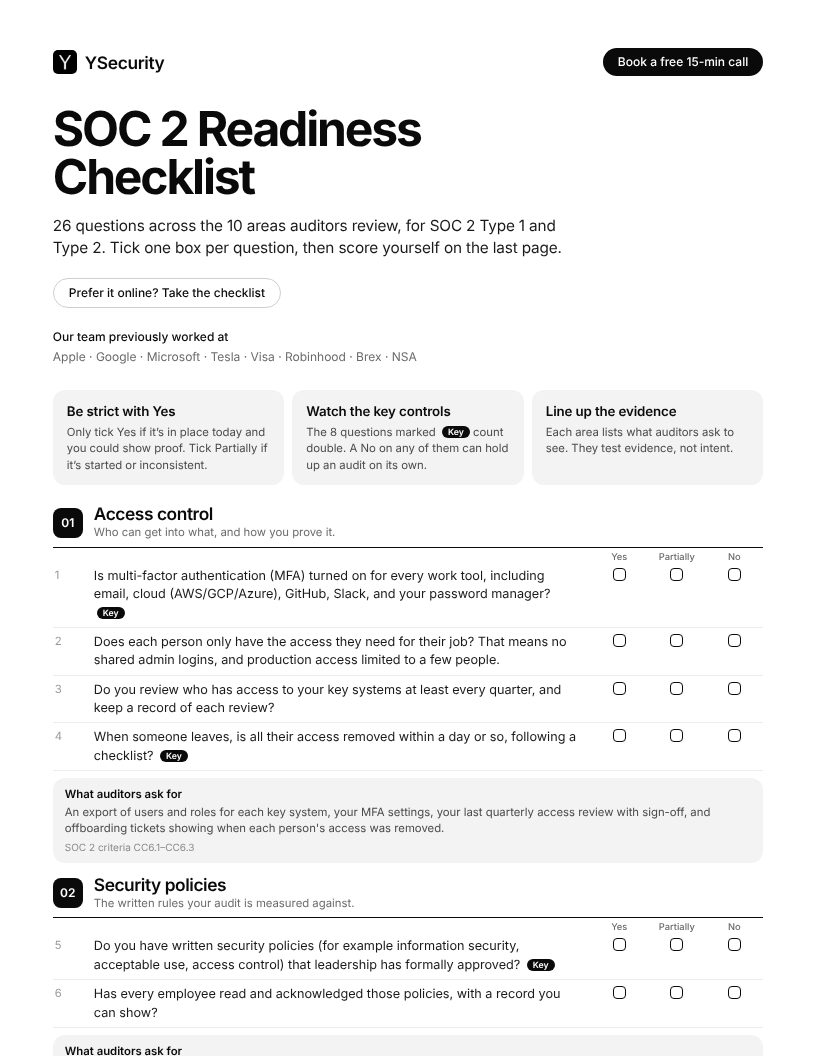
The key controls auditors check across all 10 SOC 2 areas, the evidence they ask for, and how to score your readiness.
Your download has started. Download again
SOC 2 timeline, frequently asked questions
- How long does a SOC 2 audit take?
- The audit itself, meaning the auditor's fieldwork and the report, usually takes about two months. A-LIGN puts fieldwork at 2 to 6 weeks, with a draft report within three weeks of fieldwork and the final report one to two weeks after that. Reaching a first SOC 2 Type 2 report takes longer, because readiness work and an observation window come first. Schellman advises clients to expect 12 to 15 months of calendar time from readiness through a Type 2. With focused readiness work and a three-month window, about five months is achievable.
- How long does it take to get SOC 2 compliance?
- SOC 2 is not a certification but an attestation report issued by a CPA firm. For a first Type 2, plan for readiness (a few weeks to several months, depending on how much needs to be built), an observation window of at least three months, and roughly two months for fieldwork and reporting. Augment Code completed readiness in about two months and used a three-month audit window.
- How long does a SOC 2 Type 1 take?
- A Type 1 tests the design of controls as of a single date, so there is no observation window. Once controls are in place, Schellman puts Type 1 testing at about two weeks and reporting at two to three weeks. PBMares notes that a Type 1 can usually be issued within four to six weeks after remediation. Most of the elapsed time is readiness.
- What is the minimum observation period for SOC 2 Type 2?
- The AICPA does not mandate a minimum. CPA firm Schneider Downs notes that AICPA guidance suggests at least six months, and that an auditor may agree to a shorter period for an organization's first report. In practice, three months is common for first reports, and subsequent reports usually cover twelve months so that coverage is continuous.
- Can a SOC 2 be completed in two weeks?
- Not in any form that buyers should rely on. A Type 2 requires months of operating evidence, and a Type 1 requires controls that are actually designed and implemented. In 2026 the AICPA's Journal of Accountancy reported concerns about SOC reports being signed within days or weeks, and the AICPA directed peer reviewers to raise their risk assessment when engagement timelines appear unreasonable.
- What extends a SOC 2 timeline the most?
- In our experience, four factors: no single owner for the program, engineering time diverted from product work, gaps in cloud configuration, privacy or vendor management identified late, and manual evidence collection. None of these affect the observation window, which cannot be shortened, but each extends readiness or the audit itself.
- How long after the observation window is the SOC 2 report issued?
- Typically a few weeks to a few months. CBIZ's study of 193 SOC reports found an average issuance time of 69.9 days after the end of the audit period, with 85% issued within 100 days. BARR Advisory commits to a draft no later than 30 days after the period ends. Well-organized evidence keeps issuance toward the shorter end.
- What can I provide a customer while a first SOC 2 is in progress?
- Common options are a readiness letter describing the program's status and expected report date, complete and accurate responses to the customer's security questionnaire, a call with someone who can address the customer's security team directly, and in some cases a contractual commitment to deliver the report by a set date. Bridge letters serve a different purpose: they are signed by the service organization's management, not the auditor, and cover the period between the end of one report and the issuance of the next, usually no more than three months.
- How long is a SOC 2 report valid?
- A SOC 2 report does not formally expire, but buyers generally treat it as current for about 12 months from issuance. For that reason most organizations move to an annual cycle, with each Type 2 period beginning where the previous one ended.