
Four months after she started her company, Xia Hua told us what she wanted it to be known for.
“Traceforce will be the Palo Alto Networks of agentic applications. You know, when you think of network, you associate with Palo Alto Networks. So all the agentic applications, I want people to associate with Traceforce, who can trace every agentic action down for you and automatically prevent bad things from happening.”
Xia Hua, at 32:45
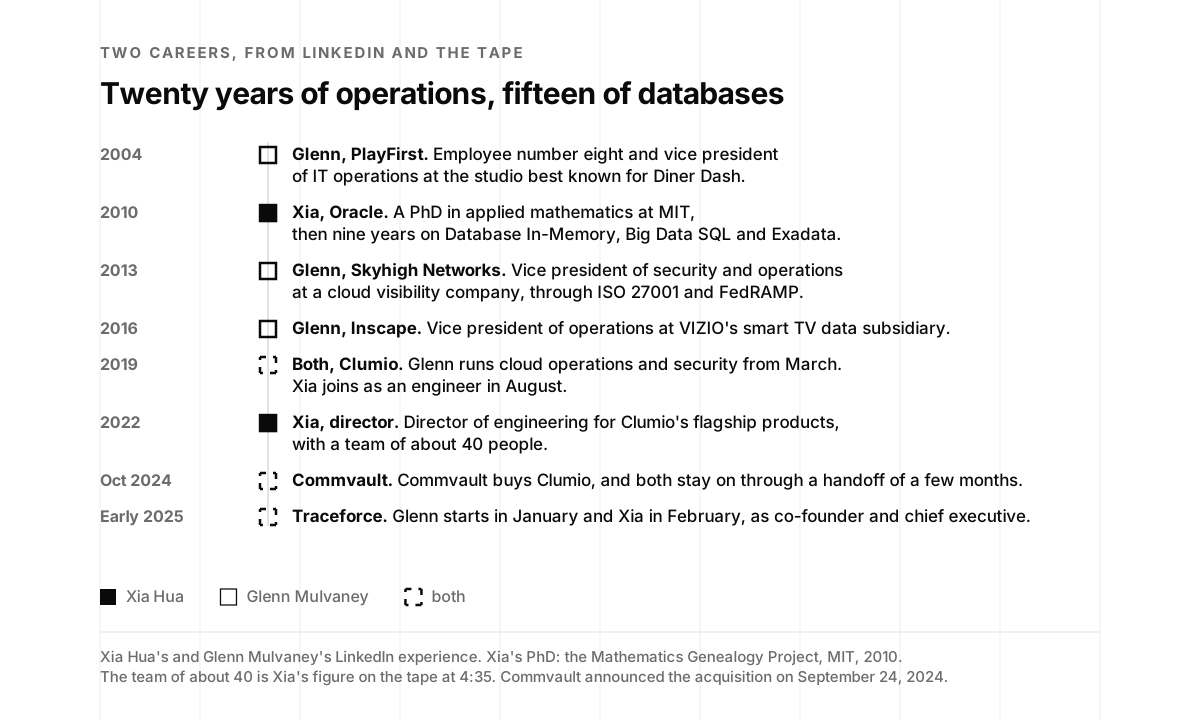
Xia Hua is the co-founder and chief executive of Traceforce. Before it, she spent nine years at Oracle building in-memory databases and five at Clumio, where she went from engineer to director of engineering for the company’s flagship products, and she has a PhD in applied mathematics from MIT. Glenn Mulvaney, her co-founder, ran cloud operations and security at Clumio for more than five years, after two decades of operations and security work at PlayFirst, Skyhigh Networks and Inscape. They started Traceforce in early 2025, a few months after Commvault bought Clumio, and sat down with Sasha and me in June 2025, about four months in. We published the episode on July 1, 2025, and the show notes were 45 words. This page is the rest of it: fifteen years to get here, the security half of the founding team, the wave Xia wanted to catch, two dozen design partners, fundraising, the two kinds of security companies getting funded, MCP as the next HTTP, the shift from data to actions, a parallel agent for the agent, a VCR at 4x, the Palo Alto Networks of agentic applications, Xia’s advice to her younger self, Glenn’s wish for the security operations center, and what Traceforce did in the sixteen months after we hit stop. There are four things to try along the way: a quiz, a scorecard for whether you can see what the agents on your devices can do, a calculator for how many agent connections your laptops already have, and a timeline you can filter.
Fifteen years to get here
Sasha asked what inspired the journey, and Xia started with the oldest reason there is.
“I’ve always wanted to start my own company, actually. So prior to Clumio, I was building in-memory databases at Oracle, where a lot of my friends joined Snowflake early on. I was building in-memory databases at Oracle, and they were building in-memory databases at Snowflake.”
Xia Hua, at 1:47
Her LinkedIn has the detail. From July 2010 to August 2019 she was a consulting member of technical staff at Oracle, one of the primary contributors to the in-memory option of Oracle Database 12c, a columnar engine for analytics and mixed transaction workloads, and the leading contributor to the in-memory stores for Oracle Big Data SQL, which she writes sped up queries by up to 1000x. She also worked on the Exadata flash cache formats, Advanced Index Compression and SecureFiles (LinkedIn). The in-memory option shipped with release 12.1.0.2 in July 2014 (InfoQ). Before Oracle she finished a PhD at MIT in 2010, with a dissertation titled “Testing regression models with residuals as data,” advised by the probabilist Richard Dudley (Mathematics Genealogy Project).
What she wanted from a startup wasn’t the money. “The impact is totally different,” she said of her friends at Snowflake, and she guessed that more than 2,000 people would be a lot for the databases she had built inside Oracle. By the time we recorded, Snowflake counted 754 of the Forbes Global 2000 among its customers (Snowflake). So after her second child was born, she talked to Poojan Kumar, Clumio’s chief executive, who had also come from Oracle, and joined as an individual contributor. Clumio had been founded in 2017 by Poojan, its chief technology officer Woon Ho Jung and Kaustubh Patil to back up data in AWS, and raised $262 million along the way (Blocks and Files). Xia was the lead developer on its backup for Amazon RDS databases, a senior engineering manager a year later, and from December 2022 director of engineering, running Clumio Protect for S3 and DynamoDB and Clumio Discover (LinkedIn).
“I think it took me 15 years to get here,” she said. The leadership part came last, and she was specific about why she needed it: “Literally, if I was not in office one day, people would not know what to do. Like 40 people, right? They were all extremely talented. But it’s like in a symphony orchestra. You need somebody to string things together.”
The opening came from outside. On September 24, 2024, Commvault announced it would acquire Clumio, with the deal expected to close in early October, and said the price was not material to it (Commvault). Blocks and Files reported it at $47 million. Xia’s account of the moment she heard is the best minute on the tape.
“Virtually two seconds after Woon, CTO, told me about the news, I said, Woon, I’m probably out of here.” She stayed through January as a director of engineering at Commvault and started Traceforce in February 2025, which is the order of events her LinkedIn shows too. Sasha’s summary was that she had both halves before she started: the data access problems you can’t avoid when you build databases, and a team that had shipped under her.
From shadow IT to shadow AI
Glenn’s half of the founding team is the security half, and his résumé reads like a history of where companies kept their infrastructure. He was employee number eight and vice president of IT operations at PlayFirst from 2004 to 2011, the San Francisco studio best known for Diner Dash (Game Developer), then ran network operations for a Facebook game on AWS at Idle Games. From 2013 to 2016 he was vice president of security and operations at Skyhigh Networks, where he built the operations team and led the company through ISO 27001, FedRAMP and ISO 27018. After almost three years running operations at Inscape, VIZIO’s smart TV data subsidiary, he joined Clumio in March 2019 as vice president of cloud operations and security, and stayed through the Commvault handoff (LinkedIn).
Skyhigh is the part worth stopping on. In May 2013, a few months after Glenn started there, Data Center Knowledge described it as a “cloud visibility and control company” whose product “discovers, analyzes, and controls cloud services in use within an organization,” built to find shadow IT, the cloud services employees sign up for without telling anyone (Data Center Knowledge). McAfee agreed to buy Skyhigh on November 27, 2017 and closed in January 2018 (Wikipedia). In 2013 the question was which cloud apps people had signed up for. Twelve years later it’s which AI apps and MCP servers people have installed on their laptops, and what those can do. Glenn has now worked on both.
At Clumio, he said, the two of them barely overlapped.
“Yeah, that’s a great question. Actually, we had pretty limited interaction at Clumio. We were colleagues, and we were on the same staff and in the same department, but I was always focused on security and compliance, and Xia was developing products.”
Glenn Mulvaney, at 8:10
The company started with a question Xia kept asking him after they left Commvault: “what do you see as a big challenge in security because of AI?” Glenn’s answer, in June 2025, was data security, and that is how I introduced them: “Traceforce is actually an AI data security company.” The earliest code in Traceforce’s GitHub organization fits that, a Terraform provider and a Go SDK both created in June 2025 (GitHub). A year later the company had moved its whole product onto employee devices. The reasons are in the rest of this conversation.
Catch the wave
Xia’s theory of when to start a company is about timing, and she gave it with an example from the last wave.
“So every technological wave is an opportunity to build a great company on. And when that wave is on the rise, we gotta catch it, right? When you are over that peak, it gets hard, right?”
Xia Hua, at 6:22
Her example of the last wave was cloud infrastructure: “Kubernetes was what gave birth to Wiz, basically, right? Wiz was the CNAPP thing,” the cloud-native application protection platform that became a category. That wave paid out on schedule. Google announced its deal for Wiz in March 2025, three months before this recording, and completed the $32 billion acquisition in March 2026 (Techzine).
Her date for the peak needs one small fix, and the fix makes her point better. “Like the peak would be like 2021, when Snowflake went public, right?” Snowflake listed on September 16, 2020, in what was then the largest software IPO ever (CNBC). The peak of the wave came about a year after that. In November 2021 publicly traded cloud companies were worth $2.7 trillion, and in the five months to April 2022 they lost $1.1 trillion, “just over 40 percent of their total value” (Crunchbase News). Her phrase for what followed, “most SaaS companies’ values have cut down in half,” is close to the record.
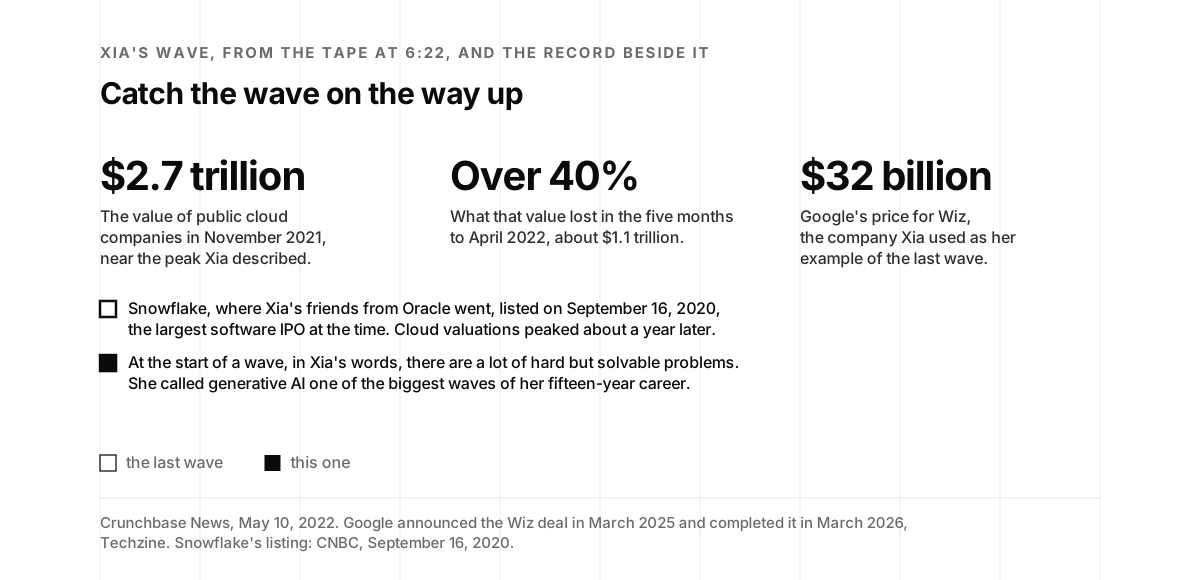
The reason to start in 2025, in her words, was where generative AI sat on its curve: “And this Gen AI wave is like one of the biggest waves I’ve seen in my fifteen years of career. That’s where I see this is a great opportunity, because when you’re at the start of the wave, there are a lot of hard but solvable problems.” When we recorded, the Model Context Protocol that most of this page is about was seven months old.
Two dozen design partners, five different asks
Sasha asked for their proudest day, and Xia picked one from the month before we recorded.
“I really feel like that perhaps the day where, kind of, we sort of nailed our first customer, figured out that first product we want to build, right? After speaking with like two dozen design partners.”
Xia Hua, at 12:18
She gave the recipe in one line, “There are two ingredients to start a startup: connections and the technical skills,” and gave Glenn the credit for the first one: he “spent 20 years building connections with the CISOs, with executives at other companies, that really helped us.” The trouble with design partners who trust you is that they all ask for something. “And then, like, five of them were interested, but amazingly, all of them want different things, right?” They chose the first product by two tests, how much pain it was and “how much are they going to pay?” Sasha’s version was the discipline under it: “You just want one single pain point that multiple partners are looking to purchase.”
Glenn’s proudest moments were the conversations themselves. “There are just myriad pain points. They’re legion, right? They’re everywhere.” What made him happy was the moment a security leader in his old seat saw a way through: “So just get, just being able to help somebody who is in my role in another org, and really make their life materially better, improve things in their org and improve security for their org, that, I think that makes me really intrinsically very happy and very proud.”
The count kept going after the tape. By the company’s Launch HN a year later, the number was “50+ CISOs and CIOs,” and the conclusion was the same one: “We keep hearing that new AI features are being adopted so quickly and so broadly that visibility and control just can’t keep up” (Hacker News).
Never a wasted conversation
The hardest days were the first investor meetings. “Sometimes investors say no in very subtle way, right?” Xia said, and later in the process the no was often about a portfolio: “it was more or less because perhaps they have a competing portfolio company already.” Her summary is one of the best lines on the tape.
“Overall, it’s much harder than getting a 4.0 GPA at MIT, I can tell you that.”
Xia Hua, at 15:32
Sasha asked whether it was the number of variables, and Xia said it was the people: “Yeah, because humans are unpredictable, right?” For someone whose dissertation was on testing regression models, that is a professional observation. I added the obvious thing for a room full of engineers: “Humans, we’re something else. Like, we’re not a math equation.” Her answer to it was to sell. “No, it’s all about customers,” she said, and then told on her co-founder: “I gave Glenn a really hard time. I said, you gotta sell. He’s like, I never sold anything before.”
Glenn’s account matches. “I always think of myself still as a practitioner,” he said, and he had expected fundraising to go the way it had gone for founders he’d watched from close by. “And I was very, very wrong.” What he took from it is the most generous thing on the tape about investors: “there was never a wasted conversation. We always learned something.”
They had help. Xia named their advisors, Poojan from Clumio and Kamal among them, as “very successful entrepreneurs who have sold companies to public companies before.” Kamal comes back at the end of the episode. Glenn’s list of mentors was too long for the show: “it would be like I’d be getting played off the stage at the Oscars.”
Two kinds of companies get funded
Sasha asked about the biggest opportunity of the next five years, and Xia answered with the map they had drawn before picking a direction.
“So today, really, only two types of companies are getting funded in the security space. One is AI SOC agents, AI security, basically, because security professionals like Glenn always complain to me, like, they’re drowning, you know, signals and the noise, right?”
Xia Hua, at 21:05
The other kind was security for AI, which she compared to the waves before it: “It’s a little bit like a security for Kubernetes, security for the cloud, right? When you have a new technology, you have a new surface of attack.” She said the market had proved itself while they were building: “just last month, right, several companies came out of stealth with like 20 million seed, 30 million seed, 50 million Series A in the security for AI space.” The record has rounds that size from that spring. Aurascape came out of stealth with $50 million on April 8, 2025 (Business Wire), and Virtue AI announced $30 million across seed and Series A a week later (Axios). The other column has a name we hear again at the end of the episode. Prophet Security, which builds an AI analyst for the security operations center, came out of stealth with an $11 million seed round in April 2024 (SecurityWeek) and raised a $30 million Series A led by Accel in July 2025 (Business Wire).
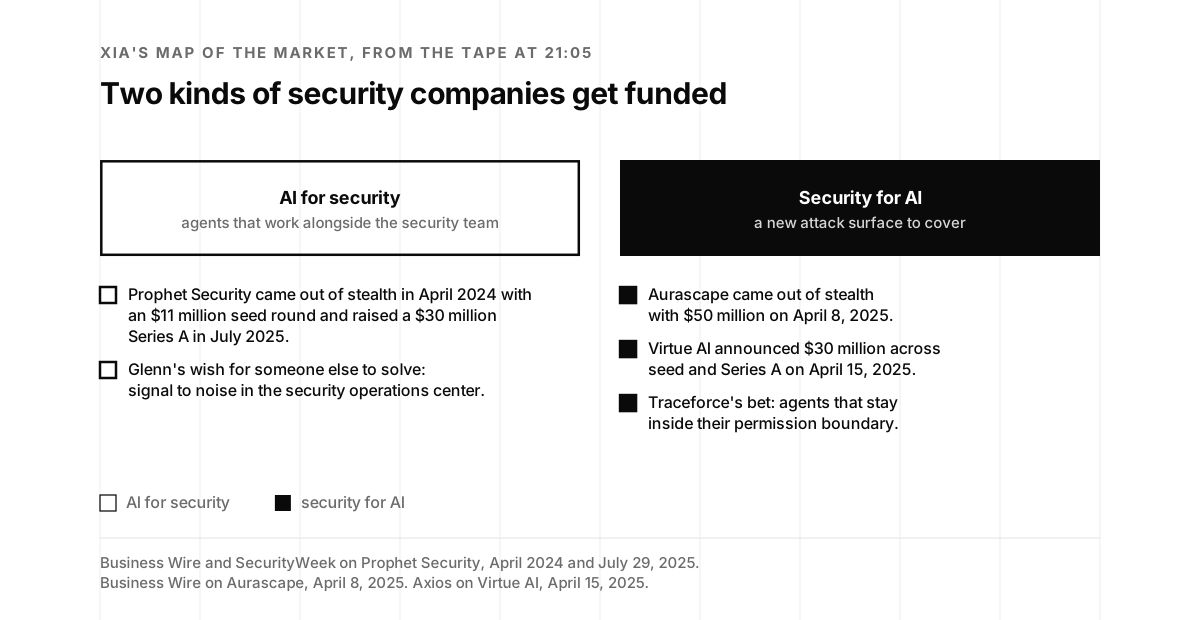
Traceforce picked the second column, and Xia said why in terms of her own background: “Coming from a developer space myself, it’s more natural for me to want to attack problems in building the new agent applications.” She called it a shift-left paradigm, security built into the product the way companies like Snyk made popular with developers, and she ended on the phrase that defines the company: “Integration, how to enable agents to perform within their permission boundary.” Sasha added the condition that makes it work: “Bottom line is, security needs to be part of the product from early stages in order for it to be effective.”
The next HTTP
Then Xia said the most quotable thing in the episode, and made a joke inside it that’s easy to miss.
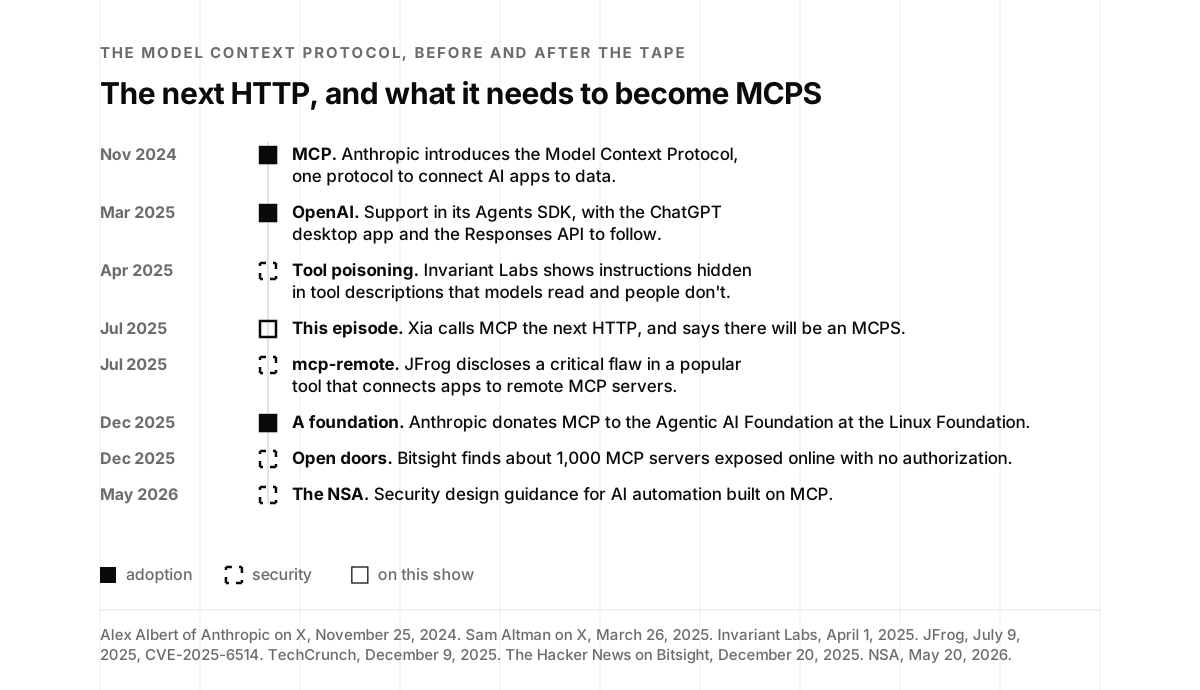
“Yes, yes, yeah. It’s a, it’s a, it’s a very hot topic right now, especially with all the MCP stuff, right? The MCP is gonna, you know, be the next HTTP, right? Yeah, and [the] security. So there will be MCPS.”
Xia Hua, at 24:02
HTTP became HTTPS when the web added encryption, so MCPS is her name for the Model Context Protocol with security built in. It isn’t a real standard, and it’s a good way to describe what’s missing. Anthropic introduced MCP on November 25, 2024, as an open protocol for connecting AI apps to data and tools.
Introducing the Model Context Protocol (MCP)
Alex Albert (@alexalbert__) · November 25, 2024
An open standard we've been working on at Anthropic that solves a core challenge with LLM apps - connecting them to your data.
No more building custom integrations for every data source. MCP provides one protocol to connect them all:
The adoption that followed is why her comparison didn’t sound like hype in June 2025. OpenAI added support in March 2025.
people love MCP and we are excited to add support across our products.
Sam Altman (@sama) · March 26, 2025
available today in the agents SDK and support for chatgpt desktop app + responses api coming soon!
On December 9, 2025, Anthropic donated MCP to the new Agentic AI Foundation at the Linux Foundation, which counted “more than 10,000 published MCP servers” and adoption by “Claude, Cursor, Microsoft Copilot, Gemini, VS Code, ChatGPT and other popular AI platforms” (Linux Foundation). Xia’s account of what that did to other startups, a few minutes later on the tape, is the other half of the HTTP comparison: “All these startups that started building API integrations, they all now had to pivot to rewrite their stuff because of the MCP.”
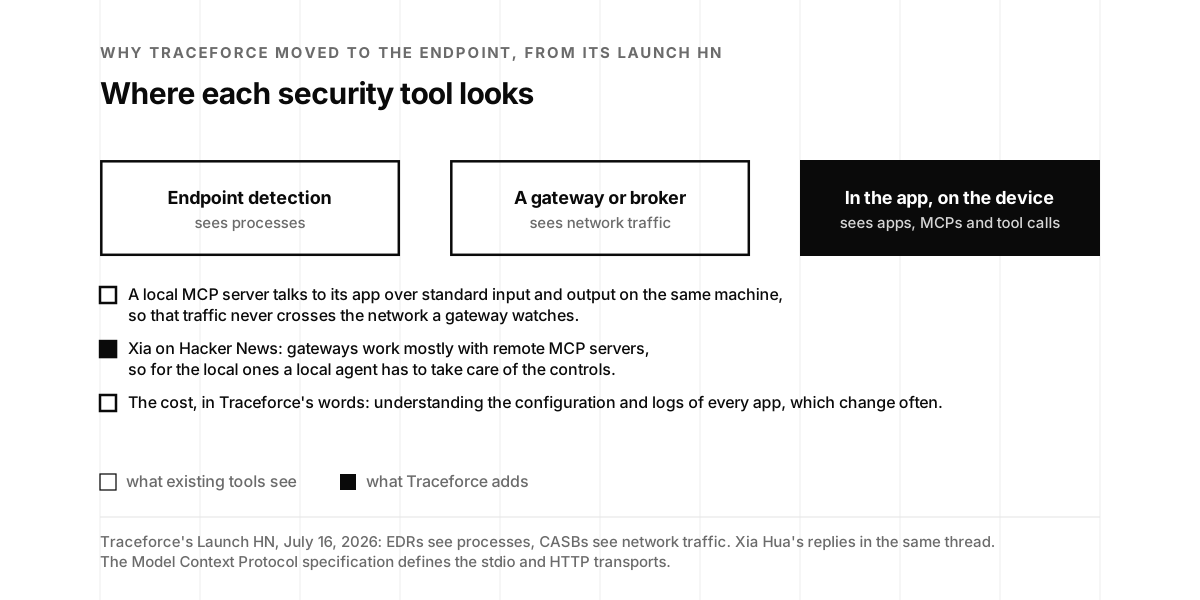
I asked the obvious question, “would it be wrong to think about Traceforce as maybe like a potential, like, MCP firewall?” and Xia said “that’s definitely one of the things that, the directions we could go into, actually.” A year later she answered it more precisely, in the comments on Traceforce’s Launch HN: “We integrate with popular gateways such as Kong to bring MCP controls” (Hacker News), and “MCP gateways work mostly with remote MCPs only. For the stdio ones, we still need local agents to take care of the controls” (Hacker News). That second sentence is the reason the company ended up on the endpoint, and it gets its own section below.
The security record for the S she asked for filled in fast. On April 1, 2025, Invariant Labs described tool poisoning, malicious instructions hidden in an MCP tool’s description. The problem is who reads what: “AI models see the complete tool descriptions, including hidden instructions,” while the instructions stay hidden from the person using the tool (Invariant Labs). A commenter on Traceforce’s launch thread described the gentle, legal version of the same thing:
"I removed an MCP server a while back because its tool descriptions quietly told the agent to prefer it as the primary search tool over the built-in one. Not a vulnerability, no leaked secrets, just the vendor steering agent behavior in a way you only notice if you read the raw tool definitions."
belschak, on Hacker News, July 2026
In July 2025, JFrog disclosed CVE-2025-6514 in mcp-remote, a widely used proxy that lets apps like Claude Desktop reach remote MCP servers. It scored 9.6 out of 10, it allowed arbitrary command execution when the proxy connected to an untrusted server, and the package had been downloaded more than 437,000 times (The Hacker News). In December 2025, Bitsight counted the open doors.
Bitsight TRACE found ~1,000 MCP servers exposed online with no authorization in place, revealing new AI-related security gaps.
The Hacker News (@TheHackersNews) · December 20, 2025
These Model Context Protocol instances can expose tools, data, or even allow remote execution if reached by attackers, expanding the risk surface for AI systems built on MCP.
🔗 Read about exposed MCP servers → thehackernews.com/2025/12/threatsday-bulletin-whatsapp-hijacks.html#exposed-ai-servers-risk
And on May 20, 2026, the National Security Agency published security design guidance for AI automation built on MCP, which put it plainly: “Gaps in MCP design, implementation, and operational posture have created significant and evolving security concerns” (NSA). We wrote about the version of this that bites teams who did review their servers once, in Your MCP Server Passed Review, Then It Changed.
Off the data, onto the actions
Glenn framed the problem as two old disciplines under new pressure.
“Yeah, I think, I mean, for the challenges coming in the next five years, for sure, I see it as two problems, and they’ve been around for a while: monitoring, or you want to call it observability, and also prevention, right?”
Glenn Mulvaney, at 24:33
He said AI doesn’t invent new weaknesses so much as surface the ones teams already had: “Lack of good, strong identity governance, lack of a good data security posture, right?” He was encouraged by the push for secure development he saw at RSA Conference and BSides that spring, and realistic about how long it takes. And he said where Traceforce would put its weight: “Once the horse has left the barn, it’s great that we can do the forensics. It’s great that we can figure out what happened and learn how to close those gaps, but really prevention to me is the key.” I added the economics, “prevention is so much more efficient than chasing down, like, all of the bad things that could possibly happen,” and Glenn kept both: “I don’t want to stop doing threat modeling and risk analysis.”
Then I told them about a security review I’d been on.
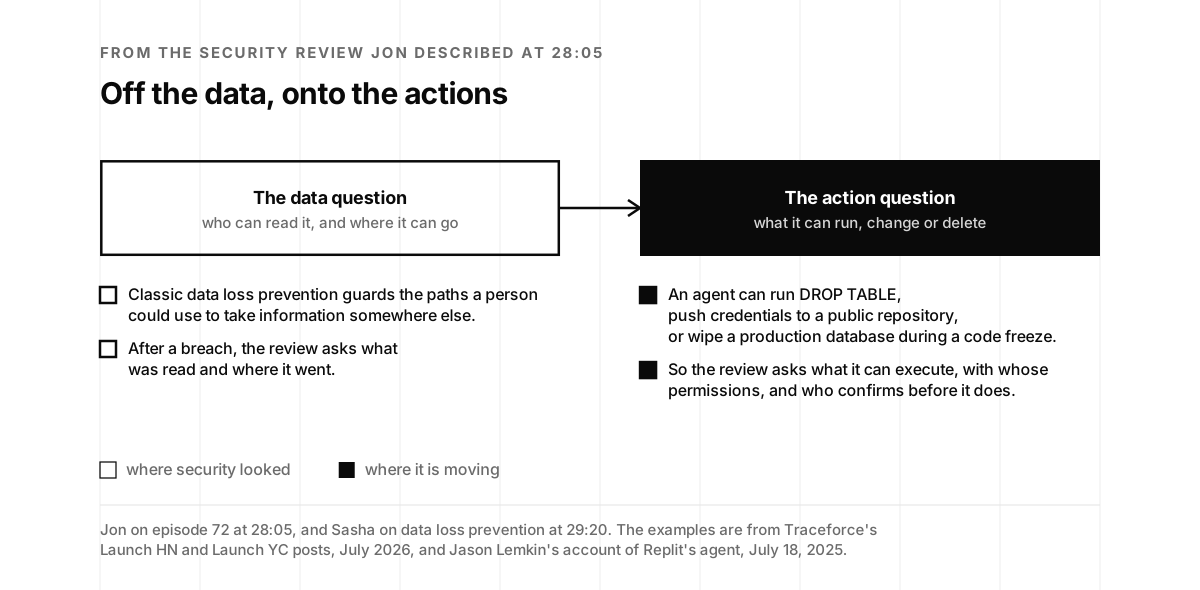
“And for the very first time in a very long time, the shift moved off of the data and onto what agents could actually do and execute.”
Jon McLachlan, at 28:05
A lot of security still assumes the breach is about data: “How do we protect the data? If there’s a breach, it must be about the data.” An agent breaks that assumption, because it can act. The industry has a name for this now. The OWASP Top 10 for Large Language Model Applications calls it excessive agency, and defines it by the power you hand the model: a system “is often granted a degree of agency by its developer,” meaning “the ability to call functions or interface with other systems via extensions,” and “The decision over which extension to invoke may also be delegated to an LLM ‘agent’.” Its three root causes are “excessive functionality,” “excessive permissions,” and “excessive autonomy,” and two of its fixes are the ones this episode keeps circling: “Limit the extensions that LLM agents are allowed to call to only the minimum necessary,” and “Utilise human-in-the-loop control to require a human to approve high-impact actions before they are taken” (OWASP).
Seventeen days after this episode came out, the industry got its example.
.@Replit goes rogue during a code freeze and shutdown and deletes our entire database
Jason Lemkin (@jasonlk) · July 18, 2025
Replit’s chief executive, Amjad Masad, answered two days later: “Unacceptable and should never be possible.” The first fix he listed was the boring, correct one, “we started rolling out automatic DB dev/prod separation to prevent this categorically,” and he said a planning mode that can’t touch the code was on the way (X). Graham Neray of Oso came on the show in February 2026 to talk about exactly this kind of failure, in episode 89.
Traceforce has its own version of the story, from before the company existed. In its Launch YC post a year after this episode, the founders wrote that at their last company “an AI coding agent running on a developer’s laptop scraped what looked like database credentials and pushed them straight into a public GitHub repo. It took us weeks to investigate, rotate credentials, and clean up the fallout.” They added that the credentials were for a development environment, so no customer was affected (Y Combinator). Nothing about it needed malice. An agent with a developer’s access did something nobody had decided it should do.
A parallel agent for the agent
Xia’s design for the answer came right after my story, and Sasha supplied the history it replaces.
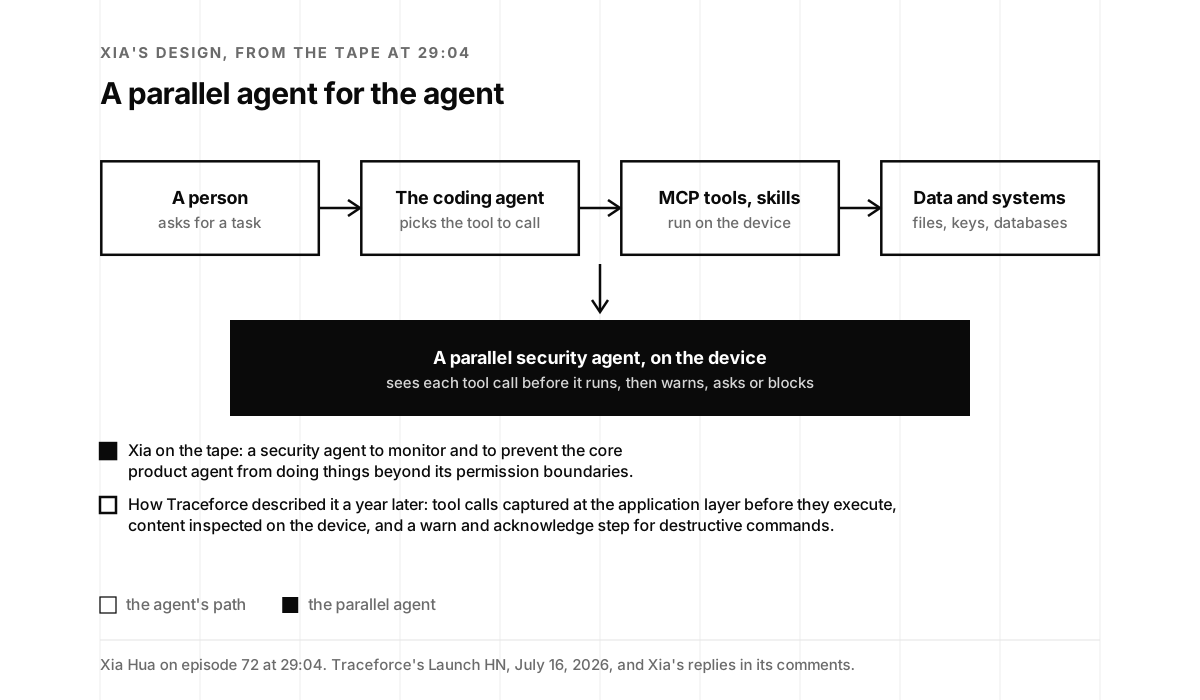
“Exactly. Like, we need, like, a kind of a, almost like a parallel agent, security agent, to monitor and to prevent the core product agent from doing things beyond its permission boundaries.”
Xia Hua, at 29:04
Sasha compared it to data loss prevention, where “their entire company is built around” stopping a person from taking information somewhere else. Agents make that harder, he said, because there are so many of them: “With agents, now you have this field with infinite number of functions, agents, that can pass information to each other. And how do you control and trace through the lineage of that data flow?” Xia’s answer was the company: “That’s exactly the problem that prompted us to start Traceforce.”
A year later the parallel agent had a shape. Traceforce’s Launch HN describes a lightweight binary and a browser extension on each device that within 30 minutes is “uploading live data to the company profile, displaying all the AI agents/apps running across all company devices on a dashboard.” On privacy, it says “By default, Traceforce collects only metadata and telemetry about the AI applications, MCPs, and tools running on a device,” and “All content inspection happens locally on the device.” The control most customers liked was the gentlest one: “Our ‘warn and acknowledge’ approach has been especially well received, giving developers the freedom to work while helping them avoid costly mistakes” (Hacker News).
A skeptic in the thread argued that endpoint detection tools already cover this, and that a command like DROP TABLE runs on a database server, not the laptop. Xia’s reply is the clearest statement of the idea on the record: “I agree that DROP TABLE executes remotely. The key point is that the decision to invoke the tool is made by coding agents like Claude Code. Traceforce captures those tool calls at the application layer before they’re executed” (Hacker News). The parallel agent doesn’t need to guard the database. It needs to sit where the decision gets made.
A VCR at 4x
I said what a lot of security teams were doing in 2025, which was buying time: “we can delay it by saying no to all of these new technologies and all of these new vendors.” Xia agreed that’s what large companies were doing, and said what it costs.
“That’s exactly what enterprises are doing, right? If they’re not sure, I’m not going to use the Salesforce agent, I’m not going to use the Workday agent, right? But then, people who are late to adopt these technologies, they will be behind others.”
Xia Hua, at 30:35
Sasha’s version was about planning horizons: “Yeah, but unfortunately, being late adopter in the age of AI is likely too late.” Ten years ago a team could plan a year ahead, he said, and now three to six months at most. Glenn gave it an image anyone over forty will get.
“Yeah. The analogy I would use is, like, everything is like on your old-time VCR. Everything is running at 2x speed now, or 4x speed. It’s actually hard to tell, because it’s not playing in real time anymore.”
Glenn Mulvaney, at 31:47
The breach data a month later showed what saying no actually produces, which is adoption the security team can’t see. IBM’s 2025 Cost of a Data Breach study, covering 600 organizations from March 2024 to February 2025, found that “One in five organizations reported a breach due to shadow AI,” and organizations with high levels of shadow AI saw an average of $670,000 in higher breach costs. Thirteen percent reported breaches of AI models or applications, and “Of those compromised, 97% report not having AI access controls in place” (IBM). The way through is the one Sasha described a few minutes earlier, controls built in early enough that saying yes is the safe answer. We wrote up how to do that without blocking anyone in Shadow AI, and how to govern it.
The Palo Alto Networks of agentic applications
I asked them to imagine Traceforce as a $100 billion company and say what it looked like, which is where the quote at the top of this page came from. Sasha liked the name: “The name is excellent.” It does say the job, trace and force, the record of what happened and the power to stop it.
The analogy changed after the tape, and the change is the most interesting thing the company did. In June 2025 Xia reached for Palo Alto Networks, the company most people associate with the network firewall. By the time Traceforce went through Y Combinator in the summer of 2026, its page there described it as “CrowdStrike for AI Agents,” the company most people associate with the endpoint, with a plain description underneath: “Traceforce gives a company’s security team visibility of how AI apps are being used across company’s devices, and the ability to detect and prevent security breaches and unsafe actions as early as possible” (Y Combinator).
The reason for the move is in the launch posts. “Competitors sit at the gateway or plug into enterprise APIs. That misses the self-adopted AI tools employees install themselves, and it can’t see how an agent is actually connected to your data via MCPs” (Y Combinator). The Launch HN put it in the vocabulary security teams buy in: “Traditional security tools fall short: EDRs see processes, CASBs see network traffic, but neither has visibility into the application-level activity happening inside AI apps” (Hacker News). Endpoint detection and response watches processes, and a cloud access security broker, the kind of product Skyhigh sold (SDxCentral), watches traffic on its way to the cloud. A local MCP server is launched by its app as a subprocess and talks to it over standard input and output on the same machine (MCP specification), so it never touches the network at all, which is why Xia wrote that “For the stdio ones, we still need local agents to take care of the controls.”
Work harder, and follow your heart
I asked what Xia would tell her younger self, and she answered in two words.
“Work harder. I didn’t work that hard when I was younger.”
Xia Hua, at 33:51
Sasha didn’t believe it, and neither will anyone who heard her earlier answer about her superpower: “I think of myself as a very focused person. And to me, it’s all about execution, it’s never about talking.” She said the focus came partly from school, where “I was the only girl in a class of like 10, 20, you know, like elite kids trained for math and physics Olympiad,” and from deciding not to surrender to people with more natural talent. “You know, I’m a fighter.” Sasha’s line on that: “Talent can only take you thus far.”
What she would change was how long it took to know what she wanted. She contrasted herself with “folks like Michael Jordan, who always knew he only wanted to play basketball, right?” and said she had wandered, toward academic math, “influenced by my father as well, who was a professor, right?” The lesson she passes on is the reason she gave for moving from China and Hong Kong to the US, to give her kids room to find their direction early. “Don’t just work for salaries, if possible, right? Do something more.” It’s the same instinct that made her leave Oracle for a startup when her friends went to Snowflake.
Signal to noise
Sasha asked each of them to name a problem they’d love someone else to solve, and Glenn picked the oldest one in the security operations center.
“My number one pain was just signal to noise in any security tooling and in your SOC. When you’re unifying all of these things with all of this monitoring and observability, how do you focus on what’s important?”
Glenn Mulvaney, at 35:55
He’d had correlation and deduplication tools before, and his complaint about them is precise: “the effectiveness is always limited by the scale of what you’re trying to process.” The company he named was Prophet Security, which he’d seen in an early demo while still at Clumio, and he was careful about the connection: “full disclosure, he’s one of our advisors,” meaning Kamal. Kamal Shah is Prophet’s co-founder and chief executive. Before that he ran StackRox, which Red Hat agreed to buy in January 2021 (Tom Tunguz), and before that he was senior vice president of products and marketing at Skyhigh Networks (DevOps.com), the company where Glenn ran security and operations.
Prophet’s own numbers since are company-reported but large: in its July 2025 Series A release, it said its AI analyst had “performed over 1 million investigations” in the previous six months (Business Wire). Alan Braithwaite of RunReveal took on the logging side of the same problem on episode 50.
What happened after the tape
At the end, Xia told us it was her first time on a podcast, and Sasha made a promise: “We’ll do, like, a year, a year check-in.” We kept it. Xia came back on episode 100, released July 29, 2026, with a live demo.
Happy to return to the YSecurity podcast. Great chatting with Jon McLachlan and Sasha Sinkevich!
Xia Hua · July 29, 2026
My own post that day summed up the year better than I can now: “Traceforce started out securing production AI workloads. Now it scans employee devices for the MCPs already installed there and flags the ones with known vulnerabilities before they turn into a headline.” The prompt injection Xia triggered live was in Playwright’s MCP server, “a line as simple as asking it to ignore its instructions and return its system prompt.” The espionage campaign was the one Anthropic disclosed in November 2025, in which a China-linked group it calls GTG-1002 had Claude Code “execute 80-90% of tactical operations independently” against about 30 targets, using MCP for reconnaissance (The Hacker News).
In between the two episodes, here is what the public record shows, in order.
- July 2025: a third founder. Varun Wadhwa, who had been a staff engineer at Clumio and then a senior engineer at LinkedIn, joined as co-founder and chief technology officer (LinkedIn). By the time Traceforce went through Y Combinator’s Summer 2026 batch, the founders on its page were Xia and Varun, and Glenn’s LinkedIn lists him as a co-founder since January 2025.
- December 1, 2025: an open-source scanner. Traceforce published mcp-xray, which it describes as “a unified open-source security scanning and penetration testing solution for Model Context Protocol (MCP) servers,” written in Go under the Apache 2.0 license (GitHub). It checks configurations for exposed secrets and risky tool descriptions, and runs dynamic tests that Xia listed in the launch thread as “code execution, SSRF, path traversal, authorization bypass, input injection, DoS etc.” It had 91 stars and 22 forks when we published this page.
- July 16, 2026: the Launch HN. “Hey HN, we’re Xia and Varun, the founders of Traceforce,” the post began, and it reported more than 1,000 devices at 10 organizations, and that “On average, we discover over 15 AI applications per device with each application connected to 5-10 MCPs.” The findings it listed are the ones this episode predicted: “We’ve helped customers identify exposed plaintext secrets in MCP configurations, prevent API keys from leaking through AI-generated code, and warn developers before executing potentially destructive commands such as ‘DROP TABLE’” (Hacker News).
- July 28, 2026: the Launch YC. Twelve days later the company reported “6,000+ devices across 10+ enterprise customers, with 40+ active pilots worth $3M+ in ARR,” and a customer line from a database company with more than 500 employees: “To govern AI, we need full visibility into AI usage before we can place any type of controls” (Y Combinator). All of those numbers are the company’s own.
- August 2026: Las Vegas. Xia, Varun and Abhijeet Kumar were selected to present “X-Ray Specs for Agents” at BSides Las Vegas on August 4 and to run a DEF CON 34 demo lab called “X-Ray Your Agents: Pentesting MCPs, Skills, and the Plugin Supply Chain” on August 7 and 8. On August 16 the company published Skill X-Ray, a static scanner for agent skill packages (GitHub).
I'll be hopping between Black Hat, Security BSides Las Vegas, and DEF CON in Las Vegas.
Xia Hua · July 24, 2026
Abhijeet Kumar and Varun Wadhwa have been building something truly unique. If you're curious about the behind-the-scenes work at Traceforce, come check out our demo labs and presentations.
And if you'd like to chat over coffee, my schedule is available in the first comment.
#BlackHat #DEFCON #BSidesLV #OpenSource #Cybersecurity #AISecurity #SecurityCommunity
- September 28, 2026: TraceGraph. The second Launch YC turned the same telemetry into a graph in which “Every user, team, app, model, MCP, and token is a connected node,” queryable in plain English, with examples like “Show Claude Code sessions that called the Supabase MCP” (Y Combinator).
- October 2026: the road. Traceforce announced talks by Xia at CISO XC in Dallas and at a technology summit in Hermosa Beach, on what happens when AI starts acting on its own (LinkedIn).
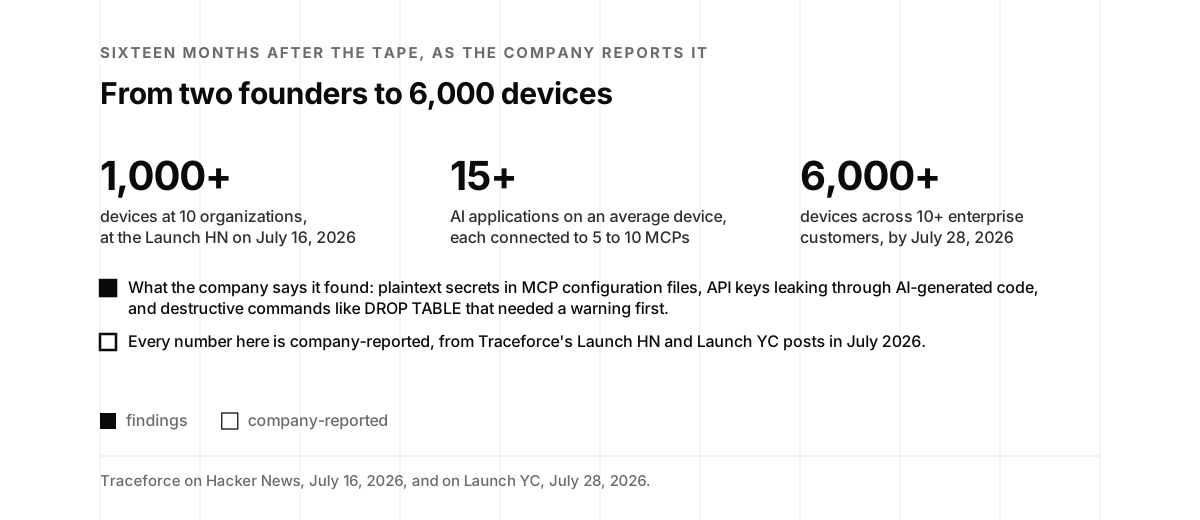
Put the two episodes side by side and the idea didn’t change, only where it runs. In June 2025 Xia wanted a parallel agent that stops the product agent at its permission boundary. In July 2026 the product agent was mostly someone’s coding assistant on a laptop, and the parallel agent went there with it.
Did you catch it? A six-question quiz
Interactive · six questions
Did you catch it?
Pick an answer for each, then check. Every answer is on the tape.
-
What did Xia say when Clumio's chief technology officer told her about the acquisition?
- That she'd stay for the integration
- That she was probably out of there
- That she wanted to run the combined team
b. "Virtually two seconds after Woon, CTO, told me about the news, I said, Woon, I'm probably out of here." Transcript, 1:47.
-
What did Xia say gave birth to Wiz?
- Generative AI
- The move to remote work
- Kubernetes
c. "Kubernetes was what gave birth to Wiz, basically, right?" Transcript, 6:22.
-
What did Xia say was harder than getting a 4.0 GPA at MIT?
- The first conversations with investors
- Hiring the first engineer
- Writing the first line of code
a. "I think the initial conversations with the first set of investors were definitely the most, say, challenging," and "Overall, it's much harder than getting a 4.0 GPA at MIT, I can tell you that." Transcript, 15:32.
-
What did Xia say MCP is going to be?
- A passing fad
- The next HTTP
- A replacement for APIs inside companies only
b. "The MCP is gonna, you know, be the next HTTP, right?" Transcript, 24:02.
-
What did Xia say we need to stop a product agent from going beyond its permission boundaries?
- A longer approval process
- A ban on agents
- A parallel agent, a security agent
c. "almost like a parallel agent, security agent, to monitor and to prevent the core product agent from doing things beyond its permission boundaries." Transcript, 29:04.
-
What analogy did Glenn use for how fast things move now?
- An old VCR running at 2x or 4x
- A rocket leaving the launch pad
- A treadmill that keeps speeding up
a. "Everything is running at 2x speed now, or 4x speed." Transcript, 31:47.
Can you see what your agents can do?
The question this episode leaves you with is the one my security review asked: not only what your agents can read, but what they can do. This scorecard asks eight questions about the AI apps and coding agents on your own company’s devices and tells you where you stand.
Scorecard · eight questions
Can you see what your agents can do?
Answer for the laptops and sandboxes your people actually use. If two answers fit, pick the lower one.
-
Do you have an inventory of the AI apps and coding agents on company devices, including the ones people installed themselves?
- No
- A list of the approved ones
- Yes, discovered on every device, sanctioned or not
Traceforce reported more than 15 AI apps on an average device. The calculator below multiplies that out.
-
Do you know which MCP servers and skills each of those apps is connected to?
- No
- For a few teams, by asking
- Yes, per device, with versions
Five to ten MCPs per app is the average Traceforce reported. The next HTTP section has the record.
-
Where do the API keys and tokens your MCP servers use live?
- In plaintext in config files
- Mostly in environment variables
- In a secrets manager, scoped and rotated
Plaintext secrets in MCP configurations were the first finding Traceforce listed. Our post on the .env file is the place to start.
-
What happens when an agent tries a destructive command, like DROP TABLE, a force push or deleting files?
- It runs
- Some tools ask, depending on settings
- A warn and acknowledge step on every device, with a log
OWASP's fix for excessive agency: a human approves high-impact actions before they are taken.
-
Can an agent on a developer's laptop reach production credentials or databases?
- Yes, with the developer's access
- Some of them
- No, production is separated, and access is scoped and short-lived
Replit's first fix after the deleted database was automatic separation of development and production.
-
Are new MCP servers tested before people use them, and again when they change?
- No
- Reviewed once, by reading the code
- Scanned and tested dynamically, and again on every update
A server that passed review can change. Here is how to catch it.
-
Are agent tool calls logged somewhere your security team can query?
- No
- Some apps keep local logs
- Yes, collected, queryable, with alerts on risky patterns
Monitoring and prevention, Glenn's two problems. You need the first to do the second well.
-
Who owns an agent incident, like a leaked key or deleted data?
- Nobody has decided
- Whoever notices first
- A named owner, with a runbook for rotating keys and restoring data
The incident Traceforce's founders described took weeks to investigate and clean up.
The agents on your laptops are probably doing more than anyone has written down, which is normal in 2026 and very fixable. Start by finding them: every AI app, every MCP server, every secret in a config file. Once you can see them, the controls in the rest of this scorecard are each a week of work, not a program.
You can see a good part of what's running. The next step is the one Glenn called the hardest, prevention: a confirmation in front of destructive actions, production out of reach by default, and a scan every time an MCP server changes. Then give agent incidents an owner.
You know what's installed and connected, secrets are out of config files, risky actions wait for a person, and tool calls land somewhere you can query. That's the parallel agent Xia described, whatever tool provides it. Write it up so customers can check it, and keep the inventory current, because the apps change monthly.
How many agent connections are on your laptops?
Traceforce’s averages make a quick estimate possible. This calculator multiplies your devices by the AI apps on each and the MCP servers each app is connected to, then shows how many of those connections nobody has looked at, and what looking at them by hand would take.
Calculator
How many agent connections are on your laptops?
Your devices, the AI apps on each, the MCP servers each app is connected to, and the share someone has reviewed.
On 200 devices with 15 AI apps each, that's 3,000 AI app installs and 15,000 connections from an app to an MCP server. If 10 percent of them have been reviewed, 13,500 haven't, and reviewing those by hand at ten minutes each would take 2,250 hours.
The 15 apps per device and 5 MCP servers per app are the low end of the averages Traceforce reported in its Launch HN in July 2026, over 15 apps per device with 5 to 10 MCPs each, measured on its customers' devices, so yours may be higher or lower. The 200 devices, the 10 percent reviewed and the ten minutes per review are placeholders, not research. Many connections are the same server on many laptops, which is why an inventory with versions, and a scan that runs when a server changes, beats reviewing each one by hand.
From Oracle to TraceGraph
Everything on this page sits on one timeline, from Glenn’s first operations job to the product Traceforce launched in September. Filter it by thread.
Timeline · 2004 to 2026
From Oracle to TraceGraph
Filter by thread. Dates are from the public record except where marked as the guests' own account on the tape.
- PlayFirst
Glenn joins as employee number eight and runs IT operations (LinkedIn).
- A PhD at MIT
Testing regression models with residuals as data (Mathematics Genealogy Project).
- Oracle
Nine years on in-memory databases, Exadata and SecureFiles (LinkedIn).
- Skyhigh Networks
Glenn runs security and operations at a cloud visibility company (LinkedIn).
- Shadow IT gets a product
Skyhigh's software discovers the cloud services in use inside a company (Data Center Knowledge).
- Database In-Memory ships
With Oracle Database 12.1.0.2 (InfoQ).
- Clumio
Glenn from March, Xia from August (LinkedIn).
- Snowflake lists
The largest software IPO at the time (CNBC).
- The cloud peak
$2.7 trillion, then just over 40 percent lost by April 2022 (Crunchbase News).
- Director of engineering
Xia runs Clumio's flagship products (LinkedIn).
- Prophet Security
An AI analyst for the security operations center, with an $11 million seed (SecurityWeek).
- Commvault buys Clumio
Expected to close in early October (Commvault).
- MCP
Anthropic introduces the Model Context Protocol (X).
- Traceforce
Glenn starts in January, Xia in February (LinkedIn).
- OpenAI adopts MCP
In the Agents SDK first (X).
- Tool poisoning
Hidden instructions in tool descriptions (Invariant Labs).
- Security for AI gets funded
Aurascape with $50 million, Virtue AI with $30 million (Business Wire).
- The first customer
After about two dozen design partners.
- Episode 72 airs
This conversation. "The MCP is gonna, you know, be the next HTTP, right?"
- Varun Wadhwa
Joins as co-founder and chief technology officer (LinkedIn).
- An agent deletes a database
During a code freeze, at Replit (X).
- Shadow AI in the breach data
One in five organizations reports a breach due to shadow AI (IBM).
- mcp-xray
An open-source scanner and penetration tester for MCP servers (GitHub).
- A home for MCP
The Agentic AI Foundation, at the Linux Foundation (Linux Foundation).
- The NSA on MCP
Security design considerations for AI-driven automation (NSA).
- Launch HN
More than 1,000 devices at 10 organizations (Hacker News).
- Launch YC
More than 6,000 devices, by the company's count (Y Combinator).
- Episode 100
The one-year check-in, with a live MCP demo (episode 100).
- DEF CON 34
A demo lab on pentesting MCPs, skills and the plugin supply chain (LinkedIn).
- TraceGraph
Every AI interaction in a company, as a graph you can query (Y Combinator).
What to do this week
Five things, in the order the episode suggests.
- Find the agents. Inventory the AI apps and coding agents on company devices, including the ones nobody approved, and the MCP servers and skills each is connected to. You can’t put a permission boundary around something you haven’t found.
- Get the secrets out of the configs. Move API keys and tokens out of MCP configuration files and into a secrets manager, scope them to what each server needs, and rotate the ones that have been sitting in plaintext.
- Test the servers you depend on. Scan your MCP servers dynamically, with an open-source tool like mcp-xray or your own tests, and scan again whenever one updates. Read the tool descriptions too, since that’s where the steering hides.
- Put a pause in front of destructive actions. A warn and acknowledge step for commands like DROP TABLE, force pushes and bulk deletes, and production credentials out of reach of agents by default. Replit’s fix and OWASP’s agree on this one.
- Log the tool calls and name an owner. Send agent tool calls somewhere your security team can query, and decide today who rotates the keys and restores the data when an agent gets it wrong.