
Podcast Episode 58

Episode 058 46 min

Jacob Berry, Field CISO at Clumio, On Balancing Security with Business Growth in the Cloud

with Jacob Berry · Clumio

0:00 / 46:00

Also on Spotify, Apple Podcasts, YouTube, Podbean, Player FM

Episode 58 of The Security Podcast of Silicon Valley, published November 17, 2024 and recorded in June 2024. Hosts Jon McLachlan and Sasha Sinkevich, co-founders of YSecurity, talk with Jacob Berry, then field CISO at Clumio, the AWS backup company Commvault agreed to buy in September 2024. Jacob traces his path from a self-described punk hacker in high school and Cisco networking classes to a cybersecurity degree at Norwich University, a security operations center, consulting at Secureworks and field work at Cybereason, and explains how he stumbled into the field CISO role. They cover political capital, three buckets of risk and the CEO's language, peeling the onion on a bank's request to keep its data in its own account, why customers buy a backup vendor for integrity and availability but question its own confidentiality, a 200-person startup held to a Fortune 500 standard, transparency over certificates, insider threats and supply chain, automated provability across thousands of AWS accounts, people upchain and automation downstream, bring your own key, redeploying to a new region for data residency, GDPR and CCPA erasure requests and backups, why people are mean to vendors, why Gen AI won't solve security, and why security data fabric is really ETL tools.

Episode notes

Jacob Berry, Field CISO at Clumio, sits down with Jon and Sasha, YSecurity.io, to explore the intricate balance between security and business growth. Jacob shares his journey from a “punk hacker” to leading security for a cutting-edge cloud data protection company. We delve into the evolving role of the CISO, the complexities of managing security for cloud-based services, and the importance of balancing confidentiality, integrity, and availability. Jacob also discusses the human side of security, from customer conversations to the challenges and opportunities in the fast-paced world of startups.

Hosted by Jon McLachlan and Sasha Sinkevich — co-founders of YSecurity.

The deep dive

It's the inverse internally

Jacob Berry, then field CISO at Clumio, with Jon and Sasha on going from punk hacker in high school to a Norwich University degree, a SOC, Secureworks and Cybereason, stumbling into the field CISO role, political capital, three buckets of risk, peeling the onion on a bank's feature request, why a backup company is bought for integrity and availability while its own customers grill it on confidentiality, a 200-person startup held to a Fortune 500's standard, transparency over certificates, he manages in and I manage out, bring your own key, redeploying to a new region, backups and the right to erasure, why people are mean to vendors, the two Spider-Men, and why security data fabric is really ETL. With the regulators' own answers on backups, the Commvault deal and what Jacob did next.

Episode 58 of The Security Podcast of Silicon Valley aired on November 17, 2024, with Jon McLachlan and Sasha Sinkevich hosting. The guest was Jacob Berry, then the field CISO at Clumio, the company that backed up data in AWS for its customers. In its own words, Clumio “helps organizations simplify data protection in AWS” (LinkedIn). Jon introduced him with the title and a compliment.

“Jacob is the field CISO at Clumio. And you’ve got, you’re absolutely a security person.”

Jon McLachlan, at 0:21

The conversation was recorded in June 2024. The tape fits that date: Jacob mentions the RSA Conference among “the shows recently this year,” and the title he carries on the show, field CISO, is the one his LinkedIn gives him from February 2023 to August 2024 (LinkedIn). A lot changed in the five months before it aired. In August, Jacob became Clumio’s head of information security. On September 24, Commvault announced it would acquire Clumio, with the deal expected to close in early October (Commvault). By the time the episode went out, Jacob was the CISO at Jit.

This page is the rest of it: a section for each part of the conversation with the sources beside it, fifteen figures, twenty-one clips from the tape, the full transcript, and five tools: a quiz, a scorecard for whether a big customer will trust your startup with its data, a calculator for how many commits really need a human, a timeline from 1819 to 2026, and a to-do list.

A note before the sections. The $10 million transfer, the payroll in a money market account, the 10,000 employees against 200 and the 400 commits are Jacob’s examples, told to make a point, not audited figures. And where he talks about how regulators treat backups under the GDPR and the CCPA, we’ve put what the UK regulator and California’s regulations actually say beside him, because the answer to Jon’s question about the CCPA turned out to be written down.

A punk hacker in high school

Jon asked for the background, and Jacob offered the short version first: about 15 years in technology and security, starting in security operations, when the work looked different.

“I was a SOC guy when SOCs were a lot different than they were now.”

Jacob Berry, at 0:55

A security operations center is the team responsible for protecting an organization against threats, whether that’s an information security operations center defending against cyberattacks or a broader security division (Wikipedia). Jon asked what pulled him into security in the first place, and Jacob answered with a line that got a laugh and then a real point about who gets into the field.

“Well, you have to be a little bit crazy to be into security. You have to be insane to, really.”

Jacob Berry, at 2:06

“I think now you get a much different mix of personas, because the salaries skyrocketed so massively in the last five years.”

Jacob Berry, at 2:11

Then he went all the way back, because Jon asked for the full story. It starts with a group of friends in high school.

“So I started as a, what I describe affectionately as, like, a punk hacker in high school, right? Like, the people I hung out with were the technology people.”

Jacob Berry, at 2:40

What they broke was games, back when online games didn’t check what players sent them. Checking input is what’s called data validation, the routines that test data entering a system for correctness, meaningfulness and security (Wikipedia). Jacob was careful about the line they didn’t cross.

“We weren’t, like, breaking into some IoT device that was controlling the power grid, right?”

Jacob Berry, at 3:02

What he kept from those years was a way of looking at technology. Hacker culture, as Wikipedia puts it, is about the intellectual challenge of creatively overcoming the limits of software and hardware (Wikipedia), and Jacob’s version is close to that.

“But I developed this mentality, too, at that age, where everything was just kind of like a problem that could be solved, and, like, technology could inherently be used any way that you could figure out how to use it.”

Jacob Berry, at 3:18

Listen · Jacob on episode 58, from 2:40
About 30 seconds: Jacob on the punk hackers he hung out with in high school. The clip stops on its own. Read the full transcript.

There was no name for the field yet, at least not one a teenager would find. Jacob’s point is that the security that existed was written for network people.

“There was, all just, there was security, but it was security for mostly IT people, mostly network professionals.”

Jacob Berry, at 3:48

The bridge was a class. Other students at his high school had asked the electronics teacher to offer Cisco networking, and Jacob took it. Cisco Networking Academy, Cisco’s education program, started in California in 1997 (Wikipedia). It got him a job before he graduated, and his LinkedIn has him as a network engineer at WiValley, Inc. from June 2008, upgrading the core of the network to a Linux platform for billing and performance management (LinkedIn).

“And then I was able to get a job in that even before I was out of high school.”

Jacob Berry, at 4:22

He didn’t romanticize the group, either. They were outcasts, he said, and breaking things through a keyboard was their outlet.
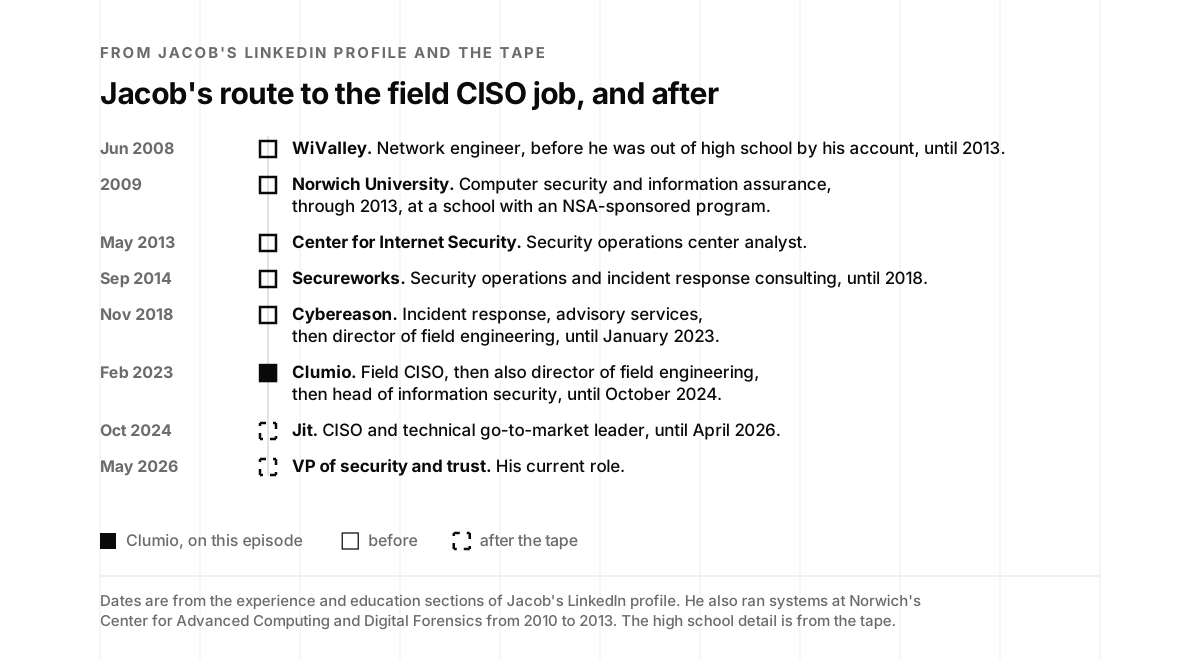
A timeline. June 2008, WiValley, network engineer, before he was out of high school by his account, until 2013. 2009, Norwich University, computer security and information assurance, through 2013, at a school with an NSA-sponsored program. May 2013, Center for Internet Security, security operations center analyst. September 2014, Secureworks, security operations and incident response consulting, until 2018. November 2018, Cybereason, incident response, advisory services, then director of field engineering, until January 2023. Filled, February 2023, Clumio, field CISO, then also director of field engineering, then head of information security, until October 2024. Dashed, October 2024, Jit, CISO and technical go-to-market leader, until April 2026. Dashed, May 2026, VP of security and trust, his current role.
Jacob's route as his LinkedIn lists it: network engineer from 2008, Norwich University from 2009, a security operations center in 2013, Secureworks, Cybereason, Clumio from 2023, then Jit and a VP of security and trust role.

Funded by the NSA

The next step came through a friend who was looking at Norwich University. Jacob described the program that drew him there.

“So the NSA has this program where they fund certain cybersecurity programs.”

Jacob Berry, at 4:59

“And when they first started this program, many years ago now, the idea was they could get some IT people to, like, take some math, some crypto, some other things, fund these programs, also do scholarships to get people into government service, and they would offer these scholarships in exchange.”

Jacob Berry, at 5:03

Norwich is a private university in Northfield, Vermont, founded in 1819. It’s the oldest of the six senior military colleges, and the Department of Defense recognizes it as the birthplace of ROTC (Wikipedia). Wikipedia’s article on the school lists, among its graduate programs, a National Security Agency-sponsored Center of Academic Excellence in Information Assurance Education (Wikipedia). The other five senior military colleges are Texas A&M, The Citadel, the University of North Georgia, the Virginia Military Institute and Virginia Tech (Wikipedia), which fits Jacob’s line about where these programs grew.

“I didn’t do the scholarship side of it, but that’s how these programs came to be at a lot of universities, was through government funding and government direction.”

Jacob Berry, at 5:17

His LinkedIn has the degree as computer security and information assurance, 2009 to 2013, with Upsilon Pi Epsilon, the Association for Computing Machinery chapter and the cyber security and forensics club alongside it (LinkedIn). Upsilon Pi Epsilon is the first honor society for the computing and information disciplines, founded at Texas A&M in 1967 (Wikipedia). He also worked through school, as he said on the show. From 2010 to 2013 he was lead system administrator at the university’s Center for Advanced Computing and Digital Forensics, running virtual classrooms and network attack and defense simulations (LinkedIn). In September 2011 he supported a security operations center at Combined Endeavor 2011, configuring SIEM and forensic intrusion detection products and handling wireless spectrum and rogue access point management (LinkedIn).

“So I didn’t even know about it as, like, a career path, but a friend had gone, saw the program.”

Jacob Berry, at 5:26

A SOC guy, then the field

After Norwich, the résumé runs through the places a security career used to start. He was a security operations center analyst at the Center for Internet Security from 2013 to 2014, in East Greenbush, New York (LinkedIn). CIS is a US nonprofit formed in October 2000 whose mission is to help people, businesses and governments protect themselves against pervasive cyber threats (Wikipedia). Then came four years of consulting.

“And then I focused on consulting for a while with Secureworks. That was interesting. I was on a team that’s large consulting for large enterprises that needed, like, staff aug, but plus.”

Jacob Berry, at 1:07

Staff augmentation is contracting for people with specific skills to work alongside a client’s own staff, under the client’s direction (Wikipedia). The “plus” was strategy. Jacob said he did much of the strategic development for initial security operations programs at larger organizations. Secureworks, where he was a consultant and then senior consultant in security operations and incident response from 2014 to 2018, was an American cybersecurity company with about 4,000 customers in more than 50 countries (Wikipedia). From there he went to Cybereason, the American cybersecurity company founded in 2012 (Wikipedia), as a principal incident response specialist in 2018, then manager of advisory services, then director of field engineering until January 2023 (LinkedIn).

The thread through all of it, by his own account, was a question most security vendors never ask.

“How do you not, if I can use the word pissed off, like, how do you not piss off security people when you’re building a company?”

Jacob Berry, at 1:41

“And that’s something a lot of people don’t inherently understand, is the type of personas and the type of individuals that get into security, because it’s, people get into it often because they care about it, not because they want to make money.”

Jacob Berry, at 1:48

Listen · Jacob on episode 58, from 1:24
About 35 seconds: Jacob on building companies that don't annoy the people they sell to. The clip stops on its own. Read the full transcript.

A stumble more than an intentional

Sasha asked how Jacob came to be a field CISO. Jacob checked the question first, then answered it honestly.

“Is that correct? Is that, am I interpreting that question?”

Jacob Berry, at 6:05

“It was a stumble, more than, more than an intentional.”

Jacob Berry, at 6:10

The reason the job exists, in his telling, is a shortage. A chief information security officer is the senior executive responsible for the strategy and program that protect an organization’s information (Wikipedia). A field CISO is the one who carries that knowledge outside the building.

“There’s a shortage of people who both want to be in front of customers and talk to them and can inherently understand the security systems that you’re building.”

Jacob Berry, at 6:19

“Whether that’s, in our case at Clumio, it’s very heavily around product security. What are we building? How are we architecting? How are we detecting threats to secure the data that our customers are sending to us?”

Jacob Berry, at 6:27

Consulting had trained him for it. At Secureworks his role touched sales engineering, the hybrid of sales and engineering (Wikipedia), and at Cybereason the sales leaders kept asking him back.

“And a lot of the sales professionals and CROs that I worked with ended up really enjoying my participation in the field efforts and the ability to go and have conversations with customers about why you would make a decision and why you wouldn’t make a decision, or how do you build a security operations program.”

Jacob Berry, at 7:08

Listen · Jacob on episode 58, from 6:18
About 20 seconds: Jacob on why the field CISO job exists. The clip stops on its own. Read the full transcript.

His LinkedIn shows the role growing at Clumio: field CISO from February 2023, field CISO and director of field engineering from September 2023 (LinkedIn).

A single vector

Sasha took the answer and widened it. The skill Jacob described, Sasha said, is the one the industry now asks of every security leader, because security always trades against something.

“Security is always a balance.”

Sasha Sinkevich, at 7:51

You can go all out on protection, Sasha said, but it comes at the expense of research and development. What the industry asks of a CISO is to hold all of it at once.

“You have to connect the compliance, you have to connect the business capacity, you have to connect the business direction, as well as engineering abilities and capacity, into a single vector that will drive the business in a secured and trusted manner.”

Sasha Sinkevich, at 8:14

Listen · Sasha on episode 58, from 7:51
About 40 seconds: Sasha on connecting compliance, the business and engineering into one direction. The clip stops on its own. Read the full transcript.

Then Jon asked the obvious follow-up: so how do you strike that balance, Jacob?

I don’t think most people do

Jacob didn’t pretend.

“I don’t think most people do, to be frank.”

Jacob Berry, at 8:33

“And there’s a lot of, in our industry, of sort of saying that we do it well.”

Jacob Berry, at 8:39

Jon gave him room: nothing’s ever perfect. Jacob’s answer started with a word security people tend to avoid.

“And there’s a little bit of politics in that as well, because inherently, security and privacy is political.”

Jacob Berry, at 8:55

Sasha added the idea that has a name.

“There’s also the notion of political capital in security.”

Sasha Sinkevich, at 9:03

“You have a line of credit, you get to use it. And then it’s important not to max it out. It’s always a balance.”

Sasha Sinkevich, at 9:07

Political capital is a metaphor for the influence built up through relationships, trust and goodwill, and it’s often described as a kind of credit that can be banked, spent, misspent, lost and saved (Wikipedia). Sasha’s version is the security leader’s: every “no” spends some of it.

Jacob’s own meaning of “political” was deeper. Privacy and security, he said, are social expectations, and societies set expectations through government.

“Like, our expectation of privacy, our expectation of security, is something that’s social-based. And you implement social standards through governing, right?”

Jacob Berry, at 9:19

“Like, security is more of a privacy game than anything else.”

Jacob Berry, at 9:40

Information privacy, also called data privacy or data protection, is defined on Wikipedia as the relationship between data, technology, the public expectation of privacy, and the legal and political issues around them (Wikipedia). That’s close to Jacob’s framing, and it set up the model he walked through next.

Three buckets of risk

Jacob sorts the risks a business manages into three buckets, and he called the answer long-winded before he gave it. The first is the one every executive already understands.

“So one’s an operational risk. Like, I might have some sort of downtime or revenue loss associated with a technology incident, and that could be through compromise, or something, remote code execution, whatever that could be.”

Jacob Berry, at 9:58

The second is what society expects about privacy, which he said “doesn’t really sell too much” but is selling more every year. His example was the way big consumer platforms now advertise privacy on podcasts. The third is legal and compliance, which he sees as the second bucket written into law.

“So this one, this bucket over here, is really, again, it’s a codification of societal expectations.”

Jacob Berry, at 11:33

“We’ve said, this is the minimum baseline that we as individuals think a business should maintain, or other individuals I share my information with should maintain. So we codify that into law.”

Jacob Berry, at 11:40

The trouble is that they speak different languages, and only one of them is the CEO’s.

“That’s the language of most CEOs, and most is, I produce a thing, I do a thing, I get paid for doing the thing, I want to maximize the profit on that.”

Jacob Berry, at 11:01

“But the confidentiality often doesn’t have too much operational impact. And CEOs are over here thinking about operational impact almost all the time.”

Jacob Berry, at 12:20
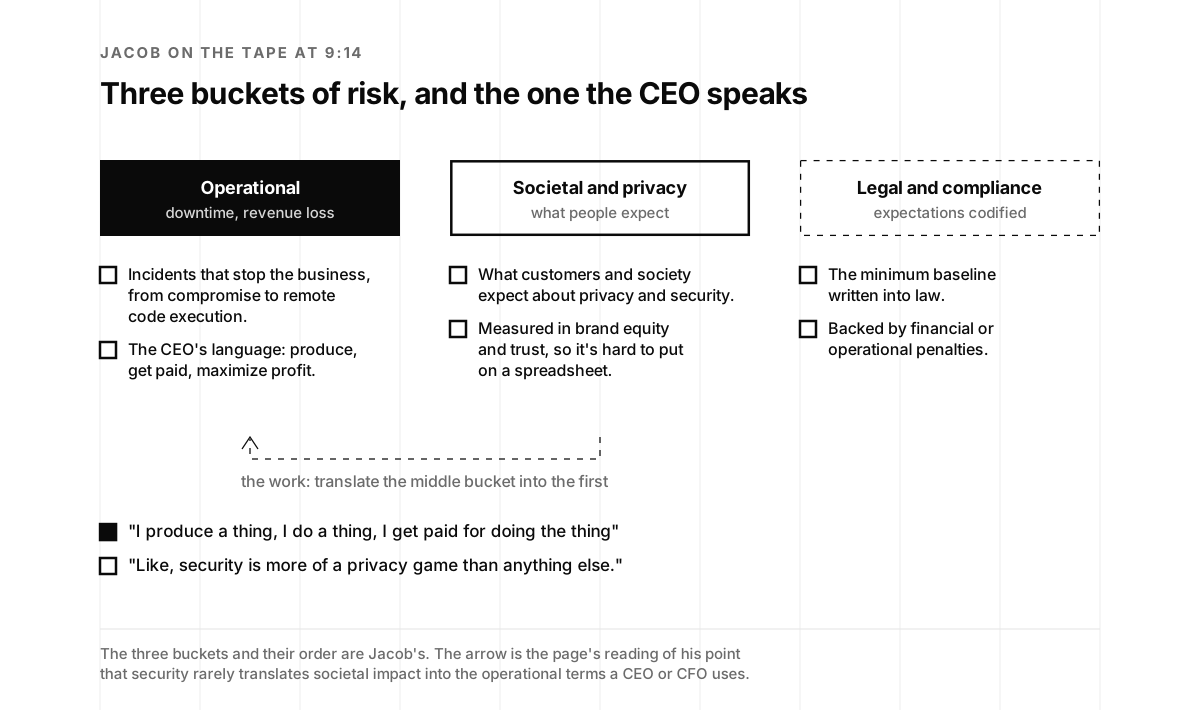
Three columns. Filled, operational risk, downtime and revenue loss: incidents that stop the business, from compromise to remote code execution, and the CEO's language, produce, get paid, maximize profit. Outlined, societal and privacy expectations: what customers and society expect about privacy and security, measured in brand equity and trust, so it's hard to put on a spreadsheet. Dashed, legal and compliance, expectations codified: the minimum baseline written into law, backed by financial or operational penalties. A dashed arrow runs from the middle column to the first, labeled the work, translate the middle bucket into the first. Two quotes from Jacob: I produce a thing, I do a thing, I get paid for doing the thing. Like, security is more of a privacy game than anything else.
Jacob's three buckets of risk: operational, which is the CEO's language, societal and privacy expectations, and legal and compliance, which codifies the second. Security people live in the middle bucket, and the work is translating it into the first.

That’s the gap he thinks security keeps losing in, and he said so plainly. What the middle bucket buys is real, but it’s measured in things a spreadsheet doesn’t show.

“And that’s when I say I don’t think we succeed at that very well, because we don’t translate why societal impact will have operational benefits or revenue-based benefits.”

Jacob Berry, at 12:32

“And often it’s not tangible, because you’re measuring those things in brand equity. You’re measuring that in, I’ve built trust with my consumer base, or the customers, the people I want to do business with, and therefore that leads to a higher purchase rate.”

Jacob Berry, at 12:41

Brand equity is the worth of a brand in itself, the reason a well-known name can earn more simply from being recognized and trusted (Wikipedia). Jacob’s practical answer was to start from the other side.

“Like, what does the CEO care about? Why is the CFO going to spend money on this?”

Jacob Berry, at 13:06

Listen · Jacob on episode 58, from 12:31
About 20 seconds: Jacob on why security struggles to show what trust is worth. The clip stops on its own. Read the full transcript.

Win-loss reports based on just the security

Jon brought it back to Clumio, where the trust question has a dollar sign on it.

“Well, with Clumio, it’s a B2B play, right? You’re selling to other businesses.”

Jon McLachlan, at 13:15

“So I bet, I mean, being a field CISO, you’re probably jumping on sales calls all the time. You’re representing the security posture of Clumio. So you could measure, you could have win-loss reports based on just the security.”

Jon McLachlan, at 13:21

Jacob cut in to agree.

“That’s the biggest driver for security here, impact on revenue.”

Jacob Berry, at 13:38

And Jon finished the thought: a field CISO hears, call after call, the one feature or compliance item a whole segment is waiting on, and can carry it back to the product managers and engineers.

“And it could be a whole slew of companies that are waiting for one feature or one compliance thingy or whatever.”

Jon McLachlan, at 13:59

Peel the onion back

Jacob’s answer to Jon was a warning about taking feature requests at face value. On the engineering side, every security feature built for one industry is a feature not built for another, so the first job is finding out what the customer is really asking for.

“Yeah, it takes a lot to sort of peel the onion back sometimes on those, like, feature requests.”

Jacob Berry, at 14:06

His example came from finance, and it’s one he said he uses all the time.

“A great example is, you’ll often hear, misconstrued in this type of industry, from finance, we want to keep our data in our accounts, right? We don’t want to transfer out to other third parties.”

Jacob Berry, at 14:30

The first answer you’ll hear is privacy or security. Jacob’s point is that data moves in and out of a bank all day, so that can’t be the whole reason. Underneath it is money moving on a schedule.

“But it’s more on the financial risk side of the business and responsibility over managing uptime, or managing, if you’re doing a, I use this example all the time, you’re doing, like, a $10 million transfer, and you miss that transfer.”

Jacob Berry, at 14:54

Payroll was his second example. A company’s payroll sits in a money market account, a deposit account that pays interest based on money market rates (Wikipedia), until payday, and then it moves. Miss one of those transfers and the penalties are large, and a vendor managing data the bank can’t see is a risk to exactly that schedule.

“So it’s, again, it goes back to an operational risk.”

Jacob Berry, at 15:40

So the feature isn’t really about keeping data in the bank’s account for privacy’s sake. It’s whatever lets the bank meet what it has promised in its own contracts, including the penalties it would pass through if a transaction is missed. That changes what you build.

“It goes really deep when you have to answer the question.”

Jacob Berry, at 15:56

“It’s a very murky world when you get into these vertical solutions.”

Jacob Berry, at 16:12
Listen · Jacob on episode 58, from 14:30
About 35 seconds: Jacob on what a bank really means when it asks to keep its data in its own account. The clip stops on its own. Read the full transcript.
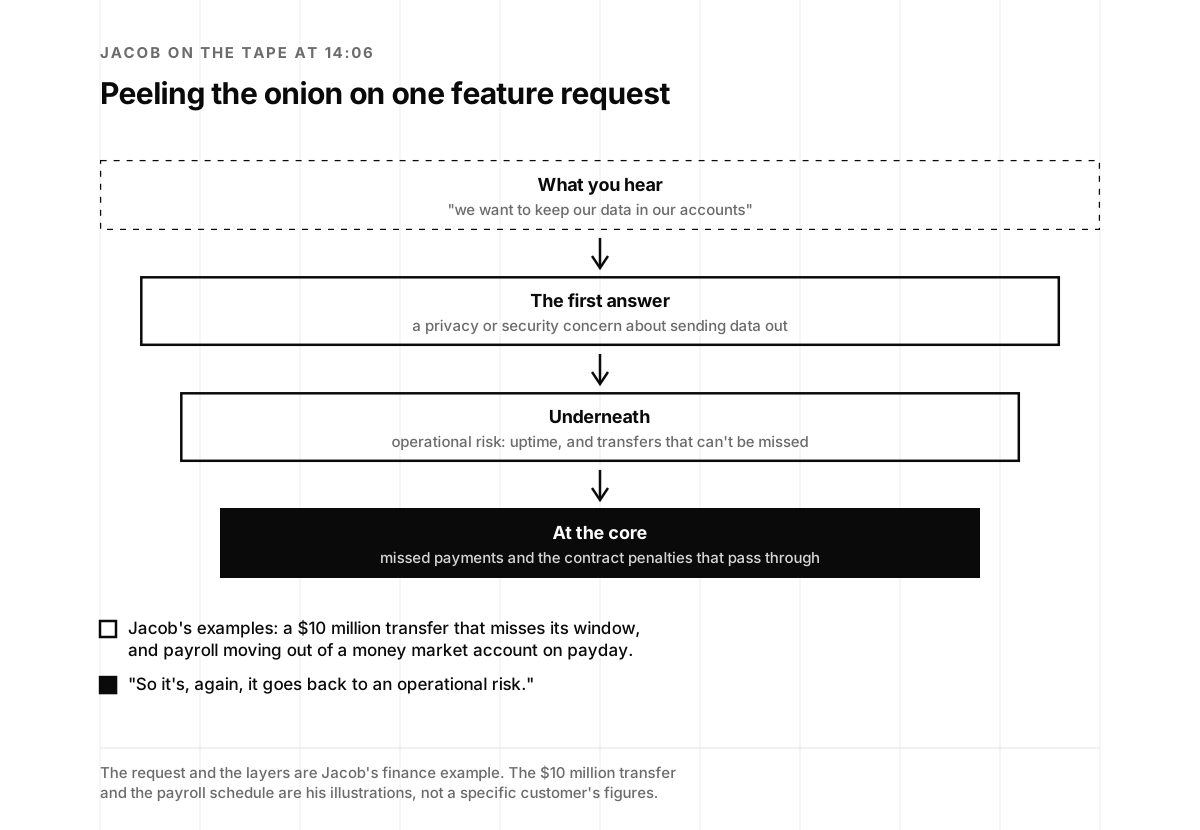
Four nested layers, each narrower, joined by arrows pointing down. Dashed, what you hear: we want to keep our data in our accounts. Outlined, the first answer: a privacy or security concern about sending data out. Outlined, underneath: operational risk, uptime, and transfers that can't be missed. Filled, at the core: missed payments and the contract penalties that pass through. Jacob's examples: a $10 million transfer that misses its window, and payroll moving out of a money market account on payday. His quote: So it's, again, it goes back to an operational risk.
Peeling the onion on one request: "we want to keep our data in our accounts" is said as privacy, sits on operational risk, and comes down to missed transfers and the contract penalties that pass through.

Healthcare, he said, is different because it’s regulated. Finance has a reputation for being regulated too, and he disagreed with it, at least on security.

“It’s not really, when it comes to security, which I’m opinionated on.”

Jacob Berry, at 16:21

Jon’s version was shorter.

“I mean, you get a bunch of tinfoil hat people in the financial space.”

Jon McLachlan, at 16:24

Jacob took it as a compliment, mostly. Banks have a lot at stake and the budget to chase every idea, and he counted himself among the tinfoil hats.

“They have the money to pay for them to have 100 quack ideas and one good one.”

Jacob Berry, at 16:32

“I have a bunch of quack ideas myself that aren’t things someone should go implement in a capitalist business.”

Jacob Berry, at 16:42

Integrity and availability

Sasha summed up the business, and asked Jacob for a correction if it was too simple.

“Given the line of business Clumio is engaged in, you help businesses to ensure that there’s always a backup of data.”

Sasha Sinkevich, at 16:49

It wasn’t. Jacob put Clumio’s focus on resiliency in AWS. A backup is a copy of data stored elsewhere so it can be restored after a loss (Wikipedia), and Amazon Web Services is the Amazon subsidiary that sells on-demand cloud computing, metered and pay-as-you-go (Wikipedia). Then Sasha asked the question the episode turns on.

“Would it be the integrity, availability of the data, or these two combined?”

Sasha Sinkevich, at 17:27

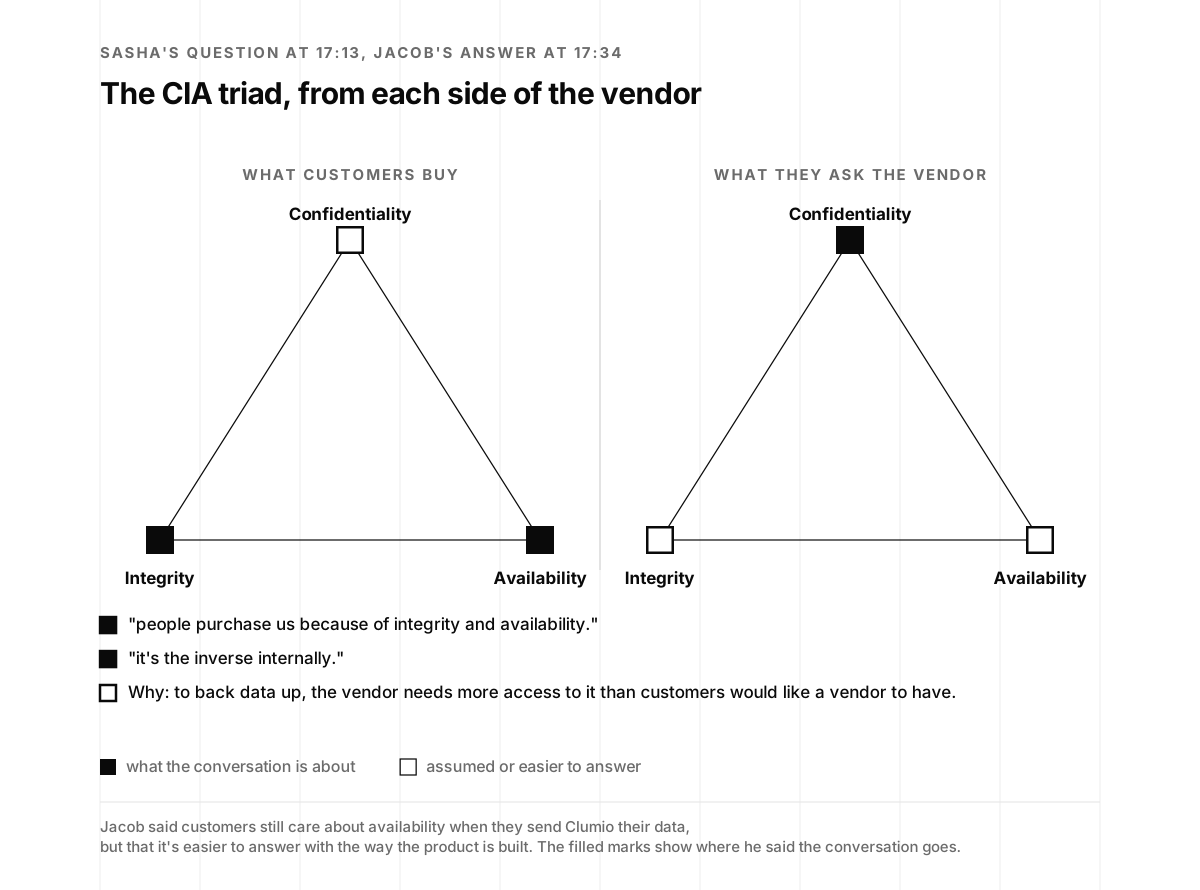
The CIA triad is shorthand for what information security protects: confidentiality, integrity and availability, whose balanced protection Wikipedia calls information security’s primary focus (Wikipedia). From the customer’s side, Jacob said, the answer is the last two.

“Yeah, so from an external-facing perspective, people purchase us because of integrity and availability.”

Jacob Berry, at 17:34

“And it’s a really interesting conversation with customers, because so much energy and time is spent on confidentiality.”

Jacob Berry, at 17:41

The reason availability gets overlooked, in his telling, is a model everyone in the cloud has learned.

“People inherently believe in the shared responsibility model in the cloud, that availability has been solved. And it’s like, infrastructure availability has been solved, not data availability.”

Jacob Berry, at 17:51

“You can still go and mess up as much as you want in your own account and impact your data availability.”

Jacob Berry, at 18:01

AWS’s own page draws the same line. It calls security and compliance “a shared responsibility between AWS and the customer,” and splits it into security of the cloud and security in the cloud (AWS). On the customer’s side of that line, AWS lists managing their data, including encryption options, and using IAM tools to apply the right permissions (AWS). The provider keeps the infrastructure up. A deleted table, a bad script or ransomware inside your own account is still yours to recover from.
Listen · Jacob on episode 58, from 17:37
About 30 seconds: Jacob on why the shared responsibility model leaves data availability with the customer. The clip stops on its own. Read the full transcript.
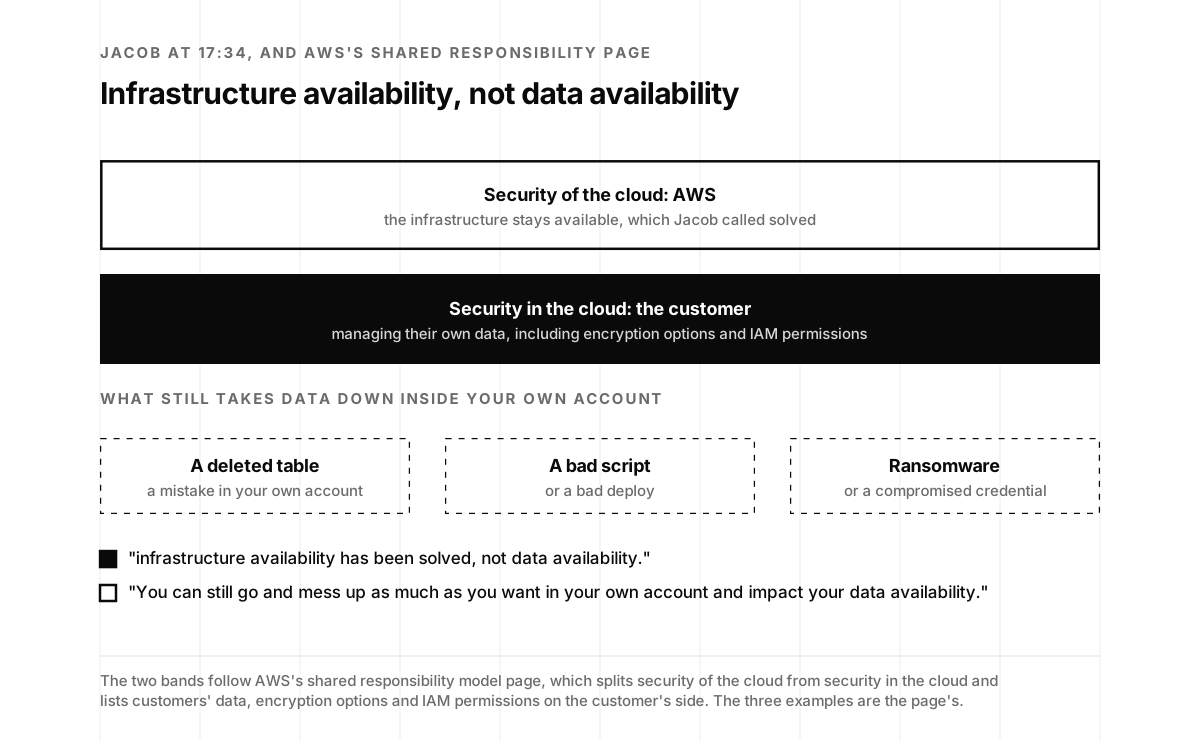
Two stacked bands. Outlined, security of the cloud, AWS: the infrastructure stays available, which Jacob called solved. Filled, security in the cloud, the customer: managing their own data, including encryption options and IAM permissions. Below, three dashed boxes for what still takes data down inside your own account: a deleted table, a mistake in your own account, a bad script or a bad deploy, and ransomware or a compromised credential. Two quotes from Jacob: infrastructure availability has been solved, not data availability. You can still go and mess up as much as you want in your own account and impact your data availability.
The shared responsibility model as Jacob read it: AWS keeps the infrastructure available, and the data in the customer's account, and whether it survives a mistake or an attack, stays the customer's job.

It’s the inverse internally

Then Jacob switched hats, and the triad flipped. The problems Clumio solved for customers, he said, were about integrity and availability, and then:

“less so than confidentiality, it’s the inverse internally.”

Jacob Berry, at 18:13

When customers hand Clumio their data, they still care about availability, because the point of a backup is coming back online after an outage. That part, he said, is easy to answer with the way the product is built. What they grill a vendor on is the other letter.

“But they really care about confidentiality and how our security program manages confidentiality of the data they’re sending us.”

Jacob Berry, at 18:31

The way AWS works makes that harder, not easier. To back data up, a vendor needs access to it.

“There’s a bunch of weird things with the way AWS works on how we have to access data and work within those bounds, which means we get higher visibility and higher access rights to some types of data than people want, inherently, a vendor to have. And that makes them very uncomfortable.”

Jacob Berry, at 18:38
Listen · Jacob on episode 58, from 18:07
About 30 seconds: Jacob on why the CIA triad flips when customers send a vendor their data. The clip stops on its own. Read the full transcript.
Two triangles side by side, each with confidentiality at the top and integrity and availability at the base. On the left, what customers buy: integrity and availability are filled, confidentiality is outlined. On the right, what they ask the vendor: confidentiality is filled, integrity and availability are outlined. Two quotes from Jacob: people purchase us because of integrity and availability. It's the inverse internally. And why: to back data up, the vendor needs more access to it than customers would like a vendor to have.
The inverse Jacob described. What customers buy from a backup vendor is integrity and availability. What they ask the vendor about its own security is confidentiality, because the vendor needs more access to their data than they'd like.

As good as a Fortune 500

The hardest version of the confidentiality question comes from the biggest customers.

“So we get a customer that’s absolutely massive that comes to us, and they expect our security program, as a startup, to be as good as a Fortune 500. And that’s really tough to do.”

Jacob Berry, at 19:03

The Fortune 500 is Fortune magazine’s annual ranking of the 500 largest US corporations by revenue, first published in 1955 (Wikipedia). Sasha finished the thought: to be on par with their internal standards. Jacob’s arithmetic for the gap was 10,000 employees on the customer’s side against 200 at Clumio, with a whole security team at the customer against a handful of people at the vendor.

“And so we have to really be conscious about how we’re doing system design and architecture, how we do key management, how we do credential management, and what it takes to access things within the company. We have to be extremely intentional in our design choices.”

Jacob Berry, at 19:32

The design choices are the multiplier. A small team can’t match a large one person for person, so the architecture has to do the work: fewer people who can reach data, keys that are managed rather than shared, and access that’s decided once in the design instead of every day by hand. Key management, for the record, is the whole life of a cryptographic key, from generation and exchange to storage, use, destruction and replacement (Wikipedia).
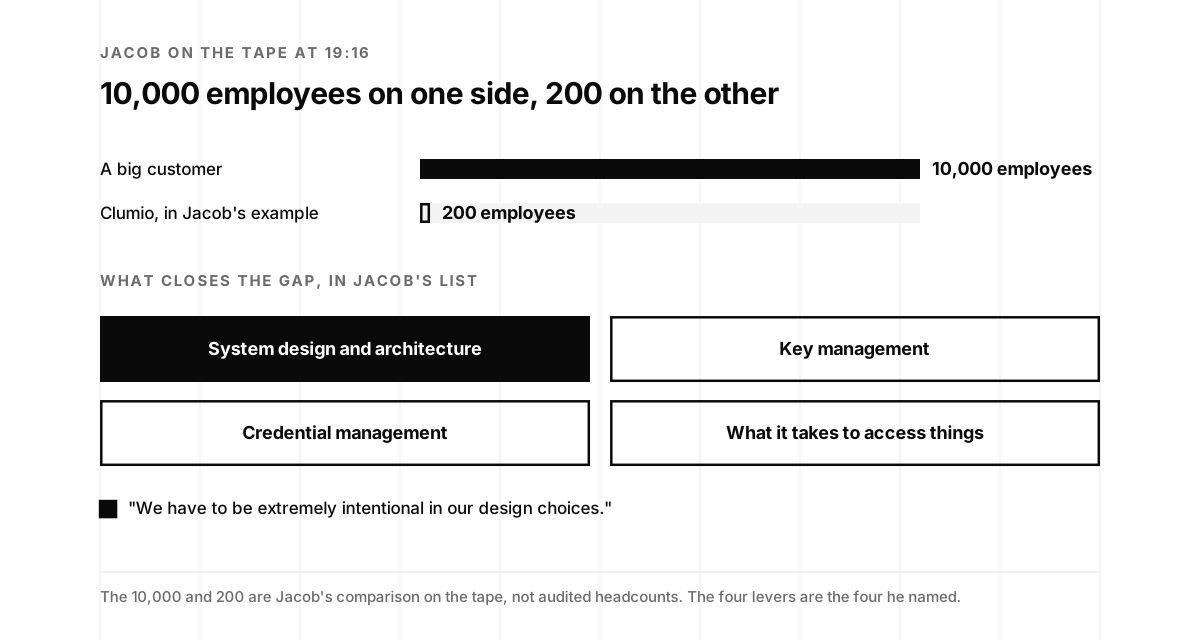
Two bars. A big customer, 10,000 employees, filled and full width. Clumio in Jacob's example, 200 employees, a sliver. Below, what closes the gap in Jacob's list: system design and architecture, filled, then key management, credential management, and what it takes to access things. His quote: We have to be extremely intentional in our design choices.
The gap Jacob described: a customer with 10,000 employees and a full security team, a startup with 200 and a handful, and the design choices that close it: system design and architecture, key management, credential management and who can access what.

Transparency is the way I approach it

Sasha asked how a small vendor proves all that to a prospect, that it can handle their data as well as they can. Jacob’s answer was one word, and he was blunt about the paperwork.

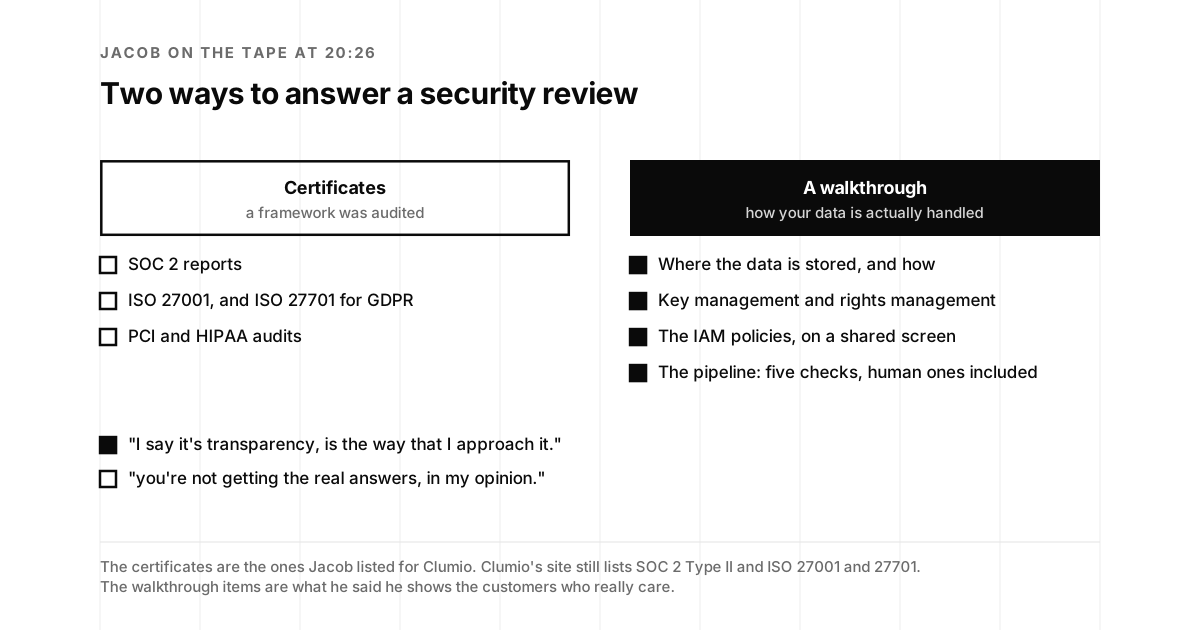
“I say it’s transparency, is the way that I approach it.”

Jacob Berry, at 20:26

He listed the certificates Clumio had: SOC 2, ISO 27001, ISO 27701 for GDPR, PCI and HIPAA audits. ISO/IEC 27001 specifies the requirements for an information security management system (Wikipedia), and ISO/IEC 27701 is the standard for privacy information management systems, first published in 2019 as an extension to 27001 and 27002 (Wikipedia). Clumio’s site still lists SOC 2 Type II and ISO 27001 and 27701 under the product today (Clumio). Jacob’s view is that none of it is the real answer.

“Those are all great. If you’re a vendor that’s managing risk through those tools, you’re not getting the real answers, in my opinion.”

Jacob Berry, at 20:38

“And the customers who really care go, okay, great, you have ISO, but I want to actually understand what you’re doing and how you’re doing it, and I want to build a relationship with you.”

Jacob Berry, at 20:45

So he sits down with them. He walks through the architecture, where the data is stored and how, and how keys and rights are managed. The cloud makes that easier than it sounds, because the controls are written down as policies.

“So with identity and access management tools that AWS provides, that gives us actually a lot of ability to show our customers very transparently how that data is managed.”

Jacob Berry, at 21:11

“If it comes to it, which it has in some cases, we’ll share our screens and go through, here’s how we’re going to go and show all these policies, and here’s how we prevent developers from having access to this data, because they’re just pushing through a CI/CD pipeline.”

Jacob Berry, at 21:27

Identity and access management is the set of policies and technologies that make sure the right users have the right access (Wikipedia), and CI/CD is continuous integration with continuous delivery or deployment (Wikipedia). The pipeline he described is how developers ship without touching customer data.

“And those have five different checks, including human checks, including tooling, and all these other things. So they can’t inherently just push bad code, right?”

Jacob Berry, at 21:39
Listen · Jacob on episode 58, from 20:26
About 30 seconds: Jacob on why certificates aren't the real answer. The clip stops on its own. Read the full transcript.
Two columns. Outlined, certificates, a framework was audited: SOC 2 reports, ISO 27001 and ISO 27701 for GDPR, PCI and HIPAA audits. Filled, a walkthrough, how your data is actually handled: where the data is stored and how, key management and rights management, the IAM policies on a shared screen, and the pipeline with five checks, human ones included. Two quotes from Jacob: I say it's transparency, is the way that I approach it. You're not getting the real answers, in my opinion.
Two ways to answer a security review. Certificates show a framework was audited. A walkthrough shows where the data lives, who can reach it, the IAM policies and the pipeline's checks, which is what the customers who really care want to see.

Insider threats and the second one

Jacob named his biggest risk, and declined to name the runner-up.

“Actually, I’m not going to mention, because it’s, I don’t want to give threat actors ideas on how to go and operate it.”

Jacob Berry, at 21:52

The first was insider threats, for an organization like Clumio. An insider threat comes from people inside an organization, employees, former employees, contractors or partners, who know its security practices, data and systems (Wikipedia). Then he did name a second one, supply chain, and said Clumio managed it through the way it handles developers. A supply chain attack goes after the less secure parts of an organization’s supply chain to reach it (Wikipedia).

“So if I think of those two as my biggest risks, those two are the ones that I want to have conversations with the customer, and how I’m handling them, because they agree, typically, that those are our biggest risks.”

Jacob Berry, at 22:04

Underneath both, he said, is a distinction that sounds pedantic until it isn’t.

“Technically, we’re really using some fundamental things around security controls, which is authorization and access. And how do you manage authorization versus access?”

Jacob Berry, at 22:15

Authorization is the function of specifying who has rights to which resources and deciding, request by request, whether a subject may use them (Wikipedia). Access is what someone can actually reach. The difference is where insiders and compromised pipelines live.

Automated provability

Proving all this by hand was, by Jacob’s account, the bottleneck in June 2024, and he said what he wanted next.

“And right now, this is the journey I want to take us on to as a startup, is going from, we manually prove that to customers today. How can I have automated provability in that?”

Jacob Berry, at 22:25

The scale made it pressing. Clumio built its infrastructure in a very segmented way, which meant thousands of AWS accounts.

“So automated provability, when you’re talking about hundreds, it’s actually thousands now, with our customer base, thousands of AWS accounts that we manage to build this infrastructure, because we’re doing things very segmented in our infrastructure.”

Jacob Berry, at 22:32

And the manual version costs sales time. Every review means calendars, a first pass with an engineering or DevOps team, a hand-off to the security team, and another meeting.

“How do I free up my sales team to be able to go and sell more? Because right now, security is almost a blocker to that, right?”

Jacob Berry, at 22:50

Listen · Jacob on episode 58, from 22:24
About 25 seconds: Jacob on moving from proving security by hand to proving it automatically. The clip stops on its own. Read the full transcript.

Critical friction points first

Sasha’s reply was about choosing what to automate, and it’s worth quoting nearly whole.

“The intelligent automation is very important. Why do I say intelligent? There are so many manual processes in the cybersecurity space today, but it’s important to identify what are the most critical friction points that potentially block sales, and how do you automate the most critical friction points first, because automation still involves manual work.”

Sasha Sinkevich, at 23:15

“But once you’ve done it, it will serve you well in the long term.”

Sasha Sinkevich, at 23:45

Listen · Sasha on episode 58, from 23:15
About 35 seconds: Sasha on automating the friction points that block sales first. The clip stops on its own. Read the full transcript.

He manages in, I manage out

Jacob agreed, and said Clumio had placed its automation bets on the developer side first, CI/CD and product security, because that’s where a startup’s energy goes. He gave his reason for why startups guard that energy.

“Why do startups always go in stealth? Because that way they can innovate in the shadows and try to out-innovate other people in the marketplace.”

Jacob Berry, at 24:09

Stealth mode is a company’s temporary secrecy, often to keep competitors from learning about a product before launch (Wikipedia). Then he gave credit where it was due.

“So Glenn runs security internally. He’s the VP of InfoSec internally. So he manages in, I manage out.”

Jacob Berry, at 24:20

That’s Glenn Mulvaney, who joined Clumio in March 2019 as vice president of cloud operations and security and stayed through the Commvault handoff, and who came on this show himself in episode 72 after co-founding Traceforce (LinkedIn, episode 72). His team’s automation, as Jacob described it, is built so a small staff only hears about the exceptions.

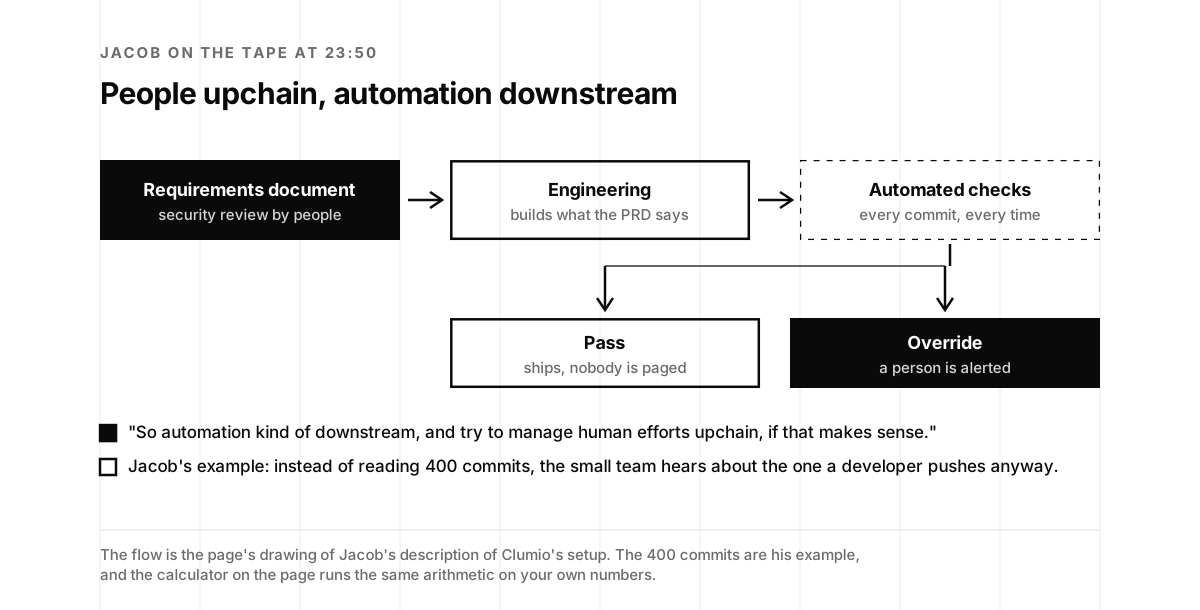
“So that way, our smaller staff only get flagged when something goes wrong, only when a developer maybe goes and says, I’m going to commit this anyway to the code base, even though it had a flag on this code check, right?”

Jacob Berry, at 24:36

The alternative is reading everything, and his example number was 400 commits. SOAR, the security orchestration, automation and response tools he mentioned, collect alerts and drive standardized responses automatically (Wikipedia). But the other half of his answer was about where people should spend their time, which is before any code exists.

“But if you’re doing it with your product team, and before you go and have engineering start something, you can put it into the PRD, you’re going to get a lot better output.”

Jacob Berry, at 25:04

“So automation kind of downstream, and try to manage human efforts upchain, if that makes sense.”

Jacob Berry, at 25:12

A product requirements document says what a product should do, and generally leaves how to the designers and engineers (Wikipedia). Putting security into it is the cheapest review there is.
Listen · Jacob on episode 58, from 24:20
About 25 seconds: Jacob on splitting security in and out, and alerts only for overrides. The clip stops on its own. Read the full transcript.
A flow from left to right. Filled, the requirements document, security review by people. Outlined, engineering, builds what the PRD says. Dashed, automated checks, every commit, every time. From the checks, two outcomes: pass, ships and nobody is paged, or override, filled, a person is alerted. Jacob's quote: So automation kind of downstream, and try to manage human efforts upchain, if that makes sense. His example: instead of reading 400 commits, the small team hears about the one a developer pushes anyway.
Jacob's split of effort: people review upchain, at the requirements document, before engineering starts, and automation runs downstream in the pipeline, flagging a human only when a developer overrides a failed check.

The calculator further down runs that math on your own commit volume.

Half the floor was developer security tools

Jacob closed that answer with an observation from the conference circuit, which also places the recording. At RSA and the other shows that year, he said, half the floor felt like it “was like developer security tools.”

The RSAC Conference, formerly the RSA Conference, started in 1991 as a small cryptography conference (Wikipedia). Jon agreed.

“Yeah, it was a lot. It’s a good show, though.”

Jon McLachlan, at 25:32

Bring your own key

Then Jon asked a question every enterprise buyer eventually asks: can the customer bring its own encryption key?

“do you get any asks for bring your own key, B-Y-O-K?”

Jon McLachlan, at 25:44

Bring your own key, or bring your own encryption, is a cloud model in which customers use their own encryption and manage their own keys (Wikipedia). Clumio supported it, Jacob said, with an AWS-shaped caveat: key management depends on the data source. His example was Amazon’s relational database service, in which AWS runs the patching, backups and point-in-time recovery (Wikipedia).

“AWS offers, typically, fundamentals, and then they offer, on top of fundamentals, when I say fundamentals, compute, storage, databases, networking, that’s fundamentals.”

Jacob Berry, at 26:09

“So each of those things all has different techniques for how you manage encryption keys in those, and what types of encryption they support, and how. And so there’s all this weird nuance.”

Jacob Berry, at 26:26
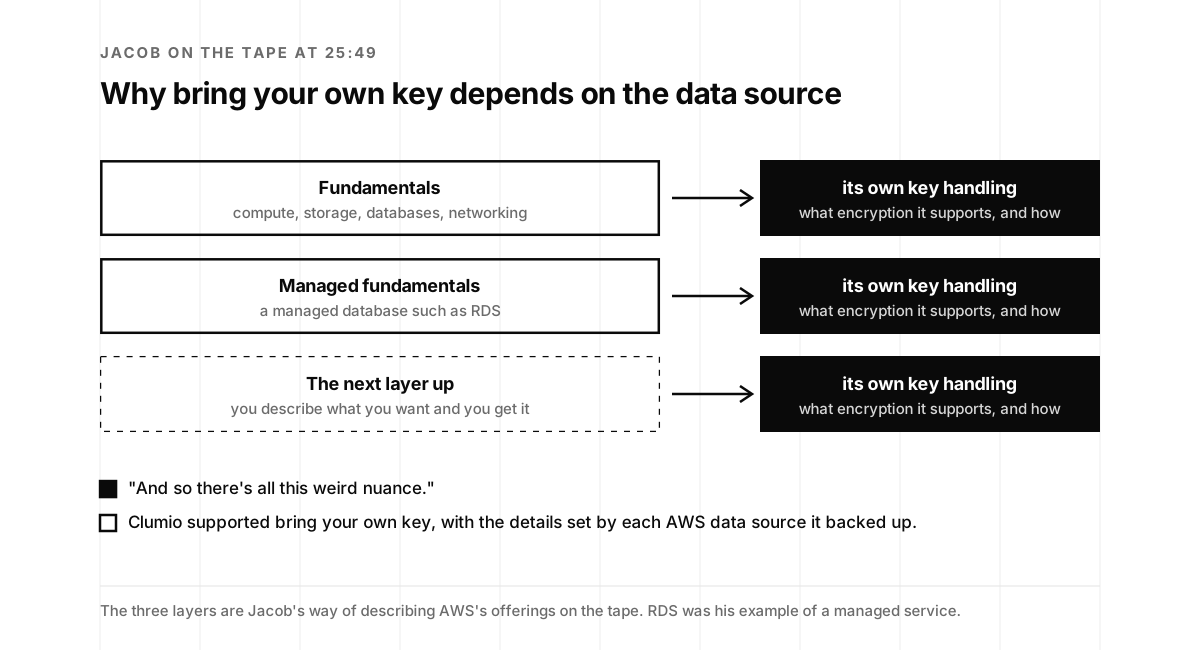
Three rows, each with an arrow to a filled box reading its own key handling, what encryption it supports and how. Outlined, fundamentals: compute, storage, databases, networking. Outlined, managed fundamentals: a managed database such as RDS. Dashed, the next layer up: you describe what you want and you get it. Jacob's quote: And so there's all this weird nuance. Clumio supported bring your own key, with the details set by each AWS data source it backed up.
AWS in the layers Jacob described: fundamentals like compute, storage, databases and networking, managed versions of them, and services where you only describe what you want. Each layer handles encryption keys its own way, which is why bring your own key depends on the data source.

Press a button and redeploy

Jon’s next question was data residency, also called data sovereignty, the idea that data generated within a country’s borders is governed by that country’s laws (Wikipedia). Jacob called it somewhat challenging and somewhat not. The challenging part is that the laws keep changing. The rest, he said, is architecture.

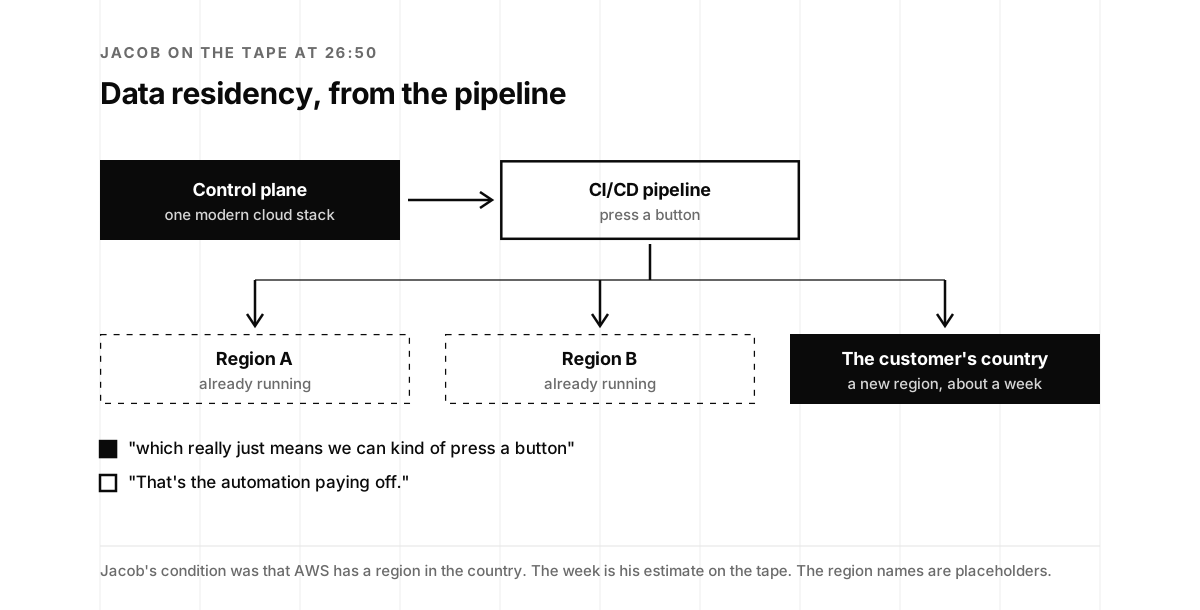
“The good thing is, we are built in a modern application with a control plane and a full modern cloud stack, which really just means we can kind of press a button in our CI/CD pipeline and redeploy our stack to any other region.”

Jacob Berry, at 26:59

As long as AWS has a region in the country, he said, Clumio could push its code there with about a week of effort. Jon said what everyone was thinking.

“That automation, paying off right there.”

Jon McLachlan, at 27:23

“That’s the automation paying off.”

Jacob Berry, at 27:25
Listen · Jacob on episode 58, from 26:59
About 25 seconds: Jacob on redeploying to a new region for data residency. The clip stops on its own. Read the full transcript.
A filled box, control plane, one modern cloud stack, with an arrow to an outlined box, CI/CD pipeline, press a button. From the pipeline, arrows fan out to three regions: region A and region B, dashed, already running, and the customer's country, filled, a new region, about a week. Two quotes from Jacob: which really just means we can kind of press a button. That's the automation paying off.
Data residency the way Jacob described it: one control plane and pipeline, and a stack that can be pushed to any AWS region in the country a customer names, in about a week.

A loophole for backups

Then Jacob brought up something he called a loophole, and said Clumio was unusual in having it. The General Data Protection Regulation is the European Union’s regulation on information privacy, aimed at giving people control over their personal data (Wikipedia), and one of the rights it gives is to have data erased, often called the right to be forgotten (Wikipedia). Backups, Jacob said, are treated differently.

“We’re a backup vendor, and GDPR service requests, for our customers, you don’t have to service backups.”

Jacob Berry, at 27:36

The detail, he explained, isn’t spelled out in the regulation itself. Each enforcement body makes its own ruling, and he had a theory about how that goes.

“And most of them typically just cheat off of whoever says it first. So whatever the first guy says, the rest go and do.”

Jacob Berry, at 28:00

“If the data comes back into the production system again, so you restore, someone has to actually make a new service request to then have that data deleted again.”

Jacob Berry, at 28:17

His advice, for anyone sending erasure requests about themselves, was to keep a list and send them again in a year or so.

“You should make a list of everything that you make service requests against, and then go back and do it in another year or so.”

Jacob Berry, at 28:30

Listen · Jacob on episode 58, from 27:31
About 30 seconds: Jacob on the right to erasure and backups. The clip stops on its own. Read the full transcript.

Here’s what one of those enforcement bodies actually wrote. The UK’s Information Commissioner’s Office says that when a valid erasure request comes in and no exemption applies, organizations have to “ensure erasure from backup systems as well as live systems” (ICO). It accepts that the data may stay in the backup until it’s overwritten, and says “the key issue is to put the backup data ‘beyond use’” in the meantime, while being clear with the person about what will happen (ICO). So the backup isn’t exempt so much as frozen, and a restore that brings the data back to life is exactly the risk Jacob described.

Sasha asked the practical question.

“How would you know that the backup was restored into production in the first place?”

Sasha Sinkevich, at 28:37

“You won’t, from an end user perspective.”

Jacob Berry, at 28:42

“You have to send that request every day for the rest of your life.”

Jon McLachlan, at 28:45

Sasha floated it as a startup idea, and Jacob said there are already services that manage data deletion requests.

Is that also the case for the CCPA?

Jon asked about California. The California Consumer Privacy Act was signed by Governor Jerry Brown on June 28, 2018, to strengthen privacy rights and consumer protection for California residents (Wikipedia). Jacob expected the same answer, without having seen a ruling.

“CCPA is typically similar. I haven’t seen, just could have missed it or haven’t looked, I haven’t seen any particular rulings from CCPA stating how you manage that, but they pretty much copy and paste, typically, off of GDPRs.”

Jacob Berry, at 29:03

His instinct was right, and California wrote it down. The CCPA regulations on requests to delete, section 7022 of title 11 of the California Code of Regulations, say that a business keeping personal information on archived or backup systems “may delay compliance with the consumer’s request to delete” for that data, until the system is restored to an active one or next accessed or used for a sale, disclosure or commercial purpose (Cornell LII). That’s Jacob’s restore rule, in regulation, from the other direction: the clock starts again when the backup comes back.
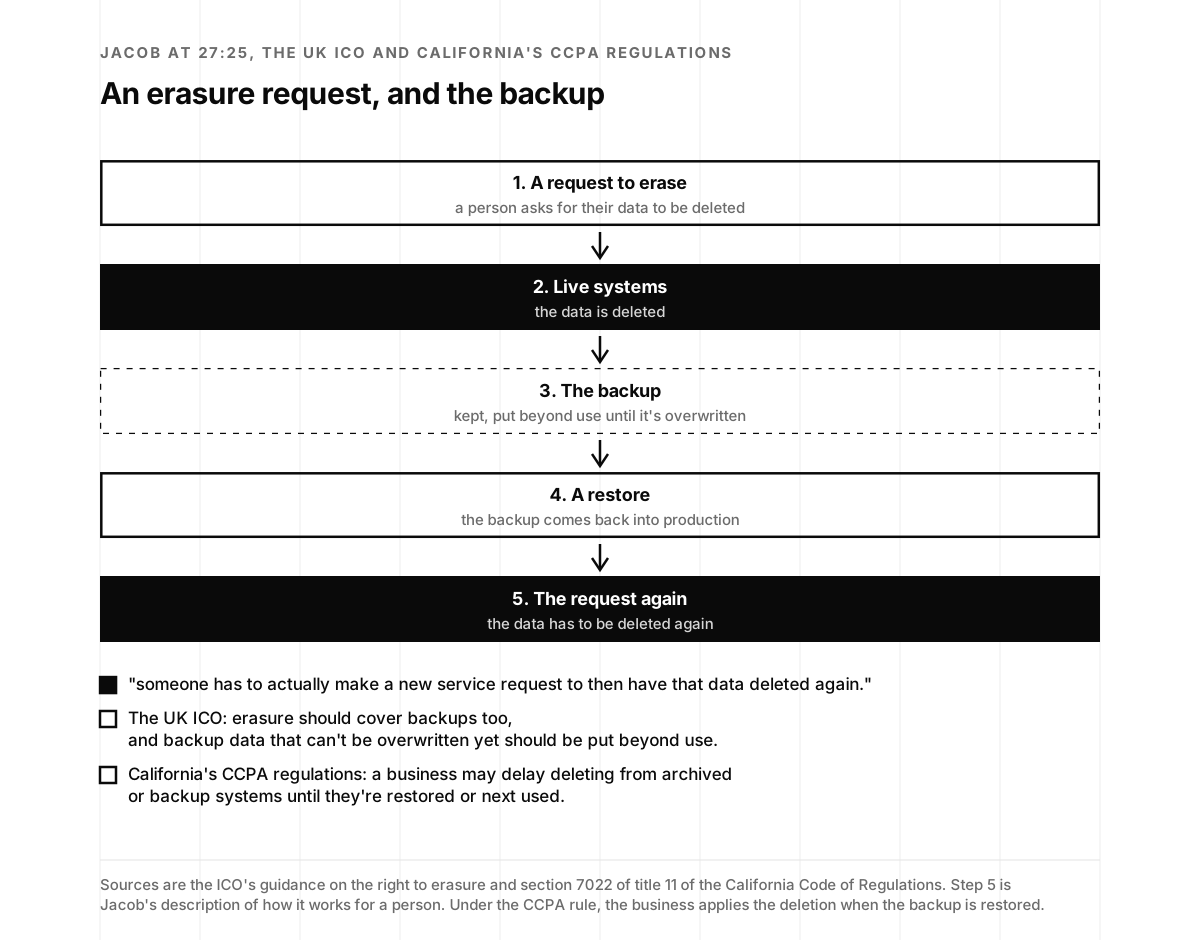
Five steps joined by arrows pointing down. 1, a request to erase, a person asks for their data to be deleted. 2, filled, live systems, the data is deleted. 3, dashed, the backup, kept and put beyond use until it's overwritten. 4, a restore, the backup comes back into production. 5, filled, the request again, the data has to be deleted again. Jacob's quote: someone has to actually make a new service request to then have that data deleted again. The UK ICO: erasure should cover backups too, and backup data that can't be overwritten yet should be put beyond use. California's CCPA regulations: a business may delay deleting from archived or backup systems until they're restored or next used.
An erasure request and a backup, step by step: the live data is deleted, the backup is kept but put beyond use, and the request has to be honored again if the backup is ever restored. The ICO and California's CCPA regulations both handle backups this way.

Snowflake people

Jon told Jacob that Clumio was lucky to have someone connecting the market, regulation, societal expectations and brand to the business, and that security sounded like part of the growth formula there. Jacob agreed, and credited the people at the top.

“Yeah, it’s 100%. It’s, fortunately, our CEO and investors all are Snowflake people, so all from the Snowflake world, and Snowflake had to deal with a lot of that in their growth structure.”

Jacob Berry, at 30:07

Snowflake is the cloud data platform company founded in San Mateo, California, which runs on AWS, Azure and Google Cloud (Wikipedia). The lesson Jacob drew from it applies to any company that stores customers’ data.

“And so, inherently, they understand that if you’re going to go and win a certain market segment, especially a larger enterprise, there’s things you have to do from a security perspective, because people aren’t going to give you their intellectual property unless you’re meeting a very high standard.”

Jacob Berry, at 30:20

“You either don’t understand it when you start that business, and you have to learn it real quick when you go to sign a customer and they say no, or you’ve already done it, and you’ve learned from the SaaS world that you have to do it, because you’re not going to sign customers up otherwise.”

Jacob Berry, at 30:40

Sasha made it general.

“Regardless of the service that company builds, you will likely handle data of your customers, either directly or indirectly, very likely directly. And data security is becoming a foundational component of doing the business.”

Sasha Sinkevich, at 30:55

Listen · Jacob on episode 58, from 30:20
About 30 seconds: Jacob on learning security when a big customer says no. The clip stops on its own. Read the full transcript.

I never say no to a customer

Jon asked for the best day Jacob had had at Clumio. Jacob checked who was listening first. Mostly startup founders and entrepreneurs, Jon said, and Jacob said they’d know the shape of it.

“So as a startup, okay. So there’s, the audience probably very much knows, startups are, you have really good days and you have really bad days.”

Jacob Berry, at 31:39

A former CEO of his, at another company, used to draw it as a jagged line that still heads up and to the right. The good days, for Jacob, are a particular kind of call: a customer the sales or customer success team expects to lose, over something security.

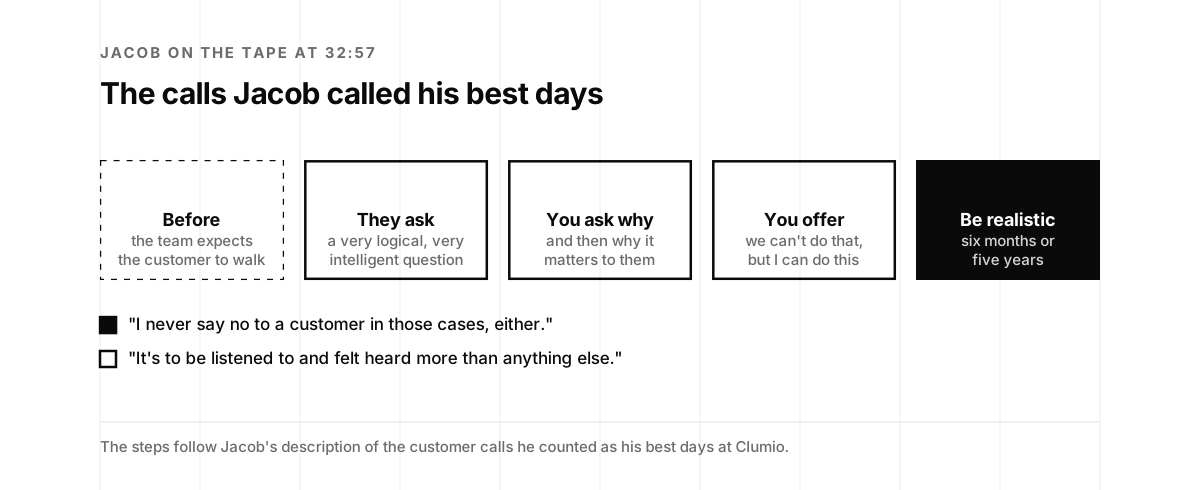
“And then I get on the call with them, and they just ask a very logical, very intelligent question about how we’re doing something.”

Jacob Berry, at 33:15

“I never say no to a customer in those cases, either. I’m going to go back and find a way to solve your problem, and then I’ll give you a realistic answer, if that’s a six-month or five-year problem.”

Jacob Berry, at 33:30

“I just don’t know if I have one engineer with one hour for the next five years to solve that, or do I get 20 engineers tomorrow to solve that problem.”

Jacob Berry, at 33:41

What turns those calls around, he said, is not the answer. It’s the listening.

“But when you sit down and you have an honest conversation, and you listen to what people have to say, and you ask why, and then you’re like, why does that matter to you?”

Jacob Berry, at 34:03

“That’s what people really want at the end of the day, isn’t it? It’s to be listened to and felt heard more than anything else.”

Jacob Berry, at 34:30

“They want to be heard.”

Jon McLachlan, at 34:35
Listen · Jacob on episode 58, from 33:14
About 25 seconds: Jacob on the customer calls everyone expects to go badly. The clip stops on its own. Read the full transcript.
Five boxes in a row. Dashed, before, the team expects the customer to walk. They ask a very logical, very intelligent question. You ask why, and then why it matters to them. You offer: we can't do that, but I can do this. Filled, be realistic, six months or five years. Two quotes from Jacob: I never say no to a customer in those cases, either. It's to be listened to and felt heard more than anything else.
The calls Jacob called his best days, step by step: a customer expected to walk away asks a logical question, he asks why and why it matters, says what Clumio can do instead, and gives a realistic answer, whether that's six months or five years.

Sometimes, he added, the customer finds out the thing they were worried about is already done. Sometimes they suggest something better, and he takes it back to build.

Which of you is the real Spider-Man?

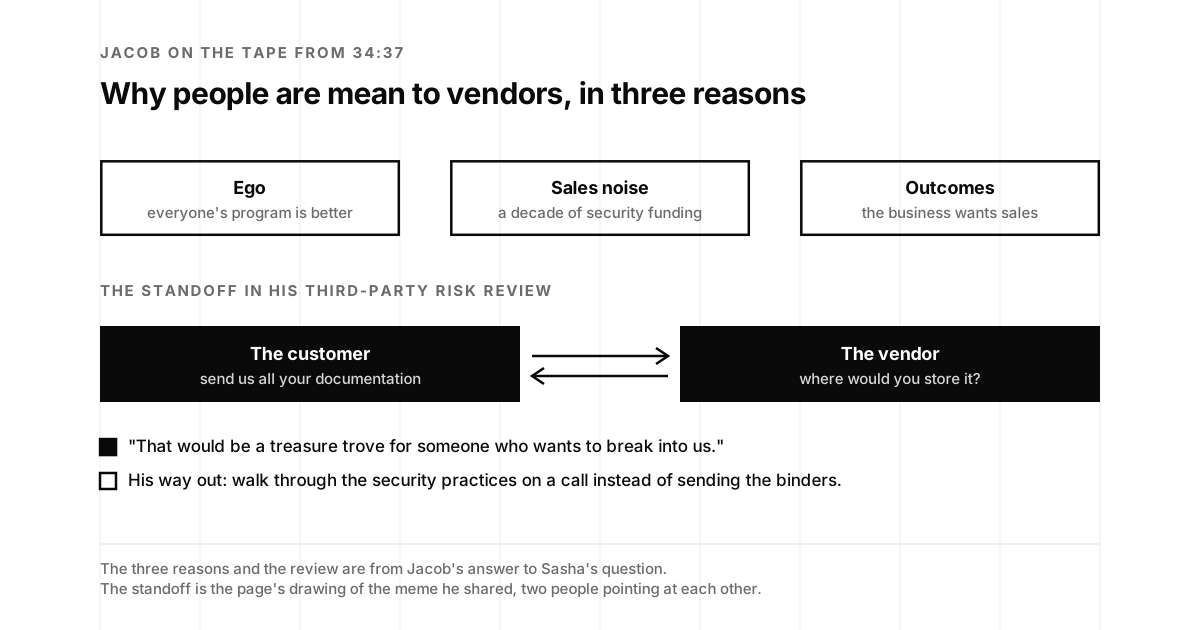
Along the way Jacob had said something Sasha wanted to hear more about: that people are very mean to vendors, “even though everyone’s a vendor for someone.” Sasha asked why. Jacob had three reasons, and the first was ego.

“Everyone thinks their security program’s better than the next guys. Well, that can’t be the case, that everyone’s better than everyone.”

Jacob Berry, at 35:08

“Sometimes it’s just convenient.”

Sasha Sinkevich, at 35:13

“And I think it’s because a lot of intelligent people are in security, and it does build this, I get this and other people don’t, mentality.”

Jacob Berry, at 35:21

The second was money. A decade of investment in security startups, now shifting toward AI-branded ones, filled the market with salespeople who can’t go deep.

“Like, they’re there to try to just tell you they exist. Like, the noise volume, they’re there to raise the noise volume. And the noise volume is so high now, people are just frustrated with the industry overall.”

Jacob Berry, at 36:28

The third was the business itself.

“And then the third thing I think contributes, and this is a larger issue, is a lot of security people don’t feel heard in the industry, or don’t feel like the business cares about them, which I say all the time, the business doesn’t care about security, because often they don’t.”

Jacob Berry, at 36:38

“They care about, they don’t care about security, they care about the outcome you’re giving them, which is typically increased sales, again.”

Jacob Berry, at 36:51

Listen · Jacob on episode 58, from 36:38
About 20 seconds: Jacob on why the business cares about outcomes, not security. The clip stops on its own. Read the full transcript.

Then he told a story with a meme in it, the one with two identical Spider-Men pointing at each other. Jacob had shared it during a third-party risk review.

“I shared that the other day when we were doing a third-party risk review, because it’s like, someone asked for all of our internal documentation on security, because, essentially, we don’t trust you.”

Jacob Berry, at 37:10

“That would be a treasure trove for someone who wants to break into us. And so, where are you storing that third-party risk data?”

Jacob Berry, at 37:30

The customer doesn’t trust the vendor, so it asks for everything. The vendor doesn’t trust the customer to hold everything safely. Both are right, which is the joke. His way out is the same one as before.

“And, typically, why I prefer Zoom calls to walk through security practices.”

Jacob Berry, at 37:38
Listen · Jacob on episode 58, from 37:10
About 25 seconds: Jacob on the review that asked for every internal security document. The clip stops on its own. Read the full transcript.
Three outlined boxes: ego, everyone's program is better. Sales noise, a decade of security funding. Outcomes, the business wants sales. Below, the standoff in his third-party risk review: a filled box for the customer, send us all your documentation, and a filled box for the vendor, where would you store it, with arrows pointing both ways between them. Jacob's quote: That would be a treasure trove for someone who wants to break into us. His way out: walk through the security practices on a call instead of sending the binders.
Why people are mean to vendors, in Jacob's three reasons: ego, sales noise from a decade of security funding, and a business that cares about outcomes rather than security. In the middle, the standoff from his story: send us all your documentation, and where would you keep it?

Sasha gave the customer’s side its due. A new vendor on board raises the company’s risk profile, and the demands may just be an attempt to keep that risk small. But Sasha landed where Jacob did.

“So it all boils down to a conversation, human conversation.”

Sasha Sinkevich, at 38:38

“Human conversation, yeah, exactly. I agree.”

Jacob Berry, at 38:42

Would I?

Jon asked whether Jacob would go back in time to meet his younger self, and what he’d say. Jacob wanted the rules first.

“Would you, if we’re not getting to sci-fi time paradoxes?”

Jacob Berry, at 39:00

The joke answer, he said, is the one everyone online gives.

“The joke online always is, you go back in time, you’re like, put $10 into Bitcoin.”

Jacob Berry, at 39:09

Bitcoin, the first decentralized cryptocurrency, was described in a 2008 white paper and came into use in 2009 (Wikipedia). But his real answer was no.

“But no, I don’t think I’d actually go back in time, because a lot of the ways I feel like I’ve succeeded have been somewhat accidental, or even, at times, naive choices, or just, like, letting the, kind of just following the life path as it has come.”

Jacob Berry, at 39:28

“Like, would I go make the same silly choice that led to an accident that led to a happy outcome, with advice? Probably not.”

Jacob Berry, at 39:50

Jon said Jacob was the first guest to say he wouldn’t go back, and called him grounded for it.

Listen · Jacob on episode 58, from 39:28
About 30 seconds: Jacob on why he wouldn't change the path. The clip stops on its own. Read the full transcript.

Security data fabric, which is really ETL tools

Sasha, who knew from before the show that Jacob rides motorcycles, asked about the road ahead.

“What do you think the next successful security product will look like?”

Sasha Sinkevich, at 41:09

Jacob said he’d give a general answer, though he has ideas of his own, and started with the trait he values most in the people he sells to.

“Security people are very skeptical, and rightfully so. That’s part of what makes you a good security person. What makes you a great security person is that you can balance the skepticism with the realism.”

Jacob Berry, at 41:26

“And I don’t think Gen AI is going to solve security.”

Jacob Berry, at 41:42

He wasn’t dismissive of it. He said the technology is really cool, that it sucks at a ton of things, and that plenty of startups will fail because they think it can do things it can’t. Generative AI is the part of AI that generates text, images, code and other data from patterns in its training data (Wikipedia), and Jacob’s point was that it’s interesting mostly because it’s visible.

“Gen AI is just interesting to the masses because it’s a very tangible implementation of machine learning.”

Jacob Berry, at 42:00

The bigger opportunity, he said, is the machine learning underneath, which the industry has adopted unevenly. Machine learning is the study of algorithms that learn from data and generalize to new data (Wikipedia). His success story was the endpoint.

“Obviously, endpoint is a great success story, where we went from traditional antivirus to a machine-learning-driven, or next-generation, antivirus in the space.”

Jacob Berry, at 42:23

Wikipedia’s article on antivirus software describes the same shift, signature-less approaches including models based on machine learning, which the media and analysts came to call next-generation antivirus (Wikipedia). Everywhere else, he said, analysis is still done by hand, and the tools that were supposed to help often add to the noise. That’s where he sees the next products, and where he was blunt about a buzzword.

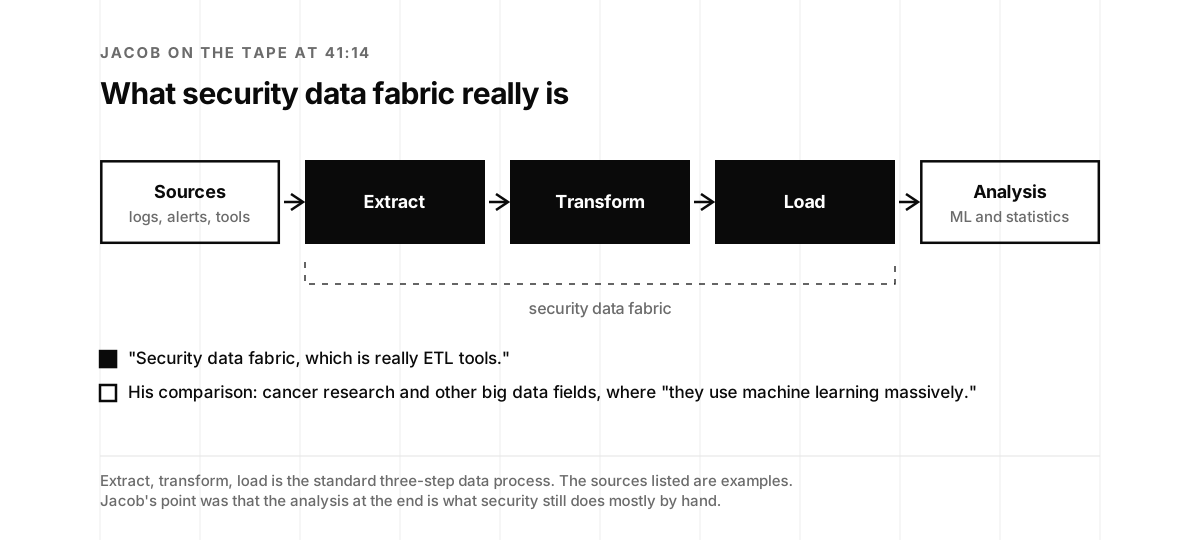
“And there’s been an emergence of smaller vendors over the last few years that get some buzzwords associated with them, like data fabric, right? Security data fabric, which is really ETL tools.”

Jacob Berry, at 43:10

Extract, transform, load is the three-step process of pulling data from sources, transforming it and loading it into a destination (Wikipedia). Jacob’s comparison was to science, where people with big data problems use machine learning heavily and then spend years processing what it finds.

“Go talk to someone doing some sort of scientific research in cancer or these other areas. They also have this big data problem, and they use machine learning massively.”

Jacob Berry, at 43:35
Listen · Jacob on episode 58, from 43:09
About 20 seconds: Jacob on security data fabric and the analytics security still does by hand. The clip stops on its own. Read the full transcript.
A pipeline of five boxes. Outlined, sources, logs, alerts, tools. Filled, extract, transform, load. Outlined, analysis, ML and statistics. A dashed bracket under extract, transform and load is labeled security data fabric. Jacob's quote: Security data fabric, which is really ETL tools. His comparison: cancer research and other big data fields, where they use machine learning massively.
What Jacob said security data fabric really is: extract from the sources security already has, transform, load into analysis, and apply the machine learning and statistics other big data fields rely on, instead of doing it by hand.

His advice on the hype was the most practical thing in the segment.

“And be skeptical on Gen AI products, but be intellectually curious on them, is my advice to people.”

Jacob Berry, at 44:23

“But don’t dismiss it outright. I think a lot of people are dismissing it outright.”

Jacob Berry, at 44:40

There is a pothole somewhere along the journey

Jon asked for final words, and Jacob went back to the journey.

“Just enjoy the journey in security. Don’t get caught up too much on the stress of the outcome that you’re going to drive every single day.”

Jacob Berry, at 45:11

“And I think the blood pressure level of the industry as a whole needs to come down, probably, a few points. Everything’s going to be okay out there.”

Jacob Berry, at 45:22

Not every decision, he said, is the end of the world or the end of privacy. Sasha finished the metaphor.

“I’ve never seen a perfect road. There is a pothole somewhere along the journey. I can promise you that. But as long as you look forward, that’s all that matters.”

Sasha Sinkevich, at 45:38

“Keep on riding. Definitely.”

Jacob Berry, at 45:50

Listen · Jacob on episode 58, from 45:11
About 20 seconds: Jacob on lowering the industry's blood pressure. The clip stops on its own. Read the full transcript.

After the tape

The five months between the recording and the release were the busiest part of this story. Jacob became Clumio’s head of information security in August 2024 (LinkedIn). On September 24, Commvault, the American publicly traded data protection and cybersecurity company (Wikipedia), announced it would buy Clumio in an asset acquisition expected to close in early October, and said the price wasn’t material to it (Commvault). Blocks and Files reported the price as $47 million, and put Clumio’s founding in 2017 and its funding at $262 million (Blocks and Files). In Commvault’s announcement, the customers it named for Clumio included Atlassian, Cox Automotive, Duolingo and LexisNexis (Commvault).

Jacob moved on in October 2024, to Jit, as CISO and technical go-to-market leader, until April 2026 (LinkedIn). Jit’s company page now says it was acquired by Torq (LinkedIn), and Torq announced the deal on May 19, 2026 (Torq). Since May 2026, Jacob has been a VP of security and trust (LinkedIn).

Glenn, the colleague who managed in while Jacob managed out, left after the handoff to co-found Traceforce, and sat down with Sasha and Jon for episode 72 (episode 72). Clumio itself carries on as Clumio by Commvault, with backup and recovery for AWS and Google Cloud, air-gapped and immutable storage, and Azure on the roadmap (Clumio). One of the standards on Jacob’s list changed too. In October 2025, ISO/IEC 27701 was revised into a stand-alone standard that can be certified on its own, rather than as an extension to ISO/IEC 27001 (Wikipedia).
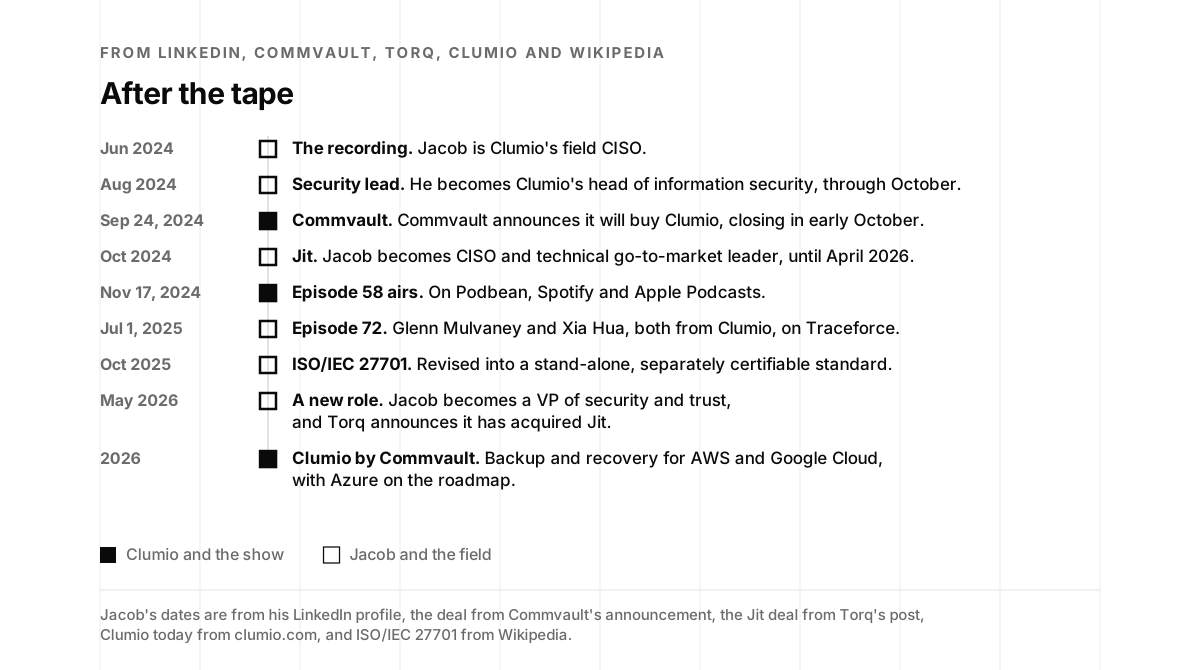
A timeline. June 2024, the recording, Jacob is Clumio's field CISO. August 2024, security lead, he becomes Clumio's head of information security, through October. Filled, September 24, 2024, Commvault announces it will buy Clumio, closing in early October. October 2024, Jit, Jacob becomes CISO and technical go-to-market leader, until April 2026. Filled, November 17, 2024, episode 58 airs on Podbean, Spotify and Apple Podcasts. July 1, 2025, episode 72, Glenn Mulvaney and Xia Hua, both from Clumio, on Traceforce. October 2025, ISO/IEC 27701 is revised into a stand-alone, separately certifiable standard. May 2026, a new role, Jacob becomes a VP of security and trust, and Torq announces it has acquired Jit. Filled, 2026, Clumio by Commvault, backup and recovery for AWS and Google Cloud, with Azure on the roadmap.
After the tape: Clumio's head of information security in August 2024, Commvault's deal for Clumio in September and October, Jit from October 2024 to April 2026, VP of security and trust from May 2026, Traceforce and episode 72, and ISO/IEC 27701 standing alone from October 2025.

The part of the conversation that aged best is the inverse itself. What a customer buys from you and what it asks you to prove are different questions, and the second one is about your own house. Answer it in the open, with the policies on the screen. Ask why a customer wants what it wants before you build it. Put the people at the start of the work and the automation at the end. And keep a written answer for the day someone asks what happens to their data in your backups.

Did you catch it? A six-question quiz

Six questions from the episode. Each answer links the moment in the transcript.

Quiz · six questions

Did you catch it?

Pick an answer for each. The explanation shows once you choose.

  1. How did Jacob describe himself in high school?

    1. A script kiddie
    2. A network administrator
    3. A punk hacker

    c. "what I describe affectionately as, like, a punk hacker in high school" Transcript, 2:43.

  2. Which two parts of the CIA triad did Jacob say customers buy Clumio for?

    1. Integrity and availability
    2. Confidentiality and integrity
    3. Confidentiality alone

    a. "Yeah, so from an external-facing perspective, people purchase us because of integrity and availability." Transcript, 17:34.

  3. How does Jacob approach proving a startup's security to a big customer?

    1. More certificates
    2. Transparency
    3. Longer questionnaires

    b. "I say it's transparency, is the way that I approach it." Transcript, 20:26.

  4. How did Jacob split security work with Glenn, Clumio's VP of InfoSec?

    1. Glenn managed in, Jacob managed out
    2. Glenn ran compliance, Jacob ran engineering
    3. They split the customers by region

    a. "So he manages in, I manage out." Transcript, 24:24.

  5. What did Jacob say about GDPR erasure requests and a backup vendor's customers?

    1. Backups have to be wiped within 30 days
    2. The backup vendor must delete the data itself
    3. You don't have to service backups

    c. "We're a backup vendor, and GDPR service requests, for our customers, you don't have to service backups." Transcript, 27:36.

  6. What did Jacob say security data fabric really is?

    1. A new kind of firewall
    2. ETL tools
    3. Generative AI

    b. "Security data fabric, which is really ETL tools." Transcript, 43:16.

Will a big customer trust you with its data?

Jacob’s test for a vendor was whether it could show, not just certify, how it protects a customer’s data. Eight questions on how close your company is, if you’re the startup on the other side of a big customer’s security review.

Scorecard · eight questions

Will a big customer trust you with its data?

Answer for how you work today. If two answers fit, pick the lower one.

  1. Can you show a prospect, live, who and what can reach their data, from the access policies themselves?

    • No, not with any confidence
    • We describe it in a document
    • Yes, we walk through the policies on a call

    "So with identity and access management tools that AWS provides, that gives us actually a lot of ability to show our customers very transparently how that data is managed." See Transparency is the way I approach it.

  2. Can a developer ship code that reaches customer data without passing checks?

    • Yes, or we don't know
    • There are automated checks, but no person and no alert on overrides
    • Several checks, including a person, and an override alerts someone

    "And those have five different checks, including human checks, including tooling, and all these other things." See Transparency is the way I approach it.

  3. Do you know your two biggest risks, and can you explain to a customer how you handle each?

    • No
    • We know them, but haven't written the explanation
    • Yes, and we walk customers through both

    "So if I think of those two as my biggest risks, those two are the ones that I want to have conversations with the customer, and how I'm handling them" See Insider threats and the second one.

  4. Is key management documented for each data store, and can customers bring their own key where the store allows it?

    • No
    • Documented, but no bring your own key
    • Documented per store, with bring your own key where it's supported

    "So each of those things all has different techniques for how you manage encryption keys in those, and what types of encryption they support, and how." See Bring your own key.

  5. Do you have a written answer for erasure requests that touch your backups?

    • No
    • We delete the live data and don't mention backups
    • Yes: live data deleted, backups put beyond use, and the request applied again on any restore

    "If the data comes back into the production system again, so you restore, someone has to actually make a new service request to then have that data deleted again." See A loophole for backups.

  6. If a customer needs its data kept in one country, how long would that take you?

    • Months, or we couldn't
    • Weeks of manual work
    • About a week, from the pipeline

    "That's the automation paying off." See Press a button and redeploy.

  7. Does security review happen in the requirements document, before engineering starts?

    • No
    • Sometimes
    • Always

    "So automation kind of downstream, and try to manage human efforts upchain, if that makes sense." See He manages in, I manage out.

  8. When a prospect asks for all of your internal security documentation, what happens?

    • We send all of it
    • We stall
    • We offer a walkthrough and share what's safe to share

    "That would be a treasure trove for someone who wants to break into us." See Which of you is the real Spider-Man?.

Two Spider-Men pointing

Trust rests on documents nobody can check, and the big reviews stall. Start by writing down who can reach customer data and why, and be ready to show the access policies on a call instead of sending binders.

Certificates, not answers

The audits are there, but the hard questions still get answered by hand, one review at a time. Put a person on code overrides, document keys per data store, and write your backup erasure answer before someone asks.

Transparent by design

You can show a customer how their data is handled and who can touch it. Keep the walkthrough current, move security into the requirements, and start automating the proof so sales isn't waiting on calendars.

How many commits need a human?

Jacob’s example was a list of 400 commits nobody can read, and a setup in which people only hear about the ones that matter. The calculator runs that arithmetic on your own numbers. He didn’t put a time period on the 400, so we’ve made it a week, and the other three defaults are examples. Put in your own.

Calculator

How many commits need a human?

Four numbers: commits a week, the share your checks flag, the share of flags developers override, and the minutes it takes a person to review one commit.

–hours a week to read every commit
–commits a week that reach a person
–hours a week on those
–hours back each week
–% of review time saved

Reading all 400 commits a week would take about 67 hours. With checks flagging 10% and developers overriding 20% of those flags, about 8 commits reach a person, about 1.3 hours. That's 65 hours back each week, 98% of the review time.

The 400 is Jacob's example from the episode, and the rest are examples, not benchmarks. The point is the shape he described: automation reads everything downstream, a person sees the overrides, and the security review that matters most happens upchain, in the requirements document, before any of these commits exist.

From Norwich to Clumio and after

Everything on this page sits on one timeline, from the year Norwich University was founded to Clumio by Commvault today. Filter it by thread.

Timeline · 1819 to 2026

From Norwich to Clumio and after

Filter by thread. Dates are from the public record except where marked as part of this show.

  1. Norwich University

    The school is founded as the American Literary, Scientific and Military Academy, the oldest of the six senior military colleges (Wikipedia, on this show).

  2. The first Fortune 500

    Fortune publishes its first list of the largest US corporations by revenue (Wikipedia, on this show).

  3. RSA Conference

    It starts as a small cryptography conference (Wikipedia, on this show).

  4. HIPAA

    President Bill Clinton signs the health information law behind one of the audits Jacob listed (Wikipedia, on this show).

  5. Cisco Networking Academy

    Cisco's education program starts in California (Wikipedia, on this show).

  6. Center for Internet Security

    The nonprofit is formed (Wikipedia, on this show).

  7. Amazon S3

    AWS launches its object storage in the United States (Wikipedia, on this show).

  8. Network engineer

    Jacob joins WiValley, Inc., before he's out of high school by his account (LinkedIn, on this show).

  9. Norwich

    He starts a degree in computer security and information assurance, through 2013 (LinkedIn, on this show).

  10. Combined Endeavor 2011

    He supports a security operations center with SIEM and forensic intrusion detection products (LinkedIn, on this show).

  11. Cybereason

    The company is founded (Wikipedia, on this show).

  12. A SOC analyst

    Jacob joins the security operations center at the Center for Internet Security (LinkedIn, on this show).

  13. Secureworks

    Four years of security operations and incident response consulting (LinkedIn, on this show).

  14. Clumio is founded

    Poojan Kumar, Woon Ho Jung and Kaustubh Patil start the company (Blocks and Files, on this show).

  15. The CCPA

    Governor Jerry Brown signs the California Consumer Privacy Act (Wikipedia, on this show).

  16. Cybereason

    Jacob joins as a principal incident response specialist, and leaves as director of field engineering in January 2023 (LinkedIn, on this show).

  17. Glenn Mulvaney

    He joins Clumio as vice president of cloud operations and security (LinkedIn, on this show).

  18. ISO/IEC 27701

    The privacy information management standard is published as an extension to 27001 and 27002 (Wikipedia, on this show).

  19. Field CISO

    Jacob joins Clumio, and adds director of field engineering in September (LinkedIn, on this show).

  20. Deletion rules amended

    California's regulation on requests to delete, which covers backups, is amended (Cornell LII, on this show).

  21. The recording

    Jon and Sasha talk with Jacob, with the year's RSA Conference still recent by Jacob's account (on this show).

  22. Head of information security

    Jacob takes over security at Clumio through October (LinkedIn, on this show).

  23. Commvault buys Clumio

    The asset acquisition is expected to close in early October (Commvault, on this show).

  24. Jit

    Jacob becomes CISO and technical go-to-market leader, until April 2026 (LinkedIn, on this show).

  25. Episode 58 airs

    The episode goes out on Podbean, Spotify and Apple Podcasts (Podbean, on this show).

  26. Episode 72

    Glenn and Xia Hua, both from Clumio, come on the show to talk about Traceforce (on this show).

  27. 27701 stands alone

    ISO/IEC 27701 is revised into a stand-alone, separately certifiable standard (Wikipedia, on this show).

  28. VP of security and trust

    Jacob takes a new role (LinkedIn, on this show).

  29. Torq acquires Jit

    Torq announces the deal (Torq, on this show).

  30. Clumio by Commvault

    Backup and recovery for AWS and Google Cloud, with Azure on the roadmap (Clumio, on this show).

What to do this week

Five things, in the order the episode suggests.

  1. Peel the onion on one request. Pick the security feature request your sales team hears most and ask why twice. Jacob’s bank example started as privacy and ended as a missed transfer and a contract penalty, and that’s a different feature.
  2. Make your access showable. Be ready to put your access policies and your pipeline’s checks on a screen in a call, and list your two biggest risks with how you handle each. The scorecard above covers the rest.
  3. Move people upchain. Put a security review in the requirements document before engineering starts, and let automation flag only the overrides. The calculator shows what that’s worth on your own commit volume.
  4. Write down your backup answer. For erasure requests, say what happens to live data and to backups, and what happens on a restore. The ICO’s “beyond use” and California’s rule on archived or backup systems are a good starting point.
  5. Get help with the parts you can’t staff. Our Sales Support team answers the security reviews and questionnaires big customers send, our Product Security team builds the pipeline checks and the architecture you’ll want to show, our vCISO Services can be the field CISO you don’t have yet, and you can book 15 minutes with us.

Key takeaways

  1. Security people have to be won, not sold

    Jacob's career thread was one question most vendors skip: how do you not annoy the security people you sell to? They get into the field because they care about it, and they can tell when a vendor doesn't.

  2. The field CISO job exists because of a shortage

    There are few people who both want to be in front of customers and understand the systems being built. Jacob stumbled into the role through consulting and field work, where sales leaders kept asking him back.

  3. Spend political capital carefully

    Sasha's framing was a line of credit: a security leader gets to use it, and it's important not to max it out.

  4. Risk comes in three buckets

    Operational risk is the CEO's language. Societal and privacy expectations are where security people live. Legal and compliance codifies those expectations into law. The work is translating the middle bucket into the first.

  5. Trust is measured in brand equity, which is why it's hard to show

    Jacob's view is that security struggles because it doesn't translate societal impact into operational or revenue terms, and trust shows up as brand equity and a higher purchase rate, not as a line item.

  6. Peel the onion on every feature request

    A bank that says it wants to keep its data in its own account for privacy may really be protecting a $10 million transfer or a payroll schedule, and the penalties in its own contracts. That changes what you build.

  7. Customers buy a backup vendor for integrity and availability

    The shared responsibility model leads people to think availability is solved, but AWS keeps the infrastructure available, not the data in your own account.

  8. Then they question the vendor on confidentiality

    Inside the vendor, the triad flips. A backup vendor needs more access to customer data than customers would like, so its own confidentiality is what gets questioned.

  9. A 200-person startup is held to a Fortune 500 standard

    Big customers expect a startup's security program to match theirs. Design choices close the gap: architecture, key management, credential management and who can access what.

  10. Transparency beats certificates

    SOC 2, ISO 27001 and 27701, PCI and HIPAA audits are great, Jacob said, but the customers who really care want a walkthrough of where the data is, who can reach it and how the pipeline is checked.

  11. Know your biggest risks and say how you handle them

    For a vendor like Clumio, insider threats came first, and supply chain was the other one Jacob would name. Customers usually agree, and the conversation is about how each is handled.

  12. Make proof automatic

    Proving controls by hand doesn't scale across thousands of AWS accounts, and it ties up the sales team. Jacob's next step was automated provability.

  13. People upchain, automation downstream

    Security review belongs in the requirements document before engineering starts, and automation should flag a person only when a developer overrides a check.

  14. Bring your own key depends on the data source

    Clumio supported BYOK, but on AWS each layer, from fundamentals to managed services, handles keys its own way.

  15. Backups and the right to erasure

    Jacob said backups aren't serviced for GDPR erasure requests, and a restore needs a new request. The UK ICO says to put backup data beyond use, and California's CCPA regulations let a business delay deleting from backups until they're restored or used.

  16. Listening turns around the worst calls

    Jacob never says no to a customer on those calls. He asks why, asks why it matters, offers what he can, and gives a realistic answer, six months or five years.

  17. Be skeptical, and curious, about Gen AI

    Jacob doesn't think Gen AI will solve security, sees more opportunity in machine learning and data analytics, called security data fabric really ETL tools, and told people not to dismiss AI outright.

Chapters

Tap a chapter to play from there.

Pull quotes

“I was a SOC guy when SOCs were a lot different than they were now.”

Jacob Berry ·

“How do you not, if I can use the word pissed off, like, how do you not piss off security people when you're building a company?”

Jacob Berry ·

“people get into it often because they care about it, not because they want to make money.”

Jacob Berry ·

“Well, you have to be a little bit crazy to be into security.”

Jacob Berry ·

“So I started as a, what I describe affectionately as, like, a punk hacker in high school, right?”

Jacob Berry ·

“We weren't, like, breaking into some IoT device that was controlling the power grid, right?”

Jacob Berry ·

“And then I was able to get a job in that even before I was out of high school.”

Jacob Berry ·

“So the NSA has this program where they fund certain cybersecurity programs.”

Jacob Berry ·

“It was a stumble, more than, more than an intentional.”

Jacob Berry ·

“There's a shortage of people who both want to be in front of customers and talk to them and can inherently understand the security systems that you're building.”

Jacob Berry ·

“Security is always a balance.”

Sasha Sinkevich ·

“into a single vector that will drive the business in a secured and trusted manner.”

Sasha Sinkevich ·

“I don't think most people do, to be frank.”

Jacob Berry ·

“No, nothing's ever perfect, right?”

Jon McLachlan ·

“And there's a little bit of politics in that as well, because inherently, security and privacy is political.”

Jacob Berry ·

“There's also the notion of political capital in security.”

Sasha Sinkevich ·

“You have a line of credit, you get to use it. And then it's important not to max it out. It's always a balance.”

Sasha Sinkevich ·

“Like, security is more of a privacy game than anything else.”

Jacob Berry ·

“So this one, this bucket over here, is really, again, it's a codification of societal expectations.”

Jacob Berry ·

“And often it's not tangible, because you're measuring those things in brand equity.”

Jacob Berry ·

“Like, what does the CEO care about? Why is the CFO going to spend money on this?”

Jacob Berry ·

“So you could measure, you could have win-loss reports based on just the security.”

Jon McLachlan ·

“That's the biggest driver for security here, impact on revenue.”

Jacob Berry ·

“Yeah, it takes a lot to sort of peel the onion back sometimes on those, like, feature requests.”

Jacob Berry ·

“So it's, again, it goes back to an operational risk.”

Jacob Berry ·

“It's a very murky world when you get into these vertical solutions.”

Jacob Berry ·

“I mean, you get a bunch of tinfoil hat people in the financial space.”

Jon McLachlan ·

“They have the money to pay for them to have 100 quack ideas and one good one.”

Jacob Berry ·

“Given the line of business Clumio is engaged in, you help businesses to ensure that there's always a backup of data.”

Sasha Sinkevich ·

“Yeah, so from an external-facing perspective, people purchase us because of integrity and availability.”

Jacob Berry ·

“And it's like, infrastructure availability has been solved, not data availability.”

Jacob Berry ·

“You can still go and mess up as much as you want in your own account and impact your data availability.”

Jacob Berry ·

“less so than confidentiality, it's the inverse internally.”

Jacob Berry ·

“But they really care about confidentiality and how our security program manages confidentiality of the data they're sending us.”

Jacob Berry ·

“And that makes them very uncomfortable.”

Jacob Berry ·

“So we get a customer that's absolutely massive that comes to us, and they expect our security program, as a startup, to be as good as a Fortune 500.”

Jacob Berry ·

“We have to be extremely intentional in our design choices.”

Jacob Berry ·

“I say it's transparency, is the way that I approach it.”

Jacob Berry ·

“If you're a vendor that's managing risk through those tools, you're not getting the real answers, in my opinion.”

Jacob Berry ·

“and I want to build a relationship with you.”

Jacob Berry ·

“And those have five different checks, including human checks, including tooling, and all these other things.”

Jacob Berry ·

“Actually, I'm not going to mention, because it's, I don't want to give threat actors ideas on how to go and operate it.”

Jacob Berry ·

“And how do you manage authorization versus access?”

Jacob Berry ·

“How can I have automated provability in that?”

Jacob Berry ·

“How do I free up my sales team to be able to go and sell more? Because right now, security is almost a blocker to that, right?”

Jacob Berry ·

“it's important to identify what are the most critical friction points that potentially block sales”

Sasha Sinkevich ·

“But once you've done it, it will serve you well in the long term.”

Sasha Sinkevich ·

“Why do startups always go in stealth? Because that way they can innovate in the shadows and try to out-innovate other people in the marketplace.”

Jacob Berry ·

“So he manages in, I manage out.”

Jacob Berry ·

“So that way, our smaller staff only get flagged when something goes wrong”

Jacob Berry ·

“you can put it into the PRD, you're going to get a lot better output.”

Jacob Berry ·

“So automation kind of downstream, and try to manage human efforts upchain, if that makes sense.”

Jacob Berry ·

“And so there's all this weird nuance.”

Jacob Berry ·

“That's the automation paying off.”

Jacob Berry ·

“We're a backup vendor, and GDPR service requests, for our customers, you don't have to service backups.”

Jacob Berry ·

“And most of them typically just cheat off of whoever says it first.”

Jacob Berry ·

“You should make a list of everything that you make service requests against, and then go back and do it in another year or so.”

Jacob Berry ·

“How would you know that the backup was restored into production in the first place?”

Sasha Sinkevich ·

“You have to send that request every day for the rest of your life.”

Jon McLachlan ·

“CCPA is typically similar.”

Jacob Berry ·

“because people aren't going to give you their intellectual property unless you're meeting a very high standard.”

Jacob Berry ·

“And data security is becoming a foundational component of doing the business.”

Sasha Sinkevich ·

“I never say no to a customer in those cases, either.”

Jacob Berry ·

“That's what people really want at the end of the day, isn't it? It's to be listened to and felt heard more than anything else.”

Jacob Berry ·

“They want to be heard.”

Jon McLachlan ·

“Everyone thinks their security program's better than the next guys.”

Jacob Berry ·

“Sometimes it's just convenient.”

Sasha Sinkevich ·

“And the noise volume is so high now, people are just frustrated with the industry overall.”

Jacob Berry ·

“They care about, they don't care about security, they care about the outcome you're giving them, which is typically increased sales, again.”

Jacob Berry ·

“That would be a treasure trove for someone who wants to break into us.”

Jacob Berry ·

“And, typically, why I prefer Zoom calls to walk through security practices.”

Jacob Berry ·

“So it all boils down to a conversation, human conversation.”

Sasha Sinkevich ·

“The joke online always is, you go back in time, you're like, put $10 into Bitcoin.”

Jacob Berry ·

“So I almost like the journey”

Jacob Berry ·

“And I don't think Gen AI is going to solve security.”

Jacob Berry ·

“Gen AI is just interesting to the masses because it's a very tangible implementation of machine learning.”

Jacob Berry ·

“Security data fabric, which is really ETL tools.”

Jacob Berry ·

“And be skeptical on Gen AI products, but be intellectually curious on them, is my advice to people.”

Jacob Berry ·

“But don't dismiss it outright.”

Jacob Berry ·

“Just enjoy the journey in security.”

Jacob Berry ·

“And I think the blood pressure level of the industry as a whole needs to come down, probably, a few points.”

Jacob Berry ·

“I've never seen a perfect road. There is a pothole somewhere along the journey. I can promise you that.”

Sasha Sinkevich ·

About the guest

Jacob Berry, Field CISO, Clumio

Jacob Berry was the field CISO at Clumio, the AWS backup and recovery company that Commvault agreed to acquire in September 2024, when he recorded this episode in June 2024. He joined Clumio in February 2023 as field CISO, added director of field engineering in September 2023, and became its head of information security in August 2024. Before Clumio he spent four years at Cybereason, rising from principal incident response specialist to director of field engineering, four years consulting in security operations and incident response at Secureworks, and a year as a security operations center analyst at the Center for Internet Security. He studied computer security and information assurance at Norwich University from 2009 to 2013, while working as a network engineer and as lead system administrator at the university's Center for Advanced Computing and Digital Forensics. After Clumio he was CISO and technical go-to-market leader at Jit from October 2024 to April 2026, and since May 2026 he has been a VP of security and trust.

About the host

Jon McLachlan and Sasha Sinkevich are co-founders of YSecurity, the on-demand cybersecurity team for startups, and of Cyberbase.ai. The Security Podcast of Silicon Valley is hosted by Jon McLachlan and Sasha Sinkevich. Jon McLachlan on LinkedIn ↗Sasha Sinkevich on LinkedIn ↗

Context and sources

  • Jacob Berry's LinkedIn experience: VP of security and trust since May 2026, CISO and technical go-to-market leader at Jit from October 2024 to April 2026, and at Clumio head of information security from August to October 2024, field CISO and director of field engineering from September 2023 and field CISO from February 2023, director of field engineering, manager of advisory services and principal incident response specialist at Cybereason from November 2018 to January 2023, consultant and senior consultant in security operations and incident response at Secureworks from September 2014 to November 2018, security operations center analyst at the Center for Internet Security from May 2013 to September 2014, lead system administrator at Norwich University's Center for Advanced Computing and Digital Forensics from 2010 to 2013, and network engineer at WiValley from 2008 to 2013. Source ↗
  • Jacob Berry's LinkedIn profile: computer security and information assurance at Norwich University, 2009 to 2013, with Upsilon Pi Epsilon, the university's Association for Computing Machinery chapter and its cyber security and forensics club, and a September 2011 project supporting a security operations center at Combined Endeavor 2011. Source ↗
  • Clumio on LinkedIn: Clumio, a Commvault company, helps organizations simplify data protection in AWS with a secure, air-gapped SaaS solution. Source ↗
  • Clumio by Commvault, home page: fast, scalable cloud backup and recovery for AWS and Google Cloud, air-gapped and immutable, with Azure on the roadmap, and SOC 2 Type II and ISO 27001 and 27701 listed. Source ↗
  • Commvault, September 24, 2024: the agreement to acquire Clumio's assets, expected to close in early October 2024, with a purchase price not material to Commvault, naming Atlassian, Cox Automotive, Duolingo and LexisNexis among Clumio's customers. Source ↗
  • Blocks and Files, September 25, 2024: Commvault buys Clumio for $47 million, its founding in 2017 by Poojan Kumar, Woon Ho Jung and Kaustubh Patil, and $262 million raised. Source ↗
  • Glenn Mulvaney's LinkedIn experience: vice president of cloud operations and security at Clumio from March 2019, then at Commvault, and co-founder of Traceforce since January 2025. Source ↗
  • Jit on LinkedIn: the Boston security company is now part of Torq. Source ↗
  • Torq, May 19, 2026: Torq Acquires Jit, the grounding layer for the AI SOC. Source ↗
  • AWS, Shared Responsibility Model: security and compliance as a shared responsibility between AWS and the customer, security of the cloud against security in the cloud, with customers responsible for managing their data, including encryption options, and applying permissions with IAM tools. Source ↗
  • UK Information Commissioner's Office, Right to erasure: erasure should extend to backup systems as well as live systems, and backup data that can't be overwritten yet should be put beyond use. Source ↗
  • California Code of Regulations, title 11, section 7022, Requests to Delete (Cornell LII): a business may delay deleting personal information stored on archived or backup systems until the system is restored to an active system or next accessed or used for a sale, disclosure or commercial purpose. Amended March 29, 2023. Source ↗
  • Wikipedia, Security operations center: the team responsible for protecting an organization against threats. Source ↗
  • Wikipedia, Data validation: the process of ensuring data is correct and useful, with routines that check data input to a system for correctness, meaningfulness and security. Source ↗
  • Wikipedia, Hacker culture: a subculture of people who enjoy the intellectual challenge of creatively overcoming the limitations of software systems or electronic hardware. Source ↗
  • Wikipedia, Cisco Networking Academy: Cisco's global educational program, started in California in 1997. Source ↗
  • Wikipedia, Norwich University: a private university in Northfield, Vermont, founded in 1819, the oldest of six senior military colleges and the birthplace of ROTC, with a National Security Agency-sponsored Center of Academic Excellence in Information Assurance Education. Source ↗
  • Wikipedia, United States senior military college: the six colleges, Norwich University, Texas A&M, The Citadel, the University of North Georgia, the Virginia Military Institute and Virginia Tech. Source ↗
  • Wikipedia, Upsilon Pi Epsilon: the first honor society for the computing and information disciplines, founded at Texas A&M in 1967. Source ↗
  • Wikipedia, Center for Internet Security: a US nonprofit formed in October 2000. Source ↗
  • Wikipedia, Secureworks: an American cybersecurity company with about 4,000 customers in more than 50 countries. Source ↗
  • Wikipedia, Cybereason: an American cybersecurity technology company founded in 2012. Source ↗
  • Wikipedia, Staff augmentation: contracting for people with specific skills who work alongside a client's staff under the client's direction. Source ↗
  • Wikipedia, Chief information security officer: the senior executive responsible for the vision, strategy and program that protect an organization's information. Source ↗
  • Wikipedia, Sales engineering: a hybrid profession of sales and engineering. Source ↗
  • Wikipedia, Political capital: influence built through relationships, trust and goodwill, often described as a kind of credit that can be banked, spent, misspent, lost and saved. Source ↗
  • Wikipedia, Information privacy: the relationship between data, technology, the public expectation of privacy, and the legal and political issues around them. Source ↗
  • Wikipedia, Brand equity: the worth of a brand in itself, and the revenue a well-known name earns from recognition. Source ↗
  • Wikipedia, Money market account: a deposit account that pays interest based on money market rates. Source ↗
  • Wikipedia, Information security: protecting information by mitigating information risks, with the balanced protection of confidentiality, integrity and availability as its primary focus. Source ↗
  • Wikipedia, Backup: a copy of data stored elsewhere so it can be restored after a data loss event. Source ↗
  • Wikipedia, Amazon Web Services: the Amazon subsidiary that provides on-demand cloud computing, metered and pay-as-you-go. Source ↗
  • Wikipedia, Amazon S3: AWS's object storage service, launched in the United States on March 14, 2006. Source ↗
  • Wikipedia, Fortune 500: Fortune's annual list of the 500 largest US corporations by revenue, first published in 1955. Source ↗
  • Wikipedia, Key management: managing cryptographic keys through generation, exchange, storage, use, destruction and replacement. Source ↗
  • Wikipedia, ISO/IEC 27001: the requirements for an information security management system. Source ↗
  • Wikipedia, ISO/IEC 27701: the standard for privacy information management systems, first published in 2019 as an extension to 27001 and 27002 and revised in October 2025 into a stand-alone standard. Source ↗
  • Wikipedia, Health Insurance Portability and Accountability Act: signed by President Bill Clinton on August 21, 1996. Source ↗
  • Wikipedia, Identity and access management: policies and technologies that ensure the right users have the appropriate access to technology resources. Source ↗
  • Wikipedia, CI/CD: the combined practices of continuous integration and continuous delivery or deployment. Source ↗
  • Wikipedia, Insider threat: a threat from people within an organization who have inside information about its security practices, data and systems. Source ↗
  • Wikipedia, Supply chain attack: a cyber-attack that targets the less secure elements of an organization's supply chain. Source ↗
  • Wikipedia, Authorization: specifying access rights to resources and deciding whether a subject may access a resource. Source ↗
  • Wikipedia, Stealth mode: a company's temporary state of secrecy, often to avoid alerting competitors before a launch. Source ↗
  • Wikipedia, Security orchestration, automation and response: technologies that let organizations respond to some incidents automatically. Source ↗
  • Wikipedia, Product requirements document: a document of all the requirements for a product, which generally leaves how to build it to designers and engineers. Source ↗
  • Wikipedia, RSAC Conference: formerly the RSA Conference, founded in 1991 as a small cryptography conference. Source ↗
  • Wikipedia, Bring your own encryption: also known as bring your own key, a cloud model in which customers use their own encryption and manage their own keys. Source ↗
  • Wikipedia, Amazon Relational Database Service: AWS's managed relational database, with patching, backups and point-in-time recovery managed automatically. Source ↗
  • Wikipedia, Data sovereignty: data generated within a country's borders is governed by that country's laws. Source ↗
  • Wikipedia, General Data Protection Regulation: the European Union regulation on information privacy, aimed at giving people control over their personal information. Source ↗
  • Wikipedia, Right to be forgotten: the right to have private information about a person removed in some circumstances. Source ↗
  • Wikipedia, California Consumer Privacy Act: signed by Governor Jerry Brown on June 28, 2018. Source ↗
  • Wikipedia, Snowflake Inc.: a cloud data platform company founded in San Mateo, California, that runs on AWS, Azure and Google Cloud. Source ↗
  • Wikipedia, Commvault: an American publicly traded data protection and cybersecurity software company. Source ↗
  • Wikipedia, Bitcoin: the first decentralized cryptocurrency, described in a 2008 white paper and in use from 2009. Source ↗
  • Wikipedia, Generative artificial intelligence: AI that uses generative models to produce text, images, code and other data. Source ↗
  • Wikipedia, Machine learning: the study of algorithms that learn from data and generalize to unseen data. Source ↗
  • Wikipedia, Antivirus software: software that prevents, detects and removes malware, and the signature-less approaches, including machine learning models, that analysts call next-generation antivirus. Source ↗
  • Wikipedia, Extract, transform, load: the three-phase process of extracting data from sources, transforming it and loading it into a destination. Source ↗
  • The Security Podcast of Silicon Valley on Podbean: episode 58, Jacob Berry, Field CISO at Clumio, On Balancing Security with Business Growth in the Cloud, November 17, 2024. Source ↗

Transcript

Automatic transcription. Jon McLachlan and Sasha Sinkevich host this episode with Jacob Berry, then field CISO at Clumio. There is no diarization on the tape, so speaker labels were assigned from the content and checked against reference recordings of each voice from this episode, passage by passage and on the short turns by pitch, and a few short lines may sit with the wrong speaker. Names and product names were normalized where the recognizer misheard them (Jon McLachlan, Sasha Sinkevich, Jacob Berry, Clumio, Secureworks, Cybereason, Norwich University, NSA, Cisco, SOC, SOC 2, ISO 27001, ISO 27701, GDPR, CCPA, PCI, HIPAA, AWS, M365, IAM, CI/CD, SOAR, PRD, RSA, BYOK, RDS, Snowflake, Gmail, Spider-Man, Zoom, Bitcoin, ETL, YSecurity). Words in [brackets] are best guesses where the audio is unclear, and [unclear] marks a phrase we couldn't make out. Answers are transcribed as spoken, with repeated words and false starts trimmed. Short backchannels such as "yeah" and "right" are left out where they overlap the other speaker.

Read the full transcript 9,464 words

Jon McLachlan

Hello, everyone, and welcome to another episode of the Security Podcast in Silicon Valley, a YSecurity production. My name is Jon McLachlan, and I am joined with co-host Sasha. And we have an amazing guest to share with everybody, Jacob Berry. Welcome to the show.

Sasha Sinkevich

Welcome, Jacob.

Jacob Berry

Hey, everyone. Thank you for having me.

Jon McLachlan

Jacob is the field CISO at Clumio. And you've got, you're absolutely a security person. You've got an amazing background. Maybe you'd like to share with our listeners just a little snippet about yourself.

Jacob Berry

Yeah. Absolutely. So I had an interesting, personally interesting to me, career. I guess it depends on your perspective, right? So I've started about 15 years of technology and security experience at this point. As part of, way back, we can get into that. If you guys want to go into, like, history, like how I got into this field and career, I'm happy to go there. But over my career, I've really focused on a couple different areas. So I started security operations. I was a SOC guy when SOCs were a lot different than they were now. That's easy to say, though, in general, right? SOCs change every single year.

Jon McLachlan

Security Operations Center, huh?

Jacob Berry

Yeah, exactly, Security Operations Center, for those not familiar with the acronym. And then I focused on consulting for a while with Secureworks. That was interesting. I was on a team that's large consulting for large enterprises that needed, like, staff aug, but plus. So I did a lot of the strategic development for the initial security operations program at some larger organizations. That was a lot of fun. And then I've done a bunch of different things since, everything from helping build security consulting practices to go-to-market, and helping people that want to understand what do you build in technology, what has value for security practitioners. What are the problem sets? How do you solve those problem sets? How do you bring a good product to market? How do you not, if I can use the word pissed off, like, how do you not piss off security people when you're building a company? And that's something a lot of people don't inherently understand, is the type of personas and the type of individuals that get into security, because it's, people get into it often because they care about it, not because they want to make money.

Jon McLachlan

And so, what about it that you cared about deeply that pulled you, that drew you into security? Is there a story there?

Jacob Berry

Well, you have to be a little bit crazy to be into security. You have to be insane to, really. I think now you get a much different mix of personas, because the salaries skyrocketed so massively in the last five years. So a lot of people did start viewing it as, this is a career path that I can go that I'll successfully make money in. But for the first, let's say, 20 years of the industry, that wasn't the case, right? Not that I was around for the first few years in the industry, but how I got into it was... Do you want me to go all the way back? I guess I'll go all the way back. I think listeners appreciate, like, a...

Jon McLachlan

I love a full story. Yeah.

Jacob Berry

Yeah. So I started as a, what I describe affectionately as, like, a punk hacker in high school, right? Like, the people I hung out with were the technology people. We'd break goofy things, like online games, back before security was big in online games, where you didn't even sanitize inputs, type of thing, when online gaming was first coming up. So we would do things like that. Like, not, we weren't destructive. We weren't, like, breaking into some IoT device that was controlling the power grid, right? That someone had, a Windows XP box that someone had plugged into the internet because you just plugged it in, because then I can get to it from home. Like, we didn't do that type of stuff. I wasn't that type of hacker, in other words. But I developed this mentality, too, at that age, where everything was just kind of like a problem that could be solved, and, like, technology could inherently be used any way that you could figure out how to use it. And there's a bunch of fun stories I could tell about, like, how I got into that mentality, how I learned it. But I didn't know of cybersecurity as a practice or a field. There wasn't a phrase for it, really, or it was just emerging as a phrase when I was learning this stuff. So there wasn't content online that was, like, cyber-branded content, or cyber as an education, or even books. There was, all just, there was security, but it was security for mostly IT people, mostly network professionals. I couldn't tell you how many CISOs there were then, but not many, I imagine. And so I did that. And fortunately, I was very lucky that some other students in my high school had petitioned the guy who did, like, electronics, like home wiring electronics, and then he also offered a digital electronic class, to offer Cisco networking classes as well. So you could do Cisco networking, go be, like, an IT guy. And so I was able to learn the Cisco networking stuff, like, really young, fortunately. And then I was able to get a job in that even before I was out of high school. So, like, those two things of hanging out with these punks who didn't really have a place in the world, that found their outlet through just whatever bizarre hacking of a video game or something similar, or just, like, breaking things in general. That was your outlet, but you broke things through a keyboard instead of physically. Like, that was their outlet for being, a lot of these people are outcasts, for being a social outcast in a lot of ways. And so I hung out with them and happened to get that exposure to the Cisco networking world. And then that led into a career. I had a friend that ended up looking at a college at Norwich University, which [is] funded by the NSA. So the NSA has this program where they fund certain cybersecurity programs. And when they first started this program, many years ago now, the idea was they could get some IT people to, like, take some math, some crypto, some other things, fund these programs, also do scholarships to get people into government service, and they would offer these scholarships in exchange. I didn't do the scholarship side of it, but that's how these programs came to be at a lot of universities, was through government funding and government direction, especially at private military institutions like [Norwich] University. So I didn't even know about it as, like, a career path, but a friend had gone, saw the program. So then I did a degree in cybersecurity as well. And I worked during that time as well. So that's my loose starting. There's a bunch of different roads I can go if you guys are interested in a little more on the history of how I got into it.

Sasha Sinkevich

So you have an amazing prequel to your current position at Clumio. What would you say your biggest focus point at [Clumio] today?

Jacob Berry

Yeah, so I don't know. It's hard to say. I've kind of been opportunistic with the roles I've taken and where I've gotten into. So, if you're asking, like, how did I get to the field CISO, was it an intentional motion, or did I stumble into it? Is that correct? Is that, am I interpreting that question?

Sasha Sinkevich

Yeah, yeah.

Jacob Berry

It was a stumble, more than, more than an intentional. There's a, say, external, customer-facing part of the business. There's a shortage of people who both want to be in front of customers and talk to them and can inherently understand the security systems that you're building. Whether that's, in our case at Clumio, it's very heavily around product security. What are we building? How are we architecting? How are we detecting threats to secure the data that our customers are sending to us? And being the fact that I did security consulting, which is customer facing, and when I was at Secureworks, that role also interacted with sales engineering and these other things, I built this skill set where I could talk, talk to people about the state of security externally and have those conversations, or about what you should do, how you do it, why you do it, the intentionalism [unclear] decisions you make in a security roadmap. How do you make those decisions, and how do you come to the right conclusion? Because people want to know that. And so I stumbled into that role, sort of accidentally, through my journey at Cybereason. And a lot of the sales professionals and CROs that I worked with ended up really enjoying my participation in the field efforts and the ability to go and have conversations with customers about why you would make a decision and why you wouldn't make a decision, or how do you build a security operations program. And that led to one thing or another, and then, inherently, this role, over time.

Sasha Sinkevich

Yeah, having this technical background and technical knowledge, as well as ability to speak externally, as well as connect business direction and business needs with engineering capacity, is extremely important. We see it more and more as a requirement from leadership in the security space. Security is always a balance. You can go all out and build the most protected [and secure] system, but it often comes in at the expense of doing R&D. And so we see, and what we hear from the industry, is as a CISO, or as a CSO, as a leader, you have to be able to connect the dots. You have to connect the compliance, you have to connect the business capacity, you have to connect the business direction, as well as engineering abilities and capacity, into a single vector that will drive the business in a secured and trusted manner.

Jacob Berry

Right.

Jon McLachlan

So how do you strike that balance, Jacob?

Jacob Berry

I don't think most people do, to be frank. Like, it, it's, I think a lot of people say they do and can. And there's a lot of, in our industry, of sort of saying that we do it well. What I can share, what I attempt to do, like my view of the world.

Jon McLachlan

No, nothing's ever perfect, right? And so all we can do is, like...

Jacob Berry

Right. So, yes, let me share how I think you strike it. And there's a little bit of politics in that as well, because inherently, security and privacy is political. And I think people try to avoid that a little bit.

Sasha Sinkevich

There's also the notion of political capital in security.

Jacob Berry

Yeah, sure.

Sasha Sinkevich

You have a line of credit, you get to use it. And then it's important not to max it out. It's always a balance.

Jacob Berry

And so, when I say political, I'm thinking, at the root of it, security and privacy is a social aspect. Like, our expectation of privacy, our expectation of security, is something that's social-based. And you implement social standards through governing, right? And you, through governing, inherently, politics is there. And when we think about security, what really compels people to do something properly, typically that's privacy oriented. Like, security is more of a privacy game than anything else. They're so intertwined, these concepts. If you separate the business concept out, so set that aside. So operational uptime is one thing. There's one bucket there. Then you have the societal's expectations of privacy. So that's another bucket of thought you have to think, how am I meeting these? So those are two things. So one's an operational risk. Like, I might have some sort of downtime or revenue loss associated with a technology incident, and that could be through compromise, or something, remote code execution, whatever that could be. There's a bunch of different threat models. You have the societal expectation of what is privacy. That doesn't really sell too much. It's selling more and more in the last five years. Like, people care about privacy. They talk about it a little more. If you look at what Google runs for ads on podcasts, for instance, they try to be like, your data is going to be secure if you put it with Google, if you use Gmail, if you use these home suites, is it not? We could get into that topic. So you have those two buckets. Then you have, like, legal and compliance as, like, your third bucket of types of risk, more or less, that you're managing. That's kind of roughly how I think about it. There's, like, legal and strategic risk, there's societal and privacy expectation risk, there's operational risk. And all three of those come from different mentalities and total different buckets. But the societal and legal, I'll talk about in a minute. Operational very much is, am I making the money? And I want to continue making the money. That's the easiest one for business to understand. That's the language of most CEOs, and most is, I produce a thing, I do a thing, I get paid for doing the thing, I want to maximize the profit on that. And I'm only going to spend the minimum amount of money to reduce the risks, as in profitability. Like, I'm going to think about that. How do I pull that lever, the risk management lever, to increase profit, rationally? So I think about that as one. And this is going to be a long-winded answer, and I'll get there in the end to your final one, and why I'm going down this path on how you balance it. Then you have legal and compliance risk. So this one, this bucket over here, is really, again, it's a codification of societal expectations. At least that's my opinion of it. We've said, this is the minimum baseline that we as individuals think a business should maintain, or other individuals I share my information with should maintain. So we codify that into law. And then as a business, you have to meet expectations. You have to meet that bar, because we've said there's financial penalties or operational penalties for that, although we don't see that very often in the US. And then there's the non-codified part of the societal expectations of how things will act. So when you talk about balancing things, as security people, we often focus heavily on that societal expectation, because within our industry, we talk about, this is the expectation of security and privacy. This data cannot be, the confidentiality of this data cannot be compromised. But the confidentiality often doesn't have too much operational impact. And CEOs are over here thinking about operational impact almost all the time. So how do you get them to care about these other buckets of things and strike a balance? And that's when I say I don't think we succeed at that very well, because we don't translate why societal impact will have operational benefits or revenue-based benefits. And often it's not tangible, because you're measuring those things in brand equity. You're measuring that in, I've built trust with my consumer base, or the customers, the people I want to do business with, and therefore that leads to a higher purchase rate. And how do you go and measure that and say the things that I'm spending money on in my security program are then tied to that, that I want to do? Very easy if you're operating focused. I'll stop there, because that's how I tie it all together there. How I balance these things, that's what I'm focused on. Like, what does the CEO care about? Why is the CFO going to spend money on this? Those are the conversations I typically like to focus on.

Jon McLachlan

Yeah, I know, it makes sense. Well, with Clumio, it's a B2B play, right? You're selling to other businesses.

Jacob Berry

Yeah.

Jon McLachlan

So I bet, I mean, being a field CISO, you're probably jumping on sales calls all the time. You're representing the security posture of Clumio. So you could measure, you could have win-loss reports based on just the security.

Jacob Berry

That's the biggest driver for security here, impact on revenue.

Jon McLachlan

And all of that great information that you gather up on that, and those customer-facing and very visible engagements, you can bring back internally to the team and be like, hey, PMs, hey, engineers, here's what we got to build to hit this one vertical. And it could be a whole slew of companies that are waiting for one feature or one compliance thingy or whatever.

Jacob Berry

Yeah, it takes a lot to sort of peel the onion back sometimes on those, like, feature requests. So on the engineering side of the business, you have to make very intelligent decisions on which resources you invest into. So if I'm going to go and build a security-based feature for a vertical play, like you're saying, so financial vertical, healthcare vertical, and they might have different requirements, you have to be able to spend a lot of time peeling the onion back on, like, why are they making this requirement? A great example is, you'll often hear, misconstrued in this type of industry, from finance, we want to keep our data in our accounts, right? We don't want to transfer out to other third parties. And if you really pull back the layer of what risk are they trying to manage, there, you'll hear, the first person will say, oh, it's a privacy or security concern of sending data. Is it? Like, well, what is the thing? Like, you send data out, in and out, all the time, of different types. But it's more on the financial risk side of the business and responsibility over managing uptime, or managing, if you're doing a, I use this example all the time, you're doing, like, a $10 million transfer, and you miss that transfer. There may be very significant financial penalties, or you could be even larger. One example I do is payroll. So payroll happens for a lot of companies, maybe the second week. And all companies really have their payroll typically in a market money account until payroll time. And then they're transferring that into something which can service the payroll needs. So imagine all this money moving all the time on the financial side of the business. If you miss one of those transactions, or miss multiple of them, there's a massive financial penalty for a lot of these businesses on that. And they don't want to entrust that. You're managing the data for something critical in your account, which they have no visibility. So it's, again, it goes back to an operational risk. And you have to pull these layers back, and this is what they need in the financial vertical and why they need it, and that type of thing. This is what contractually there wants to commit to. So this is why we have to build this security feature of supporting this type of model, or this, like, in account, or not transferring certain data. It goes really deep when you have to answer the question. But if you take that first level, what you hear from someone, of just like, we need an account because privacy or security, is that really what you need? No, we really need to hedge risks against, if there is, we're missing this financial transaction, what the penalties might be in the pass-through contracts. It's a very murky world when you get into these vertical solutions. Healthcare is different as well, because that's a highly regulated. People say finance is, not highly regular, is highly regulated. It's not really, when it comes to security, which I'm opinionated on.

Jon McLachlan

I mean, you get a bunch of tinfoil hat people in the financial space. So, not a bad thing.

Jacob Berry

But no, a lot at stake. They have the money to pay for them to have 100 quack ideas and one good one. Like, I wear a tinfoil hat all the time. I'm not, it's not a negative comment, but it's like, quack ideas are [bad around]. I have a bunch of quack ideas myself that aren't things someone should go implement in a capitalist business. They're important.

Jon McLachlan

Yeah.

Sasha Sinkevich

Given the line of business Clumio is engaged in, you help businesses to ensure that there's always a backup of data. And please correct me if I'm oversimplifying.

Jacob Berry

Yeah, oversimplifying is easy for people. That's perfect. Fantastic. We provide SaaS backups for [AWS] primarily, a little bit of M365 types. But yeah, we're focused on resiliency in AWS and solving those business problems.

Sasha Sinkevich

Given the line of business, what would you say the most important, triad in the CIA, what is the most important component in the CIA triad that Clumio is engaged in? Would it be the integrity, availability of the data, or these two combined?

Jacob Berry

Yeah, so from an external-facing perspective, people purchase us because of integrity and availability. That's what we're helping protect. And it's a really interesting conversation with customers, because so much energy and time is spent on confidentiality. You often, integrity and availability almost fall down the stack. People inherently believe in the shared responsibility model in the cloud, that availability has been solved. And it's like, infrastructure availability has been solved, not data availability. And those are two different problems. You can still go and mess up as much as you want in your own account and impact your data availability. Now, switching hats from the external-facing, like, problems we're solving for customers, which is around, around integrity and availability, less so than confidentiality, it's the inverse internally. Like, when people send us their data, they're concerned about availability highly, because if there's a DR incident, some sort of downtime, they want to use us to come back online. So they care about availability. That one's a lot easier to answer with the way we've built our product. But they really care about confidentiality and how our security program manages confidentiality of the data they're sending us. There's a bunch of weird things with the way AWS works on how we have to access data and work within those bounds, which means we get higher visibility and higher access rights to some types of data than people want, inherently, a vendor to have. And that makes them very uncomfortable. And so we have to at least, at minimum, be meeting the same confidentiality, both controls, processes, and have the right people to execute on those, that someone else out there might. So we get a customer that's absolutely massive that comes to us, and they expect our security program, as a startup, to be as good as a Fortune 500. And that's really tough to do.

Sasha Sinkevich

To be on par with their internal standards.

Jacob Berry

Right. To be on, exactly, to be on par with how they would protect the confidentiality of their data. And you're like, well, you guys have 10,000 employees, we have 200. And so, like, how am I going to make that gap, where you have the entire team just focused on this stuff, versus we have a handful of people at 200 employees? And so we have to really be conscious about how we're doing system design and architecture, how we do key management, how we do credential management, and what it takes to access things within the company. We have to be extremely intentional in our design choices.

Sasha Sinkevich

So actually, it's a very interesting space. How do you bring your security posture? Because you need to prove to your potential customer, to the prospect, that we, as a business provider, as a service provider, we guarantee our internal security is of high standard, and we can handle your data as well as you can handle your own data. How do you make sure that with a smaller amount of resources you can get to that level?

Jacob Berry

I say it's transparency, is the way that I approach it. So we have our SOC 2, [27001], 27701 for GDPR. We have our SOC 2 reports, we have our PCI audits, our [HIPAA] audits. Those are all great. If you're a vendor that's managing risk through those tools, you're not getting the real answers, in my opinion. And the customers who really care go, okay, great, you have ISO, but I want to actually understand what you're doing and how you're doing it, and I want to build a relationship with you. That's how I find the most sensitive companies are succeeding with us. I'll sit down with you and walk through how we're designing things architecturally, where the data is stored, how it's stored, how we're doing key management and rights management. One of the things that makes it easy from a technical perspective is that we're building in the cloud. So with identity and access management tools that AWS provides, that gives us actually a lot of ability to show our customers very transparently how that data is managed. So we can show them the IAM policies, we can show them what we've built and architected. If it comes to it, which it has in some cases, we'll share our screens and go through, here's how we're going to go and show all these policies, and here's how we prevent developers from having access to this data, because they're just pushing through a CI/CD pipeline. And those have five different checks, including human checks, including tooling, and all these other things. So they can't inherently just push bad code, right? There's these checks that we have. Insider threats, my biggest concern [in an] organization like this, followed by the second one. Actually, I'm not going to mention, because it's, I don't want to give threat actors ideas on how to go and operate it. But supply chain related is really the one, in how you manage supply chain. Again, we're managing that through some of the ways we're handling developers. So if I think of those two as my biggest risks, those two are the ones that I want to have conversations with the customer, and how I'm handling them, because they agree, typically, that those are our biggest risks. So yeah, those are the things. Technically, we're really using some fundamental things around security controls, which is authorization and access. And how do you manage authorization versus access? How do you do that securely and provable? And right now, this is the journey I want to take us on to as a startup, is going from, we manually prove that to customers today. How can I have automated provability in that? So automated provability, when you're talking about hundreds, it's actually thousands now, with our customer base, thousands of AWS accounts that we manage to build this infrastructure, because we're doing things very segmented in our infrastructure. How do you now bring this to automated from manual, so we can scale faster and easier? How do I free up my sales team to be able to go and sell more? Because right now, security is almost a blocker to that, right? Because we have to sit with these people all the time, schedule this, try to get everyone's calendars aligned. Then you do the first level of security review with maybe an engineering, a DevOps engineering team. And then DevOps says, hey, here's all the information, security team, that I gathered for you. And the security team says, I want to have that conversation. So yeah, it's a great question overall. Thank you for asking it, too.

Sasha Sinkevich

Yeah, of course. The intelligent automation is very important. Why do I say intelligent? There are so many manual processes in the cybersecurity space today, but it's important to identify what are the most critical friction points that potentially block sales, and how do you automate the most critical friction points first, because automation still involves manual work. Someone on your team needs to go in and automate the process. But once you've done it, it will serve you well in the long term.

Jacob Berry

Yeah, 100%. For us, I think we prioritized, rightly or wrongly, I guess time will show, automation on the developer front, in DevOps, and how we're doing that CI/CD pipeline, and product security, because as a startup, really, that's where a lot of, you're focused mostly on energy in engineering and freeing that up, because innovation is really the differentiator. Why do startups always go in stealth? Because that way they can innovate in the shadows and try to out-innovate other people in the marketplace. So we spent a lot of time, and I'll shout out some of the other people on the team. So Glenn runs security internally. He's the VP of InfoSec internally. So he manages in, I manage out. That's kind of how our breakup of responsibilities. They spend a lot of time thinking about automation and how we use just basic SOAR-like platforms and automation platforms to carry out some of these tasks automatically. So that way, our smaller staff only get flagged when something goes wrong, only when a developer maybe goes and says, I'm going to commit this anyway to the code base, even though it had a flag on this code check, right? Like, that way, they would get the alert for that, instead of having, say, an entire list of, okay, I have 400 commits I have to go through and try to read. So it's like, how do we get that number down? And then we try to do security reviews up front manually, too, because if we free up everything to automation with security reviews, something will make it through the process. But if you're doing it with your product team, and before you go and have engineering start something, you can put it into the PRD, you're going to get a lot better output. So automation kind of downstream, and try to manage human efforts upchain, if that makes sense. That gets you the scalability that you want to build towards. But we have a lot to learn, too, a lot to go build. Like, this area is constantly changing. There's, if people went to RSA or any of the shows recently this year, 50% of the floor, I don't, felt like, that to me, was like developer security tools.

Jon McLachlan

Yeah, it was a lot. It's a good show, though. I'm super curious, when you're thinking about the confidentiality internally, do you get any asks for, of course, there's encryption and everything, but do you get any asks for bring your own key, B-Y-O-K?

Jacob Berry

Yeah, we support, we support BYOK. Yeah, so you can provide a key and you can encrypt your data with that key. Again, on AWS, there's a bunch of nuances of what that means. Again, we're backing up AWS, and we built in AWS. So key management's a little different and depends on the data source, like an RDS, a relational database service. It's managed database service, for those not big in the AWS world. AWS offers, typically, fundamentals, and then they offer, on top of fundamentals, when I say fundamentals, compute, storage, databases, networking, that's fundamentals. And then they offer managed fundamentals, and then they offer, typically, a next layer up is, like, managed fundamentals, as I think about it, which is like, you don't build anything yourself. You kind of just describe what you want and you get it. So each of those things all has different techniques for how you manage encryption keys in those, and what types of encryption they support, and how. And so there's all this weird nuance. But yeah, we do support bring your own key today, and we're constantly looking at how we can make enhancements to that process on the key management front.

Jon McLachlan

Oh, that's awesome. That's awesome. And your data residency questions that might come up, or data sovereignty, sometimes it's called, those are fun topics too.

Jacob Berry

Yeah, somewhat challenging, and it's somewhat not challenging. But when I say it's somewhat challenging, because laws are constantly changing, and we have to constantly put engineering efforts to meet those laws. The good thing is, we are built in a modern application with a control plane and a full modern cloud stack, which really just means we can kind of press a button in our CI/CD pipeline and redeploy our stack to any other region. So if someone says, I need to keep my data in this country, as long as AWS has a data center in that country, or a region in that country, we can just push our code to it with, like, a week's of effort.

Jon McLachlan

That automation, paying off right there.

Jacob Berry

That's the automation paying off. So if you build things in that manner, things are a lot easier to manage from that. The other thing is, there's a bit of a loophole for us, particularly, and we're unique in this. We're a backup vendor, and GDPR service requests, for our customers, you don't have to service backups. So most countries rule on backups separately from the, it's not clearly spelled out in GDPR, you can go read about these rulings that each enforcement body makes. So anything that's not clearly spelt out in GDPR, for those unfamiliar, the enforcement body in a local region makes that calling, or that ruling. And most of them typically just cheat off of whoever says it first. So whatever the first guy says, the rest go and do. And for backups, you don't have, if it's not technically feasible to do some sort of GDPR data deletion or lookup request for a person, you don't have to service it in backups or other archive data structures. If the data comes back into the production system again, so you restore, someone has to actually make a new service request to then have that data deleted again. So, those of you on the inverse side, that care about your privacy and are doing GDPR data requests personally, you should know that as well. You should make a list of everything that you make service requests against, and then go back and do it in another year or so.

Sasha Sinkevich

How would you know that the backup was restored into production in the first place? Because companies are certainly not...

Jacob Berry

You won't, from an end user perspective.

Jon McLachlan

You have to send that request every day for the rest of your life.

Sasha Sinkevich

Maybe there is a service, a new startup idea.

Jacob Berry

A new startup idea. Delete Me. I think there's some that do something similar, manage data deletion requests, but...

Jon McLachlan

Is that also the case for the CCPA?

Jacob Berry

CCPA is typically similar. I haven't seen, just could have missed it or haven't looked, I haven't seen any particular rulings from CCPA stating how you manage that, but they pretty much copy and paste, typically, off of GDPRs. So it's, yeah, similar is typically my advisement, or just wait until you see whatever lawsuit Facebook decides to go and argue with.

Jon McLachlan

No, I really appreciate all of the shares. It's most interesting to dig into all of those requirements and how you navigate them there [at] Clumio. And it sounds like, just to be totally honest, it sounds like they're very lucky to have you, to help navigate and connect the dots between what's happening out there in the market, what's happening there in terms of regulation, societal expectations, brand awareness, and then on top of that, like, to the growth of the business. So I'm sure that you talked a little bit about seeing security as a way to control costs and to increase profitability, but it sounds like you're absolutely part of the growth formula, that all of security is, especially if someone's going to hand you their data. It's hard to imagine something more valuable than that when it comes to...

Jacob Berry

Yeah, it's 100%. It's, fortunately, our CEO and investors all are Snowflake people, so all from the Snowflake world, and Snowflake had to deal with a lot of that in their growth structure. And so, inherently, they understand that if you're going to go and win a certain market segment, especially a larger enterprise, there's things you have to do from a security perspective, because people aren't going to give you their intellectual property unless you're meeting a very high standard. And I think that's for anyone who's worked in a SaaS business in which you're storing intellectual property for customers. You either don't understand it when you start that business, and you have to learn it real quick when you go to sign a customer and they say no, or you've already done it, and you've learned from the SaaS world that you have to do it, because you're not going to sign customers up otherwise.

Sasha Sinkevich

Yeah, it's very interesting, in general, the shift that we see. Regardless of the service that company builds, you will likely handle data of your customers, either directly or indirectly, very likely directly. And data security is becoming a foundational component of doing the business. You just have to have fundamentals in the data security implemented in order to engage in doing business in the first place.

Jon McLachlan

That's quite fascinating. So what's the best day that you've had in your journey so far at Clumio?

Jacob Berry

Yeah, that's a good question. It's a tough question. I don't know if your audience is mostly startup people, or if it's...

Jon McLachlan

A lot of startup founders and entrepreneurs.

Jacob Berry

So as a startup, okay. So there's, the audience probably very much knows, startups are, you have really good days and you have really bad days.

Jon McLachlan

And it's this wild roller coaster.

Jacob Berry

Wild roller coaster. And you will be angry half the days, and you will be on top of the world the other half of the days. It's not, it's almost like being bipolar, working for a startup. It's a lot of emotional flipping. I had a CEO previously, not at this company, previous one, he would draw this graph, and he's this, like, line like that. It means you're trying to get up to the right, but you just have to do this the whole way you're going up to the right. And he's very much right. So good days are typically ones where we're solving something complex for a customer. Like, there's a hurdle that we didn't expect, or a customer wants something greater than what we, than what we did today, or how we managed something. And so we've had some of those days where we just sit down with a customer, and we think it's going to be the really challenging conversation, or they're going to just be mean, because sometimes people are just mean. They're mean to vendors. Like, it's one of the things that we're really bad at as a security industry. People are very mean to vendors, even though everyone's a vendor for someone. It's always bigger fish in the...

Sasha Sinkevich

Why do you think that is the case?

Jacob Berry

Yeah, let me answer that question. I'll come back to that. So, why people are mean to vendors? I have some colorful and not nice things to maybe say about the industry in that case. But yeah, we'll come back to it in a second.

Sasha Sinkevich

Sounds good.

Jacob Berry

So the best days I have are when I sit down with a customer, and maybe the sales team or the customer success team has been like, this customer's really upset. Like, they're really, they do this, they're not going to do business with us, or they're not going to do this renewal, or whatever it is, because something's security, and insert whatever you want. And then I get on the call with them, and they just ask a very logical, very intelligent question about how we're doing something. And we get to have a very deep conversation about what we're doing today, how we do it. They give us feedback on it and how we can change something. And we almost, I never say no to a customer in those cases, either. I'm going to go back and find a way to solve your problem, and then I'll give you a realistic answer, if that's a six-month or five-year problem. We can go and solve it. I just don't know if I have one engineer with one hour for the next five years to solve that, or do I get 20 engineers tomorrow to solve that problem. We'll find out. It's never known. And I get to sit down and have those conversations on something people think is like a really, going to be a horrible conversation that's business ending for us, or whatever it is, with this massive customer, is going to be very upset. And they often are upset. But when you sit down and you have an honest conversation, and you listen to what people have to say, and you ask why, and then you're like, why does that matter to you? What can we do to go and build the right thing for you? Typically, people will then describe what they want, and you say, well, we can't do that, but I can do this. And, like, have those, everyone leaves happy at the end of the call, because you sat down, you listened, you intellectually responded. You ask them why, or why do they care? How do you feel? Just listen to people and talk to people and have a conversation. That's what people really want at the end of the day, isn't it? It's to be listened to and felt heard more than anything else.

Jon McLachlan

They want to be heard.

Jacob Berry

Yeah. And so those are the best days, is when I go into those conversations that people think are going to be insanely tough, and then you really just have a great conversation with other great humans. And sometimes it's just, I share what we're already doing from a security practice perspective, and people are really happy. Like, oh, okay, you already thought about this. Or they say, I wish this was done different. I go, that's a really good idea, let's go and build that. Those are the best days. So, back to your question, why do people hate vendors? There's a lot of reasons people hate vendors. I make this joke all the time about people, like, pointing fingers in third-party risk programs. Everyone thinks their security program's better than the next guys. Well, that can't be the case, that everyone's better than everyone.

Sasha Sinkevich

Sometimes it's just convenient.

Jacob Berry

It's, yeah. So there's that, right? Like, people always, there's a lot of ego in security. And I think it's because a lot of intelligent people are in security, and it does build this, I get this and other people don't, mentality. And unless you've built a personal relationship with someone, often in the industry, you think, oh, this person probably doesn't do this as well as me, or they don't know, or something. So there's that. There's a lot of that in industry that I've seen. And typically it goes away as soon as you sit down and have that nice conversation with someone. You're like, oh, these, everyone's a normal person trying to do their best. And then occasionally, on the rare occurrence, you run into someone who's not a normal, nice person trying to do their best, and they're just trying to skate out of it. That's pretty rare in my experience, if you're willing to actually have the conversation. So there's that, right? There's the ego thing in the industry that exists. There's the fact that in the last 10 years, people put a ton of money into security startups. Now, maybe fortunately, that's shifting to AI-branded startups, and a lot more investment in that. Maybe not, I don't know, we'll see, that's fortunate or not. And that's created a massive influx in sales teams in security. And that, security people often want substance to their conversation, and salespeople are not the ones prepared to have substance conversation, security. Like, they're there to try to just tell you they exist. Like, the noise volume, they're there to raise the noise volume. And the noise volume is so high now, people are just frustrated with the industry overall. And then the third thing I think contributes, and this is a larger issue, is a lot of security people don't feel heard in the industry, or don't feel like the business cares about them, which I say all the time, the business doesn't care about security, because often they don't. They care about, they don't care about security, they care about the outcome you're giving them, which is typically increased sales, again. And so, if you combine those three things, you're like, you already kind of have an ego that you're doing security better than the next guy. I shared this Spider-Man meme, where there's two Spider-Mans pointing at each other, which of you is the real Spider-Man.

Jon McLachlan

Oh, yeah.

Jacob Berry

I shared that the other day when we were doing a third-party risk review, because it's like, someone asked for all of our internal documentation on security, because, essentially, we don't trust you. Show us all your internal documentation. I'm like, well, this details procedures on what we do, what systems you log into. I don't trust you to have that, like, data. Like, I'm going to send all my security practices and information on how we do things internally? That would be a treasure trove for someone who wants to break into us. And so, where are you storing that third-party risk data? So, it's like the two Spider-Men pointing at each other. I don't trust you. I don't trust you. And, typically, why I prefer Zoom calls to walk through security practices. So there's a lot of that. And then you have ego on top of that. Like, I'm doing this better than anyone else could have done it. I've thought of all these. And I see a lot of that in industry, and it's unfortunate. And you combine that with the fact that security is not taken seriously at the C-level. And then on top of that, you have the startup noise that's really just made people very frustrated in the industry, because it's hard to talk to someone that can go deep on security in the sales department.

Sasha Sinkevich

And also, as a company brings a new vendor [on board], there is an increased risk profile for the company. And maybe this is just a reaction to trying to mitigate that risk and make sure that the risk is minimal.

Jacob Berry

Yeah.

Sasha Sinkevich

So it's understandable, but it also sounds like having that human conversation, because, at the end of the day, humans are heavily involved in making that decision, what a vendor should be part of the business, or doing business for the company. So it all boils down to a conversation, human conversation.

Jacob Berry

Human conversation, yeah, exactly. I agree.

Jon McLachlan

Well, Jacob, this has been absolutely spectacular. Thank you so much for all of the shares. And I'm super curious, if you could go back in time, meet your younger self, would you, and would you have any advice for your younger self?

Jacob Berry

Would you, if we're not getting to sci-fi time paradoxes?

Jon McLachlan

We'll go with whatever you think is. Yeah.

Jacob Berry

Would I?

Jon McLachlan

It's very philosophical.

Jacob Berry

Yeah. The joke online always is, you go back in time, you're like, put $10 into Bitcoin. So it's, would you go back in time and tell yourself that? Probably. That's not bad advice, right? Yeah, probably, or into whatever, Amazon or Apple stock or Microsoft stock, right? And it explodes. Yeah. So would I go back in time? Probably. That's what I tell myself, because then I wouldn't have to worry about what I was doing in my career overall. But no, I don't think I'd actually go back in time, because a lot of the ways I feel like I've succeeded have been somewhat accidental, or even, at times, naive choices, or just, like, letting the, kind of just following the life path as it has come. And yeah. And so if you go back in time and you try to push something one direction or another, I don't know, what would it get me back to where I am? Like, would I go make the same silly choice that led to an accident that led to a happy outcome, with advice? Probably not. So I almost like the journey, and I think I look forward to that a lot, in career in general. Like, I don't know what exactly, where I'll end up. Like, I have ideas of all the different things that could happen.

Jon McLachlan

But I hope you are the first person who has shared that, yeah, they probably wouldn't go back and meet themselves.

Jacob Berry

Really? The first?

Jon McLachlan

You are the first. So, that, you're an incredibly grounded, [resonant] individual. I think that everything except our reactions to what's happening around us are completely out of our control. Accepting that is a beautiful thing.

Jacob Berry

Yeah.

Jon McLachlan

And finding a path forward is what it's all about. That's part of the fun. That is the fun.

Jacob Berry

Part of the discovery, right? Yes.

Sasha Sinkevich

Before the show, Jacob, you have shared with us you like ride motorcycles, and it just connects super well. I just had to disclose this information. Part of discovery. Riding out in the wilderness is also part of discovery, and it's important to stay present in the moment. But as you ride through that nice corner, and you can see into the future, what do you see into the future in terms of the security product? And let me be more specific. What do you think the next successful security product will look like?

Jacob Berry

Give away some of my secrets here. So I'll give a general answer overall. I have some interesting ideas in this front, and be happy to talk about it. So I think there's a rejection of this. Security people are very skeptical, and rightfully so. That's part of what makes you a good security person. What makes you a great security person is that you can balance the skepticism with the realism. But what makes a good one is skepticism. There's skepticism of what's happening with the proliferation of AI. And I don't think Gen AI is going to solve security. I don't. Like, Gen AI is really cool. And if you spend a lot of time with it, if you've done some coding, like, actually go and dive into what it can do and what it can't do. It sucks at a ton of things. And there's a ton of startups out there that are going to fail, because they think it can do things that it can't. But the things it's really good at are really cool, too. But take another step back. Gen AI is just interesting to the masses because it's a very tangible implementation of machine learning. It's very easy for people to use it and understand it and see it. And one area that I think we're not great at as a security industry, and some people take issue with this, is the adoption of machine learning in general. There's a ton of great implementations of it in identity products. Obviously, endpoint is a great success story, where we went from traditional antivirus to a machine-learning-driven, or next-generation, antivirus in the space. Great implementation. But we do so much data analytics and so much by hand in our security. And the industry, in my opinion, has really struggled in the last five years with figuring out what's next. How do we stop that struggle with the volume of data that we have to make decisions on? And we've seen a lot of products that add to that, that I think solve a lot of good problems, but they also add to the noise. And I think that's a huge opportunity for us. And I think a lot of people are skeptical to uptake those. A lot of people are skeptical to go build on them. I can tell a small story there in a minute. So I think there's a lot of opportunity in the security market for really good implementations of data analytics and data science tools. And there's been an emergence of smaller vendors over the last few years that get some buzzwords associated with them, like data fabric, right? Security data fabric, which is really ETL tools. If you're a data person, ETL being extract, transform, load, that you use in data science, whether that's machine learning or just normal statistics, non-machine-learning statistics. I think there's a lot of future in that. Yeah. And we've seen a lot of challenges in the industry. There's a lot of great successes, too, but there's a lot of more we can be doing. Go talk to someone doing some sort of scientific research in cancer or these other areas. They also have this big data problem, and they use machine learning massively. And then they have to process those results. And it takes, obviously, people doing doctorate degrees eight years to do that. And that's a very, you get this little niche area. That's, we're not applying a lot of those principles that I see broadly in the industry. And I think that's an area where we can go succeed more. And I guess some people will take issue with me saying that we're not adopting machine learning very heavily, because they're like, oh, we do that in our product, we do this. But it's like, to a degree. But we need to bring that to the masses in mind.

Sasha Sinkevich

The future is promising, all intersection in AI and security.

Jacob Berry

Yeah.

Sasha Sinkevich

But it will take some work, some decent amount of work to get there.

Jacob Berry

It takes a massive amount of work. And be skeptical on Gen AI products, but be intellectually curious on them, is my advice to people. Go ask questions about how it works and what does it do, and then go to try to reproduce it, because you'll find interesting use cases for your own uses, and you'll find a bunch of places that you shouldn't use it, that it does really bad. But don't dismiss it outright. I think a lot of people are dismissing it outright.

Sasha Sinkevich

Thank you for that share.

Jacob Berry

Yeah, absolutely.

Jon McLachlan

And thank you for joining for another episode of the Security Podcast in Silicon Valley. I'm your co-host, Jon McLachlan. I'm joined with co-host Sasha Sinkevich. Jacob Berry, it's been amazing to have you on the show. Again, the field CISO at Clumio. Would you like to leave our listeners with any final words of wisdom?

Jacob Berry

I don't know if I have words of wisdom, but maybe we'll just go back to that conversation we had about the journey.

Sasha Sinkevich

Yeah.

Jacob Berry

Just enjoy the journey in security. Don't get caught up too much on the stress of the outcome that you're going to drive every single day. Like, security can be extremely stressful. Am I doing the right thing to stop a breach? And I think the blood pressure level of the industry as a whole needs to come down, probably, a few points. Everything's going to be okay out there. Like, it's, take a deep breath, to step back. Like, not every single decision we make is going to be the end of the world, or the end of privacy, or everything, as an industry. So...

Sasha Sinkevich

I've never seen a perfect road. There is a pothole somewhere along the journey. I can promise you that. But as long as you look forward, that's all that matters.

Jacob Berry

Great.

Jon McLachlan

But keep on riding.

Jacob Berry

Keep on riding. Definitely.

Jon McLachlan

Thank you to all of our listeners for tuning in to another episode of Security Podcast in Silicon Valley, a YSecurity production. Thank you, everyone. Jacob, thank you for your time.

Sasha Sinkevich

Thank you for being part of the show.

Jacob Berry

Absolutely. Thanks. Thanks, guys.

FAQ

Questions this episode answers

Who is Jacob Berry?
Jacob Berry was the field CISO at Clumio, the cloud backup company Commvault agreed to buy in September 2024, when he recorded this episode in June 2024. He started in security operations at the Center for Internet Security, consulted at Secureworks, spent four years at Cybereason, and later became Clumio's head of information security and then CISO at Jit. He studied computer security and information assurance at Norwich University.
What is a field CISO?
A field CISO is a security leader who works with customers and prospects, explaining how the company protects their data and bringing what customers need back to the product and engineering teams. Jacob said the role exists because few people both want to be in front of customers and understand the systems being built.
How did Jacob Berry get into cybersecurity?
He was a self-described punk hacker in high school who broke online games, took Cisco networking classes other students had petitioned for, got a networking job before graduating, and then studied cybersecurity at Norwich University, which had an NSA-sponsored program.
What are Jacob's three buckets of risk?
Operational risk, like downtime and revenue loss, which is the CEO's language, societal and privacy expectations, and legal and compliance, which codifies those expectations into law.
Which part of the CIA triad matters most to a backup vendor?
From the customer's side, integrity and availability, which is what they buy a backup vendor for. Inside the vendor it's the inverse: customers question the vendor's confidentiality, because backing up their data takes access to it.
Doesn't the cloud provider make data available?
The provider keeps the infrastructure available. Jacob's point was that infrastructure availability has been solved, not data availability, and AWS's own shared responsibility model leaves the data in your account to you.
How can a small startup meet a Fortune 500 customer's security bar?
Jacob's answer was intentional design, meaning system design and architecture, key management, credential management and limits on who can access what, plus transparency about all of it.
Are SOC 2 and ISO certifications enough?
Jacob called them great, but said a vendor managing risk through them isn't getting the real answers. The customers who really care want a walkthrough of the architecture, the IAM policies and the pipeline's checks.
What did Jacob say were a vendor's biggest risks?
Insider threats first, then supply chain. He declined to name a third because he didn't want to give threat actors ideas.
What does he manages in, I manage out mean?
At Clumio, Glenn Mulvaney ran security internally as VP of InfoSec while Jacob, as field CISO, handled the customer-facing side.
How should a small security team handle code review?
Put people at the start, in the product requirements document, and let automation check every commit, flagging a person only when a developer overrides a failed check.
Does Clumio support bring your own key?
Jacob said yes, with the caveat that on AWS key management differs by data source, from fundamentals like compute and storage to managed services like RDS.
Do GDPR erasure requests apply to backups?
Jacob said a backup vendor's customers don't have to service backups when it isn't technically feasible, and a restore needs a new request. The UK ICO says erasure should cover backups too, with backup data put beyond use until it's overwritten.
What does the CCPA say about deleting data from backups?
California's CCPA regulations let a business delay deleting personal information stored on archived or backup systems until those systems are restored to an active system or next accessed or used.
Why are people mean to vendors?
Jacob gave three reasons: ego in security, a flood of salespeople after a decade of security funding, and a business that cares about outcomes rather than security. His fix is a human conversation.
What is security data fabric?
Jacob said security data fabric is really ETL tools, extract, transform and load, and that the opportunity is better data analytics and machine learning on what security already collects.
What happened to Clumio after the episode?
Commvault announced on September 24, 2024 that it would acquire Clumio, with the deal expected to close in early October, and Clumio continues as Clumio by Commvault.
Keep reading on the YSecurity blog
New episodes every other Tuesday

Got a story like this one?

We're always looking for practitioners who've been in the room when it mattered.