
Podcast Episode 70

Episode 070 34 min

The AI Governance Expert: 3 Things Every Business Needs to Trust AI

with Abhi Sharma · Relyance AI

0:00 / 34:00

Also on Spotify, Apple Podcasts, YouTube, Podbean, Player FM

Episode 70 of The Security Podcast of Silicon Valley, published June 3, 2025 and recorded in early 2025. Hosts Jon McLachlan and Sasha Sinkevich, co-founders of YSecurity, talk with Abhi Sharma, co-founder and chief executive of Relyance AI, about what it takes for a business to trust AI. Abhi defines trust as transparency times security times business value, so a zero in any one of them makes trust zero, and explains why AI multiplies business value while straining security and transparency. They cover why column-level lineage between databases misses how data travels through microservices, pipelines and third-party APIs, manual workflows and partial visibility, policies as obligations, Relyance's cloud-native customers, data residency and customer-controlled data planes, the de-identified data clause enterprises now strike from MSAs and DPAs, homomorphic encryption, ten engineers joining in Relyance's second month, unreasonable hospitality from Eleven Madison Park, 18 to 20 months of building before the first sale, a first deployment that found a data flow nobody knew about, what really drives adoption, a one-week proof of value, whether agents will replace humans, Stripe as a model for trust infrastructure, and not waiting for permission. About 34 minutes.

Episode notes

Your data is moving—through APIs, AI agents, and services—and most businesses have no idea how. Abhi Sharma, CEO and Co-Founder of Relyance AI, joins us to explain how companies are getting AI governance wrong and what to fix. He reveals the 3 elements that define trust in AI—and why missing just one breaks everything.

Hosted by Jon McLachlan and Sasha Sinkevich — co-founders of YSecurity.

The deep dive

Trust is a multiplication

After his first startup was acquired, Abhi Sharma built Relyance AI around one equation: trust is transparency times security times business value, so if any one of them is zero, trust is zero. On this episode he tells Sasha and me why AI multiplies the third and strains the other two, why database scans miss how data really moves, which contract clause enterprises now strike, and why he builds for 100 years out. Here is our conversation with the public record beside it.

Most security conversations about AI start with the model. Abhi Sharma starts with the data, and with a question most companies can’t answer: where does it actually go, and why? He has spent his career on systems that watch other systems, from an observability stack to edge machine learning, and on this episode he described the company he built to answer that question in one breath.

“So Relyance in a nutshell is the most comprehensive trust and data governance platform. What that means in simple terms is we automate and unify three things: global privacy compliance, data security posture management, and AI governance operations.”

Abhi Sharma, at 0:53

Listen · Abhi on episode 70, from 0:52
About 25 seconds: Relyance in a nutshell, three jobs in one platform, built bottoms-up and AI-first. The clip stops on its own. Read the full transcript.

Abhi is the co-founder and chief executive of Relyance AI, which his LinkedIn dates to May 2020 and which lists its headquarters in San Francisco (LinkedIn). Before Relyance he was a founding member and head of machine learning and analytics at FogHorn Systems, an edge computing company built at an incubator in Palo Alto that his profile says was acquired by Johnson Controls. Before that he was a platform engineer at AppDynamics, and before that he founded an indoor analytics project called Kontext at Carnegie Mellon University, with the edge computing pioneer Mahadev Satyanarayanan as his advisor (LinkedIn). His headline today calls him “Founder, CEO, and Chief Leaf Blower.” On this episode he tells Sasha and me what trust means once AI is in the loop, why maps of data at rest miss the point, which line in enterprise contracts has become the most negotiated, what he learned from a fine dining book, and why he thinks the telephone operator might come back.

Where we sit, so you can weigh what follows: YSecurity helps startups pass the security and compliance reviews enterprise buyers run, from the first questionnaire to SOC 2, ISO 42001 and the data processing agreement. That is the conversation Abhi describes from the other side, the buyer asking a vendor to prove where its data goes. Sasha Sinkevich and I hosted this one together. We recorded in early 2025, and the episode aired on June 3, 2025. There is no video of this episode on our YouTube channel, so this page uses the audio.

Three jobs, one platform

Each of the three jobs in Abhi’s opening line usually has its own tool and its own team. Global privacy compliance is the privacy team’s work: records of processing, subject requests, consent and assessments under laws like GDPR. Data security posture management is the security team’s: finding sensitive data, who can reach it and where it is exposed. AI governance operations is the newest of the three, and in 2025 many companies were still deciding who owned it. Relyance’s pitch was that all three depend on the same picture of how data moves, so one platform should build that picture once and serve all three.

The method mattered as much as the scope. “So, a very bottoms-up, AI-first approach for building a platform for all those three things.” Bottoms-up is the key phrase, and it comes back through the whole episode. Most governance tools start from the top, with a questionnaire sent to whoever owns a system. Abhi’s starts from the systems themselves, from code, runtime and data stores, and works upward to the record a regulator or a customer wants to see.
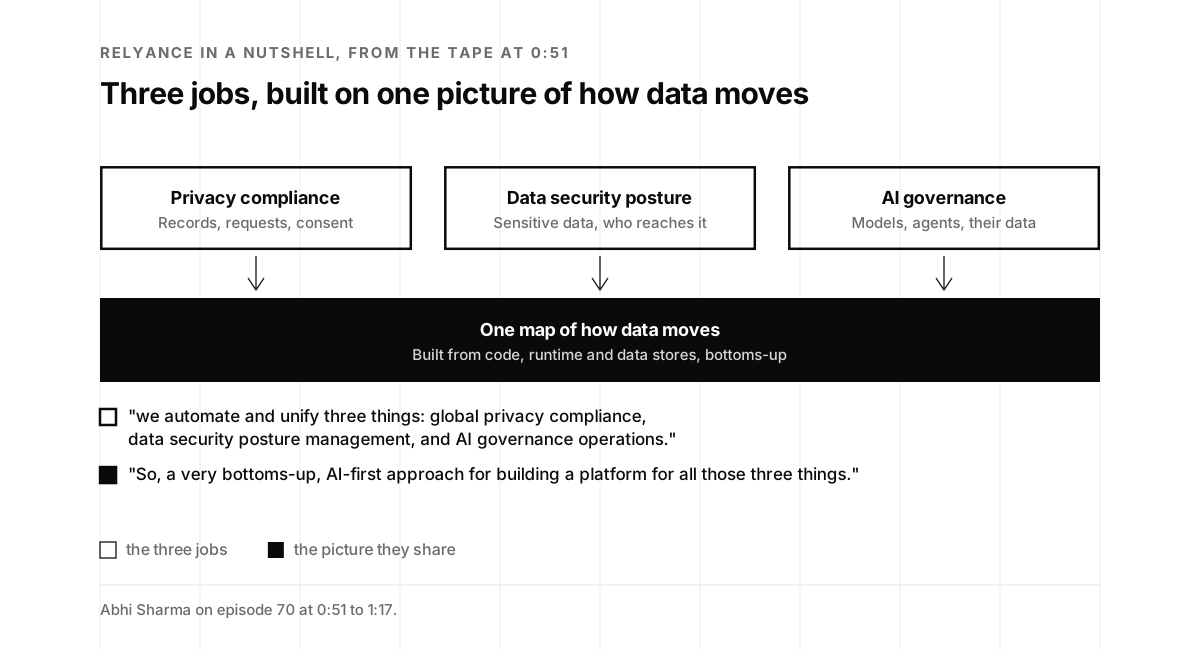
Three open boxes in a row, each with an arrow down to one filled box. Privacy compliance, records, requests and consent. Data security posture, sensitive data and who reaches it. AI governance, models, agents and their data. The filled box below: one map of how data moves, built from code, runtime and data stores, bottoms-up. Below, two lines. We automate and unify three things: global privacy compliance, data security posture management, and AI governance operations. So, a very bottoms-up, AI-first approach for building a platform for all those three things.
Abhi's three jobs, from the tape at 0:51, and the one picture underneath them.

If you have ever been on the receiving end of the privacy team’s annual data mapping survey, the appeal is obvious. The survey asks people what their systems do. The system knows what it does. We wrote about the same gap from the buyer’s side in the AI governance maturity model, where data governance is the dimension companies most often underestimate.

Twice, so I must love pain

I asked what got him started, and pointed out that you have to be a little bit crazy to be a founder. He didn’t argue. “Certainly, and I did it twice, so I must really love pain.”

The first time was FogHorn Systems, where his LinkedIn lists him as a founding member and head of machine learning and analytics from December 2015 to April 2020. He describes it there as a real-time analytics and machine learning inference platform, with a compiler, for edge computing. When it was acquired, he did what founders do after an exit: he stopped and asked himself what was next.

“But my previous startup got acquired, like any other founder. I was in this deep soul-searching mode of what I wanted to do next.”

Abhi Sharma, at 1:40

Listen · Abhi on episode 70, from 1:40
About a minute: the acquisition, the venture capital road not taken, and the idea of polymaths. The clip stops on its own. Read the full transcript.

He had the option of becoming an investor, and he says he had some opportunities to do it. His answer is one I hear from a lot of second-time founders: “But I was like, oh, I’ll do that when I’m old. I still very much love building.” What he wanted was to take what he was good at as an engineer, “which is compilers, observability, machine learning,” and apply it somewhere new.

That list is a good summary of his résumé. Observability came first, at AppDynamics, the application performance monitoring company that Cisco bought in January 2017 for $3.7 billion (Wikipedia). His LinkedIn says he built a distributed in-memory metadata caching layer there. Machine learning and compilers came at FogHorn. And the idea of computing close to where data is produced goes back to Carnegie Mellon, where his advisor was Mahadev Satyanarayanan, who published the first paper on edge computing in 2009 (Wikipedia).
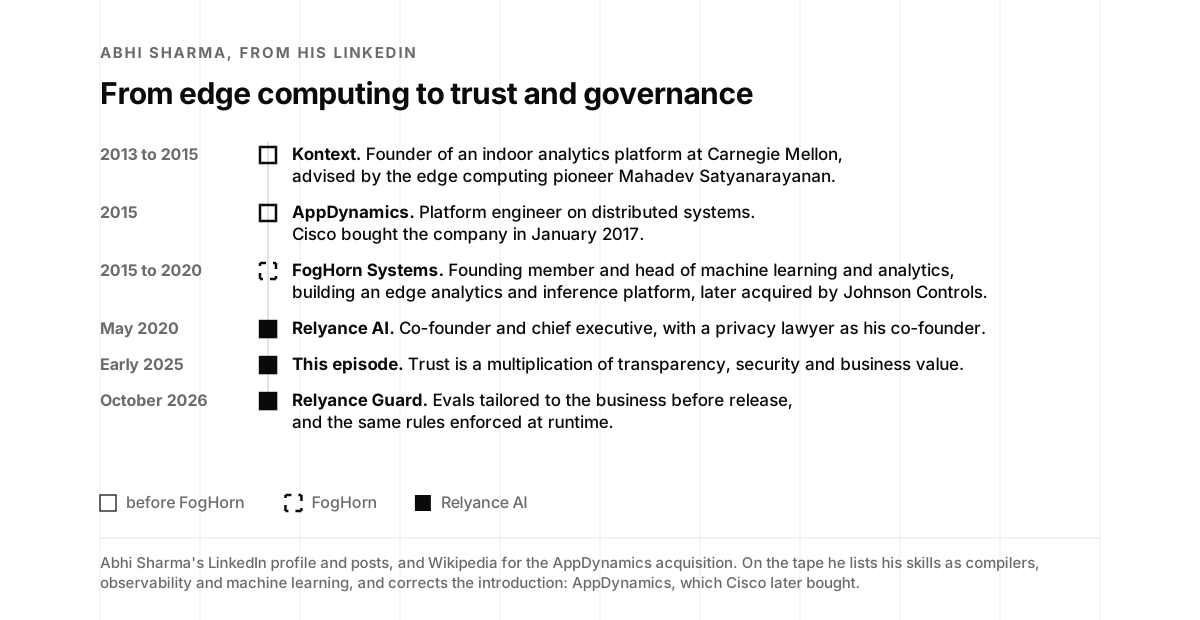
A timeline of six entries. Open, 2013 to 2015, Kontext, founder of an indoor analytics platform at Carnegie Mellon, advised by the edge computing pioneer Mahadev Satyanarayanan. Open, 2015, AppDynamics, platform engineer on distributed systems, Cisco bought the company in January 2017. Dashed, 2015 to 2020, FogHorn Systems, founding member and head of machine learning and analytics, building an edge analytics and inference platform, later acquired by Johnson Controls. Filled, May 2020, Relyance AI, co-founder and chief executive, with a privacy lawyer as his co-founder. Filled, early 2025, this episode, trust is a multiplication of transparency, security and business value. Filled, October 2026, Relyance Guard, evals tailored to the business before release, and the same rules enforced at runtime.
Abhi's path, from his LinkedIn. On the tape he lists his skills as compilers, observability and machine learning.

Where are the Leonardos?

The emotional reason he gave is not one you hear often on a security podcast. Abhi thinks the most interesting work happens where fields meet: “a lot of interesting stuff happens at the intersection of domains.”

“I’m a huge fan of the idea of polymaths. Like, you know, the problem statement I was really interested in on a very personal level is like, where are the Leonardo da Vincis of the world? There used to be a lot of them between the 1100s and 1700s, and like, there’s not many of those people anymore.”

Abhi Sharma, at 2:26

Listen · Abhi on episode 70, from 2:34
About 13 seconds: where are the Leonardo da Vincis of the world? The clip stops on its own. Read the full transcript.

Leonardo is the usual example of the Renaissance ideal that a person could master many fields at once, and the term “Renaissance man” is still used for exactly that kind of polymath (Wikipedia). Abhi’s version of the idea is practical. Privacy law, security engineering and machine learning are three fields with their own vocabularies, and the problem he wanted to solve sits in the space between them. It’s also where he comes back near the end of the episode, talking about architecture and why we stopped building beautiful buildings, so keep the polymath in mind. It is the thread that runs through everything he says.

Six weeks after the episode aired, he was still on the same idea. In July 2025 he wrote that AI is still remixing human knowledge, and that the time it frees up could bring a renaissance in science.

Abhi six weeks after this episode aired, on AI remixing human knowledge and the case for learning physics again. View on X.

Before AI and after AI

The business reason came from the people he knew. “And then what happened was I know a lot of people in the AI community personally.” That gave him a bet that, in 2020, still sounded bold.

“And so it was very clear to me in 2020 that we would live in a world where we would draw a line between before AI and after AI.”

Abhi Sharma, at 2:52

Listen · Abhi on episode 70, from 2:52
About 35 seconds: the 2020 hypothesis, AI in all business operations, and why manual governance can't keep up with it. The clip stops on its own. Read the full transcript.

He followed the hypothesis to its end. If it held, “then AI or AI agents will be embedded in all business operations. AI will, quote unquote, run the world.” And if AI runs the world, people need a way to trust it.

“Which means we need to empower humans to trust and govern it. And you can’t quite do that with top-down workflows or stupid manual applications, which is how the whole world of trust and governance runs today.”

Abhi Sharma, at 3:13

That is a founder’s thesis in three sentences, and it is worth noticing how early it was. Relyance’s LinkedIn dates the company to 2020, two years before ChatGPT made the before-and-after line obvious to everyone. The thesis also explains the product choice. If AI is going to be in every business process, then governing it with surveys and spreadsheets is hopeless, and the only approach that scales is one that reads the systems directly. Abhi wanted a problem “that had an impact at the infrastructure and governance layer for 100 years out,” and one that matched what he was good at. He didn’t think much of what was already on the market, which he described as “some version of partial visibility,” so he figured he could do something about it.

A privacy lawyer and an engineer

Then he met his co-founder. Abhi didn’t name her on the tape, and I won’t guess at her title here, but he described the pairing well.

“And then I met my co-founder, which kind of had a nice yin and yang between us. She was a privacy lawyer coming from the world of compliance, and I was sort of this engineer.”

Abhi Sharma, at 3:54

“It sounds like a match made in heaven,” I said, and I meant it. The pairing is the product. A privacy lawyer knows what the law and the contracts require. An engineer who wrote observability systems knows how to find out what the software actually does. Most companies have both kinds of people, and the trouble is that they work in different buildings and use different words for the same thing. “And we figured out we could have an interesting mixture of those two ideas to build a cocktail of something fun and interesting. And that’s Relyance, really.”

Trust is a multiplication

My next question was the one the episode is named for: what does trust mean for AI, and how does Relyance help build it? Abhi’s answer is the idea I’ve repeated most since we recorded. He started by complaining about the word itself, which he called overused but under-quantified, and then he quantified it.

“And the way I look at it is in order to quantify trust, it’s basically a multiplication across three things, which is transparency, security, and the third thing is business value.”

Abhi Sharma, at 4:42

Listen · Abhi on episode 70, from 4:42
About a minute: transparency, security and business value, and why trust is their product, not their sum. The clip stops on its own. Read the full transcript.

To trust a brand, a product or a piece of software, he said, you need all three: transparency, data security (“or you can call it control”), and some kind of business value. And then the key sentence.

“Trust is a multiplication of those three things, which means that if any portion of those three things I just mentioned is zero, trust is equal to zero.”

Abhi Sharma, at 5:24

“I’m an engineer, so I like to talk about it in mathematical terms, but hopefully that still makes sense.” It does, and the math is the whole point. If trust were a sum, a product could make up for weak security with great value, or for no transparency with strong security. Plenty of vendors sell as if that were true. A multiplication doesn’t allow it. A tool that is spectacular, secure and completely opaque has a trust score of zero, and so does one that is transparent, valuable and leaks.
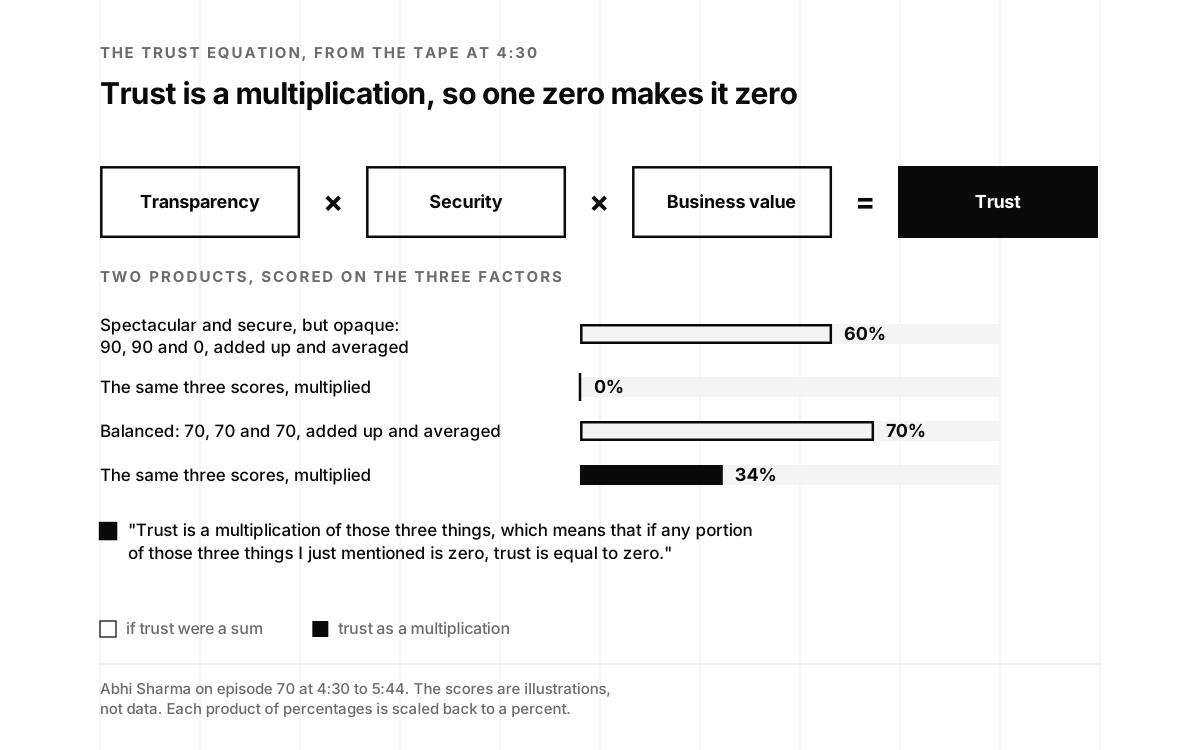
Four boxes in a row: transparency, times security, times business value, equals trust. Below, bars for two example products scored on the three factors. Spectacular and secure but opaque, 90, 90 and 0, added up and averaged, 60 percent. The same three scores multiplied, 0 percent. Balanced, 70, 70 and 70, added up and averaged, 70 percent. The same three scores multiplied, 34 percent. Below, one line. Trust is a multiplication of those three things, which means that if any portion of those three things I just mentioned is zero, trust is equal to zero.
Abhi's equation, from the tape at 4:30 to 5:44. The bars compare adding the three factors with multiplying them.

This is the frame I’d hand to any startup selling into an enterprise. A security review isn’t a hurdle between you and the value you deliver. It measures one of three factors, and if it comes out at zero the value doesn’t matter. You can try your own numbers in the trust calculator further down.

AI multiplies one factor

Then Abhi put AI into the equation, and the three factors stopped cooperating. They “are kind of at odds with each other,” he said, because AI pushes one factor up and pulls on the other two.

“So if you stay with me with this equation of trust, which is a multiplication of three things, we are all in agreement that with AI, you can actually blow up the business value you can provide, whatever it is that you’re doing in the world.”

Abhi Sharma, at 5:52

Faster service, a better product, whatever the business does. “But then that same thing, which is the incorporation of AI, is in tension with the other two things.” The other two are security and transparency, and the reason is simple: “because AI is inherently a non-deterministic system.” The same input doesn’t always produce the same output, so you can’t prove what it will do by reading it. To have trust anyway, “you kind of have to balance all of those three variables in the equation.”

Relyance’s place in that equation is the two factors AI strains. “And so Relyance’s role is really to help you with the transparency and the data security or control portion of it.” He called the result trust as a service, with a second-order effect: the brands Relyance serves can earn direct trust from their own consumers. “We’ll provide the infrastructure so you can trust and govern it.”
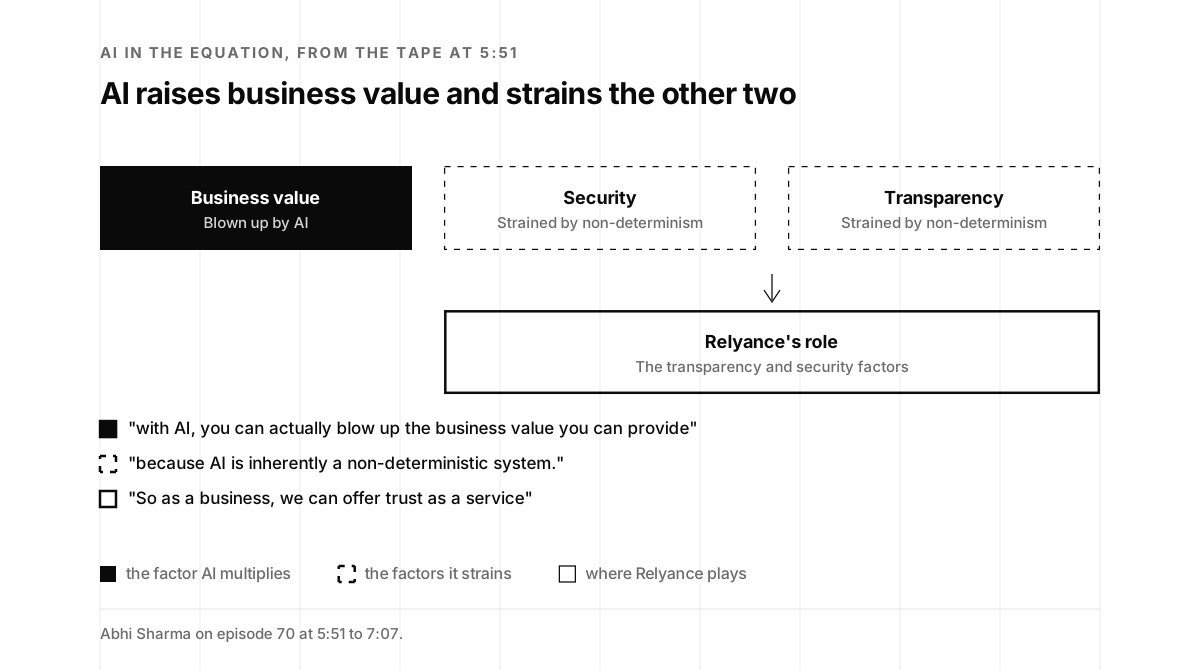
Three boxes in a row. Filled, business value, blown up by AI. Dashed, security, strained by non-determinism. Dashed, transparency, strained by non-determinism. An arrow from the two dashed boxes leads to an open box: Relyance's role, the transparency and security factors. Below, three lines. With AI, you can actually blow up the business value you can provide. Because AI is inherently a non-deterministic system. So as a business, we can offer trust as a service.
What AI does to the equation, from the tape at 5:51 to 7:07.

I like this framing because it puts the work where it belongs. Nobody needs to be talked out of using AI. The business value is real, and every company we work with wants it. The question is whether you can raise transparency and security fast enough that the product of the three keeps going up. Sasha has written about that balance in The Art and Zen of Adopting AI, and it is the same balance.

Column to column

Sasha picked up the two factors Abhi had named, data security and privacy, and asked the question that follows from AI having access to all of that data: how does the data flow, who has access to the AI, who has access to the agents, and does Relyance help companies see it? Abhi said that was the most distinctive thing they do.

“Absolutely. And in fact, that is one of the most unique things we do at Relyance, which is a very visual representation of the end-to-end flow of data.”

Abhi Sharma, at 7:43

Listen · Abhi on episode 70, from 7:44
About 56 seconds: why lineage between databases misses how data travels through microservices, pipelines and third-party calls. The clip stops on its own. Read the full transcript.

His complaint about the rest of the market was specific. Whether you look at it as data governance or as data security posture, “there is very little visualization of flow of data across the system. And whatever that exists is very column to column between databases.” Column-level lineage tells you that a field in one table was copied into a field in another. It doesn’t tell you what happened in between, and with AI the in-between is where things happen: “how the data travels between microservices, ETL pipelines, third-party API calls.”
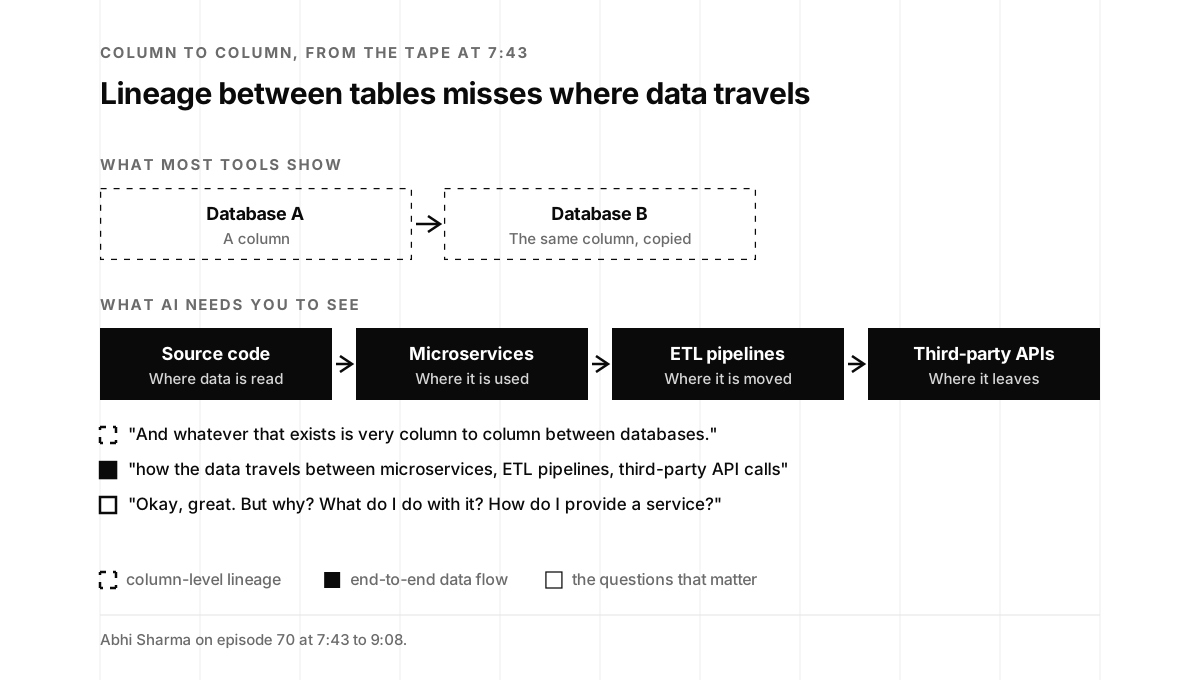
Two rows. What most tools show: two dashed boxes joined by an arrow, database A, a column, and database B, the same column, copied. What AI needs you to see: four filled boxes joined by arrows, source code, where data is read, microservices, where it is used, ETL pipelines, where it is moved, and third-party APIs, where it leaves. Below, three lines. And whatever that exists is very column to column between databases. How the data travels between microservices, ETL pipelines, third-party API calls. Okay, great. But why? What do I do with it? How do I provide a service?
Column-to-column lineage against end-to-end data flows, from the tape at 7:43 to 9:08.

Okay, great. But why?

The example he chose was Sasha. If you only look at a database, the best you can say is that a person’s data is in it.

“And that is completely missed if you just look at a database and say, well, I have Sasha’s personal information here. Okay, great. But why? What do I do with it? How do I provide a service? So the usage context becomes very important.”

Abhi Sharma, at 8:28

Those three questions are the ones a privacy lawyer asks, and the ones a scanner can’t answer. Purpose, use and service are properties of the flow, not of the table. That is why a privacy lawyer and an engineer make sense as a pair, and why he says the company has “always been true to that mission,” which is to show “end-to-end contextual visibility of data flows across your entire landscape of business transactions.” The payoff he named is speed with safety: “because then not only can you accelerate innovation and AI adoption, but you can do it with a lot of trust and safety.”

Sasha called it a kind of data lineage, or a data supply chain. That second phrase has since become its own category. When we wrote about the AI data bill of materials, the argument was the same one Abhi makes here: you can’t secure an AI system until you know the data it consumes, where it came from and where it goes next.

Over-indexed manual workflows

Sasha asked about pain, and framed it the way most founders hear it: data security and security controls are often seen as overhead. What is the biggest pain point Abhi sees when he talks to prospects? He answered in two buckets, and the first is the one every security team recognizes.

“The number one challenge is some version of over-indexed manual workflows, whether it’s mapping the data, whether it’s setting up policies for access control or ACLs on the data, whether it’s making sure you’re under- or over-provisioned, whether you’re trying to do it for compliance reasons or regulatory reasons or customer commitments.”

Abhi Sharma, at 9:25

Listen · Abhi on episode 70, from 9:25
About 32 seconds: the first bucket of pain, manual workflows for mapping data, access policies and provisioning. The clip stops on its own. Read the full transcript.

He called it a heavy hand on a whole suite of workflows, “which involves a lot of manual back and forth and conversations.” The second bucket is what’s left when a company has bought tools for the first. Some of the manual work gets automated, but two things still get missed, and the first is visibility.

“They are still deeply hurting because of partial visibility, because the existing tools can tell you you have 50 database instances and you have this data in there, but you kind of don’t know why and who and what’s the purpose.”

Abhi Sharma, at 10:17

Why, who and what’s the purpose. It’s the same three questions from his Sasha example, and he said the usual approach, scanning data where it sits, can’t answer them. A scan of data at rest tells you what is in a store. It can’t tell you who reads it, which service sends it where, or which promise to a customer it falls under.

We like to call them obligations

The second thing tools miss is the policy itself. Enforcement engines exist at every layer, Abhi said, “whether you reason about it from a network and socket layer or whether you reason about it from an application layer,” and they all share one limit.

“The problem is they’re only as good as the amount of policies you write.”

Abhi Sharma, at 10:50

Listen · Abhi on episode 70, from 10:50
About 40 seconds: why enforcement is only as good as the policies written down, and why Relyance calls them obligations. The clip stops on its own. Read the full transcript.

The AI era, he said, “has really kind of, like, thrown water over all of that stuff.” You can enforce a lot if the rules are written down. The trouble is what a real company’s rules actually are.

“And I think when security folks, or even organizations, use the term policy, we like to call obligations, because it’s the regulations, it’s the compliance frameworks, it’s the contractual commitments you make to your customers, and your internal policies. And there is no way a human being is going to write all of those down, let alone the version control of updating over time.”

Abhi Sharma, at 11:07

That word, obligations, is the most useful thing I took from the episode for our own work. A startup’s security policy is a document. Its obligations are everything it has promised to anyone: the law in every place it operates, the frameworks it was audited against, the clauses in every customer’s contract, and its own internal rules. They pile up with every deal, they change every time a customer negotiates, and nobody owns the whole list. His recap was blunt: “manual workflows or partial visibility, and manual input of policy, which is, like, impossible to keep up.”
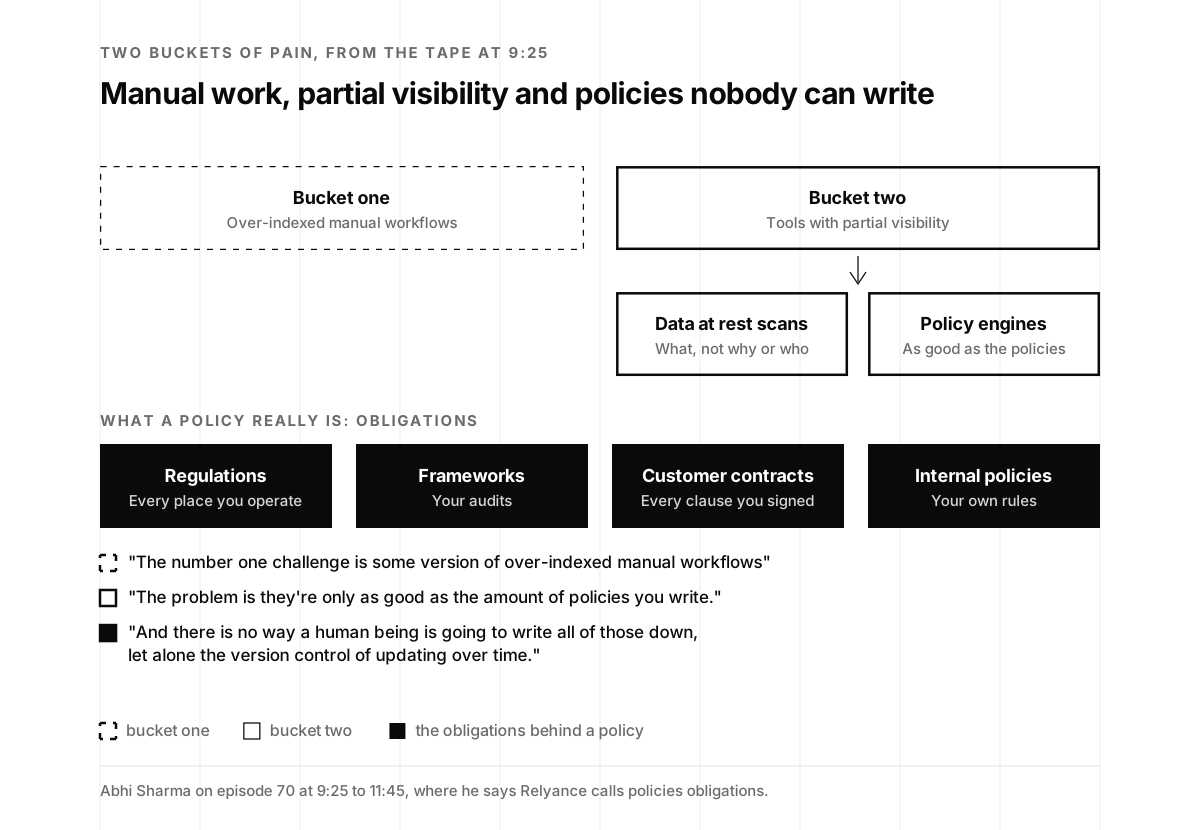
Two boxes side by side. Dashed, bucket one, over-indexed manual workflows. Open, bucket two, tools with partial visibility, with an arrow down to two open boxes: data at rest scans, what, not why or who, and policy engines, as good as the policies. Below, labeled what a policy really is, obligations, four filled boxes: regulations, every place you operate. Frameworks, your audits. Customer contracts, every clause you signed. Internal policies, your own rules. Below, three lines. The number one challenge is some version of over-indexed manual workflows. The problem is they're only as good as the amount of policies you write. And there is no way a human being is going to write all of those down, let alone the version control of updating over time.
The two buckets of pain and the four kinds of obligations, from the tape at 9:25 to 11:45.

Sasha added the piece that makes it worse.

“Into that mix, we can throw in a lot of vanilla policies that are just floating around, and often companies don’t even read into the details before they ask your counterpart to sign it.”

Sasha Sinkevich, at 11:46

We see this constantly. A startup downloads a policy template, a customer sends back a security exhibit that references it, and nobody checks whether what the company promised matches what its systems do. We wrote about that exact trap in the security exhibit your startup signed last quarter. Abhi’s word for those promises is obligations, and an obligation nobody has read is still one you owe.

Value before eleven

I asked who Relyance sells to. His answer was refreshingly direct about price.

“So the ICP for Relyance at the moment is really what I would call the mid-market or late enterprise. We’re not a cheap product.”

Abhi Sharma, at 12:01

By mid-market he meant large mid-market companies or early traditional enterprises, “but with a touch of, let’s say, modern operations.” Modern meant one thing: “as cloud-first, as cloud-native as possible.” The reason is speed. Relyance’s claim was that if Sasha started an implementation at 10 a.m. Pacific, there would be real value on the screen before the call ended at 11.

Listen · Abhi on episode 70, from 12:36
About 16 seconds: start at 10 a.m. Pacific, see value before the call ends at 11. The clip stops on its own. Read the full transcript.

That works when most of the important infrastructure lives with one of the three hyperscalers, because Relyance can pre-build the connectors and the analysis. It still serves companies with on-premises systems, he said, “but it’s just kind of harder and takes more time.”

“Like, if Sasha has five data centers in Sacramento and I need to deploy an outpost there, it just takes a lot longer than being cloud native.”

Abhi Sharma, at 13:13

“Very market segment and market vertical agnostic, though.” For a startup listening, the useful part is the logic, not the segment. Time to value is part of the business value factor in Abhi’s equation, and a tool that needs a quarter of setup before it shows anything is asking the buyer to trust it on credit.

The data plane stays home

Sasha’s follow-up was data residency, and Abhi said it shows up “especially with fintech and healthcare.” It takes two forms with Relyance’s customers. The first is geography.

“Number one, if they have operations in EMEA, they don’t want the data to leave EMEA, if you will, and come to the US.”

Abhi Sharma, at 13:52

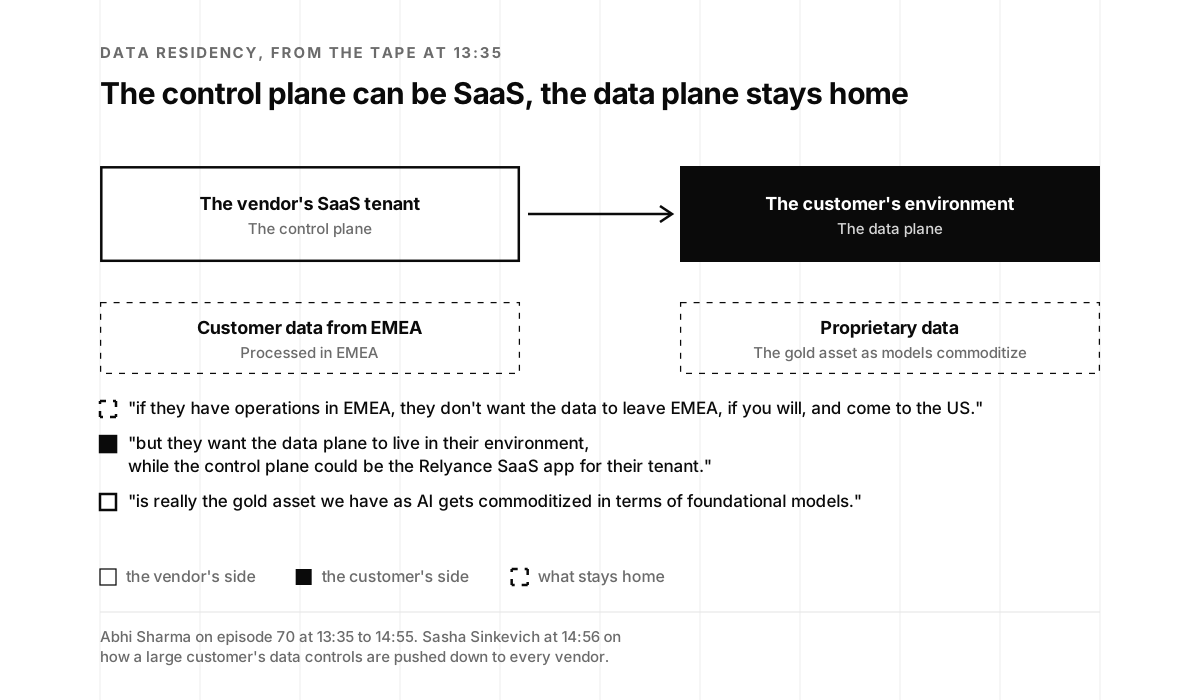
The second is architecture. Customers are “very keen on making sure that the data plane is in their control,” which in Relyance’s case means the classification and the data flows can be computed by the platform, “but they want the data plane to live in their environment, while the control plane could be the Relyance SaaS app for their tenant.”
Listen · Abhi on episode 70, from 14:00
About 22 seconds: the data plane in the customer's environment, the control plane as a SaaS tenant. The clip stops on its own. Read the full transcript.
Two boxes side by side, joined by an arrow. Open, the vendor's SaaS tenant, the control plane. Filled, the customer's environment, the data plane. Below, two dashed boxes: customer data from EMEA, processed in EMEA, and proprietary data, the gold asset as models commoditize. Below, three lines. If they have operations in EMEA, they don't want the data to leave EMEA, if you will, and come to the US. But they want the data plane to live in their environment, while the control plane could be the Relyance SaaS app for their tenant. Is really the gold asset we have as AI gets commoditized in terms of foundational models.
Where the data plane and the control plane live, from the tape at 13:35 to 14:55.

Then he made a prediction, and I think it has aged well. Residency would matter more, not less, because of what AI does to the value of data.

“And I think my personal projection is it’s going to get even more [focused], or even more necessary, for customers, because they’re going to realize that our proprietary information, whatever business you do, is really the gold asset we have as AI gets commoditized in terms of foundational models.”

Abhi Sharma, at 14:22

If the models are a commodity, the data is the moat, and companies guard moats. He expected that instinct to reach “even for modern mid-market or SMB companies.” Sasha connected it to how requirements travel through a supply chain.

“So it’s sort of a top-down policy approach, where if the larger entity accepts the policy of data controls, the same controls will be pushed down the line.”

Sasha Sinkevich, at 15:05

That is the startup’s half of the story. The enterprise adopts a residency rule, and every vendor in its supply chain inherits it in the next contract, whether or not the vendor’s architecture was built for it. If you sell to banks or hospitals, you’ll get the question before you get the purchase order.

The clause everyone strikes

Sasha’s point reminded Abhi of a contract clause, and his story about it is one of the clearest signs of how AI changed enterprise buying.

“The funny thing for me, just because you highlighted a really good point, Sasha, is like, in enterprise agreements, in the MSAs and DPAs, so the contracts when two parties do business, for the longest time there used to be a little line in those agreements: we will use your de-identified data to improve our software. And it is the most hotly negotiated item now, especially with our enterprises. It’s like, nah, you’re not doing any of that with my data, especially with this AI era.”

Abhi Sharma, at 15:18

Listen · Abhi on episode 70, from 15:18
About 35 seconds: the de-identified data clause, once boilerplate in master services and data processing agreements, now the most negotiated line. The clip stops on its own. Read the full transcript.

The MSA is the master services agreement and the DPA is the data processing agreement, and the clause he quoted used to sit in both without anyone noticing. Now, he said, larger enterprises “want that out of legal contracts.” Regulators noticed the same shift from the other direction. In February 2024 the Federal Trade Commission warned that a company that starts using customers’ data for AI training, and tells them only through “a surreptitious, retroactive amendment to its terms of service,” may be acting unfairly or deceptively (FTC).
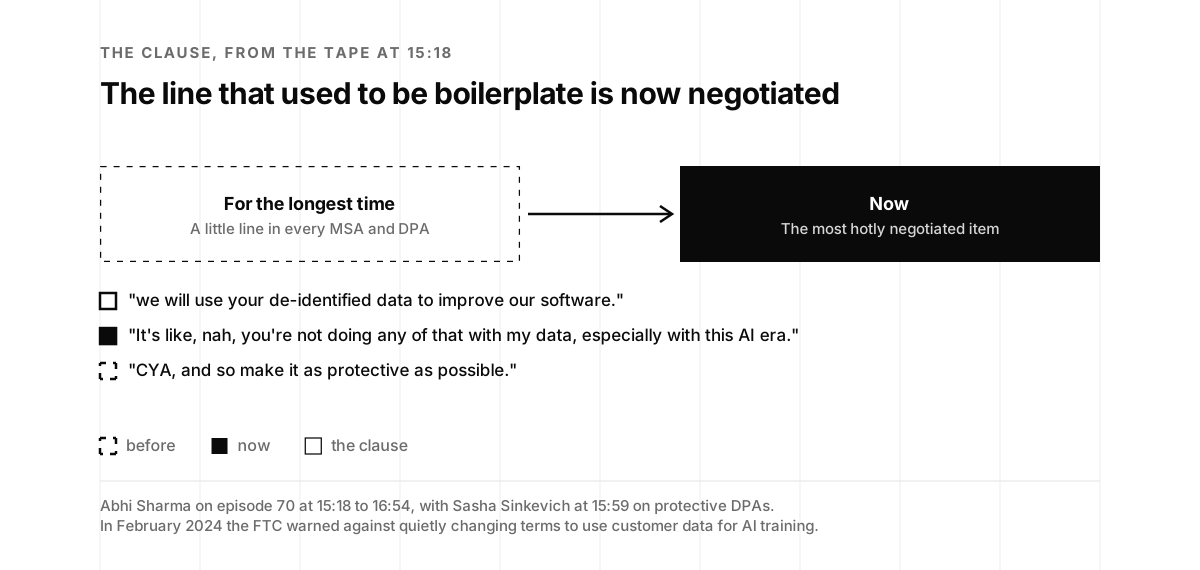
Two boxes joined by an arrow. Dashed, for the longest time, a little line in every MSA and DPA. Filled, now, the most hotly negotiated item. Below, three lines. We will use your de-identified data to improve our software. It's like, nah, you're not doing any of that with my data, especially with this AI era. CYA, and so make it as protective as possible.
The de-identified data clause before and after AI, from the tape at 15:18 to 16:54.

Sasha’s experience on our side was the mirror image.

“To that point, I often see DPAs have so much language, very protective language, just to make sure that we cover as much as possible, and that in itself tends to be a little bit overprotective at times and tends to increase the friction when you sign those deals.”

Sasha Sinkevich, at 15:59

Abhi agreed, and tied it straight back to visibility. When you don’t have the end-to-end data flow picture, what are your security and legal teams going to do? “CYA, and so make it as protective as possible.” That protects the company, and it also blocks deals that would have been good for both sides.

“Like, if you could cure cancer because of that good sharing of data, then why not? We all want that.”

Abhi Sharma, at 16:43

This is the multiplication again. A contract written in the dark sets transparency near zero, so legal sets security as high as it will go to compensate, and the business value of the partnership pays for it. The fix isn’t weaker language. It is enough visibility that both sides can write language that matches what the data actually does. When a startup answers the first enterprise questionnaire, the question about training on customer data is usually the one that decides the tone of the review, which is why it is the first question in our guide to the AI questions buyers ask.

Right around the corner

Then Sasha offered a way out.

“Luckily, homomorphic encryption is right around the corner, and we all will be saved very soon.”

Sasha Sinkevich, at 16:54

Listen · Sasha and Jon on episode 70, from 16:54
About 8 seconds: homomorphic encryption, right around the corner. The clip stops on its own. Read the full transcript.

“I’m not holding my breath,” I said. For anyone who hasn’t followed the joke for the last fifteen years: homomorphic encryption lets a computer run calculations on encrypted data without decrypting it first, and the decrypted result matches what the same calculation would have produced on the original data (Wikipedia). Craig Gentry described the first plausible construction of a fully homomorphic scheme in 2009. It is a real field with real products, and it is also the security world’s version of fusion power. In the meantime, the way most companies share data is still the way Abhi described: under a contract, with a map of where it goes.

Never giving up

I asked Abhi whether he had ever felt like giving up. He has been doing zero to one for a long time, more than four years at FogHorn and more than four at Relyance when we recorded.

“Giving up was never an option, just kind of based on how I grew up and my background. I’ve definitely felt not good enough, never enough, but never giving up.”

Abhi Sharma, at 17:26

He described himself as “always the black sheep of my family,” and the line about never feeling enough is one I’ve heard from many founders, usually off the record. “I mean, I guess there’s no such thing as failure unless you stop trying,” I said. He agreed. He comes back to that background at the end of the episode, and it explains the advice he gives his younger self.

Ten people and their own tables

His proudest moment came in Relyance’s second month, and it was about people, “because I think eventually, when you go through the entrepreneur journey, it all ends up boiling down to that.”

“When I started Relyance, in my second month of operation, so right after we got funded and we’re like, okay, we’re ready to actually start working on this thing, I had like 10 people join me instantly.”

Abhi Sharma, at 18:01

Listen · Abhi on episode 70, from 17:59
About 51 seconds: ten engineers who had worked with Abhi for years, showing up in the second month and assembling their own tables. The clip stops on its own. Read the full transcript.

They were engineers and others who had worked with him for six or seven years, and the picture he gave is a good one: “and everybody assembled their own tables and they started working on their computers.” He said they come from MIT and Google and Facebook and Meta, and “they can kind of get a million-dollar job wherever they wanted, but they chose to work here.” What he took from it was a lesson about founders, not about recruiting.

“And I think that at some point, you have to do something right as a founder for people to just continue to work with you again, whether you’re successful or not.”

Abhi Sharma, at 18:28

The test he describes is a hard one. Anyone can hire people after an exit, when the last company’s outcome is the pitch. The harder thing is people who would have followed you whether the last one worked or not. Those are the people who show up before the product exists, and for Relyance the product didn’t exist for a long time.

Unreasonable hospitality

The second proud moment was about culture. Every founder starts with a dream of what the culture will be, and a second-time founder also has a list: “you kind of realize, oh, I screwed up these 10 things, I’m not going to screw them up again.” The one that stuck at Relyance was a phrase, unreasonable hospitality, which Abhi said has “really seeped into the DNA of our employees and our operations.” What makes him proud is hearing his sales, customer success and support teams use it on calls he isn’t on, including people only two months into the job. I asked if he’d coined it.

“No, I did not. It’s borrowed from the world of fine dining.”

Abhi Sharma, at 19:53

Listen · Abhi on episode 70, from 19:54
About 26 seconds: the book, the restaurant, and why a fine dining idea belongs in a SaaS company. The clip stops on its own. Read the full transcript.

The book is Will Guidara’s Unreasonable Hospitality: The Remarkable Power of Giving People More Than They Expect, published in 2022. Guidara became the general manager of Eleven Madison Park in New York in 2006, and he and the chef Daniel Humm bought the restaurant in 2011 (Wikipedia). On the tape Abhi remembers it as the world’s best restaurant for many years in a row. The record is a single year at the very top, which is still remarkable: Eleven Madison Park was ranked first among The World’s 50 Best Restaurants in 2017, and it has held three Michelin stars since 2012 (Wikipedia).

“And it’s really a great culture book at the end of the day, full of stories about how to go above and beyond to deliver magical experiences to your customers.”

Abhi Sharma, at 20:22

He thinks “a lot of the ideas there are very applicable to technology and SaaS businesses,” and I agree, including in security. The experience of being reviewed is part of what a vendor sells. A startup that answers a buyer’s security questions in a day, with the evidence attached and a person on the other end who is glad to explain, is practicing a version of unreasonable hospitality, and buyers remember it.

Twenty months without a sale

Sasha asked whether the book shaped who Abhi hired, and whether some of those first ten were focused on customer success. Abhi said everyone was focused on experience, and that at the start a tech startup needs engineers first. He didn’t have the hospitality phrase yet, so he used a different one.

“I didn’t quite have the term [unreasonable] hospitality, but product-focused engineers is what we said, which is they really cared a whole lot about customer outcomes and then went to design the product, instead of just, like, thinking above the API layer versus just staying below the API layer.”

Abhi Sharma, at 21:21

That mattered because of how he chose to build. He called it “this very platform-oriented way of building,” and it meant a long wait.

“which meant that we had to build the product for 18, 20 months without having to sell it to anybody. And it takes a little bit of a leap of faith to kind of put in that much time and energy without seeing the feedback from the outside world just yet.”

Abhi Sharma, at 21:46

“Wow, 18 to 20 months,” I said. Most advice for founders runs the other way: sell early, learn from the first customers, build what they pay for. Abhi’s bet was that a platform that reads code, runtime and data stores couldn’t be sold in pieces, and that the first deployment had to work across all of it. The next story is what happened when it did.

The flow nobody knew about

I guessed the first sales call must have been spectacular after all that work, and Abhi said it was. Then he told the story of the first deployment, which goes straight back to Sasha’s question about end-to-end lineage and context. Everyone from the customer was on the call, the instance was empty, and the founder was hoping the long build would hold up.

“I know that one of the head of ITs of that customer was on the call, and they saw a data flow from Zendesk to a system that they did not know. And they were like, boy, that should not be happening.”

Abhi Sharma, at 22:45

Listen · Abhi on episode 70, from 22:29
About 38 seconds: the first deployment, a flow from Zendesk to a system nobody knew about, and a head of IT leaving the call to fix it. The clip stops on its own. Read the full transcript.

The detail that makes the story is who it happened to. “And this was the person who was very proud that they knew about where the data was flowing.” The head of IT left the call to get it fixed right away. It was a little scary for the customer, Abhi said, and it was magic for Relyance, “because, like, okay, we provided you that visibility which you didn’t think you had.”

I’d tell this story to any security leader who trusts their data flow diagram. Nobody in it was careless. A support tool had an integration, the integration sent data somewhere, and the diagram was drawn before that happened. Support systems are a good place to look first, because tickets carry whatever customers type into them, and integrations tend to get added by the team that runs the queue, not by the team that owns the diagram.

Relyance’s public record picks up soon after. In June 2022 the company said it had completed a SOC 2 Type II audit and named security practitioners as angel investors and advisors (X). The next spring it was a top 10 finalist in the RSA Conference’s Innovation Sandbox contest.

Relyance AI, still pinned at the top of its X account: a top 10 finalist in the 2023 Innovation Sandbox contest at the RSA Conference. View on X.

Floss every day

Sasha asked what really drives interest in tools like this. Is it businesses trying to do the right thing, or regulation that started in Europe and has been seeping into the US? Abhi said the good intentions are real and front and center with a lot of customers, but they don’t move budgets on their own.

“But yeah, in practical reality, it doesn’t always lead to the actions, because, like, doing the right thing sometimes sounds like, okay, brush your teeth every day, floss every day, don’t drink too much alcohol, you know, don’t stay up at night. And like, we know that preaching abstinence doesn’t always work.”

Abhi Sharma, at 24:04

What actually accelerates adoption, he said, comes in three forms. The first is regulatory pressure. The second is the customer asking, and his example is one I’ve watched happen at our clients.

“It’s like, I have seen many times our customers take screenshots from Relyance and give it to their sales team, because they can accelerate a deal they are part of.”

Abhi Sharma, at 24:36

Listen · Abhi on episode 70, from 24:38
About 17 seconds: customers taking screenshots of their data flows to their own sales teams, because their buyers are asking. The clip stops on its own. Read the full transcript.

Their customers want visibility, and they want to know their data is isolated from every other tenant’s. “Like, how can you prove that to me? Well, I got to show you a data flow diagram.” A diagram is the cheapest piece of evidence in enterprise sales and one of the most persuasive, as long as it is true.

The third accelerant was the newest in 2025: blessing the adoption of AI quickly, which Abhi said everybody wants. He had seen customers stuck at the starting line.

“And I have seen a lot of our customers many times be blocked in being able to launch some of the AI initiatives because they’re not sure if data from EU residents was used and they didn’t ever ask for consent.”

Abhi Sharma, at 25:04

That worry has a regulator behind it. In December 2024, the European Data Protection Board adopted an opinion on personal data in AI models, covering when a model counts as anonymous, when legitimate interest can be a legal basis, and what happens when a model is built on unlawfully processed data. If it was, the board said, “this could have an impact on the lawfulness of its deployment,” unless the model has been properly anonymized (EDPB). If you can’t say which data went into a model, you can’t answer that question, and the launch waits.
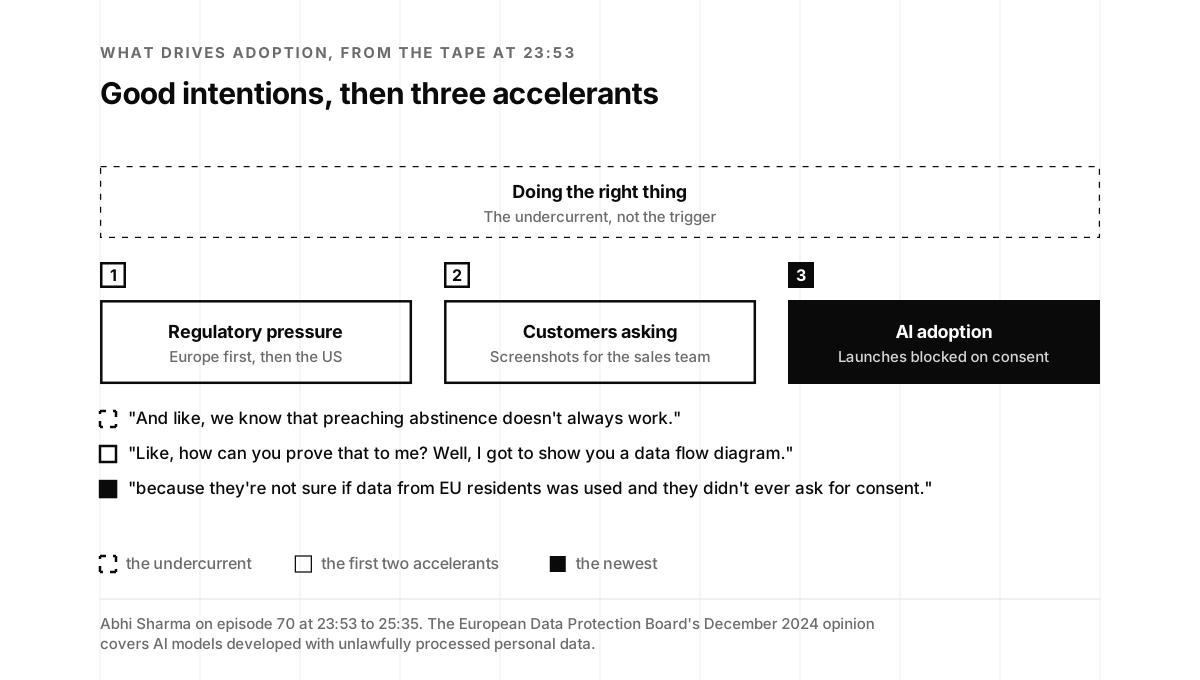
A dashed box across the width: doing the right thing, the undercurrent, not the trigger. Below it, three numbered boxes. One, open, regulatory pressure, Europe first, then the US. Two, open, customers asking, screenshots for the sales team. Three, filled, AI adoption, launches blocked on consent. Below, three lines. And like, we know that preaching abstinence doesn't always work. Like, how can you prove that to me? Well, I got to show you a data flow diagram. Because they're not sure if data from EU residents was used and they didn't ever ask for consent.
What drives adoption, from the tape at 23:53 to 25:35.

Abhi thought AI would be the biggest driver of the three in the end, even though it was early: “well, we got to move fast, because CEOs are going to be like, AI everywhere.” And moving fast with AI needs the other two factors in his equation to keep up.

A one-week proof of value

I asked the question every security leader listening would ask. You’ve always got that ticket, the one that says the data flow diagram needs updating. If someone wants to try Relyance, what does it look like? The answer was a demo request, a reply within ten minutes, a short scoping exercise, and then a small trial.

“But otherwise, it’s a small proof of value, which, the longest we have done is two weeks, the shortest we have done is one day.”

Abhi Sharma, at 26:05

The scoping, he said, is there because of how the lineage gets built: “we start all the way from source code to data in motion to data at rest. And then we stitch the lineage without an agent in the picture.” Agent here means the old kind, a piece of software you install on every server, and the point is that Relyance reads what’s already there. The scope has to describe one connected system, though. He used me as the example: if I pointed it at the code for one set of microservices, the logs for a different set and an unrelated Snowflake instance, “it will all work, but it won’t show you the full lineage journey.”
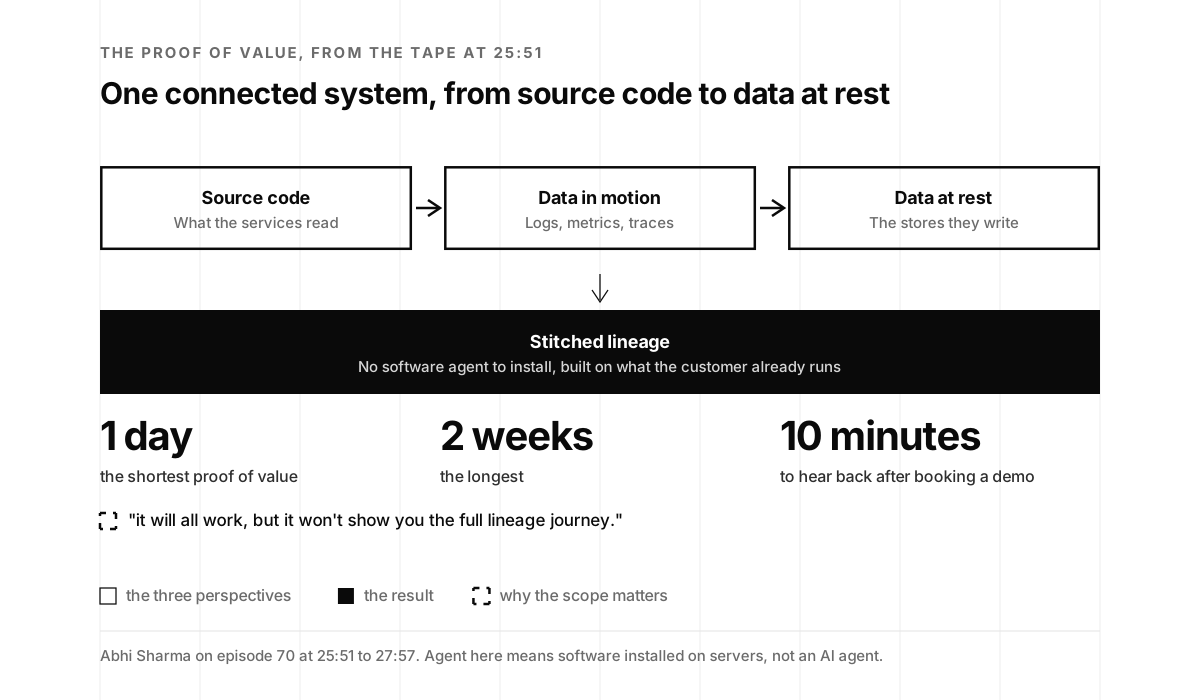
Three open boxes joined by arrows: source code, what the services read. Data in motion, logs, metrics and traces. Data at rest, the stores they write. An arrow down to a filled box: stitched lineage, no software agent to install, built on what the customer already runs. Below, three figures: 1 day, the shortest proof of value. 2 weeks, the longest. 10 minutes, to hear back after booking a demo. Below, one line, about scoping code, logs and a data store from unrelated systems: it will all work, but it won't show you the full lineage journey.
How the one-week proof of value builds lineage, from the tape at 25:51 to 27:57.

So to get going, I said, it’s a phone call and access to some GitHub repos, some logs and maybe some third-party APIs. “That’s the attempt, that’s the design,” Abhi said, and then he connected it to his past. He had faced the same problem at his previous startup, which never had a good GDPR solution and was acquired before it needed one. And he corrected my introduction.

“But you mentioned Cisco, I was really actually at AppDynamics, which was acquired by Cisco. And at AppDynamics, I was one of those engineers who wrote the early kind of the observability stack there.”

Abhi Sharma, at 27:28

The correction is worth keeping straight. His LinkedIn lists AppDynamics from January to December 2015, and Cisco bought AppDynamics in January 2017, after he had left for FogHorn (Wikipedia). The observability background is the key to the product. Logs, metrics and traces already exist in most companies, and Relyance tries to “piggyback on some of the investments our customers have made in their systems,” instead of asking for a new deployment before anyone sees value.

The telephone operator comes back

Sasha and I go to a lot of AI events in San Francisco, and I asked Abhi the question that comes up at every one of them: will agents start to replace humans?

“Yeah, I think my personal opinion is, I don’t think we’re anywhere close to agents necessarily replacing humans, even with, like, probably another decade out of progress.”

Abhi Sharma, at 28:17

He described himself as being in “the tech-optimistic camp.” Some roles may go, he said, but “humans are creative enough to always find higher-order tasks.” His summary was “more augmentation with AI rather than, quote unquote, replacement,” and then he reached for a job that already disappeared once.

“And who knows, maybe, if you remember, back in the day we had telephone operators whose job was to just connect one line to another line, and that job went away. Maybe that job comes back again.”

Abhi Sharma, at 28:53

Listen · Abhi on episode 70, from 28:54
About 30 seconds: telephone operators, and a far more sophisticated version of the job, connecting context between agents. The clip stops on its own. Read the full transcript.

Switchboard operators connected calls by plugging cords into jacks, and automated exchanges replaced them, first for local calls and then for long distance (Wikipedia). Abhi’s version connects context instead of lines. “But it’s the telephone operator, but a far more sophisticated one, that’s just nudging and prodding the agents on certain direction.” The human stays in the loop for the higher-order business outcomes.

His reason for the long timeline was about how models think, or don’t.

“Like, yes, it reasons really well, but it reasons out of what it has learned from the internet instead of first-principles thinking.”

Abhi Sharma, at 29:35

Listen · Abhi on episode 70, from 29:25
About 26 seconds: why models that reason from what they learned on the internet aren't yet doing first-principles thinking. The clip stops on its own. Read the full transcript.

“So unless there’s a new transformer-style architecture that evolves on second-order thinking, I think we will be just fine.” I’m with him on the optimism. Agents are software. We choose what they’re for, we write their prompts, we decide what they can reach and we test what they do. “We’ll build it so that it serves us as humanity,” I said, and that is the job. The telephone operator in Abhi’s picture is the person who understands the whole system well enough to route the work, and that’s a role security teams already know.

Infrastructure for trust

I asked what success looks like, for Abhi and for Relyance. He warned us first that “not all of my employees always love me for saying this,” because he plans on a scale of a century. The business he wants to be in is helping society get far more productive work out of technology, safely, by playing a role “at the infrastructure and governance layer.”

“So if you take that long-term horizon, the way we think about it is Relyance becomes one of those infrastructure [layers] where, you know, just like Stripe is the infrastructure for payments, we become the infrastructure for trust and governance, because it’s going to be very much needed.”

Abhi Sharma, at 31:05

Listen · Abhi on episode 70, from 31:13
About 24 seconds: Stripe for payments, Relyance for trust and governance, and a business built to outlast its founder. The clip stops on its own. Read the full transcript.

The second part was the timescale: “we are definitely looking to build a generational business in this category, which lasts multiple decades and multiple centuries, even after I’m dead.” The third part was money and pride, in that order and then reversed. He wants great revenue, and “I want to build generational wealth for all of our team members at Relyance.” But an IPO wouldn’t be enough on its own.

“But I will personally be still dissatisfied if our customers don’t talk about us as, like, man, that team really knew how to build great experiences, or that design was great, or that product experience was beautiful.”

Abhi Sharma, at 32:07

Then the polymath came back. Abhi studies architecture when he can, and he asked the question that bothers anyone who does: “where are all the beautiful buildings we built back in the day? Like, what’s wrong with us?” His answer for his own company is a standard more than a strategy. “So I care about building beautiful things for the sake of it.”

It is unusual to hear a security founder talk about beauty. I think it belongs in the equation. Transparency is partly a design problem: a data map nobody can read doesn’t make anyone trust anything, and a beautiful one gets screenshotted and sent to a buyer.

Don’t wait for permission

I closed the way we often do. If Abhi could go back in time and meet his younger self, would he, and what would he say? He’d go back to his early teens or twenties, and the advice was short: “just to drive harder and take more risks.” “Take more risks,” I repeated, and he explained why.

“Yeah, I grew up very poor, growing up in India. And I think when you’re kind of in a slightly boxed-in economic situation, there’s a lot of permissioning that happens around your life, which is like, you always have to get approval for something or permission for something, or your constraints decide what you can or cannot do.”

Abhi Sharma, at 33:14

Listen · Abhi on episode 70, from 33:05
About 39 seconds: drive harder, take more risks, and stop waiting for approval. The clip stops on its own. Read the full transcript.

He would tell his younger self “to just do it and not wait for permission.” “I love that. Don’t wait for permission,” I said, and it’s the line from this episode I think about most. It connects to the beginning, too. A founder who builds for 18 to 20 months before selling anything, and who leaves an exit to start over, has clearly stopped asking.

Months later he put the same idea in two words.

Abhi quoting Andrej Karpathy's "Agency > Intelligence," the same advice he gave his younger self on this episode. View on X.

What happened after the tape

The three jobs from Abhi’s first answer are still the three jobs, in reverse order. On the tape they were global privacy compliance, data security posture management and AI governance operations. His LinkedIn now lists Relyance’s work as “AI security evals and guardrails tailored to your business,” then AI governance and data posture management, then end-to-end privacy automation (LinkedIn). The company page says the same thing in its tagline, and lists 11 to 50 employees in San Francisco (LinkedIn). The newest job, AI, moved to the front.

The first new product came in March 2026. For RSAC 2026, Relyance introduced Lyo, which it called an AI-native data defense engineer that “continuously monitors thousands of data journeys across code, cloud, SaaS, AI systems, and identities.”

Introducing Lyo™: the world’s first AI-native data defense engineer. Traditional tools scan, humans fix, and risks multiply.

Relyance AI · March 20, 2026
Relyance introducing Lyo ahead of RSAC 2026. Data journeys are the company's name for the end-to-end flows Abhi describes on this episode. View on LinkedIn.

By Black Hat USA in August, the pitch had become identity and AI together. Abhi’s post from the first day of the conference described the booth demo as “a live map of every path AI and identities take to your sensitive data,” with enforcement that cuts the paths that shouldn’t exist.

If your agents, copilots, and AI-generated code grew 10× this year and your product security team didn't, we should talk.

Abhi Sharma · August 4, 2026
Abhi on day one of Black Hat USA 2026, with Relyance at booth 4902 in Mandalay Bay. View on LinkedIn.

Then, in October, came Relyance Guard. Abhi’s posts describe evaluations tailored to a company’s own business, policies and AI use cases, run before every AI feature release, with the same rules enforced as guardrails at runtime. His one-line version is “What you test is what you enforce.”

Your AI eval suite can't be 40 prompts in a spreadsheet nobody maintains, or some generic frontier eval that is just benchmaxxing without your business context.

Abhi Sharma · October 10, 2026
Abhi introducing Relyance Guard: evals tailored to the business, and the same rules enforced at runtime. View on LinkedIn.

The post I’d read twice is a short one from a few days later. Abhi argued that starting AI governance with workflows, risk assessments and compliance is a mistake, and that you need to understand the agent’s blueprint and the model doing the thinking first. His design rule is to “keep the thinking layer separate from the action layer,” so the agent stays useful while unintended or unauthorized actions are avoided.

Workflows and assessments matter, but they should be side effects or derived artifacts of the agent's deep, inherent understanding of your business and institutional knowledge.

Abhi Sharma · October 15, 2026
Abhi on what AI governance should start from. It is the bottoms-up idea from this episode, applied to agents. View on LinkedIn.

The website moved with it. Relyance’s home page now reads “AI evals and guardrails tailored for your business” (relyance.ai). The governance page describes an inventory of AI use cases, models, agents, MCP servers and vendors built from code and traffic, and it puts the bottoms-up thesis from this episode in one sentence: “Every outside AI vendor is found in traffic, not in a questionnaire” (Relyance AI). The privacy page still does the work from the first job, building a record of processing activities from “how data really moves” (Relyance AI).
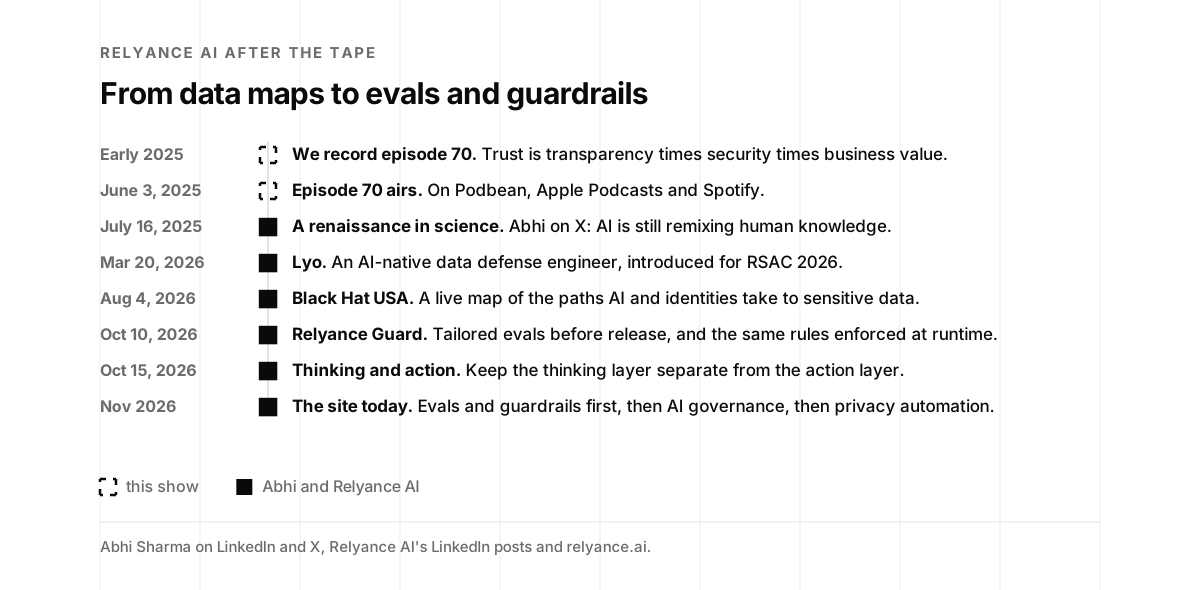
A timeline of eight entries. Dashed, early 2025, we record episode 70, trust is transparency times security times business value. Dashed, June 3, 2025, episode 70 airs, on Podbean, Apple Podcasts and Spotify. Filled, July 16, 2025, a renaissance in science, Abhi on X, AI is still remixing human knowledge. Filled, March 20, 2026, Lyo, an AI-native data defense engineer, introduced for RSAC 2026. Filled, August 4, 2026, Black Hat USA, a live map of the paths AI and identities take to sensitive data. Filled, October 10, 2026, Relyance Guard, tailored evals before release, and the same rules enforced at runtime. Filled, October 15, 2026, thinking and action, keep the thinking layer separate from the action layer. Filled, November 2026, the site today, evals and guardrails first, then AI governance, then privacy automation.
Relyance after the tape, from Abhi's LinkedIn and X, Relyance's LinkedIn posts and its site.

Read together, the arc is consistent. In 2020 Abhi bet that AI would draw a line between before and after. In early 2025 he told us trust was a multiplication, and that AI raises business value and strains transparency and security. By the end of 2026 his company was testing AI features before release and enforcing the same rules at runtime, which is that equation turned into a product. For a startup the takeaway is the same as it was on the tape: you can’t sell the value without the other two factors, and the fastest way to raise them is to know where your data actually goes.

Did you catch it? A six-question quiz

Interactive · six questions

Did you catch it?

Six questions on what Abhi, Sasha and I actually said, with the timestamp for each answer. The answers are under each question for anyone reading without JavaScript.

  1. How does Abhi say trust works across transparency, security and business value?

    1. It's their sum, so strength in one makes up for another
    2. It's their product, so if any one is zero, trust is zero
    3. It's whichever of the three is highest

    b. "Trust is a multiplication of those three things, which means that if any portion of those three things I just mentioned is zero, trust is equal to zero." Transcript, 5:24.

  2. How does Abhi describe most of the data flow visualization in the market?

    1. Very column to column between databases
    2. End to end across every service
    3. Built from customer interviews

    a. "And whatever that exists is very column to column between databases." Transcript, 8:11.

  3. What does Relyance call the policies a company has to enforce?

    1. Controls
    2. Guardrails
    3. Obligations

    c. "And I think when security folks, or even organizations, use the term policy, we like to call obligations, because it's the regulations, it's the compliance frameworks, it's the contractual commitments you make to your customers, and your internal policies." Transcript, 11:07.

  4. Which line in enterprise agreements does Abhi say is now the most hotly negotiated?

    1. The vendor will use de-identified customer data to improve its software
    2. The limitation of liability
    3. The uptime commitment

    a. "for the longest time there used to be a little line in those agreements: we will use your de-identified data to improve our software. And it is the most hotly negotiated item now, especially with our enterprises." Transcript, 15:28.

  5. Where does the phrase unreasonable hospitality come from?

    1. A management consulting framework
    2. The world of fine dining
    3. Relyance's first customer

    b. "No, I did not. It's borrowed from the world of fine dining." Transcript, 19:53.

  6. Which job does Abhi think might come back in a more sophisticated form?

    1. The travel agent
    2. The typist
    3. The telephone operator

    c. "But it's the telephone operator, but a far more sophisticated one, that's just nudging and prodding the agents on certain direction." Transcript, 29:16.

Can you show a buyer where the data goes?

Abhi’s customers take screenshots of their data flows to their own sales teams because their buyers ask to see them. This scorecard asks eight questions about the product you sell, using the transparency and security factors from his equation. It takes about two minutes.

Scorecard · eight questions

Can you show a buyer where the data goes?

Answer for the product your next enterprise buyer is evaluating, AI features included. If two answers fit, pick the lower one.

  1. Can you show a buyer where their data goes, from your code through your services to every third-party API?

    • No, or only the diagram from last year's audit
    • Database to database, but not through services and third parties
    • End to end, current, and generated from the systems themselves

    "And whatever that exists is very column to column between databases." See Column to column.

  2. For each store of customer data, do you know why it's there, who uses it and for what?

    • We know what's stored, not why
    • For the main systems
    • Every store has a purpose, an owner and the service it supports

    "Okay, great. But why? What do I do with it? How do I provide a service?" See Okay, great. But why?.

  3. Does your contract say whether customer data trains or improves your models, and does it match what your systems do?

    • We use the standard clause and haven't checked
    • The contract is clear, but nobody has checked the systems against it
    • The clause is explicit, and we can show the data flows that back it up

    "we will use your de-identified data to improve our software" is the line enterprises strike. See The clause everyone strikes.

  4. Are your obligations in one place: the laws you're under, your frameworks, customer commitments and internal policies?

    • They live in contracts and people's heads
    • Policies are written down, customer commitments aren't tracked
    • One list, mapped to the systems each obligation covers, updated with every deal

    "And there is no way a human being is going to write all of those down, let alone the version control of updating over time." See We like to call them obligations.

  5. Can you keep a customer's data in its region, and run the data plane in their environment if they ask?

    • Not today
    • In region yes, in their environment no
    • Both, documented, with a standard answer ready for the questionnaire

    "Number one, if they have operations in EMEA, they don't want the data to leave EMEA, if you will, and come to the US." See The data plane stays home.

  6. Can you prove tenant isolation with evidence, not a sentence?

    • We say it in the questionnaire
    • We have an architecture document
    • A data flow diagram and test results we can share

    "Like, how can you prove that to me? Well, I got to show you a data flow diagram." See Floss every day.

  7. Before an AI feature ships, does someone check the legal basis for the personal data it uses?

    • No
    • Sometimes, when legal is in the loop
    • Every AI feature gets a data review with a named owner before launch

    Abhi's customers were blocked when they couldn't say whether EU residents' data was used without consent. See Floss every day.

  8. How old is your data flow diagram?

    • Updating it is a ticket that's been open for months
    • Updated for the last audit
    • Regenerated whenever the systems change

    "oh, we have to draw an updated data flow diagram." See A one-week proof of value.

Trust is zero somewhere

A buyer who asks where their data goes won't get an answer you can prove yet, and in Abhi's equation that sets one factor near zero. Start with one product: draw its data flows from the code, write down why each store exists, and decide your answer on training before the next questionnaire arrives.

Partial visibility

You know your main systems and you have written policies. Close the gaps buyers ask about next: the flows through services and third parties, the list of obligations from your contracts, a residency answer, and evidence of tenant isolation you can share.

Trust you can show

You can show a buyer where their data goes and why. Keep it current: regenerate the map when systems change, update the obligations list with every deal, and run a data review before each AI feature ships.

What is your trust score?

Abhi’s equation is easy to say and easy to underestimate. Score the three factors for the product you sell, and compare what you’d get if trust were a sum with what you get when it’s a multiplication.

Calculator

What is your trust score?

Three honest estimates, in percent: how much of the data flow behind your product you could show a buyer today, how much of it is covered by the security you have promised, and how much of the value you sell the product delivers today.

–if trust were a sum (the average)
–trust as a multiplication
–your weakest factor
–points of trust from 10 more points on the weakest factor

Added up, these scores average 77%. Multiplied, the way Abhi defines trust, they make 43%. Your weakest factor is at 60%, and 10 more points there would add 7 points of trust, at least as much as 10 points anywhere else.

A zero anywhere makes the whole product zero. That is Abhi's point, and the reason a security review can stop a deal no matter how good the demo was.

From cloudlets to guardrails

Everything on this page sits on one timeline, from a Carnegie Mellon paper on edge computing to Relyance Guard. Filter it by thread.

Timeline · 2009 to 2026

From cloudlets to guardrails

Filter by thread. Dates are from the public record except where marked as part of this show.

  1. Edge computing

    Mahadev Satyanarayanan of Carnegie Mellon publishes the first paper on edge computing, on cloudlets for mobile computing (Wikipedia).

  2. Fully homomorphic encryption

    Craig Gentry describes the first plausible construction of a fully homomorphic encryption scheme (Wikipedia).

  3. Kontext

    Abhi founds an indoor analytics platform at Carnegie Mellon, advised by Mahadev Satyanarayanan (LinkedIn).

  4. AppDynamics

    A platform engineer on distributed systems, building an in-memory metadata caching layer (LinkedIn).

  5. FogHorn Systems

    A founding member and head of machine learning and analytics, building an edge analytics and inference platform (LinkedIn).

  6. Cisco buys AppDynamics

    For $3.7 billion (Wikipedia).

  7. The world's best restaurant

    Eleven Madison Park is ranked first among The World's 50 Best Restaurants (Wikipedia).

  8. Relyance AI

    Abhi co-founds the company with a privacy lawyer, betting that AI will draw a line between before and after (LinkedIn).

  9. SOC 2 Type II

    Relyance announces a completed SOC 2 Type II audit and new angel investors and advisors (X).

  10. Unreasonable Hospitality

    Will Guidara's book is published (Wikipedia).

  11. Innovation Sandbox

    Relyance is a top 10 finalist in the RSA Conference contest (X).

  12. Quiet terms changes

    The FTC warns that quietly changing terms to use customer data for AI training may be unfair or deceptive (FTC).

  13. AI models and the GDPR

    The European Data Protection Board adopts its opinion on personal data in AI models (EDPB).

  14. We record episode 70

    "Trust is a multiplication of those three things."

  15. Episode 64

    Daniel Marashlian of Drata on building a compliance automation company from the first engineer up (episode 64).

  16. Episode 70 airs

    This conversation, on Podbean, Apple Podcasts and Spotify (Podbean).

  17. Episode 73

    Michael Moore of Glean on how free AI tools become expensive mistakes (episode 73).

  18. A renaissance in science

    Abhi on AI remixing human knowledge, and the time it could free for physics, math and biology (X).

  19. Episode 75

    Jonathan Mortensen on how to use AI without giving up your data (episode 75).

  20. Lyo

    Relyance introduces an AI-native data defense engineer for RSAC 2026 (LinkedIn).

  21. Episode 95

    Pranava Adduri and George Gerchow of Bedrock Data on enabling AI instead of blocking it (episode 95).

  22. Black Hat USA

    A live map of every path AI and identities take to sensitive data, at booth 4902 (LinkedIn).

  23. Relyance Guard

    Evals tailored to the business before release, and the same rules enforced at runtime (LinkedIn).

  24. Thinking and action

    Abhi: understand the agent's blueprint first, and keep the thinking layer separate from the action layer (LinkedIn).

  25. AI evals and guardrails

    Relyance's site now leads with evals and guardrails, then AI governance, then privacy automation (relyance.ai).

What to do this week

Five things, in the order Abhi’s equation suggests.

  1. Score your three factors. For the product your next enterprise buyer is evaluating, estimate transparency, security and business value honestly, and work on the weakest one first. The calculator above shows why the weakest factor is where the next hour should go.
  2. Draw the data flow from the code, not from memory. Include the services, pipelines and third-party APIs in between, and next to every store of customer data write down why it’s there. Start with the support tools and their integrations.
  3. Write down your obligations. List the laws you’re under, the frameworks you’ve been audited against, what every customer contract commits you to and your internal policies, and map each one to the systems it covers. Our vCISO work usually starts with this list.
  4. Decide your training answer before the buyer asks. Say plainly whether customer data trains or improves your models, make the contract say the same thing, and keep the data flow that proves it. Our Sales Support team helps startups write these answers, and our AI EU Compliance Program covers the European side.
  5. Have a residency answer ready. Know where each customer’s data lives, whether you can keep it in region and what you’d need to run the data plane in their environment. If you want a second pair of eyes on any of this, book 15 minutes with us.

Key takeaways

  1. Three jobs, one platform

    Abhi Sharma describes Relyance AI as a trust and data governance platform that automates and unifies three jobs: global privacy compliance, data security posture management and AI governance operations. All three depend on the same picture of how data moves, so Relyance builds that picture bottoms-up, from the systems, instead of from surveys.

  2. A polymath's problem

    After his first startup was acquired, Abhi turned down the venture capital route and went looking for a problem at the intersection of domains, applying compilers, observability and machine learning to trust and governance. His emotional impetus was a question: where are the Leonardo da Vincis of the world?

  3. Before AI and after AI

    In 2020 Abhi bet that the world would draw a line between before AI and after AI, that AI and AI agents would be embedded in all business operations, and that people would need a way to trust and govern them. Top-down workflows and manual applications, he said, can't do that.

  4. A privacy lawyer and an engineer

    Abhi founded Relyance with a co-founder who was a privacy lawyer coming from the world of compliance. He calls the pairing a yin and yang: one knows what the law and contracts require, the other knows how to find out what the software actually does.

  5. Trust is a multiplication

    Abhi quantifies trust as transparency times security times business value. Because trust is a multiplication and not an addition, a zero in any one factor makes trust zero, so a valuable, secure product that is opaque has no trust at all.

  6. AI raises one factor and strains the other two

    AI can blow up the business value a company delivers, but it is in tension with security and transparency because it is a non-deterministic system. Relyance's role is the transparency and security factors, which Abhi calls trust as a service.

  7. Column to column isn't enough

    Most data visualization in the market is column-level lineage between databases. Abhi says AI makes the in-between matter: how data travels through microservices, ETL pipelines and third-party API calls, and the usage context that explains why it is there.

  8. Okay, great. But why?

    Knowing that a database holds Sasha's personal information isn't enough. The questions that matter are why it is there, what it is used for and which service it supports, and those are properties of the data flow, not of the table.

  9. Two buckets of pain

    The first bucket is over-indexed manual workflows for mapping data, access policies and provisioning. The second is what tools leave behind: partial visibility, because scans of data at rest can't say why or who, and enforcement engines that are only as good as the policies written down.

  10. Policies are obligations

    Relyance calls policies obligations, because a company's real rules are its regulations, compliance frameworks, contractual commitments to customers and internal policies. No human can write all of those down and keep them versioned, and Sasha adds the vanilla policies companies sign without reading.

  11. Value before the call ends

    Relyance sells to large mid-market and early enterprise companies with cloud-native operations, because it can show value within an hour when the infrastructure lives with one of the three hyperscalers. On-premises systems take longer. Abhi was frank that it is not a cheap product.

  12. The data plane stays home

    Data residency matters most in fintech and healthcare. Customers with operations in EMEA want the data to stay there, and many want the data plane in their own environment while the control plane runs as the vendor's SaaS tenant. Abhi expects this to spread as proprietary data becomes the gold asset in an era of commodity models.

  13. The clause enterprises now strike

    Enterprise MSAs and DPAs used to carry a line letting the vendor use de-identified customer data to improve its software. Abhi says it is now the most hotly negotiated item, and larger enterprises want it out. Sasha sees DPAs swing to overprotective language that slows deals.

  14. Visibility lets contracts be fair

    Without end-to-end data flow visibility, security and legal teams protect themselves with the most restrictive language they can, which blocks data sharing that would benefit both sides. Abhi's example: if sharing data could cure cancer, why not?

  15. Ten people in the second month

    Abhi's proudest moment was ten people who had worked with him for six or seven years joining in Relyance's second month and assembling their own tables. His lesson: a founder has to do something right for people to keep working with them, whether or not the last company succeeded.

  16. Unreasonable hospitality

    Relyance's culture borrows unreasonable hospitality from fine dining and Will Guidara's book of that name, about going above and beyond for customers. Abhi is proudest when he hears his sales, customer success and support teams use it on their own.

  17. Twenty months before the first sale

    Abhi built Relyance as a platform, with product-focused engineers, for 18 to 20 months before selling it to anyone. In the first deployment, a head of IT saw a data flow from Zendesk to a system nobody knew about and left the call to fix it.

  18. What really drives adoption

    Doing the right thing is the undercurrent, but like flossing, it doesn't drive action on its own. Adoption accelerates with regulatory pressure, with customers asking for proof such as data flow diagrams and tenant isolation, and with AI launches blocked by doubts about EU residents' consent.

  19. A one-week proof of value

    Relyance's trial is a small proof of value, from one day to two weeks, scoped to one connected system so the lineage can be stitched from source code to data in motion to data at rest, without installing an agent. It builds on the observability investments companies already made.

  20. The telephone operator comes back

    Abhi doesn't think agents are close to replacing humans. He expects augmentation, and maybe the return of the telephone operator in a more sophisticated form, connecting context between agents and nudging them in a direction, because models reason from what they learned on the internet rather than from first principles.

  21. Infrastructure for trust

    Abhi plans on a century scale. He wants Relyance to be the infrastructure for trust and governance the way Stripe is for payments, a generational business that outlasts him, with generational wealth for its team and customers who say the experience was beautiful.

  22. Don't wait for permission

    Abhi grew up very poor in India, where a boxed-in economic situation meant asking permission for everything. His advice to his younger self is to drive harder, take more risks and not wait for permission.

Chapters

Tap a chapter to play from there.

Pull quotes

“So Relyance in a nutshell is the most comprehensive trust and data governance platform.”

Abhi Sharma ·

“What that means in simple terms is we automate and unify three things: global privacy compliance, data security posture management, and AI governance operations.”

Abhi Sharma ·

“Certainly, and I did it twice, so I must really love pain.”

Abhi Sharma ·

“But I was like, oh, I'll do that when I'm old. I still very much love building.”

Abhi Sharma ·

“I'm a huge fan of the idea of polymaths.”

Abhi Sharma ·

“There used to be a lot of them between the 1100s and 1700s, and like, there's not many of those people anymore.”

Abhi Sharma ·

“And so it was very clear to me in 2020 that we would live in a world where we would draw a line between before AI and after AI.”

Abhi Sharma ·

“Which means we need to empower humans to trust and govern it.”

Abhi Sharma ·

“She was a privacy lawyer coming from the world of compliance, and I was sort of this engineer.”

Abhi Sharma ·

“It sounds like a match made in heaven, you and your co-founder.”

Jon McLachlan ·

“And the way I look at it is in order to quantify trust, it's basically a multiplication across three things, which is transparency, security, and the third thing is business value.”

Abhi Sharma ·

“Trust is a multiplication of those three things, which means that if any portion of those three things I just mentioned is zero, trust is equal to zero.”

Abhi Sharma ·

“I'm an engineer, so I like to talk about it in mathematical terms, but hopefully that still makes sense.”

Abhi Sharma ·

“And the other two things are basically data security and control, and transparency, because AI is inherently a non-deterministic system.”

Abhi Sharma ·

“So as a business, we can offer trust as a service, which indirectly has a second-order effect of those brands and customers that we serve have direct trust with their consumers that we are serving.”

Abhi Sharma ·

“We'll provide the infrastructure so you can trust and govern it.”

Abhi Sharma ·

“Absolutely. And in fact, that is one of the most unique things we do at Relyance, which is a very visual representation of the end-to-end flow of data.”

Abhi Sharma ·

“And whatever that exists is very column to column between databases.”

Abhi Sharma ·

“Okay, great. But why? What do I do with it? How do I provide a service? So the usage context becomes very important.”

Abhi Sharma ·

“Yeah, it's a type of data lineage or data supply chain, if you may.”

Sasha Sinkevich ·

“The number one challenge is some version of over-indexed manual workflows”

Abhi Sharma ·

“They are still deeply hurting because of partial visibility”

Abhi Sharma ·

“The problem is they're only as good as the amount of policies you write.”

Abhi Sharma ·

“And there is no way a human being is going to write all of those down, let alone the version control of updating over time.”

Abhi Sharma ·

“Into that mix, we can throw in a lot of vanilla policies that are just floating around, and often companies don't even read into the details before they ask your counterpart to sign it.”

Sasha Sinkevich ·

“So the ICP for Relyance at the moment is really what I would call the mid-market or late enterprise. We're not a cheap product.”

Abhi Sharma ·

“Like, if Sasha has five data centers in Sacramento and I need to deploy an outpost there, it just takes a lot longer than being cloud native.”

Abhi Sharma ·

“Number one, if they have operations in EMEA, they don't want the data to leave EMEA, if you will, and come to the US.”

Abhi Sharma ·

“but they want the data plane to live in their environment, while the control plane could be the Relyance SaaS app for their tenant.”

Abhi Sharma ·

“because they're going to realize that our proprietary information, whatever business you do, is really the gold asset we have as AI gets commoditized in terms of foundational models.”

Abhi Sharma ·

“So it's sort of a top-down policy approach, where if the larger entity accepts the policy of data controls, the same controls will be pushed down the line.”

Sasha Sinkevich ·

“And it is the most hotly negotiated item now, especially with our enterprises.”

Abhi Sharma ·

“It's like, nah, you're not doing any of that with my data, especially with this AI era.”

Abhi Sharma ·

“To that point, I often see DPAs have so much language, very protective language, just to make sure that we cover as much as possible, and that in itself tends to be a little bit overprotective at times and tends to increase the friction when you sign those deals.”

Sasha Sinkevich ·

“Like, if you could cure cancer because of that good sharing of data, then why not? We all want that.”

Abhi Sharma ·

“Luckily, homomorphic encryption is right around the corner, and we all will be saved very soon.”

Sasha Sinkevich ·

“I'm not holding my breath.”

Jon McLachlan ·

“Giving up was never an option, just kind of based on how I grew up and my background.”

Abhi Sharma ·

“I mean, I guess there's no such thing as failure unless you stop trying.”

Jon McLachlan ·

“And I think that at some point, you have to do something right as a founder for people to just continue to work with you again, whether you're successful or not.”

Abhi Sharma ·

“No, I did not. It's borrowed from the world of fine dining.”

Abhi Sharma ·

“And it's really a great culture book at the end of the day, full of stories about how to go above and beyond to deliver magical experiences to your customers.”

Abhi Sharma ·

“which meant that we had to build the product for 18, 20 months without having to sell it to anybody.”

Abhi Sharma ·

“And they were like, boy, that should not be happening.”

Abhi Sharma ·

“And like, we know that preaching abstinence doesn't always work.”

Abhi Sharma ·

“Like, how can you prove that to me? Well, I got to show you a data flow diagram.”

Abhi Sharma ·

“And I have seen a lot of our customers many times be blocked in being able to launch some of the AI initiatives because they're not sure if data from EU residents was used and they didn't ever ask for consent.”

Abhi Sharma ·

“And, you know, you've always got that ticket around that's like, oh, we have to draw an updated data flow diagram.”

Jon McLachlan ·

“But otherwise, it's a small proof of value, which, the longest we have done is two weeks, the shortest we have done is one day.”

Abhi Sharma ·

“But you mentioned Cisco, I was really actually at AppDynamics, which was acquired by Cisco.”

Abhi Sharma ·

“So I think that we will get more augmentation with AI rather than, quote unquote, replacement.”

Abhi Sharma ·

“But it's the telephone operator, but a far more sophisticated one, that's just nudging and prodding the agents on certain direction.”

Abhi Sharma ·

“Like, yes, it reasons really well, but it reasons out of what it has learned from the internet instead of first-principles thinking.”

Abhi Sharma ·

“We'll build it so that it serves us as humanity.”

Jon McLachlan ·

“So I care about building beautiful things for the sake of it.”

Abhi Sharma ·

“Yeah, I grew up very poor, growing up in India.”

Abhi Sharma ·

“I love that. Don't wait for permission.”

Jon McLachlan ·

About the guest

Abhi Sharma, Co-Founder and Chief Executive Officer, Relyance AI

Abhi Sharma is the co-founder and chief executive of Relyance AI, a San Francisco company he started in May 2020 with a privacy lawyer as his co-founder. Relyance began as a trust and data governance platform for privacy compliance, data security posture management and AI governance, and now leads with AI security evals and guardrails. Before Relyance he was a founding member and head of machine learning and analytics at FogHorn Systems, an edge computing company built at an incubator in Palo Alto and later acquired by Johnson Controls, and before that a platform engineer at AppDynamics. At Carnegie Mellon University he founded Kontext, an indoor analytics project advised by Mahadev Satyanarayanan.

About the host

Jon McLachlan and Sasha Sinkevich are co-founders of YSecurity, the on-demand cybersecurity team for startups, and of Cyberbase.ai. The Security Podcast of Silicon Valley is hosted by Jon McLachlan and Sasha Sinkevich. Jon McLachlan on LinkedIn ↗Sasha Sinkevich on LinkedIn ↗

Context and sources

  • Abhi Sharma on LinkedIn: founder, CEO and chief leaf blower at Relyance AI, in the San Francisco Bay Area, Carnegie Mellon University. Source ↗
  • Abhi Sharma's LinkedIn experience: CEO and co-founder of Relyance AI since May 2020 (AI security evals and guardrails, AI governance and data posture management, end-to-end privacy automation), founding member and head of ML and analytics at FogHorn Systems from December 2015 to April 2020 (built at an incubator in Palo Alto, acquired by Johnson Controls), platform engineer at AppDynamics in 2015, and at Carnegie Mellon, founder of Kontext from 2013 to 2015, advised by Mahadev Satyanarayanan. Source ↗
  • Relyance AI on LinkedIn: AI security evals and guardrails tailored to your business, data security software, 11 to 50 employees, headquartered in San Francisco, founded 2020. Source ↗
  • Relyance AI: AI evals and guardrails tailored for your business, with Relyance Guard testing AI before launch and checking every action at runtime. Source ↗
  • Relyance AI, AI governance and data posture management: an inventory of AI use cases, models, agents, MCP servers and vendors, built from code and traffic. Source ↗
  • Relyance AI, privacy automation: records of processing, subject requests, assessments, consent and a data map built from how data really moves. Source ↗
  • Relyance AI's trust center: secure and govern every AI feature, with its SOC 2 Type 2 report, ISO 27001 certificate, pen test executive report, subprocessor list, MSA and DPA available on request. Source ↗
  • Relyance AI on LinkedIn, March 20, 2026: introducing Lyo, an AI-native data defense engineer that monitors data journeys across code, cloud, SaaS, AI systems and identities, for RSAC 2026. Source ↗
  • Abhi Sharma on LinkedIn, August 4, 2026: day one of Black Hat USA, a live map of every path AI and identities take to sensitive data, at booth 4902. Source ↗
  • Abhi Sharma on LinkedIn, October 10, 2026: Relyance Guard, AI evals tailored to the business that run before every AI feature release, with the same rules enforced as runtime guardrails. Source ↗
  • Abhi Sharma on LinkedIn, October 15, 2026: AI governance should start from the agent blueprint, and keep the thinking layer separate from the action layer. Source ↗
  • Abhi Sharma on LinkedIn, October 19, 2026: bring one AI feature and get a tailored eval suite and runtime guardrails. Source ↗
  • Abhi Sharma on X, July 16, 2025: AI is still remixing human knowledge, and the time it frees could bring a renaissance in science. Source ↗
  • Abhi Sharma on X, October 27, 2025: agency over intelligence. Source ↗
  • Relyance AI on X, June 1, 2022: a completed SOC 2 Type II audit, and security practitioners as angel investors and advisors. Source ↗
  • Relyance AI on X, April 21, 2023: a top 10 finalist in the 2023 Innovation Sandbox contest at the RSA Conference. Source ↗
  • Abhi Sharma's personal site, with essays, marginalia, poetry, wine and a manifesto. Source ↗
  • Wikipedia, AppDynamics: founded in 2008, acquired by Cisco in January 2017 for $3.7 billion, merged into Splunk in 2025. Source ↗
  • Wikipedia, Mahadev Satyanarayanan: Carnegie Mellon computer scientist who published the first paper on edge computing, on cloudlets, in 2009. Source ↗
  • Wikipedia, polymath: the Renaissance ideal of developing many capacities, and Leonardo da Vinci as its usual example. Source ↗
  • Wikipedia, Eleven Madison Park: ranked first among The World's 50 Best Restaurants in 2017, three Michelin stars since 2012. Source ↗
  • Wikipedia, Will Guidara: general manager of Eleven Madison Park from 2006, co-owner from 2011, author of Unreasonable Hospitality: The Remarkable Power of Giving People More Than They Expect (2022). Source ↗
  • Wikipedia, homomorphic encryption: computing on encrypted data without decrypting it, and Craig Gentry's first plausible fully homomorphic scheme in 2009. Source ↗
  • Wikipedia, switchboard operator: operators who connected calls by hand until automated exchanges replaced them. Source ↗
  • Federal Trade Commission, February 13, 2024: AI (and other) companies, quietly changing your terms of service could be unfair or deceptive. Source ↗
  • European Data Protection Board, December 18, 2024: an opinion on personal data in AI models, covering anonymity, legitimate interest and models developed with unlawfully processed data. Source ↗
  • Episode 70 on Podbean, with the show notes. Source ↗

Transcript

Automatic transcription. There is no diarization on the tape, so speaker labels follow a speaker-labelled transcript of the published edit and were checked against the content, and a few short lines may sit with the wrong speaker. Names and product names were normalized where the recognizer misheard them (Jon McLachlan, Sasha Sinkevich, Abhi Sharma, Relyance AI, FogHorn Systems, AppDynamics, EMEA, MSAs, DPAs, Zendesk, Eleven Madison Park, LLM, POV). Words in [brackets] are best guesses where the audio is unclear. Answers are transcribed as spoken, with repeated words and false starts trimmed. Short backchannels such as "yep", "mm-hmm" and "okay" are left out.

Read the full transcript 5,940 words

Jon McLachlan

Hello, everyone, and welcome to another episode of The Security Podcast of Silicon Valley. I'm one of the hosts, Jon McLachlan. I'm joined today with the other host, Sasha Sinkevich.

Sasha Sinkevich

Hi, guys.

Jon McLachlan

And today we have an amazing guest, Abhi Sharma, the CEO and founder of Relyance AI. Welcome to the show.

Abhi Sharma

Thanks for having me.

Jon McLachlan

Oh, thanks for being part of it. Looking at your LinkedIn, you spent some time with Carnegie Mellon. You spent some time with Cisco as a performance engineer. Then you went off and you built a company, FogHorn Systems, and now you're on to Relyance AI. Spectacular. Maybe for our audience members, would you like to share what Relyance does?

Abhi Sharma

Absolutely, happy to. So Relyance in a nutshell is the most comprehensive trust and data governance platform. What that means in simple terms is we automate and unify three things: global privacy compliance, data security posture management, and AI governance operations. So, a very bottoms-up, AI-first approach for building a platform for all those three things.

Jon McLachlan

That's awesome. So, what inspired you to actually start this journey? You have to be a little bit crazy to be a founder. Something hooked you.

Abhi Sharma

Certainly, and I did it twice, so I must really love pain.

Jon McLachlan

Yeah, this is your second time around.

Abhi Sharma

Yeah. Well, so the story in a nutshell, and I'll keep it brief, but happy to dive in if you guys care to know. But my previous startup got acquired, like any other founder. I was in this deep soul-searching mode of what I wanted to do next. I had the opportunity to probably choose to, like, go down being a venture [capitalist], and I had some opportunities to do that. But I was like, oh, I'll do that when I'm old. I still very much love building. You know, after, sort of in that period between Relyance and my last startup, I was really thinking deeply about what I wanted to do next. And I wanted to apply what I was good at as an engineer, which is compilers, observability, machine learning, and apply it to a different domain, if you will. Because I think that a lot of interesting stuff happens at the intersection of domains. I'm a huge fan of the idea of polymaths. Like, you know, the problem statement I was really interested in on a very personal level is like, where are the Leonardo da Vincis of the world? There used to be a lot of them between the 1100s and 1700s, and like, there's not many of those people anymore. So that was kind of really the emotional impetus. And then what happened was I know a lot of people in the AI community personally. And so it was very clear to me in 2020 that we would live in a world where we would draw a line between before AI and after AI. And I thought to myself that if that hypothesis is true, then AI or AI agents will be embedded in all business operations. AI will, quote unquote, run the world. Which means we need to empower humans to trust and govern it. And you can't quite do that with top-down workflows or stupid manual applications, which is how the whole world of trust and governance runs today. So that was really the motivation behind kind of finding a problem that had an impact at the infrastructure and governance layer for 100 years out, and fit in the [bull's-eye] of what I was particularly good at. And it seemed like every solution in the market in this space was some version of partial visibility or a shitty top-down workflow. And I figured I could do something about it. And that was really the genesis. And then I met my co-founder, which kind of had a nice yin and yang between us. She was a privacy lawyer coming from the world of compliance, and I was sort of this engineer. And we figured out we could have an interesting mixture of those two ideas to build a cocktail of something fun and interesting. And that's Relyance, really.

Jon McLachlan

It sounds like a match made in heaven, you and your co-founder. So when you think about trust, what does that mean for AI exactly? And how does Relyance help build that trust or establish that?

Abhi Sharma

Yeah, great question. So the way I look at trust is, you know, in simple words, and it's been one of those words which is overused but under-quantified, at least in the industry. And the way I look at it is in order to quantify trust, it's basically a multiplication across three things, which is transparency, security, and the third thing is business value. So in order for you to trust a brand, trust a product, trust a piece of software, you kind of need those three things. You need transparency, you need data security, or you can call it control, and then you need some kind of business value. And all of those things have to be present in order for you to have a long-term relationship with that business, product, tool, whatever. And the funny part is, trust is not an addition of those three things. Trust is a multiplication of those three things, which means that if any portion of those three things I just mentioned is zero, trust is equal to zero. I'm an engineer, so I like to talk about it in mathematical terms, but hopefully that still makes sense. Now, what it means in the world of AI is all of those three things, business value, data security or control, and transparency, are kind of at odds with each other. So if you stay with me with this equation of trust, which is a multiplication of three things, we are all in agreement that with AI, you can actually blow up the business value you can provide, whatever it is that you're doing in the world. And that business value could be faster service, better product. But then that same thing, which is the incorporation of AI, is in tension with the other two things. And the other two things are basically data security and control, and transparency, because AI is inherently a non-deterministic system. So in order to have elevated trust in the world of non-deterministic AI systems, you kind of have to balance all of those three variables in the equation. And so Relyance's role is really to help you with the transparency and the data security or control portion of it. So as a business, we can offer trust as a service, which indirectly has a second-order effect of those brands and customers that we serve have direct trust with their consumers that we are serving. So that's what trust means to me in simplified terms in an AI-oriented world, and that's where we are playing a role. We'll provide the infrastructure so you can trust and govern it.

Sasha Sinkevich

You mentioned two very interesting components, which is data security, data privacy, and then AI exploding the business value, which entails that the AI now has access to all of this data. And now we have lots of different questions: how does the data flow? Who has access to the AI? Who has access to the agents? Is that something that you guys help companies to visualize, and maybe see how the data flows, and control?

Abhi Sharma

Absolutely. And in fact, that is one of the most unique things we do at Relyance, which is a very visual representation of the end-to-end flow of data. And to quantify that, Sasha, in the industry today, whether you look at it from a data governance perspective, or whether you look at it from a data security posture perspective, there is very little visualization of flow of data across the system. And whatever that exists is very column to column between databases. But what happens with AI, in the context of, you asked the question, how the data travels between microservices, ETL pipelines, third-party API calls, contextualizes a lot of how it is being used. And that is completely missed if you just look at a database and say, well, I have Sasha's personal information here. Okay, great. But why? What do I do with it? How do I provide a service? So the usage context becomes very important. And so that's one of the unique challenges I started, and we've always been true to that mission, which is we want to show end-to-end contextual visibility of data flows across your entire landscape of business transactions, because then not only can you accelerate innovation and AI adoption, but you can do it with a lot of trust and safety. And that's one of the most unique things of what we do at Relyance.

Sasha Sinkevich

Yeah, it's a type of data lineage or data supply chain, if you may. What's the biggest pain point that you see when you connect with your potential prospects? Often, data security and security controls are seen as overheads.

Abhi Sharma

The number one challenge is some version of over-indexed manual workflows, whether it's mapping the data, whether it's setting up policies for access control or ACLs on the data, whether it's making sure you're under- or over-provisioned, whether you're trying to do it for compliance reasons or regulatory reasons or customer commitments. There is a heavy hand on that suite of workflows, which involves a lot of manual back and forth and conversations. That's the biggest pain and challenge I see. And in the second bucket of challenges, when people have adopted some tooling for it, whether you do it from a security standpoint or a data governance standpoint, there is some automation on those manual challenges, but what gets missed is two things. They are still deeply hurting because of partial visibility, because the existing tools can tell you you have 50 database instances and you have this data in there, but you kind of don't know why and who and what's the purpose. And you can't solve it if you just do [data at rest] analysis, which is the industry norm today. So that's what is the big pain. And the second piece is, like, there's a lot of policy enforcement engines from all kinds of dimensions, whether you reason about it from a network and socket layer or whether you reason about it from an application layer. The problem is they're only as good as the amount of policies you write. And I think the AI era has really kind of, like, thrown water over all of that stuff, because at the end of the day, yes, you can enforce a lot of great stuff if the policies are written down. And I think when security folks, or even organizations, use the term policy, we like to call obligations, because it's the regulations, it's the compliance frameworks, it's the contractual commitments you make to your customers, and your internal policies. And there is no way a human being is going to write all of those down, let alone the version control of updating over time. And those are the two big buckets of challenges. To just recap: manual workflows or partial visibility, and manual input of policy, which is, like, impossible to keep up. And that's the general trend I see pretty much across our customer base.

Sasha Sinkevich

Into that mix, we can throw in a lot of vanilla policies that are just floating around, and often companies don't even read into the details before they ask your counterpart to sign it.

Jon McLachlan

What's your ICP, ideal customer profile?

Abhi Sharma

So the ICP for Relyance at the moment is really what I would call the mid-market or late enterprise. We're not a cheap product. And when I say mid-market, I mean sort of large mid-market enterprises, or early, you know, traditional large-scale enterprises, but with a touch of, let's say, modern operations. And when I say modern operations, what I mean by that is as cloud-first, as cloud-native as possible. That's where we're able to serve our customers quickly and actually show value of Relyance. Because one of the things we really pride ourselves on is, if Sasha was interested in Relyance and we started an implementation at 10 a.m. Pacific time, before he jumps off the call at 11 a.m., you have value from Relyance. Not all the value, but a big chunk in front of his eyes. And that is just easier to do when most of your important infrastructure is in one of the cloud providers, whichever, any of the three hyperscalers, because we can pre-build a bunch of connectors and applications and analysis. This doesn't mean we don't serve people that have a lot of on-prem systems, but it's just kind of harder and takes more time. Like, if Sasha has five data centers in Sacramento and I need to deploy an outpost there, it just takes a lot longer than being cloud native. So that's how I would position our ICP. Very market segment and market vertical agnostic, though.

Sasha Sinkevich

You touched on my follow-up question, which is, do your customers care about data residency?

Abhi Sharma

Data residency, especially the more enterprise-y that customer is, or more regulated, especially with fintech and healthcare, data residency is huge. And it kind of shows up in two aspects with our customers. Number one, if they have operations in EMEA, they don't want the data to leave EMEA, if you will, and come to the US. And the second aspect, in terms of more data centers, is they are very keen on making sure that the data plane is in their control, which is, Relyance helps you to classify and give you these data flows, but they want the data plane to live in their environment, while the control plane could be the Relyance SaaS app for their tenant. And that comes up all the time, consistently. And I think my personal projection is it's going to get even more [focused], or even more necessary, for customers, because they're going to realize that our proprietary information, whatever business you do, is really the gold asset we have as AI gets commoditized in terms of foundational models. So the focus and desire to control their data in their own environment is even going to be higher, even for modern mid-market or SMB companies, than we've ever seen before.

Sasha Sinkevich

And that often is driven by the requirements from their customers, who might be the enterprise entities that you just mentioned. So it's sort of a top-down policy approach, where if the larger entity accepts the policy of data controls, the same controls will be pushed down the line.

Abhi Sharma

The funny thing for me, just because you highlighted a really good point, Sasha, is like, in enterprise agreements, in the MSAs and DPAs, so the contracts when two parties do business, for the longest time there used to be a little line in those agreements: we will use your de-identified data to improve our software. And it is the most hotly negotiated item now, especially with our enterprises. It's like, nah, you're not doing any of that with my data, especially with this AI era. So now, that used to always be there in every agreement, and now everybody, in terms of larger enterprises, want that out of legal contracts. So it's a very interesting manifestation of the point that you've made that I see all the time.

Sasha Sinkevich

To that point, I often see DPAs have so much language, very protective language, just to make sure that we cover as much as possible, and that in itself tends to be a little bit overprotective at times and tends to increase the friction when you sign those deals.

Abhi Sharma

Absolutely, absolutely. And then this goes back to the point we talked about earlier. Like, when you generally don't have the end-to-end data flow visibility, but what are your security and legal teams going to do? CYA, and so make it as protective as possible. And that kind of restricts even mutual benefit that can be derived, even if it's a vendor and a controller, or a processor-controller relationship. And I think that's not great. Like, if you could cure cancer because of that good sharing of data, then why not? We all want that. But then this kind of gets in the way, because of lack of visibility, to be honest with you.

Sasha Sinkevich

Luckily, homomorphic encryption is right around the corner, and we all will be saved very soon.

Jon McLachlan

I'm not holding my breath. Abhi, you've been doing the zero to one thing. You were at your previous startup for more than four years. You've been at Relyance for more than four years for sure now. Have you ever felt like giving up?

Abhi Sharma

No, I would say that's, yeah, no, never giving up. I think I kind of was always the black sheep of my family. Giving up was never an option, just kind of based on how I grew up and my background. I've definitely felt not good enough, never enough, but never giving up. That part hasn't been around.

Jon McLachlan

I mean, I guess there's no such thing as failure unless you stop trying.

Abhi Sharma

Fair enough. Yeah, I'd agree with that.

Jon McLachlan

What's been your proudest moment as an entrepreneur?

Abhi Sharma

I think two things. One is a bit more about people, because I think eventually, when you go through the entrepreneur journey, it all ends up boiling down to that. When I started Relyance, in my second month of operation, so right after we got funded and we're like, okay, we're ready to actually start working on this thing, I had like 10 people join me instantly. And all of these people are engineers or folks who worked with me for the past six, seven years. And I feel like that was my proudest moment, because, like, you know, we just got funding and 10 people showed up, and everybody assembled their own tables and they started working on their computers. And I think that at some point, you have to do something right as a founder for people to just continue to work with you again, whether you're successful or not. And I think in that moment, just watching everybody, it felt really proud, because all of these guys come from MIT and Google and Facebook and Meta, and they can kind of get a million-dollar job wherever they wanted, but they chose to work here, which was very special. And I feel grateful for that. And the second moment is, this is also related to people and culture, but like, every founder, when they get started, has a specific dream of what culture looks like. And especially for me as a second time, you kind of realize, oh, I screwed up these 10 things, I'm not going to screw them up again. You still make some mistakes. But we have this idea of unreasonable hospitality in our [cultural pillar]. And it has really seeped into the DNA of our employees and our operations. And that makes me feel super proud, because, like, I can hear sometimes, you know, I'm off on a call, and my sales team or my CS team or my support team is like, oh, we [really] need to figure out how to support this with unreasonable hospitality. And just hearing that just cheers me up, because I was like, okay, finally, we are all getting it. And this employee is like two months old into the company, but they've gotten that. So I'd say those two things were special.

Jon McLachlan

I really love that. Unreasonable hospitality. Did you come up with that phrase, or?

Abhi Sharma

No, I did not. It's borrowed from the world of fine dining. So there's a particular, there's actually a book by that name called Unreasonable Hospitality. And I highly, highly recommend to you guys, Sasha and Jon, and to anybody, to your listeners, to read that book. It's super special. But it comes from the world of fine dining. And there's a general manager at a restaurant called Eleven Madison Park, which was the world's best restaurant for many years in a row, in New York. And it's really a great culture book at the end of the day, full of stories about how to go above and beyond to deliver magical experiences to your customers. And I think a lot of the ideas there are very applicable to technology and SaaS businesses. So that's where it came from. That was the inspiration for me personally.

Sasha Sinkevich

Did that book set in motion people that you hired? You mentioned the moment you got funding, you brought in 10 people. Was a subset of the people that you brought in focused on the customer success, or the experience that customers have with the product and with the team?

Abhi Sharma

I think everybody was focused on experience. A lot of the people that worked with me, and I have always been a little bit that way. I mean, when you start a company, mostly a tech startup, you need engineers. That's the first thing you need. And those were mostly technical folks. And I think one thing I liked, the way I described them back then, was, I didn't quite have the term [unreasonable] hospitality, but product-focused engineers is what we said, which is they really cared a whole lot about customer outcomes and then went to design the product, instead of just, like, thinking above the API layer versus just staying below the API layer. And I think all of them were like that, which was special, because I had this very platform-oriented way of building, which meant that we had to build the product for 18, 20 months without having to sell it to anybody. And it takes a little bit of a leap of faith to kind of put in that much time and energy without seeing the feedback from the outside world just yet.

Jon McLachlan

Wow, 18 to 20 months. Wow. I'm sure your first sales call was just spectacular, and you showed it off, and you got to show off everyone's hard work and the blood, sweat and tears that were just poured into the product. That feedback loop was filled with appreciation on the customer side.

Abhi Sharma

Yes, we very much saw that. And I still remember, without sharing names, I'll share an anecdote which felt special. So this goes back to the question Sasha asked before about end-to-end lineage and context. And so in my first deployment, we kind of had the same thing: empty instance, we have everybody on the call from the customer side, first deployment. And you've tested a lot, but as a founder, you're still, for the first deployment, it was like, I hope to God everything goes fine. And it did go really, really well. I know that one of the head of ITs of that customer was on the call, and they saw a data flow from Zendesk to a system that they did not know. And they were like, boy, that should not be happening. And this was the person who was very proud that they knew about where the data was flowing. And they were like, oh, I didn't know that. And he jumped off of the call because, like, I need to get this addressed right now. And of course, it was a little bit of a scary moment for the customer, but it was like magical for us, because, like, okay, we provided you that visibility which you didn't think you had. So yeah, I still remember it clearly in my mind, as to what that first deployment was.

Sasha Sinkevich

What do you think drives the interest in tools and solutions that help to identify the data flows, the lineage, and further cement the protection around the data itself? Is it mainly driven by businesses trying to do the right thing, or is it driven by some of the regulatory changes that we see started in Europe and then slightly started to seep into the US market as well?

Abhi Sharma

Yeah, I think there are definitely a lot of businesses where there is definitely the underlying current of, and we see that with a lot of our customers, doing the right thing is front and center. But yeah, in practical reality, it doesn't always lead to the actions, because, like, doing the right thing sometimes sounds like, okay, brush your teeth every day, floss every day, don't drink too much alcohol, you know, don't stay up at night. And like, we know that preaching abstinence doesn't always work. So I think there is the underlying current of doing the right thing, and then the acceleration of really being focused on adopting solutions like us comes from regulatory pressures. Second comes from customer ask. And you talked about this, Sasha. It's like, I have seen many times our customers take screenshots from Relyance and give it to their sales team, because they can accelerate a deal they are part of. Because those customers, their customers are asking for visibility, and make sure my data is tenant isolated. Like, how can you prove that to me? Well, I got to show you a data flow diagram. And then the third thing is the acceleration and blessing the adoption of AI quickly in the organization. Because everybody wants to do that. And I have seen a lot of our customers many times be blocked in being able to launch some of the AI initiatives because they're not sure if data from EU residents was used and they didn't ever ask for consent. So these things really kind of get in the way. I think we're still early on the third dimension, but I think that will probably drive a lot of the adoption cycles, Sasha, because it will be like, well, we got to move fast, because CEOs are going to be like, AI everywhere. So, like, in order to move fast, you got to trust and [protect] it.

Jon McLachlan

So I know that there's a lot of security leaders that are listening to this. And, you know, you've always got that ticket around that's like, oh, we have to draw an updated data flow diagram. If someone wants to try it out, what's that look like? How easy is it to get started?

Abhi Sharma

For now, it's as simple as you go on our website, book a demo, somebody will get back to you in 10 minutes. We do a little bit of a tech scoping exercise to make sure that we know what systems they want to connect and what the desired outcome is. But otherwise, it's a small proof of value, which, the longest we have done is two weeks, the shortest we have done is one day. And you can basically get a sense for the value you will provide across all these dimensions very, very quickly. But no more than a week of proof of value. We do tend to scope the systems a little bit. And the reason for that is because we do this end-to-end contextual lineage from multiple perspectives, which is we start all the way from source code to data in motion to data at rest. And then we stitch the lineage without an agent in the picture. So that's why we need to kind of scope, because I can't have Jon point to a code repo which is about microservices ABC, while [we] look at logs, metrics, traces of microservice PQR, and then connect to a completely random instance of Snowflake, because it will all work, but it won't show you the full lineage journey. And so that's where we just need to have that conversation. But it's pretty much a short one-week POV.

Jon McLachlan

So to get going, it's just a phone call, and then you just need some access to some GitHub repos and maybe some logs, maybe third-party APIs. That sounds nice and easy.

Abhi Sharma

That's the attempt, that's the design. I kind of faced some of these challenges myself at my previous startup, and we didn't really have a good GDPR solution, but we got acquired, so we didn't quite have to solve for it. But you mentioned Cisco, I was really actually at AppDynamics, which was acquired by Cisco. And at AppDynamics, I was one of those engineers who wrote the early kind of the observability stack there. And I think we've kind of managed to piggyback on some of the investments our customers have made in their systems, and to kind of offer that quick time to value, instead of having to do a lot of configuration and deployment to really get that visibility they're seeking.

Jon McLachlan

Sasha and I would go to events all of the time here in San Francisco. We're recording from the Bay Area, lots of AI events happening. Someone once asked the question: do you believe that agents will start to replace, like, humans? Super curious to hear maybe what your take is on that big-picture visionary question.

Abhi Sharma

Yeah, I think my personal opinion is, I don't think we're anywhere close to agents necessarily replacing humans, even with, like, probably another decade out of progress. And I think my, kind of mostly, is I'm in the tech-optimistic camp, which is, yes, we will maybe eliminate some roles, or it might replace humans in certain, let's say, [grunt work] tasks, but humans are creative enough to always find higher-order tasks and productive things too, which is what will actually end up happening. So I think that we will get more augmentation with AI rather than, quote unquote, replacement. And who knows, maybe, if you remember, back in the day we had telephone operators whose job was to just connect one line to another line, and that job went away. Maybe that job comes back again. And right now, you're just connecting context between different AI agents to get that, because you will always have human in the loop for some relative higher-order business outcomes. And maybe that's what the world looks like. But it's the telephone operator, but a far more sophisticated one, that's just nudging and prodding the agents on certain direction. And then, to be honest, like, I don't think we're at a point where self-awareness or real creative output has been done with agents yet, or even with LLM models. Like, yes, it reasons really well, but it reasons out of what it has learned from the internet instead of first-principles thinking. So unless there's a new transformer-style architecture that evolves on second-order thinking, I think we will be just fine.

Jon McLachlan

I'm sure we'll be just fine, no matter which way the technology goes. We'll build it so that it serves us as humanity. It'll be an interesting next couple of years, though, for sure. If we look into the future and you see, like, success, what does success look like for you personally, for Relyance? Give us a hint of what that looks like.

Abhi Sharma

Yeah, I love that question. So, you know, not all of my employees always love me for saying this, but I think in [100-year increments] personally, because I want to, yeah, some of them, like, we might not be alive, but I want to make sure that, so, success for me is, the way I look at this, in the business we are in, which is, I'm very much pro-humanity, I'm very much tech-forward, tech optimist, and I want to make sure that we can do far more productive work in society by leveraging all of the advancements in technology. And if we can play a role at the infrastructure and governance layer to have a safe and secure adoption of that, that is the business we are in. Like we say, AI will run the world, our agents will help run the world, and we want to make sure everybody can trust and govern them. So if you take that long-term horizon, the way we think about it is Relyance becomes one of those infrastructure [layers] where, you know, just like Stripe is the infrastructure for payments, we become the infrastructure for trust and governance, because it's going to be very much needed. And then the second thing for me that I personally care about, apart from having a grand vision, a great business outcome, we are definitely looking to build a generational business in this category, which lasts multiple decades and multiple centuries, even after I'm dead. And that's how we're laying the foundation, or that's how we're building, that's how we make the investments. And then the third thing that I personally care about in terms of success is, obviously, we are in a for-profit business. So I want us to obviously have a lot of great revenue. I want to build generational wealth for all of our team members at Relyance. But I also deeply care about the experience that we offer. I tell my team all the time that, hey, if Relyance goes public and we make a lot of money for all of you guys, that's success. But I will personally be still dissatisfied if our customers don't talk about us as, like, man, that team really knew how to build great experiences, or that design was great, or that product experience was beautiful. Going back to the polymath point, like, I study architecture too, when I can get the time. And I was like, where are all the beautiful buildings we built back in the day? Like, what's wrong with us? So I care about building beautiful things for the sake of it. And I hope we can do that as part of our success journey.

Jon McLachlan

I love that. Let's go back in time just for a moment. If we could go back in time, I'll let you decide how far back in time you'd like to go. But let's go back in time and you have an opportunity to meet your younger self. Would you meet your younger self? Like, that's the first question. And then if you would, what would you share?

Abhi Sharma

Yeah, I would definitely meet [my younger self]. And I think I'll probably go back to early teens or twenties, and the only thing I'd say, as where I am right now, is just to drive harder and take more risks.

Jon McLachlan

Take more risks.

Abhi Sharma

Take more risks. Yeah, I grew up very poor, growing up in India. And I think when you're kind of in a slightly boxed-in economic situation, there's a lot of permissioning that happens around your life, which is like, you always have to get approval for something or permission for something, or your constraints decide what you can or cannot do. And I'll probably go back to my, maybe say, early formative teens, and tell myself to just do it and not wait for permission.

Jon McLachlan

I love that. Don't wait for permission. Well, Abhi Sharma, everybody, the CEO and founder of Relyance AI. Thank you so much for joining us on this episode of The Security Podcast of Silicon Valley. It's been an absolute pleasure.

Abhi Sharma

Thank you for having me. It was lovely chatting with you both, and thanks for the insightful questions.

Sasha Sinkevich

Thank you, Abhi.

Jon McLachlan

I'm Jon McLachlan. I was joined today with the other host, Sasha Sinkevich. This has been a YSecurity production. And thank you to all of our listeners for tuning in. Thank you.

FAQ

Questions this episode answers

Who is Abhi Sharma?
Abhi Sharma is the co-founder and chief executive of Relyance AI, which he started in May 2020 in the San Francisco Bay Area. Before that he was a founding member and head of machine learning and analytics at FogHorn Systems, an edge computing company later acquired by Johnson Controls, and a platform engineer at AppDynamics. At Carnegie Mellon University he founded Kontext, an indoor analytics project advised by Mahadev Satyanarayanan.
What is Relyance AI?
Relyance AI is a San Francisco company founded in 2020. On this episode Abhi Sharma described it as a trust and data governance platform that automates global privacy compliance, data security posture management and AI governance operations. By late 2026 it led with AI security evals and guardrails, through a product called Relyance Guard, alongside AI governance and privacy automation.
What are the three things every business needs to trust AI?
Transparency, security and business value. Abhi Sharma says trust is the product of the three, not their sum, so if any one of them is zero, trust is zero.
Why does Abhi Sharma say trust is a multiplication?
Because a strength in one factor can't make up for a zero in another. A product that delivers great value with strong security but no transparency still has no trust, which is why he describes trust as transparency times security times business value.
How does AI affect trust?
AI can blow up the business value a company delivers, but because it is a non-deterministic system it strains the other two factors, security and transparency. Abhi Sharma says trust in AI requires balancing all three variables.
What is wrong with column-level data lineage?
It shows that data moved from one database column to another, but not how it traveled through microservices, ETL pipelines and third-party API calls in between, or why it is used. Abhi Sharma says that usage context is what AI governance needs.
What does Relyance mean by obligations?
The full set of rules a company has to follow: regulations, compliance frameworks, contractual commitments to customers and internal policies. Abhi Sharma says no human can write all of those down and keep them versioned, which is why manual policy input can't keep up.
What is Relyance AI's ideal customer profile?
On this episode, large mid-market and early enterprise companies with modern, cloud-first operations, in any segment or vertical. Abhi Sharma said cloud-native infrastructure lets Relyance show value within an hour, while on-premises data centers take longer.
Why do enterprises care about data residency?
Especially in fintech and healthcare, companies with operations in EMEA don't want data to leave the region, and many want the data plane in their own environment with the vendor's SaaS as the control plane. Abhi Sharma expects that to grow as proprietary data becomes the most valuable asset in an era of commodity AI models.
Why are enterprises removing the de-identified data clause from contracts?
Master services and data processing agreements used to let vendors use de-identified customer data to improve their software. With AI, Abhi Sharma says that line has become the most hotly negotiated item, and larger enterprises want it out.
What is unreasonable hospitality?
A culture idea from fine dining and the title of Will Guidara's 2022 book, from his years running Eleven Madison Park in New York: going above and beyond to give customers more than they expect. Abhi Sharma made it part of Relyance's culture.
What drives companies to adopt data governance tools?
Abhi Sharma says doing the right thing is the undercurrent but rarely the trigger. The accelerants are regulatory pressure, customers asking for proof such as data flow diagrams and tenant isolation, and AI launches blocked by uncertainty over whether EU residents' data was used without consent.
How does Relyance build data lineage?
From multiple perspectives on one connected system: source code, data in motion and data at rest, stitched together without installing an agent. Abhi Sharma said its proof of value runs from one day to two weeks.
Will AI agents replace humans?
Abhi Sharma doesn't think agents are anywhere close, even with another decade of progress. He expects augmentation instead, possibly a more sophisticated version of the telephone operator who connects context between agents, because models reason from what they learned on the internet rather than from first principles.
What advice would Abhi Sharma give his younger self?
To drive harder, take more risks and not wait for permission. Growing up very poor in India, he said, meant a lot of permissioning around his life, where constraints decided what he could or couldn't do.
Keep reading on the YSecurity blog
Related episodes
New episodes every other Tuesday

Got a story like this one?

We're always looking for practitioners who've been in the room when it mattered.