
Podcast Episode 63

Episode 063 39 min

Buying more security tools? You might be making things worse

with Kabir Mathur · Leen

0:00 / 39:00

Also on Spotify, Apple Podcasts, YouTube, Podbean, Player FM

Episode 63 of The Security Podcast of Silicon Valley, published February 25, 2025. Hosts Jon McLachlan and Sasha Sinkevich, co-founders of YSecurity, talk with Kabir Mathur, the founder and chief executive of Leen in San Francisco, which builds a unified API and data fabric for security. Kabir explains how his co-founder Neel's rebuild of a SOAR at BlueVoyant led to Leen, the hundred no's on a first idea before the pivot, why Leen sold to security product vendors first, the line between a SIEM's events and logs and the stateful data in findings, the compliance data lakes and bespoke workflows enterprise teams build for themselves, why security teams are becoming engineering teams, and why AI needs normalized data.

Episode notes

Too many startups fall into the “more tools = more security” trap. Instead of better protection, they end up with data silos, integration nightmares, and security teams buried in alerts—while real threats slip through the cracks.

Kabir Mathur, CEO of Lean, breaks down why adding more security tools might be your biggest mistake, the hidden costs of tool sprawl, and how to actually build a security stack that works.

Hosted by Jon McLachlan and Sasha Sinkevich — co-founders of YSecurity.

The deep dive

No real interconnectedness

Kabir Mathur, the founder and chief executive of Leen, on why security tools don't talk to each other, what a unified API for security data does, the line between a SIEM's logs and the stateful data in findings, a hundred no's before the pivot, and why AI makes clean, normalized data matter more than ever.

Kabir Mathur’s company started with a complaint about integrations. Before a security team can automate anything, someone has to connect the tools and make their data agree, and that someone is usually an engineer who would rather be building something else.

“there are so many different solutions in the space. They have all of these different data formats and perspectives on a finite set of assets within security. And there’s no real interconnectedness.”

Kabir Mathur, at 1:06

Listen · Kabir on episode 63, from 1:03
About 15 seconds: Kabir on the idea behind Leen. The clip stops on its own. Read the full transcript.

Kabir started Leen in 2023 with Neel Arora and Akash Bhat (Leen). The company calls its product a “Unified API and Data Fabric for Security” (Leen), and its stated mission is “to be the best devtools company in the world for security teams” (Leen). It sold first to other security vendors, compliance platforms among them, that need data from the tools their customers already run.

Jon McLachlan and Sasha Sinkevich hosted, and it aired on February 25, 2025, as episode 63, with 70 words of show notes. The notes call it the “more tools = more security” trap. On the tape, Kabir never tells anyone to stop buying tools. His argument is about the space between them. Every tool keeps its own data in its own format, and somebody has to join it all up before anyone can act on it.

This page is the rest of it: a section for each part of the conversation with the sources beside it, eleven figures, eighteen clips from the tape, the full transcript, and four tools: a quiz, a scorecard for how connected your security stack is, a calculator for what your integrations cost in engineering time, and a timeline from Kabir’s first job in games to Leen’s agents.

A middleware layer for security

Jon opened with the one-line version, that Leen is a unified API for security data, and asked whether that was right. Kabir said it was, and added the other name the company uses.

“We sometimes also refer to it as a security data fabric. That term, as I’m sure you know from being very experienced in the industry, is still not very well defined by folks in security.”

Kabir Mathur, at 0:35

So he described what it does instead.

“Yeah, essentially what we do is we act as a middleware layer for security.”

Kabir Mathur, at 0:57

A unified API sits between one product and many others. Instead of writing a separate connector for every scanner, endpoint tool and cloud console, a developer writes against one set of data models, one per category of security tool, and the layer handles each vendor’s sandboxes, API changes and authentication (Leen). Leen’s own founding post put the premise in a sentence: “security is fundamentally a data problem” (Leen).
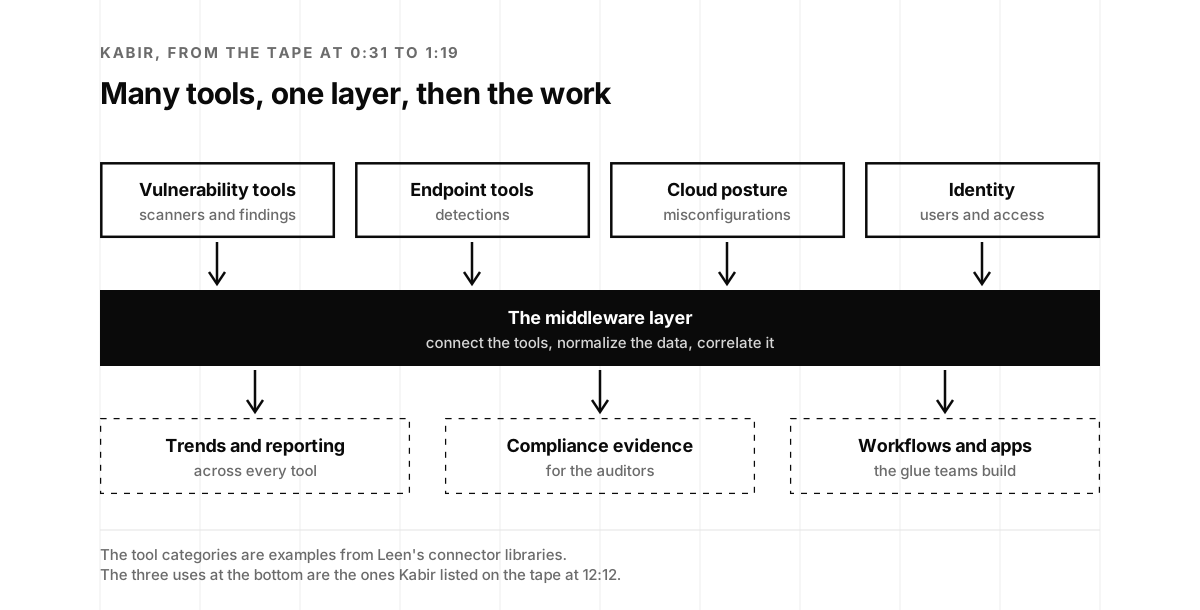
Three rows joined by arrows. Top, four open boxes: vulnerability tools, scanners and findings. Endpoint tools, detections. Cloud posture, misconfigurations. Identity, users and access. Middle, one wide filled box, the middleware layer: connect the tools, normalize the data, correlate it. Bottom, three dashed boxes: trends and reporting across every tool, compliance evidence for the auditors, and workflows and apps, the glue teams build.
What Leen means by a middleware layer.

The light bulb at BlueVoyant

Sasha asked what pain pushed them to start the company. Kabir pointed to his co-founder Neel’s work at BlueVoyant, where Neel was a senior principal engineer. Leen’s funding announcement describes BlueVoyant as a managed detection and response (MDR) and threat intelligence services company (Leen).

“And they had built their whole platform on top of Demisto. Demisto is a SOAR, for those of your listeners who might not know.”

Kabir Mathur, at 1:50

A SOAR, short for security orchestration, automation and response, is the kind of tool that lets a security team respond to some incidents automatically. Palo Alto Networks bought Demisto for $560 million in February 2019 (Wikipedia), and the product now carries the Palo Alto name. For various reasons, Kabir said, it didn’t scale with what BlueVoyant needed.

“So they decided to rip it out and build their own SOAR platform. And Neel was put in charge of that project.”

Kabir Mathur, at 2:05

Rebuilding a SOAR meant doing the part nobody sees first.

“you have to do data normalization, and only then can you actually start to build the automations and workflows on top of that.”

Kabir Mathur, at 2:19

Listen · Kabir on episode 63, from 2:11
About 20 seconds: Kabir on what Neel learned rebuilding a SOAR. The clip stops on its own. Read the full transcript.

Leen’s funding announcement says the same thing from the other side: Neel had built and set up BlueVoyant’s data normalization and orchestration platform before co-founding Leen (Leen). The founders’ bet was that if one engineer felt that frustration, others did too.
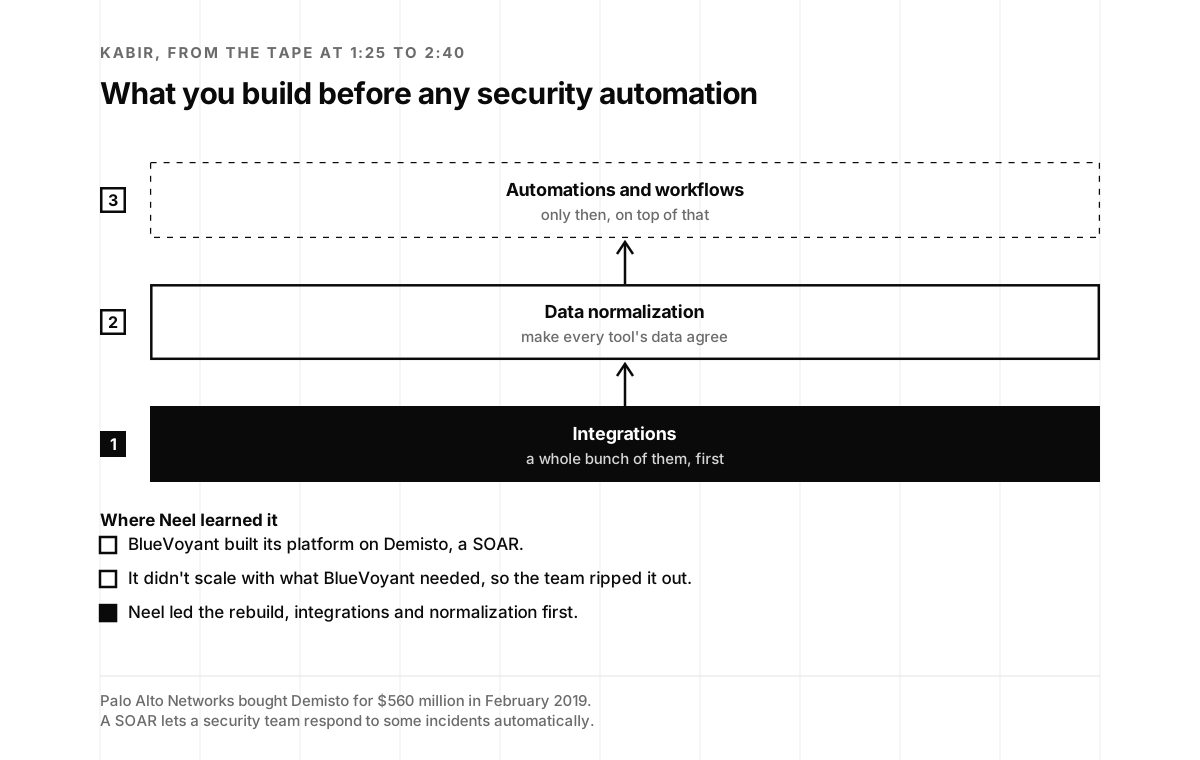
Three stacked boxes, numbered from the bottom, with arrows pointing up. One, filled, integrations, a whole bunch of them, first. Two, open, data normalization, make every tool's data agree. Three, dashed, automations and workflows, only then, on top of that. Below, where Neel learned it: BlueVoyant built its platform on Demisto, a SOAR. It didn't scale with what BlueVoyant needed, so the team ripped it out. Neel led the rebuild, integrations and normalization first.
The work underneath any security automation, in Kabir's order.

Three founders and a pivot

Jon asked how the founders met.

“So we’re all based out of San Francisco. There’s actually three of us. Our third co-partner is Akash. He’s the COO.”

Kabir Mathur, at 2:42

Neel and Akash knew each other through San Francisco circles, and Kabir met Neel separately. Kabir called San Francisco the best place in the world to start a company because of those chance connections. Their first idea wasn’t in security at all.

“we were not working on a security problem at all. We were working on a completely different idea that we tried for two or three months, didn’t see any meaningful traction with it.”

Kabir Mathur, at 3:10

Listen · Kabir on episode 63, from 3:06
About 20 seconds: Kabir on the idea before Leen. The clip stops on its own. Read the full transcript.

Leen’s own post says the name comes from “lean,” for small security teams doing a lot with little, respelled “as a tribute to engineering teams everywhere,” and that it also happens to be Neel spelled backwards (Leen). Jon liked the order of operations.

“That’s spectacular, to have a little bit of experience and to be able to identify, oh, maybe not that, let’s try this next.”

Jon McLachlan, at 3:27

A new industry every five years

Jon asked about Kabir’s superpower on the founding team. Kabir started with his résumé.

“I’d spent my whole career working for startups. It’s been 15 years now.”

Kabir Mathur, at 4:39

His LinkedIn fills in the stops (LinkedIn). He started in business development at Kiz Studios, an Atlanta game studio, in 2009, at the peak of the iPhone’s launch, by his account on the tape. He moved to ad tech at NativeX and then Kiip, a mobile advertising network (Wikipedia), where he ran business development and customer success until 2019. Then came Typeform, the online form company founded in 2012 (Wikipedia), where he led product partnerships and grew its tech partners from 40 to more than 120. He founded Leen in July 2023. The thread through all of it is the one he named.

“the thing that I really enjoy doing, and I think I’m relatively good at, is learning about new industries.”

Kabir Mathur, at 5:22

Listen · Kabir on episode 63, from 5:22
About 20 seconds: Kabir on switching industries. The clip stops on its own. Read the full transcript.

He didn’t come from security. What carried over was integration work.

“especially the work that I did at Typeform, where I built a couple hundred integrations and technical partnerships around that, so very relevant work, now just redirecting to the security industry.”

Kabir Mathur, at 6:09

Jon’s summary was that someone who changes industries that often has to see what connects them: “the repeatable golden nuggets.”
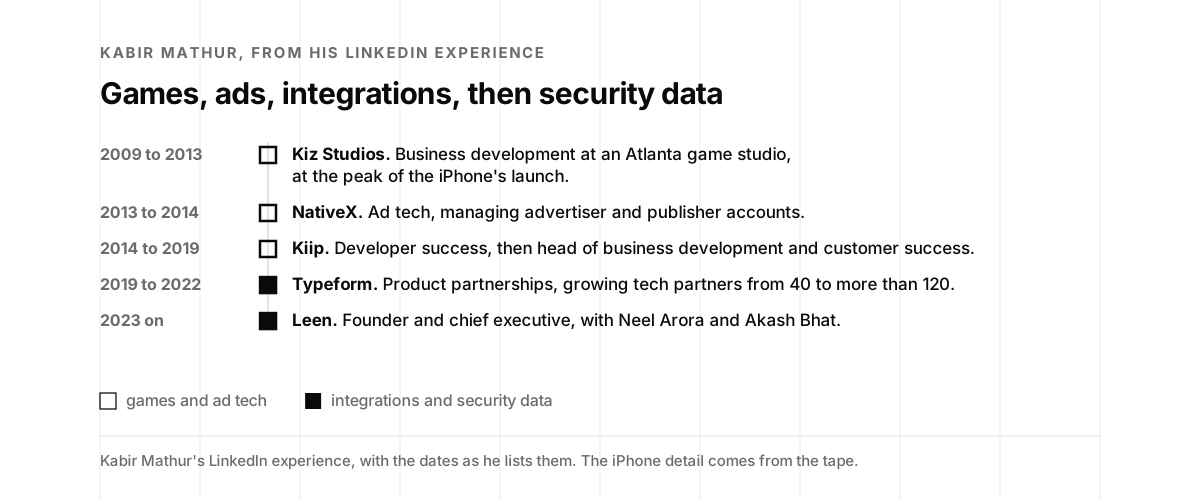
A timeline of five entries. Open, 2009 to 2013, Kiz Studios: business development at an Atlanta game studio, at the peak of the iPhone's launch. Open, 2013 to 2014, NativeX: ad tech, managing advertiser and publisher accounts. Open, 2014 to 2019, Kiip: developer success, then head of business development and customer success. Filled, 2019 to 2022, Typeform: product partnerships, growing tech partners from 40 to more than 120. Filled, 2023 on, Leen: founder and chief executive, with Neel Arora and Akash Bhat.
Kabir's road to Leen, from his LinkedIn.

Vitamin or painkiller

Sasha asked the classic product question.

“As we know, building a product that is a vitamin is not the best path for many different reasons. Building a painkiller for a very explicit pain point seems to work.”

Sasha Sinkevich, at 6:54

Kabir had been on both sides of it. The founders’ first idea, in customer success,

“was definitely a vitamin, and the market told us that in many different ways.”

Kabir Mathur, at 7:22

When they switched to security data, they still didn’t know whether the market was big enough or the problem repeatable. They went through the discovery process anyway, and the response was night and day from the first idea.

“all we had was a concept, right? We didn’t even have a prototype. We were literally pitching to people with a one-pager, telling them what our idea was, and they were super excited about it.”

Kabir Mathur, at 7:50

Listen · Kabir on episode 63, from 7:39
About 20 seconds: Kabir on the first discovery calls. The clip stops on its own. Read the full transcript.

They spoke with about 100 people, from CISOs and heads of security engineering to founders of other security companies and people running MSSPs, and heard a fairly universal problem.

A dozen or more tools

The question was where to start. Kabir described the market in two segments.

“the range is anywhere between 50 all the way up to 100 security tools that these very large enterprise security teams are using.”

Kabir Mathur, at 8:51

Leen started with the other segment, security product vendors: smaller companies, less bureaucracy, faster sales, and a pain they could state in a sentence. Kabir repeated it the way their product people and CTOs had said it to him.

“I know integrations are really important to my business. I need this data on behalf of my customers from a dozen or more tools, but it takes my team way too long to build these integrations.”

Kabir Mathur, at 9:23

Listen · Kabir on episode 63, from 9:15
About 25 seconds: Kabir on what vendors told Leen. The clip stops on its own. Read the full transcript.

Drata is one of those vendors. Its co-founder and chief technology officer, Daniel Marashlian, was our guest on episode 64. Leen’s case study says each in-house integration had taken Drata two to three months, that build time fell to about two weeks, and that its vulnerability management integrations grew from 1 to 13 in under six months. More than 500 Drata customers use Leen to monitor vulnerabilities, and a Drata product manager put the change simply: “Just one or two engineers could build an integration end-to-end” (Leen). Those are the vendor’s numbers about its own product.
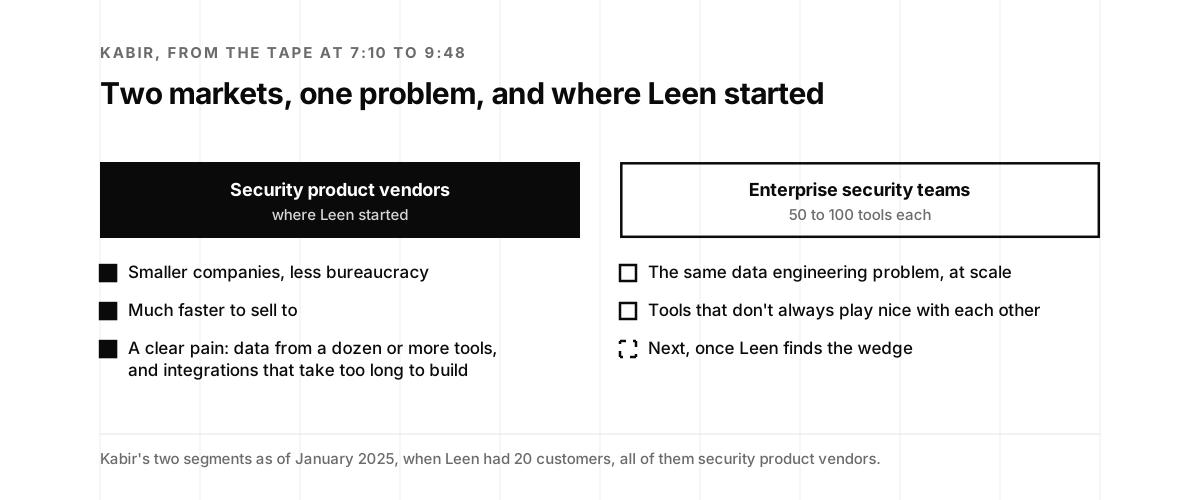
Two columns. Left, filled, security product vendors, where Leen started: smaller companies, less bureaucracy, much faster to sell to, and a clear pain, data from a dozen or more tools and integrations that take too long to build. Right, open, enterprise security teams, 50 to 100 tools each: the same data engineering problem at scale, tools that don't always play nice with each other, and, dashed, next, once Leen finds the wedge.
Why Leen sold to vendors first, in Kabir's terms.

Not a SIEM

Sasha asked about the tool most companies already have.

“Companies already feed a lot of metrics and application logs into a centralized log aggregator.”

Sasha Sinkevich, at 9:56

Splunk is the usual example, and teams build custom queries on top of it to trigger alerts. Kabir drew the line clearly. First, the context: Leen was about a year and a half old.

“About a one and a half year old company. We have 20 customers, all of whom are other security product vendors.”

Kabir Mathur, at 10:46

Then the line itself.

“And what we’ve learned is that we’re not going to replace SIEMs, right? I want to be very clear about that.”

Kabir Mathur, at 10:54

A SIEM, short for security information and event management, collects and correlates event data across an environment. Splunk is one, and Cisco completed its $28 billion purchase of it in March 2024 (Wikipedia). Kabir’s distinction was about the kind of data, not the brand.

“SIEMs are very focused on events and logs, whereas we are much more focused on the stateful data.”

Kabir Mathur, at 11:18

Stateful data, in his telling, is what the tools have already concluded.

“so the alerts, the detections, the vulnerabilities, the issues, whatever the tool calls it.”

Kabir Mathur, at 11:33

Leen also pulls out the thing each finding is about, plus some configuration data.

“Is this vulnerability related to a cloud asset, or is it a network asset? Is it an identity?”

Kabir Mathur, at 11:43

Listen · Kabir on episode 63, from 11:16
About 25 seconds: Kabir on logs versus stateful data. The clip stops on its own. Read the full transcript.

His point was that a SIEM serves one part of a security team well, and that corporate security, cloud security and application security often care more about the state of things than about granular logs. For how the SIEM market itself changed, see Alan Braithwaite on episode 50.
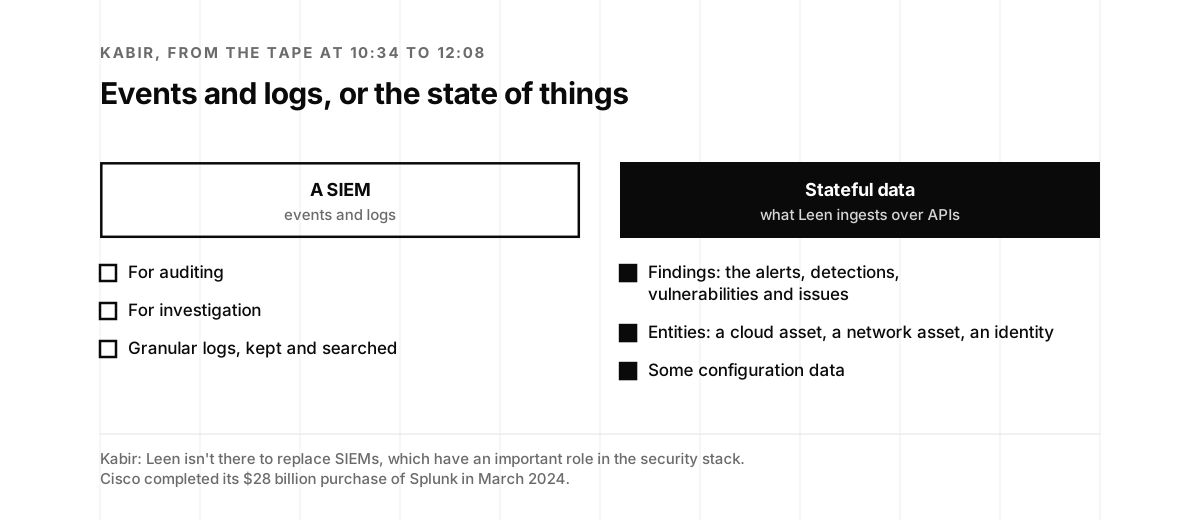
Two columns. Left, open, a SIEM, events and logs: for auditing, for investigation, granular logs kept and searched. Right, filled, stateful data, what Leen ingests over APIs: findings, the alerts, detections, vulnerabilities and issues. Entities, a cloud asset, a network asset, an identity. Some configuration data.
Two kinds of security data, in Kabir's terms.

Three jobs for the data

Kabir listed the use cases enterprise security leaders had described to him. The first is seeing trends across tools at all.

“they might have a dozen or more tools in their stack. They have to log into these different dashboards even to understand what’s happening within those environments”

Kabir Mathur, at 12:35

The second is compliance. GRC platforms, many of them Leen customers, don’t cover every case inside a large company, so teams build their own store of evidence and share it with auditors.

“many of these teams have to stand up what you can refer to as compliance data lakes”

Kabir Mathur, at 13:06

The third is glue: small applications and Slack or Microsoft Teams workflows that connect tools so someone can triage faster.

“This is all bespoke code that these teams have to own.”

Kabir Mathur, at 13:37

Listen · Kabir on episode 63, from 13:04
About 35 seconds: Kabir on what teams build for themselves. The clip stops on its own. Read the full transcript.

All three are the same job underneath: connect the tools, normalize their data, correlate it where possible, and let people act on it. Jon’s summary was that it sounded like “a great aggregation and normalization set of services that fills an important gap in the market.”
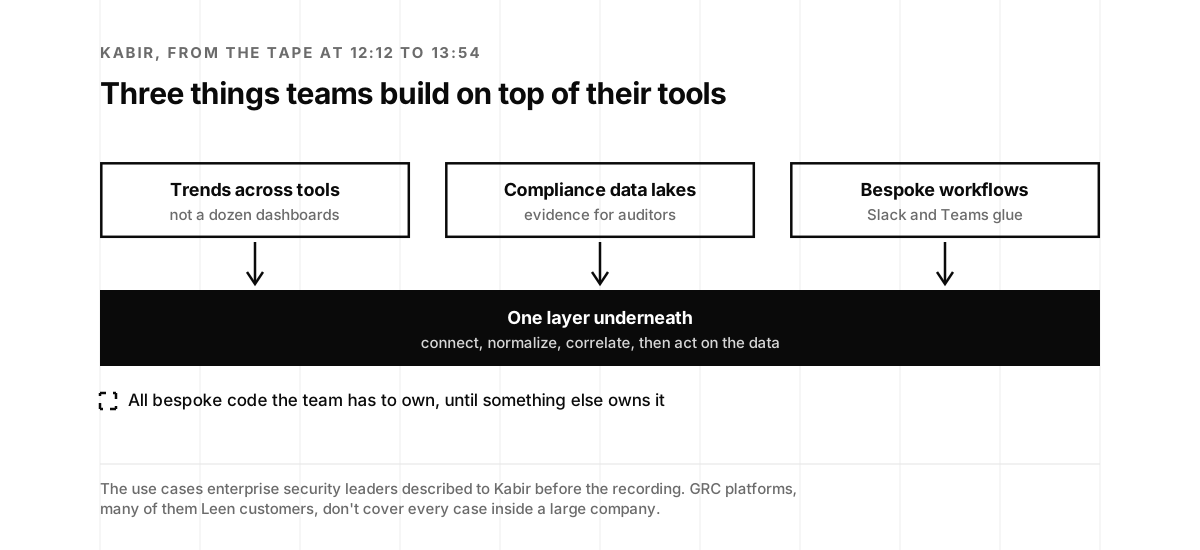
Three open boxes with arrows down to one wide filled box. Trends across tools, not a dozen dashboards. Compliance data lakes, evidence for auditors. Bespoke workflows, Slack and Teams glue. The filled box: one layer underneath, connect, normalize, correlate, then act on the data. Below, dashed: all bespoke code the team has to own, until something else owns it.
Three things teams build on top of their tools, from the tape.

A hundred no’s

Jon asked about the proudest moment so far. Kabir said the founders try not to get too high on the highs or too low on the lows, and that the moment only made sense next to what came before it.

“we talked to about 100 VCs and we got 100 no’s”

Kabir Mathur, at 14:41

Customers called the first idea very interesting too, and it was still rejection after rejection. Jon put a name on that kind of rejection.

“They said no without saying no.”

Jon McLachlan, at 14:57

Kabir knew the script.

“Oh, this is super interesting, but, and the variation of what came after that, but oh, look at the time, I have to go.”

Kabir Mathur, at 14:59

After the pivot, they set up discovery calls with as wide a range of security people as they could find, through cold outreach on LinkedIn, people they knew and security Slack communities. One of those calls didn’t end like a discovery call.

“You guys are raising money, right? I’m going to wire it to you tomorrow, and this is the amount I’m willing to commit.”

Kabir Mathur, at 16:03

That’s Kabir repeating what the person on the other end said. The founders hadn’t asked.

“And we didn’t ask that, that wasn’t the ask at all. We weren’t even sure we were ready to raise money yet.”

Kabir Mathur, at 16:08

Listen · Kabir on episode 63, from 15:44
About 40 seconds: Kabir on the discovery call that turned into an investment. The clip stops on its own. Read the full transcript.

The money arrived the next day, and things snowballed. Kabir told the same story in writing on LinkedIn in October 2025, in a post about increasing your surface area for luck, and added that within a week the investor had introduced them to five more angels, security leaders who anchored the round (LinkedIn).
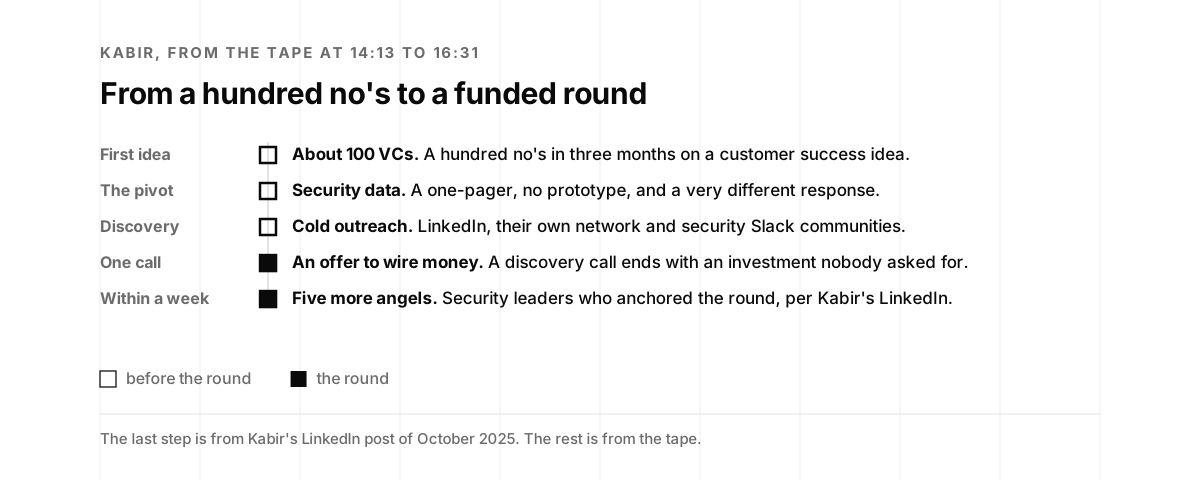
A timeline of five steps. Open, first idea, about 100 VCs: a hundred no's in three months on a customer success idea. Open, the pivot, security data: a one-pager, no prototype, and a very different response. Open, discovery, cold outreach: LinkedIn, their own network and security Slack communities. Filled, one call, an offer to wire money: a discovery call ends with an investment nobody asked for. Filled, within a week, five more angels: security leaders who anchored the round, per Kabir's LinkedIn.
From a hundred no's to a funded round, in Kabir's order.

Room in the round

Jon asked about the hardest thing so far. Kabir’s first answer was a fundraising choice.

“there was only so much room in the round. And especially for a small round, you can only have so many people putting in bigger checks. So we had to turn down one amazing VC in particular.”

Kabir Mathur, at 17:15

Turning down a well-known firm as a team with nothing yet was a risk. He thought it had played out well, because of who they picked.

“the reason we picked our lead investor, 11.2 Capital, is because they had a very strong network in security”

Kabir Mathur, at 17:35

Listen · Kabir on episode 63, from 17:15
About 25 seconds: Kabir on turning down a VC. The clip stops on its own. Read the full transcript.

Leen’s announcement of the pre-seed round names 11.2 Capital as the lead, with InnerLoop Capital and Preface Ventures, and a long list of security operators as angels, among them Jason Chan, formerly Netflix’s vice president of information security, Adrian Ludwig, formerly Atlassian’s chief information security officer, Emilio Escobar of Datadog, Jeff Trudeau of Chime, Varun Badhwar of Endor Labs and Travis McPeak of Resourcely (Leen), who was our guest on episode 68. Kabir’s LinkedIn sums up the cap table as backed by the security chiefs of Netflix, Datadog, Chime and, formerly, Atlassian (LinkedIn).

The second hard thing was letting people go.

“If things don’t work out, it’s really hard as a founder to, one, come to that realization, and then, of course, share that news with the affected person”

Kabir Mathur, at 18:01

Jon’s answer was that building a business takes a strict focus on delivering to the market, and that it isn’t everyone’s cup of tea at every point in a life.

A father’s leap

Jon asked who had the largest influence on Kabir. He named his father.

“we come from very modest roots in India, and he broke out of sort of his corporate job and took a risk and became an entrepreneur, had a successful exit.”

Kabir Mathur, at 19:03

The timing mattered. Kabir described India in the 1990s as almost an oligarchy, a long way from the market it is now.

“It wasn’t the very successful capitalist model that you now know India to be. It was a very closed economy.”

Kabir Mathur, at 19:23

Economic liberalisation in India began in earnest in 1991, opening the economy to foreign trade and investment and giving markets and private companies a larger role (Wikipedia). Entrepreneurship the way Silicon Valley thinks of it, Kabir said, didn’t really exist yet.

“So watching him do that and essentially create something very valuable out of nothing, it kind of blew my mind as a kid, right?”

Kabir Mathur, at 19:37

Listen · Kabir on episode 63, from 19:14
About 25 seconds: Kabir on his father. The clip stops on its own. Read the full transcript.

Give and take

Sasha remembered something from before the recording: one of Kabir’s co-founders hosts a podcast for the security community in India. Kabir gave the credit to Akash. It’s Akash’s own project, started before Leen, with some crossover as the founders met more people in security from Indian backgrounds and invited them on. Kabir tied it to a debt.

“We had nothing a year and a half ago. We started from zero.”

Kabir Mathur, at 21:01

“We asked for a lot of favors to get in touch with investors, to get in touch with customers, to get in touch with our first set of employees.”

Kabir Mathur, at 21:05

So Leen tries to give back, and one way is hosting events.

Inside the buyer’s mind

Kabir mentioned a panel coming up in San Francisco later that month, with CISOs on what it takes to sell into large enterprises.

“So getting into what we call it, inside the buyer’s mind.”

Kabir Mathur, at 21:37

Leen held it on January 27, 2025, at the SVB Experience Center in San Francisco, with Devin Ertel of Menlo Security, Shirish Puranik, formerly an executive vice president for cybersecurity at Wells Fargo, and Adrian Ludwig of Tools for Humanity. Leen’s write-up says buyers are consolidating and replacing tools more than adding them, often paying for something new by retiring something old, and it puts the buyer’s first question this way: “Does this tool create more problems than it solves?” (Leen). That’s the episode’s title, asked by the people who sign the purchase orders.

Sasha asked Kabir the panel’s question directly.

“What does it take to sell into the enterprise?”

Sasha Sinkevich, at 21:50

Kabir said Leen was still breaking into that segment, and that playbooks, champions and relationships all matter. Then he put them second.

“None of that matters unless you’re solving a truly important problem for these teams.”

Kabir Mathur, at 22:33

“Do a lot of these discovery calls, show them prototypes, and don’t treat these as sales calls initially, right? Until you’re sure that you’re solving a problem that matters, just ask for favors.”

Kabir Mathur, at 22:47

Listen · Kabir on episode 63, from 22:32
About 25 seconds: Kabir on selling into the enterprise. The clip stops on its own. Read the full transcript.

In his experience, even CISOs at large companies are usually open to talking to people doing something new, and doing a lot of discovery calls is how a founder refines the solution before trying to sell it.

Polluted by dashboards

Sasha added a view from the buyer’s chair.

“The security space is heavily polluted by different dashboards. Often you have to have a four-year university degree in order to understand how to use certain products.”

Sasha Sinkevich, at 23:33

The opportunity in that, Sasha said, is the experience itself.

“If we can solve a very obvious pain point by producing a better user experience or user interface, that in itself can be a good product and could be a good starting point.”

Sasha Sinkevich, at 23:47

Listen · Sasha on episode 63, from 23:27
About 35 seconds: Sasha on dashboards and user experience. The clip stops on its own. Read the full transcript.

Plays nice with everyone

Jon asked how listeners could find Leen’s events. They’re open to the public, and Kabir framed hosting them as part of the company’s role.

“We see ourselves as being this company that plays nice with everyone in security.”

Kabir Mathur, at 24:39

Listen · Kabir on episode 63, from 24:39
About 30 seconds: Kabir on Leen's events. The clip stops on its own. Read the full transcript.

As a middleware layer, Leen co-hosts with vendors and security teams alike. That panel was its second at Silicon Valley Bank’s space on Market Street, and Jon recommended the old bank vault downstairs.

“The best place to find out about our events is actually to follow our LinkedIn page.”

Kabir Mathur, at 25:12

The events go up on Luma, and Leen approves anyone who works in security. Kabir also promised more around the big conferences, RSA and Black Hat.

Far more engineering driven

Jon asked what success looks like. Kabir answered with the long-term bet Leen is making for the industry, that

“security teams overall are going to become far more engineering driven.”

Kabir Mathur, at 26:25

Security grew up with an IT and compliance makeup, he said, and the threats, the tools and the headcount it has to secure keep growing.

“So overall, the entropy in this space is just increasing.”

Kabir Mathur, at 26:56

The data grows with it, and his conclusion follows from first principles.

“our hypothesis on this is that you don’t solve big data problems without applying engineering principles to them.”

Kabir Mathur, at 27:07

Listen · Kabir on episode 63, from 27:04
About 30 seconds: Kabir on engineering-driven security teams. The clip stops on its own. Read the full transcript.

He saw it in hiring already: security teams looking for people who can write basic scripts, and the most advanced ones hiring only software developers.

“You can’t just rely on what the point solutions are doing for you.”

Kabir Mathur, at 27:51

Over five to ten years, he expected those teams to need a middleware layer and a set of developer tools built for the security stack, and Leen to be the one they choose.
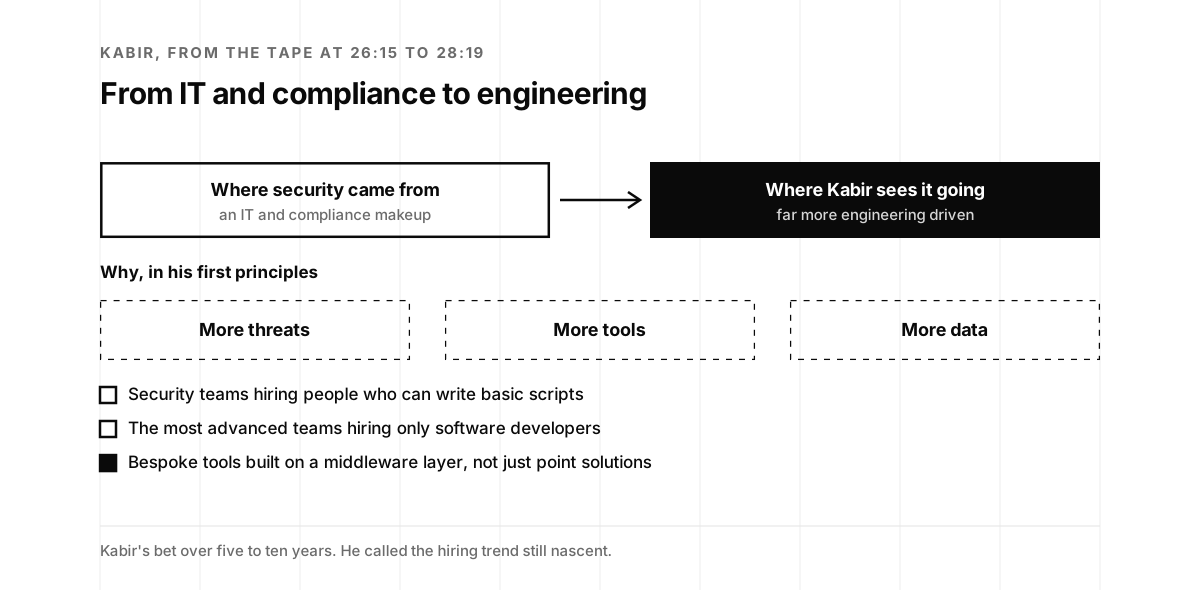
An open box, where security came from, an IT and compliance makeup, with an arrow to a filled box, where Kabir sees it going, far more engineering driven. Below, why, in his first principles, three dashed boxes: more threats, more tools, more data. Then three lines: security teams hiring people who can write basic scripts, the most advanced teams hiring only software developers, and, filled, bespoke tools built on a middleware layer, not just point solutions.
Where Kabir thinks security teams are heading.

Power tools

Jon brought in AI with a story from an event, where someone asked an AI expert when AI would replace developers.

“well, I think that’s kind of like asking when our power tools are going to replace construction workers.”

Jon McLachlan, at 28:45

His point was that someone still has to understand what happens underneath the hood when you click a button, and that with this much data, that’s an engineering problem. Kabir agreed and took it one step further.

“So we’ve been talking a lot about how humans can consume this data and activate it and deal with it more programmatically.”

Kabir Mathur, at 29:42

Garbage in, garbage out

AI, he said, is now part of the same equation, and it depends on the data more than anything else.

“If the data is not formatted correctly, if it’s not normalized, if it’s all over the place coming from all these different tools, it’s going to be garbage in, garbage out.”

Kabir Mathur, at 29:58

Garbage in, garbage out is one of computing’s oldest rules: flawed input produces flawed output (Wikipedia). Kabir’s fix is the same layer he’d been describing all along.

“if we can normalize the data, we can correlate it, we can deduplicate it”

Kabir Mathur, at 30:19

Listen · Kabir on episode 63, from 29:54
About 20 seconds: Kabir on AI and messy security data. The clip stops on its own. Read the full transcript.

With that done, he said, the output a team gets from AI, whether security insights, a reporting layer or compliance work, should be, in theory, much better. Leen made the same argument in 2026, in a post on why agents need a normalized data layer: “Large language models don’t fix bad data. They amplify it.” (Leen).
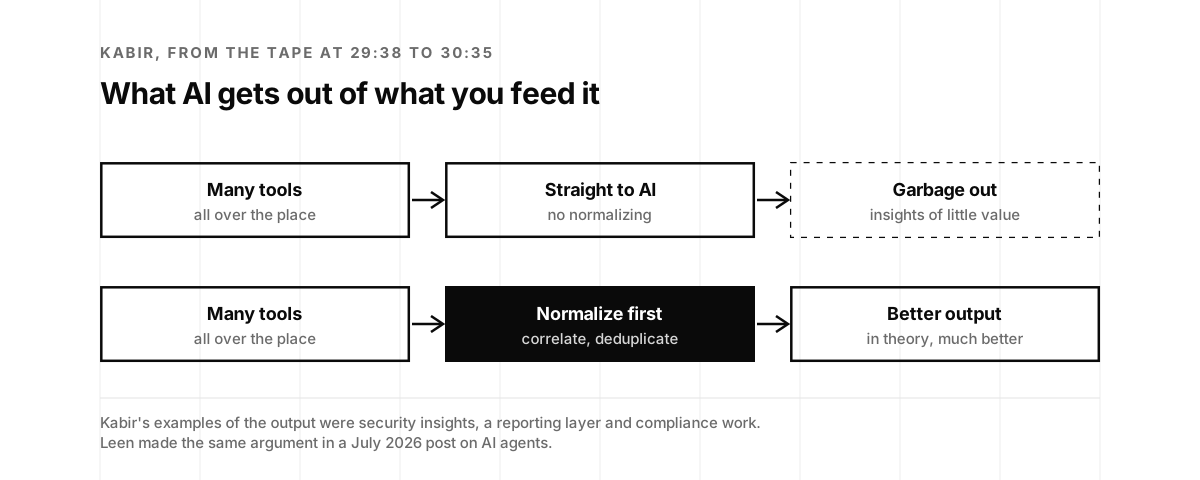
Two rows of three boxes joined by arrows. Top row: open, many tools, all over the place. Open, straight to AI, no normalizing. Dashed, garbage out, insights of little value. Bottom row: open, many tools, all over the place. Filled, normalize first, correlate, deduplicate. Open, better output, in theory, much better.
What AI gets, with and without a normalized layer.

Take the leap

Jon asked what Kabir would tell his younger self. He mentors young founders now, and his advice was about timing.

“looking back, I maybe waited a little too long to venture out and do my own thing.”

Kabir Mathur, at 31:07

From outside, other founders’ raises and overnight successes are intimidating, and you don’t see what’s underneath them.

“And the great attribute that I think most founders need to have is just tenacity and the belief in yourself that you will figure things out.”

Kabir Mathur, at 31:36

Listen · Kabir on episode 63, from 31:16
About 20 seconds: Kabir on taking the leap. The clip stops on its own. Read the full transcript.

Jon offered the other side, that everything along the way made Kabir who he is.

“There’s that catch-22 of, we’re always learning, we’re always growing, we’re always hungry.”

Jon McLachlan, at 32:18

Kabir agreed there’s no right age. He has worked for founders of 18 or 19, who make the mistakes of people new to the workforce.

“There’s so many successful entrepreneurs who didn’t start their first company until their 40s or 50s.”

Kabir Mathur, at 33:00

Sasha closed the thought.

“We all make mistakes regardless of the age.”

Sasha Sinkevich, at 33:10

Where the unsolved problems are

Sasha asked where Kabir would start a company today. Leen’s position helps: Kabir said he had spoken with more than 100 founders in the past year alone, in GRC, vulnerability prioritization, identity and more. His first answer was cloud security.

“even though you have behemoths like Wiz in the space.”

Kabir Mathur, at 34:14

Two months after the recording, on March 18, 2025, Google announced it would buy Wiz for $32 billion in cash, and the deal closed on March 11, 2026 (Wikipedia). Kabir still saw unsolved, narrower problems around it, and Sasha didn’t think a giant should scare anyone off.

“But I would say that when Apple started in a garage, the IBM already existed, and they owned a lot of real estate in the Silicon Valley.”

Sasha Sinkevich, at 34:38

Kabir’s second answer was identity, because the main ways in are still basic.

“a lot of them are still happening at a very basic level”

Kabir Mathur, at 35:03

Exposed credentials were on his list. His third was the space the automated GRC companies work in, because the number of frameworks keeps growing and large enterprises still build bespoke solutions where the platforms stop.

“Number of frameworks that companies have to adhere to is only going to continue to increase.”

Kabir Mathur, at 35:31

Sasha connected it back to the episode’s theme. If a platform can’t pull and understand the data from the technical implementation, it’s hard to make GRC fully automated.

“ideally it needs to be driven by the data itself.”

Sasha Sinkevich, at 36:13
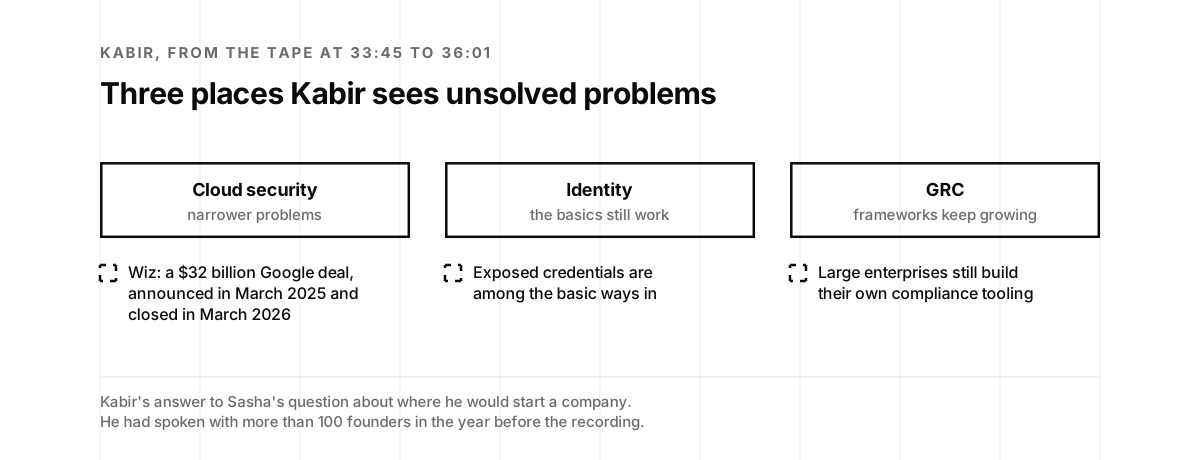
Three open boxes in a row. Cloud security, narrower problems. Identity, the basics still work. GRC, frameworks keep growing. Under each, dashed: Wiz, a $32 billion Google deal, announced in March 2025 and closed in March 2026. Exposed credentials are among the basic ways in. Large enterprises still build their own compliance tooling.
Where Kabir would look for unsolved problems.

Finding the wedge

Sasha asked what was next for Leen. It was the start of 2025, and Kabir named the biggest thing on the list.

“And one of the biggest things that we’re going to be focused on is creating value for these enterprise security teams, right?”

Kabir Mathur, at 36:57

Leen had found its footing with vendors that need to scale their integrations. With enterprise teams, he wanted one specific problem first, and then a platform for reporting, compliance workflows and automations.

“initially, you have to find that wedge use case.”

Kabir Mathur, at 37:50

Listen · Kabir on episode 63, from 37:23
About 30 seconds: Kabir on Leen's plan for 2025. The clip stops on its own. Read the full transcript.

Sasha’s summary was the advice of the whole episode.

“Just connecting the dots, making sure whenever we build a product, it’s important to keep the focus on what the market is asking for and create a solution for it.”

Sasha Sinkevich, at 37:57

What happened after the tape

When we recorded. The conversation was recorded on January 16, 2025, and aired on February 25. Kabir mentions the panel coming up “later this month,” and Leen held it on January 27.

The vendor side kept growing. Leen announced a partnership with Tenable in April 2025, a connector that brings Tenable’s vulnerability data into developer workflows (Leen). In May 2025 it published its own estimate of what an in-house integration costs, about 240 hours to build and about 220 hours a year to maintain, review and keep up with API changes (Leen), which are the defaults in the calculator below. Its integrations later became two-way, creating and updating tickets in Jira and ServiceNow (Leen).

The tool count, in his words. In September 2025 Kabir wrote about the line he kept hearing from enterprise security leaders. One CISO told him 40% of the team’s time went to managing data, and his conclusion was that visibility comes from connecting the data you already have (LinkedIn).

I keep hearing the same thing from enterprise security leaders: “We run 80+ tools, but we still don’t have visibility.”

Something doesn’t add up.

Kabir Mathur · Founder and CEO, Leen · September 24, 2025
Kabir on the tool count, seven months after the episode. View on LinkedIn.

Two months earlier, Leen and Rinki Sethi’s Lockstep had shared what they heard from 25 security practitioners about the gap between what practitioners need and what most products deliver (LinkedIn). Leen’s own account on X kept it shorter.

Leen on X, the same problem in fewer words. View on X.

From a data layer to agents. By 2026, Leen’s site led with “We started by connecting your security tools. Now we run your security operations.” (Leen). Its agents connect a team’s tools, normalize the data and run campaigns from a finding through remediation to a verified fix, and they ask a person to approve before acting (Leen). Kabir’s LinkedIn lists the jobs as triaging vulnerabilities across scanners, collecting compliance evidence for audits and fixing cloud misconfigurations as they drift, on top of 50-plus integrations and 20-plus normalized data models, with SecurityScorecard, Drata, Sysdig and Secureframe among its customers (LinkedIn). Those are the jobs from the tape, the dashboards, the compliance data lakes and the bespoke glue, done by software on top of the same layer.
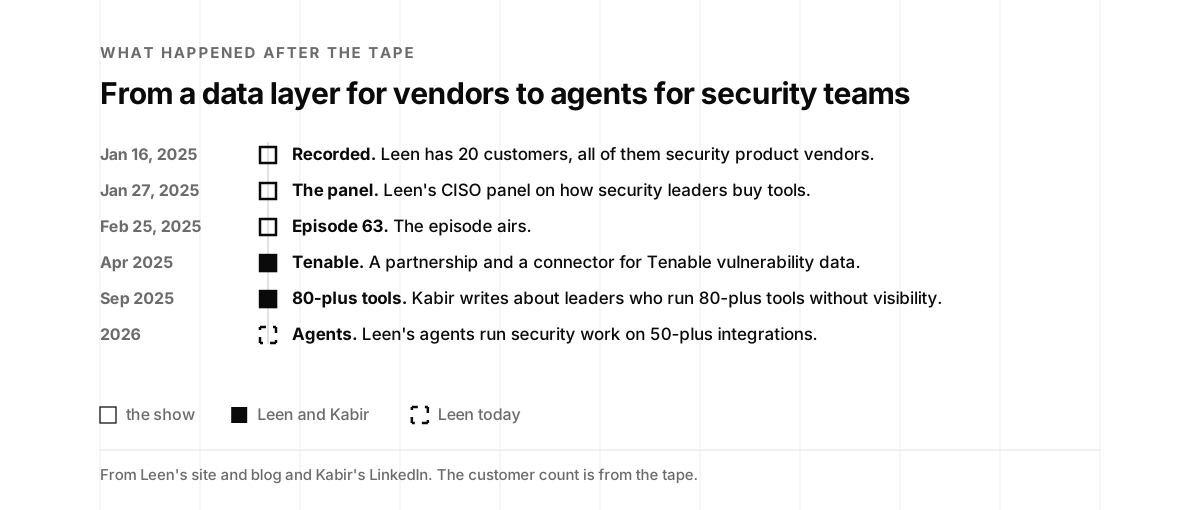
A timeline of six entries. Open, January 16, 2025, recorded: Leen has 20 customers, all of them security product vendors. Open, January 27, 2025, the panel: Leen's CISO panel on how security leaders buy tools. Open, February 25, 2025, episode 63: the episode airs. Filled, April 2025, Tenable: a partnership and a connector for Tenable vulnerability data. Filled, September 2025, 80-plus tools: Kabir writes about leaders who run 80-plus tools without visibility. Dashed, 2026, agents: Leen's agents run security work on 50-plus integrations.
What happened after the tape.

The episode’s one-sentence summary still holds: a security team doesn’t need fewer tools so much as tools whose data agrees.

Did you catch it? A six-question quiz

Six questions from the episode. Each answer links the moment in the transcript.

Quiz · six questions

Did you catch it?

Pick an answer for each question, then check your score.

  1. What did Neel's team at BlueVoyant rip out and rebuild?

    1. Their SIEM
    2. Their SOAR platform, built on Demisto
    3. Their ticketing system

    b. "So they decided to rip it out and build their own SOAR platform." Transcript, 2:05.

  2. How many security tools did Kabir say very large enterprise teams use?

    1. Five to ten
    2. Twenty to thirty
    3. Fifty to a hundred

    c. "the range is anywhere between 50 all the way up to 100 security tools that these very large enterprise security teams are using." Transcript, 8:51.

  3. What kind of data did Kabir say Leen focuses on, next to a SIEM's events and logs?

    1. Stateful data, such as findings
    2. Packet captures
    3. Endpoint telemetry

    a. "SIEMs are very focused on events and logs, whereas we are much more focused on the stateful data." Transcript, 11:18.

  4. How many VCs said no to the founders' first idea?

    1. About ten
    2. About a hundred
    3. About a thousand

    b. "we talked to about 100 VCs and we got 100 no's" Transcript, 14:41.

  5. What did Kabir say happens when AI is fed data that isn't normalized?

    1. The model cleans it up
    2. It runs faster
    3. Garbage in, garbage out

    c. "it's going to be garbage in, garbage out." Transcript, 30:06.

  6. Which customers did Leen decide to sell to first?

    1. Other security product vendors
    2. Large enterprise security teams
    3. Government agencies

    a. "And the segment that we decided to start with are other security product vendors." Transcript, 8:26.

Is your security stack connected?

Eight questions for a security team that runs more tools than it can comfortably watch, drawn from what Kabir, Sasha and Jon covered. Each one links the part of the episode it comes from.

Scorecard · eight questions

Is your security stack connected?

Answer for your whole security program as it runs today. If two answers fit, pick the lower one.

  1. Can you list every security tool you pay for, and who owns each one?

    • No
    • Roughly
    • Yes, with an owner for each

    "the range is anywhere between 50 all the way up to 100 security tools" See A dozen or more tools.

  2. Can you see findings from all your tools in one place, in one format?

    • No, we log into each dashboard
    • For some tools
    • Yes, normalized in one place

    "They have to log into these different dashboards even to understand what's happening within those environments" See Three jobs for the data.

  3. Do you know which asset or identity each finding is about?

    • No
    • For some tools
    • Yes, across tools

    "Is this vulnerability related to a cloud asset, or is it a network asset? Is it an identity?" See Not a SIEM.

  4. How do you collect compliance evidence for an audit?

    • Screenshots and spreadsheets, by hand
    • Partly automated
    • Pulled from the tools automatically

    "many of these teams have to stand up what you can refer to as compliance data lakes" See Three jobs for the data.

  5. Who maintains the scripts and workflows that glue your tools together?

    • Nobody in particular
    • One person who might leave
    • A team that owns them as code

    "This is all bespoke code that these teams have to own." See Three jobs for the data.

  6. Before you buy a new security tool, do you decide what it replaces?

    • No
    • Sometimes
    • Yes, every time

    "The security space is heavily polluted by different dashboards." See Polluted by dashboards.

  7. Does your security team have people who can write code?

    • No
    • A few scripts
    • Yes, engineers on the team

    "you don't solve big data problems without applying engineering principles to them." See Far more engineering driven.

  8. Before AI reads your security data, is it normalized and deduplicated?

    • No
    • Partly
    • Yes

    "it's going to be garbage in, garbage out." See Garbage in, garbage out.

Sprawling

Your tools work, but they work alone. Start with a list of every tool and its owner, then pick the two whose findings you'd most like to see side by side and get them into one format.

Connecting

Some of the data agrees and some doesn't. Normalize findings and the assets they're about before you build more dashboards, and put the glue code under an owner.

Connected

Your tools feed one picture. Keep it that way at the buying stage, decide what each new tool replaces, and make sure the data is clean before AI reads it.

What do your integrations cost?

The engineering time it takes to connect your own tools, with Leen’s estimate for one integration as the starting point. Change the numbers to your own.

Calculator

What do your integrations cost?

Four estimates: how many tools you need data from, the hours to build one integration, the hours a year to keep one working, and what an engineering hour costs you.

–engineering hours in the first year
–what the first year costs
–hours every year after, just to keep them working
–full-time engineers on upkeep alone

Building these integrations yourself takes about 5,520 h of engineering time in the first year, about $552,000, and 2,640 h every year after that. That's 1.3 full-time engineers doing nothing but keeping integrations working, which is the work Kabir's customers told him their teams shouldn't be spending time on.

The defaults are Leen's own estimate for one integration, about 240 hours to build and about 220 hours a year of maintenance, security reviews and API changes (Leen). Leen sells the alternative, so put in your own numbers. Twelve tools follows Kabir's "a dozen or more tools," and a full-time engineer is counted as 2,000 hours a year.

From Kiz Studios to Leen’s agents

Everything on this page sits on one timeline, from India’s reforms to Leen’s agents. Filter it by thread.

Timeline · 1991 to 2026

From Kiz Studios to Leen's agents

Filter by thread. Dates are from the public record except where marked as part of this show.

  1. India opens up

    Economic liberalisation begins opening India's economy to foreign trade and investment (Wikipedia, on this show).

  2. Kiz Studios

    Kabir starts in business development at an Atlanta game studio, his first stop in gaming (LinkedIn).

  3. NativeX

    Into ad tech, managing advertiser and publisher accounts (LinkedIn).

  4. Kiip

    Developer success, then head of business development and customer success at the mobile ad network, to 2019 (LinkedIn).

  5. Demisto

    Palo Alto Networks buys the SOAR maker for $560 million (Wikipedia, on this show).

  6. Typeform

    Kabir leads product partnerships, growing the tech partner list from 40 to more than 120, to April 2022 (LinkedIn).

  7. Leen

    Kabir founds Leen with Neel Arora and Akash Bhat after a first idea in customer success (LinkedIn, on this show).

  8. Cisco closes Splunk

    The $28 billion deal for the SIEM maker completes (Wikipedia, on this show).

  9. Leen's origins

    Leen publishes its founding thesis, that security is fundamentally a data problem (Leen).

  10. SOC 2

    Leen announces its SOC 2 compliance (X).

  11. Why Leen

    The name, from "lean," respelled for engineering teams and Neel's name backwards (Leen).

  12. Recorded

    Kabir, Jon and Sasha record the episode. Leen has 20 customers, all security vendors (on this show).

  13. Inside the buyer's mind

    Leen's CISO panel at the SVB Experience Center in San Francisco (Leen, on this show).

  14. Episode 63

    The episode airs (transcript).

  15. Google and Wiz

    Google announces a $32 billion all-cash deal for Wiz (Wikipedia, on this show).

  16. Tenable

    A partnership and connector for Tenable vulnerability data (Leen).

  17. The cost of building in-house

    Leen estimates about 460 engineering hours per integration in the first year (Leen, calculator).

  18. Practitioner research

    Leen and Lockstep share what 25 security practitioners told them (LinkedIn).

  19. 80+ tools

    Kabir writes about the enterprise leaders who run 80-plus tools without visibility (LinkedIn).

  20. Surface area for luck

    Kabir writes up the discovery call that turned into the first check (LinkedIn, on this show).

  21. Wiz joins Google

    The acquisition completes (Wikipedia).

  22. Data for agents

    Leen argues that AI agents need a normalized data layer (Leen, on this show).

  23. Agents

    Leen's site leads with running security operations on top of its integrations (Leen).

What to do this week

Five things, in the order Kabir’s argument suggests.

  1. List your tools and their owners. Every security tool you pay for, who owns it, and what data it produces. The scorecard above shows where else you stand.
  2. Pick two tools and make their findings agree. Same format, same severity scale, and the same asset or identity attached to each finding.
  3. Price the glue. Count the scripts, workflows and integrations someone keeps alive, and run the calculator with your own hours.
  4. Decide what a new tool replaces before you buy it. The buyer’s question from Leen’s panel is the right one: does it create more problems than it solves?
  5. Clean the data before AI reads it. Normalize, correlate and deduplicate first. If you’d like a second pair of eyes on your stack, our vCISO team can help, and you can book 15 minutes with us.

Key takeaways

  1. Security's problem is interconnection, not tool count

    Kabir never told anyone to stop buying tools. His point was that each tool keeps its own data in its own format, and teams lose time joining it up before they can act on any of it.

  2. A unified API is a middleware layer

    Leen connects to many security tools, normalizes their data into one model per category of tool, and serves it through one API, so a developer writes one integration instead of dozens.

  3. Automation starts with integrations and normalization

    Neel learned it rebuilding BlueVoyant's SOAR after its Demisto-based platform stopped scaling. Integrations come first, normalization second, and only then the automations people actually wanted.

  4. Pivot when the market says vitamin

    The founders' first idea, in customer success, drew 100 no's from VCs and rejection after rejection. The security data idea drew excitement on a one-pager before there was a prototype.

  5. Start where the pain is clearest

    Leen sold first to security product vendors, smaller companies with less bureaucracy and faster sales, whose product people said they needed data from a dozen or more tools and that integrations took too long.

  6. Large enterprises run 50 to 100 security tools

    Kabir's estimate for very large enterprise security teams is the same data engineering problem at a much larger scale, with tools that don't always play nice with each other.

  7. A SIEM and stateful data do different jobs

    SIEMs focus on events and logs, for auditing and investigation. Leen focuses on stateful data: the findings tools produce, the entities they're about and some configuration. Kabir was clear that Leen isn't there to replace SIEMs.

  8. Know what each finding is about

    Leen extracts the entity behind every finding, whether it's a cloud asset, a network asset or an identity, so findings from different tools can be correlated.

  9. Teams build three things for themselves

    Enterprise security leaders described trend reporting across a dozen dashboards, compliance data lakes for auditors, and bespoke workflows on Slack or Microsoft Teams, all code the team has to own.

  10. Discovery calls can become investments

    One of Leen's early discovery calls ended with an offer to wire money the next day, which the founders hadn't asked for. Within a week, by Kabir's later account, five more angels anchored the round.

  11. Pick investors for their network

    Kabir turned down a well-known VC because there was only so much room in a small round, and picked 11.2 Capital to lead because of its network in security.

  12. Sell into the enterprise with the product first

    Playbooks, champions and relationships matter, but none of it matters unless the product solves a truly important problem. Do discovery calls, show prototypes and ask for favors before selling.

  13. Security is polluted by dashboards

    Sasha's view is that too many products need a four-year degree to use, and that a better user experience for an obvious pain point can be a product in itself.

  14. Security teams are becoming engineering teams

    Kabir's bet is that growing threats, tools and data push security teams to hire people who can code, because big data problems need engineering principles and point solutions alone won't do.

  15. AI amplifies whatever data you feed it

    If findings aren't normalized and come from every tool in a different shape, AI gives garbage in, garbage out. Normalizing, correlating and deduplicating first makes the output better.

  16. Start before you feel ready

    Kabir's advice to his younger self was that he waited too long to take the leap, and that tenacity and the belief that you'll figure things out matter more than collecting the perfect résumé.

Chapters

Tap a chapter to play from there.

Pull quotes

“We sometimes also refer to it as a security data fabric.”

Kabir Mathur ·

“Yeah, essentially what we do is we act as a middleware layer for security.”

Kabir Mathur ·

“there are so many different solutions in the space. They have all of these different data formats and perspectives on a finite set of assets within security. And there's no real interconnectedness.”

Kabir Mathur ·

“And they had built their whole platform on top of Demisto. Demisto is a SOAR, for those of your listeners who might not know.”

Kabir Mathur ·

“So they decided to rip it out and build their own SOAR platform. And Neel was put in charge of that project.”

Kabir Mathur ·

“you have to do data normalization, and only then can you actually start to build the automations and workflows on top of that.”

Kabir Mathur ·

“And that's what set us on this journey, because we figured, hey, if he held this frustration, chances are that other people in the industry did.”

Kabir Mathur ·

“This is why, on a slight tangent, I believe this is the best place in the world to start a company, is because you have all of these serendipitous connections with really bright, focused people.”

Kabir Mathur ·

“we were not working on a security problem at all.”

Kabir Mathur ·

“And I know as an entrepreneur, we have to be a little bit crazy.”

Jon McLachlan ·

“I'd spent my whole career working for startups. It's been 15 years now.”

Kabir Mathur ·

“the thing that I really enjoy doing, and I think I'm relatively good at, is learning about new industries.”

Kabir Mathur ·

“especially the work that I did at Typeform, where I built a couple hundred integrations and technical partnerships around that”

Kabir Mathur ·

“And you must be able to identify the underlying patterns that connect everything together, the repeatable golden nuggets.”

Jon McLachlan ·

“As we know, building a product that is a vitamin is not the best path for many different reasons. Building a painkiller for a very explicit pain point seems to work.”

Sasha Sinkevich ·

“was definitely a vitamin, and the market told us that in many different ways.”

Kabir Mathur ·

“all we had was a concept, right? We didn't even have a prototype.”

Kabir Mathur ·

“And we learned that it's a fairly universal problem.”

Kabir Mathur ·

“the range is anywhere between 50 all the way up to 100 security tools that these very large enterprise security teams are using.”

Kabir Mathur ·

“I need this data on behalf of my customers from a dozen or more tools, but it takes my team way too long to build these integrations.”

Kabir Mathur ·

“I don't think it's something that my engineering team should be spending the time on.”

Kabir Mathur ·

“Companies already feed a lot of metrics and application logs into a centralized log aggregator.”

Sasha Sinkevich ·

“We have 20 customers, all of whom are other security product vendors.”

Kabir Mathur ·

“And what we've learned is that we're not going to replace SIEMs, right? I want to be very clear about that.”

Kabir Mathur ·

“SIEMs are very focused on events and logs, whereas we are much more focused on the stateful data.”

Kabir Mathur ·

“so the alerts, the detections, the vulnerabilities, the issues, whatever the tool calls it.”

Kabir Mathur ·

“Is this vulnerability related to a cloud asset, or is it a network asset? Is it an identity?”

Kabir Mathur ·

“They have to log into these different dashboards even to understand what's happening within those environments”

Kabir Mathur ·

“many of these teams have to stand up what you can refer to as compliance data lakes”

Kabir Mathur ·

“This is all bespoke code that these teams have to own.”

Kabir Mathur ·

“Really sounds like a great aggregation and normalization set of services that fills an important gap in the market.”

Jon McLachlan ·

“we talked to about 100 VCs and we got 100 no's”

Kabir Mathur ·

“They said no without saying no.”

Jon McLachlan ·

“You guys are raising money, right? I'm going to wire it to you tomorrow, and this is the amount I'm willing to commit.”

Kabir Mathur ·

“And we didn't ask that, that wasn't the ask at all. We weren't even sure we were ready to raise money yet.”

Kabir Mathur ·

“Sometimes you're raising money and you don't even know it.”

Jon McLachlan ·

“there was only so much room in the round. And especially for a small round, you can only have so many people putting in bigger checks.”

Kabir Mathur ·

“the reason we picked our lead investor, 11.2 Capital, is because they had a very strong network in security”

Kabir Mathur ·

“It wasn't the very successful capitalist model that you now know India to be. It was a very closed economy.”

Kabir Mathur ·

“So watching him do that and essentially create something very valuable out of nothing, it kind of blew my mind as a kid, right?”

Kabir Mathur ·

“We had nothing a year and a half ago. We started from zero.”

Kabir Mathur ·

“None of that matters unless you're solving a truly important problem for these teams.”

Kabir Mathur ·

“Until you're sure that you're solving a problem that matters, just ask for favors.”

Kabir Mathur ·

“The security space is heavily polluted by different dashboards. Often you have to have a four-year university degree in order to understand how to use certain products.”

Sasha Sinkevich ·

“If we can solve a very obvious pain point by producing a better user experience or user interface, that in itself can be a good product and could be a good starting point.”

Sasha Sinkevich ·

“We see ourselves as being this company that plays nice with everyone in security.”

Kabir Mathur ·

“security teams overall are going to become far more engineering driven.”

Kabir Mathur ·

“So overall, the entropy in this space is just increasing.”

Kabir Mathur ·

“our hypothesis on this is that you don't solve big data problems without applying engineering principles to them.”

Kabir Mathur ·

“where security teams are hiring more and more folks with at least some basic engineering capabilities.”

Kabir Mathur ·

“You can't just rely on what the point solutions are doing for you.”

Kabir Mathur ·

“well, I think that's kind of like asking when our power tools are going to replace construction workers.”

Jon McLachlan ·

“If the data is not formatted correctly, if it's not normalized, if it's all over the place coming from all these different tools, it's going to be garbage in, garbage out.”

Kabir Mathur ·

“if we can normalize the data, we can correlate it, we can deduplicate it”

Kabir Mathur ·

“looking back, I maybe waited a little too long to venture out and do my own thing.”

Kabir Mathur ·

“And the great attribute that I think most founders need to have is just tenacity and the belief in yourself that you will figure things out.”

Kabir Mathur ·

“There's that catch-22 of, we're always learning, we're always growing, we're always hungry.”

Jon McLachlan ·

“We all make mistakes regardless of the age.”

Sasha Sinkevich ·

“even though you have behemoths like Wiz in the space.”

Kabir Mathur ·

“But I would say that when Apple started in a garage, the IBM already existed”

Sasha Sinkevich ·

“ideally it needs to be driven by the data itself.”

Sasha Sinkevich ·

“initially, you have to find that wedge use case.”

Kabir Mathur ·

“Just connecting the dots, making sure whenever we build a product, it's important to keep the focus on what the market is asking for and create a solution for it.”

Sasha Sinkevich ·

About the guest

Kabir Mathur, Founder and Chief Executive Officer, Leen

Kabir Mathur founded Leen in 2023 with Neel Arora and Akash Bhat, and leads it as chief executive from San Francisco. Leen builds a unified API and data fabric for security, used by security vendors such as Drata, and by 2026 runs agents for security teams on top of it. Before Leen he spent about 15 years in startups, in business development at the game studio Kiz Studios, in ad tech at NativeX and Kiip, and leading product partnerships at Typeform from 2019 to 2022.

About the host

Jon McLachlan and Sasha Sinkevich are co-founders of YSecurity, the on-demand cybersecurity team for startups, and of Cyberbase.ai. The Security Podcast of Silicon Valley is hosted by Jon McLachlan and Sasha Sinkevich. Jon McLachlan on LinkedIn ↗Sasha Sinkevich on LinkedIn ↗

Context and sources

  • Kabir Mathur's LinkedIn experience: founder and chief executive of Leen since July 2023, Typeform from 2019 to 2022, Kiip from 2014 to 2019, NativeX from 2013 to 2014 and Kiz Studios from 2009 to 2013. Source ↗
  • Leen, home page: a unified API and data fabric for security, with unified data models for each category of security tool. "We started by connecting your security tools. Now we run your security operations." Source ↗
  • Leen, about: the mission to be the best devtools company in the world for security teams, and the founding team. Source ↗
  • Leen, Leen origins, March 21, 2024: the founding thesis that security is fundamentally a data problem. Source ↗
  • Leen, Why we named our company Leen, July 15, 2024: from lean, respelled for engineering teams, and Neel's name backwards. Source ↗
  • Leen, press kit: founded in 2023 by Kabir Mathur, Akash Bhat and Neel Arora. Source ↗
  • Leen, pre-seed announcement: led by 11.2 Capital with InnerLoop Capital and Preface Ventures, with security leaders as angels. Neel Arora built BlueVoyant's data normalization and orchestration platform. Source ↗
  • Leen, Drata case study: integrations that took two to three months now take about two weeks, vulnerability management integrations grew from 1 to 13, and more than 500 Drata customers use Leen. Source ↗
  • Leen, panel summary: how security leaders evaluate and procure tools, from the January 27, 2025 panel at the SVB Experience Center in San Francisco. Source ↗
  • Leen, partnership with Tenable for vulnerability management, April 8, 2025. Source ↗
  • Leen, The real cost of integration development, May 17, 2025: about 240 hours to build an integration in-house and about 220 hours a year to maintain it. Source ↗
  • Leen, Introducing Leen's bi-directional ITSM integrations: creating and updating tickets in Jira and ServiceNow. Source ↗
  • Leen, Why unified APIs matter in the age of AI, July 21, 2026: AI agents need a normalized data layer. Source ↗
  • Leen, agents that connect a team's security tools, normalize the data and run campaigns through remediation, with a person approving each action. Source ↗
  • Leen on LinkedIn: founded 2023, San Francisco, integrations to 50+ security products and 20 normalized data models. Source ↗
  • Kabir Mathur on LinkedIn, September 24, 2025: enterprise security leaders who run 80+ tools and still lack visibility. Source ↗
  • Kabir Mathur on LinkedIn, October 2025: the discovery call that became Leen's first investment, and the angels who anchored the round. Source ↗
  • Kabir Mathur on LinkedIn, July 2025: research with Rinki Sethi and Lockstep from interviews with 25 security practitioners. Source ↗
  • Leen on X, August 26, 2025: connecting your security data. Source ↗
  • Wikipedia, Palo Alto Networks: acquired Demisto for $560 million in February 2019. Source ↗
  • Wikipedia, security orchestration, automation and response: cybersecurity technologies that let organizations respond to some incidents automatically. Source ↗
  • Wikipedia, security information and event management. Source ↗
  • Wikipedia, Splunk: acquired by Cisco for $28 billion, completed March 18, 2024. Source ↗
  • Wikipedia, Wiz, Inc.: Google announced a $32 billion all-cash acquisition on March 18, 2025, completed on March 11, 2026. Source ↗
  • Wikipedia, economic liberalisation in India: policy changes made mainly from 1991 that opened the economy to foreign trade and investment. Source ↗

Transcript

Automatic transcription. Jon McLachlan and Sasha Sinkevich host this episode with Kabir Mathur. There is no diarization on the tape, so speaker labels were assigned from the content and checked passage by passage against reference recordings of each voice from this episode, and a few short lines may sit with the wrong speaker. Names and product names were normalized where the recognizer misheard them (Jon McLachlan, Sasha Sinkevich, Kabir Mathur, Leen, Neel, Akash, BlueVoyant, Demisto, Palo Alto XSOAR, SIEM, GRC, CISOs, Typeform, 11.2 Capital, Silicon Valley Bank). Words in [brackets] are best guesses where the audio is unclear, and the few stretches no decode makes out are marked with an ellipsis. Answers are transcribed as spoken, with repeated words and false starts trimmed. Short backchannels such as "yep" are left out, and so are the goodbyes after the sign-off.

Read the full transcript 7,285 words

Jon McLachlan

Welcome everyone to another episode of The Security Podcast of Silicon Valley. I am one of the hosts, Jon McLachlan, and I'm joined today by Sasha Sinkevich. And we have the great honor to have an amazing guest with us today, Kabir Mathur, the founder and CEO of Leen. Welcome to the show.

Kabir Mathur

Thanks for having me, Jon. Sasha.

Jon McLachlan

Leen is a unified API for security data. Is that spot on, or would you like to enhance that, Kabir, a little bit?

Kabir Mathur

Yeah, that's pretty accurate. We refer to it as a unified API for security data. We sometimes also refer to it as a security data fabric. That term, as I'm sure you know from being very experienced in the industry, is still not very well defined by folks in security. So depending on the audience, we use it sometimes and other times we don't. But yeah, we believe that what we're building could be considered a security data fabric. There are three different interpretations of it. Yeah, essentially what we do is we act as a middleware layer for security. Happy to go into more details about that. But our whole hypothesis for starting the company was that there are so many different solutions in the space. They have all of these different data formats and perspectives on a finite set of assets within security. And there's no real interconnectedness. And that's really the role that we see ourselves as playing.

Sasha Sinkevich

And what would you say the biggest pain point is that pushed you into starting this company?

Kabir Mathur

I was really inspired by the work that my co-founder and senior CTO, Neel, did at a company called BlueVoyant. It's an MDR and a [threat] intelligence provider. He was a senior principal engineer there. MDRs, of course, they typically specialize in a certain stack of tools that they work with. In this case, BlueVoyant is a unicorn in the space. They had hundreds of fairly large enterprise customers as well as government clients. And they had built their whole platform on top of Demisto. Demisto is a SOAR, for those of your listeners who might not know. It's now, after getting acquired by Palo Alto, referred to as Palo Alto XSOAR. And for various reasons, that platform did not scale with the requirements that BlueVoyant had. So they decided to rip it out and build their own SOAR platform. And Neel was put in charge of that project. As you might know, when you build something as complex as a SOAR, the first thing you have to do is you have to build a whole bunch of different integrations through [disparate] security systems, you have to do data normalization, and only then can you actually start to build the automations and workflows on top of that. But that was the key point of frustration that set off the aha moment, the light bulb in his mind. And that's what set us on this journey, because we figured, hey, if he held this frustration, chances are that other people in the industry did.

Jon McLachlan

And how did you meet your co-founder?

Kabir Mathur

So we're all based out of San Francisco. There's actually three of us. Our third co-partner is Akash. He's the COO. Neel and Akash had met through San Francisco circles. This is why, on a slight tangent, I believe this is the best place in the world to start a company, is because you have all of these serendipitous connections with really bright, focused people. But they had met, and then Neel and I met separately. And we were all thinking about starting a company. And interestingly enough, when we started the company and decided to work together, we were not working on a security problem at all. We were working on a completely different idea that we tried for two or three months, didn't see any meaningful traction with it. And that's when we decided to commit to this particular idea [in] security, and been running with this since.

Jon McLachlan

That's spectacular, to have a little bit of experience and to be able to identify, oh, maybe not that, let's try this next. And I know as an entrepreneur, we have to be a little bit crazy. You have to see the world in a different way, to see something that's off, something that needs fixing or something that needs a little extra love to make everyone's life a little bit better. To do that, like, you do have to see the world differently. We express gratitude for your sharing, like, how you saw that foundational piece across all of these different security technologies that needed to be unified, needed that extra love. Would you like to maybe share with our listeners, if you think of the founding team, everyone brings amazing stuff to the table always, and it's always very complementary, those founding teams. But what's your superpower? The one thing that really brings to the table that, this here's Kabir, 100%, and something that you do just flawlessly and amazing, and really shines.

Kabir Mathur

Well, I don't know about flawless and amazing. [As a founder], you're constantly [learning], and this is a long journey. So I'm sure I'm still making a lot of mistakes, and I'll learn from them. But I think in my case, I'd spent my whole career working for startups. It's been 15 years now. And I spent time in multiple different industries too. I started my career in gaming, mobile games. This is at the peak of iPhone launching and that whole ecosystem exploding. Then I was fortunate enough to go to a conventional industry, which is ad tech, learned a ton there, worked for two startups in that space. Before starting Leen, I worked in B2B SaaS at a company called Typeform, which is in the martech space. I was leading product partnerships for them. So not only have I had a chance to experience different industries, but I've also worn a bunch of different hats. So I've done business development, I've done customer success, I've got product teams, I've got partnership teams. If I reflect on all these experiences, the thing that I really enjoy doing, and I think I'm relatively good at, is learning about new industries. So this has been a pattern in my career, switching the industry that I operate in every four or five years, roughly, and figuring out what levers to pull that can accelerate growth, both for myself, but of course for the companies that I work for as well. And that's why, when Neel shared this idea with me, even though I didn't have security experience, I was able to see some patterns from what I've done in previous industries and identify fairly quickly how that experience could help me accelerate things in security as well. There's obviously a knowledge gap, which I'm fairly confident in my ability to scale up, especially with the support of someone like Neel, who's super experienced in the industry. Then leveraging those patterns, especially the work that I did at Typeform, where I built a couple hundred integrations and technical partnerships around that, so very relevant work, now just redirecting to the security industry. So that, yeah, that's maybe in a nutshell what I think is something that I can bring to the table in the [founding team].

Jon McLachlan

Yeah, switching industries every four to five years, that's very often. And you must be able to identify the underlying patterns that connect everything together, the repeatable golden nuggets.

Kabir Mathur

Yeah, that's right. That's what I strive to do, and it's actually something I really enjoy doing as well.

Sasha Sinkevich

We briefly touched on the pain point Leen is set up to address. What is your thinking, and what is your approach to connect the solution that you build with the market? As we know, building a product that is a vitamin is not the best path for many different reasons. Building a painkiller for a very explicit pain point seems to work. So what is your thinking, and what is your approach?

Kabir Mathur

Yeah, I love that analogy, and it's one that we refer to very often within our team as well. And we had very direct experience with this. The previous idea that we were working on outside of security, who was actually in the customer success space, was definitely a vitamin, and the market told us that in many different ways. And when we switched focus to this idea, which, by the way, we still weren't 100% convinced had a big enough market to pursue, and we didn't know if this was a repeatable enough problem, so we went through the classic discovery journey. And it was a night and day difference in terms of the response that we got to this idea, the excitement that people showed, the level of commitment that they were willing to put in. At that point in time, all we had was a concept, right? We didn't even have a prototype. We were literally pitching to people with a one-pager, telling them what our idea was, and they were super excited about it. And that, of course, made us very excited to pursue this. Taking a slight step back, I think what we learned in that discovery journey, we talked to about 100 folks in the industry, ranging all the way from very senior people like CISOs and heads of security engineering, but we also talked to founders of other security product companies. We talked to folks running MSSPs, the different segments within the security industry. And we learned that it's a fairly universal problem. And we decided to segment the market. And the segment that we decided to start with are other security product vendors. But we also see that this problem that we're solving, which is … really massive amounts of data engineering that goes into making sense of data that's coming out of so many different disparate systems that don't necessarily always play nice with each other, also applies to security teams operating at scale, where if you look at estimates, the range is anywhere between 50 all the way up to 100 security tools that these very large enterprise security teams are using. So that's how we view the market. But of course, as a small team, you have to make a conscious decision as to where to start. And we decided to start with the vendor segment for a few different reasons. One, of course, they're smaller companies, less bureaucracy, much faster selling to. And also, the pain point was very clear. And the way they articulated the pain point to us from doing those interviews, particularly with product people and CTOs and so on within these companies, was, I know integrations are really important to my business. I need this data on behalf of my customers from a dozen or more tools, but it takes my team way too long to build these integrations. And also, I don't think it's something that my engineering team should be spending the time on. If there's a better solution, I would rather use that. So that was how they articulated it to us. That's why we decided to go after this segment in particular to begin with.

Sasha Sinkevich

Like you mentioned, there are many different security tools. There is a security solution for your corporate security, there is a solution for your infrastructure security. Companies already feed a lot of metrics and application logs into a centralized log aggregator. Often, and you probably hear it from the market, they use Splunk or other [SIEM] providers, and that's how companies build their response. They build custom queries on top of the Splunk, and then the decision is made or an alert is triggered, and then the security team goes into this mode of handling the event. Do you see that as the friction point when you talk to these companies that have already integrated Splunk into the SIEM pipeline?

Kabir Mathur

Yeah, so I think the question you're asking is very relevant to the enterprise segment. If we were to start selling a security team, by the way, we don't have live customers in that segment yet, for context. About a one and a half year old company. We have 20 customers, all of whom are other security product vendors. But we have started to have these conversations with security teams. And what we've learned is that we're not going to replace SIEMs, right? I want to be very clear about that. We definitely think SIEMs have a very important role to play within the security stack, for auditing purposes, for investigation purposes. Fundamentally, the type of data that we're ingesting over these APIs from dozens of different security tools is different than what you would typically send to a SIEM. And the easiest way to think about it is, SIEMs are very focused on events and logs, whereas we are much more focused on the stateful data. Now, that's a pretty, I think for most people in security, a pretty clear delineation. What we mean by stateful data is the findings, the [processed] findings coming out of these tools, so the alerts, the detections, the vulnerabilities, the issues, whatever the tool calls it. We also extract the entities that these tools, that these findings are about. Is this vulnerability related to a cloud asset, or is it a network asset? Is it an identity? So on and so forth. And we also pull some configuration data out of it. Now, this can serve a variety of different use cases that I think is fundamentally different than what a SIEM can do. I think SIEMs are great [SecOps, threat] hunting, investigative tools, whereas, but that's only one part of a typical security team, right? That's one segment. You have corporate security, you have cloud security, you have AppSec. They have very different requirements, and they often care much more about the stateful data than they do about such granular logs and so on. And so the specific use cases, just to be clear, that we've learned about as we have been talking to these CISOs and heads of security engineering is, one, understanding the trends across your security products. Because if you think about how these teams operate today, they might have a dozen or more tools in their stack. They have to log into these different dashboards even to understand what's happening within those environments, to pair that data with other teams within their org that are actually responsible for fixing the issues, reporting, right? As that might sound, it's a really important use case that has come up multiple times in our conversations. The other is around compliance. There are, of course, GRC tools out there, and many of them are our customers as well. They don't serve every single use case within these companies. So what we've learned is that many of these teams have to stand up what you can refer to as compliance data lakes, right, where they have to keep pulling the same type of data, and they have to create some type of repo, and they have to share this with other teams within their organization, including with auditors. And then there's others where they create the use cases around creating mini applications that connect different tools within your environment. Like, for example, many teams that we talked to create a lot of bespoke workflows on top of Slack or Microsoft Teams to triage and automate certain workflows. This is all bespoke code that these teams have to own. And these are some of the use cases that we've identified so far that we can help with, essentially being this middleware layer that connects these different tools together, normalizes the data from them, correlates it as much as possible, and then allows these teams to act on the data in a meaningful way.

Jon McLachlan

That's really interesting. Really sounds like a great aggregation and normalization set of services that fills an important gap in the market. I'm really curious, is there ever been a moment that you would count as maybe the proudest moment that you've had as an entrepreneur on your journey so far?

Kabir Mathur

Tough question. I think this is such a roller coaster, this whole founder life, that at least I think our whole founding team, including myself, of course, we try not to get too happy about the highs and too low about the lows. But I think there have been a few moments that we consider to be pretty pivotal in this journey so far, especially given the context of what we went through as a team before pivoting to this idea, right? Those three months we spent on the previous customer success idea, we talked to about 100 VCs and we got 100 no's, talked to a bunch of customers, and while they thought it was a very interesting idea, [they] didn't commit any budget or work with us in a meaningful way. So it was just rejection after rejection. And then when

Jon McLachlan

They said no without saying no.

Kabir Mathur

Exactly, right? Oh, this is super interesting, but, and the variation of what came after that, but oh, look at the time, I have to go. Yeah, exactly. That was painful. It was a very painful experience to go through, to deal with that rejection. And then when we pivoted to this idea, like I said, it was very different, the response that we got, to the point where, I like telling this story, it's a very interesting anecdote in our journey, where we set up a bunch of the discovery calls, right? We reached out cold to people on LinkedIn. We had some folks in our network that were in security too. We spoke to them. We joined some Slack communities that are very security focused and started reaching out to people there. We joined them, and we did this with the intention of setting up a bunch of discovery calls with as diverse a set of folks within security as possible. And one of these calls that we had, we thought it was going to be just a regular discovery call. So we went through the whole spiel, told them a little bit about what we were building, asked a few discovery questions. And at the end of the call, this person we were speaking to said, okay, so [I'm in]. And we're like, okay, what do you mean by that? You guys are raising money, right? I'm going to wire it to you tomorrow, and this is the amount I'm willing to commit. And we didn't ask that, that wasn't the ask at all. We weren't even sure we were ready to raise money yet. We're like, yeah, sure, okay, we'll take, yeah. And sure enough, the next day, here's the SAFE. Okay. And she wired the money the next day, and then things just snowballed from there. So that, I would say, was one of those pivotal moments where we knew we were onto something, and we just have been building on that momentum ever since.

Jon McLachlan

Congratulations, and that's very special to have that happen. Sometimes you're raising money and you don't even know it.

Kabir Mathur

It shows up.

Jon McLachlan

Shows up. It's still, you're still, it's still a very young company, so maybe this hasn't crossed your plate yet. But what's the hardest thing that you've ever had to do on your entrepreneurial journey?

Kabir Mathur

Yeah, there have been several hard decisions that we've had to make already. Few that I can think of are pretty early on in the journey, when we started to raise money. We knew we would have to raise some institutional money, and we had a target in mind. We raised a pre-seed round … in October … And we talked to a bunch of folks, and we spoke to some amazing VCs, but there was only so much room in the round. And especially for a small round, you can only have so many people putting in bigger checks. So we had to turn down one amazing VC in particular. So that was the first, probably, hard decision that we had to make. We weren't sure how that was going to play out. In retrospect, I think it's played out pretty well, because the reason we picked our lead investor, 11.2 Capital, is because they had a very strong network in security, and that decision has [paid] dividends since then. So that was one thing that we weren't sure, turning down a really reputable VC as a team that had nothing at the time, how would this play out? And then along the journey, we've had to let a couple of folks in our team go, which, it's never easy, but I would say especially when you're a small team, you're so close to everyone. If things don't work out, it's really hard as a founder to, one, come to that realization, and then, of course, share that news with the affected person and [part ways]. I don't think that ever gets easier, but those have been a couple of the moments that stand out for me.

Jon McLachlan

Yeah, those are always tough moments. And building a business requires very strict focus on delivering to market. It's not everyone's cup of tea, and I know that there have been many points in my life where it wouldn't have been a good fit to be a founder or to be part of a startup. You learn and you grow. And here we are. In terms of our own personal growth, oftentimes there's very influential people that have a big impact on our lives. And I'm curious for you if you could think of maybe one person that had the largest impact on your life or your career, maybe why that person had such a large impact.

Kabir Mathur

Yeah, I would say there have been so many influences. But I would say the largest one has probably been very close to [home]. It's actually my dad, who, very early on, we come from very modest roots in India, and he broke out of sort of his corporate job and took a risk and became an entrepreneur, had a successful exit. And that was really fascinating to me, especially the context of where India was as a country in the 90s, where it was almost like an oligarchy, right? It wasn't the very successful capitalist model that you now know India to be. It was a very closed economy. So the concept of entrepreneurship, especially in the way that Silicon Valley recognizes it, didn't really exist. So watching him do that and essentially create something very valuable out of nothing, it kind of blew my mind as a kid, right? I didn't understand the concept. And the more I learned about it, the more I saw him work towards his goals, the more I was fascinated by it very early on. And I just knew that now is the path that I wanted to pursue as well. And I think every decision I've made since coming to that realization has led me to the point in time that I'm in, in the place that I'm at now. So yeah, I think undoubtedly that's probably been my greatest influence.

Sasha Sinkevich

And before we started recording this show, Kabir, I think you mentioned one of your co-founders hosts a podcast and you reach out and connect with the audience in India. I imagine that this is one of the ways you can give back to the community, by inviting that community on a platform that will allow the exposure to the wider audience.

Kabir Mathur

Yeah, definitely. I do want to credit Akash, my co-founder, completely for that. That is his own initiative. It actually has very little to do with Leen. He was doing this even before we started the company. But definitely there is some crossover, right? As we met more folks in security that also come from an Indian background, we invited those people onto the podcast to help build their personal brand. So it's a give and take. Thing that we've learned being on this journey, especially because we are such a young company, is that we recognize how much people have given to us. We had nothing a year and a half ago. We started from zero. We asked for a lot of favors to get in touch with investors, to get in touch with customers, to get in touch with our first set of employees. And sure enough, we want to make sure that we give back to the community in as many ways as possible. [Akash's] podcast is one way that we do that. We also try to host events for the community. We actually have one coming up here in San Francisco later this month, where we've invited a bunch of prominent folks in security to be on a panel. And they're going to be talking about, these are CISOs and people like that, that are going to be talking about what it takes to break into selling to these large enterprises. So getting into what we call it, inside the buyer's mind. So we do things like this as well, not to promote Leen, but just to give back to the community and help disseminate this very important knowledge.

Sasha Sinkevich

Well, this is a very good question. What does it take to sell into the enterprise?

Kabir Mathur

I don't know if I'm the best person equipped to answer this question, because we're still breaking into that segment. But I think to me, this has been a common theme across these different industries and roles that I've held at various startups. I think everything starts with a really solid product, right? You have to be solving a problem that matters. I think from a naive perspective, a lot of people place the value on relationships and so on. And I think that's important, by the way, having a playbook in mind to sell to these enterprises, navigating that journey, because it is a very complex sales journey where you have multiple interested parties, you have to identify a champion. And I won't go into too much detail there. I think these things are very well documented. None of that matters unless you're solving a truly important problem for these teams. So I would say to other folks that are thinking about this and are starting to break into the enterprise, pay very close attention to your product. Do a lot of these discovery calls, show them prototypes, and don't treat these as sales calls initially, right? Until you're sure that you're solving a problem that matters, just ask for favors. And what we've learned in our journey is that most of these people, even in fairly large companies, CISOs, and these folks that you would think have very little time, usually very open to talking to people that are doing innovative things. And maybe you're not solving the right problem initially, but by having dozens of these [calls], you'll probably refine your solution. Only once you feel like you're getting the right type of responses, people are excited about your solution, can you actually move to this phase of actually selling into these organizations.

Sasha Sinkevich

Teams are struggling with complexity that is introduced historically for many different reasons. The security space is heavily polluted by different dashboards. Often you have to have a four-year university degree in order to understand how to use certain products. And the user experience is extremely important. If we can solve a very obvious pain point by producing a better user experience or user interface, that in itself can be a good product and could be a good starting point. Thank you for sharing.

Jon McLachlan

I would love to go back to that little community connection piece. Like, this is The Security Podcast of Silicon Valley. We're all connected to this community in some capacity. And if our listeners would be interested to maybe follow future events, or are they open to the public? And are you, do you post them on, like, [Luma] or maybe Meetup? Or how do you stir up and connect with the local community?

Kabir Mathur

Yeah, absolutely. They are open to the public. And the more these events work, the more folks that attend them, the more of them we'll do. We see ourselves as being this company that plays nice with everyone in security. It's a role that we have to play because, as I've mentioned a couple of times, we see ourselves as this middleware layer for security. We want to co-host events with other companies in the space, whether they're vendors or the private security teams. In this case, we are co-hosting with Silicon Valley Bank. They have a beautiful center on Market Street in San Francisco, and it's a great event space. And this is the second time that we're going to be hosting an event there. So we leverage their community as well when we promote this. The best place to find out about our events is actually to follow our LinkedIn page. We post every event there. We usually host them on Luma, so folks can sign up. We approve you as long as you work in security, basically. And like I said, the more people respond to this, the more events we'll do. Also, around the large sort of marquee events in security like RSA and Black Hat, we're going to be doing more things for the community around those big events too.

Jon McLachlan

Awesome. Well, maybe we'll bump into each other there, or we'll swing by your next event, that we try to keep in mind. And I'm very familiar with that Silicon Valley Bank [venue] on Market Street in San Francisco. It's a beautiful … Be sure to visit that bank vault that's downstairs, is a cool piece of history. And as you build out the company, I know that part of being a founder is having that long-term vision. If you would like to fast forward into the future, and I'll let you decide how far into the future we'd like to travel here together, but what do you see as success for the company?

Kabir Mathur

I'll talk first about the trend that we want to align to, that we, as an entrepreneur, you're always making bets, right? And I think the long-term bet that we're making for this industry is that we think security teams overall are going to become far more engineering driven. So if you look back on the history of security and its origins, it has a very sort of IT compliance makeup, right? These teams have had that kind of makeup for quite a long time. And now we've gotten to the point where, as we've been discussing, the complexity is only growing in terms of the threats that these teams are dealing with, the number of tools that the average enterprise has to secure, number of employees working at these companies. So overall, the entropy in this space is just increasing. And along with that, the amount of data that's being produced by these tools is increasing. Breaking this down into first principles, our hypothesis on this is that you don't solve big data problems without applying engineering principles to them. And we've started to see, I think it's still nascent, but we've started to see this trend increase, where security teams are hiring more and more folks with at least some basic engineering capabilities. Maybe they can write basic scripts. The more advanced security teams, they only hire software developers. And the reason we think this is happening is because it's not good enough to just rely on GUI-based interfaces and sort of take these hacky approaches to joining this data and making sense of your environment. You have to actually build bespoke tools for your very complex environments. You can't just rely on what the point solutions are doing for you. And our bet is that over the five, 10 year period, this trend is only going to accelerate. And these teams are going to need some type of middleware layer, some type of DevTools suite like software developers have, but very focused on the security stack. So to us, success would be to be the DevTools … of choice for security teams, let's say five years from now.

Jon McLachlan

Yeah, I mean, data is so important, and it's becoming even more and more important, especially with all of this AI stuff, like, creeping in in every crevice and every workspace. And I heard someone, I went to an event once, and I heard someone ask a speaker who is an AI expert, this person, like, when do you think AI will replace the developer? And the speaker looked at the audience and said something along the lines of, well, I think that's kind of like asking when our power tools are going to replace construction workers. And I felt like that was just that perfect little sound bite of, yeah, things are changing and they're changing so quickly, but there's always such an important role for the human component and understanding, like, when you click a button, like, what is happening underneath the hood. And as you point out, like, understanding what's happening underneath the hood when it comes to all of this data is an advanced problem. And being an engineer, you're trained to think about the logic underneath the system and the complexities and simplify, like, huge systems down to simple concepts that we can help navigate, or make business decisions, essentially, to what's going on in these vast and complex environments. It's all data.

Kabir Mathur

Absolutely. And I think you bring up an important point related to AI as well. So we've been talking a lot about how humans can consume this data and activate it and deal with it more programmatically. But AI, of course, is going to be a very important part of this whole equation. And with AI, it's all down to the data that you feed these models, right? If the data is not formatted correctly, if it's not normalized, if it's all over the place coming from all these different tools, it's going to be garbage in, garbage out. The insights that you expect the AI to produce for you aren't going to be super valuable unless you feed it consistent data. And that's where we think a solution like ours also has an important role to play, where if we can normalize the data, we can correlate it, we can deduplicate it, then the output that your average team can get from, whether it's security insights or building a reporting layer using AI, using it for compliance purposes, the output should be, in theory, much better.

Jon McLachlan

Well, we traveled into the future a little bit. Maybe let's travel into the past, if you want. So if you had an opportunity to meet your younger self, would you? And would you have any advice for yourself?

Kabir Mathur

So, as I've mentioned, we love to give back to the community. We like to help budding entrepreneurs. I mentor a couple of young entrepreneurs myself. But yeah, I think I would like to meet my younger self, because I have always had this spark and this desire to build something my own. If anything, looking back, I maybe waited a little too long to venture out and do my own thing. So maybe that would be the piece of advice, is that, it's quite intimidating when you're a first-time founder and you look at all of these great successes, and you see how these amazing founders have raised loads of money and they've had these what seem like overnight successes, but you don't really see what's gone underneath it. And now, having gone through the journey, I realize that it's just about taking that first leap, right? And the great attribute that I think most founders need to have is just tenacity and the belief in yourself that you will figure things out. So, yeah, looking back, my experience and what I've done, I probably put too much emphasis on trying to collect the right set of experiences before having that confidence to take that leap of faith, when I maybe could have done it earlier.

Jon McLachlan

I mean, I think, though, the caveat there is, like, everything that has happened made you who you are today, and the struggles that you face and how you conquered them has put together, like, a very fine, very successful, very good person here today, even though we would go back and give ourselves maybe some advice, maybe. There's that catch-22 of, we're always learning, we're always growing, we're always hungry. I think you share that drive, passion, the fuel for all of that.

Kabir Mathur

Thank you. Yeah, that's completely right. It's a gray area. There's no easy way to say when you should take this leap of faith. And I think, you know, I've worked actually for very young founders, 18 or 19 year olds who've been CEOs. And I think that takes a special type of personality to be able to do that. But of course, you make a lot of mistakes when you're that young, because you haven't been in the workforce for that long. So there's a benefit to doing it that way, and there's a benefit to doing it maybe the way that I've done. And folks that are even older, right? There's so many successful entrepreneurs who didn't start their first company until their 40s or 50s. And maybe the chances of success are higher when you do that, because [you've] just seen so much more.

Sasha Sinkevich

We all make mistakes regardless of the age. It's just a matter of when do you start learning from mistakes and acknowledging them. I think that's most important. It's impossible to build everything. There are so many different aspects and subdomains of cybersecurity and compliance. They do intersect. At the moment, they are fairly fragmented. If you were to start a company today, where would you explore? We have a lot of listeners that might be inspired by what we are about to discuss.

Kabir Mathur

Yeah, so this is a very fortunate position that we find ourselves in, having this great horizontal view of the industry, right? We work with so many different types of companies. I've spoken to over 100 founders easily just in the last year. Some that are starting GRC companies, some that are starting vulnerability prioritization companies, identity security solutions, so many different spaces. So I think, from our purview, cloud security, there's still a lot of aspects of it that are unsolved, even though you have behemoths like Wiz in the space. It's very intimidating to try to start a company in a space where Wiz operates. And I've heard this from a lot of folks operating there, but I think there are a lot of unsolved problems there. I'm not an expert at it, so I can't go into the details of that. But we have met quite a few folks that are trying to tackle more nuanced problems within that space than maybe a more comprehensive solution like [Wiz].

Sasha Sinkevich

But I would say that when Apple started in a garage, the IBM already existed, and they owned a lot of real estate in the Silicon Valley.

Kabir Mathur

That's right. And that's correct. Yeah, absolutely. So yeah, maybe it shouldn't be an intimidating thing. I think, just based on looking at attack vectors, there's so many different ways that enterprises can get hacked and these security events can occur. But if you look at the primary attack vectors, a lot of them are still happening at a very basic level, [phishing] emails, credentials being exposed. So I think identity security is also a very important area where we have personally seen a lot of budding entrepreneurs look at that space and try to explore problems there. And then I would say probably a third area that's still very interesting, even though there are a lot of companies operating there, are [compliance], because it's never going to go away. Number of frameworks that companies have to adhere to is only going to continue to increase. There are a lot of these automated GRC companies out there that have built excellent products around making compliance easier to understand and process for your average company. But there are still gaps, I would say, particularly within really large enterprises, where we found that a lot of the security teams actually have to build some type of bespoke solution, because the point solutions are not always able to deal with their customer requirements.

Sasha Sinkevich

Yeah, so maybe there's something to the lack of data or lack of integration. In order to build a fully immersive compliance or GRC platform, ideally it needs to be driven by the data itself. [ISO] maps to very specific technical details, but if you're not capable of pulling an understanding of the data of the technical implementation, it's pretty hard to make that GRC platform fully automated. It certainly can [alleviate] some of the day-to-day friction points, but maybe not make it fully automated. What's the next big thing for Leen and the team?

Kabir Mathur

Yeah, so we've touched on this a little bit. I think we're right at the beginning of 2025. It's the end of the year or the beginning of the year. It's typically a time for anyone to reflect, definitely for founders as well. So we've been thinking about the big rocks that we want to tackle in [2025]. And one of the biggest things that we're going to be focused on is creating value for these enterprise security teams, right? We have moderate success as an early stage company within the security vendor segment. They need to scale their integrations. We're still continuing to have conversations with dozens of other founders and CTOs in that space. But we know this problem exists for these enterprise security teams operating at scale as well. So a lot of our focus now is on understanding what is a specific problem, what is that wedge use case that we can help them with. And from there, we can expand into being more of a platform that these teams can use to build bespoke security tools to connect … to build better reporting, to build better compliance workflows, [SecOps] automations. There are a variety of use cases we can go into, but as any platform needs to do, initially, you have to find that wedge use case. So a lot of our energy is being dedicated to that at the moment.

Sasha Sinkevich

That's an excellent approach. Just connecting the dots, making sure whenever we build a product, it's important to keep the focus on what the market is asking for and create a solution for it. At the end of the day, it's that simple. It's not rocket science. Kabir, it's been an amazing show. Thank you so much for joining the podcast. We look forward to all of the developments with Leen and with the team. We wish you great success.

Kabir Mathur

Thank you so much. It's been a blast. Thanks for having me.

Jon McLachlan

And thank you to all of our listeners for tuning in to another episode of The Security Podcast of Silicon Valley. Joined today with our special guest, Kabir, CEO and co-founder of Leen. It's great to have you, Kabir.

FAQ

Questions this episode answers

Who is Kabir Mathur?
Kabir Mathur is the founder and chief executive of Leen, which he started in 2023. Before that he spent about 15 years in startups, in mobile games at Kiz Studios, in ad tech at NativeX and Kiip, and leading product partnerships at Typeform, where he grew its tech partners from 40 to more than 120.
What is Leen?
Leen is a unified API and data fabric for security, based in San Francisco. It connects to dozens of security tools, normalizes their data into common models and serves it through one API. It started with security product vendors and by 2026 also ran agents for security teams on top of the same layer.
What is a unified API for security data?
It's a middleware layer between one product and many security tools. Instead of writing a separate connector for every scanner, endpoint tool and cloud console, a developer writes against one set of data models, and the layer keeps up with each vendor's API changes.
What is a security data fabric?
Kabir uses it as another name for what Leen builds, a layer that connects security tools and normalizes their data, while noting that the term is still not well defined in security.
Does buying more security tools make things worse?
On the tape, Kabir's answer is about connection rather than count. Large enterprises run 50 to 100 tools whose data comes in different formats with no real interconnectedness, and the work of joining it up falls on the security team.
How many security tools do large enterprises use?
Kabir put it at anywhere between 50 and 100 security tools for very large enterprise security teams.
Is Leen a SIEM?
No. Kabir said Leen isn't going to replace SIEMs, which focus on events and logs for auditing and investigation. Leen focuses on stateful data, the findings tools produce and the assets and identities they're about.
What is stateful security data?
In Kabir's terms, it's the findings that security tools produce, such as alerts, detections, vulnerabilities and issues, plus the entities those findings are about and some configuration data.
What is a SOAR?
Security orchestration, automation and response tools let a security team respond to some incidents automatically. BlueVoyant built its platform on Demisto, a SOAR that Palo Alto Networks bought in 2019, then replaced it with its own.
Why do security integrations take so long to build?
Every tool has its own API and data format, so each integration needs its own connector, normalization and upkeep. Leen's Drata case study says Drata's in-house integrations took two to three months each.
What is a compliance data lake?
Kabir's term for the store of compliance evidence that large security teams stand up themselves when GRC platforms don't cover their cases, pulling the same data again and sharing it with auditors.
Why does AI need normalized security data?
Because AI gives garbage in, garbage out. If findings arrive from every tool in a different shape, the insights aren't valuable. Normalizing, correlating and deduplicating the data first makes the output much better.
How did Leen raise its first money?
An early discovery call ended with the other person offering to wire money the next day, before the founders had asked. Leen's pre-seed round was later led by 11.2 Capital, with InnerLoop Capital and Preface Ventures.
Where would Kabir start a security company today?
In cloud security despite giants like Wiz, in identity security because basic attacks with exposed credentials still work, and in compliance, where large enterprises still build bespoke tools.
What can I do this week about tool sprawl?
List your tools and owners, get two tools' findings into one format, count the glue code someone maintains, decide what each new purchase replaces, and clean your data before AI reads it. The scorecard and calculator on this page help with the first and third.
Keep reading on the YSecurity blog
Related episodes
New episodes every other Tuesday

Got a story like this one?

We're always looking for practitioners who've been in the room when it mattered.