
Podcast Episode 62

Episode 062 47 min

The 4-Hour AI Scam: Hackers steal millions—and no one sees it happening

with Rod Schultz · Bolster AI

0:00 / 47:00

Also on Spotify, Apple Podcasts, YouTube, Podbean, Player FM

Episode 62 of The Security Podcast of Silicon Valley, published February 11, 2025. Hosts Jon McLachlan and Sasha Sinkevich, co-founders of YSecurity, talk with Rod Schultz, the chief executive of Bolster AI, which finds and takes down phishing sites and brand impersonation. Rod explains why fraud on the internet costs almost nothing, the shadow attack surface every large brand carries, typosquats that wait for an event, phishing run like a marketing campaign, an abuse mailbox where one customer forwards 30,000 emails a month, how a takedown dossier works, Bolster's research that an effective phishing campaign takes less than four hours to set up, the FasTrak toll text that almost fooled him, and why attackers organize better than the people they attack.

Episode notes

Imagine waking up to thousands of customers scammed—using your brand’s name. The website looked real. The emails were flawless. No one saw it coming. This is the new reality of AI-powered fraud. Cybercriminals don’t need weeks to set up a scam anymore—they need just 4 hours.

Rod Schultz, CEO of Bolster AI, exposes the rise of automated phishing, brand impersonation, and large-scale fraud, plus the strategies businesses need to stop attacks before they escalate.

Hosted by Jon McLachlan and Sasha Sinkevich — co-founders of YSecurity.

The deep dive

Four hours to change the weather

Rod Schultz, back on the show three months into running Bolster AI, on the shadow attack surface every big brand carries, typosquats that wait for a tour or the Olympics, an abuse mailbox that gets 30,000 emails a month, the dossier a takedown needs, and the research behind his line that an effective phishing campaign takes less than four hours to set up.

Rod Schultz was three months into a new job when he came back to the show. In October 2024 he became chief executive of Bolster AI, the Santa Clara company that finds and takes down phishing sites, fake accounts and other impersonations of a brand, and most of the hour went to how little it now costs to fake one.

“So within four hours, you can effectively change the weather.”

Rod Schultz, at 18:06

Listen · Rod on episode 62, from 17:49
About 20 seconds: Rod on Bolster's research into how long an effective phishing campaign takes to build. The clip stops on its own. Read the full transcript.

Bolster was founded in 2017 by Abhishek Dubey and Shashi Prakash under the name RedMarlin, and raised a $10 million Series A in November 2019, when its platform used natural language understanding and computer vision to spot brand hijacking (VentureBeat). It runs CheckPhish, a free scanner for suspicious links, and by May 2024, when Microsoft’s venture fund M12 led a $14 million round, it had raised around $40 million (TechCrunch). The legal entity is Bolster, Inc., with offices in Santa Clara and Noida, India, and the company names its category external digital threat protection, the threats that live outside a company’s own network (Bolster AI).

A note before we start. Bolster works with YSecurity. Its logo is on our home page and on our penetration testing page. Everything below comes from the tape and the public record.

Jon McLachlan and Sasha Sinkevich hosted. Rod had been on once before, on episode 29, as vice president of product at DUST Identity. This conversation was recorded in late January 2025 and aired on February 11, 2025, as episode 62, with two short paragraphs of show notes. Since then Bolster has launched Signals, an intelligence product close to the early warning Rod described on the tape, and its own researchers have timed a fake executive account at under five minutes.

This page is the rest of it: a section for each part of the conversation with the sources beside it, eleven figures, twenty-nine clips from the tape, the full transcript, and four tools: a quiz, a scorecard for how hard your brand is to impersonate, a calculator for what a customer abuse mailbox costs to triage by hand, and a timeline from Napster to Bolster’s Threat Graph.

Back from FairPlay

Jon opened with the history. Their paths crossed at Apple, he said, then allowed that was overstating it just a pinch. Both were part of Apple’s iTunes security team, and both worked on FairPlay. Rod told the rest.

“Steve Jobs was putting together a team to prevent people from stealing music and movies, kind of help recover the recording industry from the impact of Napster.”

Rod Schultz, at 0:48

Napster launched in June 1999 and was shut down in July 2001 after the copyright lawsuits (Wikipedia). FairPlay is Apple’s family of digital rights management technologies for music, video, books and apps, and Rod worked on it from January 2006 to March 2008, a story told in full on episode 29. His point this time was that the old question is back with a new kind of content.

“And I feel like what we worked on, Jon, like when it came to encryption and key management and basically enforcing business models, is kind of starting to come back around a little bit with artificial intelligence, large language models, and the question is, like, how do you monetize data?”

Rod Schultz, at 0:57

Listen · Rod on episode 62, from 0:43
About 30 seconds: Rod on FairPlay, Napster and why the old question about protecting content is back with AI. The clip stops on its own. Read the full transcript.

Sasha added the supply side of the same problem, that the models are running out of good material.

“we will be running short on data, on valid data, pretty soon, or if we haven’t already.”

Sasha Sinkevich, at 1:30

Rod agreed, called the appetite of large language models insatiable, and put the business question plainly.

“It’s turning into a data land grab. And if that’s the case, then how do you reward the people that actually created that data?”

Rod Schultz, at 2:01

When is data trustable?

Sasha asked what the organizations Rod talks to worry about most, and whether they’re looking for accurate data. Rod reframed it as a question of when data can be trusted, which someone has to decide case by case.

“That trust is context dependent.”

Rod Schultz, at 2:46

The example he reached for came from a former employer.

“Adobe has some very interesting things that they’re doing, which was the Content Authenticity Initiative, where they can stamp an image as being created by a camera with this GPS coordinate by this photographer.”

Rod Schultz, at 2:52

The Content Authenticity Initiative is an industry coalition and a business unit of Adobe that promotes provenance standards for digital media. It backs the specifications of the Coalition for Content Provenance and Authenticity and maintains open source kits that let software attach and read that provenance (Wikipedia). Rod didn’t expect any one tool to fix trust on its own.

“And I don’t think there’s going to be any one single killer app that’s going to do it.”

Rod Schultz, at 3:17

Then he named the problem the rest of the hour turned on.

“it doesn’t cost anyone anything for doing something untrustable or false or fraudulent on the internet.”

Rod Schultz, at 3:25

Listen · Rod on episode 62, from 3:23
About 20 seconds: Rod on why fraud is cheap, and where Bolster comes in. The clip stops on its own. Read the full transcript.

The shadow attack surface

The companies that feel this most, Rod said, are the large consumer brands. They spend heavily to build attention, and a fake site or account takes that attention for almost nothing.

“I can steal that attention for pennies on the dollar and utilize it for a quick buck, ruin the reputation of the brands”

Rod Schultz, at 4:06

Then the attacker moves on to whichever brand is least protected. Bolster has a name for the exposure.

“We kind of call this area that’s attacked the shadow attack surface of the brand or the company. And that attack surface is directly proportional to the size of the brand, the size of the assets under management”

Rod Schultz, at 4:21

Listen · Rod on episode 62, from 4:21
About 30 seconds: Rod on the shadow attack surface, and why it grows with the brand. The clip stops on its own. Read the full transcript.

Every leader wants a big brand, he said, and the shadow attack surface is the cost that comes with one. Bolster’s own description of the category lists what lives there: lookalike domains, impersonating accounts, fraudulent apps and listings, scam ads and data exposed on the dark web, all of it outside the network a security team usually defends (Bolster AI).
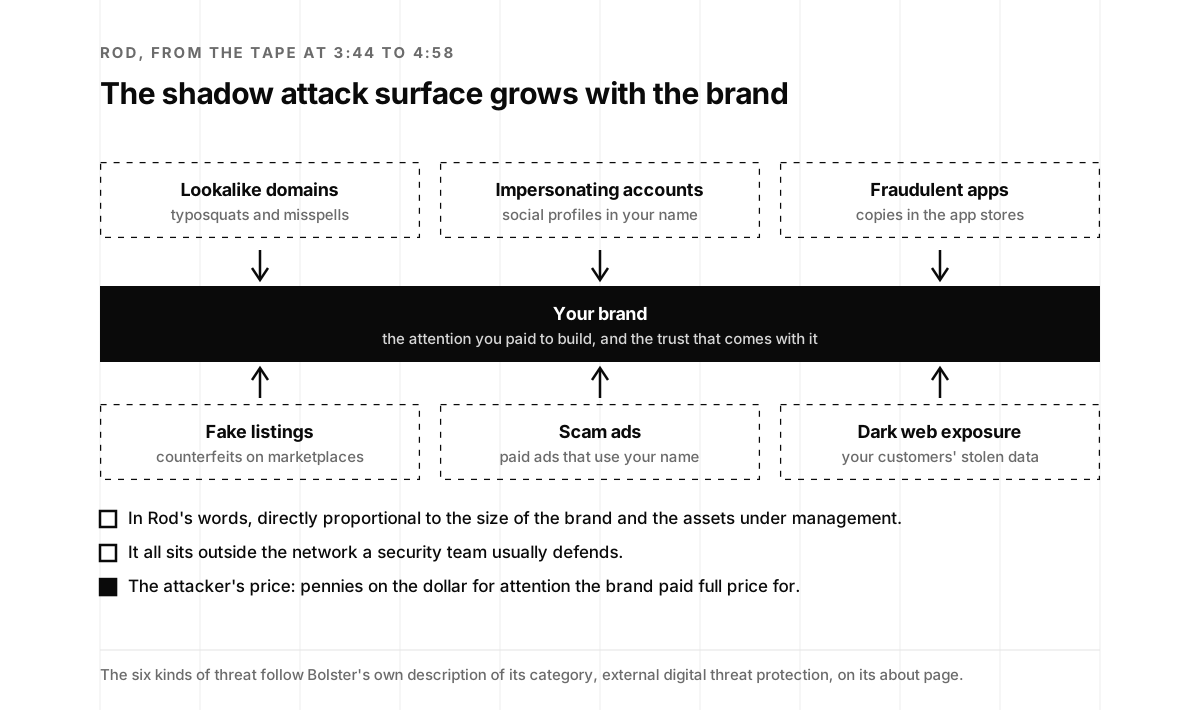
A filled box in the middle, your brand, the attention you paid to build and the trust that comes with it. Arrows point in from six dashed boxes around it. Above: lookalike domains, typosquats and misspells. Impersonating accounts, social profiles in your name. Fraudulent apps, copies in the app stores. Below: fake listings, counterfeits on marketplaces. Scam ads, paid ads that use your name. Dark web exposure, your customers' stolen data. Three notes: in Rod's words, the surface is directly proportional to the size of the brand and the assets under management. It all sits outside the network a security team usually defends. The attacker's price is pennies on the dollar for attention the brand paid full price for.
The shadow attack surface, in Bolster's own list.

Sasha summed it up as a reputational cost of doing nothing, made worse because language models make false content cheap to produce, and drew the conclusion.

“there is a need for the corporations to build a control that will protect from that misinformation.”

Sasha Sinkevich, at 5:17

Perfect replicas

Rod agreed and added two more reasons the problem is growing: the ease of creating a fake, and the ease of tuning it for a target. Then he gave the comparison he’d been using with his team.

“And what you have now is you have very low cost, perfect replicas of artworks”

Rod Schultz, at 5:45

In the art world the fake is sold to a buyer who can’t tell the difference. In phishing it’s sent to a receiver.

“So in the art world, we have the buyer and the seller. And in the phishing and the fraudulent email world, we have the sender and the receiver. And the job is to trick the receiver or the buyer into thinking they’re getting something authentic when it’s really not.”

Rod Schultz, at 6:12

Listen · Rod on episode 62, from 5:35
About 35 seconds: Rod on the art market and the phishing inbox, the same trick with a different payout. The clip stops on its own. Read the full transcript.

The payout is what differs. A forger takes the cash. A phisher asks for credentials, personal information, or access to a bank account or a credit card.
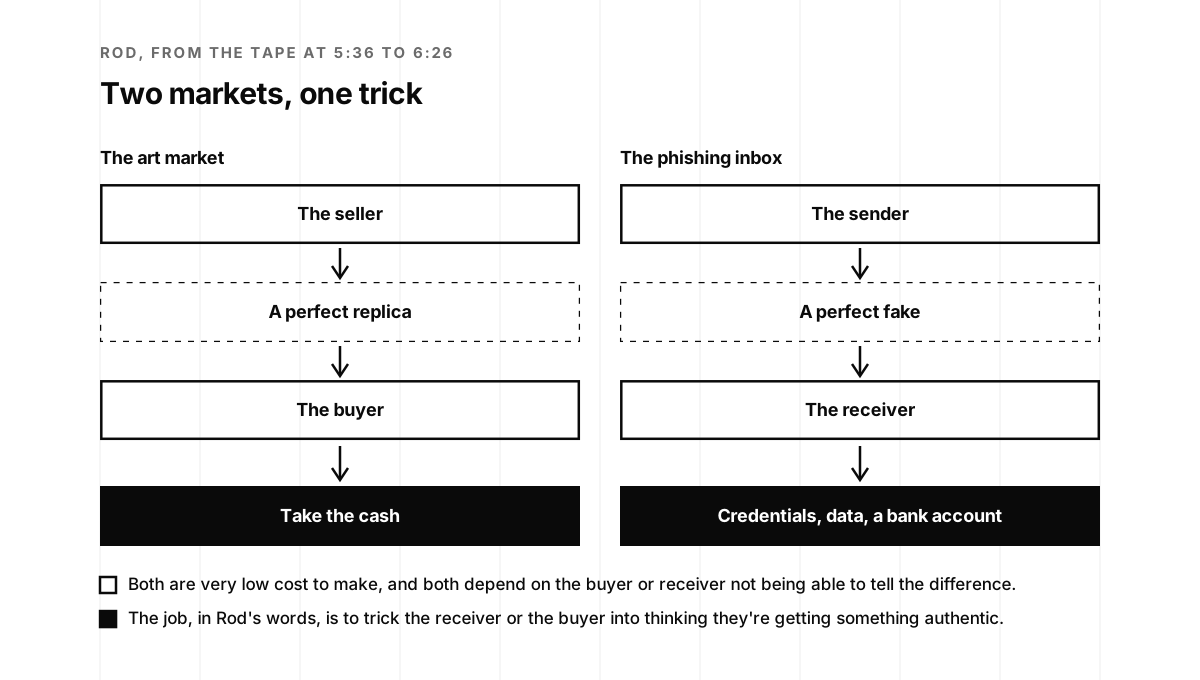
Two columns, each a chain of boxes joined by arrows. Left, the art market: the seller, open. A perfect replica, dashed. The buyer, open. Then a filled box, take the cash. Right, the phishing inbox: the sender, open. A perfect fake, dashed. The receiver, open. Then a filled box, credentials, data, a bank account. Two notes below: both are very low cost to make, and both depend on the buyer or receiver not being able to tell the difference. The job, in Rod's words, is to trick the receiver or the buyer into thinking they're getting something authentic.
Two markets, one trick.

A cat and mouse game

The creation is getting simpler, Rod said, and the distribution is already optimized.

“The internet is such an amazing distribution engine. The attackers that we see today can spin up infrastructure very quickly. They’re very good at evading detection capabilities and mechanisms that we have in place.”

Rod Schultz, at 6:35

He tied it back to the start of the conversation. On FairPlay the question was how long it would take someone to reverse engineer each new protection. The public record answers it for that round: in October 2006, Jon Lech Johansen announced he had reverse engineered FairPlay and would license the technology to other companies (Wikipedia). The question Bolster lives with is the same one pointed the other way.

“In this case, it’s how long is it going to take an attacker to try and go around our defense mechanisms or our detection mechanisms to get to the victim?”

Rod Schultz, at 7:06

Listen · Rod on episode 62, from 6:39
About 35 seconds: Rod on the cat and mouse game, from FairPlay to phishing. The clip stops on its own. Read the full transcript.

The evasion has kept moving. By March 2026, Bolster was describing campaigns that use geo-fencing, conditional delivery and infrastructure filtering so that real victims see the fraud while “automated scanners see nothing at all” (PR Newswire). In August 2026 Rod wrote about ten months of takedowns for one customer, where adversary-in-the-middle phishing was 34% of what Bolster removed and the pages victims clicked didn’t ask for credentials, because the harvesting happened one hop later (LinkedIn).

We spent ten months running takedowns for a large insurance and benefits customer.

Every check came back clean.
And every one of those verdicts was accurate.

Rod Schultz · CEO, Bolster AI · August 13, 2026
Rod on an attack that passed every check, eighteen months after the tape. View on LinkedIn.

Typosquats that lurk

Jon asked which fraud Bolster sees most. Rod sorted it into buckets and started with the cheapest.

“Number one, the easiest thing to do is to create a fake website.”

Rod Schultz, at 7:35

His example was a brand like Nike. An attacker registers the misspellings and waits.

“These are called typosquats, or misspells. And then you just lurk.”

Rod Schultz, at 7:48

Listen · Rod on episode 62, from 7:44
About 20 seconds: Rod on typosquats that wait for the Olympics. The clip stops on its own. Read the full transcript.

Typosquatting is a form of cybersquatting that relies on the typos people make when they enter a web address, and cybersquatting is registering or using a domain in bad faith to profit from someone else’s trademark or to run phishing (Wikipedia). The lookalikes wait for a moment when a lot of people type in a hurry. Rod named the Olympics, and a band’s tour.

“The URL goes up for, pick your favorite brand or band or performer, tour2025.com.”

Rod Schultz, at 8:18

The fakes are exact copies, and they sell merchandise to fans racing a sellout. “And it doesn’t sell out, because it’s all fake.”

Listen · Rod on episode 62, from 8:05
About 40 seconds: Rod on fake tour sites and merchandise that never sells out. The clip stops on its own. Read the full transcript.

For domains there’s also a formal route to get a name back, ICANN’s Uniform Domain-Name Dispute-Resolution Policy, which covers every generic top-level domain and some country code domains (Wikipedia).
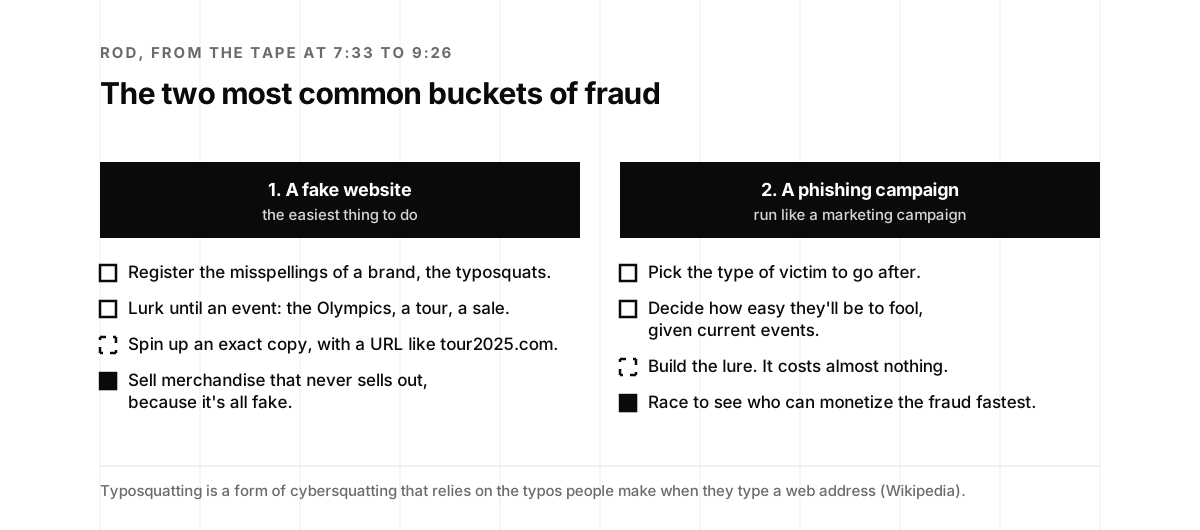
Two filled boxes side by side. Left, one, a fake website, the easiest thing to do: register the misspellings of a brand, the typosquats. Lurk until an event, the Olympics, a tour, a sale. Spin up an exact copy, with a URL like tour2025.com. Sell merchandise that never sells out, because it's all fake. Right, two, a phishing campaign, run like a marketing campaign: pick the type of victim to go after. Decide how easy they'll be to fool, given current events. Build the lure, which costs almost nothing. Race to see who can monetize the fraud fastest.
The two most common buckets Rod described.

Phishing as a marketing campaign

The second bucket is phishing, and Rod described it in the language of a marketing team.

“Of course, it costs nothing to create a sophisticated phishing campaign. It’s effectively like running a marketing campaign at this point.”

Rod Schultz, at 8:47

Pick a victim, decide how easy they’ll be to fool given what’s in the news, and launch.

“And then the race is on to see who can monetize fraud the fastest.”

Rod Schultz, at 9:06

Listen · Rod on episode 62, from 8:47
About 25 seconds: Rod on why a phishing campaign now runs like a marketing campaign. The clip stops on its own. Read the full transcript.

Bolster’s chief technology officer, Shashi Prakash, put a price on the tooling a few months before Rod joined: “tools that you can purchase for $10 or $20 to launch phishing attacks.” Attackers using phishing as a service, he said, can launch realistic bank login pages “within minutes” (TechCrunch). In December 2024 Bolster’s researchers traced the path from novice to expert through phishing kits, which they call “prepackaged tools that make it easier to start phishing attacks,” and through the hosting, stolen data and stealth tools sold on dark web markets (Bolster AI). The lures look funny until they don’t, Rod said, and they’re getting harder to tell from the real thing.

“Consumers are really paying the price.”

Rod Schultz, at 9:24

If you see something, say something

Sasha asked what companies do about cloned sites today, now that there are tools that will clone a website for you.

“it’s not really a new attack, but as we discussed, it’s just becoming so much easier.”

Sasha Sinkevich, at 9:34

Rod’s answer was blunt.

“Unfortunately, what we see is ineffective public service campaigns”

Rod Schultz, at 9:54

A banner telling customers to watch for phishing, he said, is the airport announcement, “if you see something, say something,” and it’s almost like a checkbox for the PR team.

Listen · Rod on episode 62, from 9:54
About 30 seconds: Rod on warning banners that don't protect anyone. The clip stops on its own. Read the full transcript.

Sasha named the weak link.

“Because you depend on people identifying that this is a fraud, and then you depend on people to report it.”

Sasha Sinkevich, at 10:26

The reporting channels do exist. The FTC’s advice on scam texts is to check with the real agency using a number or website you already know, use the phone’s junk report button or forward the text to 7726, and delete it (FTC). Rod’s point is that a report only helps if someone downstream acts on it.

The abuse mailbox

That was the opening for the product Bolster had just released.

“We do have a new product we just released, guys. It’s called AI Security for Email”

Rod Schultz, at 10:42

Large companies publish an abuse address and ask customers to forward anything suspicious. Bolster takes the forwarded mail, dissects the links and buttons, and takes down the infrastructure behind the real phishing. The volume is the problem.

“one, they send us 30,000 emails a month, of which 56%, I believe, around that number, are actually, like, true fraud.”

Rod Schultz, at 11:41

Listen · Rod on episode 62, from 11:40
About 20 seconds: Rod on one customer's 30,000 forwarded emails a month. The clip stops on its own. Read the full transcript.

The rest, Rod said, are things like campaign donation emails that customers forward anyway. Bolster’s own post on the product, from the last day of 2024, calls it Customer Abuse Mailbox and gives the averages behind it: “Leading brands receive over 30,000 customer-reported phishing emails per month on average,” and “It can take up to 6 minutes to review a single phishing email,” with two out of three being false positives (Bolster AI). Those are company figures, and the share of real fraud varies by brand, 56% for the customer Rod described and one in three in the post’s example.
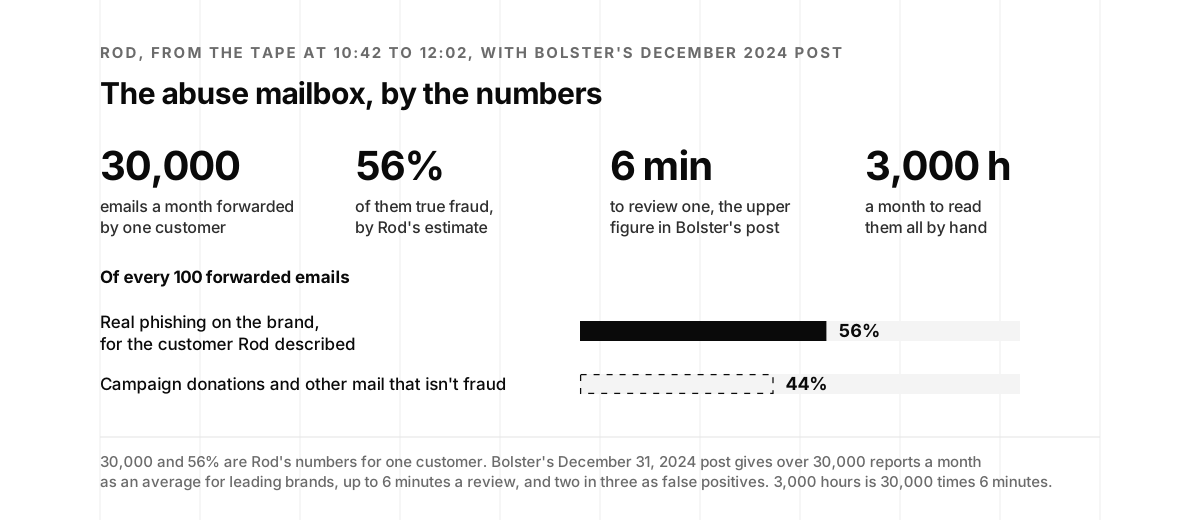
Four numbers in a row. 30,000 emails a month forwarded by one customer. 56% of them true fraud, by Rod's estimate. 6 minutes to review one, the upper figure in Bolster's post. 3,000 hours a month to read them all by hand. Below, two bars for every 100 forwarded emails: real phishing on the brand, for the customer Rod described, 56%, filled. Campaign donations and other mail that isn't fraud, 44%, dashed.
The abuse mailbox, by the numbers.

At six minutes a report, 30,000 reports is 3,000 hours of reading a month. The calculator below runs the same arithmetic on your own numbers.

A dossier for the host

Sasha asked what a company responsible for its own marketing and fraud prevention would do without a service like Bolster. Rod’s first answer was almost nothing, beyond press releases and banners.

“you can protect what’s inside of your house, but you can’t prevent bad things from happening in your neighborhood.”

Rod Schultz, at 12:52

Bolster’s job is the neighborhood: scouring the web outside the enterprise for signs of fraud and abuse, then taking them down. A company could build that itself, Rod said, or use a team built to do it.

Listen · Rod on episode 62, from 12:52
About 20 seconds: Rod on the neighborhood outside the enterprise. The clip stops on its own. Read the full transcript.

Jon asked about the takedowns. Most of the work is a negotiation with whoever hosts the fake.

“we’ll come to them with a dossier of information and say, we can prove this is fraud.”

Rod Schultz, at 13:40

Some providers act in minutes. Others are slower, and that’s where Bolster leans on its playbooks for hosting and DNS providers and the data it has built up.

“based upon playbooks that we have, but also a lot of information and data that we’ve acquired and accrued over the last five years.”

Rod Schultz, at 14:04

Listen · Rod on episode 62, from 13:40
About 40 seconds: Rod on the dossier, the fast hosts and the slow ones. The clip stops on its own. Read the full transcript.

The slowest hosts are the ones built to be slow. Bulletproof hosting is infrastructure “resilient to complaints of illicit activities,” usually run from jurisdictions with lenient laws (Wikipedia), and Jon’s follow-up was about exactly that: knowing the laws in each state and country where something is hosted. Bolster’s own numbers for its takedowns, from its home page today, are 98% resolved within 72 hours, a median takedown time under 10 hours and a cost per takedown 20 times lower (Bolster AI). Those are the company’s figures.
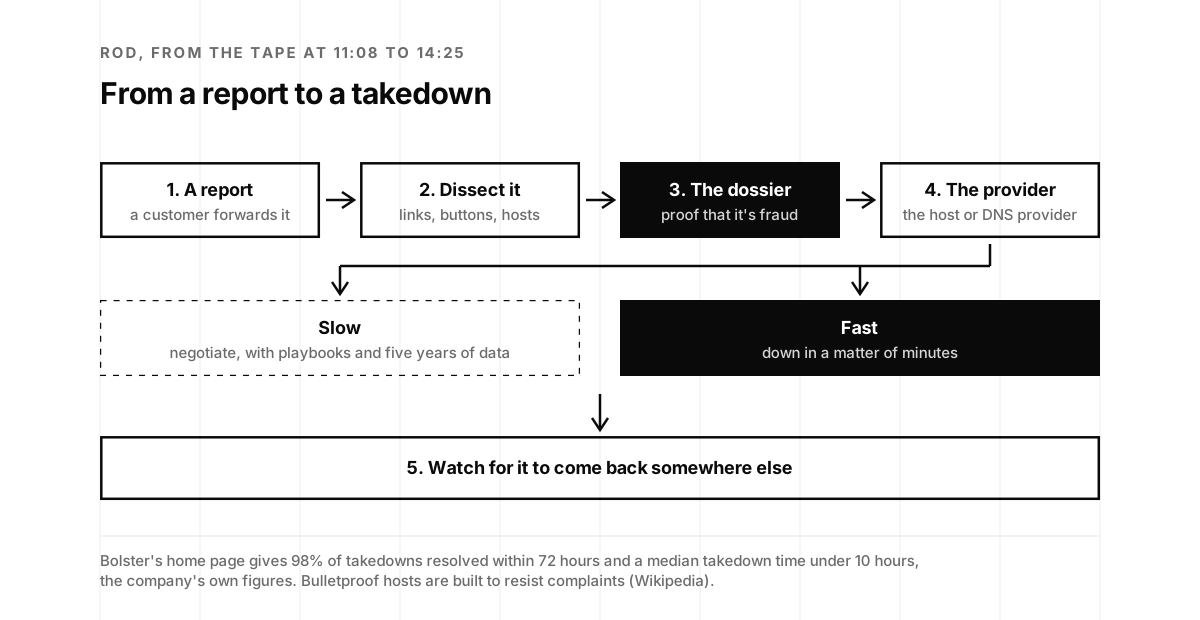
Four boxes in a row joined by arrows. One, a report, a customer forwards it. Two, dissect it, links, buttons, hosts. Three, filled, the dossier, proof that it's fraud. Four, the provider, the host or DNS provider. From the provider the path splits. Filled, fast, down in a matter of minutes. Dashed, slow, negotiate, with playbooks and five years of data. Both lead down to five, watch for it to come back somewhere else.
From a report to a takedown.

Bursty storms

Rod called what Bolster sells a scalable apparatus for legal, for trust and safety, and for brand security, sized to the attack rather than to a headcount.

“These attacks are bursty. They don’t come at predictable times.”

Rod Schultz, at 15:02

Paying three or four people to watch full time is hard to justify for something that comes in bursts. The service, he said, can be turned on within a day and scaled to meet the phishing storms and fraud storms “that come out of nowhere.”

Listen · Rod on episode 62, from 15:02
About 35 seconds: Rod on attacks that come in bursts, and a service that scales with them. The clip stops on its own. Read the full transcript.

Jon asked what pushed Bolster toward email. The customers did, Rod said. They felt helpless, because their customers’ inboxes aren’t theirs.

“And the challenge is that the enterprise doesn’t own the inbox of the consumer.”

Rod Schultz, at 16:02

The abuse inboxes stacked up faster than anyone could work through them. So Bolster started from an assumption about what a defender can and can’t change.

“you can’t control the supply of fraud, right? But what you can do is you can control how it’s consumed, and you can destroy it the minute it comes up, with the assumption that it’s going to pop up somewhere else.”

Rod Schultz, at 16:34

Listen · Rod on episode 62, from 16:32
About 20 seconds: Rod on what a defender can control, and where the attackers go next. The clip stops on its own. Read the full transcript.

And the storms move. Through other measurements in its system, Bolster has watched attackers who get pushed back from one customer turn elsewhere.

“they’re moving to weaker targets that aren’t using us to protect them.”

Rod Schultz, at 17:03
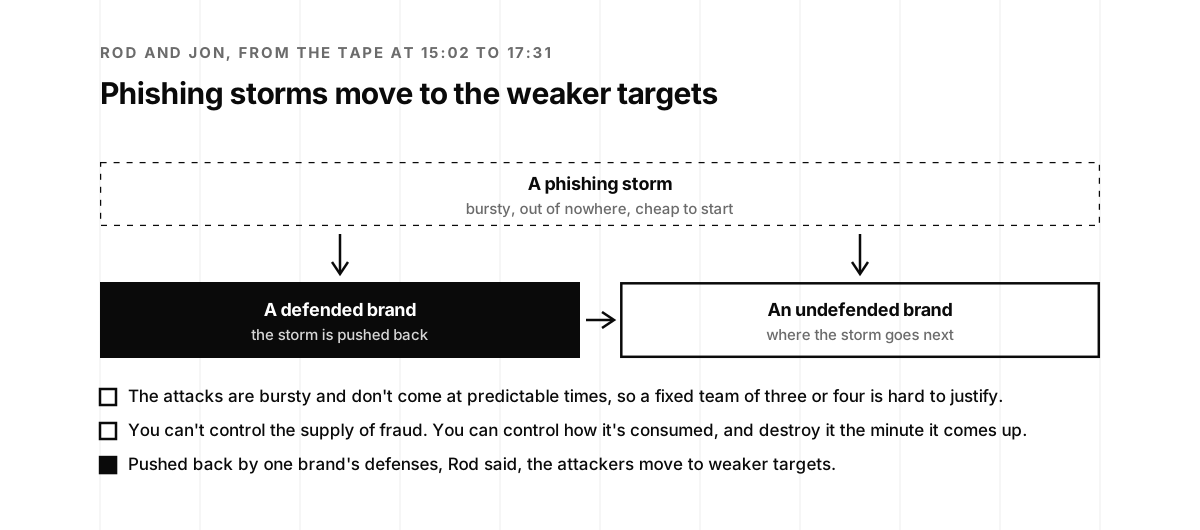
A dashed box across the top, a phishing storm, bursty, out of nowhere, cheap to start. Arrows lead down to two boxes. Filled, a defended brand, the storm is pushed back. Open, an undefended brand, where the storm goes next, with an arrow from the first to the second. Three notes: the attacks are bursty and don't come at predictable times, so a fixed team of three or four is hard to justify. You can't control the supply of fraud. You can control how it's consumed, and destroy it the minute it comes up. Pushed back by one brand's defenses, Rod said, the attackers move to weaker targets.
Storms move to the weaker targets.

Internet security weather

Jon liked the storm image. He’d always thought of some campaigns, like the external vulnerability scans that sweep the internet, as background conditions.

“It’s always kind of like the weather.”

Jon McLachlan, at 17:23

“We essentially have internet security weather.”

Jon McLachlan, at 17:28

Rod took the image one step further.

“the crazy thing is the weather is being manipulated with, like, very low cost.”

Rod Schultz, at 17:32

The people manipulating it need only a small share of victims to click all the way through, he said, and the infrastructure they need is cheap to set up.

Four hours

That led to the number in the episode’s title.

“In fact, we did some research. It takes less than four hours to set up an effective phishing campaign”

Rod Schultz, at 17:49

The build has five parts in Rod’s telling: create the website, grab the URLs, set up the servers, write the phishing emails with their hook, and redirect the victim to the phishing site. We couldn’t find the study itself on Bolster’s site, so the four hours stands as Rod’s account of it. Sasha did the business math.

“it only costs you four hours of labor to deploy a clone, and then you can craft an ideal attack, and off you go.”

Sasha Sinkevich, at 18:31

Listen · Sasha on episode 62, from 18:18
About 20 seconds: Sasha on the return an attacker gets for four hours of work. The clip stops on its own. Read the full transcript.

Bolster’s later research points the same way, and faster. In December 2025 it wrote that generative AI lets criminals create “hundreds of unique, high-quality phishing sites in minutes” (Bolster AI). In September 2026 one of its analysts created an X account impersonating a real chief executive, using a Yahoo address and his own phone, and stopped there: “From start to finish, it took less than five minutes” (Bolster AI).
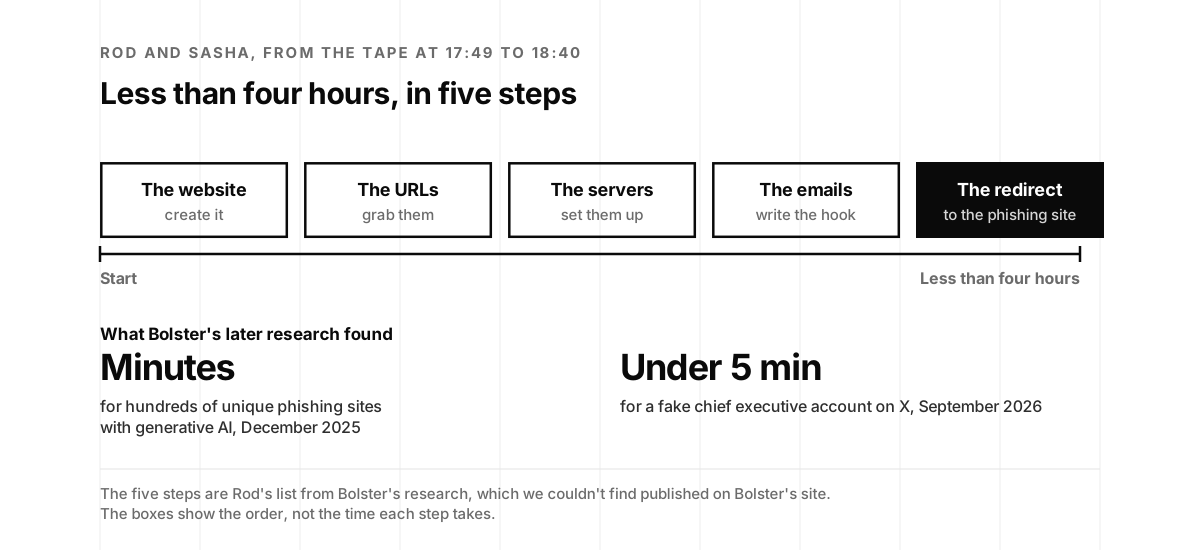
Five boxes in a row above a bar that runs from start to less than four hours. The website, create it. The URLs, grab them. The servers, set them up. The emails, write the hook. Filled, the redirect, to the phishing site. Below, what Bolster's later research found: minutes, for hundreds of unique phishing sites with generative AI, December 2025. Under 5 minutes, for a fake chief executive account on X, September 2026.
Four hours, in five steps.

The FasTrak text

The advantage sits with the fraud creator, Rod said, and it’s growing, because stolen data makes each lure more precise.

“they make them more and more precise based upon stolen data.”

Rod Schultz, at 18:58

Then he told on himself. Right before New Year’s, he got a text.

“if you’re in the FasTrak lane, you need to prepay the tolls for this weekend. You need to click here.”

Rod Schultz, at 19:22

Listen · Rod on episode 62, from 19:12
About 20 seconds: Rod on the toll text that almost worked on him. The clip stops on its own. Read the full transcript.

For a second, he said, he wondered whether he’d paid. Then he worked out what the sender knew: a Bay Area area code, the holiday travel season, and how much a FasTrak lane on Highway 101 is worth when the traffic backs up.

“I’m just another guy with a sophisticated attack that’s happening through just a little bit of information.”

Rod Schultz, at 19:36

Listen · Rod on episode 62, from 19:43
About 20 seconds: Rod on the three things the toll text knew about him. The clip stops on its own. Read the full transcript.

He wasn’t alone. In April 2024 the FBI’s Internet Crime Complaint Center said it had received more than 2,000 complaints since early March about smishing texts posing as road toll services in at least three states, warning that “the scam may be moving from state-to-state” (IC3). On January 17, 2025, a few weeks after Rod’s text, the FTC warned that “Scammers are pretending to be tolling agencies from coast to coast” (FTC).
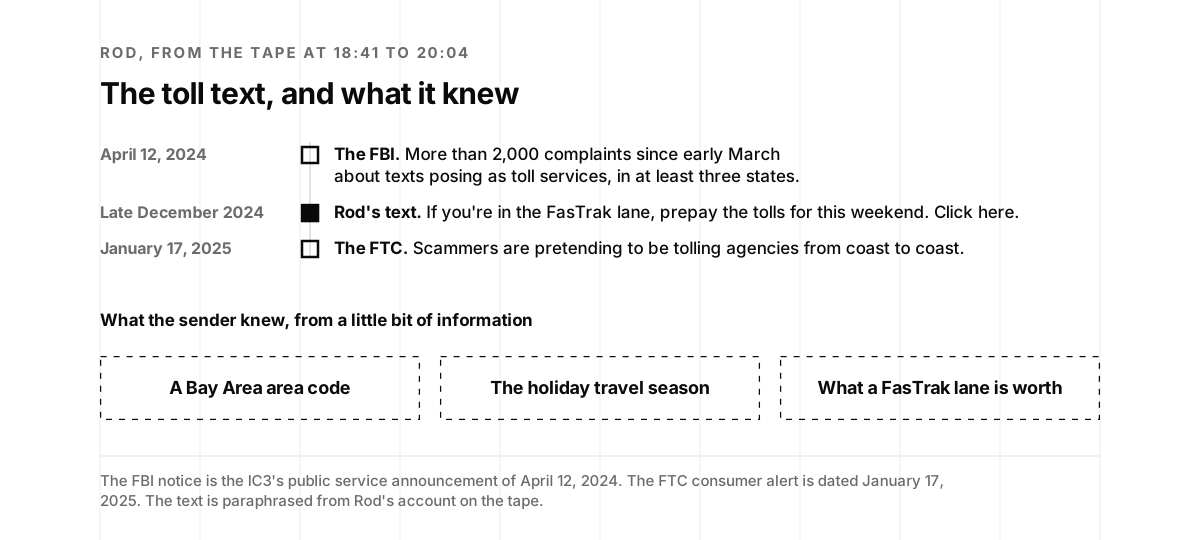
A timeline of three entries. Open, April 12, 2024, the FBI: more than 2,000 complaints since early March about texts posing as toll services, in at least three states. Filled, late December 2024, Rod's text: if you're in the FasTrak lane, prepay the tolls for this weekend, click here. Open, January 17, 2025, the FTC: scammers are pretending to be tolling agencies from coast to coast. Below, three dashed boxes for what the sender knew from a little bit of information: a Bay Area area code, the holiday travel season, and what a FasTrak lane is worth.
The toll text, and what it knew.

Fraud at scale

Jon saw where it leads once everyone’s public data is scraped into models.

“you could have some very convincing fraud at scale, which is probably something we haven’t seen ever.”

Jon McLachlan, at 20:13

Rod laid out the recipe from the attacker’s side.

“I’m just going to buy a bunch of data. That’s going to give me the context I need. I’m then going to match that with software that I can effectively get at very low cost.”

Rod Schultz, at 20:41

“So the ability to automate it, to scale it, and then to distribute it is just there.”

Rod Schultz, at 20:51

Listen · Rod on episode 62, from 20:36
About 20 seconds: Rod on data, cheap software and distribution, the three things an attacker needs. The clip stops on its own. Read the full transcript.

The brand pays too. People who fall for an attack on a brand, Rod said, turn away from it or rethink the relationship. Bolster’s December 2024 post puts a company number on it, phishing “costing companies as much as $500 per account takeover” and a 15% customer attrition rate (Bolster AI).

Three months in

Jon asked about Rod’s proudest moment since October 2024. It was the customer reviews of the new email product, and what they implied about everything Bolster never sees.

“for every X number of emails that we got, there’s probably a thousand X out there that we didn’t receive.”

Rod Schultz, at 21:46

He’d been sitting down with customers’ security operations teams to watch how they use Bolster’s web, social media and dark web products together.

“And I love how Bolster is becoming almost the central hub in some ways for the collection of data”

Rod Schultz, at 22:25

The data then moves on to the tools the team already runs, a SIEM or attack surface management tooling. The rest was people: meeting the company and watching it win accounts. Three months in, he said, one thing was already clear.

“The problem is only getting worse”

Rod Schultz, at 23:10

Where fraud goes next

Sasha asked where fraud is heading. Rod named three directions. More of it in finance, because that’s where money moves. More in Web3.

“Web3 is designed to put money on rails and to just suck it from one location and move it to another.”

Rod Schultz, at 23:40

And a tailwind he saw on the social platforms, as content moderation and fact checking were being pulled back and fewer people would flag a post that sends users on to a phishing site.

Listen · Rod on episode 62, from 23:37
About 35 seconds: Rod on Web3 and the platforms, two of the places he saw fraud heading. The clip stops on its own. Read the full transcript.

Sasha asked about the news of that month.

“And so, did Meta pull the plug on content validation?”

Sasha Sinkevich, at 24:12

Meta had recently made a statement, Sasha said, that it would no longer be doing fact checking.

The statement was Meta’s of January 7, 2025: “We will end the current third party fact checking program in the United States,” moving to Community Notes (Meta). The same post said Meta would keep its automated systems on illegal and high-severity violations, “like terrorism, child sexual exploitation, drugs, fraud and scams,” and rely on reports for less severe ones. Community Notes is the crowd-sourced context program that began on Twitter in 2021.

Information asymmetry

Rod tied it together with a term from economics.

“So all of those are contributing to what I call the information asymmetry of, like, receiving information or reading information.”

Rod Schultz, at 24:24

Information asymmetry is “a situation where one party has more or better information than the other” (Wikipedia). In Rod’s version the attacker holds the extra information, and the receiver assumes it isn’t there.

“the sender knows more about me than the receiver, right?”

Rod Schultz, at 24:40

The trust comes from the channel. A post sits on a big platform, an email lands in a real inbox, so the content borrows the trust of where it showed up.

“It’s being hosted on Meta. It’s being hosted on X. Like, those platforms are trustable.”

Rod Schultz, at 25:04

Listen · Rod on episode 62, from 24:23
About 35 seconds: Rod on information asymmetry, the sender who knows more than you think. The clip stops on its own. Read the full transcript.

Sasha called it a form of fake social validation, enough noise around a fake to make it look trusted. Rod traced the technique back to military influence campaigns and radio broadcast across front lines.

“We’ve now taken a lot of that sophistication, and it’s been handed over, in a way more powerful way, to organized crime.”

Rod Schultz, at 26:19

Listen · Rod on episode 62, from 26:02
About 30 seconds: Rod on propaganda techniques handed to organized crime. The clip stops on its own. Read the full transcript.

He put the annual loss to fraud in the trillions, his own estimate. The FTC’s count for the United States alone is narrower and still large: consumers reported losing more than $12.5 billion to fraud in 2024, up 25% on the year before, with imposter scams second only to investment scams and email the most common way scammers made contact (FTC).
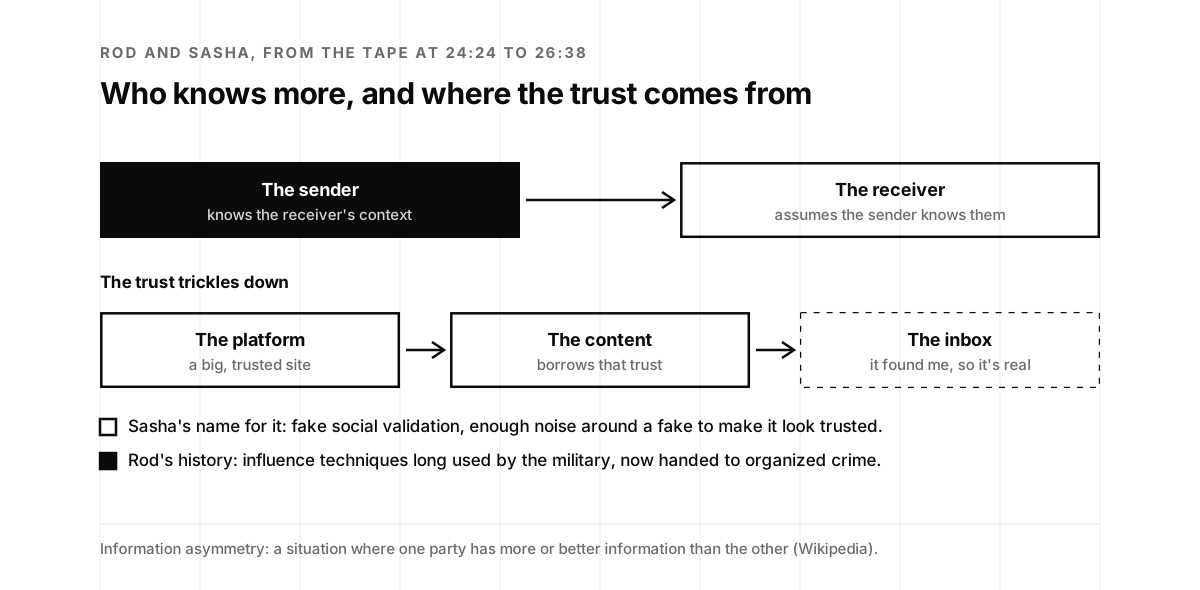
Top, two boxes joined by an arrow. Filled, the sender, knows the receiver's context. Open, the receiver, assumes the sender knows them. Below, the trust trickles down, three boxes in a chain. The platform, a big, trusted site. The content, borrows that trust. Dashed, the inbox, it found me, so it's real. Two notes: Sasha's name for it, fake social validation, enough noise around a fake to make it look trusted. Rod's history, influence techniques long used by the military, now handed to organized crime.
Who knows more, and where the trust comes from.

Deciding what not to do

Jon asked about the hardest part of the job so far.

“The hardest thing right now for us, Jon, is deciding what not to do”

Rod Schultz, at 26:44

The reason is cost. Bolster runs large and small language models, and training isn’t cheap.

“Because we use large language models and small language models, the training costs are high.”

Rod Schultz, at 26:52

“Every single customer we bring in, we train a model.”

Rod Schultz, at 27:04

Listen · Rod on episode 62, from 26:43
About 25 seconds: Rod on the training bill, and a model for every customer. The clip stops on its own. Read the full transcript.

The next question is where to take what Bolster learns outside the enterprise. Organized crime goes after companies as well as their customers, so Rod wanted a way to see the outside storms before they reach the inside.

“And can we create some sort of heads-up display to warn enterprises that the storms that are being created on the outside will eventually migrate their way toward sophisticated attacks on the inside?”

Rod Schultz, at 28:00

Jon pictured it as a weather map, a map of the internet with storms moving through and the customers in their path. Rod said yes, and then said how fast the ground had moved.

“Bolster was using large language models a couple of years before anybody else. People thought we were crazy.”

Rod Schultz, at 28:46

Listen · Rod on episode 62, from 28:46
About 15 seconds: Rod on using language models before the security world believed in them. The clip stops on its own. Read the full transcript.

The public record shows the early machine learning, if not the exact models. The 2019 coverage of the company’s Series A describes natural language understanding and computer vision models that could spot brand hijacking “in as little as milliseconds” (VentureBeat), three years before ChatGPT was released on November 30, 2022. Rod said he’d never seen technology move faster than it has since.

Attackers organize better

Sasha described the imbalance from the defender’s chair. The fraud community is interconnected, and the companies on the receiving end fight alone.

“So there is a little bit of asymmetry of the information and collaboration.”

Sasha Sinkevich, at 29:41

Rod agreed, and called it shocking.

“the attackers organize better than the people that are being attacked.”

Rod Schultz, at 29:50

Bolster was starting to look at threat intelligence built from its own data and from partners, on the model of the crowd.

“I mean, we saw this pattern with Bugcrowd.”

Rod Schultz, at 30:16

Listen · Rod on episode 62, from 29:47
About 40 seconds: Rod on why defenders need the wisdom of the crowd. The clip stops on its own. Read the full transcript.

Bugcrowd is a crowdsourced security platform founded in 2012, which runs bug bounty programs (Wikipedia). The pattern Rod meant is the same one: the attacks are universal, so what one defender learns is worth sharing with the rest.

From the how to the why

Jon asked who had shaped Rod’s career. Rod named moments more than people, starting with why he left Apple.

“Apple was really happy with me becoming, like, a sharp edge for Apple.”

Rod Schultz, at 31:04

He wanted to grow, so he went to Adobe, which ran an innovation boot camp for anyone interested in turning innovation into products. He also took business classes at Berkeley.

“I took a ton of classes over at the Haas Business School, where I learned strategy.”

Rod Schultz, at 31:32

The Haas School of Business is Berkeley’s business school, and Rod’s courses there come up again on episode 29. What changed was the question he asked.

“And that transition from, like, going from the how to the why was so eye-opening for me in many, many ways.”

Rod Schultz, at 32:06

Listen · Rod on episode 62, from 31:58
About 15 seconds: Rod on moving from how to solve something to why. The clip stops on its own. Read the full transcript.

The second moment was his first startup, Rubicon Labs, and its chief executive, Richard Egan, who told him his questions and framing mattered and to keep pushing. Rod learned to test an idea in a room and live with it being knocked down.

“be willing to have it swatted down, but not having that impact your confidence level.”

Rod Schultz, at 33:00

He started far from boardrooms.

“I was designing protocols for Cisco, in the operating system for Cisco routers and switches, when I first came out of school.”

Rod Schultz, at 33:18

That operating system is Cisco IOS. The full path, from Cisco in 1997 through Apple, Adobe, Rubicon Labs, Zoom and DUST Identity to Bolster, is the slalom on episode 29.
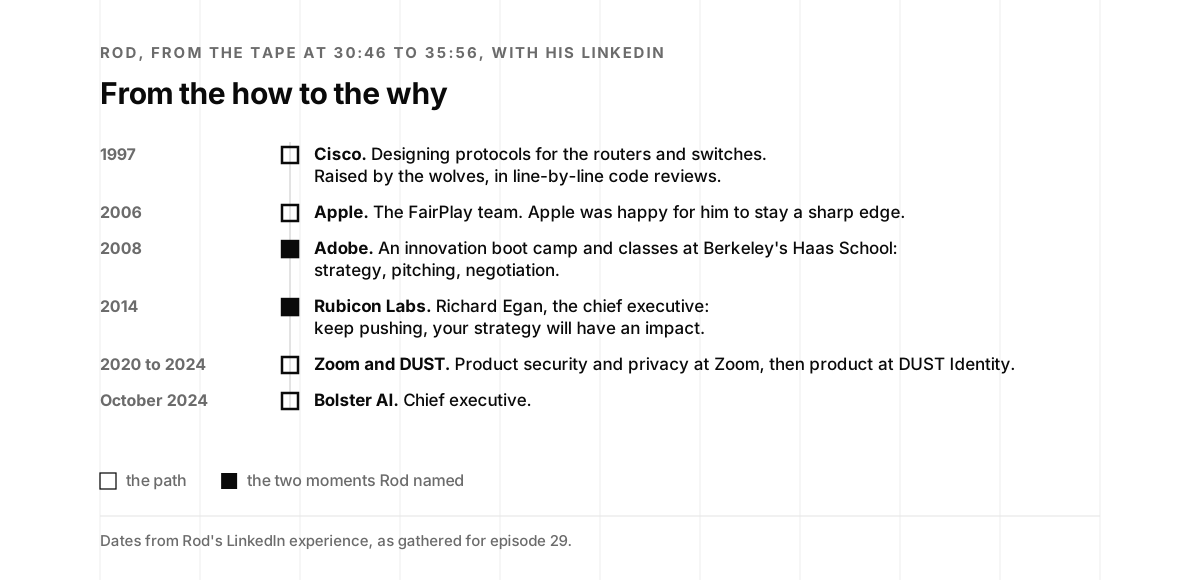
A timeline of six entries. Open, 1997, Cisco: designing protocols for the routers and switches, raised by the wolves in line-by-line code reviews. Open, 2006, Apple: the FairPlay team, where Apple was happy for him to stay a sharp edge. Filled, 2008, Adobe: an innovation boot camp and classes at Berkeley's Haas School in strategy, pitching and negotiation. Filled, 2014, Rubicon Labs: Richard Egan, the chief executive, told him to keep pushing because his strategy would have an impact. Open, 2020 to 2024, Zoom and DUST: product security and privacy at Zoom, then product at DUST Identity. Open, October 2024, Bolster AI: chief executive.
From the how to the why.

Raised by wolves

Jon asked what Rod would tell his younger self. Stock tips first. Jon suggested Bitcoin, and Rod said to buy a lot. Then the real answer.

“Keep learning from the pain. But don’t take it so personally”

Rod Schultz, at 34:18

At Adobe, he said, he was screaming at people in meetings until someone pulled him aside. He’d learned it somewhere.

“line 97, like, you’re a moron. Like, that’s not an exit condition, right?”

Rod Schultz, at 35:12

Listen · Rod on episode 62, from 35:01
About 20 seconds: Rod on printed-out code reviews at Cisco in the late nineties. The clip stops on its own. Read the full transcript.

That was Cisco in the late nineties, where code reviews went line by line through printed code, and Apple was brutal in its own way during the years of the iPhone, Apple TV and the App Store. The lesson he’d pass back:

“the job is to learn. It’s not to inflict pain back”

Rod Schultz, at 35:44

Put the stamp on fraud

Jon asked about legacy. Rod’s own is teaching.

“For me, the ability to watch someone learn an insight is magical”

Rod Schultz, at 36:18

For Bolster, he described a long game.

“it is early days in the information warfare game of fraud.”

Rod Schultz, at 36:57

His five-year hope was to put the stamp on fraud protection: defenses that spin up just in time or stay on, scale against fraud, and eventually take it down from threat intelligence. Jon offered a scene, two strangers in an elevator worrying about someone using their logo, until one says they’ll just use Bolster.

“That’s our first Super Bowl commercial, actually.”

Rod Schultz, at 38:02

The joke landed close to the date. The episode aired two days after Super Bowl LIX, played on February 9, 2025, and Rod’s last line nodded to the most famous Super Bowl ad of all, Apple’s 1984, which aired nationally on January 22, 1984, during Super Bowl XVIII.

“1984 won’t be like 1984.”

Rod Schultz, at 38:29

Secure data operations

Jon asked what product Rod wished someone would build. His answer was traceability: where data was generated, where it’s going, and whether it can be trusted. Data governance tools exist, he said, and companies like Snowflake and Databricks work on it at the database level, but networks are harder.

“secure data operations is front and center for us.”

Rod Schultz, at 40:05

The tension is that data has to move to be worth anything.

“Locked-down data is unusable, right? There’s a reason why the Fed does not want you to put your money underneath the bed, right?”

Rod Schultz, at 40:41

Listen · Rod on episode 62, from 40:40
About 35 seconds: Rod on data in motion, homomorphic encryption and DRM's comeback. The clip stops on its own. Read the full transcript.

He pointed to homomorphic encryption, which “allows computations to be performed on encrypted data without first having to decrypt it” (Wikipedia), and to secure execution environments, and back to where the conversation started.

“I think a lot of the DRM challenges that we were trying to solve back in the day, in the early 2000s or mid-2000s, they are going to rear their ugly heads again in so many ways”

Rod Schultz, at 41:02

Sasha described Bolster’s work as finding the critical data in a lot of noise, mapping related data sets together, and getting a heads-up before something happens. Rod joked that the marketing team would take the line for the website.

When in doubt, abstract

Sasha connected it to the toll text. Fraudsters reach people easily, while security products still expect specialists to run them.

“We’re talking about security that is stuck in the early 2000s, where we rely on engineers to understand the dashboards”

Sasha Sinkevich, at 42:26

What Sasha saw changing, at Bolster and elsewhere, was the weight on user experience: take the complexity away, and give the customer the output. Rod gave the product rule.

“when in doubt, simplify. I think, and with data, I think it comes down to, like, when in doubt, abstract.”

Rod Schultz, at 43:41

“solve the problems without the expectation that the customer should have a PhD in your product.”

Rod Schultz, at 43:49

Rod expected agentic interfaces to help, and had little patience for dashboards that rewrap the complexity. “None of them look good. None of them interoperate.” Walking the RSA Conference the year before, he said, felt like Vegas, every vendor a new game at the tables. Sasha brought it back to Apple, which wasn’t the first computer maker but made computers easy to use.

“But what Apple brought to the market is user experience, and that gains traction.”

Sasha Sinkevich, at 45:20

Rod picked one part of that story.

“Without Gorilla Glass, we never would have had pinch-pull and all the interesting touch screens”

Rod Schultz, at 46:08

Gorilla Glass is Corning’s chemically strengthened cover glass. The iPhone Steve Jobs showed in January 2007 had a plastic display, and the glass, not yet called Gorilla Glass, came into commercial use when the iPhone launched that June (Wikipedia). Capacitive multi-touch went mainstream with it. Rod’s bet is that AI plays the same part for the next interface.

“AI and large language models may be the Gorilla Glass here of the next iteration, the technology wave”

Rod Schultz, at 46:19

Listen · Rod on episode 62, from 45:59
About 35 seconds: Rod on Gorilla Glass, and AI as the next one. The clip stops on its own. Read the full transcript.

What happened after the tape

When we recorded. The conversation was recorded in late January 2025, a little over three months after Rod started at Bolster, and aired on February 11, 2025. A few weeks after Rod’s toll text, the FTC warned about the same scam nationwide (FTC), and in March it reported $12.5 billion in consumer fraud losses for 2024 (FTC).

The heads-up. On October 29, 2025, Bolster launched Signals, which it describes as intelligence that unites external fraud data with cyber risk data so security leaders can see where AI-generated phishing sites and impersonation attacks originate and how well they’re being taken down. “Fraud, security, and brand protection can no longer operate in silos,” Rod said in the announcement (PR Newswire). Bolster’s account on X put it as a forecast a few weeks later.

Bolster on X, November 2025: the storms have a schedule. View on X.

More of the shadow attack surface. In 2026 Bolster added Brand Guardian, built with a leading cybersecurity and cloud company, in March (PR Newswire), marketplace monitoring and takedowns in May, where Rod said most teams can find fraudulent listings “but few can remove them at scale” (PR Newswire), and fraudulent ad monitoring in July (PR Newswire).

The research. In September 2026 Bolster’s lab watched a dark web marketplace for counterfeit currency whose vendors claimed 57,803 orders, against fewer than 2,400 its payment system appeared to generate (PR Newswire). The same month came the five-minute fake executive account, and with it Bolster’s count of impersonation findings on X, about 259 a month on average for the year before June 2026, then 1,300 in June and 1,236 in August. The analyst’s conclusion: “Attackers can afford to lose accounts. Defenders can’t afford to get behind” (Bolster AI).

Threat Graph. On October 20, 2026, Bolster launched Threat Graph, which connects a phishing message to the impersonated brand, the infrastructure behind it and the victim’s experience, so a takedown can go after the campaign and not one site (Yahoo Finance, LinkedIn). It’s close to the map of the internet Jon pictured on the tape.
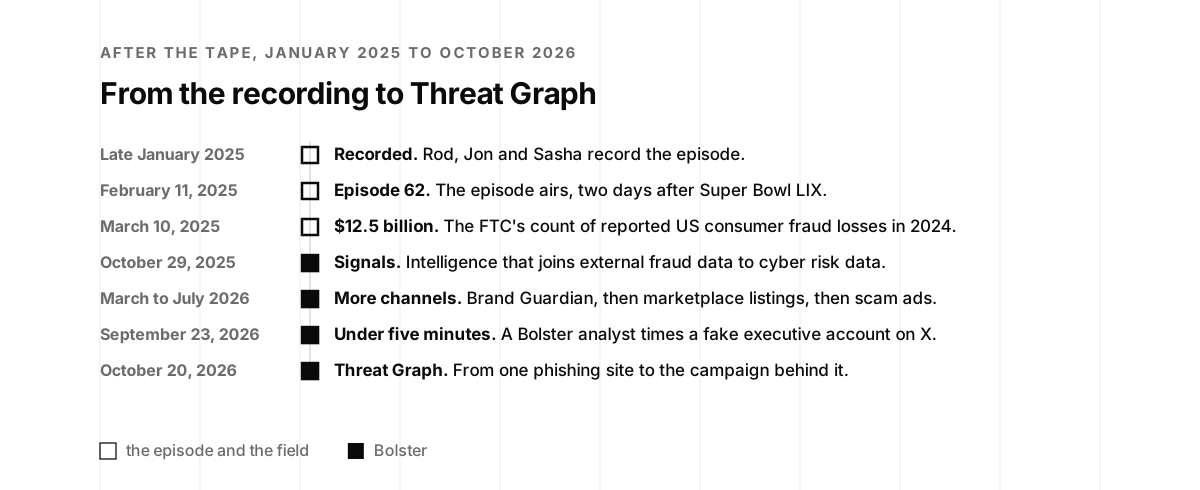
A timeline of seven entries. Open, late January 2025, recorded: Rod, Jon and Sasha record the episode. Open, February 11, 2025, episode 62: the episode airs, two days after Super Bowl LIX. Open, March 10, 2025, $12.5 billion: the FTC's count of reported US consumer fraud losses in 2024. Filled, October 29, 2025, Signals: intelligence that joins external fraud data to cyber risk data. Filled, March to July 2026, more channels: Brand Guardian, then marketplace listings, then scam ads. Filled, September 23, 2026, under five minutes: a Bolster analyst times a fake executive account on X. Filled, October 20, 2026, Threat Graph: from one phishing site to the campaign behind it.
What happened after the tape.

The part of the conversation that aged best is the plainest. A fake takes minutes to hours, so the defense has to be measured in the same units, and the brands that do it push the weather onto someone else.

Did you catch it? A six-question quiz

Six questions from the episode. Each answer links the moment in the transcript.

Quiz · six questions

Did you catch it?

Pick an answer for each. The explanation shows once you choose.

  1. How long did Bolster's research say it takes to set up an effective phishing campaign?

    1. About a week
    2. Less than four hours
    3. About a month

    b. "It takes less than four hours to set up an effective phishing campaign" Transcript, 17:50.

  2. What does Bolster call the exposure that grows with the size of a brand?

    1. The shadow attack surface
    2. The brand perimeter
    3. The trust budget

    a. "We kind of call this area that's attacked the shadow attack surface of the brand or the company." Transcript, 4:21.

  3. Of the 30,000 emails a month one customer forwards to Bolster, about what share is real fraud?

    1. About 10%
    2. About 90%
    3. About 56%

    c. "one, they send us 30,000 emails a month, of which 56%, I believe, around that number, are actually, like, true fraud." Transcript, 11:41.

  4. What did the text Rod got right before New Year's ask him to do?

    1. Confirm a package delivery
    2. Prepay his FasTrak tolls
    3. Reset a bank password

    b. "if you're in the FasTrak lane, you need to prepay the tolls for this weekend. You need to click here." Transcript, 19:22.

  5. What did Rod say was the hardest thing about running Bolster?

    1. Hiring fast enough
    2. Finding new customers
    3. Deciding what not to do

    c. "The hardest thing right now for us, Jon, is deciding what not to do" Transcript, 26:44.

  6. Which technology did Rod compare AI and large language models to?

    1. Gorilla Glass
    2. The transistor
    3. The web browser

    a. "AI and large language models may be the Gorilla Glass here of the next iteration, the technology wave" Transcript, 46:19.

Would a scammer pass you over?

Rod’s point was that attackers move to the brands nobody defends. Eight questions on how much work your brand makes them do.

Scorecard · eight questions

Would a scammer pass you over?

Answer for your main brand as it's defended today. If two answers fit, pick the lower one.

  1. Do you watch for lookalike domains of your brand, and act on the ones that go live?

    • No
    • We check now and then
    • Continuously, with takedowns

    "These are called typosquats, or misspells. And then you just lurk." See Typosquats that lurk.

  2. When a customer reports a phishing email, does someone review it within a day and go after the site behind it?

    • We have no reporting address
    • We have one, and it piles up
    • Yes, every day

    "those fraudulent email inboxes were just starting to stack up" See The abuse mailbox.

  3. Could you get a fake site taken down by its host or registrar within hours, with the evidence ready?

    • We wouldn't know where to start
    • In days, case by case
    • In hours, with a playbook

    "we'll come to them with a dossier of information and say, we can prove this is fraud." See A dossier for the host.

  4. Before a launch, a sale, a tour or a big event, do you register or watch the domains a scammer would want?

    • No
    • For the biggest ones
    • Every time

    "The URL goes up for, pick your favorite brand or band or performer, tour2025.com." See Typosquats that lurk.

  5. Do you watch social media, app stores, ads and marketplaces for accounts and listings that use your name?

    • No
    • One or two channels
    • Every channel we sell in

    "how they use our web product, our social media product, our dark web product" See Three months in.

  6. Do your customers know how you will and won't contact them, so a fake text or login link stands out?

    • We've never told them
    • It's on a help page
    • We tell them at every key moment

    "You need to click here." See The FasTrak text.

  7. Could you handle a burst of fake sites in a single week without hiring?

    • No
    • With overtime
    • Yes, it's automated or on call

    "These attacks are bursty. They don't come at predictable times." See Bursty storms.

  8. Does what you learn about outside attacks reach the security team's own tools?

    • No
    • By email, sometimes
    • Yes, it feeds our tools

    "move it into another tool that they're using for their SIEM" See Three months in.

An easy target

Someone using your name today meets little resistance. Start watching lookalike domains for your main brand, and give customers one address for reporting phishing that a person reads every day.

Harder to hit

You see some of it and act on some of it. Write the takedown playbook before you need it, cover the channels you sell in, and tell customers how you will and won't reach them.

Not worth their four hours

An attacker gets little return from your brand. Keep it that way through launches and busy seasons, and send what you learn outside to the team that defends the inside.

How many hours does your abuse mailbox cost?

What it costs to read every phishing report your customers forward, by hand. Change the numbers to your own.

Calculator

How many hours does your abuse mailbox cost?

Four estimates: how many reports your customers forward a month, the minutes it takes to review one, the share that turns out to be real phishing, and the working hours in one analyst's month.

–hours of review a month
–real phishing reports a month
–reports that weren't phishing
–full-time analysts on review alone

Reading every report by hand takes 3,000 h a month, about 18.8 full-time analysts, to find 16,800 real phishing reports among 13,200 that weren't.

The defaults come from the tape and from Bolster: 30,000 reports a month and 56% real fraud are Rod's numbers for one customer in The abuse mailbox, and six minutes a report is the upper figure in Bolster's December 2024 post. Bolster sells the automation that cuts this down, so treat these as a starting point and time your own reviews.

From Napster to Threat Graph

Everything on this page sits on one timeline, from Napster to Bolster’s Threat Graph. Filter it by thread.

Timeline · 1984 to 2026

From Napster to Threat Graph

Filter by thread. Dates are from the public record except where marked as part of this show.

  1. 1984

    Apple's Macintosh ad airs nationally during Super Bowl XVIII (Wikipedia, on this show).

  2. Napster

    The file sharing service launches, and is shut down in July 2001 (Wikipedia, on this show).

  3. FairPlay

    Rod joins Apple's FairPlay team, through March 2008 (episode 29).

  4. Reverse engineered

    Jon Lech Johansen announces he has reverse engineered FairPlay (Wikipedia, on this show).

  5. The glass

    Corning's glass, not yet called Gorilla Glass, ships on the first iPhone (Wikipedia, on this show).

  6. Adobe

    Rod moves to Adobe, and takes classes at Berkeley's Haas School of Business (episode 29, on this show).

  7. Bugcrowd

    The crowdsourced security platform is founded (Wikipedia, on this show).

  8. Rubicon Labs

    Rod's first startup, where Richard Egan was chief executive (episode 29, on this show).

  9. Fact checking

    Facebook launches its independent fact checking program (Meta).

  10. RedMarlin

    Abhishek Dubey and Shashi Prakash found the company that becomes Bolster (VentureBeat).

  11. Series A

    $10 million, co-led by Thomvest Ventures and Crosslink Capital (VentureBeat).

  12. $15 million

    A round led by Cervin, Liberty Global Ventures and Cheyenne Ventures (PR Newswire).

  13. ChatGPT

    OpenAI releases its chatbot (Wikipedia, on this show).

  14. Toll texts

    The FBI reports more than 2,000 complaints about smishing texts posing as toll services (IC3, on this show).

  15. Series B

    $14 million led by Microsoft's M12, about $40 million raised in all (TechCrunch).

  16. Chief executive

    Bolster announces Rod as chief executive, a role he started in October (Bolster AI, on this show).

  17. The toll text

    Rod gets a text telling him to prepay his FasTrak tolls (on this show).

  18. Customer Abuse Mailbox

    Bolster's post on triaging the phishing reports customers forward (Bolster AI, on this show).

  19. Community Notes

    Meta says it will end third-party fact checking in the United States (Meta, on this show).

  20. The FTC warns

    Scammers are pretending to be tolling agencies across the country (FTC).

  21. Recorded

    Rod, Jon and Sasha record the episode (on this show).

  22. Super Bowl LIX

    The game is played in New Orleans (Wikipedia, on this show).

  23. Episode 62

    The episode airs (transcript).

  24. $12.5 billion

    The FTC reports consumer fraud losses for 2024, up 25% (FTC, on this show).

  25. Signals

    External fraud and cyber intelligence for security leaders (PR Newswire, on this show).

  26. The 86,400-second war

    Rod's Forbes piece on defending trust in every second of the day (Forbes).

  27. Brand Guardian

    A solution built with a cybersecurity and cloud company against impersonation campaigns (PR Newswire).

  28. Marketplaces

    Monitoring and takedowns for fraudulent listings (PR Newswire).

  29. Scam ads

    Monitoring and takedowns for fraudulent ads (PR Newswire).

  30. Every check came back clean

    Rod on adversary-in-the-middle phishing, 34% of one customer's takedowns (LinkedIn, on this show).

  31. Counterfeit trust

    Research on a dark web marketplace that faked its order counts (PR Newswire).

  32. Under five minutes

    A Bolster analyst creates a fake executive account on X in less than five minutes (Bolster AI, on this show).

  33. Threat Graph

    Bolster connects the phishing site to the campaign behind it (Yahoo Finance, on this show).

What to do this week

Five things, in the order Rod’s argument suggests.

  1. Watch the lookalikes of your own name. List the misspellings and domains a scammer would register for your main brand, and check which ones resolve today. The scorecard above shows where else you stand.
  2. Give customers one place to report phishing, and read it. Run the calculator on your own report volume before you decide how much of the review to automate.
  3. Write the takedown playbook before you need it. For each host, registrar and platform you’ve seen fakes on, note where to send a report and what evidence they ask for.
  4. Tell customers how you will and won’t contact them. A clear rule makes a fake toll text or login link easier to spot. Say it again before launches and busy seasons.
  5. Send what you see outside to the team that defends the inside. Attacks on your customers are often a preview of attacks on you. If you’d like a hand building the program, our vCISO team can help, and you can book 15 minutes with us.

Key takeaways

  1. Fraud on the internet costs almost nothing

    Rod's starting point: nobody pays anything for doing something false or fraudulent online, which is why Bolster exists. Large consumer brands carry the cost, because an attacker can steal the attention they paid for at pennies on the dollar.

  2. Every big brand has a shadow attack surface

    Bolster's name for the brand's exposure outside its own network, the fake sites, accounts, apps and listings that trade on its name. It grows in proportion to the size of the brand and the assets under management.

  3. A phishing site is a perfect replica

    Rod compares brand protection to the art market, where cheap perfect replicas reach buyers who can't tell the difference. In phishing the buyer is the receiver, and the payout is credentials, personal data or bank access.

  4. Typosquats wait for a moment

    The easiest fraud is a fake website on a misspelled domain. Attackers register the typosquats and lurk until an event, the Olympics or a tour, then spin up exact copies selling merchandise that's all fake.

  5. Phishing now runs like a marketing campaign

    Picking a victim, gauging how gullible they are against current events, and racing to monetize the fraud first. Rod says a sophisticated campaign costs almost nothing to create.

  6. Warning banners don't protect customers

    Public service campaigns, the if you see something, say something approach, depend on people spotting the fraud and reporting it, and the reporting is very low. Rod calls them a checkbox for the PR team.

  7. An abuse mailbox needs a team or automation

    One Bolster customer forwards 30,000 customer-reported emails a month, and about 56% are real fraud. Bolster's own post puts a review at up to six minutes, which is 3,000 hours a month by hand.

  8. You can't protect the neighborhood from inside the house

    Security teams defend what's inside the enterprise. Bolster scours the web outside it for the signs of fraud and abuse, then takes them down.

  9. A takedown is a negotiation backed by a dossier

    Bolster brings the host or DNS provider proof that a site is fraud. Some providers act in minutes and others are slower, which is where playbooks and five years of data come in.

  10. Attacks come in bursts, and move to weaker targets

    Phishing storms arrive at unpredictable times, so a service that scales beats a fixed team. When one brand pushes back, Rod says, the attackers move to brands that aren't defended.

  11. Less than four hours to build a campaign

    Bolster's research, as Rod describes it, found an effective phishing campaign takes less than four hours: the website, the URLs, the servers, the crafted emails and the redirect. Bolster's later research timed a fake executive account on X at under five minutes.

  12. Stolen data makes the lure precise

    Right before New Year's, Rod got a text telling him to prepay his FasTrak tolls. It knew his Bay Area area code and the travel season, and for a second it worked.

  13. Attackers know more than the people they target

    Rod's information asymmetry: the sender knows more about the receiver than the receiver assumes, and the content borrows the trust of the platform or inbox it arrives in.

  14. The hardest call is what not to do

    Bolster trains a model for every customer, and training costs are high. Rod wanted a heads-up display that warns companies before the storms outside reach the inside, and in October 2025 Bolster launched Signals, an intelligence product close to that idea.

  15. From the how to the why

    Rod's move from the how to the why came at Adobe, through an innovation boot camp and business classes at Berkeley's Haas School, and at Rubicon Labs, where Richard Egan told him to keep pushing.

  16. When in doubt, abstract

    Security products still expect specialists. Rod's rule for data products is to simplify, abstract the data and solve the problem without expecting the customer to have a PhD in the product.

Chapters

Tap a chapter to play from there.

Pull quotes

“Steve Jobs was putting together a team to prevent people from stealing music and movies, kind of help recover the recording industry from the impact of Napster.”

Rod Schultz ·

“the question is, like, how do you monetize data?”

Rod Schultz ·

“we will be running short on data, on valid data, pretty soon, or if we haven't already.”

Sasha Sinkevich ·

“It's turning into a data land grab. And if that's the case, then how do you reward the people that actually created that data?”

Rod Schultz ·

“That trust is context dependent.”

Rod Schultz ·

“And I don't think there's going to be any one single killer app that's going to do it.”

Rod Schultz ·

“it doesn't cost anyone anything for doing something untrustable or false or fraudulent on the internet.”

Rod Schultz ·

“I can steal that attention for pennies on the dollar and utilize it for a quick buck, ruin the reputation of the brands”

Rod Schultz ·

“We kind of call this area that's attacked the shadow attack surface of the brand or the company.”

Rod Schultz ·

“And that attack surface is directly proportional to the size of the brand, the size of the assets under management”

Rod Schultz ·

“there is a need for the corporations to build a control that will protect from that misinformation.”

Sasha Sinkevich ·

“And what you have now is you have very low cost, perfect replicas of artworks”

Rod Schultz ·

“And the job is to trick the receiver or the buyer into thinking they're getting something authentic when it's really not.”

Rod Schultz ·

“The internet is such an amazing distribution engine.”

Rod Schultz ·

“The attackers that we see today can spin up infrastructure very quickly. They're very good at evading detection capabilities and mechanisms that we have in place.”

Rod Schultz ·

“In this case, it's how long is it going to take an attacker to try and go around our defense mechanisms or our detection mechanisms to get to the victim?”

Rod Schultz ·

“Number one, the easiest thing to do is to create a fake website.”

Rod Schultz ·

“These are called typosquats, or misspells. And then you just lurk.”

Rod Schultz ·

“And it doesn't sell out, because it's all fake.”

Rod Schultz ·

“Of course, it costs nothing to create a sophisticated phishing campaign. It's effectively like running a marketing campaign at this point.”

Rod Schultz ·

“And then the race is on to see who can monetize fraud the fastest.”

Rod Schultz ·

“Consumers are really paying the price.”

Rod Schultz ·

“Unfortunately, what we see is ineffective public service campaigns”

Rod Schultz ·

“It's almost like a checkbox for the PR team”

Rod Schultz ·

“Because you depend on people identifying that this is a fraud, and then you depend on people to report it.”

Sasha Sinkevich ·

“one, they send us 30,000 emails a month, of which 56%, I believe, around that number, are actually, like, true fraud.”

Rod Schultz ·

“you can protect what's inside of your house, but you can't prevent bad things from happening in your neighborhood.”

Rod Schultz ·

“we'll come to them with a dossier of information and say, we can prove this is fraud.”

Rod Schultz ·

“And they can take that down in just a matter of, like, minutes. Others are slower.”

Rod Schultz ·

“But that ability to resolve it quickly for the customer is foundational to what we do.”

Rod Schultz ·

“These attacks are bursty. They don't come at predictable times.”

Rod Schultz ·

“And the challenge is that the enterprise doesn't own the inbox of the consumer.”

Rod Schultz ·

“you can't control the supply of fraud, right? But what you can do is you can control how it's consumed, and you can destroy it the minute it comes up”

Rod Schultz ·

“they're moving to weaker targets that aren't using us to protect them.”

Rod Schultz ·

“We essentially have internet security weather.”

Jon McLachlan ·

“the crazy thing is the weather is being manipulated with, like, very low cost.”

Rod Schultz ·

“It takes less than four hours to set up an effective phishing campaign”

Rod Schultz ·

“So within four hours, you can effectively change the weather.”

Rod Schultz ·

“it only costs you four hours of labor to deploy a clone, and then you can craft an ideal attack, and off you go.”

Sasha Sinkevich ·

“The advantage is in the fraud creator right now.”

Rod Schultz ·

“if you're in the FasTrak lane, you need to prepay the tolls for this weekend. You need to click here.”

Rod Schultz ·

“I'm just another guy with a sophisticated attack that's happening through just a little bit of information.”

Rod Schultz ·

“you could have some very convincing fraud at scale, which is probably something we haven't seen ever.”

Jon McLachlan ·

“So the ability to automate it, to scale it, and then to distribute it is just there.”

Rod Schultz ·

“for every X number of emails that we got, there's probably a thousand X out there that we didn't receive.”

Rod Schultz ·

“And I love how Bolster is becoming almost the central hub in some ways for the collection of data”

Rod Schultz ·

“Web3 is designed to put money on rails and to just suck it from one location and move it to another.”

Rod Schultz ·

“the sender knows more about me than the receiver, right?”

Rod Schultz ·

“We've now taken a lot of that sophistication, and it's been handed over, in a way more powerful way, to organized crime.”

Rod Schultz ·

“The hardest thing right now for us, Jon, is deciding what not to do”

Rod Schultz ·

“Every single customer we bring in, we train a model.”

Rod Schultz ·

“Bolster was using large language models a couple of years before anybody else. People thought we were crazy.”

Rod Schultz ·

“the attackers organize better than the people that are being attacked.”

Rod Schultz ·

“And that transition from, like, going from the how to the why was so eye-opening for me in many, many ways.”

Rod Schultz ·

“be willing to have it swatted down, but not having that impact your confidence level.”

Rod Schultz ·

“the job is to learn. It's not to inflict pain back”

Rod Schultz ·

“it is early days in the information warfare game of fraud.”

Rod Schultz ·

“1984 won't be like 1984.”

Rod Schultz ·

“secure data operations is front and center for us.”

Rod Schultz ·

“Locked-down data is unusable, right?”

Rod Schultz ·

“We're talking about security that is stuck in the early 2000s, where we rely on engineers to understand the dashboards”

Sasha Sinkevich ·

“solve the problems without the expectation that the customer should have a PhD in your product.”

Rod Schultz ·

“AI and large language models may be the Gorilla Glass here of the next iteration, the technology wave”

Rod Schultz ·

About the guest

Rod Schultz, Chief Executive Officer, Bolster AI

Rod Schultz has been chief executive of Bolster AI, the Santa Clara company that finds and takes down phishing sites, brand impersonation and scams, since October 2024. He spent almost nine years at Cisco designing networking protocols, worked on Apple's FairPlay team from 2006 to 2008, and led content protection work at Adobe before joining Rubicon Labs, where he became chief product officer. He was head of product security and privacy at Zoom and led product at DUST Identity, and he first came on this show in episode 29.

About the host

Jon McLachlan and Sasha Sinkevich are co-founders of YSecurity, the on-demand cybersecurity team for startups, and of Cyberbase.ai. The Security Podcast of Silicon Valley is hosted by Jon McLachlan and Sasha Sinkevich. Jon McLachlan on LinkedIn ↗Sasha Sinkevich on LinkedIn ↗

Context and sources

  • Bolster AI, about page: offices in Santa Clara, California, and Noida, India, the legal entity Bolster, Inc., Rod Schultz as chief executive, the category external digital threat protection, the free CheckPhish scanner and a SOC 2 Type 2 attestation. Source ↗
  • Bolster AI, team page: Rod Schultz as chief executive, Jeff Klinkrodt as chief financial officer, Sharath Veldanda as vice president of engineering and Lauren Barraco as chief marketing officer, with board members from Thomvest, Crosslink and Cervin. Source ↗
  • Bolster AI, home page: 98% of takedowns resolved within 72 hours, a median takedown time under 10 hours and a cost per takedown 20 times lower, the company's own figures. Source ↗
  • Bolster AI on LinkedIn: headquartered in Santa Clara, California, founded in 2017, 51 to 200 employees, privately held. Source ↗
  • Bolster welcomes Rod Schultz as CEO, November 4, 2024: Abhishek Dubey co-founded the company in 2017, and in 2023 Bolster removed 684,686 websites, 53,146 applications and 23,625 social media threats. Source ↗
  • VentureBeat, RedMarlin raises $10 million to fight counterfeiting with AI, November 5, 2019: a Series A co-led by Thomvest Ventures and Crosslink Capital, with Abhishek Dubey and Shashi Prakash as co-founders since 2017. Source ↗
  • PR Newswire, Bolster closes $15 million financing round, October 18, 2022, led by Cervin, Liberty Global Ventures and Cheyenne Ventures. Source ↗
  • TechCrunch, Bolster, creator of the CheckPhish phishing tracker, raises $14M led by Microsoft's M12, May 22, 2024: about $40 million raised in all, and phishing tools that sell for $10 or $20. Source ↗
  • Bolster AI, Crowd-Sourcing for Email Defense, December 31, 2024: over 30,000 customer-reported phishing emails a month for leading brands on average, up to 6 minutes to review one, and two in three false positives. Source ↗
  • Bolster AI, Dark Web Phishing Attacks by Leveraging New Web Tools and AI, December 4, 2024: phishing kits, hosting, stolen data and stealth tools on the path from novice to expert. Source ↗
  • Bolster AI, AI-generated phishing pages, December 3, 2025: hundreds of unique, high-quality phishing sites in minutes with generative AI. Source ↗
  • Bolster AI, I Created a Fake CEO Account on X in Under Five Minutes, September 23, 2026: about 259 impersonation findings a month on X before June 2026, then 1,300 in June, 841 in July and 1,236 in August. Source ↗
  • PR Newswire, Bolster AI launches Signals, October 29, 2025: external fraud and cyber intelligence with natural-language queries and industry benchmarks. Source ↗
  • PR Newswire, Bolster AI powers new Brand Guardian solution, March 25, 2026, describing campaigns that show victims the fraud while automated scanners see nothing. Source ↗
  • PR Newswire, Bolster AI exposes dark web counterfeit currency operation, September 3, 2026: 57,803 claimed orders against fewer than 2,400 from the marketplace's payment system. Source ↗
  • Yahoo Finance, Bolster AI unveils Threat Graph, October 20, 2026. Source ↗
  • Rod Schultz on LinkedIn, August 13, 2026: adversary-in-the-middle phishing was 34% of what Bolster removed in ten months of takedowns for one customer. Source ↗
  • FBI Internet Crime Complaint Center, Smishing Scam Regarding Debt for Road Toll Services, April 12, 2024: more than 2,000 complaints since early March 2024 from at least three states. Source ↗
  • FTC consumer alert, Got a text about unpaid tolls? It's probably a scam, January 17, 2025. Source ↗
  • FTC, New FTC data show a big jump in reported losses to fraud to $12.5 billion in 2024, March 10, 2025: up 25%, with investment scams first, imposter scams second and email the most common contact method. Source ↗
  • Meta, More Speech and Fewer Mistakes, January 7, 2025: ending the third-party fact checking program in the United States and moving to Community Notes, with automated enforcement kept on high-severity violations including fraud and scams. Source ↗
  • Wikipedia, Content Authenticity Initiative: an industry coalition and business unit of Adobe that promotes provenance and attribution standards for digital media. Source ↗
  • Wikipedia, Typosquatting and Cybersquatting: registering lookalike domains in bad faith to profit from someone else's trademark or to run phishing. Source ↗
  • Wikipedia, FairPlay: Apple's digital rights management technologies, reverse engineered by Jon Lech Johansen, who announced it in October 2006. Source ↗
  • Wikipedia, Gorilla Glass: Corning's chemically strengthened glass, brought into commercial use with the launch of the iPhone in June 2007. Source ↗

Transcript

Automatic transcription. Jon McLachlan and Sasha Sinkevich host this episode with Rod Schultz. There is no diarization on the tape, so speaker labels were assigned from the content and checked passage by passage against reference recordings of each voice from this episode, and a few short lines may sit with the wrong speaker. Names and product names were normalized where the recognizer misheard them (Jon McLachlan, Sasha Sinkevich, FairPlay, FasTrak, Bugcrowd, Databricks, Richard Egan, AI Security for Email, YSecurity), as were a few terms the recognizer misheard (phishing, typosquats, SIEM). Words in [brackets] are best guesses where the audio is unclear, and the few stretches no decode makes out are marked with an ellipsis. Answers are transcribed as spoken, with repeated words and false starts trimmed. Short backchannels are left out.

Read the full transcript 8,416 words

Jon McLachlan

Hello, everyone, and welcome to another episode of The Security Podcast in Silicon Valley. I'm one of the hosts. I'm joined today by the other host, Sasha Sinkevich. And we've got an amazing guest for everyone, Rod Schultz, the CEO of Bolster AI. Welcome to the show, Rod.

Rod Schultz

Hey, guys, thanks for having me. Super great to be here.

Sasha Sinkevich

Welcome, Rod. This is not your first time here. Welcome. Welcome back to the show.

Jon McLachlan

Welcome back. Just for all of our listeners who may not have heard your previous show, our paths crossed a little bit at Apple. Well, maybe crossing our paths at Apple is overstating it just a pinch. But we were both part of their iTunes security team. So you got a little bit of engineering in you.

Rod Schultz

Little bit of engineering. Yeah, Jon and I both worked on the FairPlay team where, in the early two thousands, Steve Jobs was putting together a team to prevent people from stealing music and movies, kind of help recover the recording industry from the impact of Napster. And I feel like what we worked on, Jon, like when it came to encryption and key management and basically enforcing business models, is kind of starting to come back around a little bit with artificial intelligence, large language models, and the question is, like, how do you monetize data? At that time it was, how do you monetize videos, video and audio from a production, from a music studio or a movie industry studio? Now it's like, how do you demonetize data in general that's getting sucked up into these large language models?

Sasha Sinkevich

And it's a fairly common ground at this point that we will be running short on data, on valid data, pretty soon, or if we haven't already.

Rod Schultz

Yeah. I mean, right now it's like this insatiable appetite for these large language models, because they're reaching this wall in some ways. I'll go into some of the things that I think are interesting and unique with our competitive advantages in Bolster, because we do use AI and large language models for what we're doing. Yeah, in general, I think there's a very new question out there, which is, again, how do you make money in this world? It's turning into a data land grab. And if that's the case, then how do you reward the people that actually created that data?

Sasha Sinkevich

So, back in the days you mentioned at Apple, you guys were on the same team essentially, protecting the data, the digital rights of the creative content that musicians came up with. That was the whole purpose of the encryption that was slapped on top of the iTunes. What do you see today in the market? What's the biggest concern of the organizations or individuals or enterprises? Where are they looking for super accurate data?

Rod Schultz

I think it really comes into, like, when is the data trustable? So I think someone's got to sit there and make a decision on how trusted is it. That trust is context dependent. And then the source of the data starts to become interesting. When they get data, Adobe has some very interesting things that they're doing, which was the Content Authenticity Initiative, where they can stamp an image as being created by a camera with this GPS coordinate by this photographer. And then you can track and trace the credentials that go along with it along the way. And I think you're going to start to see some interesting overlapping intersection with different tools and techniques that are used to try and get back to a trustable state. And I don't think there's going to be any one single killer app that's going to do it. But a lot of it, it's kind of top of mind for people. I think the challenge right now is that it doesn't cost anyone anything for doing something untrustable or false or fraudulent on the internet. And this is really where Bolster, the company that I joined as CEO back in October, really comes into play, because there's no cost for misinformation, disinformation, and fraud. Large companies that are effectively B2C, so any large enterprise that has a large consumer buyer, needs to try and defend their brand from the illegal usage, the fake usage that's effectively stealing the attention away that the brands spend so much money to develop and create. And then, as an attacker, I come in and I can steal that attention for pennies on the dollar and utilize it for a quick buck, ruin the reputation of the brands, and then turn around and just do it on the next weak-legged [gazelle] of the herd when it comes to an insufficiently protected brand. So that's what we're looking at. We kind of call this area that's attacked the shadow attack surface of the brand or the company. And that attack surface is directly proportional to the size of the brand, the size of the assets under management, and, in some ways, about the quality of the reputation that company has with its consumer buyer. And hey, listen, every single marketer, CEO, enterprise leader aspires to have a large brand, especially if they're selling into the consumer space. And if that's the case, then there's going to be a corresponding cost to that. And that's that shadow attack surface.

Sasha Sinkevich

So, in other words, there is a reputational cost of not doing something about the misinformation that might be out there. And with the modern technology, including the large language models and the hot [word] of AI, the process of generating invalid content is so much cheaper and so much easier to do. Hence, there is a need for the corporations to build a control that will protect from that misinformation.

Rod Schultz

Yeah, exactly. There's the ease of creation. There's the ease of optimizing and making it incredibly pinpoint accurate for your target. Like, one of the conversations I had a couple of weeks ago with my team was, I was comparing the brand protection space and the brand security space that we're in to the art market. And what you have now is you have very low cost, perfect replicas of artworks that are being thrown [at] customers, and they can't tell the difference. So in the art world, we have the buyer and the seller. And in the phishing and the fraudulent email world, we have the sender and the receiver. And the job is to trick the receiver or the buyer into thinking they're getting something authentic when it's really not. And then, right, in the art world, it's take the cash. In the fraud world, it's, hey, can I get them to give me their credentials? Can I get them to give me their personal information? Can I get them to divulge access to maybe their banking account or their credit card? But there's a lot of similarities. So the ability to create that fraud is widely, it's getting simpler and simpler. And the distribution techniques are optimized, right? The internet is such an amazing distribution engine. The attackers that we see today can spin up infrastructure very quickly. They're very good at evading detection capabilities and mechanisms that we have in place. And we're seeing a very interesting cat and mouse game. I mean, to take it back to, like, the beginning of this conversation, Jon, at Apple on FairPlay, it was always this, like, question of how long was it going to take for someone to reverse engineer techniques that we pushed out for protecting music and movies. In this case, it's how long is it going to take an attacker to try and go around our defense mechanisms or our detection mechanisms to get to the victim?

Jon McLachlan

Yeah, that's really interesting. You're mentioning fraud. You're mentioning these attackers taking advantage of all of the great brands that we've built out there, using them for nefarious purposes, for fraudulent activity. What's the most common type of fraud that you help identify and take down?

Rod Schultz

I would say it kind of goes into a few buckets. Number one, the easiest thing to do is to create a fake website. And so let's, for instance, if we're trying to protect, like, a brand, like, let's say, like, Nike or something. As an attacker, you're going to try and, like, get any kind of misspelled version of Nike. These are called typosquats, or misspells. And then you just lurk. And so they will grab those DNSs and they'll sit on them until, hey, the Olympics are coming up, a lot of people might want to be going to that website, and let's then spin these websites up really quickly. We see this also in the entertainment space, where you'll get, let's say, a performer who all of a sudden announces their tour. And all of a sudden, the tour then pushes all the new marketing material. The URL goes up for, pick your favorite brand or band or performer, tour2025.com. And then people make mistakes as they type that in. And then the fraudulent empire is, like, all over the place, just waiting for unsuspecting people to look at these websites. They're exact duplicates of those websites. And people make a mistake because they're trying to buy merchandise really fast before it sells out. And it doesn't sell out, because it's all fake. The other technique that we see a lot is with phishing. Of course, it costs nothing to create a sophisticated phishing campaign. It's effectively like running a marketing campaign at this point. You just have to pick the type of victim you want to go after, make a decision on how gullible they are or how easy it is to dupe them based upon current events or something else that's happened. And then the race is on to see who can monetize fraud the fastest. And right now, these phishing campaigns, as kind of funny as they are when you look at them, they're getting more and more sophisticated. They're getting really more and more difficult to differentiate between something that's real and something that's fake. Consumers are really paying the price.

Sasha Sinkevich

How do businesses deal with this type of attack today? The phishing campaign, the clones of the website, it's not really a new attack, but as we discussed, it's just becoming so much easier. You can use [v0] and a bunch of other tools that will clone the website for you. And you can just spin it up so fast and almost instantly. What do companies do today to battle that fraud?

Rod Schultz

Unfortunately, what we see is ineffective public service campaigns, which it's like, hey, if you see this fraud, report your email to the Consumer Protection Bureau. I mean, it's almost like when you walk around the airport and they're like, if you see something, say something, which is like, okay, it sounds good. It's almost like a checkbox for the PR team to say, well, we put up a website or a page on our website that says, hey, be aware of phishing campaigns, but it doesn't do anything to actively go out and protect their customer.

Sasha Sinkevich

Because you depend on people identifying that this is a fraud, and then you depend on people to report it. But as we know, the percentage of that final report is very low.

Rod Schultz

Yeah, the reporting is very low. We do have a new product we just released, guys. It's called AI Security for Email, where what you're talking about, Sasha, is the abuse mailbox. So we work with larger companies, who, their customers do get a lot of email fraud, and they published an abuse mailbox. They basically say, look, if you see someone trying to create a phishing campaign with our logo or our stuff, please send those emails to phishing at whatever.com. They'll then hand those emails over to us, and we will then go through and process them. We'll kind of dissect them into pieces, and we do a lot of interesting kind of dissection and deeper inspection of the URLs and the buttons that are attached to them. And then we'll go out and we'll take down and destroy the infrastructure that hosts those phishing campaigns for those companies. And that has turned into an incredibly powerful tool for us to provide to the customers, because it's accurate. The customers are forwarding us these emails. And, like, say, we have a couple of companies, one, they send us 30,000 emails a month, of which 56%, I believe, around that number, are actually, like, true fraud. Some are, like, hey, campaign donations or whatever, things that really aren't fraud, they're being forwarded to us, but 56% are legitimate fraud on that brand or for that logo, and then we go and take that down. And that has been an interesting way, Sasha, for us to take action on top of the signals that we're getting through those email campaigns.

Sasha Sinkevich

Because if I'm running a company and I'm responsible for marketing, and I'm responsible, if my organization is large enough, I'm responsible for the fraud and prevention, what steps do I take today without Bolster? Is it a lot of manual steps that I have to follow? What would I do? Honestly, I wouldn't necessarily know what steps I need to take.

Rod Schultz

Yeah, that's the biggest problem, is, outside of trying to send out press releases or banners across the website saying, please look out for this new phishing campaign, or please look out for these new websites that are popping up with our brand and logo on it, there's almost nothing you can do. I mean, the kind of the example is, like, you can protect what's inside of your house, but you can't prevent bad things from happening in your neighborhood. And what Bolster really does is we go out and we scour the web on the outside of the enterprise, and we look for that data, gives us an indicator that fraud is happening and abuse is happening, and we take that down. So they could spin up their own infrastructure, Sasha, in order to do it, to go out and do the searches, or they could leverage Bolster, because this is what we're designed to do.

Jon McLachlan

That sounds really helpful. You'll actually go out and take down these fraudulent sites, these malicious sites, these sites that are stealing the brands, the reputations, for some nefarious purpose, Bolster's customers.

Rod Schultz

Yeah, and that turns into a really interesting back and forth between the hosting provider and Bolster, because we'll come to them with a dossier of information and say, we can prove this is fraud. And some of them are really fast, when they're like, awesome, like, we're going to take that down. And they can take that down in just a matter of, like, minutes. Others are slower. And this is where some of the subject matter expertise that we have at Bolster comes into play, where we can do that negotiation with that hosting provider or that DNS provider pretty fast, based upon playbooks that we have, but also a lot of information and data that we've acquired and accrued over the last five years. And we can make a very, very fast claim to say, no, we're going to prove it's fraud. We're going to show you the history behind it and explain to you why it needs to be taken down and it's nefarious. But that ability to resolve it quickly for the customer is foundational to what we do.

Jon McLachlan

Very nice. No, it sounds like a great service. Like, it saves a lot of people a lot of time, a lot of headaches, and including in the legal department, too. Because I bet a lot of that just goes back to understanding how to navigate different legal, like, frameworks or the laws in the different states, depending on, like, where something might be hosted, or even if it's outside the country.

Rod Schultz

Yeah, 100%. You kind of get this scalable kind of apparatus for legal, this scalable apparatus for trust and safety, this scalable apparatus for brand security, where we scale based upon the size of the attack. These attacks are bursty. They don't come at predictable times. And so it's really hard to say, look, as an enterprise, I want to pay for a team of three people or four people to always be looking for this stuff. So we automate these things a lot for them. We make it very simple for them to, our service can be turned on within 24 hours, sometimes faster than that. And then we can scale up and meet these bursty, like, phishing storms or these fraud storms that come out of nowhere, push them back, and then we're there and ready and waiting for them when the next one comes along.

Jon McLachlan

So for the new email product, this one is a little bit more correlated to activity happening over email. What were the indicators, what was the signal that you saw from the market that nudged Bolster to move in that direction?

Rod Schultz

People were, I mean, your customers are kind of the first ones that will tell you what to build. And so we started to get a lot of signal that this was an unsolved problem. They felt helpless in many ways, kind of brought up, like, what are they supposed to do? And the challenge is that the enterprise doesn't own the inbox of the consumer. And a lot of them were trying to say, hey, please send us these fraudulent emails. The problem was, like, those fraudulent email inboxes were just starting to stack up, and they couldn't process the queue fast enough. So we work directly with them, on a couple of key customers that get a lot of fraud, to say, okay, well, what is it? What would you like us to do? What would be good for reporting back useful insights and analytics that give you an idea of the pulse? With the assumption of, like, you can't control the supply of fraud, right? But what you can do is you can control how it's consumed, and you can destroy it the minute it comes up, with the assumption that it's going to pop up somewhere else. And what they're really looking to do is divert the attention away from their brand and push it onto the brands that aren't doing this. So as we start to battle back these phishing storms for our customers, we're starting to see, through other mechanisms that we have to measure data in the system, that they're moving to weaker targets that aren't using us to protect them.

Jon McLachlan

I see. I like the analogy of a storm that you're pushing back on, the phishing storm. I've always thought of some of these campaigns, like external vulnerability scans that just sort of happen across the internet. It's just part of what happens on the internet. It's just there. It's always kind of like the weather. Yeah, it's the weather.

Rod Schultz

Yeah, it's like the weather.

Jon McLachlan

We essentially have internet security weather.

Rod Schultz

Yeah. And the crazy thing is the weather is being manipulated with, like, very low cost. People that want to organize, because they just need a small percentage of the victims to click all the way through. And they're controlling the web based upon infrastructure that's very cheap to set up. In fact, we did some research. It takes less than four hours to set up an effective phishing campaign, where you have to create the website, you grab the URLs, you set up the servers, and then you create the crafted phishing emails with the hook of, like, what you're going to do, and to redirect the victim to the phishing site. So within four hours, you can effectively change the weather. Now, the question is, okay, if you're going to be a responsible protector of your enterprise, you need to be protecting against these things, because they come out of nowhere.

Sasha Sinkevich

So from the business point of view, the incentives are huge. You piggyback right in on the existing brands' marketing machine, and your returns on investments are huge, because it only costs you four hours of labor to deploy a clone, and then you can craft an ideal attack, and off you go.

Rod Schultz

Yeah, the future of fraud. The advantage is in the fraud creator right now. And it will probably, like, the pendulum will swing even more into the favor of the fraud creator. And then the precision starts to, like, because what they do is they make them more and more precise based upon stolen data. And that data, as healthcare records are divulged and as cell phone records are divulged, you get some really fascinating things. I mean, even me, right before, like, New Year's, I got a text, and it was like, and of course they know I live in the Bay Area, because I have a Bay Area area code on my phone. And they're like, look, if you're in the FasTrak lane, you need to prepay the tolls for this weekend. You need to click here. And for literally for a second, I was like, oh, man, I thought I paid my FasTrak. And then I was like, I'm just another victim. I'm just another guy with a sophisticated attack that's happening through just a little bit of information. One, they knew that I was probably living in the Bay Area based upon my phone number. They knew I was probably traveling, because that's the travel season. And they know that if you travel up 101 in the Bay Area, that beautifully FasTrak lane we have is a huge advantage when the traffic starts backing up and you want to use it. And it wouldn't surprise me if a lot of people fell for this one.

Jon McLachlan

Yeah, that's really interesting. And I bet, like, as AI becomes more sophisticated, as all of our publicly available data is scraped and thrown into these models, you could have some very convincing fraud at scale, which is probably something we haven't seen ever. But thanks to some of this new technology, I'm grateful that companies like Bolster are fighting back against that massive problem.

Rod Schultz

Yeah, we're trying to, I mean, we're trying to fight the good fight, guys, on this one, because I think the magical combination, Jon, as you're talking about, is, hey, I'm an attacker. I'm just going to buy a bunch of data. That's going to give me the context I need. I'm then going to match that with software that I can effectively get at very low cost. So the ability to automate it, to scale it, and then to distribute it is just there. And it really sucks for a lot of these people, because they're falling prey to attacks on the brand that are making them unhappy with that brand, and causing them to turn away from the brand, or causing them to reevaluate whether they want to have a relationship with that brand.

Jon McLachlan

So we know that you've only been with Bolster since October, October 2024. And it already feels like you have, like, your teeth, like, sunk so deep into this problem. Would you like to share with our listeners maybe the proudest moment that you've had so far?

Rod Schultz

[Really.] So doing reviews with customers on the AI Security for Email has been pretty incredible, to listen to them kind of tell your story for you, and just the excitement that they have on this is really cool, because for every X number of emails that we got, there's probably a thousand X out there that we didn't receive. And the fact that they're actively taking a proactive and concerted approach and attack to remediating these has been really neat. That kind of has grown into other conversations of, like, well, what more can you do for us? What more can you … from us? Sitting down with the security operations teams. So I've done some deep dives with some of the customers and having them explain how they use our web product, our social media product, our dark web product, but how they connect the dots and build out the stories, and how we're foundational for that, is really inspirational. And I love how Bolster is becoming almost the central hub in some ways for the collection of data, and then the ability to take that data, package it, and then move it into another tool that they're using for their SIEM or for their attack surface management tooling that they're doing. That's been really fun. I think in general also just meeting the rest of the company, the team, watching them grow and seeing the excitement on people's faces as we start to win [some of these] accounts. Really, really neat.

Jon McLachlan

I love that those best moments always come back to people.

Rod Schultz

Yeah. And most of the time I've been here, it's only been about a little over three months. There's been some holidays mixed in between, but I've hit the ground running pretty fast. It's very obvious the problem is not getting better. The problem is only getting worse, and that there's a lot of interesting opportunities in fraud protection to really go after the heart of bad.

Sasha Sinkevich

As you talk to your customers, to your existing customers and future prospects, where do you see fraud evolving in the near future?

Rod Schultz

Past, like, the level of sophistication, Sasha, like we've spoken about, we see it moving more and more into financial, because of the ability to move the money. We also see it moving a lot towards Web3, because Web3 is designed to put money on rails and to just suck it from one location and move it to another. And then we're also seeing interesting tailwinds for fraud, if we want to say that, as content moderation and fact checking are being pulled back. The ability to convince people through social media accounts to jump from social to a phishing website is getting easier and easier, because no one's going to see it. There's fewer and fewer people who are catching it and saying, pull that down, that's wrong.

Sasha Sinkevich

And so, did Meta pull the plug on content validation? [I thought they] recently made a statement that they will no longer be doing fact checking, or something along the lines.

Rod Schultz

Yep. So all of those are contributing to what I call the information asymmetry of, like, receiving information or reading information. Like, if I get an email from you, right, there is, like, in general, because you sent it to me, the sender knows more about me than the receiver, right? Probably. Me as the receiver, I have this, like, misnomer here where there is no information asymmetry, right? That, like, oh, because Sasha sent me an email, he knows me. But the problem is, like, the inbox is open, the web is open. So it's like, hey, if the assumption is, like, hey, I'm on a website, it's trustable, right? It's being hosted on Meta. It's being hosted on X. Like, those platforms are trustable. And that trust basically trickles down to the content, or the trust trickles into the email inbox, because I received it and that person knew how to find me. And all of this fraud capitalizes on that information asymmetry and the ability to say, well, I know more about, like, the receiver than the receiver knows about me. And so my job as an attacker is to fool them into trusting some information, or to performing an action that seems innocuous, but it turns into this domino effect of, usually, like, something being moved from the receiver back over to the sender.

Sasha Sinkevich

So it's a form of fake social validation. Should I make enough noise about the fake resource that was recently created, that builds the trust with the potential consumer of that fake content and the rest of the history.

Rod Schultz

Yeah. These influence campaigns have been done by psyops, people in the military, for decades, right? Whether it's, like, radio stations being broadcast in war zones from one side to the other, fake information, propaganda campaigns. We've now taken a lot of that sophistication, and it's been handed over, in a way more powerful way, to organized crime. And, like, the amount of money lost on fraud each year is, like, in the trillions. Like, it is insanely bad. Like, the number is only getting bigger. And as the numbers go up, more and more players move into the markets.

Jon McLachlan

As the CEO of Bolster, what's the hardest thing that you've had to do yet?

Rod Schultz

The hardest thing right now for us, Jon, is deciding what not to do, because there are so many interesting projects. Because we use large language models and small language models, the training costs are high. So I have to make this assessment a lot, which is, how much money do we move into advancing our models, training new models? Every single customer we bring in, we train a model. Illegal usage of their [brand] and their likeness and the concepts that they push out on their websites. And then that's the current space we're in today. Now it's, okay, well, where is the fraud market moving? The questions that you guys are asking. And how do we parlay our expertise and our competitive advantage in fraud to solve adjacent problems that aren't necessarily just on the outside of the enterprise? Can we take some of the insights that we're getting from this data and use that to solve interesting problems that are happening to the enterprise themselves? Because these attackers and this organized crime, they don't just go after consumer, they also go after enterprise. And so there is crossover between those two worlds. The question is, like, well, when does it happen? How does it happen? How do they perform the attacks? Who are the players? And can we create some sort of heads-up display to warn enterprises that the storms that are being created on the outside will eventually migrate their way toward sophisticated attacks on the inside?

Jon McLachlan

Almost like a map of the internet with storms moving through, and you could see them affect different customers that you're servicing, or Bolster, or …

Rod Schultz

100%. That's exactly right. And so I would say that's probably the hardest thing, because we want to build better products and make them more amazing for our current customers and for the ones that we're talking to right now. We also need to evolve. And this is, I've never seen technology move faster than I have over the last, basically, since ChatGPT was released. It's changed the world. Bolster was using large language models a couple of years before anybody else. People thought we were crazy. The security community did not embrace. They thought it was completely hocus-pocus and witchcraft. As you can see, things have changed, and the world has been flipped upside down. So while Bolster may have helped flip the world upside down with our early use of large language models, we still have to adjust and understand how we ride the waves through these new worlds.

Sasha Sinkevich

The space of fraud market is quite interesting. You have a community of [fraudsters] that are connected, that are interconnected. But then on the receiving end, we have enterprises and companies that are left to fight this wave of well-crafted attacks by themselves. And we're not really talking to each other, not as much as the attackers do. So there is a little bit of asymmetry of the information and collaboration. What's your stance on this?

Rod Schultz

Yeah, I think you're spot on, especially with that, which is the attackers organize better than the people that are being attacked. That is really shocking, that we're in this situation, and it happens time and time and time again. So that is an area that we're starting to investigate, to provide better threat intel based upon our data and data we can get from partnerships that we're working with. So we're starting to see some early opportunities with collaboration, because you're kind of fighting similar enemies here. I mean, we saw this pattern with Bugcrowd. We've seen this pattern with a lot of these companies that are out there that help create some of this wisdom of the crowd, because the attacks are universal. And we're looking at some of those opportunities as well.

Jon McLachlan

I'm super curious. Maybe you could help us see someone in your life that has really been there with you or for you. Maybe it's been a little bit of a mentor, someone who has had the greatest impact on your life, or maybe your career.

Rod Schultz

Interesting question. I don't know if I can say there's any, like, one person. I can point to a few things, maybe not people, or maybe some people along the way that kind of popped out. Number one, one of the reasons why I left Apple was, I was learning an insane amount there, but Apple was really happy with me becoming, like, a sharp edge for Apple. And I really wanted to understand what I could do and how I could evolve and grow. And what that led to was me leaving Apple and going to Adobe. And when I went to Adobe, they had something called an innovation boot camp, where they would take anybody who was interested and they would show them what innovation was, and, like, how do you productize innovation? And [at] Berkeley, I took a ton of classes over at the Haas Business School, where I learned strategy. I learned how to pitch. I learned how to negotiate. And having that opportunity, and I really feel like Adobe allowed me to kind of spread my wings in some ways and learn, and not just get better at content protection and cryptography, right? And key management, all the things that we know about that Apple was really focused on, right? Security and things. But to step back and kind of transform from, like, how to solve something to why you are trying to solve it. And that transition from, like, going from the how to the why was so eye-opening for me in many, many ways. I would say that's been really helpful. The first startup I went to was called Rubicon Labs. I got recruited out of Adobe to go there. And Richard Egan, the CEO, was really fantastic when giving me an opportunity to have my voice heard and to have an opinion, and to encourage me by saying, hey, listen, like, the questions you're asking and what you're presenting and how you're framing the story here is actually, like, very impactful. Keep doing it, keep driving, keep pushing, because your strategy is going to have an impact on this company. And for me, that gives you the confidence to be in a room with a few people, or on your own, and be open to, like, testing out an idea, be willing to have it swatted down, but not having that impact your confidence level. And so those things, and there's other events in my life that have contributed, were really foundational for me to go. We spoke about it a little bit. I came out of the engineering world. And in the engineering world, it's really down to, I mean, I was designing protocols for Cisco, in the operating system for Cisco routers and switches, when I first came out of school. Very different than trying to raise money with a VC, or have a pitch to a board, or close a customer, or present on stage. And so the evolution of those skills and those stepping stones along the way, and there have been many others, were foundational for me.

Jon McLachlan

Yeah, that's incredible. The shift from the how to the why, like, both incredibly important, very different stories. No, thank you for sharing. I'm really curious, speaking of our backgrounds, if you could go back in time and meet your younger self, would you, and would you have any advice for your younger self?

Rod Schultz

I mean, of course I would, 'cause I'd give them stock tips.

Jon McLachlan

Buy Bitcoin.

Rod Schultz

Yeah, buy a lot. I think, yeah, I think my advice would be, there's going to be ups and downs. Keep learning from the pain. But don't take it so personally, maybe, in some ways. Some of the advice I would have, and try and separate out the emotion from the learning, because, especially when I was younger, I mean, the story I tell people was, my first job out of school was Cisco, from Cisco to Apple, Apple to Adobe. And I'm in meetings at Adobe, and I'm, like, screaming at people, and they pulled me aside and they're like, well, what are you doing? And I'll say, what do you mean, what are we doing? Like, these things aren't getting done. Like, this guy doesn't agree with my opinion, whatever. And they're like, yeah, you can't do that. Like, that's not how you can convince somebody, right? Through raw emotion. And when you're raised by the wolves [at] Cisco Systems in the late '90s, we would do [code] reviews where we would go line by line. People would just print out all the code, and they'd go line by line, and they'd be like, line 97, like, you're a moron. Like, that's not an exit condition, right? And, like, literally, it was just like death by a million horrible comments in these code reviews. And Apple was a brutal place as well. We released iPhone, we released Apple TV at the time, the iTunes Store, the App Store, all these things. It was hard. And so you take that emotional baggage and you start to create the knives to attack people with. And I think that I would remind myself early on that, like, the job is to learn. It's not to inflict pain back, that I think a lot of people take, like, well, hey, it was painful for me, now I must make it painful for you. So that would be some advice that I'd probably give myself.

Jon McLachlan

No, I love that. I guess, looking into the future and with a growth mindset, what legacy would you like to leave? Or which legacy do you think Bolster can leave?

Rod Schultz

I think for, like, so I'll touch on the first. Like, so for me, my legacy is, if I wasn't doing this, I really love teaching, and I love just watching people gain insights on things. For me, the ability to watch someone learn an insight is magical, especially when it's a powerful insight that can shape business, can shape career, can shape education. That is incredible. And, I mean, you can have insights in physics and chemistry and math and whatever. And so I really love, I would love my legacy to be that I had an impact on people, their ability to learn, take the insights from that learning, and then turn it into, use it for positive growth. Not necessarily just, like, revenue generation for a company, but potentially good choices for career, good choices for life in general. The legacy for Bolster is, it is early days in the information warfare game of fraud. And there is a lot more of opportunity that's out there. It's our job as a company to test out these hypotheses on how to combat fraud in a cheap way, and learn and grow, and do that over and over and over again. My hope is that when we go back in five years, we put the stamp on fraud. We put the stamp on fraud protection, the ability to combat it, the ability to spin up defenses just in time or persistently, and to scale against the fraud, and then eventually to start taking that fraud down based upon threat intelligence insights and the ability to weaponize the data sets that we're starting to build on top of.

Jon McLachlan

Nice. I can just, I see it perfectly in my mind. I step into an elevator. There's two strangers in them. I don't know who they are. They're having an intense discussion around, like, oh, how do we deal with this fraud? Like, oh, someone took advantage of our logo to get clicks. Oh, no. And then one of them turns to the other and says, oh, it's easy, we'll just use Bolster. Did we sign them yet?

Rod Schultz

That's our first Super Bowl commercial, actually. … No, we actually took the entire budget. This is where … we're looking at all of our runway, and we're putting it all in on the Super Bowl.

Jon McLachlan

Just, this was not staged or anything like that.

Rod Schultz

I'd say there's going to be an ad for, like, a …, a Pepsi commercial, followed by Bolster. And then we'll probably go out of business the next day, but we're going to make a really big impact. 1984 won't be like 1984.

Jon McLachlan

Nice, nice. Well, we have a ton of entrepreneurs that listen to the show, especially in the security space. I would love to have a little bit of a leading question for you, if you don't mind. Like, what's one service or product that you wish just existed? A pain point that you've had, maybe for a while, maybe that you have at Bolster, that you're absolutely willing to put money to solve, that you just wish would go away already. Anything come to mind like that?

Rod Schultz

Like, so if I could put an ask out to the entrepreneurs in the world to go, please build me this product. Interesting. I'm not sure if anything, I mean, from a security perspective, we're always trying to connect the dots on data, Jon, and get better traceability on data.

Jon McLachlan

Traceability. Yeah.

Rod Schultz

Understanding where it was generated, where it's going, flag it, can it be trusted? And, like, there's all these data governance tools. And, like, the problem is, like, it's like, well, where do you connect your tracking information to this? Is it the database level, right? This is what Snowflake is trying to do, Databricks is trying to do. But for me, we have, like, in general, we struggle with networking infrastructure, understanding the data that's generated there. Where does it move? Has it been transformed, repainted in a certain way to hide? And that whole idea, maybe secure data operations, if I would use that term, which I don't know if I've ever heard that term before, but secure data operations is front and center for us. Maybe the hyperscalers would be the ones to start providing that. But I do feel like it's an unsolved problem, along with the identity of who created all that information. I wish, like, the product manager in me is like, that's like, give me a PRD, right?

Jon McLachlan

Well, I mean, I guess that's up to the entrepreneurs, right? Sharing a little bit of the [pain].

Rod Schultz

But, I mean, look, as more and more compute gets shifted to the cloud, right, like, this is proportional to the size of the security problem. Locked-down data is unusable, right? There's a reason why the Fed does not want you to put your money underneath the bed, right? It's not usable, right? Like, data needs to be, like, used, right? It's in motion, it needs to be in use, in transit, right? Rest. You can start to see interesting opportunities for homomorphic encryption, for data combining and data sharing in interesting ways. I think a lot of the DRM challenges that we were trying to solve back in the day, in the early 2000s or mid-2000s, they are going to rear their ugly heads again in so many ways, secure execution environments, things like that.

Sasha Sinkevich

There's a lot of data in general, and there's a lot of noise in the data. And you guys are on a mission to identify the critical data that is related to the fraud. And the question is, how quickly you can identify the anomaly in the data set? And how do you map relatable data sets together, which then supposed to help give you a heads-up of something is about to happen or something is starting to happen? And I totally understand the need in that quality data. How do you build the relationships of that data? That's extremely important.

Rod Schultz

Yeah, I think that's so well said that our marketing team is going to take that, Sasha, and we're going to use it on our website. And, no, seriously, I think it's very well put.

Sasha Sinkevich

There is, you touched on something very important, which is the story of you being on the road, and you get the message about needing to replenish your [toll] account. And this highlights how easy it is for the fraudsters to reach out to us. In general, security products are extremely complex most of the time. We're talking about security that is stuck in the early 2000s, where we rely on engineers to understand the dashboards, we rely on engineering teams to implement. What I see happening a lot more often, and I see that with Bolster, is the importance of user experience. Like, you don't have to be a security specialist with fifty years of experience to understand how you implement the solution to the obvious problem, where you, as a company, take all of the complexity of the manual processes, you take the complexity of mapping the data, you take the complexity away from trying to map data like a puzzle, and you simply give the output. And then there's a question, the only question that the customer needs to worry about, or the person that is faced with a problem, which is data in, input and output. We would like to understand what data we can take in. We'll process it for you, and the output will be the result of the function that is implemented under.

Rod Schultz

Yeah, I mean, if you talk to any seasoned product professional, they're going to tell you that you should, when in doubt, simplify. I think, and with data, I think it comes down to, like, when in doubt, abstract. And you want to abstract the data, solve the problems without the expectation that the customer should have a PhD in your product. This direction towards agentic interfaces, Sasha, is going to start to allow companies to do what they've been wanting to do, or I think what the three of us want to see, which is less complexity, better problem solving. They're just rewrapping the complexity in a way and presenting it to you in a dashboard. None of them look good. None of them interoperate. And someone needs to babysit the dashboard when you start to bring in that security vendor. Yeah, if we, the three of us walked the halls of RSA last year, and it was like we could have been at, like, in Vegas. Like, it's almost the exact same experience of, like, what game are they playing? What are the odds? And how much do you win and lose? Like, every single vendor was selling almost as if they were, like, a new game at the gaming tables in Vegas, without the understanding of, like, hey, how do I become a subject matter expert in order to harness the power of this new game you've got here?

Sasha Sinkevich

Your experience at Apple is very interesting, for one reason that I will map to the discussion that we're having now. Apple is not the first computer manufacturer. They built an extremely user-friendly product that was easy to use. Before then, we had very complex and complicated systems that you [had] to have some type of education in order to operate. But what Apple brought to the market is user experience, and that gains traction. We see the same pattern in the software today, where the user experience is what drives the adoption of the product. It's not the technology itself, and you touched on this. You started as a technologist, you were building products, but then you went into the business side. I agree with you 100% that the usability and the function that the product delivers is most important. If it's easy to use, you'll have the natural adoption of the product.

Rod Schultz

Yeah, I mean, one of the things, you could say one of the foundational technologies that Apple built on top of, was something called Gorilla Glass. Without Gorilla Glass, we never would have had pinch-pull and all the interesting touch screens at all today, right? Corning stock went through the roof. You could almost say that it's potential, right, that, like, AI and large language models may be the Gorilla Glass here of the next iteration, the technology wave, where it's not pinch-pull, but it's a new logical way to interface with technology that we as humans want to interact with. Not pull-down menus and file uploads or whatever, but it's just something more natural, based upon who we are as a species. And I think it all comes down to the usability. And so you can solve the problem in a reasonably okay way with an amazing experience, and that product is probably going to survive for a long time.

Jon McLachlan

Rod Schultz, everyone, the CEO of Bolster AI. Thank you so much for joining us on another episode of The Security Podcast in Silicon Valley.

Rod Schultz

Guys, thanks for having me. Super fun.

Jon McLachlan

To all of our listeners, for tuning in to another episode. I'm one of the hosts, Jon McLachlan, and joined with the other host, Sasha Sinkevich. This has been a YSecurity production. Thank you so much, everyone. Tune into the next episode. Oh, and for all of the great tidbits and the case studies, we'll have links in the description, Rod, so we can have clear call to actions for anyone who's interested to learn more about Bolster. Thank you so much. All right. Thank you, everyone. Thanks, Rod.

FAQ

Questions this episode answers

Who is Rod Schultz?
Rod Schultz has been chief executive of Bolster AI since October 2024. He spent about nine years at Cisco designing networking protocols, worked on Apple's FairPlay team, led content protection work at Adobe, and was chief product officer at Rubicon Labs, head of product security and privacy at Zoom, and vice president of product at DUST Identity. He first came on the show in episode 29.
What does Bolster AI do?
Bolster AI finds and takes down phishing sites, brand impersonation, fraudulent apps, social media scams, counterfeit listings and fraudulent ads, the external threats that use a company's name outside its own network. It was founded in 2017 as RedMarlin, is based in Santa Clara and Noida, India, and runs the free CheckPhish scanner.
What is the shadow attack surface?
It's Bolster's term for the part of a brand's exposure that sits outside its network: lookalike domains, impersonating accounts, fake apps and listings, and scam ads. Rod says it is directly proportional to the size of the brand and its assets under management.
How long does it take to set up a phishing campaign?
Less than four hours, according to Bolster research Rod described on the episode, covering the website, the URLs, the servers, the crafted emails and the redirect to the phishing site. In September 2026 a Bolster analyst created a fake executive account on X in under five minutes.
What is typosquatting?
Typosquatting is registering misspellings of a brand's domain, a form of cybersquatting that relies on the typos people make. Rod says attackers register them and lurk until an event like the Olympics or a tour, then put up exact copies of the real site.
Why don't phishing warning banners work?
Because they depend on customers spotting the fraud and then reporting it, and very few do. Rod calls them ineffective public service campaigns and a checkbox for the PR team.
What is an abuse mailbox?
An address such as phishing at a company's domain where customers forward suspicious emails. Bolster takes the forwarded mail, dissects the links, and takes down the infrastructure behind the real phishing. One customer sends about 30,000 emails a month, roughly 56% of them real fraud.
How does Bolster get a phishing site taken down?
It brings the hosting or DNS provider a dossier proving the site is fraud. Some providers act within minutes, and with slower ones Bolster negotiates using its playbooks and the data it has gathered over five years.
What was the FasTrak text?
A smishing text Rod got right before New Year's telling him to prepay his FasTrak tolls for the weekend and click a link. The FBI had logged more than 2,000 complaints about toll texts by April 2024, and the FTC warned about them nationwide on January 17, 2025.
What is information asymmetry in phishing?
Rod's term for the gap between what an attacker knows about a target and what the target assumes. The receiver trusts the email or the post because of where it showed up, and the fraud capitalizes on that.
Where is fraud heading, according to Rod?
Toward finance, because that's where money moves, toward Web3, which he says puts money on rails, and onto social platforms where moderation and fact checking were being pulled back.
What is the hardest part of running Bolster?
Deciding what not to do. Bolster uses large and small language models, training is expensive, and it trains a model for every customer.
What product does Rod wish someone would build?
Traceability for data, which he calls secure data operations: knowing where data was generated, where it moves, whether it has been changed and whether it can be trusted, especially across network infrastructure.
What has Bolster launched since the episode?
Signals in October 2025, Brand Guardian in March 2026, marketplace monitoring and takedowns in May 2026, fraudulent ad monitoring in July 2026, and Threat Graph, which connects a phishing site to the campaign behind it, in October 2026.
Does YSecurity work with Bolster?
Yes. Bolster works with YSecurity, and its logo is on the YSecurity home page and penetration testing page. The deep dive on this page sticks to the tape and the public record.
Keep reading on the YSecurity blog
Related episodes
New episodes every other Tuesday

Got a story like this one?

We're always looking for practitioners who've been in the room when it mattered.