
Sasha asked Ben Colman the question we ask every founder, what pain point the company solves, and Ben answered with a history lesson about antivirus. Then Sasha asked whether he still has to educate the market, and the answer was the whole arc of the company in four sentences.
“You know, we started the company five years ago and we’re incredibly stubborn, so we stuck into it, we stuck with it. But what we saw was that once OpenAI launched ChatGPT, which went really mass market in winter of ‘22, suddenly then people started really thinking about what we’re doing. And so what it started off was trying to educate people, and now they educate themselves, because the problem is so prevalent. So it’s a fire hose of inbound interest.”
Ben Colman, co-founder and chief executive of Reality Defender, at 3:14
We published this on June 17, 2025, with Sasha Sinkevich co-hosting. A month earlier the FBI had warned that someone was impersonating senior United States officials with AI-generated voice messages, and a month before that its annual report had put 2024’s reported internet-crime losses at $16.6 billion. The show notes were 36 words. This page is the rest of it: the year the company could not raise money, what “an issue” looks like when a client finally has one, why Ben thinks detection is not a losing race even though the tells of 2024 are gone, what a watermark does and does not prove, the fifth-grader at COMDEX who became the founder, the phone that will one day tell you there is an 80 percent chance a voice is synthetic, the on-device prediction that Samsung fulfilled in October 2026, and the company’s run from a Goldman Sachs vendor test to Gartner’s first deepfake-detection quadrant. Along the way there are four things to try: a quiz on the episode, a scorecard for whether a voice is still an authorization at your company, a calculator for what one convincing call is worth to an attacker and to you, and a timeline you can filter.
Half the clients, a year apart
The part of the story founders should hear first is the part before the fire hose.
“That’s right. Yeah, it’s been quite a journey. For those listening, being a startup founder has its ups and downs, and Reality Defender certainly [is] having a lot of excitement in the news right now. For our first few years, it was much the opposite. We couldn’t raise any money. Nobody wants to talk to us. Folks wanted us to get into NFT authentication. If you guys remember, NFTs were kind of the thing for a bit.”
Ben Colman at 1:27
Reality Defender was founded in New York in September 2021 and went through Y Combinator’s winter 2022 batch (LinkedIn, Y Combinator). ChatGPT launched on November 30, 2022. Between those two dates the pitch was a company that detected a thing most buyers had never seen, and the advice from the room was to go detect something they had. Ben’s own account of what happened next is the cleanest description of a market turning that I have heard on this show, and I have put it in a figure because the halves matter.
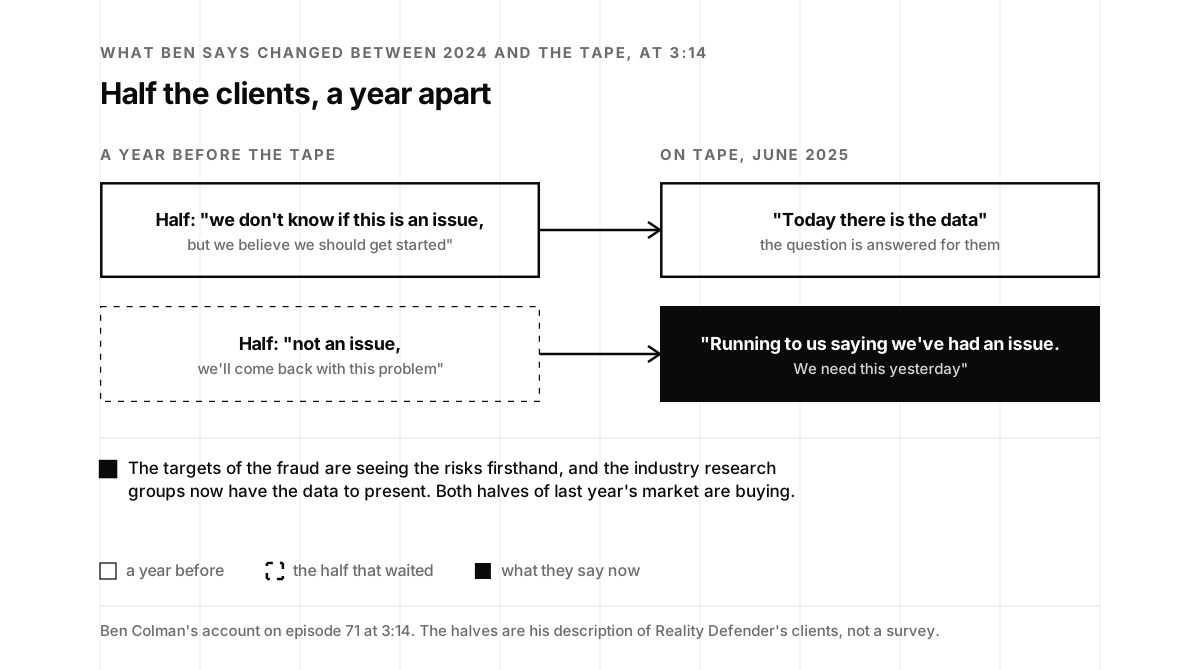
“And so last year I’d say half our clients said, hey, we don’t know if this is an issue, but we believe we should get started doing it. Well, today there is the data, so they don’t have to do it anymore. But then half the clients said, not an issue, we’ll come back with this problem. Now all those half that said it was [not] an issue are running to us saying we’ve had an issue. We need this yesterday.”
Ben Colman at 3:14
His frame for the whole category is the one I would borrow for a board deck: “The way I think about our space is just another application of cybersecurity to a new venue, which is around AI. So I think of it very similar to the antivirus industry and then the history of antivirus.” Antivirus went through an education phase, an explosion phase, and a fraud phase, and he thinks deepfake detection is on the same curve. The data he says clients no longer have to collect themselves was arriving in bulk while we were recording. The FBI’s Internet Crime Complaint Center counted nearly 860,000 complaints and $16.6 billion in reported losses for 2024, the highest since the center opened in 2000 (The Record). Deloitte’s Center for Financial Services had projected that generative AI could push United States fraud losses from $12.3 billion in 2023 to $40 billion by 2027 (Deloitte). Accenture’s threat researchers had reported a 223 percent increase in deepfake-related tool trading on dark web forums in the first quarter of 2024 against the year before (FinTech Futures). Entrust, whose figures Reality Defender cites, put a deepfake attempt at roughly one every five minutes in 2024 (Reality Defender). None of those numbers is a measurement of your company. All of them are the reason the second half of the market stopped waiting.
What “an issue” looks like
I asked Ben to describe the issue for our listeners, and he did it in two sentences that cover most of what we see.
“Yeah. Put bluntly, it’s, you know, it’s impersonations on the phone, impersonating company leadership, impersonating clients, executing wire transfers, getting access to accounts. And then similarly on video, which is all the same use cases, but also AI generated interviews, whether it’s someone interviewing for someone else, or a hacker or a state-level actor trying to get a job at a company to steal information.”
Ben Colman at 4:44
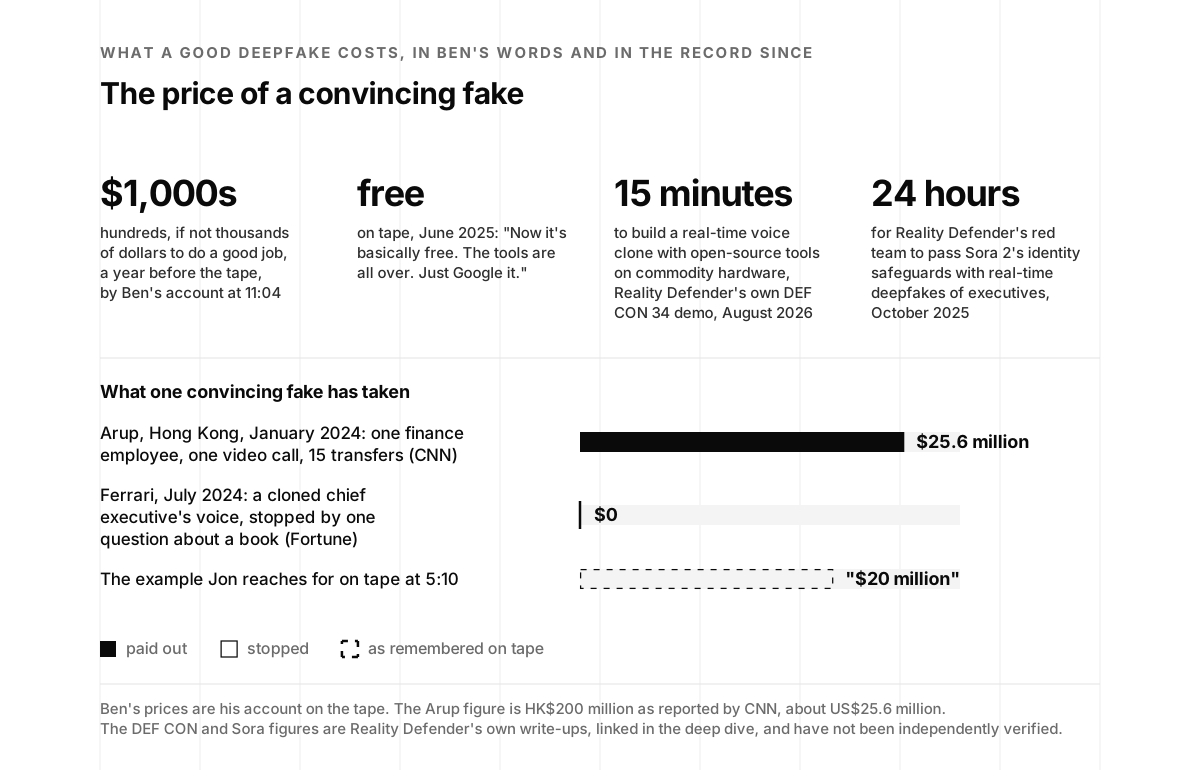
The case I reached for on tape was the one everyone reaches for, and I got the number wrong by a few million. In January 2024 a finance employee in Arup’s Hong Kong office received what looked like a phishing email from the engineering firm’s United Kingdom office asking for a secret transaction, set his doubts aside after a video call with people he took to be the chief financial officer and other colleagues, all of them deepfakes, and made 15 transfers totaling HK$200 million, about US$25.6 million. Arup confirmed that “fake voices and images were used” and that none of its internal systems were compromised (CNN). Six months later, a Ferrari executive got WhatsApp messages from a number that was not the chief executive’s, then a call in a voice that matched Benedetto Vigna’s southern Italian accent, about a confidential acquisition and a currency hedge. The executive noticed slight mechanical intonations, said “Sorry, Benedetto, but I need to identify you,” and asked which book Vigna had recommended to him a few days earlier. The call ended (Fortune). Those two stories are the two columns of this whole page: a process that accepted a face as proof, and a person who did not.
The month before this episode went out, the FBI said the same thing about a different target. On May 15, 2025 it published a public service announcement about an ongoing campaign using text messages and AI-generated voice to impersonate senior federal and state officials, aimed at their contacts, with the advice to verify any new number through a channel you already trusted (FBI, IC3).
The FBI has released a #PSA warning about an ongoing malicious text and AI-generated voice messaging campaign impersonating senior US federal or state government officials. Click for tips to help you spot a fake message:
FBI (@FBI) · May 15, 2025
The second half of Ben’s answer, the interview, is the one startups underrate. Gartner’s July 2025 research projected that by 2028 roughly one in four candidate profiles worldwide could be fake, and in a survey of 3,000 candidates six percent admitted to interview fraud, either posing as someone else or having someone pose as them (HR Dive). CrowdStrike counted more than 320 remote-job fraud incidents tied to North Korean actors in a year, and Reality Defender’s own demonstration of the problem was a fabricated candidate named Gary who passed a human interviewer’s eyes and ears on Zoom and was flagged as manipulated within seconds of being scanned (Biometric Update). The state-level actor Ben mentioned is not hypothetical. A fake hire with a laptop is an insider with credentials, which is why question four of the scorecard is about your interview process and why our counter-espionage work starts with hiring diligence rather than with network monitoring.
The only thing that can detect AI is AI
I asked Ben to frame the technical problem: would this podcast be enough to train a convincing fake of him, or would it take a photo and a little voice? His answer skipped the question and went to the thing that had changed.
“If this was six months or a year ago, we would have gone through all the things to look for. You know, looking for issues around symmetry or hourglassing or pixelation or anti-aliasing or sound versus mouth correlation, or kind of where the head and the neck kind of touch. But you know, my, one of my co-founders, who leads R&D, is a Harvard PhD. And even he can’t tell the difference anymore.”
Ben Colman at 9:23
That co-founder is Gaurav Bharaj, Reality Defender’s head of research, whose doctorate is from Harvard (Reality Defender). If he cannot see it, the line goes, your parents cannot, and neither can your accounts payable team. “Very similar to how you don’t expect my parents to be able to scan code and detect a virus. We similarly shouldn’t exactly be able to detect a deepfake, because it’s just too advanced for everybody, including the experts. And so, in a world where the only thing that can detect AI is AI, it’s just a matter of us ensuring accessibility, but also educating users on how scary it is.”
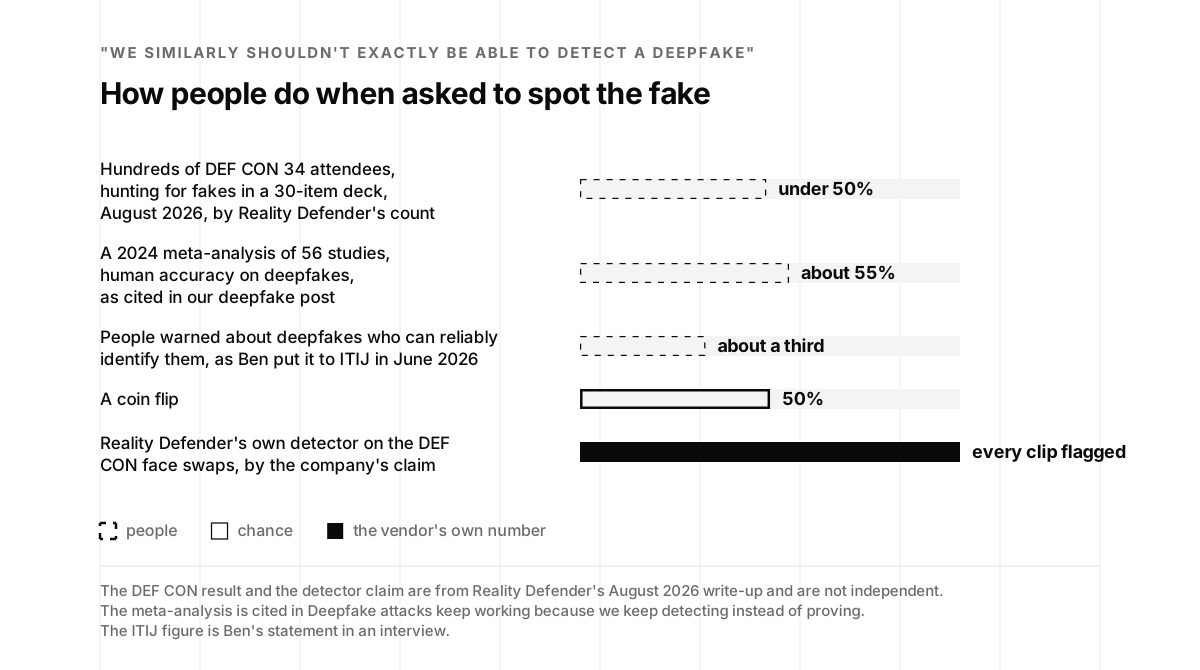
The record since has been unkind to the human eye. At DEF CON 34 in August 2026, Reality Defender ran a Guess the Deepfake challenge in the AI Village: a 30-item deck, half synthetic, and players who knew that going in and were actively hunting. Hundreds played. The average score was under 15 of 30, which is worse than a coin flip, and the company’s chief technology officer Alex Lisle noted that “The conditions were as favorable as they will ever be” (Reality Defender). A year earlier, in his interview with ITIJ, Ben had put it at about a third of people reliably spotting a fake even when warned (ITIJ). I wrote up the independent numbers in Deepfake attacks keep working because we keep detecting instead of proving: a 2024 meta-analysis of 56 studies at about 55 percent human accuracy, and CSIRO’s 2025 test of 16 detectors, many of which struggled with fakes outside their training data.
Which is the point where I should be honest about where this show has landed. Jasson Casey of Beyond Identity argued on episode 92 that detection is a classification problem whose error rate grows with the adversary, and that the durable fix is cryptographic proof of who is on the line. I agree with him about the approval. Ben’s counterargument, made a year earlier, is the best case for why detection is still worth running, and it is a physics argument.
“Most standard AI tools are focused on recreating what we observe, literally how we hear things or see things. They’re not trying to recreate how sound waves move. [They’re not trying to] recreate how photons interact in physics. So, you know, I think we have many years of exciting problems to solve. It’s obviously going to get harder, but we’re working on both sides of the equation, detecting both fakeness, which is getting better, but also realness, which is not changing. If we can detect whether you’re blinking or your heart’s beating or you’re breathing, and Jon, if you’re not, then you’d either, you’re a werewolf or a vampire or you’re an AI-generated bot.”
Ben Colman at 7:30
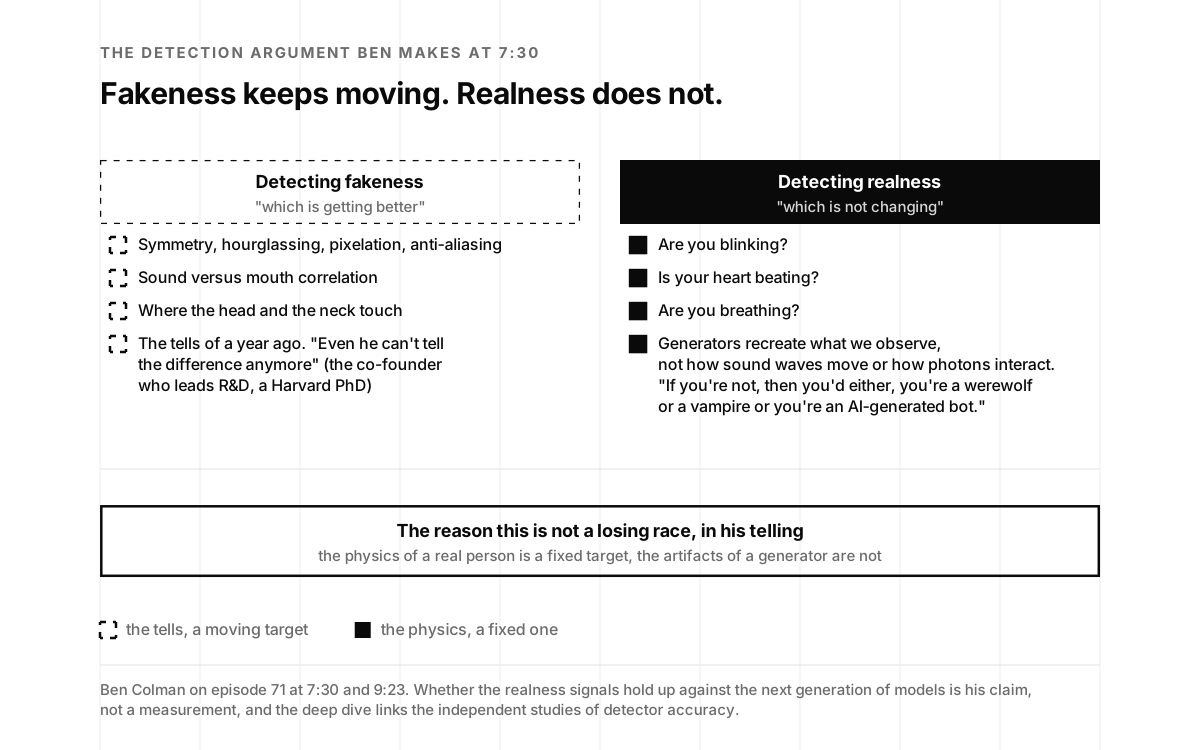
Hold the two arguments side by side and they are not actually in conflict. Jasson is talking about the decision: never let a wire depend on whether a face looks real. Ben is talking about the signal: a detector that scores a call is useful the way a spam filter is useful, as long as nobody treats its silence as permission. He said as much himself, and it is the sentence I would want every vendor in this category to say out loud: “there is no silver bullet here. Reality Defender alone is not going to solve these issues.” And then the sentence that matters for anyone designing a verification flow: “it’s paramount that organizations don’t just check for your personal information matching. All that means is that I have your information.” Knowledge-based checks prove the caller has your data. In 2025 everyone’s data is available. Deepak Dutt made the behavioral version of the same point on episode 78, and Vijay Balasubramaniyan of Pindrop made the voice version on episode 57.
What a watermark proves
Sasha asked whether the partnerships with generators meant watermarks, and got the most quotable answer of the episode.
“So we avoid watermarks, we avoid any provenance-based tools, because we assume they either can be hacked or just ignored. You know, for the tech folks who are following this podcast, you know, anyone can upload anything to Photoshop and add a watermark, [and] my parents might say, oh, [it] must say it’s real. This explosion of the Pentagon led to a $100 billion flash crash in the market. All the watermark means is that at this day and time, a thing was uploaded to a thing, and [they can] confirm that.”
Ben Colman at 11:54
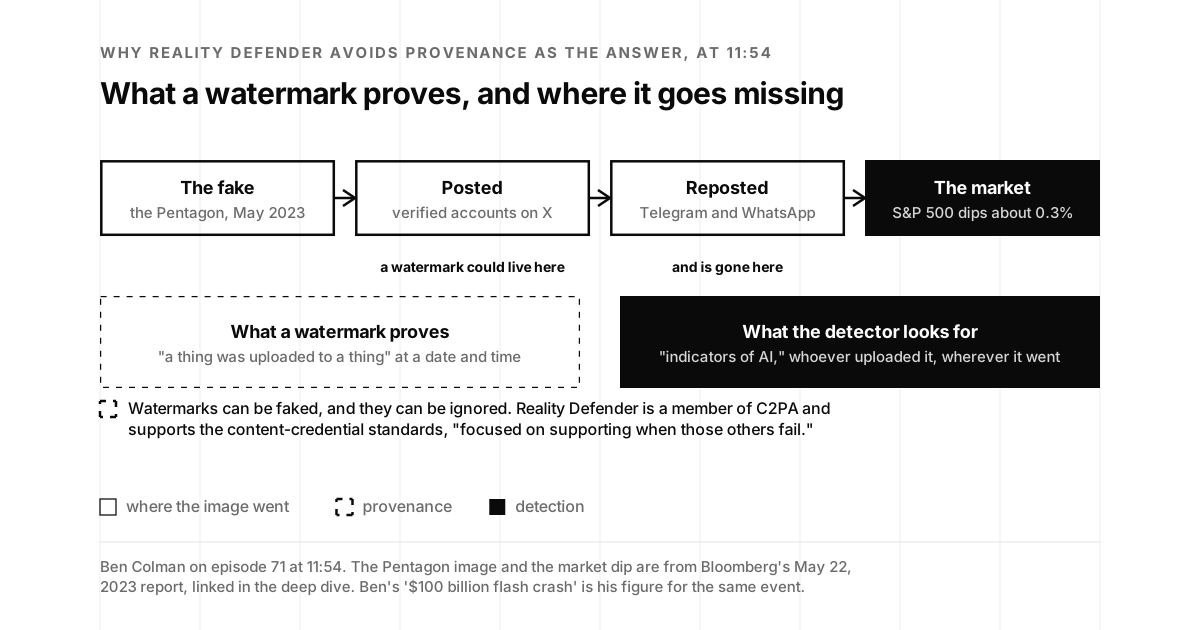
The Pentagon image is the right example. On the morning of May 22, 2023 a fabricated picture of an explosion near the Pentagon spread across social media, including from accounts with verification badges, and the S&P 500 fell about 0.3 percent to a session low just after 10 a.m. before recovering once it was debunked (Bloomberg, NPR). Ben’s “$100 billion flash crash” is his figure for that dip and I have not found a source that prices it, so take the direction and not the number. His actual argument does not depend on it: a watermark is an assertion attached at upload, it can be stripped by a screenshot, and it is invisible in the places where an image does its damage. Reality Defender is a member of the C2PA coalition and supports the content-credential standards, “focused on supporting when those others fail,” which is to say on “detecting indicators of AI” in the pixels and the audio regardless of who uploaded them or how many conversions the file has survived. I wrote the provenance half of that argument in the deepfake post: sign the approval, not just the media.
The partnerships Sasha was asking about are real and they are not watermarks. On July 18, 2024 ElevenLabs, whose voice technology had been identified behind the fake Biden robocall that hit New Hampshire voters that January, announced a collaboration in which it contributes its own models and methods to strengthen Reality Defender’s audio detection, with Ben promising “highly advanced audio detection that stays several steps ahead of bad actors and fraudsters” (ElevenLabs). On tape, eleven months later, he said about a dozen more generative platforms were lined up to “partner on the data side.” Then in October 2025 the company demonstrated what happens when a generator does not partner: within 24 hours of Sora 2’s launch, its red team used public footage of executives and entertainers to build real-time deepfakes that passed the app’s Cameo enrollment, the liveness prompts and the verbal attestation included, and reported that “Every attempt succeeded. The Sora platform detected nothing” (Reality Defender).
Reality Defender, a company specializing in identifying deepfakes, says it was able to bypass Sora’s anti-impersonation safeguards within 24 hours.
TIME (@TIME) · October 20, 2025
Hackers are the best product managers
I asked the question I ask everyone, whether something in particular pulled him into security, and got a story about fifth grade.
“And I’ll be honest, like, I grew up having a lot of fun with technology, and I was fortunate enough to have my best friend, when I was a child, his father had a computer store. So we were having a lot of fun working with computers. We were in fifth grade, and I don’t know how our parents let us do this, but we flew unaccompanied to Las Vegas to go to the big COMDEX tech conference. But we were just exposed to a lot of technology then. And we tried a lot of tools that were questionable in nature. And I, you know, it certainly is a lot more fun being on the good side than the bad side. So I’d say, you know, really just being exposed to technology is great, but also, if you’re going to be involved with things that might be a little, you know, or a lot ethically dubious, might as well be on the good side ‘cause it’s just as much fun.”
Ben Colman at 13:24
The line that followed is the title of this page, and it is the most useful thing on the tape for anyone who has to decide what to defend first.
“Hackers are the best product managers. Yeah, if they could use a new tool to do more hacking, they absolutely will. And that’s really where the initial genesis of this really interesting research we developed to this commercialized solution of Reality Defender, thinking about how bad actors and hackers and state-level groups will use these widgets to cause more harm at a greater level. No longer a Nigerian prince scam or trying to attack one person, like me attacking you, Jon. Something could do it to thousands, tens of thousands, [or] millions of people at the same time. And I only have to be right a few times, or even just once, for it to work.”
Ben Colman at 14:20
Read that as a product manager would. The attacker’s funnel has a top that used to be constrained by labor, one scammer per phone call, and generative AI removed the constraint. The conversion rate can be terrible and the campaign still pays, because the cost per attempt is close to zero and the payout per success is a wire. That is the arithmetic behind the calculator further down, and behind Ben’s advice to his own family: “I try and force my family members to use password managers. You know, my parents should not use my birthday as their password.” One breach on one site and the credential is tried everywhere else, and the attacker needs to be right “a few times, or even just once.” Fourteen months after we recorded, the same economics showed up on Wall Street. In August 2026 Point72, Millennium, Two Sigma and Citadel were targeted by AI voice-phishing calls aimed at their employees, with Point72 telling investors no client information appeared to have been taken and Two Sigma saying it blocked the attempt, and Vinod Paul of Align Managed Services, which runs security for hedge funds, gave Bloomberg the product-manager version of Ben’s point: “Before they could attack 50 entities in a targeted attack, now they can do 1,000” (InvestmentNews). Reality Defender’s own post on the attacks is the policy in two sentences: “a familiar voice on a call is no longer proof of who is on the line,” and “Detection is a layer, not authentication” (Reality Defender). We covered the defender’s side of the same scaling problem in AI cyberattacks are going autonomous.
”An 80% chance that Jon’s voice is AI generated”
I asked what success looks like for Reality Defender, and the answer was a feature of your phone.
“Similar to your phone saying, hey, this call might be spam, which maybe you’re okay with because it’s an AI agent, or it’s a United saying that I’ve been upgraded, which is, you know, it is, it’s nice. It’s a AI voice saying it. I want that call. You know, and similar to when you’re on a call, finding out that you have another call, someone also calling you, or maybe letting you know that you got an email, or your battery’s low. Getting [an] alert saying, you know what, at four minutes, 20 seconds [into] the call, there’s an 80% chance that Jon’s voice is AI generated. I think we’ll start becoming very common. Not all of them [will be] fraudulent. A lot of them will be fantastic.”
Ben Colman at 16:30
Notice what the vision is not. It is not a world without synthetic voices. It is a world where the synthetic voice calling to move your reservation is labeled, the way a spam call is labeled, and where “Jon’s voice calling to change a reservation, or calling Ben to say, hey, Ben, I’m gonna be late to the meeting” is a permissioned agent doing something useful. Sasha drew the engineering parallel, service accounts talking to services, and Ben agreed that the positive agent and the fraud are “the same exact technology and framework.” Which is why the sentence he dropped earlier, almost in passing, is the one I have quoted most since. Talking about the arrival of AI agents at 7:30: “companies do want to engage your AI agent for information sharing, but maybe not for authorization.” Information yes, authorization no. That is the permission ladder in six words, and it is the rule we wrote up in Your AI agent said no. Your API key said yes. and in Are you actually going to give the agent write access?. By the autumn of 2026 Ben was writing about tier-one telecoms seeing agentic voice traffic double every month and about contact centers that cannot tell a customer’s negotiating agent from an attacker’s, and the company’s RealCall product is the “80 percent chance” alert, delivered to the call center instead of to your lock screen (LinkedIn). Who signs for the agent is our version of the question his customers are now asking.
Cloud, edge, on device
Sasha asked the technical question, whether the company runs small models on the device, and Ben answered with the company’s credentials before the roadmap.
“Yeah. So we have over a dozen patents and white papers. We are selected for peer review at all the big conferences in computer vision and audio: CVPR, NeurIPS, ECCV, AAAI, which really differs us from most companies in our space, in that the majority of our company are PhD researchers and engineers. We see our product deployed everywhere, starting with cloud, moving to edge, moving ultimately on device as well.”
Ben Colman at 19:59
Two things in that answer are worth a founder’s attention. The first is the refusal to build on open source: “we develop our [own] models [and] data sets in-house. It’s expensive and hard to do. We think that’s important, versus a lot of other platforms [that] claim they are highly effective, but in reality you’re just using open source.” Whatever you think of the claim, note the proof he offers for it, which is not a benchmark table but the customers’ own benchmarks: “they will literally recreate all of our testing themselves and grade the results. They’ll upload 10,000 or [a hundred thousand] or more real-time or asynchronous audio or videos or images, and then grade the results.” A detection vendor who invites you to grade them on your own data is making the only claim that can be checked. Ask for that from anyone selling you a classifier. The second is the roadmap, which he described and then, when I asked whether I had heard a prediction, described again as a fact.
“So we have successfully already deployed our solution on commodity laptops, commodity phones. We’re not going to market for that ourselves. That’s [done] with partners who are the OEMs, or for various enterprise or government use cases that require a different kind of environment. And so yes, we’ve already done what we’re discussing, and we’re excited to really scale up the rollout with our partners.”
Ben Colman at 22:55
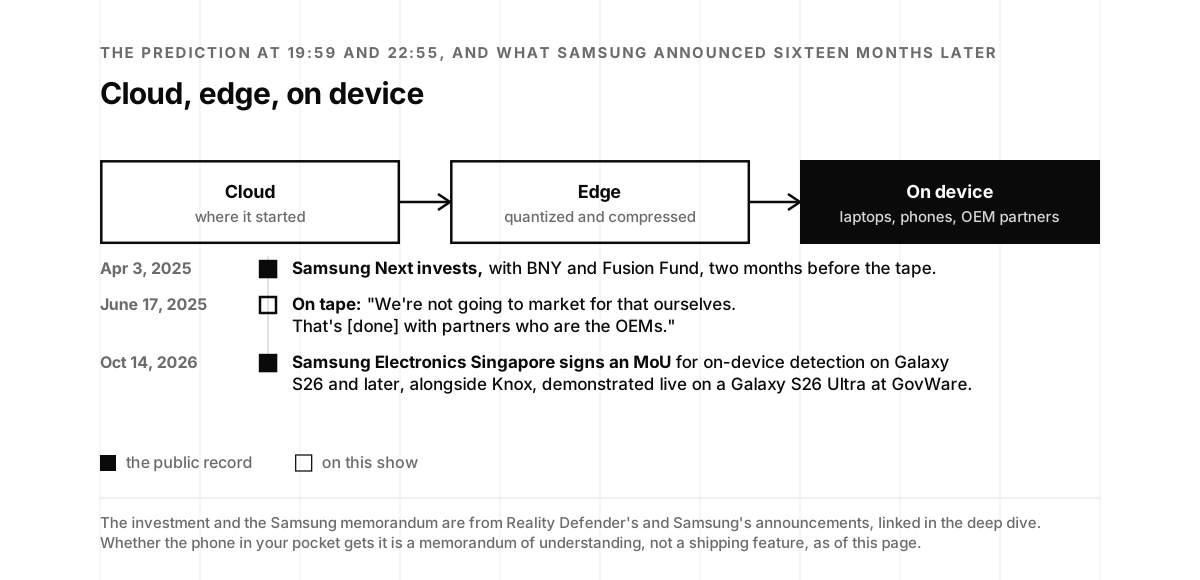
The OEM had already invested. On April 3, 2025, Reality Defender announced strategic investments from BNY, Samsung Next and Fusion Fund, and the same week won the 2025 U.S.-Japan Global Innovation Challenge, sponsored by the Defense Innovation Unit and Japan’s defense acquisition agency, with PeakMetrics (Reality Defender, Biometric Update). Then, on October 14, 2026, Samsung Electronics Singapore signed a memorandum of understanding with Reality Defender to develop and deploy on-device deepfake detection for enterprises in Singapore, identifying AI-generated voice, video and images on Galaxy S26 and later devices, with analysis staying on the phone and Samsung Knox providing the isolated storage. The release quoted a Regula survey in which 56 percent of Singapore businesses had faced audio deepfake fraud, and Ben’s line in it was the architecture in five words: “our detection is stateless by design: nothing enrolled, nothing stored” (Samsung). His own post from GovWare is below. It is a memorandum, not a shipping feature, and I will believe the billions of phones when I see the settings screen. But it is the prediction from the tape, fulfilled by the company he would not name.
AI can fake anyone's voice. Now your Samsung phone can fight back.
Ben Colman · October 2026
Deepfake voice fraud is becoming a threat to everyone. AI can clone your child's voice, impersonate your boss, or power autonomous voice agents that sound convincingly human.
Yet consumers have few practical ways to protect themselves. That's the challenge Reality Defender and Samsung are tackling: What if your phone could detect a deepfake in seconds, entirely on-device?
Until now, deepfake detection has largely relied on cloud infrastructure. That approach works well for enterprises, but protecting billions of consumer devices requires a different model. Detection can now happen locally, privately, and in real time.
This week at GovWare in Singapore, we took a major step toward making that possible. Reality Defender and Samsung Electronics Singapore announced our collaboration for on-device deepfake detection, working alongside Samsung Knox. We showcased the technology live on a Samsung Galaxy S26 Ultra, where our local AI models identified deepfake calls entirely on the device.
Why on device at all? I asked whether the pressure was security or performance, and the answer was all of it: “Compute is not infinite on the cloud. It’s incredibly expensive. But sometimes [it’s] also not available. Sometimes you just have no connectivity.” And for some clients the model itself has to be protected, “being able to not only protect our IP, but also protect what we’re scanning on behalf of our clients,” which the company handles by compressing and quantizing the models “without kind of reducing the accuracy of what they’re doing.” If you run inference on anything a customer holds, the same three pressures will find you, in that order.
Scanning the whole call
Sasha asked a question only an engineer asks: surely you do not have to process the entire audio stream, you could chunk it, run the chunks in parallel, and stop as soon as one chunk comes back fake. Ben’s answer is a product decision disguised as a technical one.
“We could do that. Some of our clients want us to do that, but we prefer to make it cheap enough and scalable enough [that] they don’t have to make a decision that way. We’re just scanning the whole thing. And so instead of traditional authentication, where you’re checking Sasha’s [ID] at the beginning, checking it again at minute two or minute 20, we’re not scanning just the first minute. We’re scanning the whole call in real time. And we don’t think that folks should compromise that to just scan the first minute.”
Ben Colman at 25:53
The reason is the attacker’s product management again. A fraudster who knows the check runs at minute one and minute twenty behaves at minute one and minute twenty. Continuous scanning is the same principle as the continuous behavioral authentication Deepak Dutt described on episode 78, applied to the media instead of the hands. Sasha’s follow-up, that security has a habit of making things complex and calling it a solution, drew the line I would print on the wall of every security startup: “I accuse innovation that’s not easy to use to actually not be innovation. I will go that far.” The product history bears it out. The real-time video plugin for Zoom shipped in October 2024, with a bot that joins the call and a side panel only the host sees (Reality Defender). The public API and software development kit arrived in August 2025, running on NVIDIA hardware, with a free tier of 50 scans a month (Biometric Update). By November 2025 the whole thing was packaged as Real Suite: RealScan, a drag-and-drop web tool, RealAPI for developers, RealCall for contact centers and RealMeeting for Zoom and Microsoft Teams (Biometric Update). Whether the models are as good as claimed is a question for your own benchmark set. Whether the product is adoptable is no longer in doubt.
The flip side of “scanning the whole call” is what the company’s red team has spent 2026 demonstrating: a check that runs once, at enrollment, can be passed once. In July 2026 Google introduced selfie video sign-in, an optional account-recovery method in which you record a short video while following head-movement prompts. Reality Defender’s researcher Dharva Khambholia had an operator follow the prompts in real time while commercially available face-swap software replaced the operator’s face with a synthetic one, on an Edge browser on a Windows laptop with an NVIDIA GPU. Both enrollment attempts succeeded, and the write-up was careful about what that does and does not show: repeatability under those conditions, not a general success rate and not an account takeover. The conclusion was two sentences: “Liveness remains valuable. But liveness alone is no longer enough” (Reality Defender, Biometric Update). It is the same lesson as the Sora cameo and the same lesson as the IDmission case the company published that autumn, in which a stolen but genuine national ID was used to generate a matching selfie, injected into the verification flow without a camera, that passed document authentication and face matching because both checks traced back to the same photo (LinkedIn). If your product has a know-your-customer or onboarding flow, that is the question five of the scorecard asks, and it is what our product security work checks when a flow accepts a face as evidence.
From a Goldman vendor test to a Gartner quadrant
Sasha read Ben’s resume at the top of the show: Google intern, co-founder of PlaceAVote, vice president at Goldman Sachs, chief executive of Covertix, angel investor and past New York lead of Xoogler.co. The one detail the resume leaves out is where the company came from, and Ben told it to Goldman’s own alumni magazine in 2024. In the Office of the Chief Information Officer from 2015 to 2017, he worked on technology commercialization and investments and, after battle-testing voice-authentication vendors, found that some “would mistakenly recognize a computer-generated voice as a real voice,” using test software from the gaming and entertainment industry years before anyone said deepfake. The chief information security officer at the time, Phil Venables, pushed the team to ask what would happen if that technology reached fraudsters, and taught him that “the best time to engage a vendor was early on.” Four years after leaving the firm, Ben founded a company to answer the question. The lesson he draws from the founding is about saying no: Reality Defender has turned down dozens of revenue opportunities outside its mandate, because “if you say yes to everything, you will excel at nothing” (Goldman Sachs). Covertix, the company in between, built persistent file protection and was acquired by Micro Focus in 2018 (LinkedIn).
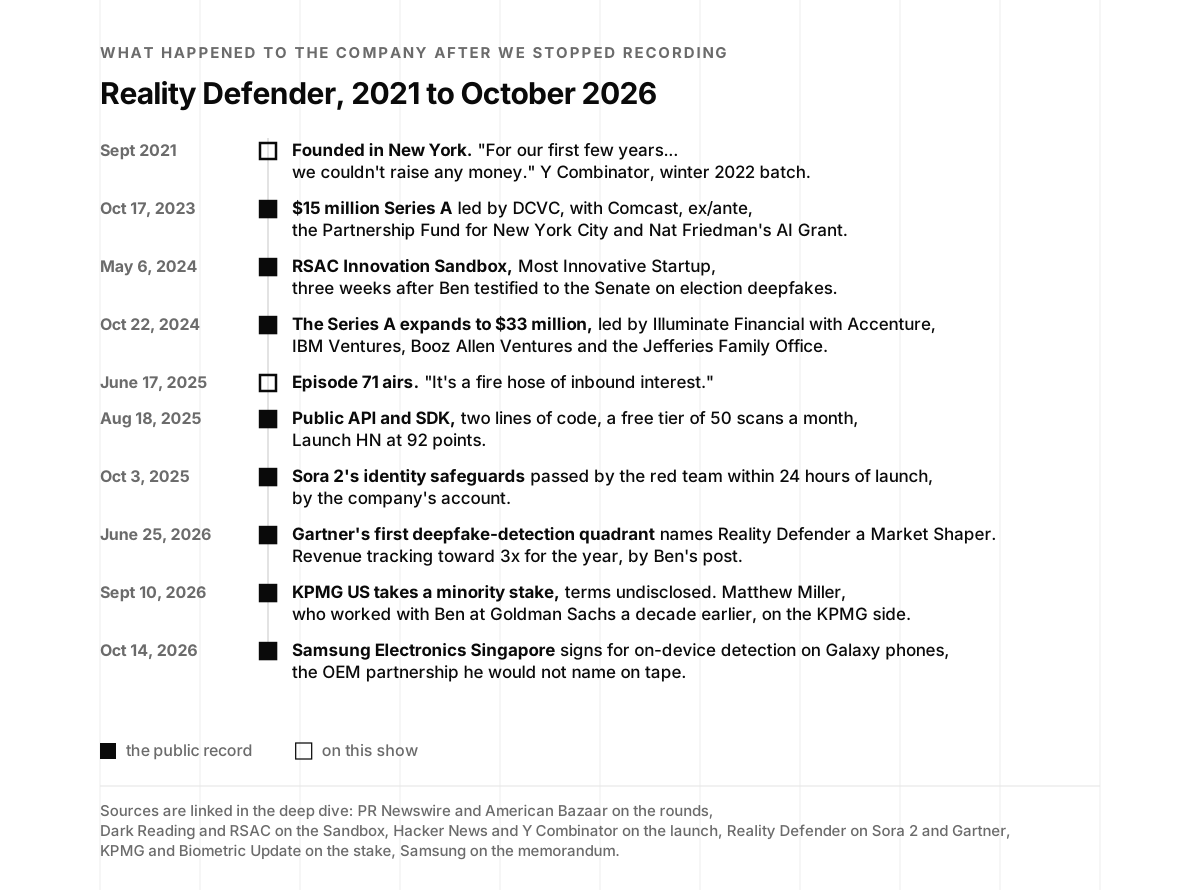
The money arrived in the order the market turned. A $15 million Series A led by DCVC closed on October 17, 2023, with Comcast, ex/ante, the Partnership Fund for New York City, Rackhouse and Nat Friedman’s AI Grant, and the release said the two-year-old company had already detected millions of deepfakes (PR Newswire). On April 16, 2024, Ben testified before the Senate Judiciary subcommittee on privacy, technology and the law at a hearing titled “Oversight of AI: Election Deepfakes,” alongside the chief executives of Resemble AI and DeepMedia, and told the senators that “Determining truth will always be slower and more difficult than spreading a lie” (Reality Defender, NBC News). Three weeks later he pitched at the RSAC Innovation Sandbox against VulnCheck, RAD Security, P0 Security, Mitiga, Harmonic Security, Dropzone AI, Bedrock Security, Antimatter and Aembit, told the judges “All we do is say human or not human,” said the top enterprise use case was real-time voice fraud at banks, and won (Dark Reading, RSAC).
On October 22, 2024 the Series A was expanded to a total of $33 million, led by Illuminate Financial with Booz Allen Ventures, IBM Ventures, the Jefferies Family Office and Accenture, which had joined through Accenture Ventures’ Project Spotlight the same day (PR Newswire, FinTech Futures). Then the episode, then the developer launch. Y Combinator’s post on August 1, 2025 is the pitch in a sentence, and the Launch HN thread seventeen days later, posted by Ben as bpcrd, is the conversation every detection vendor should expect to have in public.
Reality Defender (@DetectDeepfakes) detects deepfakes in real time with just 2 lines of code — across video, audio, and text. Like Stripe but for deepfake detection.
Congrats on the launch, @BenColmanRD and @A_Shahriyari!
Y Combinator (@ycombinator) · August 1, 2025
"Yeah but does it actually work, though?"
taneq, on Hacker News, August 18, 2025
Ben’s reply was the same answer he gave Sasha on tape, deployments at tier-one banks and large enterprises, and the thread’s best question was the one about the arms race: whether a public detector becomes the fitness function for the next generator (Hacker News). His answer on this show, a year earlier, is the realness argument above. Then the category arrived. On June 25, 2026, Gartner published its first Emerging Market Quadrant for deepfake detection, for startup vendors, and named Reality Defender a Market Shaper, with Ben’s release line the closest thing to a company motto: “Every enterprise system assumes the voice, face, and document in front of it are real” (PR Newswire). His post about it said the company was tracking toward three times its revenue for the year (LinkedIn). In May 2026 he had set up an ethics committee with Google’s former chief privacy officer Keith Enright, Yale’s Luciano Floridi and Yoel Roth, formerly of Twitter’s trust and safety, on the argument that a company that certifies what is real holds “a lot of power which needs oversight,” and that “Most ethics committees are theater. This is not one of those” (Biometric Update). In June the detection went into ZeroFox’s takedown workflow (Biometric Update). On September 10, 2026 KPMG US took a minority stake, terms undisclosed, to build the detection into its cyber and fraud practices, and the partner on KPMG’s side, Matthew Miller, had worked with Ben on cybersecurity at Goldman Sachs more than a decade earlier (Biometric Update, LinkedIn). Ben’s post on the day had the line I keep: “We don’t verify who somebody is. We verify that they’re real. Those are different problems.” Then, a month later, Samsung.
The founder notes
The best day was a bake-off. “We run up against these massive companies that have every single advantage to them. They’re legacy providers.” The company has matched and beaten them “in bake-offs with large, large client opportunities,” and the one he named without naming: “We recently bested one of them with a top five global bank.” The bank’s leadership, as he tells it, said point blank that they turned to Reality Defender “because it was better. It’s measurable.” Measurable is the word to hold onto when you buy any detection product.
The hardest day is hiring, every day. “Hiring is a huge challenge.” Few people have done this work, and “anyone touching AI” has options. His response is unusual for a chief executive: “I connect with as many cold emails as I can. If you ping me on LinkedIn, I’m always happy to find a few minutes.” He put the wider gap at “over a million jobs needing to be filled [in] the US alone, let alone the world,” and said the company has “met our best partners on our team literally from receiving their cold emails.” In 2024 the team was about 40 people, two-thirds of them PhD researchers and engineers (Goldman Sachs).
Pro-AI, pro-innovation, and in Washington. “we’re incredibly pro-AI, and we’re pro-innovation, and we’re really working hard in DC on a bipartisan basis to set up some AI-friendly regulations.” A month before the episode, the TAKE IT DOWN Act, which passed the House 409 to 2 and makes platforms remove non-consensual intimate imagery including AI-generated imagery on request, was signed into law on May 19, 2025 (Wikipedia). Sasha’s worry on tape was the usual one, that regulation slows the defenders and never the attackers, and Ben’s position is that the fix is regulation written by people who like the technology.
Fraud is equal opportunity. “whether it’s my seven-year-old son, my seven[ty]-year-old mother. We’re all great targets.” The tools are in the app store: “there’s face swap tools, there are synthetic voice generation tools. No requirements, no regulations.” He is careful to say the majority of uses are legitimate, entertainment and productivity, and that “in this edge case, the risks are infinite.”
Would he go back? He spent most of his twenties at huge companies and sometimes regretted it, “saying, what if I did startups early on? But I learned so much through these large companies.” The reason he would not change it: “I don’t think I would know what I know or question what I question without those experiences, and really being myself in the seat of our clients.” The Goldman vendor test is that sentence with a date on it.
The exit line. I told him it is a treat to stand on the shoulders of giants. “I wouldn’t go that far,” he said. Then: “We’re optimistic. We are very optimistic.”
Did you catch it? A six-question quiz
Interactive · six questions
Did you catch it?
Six questions on what Ben actually said, with the timestamp for each answer. The answers are under each question for anyone reading without JavaScript.
-
What did people want Reality Defender to pivot into during the years it could not raise money?
- Crypto wallet security
- NFT authentication
- Content moderation for social networks
b. "Folks wanted us to get into NFT authentication. If you guys remember, NFTs were kind of the thing for a bit." Transcript, 1:27.
-
Which side of the detection equation does Ben say is not changing?
- Fakeness: the artifacts a generator leaves behind
- Provenance: the watermark attached at upload
- Realness: blinking, a heartbeat, breathing
c. "detecting both fakeness, which is getting better, but also realness, which is not changing. If we can detect whether you're blinking or your heart's beating or you're breathing." Transcript, 7:30.
-
Who, by Ben's account, can no longer tell a good deepfake from the real thing?
- His co-founder who leads R&D, a Harvard PhD
- A top five global bank's fraud team
- The judges at the RSAC Innovation Sandbox
a. "one of my co-founders, who leads R&D, is a Harvard PhD. And even he can't tell the difference anymore." Transcript, 9:23.
-
What does a watermark prove, in Ben's words?
- That the image is real
- That the image was generated by a specific model
- That at this day and time, a thing was uploaded to a thing
c. "All the watermark means is that at this day and time, a thing was uploaded to a thing." Watermarks can be faked and they can be ignored. Transcript, 11:54.
-
Who are the best product managers?
- PhD researchers
- Hackers
- Bank fraud teams
b. "Hackers are the best product managers. Yeah, if they could use a new tool to do more hacking, they absolutely will." Transcript, 14:20.
-
How does Ben say Reality Defender will reach consumers' phones?
- Through the OEMs, not by going to market itself
- Through a consumer app in the app store
- Through the mobile carriers' spam filters
a. "We're not going to market for that ourselves. That's [done] with partners who are the OEMs." Samsung Electronics Singapore signed in October 2026. Transcript, 22:55.
Is a voice an authorization at your company?
Ben’s bank customers upload a hundred thousand files to grade his detector. You have a Slack channel, a finance person and a chief executive who travels. The question is not whether you can detect a deepfake. It is whether anything at your company moves because someone recognized a voice or a face. This scorecard asks eight questions about your approvals, your hiring and your product, each tied to a point on the tape, and tells you which one a convincing call would find first.
Scorecard · eight questions
Is a voice an authorization at your company?
Answer for how the last quarter actually went, not the policy document. Weighted toward the decisions that move money or grant access.
-
For a wire, a change to a vendor's bank details or a payroll change, is a phone or video call from the right person ever enough on its own?
- Yes, if it is the boss and it is urgent
- Policy says no, practice varies
- Never. A second channel or a signed approval is required, no exceptions for rank
"impersonating company leadership, impersonating clients, executing wire transfers." Arup's finance employee had a video call with the chief financial officer and colleagues. All of them were fakes. The policy that would have saved $25.6 million fits on one line.
-
When you verify a request out of band, do you call back on a number you already had, never the one that just called or messaged you?
- We reply on the same thread or number
- Usually, when someone remembers
- Always, from the directory, and it is written down
The FBI's May 2025 advice for impersonated officials was exactly this: verify a new contact through a channel you already trusted. The Ferrari call came from a number that was not the chief executive's.
-
Do your executives and finance team have a challenge: a phrase or a question only the real person could answer?
- No
- Some people do, informally
- Yes, agreed in person, rotated, and everyone knows to use it
"Sorry, Benedetto, but I need to identify you." One question about a book ended a deepfake of Ferrari's chief executive. It is free, and it works until the attacker has read your email too, which is why it is question three and not question one.
-
For remote hires with access to code, data or money, is there an identity check beyond the video interview?
- No, the interview is the check
- Reference calls we make ourselves
- Verified identity, references we call on numbers we found, and a live camera check before access is granted
"a hacker or a state-level actor trying to get a job at a company to steal information." Gartner projects one in four candidate profiles will be fake by 2028. Hiring diligence is where counter-espionage starts.
-
If your product verifies customers with a selfie, a document or a voice, does it check whether the media is generated, not only whether it matches?
- We match the face to the document and stop there
- Liveness detection only
- Liveness plus a check for synthetic or injected media, and a step-up for high-risk enrollments
"Liveness remains valuable. But liveness alone is no longer enough." A stolen but genuine ID plus a selfie generated from its photo passed document authentication and face matching at an IDmission customer, because both checks traced back to one image. Not applicable? Score it 2.
-
Does everyone who can move money or grant access know that a short clip is enough to clone a voice, and what the rule is when "the CEO" calls in a hurry?
- No, we have not talked about it
- It came up once
- Yes, with a rehearsed script for saying no to the boss
"a year ago, it was hundreds, if not thousands of dollars to do a good job. Now it's basically free." Train people, but do not make them the control. Ben's parents cannot spot a fake. Neither can his co-founder with the Harvard PhD.
-
Do your AI agents follow Ben's line: information sharing yes, authorization no?
- Our agents can act with whatever the API key allows
- Some actions need a human, it depends on the agent
- Agents read freely and every write that moves money or grants access needs a signed human approval
"companies do want to engage your AI agent for information sharing, but maybe not for authorization." The read-before-write ladder is how to draw that line.
-
When someone gets a suspicious call, message or interview, is there a place to report it within minutes and a person who looks the same day?
- No
- They would tell their manager, probably
- A channel, an owner, and a note back to the team on what was tried
"I only have to be right a few times, or even just once, for it to work." The first attempt that fails is your best warning that the campaign has started. Monitoring and response is the team that reads it.
Somewhere at your company, money or access moves because someone recognized a voice or a face, and in 2026 that is the cheapest thing in the world to fake. Fix the first two questions this week: nothing that moves money or changes bank details on a call alone, and every callback on a number you already had. Then agree the challenge question in person.
The rule exists and the busy Friday beats it. The ones that bite are the medium cases: the vendor's "new bank details," the contractor hired on a video call, the onboarding flow that matches a face to a document and stops. Rehearse the script for refusing the boss, add the identity check to remote hiring, and ask your product team question five.
Approvals have a second channel, callbacks use the directory, the challenge question is agreed, remote hires are verified and your product checks whether the face is synthetic. What is left is the signal: a detector on the calls and meetings that matter, used the way Ben describes, as a score that triggers verification, never as a silence that grants it.
The economics of one convincing call
Ben’s point is that the attacker only has to be right once, and the attempt is now free. Put your own numbers in and see what one convincing call is worth to them and what verifying every approval costs you. Every default is an assumption, chosen to be easy to argue with.
Calculator
The economics of one convincing call
Approvals that happen on a call or a video, the share that get a second channel today, what an attempt against the rest is worth, and what closing the gap costs in staff time. Rough by design. Change the numbers to yours.
At these numbers, a share of your approvals go through on a voice or a face each year. The expected loss from a few convincing attempts is set against the staff time it takes to verify every approval out of band, and the attacker's cost per attempt is close to zero either way.
The 20 percent default for verified approvals, the four attempts, the 25 percent hit rate and the five minutes are placeholders, not research. A 2024 survey that Reality Defender cites put the share of finance professionals who had been victims of a deepfake scam at 43 percent, with 87 percent saying they would make a transaction without delay if their chief executive or chief financial officer asked (Reality Defender). Not counted: the attempt that steals access instead of money, the fake hire, and the customer onboarding flow your product runs.
Fourteen years on one line
Everything on this page sits on one timeline, from Ben’s Google internship to the week this page was written. Filter it by thread.
Timeline · 2012 to 2026
Fourteen years on one line
Filter by thread. Dates are from the public record except where marked as Ben's own account on the tape.
- Google, graduate intern
Consumer privacy work in the Bay Area, the first line of the resume Sasha reads at the top of the show (LinkedIn).
- PlaceAVote
Co-founds a blockchain-based voting platform that pitches in the TechCrunch Disrupt Startup Battlefield, and meets Goldman Sachs at a lunch for data-driven founders (Goldman Sachs).
- Goldman Sachs, Office of the Chief Information Officer
Technology commercialization and investments through August 2017. The voice-authentication vendor test that mistook synthetic voices for real ones, and Phil Venables' "what if" (Goldman Sachs).
- Covertix and Xoogler.co
Chief executive of the file-protection company Micro Focus acquires in 2018, and New York lead of the network of former Googlers backing each other's startups (LinkedIn).
- Reality Defender
Founded in New York. "For our first few years, it was much the opposite. We couldn't raise any money. Nobody wants to talk to us."
- Y Combinator
The W22 batch, and a first Hacker News post about detecting AI-generated audio, video and images (Y Combinator).
- ChatGPT
"Went really mass market in winter of '22," and the education phase ended.
- The Pentagon image
A fabricated explosion spreads from verified-looking accounts and the S&P 500 dips about 0.3 percent before the debunk (Bloomberg).
- $15 million Series A
Led by DCVC with Comcast, ex/ante, the Partnership Fund for New York City, Rackhouse and Nat Friedman's AI Grant (PR Newswire).
- Arup
A Hong Kong finance employee wires HK$200 million, about US$25.6 million, in 15 transfers after a video call full of deepfaked colleagues (CNN). The same month, a robocall in a cloned Biden voice hits New Hampshire voters.
- "Oversight of AI: Election Deepfakes"
Ben testifies to the Senate Judiciary subcommittee on privacy, technology and the law: "Determining truth will always be slower and more difficult than spreading a lie" (Reality Defender).
- RSAC Innovation Sandbox, Most Innovative Startup
"All we do is say human or not human." Against VulnCheck, RAD Security, P0, Mitiga, Harmonic, Dropzone, Bedrock, Antimatter and Aembit (Dark Reading).
- ElevenLabs partnership
The voice generator contributes its models and methods to Reality Defender's audio detection (ElevenLabs). Nine days later, Fortune reports the Ferrari call stopped by a question about a book.
- Real-time video detection for Zoom
A bot joins the call and a side panel scores every face for the host (Reality Defender).
- Series A expanded to $33 million
Led by Illuminate Financial with Booz Allen Ventures, IBM Ventures, the Jefferies Family Office and Accenture (PR Newswire).
- BNY, Samsung Next and Fusion Fund invest
And, with PeakMetrics, the U.S.-Japan Global Innovation Challenge win (Biometric Update).
- $16.6 billion
The FBI's Internet Crime Complaint Center reports record losses for 2024 from nearly 860,000 complaints (The Record).
- The FBI's voice-impersonation warning
AI-generated voice messages impersonating senior officials, aimed at their contacts (IC3). Four days later the TAKE IT DOWN Act is signed.
- Episode 71 airs
This conversation, with Sasha co-hosting. "It's a fire hose of inbound interest."
- TEDxMidAtlantic
Eight minutes on the truth about deepfakes and what to do about them (YouTube).
- One in four
Gartner projects a quarter of candidate profiles worldwide could be fake by 2028 (HR Dive).
- Public API, Launch HN
Two lines of code, 50 free scans a month, NVIDIA hardware, and "Yeah but does it actually work, though?" (Hacker News).
- Gary
A fabricated candidate passes a human interviewer on Zoom and is flagged within seconds (Biometric Update).
- Sora 2, within 24 hours
Real-time deepfakes of executives pass the Cameo enrollment, liveness prompts and verbal attestation included (Reality Defender).
- Real Suite
RealScan, RealAPI, RealCall and RealMeeting, plus JPMorganChase's Hall of Innovation (Biometric Update).
- "The real problem isn't deepfakes. It's identity."
Jasson Casey on episode 92, and our post on detecting versus proving.
- The ethics committee
Keith Enright, Luciano Floridi and Yoel Roth. "Most ethics committees are theater. This is not one of those" (Biometric Update).
- Gartner's first deepfake-detection quadrant
Reality Defender named a Market Shaper, and tracking toward three times its revenue for the year by Ben's post (PR Newswire).
- Google's selfie sign-in, red-teamed
Two enrollments with a synthetic face succeed six days after the feature ships. "Liveness alone is no longer enough" (Reality Defender).
- DEF CON 34 and Wall Street
Hundreds of attendees average under 15 of 30 at Guess the Deepfake (Reality Defender). Point72, Millennium, Two Sigma and Citadel are targeted by callers posing as colleagues.
- KPMG takes a minority stake
Terms undisclosed, to build the detection into its cyber and fraud practices (Biometric Update).
- Samsung
Samsung Electronics Singapore signs for on-device detection on Galaxy S26 and later, demonstrated live on a Galaxy S26 Ultra at GovWare (Samsung).
What to do this week
Four things, in the order a convincing call would test them.
- Write the one-line rule. Nothing that moves money, changes bank details or grants access happens on a call or a video alone, whoever is on it. Put the second channel in writing: a callback on a directory number, or a signed approval from a registered device. Then tell the boss the rule applies to the boss most of all, because the boss is who the attacker will be.
- Agree the challenge in person. A phrase or a question only the real person could answer, agreed face to face, rotated when it is used. It is the cheapest control on this page and it stopped a deepfake of Ferrari’s chief executive. It is a backstop for the rule, not a replacement for it.
- Add identity to remote hiring. Verified identity before an offer, references you reach on numbers you found yourself, and a live camera check before any credential is issued. The fake candidate is an insider with a laptop, and Gartner says one in four profiles will be fake by 2028.
- Ask your product the realness question. If a selfie, a document or a voice gets a customer through onboarding, find out whether anything checks that the media is real, not only that it matches. Then decide whether a detector’s score should trigger a step-up. Use it as a signal. Never treat its silence as permission.