
Podcast Episode 57

Episode 057 46 min

Vijay Balasubramaniyan, Co-Founder and CEO of Pindrop Security: The Voice Behind Cutting-Edge Security

with Vijay Balasubramaniyan · Pindrop Security

0:00 / 46:00

Also on Spotify, Apple Podcasts, YouTube, Podbean, Player FM

Episode 57 of The Security Podcast of Silicon Valley, published October 30, 2024. Host Jon McLachlan, co-founder of YSecurity, talks with Vijay Balasubramaniyan, co-founder and chief executive of Pindrop, the Atlanta company that detects fraud and deepfakes on phone calls. Vijay, whose Georgia Tech PhD and 2010 paper on call provenance became the company in 2011, explains how a call reveals the networks it crossed, why fraud against contact centers keeps rising, how deepfake attacks at Pindrop's customers went from one a month to one a day, how Pindrop identified ElevenLabs as the tool behind the 2024 Biden robocall, why people can't reliably hear a cloned voice, and why Pindrop backs its detector with a warranty that works like a bug bounty. He also tells the story of the year one in four customers left, and gives his model for any problem: out-hire, out-innovate or out-execute. The deep dive adds what Pindrop did next, from meeting deepfake detection to BotStopper, for AI agents that call.

Episode notes

From his roots in voice technology at giants like Google and IBM to pioneering security innovations at Pindrop, Vijay Balasubramaniyan shares his unique journey of merging voice and security. Discover how Pindrop is leading the charge against deepfake fraud, revolutionizing voice authentication, and even protecting democracy.

Hosted by Jon McLachlan — co-founder of YSecurity.

The deep dive

What is human and what is machine

Vijay Balasubramaniyan wrote his PhD on where a phone call really comes from, turned it into Pindrop in 2011, and spent years hearing that the phone call was dead. Then the voices on the phone stopped being human. Here is our 2024 conversation with the public record beside it, from the paper that started the company to the deepfake robocall Pindrop traced, a warranty that pays when its detector misses, and the AI agents now calling banks for their owners, plus four tools for your own phone lines.

Vijay Balasubramaniyan has spent twenty years on one question, and generative AI made it everybody’s.

“because fundamentally, generative AI has brought into question what is human and what is machine.”

Vijay Balasubramaniyan, at 10:42

Listen · Vijay on episode 57, from 11:27
About 14 seconds: why deepfakes are the next frontier for security. The clip stops on its own. Read the full transcript.

Vijay is the co-founder and chief executive of Pindrop, the Atlanta company whose software listens to phone calls for fraud and for voices that aren’t human. Before it he was an engineer on voice systems at Intel and Siemens, a researcher at IBM and a software engineer at Google, and his PhD at Georgia Tech was on telecommunications security. In 2010 he published the paper that showed a call carries traces of every network it crossed, and in 2011 he started Pindrop on it with Paul Judge and his advisor, Mustaque Ahamad. By the end of 2018 its customers included eight of the ten largest U.S. banks and five of the seven largest U.S. insurers (Pulse 2.0). We recorded in the weeks after Pindrop’s May 2024 report on fraud and deepfakes, and published the episode on October 30, 2024, with 46 words of show notes. This page is the rest of it: a security person who is also a voice person, reading an encrypted call, the paper that started the company, the years the phone call was supposedly dead, a brother in security, what Pindrop does better than anyone, “welcome back, John,” one deepfake a month and then one a day, Giraffe Man, the first case of election interference, why people can’t hear the fake, a warranty that works like a bug bounty, being human again, five seconds of a TikTok, the best day and the hardest one, the mental model he’d give his younger self, the product he still wants someone to build, and what Pindrop did in the two years after the episode came out. There are four things to try along the way: a quiz, a scorecard for whether a cloned voice would get through your phone lines, a calculator for what a trust problem costs your growth, and a timeline you can filter.

A security person and a voice person

I opened with the question I ask everyone, whether he thinks of himself as a security person. He does, with an addition.

“I do, but you know, the interesting thing is I think of myself as a security person and a voice person.”

Vijay Balasubramaniyan, at 0:48

The voice part came first. His LinkedIn has him as a software engineer at Intel from August 2002, a senior software engineer at Siemens from July 2003 to July 2005, a research engineer at IBM from May 2006 to August 2007, a software engineer at Google in the summer of 2008, and back at IBM for the summer of 2010, where the work was on Twitter accounts that spread dubious information while looking legitimate (LinkedIn). On the tape, Intel and Siemens meant voice “for old landline switches,” and Google meant voice over IP, “the more modern Google Chat, Google Hangouts.” The security part was Georgia Tech, where he finished a PhD in computer science in 2011 (Georgia Tech Computing on X) with a thesis on telecommunications security, and where he picked up patents in voice over IP security and scalability along the way (USENIX Security 2018 speaker page).

“And then when I did my PhD at Georgia Tech, it was marrying that voice background with security, which is interesting, because a lot of folks in security focus on the digital side of things. Very few focus on the voice.”

Vijay Balasubramaniyan, at 0:48

That combination is the whole company. Most security tools look at packets, files and logins. Pindrop looks at the audio of a phone call, and for most of its life the question was whether the person on the line was the account holder. Now it is also whether the voice belongs to a person at all.
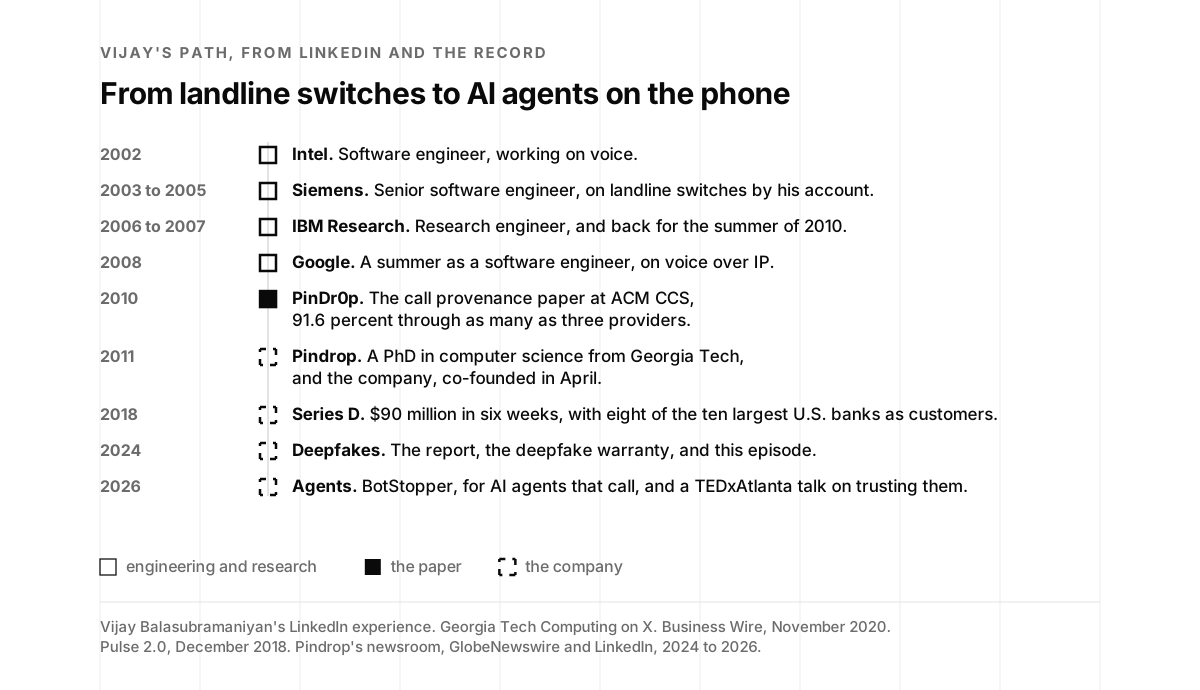
A timeline of nine entries. 2002, Intel, software engineer working on voice. 2003 to 2005, Siemens, senior software engineer, on landline switches by his account. 2006 to 2007, IBM Research, and back for the summer of 2010. 2008, a summer at Google on voice over IP. 2010, the PinDr0p paper on call provenance at ACM CCS, 91.6 percent through as many as three providers. 2011, a PhD in computer science from Georgia Tech, and Pindrop, co-founded in April. 2018, a 90 million dollar Series D raised in six weeks, with eight of the ten largest U.S. banks as customers. 2024, the report, the deepfake warranty and this episode. 2026, BotStopper for AI agents that call, and a TEDxAtlanta talk on trusting them.
From landline switches to AI agents on the phone. Sources: LinkedIn, Georgia Tech Computing, Business Wire, Pulse 2.0, Pindrop.

Reading an encrypted call

Vijay’s answer reminded me of the paper that first got me excited about this kind of work. I was in graduate school at the University of Minnesota, working on the Tor network with Roger Dingledine, and a paper came out showing that you could tell which language people were speaking on an encrypted internet call. Vijay knew it immediately: “That’s Fabian’s paper.”

It is. Charles Wright, Lucas Ballard, Fabian Monrose and Gerald Masson, all at Johns Hopkins, published it at USENIX Security in 2007 under the title “Language Identification of Encrypted VoIP Traffic: Alejandra y Roberto or Alice and Bob?” Their 21-way classifier named the language of an encrypted call with 66 percent accuracy, almost 14 times better than guessing (USENIX). Vijay explained why it works better than I could have.

“But you know, his paper was, again, super eye-opening, because they figured out, because of the variable bit rate that a lot of these audio systems use, the length of the encryption is revealing in what you’re saying.”

Vijay Balasubramaniyan, at 2:42

Encryption hides the content of each packet, not its size, and a codec that spends fewer bits on silence and simple sounds makes the sizes follow the speech. He also remembered the order the work went in: language first, “and then they started cracking words in that language.” The words came in 2011, in “Phonotactic Reconstruction of Encrypted VoIP Conversations: Hookt on fon-iks,” from Andrew White, Austin Matthews, Kevin Snow and Monrose at the University of North Carolina, with Matthews listed in linguistics as well as computer science (IEEE Symposium on Security and Privacy). That is the linguist Vijay meant when he said Monrose “combined with a researcher who was actually a linguist,” and it is why he loves the paper.

“And that’s why I love that paper, because we have a common kinship there. I come from a very different background than security, but then made security my own, much like Fabian [had] done it with his researchers.”

Vijay Balasubramaniyan, at 2:42

One small update to the tape. Vijay thought Monrose had been at Georgia Tech “for a brief moment.” He is there now, as a professor and the Julian T. Hightower Chair in Cybersecurity, welcomed in August 2022 after years as a Kenan Distinguished Professor at UNC Chapel Hill (Georgia Tech).

Where did this call come from?

The “Pindrop paper” Vijay mentioned is his own, and it is spelled with a zero. “PinDr0p: Using Single-Ended Audio Features To Determine Call Provenance,” by Vijay, Aamir Poonawalla, Mustaque Ahamad, Michael Hunter and Patrick Traynor, appeared at ACM’s Conference on Computer and Communications Security in 2010. It listened only to the audio at the receiving end, ignored the voice itself, and used the artifacts that each network leaves on a call to work out where it came from. Combined with machine learning, those features traced a call’s path through as many as three providers with 91.6 percent accuracy, and told apart traditional phone lines, cellular calls, Vonage, Skype and other phones with better than 90 percent accuracy. Ten years later the paper won the conference’s Test of Time award (Business Wire).

The company followed the paper closely. In September 2010 Vijay and Ahamad started a Georgia Tech VentureLab project called Telineage, and in 2011 Vijay and Paul Judge founded Pindrop, with Ahamad also listed as a founder, licensing the technology from the Georgia Tech Research Corporation (Wikipedia). His LinkedIn dates the company to April 2011 (LinkedIn).

The idea is worth holding onto, because it runs under everything else on this page. Caller ID is a claim the caller makes. The audio is evidence the network leaves. A fraudster can type any number into a spoofing tool, but a call routed through an internet phone service in another country still sounds like one, to software that knows what to listen for.
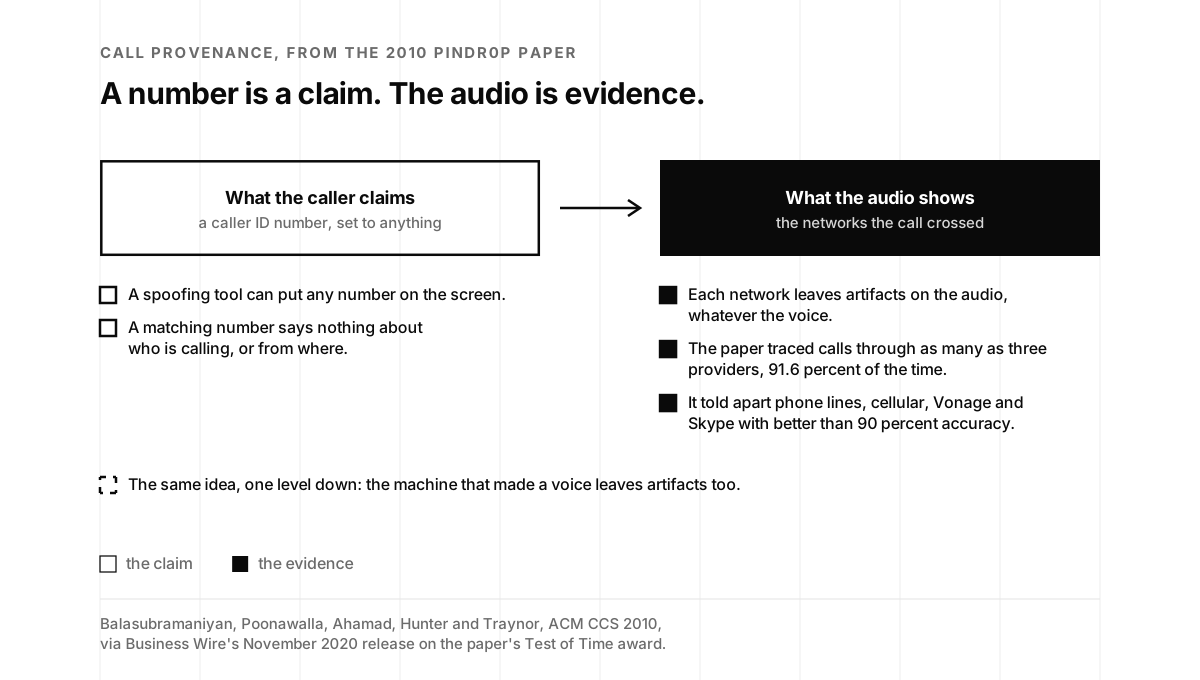
Two boxes joined by an arrow. On the left, what the caller claims: a caller ID number, which a spoofing tool can set to anything and which says nothing about who is calling or from where. On the right, filled, what the audio shows: the networks the call crossed, from artifacts each network leaves on the audio whatever the voice. The 2010 PinDr0p paper traced calls through as many as three providers 91.6 percent of the time, and told apart phone lines, cellular, Vonage and Skype with better than 90 percent accuracy. Below: the same idea one level down, the machine that made a voice leaves artifacts too.
A number is a claim. The audio is evidence. Source: Business Wire, on the paper's 2020 Test of Time award at ACM CCS.

The phone call is dead

Thirteen years as co-founder and chief executive is a mark of success, and I said so. Vijay gave the credit to the team and to luck, and then told me what raising money for a voice company sounded like in 2011 and 2012.

“I remember every time I would go try to raise a round, the common refrain was, you’re doing this in voice, or does that mean a phone call? Oh, the phone call’s dead. Like, no one’s, no one cares about a phone call.”

Vijay Balasubramaniyan, at 4:18

Listen · Vijay on episode 57, from 4:39
About 39 seconds: the phone call is dead, then Alexa, then six months against six weeks. The clip stops on its own. Read the full transcript.

The record lines up with the story. Pindrop’s first money, in 2012, was about $1 million from Andreessen Horowitz, other firms and angels, and Vijay said that round took about six months. Then came an $11 million Series A in June 2013, led by Andreessen Horowitz and Citi Ventures, $35 million in February 2015, led by Institutional Venture Partners, and $75 million in 2016, led by Google Capital, for a total of $122 million (Wikipedia). By then, in his telling, “came the Alexa,” and voice assistants changed what investors heard. The $90 million Series D in December 2018, led by Vitruvian Partners with Goldman Sachs, EDBI and others joining earlier investors, came with customers in eight of the ten largest U.S. banks and five of the seven largest U.S. insurers, more than 200 million consumer accounts protected, and revenue growing at a 137 percent compounded annual rate over three years (Pulse 2.0). “And then our Series D we raised in six weeks.”

Vijay at Startup Grind's global conference, published in March 2019, about 25 minutes: what the spread of voice technology means for security, a few months after the Series D. Watch on YouTube.

His explanation for the change is the reason the company exists: “voice has become so important for people, because that’s what makes us human.” The example was at home. His son had started talking with ChatGPT-4o, OpenAI’s voice-capable model, and asked to do it almost every day, which Vijay greeted the way a voice security person would: “okay, I don’t know where the security of this thing is, so I’m really not going to have too much of your voice out there.” He also has a number for why voice wins as an interface, “you speak about four times faster than you type,” and I added the part I care about, that voice carries far more than the words.

“Our brains are almost hardwired to detect sentiment that’s underneath the words, that’s in between the words.”

Jon McLachlan, at 6:57

Vijay’s version came from Pindrop’s own chat channels: lots of miscommunication on Slack, fixed by a simple phone call. It is a sweet point, and also the threat model in one sentence. We trust voices because they carry so much. A clone that carries the same things gets the same trust.

A cat and mouse game

How he got into security is a family story. His older brother worked in security, still does, and loved it.

“And he would tell me about what an incredible cat and mouse game it is. Something that’s as dynamic as security. Like, you can never say, okay, you’ve solved a problem, right? Like, it’s always, whatever is your best solution is always going to get beaten, because you have a very smart adversary on the other end.”

Vijay Balasubramaniyan, at 7:58

Georgia Tech, he found once he arrived, was one of the strongest security schools in the country, and then he met the professor he did his PhD under, Mustaque Ahamad, a co-author on the PinDr0p paper and a co-founder of the company. The brother never joined Pindrop. “So yeah, we are a strict, no family involved in the company.” I told him about my two brothers, one I grew up with in Minnesota and one I chose in California, and we agreed that a lot of looking up goes both ways.

The cat and mouse line matters for what comes later. A detector that wins today gets beaten tomorrow, and Pindrop’s answers to that, a consortium of known bad actors and a warranty that pays out when it loses, are both ways of living with an adversary that adapts.

Better than anyone else on the voice channel

I asked the question I ask every founder: what do you do better than everyone else in the world?

“So, you know, there’s several things that we do better, but at the core of what we do, multi-factor authentication on voice channels, really well, better than anyone else. And we do deepfake detection, or fraud detection, on voice channels better than anyone else.”

Vijay Balasubramaniyan, at 10:42

The deepfake part started early. “Like, our first patents on deepfakes are back in 2015,” he said, and Pindrop had been at it for eight years, “way before it became hot.” His example from the party-trick era was a documentary: “We are the ones who discovered the deepfakes in Anthony Bourdain’s documentary two years back.” The film was Roadrunner, released in July 2021, three summers before we recorded, and its director said three lines in Bourdain’s voice had been generated with AI (NPR). The coverage we could reach confirms the three lines, not who found them, so Pindrop’s part is his account.

“So at that point in time, it was a cool party trick.” Three years later it was, in his words, one of the biggest tailwinds the company has had, and the reason is the line at the top of this page: generative AI has brought into question what is human and what is machine.

Welcome back, John

Pindrop had just published its yearly report on fraud and deepfakes, so I asked what surprised him. He had two findings. The first was volume.

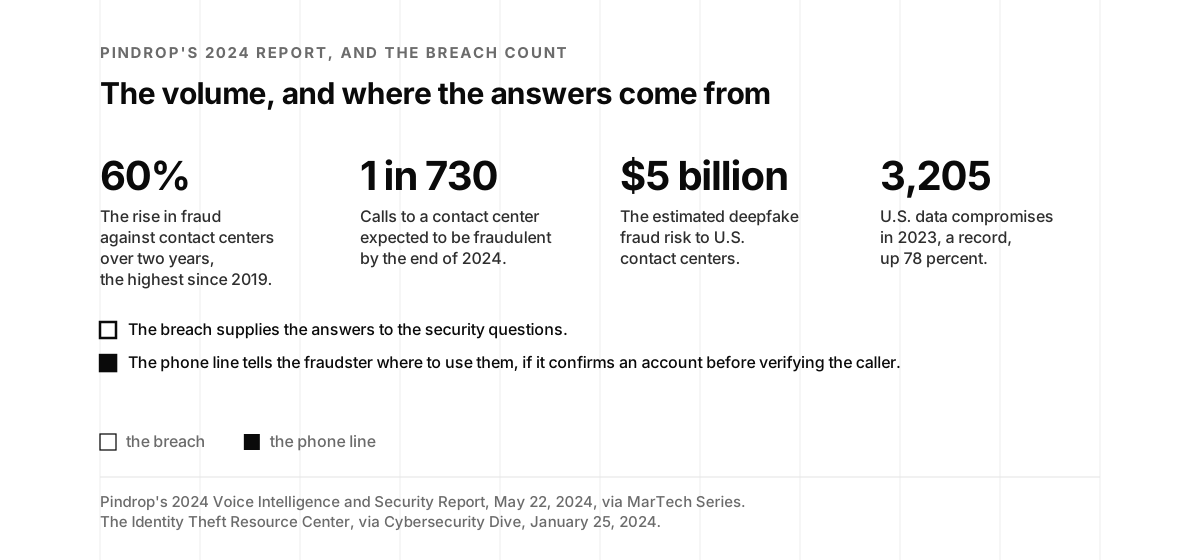
Pindrop’s 2024 Voice Intelligence and Security Report came out on May 22, 2024. It found that fraud against contact centers had risen 60 percent in two years, to its highest level since 2019, projected that one call in every 730 to a contact center would be fraudulent by the end of the year, put the deepfake fraud risk to U.S. contact centers at about $5 billion, and found that retail fraud, refund abuse included, had quadrupled among Pindrop’s call center customers through 2023 (MarTech Series). On the tape Vijay rounded the first number down, “So over the last couple of years, it’s grown by 50%,” and the report says 60. His explanation for the rise is about money that stopped flowing: “a lot of fraudsters who used to get easy money back in the day from PPP loans and unemployment now don’t have the government giving you free money.”

His second ingredient was the breaches. “Data breaches have gone up by 78%,” he said, with 3,000 incidents in 2023 against 1,800 in 2022, and that one checks out almost exactly. The Identity Theft Resource Center counted 3,205 data compromises in the U.S. in 2023, a record and a 78 percent jump over the year before (Cybersecurity Dive). What the two have to do with each other is the best explanation of phone fraud I’ve heard.

“And so being able to use the call center to say, punch it in into all of the top ten banks, and if one of them say, welcome back, John, your account balance is so on and so forth, I can then go ahead and know John banks with bank number one, and then take over his account.”

Vijay Balasubramaniyan, at 11:57

A stolen Social Security number doesn’t say where its owner banks. The phone line can. An automated phone menu that greets a caller by name, or reads out a balance before anyone has been verified, answers the question the breach left open, and the fraudster calls back later with the rest of the stolen answers. The fix is unglamorous and very effective: confirm nothing, not even that an account exists, until the caller is verified with something they have. The scorecard below starts there.
Vijay with Karen Walker, published on May 30, 2024, about 24 minutes: the same report, a week after it came out, in more detail. Watch on YouTube.
Four numbers. 60 percent, the rise in fraud against contact centers over two years, the highest since 2019, in Pindrop's May 2024 report. One in 730, the calls to a contact center expected to be fraudulent by the end of 2024. 5 billion dollars, the estimated deepfake fraud risk to U.S. contact centers. 3,205, the U.S. data compromises in 2023, a record, up 78 percent. Below: the breach supplies the answers to the security questions, and the phone line tells the fraudster where to use them, if it confirms an account before verifying the caller.
The volume, and where the answers come from. Sources: Pindrop's 2024 Voice Intelligence and Security Report, via MarTech Series. The Identity Theft Resource Center, via Cybersecurity Dive.

One a month, then one a day

The second finding was the one that made the episode’s title feel modest.

“Back in 2020, we used to see one deepfake attack a month at our customers. So it used to be one a month, and we’d look at it, we’d thwart it. In this year, every day, there is a deepfake attack per customer.”

Vijay Balasubramaniyan, at 11:57

Listen · Vijay on episode 57, from 13:51
About 31 seconds: one deepfake a month, then one a day per customer. The clip stops on its own. Read the full transcript.

He put a number on it, a 450 percent increase, and he was careful about what it measured: “The 450% is if you compare just the first four months with all of last year.” Those customers are some of the largest banks and insurers in the country, so one a day per customer is a lot of synthetic voices reaching agents who were hired to be helpful. On October 30, 2024, the day this episode came out, Pindrop posted the same comparison from the New York Stock Exchange.

Same direction, a different window: on the tape the baseline was 2020, and the 450 percent compared four months with a year. View on X.

The windows differ, and the shape doesn’t. Whatever the exact multiple, a deepfake went from something a fraud team studied to something it saw every day, in about the time it takes to raise a Series A.

Giraffe Man

My follow-up was whether Pindrop could tell which model made a voice, if all the fakes from one place shared a fingerprint. That, it turns out, is the fun part.

“In fact, if you come to Pindrop, every conference room is named after a bad actor that we’ve caught. So we have, yeah, we have Pepe and Chicken Man and Giraffe Man.”

Vijay Balasubramaniyan, at 15:11

Listen · Vijay on episode 57, from 15:25
About 27 seconds: Pepe, Chicken Man, and the fraudster with a seven-foot neck. The clip stops on its own. Read the full transcript.

Giraffe Man uses generative AI, and the name is a diagnosis. “The only person who could have produced this audio is someone with a seven-foot-long neck, and their vocal cords are thrashing between that seven feet.” A generator doesn’t have a throat, so it can produce sounds no human vocal tract could, and software that models the anatomy can hear the impossibility. It is the same move as the 2010 paper, one level down. The network leaves artifacts on a call, and so does the machine that made the voice.

The consortium is what turns one catch into a pattern. Pindrop sees the same bad actors across many customers, so it can say where calls come from, West Africa, Eastern Europe or the Philippines in his examples, and which tools they used. The tool count is the part that should worry a security team. When Pindrop first ran into deepfakes in occasional events, “there used to be one voice cloning software. It used to be the software called Lyrebird.” By the end of 2023 there were 120 apps that could clone a voice, and by the end of March 2024, by his research team’s count, “There are 358 AI apps that you can use to clone your voice.” Each one, he said, “leaves behind a telltale sign of how inhuman they are,” which is how Pindrop tells them apart.
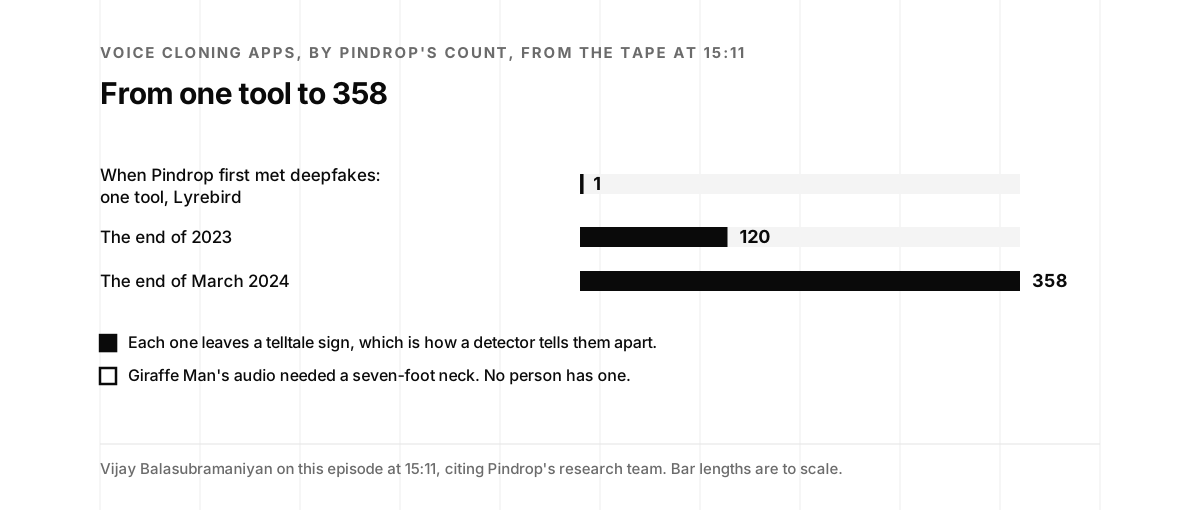
Three bars getting longer from top to bottom. When Pindrop first met deepfakes, one voice cloning tool, Lyrebird. At the end of 2023, 120 apps that can clone a voice. At the end of March 2024, 358. Below: each one leaves a telltale sign, which is how a detector tells them apart, and Giraffe Man's audio needed a seven-foot neck, which no person has.
From one tool to 358 in a few years. Source: Vijay on this episode at 15:11, citing Pindrop's research team.

The first case of election interference

Then he told the story that made Pindrop famous outside banking.

“And we were the ones who discovered that it was ElevenLabs that was used to create Biden’s deepfake. And then ElevenLabs saw our blog and then shut down the actor who actually was perpetrating this attack.”

Vijay Balasubramaniyan, at 15:11

Listen · Vijay on episode 57, from 16:59
About 38 seconds: the Biden robocall, the tool behind it, and the confession a month later. The clip stops on its own. Read the full transcript.

The calls went out the weekend before New Hampshire’s presidential primary on January 23, 2024, in an imitation of President Biden’s voice telling voters to “save your vote” for November (NBC News). One correction to the tape: Vijay said the Republican primary and Republican voters, and the record says the calls targeted Democratic voters (NBC News, The Boston Globe). The state’s attorney general, John Formella, put the count at between 5,000 and 25,000 calls.

Pindrop published its analysis on January 25, under Vijay’s name. The system broke the 39-second clip into 155 segments of 250 milliseconds each, compared it against 122 text-to-speech systems, and found “with a 99% likelihood” that the voice came from ElevenLabs or a system using similar components, a result its validation step put at 84 percent. Its liveness score, from 0 for synthetic to 1.0 for authentic, dropped below 0.3 two seconds into the call and stayed there (Pindrop). Two days later Fortune reported that the account had been suspended once the deepfake was traced to its creator, and that ElevenLabs couldn’t comment on specific incidents (Fortune). On February 6 the attorney general traced the calls to two Texas companies, Life Corporation and Lingo Telecom (Engadget). On February 25 a political consultant who had worked for a rival campaign said he was behind the call (Axios), and the next day a New Orleans magician said he had made the audio with an ElevenLabs voice generator (The Boston Globe). That is the “a month later” on the tape.

“That’s a great public service as well,” I told him, and he explained why they did it anyway: it was an election year, and “it didn’t even take the first month to happen.” The work brought Pindrop into the room with the people who run elections.

“But one of the things that the New Hampshire AG said is, how does it feel to protect the nation’s democracy?”

Vijay Balasubramaniyan, at 18:09

Pindrop went on to brief attorneys general on how to prepare and was on its way to the secretaries of state conference when we spoke. Vijay’s takeaway for his own team was that the mission keeps growing, from protecting bank accounts to this.
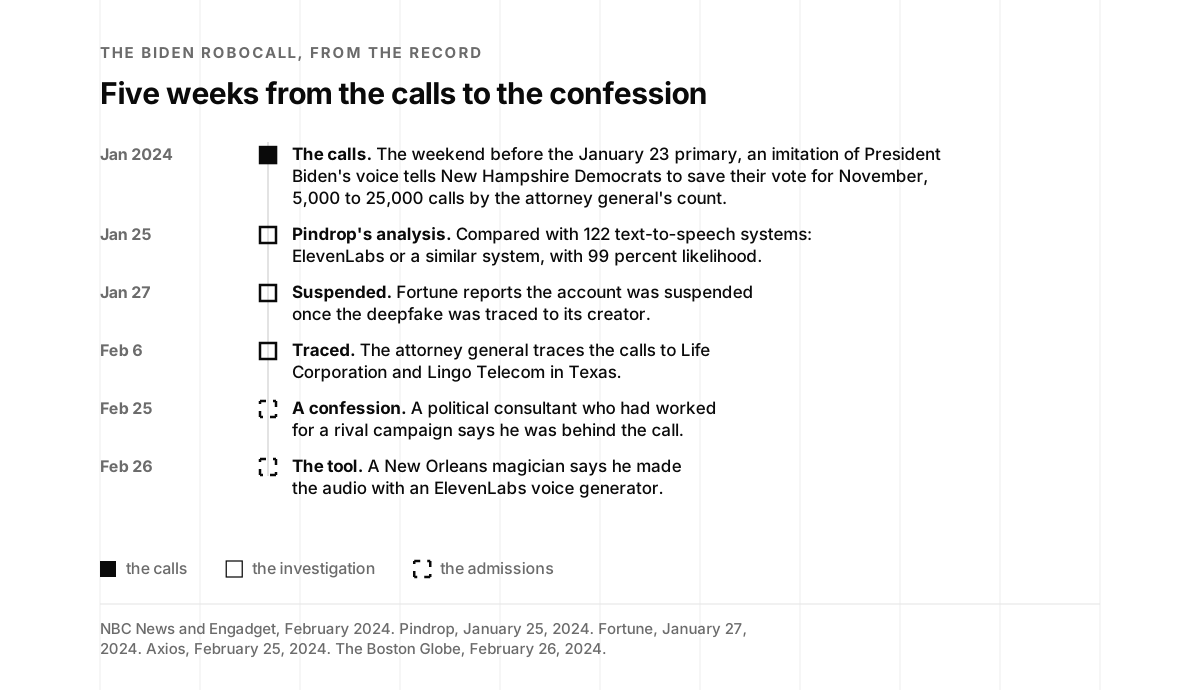
A timeline of six entries. January 2024, the weekend before the January 23 primary, robocalls in an imitation of President Biden's voice tell New Hampshire Democrats to save their vote for November, 5,000 to 25,000 calls by the attorney general's count. January 25, Pindrop's analysis, after comparing the clip with 122 text-to-speech systems, names ElevenLabs or a similar system with 99 percent likelihood. January 27, Fortune reports the account was suspended once the deepfake was traced to its creator. February 6, the attorney general traces the calls to Life Corporation and Lingo Telecom in Texas. February 25, a political consultant who had worked for a rival campaign says he was behind the call. February 26, a New Orleans magician says he made the audio with an ElevenLabs voice generator.
Five weeks from the calls to the confession. Sources: NBC News, Pindrop, Fortune, Engadget, Axios, The Boston Globe.

Two out of three times, they get it wrong

The skeptic’s question, which I asked for the skeptics: surely a person can just hear that something is off? Vijay answered with an experiment. At an attorneys general symposium, with New Hampshire’s attorney general’s permission, Pindrop played two versions of him, one real and one a deepfake. “But 40% of the people in the audience got it wrong.” Then he cited the research.

“And one of the things is, when studies have been done on humans and their ability to detect deepfakes, in particular, it depends on the medium, but on voice, they have an accuracy of 30%. So, really poor. Two out of three times, they get it wrong.”

Vijay Balasubramaniyan, at 19:53

The record puts people a little higher than his number and makes the same point. A meta-analysis of 56 studies published in December 2024 found that people correctly identify deepfakes 55.5 percent of the time overall, with a confidence interval that crosses 50 percent (Diel et al., Computers in Human Behavior Reports). A coin does about as well.

For Pindrop’s own accuracy he pointed to an outside test. “We had this NPR reporter who took different clips, and each of them are like five seconds long,” he said, and the vendors who claimed better than 90 percent were run through them. NPR’s version, published April 5, 2024: 84 clips of 5 to 8 seconds each, about half real radio from three NPR reporters and half clones of them made with PlayHT. Pindrop got all but three right. AI or Not got about half wrong, missing most of the clones, and AI Voice Detector misidentified 20 of the 84 at its original threshold (NPR). Eighty-one of 84 is 96.4 percent, and Pindrop said its model caught every deepfake in the set (Unite.AI). “We ended up in that study at 96[%] accuracy,” Vijay said, and that holds. The one thing the record moves is the runner-up. He said the next closest vendor got half of the deepfakes wrong, and by NPR’s count the second-best was AI Voice Detector, while the one that got about half wrong was AI or Not.

His explanation for the gap is the data and the customers who attack it.

“and we now have to protect eight of the top ten banks, five of the top seven insurances. Their red teams constantly are trying to beat our systems.”

Vijay Balasubramaniyan, at 21:29

The deepfake data set was 20 million clips by then, with fakeprints, his word, of more than 350 apps, and the bank and insurer counts match what Pindrop said in 2018. His conclusion about people: “It is damn near impossible.” That is the strongest argument for putting a detector on a phone line, and also the reason a detector shouldn’t be the only thing standing between a caller and a wire transfer.
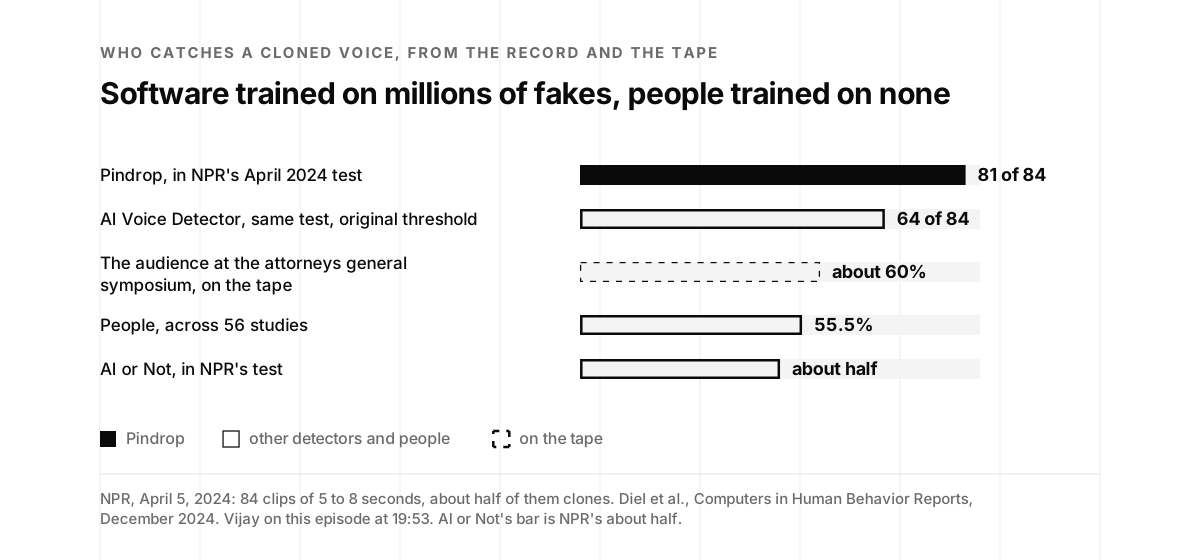
Five bars, the share of clips identified correctly. Pindrop in NPR's April 2024 test, 81 of 84. AI Voice Detector in the same test at its original threshold, 64 of 84. The audience at the attorneys general symposium, about 60 percent, on the tape. People across 56 studies, 55.5 percent. AI or Not in NPR's test, about half.
Software trained on millions of fakes, against people trained on none. Sources: NPR, April 5, 2024. Diel et al., December 2024. Vijay on this episode at 19:53.

A warranty that works like a bug bounty

The report came with something I hadn’t seen a detection vendor do: a warranty. Pindrop called its Pulse Deepfake Warranty “the first-of-its-kind.” It reimburses customers for certain losses from synthetic voice fraud that its products miss on eligible calls, at no extra cost for customers on a standard three-year subscription to Pulse, its deepfake detection product. Vijay’s line in the announcement: “We need good AI to beat bad AI” (MarTech Series). On the tape he explained why a company would sign up to pay for its own mistakes.

“But the point is, any security vendor who says they’re 100% sure of their capabilities is lying, right? And so we know there are going to be situations where we’re going to get beaten. We’re going to pay out a warranty as a result of that.”

Vijay Balasubramaniyan, at 22:40

Listen · Vijay on episode 57, from 22:58
About 34 seconds: why a vendor that claims 100 percent is lying, and what a payout teaches. The clip stops on its own. Read the full transcript.

Every payout is a missed fake with a dollar figure attached, which is exactly the sample a detection team most wants to study, and “the warranty serves almost like a bug bounty program for us.” I put it the way a customer would: “you’re going to put your money where your mouth is, and you have your customers’ back.” It’s a question worth asking any vendor whose product is a score. What do you pay when the score is wrong? A vendor that has priced its own misses has measured them, and a vendor that hasn’t is asking you to carry all of the risk.

Being human again

I asked what success looks like, and Vijay’s answer was not about Pindrop at first.

“Yeah, so you know, one of the things that we’ve always been excited [about] is a future where we get to being human again.”

Vijay Balasubramaniyan, at 23:53

Pindrop’s offices are close to Georgia Tech, and walking those streets now, he sees people buried in their phones, on collision paths, surprised at the last second by “the real world.” His hope is that the interfaces we invented because computers couldn’t handle our natural abilities, the keyboard and the mouse, give way to talking. The moment that convinced him came from a customer who wanted everyone at his company to have a vocal password. Vijay asked why, since nobody talks to their computer, and the customer pointed out that he spends eight hours a day on conference calls.

“So all it requires is a paradigm shift where, as I’m speaking, it naturally authenticates me and identifies me.”

Vijay Balasubramaniyan, at 23:53

He wants Pindrop to be “that security solution that makes us human,” which means two checks at once: that the voice belongs to you, and that it isn’t a machine pretending to be you. I pointed out that the talking computers are already here, ChatGPT and its peers answering at a depth Alexa and Siri never reached, and asked the obvious product question.

“So is there an app in the Zoom store that I can download, and it’s going to continuously do a background verification on all of the participants in the video?”

Jon McLachlan, at 26:37

“Yeah, that is the next frontier, right?” It arrived. Pindrop describes its own path as contact centers first, then audio deepfake detection in 2024, then meeting deepfake detection in 2025 (Pindrop). Pulse for Meetings was named one of TIME’s Best Inventions of 2025, and in March 2026 Pindrop put real-time deepfake detection and identity verification into Zoom Contact Center (Pindrop newsroom). Not quite the app in the Zoom store I asked for, but close enough that I’m counting it.

Vijay with Okta's Todd McKinnon on the a16z Podcast, published on January 1, 2019, about 30 minutes. His line in the description: "You have to make security more useable." Watch on YouTube.

Five seconds of a TikTok

Pindrop has always sold to enterprises, banks, insurers and health care companies. The future Vijay wants includes the people those companies serve, and the scam he described is the reason.

“And they’ve become so programmatic at this right now that attackers are focusing on a county, attacking all the elders in that county, and then they’re attacking them over Friday, Saturday, Sunday.”

Vijay Balasubramaniyan, at 27:06

It is the grandparent scam, a call from a grandchild in trouble asking for a wire, and by his account local police start Monday with seven elders in one county out anywhere from $20,000 to $200,000 each. The grandchild’s voice is the easy part. A teenager has a TikTok video that’s 10 seconds long, he said, “a lot of these voice cloning apps require five seconds of your audio to completely impersonate you.” Protecting those calls means working with carriers and handset makers, “and that’s not an easy linear path, man.”

A year after we recorded: minutes to make, and nobody too senior to be cloned. View on X.

For the founders listening, I pointed out that a lot of Pindrop’s business comes from rules banks already live under, like know your customer, and Vijay agreed and said the same expectations will have to reach communications, because “I have seen really strong, even security professionals, [fall victim] to social engineering.” The reason is the best thing about people. When someone we love calls in trouble, we want to show up for them. A technology that quietly answers human or machine, and green lights the human, lets us keep doing that. We also took a short detour into Blade Runner and killer robots, which Vijay, who once shared a panel with the chief executive of Boston Dynamics, waved off: “And so this notion of killer robots is like super far-fetched.” Software is moving fast, and hardware is still hard.

Writing code, fighting crime

I asked for the best day he’s had at Pindrop. It was a customer day, when a customer came in and described one of Pindrop’s alerts, the red or green an agent sees on a call. On a Saturday, an account came up red. The agent sent the call to a fraud analyst, who shut it down and called the customer, whose identity had been compromised so thoroughly that the fraudster knew all the answers. She had been born in [1930], and the account held her retirement savings, about $90,000. The analyst reassured her that even at zero she’d have been covered up to $250,000.

“And she was like, you’re saying that, but if it had gone down to zero, I’d have had a heart attack, because my husband’s no more, and I wouldn’t know what to do.”

Vijay Balasubramaniyan, at 32:03

Listen · Vijay on episode 57, from 32:38
About 35 seconds: a red alert on a Saturday, and why a reimbursement isn't the same as being protected. The clip stops on its own. Read the full transcript.

Pindrop keeps a Slack channel called Customer Anecdotes for stories like that, a retirement, someone’s school tuition, a 529 college savings account, an insurance agent’s $32 million book of business. That day produced a company t-shirt: “writing code, fighting crime, hell yeah.” My confession on the tape was that I’d make a horrible chief executive of a company like that, “because I would just want to give it away for free to everyone, immediately, all of the time, everywhere.” His answer was the practical one: hiring the people who build it takes revenue.

One in four customers, dollar weighted

Then I asked for the hardest day, and he told me about the year he thought he’d lose the company. Pindrop’s first customers were big banks, insurers and health care providers, and in 2011 and 2012 they wanted everything on their own premises, so until 2018 Pindrop was largely an on-premises company. When Amazon launched Amazon Connect, its cloud contact center, Vijay saw the cloud arriving and moved. The problem was the audio. Getting sensitive call recordings from a customer’s phone system into Pindrop’s cloud depended on carriers and on mechanisms that were still new, and customers didn’t trust the security of their calls in transit.

“So we had a churn rate of one in four customers, dollar weighted, leaving Pindrop.”

Vijay Balasubramaniyan, at 34:40

That was 2020, with the pandemic on top of it, and he did the math out loud: “Like, I thought we were going to die, right? Because if you think about it, right? If one in four customers that you sign up are leaving, you’ve essentially cut off any new thing coming.” I said it the way an investor would, “25% growth rate just to maintain flat, flat line,” and he finished the thought.

“Even if you’re growing at 25%, you’re growing at zero then, because you’ve lost all of those customers to churn.”

Vijay Balasubramaniyan, at 36:35

The way out was a huge investment in security. The audio had to be encrypted end to end, and the carriers had to build encrypted links between the customer and the cloud, because otherwise “I don’t want some third-party box sniffing sensitive traffic on my networks, right?” Every call carries passwords, Social Security numbers and secret answers, so the encryption had to come from the right parties, the carriers and the contact center platforms. “And that required the entire industry to mature up.” When we spoke, Pindrop’s churn was 4 percent, against what he called an industry best practice of under 10.

This is the part of the episode I’d send to founders who think of security as a cost. Pindrop’s product worked. What customers left over was whether they could trust how their data got to it. Security was the churn, and security was the fix, and the calculator below puts your own numbers on the same math.
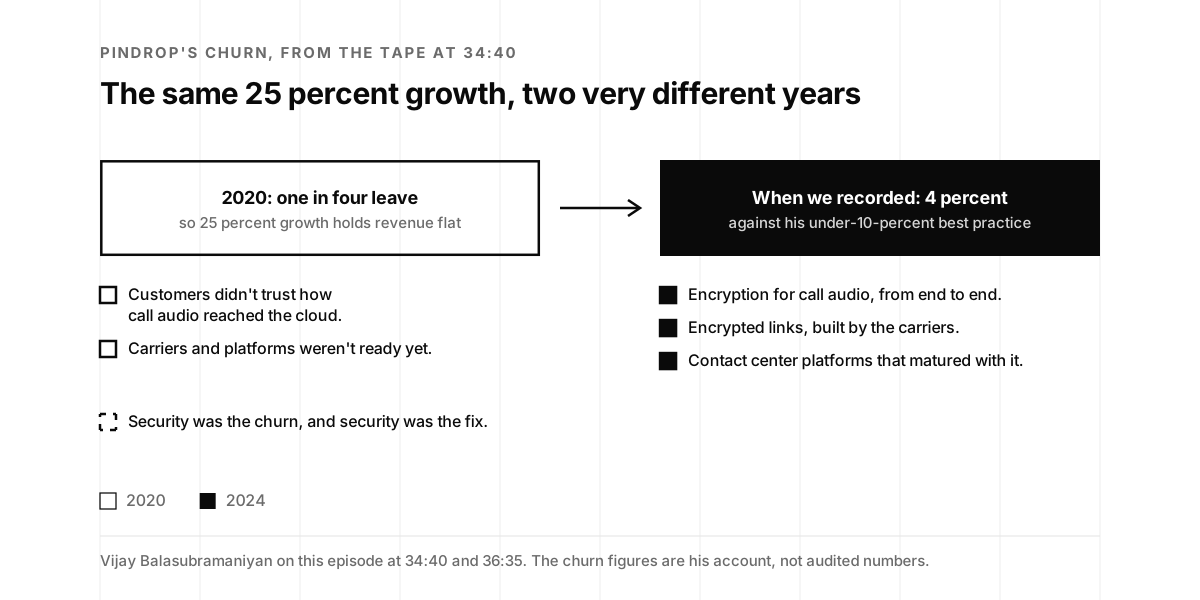
Two boxes joined by an arrow. On the left, 2020: one in four customers leave, dollar weighted, so 25 percent growth only holds revenue flat, because customers didn't trust how call audio reached the cloud and carriers and platforms weren't ready yet. On the right, filled, when we recorded: 4 percent churn, against his under-10-percent best practice, after encryption for call audio from end to end, encrypted links built by the carriers, and contact center platforms that matured with it. Below: security was the churn, and security was the fix.
The same 25 percent growth, two very different years. Source: Vijay on this episode at 34:40 and 36:35. The figures are his account.

A more measured CEO

“But it was baptism by fire.” That was when Pindrop went through layoffs, and he described the worst day, before the pandemic had quite hit, when about 15 percent of the company had to go. He told his head of human resources that he would walk everyone out himself, and he did, over two days, every hour. Some people shouted and some cried.

“And the worst were people who didn’t say a word, because at Pindrop, we have one in four employees as PhDs.”

Vijay Balasubramaniyan, at 38:00

They were people who had never failed at anything, told they were out of a job for no fault of their own, and he kept telling them it wasn’t their fault. “It was the worst experience, but it, it taught me how to be a more measured CEO.” Several of them came back a year to 18 months later, he said, because of the promise he made on the way out: “I’m going to do everything to find you a job.” I told him the thing I believe about running a company, “a loyalty to people, not to companies,” and he agreed that a company is the people in it.

Out-hire, out-innovate, or out-execute

I asked what he’d tell a younger Vijay. He had a mental model ready.

“Like, one of the things I’ve realized is, most problems, you either out-hire, out-innovate, or out-execute your way out of a problem. And you have to decide which is it, right?”

Vijay Balasubramaniyan, at 41:49

His examples are the company’s history. Engineering buried in debt, without the right cloud skills, is a hiring problem, so hire the right head of engineering. A crazy competitor is an execution problem. A brand-new cloud where nobody has figured out how to move sensitive call audio in real time is an innovation problem, which is the hardest day above, solved. Early on, he said, he had no models at all, and would “let’s throw whatever on the wall and see what sticks.” The three-way question is a good one to keep on a sticky note. Most of the time, a problem only looks unsolvable until you’ve decided which kind it is.

Security for my kids

My last question was the one for the entrepreneurs listening: what would you pay for that nobody has built? Vijay didn’t hesitate. “Yeah, it’s security for my kids.” Social media and a browser in everything have opened horizons for his son in good ways and bad, and he wants a security company to help with the bad ones.

“I want him to be a kid first, and not have to grow up to be an adult too quickly.”

Vijay Balasubramaniyan, at 44:22

He’d looked at what exists, and his review was polite: “nothing’s great yet. Nothing hits the spot quite yet.” Two years later he brought parenting to a different problem. At TEDxAtlanta in October 2026, he talked about building trust between people and AI agents, and how it can borrow from “the oldest trust building mechanism that humans have: Parenting” (LinkedIn). The father who wanted his son to stay a kid a little longer now argues that raising agents with values is how we’ll learn to trust them.

What happened after the tape

Pindrop’s public record from the summer of 2024 to the start of November 2026, in order.

  • July 17, 2024: $100 million in debt. Financing from Hercules Capital, with Pindrop saying it had analyzed 5.3 billion calls and detected 104 million spoofed ones (Help Net Security).
  • October 30, 2024: this episode, the same day as the post from the New York Stock Exchange above.
  • 2025: meetings. Meeting deepfake detection joined the contact center and audio products (Pindrop), and on November 19, 2025, Pulse for Meetings was named one of TIME’s Best Inventions of 2025 (Pindrop newsroom).
  • November 26, 2025: retail. Vijay told Axios that three in ten attacks on major retailers were AI-driven.
The retail fraud that had quadrupled by the 2024 report, now with bots making the calls. View on X.
  • February 2026: more platforms. Fraud and deepfake defense inside NiCE CXone, and deepfake detection for health care (Pindrop newsroom).
  • March 2026: Zoom, and investigations. Real-time deepfake detection and identity verification in Zoom Contact Center on March 12, and what Pindrop called the first agentic fraud investigation product on March 17 (Pindrop newsroom).
  • April 2026: TIME. Pindrop made TIME’s list of the 10 most influential software companies of 2026, and TIME’s reason was that Pindrop’s technology “was used to authenticate footage of a real-world news event.” Pindrop’s own data in the same piece: AI attacks up 1,210 percent in 2025 (Pindrop).
  • May 21, 2026: FICO. Pindrop’s fraud intelligence on the FICO Marketplace, with an 80 percent fraud detection rate and under 0.5 percent false positives across large institutions, and about $3.5 billion in fraud losses prevented for customers through December 2025, by Pindrop’s estimate (GlobeNewswire).
  • August 19, 2026: a privacy ruling. Pindrop announced that the Third Circuit had ruled it qualifies as a financial institution under the Illinois Biometric Information Privacy Act (Pindrop newsroom).
  • September 2026: agents on the phone. Pindrop says it detected calls from Meta’s Muse agent voices on September 9, a week before Meta announced its outbound calling beta.

Pindrop detected Meta's Muse AI agent before Meta even announced it.
On September 9, Pindrop detected the first calls from Muse's AI voices, Brett and Hailey, across our customers' contact centers. Meta didn't publicly announce its outbound calling beta until September 16.

This was effectively a zero-day detection. A new AI agent entered the ecosystem, and Pindrop was already identifying it without waiting for a public launch or a known threat signature.

And it wasn't an isolated event. Within four weeks, weekly Muse call volume had grown 8x. These agents were calling banks, healthcare organizations, and retailers, navigating IVRs and reaching human operators.

Vijay Balasubramaniyan · October 10, 2026
Giraffe Man's lesson, applied to a new kind of caller: the voice tells you what made it. Across 727,000 AI agent interactions, Vijay wrote, Pindrop classified 94 percent as good and 6 percent as bad. View on LinkedIn.
  • September 16, 2026: BotStopper. A product that tells within about two seconds whether a caller is human or machine, and recognizes known AI agents through a registry of more than 5,000 AI voices. Pindrop said one Fortune 500 health care deployment cut bot activity by 94.3 percent in under four months, and that AI-powered attacks had risen nearly 1,680 percent since late 2024 across more than 700 million customer interactions (GlobeNewswire).
  • September 28, 2026: a survey. Of 250 U.S. security leaders at companies with 1,000 or more employees, 74 percent had encountered or suspected a deepfake attack in the past year, and 10 percent had purpose-built tools for it, in a Wakefield Research poll for Pindrop (GlobeNewswire).
  • October 2, 2026: TEDxAtlanta, on trust between people and AI agents (LinkedIn).
  • October 28, 2026: CFX. Vijay’s keynote at Pindrop’s customer conference, and the same day, a post about two new voice models, Meta’s Muse and Block’s Dessa, both detected with “Zero changes to our detection model” (LinkedIn).
Vijay's CFX 2026 keynote, published by Pindrop on October 28, 2026, about 16 minutes: identity when AI agents are part of every customer interaction, and how to tell who, or what, is on the line. Watch on YouTube.
  • October 29, 2026: the World Economic Forum. Pindrop joined as a Global Innovator, working with the Forum’s Centre for Cybersecurity (LinkedIn).
  • November 2, 2026: hiring. Vijay shared what Pindrop sees in job applications across its customers, with Axios.

$6.3 billion. Stolen in just 20 minutes.

North Korean hackers are operating at an extraordinary speed and scale. Social engineering, automation, and increasingly accessible AI tools are fundamentally changing the economics of cybercrime.

But what concerns me most isn't just the size of this heist. It's how North Korea is industrializing cybercrime, and how the same tactics are being used to infiltrate organizations from within.

I spoke with Sam Sabin at Axios about this growing threat and what we're seeing firsthand at Pindrop.

🚨 Last year, 1 in every 343 job applications we analyzed across our customer base was linked to North Korea. This year, that number has jumped to 1 in 47. A whopping 7x increase!

Vijay Balasubramaniyan · November 2, 2026
The interview is now a phone call too, and the same question applies: who is really on the other end? View on LinkedIn.

Read in order, the record is the 2010 paper’s question asked of every new kind of caller. First it was which network a call crossed, then whether the voice was the account holder, then whether it was a person at all, and now which agent is calling, for whom, and what it should be allowed to do. Vijay’s posts this fall put it in three phrases, the Right Identity, the Right Intent and the Right Action (LinkedIn). That is a good checklist for any company whose phone rings.
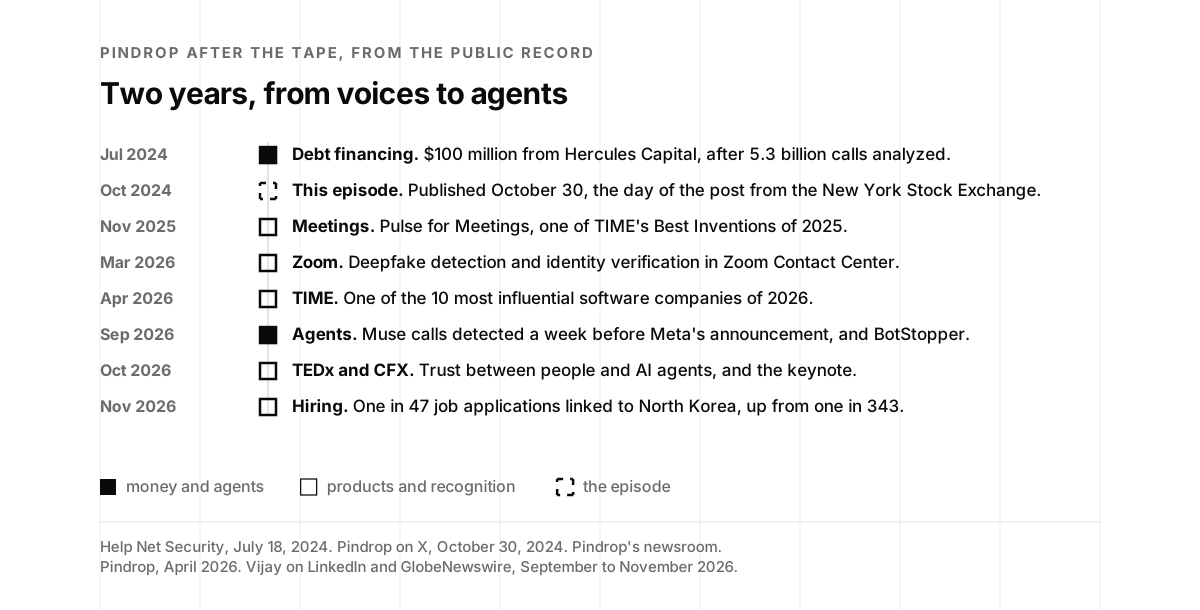
A timeline of eight entries. July 2024, 100 million dollars in debt financing from Hercules Capital, after 5.3 billion calls analyzed. October 2024, this episode, published October 30, the day of the post from the New York Stock Exchange. November 2025, Pulse for Meetings, one of TIME's Best Inventions of 2025. March 2026, deepfake detection and identity verification in Zoom Contact Center. April 2026, one of TIME's 10 most influential software companies of 2026. September 2026, Muse calls detected a week before Meta's announcement, and BotStopper. October 2026, TEDxAtlanta on trust between people and AI agents, and the CFX keynote. November 2026, one in 47 job applications linked to North Korea, up from one in 343.
Two years, from voices to agents. Sources: Help Net Security, Pindrop, TIME, GlobeNewswire, LinkedIn.

Did you catch it? A six-question quiz

Interactive · six questions

Did you catch it?

Pick an answer for each, then check. Every answer is on the tape.

  1. Besides a security person, what does Vijay call himself?

    1. A voice person
    2. A math person
    3. A product person

    a. "I think of myself as a security person and a voice person." Transcript, 0:48.

  2. What are the conference rooms at Pindrop named after?

    1. Pindrop's first customers
    2. Bad actors Pindrop has caught
    3. Famous phone hackers

    b. "every conference room is named after a bad actor that we've caught." Transcript, 15:11.

  3. Why is one fraudster called Giraffe Man?

    1. He only called at night
    2. He used a giraffe as his profile picture
    3. His audio could only have come from someone with a seven-foot neck

    c. "the only person who could have produced this audio is someone with a seven-foot-long neck" Transcript, 15:11.

  4. Whose tool did Pindrop find behind the Biden robocall?

    1. ElevenLabs
    2. PlayHT
    3. Lyrebird

    a. "And we were the ones who discovered that it was ElevenLabs that was used to create Biden's deepfake." Transcript, 15:11.

  5. What does Vijay say Pindrop's deepfake warranty works like?

    1. Cyber insurance
    2. A bug bounty program
    3. A money-back guarantee

    b. "the warranty serves almost like a bug bounty program for us." Transcript, 22:40.

  6. Vijay's mental model: most problems, you out-hire, out-innovate, or what?

    1. Outlast them
    2. Outspend them
    3. Out-execute your way out of them

    c. "most problems, you either out-hire, out-innovate, or out-execute your way out of a problem." Transcript, 41:49.

Would a cloned voice get through your phone lines?

Most startups don’t run a contact center, and most of them still have a phone number that resets passwords, changes bank details or moves money for someone who sounds right. This scorecard asks eight questions about yours, from what the line reveals before anyone is verified to what happens when an AI agent calls for a customer.

Scorecard · eight questions

Would a cloned voice get through your phone lines?

Answer for every number a customer, an employee or a vendor can call, including your own help desk. If two answers fit, pick the lower one.

  1. Before a caller is verified, what will your phone line confirm?

    • Whether an account exists, and sometimes more
    • Nothing by policy, though agents sometimes slip
    • Nothing, and the system enforces it

    This is how a stolen Social Security number finds its bank. Welcome back, John has Vijay's version.

  2. How does someone on your line verify a caller?

    • Personal details or security questions
    • A one-time code by text message
    • A prompt in your app, or a key on a registered device

    There were 3,205 data compromises in the U.S. in 2023, and the answers to those questions are in them.

  3. Can one phone call change where money or codes go: a new phone number, email or bank account, a password reset, a new sign-in device?

    • Yes, on the same call
    • Yes, after a callback or a waiting period
    • No, those changes need the registered device or the app

    That change is what a cloned voice is calling for.

  4. Do you notice when one caller asks about many different accounts?

    • No
    • Only in a later review
    • Yes, it's flagged while the calls are happening

    Pindrop names its conference rooms after callers like that. Giraffe Man is one.

  5. Does a matching caller ID skip any step?

    • Yes
    • It's one signal among several
    • No, caller ID is a claim we check

    Where a call really came from was the question in Pindrop's first paper.

  6. Is anything listening for a synthetic or replayed voice?

    • No
    • Agents are told to listen for it
    • Calls are scored for it, and the agent sees the score

    Across 56 studies, people spot deepfakes about 55 percent of the time. Listening harder isn't a plan.

  7. What happens when an AI agent calls on a customer's behalf?

    • We wouldn't know it was an agent
    • We treat it like any other caller
    • We can tell, and a written rule says what an agent may do, and for whom

    Vijay's three questions for agents: which one is calling, who it represents, and what it should be allowed to do.

  8. When someone on your line flags a call, what happens next?

    • They finish the call and move on
    • They note it in the ticket
    • Someone investigates the same day, and the customer gets a call from a number they know

    That is the Saturday in Vijay's best day.

Start with what the line will say

A line that confirms an account exists, verifies with personal details and lets one call change a phone number is the standard setup, and every part of it is fixable. Start with the first two: confirm nothing until the caller is verified, and verify with something they have, a prompt in your app or a registered device. Then move phone number, email, bank and password changes behind that same step.

Harder to fool, with a few doors left

The basics are in place. The next layer is noticing patterns: one caller asking about many accounts, a synthetic voice, an AI agent calling for a customer. Score calls for liveness, write the rule for agents, and send every flagged call to a person who looks the same day.

A hard target on the phone

Your line verifies with something the caller has, keeps account changes off the phone, notices patterns and has a rule for agents. Rehearse it once with a cloned voice, with permission, the way Pindrop did with New Hampshire's attorney general, and write down what got through.

What does a trust problem cost your growth?

Vijay’s hardest day was arithmetic: when one in four dollars of customers leaves every year, 25 percent growth only keeps you where you are. This calculator runs the same math on your numbers, and shows what bringing churn down is worth.

Calculator

What does a trust problem cost your growth?

Your recurring revenue today, the new revenue you'll book this year, the share of revenue that leaves in a year, and the churn you could reach if customers trusted how you handle their data.

–net growth this year
–revenue that leaves in a year
–revenue a year from now
–kept every year at the lower churn

With 25 percent new revenue and 25 percent churn, you grow 0% this year: $1,250,000 of revenue leaves, and you finish the year at $5,000,000. At 4 percent churn, you'd keep $1,050,000 more every year.

The 25 percent default is Pindrop's dollar-weighted churn in 2020 by Vijay's account on the tape, and 4 percent is where he said it was when we recorded. His under-10-percent best practice is his figure, not a benchmark we checked, and the $5 million is a placeholder. By his account, what moved Pindrop's number was security its customers could trust: encryption from end to end, carriers and contact center platforms that matured with it, and a huge investment in getting it right.

From call provenance to agent calls

Everything on this page sits on one timeline, from the first paper to the AI agents on the phone. Filter it by thread.

Timeline · 2002 to 2026

From call provenance to agent calls

Filter by thread. Dates are from the public record except where marked as Vijay's own account on the tape.

  1. Intel

    Software engineer, on voice for landline switches by his account (LinkedIn).

  2. The language of an encrypted call

    Wright, Ballard, Monrose and Masson, 66 percent across 21 languages (USENIX).

  3. Telineage

    A Georgia Tech VentureLab project with Mustaque Ahamad (Wikipedia).

  4. PinDr0p

    Call provenance at ACM CCS, 91.6 percent through as many as three providers (Business Wire).

  5. Pindrop

    Co-founded in Atlanta with Paul Judge and Mustaque Ahamad (LinkedIn).

  6. Words from an encrypted call

    Hookt on fon-iks, with a linguist among the authors (IEEE).

  7. About $1 million

    The first round, from Andreessen Horowitz and others (Wikipedia). Six months to raise, by his account.

  8. An $11 million Series A

    Led by Andreessen Horowitz and Citi Ventures (Wikipedia).

  9. $35 million

    A Series B led by Institutional Venture Partners (Wikipedia).

  10. The first deepfake patents

    Years of deepfake work before it was hot.

  11. $75 million

    A Series C led by Google Capital (Wikipedia).

  12. $90 million in six weeks

    A Series D led by Vitruvian Partners, with eight of the ten largest U.S. banks as customers (Pulse 2.0).

  13. One in four customers leave

    Dollar weighted, until call audio could reach the cloud securely.

  14. Test of Time

    ACM CCS honors the PinDr0p paper (Business Wire).

  15. Roadrunner

    Three lines in Anthony Bourdain's voice were generated with AI (NPR).

  16. Aaron Painter on this show

    Nametag, on redefining authentication (episode 19).

  17. A robocall in Biden's voice

    To New Hampshire Democrats before the January 23 primary (NBC News).

  18. ElevenLabs, 99 percent likely

    Pindrop's analysis against 122 text-to-speech systems (Pindrop).

  19. 3,205 data compromises

    A 78 percent jump in 2023, a record (Cybersecurity Dive).

  20. Traced to Texas

    Life Corporation and Lingo Telecom (Engadget).

  21. 81 of 84

    NPR's test of three deepfake detectors (NPR).

  22. The report, and a warranty

    60 percent more contact center fraud in two years, and the Pulse Deepfake Warranty (MarTech Series).

  23. $100 million in debt

    From Hercules Capital (Help Net Security).

  24. Episode 57 airs

    This conversation, the same day as the post from the New York Stock Exchange.

  25. Ben Colman on this show

    Reality Defender, on fighting deepfake fraud (episode 71).

  26. A TIME best invention

    Pulse for Meetings (Pindrop newsroom).

  27. Zoom

    Deepfake detection in Zoom Contact Center (Pindrop newsroom).

  28. Jasson Casey on this show

    Beyond Identity, on why the real problem is identity (episode 92).

  29. One of TIME's ten

    The most influential software companies of 2026 (Pindrop).

  30. Muse, a week early

    Calls from Meta's agent voices before the announcement (LinkedIn).

  31. BotStopper

    Human or machine in about two seconds (GlobeNewswire).

  32. 74 percent

    Of security leaders encountered or suspected a deepfake attack in a year (GlobeNewswire).

  33. TEDxAtlanta

    Trust between people and AI agents, borrowed from parenting (LinkedIn).

  34. 1 in 47

    Job applications linked to North Korea across Pindrop's customers, up from 1 in 343 (LinkedIn).

What to do this week

Five things, in the order the episode suggests.

  1. List every decision a voice can make at your company. Password and sign-in resets at the help desk, wires, vendor bank changes, payroll changes, access granted on a call. That list is what a cloned voice is shopping for.
  2. Confirm nothing until the caller is verified. Not that an account exists, not a balance, not the last four digits of anything. That’s how a stolen Social Security number becomes a taken-over account.
  3. Verify with something the caller has. A prompt in your app or a key on a registered device, instead of questions whose answers are sitting in someone else’s breach.
  4. Write the rule for AI agents that call you. Which agent, on whose behalf, allowed to do what, and which requests still need a person.
  5. Rehearse it once. With permission, clone a willing executive’s voice and call your own line, then fix what got through. When Pindrop tried it with New Hampshire’s attorney general, 40 percent of the room guessed wrong.

Key takeaways

  1. A security person and a voice person

    Vijay worked on voice at Intel and Siemens, on voice over IP at Google, and then did his PhD at Georgia Tech on telecommunications security. That combination is the company: most security tools look at packets, files and logins, and Pindrop looks at the audio of a phone call.

  2. A call carries the networks it crossed

    His 2010 paper, PinDr0p, used the artifacts each network leaves on a call's audio, ignoring the voice itself, to trace a call through as many as three providers with 91.6 percent accuracy. It won a Test of Time award ten years later, and it's the reason caller ID can be treated as a claim and the audio as evidence.

  3. The phone call wasn't dead

    In 2011 and 2012, investors told him the phone call was dead, and his first round, about $1 million, took six months. After voice assistants arrived, Pindrop raised a $90 million Series D in six weeks, in December 2018, with eight of the ten largest U.S. banks as customers.

  4. The breach supplies the answers, the phone line supplies the bank

    Fraudsters with a stolen Social Security number call the top banks until one says welcome back, then return with the rest of the stolen answers to take over the account. Data compromises in the U.S. hit a record 3,205 in 2023, so any line that confirms an account before verifying the caller is doing the attacker's research.

  5. One deepfake a month became one a day

    In 2020 Pindrop saw about one deepfake attack a month at its customers. In 2024 it saw one a day per customer, which he described as a 450 percent increase when the first four months of the year were compared with all of the year before.

  6. Every generator leaves a tell

    Pindrop names its conference rooms after the fraudsters it catches. Giraffe Man got his name because his synthetic audio could only have come from someone with a seven-foot neck, and that kind of physical impossibility is how a detector tells a machine from a person, and one cloning tool from another.

  7. 358 ways to clone a voice

    When Pindrop first ran into deepfakes there was one voice cloning tool, Lyrebird. By the end of 2023 there were 120 apps, and by the end of March 2024, by Pindrop's count, 358, each with its own telltale signature.

  8. Pindrop traced the Biden robocall

    When robocalls in an imitation of President Biden's voice reached New Hampshire voters before the January 2024 primary, Pindrop compared the clip with 122 text-to-speech systems and named ElevenLabs, or a system built from similar components, with 99 percent likelihood. The account behind it was suspended, and a month later the man who made the audio said he had used ElevenLabs.

  9. People can't reliably hear a fake

    When Pindrop played a real and a cloned recording of New Hampshire's attorney general to an audience, 40 percent got it wrong. Vijay put human accuracy on voice at 30 percent, and a 2024 meta-analysis of 56 studies put it at 55.5 percent overall, which is close to a coin flip either way.

  10. Outside tests are worth more than vendor claims

    In NPR's April 2024 test of 84 short clips, Pindrop got 81 right, 96 percent, while another vendor got about half wrong. Pindrop's data set held 20 million deepfakes, and the red teams at its bank and insurance customers attack its models constantly.

  11. A warranty that works like a bug bounty

    Pindrop's Pulse Deepfake Warranty reimburses certain losses from deepfakes its products miss. Any vendor claiming 100 percent is lying, Vijay said, so every payout is a missed fake to learn from, and the warranty serves almost like a bug bounty program.

  12. Being human again

    His picture of success is people looking up from their phones and talking to their devices, with security that identifies them by voice while they speak and confirms there isn't a machine on the other end. Jon asked for an app in the Zoom store, and Pindrop shipped meeting deepfake detection in 2025.

  13. Security was the churn, and security was the fix

    Moving to the cloud, Pindrop couldn't yet get sensitive call audio there in a way customers trusted, and in 2020 one in four customers, dollar weighted, left. Encryption from end to end, carriers and contact center platforms that matured with it, and a huge investment in security brought churn to 4 percent.

  14. Out-hire, out-innovate, or out-execute

    Vijay's advice to his younger self is a mental model: most problems, you either out-hire, out-innovate or out-execute your way out of, and the first step is deciding which kind of problem you have.

Chapters

Tap a chapter to play from there.

Pull quotes

“I think of myself as a security person and a voice person.”

Vijay Balasubramaniyan ·

“because of the variable bit rate that a lot of these audio systems use, the length of the encryption is revealing in what you're saying.”

Vijay Balasubramaniyan ·

“Oh, the phone call's dead. Like, no one's, no one cares about a phone call.”

Vijay Balasubramaniyan ·

“And then our Series D we raised in six weeks.”

Vijay Balasubramaniyan ·

“Our brains are almost hardwired to detect sentiment that's underneath the words, that's in between the words.”

Jon McLachlan ·

“Like, our first patents on deepfakes are back in 2015.”

Vijay Balasubramaniyan ·

“because fundamentally, generative AI has brought into question what is human and what is machine.”

Vijay Balasubramaniyan ·

“In this year, every day, there is a deepfake attack per customer.”

Vijay Balasubramaniyan ·

“In fact, if you come to Pindrop, every conference room is named after a bad actor that we've caught.”

Vijay Balasubramaniyan ·

“the only person who could have produced this audio is someone with a seven-foot-long neck, and their vocal cords are thrashing between that seven feet.”

Vijay Balasubramaniyan ·

“There are 358 AI apps that you can use to clone your voice.”

Vijay Balasubramaniyan ·

“how does it feel to protect the nation's democracy?”

Vijay Balasubramaniyan ·

“Two out of three times, they get it wrong.”

Vijay Balasubramaniyan ·

“any security vendor who says they're 100% sure of their capabilities is lying, right?”

Vijay Balasubramaniyan ·

“the warranty serves almost like a bug bounty program for us.”

Vijay Balasubramaniyan ·

“a lot of these voice cloning apps require five seconds of your audio to completely impersonate you.”

Vijay Balasubramaniyan ·

“So we had a churn rate of one in four customers, dollar weighted, leaving Pindrop.”

Vijay Balasubramaniyan ·

“It was the worst experience, but it, it taught me how to be a more measured CEO.”

Vijay Balasubramaniyan ·

“most problems, you either out-hire, out-innovate, or out-execute your way out of a problem.”

Vijay Balasubramaniyan ·

“I want him to be a kid first, and not have to grow up to be an adult too quickly.”

Vijay Balasubramaniyan ·

About the guest

Vijay Balasubramaniyan, Co-founder and Chief Executive Officer, Pindrop

Vijay Balasubramaniyan is the co-founder and chief executive of Pindrop, the Atlanta company he started in 2011 with Paul Judge and Mustaque Ahamad, whose software detects fraud, deepfakes and AI agents on phone calls and in meetings for banks, insurers, retailers and health care companies. Before Pindrop he worked on voice systems at Intel and Siemens, as a research engineer at IBM Research and as a software engineer at Google, and he earned a PhD in computer science from Georgia Tech with a thesis on telecommunications security. His 2010 paper PinDr0p, which showed how the audio of a call reveals the networks it crossed, won the Test of Time award at the ACM Conference on Computer and Communications Security in 2020. He holds patents in voice over IP security and scalability and speaks often on phone fraud and deepfakes, including at RSA Conference, Black Hat and FS-ISAC.

About the host

Jon McLachlan is co-founder of YSecurity, the on-demand cybersecurity team for startups, and of Cyberbase.ai. The Security Podcast of Silicon Valley is hosted by Jon McLachlan and Sasha Sinkevich. Jon McLachlan on LinkedIn ↗

Context and sources

  • Vijay Balasubramaniyan's LinkedIn experience: chief executive and co-founder of Pindrop since April 2011, research engineer at IBM in 2010 and from 2006 to 2007, software engineer at Google in 2008, senior software engineer at Siemens from 2003 to 2005, and software engineer at Intel from 2002. Source ↗
  • USENIX Security 2018 speaker page: Vijay's PhD in computer science from Georgia Tech, his thesis on telecommunications security, and his patents in voice over IP security and scalability. Source ↗
  • RSA Conference expert page for Vijay Balasubramaniyan. Source ↗
  • Georgia Tech Computing on X, October 13, 2025: Vijay as an alumnus, PhD in computer science, 2011. Source ↗
  • Business Wire, November 13, 2020: the PinDr0p paper from ACM CCS 2010 wins the Test of Time award, with its co-authors and its 91.6 percent result. Source ↗
  • Wikipedia: Pindrop Security, on Telineage at Georgia Tech's VentureLab in 2010, the 2011 founding, the Georgia Tech Research Corporation license and the funding rounds from 2012 to 2016. Source ↗
  • Wright, Ballard, Monrose and Masson, USENIX Security 2007: Language Identification of Encrypted VoIP Traffic, with a 21-way classifier at 66 percent accuracy. Source ↗
  • White, Matthews, Snow and Monrose, IEEE Symposium on Security and Privacy 2011: Phonotactic Reconstruction of Encrypted VoIP Conversations, with an author in linguistics. Source ↗
  • Georgia Tech, August 2022: Fabian Monrose joins the School of Electrical and Computer Engineering as professor and Julian T. Hightower Chair in Cybersecurity. Source ↗
  • Pulse 2.0, December 7, 2018: Pindrop's $90 million Series D led by Vitruvian Partners, with eight of the ten largest U.S. banks and five of the seven largest U.S. insurers as customers. Source ↗
  • Startup Grind on YouTube, March 2019: What the Adoption of Voice Technology Means for Security, with Vijay and Stewart Rogers. Source ↗
  • a16z on YouTube, January 1, 2019: Making Security More Useable, with Vijay and Okta's Todd McKinnon. Source ↗
  • NPR, July 16, 2021: the Roadrunner documentary's director on three lines generated in Anthony Bourdain's voice. Source ↗
  • MarTech Series, May 22, 2024: Pindrop's 2024 Voice Intelligence and Security Report and the Pulse Deepfake Warranty. Source ↗
  • Karen Walker on YouTube, May 30, 2024: Vijay on the key findings of Pindrop's report. Source ↗
  • Cybersecurity Dive, January 25, 2024: the Identity Theft Resource Center counts a record 3,205 data compromises in 2023, up 78 percent. Source ↗
  • Pindrop on X, October 30, 2024: one attack a month for its customers the year before, one a day per customer now. Source ↗
  • Pindrop, January 25, 2024: Pindrop reveals the TTS engine behind the Biden AI robocall, by Vijay Balasubramaniyan. Source ↗
  • NBC News, February 2024: New Hampshire's attorney general on the source of the fake Biden robocalls, the Democratic voters they targeted and the 5,000 to 25,000 calls. Source ↗
  • Fortune, January 27, 2024: ElevenLabs suspends the account behind the Biden audio deepfake, and Pindrop's analysis. Source ↗
  • Engadget, February 6, 2024: the calls traced to Life Corporation and Lingo Telecom, with as many as 25,000 calls. Source ↗
  • Axios, February 25, 2024: a political consultant says he was behind the fake Biden robocall. Source ↗
  • The Boston Globe, February 26, 2024: a New Orleans magician says he made the robocall audio with an ElevenLabs voice generator. Source ↗
  • Diel et al., Computers in Human Behavior Reports, December 2024: a meta-analysis of 56 studies on human deepfake detection, 55.5 percent overall. Source ↗
  • NPR, April 5, 2024: Using AI to detect AI-generated deepfakes can work for audio, but not always, on 84 clips and three detection providers. Source ↗
  • Unite.AI, June 3, 2024: an interview with Vijay, including Pulse's 81 of 84 in NPR's test and every deepfake caught. Source ↗
  • Help Net Security, July 18, 2024: Pindrop's $100 million in debt financing from Hercules Capital, 5.3 billion calls analyzed and 104 million spoofed calls detected. Source ↗
  • Pindrop's newsroom: Pulse for Meetings among TIME's Best Inventions of 2025, NiCE CXone and health care in February 2026, Zoom Contact Center and agentic fraud investigation in March 2026, and the Third Circuit ruling in August 2026. Source ↗
  • Pindrop on X, July 16, 2025: AI scams up 900 percent in two years, from Vijay's interview with CBS News. Source ↗
  • Pindrop on X, November 26, 2025: Vijay in Axios on AI-driven attacks against major retailers. Source ↗
  • Pindrop, April 2026: named one of TIME's 10 most influential software companies of 2026, with AI attacks up 1,210 percent in 2025 by its data. Source ↗
  • GlobeNewswire, May 21, 2026: Pindrop's real-time fraud intelligence on the FICO Marketplace. Source ↗
  • Vijay on LinkedIn, October 10, 2026: Pindrop detected Meta's Muse AI agent before Meta announced it. Source ↗
  • GlobeNewswire, September 16, 2026: Pindrop launches BotStopper to detect AI voice agents for the enterprise. Source ↗
  • GlobeNewswire, September 28, 2026: a Wakefield Research survey of 250 U.S. security leaders for Pindrop, on deepfakes hitting the enterprise. Source ↗
  • Vijay on LinkedIn, September 30, 2026: his TEDxAtlanta talk on October 2. Source ↗
  • Vijay on LinkedIn, October 7, 2026: after TEDxAtlanta, on building trust with AI agents the way parents build it with kids. Source ↗
  • Pindrop on YouTube, October 28, 2026: Pindrop CFX 2026, Vijay's keynote and Pindrop's vision. Source ↗
  • Vijay on LinkedIn, October 28, 2026: two new AI voice models, two zero-day detections. Source ↗
  • Vijay on LinkedIn, October 29, 2026: Pindrop joins the World Economic Forum as a Global Innovator. Source ↗
  • Vijay on LinkedIn, November 2, 2026: job applications linked to North Korea across Pindrop's customers, from 1 in 343 to 1 in 47. Source ↗
  • Spotify: episode 57 of The Security Podcast of Silicon Valley. Source ↗

Transcript

Automatic transcription. There is no diarization on the tape, so speaker labels were assigned from the content with help from speaker-embedding labels and word-level pitch. Names and product names were normalized where the recognizer misheard them (Vijay Balasubramaniyan, Jon McLachlan, Pindrop, Georgia Tech, Roger Dingledine, Fabian, TechCrunch, Alexa, ChatGPT-4o, Lyrebird, ElevenLabs, John Formella, NPR, Siris, Blade Runner, Amazon Connect, CCaaS). Bracketed words are best guesses where a syllable was lost. Timestamps are the start of each turn to within a couple of seconds.

Read the full transcript 8,080 words

Jon McLachlan

Hello, everyone, and welcome to another episode of The Security Podcast of Silicon Valley. I'm here today with a spectacular, amazing guest, Vijay Balasubramaniyan.

Vijay Balasubramaniyan

You got it right.

Jon McLachlan

Thank you. All of the gratitude in the world. You are the CEO and co-founder of Pindrop, a security startup. Well, I mean, it was a startup, and now it's actually quite a successful, thriving business. Before then, [you were] part of IBM, you're part of Google, you're part of Intel. It looks like you did your graduate school at Georgia Institute of Technology, and I imagine that a lot of that has been focused on communications and security in general. Do you think of yourself as a security person?

Vijay Balasubramaniyan

I do, but you know, the interesting thing is I think of myself as a security person and a voice person. That's one of those strange combinations where all of my previous background, before I came to do security at Georgia Tech, and I did my PhD in security at Georgia Tech, was focused on voice. At Siemens and Intel, I was working on voice. And that time, I'm going to date myself, it was for old landline switches. And then at Google, I worked on voice over IP devices, so the more modern Google Chat, Google Hangouts. And then when I did my PhD at Georgia Tech, it was marrying that voice background with security, which is interesting, because a lot of folks in security focus on the digital side of things. Very few focus on the voice. And so that brought a very unique flavor to what I did since then.

Jon McLachlan

It's incredible. When I was in graduate school, I did graduate studies in the University of Minnesota, which is where I'm from, Minnesota. And I remember there was a research paper that came out, and it was all about, internet privacy was the big thing that I was focused on at the time. And I worked on the Tor network with Roger Dingledine, and this paper came out, and it pointed out that even with [encryption] on the line, you could distinguish which language was being spoken on top of the encrypted data flow of a digital call. I just thought that was the coolest thing in the world.

Vijay Balasubramaniyan

That's Fabian's paper. That is one of, that's an incredible paper. Fabian, I know Fabian well. He loves what we do at Pindrop. And he, for a brief moment, I think he was at Georgia Tech as well. But it's an incredible paper.

Jon McLachlan

Did you work with, you work with Fabian?

Vijay Balasubramaniyan

No, we both interacted, because he was a big fan of the Pindrop paper and what we figured out there. But you know, his paper was, again, super eye-opening, because they figured out, because of the variable bit rate that a lot of these audio systems use, the length of the encryption is revealing in what you're saying. Initially, it started off with you using, what language are people speaking? That was the first thing that they cracked. And then they started cracking words in that language. So the fact that you could encrypt something, but you're saying, how are you, you could actually crack, because voice is variable, right? And yeah, his work was incredible. But the beautiful thing, again, and this is why I love Fabian's paper: he combined with a researcher who was actually a linguist. So the researcher was a linguist, so he had all of this background in linguistics and how we say things, and that plus security made an incredible paper. And that's why I love that paper, because we have a common kinship there. I come from a very different background than security, but then made security my own, much like Fabian [had] done it with his researchers.

Jon McLachlan

Amazing. And let's give credit where credit is due. You're the co-founder and CEO of Pindrop Security. You've been doing this for all, what, 13 years now. I think that's incredible. Usually people hear co-founder and CEO. You have to put that into perspective for Pindrop, because that's a mark of success. So, congratulations.

Vijay Balasubramaniyan

Thank you. It's funny. It's obviously a great team that we've had, but we've also had a lot of incredible things go our way, right? We've had lots of things not go our way as well, but we've had a lot of things go our way, including the notion that when I started Pindrop back in 2011, 2012, I remember every time I would go try to raise a round, the common refrain was, you're doing this in voice, or does that mean a phone call? Oh, the phone call's dead. Like, no one's, no one cares about a phone call. And I remember TechCrunch articles talking about phone calls being dead. And from that point, then came the Alexa, and that created, after that, I remember it took me like six months to raise my first round. And then our Series D we raised in six weeks. And one was a million-dollar round, the other was a $90 million round. And those two things took, like, the $90 million round took six weeks. And that was largely because voice has become so important for people, because that's what makes us human. And if you look at a lot of the generative AI revolution, they talk about voice assistants being the next frontier, right? Alexa started off [with] promise, but couldn't quite, like, you can ask an Alexa for weather and stuff like that. When I had my son chat with, I had my son chat with the latest ChatGPT-4o, and he was like, initially, why am I chatting with this thing? It's like an Alexa. And I was like, yeah, but you ask your Alexa for weather and ask it to play music. Can you have a conversation? And he's like, no, I can't have a conversation. And then he had a conversation with ChatGPT-4o. And he now asks me almost every day, hey, can I have a chat with ChatGPT-4o? And I'm like, okay, I don't know where the security of this thing is, so I'm really not going to have too much of your voice out there. But the point is, he really enjoyed the conversation, and that's the future, right? So we've had a lot of great tailwinds as well. And that's why we've continued on that journey for as long as we have.

Jon McLachlan

Yeah, absolutely. I think it's one of the most natural ways that [we] communicate as humans is through our voice.

Vijay Balasubramaniyan

That's exactly right. And if you're Indian like me, you can speak a mile a minute. I have to slow myself down for a lot of these podcasts. But if I was speaking naturally, I'd be like... And the average is, you speak about four times faster than you type. So it's just, if you want to get a lot of fidelity out, as well as content out, together, that combination, voice is the natural channel.

Jon McLachlan

Well, it's just so much more rich of a communication channel as well. You get the emotion, you get the intonations. Our brains are almost hardwired to detect sentiment that's underneath the words, that's in between the words. It's mostly unspoken. It's not the semantic meaning. It's much higher level communication as well. Well, it's lost on text.

Vijay Balasubramaniyan

It is.

Jon McLachlan

You can do your [LOLs] and you can do the emojis, but those only get you so far.

Vijay Balasubramaniyan

We have a pretty big Slack culture. And so yeah, we realize there are a lot of times where we've completely miscommunicated on Slack, which completely gets fixed by a simple phone call.

Jon McLachlan

So many times something is going not the way that you expect it. A quick phone call solves all of those issues. You can feel the other person almost right there in the room with you. So share with us: how did you initially get into cybersecurity? Was there something that kind of piqued your interest, or something that happened? Is there a story there that you'd like to share?

Vijay Balasubramaniyan

Yeah, it's interesting. My brother worked in security, and when I was coming here to do my PhD, there were a lot of opportunities. Opportunities, right? Like, where do we go? But because my brother worked in security and loved it, right? And he would tell me about what an incredible cat and mouse game it is. Something that's as dynamic as security. Like, you can never say, okay, you've solved a problem, right? Like, it's always, whatever is your best solution is always going to get beaten, because you have a very smart adversary on the other end. So listening to him got me interested. And when I came to Georgia Tech, I didn't know this at that point in time, when I first started, but I started seeing what an incredible school Georgia Tech was for security. And so that combination of my brother being in security and the school that I joined being so strong in security then started saying, okay, you know what? This is a space that I need to play in. And then I met my professor, whom I did my PhD under, who was a security professor. And I can tell you how I got into the area that I got into, but that then brought the entire combination and cemented it.

Jon McLachlan

Older brother?

Vijay Balasubramaniyan

Older brother, exactly. We're all trying to emulate the best of our brothers. So, yeah, my older brother was in security. He still is.

Jon McLachlan

[Oh], he still is? Is he there? Is he there [at Pindrop] with you now?

Vijay Balasubramaniyan

No, no. Okay, all right, yeah. We have a very strong, let's not get the family involved, at least in the first gig that I'm doing, right? Because there's all of these other emotions. So yeah, we are a strict, no family involved in the company.

Jon McLachlan

That's fair.

Vijay Balasubramaniyan

No, that's that. Yep, a hundred percent.

Jon McLachlan

I mean, who knows? So maybe it, it could have been a family business too. I, you know, all of that stuff sounds good. Life is better with brothers. I have two brothers. One is a, like a brother I grew up with, a blood brother back in Minnesota, and I have a chosen family brother.

Vijay Balasubramaniyan

Nice.

Jon McLachlan

[In] California, too.

Vijay Balasubramaniyan

Have you followed anything from anything that they do?

Jon McLachlan

Oh, absolutely. Like, security, coin, all, like all of the above. So yeah. I just, I was a little bit too skeptical on the Bitcoin side to really make it count, but that's okay.

Vijay Balasubramaniyan

We look up to our brothers, and there's a lot of good there.

Jon McLachlan

We do. I happen to be an older brother, so a lot of looking up comes in this direction. But I have to share with you, even as an older brother, that a lot of looking up goes back, you know, because you just get to a point. Yeah, it doesn't matter [who's older]. So tell me about Pindrop. What do you guys do better than everyone else in the world?

Vijay Balasubramaniyan

So, you know, there's several things that we do better, but at the core of what we do, multi-factor authentication on voice channels, really well, better than anyone else. And we do deepfake detection, or fraud detection, on voice channels better than anyone else. And with respect to deepfakes, for example, we've been doing this for now eight years, way before it became hot. Like, our first patents on deepfakes are back in 2015. We are the ones who discovered the deepfakes in Anthony Bourdain's documentary two years back. So at that point in time, it was a cool party trick. And now it's become one of the biggest tailwinds for Pindrop, because generative AI, we believe that deepfakes is the next frontier for security, because fundamentally, generative AI has brought into question what is human and what is machine.

Jon McLachlan

Yeah, that's an important and very interesting question. And touching on some of the recent news, I know your team just launched a report that highlights the current state of fraud and deepfakes. Was there anything that really jumped out at you that you found surprising, or

Vijay Balasubramaniyan

Yeah, there's several things that jumped out [at] us. One is, in general, because we play in voice, just the massive increase of fraud coming in the voice channel. So over the last couple of years, it's grown by 50%. And a large reason for this is a lot of fraudsters who used to get easy money back in the day from PPP loans and unemployment now don't have the government giving you free money. So they're trying to figure out ways in which they can steal money, and social engineering people is one of the easiest ways to make money. And so we're seeing a massive increase in fraud across a whole bunch of verticals. But combine that with just the number of data breaches that have happened, they are using the call center to actually estimate a lot of information that they get from the data breaches. And what I mean by that is, hey, I have a Social Security number, but I don't know that Social Security number. I know that Social Security number belongs to John, but I don't know where does John bank with, where does he have his healthcare records. And so being able to use the call center to say, punch it in into all of the top ten banks, and if one of them say, welcome back, John, your account balance is so on and so forth, I can then go ahead and know John banks with bank number one, and then take over his account. So we're seeing the data breach world, and the data breach world itself is crazy, because data breaches have gone up by 78%. There have been 3,000 data breach incidents in 2023, and there were 1,800 in 2022. So that combination of data breaches and the influx in contact center of voice fraud is one big finding. The second finding is the sophistication of attackers using generative AI. Back in 2020, we used to see one deepfake attack a month at our customers. So it used to be one a month, and we'd look at it, we'd thwart it. In this year, every day, there is a deepfake attack per customer. So that number has gone from one a month [to] one a day per customer. So what that means is a 450% increase in the number of deepfake attacks just in the first four months. And the year is not even over, right? The 450% is if you compare just the first four months with all of last year. And so that's the second big thing, that fraudsters are using deepfakes and generative AI to create their attacks, or to increase their sophistication, in a level of scale that we've not seen before. And so that's the second big [finding]. Let me pause. Any questions on either of these findings?

Jon McLachlan

No, that's incredible. I was just going to ask if Pindrop has the ability to detect which model, or maybe like models, are being used to generate these things? If you can identify, hey, all of these are coming from the same place, and then all of these other ones are also, look like they're coming from the same place, maybe because they have similar [finger]print of some kind.

Vijay Balasubramaniyan

Yeah. No, that's exactly what we do. One of the things that's really powerful at Pindrop is we have the world's largest consortium of these bad actors. In fact, if you come to Pindrop, every conference room is named after a bad actor that we've caught. So we have, yeah, we have Pepe and Chicken Man and Giraffe Man. Giraffe Man is a fraudster. He uses generative AI. And the reason he's called Giraffe is when we analyze his audio, we analyze his audio and we're like, okay, the only person who could have produced this audio is someone with a seven-foot-long neck, and their vocal cords are thrashing between that seven feet. And so that's why he's called Giraffe Man, because there's no human who could have that anatomy. But what ends up happening is, because we have this consortium, we're not only able to identify, okay, which, where are these fraudsters coming from? So are they coming from West Africa or Eastern Europe or Philippines or things like that? But we're also able to identify the tools that they're using. And this is where it's incredible. Two years back, when we were detecting the deepfakes in these occasional events that would happen, there used to be one voice cloning software. It used to be the software called Lyrebird. At the end of last year, there were 120 AI apps that you could use to clone your voice. And by March, by the end of March this year, the research team gave me the number. There are 358 AI apps that you can use to clone your voice. There's an explosion of these systems that fraudsters can use. But one other cool thing that we can do at Pindrop is identify which AI app was used to clone a voice, because each of these AI apps leaves behind a telltale sign of how inhuman they are. And we saw this in live action. So I don't know if, President Biden was impersonated in a deepfake in the Republican primaries, asking Republicans not to vote, right? So the first case of election interference. And we were the ones who discovered that it was ElevenLabs that was used to create Biden's deepfake. And then ElevenLabs saw our blog and then shut down the actor who actually was perpetrating this attack. And then a month later, it came out. He said, yeah, I was using ElevenLabs. But we were the ones who actually discovered the app. But a big part of what you say is not only identifying which attackers are coming, where they are coming from, but now, more recently, what AI app are they using? So that AI application, if they didn't know that they were being used to perpetrate fraud, they can go shut down these accounts and things like that.

Jon McLachlan

That's a great public service as well. Thank you. There's no reason that you have to scan the web for deepfakes and alert the public when it impacts things like our democracy. Right. But they're doing it anyway.

Vijay Balasubramaniyan

Yeah, we felt we had to do it, because we were worried. That was the first case of election interference, and it happened in an election year, in January, right? Like, it didn't even take the first month to happen. And it's been incredible, because that's then allowed us to interact with the New Hampshire Attorney General, who had to handle this. And so we've gone and spoken to all of the attorney generals on how they have to be prepared. We're going to go speak at the Secretaries of State conference. But we think this is important, right? And this is where, right, like the Pindrop mission has continued to grow, right? Like, originally it was catching fraud and protecting people's bank accounts. But one of the things that the New Hampshire AG said is, how does it feel to protect the nation's democracy? And he meant it as a thank you to us and the incredible team at Pindrop. But this is what I remind folks at Pindrop, right? Like, what we're doing, our mission has constantly grown. And it's just incredible to be part of Pindrop because of this wonderful mission that we have.

Jon McLachlan

No, that's incredible. And thank you. Great. Yeah. For all the skeptics out there, do you, I mean, this is maybe a little bit of a leading question for you, too. I could imagine maybe some people have bumped into some deepfakes and maybe could claim, oh, I could detect that. Oh, like a human should be able to notice, like, this is an inconspicuous voice, or whatever, or very subtle, like something feels off or feels funny. Is there, are there studies out there that compare the detection rates of Pindrop's detection versus just a human being asked to distinguish between fake and real voices?

Vijay Balasubramaniyan

Yeah, I do. New Hampshire, we were at the Attorney General Symposium, and so with Attorney General, the New Hampshire Attorney General John Formella, we took his permission and created two versions of him: one, something that he actually said, and the other, which was a version of deepfake. And if you're interested, outside this podcast, I'll play it to you and see whether you can check what is real and what is a deepfake, for the deepfake challenge. Yes, yes. If you're interested, I can play it to you right now and you can see if you can detect it yourself. But 40% of the people in the audience got it wrong. And one of the things is, when studies have been done on humans and their ability to detect deepfakes, in particular, it depends on the medium, but on voice, they have an accuracy of 30%. So, really poor. Two out of three times, they get it wrong. Pindrop's accuracy, on the other hand, is like 99%, with 1% false positives. And the interesting thing is, that's just not our claim. We had this NPR reporter who took different clips, and each of them are like five seconds long, so really small clips as well, ran through a whole bunch of deepfake detection vendors who claimed 90% plus accuracy. We ended up in that study at 96[%] accuracy. So we're the only ones in that study who actually claim a 90% plus accuracy and actually ended up having one there. The next closest vendor got half of the deepfakes wrong.

Jon McLachlan

So 50% accuracy right here.

Vijay Balasubramaniyan

Exactly. And that's the thing, right? Like, and a part of this is because we've been doing this for so long that our deepfake detection data set is now 20 million strong. Like, we have a deepfake detection data set that's 20 million strong. We have fakeprints of about 350-plus AI apps. So we have been doing this for a really long time, and we now have to protect eight of the top ten banks, five of the top seven insurances. Their red teams constantly are trying to beat our systems. So, over time, we've built up our accuracy, and we've learned what attackers do with all of what they throw at us on a daily basis. We are pretty proud of our accuracy, but it is really hard for a human to detect this. It is damn near impossible.

Jon McLachlan

Yeah, that's the gist that I have gathered too. And that's great that you've set up a feedback cycle where you're protecting customers, you're protecting real people, things that matter. And from that protection, you're actually getting exposure to the latest and greatest threats out there, which feed back into improving the detection mechanism even more.

Vijay Balasubramaniyan

So yeah, it's one of the reasons we introduced a deepfake warranty as well, right? One of the big things is, one, we are very confident of our accuracy. That's why we don't think the warranty is going to be invoked as often, right? But the point is, any security vendor who says they're 100% sure of their capabilities is lying, right? And so we know there are going to be situations where we're going to get beaten. We're going to pay out a warranty as a result of that. Now, that's going to be, to your point, the incredible loop by which we learn, oh my God, we got beaten? So we need to get better, and then we improve. And that's the way to incent everyone, such that we continue to keep ahead, while at the same time, the warranty serves almost like a bug bounty program for us.

Jon McLachlan

Yeah, that's incredible. So anything that does maybe slip through, you're going to put your money where your mouth is, and you have your customers' back. I think that's perfect. If you fast forward into the future, and I'll let you decide how much into the future we would like to time travel here, but what does success look like for you and your team at Pindrop?

Vijay Balasubramaniyan

Yeah, so you know, one of the things that we've always been excited [about] is a future where we get to being human again. We at Pindrop, right, like, we have offices really close to Georgia Tech. When I walked down the streets at Georgia Tech now, as compared to when I was going to school, and even when I went to university, there's a very different thing, in the sense most people are buried in their phones. They're not even looking up. Like, and I often see people on collision paths with each other, and at the last minute, they're like, oh, shucks. And, oh no, the real world is bumping into me. Oh, a human. Oh, no. Yes. And so the thing is that I'd love people to start looking up, right? And start [being] more human. And I think a big part of being more human is a lot of the interfaces that we created, because you couldn't quite capture our God-given capabilities as well with algorithms, go away, right? Like, we have the keyboard, we have the mouse, we have all of these things. Zoom and conferencing has brought them back in a big way, right? Like, I was talking to one of our customers, and he was like, hey, I'd like to start having everyone have vocal passwords. And I was like, why would you do that, right? I don't speak to my computer very often. What are you talking about, Vijay? I'm always on my computer speaking to it. I'm not speaking at it, but I'm speaking to it, largely because I'm on a conference call eight hours a day. So all it requires is a paradigm shift where, as I'm speaking, it naturally authenticates me and identifies me. And that was the aha moment for us, that, yeah, we are, I mean, like, at least for me, I'm eight hours on some conferencing system. It's Teams, or it's Zoom, or it's Google Meet. And so the fact is that if we can start being as naturally human as we are, I'd love for Pindrop to be that security solution that makes us human. And that means not just saying, okay, I can identify you by your voice, but also making sure that it's not a machine on the other end trying to impersonate you. And so I'd love that to be the future where, you know, if you remember the Star Trek, right? You're actually speaking to devices, and the devices are completely comfortable holding a conversation with you, taking your ambiguous directions and making them concrete, right? Oftentimes, you don't know what you're thinking, but if there is a system that says, oh, are you thinking about this? Because there's so many other people who have thought about a similar thought, but have executed it this way. It would be incredible to live in that world and us being the security solution of choice in that world.

Jon McLachlan

That's awesome. We do live in that world. That's what GPT is. GPT and all the, all of the models, you could speak to the thing and it speaks right back to you at a level that's a little bit deeper than the Alexas and the Siris that are out there. Not just doing stuff on the phone anymore. So is there an app in the Zoom store that I can download, and it's going to continuously do a background verification on all of the participants in the video?

Vijay Balasubramaniyan

Yeah, that is the next frontier, right? Like, we've always been an enterprise company. So we've been protecting enterprise and people's bank accounts, people's healthcare records. One of the big things, if I look into the future, I'd love for us to also protect the consumer. Not just the app on the Zoom store, but if you look at a lot of what's happening right now, the fastest growing scam, according to the FTC and folks like that, is the grandparent scam, where your grandparents get a call from either their son or their grandkids saying, hey, I'm in trouble, can you wire $3,000? And they've become so programmatic at this right now that attackers are focusing on a county, attacking all the elders in that county, and then they're attacking them over Friday, Saturday, Sunday. And then you're getting horror stories on Monday morning from the local police officers there saying, oh, there are seven elders for whom anywhere between $20,000 to $200,000 has been stolen. So that world is very scary. And when you're a grandkid, you [clearly] have a TikTok video that's 10 seconds long. And right now, a lot of these voice cloning apps require five seconds of your audio to completely impersonate you. So I think that's where protecting consumers, be it your grandparent, be it your parent, be it individuals on a Zoom call, I think making communication safe would be a place where I'd love to get to. It requires us to partner with some of these big carriers or big handset manufacturers, and that's not an easy linear path, man. So we're working on it, but I'd love to get [there].

Jon McLachlan

Yeah, I understand completely. For all of our listeners out there who are entrepreneurs themselves, anyone that's in that fintech space knows that there are requirements that are placed on financial institutions to protect people against fraud. And I imagine that maybe some of the B2B business that you're, that you scoop up, and yet that you execute on very well, comes from some of those requirements.

Vijay Balasubramaniyan

Absolutely. KYC, know your customer, which protects against money laundering and all of this crazy stuff, which then goes to feed all of this nefarious activity elsewhere in the world, is a big reason, because you have to know your customer. And it's one of the reasons we get business there. But the same things will have to start migrating to communications and other areas, because, man, like, it is a scary world out there. And I have seen really strong, even security professionals, [fall victim] to social engineering.

Jon McLachlan

Oh, absolutely. I mean, because we love, there's people in our lives that we love. And when they call us in need, we want to show up to them. And that's very human, and that's beautiful. But it's also a vector that we can fall victim to if we're not, if we don't have a technology like the technology that you have at Pindrop, constantly, like, looking and green lighting, like, yep, that's a human. That's a machine, right?

Vijay Balasubramaniyan

That would be exactly the way we'd like to roll it out, right? Like, you have the peace of mind that you're speaking to a human, and not a machine, and definitely not a fraudster.

Jon McLachlan

Exactly. Or fast forward into a world where there's not Terminators walking around, but, you know, there's like Boston Dynamics, Boston machines, and they have very cunning facial expressions, and you have a conversation that you bump into someone on the street. Oh, it's actually a machine that you're talking to. Very Blade Runner. That world is not far off. I think that people don't generally, we don't realize how quickly the world is about to change.

Vijay Balasubramaniyan

It is, but it is, but I will say that the notion of killer robots, man, there's a lot of, there's a lot of great stuff that's happening on the software side of things, but hardware is still incredibly hard. Machines to even have basic abilities to do some very basic stuff, they struggle with. And until that gets cracked, I think, I was on a panel with the CEO of Boston Dynamics, and he was like saying, I know exactly how good our systems are. And so this notion of killer robots is like super far-fetched.

Jon McLachlan

Oh, yeah. I didn't mean, I didn't mean like killer robots, and as in like the Terminators. That's just like the very lifelike, human-like.

Vijay Balasubramaniyan

Yeah, and things like that. No, for sure. Yeah, yeah, no.

Jon McLachlan

I, I don't subscribe to the, oh, the technology is going to revolt and the human race is going to be at risk, and it's, I think that's a little bit alarmist and kind of funny. It makes for a good movie, but that's about it.

Vijay Balasubramaniyan

Exactly right. There's so many steps there, and there are so many signals that are going to come to you, that this is just a pure leap of faith and a flight of fancy.

Jon McLachlan

Exactly. Okay, so share with us, what's been the absolute best day that you've had at Pindrop so far?

Vijay Balasubramaniyan

Oh, I think the absolute best day that I've had at Pindrop is actually customer days, right? Like, we invite customers, and there was this one customer who came in, and he was talking about a Pindrop alert. Just like you [talked] about the red and green that comes on your phone, there's a red and green that comes to these call center agents. And he talked about one of these days, on a Saturday, that an account gets a red, and they immediately transfer it to a fraud analyst. They shut down the call, and then they call the customer, because all their identity has been compromised. The fraudster knew all their answers. And they found out that the person was born in [1930], and she was this old lady. This was her retirement savings. And she was thanking the fraud analyst profusely, saying, thank you very much for protecting my account. And they said, even if it had gone down to zero, we would have this 250K reimbursement, so we would have protected your 90K. And she was like, you're saying that, but if it had gone down to zero, I'd have had a heart attack, because my husband's no more, and I wouldn't know what to do. And it's stories like that that make best days at Pindrop. We have this channel now on Slack called Customer Anecdotes, and they're filled with either an individual's retirement, someone's school tuition, a 529 account that we've protected, or an insurance agent's $32 million book of business. Like, it varies, and those make great days for me at Pindrop. Like, every time I read a story like that, and, or in this particular case, we actually heard the customer talk about it. We actually have a t-shirt at Pindrop that says, writing code, fighting crime, hell yeah, that came out of that one day when we all heard this story. And that makes a great day at Pindrop.

Jon McLachlan

Incredible. That's really special. No, thank you for sharing. I think that technology that improves the lives of humans is always so important to get back to the human impact. And you're having such a, see, I would make a horrible CEO of that company, because I would just want to give it away for free to everyone, immediately, all of the time, everywhere. Props to also being able to build a successful business around [it].

Vijay Balasubramaniyan

Yeah, incredibly talented people. And I quickly realized that in order to hire the number of people we need at Pindrop, the altruistic side of me doesn't quite account for all the incredible talent that we have.

Jon McLachlan

Okay, so maybe you would be willing to share a more vulnerable side, and share with us what's been the most challenging day that you've had so far [at] Pindrop.

Vijay Balasubramaniyan

Yeah, so you know, one of the things is, when we started Pindrop, we were largely on-premise, because we quickly got some of the biggest banks, insurance companies, healthcare providers as customers. And back in 2011, 2012, cloud wasn't as big as it was right now. So they wanted to do everything on-prem. So until 2018, we were largely an on-premise [company]. And then we started shifting to the cloud, because Amazon rolled out Amazon Connect, and we were like, man, the cloud is happening before our eyes. We need to get there. But what ended up happening is, in order to get sensitive call traffic to the cloud, it is not [supported]. So there was a point in time, Jon, when we would sign up customers, and we would not be able to figure out how to get sensitive call audio into the cloud, into our cloud, because we had to depend on carriers, and we were rolling out new products at that point in time. And a lot of these mechanisms were very nascent. So customers were like, we don't believe in the security of stuff going in transit. So we had a churn rate of one in four customers, dollar weighted, leaving Pindrop. And now we have a churn rate, from the 25%, right now, our churn rate is 4%. Like, it's really low. It's, the industry best practice is under 10%. We're at 4% right now. Back in 2020, when the pandemic was raging, [you had] the pandemic, and we had a churn rate of one in four, dollar weighted, losing. We were losing customers at that rate. [It was awful.] Like, I thought we were going to die, right? Because if you think about it, right? If one in four customers that you sign up are leaving, you've essentially cut off any new thing coming. Like, outrunning that level of churn is really hard.

Jon McLachlan

25% growth rate just to maintain flat, flat line.

Vijay Balasubramaniyan

Exactly. Right. Like, you have to counteract all of that, right? Even if you're growing at 25%, you're growing at zero then, because you've lost all of those customers to churn. And so it was awful. And we thought, I thought I was going to lose Pindrop at that point in time. And then we slowly figured out how to make stuff get to the cloud. We slowly figured out how to build the right partnerships. We slowly figured out how to become much more stronger security-wise on the cloud.

Jon McLachlan

I was about to say, you must have made a huge investment in [security].

Vijay Balasubramaniyan

Huge investment in security, huge investment in real-time security mechanisms of low latency, getting to the cloud, building all of this infrastructure with carrier companies, lots of stuff.

Jon McLachlan

May I ask real quick? Was an end-to-end encryption component involved in some of that?

Vijay Balasubramaniyan

It had to be end to end, right from the get-go. But the problem is, not only does it have to be end to end, carriers have to build TLS networks between, yeah, lines between you and the cloud. Right, because if it's the carrier not doing it, you're depending upon some third party, or some third-party box sniffing traffic, right? And I don't want some third-party box sniffing sensitive traffic on my networks, right?

Jon McLachlan

Exactly. And it really has to be every single call, and there's like passwords and Social Security numbers and secret answers.

Vijay Balasubramaniyan

So it not only had to be encrypted, but it had to be encrypted by the right third parties, which is carriers and what are known as CCaaS providers. And so, until everybody matured their level of security along with us, it became really hard. And that required the entire industry to mature up. But it was baptism by fire. Like, we had to, that was when we had to do multiple RIFs at Pindrop, right? And I remember walking everybody, so the worst day was actually when I did this. I think it was 15%, we had to let go [15%] of the company. And at that point in time, we were still, the pandemic hadn't quite hit. I walked out, I told my head of HR that I'm going to walk everyone out. And so I walked out with people who were shouting at me, people who were crying. And the worst were people who didn't say a word, because at Pindrop, we have one in four employees as PhDs. So these were people who had 4.0 GPAs, had never failed once in their lives, and had just been told they were out of a job for no fault of theirs. So they were walking in complete silence with me. And I knew it wasn't their fault, but because they didn't know, I mean, like, when you're, when you always put it up on yourself, you're like, what did I do wrong? And I had to keep telling them it wasn't their fault, it was just my shitty decisions. And man, that day was awful, because think about it, right? Like, when you're walking out 50 people out the door.

Jon McLachlan

A company that you've built. Yeah.

Vijay Balasubramaniyan

Yeah, and you're doing that over two days, every hour. It was awful. It was the worst experience, but it, it taught me how to be a more measured CEO.

Jon McLachlan

It sounds very challenging. And thank you for sharing. And I could imagine, even when it's not personal fault, when things like that happen, it's, it, there's emotions involved, and we're human, and we do feel things, and the things that we feel reflect where we've been in life and where the things that we care about. And I think of emotion as signal. It's data. It tells us, like, what we care about. We do care about doing a good job, and we do care about contributing to a vision and being part of a group. And even if it's no fault of our own, it's just sort of the business climate, those can be very challenging. All the props in the world for walking out with the folks that it just wasn't viably and viable in terms of the business. But you know what? Even if you have to walk out 15%, the 85%, it's one of those really difficult moments of being a business leader we have to deal with, but it's for the 85% that you didn't [walk out].

Vijay Balasubramaniyan

Yeah.

Jon McLachlan

And all of your customers as well.

Vijay Balasubramaniyan

The funny thing is, we have several of those 15% who we were then able to hire back a year later, 18 months later, and they came back because of that final personal connection that I had with them, saying, I'm going to do everything to find you a job. And I am sorry, but you know, Pindrop will not survive if we don't make these cuts.

Jon McLachlan

Of course. Yeah. Yeah. Yeah. No, that's huge props to you as a leader. One of the, one of the pieces of my leadership style is a loyalty to people, not to companies. Even when I'm running the company, it's not to the companies, it's to the people in those companies, because companies, they will come and go. And what is a company besides just a collection of people gathered around a common vision to make the world a better place?

Vijay Balasubramaniyan

Exactly.

Jon McLachlan

You share that as well. Yeah, yeah, thank you. If you had an opportunity to meet a younger, [vivacious] Vijay, would you? And would you have any advice for your younger self?

Vijay Balasubramaniyan

Yeah, it is over time, right? Like, one of the things I've realized is, most problems, you either out-hire, out-innovate, or out-execute your way out of a problem. And you have to decide which is it, right? Oh, we're struggling with engineering, with piling on too much debt. Oh, we need to hire, and we don't have the right skills on the cloud. We need to hire the right head of engineering. So that's, so in each of these situations, what I've found is one of these three things, right? Like, you have a crazy competitor, you have to out-execute them. You have a brand new cloud, there's no one who's figured out how to take sensitive call audio to the cloud when you're sniffing traffic and doing it in real-time latency, you have to out-innovate yourself out of that problem. And so, in each of these cases, it's one of these three things, I've found. And I'd love to go give that mental model to my earlier self, 'cause when I was early on, I'd see a problem and I'd have no mental models on how to solve the problem. So I'd be like, ad hoc, let's throw whatever is, let's throw whatever on the wall and see what sticks. And I think there are these, all of these great mental models. The one that I really like now is this one. I always think about things in this way. And there are obviously exceptions to the rule, but there is a lot of stuff that follows this rule.

Jon McLachlan

Incredible. No, it's always an interesting question to ask folks.

Vijay Balasubramaniyan

Yeah, it is.

Jon McLachlan

No one ever says that they would not meet their younger self. But even if you had mentioned that, I think that you're, you have turned into, and all of the things that have happened to you have shaped an incredible human being. It's somewhat of a leading question, then, but I also think that there's a piece to it that you are just perfect exactly the way that you are.

Vijay Balasubramaniyan

No, thank you. Appreciate you saying that. It is a lot of mistakes along the way, and a lot of great mentors taught a lot of these things to us.

Jon McLachlan

It's a powerful tool to be able to learn from our mistakes, no matter where we are. If this is a somewhat leading question, and we'll see how it lands. But we have a lot of entrepreneurs that listen to this show. And as I'm sure that you're well aware, entrepreneurs are always sniffing around and trying to hunt for the next big thing. Would there be anything out there that you would love to see, that you might actually pay money to use, that solves just a nasty pain point that you have, that just is constantly nagging you, is almost like a splinter in the back of your mind, that you wish someone would just go out there and fix it already?

Vijay Balasubramaniyan

Yeah, it's security for my kids. Security for your kids. Yeah, I think this world is just getting crazier and crazier, man, with the combination of social media and how much ease [of] access there is. Like, everything has a browser. Like, being able to make sure my son grows up well, grows up with that humanness in him, and isn't dopamine crazed, as well as, at the same time, understands what it is to be connected to people from all, like, the internet and social media. It's opened up horizons, like, in a crazy way, but it's also opened up horizons in bad ways. So the thing that I'm constantly worried about now, as I see my son being this incredibly curious individual, is what are the security mechanisms for him as he grows up, right? I want him to be a kid first, and not have to grow up to be an adult too quickly. I'd love a security company to solve that for me. I've seen the solutions. They're okay, they're clunky, they're [kludgy], but nothing's great yet. Nothing hits the spot quite yet.

Jon McLachlan

Okay. Well, I appreciate that. And all of our listeners, I'm sure, appreciate it as well. Thank you so much for the time today, Vijay. It's an absolute honor, great pleasure. Thank you for sharing vulnerable moments with us, for really opening up. And I have to say, it's incredible what you've built there at Pindrop Security, and a very warm and authentic thank you.

Vijay Balasubramaniyan

No, thank you. I thought this was a great session, Jon. You asked some incredible questions, and it made me reflect a lot. But thank you. And it's a great team at Pindrop that deserves the credit.

Jon McLachlan

And thank you to all of our listeners for tuning in to another episode of The Security Podcast of Silicon Valley, a [YSecurity] production. I'm your host, Jon McLachlan. And stay tuned for another episode. Thank you, everybody.

FAQ

Questions this episode answers

Who is Vijay Balasubramaniyan?
Vijay Balasubramaniyan is the co-founder and chief executive of Pindrop, which he started in Atlanta in 2011 with Paul Judge and Mustaque Ahamad. Before Pindrop he worked on voice systems at Intel and Siemens, at IBM Research and at Google, and he earned a PhD in computer science from Georgia Tech with a thesis on telecommunications security. His 2010 paper PinDr0p, on determining where a phone call came from, won a Test of Time award at ACM CCS in 2020.
What is Pindrop?
Pindrop is an Atlanta company whose software analyzes the audio of phone calls, and now meetings, to authenticate callers, detect fraud and detect deepfakes and AI agents. Its customers include large banks, insurers, retailers and health care companies, and its products include Pulse for deepfake detection and, since September 2026, BotStopper, which tells within about two seconds whether a caller is a human or a machine.
What was the PinDr0p paper?
PinDr0p: Using Single-Ended Audio Features To Determine Call Provenance, by Vijay Balasubramaniyan, Aamir Poonawalla, Mustaque Ahamad, Michael Hunter and Patrick Traynor, appeared at ACM CCS in 2010. Using only the audio at the receiving end, and ignoring the speaker's voice, it traced a call's path through as many as three providers with 91.6 percent accuracy. It won the conference's Test of Time award in 2020 and became the basis for Pindrop.
How did Pindrop identify the tool behind the Biden robocall?
Pindrop broke the 39-second clip into 155 segments of 250 milliseconds, compared it with 122 text-to-speech systems, and concluded with 99 percent likelihood that it came from ElevenLabs or a system using similar components, a result its validation step put at 84 percent. Its liveness score showed the voice was synthetic from two seconds in. The analysis was published on January 25, 2024, the account behind the call was suspended, and in February the man who made the audio said he had used ElevenLabs.
Can people tell a cloned voice from a real one?
Not reliably. When Pindrop played a real and a deepfake recording of New Hampshire's attorney general to an audience, 40 percent of people got it wrong, and Vijay put human accuracy on voice at about 30 percent. A meta-analysis of 56 studies published in December 2024 found people identify deepfakes correctly 55.5 percent of the time overall, close to chance. Detection software trained on millions of fakes does much better, and a call should still be verified with something the caller has.
What is Pindrop's deepfake warranty?
The Pulse Deepfake Warranty, announced in May 2024, reimburses Pindrop customers for certain losses from synthetic voice fraud that its products fail to detect on eligible calls, at no extra cost for customers on a standard three-year Pulse subscription. Vijay described it as working almost like a bug bounty program: every payout is a missed deepfake Pindrop can learn from.
How do fraudsters use data breaches against call centers?
A breach gives a fraudster personal details but not where the person banks. By calling the largest banks with those details, the fraudster finds the one whose phone line confirms the account, then calls back with the rest of the stolen answers to take it over. The defense is to confirm nothing, not even that an account exists, until a caller is verified with something they have, like a prompt in an app or a registered device.
How fast are deepfake attacks on phone lines growing?
Vijay said Pindrop saw about one deepfake attack a month at its customers in 2020 and one a day per customer in 2024. Pindrop later reported AI attacks up 1,210 percent in 2025, and AI-powered attacks up nearly 1,680 percent from late 2024 through mid-2026 across more than 700 million customer interactions, by its own data.
How much audio does it take to clone a voice?
On this episode Vijay said many voice cloning apps need about five seconds of audio to impersonate someone, which a short social media video easily provides. That is why the grandparent scam, a call from a grandchild in trouble asking for money, has become so effective, and why a familiar voice should never be the only check before money moves.
What does Pindrop do about AI agents that call?
In September 2026 Pindrop launched BotStopper, which tells within about two seconds whether a caller is a human or a machine and recognizes known AI agents through a registry of more than 5,000 AI voices. Vijay's framing is to establish the right identity, the right intent and the right action: which agent is calling, who it represents, and what it should be allowed to do. Pindrop says it detected calls from Meta's Muse agent voices a week before Meta announced them.
Keep reading on the YSecurity blog
New episodes every other Tuesday

Got a story like this one?

We're always looking for practitioners who've been in the room when it mattered.