
Podcast Episode 81

Episode 081 36 min

How to put AI agents safely into production

with Eric Olden

0:00 / 36:00

Watch on YouTube Listen on Spotify, Apple Podcasts, Podbean, Player FM

Episode 81 of The Security Podcast of Silicon Valley. Hosts Jon McLachlan and Sasha Sinkevich, co-founders of YSecurity, talk with Eric Olden, co-founder and chief executive of Strata Identity when this was recorded and Rubrik's chief identity architect since Rubrik acquired Strata in June 2026. Eric tells the story of a design partner whose test agent spent all the money it could reach in less than fifteen minutes, why a straitjacket on the model cannot work and a control plane that takes away the ability to press the API button can, why the share of agents in production is in the low single digits, the audit model of intent, context and outcome, guardrails, observability and governance as faces of one die, why agents are people too and this is not a non-human identity problem, why a lack of confidence is what holds organizations back, the rule of seeing it, doing it, and doing it five more times, the airline chatbot ruling, the flight simulator approach to testing agents in a sandbox, the three missing guardrails of the early web, SSL, web access management at Securant and federation with SAML, standards first with OAuth, OIDC, SAML, PKCE, SPIFFE and DPoP, passkeys, AuthZEN, OPA and Strata's Hexa and IDQL, the bar at hyperscale from his years running Oracle's cloud security and identity business, an apology at Oracle, not freezing as a founder, and his advice: go standards, don't reinvent the wheel, and don't test in production. Published November 4, 2025. About 38 minutes.

Episode notes

AI agents can burn through budgets and trust in minutes. Eric Olden, Co-Founder and CEO of Strata Identity, breaks down the control plane founders need: policy-driven guardrails, intent/context/outcome audit, and lifecycle governance—so you can move from sandbox to production with confidence.

Hosted by Jon McLachlan and Sasha Sinkevich — co-founders of YSecurity.

The deep dive

Agents are people too

A design partner gave an AI agent the ability to spend money in a test environment, and in less than fifteen minutes all the money was spent. Eric Olden, who co-authored SAML and sold his first identity company to RSA in 2001, told them a straitjacket on the model would never work and a control plane would. Here is what he said about guardrails, intent, context and outcome, why so few agents reach production, and the flight simulator every team should build first, plus what happened after the tape, including Rubrik buying Strata, and four tools to run against your own agents.

The best story in this episode took less than fifteen minutes to happen.

“And about a year ago, [a] challenge was brought to us, and they said, well, you know, we were looking for a way to see what would happen if an agent could spend money. And when we put it in a test environment and said, hey, let’s see what happens, in less than 15 minutes, all the money was spent.”

Eric Olden, at 3:04

Listen · Eric on episode 81, from 3:29
About 37 seconds: an agent that could spend money, a test environment, and fifteen minutes. The clip stops on its own. Read the full transcript.

Eric Olden has been solving identity problems since the web was a bunch of brochures. He founded Securant Technologies in 1995 while a student at UC Berkeley, built ClearTrust, one of the first commercial web access management products, co-authored the proposal that became SAML, and sold Securant to RSA Security in 2001. He started Symplified, one of the first identity services in the cloud, ran Oracle’s cloud security and identity business, and in 2019 co-founded Strata Identity in Boulder with Topher Marie and Eric Leach. When Sasha and I recorded with him, Strata was turning its identity orchestration into guardrails for AI agents. We published this on November 4, 2025, and the show notes were 41 words. This page is the rest of it: the fifteen-minute test, why agents in production are still in the low single digits, the audit model of intent, context and outcome, why agents are people too, the chatbot ruling he half-remembered and what the tribunal actually said, the flight simulator, the three missing guardrails of the early web, standards first, passkeys and the open policy layer, the bar at hyperscale, an apology at Oracle, the hardest days of a founder, and what Strata did in the year after we hit stop, which ended with Rubrik buying the company. There are four things to try along the way: a quiz, a scorecard for whether an agent is ready for production, a calculator for how many test runs it takes before you can sign off, and a timeline you can filter.

Fifteen minutes and the money was gone

Strata builds its products with design partners, a lot of them big financial institutions and insurers, and nobody on the tape names this one or the amount. What matters is what they expected. They asked Eric what Strata would do to control an agent like that, and he asked them what they had thought would happen.

“They said, well, we thought we could treat the AI like a service account and, like, put a, for lack of a better term, like a straitjacket on a piece of software and control it. And I said, oh, I can tell you that’s not going to work, because the only one who could do that would be the model builder themselves.”

Eric Olden, at 3:04

If OpenAI or Anthropic wanted to change how their model behaves, they could. Everyone else is a customer of the model, and a customer cannot put a straitjacket on it. What a customer can do is quieter and works every time: “What we could do is to take away the ability to press the API button to spend the money.” You control the AI, Eric said, but not in the way that seems natural. “You do it indirectly, through a control plane.” In Strata’s software that became guardrails, set by policy, for how the AIs, the agents and the humans authenticate, how they get access, how they are registered and provisioned just in time, “and all of the A’s that we do in identity, but you do them in a different way at machine scale.”
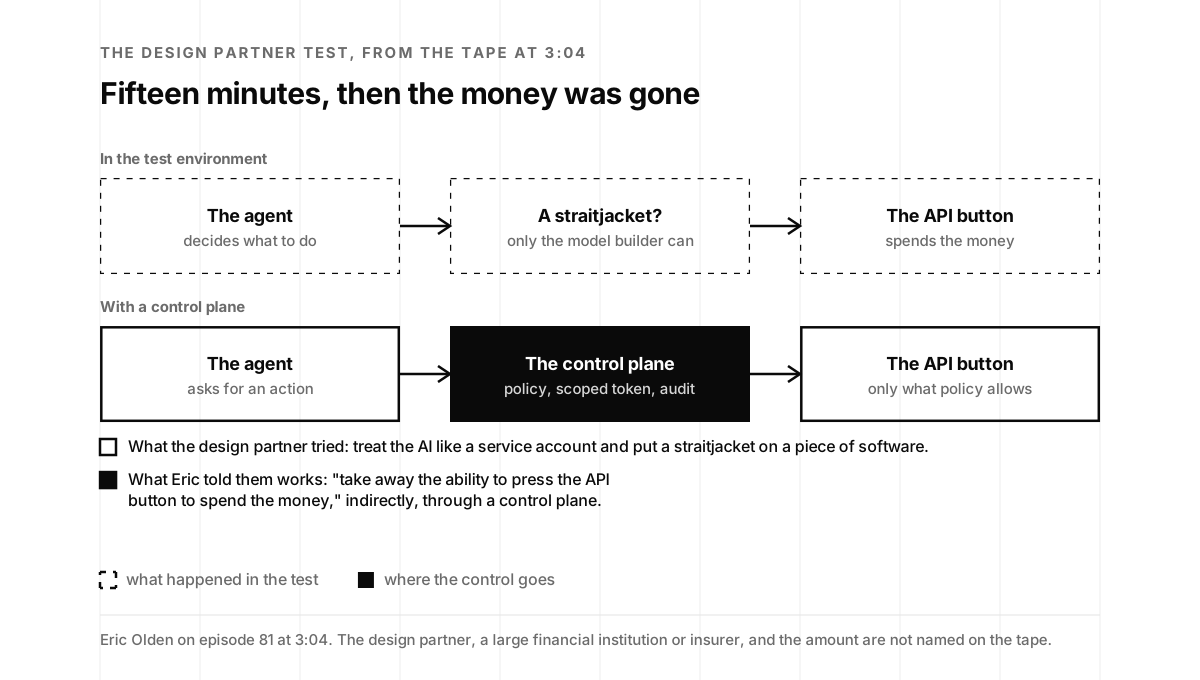
Two rows of three boxes. In the test environment, dashed: the agent decides what to do, a straitjacket on the model that only the model builder could apply, and the API button that spends the money, which was all spent in less than 15 minutes. With a control plane: the agent asks for an action, the control plane in the middle, filled, applies policy, a scoped token and an audit record, and the API button does only what policy allows.
The straitjacket goes on the model, which you don't own. The control plane goes on the button, which you do.

This is the most useful sentence in the episode for anyone shipping an agent this quarter, and it is the same idea behind our post on why an agent saying no is not authorization: the model’s judgment is not a control, and a refusal in the prompt is not a policy. The control lives between the agent and the thing it can break, where you can see it, test it and change it without retraining anything. It is also why the spending story belongs next to the agent that costs $50,000 an hour. An agent with a credit card and no limit outside itself is a budget with a fifteen-minute half-life.

Low single digits in production

Sasha’s first question was where the biggest opportunity is in managing agents, and Eric said there were two answers tied for first. The guardrails were one. The other was what he hears every time he asks the people on Strata’s wait list a single question.

“And when you ask them, what percent of your agents are in production? No, spoiler, it’s in the low single digits.”

Eric Olden, at 3:04

The two answers are tied because each one causes the other. Companies have to get agents into production, “otherwise you’re spending all this money on an investment that won’t give us any return,” and they cannot put them into production because they do not have the guardrails. Over three hundred and fifty people and organizations had signed up for Strata’s sandbox wait list when we recorded, split, he said, rather evenly between engineers with hands on keyboards and less technical people, program managers and business analysts. Low single digits is his read of that list, not a survey. The surveys since point the same way. Gartner predicted in June 2025 that more than 40 percent of agentic AI projects will be canceled by the end of 2027, because of “escalating costs and unclear business value,” and estimated that only about 130 of the thousands of vendors selling agentic AI are the real thing (The Star, from Reuters). In February 2026 a Cloud Security Alliance survey of 285 IT and security professionals, commissioned by Strata, found that only 18 percent were highly confident their identity systems could manage agent identities, only 21 percent kept a real-time inventory of their agents, 44 percent used or planned to use static API keys for them, and 84 percent doubted they could pass a compliance audit focused on agent behavior or access controls (Cloud Security Alliance).
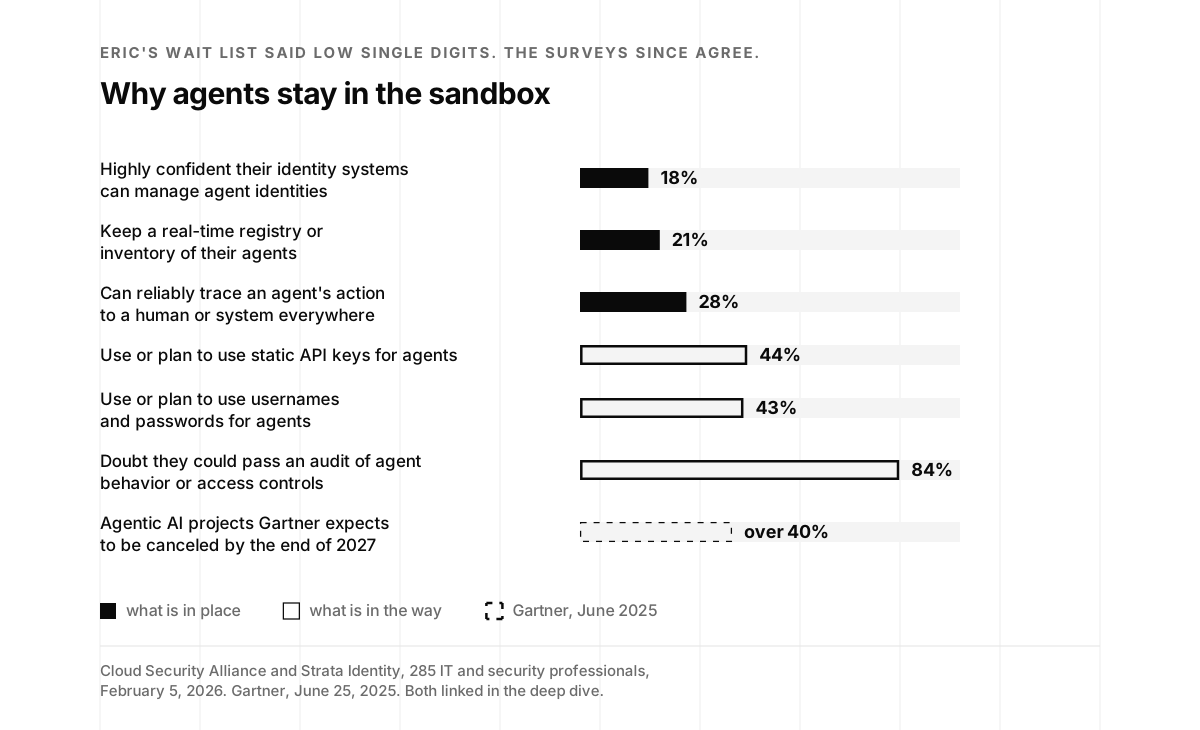
Seven horizontal bars. From the Cloud Security Alliance survey commissioned by Strata, February 2026: 18 percent highly confident their identity systems can manage agent identities, 21 percent keep a real-time inventory of agents, 28 percent can trace an agent's action to a human or system everywhere, 44 percent use or plan to use static API keys and 43 percent usernames and passwords for agents, and 84 percent doubt they could pass an audit of agent behavior. Dashed: Gartner expects over 40 percent of agentic AI projects to be canceled by the end of 2027.
The reason agents stay in the sandbox is not that they can't do the work. It is that nobody can prove what they did.

Eric put the survey’s other finding in one LinkedIn post this year: “only 17% enforce runtime access controls consistently, and 45% cite credential over-provisioning as a top concern,” because traditional least privilege assumes you can design access in advance, and “That assumption breaks the moment you introduce agents that decide what to do at runtime” (Eric Olden on LinkedIn). That is the argument of our post on why agents need least privilege more than humans ever did, and the 44 percent on static keys is the whole subject of your agents share one API key, which we wrote as the companion to this episode.

Intent, context, outcome

Sasha asked whether guardrails were the whole answer or whether observability belonged next to them, the full stack trace of what an agent did. Eric said she was absolutely right, and then described the part of Strata’s design I have repeated most since.

“And so what’s different in agents and audit that we didn’t have to think about with humans, that are deterministic, more or less, but we never really had to ask and record intent. And so that’s what’s changed in observability, is what now our audit model has three components.”

Eric Olden, at 6:18

Listen · the audit model, from 6:38
About 39 seconds: intent, which is generally the prompt, context, which is the attributes and the facts, and the outcome. The clip stops on its own. Read the full transcript.

The first component, intent, is generally the prompt. The second is context, “which are typically the attributes that were used,” the environmental details, the facts. The last is the outcome: “Like, what happened, right? Did something get purchased? Did something get promoted to production, whatever the case may be?” A log that records who called which API answers the question we asked about people. It does not answer the question we now have to ask about agents, which is why it did what it did. Strata’s AI Identity Gateway, which shipped two weeks after the episode, logs agent requests, responses and token exchanges at each step for exactly this reason (Help Net Security).
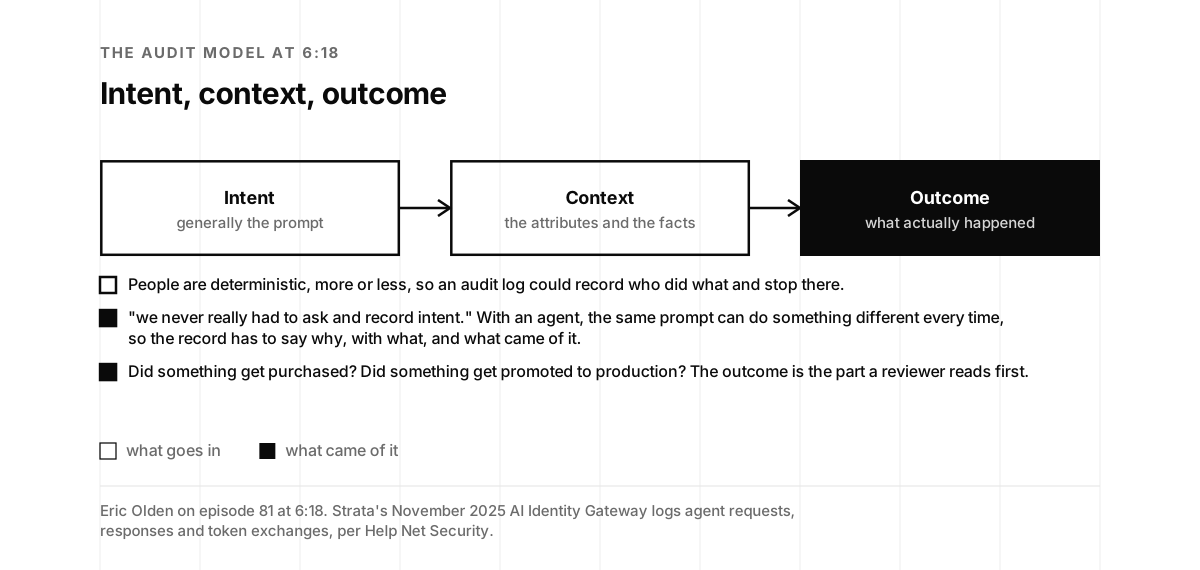
Three boxes in a row: intent, generally the prompt, context, the attributes and facts that were used, and outcome, filled, what actually happened. Below, the difference from auditing people: humans are deterministic, more or less, so logs recorded who did what, while an agent can do something different with the same prompt, so the record has to capture intent, context and outcome.
Three fields for every agent action. The 28 percent who can trace an agent's action to a human or system are the ones who wrote down the first two.

Then he went further, with a nerd alert. Guardrails and observability are not two sides of one coin, he said, “it’s actually more like one of the, nerd alert, D&D dice, right? Six-sided die. So it’s not just the one, it’s how the one affects the other, which affects the other.” The third face is identity governance, the life cycle of everything: who owns the agent, what it may still do, and when it goes away. You cannot observe what no guardrail enforced, and you cannot govern what you never observed. Our agent offboarding checklist is the governance face of the die for the day an agent is retired.
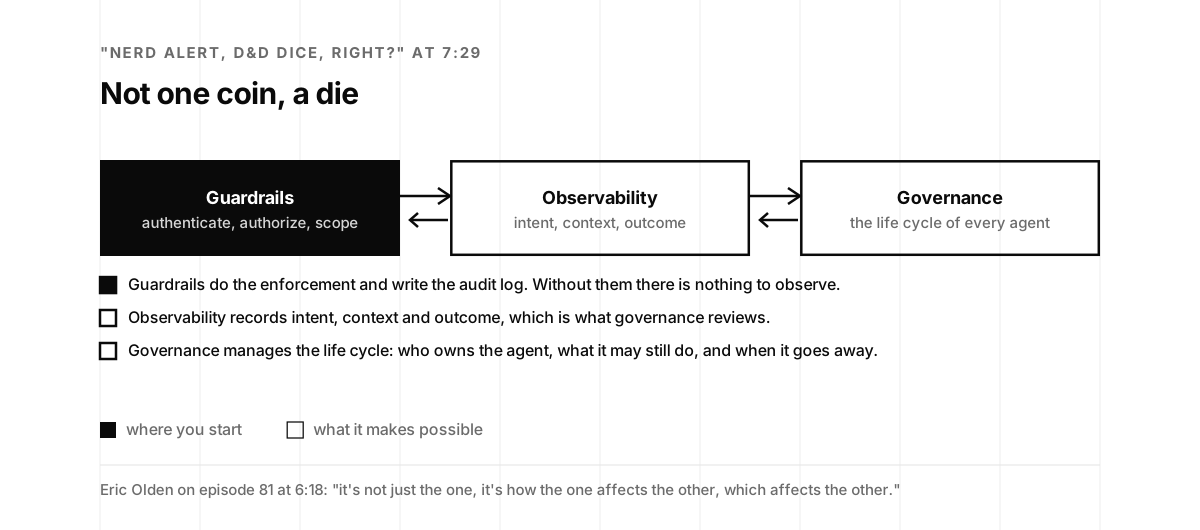
Three boxes in a row joined by arrows in both directions: guardrails, filled, which authenticate, authorize and scope, observability, which records intent, context and outcome, and governance, which manages the life cycle of every agent. Below, how each depends on the next: guardrails write the audit log, observability gives governance something to review, and governance decides what the guardrails still allow.
Guardrails, observability, governance. Change one face and the other two move.

Agents are people too

The governance question is where Eric reached for Stranger Things. “Remember the Upside Down?” I said it was kind of the analog, a different area, and he agreed: “it’s different, and it rhymes.” Everything we are used to doing with people has to be flipped around to work with agents, and the flip is smaller than the industry has made it sound.

“And so I think of that as agents are people too. And that’s your decoder ring about how do you make all this stuff work. Guess what? You don’t have to reinvent it. It’s not a non-human identity problem. It’s the same thing as treating a human.”

Eric Olden, at 8:09

Listen · agents are people too, from 8:10
About 32 seconds: the Upside Down, the decoder ring, and why this is not a non-human identity problem. The clip stops on its own. Read the full transcript.

Sasha took the analogy all the way. There is a unit of work, she said, that used to rely on human labor and can now be done by agentic flows, and “just like with humans, you have to do the background checks, you have to ensure that proper access controls are in place in order for this workforce not to venture out in places where it shouldn’t.” Joiner, mover, leaver. An owner, a manager, a role, access that matches the job, a review when the job changes, and an exit when it ends. The industry calls agents non-human identities, and Eric’s point is that the name hides the answer, because the human methodology and structures we are already good at carry straight over once you treat humans and agents as peers. The survey found that nearly half of organizations already extend their human identity models to govern agents. The difference is speed and volume: the same A’s, at machine scale. Our posts on who signs for the agent and agent governance at onboarding are the human resources department for this workforce.

Who is saying no

Sasha asked who blocks agents from production: compliance, security, or the whole organization deciding it is not ready. Eric’s answer was not a department.

“The thing that’s, I think, holding people back is a lack of confidence.”

Eric Olden, at 10:09

Enterprises have a ritual for pushing anything into production, a checklist, someone who signs off, blue-green testing, smoke tests. “And I think what really gets people shook is when you run the same prompt and the AI does something different every time you do it. And that really brings that fear of like, I don’t want to be a headline.” The cure he offered is the oldest one in security, “trust, but verify, like, never been more true than right now,” and a rule of thumb I have used in every agent review since.

“And the way I believe anybody should get confident is like, see it, do it, and then do it five more times. And if you can see predictable responses and outcomes, then you’re ready to go to production. I’d sign off on that.”

Eric Olden, at 10:09

Six runs is a good habit and a bad statistic, which is the point of the calculator further down: a failure that shows up one run in twenty will hide in six clean runs most of the time. The habit is still right. Sasha added the part that makes it hard, that the same input gives a different output when the context changes, so “these are not simple unit tests, where these are integration tests, and you’ve got a lot of moving parts.” The answer to that is the flight simulator.

The chatbot that gave away a ticket

Eric told a cautionary tale from memory, and the record is better than his version.

“And I think one of the airlines, forget which one, the, the airline, the chatbot said, oh, you get a free ticket. And they’re like, well, no, no, we didn’t mean for you to get a free, whatever, $1,000 ticket. And the court says, hey, that’s on you, airline. Give them the ticket, because you want to use the agent to do the work of a person. If it was a person who said that, we would hold you to that as well.”

Eric Olden, at 10:09

The airline was Air Canada, and it was not a free ticket. In 2022 Jake Moffatt asked the chatbot on Air Canada’s website about bereavement fares after his grandmother died, and it told him he could apply for the discount after buying a full-price ticket, which the airline’s actual policy did not allow. Air Canada argued before British Columbia’s Civil Resolution Tribunal that the chatbot was “a separate legal entity that is responsible for its own actions.” Tribunal member Christopher Rivers called that “a remarkable submission,” wrote that “It should be obvious to Air Canada that it is responsible for all the information on its website,” and ordered it to pay $812 Canadian, against the $1,630.36 he had paid for full-price tickets (CBC News). Eric’s conclusion survives the correction intact. A company that uses an agent to do the work of a person owns what the agent says, the same way it owns what the person says. The Hacker News thread put the legal theory in one line.

"Quite a sensible judgement, it seems. Pretty outrageous for the airline to try to claim the chatbot was its own legal entity."

Arrath, on Hacker News, February 2024

“So I don’t think anybody wants to be having to give out tickets, because that’s not anyone’s business model.” An $812 judgment in a small claims tribunal is a cheap lesson. The fifteen-minute test was a cheaper one, because it happened in a test environment, which is the whole point of the next section.

Don’t learn to fly on the plane to Hawaii

Strata does a lot of work in aerospace and defense, and Eric flies a lot, so his explanation of the sandbox starts at the airport.

“If you were to say, hey, the three of us, we want to learn to fly, what we would not do is, we would not go, hey, go to the airport and get behind the cockpit of a plane loaded with passengers going to fly across the Pacific to Hawaii. It would be a very bad way to learn.”

Eric Olden, at 13:57

Listen · the flight simulator, from 14:13
About 38 seconds: three podcasters, a plane full of passengers, and the Pacific. The clip stops on its own. Read the full transcript.

People do fly across the Pacific, so the question is how you get from not knowing how to being confident, and the answer is simulation. You learn to take off and land. Then the simulator takes away the right engine and tells you to deal with it, pilot, and if you crash, “You just restart it and put another quarter in the machine, and Bob’s your uncle.” Day one with an agent is the same: get one transaction working and learn how it works. Day two is where it gets useful. “Let’s change the identity system. Let’s change the AI model. Let’s change the MCP application, or the API behind the MCP.” Then you break the agent on purpose: give it too much permission and see what it does, peel back the standing privileges, and ask whether the transaction still works “with a super tightly scoped scope.” Those are the experiments you don’t want to run in production, “because you don’t want to end up paying that $1,000 ticket, or worse.”
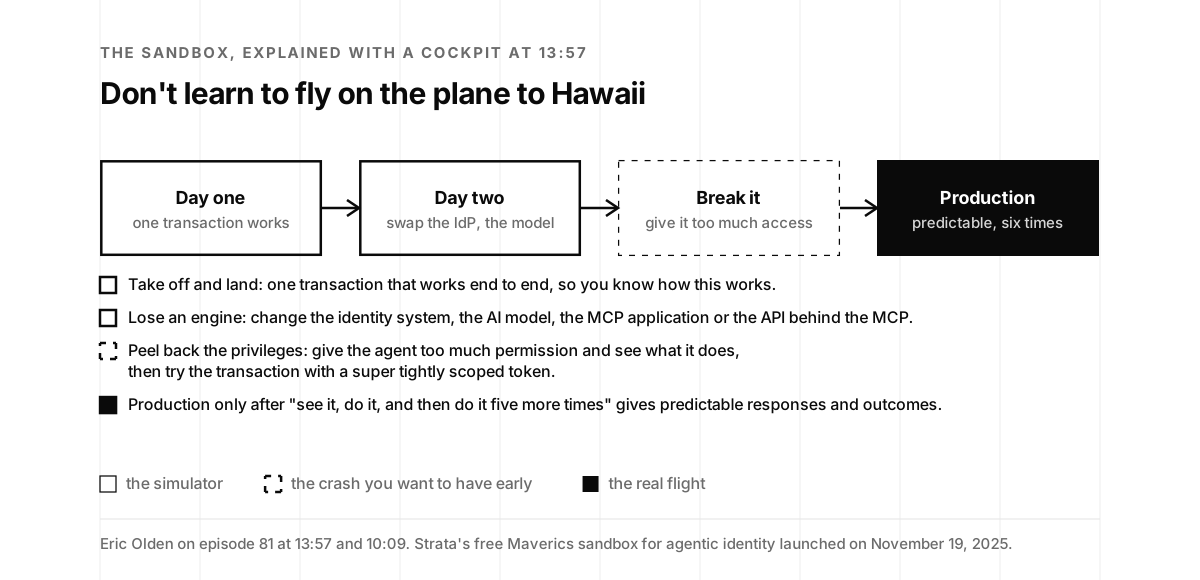
Four boxes in a row: day one, one transaction works, day two, swap the identity provider and the model, break it, dashed, give the agent too much access, and production, filled, after six predictable runs. Below, the flight simulator analogy: take off and land, lose an engine by changing the identity system, the AI model or the MCP server, peel back the privileges, and go to production only after seeing it, doing it, and doing it five more times.
Day one, day two, break it, then production. "there's no substitute for experience."

He called it a safe-to-fail mindset, and he was candid that the first version of anything is usually pretty rough. Two weeks after the episode Strata shipped the sandbox he was describing, the Maverics Sandbox for Agentic Identity, with identity providers, MCP servers and APIs already wired in and live policy enforcement, which Eric had promised would be free to start, alongside the AI Identity Gateway that enforces least-privilege policies written in OPA’s Rego language and validates proof of possession on tokens. Eric’s line in the release: “AI agents are the new digital workforce, but without identity they’re invisible and ungoverned” (Help Net Security). If your MCP servers are part of what changes on day two, our post on the MCP server that passed review and then changed is the test plan for that engine.

Three missing guardrails of the early web

I asked about the first time Eric tackled an open identity problem, and the answer went back to graduating in San Francisco in the mid-nineties, when people said you couldn’t use the web for anything commercial. “And I was like, yeah, that’s going to last.” The web servers of the day, the early one from the University of Illinois team behind Mosaic and then Netscape’s, were great at serving brochures, “HTML and images,” and what everyone actually wanted was e-commerce. What held it up, he said, was “Another missing guardrail,” and it took three things to fix.

The first was SSL. “The first, give credit to Netscape and Taher Elgamal and his team for inventing SSL,” which is how people became willing to type a credit card number into a browser. Taher was our guest on episode 61, where he explained why SSL made the client certificate optional and the password filled the gap. The second was scale. A web server’s access control lists worked for a couple dozen people, not for e-commerce sites with millions of them.

“And that became the whole realm of web access management. And I was the founder and CTO of a company, Securant, that solved that problem. And we went from two guys in a garage in Berkeley to a three-hundred-person company in a very short amount of time, because the right timing matters.”

Eric Olden, at 17:03

Listen · Securant, from 18:50
About 40 seconds: web access management, a garage in Berkeley, and the late-nineties problem called federation. The clip stops on its own. Read the full transcript.

Securant’s product was ClearTrust, which his LinkedIn profile describes as “the first commercial WAM product that managed access and SSO to Web apps” (LinkedIn). RSA Security completed its purchase of Securant on September 5, 2001, for $134.5 million in cash, and Art Coviello’s line in the release could open a talk on agents today: “Authorization plays a critical role in RSA Security’s mission to enable secure e-business” (RSA Security, Form 8-K). The third missing guardrail was trust between strangers, “Which in the late ’90s we called federation.” It needed a standard, and Eric said he was one of the four co-authors of what became SAML. The record matches the number: when the OASIS Security Services Technical Committee first met in January 2001, it took in four contributions, S2ML from Netegrity, AuthXML from Securant, X-TASS from VeriSign and ITML from Jamcracker, and merged them into the Security Assertion Markup Language, an OASIS Standard in November 2002 and, as SAML 2.0, in March 2005 (Wikipedia). “And then here we are, 2025, and I think SAML [is] very much here to stay.”
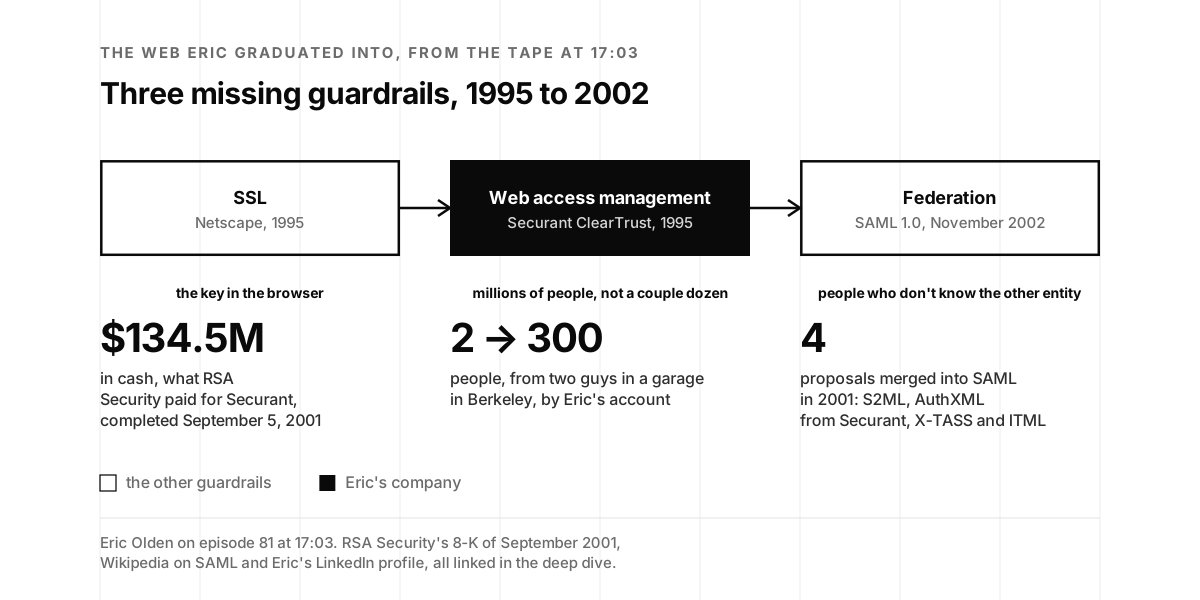
Three boxes in a row: SSL from Netscape in 1995, the key in the browser, web access management, filled, Securant's ClearTrust from 1995, for millions of people instead of a couple dozen, and federation, SAML 1.0 in November 2002, for people who don't know the other entity. Below, three figures: RSA Security paid $134.5 million in cash for Securant in September 2001, the company grew from two people in a garage in Berkeley to 300, and four proposals, including Securant's AuthXML, were merged into SAML in 2001.
E-commerce needed three guardrails before it could happen. Agents need the same three, at machine scale.

The pattern is the reason to tell the story. Every wave of computing has had a missing guardrail that held back the commercial version, and each time the fix was identity: who is this, what may they do, and can a stranger trust the answer. Agents are the fourth wave of the same question, and Eric’s mindset has not changed in thirty years: “Because the world will tell you what you can’t do. And I love the mindset of, don’t tell me that. Tell me what you can do.”

Standards first

When people ask Eric how he would solve the agent problem, he said, he doesn’t start with the technical implementation.

“First word was standards. Use standards, because if there’s anything that you want to do quickly, you gotta do it in a standardized way. Otherwise, everything becomes bespoke, and things just don’t move fast enough.”

Eric Olden, at 21:00

This is a distributed computing problem, and the standards already exist: OAuth, OIDC, SAML, PKCE, SPIFFE. Some vendors, he said, talk about solving it with a future version of OAuth or a new app-to-app integration three years from now. “Okay, well, [last] I checked, people are trying to do it today.” He paraphrased Voltaire, “don’t let perfect be the enemy of good,” and the attribution holds up: Voltaire quoted the Italian proverb “Il meglio è l’inimico del bene” in 1770 and put “le mieux est l’ennemi du bien” in his poem La Bégueule (Wikipedia). The good he wants today is OAuth bootstrapped and pushed to the edge, with real implementations of things like DPoP, “and be able to provide ways that you don’t just recycle and replay tokens.” DPoP is RFC 9449, published in September 2023, and its abstract says what he means in one sentence: “This mechanism allows for the detection of replay attacks with access and refresh tokens” (IETF). A token bound to a key the agent holds is useless to anyone who copies it, which is the same lesson as the garage door on episode 29, with a token instead of a radio code.
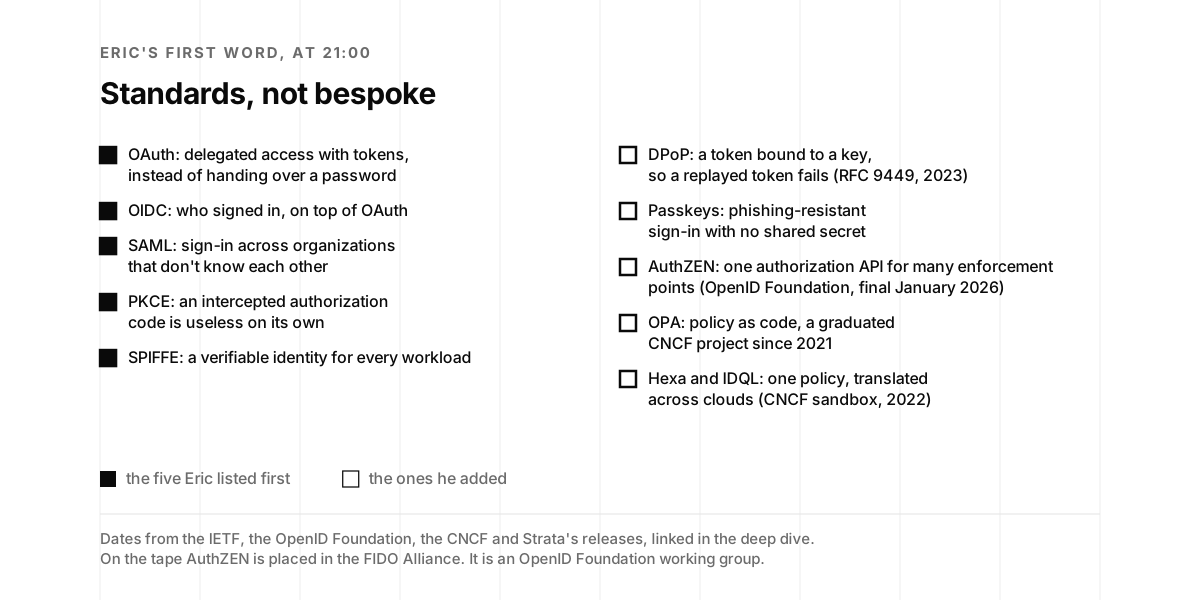
Two columns of standards. Named on the tape at 21:00: OAuth for delegated access, OIDC for who signed in, SAML for sign-in across organizations, PKCE so an intercepted code is useless, and SPIFFE for workload identity. Named later in the episode: DPoP, which binds a token to a key so a replayed token fails, passkeys, AuthZEN from the OpenID Foundation for one authorization API, OPA for policy as code, and Strata's Hexa and IDQL for one policy across clouds.
Ten standards that already exist. None of them is three years away.

And then the dream, the small part he hopes to play in all of this: “I’m doing everything I can to get rid of passwords.” That is exactly what Taher said when he was here, I told him, which is a good sign for both of them.

Passkeys, AuthZEN and the best-kept secret in authorization

Sasha asked where the community actually works together on agent security, and Eric named two places. The first was the FIDO Alliance and passkeys.

“I hate passwords. I know they’re cheap-ish, but they’re way more expensive when things go wrong. But I love that, again, some big players got together, Apple and Google and Microsoft, amongst others, and they said, hey, let’s [make] this investment. We all agree on phishing-resistant passkeys.”

Eric Olden, at 23:30

The investment was announced on May 5, 2022, when Apple, Google and Microsoft committed to expanded support for the FIDO standard (Apple), and in October 2026 the FIDO Alliance counted seven billion passkeys (FIDO Alliance). “I just put my face in front of my phone and I log in.” Then he described AuthZEN, which Strata helped build, a way for “different enforcement points by different vendors” to execute the same policy. On the tape he places it in the FIDO Alliance. It is the OpenID Foundation’s AuthZEN Working Group, and its Authorization API 1.0 was approved as a Final Specification on January 12, 2026 (OpenID Foundation). The second place was the Cloud Native Computing Foundation, home of Kubernetes, and of the Open Policy Agent, which graduated there in February 2021 (CNCF). “And I love OPA,” he said, and I couldn’t resist.

“It’s the best-kept little secret in the authZ space ever.”

Jon McLachlan, at 25:10

Anders Eknert of Styra, the company behind OPA, made the case for it on episode 18. Strata contributed Hexa to the same foundation, an open source tool for policy interoperability built around IDQL, the identity query language. If you run Amazon and Azure and want one policy in both, Hexa “will basically point it at system A. It’ll extract all your policies out of A, convert it into IDQL format, and then you point it at system B, and then it pushes it into the syntax of system B.” The CNCF accepted Hexa as a sandbox project in September 2022, with Eric’s line “IDQL and Hexa eliminate identity silos” (Business Wire). Authorization is the layer most companies still build by hand, which is the argument of authorization is the last layer, and the agent era makes that more expensive every month.

The bar at hyperscale

Before Strata, Eric ran Oracle’s security and identity division as senior vice president and general manager of cloud security and identity management, from October 2017 to July 2019 (LinkedIn). That is where he learned what the stakes look like from a hyperscaler’s side of the table.

“And when you’re dealing with millions and millions of customers, and downtime is in the tens of millions of dollars per hour, right? You think about things on a whole nother level.”

Eric Olden, at 26:29

Strata’s Department of Defense work raised the bar again: in certain circumstances, he said, an outage “truly is life or death.” So he trained his whole career to be the person who can say, “I know this will work,” and he said he hopes that isn’t arrogance, “but it’s evidence that makes me confident.” I added the part that only comes from being on the call: you have to be on the on-call rotations and see what happens during an incident before you understand where the bar is, and the word I like to use is bulletproof. I also said I think of innovation as only the parts that are easy to adopt. If it’s not easy to adopt, it won’t get used, and then it’s a nice side project or a cool demo. Eric agreed and pointed at vibe coding. He is encouraged that AI tools let more people build things and solve problems, “because that’s [to] me what software is all about,” and he is clear about the other side of it: “sometimes that expression, I know enough to be dangerous, this is really showing itself.” More people in the game, and the bar kept high on QA, with nothing going straight from a first prompt into production.

The apology at Oracle

Sasha asked for Eric’s proudest moment, and he distilled a couple of years at Oracle into one dinner. He was brought in as a startup guy to make his division build software like a startup, agile and rapid iteration, concepts that were known but not practiced. The division was a bell curve: a few eager people, a skeptical middle, and a tail that said it would never work. In his last month there, after the final training class finished, a man walked up to him at the graduation dinner.

“And he said, Eric, I owe you an apology. And I said, oh, I don’t understand, but tell me more. And he says, well, a year and a half ago, [you] got in front of the whole division, and you said, we’re going to do this crazy hard thing. I said at the time to my friend, I said, this guy is not going to last. He does not know what he’s trying to do. He’s never been at a company like Oracle.”

Eric Olden, at 30:28

He had waited in the last class for the next guy to show up, and he was apologizing because Eric had been right. Eric was quick to say it wasn’t him teaching everything, he had a great team that did it around the world. What he took from it is the lesson for anyone rolling agents out to a skeptical organization: give people a real opportunity, don’t prejudge them, and accept that they may not take it the first time around. “And even the most cynical, skeptical people, through their own doing, can show that this can work.” The agent rollout that wins is the one the skeptics end up running.

Not freezing

I asked for the most difficult day, and Eric answered with a habit instead of a date.

“So the most difficult thing, I think, is not freezing when the inevitable thing happens. And it doesn’t matter where, it could be customer, it could be partner, it could be financing, could be God knows what it’s gonna be, but it’s gonna happen.”

Eric Olden, at 33:52

He learned to meditate a lot as a founder, because in your head you can slay dragons that would beat you if you tried to fight them for real. Be ready for change, flow through it, hope for the best, “Get back on that horse. It’s not a failure until you stop trying.” When I asked about legacy, he talked about his two kids and the people he has worked with for ten, twenty and thirty years, and a friend who once called him pathologically optimistic, which I told him is the biggest compliment you can receive. Then a run of founder proverbs: “you go to war with the army that you got,” Mike Tyson’s line about everyone having a plan until they get punched in the mouth, and the one I would put on Strata’s wall, “Don’t tell me what you can’t do. Find a way, or make one.” His words of wisdom at the end were three short ones: go standards, please don’t reinvent the wheel, “And then, don’t test in production.” I added the corollary. Don’t test on my airplane.

What happened after the tape

The year after we hit stop is the strongest evidence for everything Eric said. Strata had already introduced Identity Orchestration for AI Agents in July 2025, with short-lived scoped credentials, policy-as-code authorization with human approval for sensitive actions, just-in-time provisioning of agent identities and an MCP-native proxy, and Eric’s framing was that “Autonomous AI agents now act as users in enterprise systems” (Help Net Security). His keynote from that launch is the best twenty-nine minutes on the subject, and it starts with trying to buy concert tickets through ChatGPT.

July 16, 2025: Eric's keynote introducing identity orchestration for AI agents, twenty-nine minutes. Watch on YouTube.

Two days after this episode, Outshift by Cisco posted his panel on multi-agent foundations, agent discovery, identity and trust, and on November 19 Strata shipped the AI Identity Gateway and the free sandbox. In February 2026 the survey with the Cloud Security Alliance put numbers on the lack of confidence he described, with his line “The future of identity must be orchestrated, contextual, and continuous” (Cloud Security Alliance).

November 6, 2025: Eric with Holly Watson of Oracle, Anand Raghavan of AI Defense and Tatyana Mamut of Wayfound.AI on agent discovery, identity and trust, a little over an hour. Watch on YouTube.

Then, on June 9, 2026, at its FORWARD conference in Las Vegas, Rubrik announced that it had acquired Strata. Terms were not disclosed, and the release built Rubrik’s new Identity Continuity capability on Strata’s technology, failing over to a secondary identity provider when the primary one is compromised or goes down, alongside Identity Roll Forward for Active Directory, with Rubrik’s chief business officer Mike Tornincasa saying “Strata closes the most critical gap: Identity Continuity” (Rubrik). Eric is now Rubrik’s chief identity architect (LinkedIn), and a little over two weeks after the announcement he wrote the thank-you note every founder hopes to write one day.

Now that Strata is officially part of Rubrik, I want to thank the people who got us here.

When Topher Marie, Eric Leach and I started Strata in 2019, identity was stuck. Every enterprise we met was locked into a single provider, unable to move, unable to modernize, and exposed the moment that provider went down. We set out to fix that.

Over nearly seven years the team built three things that did not exist before. Identity orchestration, so enterprises could run any identity provider and switch on their own terms. Identity continuity and failover, so identity keeps working even when a provider does not. And in 2025, we shipped the world’s first agentic identity platform, built for a world where millions of AI agents need a control plane to stay under more predictable human control.

Eric Olden · June 26, 2026
The company that shipped the control plane, in its founder's words. He thanks New York Life, Boeing, 3M, the State of Minnesota, Verizon and Cummins for buying a category that wasn't finished yet. View on LinkedIn.

“a control plane to stay under more predictable human control” is the lesson of the fifteen-minute story, a year and a half later, with a company sold on it.

Did you catch it? A six-question quiz

Interactive · six questions

Did you catch it?

Six questions on what Eric actually said, with the timestamp for each answer. The answers are under each question for anyone reading without JavaScript.

  1. A design partner let an agent spend money in a test environment. How long did the money last?

    1. About a day
    2. Less than 15 minutes
    3. Until someone noticed at the end of the month

    b. "in less than 15 minutes, all the money was spent." Transcript, 3:04.

  2. How does Eric say you control an AI agent?

    1. Put a straitjacket on the model
    2. Write a stricter system prompt
    3. Indirectly, through a control plane that takes away the ability to press the API button

    c. "You do it indirectly, through a control plane." Only the model builder could put a straitjacket on the model. Transcript, 3:04.

  3. What are the three components of Strata's audit model for agents?

    1. Intent, context and outcome
    2. Who, what and when
    3. Request, response and latency

    a. Intent, generally the prompt, context, the attributes and facts, and the outcome. "we never really had to ask and record intent." Transcript, 6:18.

  4. What does Eric call his decoder ring for agent identity?

    1. Zero trust for machines
    2. Agents are people too
    3. Non-human identity first

    b. "It's not a non-human identity problem. It's the same thing as treating a human." Transcript, 8:09.

  5. How should anybody get confident about an agent before production, in Eric's words?

    1. Read the model card
    2. Wait for a vendor's certification
    3. See it, do it, and then do it five more times

    c. "see it, do it, and then do it five more times," and look for predictable responses and outcomes. Transcript, 10:09.

  6. What was the name of the company Eric founded in a garage in Berkeley?

    1. Securant
    2. Symplified
    3. Netegrity

    a. "I was the founder and CTO of a company, Securant." RSA Security bought it in 2001. Transcript, 17:03.

Is your agent ready for production?

Eric’s checklist is the one an enterprise already uses for any software, plus the parts agents change. This scorecard asks eight questions about one agent you are about to ship, in the order the episode raises them, and tells you whether it belongs in the sandbox, in a pilot, or on the plane with passengers.

Scorecard · eight questions

Is your agent ready for production?

Answer for the agent with the most power: the one that can spend money, change data or touch production. Answer for how it runs today, not the design document.

  1. Does the agent have its own identity, separate from the person who launched it and from every other agent?

    • It uses a shared service account or one API key
    • It has its own credential, but nobody owns it
    • Its own identity, a named owner, and an entry in a registry

    "agents are people too." A person gets a badge, a manager and a role. So does an agent. Your agents share one API key is the afternoon fix.

  2. When the agent tries to spend money, delete data or change production, what actually stops it?

    • The prompt, or the model's own judgment
    • A person approves some actions by hand
    • A policy outside the model decides every action, with limits

    The straitjacket goes on the model, which you don't own. The control plane goes on the API button, which you do. An agent saying no is not authorization.

  3. What credential does the agent hold while it works?

    • A long-lived key, or a person's password
    • Tokens that expire, but broadly scoped
    • Short-lived tokens scoped to the task and bound to the agent, so a copied one fails

    "you don't just recycle and replay tokens." DPoP, RFC 9449, binds a token to a key the agent holds.

  4. What does your log record for each action the agent takes?

    • Nothing beyond the downstream API's own logs
    • Which agent called what, and when
    • Intent, context and outcome, traceable to a person or system

    Only 28 percent of the organizations in the 2026 survey could trace an agent's action to a human or system everywhere.

  5. Where was the agent tested before it reached real users?

    • In production, by its first users
    • In a demo that worked once
    • In a sandbox, with the model, identity system and tools swapped, and privileges peeled back

    Day two is the useful day: change the identity system, the model, the MCP server, then give it too much permission and watch. The MCP server that changed is one engine to fail on purpose.

  6. How many times have you run the same task and checked the outcome?

    • Once
    • A few times, and the results varied
    • Six times or more, with predictable responses and outcomes, and more for anything that spends money

    "see it, do it, and then do it five more times." The calculator below shows why the riskiest actions need more than six.

  7. Does a named person sign off before the agent goes to production, against a written checklist?

    • No
    • Informally
    • Yes, against the same checklist as any release, plus the agent items

    "someone signs off on it." Blue-green, smoke tests, and now the audit fields and the scopes. Who signs for the agent is the one-page map.

  8. When the project ends or the owner leaves, what happens to the agent and its credentials?

    • It keeps running with its keys
    • Someone remembers to turn it off, eventually
    • Its life cycle is governed: reviewed, re-scoped, and retired with its credentials

    The governance face of the die. The agent offboarding checklist is the exit interview.

Still in the sandbox, and it should be

The agent shares an identity, the only thing between it and the money is its own judgment, and nobody could reconstruct why it did what it did. That is the fifteen-minute test waiting to happen in production. Give it its own identity and owner this week, then put one policy in front of the one API that spends money or deletes data.

A pilot with guardrails on the important doors

The agent has its own identity and some limits, but the tokens live too long, the log records the call and not the intent, or the testing stopped at a demo. Bind the tokens, add intent, context and outcome to the log, and run day two in the simulator: swap the model, swap the identity provider, over-permission it and watch.

Ready to fly with passengers

Its own identity, a policy outside the model on every consequential action, short-lived bound tokens, an audit record a reviewer can read, repeated runs with predictable outcomes, a signature and a retirement plan. What is left is to keep it that way: rerun the simulator whenever the model, the tools or the scopes change.

How many runs before you sign off?

“See it, do it, and then do it five more times” is the right habit, and six runs is a small sample. This calculator shows what six clean runs can and cannot tell you about a failure that only shows up some of the time, how many clean runs it takes to be confident the failure rate is low, and what that rate means at production volume. Change the numbers to your agent’s.

Calculator

How many runs before you sign off?

An agent that does the wrong thing on some fraction of runs, a number of clean-looking sandbox runs before sign-off, and the volume and stakes in production.

–chance the sandbox runs catch it
–chance every run looks fine anyway
–clean runs to be 95% sure the rate is lower
–wrong runs a day in production
–at stake a day

If a run goes wrong 5 percent of the time, six sandbox runs catch it about 26 percent of the time and all look fine about 74 percent of the time. To be 95 percent sure the rate is below 5 percent, you need about 60 clean runs in a row. In production at 1,000 runs a day, the same rate is 50 wrong runs a day, which is why the limit has to live in a policy outside the model, not in the hope that testing found everything.

The 95 percent figure uses the statistician's rule of three: after n runs with no failures, the failure rate is below about 3/n with 95 percent confidence. It assumes the runs are independent and the sandbox matches production, which is the reason Eric's day two swaps the model, the identity system and the tools. The 5 percent, 1,000 runs and $50 are placeholders, not research.

Thirty years of identity on one line

Everything on this page sits on one timeline, from the browser that made the web visual to the week this page was written. Filter it by thread.

Timeline · 1995 to 2026

Thirty years of identity on one line

Filter by thread. Dates are from the public record except where marked as Eric's own account on the tape.

  1. SSL 2.0 ships

    In Netscape Navigator, the first guardrail of e-commerce (Wikipedia).

  2. Securant Technologies

    Founded while a student at UC Berkeley. ClearTrust, web access management (LinkedIn).

  3. Two guys in a garage in Berkeley

    To a three-hundred-person company, "because the right timing matters."

  4. Four proposals, one standard

    S2ML, Securant's AuthXML, X-TASS and ITML go into the OASIS committee that writes SAML (Wikipedia).

  5. RSA Security buys Securant

    For $134.5 million in cash (SEC).

  6. SAML 1.0

    An OASIS Standard, with SAML 2.0 following in March 2005 (Wikipedia).

  7. Symplified

    Identity as a cloud service, from Boulder, through June 2012 (LinkedIn).

  8. Oracle

    Senior vice president and general manager, cloud security and identity management, through July 2019 (LinkedIn).

  9. Strata Identity

    With Topher Marie and Eric Leach, in Boulder: identity orchestration (Wikipedia).

  10. OPA graduates

    The Open Policy Agent becomes a graduated CNCF project (CNCF).

  11. Passkeys, together

    Apple, Google and Microsoft commit to expanded support for the FIDO standard (Apple).

  12. Hexa joins the CNCF

    As a sandbox project, with IDQL. "IDQL and Hexa eliminate identity silos" (Business Wire).

  13. $26 million Series B

    Led by Telstra Ventures, $42 million raised in all, and a 380 percent increase in revenue in a year (SecurityWeek).

  14. DPoP

    RFC 9449 lets a server detect replayed access and refresh tokens (IETF).

  15. Moffatt v. Air Canada

    The chatbot is not "a separate legal entity," and the airline pays $812 (CBC News).

  16. Fifteen minutes

    A design partner's test agent spends all the money, by Eric's account.

  17. Gartner on agentic AI

    Over 40 percent of projects canceled by the end of 2027 (The Star).

  18. Identity orchestration for AI agents

    Eric's keynote and the launch: scoped credentials, policy as code, an MCP-native proxy (Help Net Security).

  19. Episode 81 airs

    This conversation. "agents are people too."

  20. Multi-agent foundations

    Eric on an Outshift by Cisco panel on agent discovery, identity and trust (YouTube).

  21. The AI Identity Gateway and a free sandbox

    Runtime control for agent actions, and the simulator Eric described (Help Net Security).

  22. AuthZEN 1.0

    The OpenID Foundation approves the Authorization API as a Final Specification (OpenID Foundation).

  23. The time-to-trust survey

    285 professionals: 18 percent highly confident, 84 percent doubt an agent audit (Cloud Security Alliance).

  24. Rubrik acquires Strata

    At FORWARD in Las Vegas, for identity continuity and resilience (Rubrik).

  25. Chief identity architect

    Eric joins Rubrik and thanks the people who got Strata there (LinkedIn).

  26. Seven billion passkeys

    The FIDO Alliance's count, four years after the joint commitment (FIDO Alliance).

What to do this week

Four things, in the order Eric would do them.

  1. Give the agent its own identity and an owner. List every agent and the credential it uses. Anything on a shared service account or a person’s key gets its own identity, a named owner and an entry in a register. The 30-minute credential inventory is the first pass.
  2. Put a policy in front of the button. Find the one API the agent can call that spends money, deletes data or changes production, and put a policy outside the model between them, with a limit and short-lived, scoped tokens. Don’t rely on the prompt.
  3. Log intent, context and outcome. For every consequential action, record the prompt, the attributes and facts it used, and what actually happened, traceable to a person or system.
  4. Build the simulator before the flight. Run the task in a sandbox until the outcomes are predictable. Then swap the model, swap the identity provider, change the MCP server, over-permission the agent and watch. Sign off only after that, against a written checklist.

Key takeaways

  1. Fifteen minutes, then the money was gone

    A design partner gave an agent the ability to spend money in a test environment. "in less than 15 minutes, all the money was spent." They had expected to treat the AI like a service account and put a straitjacket on it, and Eric told them only the model builder could do that.

  2. Control the button, not the model

    "What we could do is to take away the ability to press the API button to spend the money." You control the AI indirectly, through a control plane: policy for how agents, AIs and humans authenticate, get access and are provisioned just in time, at machine scale.

  3. Low single digits in production

    Asked what percent of their agents are in production, the people on Strata's wait list of more than 350 answer "in the low single digits." Production and guardrails are tied for first: companies need production to see a return, and cannot get there without the guardrails.

  4. Intent, context, outcome

    People are deterministic, more or less, "but we never really had to ask and record intent." Strata's audit model for agents records intent, which is generally the prompt, context, the attributes and facts used, and the outcome, what actually happened.

  5. Not a coin, a die

    Guardrails, observability and identity governance are faces of one die. "So it's not just the one, it's how the one affects the other, which affects the other." Governance is the life cycle of every agent, from onboarding to retirement.

  6. Agents are people too

    "It's not a non-human identity problem. It's the same thing as treating a human." Treat humans and agents as peers and the methodology and structures the industry is already good at carry over, at machine scale.

  7. The blocker is confidence

    Nobody in particular is saying no. "The thing that's, I think, holding people back is a lack of confidence," because the same prompt can make the AI do something different every time. The cure is trust, but verify.

  8. See it, do it, then five more times

    "And the way I believe anybody should get confident is like, see it, do it, and then do it five more times." Predictable responses and outcomes are the sign-off. For rare failures six runs is a small sample, so the riskiest actions need more, and a limit outside the model.

  9. You own what your agent says

    Eric's half-remembered airline story is Moffatt v. Air Canada: the chatbot invented a retroactive bereavement refund, the airline argued the chatbot was a separate legal entity, and the British Columbia tribunal ordered it to pay $812 Canadian. A company using an agent to do a person's work owns what the agent says.

  10. Build the flight simulator first

    You don't learn to fly in a cockpit full of passengers headed for Hawaii. Day one, make one transaction work. Day two, change the identity system, the AI model and the MCP application, give the agent too much permission, peel back privileges. Strata shipped that sandbox two weeks after the episode.

  11. Every wave had a missing guardrail

    E-commerce waited on SSL, on web access management for millions of users, which Eric built at Securant, and on federation, which became SAML. Agents are the same identity questions again, at machine scale.

  12. Standards first

    "First word was standards." OAuth, OIDC, SAML, PKCE and SPIFFE exist today, DPoP stops tokens being replayed, and AuthZEN and OPA make policy portable. Don't let perfect be the enemy of good, and don't wait three years for a new standard.

  13. Don't test in production

    Eric's words of wisdom: go standards, please don't reinvent the wheel, "And then, don't test in production."

Chapters

Tap a chapter to play from there.

Pull quotes

“And when we put it in a test environment and said, hey, let's see what happens, in less than 15 minutes, all the money was spent.”

Eric Olden ·

“What we could do is to take away the ability to press the API button to spend the money.”

Eric Olden ·

“And when you ask them, what percent of your agents are in production? No, spoiler, it's in the low single digits.”

Eric Olden ·

“So it's not just the one, it's how the one affects the other, which affects the other.”

Eric Olden ·

“And so I think of that as agents are people too. And that's your decoder ring about how do you make all this stuff work.”

Eric Olden ·

“It's not a non-human identity problem. It's the same thing as treating a human.”

Eric Olden ·

“And I think what really gets people shook is when you run the same prompt and the AI does something different every time you do it.”

Eric Olden ·

“And the way I believe anybody should get confident is like, see it, do it, and then do it five more times.”

Eric Olden ·

“Okay, well, if I crash that plane, no big deal. You just restart it and put another quarter in the machine, and Bob's your uncle.”

Eric Olden ·

“First word was standards. Use standards, because if there's anything that you want to do quickly, you gotta do it in a standardized way.”

Eric Olden ·

“Don't tell me what you can't do. Find a way, or make one.”

Eric Olden ·

About the guest

Eric Olden, Chief Identity Architect, Rubrik

Eric Olden is Rubrik's chief identity architect, a role he took in June 2026 when Rubrik acquired Strata Identity, the identity orchestration company he co-founded in Boulder, Colorado in August 2019 with Topher Marie and Eric Leach and led as chief executive. Strata built identity orchestration across identity providers, identity continuity and failover, and in 2025 an agentic identity platform with guardrails, observability and governance for AI agents. He founded Securant Technologies in 1995 while a student at UC Berkeley, built ClearTrust for web access management, co-authored AuthXML, one of the four proposals merged into SAML, and sold Securant to RSA Security for $134.5 million in cash in 2001. He founded Symplified, identity as a cloud service, in 2006, mentored at TechStars, and was Oracle's senior vice president and general manager of cloud security and identity management from 2017 to 2019.

About the host

Jon McLachlan and Sasha Sinkevich are co-founders of YSecurity, the on-demand cybersecurity team for startups, and of Cyberbase.ai. The Security Podcast of Silicon Valley is hosted by Jon McLachlan and Sasha Sinkevich. Jon McLachlan on LinkedIn ↗Sasha Sinkevich on LinkedIn ↗

Context and sources

  • Eric Olden on LinkedIn: experience, from Securant Technologies in 1995 to Rubrik in 2026. Source ↗
  • Eric Olden on LinkedIn: recent posts, including the June 26, 2026 note on Strata joining Rubrik and the post on runtime least privilege. Source ↗
  • Wikipedia: Strata Identity, founded in 2019 in Boulder, Colorado, Maverics, and the agent product. Source ↗
  • RSA Security, Form 8-K exhibit, September 2001: completion of the acquisition of Securant Technologies for $134.5 million in cash. Source ↗
  • Wikipedia: SAML, the OASIS Security Services Technical Committee in January 2001, the four contributions including AuthXML from Securant, SAML 1.0 in November 2002 and 2.0 in March 2005. Source ↗
  • Help Net Security, July 18, 2025: Strata Identity provides identity guardrails and observability for AI agents. Source ↗
  • Strata Identity on YouTube, July 16, 2025: Agentic AI Is Breaking IAM, Identity Orchestration Fixes It, Eric Olden's keynote. Source ↗
  • Outshift by Cisco on YouTube, November 6, 2025: Multi-agent foundations, agent discovery, identity and trust, with Eric Olden. Source ↗
  • Help Net Security, November 19, 2025: Strata introduces the AI Identity Gateway and the Maverics Sandbox for Agentic Identity. Source ↗
  • Cloud Security Alliance, February 5, 2026: the Securing Autonomous AI Agents survey of 285 IT and security professionals, commissioned by Strata Identity. Source ↗
  • The Star, from Reuters, June 25, 2025: Gartner says over 40 percent of agentic AI projects will be scrapped by 2027. Source ↗
  • CBC News, February 2024: Air Canada found liable for its chatbot's bad advice on bereavement fares. Source ↗
  • Hacker News, February 2024: the thread on the Air Canada chatbot ruling. Source ↗
  • Rubrik, June 9, 2026: Rubrik advances identity resilience through the Strata acquisition and Identity Roll Forward. Source ↗
  • SecurityWeek, January 2023: Strata raises $26 million in a Series B led by Telstra Ventures, $42 million in all. Source ↗
  • Business Wire, September 13, 2022: Hexa and IDQL accepted as a Cloud Native Computing Foundation sandbox project. Source ↗
  • CNCF, February 4, 2021: the Open Policy Agent graduates. Source ↗
  • OpenID Foundation, January 12, 2026: the AuthZEN Authorization API 1.0 approved as a Final Specification. Source ↗
  • IETF, September 2023: RFC 9449, OAuth 2.0 Demonstrating Proof of Possession (DPoP). Source ↗
  • Apple, May 2022: Apple, Google and Microsoft commit to expanded support for the FIDO standard. Source ↗
  • FIDO Alliance, October 15, 2026: seven billion passkeys. Source ↗
  • Wikipedia: Perfect is the enemy of good, Voltaire's La Bégueule and the Italian proverb in Questions sur l'Encyclopédie, 1770. Source ↗
  • Wikipedia: Transport Layer Security, the history of SSL 2.0 in Netscape Navigator. Source ↗
  • The Security Podcast of Silicon Valley on Podbean: episode 81, November 4, 2025. Source ↗

Transcript

Automatic transcription; speaker labels were assigned by ear (no diarization on the tape), and a few of the hosts' lines may be swapped between Jon and Sasha. Names and product names were normalized where the recognizer misheard them (Jon McLachlan, Sasha Sinkevich, Eric Olden, Strata, Securant, SAML, Taher Elgamal, OAuth, OIDC, PKCE, SPIFFE, DPoP, AuthZEN, OPA, Hexa, IDQL, FIDO Alliance, CNCF, MCP). Bracketed words are best guesses where a syllable was lost. The two sponsor reads are summarized in brackets. Timestamps are the start of each turn to within a couple of seconds.

Read the full transcript 6,145 words

[Sponsor read: YSecurity, the sponsor of the show. Security engineers from Apple, Uber, Microsoft, Robinhood and Brex, rented by the hour with a monthly cap, for SOC 2, ISO and HIPAA. The first eight hours are free at ysecurity.io/startups.]

Jon McLachlan

Hello, everyone, and welcome to another episode of The Security Podcast of Silicon Valley. I'm Jon McLachlan, one of the hosts. I'm joined with our other host, Sasha.

Sasha Sinkevich

Hello everyone.

Jon McLachlan

And today we have an absolutely amazing guest, Eric Olden. Welcome to the show.

Eric Olden

Thanks for having me. I'm looking forward to it.

Jon McLachlan

Co-founder and CEO of your latest startup, Strata. You're tackling identity, but from an agentic perspective. Did I capture that right?

Eric Olden

Yeah, you did. We started the company on the premise that identity is the new perimeter and identity security is the most important aspect of that. And five years ago, this is really before the AI third wave revolution kicked in, and we were focused on how to help humans access and do things securely using identity orchestration, which is a way to [de]couple your applications from your identity infrastructure. And then fast forward to the last couple of years, agents show up, and turns out they have the same kind of problems that people did, and they need to authenticate, they need to do authorization, they need to do access and audit. But the difference is with AI is that you have to do all of the identity things in a different way at machine scale. And so that's been a really interesting evolution into what we're doing. So now we're front and center in providing the guardrails for AI agents, and the observability, and the identity governance. It's been a lot of fun.

Sasha Sinkevich

What is the biggest problem, or, let's call it area of opportunity, in the agentic workflows and the management of agents?

Eric Olden

Yeah, there's two that are tied for first. I'll share them with you, and you'll see why I say they're tied. You know, one of the first things we've been doing is building this product with input from design partners. [We] work with a lot of big financial institutions, insurance companies, and so forth. And about a year ago, [a] challenge was brought to us, and they said, well, you know, we were looking for a way to see what would happen if an agent could spend money. And when we put it in a test environment and said, hey, let's see what happens, in less than 15 minutes, all the money was spent. And they weren't expecting that. And he said, well, what would you do, Strata? What, Eric, what would you do to control that? And [I] said, well, what did you think was going to happen? They said, well, we thought we could treat the AI like a service account and, like, put a, for lack of a better term, like a straitjacket on a piece of software and control it. And I said, oh, I can tell you that's not going to work, because the only one who could do that would be the model builder themselves. So if OpenAI wanted to do that, or Anthropic wanted to do that, then they could change how that AI works. What we could do is to take away the ability to press the API button to spend the money. And so we can control the AI, but you don't do it in the way that [may] seem, like, natural. You do it indirectly, through a control plane. And the way that we have evolved that into working software is to create these guardrails that give organizations the ability to set, using policy, how the AIs and the agents and the humans are going to authenticate, how they're going to do access, how they're going to do just-in-time registration and provisioning, and all of the A's that we do in identity, but you do them in a different way at machine scale. So those guardrails are the things that I think these kind of organizations need before they're going to go and actually use these agents in a meaningful way. Which leads to the second problem, is once you start talking to people, I love to ask this, because we've had hundreds of people sign up for our wait list on this new product, the sandbox that we're delivering. And when you ask them, what percent of your agents are in production? No, spoiler, it's in the low single digits. And so that's, I think, the real problem that people are struggling with. Well, we gotta get into production, otherwise you're spending all this money on an investment that won't give us any return. But the reason we can['t] put them into production is that we don't have the guardrails. And so that's why I say they're tied for first, because you're really trying to go into production, but you can't do that until you solve the guardrail problem.

Sasha Sinkevich

Is it just the guardrails, or also observability? Like, this is what the agent did, this is the full stack, so to say, the full stack trace of the agent's activity, and this is what agents did.

Eric Olden

Yeah, you're absolutely right, Sasha. And I think the guardrails do all of the, kind of the enforcement, right, of authentication, access, and so on. And you deliver that into an audit log. And so what's different in agents and audit that we didn't have to think about with humans, that are deterministic, more or less, but we never really had to ask and record intent. And so that's what's changed in observability, is what now our audit model has three components. [Intent], which is generally the prompt. The second thing is context, which are typically the attributes that were used, [the] environmental situation, like details, the facts, if you will. So that context. And then the last thing is the outcome. Like, what happened, right? Did something get purchased? Did something get promoted to production, whatever the case may be? So if you can't do the observability if you don't have a system that's doing the guardrail in the first place. As you kind of get, this is all sides of one coin, but it's actually more like one of the, nerd alert, D&D dice, right? Six-sided die. So it's not just the one, it's how the one affects the other, which affects the other. And the last thing I would say, if we're [trying] to be complete: you have your guardrails, you have your observability, and then you've got your identity governance. So how do you manage the life cycle of all of these things? And questions around governance in agents. A lot of this is like, you think about the movie, the show, anyways, Stranger Things. Remember the Upside Down?

Jon McLachlan

Yeah, yeah. Kind of the analog, sort of a different area.

Eric Olden

That's right. And it's like, [not] quite like the polar opposite, but it's different, and it rhymes. But that's kind of what is going on in the agentic world, is all of these things that we are used to doing with humans, we've got to flip it around and make it work with agents. And so I think of that as agents are people too. And that's your decoder ring about how do you make all this stuff work. Guess what? You don't have to reinvent it. It's not a non-human identity problem. It's the same thing as treating a human. And then if you think about humans and agents as kind of peers, then the whole kind of methodology and structures that we are really good at, you can bring to the table. So it's been a really interesting way, and translation. But yeah, it's, it's, makes it difficult to say what the one thing is, because there's more than one thing.

Sasha Sinkevich

In a way, there is a unit of work that needs to be done, and we used to rely on human labor to execute on that unit of work, and now a lot of [it] [can] be executed with agentic flows. And you mentioned something very interesting, that the percentage of total number of agents that has been deployed in production is in low single digits. Business units, or what organizational unit blocks the deployment of agents? Are those compliance teams that are blocking the deployment of agents? Is it the security team that is blocking the deployment of agents? [Or] just overall, holistically, their organizations believe that we're just not ready yet, before we have this full observability of this new force? Because just like with humans, you have to do the background checks, you have to ensure that proper access controls are in place in order for this workforce not to venture out in places where it shouldn't. You mentioned the controls should be very similar to the controls that we apply to a human.

Eric Olden

Yeah. So that is a great question. Like, who is saying no? I think the thing that's consistent, because I've talked to hundreds of organizations, and what I would say is, you know, going into the wait list I was mentioning. So we got about three, over three hundred and fifty people and organizations in there. And so I can kind of give you some trends about, like, who's in there. We look at their title, for instance, and [it's] pretty interesting how it's split rather evenly between engineering titles, like hands on keyboard, I do this day in and day out, and then also less technical people, so more on program managers and business analysts. And, you know, and you think about, like, well, who's saying no? The thing that's, I think, holding people back is a lack of confidence. And if you think about how in the enterprise, anyways, it's a big deal to push something into production. You want to have a checklist. You want to make sure you've done all of your things to make sure that, as part of moving to production, someone signs off on it. And do you do the various things like blue-green testing, you do smoke tests, you do various things that are like you would see with any kind of software that goes out. And I think what really gets people shook is when you run the same prompt and the AI does something different every time you do it. And that really brings that fear of like, I don't want to be a headline. [We] hear about the horror stories. There's so many of them. It's kind of pick the one that happened this week. But the fear of like, shoot, I don't know what it's going to do. We need to move past that fear. And that can happen to technical people or non-technical people. I think we need to move past that by getting the data and validating. So the classic statement of trust, but verify, like, never been more true than right now. And so I think that's part of what we're seeing, is really, it doesn't matter where in the organization you are. What you need to do is get confident. And the way I believe anybody should get confident is like, see it, do it, and then do it five more times. And if you can see predictable responses and outcomes, then you're ready to go to production. I'd sign off on that. But I can tell you, you talk to any of the people involved with premature[ly] putting a chatbot out there. And I think one of the airlines, forget which one, the, the airline, the chatbot said, oh, you get a free ticket. And they're like, well, no, no, we didn't mean for you to get a free, whatever, $1,000 ticket. And the court says, hey, that's on you, airline. Give them the ticket, because you want to use the agent to do the work of a person. If it was a person who said that, we would hold you to that as well. So I don't think anybody wants to be having to give out tickets, because that's not anyone's business model. But at the same time, you gotta find a way to get that confidence. So, does that make sense? What do you think?

Sasha Sinkevich

No, that makes sense. I think it's basic principle of trust, or the lack of at the moment. It's a wild, wild west. You are 100% spot on when, without proper guardrails, you can do the same input, but the output will differ unless you have proper guardrails in place. If the context and additional context changes, the output will change as well. And how do you protect from that? And then how do you test for that? Because these are not simple unit tests, where these are integration tests, and you've got a lot of moving parts.

Eric Olden

That's kind of the inspiration for us with the sandbox. We do a lot of work in the aerospace and defense world, and I fly a lot. Oh, I think about this when I get on airplanes. How good is the pilot, and how good does the airplane look? If you were to say, hey, the three of us, we want to learn to fly, what we would not do is, we would not go, hey, go to the airport and get behind the cockpit of a plane loaded with passengers going to fly across the Pacific to Hawaii. It would be a very bad way to learn. I think we could all agree on that. Now, what you would do is, but people do fly across [the] Pacific. So how do you get from not knowing it to being confident? You do a lot of simulation, and you get in a flight simulator. And in the beginning, you learn how to take off and land, pretty straightforward. Now you get that under your [belt]. Hey, I'm pretty good at that. And then you go more advanced, where you say, okay, now I'm flying. Let's simulate losing an engine.

Jon McLachlan

Mm-hmm.

Eric Olden

Then the simulator says, okay, I no longer have the right engine working. Deal with that, pilot. Okay, well, if I crash that plane, no big deal. You just restart it and put another quarter in the machine, and Bob's your uncle. And that's the whole notion that we're talking about with these AI pieces: get them working in the first place. That day one experience, where you say, hey, good, I can do a transaction, and I know how this works. And then day two, all right, let's switch things up. Let's change the identity system. Let's change the AI model. Let's change the MCP application, or the API behind the MCP. And now you can start to break the agent, give it too much permission. What can it do? What does it do if you, you know, are trying to peel back the minimum privileges, minimum standing privileges? Can I do the transaction with a super tightly scoped scope? Those are the kind of experiments that you don't want to do in production, because you don't want to end up paying that $1,000 ticket, or worse, right? So that's kind of the notion that we've been seeing. And it's been pretty exciting, because there's no substitute for experience. And once you know how this goes, I mean, [I] think we've all been there with different systems that we work with. For a while, the first version is usually pretty rough, and then it turns into something better. Anyway, so that's been really exciting for us, is to kind of bring this safe-to-fail mindset and say, hey, here you go, spin it up. And it's free, too. That always helps. So we're trying to help people learn by making it free to start. But yeah, pretty excited about it.

Jon McLachlan

I love that you mentioned experience too. It's not the first time you've tackled a difficult open security problem, is it?

Eric Olden

I've been doing this for almost 30-something years.

Jon McLachlan

And identity has been in your track record in past lives, helping solve tricky identity problems just on the human side of the fence, right?

Eric Olden

Yeah, yeah. Going back to, and I've been doing this since the mid-90s, going back into the early days of the web, I was fortunate to be in the right place at the right time, in San Francisco, when I was graduating. And I saw right in front of us, like, hey, this web thing. And at the time, people said, oh, you can't use it for anything commercial. And I was like, yeah, that's going to last. No one's going to stop if they can find a way to do it. And then the web server in the day was the early one, the Mosaic one from University of Illinois, and then the Netscape one. They're great, but they're very easy to serve content. And if you remember what people were doing in '94, '95, it was a world, the web was a bunch of brochures, HTML and images. [Made] sense, because everyone's like, hey, I got to get on the internet and have a billboard. Okay. But what people really wanted to do were e-commerce. And what was holding that up? Another missing guardrail. And it took three things that happened in the web, in identity. The first, give credit to Netscape and Taher Elgamal and his team for inventing SSL. Right now, people would have a different answer about putting their credit card on the internet. Well, it's safe, because that little key on my browser says it can't get stolen. Cool. And so people started to find a way to build interesting things. The second thing was scale. The web server, you had basic access control lists, but it wasn't anything that could be really scaled up beyond a couple dozen people. But when you have e-commerce sites that had millions of people, then the problem was, how do we scale the management of all these humans? And that became the whole realm of web access management. And I was the founder and CTO of a company, Securant, that solved that problem. And we went from two guys in a garage in Berkeley to a three-hundred-person company in a very short amount of time, because the right timing matters. And then the third thing was, once you get these systems working, how do you make them work when the people don't know the other entity? Which in the late '90s we called federation. And [that] created a need for a new standard, which became SAML, which [I] was one of the four co-authors of that. And we were solving the problem, early days of, like, how do you link different data centers and different geographies with different technologies on either end. And so that was like, okay, a real interesting conceptual problem. And the part that I was most interested in was like, how do you make that secure from a trust standpoint, and make distributed computing work? And then here we are, 2025, and I think SAML [is] very much here to stay. And I'm excited about being a small part of that in the beginning. But [it] has always been, you know, what can you do? Because the world will tell you what you can't do. And I love the mindset of, don't tell me that. Tell me what you can do. And finding a way where it's really hard and there's no examples, like, that's the fun part for me, is solving those problems. So you're right, Jon. It has been a lifetime of solving really thorny problems, but you never know where it's going to happen.

Jon McLachlan

These are definitely thorny problems, and I'm super grateful that we've got some really smart people who have spent years and years tackling problems like this, in different flavors, and in different companies, and in different entrepreneurial ventures, tackling this one for agents here in the modern day.

Eric Olden

It was definitely a lot of fun, and it's moving so fast. And I got to say, how fast it moves, it's unbelievable.

Jon McLachlan

It's a flywheel that's just going to continue, like, increasing at an increasing rate.

Eric Olden

It is. And when people asked me early on, they said, well, how would you solve this problem? I didn't tell them the technical implementation. First word was standards. Use standards, because if there's anything that you want to do quickly, you gotta do it in a standardized way. Otherwise, everything becomes bespoke, and things just don't move fast enough. And there's all sorts of great standards out now, especially for distributed computing, which is, this is a distributed computing problem. You can use standards like OAuth, you can use OIDC, you can use SAML, you can use PKCE, you can use SPIFFE. I think that's what you need to do in order to move and meet the moment, because people need the problem [solved] today. And I've heard some vendors say, oh, we're going to solve OAuth X.0 three years in the future, or this app-to-app integration three years in the future. Okay, well, [last] I checked, people are trying to do it today. And if you give them a solution that's three years in the future, even a year in the future, people, they've got problems today. So I love this quote. I think it was Voltaire who said it, but to paraphrase it, don't let perfect be the enemy of good. And I'm a huge advocate of that. It's like, hey, what can you do? Sure, if it's not perfect, that's okay. What can we do with what we've got? And that's this kind of idea to take OAuth and bootstrap it, push it to the edge, find real good implementations of things like DPoP, and be able to provide ways that you don't just recycle and replay tokens. And then other things, like especially getting rid of, and this would be my dream, and if there's a small part that I get to play in all of this, I'm doing everything I can to get rid of passwords.

Jon McLachlan

So it's pretty cool that you brought up Taher, because he said the exact same thing on the show when he was here last time.

Eric Olden

We've integrated that so many times, in so many different companies, with so many different products and services, and there's so many happy customers out there logging into systems. But it's just wild, 'cause these things, the inspiration, they show up in all sorts of different places. And I think we as an industry, we need to be open-minded.

Sasha Sinkevich

You mentioned something very important, which is the adoption of technology by the community. Where do we as a community currently work together on solving the security opportunities in the agentic space?

Eric Olden

Yeah, that, I'm a big fan of two big standards bodies right now: the CNCF, the Cloud Native Computing Foundation. I think they're doing great work. And then the FIDO Alliance, and what they've done with passkeys. We'll just keep going with passkeys. I hate passwords. I know they're cheap-ish, but they're way more expensive when things go wrong. But I love that, again, some big players got together, Apple and Google and Microsoft, amongst others, and they said, hey, let's [make] this investment. We all agree on phishing-resistant passkeys. And look at the world now. And I don't have to remember a password. I just put my face in front of my phone and I log in. So I love that. I love what they're doing. We implement a lot of stuff there at Strata. We also contribute there as well. So within the authorization group inside of the FIDO Alliance is authorization, and so we've helped with AuthZEN. So authorization Zen, and it's for more distributed computing, distributed authorization. So you can have different enforcement points by different vendors, and we can all kind of execute the same policy, is a kind of simple way to think about that. So big, big fan of that, for those reasons. And then the CNCF, part of the Linux Foundation, known most for Kubernetes, I think, is probably their most popular project. We use it all the time. But I think even beyond Kubernetes, you've got other things in identity, like OPA, Open Policy Agent, and I love OPA.

Jon McLachlan

It's the best-kept little secret in the authZ space ever.

Eric Olden

Yeah, well, I love it too. But we also have contributed there. We put a tool out called Hexa, and we wrote a standard for policy interoperability, for distributed policy. Like, if you're using multiple clouds, like Amazon and Azure, but you want to have one policy that works in both places, then you use identity query language, or IDQL. It's just something we built over the last couple of years with the community. And what that allows you to do is move from one cloud stack to another and not worry about how you're going to rebuild all those policies, because the Hexa open source tool, which is on CNCF, will basically point it at system A. It'll extract all your policies out of A, convert it into IDQL format, and then you point it at system B, and then it pushes it into the syntax of system B. So that's how you get that kind of policy interoperability. Those are my kind of current favorites.

Jon McLachlan

So how long have you been focused, and just laser focused, on all of these identity problems at Strata?

Eric Olden

Well, I kind of was born into identity in my software career.

Jon McLachlan

It was in your blood, then.

Eric Olden

Yeah, I can't get out of it. But yeah, I, I think, going [back to] 1995 was the first time I got exposed to it. Early on, we didn't call it identity, we called it web security. Security is one of those kind of amorphous terms, so overloaded. And so it became identity probably in the early 2000s, but I've been in it since before it was called that. I think more recently, with Strata, before I started this company, I was running Oracle's security and identity division, and seeing what the world looks like from the hyperscaler's point of view. And when you're dealing with millions and millions of customers, and downtime is in the tens of millions of dollars per hour, right? You think about things on a whole nother level. And I think that trained me well, because now, fast forward, what we're doing here at Strata is, certainly, focus on the big enterprise, but also we have that experience of running stuff at hyperscale and exascale. And that matters for a lot of the, the work that we do in Department of Defense and, you know, things like that, to just keep everything up and running, and making sure that an outage can mean more than just lost money and downtime. [In] certain circumstances, it truly is life or death. So I'm here for that. I trained my whole career to be the person who can say, I know this will work. I think I already shared how paranoid I am about making sure it works before you make that statement, but I don't, hopefully, you know, said everyone who thinks this, hopefully it's not arrogance, but it's evidence that makes me confident. We don't have people taking this serious and really saying, hey, good enough isn't good enough? We gotta be great, and maybe not, never perfect. Okay isn't going to cut it, where things are moving as fast as they are. You got to be good. If not good, great. But anything less than good, [I don't] see how that's going to end out, in a good way.

Jon McLachlan

Yeah, I mean, you need that experience from the big companies to be able to understand, like, where is that bar? You have to be able to see it firsthand, experience it day in, day out, be on the on-call rotations, see what happens during an incident. And then you sort of start to understand. It's like, oh, okay, this is, that's where the bar is for software. And the word that I like to use: bulletproof. And now, with all of these AI startups and all of this great innovation that's coming out of our AI space, it's a new territory. But I like to think of innovation only being those pieces of it that are easy to adopt. And if it's not easy to adopt, it's not going to get used, and it's not really innovation. [It] is maybe a nice side project. Maybe it's a cool demo. But if you can't adopt it, like, is it going to change the world?

Eric Olden

No, it's a great point. I think there's a whole other side of, like, the vibe coding thing, and seeing some of the stories about, pointing out the obvious, certainly, you're not going to vibe code something that's going to take the place of, like, millions of dollars of technical innovation and hard work and all of that. And I'm, I'm really encouraged that, like, the AI tools are making it possible for more kind of citizens, so to say, to build things and to solve problems, because that's [to] me what software is all about. So I love that we're able to democratize that and get more and more people into the game, if you will. At the same time, sometimes that expression, I know enough to be dangerous, this is really showing itself. I think the opportunity is that more people can get involved, but we also need to keep the bar high in terms of QA, and not letting the [zero-shot] into production.

Sasha Sinkevich

What do you say has been your proudest moment as an entrepreneur?

Eric Olden

That's a good question. I will say this, and try and distill a couple years at Oracle down to one thing. But when I joined Oracle, I was a startup guy coming into a really big organization, where I was like, hey, if I was brought in to make this group work like a startup, build software like a startup does. So concepts like agile, concepts like rapid iteration, all that, they were kind of known, but not practiced. And if they were practiced, it was kind of in a weird way. So I set out on a mission to get my, at least my division, to basically start to do things differently. And there were a lot of people, it was a bell curve distribution. Some of the people were really willing to make a difference. And then there was, like, the big bulk in the middle that were very skeptical. And then there were people at the end that were absolutely skeptical, and saying this is never going to work. And it was in my kind of last month or so at Oracle, and we just finished that last class that had been, like, hey, I don't want to do this. And my proudest moment was [at the] kind of graduation dinner that we had, and this person walked up to me, and he said, Eric, I owe you an apology. And I said, oh, I don't understand, but tell me more. And he says, well, a year and a half ago, [you] got in front of the whole division, and you said, we're going to do this crazy hard thing. I said at the time to my friend, I said, this guy is not going to last. He does not know what he's trying to do. He's never been at a company like Oracle. [This] is going to end so poorly, and I'll just wait for the next guy to show up. I was like, okay, that's pretty cynical, but where's the apology? And he goes, well, that's what I said. And I was the one in this last class, because I thought this is not even going to happen. And I owe you an apology, because you were right. And we can do things different, we can do these hard things. And [I] appreciate the fact that you went out on a limb. It was a very risky thing, that I guess in a company like Oracle, that's kind of risky. I'm a startup guy. It's like, [company dominoes]. [No, it's nonsense.] It's like, hey, we woke up and went to work that day.

Jon McLachlan

Yeah.

Eric Olden

But when he said that he never thought it would happen, and then he is a complete believer, that was proud. It wasn't me teaching everything. I had a great team. They went and did it. We did it around the world. But that was a proud moment, because I think what it did was it show[ed] that if you give people an opportunity, like, truly do, and don't prejudge them, but just give them a shot, and they may not be the ones that take it in the first go-around. You know, give them a shot. And even the most cynical, skeptical people, through their own doing, can show that this can work. [It's] inspiring people to their full potential, even in a new space and a new territory, with new processes and a new approach to writing code, or doing whatever.

Jon McLachlan

I think a lot of that is at the core of that entrepreneurial journey, to never really be satisfied with where we are today. And I really feel that energy, and that's awesome. I'm super curious, though. It's not all peaches and roses, as I'm sure you're well aware of. I'm wondering if you might be open to sharing with us what's been the most difficult day along your journey.

Eric Olden

That's a great question. So the most difficult thing, I think, is not freezing when the inevitable thing happens. And it doesn't matter where, it could be customer, it could be partner, it could be financing, could be God knows what it's gonna be, but it's gonna happen. And so your mindset of resiliency and just kind of mental toughness. I learned to meditate a lot as a founder, because in my head, you can just kind of slay dragons that, if you tried to actually get out and do it, you're going to lose. So, roundabout way of saying, I think it's just be ready for change, because it happens. Flow through it, and hope for the best. Get back on that horse. It's not a failure until you stop trying.

Jon McLachlan

That's right. Well said. What legacy would you like to leave? Just a small, you know, minor question. A small legacy.

Eric Olden

You know, I guess it really comes down to my two kids and the people in my company that we've been working [with]. A lot of us have been working together for, you know, 10, 20, 30 years. And so I think of the kind of legacy is like, well, when I inevitably pass, like, what will people think of me and say about me? And I hope that, you know, coming out of it is that I've never been one to shy away from the really hard things. I've never said it's going to be easy. And a friend of mine called me pathologically optimistic. And I thought that was actually beautiful. I was like, yeah.

Jon McLachlan

That's the biggest compliment you could ever receive.

Eric Olden

That's right. So if that's my legacy, as a pathological optimist, then so be it, right? What else are you going to do? I find myself saying this as a founder and CEO: you go to war with the army that you got. Mike Tyson said, everyone's got a plan to get punched in the mouth. And all of these are metaphors for what I was saying, is like, hey, just keep going and find a way through. Don't tell me what you can't do. Find a way, or make one. Maybe that's my legacy.

Sasha Sinkevich

Love it.

Jon McLachlan

Well, thank you so much for joining us on this episode of The Security Podcast of Silicon Valley. Would you like to leave our listeners with any words of wisdom, Eric?

Eric Olden

Well, appreciate you having me on the, on the show. I think, you know, in terms of words of wisdom: go standards.

Jon McLachlan

Yay. Go standards.

Eric Olden

Yes. I love it.

Jon McLachlan

Go passwords. Yay.

Eric Olden

Please don't reinvent the wheel. And then, don't test in production.

Jon McLachlan

Don't test in production. Don't test on my airplane.

Eric Olden

That's right.

Sasha Sinkevich

Great pleasure having you on the show, Eric.

Eric Olden

Thank you, Sasha.

Jon McLachlan

Yeah, huge thank you. Huge thank you again. As a friendly reminder to all of our listeners, I'm Jon McLachlan, one of the hosts, and was joined with Sasha Sinkevich, the other host. And we had the pleasure of Eric Olden, the co-founder and CEO of Strata.io. And a huge thank you to all of our listeners for tuning in to another episode of The Security Podcast of Silicon Valley.

[Sponsor read: YSecurity. SOC 2 and ISO done right the first time, a referral program for founders who need it, and the first eight hours free at ysecurity.io/startups.]

FAQ

Questions this episode answers

What happened when Strata's design partner let an AI agent spend money?
In a test environment, the agent spent all the money it had access to in less than fifteen minutes. The design partner, unnamed on the tape, had expected to treat the AI like a service account and constrain it. Eric told them only the model builder could change how the model behaves, and that the working approach is to take away the agent's ability to press the API button, through a control plane.
Why are so few AI agents in production?
Eric's answer is a lack of confidence. When he asks the people on Strata's sandbox wait list what share of their agents are in production, the answer is in the low single digits, because organizations do not have guardrails, cannot predict what an agent will do with the same prompt twice, and do not want to be a headline. A 2026 Cloud Security Alliance survey commissioned by Strata found only 18 percent highly confident their identity systems could manage agent identities and 84 percent doubtful they could pass an audit of agent behavior.
What is the intent, context and outcome audit model?
It is how Strata records agent activity. Intent is generally the prompt, context is the attributes and facts the agent used, and the outcome is what actually happened, such as a purchase or a promotion to production. People are deterministic enough that logs only had to record who did what. Agents are not, so the record has to capture why.
What does Eric Olden mean by agents are people too?
That agent identity is not a separate, exotic non-human identity problem. Agents need to authenticate, be authorized, get access and be audited, just like people, and need background checks, owners, access reviews and an exit. If you treat humans and agents as peers, the identity methodology the industry already has carries over, at machine scale.
How should a company test an AI agent before production?
Like a pilot in a flight simulator. On day one get one transaction working end to end. On day two change the identity system, the AI model and the MCP application or API behind it, give the agent too much permission and watch, and try the transaction with tightly scoped privileges. Go to production only when repeated runs give predictable responses and outcomes, and a named person signs off.
What was the airline chatbot case Eric Olden mentioned?
Moffatt v. Air Canada, decided by British Columbia's Civil Resolution Tribunal in February 2024. Air Canada's website chatbot told Jake Moffatt he could claim a bereavement fare after buying a full-price ticket, which the airline's policy did not allow. Air Canada argued the chatbot was a separate legal entity, the tribunal called that a remarkable submission, and ordered it to pay $812 Canadian. It was a partial refund, not a free ticket.
What did Eric Olden do before Strata?
He founded Securant Technologies in 1995 while a student at UC Berkeley, built ClearTrust for web access management, and co-authored AuthXML, one of the four proposals merged into SAML in 2001. RSA Security bought Securant for $134.5 million in cash in September 2001. He founded Symplified, an identity service in the cloud, in 2006, and was Oracle's senior vice president and general manager of cloud security and identity management from 2017 to 2019.
Which standards does Eric Olden recommend for AI agent security?
Standards that exist today: OAuth, OIDC, SAML, PKCE and SPIFFE, with DPoP so tokens cannot be recycled and replayed, passkeys from the FIDO Alliance, AuthZEN for one authorization API across enforcement points, the Open Policy Agent, and Strata's Hexa and IDQL for policy across clouds. On the tape AuthZEN is placed in the FIDO Alliance. It is an OpenID Foundation working group, and its Authorization API 1.0 became final in January 2026.
What are Hexa and IDQL?
Hexa is an open source policy orchestration tool Strata contributed to the Cloud Native Computing Foundation, accepted as a sandbox project in September 2022. IDQL, the identity query language, is the declarative policy format behind it. Hexa extracts policies from one system, converts them to IDQL and pushes them into another system's syntax, so one policy can work in both Amazon and Azure.
What happened to Strata Identity after this episode?
Two weeks later, on November 19, 2025, Strata launched the AI Identity Gateway and a free Maverics sandbox for agentic identity. In February 2026 it published a survey with the Cloud Security Alliance. On June 9, 2026, Rubrik announced it had acquired Strata, with terms undisclosed, building its Identity Continuity capability on Strata's technology. Eric Olden became Rubrik's chief identity architect.
Keep reading on the YSecurity blog
New episodes every other Tuesday

Got a story like this one?

We're always looking for practitioners who've been in the room when it mattered.