
Podcast Episode 61

Episode 061 44 min

The Father of SSL: Passwords are holding us back

with Taher Elgamal · Evolution Equity

0:00 / 44:00

Also on Spotify, Apple Podcasts, YouTube, Podbean, Player FM

Episode 61 of The Security Podcast of Silicon Valley. Hosts Jon McLachlan and Sasha Sinkevich, co-founders of YSecurity, talk with Taher Elgamal, the cryptographer known as the father of SSL, a partner at Evolution Equity Partners when this was recorded and Salesforce's chief technology officer for security before and since. He explains where the nickname came from, that he wrote Netscape's SSL patents and built the team behind SSL 3.0 and the push that made it the IETF's TLS standard, why SSL required a certificate from the server and only offered one to the client, which is how the password became the way everyone logs in, why he calls that his fault, the Stanford number theory that led him to Martin Hellman, HP Labs, the InfoChip compression startup, RSA Data Security and Lotus Notes, which authenticated without passwords in 1991, the origin of the password as a way to separate researchers' files, the business case for removing passwords, the Salesforce effort that moved more than 80 percent of customers to multi-factor authentication, what a chief technology officer for security does at a company built for 1999, why no product requirements document says unauthorized people are not allowed in, the AI layer in front of the stack that nobody can read, alert fatigue and attack-as-a-service, why he would regulate misuse rather than technology, what he looks for in a pitch, and the two boards he sits on, Beyond Identity for authentication and Oleria for access governance. Published January 23, 2025. About 44 minutes.

Episode notes

What if the way you secure your company is all wrong? Taher Elgamal, the ‘Father of SSL,’ reveals why passwords are failing us, what smarter security looks like, and how businesses can thrive with it.

Hosted by Jon McLachlan and Sasha Sinkevich — co-founders of YSecurity.

The deep dive

It's my fault, 100%

Taher Elgamal designed the protocol that made e-commerce possible, and he will tell you, on tape, that the password is his fault. SSL required a certificate from the server and made one optional for the client, consumers were never going to pay for a certificate, and the login page filled the gap with a username and a password. He wrote the SSL patents at Netscape, led the push that made SSL 3.0 the open standard the IETF turned into TLS, shared the 2019 Marconi Prize for it, spent ten years as Salesforce's chief technology officer for security, and recorded this as a partner at Evolution Equity with board seats at Beyond Identity and Oleria. A year later he went back to Salesforce. Here is what he said, what the record shows since, the number behind every claim, and four tools to run against the passwords your own company still depends on.

Sasha asked the question that this whole episode turns on. Lotus Notes authenticated its users with cryptography instead of passwords in 1991, so why did the industry not take that turn? Taher Elgamal did not hedge.

“It’s my fault, 100%.”

Taher Elgamal, at 6:34

Listen · Taher on episode 61, from 6:34
About 47 seconds: whose fault the password is, and why Netscape built SSL in the first place. The clip stops on its own. Read the full transcript.

I pushed back, because the behavior of hundreds of millions of users is not one person’s fault, and he kept it anyway: “It’s kind of my fault, unfortunately. Well, it’s not, I mean, it is my fault.” Then he explained the design decision that produced the password field, which is the most useful ten minutes of history a founder building a login page will hear this year. We published this on January 23, 2025, with Sasha Sinkevich co-hosting, and the show notes were 36 words. This page is the rest of it: the option in SSL that nobody checked and what filled the gap, where the father of SSL tagline came from and what the patents and the Marconi Prize say he actually did, the number theory that took a Cairo University graduate to Marty Hellman’s lab, the 1991 product that already knew passwords were a bad idea, the man who invented the password to separate papers rather than to protect them, the business case for getting rid of it, what a chief technology officer for security does at a company built for 1999, the line no product requirements document has, the AI layer in front of the stack that nobody can read, why he would regulate misuse and never the tool, what he looks for in a pitch, and the two boards he sat on that cover who you are and what you can do. There are four things to try along the way: a quiz on the episode, a scorecard for how much of your company still runs on a password, a calculator for what the password field costs you a year, and a timeline you can filter.

The option nobody checked

The design decision is simple once he lays it out. Netscape wanted to use the internet, which had existed for decades without a business model, for commerce, and everyone inside the company knew that the open internet as it stood would make e-commerce “dead on arrival.” SSL was the fix: a required cryptographic authentication of the server, so that a browser could prove it was talking to Amazon and not to someone pretending to be Amazon, plus an encrypted channel. The client side got the same mechanism as an option.

“On the consumer side, there is eight billion people. VeriSign started the issue of certificates for the server side, because this is a business model. It’s going to enable e-commerce, you’re going to make money, so paying some money to get a digital certificate seemed like a reasonable thing to do. But you and I are just not going to pay for a digital certificate as consumers. It’s just, why would I do that? I mean, I’m buying something, and if you don’t trust me, that’s fine. I’m buying from somebody else. I mean, it’s like, but we put in the cryptographic authentication for the client side as an option. So there’s actually an option in SSL to use mutual authentication, as we call it today. But it was not forced. So that actually got everybody to do passwords, because how else are you going to have an account?”

Taher Elgamal, at 6:41

Listen · the option, from 7:52
About a minute: why consumers would never buy a certificate, the mutual authentication option, how passwords started, and the password that is still number one. The clip stops on its own. Read the full transcript.

The primary source agrees with him word for word. The Internet-Draft he and Kipp Hickman posted in April 1995, “The SSL Protocol,” describes a protocol in which “Servers are always authenticated, and clients are optionally authenticated” (IETF). One side of the handshake had a business paying for its certificate, and the other side had eight billion people who were not going to. So the account came from somewhere else: “So you call somebody, say, I want to have an account with eBay. They say, cool. Who are you? They get some information from you. You have an account and you have a password key. That’s how passwords actually started.” Thirty years later his closing line on the subject is still true. NordPass’s 2025 study of leaked credentials across 44 countries found “123456” the most common password in the world, as it has been for six of the last seven years (Devolutions, NordPass).
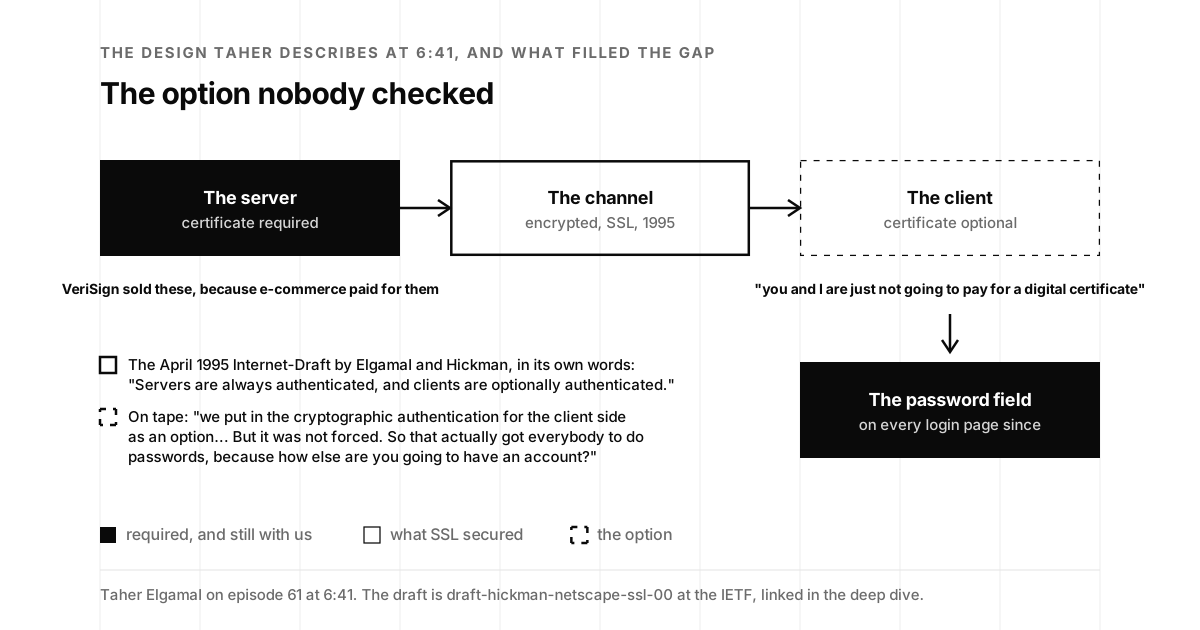
Three boxes in a row: the server, filled, with a certificate required, the channel, encrypted by SSL in 1995, and the client, dashed, with a certificate optional. Under the server: VeriSign sold these, because e-commerce paid for them. Under the client: you and I are just not going to pay for a digital certificate, and an arrow down to a filled box, the password field, on every login page since. Two notes: the April 1995 Internet-Draft said servers are always authenticated and clients are optionally authenticated, and on tape Taher said the client option was not forced, so that actually got everybody to do passwords.
The option nobody checked. One side of the handshake had a buyer for its certificate. The other side got a password field.

What I find generous about the answer is that he does not blame the users or the era. He lists the reasons the option stayed unchecked: “back then, we did not really have fingerprints and other biometrics to, to validate who these people are and that kind of thing,” and “Processing a certificate on the client side will probably be perceived as a lot of processing power, because running public key cryptography is not cheap.” Then the sentence that should be on the wall of every identity startup: “There were a lot of reasons why whatever happened, but it just, we waited way too long, is the problem.” The phone with a secure chip and a fingerprint reader is the client certificate that consumers never bought, which is the entire thesis of device-bound credentials, and the reason the company he sits on the board of was founded by his old boss at Netscape. More on that below.

Wikipedia actually claims

I opened with his LinkedIn profile, whose first entry is technical staff at HP in 1984 with no security in it, and asked how a graphics and compression engineer came to be called the father of SSL. His answer started with the encyclopedia.

“[Wikipedia actually claims] I’m the father of SSL. That’s where it came from. So whoever wrote that, I did not write my own Wikipedia entry, as nobody actually does. It refers to what I contributed, I suppose, to SSL, because I’m not actually technically the pure inventor of it. Although I wrote [patents] for SSL way back when, so, so that the Netscape original SSL [patents] I wrote. But I actually ended up building the team that developed the SSL 3.0 RFC, which we took to IETF to become TLS 1.0, and that became the industry standard.”

Taher Elgamal, at 1:08

The record fills in the pieces. Wikipedia’s source for the nickname is a December 2012 Network World profile by Ellen Messmer, which describes him as often called the father of SSL for his work at Netscape, and in which he already named storage and inadequate passwords as the weakest links (Network World, Wikipedia). The patents are real: US 5,657,390, “Secure socket layer application program apparatus and method,” filed August 25, 1995, granted August 12, 1997, inventors Taher Elgamal and Kipp E. B. Hickman, assigned to Netscape Communications, with a continuation, US 5,825,890, granted October 20, 1998 (Justia). The part he undersells is the standard. The Marconi Society’s account is that Paul Kocher focused on developing the protocol itself while Elgamal “led the adoption of SSL as a free and transparent industry standard,” secured Netscape’s agreement to make it free to everyone including competitors, and then led the effort to have the IETF adopt SSL 3.0 as the basis for TLS, winning Microsoft’s support over an alternative it had developed internally (Marconi Society). SSL 2.0 shipped in February 1995 with flaws, SSL 3.0 was a complete redesign in 1996 by Kocher with Netscape’s Phil Karlton and Alan Freier, TLS 1.0 arrived as RFC 2246 in January 1999, and TLS 1.3 as RFC 8446 in August 2018 (Wikipedia). “TLS got updated over the years, which of course is a wonderful thing. But it’s actually kind of surprising that it, this kind of technology lasts this long.”
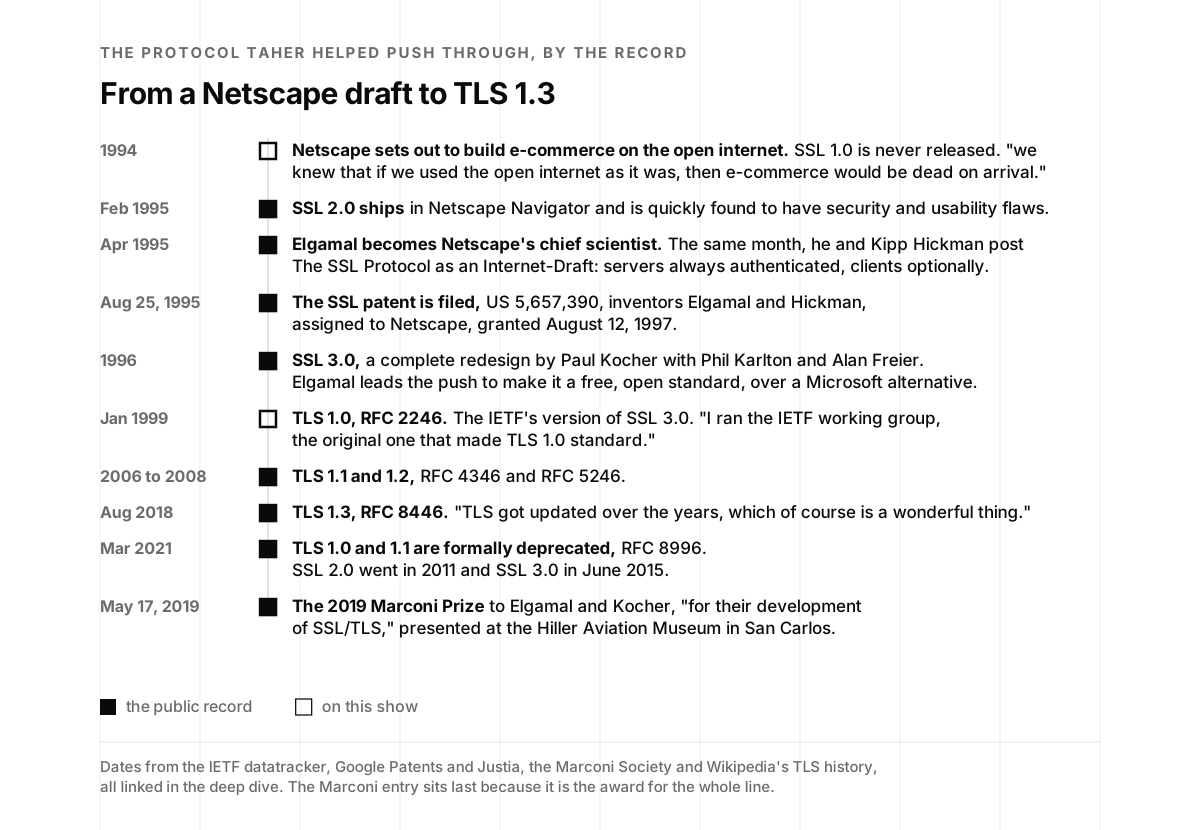
A timeline of ten entries. 1994: Netscape sets out to build e-commerce on the open internet and SSL 1.0 is never released. February 1995: SSL 2.0 ships. April 1995: Elgamal becomes chief scientist and posts The SSL Protocol draft with Kipp Hickman. August 25, 1995: the SSL patent is filed. 1996: SSL 3.0, redesigned by Paul Kocher with Karlton and Freier, which Elgamal pushes to make an open standard. January 1999: TLS 1.0, RFC 2246. 2006 to 2008: TLS 1.1 and 1.2. August 2018: TLS 1.3. March 2021: TLS 1.0 and 1.1 deprecated. May 17, 2019: the Marconi Prize to Elgamal and Kocher.
From a Netscape draft to TLS 1.3. The protocol he helped make free is the lock icon on every page you will open today.

The prize is the part the tape never mentions, because he is not that kind of guest. On March 13, 2019 the Marconi Society named Elgamal and Kocher the 2019 Marconi Prize recipients “for their development of Secure Sockets Layer/Transport Layer Security (SSL/TLS)” and other contributions to the security of communications, with Vint Cerf, the Society’s chair, observing that “In today’s climate, protecting communication and data across network channels has never been more important” (Rambus). It was presented on May 17, 2019 at the Hiller Aviation Museum in San Carlos.

The award for the whole line, from the 1995 draft to TLS 1.3. He was Salesforce's security chief technology officer at the time, and is again. View on X.

Three years later the National Academy of Engineering elected him for “contributions to cryptography, ecommerce, and protocols for secure internet transactions,” the third Salesforce member after Marc Benioff and Thomas Berson (Salesforce). The RSA Conference had given him its lifetime achievement award in 2009. None of which answers what he actually did, which is why the tape matters: he wrote the patents, he built the team that wrote SSL 3.0, and he ran the push that turned a company’s protocol into everyone’s.

Math is the thing

I asked whether there was a story of how he got pulled into security, and the honest answer was that he never did. He landed in cryptography, and the math was the driver.

“I came to Stanford to get a PhD. My undergrad degree was from Cairo University in Egypt, and I came to Stanford to get an advanced, so I came to grad school. That was 1979. And I studied electrical engineering, actually. So I came to study, like, electrical engineering, and I thought I would be working on estimation theory and signal processing and that kind of stuff. Math is the thing that I love the most all my life. I used to play with numbers when I was like four years old, which most little kids do not do. So when I came to Stanford and I found math classes that I can take, I just took a bunch of algebra and number theory courses, which was magnificent. I mean, it’s the best thing I’ve ever done. And then I ran into Marty Hellman, who’s then the professor who ended up being my thesis advisor, and he and Diffie invented public key cryptography in the mid-70s.”

Taher Elgamal, at 2:11

The record: a bachelor’s in electrical engineering from Cairo University in 1977, a master’s from Stanford in 1981 and a doctorate in 1984, advised by Martin Hellman, who with Whitfield Diffie had published public-key cryptography in 1976 and who would win the 2000 Marconi Prize and the 2015 Turing Award (Wikipedia, Beyond Identity). The thing he did not mention on tape, because he is not that kind of guest either, is the 1985 paper, “A Public Key Cryptosystem and a Signature Scheme Based on Discrete Logarithms,” in IEEE Transactions on Information Theory, which gave the world the ElGamal cryptosystem and the ElGamal signature scheme. The encryption is in GNU Privacy Guard and PGP to this day, and the Digital Signature Algorithm that NIST adopted as the Digital Signature Standard is a variant of the signature scheme (Wikipedia). Number theory, in other words, did exactly what he says it does near the end of the episode: “There are problems that are hard in one direction and very easy in another [direction]. [That’s] how public key algorithms came about.”
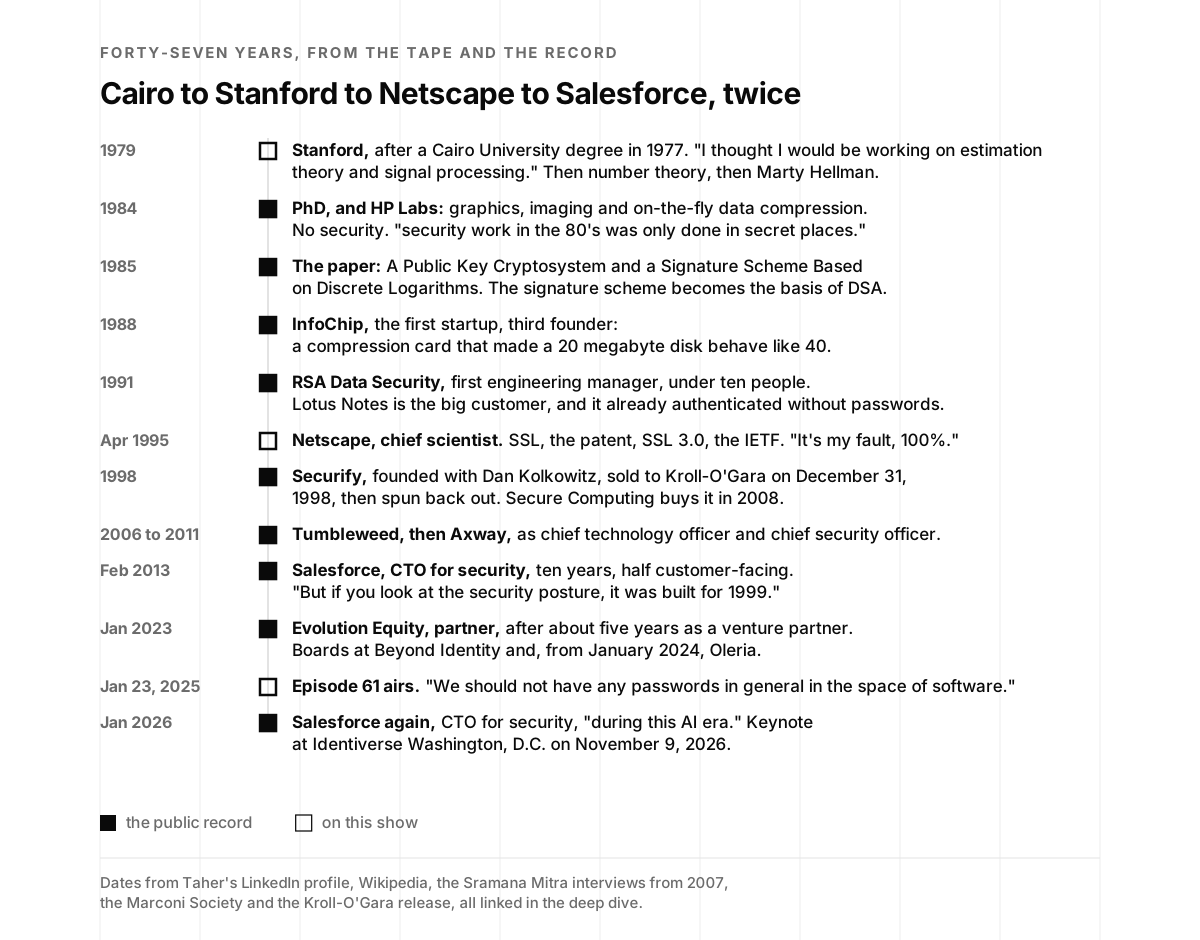
A timeline of twelve entries. 1979: Stanford after Cairo University. 1984: PhD and HP Labs. 1985: the public-key cryptosystem and signature scheme paper. 1988: InfoChip, the first startup. 1991: RSA Data Security, first engineering manager. April 1995: Netscape chief scientist. 1998: Securify. 2006 to 2011: Tumbleweed and Axway. February 2013: Salesforce CTO for security. January 2023: Evolution Equity partner. January 23, 2025: episode 61 airs. January 2026: Salesforce again, and the Identiverse keynote in November 2026.
Forty-seven years on one line, Cairo to Stanford to Netscape to Salesforce, twice. The filterable version is at the end of the page.

Then HP Labs, where he worked on data compression, image processing and computer graphics, and built “a little prototype that actually did on-the-fly data compression,” which was enough for his boss to say “hey, you’re actually handy. You’re not just an academic kind of guy. We should start a company.” The company was InfoChip, founded in 1988, and the product was a compression card that made a 20 megabyte hard disk behave like a 40, “and if you remember 1988, a 20 megabyte hard disk was actually a big deal.” The trade press of the day confirms it: a Santa Clara company called InfoChip Systems was selling the Expanz! Disk Expander Card for $199 in 1990, a half-card that compressed and decompressed in real time and claimed to increase hard disk capacity up to three times (COMPUTE!). He told Sramana Mitra in 2007 that he was the third founder and that it “did not sell for a whole lot,” but that it taught him engineering management and operations on the job (Sramana Mitra). The company he walked into next was the one that mattered.

“There was not security. When that company sold to [Cyrex], it was like three years later. I ran into RSA, the company. RSA at that time was a small company. They had less than 10 people. And I ended up being the first engineering manager. So I was actually the very first engineering manager at RSA. And I did some cryptography work also, 50-50 kind of thing. And RSA sold a cryptography toolkit, which is a software, basically a library that people bought to include cryptography into their products. You may or may not remember there used to be a thing called Lotus Notes. So that was the very first customer, actually. That was a big customer for RSA.”

Taher Elgamal, at 4:45

In the 2007 interview he put the headcount at six or seven when he joined in 1991, with Jim Bidzos as chief executive, and about twenty when he left in 1993 or 1994, by which time RSA had contracts with Microsoft, Sun and Apple and was based in Redwood Shores, in a building that is now part of the Oracle campus. He also said that the certificate business RSA had planned became the seed of VeriSign, which spun out of RSA, which makes the VeriSign in his SSL story a company he had watched form (Sramana Mitra). Then, in late 1994, at a conference in San Jose, he watched Jim Clark, whom he knew from Stanford, give a talk about encryption, emailed him afterward, consulted for Netscape for a few months, and became its full-time chief scientist in April 1995. He has said consistently that a partial version of SSL existed before he arrived and that his first job was to make it succeed (Sramana Mitra). On tape he dates the move to 1994 and the mission to one sentence: “the Netscape vision to build e-commerce on the open internet.”

Lotus knew in 1991

Sasha asked what the business need was that made Lotus put cryptography into a product in 1991, and the answer is the hinge of the episode, because the industry had the right idea and then put it down.

“It was an amazing, they used it for authentication of users. It was actually a beautifully written authentication program that would avoid passwords. Can you imagine? That was 1991. They actually wrote, [in] 1991, that passwords were a bad thing. We’re still suffering from passwords, of course. But they actually recognized that, and they wrote a very nice authentication program. So when you, in the old Lotus 1-2-3, when you actually logged in, you used a cryptographically strong authentication protocol. And then after that, every single software company you can name that existed back then bought that library, because there was just nothing else.”

Taher Elgamal, at 5:41

He means Notes, not the spreadsheet, and the record is on his side. Lotus Notes release 1.0 shipped in December 1989, after a beta so long that the product was considered vaporware, with Price Waterhouse buying 10,000 copies before launch, and Notes “was the first widely adopted software product to use public key cryptography” for client-server and server-server authentication and for encrypting data (Wikipedia). A desktop product of 1989 authenticated people with keys, and the web of 1995 authenticated servers with keys and people with a word they typed. Sasha’s question, whether the industry could have taken a different turn, is the one I would want every identity founder to be able to answer. Taher’s answer is above. Mine is that the turn is finally being taken, thirty years late, and the numbers are in the section on passkeys below.

It was invented to just separate things

The password’s origin story is the one he tells with the most relish, and it reframes what the thing was ever for.

“It was actually funny. The gentleman who invented the password worked at IBM Research in the sixties. And he, they were doing research and they were just trying to, I want to put my papers in one place and your papers go in a different place. So the idea of a password was to just, everybody knows where their stuff is at. It’s not to actually secure anything. Because when you do research, I can read your paper just as much as you can read your own. I mean, it’s all kind of research papers. So it was not invented for a security function. It was invented to just separate things.”

Taher Elgamal, at 11:17

Listen · where the password came from, from 12:00
About 46 seconds: papers in one place, your papers in another, and a thing that was never a security function. The clip stops on its own. Read the full transcript.

One correction to the tape, which does not change the point. The computer password is generally credited to Fernando Corbató at MIT, not IBM, on the Compatible Time-Sharing System in the early 1960s, where users sharing one mainframe and a common disk each needed their own files, so that “people didn’t have to live in a communal setting,” as he put it in 2014. In the same interview he called what passwords had become on the web “kind of a nightmare,” admitted to keeping a crib sheet for roughly 150 of them, and said “I don’t think anybody can possibly remember all the passwords that are issued or set up” (WeLiveSecurity, IEEE Computer Society). Corbató died on July 12, 2019, at 93, and the inventor’s own verdict matches Taher’s: a filing-cabinet convention that got promoted to the front door of the internet. “Yeah, it, it just became how the internet runs, because somebody discovered, hey, if I use a password, maybe we just, that’s how people log into things.”
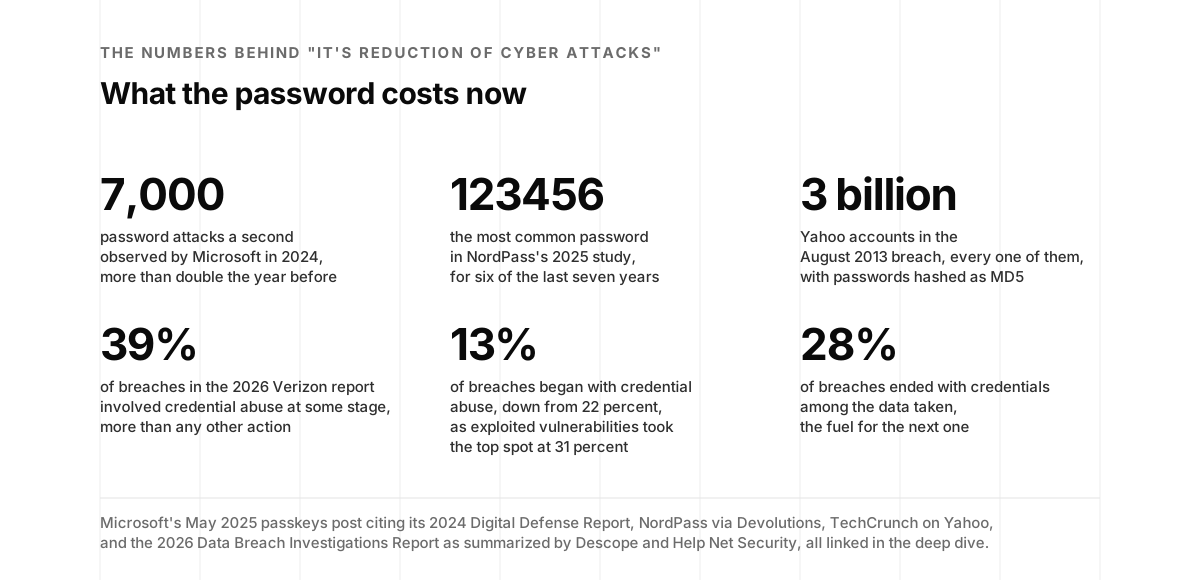
Six figures. 7,000 password attacks a second observed by Microsoft in 2024. 123456, the most common password in NordPass's 2025 study, for six of the last seven years. 3 billion Yahoo accounts in the August 2013 breach. 39 percent of breaches in the 2026 Verizon report involved credential abuse at some stage. 13 percent began with credential abuse, down from 22 percent, as exploited vulnerabilities took the top spot at 31 percent. 28 percent ended with credentials among the data taken.
What the password costs now. The one number moving the right way is the share of breaches that begin with a stolen credential, and it is moving because the exploit got easier, not because the password got better.

What the convention costs is measured every year. Microsoft observed about 7,000 password attacks per second in 2024, more than double the rate of 2023 (Microsoft). The 2026 Verizon Data Breach Investigations Report, drawn from more than 31,000 incidents and 22,000 confirmed breaches in 145 countries, found credential abuse involved at some stage of 39 percent of breaches, more than any other action, with credentials among the data taken in 28 percent, which is how the next breach gets its fuel. The share of breaches that began with a stolen credential fell to 13 percent, from 22 percent the year before, and the honest reading is that exploited vulnerabilities, now 31 percent, overtook it rather than that passwords improved: measured the old way, credential abuse would have landed at 16 percent (Descope, Help Net Security). And the breach he names at the very end of the tape, the “original Yahoo breach,” turned out in October 2017 to have covered all three billion Yahoo accounts, from an August 2013 intrusion, with passwords hashed as MD5 (TechCrunch). His sentence about it is worth keeping in your head when you design the account system for a company of six people: “I don’t think anyone should be hashing passwords in a small startup with, like, five people, six people. You delegate that.”

It’s reduction of cyber attacks

Sasha asked the YSecurity question, which is what the business need is, since no feature gets adopted without one. The answer was immediate.

“It’s reduction of, what, it’s reduction of cyber attacks. I don’t believe there is a single cyber attack, now we’re getting heavy into cyber, which is a good thing. The vast majority of cyber attacks use somebody’s credential to organize something. And if they stumble onto something that is an admin password, it’s even better, because now we have access to more stuff. And if they don’t, they try to [lure] you into something or do something else or jump into a different machine. And all of these things were built on the fact that they have access to an account someplace. Password is essentially answering the question of, which is, who are you? And even if we look at the AWS root account, it is in principle protected by password. Of course, you can add second factor authentication logic, but the root accounts in AWS are protected by password. I claim that is the wrong thing to do.”

Taher Elgamal, at 11:17

The AWS root account example aged well for his argument. Five months after this episode, Amazon Web Services said at its June 2025 re:Inforce conference that it had reached 100 percent enforcement of multi-factor authentication for root users across every account type, after requiring it for management and standalone accounts in 2024 and member accounts in March 2025, with its chief information security officer Amy Herzog noting that AWS had been “the first cloud provider to mandate the use of MFA for management and standalone accounts with root access” (The Register, AWS). The password is still there under the second factor, which is Taher’s point, but the account he picked as the example of the wrong thing to do no longer accepts a password alone.

He had run the same play himself, at a much larger scale, and the number he gave is the one every security leader planning a rollout should hear.

“The banks have actually started down that road a while back, from their own people. So they started the multi-factor authentication a long time ago, because they figured out somebody can log into a machine in production in the bank, that’s probably not a good thing. When I was at Salesforce, we encouraged every single customer to completely replace password with MFA. And actually, we had really good success. We, we had an over eighty percent success. The issue is, that was authentication into Salesforce, not the 89 other things that people need to log into. So the issue is, the landscape is, in fact, tricky. And when, because we know that the user is not gonna buy an authentication product, necessarily, the bank buys one and the Amazon has their own and just everybody has their own. And then as a user, you end up with 17 different ways to log into stuff. That is not good.”

Taher Elgamal, at 14:47

Salesforce announced in 2021 that multi-factor authentication would be required to access its products from February 1, 2022, with the Salesforce Authenticator app, time-based code apps, WebAuthn security keys and built-in authenticators such as Touch ID, Face ID and Windows Hello accepted, and one-time codes by text message, email and phone excluded because they are “inherently vulnerable to interception, spoofing, and other attacks” (The Record). The “over eighty percent” is his number from the tape, not a published figure, and I could not find Salesforce stating one. What I take from it is the sentence after: the win was one application out of ninety. The user does not buy authentication. The bank buys one, Amazon has its own, and the person in the middle ends up with seventeen ways to log in. The only answer to that is a credential that lives on the device and works everywhere, which is the standard he helped start: he is credited as the “glue” that brought the founders of Nok Nok Labs together, and Nok Nok announced the FIDO Alliance with PayPal, Lenovo, Infineon, Validity and Agnitio in February 2013 (PR Newswire). Passkeys are FIDO’s answer, and the numbers twenty-one months after this tape are the first time in his career that “we don’t need a password” has a growth curve under it.
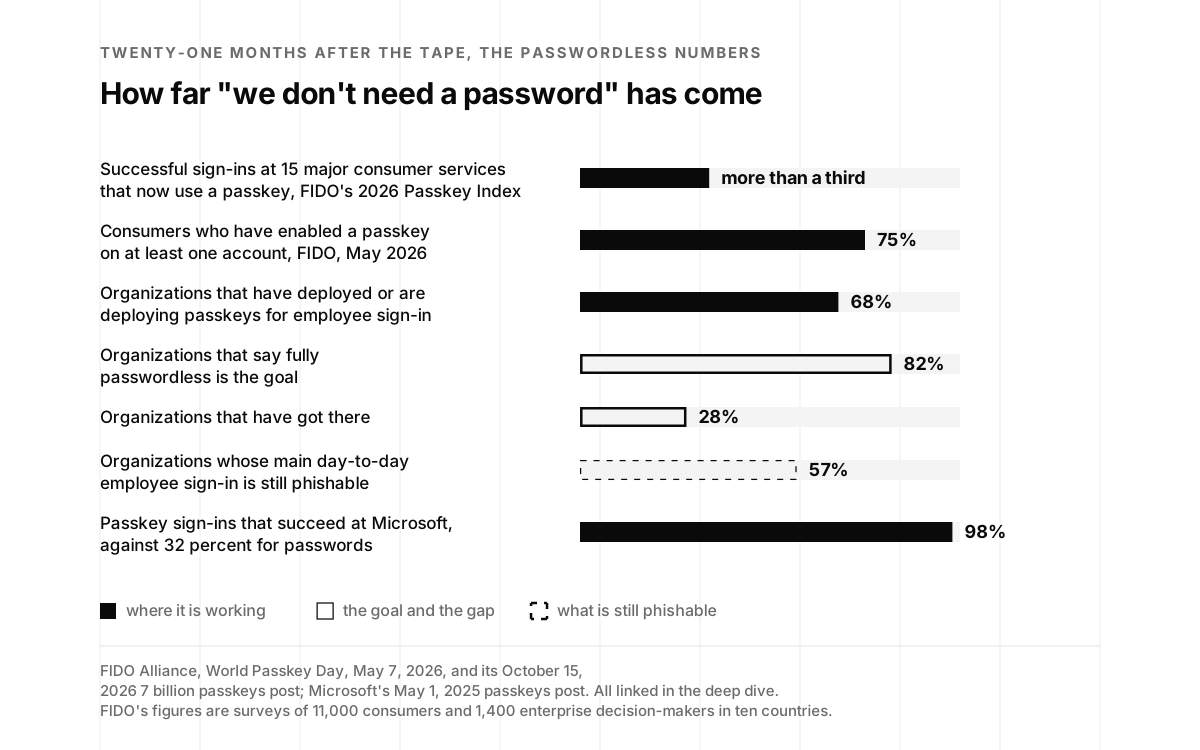
Seven horizontal bars. More than a third of successful sign-ins at 15 major consumer services now use a passkey. 75 percent of consumers have enabled a passkey on at least one account. 68 percent of organizations have deployed or are deploying passkeys for employee sign-in. 82 percent say fully passwordless is the goal and 28 percent have got there. 57 percent still use a phishable method for the main day-to-day employee sign-in. 98 percent of passkey sign-ins succeed at Microsoft, against 32 percent for passwords.
How far "we don't need a password" has come since the tape. The gap between the 82 percent who want it and the 28 percent who have it is where the scorecard below starts.

The FIDO Alliance counted five billion passkeys in use on World Passkey Day, May 7, 2026, with 90 percent of consumers aware of them, 75 percent having enabled one on at least one account, and 68 percent of organizations deploying or actively deploying them for employee sign-in, against 57 percent whose main day-to-day employee sign-in was still a phishable method (FIDO Alliance). By October 15, 2026 the estimate was seven billion passkeys and more than a third of successful sign-ins at the fifteen major consumer services in its Passkey Index (FIDO Alliance). Microsoft made new accounts passwordless by default on May 1, 2025, reporting nearly a million passkeys registered every day, passkey sign-ins succeeding about 98 percent of the time against 32 percent for passwords, and eight times faster than a password with a second factor (Microsoft). Amazon, whose founder Taher jokes decided to put a password on the website, added passkeys in October 2023 (Amazon), and on September 1, 2026 a business customer posted to Hacker News a notice they said had come from Amazon, telling them passkeys would be required on a rolling basis with the password kept only for recovery, which I could not confirm with Amazon and which drew the question that every shared account will raise.

"This will be an interesting passkey test. Much has been spilled about the complexity of passkeys for normal users but in many cases you can just not use them or they're just tied to your personal smartphone for your personal Gmail/icloud

Amazon is an account that is shared by many between household. Will this cause user confusion"

julianozen, on Hacker News, September 1, 2026

That is the user-experience objection Sasha raised on tape, that people expect a username and a password field, and Taher’s answer to it is the safe deposit box: two keys, one yours and one the bank’s, “It’s not exactly easy to use, but you know why? Because there’s good stuff that you’re saving in there that you don’t want to be available.” People adapt. They stopped writing the PIN on the back of the card. My cynical contribution was that we now have one PIN and use it across all of our cards, and he conceded that too.

April 2020, five years before this episode: two and a half minutes on how SSL laid the foundation and why the password has to go, recorded for Beyond Identity. Watch on YouTube.

Built for 1999

Sasha asked what his greatest challenge had been at Salesforce, and I asked him to clarify the title for listeners, because chief technology officer for security is not a chief information security officer. He did not run the security operations. He was half customer-facing and half an advisor to engineering teams “to attempt to improve the security posture of the whole company,” which matches the description he gave Salesforce’s own engineering blog in 2019: half his time speaking at events and advising customers and partners, the other half acting as a security advisor to internal teams (Salesforce Engineering). The challenge was the footprint.

“Salesforce started in 99. Salesforce is an awesome company. I still have tons of friends in there. They did a lot of amazing things. But if you look at the security posture, it was built for 1999. That’s when it was started. And every few years, you improve a couple of things, and you add this and you add that. And then a customer says, hey, I need you to do this. You add the stuff that the big customers ask for. I mean, the biggest challenge is just the big footprint.”

Taher Elgamal, at 17:23

Everyone is a customer of Salesforce, I said, and if you are not, you are a customer of Slack, which is also Salesforce. He agreed, and then gave the line that applies to every company older than its security program: “you can’t go back and change fundamental architectural things 20 years after a company has started. It just doesn’t work.” You improve this and you improve that, every year, “As long as you’re doing that, you’re actually fine.” He had done it for ten years, from February 2013 to January 2023, when he announced on LinkedIn that he was leaving to join Evolution Equity as a general partner, “many friendships at Salesforce over the last 10 years that I will always cherish,” as The Register reported the week Salesforce was also losing its co-chief executive and cutting ten percent of its staff (The Register). Then, nine months before this page, he went back.

Our first Identiverse Washington, D.C. keynote speaker is here! 🎉

We’re thrilled to welcome Taher Elgamal, CTO of Security at Salesforce, to the Identiverse D.C. stage. Join us as one of digital security’s most influential pioneers shares his perspective on the future of identity, trust, and security.

📅 November 9–10, 2026
📍 MGM National Harbor

Identiverse · August 2026
The title is current. His own post in January 2026 said he had rejoined Salesforce as chief technology officer for security, "during this AI era," and his profile lists the Evolution Equity partnership alongside it. The keynote is a week after this page. His announcement on LinkedIn.

So the man who recorded this as an investor is, as you read it, back inside the company whose security posture was built for 1999, in the era he described on tape as the next wave of the software stack. The LinkedIn profile that I read on air now lists both roles, chief technology officer for security at Salesforce from January 2026 and partner at Evolution Equity from January 2023, with board seats at Beyond Identity and Oleria (LinkedIn). I take the return as the most interesting data point on this page about where he thinks the problem is.

The line no PRD has

Sasha asked how a security leader keeps an organization current when there is a new product every year, and Taher answered with the structural problem under all of it, which is that we built thirty years of infrastructure without starting from security, and the keywords that have come since do not fix that on their own.

“And 25, 30 years later, you hear people talk about zero trust and secure by design and all of these things, which are wonderful things.”

Taher Elgamal, at 19:09

All the big keywords, I said. “I mean, yeah, if you keep them as keywords, then they’re a bit [hollow]. If you try to implement them, you face the reality, which is actually tough.” And then the observation I have repeated to three founders since.

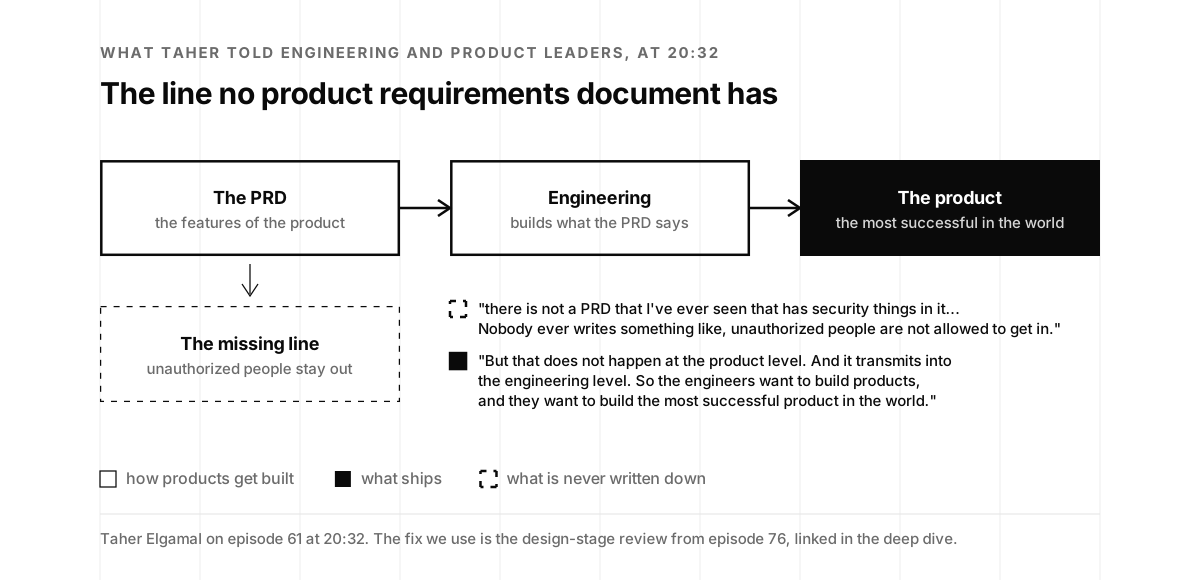
“I can’t tell you how many times I told engineering leaders and product leaders, there is not a PRD that I’ve ever seen that has security things in it. So suppose you’re a PM in some company and you’re responsible for some application. And you write down the, the, I mean, you write the, the features of the product. Nobody ever writes something like, unauthorized people are not allowed to get in. In my opinion, humble opinion, that’s probably a very important thing, because if unauthorized people find their way through, bad things will happen. But that does not happen at the product level. And it transmits into the engineering level. So the engineers want to build products, and they want to build the most successful product in the world. That’s what engineers want to do.”

Taher Elgamal, at 20:32
Listen · the PRD, from 20:32
About 54 seconds: keywords versus reality, and the sentence no product requirements document contains. The clip stops on its own. Read the full transcript.
Three boxes in a row: the PRD with the features of the product, engineering, which builds what the PRD says, and the product, filled, the most successful in the world. Under the PRD, a dashed box for the missing line: unauthorized people stay out. Two notes from the tape: there is not a PRD he has ever seen with security things in it, and nobody writes that unauthorized people are not allowed to get in, and the gap transmits from the product level into the engineering level.
The line no product requirements document has. Engineers build what the document says, and the document never says it.

This is the same gap Michael Nov of Prime Security described from the other end on episode 76: the design stage is where security has to take a seat, because the review that happens after the code is written can only ask for changes to a thing that already exists. Taher’s version is earlier still. Put the sentence in the requirements. “Unauthorized people are not allowed to get in” is a feature, it has acceptance criteria, and if it is not written down, the engineers who want to build the most successful product in the world will build exactly what was written down. Our design-stage scorecard is the checklist for whether your product process has that line in it.

The AI layer in front

I asked how all of this plays out in the space of AI, and his answer was architectural: the next wave of the stack adds a layer nobody can get their brain around.

“Well, I mean, AI is an exaggeration of the complexity of the next wave of the software stack, because you could understand what a, a three-layer kind of architecture looks like. You can convince yourself that database is a place you put data, and you have a, a Java layer in front to process things, and you have some business logic. You can actually get your brain to get there. But when you put an AI layer in front that will serve the user something better, because the AI will actually, you know, succeed in finding out what the user is really after, understanding what that AI layer is doing is impossible. These big LLMs have trillions of parameters. I mean, there’s no way.”

Taher Elgamal, at 21:31
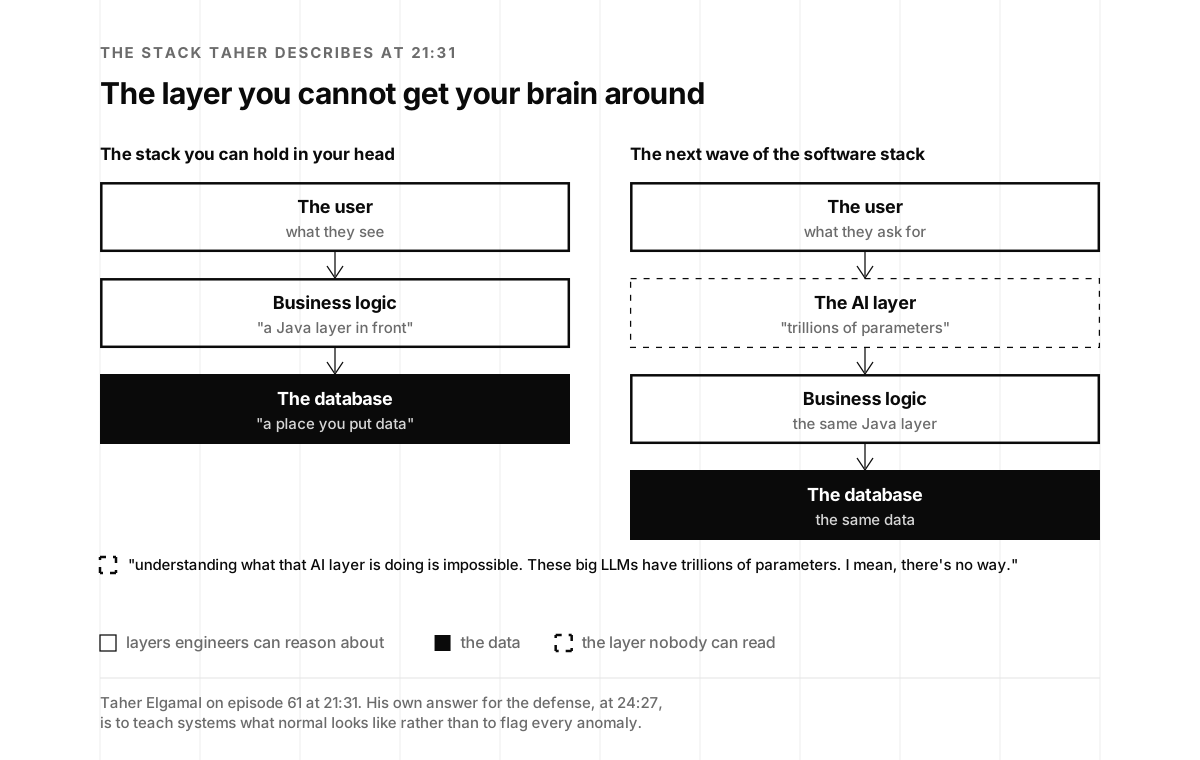
Two stacks side by side. The stack you can hold in your head: the user, business logic, a Java layer in front, and the database, a place you put data, filled. The next wave: the user, then a dashed AI layer with trillions of parameters, then the same business logic and the same database. Below, the line from the tape: understanding what that AI layer is doing is impossible.
The layer you cannot get your brain around. The database and the business logic did not change. The thing in front of them did.

Sasha agreed that the technology has to be applied properly, and Taher’s reply was the humbler one: “Yeah, but nobody knows how to apply properly.” We ended up with products that talk to each other without understanding what they are saying, and that was true before the AI layer was added. “we actually do not exactly know what the software does.” It is the argument for the ladder we use for agents, read before write, and for giving the credential rather than the model the limit, which Riad Wahby made from the key-management side on episode 69. What Taher is more hopeful about is the defense. Sasha described a market of specific tools, each with a dashboard that needs a four-year degree to read, bought “to make you feel warm and fuzzy on the inside,” and Taher’s reply was that nobody looks at them. His own picture of where the intersection of AI and security goes is better than a dashboard.

“Yeah, you can actually see that, with the correct use of AI, you can have deeper understanding of the operation of an infrastructure and the suite of applications that are running. And you can teach it what looks right and what looks wrong. And the truth is, we’ve actually done that. So all the, starting with the early intrusion detection products, they actually used machine learning to do detection. So we’ve been doing that. The issue is, we’ve been finding anomalies. Anomalies is kind of whatever it means. There’s way too many anomalies. That’s why there is more alerts than people can digest. But if you build an understanding of the operation of how these things are supposed to talk to each other, you can make sense of, this is how this application runs. And this mode I’ve never seen before. And this mode really looks like there’s somebody from a foreign country trying to do something bad.”

Taher Elgamal, at 24:27

That is the design Alan Braithwaite described from the data side on episode 50, a model of how the system is supposed to behave rather than a pile of anomalies, and it is what our 24/7 monitoring and response team is paid to produce, “the actual [actionable] action instead of just throwing a lot of noise,” in Sasha’s words. Taher’s warning is that the alerts will keep increasing because AI is being added on the offense too: companies “build the automatic attack utilities,” you rent an hour or two of attack, name the target, and “if you end up with one coin in your account, then you’re good. If you don’t, then you try the next one. You don’t lose anything.” And the attackers talk to each other more than defenders do, because defenders compete and attackers do not. His reading of the fix is collective, “if we come together and actually believe that using the connected world in a good way will benefit us, then we get there,” and his reading of the state of the art is that the executive, not the engineer, is the one who needs the deeper understanding. Sasha’s immune-system analogy got his best line of the second half: a system that notices “holy cow, I have a fever” rather than asking whether a virus is attacking, “Because the answer to that is, of course, yes.”

Three months after this episode, at RSA Conference 2025: ninety seconds on why attacking the AI stack is the biggest threat and why Evolution Equity was investing in it, with more than a million views. Watch on YouTube.

Regulate the misuse, not the tool

I asked whether the AI change would end somewhere focused, a system that homes in on the perturbations from normal, or somewhere far more self-driving, and he answered as a man who remembers the world before the web.

“So, Jon, I mean, bear in mind, you’re talking to a guy that lived for a long time before the internet. So if you rewind 30 years, there was no internet, there were [no] mobile phones, there were pieces of paper that we wrote our schedules on. It was a completely different world. When the web came, the change that happened in the world is monumental. I mean, it changed the lives of every single human being to a degree that is hard to describe. It’s actually, I’m not claiming that we knew that ahead of time. Maybe some people did. So I think the AI level of change is of the same magnitude.”

Taher Elgamal, at 34:27

The digital world brought ransomware and fraud with it, “and the level of fraud in the digital world is still an order of magnitude higher than in the physical world,” so AI “will also bring the same level of threat.” Where he lands is a principle, and he said it twice.

“And I’ve said this before, it’s my opinion. Regulating technology is a very bad idea. We should [stop] talking about it. I mean, a baseball bat can be used for a very bad thing, by the way. You can imagine, right? That does not mean we should stop making baseball bats, because it’s also fun to watch baseball games. So we should find a good compromise [on] specific uses of technology.”

Taher Elgamal, at 35:34

Cryptography was in that place, I said, and he took it personally in the best way: “Absolutely. And still [is]. I mean, all ransomware uses cryptography. Am I responsible for it? I don’t know.” He is not, and the distinction he drew is the one I would want in any policy conversation: “misuse of technology, intentionally, to harm others, is the thing that we have to regulate and prosecute and do whatever the heck you should do.” Regulating the tool mostly hurts the defenders, and the people responsible for national security, “God bless them, they’re good people,” are helped by a deeper understanding of the technology, not by a rule about it. When I suggested they have their fingers in trust stores and random number generators, he let me keep my tinfoil hat and gave the same answer: understanding finds the bad guy.

The je ne sais quoi of a pitch

A lot of founders listen to this show, so I asked what a partner at Evolution Equity looks for in a pitch and what the red flag of red flags is. The order he gave is the order on the figure.

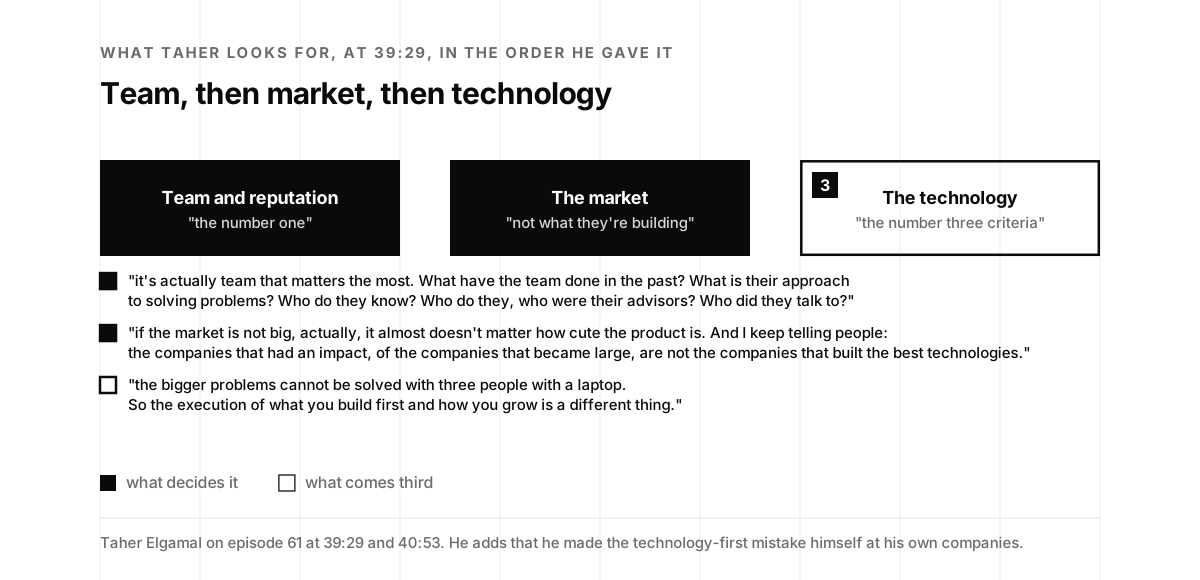
“So when I talk to a brand new company, or a company that’s been around for a year or two, a young company, it’s actually team that matters the most. What have the team done in the past? What is their approach to solving problems? Who do they know? Who do they, who were their advisors? Who did they talk to? And that tells a lot. And then the second and most important thing is what market they are actually trying to target, not what they’re building. Because if the market is not big, actually, it almost doesn’t matter how cute the product is. And I keep telling people: the companies that had an impact, of the companies that became large, are not the companies that built the best technologies.”

Taher Elgamal, at 39:33
Listen · what he looks for, from 39:29
About 57 seconds: reputation, team, market, and the thing that becomes the number three criteria. The clip stops on its own. Read the full transcript.
Three numbered boxes: one, team and reputation, the number one, filled. Two, the market, not what they're building, filled. Three, the technology, the number three criteria, outlined. Below, three quotes from the tape: team matters the most, what have they done, who were their advisors. If the market is not big it almost doesn't matter how cute the product is, and the companies that became large are not the companies that built the best technologies. And the bigger problems cannot be solved with three people with a laptop.
Team, then market, then technology. He says he made the technology-first mistake himself.

He said the technology is “the number three criteria,” and then owned it: “I made these mistakes myself, because I started companies in the past. And at the time, I might have thought this was the best technology in the world, but maybe it was, but who cares?” The record of those companies is the proof. Securify, founded in early 1998 with Dan Kolkowitz, raised $4.5 million that June and was sold to Kroll-O’Gara on December 31, 1998, for about 1.4 million shares, a deal he has valued at about $65 million, six months after the raise. He ran Kroll’s information security group for about a year and a half, spun the product business back out, and a decade later Secure Computing bought Securify for roughly $15 million plus an earn-out (Kroll-O’Gara, Sramana Mitra, eWeek). The firm he was pitching for when we recorded had become one of the largest in the category nine months earlier: on April 16, 2024, Evolution Equity announced the oversubscribed close of Evolution Technology Fund III at $1.1 billion, taking the firm founded by Richard Seewald and Dennis Smith in 2008 to more than $2 billion under management across 60 portfolio companies including Arctic Wolf, SecurityScorecard, Snyk, Aqua Security, Protect AI, Oleria and Torq, with Taher named among the partners (PR Newswire, TechCrunch). Seewald’s line in the TechCrunch piece, “We expect to invest in a portfolio of up to 30 companies in the present fund,” is the number of pitches that win. Sasha’s summary of Taher’s framework was the one I would use: “the product needs to solve the real pain point,” and Taher’s addition is that the market has to be large enough for the company to exist, because “the bigger problems cannot be solved with three people with a laptop.”

Who you are and what you can do

Taher said early on that he sits on the board of one of the companies offering a good alternative to passwords and would not do a commercial. By the end, Sasha’s enthusiasm for separating problems got him to name both of his boards, because the two of them cover the two halves of identity.

“[One] of them is Beyond Identity. Beyond Identity is actually the stronger authentication with single sign-on built in. And [Oleria] is the access controls and the governance of what IAM identity cannot do. So they’re actually not, they’re not competing.”

Taher Elgamal, at 41:45

So it is authentication, I said, and then fast follows with authorization. “Yep, it’s fast followed with authZ.” Sasha’s version is the one I use with founders: one thing is who you are, and the second thing is what you can do, and if either is messed up you end up in a tough place. The two companies are worth knowing. Beyond Identity was launched in April 2020 by Jim Clark and Tom Jermoluk, the Netscape and Silicon Graphics founders, with a $30 million Series A led by Koch Disruptive Technologies and New Enterprise Associates, on exactly the idea in Taher’s SSL story: a personal certificate whose private key is generated in the phone’s secure enclave and never leaves it, so that the chain of trust Netscape built for servers “all the way to the end user with no need for a password at all,” in Jermoluk’s words (SecurityWeek). Taher joined its technical advisory board in May 2020 alongside Martin Hellman, and in February 2022 Evolution Equity led the $100 million Series C, at a $1.1 billion valuation, with Jim Clark participating, and Taher joined the board with the line “Passwords are still the number one attack vector in most breaches” (Beyond Identity, Mobile ID World). His old boss at Netscape founded the company that checks the option nobody checked, and the man who wrote the option sits on its board. Jasson Casey, its chief executive, made the case for it on episode 92.

The day after this episode aired. The company he would not advertise on tape, advertising him. View on X.

Oleria is the other half. Founded by Jim Alkove, who had run security programs at Salesforce, Amazon and Microsoft and was Salesforce’s chief trust officer, it raised a $33 million Series A led by Evolution Equity on January 18, 2024, with Salesforce Ventures, Tapestry VC and Zscaler, and Taher joined the board with the words “Oleria is bringing cybersecurity into the future and keeping pace with the changing landscape” (Oleria). Authentication proves who you are, and Oleria’s category, access governance, decides what you can do once you have proved it. That is the same split Graham Neray of Oso described on episode 89, where building authentication would be a whole other company and permissions are one of the last layers companies still build from scratch, and it is the reason the scorecard below asks about both. My own confession on tape was that I once joined a startup to kill the password, “You are not a password. You are so much more than a password,” and that it fizzled. Taher’s consolation was perfect: “Because Jeff Bezos decided to have a password on the Amazon website.”

The founder notes

Go get a PhD in math. Sasha asked whether he would meet his younger self and what he would say. “I would ask them to go get a PhD in math and ignore this whole thing.” There is a book he read years ago with a proof that the universe could not exist without numbers, “That numbers actually existed before the universe, which is kind of a really cute thing. So, yeah, math is the origin of everything.” He cannot go back to it now, “because I’m an industry guy,” and when I suggested weekends, “Not at the PhD level anymore.” It is not like riding a bike. What brought him into cryptography was number theory, and all of public key cryptography, as I said and he confirmed, “it’s all just math at the end of the day.”

Users adapt. The safe deposit box, the two keys, and the ATM card with the PIN written on the back, which people stopped doing. “So people do adapt.” The argument that users will not accept a new way to log in has been wrong before.

The executive, not the engineer. “Technical people can probably get there. It’s the executive level person that needs a deeper understanding of how they’re operating.” Thousands of threat intelligence feeds exist, and reading them takes another four-year degree. The person who runs a digital business knows there are cybersecurity issues and has no deeper understanding of what that means, which is the gap a virtual chief information security officer exists to close.

Ten years out. Two futures. If nothing changes, “you’re going to see more tools for a while, then conglomerates,” all your cloud security from one vendor, and still gaps, because nothing you can buy tells you what gaps are in your architecture, “because the architecture is yours.” The world he wishes for “would actually take the [words] zero trust and, and secure by design for real,” with products that cheaply monitor for weird things, shut them down, “and the business continues.”

We build bad products. “I mean, we have to admit it. I’ve been in software longer than all of you. So, so we just have to admit it. The way we’ve been building software products is just not the right way.”

The exit. Sasha: “it was an absolute pleasure to have you on the show.” Taher: “Hey, guys, I appreciate it.” Sasha asked for a fast follow-up. “Can do.” I offered Fast and Furious 2. We are still owed the sequel.

Did you catch it? A six-question quiz

Interactive · six questions

Did you catch it?

Six questions on what Taher actually said, with the timestamp for each answer. The answers are under each question for anyone reading without JavaScript.

  1. Whose fault are passwords, according to Taher?

    1. The users', for choosing weak ones
    2. His, 100 percent
    3. VeriSign's, for charging for certificates

    b. "It's my fault, 100%." Then, under protest: "Well, it's not, I mean, it is my fault." Transcript, 6:34.

  2. What did SSL make optional that led everyone to passwords?

    1. Encryption of the session
    2. Authentication of the server
    3. Cryptographic authentication of the client

    c. "we put in the cryptographic authentication for the client side as an option," and then: "But it was not forced. So that actually got everybody to do passwords." Transcript, 6:41.

  3. Which product was RSA's first big customer, and what did it use the cryptography for?

    1. Lotus Notes, to authenticate users without passwords
    2. Netscape Navigator, to encrypt web pages
    3. Microsoft Windows, to sign device drivers

    a. "there used to be a thing called Lotus Notes. So that was the very first customer." And: "a beautifully written authentication program that would avoid passwords. Can you imagine? That was 1991." Transcript, 4:45 and 5:41.

  4. What was the password invented to do, in Taher's telling?

    1. Keep spies out of military computers
    2. Separate one researcher's papers from another's
    3. Protect bank accounts

    b. "So it was not invented for a security function. It was invented to just separate things." The record credits Fernando Corbató at MIT, not IBM. Transcript, 11:17.

  5. What success rate did Taher give for replacing passwords with multi-factor authentication at Salesforce?

    1. About half
    2. One hundred percent
    3. Over eighty percent

    c. "We, we had an over eighty percent success. The issue is, that was authentication into Salesforce, not the 89 other things that people need to log into." Transcript, 14:47.

  6. What comes first when he evaluates a young company?

    1. The team and its reputation
    2. The technology
    3. The size of the round

    a. "it's actually team that matters the most." Then the market. The technology "becomes the number three criteria." Transcript, 39:33.

How much of your company runs on a password?

Taher’s claim is that the vast majority of attacks start with somebody’s credential, and that the password is a filing convention promoted to a security control. This scorecard asks eight questions about where a password still stands between an attacker and your company, each tied to a point on the tape, and tells you which one a phishing email or a leaked credential would find first. Answer for how things are today, not how the policy document describes them.

Scorecard · eight questions

How much of your company runs on a password?

Answer for the accounts that can read customer data, reach production or move money, as they are used today.

  1. How does an employee sign in to the identity provider or single sign-on that everything else hangs off?

    • A password, and maybe a code by text message or email
    • A password plus an authenticator app or push approval
    • A passkey or security key bound to the device, with no password to phish

    "We do not need a password to log into something. It's just, we don't." Codes by text and email were the methods Salesforce excluded when it made MFA mandatory in 2022. Device-bound credentials explains the difference between a code and a key.

  2. How many separate logins does the average person at your company have that are not behind that single sign-on?

    • We don't know
    • More than five, and we have a list
    • A handful, each on the list, each with a reason

    "as a user, you end up with 17 different ways to log into stuff. That is not good." The win at Salesforce was one application out of ninety. Count yours.

  3. How are the root and break-glass accounts protected: the cloud root user, the domain registrar, the payment processor, the identity provider's own admin?

    • A password in a shared vault
    • A password plus a second factor
    • A hardware key, two named holders, and a tested recovery path

    "the root accounts in AWS are protected by password. I claim that is the wrong thing to do." AWS now enforces a second factor on every root user. Your registrar and your payment processor may not.

  4. Does your own product make customers choose a password, or offer them a passkey, social login or magic link first?

    • Username and password, we hash them ourselves
    • Password, delegated to an identity service
    • Passwordless by default, password only as a recovery option, delegated

    "I don't think anyone should be hashing passwords in a small startup with, like, five people, six people. You delegate that." Microsoft made new accounts passwordless by default in May 2025.

  5. Once someone is signed in, what decides what they can do: who can see every customer, change billing, or reach production data?

    • Everyone can do most things
    • A few roles, set up once
    • Roles reviewed on a schedule, with access removed when the reason goes away

    "one thing is who you are, and the second thing is what you can do." Authentication is Beyond Identity's half. Oleria's half, access governance, is this question. Authorization is the last layer companies still build from scratch.

  6. Do your AI agents and service accounts hold their own scoped credentials, or do they sign in with a person's password or a shared key?

    • They use whatever credential was in the environment
    • Their own key, with the same permissions as a person
    • Their own credential, scoped and short-lived, inventoried, with an owner

    "The vast majority of cyber attacks use somebody's credential to organize something." An agent holding a human's password is somebody's credential. Start with the inventory.

  7. Does your product requirements document, or whatever stands in for it, say who is not allowed in?

    • No, security is reviewed after the code is written
    • Sometimes, when someone remembers
    • Every feature states who may use it and who may not, before engineering starts

    "Nobody ever writes something like, unauthorized people are not allowed to get in." Write it down. Our design-stage review is the habit that makes it stick.

  8. When a credential leaks, how long until you know, and how many places does it open?

    • We would find out from the attacker
    • Days, and it opens several things because people reuse passwords
    • Hours, the credential opens one thing, and revoking it is one action

    The 2026 Verizon report found credential abuse at some stage of 39 percent of breaches, and most ransomware victims had a credential leak in the year before. The blast radius playbook is the drill.

The password is still the front door

A phished or reused password opens the identity provider, the root accounts and the product, and nobody counts the logins outside single sign-on. Fix the first and third questions this month: passkeys or security keys for the identity provider, starting with administrators, and a hardware key with two named holders on every root account. Then count the seventeen ways in.

A second factor on the front door, passwords everywhere behind it

The identity provider is protected and the rest is not: the tools outside single sign-on, the product's own login, the agent that signs in as a person, and the roles that were set once and never reviewed. The medium cases bite here. Move the product to passwordless by default behind an identity service, give agents their own credentials, and put a date on the first access review.

Who you are and what you can do, both answered

People sign in with a key bound to a device, root accounts need hardware, the product never stores a password it did not have to, agents carry their own scoped credentials, roles are reviewed and a leaked credential opens one thing. What is left is the requirements document, so the next feature ships with the line no PRD has, and the quarterly check that the list of logins outside single sign-on is still short.

What the password field costs you a year

Taher’s business case is that removing passwords reduces attacks. There is a quieter cost under that one, the hours a company spends resetting, rotating and recovering the things it asks people to remember, and the share of incidents that start with one of them. Put your own numbers in. Every default below is an assumption, chosen to be easy to argue with.

Calculator

What the password field costs you a year

People, the logins each of them keeps, resets and lockouts, the loaded cost of the time, the odds of a credential-driven incident this year and what one costs, and the share of all of it that passkeys on the main accounts would remove. Rough by design. Change the numbers to yours.

–passwords the company keeps
–a year on resets and lockouts
–that time costs a year
–expected incident cost a year
–the password field, a year
–what passkeys on the main accounts are worth a year

At these numbers, the people at the company keep a few hundred passwords between them and spend a working week or more a year resetting and recovering them. Add the odds of an incident that starts with one of those passwords, weighted by what an incident costs, and that is what the password field costs a year. The share passkeys would remove is what the move is worth.

The 17 logins, the 4 resets, the 20 minutes, the 20 percent and the $120,000 are placeholders, not research. The 17 is Taher's number for how many ways one person logs in. Microsoft reports passkey sign-ins succeeding about 98 percent of the time against 32 percent for passwords, and the 2026 Verizon report found credential abuse at some stage of 39 percent of breaches, which is the case for the last two sliders being higher than you think. Not counted: the sign-in time itself, which Microsoft puts at eight times faster with a passkey than with a password and a second factor.

Forty-seven years on one line

Everything on this page sits on one timeline, from Taher’s arrival at Stanford to the keynote a week after this page was written. Filter it by thread.

Timeline · 1961 to 2026

Forty-seven years on one line

Filter by thread. Dates are from the public record except where marked as Taher's own account on the tape.

  1. The password, at MIT

    Fernando Corbató's Compatible Time-Sharing System gives each user of a shared mainframe their own files. "so people didn't have to live in a communal setting" (WeLiveSecurity).

  2. Stanford

    From Cairo University to a graduate program in electrical engineering, then algebra and number theory, then Marty Hellman. "Math is the thing that I love the most all my life."

  3. PhD, then HP Labs

    Advised by Martin Hellman. Graphics, imaging and on-the-fly compression at HP, with no security in it (Wikipedia).

  4. The paper

    A Public Key Cryptosystem and a Signature Scheme Based on Discrete Logarithms, in IEEE Transactions on Information Theory. The signature scheme becomes the basis of the Digital Signature Algorithm (Wikipedia).

  5. InfoChip

    The first startup, with his boss from HP Labs: a compression card that made a 20 megabyte disk behave like 40. "a 20 megabyte hard disk was actually a big deal."

  6. Lotus Notes 1.0

    The first widely adopted software product to use public key cryptography, for authentication and encryption (Wikipedia).

  7. RSA Data Security

    First engineering manager at a company of six or seven, under Jim Bidzos, with Lotus as the big customer (Sramana Mitra).

  8. SSL 2.0 ships

    In Netscape Navigator, with flaws found quickly. SSL 1.0 was never released (Wikipedia).

  9. Netscape's chief scientist

    After a Jim Clark talk in San Jose and a few months of consulting. The same month, Elgamal and Hickman post The SSL Protocol as an Internet-Draft: servers always authenticated, clients optionally (IETF).

  10. The SSL patent is filed

    US 5,657,390, Elgamal and Hickman, assigned to Netscape, granted August 12, 1997 (Justia).

  11. SSL 3.0

    A complete redesign by Paul Kocher with Phil Karlton and Alan Freier. Elgamal leads the push to make it free and open, over a Microsoft alternative (Marconi Society).

  12. Securify sold to Kroll-O'Gara

    Founded in early 1998 with Dan Kolkowitz, sold for about 1.4 million shares six months after a $4.5 million raise (Kroll-O'Gara).

  13. TLS 1.0, RFC 2246

    The IETF's standard, built on SSL 3.0. TLS 1.1 follows in 2006, TLS 1.2 in 2008 (Wikipedia).

  14. Tumbleweed, then Axway

    Chief technology officer at Tumbleweed from October 2006, chief security officer at Axway after it bought Tumbleweed in 2008 (Wikipedia).

  15. RSA Conference lifetime achievement award

    Fifteen years after the Netscape draft.

  16. "Father of SSL"

    Ellen Messmer's Network World profile, the source Wikipedia cites for the nickname. Storage and inadequate passwords are already "the weakest links" (Network World).

  17. Nok Nok Labs and the FIDO Alliance

    Elgamal credited as the "glue" that brought the founders together. Nok Nok, PayPal, Lenovo, Infineon, Validity and Agnitio form the alliance that will produce passkeys (PR Newswire).

  18. Salesforce, chief technology officer for security

    Ten years, half customer-facing, half advising engineering teams (LinkedIn).

  19. The Yahoo breach

    Every account, three billion of them, with MD5-hashed passwords, as Yahoo finally disclosed on October 3, 2017 (TechCrunch).

  20. "kind of a nightmare"

    Corbató, who invented the password, on what it became on the web, with a crib sheet for about 150 of them (WeLiveSecurity).

  21. TLS 1.3, RFC 8446

    "TLS got updated over the years, which of course is a wonderful thing."

  22. The Marconi Prize

    To Elgamal and Paul Kocher, for their development of SSL/TLS, at the Hiller Aviation Museum (Rambus).

  23. Beyond Identity launches

    Jim Clark and Tom Jermoluk, with $30 million, to carry the certificate chain to the end user with no password. Elgamal and Martin Hellman join its technical advisory board in May (SecurityWeek).

  24. Salesforce requires MFA

    For every customer, with codes by text, email and phone excluded (The Record).

  25. Beyond Identity's $100 million Series C

    Led by Evolution Equity at a $1.1 billion valuation, with Jim Clark participating. Elgamal joins the board (Mobile ID World).

  26. National Academy of Engineering

    Elected for contributions to cryptography, e-commerce and protocols for secure internet transactions (Salesforce).

  27. Evolution Equity, general partner

    After ten years at Salesforce and about five as a venture partner at the firm (The Register).

  28. Amazon adds passkeys

    The website Jeff Bezos put a password on offers a way in without one (Amazon).

  29. Oleria's $33 million Series A

    Led by Evolution Equity, for Jim Alkove's access-governance company. Elgamal joins the board (Oleria).

  30. Evolution Technology Fund III, $1.1 billion

    Oversubscribed, taking the firm past $2 billion under management (PR Newswire).

  31. Episode 61 airs

    This conversation, with Sasha co-hosting. "It's my fault, 100%."

  32. Microsoft: passwordless by default

    New accounts never set a password. Nearly a million passkeys registered a day, 98 percent sign-in success against 32 for passwords (Microsoft).

  33. "Attacking the AI stack"

    Ninety seconds with Cybercrime Magazine at RSA Conference 2025 (YouTube).

  34. AWS: 100 percent MFA on root users

    Across every account type, announced at re:Inforce (The Register).

  35. Salesforce again

    "I'm happy to share that I rejoined Salesforce as CTO, Security. It is exciting to rejoin Salesforce during this AI era" (LinkedIn).

  36. "The real problem isn't deepfakes. It's identity."

    Jasson Casey of Beyond Identity on episode 92, the company Taher would not advertise.

  37. Five billion passkeys

    FIDO's World Passkey Day report: 75 percent of consumers have enabled one, 68 percent of organizations are deploying them, 57 percent still sign in with something phishable (FIDO Alliance).

  38. The 2026 Data Breach Investigations Report

    Credential abuse at some stage of 39 percent of breaches, 13 percent as the first step, exploited vulnerabilities the top way in at 31 percent (Descope).

  39. Seven billion passkeys

    More than a third of successful sign-ins at the fifteen services in FIDO's Passkey Index now use one (FIDO Alliance).

  40. Identiverse Washington, D.C.

    The opening keynote, a week after this page, on the future of identity, trust and security (X).

What to do this week

Four things, in the order a phishing email would test them.

  1. Put a key on the front door. Passkeys or hardware security keys for the identity provider, starting with every administrator, and a hardware key with two named holders on each root account: the cloud root user, the registrar, the payment processor, the identity provider’s own admin. Codes by text message and email do not count, for the reason Salesforce gave in 2022.
  2. Count the seventeen ways in. List every login a person at your company keeps outside single sign-on. Move the ones that can be moved behind it, write a reason next to the ones that cannot, and check the list quarterly. The win at Salesforce was one application out of ninety. Yours can be most of them.
  3. Stop storing passwords you did not have to. If your product has a password field, delegate it to an identity service and offer a passkey or a magic link first. If you are six people hashing passwords yourself, you are the Yahoo breach waiting for its headline.
  4. Write the line into the requirements. For the next feature, add the sentence no product requirements document has: who is allowed in, and who is not. Then make the review that happens before engineering starts the place it gets checked. That is the design-stage habit from episode 76, applied to identity.

Key takeaways

  1. The password is the option nobody checked

    SSL required cryptographic authentication of the server, because VeriSign could sell a certificate to a business that wanted to take payments, and offered the same thing to the client as an option, because consumers were never going to pay for one. "it was not forced. So that actually got everybody to do passwords, because how else are you going to have an account?" Taher's verdict on the result: "It's my fault, 100%."

  2. What the father of SSL actually did

    The nickname came from Wikipedia and a 2012 Network World profile. The record behind it: he wrote the Netscape SSL patents with Kipp Hickman, built the team that developed SSL 3.0, and led the push that made it the free, open standard the IETF adopted as TLS 1.0 in January 1999, winning Microsoft's support over its own alternative. He shared the 2019 Marconi Prize with Paul Kocher for it.

  3. Lotus knew in 1991

    RSA's first big customer, Lotus Notes, used the cryptography toolkit to authenticate users without passwords. "They actually wrote, [in] 1991, that passwords were a bad thing. We're still suffering from passwords, of course." The industry had the right idea before the web and put it down.

  4. The password was invented to separate papers, not to protect them

    On tape the inventor works at IBM Research. The record credits Fernando Corbató at MIT, on the Compatible Time-Sharing System in the early 1960s. Either way the point stands: "it was not invented for a security function. It was invented to just separate things," and then it became how the internet runs.

  5. The business case is fewer attacks

    "The vast majority of cyber attacks use somebody's credential to organize something." Even the AWS root account was protected by a password, which he called the wrong thing to do, and AWS now enforces a second factor on every root user. At Salesforce his team moved more than 80 percent of customers to multi-factor authentication, for one application out of the 90 a person logs into.

  6. Seventeen ways to log in

    The user does not buy an authentication product. The bank buys one, Amazon has its own, and the person in the middle ends up with 17 different ways to log in. People adapt, as the safe deposit box and the ATM card show, but the fix has to travel with the person, which is what the FIDO standard and passkeys were built to do.

  7. Built for 1999

    A chief technology officer for security is not a chief information security officer: he did not run security operations, he was half customer-facing and half an advisor to engineering. The challenge at Salesforce was the footprint, and the rule for any company older than its security program: "you can't go back and change fundamental architectural things 20 years after a company has started." Improve something every year and you are fine.

  8. The line no PRD has

    Zero trust and secure by design are wonderful words that get hard when implemented. Underneath: "there is not a PRD that I've ever seen that has security things in it." Nobody writes that unauthorized people are not allowed in, so the gap transmits to engineering, and engineers build the most successful product they were asked for.

  9. The AI layer in front

    A three-layer architecture is something an engineer can hold in their head. Put an AI layer with trillions of parameters in front of it and "understanding what that AI layer is doing is impossible." The defense he hopes for is not more anomalies but a model of how the system is supposed to behave, so that the new mode stands out and the operator gets an action instead of noise.

  10. Regulate the misuse, not the tool

    The web changed every human life, and AI is a change of the same magnitude, bringing the same scale of threat. A baseball bat can do harm and nobody stops making baseball bats. Cryptography was in that place, and all ransomware uses it. Regulate and prosecute intentional misuse, and help the people responsible for national security with understanding rather than rules.

  11. Team, then market, then technology

    What he asks of a young company: what the team has done, how they solve problems, who they know and who advised them. Then the size of the market, not what they are building, because "the companies that had an impact, of the companies that became large, are not the companies that built the best technologies." Technology is the number three criteria, a mistake he says he made himself.

  12. Who you are, and what you can do

    His two boards are the two halves of identity: Beyond Identity, strong authentication with single sign-on built in, founded by his old Netscape boss Jim Clark, and Oleria, access controls and governance for what identity management cannot do. Authentication, fast followed by authorization. If either one is messed up, you end up in a tough place.

Chapters

Tap a chapter to play from there.

Pull quotes

“It's my fault, 100%.”

Taher Elgamal ·

“We put in the cryptographic authentication for the client side as an option. So there's actually an option in SSL to use mutual authentication, as we call it today. But it was not forced. So that actually got everybody to do passwords, because how else are you going to have an account?”

Taher Elgamal ·

“They actually wrote, [in] 1991, that passwords were a bad thing. We're still suffering from passwords, of course.”

Taher Elgamal ·

“We do not need a password to log into something. It's just, we don't. All you want is the server knows that this is here. And there is a million ways of doing this without using a password.”

Taher Elgamal ·

“So it was not invented for a security function. It was invented to just separate things.”

Taher Elgamal ·

“And then as a user, you end up with 17 different ways to log into stuff. That is not good.”

Taher Elgamal ·

“But you can't go back and change fundamental architectural things 20 years after a company has started. It just doesn't work.”

Taher Elgamal ·

“Nobody ever writes something like, unauthorized people are not allowed to get in.”

Taher Elgamal ·

“Understanding what that AI layer is doing is impossible. These big LLMs have trillions of parameters. I mean, there's no way.”

Taher Elgamal ·

“The companies that had an impact, of the companies that became large, are not the companies that built the best technologies.”

Taher Elgamal ·

About the guest

Taher Elgamal, Chief Technology Officer for Security at Salesforce, and Partner, Evolution Equity Partners

Taher Elgamal is the cryptographer known as the father of SSL. Born in Cairo, he earned an electrical engineering degree from Cairo University in 1977 and a master's and doctorate from Stanford, advised by Martin Hellman, and his 1985 paper gave the field the ElGamal cryptosystem and the ElGamal signature scheme, the basis of the Digital Signature Algorithm. After HP Labs and the InfoChip compression startup he became RSA Data Security's first engineering manager, then Netscape's chief scientist in April 1995, where he co-wrote the SSL patents with Kipp Hickman, built the team behind SSL 3.0 and led the push that made it the open standard the IETF adopted as TLS. He founded Securify in 1998, was chief technology officer at Tumbleweed and chief security officer at Axway, and served as Salesforce's chief technology officer for security from 2013 to 2023, a role he returned to in January 2026. He joined Evolution Equity Partners as a partner in January 2023 after about five years as a venture partner, sits on the boards of Beyond Identity and Oleria, received the RSA Conference lifetime achievement award in 2009, shared the 2019 Marconi Prize with Paul Kocher for developing SSL/TLS, and was elected to the National Academy of Engineering in 2022.

About the host

Jon McLachlan and Sasha Sinkevich are co-founders of YSecurity, the on-demand cybersecurity team for startups, and of Cyberbase.ai. The Security Podcast of Silicon Valley is hosted by Jon McLachlan and Sasha Sinkevich. Jon McLachlan on LinkedIn ↗Sasha Sinkevich on LinkedIn ↗

Context and sources

  • The SSL Protocol, Internet-Draft draft-hickman-netscape-ssl-00 by Taher Elgamal and Kipp E.B. Hickman, April 1995: servers are always authenticated, and clients are optionally authenticated. Source ↗
  • Justia Patents: US 5,657,390, filed August 25, 1995, granted August 12, 1997, and US 5,825,890, granted October 20, 1998, inventors Kipp E. B. Hickman and Taher Elgamal, assigned to Netscape Communications. Source ↗
  • Marconi Society: Taher Elgamal, 2019 Marconi Prize recipient, with the account of Kocher developing the protocol and Elgamal leading its adoption as a free, open standard and the IETF's TLS. Source ↗
  • Rambus, March 13, 2019: Paul Kocher and Taher Elgamal awarded the 2019 Marconi Prize for their development of SSL/TLS, presented May 17, 2019 in San Carlos, with Vint Cerf's remarks. Source ↗
  • The Marconi Society on X, May 17, 2019: at the Hiller Aviation Museum to honor Taher Elgamal and Paul Kocher. Source ↗
  • Wikipedia: Taher Elgamal, education, career dates, awards, and the Network World source for the father of SSL nickname. Source ↗
  • Network World, December 4, 2012, Ellen Messmer: Father of SSL, Dr. Taher Elgamal, finds fast-moving IT projects in the Middle East. Source ↗
  • Wikipedia: Transport Layer Security, the history of SSL 1.0, 2.0 and 3.0, TLS 1.0 to 1.3 and the deprecations, with RFC numbers and dates. Source ↗
  • Wikipedia: ElGamal encryption, the 1985 paper in IEEE Transactions on Information Theory, its use in GNU Privacy Guard and PGP, and the Digital Signature Algorithm as a variant of the ElGamal signature scheme. Source ↗
  • Sramana Mitra, March 27, 2007, Serial Entrepreneur: Taher Elgamal, Part 4: HP Labs, and InfoChip as the third founder in 1988. Source ↗
  • Sramana Mitra, March 28, 2007, Part 5: joining RSA in 1991, six or seven people, Jim Bidzos, Lotus, and VeriSign as an RSA spin-off. Source ↗
  • Sramana Mitra, March 29, 2007, Part 6: Jim Clark's talk in late 1994, consulting for Netscape, chief scientist in April 1995, and a partial SSL that predated him. Source ↗
  • Sramana Mitra, April 1, 2007, Part 9: Securify's $4.5 million raise in June 1998, the sale to Kroll-O'Gara on December 31, 1998, and the spin-out. Source ↗
  • COMPUTE!, November 1990: InfoChip Systems of Santa Clara and the $199 Expanz! Disk Expander Card. Source ↗
  • Kroll-O'Gara, January 4, 1999: the acquisition of Securify, founded in early 1998 by Taher Elgamal and Dan Kolkowitz, for approximately 1.4 million shares. Source ↗
  • eWeek, September 3, 2008: Secure Computing to acquire Securify for about $15 million plus an earn-out. Source ↗
  • Wikipedia: HCL Notes, Lotus Notes 1.0 in December 1989 as the first widely adopted software product to use public key cryptography. Source ↗
  • WeLiveSecurity, May 23, 2014: Fernando Corbató, the password's inventor, on the Compatible Time-Sharing System and passwords becoming kind of a nightmare. Source ↗
  • IEEE Computer Society: in memoriam, Fernando Corbató, 1926 to 2019, credited with the computer password. Source ↗
  • Devolutions, January 13, 2026, on NordPass's 2025 study: 123456 the most common password for six of the last seven years, across 44 countries. Source ↗
  • TechCrunch, October 3, 2017: Yahoo says all three billion accounts were affected by the August 2013 breach. Source ↗
  • Microsoft Security Blog, May 1, 2025: new accounts passwordless by default, nearly a million passkeys a day, 98 percent against 32 percent sign-in success, and 7,000 password attacks a second in 2024. Source ↗
  • FIDO Alliance, May 7, 2026: five billion passkeys, consumer and enterprise adoption figures from surveys of 11,000 consumers and 1,400 enterprise decision-makers. Source ↗
  • FIDO Alliance, October 15, 2026: seven billion passkeys, and more than a third of successful sign-ins at the fifteen services in the 2026 Passkey Index. Source ↗
  • Descope on the 2026 Verizon Data Breach Investigations Report: credential abuse 13 percent of initial access and 39 percent of breaches at any stage, vulnerability exploitation 31 percent, credentials 28 percent of data compromised. Source ↗
  • Help Net Security, May 25, 2026: the 2026 Data Breach Investigations Report's scope, 31,000 incidents and 22,000 breaches in 145 countries. Source ↗
  • The Register, June 17, 2025: AWS reaches 100 percent MFA enforcement for root users across all account types. Source ↗
  • AWS, June 2025: IAM now enforces MFA for root users across all account types. Source ↗
  • The Record, January 7, 2022: Salesforce to require MFA for all users from February 1, 2022, with text, email and phone codes excluded. Source ↗
  • Amazon, October 2023: passkeys as a passwordless sign-in option. Source ↗
  • Hacker News, September 1, 2026: Amazon Is Requiring Passkeys, a business customer's forwarded notice and the thread on shared household accounts. Source ↗
  • PR Newswire, February 12, 2013: Nok Nok Labs launches, with Taher Elgamal credited as the glue that brought the founders together, and the formation of the FIDO Alliance. Source ↗
  • SecurityWeek, 2020: Jim Clark and Tom Jermoluk launch Beyond Identity with a $30 million Series A, extending the certificate chain to the end user with no password. Source ↗
  • Beyond Identity, May 27, 2020: Taher Elgamal and Martin Hellman join its technical advisory board. Source ↗
  • Mobile ID World, February 22, 2022: Taher Elgamal joins Beyond Identity's board after the $100 million Series C led by Evolution Equity at a $1.1 billion valuation. Source ↗
  • Beyond Identity on X, January 24, 2025: Taher Elgamal, the Father of SSL, speaking at the BeyondCon Roadshow in Palo Alto. Source ↗
  • Oleria, January 18, 2024: a $33 million Series A led by Evolution Equity Partners, with Taher Elgamal joining the board. Source ↗
  • PR Newswire, April 16, 2024: Evolution Equity Partners closes Evolution Technology Fund III at $1.1 billion, with its partners and portfolio named. Source ↗
  • TechCrunch, April 16, 2024: Evolution Equity Partners raises $1.1 billion for a new cybersecurity and AI fund, with Richard Seewald on a portfolio of up to 30 companies. Source ↗
  • The Register, January 12, 2023: Salesforce's security chief technology officer leaves for Evolution Equity Partners after ten years. Source ↗
  • Salesforce, March 2, 2022: Taher Elgamal elected to the National Academy of Engineering. Source ↗
  • Salesforce Engineering, May 29, 2019: Taher Elgamal on his role, half customer-facing and half advising internal teams, and on crypto agility. Source ↗
  • Taher Elgamal on LinkedIn, January 2026: rejoining Salesforce as chief technology officer for security during the AI era. Source ↗
  • Identiverse on LinkedIn and X, August 2026: Taher Elgamal, CTO of Security at Salesforce, to keynote Identiverse Washington, D.C. on November 9 to 10, 2026. Source ↗
  • Cybercrime Magazine on YouTube, May 8, 2025: The Biggest Threat Is Attacking The AI Stack, from RSA Conference 2025. Source ↗
  • Beyond Identity on YouTube, April 13, 2020: Taher Elgamal, the Father of SSL, on why passwords must be eliminated. Source ↗
  • The Security Podcast of Silicon Valley on Podbean: episode 61, January 23, 2025. Source ↗

Transcript

Automatic transcription; speaker labels were assigned by ear (no diarization on the tape), and the two hosts' questions are attributed by voice and by who usually asks what, so a few host lines may be swapped. Names and product names were normalized where the recognizer misheard them (Jon McLachlan, Sasha Sinkevich, Taher Elgamal, Marty Hellman, Diffie, HP, InfoChip, RSA, Lotus Notes, Netscape, Jim Clark, VeriSign, SSL, TLS, IETF, Salesforce, Evolution Equity, Beyond Identity, Oleria, AWS, PRD, OIDC, Yahoo, cryptography). Bracketed words are best guesses where a syllable was lost. Timestamps are the start of each turn to within a couple of seconds.

Read the full transcript 7,558 words

Jon McLachlan

Hello, everyone, and welcome to another episode of The Security Podcast of Silicon Valley. I'm one of the hosts, Jon McLachlan. I'm joined with the other host, Sasha Sinkevich. And today we have Taher Elgamal to join us. Welcome to the show.

Taher Elgamal

Thank you, Sasha. Thank you, Jon. We appreciate it.

Jon McLachlan

You bring so much great experience to the table. Your tagline is: you're the father of SSL. You are currently the partner at Evolution Equity, your current role. You've been founder, CEO, CTO many times over in your past. And you've also been the CTO of security at Salesforce.

Taher Elgamal

That is all true. Yes. I've been in cybersecurity for longer than most.

Jon McLachlan

On your LinkedIn, your very first entry is actually a technical staff back at HP in 84. Yeah, and there was not actually any security angle to that. So I'm curious, how did you pick up the tagline of being the father of SSL?

Taher Elgamal

[Wikipedia actually claims] I'm the father of SSL. That's where it came from. So whoever wrote that, I did not write my own Wikipedia entry, as nobody actually does. It refers to what I contributed, I suppose, to SSL, because I'm not actually technically the pure inventor of it. Although I wrote [patents] for SSL way back when, so, so that the Netscape original SSL [patents] I wrote. But I actually ended up building the team that developed the SSL 3.0 RFC, which we took to IETF to become TLS 1.0, and that became the industry standard. TLS got updated over the years, which of course is a wonderful thing. But it's actually kind of surprising that it, this kind of technology lasts this long. And I, so I ran the IETF working group, the original one that made TLS 1.0 standard. So the father of SSL is sort of a bunch of different things.

Jon McLachlan

But not undeserved, perhaps. Is there a story of how you originally got sucked into this security world?

Taher Elgamal

Security world. I came to Stanford to get a PhD. My undergrad degree was from Cairo University in Egypt, and I came to Stanford to get an advanced, so I came to grad school. That was 1979. And I studied electrical engineering, actually. So I came to study, like, electrical engineering, and I thought I would be working on estimation theory and signal processing and that kind of stuff. Math is the thing that I love the most all my life. I used to play with numbers when I was like four years old, which most little kids do not do. So when I came to Stanford and I found math classes that I can take, I just took a bunch of algebra and number theory courses, which was magnificent. I mean, it's the best thing I've ever done. And then I ran into Marty Hellman, who's then the professor who ended up being my thesis advisor, and he and Diffie invented public key cryptography in the mid-70s. So public key cryptography was very new when I landed in Stanford. Early 80s is when I actually met Marty and ended up being one of his students, and kind of that's how it goes. So I didn't actually land in cybersecurity, technically. I landed in cryptography, which the math was actually the driver rather than the security side of it.

Sasha Sinkevich

And when you started at [HP], at what point did security become a thing, as its own field, so to say? At what point did people and companies, which is just a collection of people, started to pay attention to security and dedicate enough resources for security?

Taher Elgamal

I mean, HP Labs, I didn't do any security. I worked on, I joined a group in the labs that were working on data [compression] and image processing and computer graphics and these kind of things. And that was the hot time for these things at the time. I ended up building a little prototype that actually did on-the-fly data compression at HP. So my boss at that point in time, [Caillou], said, hey, you're actually handy. You're not just an academic kind of guy. We should start a company. So 1988 was the first company, and we actually built a data compression device that will double the size of your hard disk. And if you remember 1988, a 20 megabyte hard disk was actually a big deal. So making that 40 was a really big deal. That's what, so that's what InfoChip was. So that was the first startup [I] joined.

Jon McLachlan

Amazing. Amazing.

Taher Elgamal

There was not security. When that company sold to [Cyrex], it was like three years later. I ran into RSA, the company. RSA at that time was a small company. They had less than 10 people. And I ended up being the first engineering manager. So I was actually the very first engineering manager at RSA. And I did some cryptography work also, 50-50 kind of thing. And RSA sold a cryptography toolkit, which is a software, basically a library that people bought to include cryptography into their products. You may or may not remember there used to be a thing called Lotus Notes. So that was the very first customer, actually. That was a big customer for RSA.

Sasha Sinkevich

And I'm curious to know, was there a business need for the Lotus Notes to start encoding cryptography into its product? What was driving the adoption of cryptography?

Taher Elgamal

It was an amazing, they used it for authentication of users. It was actually a beautifully written authentication program that would avoid passwords. Can you imagine? That was 1991. They actually wrote, [in] 1991, that passwords were a bad thing. We're still suffering from passwords, of course. But they actually recognized that, and they wrote a very nice authentication program. So when you, in the old Lotus 1-2-3, when you actually logged in, you used a cryptographically strong authentication protocol. And then after that, every single software company you can name that existed back then bought that library, because there was just nothing else.

Sasha Sinkevich

It's quite fascinating that we could have had, should we have taken a different turn as an industry, [it could have] been a reality without human-typed passwords. Why do you think we haven't taken that turn?

Taher Elgamal

It's my fault, 100%.

Jon McLachlan

I don't know if the behavior of hundreds of millions of users is entirely one person's fault, right?

Taher Elgamal

It's kind of my fault, unfortunately. Well, it's not, I mean, it is my fault. Because what happened is, when we, when I left RSA and I went to Netscape as chief scientist, it was ninety-four, we were building the SSL protocol because Netscape wanted to use the internet, which actually existed for thirty years before, for commercial uses. And people talked about e-commerce inside the company, that the objective was to enable e-commerce. And we knew that if we used the open internet as it was, then e-commerce would be dead on arrival. So let's just not do that. That's why SSL started. It was actually the Netscape vision to build, Jim Clark basically, the Netscape vision to build e-commerce on the open internet. And when we built SSL, we, we knew, we, we kind of built in a required cryptographic authentication for the server side. So if you're logging into a website, Amazon or somebody, you can actually show yourself that you can trust this is really Amazon, not somebody trying to be Amazon. On the consumer side, there is eight billion people. VeriSign started the issue of certificates for the server side, because this is a business model. It's going to enable e-commerce, you're going to make money, so paying some money to get a digital certificate seemed like a reasonable thing to do. But you and I are just not going to pay for a digital certificate as consumers. It's just, why would I do that? I mean, I'm buying something, and if you don't trust me, that's fine. I'm buying from somebody else. I mean, it's like, but we put in the cryptographic authentication for the client side as an option. So there's actually an option in SSL to use mutual authentication, as we call it today. But it was not forced. So that actually got everybody to do passwords, because how else are you going to have an account? So you call somebody, say, I want to have an account with eBay. They say, cool. Who are you? They get some information from you. You have an account and you have a password key. That's how passwords actually started. And hopefully you pick a strong password, something like password one, two, three. I mean, I think one, two, three, four, five, six is actually still the number one used password on the internet.

Jon McLachlan

It's hilarious. I mean, so how do you feel when you look at the entrepreneurial ecosystem and everyone trying to use client-side certificates to authenticate, and people trying to kill the password, or behavioral biometrics, like, show up and then they fizzle, and it, you must be filled with, like, emotion when you look at that ecosystem of.

Taher Elgamal

It just, it, it needs to change. We do not need a password to log into something. It's just, we don't. All you want is the server knows that this is here. And there is a million ways of doing this without using a password. Unfortunately, all the server software [has a] password field [in] the login page. Probably [gotta] change every single login page in the world.

Sasha Sinkevich

But that also goes back into the user experience. Users are just, they expect to see a username/password login at some point. Even if you log in with OIDC or social logins, at some point in the chain, you have to provide your password. That's just what users are used to, unfortunately. Fortunately, or unfortunately.

Taher Elgamal

Yeah, that's why [it's my fault]. That's right. The user should not be expecting to enter a password. You don't enter a password when you walk into a shop in, in a mall. You don't need a password. Because now we have, I mean, back then, we did not really have fingerprints and other biometrics to, to validate who these people are and that kind of thing. So we did not really have a good way of doing this. Processing a certificate on the client side will probably be perceived as a lot of processing power, because running public key cryptography is not cheap. There were a lot of reasons why whatever happened, but it just, we waited way too long, is the problem. And then along the way, you've seen a lot of multi-factor authentication, which we try to say, hey, but [please] don't use the password by itself, because we know passwords can be stolen or what have you. But honestly, we don't need any passwords. We should not have any passwords in general in the space of software.

Sasha Sinkevich

And specifically in the space of cybersecurity, and in general, it is a common pattern that in order for a new feature to be adopted, there needs to be a business need for it. What do you think the business need for removal of passwords? It may be fairly obvious, but I would like to hear it.

Taher Elgamal

It's reduction of, what, it's reduction of cyber attacks. I don't believe there is a single cyber attack, now we're getting heavy into cyber, which is a good thing. The vast majority of cyber attacks use somebody's credential to organize something. And if they stumble onto something that is an admin password, it's even better, because now we have access to more stuff. And if they don't, they try to [lure] you into something or do something else or jump into a different machine. And all of these things were built on the fact that they have access to an account someplace. Password is essentially answering the question of, which is, who are you? And even if we look at the AWS root account, it is in principle protected by password. Of course, you can add second factor authentication logic, but the root accounts in AWS are protected by password. I claim that is the wrong thing to do. For AWS accounts or for any other account, that's just the wrong thing to do. It was actually funny. The gentleman who invented the password worked at IBM Research in the sixties. And he, they were doing research and they were just trying to, I want to put my papers in one place and your papers go in a different place. So the idea of a password was to just, everybody knows where their stuff is at. It's not to actually secure anything. Because when you do research, I can read your paper just as much as you can read your own. I mean, it's all kind of research papers. So it was not invented for a security function. It was invented to just separate things. Yeah, it, it just became how the internet runs, because somebody discovered, hey, if I use a password, maybe we just, that's how people log into things.

Sasha Sinkevich

Then you [know all] of the ups and downs of a security aspect. And in general, we as a security community, we are doing much better job at securing applications layer of the process. There are so many different functions that make sure that your source code is as clean as possible from the logical oversight that may open up a vulnerability. There is a lot of solutions. There are a lot of solutions out there that solve your supply chain vulnerability. There are a lot of solutions for your infrastructure. And the question of how do you access the infrastructure, it's still the weakest. And we may say that one of the ways that the successful attack is successful is through the authN layer. Whether it's through phishing emails, someone clicks on the link, or it's someone just leaking the credentials for some type of system.

Taher Elgamal

Correct.

Sasha Sinkevich

And a [stolen] credential should not be the way a hacker should get access, or an attacker should get access. Do you see any interesting development in the space around authentication?

Taher Elgamal

There is tons. And there is different kinds of authentication. So when you're authenticating into your own company's resources, that's kind of one suite of applications. When you're logging into an e-commerce site or a bank online app or something like this, that's a different thing. So authentication is not even one use case. There is multiple use cases. There's a lot of companies that offer alternatives, and some of them are really actually good alternatives. I happen to sit [on] the board of one of those, but we're not doing commercials here, so I will not do that.

Sasha Sinkevich

How would, how do we drive the adoption of, internally, inside of highly regulated places, for example?

Taher Elgamal

The banks have actually started down that road a while back, from their own people. So they started the multi-factor authentication a long time ago, because they figured out somebody can log into a machine in production in the bank, that's probably not a good thing. When I was at Salesforce, we encouraged every single customer to completely replace password with MFA. And actually, we had really good success. We, we had an over eighty percent success. The issue is, that was authentication into Salesforce, not the 89 other things that people need to log into. So the issue is, the landscape is, in fact, tricky. And when, because we know that the user is not gonna buy an authentication product, necessarily, the bank buys one and the Amazon has their own and just everybody has their own. And then as a user, you end up with 17 different ways to log into stuff. That is not good.

Sasha Sinkevich

Yeah, that, that, that's actually a really excellent point, because from the user point of view, in order for an average profile user to use a feature, it needs to be simple enough and well understood. There should not be fifteen different steps how you can implement the, the same feature.

Taher Elgamal

But users actually adapt to things. I mean, if you have a safe deposit box in a bank, you expect that you have one key and the bank employee has the other key, and you do two keys together. It's not exactly easy to use, but you know why? Because there's good stuff that you're saving in there that you don't want to be available. So users actually do it. Users, in the beginning of the ATM world, everybody wrote their ATM PIN behind the, on, on the other side of the card, because, what do you mean I need to remember a number? That was the original thing. I think that does not happen anymore. I think now people use cards without writing numbers. So people do adapt.

Jon McLachlan

Now we have one PIN and we use it across all of our cards, right?

Taher Elgamal

And, yeah, we have that too. That is correct.

Jon McLachlan

Somewhat cynical, but, uh.

Taher Elgamal

And once you write that in the back of your monitor, that's kind of up to you. People do that, by the way. Unfortunately.

Sasha Sinkevich

When you were the CTO, you mentioned Salesforce, when you were the CTO at Salesforce, was there any, what was your greatest challenge there? As the CTO of Salesforce, maybe there was something that kept you up at night.

Jon McLachlan

And just to be clear for all of our listeners, like, you were the CTO of security.

Taher Elgamal

Correct. I was the security CTO.

Jon McLachlan

Which sounds very much like an engineering-connected role, distinct from a CISO.

Taher Elgamal

So it was not actually a CISO, as in I didn't run the security operations.

Jon McLachlan

Right.

Taher Elgamal

But I was fifty percent customer facing, and I worked with the engineering teams to attempt to improve the security posture of the whole company. Salesforce started in 99. Salesforce is an awesome company. I still have tons of friends in there. They did a lot of amazing things. But if you look at the security posture, it was built for 1999. That's when it was started. And every few years, you improve a couple of things, and you add this and you add that. And then a customer says, hey, I need you to do this. You add the stuff that the big customers ask for. I mean, the biggest challenge is just the big footprint.

Jon McLachlan

Today everyone is a customer of Salesforce, I think.

Taher Elgamal

I mean, that's true.

Jon McLachlan

Yeah. And if you're not, you're a customer of Slack, which is also Salesforce.

Taher Elgamal

Yeah. So the footprint is big, and the company wanted, I mean, I wanted to build a, a unified kind of security posture, which [is] difficult to do. So you improve this and you improve that, and you add this and you add that, and you continue improving every year. As long as you're doing that, you're actually fine. But you can't go back and change fundamental architectural things 20 years after a company has started. It just doesn't work.

Sasha Sinkevich

How do you keep, and I think it's a fairly common theme, keeping the organization [at a] high level, or, modern development in cybersecurity is fairly time consuming. How do you approach that? Every year there is a new product. How do you evaluate this specific section of the cybersecurity needs an upgrade, and how do you drive that adoption? Because at the end of the day, it's all about adoption.

Taher Elgamal

Yeah. So that, I mean, that's perhaps the best question ever. Because we, we collectively need to improve the, the overall security posture of the entire digital world. I'm an investor, as, as you said in the beginning, I'm a partner at Evolution Equity. So I invest in cybersecurity companies, which is a lot of fun for a guy like me. And I talk to every single area in cybersecurity as far as investments go. Because every area needs improvement. The reason is, we built a lot of things without starting with security. When people started social networks, security was not even an afterthought. It was just nowhere. All of a sudden, people discovered, holy crap, people are putting all their sensitive data in there. And people don't understand what sensitive data actually means. It is not your social security number. If, if, for example, somebody knows that you're physically in a particular city now, that is actually a piece of sensitive data that means you're not home. It has opportunity for somebody to do something bad. So the infrastructure that we collectively built over the last 30 years was never actually done with security in mind. And 25, 30 years later, you hear people talk about zero trust and secure by design and all of these things, which are wonderful things.

Jon McLachlan

All the big keywords.

Taher Elgamal

I mean, yeah, if you keep them as keywords, then they're a bit [hollow]. If you try to implement them, you face the reality, which is actually tough. I can't tell you how many times I told engineering leaders and product leaders, there is not a PRD that I've ever seen that has security things in it. So suppose you're a PM in some company and you're responsible for some application. And you write down the, the, I mean, you write the, the features of the product. Nobody ever writes something like, unauthorized people are not allowed to get in. In my opinion, humble opinion, that's probably a very important thing, because if unauthorized people find their way through, bad things will happen. But that does not happen at the product level. And it transmits into the engineering level. So the engineers want to build products, and they want to build the most successful product in the world. That's what engineers want to do.

Jon McLachlan

Of course. That's right. How do you think that those sorts of things are happening in the space of AI?

Taher Elgamal

Well, I mean, AI is an exaggeration of the complexity of the next wave of the software stack, because you could understand what a, a three-layer kind of architecture looks like. You can convince yourself that database is a place you put data, and you have a, a Java layer in front to process things, and you have some business logic. You can actually get your brain to get there. But when you put an AI layer in front that will serve the user something better, because the AI will actually, you know, succeed in finding out what the user is really after, understanding what that AI layer is doing is impossible. These big LLMs have trillions of parameters. I mean, there's no way. There is no way you're going to, by the design of the AI itself, that engineers will be able to figure out what's wrong and what's right, unless you do it, like, explicitly, and people don't know yet.

Sasha Sinkevich

Yeah, and I agree with you 100%. It is a very hard. At the end of the day, it's the technology that needs to be applied properly.

Taher Elgamal

Yeah, but nobody knows how to apply properly. And just like what we've done in the past, I mean, everybody had the right intention. Nobody had bad intentions. But we ended up with a lot of products that talk to each other without actually understanding what is it that they're talking about. So, so even with the prior version of the software stack that did not have the AI layers, we actually do not exactly know what the software does. It's a sad thing to see, but it's just [the truth].

Sasha Sinkevich

In the context of cybersecurity, which is very [complex and very wide] field, and it's all. There are a lot of use cases for AI. AI is very good at finding patterns, recognizing something that it shouldn't be there. And there are a lot of very cool use cases where [we] could be applying AI in the [context of cyberspace]. Today, there are a lot of distributed solutions for very specific problems. There is your solution for SOC, there is your solution for [vulnerability], supply chain, there's your solution [for] infrastructure, and all of the solutions are usually built around dashboards. You just, you open a solution and there's a dashboard. And often I feel like I have to go and get a [four-year] degree just to read the dashboard, to understand what it actually says. Though I have some knowledge and background in cybersecurity. I can only imagine what people feel without that knowledge when they look at those dashboards.

Taher Elgamal

You don't look at them.

Sasha Sinkevich

Exactly. So you just buy the product to make you feel warm and fuzzy on the inside.

Taher Elgamal

And then it's all over the place. That's what happens. Yeah.

Sasha Sinkevich

Where do you see the intersection of cybersecurity and AI moving forward?

Taher Elgamal

Yeah, you can actually see that, with the correct use of AI, you can have deeper understanding of the operation of an infrastructure and the suite of applications that are running. And you can teach it what looks right and what looks wrong. And the truth is, we've actually done that. So all the, starting with the early intrusion detection products, they actually used machine learning to do detection. So we've been doing that. The issue is, we've been finding anomalies. Anomalies is kind of whatever it means. There's way too many anomalies. That's why there is more alerts than people can digest. But if you build an understanding of the operation of how these things are supposed to talk to each other, you can make sense of, this is how this application runs. And this mode I've never seen before. And this mode really looks like there's somebody from a foreign country trying to do something bad.

Sasha Sinkevich

Yeah, and that would require a little bit of time. I think there is a number of teams going through that and trying to understand how do we make that as a higher level of understanding of the use of, a good use of AI to actually enable enterprises or organizations in general to manage their digital footprint. Yeah, it's the matter of putting all of the knowledge and context of what the application is supposed to do, where the application is supposed to do that thing, and what the normal [pattern is], combining all of that knowledge together, giving the operator the actual [actionable] action instead of just throwing a lot of noise, is, is what we all want.

Taher Elgamal

That's right. I mean, the, the alert fatigue is, is just really extreme at this point in time. And I think every security professional faces it, from the CISO all the way to everybody in the organization. There is an alert fatigue. There is no question. And the number of alerts will only keep increasing, because, because you're adding AI, actually.

Sasha Sinkevich

And there are a lot of tools built on the other side of defense, on the red side. There are a lot of tools that anyone can subscribe to. And you wouldn't really have to have knowledge in the cyber in order to construct a really well orchestrated attack at this point.

Taher Elgamal

Because it's all, you don't, because there are companies that actually build the automatic attack utilities, and you can go and, [it's a] business, and you go buy an hour or two worth of attack, and you [tell it] who is it that you want to attack. And it just goes. And you don't need to understand anything. And if you end up with one coin in your account, then you're good. If you don't, then you try the next one. You don't lose anything. Renting these things for an hour is so much cheap, cheaper than what people actually end up paying, because the value of the data is much higher, obviously. So, yeah, it is completely automated. It's very easy to use. And the attackers actually are interesting. They talk to each other. They talk to each other more than the regular companies talk to each other, because normal organizations compete. There's a competition part of what any two people that don't work for the exact same company have, so you don't share everything. But people who are writing the attack patterns don't actually care. They talk to each other, and they use the connectivity to their advantage. But you look at what the regular kind of users do, every country wants to control their own internet rather than use the connectivity to actually understand if they're being attacked in a bad way or not. That's the immediate thinking, which is just the wrong thing for an internet-connected world. But it is what it, that's what we got.

Sasha Sinkevich

Yeah, just how the incentives work. For people who are attacking, the incentive is clear. Should we communicate and find the holes?

Taher Elgamal

That's right.

Sasha Sinkevich

Collectively, we can benefit collectively. The defense side, it's not, the incentives are not as well defined.

Taher Elgamal

But if we come together and actually believe that using the connected world in a good way will benefit us, then we get there.

Jon McLachlan

Well, I think, aren't there, like, threat intelligence streams that have a little bit of the community?

Taher Elgamal

Thousands of them, yes. But you need another four-degree, full-year degree to be able to read the threat intel.

Jon McLachlan

That's also true. That's also true.

Sasha Sinkevich

If only there were a tool that we could use to deploy and organize the overflow, let's say, of information, and.

Taher Elgamal

Technical people can probably get there. It's the executive level person that needs a deeper understanding of how they're operating. And a lot of people just have a digital business. They sell something, or they do whatever. And that's the end of it. They know there's cybersecurity issues. But there's no deeper understanding of what that actually means.

Sasha Sinkevich

Right. And I think this goes back to the business incentives. Often security is seen as an overhead. Oh, I have to hire the CISO, and then the CISO will hire corporate security and product security, infrastructure security, directors, and the team will just balloon out of proportion, and it becomes an expense. And it's not clear what value does it bring. Even if you don't have an incident which results in data breach, you still don't see it as a benefit. Hence, and we started the podcast with this sentiment, that there should always be a well-defined and clear business value alignment with the cybersecurity needs.

Taher Elgamal

I mean, we build bad products. I mean, we have to admit it. I've been in software longer than all of you. So, so we just have to admit it. The way we've been building software products is just not the right way. It's just weird that.

Sasha Sinkevich

Where do you see cybersecurity as the industry? Where do you see it in 10 years from now?

Taher Elgamal

So there's multiple answers to one question in this case, and it's unfortunate. So I think if we continue along the same road, you're going to see more tools for a while, then conglomerates. So things will get acquired. And then you get bigger things to buy. All your cloud security things are going to be from one company and that kind of stuff. And you still have gaps, because actually there's no[thing] that you can buy that tell you what gaps you have in your [architecture], because the architecture is yours. So the CISO ends up owning, so what do I need to buy now? And they actually need to think hard about what the architecture they have, right? But that world will continue to move forward, because there is a lot of push [to] improve the cyber posture of everything. The world I wish would exist in ten years would actually take the [words] zero trust and, and secure by design for real. Like, try to understand what these things actually mean. And if we do that, then you're going to find products that just exist that monitor things at a cheap way to tell you if there is weird stuff or not. And they shut them down, and the business continues.

Sasha Sinkevich

What recently came to my mind and into my brain, the analogy to what you have just described, I compare to the immune system in the body. Our immune systems are really smart machines that react to all of the abnormal activities that happen. And it just happens in the background. I don't have to think about it too hard. If something really bad happens, well, then I go and seek for more in-depth assistance. However, on day-to-day basis, every millisecond of my life I've been attacked by a bajillion of different viruses. And somehow I'm just fine.

Taher Elgamal

But, yeah, the vast majority of time, nothing actually [happens]. And we're trying to, I mean, even AI, we're trying to mimic how the human system works to build an AI machine. So we're kind of realizing that the way the human system is put together is probably one of the most intelligent things that ever existed. True or false, I'm not sure, but that's what we're building for. And [there's] been a lot of talk over the years about self-healing technologies. And it's just expensive to do this stuff, right? Because the applications are getting bigger, the systems are getting bigger, the cloud is getting huge. And if you try to actually track every single thing to see if it's right or wrong, you're just gonna lose. That's why I believe there's some flavor of AI that will actually find its way through this world, because you can get it to focus on just the important thing. It's like, holy cow, I have a fever. That doesn't sound like a good, that's not a normal thing. Let me go find out what that is. Rather than, is really, uh, is a virus trying to attack me or not? Because the answer to that is, of course, yes.

Jon McLachlan

Yes.

Taher Elgamal

We need to sort of have a higher level of understanding of the operation of, of what we're running here, which we're not there yet. But we're, we're moving in that direction very quickly.

Jon McLachlan

And there's a part of me that wonders, you know, if the world is about to change in ways that [are hard] to imagine. Like, even today, even as we see the change unfolding before our very eyes, like, the place that we end up could be very different. And so I'm curious to hear, maybe from you, from a security point of view, do you think all of this advancement with AI is going to push us, in the long term, it will be something that has a sense of focus and can actually, like, hone in on just, I don't want to say symptoms, but the perturbations from a normal system? Or do you think eventually we will end up with something much more advanced, much more self-driving?

Taher Elgamal

So, Jon, I mean, bear in mind, you're talking to a guy that lived for a long time before the internet. So if you rewind 30 years, there was no internet, there were [no] mobile phones, there were pieces of paper that we wrote our schedules on. It was a completely different world. When the web came, the change that happened in the world is monumental. I mean, it changed the lives of every single human being to a degree that is hard to describe. It's actually, I'm not claiming that we knew that ahead of time. Maybe some people did. So I think the AI level of change is of the same magnitude. Now we do live in the digital world. So we need to make sense of the digital world. We just need to remember that the digital world brought with it ransomware and fraud, and the level of fraud in the digital world is still an order of magnitude higher than in the physical world. [It] brought a lot of things to it. So AI will bring about the same level of change, but it will also bring the same level of threat.

Jon McLachlan

Right. It's a tool, and tools will be used for good and for bad.

Taher Elgamal

And we're trying to regulate the tool rather [than] try to regulate how people should use the tool. And I've said this before, it's my opinion. Regulating technology is a very bad idea. We should [stop] talking about it. I mean, a baseball bat can be used for a very bad thing, by the way. You can imagine, right? That does not mean we should stop making baseball bats, because it's also fun to watch baseball games. So we should find a good compromise [on] specific uses of technology.

Jon McLachlan

Cryptography was in that place.

Taher Elgamal

Absolutely. And still [is]. I mean, all ransomware uses cryptography. Am I responsible for it? I don't know.

Jon McLachlan

No, no, I mean, I don't think you're responsible for other people's decisions and [bidding], right?

Taher Elgamal

Bingo. So misuse of technology, intentionally, to harm others, is the thing that we have to regulate and prosecute and do whatever the heck you should do.

Jon McLachlan

That's right.

Taher Elgamal

But regulating technology is just a bad idea.

Jon McLachlan

That's right. It's just a tool, right? It's just the technology.

Taher Elgamal

Yes, it's just the tool.

Sasha Sinkevich

It usually impacts how well the people who help with defense, usually you're being impacted a lot more than people [who] are on the [other] side, whatever it is that you're trying to regulate.

Taher Elgamal

And there are people who are responsible for national security for every single country in the world. And God bless them, they're good people. I love these people. But you're not going to help them by regulating a technology. You're going to help them by a deeper understanding of things, always, every single time.

Jon McLachlan

But I, I'm sure they have their fingers in things that they need to have their fingers into, right? Like trust stores or random number generators or whatever.

Taher Elgamal

Right. We could put on tinfoil hats and imagine how we can do that. I mean, honestly, even without any of this, a deeper understanding of how the technology works will enable you to [figure] out who's the bad guy.

Jon McLachlan

That's true. Yeah, that's true.

Sasha Sinkevich

So I'm very curious, if you had the opportunity to go back in time and meet the younger version of yourself. Two questions. Would you take that opportunity and meet your younger self? And then the second part of the question is, like, if you would, like, what would you share with your younger self?

Taher Elgamal

I would ask them to go get a PhD in math and ignore this whole thing.

Jon McLachlan

Math is beautiful.

Taher Elgamal

It's very elegant. Yes. There's actually an interesting book that I read many years ago that actually has a proof that the universe could not exist without numbers. That numbers actually existed before the universe, which is kind of a really cute thing. So, yeah, math is the origin of everything. And I would probably enjoy having done math. I cannot go back and do math now, because I'm an industry guy. And I enjoy everything I do, by the way. I mean, I, I've been fortunate to be in a lot of great places.

Jon McLachlan

But I, I mean, surely you could do math on the weekends, or you could pick it up to.

Taher Elgamal

Not at the PhD level anymore.

Jon McLachlan

Yeah.

Taher Elgamal

It's not like riding a [bike].

Jon McLachlan

Maybe not. Maybe not.

Sasha Sinkevich

And, and maybe it's not everyone's cup of tea either, but, you know, that.

Taher Elgamal

And it's not everybody's cup of tea. But I, I actually enjoyed doing number theory. That's what brought me into [cryptography] to begin with.

Jon McLachlan

I could imagine. Yeah. Because all of the public key cryptography, and it's all just math at the end of the day.

Taher Elgamal

That's usually number theory.

Jon McLachlan

It's number theory. Yeah.

Taher Elgamal

That's exactly right. There are problems that are hard in one direction and very easy in another [direction]. [That's] how public key algorithms came about.

Jon McLachlan

That's right. Yep. Yep. So there's a lot of entrepreneurs that listen to this show. Being a partner at Evolution Equity, is there any advice that you would like to share with folks of really what you're looking for? Yours, the je ne sais quoi, as the French would say, of a pitch, or the red flag of red flags that would be an absolute showstopper?

Taher Elgamal

If somebody or some group is just starting a company, it's their reputation that is the number one [criteria] here.

Jon McLachlan

Mm-hmm.

Taher Elgamal

So when I talk to a brand new company, or a company that's been around for a year or two, a young company, it's actually team that matters the most. What have the team done in the past? What is their approach to solving problems? Who do they know? Who do they, who were their advisors? Who did they talk to? And that tells a lot. And then the second and most important thing is what market they are actually trying to target, not what they're building. Because if the market is not big, actually, it almost doesn't matter how cute the product is. And I keep telling people: the companies that had an impact, of the companies that became large, are not the companies that built the best technologies.

Jon McLachlan

That's right.

Taher Elgamal

It's just the truth of the matter. This is the world, and it is actually an important thing to understand. So, big markets is the number one thing. And then, what the original technology, what the current thinking, where, what are they trying to build, and all of that stuff becomes the number three criteria. But that's exactly what I ask them. Technologies, I made these mistakes myself, because I started companies in the past. And at the time, I might have thought this was the best technology in the world, but maybe it was, but who cares?

Jon McLachlan

Exactly.

Sasha Sinkevich

Not for, yeah, technology is important, but the product needs to solve the real pain point.

Taher Elgamal

It needs to be large enough for the company to exist. Now, the execution is tricky, because the bigger problems cannot be solved with three people with a laptop. So the execution of what you build first and how you grow is a different thing. And it depends on the company and what the step is and everything. And that's how people end up becoming successful, right? There's different strategies to how do you end up [penetrating] a large market.

Sasha Sinkevich

I love the segregation of the different problems into the different spaces. Any two problems that can be separated, even in an engineering sense, probably should execute them independently.

Taher Elgamal

I have this, for God's sake, somebody needs to solve the identity problem. [It] keeps me going.

Jon McLachlan

I mean, I see that you're on the board of the, oh, of two of them. Are they in competition with each other?

Taher Elgamal

[One] of them is Beyond Identity. Beyond Identity is actually the stronger authentication with single sign-on built in. And [Oleria] is the access controls and the governance of what IAM identity cannot do. So they're actually not, they're not competing.

Jon McLachlan

So it's authN, and then fast follows, follow with.

Taher Elgamal

Yep, it's fast followed with authZ.

Sasha Sinkevich

Yeah, because one thing is who you are, and the second thing is what you can do.

Taher Elgamal

Exactly. Either one of these things is messed up, you end up [in] a tough place.

Jon McLachlan

I joined a startup in the past around, like, trying to kill the password. Oh, let's fix the identity problem. I was like, oh, yes, let's do this. You are not a password. You are so much more than a password. Why do we have passwords? And fizzled, but that's okay.

Taher Elgamal

Because Jeff Bezos decided to have a password on the Amazon website.

Jon McLachlan

How do you feel, I mean, speaking of, like, large companies and their passwords, how do you feel about just delegating to a third party a lot of the authentication problems? So it might be connected. And in cryptography, there's lots of trusted third parties that [we] use on behalf of people, and.

Taher Elgamal

If it's done correctly, yes.

Jon McLachlan

Okay, if it's done correctly, yeah.

Taher Elgamal

It's a hard problem.

Jon McLachlan

I don't think anyone should be hashing passwords in a small startup with, like, five people, six people. You delegate that.

Taher Elgamal

That was the original Yahoo breach. The one that started this whole thing.

Sasha Sinkevich

But, Taher, it was an absolute pleasure to have you on the show.

Taher Elgamal

Hey, guys, I appreciate it. [I'm passionate] about cybersecurity, as you probably guessed.

Sasha Sinkevich

Absolutely amazing.

Jon McLachlan

And thank you to all of our listeners for tuning in to another episode of The Security Podcast of Silicon Valley.

Sasha Sinkevich

I have so many more questions to ask you, to be honest, but I also want to be respectful of your time. Perhaps there is an opportunity for us to have a fast follow-up.

Taher Elgamal

Can do.

Jon McLachlan

Fast and Furious 2.

Sasha Sinkevich

[It's] been an absolute pleasure.

Taher Elgamal

[The] pleasure is mine. Thank you so much, guys.

Jon McLachlan

And thanks to all of our listeners. See you guys.

FAQ

Questions this episode answers

Why is Taher Elgamal called the father of SSL?
He says the tagline came from Wikipedia and that he is not technically the inventor: a partial version of SSL existed at Netscape before he arrived as chief scientist in April 1995. What he did was write the original Netscape SSL patents with Kipp Hickman, build the team that developed SSL 3.0, and lead the push that made it a free, open industry standard the IETF adopted as TLS 1.0 in January 1999, over an alternative Microsoft had built. He and Paul Kocher shared the 2019 Marconi Prize for developing SSL/TLS.
Why does Taher Elgamal say passwords are his fault?
Because of a design decision in SSL. Netscape built it so that e-commerce could run on the open internet: the server had to authenticate with a certificate, which VeriSign could sell to any business that wanted to take payments, and the client could authenticate with a certificate as an option. Consumers were never going to pay for one, the option was not forced, and the only other way to have an account was a username and a password. He says the industry waited far too long to fix it.
What did Lotus Notes do differently in 1991?
It was RSA Data Security's first big customer for its cryptography toolkit, and it used the cryptography to authenticate users without passwords, a cryptographically strong login that Elgamal calls beautifully written. Lotus Notes 1.0, released in December 1989, is recorded as the first widely adopted software product to use public key cryptography for authentication and encryption.
Where did the password come from?
On tape, from a researcher in the 1960s who wanted his papers in one place and a colleague's in another, so the password was a way to separate files rather than to secure anything. The record credits Fernando Corbató at MIT, who introduced passwords on the Compatible Time-Sharing System in the early 1960s so that people sharing one computer did not have to live in a communal setting, and who in 2014 called what they became on the web kind of a nightmare.
What is the business case for getting rid of passwords?
Fewer attacks. The vast majority of attacks start with somebody's credential, an administrator's if the attacker is lucky, and everything after that, lateral movement and phishing included, rests on access to an account somewhere. The 2026 Verizon Data Breach Investigations Report found credential abuse at some stage of 39 percent of breaches, and Microsoft observed about 7,000 password attacks a second in 2024.
What did Salesforce do about passwords while Taher Elgamal was its security chief technology officer?
It required multi-factor authentication for every customer from February 1, 2022, accepting authenticator apps, security keys and built-in biometrics and excluding codes by text message, email and phone. On tape he says the effort had over 80 percent success, with the caveat that it covered one application out of the roughly 90 a person logs into. The figure is his, not a published one.
What does a chief technology officer for security do?
Not what a chief information security officer does. At Salesforce he did not run security operations. He was fifty percent customer-facing, speaking at events and advising customers and partners, and fifty percent an advisor to engineering teams working to improve the security posture of a company whose architecture was built in 1999. He held the role from February 2013 to January 2023 and returned to it in January 2026.
What does Taher Elgamal mean by the line no PRD has?
That he has never seen a product requirements document with security in it. Nobody writes that unauthorized people are not allowed to get in, so the requirement never reaches engineering, and engineers build the most successful product they were asked for. His fix is to put the sentence in the requirements before engineering starts, which is the same design-stage habit Michael Nov described on episode 76.
How does Taher Elgamal think about AI and security?
As a new layer in front of a stack engineers could previously reason about: a database, a business-logic layer and a user interface can be held in one head, a model with trillions of parameters cannot. On defense he wants systems taught what normal operation looks like, so that a new mode stands out and the operator gets an action rather than another anomaly, and he expects alert volume to keep rising as AI joins the offense, with attack tools rentable by the hour.
What does Taher Elgamal look for in a startup pitch?
Team and reputation first: what they have done, how they approach problems, who they know and who advised them. Market second, and not what they are building, because if the market is not big it almost does not matter how cute the product is, and the companies that became large were not the ones with the best technology. Technology third. The product has to solve a real pain point in a market large enough for the company to exist, and the bigger problems cannot be solved by three people with a laptop.
Which companies is Taher Elgamal on the board of?
Beyond Identity, the passwordless authentication company founded in 2020 by Netscape's Jim Clark and Tom Jermoluk, which he joined as a director when Evolution Equity led its $100 million Series C in February 2022, and Oleria, Jim Alkove's access-governance company, which he joined when Evolution Equity led its $33 million Series A in January 2024. One answers who you are, the other what you can do.
Keep reading on the YSecurity blog
Related episodes
New episodes every other Tuesday

Got a story like this one?

We're always looking for practitioners who've been in the room when it mattered.