Podcast Episode 69

Episode 069 30 min

Cryptography and Web3 Expert: Security vs. Speed Is a False Choice

with Riad Wahby · Cubist

0:00 / 30:00

Also on Spotify, Apple Podcasts, YouTube, Podbean, Player FM

Episode 69 of The Security Podcast of Silicon Valley. Hosts Jon McLachlan and Sasha Sinkevich, co-founders of YSecurity, talk with Riad Wahby, co-founder and chief executive of Cubist and an assistant professor of electrical and computer engineering at Carnegie Mellon, about hardware-backed key management for Web3. Riad explains why security versus speed is a false choice, how a policy attached to a key lets the key refuse a bad transaction at 100 to 200 times the speed of the incumbents, how Cubist pivoted from a multi-chain developer suite after the seventh customer asked for the same thing, why every founder should find a co-founder who has run fraud operations, the middle-school purchase of Applied Cryptography that led to the cypherpunks, analog circuit design, Stanford and CMU, why perfecting a product wastes time, the 3 a.m. PagerDuty page for a good event, the fundraise that ran into the Terra and Luna collapse, the hardware security module and secure enclave Cubist locks together so only code with a known hash can touch a key, what Web3 growing up looks like, and his window on quantum computers. Published May 22, 2025. About 30 minutes.

Episode notes

Most founders think you have to choose between security and usability. Riad Wahby disagrees—and built Cubist to prove it. In this episode, he breaks down how startups can achieve secure key management without sacrificing speed or flexibility.

Hosted by Jon McLachlan and Sasha Sinkevich — co-founders of YSecurity.

The deep dive

The key says no

Riad Wahby built the wrong product first, a multi-chain developer suite, until the seventh customer told him the thing keeping them up at night was the one corner of the diagram that said automate this. Cubist pivoted to hardware-backed key management, pitched its seed in the week Terra and Luna collapsed, and launched a product whose whole premise is that security versus speed is a false choice: a policy attached to the key, enforced inside secure hardware, at 100 to 200 times the speed of the incumbents, so that when the bad guy says give me the money, the key says no. Fourteen months after the tape, MetaMask shipped an AI agent wallet with Cubist's signing and policy enforcement underneath. Here is what he said, what the record shows since, the number behind every claim, and four tools to run against the keys your own software holds.

Sasha asked Riad Wahby the question every security product eventually has to answer, where it sits on the slider between security and usability, and Riad refused the slider.

“Our goal is to say, look, you don’t need to choose between these two things. You should be able to get both. I think most people think, no, you can’t. But here’s one way that you can. So you can actually attach really, really fine-grained policies to each of your keys, and you can use them at extremely high speed. Compared to others in the industry, we’re 100 to 200 times faster to, you know, actually respond. And so, you know, you get this high speed, you get, you know, the performance you need for your, say, trading application or whatever it is. But you also get to make sure that when the bad guy says, hey, no, give me the money, the key says, wait a second, that’s not allowed.”

Riad Wahby, co-founder and chief executive of Cubist, at 2:02

Listen · Riad on episode 69, from 2:02
About 36 seconds: the false choice, the policies on the key, and what the key says to the bad guy. The clip stops on its own. Read the full transcript.

I said on tape that I love connecting authorization directly into the mechanism that drives the transaction, and I still think it is the most important sentence on this page. Three months before we published this, on February 21, 2025, Bybit lost about $1.5 billion from one cold wallet to one disguised transaction that its signers approved because the Safe{Wallet} interface they trusted had been altered. The keys were never stolen. They did what they were asked. We published this on May 22, 2025, with Sasha Sinkevich co-hosting, and the show notes were 37 words. This page is the rest of it: the product Cubist built first and the seventh customer who killed it, what a policy on a key actually is and what it has said no to at Ankr and Lombard and now MetaMask, the four co-founders and why Riad tells every founder to find an Ann, the middle-schooler who talked his father into buying Applied Cryptography, the perfection trap, the 3 a.m. page for a good thing, the fundraise that ran into the Terra collapse, the two pieces of secure hardware Cubist locks together, what Web3 growing up looks like, and the quantum window. There are four things to try along the way: a quiz on the episode, a scorecard for who can sign with your keys, a calculator for what a policy on a key is worth, and a timeline you can filter.

The seventh customer

I asked whether Riad had seen the problem up close, and he told the pivot story that every founder recognizes.

“We actually had this other idea that we were like, oh my gosh, this is going to be so cool. We’re going to build this sort of development suite that’s going to help people build complex Web3 applications, handle multi-chain interactions and stuff like this, which, by the way, is a real problem. And we built something, just version zero, get it out there, get customers using it. And we went and started talking to customers. By the way, credit to my co-founder Ann, who is sort of our business savior, who really, really put the screws to us and said, guys, okay, stop building things. We know that’s fun, but it’s time to go talk to people.”

Riad Wahby at 2:53

Listen · the seventh customer, from 3:30
About a minute: Ann puts the screws on, every customer points at the same corner of the diagram, and the aha moment. The clip stops on its own. Read the full transcript.

The first product was real. The Cubist SDK, announced in alpha in January 2023 and open-sourced that February, let developers write smart contracts as if they lived on one chain and generated the bridging code between Ethereum, Polygon and Avalanche, most of it in Rust, with the plan to sell enterprise features on top (The Block). When Polychain Capital led the $7 million seed on March 9, 2023, that was the product in the press release. Then the customers spoke, and every one of them said the same thing: “this seems really cool. But the thing that actually keeps me up at night is this one tiny corner of the diagram three slides ago where you said, like, automate this stuff.” The founders thought automation meant continuous deployment. The customers meant the whole operation. “After the seventh customer told us this, we had this kind of aha moment where we were like, okay, so this is the product that people actually want. And by the way, it’s actually a product that we can build really well.”
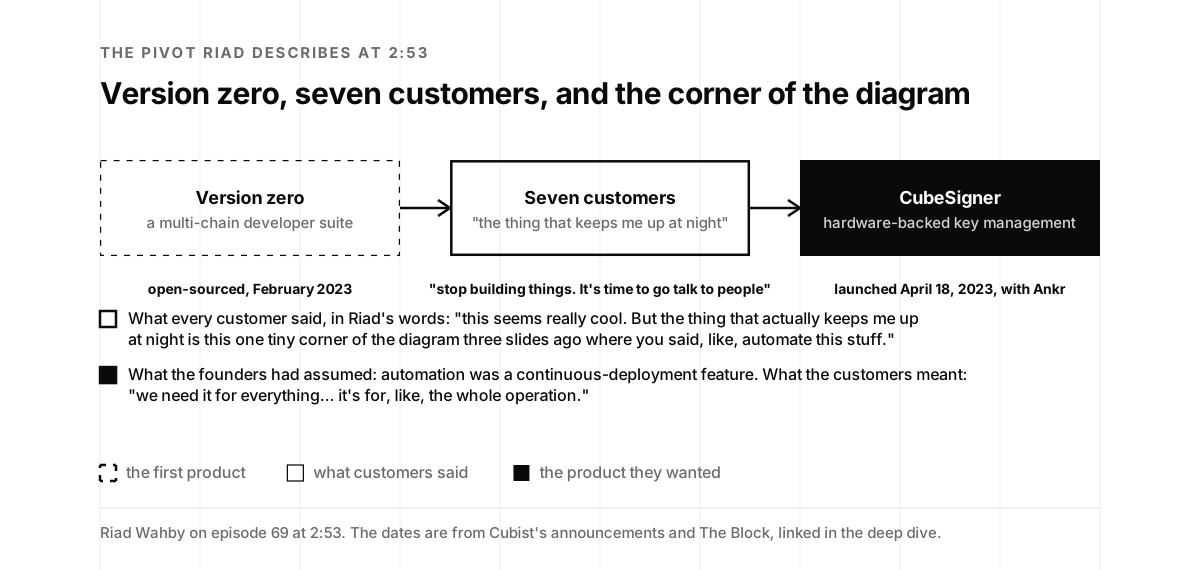
Three boxes in a row: version zero, a multi-chain developer suite, dashed and open-sourced in February 2023, then seven customers who said the thing that keeps them up at night is the automate-this corner of the diagram, then CubeSigner, hardware-backed key management, filled and launched April 18, 2023 with Ankr. Below, two notes: what every customer said, and what the founders had assumed automation meant versus what the customers meant.
Version zero, seven customers, and the corner of the diagram. The pivot took weeks: the seed closed on March 9, 2023 and CubeSigner launched on April 18.

Forty days after the seed, on April 18, 2023, Cubist launched CubeSigner as a key management platform for staking infrastructure, with Ankr as its first public customer, days after Ethereum’s Shanghai upgrade had made staked funds withdrawable for the first time and so made the keys that could withdraw them worth stealing (Cubist). The line Riad gave CoinDesk that November is the tape in four words: what customers said kept them up at night was always “We can’t manage our keys” (CoinDesk). What strikes me about the story is the part he almost skips. The founders had already felt the problem personally: “it can’t possibly be this clunky. It can’t possibly be this bad. What are we missing here?” They were not missing anything. The tools really were that bad. The lesson for anyone building in security is that your own irritation is a lead, and seven customers are the confirmation. In-house, on-demand or YOLO is our version of the same question for startups deciding what to build and what to buy.

What the key says no to

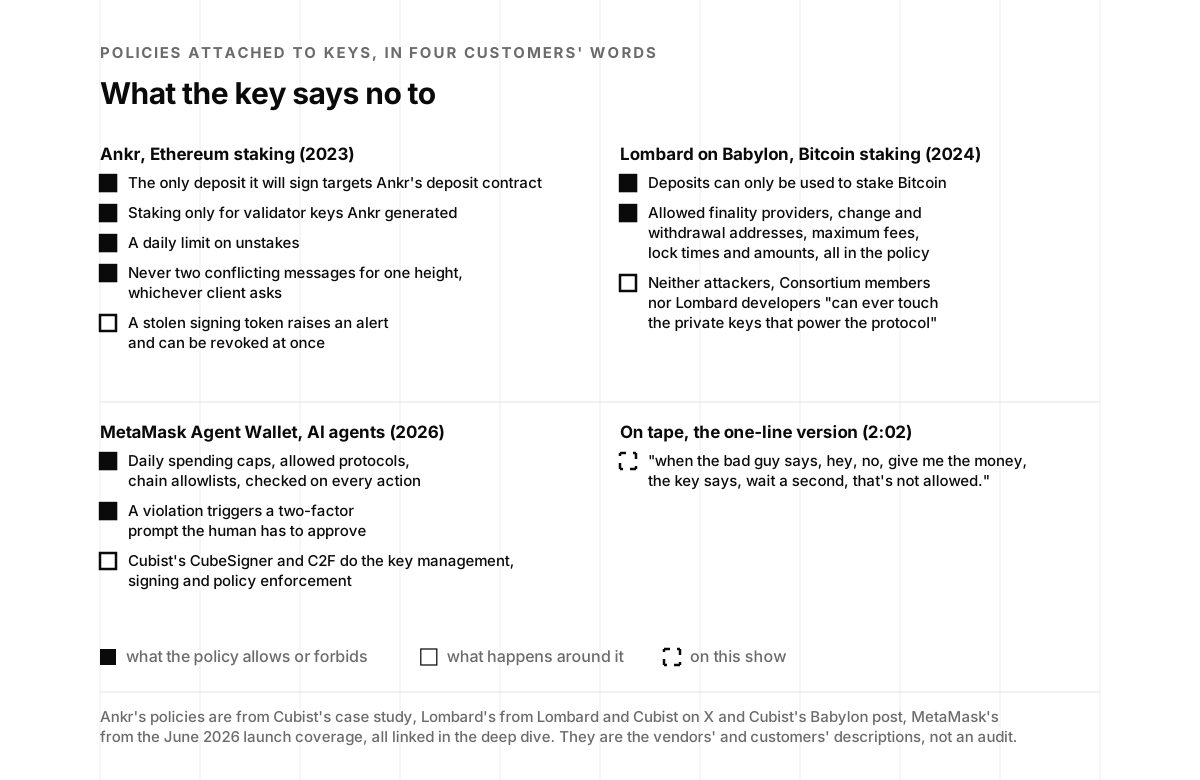
A policy attached to a key is a simple idea with a long tail, so it is worth being concrete about what one says. Cubist’s write-up of the Ankr deployment is the best description I have found. The only deposit transaction an attacker who compromises a staking machine can sign is one that targets Ankr’s own deposit contract. The only staking is on behalf of validator keys Ankr previously generated. Unstakes are limited per day. The validator will only ever sign unslashable messages, because “CubeSigner refuses to sign two conflicting messages, even if the messages come from different validator clients.” And a stolen signing token raises an alert and can be revoked immediately (Cubist, on LinkedIn). Lombard, the largest Bitcoin liquid-staking protocol by value locked when it signed, put it in one sentence in September 2024: deposits can only be used to stake Bitcoin, and nobody can touch the private keys.

Eight months before this episode. The policy is the product: the key will stake Bitcoin and it will do nothing else. View on X.
Four groups of key policies. Ankr's Ethereum staking: deposits only to Ankr's contract, staking only for Ankr's validator keys, a daily unstake limit, never two conflicting messages for one height, and revocable tokens that alert. Lombard on Babylon: deposits can only stake Bitcoin, allowed providers, addresses, fees, lock times and amounts in the policy, and neither attackers, Consortium members nor Lombard developers can ever touch the private keys. MetaMask Agent Wallet: daily spending caps, allowed protocols and chains checked on every action, a two-factor prompt on a violation, with Cubist underneath. And the line from the tape: when the bad guy says give me the money, the key says that's not allowed.
What the key says no to, in four customers' words. The policies are the vendor's and the customers' descriptions, not an audit, and they are still the clearest picture of the idea I know.

Why this matters beyond crypto is the number under it. TRM Labs counted $2.2 billion stolen in hacks and exploits in 2024 and attributed nearly 70 percent of it to infrastructure attacks, “primarily private key and seed phrase compromises” (TRM Labs). Chainalysis put North Korea’s share of the year at $1.34 billion across 303 incidents (The Defiant). Then Bybit. Sygnia’s interim forensics found that attackers had compromised a Safe developer’s machine, pushed malicious JavaScript to the storage bucket that served the Safe{Wallet} interface, and altered what the signers saw only when the transaction came from Bybit’s contract address, so that the signers approved a “disguised malicious transaction” and the attackers replaced the scripts with clean ones two minutes later (The Block). The signers were not careless. The screen lied. Which is the whole case for evaluating the policy on the transaction itself, inside hardware the browser cannot reach, rather than on what a person saw. I am not claiming any product would have stopped that attack, and neither does Riad on the tape. I am claiming that “the key says, wait a second, that’s not allowed” is the category of control that could have, and that the same category is what signing approvals from a registered device means for a company that will never touch a blockchain. On episode 85, Channi Greenwall of Olympix calls the same theft a classical Web2 exploit, from the smart contract side.
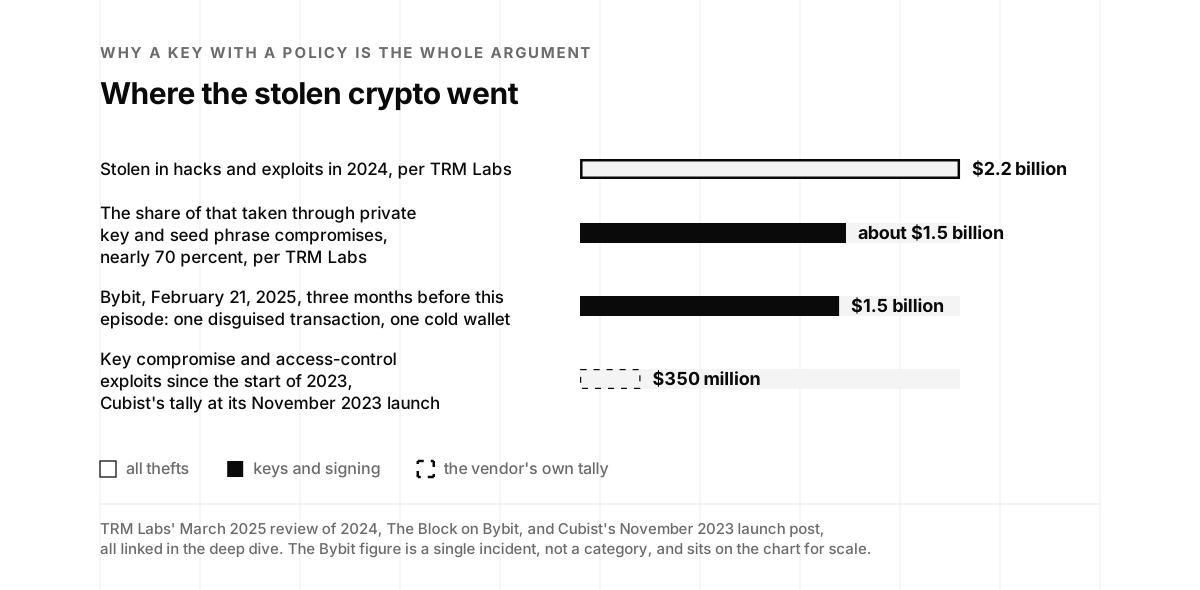
Four horizontal bars. $2.2 billion stolen in hacks and exploits in 2024 per TRM Labs. About $1.5 billion of that, nearly 70 percent, through private key and seed phrase compromises. $1.5 billion taken from Bybit on February 21, 2025 in one disguised transaction, three months before this episode. $350 million in key compromise and access-control exploits since the start of 2023, Cubist's tally at its November 2023 launch.
Where the stolen crypto went. Riad's slider question is usually framed as a trade-off between security and speed. The chart is what the trade-off has cost.

Find yourself an Ann

I asked how he met his co-founder Ann, and the answer started with the other two.

“Yeah, yeah. So, so Fraser and Deian were both PhD students with me at Stanford. We all worked together doing research stuff, like, way before we had any thought of building a company. At some point, Deian went and founded a company that was working on JavaScript security. Cool stuff, really. And he, you know, so he was sort of in San Francisco and kind of in the SF startup scene. And he met Ann. She was working as a COO at another startup in kind of, in a fintech, like, really kind of heavily compliance and kind of anti-fraud type stuff.”

Riad Wahby at 5:06

The four, by Cubist’s own page: Riad, chief executive, an assistant professor of electrical and computer engineering at Carnegie Mellon. Fraser Brown, chief technology officer, an assistant professor at Carnegie Mellon who works on systems security, automated bug finding and formal verification and co-developed the CirC compiler for cryptographic proof systems. Deian Stefan, chief scientist, an associate professor at UC San Diego who co-founded Intrinsic, the runtime security startup VMware acquired in 2019. And Ann Stefan, chief operating officer, a former fintech COO with seven years in a high-risk consumer segment, covering payments, fraud prevention and anti-money-laundering, with a chemical-biological engineering degree from MIT (Cubist). All three technical founders did their doctorates at Stanford. The Block’s March 2023 piece described the company as computer security professors who had taught at Carnegie Mellon and UC San Diego plus a former fraud operations specialist, which undersells what Riad says Ann actually is.

“I claim to know how to, like, prevent somebody from breaking into my computer, but it’s actually a very different thing, right? Like, you kind of have layers of security, and one of those layers really is, like, here are our processes for preventing fraud. And so, having somebody who knows that sort of thing [cold], and who’s really done it in a high-risk industry for many years, is a superpower. So, go find it. If you’re starting a company, find yourself somebody who is excellent at operations, because your company is a machine and they know how to make it run.”

Riad Wahby at 5:06

That is the advice I would pin above every security founder’s desk, and it is why question seven of the scorecard is about process rather than hardware. A fraud-prevention process is a security layer. The person who has run one at scale knows things about who should be allowed to do what, and when, and with whose approval, that no amount of cryptography teaches you. Michael Nov of Prime Security said something similar about his co-founder from PayPal on episode 76: the practitioner who has done the manual version of the job is the one who knows what the product has to do.

The enormous red book

I asked whether he had always thought of himself as a security person, and he said cryptography first, and then told the bookstore story.

“I kind of started out thinking of myself as something, well, more like cryptography. Okay, so long ago, in the mists of time, in middle school, I was at a bookstore with my dad, and I somehow convinced him to get me this enormous red book called Applied Cryptography by Bruce Schneier, which is, like, you know, a classic. You see it on everyone’s shelf.”

Riad Wahby at 7:19

I interrupted to point out that Sasha had one standing right there. Riad’s father looked at the book and said, “what? Come on.” From there Riad found the cypherpunks and, for a while, administered the cypherpunks mailing list, then went to college and “saw this other bright, shiny thing, which was circuit design,” and became an analog engineer. The resume confirms it: nearly a decade as a staff engineer at Silicon Laboratories, from June 2004 to January 2014, designing analog and mixed-signal integrated circuits, before a stint at NYU and UT Austin, a Stanford doctorate from 2015 to 2021 under Dan Boneh and Keith Winstein, ten months as a cryptography researcher at Algorand, and the Carnegie Mellon faculty position he has held since July 2021 (LinkedIn, Cubist). The research is not a footnote to the company. He is a co-author of RFC 9380, the standard for hashing to elliptic curves published in August 2023, and a contributor to the BLS signature draft that Ethereum and Avalanche use, and a co-inventor of the Hyrax, Brakedown and Lasso proof systems (IETF). His description of the gap between his two fields is the one I give people who confuse them: “computer security, cryptography, they’re not quite the same thing, of course, as I tell my students, but they’re close, and both are super interesting.”

July 2023, three months after the pivot: ten minutes on every way to hold a key and what each one gives up, at DeFi Security Summit. Watch on YouTube.

If you perfect it, you’re wasting time

Sasha asked when they pulled the plug on building and took what they had to customers, and why. The answer is the best thing a startup founder will take from this episode.

“I think if you’re ever, like, taking a product to a customer and feeling really comfortable about it, you’re probably missing an opportunity, because it means you should have done it, like, six months ago, when you were less comfortable about it. I don’t know, six months, something. Because, you know, I think if you’re talking to the right people, they’re not expecting to see something that’s perfect and polished. And meanwhile, you could very easily have spent that six months or whatever polishing something that nobody in the end wants, right?”

Riad Wahby at 11:28

His own practice is to be frank about the weaknesses: “hey, I know that it’s a little rough around the edges and it doesn’t work with all the chains that you’re interested in.” And then the credit, again, to Ann: “look, if you perfect it, you’re wasting time.” Sasha’s reply was the engineer’s confession, that we look for the perfect function and the perfect class, and that the eighty-twenty rule is usually enough to get to the next stage. For security products this is the harder discipline, because the whole pitch is correctness, and a founder who ships a key manager that only supports three chains feels like a founder shipping a lock with two of the pins missing. The resolution is in what Riad shipped: the first CubeSigner did one thing, Ethereum validator keys, for one customer, with a policy engine that could be formally checked, and added chains after (Cubist). Narrow and correct beats broad and polished. We make the same argument about the first security hire in In-house, on-demand or YOLO.

The good thing happened

I asked for the best day, and it was the one after six months of adrenaline.

“You’re just in that state where it’s like you sleep for four hours, you dream about the code that you were writing before you went to sleep. You wake up, you, you know, write code for 20 straight hours, maybe there’s food in there somewhere, and then you just rinse and repeat, right? First of all, I love, there’s almost nothing that’s as pure as that. Just, like, here’s six months of adrenaline, right?”

Riad Wahby at 13:25

Listen · the 3 a.m. page, from 15:24
About 25 seconds: the good event, PagerDuty, and the reason it got unhooked the next day. The clip stops on its own. Read the full transcript.

The customer was launching a product on a timeline Riad calls insane, the thing did not exist yet, and they built it together and launched on time. The product generated signatures from a fleet of machines, and one rare event was the good one. So they wired the good event to PagerDuty. “At three in the morning, my phone goes off and it’s PagerDuty. And I’m like, oh no, what’s happened? And I look and it’s like, oh, oh, the good thing happened.” The good thing was an Ethereum validator proposing a block, which pays a reward, and they got paged for every proposed block until the team “quickly put, put the damper on that.” My question on tape was the one I still think about: “why are the interrupts always, like, negative? They should be positive.” The customer is not named, and I will not guess, but the timing lines up with the April 2023 launch, where Ankr’s chief technology officer Stanley Wu said the company chose Cubist because “their team includes preeminent experts in applied cryptography and systems security” (Cubist).

The second week of the raise

I asked for the most challenging moment, and Riad said that one was also easy, and that it came early, “which, I mean, I guess that’s a good thing. Like, the low point should come as early as possible.”

Listen · the raise and the crash, from 17:19
About 55 seconds: the compressed schedule, Terra and Luna, and the investor who had been awake for 36 hours. The clip stops on its own. Read the full transcript.

“And then, do you remember a little, a little thing called Terra and Luna? Maybe this was in the news, where these two cryptocurrencies crashed, the bottom fell out. That was the second week that we were raising funds. And so this, I don’t remember exactly the day, but let’s say it happened on a Tuesday. You know, the next day we had, like, a meeting with, like, a really important person who, by the way, is fantastic. We had this kind of really important meeting, and we show up at the meeting, and he kind of shows up, and you could just immediately tell something’s not right. And we’re like, hey, man, how’s it going? He’s like, it’s terrible. I’ve been awake for 36 hours. What do you want to talk to me about?”

Riad Wahby at 16:48
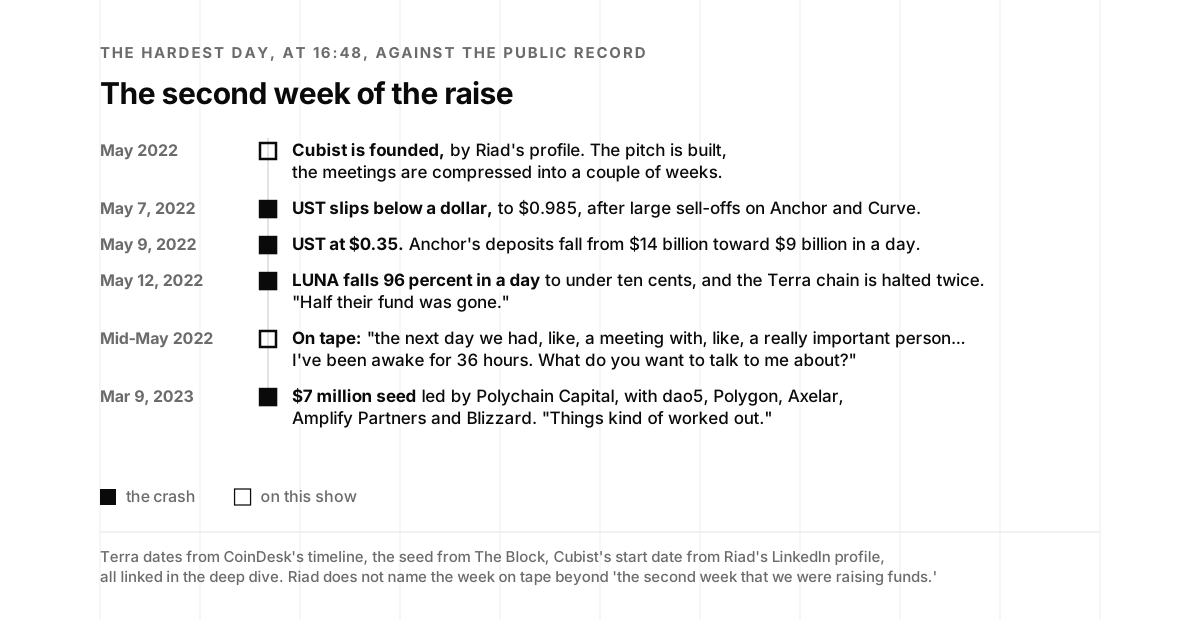
A timeline of six entries. May 2022: Cubist is founded and the pitch meetings are compressed into a couple of weeks. May 7, 2022: UST slips below a dollar. May 9: UST at 35 cents. May 12: LUNA falls 96 percent in a day and the Terra chain is halted twice, half their fund was gone. Mid-May, on tape: the meeting with the investor who had been awake for 36 hours. March 9, 2023: a $7 million seed led by Polychain Capital.
The second week of the raise against the public record. Cubist's start date on Riad's profile is May 2022. UST lost its peg on May 7.

The dates fit. Riad’s profile puts Cubist’s founding in May 2022 (LinkedIn). TerraUSD slipped to $0.985 on May 7, fell to $0.35 on May 9 as Anchor’s deposits drained, and on May 12 LUNA lost 96 percent in a day and the chain was halted twice (CoinDesk). “That whole week of meetings was basically just people who hadn’t slept, because, like, half their fund was gone.” The round closed anyway, ten months later: $7 million led by Polychain Capital with dao5, Polygon, Axelar, Amplify Partners and Blizzard (The Block). The part I would want every founder to hear is what the helplessness felt like: “at least if I’m gonna fail, I wanna have been the reason for the failure. But in this case, it’s like, no, just, like, some random stuff happened that really has nothing to do with me, and now the world is just, like, burning down.” Michael Nov’s October 8 on episode 76 was the same lesson from a far worse day: the shock is external, the decision to proceed is yours.

Seven layers removed

Sasha asked for the main pain point, and Riad gave the answer in layers, which is the right way to explain any infrastructure product.

“If we had to reduce everything too much to a single pain point, it’s, like, well, it’s just too darn hard to do this stuff, especially if you’re trying to use secure hardware to do it. Like, the hardware systems tend to be slow, they tend to be inflexible, all that. But that’s not what the customer feels directly, right? Like, they’re seven layers removed from that. What they feel is: well, I’ve got to integrate this new system that I’ve never seen before. It’s got this weird key format, and who knows how key derivation works. And my customers really want to be able to log in with their Gmail account or whatever it is.”

Riad Wahby at 19:11
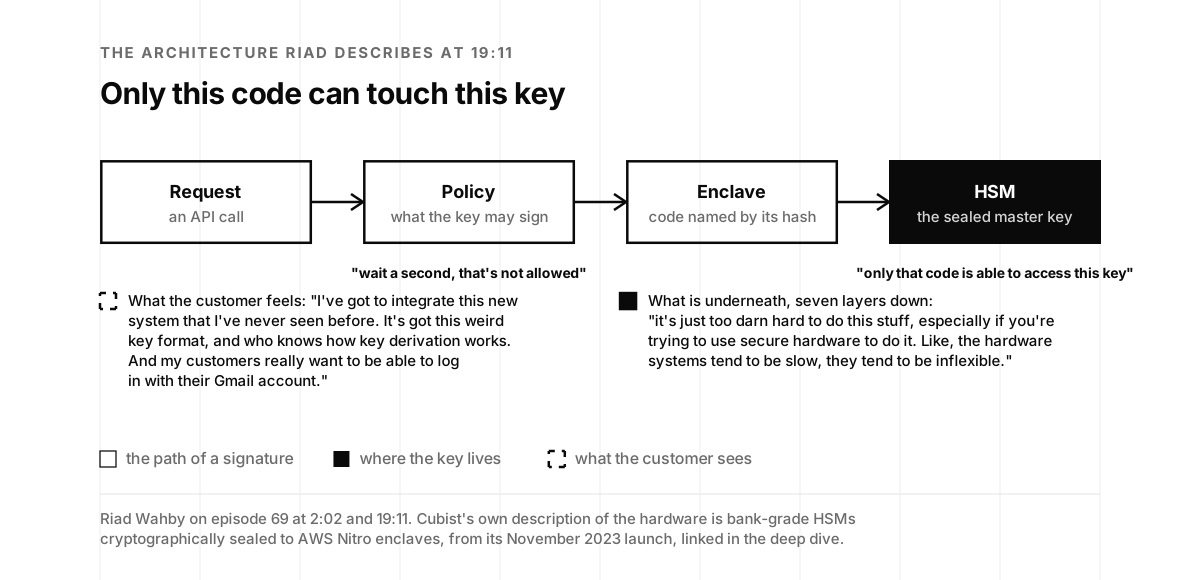
Four boxes in a row: a request, the policy that says what this key may sign and can answer wait a second, that's not allowed, the enclave running code identified by its hash, and the hardware security module holding the sealed master key, filled, where only that code is able to access this key. Below, what the customer feels, a new system with a weird key format, and what is underneath seven layers down, secure hardware that is slow and inflexible.
Only this code can touch this key. The two pieces of hardware are locked together so that the master key answers to a program with a known hash and to nothing else.

The bottom layer is two pieces of secure hardware locked to each other. “One is, like, a kind of classic FIPS 140 bank-type HSM, hardware security module. And then the other is a secure enclave. Effectively, the property that we need is we’re able to say, here is some code that’s identified by its hash, by a signature, whatever it is. Only that code is able to access this key, this sort of master key that lives inside of the HSM. And so we lock those two things together.” Cubist’s own description at the November 2023 launch was “bank-grade Hardware Security Modules cryptographically sealed to AWS Nitro enclaves,” with millisecond latency and support for hundreds of millions of wallets on any chain, by the company’s claims (Cubist, on LinkedIn). The choice of enclave was deliberate. When the Downfall attack on Intel’s SGX enclaves was disclosed in August 2023, discovered by a researcher who had started the work as a postdoc with Deian Stefan, Cubist’s post said what most vendors would not: “Intel has never shipped a processor with a secure SGX implementation,” and the reason Cubist does not use it is that “SGX tries to do too many things, which means it’s too complex, which means it’s too hard to get right.” If you build on secure hardware, that is the question to ask your vendor first.

The layers above the hardware are the product, and they are where most key management fails in practice: an API to generate keys, secure import of the keys customers already hold (“Most of our customers aren’t starting from zero, they’re starting from tons of keys”), backup and export, and the non-custodial case where each end user owns their own key and the company providing the wallet can prove that “none of our employees can touch it, we can’t touch it.” Then performance, then breadth, then the speed of adding new chains, which is where he says the traditional competitors lose: “those folks tend to fall really far behind on adding new support or on supporting workflows that don’t look like the workflows that they envisioned.” The structure of that answer is worth stealing for any product that sells trust. Name the property at the bottom, then list the hundred details above it, because the customer only ever touches the details.

Web3 grows up

I asked what smashing success looks like, and Riad answered for the industry rather than the company, with the warning that it would sound self-important.

“A lot of the newest developments, you know, people are like, God, don’t worry about security. There’s not enough time for that. Right. And so, you know, you end up in a situation where the newest, hottest project is, like, of course, like, it’s a minimum viable product, right? And so security was not one of the parts of minimum viability. And so it tends to be something that gets built on later.”

Riad Wahby at 25:49

The future, in his telling, is the industry hitting its stride, enterprises adopting, and the engineering process maturing: “I think, you know, people in Web3 will think that this is a bad thing, but I don’t. The engineering processes will start to look a lot more like they do in Web2.” At which point “a product like ours is essentially inevitable,” because “Web3 is so mediated by cryptographic keys” that every company’s assets, every API and every user wallet pass through a key manager. Sasha’s summary got the laugh of the episode: “So it turns out the classical security principles apply to Web3 as well.” “It turns out, it turns out.” The record since reads like the forecast. In 2023 and 2024 Cubist built anti-slashers with Babylon and EigenLabs, so that an honest operator with a buggy deployment cannot be penalized for double-signing, because the signer will not produce two messages for one height even when asked, a stronger guarantee than hoping “People do a deployment wrong, they accidentally get the Kubernetes configuration wrong” never happens (Blockworks). In November 2024 the Sui Foundation, Babylon, Lombard and Cubist announced the plumbing to bring staked Bitcoin to Sui, with Cubist handling the deposits, minting, staking and bridging (IBTimes). In October 2025 Avalanche’s Bitcoin bridge moved to Lombard with CubeSigner underneath.

Five months after the tape. A bridge is the place where "the key says no" earns its keep, because the bridge is where the money crosses. View on X.

Then the grown-up phase arrived on schedule. On December 16, 2025 Cubist launched Confidential Cloud Functions, verifiable off-chain code that runs in a trusted execution environment, attests that it ran unmodified and reports its result on-chain, which Fraser Brown described as “applying custom, auditable signing rules to high-value transactions” (Brief Glance). On January 22, 2026 the company named Rohan Chauhan, formerly the chief executive of Gemini’s prediction-markets business, as president, to run institutional go-to-market as banks move tokenized deposits and stablecoins into production, with Polychain, dao5, Blizzard and Paxos listed as backers (Business Wire). Riad’s one-line reaction is below, with the company’s post that explains the moment better than the press release.

This is huge---I'm beyond thrilled that Rohan is joining Cubist!

Cubist: A lot changes when people start relying on what you build.

Over the past few years, Cubist has gone from helping teams experiment onchain to running systems that institutions depend on to move billions of dollars. Rohan C. stepped away from a compelling role as CEO of Gemini's prediction market to help Cubist meet rising institutional demand, and we’re honored by the conviction behind that choice.

Riad Wahby · January 2026
Eight months after telling us that success would look like the industry maturing. "Systems that institutions depend on to move billions of dollars." View on LinkedIn.

On March 19, 2026, Hashi, a Bitcoin lending protocol on Sui built by Mysten Labs, announced commitments from BitGo, Bullish and FalconX, with Cubist’s infrastructure moving the Bitcoin collateral in and out and Chauhan calling Cubist “the de facto infrastructure layer and developer platform for native Bitcoin on Sui” (Cointelegraph, Sui). Whether Web3 has grown up is not a question I can answer. Whether the companies doing the growing have started to behave the way Riad predicted, with a key manager in the critical path and a fraud-operations veteran on the founding team, is.
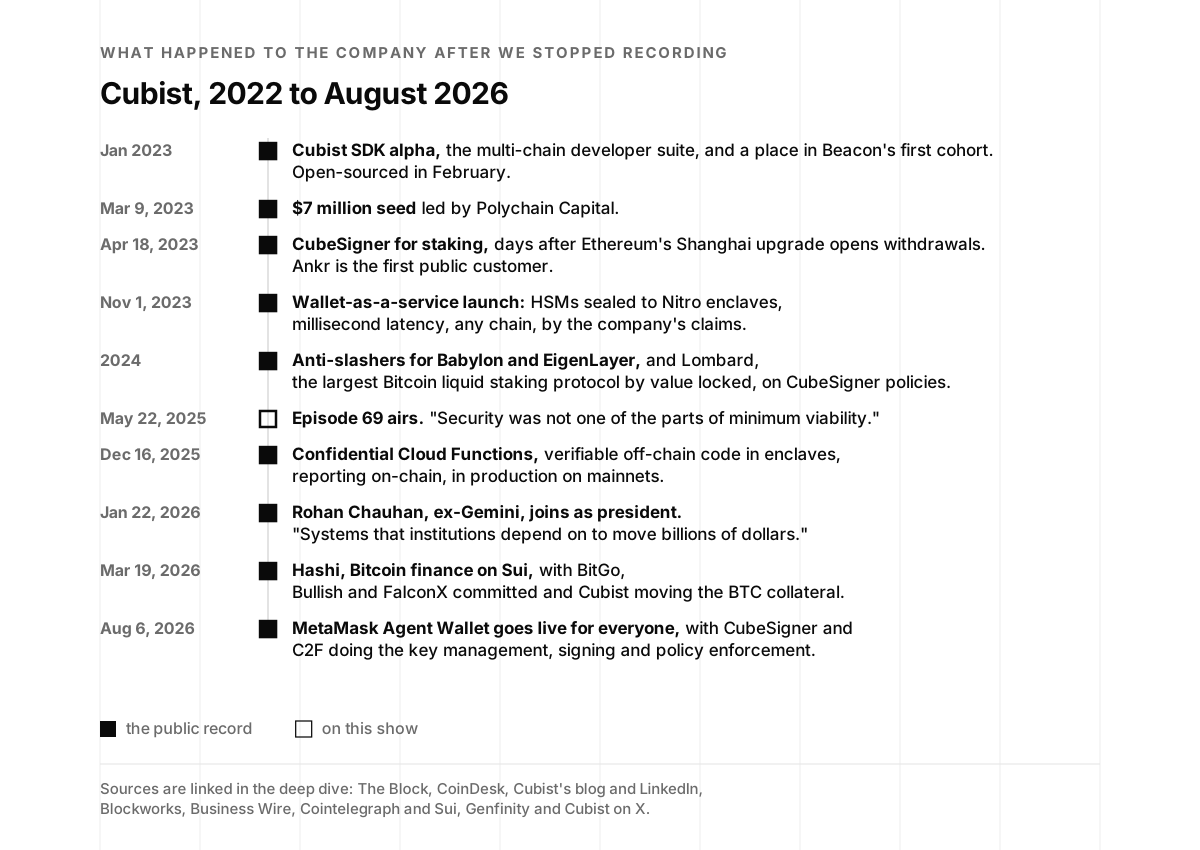
A timeline of ten entries. January 2023: the Cubist SDK alpha and Beacon's first cohort. March 9, 2023: a $7 million seed led by Polychain. April 18, 2023: CubeSigner for staking with Ankr. November 1, 2023: the wallet-as-a-service launch. 2024: anti-slashers for Babylon and EigenLayer and Lombard on CubeSigner policies. May 22, 2025: episode 69 airs. December 16, 2025: Confidential Cloud Functions. January 22, 2026: Rohan Chauhan joins as president. March 19, 2026: Hashi on Sui. August 6, 2026: MetaMask Agent Wallet goes live with Cubist underneath.
Cubist from the first SDK to the agent wallet. Everything below the episode line happened after we stopped recording.

Your agent finally gets its own wallet

The thing Riad did not predict on tape, and the reason this episode matters to a company that has never held a token, is what the key manager turned out to be for. On June 8, 2026, MetaMask opened early access to its Agent Wallet, a self-custodial wallet for AI agents: a user connects an agent, sets spending limits and allowed protocols, and the agent trades, provides liquidity and enters prediction markets on its own. In the default Guard Mode every action passes policy checks, daily spending caps, allowed protocols and chain allowlists, and a violation triggers a two-factor prompt that the human has to approve. The key isolation is Cubist’s (Genfinity). On August 6 it went live for everyone.

Fourteen months after the tape. "When the bad guy says, hey, no, give me the money, the key says, wait a second, that's not allowed." Now the bad guy can be your own agent having a bad day. View on X.
The security researcher's reaction, which is also mine. View on X.

Read Riad’s 2:02 answer again with an agent in the chair instead of a trader. The agent needs speed, because it acts at machine pace. The owner needs the key to refuse, because the agent can be wrong, or prompted into being wrong, and a refusal from the model is not a control, as we wrote in Your AI agent said no. Your API key said yes.. The policy on the key is the only part of that system that does not care what the agent believes. It is the same shape as the read-before-write ladder and the least-privilege floor we recommend for agents that never touch a blockchain: the credential, not the model, carries the limit. And it is the reason who signs for the agent is the first question an enterprise buyer will ask about yours. Ben Colman said on episode 71 that companies want to engage your agent for information sharing but maybe not for authorization. A spend cap enforced inside an enclave is what “maybe not for authorization” looks like when it is implemented.

Not five years, not a hundred

Sasha brought up forward secrecy and crypto-agility, and Riad took the opening to put a window on the quantum question.

“Personally, I think it’s probably a bit further out than some people say. But, like, I wouldn’t say that I’m kind of the, in, in the, in the group who thinks it’s, you know, happening in the next five years. I think that’s probably not likely. But I don’t think it’s never. I don’t think it’s a hundred years. I don’t think we get to say, like, ah, our grandkids will solve that problem. Like, we’re going to be the ones, like, all of us are going to be the ones who are solving it.”

Riad Wahby at 29:04
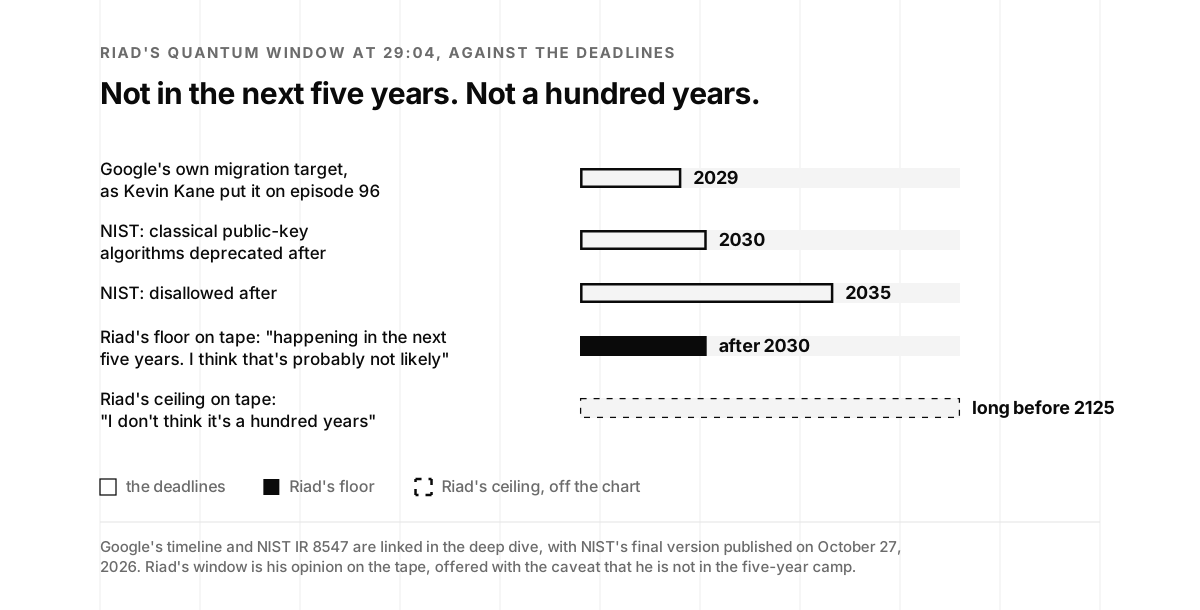
Five horizontal bars measured in years from the May 2025 tape. Google's migration target, 2029. NIST deprecates classical public-key algorithms after 2030 and disallows them after 2035. Riad's floor on tape: probably not in the next five years, so after 2030. Riad's ceiling: not a hundred years, long before 2125.
Riad's window against the deadlines. His floor is the year NIST's deprecation starts. The deadlines do not wait for the machine.

A year later Kevin Kane of American Binary argued the opposite case on episode 96, that Google’s 2029 migration target is already too relaxed, and I wrote up the deadlines in Harvest now, decrypt later: Google’s own target of 2029, NIST’s plan to deprecate classical public-key algorithms after 2030 and disallow them after 2035, which NIST finalized on October 27, 2026, the week before this page (Google, NIST, Quantum Computing Report). The two positions are less far apart than they sound. Riad’s floor is the year the deprecation begins. His point is about the machine, and the deadlines are about the migration, and a migration for a company whose entire asset base is a set of elliptic-curve keys is the kind of thing you start a decade early, which is exactly what Sasha’s “agile crypto” question was reaching for. Riad’s last line on it is the attitude I want from a cryptographer: “here’s a kind of nice problem that all of us are gonna get to solve someday, and we know it, but, but maybe we don’t have to worry quite yet.”

Two weeks after this episode, June 2025: forty-four minutes with Ripple on key management infrastructure, the long version of what he told us. Watch on YouTube.

The founder notes

One foot on both sides of the line. He is faculty at Carnegie Mellon in electrical and computer engineering, and the first thing he and Sasha had been discussing before we hit record was “the dizzying array of departments that all have some claim to teaching computer science. And mine is one of them.” His defense of the hardware department: “something about hardware, I think, is important when we start talking about computers, right?”

Investors who click. “A little more than that nowadays,” he said of the $7 million on his profile. What he wanted to talk about was the kind of investor, “super technical,” who hears the pitch and says “oh, yeah, we understand that. And by the way, here’s a couple other points. And here are a couple of people you should talk to.” Sasha’s addition is the one founders forget: when you take the money, the fund becomes part of the team, and the help that matters is the introductions you have not had years to cultivate yourself.

Would he go back? “I’m kind of an adrenaline junkie.” The advice to his younger self is to enjoy the quiet, “especially enjoy the parts where the pressure turns down a little bit. You can relax and maybe have a hobby, because in a few years, you’re going to lose your mind. You’re going to go to grad school, where you’re not allowed to have hobbies.” Then faculty, then founder, neither of which allows a hobby either. When I translated it as “oh, you think this is hard? Just wait,” he accepted the translation: “I guess apparently I would taunt my past self. That’s what we’ve just discovered together. Enjoy this. This is easy, actually.”

There’s never a dull day. Sasha called it a very difficult problem on many levels, made fun and made into a viable business. “It feels good to hear you say that. But it is definitely true. Like, we get to have a lot of fun. The technical side, there’s always something interesting. There’s always a kind of a small problem that’s very satisfying to solve.”

The exit. Sasha: “an absolutely, absolute joy.” Riad: “Thanks for having me. This has been super fun.”

Did you catch it? A six-question quiz

Interactive · six questions

Did you catch it?

Six questions on what Riad actually said, with the timestamp for each answer. The answers are under each question for anyone reading without JavaScript.

  1. How much faster than the rest of the industry does Riad say CubeSigner responds?

    1. Ten times
    2. 100 to 200 times
    3. A thousand times

    b. "Compared to others in the industry, we're 100 to 200 times faster to, you know, actually respond." Transcript, 2:02.

  2. What did Cubist build first, before key management?

    1. A hardware wallet
    2. A smart-contract auditing service
    3. A development suite for multi-chain Web3 applications

    c. "We're going to build this sort of development suite that's going to help people build complex Web3 applications, handle multi-chain interactions." The seventh customer changed the plan. Transcript, 2:53.

  3. Which book did Riad talk his father into buying in middle school?

    1. Applied Cryptography, by Bruce Schneier
    2. The Art of Computer Programming
    3. The Cuckoo's Egg

    a. "this enormous red book called Applied Cryptography by Bruce Schneier, which is, like, you know, a classic." Transcript, 7:19.

  4. What woke Riad up at three in the morning on the best day?

    1. A breach alert
    2. A PagerDuty page for a good event: a validator proposed a block
    3. A customer escalation

    b. "At three in the morning, my phone goes off and it's PagerDuty. And I'm like, oh no, what's happened? And I look and it's like, oh, oh, the good thing happened." Transcript, 14:59.

  5. What collapsed during the second week of Cubist's fundraise?

    1. FTX
    2. Silicon Valley Bank
    3. Terra and Luna

    c. "do you remember a little, a little thing called Terra and Luna?" and then: "That was the second week that we were raising funds." Transcript, 16:48.

  6. Which two pieces of secure hardware does Cubist lock together?

    1. A FIPS 140 hardware security module and a secure enclave
    2. A smart card and a phone's secure element
    3. Two hardware security modules from different vendors

    a. "One is, like, a kind of classic FIPS 140 bank-type HSM, hardware security module. And then the other is a secure enclave." Only code with a known hash can touch the master key. Transcript, 19:11.

Who can sign with your keys?

Cubist’s customers are staking operators and wallets. Yours is a startup with a deploy key, a payments API key, a cloud root credential and, increasingly, an agent that holds some of them. The question Riad answers for blockchains is the question for all of those: when software asks the key to do something, can the key say no? This scorecard asks eight questions about the keys your own systems hold, each tied to a point on the tape, and tells you which one a compromised server or a misbehaving agent would find first.

Scorecard · eight questions

Who can sign with your keys?

Answer for the keys that can move money, deploy code or read customer data, as they are held today, not as the policy document describes them.

  1. Where does the private key or secret that can move money or deploy to production actually live?

    • In an environment file, a laptop, or a shared vault anyone on the team can read
    • In a cloud secrets manager, readable by whatever has the role
    • Inside hardware or a managed signer that never exports it, and signs on request

    "All of the key management, key generation, key usage, everything happens inside of secure hardware." A key that can be copied has already been copied. The .env file is where most startups' security program starts.

  2. Is there a policy on the key that limits what it will sign: destinations, amounts, rates, environments?

    • No. If you hold the key, you can do anything it can do
    • Limits in the application code that calls the key
    • Limits enforced at the signer, outside the application, so a compromised app still cannot exceed them

    "when the bad guy says, hey, no, give me the money, the key says, wait a second, that's not allowed." Ankr's deposit key will only sign deposits to Ankr's contract. The limit lives at the key, not in the code that asks it.

  3. If one server or one engineer's laptop is fully compromised tonight, what is the most an attacker can do with the credentials on it?

    • Everything the company can do
    • A lot, but we would see it in the logs eventually
    • A bounded amount, and the attempt beyond the bound alerts us

    Cubist's design assumption is that every component is untrusted, so a hacked organization's systems still cannot sign a malicious withdrawal. The blast radius playbook is the same exercise for the rest of your stack.

  4. Are signing sessions and API tokens short-lived and revocable in one action, with an alert when one is used from somewhere new?

    • Long-lived keys, rotated when someone remembers
    • Rotated on a schedule
    • Short-lived, revocable, and a new-location use pages someone

    CubeSigner hands out short-lived, revocable privileges to sign instead of the raw key, and a stolen token raises an alert. Start with the inventory of which tokens exist at all.

  5. Do your AI agents hold their own scoped credentials, with spend or action limits, or do they share a human's or the service's key?

    • They use whatever key was in the environment
    • Their own key, same permissions as a human
    • Their own key, with caps and allowlists enforced outside the agent, and a human prompt on a violation

    MetaMask's agent wallet checks daily caps, allowed protocols and chain allowlists on every action and asks a human on a violation. One shared key for every agent is the opposite.

  6. Can you import, back up and export the keys you already hold into whatever you move to, without the migration itself exposing them?

    • We would paste them into the new system
    • An encrypted export someone decrypts along the way
    • A documented, tested path that never puts the plaintext key on a laptop

    "Most of our customers aren't starting from zero, they're starting from tons of keys. How do you securely import keys into the secure hardware?" The migration is the moment keys most often leak.

  7. Is there a fraud-operations process around the keys, not only a technical one: who may request a transfer, who approves, and what happens on an unusual request?

    • No, the engineers decide
    • An informal rule the finance lead knows
    • Written, rehearsed, with a second approver for anything above a threshold

    "you kind of have layers of security, and one of those layers really is, like, here are our processes for preventing fraud." Find yourself an Ann.

  8. Do you know which of your keys would need to change if elliptic-curve signatures were no longer safe, and how long the change would take?

    • No idea
    • A rough list
    • An inventory, the long-lived ones flagged, and a plan with a date

    "all of us are going to be the ones who are solving it." NIST's deadlines are 2030 and 2035. Harvest now, decrypt later has the four-step migration.

Whoever holds the key can do anything

Your keys are copies on laptops and in environment files, and the only limit on what they will sign is the honesty of whoever has them. Fix the first two questions this month: move the keys that can move money or deploy to production behind a signer that never exports them, and put the limit at the signer, not in the application. Then make the tokens short-lived.

Limits exist, in the wrong place

The keys are in a secrets manager and the application checks limits before it asks, which means a compromised application asks without checking. The medium cases bite here: the agent that inherited a service key, the migration that put a plaintext key on a laptop for an afternoon, the transfer nobody had to approve. Move the policy to the signer and give the agents their own capped credentials.

The key says no

Keys never leave hardware, the policy is enforced where the signature is made, sessions are short and revocable, agents are capped, migrations are tested and a human process sits on top. What is left is the inventory for the post-quantum migration, which an enterprise buyer will ask about before 2030, and the same discipline applied to every new credential your next agent needs.

What a policy on the key is worth

Riad’s argument is that the limit belongs at the key, because then a compromised machine can only do what the policy allows. Put your own numbers in and see what that is worth against a key that will sign anything. Every default below is an assumption, chosen to be easy to argue with.

Calculator

What a policy on the key is worth

One key or credential, the value it can reach, the odds it is compromised this year, how much an attacker takes before you revoke it, and the cap a policy at the signer would put on the same attack. Rough by design. Change the numbers to yours.

–taken in one compromise, no policy
–taken in one compromise, with the cap
–expected loss a year, no policy
–expected loss a year, with the cap
–what the policy is worth a year

At these numbers, a key that will sign anything loses most of what it can reach in one compromise, and a key with a daily cap loses only the cap times the days before you revoke it. The difference, weighted by the odds of a compromise, is what the policy on the key is worth a year.

The 5 percent, the 80 percent and the 24 hours are placeholders, not research. TRM Labs attributed nearly 70 percent of the $2.2 billion stolen in 2024 to private key and seed phrase compromises, which is the case for the first number being higher than you think. Not counted: destination allowlists, which stop most attacks outright rather than capping them, and the key that deploys code rather than moving money, where the cost is a breach rather than a transfer.

Twenty years on one line

Everything on this page sits on one timeline, from Riad’s first job designing circuits to the week this page was written. Filter it by thread.

Timeline · 2004 to 2026

Twenty years on one line

Filter by thread. Dates are from the public record except where marked as Riad's own account on the tape.

  1. The enormous red book

    Applied Cryptography, bought by a skeptical father at a bookstore, then the cypherpunks mailing list.

  2. Silicon Laboratories

    Nearly a decade as a staff engineer designing analog and mixed-signal integrated circuits, through January 2014 (LinkedIn).

  3. Stanford

    A doctorate in computer science under Dan Boneh and Keith Winstein, finished in 2021, then ten months as a cryptography researcher at Algorand (Cubist).

  4. Carnegie Mellon

    Faculty in electrical and computer engineering, which he still holds alongside the company.

  5. Cubist is founded

    Four co-founders: Riad, Fraser Brown, Deian Stefan and Ann Stefan. The pitch meetings are compressed into two weeks.

  6. Terra and Luna

    UST loses its peg on May 7 and LUNA falls 96 percent in a day on May 12. "Half their fund was gone" (CoinDesk).

  7. The Cubist SDK

    Version zero: a multi-chain developer suite, in alpha, then open-sourced in February, and a place in Beacon's first cohort (The Block).

  8. $7 million seed

    Led by Polychain Capital with dao5, Polygon, Axelar, Amplify Partners and Blizzard (The Block).

  9. Ethereum's Shanghai upgrade

    Staked funds become withdrawable, and the keys that can withdraw them become worth stealing.

  10. CubeSigner for staking

    Short-lived signing privileges, policies, anti-slashing, and Ankr as the first public customer (Cubist).

  11. No Silver Bullet

    Ten minutes on key management technology at DeFi Security Summit (YouTube). RFC 9380, hashing to elliptic curves, is published in August (IETF).

  12. Downfall

    A new attack steals keys from Intel SGX enclaves. Cubist's post: this is why it does not build on SGX (LinkedIn).

  13. Wallet-as-a-service

    HSMs sealed to Nitro enclaves, millisecond latency, any chain, by the company's claims (CoinDesk).

  14. Anti-slashers for Bitcoin and restaking

    Babylon and EigenLabs collaborations: the signer will not produce two messages for one height, whatever the client asks (Blockworks).

  15. Lombard

    The largest Bitcoin liquid-staking protocol by value locked runs on CubeSigner policies: deposits can only stake Bitcoin (X).

  16. Bitcoin to Sui

    Sui Foundation, Babylon, Lombard and Cubist, with Cubist handling deposits, minting, staking and bridging (IBTimes).

  17. $2.2 billion stolen in 2024

    Nearly 70 percent through private key and seed phrase compromises, per TRM Labs (TRM Labs).

  18. Bybit

    About $1.5 billion from one cold wallet, through a disguised transaction served by a compromised Safe developer's machine (The Block).

  19. Episode 69 airs

    This conversation, with Sasha co-hosting. "The key says, wait a second, that's not allowed."

  20. Storing crypto safely

    Forty-four minutes with Ripple on key management infrastructure (YouTube).

  21. Avalanche's Bitcoin bridge

    BTC.b moves to Lombard with CubeSigner and Bascule Drawbridge in the security model (X).

  22. Confidential Cloud Functions

    Verifiable off-chain code in enclaves, reporting on-chain, in production on mainnets (Brief Glance).

  23. A president from Gemini

    Rohan Chauhan joins to run institutional go-to-market. "Institutions are ready to move trillions onchain" (Business Wire).

  24. Hashi on Sui

    Bitcoin lending with BitGo, Bullish and FalconX committed, and Cubist moving the collateral (Sui).

  25. "They just need to wait"

    Kevin Kane on episode 96: Google's 2029 target is already too relaxed. Our post on harvest now, decrypt later follows the next day.

  26. MetaMask Agent Wallet, early access

    Two hundred spots, Guard Mode policy checks on every action, Cubist's key isolation underneath (Genfinity).

  27. "Your agent finally gets its own wallet"

    Live for everyone, with CubeSigner and C2F doing the key management, signing and policy enforcement (X).

  28. NIST finalizes the transition

    Classical public-key algorithms deprecated after 2030 and disallowed after 2035, the week before this page (Quantum Computing Report).

What to do this week

Four things, in the order a compromised server would test them.

  1. Find the key that can do anything. List every credential that can move money, deploy to production or read all customer data, and where each one physically lives. The one in an environment file on a laptop is the first fix. Move it behind a signer, a hardware module or a managed service that never hands the private key back.
  2. Put the limit at the signer. For each of those keys, write the policy in one line: which destinations, how much, how often, from where. Then enforce it where the signature is made, not in the application that asks. A compromised application should be able to ask for anything and get a no.
  3. Give the agents their own keys, with caps. No agent shares a human’s credential or the service’s root key. Each gets its own, with a spend or action cap and an allowlist enforced outside the agent, and a human prompt when it hits the limit. MetaMask’s Guard Mode is the consumer version of exactly this.
  4. Write the fraud process down. Who may request a transfer, who approves, what counts as unusual, and what happens then. Then rehearse it once. Riad’s superpower was a co-founder who had run that process in a high-risk industry for years. Until you have one, the document is your Ann.

Key takeaways

  1. Security versus speed is a false choice

    Sasha asked where Cubist sits on the slider between security and usability, and Riad refused it: attach fine-grained policies to each key and use them at extremely high speed, "100 to 200 times faster" than the rest of the industry, so a trading application gets its performance and "when the bad guy says, hey, no, give me the money, the key says, wait a second, that's not allowed."

  2. The seventh customer

    Cubist's first product was a multi-chain developer suite. Co-founder Ann made the team stop building and talk to customers, and every customer pointed at the same corner of the diagram, the one that said automate this. After the seventh, the founders accepted that key management was the product people wanted, and one they could build well. CubeSigner launched forty days after the seed closed.

  3. Find yourself an Ann

    Fraser Brown and Deian Stefan were Riad's fellow Stanford PhD students. Ann Stefan was a fintech chief operating officer who had run compliance and fraud prevention in a high-risk industry for years. Riad's advice to every founder: a fraud-prevention process is a security layer, and someone who knows it cold is a superpower, because "your company is a machine and they know how to make it run."

  4. If you perfect it, you're wasting time

    If you take a product to a customer and feel comfortable about it, you probably should have gone six months earlier. The right customers do not expect polish, and the months spent polishing may produce something nobody wants. Be frank about the weaknesses and ship. The first CubeSigner did one thing for one customer and added chains afterwards.

  5. The second week of the raise

    The best day was a 3 a.m. PagerDuty page for a good event, an Ethereum validator proposing a block, after six months of four-hour nights. The hardest came early: the Terra and Luna collapse hit in the second week of fundraising, the next day's investor had been awake for 36 hours, and "that whole week of meetings was basically just people who hadn't slept, because, like, half their fund was gone." The $7 million seed closed anyway, led by Polychain.

  6. Only this code can touch this key

    Underneath the product are two pieces of secure hardware locked together: a FIPS 140 hardware security module holding the master key and a secure enclave running code identified by its hash, so only that code can use the key. Above it are the details customers actually feel: import, export, backup, non-custodial end-user keys, performance and new chains. After the tape, that stack went under MetaMask's AI agent wallet, with spend caps and allowlists enforced at the signer.

Chapters

Tap a chapter to play from there.

Pull quotes

“Our goal is to say, look, you don't need to choose between these two things. You should be able to get both.”

Riad Wahby ·

“When the bad guy says, hey, no, give me the money, the key says, wait a second, that's not allowed.”

Riad Wahby ·

“After the seventh customer told us this, we had this kind of aha moment where we were like, okay, so this is the product that people actually want.”

Riad Wahby ·

“If you're starting a company, find yourself somebody who is excellent at operations, because your company is a machine and they know how to make it run.”

Riad Wahby ·

“If you perfect it, you're wasting time.”

Riad Wahby ·

“At three in the morning, my phone goes off and it's PagerDuty. And I'm like, oh no, what's happened? And I look and it's like, oh, oh, the good thing happened.”

Riad Wahby ·

“Only that code is able to access this key, this sort of master key that lives inside of the HSM. And so we lock those two things together.”

Riad Wahby ·

“Security was not one of the parts of minimum viability. And so it tends to be something that gets built on later.”

Riad Wahby ·

About the guest

Riad Wahby, Co-founder and Chief Executive Officer, Cubist

Riad Wahby is the co-founder and chief executive of Cubist, the San Diego company whose CubeSigner platform keeps cryptographic keys inside secure hardware and enforces policies on what each key will sign, and whose Confidential Cloud Functions run verifiable off-chain code in enclaves. He is also an assistant professor of electrical and computer engineering at Carnegie Mellon University. He spent nearly a decade as a staff engineer designing analog and mixed-signal integrated circuits at Silicon Laboratories, then earned a doctorate in computer science at Stanford under Dan Boneh and Keith Winstein, worked as a cryptography researcher at Algorand, and co-founded Cubist in May 2022 with Fraser Brown, Deian Stefan and Ann Stefan. He is a co-author of RFC 9380, the standard for hashing to elliptic curves, a contributor to the BLS signature standard used by Ethereum and Avalanche, and a co-inventor of the Hyrax, Brakedown and Lasso proof systems. Cubist raised a $7 million seed led by Polychain Capital in March 2023, and its infrastructure sits under Lombard, Avalanche's Bitcoin bridge, Hashi on Sui and MetaMask's Agent Wallet.

About the host

Jon McLachlan and Sasha Sinkevich are co-founders of YSecurity, the on-demand cybersecurity team for startups, and of Cyberbase.ai. The Security Podcast of Silicon Valley is hosted by Jon McLachlan and Sasha Sinkevich. Jon McLachlan on LinkedIn ↗Sasha Sinkevich on LinkedIn ↗

Context and sources

  • The Block, March 9, 2023: Polychain Capital leads Cubist's $7 million seed with dao5, Polygon, Axelar, Amplify Partners and Blizzard, for a multi-chain developer SDK written mostly in Rust, with founders from Carnegie Mellon and UC San Diego and a former fraud operations specialist. Source ↗
  • Cubist, April 2023: CubeSigner launches as a non-custodial key management platform for staking infrastructure, with short-lived signing privileges, custom policies, anti-slashing, a formally checkable policy engine, and Ankr as the first public customer. Source ↗
  • CoinDesk, November 1, 2023: Cubist releases CubeSigner as wallet-as-a-service, keys locked in secure hardware, revocable signing sessions, in production for Ethereum validators, and customers who said what kept them up at night was that they could not manage their keys. Source ↗
  • Cubist and Riad Wahby on LinkedIn: the November 2023 launch post (HSMs sealed to AWS Nitro enclaves, millisecond latency, $350 million lost to key compromise since the start of 2023), the Ankr case study, the Babylon and EigenLabs anti-slashing collaborations, the MetaMask Snap, the Intel SGX post after Downfall, and the January 2026 Rohan Chauhan announcement. Source ↗
  • Cubist's about page: the four co-founders and their backgrounds, president Rohan Chauhan, and the investor list from Polychain to Paxos. Source ↗
  • Riad Wahby's LinkedIn profile: Cubist from May 2022, Carnegie Mellon faculty from July 2021, Algorand 2021 to 2022, Stanford PhD 2015 to 2021, NYU, UT Austin, and Silicon Laboratories from June 2004 to January 2014. Source ↗
  • IETF Datatracker: Riad S. Wahby's documents, including RFC 9380, Hashing to Elliptic Curves, August 2023, and the BLS signature draft. Source ↗
  • Blockworks, 2024: Babylon and Cubist collaborate on anti-slashing for Bitcoin stakers, with extractable one-time signature keys and an always-active policy, and Riad on deployments that go wrong. Source ↗
  • Cubist blog: new key management workflows for Babylon Bitcoin staking, with a staking policy attached to a Taproot key that constrains providers, addresses, fees, lock times and amounts, and Lombard among the first teams on it. Source ↗
  • Lombard on X, September 28, 2024: CubeSigner safeguards keys in secure hardware and restricts their use with policies, so deposits can only be used to stake Bitcoin and nobody can touch the private keys. Source ↗
  • IBTimes, November 25, 2024: Sui Foundation, Babylon Labs, Lombard and Cubist partner to bring staked Bitcoin to Sui, with Cubist providing key management for deposits, minting, staking and bridging. Source ↗
  • Cubist on X, October 30, 2025: Avalanche's Bitcoin bridge moves to Lombard with CubeSigner and Bascule Drawbridge in the security model. Source ↗
  • Brief Glance, December 16, 2025: Cubist launches Confidential Cloud Functions, verifiable off-chain code in trusted execution environments reporting on-chain, with Fraser Brown on auditable signing rules for high-value transactions. Source ↗
  • Business Wire, January 22, 2026: Cubist names former Gemini executive Rohan Chauhan as president to scale infrastructure for institutional on-chain markets, backed by Polychain, dao5, Blizzard and Paxos. Source ↗
  • Cointelegraph, March 19, 2026: Hashi, a Bitcoin finance protocol on Sui, secures commitments from BitGo, Bullish and FalconX, with Ledger and Cubist among the infrastructure providers. Source ↗
  • Sui, March 19, 2026: Cubist's infrastructure moves BTC in and out of Hashi as collateral, and Rohan Chauhan calls Cubist the de facto infrastructure layer for native Bitcoin on Sui. Source ↗
  • Genfinity, June 8, 2026: MetaMask opens early access to its Agent Wallet, self-custodial, with Guard Mode policy checks on every action and Cubist's key isolation. Source ↗
  • Cubist on X, August 6, 2026: MetaMask Agent Wallet goes live for everyone with CubeSigner and Confidential Cloud Functions powering key management, signing and policy enforcement. Source ↗
  • CoinDesk: the fall of Terra, a timeline. UST slips on May 7, 2022, hits $0.35 on May 9, LUNA falls 96 percent on May 12 and the chain is halted twice. Source ↗
  • TRM Labs, March 17, 2025: $2.2 billion stolen in crypto hacks in 2024, with infrastructure attacks, primarily private key and seed phrase compromises, accounting for nearly 70 percent. Source ↗
  • The Defiant, December 20, 2024: Chainalysis counts $2.2 billion stolen across 303 attacks in 2024, $1.34 billion of it by North Korean actors. Source ↗
  • The Block, February 26, 2025: Sygnia's interim findings on the Bybit theft, about $1.5 billion through a compromised Safe developer machine, malicious JavaScript and a disguised transaction, attributed to the Lazarus Group. Source ↗
  • Google, March 2026: a timeline for post-quantum cryptography migration to 2029. Source ↗
  • NIST IR 8547: the transition to post-quantum cryptography standards, deprecating classical public-key algorithms after 2030 and disallowing them after 2035, finalized October 27, 2026. Source ↗

Transcript

Automatic transcription; speaker labels were assigned by ear (no diarization on the tape), and the two hosts' questions are attributed by voice and by who usually asks what, so a few host lines may be swapped. Names and product names were normalized where the recognizer misheard them (Jon McLachlan, Sasha Sinkevich, Riad Wahby, YSecurity, Cubist, CubeSigner, Ann, Fraser, Deian, PagerDuty, CMU, FIPS 140, HSM, Web3, Terra and Luna, Applied Cryptography). Bracketed words are best guesses where a syllable was lost. Timestamps are the start of each turn to within a couple of seconds.

Read the full transcript 5,846 words

Jon McLachlan

Hello everyone and welcome to another episode of The Security Podcast of Silicon Valley. I'm one of your hosts, Jon McLachlan. I'm joined with the other host, Sasha Sinkevich. And today we have an amazing guest, Riad Wahby. Welcome to the show.

Riad Wahby

Thanks for having me.

Jon McLachlan

It's great to have [you] on. We were just chatting a little bit before we clicked to record, and you were telling us a little bit about CMU.

Riad Wahby

Yeah, it's so, yeah, as a tiny bit of background, I'm faculty at Carnegie Mellon. I'm in the electrical and computer engineering department. And we were sort of reflecting on the dizzying array of departments that all have some claim to teaching computer science. And mine is one of them. I mean, it's, you know, something about hardware, I think, is important when we start talking about computers, right? So.

Jon McLachlan

And you're also a co-founder and CEO of Cubist.

Riad Wahby

That's right. It's kind of exciting. It's nice to have one foot on both sides of the line. Yeah, Cubist is an interesting place to work. We're still pretty small. We're a couple of years, two and a half years, almost three years in, actually. Yeah, we're having a good time thinking about computer security, cryptographic key management, you know, everything that's fun.

Jon McLachlan

So, so tell us a little bit about Cubist. What's the scoop? It's hardware-backed key management for Web3.

Riad Wahby

That's right. You've said it in a nutshell, but essentially we're building systems and APIs that let kind of anyone manage cryptographic keys in a really sane way for Web3. Being able to sort of apply sane security policies to keys that really reflect the level of sensitivity, the level of activity, and of course, being able to do this in a programmatic way where you can really build your company's software operations to interact with blockchain.

Sasha Sinkevich

So it's that dilemma in the security that we always have. Security versus usability. And where do you guys [sit] on this slider?

Riad Wahby

Our goal is to say, look, you don't need to choose between these two things. You should be able to get both. I think most people think, no, you can't. But here's one way that you can. So you can actually attach really, really fine-grained policies to each of your keys, and you can use them at extremely high speed. Compared to others in the industry, we're 100 to 200 times faster to, you know, actually respond. And so, you know, you get this high speed, you get, you know, the performance you need for your, say, trading application or whatever it is. But you also get to make sure that when the bad guy says, hey, no, give me the money, the key says, wait a second, that's not allowed.

Jon McLachlan

I love it. I love connecting your authZ directly into the mechanism that's driving the transaction. Perfect. And it kind of feels like you have a personal experience, or you saw this problem in a very up-close manner.

Riad Wahby

Yeah, a few different ways. But okay, so the story of how we got to this as a product is kind of a classic. You tell it to a founder, they're like, oh yeah, that's happened to us too. We actually had this other idea that we were like, oh my gosh, this is going to be so cool. We're going to build this sort of development suite that's going to help people build complex Web3 applications, handle multi-chain interactions and stuff like this, which, by the way, is a real problem. And we built something, just version zero, get it out there, get customers using it. And we went and started talking to customers. By the way, credit to my co-founder Ann, who is sort of our business savior, who really, really put the screws to us and said, guys, okay, stop building things. We know that's fun, but it's time to go talk to people. And so we listened to Ann, grudgingly at first, but then we realized she was right. And everyone kind of said the same thing, which was: this seems really cool. But the thing that actually keeps me up at night is this one tiny corner of the diagram three slides ago where you said, like, automate this stuff. And we said, oh yeah, well, you know, we're, yeah, that's, that's part of it, because, you know, you need that for continuous deployment. And they said, no, no, no, we need it for everything. It's not just, it's not just for CD, it's for, like, the whole operation. And we had this kind of aha moment where, okay, after the seventh customer told us this, we had this kind of aha moment where we were like, okay, so this is the product that people actually want. And by the way, it's actually a product that we can build really well. Like, we've thought about it carefully, it seems like it'll be a fun thing to build. And so that's how we actually got there. But in our kind of personal interactions, the co-founders, with Web3 generally, this had already been something where it's like, it can't possibly be this clunky. It can't possibly be this bad. What are we missing here? And then it turned out, yeah, it was, the stuff we were replacing really was that clunky and that slow and that hard to use. And so I think we kind of found a niche.

Jon McLachlan

Amazing. How did you meet your co-founder, Ann?

Riad Wahby

Interesting story. So we, okay, actually, let me back up, because I met my other two co-founders first. So there are four of us in total.

Jon McLachlan

Four total. Okay.

Riad Wahby

Yeah, yeah. So, so Fraser and Deian were both PhD students with me at Stanford. We all worked together doing research stuff, like, way before we had any thought of building a company. At some point, Deian went and founded a company that was working on JavaScript security. Cool stuff, really. And he, you know, so he was sort of in San Francisco and kind of in the SF startup scene. And he met Ann. She was working as a COO at another startup in kind of, in a fintech, like, really kind of heavily compliance and kind of anti-fraud type stuff. And so, you know, we knew Ann through Deian, and at some point we said, like, when we were kind of talking about building this company, we said, you know, actually, number one, we need somebody who can, like, who actually knows about operations. And number two, like, Ann's background is perfect, because, like, she's sort of our counterpart, but on the, like, finance side, right? Like, she knows how to talk to folks in fintech, she knows, like, kind of about the way that compliance processes work and about preventing fraud, and, you know, which is, like, you know, I claim to know how to, like, prevent somebody from breaking into my computer, but it's actually a very different thing, right? Like, you kind of have layers of security, and one of those layers really is, like, here are our processes for preventing fraud. And so, having somebody who knows that sort of thing [cold], and who's really done it in a high-risk industry for many years, is a superpower. So, go find it. If you're starting a company, find yourself somebody who is excellent at operations, because your company is a machine and they know how to make it run. And find somebody who, if you're in security, who knows how to do this sort of thing. It's been a superpower.

Jon McLachlan

So, I mean, I guess, message for all of the founders out there: you have to find yourself an Ann, who understands, like, operations, compliance, and, and maybe the business side of things. But I'm super happy that there are incredibly smart people, like, jamming on this incredibly difficult problem.

Riad Wahby

Kind of you to say. It's certainly, certainly a fun problem. So, you know, I kind of feel lucky that I get to work on it.

Jon McLachlan

You know, have you always thought of yourself as a security person, or did you accidentally happen to stumble into this crazy, crazy field?

Riad Wahby

I kind of started out thinking of myself as something, well, more like cryptography. Okay, so long ago, in the mists of time, in middle school, I was at a bookstore with my dad, and I somehow convinced him to get me this enormous red book called Applied Cryptography by Bruce Schneier, which is, like, you know, a classic. You see it on everyone's shelf.

Jon McLachlan

Sasha, I was going to say, Sasha['s] standing around the phone right there.

Riad Wahby

And he was like, wait, really? You want to read? He looked at it and he was like, what? Come on. And I said, this seems amazing. And then from there got into, like, you know, the cypherpunks. And actually, for a while, I was, like, the administrator of the cypherpunks mailing list and all this sort of stuff.

Jon McLachlan

Okay.

Riad Wahby

So I was, like, deep in the, like, kind of security, kind of cypherpunk scene. You know, I was kind of, looking back now, you know, I didn't know a lot, but I was very excited about cryptography. Let's put it that way. And then I went off to college and I saw this other bright, shiny thing, which was circuit design. And so I ended up working on that. I ended up as an electrical engineer, and I spent a long time in industry designing analog integrated circuits. But kind of in the back of my mind, always keeping a finger on the pulse, like, computer security, this is, like, a cool thing. There's a lot of interesting kind of policy, politics, tech stuff going on at this nexus. And at some point, well, [it] depends, internally, I was like, you know, maybe a, a slight shift would be cool. And then I ended up, like, going back to grad school and working in computer science. Yeah, then I ended up sort of back in the fold and, like, working on cryptography again. So I kind of made a full circle. So computer security, cryptography, they're not quite the same thing, of course, as I tell my students, but they're close, and both are super interesting. And it's a really, really, really cool area to work in.

Jon McLachlan

And fast forwarding to today, here we are with Cubist. You're building a solution to an incredibly difficult problem and using, like, all of the great cryptographic primitives to help achieve success. And you've raised money. You've raised seven million in seed, according to LinkedIn.

Riad Wahby

A little more than that nowadays. It's sort of kind of amazing that you can kind of tell investors, like, look, here's the problem. This is what we're doing about it. Like, look at this. And I mean, number one, I think it's really kind of amazing that, well, we were very lucky. We found investors that we really click with. They're super technical. They're folks that, you know, when we explain these things, they're like, oh, yeah, we understand that. And by the way, here's a couple other points. And here are a couple of people you should talk to. Right. So, like, when your investors do that, like, you know, you're talking to your people, right? And it's just amazing that you can sort of find a problem, identify it, say, look, this thing is a real thing that we should do. And then there are people out there who understand enough to say, yes, and I'm going to back it. I mean, that's, that's, that's kind of amazing.

Sasha Sinkevich

Which I think is a very important point that you, Riad, just touched upon, which is the seamless connection with your team. And when you take external money, the VC becomes part of your team. Like, you have to be aligned in the direction, in the vision, and on the execution as well. Especially if you get that external help from VCs, not just in terms of money, but in terms of connecting people, connecting the pain points, connecting with other businesses. That's extremely helpful.

Riad Wahby

Absolutely. You know, every VC prides themselves on is being connected to everyone else, right? So to the, to the extent that they're able to leverage that for you, that's, that's something that, you know, you haven't, presumably you as a founder haven't spent years cultivating all these relationships, because, like, you['ve] been doing whatever it is that your company's doing instead.

Sasha Sinkevich

Riad, you mentioned something else very interesting. You guys were in a build mode. Let's build a product, let's build even more product. And then at some point, Ann mentioned that, hey, guys, maybe let's stop and let's talk to the customers. At what point did you pull a plug on the further development and just [took what] you already had and communicated that to the existing customers or prospects at that point? And why was it important?

Riad Wahby

I can only speak for myself personally. And a little bit, I can reflect on my experience with my co-founders. I think a lot of people tend to be perfectionists about this kind of thing, right? Like, it's really easy to say, not ready yet. We're going to take a little more time and then we're going to, right? And I think you kind of, like, I think if you're ever, like, taking a product to a customer and feeling really comfortable about it, you're probably missing an opportunity, because it means you should have done it, like, six months ago, when you were less comfortable about it. I don't know, six months, something. Because, you know, I think if you're talking to the right people, they're not expecting to see something that's perfect and polished. And meanwhile, you could very easily have spent that six months or whatever polishing something that nobody in the end wants, right? So I think getting over the need for perfection in favor of something where I know what the strengths are, I know what the weaknesses are, I'm going to be very frank about the weaknesses. Like, take it to a customer, like, hey, I know that it's a little rough around the edges and it doesn't work with all the chains that you're interested in, maybe, in the case of the product that we were looking at. But the imperfection is kind of part of the process. Is super important. And for, I mean, I'm preaching that, but, like, really, I am basically just reiterating what Ann told to me, which was, look, if you perfect it, you're wasting time.

Sasha Sinkevich

Which is super important. When we wear the engineering hats, we also always look for that perfect solution, the perfect function, the perfect class. But in reality, there is no need to get to that perfection state, because it doesn't exist, which is what you mentioned. And often the eighty-twenty rule is more than sufficient in order to move forward to the next stage.

Jon McLachlan

Absolutely. I'm super curious as you reflect on your journey. It's been almost three years now. [What's] been the absolute best day that you've had? What did that feel like, and what, what was going on?

Riad Wahby

Okay, I think, I think there's one clear answer here. After we decided to really focus on the kind of key management infrastructure, when we zoomed in from that huge picture to this tiny thing that all the customers had actually cared about, we, we actually were in a position where we, we had a customer who was launching a new product. Like, we had a customer who was willing to pay for the thing. And it didn't exist yet, but that's okay. And we were just kind of building with them. Like, they had this kind of new thing. They said, look, we need all this. Here's the feature sets that we need. Here's the stuff that we're building. Here's our timeline. And that timeline was, like, insane, of course. And I mean, because why not? Like, you gotta strive. That's what you do. You move fast. Yeah. And so we then went into, like, insane build mode. And so we were, you know, you're just in that state where it's like you sleep for four hours, you dream about the code that you were writing before you went to sleep. You wake up, you, you know, write code for 20 straight hours, maybe there's food in there somewhere, and then you just rinse and repeat, right? First of all, I love, there's almost nothing that's as pure as that. Just, like, here's six months of adrenaline, right? Yes. But at the end of that, we actually launched the thing on time, by the way. We launched the thing and the customer was, like, up and running. You know, we had things working. But then, of course, that's a fantastic feeling.

Jon McLachlan

That's spectacular.

Riad Wahby

That's a huge feeling. And it works. Like, here we go. This was for a customer who was building a specific kind of application where they had a bunch of machines that were sort of automatically generating a bunch of signatures. And there were certain kinds of, yeah, there was sort of a certain event that was relatively rare, but was, like, that's good when that happens. Like, it's rare just by the design of the sort of external system. And so we really wanted to know when those sort of rare good events happened. And so at some point, we hooked up the good event to PagerDuty. And so then at three in the morning, my phone goes off and it's PagerDuty. And I'm like, oh no, what's happened? And I look and it's like, oh, oh, the good thing happened. Well, that's amazing. And then, of course, the next day we unhooked that because, like, nobody wants to wake up at three in the morning. But that moment was like, ah, this is, this is fantastic.

Jon McLachlan

That's spectacular. What, w-, was the good thing, like, you discovered, you, you bumped into a new bitcoin? Was it mining related?

Riad Wahby

Yeah, exactly. I mean, it's, so this was for Ethereum, but yeah, basically, like, it was one of their validators proposed a block and, you know, and then you get a big reward as a result. And, yeah, so we, we got a PagerDuty for every proposed block and, and yeah, people, people quickly put, put the damper on that. I was like, oh, it's, sometimes it would be nice to be rewarded by PagerDuty, but they said no.

Jon McLachlan

Like, why are the interrupts always, like, negative? They should be positive. I love the, I love that. And it fits with your, I, I feel like your leadership style is very positive, very, like, forward looking, filled with gratitude and humility, so it fits.

Riad Wahby

It's kind of you to say. I hope that that's true. Okay, okay.

Jon McLachlan

The converse question is, could you think of your most challenging moment that you've had so far? As a founder.

Riad Wahby

Yeah. So that one's also easy, it turns out. And it happened really early, which, I mean, I guess that's a good thing. Like, the low point should come as early as possible. And then it's kind of a climb out from there. So we put together a plan. We were like, we're going to pitch. So we had built this beautiful pitch. Like, really, I think it was, it was kind of a nice, it was a clean story, and people were liking it. And we said, okay, now's the time. Like, it's, it's time to, like, to strike, to, to really, to, to raise a round and go. And that was great. We had a bunch of meetings lined up. Like, we were able to really kind of compress the timeline, kind of all the things that people say, this is what you should do, right? Things were going great. And then, do you remember a little, a little thing called Terra and Luna? Maybe this was in the news, where these two cryptocurrencies crashed, the bottom fell out. That was the second week that we were raising funds. And so this, I don't remember exactly the day, but let's say it happened on a Tuesday. You know, the next day we had, like, a meeting with, like, a really important person who, by the way, is fantastic. We had this kind of really important meeting, and we show up at the meeting, and he kind of shows up, and you could just immediately tell something's not right. And we're like, hey, man, how's it going? He's like, it's terrible. I've been awake for 36 hours. What do you want to talk to me about? And we were like, oh, okay, not great. And so that whole week of meetings was basically just people who hadn't slept, because, like, half their fund was gone. And it was quite challenging to sort of pitch through that. Things kind of worked out. So I guess in the end, it was, you know, that really was lower than the local max. But that was scary. I thought we were done at that point. But wow, it can be, you know, in that moment where something just completely external to you, it's like, at least if I'm gonna fail, I wanna have been the reason for the failure. But in this case, it's like, no, just, like, some random stuff happened that really has nothing to do with me, and now the world is just, like, burning down. And I mean, it's just such a terrible feeling. It's like not only are things going wrong, but you're also completely helpless.

Sasha Sinkevich

[Riad,] what is the main pain point that you guys solve for your customers today?

Riad Wahby

Yeah, that's a, that's a great question. So I, I think, yeah, I think there are multiple layers of answer. So, and really just kind of riffing on what you said, I mean, at the bottom, you know, if we had to reduce everything too much to a single pain point, it's, like, well, it's just too darn hard to do this stuff, especially if you're trying to use secure hardware to do it. Like, the hardware systems tend to be slow, they tend to be inflexible, all that. But that's not what the customer feels directly, right? Like, they're seven layers removed from that. What they feel is: well, I've got to integrate this new system that I've never seen before. It's got this weird key format, and who knows how key derivation works. And my customers really want to be able to log in with their Gmail account or whatever it is. So that's what they actually feel. And those two things are very directly connected, but by seven layers or so. So I'd say at the bottom, really, our approach starts from secure hardware. So all of the key management, key generation, key usage, everything happens inside of secure hardware. And we're able to do that by coupling two different secure hardware systems. One is, like, a kind of classic FIPS 140 bank-type HSM, hardware security module. And then the other is a secure enclave. Effectively, the property that we need is we're able to say, here is some code that's identified by its hash, by a signature, whatever it is. Only that code is able to access this key, this sort of master key that lives inside of the HSM. And so we lock those two things together. And now you can actually get some really strong properties, right? When you can say, I know that the only code that's allowed to touch this data, which happens to be a secret key, is, you know, this code. And then I can really focus on making sure that code is correct, making sure that it does the stuff I need it to do, et cetera. So at the bottom, that's really what it's about. Okay, but then on top of that, there's all the stuff that the customers actually want, which is, like, well, I need a nice API for generating keys. I need to be able to import my existing keys, right? Most of our customers aren't starting from zero, they're starting from tons of keys. How do you securely import keys into the secure hardware? I want to be able to back up and export my keys. If I'm running a wallet, like, where, you know, I have end users, and the end users are the ones who actually own their own keys, then our customer, you know, we have a lot of customers who are in that mode, where they're not the custodian. We're certainly not the custodian. Each of their customers owns their own key, right? So now you have this really interesting question: well, how do you make sure that the customer is able to retrieve their key and back it up, say, but no one else is? And especially the company that's providing the service is not able to touch that key, because, of course, they don't want to be, they want to be able to say, like, we have strong safeguards, none of our employees can touch it, we can't touch it, et cetera, right? So I think all of those little things are, you kind of have to have all these pieces in place. But then, of course, you also have to have really fast performance. You have to have broad support for any kind of chain that somebody might want to use. You have to be able to add new chains really quickly. That's something where we're able to be really agile about this. And sort of, I think that kind of gestalt is the pain point that we're solving. It's like there's a million details and the space is expanding at this incredible rate. And you still need to be able to have a product that isn't just, like, sitting still and is, like, well, the stuff from five years ago is good enough. And what we tend to see, and one of the reasons that we tend to win when we go up against kind of the more traditional competitors in the space, is that those folks tend to fall really far behind on adding new support or on supporting workflows that don't look like the workflows that they envisioned. Because we're able to remain agile like that, and because we've kind of thought really carefully about all of these details, like import, export, the custody model, the sort of security policies that apply to the keys, the different user models, et cetera, like, all these things, getting all those details right, I think that's where we're able to really say: look, we can solve your problem in a way that the competitor can't.

Sasha Sinkevich

It's a very difficult problem on so many different levels. And making it fun and making it a business-viable product.

Riad Wahby

Thank you so much. It feels good to hear you say that. But it is definitely true. Like, we get to have a lot of fun. The technical side, there's always something interesting. There's always a kind of a small problem that's very satisfying to solve. You know, there are these nice, really hardcore kind of engineering problems. And, so, you know, there's, there's a lot of, there's a lot of payoff for working on this kind of thing, because, you know, there's never a dull day.

Jon McLachlan

I love it. Okay, with your journey, with where you are today, if you had an opportunity to go back in time and meet your younger self, would you? And what would you say to your younger self?

Riad Wahby

So I, I don't know. I'm kind of an adrenaline junkie. I really like that kind of thing. And so I guess I would tell my past self: enjoy that, especially enjoy the parts where the pressure turns down a little bit. You can relax and maybe have a hobby, because in a few years, you're going to lose your mind. You're going to go to grad school, where you're not allowed to have hobbies. And then you're going to have, you know, be faculty, and you're going to be a startup founder, where [you're] not allowed to have a hobby with either one of those, let alone both at the same time. So, like, just enjoy it. Like, you know, enjoy what doesn't feel like, but actually is, like, a quite relaxing period in your life.

Sasha Sinkevich

And then you can enjoy the life of a startup founder, which has a lot of its own props and benefits.

Riad Wahby

Absolutely. No, I mean, like I said, I'm an adrenaline junkie. Like, there's nothing better.

Jon McLachlan

So, in other words, you're going to go back in time and encounter your younger self and say, basically, oh, you think this is hard? Just wait.

Riad Wahby

I guess apparently I would taunt my past self. That's what we've just discovered together. Enjoy this. This is easy, actually.

Jon McLachlan

Okay, well, that's, that's beautiful in some sort of twisted way. That's great. I love it. I love it. Okay, let's go into the future now. So if we could go into the future, and you envision success, like, smashing success. You knock it out of the park, you hit your growth goals, you hit your fundraising goals, you hit all of these happy customers. What does that look like?

Riad Wahby

[For] Cubist. It's a great question. So I think, maybe with backing out a little bit the focus, like, what does it look like for the industry? I think what it means is, this is going to sound a little bit self-absorbed, so I want to be clear up front, I'm self-aware enough to know this is going to sound a little self-important, but I think it'll mean that there's been a bit of maturation in the industry generally, like, in the Web3 industry. And here's what I mean: I think right now, what we see is there's sort of a lot of energy and a lot of, you know, a lot of heat and a lot of light. And there's sort of things happening and they're kind of going in all directions. And as a result of that, a lot of the newest developments, you know, people are like, God, don't worry about security. There's not enough time for that. Right. And so, you know, you end up in a situation where the newest, hottest project is, like, of course, like, it's a minimum viable product, right? And so security was not one of the parts of minimum viability. And so it tends to be something that gets built on later. I think the future is a place where we actually, you know, we kind of know, like, the industry hits its stride, and, like, here are the killer applications. Here's where, you know, the next billion people are getting into blockchain. Here's how enterprises are adopting. You know, this is what, you know, now finally people stop saying, like, oh, well, no, nobody's ever gonna use that, which I don't think is true. I think people will use it. And I think we're kind of getting close to that. And I think at that point, what we're going to have is, you know, the focus will really be on, let's, you know, sort of step up the quality of the process. Let's step up the, you know, the way that we handle things. And I think, you know, people in Web3 will think that this is a bad thing, but I don't. The engineering processes will start to look a lot more like they do in Web2. I think at that point, a product like ours is essentially inevitable. Like, this is what you need, right? You need to be able to manage things in a way that gives you, as a company, the ability to manage your own assets in a really clean way. You need to be able to offer APIs to your, you know, if you have sort of technical customers, or you need to be able to offer a clean UI and a great user experience to your non-technical customers, whatever it is, like, all of those things, because Web3 is so mediated by cryptographic keys, all of those things come via a system like Cubist and like CubeSigner. And so, to me, that smashing success is really following on the heels of, like, finally, Web3 grows up. And here's the use case that, of course, everyone is now seeing as, like, inevitable. And as a result, we really need to build, like, carefully built systems that are managing keys and managing the way that we interact with the rest of the world.

Sasha Sinkevich

So it turns out the classical security principles apply to Web3 as well.

Riad Wahby

It turns out, it turns out.

Sasha Sinkevich

And it sounds like, based on the product that you have already built, you put your customers in a very interesting position where the forward secrecy applies. I'm sure you have the function that supports that. The agile crypto also applies, you can switch from different algorithms, which is super exciting.

Riad Wahby

Yeah, absolutely. I think one other kind of interesting thing that maybe is a little further down the pipe, but someday, you know, we'll, we'll all be talking about, is, you know, the real, and I'm sure you all have already talked about it, is, because you're future looking, is, you know, once we start to, you know, really see crypto-threatening quantum computers coming down the pipe. Personally, I think it's probably a bit further out than some people say. But, like, I wouldn't say that I'm kind of the, in, in the, in the group who thinks it's, you know, happening in the next five years. I think that's probably not likely. But I don't think it's never. I don't think it's a hundred years. I don't think we get to say, like, ah, our grandkids will solve that problem. Like, we're going to be the ones, like, all of us are going to be the ones who are solving it. And it's gonna change the landscape in really interesting ways. So that's an instance of, here's a kind of nice problem that all of us are gonna get to solve someday, and we know it, but, but maybe we don't have to worry quite yet.

Jon McLachlan

Riad Wahby, everyone. Thank you so much. And thank you to all of our listeners for tuning in to another episode of The Security Podcast of Silicon Valley, a YSecurity production.

Sasha Sinkevich

Riad, it's a great pleasure to have you on the show. An absolutely, absolute joy.

Riad Wahby

Thanks for having me. This has been super fun.

Jon McLachlan

No, thank you, thank you.

FAQ

Questions this episode answers

What does Cubist do?
Cubist builds hardware-backed key management and signing infrastructure. Its CubeSigner platform generates, stores and uses cryptographic keys inside secure hardware, bank-grade hardware security modules sealed to AWS Nitro enclaves by the company's description, and lets customers attach policies that limit what each key will sign, such as which contracts it may deposit to, how many unstakes a day, or never two conflicting messages for one block height. Customers include staking operators, wallets, Bitcoin bridges and, since 2026, MetaMask's Agent Wallet. Its Confidential Cloud Functions product runs verifiable off-chain code in enclaves.
Why does Riad Wahby say security versus speed is a false choice?
Because the policy check and the signature happen together inside secure hardware, so a key can be both fast enough for a trading application and able to refuse a transaction the policy forbids. He puts Cubist's response time at 100 to 200 times faster than others in the industry. The trade-off most people assume comes from older hardware systems that were slow and inflexible, which is the pain point seven layers below what the customer feels.
What is a policy attached to a key?
A rule enforced at the signer, not in the application, about what the key will sign. Riad's examples on the tape are fine-grained policies on each key that reflect its sensitivity and activity. Cubist's customers describe them concretely: Ankr's deposit key only signs deposits to Ankr's contract and only stakes for validator keys Ankr generated, Lombard's deposits can only be used to stake Bitcoin, and MetaMask's agent wallet checks daily spending caps, allowed protocols and chain allowlists on every action.
How did Cubist find its product?
By building the wrong one first. The multi-chain developer suite was real, but when the team went to customers, every one said the thing keeping them up at night was the one corner of the diagram that said automate this, and they meant the whole operation, not continuous deployment. After the seventh customer the founders pivoted to key management, which launched in April 2023 with Ankr as the first public customer.
Who are Cubist's founders?
Riad Wahby, chief executive, an assistant professor of electrical and computer engineering at Carnegie Mellon with a Stanford doctorate and a decade designing analog circuits at Silicon Labs. Fraser Brown, chief technology officer, also a Carnegie Mellon assistant professor working on systems security and formal verification. Deian Stefan, chief scientist, an associate professor at UC San Diego who co-founded Intrinsic, acquired by VMware in 2019. And Ann Stefan, chief operating officer, a former fintech COO with seven years in a high-risk consumer segment covering payments, fraud prevention and anti-money-laundering.
What was Riad's hardest moment as a founder?
The second week of the seed raise, when Terra and Luna collapsed in May 2022. The pitch meetings had been compressed into a short window, and the day after the crash a key investor arrived having been awake for 36 hours. The whole week was meetings with people who had lost half their fund. Riad thought the company was done. The $7 million seed led by Polychain Capital closed in March 2023.
How does Cubist keep keys inside secure hardware?
By locking two systems together: a classic FIPS 140 hardware security module that holds a master key, and a secure enclave running code identified by its hash. Only that code can access the key, so the security argument reduces to making sure that code is correct. Cubist avoids Intel SGX, which it has described as too complex to get right, in favor of AWS Nitro enclaves. Everything above that, key generation APIs, secure import of existing keys, backup and export, and non-custodial end-user keys, is the product customers actually touch.
What does Riad Wahby think about quantum computers breaking cryptography?
That it is probably further out than some people say, not likely in the next five years, but not never and not a hundred years away: the current generation will be the one that solves it, and it will change the landscape in interesting ways. NIST's transition plan deprecates classical public-key algorithms after 2030 and disallows them after 2035, which the deep dive sets against his window.
Keep reading on the YSecurity blog
New episodes every other Tuesday

Got a story like this one?

We're always looking for practitioners who've been in the room when it mattered.