
Podcast Episode 85

Episode 085 35 min

How Companies Lose $197 Million in Seconds

with Channi Greenwall · Olympix

0:00 / 35:00

Watch on YouTube Listen on Spotify, Apple Podcasts, Podbean, Player FM

Episode 85 of The Security Podcast of Silicon Valley, published December 30, 2025. Hosts Jon McLachlan and Sasha Sinkevich talk with Channi Greenwall, founder and CEO of Olympix, about smart contract security: three ways Web3 differs from Web2, losses of up to $197 million in a matter of a second, why 90% of exploited contracts had been audited, audits at $25K to $250K each, automating 90% of what auditors find, Circle and Solidity, the $5 million point where teams start buying tools, a free tool used by about 30% of Solidity developers, symbolic execution and fuzzers, a missing reentrancy guard, the Bybit hack as a Web2 exploit, building without a co-founder, ten years until everything is on-chain, chewing glass, and swimwear shapewear. About 37 minutes.

Episode notes

What if 90% of “secured” smart contracts were still exploitable? That’s the reality Olympix founder and CEO Channi Greenwall is seeing on-chain today. She breaks down why traditional audits are failing Web3 teams, why the attack surface is bigger than most founders realize, and how automated security is starting to close the gap.

You’ll learn:

  • Why Web3 security is closer to medical devices and aviation than typical SaaS risk
  • How one exploit can wipe out years of startup effort in seconds
  • The hidden overlap between Web2 and Web3 attack surfaces that founders underestimate
  • What it actually looks like to automate 60–80% of what human auditors do today

Listen to the full episode on your favorite platform.

Hosted by Jon McLachlan and Sasha Sinkevich — co-founders of YSecurity.

The deep dive

In a matter of a second

Channi Greenwall, the founder and CEO of Olympix, with Jon and Sasha on why security is more fun to break than to build, three ways Web3 differs from Web2, $197 million gone in a matter of a second, why 90% of exploited contracts had been audited, a free tool used by about a third of Solidity developers, symbolic execution and fuzzers, a missing reentrancy guard, Bybit as a Web2 exploit, building without a co-founder, ten years until everything is on-chain, chewing glass, and the one product she wishes someone would build.

Episode 85 of The Security Podcast of Silicon Valley aired on December 30, 2025, with Jon McLachlan and Sasha Sinkevich hosting. The guest was Channi Greenwall, founder and CEO of Olympix, a New York startup that builds security tools for smart contracts, the programs that hold and move money on a blockchain (Podbean, Fortune). The episode is called “How Companies Lose $197 Million in Seconds.” The video version went up on our YouTube channel on August 28, 2026 (YouTube).

“12 million is drained, 27, 37, 197 million, like that, in a matter of a second.”

Channi Greenwall, at 3:39

Listen · Channi Greenwall on episode 85, from 3:11
About 35 seconds: Channi on the third difference between Web2 and Web3, and what it costs when a contract fails. The clip stops on its own. Read the full transcript.

Olympix checks a contract’s code before it ships. Its site lists static analysis, generated unit tests, mutation testing, and an internal auditor called BugPoCer that combines symbolic execution, fuzzing and AI and writes a working proof of concept for each finding it reports (Olympix). The site’s first line is the number Channi gives twice on this episode: 90% of exploited smart contracts were audited.

The tape dates itself to the middle of 2025 or a little later. Channi calls the Bybit theft of February 2025 “a very notorious hack that happened this year.” She brings up Stripe buying Web3 companies and Circle going public, which happened between February and June 2025, and she says Coinbase had just joined the S&P 500, which it did on May 19, 2025 (Wikipedia, Wikipedia, Wikipedia, Wikipedia). Olympix started in June 2022, and she puts the company at “just about three” years old (LinkedIn).

This page follows the conversation in order: a section for each part of it with the sources beside it, fifteen figures, twenty-five clips from the tape, the full transcript, and five tools: a quiz, a scorecard for a contract that is about to ship, a calculator that sets audit spend against the money at stake, a timeline, and a to-do list. Where the decodes of the tape disagree on a word, the transcript puts its best guess in brackets, and the page doesn’t quote those words. The page stays with the security story, and the whole conversation is in the transcript.

Twisted into my DNA

Jon opened by asking Channi whether she thinks of herself as a security person. She said yes.

“I think it’s very much twisted into my DNA. I have a technical background.”

Channi Greenwall, at 1:47

Listen · Channi Greenwall on episode 85, from 1:44
About 20 seconds: Channi on her background, from a master's in security engineering to product and then to Olympix. The clip stops on its own. Read the full transcript.

The short version on the tape is a master’s in security engineering, some years in the field, then product, then Olympix. Her LinkedIn fills in the years. She was a software engineer at JPMorgan Chase from 2018 to 2020, on cyber defense and fraud and then on risk forecasting. In 2020 she was the head teaching assistant for a cybersecurity class of more than 100 students at NYU’s Tandon School of Engineering. From May 2021 to June 2022 she was a product lead for endpoint security at SecurityScorecard, and she lists the chief operating officer and co-founder as the person she reported to. Olympix starts in June 2022 (LinkedIn). Olympix’s own page says she started the company in 2022 with an MS in security engineering from NYU and experience building security tools for major banks (Olympix).

The SecurityScorecard years show up again on Olympix’s list of angel investors. Two of the names are Aleksandr Yampolskiy, SecurityScorecard’s co-founder and CEO, and Sam Kassoumeh, its co-founder and COO. Guy Podjarny, the founder of Snyk, is on the same list (Olympix).

More fun to break than to build

Asked where Olympix came from, Channi started with why she does security at all.

“I love security, for context, just because it’s so much more fun to break than to build.”

Channi Greenwall, at 2:13

Then came the origin of the company in one line. She started Olympix “after I personally deployed a side project on-chain,” and the deployment showed her what she called “such a unique attack surface.” The side project gets its own section further down. Here it is only the trigger. The question she took from it is the one the rest of the episode answers: what makes code on a blockchain harder to secure than code on a server?

Three differences from Web2

Her answer came as a list, and she gave it twice, once here and once when Sasha asked the same question later in the episode. “For context, just looking at Web2 versus Web3, you have three kind of key differentiators.”

“The first being, in Web2, we live patch, redeploy, patch, redeploy.”

Channi Greenwall, at 2:38

The first is the update cycle. She cited Mark Zuckerberg’s line about moving fast and breaking things as the way Web2 works: ship, find the bug, fix it, ship again. “Web3, just deploying or changing your source code is such another animal.” A contract on a chain is hard to change once it is live, so the testing has to happen before it goes out.

The second is that everything is public.

“In the Web3 ecosystem, everything’s on-chain. So, you can deduce it at a source or bytecode level. So, essentially, it’s transparent.”

Channi Greenwall, at 3:05

In Web2, she said, firewalls and other systems sit in front of the code. On a chain, anyone can read the contract, including the person looking for the hole.

The third is what an attacker gets.

“And the third reason is direct access to liquidity. And I think this is the most interesting reason.”

Channi Greenwall, at 3:12

When a Web2 company is breached, the attacker takes data, and the costs come afterward as regulators, reputation and payouts. She said that problem has fueled a security market of more than 300 billion. In Web3 the attacker takes the money itself, and the company can go under with it.
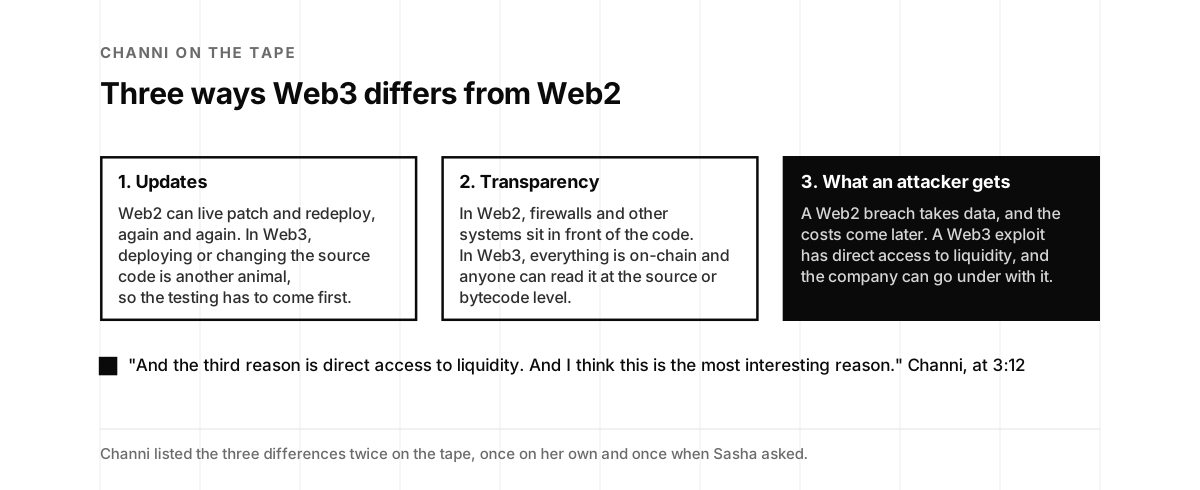
Three cards. 1. Updates: Web2 can live patch and redeploy, again and again. In Web3, deploying or changing the source code is another animal, so the testing has to come first. 2. Transparency: in Web2, firewalls and other systems sit in front of the code. In Web3, everything is on-chain and anyone can read it at the source or bytecode level. 3, filled. What an attacker gets: a Web2 breach takes data, and the costs come later. A Web3 exploit has direct access to liquidity, and the company can go under with it. Channi's line, "And the third reason is direct access to liquidity. And I think this is the most interesting reason." Channi, at 3:12
The three differences, as Channi listed them on the tape.

In a matter of a second

The numbers she gave for that third difference are where the episode’s title comes from: “you get hacked in the Web3 ecosystem,” and 12 million, 27, 37 or 197 million is gone almost at once.

She didn’t name the protocols on the tape. The 197 matches the largest of them. On March 13, 2023, Euler Finance, a lending protocol, was hit by a flash-loan attack that took an estimated $197 million, according to the security firms BlockSec and PeckShield: $136 million in staked ether, $34 million in USDC, $19 million in wrapped bitcoin and $8.7 million in DAI (The Block). A flash loan is borrowed and repaid inside a single transaction, so the attacker doesn’t need capital of their own. Olympix’s own post-mortem traces the loss to a function called donateToReserves that skipped a solvency check, which let the attacker create bad debt and then liquidate themselves for the maximum reward (Olympix).

By March 25, 2023 the exploiter had returned 58,737 ether to the protocol, of the roughly 96,000 taken (The Block).

Olympix’s lead investor used Euler as its example. In July 2023, Boldstart Ventures wrote that a scan of Euler’s full codebase with Olympix’s tool returned the vulnerability that was exploited, plus two other results (Boldstart Ventures).
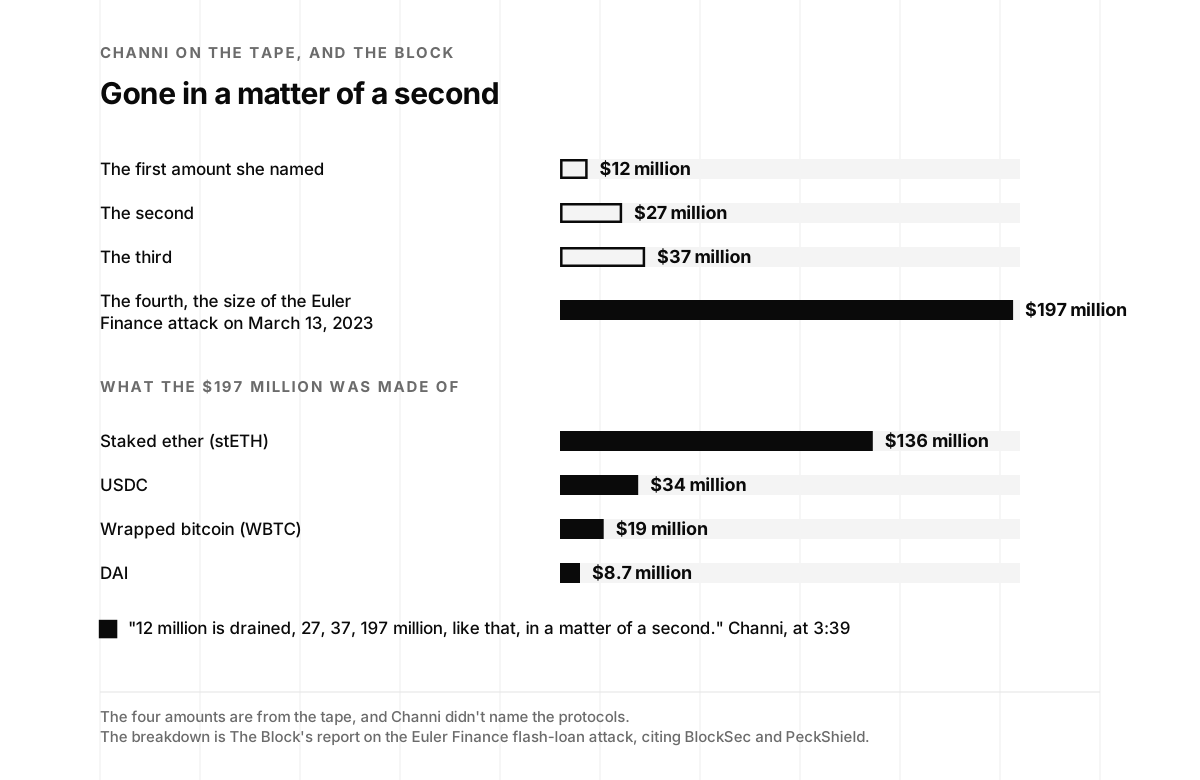
Two bar charts. The amounts Channi named on the tape: $12 million, $27 million, $37 million, and $197 million, filled, the size of the Euler Finance attack on March 13, 2023. What the $197 million was made of: $136 million in staked ether, $34 million in USDC, $19 million in wrapped bitcoin and $8.7 million in DAI. Channi's line, "12 million is drained, 27, 37, 197 million, like that, in a matter of a second." Channi, at 3:39
The amounts Channi named, and what the largest one was made of.

Critical systems

Channi said she has always been fascinated by attack surfaces with high stakes, and she reached for two examples.

“If your medical device fails, insulin pump, something like that, there’s no coming back, right?”

Channi Greenwall, at 3:56

The second was the airplane. “Or, you know, if, for example, your airplane fails, you’re gone.” Her point was that a contract with money in it belongs in that category, because a failure can kill the company. “Millions of people’s money could just be drained in a matter of a second.”

So she went looking for the security those stakes should have produced.

“I was like, wow, there’s hundreds of billions circulating here. There must be the most insane security stack.”

Channi Greenwall, at 4:16

What she found was the same gap she knew from those older fields. “And historically, it’s always been, like, formal verification, or, like, in traditional industries, and no one’s really nailed it.” Formal verification means proving, with mathematics, that a system meets a written specification (Wikipedia). It is also one of the methods Olympix automates, as she explains later.

Ninety percent had been audited

The number that shaped the company came next.

“When we started Olympix in 2022, over 16 billion had been exploited to date. 90% of all exploited contracts, so I’m referring to smart contracts, had undergone an audit, which is the only kind of security unlock that existed in the ecosystem.”

Channi Greenwall, at 4:46

Listen · Channi Greenwall on episode 85, from 4:45
About 25 seconds: Channi on the 90% figure and what an audit is. The clip stops on its own. Read the full transcript.

An audit, in her words, “is exactly like having a third party come in, like a consultant, look at your code, tell you what’s wrong, you make the changes, and you implement them.” The trouble is the price and the result.

“Like, people are paying anywhere from $25K to $250K for each audit, and they’re having to undergo multiple. And still, it’s not foolproof.”

Channi Greenwall, at 5:29

“Some companies were getting 10-plus audits and still losing money.” For a sense of the year she started in, Chainalysis counted $3.8 billion in tokens stolen in 2022, the biggest year for crypto hacking on record at the time (TechRadar). Her conclusion was about people in general. “So, a human, as we know, can only find so much.”

Olympix still leads with the figure. The first line on its home page today is “90% of exploited smart contracts were audited” (Olympix).
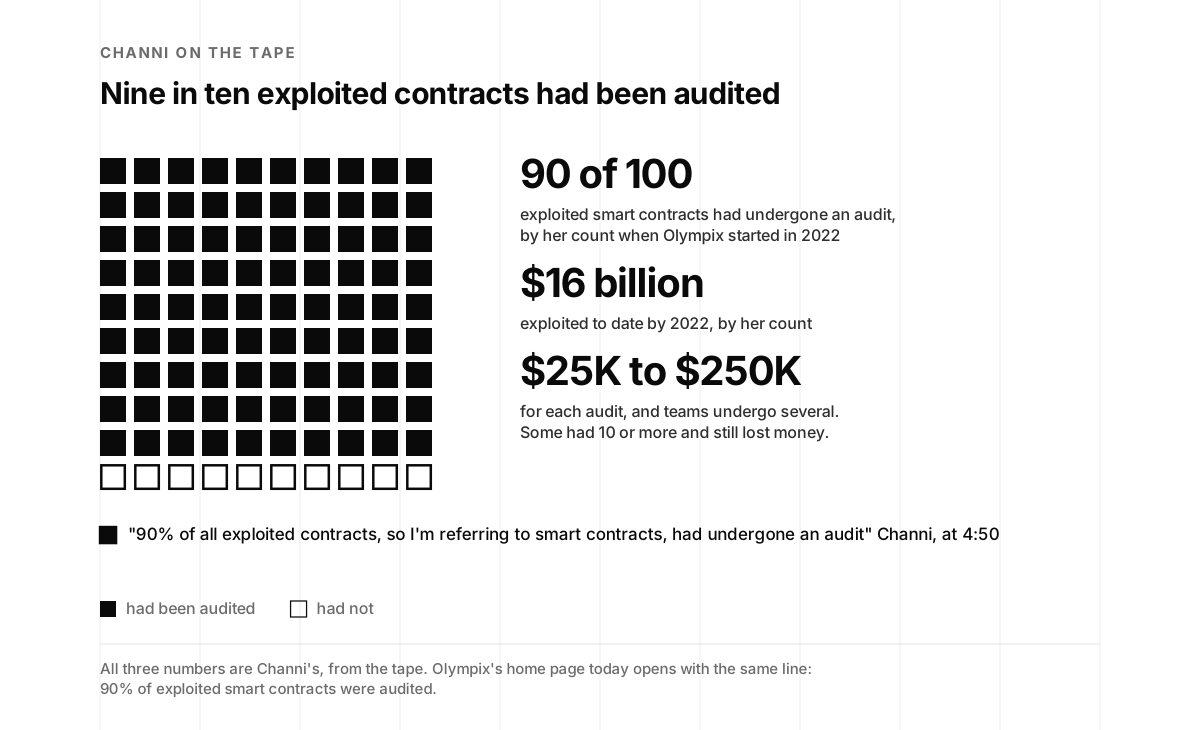
A grid of 100 squares, 90 filled and 10 outlined. Beside it: 90 of 100 exploited smart contracts had undergone an audit, by Channi's count when Olympix started in 2022. $16 billion exploited to date by 2022, by her count. $25K to $250K for each audit, and teams undergo several. Some had 10 or more and still lost money. Channi's line, "90% of all exploited contracts, so I'm referring to smart contracts, had undergone an audit" Channi, at 4:50
Channi's two numbers on audits, and the cost range she gave.

Security tools for developers

In 2022, she said, plenty of security companies saw the same losses. The difference was where they put the fix.

“No one except Olympix said, let’s solve it by giving security tools to developers, embedding security first.”

Channi Greenwall, at 5:53

The rest of the market went two other ways. Some companies sold architecture and chaos engineering tools to the business or through DAOs, the on-chain organizations that govern many protocols. The most popular choice, she said, was on-chain monitoring, which she described as “hey, inevitably, everyone’s going to get hacked. Let’s alert you when you do.” She called monitoring an important part of the stack. Her question was whether the number of hacks could come down before anyone needs an alert.
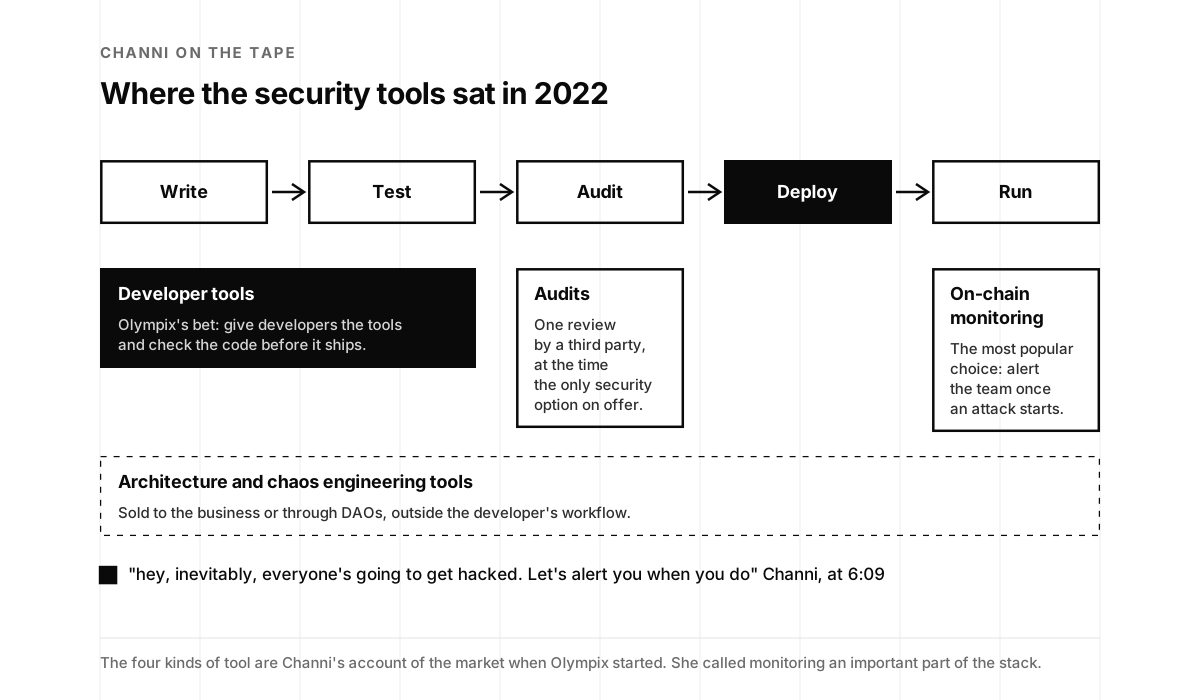
A contract's life as five steps: write, test, audit, deploy, run, with deploy filled. Under write and test, filled: developer tools, Olympix's bet, give developers the tools and check the code before it ships. Under audit: audits, one review by a third party, at the time the only security option on offer. Under run: on-chain monitoring, the most popular choice, alert the team once an attack starts. Dashed, across the bottom: architecture and chaos engineering tools, sold to the business or through DAOs, outside the developer's workflow. Channi's line, "hey, inevitably, everyone's going to get hacked. Let's alert you when you do" Channi, at 6:09
Where each kind of tool sat in 2022, along a contract's life.

Find 90%, leave 10% for the human

The engineering goal she gave is a ratio.

“And so our North Star, from an engineering standpoint, is what percent of historically was done by humans can we automate?”

Channi Greenwall, at 6:22

Listen · Channi Greenwall on episode 85, from 6:21
About 15 seconds: Channi on automating what auditors find by hand, and leaving the rest to people. The clip stops on its own. Read the full transcript.

The auditor stays. “Not to say we’re going to replace this human, but why does the human need to be finding everything?” The plan is that tools find 90% and leave 10% for the auditor, which lowers the chance that a contract gets exploited at all.

The company has published how close it is. In a case study dated September 24, 2026, Olympix says its tools find about 70% of the vulnerabilities an external audit would surface, before the audit begins, and that the goal is 85% (Olympix). Its home page gives the same 70% for audit-level findings (Olympix).
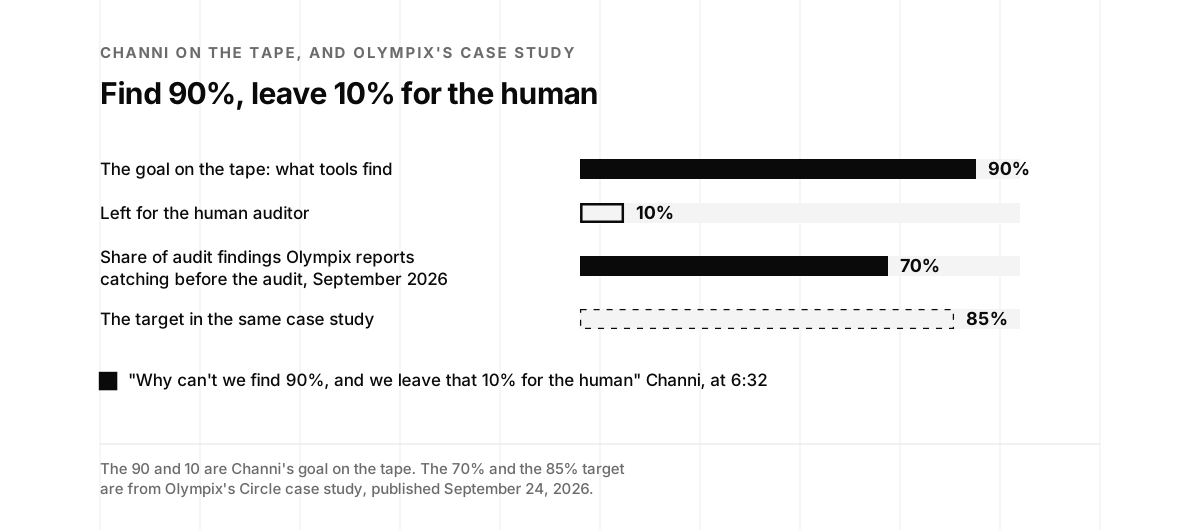
Four bars. The goal on the tape, what tools find: 90%. Left for the human auditor: 10%. Share of audit findings Olympix reports catching before the audit, in its September 2026 case study with Circle: 70%. The target in the same case study, dashed: 85%. Channi's line, "Why can't we find 90%, and we leave that 10% for the human" Channi, at 6:32
The goal on the tape, and the share Olympix reports today.

Circle, Solidity and Solana

Sasha asked which chains Channi meant, public, private or permissioned, and who the biggest customer is. Channi answered the second part first.

“Who’s our biggest customer? Circle.”

Channi Greenwall, at 6:53

Listen · Channi Greenwall on episode 85, from 6:52
About 20 seconds: Channi on her biggest customer, the languages developers use, and why hackers follow the money. The clip stops on its own. Read the full transcript.

Circle issues the USDC stablecoin and went public on the New York Stock Exchange in June 2025 (Wikipedia). Olympix’s case study says Circle became a design partner in 2023, runs every EVM-based smart contract through Olympix’s static analyzer before it goes to external auditors, runs mutation testing in its build pipeline, and recently renewed for two years (Olympix).

On languages, she put about 90% of development on Solidity, with a move toward Solana, where she said the language is Rust. Solidity was proposed in August 2014 by Gavin Wood, and its programs run on the Ethereum Virtual Machine, the EVM, or on compatible virtual machines (Wikipedia). Solana is a separate proof-of-stake chain, founded in 2018 and launched in March 2020 (Wikipedia). The EVM-compatible chains, she said, are where most of the liquidity is, and she gave the rule that follows from it.

“And like, wherever there’s money, there’s hackers. And wherever there’s hackers, security needs to be the first step in development.”

Channi Greenwall, at 7:08

Sasha took that as the answer to the next question as well. A blockchain can store data, but the use case here is the money. “But it sounds like the specific use case that we are addressing here is the asset protection.”
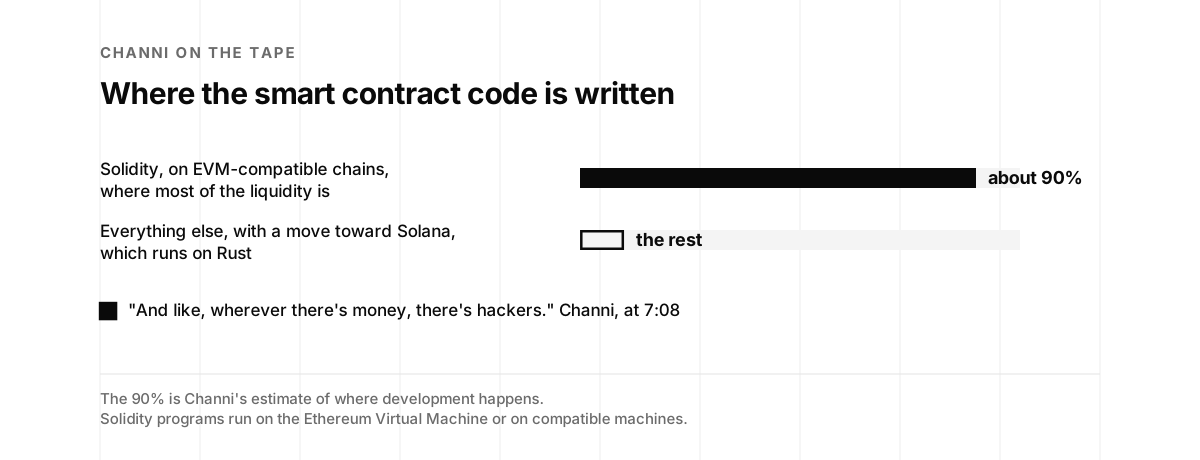
Two bars. Solidity, on EVM-compatible chains, where most of the liquidity is: about 90%. Everything else, with a move toward Solana, which runs on Rust: the rest. Channi's line, "And like, wherever there's money, there's hackers." Channi, at 7:08
Where development is, by Channi's account, and where it is moving.

No one telling you what to do

The next question was who makes a Web3 team spend money on security at all. Channi’s answer started with how it works in Web2.

“So, like, in traditional Web2, security is mandated by regulatory, meaning whatever we’re told we have to do, we do. Not necessarily because we care about security.”

Channi Greenwall, at 7:41

On a chain there is no such rule, she said, besides maybe one audit by a good audit firm, which people will do. Past that, there’s little incentive to add anything unless a lot of liquidity is at stake.

“So once they hit, you know, about, like, 5 million in volume within their protocol or moving through their protocol, they start to engage with us.”

Channi Greenwall, at 8:09

Listen · Channi Greenwall on episode 85, from 8:08
About 30 seconds: Channi on when teams start to buy security, and why the small ones need it as much as the big ones. The clip stops on its own. Read the full transcript.

The range above that threshold is wide. “You know, we have companies that are moving tens of billions every day.” At the other end are teams with 5 or 20 million, and she argued they need the same care, because one exploit takes a small company under. “And those first couple years of starting a company are the most critical to get everything right.” She has watched the same sequence many times: a team finally gets traction, the money in the contract grows, attackers read the public code and find the hole.

“And then, like, there goes the six, seven years of hard work that these founders put in.”

Channi Greenwall, at 8:51
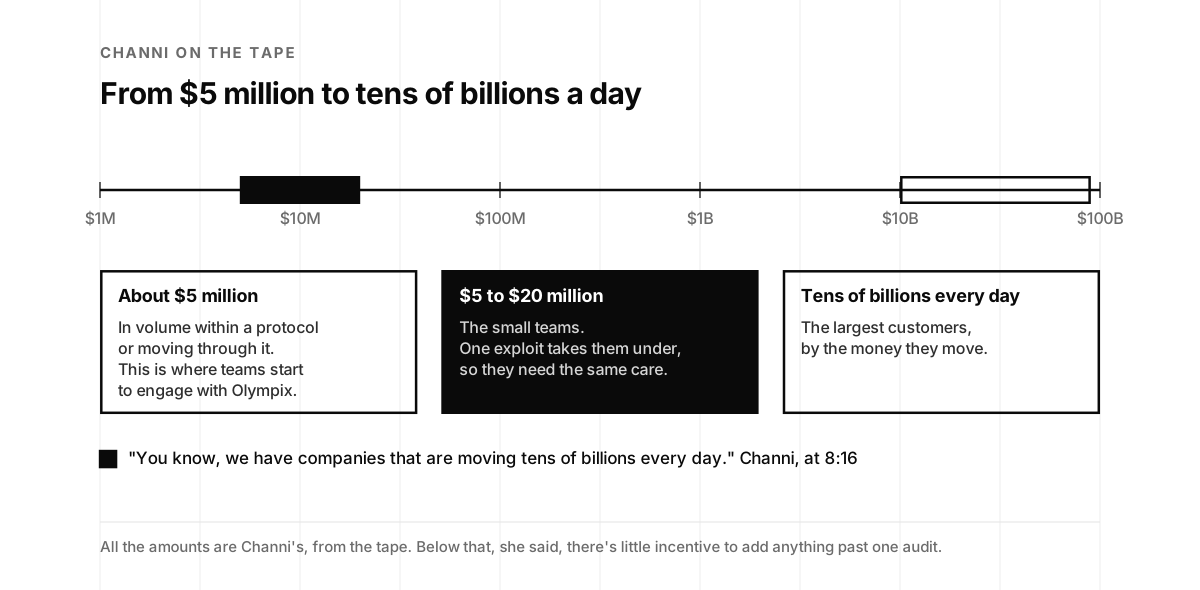
A log scale from $1 million to $100 billion, with a filled band from $5 million to $20 million and an outlined band at tens of billions. Three cards. About $5 million in volume within a protocol or moving through it: where teams start to engage with Olympix. $5 to $20 million, filled: the small teams, where one exploit takes them under, so they need the same care. Tens of billions every day: the largest customers, by the money they move. Channi's line, "You know, we have companies that are moving tens of billions every day." Channi, at 8:16
The money Channi named, from the point teams start buying tools to the largest customers.

Their life savings

Jon took the founders’ side. “Yeah, there’s a lot at stake. And like, these are people’s dreams.” Channi widened it to the people whose money sits in those contracts.

“It’s also about everyone globally who’s distributing their capital here.”

Channi Greenwall, at 9:10

In America, she said, people trust the dollar and the bank, whatever they think of politics or the economy. “In Venezuela and Brazil, this isn’t the case at all.” There, people use decentralized protocols for trading, staking, borrowing and lending.

“Like, if one of these protocols fails, that could be their life savings.”

Channi Greenwall, at 9:36

Listen · Channi Greenwall on episode 85, from 9:28
About 25 seconds: Channi on what a protocol failure means for people who don't trust their banks. The clip stops on its own. Read the full transcript.

The same protocols, working and well secured, “could allow them financial autonomy.” Which of the two stories plays out, she said, depends on how security is built into the development of those companies.

A free tool, no advertising

Jon played a crypto founder who has just heard all this and wants to look at a contract before the company gets big. Where does that founder start? The answer was a free tool first, and then the paid ones.

“So we have a free tool that about 30% of Solidity developers use, that automates about, like, I’d say, like, 20% of what historically was found by external audits”

Channi Greenwall, at 10:09

Listen · Channi Greenwall on episode 85, from 10:07
About 20 seconds: Channi on the free tool and the paid tiers. The clip stops on its own. Read the full transcript.

The paid tools, she said, take that to 60 or 80%. “It’s not self-service,” so a team reaches out through the website or on LinkedIn and Olympix onboards them. The company’s site is olympix.security, and it now has a Try Free Analyzer button for developers and says Olympix has analyzed more than 100 million lines of Solidity (Olympix).

Jon turned it into a market share. “You have 30% market penetration into the smart contract space.” Channi added that the company got there without spending a dollar on advertising.
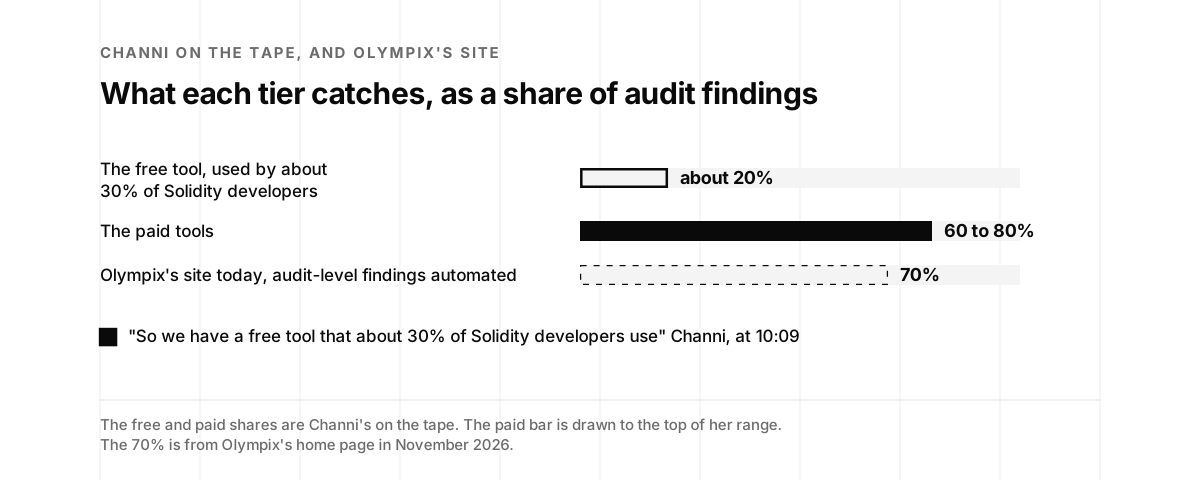
Three bars. The free tool, used by about 30% of Solidity developers: about 20% of what external audits historically found. The paid tools, filled: 60 to 80%. Olympix's site today, audit-level findings automated, dashed: 70%. Channi's line, "So we have a free tool that about 30% of Solidity developers use" Channi, at 10:09
The free tool and the paid tiers, as Channi described them, next to the share Olympix reports today.

Down the rabbit hole

Jon asked whether there had been an aha moment. He had seen the 10,000 Hearts NFT in her background, a project she lists on LinkedIn from February to April 2022 as “Just for fun (side project)” (LinkedIn). She called it a rabbit hole.

The project overlapped her time at SecurityScorecard, which she described as a late-stage cybersecurity company where she worked directly for a founder. The days were long, and the side project filled the hours after work. “So I was like, I’ll just work on a side project.” Smart people she knew were moving into Web3 full time, she didn’t know much about it, and she learns best by doing. So she launched a project, with a few interns. It was a night project, a side project.

“In doing so, again, is when I realized the differentiation in attack surface.”

Channi Greenwall, at 11:29

Boldstart Ventures told the same story when it led her seed round: she launched an NFT project called 10,000 Hearts and saw how easily smart contracts could be exploited (Boldstart Ventures).

The attraction was the same one she described at the start of the episode. “I always wanted to start a medical device security company because of that reason.” She never did. “But just from a business perspective, it’s a very hard thing to actually implement and scale, given regulatory, given hardware.” Web3 had the same pull, a high-stakes attack surface and an interesting problem. The decision was still hard, because she loved her job.

“It was more that this problem was right in my face. I thought, how incredible if I get this opportunity to try and solve it.”

Channi Greenwall, at 12:20

Symbolic execution machines and fuzzers

She described the work as a daily list of hard problems, and named the machinery.

“We’re building symbolic execution machines, fuzzers, like, we’re automating formal verification, something historically that was so hard, so manual, and so easy to get wrong.”

Channi Greenwall, at 12:33

Listen · Channi Greenwall on episode 85, from 12:26
About 20 seconds: Channi on the tools Olympix builds and why each day feels like a new problem. The clip stops on its own. Read the full transcript.

Each of those terms is a different way of asking whether code can do something it shouldn’t. Symbolic execution runs a program on symbols in place of real values to work out which inputs reach each part of the code (Wikipedia). Fuzzing feeds a program invalid, unexpected or random inputs and watches for crashes and failed checks (Wikipedia). Formal verification proves a property against a written specification (Wikipedia). Mutation testing, which Olympix also sells, makes small changes to the code to see whether the tests notice (Wikipedia).

On Olympix’s site those ideas are products: static analysis, generated unit tests that the site says reach up to 90% line and branch coverage, mutation testing, and BugPoCer, which combines an intermediate representation, custom detectors, symbolic execution, fuzzing and AI and proves each finding with an executable proof of concept (Olympix).
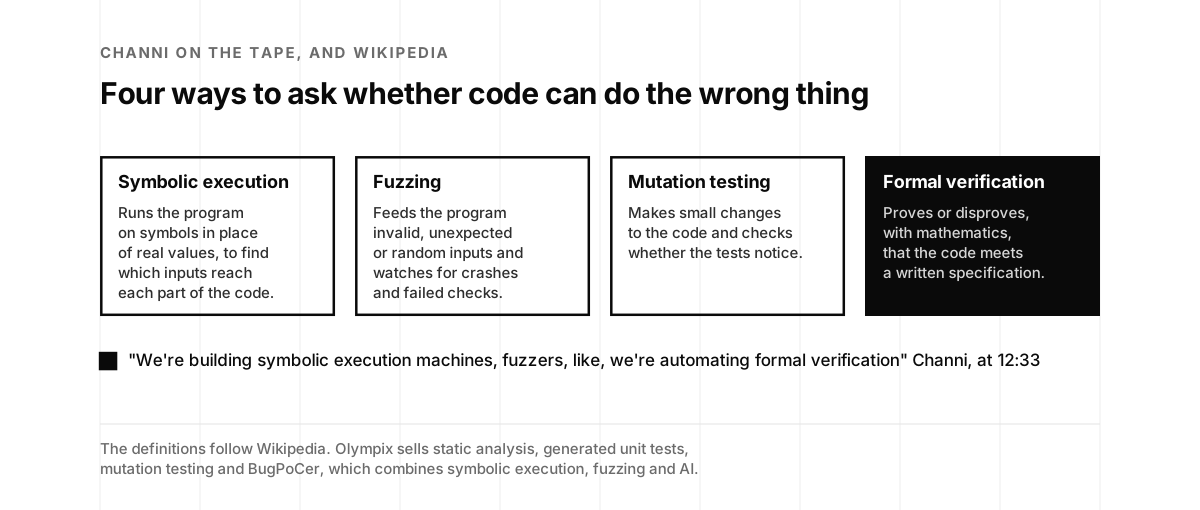
Four cards. Symbolic execution: runs the program on symbols in place of real values, to find which inputs reach each part of the code. Fuzzing: feeds the program invalid, unexpected or random inputs and watches for crashes and failed checks. Mutation testing: makes small changes to the code and checks whether the tests notice. Formal verification, filled: proves or disproves, with mathematics, that the code meets a written specification. Channi's line, "We're building symbolic execution machines, fuzzers, like, we're automating formal verification" Channi, at 12:33
The methods Channi named, and the question each one answers.

Is Web3 security any different?

Sasha asked the question plainly: is Web3 security any different from Web2 security, and how? Channi gave the three differences again, in more detail. The first is the pace of change.

“Like, you have that freedom to consistently build, change, build, change, ship, ship, ship, ship, ship.”

Channi Greenwall, at 13:06

On a chain, “you have to be so careful and so aggressive with the testing before deploying.” The second is the open code. “On the flip side, any bad actor can go and see any hole or flaw in your code.” In Web2 there are layers of protection in front of the source, and on a chain the source or bytecode is there in a flash. The third is the prize.

“But it’s not the same as losing 12 million, 27 million, 197 million in one shot.”

Channi Greenwall, at 14:11

She boiled it down to two things: the attack surface is larger, and the stakes are higher.

A missing reentrancy guard

Sasha pushed on where the risk sits: “Would you say the biggest risk with Web3 security is the intricacies of the contract that you define, and then you essentially publish on the chain, and everyone can use that contract?” Channi said that is part of it.

“I think what you’re referring to is, like, contract logic, that it meets the logic that it’s supposed to.”

Channi Greenwall, at 14:46

Listen · Channi Greenwall on episode 85, from 14:46
About 25 seconds: Channi on bugs that drain a contract without breaking its logic. The clip stops on its own. Read the full transcript.

The other part is code that does what it is supposed to do and can still be drained.

“There’s also, like, you miss a reentrancy guard, you have a certain pattern within your code that could lead to major funds being drained.”

Channi Greenwall, at 14:55

Reentrancy means a function can be called again before its first call has finished (Wikipedia). In a contract, the dangerous version is a function that sends money before it updates the balance. The receiving contract calls back in while the first call is still running, and the old balance pays out again. A reentrancy guard is a lock on the function: a second entry fails until the first call finishes. The best-known case is The DAO. On June 17, 2016, an attack that used several flaws, including one with recursive calls, moved 3.6 million ether out of it, about a third of the fund and worth around $50 million at the time. On July 20, 2016, Ethereum hard forked to return the funds, and the original chain continued as Ethereum Classic (Wikipedia).

Her second example was a single value. “It’s just, if someone changes one thing from five to zero, all of a sudden an external caller can drain.” So the logic can be right and the contract still unsafe. The answer is more spending and more testing, and teams are still adjusting to that, she said, because “the spend for the same size Web2 startup is not going to be comparable at all to someone deploying on-chain, because they don’t have the same risk.”
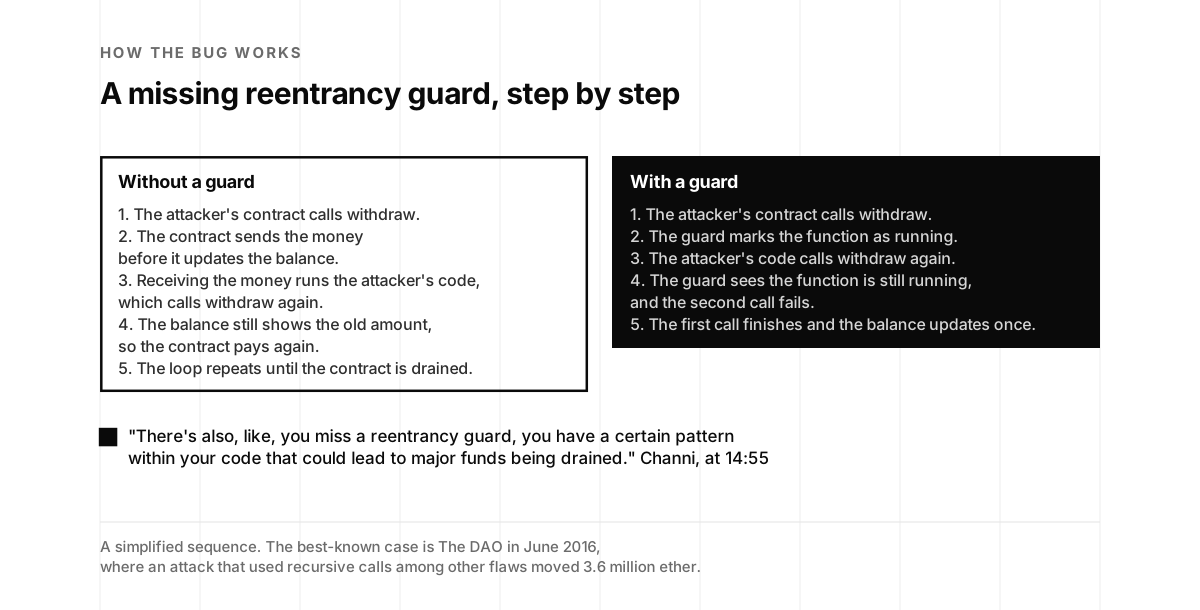
Two cards. Without a guard: 1. the attacker's contract calls withdraw. 2. The contract sends the money before it updates the balance. 3. Receiving the money runs the attacker's code, which calls withdraw again. 4. The balance still shows the old amount, so the contract pays again. 5. The loop repeats until the contract is drained. With a guard, filled: 1. the attacker's contract calls withdraw. 2. The guard marks the function as running. 3. The attacker's code calls withdraw again. 4. The guard sees the function is still running, and the second call fails. 5. The first call finishes and the balance updates once. Channi's line, "There's also, like, you miss a reentrancy guard, you have a certain pattern within your code that could lead to major funds being drained." Channi, at 14:55
How a reentrancy bug drains a contract, and where the guard stops it.

Not enough expertise

Sasha said that was the point of the question.

“The Web3 in general is a fairly new mass product. It’s not a new technology, but it recently has seen mass adoption.”

Sasha Sinkevich, at 15:33

“But there is not enough expertise in Web3 and understanding how Web3 works in order to secure it.” The talent sits on the Web2 side, Sasha said, and fewer people know how to secure Web3. Channi agreed, “Yeah, I think that’s absolutely right,” and tied it to budgets again: deploying on-chain takes more security spending than teams set aside.

A classical Web2 exploit

Her example was Bybit.

“For example, like, there’s a very notorious hack that happened this year, the Bybit hack. It’s well over a billion dollars. And it was actually a classical, like, Web2 exploit.”

Channi Greenwall, at 16:03

Listen · Channi Greenwall on episode 85, from 16:02
About 25 seconds: Channi on Bybit, a Web2 attack that drained on-chain money. The clip stops on its own. Read the full transcript.

On February 21, 2025, Bybit announced it had been hacked. By the exchange’s count about 400,000 ether was stolen, worth roughly $1.4 billion, and the attacker exploited Bybit’s multi-signature wallet through compromised infrastructure at Safe{Wallet}, a third-party provider. The FBI attributed the theft to North Korea (Wikipedia). The interim forensics from Sygnia point to a compromised Safe developer’s machine, JavaScript altered in the cloud storage that served the Safe{Wallet} interface, and code that changed the transaction only when it came from Bybit’s contract address or one other. Two minutes after the theft, the attackers swapped the original files back (The Block). The page for episode 69, with Riad Wahby of Cubist, walks through the same attack from the key management side.

That is Channi’s point about the two stacks. “So, like, part of their responsibility is securing both the Web2 and the Web3 stack, because they deployed both.” The attacker used the Web2 side to take the on-chain money.

“And so, like, you have to both have a Web2 security expert and a Web3 security expert, and you need to understand where they overlap”

Channi Greenwall, at 16:39

The overlap is where the holes are, the places “someone can weave from, like, a Web2 interface into your Web3 stack.” Testing the Web2 half is what our Penetration Testing team does, and a team that a nation-state would target can look at our Counter Nation-State Espionage program.
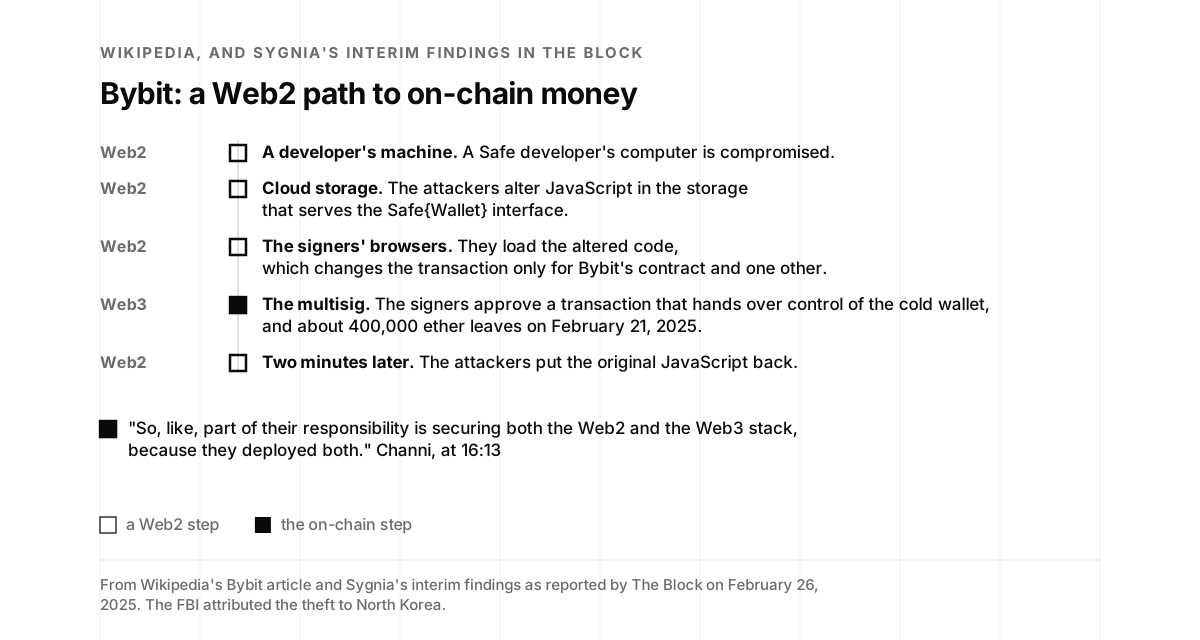
A five-step path. Web2: a Safe developer's computer is compromised. Web2: the attackers alter JavaScript in the storage that serves the Safe{Wallet} interface. Web2: the signers' browsers load the altered code, which changes the transaction only for Bybit's contract and one other. Web3, filled: the signers approve a transaction that hands over control of the cold wallet, and about 400,000 ether leaves on February 21, 2025. Web2: two minutes later, the attackers put the original JavaScript back. Channi's line, "So, like, part of their responsibility is securing both the Web2 and the Web3 stack, because they deployed both." Channi, at 16:13
The Bybit attack path, from a developer's machine to the cold wallet.

The problem statement is still the same

Sasha summed up the security engineer’s view.

“So it sounds like the problem statement is still the same. How do I protect? And you have to answer questions of what am I protecting, and against who?”

Sasha Sinkevich, at 16:55

Listen · Sasha Sinkevich on episode 85, from 16:55
About 35 seconds: Sasha on the standard flow of a threat model, with Web3 as one more layer. The clip stops on its own. Read the full transcript.

After that comes the standard flow: identify the attack surface, then answer the questions for each part of it. “You still have to protect the Web2 infrastructure and some of the logic. And then you have to think in depth about securing the Web3 component of that stack.” In Sasha’s words, Web3 is one more layer.

The intern project was the NFT

Jon summed up the founding story, and Channi corrected one detail. He had her building the company on nights and weekends, with a couple of interns, while holding a job.

“Sorry, sorry. I want to clarify.”

Channi Greenwall, at 17:49

The interns worked on the NFT project. “I didn’t actually start Olympix full time until I left SecurityScorecard.” Her LinkedIn has the dates. SecurityScorecard ends in June 2022, and Olympix starts the same month (LinkedIn).

Jon thanked her for working on hard problems. “That helps make the security community better.” A year after the founding, she put her view of the market to Fortune in two lines: “Innovation always precedes security,” and “Security does not matter until it does” (Fortune).

There just wasn’t someone

Jon asked whether she had ever thought about a co-founder. Her answer was about skills and timing.

“I have a technical background and no problem building out the first version.”

Channi Greenwall, at 18:29

Listen · Channi Greenwall on episode 85, from 18:29
About 15 seconds: Channi on building the first version herself and hiring engineers fast. The clip stops on its own. Read the full transcript.

Her rule for hiring is to push herself out of every role she can.

“Of course, you always hire people smarter and better than you and push yourself out of as many roles as you can, except for the roles you extremely excel at.”

Channi Greenwall, at 18:33

She hired engineers quickly, and the team is mostly engineers. At the start she didn’t have someone she wanted to take on the problem with. Since then the company has hired people she calls key employees. “They own significant equity stakes. They operate as business partners.” Olympix’s site now introduces Sarah Hicks, who hosts its podcast The Security Table, as an Olympix co-founder (Olympix). The founding was hers, and she said she would have gone ahead with or without a partner and with or without funding. “Like, there was nothing stopping me from solving this problem. Along the way, you find the pieces and the people.”

Jon asked about money, and Channi said, “We did. We raised a seed round.” Fortune reported the round on July 11, 2023: $4.3 million, led by Boldstart Ventures, with Robot Ventures, Shrug Capital, Konstantin Richter of Blockdaemon and Tarun Chitra of Gauntlet. Olympix then had six people in New York, and its static analyzer was in a private alpha with 30 companies (Fortune). Boldstart’s post adds Guy Podjarny of Snyk and Ian Andrews of Chainalysis as angels, and names Blockdaemon, Rysk Finance and Arrakis Finance among the alpha teams (Boldstart Ventures).

A matter of 10 years

Sasha asked where adoption goes next: “Where do you see the next level of adoption of Web3 technology across all of the industries that are ripe for the adoption of Web3?” Channi said it’s hard to answer, because her customers keep surprising her.

“You know, it’s so hard to say, because I’m constantly in awe of the solutions that my customers are providing.”

Channi Greenwall, at 19:30

She had just spoken with a company that doesn’t think in Web2 and Web3 at all. “Because vibe coding and the convergence of AI is becoming so widespread, you should think of everyone as a developer.” If everyone can build, and a platform lets everyone deploy on-chain, the market is huge. Then she listed the moves she was watching.

“Obviously, you’re seeing, like, these bigger moves of Stripe acquiring multiple Web3 companies, of Circle going public.”

Channi Greenwall, at 20:23

Listen · Channi Greenwall on episode 85, from 20:23
About 25 seconds: Channi on Stripe, Circle and banks, and her ten-year call. The clip stops on its own. Read the full transcript.

Stripe completed its acquisition of Bridge in February 2025 and acquired Privy, which powers crypto wallets, in June 2025 (Wikipedia). Circle went public on the New York Stock Exchange the same month (Wikipedia). On the payment side, she said, “every major bank is moving RWAs, real-world assets.” She wouldn’t pick a single winner, and said a VC’s website would cite a different one every couple of months. Her call was about everything at once: in about 10 years, she said, everything is on-chain.

Jon tied it back to the same shift: “And vibe coding is now changing things and opening up possibilities for folks that it was out of reach, and is changing the way engineering is working.” Our post on vibe coding security covers the checks that AI-written code needs.
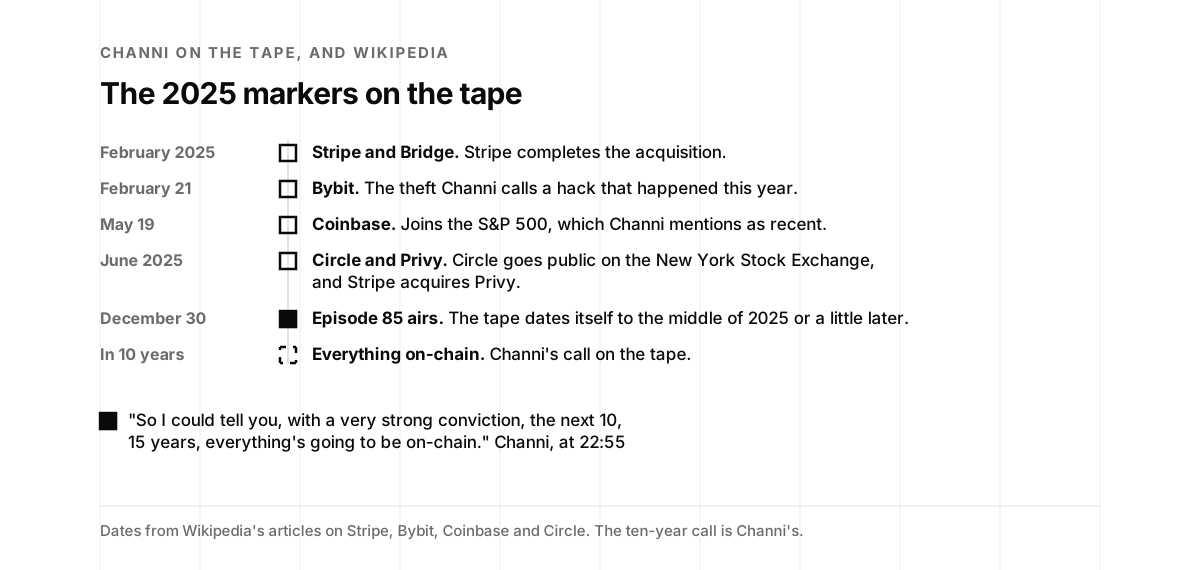
A timeline of 2025. February 2025: Stripe completes its acquisition of Bridge. February 21: Bybit, the theft Channi calls a hack that happened this year. May 19: Coinbase joins the S&P 500, which Channi mentions as recent. June 2025: Circle goes public on the New York Stock Exchange, and Stripe acquires Privy. December 30, filled: episode 85 airs. The tape dates itself to the middle of 2025 or a little later. In 10 years, dashed: everything on-chain, Channi's call on the tape. Channi's line, "So I could tell you, with a very strong conviction, the next 10, 15 years, everything's going to be on-chain." Channi, at 22:55
The 2025 markers Channi named, which also date the tape.

Why does it need to cost $100?

Sasha asked what drives the adoption. “Is it the efficiency that chain allows you to have?” Channi split the answer by who is adopting.

“For, like, mass developers, it’s usability. From, like, an economic standpoint, of course, it’s efficiency and money saved.”

Channi Greenwall, at 20:58

Listen · Channi Greenwall on episode 85, from 20:58
About 20 seconds: Channi on usability for developers and cost for everyone else. The clip stops on its own. Read the full transcript.

“It’s like, why does it need to cost $100 when it could cost $1 to move money?” Her examples came from markets she wouldn’t have guessed. One company makes NFTs for wine collectors. “They’ve created NFTs of every single wine, so you can validate that this is, like, a true, real, legitimate bottle.” Art is another. “Like, people are tokenizing art a lot.” Then one she called an interesting idea that seemed hard to execute: an entrepreneur tokenizing meditation. Companies give employees tokens for meditating, and the founder told her she already had thousands of users and companies on board.

She came back to the company from that morning call: thousands of users a month, people who aren’t technical, deploying on-chain. She said nobody would have expected it a year or two earlier.

“Especially even a year ago, especially two years ago, when FTX collapsed, everyone thought it was done.”

Channi Greenwall, at 22:50

The bankruptcy of FTX began in November 2022, and the exchange and more than 100 affiliated companies filed on November 11 (Wikipedia). Her call: “So I could tell you, with a very strong conviction, the next 10, 15 years, everything’s going to be on-chain.”

The goalpost always moves

Jon asked about her proudest day so far. “What’s been the proudest day so far on your entrepreneurial journey?” She said there isn’t one.

“I think the goalpost always moves there.”

Channi Greenwall, at 24:23

Listen · Channi Greenwall on episode 85, from 24:23
About 30 seconds: Channi on the goalpost that moves every day. The clip stops on its own. Read the full transcript.

She listed the goalposts in order: taking the risk to start, getting people behind you, a product that works, adoption, selling, more demand than you can take on. The last one she named was “And then people who used to laugh at you are trying to copy you.” The next goalpost is already set.

“we onboard the next 10 million users, and they’re able to deploy contracts securely and quickly and cheaply and efficiently because of us.”

Channi Greenwall, at 24:48

Jon’s summary: “Sounds like every day is the proudest day.”
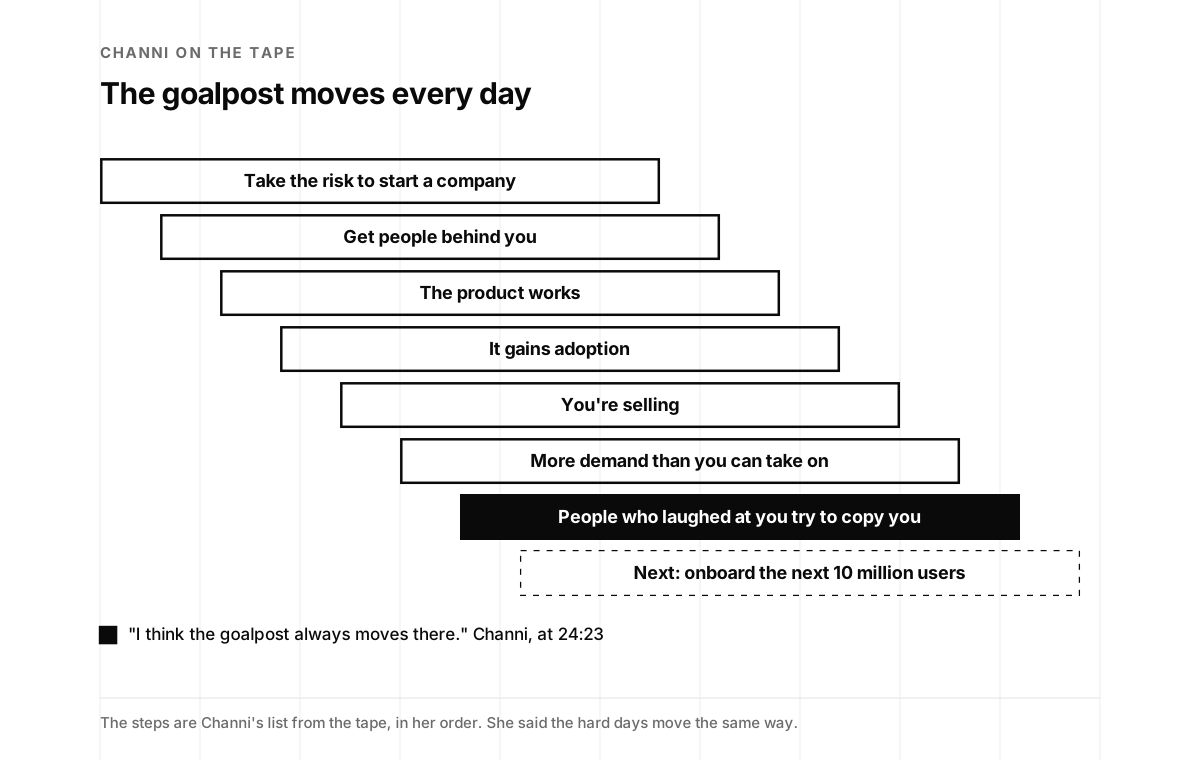
A staircase of eight steps, each one further right. Take the risk to start a company. Get people behind you. The product works. It gains adoption. You're selling. More demand than you can take on. Filled: people who laughed at you try to copy you. Dashed, the next one: onboard the next 10 million users. Channi's line, "I think the goalpost always moves there." Channi, at 24:23
The goalposts Channi listed, in the order she gave them.

Chewing glass

Channi had added that some days are bad, and Jon picked it up. “I know being a founder can be filled with super high highs and then super low lows.” Those are vulnerable days, he said, and “You see people’s true colors, like, in those days.” Had she had a most difficult day?

“You know, this question is really hard to answer, because I feel like they happen at such a regular cadence.”

Channi Greenwall, at 25:24

Listen · Channi Greenwall on episode 85, from 25:23
About 30 seconds: Channi on hard days that get easier in hindsight. The clip stops on its own. Read the full transcript.

She borrowed a founder’s image for it. “So I think Elon Musk famously says this, like, starting a company is like consistently chewing glass.” The days she once thought were chewing glass now feel lighter: “like, now it’s like eating paper for me.” Her version of the goalpost works the other way too.

“They always suck, but they always, like, in retrospect, like, become easier as you continuously go through the hard times.”

Channi Greenwall, at 26:02

The current solution is broken

Jon asked about the future. Founders see something most people don’t, he said, so what will be the greatest security challenge for the community? Her answer started with what Olympix is building, and she said so.

“Here’s what the world looks like today. A lot of people are trying to deploy on-chain. The current solution is broken. 90% of exploit contracts are audited. That’s the current solution.”

Channi Greenwall, at 26:38

Listen · Channi Greenwall on episode 85, from 26:38
About 20 seconds: Channi on why the next wave of users depends on automated security. The clip stops on its own. Read the full transcript.

She called that a 90% fail rate. If everyone is going to be on-chain in 10 to 15 years, the security has to scale with it, which means automating what humans did by hand and doing it “not just better, like, five, 10x better.” She played out the alternative.

“Like, we’re going to get hundreds of thousands of auditors, and they’re all going to have a hundred percent success rate as humans? No, that’s not feasible.”

Channi Greenwall, at 27:37

Listen · Channi Greenwall on episode 85, from 27:36
About 20 seconds: Channi on why more auditors won't close the gap. The clip stops on its own. Read the full transcript.

She called it a biased answer, since she faces the problem every day, and allowed that founders of other deep tech security companies would say the same about theirs. “And the ecosystem and world will not scale without it.” She also said, “And inevitably, we’re the only people positioned to do it right now, because we’re the only people betting on that, and we’re the only company with major adoption there.”

They’re not blind to it

Jon asked whether the big platforms were behind. “Do you feel like it’s just crazy that the AWSs of the world and the Google GCPs of the world, the Azures, and maybe even the central banking system, is not taking this more seriously, this change that’s coming?” She said he would be surprised.

Listen · Channi Greenwall on episode 85, from 28:08
About 35 seconds: Channi on what large companies are already spending on-chain. The clip stops on its own. Read the full transcript.

She cited a Coinbase report from a couple of quarters earlier, by her account, that the average Fortune 500 company has at least a $50 to $100 million budget for on-chain initiatives. She called that experimentation and small next to their other budgets. “But, like, no one’s really thinking it’s a joke.” She pointed to Stripe’s acquisitions, said Mastercard was about to deploy something on-chain, and named Goldman and JPMorgan. Her estimate is that the top 50 to top 500 companies all have budget and people on it.

“They’re not blind to it.”

Channi Greenwall, at 28:44

Escape velocity

Jon added the decentralization of compute, storage and money to the list of what changes. Channi compared it to AI.

“ChatGPT was the thing that kind of spun off everyone’s crazy obsession with AI, all these AI companies.”

Channi Greenwall, at 29:02

Listen · Channi Greenwall on episode 85, from 28:58
About 35 seconds: Channi on the ChatGPT moment and where crypto is on the same curve. The clip stops on its own. Read the full transcript.

There were early believers long before that moment, she said, and she put OpenAI’s start eight years before the boom. Wikipedia gives 2015 for OpenAI’s founding and November 30, 2022 for ChatGPT’s release (Wikipedia, Wikipedia). People push a new thing off, she said, until the scale arrives. “And that’s that, like, escape velocity moment.”

“And I think right now we’re, like, three, four years before, like, that initial wave of escape velocity, five, six years before, like, mass, mass adoption.”

Channi Greenwall, at 29:23

Jon: “So early. We haven’t even seen, like, early adoption yet.” Channi: “I think Coinbase just joined the S&P 500. These crypto companies are growing faster than you think.” Coinbase joined the index on May 19, 2025 (Wikipedia). Jon: “It’s a good thing. It’s going to help bring positive change.” Channi: “Right, 100%, especially globally.”

What I bring and pull out of others

Jon asked what legacy she wants to leave. She started with how she works: “I guess that I never shrunk myself to what people think should be the status quo or should go around.” Then she named the legacy.

“But I guess it’s like, in terms of legacy, I think the most important thing to me is what I bring and pull out of others.”

Channi Greenwall, at 30:11

Listen · Channi Greenwall on episode 85, from 30:10
About 20 seconds: Channi on finding people and pushing them to their highest level. The clip stops on its own. Read the full transcript.

She counts finding the best people and pushing them to a level they didn’t know they had among her best qualities. The products are meant to do the same for customers.

“Now, this customer is security first. They’re a security engineer. They went from a developer to a security engineer because they have all these tools.”

Channi Greenwall, at 30:42

Someone collected a bug bounty

Sasha asked for a single day. “And just to play off that a little bit more, what is your most memorable day on the journey so far with Olympix?” Channi gave two.

“But I think, like, the first memorable moment was when someone collected a bug bounty using our tool.”

Channi Greenwall, at 31:22

Listen · Channi Greenwall on episode 85, from 31:22
About 25 seconds: Channi on a bug bounty paid out through the tool, and a test against a top audit firm. The clip stops on its own. Read the full transcript.

The tool found a real flaw and someone got paid for it, which told the team how strong the tool was. The second was a head-to-head with an audit firm.

“And then recently, one of the top audit firms, one of our customers underwent an audit from the top audit firm, and our tool automated 100% of the findings that the audit firm found.”

Channi Greenwall, at 31:37

She didn’t name the customer or the firm. Those results moved her conviction. At the start, she said, a founder thinks in odds of 80, 70, even 60%, and that is enough to begin.

“Like, when those technical milestones hit, I think for me, like, right now, I’m at, like, 95, 97% conviction that could work, which means, like, I should be moving faster.”

Channi Greenwall, at 31:58

She said she sees the future so often that it feels like a memory, and that a founder has to be that convinced. “You have to be crazy to be a founder. There’s no way around that one.” For someone with a family and no salary, the sacrifice only makes sense if the bet is right.

“And I believe the trade-off is worth it a millionfold.”

Channi Greenwall, at 33:01

A bug bounty program pays outside researchers who report security bugs (Wikipedia). Running one well is the job of our AI-Accelerated Bug Bounty Program.
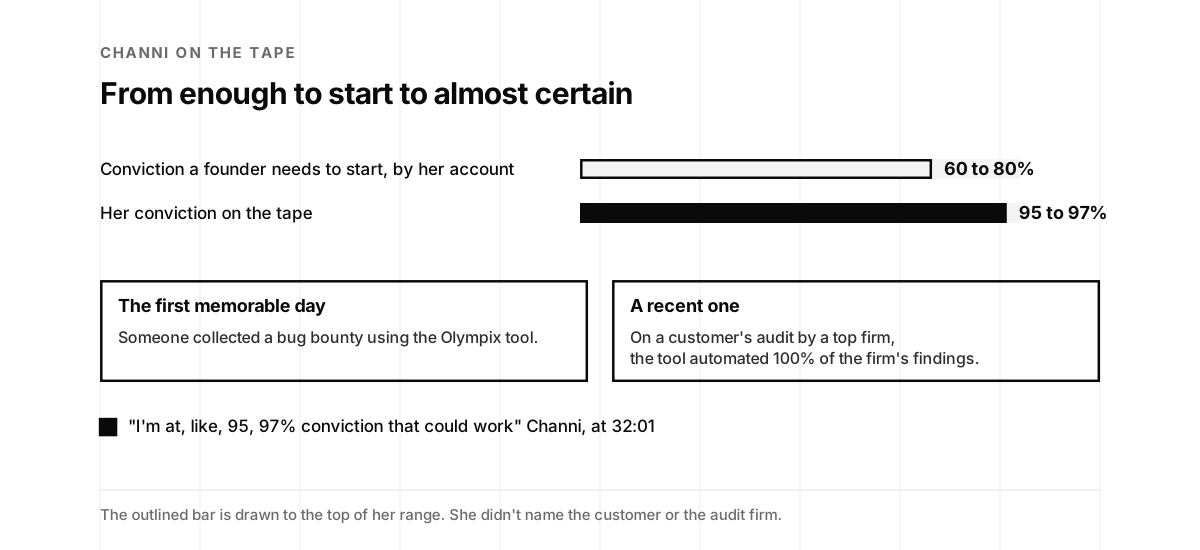
Two bars. Conviction a founder needs to start, by Channi's account: 60 to 80%. Her conviction on the tape, filled: 95 to 97%. Two cards. The first memorable day: someone collected a bug bounty using the Olympix tool. A recent one: on a customer's audit by a top firm, the tool automated 100% of the firm's findings. Channi's line, "I'm at, like, 95, 97% conviction that could work" Channi, at 32:01
Channi's conviction at the start and on the tape, with the two days that moved it.

Trust your gut

Jon asked what she would tell a younger version of herself.

“I think I would just say trust your gut.”

Channi Greenwall, at 33:26

Listen · Channi Greenwall on episode 85, from 33:25
About 20 seconds: Channi on her advice to her younger self. The clip stops on its own. Read the full transcript.

Her regrets, she said, are the times she moved too slowly. “And like, probably the biggest lessons I’ve learned as a founder and as a human is, like, just move faster and trust your gut.” Being wrong sometimes is part of it. “Like, when you’re wrong, it’s okay. Just move quickly and get there.” Jon liked the intuition part, and she added that people know more than they think they do. She applies it to her own team. When a question comes up, she asks the people at Olympix “what does your gut tell you?” because “they’re sitting and sunk into this problem.”

Swimwear shapewear

Jon’s last question is one the show likes to ask: “is there just one tool or service that you wish someone would just go out there and build already?” Channi checked the rules. “Does it have to be security-related?” It didn’t.

“I would love for there to be a good swimwear shapewear.”

Channi Greenwall, at 34:37

Listen · Channi Greenwall on episode 85, from 34:37
About 20 seconds: Channi's answer to the last question, a product outside security. The clip stops on its own. Read the full transcript.

Nobody has built nice-looking swimwear that is also shapewear, she said, and she called it simple to execute: “Everyone knows how to build swimwear. Like, you just need to layer the two and, like, create a good line.” It isn’t her field. “But I have no experience with consumer. All I do is, like, deep tech.” She pointed to Spanx and Skims as proof that the market is real. Spanx is an American shapewear company that Sara Blakely founded in 2000 in Atlanta, Georgia, and Skims was co-founded in June 2019 by Kim Kardashian and Jens Grede (Wikipedia, Wikipedia).

After the tape

The video went up. The episode was posted to our YouTube channel on August 28, 2026, at 37 minutes (YouTube).

Olympix published the Circle story. On September 24, 2026, Olympix published a case study with Circle. It says Circle has been a design partner since 2023, that Olympix finds about 70% of what an external audit would surface before the audit starts, with a target of 85%, and that Circle’s team was among the first to use BugPoCer and Olympix’s fuzzing and automated formal verification tools (Olympix). Olympix’s customer stories page also lists Securitize, Lucid Labs and Cork Protocol (Olympix).

Olympix writes up the exploits. Its exploits page now holds 152 post-mortems, each traced to the root cause in the code, and puts the losses its tools would have prevented at $680 million. Euler’s $197 million is one of them (Olympix).

The record moved. Bybit held the record for the largest cryptocurrency theft until October 29, 2026, when Binance lost an estimated $6.3 billion (Wikipedia, Wikipedia).

Channi writes about proofs now. Her LinkedIn is mostly short posts on formal verification, and she writes a newsletter called Counterexample. On November 3, 2026, she posted a four-line guide to what engineers mean by tested, fuzzed, audited and formally verified. The fourth line reads, “‘It’s formally verified’ means it can’t do the bad thing, on any input” (LinkedIn). A week earlier she wrote that boards should ask “what’s changed in the code since the audit, and who checked it” (LinkedIn).

What engineers mean when they say: "It's tested" means it works for the cases we thought of.

Channi Greenwall · November 2026
Channi on the four things engineers mean when they say code is safe. View on LinkedIn.

On the tape, the 90% figure was the case against stopping at an audit. In her posts, the same argument has moved one step further, from audits to proofs.
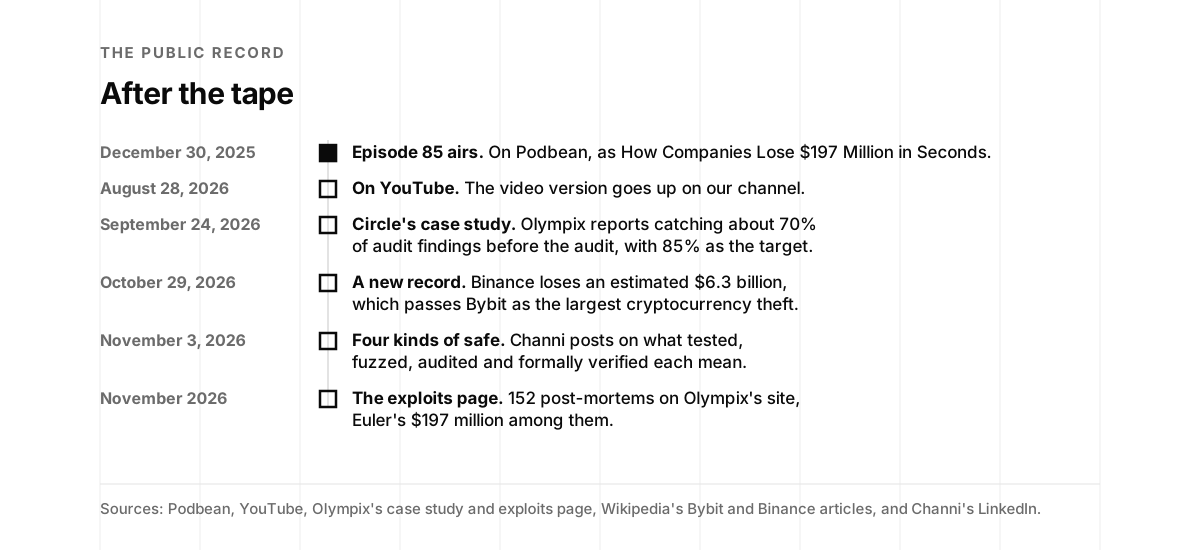
A timeline. December 30, 2025, filled: episode 85 airs on Podbean as How Companies Lose $197 Million in Seconds. August 28, 2026: the video version goes up on our YouTube channel. September 24, 2026: Circle's case study, where Olympix reports catching about 70% of audit findings before the audit, with 85% as the target. October 29, 2026: Binance loses an estimated $6.3 billion, which passes Bybit as the largest cryptocurrency theft. November 3, 2026: Channi posts on what tested, fuzzed, audited and formally verified each mean. November 2026: 152 post-mortems on Olympix's exploits page, Euler's $197 million among them.
The public record after the tape.

Did you catch it? A seven-question quiz

Seven questions from the episode. Each answer links the moment in the transcript.

Quiz · seven questions

Did you catch it?

Pick an answer to see whether you caught it, and where it is on the tape.

  1. By Channi's count, what share of exploited smart contracts had undergone an audit?

    1. 90%
    2. 50%
    3. 10%

    a. "90% of exploit contracts are audited. That's the current solution." Transcript, 26:42.

  2. What did Channi say one audit costs?

    1. $2K to $5K
    2. $25K to $250K
    3. More than $1 million

    b. "Like, people are paying anywhere from $25K to $250K for each audit, and they're having to undergo multiple." Transcript, 5:29.

  3. Who did Channi name as Olympix's biggest customer?

    1. Coinbase
    2. Stripe
    3. Circle

    c. "Who's our biggest customer? Circle." Transcript, 6:53.

  4. How much of development did Channi put on Solidity?

    1. About 90%
    2. About half
    3. About 10%

    a. "We're seeing the most, I think it's like 90% of development is on Solidity." Transcript, 6:56.

  5. Which theft did Channi call a classical Web2 exploit?

    1. The DAO
    2. Bybit
    3. Euler Finance

    b. "For example, like, there's a very notorious hack that happened this year, the Bybit hack." Transcript, 16:03.

  6. Which missing piece did Channi say could lead to major funds being drained?

    1. A cookie banner
    2. A password policy
    3. A reentrancy guard

    c. "There's also, like, you miss a reentrancy guard, you have a certain pattern within your code that could lead to major funds being drained." Transcript, 14:55.

  7. What does Channi wish someone would build?

    1. A good swimwear shapewear
    2. A better travel app
    3. A password manager for families

    a. "I would love for there to be a good swimwear shapewear." Transcript, 34:37.

Is your contract ready for mainnet?

Channi’s case is that the checks have to happen before a contract ships. Eight questions on how far along yours are.

Scorecard · eight questions

Is your contract ready for mainnet?

Answer for the contract you plan to ship next. If two answers fit, pick the lower one.

  1. Have you written down what the contract must never do, such as paying out more than was deposited, and do you check each change against that list?

    • No
    • Written down, not checked
    • Yes, on every change

    "you have to be so careful and so aggressive with the testing before deploying." See Is Web3 security any different?

  2. Does static analysis run on every change, before the code goes to an auditor?

    • No
    • Before releases
    • On every change

    "No one except Olympix said, let's solve it by giving security tools to developers, embedding security first." See Security tools for developers.

  3. Do you know that your tests fail when the code is wrong, through mutation testing or fuzzing?

    • We don't know
    • For some contracts
    • Yes, and we measure it

    "something historically that was so hard, so manual, and so easy to get wrong." See Symbolic execution machines and fuzzers.

  4. Does every function that sends value update its own state first, or sit behind a reentrancy guard?

    • Not checked
    • Most of them
    • All of them

    "There's also, like, you miss a reentrancy guard, you have a certain pattern within your code that could lead to major funds being drained." See A missing reentrancy guard.

  5. Has someone reviewed every change made since the last audit?

    • No
    • Some of them
    • Yes, all of them

    "Some companies were getting 10-plus audits and still losing money." See Ninety percent had been audited.

  6. Are the Web2 parts around the contract, such as signing machines, the front end, cloud storage and deploy keys, tested as hard as the contract?

    • No
    • Partly
    • Yes

    "So, like, part of their responsibility is securing both the Web2 and the Web3 stack, because they deployed both." See A classical Web2 exploit.

  7. Do you know how much money an exploit could take, and whose money it is?

    • No
    • Roughly
    • Yes, written down

    "Like, if one of these protocols fails, that could be their life savings." See Their life savings.

  8. Do you have on-chain monitoring and a plan for the first hour after an exploit?

    • Neither
    • One of them
    • Both

    "hey, inevitably, everyone's going to get hacked. Let's alert you when you do" See Security tools for developers.

Not ready to ship

The checks happen late or not at all. Start with the list of things the contract must never do, and put static analysis on every change.

Close

Some checks run before the audit. Next, make sure your tests catch broken code, review every change since the audit, and test the Web2 side.

Ready to ship

The checks run before the auditor sees the code. Keep them on every change, and keep the plan for the first hour current.

What do your audits cost against the money at stake?

Channi gave a price range for one audit and the point where teams start buying more than one. This calculator sets your audit spend against the money moving through your protocol.

Calculator

What do your audits cost against the money at stake?

Three numbers: the money moving through your protocol, how many audits you plan before launch, and the price of one audit.

$200,000spent on audits
4%of the money at stake
25times the audit spend, if one exploit drains it all

2 audits at $100,000 each cost $200,000, which is 4% of the $5,000,000 moving through the protocol. An exploit that drains all of it costs 25 times the audit spend, and on the tape, 90% of exploited contracts had been audited.

The $5,000,000 default is the point where Channi says teams start to buy security tools. Her range for one audit is $25,000 to $250,000. The 2 audits and the $100,000 price are our examples, not benchmarks. Put in your own.

From The DAO in 2016 to a record theft in 2026

Everything on this page sits on one timeline, from 2000 to 2026. Filter it by thread.

Timeline · 2000 to 2026

From The DAO in 2016 to a record theft in 2026

Filter by thread. Channi's dates are from her LinkedIn, and the rest are from the public record.

  1. Spanx

    Sara Blakely founds the shapewear company in Atlanta (Wikipedia, on this show).

  2. Solidity

    Gavin Wood proposes what becomes the main language for Ethereum smart contracts (Wikipedia, on this show).

  3. OpenAI

    Founded as a nonprofit (Wikipedia, on this show).

  4. The DAO

    An attack that used recursive calls among other flaws moves 3.6 million ether, about a third of the fund (Wikipedia, on this show).

  5. The hard fork

    Ethereum forks to return The DAO's funds, and the old chain continues as Ethereum Classic (Wikipedia).

  6. Solana

    Founded, with the network launching in March 2020 (Wikipedia, on this show).

  7. JPMorgan Chase

    Software engineer on cyber defense and fraud, then risk forecasting, to 2020 (LinkedIn).

  8. Skims

    Kim Kardashian and Jens Grede co-found the company (Wikipedia, on this show).

  9. NYU Tandon

    Head teaching assistant for a cybersecurity class of more than 100 (LinkedIn, on this show).

  10. SecurityScorecard

    Product lead for endpoint security, to June 2022 (LinkedIn, on this show).

  11. 10,000 Hearts

    The NFT side project, to April 2022 (LinkedIn, on this show).

  12. Olympix

    Channi starts the company full time (LinkedIn, on this show).

  13. FTX

    The exchange's bankruptcy begins (Wikipedia, on this show).

  14. ChatGPT

    OpenAI releases it (Wikipedia, on this show).

  15. $3.8 billion stolen

    Chainalysis's count for the year, a record at the time (TechRadar, on this show).

  16. Euler Finance

    A flash-loan attack takes an estimated $197 million (The Block, on this show).

  17. Ether returned

    The Euler exploiter has sent back 58,737 ether (The Block).

  18. A $4.3 million seed

    Led by Boldstart Ventures (Fortune, on this show).

  19. Circle

    Becomes a design partner (Olympix, on this show).

  20. Stripe and Bridge

    Stripe completes the acquisition (Wikipedia, on this show).

  21. Bybit

    About 400,000 ether stolen through compromised Safe{Wallet} infrastructure (Wikipedia, on this show).

  22. Coinbase in the S&P 500

    The exchange joins the index (Wikipedia, on this show).

  23. Circle goes public

    On the New York Stock Exchange, the same month Stripe acquires Privy (Wikipedia, on this show).

  24. Episode 85 airs

    This conversation (Podbean).

  25. Episode 85 on YouTube

    The video version (YouTube).

  26. The Circle case study

    About 70% of audit findings caught before the audit, with 85% as the target (Olympix, on this show).

  27. Binance

    An estimated $6.3 billion stolen, the largest cryptocurrency theft on record (Wikipedia, on this show).

  28. Four kinds of safe

    Channi's post on tested, fuzzed, audited and formally verified (LinkedIn, on this show).

What to do this week

Five things, in the order of the episode.

  1. Write down what must never happen. List the few things your contract must never do, such as paying out more than was deposited, and check every change against the list. Take the scorecard with whoever writes the contracts.
  2. Run tools before the audit. Put static analysis on every change, and use mutation testing or fuzzing to prove your tests catch broken code. Then the auditor’s hours go to what tools can’t find. Our Product Security team can set this up in your pipeline.
  3. Check every function that moves money. Update state before any external call, and put a reentrancy guard where a second entry could pay out twice.
  4. Test the Web2 side as hard as the contract. Bybit’s money left through a developer’s machine and a web interface. Our Penetration Testing team tests the signing machines, front ends and cloud storage around a protocol.
  5. Get a second pair of eyes. Run the calculator on your launch budget. A vCISO can own the plan, and you can book 15 minutes with us.

Key takeaways

  1. Audits alone aren't enough

    By Channi's count, 90% of exploited smart contracts had undergone an audit, and some teams had 10 or more audits and still lost money.

  2. Web3 breaks differently

    Code on a chain is hard to change, anyone can read it, and an exploit takes the money itself, so the testing has to happen before deployment.

  3. The losses come fast

    Channi named losses of 12, 27, 37 and 197 million dollars, drained in a matter of a second. The largest matches the Euler Finance attack of March 2023.

  4. Automate the findings people make by hand

    Olympix's goal is to automate 90% of what auditors used to find by hand and leave the other 10% for people.

  5. Buying starts around $5 million

    Teams start to buy security tools once about $5 million moves through their protocol, and small teams are the ones a single exploit can end.

  6. Correct logic can still be drained

    A missing reentrancy guard, or one value changed from five to zero, can drain a contract whose logic does what it should.

  7. The Web2 side counts too

    Channi calls the Bybit theft a classical Web2 exploit, so a team needs Web2 and Web3 security expertise and has to know where the two overlap.

  8. Threat modeling still applies

    Sasha's view: ask what you are protecting and against whom, map the attack surface, and treat Web3 as one more layer.

  9. Everything on-chain in about 10 years

    Channi expects everything to be on-chain within about 10 years, and pointed to Stripe's acquisitions, Circle going public and Coinbase joining the S&P 500.

  10. Trust your gut and move faster

    Her advice to her younger self is to trust her gut and move faster, and she asks her own team what their gut tells them.

Chapters

Tap a chapter to play from there. The play icon beside it opens that moment on YouTube.

Pull quotes

“I think it's very much twisted into my DNA. I have a technical background.”

Channi Greenwall ·

“I love security, for context, just because it's so much more fun to break than to build.”

Channi Greenwall ·

“The first being, in Web2, we live patch, redeploy, patch, redeploy.”

Channi Greenwall ·

“In the Web3 ecosystem, everything's on-chain. So, you can deduce it at a source or bytecode level. So, essentially, it's transparent.”

Channi Greenwall ·

“And the third reason is direct access to liquidity. And I think this is the most interesting reason.”

Channi Greenwall ·

“12 million is drained, 27, 37, 197 million, like that, in a matter of a second.”

Channi Greenwall ·

“If your medical device fails, insulin pump, something like that, there's no coming back, right?”

Channi Greenwall ·

“I was like, wow, there's hundreds of billions circulating here. There must be the most insane security stack.”

Channi Greenwall ·

“When we started Olympix in 2022, over 16 billion had been exploited to date.”

Channi Greenwall ·

“Like, people are paying anywhere from $25K to $250K for each audit, and they're having to undergo multiple. And still, it's not foolproof.”

Channi Greenwall ·

“Some companies were getting 10-plus audits and still losing money.”

Channi Greenwall ·

“No one except Olympix said, let's solve it by giving security tools to developers, embedding security first.”

Channi Greenwall ·

“And so our North Star, from an engineering standpoint, is what percent of historically was done by humans can we automate?”

Channi Greenwall ·

“Who's our biggest customer? Circle.”

Channi Greenwall ·

“And like, wherever there's money, there's hackers. And wherever there's hackers, security needs to be the first step in development.”

Channi Greenwall ·

“So, like, in traditional Web2, security is mandated by regulatory, meaning whatever we're told we have to do, we do. Not necessarily because we care about security.”

Channi Greenwall ·

“And then, like, there goes the six, seven years of hard work that these founders put in.”

Channi Greenwall ·

“Yeah, there's a lot at stake. And like, these are people's dreams.”

Jon McLachlan ·

“Like, if one of these protocols fails, that could be their life savings.”

Channi Greenwall ·

“In doing so, again, is when I realized the differentiation in attack surface.”

Channi Greenwall ·

“It was more that this problem was right in my face. I thought, how incredible if I get this opportunity to try and solve it.”

Channi Greenwall ·

“We're building symbolic execution machines, fuzzers, like, we're automating formal verification, something historically that was so hard, so manual, and so easy to get wrong.”

Channi Greenwall ·

“There's also, like, you miss a reentrancy guard, you have a certain pattern within your code that could lead to major funds being drained.”

Channi Greenwall ·

“It's just, if someone changes one thing from five to zero, all of a sudden an external caller can drain.”

Channi Greenwall ·

“The Web3 in general is a fairly new mass product. It's not a new technology, but it recently has seen mass adoption.”

Sasha Sinkevich ·

“For example, like, there's a very notorious hack that happened this year, the Bybit hack. It's well over a billion dollars. And it was actually a classical, like, Web2 exploit.”

Channi Greenwall ·

“So it sounds like the problem statement is still the same. How do I protect? And you have to answer questions of what am I protecting, and against who?”

Sasha Sinkevich ·

“Of course, you always hire people smarter and better than you and push yourself out of as many roles as you can, except for the roles you extremely excel at.”

Channi Greenwall ·

“Like, there was nothing stopping me from solving this problem. Along the way, you find the pieces and the people.”

Channi Greenwall ·

“So I could tell you, with a very strong conviction, the next 10, 15 years, everything's going to be on-chain.”

Channi Greenwall ·

“It's like, why does it need to cost $100 when it could cost $1 to move money?”

Channi Greenwall ·

“I think the goalpost always moves there.”

Channi Greenwall ·

“So I think Elon Musk famously says this, like, starting a company is like consistently chewing glass.”

Channi Greenwall ·

“Like, we're going to get hundreds of thousands of auditors, and they're all going to have a hundred percent success rate as humans? No, that's not feasible.”

Channi Greenwall ·

“They're not blind to it.”

Channi Greenwall ·

“But I guess it's like, in terms of legacy, I think the most important thing to me is what I bring and pull out of others.”

Channi Greenwall ·

“But I think, like, the first memorable moment was when someone collected a bug bounty using our tool.”

Channi Greenwall ·

“And I believe the trade-off is worth it a millionfold.”

Channi Greenwall ·

“I think I would just say trust your gut.”

Channi Greenwall ·

“I would love for there to be a good swimwear shapewear.”

Channi Greenwall ·

About the guest

Channi Greenwall, Founder and CEO, Olympix

Channi Greenwall is the founder and CEO of Olympix, a New York company that builds pre-deployment security tools for smart contracts. She started it in June 2022, after an NFT side project called 10,000 Hearts showed her how different the attack surface on a blockchain is. Her LinkedIn lists software engineering on cyber defense and fraud at JPMorgan Chase from 2018 to 2020, a role as head teaching assistant for a cybersecurity class at NYU Tandon in 2020, and product work on endpoint security at SecurityScorecard from May 2021 to June 2022. Olympix's site says she has an MS in security engineering from NYU. She joined Jon McLachlan and Sasha Sinkevich on episode 85, published December 30, 2025.

About the host

Jon McLachlan and Sasha Sinkevich are co-founders of YSecurity, the on-demand cybersecurity team for startups, and of Cyberbase.ai. The Security Podcast of Silicon Valley is hosted by Jon McLachlan and Sasha Sinkevich. Jon McLachlan on LinkedIn ↗Sasha Sinkevich on LinkedIn ↗

Context and sources

  • The episode on Podbean, published December 30, 2025, with the show notes. Source ↗
  • The video version on YouTube, posted August 28, 2026, with twelve chapters in the description. Source ↗
  • Channi Greenwall's LinkedIn: JPMorgan Chase from 2018 to 2020, head teaching assistant at NYU Tandon in 2020, product lead for endpoint security at SecurityScorecard from May 2021 to June 2022, the 10,000 Hearts NFT from February to April 2022, and Olympix since June 2022. Source ↗
  • Olympix's home page: 90% of exploited smart contracts were audited, its products, and the share of audit-level findings it automates. Source ↗
  • Olympix's about page: the founding in 2022, Channi's MS in security engineering from NYU, and the angel investors. Source ↗
  • Olympix's case study with Circle, September 24, 2026: a design partner since 2023, about 70% of audit findings caught before the audit, and 85% as the target. Source ↗
  • Olympix's customer stories, with Circle, Securitize, Lucid Labs and Cork Protocol. Source ↗
  • Olympix's exploits page: 152 post-mortems and $680 million in losses it says its tools would have prevented. Source ↗
  • Olympix's post-mortem on Euler Finance: donateToReserves skipped a solvency check. Source ↗
  • Olympix's podcast page, The Security Table, hosted by Olympix co-founder Sarah Hicks. Source ↗
  • Fortune, July 11, 2023: Olympix raises $4.3 million, led by Boldstart Ventures, with six people in New York and a static analyzer in private alpha with 30 companies. Source ↗
  • Boldstart Ventures on leading the seed round, July 11, 2023, with the 10,000 Hearts story and a scan of Euler's code. Source ↗
  • The Block, March 13, 2023: Euler Finance flash-loan attacked for an estimated $197 million. Source ↗
  • The Block, March 25, 2023: the Euler exploiter returns 58,737 ether. Source ↗
  • TechRadar, February 2, 2023: Chainalysis counts $3.8 billion stolen in crypto hacks in 2022. Source ↗
  • Wikipedia on Bybit: the theft of February 21, 2025, about 400,000 ether, and the compromised Safe{Wallet} infrastructure. Source ↗
  • The Block, February 26, 2025: Sygnia's interim findings on the Safe developer machine and the altered JavaScript. Source ↗
  • Wikipedia on Binance: the theft of October 29, 2026, an estimated $6.3 billion. Source ↗
  • Wikipedia on The DAO: the attack of June 17, 2016 and the hard fork of July 20, 2016. Source ↗
  • Wikipedia on reentrancy. Source ↗
  • Wikipedia on Solidity: proposed in August 2014, and run on the Ethereum Virtual Machine. Source ↗
  • Wikipedia on Solana: founded in 2018, launched in March 2020. Source ↗
  • Wikipedia on Circle: USDC, and the public listing on the New York Stock Exchange in June 2025. Source ↗
  • Wikipedia on Stripe: the Bridge acquisition completed in February 2025 and Privy acquired in June 2025. Source ↗
  • Wikipedia on Coinbase: included in the S&P 500 on May 19, 2025. Source ↗
  • Wikipedia on the bankruptcy of FTX, from November 2022. Source ↗
  • Wikipedia on OpenAI and on ChatGPT, released November 30, 2022. Source ↗
  • Wikipedia on symbolic execution, fuzzing, mutation testing and formal verification. Source ↗
  • Wikipedia on Spanx and Skims. Source ↗

Transcript

Automatic transcription. Jon McLachlan and Sasha Sinkevich host this episode with Channi Greenwall, founder and CEO of Olympix. There is no diarization on the tape, and Jon's and Sasha's voices are close, so speaker labels were assigned from the content and checked passage by passage against reference recordings of each voice from this episode and by pitch, and a few short lines may sit with the wrong speaker. The sponsor reads at the start and end are summarized in brackets. Names and product names were normalized where the recognizer misheard them (Jon McLachlan, Sasha Sinkevich, Channi Greenwall, Olympix, olympix.ai, SecurityScorecard, 10,000 Hearts, DAOs, S&P 500, JPMorgan, ChatGPT, Spanx, Skims, YSecurity), as were a few terms (Web2, Web3, fuzzers). Words in [brackets] are best guesses where the audio is unclear, and [unclear] marks a word we couldn't make out. Answers are transcribed as spoken, with repeated words and false starts trimmed. Short backchannels such as "yeah" and "right" are left out where they overlap the other speaker.

Read the full transcript 7,549 words

[Sponsor read: YSecurity, the sponsor of the show. For the moment a customer's legal team asks what happens if you get hacked: forty-plus security engineers who've done security at Apple, Uber, Microsoft, Robinhood and Brex, rented by the hour with a monthly cap, for SOC 2, ISO and HIPAA. Book a free strategy call, and the first eight hours are free at ysecurity.io/startups.]

Jon McLachlan

Hello, everyone, and welcome to another episode of the Security Podcast of Silicon Valley. I'm one of the hosts, Jon McLachlan. I'm joined [by] the other host, Sasha Sinkevich. And today we have an amazing guest to share with everyone, Channi Greenwall, the founder and CEO of a new security startup, Olympix. Welcome to the show.

Channi Greenwall

Thank you for having me.

Jon McLachlan

So share with our listeners a little bit about Olympix. What is Olympix out to do? Do you think of yourself as a security person?

Channi Greenwall

Do I think of myself as a security person? Yes. I think it's very much twisted into my DNA. I have a technical background. So, master's in security engineering. I worked in that field for a little bit before moving on full time to product and then to starting Olympix. I guess maybe it'd be helpful then to go a little bit into the genesis of Olympix and where it came from.

Jon McLachlan

We'd love that.

Channi Greenwall

Okay, great. So, like I said, traditional technical background, started Olympix after I personally deployed a side project on-chain. I love security, for context, just because it's so much more fun to break than to build. And it's very dynamic, which I also, as an ADHD, highly stimulated person, gravitate to things that are constantly moving, evolving. There's nothing monotonous about it. So I started Olympix because I personally deployed a project on-chain. I thought, wow, this is such a unique attack surface. For context, just looking at Web2 versus Web3, you have three kind of key differentiators. The first being, in Web2, we live patch, redeploy, patch, redeploy. You know, as Mark Zuckerberg famously says, move [quick] and break things, which you have the luxury of being able to do in the Web2 traditional ecosystem. User wants to change on that, no problem. Fix, fix, fix, fix. Web3, just deploying or changing your source code is such another animal. The second piece is the transparent nature. So, again, in Web2, we have the luxury of firewall and so many security systems that overlay and protect our underlying code. In the Web3 ecosystem, everything's on-chain. So, you can deduce it at a source or bytecode level. So, essentially, it's transparent. And the third reason is direct access to liquidity. And I think this is the most interesting reason. So, again, in the Web2 ecosystem, if you undergo an exploit, they steal your data. Of course, regulatory comes down, and the reputational damage and the payout sucks. It's a huge industry just to stop those things from happening, right? Really sucks. It's horrible. It's fueled the 300 billion plus security market. However, it's nothing in comparison to if your entire company goes under via an exploit. So, right now, you know, you get hacked in the Web3 ecosystem, and 12 million is drained, 27, 37, 197 million, like that, in a matter of a second. So, security is so critical. And I found this really interesting because I always had a personal fascination and, like, these attack surfaces that have such high stakes. So, something to comp it to would be, like, medical device security. If your medical device fails, insulin pump, something like that, there's no coming back, right? So, those are the stakes. Or, you know, if, for example, your airplane fails, you're gone. So these are, like, critical systems. So the same attack surface kind of translates [in the Web3] ecosystem. It's a critical system because it can kill your company. Millions of people's money could just be drained in a matter of a second. So it was really fascinating. I was like, wow, there's hundreds of billions circulating here. There must be the most insane security stack. And I just want to see what people were building, because I've always been fascinated by, like, these critical system attack surfaces and what people build there. And historically, it's always been, like, formal verification, or, like, in traditional industries, and no one's really nailed it. And it turns out that the Web3 ecosystem hadn't as well, which was surprising to me, given how much money was there. But it just shows the urgency for this technology, that, like, people are building despite critical security infrastructure being in place. When we started Olympix in 2022, over 16 billion had been exploited to date. 90% of all exploited contracts, so I'm referring to smart contracts, had undergone an audit, which is the only kind of security unlock that existed in the ecosystem. And to explain, an audit is exactly like having a third party come in, like a consultant, look at your code, tell you what's wrong, you make the changes, and you implement them. Sounds good and dandy if we had better numbers behind it. But when I tell you 90% of exploit contracts underwent this audit, it becomes a little bit problematic there, right? Like, those numbers aren't in the builder's favor, aren't in the CEO of the company that's trying to deploy [on-chain's] favor. When, if I get one audit, not necessarily bulletproof, if I get two. And then let's just dial it back a little bit, too, to cost. Like, people are paying anywhere from $25K to $250K for each audit, and they're having to undergo multiple. And still, it's not foolproof. Some companies were getting 10-plus audits and still losing money. So, a human, as we know, can only find so much. And there's always going to be something smarter, or a layered approach when it comes to security, that needs to be embedded. In 2022, a lot of security companies actually saw this problem, like, a lot is getting hacked, we need to do something. No one except Olympix said, let's solve it by giving security tools to developers, embedding security first. The majority of companies either did, like, some type of architecture, chaos engineering tool that they sell directly to the business or through DAOs, or they did on-chain monitoring, which was probably the most popular, which is like, hey, inevitably, everyone's going to get hacked. Let's alert you when you do, and then you can do something like that, and hopefully we can mitigate the losses, which, again, is so important and critical part of the stack. But what if we could just bring that number down altogether, that experience to hack? And so our North Star, from an engineering standpoint, is what percent of historically was done by humans can we automate? Not to say we're going to replace this human, but why does the human need to be finding everything? Why can't we find 90%, and we leave that 10% for the human, and then lower the stakes and lower the chances that you actually get exploited in the first place? So, yeah, that's a [long-winded] answer to, like, what Olympix does in our genesis.

Sasha Sinkevich

Are we mainly talking about public, private, or permission chains? What is the biggest customer that you see the engagement with?

Channi Greenwall

Who's our biggest customer? Circle. What, where are they launching? On Solidity. We're seeing the most, I think it's like 90% of development is on Solidity. We're seeing a bit of a move towards Solana, which is Rust. Historically, it's been primarily, like, EVM-compatible chains, where majority of the liquidity is on. And like, wherever there's money, there's hackers. And wherever there's hackers, security needs to be the first step in development.

Sasha Sinkevich

Yeah, and I think that answers my follow-up question, which is, what type of assets are we protected? Because with blockchain, you can not only store the currency assets or assets that can translate into the currencies, we can also talk about data storage. That's what blockchain is good for, is just to store lots of data. But it sounds like the specific use case that we are addressing here is the asset protection.

Channi Greenwall

Yeah, I think there's something interesting here. So, like, in traditional Web2, security is mandated by regulatory, meaning whatever we're told we have to do, we do. Not necessarily because we care about security. The Web3 ecosystem, there's no one telling you you have to do something, besides, like, maybe one audit by a good audit firm, and people will do that. But anything additional, or any additional layer, there's no really incentive to implement unless you have a large amount of liquidity at stake that could be compromised. And that's where we see the majority of our customers coming from. So once they hit, you know, about, like, 5 million in volume within their protocol or moving through their protocol, they start to engage with us. You know, we have companies that are moving tens of billions every day. And then we have companies that are as small as, you know, 5, 20 million. That to be said, like, it's just as important that security is implemented in the small teams and big teams, because as soon as one exploit happens to a small team that's very vulnerable, like, their company's gone under. And those first couple years of starting a company are the most critical to get everything right. And no one believes in you, whatever. So, like, they finally get the traction. And we've seen this happen so many times. Like, these teams finally get the traction, and then they get exploited, because, obviously, bad actors see, like, okay, a lot of money's here, and this contract, which is on-chain and public, is vulnerable. They go after that. And then, like, there goes the six, seven years of hard work that these founders put in. So it's really, really crazy.

Jon McLachlan

Yeah, there's a lot at stake. And like, these are people's dreams. People are putting everything that they've got behind these companies, trying to do the zero to one thing. I have all the respect in the world for that.

Channi Greenwall

Right. And like, forget the founders, even. It's also about everyone globally who's distributing their capital here. So, in America, we're so used to this luxury of trusting our dollar and putting our money in the bank. And we're not worried anything's going to happen to it, right? Everyone has their thoughts on politics and the general economy, but when push comes to shove, no one's worried that they're not going to get their 4% back, or their money [is at stake] in the bank. In Venezuela and Brazil, this isn't the case at all. And they rely on these decentralized modes of trading, staking, borrowing, lending. Like, if one of these protocols fails, that could be their life savings. And by the flip side, if they're working and they have good security infrastructure, that could allow them financial autonomy. There's two sides to the story, and they play out very differently depending on how security is embedded into the development of these crypto companies.

Jon McLachlan

Yeah. So let's pretend I'm a crypto founder for a second, and I'm doing some on-chain stuff, and I've got, like, a smart contract out there. And I'm listening to this, I'm thinking to myself, wow, maybe I could take a closer look at this even before I get big. Can I go to olympix.ai?

Channi Greenwall

Yeah, you can go to our website. It's not self-service. So we have a free tool that about 30% of Solidity developers use, that automates about, like, I'd say, like, 20% of what historically was found by external audits, where we see, like, the mover that gets you more to, like, 60 or 80% are our paid tools. So we have different tiering there, but you can always just reach out directly on our website or to us on LinkedIn, and we onboard.

Jon McLachlan

Wow, that's incredible. You have 30% market penetration into the smart contract space.

Channi Greenwall

Without a dollar, yeah, spent on any advertising.

Jon McLachlan

Congratulations, that's huge. And I see that you've been doing this for just over three years now.

Channi Greenwall

Yeah, just about three.

Jon McLachlan

Did something happen? You did your own on-chain adventure, and you were a founder, and it looks like you started the 10,000 Hearts NFT. Was there a moment where you were like, aha?

Channi Greenwall

So I think it was like a rabbit hole. So, first of all, I was just living in Miami, because I worked directly for a founder of late-stage cybersecurity company, and I didn't know many people there. So I was just, I was, anyways, working nine to nine, but you need something to do 9 p.m. to 1 a.m. And I don't personally like TV. So, and I didn't know anyone really there. So I was like, I'll just work on a side project. Like, a lot of smart people I know are moving full time into the Web3 ecosystem. I don't know much about it. And I personally learned best by doing it. So I'm like, let me just launch a project. Like, everyone's launching [an NFT]. It'll be fun. Grabbed some interns, worked on that, [preface it]. It was just, like, a night project, side project. In doing so, again, is when I realized the differentiation in attack surface. And like I said, I've always been so drawn to the type of attack surface that has such high stakes, more because I just like to see what people are building and how you solve for that to make the technology accessible despite the high stakes. And that's such an interesting security question, where, like, I always wanted to start a medical device security company because of that reason. But just from a business perspective, it's a very hard thing to actually implement and scale, given regulatory, given hardware. Like, there's so many pieces there, like, all models are so different. So it never made sense for me to pursue that dream. But, like, it kind of paralleled, in the sense of, like, high stakes attack surface, really interesting problem. And then, as I began, like I said, crawling down that rabbit hole, like, I just want to see what people were building. Why can't I try building something? And it was hard for me, definitely, because I really loved my job at the time. So it's not that I wanted to leave my job at all. It was more that this problem was right in my face. I thought, how incredible if I get this opportunity to try and solve it. And, you know, each day I feel grateful, because as we begin to unlock, like, how to solve it and how that actually looks, it's like, we're the ones doing this. That's so interesting. We're building symbolic execution machines, fuzzers, like, we're automating formal verification, something historically that was so hard, so manual, and so easy to get wrong. Every day, it's so fascinating to, like, climb down this to solve for each of these hard technological problems.

Sasha Sinkevich

Is Web3 security any different than Web2 security? And how?

Channi Greenwall

Yeah. So, like I said, there are three reasons. Web2 security comes down to what is regulatory pushing. So, three big differentiators in terms of attack surface, like I highlighted. So, one is, in Web2, you consistently are patching, redeploying, patching, redeploying. Like, you have that freedom to consistently build, change, build, change, ship, ship, ship, ship, ship. In Web3, because the systems are so subject to error and things can go so wrong, you have to be so careful and so aggressive with the testing before deploying. So, that's like the first differentiator. The second differentiator is the transparent nature. So when you deploy on-chain, you're looking at anyone being able to see it. So, like, there's beauty to that, and that's part of this ecosystem. It's like everything's transparent. On the flip side, any bad actor can go and see any hole or flaw in your code. Whereas in the Web2 ecosystem, we have so many layers and fortresses of protection sitting in front of us. Like, there's so much more going on before someone can even access the source code. With Web3, it's just source or bytecode in a flash. Like, we can have it. And the third thing is, again, like I said, probably the biggest, is direct access, like, liquidity versus data. And Web2, you're always compromising your data. Of course, regulatory comes down. Of course, reputation. There are components that are huge, and that fuels a 300 billion plus industry of companies that operate there. But it's not the same as losing 12 million, 27 million, 197 million in one shot. I just say the attack surface, if [it was boiled] down to two things, attack surface is larger and the stakes are higher.

Sasha Sinkevich

Would you say the biggest risk with Web3 security is the intricacies of the contract that you define, and then you essentially publish on the chain, and everyone can use that contract? And there is very little room for making errors in the definition of the contract, because then it becomes public and you can exploit the contract itself.

Channi Greenwall

I think what you're referring to is, like, contract logic, that it meets the logic that it's supposed to. And I think that's a component of Web3 security and smart contract security, but it's not the only piece. There's also, like, you miss a reentrancy guard, you have a certain pattern within your code that could lead to major funds being drained. And like, that doesn't necessarily break the logic. It's just, if someone changes one thing from five to zero, all of a sudden an external caller can drain. So, like, I think it's part of it, but I think the larger thing is just that the general attack surface is so much greater. And that requires a greater amount of spend, a greater amount of testing. And people are still adapting to that reality that, like, it can't look like, for example, the spend for the same size Web2 startup is not going to be comparable at all to someone deploying on-chain, because they don't have the same risk.

Sasha Sinkevich

I think that's where I was leading. The Web3 in general is a fairly new mass product. It's not a new technology, but it recently has seen mass adoption. But there is not enough expertise in Web3 and understanding how Web3 works in order to secure it. And so you have this disbalance of security talent on Web2 versus understanding how to secure Web3.

Channi Greenwall

Yeah, I think that's absolutely right. And I think people underscore how much, going back to the spend, needs to be allocated for deploying on-chain. For example, like, there's a very notorious hack that happened this year, the Bybit hack. It's well over a billion dollars. And it was actually a classical, like, Web2 exploit. It just, they happen to operate on-chain. So, like, part of their responsibility is securing both the Web2 and the Web3 stack, because they deployed both. However, like, they can actually get the consequences of the on-chain component, meaning, like, liquidity being drained via Web2, so people can come in this way. So there's, like, a lot more, when you think of attack surface, right? It just refers to the amount of space that's vulnerable. There's just so much more vulnerable space, and the solutions need to be so much more layered, and you're responsible for exponentially, in turn. And so, like, you have to both have a Web2 security expert and a Web3 security expert, and you need to understand where they overlap, and where you're vulnerable, and where, like, those holes are that someone can weave from, like, a Web2 interface into your Web3 stack.

Sasha Sinkevich

Yep. So it sounds like the problem statement is still the same. How do I protect? And you have to answer questions of what am I protecting, and against who? And then you go into standard logical flow of identifying the attack surface, which you have mentioned many times. Then you answer the questions, and you still have to protect infrastructure. You still have to protect the Web2 infrastructure and some of the logic. And then you have to think in depth about securing the Web3 component of that stack. So, just [an] additional layer.

Jon McLachlan

So, I love your story. You built this nights and weekends, and you had your job at the same time, and you're kind of, like, probably burning both ends of the wick, so to speak. And you're in Miami. And then you mentioned that you had a couple of interns, and you just built, and you just threw yourself into this hard problem, and you took a stab at this, and you built this up.

Channi Greenwall

Sorry, sorry. I want to clarify. The intern project [I worked on] was the NFT project. I didn't actually start Olympix full time until I left SecurityScorecard. So that was just, like, a side project. Yeah.

Jon McLachlan

So you've been in security, and your passion is clearly security. I love that. I love that you're tackling hard problems. So thank you. Thank you for that. That helps make the security community better. That helps make our futures more secure, whether they go on-chain or in traditional space. It's a win across the board for the community. And I'm super curious, like, when you were grinding, and your head's down, and you're focused, and you're building this up, did it ever cross your mind to maybe think about having a co-founder?

Channi Greenwall

I have a technical background and no problem building out the first version. Of course, you always hire people smarter and better than you and push yourself out of as many roles as you can, except for the roles you extremely excel at. So I was very quick to hire and scale the engineering team after. And our team is mostly engineers. But at the time, I didn't have someone that I wanted to tackle this problem with. And since then, and since validating our [idea], we've brought on key employees. They own significant equity stakes. They operate as business partners. But ultimately, like, I founded the company. So I'd say it's not that I was, like, opposed or for or whatever. There just wasn't someone. [The cards didn't play.] And I was doing it with or without someone, with or without funding. Like, there was nothing stopping me from solving this problem. Along the way, you find the pieces and the people.

Jon McLachlan

And did you raise money?

Channi Greenwall

We did. We raised a seed round.

Sasha Sinkevich

Where do you see the next level of adoption of Web3 technology across all of the industries that are ripe for the adoption of Web3?

Channi Greenwall

You know, it's so hard to say, because I'm constantly in awe of the solutions that my customers are providing. I say, like, I have the most unsexy, like, obviously, to me, it's like the sexiest thing in the world. Like, security and the problem we're solving is so cool. It's so interesting. It's so novel. Every day, it's like the hardest problem. However, to most people, like, they do not care. But the ideas our customers come up with, and the amount of people that come behind it and begin deploying on-chain and begin interacting with their apps, is crazy. I actually just got off the phone earlier today with a company, and their belief is, like, you shouldn't think of Web3 versus Web2. You should, like, developers. Because vibe coding and the convergence of AI is becoming so widespread, you should think of everyone as a developer. And in the future, if everyone can develop, and we've been able to create, like, a platform where everyone can deploy on-chain, the market size is huge. So it's really hard for me to say, like, obviously, gaming's right. Obviously, you're seeing, like, these bigger moves of Stripe acquiring multiple Web3 companies, of Circle going public. There's the payment side, like, every major bank is moving RWAs, real-world assets. Like, I wish I could, like, point to one thing and be like, this is the biggest mover. And probably, if you read a VC's website, every couple months they'll cite something else. But ultimately, [I'd] say across the board, it's a matter of 10 years that everything is on-chain.

Sasha Sinkevich

What do you think drives this adoption? Is it the efficiency that chain allows you to have? What is the main driver?

Channi Greenwall

For, like, mass developers, it's usability. From, like, an economic standpoint, of course, it's efficiency and money saved. It's like, why does it need to cost $100 when it could cost $1 to move money? There's a lot of different applications there. We would think as silly applications, but very, they make a lot of sense. Like, I know a company, and it's for wine collectors. Apparently, that's a huge market. They've created NFTs of every single wine, so you can validate that this is, like, a true, real, legitimate bottle. And I guess there's a huge market for fakes out there. Like, by the same token, art, right? Like, people are tokenizing art a lot. And, like, these aren't markets where I think would move on-chain, just wouldn't come to mind first. However, people are operating, building there. There's huge markets and a lot of people behind it. So, like, it's hard for me to say, like, if we were to point to one. Of course, like, the financial industry as a whole, just moving and off-boarding trillions of dollars into the ecosystem. But, like, it's so much more than the eye can see. Like, the use cases are beyond what you can imagine. Like, I met an entrepreneur who is tokenizing meditation. Like, I guess some companies like to create this benefits and want to incentivize their employees to meditate. And so, like, they do that by, when you meditate, you receive tokens. And I'm just like, that's such an interesting idea. Seems kind of hard to execute, right? In my head. And she's like, I have X,000 users already and X,000 companies on board. And I'm like, wow, I would have never thought, like, this application would be on-chain. So I guess what I'm saying is, like, why it's so compelling to me is, like, the problems that people are solving, and, like, using our technology as the underlying barrier to, like, get there, are beyond my wildest imagination. So, like, there's so many ideas. And, like, me, the three of us could not even fathom what people are thinking up right now. Like, I was so, again, like I told you, in awe of this company I was speaking to this morning, where they're just like, the future is a conversion. There's not developer, regular person. There's vibe coding for all. And, like, if we can make it easy for them to deploy on-chain, and they have thousands of users every month. People who are not technical deploying on-chain. Who would have thought, right? Especially even a year ago, especially two years ago, when FTX collapsed, everyone thought it was done. So I could tell you, with a very strong conviction, the next 10, 15 years, everything's going to be on-chain.

Jon McLachlan

I look forward to it. I look forward to it being just as secure as ever, with folks like yourself thinking through all of the tough security problems, too. So who knows what's going to be in the future? And vibe coding is now changing things and opening up possibilities for folks that it was out of reach, and is changing the way engineering is working. I'm super curious. You started in Miami, and for the benefit of all of our listeners, I think you're in New York now. That's New York City behind you.

Channi Greenwall

Right. Yeah. So I was working part time in Miami to work directly with my boss. I do believe that in-person work is the best work. But I've been in New York for over 10 years, and so I always, like, kept my apartment here and moved very quickly back. I don't think Miami is the place to start a company.

Sasha Sinkevich

Where did you grow up?

Channi Greenwall

In California, in San Francisco. [We] grew up in San Francisco.

Jon McLachlan

Wow, you're a San Francisco native as well.

Channi Greenwall

But New York is just very crypto-centric. And so to start a crypto company, New York is best. And like, I've been kind of hunkered down here for a long time, so it made sense for me. It's also, you have to think about, like, where you're bringing key employees, and you want to bring them to a major city they're excited about. And New York happens to be a city that people get very excited about and love to live in.

Jon McLachlan

Very exciting city. Yeah. Lots happening. Well, congratulations on [me hitting] your escape velocity from San Francisco. That's, that takes skill. What's been the proudest day so far on your entrepreneurial journey?

Channi Greenwall

I think the goalpost always moves there. First, it's taking the risk to start a company. Then it's, you get people behind you. Then your product works. Then it gains adoption. Then you're selling. Then you can't even take on the scale of the people that want it. And then people who used to laugh at you are trying to copy you. Like, that goalpost moves every day for me. You want it to keep moving, right? Like, when I think about what's the next day I'm proud of, it, like, I want it to be, we onboard the next 10 million users, and they're able to deploy contracts securely and quickly and cheaply and efficiently because of us. I definitely can't point to one moment. I could say, like, every day, if you ask me, or if, like, I look forward to it, it changes. I think that's very exciting.

Jon McLachlan

Sounds like every day is the proudest day.

Channi Greenwall

Every day, something great happens, right? Like, some days suck.

Jon McLachlan

Some days suck. I mean, speaking of days that suck, I know being a founder can be filled with super high highs and then super low lows. Those are very vulnerable moments for founders. You see people's true colors, like, in those days. Have you had a most difficult day on your journey?

Channi Greenwall

You know, this question is really hard to answer, because I feel like they happen at such a regular cadence. And when you look back, it's like, in retrospect, that wasn't that bad. Like, I learned this, and this thing doesn't feel like such a big deal anymore to me. And like, if this happened to me today, it wouldn't be a big deal. So I think Elon Musk famously says this, like, starting a company is like consistently chewing glass. And I think that's very apt. They happen very regularly. And like, I couldn't point to one day, but, like, I will say, when you look back at the ones that you thought were, like, chewing glass, like, now it's like eating paper for me. Like, I could do that kind of day any day now. And so I guess, by the same token as, like, proudest moments, like, the goalpost keeps moving for, like, how hard or how sucky they can get. They always suck, but they always, like, in retrospect, like, become easier as you continuously go through the hard times. That's good and bad. It's like you said, highs and lows all the time.

Jon McLachlan

I think one of the most incredible pieces about being a founder, specifically in the security community, is, like, you have the superpower to be able to look into the future, and you see something different. You see something that most people don't see. And I'm curious, if you look into the future, what do you see in terms of maybe the greatest security challenge that we're going to face as a community? Like, the way things are going, the way things are changing, on-chain, AI?

Channi Greenwall

I mean, obviously, I think it's what we're building. Here's what the world looks like today. A lot of people are trying to deploy on-chain. The current solution is broken. 90% of exploit contracts are audited. That's the current solution. And yet there's still 90% fail rate there. If I see the future as everyone's going to be on-chain in the next 10 to 15 years, it will not happen unless our solution becomes, like, a mass scale opportunity for people to deploy securely on-chain, which means we have to be able to build something that automates what historically was done manually better, not just better, like, five, 10x better, and gives people the freedom to deploy on-chain. And so it onboards the next 10 million users. Like, I genuinely think the problem we're solving is the hardest problem, but not exposed to the other problems of other industries. So it's kind of, it's a very biased answer, right? Like, I'm sure if I sat down and, like, looked at other, like, deep tech security companies, their problem is also very inherently hard and difficult. And I might have the same sentiment. But because I'm biased and facing this every day, I do think it's obviously so important to me, so critical. And the ecosystem and world will not scale without it. Let's play out that game, right? Like, we're going to get hundreds of thousands of auditors, and they're all going to have a hundred percent success rate as humans? No, that's not feasible. So, like, you believe in a future where everything's on-chain, there needs to be an automated security infrastructure approach. And inevitably, we're the only people positioned to do it right now, because we're the only people betting on that, and we're the only company with major adoption there.

Jon McLachlan

Do you feel like it's just crazy that the AWSs of the world and the Google GCPs of the world, the Azures, and maybe even the central banking system, is not taking this more seriously, this change that's coming?

Channi Greenwall

I think you'd be surprised. I think Coinbase came out with a report a couple of quarters ago that the average Fortune 500 has at least a $50 to $100 million budget for on-chain initiatives. I think, again, that's all experimentation, and that's very small in comparison to, like, their overall budget for every other initiative they have. But, like, no one's really thinking it's a joke. And I think Stripe's acquisitions recently just went to show, like, people are beginning to delve here, whether it's this year or next year. I mean, Mastercard's about to deploy something on-chain. Goldman, JPMorgan. I'd say, like, the top 50, top 500 companies definitely have budget and resources going towards on-chain initiatives. They're not blind to it. But, like, of course, yeah, it'll speed up and become exponentially larger as time goes by.

Jon McLachlan

And the decentralization of compute, of storage, and of money, it's going to disrupt the way that we think about those things, right?

Channi Greenwall

[unclear], yeah, yeah. But I mean, like, if you think about any, like, other disruptive technology, ChatGPT was the thing that kind of spun off everyone's crazy obsession with AI, all these AI companies. I don't even think, like, I know that was the moment, but there were, of course, early believers. Like, OpenAI has started eight years before that huge boom and rush of users. And so, with anything, like, people kind of push it off, or, like, kind of semi-acknowledge it, but they don't realize the scale until it happens. And that's that, like, escape velocity moment. And I think right now we're, like, three, four years before, like, that initial wave of escape velocity, five, six years before, like, mass, mass adoption. So I think it's coming sooner than you think. But at the same token, we're also still in the early days.

Jon McLachlan

So early. We haven't even seen, like, early adoption yet.

Channi Greenwall

I think Coinbase just joined the S&P 500. These crypto companies are growing faster than you think.

Jon McLachlan

It's a good thing. It's going to help bring positive change.

Channi Greenwall

Right, 100%, especially globally.

Jon McLachlan

Have you thought about what legacy you want to leave? I know you're still very young, and so it's like maybe a silly question. You're just getting started, really.

Channi Greenwall

I guess that I never shrunk myself to what people think should be the status quo or should go around. Like, obviously, I think that just [place], like, being able to see something and chase after it, despite how many obstacles, no's, rejections come after you. It's an important quality. But I guess it's like, in terms of legacy, I think the most important thing to me is what I bring and pull out of others. I think it's also, like, one of my best qualities, is that I'm able to find the best people, and that I'm able to extract and push them to their highest level of greatness, and things they might not have been themselves aware that they were capable of. So I think that's probably most important to me, because I feel really great when I'm able to do that. I think it's really impactful. And then, by the same token, the products that we create as a team, or deploy, it also touched the customer. Like, who does it make the customer become? Now, this customer is security first. They're a security engineer. They went from a developer to a security engineer because they have all these tools. Like, we're able to, again, like, extract the next level from that. So whether it be, like, me being there personally and extracting that level from people and demanding greatness, so they build these great things, or the products themselves transforming individuals into their next level that they never knew they would have access to, I think that's probably, like, the most powerful thing you can do.

Sasha Sinkevich

And just to play off that a little bit more, what is your most memorable day on the journey so far with Olympix? Just to scope it down a little bit.

Channi Greenwall

I think memorable comes back down to, like, that question about what was your biggest success, or might say, like, that goalpost keeps moving. But I think, like, the first memorable moment was when someone collected a bug bounty using our tool. I thought that was really cool. Like, our tool was able to get them money, because, like, people had security [flaws]. So that told us how powerful our tool was. It's replacing some security researcher and is able to find holes. And then recently, one of the top audit firms, one of our customers underwent an audit from the top audit firm, and our tool automated 100% of the findings that the audit firm found. So that just, again, validates to us. You know, when you start a company, you kind of think, like, I have an 80% shot that this will work, or 70%, like, even kind of 60 is enough conviction to start. And that conviction grows as you begin to deploy product, gain adoption, whatever. Like, when those technical milestones hit, I think for me, like, right now, I'm at, like, 95, 97% conviction that could work, which means, like, I should be moving faster. Like, when you get to that, it's kind of crazy. Like, it's almost, that's maybe when you're too late. And, like, it's good because we started early, and, like, it'd be very hard to catch up with us now. But it's funny, because I also think about the future when I think about memorable. Like, I envision what will happen in the future, and, like, it feels like it's already happened to me. Sounds silly, but I think you envision it so much that it's, like, becomes a memory of, like, you seeing something as true. And I think you have to be, like, that psychotic to, like, do something like this, where you see something as true and it needs to have this change in order to be true. And that drives you to build it every single day. You have to be crazy to be a founder. There's no way around that one. Yeah, you have to really, really believe that what you're going to do is going to change the world. Otherwise, why would you be investing your time and resources? I guess if you're really young, then, like, maybe it's just, like, a fun experiment for you. But, like, I think at a certain age, when you have a family, when you have kids, like, you're making no money, and you're really sacrificing on a lot of levels. You're sacrificing time with family. You're sacrificing so much that you would be doing with anything. But you have to believe the trade-off is worth it. And I believe the trade-off is worth it a millionfold. And I believe we can execute on this a millionfold. And so, with that being true, like, no other reality exists to me besides building Olympix with full conviction, full energy, with 100% of me in it.

Jon McLachlan

Going back in time a little bit, if you had an opportunity to meet your younger self, would you take that opportunity? And if you would, what sort of advice would you have for your younger self?

Channi Greenwall

I think I would just say trust your gut. I think when I look back at anything that I feel like was a regret, or [I'd] even say, like, I moved too slowly, because usually I get there, but sometimes I move too slowly, or historically. And like, probably the biggest lessons I've learned as a founder and as a human is, like, just move faster and trust your gut. And usually you're right. Sometimes you're wrong. Like, when you're wrong, it's okay. Just move quickly and get there. So I'd probably just say trust your gut.

Jon McLachlan

I love that. Intuition, and it works. It's right there.

Channi Greenwall

I think you know a lot more than you think you know. Yeah. And [by the same token], like, so does everyone. As everyone who works at Olympix, like, I often defer to them, like, what does your gut tell you? Oftentimes they know better than me, because they're sitting and sunk into this problem. And when you push that question, usually the answer ends up being something meaningful.

Jon McLachlan

I love that. You know, we have a lot of entrepreneurs, aspiring entrepreneurs, folks running small companies, folks thinking about their next idea who listen to this show. And so this is a little bit of a leading question. Always super fun to ask, but is there just one tool or service that you wish someone would just go out there and build already? Because you've bumped into this problem over and over, and it's not in your area of expertise, so you don't have time to solve it. And you just wish this problem would just go away, and you'd be willing to pay money to have this thing solved?

Channi Greenwall

Does it have to be security-related?

Jon McLachlan

Oh no, it could be anything.

Channi Greenwall

I would love for there to be a good swimwear shapewear. I think that would be amazing. No one's built, like, a nice-looking swimwear [that's] shapewear. And I don't, I feel like it's the most simple, in-your-face thing. And it's very easy to execute on from a consumer perspective. Like, everyone knows how to build good shapewear at this point. Everyone knows how to build swimwear. Like, you just need to layer the two and, like, create a good line. And I think that the revenue opportunity and that would be huge there. I think that's, like, the, that would be a huge consumer-facing company. But I have no experience with consumer. All I do is, like, deep tech. But, like, as a girl, I would love that. I think that would be awesome. I mean, major businesses are built off that, right? Like, Spanx shapewear, Skims shapewear. I don't know if you've read that book, but, like, the whole thing is, like, there's nothing for a woman like buying a new pair of shoes. Like, there's the emotional and psychological piece of clothing that plays into, like, female psychology, that I think is very powerful, and that can drive a lot of revenue. And I think we could build gorgeously executed shapewear swim brand. People would enjoy that, and make them feel good, and make a lot of money.

Jon McLachlan

So, thank you so much for sharing. This has been an absolutely spectacular, very educational episode on Web 3.0 security, Olympix. It sounds like you're making incredible strides, helping build a more secure future for all of us. I'm one of the hosts, Jon McLachlan, [as] joined with our other host, Sasha Sinkevich. And for all of our listeners, Channi Greenwall, the founder and CEO of Olympix.

Channi Greenwall

Thank you so much, Jon and Sasha.

Jon McLachlan

And thank you, both of you, and to all of our listeners, for tuning in to another episode of the Security Podcast of Silicon Valley. This has been a YSecurity production. Please stay tuned for the next show. And if you feel so compelled, please give us a rating, drop some comments, and share on your socials.

[Sponsor read: YSecurity. SOC 2 and ISO as keys to enterprise deals and regulated industries, done right the first time by 40-plus engineers from Apple, Uber, Microsoft, Robinhood and Brex, a referral program for founders who need it, and the first eight hours free at ysecurity.io/startups.]

FAQ

Questions this episode answers

Who is Channi Greenwall?
Channi Greenwall is the founder and CEO of Olympix, which builds pre-deployment security tools for smart contracts. Her LinkedIn lists software engineering at JPMorgan Chase from 2018 to 2020 and product work on endpoint security at SecurityScorecard from 2021 to 2022, and Olympix's site says she has an MS in security engineering from NYU. She started Olympix in June 2022.
What does Olympix do?
Olympix checks smart contract code before it ships. Its site lists static analysis, generated unit tests, mutation testing, and an internal auditor called BugPoCer that combines symbolic execution, fuzzing and AI and writes a proof of concept for each finding. On the tape Channi says the free tool covers about 20% of what external audits find, and the paid tools 60 to 80%.
Why aren't smart contract audits enough?
Channi says 90% of exploited smart contracts had undergone an audit, that an audit costs $25K to $250K, and that some teams had 10 or more and still lost money. A human can only find so much, so she argues for tools that check the code on every change, before the audit.
How is Web3 security different from Web2 security?
Channi gives three differences. Web2 can patch and redeploy, and a contract on a chain is hard to change. Web3 code is public at the source or bytecode level. And a Web2 breach takes data, where a Web3 exploit takes the money itself.
What was the $197 million?
Channi named it among the losses that drain in a matter of a second, without naming the protocol. On March 13, 2023, Euler Finance lost an estimated $197 million to a flash-loan attack, according to BlockSec and PeckShield as reported by The Block.
What is a reentrancy guard?
A lock on a function, so that a second call fails until the first call finishes. Without one, a contract that sends money before it updates the balance can be called again and pay out twice. Channi named a missing reentrancy guard as a pattern that can drain major funds.
Why does Channi call the Bybit hack a Web2 exploit?
Bybit lost about 400,000 ether, worth roughly $1.4 billion, on February 21, 2025, through compromised infrastructure at Safe{Wallet}. Interim forensics pointed to a developer's machine and altered JavaScript in the interface the signers used. The money was on-chain, and the way in was Web2.
Who is Olympix's biggest customer?
Channi named Circle. Olympix's case study says Circle has been a design partner since 2023 and runs every EVM-based contract through Olympix's static analyzer before its external audits.
When do teams start buying smart contract security tools?
Channi says teams engage once about $5 million in volume moves through their protocol. Below that, she says, there's little incentive to add anything past one audit, even though one exploit can end a small team.
How did Olympix start?
Channi launched an NFT side project called 10,000 Hearts in 2022 while she worked at SecurityScorecard, saw how different the attack surface was, and started Olympix full time in June 2022. Boldstart Ventures led a $4.3 million seed round in July 2023.
Did Olympix have a co-founder?
Channi says she built the first version herself and didn't have someone she wanted to take on the problem with. Key employees since then own significant equity and operate as business partners, and Olympix's site now introduces Sarah Hicks as a co-founder.
How long until everything is on-chain?
Channi's call is about 10 years, and 10 to 15 years with strong conviction. She also put crypto three to four years from its escape velocity moment and five to six years from mass adoption.
What product does Channi wish someone would build?
A good swimwear shapewear: nice-looking swimwear that is also shapewear. She pointed to Spanx and Skims as proof of the market.
Keep reading on the YSecurity blog
New episodes every other Tuesday

Got a story like this one?

We're always looking for practitioners who've been in the room when it mattered.