
Episode 97 of The Security Podcast of Silicon Valley aired on June 16, 2026, with Jon McLachlan and Sasha Sinkevich hosting. The guest was Alexis Lingad, founder and CEO of KinoSec, a San Francisco startup building autonomous offensive security: software agents that attack a customer’s systems the way an intruder would, with permission, and report what they got into. Jon asked what he had been up to. Alexis answered with the phrase the rest of the conversation kept circling back to.
“It’s not really a cyber weapon, but, yeah, I mean, they call it a cyber weapon”
Alexis Lingad, at 1:53
Asked to expand, he described the product in two moves: gather intelligence on a target, then break in wherever the target is weakest, online or off.
“we created, like, a god-level hacker that can, what do you call this, gather intelligence for some specific target.”
Alexis Lingad, at 2:22
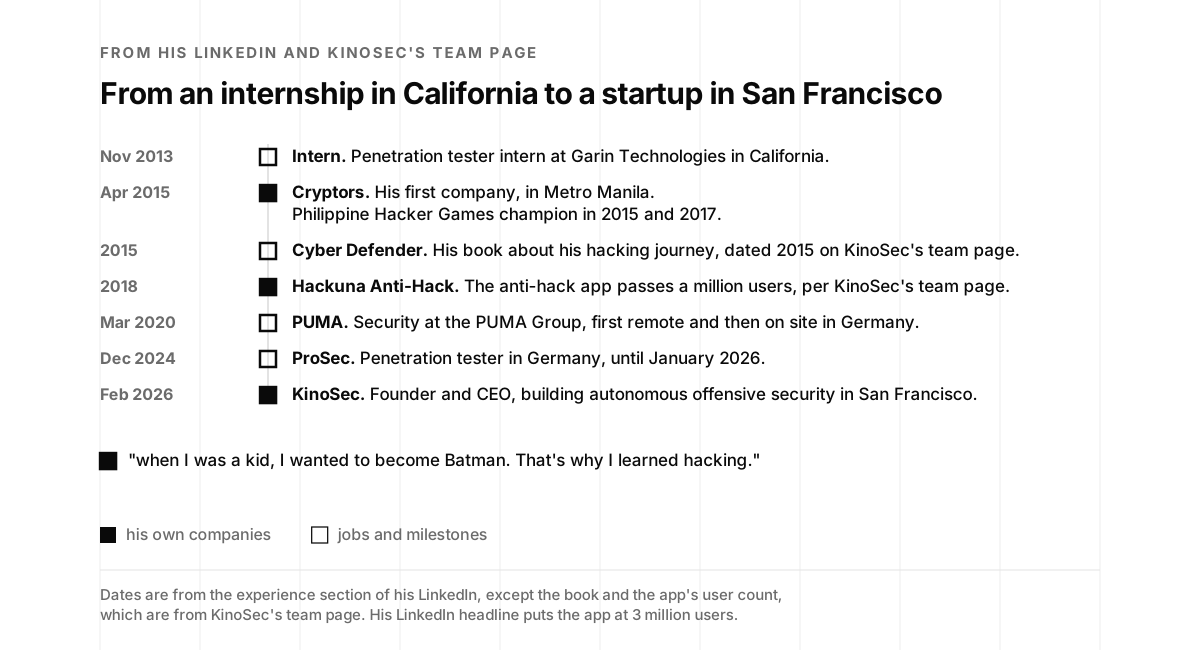
His LinkedIn fills in how a self-taught hacker got here (LinkedIn). He interned as a penetration tester at Garin Technologies in California from November 2013, then founded Cryptors in Metro Manila in April 2015, where he did web, mobile and network testing, was “PH Hacker Games Champion 2015 & 2017” and built Hackuna Anti-Hack, an app he describes as the first in the world to track hackers. From March 2020 he worked in security at the PUMA Group, first remotely and then on site in Germany, rising to senior cyber security engineer, and from December 2024 to January 2026 he was a penetration tester at ProSec in Germany. He founded KinoSec in February 2026. He is also the author of a book, Cyber Defender, which KinoSec’s team page dates to 2015 (KinoSec).
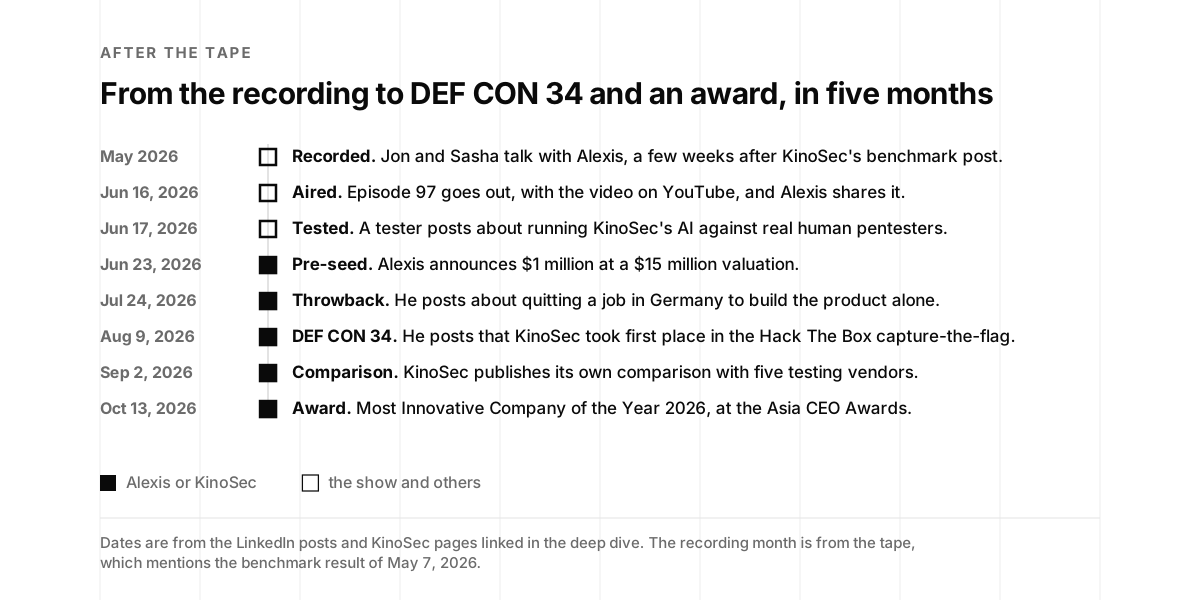
The conversation was recorded in May 2026, a few weeks after KinoSec announced the benchmark result Alexis mentions on the tape, and about a month before it aired. In the five months since, KinoSec closed a pre-seed round, won a capture-the-flag contest at DEF CON 34 by its own account, and reshaped its homepage around a white-label product for managed service providers. The last section below covers that.
This page is the rest of it: a section for each part of the conversation with the sources beside it, thirteen figures, twelve clips from the tape, a LinkedIn card, the full transcript and the video, and four tools: a quiz, a scorecard for how much of the attack path your pen test sees, a calculator for the surfaces your last test missed, and a timeline from the Philippine Hacker Games to DEF CON 34.
A word on framing before the sections. Everything KinoSec sells to companies today is a penetration test, which Wikipedia defines as “an authorized simulated cyberattack on a computer system” (Wikipedia). The bigger claims on the tape, about governments, sovereign buyers and the company’s future, are Alexis’s account of his plans. Where we couldn’t confirm something, the page says so.
A cyber weapon, by his own name
The first answer set the tone. KinoSec was in San Francisco, it had built what people call a cyber weapon, and the comparison Alexis reached for was a company better known for intelligence software than for hacking.
“It’s Palantir for offensive cyber operations.”
Alexis Lingad, at 2:11
Palantir, per Wikipedia, “develops data integration and analytics software,” and its Gotham platform is “an intelligence tool used by militaries and counter-terrorism analysts” (Wikipedia). Alexis used the same comparison in a LinkedIn post in late May 2026 about a pitch at The Residency, a startup program in San Francisco that backs KinoSec, where he called the endgame a “next level Palantir” for the people protecting us (LinkedIn). On the tape he described what the god-level hacker does for a buyer: gather intelligence on a target, hack within the digital and the physical realm, and use those capabilities “in order to neutralize those operations of the high-profile threats.” The buyer he had in mind for that version is whoever buys the product to protect a country, and his example of a target was terrorists. The same post puts the plan in one line: enterprises first, “so governments can wield it against the world’s most dangerous threats tomorrow.”
That is the long-term vision, and KinoSec’s site gives it a name, Project Hades, under the line “The cyber doomsday is coming.” (KinoSec). What companies buy from KinoSec today is narrower and familiar: an automated penetration test that tries to get as far into their own systems as a real intruder would.
Batman and a college report
Sasha asked what prompted the company. Alexis went back to childhood.
“when I was a kid, I wanted to become Batman. That’s why I learned hacking.”
Alexis Lingad, at 3:18
He told the same story on LinkedIn on June 3, 2026, in a post that opens “Some kids wanted to be astronauts.” and introduces Project Hades (LinkedIn).
The next step was the one that shaped the rest. He hacked his own college, wrote up how he got in, and handed the report over to help.
“But they didn’t like it, so I got kicked out.”
Alexis Lingad, at 3:31
Jon asked which college. Alexis said he couldn’t say on air, and the conversation moved on. A third-party profile he reshared on LinkedIn, from ForgeUp Ventures, says he began hacking as a teenager and wrote a book about hacking at 19. KinoSec’s team page describes the book as telling his “hacking journey from being a blackhat to whitehat” (KinoSec).
The college story is the oldest version of the problem KinoSec sells against. A finding nobody asked for, from someone nobody authorized, lands as an attack even when it arrives as a report. Penetration testing exists so the same work arrives with a contract, a scope and a name on it. If you have never had a test, our penetration testing team does exactly that, with a retest at the end.
A scope and a kill switch
Sasha raised the question most people have when they first hear the words autonomous hacker: what keeps it inside the lines?
“How do you balance the power behind the AI technology, especially when you chain it?”
Sasha Sinkevich, at 3:51
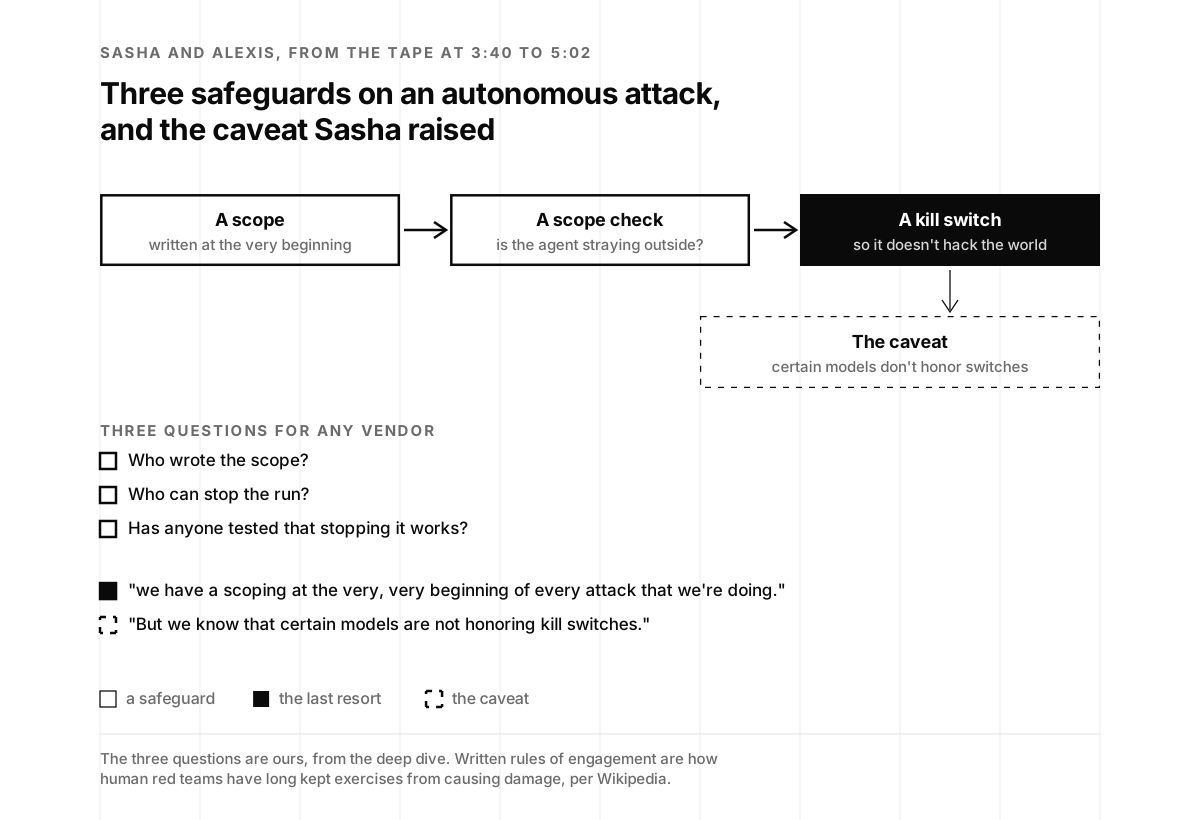
Alexis’s answer had three parts. Every attack starts with a scope. The agent works within the attack surfaces in that scope and checks whether it is straying outside them. And behind that check sits a switch.
“we have a scoping at the very, very beginning of every attack that we’re doing.”
Alexis Lingad, at 4:19
“Then usually it will have a kill switch in order to, you know, not hack the whole world.”
Alexis Lingad, at 4:41
Sasha’s follow-up named the weak spot in that design.
“But we know that certain models are not honoring kill switches.”
Sasha Sinkevich, at 4:48
A kill switch, in the engineering sense, is “a safety mechanism used to shut off machinery in an emergency” (Wikipedia), and it only works if the machine obeys it. Human red teams have long relied on something sturdier than a switch: written rules of engagement, which Wikipedia describes as used “to ensure that the red team does not cause damage during their exercises” (Wikipedia). The buyer’s version of Sasha’s question is three questions for any automated testing vendor. Who wrote the scope? Who can stop the run? And has anyone tested that stopping it works?
A model called Skynet
Sasha asked about the models underneath. Alexis said KinoSec uses many models for specific tasks and is also building its own.
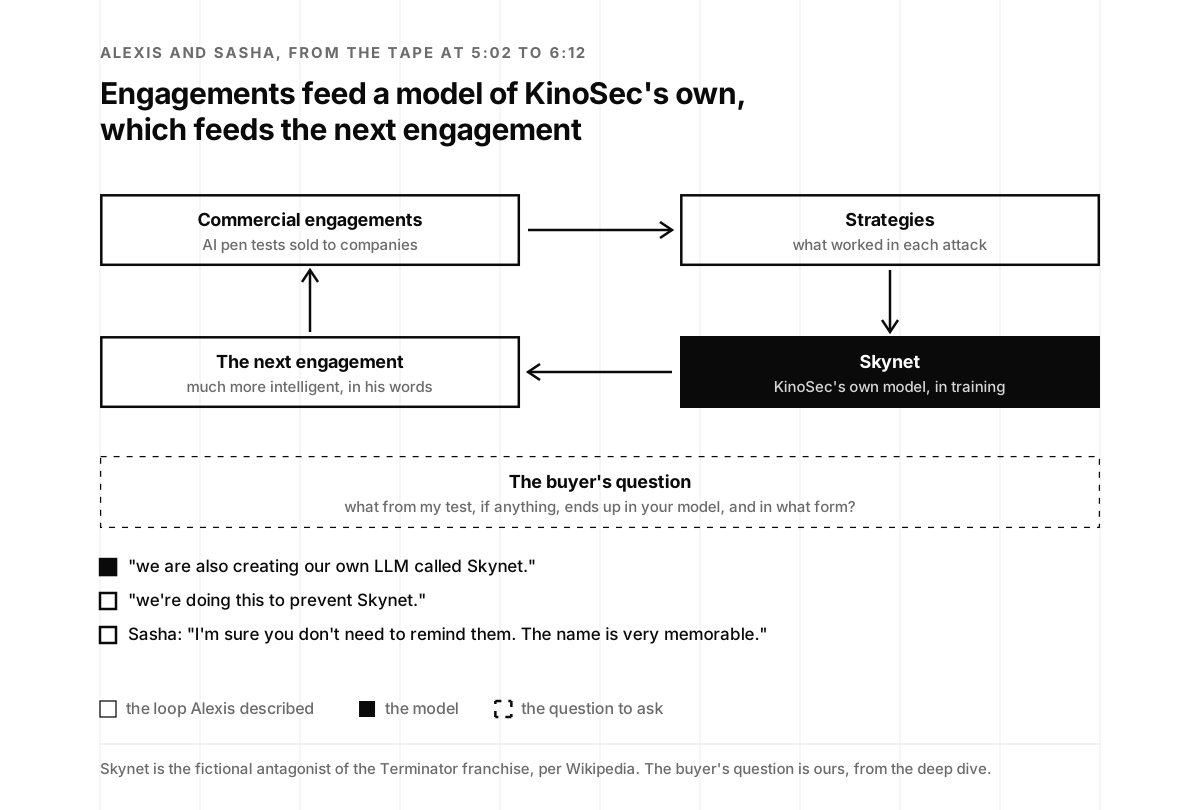
“we are also creating our own LLM called Skynet.”
Alexis Lingad, at 5:12
The name, he said, is a reminder for the team: “we’re doing this to prevent Skynet.” Skynet is the fictional superintelligence that serves as “the main antagonist of the Terminator franchise” (Wikipedia). Sasha had the line of the exchange.
“I’m sure you don’t need to remind them. The name is very memorable.”
Sasha Sinkevich, at 5:27
The more useful detail for buyers came next. The strategies KinoSec’s agents use in commercial engagements, the AI pen tests it sells to companies, feed that model so it becomes, in Alexis’s words, “much more intelligent and continuously learning.” That is how a testing product improves, and it is also a procurement question worth asking any vendor plainly: what from my test, if anything, ends up in your model, and in what form? A good vendor will have a written answer.
Pen testing firms first
Sasha asked how a technology this sensitive finds traction with enterprises. Alexis’s answer was a lesson in picking a first customer. KinoSec didn’t start with enterprises. It started with the people who already do the work.
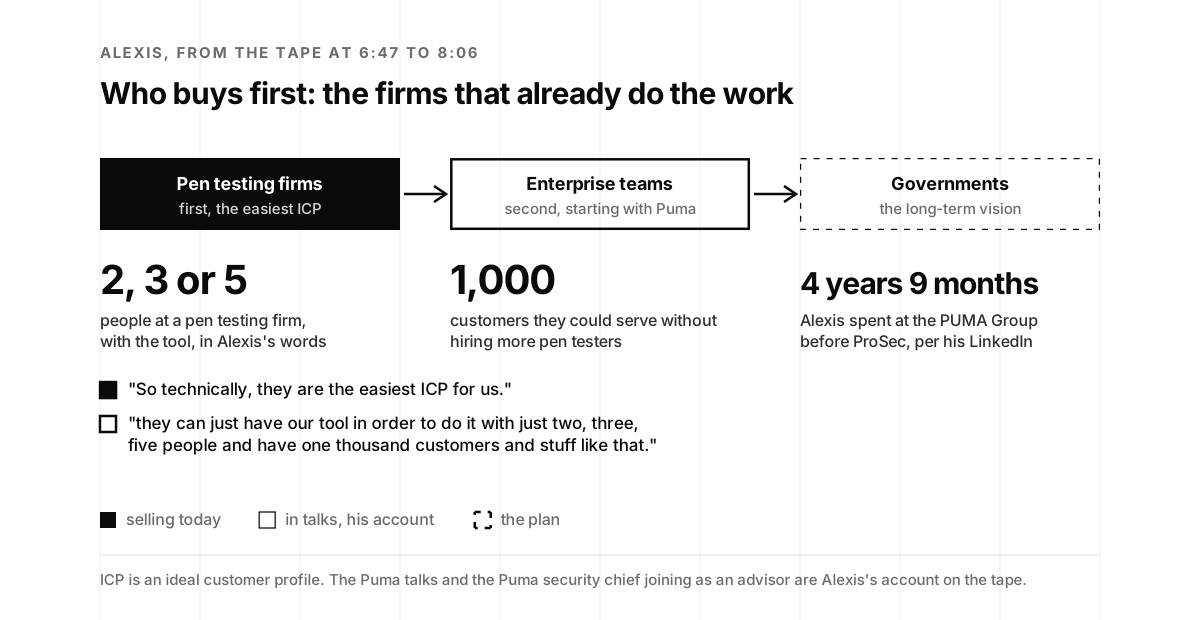
“So technically, they are the easiest ICP for us.”
Alexis Lingad, at 6:59
Pen testing companies already know the tools and what the product is for, he said, and they want more revenue and more customers without hiring more pen testers. With KinoSec, a firm could serve far more clients with the same team.
“they can just have our tool in order to do it with just two, three, five people and have one thousand customers and stuff like that.”
Alexis Lingad, at 7:11
Enterprises with security teams of their own came second. Alexis said KinoSec was in talks with Puma and that Puma’s chief information security officer had just joined as an advisor, to connect the company with other security chiefs in Europe. Jon guessed Puma was a fashion brand and Alexis corrected him: a sports brand. Wikipedia calls Puma “the third largest sportswear manufacturer in the world” (Wikipedia), and Alexis knows it well, since his LinkedIn shows him in security at the PUMA Group for four years and nine months before ProSec.
Number one on a benchmark
Jon asked for the founding story. Alexis started KinoSec alone and hired his first executives after early traction.
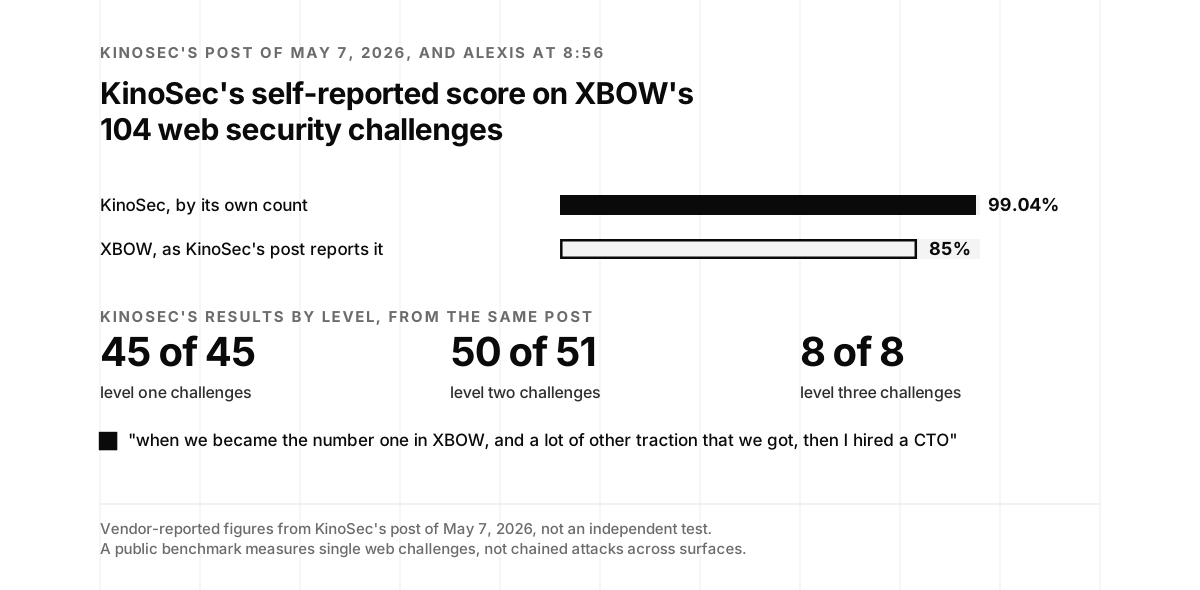
“when we became the number one in XBOW, and a lot of other traction that we got, then I hired a CTO”
Alexis Lingad, at 9:00
The benchmark is a set of 104 web security challenges published by XBOW, a rival autonomous pentesting company. On May 7, 2026, KinoSec announced a 99.04% success rate on it, 103 of the 104 challenges, and called itself the top autonomous pentesting platform on that benchmark (KinoSec). The same post puts XBOW’s own result at 85%. These are KinoSec’s figures, not an independent test, and a public benchmark measures web challenges, not the chained attacks the rest of this conversation is about. The tape’s mention of the result is also how we date the recording to after May 7.
Sasha asked whether KinoSec had raised. Alexis said yes, and Sasha congratulated him. On June 23, a week after the episode aired, Alexis announced a $1 million pre-seed round at a $15 million valuation on LinkedIn, and KinoSec’s team page later recorded “Raised $1.1M in pre-seed funding” (KinoSec).
The first company
Alexis then went back to the beginning. After he was kicked out, he said, no one would hire him, so he started a company of his own.
“So I created my first startup, and then I became a national hacking champion twice.”
Alexis Lingad, at 9:42
His LinkedIn names the company and the titles: Cryptors, from April 2015 to January 2020, and the Philippine Hacker Games in 2015 and 2017. Most of the products failed, he said, but one succeeded.
“this Hackuna Anti-Hack is the first mobile app in the world that tracks hackers.”
Alexis Lingad, at 10:05
On the tape it “gained millions of users worldwide.” KinoSec’s team page says it reached “1 Million+ Users” in 2018 and his LinkedIn headline says 3 million, and a profile he reshared from PlayHouse Ventures says it protected people on public Wi-Fi networks. He said the company became startup of the year in 2018 and exited in 2020. His LinkedIn lists “Startup of the Year 2018 in the Philippines,” and KinoSec’s team page records an incubation program with KMC and ImpactHub Manila the same year. We couldn’t find a public record of the exit or its buyer.
Humbled in Germany
After the exit, he tried to retire for a month and got bored. He went to Germany to work as an ethical hacker and surround himself with people who knew more than he did.
“I think you can grow more if you’re surrounded with people that is much, much, much, much smarter than you.”
Alexis Lingad, at 10:40
“And I got humbled a lot in there, which is really, really good experience.”
Alexis Lingad, at 10:47
The LinkedIn record matches the arc: Puma from 2020 and ProSec until January 2026, the month before KinoSec began. In July he posted the moment he left, quitting a job in Germany he liked to build the product alone, and the problem that pushed him out the door.
Throwback: I quit a job in Germany I actually liked.
Alexis Lingad · July 24, 2026
A week later, I was sleeping on my friend's couch.
I had a flight to Vienna back then and a product I'd been building by myself.
No customers.
No investors.
No proof anyone would pay for it.
Just one problem I couldn't stop thinking about.
Clients kept telling me:
"We tested our web app. We're secure."
But real attackers don't stop at the web app.
Neither did I.
That post is the cleanest statement of KinoSec’s thesis, and it is a good test for any company: if your last pen test covered only the web app, what did it say about everything the web app connects to?
An arm race, cloak and dagger
Alexis framed the company’s mission as getting there first.
“So, in order for us to counter that looming threat, we created the weapon first, and to counter them.”
Alexis Lingad, at 10:52
He called it a cybersecurity arm race, and Jon gave it a period.
“I like it. It’s very Cold War, like cloak and dagger.”
Jon McLachlan, at 11:08
“Just be careful who you let use the system, huh?”
Jon McLachlan, at 11:13
The Cold War, per Wikipedia, included “an arms race in both conventional and nuclear weapons,” and cloak and dagger became a metaphor for “intrigue, secrecy, espionage, or mystery” (Wikipedia, Wikipedia). Alexis took Jon’s warning in stride. He said that in the past few days he had talked with former Pentagon people who were connecting him with the NSA, and that he had an investor who worked with the CIA. Those are his account, and we couldn’t verify them. His LinkedIn post about the pre-seed round thanks “angels from defense, journalism, cybersecurity and more.”
Months, not years
Sasha took the arms race seriously. The race between offense and defense is as old as the internet, Sasha said, and new technology speeds it up and shrinks the margin for error. Where was it going?
“I think it will exponentially change in the next few months. Not years, but few months.”
Alexis Lingad, at 12:18
The reason, he said, is the continuous learning and self-learning so many startups are working on, past the buzzwords. You could already see it every day, and most of what was happening involved some AI agents, or in his words, “there’s a flavor of AI in there.” The record since the tape is on his side about direction, if not about every incident. Phishing, the oldest way in, is now cheap to personalize, and Wikipedia notes that “Large language models can automate personalized phishing at low cost” (Wikipedia). Our companion post, AI Cyberattacks Are Going Autonomous, walks through the documented cases from the months after this conversation.
Stuxnet, by hand
Sasha asked for the biggest threat vector Alexis sees.
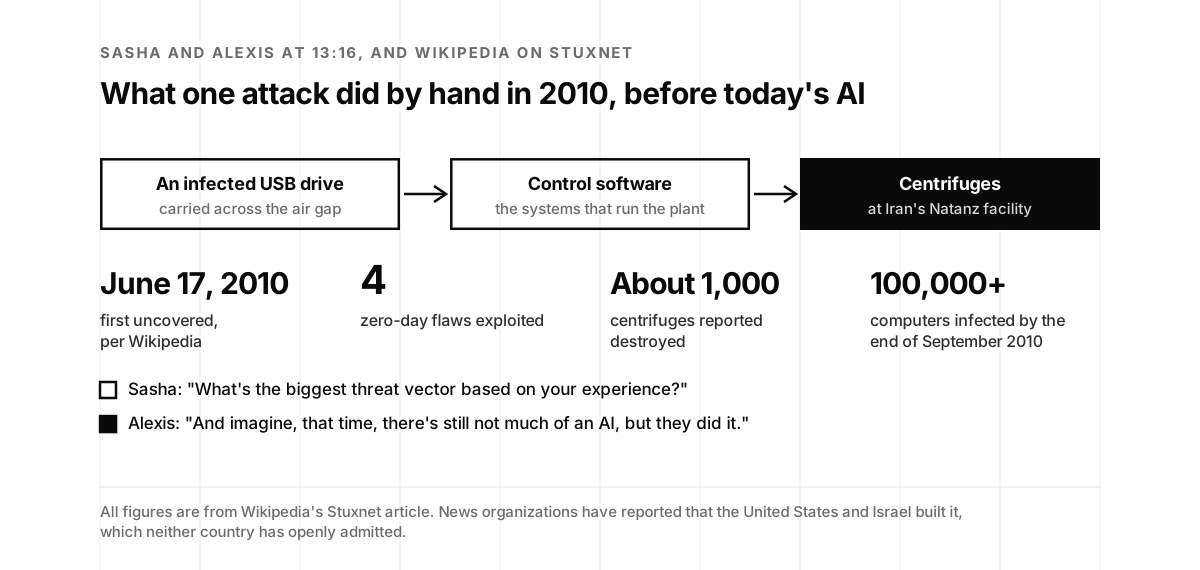
“What’s the biggest threat vector based on your experience?”
Sasha Sinkevich, at 13:16
Alexis didn’t name a technique. He named a precedent.
“that specific attack is specialized in targeting the critical infrastructure. And imagine, that time, there’s still not much of an AI, but they did it.”
Alexis Lingad, at 13:25
Stuxnet was “first uncovered on 17 June 2010,” per Wikipedia. It targeted industrial control systems, worked by “Exploiting four zero-day flaws,” reached its target on infected USB drives that crossed the air gap, and was reported to have destroyed about 1,000 centrifuges at Iran’s Natanz facility (Wikipedia). Multiple news organizations have reported that it was built jointly by the United States and Israel, which neither country has openly admitted. His point was about the gap between then and now. That attack took years of skilled human work. An agent that can chain web, network and control-system weaknesses on its own shortens that.
Beyond the web
That is why KinoSec doesn’t stop at web applications, Alexis said. His competitors focus on the web and the network, and his verdict on that was “It sounds cute.”
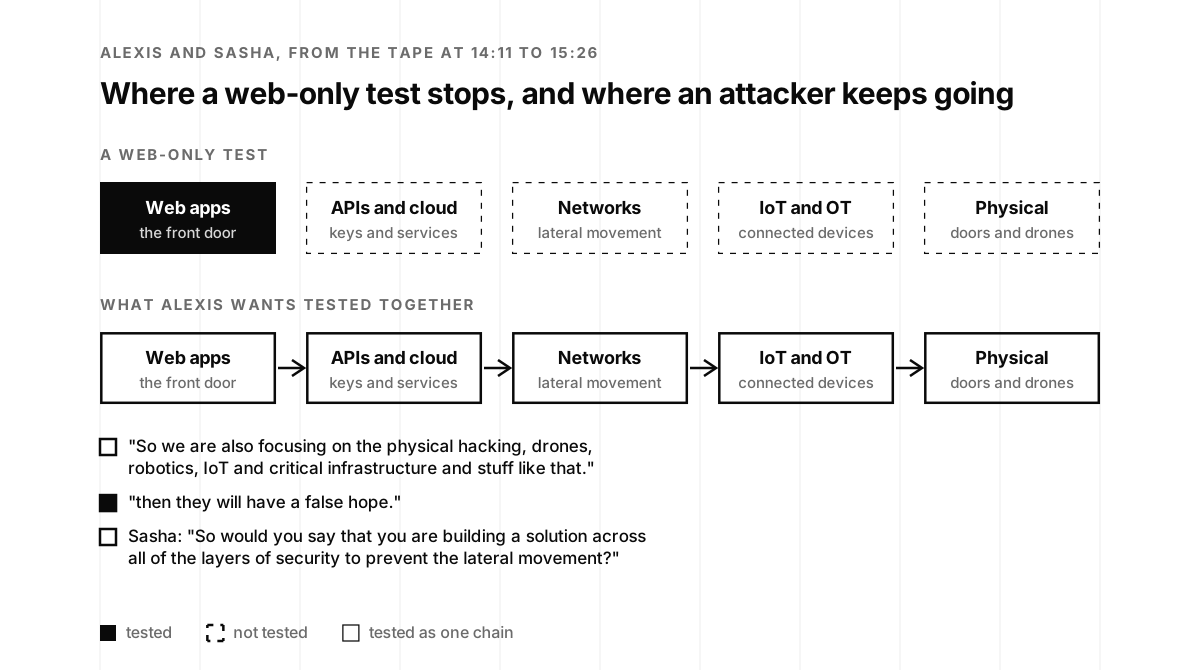
“So we are also focusing on the physical hacking, drones, robotics, IoT and critical infrastructure and stuff like that.”
Alexis Lingad, at 14:12
The point of covering all of it is to chain one surface into the next, the way an intruder would. A company that tests only its web app gets a clean report on the web app, and an exposed device or server connected to it can still let someone in. His word for the result is the one to remember.
“then they will have a false hope.”
Alexis Lingad, at 14:42
Sasha put it in a defender’s terms, and Alexis agreed.
“So would you say that you are building a solution across all of the layers of security to prevent the lateral movement?”
Sasha Sinkevich, at 15:14
Lateral movement, per Wikipedia, covers the techniques attackers use “to move progressively through a network,” and it is part of the ATT&CK framework (Wikipedia). The Internet of things sits right in that path. Wikipedia notes that “IoT devices are vulnerable to security breaches” because of how connected they are (Wikipedia), and episode 94 with Jim LaRoe is about how one unsecured printer can take down 11,000 devices. If your pen test scope stops at the web tier, our penetration testing team can scope the network and the devices too.
Why Sasha didn’t say AI
Jon had noticed something about Sasha’s questions.
“I’m so curious, Sasha, why you didn’t want to say AI earlier in your conversation, like in your question.”
Jon McLachlan, at 15:29
Sasha’s answer was about keeping the conversation on the mechanics.
“I’m trying to leave space for implementation discussions.”
Sasha Sinkevich, at 15:44
Throwing around AI, LLMs, small models and embeddings, Sasha said, “it’s often diluting the focus of the discussion.” Then Sasha conceded the obvious: every modern technology stack has it, and its name is AI. It is a fair habit for anyone evaluating an AI security product. Ask what it does, step by step, before asking what it is made of.
The hardest decision
Jon asked the show’s standing question about the hardest thing Alexis had ever done. His answer was the decision to start again.
“I think one of the hardest things is deciding to do this second startup”
Alexis Lingad, at 16:31
If KinoSec succeeds in building the most powerful cyber weapon in the world, he said, governments and countries will try to control it or take it, and he half-joked that someone might try to kill him. Jon pushed on the framing.
“It’s just going to happen much more quickly. So things will get more intense.”
Jon McLachlan, at 17:15
Jon’s point was that a cybersecurity information war doesn’t add new events so much as speed up the ones already coming, and he noted that Alexis had considered the other side and ended up, after Germany, on the good guy’s side.
Curious, not a villain
Alexis didn’t pretend the other side never tempted him.
“Yeah, I mean, sometimes I just wanted to become a villain, you know.”
Alexis Lingad, at 17:33
People cast the hacker as the villain, he said, but hacking taught him to think out of the box and to be different, and what drove him as a kid was curiosity about how things fail.
“I want to know what will happen if it breaks”
Alexis Lingad, at 18:13
Sasha finished the thought from experience.
“Yeah, people who don’t understand, like, they make fun of us, right?”
Sasha Sinkevich, at 18:39
That curiosity is the trait good security people share, and it’s the subject of episode 80 with Ted Harrington, on why curiosity drives both innovation and security.
The bat signal
Jon asked what success looks like. Alexis went back to Batman.
“when they see our logo, it’s like the bat signal”
Alexis Lingad, at 19:10
In his picture, a high-profile criminal who sees that a country is protected by KinoSec feels fear, because the hacker behind the logo is like a god, all-knowing, and the world that results has less crime and is better for the next generation. The comparison is apt in a way he may not have intended. Wikipedia notes that in the comics the Bat-Signal summons Batman and also serves “as a weapon of psychological intimidation to the numerous criminals of Gotham City” (Wikipedia).
He also named the safeguard for that version, and it is the most concrete one in the episode.
“the one that is using it will be hacked first”
Alexis Lingad, at 20:19
The goal, he said, is a weapon that is autonomous and can’t be controlled by evil people, and checking the user first is how KinoSec would make sure the user isn’t the threat. For any security vendor, the version of that idea worth asking about is ordinary customer verification: written authorization, proof that you own what you asked to be tested, and a record of who approved the run.
A realistic hacker
Sasha asked for clarity. Was KinoSec building something that goes after attackers, or something that finds vulnerabilities across every layer, maybe in stages? Alexis brought it back to what customers buy.
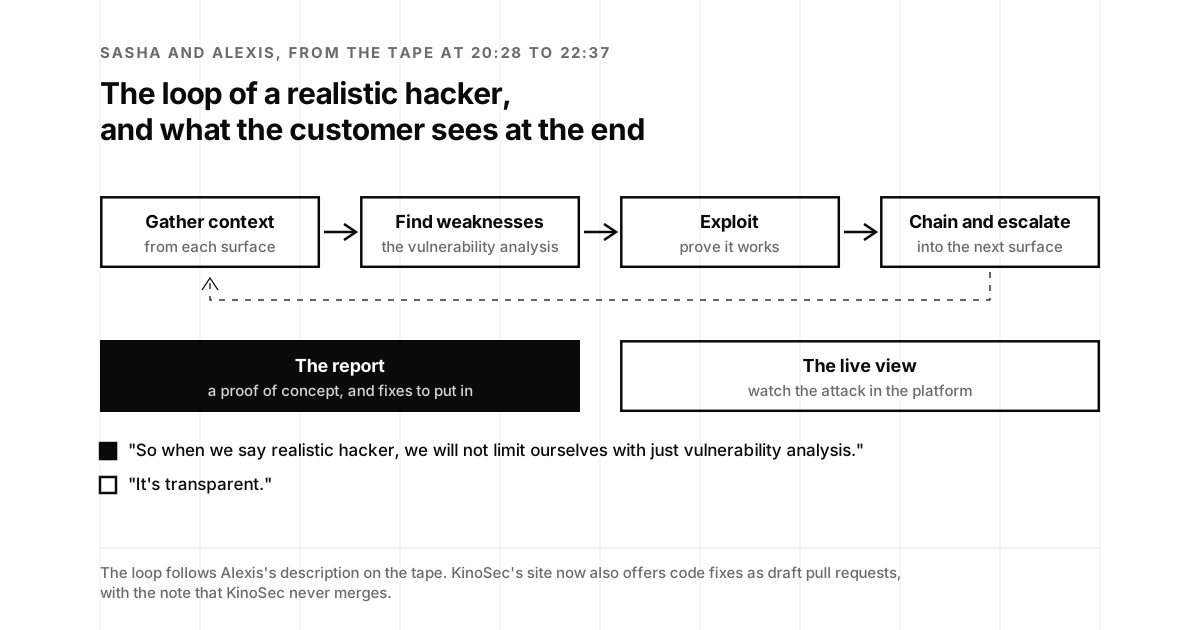
“we hack the client as just like a realistic hacker.”
Alexis Lingad, at 21:16
A realistic hacker doesn’t stop at a list of weaknesses, he said. It exploits them, chains the exploits, escalates privilege and gathers context from one surface to attack the next.
“So when we say realistic hacker, we will not limit ourselves with just vulnerability analysis.”
Alexis Lingad, at 21:19
The deliverable is a report with a proof of concept and suggested fixes, plus a view in KinoSec’s platform where the customer can watch the attack live, which he said is the most entertaining part for clients. Everything the agent does is visible, from escalating a privilege to adding a user.
“It’s transparent.”
Alexis Lingad, at 22:27
Privilege escalation, per Wikipedia, is “the act of exploiting a bug, a design flaw, or a configuration oversight” to gain access normally protected from a user (Wikipedia), and it is the step that turns a foothold into a breach. KinoSec’s site now offers a feature that sends code fixes back as draft pull requests, with the note that “KinoSec never merges” (KinoSec). If you are choosing a test, our companion post AI Penetration Testing covers what agents do well, where human testers still earn their fee, and what a report should show.
Eminent domain
Jon had a warning for a founder building military-grade technology.
“Be careful. Like, the governments are going to come around and declare eminent domain”
Jon McLachlan, at 22:37
Eminent domain is “the compulsory acquisition of private property for public use,” per Wikipedia, with just compensation (Wikipedia). Alexis didn’t laugh it off.
“We are actually preparing for that.”
Alexis Lingad, at 22:51
Once KinoSec enters that domain, he said, there are a lot of looming threats, and the company had prepared something for them. He didn’t say what.
Without limits
Jon asked the question every buyer of an AI security product should. The big model providers have guardrails, safety programs and strict terms of service, there is now an ISO 42001 standard for managing AI, and breaking into systems is not an allowed use under their terms of service. How does KinoSec’s software get around that? Alexis’s answer was the model from earlier.
“Yeah. Yeah. So that’s why we have the Skynet.”
Alexis Lingad, at 23:46
KinoSec’s own model, he said, runs “purely without limits,” and that is what lets it go deeper than frontier models will.
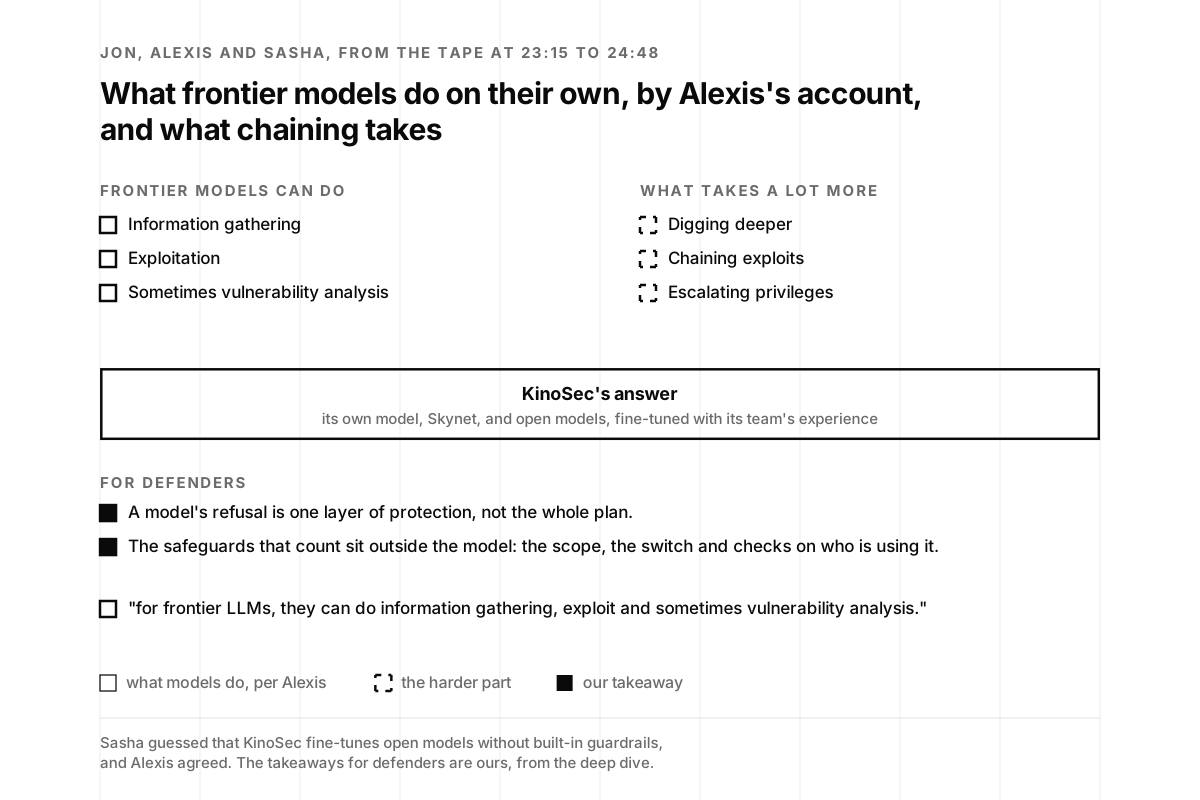
“for frontier LLMs, they can do information gathering, exploit and sometimes vulnerability analysis.”
Alexis Lingad, at 24:14
The deeper work, chaining exploits and escalating privileges, takes a lot more. Sasha guessed that KinoSec builds on open models without built-in guardrails and fine-tunes them with context from its own expertise and experience, and Alexis agreed, adding “a bunch of other models that are pretty open.” Two things follow for defenders. A model’s refusal is one layer of protection and not the whole plan, because offensive tools can run on models with no refusals at all. And the safeguards that count for an offensive tool are the ones outside the model: the scope, the switch and the customer checks from earlier sections.
One API key
Jon asked the question the whole category raises.
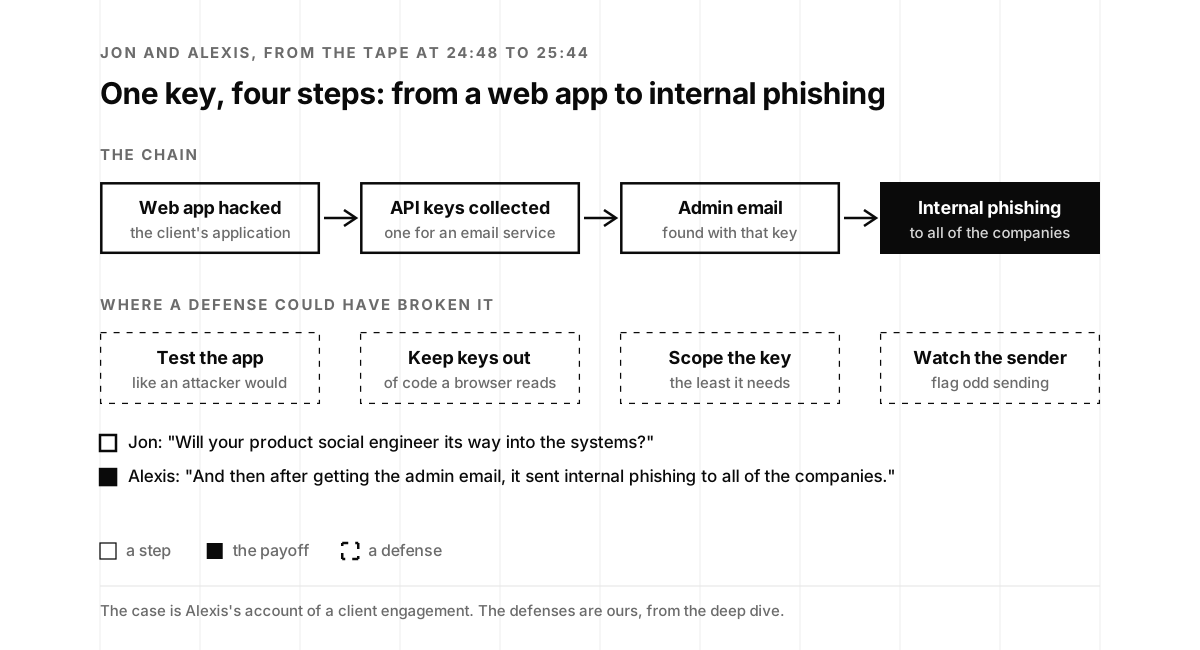
“Will your product social engineer its way into the systems?”
Jon McLachlan, at 24:48
Alexis answered with a case from a client engagement. The agent hacked the client’s web application and collected the API keys it found there.
“And one of those API keys is Resend API key. And then our AI agent used that Resend API key in order to get the admin email.”
Alexis Lingad, at 25:01
Resend is an email service for developers, built to “Deliver transactional and marketing emails at scale” (Resend). With the admin’s address in hand, the agent took the next step on its own.
“And then after getting the admin email, it sent internal phishing to all of the companies.”
Alexis Lingad, at 25:12
He named it as he went.
“Yeah, that’s social engineering. And my God, that’s like spear phishing.”
Alexis Lingad, at 25:22
Competing tools, he said, would stop at the exposed API keys. His point was that the finding is where the attack starts. An API key is “a secret unique identifier used to authenticate and authorize” a program to a service, per Wikipedia, which also warns that developers “may hard-code keys into source code, and forget that when they release the code.” In 2017 a security firm examined 16,000 Android apps and found hard-coded API keys in more than 300 of them (Wikipedia).
Three things follow for defenders. Keep secrets out of anything a browser can read, and scan code and builds for them before every release. Give each key the least it needs, so a leaked one reaches as little as possible, the subject of episode 105 with Yair Grindlinger. And treat a key that can send email as a key to the company’s voice. Spear phishing is the targeted form of phishing (Wikipedia), and mail sent through the company’s own sending account looks like the company because it is. Our monitoring and response team can watch for an account that starts behaving strangely, and a penetration test can show what your exposed keys reach before someone else finds out.
Cat and mouse
Sasha took the case wider.
“there’s been so much money poured into the application layer security.”
Sasha Sinkevich, at 25:49
There are good solutions out there, Sasha said, and adopting them fairly gives good coverage. But an organization is much more than its application layer or its web entry point.
“There are so many other ways to infiltrate the organization.”
Sasha Sinkevich, at 26:11
Sasha listed the ones the conversation had covered: the networks, the IoT devices on them that allow lateral movement, and the oldest one.
“Phishing is still a pretty successful way to get into the organization.”
Sasha Sinkevich, at 26:26
There are solutions meant to protect against all of it, Sasha said, “but this is a cat and mouse game.” The attacker is creative and moves faster than the defense, so a company is better off as friends with an attacking force that knows how to get around its controls and still find the gaps. Then came the line every security buyer should keep.
“there is no such thing as a perfect system.”
Sasha Sinkevich, at 27:05
“I can guarantee you there are things that we don’t know.”
Sasha Sinkevich, at 27:23
The working version of that idea is defense in depth. Wikipedia describes it as “multiple layers of security controls” placed throughout a system, so there is redundancy “in the event a security control fails” (Wikipedia). Layers cover the failures you can imagine. Testing by someone who thinks like the attacker finds the ones you can’t. Episode 88 with Andrew Rubin is about the layer that stops one breach from spreading, and episode 82 with Rejah Rehim is about automating the application test itself.
Advice to a younger self
Jon asked the show’s other standing question.
“If you could go back in time and meet a younger Alexis, would you take that opportunity?”
Jon McLachlan, at 27:28
Alexis would, he said, because a first startup brings a lot of failures and mistakes, and he would hand his younger self the list.
“here are the mistakes that you should learn from”
Alexis Lingad, at 27:57
Jon asked whether the younger Alexis would have listened. Alexis’s answer was that he questions what he is told, and that he would have tested his older self’s advice the same way before taking it.
“So I’m critically thinking of all of those things that is being fed to me.”
Alexis Lingad, at 28:27
Jon recognized the trait.
“Maybe that’s one of the things that drives us to be entrepreneurs, is like, we’re just skeptical that this is the way it has to be.”
Jon McLachlan, at 29:12
It is the founder’s version of the hacker’s curiosity from earlier. Both start by declining to believe that a system works the way it says it does.
A nuclear weapon and a kill switch
Sasha asked about the next milestones, for Alexis and for the company.
“What’s the next big milestone for you, Alexis, personally?”
Sasha Sinkevich, at 29:37
For himself, Alexis said, the milestone was to learn more, not fear mistakes, and connect with strategic advisors who could help him reduce the ways this could go wrong. He explained why with the starkest image in the episode.
“Because this is a very delicate thing, by the way, because it’s like I’m having a nuclear weapon within myself”
Alexis Lingad, at 30:20
If he forgot the kill switch, he said, it would hack a lot of people, and he called that outcome “some kind of apocalyptic thing.” His answer to that risk was people.
“So I really need to have this kind of strategic advisors and someone to talk to”
Alexis Lingad, at 30:47
The advisors are for the moments of doubt, he said, and for a founder holding a tool like this, those moments are the point.
It is the right instinct, and it has a name. The two-person rule is “a control mechanism designed to achieve a high level of security” for especially critical material and operations, and the US Air Force uses it to keep any single person from launching a nuclear weapon (Wikipedia). For a security program, the everyday version is a second approver on any action that can’t be undone, from a production deletion to the start of an offensive test.
From a web app to a hotel door
For the company, Alexis laid out three phases.
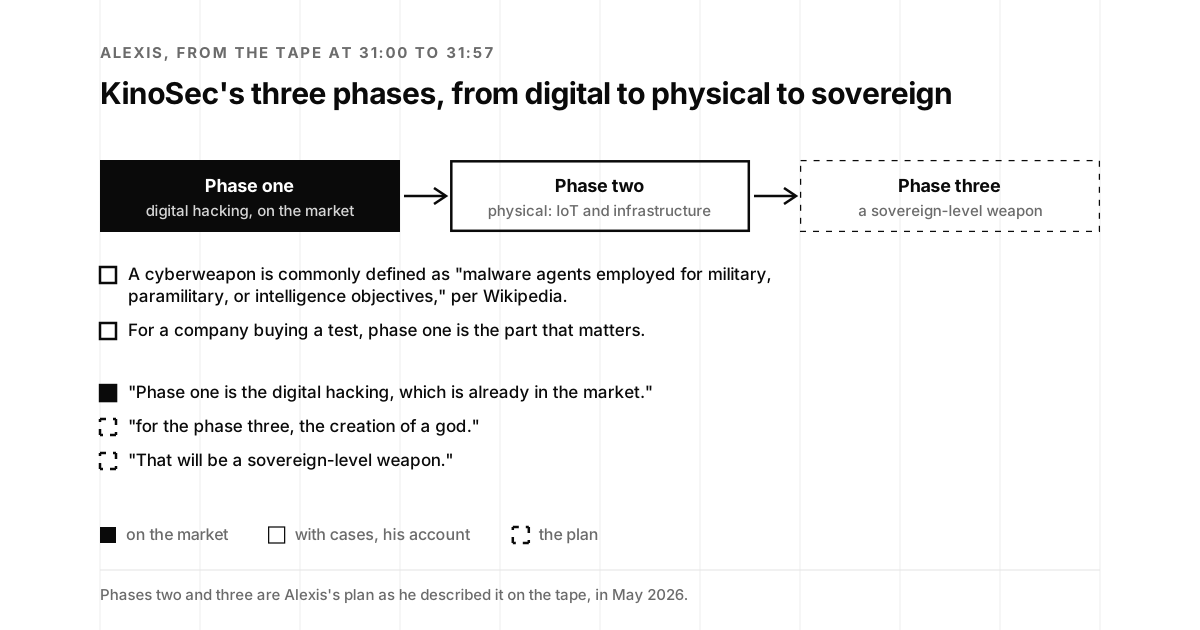
“Phase one is the digital hacking, which is already in the market.”
Alexis Lingad, at 31:03
Phase two is physical hacking, IoT and critical infrastructure, and he had a case.
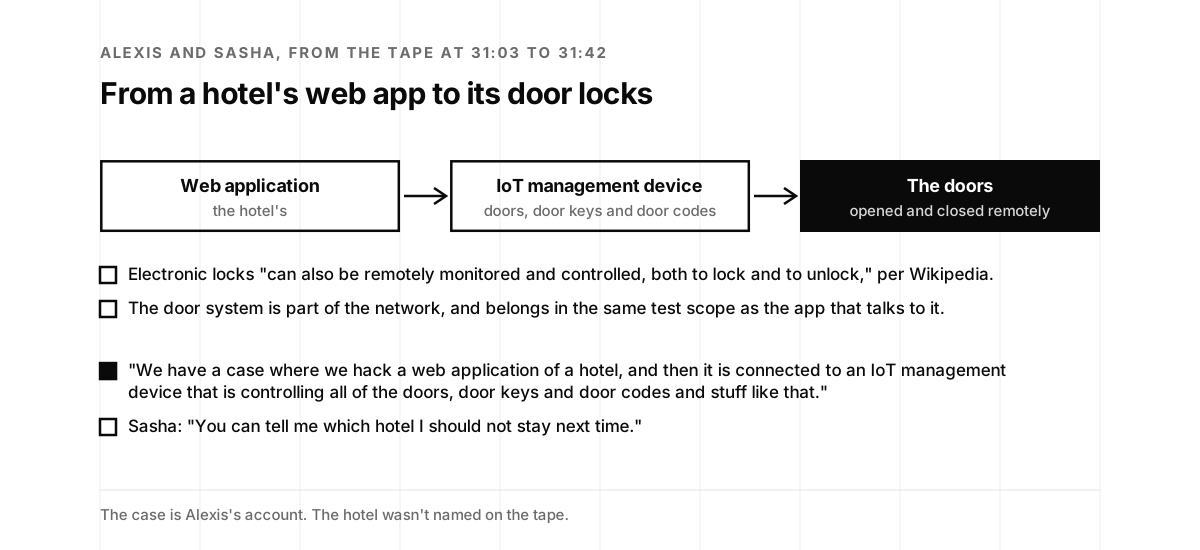
“We have a case where we hack a web application of a hotel, and then it is connected to an IoT management device that is controlling all of the doors, door keys and door codes and stuff like that.”
Alexis Lingad, at 31:12
From there, he said, the agent chained the exploit from the web to the IoT device to the doors, and could open and close them remotely. Electronic locks are built for that convenience. Wikipedia notes they “can also be remotely monitored and controlled, both to lock and to unlock” (Wikipedia). The feature that lets the front desk reissue a key from a screen is the one an intruder reaches by getting to that screen. Sasha took the practical view.
“You can tell me which hotel I should not stay next time.”
Sasha Sinkevich, at 31:39
The lesson for anyone running a building is that the door system is part of the network. It belongs in the same pen test scope as the web app that talks to it. Our companion post on IoT device security covers how to find devices like these and keep them apart from everything that doesn’t need to reach them.
Phase three
Then came the third phase, the long-term vision from the start of the conversation.
“for the phase three, the creation of a god.”
Alexis Lingad, at 31:46
“That will be a sovereign-level weapon.”
Alexis Lingad, at 31:54
A cyberweapon, per Wikipedia, is commonly defined as “malware agents employed for military, paramilitary, or intelligence objectives,” and “Stuxnet is considered to be the first major cyberweapon” (Wikipedia). That is a different business from selling pen tests to companies, with different buyers and different rules, and Alexis described them as separate phases: a commercial product on the market today, and a sovereign vision that is still a plan. For a company deciding whether to buy a test, phase one is the part that matters, and the questions about scope, stopping and who uses the system are the ones to ask.
The proudest moment
Jon asked the last of the show’s standing questions.
“What’s been the proudest moment in your entrepreneurial journey so far?”
Jon McLachlan, at 31:57
“Yeah, I had my first startup exit that is successful”
Alexis Lingad, at 32:02
He had made a lot of mistakes in it, he said. Jon asked how the hacker-tracking app had worked. Alexis said it was a long time ago, and that the underlying secret sauce had gone with the sale.
“that I think that’s the one that has been sold to the government agency that acquired it.”
Alexis Lingad, at 32:34
Jon summed it up: part of the acquisition, special IP and top secret. That is Alexis’s account, and we couldn’t find a public record of the acquisition or the buyer. Jon closed on the months ahead and all the new weapons technology coming out.
“Pretty exciting and pretty scary also.”
Alexis Lingad, at 33:06
Jon said he was glad Alexis was on the good side of it, and Sasha had the last word before the sign-off: “Just have to embrace it and enjoy the ride.”
What happened after the tape
On air. The episode aired on June 16, 2026, with the video on YouTube the same day, and Alexis reshared YSecurity’s announcement of it that day (LinkedIn).
A hands-on test. The next day Brian Harris, whose LinkedIn headline reads black team lead and chief instructor, posted that Alexis had let him run KinoSec’s AI “through its paces” to see how it compared with human pentesters (LinkedIn).
Pre-seed. On June 23 Alexis announced a $1 million pre-seed round at a $15 million valuation, naming Golden Gate Ventures, AI Tinkerers Fund and The Residency among the backers, under the line “Not a scanner. An operator.” (LinkedIn). KinoSec’s team page later recorded the round as $1.1 million.
DEF CON 34. On August 9 he posted that KinoSec had taken first place in the Hack The Box capture-the-flag at DEF CON 34 by letting the product “play and hack for us” (LinkedIn). KinoSec’s site says it solved 37 of 37 challenges and finished first against human teams (KinoSec). Capture the flag is, per Wikipedia, “perhaps the best known of these contests” at DEF CON (Wikipedia). These are KinoSec’s figures, and we didn’t find an independent scoreboard.
A comparison. On September 2 KinoSec published its own comparison with XBOW, Horizon3.ai, Pentera, Cobalt and Synack (KinoSec). It is a vendor’s comparison, written by the vendor.
An award. In September Alexis announced that KinoSec had been named Most Innovative Company of the Year 2026 at the Asia CEO Awards (LinkedIn), and he posted about it again on October 13 (LinkedIn). The team page lists it as a Circle of Excellence award at the 17th Asia CEO Awards (KinoSec).
A new front door. KinoSec’s homepage now leads with white-label autonomous pentesting for managed service providers, with Zeus for web apps, APIs and cloud and Poseidon for internal and external networks, and it lists “SOC 2 Type 1 in progress” (KinoSec). That is the strategy from the tape, pen testing firms and service providers first, now on the first screen of the site.
The part of the conversation that aged best is the plainest. A web-only test gives a web-only answer, and attackers chain whatever they find. Five months on, KinoSec’s own pitch has narrowed to that claim, sold through the firms that already do the work. The bigger plans are still Alexis’s account, and the safeguards Jon and Sasha pressed on, a written scope, a kill switch that works and care about who uses the system, are still the right questions for any vendor in this space.
Did you catch it? A six-question quiz
Six questions from the episode. Each answer links the moment in the transcript.
Quiz · six questions
Did you catch it?
Pick an answer for each. The explanation shows once you choose.
-
How did Alexis describe what KinoSec set out to build?
- A faster web vulnerability scanner
- A god-level hacker that gathers intelligence on a target
- A phishing training platform for employees
b. "we created, like, a god-level hacker" Transcript, 2:22.
-
Why did KinoSec sell to pen testing firms first?
- They already know the tools, and want more customers without hiring more testers
- They were the only buyers allowed to use it
- Enterprises had already said no
a. "So technically, they are the easiest ICP for us." Transcript, 6:59.
-
What did the agent do after it used a client's email API key to get the admin email?
- Reported the key and stopped
- Sent internal phishing across the company
- Deleted the client's mailing lists
b. "And then after getting the admin email, it sent internal phishing to all of the companies." Transcript, 25:12.
-
What weak spot did Sasha raise about kill switches?
- They slow the test down too much
- Customers forget to turn them on
- Certain models don't honor them
c. "But we know that certain models are not honoring kill switches." Transcript, 4:48.
-
Asked for the biggest threat vector, what did Alexis bring up?
- Stuxnet, an attack on critical infrastructure from before today's AI
- Password reuse
- Ransomware gangs
a. "Have you heard about the Stuxnet?" Transcript, 13:21.
-
In the hotel case, what was the web application connected to?
- The hotel's payment terminals
- The guest Wi-Fi
- An IoT management device controlling the doors
c. "and then it is connected to an IoT management device that is controlling all of the doors" Transcript, 31:16.
How much of the attack path does your pen test see?
Alexis’s test of a pen test was whether it follows the path an attacker would take or stops at the first surface. Eight questions on how far your testing goes.
Scorecard · eight questions
How much of the attack path does your pen test see?
Answer for your last pen test and your program as it runs today. If two answers fit, pick the lower one.
-
What did your last pen test cover?
- The main web app
- Web apps and APIs
- Web, APIs, cloud, networks and connected devices, in one scope
"then they will have a false hope." See Beyond the web.
-
When the testers found a leaked secret, like an API key, what happened next?
- It went on the list of findings
- They checked that the key was live
- They tested what the key could reach, within scope, and reported the chain
"it sent internal phishing to all of the companies." See One API key.
-
Does the report chain findings together, or list them one by one?
- A list of separate findings
- A few findings linked by hand in the summary
- Attack paths, with chaining and privilege escalation tried where allowed
"So when we say realistic hacker, we will not limit ourselves with just vulnerability analysis." See A realistic hacker.
-
Who wrote the scope, and who can stop the test?
- Nobody wrote it down
- The vendor wrote it, and we'd email to stop
- We signed a written scope, and a named person has a tested way to stop the run
"we have a scoping at the very, very beginning of every attack that we're doing." See A scope and a kill switch.
-
Is phishing part of your testing?
- No
- A yearly awareness campaign
- Yes, including mail that arrives from inside the company
"Phishing is still a pretty successful way to get into the organization." See Cat and mouse.
-
How often do you test?
- Once a year or less
- After major releases
- Continuously, with a human-led test at least once a year
"I think it will exponentially change in the next few months." See Months, not years.
-
What does the report give your team?
- A list of severities
- Findings with a proof of concept
- A proof of concept, the full path, and fixes your team can retest
"they can also see in our platform how the hack works" See A realistic hacker.
-
Do you know what your testing vendor does with data from your test?
- No idea
- It's somewhere in the contract
- Yes, in writing, including whether it trains their models
"we are also creating our own LLM called Skynet." See A model called Skynet.
Your testing sees the front door and little else. List every surface an attacker could start from, then scope the next test to follow a chain across them instead of stopping at the first one.
Some of the path is tested and some isn't. Add the surfaces your last test skipped, check what your exposed secrets can reach, and make sure a named person can stop any run.
Your testing follows the path an intruder would take. Keep it frequent, keep people in the loop for the creative chains, and keep the scope and the stop switch tested.
What did your last test leave out?
Alexis gave no numbers for an average company, so the defaults below are round examples. Put in your own.
Calculator
What did your last test leave out?
Six counts: the web apps and APIs you run and how many your last pen test covered, the connected devices on your networks, like cameras, printers and door controllers, and how many it covered, and the API keys and other secrets in use and how many it checked for what they can reach.
Your last test covered 33% of your web apps and APIs and 0% of your connected devices, and checked 13% of your secrets for what they can reach. That leaves 68 systems and 35 secrets an attacker can try that no test has.
These defaults are examples, not figures from the episode. Alexis's point in Beyond the web was that a web-only test leaves "a false hope," and in One API key that a single secret can open the next surface. Count from your last report before you trust any total.
From the Hacker Games to DEF CON 34
Everything on this page sits on one timeline, from the first DEF CON to KinoSec’s award in October 2026. Filter it by thread.
Timeline · 1993 to 2026
From the Hacker Games to DEF CON 34
Filter by thread. Dates are from the public record except where marked as part of this show.
- The first DEF CON
The hacker conference is first held in Las Vegas (Wikipedia, on this show).
- Palantir
The data integration and analytics company Alexis compared KinoSec to is founded (Wikipedia, on this show).
- Stuxnet uncovered
The worm that targeted industrial control systems is first uncovered (Wikipedia, on this show).
- An internship
Alexis starts as a penetration tester intern at Garin Technologies in California (LinkedIn, on this show).
- Cryptors
He founds his first company in Metro Manila, and wins the Philippine Hacker Games that year and again in 2017 (LinkedIn, on this show).
- Cyber Defender
His book on his hacking journey comes out, per KinoSec's team page (KinoSec, on this show).
- Keys in the code
A security firm finds hard-coded API keys in more than 300 of 16,000 Android apps (Wikipedia, on this show).
- Hackuna Anti-Hack
The anti-hack app reaches more than a million users, and the company is named startup of the year, per KinoSec's team page (KinoSec, on this show).
- PUMA
Alexis joins security at the PUMA Group, later on site in Germany (LinkedIn, on this show).
- ProSec
He becomes a penetration tester at ProSec in Germany, until January 2026 (LinkedIn, on this show).
- KinoSec
Alexis founds KinoSec (LinkedIn, on this show).
- Number one on XBOW
KinoSec announces 103 of 104 challenges on the XBOW benchmark, by its own count (KinoSec, on this show).
- Next level Palantir
Alexis posts about his pitch at The Residency and the endgame behind it (LinkedIn, on this show).
- The recording
Jon and Sasha talk with Alexis, a few weeks after the benchmark post (on this show).
- Episode 97 airs
The episode goes out, with the video on YouTube, and Alexis shares it (LinkedIn, on this show).
- Pre-seed
Alexis announces a $1 million pre-seed round at a $15 million valuation (LinkedIn, on this show).
- Throwback
He posts about quitting a job in Germany to build the product alone (LinkedIn, on this show).
- DEF CON 34
KinoSec takes first place in the Hack The Box capture-the-flag, 37 of 37 by its own count (LinkedIn, on this show).
- A comparison
KinoSec publishes its own comparison with five testing vendors (KinoSec, on this show).
- Most Innovative Company
KinoSec receives the award at the 17th Asia CEO Awards (LinkedIn, on this show).
What to do this week
Five things, in the order Alexis’s argument suggests.
- Widen the scope. List every surface an attacker could start from: web apps, APIs, cloud accounts, networks and connected devices. If your last pen test covered only the first, scope the next one to follow a chain. The calculator above shows the size of the gap.
- Hunt your own keys. Scan code, builds and front-end bundles for API keys, rotate any you find, and cut each key down to the least it needs. Start with the keys that can send email.
- Test the inside of your inbox. Run a phishing test that arrives from an internal address, and check that your monitoring would notice a sending account behaving strangely.
- Ask your vendor four questions. Who wrote the scope, who can stop the run, has anyone tested that stopping works, and what from your test ends up in their models? The scorecard above covers the rest.
- Put the doors in scope. Inventory the IoT and building systems on your network, from cameras to door controllers, and keep them apart from everything that doesn’t need to reach them. If you’d like a hand with any of it, our penetration testing team and monitoring and response team can help, and you can book 15 minutes with us.