
Kevin Kane builds cryptography for a computer that doesn’t exist yet. His company’s bet is that the hard part of the post-quantum move isn’t picking the new algorithm. It’s everything built around it, and proving that the whole construction holds.
“Using post-quantum encryption does not make the product quantum safe. You have to follow additional instructions, right, to do the cryptographic construction correctly.”
Kevin Kane, at 16:32
Kevin co-founded American Binary, a network security company in Kirkland, Washington, whose product is a post-quantum VPN for enterprise and government networks (American Binary). He has run it as chief executive since March 2019 (LinkedIn).
A note before we start. American Binary works with YSecurity. Its logo is on our home page and on our penetration testing page. Everything below comes from the tape and the public record.
Jon McLachlan hosted this one alone, and it aired on June 2, 2026, with 65 words of show notes. This page is the rest of it: a section for each part of the conversation with the sources beside it, eleven figures, eighteen clips from the tape, the full transcript, and four tools: a quiz, a scorecard for how ready your data is for a quantum computer, a calculator for how long your recorded traffic stays exposed, and a timeline from Kevin’s years in Seoul to the deadlines ahead.
Back for a second round
Jon introduced Kevin as a repeat guest, and he is. Kevin’s first visit was episode 32 in September 2023, a 95-minute conversation about cryptography and quantum computers. Jon asked what had happened since.
“Well, a lot has happened in the last several years. I’ve co-founded American Binary. It’s a network security company focused on post-quantum encryption.”
Kevin Kane, at 1:56
The company’s legal name is Ambit Inc., and it does business as American Binary (American Binary). Its team page lists Kevin as chief executive and co-founder, with Andrew McElroy, the chief technology officer and the other co-founder, beside him. The product is Ambit Client, a VPN built on the company’s own protocol, MaxKyber (American Binary).
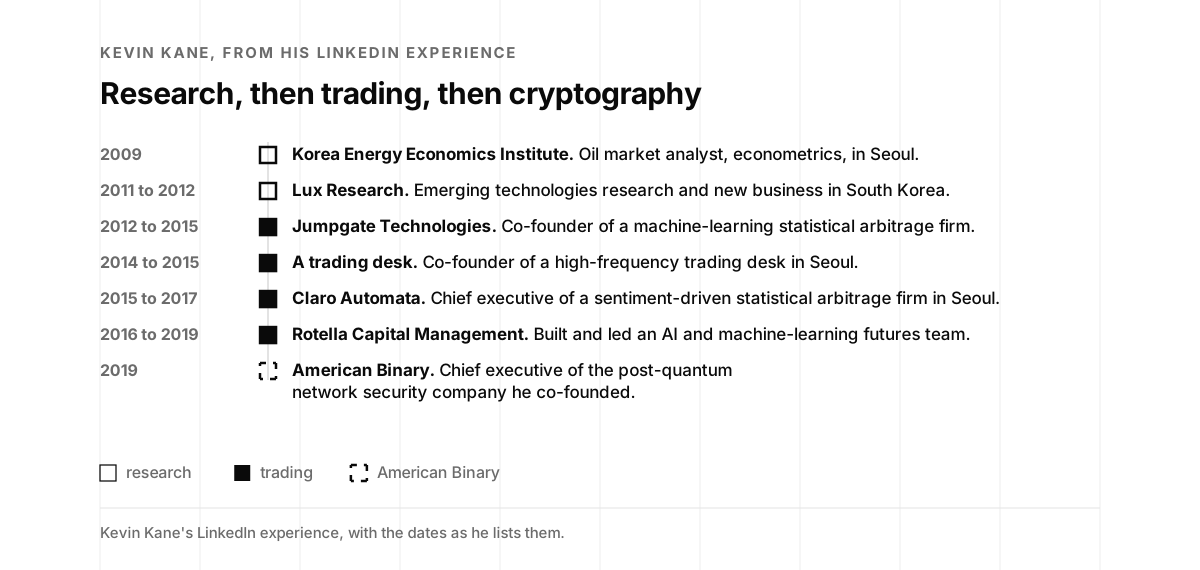
Kevin didn’t come to cryptography by the usual road. His LinkedIn runs through energy economics, finance and trading before American Binary. He was an oil market analyst at the Korea Energy Economics Institute in Seoul in 2009, then worked in emerging technology research for Lux Research in South Korea. He co-founded a machine-learning statistical arbitrage firm in 2012, built a high-frequency trading desk in Seoul in 2014, and ran an AI and machine-learning futures team at Rotella Capital Management from 2016 to 2019 (LinkedIn). On the tape he also mentions working for the Army’s Judge Advocate General’s Corps in Korea. That trading background comes back later, when he explains how he thinks about timing.
The key exchange under everything
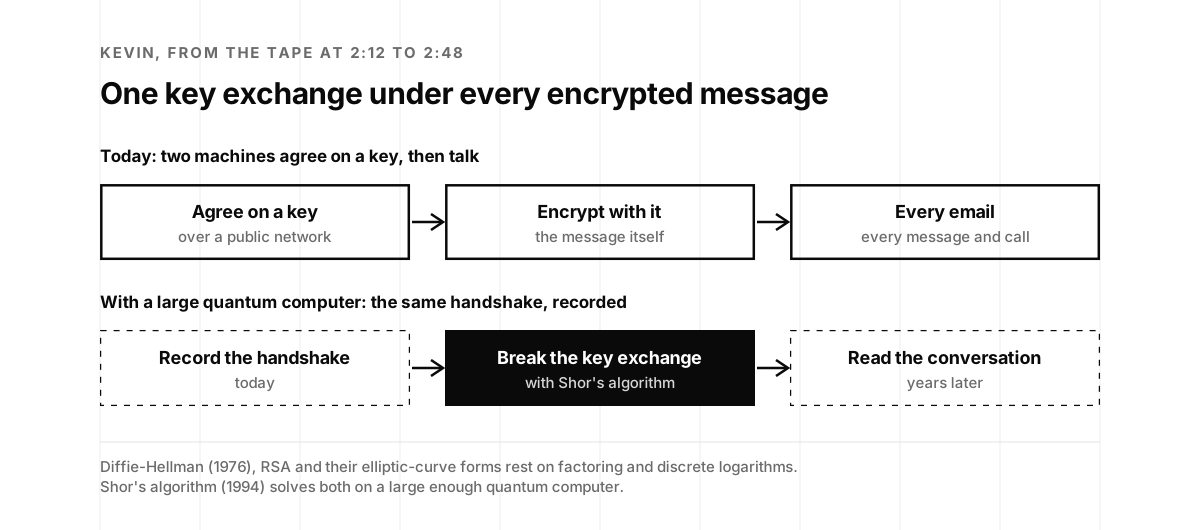
Kevin started where every encrypted conversation starts, with the moment two machines agree on a secret.
“there is a particular key exchange called the Diffie-Hellman key exchange, and it guides everything on the internet. Every email, every WhatsApp message, every VTC connection that’s encrypted uses this key exchange.”
Kevin Kane, at 2:12
His plain version of what a key exchange does is worth keeping.
“I’m going to send you encrypted some secret information, and I’m going to send you over a key that you can then use to receive the secret information that’s about to come.”
Kevin Kane, at 2:28
The Diffie-Hellman key exchange dates to 1976, when Whitfield Diffie and Martin Hellman published a way for two parties who have never met to agree on a shared secret over a public channel. Most modern connections use its elliptic-curve form. Its security, like that of RSA and the ElGamal system Jon named later, rests on math problems that today’s computers can’t solve in useful time, factoring large numbers and computing discrete logarithms. Shor’s algorithm, published by Peter Shor in 1994, solves both on a large enough quantum computer.
That’s why one mechanism carries so much risk. Break the key exchange and every conversation built on it opens, which is why the post-quantum work starts there.
Diffie on the board
Then Kevin dropped the news of the week.
“Whitfield Diffie joined our advisory board last week.”
Kevin Kane, at 2:48
American Binary announced the appointment on April 30, 2026. Diffie, in the release, says organizations “should begin transitioning as soon as possible to mitigate risks” (PR Newswire). Diffie and Hellman shared the 2015 Turing Award for the work Kevin had just described. American Binary’s home page now lists three advisors: Diffie, Bruce Schneier, the author of Applied Cryptography, and Brian LaMacchia, who founded Microsoft’s cryptography review board (American Binary).
There’s a nice symmetry in it. The man whose key exchange guides everything on the internet now advises a company built to replace it.
Six months of review
The claim Kevin cared most about wasn’t the advisory board. It was the review.
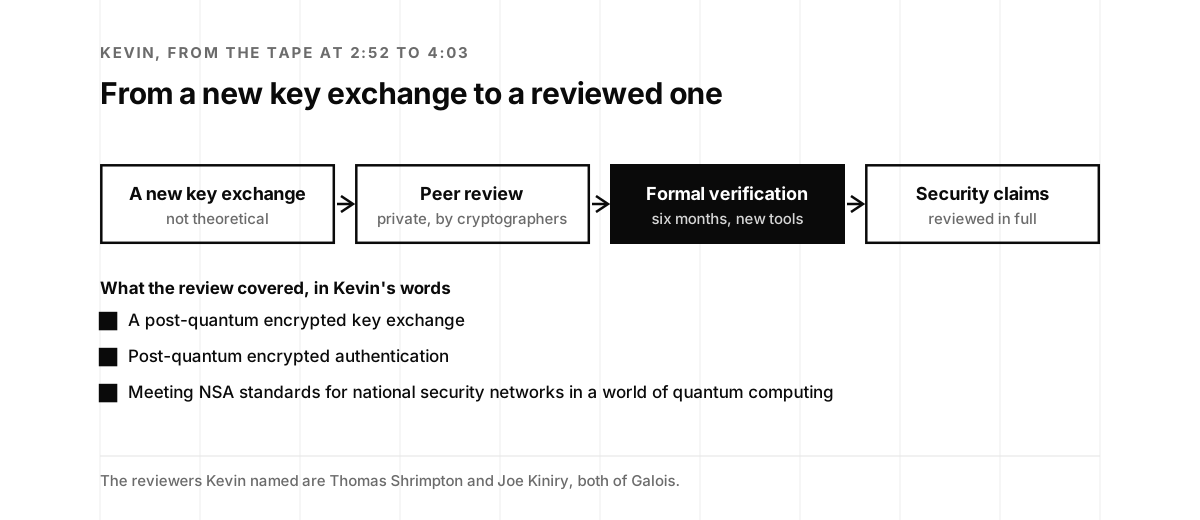
“we developed a new key exchange that is not theoretical and in the lab, but has completed private peer review and formal verification from two DARPA performers and cryptographers for the US community, and they are really famous people.”
Kevin Kane, at 2:55
He named them: Thomas Shrimpton, whom he described as a founder of Real World Crypto under the International Association for Cryptologic Research, and Joe Kiniry, both of Galois, the engineering firm that does research contracts with DARPA. Galois describes its cryptography practice as using “formal methods to guarantee that cryptographic operations function exactly as intended” (Galois).
“And after six months of review and using some modern tools that were not available two years ago to do this kind of review, we completed a total review of our security claims that are novel.”
Kevin Kane, at 3:39
Formal verification is a mathematical proof that a design does what its specification says, for every input rather than the inputs someone thought to test. In cryptography it means proving the construction is right, not only that the algorithm inside it is strong. American Binary’s home page carries the reviewers’ summary, that no known protocol has had “specification and formal verification of comparable depth” (American Binary).
Kevin listed what the review covered.
“And these security claims include a post-quantum encrypted key exchange, post-quantum encrypted authentication, and then meeting NSA standards for national security networks in a world of quantum computing”
Kevin Kane, at 3:52
All four parts
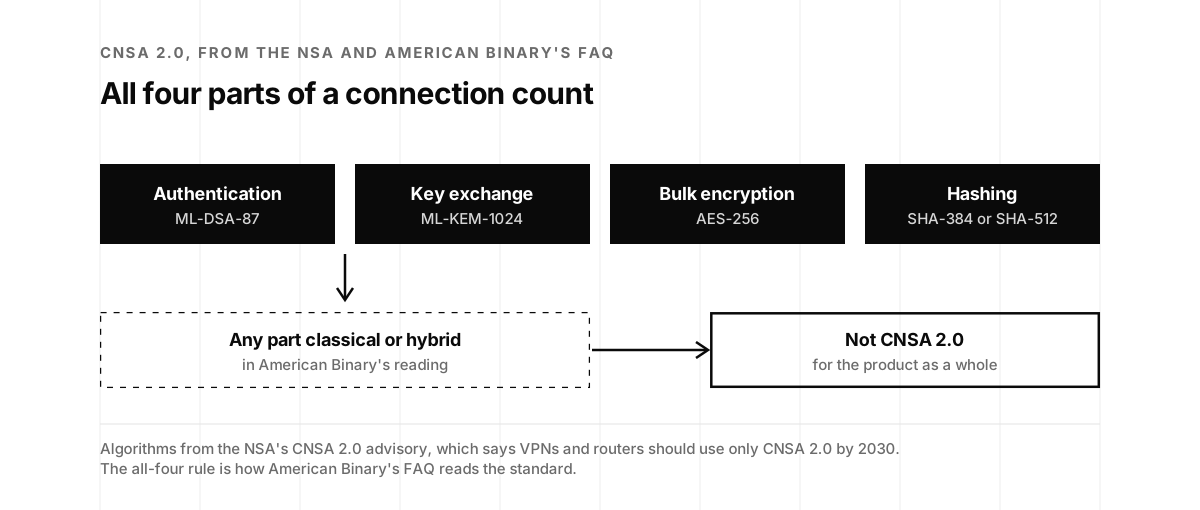
The NSA standard Kevin means is the Commercial National Security Algorithm Suite, CNSA 2.0, the algorithms the agency requires for national security systems. It names ML-KEM-1024 for key establishment and ML-DSA-87 for signatures, keeps AES-256 for the bulk encryption, and sets dates: VPNs and routers should “exclusively use CNSA 2.0 by 2030” (NSA). From January 1, 2027, the NSA’s FAQ says, “all new acquisitions for NSS will be required to be CNSA 2.0 compliant” (NSA).
American Binary’s own test for a quantum-resistant VPN is that all four cryptographic parts use CNSA 2.0 algorithms: authentication, key exchange, bulk encryption and hashing. Its FAQ says that if one part falls short, the product as a whole doesn’t meet the standard, and it treats hybrid designs, which pair a classical algorithm with a post-quantum one, as transitional (American Binary).
Kevin added two conditions that matter to his buyers, software and mobile.
“And if they have, they’re definitely not in software, and they’re definitely not operating over mobile networks, which are more and more some of the sexy technical claims that my company position itself for.”
Kevin Kane, at 4:15
And he said where the protocol goes next.
“We believe our solution, our VPN and our protocol, and will be in zero trust by the end of the year, is the future of internet security, especially as we go into a quantum era.”
Kevin Kane, at 4:29
The rest of the market is taking a different first step. Cloudflare reports its post-quantum rollout as the share of traffic “protected against harvest-now/decrypt-later,” mostly through hybrid key agreement in TLS (Cloudflare). That’s a reasonable start for web traffic. For national security systems and the vendors who sell to them, CNSA 2.0 is the bar, and it asks for all four parts.
Tight rules at work
Jon called the review “like an 11 out of 10 on the cool scale,” and then asked about the other shift every company is living through, AI coding assistants. Did Kevin have a favorite?
“In American Binary, we actually have very tight rules”
Kevin Kane, at 5:41
“That’s good, it’ll make your SOC 2 and all your certifications easier.”
Jon McLachlan, at 5:46
That’s the right instinct for a company whose product is cryptography. Source code, keys and protocol designs are exactly what you don’t want flowing into a tool you don’t control, and a written rule for which tools may touch which data is something an auditor will ask to see. Our secure AI development work starts from the same place.
At home, Kevin wants the opposite of tight. His gripe is that the assistants he uses have grown more cautious.
“I want high inference that might be wrong. Like, I can do the rest without you. I don’t need you to tell me what I already know. I want you to tell me things that I haven’t thought of, that might be dangerous to believe, but I want to see anyway.”
Kevin Kane, at 6:12
He framed it with a story from his Army years in Korea, about a rule written for one bad night that would have restricted everyone. His point was about error rates. Pick a tolerable one, and don’t design the whole system around the rare case.
“Be spicy. I came here to say that AI safety should not be made for the tails and punish the rest of us.”
Kevin Kane, at 8:11
It’s a view many cautious teams will push back on, and the two halves fit together better than they look. Strict rules where the stakes are your own product and your customers’ data, and room to explore where the only person who pays for a wrong answer is you.
Mirror Google
Then Jon asked the question the episode title promises an answer to: when will quantum computers actually break ElGamal, Diffie-Hellman and RSA? Kevin didn’t offer a date of his own. He borrowed one.
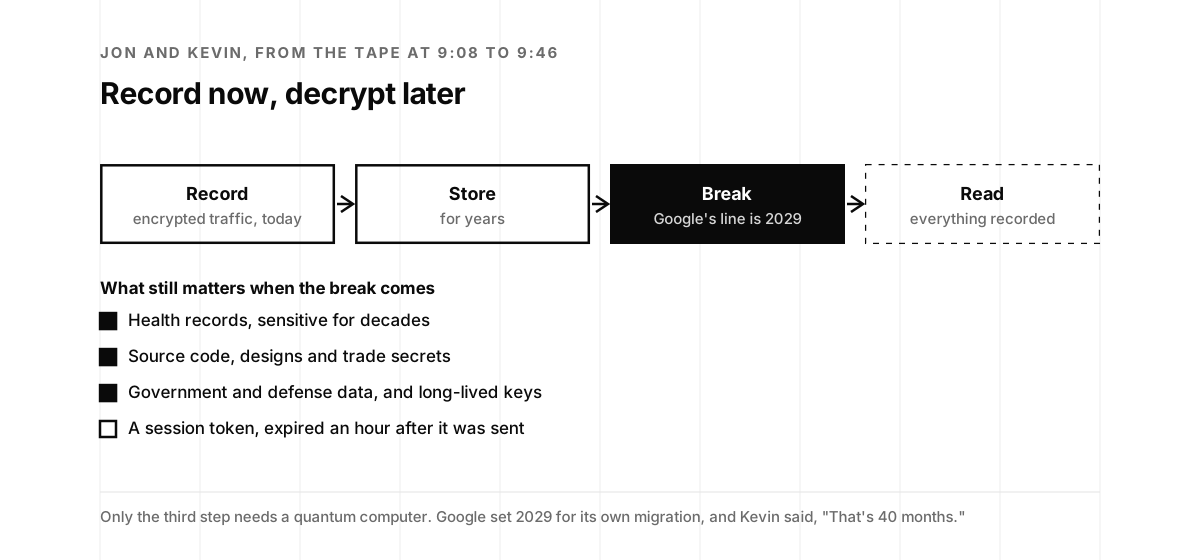
“So number one, the first is we’re at a level of risk. Let’s just mirror Google. A public company put a position out. A public company did that, right? So I don’t think public companies make deadlines on the future. Google said by 2029, we should be concerned. That’s 40 months.”
Kevin Kane, at 9:09
Google’s security leadership announced in March 2026 that it is “setting a timeline for post-quantum cryptography migration to 2029” for its own systems (Google). The forecasts behind such dates are ranges, not points. In the Global Risk Institute’s latest survey, experts rated a cryptographically relevant quantum computer “quite possible (28-49%) within the next 10 years” (Global Risk Institute).
The show notes put it more sharply, that Google’s timeline is already too relaxed. The tape explains why in the next breath. The deadline that matters isn’t the day the machine arrives. It’s the day an attacker started recording.
Yes, it’s a harvest attack
Jon took the four years and ran the attacker’s math out loud.
“even then, if I’m just recording all of the encrypted, harvest it, and then you wait for four years, and you’ll be able to see everything, right?”
Jon McLachlan, at 9:34
“Yes, it’s a harvest attack.”
Kevin Kane, at 9:44
That’s the episode title in one exchange. They don’t need to break in now. They need to record now and wait. Harvest now, decrypt later attacks are passive, leave nothing in your logs, and work against data you already sent. The White House memorandum that set the US government’s post-quantum goals, NSM-10 of May 2022, aims at “mitigating as much of the quantum risk as is feasible by 2035.”
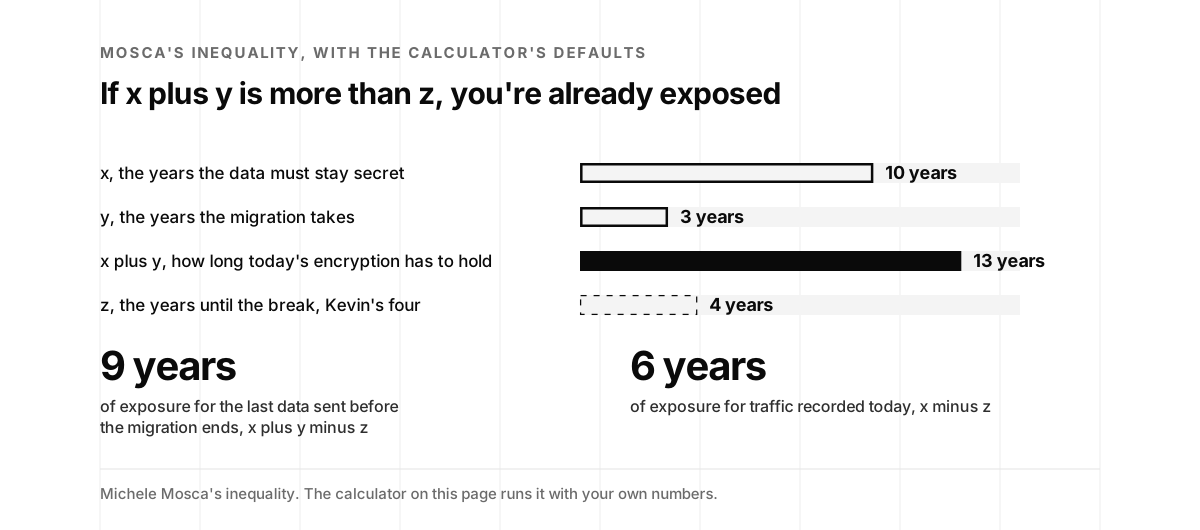
The way to reason about it has a name, Michele Mosca’s inequality. Add the years your data must stay secret to the years your migration will take. If the sum is longer than the years until a quantum computer can break today’s key exchange, the data you send today is already exposed. A session token that expires in an hour doesn’t care. Health records, source code, defense data and long-lived keys do. The calculator below runs the inequality with your own numbers, and our guide to harvest now, decrypt later walks through the deadlines and a four-step migration.
Make it your own
Jon took a detour through the phones that came before the iPhone and the ones that came after, which all looked like the iPhone. His point was that copying an idea and making it your own aren’t the same thing. Kevin drew the line more sharply.
“If I have to have an opinion on what should be, I have no patience, no understanding, no sympathy for someone who copies something to make money.”
Kevin Kane, at 11:02
What he wants instead is people who care about the problem more than the payout.
“I tend to have a bias towards preferring to be around people who are so passionate about the problem, right, that they’re so obsessed on solving the problem, so lost in solving the problem, that they forget about money, and money is something that happens to happen as a result of that obsession.”
Kevin Kane, at 11:15
He tied it to a personal test. When you watch a movie with someone close to you, ask whether they see you in the character nobody likes, and be honest about the answer.
“And so that means having a high internal standard and not breaking that internal standard, no matter how much it hurts ourselves.”
Kevin Kane, at 12:26
The crowd and the trend
Jon asked whether a standard that high makes founding a company easier or harder.
“It’s probably harder, isn’t it, having a higher expectation?”
Jon McLachlan, at 12:58
Kevin answered from his years in statistical arbitrage.
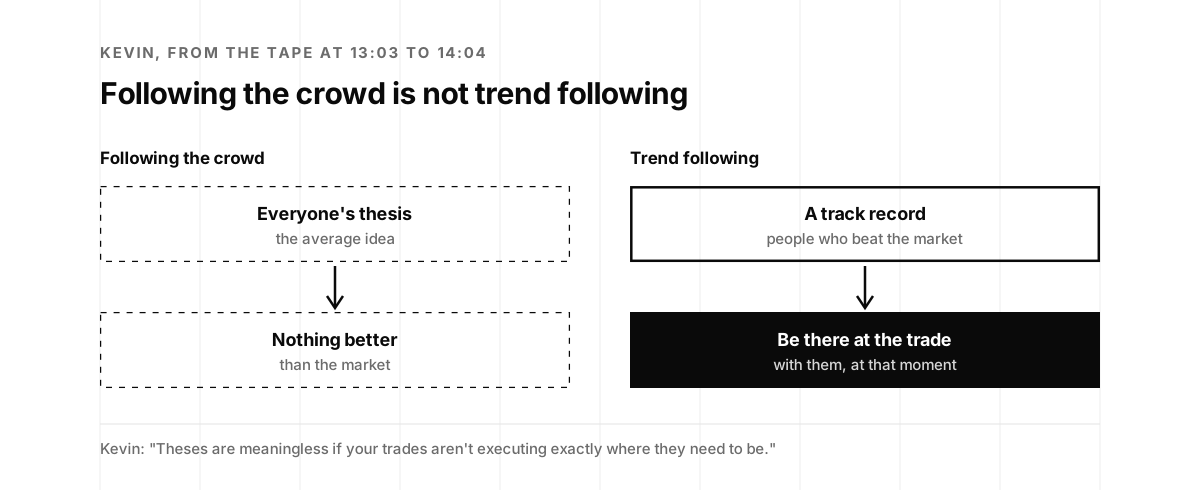
“Yes, it results in long periods of being misunderstood because, you know, there are two things that people often misunderstand from an investor perspective: following the crowd and trend following are not the same thing, right? So when we follow the crowd, we get crap.”
Kevin Kane, at 13:04
Trend following, in his definition, means following people whose track records beat the market, and being in the trade when they are. A thesis on its own is worth nothing.
“Theses are meaningless if your trades aren’t executing exactly where they need to be.”
Kevin Kane, at 14:02
Timing is everything
Jon offered the old line, that timing is everything. Kevin agreed and gave American Binary’s version.
“It is. Timing is everything. I’ve seen it. You know, when we started this company, the time was not here, and it wasn’t here two years ago, and it’s starting to come here now. But two years later, it’s going to super be here. And four years later, super be here.”
Kevin Kane, at 14:21
The catch is that you can’t wait for the market to arrive and then start, because the work takes too long to learn.
“But you know, if you wait too late to start, you’re not going to catch up, because tech nowadays, especially in our area, it’s to the point where you need 20 years of accumulated knowledge to do something like we’re doing. You can’t wing it on a weekend or at a meetup with some friends and hack this.”
Kevin Kane, at 14:36
That’s the deep tech pattern. The core technology has to be invented and proven before there’s a product to sell, so the company that starts early has a head start no money can buy back later.
The handshake that kept failing
Kevin was specific about what those years were spent on.
“It took us years of finding out what was wrong with our systems when they weren’t working in the real world two years ago. And we learned that we were having a problem handshaking, which led us to developing a lot of solutions around our key exchange, but we didn’t know that that was the issue.”
Kevin Kane, at 14:55
New cryptography fails in ways no one has written up yet.
“There’s such a long road on learning what’s going wrong with software that is new, doesn’t exist in the wild except for what you built, and then putting it in a complex system.”
Kevin Kane, at 15:11
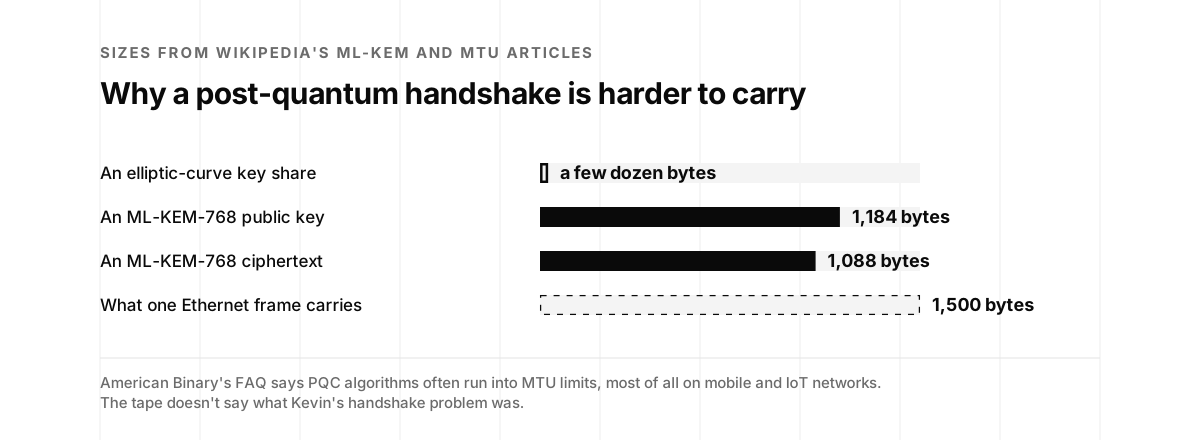
The tape doesn’t say what the handshake problem was, and post-quantum handshakes have a well-known source of trouble: size. At the ML-KEM-768 level, a public key is 1,184 bytes and a ciphertext 1,088, where an elliptic-curve key share is a few dozen bytes (Wikipedia). A standard Ethernet frame carries about 1,500 bytes, so a post-quantum handshake can spill across packets that a classical one never needed. American Binary’s FAQ names the same constraint, that PQC algorithms often run into maximum transmission unit limits, and says it matters most on mobile and IoT networks (American Binary). Those are the networks Kevin said his protocol runs over.
Truth to power
Jon asked about the proudest moment since the last time they talked. Kevin’s answer was about authority, and where it comes from.
“So nowadays we challenge directly some of the world’s most famous cryptographers and leaders from institutions around the world to look at problems in a way that they might not have, then to be able to speak with that authority which was earned is an incredible thing.”
Kevin Kane, at 15:54
The review, the advisory board and the years of field failures are what let a startup argue with famous cryptographers and be taken seriously. Authority earned that way doesn’t depend on a title.
Brick houses and hay houses
Then came the metaphor at the heart of the episode.
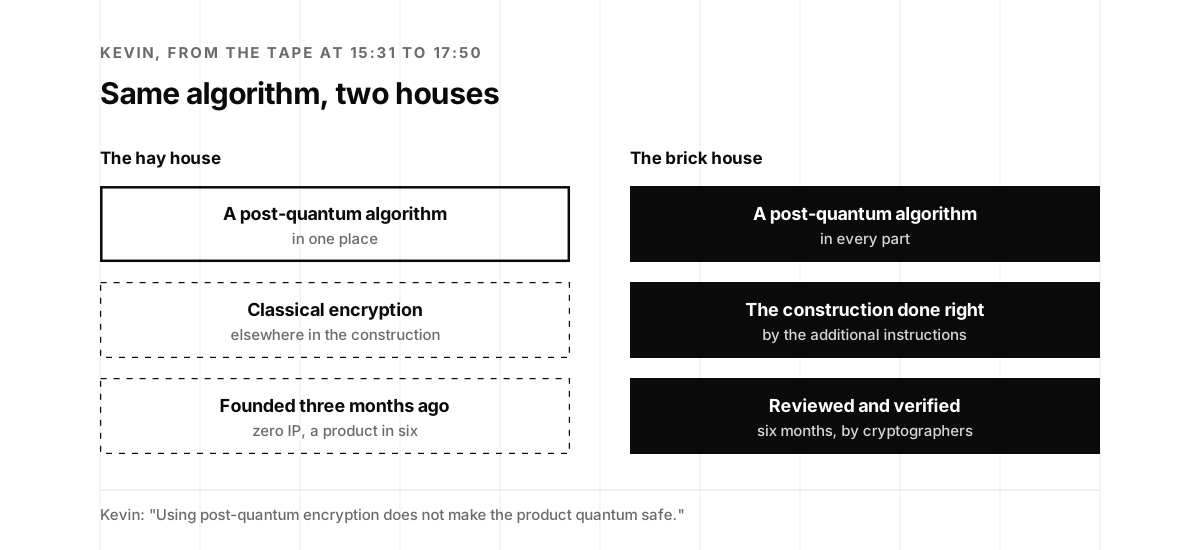
“It’s like the three little pigs, right? So we built a brick house and we didn’t build a hay house, and the brick house allows us to do things in it that you might not with a hay house, right? And everyone wants in your brick house, because the hay ones are all collapsing around us.”
Kevin Kane, at 16:10
The hay house is a product that swaps in a post-quantum algorithm and stops there. That’s the point Kevin made next, and the one this page opened with.
“Using post-quantum encryption does not make the product quantum safe. You have to follow additional instructions, right, to do the cryptographic construction correctly.”
Kevin Kane, at 16:32
A construction is everything around the algorithm: how keys are generated, exchanged, authenticated and rotated, what’s hashed, what’s encrypted, and in what order. A strong algorithm inside a weak construction is still a weak product. The Three Little Pigs is a fair picture of it, because the hay house looks fine until the wind comes.
Earn the right
Kevin had a warning for investors too.
“Investors might not be wise to invest in a post-quantum encryption company that was founded three months ago and that has, like, zero IP, and they’re going to build a post-quantum encrypted email client in six months, unless their expectation is that they might get a result four years later that’s product ready, because it’s such a long road. They didn’t earn the right.”
Kevin Kane, at 16:44
The failure he described is the hay house in practice: a post-quantum algorithm in one place, with classical encryption still used elsewhere in the construction. For a buyer, the questions follow directly. Which parts of the connection are post-quantum, who reviewed the construction, and what did they find? A penetration test that looks at how the cryptography is put together, not only whether it’s switched on, is one way to get an answer you can show a customer.
The day the rumor lands
Kevin’s last point in this run was about trust, and it applies to any startup selling security.
“tell that to your customers who decide to stop using the product tomorrow because a bunch of crypto bros are freaking out on Twitter and X, saying someone broke, someone solved for the discrete logarithmic problem and broke this email’s thing. I don’t think anyone’s going to wait for a cryptographer to say, well, actually, AES-256 is still secure inside. I think they’re going to leave, or even worse, a bank.”
Kevin Kane, at 17:23
He’s right that the symmetric layer would survive. AES-256 isn’t broken by Shor’s algorithm, and the best known quantum attack on it, Grover’s algorithm, only halves its effective key length. It wouldn’t matter. Customers don’t wait for the cryptographer’s footnote, and a bank won’t either. A product that can show its proof the same afternoon keeps the customer.
“So hay houses are solutions that are good enough.”
Kevin Kane, at 17:52
A train on new rails
Jon reached for a novel to make the same point, Atlas Shrugged. Hank Rearden invents a metal stronger and lighter than steel, the experts say it will fail, and nobody wants to ride the first train on rails made from it except Rearden and Dagny Taggart.
In Jon’s telling, the train gets across the country in record time. It’s the brick house again. Proof beats argument, and the people who built on the new thing get there first.
Own the outcome
Jon tied the story back to being true to your values, and Kevin took it somewhere larger.
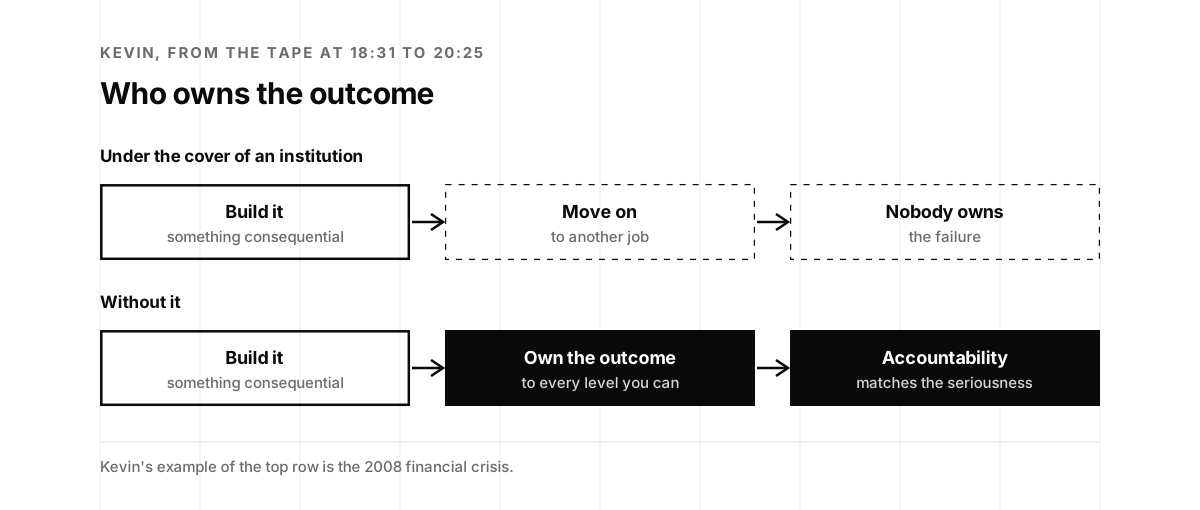
“I think the proper way to look at the world is to imagine every year is the last year of humanity, and you want to prevent the end, and you’re going to optimize your behavior, your culture, your actions and your values around preventing that failure. And you’re not going to outsource your survival to invisible things, to other people, to governments. You’re going to own the outcome yourself to every level that you can.”
Kevin Kane, at 18:37
His example of what goes wrong without that ownership was the 2008 financial crisis.
“I mean, I think the financial crisis in 2008 happened because people who built those things can move on to other jobs.”
Kevin Kane, at 19:26
So he wants the responsibility to sit with a person.
“I think that the buck should fall on the human being, and they should look into the dark void and say, I will accept this problem, and I’m not going to face this problem under the cover of an institution. I’m going to face it myself, so that the accountability matches the seriousness. And that is how we behave in our company.”
Kevin Kane, at 19:54
He expects the standard to cost him some hires as the company grows, and he’s fine with that.
“And as we scale, I’m going to insist that on people. It’s going to filter a lot of people out. That’s fine.”
Kevin Kane, at 20:14
For a security company it’s the right instinct. A named owner for every key, every system and every risk is what makes an incident survivable, and it’s the first thing a good auditor checks.
People are complicated
Jon asked what Kevin would tell his younger self if he could go back in time and meet him.
“The biggest piece of advice, the one I struggle with the most, is that people are complicated. And you can have righteous standards for yourself, but be careful of judging other people in front of you for that, because that person might not meet your standard but can help you in other ways.”
Kevin Kane, at 20:37
“So that’s something I’ve learned, that help comes from people sometimes we don’t even like. That’s very humbling, right?”
Kevin Kane, at 21:08
He talked about asking forgiveness of people he had hurt, and about the damage that forgiveness can’t always undo. Then the line every co-founder should hear once.
“You know, not everyone you start with is the person you’re going to finish with.”
Kevin Kane, at 21:46
A few turns left
Jon said that being a founder means getting used to a certain feeling.
“I’ve noticed, like, as a founder myself, you kind of have to get used to being unsatisfied.”
Jon McLachlan, at 21:58
Kevin’s answer was a game. He thinks of life like a role-playing game with a few turns left, which makes room for things other than the work.
“So you have your mission and vision, but is it really worthwhile to live just for that? I don’t think it is, actually.”
Kevin Kane, at 22:34
“And one of the lessons I would tell 10 years ago to myself is, don’t postpone happiness, integrate it into your work now. And if the people around you are not capable of it, demand they grow or find other people. Don’t sacrifice yourself for people who can’t match your happiness.”
Kevin Kane, at 23:14
He learned it, he said, when he worked hard to come back and show his parents what he’d built, and both had died before he got there. His advice to younger people is not to count on later.
“You need to do it, not wait for it. You have to do it.”
Kevin Kane, at 24:13
It’s the same lesson as the harvest attack, turned inward. The cost of waiting arrives whether or not you were ready for it.
What happened after the tape
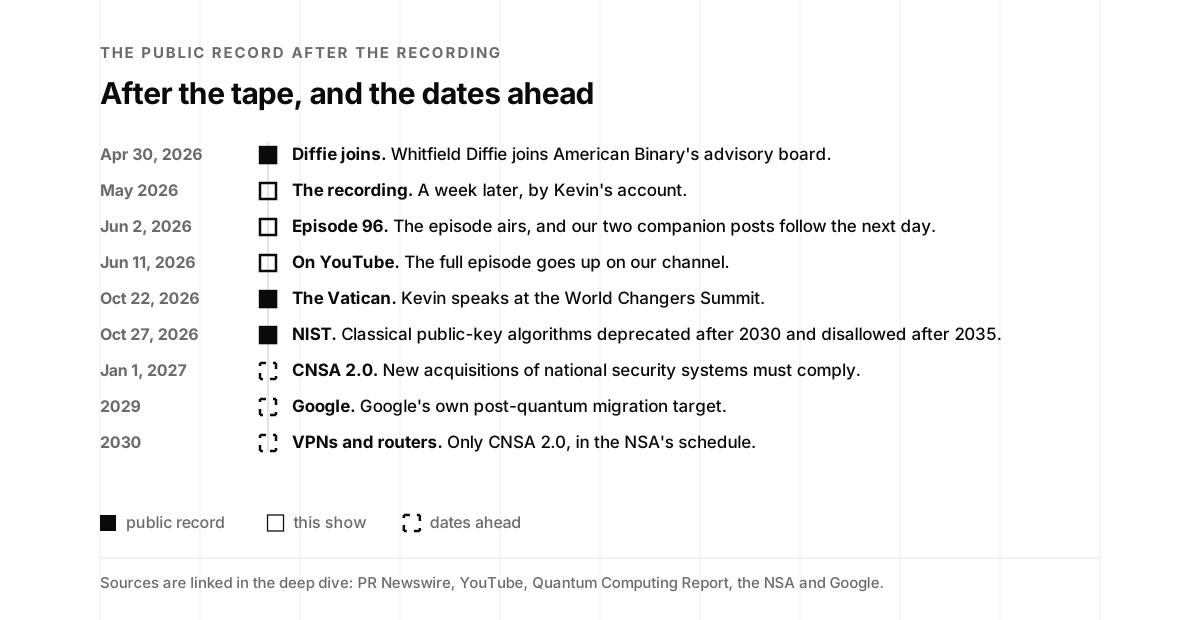
The record since the recording follows the deadlines Kevin and Jon talked about.
When we recorded. Kevin says Whitfield Diffie joined the advisory board “last week,” and American Binary announced the appointment on April 30, 2026 (PR Newswire). So the conversation took place in the first days of May 2026. The episode aired on June 2, and the video went up on our YouTube channel on June 11 (YouTube).
Two companion posts. The next day we published Harvest now, decrypt later, on the deadlines and a four-step migration, and What is deep tech?, on building a company whose core has to be invented first.
NIST sets the schedule. On October 27, 2026, NIST finalized its transition plan, with classical public-key algorithms deprecated after 2030 and disallowed after 2035 (Quantum Computing Report). That’s the same window the draft proposed in November 2024 (NIST).
Kevin at the Vatican. On October 22, 2026, Kevin spoke at the World Changers Summit at the Pontifical Academy of Sciences in the Casina Pio IV, Vatican City, and gave a short interview there (YouTube). His talk from the summit, on trust in the quantum era, is on his own channel (YouTube).
The next deadline. From January 1, 2027, new acquisitions of national security systems must be CNSA 2.0 compliant, in the NSA’s words “all new acquisitions for NSS” (NSA). Google’s 2029 target and the 2030 VPN milestone come after it.
What holds up best is the order Kevin argued for. Get the construction right, prove it to people paid to find the flaw, and start before the deadline makes you, because the harvest started years ago.
Did you catch it? A six-question quiz
Six questions from the episode. Each answer links the moment in the transcript.
Quiz · six questions
Did you catch it?
Pick an answer for each question, then check your score.
-
Who joined American Binary's advisory board the week before the recording?
- Martin Hellman
- Whitfield Diffie
- Peter Shor
b. "Whitfield Diffie joined our advisory board last week." Transcript, 2:48.
-
How long did the review of American Binary's new security claims take?
- Two weeks
- Two years
- Six months
c. "And after six months of review and using some modern tools that were not available two years ago to do this kind of review, we completed a total review of our security claims that are novel." Transcript, 3:39.
-
Whose deadline did Kevin say to mirror?
- Google's
- His investors'
- A competitor's
a. "Let's just mirror Google." Transcript, 9:14.
-
What turned out to be breaking American Binary's system in the real world?
- A licensing dispute
- A problem handshaking
- A shortage of engineers
b. "And we learned that we were having a problem handshaking, which led us to developing a lot of solutions around our key exchange, but we didn't know that that was the issue." Transcript, 15:02.
-
What does using post-quantum encryption not do on its own, in Kevin's words?
- Make the product quantum safe
- Slow down the network
- Pass a security audit
a. "Using post-quantum encryption does not make the product quantum safe." Transcript, 16:32.
-
What did Kevin tell his younger self not to postpone?
- Fundraising
- Hiring
- Happiness
c. "don't postpone happiness, integrate it into your work now." Transcript, 23:17.
Is your data ready for a quantum computer?
Eight questions for a company whose encrypted traffic someone might be recording today, drawn from what Kevin and Jon covered. Each one links the part of the episode it comes from.
Scorecard · eight questions
Is your data ready for a quantum computer?
Answer for your product and the systems behind it, as they stand today. If two answers fit, pick the lower one.
-
Do you know everywhere your products and systems use RSA, Diffie-Hellman or elliptic curves?
- No
- For the main services
- Yes, in an inventory we keep current
"there is a particular key exchange called the Diffie-Hellman key exchange, and it guides everything on the internet." See The key exchange under everything.
-
Do you know how long your most sensitive data has to stay secret?
- No
- A rough idea
- Yes, for each class of data
"Yes, it's a harvest attack." See Yes, it's a harvest attack.
-
Is post-quantum key exchange turned on for your public endpoints and VPNs?
- No
- On some of them
- Yes, everywhere it's supported
"Using post-quantum encryption does not make the product quantum safe." See Brick houses and hay houses.
-
Can you swap a cryptographic algorithm without re-architecting the product?
- No
- With a lot of work
- Yes, by configuration or a library update
Every part of the connection has to meet the bar, not one of them. See All four parts.
-
Has anyone outside the team reviewed how your cryptography is put together?
- No
- A general penetration test
- Yes, a review of the cryptographic construction
"we completed a total review of our security claims that are novel." See Six months of review.
-
Have your critical vendors told you their post-quantum plans?
- We haven't asked
- Some of them
- Yes, with dates
"I don't think anyone's going to wait for a cryptographer to say, well, actually, AES-256 is still secure inside." See The day the rumor lands.
-
Is there a date on your migration plan?
- No
- A target year
- Yes, with milestones before 2030
"Let's just mirror Google." See Mirror Google.
-
Do your long-lived keys and certificates each have an owner and a rotation date?
- No
- Some of them
- Yes, all of them
"You're going to own the outcome yourself to every level that you can." See Own the outcome.
Anything you send today could be readable later. Start with an inventory of where RSA, Diffie-Hellman and elliptic curves live, and with the shelf life of the data that crosses them.
You know where the exposure is and some of it is moving. Next, get the construction reviewed, ask your critical vendors for dates, and put your own date on the plan.
Your inventory, your plan and your review are in place. Keep the inventory current as the product changes, rotate the long-lived keys on schedule, and keep the evidence a buyer will ask for.
How exposed is your recorded traffic?
Mosca’s inequality, with your own numbers. Kevin’s four years is the default for the break, and you can change it.
Calculator
How exposed is your recorded traffic?
Three estimates: how long your data has to stay secret, how long your migration will take, and how many years until a quantum computer can break today's key exchange.
Today's encryption has to hold for 13 years. If the break comes in 4 years, traffic recorded today is readable for 6 years while it should still be secret. Counting everything sent until the migration ends, recorded data is readable while still secret for 9 years. Anything above zero means the harvest is already working against you.
Mosca's inequality says you're exposed whenever the first two numbers add up to more than the third. The four years is Kevin's reading of Google's 2029 line, not a forecast. Expert surveys give a range, so try a few values and plan for the earlier ones.
From Seoul to Kirkland
Everything on this page sits on one timeline, from the 1976 key exchange to the deadlines ahead. Filter it by thread.
Timeline · 1976 to 2027
From Seoul to Kirkland
Filter by thread. Dates are from the public record except where marked as part of this show.
- Diffie and Hellman
The key exchange that guides the internet is published (Wikipedia, on this show).
- Shor's algorithm
Peter Shor shows a quantum computer could factor and compute discrete logarithms efficiently (Wikipedia).
- Seoul
Oil market analyst at the Korea Energy Economics Institute (LinkedIn).
- Lux Research
Emerging technologies research and new business in South Korea, to December 2012 (LinkedIn).
- Jumpgate Technologies
Co-founder of a machine-learning statistical arbitrage firm (LinkedIn).
- A trading desk
Co-founds a high-frequency trading desk in Seoul (LinkedIn).
- Rotella Capital Management
Builds and leads an AI and machine-learning futures team, to January 2019 (LinkedIn, on this show).
- American Binary
Kevin becomes chief executive of the company he co-founded (LinkedIn, on this show).
- NSM-10
The White House sets the goal of mitigating as much quantum risk as feasible by 2035 (White House).
- CNSA 2.0
The NSA publishes its post-quantum suite and timeline for national security systems (NSA, on this show).
- Episode 32
Kevin's first visit, on cryptography and quantum computers (episode 32).
- The first standards
NIST finalizes ML-KEM, ML-DSA and SLH-DSA (NIST).
- The draft transition plan
NIST proposes deprecating classical public-key algorithms after 2030 and disallowing them after 2035 (NIST).
- VPNs by 2030
The NSA's CNSA 2.0 advisory says VPNs and routers should use only CNSA 2.0 by 2030 (NSA).
- The post-quantum web
Cloudflare reports its share of traffic protected against harvest attacks (Cloudflare).
- Oracle
Ambit Client on Oracle Cloud Infrastructure, for enterprise and defense customers (PR Newswire).
- Google picks 2029
Google sets its own post-quantum migration timeline (Google, on this show).
- Whitfield Diffie joins
The co-inventor of the key exchange joins American Binary's advisory board (PR Newswire, on this show).
- The recording
A week after Diffie joins, by Kevin's account (transcript).
- Episode 96
The episode airs (transcript).
- Two companion posts
Harvest now, decrypt later and What is deep tech? (harvest, deep tech).
- On YouTube
The full episode goes up on our channel (YouTube).
- The Vatican
Kevin speaks at the World Changers Summit at the Pontifical Academy of Sciences (YouTube).
- NIST finalizes the transition
Classical public-key algorithms deprecated after 2030 and disallowed after 2035 (Quantum Computing Report).
- New NSS acquisitions
Required to be CNSA 2.0 compliant, per the NSA's FAQ (NSA).
What to do this week
Five things, in the order Kevin’s argument suggests.
- Find your key exchanges. List where your products and systems use RSA, Diffie-Hellman and elliptic curves, including VPNs, TLS endpoints and anything that signs. The scorecard above shows where else you stand.
- Rank your data by shelf life. The calculator shows how long today’s recorded traffic stays exposed. Move first on what has to stay secret longest.
- Ask your vendors for dates. Your VPN, cloud and CDN providers each have a post-quantum plan or should. Write down what they say.
- Review the construction, not only the algorithm. A penetration test or a product security review that looks at how your cryptography is put together tells you whether you built a brick house.
- Put a date on it. Google picked 2029 and the NSA picked 2030 for VPNs. Pick yours, and if you’d like a second pair of eyes on the plan, book 15 minutes with us.