
Podcast Episode 90

Episode 090 43 min

How Two Marines Cracked the Defense Tech Industry (Reveal Technologies)

with Garrett Smith · Reveal Technology

0:00 / 43:00

Watch on YouTube Listen on Spotify, Apple Podcasts, Podbean, Player FM

Episode 90 of The Security Podcast of Silicon Valley, published March 10, 2026. Hosts Jon McLachlan and Sasha Sinkevich, co-founders of YSecurity, talk with Garrett Smith, the co-founder and chief executive of Reveal Technology in Bozeman, Montana, and a Marine Corps Reserve lieutenant colonel with more than 21 years in the Marines. Garrett explains how he and co-founder Andrew Dixon, both Marine officers who served in combat in Afghanistan, built the intelligence tool they lacked: Farsight, which turns drone video into 2D and 3D maps on a mobile device at the tactical edge. They cover the national security bug, focus as the whole game, the prioritization queue for intelligence, the lap atlas and the mobile revolution for the military, partnering with Palantir at a different layer, the ideal user profile versus the economic buyer, selling bottom-up and top-down at the same time, the groundswell the buyer follows, why the venture model fits defense poorly, bootstrapping before a Series A led by Next Frontier Capital and a Series B led by Ballistic Ventures, law enforcement as an expansion, Reveal as a consolidator and the Identifi program of record with US Special Operations Command, electronic warfare and signals next, compliance as the barrier to entry from an interim authority to test to an authority to operate, partnering with the adopter, thin reciprocity between agencies, why Silicon Valley rediscovered national security, $40 billion and then $125 billion into defense and dual-use companies, the counter-drone gap from Ukraine to Montana, and deterrence. About 42 minutes.

Episode notes

Most security decisions fail when the people doing the work don’t have the information they need. Garrett Smith, Founder and CEO of Reveal Technology and a Marine Corps Reserve Lieutenant Colonel, explains how bottom-up product design changes defense outcomes—and what business leaders can learn about building technology people actually adopt. Listen to learn how compliance, procurement, and mission pressure shape what ships and what stalls.

Hosted by Jon McLachlan and Sasha Sinkevich — co-founders of YSecurity.

The deep dive

The point of the problem

Garrett Smith, a Marine Corps Reserve lieutenant colonel and the co-founder and chief executive of Reveal Technology, on building intelligence for the corporal at the tactical edge instead of the program manager at a desk: drone video turned into 3D maps on a handheld, selling bottom-up and top-down at the same time, a slower road for venture money, compliance as the barrier to entry, and the counter-drone gap he would pay to see closed.

Reveal Technology exists because of a map. Garrett Smith led Marines into combat with a topographic map and some outdated imagery, and nothing else to plan with. A decade later his company sells the tool he wished he’d had, software that turns drone video into maps on a handheld, built for the person who carries the risk.

“So our entire thesis was, how do we enable that decision maker, that tactical decision maker who’s actually adopting all of the physical risk, how do we endow that person with the ability to generate their own intelligence on the fly, at the point of the problem?”

Garrett Smith, at 9:37

Listen · Garrett on episode 90, from 7:50
About 35 seconds: Garrett on the map he carried into combat. The clip stops on its own. Read the full transcript.

Garrett co-founded Reveal in 2018 with Andrew Dixon, Parker Clark and John Laxson, and the company is headquartered in Bozeman, Montana, with offices in Washington, D.C., and San Francisco (Reveal). Its flagship, Farsight, is in Reveal’s words “a 3D mapping and terrain intelligence platform” for frontline units (Reveal).

Jon McLachlan and Sasha Sinkevich co-hosted this one, and it aired on March 10, 2026, with 65 words of show notes. This page is the rest of it: a section for each part of the conversation with the sources beside it, eleven figures, eighteen clips from the tape, the full transcript, and four tools: a quiz, a scorecard for how ready a startup is to sell to the Department of Defense, a calculator for how long a compliance wait lasts on your runway, and a timeline from Garrett’s enlistment to Reveal’s latest contracts.

Twenty-one years in

Jon opened with Garrett’s service record, and Garrett corrected the number upward. He’s still a Marine.

“I’m still in the Reserve component of the Marine Corps. I’ve been in for just over 21 years.”

Garrett Smith, at 2:12

His LinkedIn lays it out. He enlisted as an infantry Marine in 2005, served on active duty as an infantry and intelligence officer from 2008 to 2011, and then spent most of a decade in the reserves with 4th Force Reconnaissance Company, as a platoon commander, an intelligence officer, the operations officer and the executive officer. He commanded Company A of the 4th Reconnaissance Battalion in 2021, then led the small drone red team at the Marine Innovation Unit from 2022 to 2025 (LinkedIn).

The civilian track ran in parallel. He studied linguistics at Brigham Young University, earned a master’s in international policy studies at Stanford in 2015, and spent three years in business development at the drone company Kespry before founding Reveal in December 2018 (LinkedIn).

“So it’s been a unique pleasure and definitely informs all of what we do at Reveal.”

Garrett Smith, at 2:27
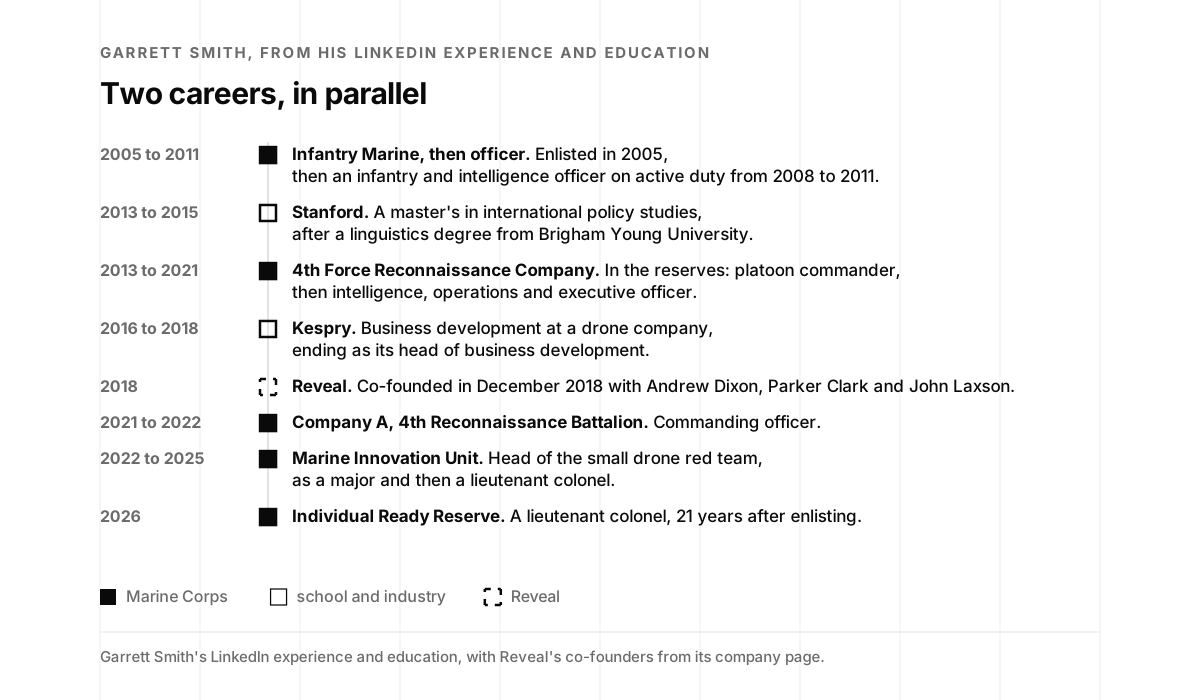
A timeline of eight entries. Filled, 2005 to 2011, infantry Marine, then officer: enlisted in 2005, then an infantry and intelligence officer on active duty from 2008 to 2011. Open, 2013 to 2015, Stanford: a master's in international policy studies, after a linguistics degree from Brigham Young University. Filled, 2013 to 2021, 4th Force Reconnaissance Company: in the reserves, platoon commander, then intelligence, operations and executive officer. Open, 2016 to 2018, Kespry: business development at a drone company, ending as its head of business development. Dashed, 2018, Reveal: co-founded in December 2018 with Andrew Dixon, Parker Clark and John Laxson. Filled, 2021 to 2022, Company A, 4th Reconnaissance Battalion: commanding officer. Filled, 2022 to 2025, Marine Innovation Unit: head of the small drone red team, as a major and then a lieutenant colonel. Filled, 2026, Individual Ready Reserve: a lieutenant colonel, 21 years after enlisting.
Garrett's two careers, side by side.

The national security bug

Sasha asked what was hardest about going from the service to founding a company. Garrett answered with what was easiest to miss.

“So there’s almost nothing more addictive and more meaningful than being oriented on a public service initiative as a mission.”

Garrett Smith, at 2:45

Listen · Garrett on episode 90, from 2:45
About 40 seconds: Garrett on the mission, and the bug he never got over. The clip stops on its own. Read the full transcript.

The mission gives everything a sense of purpose, he said, in a way that the next great dating app probably doesn’t. He enlisted with his brother after 9/11 and the invasion of Iraq, and what stayed with him was the old truism about combat.

“And the truism that at the end of the day, in combat, you’re fighting for the person to your left or to your right and your teammates, it’s totally true.”

Garrett Smith, at 4:05

What the experience also showed him was a gap. The warfighters were ill-equipped in terms of technology, he said, just as the threat shifted from desert warfare to something closer to peer competition with Russia and China. So the hard part of leaving uniform was finding a mission as meaningful as the one he’d left.

“So coming back to answer your question, Sasha, the hard thing about transitioning from the military into the civilian or private sector is finding a way to attach yourself to a mission that can be as meaningful as the one that we used to serve while in uniform.”

Garrett Smith, at 4:37

Focus is everything

Sasha asked how a founder picks a problem when there’s so much noise. Garrett said the team was the easy part, at least for him.

“And focusing on the wrong thing is actually death of a company. And focusing on the right thing is literally the whole game.”

Garrett Smith, at 5:26

He started Reveal with three of his best friends, people he’d worked with for many years, so the team element of the equation was relatively solved. Reveal’s own page lists the four co-founders today: Garrett as chief executive, Andrew Dixon as chief operating officer, Parker Clark as chief technology officer and John Laxson as chief product officer (Reveal). What they still had to find was a gap in the national security market they could fill and still care about for the life of a young company.

We were our customers

The gap found them first. Garrett and Andrew are both Marine officers who served in combat in Afghanistan, and both went into high-risk raids without enough information.

“We, in other words, were our customers. We were the people we were trying to serve.”

Garrett Smith, at 6:51

Listen · Garrett on episode 90, from 6:15
About 50 seconds: Garrett on the gap he and his co-founder lived. The clip stops on its own. Read the full transcript.

That gave them more than a market. It gave them the product, and the reason for it.

“That allowed us unique insight into the product development phase of the company, so that we not only understood the product that we needed to build, but why we were building it and who would be using it.”

Garrett Smith, at 6:55

Sasha put the problem another way, information in silos with no central system to deliver the piece you need when it’s critical. Garrett got specific.

“a very outdated 1 in 50,000 topographic map and some outdated low-resolution images that in no way represented the terrain and the environment that we were going to move into.”

Garrett Smith, at 8:08

A 1:50,000 topographic map shows a kilometer of ground in two centimeters of paper. It’s fine for planning a route across a province and close to useless for planning a raid on one compound.
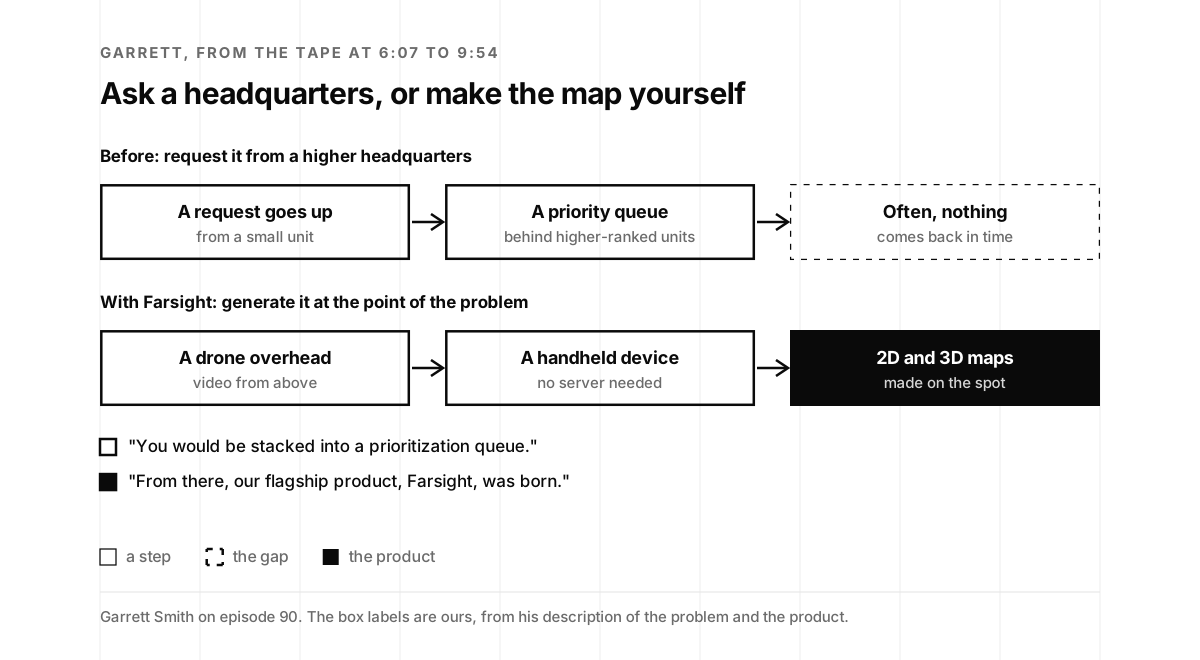
Two rows of three boxes joined by arrows. Top row, before, request it from a higher headquarters: open, a request goes up, from a small unit. Open, a priority queue, behind higher-ranked units. Dashed, often, nothing comes back in time. Bottom row, with Farsight, generate it at the point of the problem: open, a drone overhead, video from above. Open, a handheld device, no server needed. Filled, 2D and 3D maps, made on the spot. Two quotes from Garrett: "You would be stacked into a prioritization queue." And: "From there, our flagship product, Farsight, was born."
The intelligence gap Garrett described, and the product that closed it.

Farsight

The answer was a phone in the hands of the person on the ground.

“And so the thing that we built and the thing that we dreamed of having was a mobile device optimized software application that could ingest video streams from drones and rapidly generate high-resolution two-dimensional and three-dimensional maps.”

Garrett Smith, at 8:24

The old way was a request to a higher headquarters and a place in a prioritization queue, behind units that ranked higher. More often than not, he said, the intelligence never came. Generating the map on the spot from a drone overhead skips the queue. In mapping terms that’s photogrammetry at the edge, the 3D model built from overlapping images on a handheld rather than in a data center.

“From there, our flagship product, Farsight, was born.”

Garrett Smith, at 9:51

Reveal describes Farsight today as a platform that “turns drone, satellite, and sensor imagery into a single operational interface” (Reveal). In May 2025 the company partnered with Maxar to add Maxar’s high-resolution imagery to it (Reveal).
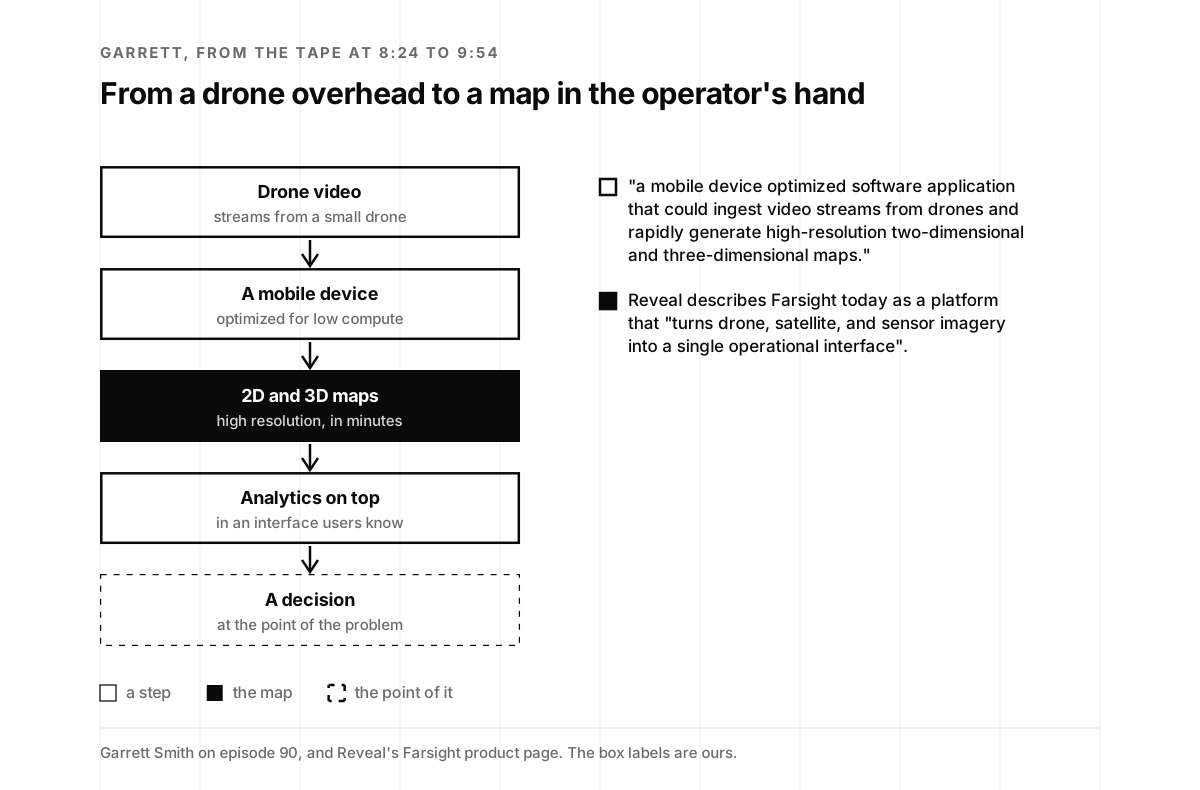
Five boxes stacked top to bottom with arrows between them. Open, drone video, streams from a small drone. Open, a mobile device, optimized for low compute. Filled, 2D and 3D maps, high resolution, in minutes. Open, analytics on top, in an interface users know. Dashed, a decision, at the point of the problem. Beside them, a quote from Garrett: "a mobile device optimized software application that could ingest video streams from drones and rapidly generate high-resolution two-dimensional and three-dimensional maps." And Reveal's description of Farsight today, a platform that "turns drone, satellite, and sensor imagery into a single operational interface".
From a drone overhead to a map in the operator's hand.

The lap atlas

Jon pictured something like a live map of the battlefield. Garrett said live stream was overstating it, and reached for a better picture.

“Imagine that analog, querying the lap atlas in your car to get around. That’s how the military, in many places, still operates.”

Garrett Smith, at 10:36

Listen · Garrett on episode 90, from 10:19
About 25 seconds: Garrett on the lap atlas and the mobile revolution. The clip stops on its own. Read the full transcript.

“So what we are doing is facilitating the mobile revolution for the military and doing it with an application that mimics an experience that almost everybody has in the civilian world”

Garrett Smith, at 10:45

The comparison is the whole design brief. Almost everyone already uses a map on a phone, so the interface starts out familiar to the people who need it most.

Palantir, from the other end

Jon was surprised that Palantir hadn’t stepped in. Garrett said they had, just at a different layer.

“We would prefer to see it as partnering with Palantir or others like Palantir operating in the space.”

Garrett Smith, at 11:30

Listen · Garrett on episode 90, from 11:30
About 25 seconds: Garrett on Palantir's layer and Reveal's. The clip stops on its own. Read the full transcript.

Palantir offered its capability first to command centers and senior decision makers, he said, people relatively abstracted from the tactical problem. Reveal starts at the other end.

“What we’re doing is servicing the highly decentralized, low-echelon decision maker first.”

Garrett Smith, at 12:06

From there it reaches up toward the echelons where Palantir already delivers value. The two products meet in the middle of the stack, which is why Garrett calls it a partnership rather than a fight.
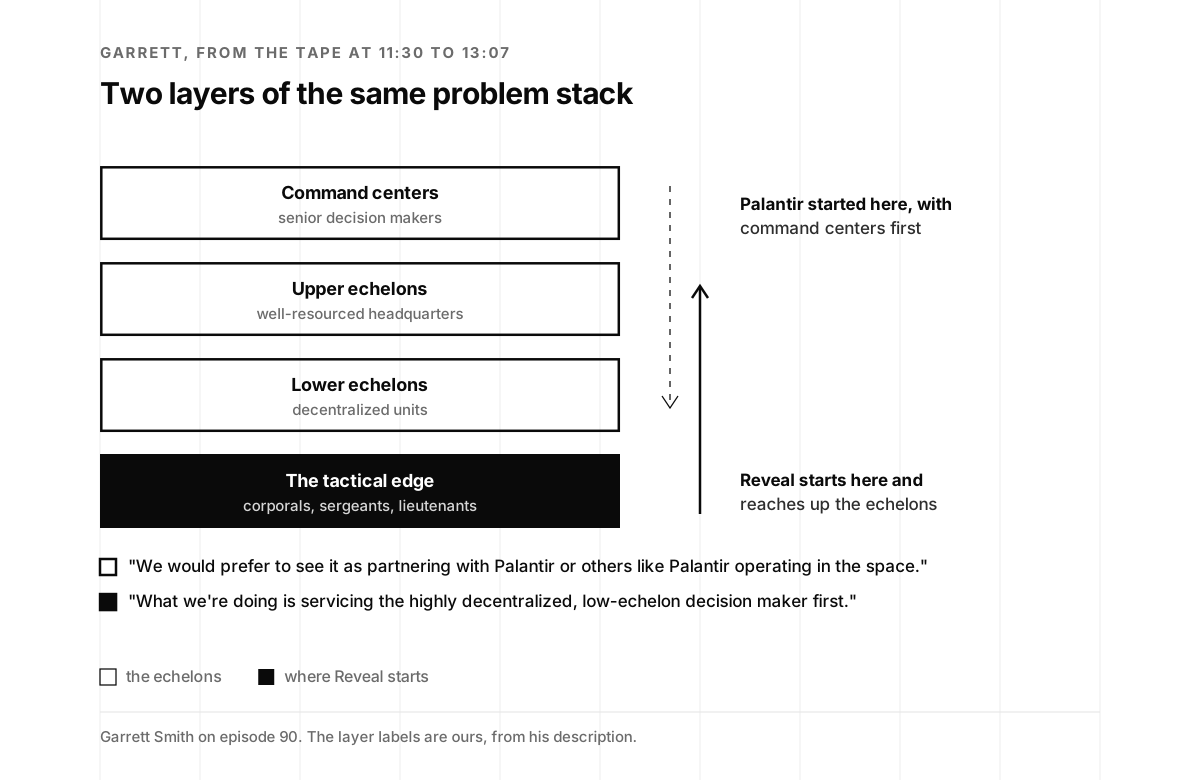
Four boxes stacked from top to bottom. Open, command centers, senior decision makers. Open, upper echelons, well-resourced headquarters. Open, lower echelons, decentralized units. Filled, the tactical edge, corporals, sergeants, lieutenants. A dashed arrow runs down from the top, labeled Palantir started here, with command centers first. A solid arrow runs up from the bottom, labeled Reveal starts here and reaches up the echelons. Two quotes from Garrett: "We would prefer to see it as partnering with Palantir or others like Palantir operating in the space." And: "What we're doing is servicing the highly decentralized, low-echelon decision maker first."
Two layers of the same problem stack.

The tactical edge

Jon called it the place where the rubber hits the road. Garrett had a name for it.

“We call that place the tactical edge. You know, that’s where corporals and sergeants and lieutenants are making decisions in the high-risk physical terrain, right at the point of the problem”

Garrett Smith, at 12:33

Listen · Garrett on episode 90, from 12:32
About 35 seconds: Garrett on the tactical edge and low compute. The clip stops on its own. Read the full transcript.

The value is in the engineering that makes the software run there.

“That’s where our value proposition lies, because we’ve done so much technological kind of advancement to optimize this capability for low-compute mobile devices rather than high-compute, high-resource architectures like servers and clouds and command centers.”

Garrett Smith, at 12:49

Reveal says its products are “purpose-built for contested and disconnected environments” (Reveal). At the edge, bandwidth is contested and connections drop, so software that needs a server to think stops working at the worst moment. Edge computing is a buzzword in most industries. Here it’s the requirement.

The user isn’t the buyer

Sasha named the ideal customer profile, corporals and boots on the ground. Garrett split the term in two.

“That’s our ideal user profile. In the defense security kind of environment, the customer or the buyer is actually highly abstracted and distant from that end-user set.”

Garrett Smith, at 13:13

So how, Sasha asked, do you connect with the economic buyer and make sure the corporal still gets the value? Garrett said every company that sells into national security hits the same wall, and the legacy vendors climb it from the top.

“The legacy set typically will go top-down. In other words, they’ll engage with the economic buyer and the high-order program managers first, generate a list of requirements, build to those requirements, line up funding in partnership with those economic buyers”

Garrett Smith, at 14:02

Listen · Garrett on episode 90, from 14:02
About 20 seconds: Garrett on how legacy vendors sell, top-down. The clip stops on its own. Read the full transcript.

The technology eventually trickles down to the people who use it. What that skips, he said, is the thing Silicon Valley has been great at for decades, starting with the user.

Bottom-up and top-down at once

Reveal did both, in that order and then in parallel.

“So what we chose to do was blend a Silicon Valley approach with that top-down legacy approach.”

Garrett Smith, at 13:52

The team went to the corporals and sergeants first, reached a minimum viable product and something like product-market fit with them, and built ground-level demand. Then, in parallel, they worked Congress, program managers and senior decision makers across the Department of Defense.

“So we married those two efforts really healthfully for our end-user set. And now we can scale adoption with a product that they actually want to adopt, which is not always the case with legacy technologies in the military.”

Garrett Smith, at 15:56
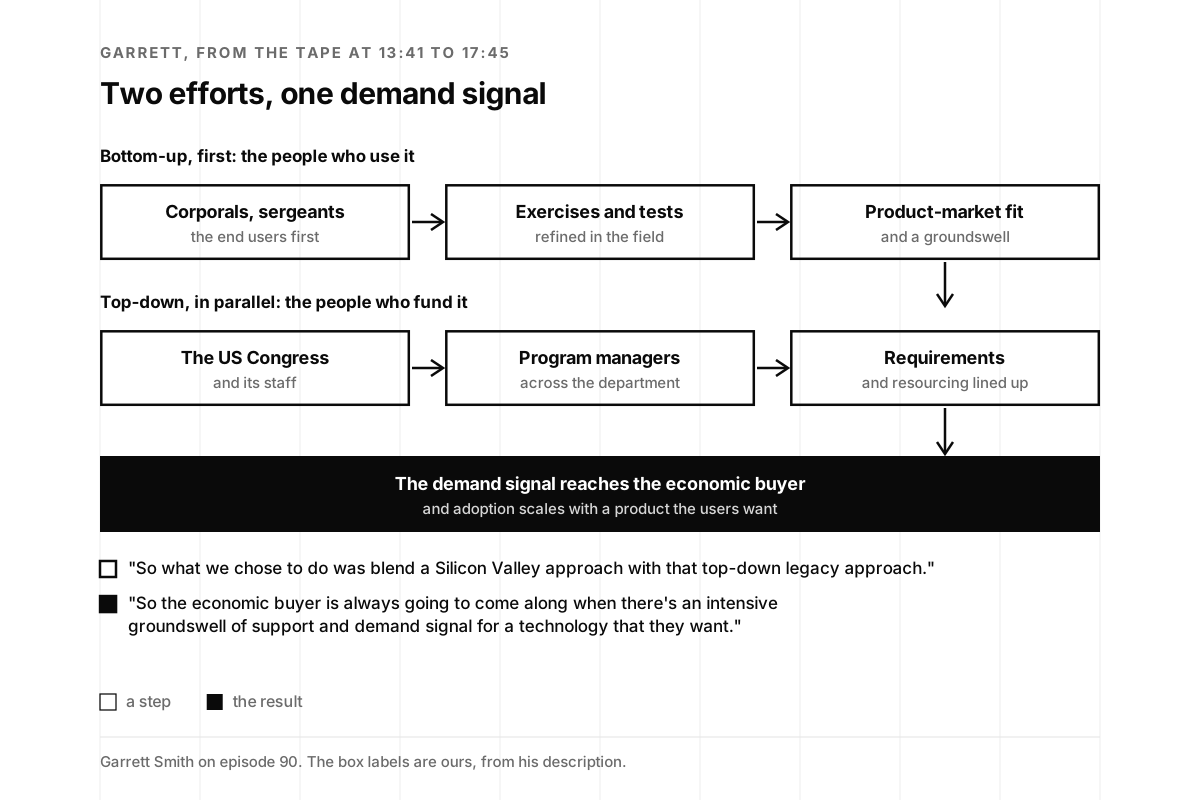
Two rows of three boxes joined by arrows. Top row, bottom-up, first, the people who use it: corporals, sergeants, the end users first. Exercises and tests, refined in the field. Product-market fit, and a groundswell. Bottom row, top-down, in parallel, the people who fund it: the US Congress and its staff. Program managers across the department. Requirements and resourcing lined up. Both rows point to a filled box: the demand signal reaches the economic buyer, and adoption scales with a product the users want. Two quotes from Garrett: "So what we chose to do was blend a Silicon Valley approach with that top-down legacy approach." And: "So the economic buyer is always going to come along when there's an intensive groundswell of support and demand signal for a technology that they want."
Two efforts, one demand signal.

Groundswell

Jon asked whether the Marine connections made the bureaucracy easier. Garrett said no, not in the early days.

“So I don’t think we were particularly good in the early days at navigating the bureaucracy and navigating the top-down side of how this sales process works for the federal government.”

Garrett Smith, at 16:23

What they knew were the units and the people who would use the product. So they networked their way into testing, evaluation and exercise environments, refined it there, and let the demand build. Then he said the line that runs through the whole episode.

“So the economic buyer is always going to come along when there’s an intensive groundswell of support and demand signal for a technology that they want.”

Garrett Smith, at 17:13

Listen · Garrett on episode 90, from 17:13
About 15 seconds: Garrett on why the buyer follows the users. The clip stops on its own. Read the full transcript.

Jon called it a unique entrepreneurial story, a bottom-up go-to-market with the military. Garrett called it irregular, and the reason companies like his are disrupting the market. The companies that copy the legacy approach meet with middling success, he said, because of the noise, the incumbency and the legacy baggage at that level.

“You get sticky and you remain sticky when you’re actually solving problems at the end-user level.”

Garrett Smith, at 18:27

Our post on building a defense tech startup turns this part of the episode into a playbook.

Not the lowest bid

Jon brought up contract bidding, a spec for an M16 and a contract for 50,000 of them, and the temptation to go with the lowest number.

“But then, like, what are you sacrificing in terms of quality?”

Jon McLachlan, at 18:51

Garrett took the point somewhere founders feel it, the money.

“but there’s a very different and much slower road to success in defense. But once you’re there, it’s quite big.”

Garrett Smith, at 19:16

Seed to A to B, on a defense clock

The slower road changes what kind of capital makes sense.

“And what that means is that the traditional venture capital model actually might not be fully appropriate for a defense upstart project as well.”

Garrett Smith, at 19:22

Investors want to see growth early, and the usual seed to Series A to Series B sequence assumes revenue arrives on a commercial timeline. In defense, he said, the hurdles stretch the road to meaningful revenue, so investors and founders have been working out together what venture capital looks like in this market.
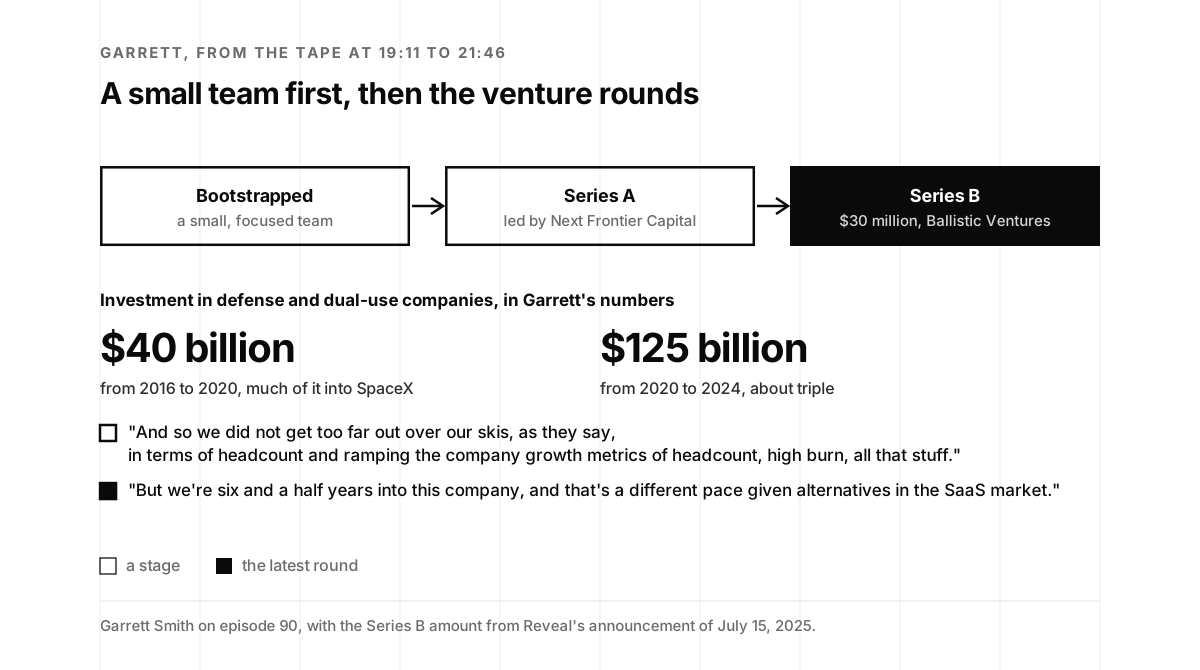
Three boxes in a row joined by arrows. Open, bootstrapped, a small, focused team. Open, Series A, led by Next Frontier Capital. Filled, Series B, $30 million, Ballistic Ventures. Below, investment in defense and dual-use companies, in Garrett's numbers: $40 billion from 2016 to 2020, much of it into SpaceX, and $125 billion from 2020 to 2024, about triple. Two quotes from Garrett: "And so we did not get too far out over our skis, as they say, in terms of headcount and ramping the company growth metrics of headcount, high burn, all that stuff." And: "But we're six and a half years into this company, and that's a different pace given alternatives in the SaaS market."
A small team first, then the venture rounds.

Over our skis

Jon asked whether they raised. Garrett said they mostly didn’t, at first.

“I like to say that we bootstrapped, or kind of bootstrapped.”

Garrett Smith, at 20:11

Listen · Garrett on episode 90, from 20:25
About 20 seconds: Garrett on bootstrapping before the venture rounds. The clip stops on its own. Read the full transcript.

“And so we did not get too far out over our skis, as they say, in terms of headcount and ramping the company growth metrics of headcount, high burn, all that stuff.”

Garrett Smith, at 20:26

Once the product was right, they raised a Series A led by Next Frontier Capital in Bozeman, and then a Series B led by Ballistic Ventures. Reveal announced the Series B in July 2025 as a $30 million round (Reveal). Garrett said one of Ballistic’s founders, Kevin Mandia, had been a mentor and a seed investor for years. Mandia founded Mandiant as Red Cliff Consulting in 2004, and Ballistic lists him as a general partner (Ballistic Ventures).

The fit went beyond friendship, because Reveal wants to add cybersecurity tools to the same mobile software for the same users.

“And we’re definitely on the ramp for revenue, having hit the hockey stick inflection point, as they say.”

Garrett Smith, at 21:30

“But we’re six and a half years into this company, and that’s a different pace given alternatives in the SaaS market.”

Garrett Smith, at 21:40

A SWAT team looks like an infantry unit

Jon asked whether the growth would come only from the military. Garrett said Reveal is a defense company first, and explicitly so.

“Yeah, so we’re definitively and explicitly a defense company.”

Garrett Smith, at 21:58

But the users look alike across the line.

“An infantry unit in the military is so much like a SWAT team in a regional SWAT office or a sheriff’s department, right?”

Garrett Smith, at 22:19

Listen · Garrett on episode 90, from 22:02
About 35 seconds: Garrett on law enforcement as the next market. The clip stops on its own. Read the full transcript.

Law enforcement is an expansion opportunity, he said, not yet a co-equal market. Eight months after the episode aired, it started to happen abroad. In November 2026 Reveal said Taiwan’s Criminal Investigation Bureau Special Tactical Unit had acquired Farsight, through MIST Taiwan (Reveal).

Consolidators

Sasha asked about the next twelve months of new value. Garrett answered with the structure of the market instead.

“The defense market is full of platforms and consolidators.”

Garrett Smith, at 22:58

Lockheed Martin, Boeing and Raytheon have bought small, innovative companies since the 1980s and early 1990s, he said, because as companies grow they become less organically innovative. The newer upstarts, Anduril and Palantir among them, are starting to do the same. So is Reveal.

“So we will acquire companies. We are a consolidator. We’re a buyer, in other words.”

Garrett Smith, at 24:51
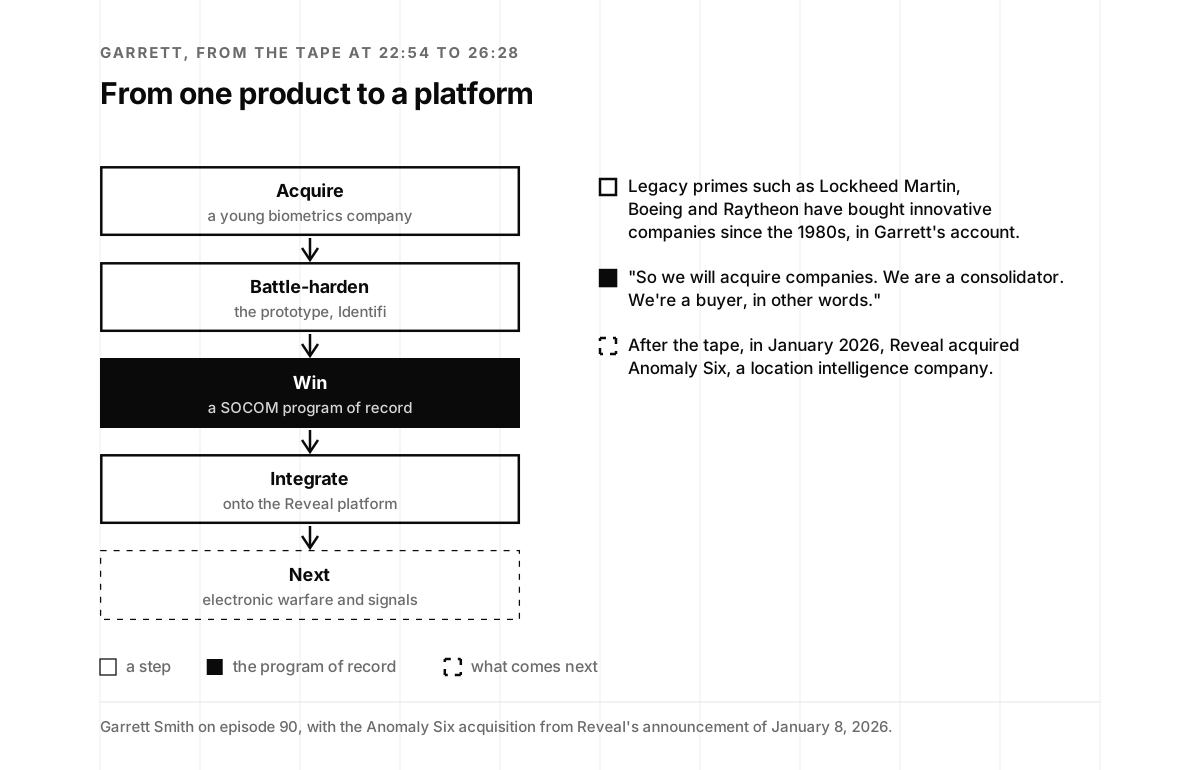
Five boxes stacked top to bottom with arrows between them. Open, acquire, a young biometrics company. Open, battle-harden, the prototype, Identifi. Filled, win, a SOCOM program of record. Open, integrate, onto the Reveal platform. Dashed, next, electronic warfare and signals. Beside them: legacy primes such as Lockheed Martin, Boeing and Raytheon have bought innovative companies since the 1980s, in Garrett's account. A quote from Garrett: "So we will acquire companies. We are a consolidator. We're a buyer, in other words." And after the tape, in January 2026, Reveal acquired Anomaly Six, a location intelligence company.
How a young company grows into a platform.

Identifi, a program of record

The proof was a biometrics product. Reveal bought a young company with a handheld biometrics suite, battle-hardened it, and took it into a competition.

“They had a very good prototype product called Identifi that we thought could be a contender for a Special Operations Command program of record.”

Garrett Smith, at 25:03

Listen · Garrett on episode 90, from 25:03
About 25 seconds: Garrett on taking Identifi to a program of record. The clip stops on its own. Read the full transcript.

“And we recently outright won the program of record, competing with large legacy contractors, for that major contract over a multi-year basis.”

Garrett Smith, at 25:19

A program of record is one recorded in the department’s Future Years Defense Program, the step that turns a prototype into sustained purchases (Warfighting Acquisition University glossary). Reveal announced it publicly on May 1, 2026, as Identifi’s adoption across United States Special Operations Command for tactical biometrics, “moving handheld identity verification from evaluation into sustained operational use” (Reveal).

“And so now we’re demonstrating that we have multiple products that are generating real production revenue, one of which is now a program of record with the US military.”

Garrett Smith, at 25:32

Electronic warfare and signals next

The roadmap follows the same user. Garrett said one of the next products will sit in electronic warfare and signals, with network and cybersecurity elements, all optimized for mobile.

“all optimized for that corporal, sergeant, lieutenant, junior decision maker that’s out there at the tactical edge of the battle space.”

Garrett Smith, at 26:21

Sasha connected it back to the founding story. A company born from boots on the ground keeps talking to them, so it sees the pain points of today and of a year from now, and it can pick acquisitions that fit the stack those users already carry. Legacy acquisitions, decided at the top, may never trickle down. Garrett agreed and went further.

“We’ve built the relationships of trust with this customer and user set, so that as new emerging requirements come about, we’ll be involved in those conversations quite early.”

Garrett Smith, at 27:38

Prove it every day

Jon called Reveal a trusted part of the next generation of defense technology. Garrett said that has to be earned again every day.

“I think one of the reasons why the legacy set has sort of failed to be a part of the innovation narrative nowadays is because they got too comfortable and they didn’t innovate fast enough.”

Garrett Smith, at 28:22

Listen · Garrett on episode 90, from 28:21
About 15 seconds: Garrett on why the legacy vendors fell behind. The clip stops on its own. Read the full transcript.

“So we intend to prove our value every single day with new products, with thought leadership and partnership with this critical end-user group.”

Garrett Smith, at 28:32

An incredibly high barrier to entry

Jon asked about the part most founders want to know: which certifications open the door to the federal buyer. Garrett called compliance yet another hurdle.

“an incredibly high barrier to entry in the form of compliance regimes.”

Garrett Smith, at 29:45

He listed the ladder. An interim authorization to test, or IATT, covers testing and evaluation on the way to adoption. An authorization to operate, or ATO, is granted system by system and integration by integration, under the department’s Risk Management Framework. Then come the technology readiness and integration readiness metrics. Technology readiness levels run from 1, basic principles observed, to 9, a system proven in operation (NASA).

“I mean, if you don’t know what you’re doing, it could add many years to the product development and product adoption cycle. That can be death for a young company that is resource-constrained and maybe living on the fumes of venture capital and limited bank accounts.”

Garrett Smith, at 30:42
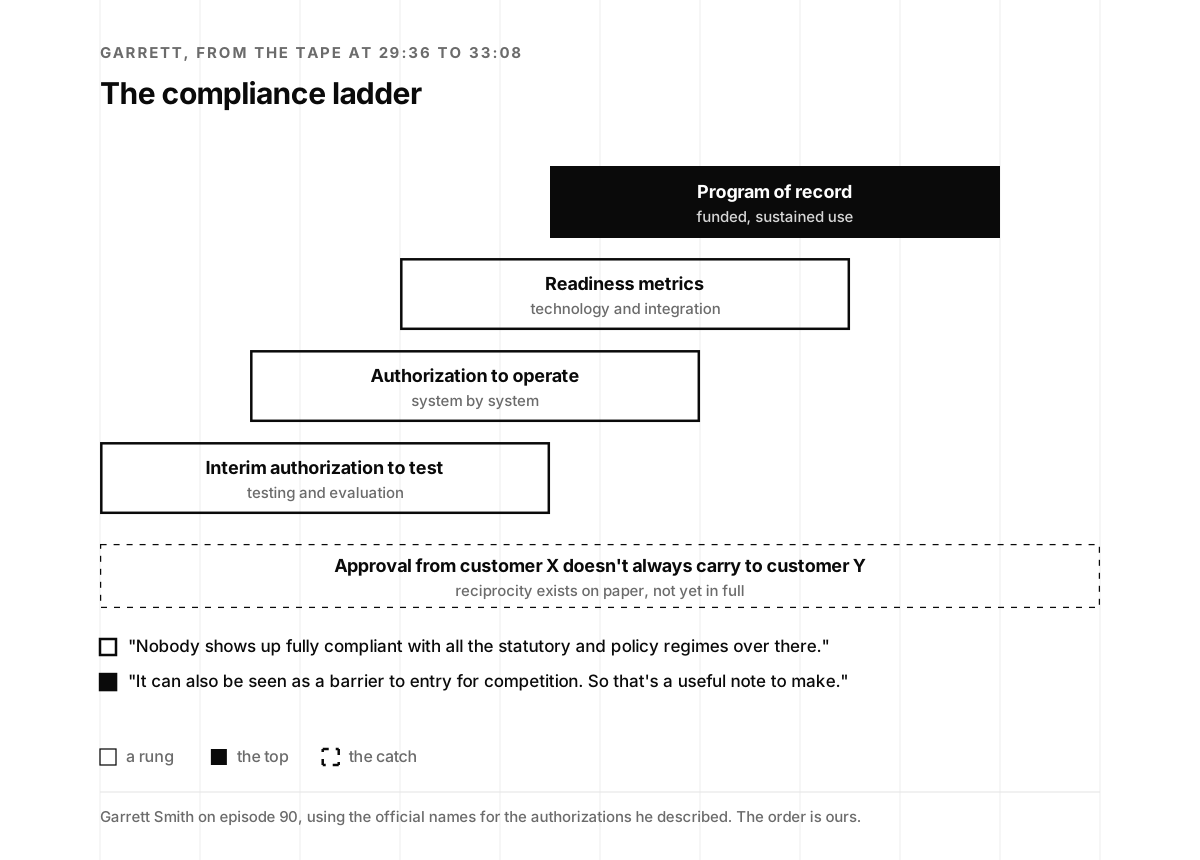
Four boxes rising like steps from lower left to upper right. Open, interim authorization to test, testing and evaluation. Open, authorization to operate, system by system. Open, readiness metrics, technology and integration. Filled, program of record, funded, sustained use. Below, a dashed box: approval from customer X doesn't always carry to customer Y, reciprocity exists on paper, not yet in full. Two quotes from Garrett: "Nobody shows up fully compliant with all the statutory and policy regimes over there." And: "It can also be seen as a barrier to entry for competition. So that's a useful note to make."
The compliance ladder, as Garrett described it.

Partner with the adopter

The way through is counterintuitive. Tell the customer what you don’t know.

“Often, what you can do as a young company entering this market is partner with the adopter, indicate that you don’t know everything they need from you in terms of compliance, and to partner with you, the young company, to make it happen.”

Garrett Smith, at 30:59

Listen · Garrett on episode 90, from 30:58
About 40 seconds: Garrett on partnering with the adopter through compliance. The clip stops on its own. Read the full transcript.

“And oftentimes, we’ve discovered that while it can be a slower process, that actually engenders a huge amount of trust with the end user and adopter and the customer”

Garrett Smith, at 31:13

“Nobody shows up fully compliant with all the statutory and policy regimes over there.”

Garrett Smith, at 31:27

Sasha asked whether that’s what’s called sponsorship, an agency or a team that walks a company through the process because it wants the product. Garrett said that’s exactly right, and part of it.

Reciprocity, mostly missing

The catch is that passing once doesn’t mean passing everywhere.

“A challenge that many companies run into with the federal government is that fully satisfying the compliance regime with customer X doesn’t always mean that you’re immediately adoptable by customer Y.”

Garrett Smith, at 32:06

Listen · Garrett on episode 90, from 32:17
About 20 seconds: Garrett on reciprocity and the moat it makes. The clip stops on its own. Read the full transcript.

On paper, the department’s instruction for the Risk Management Framework, DoD Instruction 8510.01, commits it to reciprocity between components (DoD). In practice, Garrett said, it doesn’t exist in full form, and he pointed out the other side of it.

“It can also be seen as a barrier to entry for competition. So that’s a useful note to make.”

Garrett Smith, at 32:33

He thinks the federal government has woken up to the need for better reciprocity, and he gave Jon the last word on why the hurdle exists at all.

“this is an important level of security that’s baked into federal acquisition processes that does slow things down, but it does mean that the systems and ecosystems that you’re working within are quite secure.”

Garrett Smith, at 32:55

For startups selling into the department, the frameworks that show up first are usually CMMC for contractors handling controlled information and FedRAMP for cloud services. Our CMMC Level 2 and FedRAMP teams start from the same place Garrett did, with a partner who knows the ladder.

Why it still matters

Sasha asked why, with all the hurdles and the bureaucracy, it still matters for national security that people like Garrett keep showing up. Garrett answered with history.

“I’ve been gratified and excited by the fact that the venture capital and Silicon Valley ecosystems have rediscovered the imperative for building national security technologies. For a long time, that was not the case.”

Garrett Smith, at 33:32

From the 1940s to the 1980s, he said, Silicon Valley built the technologies that won the Cold War. When the Soviet Union collapsed between 1989 and 1991, the moment people called the end of history, the energy and risk capital went to the internet, cloud computing and mobile phones. Meanwhile, he said, adversaries kept rising, and by the early 2010s revisionist forces in Russia and China were challenging the order the United States and its allies had built.

“And so by the mid-2010s, venture capital and the national security enterprise, everybody realized, wait, we need some disruption here.”

Garrett Smith, at 35:01
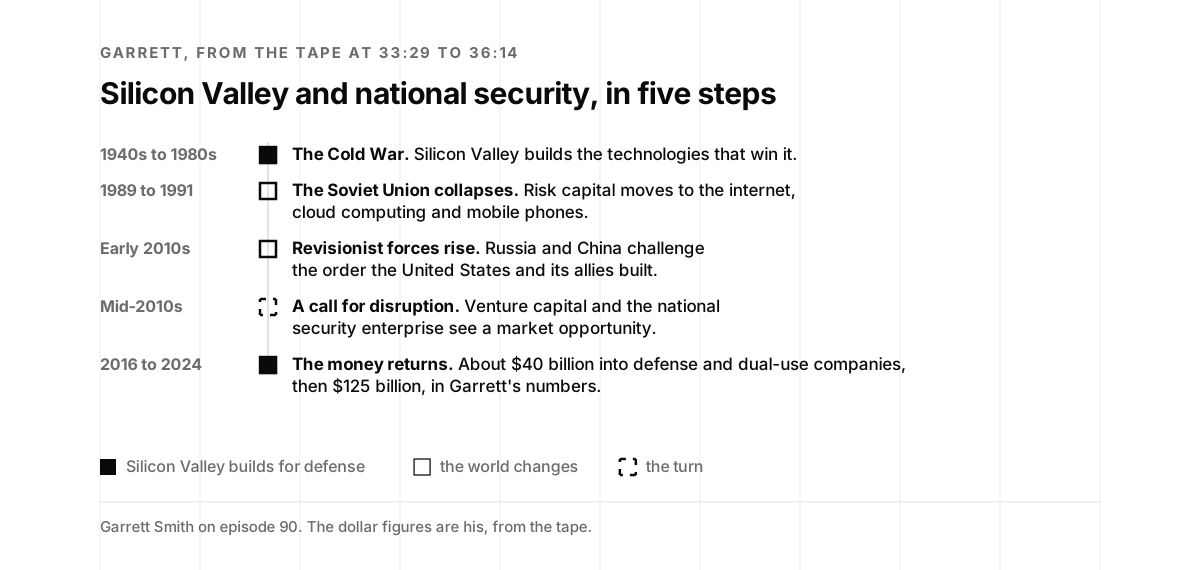
A timeline of five entries. Filled, 1940s to 1980s, the Cold War: Silicon Valley builds the technologies that win it. Open, 1989 to 1991, the Soviet Union collapses: risk capital moves to the internet, cloud computing and mobile phones. Open, early 2010s, revisionist forces rise: Russia and China challenge the order the United States and its allies built. Dashed, mid-2010s, a call for disruption: venture capital and the national security enterprise see a market opportunity. Filled, 2016 to 2024, the money returns: about $40 billion into defense and dual-use companies, then $125 billion, in Garrett's numbers.
Garrett's history of Silicon Valley and national security, in five steps.

A hot and frothy market

Then the numbers, as he gave them.

“So between 2016 and 2020, something like $40 billion was invested into defense and dual-use companies. Much of that went into SpaceX, actually. From 2020 to 2024, that actually tripled to $125 billion.”

Garrett Smith, at 35:30

Listen · Garrett on episode 90, from 35:30
About 15 seconds: Garrett on the money flowing into defense tech. The clip stops on its own. Read the full transcript.

Counts vary with how dual-use companies are classified, but every count points the same way. J.P. Morgan, using PitchBook data, put venture investment in US defense tech startups at about $38 billion in the first half of 2025 alone (J.P. Morgan). In January 2026, Defense News reported PitchBook’s count of a record $49.1 billion in defense tech venture deals for 2025 (Defense News).

Do well by doing good

Garrett’s case for the market isn’t only the money.

“This is a meaningful space where you can do well by doing good, and is important for our society and keeping peace and deterrence in the world.”

Garrett Smith, at 36:05

Jon said he could feel the passion and the patriotism, and that it was all connected. The same thread runs through Reveal’s own front page, which tells visitors “We are building Reveal for the warrior, because we are those warriors” (Reveal).

The tool he’d buy

Jon asked one of his favorite questions: what tool or service doesn’t exist yet that you’d throw money at? Garrett said it was an easy one.

“So every day we see highlight videos from the Ukraine-Russia front where small drones are being used as one-way attack munitions to kill people, destroy lives, destroy infrastructure, and otherwise challenge the Ukrainians or the Russians, either direction.”

Garrett Smith, at 36:49

Listen · Garrett on episode 90, from 36:47
About 50 seconds: Garrett on small drones, from ISIS to Ukraine. The clip stops on its own. Read the full transcript.

It isn’t entirely new, he said. ISIS used small drones in Iraq and Syria, and the 2020 war between Armenia and Azerbaijan showed drones killing tanks. But only in Ukraine has it reached industrial scale, with swarms of low-cost, attritable one-way attack drones.

“And so what we need in the West is really good drone deterrence and counter-drone capability.”

Garrett Smith, at 37:58

That means the whole chain, from awareness, spotting, tracking and identifying threats all the way to taking kinetic action. His LinkedIn adds context he didn’t mention on the tape: from 2022 to 2025 he led the small drone red team at the Marine Innovation Unit (LinkedIn).
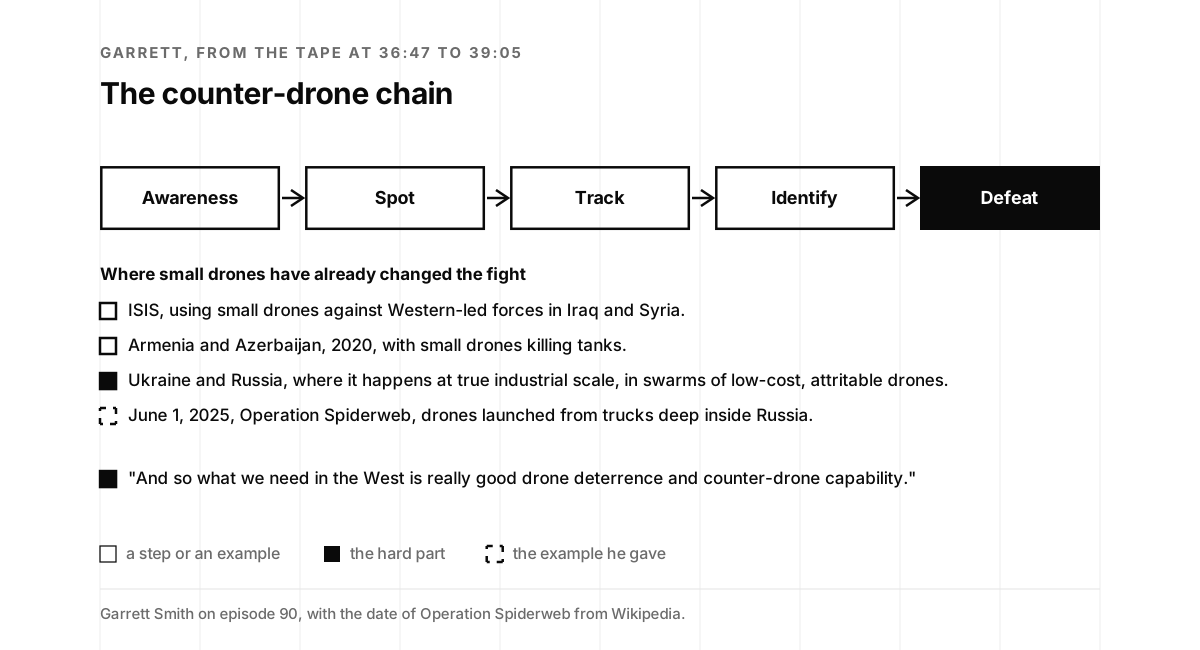
Five boxes in a row joined by arrows: awareness, spot, track, identify, and, filled, defeat. Below, where small drones have already changed the fight: ISIS, using small drones against Western-led forces in Iraq and Syria. Armenia and Azerbaijan, 2020, with small drones killing tanks. Filled, Ukraine and Russia, where it happens at true industrial scale, in swarms of low-cost, attritable drones. Dashed, June 1, 2025, Operation Spiderweb, drones launched from trucks deep inside Russia. A quote from Garrett: "And so what we need in the West is really good drone deterrence and counter-drone capability."
The counter-drone chain Garrett described.

Here in Middle America

Then he brought it home.

“Think about how Ukraine a number of months ago infiltrated trucks that then flew small drones on a semi-autonomous basis to destroy major Russian assets way behind enemy lines.”

Garrett Smith, at 38:29

Listen · Garrett on episode 90, from 38:29
About 25 seconds: Garrett on the drone threat to infrastructure at home. The clip stops on its own. Read the full transcript.

That was Operation Spiderweb, the covert drone attack the Security Service of Ukraine carried out on June 1, 2025, against Russian Air Force bombers at five air bases deep inside Russia.

“That could happen for critical infrastructure here in Middle America. I live in Montana.”

Garrett Smith, at 38:41

“And it doesn’t cost very much money for an adversary to do it.”

Garrett Smith, at 38:53

Jon summed it up. That’s not a weekend project, and you can’t vibe code that one. Garrett agreed, twice. Our explainer on counter-drone technology walks the detect, track, identify and defeat chain from this part of the episode.

The only way you deter war

Jon asked for parting words. Garrett said defense technology can sound aggressive or violent, and that some people have philosophical reasons to stay away from it.

“I’ll just say that there are real, true threats out in the world.”

Garrett Smith, at 39:57

Listen · Garrett on episode 90, from 40:01
About 10 seconds: Garrett on deterrence. The clip stops on its own. Read the full transcript.

“And the only way you deter war is by preparing adequately to win.”

Garrett Smith, at 40:08

Reveal: The Digital Arms Room for the Modern Warrior, a video of just under three minutes on Reveal's YouTube channel from February 23, 2026, the fourth anniversary of Russia's invasion of Ukraine. It's Reveal's own production, and it makes the same argument Garrett makes here. Watch on YouTube.

It’s the same line Reveal puts at the top of its site, “the only way to prevent war is to be prepared to win it” (Reveal), and the old idea behind deterrence theory. He closed with a recruiting pitch for an industry that needs entrepreneurial talent, and for his own company.

“We have an incredible company culture that is mission-focused. We love each other. We’re doing good. And this could be a place for you.”

Garrett Smith, at 40:34

What happened after the tape

The record since the recording follows the plan Garrett described.

When we recorded. The tape doesn’t give a date. Garrett calls the Series B “earlier this year” and says Reveal is six and a half years old, and Reveal announced the Series B on July 15, 2025 (Reveal). So the conversation took place in the second half of 2025, and the episode aired on March 10, 2026.

Another acquisition. On January 8, 2026, Reveal said it had acquired Anomaly Six, whose location intelligence it pairs with Farsight and Identifi (Reveal). That’s the consolidator strategy from the tape, a second time.

The program of record, in public. On May 1, 2026, Reveal announced Identifi’s adoption as a program of record for tactical biometrics across US Special Operations Command (Reveal).

More Farsight. On October 7, 2026, Reveal announced a $9.5 million US Army purchase order for Farsight for infantry brigades (Reveal), and on October 12 it launched Farsight 2.0 (Reveal).

Law enforcement. On November 3, 2026, Taiwan’s Criminal Investigation Bureau Special Tactical Unit became a Farsight customer (Reveal).

Garrett. His LinkedIn now lists him in the Individual Ready Reserve as a lieutenant colonel from January 2026, after four years leading the Marine Innovation Unit’s small drone red team (LinkedIn). Reveal’s company page counts more than 11 allied nations using its products and more than $120 million in total contract value awarded (Reveal).
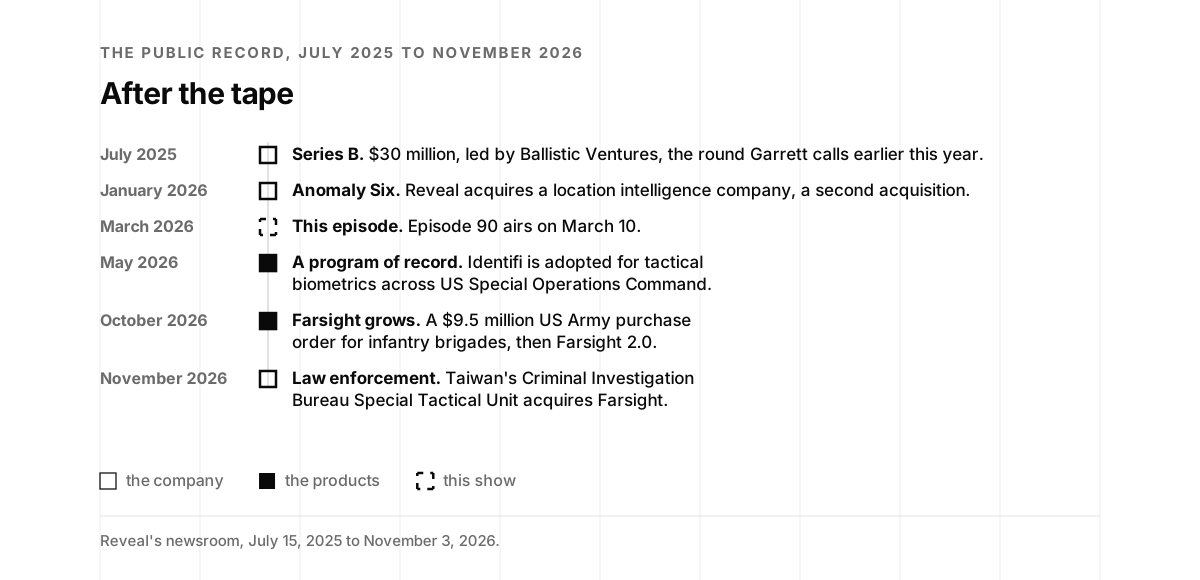
A timeline of six entries. Open, July 2025, Series B: $30 million, led by Ballistic Ventures, the round Garrett calls earlier this year. Open, January 2026, Anomaly Six: Reveal acquires a location intelligence company, a second acquisition. Dashed, March 2026, this episode: episode 90 airs on March 10. Filled, May 2026, a program of record: Identifi is adopted for tactical biometrics across US Special Operations Command. Filled, October 2026, Farsight grows: a $9.5 million US Army purchase order for infantry brigades, then Farsight 2.0. Open, November 2026, law enforcement: Taiwan's Criminal Investigation Bureau Special Tactical Unit acquires Farsight.
The public record after the recording.

What holds up best is the order of operations. Build with the operators, let the demand reach the buyer, partner through the compliance, and grow by acquiring what the same users need next.

Did you catch it? A six-question quiz

Six questions from the episode. Each answer links the moment in the transcript.

Quiz · six questions

Did you catch it?

Pick an answer for each question, then check your score.

  1. What map did Garrett have for some of his combat operations?

    1. A live satellite feed on a tablet
    2. A very outdated 1 in 50,000 topographic map
    3. A hand-drawn sketch from a scout

    b. "a very outdated 1 in 50,000 topographic map and some outdated low-resolution images that in no way represented the terrain and the environment that we were going to move into." Transcript, 8:08.

  2. Who did Palantir offer its capability to first, in Garrett's telling?

    1. Corporals and sergeants
    2. Local law enforcement
    3. Command centers and senior decision makers

    c. "But they offered it first to command centers and senior decision makers who were relatively abstracted from the actual tactical problems." Transcript, 11:46.

  3. What does Garrett say the economic buyer will always follow?

    1. A groundswell of support and demand signal
    2. The lowest bid
    3. A finished compliance package

    a. "So the economic buyer is always going to come along when there's an intensive groundswell of support and demand signal for a technology that they want." Transcript, 17:13.

  4. How did Reveal fund its early years?

    1. A large seed round from a defense prime
    2. Mostly bootstrapped, with a small team
    3. Government grants alone

    b. "I like to say that we bootstrapped, or kind of bootstrapped." Transcript, 20:11.

  5. What does nobody show up with, according to Garrett?

    1. Full compliance with every statutory and policy regime
    2. A program of record
    3. A government sponsor

    a. "Nobody shows up fully compliant with all the statutory and policy regimes over there." Transcript, 31:27.

  6. What would Garrett throw money at today?

    1. A faster authorization process
    2. Better maps of the Pacific
    3. Ways to detect and defeat small drones

    c. "So I think that's the major opportunity space right now, where there aren't good solutions and there need to be, how to detect and defeat small drones." Transcript, 38:56.

Are you ready to sell to the Department of Defense?

Eight questions for a startup that wants a defense customer, drawn from the path Garrett described. Each one links the part of the episode it comes from.

Scorecard · eight questions

Are you ready to sell to the Department of Defense?

Answer for the product you want a defense customer to buy, as it stands today. If two answers fit, pick the lower one.

  1. Has your product been in the hands of the people who would use it, in a test or an exercise?

    • Not yet
    • In a demo or a lab
    • Yes, in exercises with real units

    "We then networked aggressively to get our technology into the hands of people in the testing and evaluation and exercise environment." See Groundswell.

  2. Do you have a sponsor inside the government who wants the product?

    • No
    • Interested contacts, no sponsor yet
    • Yes, a team walking us through the process

    "Often, what you can do as a young company entering this market is partner with the adopter" See Partner with the adopter.

  3. Where are you on the authorization ladder?

    • We haven't started
    • An interim authorization to test
    • An authorization to operate for at least one system

    "There's an authority to operate, or ATO, certification that you achieve on a system-by-system or integration-by-integration basis." See An incredibly high barrier to entry.

  4. Does your product work without a network connection?

    • No, it needs the cloud
    • Partly, with features turned off
    • Yes, the core runs on the device

    "we've done so much technological kind of advancement to optimize this capability for low-compute mobile devices" See The tactical edge.

  5. Are your security controls documented against a federal framework?

    • No
    • Partly, mapped informally
    • Yes, mapped to CMMC or NIST controls, with evidence

    "Nobody shows up fully compliant with all the statutory and policy regimes over there." See Partner with the adopter.

  6. Do you know how much of your runway the compliance process will take?

    • No
    • A rough guess
    • Yes, the timeline is in the plan

    "if you don't know what you're doing, it could add many years to the product development and product adoption cycle." See An incredibly high barrier to entry.

  7. Is your burn sized for a defense sales cycle?

    • It's built for a SaaS timeline
    • Mostly
    • Yes, a small team until the product fits

    "And so we did not get too far out over our skis, as they say" See Over our skis.

  8. Have you planned for a fresh review with each new government customer?

    • We assume one approval covers everyone
    • We expect some rework
    • Yes, each customer's review is in the plan

    "fully satisfying the compliance regime with customer X doesn't always mean that you're immediately adoptable by customer Y." See Reciprocity, mostly missing.

Outside the gate

The product may be good, but the defense path hasn't started. Put it in front of the people who would use it, in an exercise if you can, and find one person inside the government who wants it enough to sponsor it.

On the ladder

Users have seen it and the paperwork has begun. Next, map your controls to the framework your first contract will ask for, put the authorization timeline in your plan, and size your burn to survive it.

Defense-ready

You've built with the users and started up the ladder. Keep the sponsor close, plan for a fresh review with each new customer, and keep your evidence current as the product changes.

How much runway does the compliance wait cost?

Garrett warned that compliance can add years to the adoption cycle for a company living on the fumes of venture capital. Put in your own numbers to see what the wait for a first authorization costs.

Calculator

How much runway does the compliance wait cost?

Three estimates: the cash you have, what you spend in a month, and how many months you expect before a first authorization lets a customer use the product.

–months of runway
–spent before the first authorization
–of your runway
–months left after it

At this burn your cash lasts about 20 months. Waiting 12 months for a first authorization spends about $2,400,000, 60% of your runway, and leaves about 8 months after it. A sponsor who walks you through the process, and a product built with the users first, are how Garrett shortened that wait.

The twelve months is an illustration, not a benchmark. The wait depends on the system, the customer and how ready your controls are, and Garrett's point is that it can run to years.

From Reno to Bozeman

Everything on this page sits on one timeline, from Garrett’s enlistment to Reveal’s latest contracts. Filter it by thread.

Timeline · 1991 to 2026

From Reno to Bozeman

Filter by thread. Dates are from the public record except where marked as part of this show.

  1. The Soviet Union dissolves

    The end of the Cold War, when risk capital moved on from defense, in Garrett's history (Wikipedia, on this show).

  2. Infantry Marine

    Garrett enlists, in the Reno, Nevada area (LinkedIn).

  3. Infantry and intelligence officer

    On active duty as a lieutenant, to November 2011 (LinkedIn).

  4. 4th Force Reconnaissance Company

    A platoon commander in the reserves, then the company's intelligence, operations and executive officer, to 2021 (LinkedIn).

  5. Stanford

    A master's in international policy studies, after starting in 2013 (LinkedIn).

  6. Kespry

    Business development at the drone company, to December 2018 (LinkedIn).

  7. Reveal is founded

    By former Marine Corps officers and Stanford technologists, in Bozeman (Reveal, LinkedIn, on this show).

  8. Armenia and Azerbaijan

    Small drones kill tanks in the Second Nagorno-Karabakh War (Wikipedia, on this show).

  9. Company A, 4th Reconnaissance Battalion

    Commanding officer, to January 2022 (LinkedIn).

  10. Small drone red team

    Head of the sUAS red team at the Marine Innovation Unit, to December 2025 (LinkedIn).

  11. TechCrunch

    Coverage of Reveal's raise (Reveal).

  12. American Dynamism 50

    Andreessen Horowitz names Reveal to its list of companies shaping the fight of the future (Reveal).

  13. Maxar

    A partnership to bring Maxar's high-resolution imagery to Farsight (Reveal).

  14. Operation Spiderweb

    Ukraine's truck-launched drone attack on bombers deep inside Russia (Wikipedia, on this show).

  15. Series B

    A $30 million round led by Ballistic Ventures (Reveal, on this show).

  16. STRATFI extended

    Reveal executes its option to extend a STRATFI contract award (Reveal).

  17. Individual Ready Reserve

    Garrett, now a lieutenant colonel (LinkedIn).

  18. Anomaly Six

    Reveal acquires the location intelligence company (Reveal, on this show).

  19. A record year

    PitchBook counts $49.1 billion of defense tech venture deals in 2025 (Defense News).

  20. Episode 90

    The episode airs (transcript).

  21. Identifi, a program of record

    Adopted for tactical biometrics across US Special Operations Command (Reveal, on this show).

  22. On YouTube

    The full episode goes up on our channel (YouTube).

  23. US Army order

    A $9.5 million purchase order for Farsight for infantry brigades (Reveal).

  24. Farsight 2.0

    A new version for the tactical edge (Reveal).

  25. Taiwan

    The Criminal Investigation Bureau Special Tactical Unit acquires Farsight (Reveal, on this show).

What to do this week

Five things, in the order Garrett’s path suggests.

  1. Put the product in a user’s hands. Find one exercise, test event or pilot where the people who would carry it can use it and tell you what’s wrong. The scorecard above shows where else you stand.
  2. Find one sponsor. A team inside the government that wants the product is the partner Garrett says gets you through compliance.
  3. Map your controls before the contract asks. If controlled information is in your future, start with CMMC Level 2, and with FedRAMP if you sell a cloud service.
  4. Size your burn for the wait. The calculator shows what a year of waiting costs you.
  5. Plan for each customer’s review. Reciprocity is thinner than it looks on paper, so budget the rework. If you’d like a second pair of eyes on any of it, book 15 minutes with us.

Key takeaways

  1. Build for the person who carries the risk

    Garrett Smith's thesis for Reveal is to give the tactical decision maker, the person actually taking the physical risk, the ability to generate their own intelligence on the fly at the point of the problem, instead of waiting in a headquarters queue for a map that may never come.

  2. Founders who were the customer

    Garrett and his co-founder Andrew Dixon are Marine officers who served in combat in Afghanistan and lived the intelligence gap. Being their own customers gave them insight into what to build, why, and who would use it.

  3. Focus is the whole game

    With a team of four co-founders who had worked together for years, the team was the solved part of the equation. Garrett says focusing on the wrong thing is death for a company, and the job was finding a gap they could care about for the life of a young company.

  4. Drone video into maps on a handheld

    Farsight began as a mobile application that ingests drone video and rapidly generates high-resolution 2D and 3D maps, with analytics on top, built to run on low-compute devices rather than servers and clouds.

  5. The mobile revolution, for the military

    Garrett compares much of the military's current mapping to querying a lap atlas in the car. Reveal's aim is the experience almost everyone already has with digital maps on a phone, brought to the field.

  6. A partner to Palantir, at a different layer

    In Garrett's account, Palantir offered its capability first to command centers and senior decision makers, while Reveal serves the decentralized, low-echelon decision maker first and reaches up the echelons toward where Palantir delivers value.

  7. The user isn't the buyer

    Garrett separates the ideal user profile, corporals and boots on the ground, from the economic buyer, who in defense is highly abstracted and distant from the end user. Every company selling into national security hits that gap.

  8. Bottom-up and top-down at the same time

    Reveal went to the corporals and sergeants first, reached a minimum viable product and something like product-market fit with them, and in parallel engaged Congress, program managers and senior decision makers, so the demand signal met lined-up resourcing.

  9. The buyer follows the groundswell

    Garrett says the economic buyer always comes along when there's an intensive groundswell of support and a demand signal from the users, because the buyer can't ignore what constituents say they want and need.

  10. Defense is a slower road to a bigger prize

    The road to meaningful revenue in defense is slower, and once you're there it's big. That makes the usual seed to Series A to Series B venture timeline a poor fit, so Reveal mostly bootstrapped with a small, focused team before raising.

  11. Grow like a consolidator

    The defense market is full of platforms and consolidators. Reveal acquired a young biometrics company, battle-hardened its prototype into Identifi, and won a Special Operations Command program of record against large legacy contractors.

  12. Prove it every day

    Garrett thinks the legacy vendors fell out of the innovation narrative because they got too comfortable and didn't innovate fast enough, so Reveal intends to prove its value every single day.

  13. Compliance is the barrier to entry

    Selling software into connected government systems means an interim authority to test, an authority to operate granted system by system, and readiness metrics. Without knowing the path, it can add years to the adoption cycle for a resource-constrained startup.

  14. Partner with the adopter

    Garrett's advice is to tell the adopter what you don't know about their compliance needs and make it happen together. The process can be slower, and it builds a huge amount of trust, because nobody shows up fully compliant.

  15. Reciprocity is thinner than it looks

    Satisfying customer X's compliance regime doesn't always make you adoptable by customer Y. Garrett notes the same gap is a barrier to entry for competitors, and that the government has woken up to the need for better reciprocity.

  16. The gap he'd pay to close: small drones

    Small one-way attack drones have reached industrial scale in Ukraine and Russia. Garrett says the West needs counter-drone capability across the chain, from spotting and tracking to kinetic defeat, including for critical infrastructure at home.

Chapters

Tap a chapter to play from there. The play icon beside it opens that moment on YouTube.

Pull quotes

“Garrett Smith, founder and CEO at Reveal. We do run the company out of Bozeman, Montana, but we have people on the team all over the map”

Garrett Smith ·

“I'm still in the Reserve component of the Marine Corps. I've been in for just over 21 years.”

Garrett Smith ·

“So it's been a unique pleasure and definitely informs all of what we do at Reveal.”

Garrett Smith ·

“What is the most interesting and maybe difficult part transitioning from being in service and becoming a founder of a company?”

Sasha Sinkevich ·

“So there's almost nothing more addictive and more meaningful than being oriented on a public service initiative as a mission.”

Garrett Smith ·

“But I came up through the ranks of the military and caught what I would call the national security bug and was never cured of that bug.”

Garrett Smith ·

“And the truism that at the end of the day, in combat, you're fighting for the person to your left or to your right and your teammates, it's totally true.”

Garrett Smith ·

“So coming back to answer your question, Sasha, the hard thing about transitioning from the military into the civilian or private sector is finding a way to attach yourself to a mission that can be as meaningful as the one that we used to serve while in uniform.”

Garrett Smith ·

“How do you determine and how do you distill down what actually is important and what we should focus on in order to solve that pain point?”

Sasha Sinkevich ·

“And focusing on the wrong thing is actually death of a company. And focusing on the right thing is literally the whole game.”

Garrett Smith ·

“And so the kind of team element of the equation was relatively solved.”

Garrett Smith ·

“We, in other words, were our customers. We were the people we were trying to serve.”

Garrett Smith ·

“That allowed us unique insight into the product development phase of the company, so that we not only understood the product that we needed to build, but why we were building it and who would be using it.”

Garrett Smith ·

“a very outdated 1 in 50,000 topographic map and some outdated low-resolution images that in no way represented the terrain and the environment that we were going to move into.”

Garrett Smith ·

“And so the thing that we built and the thing that we dreamed of having was a mobile device optimized software application that could ingest video streams from drones and rapidly generate high-resolution two-dimensional and three-dimensional maps.”

Garrett Smith ·

“You would be stacked into a prioritization queue.”

Garrett Smith ·

“And so, more often than not, we would never get the intelligence that we requested.”

Garrett Smith ·

“So our entire thesis was, how do we enable that decision maker, that tactical decision maker who's actually adopting all of the physical risk, how do we endow that person with the ability to generate their own intelligence on the fly, at the point of the problem?”

Garrett Smith ·

“From there, our flagship product, Farsight, was born.”

Garrett Smith ·

“Imagine that analog, querying the lap atlas in your car to get around. That's how the military, in many places, still operates.”

Garrett Smith ·

“We're helping the military get it into the 21st century, in other words.”

Garrett Smith ·

“I'm super surprised, like, Palantir didn't step in, or someone like that, to do something like this.”

Jon McLachlan ·

“We would prefer to see it as partnering with Palantir or others like Palantir operating in the space.”

Garrett Smith ·

“But they offered it first to command centers and senior decision makers who were relatively abstracted from the actual tactical problems.”

Garrett Smith ·

“What we're doing is servicing the highly decentralized, low-echelon decision maker first.”

Garrett Smith ·

“We call that place the tactical edge. You know, that's where corporals and sergeants and lieutenants are making decisions in the high-risk physical terrain, right at the point of the problem”

Garrett Smith ·

“That's where our value proposition lies, because we've done so much technological kind of advancement to optimize this capability for low-compute mobile devices rather than high-compute, high-resource architectures like servers and clouds and command centers.”

Garrett Smith ·

“So corporals and boots on the ground is your ICP. That's your ideal customer profile.”

Sasha Sinkevich ·

“That's our ideal user profile. In the defense security kind of environment, the customer or the buyer is actually highly abstracted and distant from that end-user set.”

Garrett Smith ·

“The legacy set typically will go top-down.”

Garrett Smith ·

“So what we chose to do was blend a Silicon Valley approach with that top-down legacy approach.”

Garrett Smith ·

“So we married those two efforts really healthfully for our end-user set. And now we can scale adoption with a product that they actually want to adopt, which is not always the case with legacy technologies in the military.”

Garrett Smith ·

“So I don't think we were particularly good in the early days at navigating the bureaucracy and navigating the top-down side of how this sales process works for the federal government.”

Garrett Smith ·

“So the economic buyer is always going to come along when there's an intensive groundswell of support and demand signal for a technology that they want.”

Garrett Smith ·

“That's a really unique entrepreneurial story. Congratulations on pulling that one off.”

Jon McLachlan ·

“Yeah, it's irregular.”

Garrett Smith ·

“You get sticky and you remain sticky when you're actually solving problems at the end-user level.”

Garrett Smith ·

“But then, like, what are you sacrificing in terms of quality?”

Jon McLachlan ·

“but there's a very different and much slower road to success in defense. But once you're there, it's quite big.”

Garrett Smith ·

“And what that means is that the traditional venture capital model actually might not be fully appropriate for a defense upstart project as well.”

Garrett Smith ·

“I like to say that we bootstrapped, or kind of bootstrapped.”

Garrett Smith ·

“And so we did not get too far out over our skis, as they say, in terms of headcount and ramping the company growth metrics of headcount, high burn, all that stuff.”

Garrett Smith ·

“Instead, we focused maniacally on building the right product with a very small, kind of focused team first.”

Garrett Smith ·

“And we're definitely on the ramp for revenue, having hit the hockey stick inflection point, as they say.”

Garrett Smith ·

“But we're six and a half years into this company, and that's a different pace given alternatives in the SaaS market.”

Garrett Smith ·

“Yeah, so we're definitively and explicitly a defense company.”

Garrett Smith ·

“An infantry unit in the military is so much like a SWAT team in a regional SWAT office or a sheriff's department, right?”

Garrett Smith ·

“The defense market is full of platforms and consolidators.”

Garrett Smith ·

“So we will acquire companies. We are a consolidator. We're a buyer, in other words.”

Garrett Smith ·

“They had a very good prototype product called Identifi that we thought could be a contender for a Special Operations Command program of record.”

Garrett Smith ·

“And we recently outright won the program of record, competing with large legacy contractors, for that major contract over a multi-year basis.”

Garrett Smith ·

“And so now we're demonstrating that we have multiple products that are generating real production revenue, one of which is now a program of record with the US military.”

Garrett Smith ·

“all optimized for that corporal, sergeant, lieutenant, junior decision maker that's out there at the tactical edge of the battle space.”

Garrett Smith ·

“The story of the company, the company was born through that direct relationship with boots on the ground.”

Sasha Sinkevich ·

“We've built the relationships of trust with this customer and user set, so that as new emerging requirements come about, we'll be involved in those conversations quite early.”

Garrett Smith ·

“We still need to prove ourselves every day.”

Garrett Smith ·

“I think one of the reasons why the legacy set has sort of failed to be a part of the innovation narrative nowadays is because they got too comfortable and they didn't innovate fast enough.”

Garrett Smith ·

“So we intend to prove our value every single day with new products, with thought leadership and partnership with this critical end-user group.”

Garrett Smith ·

“Are there specific certifications that you just had to land in order to open up the business for the economic buyers?”

Jon McLachlan ·

“an incredibly high barrier to entry in the form of compliance regimes.”

Garrett Smith ·

“I mean, if you don't know what you're doing, it could add many years to the product development and product adoption cycle.”

Garrett Smith ·

“Often, what you can do as a young company entering this market is partner with the adopter, indicate that you don't know everything they need from you in terms of compliance, and to partner with you, the young company, to make it happen.”

Garrett Smith ·

“that actually engenders a huge amount of trust with the end user and adopter and the customer”

Garrett Smith ·

“Nobody shows up fully compliant with all the statutory and policy regimes over there.”

Garrett Smith ·

“So are you talking about a sponsor?”

Sasha Sinkevich ·

“A challenge that many companies run into with the federal government is that fully satisfying the compliance regime with customer X doesn't always mean that you're immediately adoptable by customer Y.”

Garrett Smith ·

“It can also be seen as a barrier to entry for competition. So that's a useful note to make.”

Garrett Smith ·

“this is an important level of security that's baked into federal acquisition processes that does slow things down, but it does mean that the systems and ecosystems that you're working within are quite secure.”

Garrett Smith ·

“I've been gratified and excited by the fact that the venture capital and Silicon Valley ecosystems have rediscovered the imperative for building national security technologies.”

Garrett Smith ·

“And so by the mid-2010s, venture capital and the national security enterprise, everybody realized, wait, we need some disruption here.”

Garrett Smith ·

“This is a hot and frothy market.”

Garrett Smith ·

“This is a meaningful space where you can do well by doing good, and is important for our society and keeping peace and deterrence in the world.”

Garrett Smith ·

“Yeah, I really feel the passion and the patriotism, too. So it's all connected.”

Jon McLachlan ·

“So every day we see highlight videos from the Ukraine-Russia front where small drones are being used as one-way attack munitions to kill people, destroy lives, destroy infrastructure”

Garrett Smith ·

“But only in the case of Ukraine-Russia have we seen this at true industrial scale.”

Garrett Smith ·

“And so what we need in the West is really good drone deterrence and counter-drone capability.”

Garrett Smith ·

“That could happen for critical infrastructure here in Middle America. I live in Montana.”

Garrett Smith ·

“And it doesn't cost very much money for an adversary to do it.”

Garrett Smith ·

“That sounds like a huge problem. That's not a weekend project. You can't vibe code that one.”

Jon McLachlan ·

“And the only way you deter war is by preparing adequately to win.”

Garrett Smith ·

“We have an incredible company culture that is mission-focused. We love each other. We're doing good. And this could be a place for you.”

Garrett Smith ·

About the guest

Garrett Smith, Co-Founder and Chief Executive Officer, Reveal Technology

Garrett Smith is the co-founder and chief executive of Reveal Technology, the Bozeman, Montana, company that builds mission software for the tactical edge, which he founded in December 2018 with Andrew Dixon, Parker Clark and John Laxson. He has served in the Marine Corps for more than 21 years. He enlisted as an infantry Marine in 2005, served on active duty as an infantry and intelligence officer from 2008 to 2011, and in the reserves was a platoon commander and then the intelligence, operations and executive officer of 4th Force Reconnaissance Company, commanding officer of Company A, 4th Reconnaissance Battalion, and from 2022 to 2025 head of the small drone red team at the Marine Innovation Unit. He has been in the Individual Ready Reserve as a lieutenant colonel since January 2026. Before Reveal he worked in business development at the drone company Kespry from 2016 to 2018. He holds a master's in international policy studies from Stanford, a certificate in innovation and entrepreneurship from the Stanford Graduate School of Business and a bachelor's in linguistics from Brigham Young University.

About the host

Jon McLachlan and Sasha Sinkevich are co-founders of YSecurity, the on-demand cybersecurity team for startups, and of Cyberbase.ai. The Security Podcast of Silicon Valley is hosted by Jon McLachlan and Sasha Sinkevich. Jon McLachlan on LinkedIn ↗Sasha Sinkevich on LinkedIn ↗

Context and sources

  • Garrett Smith's LinkedIn experience: founder and chief executive of Reveal Technology since December 2018, more than 21 years in the Marine Corps from infantry Marine in 2005 through 4th Force Reconnaissance Company, Company A of the 4th Reconnaissance Battalion and head of the small drone red team at the Marine Innovation Unit from 2022 to 2025, the Individual Ready Reserve as a lieutenant colonel from January 2026, and business development at Kespry from 2016 to 2018. Source ↗
  • Garrett Smith's LinkedIn education: a master's in international policy studies at Stanford University from 2013 to 2015, a Stanford Graduate School of Business certificate in innovation and entrepreneurship, and a bachelor's in linguistics from Brigham Young University. Source ↗
  • Reveal, company page: founded in 2018 by former U.S. Marine Corps officers and Stanford technologists, headquartered in Bozeman, Montana, with offices in Washington, D.C., and San Francisco, more than 11 allied nations using its products, more than $120 million in total contract value awarded, and co-founders Garrett Smith, Andrew Dixon, Parker Clark and John Laxson. Source ↗
  • Reveal, home page: mission software for the tactical edge, purpose-built for contested and disconnected environments, under the line that the only way to prevent war is to be prepared to win it. Source ↗
  • Reveal, Farsight: a 3D mapping and terrain intelligence platform that turns drone, satellite and sensor imagery into a single operational interface for frontline units. Source ↗
  • Reveal, Identifi: a biometrics identity intelligence platform for establishing and verifying identity on a mobile device, online or offline. Source ↗
  • Reveal, December 11, 2024: TechCrunch covers Reveal's raise. Source ↗
  • Reveal, March 15, 2025: Andreessen Horowitz names Reveal to its American Dynamism 50, companies shaping the fight of the future. Source ↗
  • Reveal, May 1, 2025: a partnership with Maxar to bring high-resolution imagery to Farsight. Source ↗
  • Reveal, July 15, 2025: a $30 million Series B led by Ballistic Ventures. Source ↗
  • Reveal, August 1, 2025: Reveal executes its option to extend a STRATFI contract award. Source ↗
  • Reveal, January 8, 2026: Reveal acquires Anomaly Six, whose location intelligence complements Farsight and Identifi. Source ↗
  • Reveal, May 1, 2026: Identifi is adopted as a program of record for tactical biometrics across US Special Operations Command, moving handheld identity verification from evaluation into sustained operational use. Source ↗
  • Reveal, October 7, 2026: a $9.5 million US Army purchase order for Farsight for infantry brigades. Source ↗
  • Reveal, October 12, 2026: Reveal launches Farsight 2.0. Source ↗
  • Reveal, November 3, 2026: Taiwan's Criminal Investigation Bureau Special Tactical Unit acquires Farsight through MIST Taiwan. Source ↗
  • Ballistic Ventures, team: Kevin Mandia is listed as a general partner. Source ↗
  • Wikipedia, Mandiant: founded by Kevin Mandia, a former United States Air Force officer, as Red Cliff Consulting in 2004. Source ↗
  • Wikipedia, Operation Spiderweb: the covert drone attack the Security Service of Ukraine carried out deep inside Russia on June 1, 2025, against bombers at five air bases. Source ↗
  • Wikipedia, Second Nagorno-Karabakh War: the 2020 war between Azerbaijan and Armenia over Nagorno-Karabakh. Source ↗
  • Wikipedia, Anduril Industries: an American military technology company founded in 2017. Source ↗
  • J.P. Morgan, September 18, 2025, with PitchBook data: venture investment in US defense tech startups of roughly $38 billion in the first half of 2025. Source ↗
  • Defense News, Rudy Ruitenberg, January 20, 2026: PitchBook counts a record $49.1 billion of defense tech venture deals in 2025, up from $27.2 billion a year earlier. Source ↗
  • DoD Instruction 8510.01, the Risk Management Framework for DoD systems, which commits the department to cybersecurity reciprocity. Source ↗
  • NASA, technology readiness levels: the scale from 1, basic principles observed, to 9, a system proven in operation. Source ↗
  • Warfighting Acquisition University glossary, program of record: a program as recorded in the current Future Years Defense Program. Source ↗

Transcript

Automatic transcription. Jon McLachlan and Sasha Sinkevich host this episode with Garrett Smith. There is no diarization on the tape, so speaker labels were assigned from the content and checked passage by passage against reference recordings of each voice from this episode, and a few short lines may sit with the wrong speaker. Names and product names were normalized where the recognizer misheard them (Jon McLachlan, Sasha Sinkevich, Garrett, Farsight, Identifi, Anduril, Robinhood, YSecurity). Words in [brackets] are best guesses where the audio is unclear, and the two sponsor reads are summarized in brackets. Answers are transcribed as spoken, with repeated words and false starts trimmed. The goodbyes after the sign-off are left out.

Read the full transcript 7,029 words

[Sponsor read: YSecurity, the sponsor of the show. Forty-plus security engineers who've done security at Apple, Uber, Microsoft, Robinhood and Brex, rented by the hour with a monthly cap, for SOC 2, ISO and HIPAA. Book a free strategy call, and the first eight hours are free at ysecurity.io/startups.]

Jon McLachlan

Hello, everyone, and welcome to another episode of The Security Podcast of Silicon Valley. We have an amazing guest with us, Garrett Smith, the founder and CEO of Reveal Technologies, with us, broadcasting live from, actually, Bozeman, Montana. Garrett, welcome to the show.

Garrett Smith

Thanks, Jon. Thanks, Sasha. Happy to be here. Garrett Smith, founder and CEO at Reveal. We do run the company out of Bozeman, Montana, but we have people on the team all over the map, not just here in the U.S., but overseas as well, to include the Pacific Rim and growing presence in Europe and servicing our NATO ally partners and customers.

Jon McLachlan

Yeah, I have to say, like, I was looking at your LinkedIn and I see that you were part of the United States Marine Corps for 20 years before you jumped in and started Reveal Technologies. So I just wanted to say, like, thank you for your service.

Garrett Smith

Yeah, thank you. And some of that service actually overlaps with my time building Reveal Technology. I'm still in the Reserve component of the Marine Corps. I've been in for just over 21 years. I'm a lieutenant colonel in the reserves, and I've been able to pursue that line of my profession in parallel with building Reveal and my kind of time in Silicon Valley proper. So it's been a unique pleasure and definitely informs all of what we do at Reveal. It's my professional, personal and passion background, for sure.

Sasha Sinkevich

Thank you for your service, Garrett. What is the most interesting and maybe difficult part transitioning from being in service and becoming a founder of a company?

Garrett Smith

So there's almost nothing more addictive and more meaningful than being oriented on a public service initiative as a mission. So being attached directly to a national security mission imbues everything you do with a sense of purpose and a sense of high impact and a sense of importance and meaning in a way that building the next great dating app probably doesn't, unless you're just incredibly passionate about solving people's relationship problems, which maybe you are. And great. If that's your thing, amazing. But I came up through the ranks of the military and caught what I would call the national security bug and was never cured of that bug. This has been a passion project for us, my co-founders and I, and it extends way back into the mid-2000s, when I first enlisted in the Marines with my brother in the wake of 9/11 and the invasion of Iraq in 2003. And we were absorbed into this heady space where we were overseas, in harm's way, learning and working together and, you know, working on each other's behalf and doing it in service to a national mission that we really believed in. In retrospect, obviously, there's all kinds of criticisms you could level at the national security enterprise. Should we, should we not have been in X, Y or Z location? But at the end of the day, we believed at the time that we were doing a good and righteous thing. And the truism that at the end of the day, in combat, you're fighting for the person to your left or to your right and your teammates, it's totally true. And we found through the course of that experience that the national security enterprise and the warfighters like us were ill-equipped in terms of technology to confront real 21st-century problems, especially as we transitioned from open desert warfare against relatively backward opponents and now confronting a global security crisis that really looks more like peer competition from Russia and from China. So coming back to answer your question, Sasha, the hard thing about transitioning from the military into the civilian or private sector is finding a way to attach yourself to a mission that can be as meaningful as the one that we used to serve while in uniform.

Sasha Sinkevich

Awesome. There are so many different levels of noise about different problems, and different problems present themselves in many different ways. How do you determine and how do you distill down what actually is important and what we should focus on in order to solve that pain point?

Garrett Smith

How do you remove the noise and focus, identify the pain points? It's really difficult. And as you know, a successful founder in your own right and being surrounded by lots of successful projects and founders in your communities, you know that focus is everything. And focusing on the wrong thing is actually death of a company. And focusing on the right thing is literally the whole game. So at the beginning of our company's history, Reveal, back in 2018, I had the benefit of starting this project with three of my best friends and co-founders, with whom I'd been working for many, many years. And so the kind of team element of the equation was relatively solved. And so what we needed to do was find a mission and a problem area or a gap in the national security market and figure out whether we could build an adequate solution that we were also still passionate at solving, and do it over the course of a young company lifespan. So that problem that we found, and in fact, this was the problem we identified well before we started the company, was born of personal experience. So my co-founder, Andrew Dixon, and I are both Marine officers by background. We both served in combat operations overseas in Afghanistan and elsewhere. And we directly and personally experienced a technology gap and shortfall that meant that we didn't have enough information and intelligence going into high-risk raid scenarios and high-risk other military operating scenarios. And so we set out intending to solve an intelligence and information gap for people who looked a lot like us. So we came into that problem area with a huge amount of empathy. We, in other words, were our customers. We were the people we were trying to serve. That allowed us unique insight into the product development phase of the company, so that we not only understood the product that we needed to build, but why we were building it and who would be using it. It just so happened that that thing that we imagined building was also high value enough to where the customer in this case was willing to pay.

Sasha Sinkevich

Yeah, so this is actually very interesting, because there is no lack of funding in the national security space. And there are so many different vendors that are constantly iterating over existing solutions, coming up with new technologies to solve the pain points. What you have mentioned is you've experienced lack of intelligence, or essentially lack of information, or maybe, if I were to [fetch] there, some type of silos of information. And there was no central system that would give you the most relevant piece of information that you needed at that point of time, when that information was critical to make the right or the wrong decision.

Garrett Smith

Yeah, I mean, to get really specific, in too many situations, I found myself leading Marines into a combat scenario, and the only inputs that I had to make decisions and plans and make kind of on-the-fly decisions in live combat operations was a very outdated 1 in 50,000 topographic map and some outdated low-resolution images that in no way represented the terrain and the environment that we were going to move into. In other words, we had insufficient mission planning and situational awareness materials. And so the thing that we built and the thing that we dreamed of having was a mobile device optimized software application that could ingest video streams from drones and rapidly generate high-resolution two-dimensional and three-dimensional maps. At its basic level, that's it. And that was our flagship product. And we've built a number of analytic capabilities that live on top of that in a user interface that is highly engageable by the user demographic. But that was it, right? Like, we needed to be able to decide and act in high-risk environments where time was short, risks were high, people's lives were on the line, and we needed to give an ability to generate intelligence right there at the point of the problem. Historically, if you wanted to get this kind of a mission planning or situational awareness product, you had to request it from a higher headquarters. You would be stacked into a prioritization queue. If you were like my units, you were probably just one of many and not in any way special, or you wouldn't find yourself on the top of that priority queue. And so, more often than not, we would never get the intelligence that we requested. And those intelligence resources were always overtasked, overburdened and had too many constituent customers asking for this kind of support. So our entire thesis was, how do we enable that decision maker, that tactical decision maker who's actually adopting all of the physical risk, how do we endow that person with the ability to generate their own intelligence on the fly, at the point of the problem? From there, our flagship product, Farsight, was born.

Jon McLachlan

Wow. So Farsight, it almost feels like a thing that I can hold in my hand as there's tactical, like, operation unfolding around me, and I can stream live information about what's happening in places I can't see that is 3D enhanced, like a traditional, like, Apple Maps or Google Maps or whatever, but is actually like a live stream of what's going on. Is that more or less?

Garrett Smith

Live stream is likely overstating it, but just imagine the days before we had Apple and Google Maps that allowed us to quickly and intelligently navigate around our city, or even more, a cross-country trip where you didn't know how to get from point A to B. Imagine that analog, querying the lap atlas in your car to get around. That's how the military, in many places, still operates. So what we are doing is facilitating the mobile revolution for the military and doing it with an application that mimics an experience that almost everybody has in the civilian world, in other words, engaging with high-reliability digital mapping capabilities that allow for easy navigation and understanding of your environment. We're helping the military get it into the 21st century, in other words.

Jon McLachlan

Yeah, I couldn't imagine, like, a more meaningful delivery to, like, these are the men and women putting their lives on the line. Of course, we want to have the greatest technology at play, with the latest maps and the latest intel, all of that. I'm super surprised, like, Palantir didn't step in, or someone like that, to do something like this.

Garrett Smith

But they did, actually. So they did.

Jon McLachlan

You're killing Palantir, displacing them.

Garrett Smith

We would prefer to see it as partnering with Palantir or others like Palantir operating in the space. But here's a description of our specific gap that we're filling. Palantir offered a very exquisite, very, very powerful capability in the way that we just described. But they offered it first to command centers and senior decision makers who were relatively abstracted from the actual tactical problems. So they were solving a different layer of the problem stack, and they were doing it for relatively well-endowed, high-resource key decision makers in the upper echelons of a military or intelligence organization. What we're doing is servicing the highly decentralized, low-echelon decision maker first. So we are doing it from the hyper-tactical level, the edge environment, all the way up to the place where Palantir continues to deliver value at upper echelons, if that makes sense.

Jon McLachlan

Makes perfect sense. So your technology is used by, you know, close to where the rubber hits the road, so to speak.

Garrett Smith

That's right.

Jon McLachlan

The men and women actually, like, unfolding.

Garrett Smith

That's right. We call that place the tactical edge. You know, that's where corporals and sergeants and lieutenants are making decisions in the high-risk physical terrain, right at the point of the problem, right at the cutting edge, the bleeding edge, the pointy tip of the spear, however you choose to describe it. That's where our value proposition lies, because we've done so much technological kind of advancement to optimize this capability for low-compute mobile devices rather than high-compute, high-resource architectures like servers and clouds and command centers. That's right.

Sasha Sinkevich

So corporals and boots on the ground is your ICP. That's your ideal customer profile.

Garrett Smith

That's our ideal user profile. In the defense security kind of environment, the customer or the buyer is actually highly abstracted and distant from that end-user set. But you're right, Sasha. Yeah.

Sasha Sinkevich

So that's where I'm actually leading with my question. Yeah. How do you connect with the EB, the economical buyer, to make sure that your ICP, the corporal and boots on the ground, they get all of the value from the technology that you get to offer?

Garrett Smith

This is the problem that any company trying to engage with the national security market is going to encounter, the abstraction between end user and the EB, or the economic buyer. So what we chose to do as a company is very different than how traditional or legacy military vendors or tech vendors go to market in the national security space. The legacy set typically will go top-down. In other words, they'll engage with the economic buyer and the high-order program managers first, generate a list of requirements, build to those requirements, line up funding in partnership with those economic buyers, and eventually that technology will make its way down to the end users who will actually employ the technology. What that doesn't do is what Silicon Valley has been great at for decades now, which is engaging the end user and the consumer first and understanding how they prefer to engage with technology, maybe even advancing the way that people engage with technology, so that by the time they adopt it, it's something they're very comfortable with, that answers their needs and answers it in a way that they can adopt and immediately use and onboard it into their lives or their work environments. The legacy defense technology vendor set doesn't do that. They go from top-down. The benefit of that is that you get a lot of money and resourcing and kind of political heft and stickiness around that go-to-market strategy. So what we chose to do was blend a Silicon Valley approach with that top-down legacy approach. So we first went to the end users, the corporals, the sergeants, the people who would actually be using the technology in their hands in live operations at the point of the problem, solving their problems. We then kind of arrived at a minimum viable product and achieved something like product-market fit with those end-user personas and had a pretty broad-based, ground-level support for what we wanted to deliver and a high appetite for adopting the technology, provided that the top-down problem could be solved. So in parallel with building the right product, we went and engaged with the US Congress, we engaged with program managers and senior decision makers and influencers across the United States Department of Defense, so that by the time the demand signal reached the buyer, the top-down resourcing, appetite to buy, requirements, all of those things were also lined up. So we married those two efforts really healthfully for our end-user set. And now we can scale adoption with a product that they actually want to adopt, which is not always the case with legacy technologies in the military.

Jon McLachlan

Yeah, definitely not. Were you able to do that particularly effectively because of your connection with the Marines, and you kind of knew who to go to and could navigate sort of the bureaucracy or the individual units, so to speak?

Garrett Smith

So I don't think we were particularly good in the early days at navigating the bureaucracy and navigating the top-down side of how this sales process works for the federal government. But what we did know were units and people who would be the prototypical customer and user. So we brought all that empathy into the product development phase. We then networked aggressively to get our technology into the hands of people in the testing and evaluation and exercise environment. That allowed us to do a lot of refinement. It allowed us to arrive at min viable product and at product-market fit, so that by the time we actually figured out how to go to market from the top-down perspective, we had all of that groundswell of support. We also, I think, benefited from always remaining in the mindset of the prototypical end user, rather than trying to empathize aggressively with the economic buyer. So the economic buyer is always going to come along when there's an intensive groundswell of support and demand signal for a technology that they want. In other words, they can't ignore what their constituents are telling them they want and need. So we aimed all of our energy there first. And our background as tactical and military operators meant that we had a high degree of empathy and connectivity with that end-user set and could help them generate the demand signal. And then we could help them focus and intensify that demand signal up to the key decision makers and the economic buyers.

Jon McLachlan

That's a really unique entrepreneurial story. Congratulations on pulling that one off. You did a bottom-up go-to-market strategy with the military.

Garrett Smith

Yeah, it's irregular. It is maybe one of the key disruptive elements of companies like ours that are positively impacting the national security market. There are a lot of companies that are trying to mimic the legacy way of going to business or going to market in this environment, and they're met with middling success, because it's very difficult to do that with all of the noise and the incumbency and the legacy baggage that exist at that level. I think you really have to focus in on what does the end user actually want. And that's the only way to really add value, ethically, in my opinion, and add value for a long time. You get sticky and you remain sticky when you're actually solving problems at the end-user level.

Jon McLachlan

I just remember hearing stories about, like, how contract bidding works. And let's say you have a spec for, like, an M16, and you can put a contract out to produce, like, 50,000 of them or 100,000 or whatever. And if you just look at the numbers, maybe it should go to the lowest. There's a case to be made, a business case, maybe, to just go with the lowest number. But then, like, what are you sacrificing in terms of quality? And there's all of these other questions. And I've just been very cautious around only looking at numbers. And I think, like, the obsession to empathize with, you know, what you're building, will actually be used, how it will perform, how it'll be deployed, much more value to be had there.

Garrett Smith

Well, thank you. I think this may or may not be near and dear to the hearts of your listeners, but there's a very different and much slower road to success in defense. But once you're there, it's quite big. And what that means is that the traditional venture capital model actually might not be fully appropriate for a defense upstart project as well. In other words, venture capitalists want to very quickly see growth in the earliest phases of a company's life cycle. And a traditional Series Seed to A to B process is just not going to play out in the same way on the same timeline going to market in defense, because of the many hurdles and the long road to achieving meaningful revenue from a customer in this space. So it's been a journey, I think, for both the investor groups who are getting interested in and investing into the defense market, and a bi-directional journey shared by the entrepreneurs who are helping to define what venture capital looks like in the national security market.

Jon McLachlan

Did you guys raise?

Garrett Smith

I like to say that we bootstrapped, or kind of bootstrapped. We didn't take very much venture capital in our early days, knowing that there was unlikely to be success on the timeline typically preferred by an investor. And so we did not get too far out over our skis, as they say, in terms of headcount and ramping the company growth metrics of headcount, high burn, all that stuff. We didn't get into that territory. Instead, we focused maniacally on building the right product with a very small, kind of focused team first. Once we did that, we went out and raised a traditional Series A and then followed it with a Series B earlier this year. Series A led by Next Frontier Capital in Bozeman, Montana, and the Series B led by a firm that's likely familiar for your listeners, Ballistic Ventures, which is kind of a tier A cybersecurity firm in San Mateo, California. One of the founders over there, Kevin Mandia, very good friend of mine, a mentor for many years and a seed investor in our earliest days, been tracking us for quite some time. And because we have not only national security implications that, obviously, they like to see as a cyber investor, we also have ambitions to layer in cybersecurity tools into our mobile-optimized set of software tools for this same type, the same user set as our flagship product. So it was a good marriage of interest there. And we're definitely on the ramp for revenue, having hit the hockey stick inflection point, as they say. And I think venture is now appropriate for us. But we're six and a half years into this company, and that's a different pace given alternatives in the SaaS market.

Jon McLachlan

Yeah, definitely. And the growth, do you see it all coming from, like, government, military? Maybe do you see anything with, like, private security? Do you see anything, like, with local law enforcement? Or what's your vision?

Garrett Smith

Yeah, so we're definitively and explicitly a defense company. That being said, there are many user sets in the non-DOD federal ecosystem, so law enforcement or Homeland Security, certainly local, municipal, state law enforcement as well, who are potentially prototypical adopters of this kind of technology. An infantry unit in the military is so much like a SWAT team in a regional SWAT office or a sheriff's department, right? So the law enforcement community is one that we intend to expand into, but they still are not a co-equal focus market for us. Definitely, we see it as an expansion opportunity.

Sasha Sinkevich

What are some of the top three new, I don't want to call it features, but new value-add developments that you and your team are working on right now that will add value and help boots on the ground in the coming 12 months?

Garrett Smith

Yeah, so I'm actually going to answer that question in maybe a different way. The defense market is full of platforms and consolidators. So if you think of the legacy defense technology vendors, big names you'll have heard of, Lockheed Martin, Boeing, Raytheon, these are companies that are familiar to everybody. Since the 80s and early 90s, they have been consolidators. They're buying up small, innovative companies. As companies grow, certainly as that legacy set has grown, they become fundamentally less organically innovative. And in order to deliver value over time, they often make acquisitions of younger, more innovative companies to onboard tech to their platform. They become a delivery mechanism to this customer set. So in this defense technology renaissance, which is a period that I would say began in 2015, 2016, 2017, where you saw ramping amounts of venture capital going into defense startups, and as defense startups started making waves, disruptive waves and market-share-grabbing waves in the defense ecosystem, think larger upstarts like Anduril, certainly Palantir, is a little bit of an OG entity in this grouping, but Anduril Industries and others, companies on the rise, bigger companies, Anduril certainly is carving this pathway, are going to start acquiring other companies. And indeed, many have already built an established way forward in growth by doing just that. So Reveal Technology is going to do that as well. And in fact, we already have. So one of the key features recently of the company-level platform is that we made an acquisition last year of a young technology company that was building a handheld or mobile biometrics data collection and analysis suite. And we helped, post-acquisition, deliver that as a program of record to U.S. Special Operations Command. So what I see as a key feature of our company going forward is that we will be a heterogeneous multi-product platform, part grown through inorganic means. So we will acquire companies. We are a consolidator. We're a buyer, in other words. So that's, I think, one of them. The second, just to double-click on that biometrics product, we acquired a company last year. They had a very good prototype product called Identifi that we thought could be a contender for a Special Operations Command program of record. We battle-hardened it and tested it and put it through kind of our version of the product refinement ringer process. And we recently outright won the program of record, competing with large legacy contractors, for that major contract over a multi-year basis.

Jon McLachlan

Congratulations.

Garrett Smith

Thank you. Yeah, and it is huge. And so now we're demonstrating that we have multiple products that are generating real production revenue, one of which is now a program of record with the US military. So we think that we've proved that that inorganic growth model is high viability and that we can integrate new products onto a Reveal company-level platform. So in future, what does Reveal look like? We look like a product portfolio that will continue to expand, continue to leverage our expertise in taking new, disruptive, innovative products to market through the pathways that we're carving and the relationships that we've built and the contracts that we've won. So I would expect that in the future, Reveal has even more products. And one of those, very specifically, will be in the electronic warfare and signals domain, which will get into the network and cybersecurity elements, all optimized for the mobile environment, all optimized for that corporal, sergeant, lieutenant, junior decision maker that's out there at the tactical edge of the battle space.

Sasha Sinkevich

This is very interesting. And a couple of things I find very interesting. The story of the company, the company was born through that direct relationship with boots on the ground. So, bottoms up. And then I'm sure it now shows up in your acquisition journey as well, because you continuously talk to the boots on the ground. You know exactly the pain points that are present today and will be present a year from now. And you are in this really unique position where you can then scope out the technologies that can quickly be added onto the platform and offered through the technology stack that is already in hands of the boots on the ground. Whereas the alternative, the legacy companies, they do acquisitions, but those acquisitions are primarily driven by decisions made at the very top that may not necessarily then trickle down to the actual end user.

Garrett Smith

Or at minimum, they're not built in a way that is easily adopted by or easily used by those end-user personas. And so we do think that we've maybe found a little bit of a groove in this sense. We've built the relationships of trust with this customer and user set, so that as new emerging requirements come about, we'll be involved in those conversations quite early. And we'll be able to either acquire technologies and then onboard them onto our platform to deliver value that way, or we'll have enough heads up and advance kind of relationship input so that we can organically build products for this end user and end customer set. And we become a trusted component of the next generation of the national security technology enterprise.

Jon McLachlan

Absolutely. It sounds like you are a trusted component of the next generation technology that's being on board.

Garrett Smith

I think so. Yeah. We still need to prove ourselves every day. I mean, it really is that, right? I think one of the reasons why the legacy set has sort of failed to be a part of the innovation narrative nowadays is because they got too comfortable and they didn't innovate fast enough. So we intend to prove our value every single day with new products, with thought leadership and partnership with this critical end-user group.

Jon McLachlan

Spectacular. It's a labor of love, and I really feel the passion. And I'm super curious, I'm sure our listeners are curious too. A lot of entrepreneurs listen to this show when we're thinking about organizations like our companies and how do we demonstrate that a company is secure, that we're producing secure products that are worthy of adoption by specific markets. I think, like, defense is sometimes left in sort of a very high regard, but just kind of a fuzzy high regard. Are there specific certifications that you just had to land in order to open up the business for the economic buyers? I thought it was great that you built those feedback loops with the actual users of this new technology. There's a whole piece, and you're talking about, like, cybersecurity being a new space, and maybe there's a new product that's in the works, and there's more the cyber and the signal space. But in terms of demonstrating that, how do you demonstrate that to the federal government?

Garrett Smith

Yeah, so yet another hurdle that a new company needs to clear in order to do meaningful scaled work with the US government is an incredibly high barrier to entry in the form of compliance regimes. And so there's a whole list of compliance measures that you need to adhere to and satisfy before a technology, specifically software, can be adopted into an ecosystem that is connected to sensitive government systems. And that includes cyber vulnerability, cybersecurity regimes. It's a set of certifications called interim authority to test, when you're testing and evaluating technologies on the ramp to adoption. There's an authority to operate, or ATO, certification that you achieve on a system-by-system or integration-by-integration basis. There's this whole list of technology readiness and integration readiness compliance metrics that you need to hit in order to do that work at scale with the government. And it's really difficult. Not only do you need to build a great product, you need to also build a compliance regime that satisfies all of the customers' needs and requirements and demands. I mean, if you don't know what you're doing, it could add many years to the product development and product adoption cycle. That can be death for a young company that is resource-constrained and maybe living on the fumes of venture capital and limited bank accounts. So that's a tough one. Often, what you can do as a young company entering this market is partner with the adopter, indicate that you don't know everything they need from you in terms of compliance, and to partner with you, the young company, to make it happen. And oftentimes, we've discovered that while it can be a slower process, that actually engenders a huge amount of trust with the end user and adopter and the customer, so that by the end of that process, there's a long track record of having worked together. Nobody shows up fully compliant with all the statutory and policy regimes over there. And I think it's one of those ways to generate trust with the market, is partnering with the end user and the customer to get that done.

Sasha Sinkevich

So are you talking about a sponsor? And I think it's called sponsorship, where one of the agencies or a team within the agency will essentially walk with you through the process, because they are an interested party in adopting the product.

Garrett Smith

That's exactly right. That's part of it. Having a really great sponsor or partner that can walk your company down the pathway to compliance and adoption and integration and onboarding, that's absolutely part of it. A challenge that many companies run into with the federal government is that fully satisfying the compliance regime with customer X doesn't always mean that you're immediately adoptable by customer Y. And so some amount of compliance reciprocity that we expect in the commercial world actually doesn't exist in a full form of the federal government. And so awareness of that dynamic is an important thing to be aware of for a young company trying to do work in this space. It can also be seen as a barrier to entry for competition. So that's a useful note to make. And I think the federal government is awakened to the idea that they need to be better in terms of compliance reciprocity across and between agencies. So it's a complex environment, but absolutely is something that can be overcome. Like you said at the prompt of this line of discussion, Jon, this is an important level of security that's baked into federal acquisition processes that does slow things down, but it does mean that the systems and ecosystems that you're working within are quite secure.

Sasha Sinkevich

Why, given all of the hurdles that do exist, and there is some bureaucracy, just part of any large organization, and government happens to be a large organization, why is it still important for national security to make sure that people like yourself still show up every day and build innovative technology?

Garrett Smith

Yeah, I think this is a really important core question. I've been gratified and excited by the fact that the venture capital and Silicon Valley ecosystems have rediscovered the imperative for building national security technologies. For a long time, that was not the case. So back in the Cold War, so like the 1940s to the 1980s, the Silicon Valley was heavily engaged in building all of the technologies that won the Cold War, that presented a deterrent effect on the enemies of open societies in the world, ended up allowing the United States and its Western partners and other partners to win the Cold War. So when the 1989 to 1991 collapse of the Soviet Union meant the end of history and the end of the Cold War, all of a sudden all that energy and risk capital and ingenuity started flowing elsewhere. That's when we saw the rise of the internet and cloud computing and mobile telephony and software and all of the things that really generate a huge amount of value for individual human consumers. What happened in the interim, though, was that other malign actors or adversaries to the United States continued to rise, in some cases stealthfully. And so by the early 2010s, we saw revisionist forces like those in Russia and those in China continuing to exert malign influence on the world and challenge the global order that was championed by and built by the United States and its Western allies, to include the EU and NATO and many, many others. And so by the mid-2010s, venture capital and the national security enterprise, everybody realized, wait, we need some disruption here. We need disruption, we need innovation. And what that means is a market opportunity. So when you marry up market forces and capitalism in the American style, which is very entrepreneurial, with a national security market that's hungry for innovation, that means there's a market opportunity. Those two things collided in the mid-2010s into the end of the 2010s and is very active now. So between 2016 and 2020, something like $40 billion was invested into defense and dual-use companies. Much of that went into SpaceX, actually. From 2020 to 2024, that actually tripled to $125 billion. And that continues to rise. This is a hot and frothy market. And that is all market signaling that there's an important mission here. And that not only can you satisfy a mission by engaging in this space, which is the thing that really energizes me, you can make money here. And that's the way that the market forces and Western-style capitalism are solving problems in the world. This is a meaningful space where you can do well by doing good, and is important for our society and keeping peace and deterrence in the world.

Jon McLachlan

Yeah, I really feel the passion and the patriotism, too. So it's all connected. I'm super curious. So we have a lot of entrepreneurs who are listening to this, a lot of folks in the security space. This is a little bit of a leading question, but if there were one tool or service that does not exist today that you just wish already existed, and if it existed, you would buy it, you would throw money at it to solve some pain point that you experienced, like, regularly, or that you've seen, like, regularly, but you just don't have the time or the energy, like, or maybe the expertise to go off and solve it the right way, what would that be?

Garrett Smith

Yeah, so this is an easy question. So every day we see highlight videos from the Ukraine-Russia front where small drones are being used as one-way attack munitions to kill people, destroy lives, destroy infrastructure, and otherwise challenge the Ukrainians or the Russians, either direction. And so this is a new mode of warfare that we have not seen at scale in previous conflicts. There have been some. ISIS used small drones in this way in the early 2010s, when they were challenging the Western-led efforts in Iraq and Syria and elsewhere. But that was relatively minor. Armenia, Azerbaijan went to war a number of years ago, and we started seeing small drones killing major military assets like tanks and that sort of thing. But only in the case of Ukraine-Russia have we seen this at true industrial scale. And what this means is that we need to figure out how to guard against that type of capability in massive swarms of low-cost, attritable drone munitions. So if you think of, like, swarming drones coming at you on the receiving end of an attack, that is terrifying and is very real in the case of Ukraine-Russia. And so what we need in the West is really good drone deterrence and counter-drone capability. And that includes everything up and down the awareness stack to the kinetic defeat of drones. So awareness of, spotting, tracking, identifying threats in that space, and then everything between that, all the way up to taking kinetic action to neutralize or destroy incoming small drones. I mean, it's an incredibly complex problem. It's not just a military problem. Think about how Ukraine a number of months ago infiltrated trucks that then flew small drones on a semi-autonomous basis to destroy major Russian assets way behind enemy lines. That could happen for critical infrastructure here in Middle America. I live in Montana. There are civil and military infrastructure projects here that are highly vulnerable to that kind of an attack and disruption. And it doesn't cost very much money for an adversary to do it. So I think that's the major opportunity space right now, where there aren't good solutions and there need to be, how to detect and defeat small drones.

Jon McLachlan

That sounds like a huge problem. That's not a weekend project. You can't vibe code that one.

Garrett Smith

No, no, that's true. You can't vibe code that one. That's true.

Jon McLachlan

Yeah. Well, Garrett Smith, everyone, the founder and CEO of Reveal Technology. Thank you so much for joining us. Would you like to leave our listeners with any words of wisdom?

Garrett Smith

Sure. This is a market that is in need of ingenuity, resourcing, talent, energy and focus, and it means something. It's a meaningful place where a lot of opportunity exists and a lot of opportunity for good exists. I would also say that while military technology on its face sounds aggressive, it sounds violent, it sounds whatever it sounds like, that might tickle you wrong, right? That might not be an attractive thing. You might have philosophical or ideological considerations in play if you're thinking about and getting involved with this industry. I'll just say that there are real, true threats out in the world. We do not want to go to war with those threats, with those entities. We would prefer to deter that one. And the only way you deter war is by preparing adequately to win. And so if any of that speaks to you, this is an industry in high need of entrepreneurial talent and ingenuity and resourcing. So bring that talent. Also, our company, Reveal Technology, is in a growth phase. And so if any of what I said was interesting, I'm more than happy to connect you with our recruiting and talent team to come join our mission. This is an exciting place. We have an incredible company culture that is mission-focused. We love each other. We're doing good. And this could be a place for you. So thanks, Jon. Thanks, Sasha, for hosting, and happy to reconvene for a good conversation anytime.

Jon McLachlan

Thank you, Garrett. I'm super grateful that there are super smart and talented folks busting their chops to solve it and make sure we're always in a good position in terms of defense. With that, thank you to all of our listeners for tuning in to another episode of The Security Podcast of Silicon Valley. I was one of your hosts, Jon McLachlan, joined with the other host, Sasha Sinkevich, and this is a YSecurity production.

[Sponsor read: YSecurity. SOC 2 and ISO as keys to enterprise deals and regulated industries, done right the first time by 40-plus engineers from Apple, Uber, Microsoft, Robinhood and Brex, a referral program that pays for introductions, and the first eight hours free at ysecurity.io/startups.]

FAQ

Questions this episode answers

Who is Garrett Smith?
Garrett Smith is the co-founder and chief executive of Reveal Technology and a Marine Corps Reserve lieutenant colonel with more than 21 years in the Marines. He enlisted in 2005, served as an infantry and intelligence officer, spent years with 4th Force Reconnaissance Company, commanded Company A of the 4th Reconnaissance Battalion and led the Marine Innovation Unit's small drone red team. He holds a master's in international policy studies from Stanford.
What does Reveal Technology make?
Reveal builds mission software for the tactical edge. Its flagship, Farsight, turns drone, satellite and sensor imagery into 2D and 3D maps on a mobile device. Its products also include Identifi for biometrics, Anomaly Six for location intelligence and Chronos for training and evaluation.
Why did Garrett start Reveal?
He and his co-founder Andrew Dixon led Marines into high-risk raids with an outdated 1 in 50,000 topographic map and low-resolution images. They set out to close that intelligence gap for people like themselves.
What is the tactical edge?
Garrett's term for where corporals, sergeants and lieutenants make decisions in high-risk physical terrain, right at the point of the problem. Reveal optimizes its software for low-compute mobile devices that work there, rather than servers and clouds.
How does Reveal relate to Palantir?
Garrett prefers to see it as a partnership. In his account Palantir served command centers and senior decision makers first, while Reveal serves the low-echelon decision maker first and reaches up toward the upper echelons.
How do you sell to the military as a startup?
Garrett's approach was to blend Silicon Valley's user-first method with the legacy top-down approach: build with the end users until there's a groundswell of demand, and in parallel work with Congress, program managers and senior decision makers so resourcing and requirements are lined up when the demand signal arrives.
Is venture capital right for a defense startup?
Not always early on, Garrett says. Defense has a slower road to meaningful revenue, so Reveal kind of bootstrapped with a small team before raising a Series A led by Next Frontier Capital and a Series B led by Ballistic Ventures.
Who invested in Reveal's Series B?
Ballistic Ventures led it. Reveal announced the $30 million round on July 15, 2025. Garrett said Kevin Mandia, a Ballistic founder and the founder of Mandiant, had been a mentor and a seed investor for years.
What is Identifi?
A handheld biometrics product that came from an acquisition. Reveal battle-hardened the prototype and won a US Special Operations Command program of record for it, announced publicly on May 1, 2026 as an adoption for tactical biometrics.
Will Reveal sell to law enforcement?
Garrett calls Reveal explicitly a defense company, with law enforcement as an expansion opportunity because an infantry unit is so much like a SWAT team. In November 2026 Taiwan's Criminal Investigation Bureau Special Tactical Unit acquired Farsight.
What compliance does software need to work with the Department of Defense?
Garrett listed an interim authority to test for testing and evaluation, an authority to operate granted system by system or integration by integration, and technology and integration readiness metrics. Without knowing the path, he said, it can add years to adoption.
Is compliance reciprocity real in the federal government?
Only partly, in Garrett's experience. Fully satisfying the compliance regime with one customer doesn't always make you immediately adoptable by another, though he thinks the government has woken up to the need to improve.
How much money is going into defense tech?
Garrett's figures were about $40 billion into defense and dual-use companies from 2016 to 2020 and $125 billion from 2020 to 2024. Defense News reported PitchBook's count of a record $49.1 billion in defense tech venture deals in 2025.
What tool would Garrett pay for?
Detection and defeat of small drones. He pointed to one-way attack drones on the Ukraine-Russia front and to Ukraine's truck-launched drone attack behind Russian lines, and said the same could happen to critical infrastructure in Montana.
What has happened since the episode?
Reveal acquired Anomaly Six in January 2026, announced Identifi as a USSOCOM program of record in May 2026, received a $9.5 million US Army purchase order for Farsight and launched Farsight 2.0 in October 2026, and sold Farsight to a Taiwanese police tactical unit in November 2026.
Keep reading on the YSecurity blog
Related episodes
New episodes every other Tuesday

Got a story like this one?

We're always looking for practitioners who've been in the room when it mattered.