
Counter-Drone Technology: Closing the Biggest Gap in National Security
A $500 drone can destroy a $10 million tank. Small drones reshaped warfare in a few short years, and the defenses against them are still being built. Here's how counter-drone technology works, from detection to defeat, why it's a national-security priority, and where the openings are for founders.
Counter-drone technology is the most urgent unsolved problem in national security, and one of the clearest openings for a new company in a generation. Every day, footage from the Ukraine-Russia front shows small drones used as one-way attack munitions, destroying tanks, infrastructure, and lives at industrial scale. The cost to the attacker is minimal. The cost to the target can be catastrophic. The defenses are being designed right now, and most of them are still ahead of us.
On episode 90, Garrett Smith, co-founder and CEO of Reveal Technology and a Marine Corps Reserve Lieutenant Colonel, called this the single biggest technology gap in national defense. This post is about the problem and the technology, from the kill chain to the law that governs it at home. How Garrett built the company, and how a startup sells into the Pentagon, is the companion piece, How to Build a Defense Tech Startup.
What is counter-drone technology, and why did it become urgent?
Counter-drone technology, counter-UAS or C-UAS in government shorthand (UAS is “unmanned aircraft system”), is the set of sensors, software and effectors that find a hostile drone and stop it before it reaches its target. The Pentagon’s four verbs are detect, track, identify and defeat, and most of the industry has organized itself around them.
The reason the field went from niche to urgent in about five years is economic. The Department of Defense’s Strategy for Countering Unmanned Systems, signed in December 2024, puts it in one sentence: “The relatively low-cost, widely available nature of these systems has, in effect, democratized precision strike.” Precision strike used to require a nation’s air force. Now it requires a hobby shop and a 3D printer.
The escalation followed a clear path. ISIS first used small commercial drones as improvised weapons in Iraq and Syria in the mid-2010s: crude, but it proved the concept. The 2020 Armenia-Azerbaijan conflict was the next step, with Turkish-made Bayraktar TB2 drones destroying tanks and air defense systems and showing that a small nation could neutralize major military assets. Ukraine-Russia brought drone warfare to industrial scale, with both sides using thousands of first-person-view drones daily. A $500 drone can destroy a $10 million tank.
“Every day we see highlight videos from the Ukraine-Russia front where small drones are being used as one-way attack munitions to kill people, destroy lives, destroy infrastructure.”
Garrett Smith, co-founder and CEO of Reveal Technology, on episode 90
The defender’s side of that ledger is worse. In the Red Sea, US destroyers were shooting down Houthi drones costing roughly $2,000 with Standard Missile-2 interceptors costing roughly $2 million (CSIS, Cost and Value in Air and Missile Defense Intercepts, 2024). The same analysis adds the nuance the headlines skip: the fair comparison is the interceptor against the value of the ship or the crowd it protects, not against the drone. Both things are true, and together they define the product requirement: stop the drone reliably, at a price you can afford to repeat five hundred times.
How does a counter-UAS system work? The kill chain from detect to defeat
Every counter-drone system, from a handheld at a checkpoint to a base defense network, runs the same five-step chain, and the whole sequence has to finish in the seconds between a drone crossing the fence line and reaching its target.
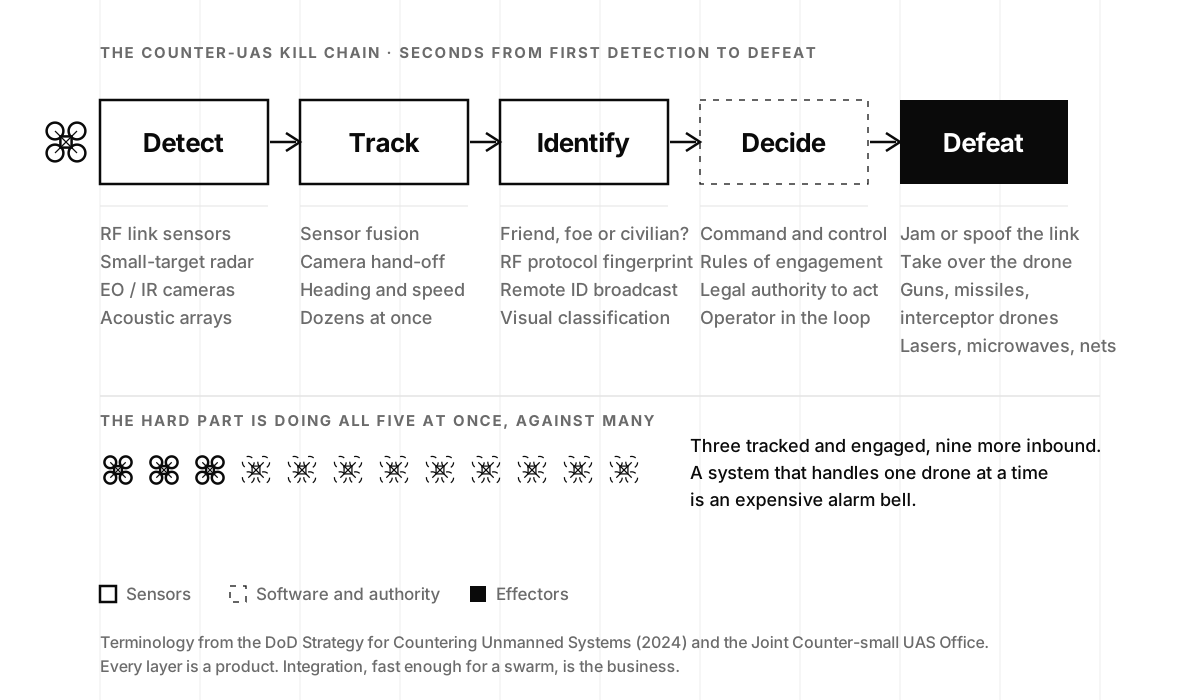
Detect. Small drones are hard to see on purpose: they fly low, their radar signature is close to a bird’s, and the cheapest ones are mostly plastic. Radio-frequency sensors listen for the control and video links and can often name the drone model from its protocol; they are blind to a drone flying a pre-programmed route with its radio off, or one steered through a fiber-optic thread. Radar tuned for small, slow, low targets works in the dark and spends much of its life rejecting birds. Cameras confirm what the object is but need line of sight. Acoustic arrays are cheap and short-range. None is enough alone, and the fusion layer that turns four noisy feeds into one confident track is where the real engineering lives.
Track. Keep a moving fix on the object, hand it from radar to camera as it closes, predict its heading, and do all of that for dozens of objects at once. Swarms are the design case. A single FPV drone is a nuisance. A semi-autonomous swarm of hundreds is the requirement the field is building toward, and no system we know of handles it comfortably yet.
Identify. Friend, foe, or a real-estate photographer? Drones that have to be registered in the US must now broadcast Remote ID, identification and location for the drone and its control station, which sorts the compliant from the interesting. Beyond that, identification leans on RF fingerprints, flight behavior and, increasingly, computer vision classifying the airframe and whatever hangs under it.
Decide. Command-and-control software fuses everything above into a picture an operator can act on, applies rules of engagement, and, in the civilian world, checks whether anyone present has the legal authority to act at all (more on that below). The clock is unforgiving: seconds, not minutes.
Defeat. The effectors, which deserve their own section.
Kinetic, electronic, or cyber: how do you actually stop a drone?
Once you know what it is and where it’s going, you have five broad ways to stop it, and each trades cost, collateral and coverage differently.
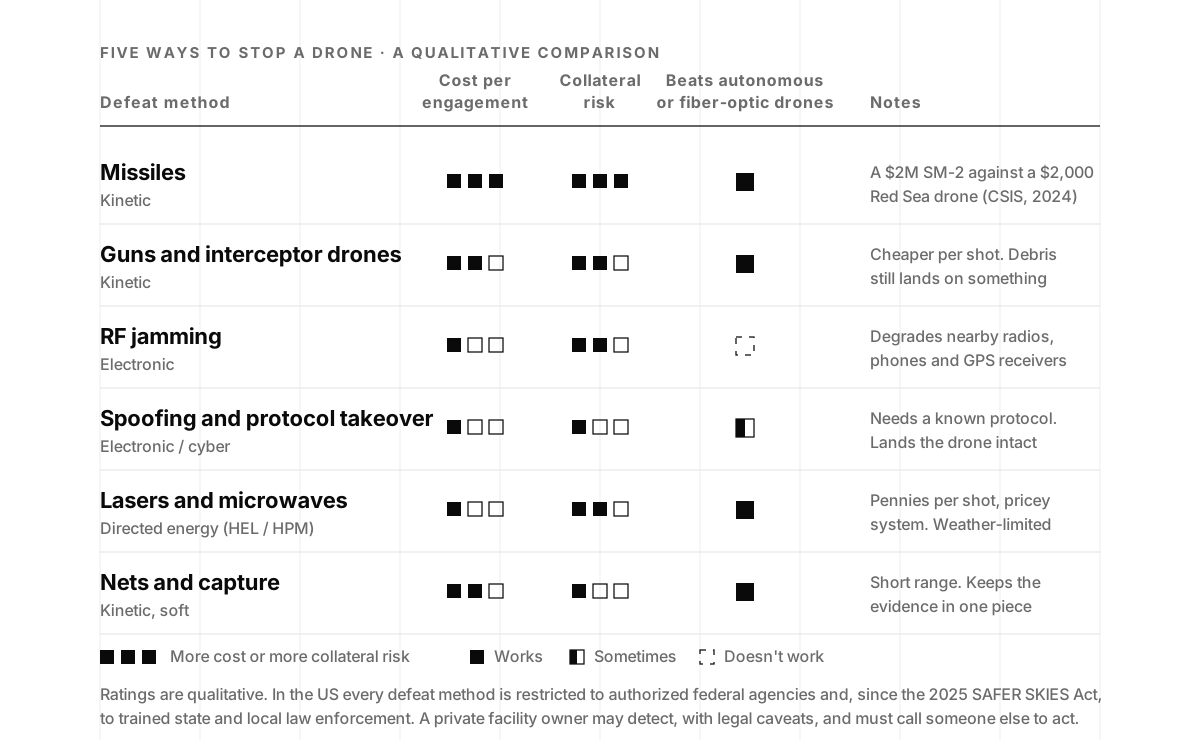
Kinetic (hard kill). Missiles, guns firing proximity-fuzed or airburst rounds, and interceptor drones that ram or shoot their target. Hard kill works against any drone regardless of how it is guided, which matters more every month. The costs are the cost per shot, absurd for a missile against a cheap drone, and the fact that whatever you hit falls on something. Interceptor drones and cheap guided rounds are the industry’s attempt to bring the hard-kill price down to the price of the threat.
Electronic (soft kill). Jamming floods the drone’s control link or GPS receiver so it loses its operator, then hovers, lands or flies home. It is cheap, reusable and instantaneous. It also degrades every other radio in the area, and it does nothing against a drone that isn’t listening: fiber-optic-guided FPVs and autonomous drones with pre-loaded targets fly straight through it.
Cyber takeover. Instead of shouting over the link, you speak it. Protocol takeover sends the drone commands it accepts as legitimate, then lands it intact wherever you choose, payload and evidence included. It is the most surgical option, ideal for stadiums and airports, and it works only on drones whose protocol you know, which rules out custom encrypted links and autonomous flight. This is exploitation of an embedded device in flight, the same discipline behind the autonomous cyberattack tooling we covered with Alexis Lingad.
Directed energy. High-energy lasers burn through an airframe for pennies of electricity per shot; high-power microwave disables the electronics of everything in a cone, the closest thing anyone has to a swarm answer. Both need expensive systems, both are limited by weather and range, and both are moving from demonstration to deployment.
Nets and capture. Net guns and net-carrying interceptors bring the drone down more or less intact. Short range, low collateral, keeps the evidence.
The US military’s counter-drone school at Fort Sill, Oklahoma, opened in 2023 to train roughly a thousand troops a year on all of the above, and the colonel who described it to NPR summed up the doctrine: “There’s no silver bullet in any of this,” so you build “a system of systems,” soft kill for the cheap majority of threats and hard kill for the ones that fly through it.
What Ukraine taught everyone about drones and the defenses against them
Four lessons from the war have shaped every serious counter-UAS program since.
Scale changes the math. When both sides fly thousands of FPV drones a day, a defense that costs a hundred thousand dollars per engagement is a defense you can afford to use about once. The DoD strategy names the cost imbalance between drones and countermeasures as a problem to fix, and the entire market for interceptor drones, guns and directed energy exists because of it.
The arms race runs in weeks. Jamming worked until the drones went to fiber-optic guidance and pre-programmed autonomy. Each side now updates software and airframes on cycles measured in weeks, and any counter-drone product that ships on a five-year procurement cycle is obsolete on arrival. Garrett’s line from the episode applies to defenders as much as to companies: “Legacy companies fail when they get too comfortable.”
Autonomy is the trend line. The DoD strategy expects future systems to be “increasingly capable, affordable, autonomous, and networked.” Every step toward autonomy removes a link for the defender to jam and pushes the defense toward sensing and hard kill.
Reach is no longer about range. Garrett pointed to Ukraine transporting drones by truck behind Russian lines and launching semi-autonomous attacks deep in enemy territory. The clearest example came in June 2025, when Ukraine’s security service smuggled more than a hundred FPV drones into Russia in truck-borne containers and launched them at bomber bases, one of them roughly 4,300 kilometers from Ukraine. For anyone defending a fixed site, the lesson is uncomfortable and useful: the launch point can be a parking lot a mile away.
Why edge processing matters: from drone video to a 3D map in minutes
Reveal’s own products are not counter-drone weapons. They are the intelligence layer that lives on the operator’s device, and the design principle behind them is the one counter-UAS needs. Reveal’s flagship, Farsight, ingests video from a drone overhead and builds 2D and 3D maps with line-of-sight, route and landing-zone analytics on a handheld, in the company’s published figure in under ten minutes, “without any network connectivity or backhaul.” No reach-back to a data center, no waiting for a satellite link a competent adversary will have jammed.
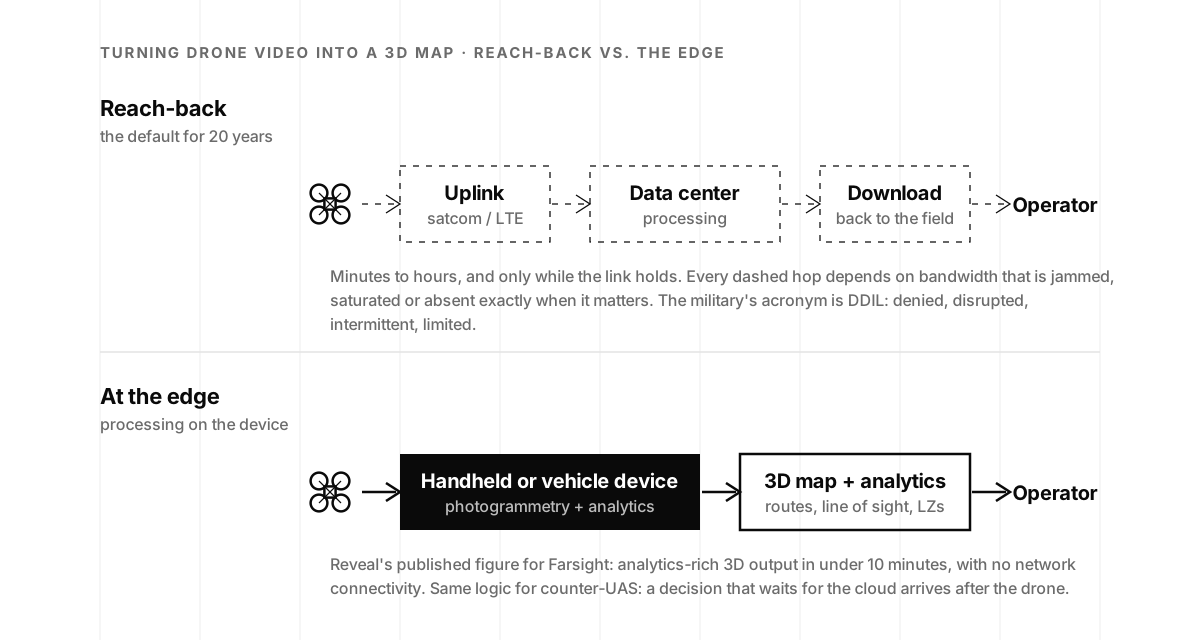
The military’s acronym for the environment this is built for is DDIL: denied, disrupted, intermittent, limited. Every counter-drone system lives in DDIL by definition, because the first thing a drone attack does is contest the spectrum. So Garrett’s requirement for detection, mobile and low-power on handhelds and small vehicles rather than fixed installations at airports and bases, is really a requirement to move the whole kill chain to the edge: sense locally, fuse locally, decide locally, and only then, if a link exists, tell headquarters. Fitting photogrammetry or sensor fusion into the thermal and power budget of a handheld is a hard engineering problem, the kind we described in What Is Deep Tech, and one of the places a small team can beat a prime. Garrett put the standard plainly: “We intend to prove our value every day.”
Counter-drone for critical infrastructure: what changed in US law
The same tactics that work on a bomber base work on a substation, and the substation has no air defense.
“That could happen for critical infrastructure here in middle America. There are civil and military infrastructure projects here that are highly vulnerable… and it doesn’t cost very much money for an adversary to do it.”
Garrett Smith, Reveal Technology, episode 90
Power grids, water treatment, pipelines, data centers and communication towers are all reachable from the air, and traditional perimeter security, built for fences, cameras and guard posts, was never designed for a threat that arrives over the fence at highway speed. The good news is that the legal and funding picture in the United States changed substantially in the last year.
Start with the constraint. Federal law reserves drone mitigation, meaning jamming, spoofing, taking control of, or destroying a drone, to authorized components of the Departments of Defense, Energy, Justice and Homeland Security. The FAA’s counter-UAS page points to the 2020 interagency legal advisory, which warns that private mitigation can violate the Communications Act’s jamming prohibitions, the Aircraft Sabotage Act and the Computer Fraud and Abuse Act, and that even some detection gear can implicate the Wiretap and Pen/Trap statutes. In plain English: a company cannot shoot, jam or hijack a drone over its own plant, and should involve counsel before switching on a detection system.
Then the change. The SAFER SKIES Act, signed in December 2025 inside the FY2026 National Defense Authorization Act, reauthorized federal counter-drone powers through 2028 and created a framework for trained state and local law enforcement to disable unauthorized drones at public gatherings and major events, backed by a $500 million, two-year program that has already sent $250 million to eleven World Cup host states and the National Capital Region. Route Fifty’s reporting carries the number behind the urgency: about 2,300 drones detected around NFL stadiums during the 2024 season. The officer your facility calls may soon have both the authority and the equipment to act, and CISA publishes guidance for infrastructure owners on exactly this coordination.
What a company that operates a facility can do this quarter:
- Know your airspace. Passive detection, deployed with legal advice, tells you how many drones cross your site in a month. The number tends to surprise people.
- Write the call. Agree in advance with local law enforcement who responds to an unauthorized drone, how fast, and with what authority, and assume your site has already been photographed from the air.
- Treat your own drones as devices. A corporate drone is a flying IoT device with a radio, a GPS receiver, a camera and a firmware schedule, and it belongs in the same inventory and hardening program as your cameras and badge readers. Its ground-control software deserves a penetration test like anything else that talks to your network.

If your technology is the reason someone would fly a camera over your campus, that is a counterintelligence problem before it is a physical security one, and it is the kind of scenario our counter nation-state espionage program is built around.
Why counter-drone technology is a national security priority and an investment wave
Government has moved. The DoD strategy laid out five lines of effort, among them delivering solutions with more speed, adaptability and scale, and in August 2025 the Pentagon stood up Joint Interagency Task Force 401 as the lead organization for synchronizing counter-small-UAS capability across departments and agencies. Its stated mission fits on one line: “rapidly delivering state-of-the-art counter-small UAS capabilities to warfighters at home and abroad.” Those two words, at home, turn a military market into a national one.
Capital has followed. On the episode, Garrett cited roughly $125 billion invested in defense and dual-use technology from 2020 to 2024, about triple the prior four years, and the trend has steepened since: PitchBook counted a record $49.1 billion of venture deals in defense tech in 2025, up from $27.2 billion the year before. CB Insights’ explanation, quoted by Defense News, is the thesis of this post: “Ukraine demonstrated drone and autonomous system effectiveness in real combat, fundamentally shifting how VCs view defense investments.”
What the West still needs to build falls into the three categories Garrett laid out, and each is a company. Better detection at the edge: current systems are built for airports and fixed bases, while the tactical edge needs mobile, low-power detection on handheld devices or small vehicles. Integrated defeat systems: a detection system without a defeat mechanism is an expensive alarm bell, and the detect-track-neutralize loop has to be fast enough for swarms. Scalable, affordable countermeasures: the economics currently favor the attacker, and if a $500 drone requires a $100,000 missile to stop, the math doesn’t work.
A founder who solves even one layer of the chain at a price the military can scale has a customer with a stated, funded, urgent need. The road to procurement runs through compliance that is new to a commercial founder: ITAR for anything that counts as a defense article, and CMMC Level 2 the moment a contract involves controlled unclassified information. Garrett’s advice on getting through it with the customer rather than around them is in the companion post; the short version is that the compliance work becomes a moat once done.
Where to start
If you are a founder, pick one layer of the kill chain, build it for the operator holding the device, and get it into an exercise where corporals can break it. Line up the compliance early: a CMMC Level 2 readiness assessment will tell you how far you are from a contract that handles CUI, and the ITAR question is cheaper to answer before the first export-control officer asks it. If you operate a facility, start with detection and a phone number.
Either way, listen to the source. Garrett explains how two Marines built for the edge, and what the edge taught them, in 43 minutes on episode 90.
Counter-drone technology frequently asked questions
- What is counter-drone (counter-UAS) technology?
- Counter-drone technology, also called counter-UAS or C-UAS, is the combination of sensors, software and effectors used to detect, track, identify and defeat hostile or unauthorized drones. Sensors include radio-frequency detectors, small-target radar, electro-optical and infrared cameras and acoustic arrays. Effectors range from jamming and protocol takeover to guns, interceptor drones, lasers and nets. The integration layer that fuses the sensors and supports a decision in seconds is usually the hardest part to build.
- How does a counter-drone system detect a small drone?
- Usually with several sensors at once, because each one has a blind spot. RF sensors listen for the drone's control and video links but miss autonomous or fiber-optic drones. Radar tuned for small, slow, low targets works in the dark but struggles with birds and ground clutter. Cameras confirm what the object is but need line of sight. Acoustic arrays are cheap and short-range. Fusing them into one track is what turns a pile of alerts into a target.
- What is the difference between kinetic and non-kinetic drone defeat?
- Kinetic, or hard-kill, methods physically destroy or capture the drone: missiles, guns firing airburst rounds, interceptor drones and nets. They work against any drone but cost more per shot and drop debris. Non-kinetic, or soft-kill, methods attack the drone's links or electronics: jamming the control link, spoofing its GPS, taking over its protocol, or disabling its electronics with a laser or high-power microwave. They are cheap and reusable, but jamming fails against autonomous and fiber-optic drones.
- Can a drone be hacked or taken over instead of shot down?
- Yes, when the drone uses a known protocol. Protocol takeover, sometimes called cyber takeover, sends the drone commands it accepts as legitimate, then lands it in a safe spot with its payload and evidence intact and nothing falling from the sky. It is the lowest-collateral option for stadiums, prisons and airports. It does not work against drones with custom encrypted links or fully autonomous drones that ignore their radio, which is why it sits inside a layered system rather than replacing one.
- Is it legal for a company to jam or shoot down a drone over its own facility in the US?
- No. Federal law reserves drone mitigation (jamming, spoofing, taking control, or destroying) for authorized components of the Departments of Defense, Energy, Justice and Homeland Security, and the 2020 interagency legal advisory warns that private use can violate the Communications Act, the Aircraft Sabotage Act and the Computer Fraud and Abuse Act. The SAFER SKIES Act, signed in December 2025, extends mitigation authority to trained state and local law enforcement. Private owners can deploy detection, with legal advice, and build a response plan with local police.
- Why is counter-drone technology a national security priority?
- Because cheap, widely available drones have, in the Pentagon's words, "democratized precision strike." Ukraine showed that first-person-view drones costing a few hundred dollars can destroy multimillion-dollar vehicles at industrial scale, and that truck-launched drones can hit targets thousands of kilometers from a border. The Department of Defense issued a dedicated strategy for countering unmanned systems in December 2024 and stood up Joint Interagency Task Force 401 in August 2025 to deliver counter-small-UAS capability faster, at home and abroad.
- How much does it cost to shoot down a drone?
- It depends entirely on the effector. CSIS notes that a Standard Missile-2 fired at a roughly $2,000 Houthi drone in the Red Sea costs about $2 million. Guns, interceptor drones and nets cost far less per shot; jamming and directed energy cost almost nothing per engagement once the system is bought. CSIS also cautions that cost per intercept is the wrong sole metric, because the value of the ship, base or crowd being defended matters more. Closing the cost imbalance is an explicit goal of the DoD strategy.
- What does edge processing mean in drone technology?
- Edge processing means doing the computation on the device in the field rather than sending data to a distant server. Reveal Technology's Farsight, for example, turns drone video into 2D and 3D maps with analytics on a handheld in under ten minutes with no network connection, according to the company. For counter-drone systems the same principle applies: detection, tracking and the decision to act have to happen locally and in seconds, because the link to the cloud is the first thing an adversary jams.