
Episode 40 of The Security Podcast of Silicon Valley aired on April 1, 2024, with Jon McLachlan hosting. The guest was Jose Arrieta. His LinkedIn lists him as chief information officer of the U.S. Department of Health and Human Services from May 2019 to September 2020, and as its interim chief data officer for the same months. In August 2020 he founded Imagineeer, a company whose mission, by his LinkedIn, is “to operationalize the ability to test intuition” (Podbean, LinkedIn). The episode is called “Jose Arrieta, Imagineer, Former Chief Information Officer and Chief Data Officer at US Health and Human Services.” It has no video version.
At the end of the episode, Jon asked for final words of wisdom.
“the one word of wisdom I would have is just go all in.”
Jose Arrieta, at 46:54
This page follows the conversation in order: a section for each part of it, fifteen figures, twenty-two clips from the tape, the full transcript, and five tools: a quiz, a scorecard for whether your logs could tell the story of an attack, a calculator for what half a penny for each use of your data adds up to, a timeline, and a to-do list. Where the decodes of the tape disagree on a word, the transcript puts its best guess in brackets, and the page doesn’t quote those words. Jon and Jose say “imagineer” on the tape. The company writes its name Imagineeer, with three e’s, and so does the transcript.
Balancing forces
Jon opened with the jobs on Jose’s LinkedIn: procurement, a program manager role at the TSA, industry liaison at the U.S. Department of Homeland Security, and director of small and disadvantaged business utilization at the U.S. Department of the Treasury. Jose took it from there.
“It’s fundamentally balancing these forces that never quite fit together, right?”
Jose Arrieta, at 1:07
Procurement rules and procurement law come first. Contracts are made with industry partners, and certain things drive their costs. The federal system adds socioeconomic goals, like a competitive small business base, which Jose calls important from a national security perspective. He has built requirements to get the most participation from the industrial base, and entered into contracts with large dollar values. He also tried to shape small business policy, so that
“we reward companies who are reinvesting”
Jose Arrieta, at 2:03
That means companies that reinvest in themselves to deliver capabilities for the government. He felt the procurement process left that part out. His example of a mission where government has to step in with policy and investment was Homeland Security.
“if Homeland Security was easy, a private company would go and secure the border”
Jose Arrieta, at 2:26
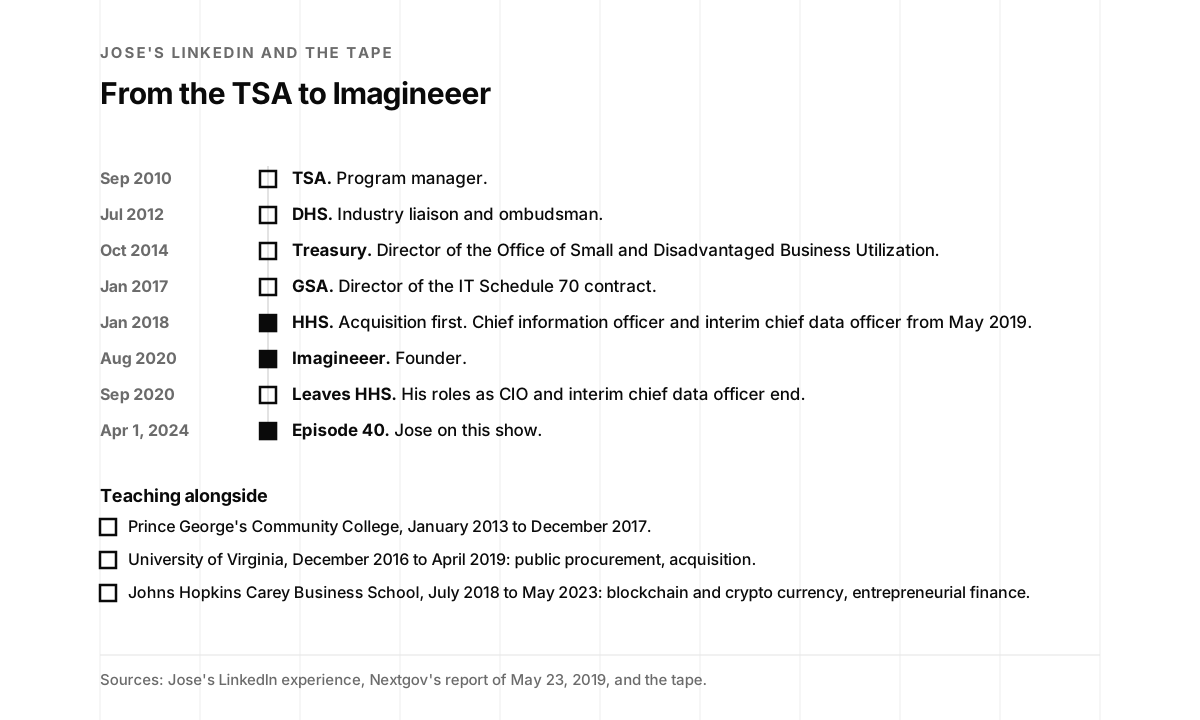
As for all the titles on his LinkedIn, his joke was that they kept kicking him out of jobs. The profile gives the order. Program manager at the TSA from September 2010 to July 2012. Industry liaison and ombudsman at DHS from July 2012 to October 2014. Director of the Office of Small and Disadvantaged Business Utilization at Treasury from October 2014 to January 2017, where the profile says he was the “First member of the Senior Executive Service to lead” that office. Director of the IT Schedule 70 contract at the General Services Administration in 2017, which the profile calls “the largest IT contract in the world.” Then HHS, from January 2018, first in acquisition (LinkedIn). Later in the episode, Jose said he used to be a developer. He built the interface the poorest county in Pennsylvania used to enroll people in what the state called adultBasic insurance, paid for with money Pennsylvania received from the tobacco lawsuits.
Three classrooms
Jon brought up teaching. Jose’s LinkedIn lists three adjunct roles: Prince George’s Community College from January 2013 to December 2017, the University of Virginia from December 2016 to April 2019, teaching public procurement and acquisition, and the Johns Hopkins Carey Business School from July 2018 to May 2023, teaching blockchain and crypto currency, and entrepreneurial finance (LinkedIn).
If you can teach something, he said, you learn more than you provide.
On the tape, teaching is the thing he missed most after he stopped, right after the pandemic. The ideas, he said, come from people in college who have the free time to create. Jon added that students haven’t yet been stained by the conventional ways of solving problems.
“They’re not afraid to challenge the status quo.”
Jose Arrieta, at 4:16
Without a return on investment to measure, or presidential policy fights in an election year, a student can take on a project for its own sake, and some of those projects snowball. Jose called it a unique storm.
A nation-state attack on HHS
Jon turned to Jose’s time as chief information officer at HHS. Jose said a Bloomberg documentary that had just come out put him in the middle of the security conversation.
“We experienced what I believe was a nation-state cyber attack on Health and Human Services during the pandemic.”
Jose Arrieta, at 5:33
He believes it was a mapping activity.
“it appeared to be an amplified DDoS attack, but it was actually to map our interconnectivity within the broader health system, right?”
Jose Arrieta, at 5:49
A map of HHS at the start of the pandemic shows where its money was going to flow, through payments, contracts or grants. Wikipedia puts the HHS budget for fiscal year 2020 at $1.293 trillion (Wikipedia). It describes a denial-of-service attack as one that “seeks to make a machine or network resource unavailable to its intended users,” and lists DNS amplification among the common forms of the distributed kind (Wikipedia).
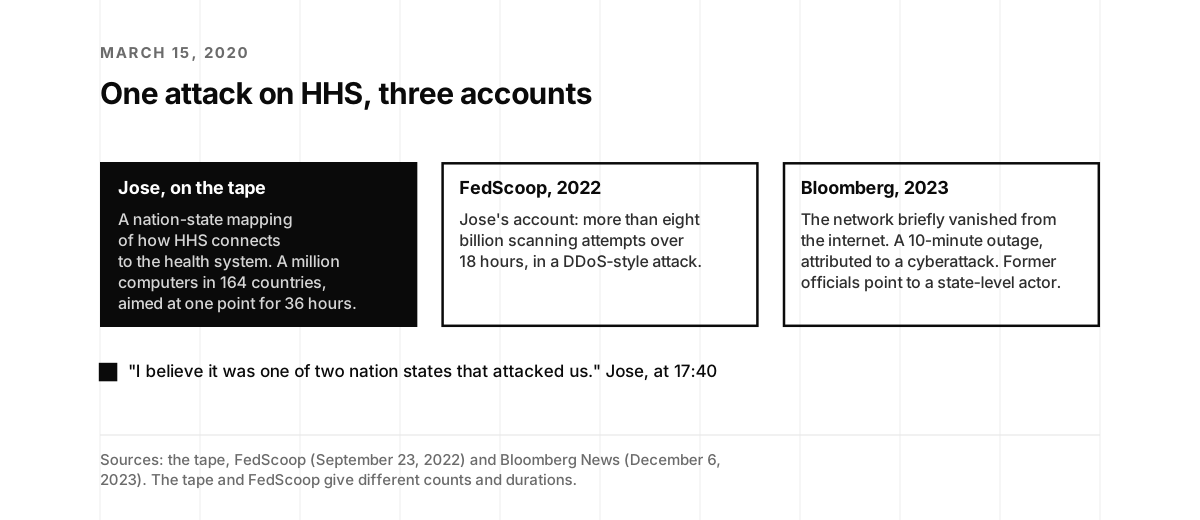
Two news reports describe the attack. On September 23, 2022, FedScoop reported Jose’s account that HHS was hit with more than eight billion scanning attempts over 18 hours in a DDoS-style attack on March 15, 2020. He referred to “an enemy combatant” without naming a country (FedScoop). On December 6, 2023, Bloomberg News reported that the HHS network “briefly vanished from the internet” that day, that Secretary Alex Azar attributed a 10-minute outage to a cyberattack, and that former officials attribute it to a state-level actor. Bloomberg names Jose as one of two officials involved in the response (Bloomberg).
Vetting after 9/11
Jose’s security background goes back further, to his early career.
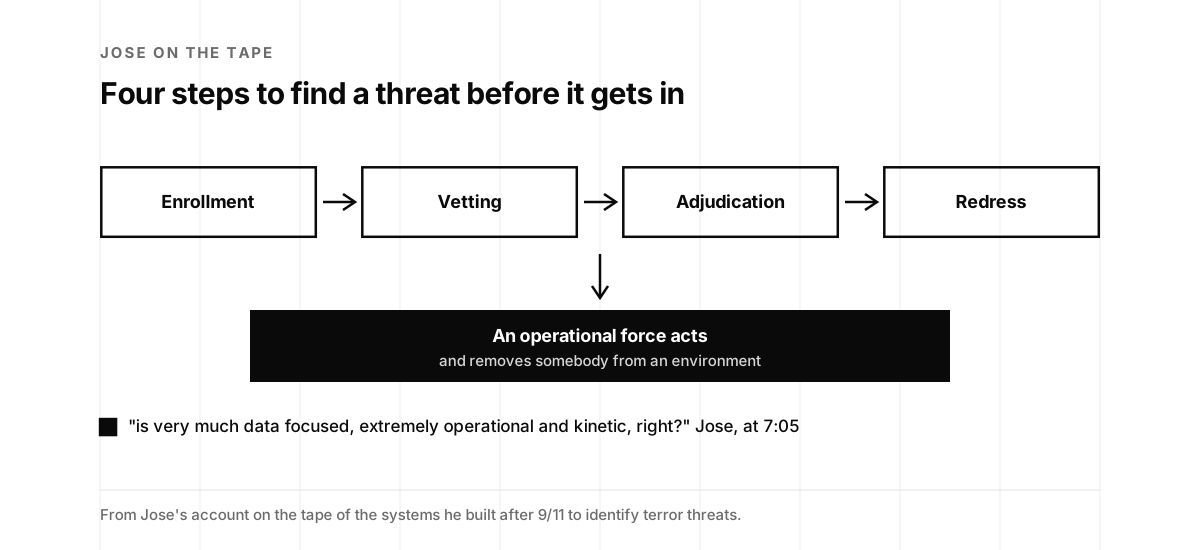
“I built out enrollment, vetting, adjudication and redress systems to actually identify terror threats around the world”
Jose Arrieta, at 6:28
After 9/11, those systems looked for people entering, flying over, or trying to gain access to work in the United States in certain domains. He timed it with a comparison: they were building vetting tools before Facebook knew you had a dog and marketed dog food to you. His background from a security perspective, he said,
“is very much data focused, extremely operational and kinetic, right?”
Jose Arrieta, at 7:05
Kinetic, in his words, means security mixed with an operational force that physically removes somebody from an environment. Jon’s summary was that Jose connects the cyberspace with the kinetic space.
An industrial base needs security too
At Treasury, Jose ran a research project of his own on where one country’s foreign direct investment went. Around 2014, he said, 90% of it went into seven or eight countries.
“if you drew it on a map, it encircled Japan.”
Jose Arrieta, at 8:08
His question from that: how do you protect a strong industrial base, one that creates ideas and unique capabilities,
“without overburdening it with taxes, without overburdening it with costs, so that you can compete?”
Jose Arrieta, at 8:25
Talk of U.S. strength tends to start with the military, he said.
“the economic base is what actually supports that military”
Jose Arrieta, at 8:37
We talk about securing software and securing an airport, he added, and less about creating security around an industrial base. Jon called these high-level questions, a bird’s eye view, where many founders on the show work on one small piece of the security puzzle.
An identity for every data set
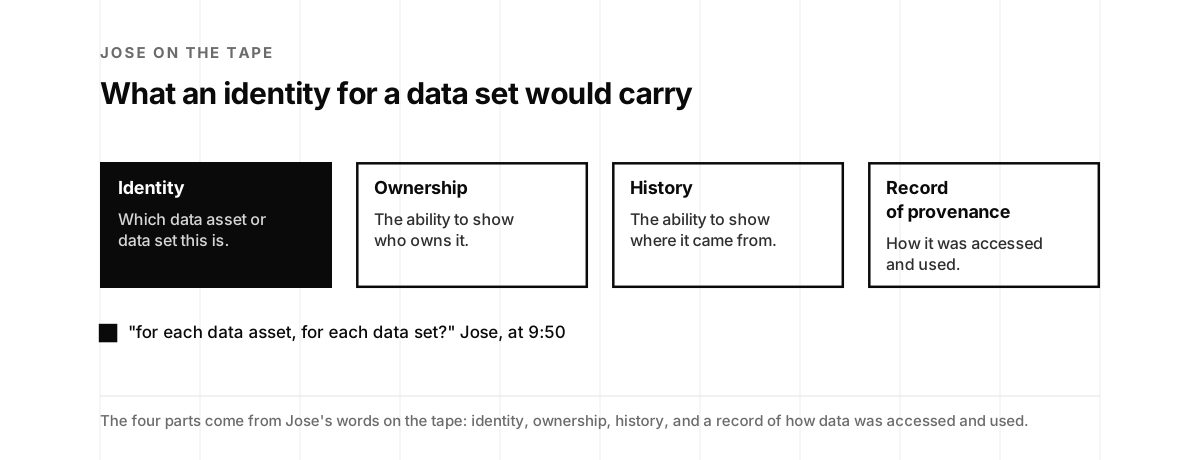
Jose asked Jon to disagree with him if he’s wrong. What goes bonkers in his brain when he looks at AI is how anyone is securing identity, and creating one
“for each data asset, for each data set?”
Jose Arrieta, at 9:50
Jon’s answer was that AI companies aren’t doing it, and he brought up a lawsuit.
“the Times is now suing OpenAI and Microsoft because copyright violation, I guess, is what they’re claiming”
Jon McLachlan, at 9:57
That case will be hard, Jon said, without data properly identified from its source. Wikipedia’s OpenAI article says The New York Times sued OpenAI and Microsoft for copyright infringement in December 2023, over the use of its content to train AI models (Wikipedia).
Jose agreed, and peeled it back: modern micropayment solutions, and completely disrupting electronic health records. That’s not AI, he said.
“That’s creating that foundation so some of these capabilities can truly scale.”
Jose Arrieta, at 10:37
Scars from blockchain
The data question isn’t the topic everybody wants to talk about, Jose said, and he has a reason to know. At HHS he worked on it
“in particular with blockchain technology, which I have scars I can show you from”
Jose Arrieta, at 10:50
The project he describes ran in one of the department’s business units, on Hyperledger Fabric.
“the data question is the most important question”
Jose Arrieta, at 11:03
That means the ability to show who owns data, and the ability to show its history. Wikipedia calls Hyperledger “an umbrella project of open source blockchains and related tools” that the Linux Foundation started in December 2015 (Wikipedia). In December 2018, Nextgov reported that HHS expected an authority to operate for HHS Accelerate, which “uses blockchain, machine learning and artificial intelligence to streamline acquisition.” Nextgov called it the “first blockchain-based program in the federal government” to get that certification (Nextgov). When HHS named Jose CIO in May 2019, Nextgov described Accelerate as “the first distributed-ledger-powered system to receive an authority to operate” (Nextgov). Neither story names the platform. Before HHS, at GSA, his LinkedIn says he “Created and tested the first successful proof of concept in the world” for using blockchain to automate procurement (LinkedIn).
Jon’s take on the topic:
“It’s sexy what you can do with it, maybe, but it’s not maybe sexy how to get there.”
Jon McLachlan, at 11:18
The EHR pitch
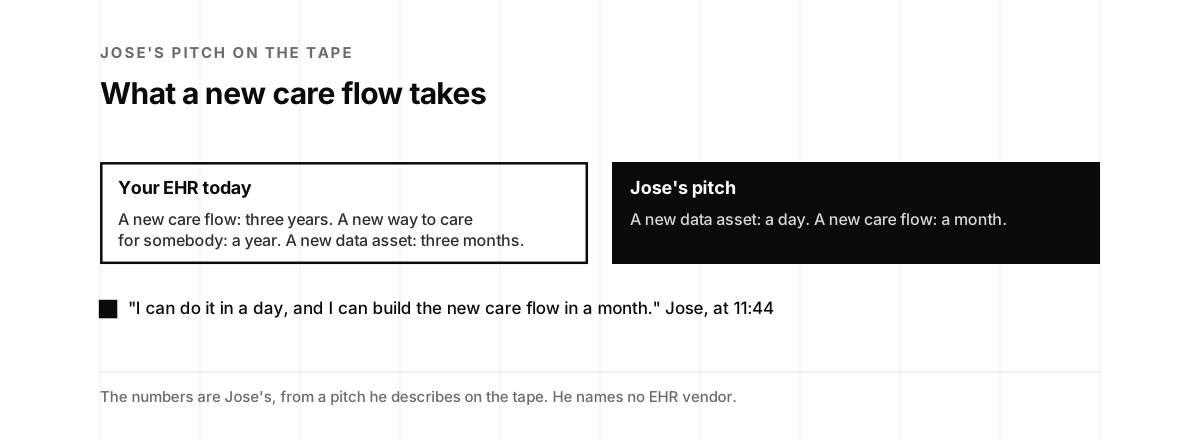
Jose made the case with a pitch. You’re implementing an EHR. It takes three years to build a new care flow, or a year to build a new way to care for somebody, and three months to integrate a new data asset.
“I can do it in a day, and I can build the new care flow in a month.”
Jose Arrieta, at 11:44
That cuts costs, he said, makes you agile at the edge, and creates real interoperability. To a technologist it may be an easy sell.
“for a hospital administrator, for the CEO of a health system, that’s a tough pitch.”
Jose Arrieta, at 12:08
Wikipedia defines an electronic health record as “electronically stored patient and population health information in a digital format” (Wikipedia). Jon said computers always do what we tell them to do, and the hard part of change is people.
“the tricky part in instigating change, or having a real impact, I always think is, like, the human side of things, adoption.”
Jon McLachlan, at 12:21
Only what you logged
Jose picked up on that with a thought experiment for Jon, the cyber guy.
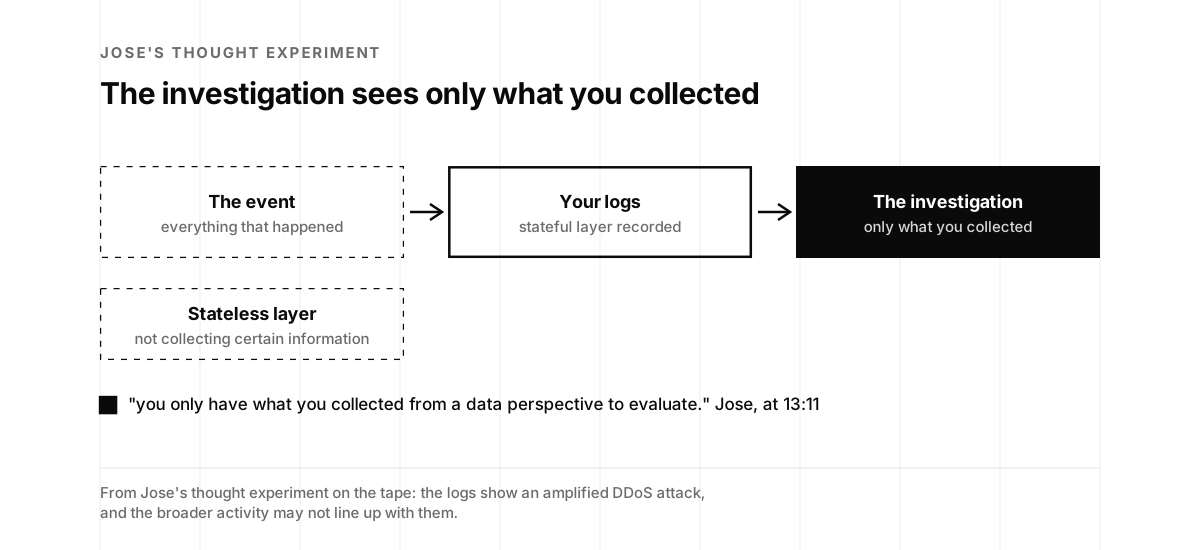
“let’s imagine that you experience a massive cyber event.”
Jose Arrieta, at 12:42
From a data perspective, the logs tell one story.
“when you look at what you log, it appears to be an amplified DDoS attack.”
Jose Arrieta, at 12:48
That’s only part of it. Your network has a stateless layer and a stateful layer.
“at a stateless level, you’re not collecting certain information.”
Jose Arrieta, at 13:00
So when you go back and investigate,
“you only have what you collected from a data perspective to evaluate.”
Jose Arrieta, at 13:11
What you collected may not line up with the broader activity in that environment, which makes a real discussion of the threat hard. Add political complexity, Jose said, and the people on the front lines see a different reality from the people looking at it from a mile away.
“you have to have amazingly thick skin to deal with that.”
Jose Arrieta, at 13:53
Jon took it from the operator’s side. People fill in gaps almost unconsciously, with their experiences and motives, and a diverse group fills them in with different shades of color.
“you have to be very careful about what we don’t know.”
Jon McLachlan, at 14:06
An operator has to stay self-aware about that.
“no information really does mean no information.”
Jon McLachlan, at 15:19
Jose agreed that missing data limits what you can say happened. You might see things in real time that you aren’t recording, because an investment wasn’t made.
One team for the NOC and the SOC
Jon asked for the one lesson Jose took from the breach into every job since. Jose had come into the event with one focus.
“I had been obsessively focused on creating identity for data assets and data sets”
Jose Arrieta, at 16:01
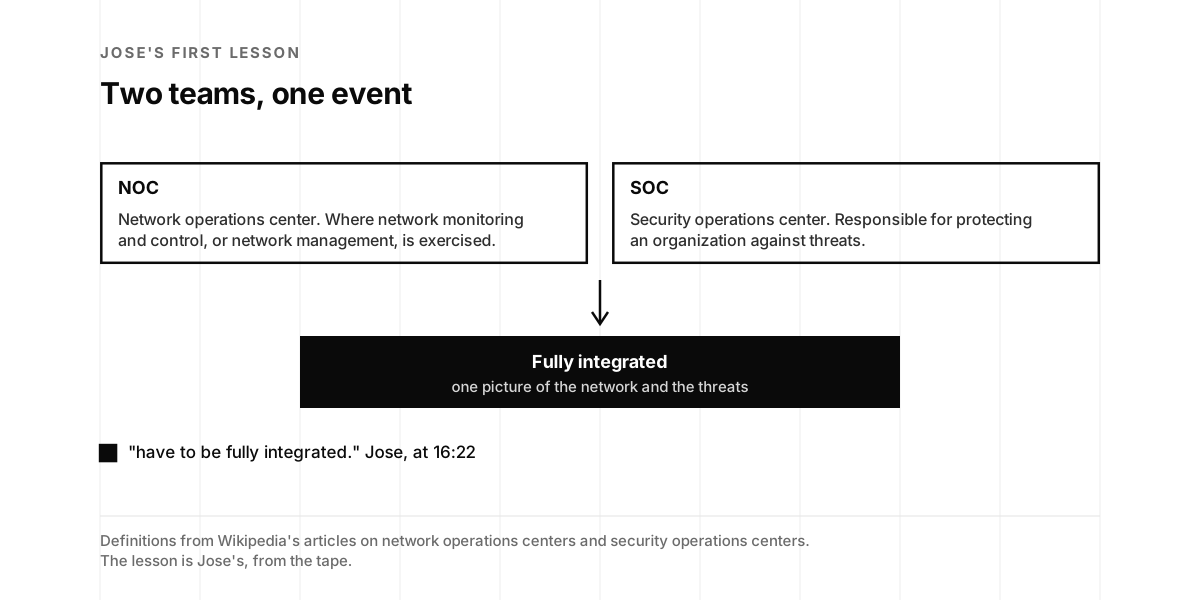
The event taught him a couple of more basic things. The first was that the NOC and the SOC
“have to be fully integrated.”
Jose Arrieta, at 16:22
“investing in them and not integrating them is just really a giant weakness that you’re creating.”
Jose Arrieta, at 16:24
In Wikipedia’s words, a network operations center (“NOC, pronounced like the word knock”) is where “network monitoring and control, or network management, is exercised,” and a security operations center “is responsible for protecting an organization against threats” (Wikipedia, Wikipedia). In an attack like the one Jose describes, the first team watches the traffic and the second watches the threat.
Five shooters
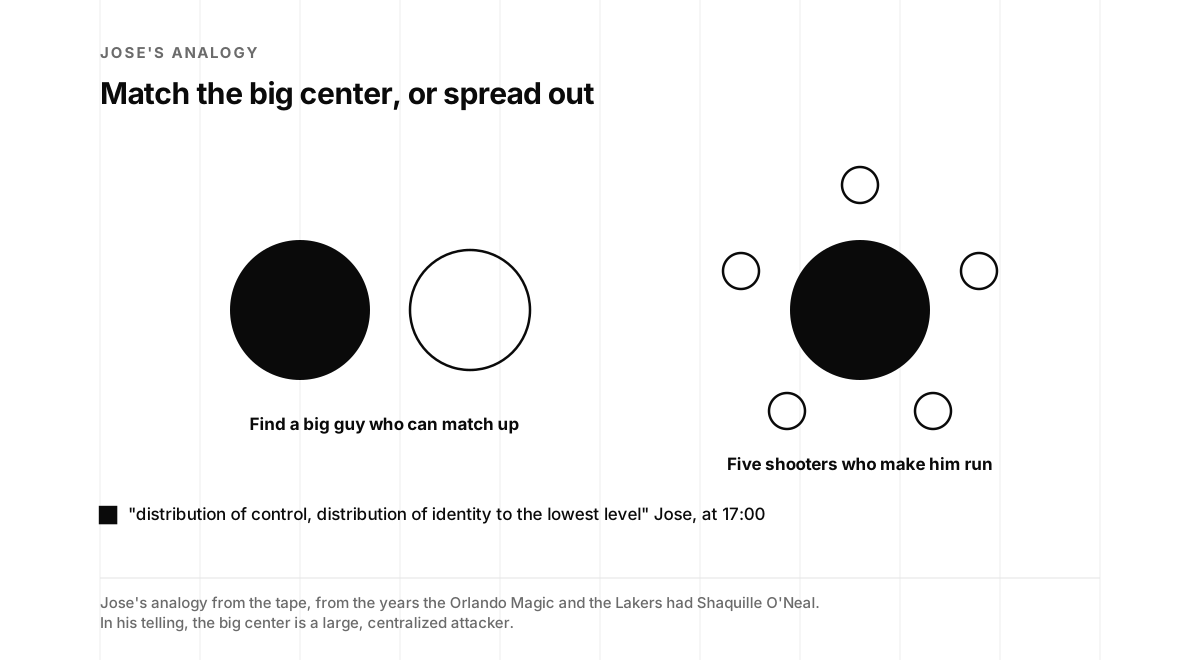
The second lesson came with an analogy Jose says he always uses. When the Orlando Magic and then the Lakers had Shaq,
“everybody tried to find a big guy that was big and quick”
Jose Arrieta, at 16:44
Every team wanted a center who could match up with him. Then teams found another way.
“if we hire five shooters that can really shoot the lights out and make him run all over the place, we have a better chance of beating him, because he’s a unicorn.”
Jose Arrieta, at 16:50
Wikipedia has the order of his teams: the Magic took Shaquille O’Neal first overall in the 1992 NBA draft, and after four years he signed with the Los Angeles Lakers, where he won titles in 2000, 2001 and 2002 (Wikipedia).
The big center, in Jose’s analogy, is a large, centralized attacker that uses a lot of computing to overwhelm a network, embed itself and learn how the network behaves. His answer is
“distribution of control, distribution of identity to the lowest level”
Jose Arrieta, at 17:00
“if you change the way that you interact with them, then they have to change the way they interact with you.”
Jose Arrieta, at 17:21
One of two nation states
The third thing, Jose said, he still doesn’t fully understand: how hard it is to talk openly about who did it.
“I believe it was one of two nation states that attacked us.”
Jose Arrieta, at 17:40
On the tape, he describes a million computers in 164 countries aimed at one point, one of the largest internet surface areas on the planet, for 36 hours, following the network’s behavior in real time as HHS changed it. FedScoop’s 2022 report of his account has more than eight billion scanning attempts over 18 hours. His conclusion:
“That’s not some researcher in a basement.”
Jose Arrieta, at 18:11
HHS had no legal offensive capabilities to answer a nation state with, he said. What he wants for defenders like that is flexibility.
“let’s create tools that give you the flexibility to defend yourself in the event of a large action like that.”
Jose Arrieta, at 18:39
How do you delegate trust?
Jon liked the idea of decentralizing things. Jose was clear that he isn’t arguing for putting the whole U.S. healthcare sector on a blockchain platform. His question is a different one:
“how do you delegate trust?”
Jose Arrieta, at 19:19
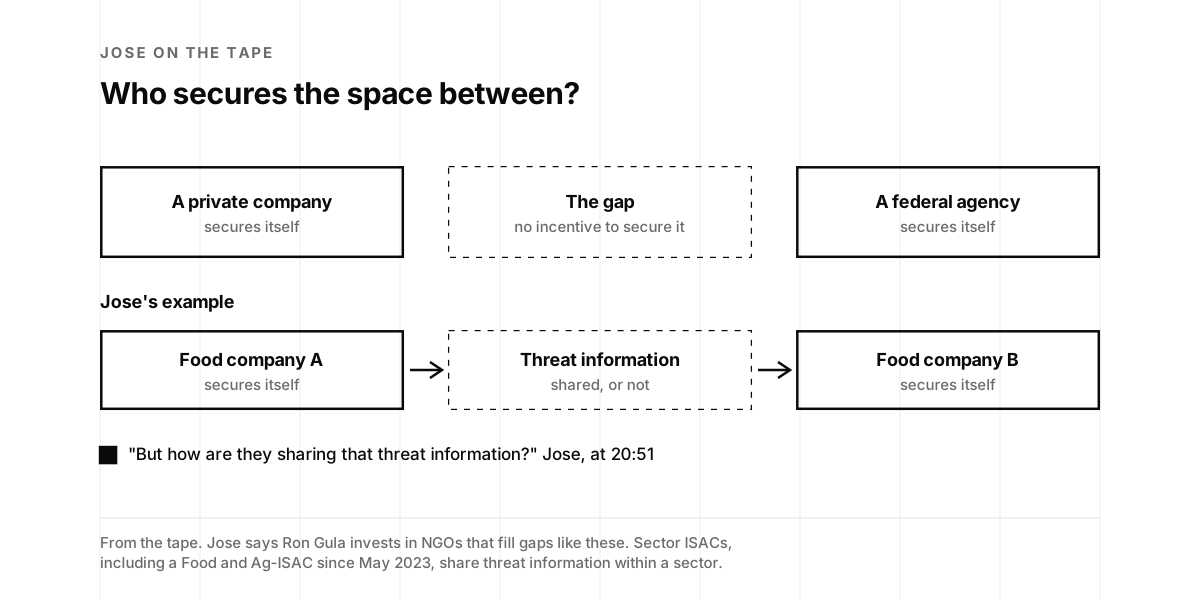
That means delegated authority inside organizations, and something else besides. A private company will secure itself, he said, because it has the incentives. Apple was his example. A federal agency will secure itself too, with its resources.
“But there are gaps, like in an industrial base, right, where there’s really no incentive to secure in those gaps, right?”
Jose Arrieta, at 19:50
Investing in the gap
Jose had talked about the gap with Ron Gula, a venture investor in cybersecurity startups.
“he’s investing in NGOs that fill those gaps between government agencies and private companies.”
Jose Arrieta, at 20:11
Wikipedia lists Gula as a co-founder of Tenable in September 2002, and says he worked for the National Security Agency in the 1990s (Wikipedia). In December 2020, Gula Tech Adventures, founded by Ron and Cyndi Gula, set up a foundation that “will award $1,000,000 in competitive grants to cybersecurity nonprofits” several times a year (PR Newswire).
Jose’s example was food, with a nod to Maslow’s hierarchy of needs. He sees creating distrust in the food industrial base as an attack vector that some adversarial nation states are focused on. Food company A and food company B will each secure themselves.
“But how are they sharing that threat information?”
Jose Arrieta, at 20:51
They have no strong incentive to, and that gap is the opportunity. Sectors already have a structure for sharing. Wikipedia describes an information sharing and analysis center as a central resource for information on cyber threats to critical infrastructure, with two-way sharing between the private and public sectors. Sector ISACs began forming in 1999, after Presidential Decision Directive 63 was signed on May 22, 1998 (Wikipedia). Food got one of its own in May 2023, when the food and agriculture group inside IT-ISAC became the Food and Ag-ISAC, a forum for food and agriculture companies (Security Magazine).
Data at the center
Jon tied it back to identity and data.
“identity is just the answer to the question, who are you?”
Jon McLachlan, at 22:00
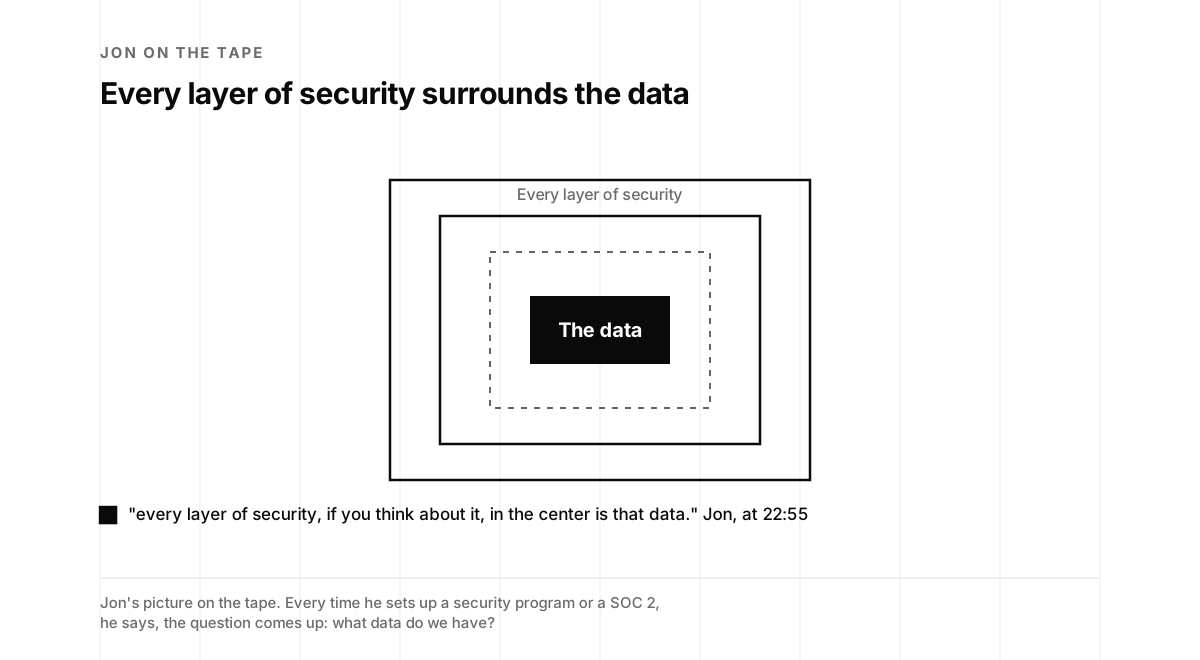
People answer it by looking at each other. A computer system has to answer it for data: where did it come from, and who owns it? That’s what the New York Times is upset about with OpenAI, Jon said. Every time he sets up a security program or a SOC 2, at a two-person startup or an old, giant company, the same question comes up: what data do we have?
“every layer of security, if you think about it, in the center is that data.”
Jon McLachlan, at 22:55
There’s some value in CPUs too, especially with Bitcoin, he added, but the real gold mine in cybersecurity is the data.
A record of provenance
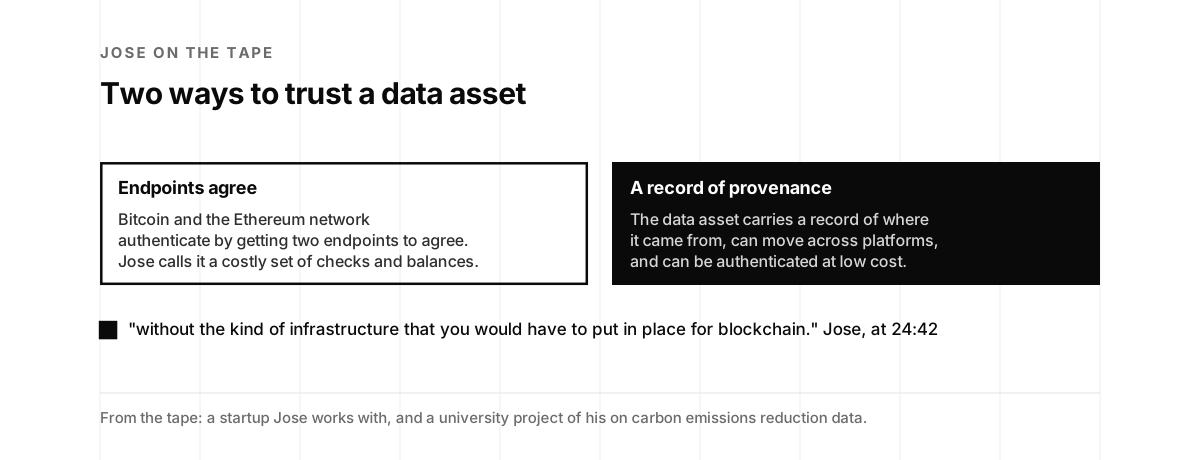
Jose described how Bitcoin and the Ethereum network validate something.
“you’re authenticating something by getting two endpoints to agree on it in some semblance”
Jose Arrieta, at 23:36
He called that a costly set of checks and balances. He’s working with a startup in Toronto. The decodes of the tape don’t agree on its name, so the page leaves it out.
“they’re creating a record of provenance of the data asset”
Jose Arrieta, at 24:03
They also make the data asset portable across platforms. Jose also made an investment at a university to create a software-based digital twin of a working piece of hardware, with a secure root of trust, and a representation of carbon emissions reduction data that could move across platforms at low cost.
The data asset could be authenticated, he said,
“without the kind of infrastructure that you would have to put in place for blockchain.”
Jose Arrieta, at 24:42
Peacemakr
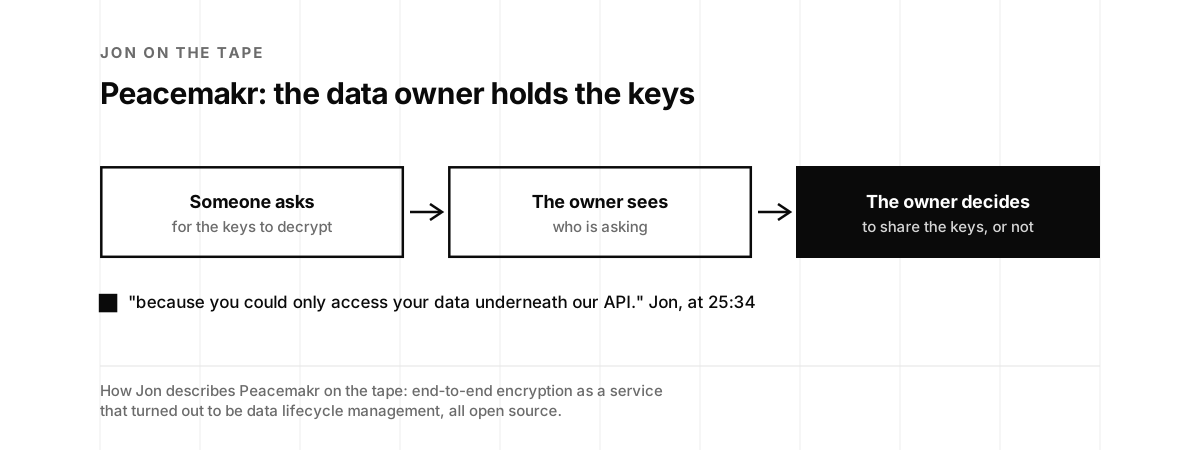
Jose asked whether Jon had seen anybody doing this. Jon had: Peacemakr, the startup he led. It brought end-to-end encryption as a service to market, and as the team sold it, they saw it was data lifecycle management, a way to verify what happened to data as it flowed from one system to another.
You could see who was trying to access your data,
“because you could only access your data underneath our API.”
Jon McLachlan, at 25:34
All of it was open source, he said. To read data, you requested the keys to decrypt it. The data owner saw who you were, and decided whether to share those keys with you.
Half a penny
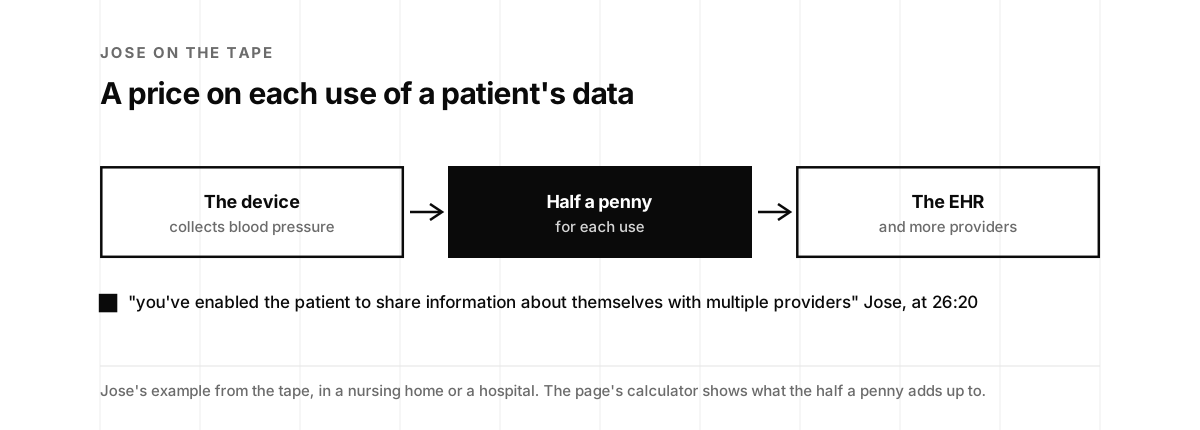
Jose put Jon’s design into a nursing home or a hospital. Between the device collecting a patient’s blood pressure and the EHR that holds the record of care,
“you had this ability to transact for that data.”
Jose Arrieta, at 26:11
Say each use costs half a penny. Now
“you’ve enabled the patient to share information about themselves with multiple providers”
Jose Arrieta, at 26:20
It may not be a great business case, he said, but it would disrupt the market. The same goes for people writing a song or creating content, the New York Times among them:
“now you have the ability to maintain ownership of something forever, and you can engage in a microtransaction”
Jose Arrieta, at 26:41
There’s also a record that you created the content. That, he said, fundamentally distributes authority and value throughout an ecosystem.
Wikipedia defines a micropayment as “a financial transaction involving a very small sum of money,” usually online, and says several systems proposed in the mid-to-late 1990s were unsuccessful (Wikipedia). The calculator shows what Jose’s half a penny adds up to.
The next wave may not be AI
Jose calls that spread of authority and value a democratic principle, and the next wave of transformation in industry.
“I don’t think it’s AI. I don’t think it’s large-scale, centralized artificial intelligence capabilities.”
Jose Arrieta, at 27:08
He thinks it’s an investment in identity around data assets and data ownership, which powers all modern AI platforms. He doesn’t know the economics, he said, and could be way off.
“I truly believe that’s the way that you compete with a system of government that is more centralized, that is more top-down driven, that is more authoritarian.”
Jose Arrieta, at 27:28
It fits with the constitutional values the founders of the United States set out, he said, without wanting to sound like he’s running for office. Jon agreed that the hard problems sit under the hood.
“AI is cool on the surface, and it’s whiz-banging.”
Jon McLachlan, at 28:16
Underneath is grit that doesn’t match our ideas of ownership, content creation or credit.
“If you’re Madonna and you make a really awesome hit song, like, you would like to get paid, right?”
Jon McLachlan, at 28:42
Jose went back to the basics of a democratic society: can you own property?
“Do you have a right to intellectual property, to things that you create? That’s how you spread wealth.”
Jose Arrieta, at 29:04
The next word
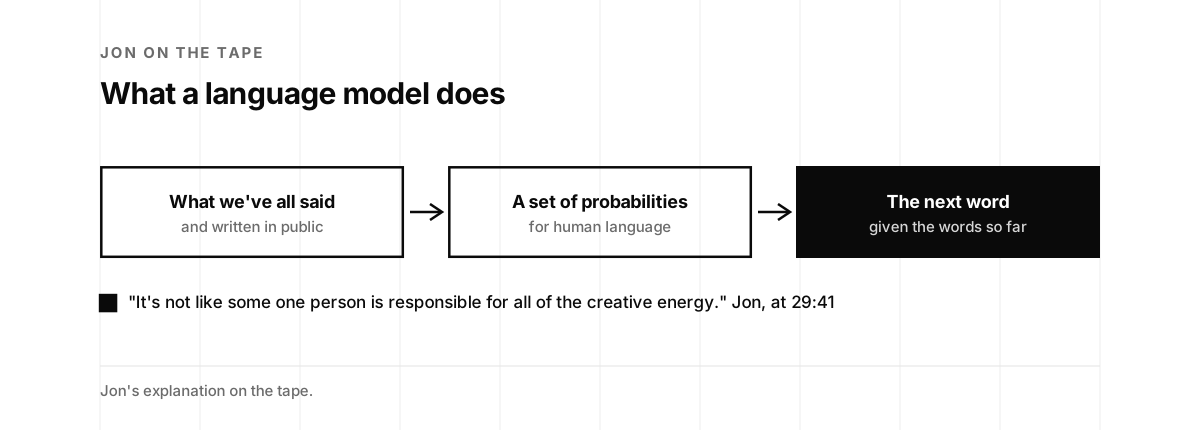
Jon described what a language model does. AI is an amalgamation of what all of us have said and written in public, and the people who built it found the math to represent all of us at once. That’s why it speaks so many languages, and why it sounds like us.
“It’s not like some one person is responsible for all of the creative energy.”
Jon McLachlan, at 29:41
Given a set of words, it learned the probability of the next word. Human language comes down to a set of probabilities. Jose’s reply was that it lets you test different things.
Imagineeer
Jose doesn’t have a normal job, he said, and thinks that’s a good thing. Jon asked about the name.
“you call yourself an imagineer now.”
Jon McLachlan, at 30:33
“It just sounded like a cool name.”
Jose Arrieta, at 30:42
His LinkedIn has his HHS roles ending in September 2020 and Imagineeer starting in August 2020 (LinkedIn). On the tape, he started it to work on interesting problems and connect dots, without knowing how he would make money doing it. His first example was the carbon project: a cryptographic wrap for carbon emissions data that makes the data portable. With that, you could reward carbon emissions reductions, and maybe fuel the carbon offset market. Jose also walks through health projects he was working on, which are in the transcript.
Advise and integrate
Jon asked whether Jose advises startups or gets his hands dirty. Both, Jose said. He jumps into startups and advises them. One is a quantum optimization company. Another is American Binary, the post-quantum company whose co-founder and CEO, Kevin Kane, came on episode 32 and episode 96. On the other side,
“I actually go and integrate technologies and serve more as the kind of integrator, putting the pieces together”
Jose Arrieta, at 35:21
He has never raised money for himself, he said. For American Binary, though, he made a phone call and
“helped them raise money right when I left government.”
Jose Arrieta, at 39:26
“And I just believed in Kevin. I thought he was fantastic.”
Jose Arrieta, at 39:31
In a government job like the one he had, he said, you have no life.
“things that you have to do because the bureaucracy demands it.”
Jose Arrieta, at 36:00
All in, three times
Jon asked what success looks like for Jose, then offered a guess.
“it sounds like it’s more about the journey.”
Jon McLachlan, at 37:23
Jose answered with HHS.
“There were three times during the pandemic where my team at Health and Human Services, whom I adore”
Jose Arrieta, at 37:27
Each time, the team asked whether they were going all in. The last time, the stakes were his job.
“you could get fired for making that call.”
Jose Arrieta, at 37:42
“I think it’s the right call for the nation.”
Jose Arrieta, at 37:46
What he learned is that going all in opens a door, whatever the outcome.
“the journey itself opens another door to you, right?”
Jose Arrieta, at 37:52
The outcome isn’t what he glorifies, he said, and the full story is one for a beer.
What’s next
Jose doesn’t know what’s next. He has two concepts.
“I have a concept around significantly disrupting the EHR space”
Jose Arrieta, at 38:11
“I have another concept around building a large service provider in the federal space.”
Jose Arrieta, at 38:22
He would build to a certain scale, buy companies and integrate them, and compete with the large integrators at that scale,
“leveraging AI to automate a lot of the back-end services.”
Jose Arrieta, at 38:40
He works with a number of partners and learns as he goes, among them
“people from around the world that I’ve never met other than video”
Jose Arrieta, at 40:09
Rip the Band-Aid off
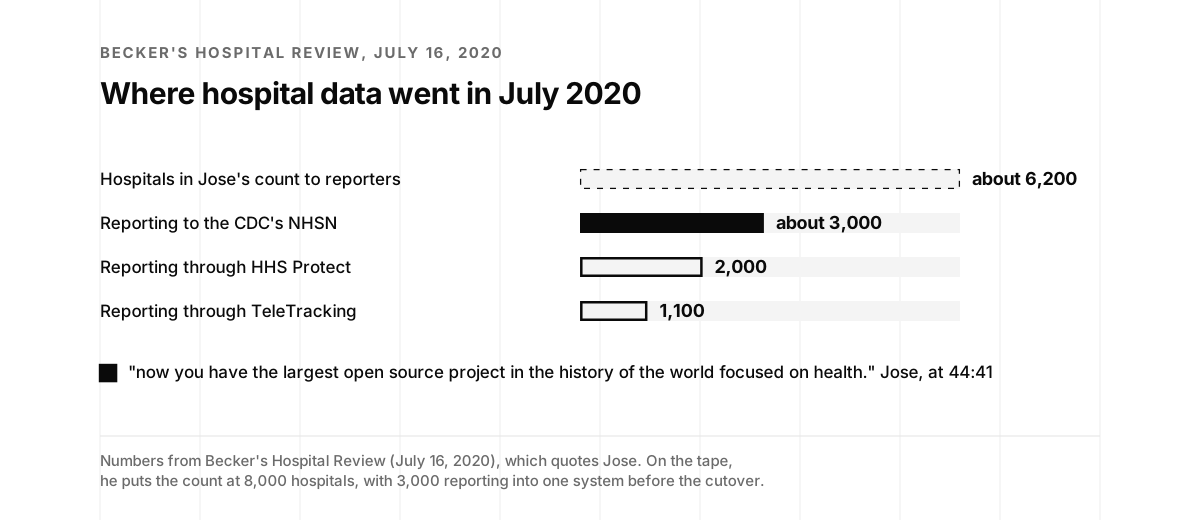
Late in the episode, Jose told the story of one hard call. HHS had to cut over the reporting of all the hospitals in the United States into one mechanism. On the tape, he puts the count at 8,000 hospitals, with 3,000 reporting into one system before the cutover. The team was told on a Wednesday to have it done by Friday or Monday. Before going live, people asked whether they were going to do this, and Jose said yes, and that all the data would be shared openly.
“sometimes you just got to rip the Band-Aid off.”
Jose Arrieta, at 44:30
He assumed the cutover would have issues. With all the data open, everyone could look for the inaccuracies.
“now you have the largest open source project in the history of the world focused on health.”
Jose Arrieta, at 44:41
“I didn’t realize how political that would become”
Jose Arrieta, at 44:51
Becker’s Hospital Review covered the change on July 16, 2020. HHS updated its guidance on July 10, 2020. Hospitals that had reported daily to the CDC’s National Healthcare Safety Network would report through TeleTracking to HHS, or through their state. Jose told reporters that the network received data from about 3,000 of roughly 6,200 hospitals, HHS Protect from another 2,000, and TeleTracking from 1,100 more. “We do that through HHS Protect,” he said (Becker’s).
Go all in
Jon asked for final words of wisdom, and Jose gave them.
“If you have that instinct that you feel like you should be all in on something, then go all in.”
Jose Arrieta, at 46:59
“it most certainly will open up a door that you could never imagine.”
Jose Arrieta, at 47:07
“What I thought was a risk really created an amazing opportunity for me.”
Jose Arrieta, at 47:16
What happened after the tape
Imagineeer grew past one person. In a LinkedIn post, Jose says he founded Imagineeer six years ago, and that “For five of those six years, Imagineeer was a one-person advisory firm.” (LinkedIn).
A Department of Education contract. Another recent post announces an Enterprise Acquisition Transformation support contract at the U.S. Department of Education (LinkedIn).
On two 2027 lists. His posts say Imagineeer is a 2027 Elev8 GovCon Honoree, and that Jose was named to the 2027 Engage Fed Health 150 (LinkedIn).
Still advising American Binary. A post from this year says he has advised the company “since the friends and family round” (LinkedIn). Kevin Kane came back for a second visit on episode 96, published June 2, 2026.
Teaching ended in 2023. His LinkedIn has the Johns Hopkins role running to May 2023 (LinkedIn).
AI agents in government. He talked about agents in government with David Blackburn on OrangeSlices’ GovCon Executive Slice podcast, which he shared on LinkedIn (LinkedIn).
More on this show. Jon compares Peacemakr with Intel’s hardware-based protection for data, on episode 39 with Steve Orrin. Georgianna Shea of the Foundation for Defense of Democracies tells how Presidential Decision Directive 63 led to her first job as a network analyst, on episode 48.
Did you catch it? A seven-question quiz
Seven questions from the episode. Each answer links the moment in the transcript.
Quiz · seven questions
Did you catch it?
Pick an answer to see whether you caught it.
-
What does Jose believe the March 2020 attack on HHS was for?
b. "it appeared to be an amplified DDoS attack, but it was actually to map our interconnectivity within the broader health system, right?" Transcript, 5:49.
-
What does Jose say about the NOC and the SOC?
a. "have to be fully integrated." Jose means the NOC and the SOC. Transcript, 16:22.
-
What analogy does Jose use for spreading identity out?
c. "if we hire five shooters that can really shoot the lights out and make him run all over the place, we have a better chance of beating him, because he's a unicorn." Transcript, 16:50.
-
Which question does Jon say comes up every time he sets up a security program?
b. "what data do we have?" Transcript, 22:46.
-
What price does Jose suggest for each use of a patient's data?
a. "you had this ability to transact for that data." Then he says, let's say half a penny. Transcript, 26:11.
-
How many times during the pandemic did Jose's team ask whether they were going all in?
c. "There were three times during the pandemic where my team at Health and Human Services, whom I adore" asked whether they were going all in. Transcript, 37:27.
-
What does Jose call the hospital data cutover, once the data was open?
b. "now you have the largest open source project in the history of the world focused on health." Transcript, 44:41.
Could you reconstruct your worst day?
Eight questions on whether your logs, teams and data records could tell the story of a large attack, from the episode. Each tip quotes the tape or paraphrases it, and links its section.
Scorecard · eight questions
Could you reconstruct your worst day?
Answer for your production network and the data it holds. If two answers fit, pick the lower one.
-
What do you log at the edge of your network?
- Little or nothing, only inside our apps
- Some edge traffic, kept for a few days
- The edge and the apps, kept long enough to investigate
"at a stateless level, you're not collecting certain information." See Only what you logged.
-
Do your NOC and SOC work as one team?
- Separate teams and separate tools
- Separate, with a shared channel in an incident
- One team with one picture of the network and the threats
The NOC and the SOC, Jose says, "have to be fully integrated." See One team for the NOC and the SOC.
-
Can you answer the question of what data you have?
- No, we have no inventory
- For our main systems
- Yes, every data set, each with an owner
Jon says the question comes up at every company he works with, from a two-person startup up. See Data at the center.
-
Can you say where a data set came from and who has used it?
- No
- For some data sets
- Yes, with a record of its source and every access
Jose asks how you create an identity "for each data asset, for each data set?" See An identity for every data set.
-
Do you share threat information with other companies in your sector?
- No
- Informally, with a few peers
- Yes, through an ISAC or a similar group
Jose's two food companies each secure themselves, and neither has an incentive to share. See Investing in the gap.
-
How far down does identity go?
- One login at the perimeter
- Each user
- Each user, each service and each data set
"distribution of control, distribution of identity to the lowest level" See Five shooters.
-
If a large attack hit tomorrow, could you change how your network behaves?
- No plan
- A plan on paper
- A tested plan, with the providers who would help
"let's create tools that give you the flexibility to defend yourself in the event of a large action like that." See One of two nation states.
-
Do your incident reports say what you didn't record?
- No, the gaps get filled in
- Sometimes
- Every report lists what the logs can't show
"no information really does mean no information." See Only what you logged.
A large attack would leave you with part of the story. Start at the edge: decide what to log there and how long to keep it, and put the NOC and SOC on one channel.
You'd see most of an attack. Next, list every data set with an owner and a source, join your sector's ISAC, and write down how you would change the network under load.
Your logs, teams and data records could tell the story of a bad day. Test it with an exercise, and keep each report honest about what the logs can't show.
What half a penny adds up to
Jose’s example is half a penny each time a provider uses a reading from a patient’s device. This calculator shows what that adds up to for the people the data describes.
Calculator
What half a penny adds up to
Three numbers: how many readings your devices collect a day, how many providers use each one, and the price of each use in cents.
With 10,000 readings a day, each used by 2 providers at 0.5 cents a use, the people the data describes would get $100 a day, or $36,500 a year, from 20,000 uses a day.
The half a penny comes from the tape. The 10,000 readings and the 2 providers are placeholders: put in your own numbers.
From Treasury to Imagineeer
Jose’s path, HHS in the pandemic, data and trust, threat sharing, and the episodes on this site that pick up the thread. Filter by topic.
Timeline
From Treasury to Imagineeer
- PDD-63
Presidential Decision Directive 63 is signed. Sector ISACs begin forming in 1999 (Wikipedia, on this page).
- Tenable
Ron Gula, Jack Huffard and Renaud Deraison found the company (Wikipedia).
- TSA
Jose becomes a program manager (LinkedIn, on this page).
- DHS
Industry liaison and ombudsman (LinkedIn).
- First classroom
Adjunct at Prince George's Community College (LinkedIn, on this page).
- Treasury
Director of the Office of Small and Disadvantaged Business Utilization (LinkedIn, on this page).
- Hyperledger
The Linux Foundation starts its umbrella project for open source blockchains (Wikipedia, on this page).
- GSA
Director of the IT Schedule 70 contract (LinkedIn).
- HHS acquisition
Jose joins HHS on the acquisition side (Nextgov).
- Johns Hopkins
Adjunct at the Carey Business School (LinkedIn).
- HHS Accelerate
HHS expects an authority to operate for its blockchain acquisition system (Nextgov).
- CIO
HHS names Jose its permanent chief information officer (Nextgov).
- The attack
A DDoS-style attack hits HHS. The network briefly vanishes from the internet (Bloomberg, on this page).
- Hospital reporting moves
New guidance sends hospital data through TeleTracking to HHS, or through the states (Becker's, on this page).
- Imagineeer
Jose founds the company (LinkedIn, on this page).
- Leaves HHS
His roles as CIO and interim chief data officer end (LinkedIn).
- Gula Tech Foundation
A foundation for grants to cybersecurity nonprofits (PR Newswire, on this page).
- Eight billion scans
FedScoop reports Jose's account of the attack (FedScoop).
- Last class
His Johns Hopkins role ends (LinkedIn).
- Food and Ag-ISAC
IT-ISAC's food and agriculture group becomes its own center (Security Magazine).
- Episode 32
Kevin Kane of American Binary on post-quantum cryptography (episode page).
- The untold story
Bloomberg News reports on the attack (Bloomberg).
- The Times sues
The New York Times sues OpenAI and Microsoft for copyright infringement (Wikipedia, on this page).
- Episode 39
Steve Orrin of Intel, with Jon on Peacemakr (episode page).
- Episode 40
Jose on the show (Podbean, transcript).
- Episode 48
Georgianna Shea on PDD-63 and the start of her career (episode page).
- Episode 96
Kevin Kane comes back for a second visit (episode page).
What to do this week
Five things, in the order of the episode.
- Check what your edge keeps. Find out what your stateless layers log and for how long, then take the scorecard with your team.
- Put the NOC and SOC together. Give them one channel and one picture of the network for the next incident, as in One team for the NOC and the SOC.
- Answer what data you have. List each data set with an owner and a source. Our post on the AI data bill of materials has a starting format.
- Join your sector’s ISAC. Health, food and most other critical sectors have one, as in Investing in the gap.
- Get help for the bad day. 24/7 Monitoring & Response watches cloud, network, endpoints and mobile in one picture, with people who respond, and our Counter Nation-State Espionage & National Security Program is built for state-grade adversaries. If you want to talk it through, book 15 minutes with us.