Episode 32 of The Security Podcast of Silicon Valley, published September 1, 2023. Host Jon McLachlan talks with Kevin Kane, co-founder and CEO of American Binary, about post-quantum cryptography: his path from the US Army and a run for the Georgia House to about ten years in Korea and quantitative trading, why cryptography is like handling enriched uranium, the end of the shelf life of the internet's encryption, Q-Day and LK-99, three White House actions, post-quantum encryption on edge devices, the OSI layer you sell into, CNSA 2.0 and Kyber, a machine built to break encryption, the art of the unknown, Arrival, two books on power, a Facebook feature that gave people away, crypto agility without new attack surface, and the market for whole products. About 95 minutes.
Episode notes
In this episode of a YSecurity.io production we feature, Kevin Kane, the Co-Founder and CEO of Ambit, Inc. dba American Binary, a startup specializing in protecting businesses against current and next-generation cyber threats. With expertise in post-quantum cryptography and high-performance network infrastructure, catch a glimpse into the future of quantum computing and its devastating impact on RSA and EC public key cryptography, potentially halting secure communications across the Internet and globalization as we know it. In this episode, Kevin shares vulnerable moments and thoughtful insights on religion, philosophy, self-improvement, psychology, and how security plays a crucial role in today's interconnected and globalized world. Don't miss out on this insightful and engaging conversation.
Hosted by Jon McLachlan — co-founder of YSecurity.
The deep dive
The end of the shelf life
Kevin Kane, the co-founder and CEO of American Binary, on his first visit to the show: an Army career and a run for office, ten years in Korea, a hundred truths on every topic, cryptography as enriched uranium, the end of the shelf life of the internet's encryption, Q-Day and the LK-99 scare, research indexed by the hour, three White House actions, post-quantum crypto on edge devices, the OSI layer you sell into, an irrational passion, two years ahead and lonely, no encryption and no globalization, CNSA 2.0 and Kyber, a machine built to break encryption, the art of the unknown, Arrival, two books on power, a portfolio of people, a Facebook feature that gave people away, crypto agility without new attack surface, and the market for whole products.
Episode 32 of The Security Podcast of Silicon Valley aired on September 1, 2023. Jon McLachlan hosted alone. The guest was Kevin Kane, co-founder and CEO of American Binary, a company that builds post-quantum network security (Podbean). At 95 minutes it is the longest episode of the show. The show notes ran 113 words and promised “a glimpse into the future of quantum computing.”
“the consensus among the cryptography community is that we’ve hit the end of the shelf life of all of the internet’s encryption.”
Kevin Kane, at 18:07
Listen · Kevin Kane on episode 32, from 18:02About 35 seconds: Kevin on why everything built on the public internet has to change. The clip stops on its own. Read the full transcript.
American Binary’s legal name is Ambit Inc., and the company is based in Kirkland, Washington (American Binary). Kevin has run it as chief executive since March 2019, and his LinkedIn headline today reads “Enterprise Post-Quantum Network Security (CNSA 2.0)” (LinkedIn).
A note before we start. American Binary works with YSecurity. Its logo is on our home page and on our penetration testing page. Everything below comes from the tape and the public record.
The tape dates itself to the summer of 2023. Kevin brings up LK-99, the material a Korean team claimed was a room-temperature superconductor in preprints posted on July 22, 2023, and Jon adds that nobody knew yet when they recorded. By mid-August, replication work had concluded it was not a superconductor (Wikipedia). Kevin also compares researchers to the scientists in Oppenheimer, the film released on July 21, 2023 (Wikipedia).
Kevin came back almost three years later for episode 96, on harvest attacks and formal verification. This page is the first conversation: a section for each part of it with the sources beside it, eighteen figures, thirty clips from the tape, the full transcript, and five tools: a quiz, a scorecard for how ready your encryption is for the change, a calculator for whether your network refresh lands before the NSA’s 2030 date, a timeline, and a to-do list.
The tape is from 2023. Where a fact has changed since, such as the status of Kyber, the page gives the change and its date. Where the decodes of the tape disagree on a word, the transcript puts its best guess in brackets, and the page doesn’t quote those words. The episode also runs through personal stories, religion and politics. Those parts are in the transcript as spoken, and the page stays with the security story.
I ran for everything at once
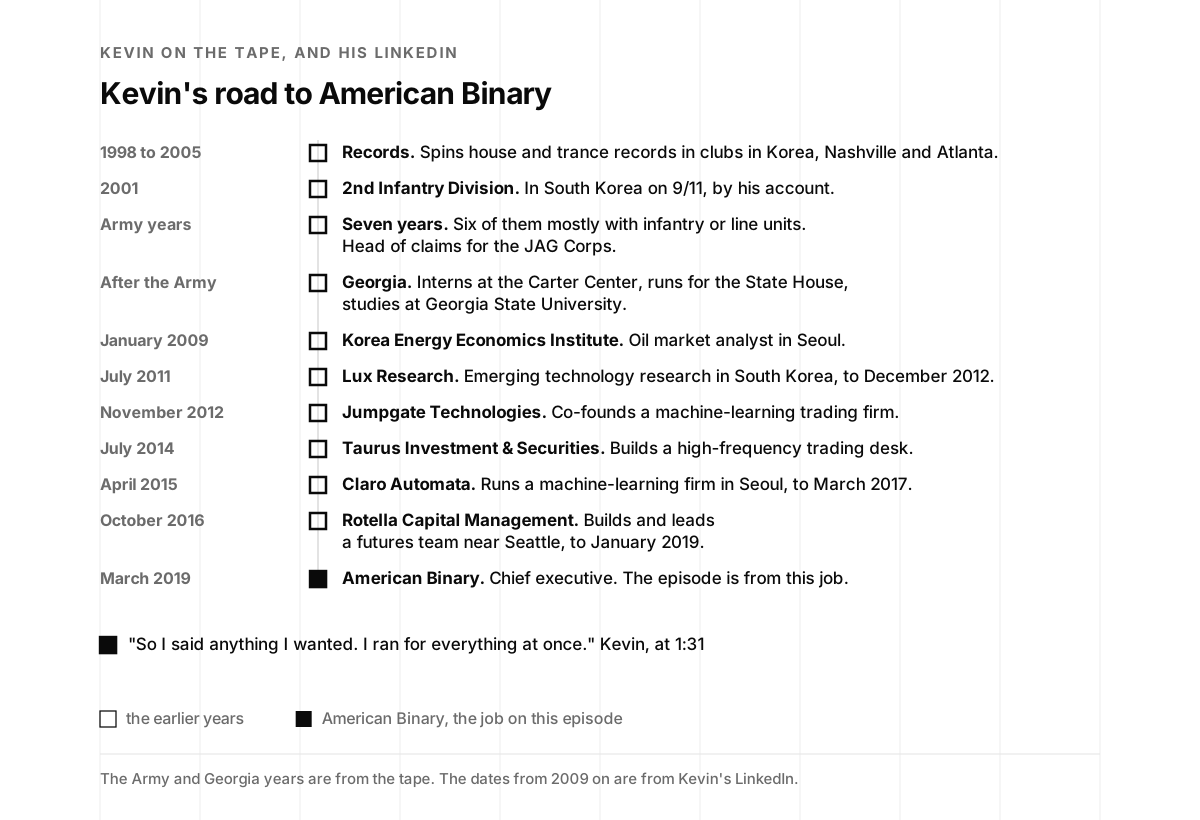
Jon opened with Kevin’s past: the US Army, then a run for the Georgia House of Representatives. Kevin said he spent seven years in the Army, six of them assigned mostly to infantry or line units, and that he was head of claims for the Judge Advocate General’s Corps, the Army’s legal branch (Wikipedia). He got out during the Iraq War.
“It’s like I’m no longer in a place where I have to watch everything I say, and I have to be mindful of whether or not people like me to get the assignments I want.”
Kevin Kane, at 1:18
“So I said anything I wanted. I ran for everything at once.”
Kevin Kane, at 1:31
Listen · Kevin Kane on episode 32, from 1:27About 15 seconds: Kevin on leaving the Army and saying anything he wanted. The clip stops on its own. Read the full transcript.
He listed what he did at the same time. He interned at the Carter Center and met President Carter. The Carter Center is a nonprofit that former president Jimmy Carter founded in 1982, two miles from downtown Atlanta (Wikipedia). He ran for the State House. He was an honors student at Georgia State University, writing an undergraduate thesis on democratization in Northeast Asia and South Korea. He gave speeches, and he caught shoplifters at a clothing store.
What he took from the campaign:
“I learned that running for office is not one of my strong suits.”
Kevin Kane, at 2:45
“I think that if you’re a person of nuance and you’re a person of thoughtfulness, don’t run for office, because the people who knock on doors are not going to be too excited about that.”
Kevin Kane, at 2:49
Kevin's road to American Binary. The Army and Georgia years are from the tape, and the dates from 2009 on are from his LinkedIn.
A strange series of events
Jon asked how Kevin ended up as an oil market analyst in Seoul.
“That’s a strange series of events.”
Kevin Kane, at 3:14
Kevin had first lived in South Korea in the Army. In those years he also played records in clubs, from 1998 to 2005, in Korea and in Nashville and Atlanta. He said he did it for the people, not the money. After the campaign, he went back.
“I like the fact that there’s so much uncertainty. To me, that was the most attractive thing.”
Kevin Kane, at 5:01
“So you like to push yourself outside your comfort zone.”
Jon McLachlan, at 5:06
Listen · Kevin Kane on episode 32, from 4:55About 20 seconds: Kevin on going back to Seoul, and Jon on the comfort zone. The clip stops on its own. Read the full transcript.
He went to graduate school at what he called Korea’s top school, the national school where ambassadors and diplomats study. His LinkedIn lists Seoul National University. He said his economics professor there became South Korea’s economic minister. He lived in Korea for about ten years in all and speaks Korean.
“And in that experience, like in graduate school, Koreans are very direct. I’m going to generalize.”
Kevin Kane, at 7:10
His LinkedIn picks up from there. He was an oil market analyst in econometrics at the Korea Energy Economics Institute in Seoul from January 2009, then worked in emerging technology research for Lux Research in South Korea from July 2011 to December 2012. He co-founded a machine-learning trading firm, Jumpgate Technologies, in November 2012, built a high-frequency trading desk at Taurus Investment & Securities from July 2014, and ran Claro Automata, a machine-learning firm in Seoul, from April 2015 to March 2017. He then built and led a futures team at Rotella Capital Management near Seattle from October 2016 to January 2019 (LinkedIn). On the tape he describes the trading desk and a weekly mean-reversion strategy that used machine learning.
A hundred truths
Kevin said living overseas showed him a gap between what American media cover and what happens.
“me experiencing it overseas, realize what American media cover and what happens is, like, a huge gap.”
Kevin Kane, at 11:49
“Americans get a very curated view of the world.”
Kevin Kane, at 11:54
Jon described his morning routine. He opens an app called Hourly News that plays short clips from many outlets, including NPR, Fox News, the CBC and Deutsche Welle.
“No one lies, but when something big happens, there’s things that don’t get reported, or reported, like, slightly differently, with a different tone.”
Jon McLachlan, at 13:14
Kevin’s version of the same point:
“So I always say there’s a hundred truths you can talk about on a topic, and maybe the human brain can only handle four or five out of that hundred that you select.”
Kevin Kane, at 13:30
“And the one you select is either the conscious or the subconscious manipulation.”
Kevin Kane, at 13:39
Listen · Kevin Kane on episode 32, from 13:29About 15 seconds: Kevin on the hundred truths and the four or five we pick. The clip stops on its own. Read the full transcript.
“I call it drinking the Kool-Aid.”
Jon McLachlan, at 13:47
The same filter applies to security news. A vendor’s headline, a government memo and a research paper can all be true and still pick different four or five truths from the same hundred.
Like handling enriched uranium
Jon asked how Kevin got into security, and said post-quantum cryptography is the real kind of crypto, the kind that protects data. Kevin answered with a warning about the field.
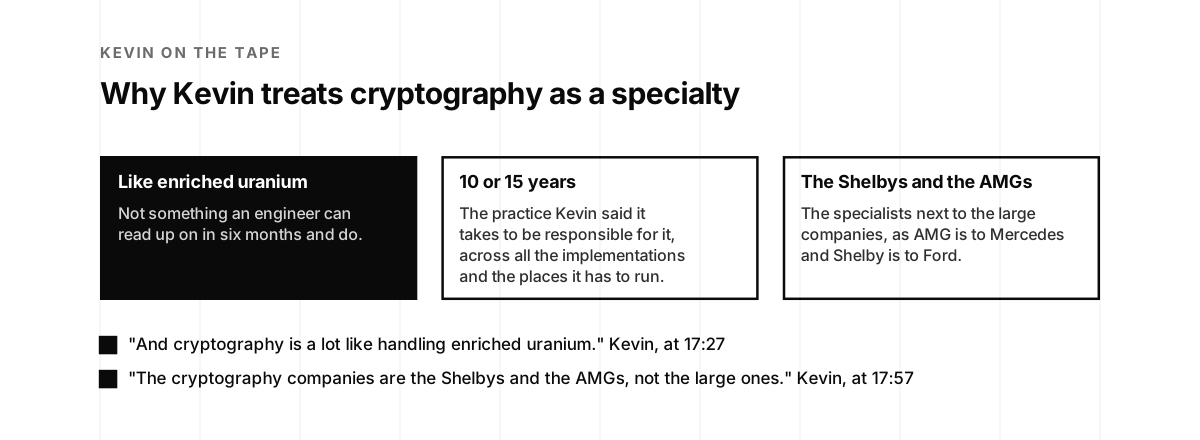
“And cryptography is a lot like handling enriched uranium.”
Kevin Kane, at 17:27
“It’s not the kind of thing you can be an engineer and in six months just read up on and do.”
Kevin Kane, at 17:31
Listen · Kevin Kane on episode 32, from 17:27About 35 seconds: Kevin on why cryptography takes years of practice, and who does it best. The clip stops on its own. Read the full transcript.
He said it takes 10 or 15 years of practice to be responsible for it, across all the implementations, and across the places it has to run. Then he compared the cryptography companies to the tuning shops of the car world.
“It’s like AMG is to Mercedes, or Shelby is to Ford.”
Kevin Kane, at 17:53
“The cryptography companies are the Shelbys and the AMGs, not the large ones.”
Kevin Kane, at 17:57
Kevin's case for cryptography as a specialty.
The end of the shelf life
Then he gave the claim the whole episode builds on.
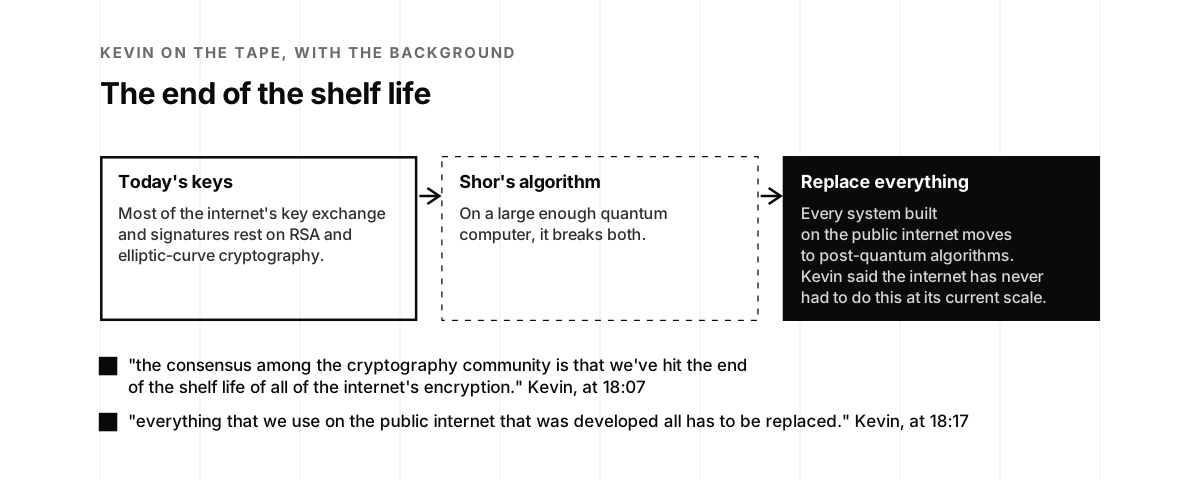
“the consensus among the cryptography community is that we’ve hit the end of the shelf life of all of the internet’s encryption.”
Kevin Kane, at 18:07
“everything that we use on the public internet that was developed all has to be replaced.”
Kevin said this replacement is new in history, because the public internet at this scale is new.
“And what happens in this very mature infrastructure for e-commerce and for communication when we have to stop and redo everything?”
Kevin Kane, at 18:39
The end of the shelf life, as Kevin laid it out.
Wrong and right at the same time
Kevin described two camps. One says quantum computers are far away, so there is nothing to worry about.
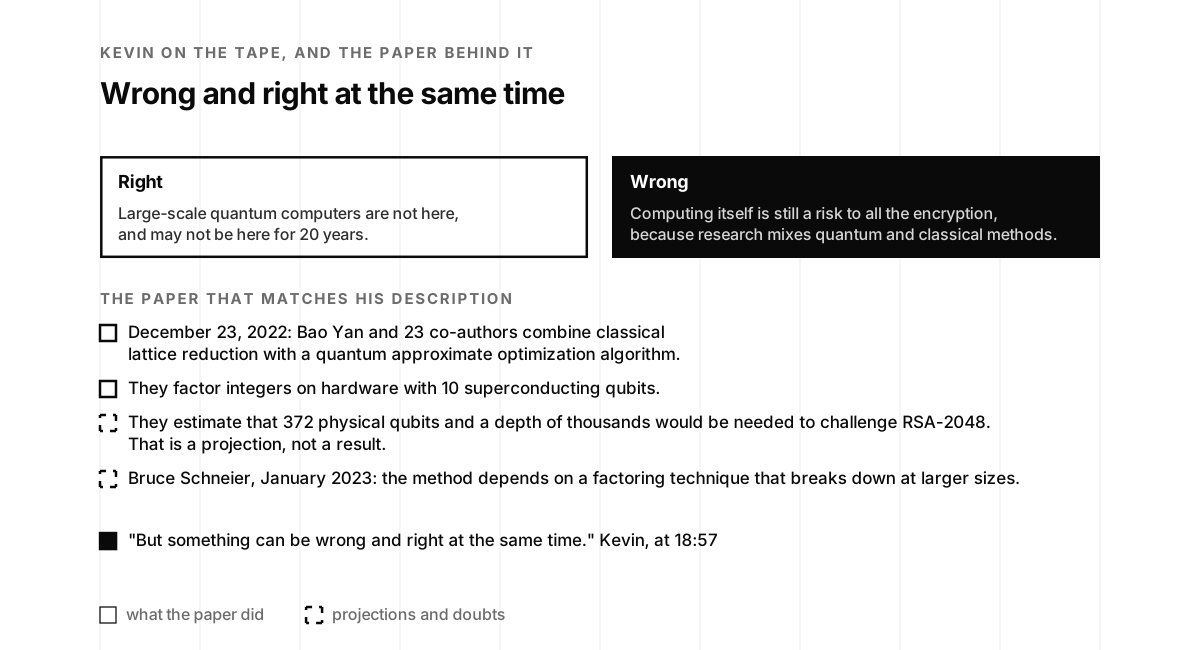
“But something can be wrong and right at the same time.”
Kevin Kane, at 18:57
“You’re right in that large-scale quantum computers are not here, and they may not be here for 20 years.”
Kevin Kane, at 19:00
“You’re wrong in thinking that computing itself is not a risk to all the encryption”
Kevin Kane, at 19:05
Listen · Kevin Kane on episode 32, from 18:57About 20 seconds: Kevin on the camp that says quantum computers are 20 years away. The clip stops on its own. Read the full transcript.
His evidence was research that mixes quantum and classical computing. He said quantum computing companies were moving into classical computing research, and that recent Chinese research paired a noisy quantum computer of about 300 qubits with classical preprocessing to attack encryption.
The paper that matches his description was posted on December 23, 2022, by Bao Yan and 23 co-authors. It combined classical lattice reduction with a quantum approximate optimization algorithm, factored integers on hardware with 10 superconducting qubits, and estimated that “a quantum circuit with 372 physical qubits and a depth of thousands” would be needed to challenge RSA-2048. That last number is a projection, not a result (arXiv). Bruce Schneier read it in January 2023 and wrote, “It might not be correct, but it’s not obviously wrong.” He added that the method depends on a factoring technique that breaks down at larger sizes (Schneier on Security).
Two halves of one argument, with the paper behind the second half.
They call it Q-Day
Kevin said large governments were spending billions of dollars on breaking RSA, because of what it would be worth. Jon added the obvious part.
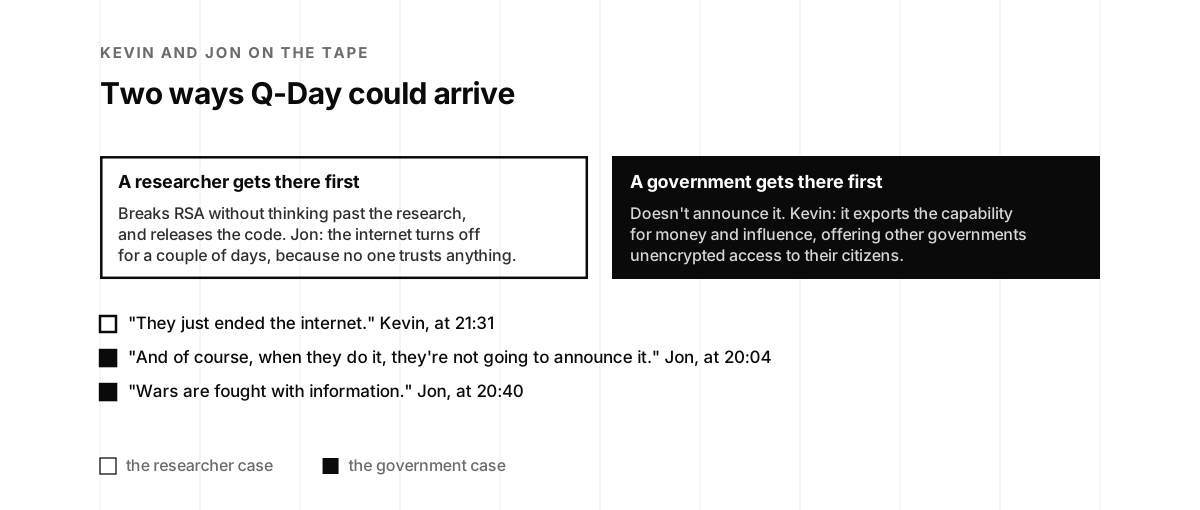
“And of course, when they do it, they’re not going to announce it.”
Jon McLachlan, at 20:04
“I think what they’re going to do is export the capability for financial gain and for geopolitical influence, like a Monroe Doctrine.”
Kevin Kane, at 20:12
Listen · Jon McLachlan on episode 32, from 20:03About 35 seconds: Jon and Kevin on what a government would do with the capability. The clip stops on its own. Read the full transcript.
Kevin’s example was a government that offers other governments “unencrypted access to every citizen they have.” Jon summed it up.
“Wars are fought with information.”
Jon McLachlan, at 20:40
“And that’s what they call it, and they call it Q-Day, the research there.”
Kevin Kane, at 20:44
Later in the episode Jon came back to the point: “the wars are won and lost with the control of information.” Kevin agreed: “Yeah, the information advantage, right?”
The worst thing that could happen
Jon asked whether Q-Day would come on one day, at one point in time. Kevin answered with LK-99.
“Think of LK-99, the superconductive material, that there was a claim around, that might not have been a thing, right? We don’t know yet.”
Kevin Kane, at 21:04
“Let’s say somebody isn’t thinking about, outside of their research, the implications of breaking RSA and releasing the code.”
Kevin Kane, at 21:15
“They just ended the internet.”
Kevin Kane, at 21:31
Listen · Kevin Kane on episode 32, from 21:00About 35 seconds: Kevin on the researcher who releases the code. The clip stops on its own. Read the full transcript.
“At least as we know it, it’s going to turn off for a couple of days, because no one is going to trust anything anymore, right?”
Jon McLachlan, at 21:33
Kevin compared it to the film then in theaters.
“academic researchers don’t understand, like in Oppenheimer, the consequence of what they’re doing.”
Kevin Kane, at 21:41
The LK-99 team, from Korea University, posted two preprints on July 22, 2023, claiming superconductivity at up to about 400 K at normal pressure. On August 16, 2023, Nature published an article declaring that it had been shown not to be a superconductor (Wikipedia). That was Kevin’s point: a claim can go around the world before anyone knows whether it is real.
Kevin's worst case, step by step.
Research, by the hour
Kevin’s next point was about speed. Research gets indexed and builds on itself.
“And what is different now from 20 years ago is that all of the world’s research, and by the hour, is indexed on the internet.”
Kevin Kane, at 21:50
Unlike 20 years ago, he said, anyone can now pull up the published work and build on it to break encryption.
He called the pace “probably not even exponential, but double exponential innovation.” Then he compared a broken RSA to the breaches people know.
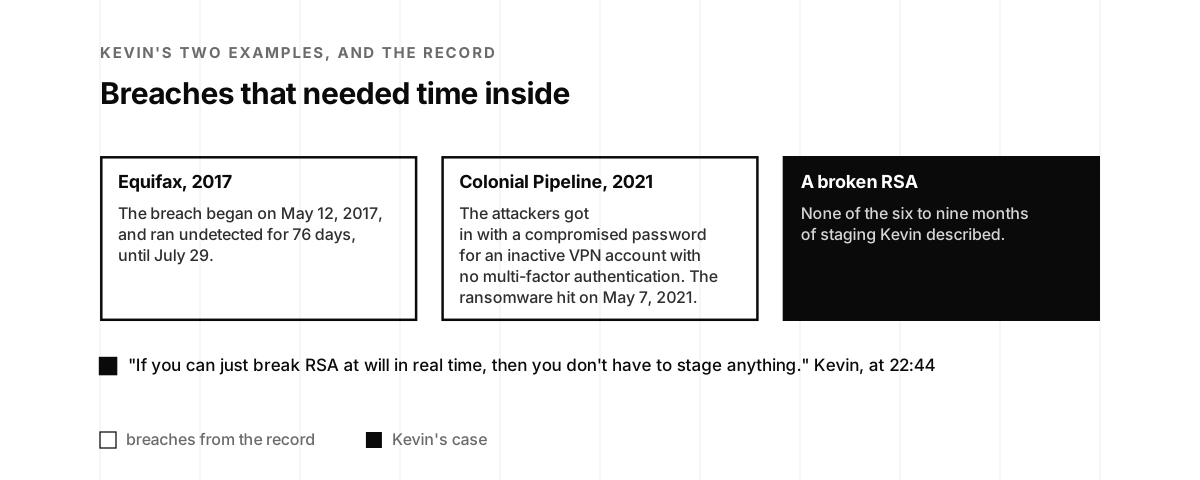
“it’s not like you breach a building like Equifax, and you spend six to nine months staging the breach and figuring out your way in, or the Colonial Pipeline.”
Kevin Kane, at 22:34
“If you can just break RSA at will in real time, then you don’t have to stage anything.”
Kevin Kane, at 22:44
Listen · Kevin Kane on episode 32, from 22:34About 25 seconds: Kevin on a break that needs no staging, and Jon on what it would mean. The clip stops on its own. Read the full transcript.
“There goes, like, every company that ever does anything on the internet.”
Jon McLachlan, at 22:55
The record on his two examples: the 2017 Equifax breach began on May 12, 2017, and “continued undetected for 76 days until July 29, 2017” (Wikipedia). The Colonial Pipeline ransomware attack hit on May 7, 2021, and the attackers got in with a compromised password for an inactive VPN account that had no multi-factor authentication (Wikipedia). Both took time inside the network. Kevin’s point is that a broken key exchange takes none.
Two breaches that needed time inside, and the one Kevin warned about that doesn't.
Three White House actions
“Now that I did the fear, I can talk about the reality.”
Kevin Kane, at 22:59
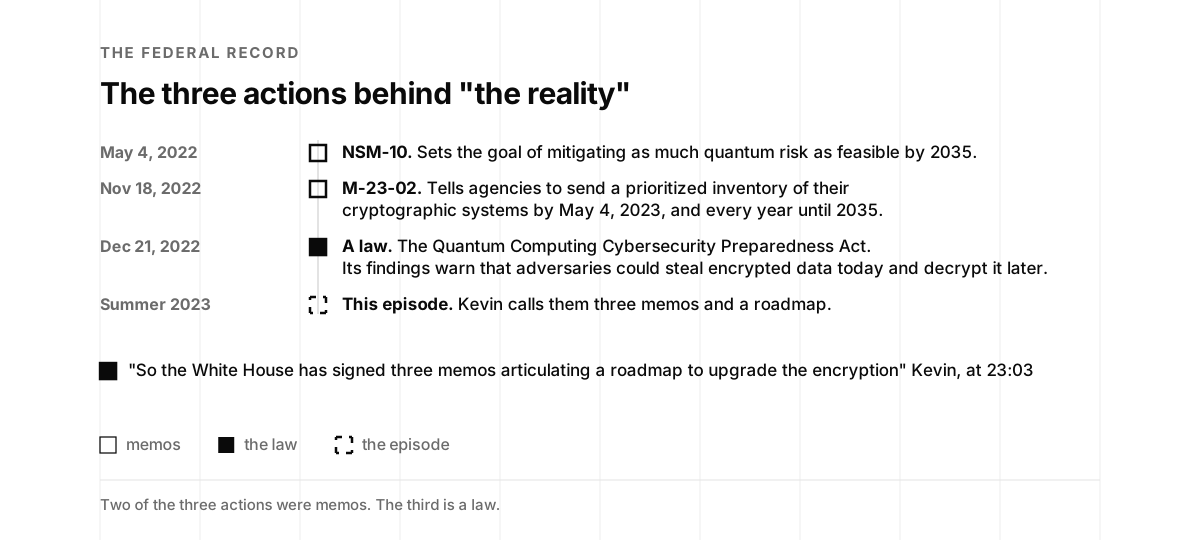
“So the White House has signed three memos articulating a roadmap to upgrade the encryption”
Kevin Kane, at 23:03
Listen · Kevin Kane on episode 32, from 22:59About 15 seconds: Kevin on the White House roadmap. The clip stops on its own. Read the full transcript.
By the summer of 2023 there were three federal actions behind that roadmap, though only two were memos. National Security Memorandum 10, on May 4, 2022, set the goal of mitigating as much quantum risk as feasible by 2035 (White House). On November 18, 2022, the Office of Management and Budget issued M-23-02, “Migrating to Post-Quantum Cryptography,” which told agencies to send a prioritized inventory of their cryptographic systems “By May 4, 2023, and annually thereafter until 2035” (OMB). On December 21, 2022, President Biden signed the Quantum Computing Cybersecurity Preparedness Act into law (Rep. Nancy Mace). Its findings say adversaries could “steal sensitive encrypted data today using classical computers” and wait for a quantum computer to decrypt it (GovInfo).
The three federal actions behind "the reality," with their dates.
Blackmail material
Kevin said the roadmap covers corporate data, the economy, national security and health records, and that health records are the strangest of these.
“Healthcare is a strange one, that there are perpetual breaches at hospitals.”
Kevin Kane, at 23:16
He said attackers want to know who is ill, and that the records of executives at large public companies are worth even more to an adversary.
“Blackmail material.”
Jon McLachlan, at 23:52
“Yes, blackmail material, manipulation material.”
Kevin Kane, at 23:53
He framed the response as a choice to make now, whatever anyone thinks of the past.
“Do you want to survive now? Yes or no? It’s the binary question, actually.”
Kevin Kane, at 24:37
Our harvest post lists health and genetic records among the data that “must stay secret for a decade or more,” which puts them early in any migration plan. For a health tech vendor, the encryption questions start in the buyer’s review, which our post on the health system security review walks through.
It can happen to you
Jon answered with a mantra from self-defense training.
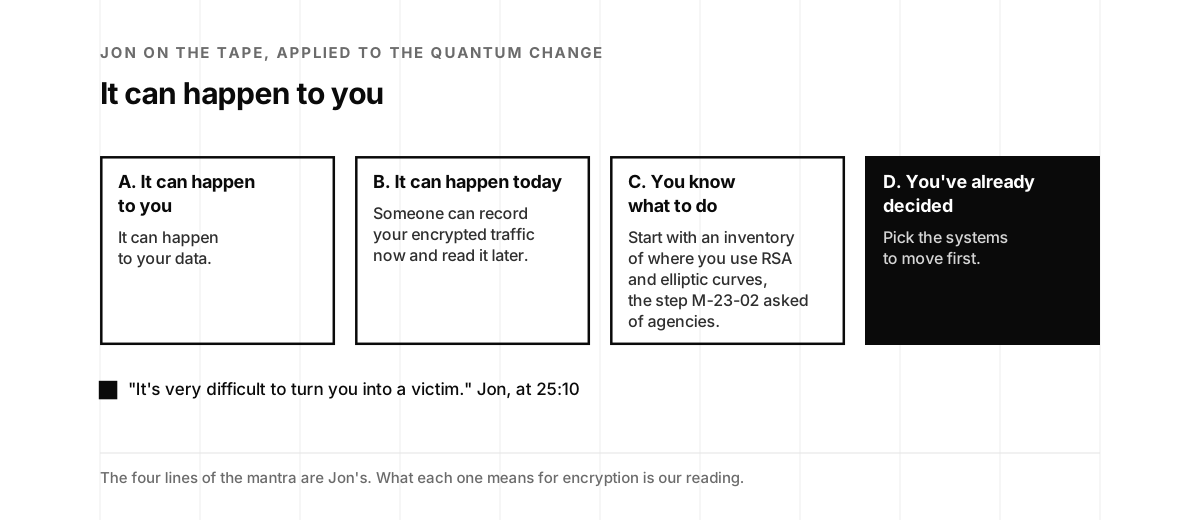
“It reminds me of the self-defense mantra. A, it can happen to you. B, it can happen today. C, like, you know what to do about it. And D, you’ve already decided to do that.”
Jon McLachlan, at 24:54
“It’s very difficult to turn you into a victim.”
Jon McLachlan, at 25:10
Listen · Jon McLachlan on episode 32, from 24:54About 20 seconds: Jon's four-part self-defense mantra. The clip stops on its own. Read the full transcript.
Kevin said the same preparation is what lets a person stay calm.
“It is peace, and it puts you in control, to be calm when you have conflict and to be able to talk out of it, because you don’t have any of your adrenaline running.”
Kevin Kane, at 26:35
The mantra works as a security plan for the quantum change. It can happen to your data. It can happen today, if someone records your traffic now. You know what to do, which is the inventory the White House asked agencies for. And deciding in advance means picking the systems to move first.
Jon's mantra, applied to the quantum change.
Austere environments
Jon asked what Kevin and his team do better than everyone else in the world.
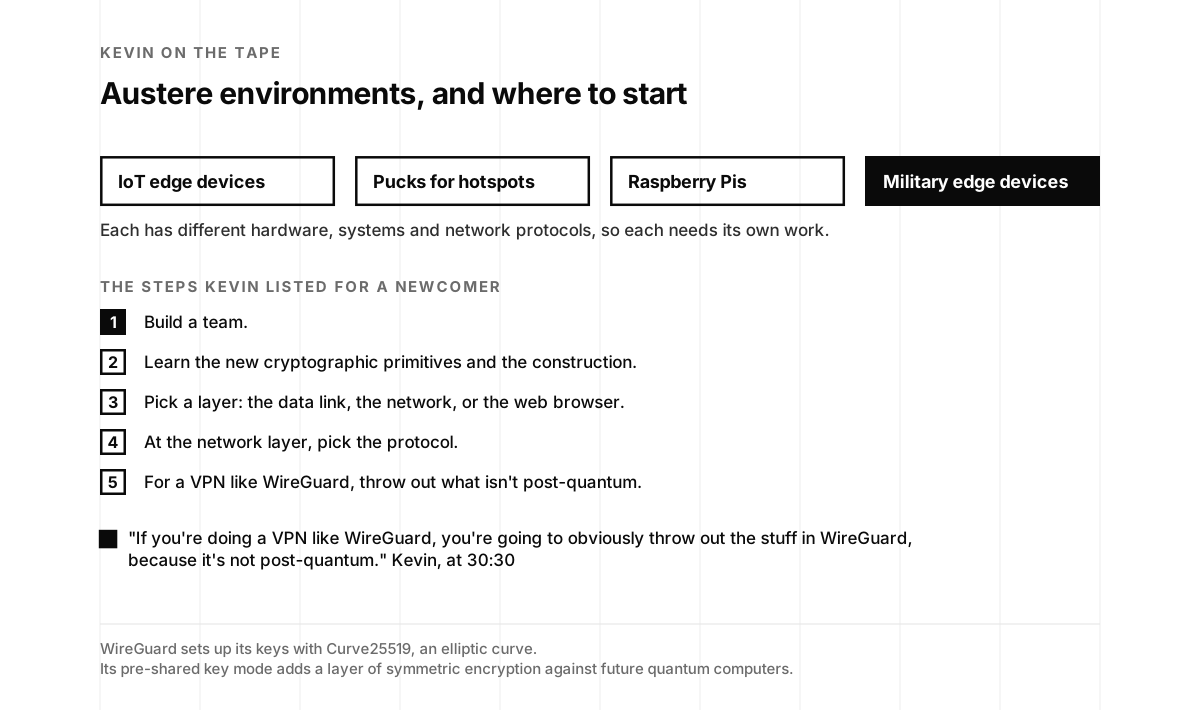
“I would say we probably have some of the most experience in austere environment deployment of post-quantum cryptography. That’s a mouthful.”
Kevin Kane, at 29:26
“So austere environment means, like, IoT edge devices, pucks for hotspots, things that get to be more difficult, Raspberry Pis, for example, edge devices for the military, and this kind of stuff.”
Kevin Kane, at 29:36
Listen · Kevin Kane on episode 32, from 29:26About 20 seconds: Kevin on what "austere environments" means. The clip stops on its own. Read the full transcript.
Each of those devices has different hardware, systems and network protocols, so each needs its own work. He said American Binary was “easily two years ahead of everyone else” in that space, and listed what a newcomer has to do.
“First, you’ve got to build a team. Secondly, you’ve got to learn about the new cryptographic primitives and the construction.”
Kevin Kane, at 30:10
Then they have to pick a layer: the data link, the network, or the web browser. At the network layer, the question is which protocol to use.
“If you’re doing a VPN like WireGuard, you’re going to obviously throw out the stuff in WireGuard, because it’s not post-quantum.”
Kevin Kane, at 30:30
WireGuard sets up its keys with Curve25519, an elliptic curve. Its pre-shared key mode adds “an additional layer of symmetric encryption to mitigate future advances in quantum computing,” and pre-shared keys are “usually troublesome from a key management perspective” (Wikipedia).
Austere environments, and the steps Kevin listed for anyone starting out.
Start with the OSI model
Kevin told a story about an early pitch to a potential investor.
“Yeah, this was a bad VC pitch for me years ago.”
Kevin Kane, at 30:41
The investor asked, “How are you going to post-quantum on the internet?” Kevin said he didn’t know how to answer then, and does now.
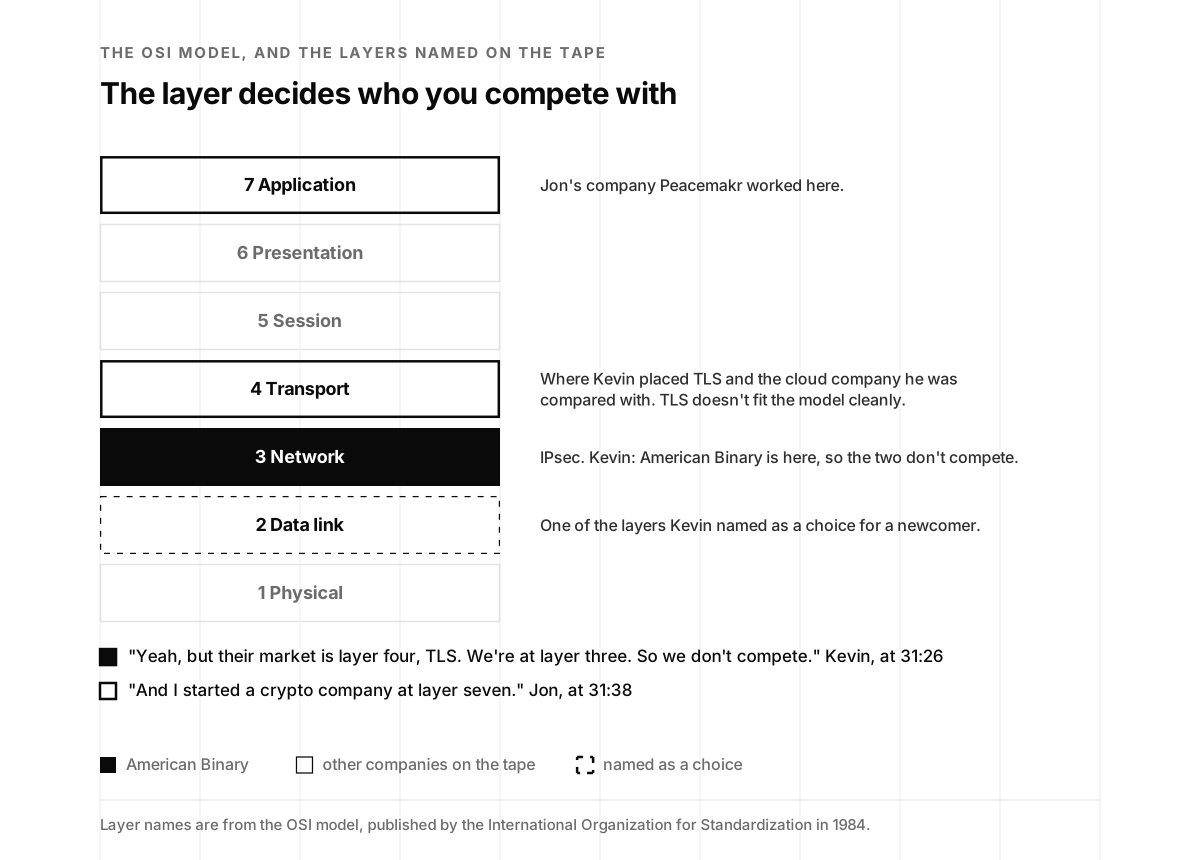
“I should have started off with the OSI model, layers of the internet, and said, this is our market.”
Kevin Kane, at 31:03
“Yeah, but their market is layer four, TLS. We’re at layer three. So we don’t compete.”
Kevin Kane, at 31:26
Listen · Kevin Kane on episode 32, from 31:02About 30 seconds: Kevin on why the layer decides who you compete with. The clip stops on its own. Read the full transcript.
The second quote was his reply to someone who compared American Binary to a cloud computing competitor. Jon added his own company: “And I started a crypto company at layer seven.” Kevin named it: Peacemakr, which worked at the application layer.
The OSI model is a reference model the International Organization for Standardization published in 1984, with seven layers: physical, data link, network, transport, session, presentation and application. IPsec sits at the network layer, and TLS “does not strictly fit inside the model” because it has traits of the transport and presentation layers (Wikipedia).
Where each kind of encryption sits, and the layers named on the tape.
A national treasure
Kevin credited his co-founder.
“I learned it all from my co-founder, Andrew McElroy.”
Kevin Kane, at 31:46
He said McElroy had been president of the Linux user group in Nashville, named DEF CON and Black Hat, and said that on a call that same day McElroy had explained baseband details the other side had never heard of.
“So I have this awesome co-founder, Andrew McElroy, that I get to give mention to on your podcast, because he’s a national treasure.”
Kevin Kane, at 32:16
American Binary’s team page lists McElroy as co-founder and chief technology officer (American Binary).
An irrational passion
Kevin spent part of his career around people with advanced degrees, and he had a view on why some of them do well at work.
“And if you want to be immersed in a topic, go for a PhD.”
Kevin Kane, at 33:43
“If you got a degree because you’re passionate about that topic”
Kevin Kane, at 34:43
If you bring that passion to work, he said, you go to the top. If the degree was for status, “you’re going to be useless in the workplace.”
Jon put it in terms of motivation, and then described his own reason for working in security.
“This is the difference between an internal motivator and an external motivator.”
Jon McLachlan, at 35:10
“And so I just tell people it’s an irrational passion.”
Jon McLachlan, at 35:28
Listen · Jon McLachlan on episode 32, from 35:10About 30 seconds: Jon on internal drive, and the irrational passion that keeps him in security. The clip stops on its own. Read the full transcript.
“I’m with you. It is a privilege to be a person who can have a passion for things.”
Kevin Kane, at 35:49
Kevin said passion is what keeps people at the front of new things, and that the front is not comfortable.
“Because when you’re in new things and you’re early on, like even in crypto, and seven years ago, it’s a very lonely place to be when you’re new.”
Kevin Kane, at 36:17
Two years ahead, and lonely
Kevin’s example was a competitor’s email claiming to be first with post-quantum encryption on Starlink.
“And I was like, man, we did this in 2021 in a warfighter, on a stealth naval ship.”
Kevin Kane, at 36:39
“But the thing about it is, we’re not doing press releases about our quiet professional work. We’re just doing it.”
Kevin Kane, at 36:45
That 2021 deployment is Kevin’s account on the tape. We found no public record of it, which fits his point about press releases.
“When you’re deeply passionate about a topic, you end up being two years ahead of everyone else on it. But it’s a lonely place.”
Kevin Kane, at 36:52
Listen · Kevin Kane on episode 32, from 36:52About 25 seconds: Kevin on being two years early. The clip stops on its own. Read the full transcript.
He said that when American Binary showed up to warfighters, nobody knew what post-quantum encryption was, and that 24 months later it was “coming down from the White House.” NSM-10 came in May 2022, and M-23-02 that November.
Kevin in 2022. American Binary’s YouTube channel has a nine-minute video of Kevin at Fed Supernova 2022, posted on January 8, 2023, about eight months before this episode aired (YouTube).
Kevin Kane, CEO, American Binary at Fed Supernova 2022, posted by American Binary on January 8, 2023. Watch on YouTube.
No encryption, no globalization
Kevin said he found the job was a mix of cryptography and geopolitics. Jon agreed that the two go together, and Kevin explained why.
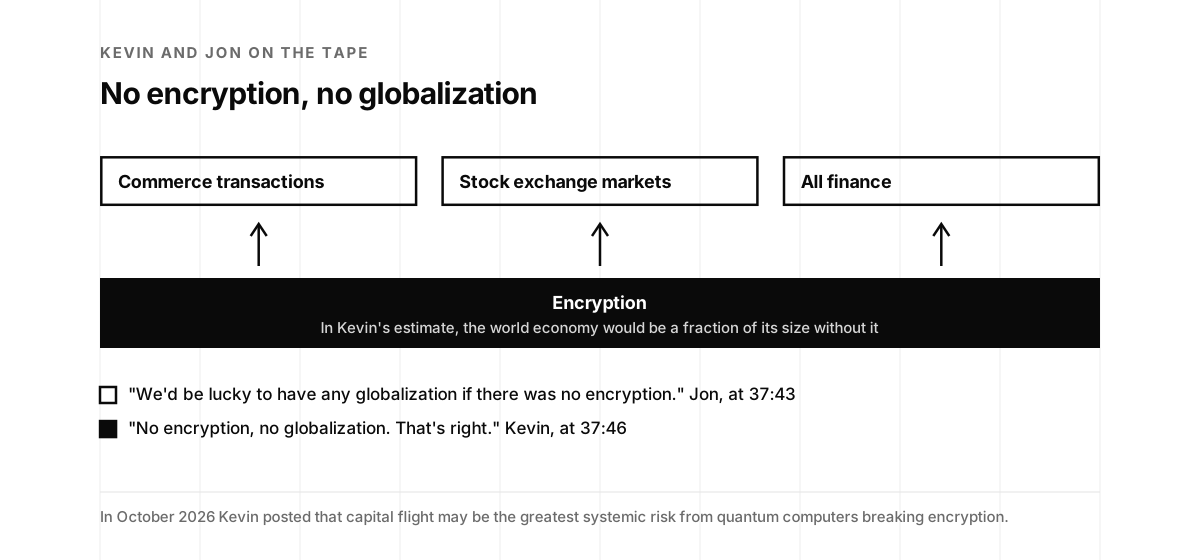
“The world economy is probably going to be a fraction of its size without encryption, because commerce transactions, stock exchange markets…”
Kevin Kane, at 37:30
“We’d be lucky to have any globalization if there was no encryption.”
Jon McLachlan, at 37:43
“No encryption, no globalization. That’s right.”
Kevin Kane, at 37:46
Listen · Kevin Kane on episode 32, from 37:30About 35 seconds: Kevin and Jon on encryption as the floor under world trade. The clip stops on its own. Read the full transcript.
“And when you’re at the end of the shelf life of encryption for all finance, you run the risk of regressing everything all the way back if we don’t get out ahead of it with solutions.”
Kevin Kane, at 37:49
Three years later he was still making this argument. In October 2026 he posted that capital flight may be the greatest systemic risk from quantum computers breaking encryption, and he linked a finance panel from World Quantum Day in Saudi Arabia (LinkedIn, YouTube).
What rests on encryption, in Kevin's list.
CNSA 2.0
Kevin said this wasn’t his alarm alone.
“That’s the position of the NSA, that this is an urgent thing.”
Kevin Kane, at 38:11
“And CNSA 2.0 removed all elliptic curve cryptography.”
Kevin Kane, at 38:29
Listen · Kevin Kane on episode 32, from 38:14About 30 seconds: Kevin on CNSA 2.0 and what it removed. The clip stops on its own. Read the full transcript.
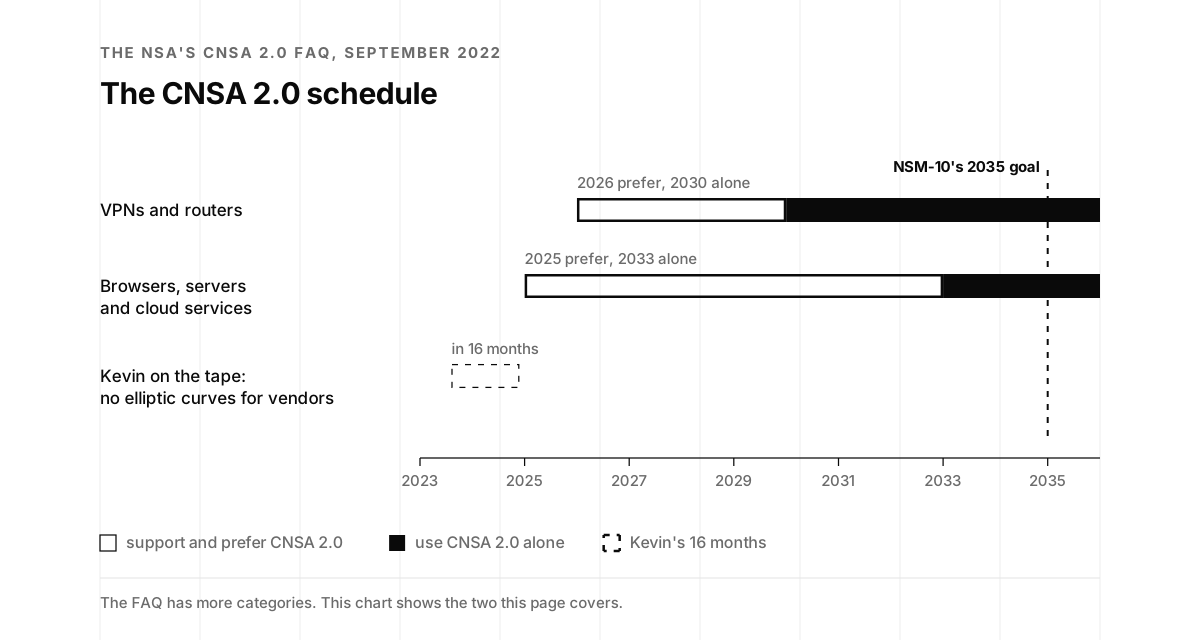
He said vendors selling to the US government would not be able to use elliptic curves in 16 months, and that the NSA had removed RSA as well. Jon asked whether that touches certifications such as FedRAMP. Kevin said it would all change, and that FIPS 140-3 would be updated “to include several post-quantum options.”
The NSA announced the Commercial National Security Algorithm Suite 2.0 in September 2022 (Wikipedia). Its FAQ calls RSA and elliptic curve cryptography “the main algorithms that need to be replaced,” and its schedule runs past Kevin’s 16 months. Traditional networking equipment, such as VPNs and routers, should support and prefer CNSA 2.0 by 2026 and use it exclusively by 2030. Web browsers, servers and cloud services follow a 2025 and 2033 schedule. The FAQ also says the NSA “will not require NSS developers to use hybrid certified products for security purposes” (NSA).
The CNSA 2.0 schedule from the NSA's FAQ.
Three signatures and one cipher
Jon asked whether American Binary had implementations of the suggested algorithms.
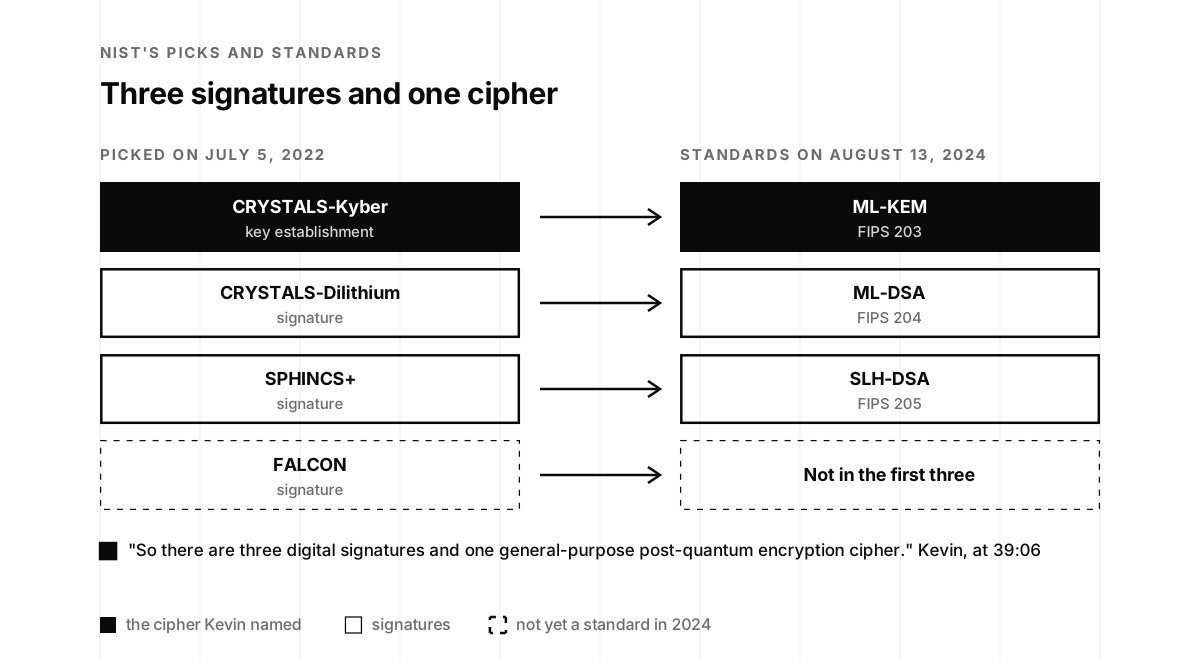
“So there are three digital signatures and one general-purpose post-quantum encryption cipher.”
Kevin Kane, at 39:06
“And the general purpose is called Kyber, like in CRYSTALS-Kyber, from Star Wars.”
Kevin Kane, at 39:12
Listen · Kevin Kane on episode 32, from 39:06About 25 seconds: Kevin on Kyber and the NIST process. The clip stops on its own. Read the full transcript.
That matches NIST’s first picks. On July 5, 2022, NIST announced CRYSTALS-Kyber for key establishment and three signature schemes: CRYSTALS-Dilithium, FALCON and SPHINCS+ (Wikipedia). Kyber’s developers came from Europe and North America, with funding that included the European Commission, Switzerland, the Netherlands and Germany (Wikipedia).
Kevin named one cryptographer in particular, DJ Bernstein, as someone who saw the end of the shelf life coming. Bernstein co-edited the 2009 book Post-Quantum Cryptography, and SPHINCS+, adapted from the SPHINCS scheme he co-wrote, was one of the four 2022 winners (Wikipedia).
NIST released draft standards in August 2023 and the final ones on August 13, 2024. Kyber became ML-KEM in FIPS 203, Dilithium became ML-DSA in FIPS 204, and SPHINCS+ became SLH-DSA in FIPS 205 (NIST).
From Kevin's "three digital signatures and one" to the standards.
A machine built to break encryption
“The NSA has a new category of device they call cryptographically relevant quantum computer.”
Kevin Kane, at 39:49
“That is not the quantum computer you hear about on Bloomberg News.”
Kevin Kane, at 39:56
Listen · Kevin Kane on episode 32, from 39:49About 25 seconds: Kevin on a machine designed to do one thing. The clip stops on its own. Read the full transcript.
He described it as special-purpose hardware that would pair around 500 qubits with classical computing and advanced math, and run “to just break encryption full time.” Federal documents use the same initials with a slightly different name: M-23-02 speaks of “a cryptanalytically relevant quantum computer (CRQC),” one able to attack real-world cryptographic systems that a classical computer could not (OMB).
“And that’s what people are building, and that is a near-term device than a quantum computer.”
Kevin Kane, at 40:13
Jon compared it to early flash storage, when the first devices on the market were hybrids. Kevin agreed.
“There will be hybrid devices.”
Kevin Kane, at 41:56
He also cited Boston Consulting Group research that, by his account, ranks China first in government spending on quantum computing, with factoring large integers as the top area. We didn’t find that report, so the page gives it as his summary.
The art of the unknown
Kevin traced the Chinese paper to earlier American work.
“That paper was called Variational Quantum Factoring, developed by Zapata Computing.”
Kevin Kane, at 42:56
“And the Chinese paper is a derivative of theirs.”
Kevin Kane, at 43:16
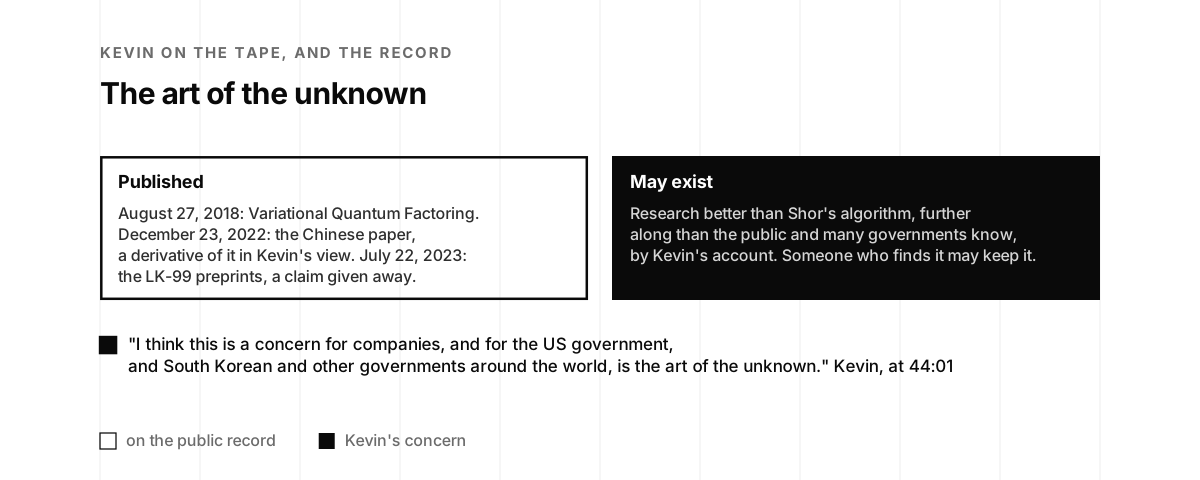
Variational Quantum Factoring was posted on August 27, 2018, by Eric Anschuetz, Jonathan Olson, Alán Aspuru-Guzik and Yudong Cao. Its abstract opens with factoring as “one of the cornerstone applications of the field of quantum computing,” and notes that Shor’s algorithm is “well beyond the capabilities” of today’s noisy machines (arXiv). The paper maps factoring to an optimization problem for the quantum approximate optimization algorithm, the same family of method the 2022 Chinese paper used.
Kevin’s larger worry was what isn’t published.
“And I will also say, research in making something better than Shor’s is much more farther along than not only the public may know, but also many governments.”
Kevin Kane, at 43:23
“So the things that we all know and the things that actually exist, there may be a bit of a concern.”
Jon McLachlan, at 43:57
“I think this is a concern for companies, and for the US government, and South Korean and other governments around the world, is the art of the unknown.”
Kevin Kane, at 44:01
Listen · Kevin Kane on episode 32, from 44:01About 25 seconds: Kevin on the art of the unknown. The clip stops on its own. Read the full transcript.
He came back to LK-99 here: the researchers gave their claim away, and someone else might keep theirs. Jon’s answer: “I think different people optimize for different things.”
What is published, and what Kevin said may exist.
Arrival
Jon asked for a favorite book or movie that changed how Kevin sees the world. Kevin picked one of each, and started with the movie.
“So my favorite movie, number one, all time, is Arrival.”
Kevin Kane, at 45:37
He said he likes it “because I have a fascination with the future,” and because of what it says about language. Arrival is a 2016 film directed by Denis Villeneuve and written by Eric Heisserer, from Ted Chiang’s 1998 novella “Story of Your Life.” Amy Adams plays a linguist the US Army hires to talk with visitors from space (Wikipedia).
“I wonder sometimes if you process problems differently in life when you’re speaking the other language.”
Kevin Kane, at 46:03
Listen · Kevin Kane on episode 32, from 46:03About 25 seconds: Kevin on how Korean word order changes a sentence. The clip stops on its own. Read the full transcript.
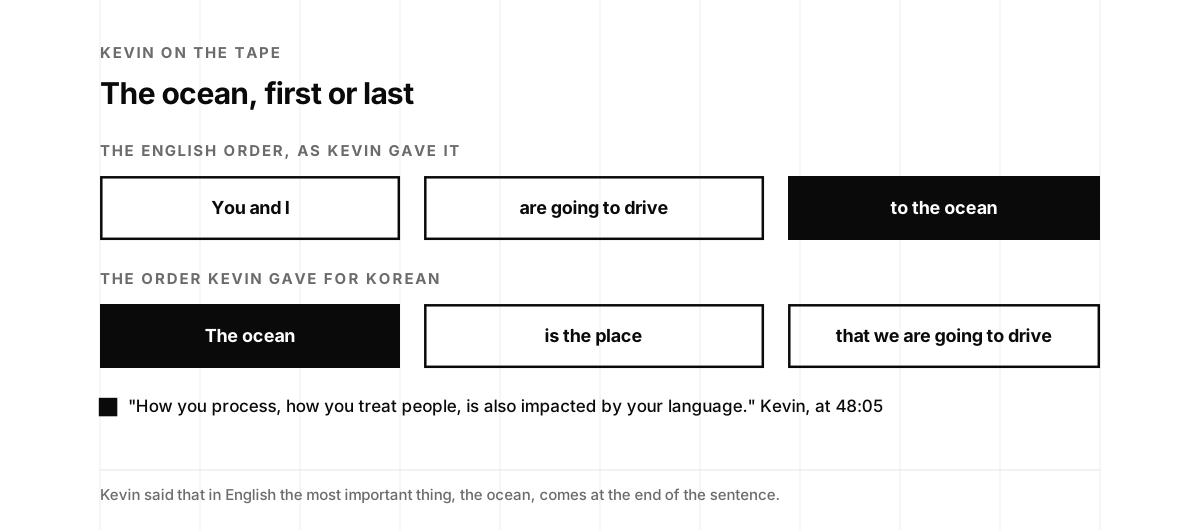
His example was word order. In Korean, he said, you wouldn’t say “You and I are going to drive to the ocean.” You would say “The ocean is the place that we are going to drive.”
“It changes the way that you think about things, because the tools that we use to form those thoughts, language…”
Jon McLachlan, at 46:43
Kevin tied patience to language. If you join a Korean conversation mid-context, he said, you wait minutes to catch up, and when you teach your language to people who don’t know it, “patience better be who you are.”
“How you process, how you treat people, is also impacted by your language.”
Kevin Kane, at 48:05
The film leans on the idea that language shapes thought, often called the Sapir-Whorf hypothesis. The linguist Betty Birner of Northern Illinois University said the film’s use of it went “beyond anything that is plausible” (Wikipedia).
Kevin's word-order example from the tape.
Compassion and boundaries
Kevin said people use language to dehumanize others. He tries to stay patient with people who aren’t making sense.
“Okay, this person’s brain is not permitting them to be a reasonable person, and I’m just going to sit and be calm”
Kevin Kane, at 48:50
Jon described what he reminds himself of.
“is it the answer to the question, is that the right thing to do? In their minds, it’s always yes, that’s the right thing to do.”
Jon McLachlan, at 49:47
Listen · Jon McLachlan on episode 32, from 49:47About 40 seconds: Jon on assuming the other person thinks they're right. The clip stops on its own. Read the full transcript.
“Phase one, in that compassion, is to become compassionate, and phase two is to learn to mix that with boundaries.”
Kevin Kane, at 50:26
“Yes, boundaries are good.”
Jon McLachlan, at 50:33
Two books on power
Kevin’s first book was John Mearsheimer’s The Tragedy of Great Power Politics. The book, published by W. W. Norton in 2001, sets out Mearsheimer’s theory of offensive realism (Wikipedia).
“And what he simply suggested is that there is no difference between people today and a hundred years ago when it comes to war.”
Kevin Kane, at 59:04
“But I want to know the future. I don’t want to know what makes me feel good.”
Kevin Kane, at 60:13
His second book was a memoir by a CIA officer.
“And one of the pioneers was William Colby, and he wrote the book Honorable Men.”
Kevin Kane, at 65:04
As Kevin told it, Colby’s first assignments included Italy after the fall of Mussolini. Colby saw a chance to sway an election, funneled money to a Catholic church, which funneled it to a candidate who won, and Italy did not go to the Soviet bloc. His lesson:
“One person turned the tilt.”
Kevin Kane, at 66:22
The record is close to his version, with different dates. William Colby was Director of Central Intelligence from September 1973 to January 1976, and published Honorable Men: My Life in the CIA in 1978. He spent much of the 1950s in Rome under State Department cover and led the agency’s covert political campaign to support anti-communist parties (Wikipedia). In Italy’s election of April 18, 1948, before Colby’s time in Rome, the CIA admits giving US$1 million to what it called center parties, and Christian Democracy won by a comfortable margin (Wikipedia).
What Kevin took from the book:
“And the fastest way to impact is to believe in yourself irrationally at times, and just go.”
Kevin Kane, at 68:11
Listen · Kevin Kane on episode 32, from 67:59About 30 seconds: Kevin on what he took from Honorable Men. The clip stops on its own. Read the full transcript.
A portfolio of people
Kevin used a term from finance for the country.
“I see the United States as a portfolio, and the best portfolio is what kind of portfolio?”
Kevin Kane, at 68:54
Jon: “Diverse.” Kevin: “Diversified portfolio.”
“We need the hunters. We need the human rights lawyers. We need the activists.”
Kevin Kane, at 69:05
Listen · Kevin Kane on episode 32, from 68:53About 20 seconds: Kevin on the country as a portfolio. The clip stops on its own. Read the full transcript.
“And if we all could just see it that way, our patience and our philosophy about how we engage each other will change a lot.”
Kevin Kane, at 69:41
Jon answered that the differences are a strength.
Jon said he deleted his social media accounts and holds dinner parties.
“When you have a synchronous conversation with someone in person, you get all of the juicy body language that comes up, that we’re constantly reading”
Jon McLachlan, at 72:57
Firing before you process
Kevin recommended a book by Lieutenant Colonel Dave Grossman, On Killing: The Psychological Cost of Learning to Kill in War and Society. He summarized its claim about soldiers in earlier wars.
“A lot of people just couldn’t bring themselves to pull the trigger in the middle of the battle”
Kevin Kane, at 74:33
The book, from 1996, builds on S.L.A. Marshall’s theory that most soldiers in war never fire their weapons. Among the training changes it describes is “using man-shaped targets instead of bullseye targets.” Marshall’s numbers are disputed. In a 1988 article, Professor Roger J. Spiller argued that Marshall had not done the research behind them (Wikipedia).
Kevin applied it to the internet.
“So, same thing with social media. When you’re arguing and saying horrible things, you’re firing off before you process that that’s a person.”
Kevin Kane, at 74:53
Listen · Kevin Kane on episode 32, from 74:51About 30 seconds: Kevin on social media and the reflex to fire first. The clip stops on its own. Read the full transcript.
“And it doesn’t help that their monetization strategy in those companies is to produce engagement. And the thing that happens to produce the most engagement is rage.”
Jon McLachlan, at 75:21
A feature that gave people away
When Facebook reached the rest of the world, Kevin ran a group called Addicted to International Politics, with members from 100 nationalities. Some of them were at risk because of who they were. He found a problem in how the site suggested friends.
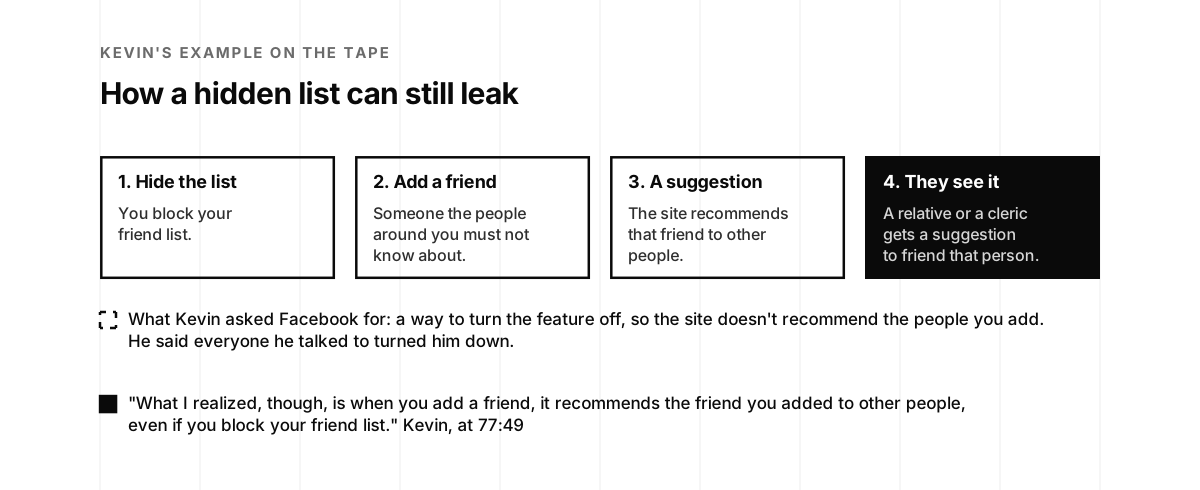
“What I realized, though, is when you add a friend, it recommends the friend you added to other people, even if you block your friend list.”
Kevin Kane, at 77:49
Jon called it a loophole.
His example: someone in a dangerous place hides their friend list, adds friends the people around them must not know about, and a relative or a cleric gets a suggestion to friend one of them. The setting hid the list. The suggestions still showed who was on it. As an admin of the group, he asked Facebook whether the feature could be turned off, so the site wouldn’t recommend the people you add.
“Because for most of the world, this is untenable.”
Kevin Kane, at 78:37
He said everyone he talked to turned him down.
Jon called it a small ask. Kevin’s answer was that the feature is key to their growth.
Jon closed the thought.
“But as technology leaders, we do have the ability to bring into this world, like, new things that can make the world a better place.”
Jon McLachlan, at 79:42
Listen · Jon McLachlan on episode 32, from 79:42About 20 seconds: Jon on building tech that keeps connections safe. The clip stops on its own. Read the full transcript.
The same check applies to any product with a privacy setting. A hidden list stays hidden only if no other feature, such as friend suggestions, gives away what is on it.
How a hidden list can still leak, in Kevin's example.
Don’t show them your teeth
Jon asked what Kevin would tell his younger self.
“I would say, don’t make too much meaning of conflicts in the present.”
Kevin Kane, at 84:32
“If you have enemies, don’t show them your teeth.”
Kevin Kane, at 84:48
“Let them be in the dark of what you can do.”
Kevin Kane, at 84:50
Listen · Kevin Kane on episode 32, from 84:32About 40 seconds: Kevin's advice to his younger self. The clip stops on its own. Read the full transcript.
“Hide it, develop it, do something about it, and get more control over yourself.”
Kevin Kane, at 85:06
His example went back to a crowded street in Seoul in 2003, when a stranger yelled at him about President Bush. Kevin answered with a joke on his flip phone, and the crowd laughed at the man. His advice now is not to warn people first, so they can’t prepare.
Cryptography is bad business
Jon switched to an investor’s questions. He asked how a cryptography company makes money.
“Cryptography is bad business from monetization. I think a lot of investors know that.”
Kevin Kane, at 85:56
“What is valuable is if you build whole IT products that are agile for encryption that needs to be transitioned”
Kevin Kane, at 86:01
Listen · Kevin Kane on episode 32, from 85:56About 20 seconds: Kevin on where the money is. The clip stops on its own. Read the full transcript.
He said American Binary rolls out SASE and software-defined firewalls to cut IT costs. Secure access service edge is the delivery of network and security controls as a cloud service, and the term was coined in 2019 by Neil MacDonald of Gartner (Wikipedia). Kevin said the labels don’t matter to him.
“And so rather than getting caught up in the Gartner buzzwords and stuff, let’s just talk about the first principles.”
Kevin Kane, at 86:37
He described a deployment with a healthcare company for network management, and the product behind it.
“And our solution, Fortress, is a network infrastructure in a box.”
Kevin Kane, at 86:50
“In one use case, we modeled reducing hardware firewalls from 500 to one, but with the same throughput and performance and network integrity.”
Kevin Kane, at 87:03
“we’re going to reduce company IT costs at scale by more than 70%, while transitioning to post-quantum encryption for free.”
Kevin Kane, at 87:17
These are his company’s claims on the tape, and he gave them as the business strategy. Jon summed up the difference.
“Because I see cryptography as a tool.”
Jon McLachlan, at 87:48
One construction per protocol
Jon asked whether the cryptography inside American Binary’s products is proprietary. Kevin said the proprietary part is how the software fits into the network protocols. The cryptography is standard.
“Look, if someone’s offering proprietary cryptography, it’s usually snake oil, unless they’re serving the NSA or the CIA.”
Kevin Kane, at 88:25
“Yes. A scalable solution is to use standardized stuff, right?”
Kevin Kane, at 88:32
“Ah, so you have crypto agility built into your products?”
Jon McLachlan, at 89:14
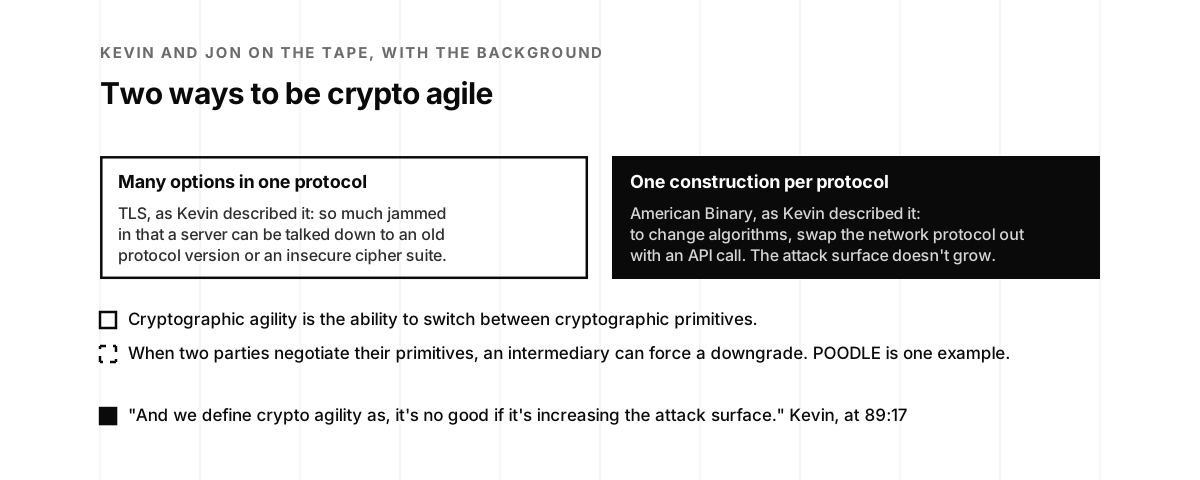
“And we define crypto agility as, it’s no good if it’s increasing the attack surface.”
Kevin Kane, at 89:17
“So what we do is we have one cryptographic construction per network protocol”
Kevin Kane, at 89:23
Listen · Kevin Kane on episode 32, from 89:16About 30 seconds: Kevin on agility without new attack surface, and on TLS. The clip stops on its own. Read the full transcript.
To change algorithms, he said, they swap the network protocol out with an API call, so being agile adds no attack surface. He called TLS “such a horrible system,” because “it’s got so much jammed in there.” Jon asked whether he meant a server that will negotiate down.
“and that server is willing to downgrade the version of the protocol, or use an insecure cipher suite, that’s what you’re talking about, right?”
Jon McLachlan, at 89:54
Kevin: “Yes.” The general definition of cryptographic agility is the ability to switch between cryptographic primitives. The same article notes that agility “typically increases the complexity of the applications that rely on it,” and that negotiating primitives “creates the opportunity for downgrade attacks by intermediaries,” with POODLE as the example (Wikipedia). A downgrade attack pushes two parties onto an older, weaker mode they both still allow.
Two ways to be crypto agile, and where each leaves the attack surface.
Where the puck is going
Kevin said market research undercounts the change.
“And all the market research is wrong, because they’re valuing the encryption as a value-add only”
Kevin Kane, at 91:24
“So the market size is every single piece of hardware that is encrypted”
Kevin Kane, at 91:44
“They’re going to make you buy the whole damn thing over, because there’s more revenue.”
Kevin Kane, at 91:56
Listen · Kevin Kane on episode 32, from 91:42About 15 seconds: Kevin on why the change sells whole new products. The clip stops on its own. Read the full transcript.
“So the SAM and the TAMs are ginormous. Basically, the entire internet.”
Jon McLachlan, at 92:04
“By 2030, it’s over a trillion.”
Kevin Kane, at 92:08
That figure is his estimate. Jon put the bet in hockey terms.
“We see the future, and we skate to where the puck is going to be, not where the puck is.”
Jon McLachlan, at 92:18
“So the real trick in my business is to make sure you’re around in the market for the next 16 months, before the demand blows up”
Kevin Kane, at 92:23
He also brought up two names. One is Ascon, a family of lightweight authenticated ciphers and hash functions. NIST picked it on February 7, 2023, and published it as SP 800-232 on August 13, 2025 (Wikipedia). The other is NIAP, a US government initiative operated by the NSA that evaluates products and protection profiles (Wikipedia). He said NIAP had no profiles yet to evaluate that software, and expected them in about 18 months.
After the tape
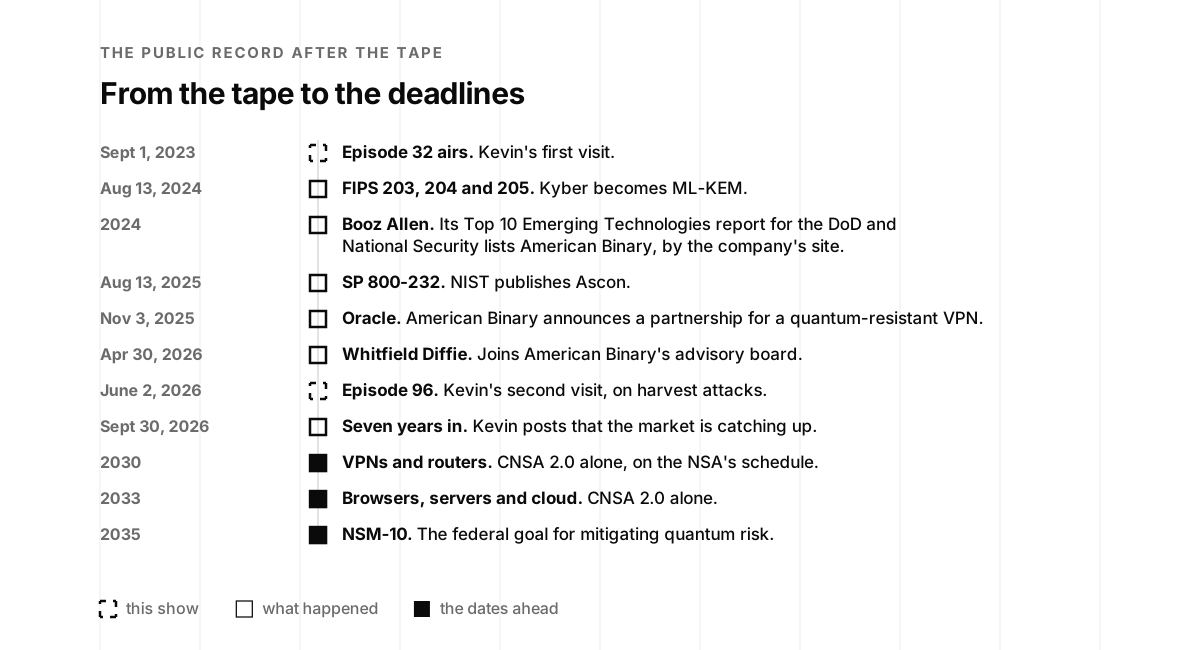
The standards arrived. NIST published FIPS 203, 204 and 205 on August 13, 2024. Kyber is now ML-KEM (NIST). Ascon followed as SP 800-232 on August 13, 2025.
American Binary kept building. Its site lists the company in Booz Allen’s 2024 Top 10 Emerging Technologies for the DoD and National Security report (American Binary). On November 3, 2025, it announced a partnership with Oracle for a quantum-resistant VPN (PR Newswire). On April 30, 2026, Whitfield Diffie joined its advisory board (PR Newswire).
Kevin came back.Episode 96 aired on June 2, 2026. In it he explains the key exchange behind nearly every encrypted message, the harvest attack, and six months of formal verification.
Seven years in. On September 30, 2026, Kevin posted about American Binary’s new website and its first seven years (LinkedIn). He wrote, “We bet on full post-quantum encryption before the National Security Agency published CNSA 2.0,” and that the company “resisted the advice to go to market early with a hybrid product.” He closed by saying “the market is catching up to the problem we started building for.”
Doing Hard Things for America and the World: The Journey to Full PQC
Kevin on seven years of building for full post-quantum encryption. View on LinkedIn.
In 2023 he said American Binary was two years ahead and that it was lonely there. In 2026 he wrote that the market is catching up.
The next dates. The NSA’s schedule asks VPNs and routers to use CNSA 2.0 alone by 2030, and browsers, servers and cloud services by 2033 (NSA). NSM-10’s goal for the federal government is 2035.
The public record after the tape, and the dates ahead.
Did you catch it? A seven-question quiz
Seven questions from the episode. Each answer links the moment in the transcript.
Quiz · seven questions
Did you catch it?
Pick an answer to see whether you caught it, and where it is on the tape.
What does Kevin compare cryptography to?
Handling enriched uranium
Learning a second language
Building a bridge
a. "And cryptography is a lot like handling enriched uranium." Transcript, 17:27.
What does Kevin say the cryptography community agrees on?
Quantum computers are 50 years away
The internet's encryption has hit the end of its shelf life
Longer RSA keys will be enough
b. "the consensus among the cryptography community is that we've hit the end of the shelf life of all of the internet's encryption." Transcript, 18:07.
Which film does Kevin bring up about researchers who don't see the consequences?
WarGames
The Matrix
Oppenheimer
c. "academic researchers don't understand, like in Oppenheimer, the consequence of what they're doing." Transcript, 21:41.
At which OSI layer does Kevin say American Binary works?
Layer three
Layer four
Layer seven
a. "Yeah, but their market is layer four, TLS. We're at layer three. So we don't compete." Transcript, 31:26.
Finish Kevin's line: no encryption, no...
privacy
globalization
internet
b. "No encryption, no globalization. That's right." Transcript, 37:46.
What is Kevin's favorite movie?
Inception
Interstellar
Arrival
c. "So my favorite movie, number one, all time, is Arrival." Transcript, 45:37.
How does Kevin define crypto agility?
It's no good if it adds attack surface
Support every cipher suite a client asks for
Rotate every key each day
a. "And we define crypto agility as, it's no good if it's increasing the attack surface." Transcript, 89:17.
Is your encryption past its shelf life?
Kevin’s claim is that the internet’s encryption has reached the end of its shelf life. Eight questions on how far along your own replacement is.
Scorecard · eight questions
Is your encryption past its shelf life?
Answer for your systems as they run today. If two answers fit, pick the lower one.
Do you have a list of where your systems use RSA or elliptic-curve keys, such as VPNs, TLS, SSH, email and code signing?
No
Partly
Yes, and we keep it current
"everything that we use on the public internet that was developed all has to be replaced." See The end of the shelf life.
Do you know which layer each encrypted connection runs at, such as the network layer for IPsec or WireGuard, or TLS above it?
No
For some of them
Yes, for all of them
"I should have started off with the OSI model, layers of the internet, and said, this is our market." See Start with the OSI model.
Have your VPN, firewall and router vendors given you a date for CNSA 2.0 or ML-KEM support?
We haven't asked
We asked, no date yet
Yes, with a date
"And CNSA 2.0 removed all elliptic curve cryptography." See CNSA 2.0.
Do your products use only standardized algorithms, with no proprietary cryptography?
We don't know
Mostly
Yes
"Look, if someone's offering proprietary cryptography, it's usually snake oil, unless they're serving the NSA or the CIA." See One construction per protocol.
Can you change an algorithm without adding new options a client could negotiate down to?
You don't know yet where the old keys are. Start with an inventory of RSA and elliptic-curve use, and ask your network vendors for dates.
Near the date
Some of the map is drawn. Next, name the layer for each encrypted path, close downgrade paths, and count the edge devices.
Ahead of the date
You know where the old keys are and who will replace them. Keep vendor dates on file, and check the plan against the NSA's 2030 and 2033 dates.
Does your network refresh beat 2030?
The NSA asks traditional networking equipment, such as VPNs and routers, to use CNSA 2.0 alone by 2030. This calculator checks your next planned refresh against that date. Every default is our example, not a benchmark.
Calculator
Does your network refresh beat 2030?
Four numbers: this year, the years until your next planned refresh of VPN gateways, firewalls and routers, how many devices that covers, and the cost to replace one.
4years left before 2030
1years your refresh lands after 2030
40devices to replace or update early
$320,000if those devices need new hardware
5$8,000
Your next refresh is 5 years out, and 2030 is 4 years out. On that plan, 40 devices need replacing or updating before their cycle ends, about $320,000 at $8,000 each if they need new hardware.
The 5 years, 40 devices and $8,000 are our examples, not benchmarks. Put in your own. If your vendor ships a CNSA 2.0 update for the gear you own, you may not need new hardware. Kevin's point was that hardware sellers would rather sell the whole product again. The 2030 date is from the NSA's CNSA 2.0 FAQ.
From Italy in 1948 to CNSA 2.0 in 2030
Everything on this page sits on one timeline, from 1948 to 2035. Filter it by thread.
Timeline · 1948 to 2035
From Italy in 1948 to CNSA 2.0 in 2030
Filter by thread. Kevin's dates from 2009 on are from his LinkedIn, the earlier ones are from the tape, and the rest are from the public record.
Italy's election
The CIA admits giving $1 million to center parties, and Christian Democracy wins (Wikipedia, on this show).
The NSA's date for using CNSA 2.0 alone in traditional networking equipment (NSA, calculator).
NSM-10's goal
The federal target for mitigating quantum risk (White House).
What to do this week
Five things, in the order of the episode.
Find where the old keys are. List where your systems use RSA and elliptic-curve keys, the way M-23-02 asked federal agencies to. Take the scorecard with whoever runs your infrastructure.
Rank data by how long it matters. Start with records that must stay secret for a decade or more, as our harvest post explains. Episode 96 has Kevin’s follow-up.
Ask your network vendors for dates. VPNs and routers are on the NSA’s 2030 schedule. Run the calculator on your refresh plan, and our Product Security team can review the architecture.
Close the downgrade paths. Turn off old protocol versions and weak cipher suites, and prefer one construction per protocol to a long list of options. Our Penetration Testing team tests for the paths an attacker would use.
Get a second pair of eyes. Kevin’s point was that cryptography takes years of practice. A vCISO can own the migration plan, and you can book 15 minutes with us.
Kevin says the cryptography community agrees that the internet's encryption has reached the end of its shelf life, so everything built on the public internet has to be replaced.
Wrong and right at the same time
Large-scale quantum computers may be 20 years away. Kevin says that doesn't make today's encryption safe, because research mixes quantum and classical methods.
A broken key exchange needs no staging
Equifax and Colonial Pipeline took time inside the network. Kevin says that with RSA broken in real time, an attacker would not have to stage anything.
Cryptography is a specialty
Kevin compares cryptography to handling enriched uranium. It takes 10 or 15 years of practice, not six months of reading.
Know your layer
Kevin says he should have opened his investor pitch with the OSI model. American Binary works at layer three, so it doesn't compete with a company whose market is TLS at layer four.
Edge devices are the hard part
Austere environments, such as IoT edge devices, hotspots, Raspberry Pis and military edge devices, each have different hardware, systems and network protocols.
The government set the direction
Kevin points to three White House actions and the NSA's CNSA 2.0, which removes elliptic curve cryptography and RSA for vendors selling to the US government.
Agility without new attack surface
Kevin says crypto agility is no good if it adds attack surface. American Binary uses one cryptographic construction per network protocol.
A hidden list isn't private
Kevin found that Facebook recommended the friends a user added to other people, even when the user hid the friend list.
Sell the whole product
Kevin says cryptography is bad business on its own. The value is in whole IT products that are agile for the move to post-quantum encryption.
Chapters
Tap a chapter to play from there.
Pull quotes
“So I said anything I wanted. I ran for everything at once.”
“I learned that running for office is not one of my strong suits.”
“That's a strange series of events.”
“I like the fact that there's so much uncertainty. To me, that was the most attractive thing.”
“So you like to push yourself outside your comfort zone.”
“Americans get a very curated view of the world.”
“No one lies, but when something big happens, there's things that don't get reported, or reported, like, slightly differently, with a different tone.”
“So I always say there's a hundred truths you can talk about on a topic, and maybe the human brain can only handle four or five out of that hundred that you select.”
“I call it drinking the Kool-Aid.”
“And cryptography is a lot like handling enriched uranium.”
“It's not the kind of thing you can be an engineer and in six months just read up on and do.”
“The cryptography companies are the Shelbys and the AMGs, not the large ones.”
“everything that we use on the public internet that was developed all has to be replaced.”
“But something can be wrong and right at the same time.”
“You're right in that large-scale quantum computers are not here, and they may not be here for 20 years.”
“And of course, when they do it, they're not going to announce it.”
“I think what they're going to do is export the capability for financial gain and for geopolitical influence, like a Monroe Doctrine.”
“Wars are fought with information.”
“And that's what they call it, and they call it Q-Day, the research there.”
“They just ended the internet.”
“And what is different now from 20 years ago is that all of the world's research, and by the hour, is indexed on the internet.”
“If you can just break RSA at will in real time, then you don't have to stage anything.”
“There goes, like, every company that ever does anything on the internet.”
“Now that I did the fear, I can talk about the reality.”
“So the White House has signed three memos articulating a roadmap to upgrade the encryption”
“Blackmail material.”
“Do you want to survive now? Yes or no? It's the binary question, actually.”
“It reminds me of the self-defense mantra. A, it can happen to you. B, it can happen today. C, like, you know what to do about it. And D, you've already decided to do that.”
“I would say we probably have some of the most experience in austere environment deployment of post-quantum cryptography. That's a mouthful.”
“First, you've got to build a team. Secondly, you've got to learn about the new cryptographic primitives and the construction.”
“If you're doing a VPN like WireGuard, you're going to obviously throw out the stuff in WireGuard, because it's not post-quantum.”
“I should have started off with the OSI model, layers of the internet, and said, this is our market.”
“Yeah, but their market is layer four, TLS. We're at layer three. So we don't compete.”
“And I started a crypto company at layer seven.”
“So I have this awesome co-founder, Andrew McElroy, that I get to give mention to on your podcast, because he's a national treasure.”
“And so I just tell people it's an irrational passion.”
“And I was like, man, we did this in 2021 in a warfighter, on a stealth naval ship.”
“When you're deeply passionate about a topic, you end up being two years ahead of everyone else on it. But it's a lonely place.”
“We'd be lucky to have any globalization if there was no encryption.”
“No encryption, no globalization. That's right.”
“And CNSA 2.0 removed all elliptic curve cryptography.”
“So there are three digital signatures and one general-purpose post-quantum encryption cipher.”
“The NSA has a new category of device they call cryptographically relevant quantum computer.”
“That is not the quantum computer you hear about on Bloomberg News.”
“There will be hybrid devices.”
“That paper was called Variational Quantum Factoring, developed by Zapata Computing.”
“I think this is a concern for companies, and for the US government, and South Korean and other governments around the world, is the art of the unknown.”
“So my favorite movie, number one, all time, is Arrival.”
“How you process, how you treat people, is also impacted by your language.”
“Phase one, in that compassion, is to become compassionate, and phase two is to learn to mix that with boundaries.”
“But I want to know the future. I don't want to know what makes me feel good.”
“One person turned the tilt.”
“And the fastest way to impact is to believe in yourself irrationally at times, and just go.”
“I see the United States as a portfolio, and the best portfolio is what kind of portfolio?”
“So, same thing with social media. When you're arguing and saying horrible things, you're firing off before you process that that's a person.”
“What I realized, though, is when you add a friend, it recommends the friend you added to other people, even if you block your friend list.”
“Because for most of the world, this is untenable.”
“If you have enemies, don't show them your teeth.”
“Cryptography is bad business from monetization. I think a lot of investors know that.”
“And our solution, Fortress, is a network infrastructure in a box.”
“Look, if someone's offering proprietary cryptography, it's usually snake oil, unless they're serving the NSA or the CIA.”
“And we define crypto agility as, it's no good if it's increasing the attack surface.”
“So what we do is we have one cryptographic construction per network protocol”
“So the market size is every single piece of hardware that is encrypted”
“By 2030, it's over a trillion.”
“We see the future, and we skate to where the puck is going to be, not where the puck is.”
About the guest
Kevin Kane, Co-Founder and CEO, American Binary
Kevin Kane is co-founder and CEO of American Binary (Ambit Inc.), a post-quantum network security company in Kirkland, Washington. He joined Jon on episode 32, published September 1, 2023, and came back for episode 96 in June 2026. On the tape he describes seven years in the US Army, where he was head of claims for the JAG Corps, an internship at the Carter Center, a run for the Georgia House of Representatives, and about ten years in Korea. His LinkedIn lists oil market analysis at the Korea Energy Economics Institute from 2009, emerging technology research at Lux Research, a machine-learning trading firm he co-founded, a high-frequency trading desk, and a futures team at Rotella Capital Management before he became American Binary's chief executive in March 2019.
Jon McLachlan is co-founder of YSecurity, the on-demand cybersecurity team for startups, and of Cyberbase.ai. The Security Podcast of Silicon Valley is hosted by Jon McLachlan and Sasha Sinkevich.
Jon McLachlan on LinkedIn ↗
Context and sources
The episode on Podbean, published September 1, 2023, with the show notes. Source ↗
Kevin Kane's LinkedIn: oil market analyst at the Korea Energy Economics Institute from January 2009, Lux Research from July 2011 to December 2012, Jumpgate Technologies from November 2012, a trading desk at Taurus Investment & Securities from July 2014, Claro Automata from April 2015 to March 2017, Rotella Capital Management from October 2016 to January 2019, and chief executive of American Binary since March 2019. Source ↗
American Binary's site: the company's legal name, Ambit Inc., and its home in Kirkland, Washington. Source ↗
American Binary's team page, which lists Andrew McElroy as co-founder and chief technology officer. Source ↗
Kevin's LinkedIn post of September 30, 2026, on seven years of building for full post-quantum encryption and the company's new website. Source ↗
National Security Memorandum 10, May 4, 2022, which sets the goal of mitigating as much quantum risk as feasible by 2035. Source ↗
OMB memo M-23-02, Migrating to Post-Quantum Cryptography, November 18, 2022: the inventory of cryptographic systems due by May 4, 2023, and every year until 2035, and the definition of a cryptanalytically relevant quantum computer. Source ↗
Rep. Nancy Mace's office on the Quantum Computing Cybersecurity Preparedness Act, signed into law on December 21, 2022. Source ↗
The text of the Quantum Computing Cybersecurity Preparedness Act on GovInfo, including the finding about data stolen today and decrypted later. Source ↗
The NSA's CNSA 2.0 FAQ: RSA and elliptic curve cryptography as the main algorithms to replace, the schedule for networking equipment, browsers, servers and cloud services, and the position on hybrid products. Source ↗
Wikipedia on the Commercial National Security Algorithm Suite, announced in September 2022. Source ↗
Wikipedia on the NIST post-quantum standardization: CRYSTALS-Kyber, CRYSTALS-Dilithium, FALCON and SPHINCS+ picked on July 5, 2022. Source ↗
NIST on the first three finalized post-quantum standards, FIPS 203, 204 and 205, released on August 13, 2024. Source ↗
Wikipedia on ML-KEM, the standard that grew out of Kyber, and the funding behind its developers. Source ↗
Wikipedia on Daniel J. Bernstein, co-editor of the 2009 book Post-Quantum Cryptography. Source ↗
Bao Yan and co-authors, December 23, 2022: classical lattice reduction combined with a quantum approximate optimization algorithm, and the estimate of 372 physical qubits for RSA-2048. Source ↗
Bruce Schneier on the Chinese paper, January 2023. Source ↗
Variational Quantum Factoring by Eric Anschuetz, Jonathan Olson, Alán Aspuru-Guzik and Yudong Cao, August 27, 2018. Source ↗
Wikipedia on LK-99: the preprints of July 22, 2023, and the replication work that followed. Source ↗
Wikipedia on Oppenheimer, the film released on July 21, 2023. Source ↗
Wikipedia on the 2017 Equifax data breach, which began on May 12, 2017, and ran undetected for 76 days. Source ↗
Wikipedia on the Colonial Pipeline ransomware attack of May 7, 2021, and the VPN account the attackers used. Source ↗
Wikipedia on the OSI model, published in 1984, and where IPsec and TLS fit in it. Source ↗
Wikipedia on WireGuard, its key exchange and its pre-shared key mode. Source ↗
Wikipedia on cryptographic agility, its complexity, and the downgrade attacks negotiation allows. Source ↗
Wikipedia on secure access service edge, a term coined in 2019 by Neil MacDonald of Gartner. Source ↗
Wikipedia on Ascon, picked by NIST on February 7, 2023, and published as SP 800-232 on August 13, 2025. Source ↗
Wikipedia on the National Information Assurance Partnership, operated by the NSA. Source ↗
Wikipedia on Arrival, the 2016 film, and a linguist's view of its use of the Sapir-Whorf hypothesis. Source ↗
Wikipedia on The Tragedy of Great Power Politics by John Mearsheimer, published in 2001. Source ↗
Wikipedia on William Colby, Director of Central Intelligence from 1973 to 1976 and author of Honorable Men. Source ↗
Wikipedia on Italy's general election of April 18, 1948. Source ↗
Wikipedia on On Killing by Dave Grossman, and the dispute over S.L.A. Marshall's research. Source ↗
Wikipedia on the Carter Center, founded in 1982. Source ↗
Wikipedia on the Judge Advocate General's Corps of the US Army. Source ↗
American Binary's video of Kevin at Fed Supernova 2022, posted on January 8, 2023. Source ↗
The World Quantum Day finance panel Kevin linked in October 2026. Source ↗
PR Newswire, November 3, 2025: American Binary partners with Oracle on a quantum-resistant VPN. Source ↗
PR Newswire, April 30, 2026: Whitfield Diffie joins American Binary's advisory board. Source ↗
American Binary on its listing in Booz Allen's 2024 Top 10 Emerging Technologies for the DoD and National Security report. Source ↗
Transcript
Automatic transcription. Jon McLachlan hosts this episode alone with Kevin Kane, co-founder and CEO of American Binary. There is no diarization on the tape, so speaker labels were assigned from the content and checked against reference recordings of each voice from this episode and the pitch of each voice, passage by passage and on the short turns, and a few short lines may sit with the wrong speaker. Names and terms were normalized where the recognizer misheard them (Jon McLachlan, Kevin Kane, American Binary, Georgia State University, JAG, Tokyo Vice, Deutsche Welle, Kyber, CRYSTALS-Kyber, CNSA 2.0, FedRAMP, FIPS 140-3, WireGuard, LK-99, Shor's algorithm, Zapata Computing, Christopher Savoie, Peacemakr, Andrew McElroy, John Mearsheimer, SASE, Ascon, NIAP, ambit.inc, YSecurity). Words in [brackets] are best guesses where the audio is unclear, and [unclear] marks a phrase we couldn't make out. Answers are transcribed as spoken, with some repeated words and false starts trimmed. Short backchannels such as "yeah" and "right" are left out where they overlap the other speaker.
Read the full transcript 17,731 words
Jon McLachlan
Hello everyone, and welcome to another episode of the Security Podcast in Silicon Valley. I am here today with a very special guest, Kevin Kane, the co-founder and CEO of American Binary. Welcome to the show, Kevin.
Kevin Kane
Thank you for having me. Nice to meet you, and nice to meet everyone in your audience.
Jon McLachlan
You know, it's great to have you on. It was just looking over your experience. You go all the way back to being in the US Army. I have to say thank you for your service. After the Army, you ran for a candidate for the House of Representatives in Georgia.
Kevin Kane
Yes.
Jon McLachlan
What was that like?
Kevin Kane
It was quite the experience. I lived in Georgia, and at that time I was much younger. And I had just gotten out of the Army. It was during the Iraq War. I was the head of claims. I worked for JAG. And I was assigned for six of my seven years to mostly infantry or line units. And so I loved it, my experience. And when I got out, I had a number of things to say, especially having lived overseas. And while I was, when I got out, it was a sort of I'm-going-to-live-the-rest-of-my-life kind of mentality. I can be anything, I can do anything, nobody can stop me. It's like I'm no longer in a place where I have to watch everything I say, and I have to be mindful of whether or not people like me to get the assignments I want. And I no longer had to care. At least so I thought. So I said anything I wanted. I ran for everything at once. I got an internship at the Carter Center. I met President Carter. I worked with the former Zimbabwe colonel who was in an uprising over Rhodesia. We hit it off.
Jon McLachlan
Wow.
Kevin Kane
I was also in the, I transferred from the University of Maryland, which is the primary choice for people while they're in the military to go to school. I had a free tuition at Georgia State University plus the GI Bill. So I had money for a house and rent, and for my tuition paid for. So it was easy for me financially. As a person who didn't have any financial resources or assistance, I did everything by myself, sleeping on couches at 18 because with nowhere to stay on my own. So I made my way in life. And I got out of the Army, and when I got out, I was like, I'm going to be president of the US. I'm going to do everything I want. No one can stop me. And I ran for State House while an intern at the Carter Center, while catching people stealing at Banana Republic, and while also giving speeches, traveling. And what else am I missing that I was also doing at the same time? Oh, and I was an honors student at Georgia State University, in an honors program writing a thesis as an undergraduate student on democratization processes in Northeast Asia and South Korea. And so while doing all those things and learning a lot of lessons, I learned that running for office is not one of my strong suits. I think that if you're a person of nuance and you're a person of thoughtfulness, don't run for office, because the people who knock on doors are not going to be too excited about that.
Jon McLachlan
You were very busy. It looks like you've stayed very busy too. You mentioned that, your connection to Korea, and you actually ended up as an oil market analyst.
Kevin Kane
Yes. In Seoul.
Jon McLachlan
There, shortly after your...
Kevin Kane
That's a strange series of events. So when I realized I wasn't going to be a politician in today's very extreme politics, I was like, I don't want to participate in the lying to myself and people all the time to get elected. And so you push to do that in a way. You can't have a conversation. You can't say this is complicated. And so when I was disheartened and I wanted to know what I'm going to do with my life, I decided to go to South Korea. I first lived there the first time when I was in the Army. And I could tell you all kinds of stories about this. I used to spin records, vinyl records. I played house and progressive house [and] trance from 1998 to 2005.
Jon McLachlan
Awesome.
Kevin Kane
I used to play in my barracks, spinning on two MK2s and a [DJM-300]. And I had a huge collection of vinyl. I was really serious into it, and being mathematical about my mixes and stuff like that, and a proper progression, setting the mood. And I got a gig as the first Caucasian or white guy in South Korea at one of the biggest clubs in the country. And there was DJ, that was DJ, I spun record with a DJ, and I played in big rooms in Korea. And also I did in the US and Nashville and other places, in Atlanta.
Jon McLachlan
Usually when people have a side hustle or a night gig, like, it's not quite like that, but that's spectacular.
Kevin Kane
Yeah, I didn't do it for the money. I did it for the friendship and the people I meet. And I remember, like, meeting people from Hong Kong and Singapore and Dubai who would come up to me. And I did it for the experience. And I really loved it, and I loved meeting that side of Korea outside of the military. And so I decided I want to go back. And it's a sprawling metropolis, almost no crime, culture is totally different, everything is a challenge, and I like that. I like the fact that there's so much uncertainty. To me, that was the most attractive thing.
Jon McLachlan
So you like to push yourself outside your comfort zone.
Kevin Kane
Yes, it's got to be stimulating. It's a perpetual dopamine burst.
Jon McLachlan
It definitely can be. It definitely can be, as long as it's not too much. And sometimes folks, like, well, will buckle and crumble underneath the weight of all of the change, and there's a Goldilocks zone in there. There's, there are definitely, to each their own. People should do what they're comfortable with.
Kevin Kane
That's true. That's true. And for me, it was like, I like that. I like being in that hot seat. So I went back, and I didn't know what I was going to do, and I decided to go for a graduate degree at their top school. So it's an almost all-Korean national school where their ambassadors and diplomats go. My economics professor in graduate school was the future economic minister of South Korea. And those kind of category people, it's going to Peking University in China, or Tokyo in Tokyo. So these Asian countries, the national school is the best school, not the privately owned ones. So that school I went to, I was almost the white in all my classes. It was a lot of fun. I had arguments with the ambassadors' daughters, and we had heated... It was, it wasn't, no. My graduate school, it was really strange being in Korea. There were no people who, there was no conversation, even not one time, about being thoughtful. It was more like just a punching match every day, and people raising their voices, in my experience, in class. And I remember people from Chile, and we would talk about America and Latin America. And we had a lot of love for each other because we didn't pull punches. We respected each other as people and trusted that, but we came in swinging. And I loved my graduate school experience for that. And Koreans, in my experience in graduate school, I lived there 10 years and [plus] more cumulative, and I speak Korean. And my Korean friends sometimes consider me like Korean, because I can speak, like, pronouncing like Korean. If you call me on the phone, sometimes they don't know that I'm not Korean. And in that experience, like in graduate school, Koreans are very direct. I'm going to generalize. I remember I was taking an elective in petroleum engineering, and in front of one student, this other guy said, "Don't study with him. He is not smart." In front of his face.
Jon McLachlan
I see. Well, it doesn't get more direct than that, does it?
Kevin Kane
Yes.
Jon McLachlan
And did you study with the guy here? No?
Kevin Kane
Yeah, I did. We were [friends].
Jon McLachlan
Oh, you did? Okay, all right.
Kevin Kane
But I did take the advice a little bit, and I, like, double-checked what he said to me with the other guy. Those were, those, when the people plant those seeds, they're dangerous. But yeah, that was the experience for me. And especially when they speak English, you don't have such emotional assignment to the words. So throwing barbs in a second language is much easier. And so I used to get them in English nonstop. But you start developing, like, a tone deafness to the volatility that comes from hearing constantly offensive things. One time I had a job, that was this PhD guy, had a PhD from, at the Energy Economic Institute, from Ohio. And he said, "You only got this job because of your skin color." I was like, wow. And I was, like, worked up for two hours.
Jon McLachlan
And for all of our listeners, what do you identify your skin color as?
Kevin Kane
I'm white, but it's Northeast Asia, so it's a world, it's not a part of the globalized social world. It's still isolated. And they have foreign products, but it's a very isolated world. One time I was with a rock singer I met when I used to be a DJ, and there was a woman standing behind a guy, and I said, "Why is she afraid? Do I look like somebody on TV she doesn't like?" She said, "No, she never saw a white person before."
Jon McLachlan
Oh, okay. In person.
Kevin Kane
In person, yeah, of course. It's, they were nervous. This was in 2001. So the delta between, like, where our idea of globalization and then that world is like 25 [years].
Jon McLachlan
Where was that?
Kevin Kane
South Korea, in Seoul.
Jon McLachlan
In South Korea, in Seoul.
Kevin Kane
Yeah. In Seoul. So people coming as tourists to Korea, and en masse to teach English, is a new thing, and it didn't really start then. So there were like four Starbucks, for a reference here, in the whole country at the time. And so you could literally go to a nightclub and not see a person from another country for five hours. And so you're the only one. Get in trouble, you're always on the losing side with the police, too. So it's a very, like, the law applies to local people. If you're foreign, the law is a little different. Now, so you're not supposed to be here anyway, in the country. So it's like that.
Jon McLachlan
I see. You got to just be careful. Be aware of your surroundings always, but especially in a situation like that.
Kevin Kane
It's changed a lot. So the world has also changed a lot in, now, 23 years. At that time, there were often, frequently, signs that say no foreigners allowed in the nightclub or the restaurant.
Jon McLachlan
And so there would be... Did you go in anywhere?
Kevin Kane
No. No. If you speak Korean, you could maybe get away with it. And then if you, so I used to... So if you want a story like that, I'll give you one, and then we can talk about some other...
Jon McLachlan
I'm just curious. We could talk about security here in a second. But yeah, let's hear the story.
Kevin Kane
Okay, I'll tell... One of my friends once asked me if he wanted to meet once a week to write a book, because he said it should be like the HBO Max Tokyo Vice. I don't know if you've seen that. It's about a guy who lived in Japan that got the first American to work in a Japanese news organization. He reported on Yakuza. True story. And so they made a TV series, HBO Max series, about it. I recommend it. And so he was like, you should do something like that. I was like, because I have a lot of stories. And when I was in the 2nd Infantry Division, I was there during 9/11, so that's like about [20, 40] miles from North Korea. And so when 9/11 happened, we were on lockdown, because nobody knew who was to blame for 9/11 at that moment. We had no intel. So everything was on the table, and including the North Korean forces realizing this is their once-in-a-one-hundred-year chance to get the United States while it's distracted. And a lot of people in the world don't know: North Koreans still shoot South Korean soldiers. There are frequently firefights across the border still today. In fact, I worked in the office with a guy who was shot by a North Korean right through the calf. And I asked him, like, "What is that hole on yours? Like, it looks like a cigar [burn]." And he's like, "Well, that was from the North Korean bullet. Like, that went through me." Yeah, it was an American guy, and he was in my office, and he was relocated to work for JAG instead of being, like, infantry after he was shot by a North Korean. And so they shoot Americans. And it's, me experiencing it overseas, realize what American media cover and what happens is, like, a huge gap. Americans get a very curated view of the world.
Jon McLachlan
Oh, extremely.
Kevin Kane
It is universal to blame, no matter whether it is left or right. They just don't genuinely cover everything.
Jon McLachlan
No, it's so true. It's so true. My morning routine is I grab my phone, and there's an app called Hourly News, and it is an app that downloads, like, the news clippings from all, like, major news outlets, and just the clippings, just, like, headlines and, like, 20 seconds on what happened. And you can hear from NPR, from Fox News, from the CBC, which is Canadian, from Deutsche Welle, which is German. From... There's a... Which one is it? The Hong Kong news. Hong Kong news has the Chinese Hong Kong [space].
Kevin Kane
I like Bloomberg Asia. They cover very different from the United States. It used to. I don't know, now that China has taken over Hong Kong, I would imagine it's a little more uncomfortable for them, unless they're moving to somewhere that allows them to have a little bit more freedom of press, like Singapore. Although that's relative, right, in Asia. But I think the Hong Kong is probably the least comfortable place to work for the press and [occupy] live right now. But yeah, it was really great. And you would learn all kinds of things about issues in smaller cities in India and... It's fascinating.
Jon McLachlan
You know what's incredible is, like, when you compare and contrast different news sources, you hear... No one lies, but when something big happens, there's things that don't get reported, or reported, like, slightly differently, with a different tone. You notice the gaps, and you notice the... Yeah, it's not exactly as straightforward as someone sells it on one.
Kevin Kane
That is the manipulation. So I always say there's a hundred truths you can talk about on a topic, and maybe the human brain can only handle four or five out of that hundred that you select. And the one you select is either the conscious or the subconscious manipulation. We all do it. We want to persuade someone, and it's a human thing. I think superhuman.
Jon McLachlan
I call it drinking the Kool-Aid. And we all got, like, our own version, our own flavor of Kool-Aid that tastes good for us.
Kevin Kane
I can give an example. When I lived in South Korea in 2003, just before I was transitioning from South Korea to the US, to 3rd Infantry Division, 3rd Infantry Division was the first over the berm into Iraq. So I was in the rear with it, because I wasn't in the war, I was in the rear, with [head of] claims. Before transitioning, South Koreans were super anti-United States at that time. It was very strange. It was like Europe, just going a different track than the US and saying, we don't agree. And being a smaller country in South Korea, they felt like, identify with a larger country invading the smaller one. So they shot red paintball guns at American Humvees, and it got a little ugly. They kidnapped an American soldier at [Hongik] University, [come here], and it was a big issue. My office handled it. I worked in the National Affairs Office for 8th United States Army in Seoul. And we had to deal with a lot of bad issues in South Korea, [at] that time. Big change now. It's like the South Korean presidents visiting the US and singing karaoke with President Biden. So different. 20 years, it's a completely different world. But at that time, that was the South Korea I was in. And I remember one time when I was getting a flower for a girl, this gentleman came up to me, and he just started putting his finger in my [face], yelling "you Bush" and President Bush. And he was, like, [jockeying] for a fist fight. And it was in a crowded street in the middle of Seoul. And I got... Also, I usually dealt with that kind of stuff with wit. And so I pulled my mobile phone out. We had flip phones. We didn't have smartphone. And I started pretending to dial something. All these Koreans are watching you. "Who are you dialing?" And I said, "It's Bush. You can talk to him. He's right here for you. Tell him. Get the fuck out of my face." And, like, all these Koreans started laughing at this guy. Right, the whole crowd. It was a crowded street, and they're all laughing at him and my wit. And he just felt bullied by the crowd. Which is what you want to do in that sort of situation, right?
Jon McLachlan
Look to the crowd. Yeah. Nice.
Kevin Kane
The absurdity of holding a person accountable for the actions of people they have no control over in itself was, like, ironic, and I wanted to basically use that absurdity to humiliate the person and neuter them, so that they would discontinue the... And it wasn't like I want... I didn't even, I didn't have the patience for a 15-minute conversation with that person. And I don't think they deserved that 15 minutes of my time.
Jon McLachlan
Of course not.
Kevin Kane
So that's how I ended it.
Jon McLachlan
So elegant. Super witty. Like, I love it. And it's a good, like, defense mechanism, to just be aware of your surroundings and be aware of, like, the culture of everyone else in that space. And that, that was... You knew that was going to flip the crowd of people watching?
Kevin Kane
Yeah, it wasn't the first time, but we had two more others. This is another podcast.
Jon McLachlan
Okay, that's for another podcast. So do share with me, like, how did you get into the security game? Like, you're now at American Binary. You're working on some really difficult, might I say, open problems of post-quantum cryptography. Which has nothing to do with, like, good Bitcoins and stuff like that. This is real crypto. As far as I'm concerned, cryptography is actually protecting your content of data, bit smashing, as you...
Kevin Kane
I'll make an analogy here. When we're in high school and we're young and we're 15 or 16, everyone's talking about kissing a girl or sex, but no one actually did it. So it's like that in cryptography. If a person's talking about it a lot and that they know about it, they probably don't. And cryptography is a lot like handling enriched uranium. It's not the kind of thing you can be an engineer and in six months just read up on and do. It's either something that is in you, and you are practiced for 10 or 15 years on how to handle it, to be responsible for it, and all the different implementations, and how you introduce it into austere environments. And it gets to be, it's very niche. It's like AMG is to Mercedes, or Shelby is to Ford. The cryptography companies are the Shelbys and the AMGs, not the large ones. It's not their strong suit. So as I preface that, and we talk about this niche area of expertise, the consensus among the cryptography community is that we've hit the end of the shelf life of all of the internet's encryption. And now, that is important, because everything that we use on the public internet that was developed all has to be replaced. And it's the first time in world's history that we're really having to do this, because the internet, public internet, is a relatively new thing in terms of the mass adoption, and having millions and billions of websites and WhatsApp and Gmail and all this is new. And what happens in this very mature infrastructure for e-commerce and for communication when we have to stop and redo everything? And a lot of people are not excited about that, understandably. And so you have this camp where they say, oh, quantum computers aren't near, so I don't have to worry about it. But something can be wrong and right at the same time. You're right in that large-scale quantum computers are not here, and they may not be here for 20 years. You're wrong in thinking that computing itself is not a risk to all the encryption with, even without quantum computing. And I think that is the more nuanced truth that is coming out.
Jon McLachlan
Yeah.
Kevin Kane
A lot of quantum computing companies are moving to classical computing research, taking the ability to run quantum algorithms more efficiently on a classical computer than a future quantum computer. And these sort of esoteric areas of research are happening. In fact, a lot of Chinese research coming out lately is about using today's noisy quantum computer with 300 qubits and breaking encryption with it, by combining it with some preprocessing on classical computing. So what you come to learn is that the desire to break encryption, the appetite, is so large. Large governments like China are pounding in billions of dollars just to breaking RSA, because it's so much financial benefit to them to be able to do that.
Jon McLachlan
And of course, when they do it, they're not going to announce it. I certainly would not announce it. The benefit is only going to be there if you keep it a secret.
Kevin Kane
I think what they're going to do is export the capability for financial gain and for geopolitical influence, like a Monroe Doctrine. So if you want to sway countries in, like, a proxy war to side with you, give them unencrypted access to every citizen they have with the tool. And I think that they will kiss your ring if you can do that, because you're guaranteeing them to stay in power. Now they can see everything, and all the dissidents.
Jon McLachlan
Wars are fought with information. This is like the nuclear bomb.
Kevin Kane
And that's what they call it, and they call it Q-Day, the research there.
Jon McLachlan
Yeah, they call it Q-Day. I didn't know.
Kevin Kane
And it's a sort of a bigger problem, because...
Jon McLachlan
Do you think it will be like one day, like one point in time, or it will be like [a progression]?
Kevin Kane
Here's the worst thing that could happen. The worst thing that could happen is for some... Think of LK-99, the superconductive material, that there was a claim around, that might not have been a thing, right? We don't know yet.
Jon McLachlan
We don't know yet, yet. So, [at] the time of this recording, anyway.
Kevin Kane
Let's say somebody isn't thinking about, outside of their research, the implications of breaking RSA and releasing the code. Let's say some new approach of running quantum algorithms on a laptop or on a supercomputer, and then release the code. They just ended the internet.
Jon McLachlan
At least as we know it, it's going to turn off for a couple of days, because no one is going to trust anything anymore, right?
Kevin Kane
Yes. So that's the worst thing that could happen, is that academic researchers don't understand, like in Oppenheimer, the consequence of what they're doing. And this is a real risk. And so we run with this risk. And what is different now from 20 years ago is that all of the world's research, and by the hour, is indexed on the internet. So unlike 20 years ago, now you can pull all of the prior [art, or] anything you want to elaborate on, to break encryption. So you can't say, 20 years ago the encryption wasn't broken, and it [hasn't] been broken for every year for 20 years, we don't have to worry about it. That's absolutely wrong thinking, because the keys to breaking encryption is going to be in prior art, and making improvements on it in mathematics and in algorithm research. And so every day we get closer and closer, from what is probably not even exponential, but double exponential innovation, not just... It has a drastic, has a very dire implications on... But it's not like you breach a building like Equifax, and you spend six to nine months staging the breach and figuring out your way in, or the Colonial Pipeline. If you can just break RSA at will in real time, then you don't have to stage anything. You can literally bring the company to its knees and put it out of business, because you just [breach] every day.
Jon McLachlan
There goes, like, every company that ever does anything on the internet.
Kevin Kane
Now that I did the fear, I can talk about the reality. So the White House has signed three memos articulating a roadmap to upgrade the encryption, in light of this perceived threat to corporate and private, to the economy and to national security, and to your healthcare records. Healthcare is a strange one, that there are perpetual breaches at hospitals. That's, like, the most malicious hack imaginable. They are trying to get information on who is ill, so that they can basically offer their family members cash in exchange for secrets.
Jon McLachlan
Oh, that's really malicious.
Kevin Kane
It's malicious and dark. And also, if you have psychiatric and other records, and you have them of S&P 500 executives, it gets even darker. And those are the kind of things our adversaries want.
Jon McLachlan
Blackmail material.
Kevin Kane
Yes, blackmail material, manipulation material. Somebody can say, and I love this question, "The US does this and that." Well, yes, but you know what? I'm a US citizen, and I think that when China does it, it's a little bit different, because it adversely affects me. So you have to have a little bit of selfishness there, and be prejudiced against things that target you in particular. And you have the right to defend yourself, no matter what the US government does. I have the right to survive, as do you. So I appreciate it. Yeah, I think that, I wanted to parse that our way of life is under threat, and it's completely irrelevant [about the US] having done that in the past. It's now about, in the moment, being present. Do you want to survive now? Yes or no? It's the binary question, actually. And if we want to survive now, and we want to not be in the abstract, we want to be material in the present here, thinking physically, biological bodies, I want to survive, we are taking steps to do that.
Jon McLachlan
It reminds me of the self-defense mantra. A, it can happen to you. B, it can happen today. C, like, you know what to do about it. And D, you've already decided to do that. Like, if you accept those, it's very difficult to take advantage of you. It's very difficult to turn you into a victim.
Kevin Kane
Absolutely. I won't go into this podcast, but I've had horrible experiences, like a lot of people in life, and I understand what it is like to feel helpless. I've averted very likely, like, knife attacks and this kind of stuff overseas, and I understand that things happen and our lives can be lost at any minute. I think there is value for people who decide... It also changes, like, all martial arts, or any kind of sense of vigilance over your body and defending it. It changes your confidence in psychology. Totally, 100%. There is, it's not... When you're in a restaurant and you have a spider sense, and maybe there are three people who join the room, and you can tell that these people can handle themselves, that they're not living their life in one mile for their entire life, proximity, and not doing anything uninteresting. Right? Maybe their hands are a little bit rough, or unusually muscular in their finger sizes, and maybe they got even a knife scratch down their cheek, right? Okay, your spider sense is up. This person is potentially dangerous guy. And if you at least know how to handle yourself enough, you're not going to win the fight, but you just can defend yourself and you have a shot, then you're going to go back to eating your lunch and not care that they're sitting next to you. And who doesn't want that feeling?
Jon McLachlan
Yeah, exactly. That's confidence right there. Peace.
Kevin Kane
It is peace, and it puts you in control, to be calm when you have conflict and to be able to talk out of it, because you don't have any of your adrenaline running. You're focused. And, like, an experience with the mobile phone and that gentleman, had I been less physically confident, maybe I would have lashed out in, like, an impulse control problem, rather than being in control of my impulses, because I have nothing to worry about.
Jon McLachlan
Right, it's mindset.
Kevin Kane
I would love for everyone to have that feeling, right?
Jon McLachlan
So you have to want it, though. It's not something that you can gift to somebody else. It has to come from some sort of internal drive, or a decision that one makes, or, like, an experience that you go through that leads you to see, like, the value in that.
Kevin Kane
I think it's easier to be calm and patient with people who are unpleasant when you feel like you don't really have a whole lot of things to worry about. That's true. So for me, it helps me to be a better person.
Jon McLachlan
And that's good. And I'm really happy to hear that you use this as a tool to be a better person and lead a better life, because that makes the world a better place. And I do want to live in a better world, and I'll do my part to make that a better place as well, by using the tools that are right for me to help make myself a better person. So we're in the same boat there. And I'm not sure that's the right tool for everybody out there, because everyone is, like, in a different place. But whatever tool people use to help make themselves better, I'm happy for them, like, regardless of what that tool is, as long as they don't go off the deep end, as long as it actually results in them being a [better person]. There might be a religious discussion in there somewhere.
Kevin Kane
I am wondering if this was coming up. My only comment that sort of scoots around the religious discussion is my own personal philosophy is, whether or not I am religious...
Jon McLachlan
Are you religious?
Kevin Kane
Before I get to that part, I don't want to put my faith in any idea, in any value, in any belief system. I'm not going to put my life, my immediate life, in the hands of that. I won't.
Jon McLachlan
Good for you.
Kevin Kane
Yeah. And that's where my philosophy for it, my philosophy on personal physical security, comes from, is that you can believe in all those things, but it's unnecessary to put your life in their hands when you can do more yourself. And so I'm a person of believing of doing full throttle everything all the time.
Jon McLachlan
Amazing. Excellent. Okay, I love it.
Kevin Kane
There you go.
Jon McLachlan
[I spun it around it.] You dodged that question with such [poise].
Kevin Kane
Full throttle, everything, all the time.
Jon McLachlan
All right. So in that spirit, so what do you do better than everyone else in the world at [American Binary]?
Kevin Kane
I don't know about better than anyone else all the time. I would say we probably have some of the most experience in austere environment deployment of post-quantum cryptography. That's a mouthful. So austere environment means, like, IoT edge devices, pucks for hotspots, things that get to be more difficult, Raspberry Pis, for example, edge devices for the military, and this kind of stuff. All of these are different hardware, different systems, different network protocols. A lot of complicated computer science. So when you're transitioning to new cryptography, you have to learn a lot about a lot of things. And we have a lot of experience developing this austere environment and deployment. We're easily two years ahead of everyone else who's going to be heading down that space. First, you've got to build a team. Secondly, you've got to learn about the new cryptographic primitives and the construction. You've got to, then you've got to figure out whether you want to be in the network layer. Are you going to be data link, layer two? Are you doing something in the web browser? And then, if you're doing it at, like, layer three, what are you using for a network protocol? Is it [IKEv2]? If you're doing a VPN like WireGuard, you're going to obviously throw out the stuff in WireGuard, because it's not post-quantum. You're going to replace it.
Jon McLachlan
I want it in all of those layers.
Kevin Kane
Yeah, this was a bad VC pitch for me years ago. And the guy asked me, like, "How are you going to post-quantum on the internet?" And I was thinking to myself, have you ever invested in a computer security company? Because I'm a little confused by this question.
Jon McLachlan
This was a potential investor?
Kevin Kane
Yes, and it was, I was not equipped how to handle that question. I should have started off with the OSI model, layers of the internet, and said, this is our market. And it's, like, strange. Sometimes people... It's hard. This is really niche. And for me, I'm learning. Someone compared us to a cloud computing competitor, and they are at TLS, layer four. And I said to somebody, they're not even in my market. And they're like, "What are you talking about? They do [post-quantum]." Yeah, but their market is layer four, TLS. We're at layer three. So we don't compete. And so when you're talking about this topic, they don't understand what that means, like the difference between layer three and layer two and layer four.
Jon McLachlan
And I started a crypto company at layer seven.
Kevin Kane
That's Peacemakr. It was application layer structure. It's fascinating to learn this. I'm learning too. I learned it all from my co-founder, Andrew McElroy. He was the president of Linux user group in Nashville. He used to run [PhreakNIC]. He was on the board, and the [editor] to DEF CON. He was a DEF CON, a Black Hat. And he really knows what he's doing. And I have the luxury of working with someone who understands how everything works. We were on a call today talking about baseband off the phone, and he was explaining how you would utilize that for certain things. And the other people on the other side had never even heard of some of the stuff he was talking about. So I have this awesome co-founder, Andrew McElroy, that I get to give mention to on your podcast, because he's a national treasure.
Jon McLachlan
Amazing. It's always, like, spectacular. We get to work with the best and the brightest, and it's really an honor to [do] things with other people like that. And the person that stops learning and growing, I might as well just be dead, as far as I'm concerned.
Kevin Kane
It is a marathon, right? It's not a race. I have something some of your audience will laugh about, and some are going to feel uncomfortable, but I'm going to say it. So I get at least something controversial, right?
Jon McLachlan
Please, yes.
Kevin Kane
Having worked in quantitative finance...
Jon McLachlan
And [were you] a high-speed trader, or an analyst?
Kevin Kane
I did both. I did high-frequency trading at a desk in South Korea, at an investment bank. They don't have the same rules as the United States, and their investment banks are allowed to trade for profit on HFT. And so I ran a desk there doing that. And then I started a small emerging offshore manager for, like, weekly-horizon trading, using machine learning for decision making. We did what they call mean reversion, [long-short] US equity. And we did a weekly [mean reversion] using an online learning algorithm at that time. And my colleague went on to be an executive director at GoodAI in the Czech Republic. And so I had good people around me at that time. And I had a lot of experience working with the very idolized, in popular culture and media, PhD. And PhD is a really wonderful thing. I have a master's. And if you want to be immersed in a topic, go for a PhD. Right. If you want to get a PhD to get a job, you're going to be a lousy employee. It's my experience.
Jon McLachlan
Yeah.
Kevin Kane
It just is not going to work out. Because, being the marathon in the race, for some people it's a race to finish the PhD, and then they're done. And that's just the beginning. You just got past the first corner of the race. You just started. And that's my thing. If the most biggest thing you've ever accomplished in your life is a PhD, then that's all you ever are going to accomplish, no matter where you go in the private sector. And I've worked with a lot of people with advanced degrees and PhDs from places like MIT and University of Nottingham, UK, astrophysicists, Cambridge. And some of them are wonderful, and some of them are totally useless. And by useless, like, in a whole year of work, nothing is accomplished. And that is because, for some people, if your goal is to get a degree to then say you had a degree, when you hit the workforce, you're not going to be very useful. If you got a degree because you're passionate about that topic, and you bring that passion [for the] topic to the workplace, you're going to go to the top.
Jon McLachlan
Yes, the [passion], the drive.
Kevin Kane
If you don't have passion about your topic such that there is nobody left in the competition, it's an empty wrestling match, just you left, then you will get everything you want in life. But if you did it for the status, and to be able to tell mom and dad that you got a PhD, and to show off when you go back to school, you're going to be useless in the workplace.
Jon McLachlan
This is the difference between an internal motivator and an external motivator. If you're driven for those external motivators, you're going to get there. It just, they have a tendency to kill creativity. If you have an internal drive... And this is how I describe my interest in security. I can't articulate it. And so I just tell people it's an irrational passion. And it's the best way for me to describe my relationship to this topic of security. I just love it. And I can't even explain it. Like, it's just always been there. I've either volunteered with police in high school to hit that passion button, or in computer science, like, focus on security.
Kevin Kane
I'm with you. It is a privilege to be a person who can have a passion for things. I have a lot of very smart, or capable, or just capable friends, and they lack a passion about something. And I'm not sure there's a whole lot that can be done about it. It's just sort of sad. It breaks my heart, because you see where it's going to go. And for those people, there is a lot to be done in society, but it's certainly not going to be at the front of new things, right? Because when you're in new things and you're early on, like even in crypto, and seven years ago, it's a very lonely place to be when you're new. Yeah. And no one's, everyone's against you. And in post-quantum cryptography, we've been down this path for quite a while. And I saw this email of a competitor, and they said, "We're the first to deploy in Starlink with post-quantum encryption." And I was like, man, we did this in 2021 in a warfighter, on a stealth naval ship. But the thing about it is, we're not doing press releases about our quiet professional work. We're just doing it. When you're deeply passionate about a topic, you end up being two years ahead of everyone else on it. But it's a lonely place. I showed up, we showed up to warfighters, and no one knew what post-quantum encryption was. And then in 24 months, it's coming down from the White House. The DHS and OMB and all these offices are looking into it. Wells Fargo hired a team. And people call me up, and they were like, "You were right, and you saw way ahead of the curve." It's not anything about me. It's just passion. And I found it was a really cool mix between cryptography and geopolitics in the world.
Jon McLachlan
They go together.
Kevin Kane
They do. Yes. And not just for surveillance, but let me explain. The world economy is probably going to be a fraction of its size without encryption, because commerce transactions, stock exchange markets...
Jon McLachlan
We'd be lucky to have any globalization if there was no encryption.
Kevin Kane
No encryption, no globalization. That's right. Right. And when you're at the end of the shelf life of encryption for all finance, you run the risk of regressing everything all the way back if we don't get out ahead of it with solutions. And that is, when I saw that this was the case, I was like, wait a second, I get to be in the hot seat for the end of globalization, and trying to prevent that from happening. That's not [unclear]. That's the position of the NSA, that this is an urgent thing. NSA has new guidelines out. They're guidelines for encryption that the [NSA] put out for private companies that want to sell to the US government. Is called CNSA 2.0. CNSA, it's like Commercial something Algorithm Suite. And CNSA 2.0 removed all elliptic curve cryptography. You're not allowed to use it in 16 months.
Jon McLachlan
Really?
Kevin Kane
You're not supposed to be using it when you sell it to the US government. In other words, it's deemed unsafe.
Jon McLachlan
So does that affect, like, the FedRAMP, like, certification protocols?
Kevin Kane
It's all going to be changing. So FIPS 140-3 is going to be updated too, I believe, to include several post-quantum options. I think some of the NSA is the most strict. So they removed RSA as well. At any level, you can't use it. It doesn't matter.
Jon McLachlan
And American Binary has implementations of the algorithms that are suggested?
Kevin Kane
Yes. So there are three digital signatures and one general-purpose post-quantum encryption cipher.
Jon McLachlan
Okay.
Kevin Kane
And the general purpose is called Kyber, like in CRYSTALS-Kyber, from Star Wars. And that was developed by cryptographers from the Netherlands, Switzerland's office for IBM, and Stanford Research, SRI, and ARM Processor. And a collection of cryptographers had developed it. It went through standardization and review with NIST. It's going to be standardized. People like DJ Bernstein, who's a popular cryptographer, they all are betting on post-quantum cryptography, and they recognize the end of the shelf life of encryption. That's why guys like DJ Bernstein participate in the post-quantum challenge as a cryptographer. And I want to go back. The NSA has a new category of device they call cryptographically relevant quantum computer. That is not the quantum computer you hear about on Bloomberg News. It's basically, like, a special design piece of hardware that will be special designed to leverage, like, 500 qubits with classical computing and preprocessing and the most advanced math to just break encryption full time. And that's what people are building, and that is a near-term device than a quantum computer. That's the sense of urgency. And there's another important point. If I could use a little bit harsh language, people who are naive, take for granted everything they have, who can't think like a bad guy, they would say, "Why would anyone use that?" [unclear]. Simple for you: financially, really beneficial to do that. Think of all the money they would make. If you had the key to the kingdom, what are you talking about? I would say. And then people will say, "People shouldn't be like that." Get in line of the what-should-be. It's not going to change the reality. And there are people like that. And in fact, those people like that are going to be the first to have it, because they have the incentives. This is not about novel science research making the world a better place. Study encryption is for doing bad things. So that's changing.
Jon McLachlan
That's where the money changes your relationship to power.
Kevin Kane
Right. Yeah. Boston Consulting Group, I think it was them, they did some research on where the spending within the quantum computing space is going. China is number one, for a lot of the spending, the government is. And guess what their top area is? Meaning they don't spend any more in any other area in quantum computing than factoring large integers.
Jon McLachlan
I remember when flash memory was just coming out, like stateful flash memory. It was before, it wasn't reliable. People were like, oh, we won't see that. All the [iPods] still had, like, spinning hard drives inside them. And the very first couple of devices that made it onto the market were hybrid devices. Just like this quantum [concept].
Kevin Kane
[That's] the NSA's point. There will be hybrid devices. There will be custom-designed devices leveraging quantum mechanics in some non-traditional compute method. And how do I know this? We work with other top IP-holding quantum computing companies, and written papers that have gone to important places in Washington on, if we were to design this machine, this is what it is. Now, that particular compute company we worked with, for the purpose of social proofs with your audience... Chinese researchers, like 20, which means if it's 20 researchers publishing breaking-encryption research, they got approval from the [Politburo] in Beijing. Otherwise you're going to end up shoved in the trunk of a car in China. You don't do that in places like that. And so they published a paper talking about the approach to break RSA-2048. Number one, they started off with the goal of breaking a higher level, right out. That's sending warning signals to the world: we want to hurt people. The second thing was that they piggybacked on research that came out of the United States about five years ago. I know the specific paper. That paper was called Variational Quantum Factoring, developed by Zapata Computing. And they have the fourth largest IP portfolio in quantum algorithms in the world. They're backed by Honeywell, BASF. The CEO is one of the founders of Siri from Apple. That is Christopher Savoie. These guys are very smart. And the Chinese paper is a derivative of theirs. I'm not going to go into any more detail, but they are years behind the United States. And I will also say, research in making something better than Shor's is much more farther along than not only the public may know, but also many governments. Because if you work at a quantum algorithm company and you do develop something better than Shor's, and you went to ROTC in high school, and you have a little bit of a lean in your perspective of the world, you're going to say, holy shit, I can't tell anyone I did this. And I think that those instances are more than one.
Jon McLachlan
So the things that we all know and the things that actually exist, there may be a bit of a concern.
Kevin Kane
I think this is a concern for companies, and for the US government, and South Korean and other governments around the world, is the art of the unknown. And if you developed... I was surprised with the superconductor at room temperature release, and I was thinking, like, wow, he gave it away. [He] could have reshaped the entire world in his image. And they chose not to do that, but not everyone will be that way. And it's...
Jon McLachlan
I think different people optimize for different things. Yeah. So sometimes, sometimes fame and, like, getting your name out there is more important than the money.
Kevin Kane
And some people want to build Blackstones and BlackRocks and Facebooks and Googles. And so I think this uncertainty of what is the personality types of the people who get it first is, like, a bit of intrigue, especially out of China, right? Are they going to be publishing it for good faith, or are they going to use it for taking the rest of the South China Sea by decrypting everything that comes across South Asia? And it's unclear to people.
Jon McLachlan
It's pretty clear that, like, ever since World War II, and probably even before then too, the wars are won and lost with the control of information.
Kevin Kane
Yeah, the information advantage, right? That is how it is done.
Jon McLachlan
Do you have a favorite book or a favorite movie that you watched and just really left a deep impression, or a mark, or helped you change the way that you see the world?
Kevin Kane
Two. Book in a movie, totally orthogonal in why I like it.
Jon McLachlan
Okay, I love it.
Kevin Kane
I'll start with the beautiful one. So my favorite movie, number one, all time, is Arrival. Yes, that is my favorite movie of all, because I have a fascination with the future. And I have a fascination... I'm not very good at other languages, but I have a fascination with that. And speaking Korean for at an elementary level for a long time, and pronouncing it like Korean. But my vocabulary is not so impressive. I wonder sometimes if you process problems differently in life when you're speaking the other language. Like in Korean, for example, I wouldn't say to you, like, "You and I are going to drive to the ocean," where the most important thing is the ocean, at the end of the sentence. In Korean, you would say, "The ocean is the place that we are going to drive." So the subject-verb agreements are inverted, and every aspect of your language is like that. And also, Koreans do not use pronouns. So they don't even identify your gender. It's just, the language is missing it altogether. And so I love that, actually.
Jon McLachlan
It is very strange. It changes the way that you think about things, because the tools that we use to form those thoughts, language...
Kevin Kane
Yeah, different structure. And not being political in the United States, when I see all these debates, all I see is people who've never lived overseas.
Jon McLachlan
Everything is perspective. Right. And one of the beautiful things about traveling and experiencing other cultures, or other cuisines, or other, like, value systems, is perspective.
Kevin Kane
Korean's a contextual language, meaning that if you're not following the conversation from the beginning to the end, if you jump in the middle, you'll be totally lost, because they start omitting information. They don't keep repeating it. So the high context is required.
Jon McLachlan
It's very high-context communication style.
Kevin Kane
Yes. And that allows you to delete a lot of things, though. And so that's why, for example, they don't have that. So when you first meet someone, coffee or whatever, you may address a gender and other things, but never again the rest of the day. And so it's just deleted from the language, that part. And it's really fascinating. That was an interesting one, not to be sensitive, but I want to show the real depth of the difference here. And it's a big deal. And then also the subject-verb agreements are inverted. So when I watched that movie, I was like, wow, this is so cool, because there is a truth to it. How you process, how you treat people, is also impacted by your language. You use language to dehumanize people, right? So when we want to hurt them, we use labels other than them being a person. And you even see we demonize people also, when they do things that do not make sense. Like when a person is not being reasonable, we get angry, we yell at them, we call them stupid. And we don't realize that they're operating at the peak efficiency of their biological brain, that the consciousness is not some imaginary cloud with ideas that are more powerful than the biological brain will permit. That's all bullshit. And, like, when we see it that way, it makes me very patient with people. Okay, this person's brain is not permitting them to be a reasonable person, and I'm just going to sit and be calm, [so] they can get to a level they can understand what is wrong here. And even if it takes me 10 minutes, I will wait. And we are very patient. Also, like, Korean requires you to be sometimes very patient too, in the language, because if you come into a conversation mid-context, you're going to wait minutes to catch up. You can't just grab onto the sentence sometimes and see what's happening. And also, when you're learning a second language and you want to communicate your language to people who don't know your language, patience better be who you are.
Jon McLachlan
Absolutely. Another way to phrase that is that idea of being patient with people because they're at the peak operating capability of wherever it is that they are. One of the things that I will always remind myself of, or afford people, is it the answer to the question, is that the right thing to do? In their minds, it's always yes, that's the right thing to do. And now, as a listener, it's my job, I put this onus on me as a listener, to try to figure out, what are those things that are driving you? What are your values? What are your experiences? What have you been through? What are the chemicals in your brain, or setting it up so that's the right thing to do? And then from that perspective, like, you can have a lot of compassion, for almost anything that someone might say, no matter how far out there they are.
Kevin Kane
I'm going to guess you and I are in the journey. Phase one, in that compassion, is to become compassionate, and phase two is to learn to mix that with boundaries.
Jon McLachlan
Yes, boundaries are good.
Kevin Kane
Compassion and no boundaries is how you end up seeing a psychiatrist in five years for damage. It's true, because you can end up in a codependent relationship, all kind of host of problems. You can let people into your head and abuse you, choose what you don't want to focus on, or let people walk all over you in the name of being nice. And those boundaries are what allow you to [have a] defensible position, then be helpful. In this particular spiritual conversation, I think my favorite quote comes from Alfred Hitchcock, on his speech about wanting a clear horizon. And in his vision of a clear horizon is going through a day without people seeing hurtful things, so that our energy can be put towards more useful things.
Jon McLachlan
So Arrival is your favorite movie because of the connection to language, and you're fascinated by language, and it being the connecting glue that we have to each other, and how it can shape the way that we think about the world, or even ourselves.
Kevin Kane
Well, it's also in physics, really deep. So, like, someone asked me, "Do they not die?" Because it's sort of like they're in a phase, right? So, like, in physics, and it's permanent. So in the movie, there are some things that are really deep that are assumed, that the future is already told, and that the future is no different from the past. So you're immortal, but you're not. And that's getting into, like, heavy physics.
Jon McLachlan
That's very heavy. Is that, like, deterministic universe, or is it multiverse? Or maybe it's both, like [opportunities] seem to...
Kevin Kane
Yes, because if you can always, if she's, she lives forever, right? Because she can always be a part of the past, and remembering that past, and she can always, she can go to the future. And so think of it like a moving average for the stock market, right? And you can go back to any time, and when you go back to it, you're present, and that present is now, and it's just frozen in time, and everything has already happened. And that's what it's like. So it's like playing a tape, and you can replay it as much as you like. Like, your tape has a dead end, and you can't see beyond when your tape ends.
Jon McLachlan
And you can fast forward and rewind and [play].
Kevin Kane
I'm not 100% sure if she could rewind. I guess that's an important part, but I would imagine she could. If she can go to the future, she can come back to the present, right? And so someone asked me, "What does this mean?" And I was like, this is too heavy to explain to you in a movie theater. [unclear] some theoretical physicist, too, all right, to talk about this.
Jon McLachlan
I think our notion of time is all messed up. It is not an arrow as we've evolved to understand it, maybe it's the right way to phrase that. And I think that there will be some very interesting things that we discover around time travel. Yeah, one of them will have a huge impact, actually, on how we compute things, because I believe that the first thing that will time travel will be information.
Kevin Kane
Yeah, from what I understand in physics and quantum mechanics is that there are certain experiments that are totally legit that give you some advantage of seeing a little bit ahead, in certain environments, into the future. But they don't call it the future, and they say you're saying it wrong. So that's fine. Okay. You can have some, like, privileged information from...
Jon McLachlan
100 milliseconds into the future.
Kevin Kane
Yes. And so it's so cool. And then we have to ask all kinds of questions about God and religion, then, because if you're seeing that there is certainty around the future in some controlled experiments, like, it's not a regression here, it's not statistics, it's like a fact, a fucking fact, the future. Rather than being scared by that, like, I think that's the coolest thing.
Jon McLachlan
We should just march right towards that future.
Kevin Kane
Yeah, I want to see what that is.
Jon McLachlan
Same. And I thought you wanted to avoid the likes of religion discussions so elegantly earlier.
Kevin Kane
I also was born Catholic, to Catholics. When we're older, we tend not to want to talk about it a lot.
Jon McLachlan
Oh, that's okay. I understand that completely. Religion. I actually grew up in a survivalist cult.
Kevin Kane
Wow. So, well, I know, I have a friend who grew up in a nudist colony.
Jon McLachlan
In a what? A nudist colony. Oh, that's really different. No, mine was conservative. So sex was taboo as a whole.
Kevin Kane
But like America as a whole.
Jon McLachlan
Yes, but to the extreme. And what else? Like, we believe, like, those, World War III was coming, and so there were fallout shelters we had in Montana, just, what was that park? Yellowstone National Park. It had 50,000-acre ranch. And the theology in that cult was, like, a mixture of all of the world's religions.
Kevin Kane
Wow. Super different.
Jon McLachlan
And so growing up, I had this sampling of Christianity and Buddhism and Taoism, Judaism, lots of different stuff, like, in that mix. But it was also, it also borrowed a lot of things from, like, metaphysics. So there's, like, Elohim of the [seven rays]. So I've gone through a full spectrum of different religious experiences. And personally, I see religion... So there's a difference. I make an important distinction between religion and spirituality.
Kevin Kane
Yeah.
Jon McLachlan
You know, religion being institutions that are formed by people, and we come together, we go to church, and there's a physical place we go, and there's a set of doctrines. And then spirituality, which is, like, what is it that you actually believe?
Kevin Kane
Yeah. I have a quantum mechanics view, or superposition view, of...
Jon McLachlan
Oh, of religion?
Kevin Kane
Of religion, or karma, or beliefs. Religion, like beliefs and karma. There's a Catholic version of karma, the Christian, like, these consequences of actions, and being ordained, and fate, and all this. And I have a simple principle that's guided me really well in life, is that if you're going to look for those things, they're never going to come. Just, if you look at the Schrödinger's cat, the states are all collapsed.
Jon McLachlan
That's right. And you lose your superposition.
Kevin Kane
Yes. So I always say, if there is any of those things, there is no benefit to you to look for it. [unclear]. So you, if you don't control it, and you're going to look for it, the process of looking for it is energy lost on doing something about it.
Jon McLachlan
Doing something that making the world a better place, perhaps, like working on ourselves.
Kevin Kane
I found a really cool way to spin in quantum mechanics with religion. So I exist in both, right? It's my politically correct answer. I can recognize it, but my caveat is, if you stare at it, then everything runs from you.
Jon McLachlan
Nice. It's like if you're stuck on a problem, you have to take a break. You have to go do something else, refresh your context. And then when you're not even thinking about the answer, it will come to you.
Kevin Kane
Just like, this is knowledge we all have, when people say, when we're young, say, I don't want to jinx myself, or I don't want to... We all know this, and whether or not that's true, at least we have peace of mind. Right, sleeping better at night. And I think, like, a way to destroy yourself is to wait for karma. A way to destroy your peace is to wait for those things to happen. You got to just let go of it. And your life is much better. And I found that it took me a lot of growth to do that. I used to pray a lot, and I used to bet on this stuff, and you just find yourself miserable.
Jon McLachlan
Yeah. Right.
Kevin Kane
Wanting something to happen you have no control over. So what I've learned is that, just don't look at it. And it was going to happen, it was going to happen. So don't worry about it.
Jon McLachlan
Acceptance. Acceptance for the things that we don't control, is things that we don't control.
Kevin Kane
That's such a deep meaning. I don't think... I wish they wrote a little bit more, like two more chapters, on the psychological impact of that, in the Bible.
Jon McLachlan
Okay, okay. So what's your favorite book, then?
Kevin Kane
My favorite book is probably, this one's going to come across strange, but it's [The] Tragedy of Great Power Politics, by John Mearsheimer.
Jon McLachlan
Why is this one your favorite book?
Kevin Kane
Actually, I want to have two. I want to cheat.
Jon McLachlan
Oh, you want to have two favorite books? Okay. This is 100% allowed.
Kevin Kane
Okay. So I like... Because everything I was raised to believe at the tail end of the Cold War, he casts water on. And what he suggested was, he predicted the invasion of Ukraine, and he predicts the looming conflict with China. And for him, it was a very modelable, simple analysis that wasn't hard to see. And when things are very elegant and simple, and then they work out over and over again, I want to look in what is that. And what he simply suggested is that there is no difference between people today and a hundred years ago when it comes to war. And there's nothing different.
Jon McLachlan
Yeah.
Kevin Kane
And how he lays out... Of course, he doesn't say that, but that's the implication, from my perspective. And he lays out these very methodical hypothesis, and why Russia... And what he suggested was... So this is, I don't want to get into IR theory too much. We have three levels of analysis: international, state, and individual level. And those are universal no matter what kind of view of theories you have, constructivism, international liberalism, or realism. All three classes of study use the same three principles: international, state, and... What, international realism, he's a father of neo-realism. He said that international norms, becoming closer to other countries, and developing laws in the United Nations, is not going to stop war, and that this is all fiction in our mind, and it has no power and no authority. That's essentially what he says. The average American person will find that sometimes offensive, unsettling, and not something they want to believe true, because it casts a dark shadow on the future. But I want to know the future. I don't want to know what makes me feel good. And then Putin invaded Ukraine, and walked right over norms. It's threatening Poland, walking right over norms. China is threatening Taiwan, walking right over norms. And then the US invaded Iraq, violating all the norms. So the statistical reality is, to me, he's right. Now, do I like that? Does that make me feel good? No. But is it important to study these things? Like, it is, whether you're left or right, to study everything and read everything. Whether you believe in critical race theory, whatever, you want to read everything. You want to know, like the general said. And why I want to read these dark things too, because if they have predictive power, then they're going to inform our national policy. They're going to inform the kind of people we elect. And we want people elected who are sober, and not people who are counting on karma, and counting on things to happen because it's what we believe is right. Our enemies don't care what we believe is right. And John Mearsheimer woke me up from these dreams and these illusions that when the US won the Cold War, it wasn't just that we had a better system to offer. Clearly, we did. But that's spurious correlation. Also, there is distribution of power, resources, and a whole bunch of other things. I like the mantra of, something can be right and wrong at the same time.
Yes. And so John Mearsheimer, he ripped the umbilical cord off and had me see the world from a more sobering view. And I wanted that view, so that the world's more understandable to me. And he wrote a long time ago things that suggested that Ukraine was going to... Well, I was so surprised. They're like, "We're so shocked he invaded." And I was like, yeah, but anyone who studies international realism knows that this was no surprise at all. You were counting on the humanism part, stuff to matter, and I think that well-developed countries in particular, at a certain economic level, at least in the West, right, we think we change with it. We become less attuned towards violence and this kind of stuff. But I'm not sure that this is true. What if we're just on a moving average, we just moved a couple standard deviations from the mean, and we're bouncing back now?
Jon McLachlan
I mean, we have the largest standing military in the world, right?
Kevin Kane
Yes. The US is also on its heels, and blood is in the water, and sharks are circling, as a consequence of...
Jon McLachlan
A changing [order]. Principles of a new world order, right?
Kevin Kane
But I got news for American people, though. They have to care about our power projection. They have to care about our power as a country, not as one people of the world, because the rest of the world is not down with women's rights. I don't know if most of these people have known liberalism and democracy as we define it. We are a super minority. If the whole world had one, we elected one president for the whole world, there would never be another liberal president in the history of the future. Again, we don't have the numbers. And when you look at it like that, whether you are left or right in the United States, whatever it is you're fighting for, if the United States doesn't survive, it's all over for all of them. And then some people will say the US will always survive, and that's total nonsense. It's fought for every day. Don't know that. I won't say, just go talk to people in our forces. Go talk to people who do more serious stuff, like counterterrorism. Go talk to people who [work in] special groups out of DHS to do human trafficking. And behind human trafficking, there's a lot of other really dark and dirty stuff. And so, like, you realize that the average, I'm going to say something a little cold, the average person who's just a good person going in their office every day is not in the fight. And they have no idea that they are not contributing anything to their own security.
Jon McLachlan
They pay their taxes, maybe.
Kevin Kane
Okay, you're right about all of that. When we're not in the fight, we...
Jon McLachlan
But they're definitely not [front-lining] it.
Kevin Kane
I'm not knocking them. It's a very... I always say those are my favorite people to be around, because you just don't want to hear about the dark stuff. I would say that a lot more is in the balance than people realize.
Jon McLachlan
Yeah. I think this world has come very close to some very dark moments. People don't, you generally don't want to hear it. Cuban Missile Crisis incidents.
Kevin Kane
But somebody has to hear it, because this brings in my other favorite book. This is...
Jon McLachlan
What? Yeah, please.
Kevin Kane
Actually, this is great, man. You're a great interviewer. So here's the other book that changed my life. I've never worked for the intelligence community in the US. I've never done any of that, but I read it.
Jon McLachlan
Yeah, they all say that. They all say that.
Kevin Kane
No, I never did. But I do recommend a book, the birth of the CIA, and it's not what people think. It's a beautiful book. Because at the time, the US didn't have an intelligence community. We didn't collect intelligence. We didn't do it well. And the US wasn't going to win World War II, or survive any of the Cold War, if we didn't get good at it.
Jon McLachlan
That's right.
Kevin Kane
And one of the pioneers was William Colby, and he wrote the book Honorable Men. And the book is amazing, because he tells you about his missions. His first assignment, one of them, was in Italy, right after the collapse of Mussolini and the Nazis. And they were going to join the Soviet bloc. It was predetermined Italy was going to join the Soviet bloc. Think of all of the immigrants to the United States from Italy since then. Think of the mathematicians. Think of their contribution to art, to wine, to food. We never got any of that. Think of all the people alive today from Italy who have, many of them would never have been born. So the implications are really dark. You know, and you meet people from Eastern Europe who grew up in that time, and they still have wounds from it. They're still recovering from the trauma. This is generational trauma. So averting that is worth all costs. [He] was a CIA officer in Italy, and he saw an opportunity to interfere in their elections. And it was the right thing to do. So he funneled money to a Catholic church, who funneled money to a campaign person, who got elected, and Italy did not go to Soviet bloc. One person did that. One person turned the tilt. Of course, there were other people involved, but if he didn't have the passion and the initiative, no one else would have been on the team.
Jon McLachlan
Or if he didn't see, like, what was happening.
Kevin Kane
So think of yourself, whoever you are in the podcast. You're from Ohio, you're an undergrad studying computer science, and somewhere in the world is someone waiting for you to turn the history for 50 years, with one [place]. It is really like that. One thing that a lot of the public don't get is, they think that the government's the big system of people with big meeting. Sometimes it's just a guy in Iran who makes the whole difference. And sometimes they swing wrong, and bad things happen. The game's still got to be played.
Jon McLachlan
That's right.
Kevin Kane
Just on human rights in the United States, whatever position, the game's still got to be played, even if there's a blowback and a consequence. You still got to play the game.
Jon McLachlan
You got to play it. Got to try. You have to be the change that you want to see in the world. You have to play an active role in that. I guess you could just sit back and be part of the scenery, but he might just be part of the problem, in fact.
Kevin Kane
He helped shape it. And then they see, I had a lot of overstretch, and a lot of things that they weren't supposed to do. He got before Congress, and he said, we're a democracy. If you don't like what I've done over my career, in the end, then regulate it, and get involved. He said, I'm not here to tell you how to run the country. I'm here to execute on the authority you give me. And if you want to change that authority, you do that. And he was a really beautiful guy, and he impacted the world single-handedly on several instances. And he was not necessarily remarkable, from his perspective. You just read his monologue. He's just a person talking to himself, what he thinks he should be doing. And so here you had a person, his entire life, he was introspecting, trying to figure out, calling for the best for everyone. And I really like that book, because we live in a time where people don't have self-esteem, and they don't believe in themselves, and they don't believe they can have impact. And it's absolutely untrue. And the fastest way to impact is to believe in yourself irrationally at times, and just go. And even if you fall and fail, you're going to learn, you're going to iterate. Now, look, if you don't have that fortitude, and it's not for you, then that's fine. Get behind someone who does. It's not, everything's not for everyone.
Jon McLachlan
Right.
Kevin Kane
I have a friend who has a phobia of being in the woods where the brush is thick. And there's nothing they can do.
Jon McLachlan
Being in the woods with a what?
Kevin Kane
Thick brush.
Jon McLachlan
Oh, just like thickets.
Kevin Kane
Like a person, like a person who has a phobia around darkness or spiders, and they have a phobia for that, right? And some people, we just have things we just can't get over. And that brings me to another point, on social politics in the US, that really saddens me.
Jon McLachlan
Sure.
Kevin Kane
I see the United States as a portfolio, and the best portfolio is what kind of portfolio? What is the word?
Jon McLachlan
Diverse.
Kevin Kane
Diversified portfolio. Yes.
Jon McLachlan
Diverse portfolio. Yes.
Kevin Kane
We need the hunters. We need the human rights lawyers. We need the activists. We need the soldiers and killers. We need the first responders. We need the civil rights. We need the people who don't want change. Right? It's a portfolio, and everyone has their time up to back. For the people who don't want change, those people might be really bad for liberalism, but really good at stopping China from intruding on our rights. And they don't want change, right?
Jon McLachlan
That's right.
Kevin Kane
Oh, they don't want to change the good thing that we all have going for themselves. And so I look as a portfolio strategy. And if we all could just see it that way, our patience and our philosophy about how we engage each other will change a lot.
Jon McLachlan
This is one of the things that gets me really excited. And I don't really fit into any particular box very well. But I will, in a non-monogamous sense, in a non-monogamous, like, political sense, like, adopt different views across the spectrum where I think it makes sense. And I don't identify as one thing or another thing. And I don't really sit into any one box very well because of that. And it confuses people, because, like, [I] break rules. I think what I'm just doing with my identity, what you just described, is really healthy for our nation, trying to do that. And it's a journey, it's not a destination. It's always changing.
Kevin Kane
I think one of the things that has clutched the individual American soul is a desire to establish self-esteem through political identities. And I think nothing healthy comes from this at all.
Jon McLachlan
Zero. There's nothing good there. Like, why are you going to attach your self-worth, your self-esteem, your self-acceptance to something external that you have to cling to, that may not make sense?
Kevin Kane
Yeah. I think if a person's going to a bar wondering how a person votes, the person they're hurting the most is themselves.
Jon McLachlan
Yes.
Kevin Kane
Right. Because they could be looking for people who are funny. They could be looking for people who like to ride bicycles. And these are conversations that are not necessary in your entire life cycle of a relationship with someone. And the more we make politics a conversation for people, the worse they're going to become as human beings, in my opinion. Look at, like, the [unclear]. There are people who love knocking on doors. I just don't think that it would be good if everyone did it. I don't think it'd be good if everyone was a sociopath at war, making decisions on bombing runs. I think that we have to relax a little bit and realize that we can't draw everyone into our wars, because we are different. We are all so different.
Jon McLachlan
And those differences are not a bad thing. They are strength.
Kevin Kane
Yes. Absolutely. And they're human beings. And human beings have limitations of what kind of information they can process, what they can understand. And if we're these people at the lines of change, then I would just ask us to also understand that in front of you is a human being. And that means to me that not just, like, some UN Human Rights Charter. It means that they're fallible. It means that they're, shit, they're just not going to understand. Like, [their brain] can't process. And so it might take a year, like therapy. Like, if we all want to change and we have some problem, it takes 10 years of therapy sometimes to change. Get that person in front of you, whose views you don't like, even if you're sure they are wrong, 10 years. And so we have to, I don't mean to be political, but we have to accept that there's nowhere to go, with each other, and we got to get used to being patient. And doing that, right now, our patience with each other seems to be zero.
Jon McLachlan
I don't feel that at all with you.
Kevin Kane
You and I are not. It looks like that on Twitter and social media, when I read the headlines.
Jon McLachlan
I deleted all my social media accounts. I did. Like, I will hold dinner parties, and I will invite people over, because it's a lot. When you have a synchronous conversation with someone in person, you get all of the juicy body language that comes up, that we're constantly reading, and the communication channel is much more rich.
Kevin Kane
I think that when the human brain writes through social media, there is, like, the whole kind and thoughtful part of them is just deleted.
Jon McLachlan
I mean, it's so easy to forget that there are other human beings that are reading, like, what you write. And then, even then, like, when you read text, you have none of the communication channels that our brains have evolved to cook up. Like, you're reading my body language. This is why I have the camera on, so you can read my body language and I can read yours. We have a more fluid, intricate, deep conversation that way. But if we were just sending text back and forth to each other, it'd be very dry, because we're just not... There's 90% of the communication is gone. Maybe even 95%. It's just gone.
Kevin Kane
This reminds me of, there's a comparison, there's a book I'll share with you.
Jon McLachlan
Oh, please.
Kevin Kane
The book is called... by Lieutenant Colonel Dave Grossman. And it's called On Killing. On Killing. Okay. Psychological cost of learning to kill in a war in society. And before, leading up to world wars and the Korean War and Vietnam War, there was apparently a lot of people who just didn't engage in any combat, because they couldn't. And so even in the battlefield, a lot of people never fired anything. And so the argument is that movies romanticize everyone's hero in fighting. A lot of people just couldn't bring themselves to pull the trigger in the middle of the battle, which is why maybe casualties were much higher too at that time. And so what happened was, they learned that if you make, like, a silhouette shape for a range, you're muscle memory the shoot, so you get the round off before you really process it.
Jon McLachlan
Right.
Kevin Kane
Now here's my thing, right? So, same thing with social media. When you're arguing and saying horrible things, you're firing off before you process that that's a person. It's the same thing. And so I was talking with a friend of mine who left the intelligence community today, and we were joking, but he's like, how do you make the world a better place? To get rid of social media. It's not that it's very valuable. It changes lives. But it also brings out this dark side, where we're firing shots before we realize that's a person.
Jon McLachlan
And it doesn't help that their monetization strategy in those companies is to produce engagement. And the thing that happens to produce the most engagement is rage. So those things that they're showing you, and the things that pop up on your stream, and you're scrolling, is, like, simply designed to produce a response. Elicit more screen time. Is that it? It's the [dollars] that those companies care about. They don't care about your psychological well-being. They don't care about you forming, like, real relationships with the people on that platform.
Kevin Kane
It's fucked.
Jon McLachlan
That's why I deleted those accounts.
Kevin Kane
I have a request for Facebook, [from someone on] your podcast, and this is a legit, simple one. So, this... Being libertarian, I'm open to however people practice their sexuality, whatever they want to do. I'm more of, I want to make money and run business and build dreams. And then, of course, that's done. I'm not, that's not where I want to spend my time with the person. I'm not also a very social person. I'm just obsessed with the future and building companies. So I have this tolerance of, fine, let's go, let's get on the ruck march, let's start, [unclear]. And so that's my attitude towards life and people, and just, that's, I'm in that portfolio, and the world has to have people like me, that I'm just hyper-focused on some things. And in that process, however, even overseas, on this particular topic, I've always felt saddened that people who are different by their sexuality, whatever, they get it really bad in Asia. And when Facebook was introduced to the rest of the world, I used to manage a group called Addicted to International Politics. We had 100 nationalities. I did a survey, and 100 nationalities from most of the world's countries. I had Taliban on there looking for women who were in the Taliban so they could go find them. And I have them express themselves. So we had people reach out to me: "Hey, I'm a woman in Afghanistan. Can I use this fake profile as a man?" Because we have no fake profile [rule]. Well, I said, go ahead. So he made exceptions, and I learned. And it was like, and I had some, one of my friends who works in the Pentagon used to be an admin with me there. It was, like, a serious thing. There was a woman who escaped Sri Lanka. She married one of my admins, because she was going to be killed, because she was, like, raped, but it was like an honor killing or something. And so I was reaching out to human rights lawyers: "Hey, I had this person contact me on social media, and I want to do something about this. They're, like, on the run." And so I had this experience, and I had to deal with people who were gay, and all kinds of things like that. What I realized, though, is when you add a friend, it recommends the friend you added to other people, even if you block your friend list.
Jon McLachlan
Oh, oh, oh. [So, loopholes.] There's loopholes in this.
Kevin Kane
So if you and I are in Iraq, or you and I are in Indonesia, in an Islamic area, and I had three gay people, but I block my friend list, the cleric or my father is going to see a recommendation to friend that person.
Jon McLachlan
Dangerous.
Kevin Kane
And they know immediately, because they'll go to me and see that, if they add them, then it'll show up somehow, they'll see a like or something. So when I was invited as an admin of this group, which was in the middle of one or two interesting things in the world, and I went to Facebook, and I was very serious, and I asked about that feature: can you turn it off, so that you don't recommend to people you add? Because for most of the world, this is untenable. And, dude, I got shut down everyone I talked to.
Jon McLachlan
Really? That's frustrating. That's really frustrating. And that's such, like, a small ask, too.
Kevin Kane
What, that's key to their growth.
Jon McLachlan
Yeah. After I saw a movie on HBO, I think it was called From Chechnya with Love, and it was about an underground railroad for LGBTQ folks that were in Chechnya, which is a very dangerous place to be gay, and they were trying to help them get out of it. It was, like, a documentary or docudrama, like undercover filming. And, oh, it just made me so upset. And I was like, okay, like, I can be part of the change that I want to see in the world.
Kevin Kane
Here's the darker part. That feature must be responsible for people being dead.
Jon McLachlan
Yes.
Kevin Kane
Because I said that. They just, I wasn't talking to the right people. And I was like, listen, I'm coming from this place from experience, and I'm telling you, people are getting hurt.
Jon McLachlan
But as technology leaders, we do have the ability to bring into this world, like, new things that can make the world a better place. And I think, like, when we do that, and we do that in a way that enables, like, safe connections, or privacy-preserving technologies, I'm all for that.
Kevin Kane
And that's one of the really cool things about Starlink, right? Is that hopefully places like North Korea will have internet access. Hope he makes it free for everyone for that part of the world.
Jon McLachlan
Just beam it down. Yeah.
Kevin Kane
Exactly. Exactly. I know that China is developing tech to block it, because they immediately caught on to what this is about. And I think that when I first returned to the United States in 2019... 2016. I came from that world, and I had been to Vietnam, Malaysia, Indonesia, Singapore. I've been extorted, blackmailed, threatened, [unclear], all kinds of stuff. I have some wounds to lick when I returned to the United States. It's such a better place. There are criminals here, and there are thieves here, but we respond with shock and surprise. There are racists and bigots, but we respond with shock and surprise. In most of the world, they don't respond with shock and surprise. And that's the difference. And when you come from a world where people don't respond to shock and surprise from that, it's very isolating, it's very sad, and you want to do something about it when you return. And when I would pitch doing something about it, I noticed a lot of people didn't want to touch it.
Jon McLachlan
And next time you pitch something to do something about it, [unclear].
Kevin Kane
Like so. But at that time, it had to do with China. No one wanted to [touch it]. And it's changed, though. It's changed a lot. And I noticed that there is discussions about our tech leaders, about how we can delicately [handle] Hong Kong, or this kind of things. And when my generation... It's strange.
Jon McLachlan
When were you born?
Kevin Kane
'79.
Jon McLachlan
Okay. So I'm '84.
Kevin Kane
Okay, so we're very close. We're very close, yeah. And in our generation, it wasn't that there was one people of the world. It was that there was one community of free people in the world. And it was our responsibility, for anybody who says we want to be like you, to do something about it. The US has fell short of it many times, but it was something we strive for. And I've noticed, from the right and the left, they just threw it out in the last two elections. And so for people from our generation, it's about ideology. It's that these people I know who are acting this way have never lived there.
Jon McLachlan
Right. You haven't experienced it firsthand, and you don't really understand it.
Kevin Kane
Yeah, we're super lucky. Six billion people out of the eight now, they live in just... We often talk about, activists often talk about their labor conditions and exploitation, but they don't talk about, and what the crypto community doesn't talk about, is how they treat each other and their culture. Making a woman stay with her boss at eight o'clock drinking three times a week, or is she going to get fired, because that's the culture. That's wrong, and I don't care what the [culture says about it]. There are some things we shouldn't be open-minded about. Treating [being] like that is not excusable by culture. That innocent is going to suffer trauma, and that trauma is going to transfer to their children. And so we still have this better world to make, but of course we got to do it within some resource limits. Tech is interesting, because you can reach far and wide with little resource. That's right. And I feel like, from that Cold War mentality, our work's still not there.
Jon McLachlan
It's a journey, not a destination, right?
Kevin Kane
Yeah. And I really wish that the people here would get a second [wind] for that work, because there's a book that I was recommended, that I admittedly haven't really got to in depth, called The Jungle Grows Back. I recommend for your audience. The Jungle Grows Back, by Robert Kagan. Basically suggests that if the US pulls back from the world, the jungle of the pre-colonial, the colonial era, is going to grow back.
Jon McLachlan
And that's very Atlas Shrugged.
Kevin Kane
Yes. But you see the evidence of it. So the US has been rather weak around defending Eastern Europe, so they see that as an [invitation], so they invade it. And he talks about the fall of the US world order. So you're going to have to pay mercenaries and companies to securely ship, if the US pulls back patrolling the sea lanes. You're going to see pirates again. And that's the one thing that American people concern me about, is they have this delusion with no foundation that the future is just better. And there's no...
Jon McLachlan
There's no set [destination]. There's nothing. It is what we make of it. This world is what we make of the world.
Kevin Kane
What if the last 80 years are just a deviation from the mean, and we're being pulled back to darkness? So we have to be serious about this.
Jon McLachlan
If you could go back in time, meet your younger self, would you have any advice for your younger self?
Kevin Kane
I would say, don't make too much meaning of conflicts in the present. [Don't] be too emotional about that stuff, because it's all going to pass. Focus on getting out of the situation everything you can. [Find] as many people as you can. If you have enemies, don't show them your teeth. Let them be in the dark of what you can do. If you're going to make a joke about President Bush invading Iraq, at least don't tell them you're going to do it, so they can prepare. Right? You're just giving people a way to manipulate and control you if you show them everything about your emotion. Hide it, develop it, do something about it, and get more control over yourself. And that's what I would tell my younger, so, let's spend more time on that. I have ADHD, right, symptoms. So impulse control and emotions and hyperfocus, they get you really far, but they also create a lot of self-inflicted [wounds].
Jon McLachlan
If I put my investor [hat on] real quick, and I ask you the question: okay, American Binary, you sound like an amazing leader, but you're building a business. There's clear opportunity. There's going to be clear need for all of this, even today, even right now, not just because of the things we don't know, but because people that care can be recording everything and just break historical content as soon as it does become available. In terms of cryptography, how do you monetize cryptography?
Kevin Kane
Cryptography is bad business from monetization. I think a lot of investors know that. What is valuable is if you build whole IT products that are agile for encryption that needs to be transitioned, and you have a real, thorough, vetted expertise in that new encryption that everyone's scared of.
Jon McLachlan
Yeah.
Kevin Kane
And what we do is we roll out SASE and other solutions that leverage more software-defined firewalls and so on to lower IT cost. There are always people that say SDNs are out of fashion, and SASE. And honestly, this is all mumbling noise to me. There is, it's an IT product that costs less, and people can use it, and it's vetted. That's all it really is. And so rather than getting caught up in the Gartner buzzwords and stuff, let's just talk about the first principles. And so we have use case deployed with a company owned by S&P 500 Humana. Healthcare company, network management. And our solution, Fortress, is a network infrastructure in a box. And think of it like an app store. We can deploy firewall, we can deploy VPN, we can deploy several other features in the IT network in a software fashion. In one use case, we modeled reducing hardware firewalls from 500 to one, but with the same throughput and performance and network integrity. It's a smaller attack surface. Well, that's expensive. So the company strategy, how we monetize it, is: we're going to reduce company IT costs at scale by more than 70%, while transitioning to post-quantum encryption for free. So our implementations have been used in Ukraine. We have done a lot of work in warfighters. We probably have the most beaten and tried implementation of post-quantum encryption in the world. That much I can say. We've been through a long vetting process, and we continue to expand to lightweight cryptography. And we figure out how to bring this into the transition to new IT equipment that's lighter, faster, and better.
Jon McLachlan
So you actually [deliver] a product. Because I see cryptography as a tool. And instead of deliver a tool to the market, which never works, like, you're delivering a full-on product, which is the [SASE].
Kevin Kane
It cuts IT costs and reduces the attack surface and makes it easier for the IT [admin] to operate the network.
Jon McLachlan
So the implementations of this new quantum-resistant cryptography that you guys are super good at, and laser focused on, and you drop into your products, is that proprietary? Are those proprietary information?
Kevin Kane
No, it's more trade [secrets], perhaps, and then some of the proprietary way that the software is integrated into the network protocols and that stuff. Sure. Look, if someone's offering proprietary cryptography, it's usually snake oil, unless they're serving the NSA or the CIA.
Jon McLachlan
And it's not cryptography.
Kevin Kane
Yes. A scalable solution is to use standardized stuff, right? This is easier, more interoperable, less education for the customer. Kyber is being standardized, and so are a couple of other ciphers that we use that are not elliptic curve and not RSA. We could talk about that. There's also some real interesting solutions, also on lightweight cryptography, that may fall under, soon, post-quantum cryptography. So 160-kilobyte key size post-quantum solution. There's a lot happening in encryption. So we figure out, how do I get that into a network? We offer the network solution at a fraction of the cost, so that when you're upgrading with us, you can use today's encryption, and in two years you can say, I want post-quantum, and we do an API call. It's all [there].
Jon McLachlan
Ah, so you have crypto agility built into your products?
Kevin Kane
Yes. And we define crypto agility as, it's no good if it's increasing the attack surface. So if you're jamming crypto in there, that's not good. So what we do is we have one cryptographic construction per network protocol, and we swap the network protocols out [whole] with API call. So we don't increase the attack surface despite being crypto agile. There's a lot of tiny little details that are really important to do this. This is why TLS is such a horrible system, because it's got so much jammed in there that it's always being breached, because the attack surface is just enormous.
Jon McLachlan
If we're going to speak TLS, and I'm an attacker, and I'm going to initiate a connection to a server, and that server is willing to downgrade the version of the protocol, or use an insecure cipher suite, that's what you're talking about, right?
Kevin Kane
Yes. So, like, people will say, how do you not use TLS? There's a lot of places where you can do not using it, for your core parts of your VPN, your encrypted communications. Even do it without email, if you wanted to. And at the network layer, you have quite a few options. And so you want to minimize the dependence on this stuff as much as possible. But this is what we do. We have traction in healthcare, and we also have traction in defense. In fact, we had a really big call today with people from the special operations community, on a project with the telco. And so we continue to be at the tip of the spear in this topic. In 16 months, standardization is fully authorized for post-quantum encryption for all federal products. So you can have a post-quantum AWS cloud, and the federal government will buy it. There are no barriers to entry at that point.
Jon McLachlan
So how's Amazon going to do that? Because they have that.
Kevin Kane
There are two ways of looking. A lot of encryption is complicated. There are two important parts: in transit, at rest. Kyber is a stream cipher at rest, so you can pair it with AES or something like that, or you could even pair it with, like, Ascon [in lightweight] cryptography, which is an AEAD. And that's much smaller. So you have a lot of options now, sexy options that are standardizing in the next 18 months. So you will develop construction, you'll get it vetted, tested. There are no NIAP profiles to evaluate software [implementation]. They're going to be around [in] 18 months. So it's all happening. And look at it like this. So people say, what is the transition to post-quantum encryption market size? And all the market research is wrong, because they're valuing the encryption as a value-add only, [refitting] all the products, and [it's about] market sizes: post-quantum VPN, post-quantum firewalls, post-quantum whole product.
Jon McLachlan
That means post-quantum application [layer].
Kevin Kane
Post-quantum email. So the market size is every single piece of hardware that is encrypted, and the product is whole, because you're going to sell the whole new thing all over again. Think that the incumbents who sell hardware are going to sell you upgrades? They're going to make you buy the whole damn thing over, because there's more revenue. But the market research is factoring in [these] whole products only as value-adds. So I say the market research is wrong.
Jon McLachlan
So the SAM and the TAMs are ginormous. Basically, the entire internet.
Kevin Kane
By 2030, it's over a trillion. Everything will be [post-quantum] encrypted. And if not, then, you know, at our peril, right?
Jon McLachlan
That's the risk we take as entrepreneurs. We see the future, and we skate to where the puck is going to be, not where the puck is.
Kevin Kane
So the real trick in my business is to make sure you're around in the market for the next 16 months, before the demand blows up, when the federal gates all open, because it's all authorized. And people don't understand how big federal is. Almost every big tech company has federal. They just don't market it. It's so much money for them. AWS, someone told me, is like 40% revenue from defense. So AWS would probably not be a profitable company if it weren't for the US government.
Jon McLachlan
Oh, absolutely not. They'd be missing 40% of their income.
Kevin Kane
The single biggest spending customer in the world, US government. So that's why, like, when they authorize this encryption, it's such a big deal.
Jon McLachlan
Well, thank you so much for all of the generous time that you've shared with me and all of our listeners. Would you like to leave our listeners with any words of wisdom?
Kevin Kane
I would say we need all the help we can get. I don't have all the answers. And so please feel free to reach out to me. My website is ambit.inc.
Jon McLachlan
Would you like to make a plug for anything? If someone wants to try out, like, post-quantum?
Kevin Kane
If you want to try out a post-quantum enterprise VPN or other product, you can reach out to us, and we can support you in that department.
Jon McLachlan
Are you hiring? Any roles?
Kevin Kane
Yeah, I'm looking for sales professionals for enterprise, and I'm also looking for two senior engineers to support some products that we have coming. So we have one we're deploying in an austere environment that's really tight, and the code has to be tight. And we have a couple of, like, IoT applications. [unclear]. I'm looking for supporters who can help us see our vision. I want help in scaling my company.
Jon McLachlan
Excellent. And Kevin, it's been an absolute pleasure. Thank you. This is spectacular.
Kevin Kane
I wanted to give you my best, and I wanted to be useful for your audience. And so I tried to do that. I hope I did.
Jon McLachlan
You did. Absolutely. You went way above and beyond. And thank you for all the vulnerable moments that you shared as well.
Kevin Kane
No problem. You should have seen my other interview. It was four hours.
Jon McLachlan
Really?
Kevin Kane
I did one, Robert Hansen's a famous hacker. He had a death threat. He hacked [some] North Korean op or something. And he sold the company recently for 45 million cash. He wears the hacker, like, whole thing. Like, his clothes are dark, and it's got a leather thing that [whips] over. Oh, character. You got to meet him. He's like from the Matrix.
Jon McLachlan
Cool. Cool.
Kevin Kane
So thank you very much.
Jon McLachlan
No, thank you. Thank you. This is amazing. And thank you to all of our listeners for tuning in for another episode of the Security Podcast in Silicon Valley.
FAQ
Questions this episode answers
Who is Kevin Kane?
Kevin Kane is co-founder and CEO of American Binary (Ambit Inc.), a post-quantum network security company in Kirkland, Washington. On the episode he describes seven years in the US Army, a run for the Georgia House of Representatives, and about ten years in Korea. His LinkedIn adds oil market analysis and quantitative trading before he became American Binary's chief executive in March 2019.
What does the end of the shelf life of encryption mean?
It is Kevin's phrase for the cryptography community's view that RSA and elliptic-curve cryptography, which most of the internet's key exchange and signatures rest on, won't hold up against a large enough quantum computer running Shor's algorithm. Everything built on the public internet has to move to post-quantum algorithms.
What is Q-Day?
It is the day a quantum computer can break today's public-key encryption. Kevin warns that a government that gets there first won't announce it, and that a researcher who releases the code could end the internet as we know it.
What are the three federal actions Kevin calls the White House roadmap?
National Security Memorandum 10 on May 4, 2022, OMB memo M-23-02 on November 18, 2022, and the Quantum Computing Cybersecurity Preparedness Act, signed on December 21, 2022. Kevin called them three memos. Two were memos, and the third is a law.
What is CNSA 2.0?
It is the NSA's Commercial National Security Algorithm Suite 2.0, announced in September 2022. Its FAQ calls RSA and elliptic curve cryptography the main algorithms to replace. VPNs and routers should support and prefer CNSA 2.0 by 2026 and use it alone by 2030.
What is Kyber?
CRYSTALS-Kyber is the key establishment algorithm NIST picked on July 5, 2022, alongside three signature schemes. NIST published it as ML-KEM in FIPS 203 on August 13, 2024.
What is a cryptographically relevant quantum computer?
It is Kevin's name for a special-purpose machine that pairs around 500 qubits with classical computing and advanced math to break encryption full time. Federal documents call it a cryptanalytically relevant quantum computer, or CRQC.
What are austere environments?
It is Kevin's term for edge deployments: IoT edge devices, pucks for hotspots, Raspberry Pis and military edge devices. Each has different hardware, systems and network protocols.
Where does American Binary sit in the OSI model?
At layer three, the network layer, by Kevin's account. He placed a cloud competitor he was compared with at layer four, TLS, so the two don't compete.
What does Kevin mean by crypto agility?
He means the ability to change algorithms without adding attack surface. American Binary uses one cryptographic construction per network protocol and swaps the protocol out with an API call. He contrasted that with TLS, which negotiates among many options.
How does Kevin say a cryptography company makes money?
He says cryptography is bad business on its own. American Binary sells whole IT products, such as Fortress, a network infrastructure in a box, that cut IT costs and move customers to post-quantum encryption.
What happened to LK-99?
Preprints posted on July 22, 2023, claimed it was a room-temperature superconductor. Kevin used it as an example of a claim that goes around the world before anyone knows whether it's real. By mid-August 2023, replication work had concluded it was not a superconductor.
What did Kevin ask Facebook to change?
He ran a group with members from 100 nationalities and found that Facebook recommended the friends a user added to other people, even when the friend list was hidden. He asked whether the feature could be turned off, and he said everyone he talked to turned him down.
Which books and film does Kevin recommend?
Arrival, the 2016 film. The Tragedy of Great Power Politics by John Mearsheimer. Honorable Men by William Colby. On Killing by Lieutenant Colonel Dave Grossman. And The Jungle Grows Back by Robert Kagan.