
Episode 10 of The Security Podcast of Silicon Valley came out on November 15, 2021, with Jon McLachlan hosting. The guest was Michael Malone, founder and CEO of Smallstep, which builds open source tools to run your own certificate authority (Podbean, Apple Podcasts, Spotify, LinkedIn, Smallstep). The episode is called “Michael Malone, Founder and CEO of SmallStep, Certificates, Identity, X.509, and Authentication.”
Five months earlier, on episode 3, Daniel Feldman, an early employee of Scytale, the SPIFFE startup, named Smallstep as the company to watch.
The talk covers two subjects. The first is certificates: what Smallstep automates, the bottom turtle of identity, why certificates carry countries, and what zero trust means. The second is running a company: hiring, a best day and a worst day, and money.
This page follows the conversation in order: a section for each part of it, fifteen figures, seventeen clips from the tape, the full transcript, and five tools: a quiz, a scorecard for your root of trust, a calculator for certificate renewals, a timeline, and a to-do list. Where the decodes of the tape disagree on a word, the transcript puts its best guess in brackets, and the page doesn’t quote or retell those words.
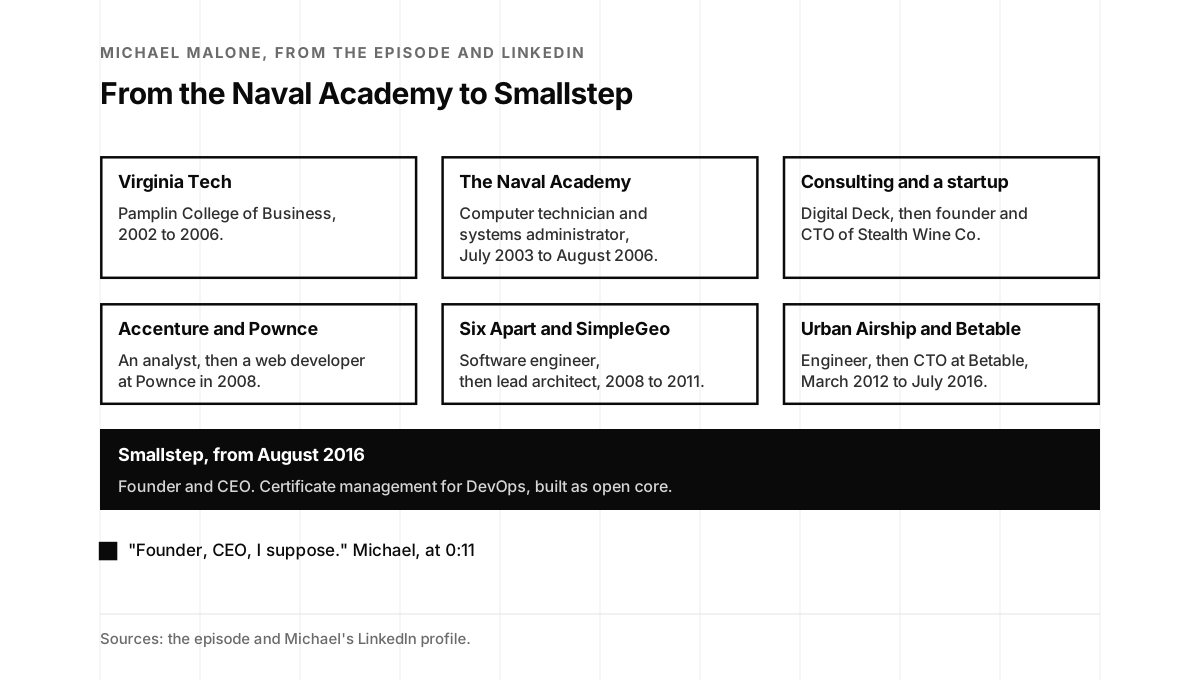
From the Naval Academy to Smallstep
Jon started with the title.
“Founder, CEO, I suppose.”
Michael Malone, at 0:11
Then Jon read Michael’s resume, which LinkedIn lists the same way. Virginia Tech. Computer technician and systems administrator at the United States Naval Academy. Consulting for Digital Deck. Founder and CTO of Stealth Wine Co. An analyst at Accenture. A web developer at Pownce, a software engineer at Six Apart, lead architect at SimpleGeo, an engineer at Urban Airship, and CTO at Betable. Then Smallstep, from August 2016 (LinkedIn).
Right after SimpleGeo, Jon added that some of Michael’s coworkers had nice things to say, about a database above all.
Two of those companies have a short history on Wikipedia. Pownce was a social networking and micro-blogging site. On December 1, 2008, it announced that Six Apart had acquired it, and it shut down on December 15, 2008 (Wikipedia). Six Apart made the Movable Type blogware and the TypePad hosting service (Wikipedia). Urban Airship now goes by Airship (Wikipedia).
What Smallstep automates
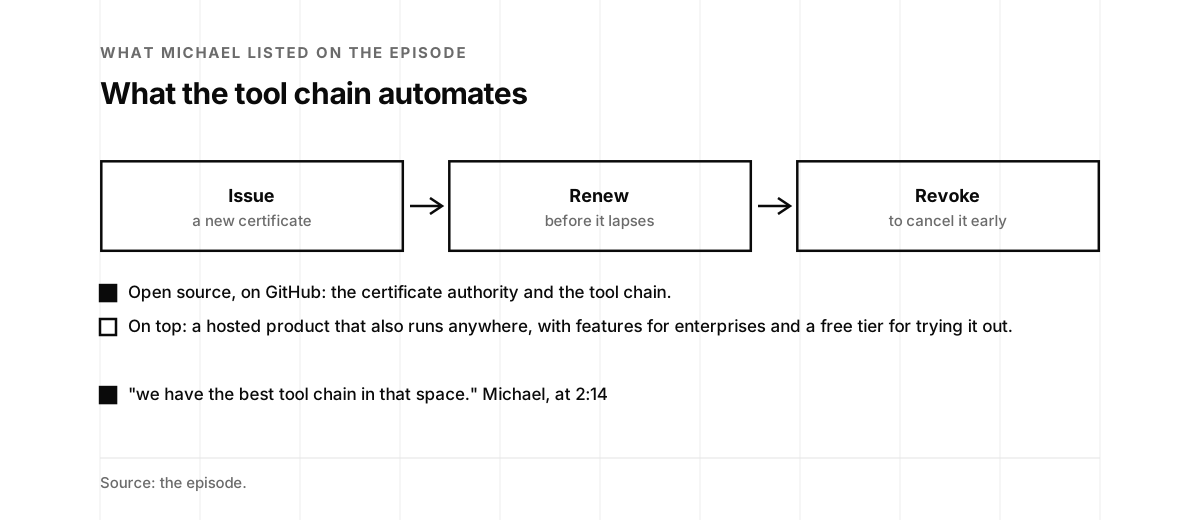
Michael described a venture-backed startup out of the Bay Area that also hires remote employees. The focus is certificate management for DevOps, built as open core: a certificate authority and a tool chain that automate issuing, renewing and revoking certificates. All of it is open source, on GitHub.
“we have the best tool chain in that space.”
Michael Malone, at 2:14
On top of the open source sits a hosted product that also runs anywhere, with features for enterprises. It’s turnkey. You sign up on the website, and a free tier lets you try it out.
Don’t build it yourself
Jon called it a tough problem: managing identities, and binding them to processes, machines or containers.
“I would never recommend anyone try to build that stuff themselves.”
Jon McLachlan, at 2:45
Each time Jon ran into it earlier in a career in the Valley, the answer was to hire an expert team and let it build the thing. That was long before Smallstep existed, and Jon was glad to see a turnkey option now.
SPIFFE, SPIRE and Smallstep
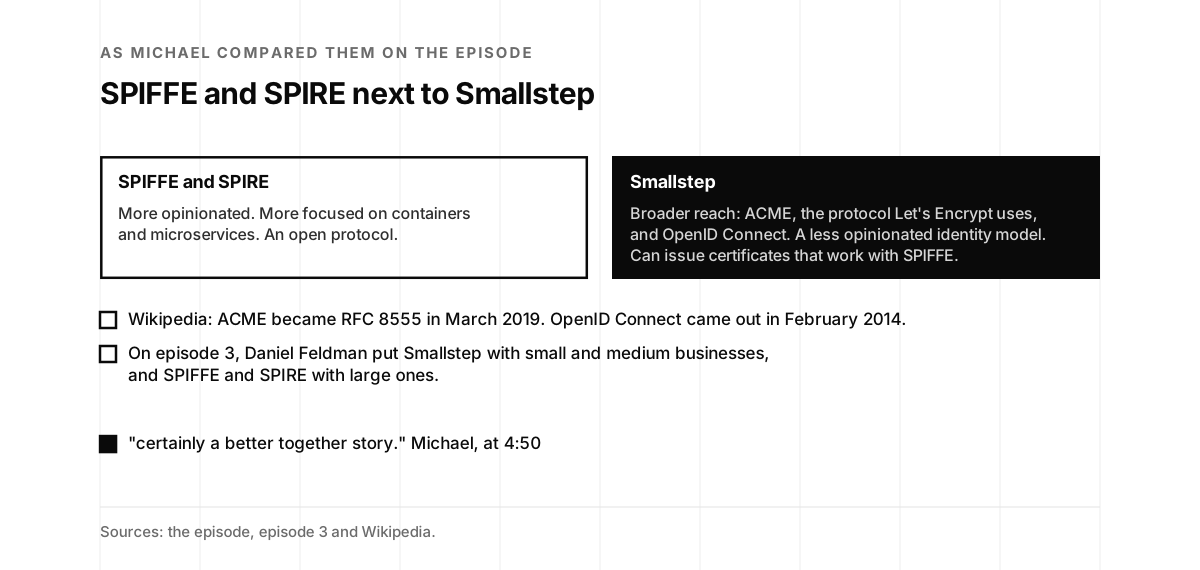
Jon asked how Smallstep compares with SPIFFE and SPIRE. Michael knows the SPIFFE folks and took part in some of their early standardization work. The two overlap. SPIFFE and SPIRE are more opinionated, and more focused on containers and microservices, a use case Smallstep covers too.
Smallstep reaches further, Michael said. It supports ACME, the protocol Let’s Encrypt uses, and it can issue certificates through OpenID Connect, with a less opinionated identity model.
“certainly a better together story.”
Michael Malone, at 4:50
SPIFFE is an open protocol, and Smallstep’s tool chain can issue certificates that work with it. Michael was happy to see the SPIFFE people succeed. Jon noted that HP had bought them. Episode 3’s guide has the details: Hewlett Packard Enterprise acquired Scytale, the SPIFFE startup, in February 2020 (episode 3).
ACME is a protocol for automating the work between certificate authorities and their users’ servers. The Internet Security Research Group designed it for its Let’s Encrypt service, and the finished standard came out in March 2019 as RFC 8555 (Wikipedia). OpenID Connect, published in February 2014 by the OpenID Foundation, is the third generation of OpenID (Wikipedia).
On episode 3, Daniel Feldman drew the same line from the other side: Smallstep for small and medium businesses, SPIFFE and SPIRE for large ones (episode 3).
The bottom turtle
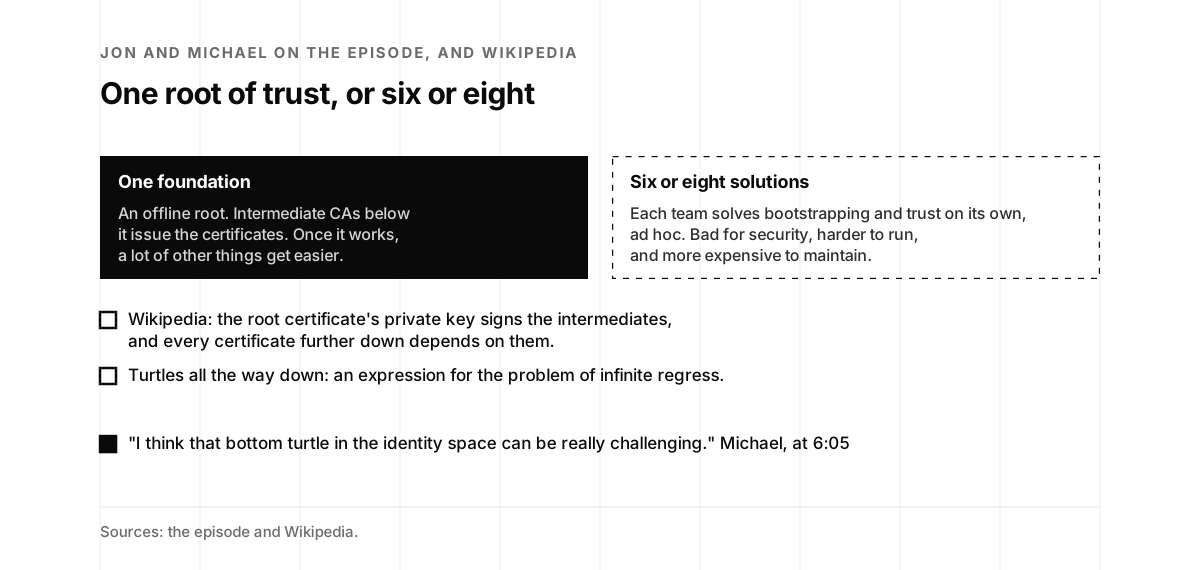
Jon described the problem certificates solve. What is it that you trust? With an in-house certificate authority, you keep an offline root of trust, and intermediate CAs issue certificates below it. Managing all of that is hard. Once it’s set up, you have one entity to trust, and it sits offline, out of reach of a breach.
“I think that bottom turtle in the identity space can be really challenging.”
Michael Malone, at 6:05
It’s hard, Michael said, and once you figure it out, a lot of other things get easier. Many teams solve the bootstrapping and trust problem haphazardly and ad hoc, over and over. In place of one foundation, they end up with “six or eight poorly implemented solutions.” That’s bad for security and harder to run. Jon added that it costs more to maintain.
“Turtles all the way down” is an expression for the problem of infinite regress (Wikipedia). In a certificate tree, the root certificate sits at the top, and its private key signs other certificates. The intermediates it signs carry its trust, and every certificate further down depends on them (Wikipedia).
The knowledge gap
“The other issue here is there’s a huge knowledge gap.”
Michael Malone, at 6:52
Public key infrastructure isn’t something even educated, experienced software engineers or DevOps people tend to know well, Michael said. For some, it’s an embarrassing gap. Jon admitted to being no certificate expert. A certificate has many frameworks and small pieces, and you have to know the history to see how they got there.
Wikipedia defines public key infrastructure as the roles, policies, hardware, software and procedures to create, manage, distribute, use, store and revoke digital certificates (Wikipedia).
Why a certificate lists a country
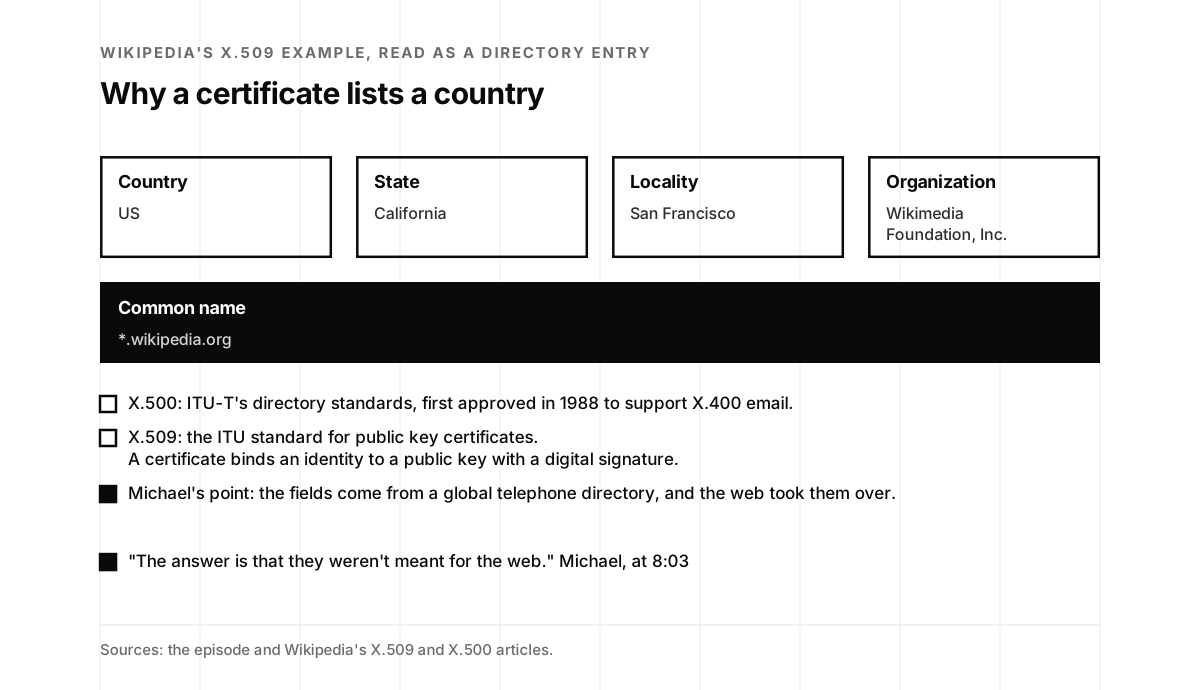
Michael’s piece of history: X.509 and X.500 came out of ITU-T, a telecom standards body. You may have wondered why certificates for the web carry countries and localities, which don’t matter on the web.
“The answer is that they weren’t meant for the web.”
Michael Malone, at 8:03
X.500 and ITU-T were building a global telephone directory. The web inherited it, history and baggage included.
Wikipedia dates it. X.500 is a series of standards for electronic directory services, developed by ITU-T and first approved in 1988, to support X.400 email (Wikipedia). X.509 is the ITU standard for the format of public key certificates, and a certificate binds an identity to a public key with a digital signature (Wikipedia). The X.509 article’s example is the certificate for Wikipedia itself. Its subject names a country, a state, a locality and an organization: US, California, San Francisco and the Wikimedia Foundation.
TLS is already everywhere
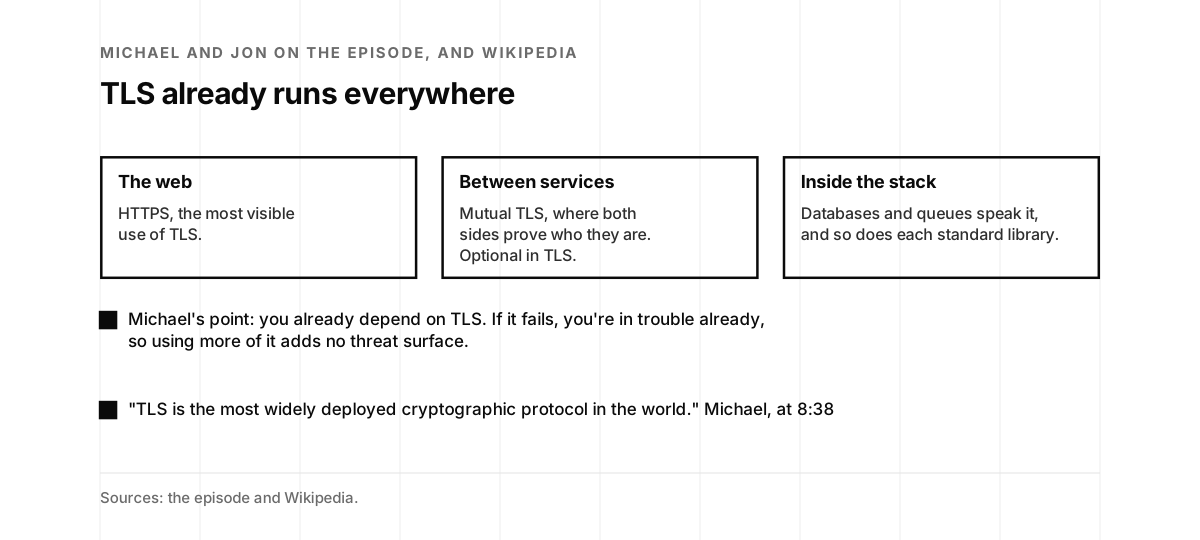
Jon called X.509 an important standard for the web: it’s how HTTPS works, and mutual TLS authentication, a step above that.
“TLS is the most widely deployed cryptographic protocol in the world.”
Michael Malone, at 8:38
There’s plenty not to like in TLS, Michael said, above all in earlier versions. Chances are you already use it and depend on its security. If it fails, you’re in trouble already, and using more of it won’t add to your threat surface.
TLS secures communications over a network such as the Internet, and HTTPS is its most visible use (Wikipedia). Mutual authentication, where both sides prove who they are, is optional in TLS (Wikipedia). On episode 61, Taher Elgamal, known as the father of SSL, explained why SSL required a certificate from the server and only offered one to the client.
Authorization first, then authentication
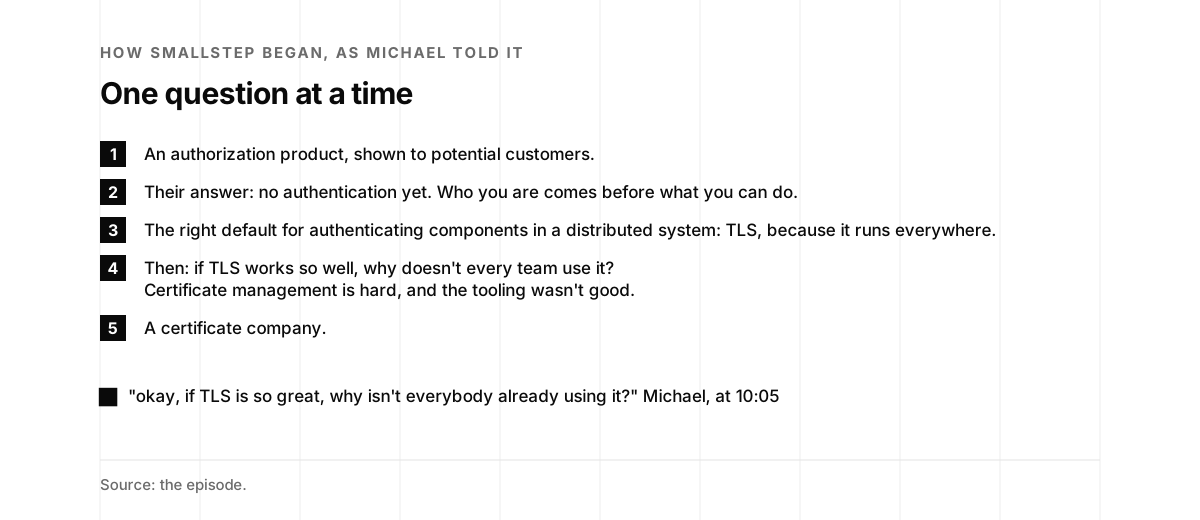
Michael tied this to how Smallstep began. The company first worked on authorization and showed a solution to potential customers. The customers’ answer ended like this:
“but we don’t have authentication yet.”
Michael Malone, at 9:29
Jon summed it up. You answer who you are before you answer what you can do. That led Michael to the next question: what’s the right default for authenticating components in a large distributed system? The research pointed to TLS, because it’s everywhere. Databases speak it, queues speak it, and each standard library implements it. Then a harder one:
“okay, if TLS is so great, why isn’t everybody already using it?”
Michael Malone, at 10:05
The answer was certificate management, a big job that is tricky in a distributed system, with no good tooling.
“So here we are.”
Michael Malone, at 10:19
On episode 18, Jon put the same two questions to Anders Eknert of Styra, the company behind the Open Policy Agent.
Zero trust means managing trust
Jon’s view: zero trust depends on a root of trust. It means you don’t trust a central authority out in the cloud, cut off from your infrastructure, and you route trust inside your own systems. Jon thinks of a CA as that internal root of trust, and of zero trust as someone being clever with certificates.
Michael agreed, and called zero trust an overused marketing term that has almost lost its meaning.
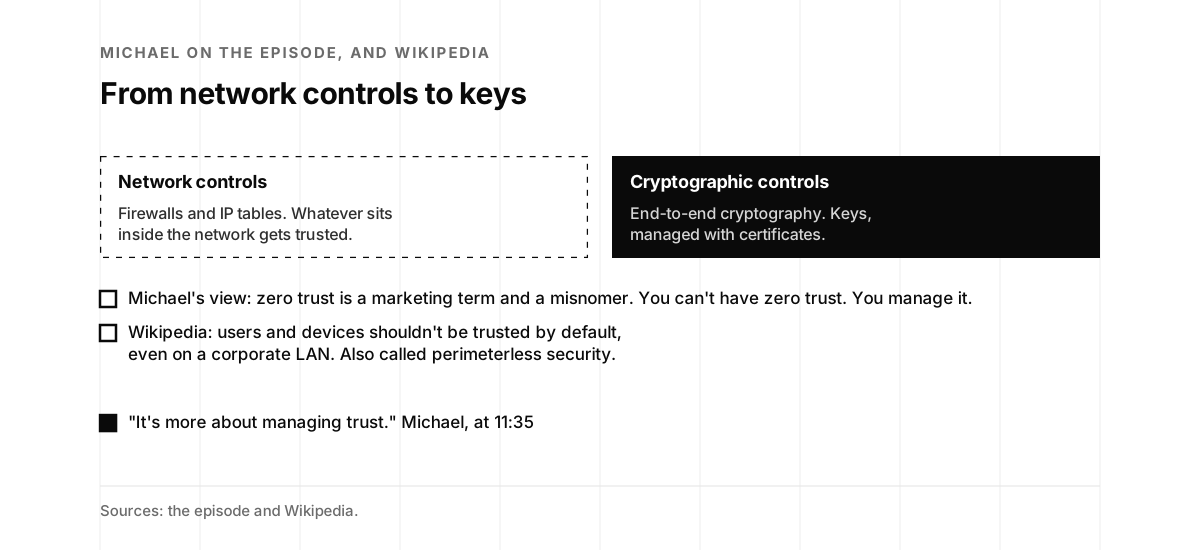
“it’s also a bit of a misnomer since you can’t actually have zero trust.”
Michael Malone, at 11:30
“It’s more about managing trust.”
Michael Malone, at 11:35
Most teams that adopt a zero trust strategy don’t want to trust the network. They move away from network controls, such as firewalls and IP tables, to cryptographic controls and end-to-end cryptography. Cryptography means managing keys.
“one of the best ways to do that in a large distributed system is to use certificates.”
Michael Malone, at 12:04
Wikipedia’s version: users and devices shouldn’t be trusted by default, even on a privileged network such as a corporate LAN. Another name for it is perimeterless security (Wikipedia). On episode 3, Daniel Feldman also called zero trust a marketing term.
A distributed systems engineer
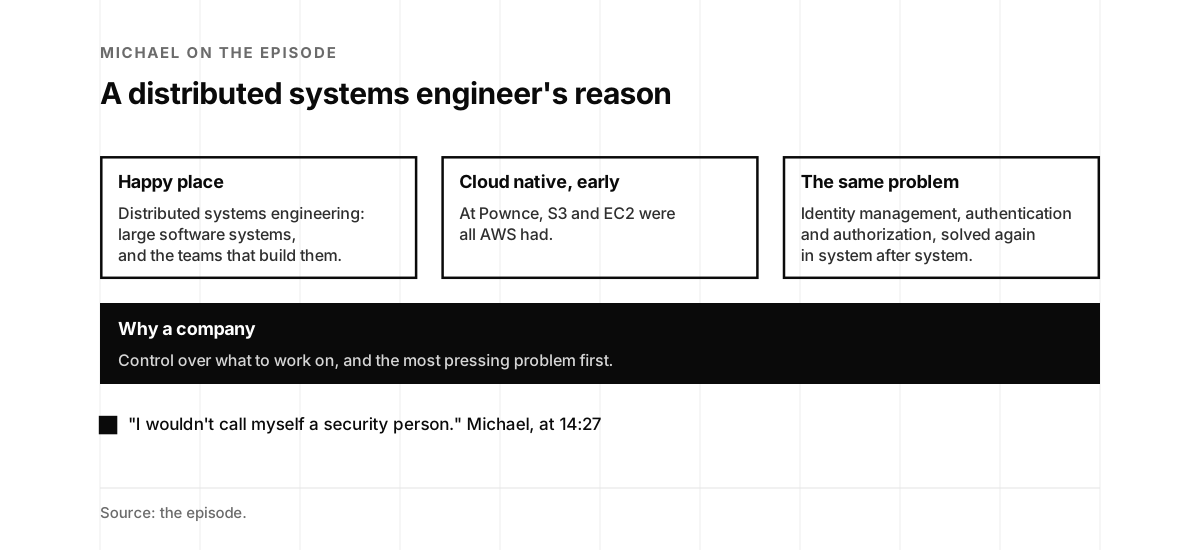
Jon asked what led Michael to start a security company. One reason:
“the ability to control my destiny and what I’m working on”
Michael Malone, at 14:13
Michael also described the work this way.
“I wouldn’t call myself a security person.”
Michael Malone, at 14:27
Michael’s happy place is distributed systems engineering. Michael likes building large software systems, and the teams that build them, and has done it a number of times. All of it was in what we now call the cloud native world. At Pownce, the team ran on AWS when S3 and EC2 were all AWS had. Several greenfield systems meant making most of the mistakes you can make, and solving the same problems again and again. The hard one that kept coming back was identity management, authentication and authorization. Other problems sit next to it, and Michael would like to take them on with infinite time and resources. This one seemed the most pressing.
No pearl of wisdom
Jon asked for one truth about the world that most people miss. Michael didn’t claim a pearl of wisdom. The way Michael operates is to pursue passions and work on things worth believing in.
“it’s important to enjoy the journey”
Michael Malone, at 17:04
That means working on something exciting every day, without looking to the past or the future. Michael does what seems right and hopes other people see it that way too. When they don’t, there’s comfort in one thing:
“at least I did what I thought was right.”
Michael Malone, at 17:42
The grow-up question
Jon asked about leadership style, and then what Michael’s team would say.
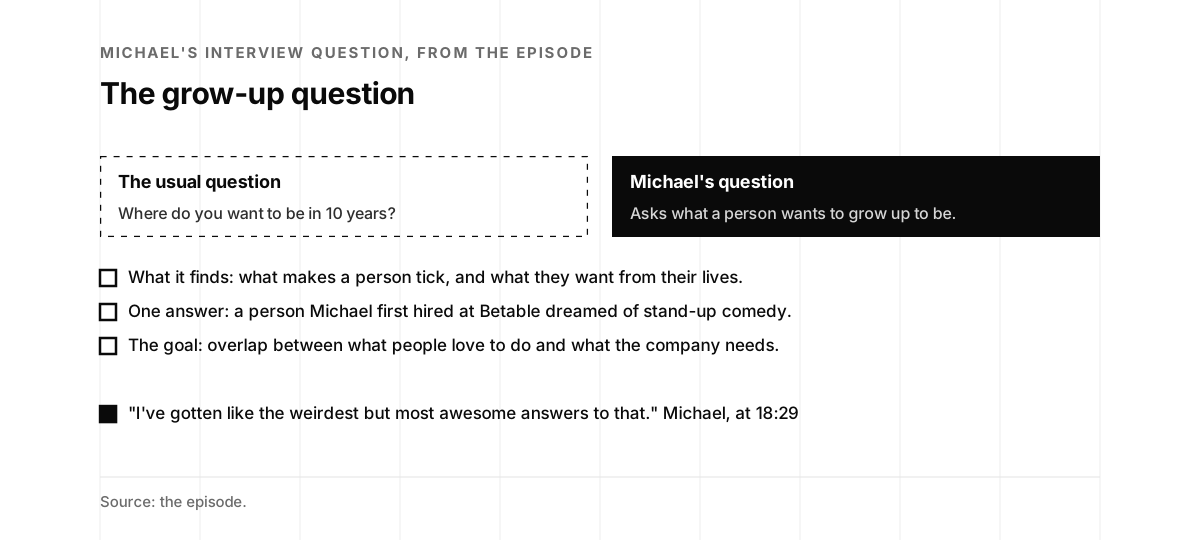
“They would probably laugh. I am not a process person, I am not organized, but I like to get to know people and I like to understand what makes them tick and what they want to be doing.”
Michael Malone, at 18:06
One of Michael’s favorite interview questions asks what a person wants to grow up to be. It has drawn the weirdest and most awesome answers. A small startup can bend to what people want from their lives. One person who works for Michael now, first hired at Betable, dreamed of stand-up comedy. Michael thought that was awesome.
That’s the management style: find people who are similarly passionate, learn what they’re passionate about, and hope it overlaps with what the company needs.
Smart, and passionate about the work
Jon’s first interview as an interviewer was for a security role, and it felt like a heavy responsibility. Early on, Jon thought interviews were about the technical details. Do you know this technology? Can you solve this algorithm? Later, Jon decided that people are smart and can learn what a job needs, and started to look for passion, something you can’t teach.
Michael has two tests.
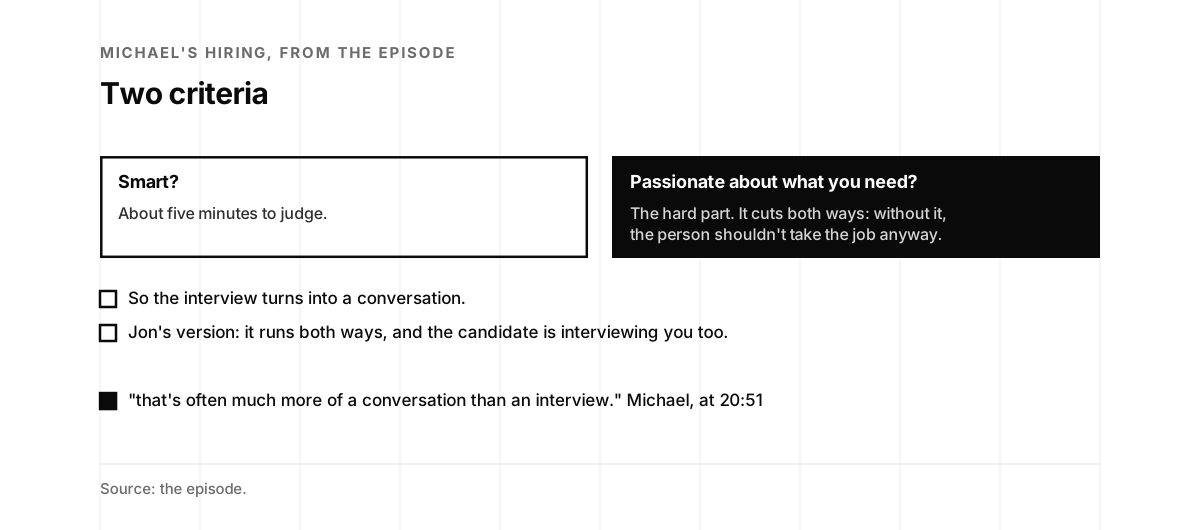
“there’s sort of two criteria I hire for.”
Michael Malone, at 20:24
One is whether you’re smart. The other is whether you care about the thing the company needs you to care about.
“figuring out whether someone’s smart takes five minutes. It’s the second part that I think is hard.”
Michael Malone, at 20:35
The test cuts both ways. Someone who isn’t passionate about the problem shouldn’t work on it anyway.
“that’s often much more of a conversation than an interview.”
Michael Malone, at 20:51
Jon agreed, and called passion “a two-way street.” When Jon interviews someone, Jon is being interviewed too. Michael played it down.
“I don’t think it’s rocket science.”
Michael Malone, at 21:29
Anyone who thinks it through honestly would get there, Michael said. A lot of hiring helped, and the approach grew out of more standard ones from years of working for other people. In Michael’s words, “more evolutionary than revolutionary.” Jon called that humility, and said security has plenty of experts and plenty left to improve.
On episode 18, Anders Eknert of Styra also described interviews as casual conversations.
A best day: the first raise
Jon asked for a best day in five years of Smallstep. Michael started with a caveat.
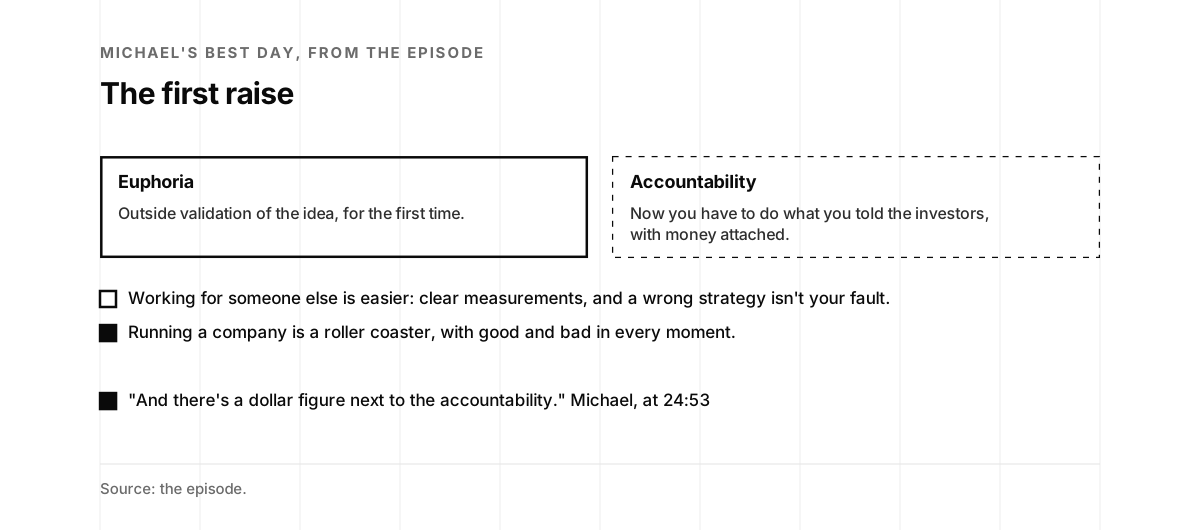
“every moment has good parts and bad parts.”
Michael Malone, at 23:23
“It’s very much a roller coaster ride, I think, running a company.”
Michael Malone, at 23:32
In a lot of ways, working for somebody else is easier. You get clear measurements. Someone tells you what to do, you do it well or poorly, and if the strategy was wrong, that’s not your fault. Running a company means making the decision, executing it, and then wondering whether you executed well on the wrong thing.
The obvious answer was raising money: the first real outside validation of the idea. It was gut-wrenching too. Now you have to do everything you told the investors you would do, or answer for it.
“And there’s a dollar figure next to the accountability.”
Michael Malone, at 24:53
The feeling was a “mixture of like euphoria and what have I gotten myself into?” Michael is analytical, and even emotions get a meta-analytical look. Still, running a venture-backed company is an emotional experience.
A worst day you forget
No worst day came to mind. Maybe Michael forced it out of memory. There have been bad moments, though. People have left the company, always on good terms, and it still hurts like losing a family member on a tight team. Some releases the team was excited about met a world that didn’t see it the same way. Michael doesn’t dwell on those.
“Mistakes are opportunities to learn something new. And I try not to make the same mistake twice.”
Michael Malone, at 26:46
Jon agreed: learn what you can, look for the silver lining and move forward. A leader also has to help a team do the same, and has to mean it.
“So if you don’t believe it, people can smell it.”
Jon McLachlan, at 27:20
A venture sells you money
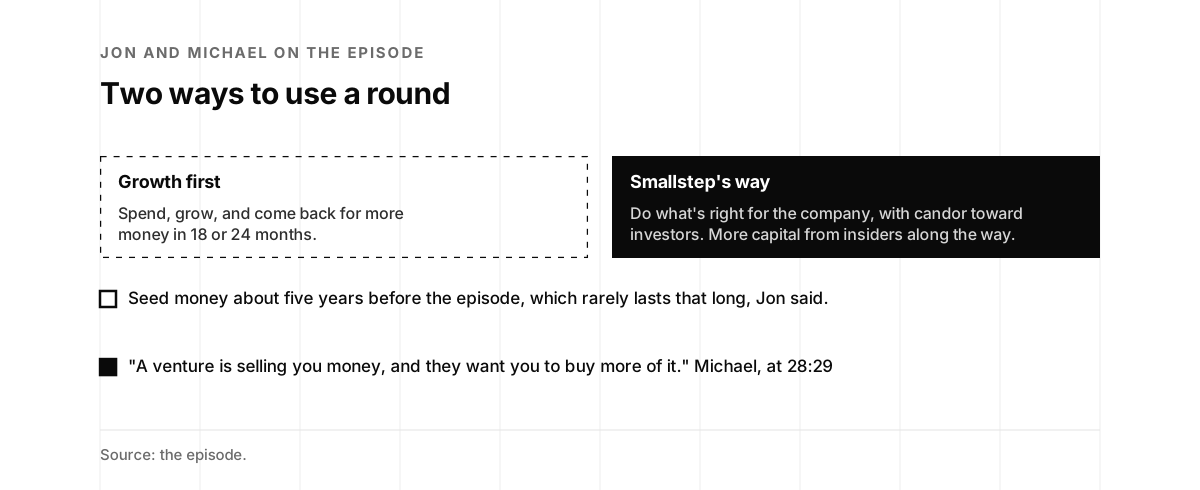
Jon pointed out that Smallstep raised seed money about five years before the episode, and seed rarely lasts five years. Venture capitalists often push you to spend, grow and come back for more in 18 or 24 months. Michael said Smallstep had raised more along the way from insiders, and brought in more capital a little over a year before.
“A venture is selling you money, and they want you to buy more of it.”
Michael Malone, at 28:29
“So the best way to get you to buy more of it is to get you to spend what you have.”
Michael Malone, at 28:33
Michael tries to do what’s right for the company, and feels lucky in the investors.
“if you can have a good relationship with the people that are funding you”
Michael Malone, at 28:45
Candor with them, Michael said, goes a long way.
Many startups grow at any cost. Smallstep hasn’t followed that “run it off the cliff sort of philosophy,” and Jon called that refreshing.
Back to authorization
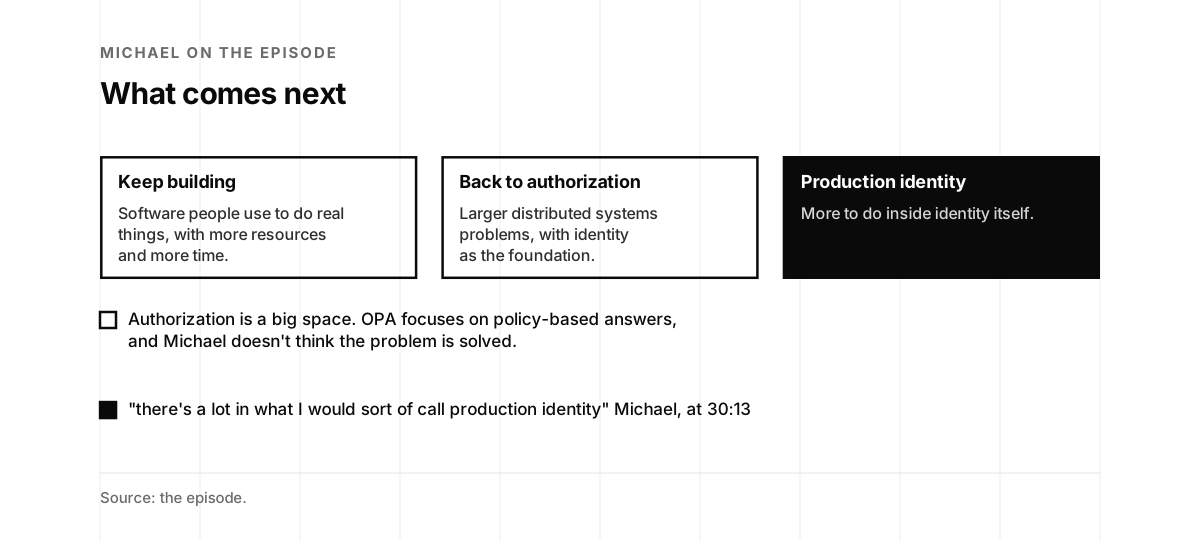
Looking ahead, Michael started with what Smallstep had done: software people use to do real things. The plan is more of it, with more resources and more time. That includes going back to the authorization work and larger distributed systems problems, with identity as the foundation. Even within identity there’s more to do:
“there’s a lot in what I would sort of call production identity”
Michael Malone, at 30:13
Jon brought up the Open Policy Agent, OPA, and the GUI that Styra built on top of it. Michael knows the OPA folks. Authorization is a big space, both said. Jon saw OPA as focused on policy-based answers, and Michael agreed. Michael sees a lot of opportunity there, and doesn’t think the problem has been solved yet.
Anders Eknert of Styra, the company behind OPA, came on episode 18 in July 2022.
What happened after the tape
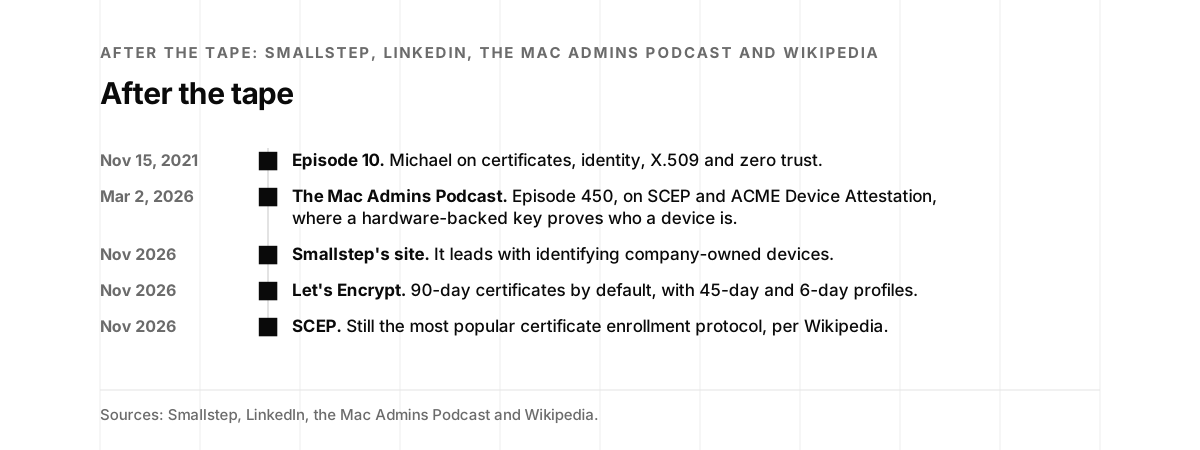
Smallstep’s site leads with devices. On November 11, 2026, smallstep.com led with “Identify company-owned devices with ease.” The page names step-ca, the step CLI and Smallstep SSH (Smallstep). Michael’s LinkedIn headline is still founder and CEO at Smallstep (LinkedIn).
Michael on the Mac Admins Podcast. On March 2, 2026, Michael posted about joining the Mac Admins Podcast that week to talk about certificates (LinkedIn). The subject was SCEP, which is password-based and was built for a world where someone at an IT desk unboxed each device. In Michael’s view, remote work, drop-ship laptops and zero trust break those assumptions. The replacement on the show was ACME Device Attestation. A device proves who it is with a hardware-backed key, in a Secure Enclave or a TPM, and the private key never leaves the chip. The episode is number 450, with hosts Tom Bridge and Marcus Ransom (Mac Admins Podcast).
Michael on SCEP, ACME Device Attestation and the Mac Admins Podcast.
Michael Malone · March 2, 2026
SCEP is still the most popular. Wikipedia calls the Simple Certificate Enrollment Protocol the most popular and widely available certificate enrollment protocol. iPhones use it to enroll in enterprise PKI, and RFC 8894 describes it (Wikipedia).
Let’s Encrypt offers shorter certificates. The default is 90 days, with renewal at any time, and there are 45-day and 6-day profiles too (Wikipedia). Wikipedia calls it the world’s largest certificate authority, used by more than 700 million websites.
Secrets that move. On episode 92, in April 2026, Jasson Casey of Beyond Identity described the trouble with passwords, API keys and session cookies: they move.
Did you catch it? A seven-question quiz
Seven questions from the episode. Each answer links the moment in the transcript or its section.
Quiz · seven questions
Did you catch it?
Pick an answer to see whether you caught it.
-
What does Smallstep's tool chain automate, as Michael described it?
a. All of it open source, on GitHub. See What Smallstep automates.
-
Which protocol did Michael name as the one Let's Encrypt uses?
b. Smallstep supports it, and can also issue certificates through OpenID Connect. See SPIFFE, SPIRE and Smallstep.
-
Why do certificates for the web list countries and localities?
c. "The answer is that they weren't meant for the web." Transcript, 8:03.
-
What did Smallstep work on before certificates?
a. The customers it showed the product to didn't have authentication yet. See Authorization first, then authentication.
-
What does Michael say zero trust is about?
c. "It's more about managing trust." Transcript, 11:35.
-
How long does Michael say it takes to tell whether someone is smart?
b. "figuring out whether someone's smart takes five minutes." Transcript, 20:35.
-
What does Michael say a venture investor is doing?
a. "A venture is selling you money, and they want you to buy more of it." Transcript, 28:29.
How solid is your root of trust?
Eight questions on how your company gives services an identity, built from the episode. Each tip links the section behind it.
Scorecard · eight questions
How solid is your root of trust?
Answer for your systems as they run today. If two answers fit, pick the lower one.
-
How many separate ways does your company give services an identity?
- Several, each team its own
- Two or three
- One
Six or eight homegrown answers are harder to run than one. See The bottom turtle.
-
Is the private key of your root certificate authority kept offline?
- No, or we don't know
- Offline, but the rest is ad hoc
- Yes, and intermediates issue the certificates
An offline root is one thing you don't have to worry about losing to a breach. See The bottom turtle.
-
Do your services prove who they are to each other with certificates?
- No, they trust the network
- Some do
- Yes, with mutual TLS
Answer who a service is before you decide what it can do. See Authorization first, then authentication.
-
Are certificate issuance and renewal automated?
- No, by hand
- Partly
- Yes
The calculator shows the hours by hand. See What Smallstep automates.
-
Could you revoke a certificate today and know it took effect?
- No
- Probably
- Yes, we've tested it
Revocation is part of the tool chain's job, next to issuing and renewing. See What Smallstep automates.
-
Could more than one person on your team explain your certificate chain?
- No one could
- One person
- Several people
Even experienced engineers tend to have a gap here. See The knowledge gap.
-
What decides whether one service can reach another?
- Firewalls and IP rules only
- Network rules and some keys
- Cryptographic identity, with network rules behind it
Zero trust moves you from network controls to keys. See Zero trust means managing trust.
-
Do you know which certificates expire in the next 90 days?
- No
- The public ones
- All of them
Let's Encrypt certificates last 90 days by default. See What happened after the tape.
Each team solves identity on its own. Pick one root of trust, keep it offline, and issue from intermediates.
The pieces exist. Automate renewal and revocation, and teach more than one person how the chain works.
Keep the root offline and renewals automatic, and move the last network-only rules to keys.
How many certificate renewals do you run?
Michael’s tool chain automates issuing, renewing and revoking certificates. This calculator shows what renewal by hand costs as certificates get shorter.
Calculator
How many certificate renewals do you run?
Four numbers: how many certificates you run, how many days each one lasts, the minutes a renewal takes by hand, and the share you renew automatically.
200 certificates that last 90 days need 811 renewals a year, about 16 a week. With 0% renewed automatically, the rest take 203 hours a year at 15 minutes each.
The calculator counts 365 days to a year and rounds to whole numbers. The 90-day default is the Let's Encrypt default lifetime, per Wikipedia, and 6 is its shortest profile. The other defaults are placeholders, yours to change.
From the Naval Academy to production identity
Michael’s path, the field around it, and this show. Filter by topic.
What to do this week
Five things, in the order of the episode.
- Count your identity systems. List every place your company gives services an identity, as in The bottom turtle. The scorecard shows where else to look.
- Take the root offline. Keep the root key offline and issue from intermediates, as Jon described in The bottom turtle.
- Automate renewal first. Run your numbers in the calculator before you shorten certificate lifetimes.
- Ask the grow-up question. Try it in your next interview, as in The grow-up question.
- Get help with it. Our Product Security team embeds with your engineers to ship SSO, audit logs, customer-managed keys and end-to-end encryption. Penetration Testing produces the report an enterprise buyer’s security team accepts, and vCISO Services give you a vCISO with a full security team behind them. If you want to talk it through, book 15 minutes with us.