
Podcast Episode 9

Episode 009 25 min

Dylan Ayrey, Founder and CEO of Truffle Security, How Open-Source Makes the World More Secure

with Dylan Ayrey · Truffle Security

0:00 / 25:00

Also on Spotify, Apple Podcasts, YouTube, Podbean, Player FM

Episode 9 of The Security Podcast of Silicon Valley, published September 7, 2021. Host Jon McLachlan talks with Dylan Ayrey, co-founder and CEO of Truffle Security and the creator of TruffleHog, an open source tool that finds leaked API keys. Dylan walks through earlier research on a WPA2 half handshake crack and a clipboard attack, explains why TruffleHog digs through git history, where about half the keys sat, and pictures API keys frozen in GitHub's Arctic archive. The talk covers why open source reaches people a company never builds for, why the community isn't the company's, knowledge that travels from job to job, and a starter kit for open sourcing a project: a license, a code of conduct and GitHub's community checklist. About 25 minutes.

Episode notes

In this thought-provoking episode of a YSecurity.io production, we're joined by Dylan Ayrey, the Founder and CEO of Truffle Secure, for a deep dive into the transformative power of open-source projects in cybersecurity. Dylan, the brain behind the renowned open-source tool Truffle Hog, shares insights on leveraging open-source projects to forge a more secure, resilient, and transparent digital future.

Dylan begins by addressing the critical task of uncovering secrets hidden within GitHub repositories, including the Git history, and the role of tools like Truffle Hog in mitigating potential security risks. This conversation not only highlights the practical aspects of security in software development but also underscores the broader implications of sensitive data exposure.

Skeptics of open-source projects often question their viability for building real companies or securing software. Dylan challenges this skepticism by illustrating the tangible benefits and successes achieved through open-source initiatives. He delves into the distinction between Community and Open Source, elucidating why these concepts, while overlapping, cater to different aspects of the software development ecosystem.

The discussion then turns to the importance of open-source projects for engineers, particularly those at the onset of their careers. Dylan advocates for the engagement with open-source as a means of skill development, networking, and contributing to the greater good of the tech community. He shares strategies for engineers and advocates within large organizations to champion the development and adoption of open-source projects, highlighting the business and security value these initiatives can bring.

Listeners will be treated to a rich exploration of how open-source projects like Truffle Hog are instrumental in advancing security practices and fostering a culture of collaboration and transparency in the tech industry. Whether you're an engineer, a cybersecurity professional, or simply interested in the impact of open-source on the future of technology, this episode offers compelling reasons to engage with and support open-source initiatives.

Join us for an enlightening conversation with Dylan Ayrey on the pivotal role of open-source in shaping a more secure digital landscape. Tune in to understand the nuances of discovering hidden risks in code, the symbiotic relationship between open-source and community, and how early career engagement with open-source projects can propel both personal growth and industry-wide advancements.

Hosted by Jon McLachlan — co-founder of YSecurity.

The deep dive

Half the keys were buried

Dylan Ayrey, co-founder and CEO of Truffle Security: a clipboard trick and a half handshake, why TruffleHog digs through old commits, API keys frozen in GitHub's Arctic vault, why open source reaches people a company never builds for, why the community isn't yours, knowledge you can take to your next job, and a starter kit for open sourcing a project.

Episode 9 of The Security Podcast of Silicon Valley came out on September 7, 2021, with Jon McLachlan hosting. The guest was Dylan Ayrey, co-founder and CEO of Truffle Security and the creator of TruffleHog, an open source tool that finds leaked secrets (Podbean, Apple Podcasts, Spotify, LinkedIn, GitHub, Truffle Security). The episode title ends “How Open-Source Makes the World More Secure.”

Dylan’s case is that open source makes security better twice. A tool like TruffleHog finds the API keys people leak into code, including the ones buried in old commits. And giving a tool away brings in users, use cases and contributors that one company would never reach on its own.

This page follows the conversation in order: a section for each part of it, eleven figures, eleven clips from the tape, a talk from Dylan’s YouTube channel, a post from Dylan’s LinkedIn, the full transcript, and five tools: a quiz, a scorecard for secrets in your git history, a calculator for how many keys a team leaks, a timeline, and a to-do list. Where the decodes of the tape disagree on a word, the transcript puts its best guess in brackets, and the page doesn’t quote or retell those words.

Talks before Truffle

Jon introduced Dylan as co-founder and CEO of Truffle Security, a contributing author of TruffleHog, the open source core of Truffle’s product, and before that a senior security partner at Netflix. LinkedIn dates the Netflix role to 2020 and 2021, and lists Dylan as the creator and maintainer of TruffleHog since December 2016 (LinkedIn).

Jon asked about the research Dylan did before Truffle Security. Dylan had spoken at conferences for a couple of years, most recently at Black Hat and DEF CON in 2020, on Google Cloud security work done in collaboration with Google. BSides SF was among the other stages.

“Usually it’s centered around application security.”

Dylan Ayrey, at 1:08

The 2020 Black Hat and DEF CON talk on Google Cloud service accounts, 40 minutes, posted on Dylan's own YouTube channel on August 6, 2020. Watch on YouTube.

The video’s description says the talk covers ways to exploit GCP service accounts and tools that defend against them, such as org policy (YouTube). The tools from the talk are on Dylan’s GitHub as gcploit (GitHub). Wikipedia describes DEF CON as a hacker convention held every year in Las Vegas since June 1993 (Wikipedia).
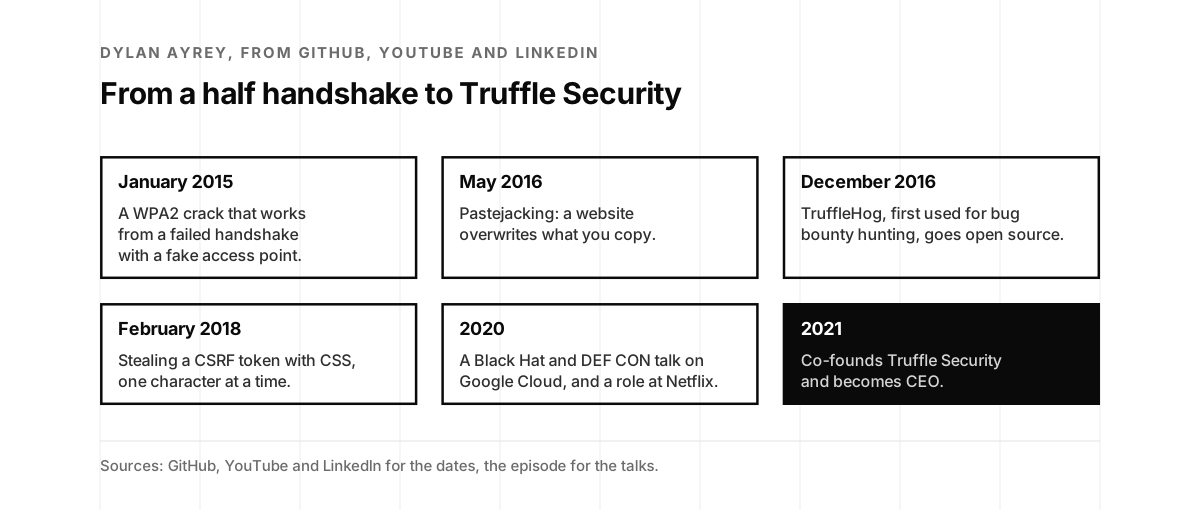
Six cards. January 2015: a WPA2 crack that works from a failed handshake with a fake access point. May 2016: Pastejacking, a website overwrites what you copy. December 2016: TruffleHog, first used for bug bounty hunting, goes open source. February 2018: stealing a CSRF token with CSS, one character at a time. 2020: a Black Hat and DEF CON talk on Google Cloud, and a role at Netflix. Filled, 2021: co-founds Truffle Security and becomes CEO.
Dylan's path, from GitHub, YouTube and LinkedIn. Sources: GitHub, YouTube, LinkedIn and the episode.

A half handshake and a clipboard

Dylan’s earlier work included Wi-Fi hacking. The WPA2 half handshake crack showed you only needed half the handshake to attack a network, where earlier attacks needed the full one. The proof of concept on GitHub, from January 2015, listens for a phone or laptop probing for a known network, puts up a fake access point with that name, and runs a dictionary attack on the failed handshake (GitHub). Wikipedia describes WPA2’s four-way handshake as the step where a client and an access point confirm they hold the same pre-shared key without sending it (Wikipedia).

Then a run of application security posts. In one, Dylan showed that a malicious website can overwrite what’s on your clipboard and slip in malicious commands. Jon pointed to how people transfer bitcoins around. Wikipedia’s article on the clipboard has a related example, a hijacker swapping in its own cryptocurrency address (Wikipedia).

Dylan’s example was a command on a Stack Overflow page. You copy it and paste it into a bash shell.

“what you copy isn’t necessarily what’s in your clipboard.”

Dylan Ayrey, at 1:58

The page can add a new line at the end, so the command runs the moment you paste it. After the write-up, a terminal app changed.

“iTerm actually pushed out a new feature that prompts you and says, hey, what’s in your clipboard has a new line at the end.”

Dylan Ayrey, at 2:09

The write-up is on GitHub as Pastejacking, from May 2016. Its demo swaps a harmless echo command for one that ends in a new line, and it notes that iTerm warns before pasting a command that ends that way (GitHub). Wikipedia names the attack pastejacking and credits Dylan with developing it (Wikipedia). iTerm2 is a free and open source terminal for macOS (Wikipedia).

Listen · Dylan Ayrey on episode 9, from 1:49
About 25 seconds: Dylan on the clipboard attack and the iTerm prompt that followed. The clip stops on its own. Read the full transcript.

Dylan thinks the clipboard post spread because it’s easy to grasp whether or not you work in security. Other posts took more explaining, such as one on using CSS to steal a CSRF token over many requests. That repository, from February 2018, pulls the token one character at a time in about 10 seconds (GitHub). Wikipedia describes cross-site request forgery as an exploit where unauthorized commands come from a user the web application trusts (Wikipedia). Dylan said a number of other open sourced projects have collected dust on GitHub.
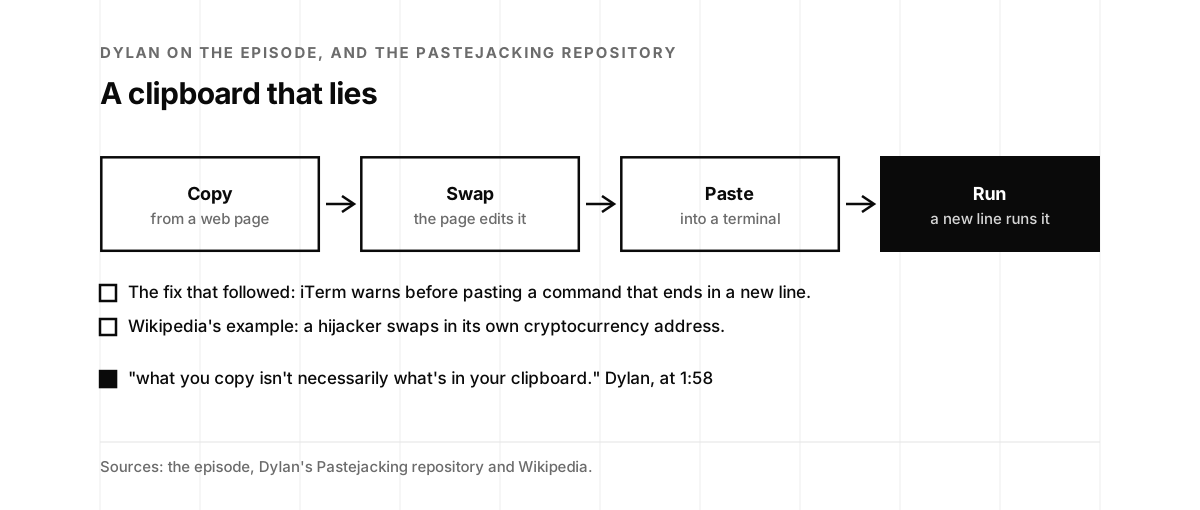
Four boxes joined by arrows: copy from a web page, swap as the page edits it, paste into a terminal, and, filled, run, because a new line runs it. Below: the fix that followed, iTerm warns before pasting a command that ends in a new line. Wikipedia's example: a hijacker swaps in its own cryptocurrency address. Quote: "what you copy isn't necessarily what's in your clipboard."
How the clipboard attack works. Sources: the episode and Dylan's Pastejacking repository.

What TruffleHog does

Jon asked what Truffle Security does. The answer starts with TruffleHog, one of the tools Dylan open sourced.

“all it does is it finds API keys that are accidentally leaked out.”

Dylan Ayrey, at 3:18

It digs through old git commits for API keys that people committed by accident or on purpose.

“it was originally just written for me to do bug bounties.”

Dylan Ayrey, at 3:36

The README showed a screenshot from a real bug bounty, with a real key that has since been turned off. Then Dylan gave the tool to the community. People used it for bug bounties and in CI pipelines. At the time of the episode, Dylan counted something like a thousand daily installs from public repositories, and TruffleHog ships with Kali Linux.

Wikipedia describes a bug bounty program as a deal that pays people for reporting bugs, especially security vulnerabilities (Wikipedia), and Kali Linux as a Linux distribution built for digital forensics and penetration testing (Wikipedia). TruffleHog’s README today defines a secret as “a credential a machine uses to authenticate itself to another machine,” and says the tool can log in to confirm whether a key it finds is still live (GitHub).

Listen · Dylan Ayrey on episode 9, from 3:17
About 35 seconds: Dylan on where TruffleHog came from. The clip stops on its own. Read the full transcript.

Jon has had the same moment looking at a repository.

“oops, there’s a key.”

Jon McLachlan, at 4:52

Jon’s view: automated help can put a real dent in a pragmatic problem, and security people have an obligation to educate.

Half the history

GitHub’s search bar would find a key in the current code. It wouldn’t search the old commits, and Dylan found about half of the source code buried in that past.

“which meant up to that point, half the keys just weren’t being found.”

Dylan Ayrey, at 5:42

Dylan has committed keys too, and wants the work done without blame.

“Security should be ran in a blameless way, myself included, have committed keys in the past.”

Dylan Ayrey, at 5:49

One developer might commit a key or two over a year or two. A large company multiplies that.

“in an organization that’s got 7,000 people, that means you have more than 7,000 keys sticking out in a year.”

Dylan Ayrey, at 6:05

The risk grows when a big organization open sources code on a regular basis. Even code that passes an open source review can carry old keys.

“that old revision history wasn’t really audited super well.”

Dylan Ayrey, at 6:23

So TruffleHog digs through the past and helps find the keys that were missed. Wikipedia describes Git as a distributed version control system, created by Linus Torvalds for the Linux kernel (Wikipedia). The calculator below runs Dylan’s numbers for a team of your size.
Listen · Dylan Ayrey on episode 9, from 5:38
About 30 seconds: Dylan on the keys buried in old commits. The clip stops on its own. Read the full transcript.
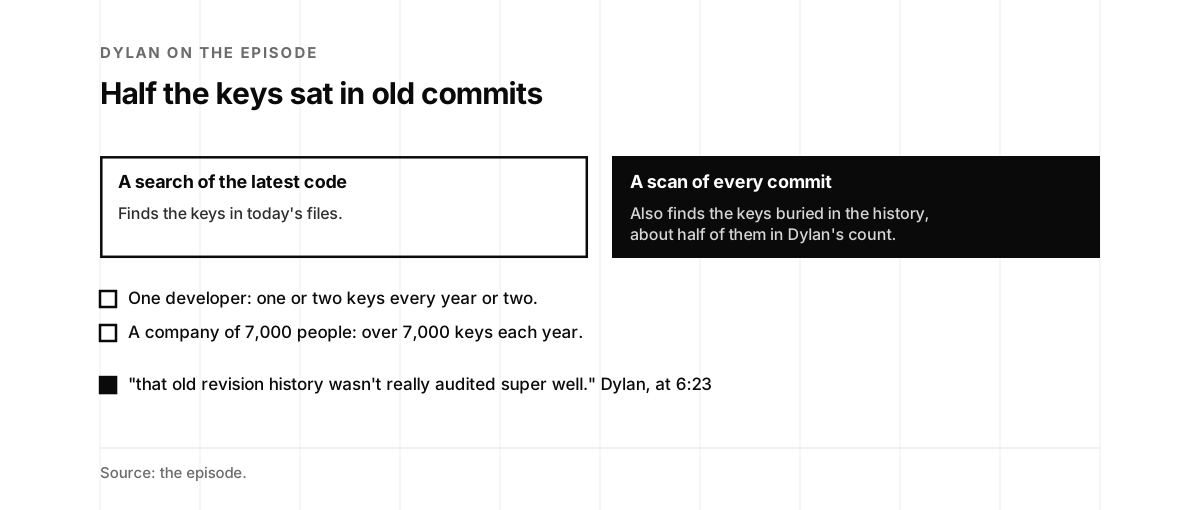
Two cards. A search of the latest code: finds the keys in today's files. Filled, a scan of every commit: also finds the keys buried in the history, about half of them in Dylan's count. Below: one developer, one or two keys every year or two. A company of 7,000 people: over 7,000 keys each year. Quote: "that old revision history wasn't really audited super well."
What a search of the latest code sees, next to the whole history. Source: the episode.

Keys in the permafrost

The talk turned to archaeology, and Dylan brought up GitHub’s vault of open source code, locked in ice underground. Dylan asked how many API keys sit in that vault for good.

Dylan pictured archaeologists, 10,000 years from now, digging through what used to be permafrost, opening the vault and running forensics on ancient keys that leaked by accident. Some of those keys probably won’t be rotated by then.

“they’ll probably still be active 10,000 years.”

Dylan Ayrey, at 7:26

On the tape the vault is in Antarctica. Wikipedia places it in the Arctic World Archive, on Spitsbergen in Norway’s Svalbard archipelago, under the Arctic permafrost. GitHub announced the GitHub Archive Program in November 2019, and in July 2020 a 21-terabyte snapshot of public code went into the vault on 186 reels of film (Wikipedia).
Listen · Dylan Ayrey on episode 9, from 6:38
About 40 seconds: Dylan on API keys frozen in GitHub's archive. The clip stops on its own. Read the full transcript.
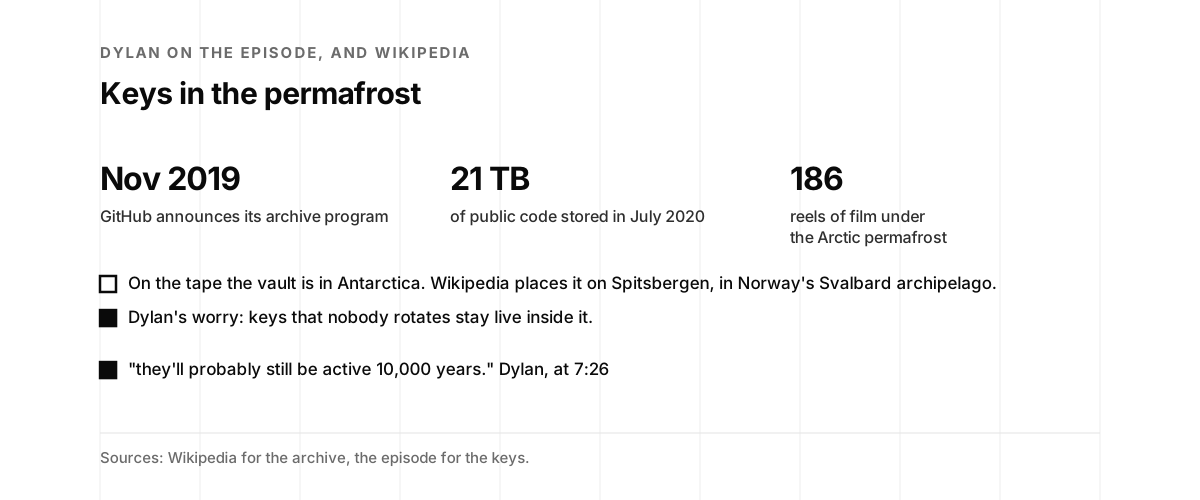
Three numbers. November 2019: GitHub announces its archive program. 21 TB: of public code stored in July 2020. 186: reels of film under the Arctic permafrost. Below: on the tape the vault is in Antarctica, and Wikipedia places it on Spitsbergen, in Norway's Svalbard archipelago. Filled: Dylan's worry, keys that nobody rotates stay live inside it. Quote: "they'll probably still be active 10,000 years."
GitHub's archive, and the keys inside it. Sources: the episode and Wikipedia.

Why give it away

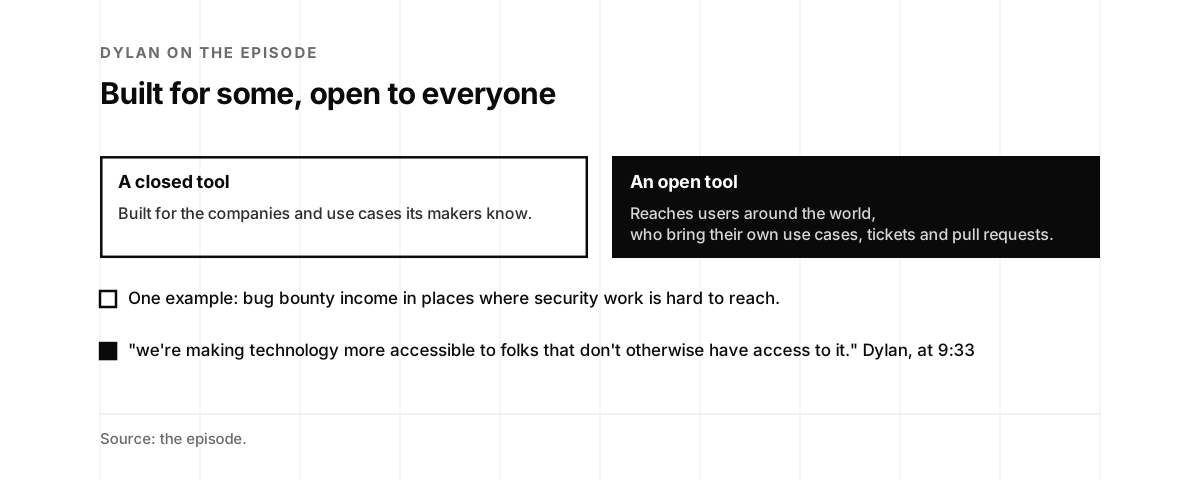
Jon asked why build a company on open source, when many companies don’t go down that road. Dylan’s answer turned on what a closed tool can’t see. A company in San Francisco tends to build for the companies and use cases it knows.

“there are so many other use cases that you don’t get to see”

Dylan Ayrey, at 8:52

An open tool lets others come to the table, explain their use cases in tickets and submit pull requests. And the reach goes past the United States and past the wealthy parts of San Francisco, to people all over the world.

“we’re making technology more accessible to folks that don’t otherwise have access to it.”

Dylan Ayrey, at 9:33

That includes information security, and the chance to earn money from bug bounties in places that would otherwise struggle to get into those spaces. Open source tools got Dylan into security in the first place.

“I felt really the need to continue to give back to that”

Dylan Ayrey, at 10:22

That’s why Dylan wrote TruffleHog and open sourced it. Watching the community grow, and how many people came to depend on the tool, led Dylan to leave Netflix and support that community full time.
Listen · Dylan Ayrey on episode 9, from 9:19
About 40 seconds: Dylan on building for the whole world. The clip stops on its own. Read the full transcript.
Two cards. A closed tool: built for the companies and use cases its makers know. Filled, an open tool: reaches users around the world, who bring their own use cases, tickets and pull requests. Below: one example, bug bounty income in places where security work is hard to reach. Quote: "we're making technology more accessible to folks that don't otherwise have access to it."
Who a closed tool is built for, and who an open one reaches. Source: the episode.

Not your community

Dylan expects open source to keep growing.

“It’s become the dominant operating system.”

Dylan Ayrey, at 11:57

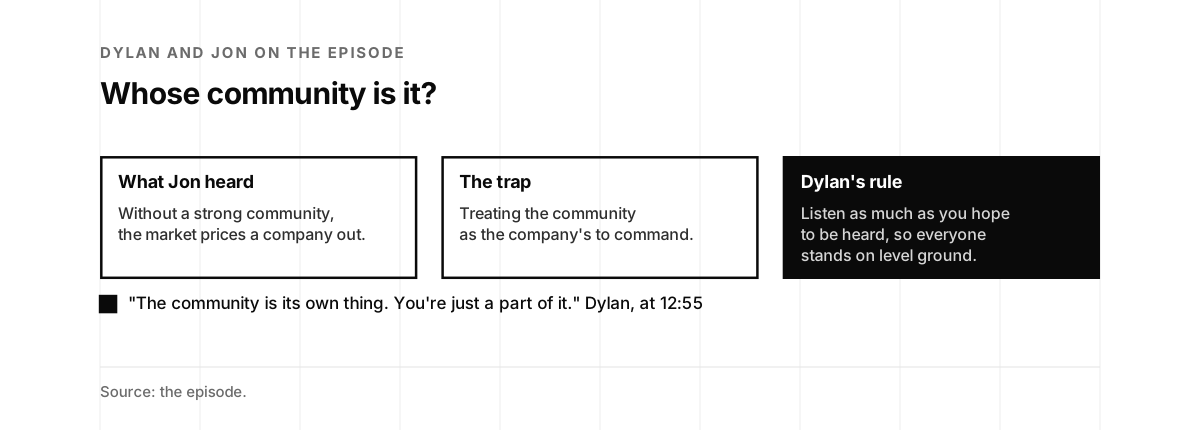
It’s taking over infrastructure too, and it’s hard to picture a database these days that isn’t open source. Jon once heard someone, probably a venture capitalist, say that a company without a strong community gets commoditized and priced out of the market. With a strong community, the company always has that community, and it becomes part of the value proposition.

Dylan agreed the community has value, and named what founders of open source companies often get wrong.

“The community is its own thing. You’re just a part of it.”

Dylan Ayrey, at 12:55

To do it right, a company listens to the community as much as it hopes the community listens back.

“you’re not the dictator of that community”

Dylan Ayrey, at 13:07

Dylan’s word for the goal was a level playing field.
Listen · Dylan Ayrey on episode 9, from 12:40
About 40 seconds: Dylan on why the community isn't the company's. The clip stops on its own. Read the full transcript.
Three cards. What Jon heard: without a strong community, the market prices a company out. The trap: treating the community as the company's to command. Filled, Dylan's rule: listen as much as you hope to be heard, so everyone stands on level ground. Quote: "The community is its own thing. You're just a part of it."
The community, as Dylan described it. Source: the episode.

Leaving the day job

Jon asked when Dylan knew it was time to leave the day job, focus on the community and build a company. The timing came with the pandemic, and Dylan looks back on it with one wish.

“wish that I had done it sooner.”

Dylan Ayrey, at 14:16

Dylan would have liked to be more involved with the community earlier on, and still thinks the founders started at a good time.

“it’s never too late.”

Dylan Ayrey, at 14:34

Truffle Security’s blog post on its first funding round says Dylan left a full-time job in early 2021, with co-founders Dustin Decker and Julian Dunning (Truffle Security).

The stories are the best days

Jon asked for Dylan’s best day so far. The answer was hearing people’s stories: the use cases they have found for the tool over the years, bug bounties included. Dylan used to hear those stories off the cuff, and can now sit down with people and hear them all day.

“that’s really been the best times for me.”

Dylan Ayrey, at 15:33

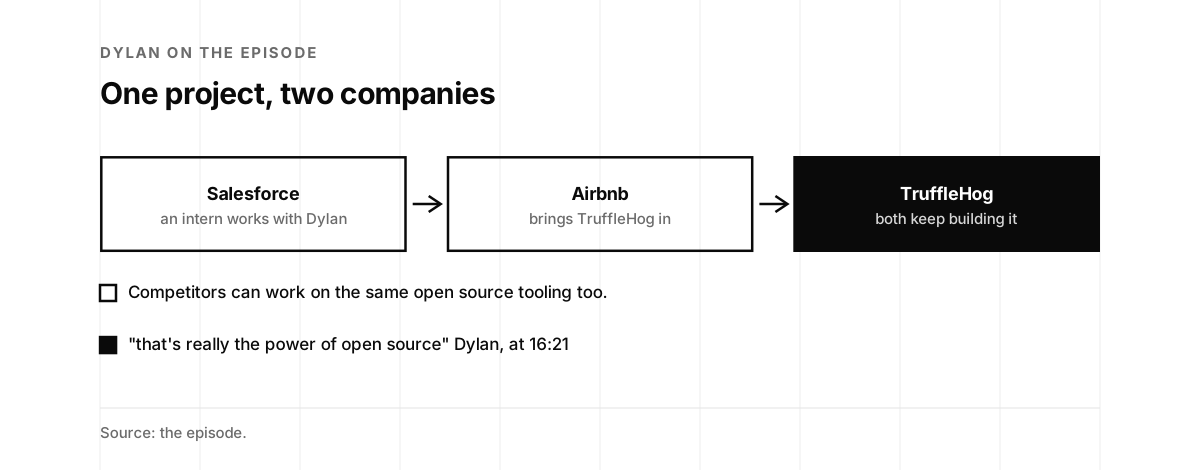
Jon asked for one story in particular. An intern Dylan had worked with at Salesforce later moved to Airbnb, put TruffleHog into use there, and went on contributing and building new features. The two kept collaborating through the project without working at the same company.

“that’s really the power of open source”

Dylan Ayrey, at 16:21

The two companies would never have worked together otherwise. Competitors can work on the same tooling too, and everyone ends up more secure. Jon called it altruistic, with a sense of meaning and purpose that’s hard to get any other way.
Listen · Dylan Ayrey on episode 9, from 15:53
About 35 seconds: Dylan on two companies working together through one project. The clip stops on its own. Read the full transcript.
Three boxes joined by arrows: Salesforce, an intern works with Dylan. Airbnb, the intern brings TruffleHog in. Filled, TruffleHog, both keep building it. Below: competitors can work on the same open source tooling too. Quote: "that's really the power of open source"
One project, two companies. Source: the episode.

Trust in the open

Dylan added a sense of trust that comes from code that’s out in the open.

“Not to say that open source projects can’t have vulnerabilities, like they certainly can.”

Dylan Ayrey, at 17:13

The transparency helps people trust a tool when they go to use it.

Knowledge you can take with you

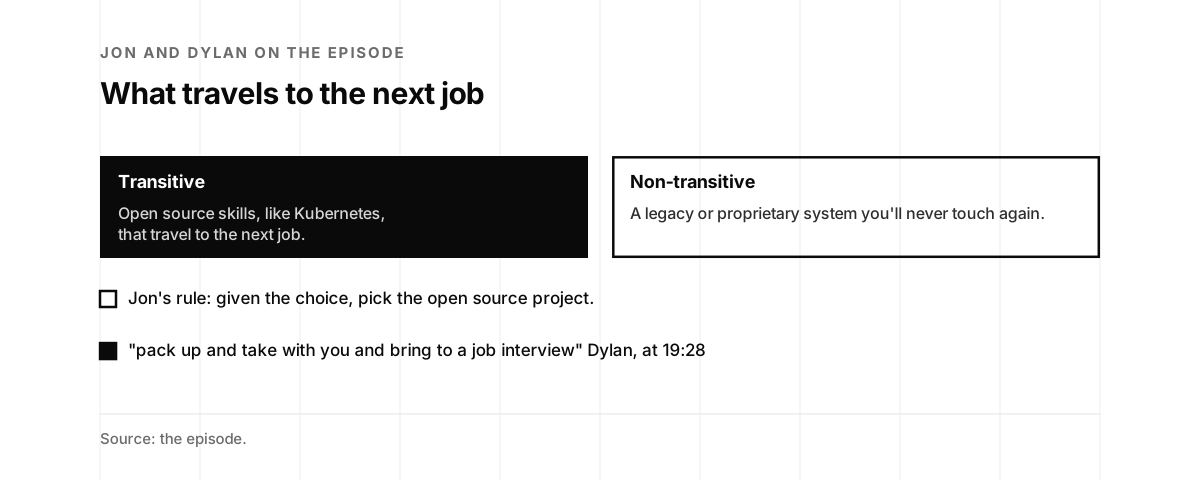
Jon shared some mentoring advice from big companies: sort what you learn into two kinds. Transitive knowledge comes with you to the next job and stays useful over a career. Non-transitive knowledge is a legacy or proprietary system you’ll never work on again. Open source builds the first kind. Given the choice between an open source project and a proprietary one, Jon picks open source every time.

Listen · Jon McLachlan on episode 9, from 17:29
About 35 seconds: Jon on transitive knowledge. The clip stops on its own. Read the full transcript.

Dylan agreed, and aimed it at people early in their careers. Experience with Kubernetes, or with open source projects you’ve contributed to or built on, travels with you.

“pack up and take with you and bring to a job interview”

Dylan Ayrey, at 19:28

It’s useful on the first day of the next job. Time sunk into a big company’s historical proprietary internal system adds to the debt that company struggles to hire for, and it leaves you little to talk about in the next interview.

“you end up boxing yourself in”

Dylan Ayrey, at 19:50

Wikipedia describes Kubernetes as an open source container orchestration system, first designed by Google (Wikipedia). Jon’s own habit goes further, at every opportunity.

“rip out a proprietary system and replace it with something that’s open source. I do it.”

Jon McLachlan, at 20:23

It can take some finessing and a little political dancing, but Jon finds it better for the engineers, the company, the customers and the new people on the team.
Listen · Jon McLachlan on episode 9, from 20:11
About 35 seconds: Jon on replacing proprietary systems with open source. The clip stops on its own. Read the full transcript.
Two cards. Filled, transitive: open source skills, like Kubernetes, that travel to the next job. Non-transitive: a legacy or proprietary system you'll never touch again. Below: Jon's rule, given the choice, pick the open source project. Quote: "pack up and take with you and bring to a job interview"
Two kinds of knowledge, in Jon's mentoring advice. Source: the episode.

Success is giving back

Jon asked what success looks like for Truffle Security in five or ten years. Dylan pointed back to the community: the ways Truffle has helped it, and the tools, scripts, talks and blog posts still to come.

“Look at all the folks new to security.”

Dylan Ayrey, at 21:21

Success means giving tooling and experience to people new to security, and helping the community that brought Dylan into security in the first place.

A starter kit for open source

Jon’s last question was for anyone thinking about open sourcing a project. Dylan’s first piece of advice was to lean toward publishing.

“you should probably bias towards open sourcing it”

Dylan Ayrey, at 22:24

That holds even when you’re unsure anyone will use it, or worried about handing a competitor an advantage.

“And if it takes off, it takes off. And if it doesn’t, then there really isn’t much harm with having open sourced it.”

Dylan Ayrey, at 22:42

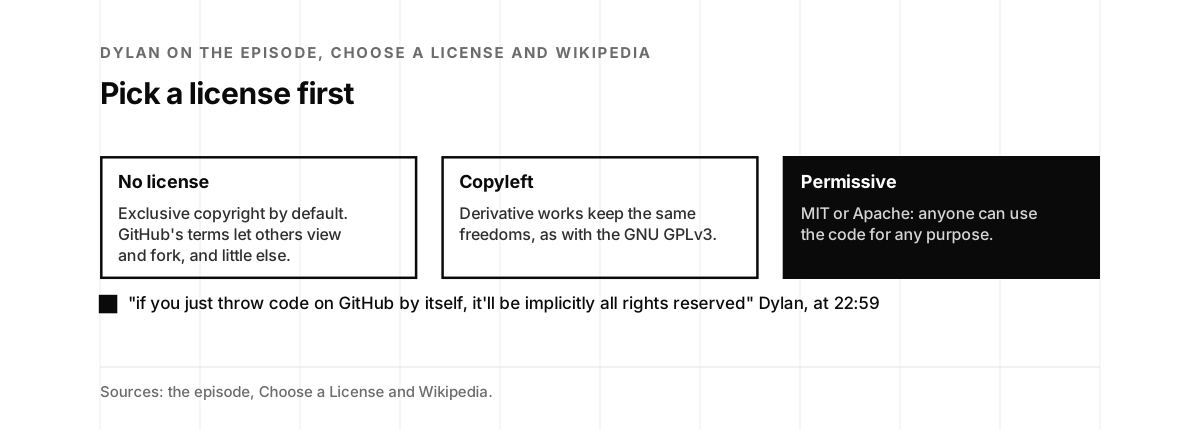
The first step is a license. Dylan named choosealicense.org on the tape. The site lives at choosealicense.com, curated by GitHub, and it splits the choice into simple and permissive, like the MIT License, and sharing improvements, like the GNU GPLv3 (Choose a License).

“if you just throw code on GitHub by itself, it’ll be implicitly all rights reserved”

Dylan Ayrey, at 22:59

Choose a License puts it the same way: code is “under exclusive copyright by default” (Choose a License). The choice turns on whether the code and its derivatives must stay open. Wikipedia describes copyleft as granting freedoms on the condition that derivative works keep the same rights (Wikipedia). The MIT License is permissive and allows reuse inside proprietary software (Wikipedia), and the Apache License lets anyone use, modify and distribute the software for any purpose (Wikipedia).

Listen · Dylan Ayrey on episode 9, from 22:50
About 30 seconds: Dylan on picking a license first. The clip stops on its own. Read the full transcript.

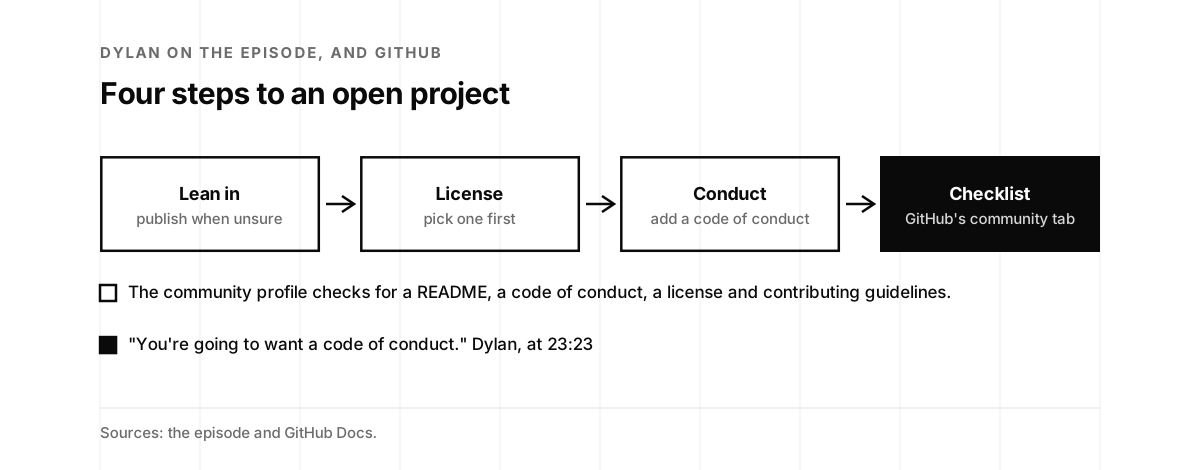
“You’re going to want a code of conduct.”

Dylan Ayrey, at 23:23

A code of conduct says how people can interact, protects members from harassment, and gives you something to point to when someone breaks the rules. Standard ones can be added in one click. Wikipedia describes the Contributor Covenant as a code of conduct for contributors to free and open source projects (Wikipedia).

“If you go to the community tab, it’s got basically a checklist of different things”

Dylan Ayrey, at 23:47

GitHub’s documentation calls it the community profile, a check for files such as a README, a code of conduct, a license and contributing guidelines (GitHub Docs). TruffleHog’s own checklist also covers a security policy, issue templates and a pull request template (GitHub).
Listen · Dylan Ayrey on episode 9, from 23:22
About 30 seconds: Dylan on a code of conduct and GitHub's checklist. The clip stops on its own. Read the full transcript.
Three cards. No license: exclusive copyright by default, and GitHub's terms let others view and fork, and little else. Copyleft: derivative works keep the same freedoms, as with the GNU GPLv3. Filled, permissive: MIT or Apache, anyone can use the code for any purpose. Quote: "if you just throw code on GitHub by itself, it'll be implicitly all rights reserved"
The license choice, as Dylan laid it out. Sources: the episode, Choose a License and Wikipedia.
Four boxes joined by arrows: lean in and publish when unsure, pick a license first, add a code of conduct, and, filled, the checklist on GitHub's community tab. Below: the community profile checks for a README, a code of conduct, a license and contributing guidelines. Quote: "You're going to want a code of conduct."
Dylan's starter kit for an open source project. Sources: the episode and GitHub.

What happened after the tape

A first funding round. On December 8, 2021, Truffle Security announced a $14 million Series A led by a16z. Dylan’s post says TruffleHog started as a tool to “find API keys in Git source code” (Truffle Security).

TruffleHog v3. In April 2022, Truffle Security’s YouTube channel introduced version 3 of the tool. This is Truffle’s own video (YouTube). Today the README says TruffleHog looks for secrets in Git, chats, wikis, logs and more, and classifies over 800 types (GitHub).

A Series B. On November 6, 2025, Truffle Security announced a $25 million Series B led by Intel Capital and a16z. The release counts “23,000+ GitHub stars, 15 million downloads, and over 250,000 daily runs worldwide” for the open source tool (Truffle Security). On the tape, Dylan counted about a thousand daily installs.

Keys in training data. On June 1, 2026, Dylan wrote up a scan of Hugging Face training data: “7.6 petabytes across 187 million files.” It found 221,303 live, unique credentials in 6,003 datasets, and 1,131 datasets held the same live key. The post’s advice fits Dylan’s 10,000-year joke: “Rotation is still the only fix” (Truffle Security). Wikipedia describes Hugging Face as a platform where users share datasets and machine learning models (Wikipedia).

Dylan on scanning every Hugging Face dataset for secrets.

Dylan Ayrey · July 31, 2026
Dylan's video post on the Hugging Face scan. View on LinkedIn.

A revocation program. On November 4, 2026, Truffle Security launched a free Secrets Revocation Program. Issuers revoke the secrets Truffle finds exposed in public code, packages, container images and AI datasets, and the program starts with 1.4 million verified, live credentials. The release cites Truffle’s 2025 study of 21,981 live keys reported on GitLab and Bitbucket: six months later, 81% still worked (Truffle Security).
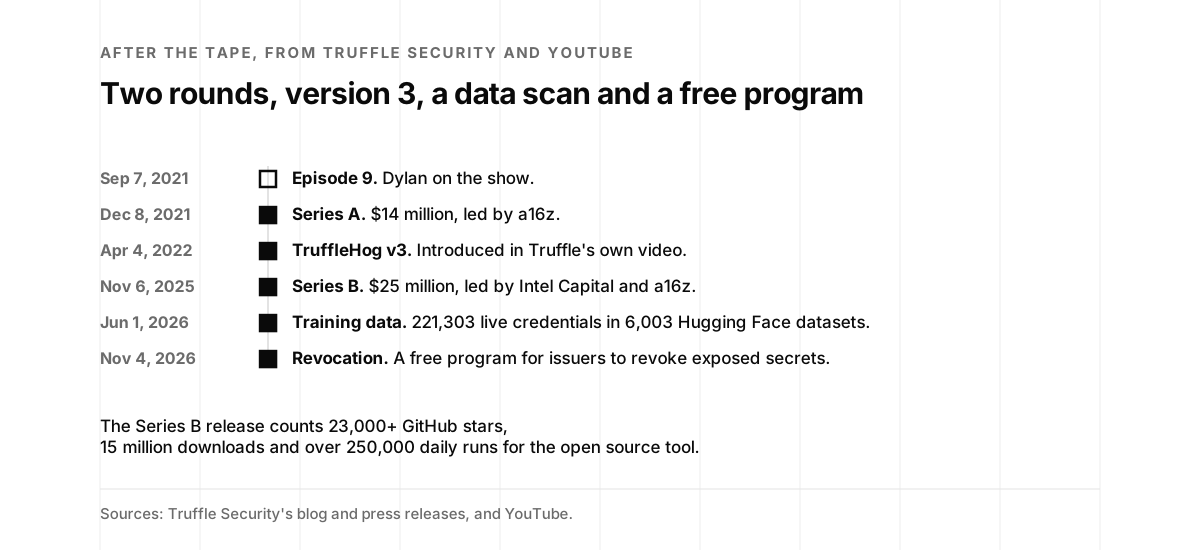
A timeline. September 7, 2021: episode 9, Dylan on the show. December 8, 2021, filled: Series A, $14 million, led by a16z. April 4, 2022, filled: TruffleHog v3, introduced in Truffle's own video. November 6, 2025, filled: Series B, $25 million, led by Intel Capital and a16z. June 1, 2026, filled: training data, 221,303 live credentials in 6,003 Hugging Face datasets. November 4, 2026, filled: revocation, a free program for issuers to revoke exposed secrets. Below: the Series B release counts 23,000 plus GitHub stars, 15 million downloads and over 250,000 daily runs for the open source tool.
Truffle Security after the episode. Sources: Truffle Security and YouTube.

Truffle Security on this show. On episode 16, Jon introduced Will Butler, then on Robinhood’s red team, as a Truffle Security co-founder. On episode 84, Jack Cable of Corridor named Dylan among Corridor’s angel investors.

The same themes on this show. Episode 36 had Feross Aboukhadijeh of Socket on securing the open source supply chain. Episode 68 had Travis McPeak, who also went from Netflix to running a startup, on security built for developers. Episode 60 had Damon Fleury of SpyCloud on stolen credentials as open doors.

Did you catch it? A seven-question quiz

Seven questions from the episode. Each answer links the moment in the transcript or its section.

Quiz · seven questions

Did you catch it?

Pick an answer to see whether you caught it.

  1. What did Dylan first write TruffleHog for?

    b. "it was originally just written for me to do bug bounties." Transcript, 3:36.

  2. How much of the source code did Dylan find buried in old commits?

    c. A search of the latest code missed the keys in the history. See Half the history.

  3. What changed in iTerm after Dylan's clipboard write-up?

    a. "iTerm actually pushed out a new feature that prompts you and says, hey, what's in your clipboard has a new line at the end." Transcript, 2:09.

  4. What worries Dylan about GitHub's archive in the ice?

    b. "they'll probably still be active 10,000 years." Dylan means keys in the vault that nobody rotates. Transcript, 7:26.

  5. Whose community is it, in Dylan's view?

    c. "The community is its own thing. You're just a part of it." Transcript, 12:55.

  6. What does Jon call knowledge you can take to your next job?

    a. Open source builds it, and proprietary internal systems don't. See Knowledge you can take with you.

  7. What's the first step in Dylan's starter kit for open source?

    b. Code on GitHub without a license stays all rights reserved. See A starter kit for open source.

Are your keys out of your history?

Eight questions on secrets in code, built from the episode. Each tip links the section behind it.

Scorecard · eight questions

Are your keys out of your history?

Answer for your code as it stands today. If two answers fit, pick the lower one.

  1. Does your secret scan cover every commit in the history?

    • We don't scan
    • The latest code only
    • Every commit, on a schedule

    "which meant up to that point, half the keys just weren't being found." See Half the history.

  2. When a scan finds a key, how fast is it rotated?

    • When someone gets to it
    • Within a week
    • The same day, with a runbook

    Truffle's 2026 scan found the same live key in 1,131 datasets. See What happened after the tape.

  3. Do you check whether a found key is still live?

    • No
    • By hand, sometimes
    • Every finding is checked

    TruffleHog can log in to confirm whether a key it finds still works. See What TruffleHog does.

  4. Does every repository run a secret scan in CI?

    • No
    • Some repositories
    • Every repository, on every push

    TruffleHog users put it in CI pipelines. See What TruffleHog does.

  5. Before you open source a repository, does anyone scan its history?

    • No
    • Sometimes
    • Always, as part of the review

    "that old revision history wasn't really audited super well." See Half the history.

  6. Can engineers report a key they leaked without blame?

    • No
    • In practice, mostly
    • Yes, and it's written down

    "Security should be ran in a blameless way, myself included, have committed keys in the past." See Half the history.

  7. Do your public repositories carry a license and a code of conduct?

    • No
    • Some of them
    • All of them

    Dylan's first steps for open source are a license and a code of conduct. See A starter kit for open source.

  8. Do you scan for secrets beyond git, in chats, wikis and logs?

    • No
    • One or two places
    • Yes, on a schedule

    TruffleHog's README lists chats, wikis and logs next to Git. See What TruffleHog does.

Keys in the history

Start with one scan of every commit, and a runbook for rotating what it finds.

Mostly covered

The scans run. Check every finding for a live key, and scan the history before anything goes public.

History scanned, keys rotated

Keep the scans on a schedule, and keep the reporting blameless.

How many keys does your team leak?

The calculator runs Dylan’s estimate from Half the history for a team of your size.

Calculator

How many keys does your team leak?

Three numbers: the people who commit code, the keys each of them commits in a year, and the share of keys that sit only in old commits.

25keys a scan of the latest code misses
50keys committed in a year
1.0keys committed in a week

50 people who commit code, at 1.0 keys each in a year, commit about 50 keys a year, or 1.0 a week. A scan of only the latest code would miss about 25 of them, the 50% that sit only in old commits.

The defaults follow the episode: about one key per person a year, and half the code in old commits. Swap in your own numbers. Keys in chats, wikis and logs aren't counted, so treat the result as a floor.

From a clipboard trick to a Series B

Dylan’s path, the field around it, and this show. Filter by topic.

Timeline

From a clipboard trick to a Series B

  1. Half a handshake

    Dylan's proof of concept cracks WPA2 from a failed handshake with a fake access point (GitHub, on this page).

  2. Pastejacking

    A demo of a website overwriting what you copy (GitHub, Wikipedia, on this page).

  3. TruffleHog

    Dylan starts the open source tool, first written for bug bounties (LinkedIn, on this page).

  4. CSRF tokens through CSS

    A demo that steals a token one character at a time (GitHub).

  5. The GitHub Archive Program

    GitHub announces it will store public open source code in the Arctic World Archive (Wikipedia, on this page).

  6. Netflix

    Dylan becomes a senior security partner at Netflix, into 2021 (LinkedIn).

  7. Into the vault

    A 21-terabyte snapshot of public code goes under the permafrost in Svalbard (Wikipedia).

  8. The Google Cloud talk

    Dylan posts the Black Hat and DEF CON talk on GCP service accounts (YouTube, on this page).

  9. Truffle Security

    Dylan leaves a full-time job to found the company with Dustin Decker and Julian Dunning (Truffle Security, on this page).

  10. This episode

    Dylan on the show (Podbean).

  11. A Series A

    $14 million, led by a16z (Truffle Security).

  12. TruffleHog v3

    Truffle's own video introduces the next version of the tool (YouTube).

  13. Episode 16

    Will Butler, introduced as a Truffle Security co-founder (episode 16).

  14. A Series B

    $25 million, led by Intel Capital and a16z (Truffle Security).

  15. Episode 84

    Jack Cable names Dylan among Corridor's angel investors (episode 84).

  16. Secrets in training data

    Truffle finds 221,303 live credentials in 6,003 Hugging Face datasets (Truffle Security).

  17. The scan, on LinkedIn

    Dylan's video post on the Hugging Face scan (LinkedIn, on this page).

  18. Secrets Revocation Program

    A free program for issuers to revoke the secrets Truffle finds exposed (Truffle Security).

What to do this week

Five things, in the order of the episode.

  1. Scan every commit, once. Run a secret scan over the full history of your repositories, as in Half the history.
  2. Count your exposure. Run the calculator with your own team’s numbers.
  3. Rotate what you find. A key in a public repository, a package or a dataset stays live until someone rotates it, as in Keys in the permafrost.
  4. Scan before you publish. Before you open source a repository, scan its history and add a license and a code of conduct, as in A starter kit for open source. The scorecard covers the rest.
  5. Get help with it. Our Secure AI SDLC & Engineering service protects secrets and branches in the repositories your engineers and coding agents touch, Training-Data Scrubbing removes embedded secrets from datasets, and Penetration Testing tests your application and cloud the way an attacker would. If you want to talk it through, book 15 minutes with us.

Key takeaways

  1. Scan the whole history

    In Dylan's research, about half of the source code sat in old commits, so a search of the latest code missed about half the keys.

  2. Keys grow with headcount

    One or two keys per developer every year or two adds up to thousands a year at a large company.

  3. Fix leaks without blame

    Everybody makes mistakes, Dylan included, so security should run without blame.

  4. Rotate, or it lives on

    Keys in GitHub's Arctic archive stay live for as long as nobody rotates them.

  5. Open tools reach further

    Open source brings in use cases, tickets and pull requests from people a company would never build for.

  6. The community isn't yours

    A company is one member of its open source community, and has to listen as much as it talks.

  7. Collaboration crosses companies

    An intern from Salesforce kept building TruffleHog from Airbnb, and competitors can share tooling too.

  8. Learn what travels

    Open source skills go with you to the next job, and proprietary internal systems stay behind.

  9. License first

    Without a license, code on GitHub is all rights reserved, so pick copyleft or a permissive license such as MIT or Apache.

  10. Set the rules of conduct

    A code of conduct says how people interact and gives you something to point to, and GitHub's community tab lists the rest.

Chapters

Tap a chapter to play from there.

Pull quotes

“Usually it's centered around application security.”

Dylan Ayrey ·

“what you copy isn't necessarily what's in your clipboard.”

Dylan Ayrey ·

“iTerm actually pushed out a new feature that prompts you and says, hey, what's in your clipboard has a new line at the end.”

Dylan Ayrey ·

“all it does is it finds API keys that are accidentally leaked out.”

Dylan Ayrey ·

“it was originally just written for me to do bug bounties.”

Dylan Ayrey ·

“oops, there's a key.”

Jon McLachlan ·

“which meant up to that point, half the keys just weren't being found.”

Dylan Ayrey ·

“Security should be ran in a blameless way, myself included, have committed keys in the past.”

Dylan Ayrey ·

“in an organization that's got 7,000 people, that means you have more than 7,000 keys sticking out in a year.”

Dylan Ayrey ·

“they'll probably still be active 10,000 years.”

Dylan Ayrey ·

“there are so many other use cases that you don't get to see”

Dylan Ayrey ·

“we're making technology more accessible to folks that don't otherwise have access to it.”

Dylan Ayrey ·

“It's become the dominant operating system.”

Dylan Ayrey ·

“The community is its own thing. You're just a part of it.”

Dylan Ayrey ·

“wish that I had done it sooner.”

Dylan Ayrey ·

“that's really the power of open source”

Dylan Ayrey ·

“Not to say that open source projects can't have vulnerabilities, like they certainly can.”

Dylan Ayrey ·

“you end up boxing yourself in”

Dylan Ayrey ·

“you should probably bias towards open sourcing it”

Dylan Ayrey ·

“if you just throw code on GitHub by itself, it'll be implicitly all rights reserved”

Dylan Ayrey ·

“You're going to want a code of conduct.”

Dylan Ayrey ·

About the guest

Dylan Ayrey, Co-founder and CEO, Truffle Security

Dylan Ayrey is co-founder and CEO of Truffle Security, the company behind TruffleHog, an open source tool that finds leaked credentials. Dylan created TruffleHog in December 2016, was a senior security partner at Netflix in 2020 and 2021, and left a full-time job in early 2021 to found Truffle Security with Dustin Decker and Julian Dunning. Dylan's earlier research includes a WPA2 half handshake crack, the clipboard attack known as pastejacking, CSS tricks that steal CSRF tokens, and a 2020 Black Hat and DEF CON talk on Google Cloud service accounts.

About the host

Jon McLachlan is co-founder of YSecurity, the on-demand cybersecurity team for startups, and of Cyberbase.ai. The Security Podcast of Silicon Valley is hosted by Jon McLachlan and Sasha Sinkevich. Jon McLachlan on LinkedIn ↗

Context and sources

  • Episode 9 on Podbean: Dylan Ayrey, Founder and CEO of Truffle Security, How Open-Source Makes the World More Secure. Source ↗
  • Dylan Ayrey's experience on LinkedIn: CEO and co-founder of Truffle Security since 2021, creator and maintainer of TruffleHog since December 2016, and senior security partner at Netflix in 2020 and 2021. Source ↗
  • Dylan Ayrey on GitHub: Pastejacking, the WPA2 half handshake crack, cssInjection and the tools from the 2020 Black Hat and DEF CON talk. Source ↗
  • Pastejacking on GitHub, May 2016: a demo of a website overwriting what's in a person's clipboard, and a note that iTerm warns before pasting a command that ends in a new line. Source ↗
  • WPA2-HalfHandshake-Crack on GitHub, January 2015: a proof of concept that cracks WPA2 from a failed handshake with a fake access point. Source ↗
  • cssInjection on GitHub, February 2018: stealing a CSRF token with CSS injection, without iFrames, in about 10 seconds. Source ↗
  • YouTube, August 6, 2020: Dylan's Black Hat and DEF CON 2020 talk on exploiting GCP service accounts and the tools that defend against it. Source ↗
  • TruffleHog on GitHub: finds, verifies and analyzes leaked credentials, classifies over 800 secret types, and can log in to confirm whether a secret is live. Source ↗
  • TruffleHog's community standards on GitHub: description, README, code of conduct, contributing guide, license, security policy, issue templates and pull request template. Source ↗
  • GitHub Docs: community profiles check public repositories for files such as a README, a code of conduct, a license and contributing guidelines. Source ↗
  • Choose a License, curated by GitHub: MIT for simple and permissive, the GNU GPLv3 for sharing improvements. Source ↗
  • Choose a License, No License: a creative work, code included, is under exclusive copyright by default. Source ↗
  • Truffle Security, December 8, 2021: a $14 million Series A led by a16z, and Dylan's account of leaving a full-time job in early 2021 with co-founders Dustin Decker and Julian Dunning. Source ↗
  • Truffle Security, November 6, 2025: a $25 million Series B led by Intel Capital and a16z, with 23,000+ GitHub stars, 15 million downloads and over 250,000 daily runs for TruffleHog. Source ↗
  • Truffle Security, June 1, 2026: a scan of 7.6 petabytes of Hugging Face training data found 221,303 live, unique credentials in 6,003 datasets. Source ↗
  • Truffle Security, November 4, 2026: a free Secrets Revocation Program for issuers, starting with 1.4 million verified, live credentials. Source ↗
  • LinkedIn, July 31, 2026: Dylan's video post on scanning every Hugging Face dataset for secrets. Source ↗
  • YouTube, April 4, 2022: Truffle Security's own video introducing TruffleHog v3. Source ↗
  • Wikipedia, Arctic World Archive: a vault on Spitsbergen, Svalbard, that holds GitHub's public open source code on film under the Arctic permafrost, stored in July 2020. Source ↗
  • Wikipedia, Clipboard (computing): clipboard hijacking, and the attack dubbed pastejacking, which credits Dylan Ayrey. Source ↗
  • Wikipedia, Wi-Fi Protected Access: in WPA2, a four-way handshake confirms the client and access point share the pre-shared key without sending it. Source ↗
  • Wikipedia, Cross-site request forgery: an exploit where unauthorized commands come from a user the web application trusts. Source ↗
  • Wikipedia, Bug bounty program: recognition and compensation for reporting bugs, especially security vulnerabilities. Source ↗
  • Wikipedia, Kali Linux: a Linux distribution designed for digital forensics and penetration testing. Source ↗
  • Wikipedia, Copyleft: freedoms granted on the condition that derivative works keep the same rights. Source ↗
  • Wikipedia, MIT License: a permissive license that allows reuse within proprietary software. Source ↗
  • Wikipedia, Apache License: a permissive license from the Apache Software Foundation for use, modification and distribution for any purpose. Source ↗
  • Wikipedia, Contributor Covenant: a code of conduct for contributors to free and open source software projects. Source ↗

Transcript

Automatic transcription. Jon McLachlan hosts this episode with Dylan Ayrey, co-founder and CEO of Truffle Security. There is no diarization on the tape, so speaker labels were assigned from the content and checked against reference recordings of each voice from this episode, and a few short lines may sit with the wrong speaker. Names and terms were normalized where the recognizer misheard them (Jon McLachlan, Dylan Ayrey, TruffleHog, DEF CON, BSides SF, Kali Linux, CSRF). Words in [brackets] are best guesses where the audio is unclear, and [...] marks words no decode made out. Speech is transcribed as spoken, though many repeated words and false starts are left out, and so are short backchannels such as "yeah" where they overlap the other speaker.

Read the full transcript 4,902 words

Jon McLachlan

Hey everyone, welcome to the Security Podcast of Silicon Valley. Today I'm here with a very special guest, Dylan Ayrey, who's the co-founder and CEO of Truffle Security. Before that, he was a contributing author of TruffleHog, which is the open source core of the product at Truffle Security. And prior to that, a senior security partner at Netflix. And if you looked at his LinkedIn, he has a good chunk of other stuff related to being a security person. And if you go all the way back, he was at RIT. I got a BS in computer engineering. So welcome to the show, Dylan.

Dylan Ayrey

Thanks, Jon. Great to be here.

Jon McLachlan

So can you tell me about some of that security research that you were doing before you got involved with the Truffle Security?

Dylan Ayrey

Yeah, sure. So I've been talking at conferences for a couple years now. Most recently in 2020, I spoke at Black Hat and DEF CON on some GCP-related security stuff that we did in collaboration with Google. I've also spoken at [KubeCon], [ToorCon], BSides SF, [ToorCamp], and a bunch of others on a wide range of topics. Usually it's centered around application security. A couple years ago, I did some Wi-Fi hacking stuff. And so I published the Wi-Fi WPA2 half handshake crack, where you only needed half the handshake. Prior to that, it was like the full handshake. And I did a write-up on how that was possible and published some scripts there. A bunch of application security stuff. And so I showed, like, malicious websites can stomp over what's on your clipboard and potentially put malicious commands in there and things like that. And a bunch of other one-off fun application security type blog posts.

Jon McLachlan

[I bet that] clipboard attack is really nasty, especially given how people transfer bitcoins around, usually copying [that string].

Dylan Ayrey

Well, you know, the example that I think I gave was like a Stack Overflow page. If you copy a command from Stack Overflow and go to paste it in a bash shell, what you copy isn't necessarily what's in your clipboard. And they could put a new line at the end of the command, so it would auto-run as soon as you paste it in. And after I did the write-up on that, iTerm actually pushed out a new feature that prompts you and says, hey, what's in your clipboard has a new line at the end. Are you sure you want to paste it in? So that was, like, as a result of that. The other thing is, like, that particular security problem, I think, is like really easy for folks to wrap their head around, whether or not they're in the security space. And so I think that kind of helped with the popularity of that blog post, as, you know, as opposed to some of the complicated, you know, you can use CSS to CSRF steal this token over many requests type posts I did. The clipboard one, like you mentioned, is just like really easy for folks to kind of wrap their head around, I think. But anyways, I also, like, uh, I'm an avid open source contributor and user and have open sourced a number of things over the years that have just kind of collected dust on my GitHub. But that's sort of me in a nutshell and some of the research I've done over the years.

Jon McLachlan

Would you like to share with our listeners a little bit about what Truffle Security is or what, what you guys do over there at Truffle Security?

Dylan Ayrey

Yeah, sure. So TruffleHog is one of those open source tools that I, that I open sourced a while ago, actually. And basically, all it does is it finds API keys that are accidentally leaked out. So [it] can go through what was originally just meant for git revision control, dig through all those old commits and find API keys that folks either accidentally or intentionally committed. And it was originally just written for me to do bug bounties. So in the README, you can actually see a screenshot. That's from a real bug bounty. It actually has the real key, which is no longer active, from when I first open sourced this thing and started doing bug bounties with it. Decided to give it back to the community. Lots of folks have since used it for all kinds of reasons: bug bounties and putting it in CI pipelines and this, that, and the other. Today, I think I have something like a thousand daily installs from public repositories that I've published to. And in addition to that, it's native in Kali Linux and a bunch of other tool sources that also get different uses out of the tool. So I think it's, you know, I'm so excited to be a part of that community and have given back in a way that allows people to improve their security and sort of be able to find these keys easier. And I'm just really happy this year to be given the opportunity to continue to grow that community and spend more time with those folks and continue to give back to them.

Jon McLachlan

Yeah, that's, that's really special. I love the, the sort of the inception story, and it's a nice focused space. And I know, as a security professional myself, I've had many face palm moments where I'm looking at a repository and then, oops, there's a key. It's like, uh-oh, this is not good. And to have some automated help with that could go a long way in actually putting a real dent in a very pragmatic problem that I'm sure many security professionals share my experience with that face palm [moment]. You know, we do have an obligation to educate and jump on things that we do notice here and there. So that's, that's awesome. And the fact that it got started with a bug bounty hunt program. So you were looking for bug bounties and just wanted to automate your hunt for credentials, and

Dylan Ayrey

Yeah, it was actually really difficult to go through revision history, actually. So, like, maybe you could type into the GitHub search bar something that you're looking for, but, you know, it wouldn't go through all those old commits. And what I found is about half of the source code was actually buried in the past, which meant up to that point, half the keys just weren't being found. And I think, maybe to your point, like, you know, everybody makes mistakes. Security should be ran in a blameless way, myself included, have committed keys in the past. And so, you know, you can think, you know, over the course of a year or two, an individual developer or security engineer might accidentally commit a key or two. But in an organization that's got 7,000 people, that means you have more than 7,000 keys sticking out in a year. That's really where this thing becomes a problem at scale, where you have a big organization that's regularly open sourcing stuff. You know, people make mistakes even when the tools go through an open source review process, like that old revision history wasn't really audited super well. And so I wrote the tool to kind of help dig through that past and help clean up some of those keys that were kind of missed.

Jon McLachlan

Like an archaeologist in a script.

Dylan Ayrey

[No, it's exactly]. You know, it's funny you mentioned archaeology. What I think about all the time is that Arctic vault, where they've taken all the big open source projects and put, you know, the one I'm talking about, where GitHub put them in ice and locked them underground in the permafrost of Antarctica. How many API keys are permanently codified in that vault until the end of time? And when real archaeologists 10,000 years from now, you know, dig through what's no longer permafrost, it's just melted mud or whatever it turns into, and they find this big vault, they're going to do forensics on it and find the ancient keys that, you know, 10,000 years ago accidentally leaked out, and maybe [get] some access to some, like, uh, you know, subsystem or remnant of the [human being, right]? You know, some of those API keys are probably not going to be rotated by that, and they'll probably still be active 10,000 years. 10,000 years. Recommended we rotate this.

Jon McLachlan

Exactly. Yeah, that's funny. Okay, so Truffle Security is built on this open source platform. So why open source? I know a lot of companies don't really go down the open source road, but it sounds like you really embrace the community and you still build a company around [them].

Dylan Ayrey

Yeah, that's a good question. So I think sharing a little bit about my background, I went to RIT. Like you mentioned, they're the first school in the country to have an open source minor. And so I was able to get exposed to open source through their open source program. I wasn't minoring in open source, but I took one of those classes and I was very involved with the program lead over there. I was part of his, like, open source club. jQuery is also, like, a big notable open source project that came out of RIT. And that creator was, like, involved in those same scenes and would go to those hackathons, and I could hear from him and bounce ideas off them. I mean, the reality is, look, like, you're a, a company based out of San Francisco making technology and thinking about the users of that technology. I think it's often easy to localize your experiences to build it for companies that you've spent your time with and use cases that you're most familiar with. But when you don't give that technology back, you don't make it free and open, there are so many other use cases that you don't get to see, that you miss and you don't get to build the tool for. By creating that open source tool, you get to give back and allow others to come to the table and explain their use cases in the tickets and submit those pull requests and be able to just bring new perspective that just totally doesn't [otherwise become] available to you. And when you think about also the technology that you're building, I think we often build it, you know, we build it for the United States, we build it for San Francisco, we build it for, like, this hyper wealthy spot within San Francisco. But the reality is, like, people all over the world use these. And by making it free and open, we're making technology more accessible to folks that don't otherwise have access to it. And we're bringing, in this case, information security and the ability to do bug bounties and make money to places that would otherwise have a hell of a hard time getting into those spaces. And so I think open source is a really powerful tool that can really help people. It can really unlock technology in a lot of different areas that we don't necessarily always think to build technology for. And being able to have them as part of the same community and help build the tool with you is, I think, really, really powerful. And that's sort of, that's my background of where open source kind of, like, why it's so important in my life. I think specifically in terms of Truffle Security, you know, the open source tools that were available to me that allowed me to get into information security in the first place, I felt really the need to continue to give back to that, which is why I wrote the tool and open sourced it in the first place. And then just seeing how large that community grew and how many use cases there were and how many folks became dependent on it and how so many different folks have contributed to it over the years just made me want to continue to eventually quit my full-time job, like you mentioned, I leave Netflix, and just continue to support that community and grow it out and continue to get back.

Jon McLachlan

No, that's incredible. I really feel the passion, and I love that. It's a great story. And I love the giving back and being part of a community. And through the community, you're going to have a much wider impact than if you just [build] one thing for one specific use case that you're just super focused on or familiar with. That's very powerful. So, thank you. Thank you for that. I very much appreciate all of that and the background that led you to this. So that's, that's very cool. I had no idea that you could minor [in], or maybe even major now in open source communities like that. That's also very cool.

Dylan Ayrey

Yeah. So they were the first open source program nationally, and they started with a minor. But I think other universities have since gotten involved. And I think there are universities that allow you to major in it. I mean, it's a big space, you know, learning about the different licenses, learning about contributor models, learning, you know, different ways that communities can grow and how communities can become toxic and all these, you know, there's a lot of different areas to dive into. And I think also, like, open source is only becoming more and more popular. It's become the dominant operating system. It's starting to take over our infrastructure as well. Like, we see you can't think of using a database these days without it being open source. So I think it's going to continue just to become more and more popular. And so it totally makes sense to me that that would become a more focused area [in] people's studies as they get into technology.

Jon McLachlan

I know, it makes perfect sense. And I even heard someone, you know, say once, I think it was a VC, actually, some managing director, managing partner. He was like, oh, if you don't, [if] you don't build a strong sense of community, then you will be commoditized, and you will be a commodity, and then you'll be priced out of the market. But if you have a strong sense of community, you'll always have the community. There will be one community that will be part of your value proposition, actually.

Dylan Ayrey

Yeah, there's definitely lots of value in community, but I think one part that maybe some folk, maybe misunderstand when they, when they want to go make an open source company is it's not your community, right? The community is its own thing. You're just a part of it. And so, like, the community itself, of course, is valuable, and you get to give back and contribute to it. But, you know, the, to do it right, you're not the dictator of that community, and you're listening to them just as much, or if not more, than hopefully they're listening to you. And I think that's a really important piece to us, or to me, is just it's a level playing field. Exactly. Yeah. Being able to hear folks and to be able to build, you know, based on ways that I think can help and give back and not just ways that can, to sort of turn this thing into some sort of a money machine or monetize, you know, [vouch out] this or that.

Jon McLachlan

As, okay, so as you built this and you saw the community sort of show up and grow around what you were, what, I guess, you had started, but then the community has a life of its own. Was there a moment in time where you knew it was the right time to leave your day job and really just focus on building out this community and ultimately a company around Truffle Security?

Dylan Ayrey

Yeah, so I think the global pandemic hit, and I had nice health insurance, and I said, now's a really good time to give up that health insurance. No, I mean, so I mean, the reality is, I think, I think I probably, in hindsight, wish that I had done it sooner. I wish that I had been able to be more involved with that community earlier on. But I think we still did it at a really good time, myself and my co-founders. And I think I'm just really glad right now to be able to continue to grow and give back. And, you know, it's never too late. And so I'm really excited to see what we're going to do in the next year or two. We have insurance now. So.

Jon McLachlan

Well, this is good. I'm super happy for you. This is important. I, you know, with [Peacemaker], we were on a very similar timeline. I was like, oh, health insurance? Who needs that? And so I understand completely. Really appreciate the joke. So far, what has been your best day in that entrepreneurial journey with [Truffle]?

Dylan Ayrey

I think, honestly, it's just hearing all the different stories and use cases that folks have had with [TruffleHog] over the years. You know, I hear it kind of napkin math before that, back of envelope, like off the cuff, but now just being able to talk to folks all day about it and just hearing all the different wild use cases and the [exciting] bug bounty stories that people have and the, the different ways people have used the tool over the, I think it's been the most interesting to me. And I think, like, just being able to sit down with people and hear about those stories and hear how many different ways people have been able to use the tool, that's really been the best times for me.

Jon McLachlan

Well, that's awesome to see the impact and to really feel it and be surprised of how people pick up your technology and use it. Has there been one in particular that really resonated with you and you were like, oh, you caught yourself totally by surprise, but in a very pleasant, happy sort of way that you could help?

Dylan Ayrey

There's an intern that I worked with when I was at Salesforce, and she went on to work at Airbnb. And then when she was at Airbnb, she [took] TruffleHog and operationalized it and then continued to give back, contribute, build new features. And just, you know, being able to continue to work with her through that community, even though we weren't at the same company, but still having that connection and still having that collaboration opportunity was an awesome experience. And I think that's really the power of open source, is you have two different companies that are in no way would otherwise be working together. And sometimes you have competitors as well, still able to come together within this sense of community and contribute and collaborate on some form of tooling and help make everybody more secure in that capacity.

Jon McLachlan

No, I love that. I love how it just brings people together and you can collaborate and help solve tough problems with others and really make the world a better place, more secure place at the end of the day for everybody. It's very, very altruistic, and it gives a strong sense of meaning and purpose when you're contributing and working on an open source project like that, that you just don't get any other way, right?

Dylan Ayrey

Yeah. And I think there's also, like, a sense of trust that you get from open source as well. Just being able to know that it's all out there in the open. Not to say that open source projects can't have vulnerabilities, like they certainly can. But I think just being able to come to the table with a certain level of transparency, I think, really helps with just trusting tools when you go to use them.

Jon McLachlan

You know, it reminds me of whenever I'm at a big company, I find myself mentoring, and I always encourage them to think about the stuff that they learn, to always learn as much as they can, but to think about the stuff that they learn in two very distinct categories. One of them [is] transitive knowledge, knowledge that you can bring with you to your next gig or bring with you along your career and something that will continue to exist and be useful for you in the long run. And then non-transitive knowledge, where it's just you have to learn something just to learn it. Maybe it's a legacy system, it's proprietary, and it's [dead end]. Like, you never work on it again. And I think of open source as being a great way to increase your transitive knowledge and build up your toolbox that you can actually bring with you as you develop your career. You can bring those tools from one gig to another gig to another gig. So given a choice between an open source project or some proprietary thing, I always will choose the open source project. Just from a professional sense, it's transitive knowledge. You get to bring it with you to your next thing. You learn it, you understand it, you understand the problem that it can solve. You don't have to solve it yourself again. And a proprietary thing, you can't, it's just, there's no bringing it with you. So, unless you plan to stay at the same company, you know, your entire career, those things just disappear.

Dylan Ayrey

I think that's absolutely right. And especially for folks earlier on in their career, when they first go to join a company and they just are energetic and want to learn everything they can, I think if they take the advice that you just gave and just focus on the tools that are going to be available to them beyond their current company, it's just going to help their career so much more. And it's going to just make them more valuable to the market when they go to look for future jobs. Because if you have a bunch of experience with Kubernetes and you have a bunch of experience with all these different open source projects that you may have contributed to or built on top of, it's, you know, it's, it's just something that you can, you can pack up and take with you and bring to a job interview and be able to just immediately smash on day one when you go to that next job. But the flip side of that is if you invest all your time and, from a larger company, it's like a historical proprietary internal whatever, you end up contributing to that debt, which is harder for that company to go out and hire for. And you end up boxing yourself in, because when you go to look for that next job, um, if all you have to speak about is this internal proprietary stuff, it's harder to have those conversations and harder to prove how you're able to prove your value to the new company if you don't have that familiarity with those, those other tools that are shared between the two.

Jon McLachlan

Right, that's absolutely true. It's been my experience 100% here in the Valley. I guess there is something to be said about being able to identify patterns and see the patterns repeat them at every opportunity that I have to rip out a proprietary system and replace it with something that's open source. I do it. I just do it. It's not even a question in my mind. But sometimes it takes a little finessing, a little bit of political dancing. It depends on the organization that you're part of. But usually it's better for everyone. It's better for the engineers. It's better for the company. It's better for the customers. It's better for, like, the new people that are already part of that team. Yeah. That really resonates. So if we, if you fast forward just a little bit into the future, or however much into the future you'd like to fast forward, I'll leave this up to you. Like five years, maybe 10 years, whatever. What does success really look like to you for Truffle Security?

Dylan Ayrey

Yeah, I mean, I think I'm just really excited. And I know I've mentioned it a hundred times already, but I'm just really excited to give back. And so success for me is just being able to look back and say, you know, look at all the different ways we've been able to help the community. Look at all the folks new to security. We're able to give them tooling and get them, you know, experiences and get them ramped up with security in ways that they didn't have exposure to in the past. And to be able to just give tools and scripts and all sorts of things in the future, talks and blog posts and all this and that, to be able to just continue to grow and help the community that helped me get involved in security in the first place. And I think that's, that's what I was most excited about jumping into this and doing it full time. And I think that's the part that, that would be, I'll hopefully look back on and be most proud of, is just being able to, to do that.

Jon McLachlan

Yeah, to take the, and to really give back meaningful and concrete ways to the community. Would you recommend, if there is anyone out there thinking about dabbling around or, or trying to solve a tough problem, maybe building an open source thing around it, any advice that you would give?

Dylan Ayrey

If, if you're building a tool and you think others are going to get value out of it, like, you should probably bias towards open sourcing it, I think. Even if you're on the fence about whether or not other people are going to use it, or whether or not, like, you may give the competitive advantage away to somebody else. I definitely think folks should, should not be as concerned with those things and lean more into just putting it out there and seeing what happens. And if it takes off, it takes off. And if it doesn't, then there really isn't much harm with having open sourced it. And so that's kind of my advice. It's like the first step, you probably want to go to choosealicense.org and figure out how the different open source licensing models work. The reason why is if you just throw code on GitHub by itself, it'll be implicitly all rights reserved, and other folks won't actually get to [use it]. So you'll want to figure out what open source license is right for you, whether or not it's important for that code and the derivations of that code to stay open source, so something like copyleft, or whether or not you just want it to be totally open and anyone uses it for any use case, so something like MIT or Apache. To learn those differences and pick your license. You're going to want a code of conduct. So to be able to say how folks can interact with this community, to make sure that you don't have issues with folks harassing members of the community and things like that. You want to be able to lay out what's appropriate conduct so that you can enforce those rules and have something to point to when people break those rules. And, you know, you want to have a couple of other standards for how folks should engage with you and things like that. And GitHub walks through all of these things these days. If you go to the community tab, it's got basically a checklist of different things that you want for a, you know, a good, strong, healthy open source community. So that's, that's the getting started kit in a nutshell, I guess, is like, I would bias towards open sourcing something if you're on the fence about it. I would say, you know, do a little bit of homework to figure out what license is right for you. There's some really standard code of conducts and ways to engage and things like that, that you can just one-click add to your repositories in GitHub or copy-paste them in. And those things are definitely important. But that's, that's, you know, for someone who's looking to get into open source, those are the fundamentals there, is bias towards open sourcing it, figure out the right license, and then add the ways for folks to interact, and the code of conduct, and all those things.

Jon McLachlan

Awesome. That sounds like a really good starting point for anyone out there curious about open sourcing, perhaps a new project, or just an idea that they want to see where it goes. And, well, hey, thank you so much for your time, Dylan, today. And thank you, everyone, for listening and tuning in to the Security Podcast of Silicon Valley. I'm your host, Jon McLachlan. Stay tuned for more episodes in the future.

Dylan Ayrey

[Thanks, Jon].

FAQ

Questions this episode answers

Who is Dylan Ayrey?
On this September 2021 episode, Jon introduced Dylan Ayrey as co-founder and CEO of Truffle Security, a contributing author of TruffleHog and a former senior security partner at Netflix.
What is TruffleHog?
An open source tool Dylan first wrote for bug bounties. It digs through git history for API keys that people committed by accident or on purpose.
Why scan the whole git history for secrets?
Dylan found about half of the source code buried in old commits, and a search of the latest code missed the keys in it.
What is pastejacking?
A web page changes what you copy, so the command you paste into a terminal isn't the one you saw. Dylan's demo added a new line so it ran on paste, and iTerm later added a warning.
What does GitHub's Arctic vault have to do with leaked keys?
GitHub stored a snapshot of public code in the Arctic World Archive in July 2020. Dylan pointed out that any keys in that code stay there for good, and live until someone rotates them.
Why build a security company on open source?
Dylan's answer: open tools reach use cases and people a company would never build for, and the community that brought Dylan into security deserves something back.
How should you open source a project?
Lean toward publishing, pick a license first, add a code of conduct, and work through the checklist on GitHub's community tab.
What happened after the episode?
Truffle Security raised a $14 million Series A in December 2021 and a $25 million Series B in November 2025. In 2026 it scanned Hugging Face training data for secrets and launched a free Secrets Revocation Program.
Keep reading on the YSecurity blog
New episodes every other Tuesday

Got a story like this one?

We're always looking for practitioners who've been in the room when it mattered.