
Episode 8 of The Security Podcast of Silicon Valley came out on August 24, 2021, with Jon McLachlan hosting. The guest was Fredrick Lee, known as Flee, then the chief security officer at Gusto, which makes payroll, benefits and HR software for U.S. businesses (Podbean, LinkedIn, Gusto).
Flee’s case is that a security team does its job better when its people differ from each other and bring all of themselves to work. Each person’s lived experience feeds a threat model, so a team that looks alike can miss a threat that someone else would see at once.
This page follows the conversation in order: a section for each part of it, eleven figures, thirteen clips from the tape, Flee’s op-ed on data custody, the full transcript, and five tools: a quiz, a scorecard for security savior syndrome, a calculator for how far each security person stretches as a company grows, a timeline, and a to-do list. Where the decodes of the tape disagree on a word, the transcript puts its best guess in brackets, and the page doesn’t quote or retell those words.
From developer to security chief
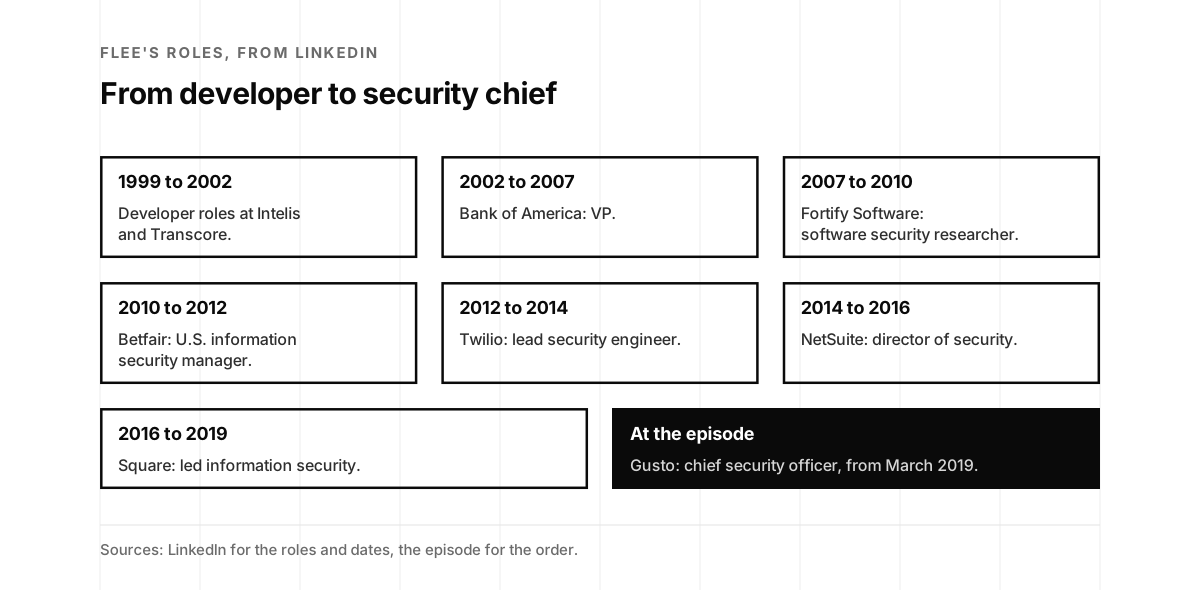
Jon’s introduction ran through Flee’s career, newest first: chief security officer at Gusto, head of information security at Square, director of security at NetSuite (part of Oracle), lead security engineer at Twilio, security manager at Betfair, security researcher at Fortify Software, a VP at Bank of America, and a Java developer at Transcore. Flee said the list traces a career through the dot-com crashes.
LinkedIn dates the Gusto role from March 2019 to July 2023, and the Square role from December 2016 to February 2019. It lists the first role as senior systems developer at Intelis, starting October 1999 (LinkedIn). Bank Innovation reported in March 2019 that Gusto had hired Flee as chief security officer, reporting to co-founder and CTO Edward Kim, with growing the security team as a first task (Bank Innovation).
Jon remembered running into Flee at BSides and at RSA, and coming away each time with a warm feeling about the way Flee spoke about security and team building.
Magazines, BASIC and 2600
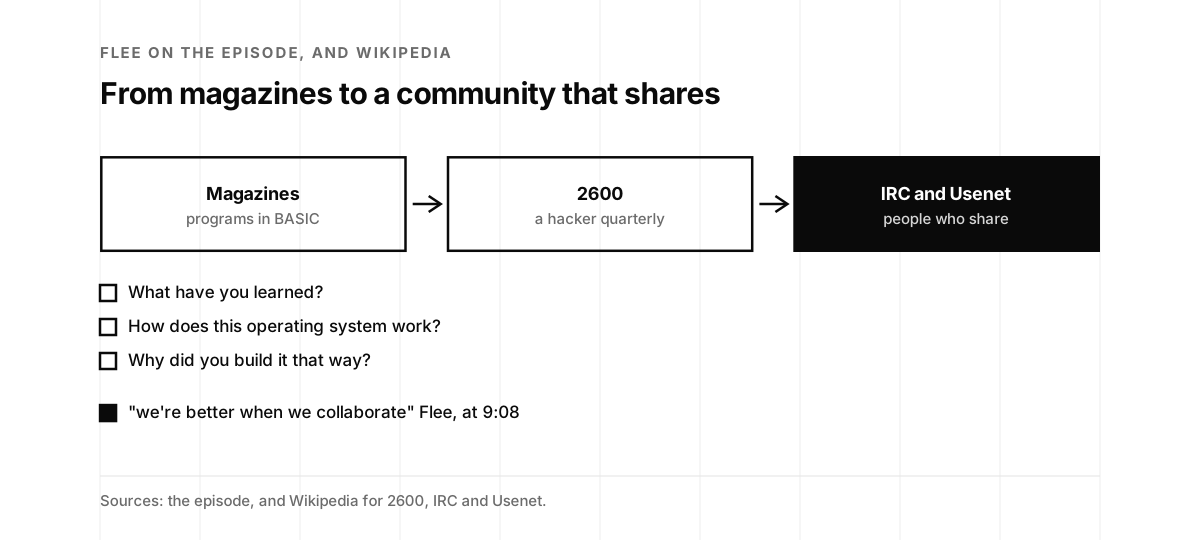
Jon asked how Flee became interested in security. Flee learned from computer magazines: articles on what people did with computers, with sample programs in BASIC to type into a Tandy or a Commodore 64. Then came a magazine called 2600.
Wikipedia describes 2600: The Hacker Quarterly as a seasonal publication of technical articles, many of them written and submitted by its readers, on hacking, telephone switching systems and Internet protocols. It launched in January 1984, and its name comes from a 2600 hertz tone (Wikipedia).
Much of what people worked on came down to puzzles. Flee has a phrase for that approach to learning.
“aggressive exploration and aggressive education.”
Fredrick Lee, at 5:42
Jon liked how positive it sounds.
Learning by sharing
Flee credited the security community of those early days, and pointed to how powerful IRC and Usenet were.
“it was all about sharing.”
Fredrick Lee, at 8:41
People asked each other what they had learned, how an operating system or a university’s computers worked, why someone built a thing a certain way, how to obfuscate code or crack software. The community isn’t perfect and it’s far from friendly, Flee said, which is something it works on. One lesson stayed with Flee.
“we’re better when we collaborate”
Fredrick Lee, at 9:08
Jon called it a truth most people miss.
“sharing our experiences is how teams become stronger than some of their individual parts”
Jon McLachlan, at 9:21
Wikipedia describes IRC as a text-based chat system built for group discussion in channels, created in August 1988 (Wikipedia), and Usenet as a worldwide distributed discussion system, set up in 1980, where people post articles to newsgroups (Wikipedia).
Security as free form jazz
Flee still sees that spirit in Silicon Valley, above all in open source. Being a hacker, or a curious computer user, goes hand in hand with it.
“we’re just here for the purity of the puzzle.”
Fredrick Lee, at 9:45
Progress comes from taking someone else’s knowledge and doing a slight riff on top of it. Someone lays down a melody, someone else riffs on it, it turns into something new, and the next person riffs on that.
“it feels a lot like almost like free form jazz.”
Fredrick Lee, at 10:02
Flee is passionate about music, and puts security, jazz and hip hop together: do it yourself, explore past the boundaries people said existed, and reuse what’s already there. Jon heard an art underneath all of it. When a team finds its groove, it can build something cool fast and surprise everyone in the room. Wikipedia describes free jazz, also called free form jazz, as an experimental approach to improvisation from the late 1950s and early 1960s, when musicians broke down conventions such as regular tempos and chord changes (Wikipedia).
The CISO puts the band together
Jon asked what a day in the life of a CSO looks like. Flee sees a lot of misconceptions about the role, what the job is day to day, and what makes someone qualified for it. In a new generation of CISOs, many didn’t take the job on purpose. Flee joked that the company needed one, the person was there, and wasn’t smart enough to say no.
Most people in security are deeply technical and want to stay that way. The CISO’s job is different.
“getting these various band members together and making their individual performances into a song”
Fredrick Lee, at 12:07
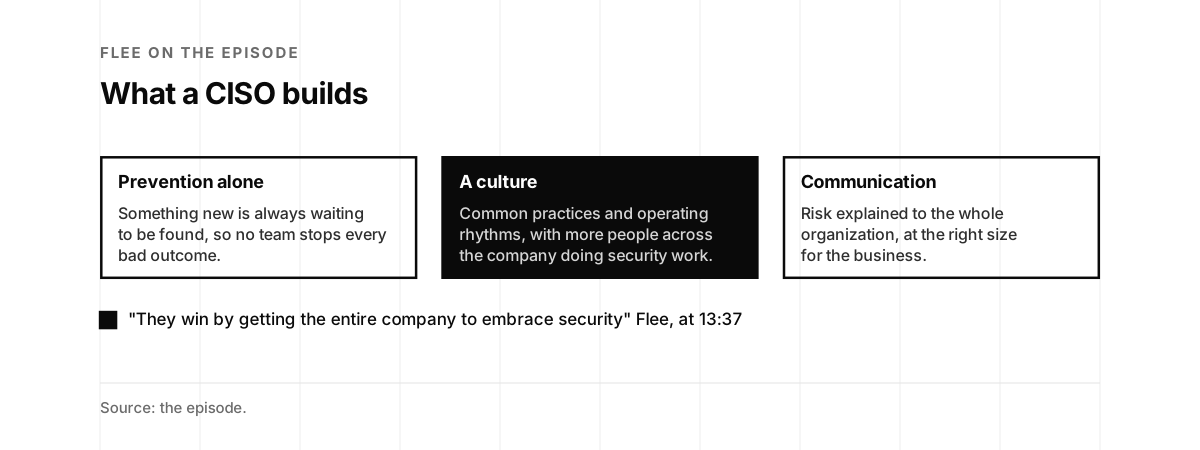
The goal is a strong team that keeps a security culture going. Culture matters because no team can stop every bad thing. Something new is always waiting to be found, by some kid tinkering on the internet, and Flee called the idea that CISOs can prevent all bad outcomes false.
What a CISO can do is build a culture of security and resiliency: common practices and operating rhythms that make what the company ships more secure today than it was two days ago, with more and more people across the company doing the work of security.
“They win by getting the entire company to embrace security”
Fredrick Lee, at 13:37
Flee called communication fundamental: explaining risk to the whole organization, in a way that’s right-sized for the business.
Where the opportunity is
Flee doesn’t think security should eliminate risk.
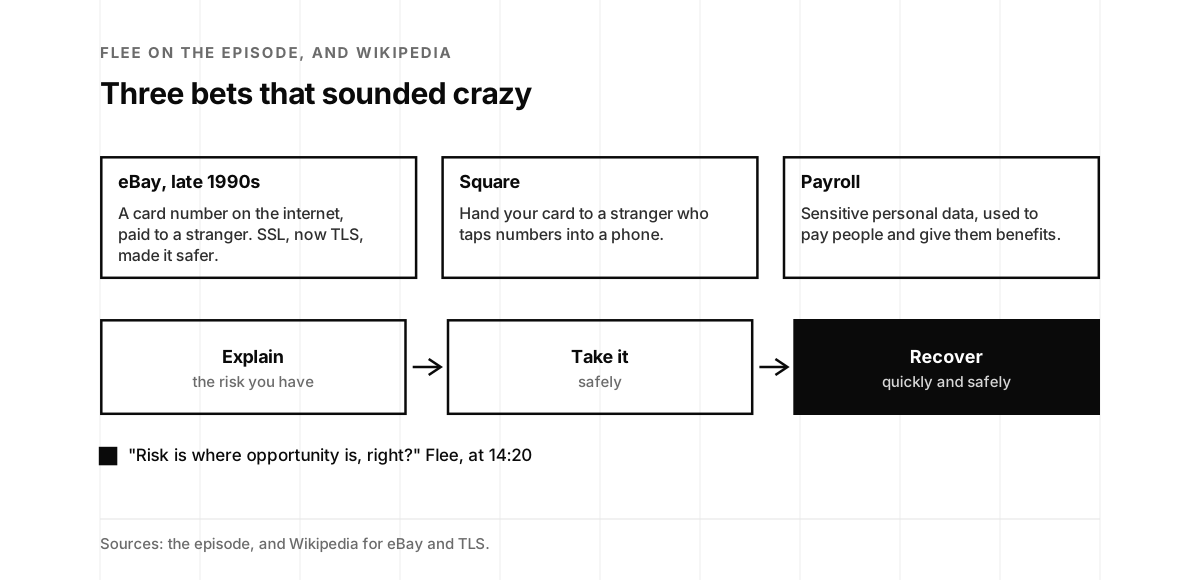
“Risk is where opportunity is, right?”
Fredrick Lee, at 14:20
An investor in the stock market takes a bet for the chance of an oversized outcome. The internet as we know it exists because people took risks. Flee went back to the late 1990s, when people bought Beanie Babies on eBay. Putting a credit card number on the internet, trusting that a stranger would get paid and nobody would steal the rest of your money, sounded crazy. Jon agreed it was insane at the time. Math and cryptography made it safer: SSL, known now as TLS. A booming industry followed.
Square looked like the same kind of idea: hand your card to a stranger who taps numbers into a phone. Payroll worked the same way: take sensitive personal data and make it useful, to pay people and give them benefits. Each bet built a large company. Part of the CISO’s job, Flee said, is to help the company take risks. That means explaining what risk the company has, and finding ways to take it safely. Flee called it pragmatic risk taking, an idea learned through Sam Quigley, and said security should enable the business.
“we’re there to actually be business enablers and not people actually say no.”
Fredrick Lee, at 16:36
The other half of the job is resiliency, in case a risk doesn’t pay off.
“I’m more interested in being able to fail quickly and recover quickly and safely”
Fredrick Lee, at 17:01
That beats a promise to eliminate every vulnerability, Flee said, because it keeps the business moving at speed while it protects customers. Wikipedia says Beanie Babies were the most bought and sold items on eBay, about 10% of all listings in 1997 (Wikipedia), and describes TLS as a cryptographic protocol for secure communication over a network (Wikipedia).
Two days to be proud of
Jon asked for a single best day at Gusto. Flee asked to talk about more than one.
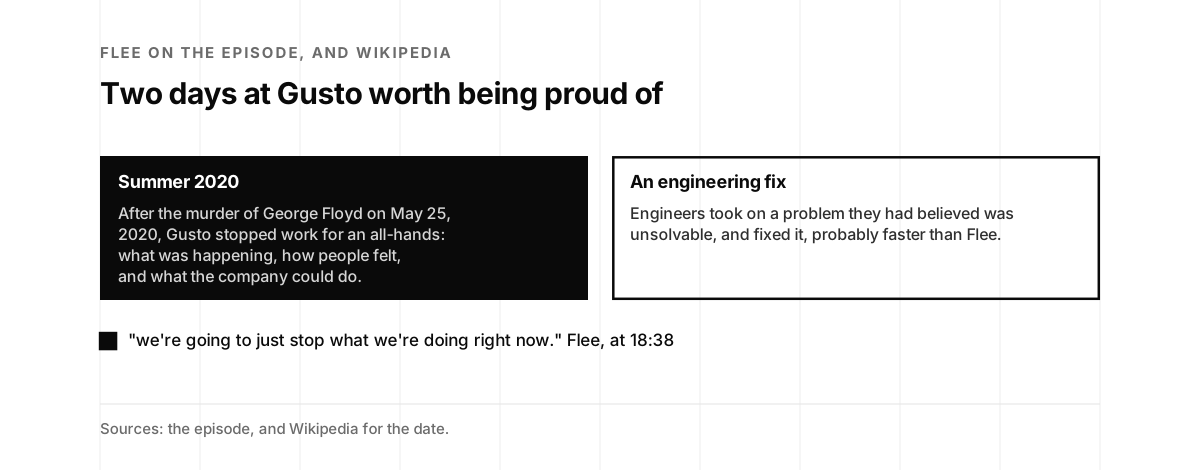
The first came in the summer of 2020, during the protests that followed the murder of George Floyd. Wikipedia dates the murder to May 25, 2020, in Minneapolis (Wikipedia). Gusto stopped.
“we’re going to just stop what we’re doing right now.”
Fredrick Lee, at 18:38
The company held an all-hands for everyone: what was happening in the community, how employees felt about it, and what Gusto could do to show up and offer more support. Follow-on actions came after that day.
“We’re here to build a better society and a better future.”
Fredrick Lee, at 19:25
It was the first company Flee had worked at that was willing to do that. Other companies had talked about diversity, and Jon named the gap that talk leaves.
“It’s nice to hear it, but then it’s like, then what happens?”
Jon McLachlan, at 19:50
The second best day started with an internal issue in how engineering worked. It wasn’t a security defect or a compromise, and Flee kept the details private. Flee explained the problem, the engineers took it on, and they fixed something they had thought couldn’t be solved.
“all the engineers got on board.”
Fredrick Lee, at 20:30
They were probably quicker about it than Flee was, because they had taken in why it mattered to the people who use Gusto. To Flee, that proved the culture was working.
Custodians of the data
What the engineers took in is a view Flee talks about inside Gusto.
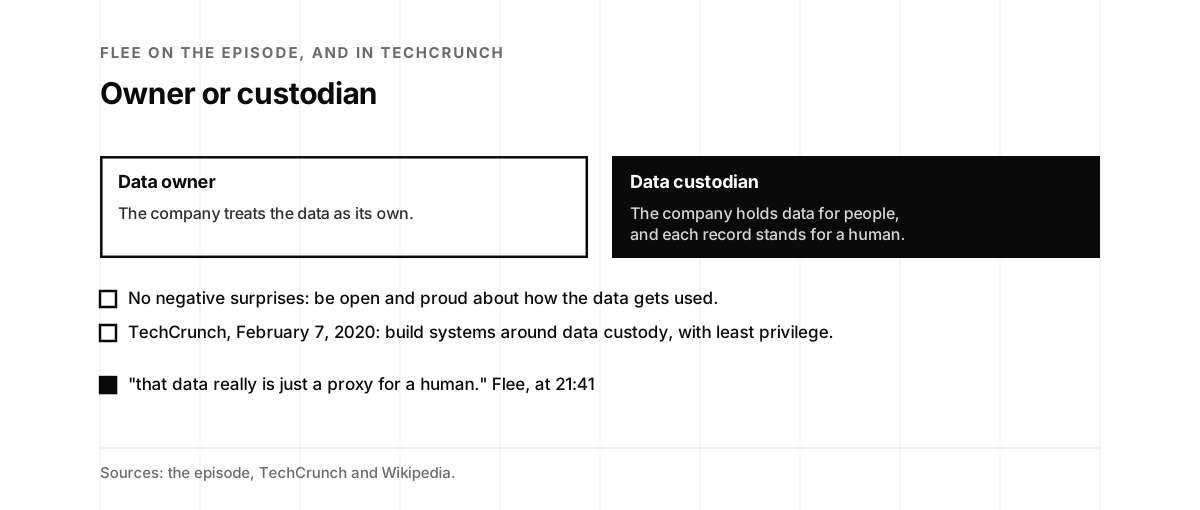
“We don’t own any data at Gusto.”
Fredrick Lee, at 21:34
The company owns little data, Flee said. It is a data custodian.
“that data really is just a proxy for a human.”
Fredrick Lee, at 21:41
The zeros and ones stand for real people who depend on Gusto to do a good job with them.
“being good custodians and good shepherds of that data”
Fredrick Lee, at 21:58
Flee wants nobody to have a negative surprise from Gusto, and wants the company proud and transparent about how it uses data. Jon repeated those words back.
Flee had made the same case in a TechCrunch op-ed on February 7, 2020, “CCPA won’t be enough to fix tech’s data entitlement problem.” It argues for building systems around data custodianship, with the principle of least privilege, and says “No company is entitled to data; they are entrusted with it.” (TechCrunch). Wikipedia describes least privilege as giving each part of a system access only to what its legitimate purpose needs (Wikipedia).
Small progress over time
Change needs a catalyst, Flee said, and the resiliency to keep at it. The first security engineer or the first CISO at a company makes a lot of small progress.
“that small progress over a duration is what fundamentally actually changes the company.”
Fredrick Lee, at 24:03
Security people may look grumpy, Flee said, but they’re some of the biggest optimists in the world, because they know what a better future could look like. Jon took it from there: we picture that future, then build toward it.
“build little roads and struts to help bring us towards there”
Jon McLachlan, at 24:23
Bring your full self
Jon talked about bumping into people who are different from us, and bringing our full selves to the table. Those small moments, in Jon’s view, lead to change and to more open minds. Flee called it a passion area, and wants more security people to bring all of themselves to work.
The security community can be toxic, and Flee wrestles with how much of its culture is good. Some of it needs to be erased: sexism, gatekeeping, homophobia, transphobia and racism.
“Bigotry has no place in security.”
Fredrick Lee, at 27:38
In the early days, most people in the field never even saw each other.
“security used to always be a refuge for the nerdy outcasts.”
Fredrick Lee, at 27:49
Flee used to joke that if you got into security, there was probably something wrong with you.
Diversity is technically correct
The field’s problem at the time of the episode, Flee said, was getting more diversity. Diversity matters for more than it being the right thing to do, though it should be done for that reason too, Flee said. Even more so, it’s technically the correct thing to do.
Part of the job in security is thinking about every bad thing that can happen, and how to mitigate it. Each person brings a different view of the world to that.
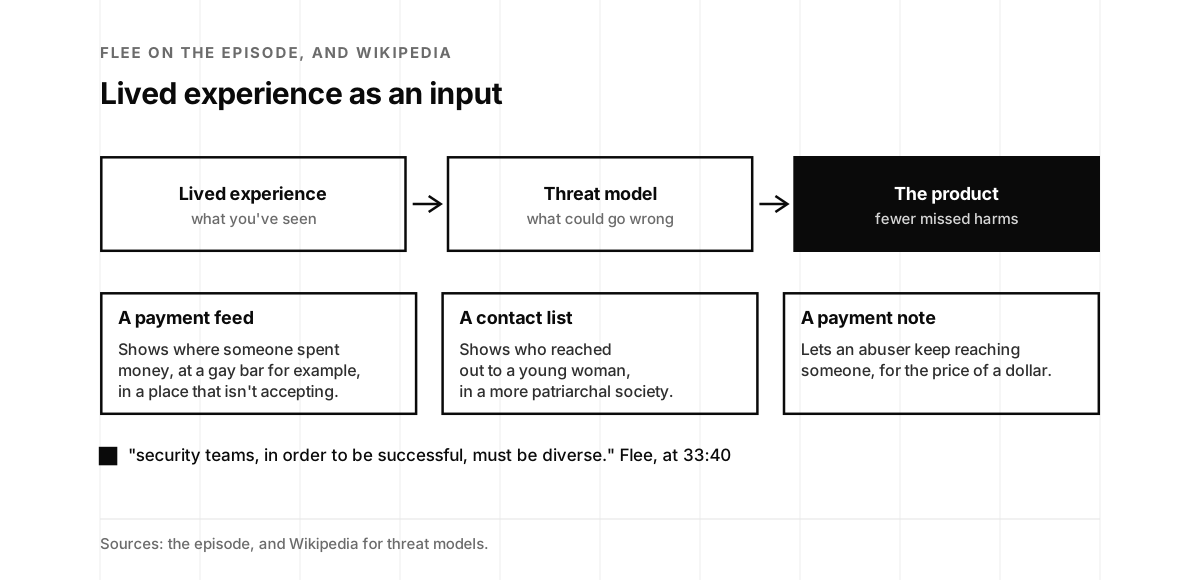
“we all have these lived experiences that feed into our personal threat models”
Fredrick Lee, at 29:40
Flee’s example was a payment app like Venmo, whose feed can show where people spend money. If everyone around you can see that you went to a gay bar, in a place that’s less accepting, the consequences can be physical and real. A security team without that diversity can miss it.
“you might literally miss that aspect.”
Fredrick Lee, at 30:44
Jon added a second gap: a team can have the diversity while people hold part of themselves back. Flee agreed, and went further.
“making it psychologically safe for somebody to actually be who they are is also important.”
Fredrick Lee, at 30:58
Another of Flee’s examples comes from culture. In a more patriarchal society, a feature that shows who reached out to a young woman, say a random man on LinkedIn, can bring negative consequences for her. People with that background can point out the cultural differences while a product is being built.
Payment apps raise a related question: whether a product makes it easy for an abuser to keep reaching someone, for example through the note on a one-dollar payment. The security industry can improve those cases, Flee said, and that’s much of the reason for this view.
“security teams, in order to be successful, must be diverse.”
Fredrick Lee, at 33:40
Flee wants it to be easier for people who are different to build long careers in security. The test should be whether someone can do the job.
“can you be a good security practitioner? It shouldn’t matter who you date, who you marry”
Fredrick Lee, at 34:02
Wikipedia describes a threat model as a process for identifying and listing potential threats, and prioritizing the countermeasures (Wikipedia), and psychological safety as the belief that you won’t be punished or humiliated for speaking up with ideas, questions, concerns or mistakes (Wikipedia).
Hiring for aptitude
Jon has built teams in the Valley, and has seen what happens when differences and different experiences are set up as a team’s strengths.
“a camaraderie that you would otherwise miss”
Jon McLachlan, at 34:39
That leads to better products and more innovation, in Jon’s experience, and to people who feel part of something bigger. Jon asked what signal Flee looks for when interviewing someone for a senior security role.
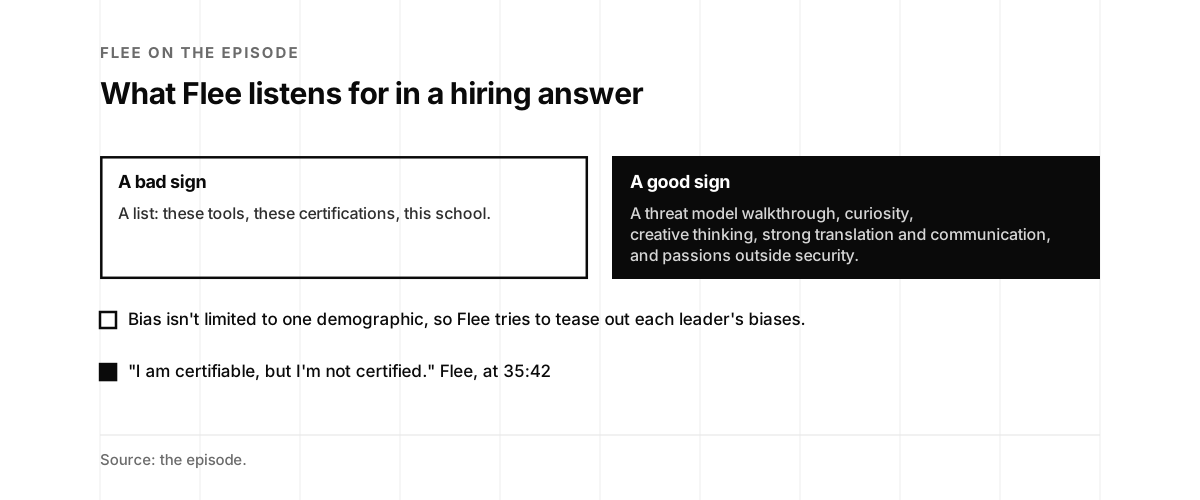
With senior leaders, Flee looks at how they think about what a good security hire looks like. Flee has zero certifications.
“I am certifiable, but I’m not certified.”
Fredrick Lee, at 35:42
A good sign is a leader who knows the core attributes and aptitude a person needs to be effective in cybersecurity. A bad sign is a list: these tools, these certifications, this school. Jon compared that to nails on a chalkboard, and Flee could see the rejection on Jon’s face.
What Flee wants to hear is a test of whether someone can walk through something that looks like a threat model, and natural aptitudes such as curiosity and creative thinking.
“really strong at translation and really strong at communication”
Fredrick Lee, at 36:36
A leader who says that lights Flee up.
A leader who welcomes passions outside security is open to all walks of life. A life outside the field shows a full person.
“you’re not just pigeonholed into this one identity”
Fredrick Lee, at 37:08
People often treat problems with diversity as a white male problem, Flee said, and that isn’t true.
“Everybody can have some kind of bias.”
Fredrick Lee, at 37:29
Flee tries to tease out a leader’s biases, and how the leader could broaden their horizons. Bias isn’t limited to one demographic, Flee said, and every group in the Bay Area has some to challenge.
“We are diverse, but we’re not integrated here in the Bay Area.”
Fredrick Lee, at 38:29
Jon agreed that there’s work left.
“The future is not here yet.”
Jon McLachlan, at 38:35
Angry optimists
What Flee loves about security people is that they’re angry optimists. They look at the world and say it could be better. Jon called it a wonderful description.
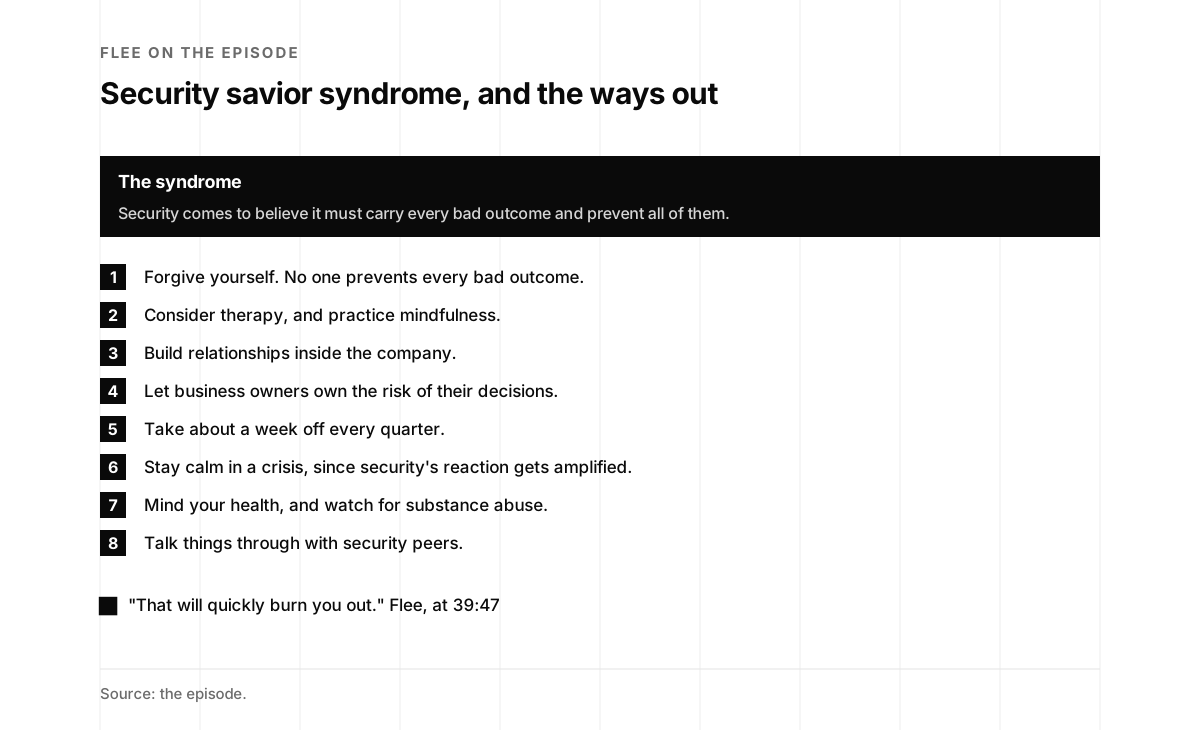
Security savior syndrome
Jon noted how stressful and visible security gets when things go wrong, and pointed to the recent T-Mobile breach. Jon asked what advice Flee had for people helping their company through a ransomware attack or a data breach. Wikipedia says T-Mobile confirmed the breach on August 16, 2021, and two days later said the stolen records covered more than 40 million former and prospective customers and 7.8 million current postpaid customers (Wikipedia).
Flee had a name for the trap.
“this thing that I call security savior syndrome”
Fredrick Lee, at 39:32
Security people and security teams come to believe they must carry the burden of every bad outcome, and prevent every one of them.
“That will quickly burn you out.”
Fredrick Lee, at 39:47
Flee’s first advice is forgiveness, for yourself.
“we cannot prevent every single bad outcome.”
Fredrick Lee, at 40:00
Everyone in security should at least consider therapy, Flee said, and practice mindfulness. Build relationships inside your company, so you have support.
“You’re not supposed to be in this alone”
Fredrick Lee, at 40:44
Where the company allows it, and Flee said not every company does, shift the culture so the business owns its risk decisions.
“business owners own the risk and the outcome from their decisions as opposed to security.”
Fredrick Lee, at 40:58
Then security isn’t on the hook for fixing someone else’s mistakes, and can come at a problem from a helping angle. Episode 7 made a similar case: the business makes the risk decision, and security explains the risk in terms it can decide on.
Take a vacation at least once a quarter, ideally a week each quarter, to recharge. Flee called security a marathon. The work is many small changes that add up over time, and some bad things will still happen. In a crisis, show calm, which also helps your own stress.
“at least display the demeanor of calmness.”
Fredrick Lee, at 42:12
People look to security almost like mom and dad, so security’s reaction gets amplified. Tell the CEO an incident will destroy the company, and the CEO believes it and gets stressed. The stress circles back to you, spreads to your team and peers, and feeds on itself.
Mind your physical health too, and watch for substance abuse. Flee sees a culture in the field that celebrates drinking, and doesn’t judge anyone for it.
“alcohol is not a solution for stress.”
Fredrick Lee, at 43:29
You don’t need a therapist to talk things through, Flee said.
“You can literally have your security peers be your therapy”
Fredrick Lee, at 44:10
Flee named IRC as an outlet, and Slack and Discord for younger people. Jon singled out the advice on risk ownership.
“it’s a great way to scale a security culture across an organization.”
Jon McLachlan, at 44:32
Responsibility stops sitting in one place and spreads everywhere. Wikipedia notes that the World Health Organization describes occupational burnout as a work-related phenomenon from chronic workplace stress that hasn’t been successfully managed (Wikipedia).
Scaling past headcount
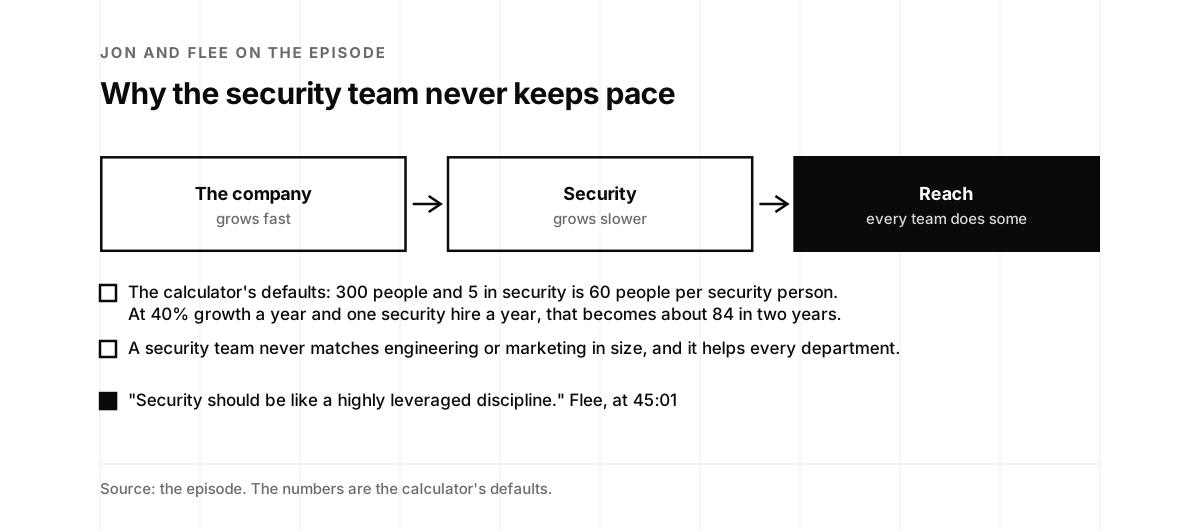
As a company grows, Jon said, its security team may not grow as fast, so each security person has fewer resources for a larger group of people. Flee agreed, and called it reality, with good reasons behind it.
“Security should be like a highly leveraged discipline.”
Fredrick Lee, at 45:01
Security people can do a lot, but that doesn’t mean they should be superheroes and burn themselves out. A good security team can scale better than a lot of engineering teams. It will never be the size of engineering or marketing, while it’s responsible for helping every department, so the ratio looks small next to the rest.
Flee called that part of the fun of the challenge. The calculator below shows how far each security person stretches as a company grows. Jon closed by thanking Flee for the perspectives on diversity, security and team building.
What happened after the tape
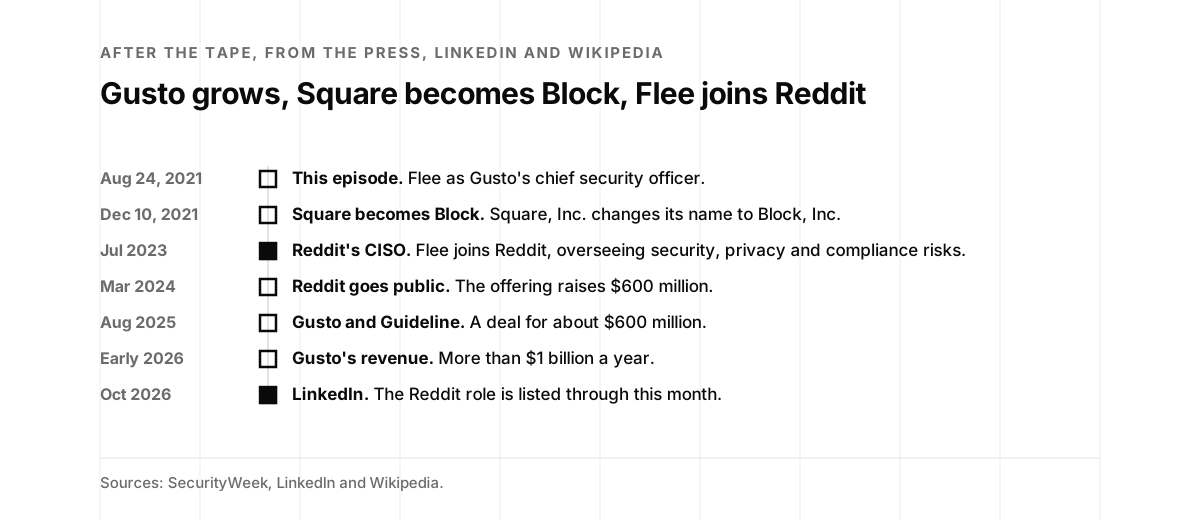
Reddit’s security chief. On July 31, 2023, SecurityWeek reported that Reddit had hired Flee as CISO, overseeing information security, privacy and compliance risks and reporting to CTO Chris Slowe (SecurityWeek). Cybersecurity Dive reported the same day that Flee would lead Reddit’s privacy and security teams, after serving as chief security officer and head of IT at Gusto from 2019 (Cybersecurity Dive). LinkedIn lists the Reddit role from July 2023 through October 2026 (LinkedIn).
Gusto kept growing. Wikipedia says Gusto launched as ZenPayroll on December 11, 2012, took its current name in September 2015, and was valued at $9.6 billion in 2023, with $500 million in annual revenue. It agreed to buy Guideline for about $600 million in August 2025, bought Mosey in April 2026, and passed $1 billion in annual revenue by early 2026 (Wikipedia).
Square became Block. On December 10, 2021, Square, Inc. changed its name to Block, Inc. (Wikipedia). Reddit went public in March 2024, raising $600 million (Wikipedia).
The same themes on this show. Episode 2 had Andrew Gontarczyk, then the CISO of Pure Storage, on building a security team and hiring for execution and delivery. Episode 17 had Sean Cassidy, then the first head of security at Asana, on hiring software engineers and teaching them security, and a high-trust culture. Episode 46 had Polina Morozov, then a security recruiter at Grammarly, on green flags and red flags in hiring. Episode 5 had Leigh Honeywell of Tall Poppy on online harassment and personal security. Episode 80 had Ted Harrington on the hacker inside everyone and why curiosity matters.
Did you catch it? A seven-question quiz
Seven questions from the episode. Each answer links the moment in the transcript.
Quiz · seven questions
Did you catch it?
Pick an answer to see whether you caught it.
-
How did Flee describe the early days of the security community on IRC and Usenet?
b. "it was all about sharing." Transcript, 8:41.
-
What kind of music does Flee compare progress in security to?
a. "it feels a lot like almost like free form jazz." Transcript, 10:02.
-
What does Flee say about the idea that CISOs can prevent every bad outcome?
c. Flee called the idea that CISOs can prevent all bad outcomes false. See The CISO puts the band together.
-
Where does Flee say opportunity is?
b. "Risk is where opportunity is, right?" Transcript, 14:20.
-
What does Flee call a company that holds people's data?
a. "being good custodians and good shepherds of that data" Transcript, 21:58.
-
Why does Flee say diversity is technically correct for a security team?
c. "we all have these lived experiences that feed into our personal threat models" Transcript, 29:40.
-
What does Flee call the belief that security has to carry every bad outcome?
a. "this thing that I call security savior syndrome" Transcript, 39:32.
Is your security team carrying it all?
Eight questions on security savior syndrome, built from Flee’s advice. Each tip links the section behind it.
Scorecard · eight questions
Is your security team carrying it all?
Answer for your company as it runs today. If two answers fit, pick the lower one.
-
Who owns the risk when a team ships something or changes a process?
- Security, by default
- Security, with input from the team
- The business owner, with security's advice
Flee's advice is to move the risk and the outcome to business owners. See Security savior syndrome.
-
What does your security program promise the company?
- That nothing bad will happen
- Fewer incidents
- Fast, safe recovery when something does happen
Flee called the idea that CISOs can prevent all bad outcomes false. See The CISO puts the band together.
-
Do people on the security team take real time off?
- Rarely
- A week now and then
- About a week every quarter
Flee recommends a week each quarter. See Security savior syndrome.
-
In an incident, how does security talk to leadership?
- In alarm
- Calmly, but making it up as we go
- Calmly, with a plan we've practiced
"at least display the demeanor of calmness." See Security savior syndrome.
-
After an incident, what does the review look for?
- Someone to blame
- The cause, with some blame
- The fix and the lesson, with no blame
"we cannot prevent every single bad outcome." See Security savior syndrome.
-
Does security have allies across the company it can lean on in a crisis?
- Few
- In some teams
- In most teams
"You're not supposed to be in this alone" See Security savior syndrome.
-
Do your security people have peers outside the company to talk things through with?
- No
- A few, informally
- Yes, in regular groups or communities
"You can literally have your security peers be your therapy" See Security savior syndrome.
-
How much of the security work do other teams own?
- Security does it all
- Some teams share it
- Most teams own part of it
"They win by getting the entire company to embrace security" See The CISO puts the band together.
Start by naming a business owner for each big risk, and book the team's time off.
Practice the incident plan, and drop the blame from the review.
Keep the time off, the peers and the shared ownership on a schedule.
Will your security team keep up?
The calculator runs Jon’s point from Scaling past headcount: as a company grows, each security person covers more people.
Calculator
Will your security team keep up?
Four numbers: people at the company today, how fast the company grows each year, people on the security team today, and security hires you plan each year.
With 300 people and a security team of 5, each security person covers about 60 people. If the company grows 40% a year and security adds 1 a year, that becomes about 84 people per security person in two years. Holding today's ratio would take about 3 security hires a year.
The defaults are placeholders, so put in your own numbers. Growth is compounded once a year. Flee's answer to a rising ratio: other teams own part of the security work, so the security team doesn't have to grow at the company's pace.
From 2600 to Reddit
Flee’s path, the field around it, and this show. Filter by topic.
Timeline
From 2600 to Reddit
- 2600 launches
The hacker quarterly that Flee found as a reader (Wikipedia, on this page).
- IRC
Internet Relay Chat is created, a text chat built for group channels (Wikipedia, on this page).
- eBay
Founded as AuctionWeb. Beanie Babies were 10% of its listings in 1997 (Wikipedia, on this page).
- Intelis
Senior systems developer, until August 2001 (LinkedIn).
- Transcore
J2EE developer, until February 2002 (LinkedIn).
- Bank of America
VP, until February 2007 (LinkedIn).
- Fortify Software
Software security researcher, then principal researcher, until September 2010 (LinkedIn).
- Betfair
U.S. information security manager, until August 2012 (LinkedIn).
- Twilio
Lead security engineer, until March 2014 (LinkedIn).
- ZenPayroll launches
The company renamed itself Gusto in September 2015 (Wikipedia).
- NetSuite
Director of security, until December 2016 (LinkedIn).
- Square
Head of information security, until February 2019 (LinkedIn).
- Empowering through security
O'Reilly publishes an excerpt of Flee's keynote at its security conference in New York (O'Reilly).
- Gusto
Chief security officer, reporting to CTO Edward Kim (Bank Innovation, on this page).
- The op-ed on data custody
Flee's TechCrunch piece on the data entitlement problem (TechCrunch, on this page).
- George Floyd is murdered
The protests that summer led to the day Gusto stopped to talk (Wikipedia, on this page).
- Episode 2
Andrew Gontarczyk on building a security team (episode 2).
- Episode 5
Leigh Honeywell on online harassment and personal security (episode 5).
- Episode 7
Michael Brooks on why ignoring a risk accepts it (episode 7).
- T-Mobile's breach
T-Mobile confirms a data breach, the one Jon mentions on the tape (Wikipedia, on this page).
- This episode
Flee on the show, then the chief security officer at Gusto (Podbean).
- Square becomes Block
Square, Inc. changes its name to Block, Inc. (Wikipedia, on this page).
- Episode 17
Sean Cassidy on hiring software engineers and teaching them security (episode 17).
- Reddit
CISO, overseeing security, privacy and compliance risks (SecurityWeek, on this page).
- Reddit goes public
The offering raises $600 million (Wikipedia).
- Episode 46
Polina Morozov on green flags and red flags in hiring (episode 46).
- Gusto and Guideline
Gusto agrees to buy Guideline for about $600 million (Wikipedia).
- Episode 80
Ted Harrington on curiosity and the hacker inside everyone (episode 80).
- The Reddit role ends
LinkedIn lists the role through this month (LinkedIn).
What to do this week
Five things, in the order of the episode.
- Ask who a feature could hurt. In your next design review, ask how the feature could hurt someone in a different community, and bring in people who know that community, as in Diversity is technically correct.
- Put a threat model in the interview. Ask candidates to walk through something that looks like a threat model, and listen for curiosity and communication, as in Hiring for aptitude.
- Name an owner for each big risk. Have a business owner sign off on the risk and the outcome of each decision, as in Security savior syndrome. The scorecard covers the rest.
- Run the ratio. Put your numbers in the calculator, and pick the security work another team could own, as in Scaling past headcount.
- Get help with it. Our vCISO Services give you a senior security leader part time, with a team behind them, Product Security brings security engineers into your product reviews, and 24/7 Monitoring & Response watches your infrastructure and responds hands-on, so your team isn’t carrying it alone. If you want to talk it through, book 15 minutes with us.