
Podcast Episode 46

Episode 046 37 min

Polina Morozov, Security Recruiter at Grammarly on Navigating Careers and Culture in Cybersecurity

with Polina Morozov · Grammarly

0:00 / 37:00

Also on Spotify, Apple Podcasts, YouTube, Podbean, Player FM

Episode 46 of The Security Podcast of Silicon Valley, published June 6, 2024. Host Jon McLachlan talks with Polina Morozov, then a security recruiter at Grammarly, about falling into recruiting after studying international development at UCLA, doing everything in HR at a startup, connecting with engineers as a shy recruiter, a contingency agency and the RPO firm Binc, Robinhood buying Binc and absorbing its team, Grammarly's security team called Trust, why the roles are the easy part of hiring and the process and hiring partners are the hard part, rubrics, interviewer training and the bar, why security is a small world where everyone knows everyone, Grammarly's 30 million weekly users and 70,000 teams, an AI security researcher search sourced through research papers, the cybersecurity talent shortage, layoffs that hit recruiters first, how to ask for a referral, matchmaking over volume for senior roles, Grammarly's support for its people in Ukraine, the best and hardest days in recruiting, green flags and red flags on a first call, recruiting tools that don't fit together, and interviews that qualify people in.

Episode notes

Host Jon McLachlan, welcomes Polina Morozov, a distinguished Security Recruiter from Grammarly (and formerly Robinhood) onto Security Podcast of Silicon Valley, a YSecurity.io production. As we peel back the layers of security and recruiting, Polina shares her remarkable journey from aspiring diplomat to a key player in tech hiring, highlighting the crucial role communication plays in connecting talent with opportunity. Discover how Grammarly's cutting-edge tools not only enhance written communication but also serve as a catalyst for Polina's career. Through candid conversations, this episode offers a unique lens on the challenges and triumphs of recruiting in the security tech world, emphasizing the importance of pushing boundaries, fostering trust, and the undeniable impact of cultural and global influences on business practices. Tune in for an engaging exploration of what it takes to secure top talent in the ever-evolving landscape of cybersecurity, or, land your next huge opportunity and accelerate your own career in cybersecurity.

Hosted by Jon McLachlan — co-founder of YSecurity.

The deep dive

Everyone knows everyone

Polina Morozov, then a security recruiter at Grammarly, with Jon on falling into recruiting, a contingency agency and an RPO firm that Robinhood bought, a security team called Trust, why the roles are the easy part of hiring, a method to the madness, a small world where everyone knows everyone, 30 million people a week and 70,000 teams, an AI security researcher found through research papers, the talent shortage, layoffs that hit recruiters first, how to ask for a referral, matchmaking over volume, a Ukrainian-founded company in wartime, green flags and red flags, and qualifying people in.

Episode 46 of The Security Podcast of Silicon Valley aired on June 6, 2024, with Jon McLachlan hosting. The guest was Polina Morozov, then a security recruiter at Grammarly, who came to Grammarly from Robinhood (Podbean, Apple Podcasts, Spotify). Her LinkedIn now lists her as a staff technical recruiter at Rippling since June 2026. Before that she recruited at Grammarly from June 2022, and then at Superhuman, the new name of Grammarly’s parent company (LinkedIn). The episode is called “Polina Morozov, Security Recruiter at Grammarly on Navigating Careers and Culture in Cybersecurity.” It has no video version, and it was her first podcast.

The idea under the whole conversation came up a quarter of the way in, when Jon asked what’s different about recruiting for security.

“security is a really small world, and I did find that everyone knows everyone.”

Polina Morozov, at 10:07

Listen · Polina Morozov on episode 46, from 10:05
About 25 seconds: Polina on why networking matters more in security than in the rest of engineering. The clip stops on its own. Read the full transcript.

This page follows the conversation in order: a section for each part of it, seventeen figures, eleven clips from the tape, a LinkedIn post, the full transcript, and five tools: a quiz, a scorecard for your security hiring loop, a calculator for how many interview loops one hire takes, a timeline, and a to-do list. Where the decodes of the tape disagree on a word, the transcript puts its best guess in brackets, and the page doesn’t quote those words.

Just Grammarly

Jon opened as a fan. When he first started using Grammarly, he was at Pure Storage, and co-workers came up to ask whether he had taken a communication class. His answer was that it was just Grammarly. Pure Storage’s CISO at the time, Andrew Gontarczyk, was the guest on episode 2, on building a security team. The company now goes by Everpure (Wikipedia).

Polina said she has used Grammarly since college. Recruiting, she said, “entails a lot of writing,” and that is one of the reasons she joined. Jon guessed that a recruiter communicates all the time.

“That’s basically the job.”

Polina Morozov, at 1:09

Nobody grows up wanting to be a recruiter

Jon asked how she got into recruiting.

“most of my colleagues will probably agree that no one grows up wanting to be a recruiter.”

Polina Morozov, at 1:16

She didn’t know the job existed. She fell into it.

“So I graduated from UCLA, and I studied international development studies.”

Polina Morozov, at 1:29

“I wanted to be a diplomat or go to law school, and it just wasn’t in the cards for me.”

Polina Morozov, at 1:37

Her LinkedIn lists one step on that road: an internship at UNICEF from June to September 2010. Wikipedia describes UNICEF as the United Nations agency “responsible for providing humanitarian and developmental aid to children worldwide” (Wikipedia).

Right after college she worked for a property management company. She loved her boss, who she said inspired her, but there wasn’t much room to grow, and jobs were scarce. Then she found a job at a startup of about 35 people, helping run its HR.

“And I did everything in HR, from payroll to planning our events to, like, moving offices once we grew, stocking kitchen, and then also recruiting.”

Polina Morozov, at 2:57
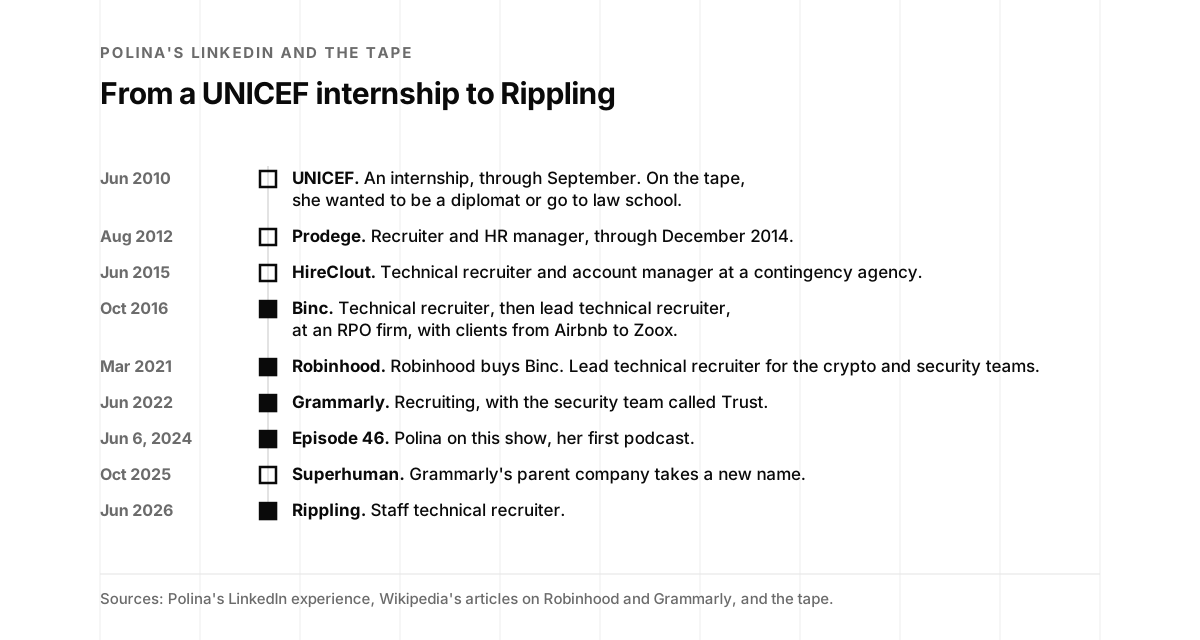
A timeline. June 2010: UNICEF, an internship through September, and on the tape she wanted to be a diplomat or go to law school. August 2012: Prodege, recruiter and HR manager through December 2014. June 2015: HireClout, technical recruiter and account manager at a contingency agency. October 2016, filled: Binc, technical recruiter, then lead technical recruiter, at an RPO firm, with clients from Airbnb to Zoox. March 2021, filled: Robinhood buys Binc, and she is lead technical recruiter for the crypto and security teams. June 2022, filled: Grammarly, recruiting with the security team called Trust. June 6, 2024, filled: episode 46, Polina on this show, her first podcast. October 2025: Superhuman, as Grammarly's parent company takes a new name. June 2026, filled: Rippling, staff technical recruiter.
From a UNICEF internship to Rippling, as her LinkedIn lists it, with what she said on the tape.

Shy by nature

She added one more thing about herself.

“And I am very shy by nature as well, and always try to push the boundary of my comfort zone.”

Polina Morozov, at 3:11

That, she said, is part of why she was on the show. Recruiting for the startup, she found she connected with its engineers.

“because they’re also, like, introverted, like myself, they maybe didn’t feel, like, very intimidated by me, ‘cause I wasn’t, like, very salesy in, like, my demeanor.”

Polina Morozov, at 3:32

Listen · Polina Morozov on episode 46, from 3:20
About 35 seconds: Polina on why engineers opened up to a recruiter who wasn't salesy. The clip stops on its own. Read the full transcript.

She liked learning about computer science and what engineers could create, and she liked that it challenged her. So she gravitated to recruiting. A few minutes later Jon came back to the word she had used. Being an introvert is amazing too, he said, because

“we recharge better sometimes with less folks around us.”

Jon McLachlan, at 5:51

Polina said she loves her alone time, and Jon said he does too. Wikipedia links introversion with “introspection, reserve, and a preference for solitary activities,” and credits Carl Jung with bringing the terms into psychology (Wikipedia).

Contingency, then RPO

She left the startup for an agency, HireClout, which she called a regular contingency agency. Her LinkedIn lists her there as a technical recruiter and account manager from June 2015 to October 2016.

“And I spent about a year and a half there, just working as a recruiter, account manager, learning the ropes”

Polina Morozov, at 4:12

A contingency agency gets paid when a candidate it sends gets hired. Wikipedia’s article on executive search puts it this way: “Contingent recruiters are paid only upon the successful completion” of the search (Wikipedia). The firm she wanted to join worked another way.

“which was, like, an RPO recruiting firm out in the Valley that was consulting all the hot companies in the Bay Area, essentially.”

Polina Morozov, at 4:33

That firm was Binc, which she said no longer exists. RPO stands for recruitment process outsourcing, which Wikipedia defines as a company that “engages a third-party provider to manage all or part of its recruitment process” (Wikipedia). The description of Binc on her LinkedIn says its recruiting team “fully embeds themselves into your organization, systems, and culture.”

She wanted the exposure to those companies, and she wanted teachers.

“And then they had really great recruiters, and I wanted to be mentored by them.”

Polina Morozov, at 4:51

She got hired, and she called the rest history.

“I consulted many companies, from Airbnb to Ripple, Capital One, Instacart.”

Polina Morozov, at 5:01

She also worked with blockchain companies such as Protocol Labs, the company best known for creating the InterPlanetary File System (Wikipedia). Her LinkedIn dates each client. Airbnb came first, from November 2016, then Mya Systems, Instacart, Turvo, Capital One and Ripple, then Protocol Labs in 2020 and Zoox in early 2021. For her last couple of years at Binc, it says, her focus was scaling crypto and web3 startups.

“then we ended up getting acquired by Robinhood, and they absorbed the whole team.”

Polina Morozov, at 5:16

Wikipedia dates the deal to March 2021, and calls Binc “a recruiting firm” (Wikipedia). Robinhood went public on the Nasdaq four months later, on July 29, 2021. Her LinkedIn says she supported the growth of Robinhood’s crypto and security teams from March 2021 to March 2022. The roles it lists include cryptography engineers, security architects, a director of security architecture, an engineering manager for security, a technical program manager for security, a vice president of product security, and corporate security roles. She left while she was hiring for the engineering team of Say Technologies. Robinhood completed its $140 million purchase of Say in August 2021, and Wikipedia describes Say as a company that helps shareholders “vote proxies and ask questions of management.”

“And then I left because Grammarly actually reached out to me, and I couldn’t say no to them.”

Polina Morozov, at 5:25
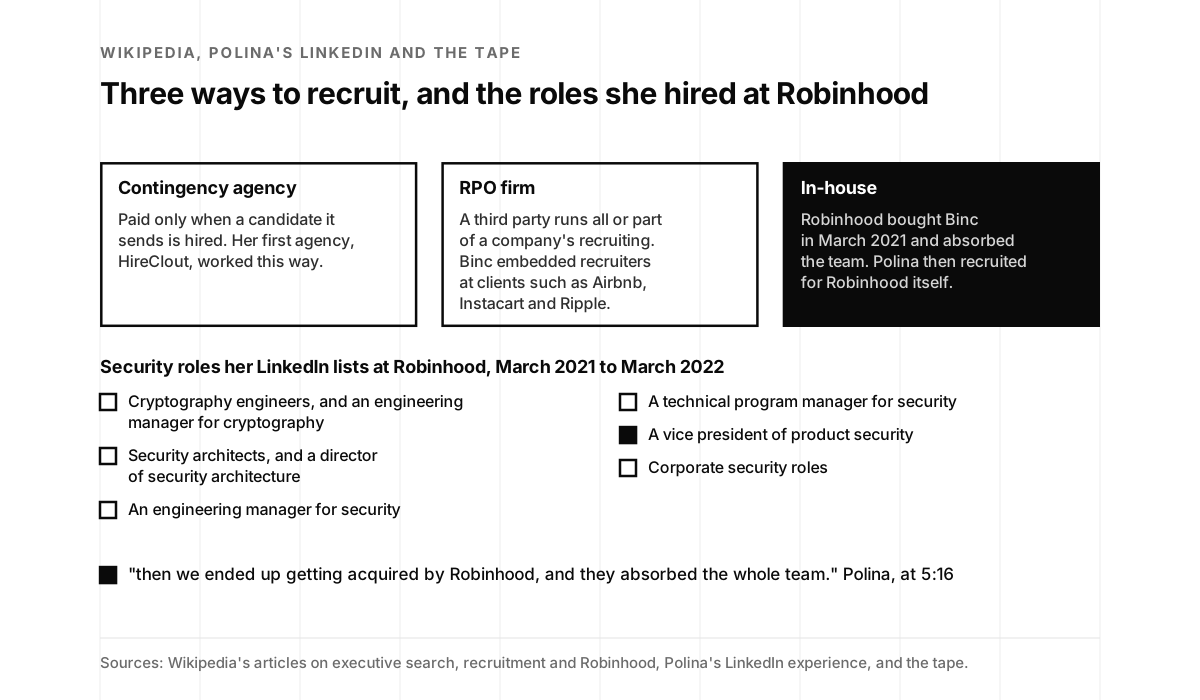
Three cards. Contingency agency: paid only when a candidate it sends is hired, and her first agency, HireClout, worked this way. RPO firm: a third party runs all or part of a company's recruiting, and Binc embedded recruiters at clients such as Airbnb, Instacart and Ripple. In-house, filled: Robinhood bought Binc in March 2021 and absorbed the team, and Polina then recruited for Robinhood itself. Below, the security roles her LinkedIn lists at Robinhood, March 2021 to March 2022: cryptography engineers and an engineering manager for cryptography, security architects and a director of security architecture, an engineering manager for security, a technical program manager for security, a vice president of product security, filled, and corporate security roles. Then: "then we ended up getting acquired by Robinhood, and they absorbed the whole team." Polina, at 5:16
Contingency, RPO and in-house recruiting, and the security roles her LinkedIn lists at Robinhood.

Jon summed up the pattern as a common theme.

“always pushing yourself outside your comfort zone”

Jon McLachlan, at 5:36

A team called Trust

Jon asked what she does at Grammarly.

“So now I do also support our security team. We call it Trust.”

Polina Morozov, at 6:05

She works closely with the CISO, Suha, and with a number of hiring managers, each hiring for their own group. Suha Can was the guest on episode 52 two months later, where he described his first job at Grammarly as being “responsible for all aspects of trust in the company.” Polina had also supported other teams, from Grammarly for Developers to machine learning.

“But really, I do have a special place for security teams”

Polina Morozov, at 6:28

She likes the roles and the smaller community, so she gravitated back to it.

“I love how Grammarly calls that team Trust”

Jon McLachlan, at 6:52

“Like, we really want our users to be able to trust our product, and we do work on that really hard.”

Polina Morozov, at 6:58

Jon said he could imagine why.

“because the product, in order for it to be useful, it has to read things that you’re typing in.”

Jon McLachlan, at 7:06

It reads emails, he said, and the keyboard on the iPhone reads as you type. Trust matters if you’re going to use it. Suha made the same case for controls users can see on episode 52.
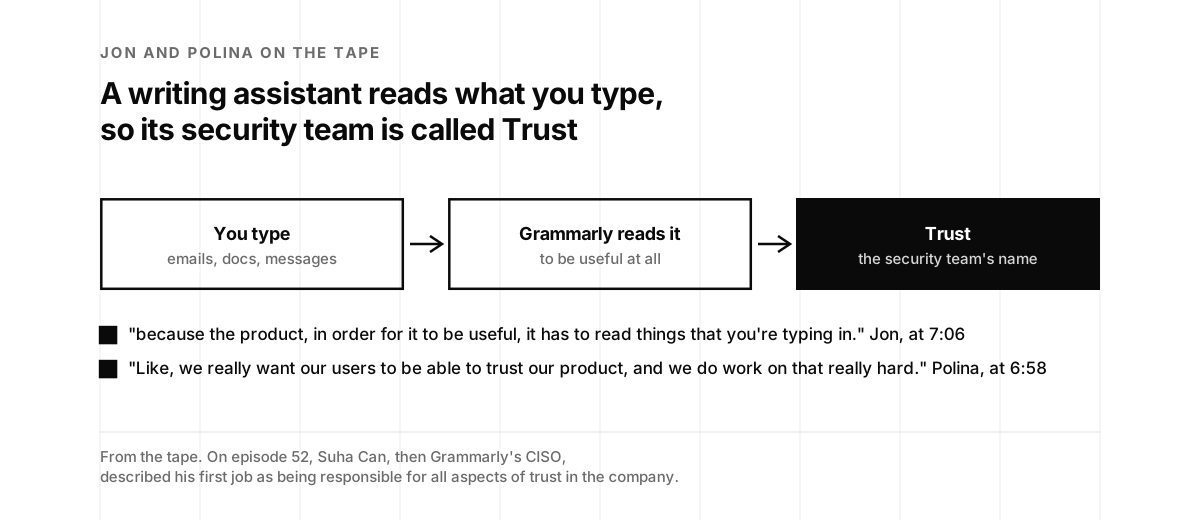
Three boxes joined by arrows. You type: emails, docs, messages. Grammarly reads it, to be useful at all. Trust, filled: the security team's name. Below: "because the product, in order for it to be useful, it has to read things that you're typing in." Jon, at 7:06. And: "Like, we really want our users to be able to trust our product, and we do work on that really hard." Polina, at 6:58
Why a writing assistant's security team is called Trust, from Jon and Polina on the tape.

The roles are the easy part

Jon asked about the most challenging role she had ever filled. She had been turning the question over for a few weeks.

“there’s really not a role that’s, like, really challenging, in my opinion.”

Polina Morozov, at 7:45

“Like, you can always find someone, right?”

Polina Morozov, at 7:50

You can change your requirements, adjust and pivot to what the market tells you, and to the talent you’re attracting.

“So that’s actually the easy part”

Polina Morozov, at 8:02

She meant the roles themselves.

“What’s challenging in recruiting is when you have some, like, roadblocks and blockers in your process or in your hiring partners.”

Polina Morozov, at 8:07

Listen · Polina Morozov on episode 46, from 8:06
About 30 seconds: Polina on what makes hiring hard: the process and the partners. The clip stops on its own. Read the full transcript.

She named the blockers. A new hiring manager may need a lot of training on how to interview and on the nuances of the process. The process itself can be missing pieces.

“like not having good rubrics, or maybe having the bar too high”

Polina Morozov, at 8:33

Then, she said, you start saying no to everyone. When she consulted for startups, the blocker was often money.

“maybe their comp is not as competitive, right?”

Polina Morozov, at 8:58

“It’s more about having that right team and the right processes in place.”

Polina Morozov, at 9:14

A method to this madness

After a polite round of “go ahead,” she finished the thought.

“there is a process and a method to this madness, right?”

Polina Morozov, at 9:27

Some steps have to happen for a search to end in a hire.

“when you deviate from, like, the process, that’s when you get yourself in trouble.”

Polina Morozov, at 9:41

Wikipedia’s article on job interviews says that structured interviews, with set questions in a set order, “are usually more accurate predictors” of who will do well, and that structured interviews with several interviewers and training may reduce the effect of things that have nothing to do with the job (Wikipedia). Her LinkedIn shows her doing that work at Grammarly. She “Standardized the interview process” across machine learning, security and enterprise, and “Led an interviewer training session for the Security team.”
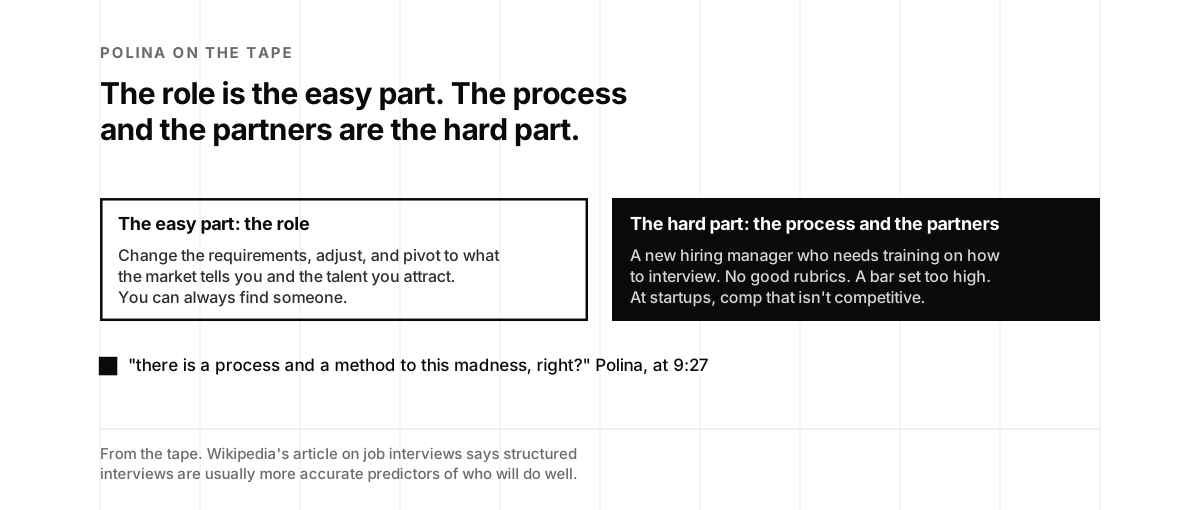
Two cards. The easy part, the role: change the requirements, adjust, and pivot to what the market tells you and the talent you attract, and you can always find someone. The hard part, filled, the process and the partners: a new hiring manager who needs training on how to interview, no good rubrics, a bar set too high, and at startups, comp that isn't competitive. Below: "there is a process and a method to this madness, right?" Polina, at 9:27
What Polina calls the easy part of hiring and the hard part, from the tape.

Everyone knows everyone

Jon asked what is different where security and recruiting meet. Her answer is the quote at the top of this page. The consequence comes next.

“So, like, networking is really important, for example.”

Polina Morozov, at 10:14

That means making sure “you’re leaving positive, lasting impressions” in each role, she said, because the community is so close-knit.

“I guess if everyone knows everyone else, and, like, a reality TV show.”

Jon McLachlan, at 10:31

“Sometimes it does seem that way.”

Polina Morozov, at 10:35

Listen · Polina Morozov on episode 46, from 10:35
About 25 seconds: Polina on why security people follow each other from company to company. The clip stops on its own. Read the full transcript.

“And that’s how you can also get your next job or get your next opportunity, right?”

Polina Morozov, at 10:41

“I do find that a lot of people follow each other as well”

Polina Morozov, at 10:46

In general software engineering she sees less of that, because there are more people and more openings. Security, she said, is a niche.

Jon tied it to the team’s name. Security is about trust, he said, and when you find people you work well with, “there’s a sense of trust that developed.” That may be why people follow each other.

“It’s just, like, that theme of trust all across.”

Polina Morozov, at 11:26
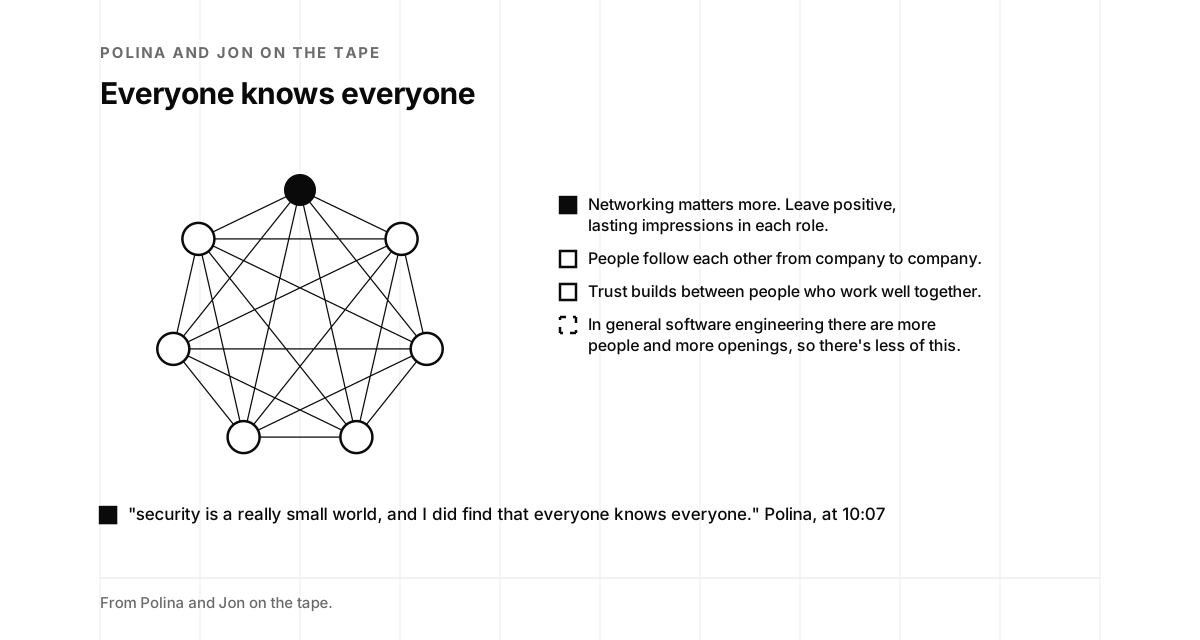
A drawing of seven people in a circle, each joined by a line to every other, with one of them filled. Beside it, a list. Filled: networking matters more, so leave positive, lasting impressions in each role. People follow each other from company to company. Trust builds between people who work well together. Dashed: in general software engineering there are more people and more openings, so there's less of this. Below: "security is a really small world, and I did find that everyone knows everyone." Polina, at 10:07
A small world: in security, the people you work with now are your next references, from Polina and Jon on the tape.

Thirty million a week

Jon knew Grammarly as a consumer product. He asked whether it had much of a business side, and whether Polina had ever hired for a compliance role because of it. She took the first question first.

“we do have over 30 million individual users using Grammarly, 30 million per week.”

Polina Morozov, at 11:54

“And then we actually also have over 70,000 teams connecting on Grammarly.”

Polina Morozov, at 12:00

The show used the same two numbers two months later, when it described Suha’s job as overseeing the security of “over 30 million users and 70,000 enterprise teams worldwide” (Apple Podcasts). One of Grammarly’s bigger focuses, Polina said, was its enterprise offering, so that more organizations could use it across their teams.

“It’s a very tailored experience”

Polina Morozov, at 12:20

There is a big generative AI component, she said. Grammarly could pull information from a company’s internal wiki pages and docs, and help with the company’s tone.

Wikipedia dates Grammarly’s first generative AI product to April 2023, built on GPT-3 models (Wikipedia). The goal she described was fewer hours spent on communication, and help digesting what gets sent to you. She pointed listeners to Grammarly’s commercials set in an office, on YouTube (YouTube). Suha picked up the move from consumers to enterprises on episode 52.
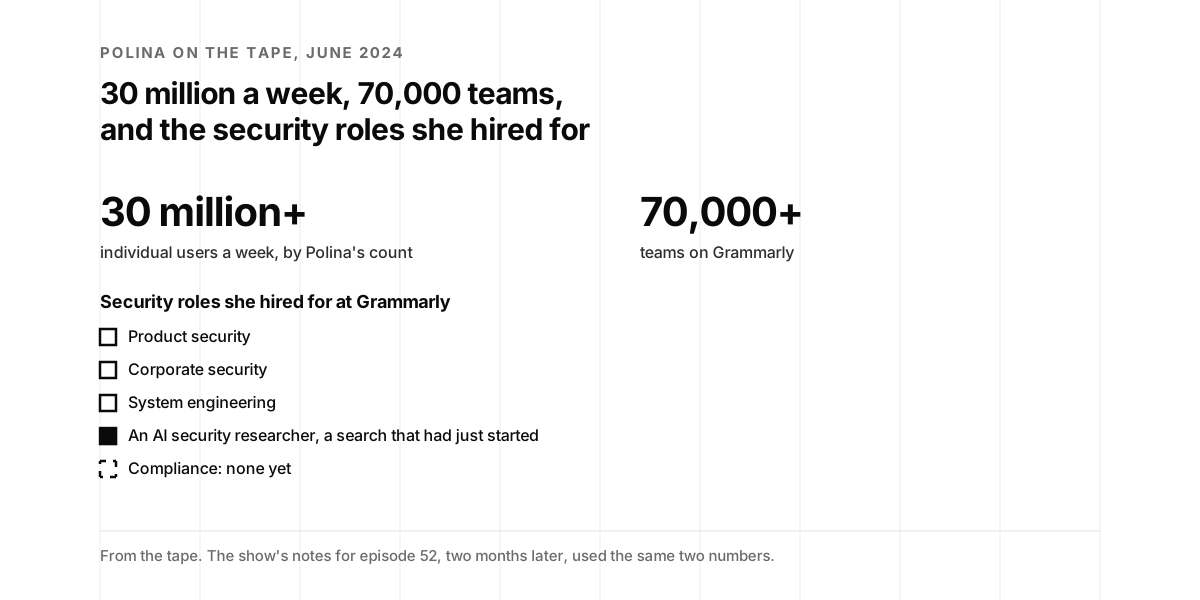
Two numbers. 30 million plus: individual users a week, by Polina's count. 70,000 plus: teams on Grammarly. Below, the security roles she hired for at Grammarly: product security, corporate security, system engineering, and, filled, an AI security researcher, a search that had just started. Dashed: compliance, none yet.
Grammarly's scale as Polina gave it in June 2024, and the security roles she hired for.

Then the second question.

“In terms of compliance roles, I personally haven’t worked on any compliance roles.”

Polina Morozov, at 13:18

As at Robinhood, she had focused on other security roles.

“product security roles, corporate security roles, some system engineering type roles.”

Polina Morozov, at 13:29

An AI security researcher

One search had just started.

“I do have an AI security researcher role that I’m working on.”

Polina Morozov, at 13:34

Grammarly wanted someone to lead security for its AI products, run research in that area and represent the company. She called it one of the “really niche, interesting” roles. Jon called it specific, and she agreed. Compliance was “not yet, at least,” she said. Later in the conversation she explained how she was looking for that person, in Matchmaking over volume. On episode 52, Suha described Grammarly’s dedicated responsible AI team.

The talent shortage

Jon joked that finding the right fit must always be easy, and Polina played along: “So easy.” Then he named the topic.

“People talk about this thing called, like, the cybersecurity talent shortage.”

Jon McLachlan, at 14:27

Her first answer was about the people who already have jobs.

“I feel like people are also more hesitant to maybe move right now, just ‘cause of the economy.”

Polina Morozov, at 14:34

If they have a good gig and are good at what they do, they don’t jump at a new opportunity.

“So it does take more time to warm them up to the idea of maybe leaving and exploring something else.”

Polina Morozov, at 14:49

Listen · Polina Morozov on episode 46, from 14:32
About 25 seconds: Polina on why people with good jobs are slow to move. The clip stops on its own. Read the full transcript.

“and then I think there’s probably a shortage of talent, especially when you’re looking at, like, top-tier talent.”

Polina Morozov, at 14:56

“Grammarly is in a unique position where we are making some, like, really big bets”

Polina Morozov, at 15:03

Those bets need people who can jump on problems and solve them now, without much time to get up to speed. So the work takes longer: more candidates to reach, more time to engage them, and more time to convince them to look outside their current job.
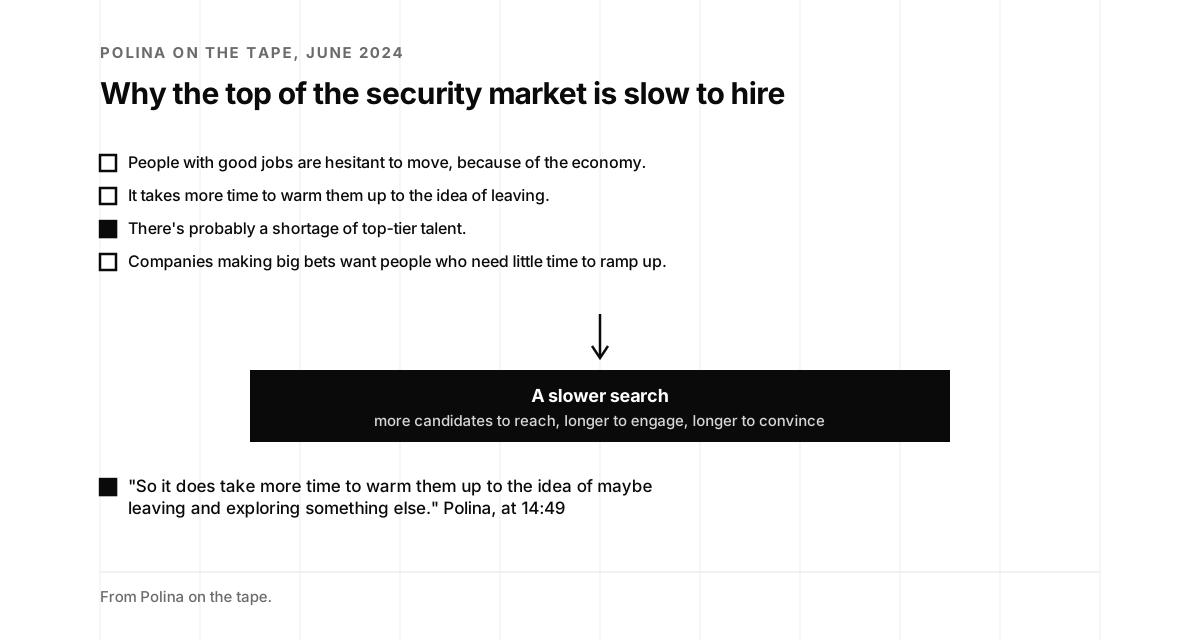
A list. People with good jobs are hesitant to move, because of the economy. It takes more time to warm them up to the idea of leaving. Filled: there's probably a shortage of top-tier talent. Companies making big bets want people who need little time to ramp up. An arrow down to a filled box: a slower search, with more candidates to reach, longer to engage, and longer to convince. Below: "So it does take more time to warm them up to the idea of maybe leaving and exploring something else." Polina, at 14:49
Why the top of the security market is slow to hire, as Polina described it in June 2024.

Layoffs hit recruiters first

Jon raised the layoffs in the Bay Area and asked whether they reached cybersecurity roles. He guessed companies weren’t letting go of their top talent.

“Right. I mean, sometimes they do, for sure, especially, like, larger organizations.”

Polina Morozov, at 15:44

Leaders make a decision, she said, or cut a business line, and that has nothing to do with performance. She had also been helping with general engineering roles, and she saw a difference.

Security teams, she said, were affected

“less so than all other teams, because obviously it’s, like, an important function for many organizations.”

Polina Morozov, at 16:21

She said she doesn’t come across

“many security engineers who have been laid off.”

Polina Morozov, at 16:31

She couldn’t think of anyone she was talking to then who had been laid off. Most were employed. Jon said that when layoffs do reach security, people ping him for leads and advice, because it can be hard emotionally. Polina sees the same messages from her side.

“and unfortunately we’re always the first ones to be let go”

Polina Morozov, at 17:29

When companies stop hiring, recruiters are the ones without work, she said, and a lot of recruiters had been laid off in the year and a half before the episode.
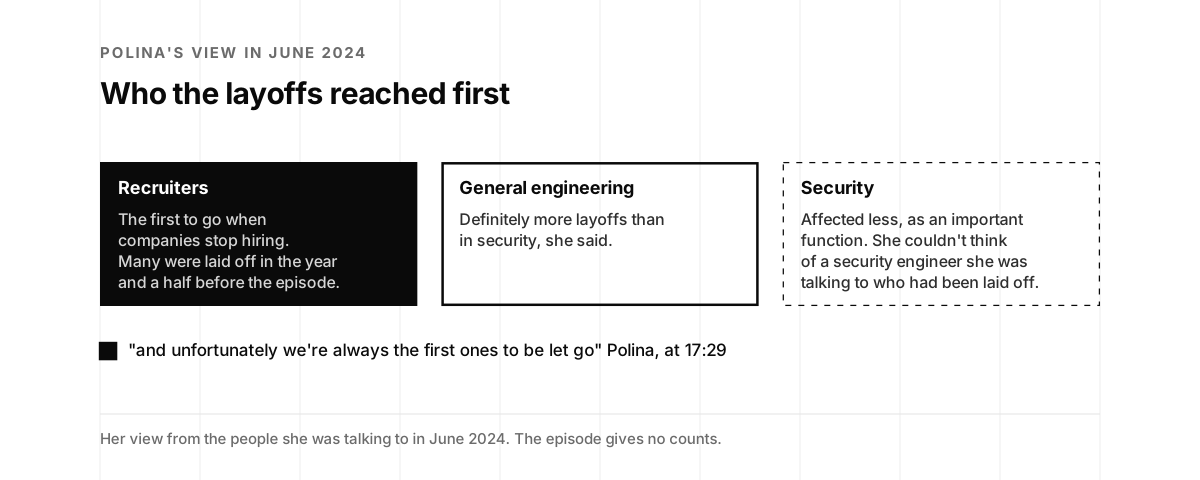
Three cards. Recruiters, filled: the first to go when companies stop hiring, and many were laid off in the year and a half before the episode. General engineering: definitely more layoffs than in security, she said. Security, dashed: affected less, as an important function, and she couldn't think of a security engineer she was talking to who had been laid off. Below: "and unfortunately we're always the first ones to be let go" Polina, at 17:29
Who felt the layoffs, as Polina saw it from the people she talked to in June 2024.

How to ask for a referral

People reach out to both of them when they’re looking. Jon asked for the best way to use your network. Polina answered with a list.

“Do your research. Really read, learn about the company, use the product, learn about the product.”

Polina Morozov, at 17:52

“Make sure you really align to the job that you’re asking to be referred to.”

Polina Morozov, at 17:59

Listen · Polina Morozov on episode 46, from 17:51
About 25 seconds: Polina's referral checklist, in her words. The clip stops on its own. Read the full transcript.

Then write a short pitch about why you’re the right person for the role. She gets many pings about Grammarly roles from people whose backgrounds don’t fit.

“they just read the title of the role and they didn’t read the job description”

Polina Morozov, at 18:25

The more homework you do, she said, the easier it is for the person to refer you, and the more enthusiasm you show.

“Like, you want to tell them, yes, like, this is the company where I want to be”

Polina Morozov, at 18:44

People respond to that, she said. Wikipedia defines an employee referral as “a candidate recommended by an existing employee” (Wikipedia).
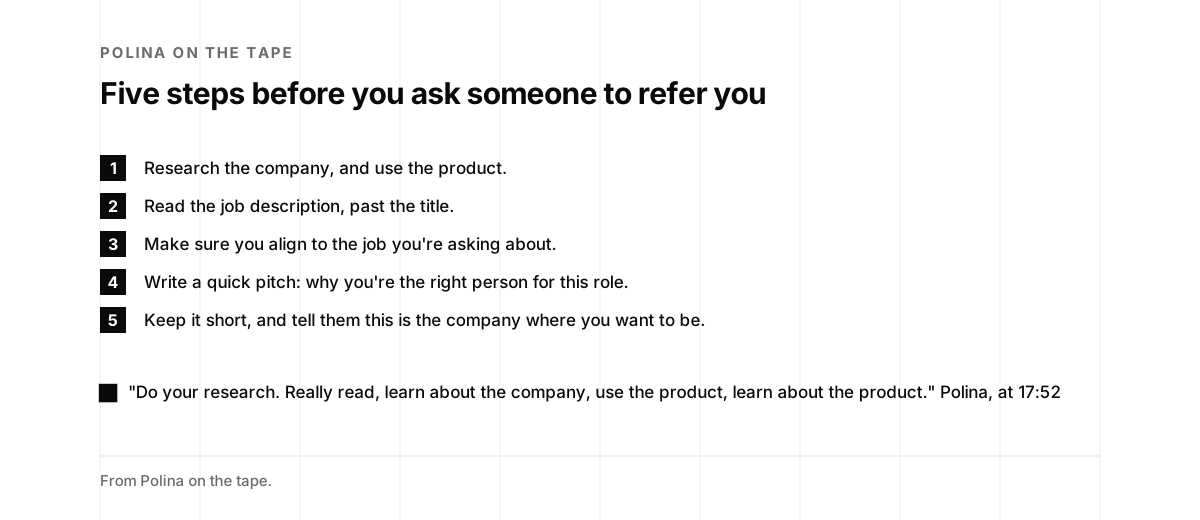
A numbered list. One: research the company, and use the product. Two: read the job description, past the title. Three: make sure you align to the job you're asking about. Four: write a quick pitch, why you're the right person for this role. Five: keep it short, and tell them this is the company where you want to be. Below: "Do your research. Really read, learn about the company, use the product, learn about the product." Polina, at 17:52
Polina's five steps before you ask someone to refer you, from the tape.

Matchmaking over volume

Jon asked whether she has a favorite role to hire for.

“I do enjoy, like, more senior roles, to be honest.”

Polina Morozov, at 18:59

Managers and above, directors, vice presidents, leads and staff engineers. She likes to learn their stories.

“And then the search allows me to slow down, right?”

Polina Morozov, at 19:14

She doesn’t need a high volume of candidates in the pipeline. The work is finding the right match for the role.

“it becomes more of a matchmaking game”

Polina Morozov, at 19:27

She tries to learn what matters to each candidate and to make sure they have what they need to decide. She loves building that trust with her candidates.

Jon said it sounds like networking for the recruiter as well, staying in touch with people even when a role isn’t the fit.

“Yeah, I’ve stayed in touch with a lot of people from Robinhood, for example, right?”

Polina Morozov, at 20:05

She checks in with people she hired. Then she came back to the AI security researcher search, which she said was teaching her a ton.

She likes to look for the needle in the haystack, and to try

“different strategies when it comes to sourcing, outside of just looking on LinkedIn, right?”

Polina Morozov, at 20:29

For that role, she was reading research papers. Jon asked whether she reached out to the authors, and she said that’s what she had been doing lately, and that it was fun.

“I like more niche, like, difficult roles.”

Polina Morozov, at 20:46

“You like a good challenge.”

Jon McLachlan, at 20:50

“I do like a good challenge, yes.”

Polina Morozov, at 20:52

Jon said many people come to security for the same reason.

“I think a lot of people in security get into security because they’re just really complex, intricate puzzles”

Jon McLachlan, at 20:55
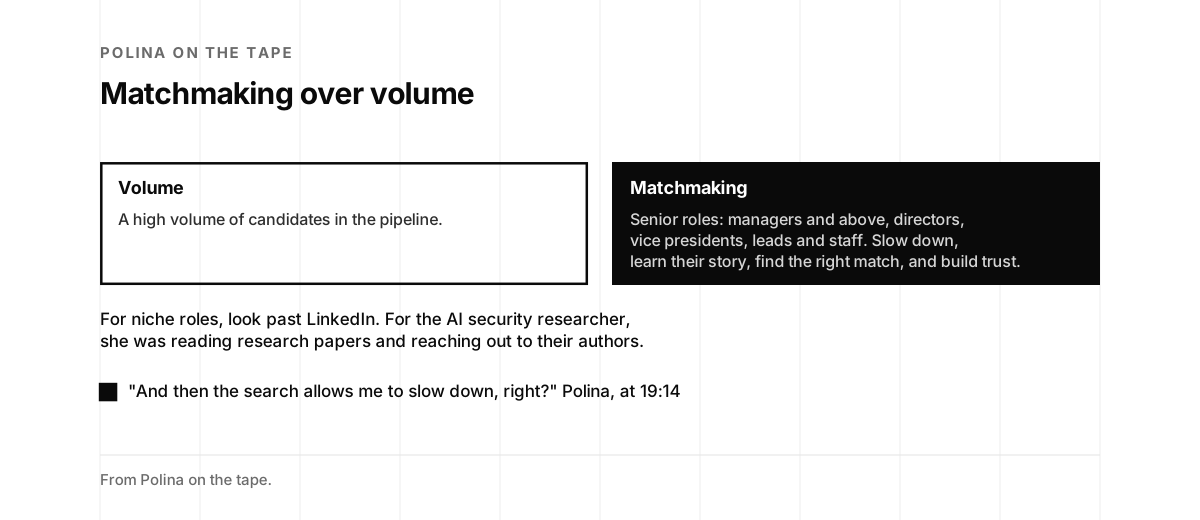
Two cards. Volume: a high volume of candidates in the pipeline. Matchmaking, filled: senior roles, managers and above, directors, vice presidents, leads and staff, where she slows down, learns their story, finds the right match, and builds trust. Below: for niche roles, look past LinkedIn, and for the AI security researcher, she was reading research papers and reaching out to their authors. Then: "And then the search allows me to slow down, right?" Polina, at 19:14
Matchmaking over volume: how Polina runs a senior search, from the tape.

A Ukrainian-founded company

Jon brought up Grammarly’s roots and the war, and asked whether it had touched the company’s culture.

“our company was founded in Ukraine. Our co-founders are from Ukraine, and we have many team members who call Ukraine home.”

Polina Morozov, at 21:50

Listen · Polina Morozov on episode 46, from 21:45
About 30 seconds: Polina on Grammarly's roots and when she joined. The clip stops on its own. Read the full transcript.

Wikipedia says Grammarly was developed in Ukraine and launched in 2009 by Alex Shevchenko, Max Lytvyn and Dmytro Lider (Wikipedia).

“So the war started in February of 2022, and then I started with Grammarly in June of 2022.”

Polina Morozov, at 22:00

She hadn’t seen the culture before the war, she said. She said the company’s roots were part of why she joined, and that she wanted to help support the Ukrainian people. Then she listed what Grammarly did. It supported its employees in many ways through the war, and helped some of them move out of Ukraine.

“we also opened an office in Germany”

Polina Morozov, at 23:20

A lot of people moved to Germany during the war, she said.

“We also donated over $5 million to various organizations supporting Ukrainian people.”

Polina Morozov, at 23:26

“And we offer Grammarly and all of our paid features in Ukraine for free to anyone who wants to use it.”

Polina Morozov, at 23:34

Listen · Polina Morozov on episode 46, from 23:06
About 35 seconds: Polina on what Grammarly did for its people in Ukraine. The clip stops on its own. Read the full transcript.

Grammarly’s own posts give the details. On April 26, 2022, it wrote that it had delivered $4.75 million and would complete a $5 million commitment, equal to all its net revenue from Russia and Belarus. It also wrote that it gave relocation and ongoing financial support, with “a year of paid leave to those joining Ukraine’s armed forces” (Grammarly). Wikipedia adds that Grammarly stopped all business in Russia and Belarus after the 2022 invasion (Wikipedia). The free offer was, in that post, Grammarly Premium for media organizations in Ukraine. The company’s page today lists free paid features for Ukrainian nonprofits, NGOs and media organizations (Superhuman).

“We just had an off-site in San Francisco for the people team at Grammarly”

Polina Morozov, at 25:37

Team members from Ukraine joined, including people who had to leave because of the war. They were still positive and living their lives, she said, with family still in Ukraine.

“it was just, like, incredible to witness their, like, strength and, like, life philosophy.”

Polina Morozov, at 26:06

Jon said it warmed his heart that Grammarly was playing an active role. Hard moments outside our comfort zone, he said, are when we learn and grow, and when you see

“people’s true colors come out.”

Jon McLachlan, at 26:27

“And for most of humanity, that’s really beautiful.”

Jon McLachlan, at 26:30
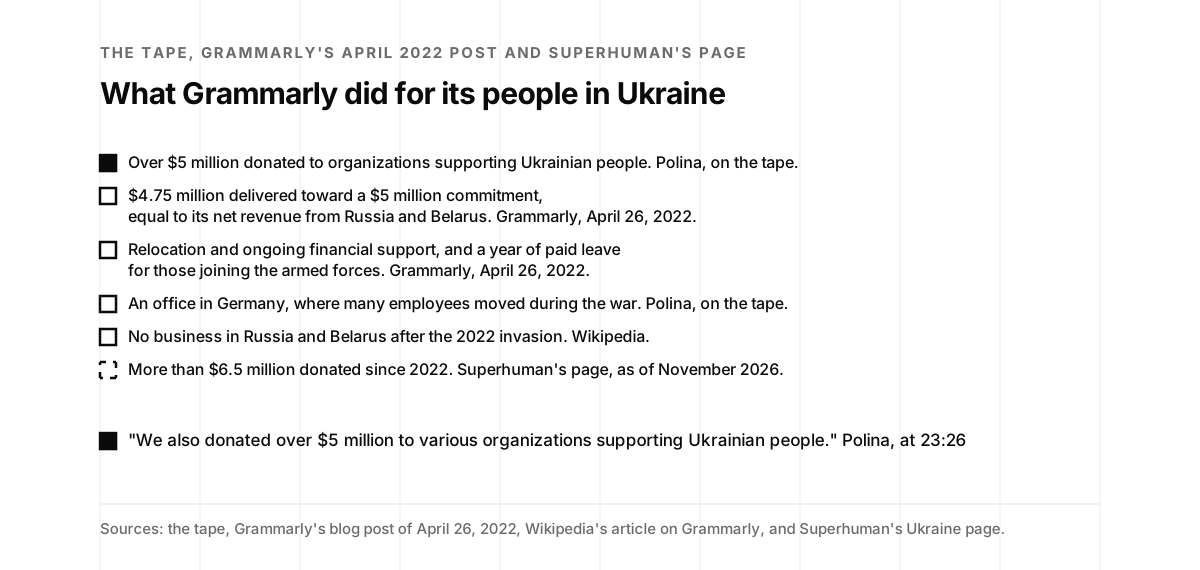
A list. Filled: over $5 million donated to organizations supporting Ukrainian people, Polina on the tape. $4.75 million delivered toward a $5 million commitment, equal to its net revenue from Russia and Belarus, Grammarly, April 26, 2022. Relocation and ongoing financial support, and a year of paid leave for those joining the armed forces, Grammarly, April 26, 2022. An office in Germany, where many employees moved during the war, Polina on the tape. No business in Russia and Belarus after the 2022 invasion, Wikipedia. Dashed: more than $6.5 million donated since 2022, Superhuman's page as of November 2026. Below: "We also donated over $5 million to various organizations supporting Ukrainian people." Polina, at 23:26
What Grammarly did for its people in Ukraine, from Polina on the tape and from the company's own pages.

The best day

Jon asked for her best day at Grammarly. It was recent: that same off-site. The team had hired a new head of talent acquisition, and she had a new manager. When leadership changes, she said, you don’t know what to expect.

“I felt like my personal beliefs when it comes to this art of recruiting very much aligned”

Polina Morozov, at 27:12

Their philosophy matched hers, and that energized her. The team also put on some fun events, and she said they were wined and dined. The other kind of great day, she said, is when a candidate accepts an offer and is excited to join.

The hardest day

Then the hardest day. She has a few.

“our job is very much dependent on other people”

Polina Morozov, at 28:01

“and a lot of it is out of our control.”

Polina Morozov, at 28:10

One is when a candidate decides not to join for legitimate reasons.

“because they have to do what’s best for them, right?”

Polina Morozov, at 28:18

That’s fine, she said, but it’s a little sad, because she wanted to make it work. The other is when hiring partners don’t partner with her, or don’t see the value in her job.

Recruiters have a bad reputation, she said, because there are a lot of bad recruiters out there. People have had bad experiences with recruiting, so a candidate or a hiring manager may come in wary, and you really need to

“work extra hard on earning that trust”

Polina Morozov, at 29:07

You show your value, and you show them you’re there to help and know what you’re doing.

“And that becomes challenging, because it does take time, right?”

Polina Morozov, at 29:22

Her LinkedIn says that at Grammarly she was “the first escalation point for challenging situations involving candidates and hiring managers.”
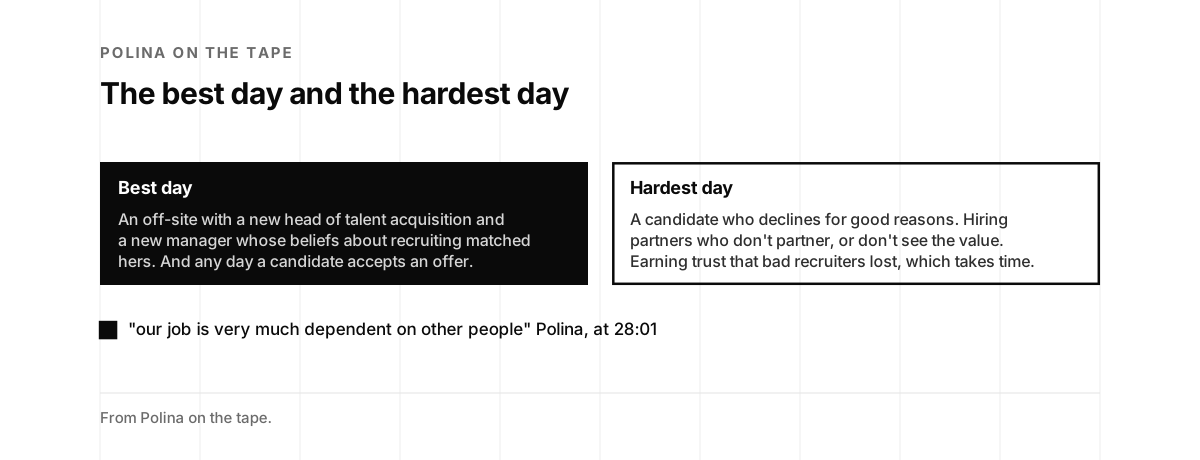
Two cards. Best day, filled: an off-site with a new head of talent acquisition and a new manager whose beliefs about recruiting matched hers, and any day a candidate accepts an offer. Hardest day: a candidate who declines for good reasons, hiring partners who don't partner or don't see the value, and earning trust that bad recruiters lost, which takes time. Below: "our job is very much dependent on other people" Polina, at 28:01
The best day and the hardest day in Polina's job, from the tape.

Green flags

On a lighter note, Jon asked for a favorite interview question, or a green flag.

“Yeah, I don’t have one question.”

Polina Morozov, at 29:49

She loves it when a candidate doesn’t try too hard. You get on the phone, say hello, and they tell you a little about themselves.

“They ask you about you, and it’s casual, and that they’re, like, being themselves and being vulnerable.”

Polina Morozov, at 30:00

Her own questions are open on purpose. She asks why they’re looking, and what made them take the call.

“Why are you leaving? What’s missing for you?”

Polina Morozov, at 30:20

Listen · Polina Morozov on episode 46, from 30:09
About 25 seconds: Polina's questions for a first call, and why she asks them. The clip stops on its own. Read the full transcript.

She also asks what the ideal next opportunity would be, because the answer may point somewhere else.

“maybe not this role, but maybe there’s a different role that would be better fit for you.”

Polina Morozov, at 30:29

She works the same way on pay and the rest of the offer.

“I try to be very transparent, as transparent as I can be about Grammarly, the role, anything in between.”

Polina Morozov, at 30:51

“I overshare, usually. So that typically makes them overshare as well, which I appreciate.”

Polina Morozov, at 30:57

When candidates stay closed off, she can’t tell whether they want the job. So she gets to know them through the process.

“I often tell people that they’ll become, like, my best friend for the next three weeks or, like, four weeks, however long the process takes.”

Polina Morozov, at 31:19

She likes learning about their families, their hobbies and where they’ve traveled, and how different and how alike everyone is. Andrew Gontarczyk shared his favorite question on episode 2: what will your first 90 days look like?
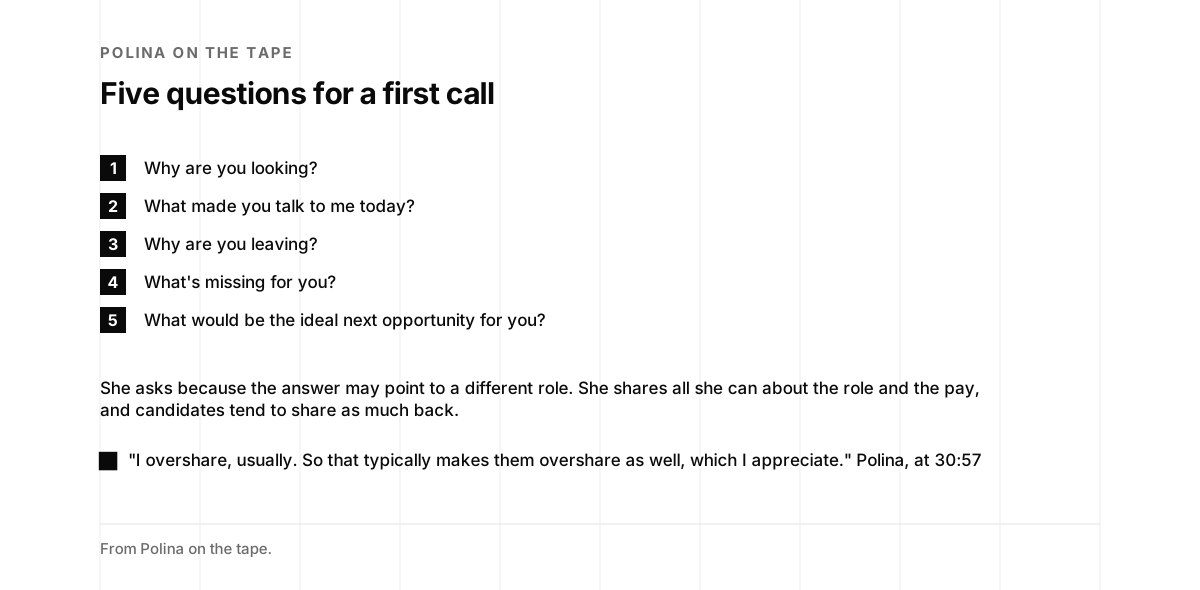
A numbered list. One: why are you looking? Two: what made you talk to me today? Three: why are you leaving? Four: what's missing for you? Five: what would be the ideal next opportunity for you? Below: she asks because the answer may point to a different role, and she shares all she can about the role and the pay, and candidates tend to share as much back. Then: "I overshare, usually. So that typically makes them overshare as well, which I appreciate." Polina, at 30:57
Polina's first-call questions and her green flags, from the tape.

Red flags

Then Jon flipped it.

“What about red flags?”

Jon McLachlan, at 31:48

The first is a candidate who hasn’t looked at the company. Some get on a call having never heard of Grammarly.

“That’s a red flag, ‘cause, like, why are we talking?”

Polina Morozov, at 32:08

She’ll tell them more, but she expects some research, especially from senior people who have been around the block. The second is the way people talk about their last job.

“And people will sometimes start venting to me about, like, their co-workers, or, like, blaming the circumstances or their managers”

Polina Morozov, at 32:25

Listen · Polina Morozov on episode 46, from 32:24
About 30 seconds: Polina on the red flag she hears most on first calls. The clip stops on its own. Read the full transcript.

“not taking responsibility for anything that has happened”

Polina Morozov, at 32:38

They don’t talk about how they tried to fix it.

“you’re not there to take a therapy call, right?”

Jon McLachlan, at 32:55

“Right. It’s not a therapy call.”

Polina Morozov, at 32:57

She described a candidate who says they’re leaving because the team is terrible and everything is horrible. Jon suggested that may signal someone who runs away from problems, and she agreed. You can be honest with her, she said, and she is empathetic, but there’s a way to present it.

“It’s still an interview, so there’s an etiquette.”

Polina Morozov, at 33:28

Some of it, she said, is for friends over drinks. She wishes she could do more for people who interview badly, because there is an art to it.

“I could coach people on how to interview”

Polina Morozov, at 33:42

“Maybe they’ve been in, like, the same job for a really long time, and, like, they haven’t interviewed, and so they’re a little bit rusty.”

Polina Morozov, at 33:50

When she can, she gives feedback on the call, so that if a question comes up later in the process, they have a better answer ready. Jon called interviewing a skill you can improve with work, effort and practice.
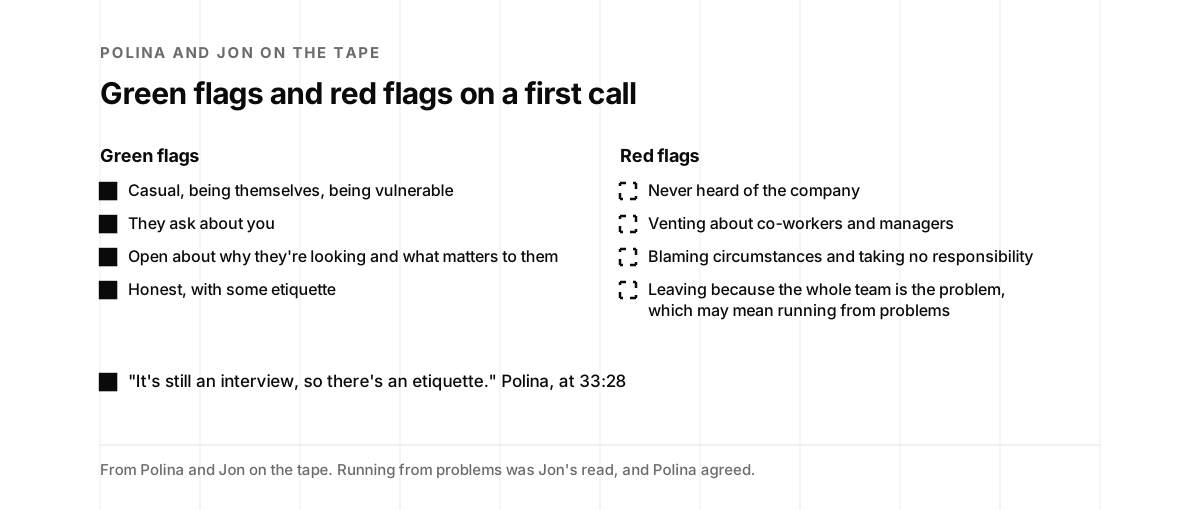
Two lists. Green flags, filled: casual, being themselves, being vulnerable. They ask about you. Open about why they're looking and what matters to them. Honest, with some etiquette. Red flags, dashed: never heard of the company. Venting about co-workers and managers. Blaming circumstances and taking no responsibility. Leaving because the whole team is the problem, which may mean running from problems. Below: "It's still an interview, so there's an etiquette." Polina, at 33:28
Polina's green flags and red flags for a first call, from the tape.

Qualify people in

Jon closed with the question he asks for the founders who listen.

“Is there a pain point that you feel, and you feel it all of the time”

Jon McLachlan, at 34:43

She has two. The first is the tools.

“Everything from, like, ATS to sourcing tools to, like, data tools to scheduling.”

Polina Morozov, at 34:59

An applicant tracking system, Wikipedia says, is software that “enables the electronic handling of recruitment and hiring processes” (Wikipedia).

“Like, scheduling, for some reason, is always, like, a hurdle in all the companies I’ve ever worked with.”

Polina Morozov, at 35:05

She wants “one place for all of it.” Today it’s separate tools, plus spreadsheets to make sense of them.

“It’s just not very cohesive.”

Polina Morozov, at 35:26
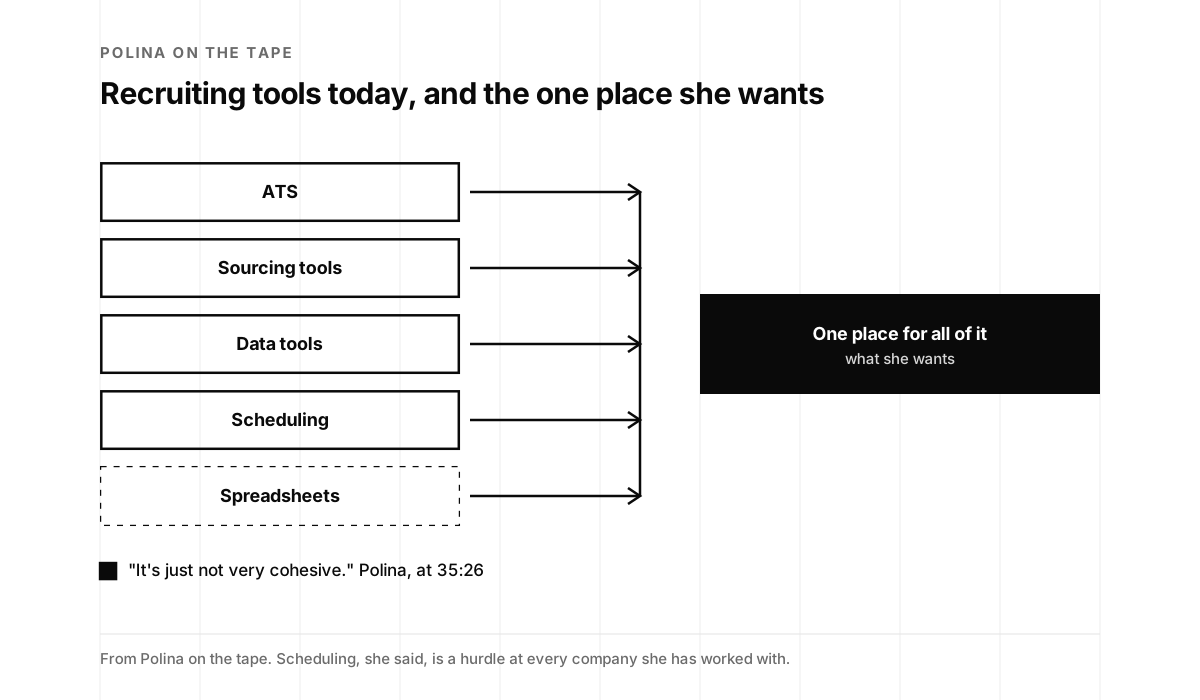
Five boxes in a column: ATS, sourcing tools, data tools, scheduling, and spreadsheets, dashed. Arrows from each join a line that points to a filled box: one place for all of it, what she wants. Below: "It's just not very cohesive." Polina, at 35:26
Polina's recruiting stack today, and the one place she wants for all of it.

The second is the interview. Engineering interviews could be unbiased, she said, and they are still biased. Companies assess technical skill in different ways.

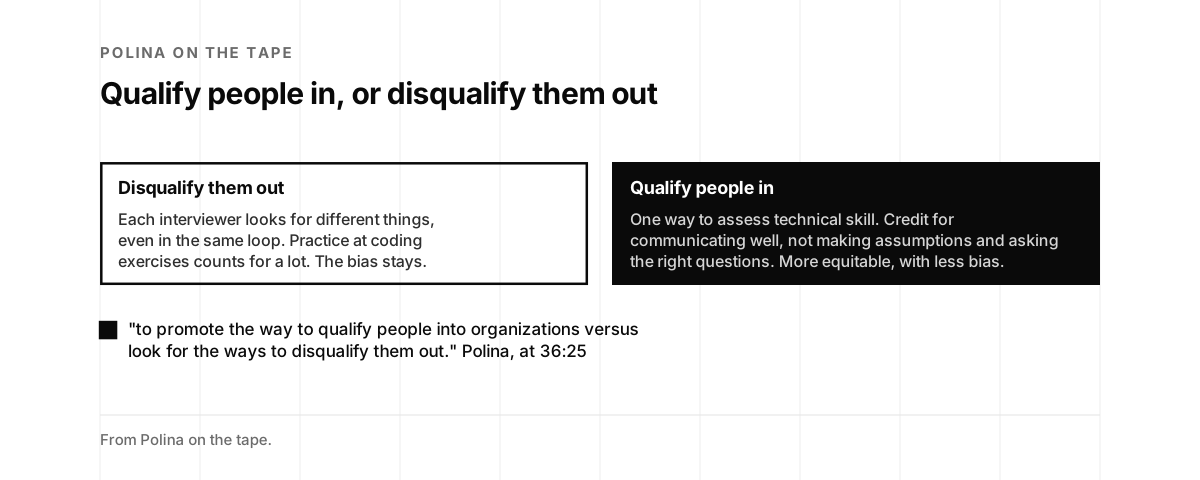
“Even in the same interview loops, you look for different things.”

Polina Morozov, at 35:56

Much of it comes down to whether you know how to interview. Candidates who practice LeetCode exercises tend to do well, she said. LeetCode is an online platform for coding interview preparation, founded in 2015, and Wikipedia counts 26.3 million monthly visitors as of 2025 (Wikipedia).

“If you know how to communicate well, not make assumptions, right, ask the right questions, you’ll do well.”

Polina Morozov, at 36:09

“So, like, I feel like we need to disrupt the interview process itself”

Polina Morozov, at 36:16

She wants it more equitable, with less bias.

“to promote the way to qualify people into organizations versus look for the ways to disqualify them out.”

Polina Morozov, at 36:25
Listen · Polina Morozov on episode 46, from 35:55
About 35 seconds: Polina on interviews that qualify people in. The clip stops on its own. Read the full transcript.
Two cards. Disqualify them out: each interviewer looks for different things, even in the same loop, practice at coding exercises counts for a lot, and the bias stays. Qualify people in, filled: one way to assess technical skill, credit for communicating well, not making assumptions and asking the right questions, more equitable, with less bias. Below: "to promote the way to qualify people into organizations versus look for the ways to disqualify them out." Polina, at 36:25
Two ways to run an interview loop, from Polina on the tape.

Her first podcast

Jon thanked her.

“This is my first podcast, so hopefully your listeners will find it useful.”

Polina Morozov, at 36:44

She said she enjoyed it. Jon thanked her for sharing her time and her insights, and thanked the listeners.

What happened after the tape

Grammarly became Superhuman. Grammarly agreed to buy Coda in December 2024, and Coda’s CEO, Shishir Mehrotra, became Grammarly’s CEO. In May 2025 it raised $1 billion in nondilutive funding from General Catalyst. In July 2025 it agreed to buy the email client Superhuman, and in October 2025 the parent company rebranded as Superhuman (Wikipedia). Episode 52 follows the same changes, including Suha’s move to DoorDash in March 2025.

Polina’s Grammarly years. Her LinkedIn says that over almost three years at Grammarly she helped scale the Security Engineering, ML, Enterprise and Growth teams, and was growing Infrastructure, Security and IT. She standardized the interview process, trained the Security team’s interviewers, and worked with the CISO and several engineering directors and vice presidents on hiring strategy (LinkedIn).

Hiring for an AI-native security team. On April 22, 2026, at Superhuman, Polina shared a hiring post by Kevin McDermott, Superhuman’s head of security. He wrote that security teams “are going to look meaningfully different 18 months from now.” His team had automated incident response investigations and security reviews, and was taking on automatic fixes for vulnerabilities next. The new hire would help “build and scale our AI-native security team.” Polina wrote that the hire would join “a fantastic team under Kevin’s leadership.”

Polina shares Superhuman's security hiring post: an AI-native security team.

Polina Morozov · April 22, 2026
Kevin McDermott's post lists what his team had automated so far, and the role it was hiring for. View on LinkedIn.

Rippling. Her LinkedIn lists her as a staff technical recruiter at Rippling since June 2026, hiring managers and directors. Wikipedia describes Rippling as a software company whose cloud platform lets businesses manage HR, finances and IT, launched in 2017 (Wikipedia).

Support for Ukraine, since. Superhuman’s page now says the company “has donated more than $6.5 million” since 2022 to organizations supporting the people of Ukraine, up from the $5 million Polina cited, and that Grammarly blocked access to its products in Russia in 2022 (Superhuman).

More on this show. Andrew Gontarczyk, then the CISO of Pure Storage, said what he hires for on episode 2: the ability to execute and deliver. Kayne McGladrey answered when a startup should hire a CISO on episode 56. On the blog, Hiring a Fractional CISO? 7 Questions That Separate a Partner From a Logo turns interviews into a decision, In-House, On-Demand, or YOLO? covers how startups staff security, and Hiring Is Now an Attack Surface covers attackers who apply for your jobs.
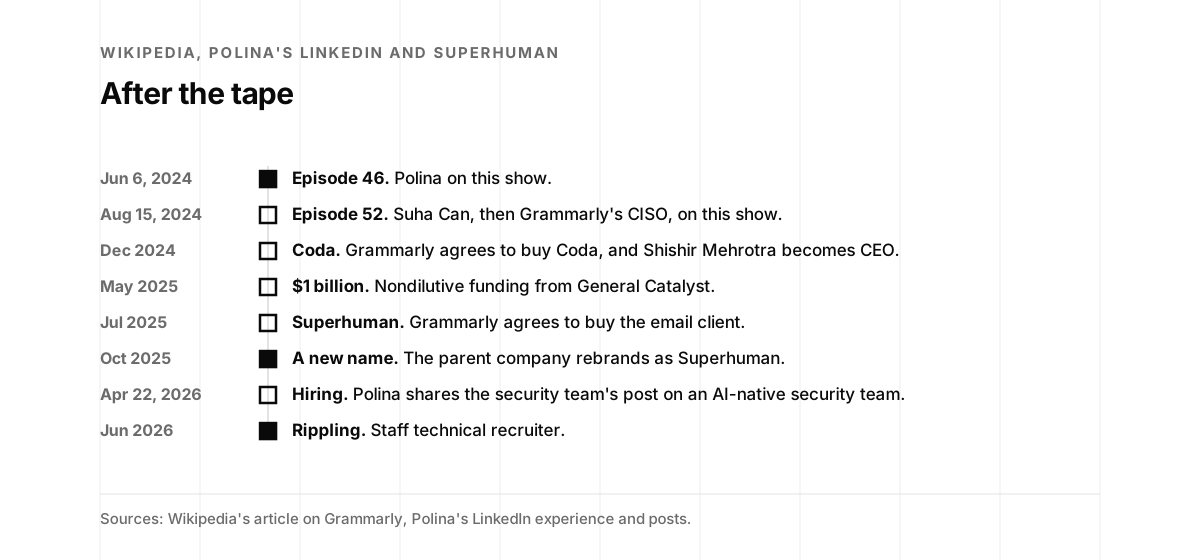
A timeline. June 6, 2024, filled: episode 46, Polina on this show. August 15, 2024: episode 52, Suha Can, then Grammarly's CISO, on this show. December 2024: Coda, as Grammarly agrees to buy Coda and Shishir Mehrotra becomes CEO. May 2025: $1 billion in nondilutive funding from General Catalyst. July 2025: Superhuman, as Grammarly agrees to buy the email client. October 2025, filled: a new name, as the parent company rebrands as Superhuman. April 22, 2026: hiring, as Polina shares the security team's post on an AI-native security team. June 2026, filled: Rippling, staff technical recruiter.
After the tape, from Grammarly's changes to Rippling. Sources: Wikipedia, Polina's LinkedIn and Superhuman.

Did you catch it? A seven-question quiz

Seven questions from the episode. Each answer links the moment in the transcript.

Quiz · seven questions

Did you catch it?

Pick an answer to see whether you caught it.

  1. What did Polina study at UCLA?

    b. "So I graduated from UCLA, and I studied international development studies." She wanted to be a diplomat or go to law school. Transcript, 1:29.

  2. What does Grammarly call its security team?

    a. "So now I do also support our security team. We call it Trust." Transcript, 6:05.

  3. What kind of firm was Binc, the company Robinhood bought?

    c. "which was, like, an RPO recruiting firm out in the Valley that was consulting all the hot companies in the Bay Area, essentially." Transcript, 4:33.

  4. Which part of recruiting does Polina call the easy part?

    a. "So that's actually the easy part" She meant the roles themselves. The hard part is the process and the hiring partners. Transcript, 8:02.

  5. How many people used Grammarly each week, by Polina's count in June 2024?

    b. "we do have over 30 million individual users using Grammarly, 30 million per week." Transcript, 11:54.

  6. Where was Polina looking for an AI security researcher, beyond LinkedIn?

    c. "reading through research papers right now, for example." Transcript, 20:35.

  7. What does Polina want the interview process to do?

    a. "to promote the way to qualify people into organizations versus look for the ways to disqualify them out." Transcript, 36:25.

Is your security hiring loop ready?

Eight questions on the interview loop for your next security hire, from the episode. Each tip quotes the tape or paraphrases it, and links its section.

Scorecard · eight questions

Is your security hiring loop ready?

Answer for the next security role you plan to fill. If two answers fit, pick the lower one.

  1. Does every interviewer score against a written rubric?

    • We have no rubric
    • Some loops have one
    • Every loop, every interviewer

    Polina names "not having good rubrics" as a blocker. See The roles are the easy part.

  2. Have your hiring managers been trained to interview?

    • No
    • The senior ones
    • Everyone who sits on a loop

    A new hiring manager may need a lot of training on how to interview, she says. See The roles are the easy part.

  3. Is the bar written down for the level you're hiring?

    • No, each interviewer decides
    • Roughly
    • Yes, and the loop agrees on it before the first interview

    A bar set too high ends with saying no to everyone. See A method to this madness.

  4. Is your offer competitive for the people you want?

    • We don't know
    • We check sometimes
    • We check each role against the market

    "maybe their comp is not as competitive, right?" See The roles are the easy part.

  5. Where do you look for candidates?

    • Inbound and job boards only
    • Plus LinkedIn and referrals
    • Plus research papers, communities and talks

    For a niche AI security role, Polina read research papers. See Matchmaking over volume.

  6. What do candidates learn about the role and the pay before they invest time?

    • Almost nothing
    • The basics
    • Everything we can share, early

    "I try to be very transparent, as transparent as I can be about Grammarly, the role, anything in between." See Green flags.

  7. Does your first call ask why the candidate is looking?

    • No
    • Sometimes
    • Always, and we listen for what's missing

    Her questions: why are you looking, why are you leaving, and what's missing. See Green flags.

  8. Do all your loops for one role assess the same things?

    • Each interviewer improvises
    • Same questions, different scoring
    • Same questions and the same scoring

    "Even in the same interview loops, you look for different things." See Qualify people in.

Hiring on hope

Your loop depends on who happens to interview. Write a rubric for the next role, train the people on the loop, and agree on the bar before the first interview.

A process in progress

The basics are there. Next, check your offer against the market, look for candidates past the job boards, and tell candidates what you can, early.

A method to the madness

Your loop qualifies people in. Keep the rubrics current as roles change, and recheck the bar each time a hiring manager is new.

How many loops before a yes

Polina’s point about a bar set too high is a pass rate. This calculator turns your pass rate into final loops, interviewer hours and weeks for one hire.

Calculator

How many loops before a yes

Four numbers: the percent of final loops that end in an offer, the interviewers on each loop, the hours each one spends, and how many final loops you can run in a week.

4.0final loops for one hire
30interviewer hours for one hire
2.0weeks of final loops

With 25% of final loops ending in an offer, one hire takes 4.0 final loops. At 5 interviewers and 1.5 hours each, that's 30 interviewer hours, and 2.0 weeks at 2.0 loops a week.

Every default here is a placeholder: put in your own numbers. A bar set too high shows up as a low first number. Polina tells candidates she'll be their best friend for three or four weeks, however long the process takes.

From UNICEF to Rippling

Polina’s path, Grammarly’s and Robinhood’s changes, and the episodes on this site that pick up the thread. Filter by topic.

Timeline

From UNICEF to Rippling

  1. Grammarly launches

    Developed in Ukraine by Alex Shevchenko, Max Lytvyn and Dmytro Lider (Wikipedia).

  2. UNICEF

    An internship, through September (LinkedIn, on this page).

  3. Recruiter and HR manager

    At Prodege, through December 2014 (LinkedIn).

  4. HireClout

    Technical recruiter and account manager at a contingency agency (LinkedIn, on this page).

  5. Binc

    Technical recruiter at an RPO firm, then lead technical recruiter from January 2019 (LinkedIn).

  6. Airbnb

    Her first Binc client, through October 2017 (LinkedIn).

  7. Protocol Labs

    A blockchain client, through December 2020 (Wikipedia, LinkedIn).

  8. Robinhood buys Binc

    Polina joins Robinhood as a lead technical recruiter and supports its crypto and security teams (Wikipedia, on this page).

  9. Episode 2

    Andrew Gontarczyk, then the CISO of Pure Storage, on building a security team (episode page).

  10. Robinhood goes public

    On the Nasdaq, under the ticker HOOD (Wikipedia).

  11. Say Technologies

    Robinhood completes a $140 million purchase (Wikipedia).

  12. The war

    Grammarly stops all business in Russia and Belarus (Wikipedia, on this page).

  13. $5 million

    Grammarly reports $4.75 million delivered toward a $5 million commitment (Grammarly).

  14. Polina joins Grammarly

    Recruiting, with the security team called Trust (LinkedIn, on this page).

  15. Generative AI

    Grammarly launches a product built on GPT-3 models (Wikipedia).

  16. Episode 46

    Polina on the show (Podbean, transcript).

  17. Episode 52

    Suha Can, then Grammarly's CISO (episode page).

  18. Episode 56

    Kayne McGladrey on when to hire a CISO (episode page).

  19. Coda

    Grammarly agrees to buy Coda, and Shishir Mehrotra becomes CEO (Wikipedia).

  20. $1 billion

    Nondilutive funding from General Catalyst (Wikipedia).

  21. Superhuman

    Grammarly agrees to buy the email client (Wikipedia).

  22. A new name

    The parent company rebrands as Superhuman, and Polina's title moves with it (Wikipedia, LinkedIn).

  23. An AI-native security team

    Polina shares Superhuman's security hiring post (LinkedIn, on this page).

  24. Rippling

    Staff technical recruiter, hiring managers and directors (LinkedIn).

What to do this week

Five things, in the order of the episode.

  1. Write the rubric first. Before the next security search opens, write down what each interviewer scores and where the bar sits, as in A method to this madness. Then take the scorecard with your hiring managers.
  2. Train the people on the loop. A new hiring manager may need help with how to interview, as in The roles are the easy part.
  3. Ask for referrals the right way. Use the product, read the job description, and send a short pitch, as in How to ask for a referral.
  4. Look past LinkedIn for niche roles. For an AI security role, read the papers and write to the authors, as in Matchmaking over volume.
  5. Get help building the team. Our vCISO Services give you a CISO who builds a security roadmap around your goals, with a dedicated security team to carry it out. Our Counter Business Espionage & IP Protection work includes hiring diligence. If you want to talk it through, book 15 minutes with us.

Key takeaways

  1. The role is the easy part

    Polina said there's really not a role that's challenging: you can change requirements and adjust to the market. The hard part is the process and the people around it.

  2. Blockers live in the process

    New hiring managers who need interview training, missing rubrics, a bar set too high and comp that isn't competitive slow a search down.

  3. Security is a small world

    Everyone knows everyone, so networking matters more, people follow each other between companies, and the impression you leave in each role follows you.

  4. The best people aren't looking

    In June 2024 she found people with good jobs hesitant to move, a probable shortage of top-tier talent, and companies with big bets and little time to ramp people up.

  5. Security felt the layoffs less

    She saw more layoffs in general engineering than in security, and recruiters were the first to go.

  6. Do your homework before a referral

    Use the product, read the job description, make sure you fit, write a quick pitch, keep it short, and say it's where you want to be.

  7. Senior searches are matchmaking

    For senior and niche roles she slows down, learns each person's story, and sources past LinkedIn, down to reading research papers.

  8. First calls should be honest both ways

    She asks why you're looking, why you're leaving and what's missing, shares what she can about the role and pay, and watches for venting and blame.

  9. Qualify people in

    She wants one place for recruiting tools and an interview process that is more equitable, with less bias, and looks for ways to qualify people into organizations.

Chapters

Tap a chapter to play from there.

Pull quotes

“security is a really small world, and I did find that everyone knows everyone.”

Polina Morozov ·

“most of my colleagues will probably agree that no one grows up wanting to be a recruiter.”

Polina Morozov ·

“I wanted to be a diplomat or go to law school, and it just wasn't in the cards for me.”

Polina Morozov ·

“And I am very shy by nature as well, and always try to push the boundary of my comfort zone.”

Polina Morozov ·

“And then they had really great recruiters, and I wanted to be mentored by them.”

Polina Morozov ·

“then we ended up getting acquired by Robinhood, and they absorbed the whole team.”

Polina Morozov ·

“So now I do also support our security team. We call it Trust.”

Polina Morozov ·

“I love how Grammarly calls that team Trust”

Jon McLachlan ·

“because the product, in order for it to be useful, it has to read things that you're typing in.”

Jon McLachlan ·

“So that's actually the easy part”

Polina Morozov ·

“What's challenging in recruiting is when you have some, like, roadblocks and blockers in your process or in your hiring partners.”

Polina Morozov ·

“there is a process and a method to this madness, right?”

Polina Morozov ·

“And that's how you can also get your next job or get your next opportunity, right?”

Polina Morozov ·

“I do have an AI security researcher role that I'm working on.”

Polina Morozov ·

“So it does take more time to warm them up to the idea of maybe leaving and exploring something else.”

Polina Morozov ·

“less so than all other teams, because obviously it's, like, an important function for many organizations.”

Polina Morozov ·

“Do your research. Really read, learn about the company, use the product, learn about the product.”

Polina Morozov ·

“And then the search allows me to slow down, right?”

Polina Morozov ·

“different strategies when it comes to sourcing, outside of just looking on LinkedIn, right?”

Polina Morozov ·

“our company was founded in Ukraine. Our co-founders are from Ukraine, and we have many team members who call Ukraine home.”

Polina Morozov ·

“We also donated over $5 million to various organizations supporting Ukrainian people.”

Polina Morozov ·

“our job is very much dependent on other people”

Polina Morozov ·

“I overshare, usually. So that typically makes them overshare as well, which I appreciate.”

Polina Morozov ·

“It's still an interview, so there's an etiquette.”

Polina Morozov ·

“Even in the same interview loops, you look for different things.”

Polina Morozov ·

“to promote the way to qualify people into organizations versus look for the ways to disqualify them out.”

Polina Morozov ·

About the guest

Polina Morozov, Security Recruiter, Grammarly

Polina Morozov is a technical recruiter. She studied international development studies at UCLA and interned at UNICEF in 2010. She recruited at the agency HireClout and then at Binc, a recruitment process outsourcing firm, where her clients included Airbnb, Instacart, Capital One, Ripple, Protocol Labs and Zoox. Robinhood bought Binc in March 2021, and she supported Robinhood's crypto and security teams as a lead technical recruiter. She joined Grammarly in June 2022, where she recruited for the security team, called Trust, and worked with the CISO. She joined Jon McLachlan on episode 46, published June 6, 2024. Her LinkedIn lists her at Superhuman, Grammarly's renamed parent, from October 2025, and as a staff technical recruiter at Rippling since June 2026.

About the host

Jon McLachlan is co-founder of YSecurity, the on-demand cybersecurity team for startups, and of Cyberbase.ai. The Security Podcast of Silicon Valley is hosted by Jon McLachlan and Sasha Sinkevich. Jon McLachlan on LinkedIn ↗

Context and sources

  • Episode 46 on Podbean, June 6, 2024, with show notes on Polina's path from aspiring diplomat to recruiting, Grammarly, Robinhood, and recruiting in security. Source ↗
  • Polina Morozov's LinkedIn experience: Rippling from June 2026, Superhuman from October 2025, Grammarly from June 2022, Robinhood from March 2021 through Binc's acquisition, Binc from October 2016, HireClout from June 2015, and a UNICEF internship in 2010. Source ↗
  • Polina Morozov on LinkedIn, April 22, 2026: she shares a hiring post by Kevin McDermott, Superhuman's head of security, for an AI-native security team. Source ↗
  • Grammarly, How Grammarly Is Honoring Our Commitment to Ukraine, April 26, 2022: $4.75 million delivered toward a $5 million commitment, relocation and financial support, and a year of paid leave for employees joining Ukraine's armed forces. Source ↗
  • Superhuman, Superhuman stands with Ukraine: more than $6.5 million donated since 2022, and free paid features for Ukrainian nonprofits, NGOs and media organizations. Source ↗
  • Wikipedia, Grammarly: developed in Ukraine and launched in 2009, stopped business in Russia and Belarus after the 2022 invasion, generative AI from April 2023, Coda in December 2024, and the rebrand to Superhuman in October 2025. Source ↗
  • Wikipedia, Robinhood Markets: Robinhood acquired the recruiting firm Binc in March 2021, went public on July 29, 2021, and completed the purchase of Say Technologies in August 2021. Source ↗
  • Wikipedia, Recruitment: recruitment process outsourcing, and employee referrals. Source ↗
  • Wikipedia, Executive search: contingent recruiters are paid only when a search succeeds, and retained recruiters are paid for the process. Source ↗
  • Wikipedia, Job interview: structured interviews are usually more accurate predictors, and training and several interviewers may reduce bias. Source ↗
  • Wikipedia, Applicant tracking system: software for the electronic handling of recruitment and hiring. Source ↗
  • Wikipedia, LeetCode: an online platform for coding interview preparation, founded in 2015. Source ↗
  • Wikipedia, Protocol Labs: an open-source research and development company, founded in 2014, best known for the InterPlanetary File System. Source ↗
  • Wikipedia, Rippling: a software company whose cloud platform lets businesses manage HR, finances and IT, launched in 2017. Source ↗
  • Wikipedia, UNICEF: the United Nations agency for humanitarian and developmental aid to children. Source ↗
  • Wikipedia, Extraversion and introversion: introversion is linked to introspection, reserve and a preference for solitary activities. Source ↗

Transcript

Automatic transcription. Jon McLachlan hosts this episode with Polina Morozov, then a security recruiter at Grammarly. There is no diarization on the tape, so speaker labels were assigned from the content and checked against reference recordings of each voice from this episode and by pitch, and a few short lines may sit with the wrong speaker. Names and terms were normalized where the recognizer misheard them (Jon McLachlan, Polina Morozov, Grammarly, Pure Storage, UCLA, HireClout, Binc, RPO, Airbnb, Ripple, Capital One, Instacart, Protocol Labs, Robinhood, Suha, ATS, LeetCode). Words in [brackets] are best guesses where the audio is unclear. Answers are transcribed as spoken, with most repeated words and false starts kept. Short backchannels such as "yeah" and "right" are left out where they overlap the other speaker.

Read the full transcript 6,209 words

Jon McLachlan

Hello, everyone, and welcome to another episode of the Security Podcast of Silicon Valley, a YSecurity production. I'm your host, Jon McLachlan, and I am joined today by a very special guest, Polina Morozov.

Polina Morozov

Thank you, Jon. I'm really excited to be here and talk about all things recruiting.

Jon McLachlan

Awesome. You're a recruiter at Grammarly.

Polina Morozov

I am, yes.

Jon McLachlan

I'm a huge fan of Grammarly. They help my communication, my written communication, on pretty much everything.

Polina Morozov

Yeah, that's music to my ears.

Jon McLachlan

I remember when I first started using Grammarly, I was at Pure Storage, and I actually had co-workers come up to me and say, "Did you take a communication class? What's going on? Your communication is so much better. Your written communications." I was like, "Nope, it's just Grammarly." Just Grammarly.

Polina Morozov

Yeah. So similarly to you, I also have been using Grammarly forever, in college. And then when I started in recruiting, because it entails a lot of writing, and that's why, like, one of the reasons why I joined Grammarly as well.

Jon McLachlan

I bet as a recruiter you are communicating all the time.

Polina Morozov

Yes, non-stop. That's basically the job.

Jon McLachlan

That's the job. Yeah. So how did you get into recruiting?

Polina Morozov

Yeah, so most of my colleagues will probably agree that no one grows up wanting to be a recruiter. I didn't even know that this job exists, and I think my parents still don't know what I do. But I fell into it. So I graduated from UCLA, and I studied international development studies. And so there, in a young, romantic manner, I wanted to be a diplomat or go to law school, and it just wasn't in the cards for me. I am an immigrant, so I moved to America in, like, middle school, when I was a teenager, and I needed to work, essentially. So, like, that was the thing. I couldn't continue my education. And so right after college, I was doing something else. I was working for, like, a property management company, which was very interesting experience. Like, I loved my boss. She was, like, very inspiring, but there was just not many career growth opportunities. And I think I was, like, making minimum wage at the time. So I was, like, really trying to find something, right, anywhere. It was also, like, an interesting time with our economy, and, like, the jobs were scarce at the time as well. So I did get hooked up with a job. One of my husband's cousins was working at a startup in LA, and he was a lawyer, and he was running all the HR operations. This was also probably 12 years ago. He was starting out his career, like, just like myself. And he needed help, and he just needed someone who's going to help him in all of the HR motions. And the startup was, like, at 35 people at the time. So, like, I interviewed with him. I did go through the process, and he, you know, did hire me. And I did everything in HR, from payroll to planning our events to, like, moving offices once we grew, stocking kitchen, and then also recruiting. And I am very shy by nature as well, and always try to push the boundary of my comfort zone. And that's, like, part of the reason why I'm doing this today as well.

Jon McLachlan

That's amazing.

Polina Morozov

Yeah. And so I also found that I really connected with engineers, engineers at the company, or, like, engineers that I would talk to when I was recruiting for the startup. I think we're, like, because they're also, like, introverted, like myself, they maybe didn't feel, like, very intimidated by me, 'cause I wasn't, like, very salesy in, like, my demeanor. And I just, like, really liked it. I liked learning about computer science and, like, what these people are able to create. And I liked that it was, like, really challenging me. So I gravitated towards recruiting. So eventually, I did leave the startup. I had my first child, and it was, like, an hour and a half commute from our house. So I needed to find something more, like, conducive. So I did, yeah. So I did get a job at an agency, HireClout, where it was, like, your regular contingency agency. And I spent about a year and a half there, just working as a recruiter, account manager, learning the ropes, trying to get, like, business from, for us, going to Santa Monica and Venice, and my cold calling, and learning the job from that perspective. I always knew about Binc, which was, they no longer exist, but which was, like, an RPO recruiting firm out in the Valley that was consulting all the hot companies in the Bay Area, essentially. And I really wanted to work there, because I knew that it would give me exposure to these organizations where I wouldn't be able to actually move to the Bay Area. And then they had really great recruiters, and I wanted to be mentored by them. I got hired, and the rest is, like, history. It was a great experience. I consulted many companies, from Airbnb to Ripple, Capital One, Instacart. Then I also worked with some blockchain companies, like Protocol Labs. And we ended, yeah, and then we ended up getting acquired by Robinhood, and they absorbed the whole team. And then, yeah, so I was at Robinhood for about a year and a half. And then I left because Grammarly actually reached out to me, and I couldn't say no to them.

Jon McLachlan

That's spectacular. That's an incredible story. You have the common theme of always pushing yourself outside your comfort zone and position yourself to learn and to grow, and surround yourself with smart people.

Polina Morozov

Thank you. Thank you for your kind words.

Jon McLachlan

I mean, being an introvert is amazing, though, too. That just means, like, we recharge better sometimes with less folks around us. That's not a bad thing.

Polina Morozov

No, I love my alone time.

Jon McLachlan

That's awesome. I do too, to be totally honest. So now [at Grammarly], what do you do?

Polina Morozov

So now I do also support our security team. We call it Trust. So I work closely with our CISO, Suha, and then a bunch of different hiring managers, supporting hiring for their specific orgs. I did support, like, different teams at Grammarly, from our, like, Grammarly for Developers, when that was a thing, to machine learning. But really, I do have a special place for security teams, and I really do enjoy the roles and, like, the unique, like, smaller community of, like, security world. And so I just gravitated right back into that. So now I feel...

Jon McLachlan

Yeah, [you're on] security and trust.

Polina Morozov

Yes, security and trust.

Jon McLachlan

I love how Grammarly calls that team Trust, not just security.

Polina Morozov

Yeah, trust is big for us. Like, we really want our users to be able to trust our product, and we do work on that really hard.

Jon McLachlan

No, I imagine that you do, because the product, in order for it to be useful, it has to read things that you're typing in. It has to read emails. It has to, there's a very convenient, very fun keyboard on the iPhone. It is reading things. So trust is very important if you're going to be using this service. Super happy to hear that Grammarly takes all of that very seriously.

Polina Morozov

We do, yes.

Jon McLachlan

So what's maybe, what's the most challenging role that you've ever filled?

Polina Morozov

Yeah, I've been actually, like, answering this question in, like, my mind for a few weeks now, and, like, pondering on what a good answer would be, 'cause there's really not a role that's, like, really challenging, in my opinion. Like, you can always find someone, right? You can change your requirements, adjust, pivot, depending on what the market, what is the market telling you, and what kind of talent you're attracting. So that's actually the easy part, the roles themselves. What's challenging in recruiting is when you have some, like, roadblocks and blockers in your process or in your hiring partners. 'Cause I think every recruiter will tell you that they experience this, where if your hiring manager maybe is, like, a new hiring manager and needs a lot of, like, training on how to, like, interview, and the nuances of the process, or if there's blockers in the process itself, like not having good rubrics, or maybe having the bar too high that's not aligned to, like, the [lowest].

Jon McLachlan

You just say no to everybody, maybe, sometimes.

Polina Morozov

Sometimes you just, yeah, right, you start saying no to everyone. So it's more about, like, your partners, right, in the process, and the process itself that's challenging. Like, when I was a consultant, also, like, supporting startups, like, maybe their comp is not as competitive, right? And so that becomes a big challenge to attract the talent that they want. So it's less about the role itself, because if you have receptive team, then you can adjust and find the right person. It's more about having that right team and the right processes in place.

Jon McLachlan

That's nice. I know. I appreciate the insight. Yeah.

Polina Morozov

Go ahead.

Jon McLachlan

Oh, go ahead.

Polina Morozov

No, I was saying that there is, like, there is a process and a method to this madness, right? So there are certain things that need to be done that yield in, like, positive result and end up in a hire. And so, like, when you miss some of the steps, and things get, when you deviate from, like, the process, that's when you get yourself in trouble.

Jon McLachlan

Yeah, could only imagine. And I imagine that intersection between security and recruiting has some nuances about it that just don't exist in other parts of the org, or in other parts of recruiting, maybe, in general. What can you share with us about that intersection?

Polina Morozov

Yeah, I mean, I think it's also, like, security is a really small world, and I did find that everyone knows everyone. So, like, networking is really important, for example. Networking and making sure that, like, you're leaving positive, lasting impressions [in] your current roles, because I do find that it's a very, like, close-knit community.

Jon McLachlan

I guess if everyone knows everyone else, and, like, a reality TV show.

Polina Morozov

Sometimes it does seem that way. So I think, like, networking in security is really important. And that's how you can also get your next job or get your next opportunity, right? I do find that a lot of people follow each other as well, where in, like, the general, like, software engineering world, I see less of that, 'cause it's like there's just more people, more opportunities, et cetera, where in security, it's very niche.

Jon McLachlan

I've always thought about security being, like you mentioned before, focus on trust. And when you bump into people that you enjoy working with and that you work well together with, there's a sense of trust that developed. In security, especially so important. So yeah, maybe that's why folks maybe will sometimes follow each other a little bit.

Polina Morozov

Yeah, that's a good point. It's just, like, that theme of trust all across.

Jon McLachlan

I know Grammarly has a pretty strong consumer presence, and so us as individuals, we can sign up and we can use it. I don't know if it has too much of a business presence, like if there's business sales, but have you ever had to hire for a compliance role that maybe [bubbled up] because of business needs?

Polina Morozov

Yeah, and so I'll answer your first question. So yes, we do have over 30 million individual users using Grammarly, 30 million per week. And then we actually also have over 70,000 teams connecting on Grammarly. And it's actually, like, one of our bigger focuses right now is on our enterprise offering, where we would like for more organizations to be able to use Grammarly in their ecosystem. It's a very tailored experience, because there's a big generative AI component. We're also, like, able to pull information from your internal wiki pages or your docs and help you with company tone. And so we've really honed in on helping you with [productivity] and decreasing the number of hours you spent on communication, and then also, like, digesting the information that's being sent to you. I'm not sure if you saw, there's, like, a couple of, like, really cute commercials out there that, like, take place in an office space environment, and it's, like, really cute and funny. And if you haven't, check it out on YouTube.

Jon McLachlan

[We can have] links in the show description.

Polina Morozov

Okay, cool. Perfect. Yeah. And so our focus is actually in helping more organizations be more productive and, like, effective in their communication across their teams. And that's, like, what we're focusing on right now, and continuing to grow, like, that client base. In terms of compliance roles, I personally haven't worked on any compliance roles. So I mostly focused on, similarly to, like, when I was at Robinhood, more on, like, product security roles, corporate security roles, some system engineering type roles. I do have an AI security researcher role that I'm working on. It's just, like, recently kicked off, where we're looking for someone who can really spearhead that for us, security specifically in, like, in AI products, and spearhead, like, research in that area and represents Grammarly for us. So that's one of, like, really niche, interesting roles.

Jon McLachlan

That's such [unclear].

Polina Morozov

Yeah, yeah, it's very specific, for sure. It's one of those roles. But yeah, not compliance, or not yet, at least.

Jon McLachlan

Yeah, not yet. In cybersecurity in general, do you feel like that there's any sort of shortage of talent out there? Is it sometimes challenging to find the right fit, or [unclear]? So I'm sure it's, like, always just super...

Polina Morozov

So easy.

Jon McLachlan

People talk about this thing called, like, the cybersecurity talent shortage.

Polina Morozov

Yeah. So generally speaking, I feel like people are also more hesitant to maybe move right now, just 'cause of the economy. And if they do have a good gig and they're, like, they're really good at what they do, they're not ready to jump on a new opportunity very readily. So it does take more time to warm them up to the idea of maybe leaving and exploring something else. I mean, yeah, and then I think there's probably a shortage of talent, especially when you're looking at, like, top-tier talent. Grammarly is in a unique position where we are making some, like, really big bets, and we need some talents to come in that can really jump on things and solve them for us now, and might not have a lot of time to [ramp] people up. And [I] did find that it's the volume of candidates, and it takes a longer time to engage with folks, and again, to, like, convince them to look outside of their current opportunity.

Jon McLachlan

I guess, I mean, there's a lot of layoffs happening in the Bay Area and just with the economy in general. Do you find that similar things are happening with cybersecurity roles? And they're probably not, like, their top talent.

Polina Morozov

Right. I mean, sometimes they do, for sure, especially, like, larger organizations. Like, they just make decisions, they think, and then, or, like, they decide to cut a business line, right? And it's, that has nothing to do with performance. Yeah, and there's been so many layoffs. So for security, 'cause I also, like, I've been, like, helping out and dabbling in just, like, general engineering roles as well, and there's, like, definitely more layoffs in the engineering world when you look at it versus security. I think security [teams have] been affected, like, less so than all other teams, because obviously it's, like, an important function for many organizations. So I don't, I actually don't come across many security engineers who have been laid off. There's maybe, like, a few, but not many, and I can't even think of anyone that I'm talking to right now who's been laid off. Like, most people are currently employed. So I do feel like the security world's been affected less. So, yeah. How about you? Have you noticed that it's been affected more? Oh, I mean, what's been your experience?

Jon McLachlan

When there is a round of layoffs, and they do sometimes impact security, I will [get] pinged from people asking about opportunities that I might know of. Yeah. Advice, sometimes, because it's, like, emotionally can be challenging.

Polina Morozov

It's also, yeah, I mean, maybe it's also 'cause of, like, my perspective. Like, a lot of recruiters have been laid off in the last probably, like, year and a half, so it's been really rough out there. And similarly to you, I get a lot of messages from, like, my friends and colleagues looking for work, and there's not, not many companies are looking for recruiters, and unfortunately we're always the first ones to be let go, 'cause when companies stop hiring, like, the recruiters are the ones who don't have work.

Jon McLachlan

People reach out to us, and in times when they're looking for new opportunities, would you suggest that there's a, there's, like, a best way to use your network? Like, a really good way to use your network?

Polina Morozov

Do your research. Really read, learn about the company, use the product, learn about the product. Look at the jobs. Make sure you really align to the job that you're asking to be referred to. And then also write a quick pitch about yourself, like why you are the right person, or, like, why should you be considered in the running for this role. And don't make it too long, 'cause I do also get many pings from, like, different kinds of, like, backgrounds about roles at Grammarly, and oftentimes, like, they haven't done their research, or, like, they just read the title of the role and they didn't read the job description, and then, like, their background is actually not, like, a fit. So the more homework you do, the easier it will be for the person, A, to refer you, and then they just show more enthusiasm about wanting to work there. And it's, like, really important to, you want to flatter them up. Like, you want to tell them, yes, like, this is the company where I want to be, because people are very receptive to that. So I think that's really important.

Jon McLachlan

Amazing. Do you have a favorite role to hire for? Like, you see something open up, [or a req] come in, and you get excited.

Polina Morozov

Yeah, I mean, I do enjoy, like, more senior roles, to be honest. Like, anything, like, manager and above, directors, VPs, lead, like, tech staff people, everyone who's, like, more senior. I just, like, love to learn about, like, their story. And then the search allows me to slow down, right? 'Cause I can, like, just look for, I don't need such high volume of candidates in the pipeline. It's more about finding that right match to the role. It's, it becomes more of a matchmaking game versus just volume of volume. Yeah, and I do enjoy that, because I do try to connect with my candidates and learn about them, learn what's important to them, and really make sure that they also have all the information they need to make a decision about the role. And I love, like, building that, like, trust again with my candidates. So.

Jon McLachlan

Sounds like a great networking opportunity for the recruiter as well. Yeah, for sure. Yeah. Stay in touch with folks that you interview, and maybe it's not a good fit, but you just happen to stay in touch with them through future opportunities, maybe?

Polina Morozov

Yeah, I've stayed in touch with a lot of people from Robinhood, for example, right? And folks that I've hired, and we do check in time to time, and it's also, like, part of building your network. And then I do roles that are, like, really hard to find. The AI security researcher role I'm working on, that's really interesting. I'm, like, learning a ton. And then also I like to look for that needle in the haystack and try different strategies when it comes to sourcing, outside of just looking on LinkedIn, right? And trying to, like, reading through research papers right now, for example.

Jon McLachlan

So, lots of research papers here, reached out to them, maybe?

Polina Morozov

Yeah, and lately that's what I've been doing, which is fun, and just, I don't know, I like more niche, like, difficult roles.

Jon McLachlan

You like a good challenge.

Polina Morozov

I do like a good challenge, yes.

Jon McLachlan

That's spectacular. I think a lot of people in security get into security because they're just really complex, intricate puzzles, and the answer to the question, what is the right thing to do here, it's just [not] obvious.

Polina Morozov

Yeah, yeah, I can see that.

Jon McLachlan

So with Grammarly being a Ukrainian-founded company, and everything that's going on over there, right, I'm sure that has touched the company culture a little bit. And you mentioned yourself that you're an immigrant. I have all of the respect and love in the world for the Ukrainian people, and heart goes out to them for everything that's happening. There's nothing glorious about war, but have you noticed that has had an impact on the culture?

Polina Morozov

Yeah, yeah. I mean, we're very, like, deeply connected to Ukraine, because our company was founded in Ukraine. Our co-founders are from Ukraine, and we have many team members who call Ukraine home. So the war started in February of 2022, and then I started with Grammarly in June of 2022. So I wasn't there for that transition. I don't know what the culture was. I haven't experienced it. But part of the reason why I joined was because it was a Ukrainian company. And, like, when I saw what was happening in Ukraine and the war, it, like, deeply affected me on the personal level. I'm actually from Russia, but one of the reasons why we left Russia was because of its government, and we left in 2000, when Putin did become a president. And my husband's family is from Ukraine.

Jon McLachlan

Oh, okay, so Romeo and Juliet.

Polina Morozov

I mean, sort of. I mean, I'm 100%, like, Ukraine, pro-Ukrainian. It's not even, like, a question. But yeah, so it was part of the reason why I wanted also to join Grammarly, because it meant a lot to me that I could contribute in any way, shape or form in, like, supporting the Ukrainian people. And Grammarly has done a lot for Ukraine and their employees. For employees, obviously, like, they've supported them in many ways through the war, and some people were helped to move out of Ukraine. And one of, we also opened an office in Germany, and so a lot of folks moved to Germany during the war. We also donated over $5 million to various organizations supporting Ukrainian people. And we offer Grammarly and all of our paid features in Ukraine for free to anyone who wants to use it. So that's also a way to contribute. And then, yeah, and I'm sure, like, we've done a lot more that I'm forgetting about or not even aware about, because we're so embedded in and invested into Ukraine that, like, there's just a lot of maybe even untangible things that we've done during this, like, really difficult time.

Jon McLachlan

With you being from Russia and your husband being from Ukraine, and with extended family, but has that been challenging to have?

Polina Morozov

I mean, not really. I come from a very small family. Everyone is in America now, so no one else in Russia. I have some very distant family members, but I'm not in touch with them. And so I've always, it's funny, 'cause, like, I've always, after, like, I immigrated to the United States, like, most of my friends have always been Ukrainian. And so one of my best friends was Ukrainian, and I've almost lived at her house for a period of time in, like, high school and college. And so, like, I feel very connected to that culture. So there's not any kind of a divide or any question in mind with my family about who to support or what's happening.

Jon McLachlan

No, I mean, spectacular to hear. Some of the closest people in my life and chosen family from Russia, Belarus and Ukraine. So just, like, all three. Just saying, you know.

Polina Morozov

Yeah, and I mean, if people have moved out of the country into the United States, I think that obviously explains...

Jon McLachlan

It changes things, yeah.

Polina Morozov

It changes things, and they wouldn't have left if they liked it there or supported the government, so obviously they're not in alignment with what's [happening].

Jon McLachlan

The propaganda machine can't touch you, like, way over here. Yeah, no. Well, that's pretty amazing. It warms my heart that Grammarly is playing an active role to make the lives of folks going through a challenging...

Polina Morozov

Yeah. We just had an off-site in San Francisco for the people team at Grammarly, and we had a lot of our team members from Ukraine, and those who had to be misplaced because of the war, come and join. It was, like, an amazing experience to hang out with them and just see how incredible and strong they are, 'cause, like, they're still very positive and living their lives when there's all these, like, different things going on there. And they also have family in Ukraine. And it was just, like, incredible to witness their, like, strength and, like, life philosophy. So it's, like, a very interesting experience.

Jon McLachlan

Yeah, absolutely. I mean, I think it's those challenging moments, and those moments where we're outside of our comfort zone, that not only are we, like, learning and we're growing, but you really get to see, like, people's true colors come out. And for most of humanity, that's really beautiful.

Polina Morozov

For sure.

Jon McLachlan

So what's the best day that you've had at Grammarly?

Polina Morozov

So, yeah, so it was recent, honestly. Yeah, we, when we had that off-site, like, the whole experience is pretty great. We hired some, like, new talent on the team, head of our, like, talent acquisition. I got also a new manager, and they're just, like, amazing, incredible people. And it was very energizing to meet them, because as, when, like, your leadership changes, you don't know what to expect. So it could be scary at times, but it was great meeting with them, and I felt like my personal beliefs when it comes to this art of recruiting very much aligned with, like, their philosophies and beliefs, which really energized me and made me even more excited about being part of this journey, like, hiring people and growing Grammarly. And so that was really great. And then we just had some, like, fun little events that they put together. So it's always good to get pampered, and, like, they wined and dined us.

Jon McLachlan

[That sounds] nice.

Polina Morozov

Good time. Yeah. So that was definitely, like, a really good day. And then I always have a great day when a candidate accepts my offer and, like, they're excited about joining. That's always worthy celebrating and makes me really happy.

Jon McLachlan

What's the most challenging day that you've faced at Grammarly?

Polina Morozov

Yeah, that's a difficult question, and I do have a few. Like, our job is very much dependent on other people, and, like, other people's decisions and other people, like, moves, and a lot of it is out of our control. So obviously, when someone decides not to join Grammarly for legitimate reasons, because they have to do what's best for them, right? And sometimes it's not us, which is, like, totally fine, but definitely, like, it's a little bit, like, sad, because I did want to make it work, but it didn't. So. And then also, I'll be more vague, but when your hiring partners don't, like, partner up with you the way that you want them to, or don't see the value in your job. I think recruiting and recruiters do have a bad rep, because there are a lot of bad recruiters out there, and people do have bad experiences with recruiting, which kind of prevents us from trusting us. And so when you work with either a candidate or a hiring manager who is apprehensive, had [bitter] experiences in the past, and you really need to, like, work extra hard on earning that trust and, like, showing your value and showing them that, hey, I'm really here to support you and help you, and you can trust me, and I know what I'm doing through this process. And that becomes challenging, because it does take time, right? So it's not going to be immediate, and it can take any amount of time, depending on who you're working with. And that's, like, challenging sometimes, to build those relationships.

Jon McLachlan

Yeah, that can be. And I appreciate your sharing. I know that's a difficult question, but on a lighter note, do you have a favorite interview question, or is there something, is there a green flag that you look for when you're interviewing somebody?

Polina Morozov

Yeah, I don't have one question. I love when people, like, don't try to be super, and you just, like, get on the phone with them, you're like, "Hey, how are you?" And they start telling you a little bit about themselves. They ask you about you, and it's casual, and that they're, like, being themselves and being vulnerable. I think that's, like, very important. I try to ask more, like, vague questions to just get to know them. Like, I always interested to know, "Hey, like, why are you looking? Right? What made you talk to me today? Why are you leaving? What's missing for you? Right? Would be, like, the ideal next opportunity for you?" Because I do want to learn more about the candidates and then figure out, maybe not this role, but maybe there's a different role that would be better fit for you. But just when candidates are being, like, vulnerable and honest with me, like, that makes my job really easy. And same goes to all of it. Like, when we're talking about, like, more compensation questions or questions about some other things that's really important to them, I try to be very transparent, as transparent as I can be about Grammarly, the role, anything in between. I overshare, usually. So that typically makes them overshare as well, which I appreciate. But it is difficult when they don't and they try to hold their, like, closed off, 'cause then I don't know where, what they're thinking. Like, do they really want to work here? What's happening? Makes me question it. But there's not one question. And I love to just get to know them through the process too, because, like, I often tell people that they'll become, like, my best friend for the next three weeks or, like, four weeks, however long the process takes. And I love just learning about, like, their families or their hobbies or, like, where they traveled. And it's the longer process, but it's interesting to learn about, like, people's history and, like, where, what they're about, and how, like, different, but yet the same everyone is.

Jon McLachlan

I mean, these are human beings. Yeah. What about red flags? Things that are just, like, whoa, what was that?

Polina Morozov

Yeah, I do get red flags sometimes, too. I mean, one, if you're talking to any company, right, do your research. Make sure that you know what the company does. Sometimes I'll get on a call, and, like, they have no, never heard of Grammarly, have no idea what we do. That's a red flag, 'cause, like, why are we talking? Obviously, I'll tell you more about us, but do a little bit of research at least, especially, like, when I'm talking to more senior people, right, who've been around the block for a while. And then when they start, there's obviously some nuance to interviewing. And people will sometimes start venting to me about, like, their co-workers, or, like, blaming the circumstances or their managers, and, like, why things didn't work out, like, not taking responsibility for anything that has happened or, like, is happening to them, not talking about ways, like, they tried to resolve or, like, troubleshoot. And it's more just, like, [me], maybe, like, somewhat not self-aware at times, even.

Jon McLachlan

I mean, you're not, you're not there to take a therapy call, right?

Polina Morozov

Right. It's not a therapy call. Also, it's like when you're being very aggressive and just not, I don't know, like, not taking any responsibility and just, like, saying, "Well, I'm leaving because the team is terrible. Everything's horrible."

Jon McLachlan

Maybe the signal that you're getting from that is you run away from problems.

Polina Morozov

You run away from problems, yes. And then also, you can be honest, especially with me, because I do understand, I'm very empathetic, right? But there's also a way to, like, present that information. It's still an interview, so there's an etiquette. And some of this information, maybe share with your friends over drinks and not with me.

Jon McLachlan

Yes, yes. No, that's, that's too bad that happens sometimes.

Polina Morozov

Yeah, it happens. Sometimes I wish, like, I could coach people on how to interview, 'cause again, like, there is an art to this. And I think sometimes people just don't know how to interview. Maybe they've been in, like, the same job for a really long time, and, like, they haven't interviewed, and so they're a little bit rusty. And I do try to give some feedback when we're talking, and I'll say, "Hey, if you, this question comes up when you're talking to us later in the process, maybe try to say this instead of that." But I wish I could coach them a little bit more as well, 'cause I think it's hard, and some people are really great at it and some are not. And it takes time to really learn how to [contribute].

Jon McLachlan

I'm sure it's a skill. Yeah. You think you can improve skills that we have, and it takes work, and it takes effort, and being deliberate. Well, this is a little bit of a leading question. We have a lot of founders and entrepreneurs that listen to this show. And so in that spirit, is there anything out there, Polina? Is there a pain point that you feel, and you feel it all of the time, and you think someone should just step in and fix this or solve this or build this thing, and I would use this?

Polina Morozov

Yeah, I mean, all the time. I feel like systems [in] recruiting are not the best. Everything from, like, ATS to sourcing tools to, like, data tools to scheduling. Like, scheduling, for some reason, is always, like, a hurdle in all the companies I've ever worked with. It's, like, not a good, streamlined process. So I always think about how it would be great if there was one place for all of it, versus, like, different tools that we have to use, spreadsheets to make sense of things. It's just not very cohesive. And then also, like, the way we interview, right? I feel like a lot of, especially in engineering, I feel like it's type of interviews that could be very unbiased, but they're there, yet they're still very biased. And there should be a way to consolidate, like, different ways that companies assess engineers on, like, the, specifically, like, their technical acumen, 'cause all companies look for different things. Even in the same interview loops, you look for different things. And it, again, comes to whether you know how to interview or not. So, like, LeetCode, right? If you practice a lot of code type of exercises, like, you typically will do well. If you know how to communicate well, not make assumptions, right, ask the right questions, you'll do well. So, like, I feel like we need to disrupt the interview process itself and do something to it where it's more equitable, it has less bias, to promote the way to qualify people into organizations versus look for the ways to disqualify them out.

Jon McLachlan

This has been an absolute pleasure, Polina. Thank you so much for joining for a show of the Security Podcast of Silicon Valley.

Polina Morozov

Yeah, thank you so much. Thank you for inviting me. I'm really flattered. This is my first podcast, so hopefully your listeners will find it useful. That's my hope. But I really enjoyed this, and just thank you so much.

Jon McLachlan

No, it's fabulous. Thank you for sharing the time and sharing the moment, sharing your insights with everybody. And thank you to all of our listeners. And don't forget to tune in to another episode of the Security Podcast of Silicon Valley.

FAQ

Questions this episode answers

Who is Polina Morozov?
Polina Morozov is a technical recruiter. On episode 46, aired June 6, 2024, she was a security recruiter at Grammarly, where she worked with the security team, called Trust, and the CISO. Her LinkedIn now lists her as a staff technical recruiter at Rippling since June 2026.
How did Polina Morozov get into recruiting?
She studied international development studies at UCLA and wanted to be a diplomat or go to law school. After college she worked at a property management company, then did everything in HR at a startup of about 35 people, including recruiting. She found she connected with engineers.
What is an RPO recruiting firm?
RPO stands for recruitment process outsourcing: a company hands all or part of its recruiting to a third party. Polina worked at Binc, an RPO firm whose clients included Airbnb, Ripple, Capital One and Instacart, until Robinhood bought it in March 2021.
Why does Grammarly call its security team Trust?
Polina said trust is big for Grammarly, because it wants users to trust the product. Jon pointed out that a writing assistant has to read what you type, including emails, to be useful.
What makes hiring for security hard, according to Polina Morozov?
She said the roles themselves are the easy part. The hard part is the process and the hiring partners: new hiring managers who need training on how to interview, missing rubrics, a bar set too high, and at startups, comp that isn't competitive.
Is there a cybersecurity talent shortage?
In June 2024 Polina said there's probably a shortage of top-tier talent. People with good jobs were hesitant to move because of the economy, and companies making big bets wanted people who needed little time to ramp up.
How should you ask someone to refer you for a job?
Research the company and use the product, read the job description past the title, make sure you align to the job, write a quick pitch about why you're the right person, keep it short, and say this is the company where you want to be.
What does Polina Morozov ask candidates on a first call?
Why are you looking, what made you talk to me today, why are you leaving, what's missing for you, and what would be the ideal next opportunity. She asks because the answer may point to a different role.
What are red flags in a first recruiter call?
Not knowing what the company does, venting about co-workers and managers, blaming circumstances and taking no responsibility. Jon added that leaving because the team is terrible may signal running away from problems.
What did Grammarly do for its people in Ukraine?
Polina said Grammarly supported its employees through the war, helped some move out of Ukraine, opened an office in Germany, donated over $5 million, and offered its paid features in Ukraine for free. Grammarly's April 2022 post describes relocation, financial support and a year of paid leave for employees joining the armed forces.
Keep reading on the YSecurity blog
New episodes every other Tuesday

Got a story like this one?

We're always looking for practitioners who've been in the room when it mattered.