
Hiring Is Now an Attack Surface
The largest crypto theft on record started with a take-home coding test. Laptop farms in Texas, deepfaked interviews and North Korean applications rising from 1 in 343 to 1 in 47 all say the same thing: attackers now apply for your jobs, recruit your engineers and feed the tools in between. Jon McLachlan on why the offer letter has become your first credential, what to verify at each step without punishing real candidates, and a free map of your own hiring attack surface.

The largest crypto theft on record started with two ordinary moments in two engineers’ working lives.
In June, an engineer on Binance’s wallet team searched for a popular AI coding tool and installed a tampered copy of Homebrew, the package manager most Mac developers use every day. Binance’s security team caught it, replaced the laptop and rotated the credentials. The attacker kept something more useful than the laptop: a picture of who worked on the wallets.
In September, one of those people was looking at jobs. Binance’s own report, published on November 3, says he “was contacted through a legitimate job-hunting platform by an individual posing as a Project Director.” The first round was a live video interview with a recruiter who “shared a social media account with him, including personal photos and videos posted on the platform, in order to build trust.” The second was with someone claiming to be the chief executive of a company that didn’t exist. Near the end of it he “was instructed to download an “assignment” containing a malicious code repository onto his work computer.” The code ran during setup, and in Binance’s words, “The 0-day malware was not detected by the endpoint security protection tools at the time.”
On October 20 the attacker used that laptop and an internal AI tool to take over two more wallet engineers’ machines, and found a container deployment token on one of them. On October 29 it logged into a third engineer’s computer, used the stolen token to deploy a container and triggered the script that launched the theft. Binance says about $6.34 billion in digital assets were affected, roughly $2.85 billion of it frozen or intercepted, and that it will absorb the loss rather than its users (Binance). The FBI attributes the attack to TraderTraitor, a North Korean state-sponsored group (FBI), and blockchain analysts at TRM Labs put the total at $6.36 billion (TRM Labs).
‼️ BREAKING: Binance says it was hacked after one engineer installed a fake Mac Homebrew tool and another did a coding test for a fake job on his work computer.
International Cyber Digest (@IntCyberDigest) · November 3, 2026
The first searched for an AI coding tool and got a tampered Homebrew, a popular Mac tool. Binance caught it, but the hackers learned who worked on its wallets.
…
The coding test hid malware its security missed. Hackers then used Binance's own internal AI tool to take over two wallet engineers.
They stole a record $6.3B
Read that chain again and notice what it didn’t need. Nobody broke through a firewall. The attacker needed a job board, two video calls, a believable recruiter and an engineer who was curious about what else was out there, which describes most good engineers I know.
It would be easy to turn this into a story about one careless person. I don’t think that’s true, and I don’t think it’s fair. More than a year earlier, Binance’s founder warned the whole industry about exactly this, in public and in detail:
These North Korean hackers are advanced, creative and patient. I have seen/heard:
CZ 🔶 BNB (@cz_binance) · September 17, 2025
1. They pose as job candidates to try to get jobs in your company. This gives them a “foot in the door”. They especially like dev, security, finance positions.
2. They pose as employers and try to interview/offer your employees. During the interview, they will be a problem with Zoom and they will send your employee a link to an “update”, which contains virus that will takeover your employee’s device. Or they will give your employee a coding question and later send some “sample code”.
…
To all crypto platforms, train your employees to not download files, and screen your candidates carefully.
That’s why I think the most useful sentence a founder can hear this year is a short one. Hiring is now an attack surface. Attackers apply for your jobs. They recruit your engineers. And they feed text, code and faces into the tools that sit in between. Your hiring funnel is already a security system. The only question is whether you designed it as one.
This post is for the founder who hires remotely, hires fast and gives new engineers real access in their first week, which is most founders I know, and us too. It covers what changed in 2026, the three doors into a company that run through hiring, the principles that make the problem manageable without making hiring miserable for honest candidates, a stage-by-stage list of what to check, and a free map you can run on your own funnel.
The short answer
Hiring is an attack surface because the hiring process decides who gets credentials. North Korean IT workers, proxy interviewers and deepfaked candidates try to get hired so they can be paid, steal code and data, or hold it for ransom. Fake recruiters go after your engineers with poisoned coding tests and fake meeting “updates.” And attackers feed AI résumé screeners, applicant tracking systems and help desks whatever inputs work in their favor. The fix is mostly process, and most of it costs minutes per hire:
- Verify identity before you issue credentials, not just before payroll.
- Confirm it’s the same person at every step: interview, offer, laptop and day one.
- Ship laptops only to the address on a verified ID, and block remote-control tools on them.
- Grow access with time and checks. Nobody needs production in week one.
- Run candidates’ code in a throwaway sandbox, and keep your own people’s job interviews off company laptops.
- Add up weak signals, and never act on a single signal, a name or a nationality.
- Publish how you hire, so candidates can spot impostors using your name.
The rest of this post explains why each one matters, what it looks like at a twenty-person company, and how to describe it to an enterprise buyer who asks how you screen the people who can reach their data.
Three doors into one funnel
It helps to stop thinking about hiring fraud as one problem. It’s three, and they come in through different doors.
Door one: they apply to work for you. A candidate who isn’t who they say they are gets an offer, a laptop and accounts. The best-known version is North Korea’s remote IT worker program, which places operatives in real jobs under stolen or borrowed identities, but proxy interviewers and plain old résumé fraud use the same door.
Door two: they recruit your people. A recruiter who doesn’t exist offers one of your engineers an interesting job, and the interview includes a coding assignment, a meeting “update” or sample code that runs on whatever machine the engineer happens to use. The other version of this door is bribery: criminals offering employees and contractors money for access.
Door three: they feed the machine in between. Résumé screeners, applicant tracking systems, scheduling bots, background check portals and the help desk that resets a new hire’s password are all software or processes that take input from strangers. Some of them can be talked into things.
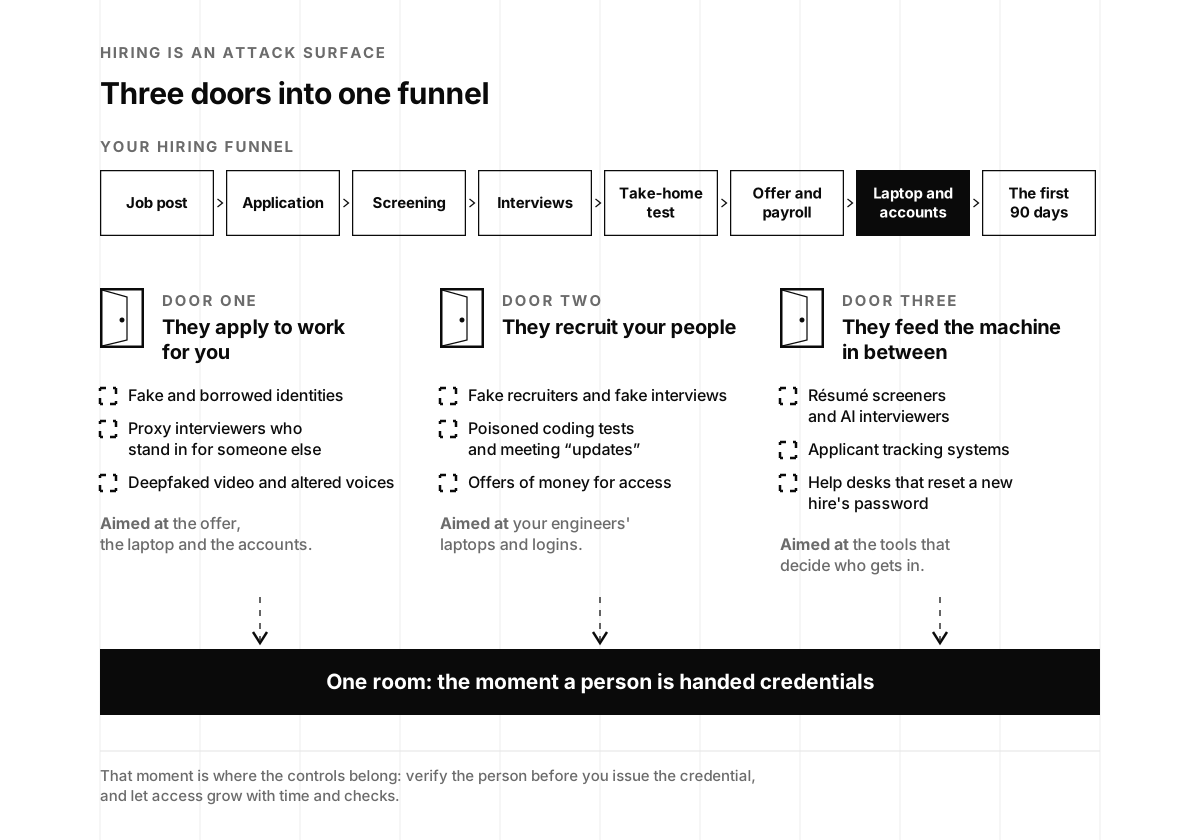
All three doors open onto the same room: the moment you hand a person credentials. Keep that picture in mind, because it’s the idea this whole post keeps coming back to.
Door one: they apply to work for you
North Korea’s remote IT worker program isn’t new. The FBI, the State Department and the Treasury warned American companies about it in 2022, and the first big prosecutions landed in 2024. What changed this year is the volume, and how many ordinary companies found it in their own payroll.
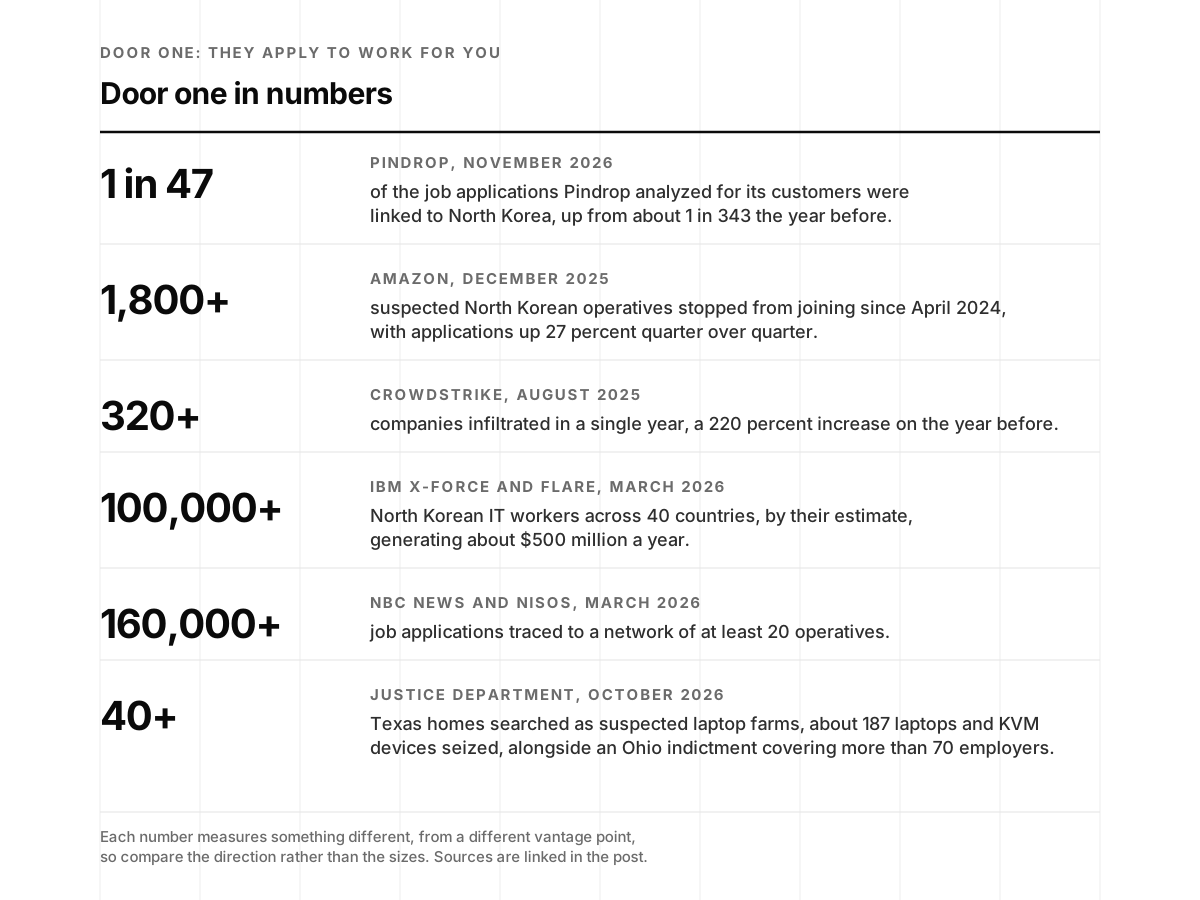
Pindrop detects fraud and deepfakes on calls and video meetings, and its chief executive, Vijay Balasubramaniyan, told Axios that across the job applications Pindrop analyzed for its customers, North Korea-linked applications went from about 1 in 343 last year to 1 in 47 this year (Axios). Vijay was our guest on episode 57, back when most of the deepfake conversation was about cloned voices on bank phone lines.
$6.3 billion. Stolen in just 20 minutes.
Vijay Balasubramaniyan · November 2, 2026
North Korean hackers are operating at an extraordinary speed and scale. Social engineering, automation, and increasingly accessible AI tools are fundamentally changing the economics of cybercrime.
But what concerns me most isn't just the size of this heist. It's how North Korea is industrializing cybercrime, and how the same tactics are being used to infiltrate organizations from within.
I spoke with Sam Sabin at Axios about this growing threat and what we're seeing firsthand at Pindrop.
🚨 Last year, 1 in every 343 job applications we analyzed across our customer base was linked to North Korea. This year, that number has jumped to 1 in 47. A whopping 7x increase!
Amazon sees the same thing at the scale of one of the world’s largest employers. Its chief security officer, Stephen Schmidt, wrote in December 2025 that the company had stopped more than 1,800 suspected North Korean operatives from joining since April 2024, with applications up 27 percent quarter over quarter. His post is the most practical thing I’ve read on how they get through, and how they get caught:
At Amazon, we've stopped more than 1,800 suspected DPRK operatives from joining since April 2024, and we've detected 27% more DPRK-affiliated applications quarter over quarter this year.
Stephen Schmidt · Senior Vice President & Chief Security Officer at Amazon · December 18, 2025
Our detections combine AI-powered screening with human verification.
…
• Small details give them away. For example, these applicants often format U.S. phone numbers with "+1" rather than "1." Alone, this means nothing. Combined with other indicators, it paints a picture.
…
Implement identity verification at multiple hiring stages and monitor for anomalous technical behavior: unusual remote access, unauthorized hardware.
The other numbers point the same way. CrowdStrike found the group it calls Famous Chollima inside more than 320 companies in a single year, “a 220% year-over-year increase,” and reported that the workers use generative AI “at every stage of the hiring and employment process,” from résumés to live interviews to the work itself (CrowdStrike). IBM X-Force and Flare put the workforce at upwards of 100,000 North Koreans spread across 40 countries, generating about $500 million a year for Pyongyang (The Register). In March, NBC News reported on a network of at least 20 operatives that the security firm Nisos tracked through at least 160,000 job applications, and quoted Michael Barnhart of DTEX on why so few employers notice: “Unless you have external information, you might not know they’re North Korean” (NBC News).
Then, on October 13, the Justice Department announced coordinated actions: an indictment in Ohio charging 14 people in a scheme that reached more than 70 American employers in health care, communications, retail, manufacturing and cybersecurity support, and the results of an FBI operation called Lonestar Roundup, which between September 21 and 25 searched more than 40 Texas homes suspected of operating as laptop farms and seized about 187 laptops and KVM devices (Justice Department). David Toepfer, the U.S. Attorney in Cleveland, wrote the sentence every founder should read twice: “These charges serve as an urgent alert to all U.S. companies to remain vigilant in their hiring practices.”
If the term is new: a laptop farm is a house full of company laptops, each shipped to a new remote hire who isn’t there. A facilitator keeps them powered and online, and the real worker connects from abroad through remote-control software or a small KVM-over-IP box (keyboard, video and mouse, over the internet) that sits between the laptop and its keyboard, screen and mouse. To your systems, your new engineer is logging in from Texas. CrowdStrike reported that since May 2026 the group has disguised that hardware, making a video capture card appear to be an ordinary webcam, and that some operatives filed false police reports about “stolen” laptops to get replacements shipped to farm addresses (CrowdStrike).
What one looks like from the inside
The best-documented case still comes from a security company that was willing to say it out loud. In July 2024, KnowBe4 hired a principal software engineer for an internal AI team. Its people team had run “four video conference based interviews on separate occasions, confirming the individual matched the photo provided on their application.” The background check came back clean, because the identity was real and stolen, and the photo had started life as stock photography before being touched up with AI. When the company’s Mac arrived, “the moment it was received, it immediately started to load malware.” The security team saw the alerts at 9:55 that night, called the new hire, who said he was troubleshooting his router, and had the laptop contained by about 10:20 (KnowBe4). Stu Sjouwerman, KnowBe4’s founder, published the whole thing so other companies could learn from it, and I’m grateful he did.
Look at where that hire was decided. Four interviews, a background check and a photo match all said yes. The only control that caught him was the one watching the laptop after it was already inside.
Ben Colman, co-founder and chief executive of Reality Defender, described the whole category in one breath when Sasha and I talked with him on episode 71, and the end of his sentence is this section:
Why do they want the job? Mostly for the paycheck. The Justice Department says individual workers have earned up to $300,000 a year, most of it routed to the regime. Many of them do the work, and some do it well. But the access is the asset. In January 2025 the FBI warned that workers who are discovered have been “holding stolen proprietary data and code hostage until the companies meet ransom demands,” after copying company repositories to their own accounts (FBI). Its October 2026 alert adds threats to publish corporate data, and threats against former managers after a termination (FBI).
Trevor Hilligoss, who investigated cybercrime for the Army’s Criminal Investigation Division and on an FBI cyber task force before becoming SpyCloud’s chief intelligence officer, framed the insider version of the same question on episode 86. He was talking about banks. Replace “teller” with “engineer” and it’s about you:
Deepfakes are the costume, not the crime
The part of this story that gets the headlines is the face on the screen. Deepfakes are real, and they’re getting cheaper. But I’d put them in their place: they’re a costume. The crime is getting credentials issued to someone who isn’t who they claim to be, and there are several costumes that do the same job.
A face swap. Dawid Moczadło, co-founder of Vidoc Security Lab, nearly fell for two of them in about two months. The second, a “Serbian” engineer who reached out on LinkedIn, kept his camera off in the first round and turned it on in the next, and in Dawid’s recording, as The Register noted, the head doesn’t quite match the neck. Asked to wave a hand in front of his face, he refused. Dawid’s summary is the one every hiring manager should hear: “If they almost fooled me, a cybersecurity expert, they definitely fooled some people” (The Register).
A stand-in. Flare’s research found foreign recruits paid to sit through video interviews as the applicant, after which “a North Korean operator may take over the position after the company makes an offer” (IBTimes UK). No AI involved. The FBI’s July 2025 guidance tells employers to capture images to compare across meetings for exactly this reason: the person doing the work may not be the person who passed the interview (FBI).
A polished paper trail. Microsoft reported North Korean workers using face-swapping tools to put their own photos onto stolen identity documents and using voice-changing software on calls (Microsoft). Gartner projected in July 2025 that by 2028 one in four candidate profiles worldwide could be fake, and in its survey of 3,000 job candidates, six percent admitted to interview fraud, either posing as someone else or having someone pose as them (HR Dive).
So should you buy a deepfake detector for your interviews? Maybe, as one signal. But the better question is the one Jasson Casey, co-founder and chief executive of Beyond Identity, asked on episode 92. He pointed out that synthetic video is about to have plenty of legitimate uses, like a live translation filter, and then changed the question:
For hiring, that translates into something simple. Stop trying to judge whether a face looks real, and prove who the person is: a government ID checked against a live capture by a verification service, before the final round, and the same check matched again at the offer, at the laptop handoff and on day one. A real candidate with a bad webcam, a stutter or a translation filter passes that. A stand-in doesn’t, because the person who shows up on day one has to be the person whose identity you verified. I made the longer version of this argument in Deepfake Attacks Keep Working Because We Keep Detecting Instead of Proving, and it holds even more for hiring than for wire transfers. The Arup case, in which an employee in Hong Kong sent about $25.6 million after a video call full of deepfaked colleagues (CNN), was one bad decision on one call. A fake hire is a bad decision you renew every morning.
Door two: they recruit your people
The Binance case is the newest and most expensive example of this door, but not the first. In 2022 an engineer at Sky Mavis, the company behind Axie Infinity, went through several rounds of interviews for a job that didn’t exist and received an offer as a PDF that carried malware. That foothold led to the Ronin bridge theft of about $625 million (TechRadar). Four years and roughly ten times the money later, the pattern is the same: find the people with access, give them a reason to run your code, and wait.
The campaign security researchers call Contagious Interview runs this play at scale. GitLab banned 131 accounts in 2025 for distributing North Korean malware, much of it in fake “technical interview” projects. The BeaverTail and OtterCookie malware families turned up in more than 95 percent of cases. The projects typically hide a small loader in configuration files, and in more than 80 percent of cases the real payload sits somewhere else, on servers where, as GitLab puts it, “Staging URLs commonly respond with decoy content unless the correct header values are included with requests,” so a curious reviewer sees nothing (GitLab).
Developers have been writing about these interviews for a while. David Dodda’s post “I almost got hacked by a ‘job interview’” reached the top of Hacker News in October 2025 with 897 points, and the comments read like a support group:
"I had someone who was targeting junior developers posting on Who Wants to Be Hired threads here on Hacker news. They reached out saying they liked my projects and had something I might be interested in, then set up an interview where they tried to get me to install malware."
atropoles, commenting on I almost got hacked by a 'job interview', October 2025
When the Binance details came out, one developer described the tell from the other side of the call:
"the other side typically has video turned off, asks a bit about your experience and just nods without digging, they are in a hurry to send you their coding challenge."
AlexITC, commenting on North Korean fake job interview led to $6.3B Binance heist, November 2026
Here’s the uncomfortable part for founders. Your engineers will look at other jobs. They should. A healthy company is one people choose to stay at, and the best engineers I know take recruiter calls because it keeps them honest about the market. So the answer can’t be “don’t job hunt.” It has to be a norm that makes the safe path the easy one: interviews and take-home tests happen on personal devices, never on a work laptop; anyone who gets a strange recruiter message can forward it to one place without explaining themselves; and nobody gets in trouble for the one they almost fell for. The reports you get from that channel are some of the best threat intelligence a small company can have.
It’s also worth looking at your own hiring through the same lens. If your process asks candidates to install a proctoring tool or run your starter repository, you’re teaching the reflex attackers rely on. One commenter in the Binance thread put it bluntly:
"The practice of installing software during a job interview should be forbidden by law. Some companies require you to install Windows remote administration tools (basically root kits) on your machine to check whether you are using search engines or AI. It is insane."
129-1, commenting on North Korean fake job interview led to $6.3B Binance heist, November 2026
Browser-based assessments in an isolated environment do the same job without asking anyone to install anything, and they make a fake recruiter’s “please run this” look as strange as it should.
The other half of door two: offers of money
Point four of the warning above is the quiet version of door two: paying insiders. In May 2025, Coinbase disclosed that criminals had bribed overseas support contractors for customer data, and estimated the cost at $180 million to $400 million (The Block). That September, the BBC’s cyber correspondent Joe Tidy published the messages he’d received from someone claiming to represent the Medusa ransomware gang, offering him 15 percent of any ransom, later raised, for his login to the BBC. When he stalled, his phone filled with multi-factor prompts (BleepingComputer, BBC). Trevor told us on episode 86 that SpyCloud sees posts from would-be insiders selling access “pretty regularly”:
You can’t screen your way out of bribery at hiring time. You can shrink what one person can sell, which is the access principle further down, and you can make it normal to report an offer like the one Joe Tidy got.
Door three: they feed the machine in between
The third door is the one founders think about least, because it looks like tooling. Hiring now runs on software that reads strangers’ input: AI résumé screeners, applicant tracking systems, scheduling bots, background check portals, and increasingly AI interviewers. Each one is an input channel.
On episode 101, our guests Johnny Hung and Munam Wasi of Mighty described job applicants pasting white text into their résumés that only the AI screener can read, telling it to ignore its instructions and book the interview. It’s prompt injection, and nobody doing it calls it that. The same trick runs in reverse: last year a Stripe executive hid a line in his LinkedIn bio addressed to any AI model reading it, asking it to put a flan recipe in its message, and a recruiter’s AI-written outreach duly arrived with a flan recipe in it (Daily Dot). Funny when it’s flan. Less funny when the screener decides who gets an interview, or when the AI agent scheduling interviews can send email from your domain.
The machine also holds data worth stealing. In July 2025, two researchers, Ian Carroll and Sam Curry, got into the admin side of McHire, the AI hiring chatbot behind McDonald’s applications, through a test account whose username and password were both “123456,” and then found they could walk through records of more than 64 million applications by changing a number in an internal API request (BleepingComputer). Your applicant tracking system holds names, phone numbers, salary expectations and sometimes identity documents. Treat it like a customer database, because to an attacker it is one.
And your brand is bait. Fake recruiters borrow real company names to scam job seekers, and the FBI’s 2025 Internet Crime Report put losses from employment fraud at $362.9 million, up from $264.2 million the year before (Security Point Break). Those victims aren’t your company, but they’re people who wanted to work for you. Rod Schultz of Bolster explained on episode 62 how quickly a convincing lookalike of a brand can go up. A careers page that says exactly how you hire, from which domains, and that you never ask candidates to pay or install anything, protects them and you for the price of a paragraph.
The last piece of machinery is the help desk. “Hi, I’m new and I can’t log in” is the oldest pretext there is, because new hires really can’t log in. In July 2025, Clorox sued its former IT services provider, Cognizant, alleging that the attackers behind its 2023 breach got employee passwords reset simply by calling and asking (Insurance Journal). A new hire’s first password reset should require the same identity check as their offer.
Why this lands on a founder’s desk
At a large company, hiring fraud is a problem for recruiting operations, a security team and an insider-risk program. At a startup, it lands on the founder, because the things that make startups fast are the same things that make this door wide.
You hire remotely because that’s where the talent is. I’m not going to tell anyone to stop. Remote hiring is one of the best things that happened to startups. But it removed the step where someone walked into the office and shook your hand.
You hire fast, often through contractors and agencies. Microsoft notes that North Korean workers often apply “indirectly through staffing or contracting companies,” and CrowdStrike saw staffing firms used to redirect laptops without the firms knowing. Every layer between you and the person is a place where identity gets assumed.
Your new engineers get real access in week one. At a twenty-person company the third engineer can often reach production, the customer database and the cloud console, because there’s nobody else to do the work. That’s the startup’s superpower and the attacker’s prize.
The bill arrives in places you don’t expect. U.S. sanctions violations are strict liability, so “paying a North Korean worker, even unknowingly and unintentionally, can constitute a violation,” as Jenner & Block put it in an August 2026 client alert, which also advises treating a suspected case as “both a potential sanctions issue and a cybersecurity incident” (Jenner & Block). So far, they note, enforcement has gone after the operators and facilitators, not the companies they fooled. There’s also the code. If the person who signed your invention assignment agreement used a stolen name, ask your counsel what that means for the code they wrote. We aren’t lawyers, and I’d rather you ask that question before a diligence team does.
Buyers already ask. Enterprise security questionnaires ask how you screen people who can reach customer data, how fast you remove access when someone leaves, and whether contractors get the same checks. ISO/IEC 27001:2022 makes screening an explicit control, before someone joins and on an ongoing basis, in proportion to the information they’ll access (HighTable). SOC 2 doesn’t prescribe a specific check, but most startups describe screening among their people controls, and the auditor tests what you describe. The founder who can say how hiring proves identity has a better answer than “we do background checks,” which, as KnowBe4 learned, a stolen identity passes.
Under all of that sits the real tension, and it’s worth naming because it’s why this is hard. Founders want three things from hiring that pull against each other: speed, reach and a welcoming experience for candidates. Security adds a fourth, proof, and every check you add costs a little of the other three. The honest candidates pay most of that cost. Socket, the supply-chain security company, studied 80 confirmed fraudulent engineering applicants that reached its pipeline in 2025 and wrote: “The burden of proof has shifted, and authentic candidates are caught in the crossfire” (Socket). Feross Aboukhadijeh, Socket’s founder, was on episode 36 talking about the software supply chain. Socket’s team now treats hiring as part of the same chain: “The traditional hiring funnel has become a security perimeter.” And when this story first broke wide, one Hacker News commenter said the part that most people feel:
"The part that's really sad is that we have tons of out of work devs right now. This sort of thing only makes it harder for the legitimate people to get hired."
giantg2, commenting on The North Korean fake IT worker problem is ubiquitous, July 2025
So aim for the least friction that still proves the thing you need proved, applied the same way to everyone, and explained to candidates as care rather than suspicion. Coinbase’s Brian Armstrong sits at one end of that spectrum. He told Stripe’s John Collison on the Cheeky Pint podcast that Coinbase now brings every new hire to the United States for in-person orientation and requires citizenship and fingerprints for people with access to sensitive systems, because “It feels like there’s 500 new people graduating every quarter,” and that “When we catch people, we don’t walk them out the door, they go to jail” (Business Insider).
Most startups don’t need fingerprints. Almost all of them need the principles below.
Seven principles for hiring when hiring is an attack surface
1. The offer letter is the first credential
Everything you’ll protect later, the code, the customer data, the cloud account, is reached through credentials, and every credential traces back to one decision: this person is who they say they are. That decision is made in hiring, usually by people who were never told it was a security decision. So move it on purpose. Verify identity before you issue anything that logs in, well before the first paycheck. The FBI agrees: its July 2025 guidance says not to grant system access until background checks are complete (FBI).
2. Prove who, instead of guessing what
Judging whether a face, a voice or a résumé “looks real” is a losing game, and it’s the game attackers are building tools to win. Proving who someone is uses different evidence: a government document, a live capture matched to it by a service built for that job, past employers reached through contacts you found yourself, and the same identity confirmed again at each later step. Aaron Painter of Nametag was arguing on episode 19, back in 2022, for signing in with a verified ID instead of a password. Hiring is where that idea pays off first.
3. Identity in depth, for the whole tenure
The FBI’s newest guidance borrows a phrase from network security: “Mirroring cybersecurity concepts, detection requires an “identity in depth” approach for effective defense,” with “layered detections, access controls, and continuous identity verification throughout employment” (FBI). Think of identity as something you keep confirming, lightly, the way you keep confirming a device is healthy.
4. Weak signals add up, and people aren’t signals
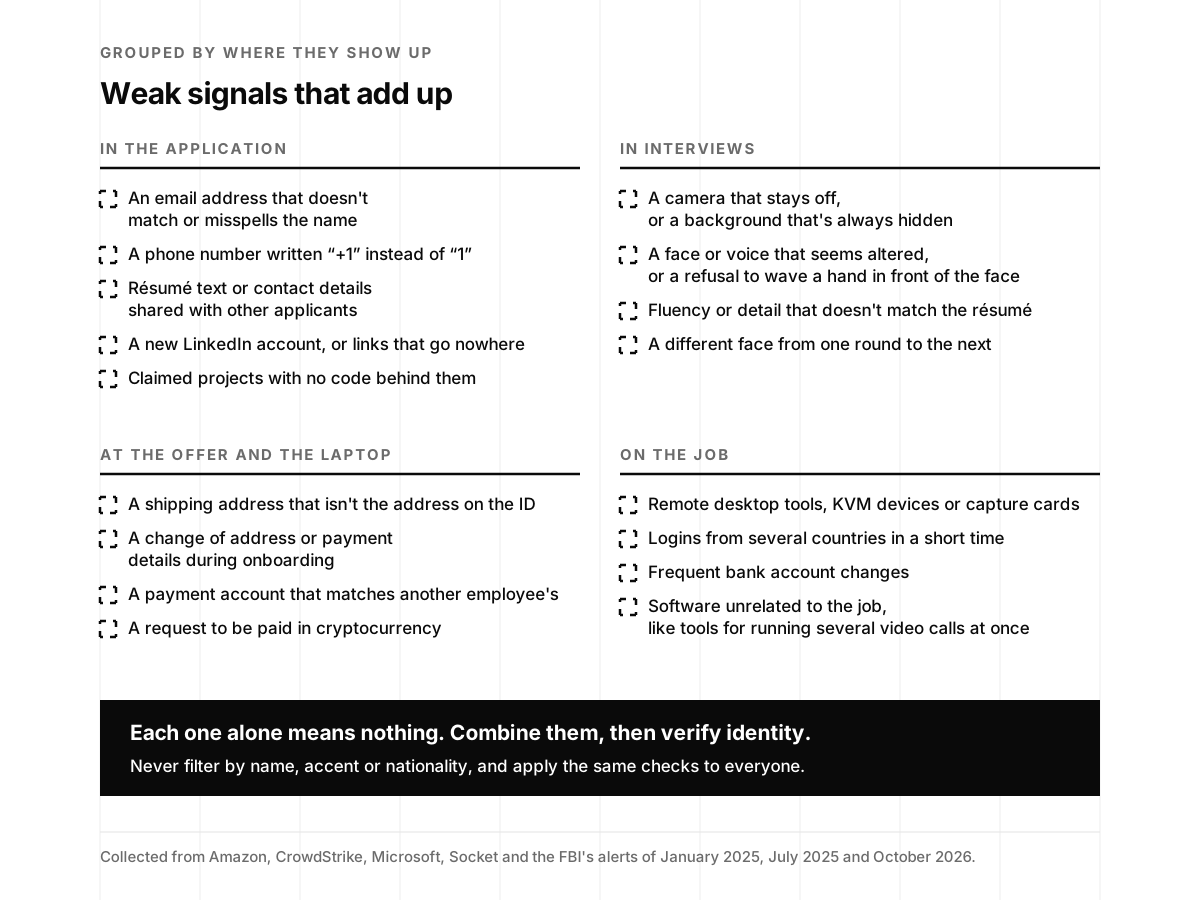
Schmidt’s “+1” phone format, an email address that doesn’t match the name, a LinkedIn profile created last month, dead portfolio links, a résumé whose sentences also turn up in other applicants’ résumés, a camera that never works, a laptop shipping address that isn’t the address on the ID: each of these alone means nothing, and Socket said it best: “Each signal is weak on its own; together they indicate elevated risk.” The FBI’s October alert makes the same point and adds the warning that matters most for fairness: “Relying solely on “ban lists” or filtering out ITW associated names can be unreliable, block qualified applicants,” and controls should be calibrated to limit false positives. Never filter by name, accent or nationality. Combine behavior, and verify.
5. Access grows with verification
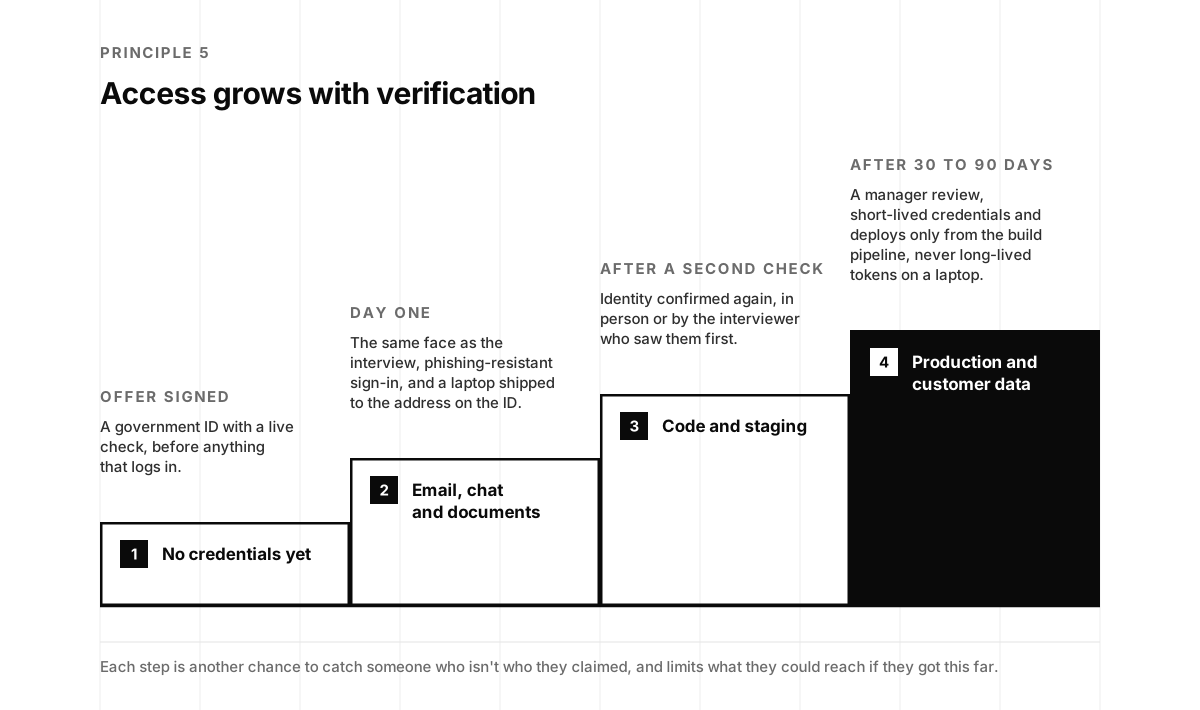
This is the principle that would have changed the Binance story at the end rather than the beginning. The attacker got in through an interview, but the theft needed a container deployment token sitting on an engineer’s laptop. One commenter in the Binance thread made the point I’d make to any founder: “In a company of this size, the deployments should be via CI only.” For a new hire, design access as a staircase: email, chat and documents on day one; code and staging once identity is confirmed in person or by a second check; production and customer data after that, through short-lived credentials rather than tokens that live on a laptop. A fake hire who gets day-one access gets very little. Our blast radius playbook walks through the rest of the controls that keep one foothold small.
6. Code from strangers runs in a box, both ways
Code a candidate sends you runs in a throwaway sandbox: no secrets, no network access to your systems, deleted afterward. Code a stranger sends your engineer runs in the same kind of box, or not at all, and never on a work laptop. Socket’s list for take-home work is a good starting point: containerized sandboxes, repositories that are deleted afterward, temporary tokens and read-only access.
7. Make the honest path the easy path
For candidates, that means telling them at the start what you’ll verify and why, using the same checks for everyone, and publishing how real recruiters from your company will and won’t contact them. For employees, it means a no-blame way to report a suspicious recruiter or an offer of money, and a norm that job hunting happens on personal devices. People follow the path that’s easiest. Make it the safe one.
What to check at each stage of hiring
Here’s how those principles land on an actual funnel. The time estimates are ours, from helping startups put this in place, and assume you use a verification service rather than building anything.
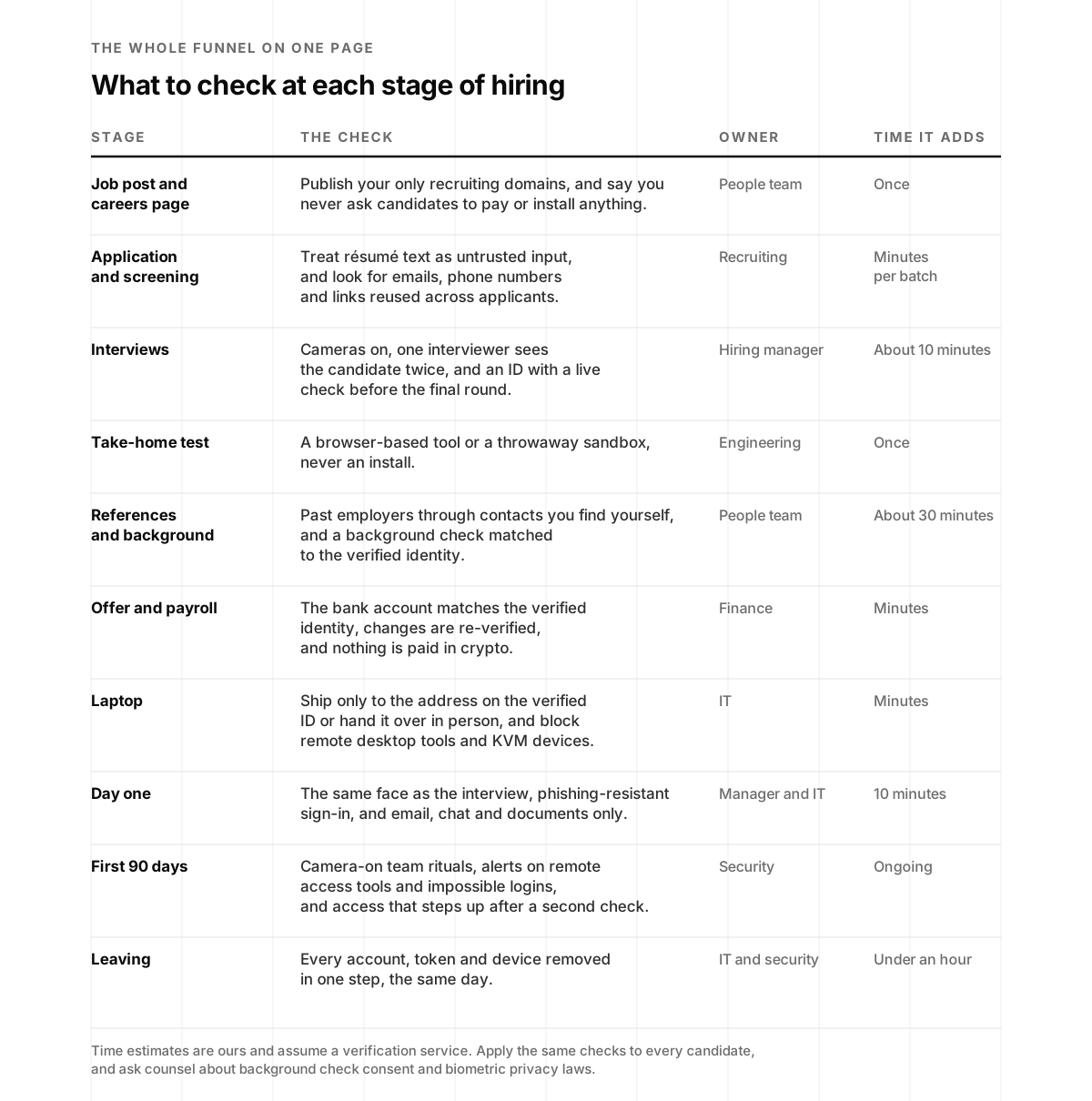
A few notes the table can’t hold.
Tell candidates what you’ll check before you check it. A short paragraph in the first email, “we verify identity with a quick ID and selfie check before the final round, the same for everyone,” turns a moment of suspicion into a sign that you take security seriously. The good candidates like it. It’s also the step where you should get your counsel’s view on background check consent rules and on biometric privacy laws like Illinois’s Biometric Information Privacy Act, which matter if your verification vendor stores face data.
Keep the same person in the loop. One interviewer who sees the candidate in the first round and again in the last, and the manager who joins the day-one call, catch more stand-ins than any tool, because people notice when someone is different.
Treat contractors and agencies the same way. The FBI asks employers to share its guidance with the vendors that supply contracted IT workers, and Microsoft calls for “greater scrutiny for employees of staffing companies.” If an agency can’t tell you how it verified the person, verify them yourself.
Watch the laptop, not just the person. The FBI’s alert lists the tools that show up on farm-hosted machines: remote desktop software such as AnyDesk, TeamViewer, RustDesk and Chrome Remote Desktop, KVM-over-IP hardware such as TinyPilot and PiKVM, and screen-capture software that has nothing to do with the job. Your endpoint tooling can alert on all of them on day one.
Map your hiring attack surface
This map asks one question for each stage of your funnel, plus four about how you hire, and shows which door is widest open, where a fake hire would most likely get through, and the next five moves in order. It takes about five minutes, runs entirely in your browser, and you can export the plan for your people team.
The hiring attack surface map
Pick the answer closest to what you do today, not what the policy says. The map updates as you go.
Everything here runs in your browser and is saved only in this browser. The weights reflect our experience with startups, not a standard, and the time estimates assume a verification service rather than anything you build. Never act on a single signal, and get counsel's advice before you change background checks or collect biometric data.
Got it. Sasha or I will reply to set up a review of your hiring flow.
Something went wrong. Email hello@ysecurity.io and we'll set it up by hand.
If you think you already hired one
First, breathe. Companies with strong security teams have been fooled, KnowBe4 among them, and the people who were fooled weren’t careless. Then move carefully, because the order matters.
- Don’t confront the person yet. The FBI has seen discovered workers copy code and data and demand money, and threaten former managers after a termination. Tipping someone off before you’re ready is how evidence and repositories disappear.
- Call counsel the same day. Jenner & Block’s advice is to treat it as “both a potential sanctions issue and a cybersecurity incident,” which means legal, security and your people team working from one plan, and a decision with counsel about disclosure.
- Preserve before you remove. Keep logs, device images and the hiring record: the interviews, the documents, the payroll and shipping details. You’ll need them to find the facilitator pattern, and so will law enforcement.
- Remove access in one coordinated step. Every account, session, token, SSH key, OAuth grant and device at once, including the laptop. Then rotate the secrets they could reach and review what they committed. Our offboarding checklist was written for AI agents, but its rule fits people too: retire every identity in one move, not over a week.
- Report it. File with your local FBI field office and with the FBI’s Internet Crime Complaint Center at ic3.gov, with addresses, payment details and identifiers. The Justice Department’s cases are built from reports like yours.
- Look for the pattern elsewhere. Shared bank accounts, the same shipping address, the same references, the same résumé phrasing. Where there’s one, there are often two.
If you want help with the quiet version of this, it’s exactly what our counter business espionage team does, under a nondisclosure agreement and on a need-to-know basis inside your company.
Turn it into an answer buyers trust
Once the checks are in place, write them down the way a buyer will read them. Enterprise questionnaires ask some version of “How do you screen personnel with access to our data?”, and the founder who answers with mechanism and proof stands out. Something like this, once it’s true:
Everyone who can reach customer data has their identity verified against a government ID with a live check before they receive any credentials, works on a company-managed laptop shipped only to the address on that ID, and gets production access only after a second check, and we remove all of it the same day they leave.
Sasha wrote up how to build sentences like that one, and what to attach, in The 10 AI Security Questions Your First Enterprise Buyer Will Ask in 2027. If the honest answer today is “not yet,” send the dated version, which buyers accept far more readily than a confident paragraph. And if your board is asking what changed after Binance, this belongs on the security slide: who can reach production, and how you know who they are.
Sasha and I will be talking about this kind of thing at MicroConf US in Austin next April, where YSecurity is a sponsor and our talk is “How Founders Turn Security Commitments Into Revenue.” It’s on our events page, with field notes from the rooms we’ve been in this year.
The Binance engineer did something ordinary. He took an interview. The lesson I take from it isn’t that people need to be more paranoid. It’s that the systems around people should make the ordinary thing safe: a laptop that never runs strangers’ code, a token that never lives on a laptop, a funnel that proves who someone is before it hands them the keys. Do that, and the next great hire you make will be exactly who they said they were.
Jon
Hiring security, fake candidates and fake recruiters, frequently asked questions
- What does it mean that hiring is an attack surface?
- It means the hiring process decides who gets credentials, so attackers now target it directly. They apply for jobs under stolen or borrowed identities, sometimes with proxies or deepfakes in the interviews. They pose as recruiters and send your engineers malicious coding tests. And they feed résumé screeners, applicant tracking systems and help desks the inputs that work for them. Binance's $6.3 billion loss in October 2026 began with a fake job interview and a take-home test run on a work laptop.
- How do North Korean IT workers get hired at American companies?
- They apply for remote jobs, often engineering roles, under stolen or borrowed American identities, with AI-polished résumés and new or hijacked LinkedIn and GitHub profiles. Some use proxies who interview on camera for them, and the North Korean operator takes over after the offer. Once hired, a U.S.-based facilitator receives the company laptop at a laptop farm and keeps it online while the worker connects from abroad. Pay goes to accounts the facilitators control and on to the regime. Many of these workers do the job, and some steal code or data and demand money when they're discovered.
- How common are fake job candidates in 2026?
- More common every quarter. Pindrop told Axios in November 2026 that North Korea-linked applications across its customers rose from about 1 in 343 last year to 1 in 47. Amazon said in December 2025 it had stopped more than 1,800 suspected North Korean operatives since April 2024, with applications up 27 percent quarter over quarter. Gartner projected in July 2025 that by 2028 one in four candidate profiles worldwide could be fake. And the FBI's 2025 Internet Crime Report put losses from employment fraud against job seekers at $362.9 million.
- What is a laptop farm?
- A laptop farm is a home or small office in the employer's country holding company laptops that were shipped to remote hires who aren't there. A facilitator keeps the laptops powered and connected, and the real workers control them from abroad with remote access software or KVM-over-IP devices that sit between the keyboard, screen and mouse. To the employer, the new hire appears to log in from inside the country. In September 2026 the FBI searched more than 40 suspected laptop farms in Texas and seized about 187 laptops and KVM devices.
- Are deepfake job interviews real, and how do I spot them?
- They're real, and spotting them by eye is getting harder. Security founders have caught candidates using real-time face-swapping software, and North Korean schemes also use human proxies who interview in someone else's name. Glitches, a camera that never works and answers that sound read out loud are clues, but the stronger fix is to prove identity rather than guess: verify a government ID with a live check before the final round, confirm the same face at the offer, the laptop handoff and day one, and grant access only after that.
- How do I verify a remote candidate's identity without discriminating?
- Apply the same checks to every candidate at the same stage, explain them up front, and verify identity rather than screening names, accents or nationalities. The FBI's October 2026 guidance says ban lists and name filtering are unreliable and can block qualified applicants, and it recommends combining several weak signals before acting. Use an identity verification service with a live check, verify past employers through contacts you find yourself, and get your counsel's advice on background check consent and biometric laws such as Illinois's Biometric Information Privacy Act.
- How do fake recruiters hack engineers?
- They approach engineers on LinkedIn or job platforms as recruiters, run convincing interviews, then ask the candidate to download a coding assignment, install a meeting update or run sample code. The project carries a hidden loader that runs during setup and steals credentials or installs remote access malware. GitLab banned 131 accounts in 2025 for hosting these projects. At Binance, an engineer ran the assignment on his work computer, and the attacker used that foothold to reach the wallet systems.
- Should candidates' take-home tests run on company laptops?
- No, in either direction. Code a candidate sends you should run in a throwaway sandbox with no secrets and no access to your network. And your own employees should never run another company's interview assignment on a work device. Make that a written, no-blame norm, because people job hunt and that's healthy, and give them a fast way to report a recruiter who seems off.
- Is it illegal to pay a North Korean IT worker by accident?
- It can be. U.S. sanctions violations are strict liability, so paying a North Korean worker can be a violation even if you didn't know, according to Jenner & Block's August 2026 client alert. So far enforcement has targeted operators and facilitators rather than deceived employers, but you should treat a suspected case as both a sanctions issue and a security incident and talk to counsel about disclosure. We aren't lawyers, and this isn't legal advice.
- What should I do if I think we hired a North Korean IT worker?
- Don't confront the person first. Bring in counsel, preserve logs and device images, and plan to remove every account, token, device and integration in one coordinated step, because the FBI has seen workers copy code and data and then demand money when they're discovered. Check payroll destinations, code repositories and secrets the person could reach, rotate what they touched, and report to your local FBI field office and to the FBI's Internet Crime Complaint Center. Then look for the facilitator pattern elsewhere in your workforce.
- Do SOC 2 or ISO 27001 require background checks?
- ISO/IEC 27001:2022 does, in proportion to risk: its screening control asks for background verification before someone joins and on an ongoing basis, proportional to the information they will access. SOC 2 doesn't prescribe specific checks, but most companies describe screening among their people controls, and the auditor tests what you describe. Enterprise security questionnaires also ask directly how you screen people who can reach customer data.
- Does the hiring attack surface map send my answers anywhere?
- No. It runs in your browser and saves your answers only in this browser. Nothing is sent unless you use the optional email form, which sends your email, the context you picked and the level you chose for each stage. Our usual site analytics run on this page too, with the map masked.