
Episode 2 of The Security Podcast of Silicon Valley aired on May 17, 2021, eleven days after the first. Jon McLachlan hosted alone. The guest was Andrew Gontarczyk, then the chief information security officer of Pure Storage, and the subject was building a security team: when a company needs one, what kinds of teams there are, how a security leader influences the rest of the company, his interview questions, diversity, how he leads, and what kept him up at night (Podbean).
“So, today’s show is going to be about building a security team, a world-class security team.”
Jon McLachlan, at 1:09
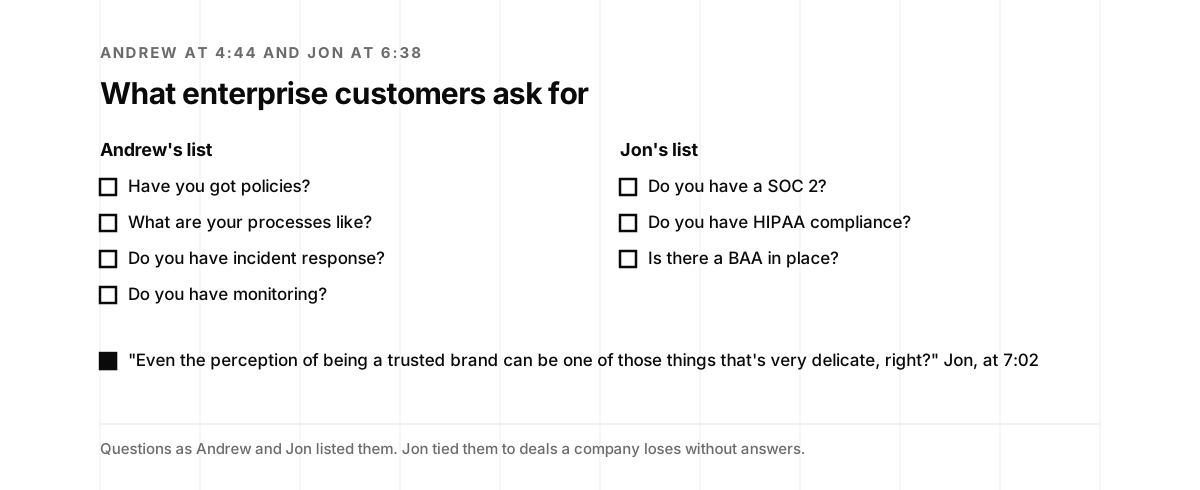
Andrew’s LinkedIn lists the path behind his answers (LinkedIn). He was a senior managing consultant at IBM Australia from 1999 to November 2010 and manager of security architecture at NBN Co from December 2010 to July 2014. At Commonwealth Bank he was executive manager of security transformation from July 2014 to June 2017. He was chief information security officer and head of information security at Pepper Financial Services Group from July 2017 to April 2018, then vice president of information security at Symantec from April 2018 to April 2020. He was chief information security officer of Pure Storage from March 2020 to October 2024, and since October 2024 he has been CEO Legal Risk Management at LEAP Dev.
NBN Co is the government-owned company that designs, builds and runs Australia’s National Broadband Network as the country’s wholesale broadband provider (Wikipedia). Commonwealth Bank, or CommBank, is an Australian bank with operations in New Zealand, Asia, the United States and the United Kingdom (Wikipedia).
Jon introduced Pure Storage as “a storage company that revolutionized the way storage is thought about.” It was founded in 2009 under the code name Os76 by John Colgrove and John Hayes, and it came out of stealth as Pure Storage in August 2011 with all-flash storage hardware and software. In its October 2015 public offering it sold 25 million shares for $425 million. It bought Portworx, a Kubernetes storage company, for $370 million in September 2020, six months after Andrew joined. In February 2026 it renamed itself Everpure, and its headquarters are in Santa Clara, California (Wikipedia).
A chief information security officer, or CISO, is the senior-level executive who sets an organization’s security vision, strategy and program (Wikipedia). A red team simulates an adversary at the organization’s direction, a blue team defends against intrusions, and a purple team is a temporary combination of the two that gives fast feedback during a test (Wikipedia). Governance, risk and compliance, or GRC, ties governance, risk management and regulatory compliance together, so an organization meets its obligations and still runs efficiently (Wikipedia).
The tape gives no recording date, and it fits the spring of 2021. Andrew says he moved to Silicon Valley three years earlier for the Symantec job, which his LinkedIn dates to April 2018. He also says he runs his whiteboard interview question over a shared screen “because we can’t do it in real life.” The episode went out in May 2021.
The page has a section for each part of the conversation with its sources, seventeen figures, eighteen clips from the tape, the full transcript, and five tools: a quiz, a scorecard for whether your security program is ready for its next stage, a calculator for whether a control is worth its cost, a timeline from 1999 to 2026, and a to-do list.
The tape is from 2021. Where a fact has changed since, such as Andrew’s job, Pure Storage’s name or the NIST Cybersecurity Framework, the page gives the change and its date. Where the decodes of the tape disagree on a word, the transcript puts its best guess in brackets, and the page doesn’t quote those words.
Our sweet spot is we’re builders
Jon asked two questions at once: how a CISO builds a world-class team, and how a company knows it needs one. Andrew said the standards tell you everything you need to have in place, and that they have value. The second question was the one that had changed his thinking since he arrived in Silicon Valley.
“I moved to Silicon Valley three years ago for the Symantec gig.”
Andrew Gontarczyk, at 2:04
He described his background as corporate security, plus years of consulting to industry at IBM.
“I come at the security problem probably from a more traditional security standpoint rather than from an engineering standpoint.”
Andrew Gontarczyk, at 2:25
The Symantec job ended when “Symantec sold their enterprise business, and that sort of came to an end,” and the team he was part of was dissolved. The buyer was Broadcom. It announced its purchase of Symantec’s enterprise security software division on August 8, 2019, for $10.7 billion, and closed it on November 4, 2019. Symantec kept its Norton consumer products, renamed itself NortonLifeLock, and became Gen Digital after its merger with Avast in September 2022 (Wikipedia). Andrew found what he called a new home at Pure, and his LinkedIn dates his start there to March 2020.
Silicon Valley made him ask what he brought to a place that is “very engineering focused and engineering driven,” full of what he called mega brains. He said he felt a sense of inferiority and awe. His answer to his own question is the first idea of the episode, and it also answers which companies need which kind of security team.
“I think our sweet spot is we’re builders.”
Andrew Gontarczyk, at 3:46
He likes to build capabilities. In a 2025 interview with Team Cymru’s newsletter, he said he approaches every problem as an architectural problem (LinkedIn). After the tape covers that interview.
It’s just a question of timing
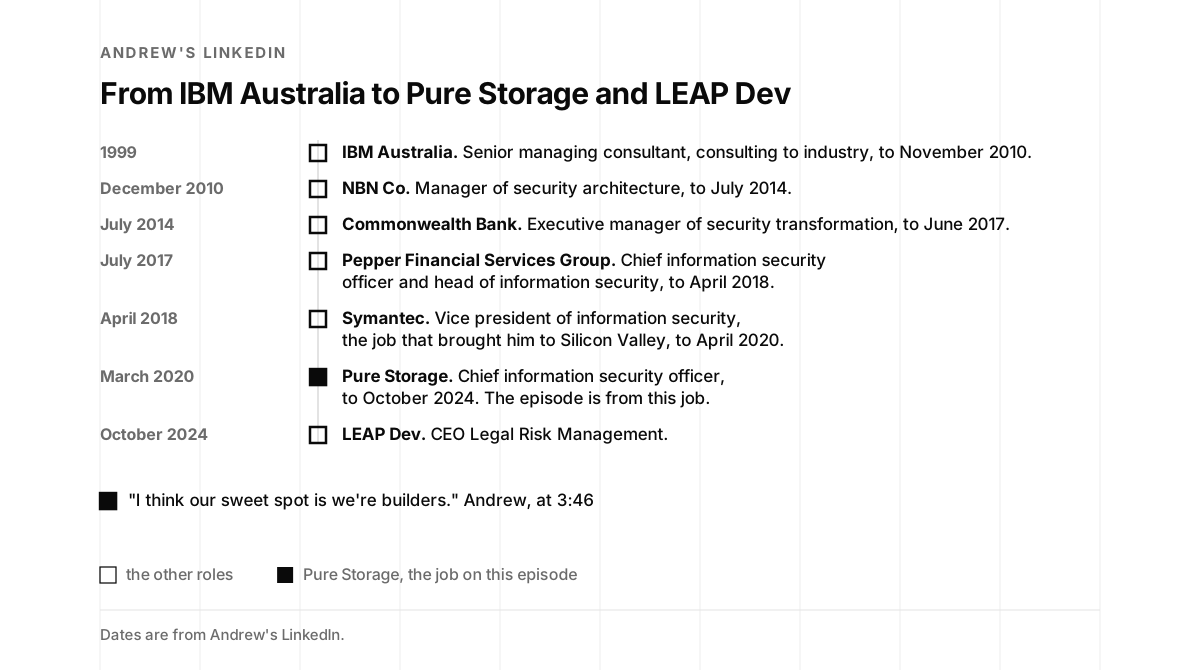
Andrew described the phases a tech company goes through. At first a startup focuses on building the product, getting investment, and feature and function. Security shows up as a feature if the product is a security product.
“And typically, security in those, in that phase, isn’t high on the priority list.”
Andrew Gontarczyk, at 4:07
With success and traction, the company goes public and sells to what he called the smaller end of town, the commercial side. As it grows it goes after enterprise deals, and the questions change.
“And enterprise customers have higher demands from the perspective of just the boring stuff.”
Andrew Gontarczyk, at 4:44
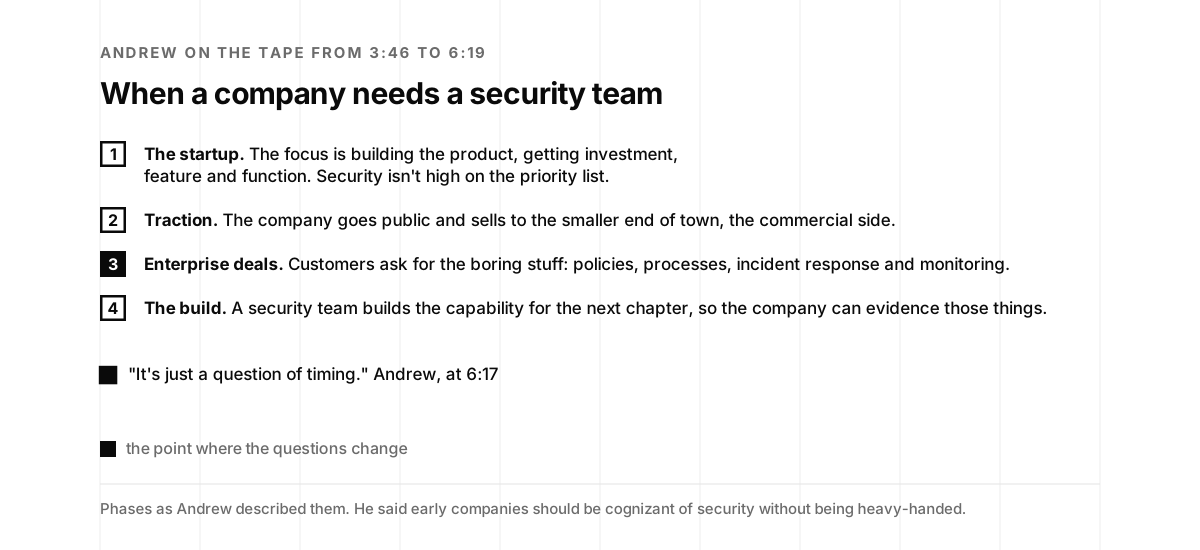
He listed the boring stuff the way a buyer asks for it: “have you got policies? What are your processes like? Do you have incident response? Do you have monitoring?” Helping a company through that change is his sweet spot. He called it greenfield work, building the capability for the company’s next chapter, where it can start to evidence those things.
His advice to early companies is to be cognizant of security and do their best without being heavy-handed, because heavy-handed security gets in the way of growing the business, getting investment and getting traction. The time to catch up comes anyway, he said, because boards, directors and the press all talk about security.
“It’s just a question of timing.”
Andrew Gontarczyk, at 6:17
Yash Kosaraju, the CISO of a16z, drew a similar line on episode 104 in 2026: a first security hire who can work independently comes well before a head of security who builds a team. Our post on how startups should staff security covers the options in between, and it cites this episode for the range of specialties behind the word security.
Where’s your SOC 2?
Jon restated the answer in sales terms. The right time is when you need security for your next phase of top-end growth,
“when you’re losing deals to security teams and other companies that are saying, hey, where’s your processes?”
Jon McLachlan, at 6:38
He listed the questions a startup hears first: do you have a SOC 2, do you have HIPAA compliance, is there a BAA in place. Our posts What Even Is a SOC 2? and The Health System Security Review Your BAA Won’t Pass explain both. Jon also picked up a word Andrew had used several times, trust.
“Even the perception of being a trusted brand can be one of those things that’s very delicate, right?”
Jon McLachlan, at 7:02
Those questions are where the boring stuff starts to cost deals. Our SOC 2 Type 2 and Sales Support teams work on the evidence Andrew listed: policies, processes, incident response and monitoring that a buyer can check. Enabled Isn’t Enforced covers the questionnaire answers that lose deals.
Jon then asked whether a security team needs every piece. He thinks of product security teams that build security into what a company ships, infrastructure security teams that secure the company’s own tools, and red and blue teams with feedback loops between them.
The car and the factory
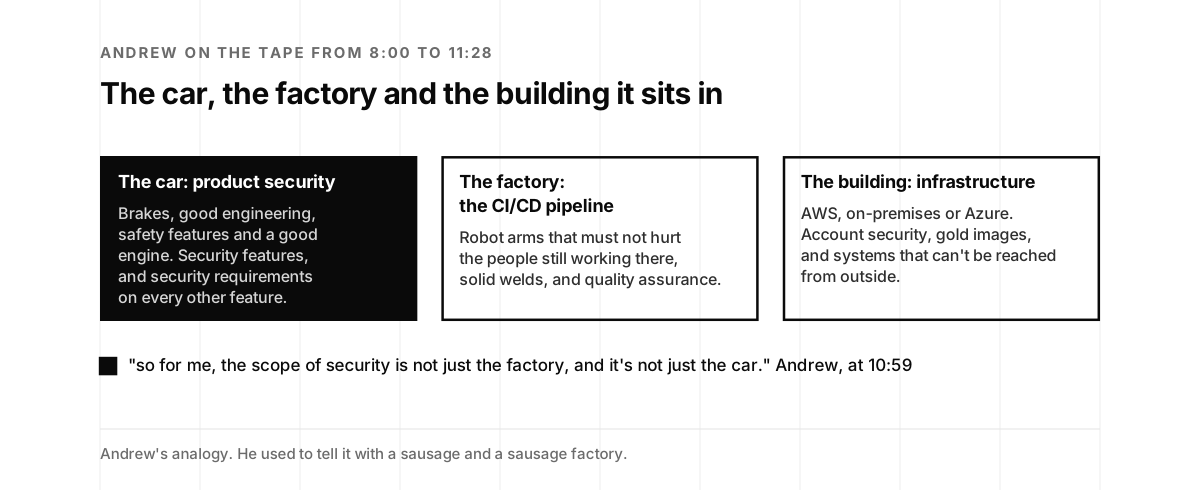
Andrew answered with an analogy. He used to talk about the sausage and the sausage factory, and he moved to cars because a car’s parts are more tangible than herbs and spices.
“So let’s stick with the car manufacturing plant and the cars.”
Andrew Gontarczyk, at 8:21
The car must not kill people. It needs brakes, good engineering, safety features and a good engine, and all of it has to be designed and engineered.
“And to me, that is the sort of product security side of the house.”
Andrew Gontarczyk, at 8:41
Product security has two parts in his telling: designing and building security features, and injecting security requirements into every other feature. The second part comes from his background in architecture.
“So every problem for me is an architectural problem.”
Andrew Gontarczyk, at 9:00
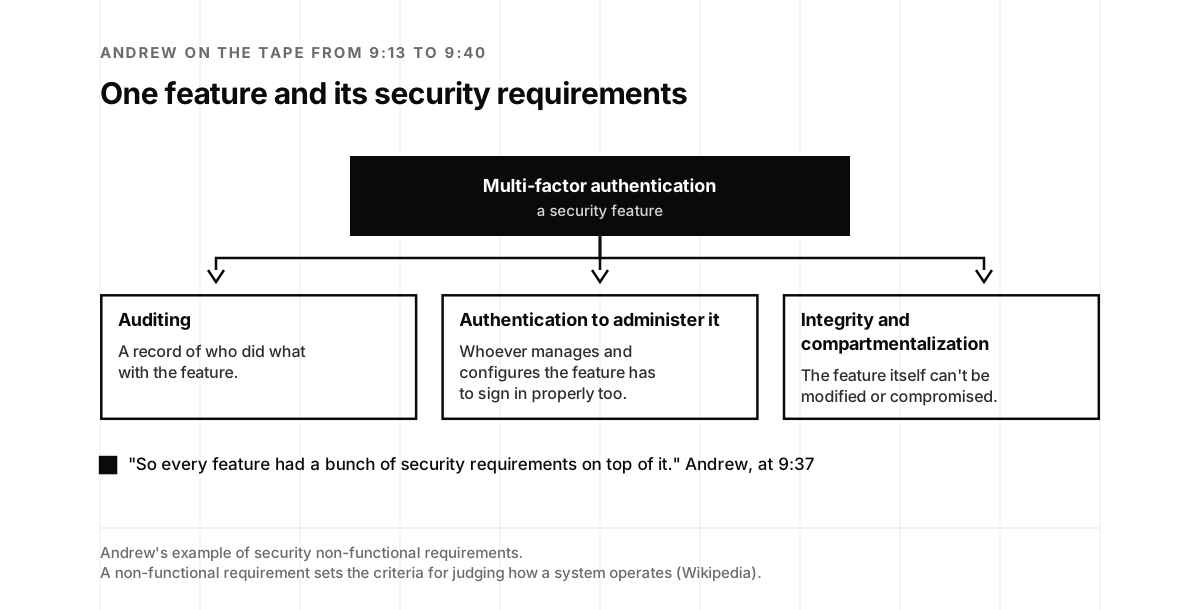
He wants a set of what he calls security non-functional requirements, which every feature applies. A non-functional requirement sets the criteria for judging how a system operates, and the plan for it lives in the system architecture (Wikipedia). His example was multi-factor authentication, which lets a user in only after two or more distinct types of evidence (Wikipedia). It is a security feature, and it still needs auditing, authentication for whoever administers and configures it, and integrity and compartmentalization so the feature itself can’t be modified or compromised.
“So every feature had a bunch of security requirements on top of it.”
Andrew Gontarczyk, at 9:37
The factory comes next. The robot arms that move cars must not hurt the people still working there, and the welds must be solid. For software, he said, the factory is the pipeline that builds and ships the product.
“that’s sort of more the CI/CD side of things.”
Andrew Gontarczyk, at 10:17
The industry name for securing that pipeline is DevSecOps. Wikipedia describes it as integrating DevOps with security practices: each delivery team builds security controls into its own delivery and tests for security earlier, a practice called shift left (Wikipedia). Andrew’s third piece is the infrastructure the factory runs in, whether AWS, on-premises or Azure. That covers account security, gold images, and whether the computer systems that support the robots can be reached from outside. In the analogy, it is the factory’s front door and the power to its machinery.
“so for me, the scope of security is not just the factory, and it’s not just the car.”
Andrew Gontarczyk, at 10:59
It is both, he said, and both have to work. The principle is the same for every feature: work out the security requirements, build them, then make sure they are there.
A product security team and a security operations team
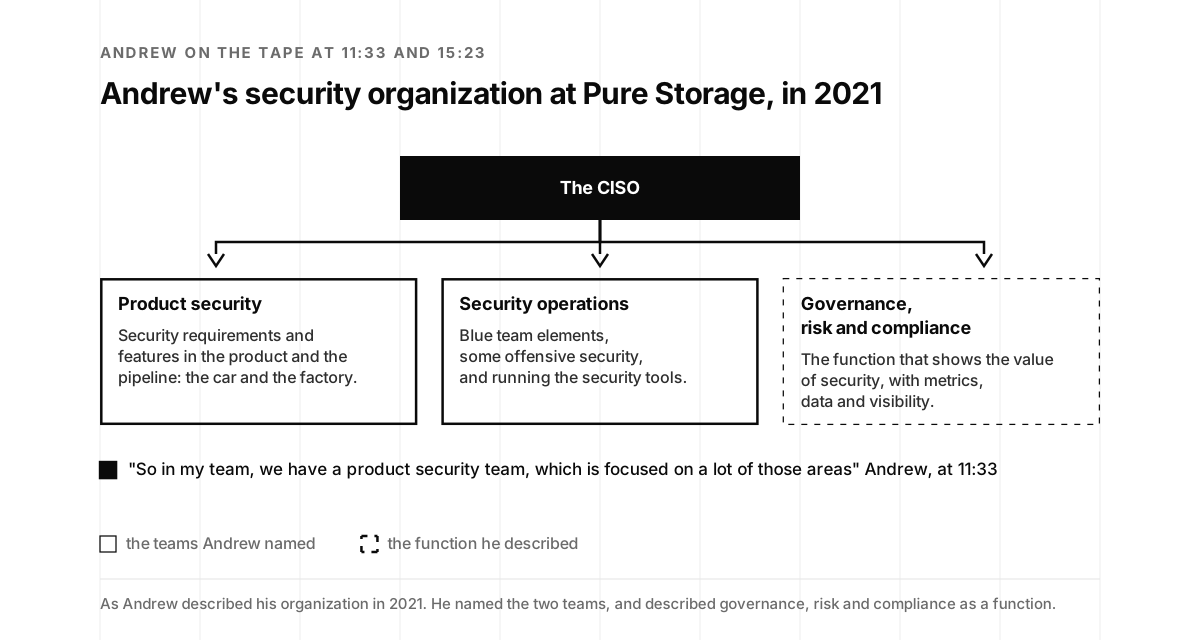
Andrew’s organization at Pure Storage followed the same split.
“So in my team, we have a product security team, which is focused on a lot of those areas”
Andrew Gontarczyk, at 11:33
The second team, security operations, runs what has been built. It holds the blue team side and some of the offensive security, the red and blue roles Jon had asked about,
“but also the operational running of our security tools.”
Andrew Gontarczyk, at 11:52
Later he added governance, risk and compliance, which he called the function that shows the value of security. That makes an engineering team that builds security into the car and the factory, an operations team that watches, tests and runs the tools, and a risk function that measures the program and reports it to the business. Our Product Security and 24/7 Monitoring & Response teams cover the first two from outside, and a vCISO can own the third.
What is a blue team?
Jon stopped to define a term for listeners.
“So just for our listeners, what is a blue team?”
Jon McLachlan, at 11:56
Andrew started with the two sides of security, defense and offense.
“So the red team is the team that attacks.”
Andrew Gontarczyk, at 12:09
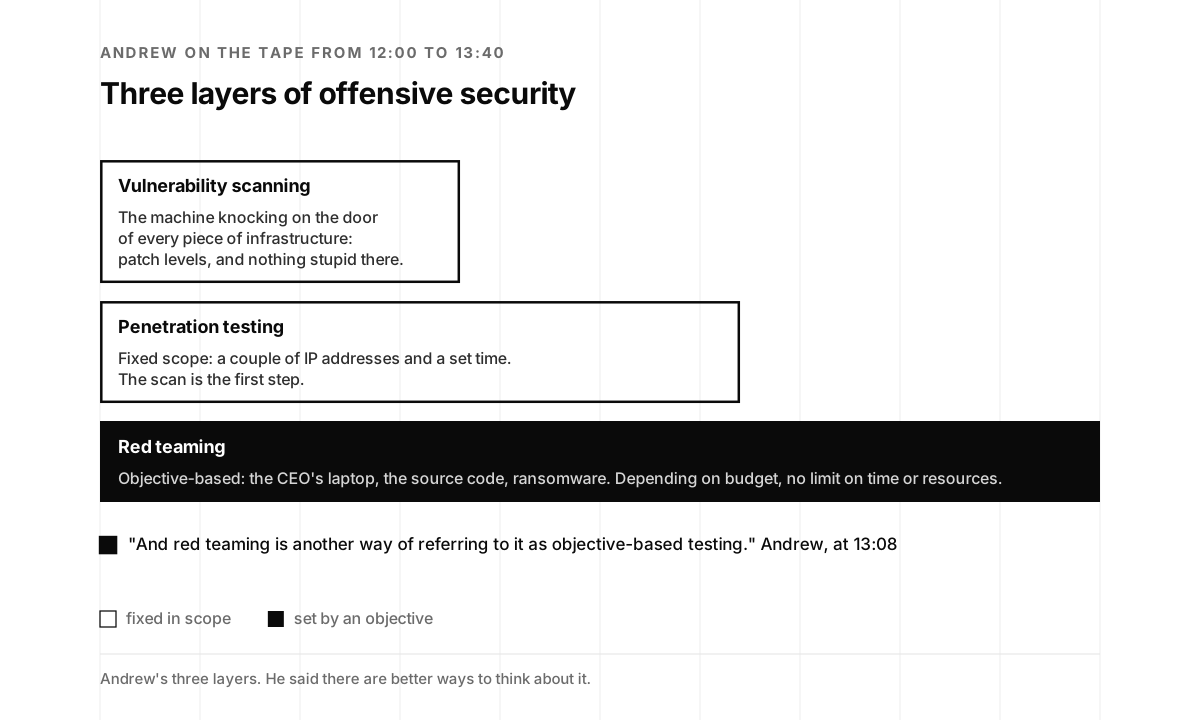
Larger organizations build their own red team capability to simulate real adversaries. He sees three layers of offensive security, and he said others might correct him. The first is scanning.
“But you’ve kind of got vulnerability scanning, which is just the machine knocking on the door of every piece of infrastructure”
Andrew Gontarczyk, at 12:38
A vulnerability scanner is a computer program that assesses computers, networks or applications for known weaknesses (Wikipedia). The scan checks patch levels and that “nothing’s stupid there,” and it is the first step a penetration tester takes to find “any potential kinks in the armor that they can exploit.” A penetration test is an authorized simulated cyberattack on a computer system (Wikipedia), and it is the second layer. Its scope is fixed: the tester gets a couple of IP addresses and a set time, and finds and does as much as possible. The third layer has no such limits.
“And red teaming is another way of referring to it as objective-based testing.”
Andrew Gontarczyk, at 13:08
His examples of objectives were compromising the CEO’s laptop and stealing their email, compromising source code, and testing how susceptible the company is to ransomware. Depending on budget, a red team has no limit on time or resources. He has worked with red teams that dropped USB drives in an office lobby to get into people’s machines.
Red teams go after people because the outside is usually closed. Most organizations, he said, do reasonably well at that unless they are negligent or under-resourced, because so much good information is available.
“So phishing and all those kinds of things is usually the way that they get in.”
Andrew Gontarczyk, at 14:11
Phishing is social engineering that tricks people into giving up sensitive information or installing malware (Wikipedia). A red team that gets in that way tests defense in depth, the practice of layering safeguards so that protection holds when one of them fails (Wikipedia). How long the red team takes to reach its goals depends on the internal security it meets. Then he answered the question.
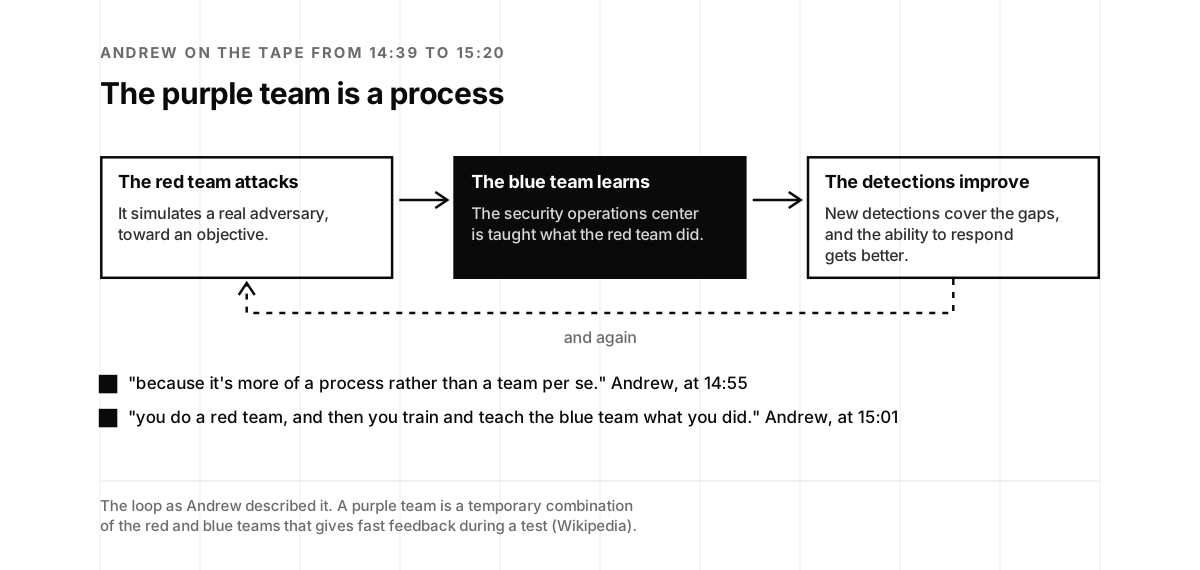
“The blue team is effectively the security operations center.”
Andrew Gontarczyk, at 14:39
A security operations center, or SOC, is responsible for protecting an organization against threats (Wikipedia). The blue team’s job, in Andrew’s words, is to detect and respond to what the red team does, “or more importantly, to what a real adversary does.” He found the name purple team a bit strange.
“because it’s more of a process rather than a team per se.”
Andrew Gontarczyk, at 14:55
Jon guessed it was the two colors mixed together, and Andrew agreed. The process is a loop.
“you do a red team, and then you train and teach the blue team what you did.”
Andrew Gontarczyk, at 15:01
The blue team uses what the red team did to write detections and close the gaps in its ability to respond. Security, Andrew said, is a process you keep iterating through, and Jon called it “the journey.” Will Butler, then on Robinhood’s red team, talked about red teaming and penetration testing on episode 16, and Wesley Belleman described what a SOC is and how to build one on episode 4. Our Penetration Testing team runs the offensive side for companies without a red team, and Pentest Once a Year? covers what enterprise buyers now expect from testing.
Security is a team sport
Andrew moved from offense and defense to governance, risk and compliance, and to how a security leader justifies spending: “That’s all risk-based.” It brought him back to Jon’s first question.
“You don’t need them day one.”
Andrew Gontarczyk, at 15:44
At the start, he said, “The risks don’t justify the reward.” A security boffin, in his word, would make everything super secure from day one, but that isn’t practical and it gets in the way of the business. Let the business grow until it has something worth securing. Many technical people find the risk function boring, and he said, “but I find it extremely valuable,” because it is the function that demonstrates the value of security and drives security across the organization.
“Security is a team sport.”
Andrew Gontarczyk, at 16:28
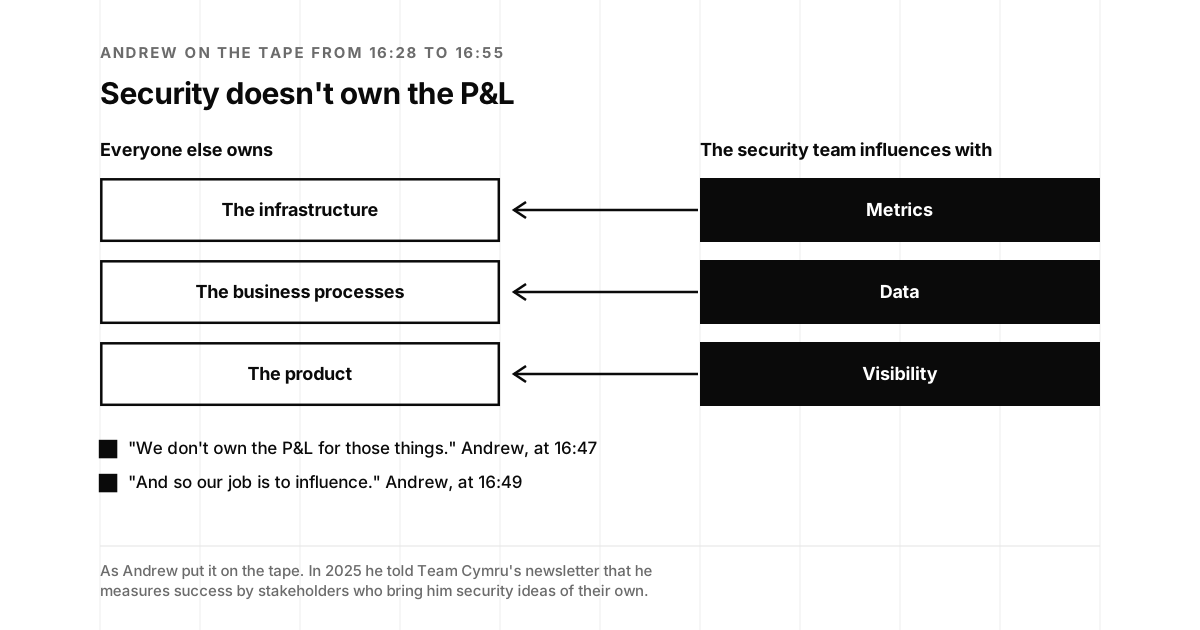
The security team doesn’t do the bulk of the security work. Everyone else owns the infrastructure, the business processes and the product.
“We don’t own the P&L for those things.”
Andrew Gontarczyk, at 16:47
“And so our job is to influence. And the best way to influence is with metrics and data and visibility.”
Andrew Gontarczyk, at 16:49
That is the job of the governance, risk and compliance function, he said, and he noticed that risk management isn’t front of mind in younger Silicon Valley companies, which he understood as part of their evolution. The method is to work out with your stakeholders what is important and meaningful to them, which is different in every organization. He called that part “more art” than science. Some leadership teams ask good, insightful questions, and he said Pure’s executives did. That made his job easier, because their questions told him what to focus on. Jon said not every company is like that, and that a captive audience willing to move forward together can go a long way.
Andrew later named his own measure of that influence: stakeholders who come to him with security ideas and plans of their own. After the tape has the interview. Our post on the security slide your board deck is missing is about the same reporting problem.
The tail wagging the dog
Andrew said security is often the tail wagging the dog, and named a habit of what he called pure-play security people, a group he counts himself in.
“There is a tendency for a lot of security people to be all doom and gloom, the FUD kind of, fear, uncertainty and doubt.”
Andrew Gontarczyk, at 18:50
Fear, uncertainty and doubt, or FUD, is a manipulative propaganda tactic used in selling, advertising and elections (Wikipedia). Andrew said security people do it not necessarily deliberately, because “that’s just the way that they think.” Jon called it a mentality. Andrew said it isn’t constructive because it leaves out the business. The business asks whether it needs a control right now, and it has to prioritize its people and its money.
“the business is all about taking risks.”
Andrew Gontarczyk, at 19:21
Security people who forget that get frustrated and ask why the business isn’t doing what they asked. The answer, he said, is that the business has a thousand other priorities and has done a little. If it isn’t enough, motivating the business to do more is why the security team exists.
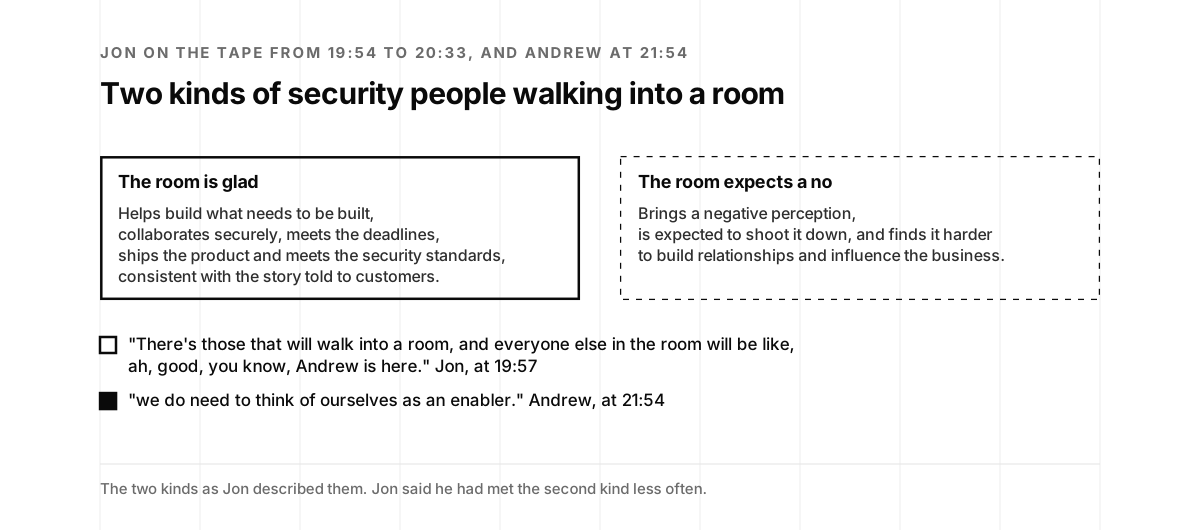
Jon described two kinds of security people. When the first kind walks into a room, the room is glad: the person will help build what needs to be built, collaborate securely, meet the deadlines, ship the product and meet the security standards, consistent with the security story told to customers.
“There’s those that will walk into a room, and everyone else in the room will be like, ah, good, you know, Andrew is here.”
Jon McLachlan, at 19:57
The second kind brings a negative perception into the room. Jon said he had met them less often.
“It’s like, uh-oh, they’re just going to shoot it down.”
Jon McLachlan, at 20:30
The second kind finds it harder to build relationships and to influence the business toward what is healthy for both security and the business. Our post Stop Saying No makes the same case for AI tools.
Execute and deliver
Jon asked what is hardest to find when Andrew fills a role. Andrew said it depends on the role, and then named the constant.
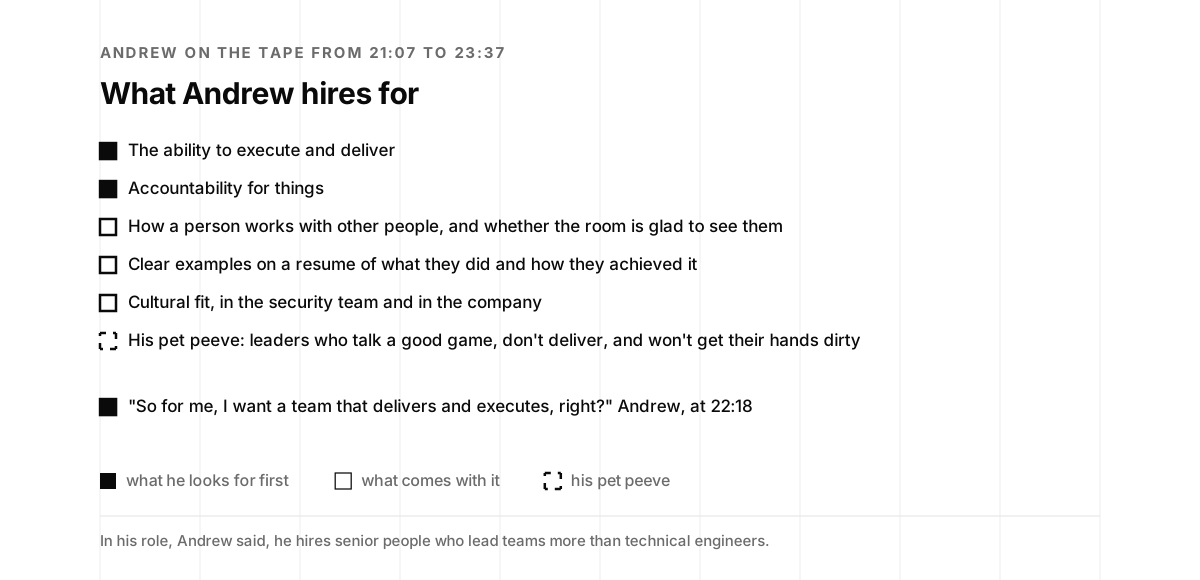
“the most important thing that I’m looking for is ability to execute and deliver, and people that take accountability for things.”
Andrew Gontarczyk, at 21:20
The second thing is how a person works with other people. He used Jon’s room: some people are welcomed, and some will say that everything is insecure and that “the best thing for us to do is just shut down the company so there’ll be no risk.”
“we do need to think of ourselves as an enabler.”
Andrew Gontarczyk, at 21:54
“And that means sometimes agreeing to and endorsing positions that might make us uncomfortable.”
Andrew Gontarczyk, at 21:56
“A willingness to compromise will go a long way.”
Jon McLachlan, at 22:03
Andrew agreed. A security leader, he said, has to look at the whole outcome and work with the business to balance it.
“So for me, I want a team that delivers and executes, right?”
Andrew Gontarczyk, at 22:18
He wants a team that delivers on what it says it will do, is proactive, and is seen as an enabler that contributes to the business. On a resume he looks for clear examples of what a person did and how they achieved it. Then comes cultural fit, in the security team and in the company. In his role he hires senior people who lead teams more than technical engineers.
“one of my pet peeves, I guess, is just people that talk a lot, talk a good game, but don’t deliver anything”
Andrew Gontarczyk, at 23:13
Those are the leaders who won’t roll up their sleeves and think everyone else works for them. Directing work is a large part of a leader’s job, he said, “but you need to be able to get your hands dirty.” Jon agreed that leaders need to understand the details, which is “where the rubber hits the road.” Polina Morozov, then a security recruiter at Grammarly, talked about recruiting for security on episode 46.
Your first 90 days
Jon asked for a favorite interview question. Andrew has two. One is a question he and a former colleague both ask, for architecture roles. The other is for any leader.
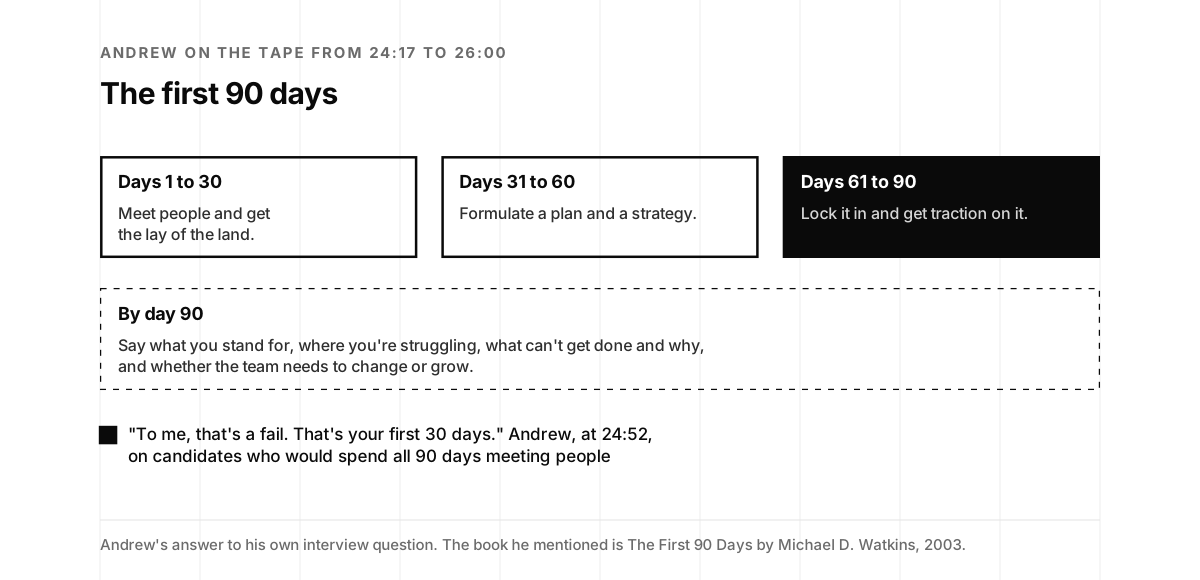
“just tell me what your first 90 days are going to be like.”
Andrew Gontarczyk, at 24:17
“And what’s interesting about that one, and what surprises me, is how many people answer that question badly.”
Andrew Gontarczyk, at 24:24
There is a book on the subject, he said, and plenty of literature beyond it. The book is The First 90 Days by Michael D. Watkins, published by Harvard Business School Press in 2003, with a second edition in 2013 (Wikipedia). The question tests execution, delivery and accountability. Many candidates told him they would spend the 90 days meeting people and getting the lay of the land.
“To me, that’s a fail. That’s your first 30 days.”
Andrew Gontarczyk, at 24:52
“Your next 30 should be formulating a plan and a strategy, and your last 30 should be kind of locking that in and getting traction on it”
Andrew Gontarczyk, at 24:56
“I love that word, the traction.”
Jon McLachlan, at 25:05
Meeting people helps the new hire, Andrew said, and it doesn’t help the organization. Jon said 30 days of meeting people is generous. By day 90, Andrew said, a leader should be able to say what they stand for, where they are struggling, what can’t get done and why, and whether the team is wrong or needs more people.
“you need to establish yourself in the organization, especially at a leadership level.”
Andrew Gontarczyk, at 25:32
Secure it
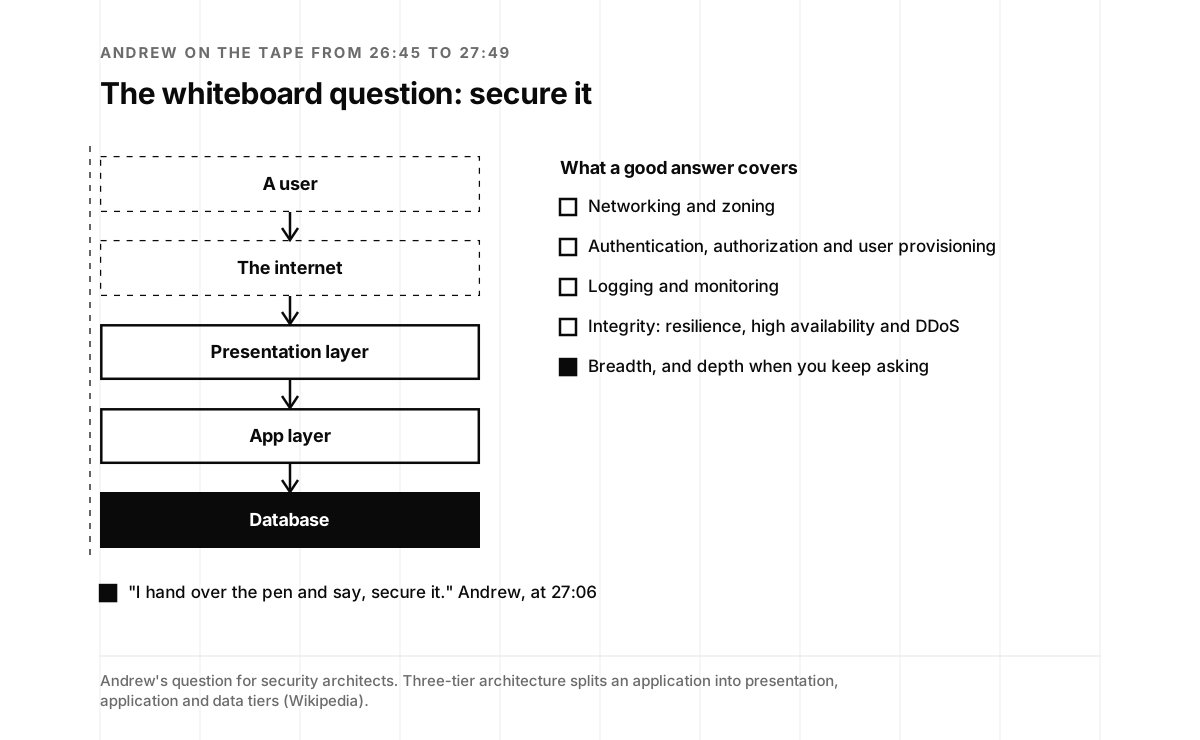
The second question is the one Andrew uses for security architects. He used to draw on a whiteboard. In 2021 he drew on a Google Slide or a PowerPoint and shared his screen.
“And you could argue it’s a bit old school, but it works.”
Andrew Gontarczyk, at 26:45
“it’s basically presentation layer, app layer, database, internet, and a user with a line through all of them”
Andrew Gontarczyk, at 26:52
That is three-tier architecture, a client-server pattern that splits an application into a presentation tier, an application or logic tier, and a data tier (Wikipedia). Then he gives the candidate the pen.
“I hand over the pen and say, secure it.”
Andrew Gontarczyk, at 27:06
“And it really gives you a sense of how they think about security.”
Andrew Gontarczyk, at 27:11
The answer shows whether the candidate thinks about networking and zoning, authentication, authorization and user provisioning, logging and monitoring, and integrity, with resilience, high availability and DDoS. It shows breadth, and it can show depth. Jon said you can keep asking for one more layer until you are looking at assembly. Andrew said the question also shows whether a candidate can design a solution and contribute. A person who can’t secure a simple web app can’t help a team do it.
Every opinion is a diverse opinion
Jon brought up diversity. He listed race and sexual orientation, and then a wider idea.
“everyone brings a unique piece of diversity to the table”
Jon McLachlan, at 28:48
His example was a team with both new and senior members. With openness, humility and a habit of learning, he said, a disagreement becomes a chance to see the world from another perspective. He asked whether Andrew makes special diversity efforts when he builds a team, since hiring often means getting what you get.
Andrew said diversity is usually described the way Jon had, in terms of sexual orientation and race, and Jon added gender. Andrew then described an article he had heard in The Economist. Men and women of different sexual orientations and races who all come from the same university, with the same socioeconomic background and the same college system, tick the boxes on paper, and they are not necessarily diverse. He said he supports the dimensions organizations use today. People can poke holes in any of them, he said, and the intent and the overall outcome are the right thing to do.
“the most important thing is what you’re talking about, is diversity of ideas.”
Andrew Gontarczyk, at 31:28
As CISO he is expected to have the answers, and one of his strengths is making a call when a group is floundering. What he struggles with is people who don’t challenge him.
“I really like people to challenge me.”
Andrew Gontarczyk, at 32:15
In hierarchical places, and he named financial services, people decide they can’t raise something with the boss. He asks people to tell him when an idea is stupid or when they can make it better.
“every opinion is a diverse opinion, because it’s not yours.”
Andrew Gontarczyk, at 32:48
He separated two parts. The first is treating every person as a human being with an equal right to be here and to the same opportunities, without discrimination. He said he supports measures that break down stereotypes and prejudices built up over generations, that ignoring them is naive, and that everyone has unconscious bias to be aware of and work through. The second part is the culture of a team: junior people need to feel free to ask difficult questions, such as saying in a meeting that they don’t understand. Andrew has done it many times.
“for me, 90% of the time when I’ve done that, a good two or three other people in the room go, yeah, I was wondering the same.”
Andrew Gontarczyk, at 34:27
Jon acted out the line: “I’m so sorry. I don’t understand. Please help me.” Andrew said that if someone asks a genuinely stupid question, don’t make them feel like an idiot, because they’re learning.
“I think diversity of ideas is just creating a safe space for people to voice them”
Andrew Gontarczyk, at 34:50
Fredrick Lee, then the chief security officer of Gusto, talked about why authentic diversity matters for security teams on episode 8, three months after this one.
My job as a leader is to create space
Andrew’s view of diversity led to his view of leadership.
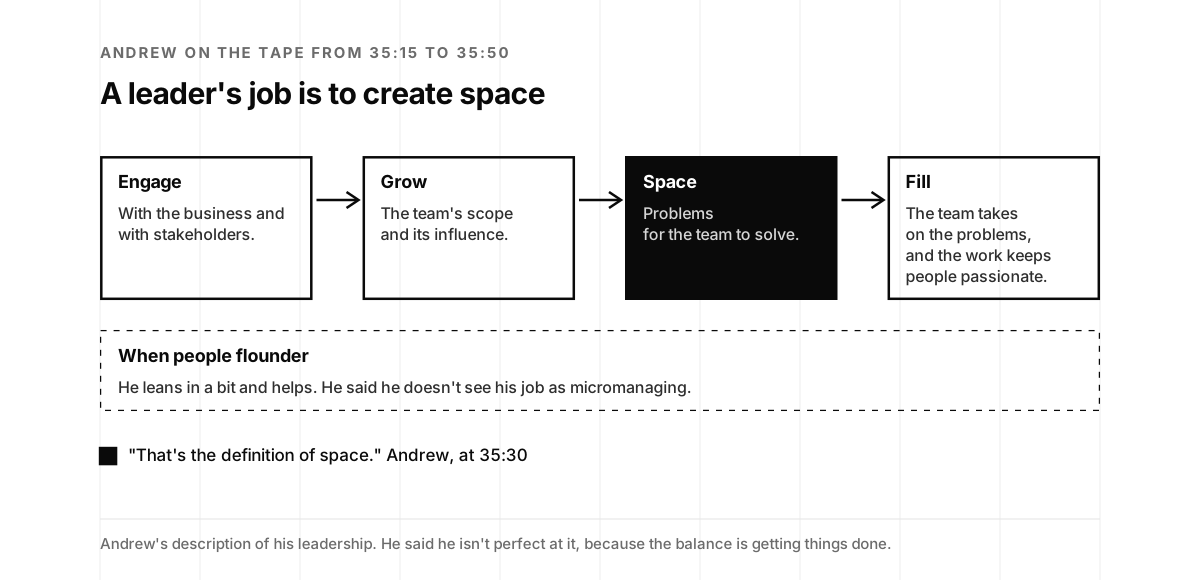
“My job as a leader is to create space.”
Andrew Gontarczyk, at 35:15
He creates the space by engaging with the business and with his stakeholders.
“constantly grow our scope, constantly grow our influence, which fundamentally translates to creating problems for us to solve.”
Andrew Gontarczyk, at 35:22
“That’s the definition of space.”
Andrew Gontarczyk, at 35:30
The team fills that space, and he hopes the work excites people and keeps them passionate about what the team is trying to achieve.
“But I don’t see my job as micromanaging and all those sorts of things.”
Andrew Gontarczyk, at 35:44
Jon said he doesn’t know anyone who likes being micromanaged. Context lets each person see how their work adds value and stays interesting, and he said the same holds outside security.
“And it’s great, because everyone retains a strong sense of agency.”
Jon McLachlan, at 36:21
When people make their own decisions in line with the business and own the result, “that’s where the magic is,” Jon said. Andrew said he tries to work that way and isn’t perfect at it, because the balance is getting things done. Some people given a lot of space flounder, so he leans in and helps. Jon added that time is part of the space too, with a nod to Einstein and space-time, the mathematical model that combines the three dimensions of space and time into a single four-dimensional continuum (Wikipedia). Andrew picked up Jon’s point about accountability and ownership.
“that’s what people get excited about”
Andrew Gontarczyk, at 37:23
When people deliver something, he said, “they go, look what I made.” Jon called that a success, and said there is no success without a bit of struggle first.
What I don’t know
Jon asked what keeps Andrew up at night. Andrew said it was an easy question.
“What keeps me up at night is what I don’t know.”
Andrew Gontarczyk, at 38:04
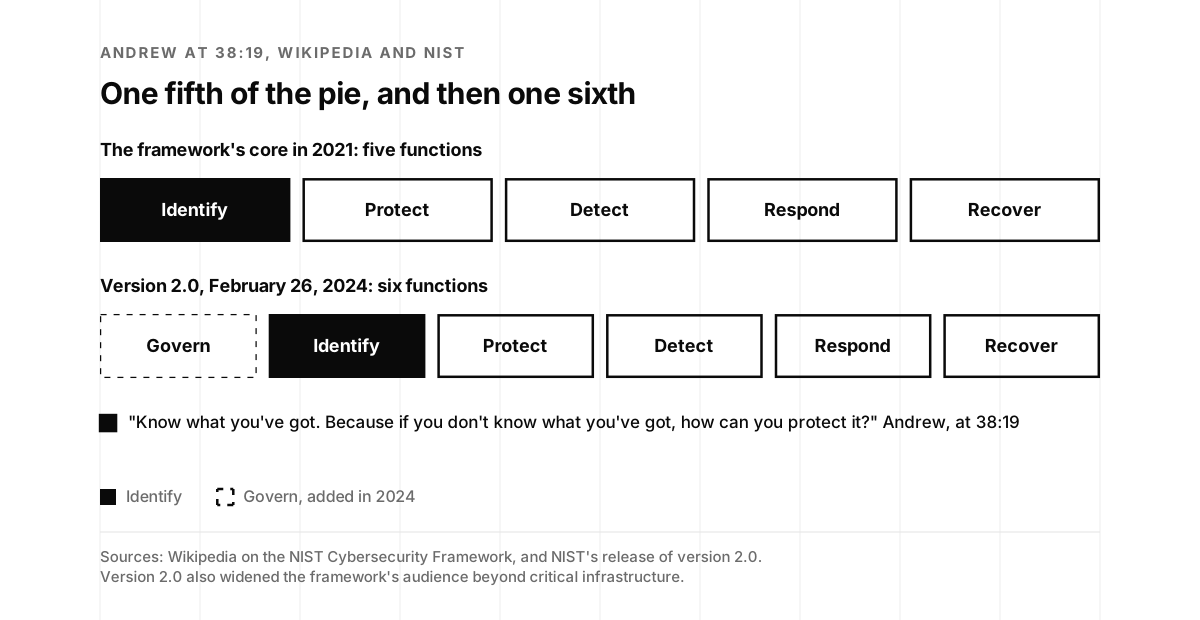
Every organization he had worked in grew fast, and technology moves fast. He pointed to the NIST Cybersecurity Framework, whose first function is Identify, and called that column “one fifth of the pie.”
“Know what you’ve got. Because if you don’t know what you’ve got, how can you protect it?”
Andrew Gontarczyk, at 38:19
The NIST Cybersecurity Framework is a set of guidelines that helps organizations assess and improve their preparedness against cybersecurity threats, and NIST released version 1.0 in 2014 (Wikipedia). In 2021 its core had five functions: Identify, Protect, Detect, Respond and Recover. Version 2.0, released on February 26, 2024, added Govern as a sixth function and widened the framework’s audience beyond critical infrastructure to all organizations. Govern covers how an organization makes and carries out its decisions on cybersecurity strategy, and NIST calls cybersecurity “a major source of enterprise risk” for senior leaders to weigh alongside financial and reputational risk (NIST). Identify is one sixth of the pie now.
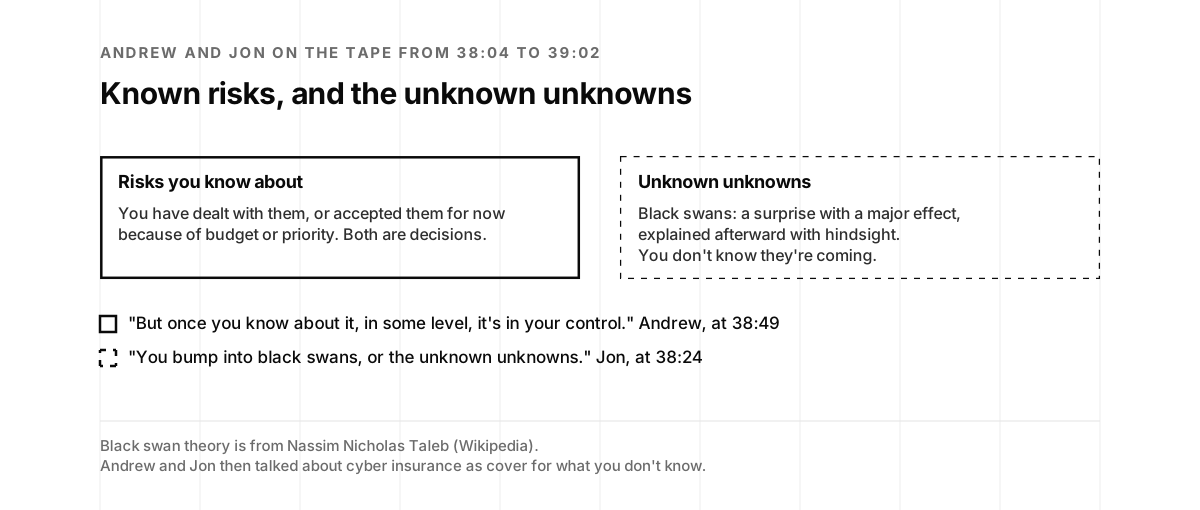
“You bump into black swans, or the unknown unknowns.”
Jon McLachlan, at 38:24
A black swan is a surprise event with a major effect that people explain afterward with hindsight, a theory Nassim Nicholas Taleb set out (Wikipedia). Known knowns, known unknowns and unknown unknowns are the categories from a Defense Department news briefing on February 12, 2002 (Wikipedia), and Jon called the last one “that fourth quadrant of knowledge.” Andrew explained why a known risk is different. Once you know about a risk, you have either dealt with it or accepted it, perhaps to deal with later for reasons of budget or priority.
“But once you know about it, in some level, it’s in your control.”
Andrew Gontarczyk, at 38:49
“You’re making decisions,” he said.
Cyber insurance is just a no-brainer
Jon suggested that unknown unknowns are why some companies buy cyber insurance. Andrew didn’t think it should even be a question.
“Look, cyber insurance is just a no-brainer.”
Andrew Gontarczyk, at 39:02
He compared it to car insurance and called it part of the cost of doing business. He said the question is when an incident happens and how bad it is.
“So insurance is, in my opinion, a necessary risk management strategy.”
Andrew Gontarczyk, at 39:20
Cyber insurance is a specialty insurance product that protects organizations against risks related to information technology infrastructure and activities (Wikipedia). Andrew then gave an example of what he doesn’t know: data loss. Personal information carries regulatory, commercial and financial impact, and losing intellectual property is a different subject. Data protection, he said, is a nightmare: data is everywhere, it is near impossible to control fully, and the more you control it, the more you frustrate your users.
“I’d challenge any CISO or any security professional to be able to say, I know where all my data is.”
Andrew Gontarczyk, at 40:25
His larger worry was technology itself, with cloud services as the example. Depending on governance, “anyone can spin stuff up with their credit card,” he said. The calculator below puts numbers on his risk-based approach: what a risk is likely to cost each year, and whether a control costs less than the loss it prevents.
At the end, Jon asked for last words. Andrew said this was where he should try to be profound and deeply philosophical, “which I think I’m neither of those.” Jon wished him the best “moving forward with Pure Storage and securing all of that valuable data.”
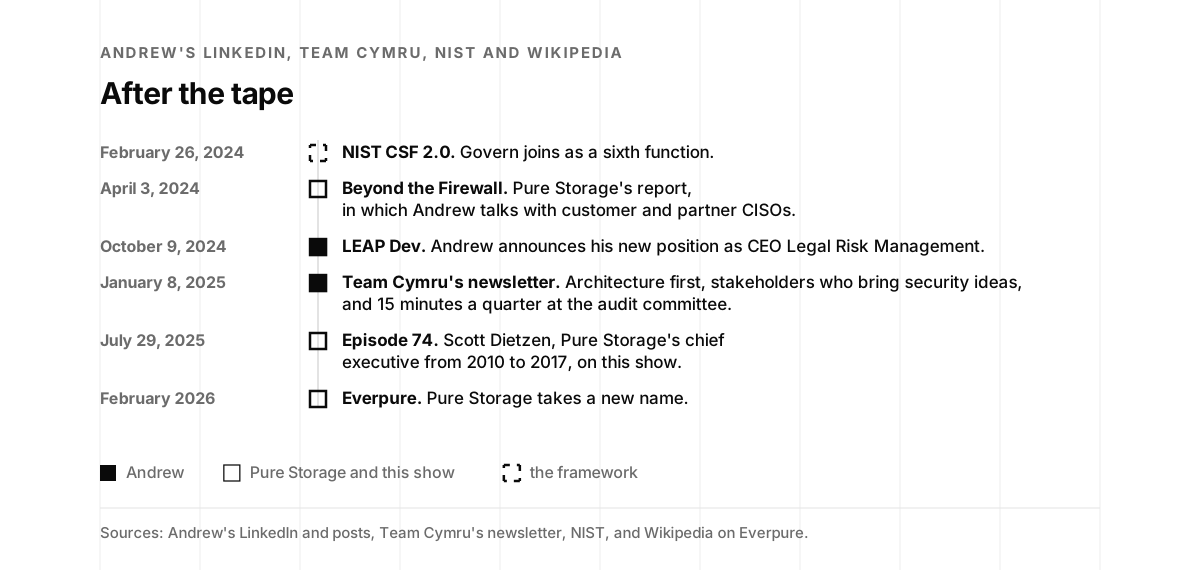
After the tape
Andrew stayed at Pure Storage for three and a half more years, until October 2024 (LinkedIn). On April 3, 2024, Roger Boss shared Pure Storage’s report Beyond the Firewall: Insights and Strategies from Leading CISOs on LinkedIn, describing a project in which Andrew talks with customer and partner CISOs about the biggest challenges they face (LinkedIn). Andrew reposted it: “Proud to be part of this conversation.”
On October 9, 2024, he announced a new position as CEO Legal Risk Management at LEAP Dev (LinkedIn). On January 8, 2025, Team Cymru’s newsletter, The Future of Threat Intelligence, published three takeaways from a podcast interview with him, written up by David Monnier (LinkedIn). Each one picks up a thread from this episode.
- He starts from the architecture. “I approach every problem as an architectural problem,” he said, close to what he said about the car and the factory in 2021.
- Success is stakeholders who bring ideas. He measures his success by his stakeholders “coming to me with security ideas” and strategies of their own.
- Reporting gets 15 minutes a quarter. Reporting usually goes to the audit committee, and “if you get 15 minutes in that every quarter,” that is a good window. Three months of work distilled into 15 minutes should cover the business question: “are we under control or are we not under control?”
Interesting chat I had the privilege of having last year.
Andrew Gontarczyk · January 2025
Two other episodes of this show came from Pure Storage. Prakash Darji, general manager of its Digital Experience business unit, talked about the Portworx acquisition on episode 6 in July 2021. Scott Dietzen, its chief executive from 2010 to 2017, was the guest on episode 74 in July 2025, where Jon told him he had joined Pure Storage after Scott had moved on.
Did you catch it? A seven-question quiz
Seven questions from the episode. Each answer links the moment in the transcript.
Quiz · seven questions
Did you catch it?
Pick an answer to see whether you caught it, and where it is on the tape.
-
What analogy does Andrew use for a product and the pipeline that builds it?
- A castle and its moat
- A lock and its key
- A car and the factory that makes it
c. "So let's stick with the car manufacturing plant and the cars." Transcript, 8:21.
-
What does Andrew call red teaming?
- Objective-based testing
- Fixed-scope testing
- Vulnerability scanning
a. "And red teaming is another way of referring to it as objective-based testing." Transcript, 13:08.
-
What is the blue team, in Andrew's words?
- The red team's managers
- The security operations center
- The compliance team
b. "The blue team is effectively the security operations center." Transcript, 14:39.
-
What does Andrew say the security team doesn't own?
- The security tools
- The policies
- The P&L
c. "We don't own the P&L for those things." Transcript, 16:47.
-
Which interview question does Andrew ask every leader?
- What will your first 90 days look like?
- What was your worst breach?
- Which tool would you buy first?
a. "just tell me what your first 90 days are going to be like." Transcript, 24:17.
-
After he draws a three-tier app, what does Andrew tell the candidate?
- Break it
- Secure it
- Scale it
b. "I hand over the pen and say, secure it." Transcript, 27:06.
-
What does Andrew say keeps him up at night?
- What he doesn't know
- Ransomware
- The board
a. "What keeps me up at night is what I don't know." Transcript, 38:04.
Is your security program ready for its next chapter?
Andrew’s test for when a company needs a security team is what its biggest customers ask for, and whether it can show them. Eight questions on whether your program can.
Scorecard · eight questions
Is your security program ready for its next chapter?
Answer for the company as it works today. If two answers fit, pick the lower one.
-
When an enterprise prospect asks for your policies, your incident response plan and your monitoring, can you show them?
- No
- Some of it
- Yes, with evidence a buyer can check
"Do you have incident response? Do you have monitoring?" See It's just a question of timing.
-
Does every feature, security or not, ship with security requirements such as auditing, admin authentication and integrity?
- No, only security features get a security review
- Some teams do this
- Yes, written into every design
"So every feature had a bunch of security requirements on top of it." See The car and the factory.
-
Are the pipeline that builds and ships your product and the cloud accounts it runs in secured, with an owner?
- Not yet
- Partly
- Yes, and someone owns them
"that's sort of more the CI/CD side of things." See The car and the factory.
-
Does someone detect and respond to attacks, around the clock or on call?
- No one watches
- Alerts reach someone, sometimes
- Yes, a team, a SOC or a service
"The blue team is effectively the security operations center." See What is a blue team?
-
When your defenses are tested, do the people who defend learn what the testers did?
- We don't test
- We test, and the report sits
- Yes, findings become detections
"you do a red team, and then you train and teach the blue team what you did." See What is a blue team?
-
Can you show leadership where security stands in metrics and data, on the questions they ask?
- No
- Some numbers, not tied to their questions
- Yes, every quarter
"And the best way to influence is with metrics and data and visibility." See Security is a team sport.
-
Do you know what you've got: your systems, your data, and the cloud accounts people started on their own?
- No
- Partly, with gaps we know about
- Yes, and we check it
"Know what you've got." See What I don't know.
-
Do you have cyber insurance, and do you know what it covers?
- No
- We have a policy nobody has read
- Yes, read and matched to our risks
"Look, cyber insurance is just a no-brainer." See Cyber insurance is just a no-brainer.
Most of the program is still unknown. Start with Identify: list your systems, data and cloud accounts, and name an owner for the product, the pipeline and the infrastructure.
The pieces exist in places. Next, test them, teach the defenders what the testers did, and report the results to leadership on the questions they ask.
The program is built and measured. Keep bringing leadership the metrics, retest after changes, and recheck the inventory as the company grows.
Is the control worth the money?
Andrew said security spending is risk-based. This calculator uses the standard formula: the annualized loss expectancy is the yearly rate of occurrence times the single loss expectancy (Wikipedia). Every default is our example, not a benchmark.
Calculator
Is the control worth the money?
Four numbers: what one incident would cost, the chance it happens in a year, the share of that loss a control prevents, and what the control costs each year.
At a 25% chance a year, an incident that costs $400,000 is an expected loss of $100,000 a year. A control that prevents 60% of it brings that to $40,000, so it avoids $60,000 a year for $50,000, or 1.2 dollars of loss avoided for each dollar spent.
The $400,000, 25%, 60% and $50,000 are our examples, not benchmarks. Put in your own. Above 1, the control costs less than the loss it avoids. Below 1, the other options Andrew named apply: accept the risk, or insure it.
From IBM Australia to Everpure
Everything on this page sits on one timeline, from 1999 to 2026. Filter it by thread.
Timeline · 1999 to 2026
From IBM Australia to Everpure
Filter by thread. Career dates are from Andrew's LinkedIn, and company dates are from the public record.
- IBM Australia
Senior managing consultant to November 2010, consulting to industry (LinkedIn, on this show).
- Unknown unknowns
The phrase comes from a Defense Department news briefing (Wikipedia, on this show).
- The First 90 Days
Michael D. Watkins's book, from Harvard Business School Press (Wikipedia, on this show).
- Os76
John Colgrove and John Hayes found Pure Storage under a code name (Wikipedia, on this show).
- NBN Co
Manager of security architecture to July 2014 (LinkedIn, Wikipedia).
- The NIST Cybersecurity Framework
NIST releases version 1.0 (Wikipedia, on this show).
- Commonwealth Bank
Executive manager of security transformation to June 2017 (LinkedIn, Wikipedia).
- Pure Storage goes public
25 million shares for $425 million (Wikipedia, on this show).
- Pepper Financial Services Group
Chief information security officer and head of information security to April 2018 (LinkedIn).
- Symantec
Vice president of information security, the job that brought him to Silicon Valley (LinkedIn, on this show).
- Broadcom and Symantec
Broadcom announces it will buy Symantec's enterprise security software division for $10.7 billion (Wikipedia, on this show).
- The sale closes
Symantec keeps Norton and renames itself NortonLifeLock (Wikipedia).
- Pure Storage
Andrew becomes chief information security officer (LinkedIn, on this show).
- Portworx
Pure Storage buys the Kubernetes storage company for $370 million (Wikipedia, episode 6).
- The conversation
The tape fits these months (on this show).
- Episode 1 airs
Anand Ganesh of Hammerspace (episode 1).
- Episode 2 airs
On Podbean (Podbean, on this show).
- Episode 6 airs
Prakash Darji of Pure Storage on the Portworx acquisition (episode 6).
- Episode 8 airs
Fredrick Lee of Gusto on diversity in security teams (episode 8).
- NIST CSF 2.0
Govern joins as a sixth function (NIST, on this show).
- Beyond the Firewall
Pure Storage's report in which Andrew talks with customer and partner CISOs (LinkedIn, on this show).
- LEAP Dev
Andrew announces his new position as CEO Legal Risk Management (LinkedIn, on this show).
- Team Cymru's newsletter
Architecture, stakeholders and 15 minutes at the audit committee (LinkedIn, on this show).
- Episode 74 airs
Scott Dietzen, Pure Storage's chief executive from 2010 to 2017 (episode 74).
- Everpure
Pure Storage takes a new name (Wikipedia, on this show).
- Episode 104 airs
Yash Kosaraju, the CISO of a16z, on the first security hire and the head of security (episode 104).
What to do this week
Five things, in the order of the episode.
- Check whether it’s time to build. Take the scorecard with whoever answers your security questionnaires today. If enterprise buyers are asking for policies, incident response and monitoring, our post on how startups should staff security compares hiring, a fractional leader and a service.
- Write security requirements into every feature. Pick one feature in flight and list its auditing, admin authentication and integrity requirements. Then do the same for the pipeline that builds it and the cloud accounts it runs in. Our Product Security team does this with engineering teams.
- Close the loop between attack and defense. Scan, test or red team, then walk the defenders through what the testers did and turn it into detections. Our Penetration Testing and 24/7 Monitoring & Response teams cover the two sides.
- Know what you’ve got, and decide on what you don’t fix. Inventory your systems, data and cloud accounts, including the ones people started with a credit card. For each known risk, decide in writing to fix it, accept it or insure it, with the calculator for the numbers, and report the decisions to leadership as metrics. The Security Slide Your Board Deck Is Missing shows one way to report it.
- Get help with the parts you can’t staff. A vCISO can own the program and the reporting, our post on hiring a fractional CISO lists the questions to ask one, and you can book 15 minutes with us.