
Episode 6 of The Security Podcast of Silicon Valley came out on July 26, 2021, with Jon McLachlan hosting. The guest was Prakash Darji, general manager of the Digital Experience business unit at Pure Storage, the flash storage company now called Everpure (Podbean, LinkedIn, Wikipedia). The episode is called “Prakash Darji, General Manager of Digital Experience at Pure Storage: The Next Frontier of Storage and Security.”
Two threads run through the talk. One is how storage keeps data safe from attackers who are willing to wait. The other is the question Prakash wants every executive to ask: how secure am I, and what does the next level cost?
This page follows the conversation in order: a section for each part of it, sixteen figures, seven clips from the tape, a LinkedIn post, the full transcript, and five tools: a quiz, a scorecard for slow attacks, a calculator for how far back your immutable copies reach, a timeline, and a to-do list. Where the decodes of the tape disagree on a word, the transcript puts its best guess in brackets, and the page doesn’t quote or retell those words.
Down the stack to storage
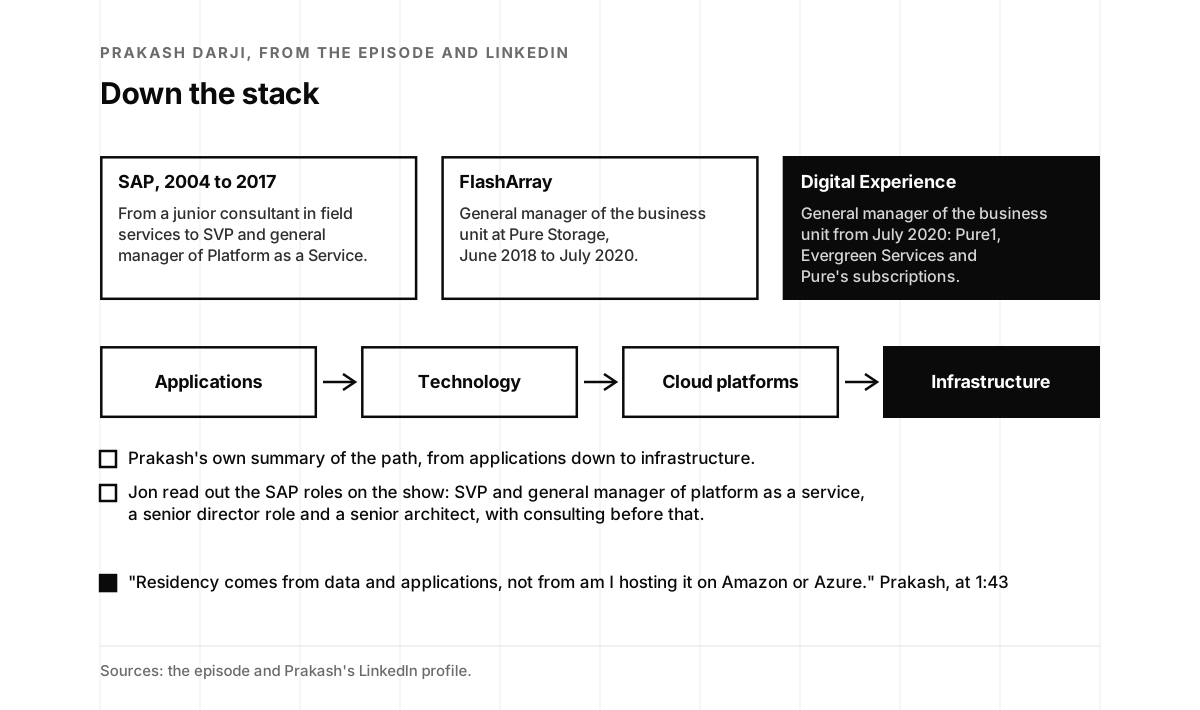
Jon read out the path: SVP and general manager of platform as a service at SAP, a senior director role there, a senior architect before that, and senior roles in consulting. LinkedIn fills in the rest. Prakash spent February 2004 to April 2017 at SAP, ending as SVP and general manager of Platform as a Service from July 2014. Pure Storage came next, from June 2018 as general manager of the FlashArray business unit, and from July 2020 as general manager of the Digital Experience business unit (LinkedIn).
Prakash summed up the path as applications, then technology, then cloud platforms, and now infrastructure: down the stack.
“And the challenges in each one of those things are very, very different.”
Prakash Darji, at 1:03
Building a cloud platform taught Prakash a lesson about hybrid. A company with a back office ERP system wants a mobile app for order approval. The app uses cloud development techniques, but all the data sits on premises. So Prakash sees hybrid in terms of applications and data, wherever they run.
“Residency comes from data and applications, not from am I hosting it on Amazon or Azure.”
Prakash Darji, at 1:43
One gateway for many apps
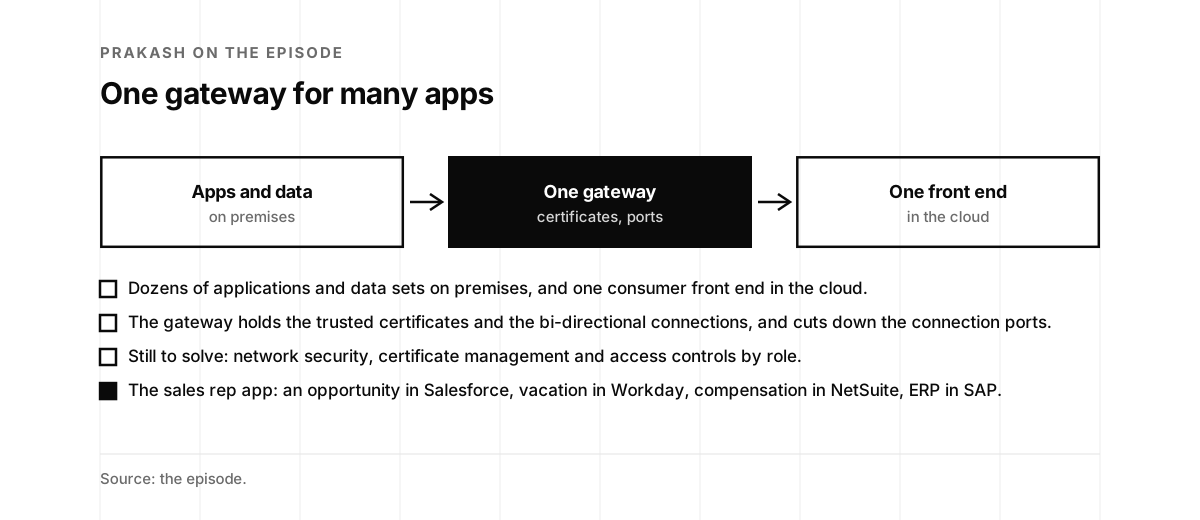
Jon asked about the biggest data security challenges Prakash had seen. The first is how you approach the real estate. Say a company has 10 applications or 50 data sets on premises and wants a consumer front end in the cloud. Prakash had no patience for wiring each one up point to point.
“Like, you need one gateway on premise, where you can have your trusted certificates, bi-directional connections”
Prakash Darji, at 2:17
The gateway also cuts down the connection ports, because enterprises are complicated. Then come the questions: network security, certificate management and role-based access controls, in a distributed environment with lots of applications and data behind one app at the front.
The example was a sales rep application. What a sales rep needs sits in different systems: an opportunity in Salesforce, a vacation request in Workday, compensation in NetSuite, and an ERP system from SAP. Prakash asked whether you’d want app sprawl on the phone,
“where you have the sales rep have 50 different apps on their phone to do their job”
Prakash Darji, at 3:18
When isolation costs productivity
Prakash’s complaint about phones: too many apps, too much scrolling. Jon pointed to the upside. On the device, apps don’t talk to each other unless they’re built to work together. Prakash’s answer was that this isolation makes for a poor experience. Jon agreed, recalling the swiping it takes to find an app again.
Prakash’s example: a customer meeting sits in Salesforce, and a vacation goes into Workday.
“Wouldn’t it be nice if those apps could collaborate and actually change your meetings?”
Prakash Darji, at 4:21
“That would be nice. In fact, that drives me crazy.”
Jon McLachlan, at 4:25
“security here is being used to destroy productivity”
Prakash Darji, at 4:32
Jon’s answer: the right integrations could bake it in, but that takes work, and it won’t work across every calendar app people use.
An app for each person
Today’s apps are horizontal or vertical: a genomics app, a health app, a banking app, an HR app, a Salesforce app. Prakash expects that to change.
“There is going to be a new economy of persona-based applications in the future”
Prakash Darji, at 5:15
Once platforms as a service make development cheap enough, each person could get an app of their own, machine generated from the apps they use. The hard part is security: the pathways, the personally identifiable information and the connections. Then Prakash turned to single sign-on.
“But every time I get that pop-up to renew my token, I get irritated.”
Prakash Darji, at 5:57
Jon agreed, then gave the other side. The prompt is a security check that the right person still holds the device. Or there’s a compliance reason, such as a SOC 2 Type 2 report that calls for a new check every three or seven days.
“Maybe there’s some compliance reason.”
Jon McLachlan, at 6:17
“But like, look, are there smarter ways to do it?”
Prakash Darji, at 6:30
Ransomware and black money
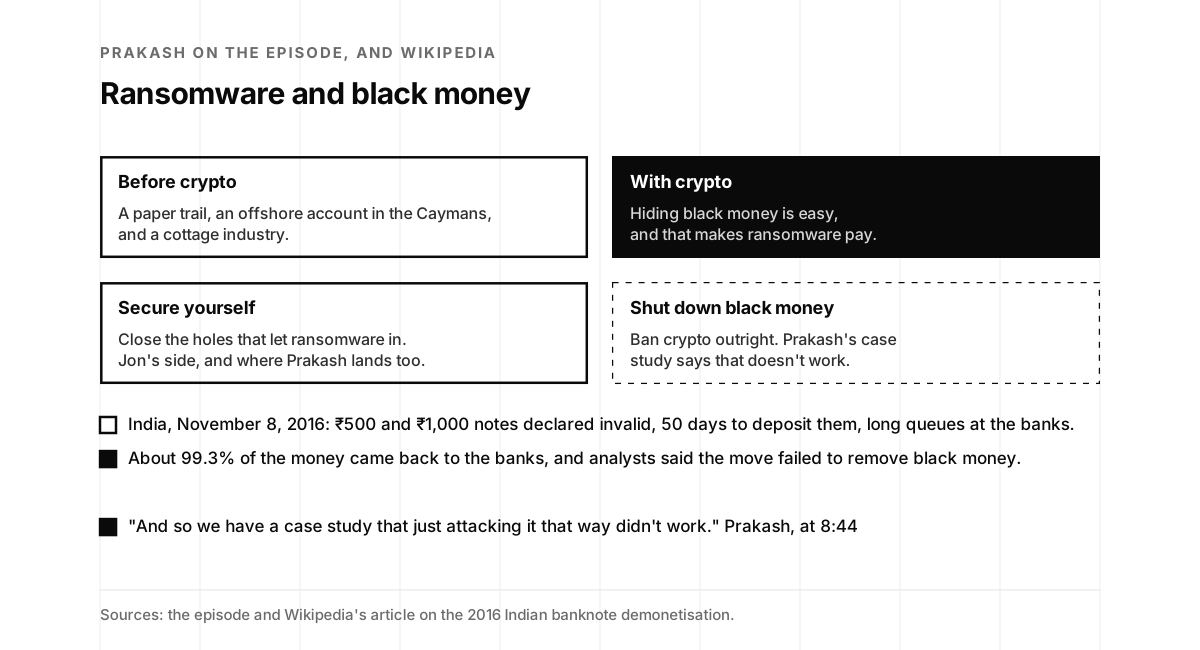
Prakash switched to ransomware. It was happening in spades, and many people still weren’t paying attention.
“Now, it’s happening for one reason, because we’ve made black money really easy.”
Prakash Darji, at 6:51
Before crypto, hiding money took a careful paper trail, an offshore bank account in the Cayman Islands, and a cottage industry that kept it out of reach of the masses. Crypto made it easy.
Jon pushed back: fix the security holes that let ransomware happen, and leave the economics alone. Prakash saw two sides to it. Protect yourself, or shut down black money. One answer is to ban crypto outright. Prakash’s case study for that kind of move was India, which pulled its large banknotes to go after black money. In Prakash’s telling, the result was a collapse, with people standing in lines.
“And so we have a case study that just attacking it that way didn’t work.”
Prakash Darji, at 8:44
So, back to Jon’s point: you need stronger security.
India announced the move on November 8, 2016. All ₹500 and ₹1,000 notes were declared invalid from midnight, and new ₹500 and ₹2,000 notes were issued in exchange. People had 50 days, until December 30, 2016, to deposit the old notes, and many stood in long queues. A 2018 report from the Reserve Bank of India found that about 99.3% of the money had come back to the banks, and analysts said the effort had failed to remove black money from the economy (Wikipedia).
Ransomware holds a victim’s data hostage until a ransom is paid (Wikipedia). In May 2021, Colonial Pipeline halted its pipeline after a ransomware attack and paid 75 bitcoin, about $4.4 million. On June 7, 2021, the Department of Justice said it had recovered 63.7 of those bitcoins (Wikipedia).
Copies nobody can delete
Jon described how storage people tend to think about security: availability, backups, recoverability and access.
“Well, so what’s fascinating is how sophisticated some of the attacks have been.”
Prakash Darji, at 9:12
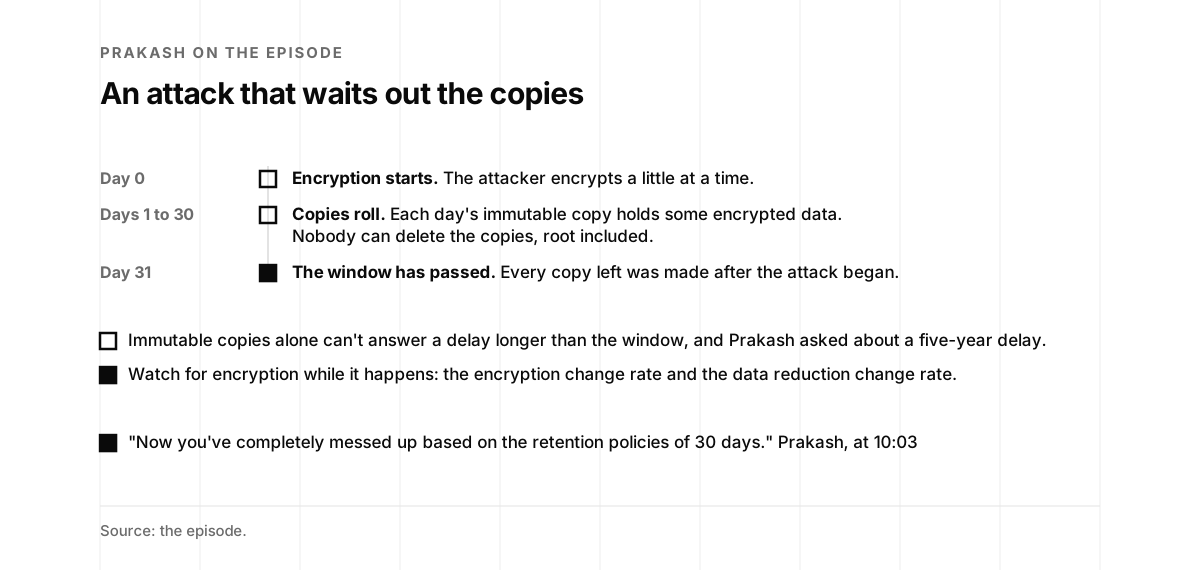
The first answer was immutable data. On the storage system, you set a policy that keeps data immutable for 30 days. Nobody can delete it, root access included. It costs some extra capacity, which the system keeps small.
“Pay a little bit of a capacity penalty to keep some extra data around”
Prakash Darji, at 9:40
Then the attacks changed.
“So if you introduce a time-delayed attack where you start encrypting things slowly, and you wait till 30 days have passed.”
Prakash Darji, at 9:52
“Now you’ve completely messed up based on the retention policies of 30 days.”
Prakash Darji, at 10:03
Jon brought up dwell time, how long an attacker sits inside before anyone notices. Prakash raised the stakes: what if the delay is five years? Immutable copies alone don’t answer that. You also need to notice when your data is being encrypted, and Prakash named two signals a storage system can watch.
“The encryption change rate, the data reduction change rate.”
Prakash Darji, at 10:32
A write once, read many device holds data that can’t be changed once it’s written, which guards against human error, computer bugs and malware (Wikipedia).
Two keys for every change
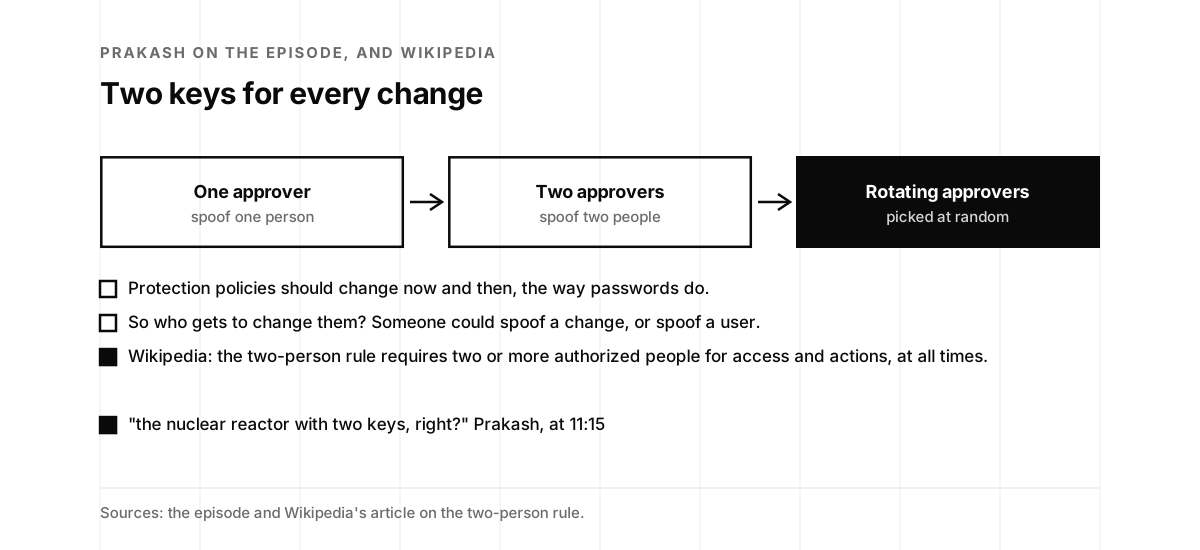
Customers set the protection policies, and they should change them now and then, the way you change a password. That raises a question: who can change them? Someone could spoof a change, or spoof a user. Prakash’s answer was two people, like
“the nuclear reactor with two keys, right?”
Prakash Darji, at 11:15
With two approvers, an attacker has to spoof two people. Rotate who can approve, at random, and spoofing gets harder still.
“So we’re just at the beginning of this ransomware journey”
Prakash Darji, at 11:33
The two-person rule requires two or more authorized people to be present for access and actions, at all times (Wikipedia).
How secure am I?
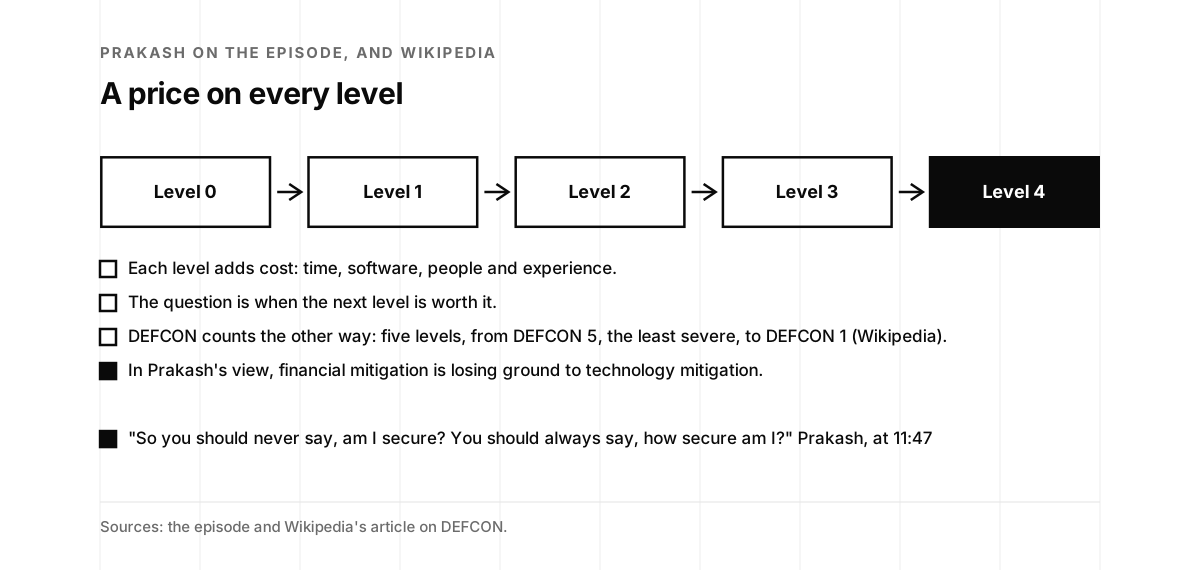
Every protection has a cost, the way insurance does. So Prakash changes the question.
“So you should never say, am I secure? You should always say, how secure am I?”
Prakash Darji, at 11:47
Level zero, one, two, three, four: Prakash compared it to DEFCON levels. Each level costs more in time, software, people and experience, so the real question is when the next level is worth it. Prakash saw the security market as early in its maturity.
“But my prediction is, over the next 10 years, given where the world’s going, this is going to be a very rapidly growing, very maturing market.”
Prakash Darji, at 12:29
DEFCON runs the other way. The alert state of the US armed forces has five levels, from DEFCON 5, the least severe, to DEFCON 1 (Wikipedia).
Jon agreed and made it specific.
“You have to ask the question, are you secure against who or what?”
Jon McLachlan, at 12:53
Prakash answered as an executive who carries the risk.
“I sign off on liability and risk on things I ship”
Prakash Darji, at 13:07
How secure am I, and am I willing to live with that risk and its cost? Prakash compared it to buying insurance. Sometimes the answer is financial mitigation, sometimes it’s technical, and sometimes it’s a bit of both.
“But I can tell you, increasingly, the financial mitigation is becoming less important, and the technology mitigation is becoming more important over time.”
Prakash Darji, at 13:41
Prevention over remediation
Jon asked why the shift. Big companies have buckets of money to mitigate with.
“As you get bigger, right, and as your surface attack grows, your insurance premiums get too high.”
Prakash Darji, at 14:00
Prakash put it as an ounce of prevention against a pound of remediation. Jon knew where the phrase came from: Andrew, the CISO. Two months earlier, episode 2 had Andrew Gontarczyk, Pure Storage’s chief information security officer, as its guest. Then Prakash turned the question around and asked for Jon’s prediction.
Finders, keepers
Jon agreed it was early, and saw one model at work in data security on the internet.
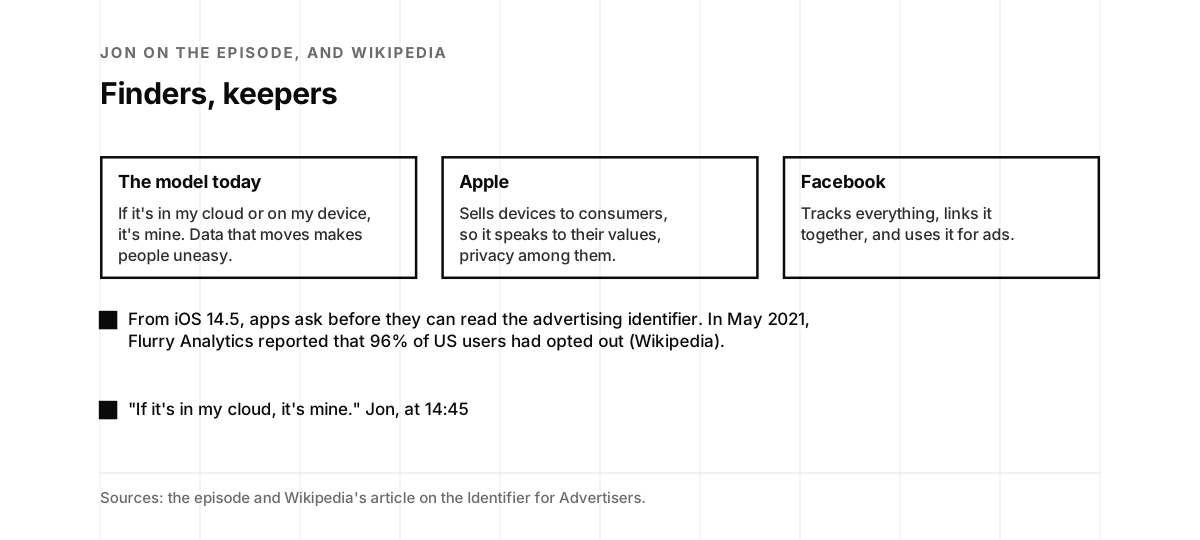
“and the conceptual model that I see out there that’s operating is finders, keepers”
Jon McLachlan, at 14:40
“If it’s in my cloud, it’s mine.”
Jon McLachlan, at 14:45
The same goes for data on a device. People get uneasy when data moves across systems, and Facebook, advertising and Google knowing nearly everything show where that leads. Jon’s question: can that basic model change?
Apple, Facebook and privacy
Prakash asked about Apple and Facebook. Apple was locking things down and hurting Facebook’s advertising. Was that about security, politics or the market?
Jon’s answer was privacy, and it starts with Apple’s business model.
“They exist to sell devices, and everything that they do is geared towards selling more devices.”
Jon McLachlan, at 15:33
Consumers buy the devices, so Apple speaks to their values, and privacy is one of them. Facebook wanted to track everything and link it together. Jon tied it back to the app for each person. If that app could log into Facebook, Facebook would take the data and use it for ads.
“Literally, modify your behavior.”
Jon McLachlan, at 16:12
Starting with iOS 14.5, apps have to ask before they can read the device’s advertising identifier. Facebook said in July 2020 that the requirement would likely hurt its ad targeting, and in May 2021, Flurry Analytics reported that 96% of US users had opted out (Wikipedia).
Prakash’s next story stays in the transcript.
Paying for privacy
The story ended on a question: how do you get information in the modern era, and how do you know it’s accurate? Jon named alternatives to Google: DuckDuckGo, and browsers built to keep trackers away, such as Brave and Puma Browser. The choice is free software that keeps a close eye on you, or paying for your hardware and getting more privacy.
“And when we buy an Apple phone versus a Google phone, we’re actually voting with our money”
Jon McLachlan, at 18:29
Jon added that the data ends up in storage at the back end, and once it’s in the cloud, someone has to secure it.
“We’re all going to have to solve those.”
Prakash Darji, at 18:48
Jon’s reply: even work in the cloud runs on some piece of hardware in the end.
Layers, and storage run for you
Prakash laid out how Pure approaches it.
“the way we think about it is you need layers, right?”
Prakash Darji, at 18:58
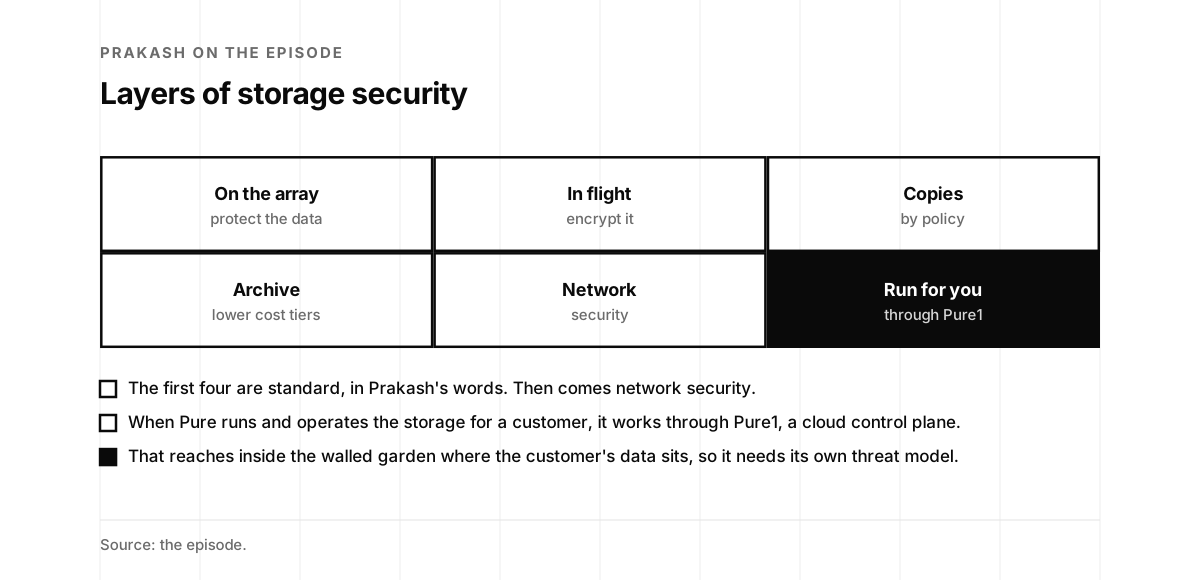
Protect the data on the array. Encrypt data in flight. Use protection policies to make duplicate copies, on a time bound. Keep lower cost tiers for archives. All of that is standard. Then comes network security, and a new piece for Pure.
“one of the things we’re trying to do right now is SaaSify storage”
Prakash Darji, at 19:25
With Pure as a Service, Pure runs and operates the storage for the customer, through a cloud SaaS control plane called Pure1. That means reaching into the walled garden where the customer’s data sits, and that calls for a different threat model.
Defense in depth places layers of security controls throughout a system, so there’s a backup when one control fails or a flaw gets exploited (Wikipedia).
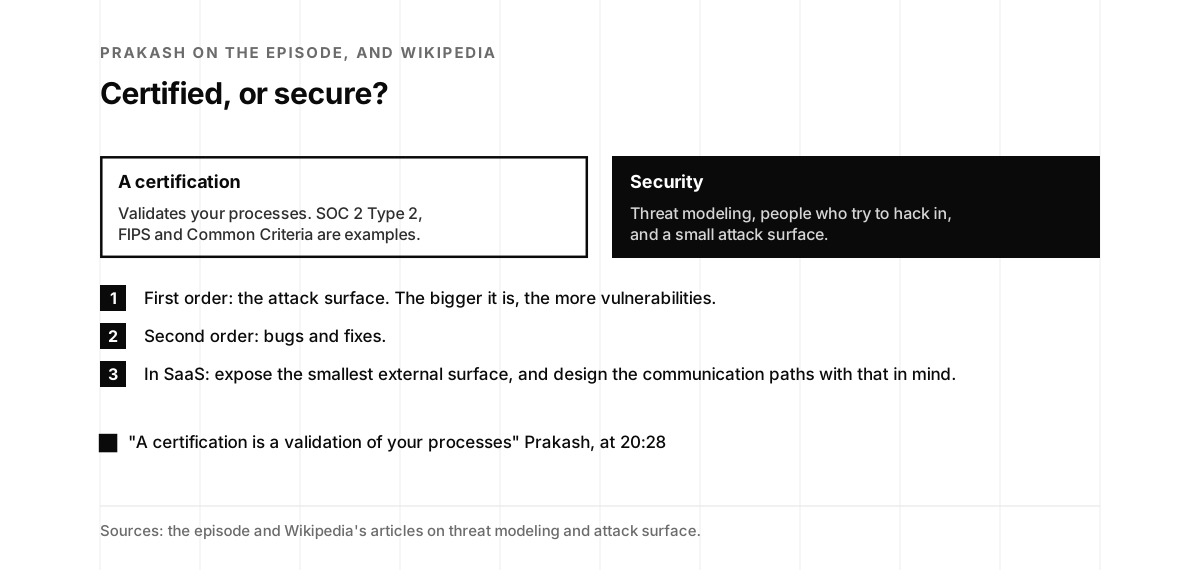
Certified, or secure?
Jon asked whether certifications such as SOC 2 Type 2, FIPS or Common Criteria melt away the security blockers in large deals.
“What’s fascinating is, having certifications doesn’t mean you’re secure.”
Prakash Darji, at 20:14
“A certification is a validation of your processes”
Prakash Darji, at 20:28
To be secure, you need threat modeling, and people who try to hack in. In Prakash’s view, the strongest posture comes from shrinking your attack surface, ahead of patching and chasing critical vulnerabilities.
“It’s a second order problem. The first order problem is just attack surface area.”
Prakash Darji, at 21:22
In a SaaS product, that means exposing the smallest external surface area you can, and designing the communication paths with that in mind. Jon heard simplicity in it.
“Simple systems tend to have less bugs.”
Jon McLachlan, at 22:13
They also tend to have fewer vulnerabilities, and they pass certifications more easily, because there’s less to test. Episode 21 comes at the same point from fuzz testing: an industry that sells certifications while software stays insecure.
Threat modeling identifies potential threats, such as structural weaknesses or missing safeguards, and prioritizes the countermeasures (Wikipedia). An attack surface is the sum of the points where an unauthorized user can try to get data in or out, or take control (Wikipedia). Common Criteria is an information security standard, adopted as ISO/IEC 15408 (Wikipedia).
The 2% who ask hard questions
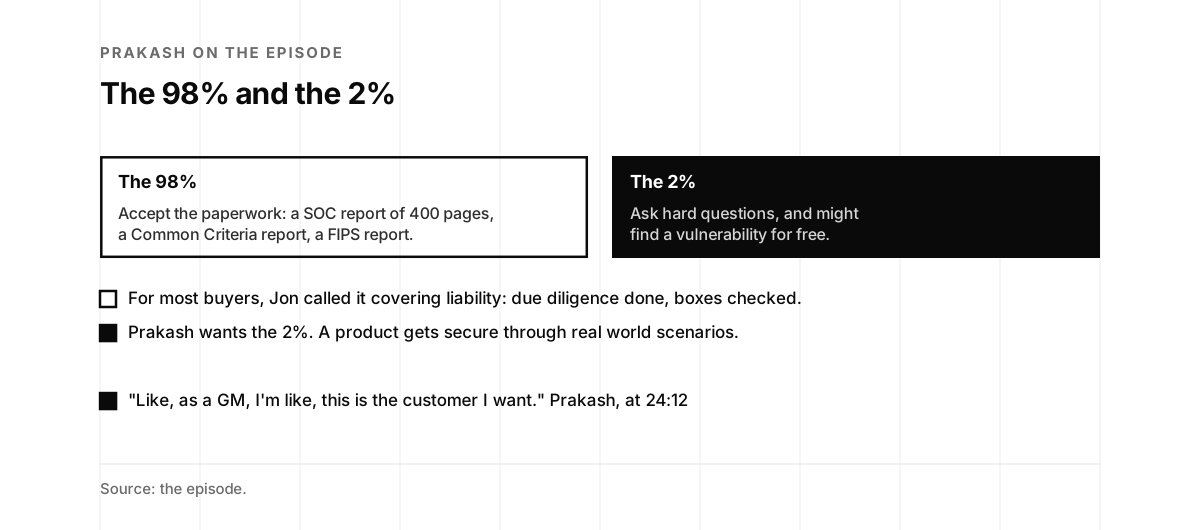
Jon asked how a general manager decides what to do when a customer’s security team asks for X, Y and Z. Build it, pass on it, or leave it to engineering and sales?
“And 98% of the time, people aren’t as sophisticated as they seem to be.”
Prakash Darji, at 23:06
Do the certifications, produce a 400-page SOC report, a Common Criteria report and a FIPS report, and
“bury the RFPs in a pound of paper”
Prakash Darji, at 23:23
Most people go away satisfied. Jon called it covering liability: due diligence done, certifications in hand. Check the boxes, move forward. The challenge is finding the sophisticated buyer, the 2%. That buyer might find a vulnerability you’d otherwise pay pen testers to find. In Prakash’s words, that’s
“someone who’s going to do it for you for free”
Prakash Darji, at 24:07
“Like, as a GM, I’m like, this is the customer I want.”
Prakash Darji, at 24:12
There’s no way to secure a product without real world scenarios. Jon liked the idea of learning from the customer to make the product better.
Portworx joins Pure
“Pure Storage bought Portworx for what, 370 million?”
Jon McLachlan, at 24:45
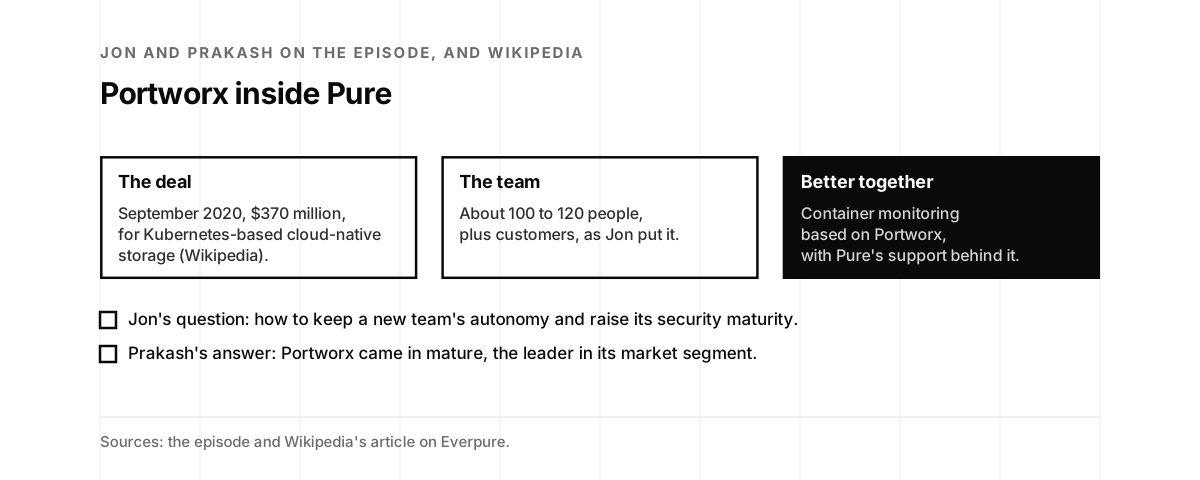
Portworx focused on storage as a service for containers, and it brought customers and a team of about 100 to 120 people. Jon asked how an acquisition balances the new team’s autonomy with Pure’s security maturity.
Prakash’s good news: Pure didn’t buy Portworx too early in its cycle. It was the leader in its market segment, with a fairly mature product. Some things work better together, starting with support.
“You’re famous for your world-class support.”
Jon McLachlan, at 26:10
Pure prioritized container monitoring based on Portworx, shipped or shipping in Q2. It gives container storage the same troubleshooting, remediation and root cause work that Pure’s flash storage already had.
Pure Storage bought Portworx in September 2020 for $370 million. Wikipedia describes it as a provider of Kubernetes-based cloud-native storage and data management platforms (Wikipedia).
Kubernetes and its surface area
“It’s not about the security posture of Portworx per se.”
Prakash Darji, at 26:55
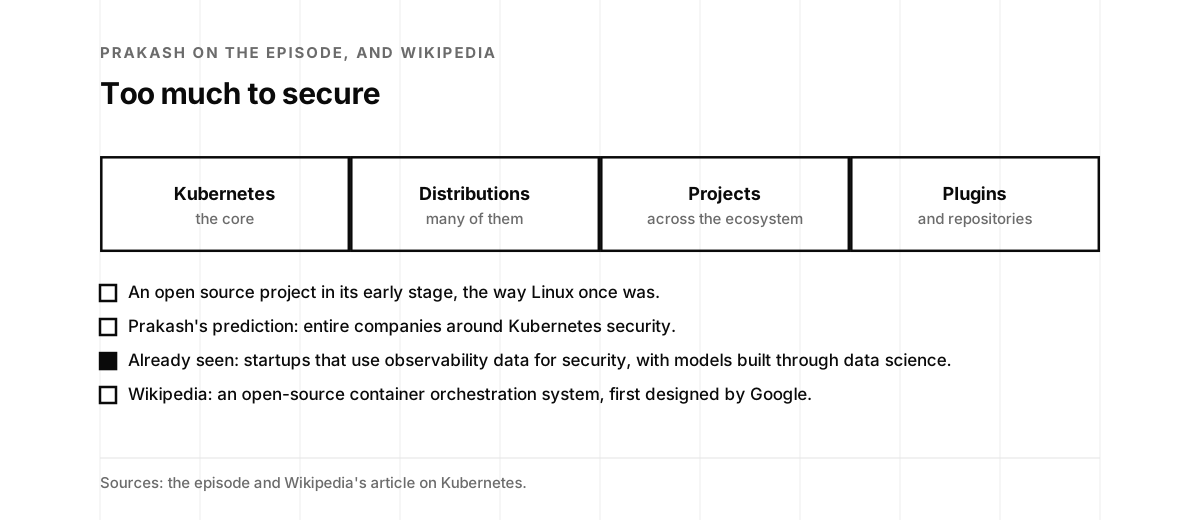
Portworx itself is mature. The concern is everything around it: Kubernetes, the open source ecosystem, its distributions and its projects. That adds up to a large surface area of source code, repositories and plugins to secure.
“there’s going to be entire companies that come up in the industry”
Prakash Darji, at 27:28
Kubernetes is like any early-stage open source project. Linux was like that in its early days, with open questions about what goes into a package and into the consolidated ecosystem. Jon agreed that companies would pop up around Kubernetes security. Prakash had already seen a few startups using observability for security, with models built through data science.
Kubernetes is an open-source container orchestration system for automating software deployment, scaling and management, first designed by Google (Wikipedia).
Go for all of it
Jon asked about the target market: small and midsize businesses, or bigger enterprise deals with more stickiness and more money per deal.
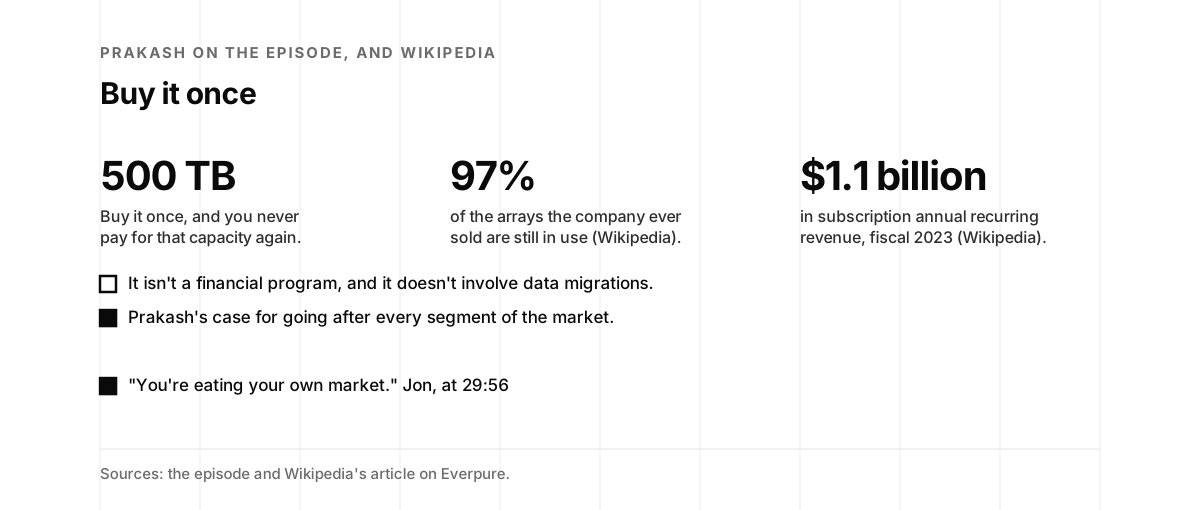
“Look, I think it would be unfortunate if Pure Storage did anything but disrupt the entire industry and go for all of it.”
Prakash Darji, at 29:09
Prakash’s case rests on Evergreen. Buy 500 terabytes, and you never pay for that capacity again. It isn’t a financial program, and it doesn’t involve data migrations.
“So we’re the only company that has reduced the GDP spend in storage.”
Prakash Darji, at 29:46
“You’re eating your own market.”
Jon McLachlan, at 29:56
Prakash agreed, and added that nobody else was doing it. All price bands, all segments, everywhere: in Prakash’s view, the value is strong enough to go for world domination.
Wikipedia dates the Evergreen subscription services to 2015 and Evergreen//One, storage as a service, to 2018. Over 97% of the arrays the company ever sold are still in use because of the upgradeable architecture, and subscription annual recurring revenue passed $1.1 billion in fiscal 2023 (Wikipedia).
Drives too big to move
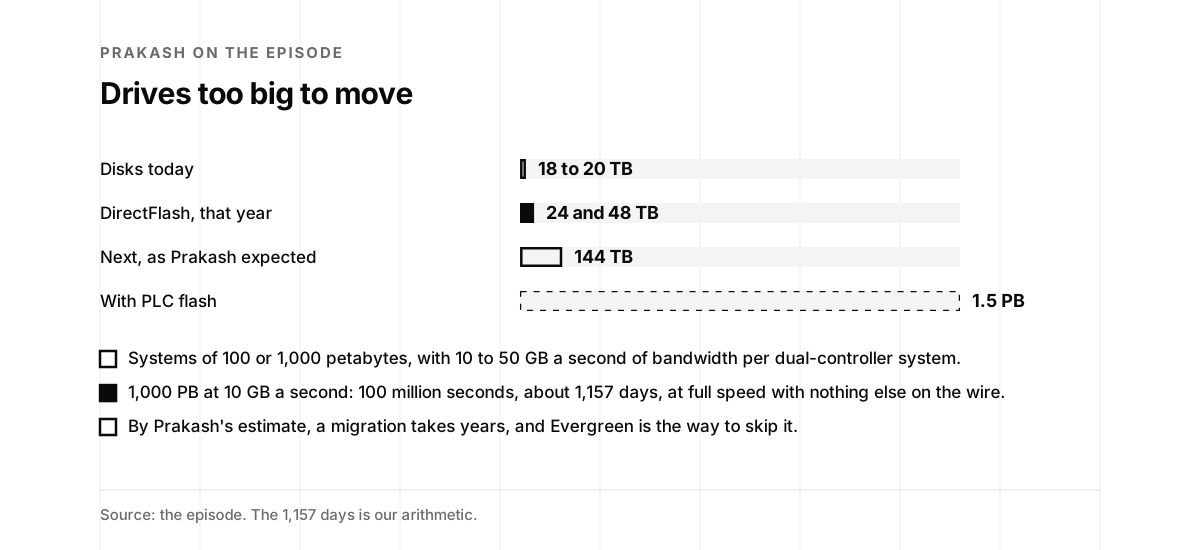
Storage is sticky. It’s hard, it takes time, and people don’t like moving data. Prakash cited a Wikibon forecast for the cost per terabyte of SSDs around 2026. Disks were at 18 and 20 terabytes, near the end of Moore’s law, with maybe 24 to 30 ahead.
“This year, we’ve got a 24 terabyte and a 48 terabyte DirectFlash drive”
Prakash Darji, at 31:07
Next could come 144 terabytes, and with PLC flash, a 1.5 petabyte drive. Jon thought of the AI industry, which runs on data.
“Today, more data gets generated and thrown away than stored.”
Prakash Darji, at 31:50
Data gets stored once storing it is cost effective. Play that forward: 1.5 petabyte drives, systems of 100 or 1,000 petabytes, and dual-controller storage systems with 10 to 50 gigabytes of bandwidth. Moving that data could take five to 10 years.
“That’s completely not viable.”
Prakash Darji, at 32:41
The limit is the controller architecture, and a faster network doesn’t fix it.
“Data is going to get so big, you can’t afford data migrations.”
Prakash Darji, at 33:07
Then you rely on something like Evergreen, and Prakash asked who else has that. The arithmetic backs the worry: 1,000 petabytes at 10 gigabytes a second takes 100 million seconds, about 1,157 days, at full speed with nothing else on the wire.
Optimists, pessimists and a black box
Jon credited Pure Storage with essentially the first enterprise-grade all-flash storage, and with a vision for a new generation of data and services.
“That’s the goal, right? You want to put data to work.”
Prakash Darji, at 33:54
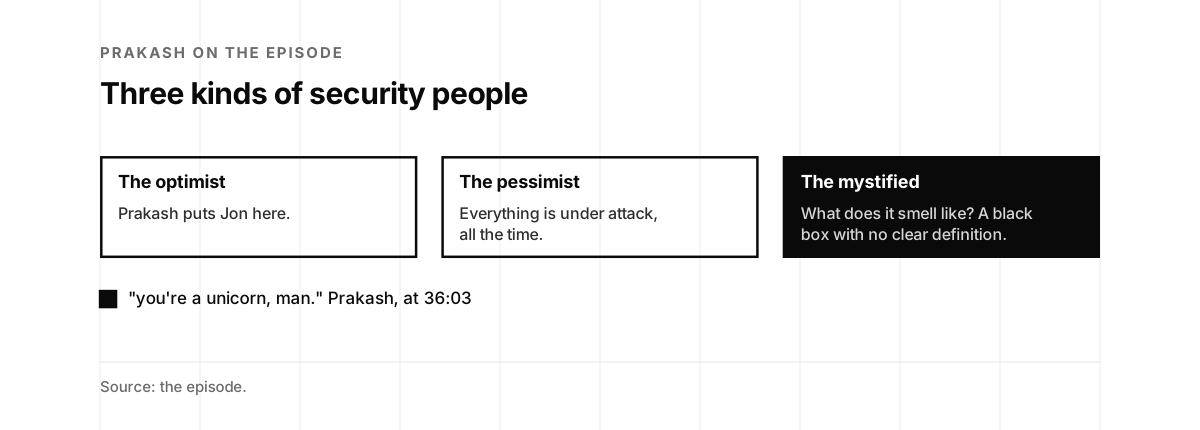
It comes down to performance, density and cost. Jon asked whether Pure’s culture of ambition shapes how it thinks about security. Prakash hadn’t given it much thought, but saw three types among security people. The optimist, which is how Prakash sees Jon. The pessimist, for whom the world is falling and everyone is attacking everyone. And the person for whom security is a mystery.
“What does it smell like? What does it look like? What are its attributes?”
Prakash Darji, at 35:02
It’s like asking what the cloud is. A location? A puffy thing? For most people, security is a black box, with no clear definition.
“Most technologists don’t understand it.”
Prakash Darji, at 35:40
Jon’s take: most find it at least mildly amusing, a black box they bump into now and then.
“And then you get folks like me who have built careers around”
Jon McLachlan, at 35:55
Prakash had a word for that.
“you’re a unicorn, man.”
Prakash Darji, at 36:03
What happened after the tape
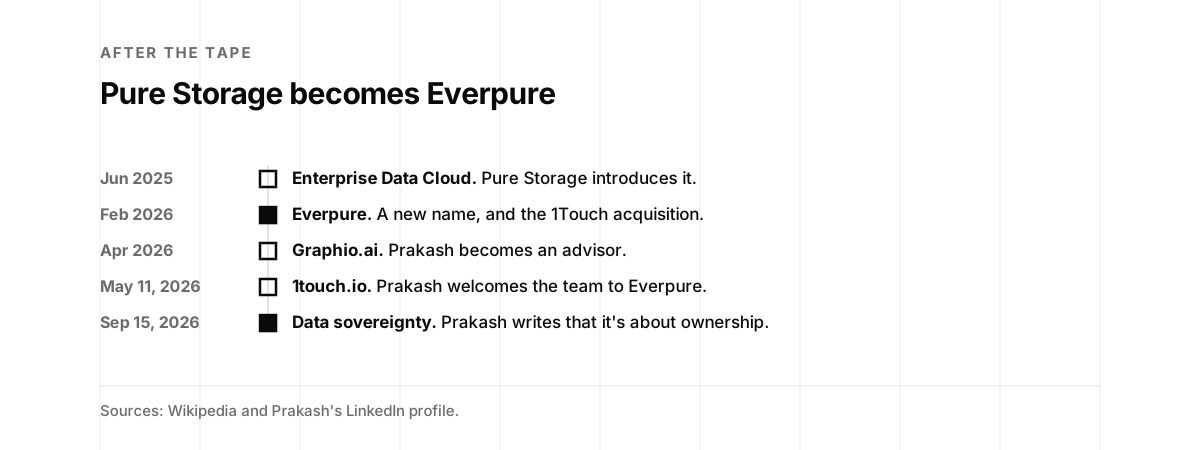
Pure Storage is now Everpure. The company renamed itself in February 2026 to reflect a shift toward data management. In June 2025 it had introduced the Enterprise Data Cloud (Wikipedia).
Prakash’s business grew. LinkedIn lists Prakash as general manager of the Digital Experience business unit since July 2020. It covers Pure1, Evergreen Services, Pure-as-a-Service and the data management teams, described as “a $2B+ subscription business” (LinkedIn).
1Touch joins Everpure. In February 2026, Everpure acquired 1Touch, which Wikipedia calls “an innovator in data intelligence and orchestration” (Wikipedia). On May 11, 2026, Prakash welcomed 1touch.io and its data discovery and classification, for data in SaaS applications, on premises, in the cloud or at the edge (LinkedIn).
Ownership over residency. On September 15, 2026, Prakash wrote about rethinking data sovereignty: “It’s not about residency, but about ownership.” The episode opened on residency too, in Down the stack to storage.
Prakash on rethinking data sovereignty around ownership.
Prakash Darji · September 15, 2026
The post links an interview in The Data Wire, “As AI Uncouples Data From Applications, Storage Becomes The Foundation For Sovereign AI,” dated September 14, 2026. The page says Everpure sponsored it. One line from it fits Drives too big to move: “Data doesn’t like being moved. It likes being accessed.” (The Data Wire).
An advisor to Graphio.ai. Since April 2026, Prakash has also advised Graphio.ai, which LinkedIn describes as a new company using AI for process compliance (LinkedIn).
Pure Storage on this show. Episode 2 had Andrew Gontarczyk, Pure Storage’s chief information security officer, on building a security team. Episode 74 had Scott Dietzen, Pure Storage’s chief executive from 2010 to 2017, on Augment Code.
Did you catch it? A seven-question quiz
Seven questions from the episode. Each answer links the moment in the transcript or its section.
Quiz · seven questions
Did you catch it?
Pick an answer to see whether you caught it.
-
Where does residency come from, in Prakash's view of hybrid?
a. "Residency comes from data and applications, not from am I hosting it on Amazon or Azure." Transcript, 1:43.
-
What sits between the apps on premises and the front end in the cloud?
c. Enterprises are complicated, so one gateway handles the certificates and connections. See One gateway for many apps.
-
How does a time-delayed attack get past 30 days of immutable copies?
b. "So if you introduce a time-delayed attack where you start encrypting things slowly, and you wait till 30 days have passed." Transcript, 9:52.
-
Which two signals did Prakash name for spotting encryption?
a. "The encryption change rate, the data reduction change rate." Transcript, 10:32.
-
What question should you ask about security, according to Prakash?
c. "So you should never say, am I secure? You should always say, how secure am I?" Transcript, 11:47.
-
What does a certification validate?
b. "A certification is a validation of your processes" Transcript, 20:28.
-
Why can Pure go after every segment, in Prakash's view?
a. Buy 500 terabytes, and you never pay for that capacity again. See Go for all of it.
Could you survive a slow attack?
Eight questions on whether an attacker who waits could outlast your copies, built from the episode. Each tip links the section behind it.
Scorecard · eight questions
Could you survive a slow attack?
Answer for the data you can least afford to lose. If two answers fit, pick the lower one.
-
How long do your immutable copies last, compared with how long an attacker could go unnoticed?
- We don't keep immutable copies
- A fixed window, shorter than our worst dwell time
- Longer than our worst dwell time, and reviewed
An attack can wait out a 30-day window. See Copies nobody can delete.
-
Can one admin, root included, delete those copies or shorten the window?
- Yes
- Only with a second approval
- No, nobody can
In Prakash's example, root access can't delete the copies. See Copies nobody can delete.
-
Do you watch for slow encryption, such as a jump in the change rate or a drop in data reduction?
- No
- On some systems
- Yes, with alerts someone answers
Prakash named the encryption change rate and the data reduction change rate. See Copies nobody can delete.
-
Who can change a protection policy?
- Any admin
- One named person
- Two people, picked at random
Two keys, with the approvers rotated at random. See Two keys for every change.
-
Do you know how long an attacker could sit in your systems before anyone notices?
- No idea
- A rough guess
- Measured, from tests or past incidents
Jon's question was dwell time. See Copies nobody can delete.
-
Do you know which level of security you're paying for, and what the next one costs?
- No
- Roughly
- Yes, with a cost for each level
Ask how secure you are, and price each level. See How secure am I?
-
Is your attack surface written down: endpoints, open ports, plugins?
- No
- In part
- Yes, and we keep cutting it down
Attack surface first, bugs second. See Certified, or secure?
-
Beyond certifications, do people try to break in?
- No, certifications only
- A yearly pen test
- Regular tests, and we welcome customers who probe
Prakash wants the buyers who find things. See The 2% who ask hard questions.
An attacker who waits can outlast your copies. Start with immutable copies nobody can delete, kept longer than your worst dwell time.
Your copies help, but a slow attack could go unnoticed. Watch the change rates, and put two people on every policy change.
Keep the window longer than your dwell time, test the alarms each quarter, and keep cutting the attack surface.
How long can your copies reach back?
Immutable copies cost capacity, and the cost grows with the window. This calculator estimates the extra capacity for a window of your size, and what reaching back five years would take.
Calculator
How long can your copies reach back?
Four numbers: how much data you protect, how much of it changes each day, how many days of copies you keep, and your data reduction ratio.
Keeping 30 days of immutable copies of 100 TB that changes 2.0% a day, at 3.0 to 1 data reduction, takes about 20.0 TB more, 20% of the data. An attack that waits longer than 30 days outlasts every copy. Reaching back 1,825 days would take about 1,217 TB.
The 30 days and the five-year delay come from the tape. The other defaults are placeholders. The math is an upper bound: it assumes each day's changes land on new blocks and shrink by the same ratio as the data. Copies that overwrite the same blocks cost less, and a slow attack needs detection as well as a long window.
From SAP to Everpure
Prakash’s path, Pure Storage, the field around them, and this show. Filter by topic.
Timeline
From SAP to Everpure
- SAP
Prakash joins as a junior consultant in field services (LinkedIn).
- Os76
John Colgrove and John Hayes found the company that becomes Pure Storage (Wikipedia).
- BusinessObjects
Senior director of product management for BusinessObjects Planning & Consolidations, to October 2010 (LinkedIn).
- Out of stealth
Os76 emerges as Pure Storage (Wikipedia).
- Platform as a Service
SVP and general manager at SAP, to April 2017 (LinkedIn, on this page).
- Evergreen
The Evergreen family of subscription services launches (Wikipedia, on this page).
- Pure Storage goes public
25 million shares for $425 million (Wikipedia).
- India's banknotes
India declares its ₹500 and ₹1,000 notes invalid. About 99.3% of the money comes back to the banks (Wikipedia, on this page).
- A new chief executive
Charles Giancarlo takes over from Scott Dietzen (Wikipedia).
- Evergreen//One
Storage as a service launches (Wikipedia).
- FlashArray
Prakash joins Pure Storage as general manager of the FlashArray business unit, to July 2020 (LinkedIn).
- StorReduce
Pure Storage's first acquisition, for $25 million (Wikipedia).
- Compuverde
Pure Storage buys the file storage company (Wikipedia).
- Digital Experience
Prakash becomes general manager of the Digital Experience business unit (LinkedIn).
- Apple's prompt
Facebook says Apple's tracking prompt would likely hurt its ad targeting (Wikipedia, on this page).
- Portworx
Pure Storage buys the Kubernetes storage company for $370 million (Wikipedia, on this page).
- Colonial Pipeline
A ransomware attack halts the pipeline, and the company pays 75 bitcoin (Wikipedia).
- Episode 2
Andrew Gontarczyk, Pure Storage's chief information security officer (episode 2).
- This episode
Prakash on the show (Podbean).
- Enterprise Data Cloud
Pure Storage introduces it (Wikipedia).
- Episode 74
Scott Dietzen, Pure Storage's chief executive from 2010 to 2017, on Augment Code (episode 74).
- Everpure
Pure Storage renames itself Everpure and acquires 1Touch (Wikipedia, on this page).
- Graphio.ai
Prakash becomes an advisor (LinkedIn).
- 1touch.io
Prakash welcomes 1touch.io to Everpure (LinkedIn).
- Data sovereignty
Prakash's post on ownership and data sovereignty (LinkedIn, on this page).
What to do this week
Five things, in the order of the episode.
- Check your window against dwell time. Compare how long your immutable copies last with how long an attacker could go unnoticed, as in Copies nobody can delete. The calculator shows what a longer window costs.
- Watch for slow encryption. Alert on jumps in the change rate and drops in data reduction, the two signals Prakash named.
- Put two keys on policy changes. Require two approvers, rotated at random, for any change to a protection policy, as in Two keys for every change.
- Price each level of security. Ask how secure you are, write down what the next level costs, and decide when it’s worth it, as in How secure am I?. The scorecard shows where to start.
- Get help with it. Our 24/7 Monitoring & Response team watches for attacks in progress, Penetration Testing shows what an attacker can reach, and a vCISO can own the program. If you want to talk it through, book 15 minutes with us.