
Podcast Episode 52

Episode 052 42 min

Suha Can, CISO at Grammarly: Safeguarding User Data in Enterprise AI Systems

with Suha Can · Grammarly

0:00 / 42:00

Also on Spotify, Apple Podcasts, YouTube, Podbean, Player FM

Episode 52 of The Security Podcast of Silicon Valley, published August 15, 2024. Hosts Jon McLachlan and Sasha Sinkevich talk with Suha Can, then the CISO of Grammarly, about safeguarding user data in enterprise AI: a coffee shop with one computer and the IRC, two jobs at Grammarly, solutions that scale and the crown jewels, security as a builder profession, SOC 2 and ISO 42001, a responsible AI team that checks every model, controls users can see, the EU AI Act, the questions enterprises ask about their data, a key the customer holds, three measures of success, the Shadow Brokers and WannaCry, the no-mystery principle, and the CISO as chief trust officer. About 42 minutes.

Episode notes

In this episode of the Security Podcast of Silicon Valley, a YSecurity production, Hosts Jon and Sasha dive deep with Suha Can, the Chief Information Security Officer at Grammarly, who oversees the security of over 30 million users and 70,000 enterprise teams worldwide. Suha shares his journey from discovering the internet in a small Turkish café to leading security at major tech giants like Amazon and Microsoft. We explore how he’s pioneering responsible AI at Grammarly, balancing product security with innovation, and preparing for the future of AI and cybersecurity. Tune in for an enlightening conversation on building trust, tackling zero-day exploits, and the evolving role of the CISO in today’s AI-driven world.

Hosted by Jon McLachlan and Sasha Sinkevich — co-founders of YSecurity.

The deep dive

No mystery, no unanswered questions

Suha Can, then the CISO of Grammarly, with Jon and Sasha on a coffee shop with one computer and the IRC, two hats at Grammarly, solutions that scale and the crown jewels, security as a builder profession, SOC 2 and ISO 42001, a responsible AI team of researchers and linguists, controls users can see, the EU AI Act and the sunlight test, the four questions every enterprise asks about its data, a key the customer holds, three measures of success, the Shadow Brokers and WannaCry, the no-mystery principle, and the CISO as chief trust officer.

Episode 52 of The Security Podcast of Silicon Valley aired on August 15, 2024, with Jon McLachlan and Sasha Sinkevich hosting. The guest was Suha Can, then the chief information security officer of Grammarly, the AI writing assistant (Podbean, LinkedIn). The episode is called “Suha Can, CISO at Grammarly: Safeguarding User Data in Enterprise AI Systems.” It has no video version.

“the mindset has to be that there must be no mystery, no unanswered questions.”

Suha Can, at 34:50

Listen · Suha Can on episode 52, from 34:34
About 20 seconds: Suha on the principle he took from the hardest days of his career. Section 24 has the story behind it. The clip stops on its own. Read the full transcript.

Suha held two jobs at Grammarly from September 2022 to February 2025. As CISO he led security, privacy, responsible AI, governance, risk and compliance, fraud and abuse, and IT. As vice president of engineering he led the teams that built Grammarly Business for enterprise customers. Before that he founded the Payments Security team at Amazon and grew it from 1 to more than 100 engineers, and he spent more than ten years at the Microsoft Security Response Center. Since March 2025 he has been vice president and chief security officer at DoorDash (LinkedIn).

The tape dates itself to 2024. Sasha says Grammarly was doing AI “before AI was as popular as it is in 2024,” and Suha says Grammarly is launching a customer-held key for its enterprise customers at the end of the month. Grammarly announced that feature, which it calls Bring Your Own Key, on June 25, 2024, for “the coming weeks” (Business Wire, Help Net Security).

This page follows the conversation in order: a section for each part of it with the sources beside it, sixteen figures, twenty-five clips from the tape, the full transcript, and five tools: a quiz, a scorecard for an AI product that wants enterprise buyers, a calculator for the race between a patch and an exploit, a timeline, and a to-do list. Where the decodes of the tape disagree on a word, the transcript puts its best guess in brackets, and the page doesn’t quote those words.

A coffee shop with one computer

Jon asks how Suha got into security. Suha grew up in Turkey in the middle of the 1990s, and the one thing he wanted and didn’t have at home was the internet. He was in high school at the time.

“So I found this coffee shop in a nicer part of town.”

Suha Can, at 2:08

Listen · Suha Can on episode 52, from 2:08
About 30 seconds: Suha on the long walk after school to a coffee shop with one computer. The clip stops on its own. Read the full transcript.

It was far from home, so he took a long walk there after school. On the bottom floor sat the one computer, and through it he found the IRC, Internet Relay Chat, a text chat system built around group channels (Wikipedia). The people on it were mostly students from the few technical universities, plus managers and admins.

“And really, when you look at the time, it was amazing because I was seeking knowledge.”

Suha Can, at 2:52

Everyone else there knew more than he did, he says. Two communities met him there. One ran Unix servers for companies and universities and cared about securing them. The other was the demoscene, the computer art scene that makes small programs with graphics and music to show off programming skill (Wikipedia). Suha joined a Unix security group.

“There was a sense of curiosity, seeking to understand how things work. It was all about having fun, gaining knowledge, a little bit of friendly competition for sure.”

Suha Can, at 3:28

He says several of the people he met there went on to become security founders. His LinkedIn lists him as staff at GSULinuX, on Linux and network security, from 2000 to 2005, and as an enterprise IT security intern at IBM in 2003 (LinkedIn).
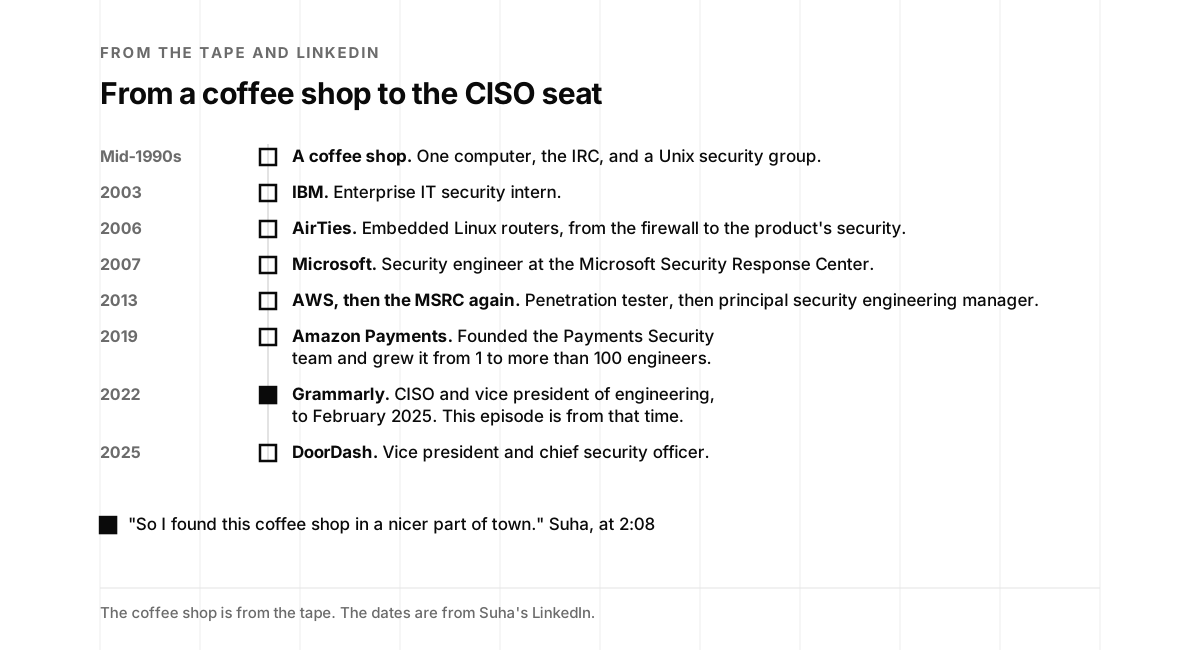
A timeline. Mid-1990s: a coffee shop, with one computer, the IRC, and a Unix security group. 2003: IBM, enterprise IT security intern. 2006: AirTies, embedded Linux routers, from the firewall to the product's security. 2007: Microsoft, security engineer at the Microsoft Security Response Center. 2013: AWS, then the MSRC again, as a penetration tester and then principal security engineering manager. 2019: Amazon Payments, where he founded the Payments Security team and grew it from 1 to more than 100 engineers. 2022, filled: Grammarly, CISO and vice president of engineering, to February 2025. This episode is from that time. 2025: DoorDash, vice president and chief security officer. Suha's line, "So I found this coffee shop in a nicer part of town." Suha, at 2:08
Suha's path from the coffee shop to the CISO seat, from the tape and his LinkedIn profile.

Two hats

Jon calls himself a paid Grammarly member of many years and asks what the CISO does there. Suha says he wears two hats.

“Job number one is the CISO job. So I am responsible for all aspects of trust in the company.”

Suha Can, at 4:41

Listen · Suha Can on episode 52, from 4:41
About 25 seconds: Suha on the first of his two jobs, and everything that sits under it. The clip stops on its own. Read the full transcript.

Under the first hat he lists product security, corporate security, privacy, compliance, corporate engineering and the IT infrastructure, and the responsible AI research team. The second hat is engineering. He leads the engineering teams that build the enterprise version, which he says has a lot of interesting security and IT management problems to solve.

Jon suggests that makes him chief product security officer too. Suha agrees and adds chief compliance officer and chief privacy officer.
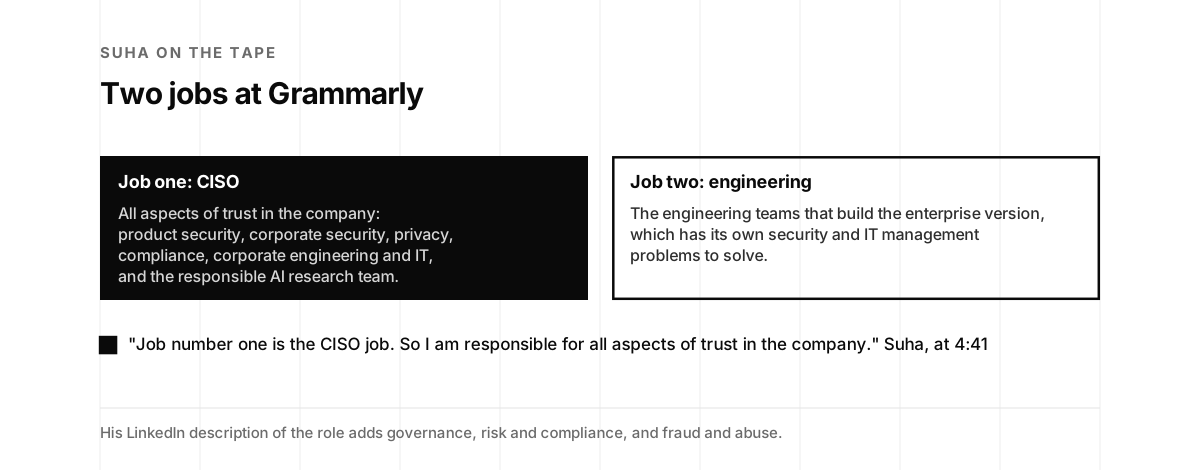
Two cards. Job one, filled: CISO. All aspects of trust in the company: product security, corporate security, privacy, compliance, corporate engineering and IT, and the responsible AI research team. Job two: engineering. The engineering teams that build the enterprise version, which has its own security and IT management problems to solve. Suha's line, "Job number one is the CISO job. So I am responsible for all aspects of trust in the company." Suha, at 4:41
The two hats, from the tape and Suha's LinkedIn description of the role.

Solutions that scale

Sasha asks how a security organization with that many parts runs without slowing down research and development. Suha starts with scale.

“So I think one of the important things is really building solutions that scale.”

Suha Can, at 5:59

Listen · Suha Can on episode 52, from 5:59
About 40 seconds: Suha on risk tolerance, strategic investment, and why a team without either falls behind. The clip stops on its own. Read the full transcript.

The first step is to know the company’s risk tolerance. At Grammarly, he says, trust has to be paramount, so the security bar is high, and the budget has to match it.

“Obviously, if you work in a company and security is very important, but you don’t have the right investment in the area and you don’t have the right strategic voice to influence the company, then no matter who you hire, you’re just going to be always behind.”

Suha Can, at 6:25

“And the business moves at a very fast speed. You definitely cannot be in the business of slowing things down.”

Suha Can, at 6:39

So the order is strategy first: a clear vision, the board along, leadership around. Then hiring, then teams. Then a lot of automation, which gets the basics in check.

Necessary but not sufficient

Once the basics are in check, scale stops being enough.

“and I truly believe that scalable solutions are necessary but not sufficient.”

Suha Can, at 7:16

Listen · Suha Can on episode 52, from 7:16
About 25 seconds: Suha on the crown jewels, and the experts who go deep on them. The clip stops on its own. Read the full transcript.

“I always believe that for really high-risk areas or your crown jewels, you need to go a lot deeper. You need to build layers in the defenses.”

Suha Can, at 7:22

That takes skilled people who do manual work on the riskiest systems. He sums it up as two investments in a row: things that scale first, then depth in the areas that matter most to the business.
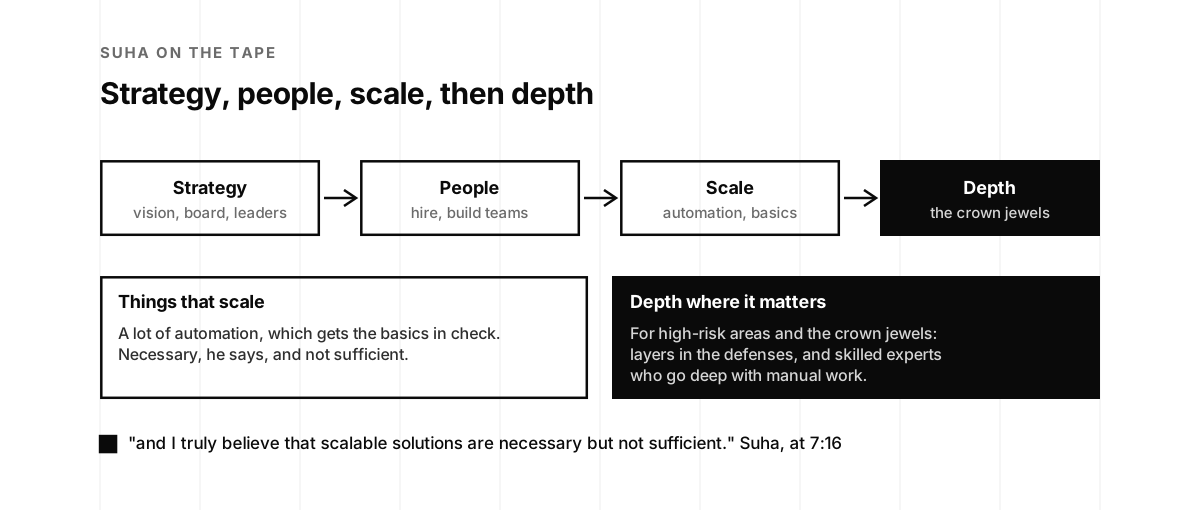
Four boxes in a row with arrows: Strategy, meaning vision, board and leaders. People, meaning hire and build teams. Scale, meaning automation and the basics. Depth, filled, meaning the crown jewels. Below, two cards. Things that scale: a lot of automation, which gets the basics in check. Necessary, he says, and not sufficient. Depth where it matters, filled: for high-risk areas and the crown jewels, layers in the defenses, and skilled experts who go deep with manual work. Suha's line, "and I truly believe that scalable solutions are necessary but not sufficient." Suha, at 7:16
Scale first, then go deep, as Suha lays it out on the tape.

I didn’t know security was this

The third part is how the team works.

“And I think security has to have a builder mindset. So my teams don’t operate in a way where we advise teams what to do and then we move away.”

Suha Can, at 7:57

Most of his security engineers are also software engineers, he says, and that’s how the team earns credibility. He tells a story from his time at Amazon that, he says, has repeated itself since. His team does a security deep dive on a service and presents its findings to the team that owns it.

“And the principal engineer of the team told me, hey, I didn’t know security was this.”

Suha Can, at 8:38

Listen · Suha Can on episode 52, from 8:31
About 25 seconds: Suha on the compliment he got from a principal engineer, and the version of security people are used to. The clip stops on its own. Read the full transcript.

“But typically, that’s not how you’re going to be able to land impact, and that’s not how you’re going to gain the respect of the engineers, which ultimately are your closest partner in security.”

Suha Can, at 8:58
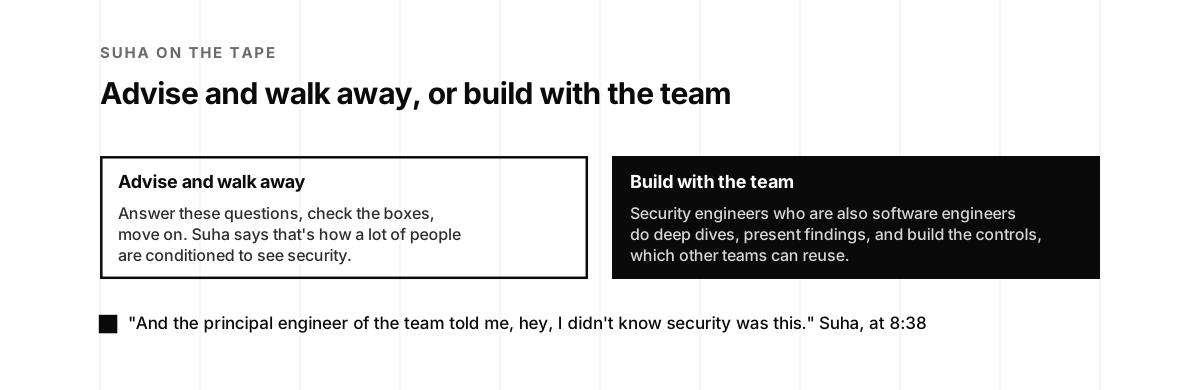
Two cards. Advise and walk away: answer these questions, check the boxes, move on. Suha says that's how a lot of people are conditioned to see security. Build with the team, filled: security engineers who are also software engineers do deep dives, present findings, and build the controls, which other teams can reuse. Suha's line, "And the principal engineer of the team told me, hey, I didn't know security was this." Suha, at 8:38
Two ways a security team can work with engineers, from Suha's answer.

A builder profession

Sasha agrees that security in isolation doesn’t work and has to be driven by the business, with engineering teams implementing the controls. Suha goes one step further.

“I even go farther than that, in the sense that we actually implement the controls.”

Suha Can, at 9:37

Listen · Suha Can on episode 52, from 9:35
About 25 seconds: Suha on why the security team builds the controls itself. The clip stops on its own. Read the full transcript.

His reason is reuse. If you find a threat and want a control for it, he says, you probably want to build it, because the same control is likely to help other teams in the company.

“We have to have a good mix of security skills and software engineering skills.”

Suha Can, at 9:47

His LinkedIn says the same about his time at Amazon. His engineering organization built and ran the core payments infrastructure that processed all of Amazon’s payments, and his security organization owned automation, application security, red team, threat intelligence, detections and incident response for the payments businesses (LinkedIn).

Sasha asks what Grammarly does better than anyone else in the world. Suha’s answer is AI for communication.

“So I would say that Grammarly is the only AI company really focused on transforming how people communicate, whether it’s at work, at school, for personal communications.”

Suha Can, at 10:31

Listen · Suha Can on episode 52, from 10:31
About 25 seconds: Suha on what Grammarly does better than anyone else. The clip stops on its own. Read the full transcript.

He says Grammarly has been at it for about 15 years, and he puts it at something like 95% of the Fortune 500. Wikipedia dates Grammarly’s launch to 2009, by founders Alex Shevchenko, Max Lytvyn and Dmytro Lider, and its generative AI product to April 2023 (Wikipedia).

“So I think it’s important to highlight that Grammarly has been doing AI before AI was as popular as it is in 2024.”

Sasha Sinkevich, at 11:03

Sasha thanks him for a security team that protects the data everyone gives Grammarly, and says it was just a thank you.

From consumers to enterprises

Jon brings up the shift from consumers to enterprises. He likes the tone feature that shows small emojis for how an email might sound, and then asks the enterprise question.

“But at the end, like, in terms of security, if you sell that product to the enterprise space, usually there’s, like, certification questions that come up.”

Jon McLachlan, at 12:28

Suha draws the line between the two markets. Consumers ask how their data is handled, which is privacy. Enterprises make security a deep topic of its own.

“There’s a lot of questions about how the data is handled.”

Suha Can, at 13:07

One of the ways we communicate

Suha describes certifications as one of the ways companies tell each other that they meet certain standards, with a third party agreeing. He says Grammarly holds the common security certifications.

“We are also quite aggressive in pursuing new certifications, especially in the realm of AI and privacy, because especially with AI, there is a lot of nervousness in the industry.”

Suha Can, at 13:38

Listen · Suha Can on episode 52, from 13:38
About 30 seconds: Suha on the gap between Silicon Valley and the global CISOs he talks to. The clip stops on its own. Read the full transcript.

The nervousness depends on where you stand. In Silicon Valley, he says, everyone is embracing AI and building on it. The global CISOs he talks to are more cautious.

The next certification Grammarly is going after is ISO 42001, and he thinks Grammarly is one of the first to do it. Grammarly’s compliance page today lists SOC 2 Type 2, SOC 3, ISO/IEC 27001, 27017, 27018, 27701 and 42001 (Grammarly). A SOC 2 report is an audit report under the AICPA’s Trust Services Criteria (Wikipedia), and ISO/IEC 27001 sets the requirements for an information security management system (Wikipedia).
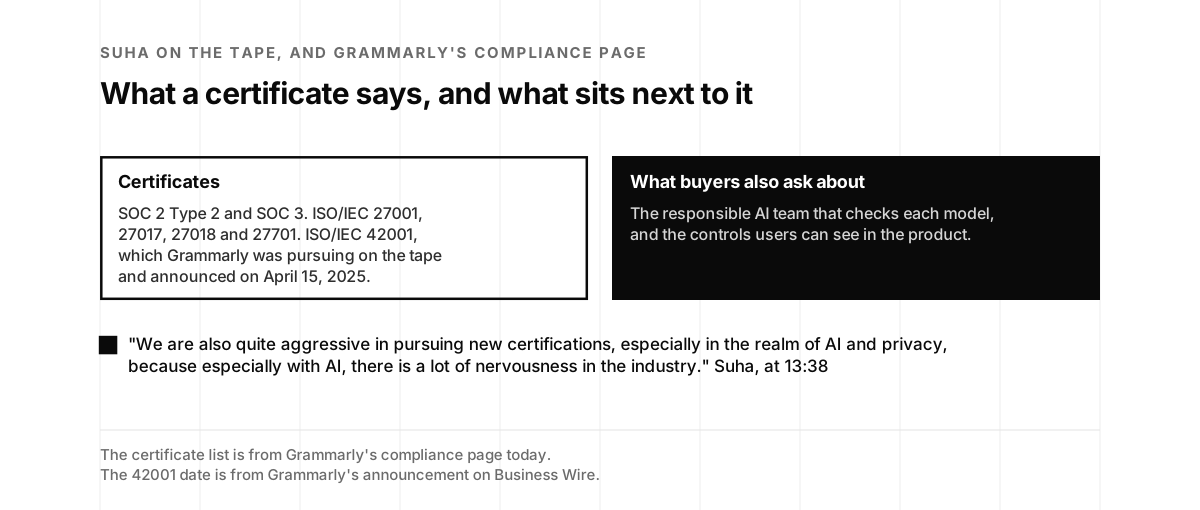
Two cards. Certificates: SOC 2 Type 2 and SOC 3. ISO/IEC 27001, 27017, 27018 and 27701. ISO/IEC 42001, which Grammarly was pursuing on the tape and announced on April 15, 2025. What buyers also ask about, filled: the responsible AI team that checks each model, and the controls users can see in the product. Suha's line, "We are also quite aggressive in pursuing new certifications, especially in the realm of AI and privacy, because especially with AI, there is a lot of nervousness in the industry." Suha, at 13:38
What compliance does for a buyer, and what Suha says sits next to it.

ISO 42001

Compliance matters to a security buyer, Suha says, but it isn’t everything. Later in the conversation Jon and Sasha come back to the standard. Jon says he doesn’t know any company that’s certified yet.

“Yeah, I don’t know any company yet that’s 42001 certified, but I saw that come out a couple of months ago, and I was like, this is great. This is interesting.”

Jon McLachlan, at 17:35

“And it’s important that companies consider the certifications as standards, and frameworks are not there for the check mark purposes.”

Sasha Sinkevich, at 18:09

Grammarly got there in April 2025. On April 15, 2025, it announced its ISO/IEC 42001:2023 certification, which it called the world’s first AI management system standard, and named the certification body as Mastermind (Business Wire). That was about a month after Suha moved to DoorDash.

A dedicated responsible AI team

The other half of the answer is the work that a certificate doesn’t show. Suha starts with the people.

“Responsible AI is an area where we have a dedicated team, a robust set of researchers that work on responsible AI”

Suha Can, at 14:41

Listen · Suha Can on episode 52, from 14:41
About 25 seconds: Suha on what a model has to get past before it reaches users. The clip stops on its own. Read the full transcript.

As the team builds models, he says, it uses analytical linguists and machine learning models to check them. He names three things a model must not do.

“that they wouldn’t leak data, that they wouldn’t mislead our users by hallucinating”

Suha Can, at 15:03

The third is saying things that would be awful to say. A hallucination is an AI answer that presents false or misleading information as fact (Wikipedia).

“So typically, when I talk to other CISOs, they, of course, ask about compliance, but they’re also curious, so I end up explaining to them what we do with responsible AI.”

Suha Can, at 15:34

A few weeks after the episode aired, on September 4, 2024, Suha shared Grammarly’s white paper on how it approaches responsible AI, “The Responsible AI Advantage: Guidelines for Ethical Innovation.”

Suha Can on LinkedIn, September 4, 2024: Grammarly's white paper on how it builds responsible AI, with principles like transparency, fairness and user agency.

Suha Can · LinkedIn
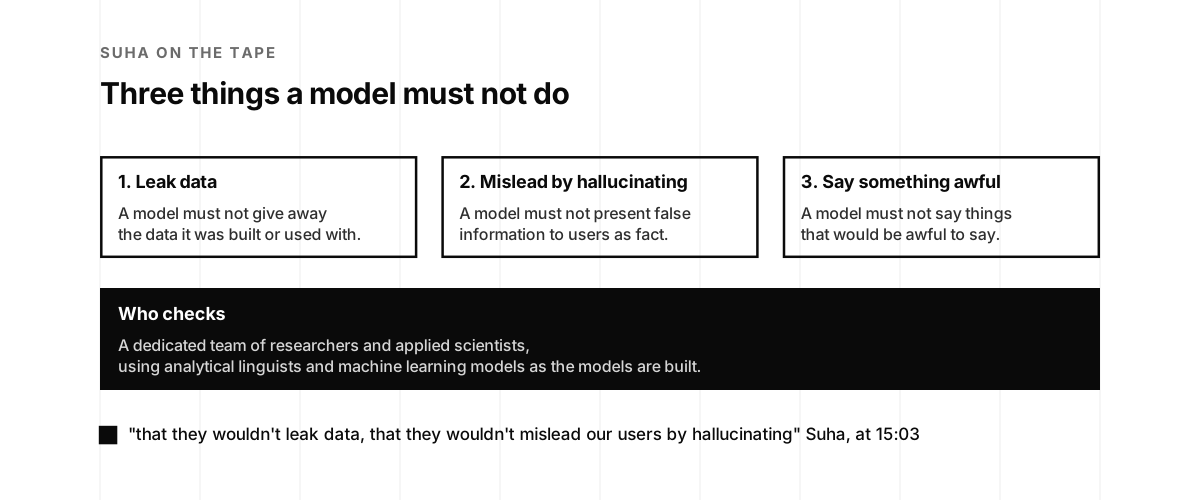
Three cards. 1. Leak data: a model must not give away the data it was built or used with. 2. Mislead by hallucinating: a model must not present false information to users as fact. 3. Say something awful: a model must not say things that would be awful for the company to say. Below, filled: who checks. A dedicated team of researchers and applied scientists, using analytical linguists and machine learning models as the models are built. Suha's line, "that they wouldn't leak data, that they wouldn't mislead our users by hallucinating" Suha, at 15:03
The three checks Suha names for a model before it ships, and who runs them.

Controls users can see

The third part of the trust story sits in the product itself.

“We also rely a lot on controls in the product.”

Suha Can, at 15:42

A company can tell people it cares about privacy and keeps a high security bar, he says, but it’s hard for them to look under the hood.

Listen · Suha Can on episode 52, from 15:42
About 30 seconds: Suha on the controls that let users see their data and choose features. The clip stops on its own. Read the full transcript.

He gives two examples. Users can see the data Grammarly has stored against their user ID at any time. And they can decide whether to use a feature, with an explanation of the data behind it. He says Grammarly believes this is how it earns its users’ trust.

Grammarly published the same ideas in a December 2022 post: it doesn’t sell user data, it never runs in sensitive fields like password and credit card fields by default, and users can view all the data tied to their account (Grammarly).
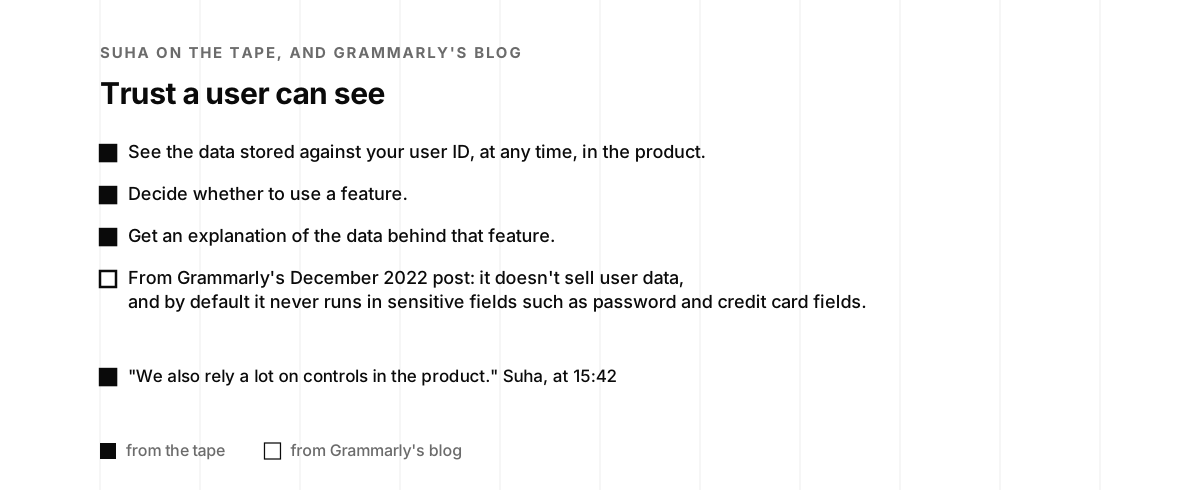
A list. Filled: see the data stored against your user ID, at any time, in the product. Filled: decide whether to use a feature. Filled: get an explanation of the data behind that feature. Outlined: from Grammarly's December 2022 post, it doesn't sell user data, and by default it never runs in sensitive fields such as password and credit card fields. Suha's line, "We also rely a lot on controls in the product." Suha, at 15:42
Three things a user can do in the product, from Suha's answer.

The EU AI Act

Jon says he isn’t sure the security community knows what secure AI means yet, and thanks Suha for putting a team on the question. Sasha turns to regulation.

“Has EU AI regulations impacted the velocity or the roadmap of certain controls that are being implemented?”

Sasha Sinkevich, at 18:46

The Artificial Intelligence Act is the European Union’s regulation on AI. It entered into force on August 1, 2024, two weeks before the episode aired, and its provisions phase in over the following 6 to 36 months (Wikipedia). Suha welcomes it, and his reason is clarity.

“So I think typically, as a security professional, as a privacy professional, what I fear most is unknown and ambiguity, and there’s still a lot of that in the space.”

Suha Can, at 19:10

Listen · Suha Can on episode 52, from 19:10
About 15 seconds: Suha on why a security and privacy professional welcomes a clear rule. The clip stops on its own. Read the full transcript.

He says the act didn’t change how Grammarly handled EU users’ data, because Grammarly handled it the same way before.

“Some companies use data to improve their models, improve their products. Some companies hold on to data indefinitely. That’s not how Grammarly is operating.”

Suha Can, at 20:00

The General Data Protection Regulation already applied to those users. The EU adopted it on April 14, 2016, and it took effect on May 25, 2018 (Wikipedia).
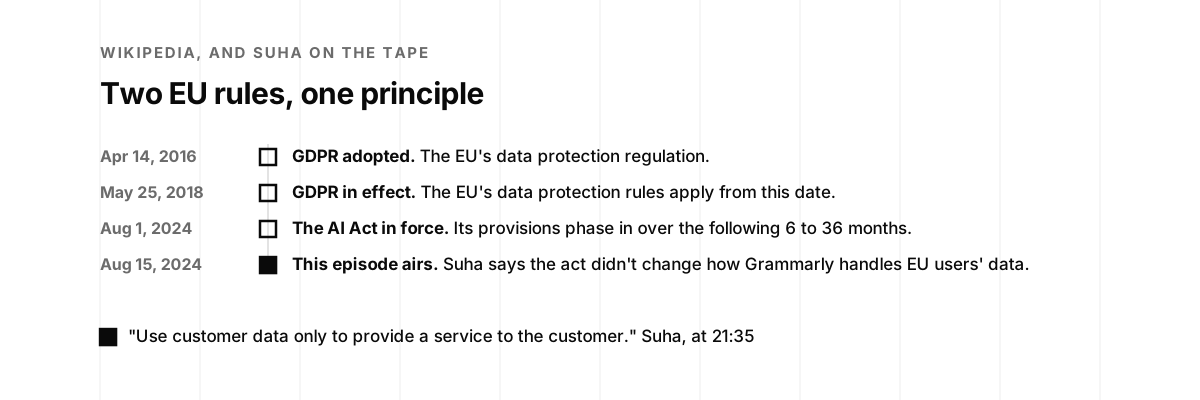
A timeline. April 14, 2016: GDPR adopted, the EU's data protection regulation. May 25, 2018: GDPR in effect, and the EU's data protection rules apply from this date. August 1, 2024: the AI Act in force, with provisions phasing in over the following 6 to 36 months. August 15, 2024, filled: this episode airs, and Suha says the act didn't change how Grammarly handles EU users' data. Suha's line, "Use customer data only to provide a service to the customer." Suha, at 21:35
Two EU rules and the principle Suha says Grammarly held under both.

Our internal compass

Sasha sums it up: strong foundations in data privacy and governance mean a new regulation doesn’t force sudden changes in how the product is built. Suha agrees. Whatever a regulation requires, he says, Grammarly’s internal compass is that its practices pass an internal test. The decodes split on the test’s name, so the transcript has its best guess in brackets. The principle under it is the customer first principle.

“Use customer data only to provide a service to the customer.”

Suha Can, at 21:35

Listen · Suha Can on episode 52, from 21:14
About 25 seconds: Suha on the test Grammarly's practices have to pass, and the principle under it. The clip stops on its own. Read the full transcript.

Where does my data go?

Jon says he and Sasha have both heard the same request many times: AI services that run on-premises, or at least data ownership that stays on-premises while the services run in a managed cloud.

“Have you guys had a lot of those requests come in at Grammarly too? Or do you offer a single-tenant tier in your enterprise space?”

Jon McLachlan, at 22:10

Suha says the concern is real and bigger in the age of generative AI.

“When a company uses an AI tool internally, their data goes somewhere else.”

Suha Can, at 22:48

The concerns come down to two groups. The first is about storage and access.

“So in this space, it really boils down to concerns around retention. Do you store this data? How long do you store this data? Who can access this data?”

Suha Can, at 23:00

Listen · Suha Can on episode 52, from 23:00
About 25 seconds: Suha on the questions every enterprise asks about its data. The clip stops on its own. Read the full transcript.

Regional data storage belongs to that group too. The second is about training.

“And the second piece is, do you use my data to train models? And if you do, is it to train models just for me, or is it to train models for all of your customers?”

Suha Can, at 23:15
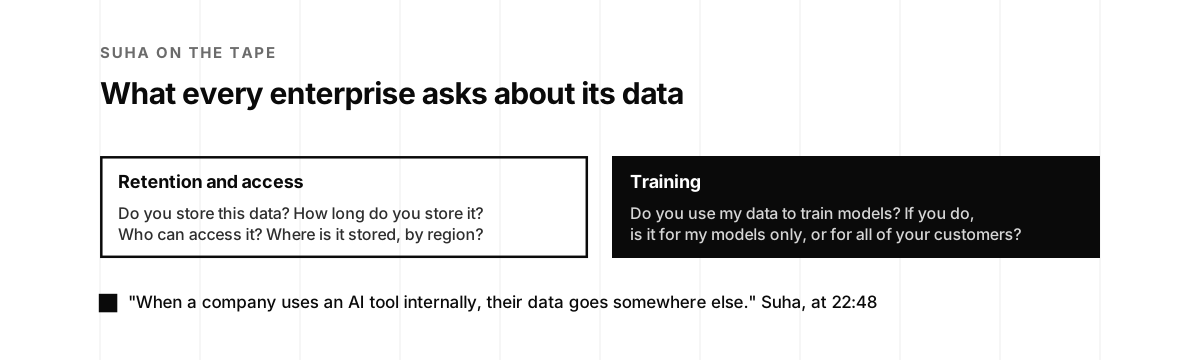
Two cards. Retention and access: do you store this data? How long do you store it? Who can access it? Where is it stored, by region? Training, filled: do you use my data to train models? If you do, is it for my models only, or for all of your customers? Suha's line, "When a company uses an AI tool internally, their data goes somewhere else." Suha, at 22:48
The questions Suha says enterprise customers ask about their data.

A key the customer holds

Suha calls Grammarly’s answer a tiered model that keeps changing with customer feedback. Running everything themselves means the customer has to manage it, he says, and some customers don’t want to do that. They still want their data kept secure. The answer he describes is a key that’s controlled by the customer.

“So the customer hosts the key, gives us permission to the key so that we can use it to encrypt and decrypt data.”

Suha Can, at 24:12

Listen · Suha Can on episode 52, from 24:11
About 25 seconds: Suha on what a customer can do when it holds the key. The clip stops on its own. Read the full transcript.

“They can revoke our access to their data immediately by revoking our access to the key.”

Suha Can, at 24:25

They can also rotate their keys, he says, which gives them control over how their data is encrypted.

The general model is called bring your own encryption, or bring your own key. The customer manages its own keys, and if it deletes them, the encrypted data can’t be read again, a practice called crypto-shredding (Wikipedia). Grammarly announced Bring Your Own Key for enterprise customers on June 25, 2024, with session timeouts, custom roles and group-level security controls (Help Net Security).

Suha puts the customer-held key between two extremes: the cost of running a customer-guarded environment, and a setup where the customer has no visibility and no control. On training, he says Grammarly does not train on its enterprise customers’ data.

“On training, we absolutely do not train on the data of our enterprise customers, and it’s just not something we do.”

Suha Can, at 24:58

“I’ve seen application layer encryption, bring your own key style encryption, used in a past life to really open up the market for very similar types of products.”

Jon McLachlan, at 25:11
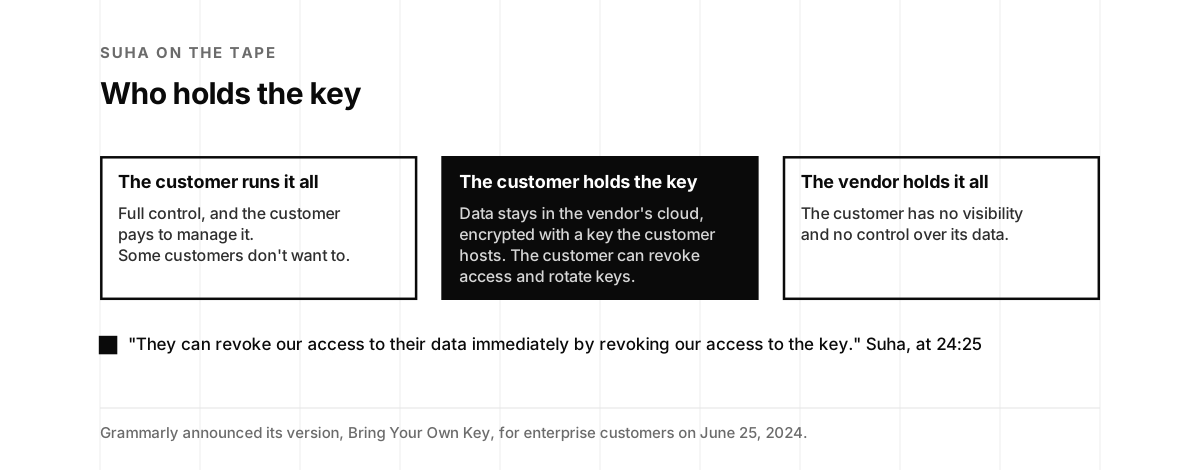
Three cards. The customer runs it all: full control, and the customer pays to manage it. Some customers don't want to. The customer holds the key, filled: data stays in the vendor's cloud, encrypted with a key the customer hosts. The customer can revoke access and rotate keys. The vendor holds it all: the customer has no visibility and no control over its data. Suha's line, "They can revoke our access to their data immediately by revoking our access to the key." Suha, at 24:25
Three places the key can sit, and where Suha puts Grammarly.

Three measures of success

Jon asks what success looks like for Grammarly’s security team, as far ahead as Suha wants to look. Suha starts with the work itself.

“And this space is full of hard and unsolved security problems.”

Suha Can, at 25:57

Listen · Suha Can on episode 52, from 26:03
About 30 seconds: Suha on the first measure: solving hard problems and sharing how. The clip stops on its own. Read the full transcript.

The first measure is to solve those problems and share how Grammarly brings safety into its models. If the team does that well, he says:

“We really made this technology safer for everybody.”

Suha Can, at 26:29

The second is to stay a user-centric and ethical AI company that keeps the user in the driver’s seat on what data to share.

The third is out of the team’s hands.

“So if you do those things well, and of course, the third is the market has to reward our approach, and it also has to be true for us to be successful.”

Suha Can, at 27:37
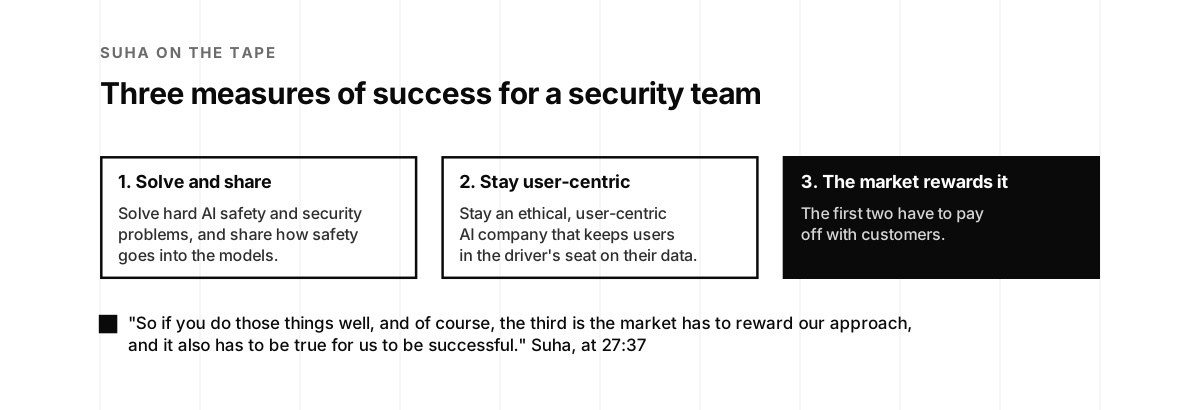
Three cards. 1. Solve and share: solve hard AI safety and security problems, and share how safety goes into the models. 2. Stay user-centric: stay an ethical, user-centric AI company that keeps users in the driver's seat on their data. 3, filled. The market rewards it: the first two have to pay off with customers. Suha's line, "So if you do those things well, and of course, the third is the market has to reward our approach, and it also has to be true for us to be successful." Suha, at 27:37
Suha's three measures of success for his security team.

Hard, long days

Sasha asks for the best day at Grammarly so far. Suha can’t pick one, but he knows the kind.

“where the work is extremely hard, extremely long, and for a really good cause.”

Suha Can, at 28:34

Listen · Suha Can on episode 52, from 28:26
About 25 seconds: Suha on the days he likes best. The clip stops on its own. Read the full transcript.

“And doing a run like this, a really hard, long day with my team, colleagues, it’s just what gets me into my flow state.”

Suha Can, at 28:44

Jon likes a good flow state too, early in the morning or late at night, and sometimes both on the same day. Then he asks for the opposite: the single most challenging day of Suha’s career.

The blue team of the internet

Suha’s hardest days were at Microsoft, where he worked on security incident response.

“And also, you know, the adversaries that Microsoft deals with is that they are just truly outstanding, technically. It’s absolutely the best of the best.”

Suha Can, at 29:59

Listen · Suha Can on episode 52, from 29:50
About 25 seconds: Suha on incident response at Microsoft and the team he worked with. The clip stops on its own. Read the full transcript.

“And we kind of viewed ourselves there in the MSRC as kind of like the blue team of the internet.”

Suha Can, at 30:09

MSRC is the Microsoft Security Response Center. His LinkedIn describes the work: as part of the MSRC React team he found vulnerabilities in Microsoft products and did root cause analysis and variant investigation on reported ones, and later he led a product security engineering and research organization across the United States, Israel and China that responded to vulnerabilities and zero-day exploits (LinkedIn). A zero-day is a vulnerability unknown to anyone who could fix it (Wikipedia).

Some of those days, he says, aren’t wise to talk about in any context. Jon agrees: no violating NDAs.

The Shadow Brokers

One day he can talk about.

“It’s probably around 2017, there was this incident, the Shadow Brokers.”

Suha Can, at 30:30

Listen · Suha Can on episode 52, from 30:30
About 40 seconds: Suha on the group that promised NSA zero-days and then delivered. The clip stops on its own. Read the full transcript.

“but some unknown parties came upon the internet with remarkably bad grammar, and they were teasing that they have a bunch of really, really good zero-days from the NSA that they will drop.”

Suha Can, at 30:37

The Shadow Brokers emerged in mid-2016 and first published on August 13, 2016. They leaked hacking tools, including zero-day exploits, from the Equation Group, widely suspected to be part of the NSA (Wikipedia). The teasing lasted months. Then the release came, and one exploit in it was EternalBlue.

“So it was real. They absolutely were authentic in their claims, the Shadow Brokers.”

Suha Can, at 31:06

EternalBlue was an NSA exploit built on a Windows zero-day that let attackers reach any number of computers on a network. The group released it publicly on April 14, 2017 (Wikipedia).
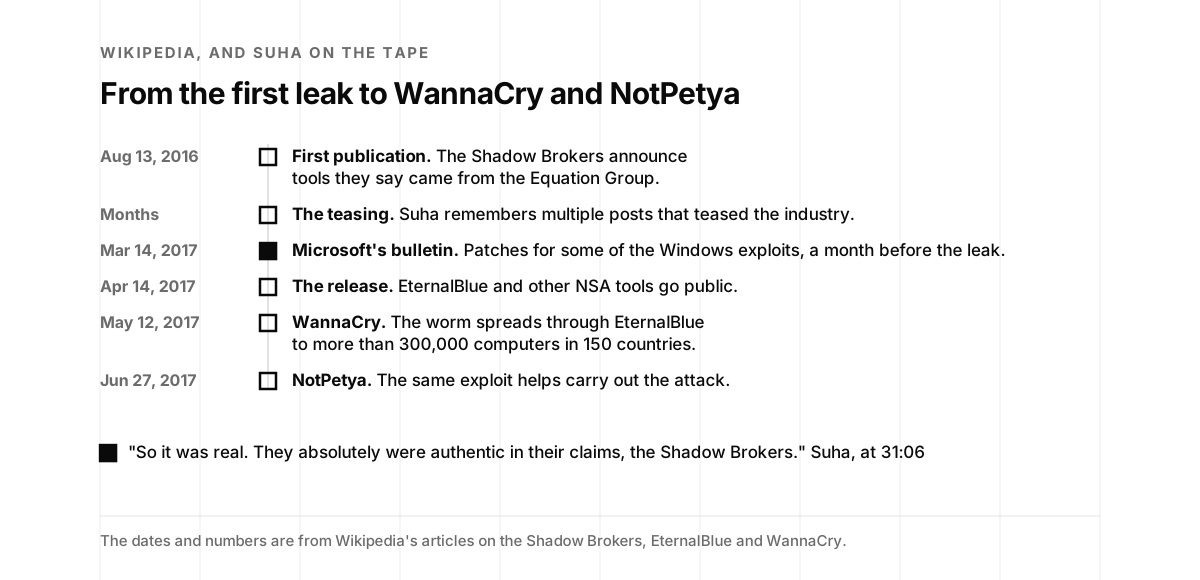
A timeline. August 13, 2016: first publication, as the Shadow Brokers announce tools they say came from the Equation Group. Months: the teasing, as Suha remembers multiple posts that teased the industry. March 14, 2017, filled: Microsoft's bulletin, with patches for some of the Windows exploits, a month before the leak. April 14, 2017: the release, as EternalBlue and other NSA tools go public. May 12, 2017: WannaCry spreads through EternalBlue to more than 300,000 computers in 150 countries. June 27, 2017: NotPetya, as the same exploit helps carry out the attack. Suha's line, "So it was real. They absolutely were authentic in their claims, the Shadow Brokers." Suha, at 31:06
The Shadow Brokers, from the first leak to WannaCry and NotPetya, with Suha's account beside the dates.

Patched before the drop

The hard part for Microsoft was the uncertainty. The team had a time limit and no list.

“But we didn’t know exactly which vulnerabilities these folks were going to release. There’s a lot of unknown and uncertainty there.”

Suha Can, at 31:46

The vulnerabilities in question were remote zero-days in Windows. Jon and Sasha point out how many people that touches.

“It’s not just individuals. Most of the world back then was running on Windows system. It still is.”

Sasha Sinkevich, at 32:07

So the team searched millions of lines of Windows code with little to go on, fixed as much as it could, and released the fixes. About a month later the release dropped.

“That day was a very stressful day for us.”

Suha Can, at 32:55

Listen · Suha Can on episode 52, from 32:55
About 20 seconds: Suha on the day the release dropped and the team took the exploits apart. The clip stops on its own. Read the full transcript.

They reverse engineered the exploits and recognized each of them.

“Thankfully, we got it right. So we patched all of those vulnerabilities before the release happened. And obviously, the opposite would have been a disaster.”

Suha Can, at 33:11

Wikipedia gives the same gap. Microsoft had patched some of the Windows exploits in a security bulletin on March 14, 2017, a month before the April 14 leak (Wikipedia).

Then WannaCry

A couple of months later, WannaCry used one of those exploits, and Suha’s explanation is that not everyone patches. The WannaCry attack began on May 12, 2017. It spread through EternalBlue, mostly through organizations that hadn’t applied Microsoft’s patches or ran Windows versions past their end of life, and it hit more than 300,000 computers in 150 countries (Wikipedia). NotPetya used the same exploit on June 27, 2017 (Wikipedia).

Listen · Suha Can on episode 52, from 33:13
About 20 seconds: Suha on WannaCry, a couple of months after the leak. The clip stops on its own. Read the full transcript.

Sasha sees a prioritization lesson in it.

“a lot of things are dependent on how well you prioritize this specific set of criticals and highs.”

Sasha Sinkevich, at 33:37
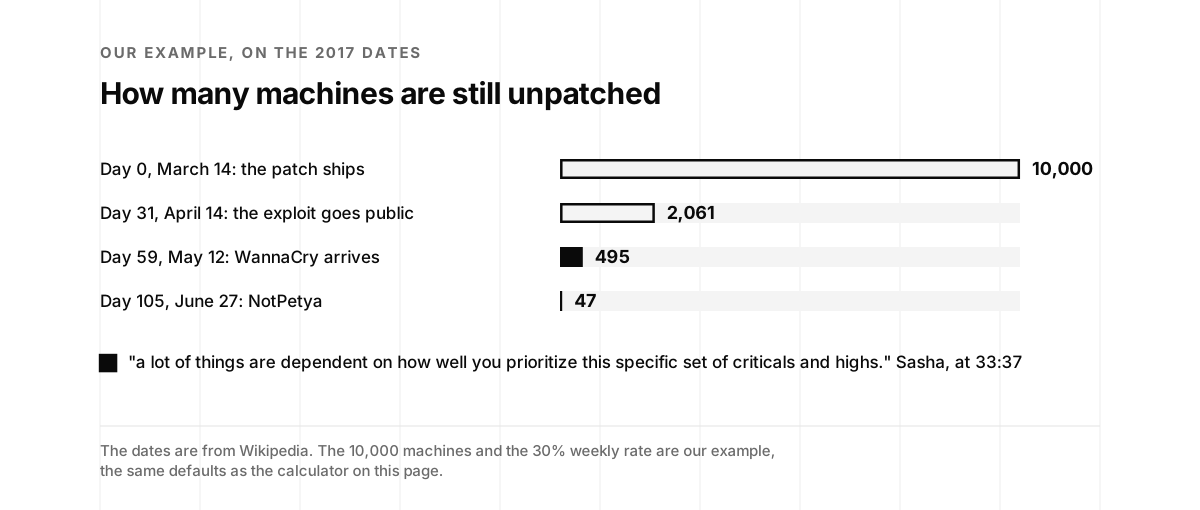
A bar chart of machines still unpatched out of 10,000, if 30% of the unpatched ones get patched each week. Day 0, March 14, the patch ships: 10,000. Day 31, April 14, the exploit goes public: 2,061. Day 59, May 12, WannaCry arrives, filled: 495. Day 105, June 27, NotPetya, filled: 47. Sasha's line, "a lot of things are dependent on how well you prioritize this specific set of criticals and highs." Sasha, at 33:37
The patch race: the days from Microsoft's patch to the leak and to WannaCry, and why the share still unpatched matters.

No researcher to call

Suha says that wasn’t the lesson of that day.

“This is not a prioritization exercise, because we definitely knew the importance of these vulnerabilities.”

Suha Can, at 34:14

Most vulnerability reports come from a researcher Microsoft can talk to. This time, he says, there was no researcher, and nobody was telling them anything. The Shadow Brokers and Microsoft had no channel between them.

The no-mystery principle

So what got the team through? Suha’s answer is a principle for working with that much ambiguity.

“the mindset has to be that there must be no mystery, no unanswered questions.”

Suha Can, at 34:50

The method is to argue against your own best guess until nothing is left to argue.

“You try to prove yourself wrong. You say, no, it can’t be it. What if it’s this?”

Suha Can, at 34:55

When every question has an answer, the answer that’s left is the one to trust.

“through answering all of the questions, only the truth remains”

Suha Can, at 35:15

He says he uses the principle with his teams. It means getting to the bottom of the problem, really understanding it, and trying to prove yourself wrong.

“And if you can’t, then I think you must be right.”

Suha Can, at 35:35

Sasha connects it to security and to life in general.

“In other words, we have to know what we’re trying to fix before we fix it.”

Sasha Sinkevich, at 35:56

The same idea shows up in what Suha said a year earlier about bug bounties. In a June 14, 2023 HackerOne write-up of his talk with HackerOne’s Alex Rice, he said, “Preemptive security is about working to disconfirm your beliefs.” He also said the main bug bounty metric he reports to the board is the number of unique researchers who reported at least one vulnerability in a quarter (HackerOne).
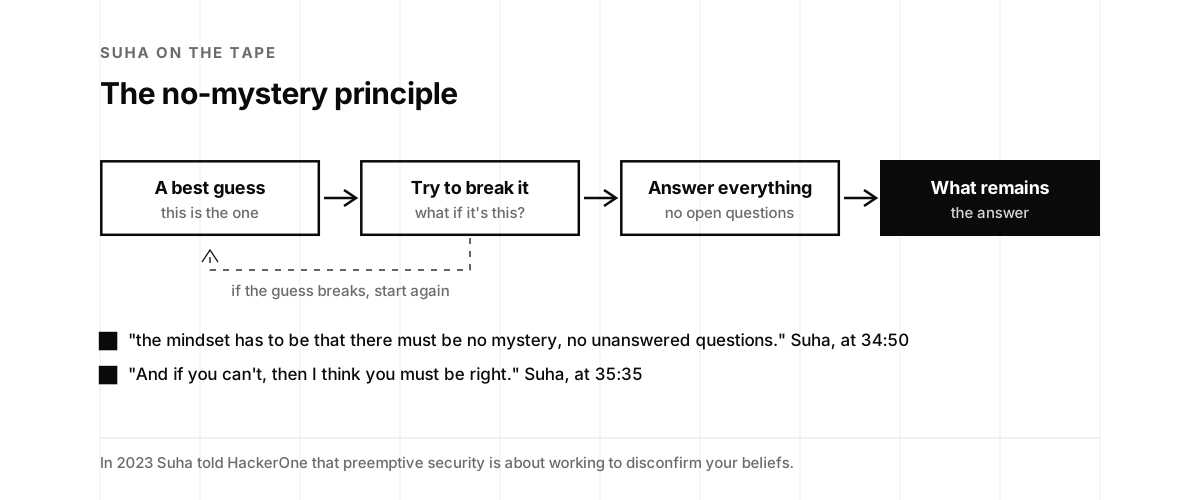
Four boxes in a row with arrows: a best guess, this is the one. Try to break it, what if it's this? Answer everything, no open questions. What remains, filled, the answer. A dashed line loops back from the second box to the first: if the guess breaks, start again. Suha's lines, "the mindset has to be that there must be no mystery, no unanswered questions." Suha, at 34:50 And, "And if you can't, then I think you must be right." Suha, at 35:35
The no-mystery principle as a loop, from Suha's answer.

Believe in yourself more

Jon’s last question: would Suha meet his younger self, and what would he say? Suha says yes, just to freak the guy out. The advice is about confidence.

“I think it took me a very long time to get to a place where I feel I actually know what I’m doing.”

Suha Can, at 36:34

Listen · Suha Can on episode 52, from 36:33
About 20 seconds: Suha on the advice he would give his younger self. The clip stops on its own. Read the full transcript.

“So maybe what I will tell them, hey, believe in yourself more, take more risk.”

Suha Can, at 36:47

Jon puts it as stop having imposter syndrome, and Suha agrees.

Attackers and defenders with AI

Before Jon can close the episode, Sasha asks one more question: what Suha expects from product security and from AI in security over the next three to five years. Suha takes the AI half first.

“I think we will see a lot more misuse of advanced AI technology by adversaries, by malicious actors, to accelerate cybersecurity capabilities that they may have.”

Suha Can, at 37:38

Listen · Suha Can on episode 52, from 37:38
About 15 seconds: Suha on what attackers will do with AI. The clip stops on its own. Read the full transcript.

He lists malware development, phishing and social engineering among the uses. On the defending side, he says AI is already showing up a little in security operations and incident response, and much more could happen there.

When a hallucination reaches the physical world

Then the risk side.

“we will probably run into cases where hallucinations actually have a real-world impact.”

Suha Can, at 38:22

Listen · Suha Can on episode 52, from 38:15
About 30 seconds: Suha on the incident he expects to read about in the news. The clip stops on its own. Read the full transcript.

“So something will happen in the physical world because of a hallucination”

Suha Can, at 38:27

He expects it in the news, and he expects it to push the industry toward resilience for AI and for critical infrastructure.

Misalignment

Further out, he names alignment.

“I do believe, with artificial general intelligence, the misalignment issues will come to bear, and we’ll see cases where AI will have its objectives not aligned with what the humans are trying to achieve.”

Suha Can, at 38:48

Alignment is the work of steering AI systems toward the goals people intend. A misaligned system pursues goals no one intended (Wikipedia).
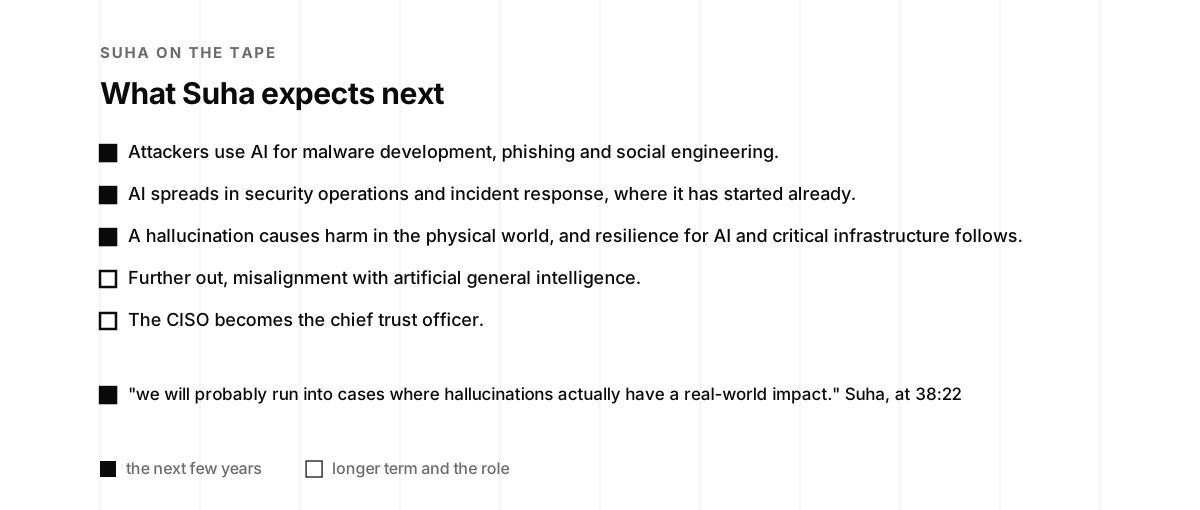
A list. Filled: attackers use AI for malware development, phishing and social engineering. Filled: AI spreads in security operations and incident response, where it has started already. Filled: a hallucination causes harm in the physical world, and resilience for AI and critical infrastructure follows. Outlined: further out, misalignment with artificial general intelligence. Outlined: the CISO becomes the chief trust officer. Suha's line, "we will probably run into cases where hallucinations actually have a real-world impact." Suha, at 38:22
What Suha expects next, in the order he gave it.

Chief trust officer

The security half of his answer is about the job.

“I think the security role, and the role of the CISO in particular, is kind of becoming a lot more broad than it originally was.”

Suha Can, at 39:07

Listen · Suha Can on episode 52, from 39:21
About 30 seconds: Suha on the CISO becoming the chief trust officer. The clip stops on its own. Read the full transcript.

It started with corporate security and moved into product security, he says, and now companies want the CISO to lead the adoption of AI.

“A lot of companies are actually looking at the CISOs to lead the company in the adoption of AI and in the bringing of AI in the workplace.”

Suha Can, at 39:24

He believes the CISO is becoming a chief trust officer in every respect.

He likes the change. The role stays technical and strategic, he says, with a bigger seat at the table. Sasha says the job is about data: how you protect it, whether it goes into training, and who can reach it.

“Who has access to the data, whether it’s internal teams or it’s internal services?”

Sasha Sinkevich, at 40:10

“That was the first time I heard it posed as a chief trust officer. I like that a lot.”

Jon McLachlan, at 40:40

Suha says he knows a couple of people with the title already. Sasha closes by offering a follow-up episode about the future, and Suha says he likes talking about the future.

After the tape

Suha took the case on the road. Grammarly announced his session at the Gartner IT Symposium/Xpo on October 22, 2024, on a playbook for measuring the return on AI deployments (LinkedIn). In November 2024 he wrote in Grammarly’s “AI Responsibly” newsletter on how return on investment and responsible AI connect (LinkedIn).

Grammarly changed at the top. In December 2024 Grammarly agreed to buy Coda, and Coda’s CEO, Shishir Mehrotra, replaced Rahul Roy-Chowdhury as Grammarly’s CEO. In May 2025 it raised $1 billion in nondilutive funding from General Catalyst. In July 2025 it agreed to buy the email client Superhuman, and in October 2025 the parent company, Grammarly Inc., rebranded as Superhuman (Wikipedia).

Suha moved to DoorDash. He joined DoorDash as vice president and CISO in March 2025. His title now reads vice president and chief security officer, and he leads cybersecurity, governance, risk and compliance, and physical safety for the company and its subsidiaries (LinkedIn).

Suha Can on LinkedIn, March 2025: he joined DoorDash as VP and CISO.

Suha Can · March 2025
Suha's post on joining DoorDash. View on LinkedIn.

Grammarly has a new CISO. Grammarly’s trust center now names Giles Douglas as chief information security officer (Grammarly).

More from Grammarly on this show. Polina Morozov, then a security recruiter at Grammarly, was the guest on episode 46, two months before this one.
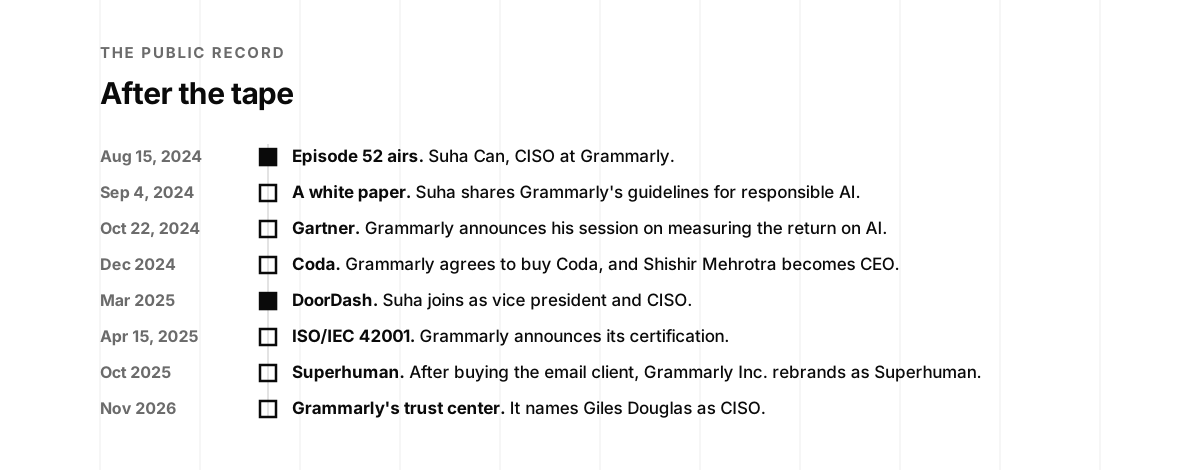
A timeline. August 15, 2024, filled: episode 52 airs, Suha Can, CISO at Grammarly. September 4, 2024: a white paper, as Suha shares Grammarly's guidelines for responsible AI. October 22, 2024: Gartner, as Grammarly announces his session on measuring the return on AI. December 2024: Coda, as Grammarly agrees to buy Coda, and Shishir Mehrotra becomes CEO. March 2025, filled: DoorDash, where Suha joins as vice president and CISO. April 15, 2025: ISO/IEC 42001, as Grammarly announces its certification. October 2025: Superhuman, as Grammarly Inc. rebrands as Superhuman after buying the email client. November 2026: Grammarly's trust center names Giles Douglas as CISO.
The public record after the tape.

Did you catch it? A seven-question quiz

Seven questions from the episode. Each answer links the moment in the transcript.

Quiz · seven questions

Did you catch it?

Pick an answer to see whether you caught it, and where it is on the tape.

  1. What did Suha find on the bottom floor of the coffee shop?

    1. One computer
    2. A shelf of Unix manuals
    3. A room full of hackers

    a. "And at the bottom floor of the coffee shop, there was one computer" Transcript, 2:19.

  2. What does Suha call his first job at Grammarly?

    1. Vice president of engineering
    2. The CISO job
    3. Chief privacy officer

    b. "Job number one is the CISO job." Transcript, 4:41.

  3. How does Suha describe scalable solutions?

    1. The whole job
    2. A waste of money for a startup
    3. Necessary but not sufficient

    c. "and I truly believe that scalable solutions are necessary but not sufficient." Transcript, 7:16.

  4. Which new certification was Grammarly pursuing when the episode was recorded?

    1. ISO 42001
    2. ISO 9001
    3. FedRAMP

    a. "So in the compliance space, for example, we are really pursuing, I think we are one of the first to do that, the new ISO 42001" Transcript, 14:11.

  5. What does Suha say Grammarly does not do with its enterprise customers' data?

    1. Encrypt it
    2. Train models on it
    3. Store it in the cloud

    b. "On training, we absolutely do not train on the data of our enterprise customers, and it's just not something we do." Transcript, 24:58.

  6. What did the Shadow Brokers say they would drop?

    1. Windows source code
    2. A list of stolen passwords
    3. Zero-days from the NSA

    c. "they were teasing that they have a bunch of really, really good zero-days from the NSA that they will drop." Transcript, 30:43.

  7. What does Suha's principle say there must be none of?

    1. Mystery
    2. Risk
    3. Meetings

    a. "the mindset has to be that there must be no mystery, no unanswered questions." Transcript, 34:50.

Would an enterprise CISO trust your AI product?

Suha’s answers add up to a list of what an enterprise buyer checks before it lets an AI tool near its data. Eight questions on how many of them you can answer.

Scorecard · eight questions

Would an enterprise CISO trust your AI product?

Answer for the AI product you sell to businesses. If two answers fit, pick the lower one.

  1. Can you tell a buyer, in writing, what customer data you store, for how long, and who can access it?

    • No
    • Partly
    • Yes, on one page

    "So in this space, it really boils down to concerns around retention. Do you store this data? How long do you store this data? Who can access this data?" See Where does my data go?

  2. Do you train models on your enterprise customers' data?

    • Yes, by default
    • Only if they opt in
    • No

    "On training, we absolutely do not train on the data of our enterprise customers, and it's just not something we do." See A key the customer holds.

  3. Can an enterprise customer hold its own encryption key, and revoke or rotate it?

    • No
    • On the roadmap
    • Yes

    "They can revoke our access to their data immediately by revoking our access to the key." See A key the customer holds.

  4. Can users see the data you hold about them, and turn features on or off?

    • Neither
    • One of them
    • Both

    "We also rely a lot on controls in the product." See Controls users can see.

  5. Does every model go through a check for data leaks, hallucination and harmful output before it reaches users?

    • No
    • Some models
    • Every model

    "that they wouldn't leak data, that they wouldn't mislead our users by hallucinating" See A dedicated responsible AI team.

  6. Do you hold SOC 2 Type 2 or ISO 27001, with a plan for ISO 42001?

    • Neither
    • One, no plan for 42001
    • Yes, and a plan for 42001

    "We are also quite aggressive in pursuing new certifications, especially in the realm of AI and privacy, because especially with AI, there is a lot of nervousness in the industry." See One of the ways we communicate.

  7. Does your security team build controls with the engineers, or advise and walk away?

    • Advise only
    • Some of each
    • Build with them

    "So my teams don't operate in a way where we advise teams what to do and then we move away." See I didn't know security was this.

  8. Could you explain your data practices to a regulator in one sentence?

    • No
    • Roughly
    • Yes

    "Use customer data only to provide a service to the customer." See Our internal compass.

Not ready for the enterprise questions

A buyer will ask about retention, access and training before anything else. Write a one-page answer, and decide where you stand on training before they ask.

Getting there

The basics are in place. Next, give enterprise customers a key they hold, and put a check on every model before it reaches users.

Ready for the enterprise questions

You can answer what Suha says every enterprise asks. Keep the answers current as your models change.

How many machines are still unpatched on exploit day?

Microsoft patched before the Shadow Brokers release, and WannaCry still spread a month after it, through machines that hadn’t been patched. This calculator shows how many of yours would still be open when an exploit goes public, and when a worm arrives.

Calculator

How many machines are still unpatched on exploit day?

Four numbers: your machines, the share of unpatched machines you patch each week, and the days from the patch to a public exploit and to a worm.

2,061still unpatched when the exploit goes public
495still unpatched when the worm arrives
5%of your machines open to the worm

With 10,000 machines and 30% of the unpatched ones patched each week, 2,061 are still open when the exploit goes public after 31 days, and 495, or 5% of them, when the worm arrives after 59 days.

The 31 and 59 days are the gaps from Microsoft's March 14, 2017 security bulletin to the Shadow Brokers release on April 14 and to WannaCry on May 12, 2017. The 10,000 machines and the 30% weekly rate are examples we picked. Put in your own numbers.

From a coffee shop in the 1990s to DoorDash in 2025

Everything on this page sits on one timeline. Filter it by thread.

Timeline · the 1990s to 2025

From a coffee shop in the 1990s to DoorDash in 2025

Filter by thread. Suha's dates are from the tape and his LinkedIn, and the rest are from the public record.

  1. The coffee shop

    One computer, the IRC, and a Unix security group (on this show).

  2. IBM

    Enterprise IT security intern, to October 2003 (LinkedIn).

  3. AirTies Wireless Networks

    Research and development engineer on embedded Linux routers, owning the firewall and the product's security, to 2007 (LinkedIn).

  4. Microsoft Security Response Center

    Security engineer on the MSRC React team, to January 2013 (LinkedIn, on this show).

  5. Grammarly

    First release, from founders Alex Shevchenko, Max Lytvyn and Dmytro Lider (Wikipedia, on this show).

  6. Amazon Web Services

    Security engineer and penetration tester, to August 2013 (LinkedIn).

  7. Back to the MSRC

    Principal security engineering manager, leading product security engineering and research, to December 2018 (LinkedIn).

  8. GDPR adopted

    The EU's data protection regulation, in effect from May 25, 2018 (Wikipedia, on this show).

  9. The Shadow Brokers

    The group's first publication (Wikipedia, on this show).

  10. Microsoft's patches

    A security bulletin patches some of the Windows exploits, a month before the leak (Wikipedia, on this show).

  11. EternalBlue goes public

    The Shadow Brokers release it with other NSA tools (Wikipedia, on this show).

  12. WannaCry

    The ransomware worm spreads through EternalBlue to more than 300,000 computers in 150 countries (Wikipedia, on this show).

  13. NotPetya

    The same exploit helps carry out the attack (Wikipedia).

  14. A browser extension bug

    Tavis Ormandy of Google finds that Grammarly's extension exposed authentication tokens to websites, and Grammarly ships a fix within hours (Wikipedia).

  15. A bug bounty

    Grammarly launches its program on HackerOne, with a $100,000 reward for the first hacker to reach a specific document on its server (Wikipedia, on this show).

  16. Amazon Payments Security

    Suha founds the team and grows it from 1 to more than 100 engineers, then leads security engineering for Amazon Payments from March 2021 (LinkedIn, on this show).

  17. Grammarly

    CISO and vice president of engineering, to February 2025 (LinkedIn, on this show).

  18. A user-first post

    Grammarly says more than 50,000 teams use Grammarly Business and that it doesn't sell user data (Grammarly, on this show).

  19. Generative AI

    Grammarly launches a product built on large language models (Wikipedia).

  20. Preemptive security

    HackerOne writes up Suha's talk on bug bounties and board metrics (HackerOne, on this show).

  21. Episode 46

    Polina Morozov, then a security recruiter at Grammarly, on the show (episode 46).

  22. Bring Your Own Key

    Announced for enterprise customers, with session timeouts and custom roles (Help Net Security, on this show).

  23. The EU AI Act

    Enters into force, with provisions phasing in over 6 to 36 months (Wikipedia, on this show).

  24. Episode 52 airs

    This conversation (Podbean).

  25. The responsible AI white paper

    Suha shares Grammarly's guidelines for responsible AI (LinkedIn, on this show).

  26. Gartner IT Symposium/Xpo

    Grammarly announces Suha's session on measuring the return on AI deployments (LinkedIn, on this show).

  27. Coda and a new CEO

    Grammarly agrees to buy Coda, and Shishir Mehrotra becomes CEO (Wikipedia, on this show).

  28. DoorDash

    Suha joins as vice president and CISO (LinkedIn, on this show).

  29. ISO/IEC 42001

    Grammarly announces its certification (Business Wire, on this show).

  30. Superhuman

    Grammarly agrees to buy the email client (Wikipedia, on this show).

  31. A new name

    The parent company, Grammarly Inc., rebrands as Superhuman (Wikipedia, on this show).

What to do this week

Five things, in the order of the episode.

  1. Write down where customer data goes. Put on one page what you store, for how long, who can access it, where it lives, and whether it trains any model. Suha says every enterprise asks those questions. Take the scorecard with your product lead.
  2. Decide who holds the key. If buyers ask for on-premises, a key the customer holds may be the middle ground Suha describes. Our Product Security team can help you design it.
  3. Check every model before it ships. Test for data leaks, hallucination and output you would never want to ship, and write down who signs off. ISO 42001 turns that habit into a management system an auditor can certify.
  4. Time your patch race. Run the calculator with your own fleet and patch rate, then measure how long a critical patch takes to reach most of your machines.
  5. Get a second pair of eyes. A vCISO can own the plan, and you can book 15 minutes with us.

Key takeaways

  1. Scale first, then go deep

    Suha starts with solutions that scale, such as automation that gets the basics in check. Then he invests deep in the crown jewels, where skilled experts do manual work.

  2. Build with the engineers

    Suha's security engineers are also software engineers. They don't advise and walk away. They build the controls with the teams, and a control built for one threat often helps other teams too.

  3. Compliance is a language between companies

    Certifications are one of the ways companies tell each other that they meet a standard, with a third party agreeing. Suha says compliance matters to a security person, but it isn't everything.

  4. Check every model before it ships

    Grammarly's responsible AI team checks models for leaked data, misleading hallucinations and output that would be awful to say, using analytical linguists and machine learning models.

  5. Let users see their data

    Controls in the product let users see the data stored against their account and choose which features to use, with an explanation of the data behind each one.

  6. A principle outlasts a regulation

    Suha says the EU AI Act didn't change how Grammarly handled EU users' data, because it already used customer data only to provide the service.

  7. Answer the enterprise questions first

    Enterprise buyers ask whether you store their data, for how long, who can access it, where it's stored, and whether it trains your models.

  8. Let the customer hold the key

    A key the customer hosts lets it revoke the vendor's access at once and rotate keys, without the cost of running the whole service itself.

  9. Patch before the exploit

    Microsoft patched the Windows bugs before the Shadow Brokers released their exploits. WannaCry still spread a month later through machines that hadn't been patched.

  10. No mystery, no unanswered questions

    When the facts are unclear, try to prove your best guess wrong and answer every open question. What remains is the answer.

  11. The CISO as chief trust officer

    Suha sees the CISO's role growing from corporate and product security into leading AI adoption and owning trust across the company.

Chapters

Tap a chapter to play from there.

Pull quotes

“And at the bottom floor of the coffee shop, there was one computer”

Suha Can ·

“And really, when you look at the time, it was amazing because I was seeking knowledge.”

Suha Can ·

“There was a sense of curiosity, seeking to understand how things work.”

Suha Can ·

“Job number one is the CISO job. So I am responsible for all aspects of trust in the company.”

Suha Can ·

“So I think one of the important things is really building solutions that scale.”

Suha Can ·

“And the business moves at a very fast speed. You definitely cannot be in the business of slowing things down.”

Suha Can ·

“and I truly believe that scalable solutions are necessary but not sufficient.”

Suha Can ·

“I always believe that for really high-risk areas or your crown jewels, you need to go a lot deeper. You need to build layers in the defenses.”

Suha Can ·

“And I think security has to have a builder mindset.”

Suha Can ·

“And the principal engineer of the team told me, hey, I didn't know security was this.”

Suha Can ·

“I even go farther than that, in the sense that we actually implement the controls.”

Suha Can ·

“We have to have a good mix of security skills and software engineering skills.”

Suha Can ·

“So I think it's important to highlight that Grammarly has been doing AI before AI was as popular as it is in 2024.”

Sasha Sinkevich ·

“We are also quite aggressive in pursuing new certifications, especially in the realm of AI and privacy, because especially with AI, there is a lot of nervousness in the industry.”

Suha Can ·

“Responsible AI is an area where we have a dedicated team, a robust set of researchers that work on responsible AI”

Suha Can ·

“that they wouldn't leak data, that they wouldn't mislead our users by hallucinating”

Suha Can ·

“We also rely a lot on controls in the product”

Suha Can ·

“Because, really, I'm not sure that the security community knows what it means to have secure AI quite yet.”

Jon McLachlan ·

“And it's important that companies consider the certifications as standards, and frameworks are not there for the check mark purposes.”

Sasha Sinkevich ·

“So I think typically, as a security professional, as a privacy professional, what I fear most is unknown and ambiguity, and there's still a lot of that in the space.”

Suha Can ·

“Some companies use data to improve their models, improve their products. Some companies hold on to data indefinitely. That's not how Grammarly is operating.”

Suha Can ·

“Use customer data only to provide a service to the customer.”

Suha Can ·

“When a company uses an AI tool internally, their data goes somewhere else.”

Suha Can ·

“So in this space, it really boils down to concerns around retention. Do you store this data? How long do you store this data? Who can access this data?”

Suha Can ·

“So the customer hosts the key, gives us permission to the key so that we can use it to encrypt and decrypt data.”

Suha Can ·

“They can revoke our access to their data immediately by revoking our access to the key.”

Suha Can ·

“On training, we absolutely do not train on the data of our enterprise customers, and it's just not something we do.”

Suha Can ·

“And this space is full of hard and unsolved security problems.”

Suha Can ·

“And we kind of viewed ourselves there in the MSRC as kind of like the blue team of the internet.”

Suha Can ·

“It's probably around 2017, there was this incident, the Shadow Brokers.”

Suha Can ·

“So it was real. They absolutely were authentic in their claims, the Shadow Brokers.”

Suha Can ·

“Thankfully, we got it right. So we patched all of those vulnerabilities before the release happened. And obviously, the opposite would have been a disaster.”

Suha Can ·

“the mindset has to be that there must be no mystery, no unanswered questions.”

Suha Can ·

“And if you can't, then I think you must be right.”

Suha Can ·

“In other words, we have to know what we're trying to fix before we fix it.”

Sasha Sinkevich ·

“So maybe what I will tell them, hey, believe in yourself more, take more risk.”

Suha Can ·

“we will probably run into cases where hallucinations actually have a real-world impact.”

Suha Can ·

“That was the first time I heard it posed as a chief trust officer. I like that a lot.”

Jon McLachlan ·

About the guest

Suha Can, Chief Information Security Officer, Grammarly

Suha Can was the chief information security officer and vice president of engineering at Grammarly from September 2022 to February 2025. As CISO he led security, privacy, responsible AI, governance, risk and compliance, fraud and abuse, and IT, and as vice president of engineering he led the teams that built Grammarly Business. Before Grammarly he founded the Payments Security team at Amazon in 2019 and grew it from 1 to more than 100 engineers, then directed security engineering for Amazon Payments. He spent more than ten years at the Microsoft Security Response Center, first on the MSRC React team and later leading a product security engineering and research organization, with eight months at AWS in between. Since March 2025 he has been vice president and chief security officer at DoorDash. He joined Jon McLachlan and Sasha Sinkevich on episode 52, published August 15, 2024.

About the host

Jon McLachlan and Sasha Sinkevich are co-founders of YSecurity, the on-demand cybersecurity team for startups, and of Cyberbase.ai. The Security Podcast of Silicon Valley is hosted by Jon McLachlan and Sasha Sinkevich. Jon McLachlan on LinkedIn ↗Sasha Sinkevich on LinkedIn ↗

Context and sources

  • The episode on Podbean, published August 15, 2024, with the show notes. Source ↗
  • The episode on Apple Podcasts. Source ↗
  • The episode on Spotify. Source ↗
  • Suha Can's LinkedIn profile. Source ↗
  • Suha Can's experience on LinkedIn: Grammarly from September 2022 to February 2025, Amazon from 2019 to 2022, the Microsoft Security Response Center from 2007 to 2018, and DoorDash from March 2025. Source ↗
  • Suha's LinkedIn post sharing Grammarly's white paper, The Responsible AI Advantage: Guidelines for Ethical Innovation, September 4, 2024. Source ↗
  • Suha's LinkedIn post on Grammarly's AI Responsibly newsletter, on return on investment and responsible AI, November 20, 2024. Source ↗
  • Suha's LinkedIn post on joining DoorDash as VP and CISO, March 2025. Source ↗
  • Suha's LinkedIn activity, including Grammarly's post announcing his session at the Gartner IT Symposium/Xpo on October 22, 2024. Source ↗
  • HackerOne's write-up of Suha's talk with Alex Rice on bug bounties and preemptive security, June 14, 2023. Source ↗
  • Grammarly's blog post on its user-first approach to security and privacy, December 1, 2022. Source ↗
  • Grammarly's trust center, which names Giles Douglas as CISO today. Source ↗
  • Grammarly's compliance page: SOC 2 Type 2, SOC 3, and ISO/IEC 27001, 27017, 27018, 27701 and 42001. Source ↗
  • Help Net Security on Grammarly's enterprise security features, including Bring Your Own Key, June 26, 2024. Source ↗
  • Business Wire: Grammarly Deepens Enterprise Capabilities With Enhanced Security and Control Features, June 25, 2024. Source ↗
  • Business Wire: Grammarly Achieves ISO/IEC 42001:2023 Certification, The World's First AI Management Standard, April 15, 2025. Source ↗
  • Wikipedia on Grammarly, from its 2009 launch to the 2025 rebrand as Superhuman. Source ↗
  • Wikipedia on the Shadow Brokers. Source ↗
  • Wikipedia on EternalBlue. Source ↗
  • Wikipedia on the WannaCry ransomware attack. Source ↗
  • Wikipedia on the EU Artificial Intelligence Act. Source ↗
  • Wikipedia on the General Data Protection Regulation. Source ↗
  • Wikipedia on bring your own encryption, also called bring your own key. Source ↗
  • Wikipedia on hallucination in artificial intelligence. Source ↗
  • Wikipedia on AI alignment. Source ↗
  • Wikipedia on zero-day vulnerabilities. Source ↗
  • Wikipedia on IRC. Source ↗
  • Wikipedia on the demoscene. Source ↗
  • Wikipedia on SOC reports. Source ↗
  • Wikipedia on ISO/IEC 27001. Source ↗

Transcript

Automatic transcription. Jon McLachlan and Sasha Sinkevich host this episode with Suha Can, then the CISO of Grammarly. There is no diarization on the tape, and the three voices are close in pitch, so speaker labels were assigned from the content and checked passage by passage against reference recordings of each voice from this episode and by pitch, and a few short lines may sit with the wrong speaker. Names and product names were normalized where the recognizer misheard them (Jon McLachlan, Sasha Sinkevich, Suha Can, Grammarly, Lumos, the Shadow Brokers, EternalBlue, WannaCry, MSRC, YSecurity), as were a few terms (SOC 2 Type 2, ISO 42001, IRC). Words in [brackets] are best guesses where the audio is unclear, and [unclear] marks a word we couldn't make out. Answers are transcribed as spoken, with repeated words and false starts trimmed. Short backchannels such as "yeah" and "right" are left out where they overlap the other speaker.

Read the full transcript 7,001 words

Jon McLachlan

Hello, everyone, and welcome to another episode of the Security Podcast of Silicon Valley. I'm your host, Jon McLachlan, and I'm joined with Sasha Sinkevich, co-host. And we have a very special guest for everyone today, Suha Can, the CISO at Grammarly, the Chief Information Security Officer. Suha Can, you bring a lot of great experience to the table. You are leading security, privacy, compliance, and identity at that global company, Grammarly. He's dedicated to securing the data for Grammarly, which includes over 30 million users and 70,000 teams at enterprises and organizations worldwide. Previously, Suha, you were the director of security at Amazon, overseeing security engineering globally for Amazon Payments and Alexa. While at Amazon, Suha, you built Lumos, the secure payment processing service handling all customer payments for all Amazon businesses and relying on formal verification methods for security [assurance]. You also led global security research at Microsoft. You were responsible for responding to all of those zero-day exploits, building mitigations to kill vulnerability classes, entire classes of vulnerabilities, and increasing the cost of exploits and unknown vulnerabilities. Welcome to the show, Suha.

Suha Can

Thanks, Jon. Thanks for having me.

Jon McLachlan

It's great to have you.

Suha Can

Great. It's awesome to be here.

Jon McLachlan

For all of our listeners, how did [you] get into security?

Suha Can

Yeah, [unclear]. So I grew up in Turkey, and growing up, I was really into maths and computers. This is kind of, let's say, mid-90s. I'm in my 40s now. The things that I didn't have at home that I really wanted to have was internet access. This was still the early days of the internet in Turkey. I was really looking for a way to get connected. I'm at a high school at the time, and we don't have internet in school as well. So I found this coffee shop in a nicer part of town, [and] that was kind of pretty far from where I am. So I would go on a pretty long walk after school to go to this coffee shop. And at the bottom floor of the coffee shop, there was one computer, and this one computer was [connected] to the internet. This is a nice part of town. Apparently, this is something that was starting to come in, so they put one [there] to attract people. And through that computer, I fell in love with the IRC and started getting to know other people who are computer [aficionados] in Turkey. The IRC [community] of Turkey at that time was pretty much students from the few technical universities and managers and admins and the like. I started learning from this. And really, when you look at the time, it was amazing because I was seeking knowledge. Here's other people, all of whom are more knowledgeable than me. And there were two communities at the time. One was the Linux, let's say, admin security community, people managing Unix servers in various companies and universities. And the second was the demoscene community, people building fascinating graphics and very small amounts of code. And of those communities were accessible through this medium. And I got the chance to join a Unix security group, and I learned a lot from those. There was a sense of curiosity, seeking to understand how things work. It was all about having fun, gaining knowledge, a little bit of friendly competition for sure. And I had a lot of fun learning from those people, being part of that. And most of those people, [I'm] still connected with today. Many of them actually ended up in the US. Several went on to become [CISOs] or security founders here. [unclear].

Jon McLachlan

That's awesome. That's an incredible story. How old were you when you discovered that coffee shop?

Suha Can

[15], I think. Something like that. [16 or 15].

Jon McLachlan

A very impressionable age.

Suha Can

Very impressionable age. I was certainly one of the [most annoying] people [on IRC] in Turkey at the time, and most people were older than me. And yeah, it's truly, it was an extraordinary time.

Jon McLachlan

I love it. I love the sense of curiosity and just the exploring things. So now, today, as the Chief Information Security Officer at Grammarly, an amazing product, by the way, I'm a huge fan. I've been a paid member for, man, I don't even know how many years. As soon as I discovered you guys, I bought it. But what is it? What do you do at Grammarly as the CISO?

Suha Can

Great. Yeah, I wear two hats [at Grammarly]. Job number one is the CISO job. So I am responsible for all aspects of trust in the company. So I [lead] security, product security, corporate security, privacy, compliance, corporate engineering, the IT infrastructure of Grammarly itself, [and] responsible AI, so our research team that's focused on making AI safe for our customers. So this job, number one, that's my main role. I also lead the engineering teams [at Grammarly] that build the enterprise version [of Grammarly], because typically, the enterprise version has a lot of interesting security and IT management problems to solve, and my teams also build those capabilities of Grammarly for our customers.

Jon McLachlan

Sounds like you're also chief product security officer.

Suha Can

Yeah, absolutely. I would say that, absolutely. Chief product security officer, chief compliance officer, [I think], chief privacy officer, all of it.

Sasha Sinkevich

Security has a lot of different subcategories, and the security umbrella is vast and goes into different aspects of the product and the organization. How do you make sure that the security as an organization runs fluently and it does not impede the research and development?

Suha Can

Great question. So I think one of the important things is really building solutions that scale. I think when we look at the security program, you really want to make sure that you're able to understand the risk tolerance of the company, which at a company like Grammarly, clearly, trust needs to be paramount, so we have a pretty high bar on security. You ensure that the investment is also strategic and on par with that importance. Obviously, if you work in a company and security is very important, but you don't have the right investment in the area and you don't have the right strategic voice to influence the company, then no matter who you hire, you're just going to be always behind. And the business moves at a very fast speed. You definitely cannot be in the business of slowing things down. So first, it starts with a strategic alignment. You need to have a very clear vision. You need to bring the board along. You need to bring [counsel] and leadership around. And then you hire great people. Obviously, you build teams. But generally speaking, there is always this balance between velocity and [enabling] the business. And then, to get started, a lot of automation, a lot of scaling [your program]. And I think that's always a great place to start. That enables you to get the basics in check. Once you [have it] in check, obviously, and I truly believe that scalable solutions are necessary but not sufficient. I always believe that for really high-risk areas or your crown jewels, you need to go a lot deeper. You need to build layers in the defenses. And typically, that requires really skilled security experts that [can] go really deep, do a lot of manual introspection, and really raise the barrier in a major way. The cool thing is this is kind of what you do. So you need to invest in things that scale, and I think that's [where to] start. Then you invest deep in certain areas that are really important and high impact to the business. But as you do these things, how you do is also important. And I think security has to have a builder mindset. So my teams don't operate in a way where we advise teams what to do and then we move away. We build solutions with [them]. Most of our security engineers are also software engineers, and they are builders. So no matter what your strategy is, the how of it should be by being a builder and [bringing a] builder mindset to the organization. That's super important. And that's also how you're getting credibility with [development] teams. Typically, one of the things, one of my [fond] memories from my time at Amazon, and it has also repeated itself at [Grammarly], is we will do a security deep dive, and we will present our findings to the team who owns the services we were diving deep on. And the principal engineer of the team told me, hey, I didn't know security was this. And that's a nice compliment that one [gets] here, because people are used to security being, hey, answer these questions, check, like, make sure you do these things, and, like, walk away. And I think that's just unfortunate, how a lot of people are conditioned. But typically, that's not how you're going to be able to land impact, and that's not how you're going to gain the respect of the engineers, which ultimately are your closest partner in security.

Sasha Sinkevich

Yeah, absolutely. Having the right people in all of the right areas of the security is important to make sure that the conversation and communication with engineering teams is open and is ongoing. Security in isolation does not work. Security needs to be driven by business, and it needs to be closely collaborated with engineering teams that implement certain controls.

Suha Can

I agree with you 100%. I even go farther than that, in the sense that we actually implement the controls. And I [think that's where] I truly believe security is a builder profession. We have to have a good mix of security skills and software engineering skills. And if you identify a particular threat and you want to build a control, you probably want to build it, because it is very likely that same control will also be useful for other teams in the company. So it's really thinking about [it still] and being a builder that's going to make your strategy work for you.

Sasha Sinkevich

Yeah, the engineering mindset of security teams is extremely welcomed and very well received by the other arms of the organization. We've seen it work really well so many times, and that's the amazing approach to take. Having said that, what does Grammarly do better than everyone else in the world?

Suha Can

[AI for] communications. So I would say that Grammarly is the only AI company really focused on transforming how people communicate, whether it's at work, at school, for personal communications. We've been doing this for about 15 years. And I think this focus led to a product that people really love, that they really find very useful, but it's really about AI communications. And I think this is what Grammarly does in the world better than everyone else. And that's probably why we have [users at] something like 95% of the Fortune 500.

Sasha Sinkevich

So I think it's important to highlight that Grammarly has been doing AI before AI was as popular as it is in 2024. And we're super grateful to see you create a security organization that is dedicated to protect the data that all of us provide to Grammarly in order to get the service off that data.

Suha Can

[To answer the question].

Sasha Sinkevich

No, yeah, it wasn't. It was just a thank you for doing an amazing work for protecting that data.

Jon McLachlan

Okay, so let's talk about how security intersects that AI space a little bit. Does Grammarly, I know that Grammarly started off mostly as, like, aiming for consumers. In terms of security, consumer space is very important, but it is a very different game than when you go after enterprises. Now I see Grammarly going more for corporations, more for enterprises, more for corporate communication within your organization. How do you trim things up, make them more succinct, increase information density? I love the feature that actually does the analysis, the tone analysis. So when you write an email, it will show you, like, little emojis of what you might sound like when someone reads that. Super good way to just reflect on your word choice, the tone. But at the end, like, in terms of security, if you sell that product to the enterprise space, usually there's, like, certification questions that come up. Oh, do you have SOC 2, ISO 27001? Maybe? I don't know. Does Grammarly go after those certifications to demonstrate their security posture? Or how do you, what is your approach?

Suha Can

Yes, I think it is a call-out. If you just look at what Grammarly does, clearly, security is going to be extremely important. And [when] you sell to consumers, privacy is extremely important. There's a lot of questions about how the data is handled from a [privacy perspective]. [When] you go B2B and start talking to enterprises, security becomes extremely important and a deep topic for conversation. And [compliance], of course, is one of the ways we communicate to each other as companies that we meet certain standards. [A] third party also agrees with us that we meet certain standards. So that's the [value of compliance]. Yes, we do. We do have [SOC 2] Type 2, [ISOs], all the common industrial certifications around security. We are also quite aggressive in pursuing new certifications, especially in the realm of AI and privacy, because especially with AI, there is a lot of nervousness in the industry. And when you talk to Silicon Valley, and when you talk to companies, like, other startups, everybody is in the embracing mode and building things on top of it mode. But at a global scale, and [Grammarly] is a global company, so I talk to a lot of global CISOs, there's still a lot of nervousness. There's a lot of timidity around adopting AI due to the risks and [unknowns]. So in the compliance space, for example, we are really pursuing, I think we are one of the first to do that, the new ISO 42001, the [AI risk management] certification, and we'll add it to our roster pretty soon, hopefully. That's how we think about compliance. I think compliance is definitely, for the [pure] security person, is valuable, but that's not everything. There's a lot that we do that enables Grammarly to be AI safe with customers. Maybe I can talk a little bit about [that]. Responsible AI is an area where we have a dedicated team, a robust set of researchers that work on responsible AI, and they ensure that all of our models go through a [safety assurance] procedure. And we build, as we build models, we use analytical linguists and machine learning models to actually make sure that these models have [safety] built in, that they wouldn't leak data, that they wouldn't mislead our users by hallucinating, that they wouldn't say things that are awful for [Grammarly] to say. And I think this is just one example how, by a dedicated team of world-class researchers and applied scientists and analytical linguists [focused on] responsible AI, it's kind of how we are able to really continue bringing the latest technology to our customers while maintaining a high bar on safety with AI. So typically, when I talk to other CISOs, they, of course, ask about compliance, but they're also curious, so I end up explaining to them what we do with responsible AI. We also rely a lot on controls in the product, because you can tell someone that you care about privacy and that you have a high security bar, but it's not easy for them to really see what you're [doing] under the hood. By providing controls to users so that they can, for example, see what data we have stored against their user ID at any point in time in the product, [at the] click of a button. This is [our] transparency control, and by giving them the ability to determine whether they would like to use a particular feature or not, and explain to them what data [covers] that particular feature, we believe we earn the trust of our users. And this user [transparency] and control is also part of our overall security and privacy. Typically, that's how I think about our security investments, and how we describe them and explain [to] them and earn the trust of customers.

Jon McLachlan

I'm not surprised at all. Grammarly has always been a trailblazing type of company. You've been on the forefront of all of the stuff for a very long time. And I'm super happy to hear how security is part of that core exploration. Because, really, I'm not sure that the security community knows what it means to have secure AI quite yet. I think the jury is still out a little bit on that one. But you mentioned ISO 42001. You mentioned the responsible AI team of researchers dedicated just to thinking about this new space. That's incredible. And so it's not just leadership within Grammarly for the benefit of all of Grammarly's customers, but it's also, I think, you're participating in a bigger discussion here that extends way out outside of Grammarly. A huge thanks for gathering together a world-class team and putting them to think about and trailblaze these super important questions in AI. Yeah, I don't know any company yet that's 42001 certified, but I saw that come out a couple of months ago, and I was like, this is great. This is interesting.

Sasha Sinkevich

There's a lot of development in AI and the intersection between AI and security. 42001 is a fine example of a new standard. I concur that we don't see that many companies having gone through that certification yet, and we're super excited to hear that [Grammarly] is on a path of getting that certification soon. And it's important that companies consider the certifications as standards, and frameworks are not there for the check mark purposes. Often, it has very good guidelines and guardrails of what to do and what not to do. So this is awesome. I have a related question to the AI security and compliance. The European regulators decided to release this new AI Act, and I imagine that Grammarly has a lot of customers in Europe. Grammarly is a global company, a lot of customers are in Europe. Has EU AI regulations impacted the velocity or the roadmap of certain controls that are being implemented?

Suha Can

Great question. So I think, first of all, I welcome, and I think [it's really] positive, that there's a lot more clarity on how companies should handle user data, generally, in this space. So I think typically, as a security professional, as a privacy professional, what I fear most is unknown and ambiguity, and there's still a lot of that in the space. [AI], you know, is an extremely fast-moving space. But having clarity about the expectations from a regulator perspective is actually [very helpful]. So we looked into this, of course, [specifically], and it didn't. The main reason is really, [Grammarly has] really a deep focus on building ethical AI and user trust. And I think when you look at how, for example, before the act and after the act, we were handling EU users' data, it doesn't change. Why? Because we were handling it in an ethical way from the get-go. For example, the type of data that the user might have. Some companies use data to improve their models, improve their products. Some companies hold on to data indefinitely. That's not how Grammarly is operating. So the users in the EU, and we are [intimately familiar] with GDPR, we already would not be saving their data or using it for improving our models or our products. And in fact, after the act, we're continuing to [do] exactly the same thing, and we remain compliant. And like I said, I think it's ultimately the principle alignment that the company has and the spirit of the EU regulator, that they are aligned. And I think [they're together] in this case.

Sasha Sinkevich

Fantastic. So, in other words, having strong foundation in data privacy, data governance, having those principles in place, and having new regulations constantly coming out does not really change the roadmap for Grammarly, as the new regulations do not require sudden changes in how the product is built and how the product is operating. Fantastic.

Suha Can

Absolutely. And I think internally, we call this the [sunlight test]. And regardless of what [a] regulation might require companies to do, like, our internal compass is to make sure that whatever practices we have will pass the [sunlight test]. And I think [the ethos] in this case is serving us well, in the sense that this type of news does not have impact due to our immediate roadmaps, because we are operating under the same underlying [profound] principles, which are really the customer first principle, right? Use customer data only to provide a service to the customer.

Jon McLachlan

Amazing. So I'm actually super curious, in terms of Grammarly being an AI company, and a lot of the concerns focus around data. Sasha and I have, in our own professional experiences, heard a lot of requests come in for AI services to go on-prem, or at least for the data ownership piece to live on-prem while all of the services stay up in a cloud that's fully managed. Have you guys had a lot of those requests come in at Grammarly too? Or do you offer a single-tenant tier in your enterprise space? Or do you just invite everyone to participate in a multi-tenant space that has very strong security guarantees? Or how do you handle that? You guys must navigate that with great poise [and class].

Suha Can

[Absolutely]. I think when [you] think about the underlying concern, it's really true, and it's even more true today in the age of generative AI, which is companies are nervous about how their data is going to be handled. When a company uses an AI tool internally, their data goes somewhere else. And I think that's the [SaaS] model, and [it's] totally fine, but there does need to be some controls and some standards that you provide to your customers. So in this space, it really boils down to concerns around retention. Do you store this data? How long do you store this data? Who can access this data? There's security, there's privacy-related concerns about regional data storage and things like that. And the second piece is, do you use my data to train models? And if you do, is it to train models just for me, or is it to train models for all of your customers?

Jon McLachlan

Yeah, those are the good questions.

Suha Can

Those are [unclear]. So I think, and for us, we [create] a tiered model, and you look at, and we are constantly iterating on this from customer feedback, [and] where we currently found the best, [obviously], there's a couple of trade-offs here that are involved. If you provide an [on-prem] solution, customer has to manage it, and some customers just don't want to do it, and it requires investment from the customer, and they still want their data kept secure. So how do you do that? First, I think, for our enterprise customers, we are launching at the end of this month this feature called [Bring Your Own Key], which ultimately [encrypts] data in [Grammarly's] cloud, but with a key that's controlled by the customer. So the customer hosts the key, gives us permission to the key so that we can use it to encrypt and decrypt data. And that's the model that we are currently offering our enterprise customers, where they know exactly what's happening with the data. They can revoke our access to their data immediately by revoking our access to the key. They can rotate their keys so that they have control over the [characteristics] of the encryption [that's occurring] with their data. And I think [Bring Your Own Key] solution for enterprise customers is kind of where we currently strike the balance between the cost to the customer to operate a customer-guarded environment and something where that's completely [owned by Grammarly], and they have no visibility, or they have no control over [their data]. So that's kind of how we strike the balance on data security for enterprise customers. On training, we absolutely do not train on the data of our enterprise customers, and it's just not something we do. And obviously, [it always should be]. So that's kind of our [stance] on training with customer data.

Jon McLachlan

Yeah, that's awesome. I've seen application layer encryption, bring your own key style encryption, used in a past life to really open up the market for very similar types of products. That's great. If you were to fast forward into the future, and you can put your goggles on that you can see, I'll let you decide how far into the future we want to go here, but what does success look like for Grammarly? And how do you see security enabling that success, or your team, you and your team, enabling that type of success at Grammarly?

Suha Can

Great question, Jon. [We're at the forefront] of AI, and we build models of varying sizes and shapes for [several] distinct applications. And this space is full of hard and unsolved security problems. In the future, if we do a great job, our team is at the forefront of solving these security problems. We share the way we bring safety into AI models, or generative AI models, large language models, traditional AI models. I think demonstrating or sharing what we have done is definitely a [marker] I have in my head about, yes, my security team has been successful. We really made this technology safer for everybody, [not] for our users, but for the public at large. So I think, first, it's kind of on the technological side. The second aspect of [our ideal] success is we have a very user-centric, ethical approach to AI, and our investments in tackling specific problems instead of ignoring them for our customers, in bringing these capabilities as part of the user's experience with our product. Earlier, I spoke about [transparency and control]. [It's] essentially keeping the user in the driver's seat in making the trade-offs between sharing some data and the value they get from the data, and how transparent we are about, and how much we give them control. So that's the second piece that I think. Whatever future we get to, we need to get there with being this user-centric and ethical AI company. And that's the second measure for success here. So, [for] first, solving hard AI safety and security problems, pushing the [industry] forward on that. Second, remaining an ethical and user-centric AI provider and setting the standard on it. So if you do those things well, and of course, the third is the market has to reward our approach, and it also has to be true for us to be successful. If all those three things happen, my security team [may be] successful.

Sasha Sinkevich

Awesome. You've had an amazing journey leading up to Grammarly. You've had an amazing time at Grammarly. You've built out the amazing team that is capable of making sure that the data controls and security controls are implemented. If you look back into your experience at Grammarly, what is the best day that you've had so far? I'm sure there are a lot more awesome days in the future, but up to this point, what is the best day you've had at Grammarly?

Suha Can

Awesome question. So, [unclear], I can't pinpoint a specific day, but there are definitely several days that come to mind when I think about this. But I [really] love the days where the work is extremely hard, extremely long, and for a really good cause. And Grammarly gave me many such days so far. And doing a run like this, a really hard, long day with my team, colleagues, it's just what gets me into my flow state.

Jon McLachlan

Amazing. I always like a really good flow state. And sometimes it happens early in the morning, and sometimes it happens late at night, and sometimes it's both in the same day. Those are always awesome days. To contrast that a little bit, you've been a security guy your whole life, and you've seen a lot of interesting stuff, I have absolutely no doubt. But if you look back on your entire career, would you say that there was a single most challenging day? And we're curious to hear how you overcame those challenges.

Suha Can

It's a great question. So I would say that by far the most interesting and challenging days of my security career, they were probably during my time at Microsoft. For information, I [led] security incident response at Microsoft during the better part of [a dozen years]. And security incident response at Microsoft, not for the [faint of heart]. There were certainly difficult days. And you [work with] the most amazing [team] that you can imagine. It is a very global team, very, very skilled team. And also, you know, the adversaries that Microsoft deals with is that they are just truly outstanding, technically. It's absolutely the best of the best. And we kind of viewed ourselves there in the MSRC as kind of like the blue team of the internet. That's how we viewed ourselves. There are difficult days. There are some that I don't think it's wise to talk about in any context.

Jon McLachlan

Yeah, no, no violating NDAs.

Suha Can

Yeah, I wouldn't do that. But there's one in particular that came to my mind just as I'm thinking about it. It's probably around 2017, there was this incident, the Shadow Brokers. I don't know if you remember that, but some unknown parties came upon the internet with remarkably bad grammar, and they were teasing that they have a bunch of really, really good zero-days from the NSA that they will drop. Now, I think [they teased] the industry for a few months, I remember. They did multiple posts, and obviously, whenever something [like this] happens, we look into it. At some point, they came out with [their] release, and [exploits] such as EternalBlue were part of that release. So it was real. They absolutely were authentic in their claims, the Shadow Brokers. And now, on the Microsoft side, the events leading up to that release were such that we didn't have high confidence. We knew exactly which vulnerabilities they were going to drop and which exploits they were going to drop. But we [did] have high confidence, but we didn't have certainty that we were able to find out, figure out which vulnerabilities [they were], and [fix] all of them correctly before they actually [released] it. And there's a time element here. We had to work really hard to make sure that we do fix a lot of these [correctly]. But we didn't know exactly which vulnerabilities these folks were going to release. There's a lot of unknown and uncertainty there. And the vulnerabilities we are talking about are remote [code execution] zero-days in an operating system like Windows. That's very serious.

Jon McLachlan

[You have] so many people run Windows, and a zero-day code execution, like.

Sasha Sinkevich

It's not just individuals. Most of the world back then was running on Windows system. It still is. Most of the world is still running on Windows machines.

Suha Can

Yeah, absolutely. It is absolutely true. So I think the task leading up to [that] release is, you have to think about how this is, right? We are a team of people. We are searching high and low in [hundreds of] millions of lines of code in Windows and trying to kind of find, based on a very limited amount of information, trying to find which ones they are talking about, and fix them in the correct way. And then we [unclear] their release. We [finished] it as much as we can, and we released it. And about a month from [then], they actually dropped their release, [Shadow Brokers]. That day was a very stressful day for us. Yeah. We got the release, we [farmed] out the exploits in it [to the team], and we started looking at, basically, reverse engineer them, and, okay, oh, this is, yeah, we knew about this, we knew about this, we knew about this. Thankfully, we got it right. So we patched all of those vulnerabilities before the release happened. And obviously, the opposite would have been a disaster. But then, of course, a couple of months from then, WannaCry happened. Why? Because WannaCry leveraged one of those vulnerabilities and those exploits. And why? [People], not everybody patches.

Sasha Sinkevich

Yeah, it's one of those situations, one of those situations where no stress, but a lot of things are dependent on how well you prioritize this specific set of criticals and highs. And thank you for doing that. It's not just a matter of identifying, but I imagine it's a matter of connecting with engineering teams to make sure that prioritized vulnerabilities are patched and rolled into the production as soon as possible, and communication channel with researchers.

Suha Can

So, absolutely. But I think in this case, just remember, and you asked how we overcame this challenge, right, this difficult day. This is not a prioritization exercise, because we definitely knew the importance of these vulnerabilities. And this is also not a case of, we can communicate with the researcher. There is no researcher. No one is really telling us anything about [this]. It's not like Shadow Brokers and us had a communication channel, right? So it's really about something else. I think the way we were able to overcome this is really, you have to, I think that the principle for me that's really [unclear] from this is what I call the no-mystery principle. If you really have to deal with this level of ambiguity, and [when] you have to do that, the mindset has to be that there must be no mystery, no unanswered questions. You try to prove yourself wrong. You say, no, it can't be it. What if it's this? What if it's that? You basically keep challenging yourself that you must be wrong in your assumption that this is the one, I believe. And then, when you approach the problem in that way, such that, [unclear] through answering all of the questions, only the truth remains, then obviously, this must be the [vulnerability]. So it's really, I think this is something that I use on my teams. We call it the [no-mystery] principle. Really not being satisfied with the [hypothesis], and that's where [you] really get down to the bottom of it, really understand it, and really try to prove ourself wrong. And if you can't, then I think you must be right. So that's what I would say is the key ingredient for [succeeding in] these situations, to apply the [no-mystery] principle.

Sasha Sinkevich

It's a great approach in security and in life in general. We have to understand the problem statement clearly before we start fixing something. In other words, we have to know what we're trying to fix before we fix it. And it's important to spend as much time as possible to understand the problem before we dive into the solutions for that problem.

Jon McLachlan

Okay, super quick last question here for you, Suha Can. If you could meet your younger self, would you? And what would you say?

Suha Can

Yeah, I mean, totally meet [me], just to freak the guy out.

Jon McLachlan

Just to freak him out.

Suha Can

Absolutely. And I did not meet my older self, so that's also true. But yeah, I think the only thing I can say is, really, I think it took me a very long time to get to a place where I feel I actually know what I'm doing. I think, building, having that maybe unjustified confidence earlier on would probably lead me to take [on] more risks. So maybe what I will tell them, hey, believe in yourself more, take more risk. That's probably what I will tell my younger self.

Jon McLachlan

Stop having imposter syndrome. Stop it.

Suha Can

Absolutely. Yeah.

Jon McLachlan

[Hey], this has been absolutely wonderful. Thank you so much for joining on another episode of the Security Podcast of Silicon Valley, Suha.

Sasha Sinkevich

Before I close down, I do have a question.

Suha Can

Please, Sasha, please. Yeah, go for it.

Sasha Sinkevich

Okay, quick question. Suha, what are your predictions for security space? By security space, let's be more specific, product security. And what are your predictions for AI in the context of security? What developments do you see in the next three to five years?

Suha Can

Okay, I'll answer the second [part] of [unclear] first, which is really about the horizon for security. So I think there's two pieces. I think we will see a lot more misuse of advanced AI technology by adversaries, by malicious actors, to accelerate cybersecurity capabilities that they may have. It could be [vulnerability research], it could be malware development, it could be phishing and social engineering, other things. So I think, I definitely would be shocked if that's not already [happening], but I think we will see a lot more of that. I also expect the [defenders] to leverage these tools a lot more. And I know it's already happening a little bit in the SOC and in the IR space, but there's just so much more that [could] happen. There's just so much more that could happen. So I expect those things to be part of our life a couple of years from now. On the risk side, I think when we think about the type of incidents we will see, we will probably run into cases where hallucinations actually have a real-world impact. So something will happen in the physical world because of a hallucination, [a] piece of AI software that humans over-relied on. And I think we will see it in the news, and I think it's going to be pretty terrifying. And we'll start thinking a lot more about resilience in the context of AI, and things like that, and critical infrastructure, and so forth. And I think if you really look a little bit longer, I do believe, with artificial general intelligence, the misalignment issues will come to bear, and we'll see cases where AI will have its objectives not aligned with what the humans are trying to achieve. And I think that's also a very fascinating problem space. So that's kind of about AI. And about security, I think the security role, and the role of the CISO in particular, is kind of becoming a lot more broad than it originally was. I think it was originally quite corporate [IT] security and things of that nature. Then it moved into product security, and [all products have AI]. A lot of companies are actually looking at the CISOs to lead the company in the adoption of AI and in the bringing of AI in the workplace. And I do believe the role of the CISO is becoming one of the trust, chief trust officer, in all aspects. And I like it. I think it doesn't change the fundamental nature of the role, which is a highly technical role, [that's] also very strategic, but it, I think, enables us to have a bigger seat at the table in the company conversations.

Sasha Sinkevich

Yeah, and we see it a lot more. Most of the functions that companies produce as a value add to the market is built around data, and it's all about, how do you protect the data? Does the data go into the training of the model? Who has access to the data, whether it's internal teams or it's internal services? And I agree with you 100% that CISO and CSO roles are all about the data, and how do you build the trust between the company and customers, in terms of how do you, as a company, protect the data that is given to you by the customer. And AI is very fascinating space that is being added into that mix.

Jon McLachlan

That was the first time I heard it posed as a chief trust officer. I like that a lot. I'm going to start using that, if that's okay.

Suha Can

I know a couple of such people. It exists already. Yeah, and I think it makes sense.

Jon McLachlan

Amazing. Well, thank you so much for joining on an episode of the Security Podcast of Silicon Valley, Suha. Your insights have been very enlightening.

Suha Can

My pleasure, really, and [Sasha]. It's great to be here, thinking a little bit about the past. That was definitely a good experience for me.

Sasha Sinkevich

Awesome to have you on the episode. We did talk a lot about your prior experiences that led up to the point [at] Grammarly. Thank you so much for sharing your point of view on the development of security and trust. I feel like at the very end of the episode, we touched on a lot of forward-looking topics, and maybe, if you are interested and curious and available, we can have a follow-up episode to this episode, and we can maybe discuss things that will happen in the future based on what we see in the present.

Suha Can

Yeah, also, I like talking about the future.

Jon McLachlan

And a huge thank you to all of our listeners for tuning in to another episode of the Security Podcast of Silicon Valley. This is a YSecurity production. I am your co-host, Jon McLachlan, joined with Sasha Sinkevich.

Sasha Sinkevich

So it's been an absolute pleasure. Thank you so much for your support. I appreciate you.

Jon McLachlan

The CISO of Grammarly, huge thank you. All of the appreciation in the world for sharing some vulnerable moments with us, and deep insights.

Suha Can

Take care, [unclear]. Thank you.

FAQ

Questions this episode answers

Who is Suha Can?
Suha Can was the chief information security officer and vice president of engineering at Grammarly from September 2022 to February 2025. Before that he founded and grew the Payments Security team at Amazon and spent more than ten years at the Microsoft Security Response Center. Since March 2025 he has been vice president and chief security officer at DoorDash.
How did Suha Can get into security?
As a teenager in Turkey in the mid-1990s, he walked to a coffee shop with one computer to get on the internet. There he found the IRC and joined a Unix security group of students, admins and managers.
What did Suha Can do as CISO at Grammarly?
He was responsible for all aspects of trust: product and corporate security, privacy, compliance, corporate engineering and IT, and the responsible AI research team. He also led the engineering teams that built Grammarly's enterprise product.
How can a security team keep up with a fast business?
Suha's answer is to understand the company's risk tolerance, get strategic alignment and the right investment, build solutions that scale, and then go deep where the risk is highest. He adds that the security team should build the controls itself.
What is ISO 42001?
ISO/IEC 42001:2023 is a standard for AI management systems. On the tape Suha says Grammarly was pursuing it, and Grammarly announced its certification on April 15, 2025.
How does Grammarly check its AI models?
A dedicated team of researchers and applied scientists uses analytical linguists and machine learning models to make sure a model doesn't leak data, mislead users by hallucinating, or say things that would be awful to say.
Did the EU AI Act change how Grammarly handles data?
Suha says it didn't. Grammarly already wasn't saving EU users' data or using it to improve its models or products, and he says it remains compliant after the act. The act entered into force on August 1, 2024.
What do enterprises ask an AI vendor about their data?
Suha groups the questions in two. The first group is about retention and access: do you store the data, for how long, who can access it, and where is it stored. The second is about training: do you train models on it, and are those models only for the customer or for everyone.
What is Bring Your Own Key?
It's a model where the customer manages its own encryption key. In Grammarly's version, as Suha describes it, the customer hosts the key, gives Grammarly permission to use it, and can revoke that access or rotate keys. Grammarly announced it on June 25, 2024.
Does Grammarly train on enterprise customer data?
On the tape Suha says Grammarly absolutely does not train on the data of its enterprise customers.
What happened with the Shadow Brokers and EternalBlue?
The Shadow Brokers leaked hacking tools they tied to the NSA's Equation Group. Microsoft patched some of the Windows exploits on March 14, 2017, a month before the April 14 release that included EternalBlue. Suha says his team found and patched the bugs before the release. WannaCry used EternalBlue on May 12, 2017.
What is the no-mystery principle?
It's Suha's rule for working through ambiguity: there must be no mystery and no unanswered questions. You try to prove your best guess wrong, and if you can't, he says, you must be right.
What does Suha Can expect from AI in security?
He expects attackers to use AI for malware development, phishing and social engineering, AI to spread in security operations and incident response, a hallucination to cause harm in the physical world, and, further out, misalignment with artificial general intelligence.
What is a chief trust officer?
Suha uses the phrase for where the CISO role is going: broader than corporate and product security, leading AI adoption, and owning trust in all aspects. He says he knows a couple of people who already hold the title.
Keep reading on the YSecurity blog
New episodes every other Tuesday

Got a story like this one?

We're always looking for practitioners who've been in the room when it mattered.