
Podcast Episode 53

Episode 053 47 min

Lorenzo Thione, Co-Founder and Chairman of StartOut, on AI's Role in Security and the Power of Diverse Investment

with Lorenzo Thione · StartOut

0:00 / 47:00

Also on Spotify, Apple Podcasts, YouTube, Podbean, Player FM

Episode 53 of The Security Podcast of Silicon Valley, published September 1, 2024 and recorded in April 2024. Host Jon McLachlan, co-founder of YSecurity, talks with Lorenzo Thione, co-founder of StartOut, the nonprofit for LGBTQ entrepreneurs, and a managing director of Gaingels, the venture firm. Lorenzo, who co-founded Powerset, the natural language search company Microsoft bought in 2008, explains why AI is both an opportunity and a risk for security, his investment thesis of containment, why a loved one's cloned voice takes your defenses down and why families should agree on shared secrets, why the truth about AI lies between doomsday and no guardrails, and why the answer is to invest in good cops. They cover how StartOut led to Gaingels, paths for access instead of quotas, diversifying the cap table, the private-market flywheel, the Gaingels letter and the 1% pledge, Alan Turing and the Rainbow Honor Walk, the Turing test and the Chinese room, ELIZA, the singularity, stochastic parrots, more speech not less, and sleeping more.

Episode notes

In this episode of The Security Podcast of Silicon Valley, a YSecurity production, Host Jon McLachlan talks with Lorenzo Thione, a philanthropist, LGBTQ advocate, and investor. As the co-founder and chairman of StartOut, the only LGBTQ incubator, and managing director of Gaingels, Lorenzo shares his unique insights into the intersection of AI and security. They explore the ethical implications of advanced AI technologies, the importance of diversity in the tech industry, and how inclusive investment strategies can drive innovation. Tune in for a thought-provoking conversation on shaping a more equitable future in tech.

Hosted by Jon McLachlan — co-founder of YSecurity.

The deep dive

The truth lies somewhere in the middle

Lorenzo Thione, co-founder of StartOut and managing director of Gaingels, with Jon on AI as both a risk and a defense, containment, a cloned voice on the phone, shared secrets with the people you love, doomsday versus no guardrails, good cops against fraudsters, Powerset, why a nonprofit couldn't invest, paths instead of quotas, a more diverse cap table, the private-market flywheel, the Gaingels letter and the 1% pledge, Alan Turing and the Turing test, ELIZA, the singularity, stochastic parrots, more speech, and sleeping more.

Episode 53 of The Security Podcast of Silicon Valley aired on September 1, 2024, with Jon McLachlan hosting alone. The guest was Lorenzo Thione, whom the show notes called “a philanthropist, LGBTQ advocate, and investor,” the co-founder and chairman of StartOut and the managing director of Gaingels (Podbean). Jon opened with a question.

“So share with us, do you think of yourself as a security person?”

Jon McLachlan, at 0:38

The answer was no, and the next forty-five minutes showed why that didn’t matter. Lorenzo co-founded Powerset, a natural language search engine that Microsoft bought in 2008, and he invests in AI for a living. His worry and his thesis are the same thing: AI makes old attacks cheaper and invents new ones, so somebody has to build the defenses.

The conversation was recorded in April 2024. The tape fits that date: Jon speaks of Peacemakr in the past tense, “when I was founder and CEO of Peacemakr,” and his LinkedIn has Peacemakr ending in October 2023 (LinkedIn).

This page is the rest of it: a section for each part of the conversation with the sources beside it, fifteen figures, nineteen clips from the tape, the full transcript, and five tools: a quiz, a scorecard for whether a cloned voice would get money out of your company, a calculator for what a 1% pledge is worth, a timeline from 1938 to 2026, and a to-do list.

A note before the sections. Lorenzo told the story of the call to Congress from memory, and he said so, so the page sets it beside the testimony on the record. And when he and Jon talk numbers, the 1% and the 10% are theirs, and the rest of the calculator is our example.

Not specifically a security person

Lorenzo answered the opening question straight.

“So no, not specifically. I do not consider myself a security person.”

Lorenzo Thione, at 0:43

“I guess my security knowledge stems from a good enough education in computer science.”

Lorenzo Thione, at 0:47

That education is a master’s degree in software engineering from the University of Texas at Austin, by Wikipedia’s account of Powerset’s founders, and before Powerset he worked on natural language processing at FXPAL (Wikipedia). FXPAL, the FX Palo Alto Laboratory, was a research lab for Fuji Xerox, with AI among its three main research areas (Wikipedia). He said the security courses were eye-opening, and then he said what really holds his attention.

“artificial intelligence in its most current and advanced forms represents both an opportunity to improve our security as well as a risk of seeing more surfaces of attack and more sophisticated ways in which these can be breached.”

Lorenzo Thione, at 1:11

He named three reasons the risk side is growing, all in one breath.

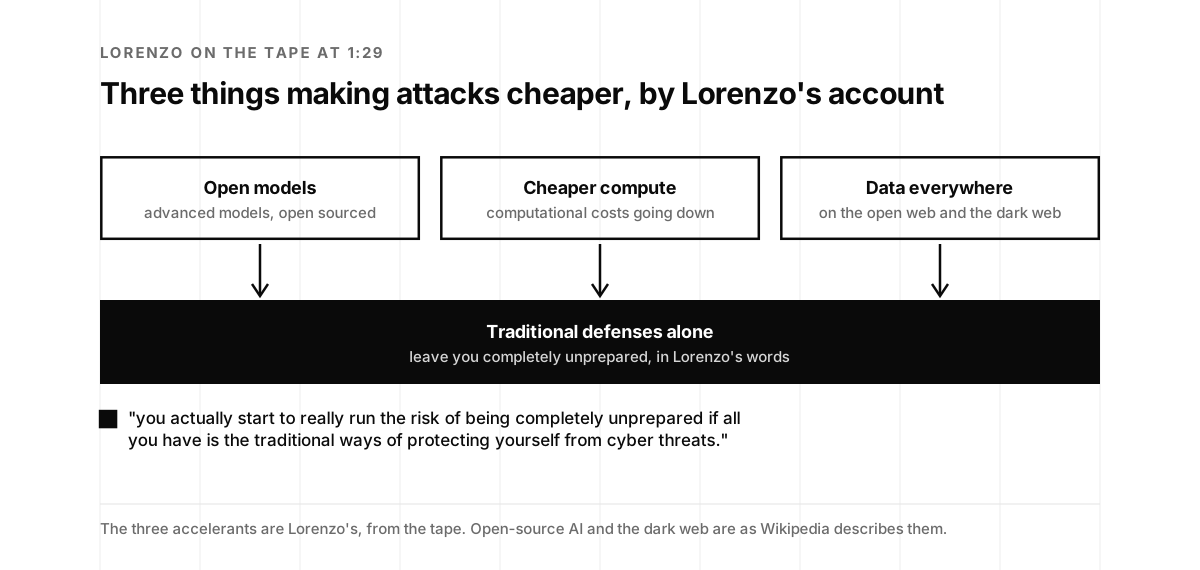
“Because with very advanced technical models being open sourced and available, with computational costs significantly going down, with the wide accessibility of data, both on the open web as on the dark web, you actually start to really run the risk of being completely unprepared if all you have is the traditional ways of protecting yourself from cyber threats.”

Lorenzo Thione, at 1:29

Open-source AI, as the Open Source Initiative defines it, is an AI system anyone can use, study, modify and share, including its data, code and model parameters (Wikipedia). The dark web is web content on darknets that need specific software, configuration or authorization to reach (Wikipedia). Put the three together and an attacker who once needed a lab now needs a laptop, a public model and whatever the target has already posted.
Listen · Lorenzo on episode 53, from 1:29
About 25 seconds: Lorenzo on open models, cheaper compute and data on the open and dark web. The clip stops on its own. Read the full transcript.
Three outlined boxes side by side, each with an arrow down to one filled box. Open models, advanced models, open sourced. Cheaper compute, computational costs going down. Data everywhere, on the open web and the dark web. The filled box: traditional defenses alone leave you completely unprepared, in Lorenzo's words. A quote from Lorenzo: you actually start to really run the risk of being completely unprepared if all you have is the traditional ways of protecting yourself from cyber threats.
Lorenzo's three accelerants, and why traditional defenses alone leave you unprepared.

What I have defined or called containment

Lorenzo isn’t only watching this. He invests in it.

“And one of the areas that I focus on is what I have defined or called containment.”

Lorenzo Thione, at 2:02

He said the idea is broader than cybersecurity, and he split it in two. On one side, AI makes the old problems worse.

“And what you have is, on one hand, the exacerbation of the seriousness and the risks that existed, anything from fraud to cyber intrusion to data security issues.”

Lorenzo Thione, at 2:20

On the other, it makes new ones.

“At the other end of the spectrum, you have completely new problems that are created by these technologies, including things like proper copyright attribution, detection of misinformation.”

Lorenzo Thione, at 2:34

And the two sides meet in the middle, at the deep fake.

“when you get like deep fake detection issues, you also are acting against the potential of those fakes being used for fraud or for other types of social engineering and so on.”

Lorenzo Thione, at 2:49

Deepfakes are images, videos or audio edited or generated with AI tools or editing software, a form of synthetic media (Wikipedia). Misinformation is incorrect or misleading information, spread with or without intent (Wikipedia), and copyright is the owner’s exclusive right to copy, distribute, adapt, display and perform a creative work (Wikipedia). Social engineering, in security, is the use of psychological pressure to get people to act or to give up confidential information, and phishing is one kind of it (Wikipedia).
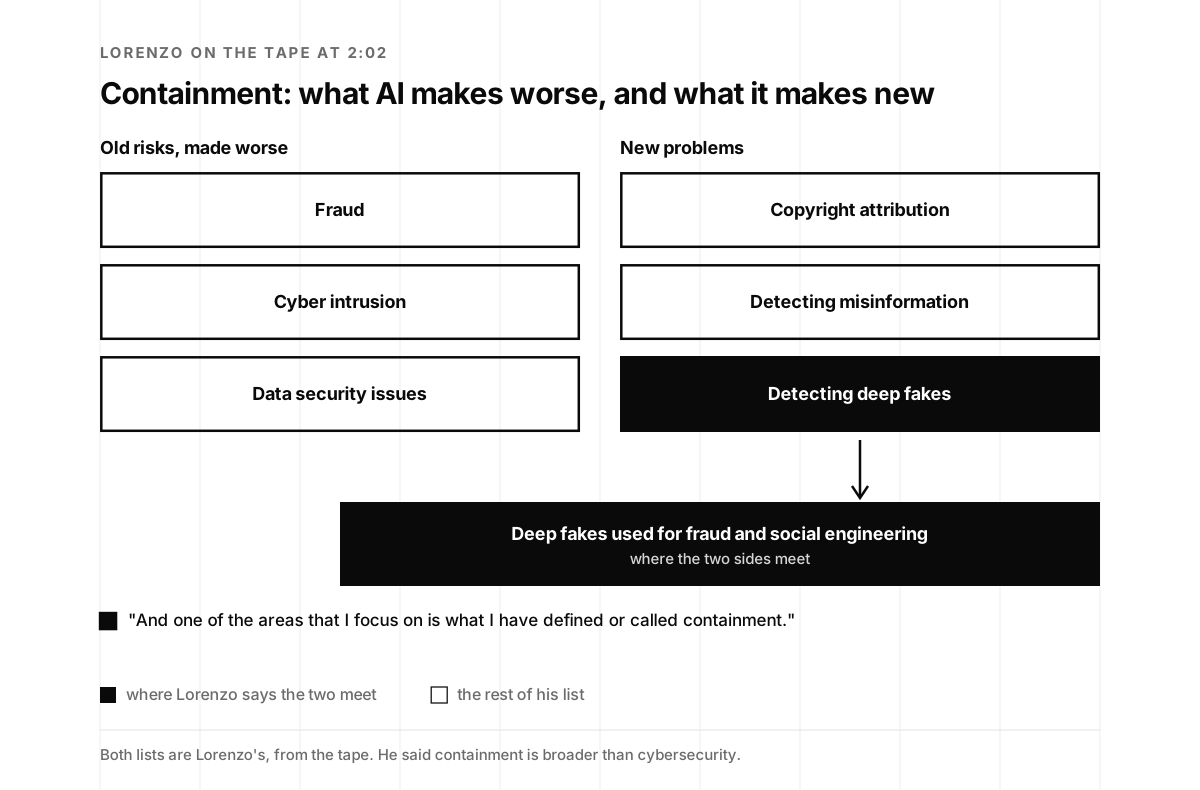
Two columns of boxes. Old risks, made worse: fraud, cyber intrusion, data security issues. New problems: copyright attribution, detecting misinformation, and, filled, detecting deep fakes, with an arrow down to a filled box: deep fakes used for fraud and social engineering, where the two sides meet. A quote from Lorenzo: And one of the areas that I focus on is what I have defined or called containment.
Containment, as Lorenzo laid it out: old risks made worse, new problems, and the deep fake in both.

Are you sure that it’s actually your best friend?

Jon had a specific scenario in mind, from something Lorenzo had shared.

“Actually, one of the things that you posted on LinkedIn really grabbed my attention.”

Jon McLachlan, at 3:34

The post was the phone call. Your best friend calls, you pick up, and it’s their voice.

“And actually, are you sure that it’s actually your best friend that you’re talking to?”

Jon McLachlan, at 3:48

Audio deepfake technology, also called voice cloning, is AI that generates speech convincingly mimicking a specific person, often saying things they never said, and it has drawn criticism for its use in scams, phishing and misinformation (Wikipedia). Voice phishing, or vishing, is phishing over the phone (Wikipedia). Lorenzo didn’t treat it as a thought experiment.

“I wish that were a scenario that was sci-fi and made up and far from being possible.”

Lorenzo Thione, at 3:55

“The reality is that we are dealing as a society with these advanced types of scams and social engineering and otherwise already.”

Lorenzo Thione, at 4:01

A politician was actually testifying to Congress

Lorenzo reached for a story he’d heard.

“In fact, I can’t remember the name, but a politician was actually testifying to Congress”

Lorenzo Thione, at 4:08

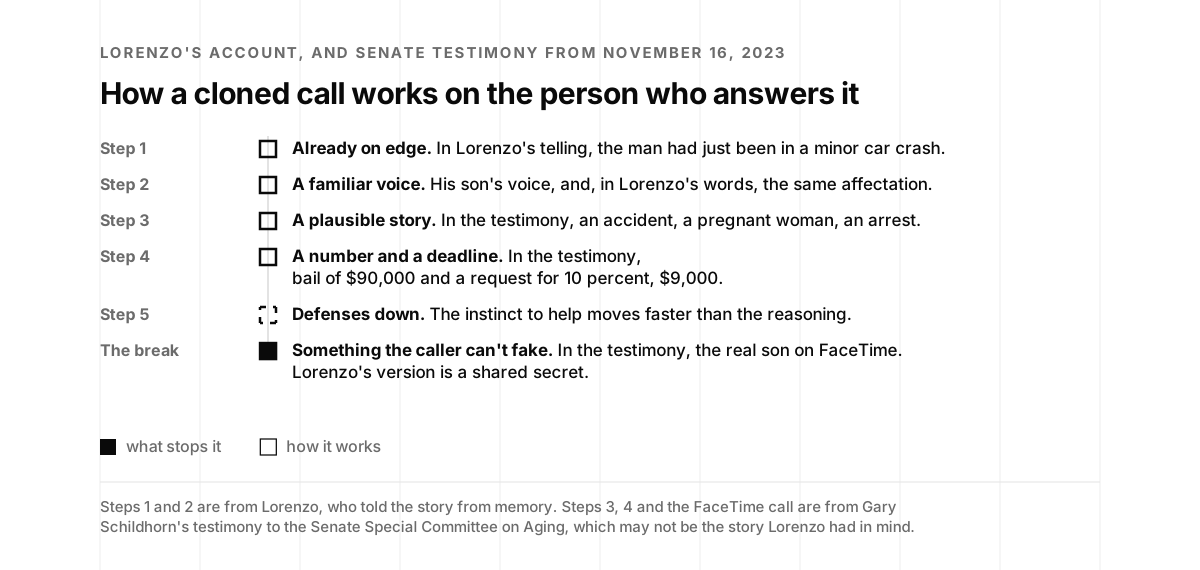
In his telling, the man had just been in a minor car crash, which already had him on edge, and then the call came.

“and got a call from his son saying that he was in prison, I think, or something, and needed money to be sent to some address or whatever it is.”

Lorenzo Thione, at 4:43

The man saw through it, as Lorenzo remembered, but the point was how it felt.

“because all of your defenses go down when your primordial brain, the one that acts on instincts and really fast to react, is getting all of these signals that say, this is your son.”

Lorenzo Thione, at 5:12

“They speak with the same affectation, and they’re saying things that theoretically could be true.”

Lorenzo Thione, at 5:26

“So your defenses completely go down, and you become much less rational and much less sort of wise to those risks.”

Lorenzo Thione, at 5:31

Congress has heard a call like that. On November 16, 2023, the Senate Special Committee on Aging held a hearing titled “Modern Scams: How Scammers Are Using Artificial Intelligence and How We Can Fight Back.” One witness, Gary Schildhorn, a Philadelphia attorney, described a call in his son’s voice saying he’d been in an accident, had hit a car driven by a pregnant woman and been arrested, and then a caller posing as a lawyer said bail was $90,000 and asked for 10 percent, $9,000. Then his real son reached him on FaceTime and told him he was being scammed (govinfo). Lorenzo remembered a politician and a crash on the father’s side, so the record may not be the story he had in mind. It is the same call.
Listen · Lorenzo on episode 53, from 5:12
About 25 seconds: Lorenzo on why a cloned voice takes your defenses down. The clip stops on its own. Read the full transcript.
Six steps on a timeline. Step 1, already on edge, in Lorenzo's telling, the man had just been in a minor car crash. Step 2, a familiar voice, his son's voice, and, in Lorenzo's words, the same affectation. Step 3, a plausible story, in the testimony, an accident, a pregnant woman, an arrest. Step 4, a number and a deadline, in the testimony, bail of $90,000 and a request for 10 percent, $9,000. Step 5, dashed, defenses down, the instinct to help moves faster than the reasoning. Filled, the break, something the caller can't fake, in the testimony, the real son on FaceTime, and Lorenzo's version is a shared secret.
How a cloned call works on the person who answers it, from Lorenzo's account and the Senate testimony.

The truth lies somewhere in the middle

Lorenzo turned the story into a question about the technology itself.

“the question becomes to what extent technology is the culprit, and to what extent are we as a society kind of losing track of the true balance of benefit and costs that any new transformational technology really brings.”

Lorenzo Thione, at 5:46

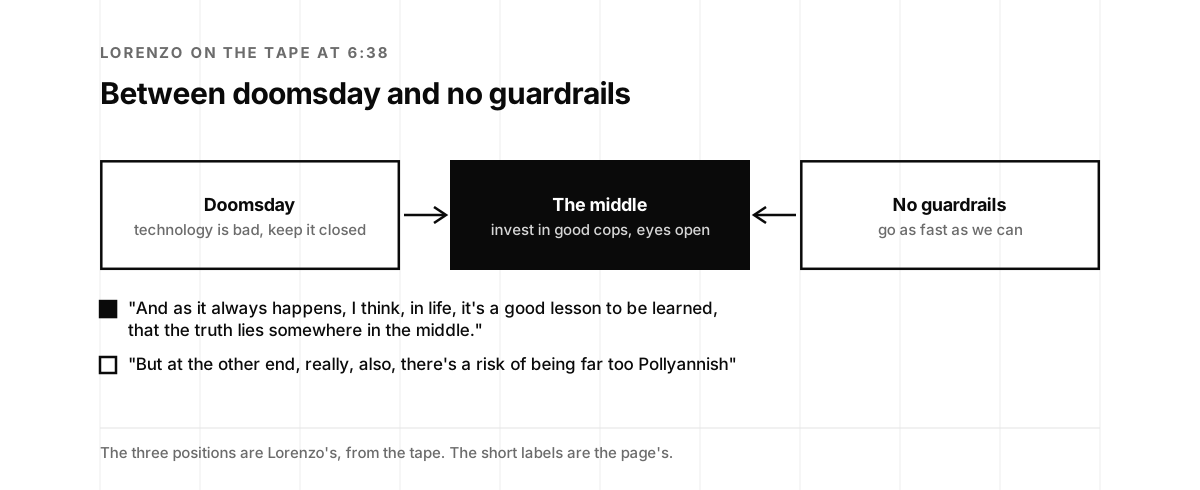
He thinks people overweight the dangers and underweight the long-term benefits, and that both camps in the AI argument go too far. One side is the doomsday camp, which wants to keep models closed. The other side swings the opposite way.

“But at the other end, really, also, there’s a risk of being far too Pollyannish”

Lorenzo Thione, at 6:38

“There’s no, let’s just keep going as fast as we can with no guardrails in developing these technologies.”

Lorenzo Thione, at 6:55

The page’s title is his answer.

“And as it always happens, I think, in life, it’s a good lesson to be learned, that the truth lies somewhere in the middle.”

Lorenzo Thione, at 7:02

“And we should be walking in this with open eyes.”

Lorenzo Thione, at 7:09
Listen · Lorenzo on episode 53, from 6:38
About 35 seconds: Lorenzo on the doomsday camp, the no-guardrails camp and the middle. The clip stops on its own. Read the full transcript.
Three boxes in a row with arrows from the outer two pointing to the middle. Outlined, doomsday, technology is bad, keep it closed. Filled, the middle, invest in good cops, eyes open. Outlined, no guardrails, go as fast as we can. Two quotes from Lorenzo: And as it always happens, I think, in life, it's a good lesson to be learned, that the truth lies somewhere in the middle. But at the other end, really, also, there's a risk of being far too Pollyannish.
Between doomsday and no guardrails, Lorenzo's middle: invest in the defenses.

Good cops against the thieves and robbers

The middle isn’t standing still. Lorenzo’s middle is a spending plan.

“I think the right thing to do is to invest in new technologies and in advanced methods to fight against these misuse or even the side effects of these.”

Lorenzo Thione, at 7:34

“Some people call it an arms race, and to some extent it is, but that’s the story of humanity and of its technological progress.”

Lorenzo Thione, at 7:45

An arms race is a competition between states for superior armed forces and military technology, and unlike a sporting race it has no finish line, it spirals on (Wikipedia). Lorenzo’s examples ran from the invention of currency through industrialization and the internet to cryptocurrency, every one of them used for fraud. His conclusion:

“Instead of constraining the technology, we need to invest in figuring out how to have good cops against the thieves and robbers and fraudsters that want to manipulate that technology for their own gain.”

Lorenzo Thione, at 8:05

Listen · Lorenzo on episode 53, from 7:44
About 35 seconds: Lorenzo on the arms race and good cops. The clip stops on its own. Read the full transcript.

99.9999% of people in this world are good

Jon agreed, and started from people rather than tools.

“I think of technology as a tool.”

Jon McLachlan, at 8:20

“It turns out that I believe wholeheartedly that 99.9999% of people in this world are good”

Jon McLachlan, at 8:23

Then he did the arithmetic the other way. A tiny fraction of people will push the big red button, so there are evil people in the world.

“It is itself not inherently good. It is itself not inherently bad. It is how we use it that matters.”

Jon McLachlan, at 8:59

He blamed the panic on wiring older than the technology.

“So when the bush moves, it must be a lion, so we run.”

Jon McLachlan, at 9:28

The “lizard brain” is the popular name for the reptilian complex in the triune brain, Paul MacLean’s 1960s model of the brain, which Wikipedia calls a once popular model (Wikipedia). Jon’s point doesn’t need the model. Fear that fires first kept our ancestors alive, and it fires the same way at a new technology.

“But we still have to deal with the edge cases, I would say, of that, that there are evil people in the world, and hence security, right?”

Jon McLachlan, at 10:05

Listen · Jon on episode 53, from 8:53
About 35 seconds: Jon on evil people, tools and the lion in the bush. The clip stops on its own. Read the full transcript.

You can’t trust the voice on the phone anymore

Jon came back to the call.

“Someone calls you up, and all of a sudden you hear a trusted voice, but it’s not who you think it is. You can’t trust the voice on the phone anymore.”

Jon McLachlan, at 10:26

He compared it to the little lock icon people were taught to look for before typing a password into a website, and wondered whether calls would get a habit like that. Lorenzo wasn’t sure the lock icon had worked either.

“I wish the majority of people even knew how to look for the lock icon and stay away from phishing websites and otherwise.”

Lorenzo Thione, at 10:47

“I think that technology companies have done a lot to try and guard for the ignorance or the naivete of users, and helped.”

Lorenzo Thione, at 10:55

Phishing is a form of social engineering in which attackers trick people into giving up sensitive information or installing malware, and Wikipedia notes that large language models can now automate personalized phishing at low cost (Wikipedia).

Make sure you have passwords and shared secrets

Then Lorenzo gave the most useful advice in the episode. He said that until about two years before, the cloned-voice scenario would have seemed far-fetched, and now it’s real, so he tells people to stop trusting their senses.

“just stop relying on what you see and what you hear, or rather the characteristics of what you see and what you hear”

Lorenzo Thione, at 11:20

“much like we do with security and passwords, on knowledge, right?”

Lorenzo Thione, at 11:29

“And the one thing that is still going to be difficult is for someone who’s not supposed to have certain knowledge to display it, to show it, to give it to you.”

Lorenzo Thione, at 11:33

“make sure you have passwords and shared secrets that you don’t discuss with anyone else and that you can use in very critical situations to basically make sure that the other person knows it’s actually really you.”

Lorenzo Thione, at 11:50

That’s an old idea from cryptography pointed at a new problem. A shared secret is a piece of data known only to the parties involved, and it can be a PIN, a password or a passphrase (Wikipedia). Static knowledge-based authentication is built on a pre-agreed set of shared secrets (Wikipedia). And in the language of NIST’s digital identity guidelines, the person proving who they are is the claimant and the person checking is the verifier (Wikipedia). On a cloned call, you’re the verifier, and a voice is not a secret.

A few practical points of ours, not Lorenzo’s. Agree on the phrase in person, never in a text or an email a scammer could read. Don’t make it anything findable, like a pet’s name or a school. When a call asks for money, end it and call back on a number you already had. At work, the same rule belongs on any request to move money or change bank details.
Listen · Lorenzo on episode 53, from 11:32
About 30 seconds: Lorenzo's advice: shared secrets with the people you'd send money to. The clip stops on its own. Read the full transcript.
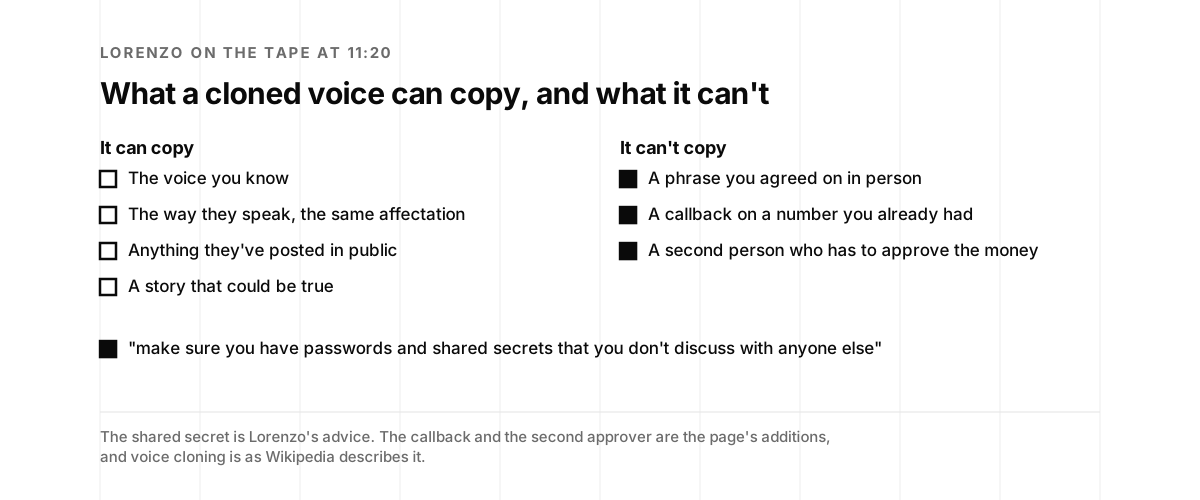
Two lists. It can copy, outlined: the voice you know, the way they speak, the same affectation, anything they've posted in public, a story that could be true. It can't copy, filled: a phrase you agreed on in person, a callback on a number you already had, a second person who has to approve the money. A quote from Lorenzo: make sure you have passwords and shared secrets that you don't discuss with anyone else.
What a cloned voice can copy, and what it can't.

Angels with a hard G

Jon moved on to Gaingels and checked the name.

“You are the managing director of the Gaingels.”

Jon McLachlan, at 12:03

“It’s like Angels with a G, with a hard G in front of it.”

Lorenzo Thione, at 12:11

Wikipedia says the name mixes “gay angels” and “gaining from angels” (Wikipedia). Lorenzo told the rest of the story later in the conversation.

I started an AI company back about 20 years ago

Asked for his background, Lorenzo started with the company.

“Yeah, you mentioned some of my background, but once I sort of started my career as an operator entrepreneur, I started an AI company back about 20 years ago.”

Lorenzo Thione, at 12:18

The company was Powerset. It was based in San Francisco and was building a natural language search engine in 2006, one that tried to understand the question instead of matching keywords, using technology licensed from PARC, the former Xerox Palo Alto Research Center. On May 11, 2008, it opened a tool for searching part of English Wikipedia with conversational phrases, and on July 1, 2008, Microsoft acquired it for an estimated $100 million. Wikipedia lists Lorenzo as its product architect and a co-founder, with Barney Pell as CEO, and among its alumni, Tom Preston-Werner, who left after the acquisition to found GitHub (Wikipedia). His LinkedIn has him as founder and product architect from September 2006 to September 2008, then principal program manager for Powerset and Bing at Microsoft until October 2010 (LinkedIn). Microsoft Bing traces its roots to MSN Search, Windows Live Search and Live Search (Wikipedia).

“After a successful acquisition, one of the things I turned my attention to were the inequities and imbalances that existed in the venture capital ecosystem in terms of who this incredible engine for innovation and wealth creation was really benefiting.”

Lorenzo Thione, at 12:30
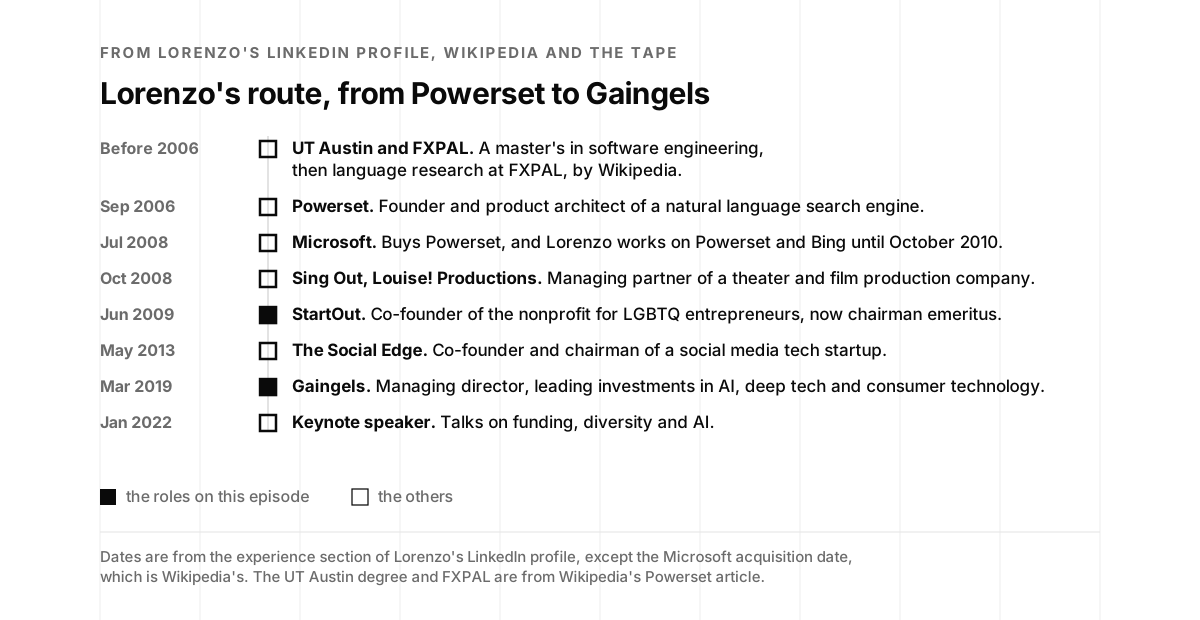
A timeline. Before 2006, UT Austin and FXPAL, a master's in software engineering, then language research at FXPAL, by Wikipedia. September 2006, Powerset, founder and product architect of a natural language search engine. July 2008, Microsoft buys Powerset, and Lorenzo works on Powerset and Bing until October 2010. October 2008, Sing Out, Louise! Productions, managing partner of a theater and film production company. Filled, June 2009, StartOut, co-founder of the nonprofit for LGBTQ entrepreneurs, now chairman emeritus. May 2013, The Social Edge, co-founder and chairman of a social media tech startup. Filled, March 2019, Gaingels, managing director, leading investments in AI, deep tech and consumer technology. January 2022, keynote speaker, talks on funding, diversity and AI.
Lorenzo's route, from Powerset to Gaingels, from his LinkedIn, Wikipedia and the tape.

A pretty rarefied small group of people

What he saw, after the acquisition, was who venture capital was working for.

“And it was benefiting a pretty, and to some extent still is, a pretty rarefied small group of people”

Lorenzo Thione, at 12:49

He went through it group by group, starting with women.

“And it just so happened that in 2008, women already were being noticed to be receiving a fraction of the capital of their male counterparts when founding companies.”

Lorenzo Thione, at 13:09

“And there were pretty much almost no female general partners of large established venture capital firms.”

Lorenzo Thione, at 13:23

He said it was even worse for underrepresented ethnic groups, and that one gap had no one counting it at all.

“and nobody was paying attention at the additional kind of inequities that existed with respect to the LGBTQ community accessing capital.”

Lorenzo Thione, at 13:39

Wikipedia says women make up a small fraction of the venture capital workforce, and that research from Women in VC puts the share of female VC partners just shy of 5 percent (Wikipedia). Someone has since counted the LGBTQ gap. StartOut’s 2023 State of LGBTQ Entrepreneurship Report, built with Socos Labs from internal data, Crunchbase and Pitchbook, looked at 142,000 founders and 95,000 high-growth companies in the United States from 2000 to 2022. It found that LGBTQ+ founders raised 0.5% of the $2.1 trillion in startup funding, while 7.1% of the population identifies as LGBTQ+, and that despite raising 16% less funding than the average founder, they created 36% more jobs, 114% more patents and 44% more exits (StartOut).
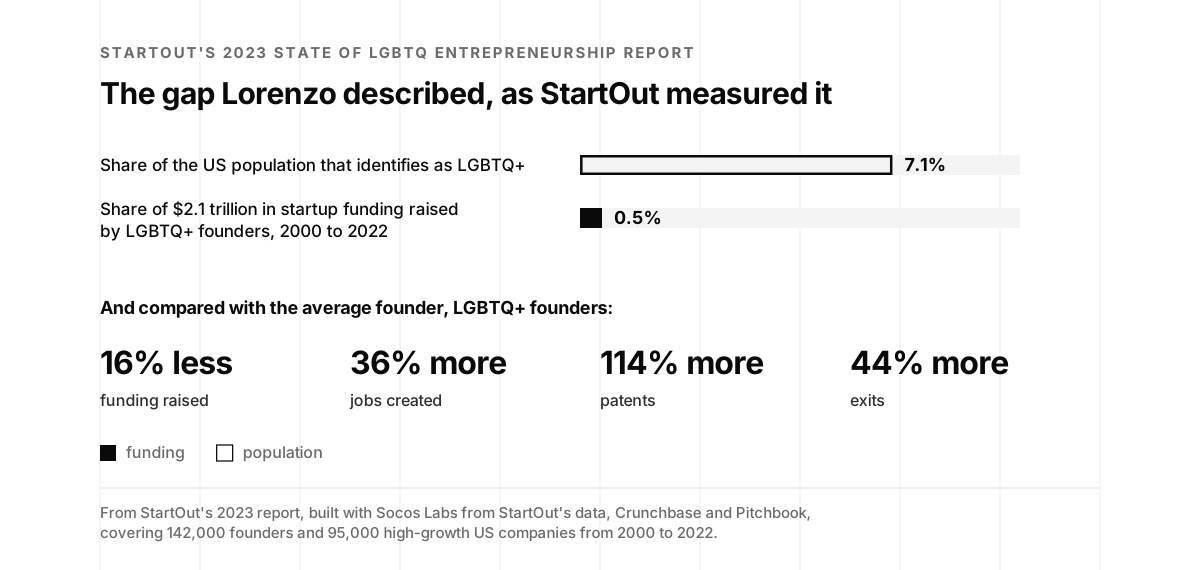
Two bars. The share of the US population that identifies as LGBTQ+, 7.1 percent, outlined. The share of $2.1 trillion in startup funding raised by LGBTQ+ founders from 2000 to 2022, 0.5 percent, filled. Below, compared with the average founder, LGBTQ+ founders raised 16 percent less funding and created 36 percent more jobs, 114 percent more patents and 44 percent more exits.
The gap Lorenzo described, as StartOut's 2023 report measured it.

To learn from each other, to mentor each other

His answer was an organization.

“And so what emerged was the idea of creating a space and organization that would help LGBTQ entrepreneurs to learn from each other, to mentor each other, to network with each other, to support each other, and to gain more success in starting and growing their businesses.”

Lorenzo Thione, at 14:07

“I’m co-founder and founding chair of the organization.”

Lorenzo Thione, at 14:35

That’s StartOut, the nonprofit supporting LGBTQ entrepreneurs that Wikipedia says entrepreneur Darren Spedale founded in 2009, with more than 18,000 members and chapters in eight cities (Wikipedia). Lorenzo’s LinkedIn lists him as co-founder from June 2009 and now as chairman emeritus (LinkedIn). StartOut states its mission as increasing opportunity and success for LGBTQ+ entrepreneurs, and says it supports more than 700 founders a year (StartOut).

Jon had been through it. His own company, Peacemakr, went through StartOut while he was its founder and CEO.

“and it was just an incredible experience, like nothing I’d ever expected or had been through before.”

Jon McLachlan, at 19:49

“all of the gratitude in the world for starting StartOut, the only LGBTQ incubator in the world”

Jon McLachlan, at 20:04

Listen · Lorenzo on episode 53, from 14:06
About 35 seconds: Lorenzo on why StartOut exists. The clip stops on its own. Read the full transcript.

A nonprofit couldn’t invest directly

StartOut could teach and connect founders. It couldn’t write them checks.

“Ultimately, one of the things that the organization couldn’t do was to invest directly into the companies that it sought to help.”

Lorenzo Thione, at 14:40

“And partially, that was the nonprofit nature of the organization.”

Lorenzo Thione, at 14:50

“So we started Gaingels, and you jokingly said Gay Angels, which is certainly part of the portmanteau”

Lorenzo Thione, at 14:54

He added that the spelling with an “i” makes it read like gain, as in profit, and called it a fortunate misspelling.

“But we started out as a network of investors that were supporting directly LGBT founders.”

Lorenzo Thione, at 15:09

Wikipedia describes Gaingels as a venture capital firm headquartered in Burlington, Vermont, co-founded in 2014 by David Beatty and Paul Grossinger, that began as a small angel syndicate of LGBTQIA+ investors backing founders from the same community. In 2018 it widened its mission to diversity across venture capital, and its investments grew from $5 million in 2018 to $50 million in the first eight months of 2020 (Wikipedia). An angel investor provides capital to a business, often very early, and a growing number organize themselves into angel groups or networks to share capital and advice (Wikipedia). Lorenzo’s LinkedIn has him as a managing director at Gaingels since March 2019 (LinkedIn).

“The reality, though, was that we one day realized the opportunity and the need was much broader”

Lorenzo Thione, at 15:19

This is not about quotas

The broader version started from the cap table up. A team can be diverse in one way and not another.

“You may have a team that has two women founders and no representation from other groups.”

Lorenzo Thione, at 15:44

“And again, this is not about quotas. I despise quotas.”

Lorenzo Thione, at 15:50

“It’s really about the idea of creating paths for access to people that have the talent and the means, but not the opportunity”

Lorenzo Thione, at 15:54

So Gaingels changed into an investor that invests to make money for itself and its members, with help on inclusion as the value it adds.

“helping them with recruitment, helping them with adding leadership, adding governance, board members, advisors from underrepresented pools of talent that they would not normally have access to.”

Lorenzo Thione, at 16:50

“And ultimately, the decisions for who to bring on and who to hire were always decisions that remained with the company”

Lorenzo Thione, at 17:01
Listen · Lorenzo on episode 53, from 15:50
About 35 seconds: Lorenzo on paths for access, not quotas. The clip stops on its own. Read the full transcript.
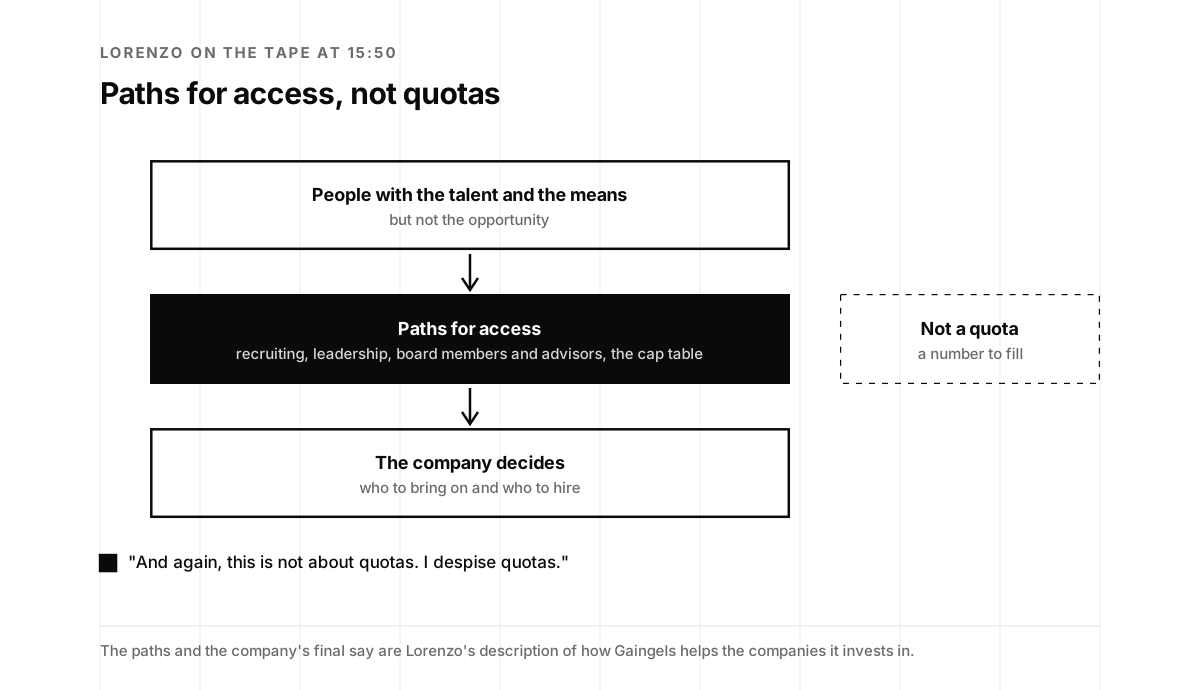
Three boxes joined by arrows pointing down. Outlined, people with the talent and the means, but not the opportunity. Filled, paths for access: recruiting, leadership, board members and advisors, the cap table. Outlined, the company decides who to bring on and who to hire. Beside the middle box, dashed: not a quota, a number to fill. A quote from Lorenzo: And again, this is not about quotas. I despise quotas.
Quotas versus paths, as Lorenzo put it: the company still decides who to hire.

Diversifying the cap table

The last piece is the one he said nobody was talking about in 2018.

“And the last piece of that, which was not something that anyone was talking about back in 2018, is the importance of diversifying the cap table.”

Lorenzo Thione, at 17:14

A capitalization table, or cap table, analyzes a company’s ownership percentages, dilution and the value of equity in each round of investment (Wikipedia). Lorenzo’s argument is about who’s on it when the company wins.

“And if it’s always the same people who get to invest into the best companies, then it’s always the same people who get to get wealthier and more powerful”

Lorenzo Thione, at 17:37

So Gaingels lets individual investors from underrepresented backgrounds put in what can be small amounts, alongside the big funds, and that turns into a cycle.

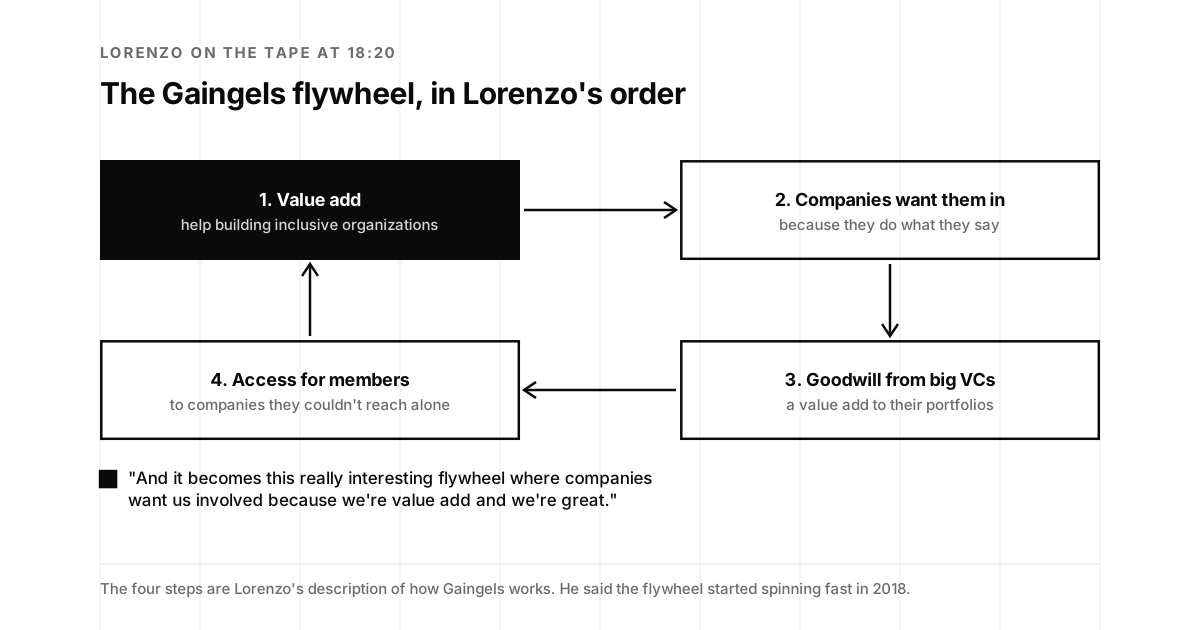
“And it becomes this really interesting flywheel where companies want us involved because we’re value add and we’re great.”

Lorenzo Thione, at 18:23

“We do what we say we do.”

Lorenzo Thione, at 18:30

“And for our members and for investors, we create this incredible opportunity to invest in companies that they would normally not have access to.”

Lorenzo Thione, at 19:02

He said the flywheel started spinning fast in 2018, and that it made Gaingels one of the most active investment groups in venture capital, and the only one of meaningful size dedicated to inclusion across capital, leadership and governance.
Listen · Lorenzo on episode 53, from 17:37
About 25 seconds: Lorenzo on why the cap table matters. The clip stops on its own. Read the full transcript.
Four boxes in a loop. Filled, 1, value add, help building inclusive organizations, with an arrow to 2, companies want them in, because they do what they say, then down to 3, goodwill from big VCs, a value add to their portfolios, then left to 4, access for members, to companies they couldn't reach alone, then back up to 1. A quote from Lorenzo: And it becomes this really interesting flywheel where companies want us involved because we're value add and we're great.
The Gaingels flywheel, in the order Lorenzo described it.

Grow the pie instead of just reallocating it

Jon asked how AI, and security in particular, could help break the echo chamber in how capital gets handed out, and whether Gaingels invests much in AI.

“Yeah, we invest very heavily in the AI space”

Lorenzo Thione, at 20:38

He said the big consulting firms put AI’s impact on the global economy in the many trillions of dollars, and that this technology is different.

“we’re seeing a technology that has the opportunity to grow the pie instead of just reallocating it in some, quote unquote, more efficient way.”

Lorenzo Thione, at 21:14

“That is exciting to investors. It’s exciting to innovators and founders. It’s exciting to users and workers everywhere.”

Lorenzo Thione, at 21:24

Anytime you have a new risk, you have a new opportunity

Then he connected it back to security, where Gaingels has been investing for a long time.

“When it comes to security, we also have a long history of investing in security businesses”

Lorenzo Thione, at 22:00

“Because anytime you have a new risk, you have a new opportunity. And now that equation is just accelerating when you introduce AI in it.”

Lorenzo Thione, at 22:10

His own thesis is the containment idea from the start of the episode, put as a mandate.

“this intersection of AI-first technologies designed to combat, counteract or contain the misuse and side effects and kind of bad outcomes that a bad actor in control or using AI can inflict.”

Lorenzo Thione, at 22:28

Listen · Lorenzo on episode 53, from 22:10
About 30 seconds: Lorenzo on investing in security as AI changes it. The clip stops on its own. Read the full transcript.

Private markets are not symmetric

As for the echo chamber, Lorenzo said AI doesn’t change it any more than anything else does, with one exception: because everyone expects profit from investing in AI early, it’s the most competitive place to put money. And competition works differently in private markets.

“in the public market, competitiveness just determines price, right? Price goes up.”

Lorenzo Thione, at 23:31

“private markets are not symmetric like the public market are, meaning not everybody has access at any price to invest in certain companies.”

Lorenzo Thione, at 23:37

The flywheel is what gets Gaingels in the door, and its members in with it.

“we are regularly able to access, and therefore provide that access to investors who, on their own, would simply not have the ability to invest in some of these businesses.”

Lorenzo Thione, at 23:57

“Yeah, it sounds like there’s power in numbers.”

Jon McLachlan, at 24:20

“There is absolutely power in numbers.”

Lorenzo Thione, at 24:23

Venture capital is private equity for startups judged to have high growth potential, paid for with equity, and because startups face high uncertainty, those investments fail often (Wikipedia). Access to the few that don’t is the scarce thing.

Listen · Lorenzo on episode 53, from 23:31
About 15 seconds: Lorenzo on why private markets aren't symmetric. The clip stops on its own. Read the full transcript.

What we call our Gaingels letter

Every company that joins the Gaingels portfolio is invited to sign something.

“to sign what we call our Gaingels letter.”

Lorenzo Thione, at 24:47

“It is a non-binding pledge, designed to be non-binding for a lot of reasons, because this is really about alignment of interests.”

Lorenzo Thione, at 24:49

He listed what it asks companies to consider.

“including parity in hiring and recruiting, when you’re looking at pipelines across multiple dimensions of inclusivity and diversity”

Lorenzo Thione, at 25:07

The same goes for the board and advisors, the cap table and philanthropy.

“We are signers and partners of the Give 1% organization that encourages corporations to assign 1% of either equity, profit or product to causes that they care about”

Lorenzo Thione, at 25:31

“and the adoption of non-discrimination standards that include and provide benefits for many of the categories that still are being excluded by law.”

Lorenzo Thione, at 25:46

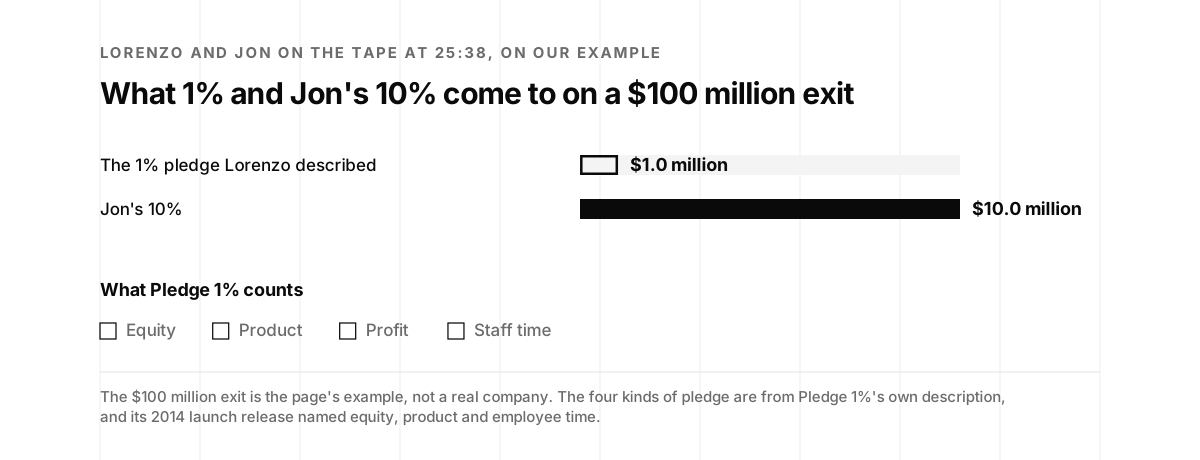
The organization he means is Pledge 1%. Atlassian, the Entrepreneurs Foundation of Colorado and the Salesforce Foundation launched it as founding partners on December 2, 2014, asking companies to pledge 1% of their equity, product and employee time to their communities (Atlassian). Today it calls itself a global movement for corporate impact, offers a framework for setting aside a percentage of staff time, product, profit and equity, and counts 20,000 companies in more than 130 countries (Pledge 1%).
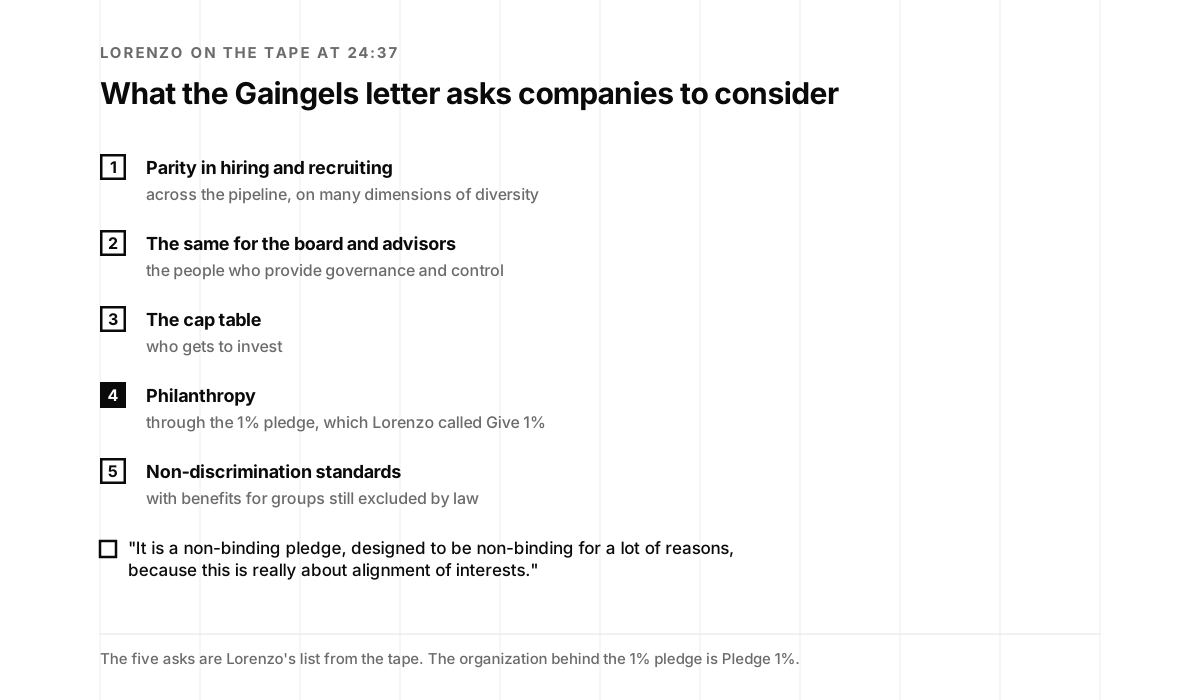
Five numbered asks. 1, parity in hiring and recruiting, across the pipeline, on many dimensions of diversity. 2, the same for the board and advisors, the people who provide governance and control. 3, the cap table, who gets to invest. 4, filled, philanthropy, through the 1% pledge, which Lorenzo called Give 1%. 5, non-discrimination standards, with benefits for groups still excluded by law. A quote from Lorenzo: It is a non-binding pledge, designed to be non-binding for a lot of reasons, because this is really about alignment of interests.
The five asks of the Gaingels letter, as Lorenzo listed them.

Oh, that’s not enough

Jon had seen the pledge before.

“No, it’s important to be the change that we want to see in the world.”

Jon McLachlan, at 25:55

He’d seen it before, when Peacemakr went through StartOut.

“and I remember thinking, like, oh, 1%? Oh, that’s not enough.”

Jon McLachlan, at 26:11

So he changed it to 10.

“That’s very generous. Good for you.”

Lorenzo Thione, at 26:16

“I mean, I would have loved to have given more on top of that”

Jon McLachlan, at 26:18

Lorenzo pointed at Salesforce, where 1% is a very large number. Marc Benioff, whom Lorenzo named as one of the forces behind the foundation, is Salesforce’s co-founder, chairman and CEO (Wikipedia). The point of the small number is that people will actually do it.

“it’s a small enough piece of the pie that it should be nothing but a second thought to actually do this”

Lorenzo Thione, at 26:43

“the impact on global poverty, on climate change, on so many of the causes that really can’t be solved by any one given party and really need our collective effort”

Lorenzo Thione, at 27:04

The calculator below runs the arithmetic on your own company, at Lorenzo’s 1% and Jon’s 10.
Listen · Lorenzo on episode 53, from 26:27
About 25 seconds: Lorenzo on why 1% matters. The clip stops on its own. Read the full transcript.
Two bars on an example $100 million exit. The 1% pledge Lorenzo described, $1.0 million, outlined. Jon's 10%, $10.0 million, filled. Below, what Pledge 1% counts: equity, product, profit and staff time.
What 1% and Jon's 10% come to on our example exit, and what Pledge 1% asks for.

A history unlearned is a history repeated

Jon, who was recording in San Francisco, brought up a walk through the Castro.

“And when you go for a walk in the Castro, which is the gay district in San Francisco, they have placards on the sidewalks.”

Jon McLachlan, at 27:24

“And one of the placards is of Alan Turing.”

Jon McLachlan, at 27:38

“I believe a history unlearned is a history repeated.”

Jon McLachlan, at 27:44

The placards are the Rainbow Honor Walk, bronze plaques in the Castro’s business district honoring LGBTQ people who “made significant contributions in their fields” (Wikipedia). Alan Turing was in the inaugural round of twenty honorees, installed in 2014 (Wikipedia). The Castro was one of the first gay neighborhoods in the United States (Wikipedia).

“and he helped the Allies win World War II by breaking the German Enigma machine with his machine, with his mathematics.”

Jon McLachlan, at 27:50

Wikipedia calls Turing an English mathematician and logician widely regarded as the father of theoretical computer science. During the war he worked at Bletchley Park, Britain’s codebreaking center, as head of Hut 8, decrypting German naval messages, and his techniques sped up the cryptanalysis of Enigma (Wikipedia). The Enigma machine was the cipher device Nazi Germany used across all its military branches, considered secure enough for its most top-secret messages (Wikipedia). Turing earned his doctorate at Princeton in 1938 (Wikipedia), and the test came later, in a 1950 paper (Wikipedia).

A very interesting intellectual exercise

Jon explained the Turing test for listeners and asked whether today’s LLMs pass it.

“If you can make that distinction, then the machine is said to have failed the Turing test.”

Jon McLachlan, at 28:15

“And now, with all of the LLMs, it feels like these machines today with these LLMs are passing the Turing test.”

Jon McLachlan, at 28:42

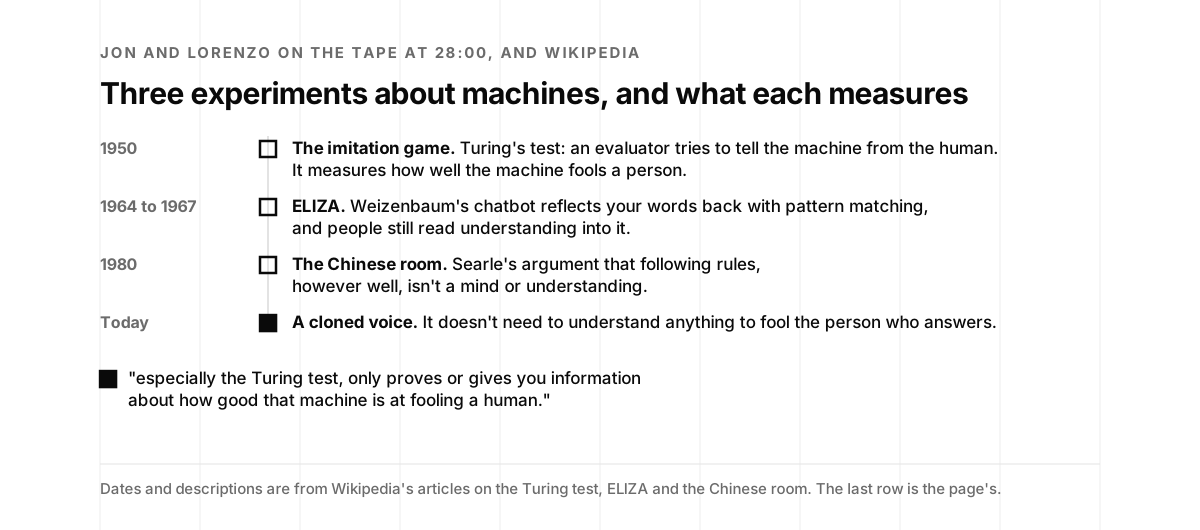
The test, as Turing introduced it in “Computing Machinery and Intelligence” in 1950, was the imitation game, and the paper opens by proposing to consider whether machines can think. In the modern version, an evaluator reads a conversation between a human and a machine, and the machine passes if the evaluator can’t reliably tell which is which, whether or not its answers are correct (Wikipedia). A large language model is a machine learning model trained on a vast amount of text, and LLMs are the basis of most modern chatbots (Wikipedia). Lorenzo answered with a second thought experiment.

“Well, so the Turing test is a very interesting intellectual exercise. And there are a few of these intellectual exercises. The Chinese room is another one.”

Lorenzo Thione, at 28:58

The Chinese room is John Searle’s argument, from a 1980 paper, that a computer running a program can’t have a mind or understanding, however human it seems (Wikipedia). Lorenzo’s objection to both is that they don’t make good tests.

“But in reality, they’re very ill-defined exercises, if you actually wanted to use them as tests, right?”

Lorenzo Thione, at 30:10

“especially the Turing test, only proves or gives you information about how good that machine is at fooling a human.”

Lorenzo Thione, at 30:48

That last line is the security point in the middle of the philosophy. A cloned voice is a machine that’s good at fooling a human. It doesn’t have to be intelligent to take your money.
Listen · Lorenzo on episode 53, from 30:25
About 35 seconds: Lorenzo on why the Turing test only measures fooling people. The clip stops on its own. Read the full transcript.
A timeline of four items. 1950, the imitation game, Turing's test, an evaluator tries to tell the machine from the human, it measures how well the machine fools a person. 1964 to 1967, ELIZA, Weizenbaum's chatbot reflects your words back with pattern matching, and people still read understanding into it. 1980, the Chinese room, Searle's argument that following rules, however well, isn't a mind or understanding. Filled, today, a cloned voice, it doesn't need to understand anything to fool the person who answers. A quote from Lorenzo: especially the Turing test, only proves or gives you information about how good that machine is at fooling a human.
Three thought experiments about machines and understanding, and what each one actually measures.

Tell me more about that

Lorenzo went back to an early program.

“I don’t know if you’ve ever heard of a program called ELIZA.”

Lorenzo Thione, at 31:36

“No, I have not.”

Jon McLachlan, at 31:39

“But it was this very basic program that was designed to act as a talk therapy bot.”

Lorenzo Thione, at 31:50

“like respond to half of the things that you said with things like, that’s interesting, tell me more about that, or, how do you feel about this?”

Lorenzo Thione, at 32:01

He guessed it came from the 1970s and didn’t remember who wrote it. ELIZA was developed from 1964 to 1967 at MIT by Joseph Weizenbaum. It used pattern matching and substitution to give an illusion of understanding, and its best-known script, DOCTOR, played a Rogerian psychotherapist who reflects people’s words back to them. It was one of the first chatbots, and one of the first programs capable of attempting the Turing test. Weizenbaum was surprised that people, including his secretary, attributed human feelings to it, which came to be called the ELIZA effect (Wikipedia).

Lorenzo said the same trick works without computers. Fortune tellers, in his words, are

“people who have developed a very good skill at listening, mirroring, asking the right questions, being generic enough that things pattern matched into what people expect to have a response.”

Lorenzo Thione, at 32:36

Cold reading is the name for that set of techniques: high-probability guesses, quick reading of the person’s reactions, and reinforcement of the hits (Wikipedia). Mirroring, or the chameleon effect, is imitating someone’s gestures, speech or attitude, and it builds rapport (Wikipedia). Jon heard Chris Voss in it, the former FBI hostage negotiator and co-author of Never Split the Difference (Wikipedia).

“Mirroring is a very well understood tactic in manipulation and persuasion, and there’s a number of them, right?”

Lorenzo Thione, at 33:03

The same toolkit is what makes a scam call work. A caller doesn’t need to know much about you if they can mirror you and let you fill in the rest.

Listen · Lorenzo on episode 53, from 31:49
About 20 seconds: Lorenzo on ELIZA, the talk therapy bot. The clip stops on its own. Read the full transcript.

Things that humans are terrible at doing

Lorenzo said the Turing test was never going to settle whether machines are intelligent, because nobody has defined intelligence or why we care about it. He’d read a LinkedIn post asking a better question.

“getting machines to do things that humans are terrible at doing?”

Lorenzo Thione, at 34:08

“Like, they can’t do it at scale, they can’t do it repeatedly, they can’t do it correctly.”

Lorenzo Thione, at 34:12

He thinks building machines in our own image, as a kind of act of creation, gets the goal wrong, and he closed the subject warmly.

“but it’s hardly the right test to think about when really looking at artificial intelligence.”

Lorenzo Thione, at 34:56

It’s absolutely compatible

Jon asked the big question next.

“Do you believe in the singularity”

Jon McLachlan, at 35:04

The technological singularity is a hypothetical point where technological growth accelerates beyond human control. In I. J. Good’s intelligence explosion model from 1965, an upgradable intelligent agent improves itself in a positive feedback loop until it’s a superintelligence (Wikipedia). Ray Kurzweil, the computer scientist and futurist Lorenzo mentioned, has written books on it (Wikipedia). Lorenzo said the idea is consistent with what we know.

“is absolutely compatible with everything we know about the world, the physics of it”

Lorenzo Thione, at 35:29

“But it’s absolutely compatible.”

Lorenzo Thione, at 35:57

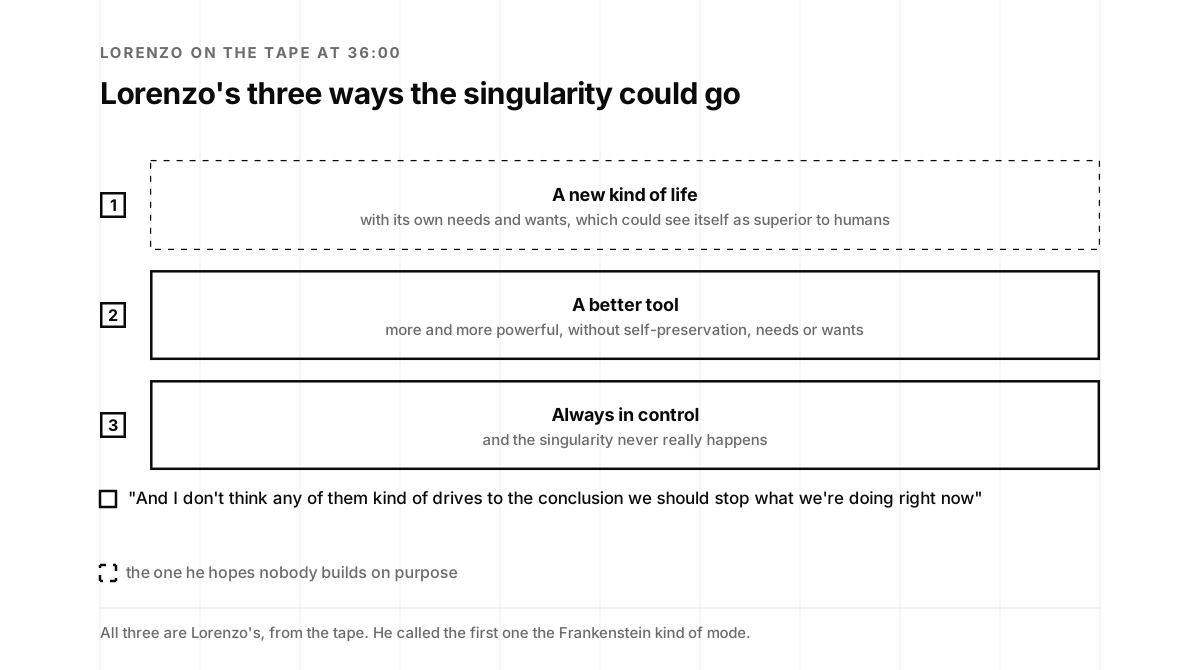
What he wasn’t sure about was the outcome, and he laid out at least three.

“We have the creation of a completely new sort of type of life, right?”

Lorenzo Thione, at 36:07

“It also could simply just be a better tool that becomes more and more powerful”

Lorenzo Thione, at 36:25

“which is we are always in control of that replication”

Lorenzo Thione, at 37:30

He hopes nobody tries for the first one on purpose.

“the right thing to do is the Frankenstein kind of mode”

Lorenzo Thione, at 36:53

He means that as the thing to avoid: a being with its own needs and wants plus superhuman ability, which, by everything we know about superior life forms, would subjugate the others. And none of the three, he said, is a reason to stop.

“And I don’t think any of them kind of drives to the conclusion we should stop what we’re doing right now”

Lorenzo Thione, at 37:45
Listen · Lorenzo on episode 53, from 36:47
About 25 seconds: Lorenzo on the Frankenstein mode. The clip stops on its own. Read the full transcript.
Three numbered boxes. 1, dashed, a new kind of life, with its own needs and wants, which could see itself as superior to humans. 2, a better tool, more and more powerful, without self-preservation, needs or wants. 3, always in control, and the singularity never really happens. A quote from Lorenzo: And I don't think any of them kind of drives to the conclusion we should stop what we're doing right now.
Lorenzo's three ways the singularity could go.

It’s not a stochastic parrot

Jon offered the skeptic’s version.

“I heard someone put it that AI is just a fancy parrot, that it reads things and it knows how to regurgitate what it’s heard.”

Jon McLachlan, at 38:18

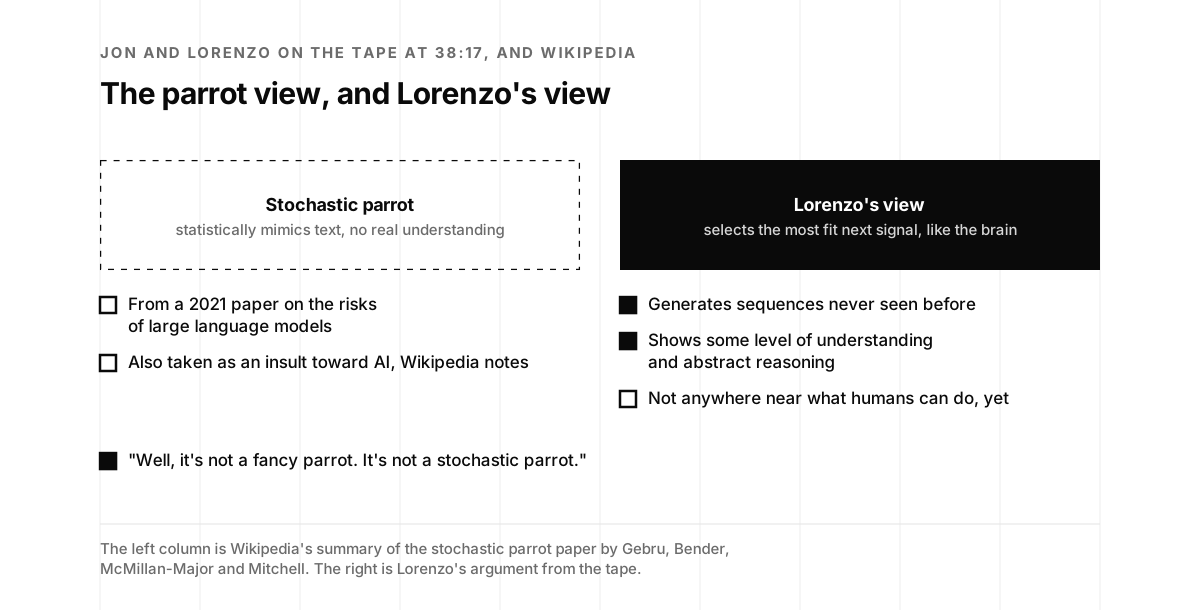
“Well, it’s not a fancy parrot. It’s not a stochastic parrot.”

Lorenzo Thione, at 38:31

The phrase comes from a 2021 paper on AI ethics, “On the Dangers of Stochastic Parrots: Can Language Models Be Too Big?”, by Timnit Gebru, Emily M. Bender, Angelina McMillan-Major and Margaret Mitchell, which laid out risks of large language models. It frames LLMs as systems that statistically mimic text without real understanding, and Wikipedia notes the term has also been taken as an insult toward AI (Wikipedia). Lorenzo’s case against it is about how the networks work.

“there are a lot of similarities between what multilayer neural networks, which are at the core of transformers, which are at the core of large language models, and brain networks, neural networks in the brain, work in a lot of similar ways”

Lorenzo Thione, at 38:54

“it is very clear that it is able to generate sequences that have never been generated before”

Lorenzo Thione, at 39:49

“These things are not anywhere near what humans can do, but the idea that they will never approach it is kind of, I don’t know, wishful thinking for some”

Lorenzo Thione, at 40:27

A transformer is a neural network architecture built on multi-head attention, in which text is split into tokens and each token is weighed against the others in its context (Wikipedia), and an artificial neural network is a computational model inspired by the structure and functions of biological neural networks (Wikipedia). How far the similarity goes is still argued. Lorenzo’s view is that the label sells the systems short, and that betting they’ll never approach what people can do is wishful thinking.
Listen · Lorenzo on episode 53, from 38:30
About 20 seconds: Lorenzo on why LLMs aren't stochastic parrots. The clip stops on its own. Read the full transcript.
Two boxes side by side. Dashed, stochastic parrot, statistically mimics text, no real understanding, from a 2021 paper on the risks of large language models, also taken as an insult toward AI, Wikipedia notes. Filled, Lorenzo's view, selects the most fit next signal, like the brain, generates sequences never seen before, shows some level of understanding and abstract reasoning, and is not anywhere near what humans can do, yet. A quote from Lorenzo: Well, it's not a fancy parrot. It's not a stochastic parrot.
The parrot view and Lorenzo's view, side by side.

His story is not told enough

Jon came back to Turing.

“I really believe that his story is not told enough”

Jon McLachlan, at 40:46

Lorenzo remembered a film without its name, and it came up as The Imitation Game, the 2014 film directed by Morten Tyldum and written by Graham Moore, from Andrew Hodges’ 1983 biography, with Benedict Cumberbatch as Turing (Wikipedia).

“Yeah, the way he was mistreated by his government”

Lorenzo Thione, at 40:56

“the UK government kind of issued an apology.”

Lorenzo Thione, at 41:04

In 1952, after acknowledging a relationship with another man, Turing was prosecuted for gross indecency, received probation conditional on chemical castration and lost his security clearance. After a 2009 campaign, Prime Minister Gordon Brown officially apologized for the “appalling way [Turing] was treated,” and Queen Elizabeth II granted him a pardon in 2013 (Wikipedia). The “Alan Turing law,” part of the UK’s Policing and Crime Act 2017, pardons men cautioned or convicted under the old laws against homosexual acts (Wikipedia). The apology came in 2009, fifteen years before this recording.

Asked what he’d say to Turing, Lorenzo picked a subject.

“and discuss all the ways in which the world is computation and computation is physics.”

Lorenzo Thione, at 41:31

“someone I admire very much and would love to one day have an opportunity to meet and converse with, is Stephen Wolfram.”

Lorenzo Thione, at 41:44

Stephen Wolfram is a British-American computer scientist, physicist and businessman who works in computer algebra and theoretical physics (Wikipedia). And dinner would be at home.

“I would probably make dinner.”

Lorenzo Thione, at 42:08

“Also, if I’m going to bring a celebrity to a restaurant, we’re going to get interrupted every moment by people wanting to take their selfie with them.”

Lorenzo Thione, at 42:17

Listen · Lorenzo on episode 53, from 41:27
About 35 seconds: Lorenzo on what he'd talk about with Turing. The clip stops on its own. Read the full transcript.

We need more freedom of speech, not less speech

Jon named two well-known people from the tech world, Peter Thiel and Kara Swisher, and asked Lorenzo about them.

“Very spicy personalities.”

Jon McLachlan, at 42:43

“People are interesting. People are different. I love when people voice their opinion. We need more of that. We need more freedom of speech, not less speech.”

Lorenzo Thione, at 42:50

“And I think the marketplace of ideas is how not just innovation but social progress actually does happen.”

Lorenzo Thione, at 43:00

He said he doesn’t agree with everything either of them has said, and then he made it personal.

“Peter served on the board of directors of my very first company. I learned a ton from him.”

Lorenzo Thione, at 43:17

“And I think it’s great that there’s no one dimension to every single person.”

Lorenzo Thione, at 43:24

Thiel is a co-founder of PayPal, Palantir Technologies and Founders Fund, and was the first outside investor in Facebook (Wikipedia). Wikipedia lists him among Powerset’s investors, and Founders Fund co-led Powerset’s $12.5 million Series A in November 2007 (Wikipedia). Kara Swisher is a journalist who has covered the business of the internet since 1994 (Wikipedia).

Listen · Lorenzo on episode 53, from 42:50
About 30 seconds: Lorenzo on more speech, not less. The clip stops on its own. Read the full transcript.

Diversity of ideas comes from diversity of experience

Jon took it to founders.

“You have to have a little bit of this crazy. You have to be willing to break the rules.”

Jon McLachlan, at 44:04

“And I think diversity of ideas comes from diversity of experience.”

Jon McLachlan, at 44:32

“We bring our experiences with us. We have no choice but to see the world through them”

Jon McLachlan, at 44:35

He said he sees a lot of that comfort with breaking the rules in the LGBTQ community, which is a good thing for anyone building something new.

Sleep more, not less

The last question was what Lorenzo would tell his younger self.

“Yes, I would. And I would give myself the advice of sleeping more.”

Lorenzo Thione, at 45:26

“When I was young, I thought sleeping as little as I could get away with was a superpower, was something that made me more productive.”

Lorenzo Thione, at 45:33

He said he now understands how much sleep, nutrition, exercise and mental health shape productivity, creativity and the ability to have an impact.

“And I would go back and tell myself, sleep more, not less.”

Lorenzo Thione, at 46:04

Listen · Lorenzo on episode 53, from 45:33
About 35 seconds: Lorenzo's advice to his younger self. The clip stops on its own. Read the full transcript.

After the tape

Lorenzo’s LinkedIn has him still at Gaingels as a managing director, leading investments in AI, deep tech and consumer technology while working to increase minority representation in venture capital, and it puts the firm’s record at more than $300 million invested in over 500 LGBTQ+ led companies, and over $1 billion across more than 2,400 startups (LinkedIn). The same profile lists him as co-founder and chairman emeritus of StartOut, a keynote speaker since January 2022, and managing partner since October 2008 of Sing Out, Louise! Productions, a theater and film production company whose credits include Hadestown, which won the 2019 Tony Award for Best Musical, and The Inheritance, which won the 2020 Tony Award for Best Play. Hadestown is Anaïs Mitchell’s musical, and The Inheritance is Matthew López’s play inspired by E. M. Forster’s Howards End (Wikipedia, Wikipedia).

One of those shows he also helped write. Allegiance, a musical inspired by George Takei’s experience of the Japanese American internment during World War II, has music and lyrics by Jay Kuo and a book by Marc Acito, Kuo and Lorenzo Thione. It premiered in San Diego in September 2012 and played on Broadway from October 2015 to February 2016 (Wikipedia).

StartOut today describes its work as empowering LGBTQ+ and allied entrepreneurs, and counts 28,000 people connected and 1,829 companies supported (StartOut). Its research arm, the StartOut Index, is where the funding numbers earlier on this page come from (StartOut).

And one link back to this show. Anzenna, the company Ganesh Krishnan founded and talked about in episode 34, lists Gaingels among its backers on its company page (Anzenna).
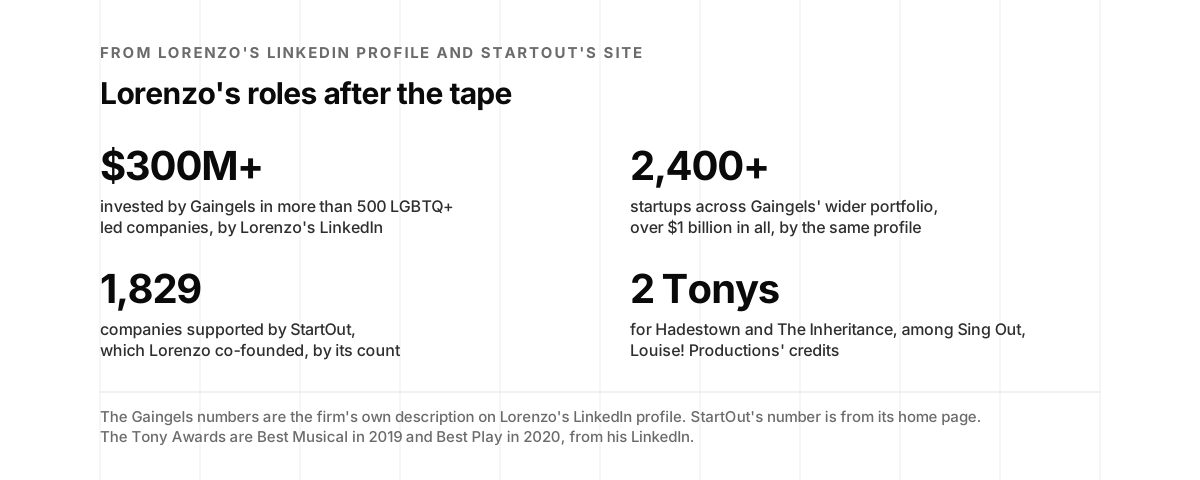
Four figures. $300 million or more invested by Gaingels in more than 500 LGBTQ+ led companies, by Lorenzo's LinkedIn. 2,400 or more startups across Gaingels' wider portfolio, over $1 billion in all, by the same profile. 1,829 companies supported by StartOut, which Lorenzo co-founded, by its count. 2 Tonys, for Hadestown and The Inheritance, among Sing Out, Louise! Productions' credits.
Lorenzo's roles after the tape, from his LinkedIn.

Did you catch it? A six-question quiz

Six questions from the episode. Each answer links the moment in the transcript.

Quiz · six questions

Did you catch it?

Pick an answer for each. The explanation shows once you choose.

  1. What does Lorenzo call the area of AI he focuses on as an investor?

    1. Detection
    2. Disruption
    3. Containment

    c. "And one of the areas that I focus on is what I have defined or called containment." Transcript, 2:02.

  2. What did Lorenzo say to set up with the people you'd send money to?

    1. A video call before any transfer
    2. Passwords and shared secrets
    3. A second phone number

    b. "make sure you have passwords and shared secrets that you don't discuss with anyone else" Transcript, 11:50.

  3. What couldn't StartOut do, that Gaingels could?

    1. Invest directly in the companies it helped
    2. Run events in more than one city
    3. Mentor founders outside San Francisco

    a. "Ultimately, one of the things that the organization couldn't do was to invest directly into the companies that it sought to help." Transcript, 14:40.

  4. What did Lorenzo say about quotas?

    1. They're the fastest fix
    2. They work for boards but not for hiring
    3. He despises them

    c. "And again, this is not about quotas. I despise quotas." Transcript, 15:50.

  5. What did Jon do with the 1% pledge at Peacemakr?

    1. Kept it at 1%
    2. Changed it to 10%
    3. Gave it to the investors

    b. "and I remember thinking, like, oh, 1%? Oh, that's not enough." Transcript, 26:11.

  6. What does the Turing test really measure, by Lorenzo's account?

    1. How good a machine is at fooling a human
    2. Whether a machine is conscious
    3. How fast a machine can reason

    a. "especially the Turing test, only proves or gives you information about how good that machine is at fooling a human." Transcript, 30:48.

Would a cloned voice get through?

Lorenzo’s advice was for families, and it works for companies too. Eight questions on whether a familiar voice and a good story could get money out of yours.

Scorecard · eight questions

Would a cloned voice get through?

Answer for how your company works today. If two answers fit, pick the lower one.

  1. When a caller asks to move money or change bank details, how is it checked?

    • The voice or the caller ID is enough
    • Sometimes we call back
    • Always a callback to a number we already had

    "just stop relying on what you see and what you hear, or rather the characteristics of what you see and what you hear" See Make sure you have passwords and shared secrets.

  2. Do the people who can move money share a phrase that never appears in writing?

    • No
    • Some of them
    • Yes, agreed in person and changed when someone leaves

    "make sure you have passwords and shared secrets that you don't discuss with anyone else" See Make sure you have passwords and shared secrets.

  3. Can one person send a wire or change payment details alone?

    • Yes
    • Only above a limit does it take two
    • Always two people, on two channels

    "So your defenses completely go down, and you become much less rational and much less sort of wise to those risks." See A politician was actually testifying to Congress.

  4. Has your team heard what a cloned-voice call sounds like?

    • Never covered
    • Mentioned in training
    • Practiced with a realistic exercise

    "The reality is that we are dealing as a society with these advanced types of scams and social engineering and otherwise already." See Are you sure that it's actually your best friend?

  5. What happens when a caller pushes urgency or secrecy?

    • People hurry to help
    • It depends on who answers
    • Urgency is the cue to slow down and verify

    "because all of your defenses go down when your primordial brain, the one that acts on instincts and really fast to react, is getting all of these signals that say, this is your son." See A politician was actually testifying to Congress.

  6. Do you assume your executives' voices can be cloned?

    • We've never thought about it
    • We know, but haven't acted
    • Yes, and we plan around it

    "You can't trust the voice on the phone anymore." See You can't trust the voice on the phone anymore.

  7. Is there a fast, blame-free way to report a strange call?

    • No
    • Email the security team
    • One channel, and people use it

    "But we still have to deal with the edge cases, I would say, of that, that there are evil people in the world, and hence security, right?" See 99.9999% of people in this world are good.

  8. Do the people at home have their own code word?

    • No
    • Some of us
    • Yes, and we talk about it at work

    "I wish that were a scenario that was sci-fi and made up and far from being possible." See Are you sure that it's actually your best friend?

Are you sure it's your best friend?

A familiar voice and a good story would probably get money out today. This week, put a callback rule on every request to move money or change bank details, and agree a shared phrase with the people who can approve it.

Somewhere in the middle

Some checks exist, but they depend on who answers the phone. Make the callback and the second approver mandatory, and run one realistic exercise so people hear what a cloned call sounds like.

Shared secrets

A cloned voice would run into a process, not a person. Change the phrases when people leave, test the process once a year, and share the habit with your team's families.

What is a 1% pledge worth?

Lorenzo described the 1% pledge, and Jon raised his to 10%. The calculator runs both on a company you pick. The company value, the team and the 2,080-hour work year (40 hours a week for 52 weeks) are our examples. Put in your own.

Calculator

What is a 1% pledge worth?

Four numbers: what the company is worth at exit, the share of equity pledged, the people on the team, and the share of their work time pledged.

–$ millions to causes at exit
–$ millions at Jon's 10%
–volunteer hours a year
–working days a year

Pledge 1% of a company that exits at $100 million and the pledge is worth $1.0 million, against $10.0 million at Jon's 10%. 1% of the work time of 50 people is 1,040 hours a year, about 130 working days.

The 1% is the pledge Lorenzo described on the tape, and the 10% is what Jon said he changed his to. The $100 million exit, the 50 people and the 2,080-hour work year are our examples, not benchmarks. Pledge 1% itself counts equity, product, profit and staff time.

From Turing to Gaingels and after

Everything on this page sits on one timeline, from Turing’s doctorate in 1938 to Gaingels and StartOut today. Filter it by thread.

Timeline · 1938 to 2026

From Turing to Gaingels and after

Filter by thread. Dates are from the public record except where marked as part of this show.

  1. Turing's doctorate

    Alan Turing earns his doctorate at Princeton (Wikipedia, on this show).

  2. The imitation game

    Turing's paper "Computing Machinery and Intelligence" introduces the test (Wikipedia, on this show).

  3. Turing is prosecuted

    He is prosecuted for gross indecency after acknowledging a relationship with another man, and loses his security clearance (Wikipedia, on this show).

  4. ELIZA

    Joseph Weizenbaum begins the chatbot at MIT, and finishes it in 1967 (Wikipedia, on this show).

  5. The intelligence explosion

    I. J. Good describes a self-improving intelligent agent (Wikipedia, on this show).

  6. The Chinese room

    John Searle publishes "Minds, Brains, and Programs" (Wikipedia, on this show).

  7. Founders Fund

    Peter Thiel, Ken Howery and Luke Nosek found the venture fund in San Francisco (Wikipedia, on this show).

  8. Powerset

    Lorenzo starts the natural language search company as founder and product architect (LinkedIn, on this show).

  9. Powerset's Series A

    $12.5 million, co-led by Foundation Capital and The Founders Fund (Wikipedia, on this show).

  10. Searching in plain English

    Powerset opens a tool for searching part of English Wikipedia with conversational phrases (Wikipedia, on this show).

  11. Microsoft buys Powerset

    For an estimated $100 million (Wikipedia, on this show).

  12. Sing Out, Louise! Productions

    Lorenzo becomes managing partner of the theater and film production company (LinkedIn, on this show).

  13. StartOut

    The nonprofit for LGBTQ entrepreneurs is founded, with Lorenzo as a co-founder from June 2009 by his LinkedIn (Wikipedia, on this show).

  14. An apology

    Prime Minister Gordon Brown apologizes for the way Turing was treated (Wikipedia, on this show).

  15. Allegiance premieres

    The musical, with a book by Marc Acito, Jay Kuo and Lorenzo, opens in San Diego (Wikipedia, on this show).

  16. A royal pardon

    Queen Elizabeth II pardons Turing (Wikipedia, on this show).

  17. Gaingels

    David Beatty and Paul Grossinger co-found it as an angel syndicate of LGBTQIA+ investors (Wikipedia, on this show).

  18. The Rainbow Honor Walk

    Alan Turing is among the first twenty honorees on the Castro's sidewalks (Wikipedia, on this show).

  19. The Imitation Game

    Morten Tyldum's film, with Benedict Cumberbatch as Turing (Wikipedia, on this show).

  20. Pledge 1%

    Atlassian, the Entrepreneurs Foundation of Colorado and the Salesforce Foundation launch it (Atlassian, on this show).

  21. Allegiance on Broadway

    It runs through February 2016 (Wikipedia, on this show).

  22. The Alan Turing law

    The UK pardons men convicted under the old laws against homosexual acts (Wikipedia, on this show).

  23. Gaingels widens its mission

    From LGBTQIA+ founders to diversity across venture capital (Wikipedia, on this show).

  24. Peacemakr

    Jon co-founds the company, which later goes through StartOut (LinkedIn, on this show).

  25. Managing director at Gaingels

    Lorenzo's role at the firm, by his LinkedIn (LinkedIn, on this show).

  26. $50 million in eight months

    Gaingels' investments, up from $5 million in 2018 (Wikipedia, on this show).

  27. Stochastic parrots

    Gebru, Bender, McMillan-Major and Mitchell's paper on the risks of large language models (Wikipedia, on this show).

  28. The StartOut Index

    LGBTQ+ founders raised 0.5% of $2.1 trillion in startup funding from 2000 to 2022 (StartOut, on this show).

  29. Congress hears about AI scams

    A Senate Aging Committee hearing on how scammers use AI, with a father's account of a cloned call (govinfo, on this show).

  30. The recording

    Jon and Lorenzo talk, after Peacemakr, by Jon's account (on this show).

  31. Episode 53 airs

    The episode goes out on Podbean and Spotify (Podbean, on this show).

  32. Gaingels today

    More than $300 million in over 500 LGBTQ+ led companies, by Lorenzo's LinkedIn (LinkedIn, on this show).

  33. StartOut today

    28,000 people connected and 1,829 companies supported, by StartOut's count (StartOut, on this show).

What to do this week

Five things, in the order the episode suggests.

  1. Agree on a shared secret at home. Pick a phrase with the people you’d send money to, in person, and agree that any call asking for money gets the phrase or a callback.
  2. Put a callback rule on money at work. Any request to move money or change bank details gets verified on a number you already had, and above a limit, by a second person on a second channel.
  3. Score your company. Take the scorecard with whoever approves payments, and fix the lowest answer first.
  4. Run the pledge numbers. Try the calculator on your own company, and read what Pledge 1% asks for.
  5. Get help with the parts you can’t staff. Our vCISO Services can write the payment and verification policies and run the exercise, our Counter Business Espionage & IP Protection team handles the social engineering and insider side, our AI Product Red Teaming tests whether your own AI product can be turned against your users, and you can book 15 minutes with us.

Key takeaways

  1. AI cuts both ways for security

    Lorenzo sees AI in its most advanced forms as both an opportunity to improve security and a source of more surfaces of attack and more sophisticated breaches.

  2. Traditional defenses alone won't keep up

    Open-sourced models, cheaper compute and data on the open and dark web mean a company with only traditional protections is, in his words, completely unprepared.

  3. Containment is the thesis

    His investing focus is containment: AI makes old risks like fraud and intrusion worse and creates new problems like copyright attribution and misinformation, and deep fakes sit in both.

  4. The cloned call is already here

    Jon's scenario of a best friend's voice on the phone isn't science fiction, Lorenzo says, and Congress has heard testimony about a call just like it.

  5. A familiar voice takes your defenses down

    When the primordial brain hears your son's voice saying plausible things, you become much less rational, especially if you're already on edge.

  6. Verify with knowledge, not senses

    Stop relying on what you see and hear and rely on knowledge instead, because someone who isn't supposed to have it will still have trouble showing it.

  7. Agree on shared secrets with the people you'd pay

    With loved ones you'd send money to, set up passwords and shared secrets you don't discuss with anyone else, for critical situations.

  8. Neither doomsday nor no guardrails

    Lorenzo rejects both the doomsday camp and the race with no guardrails. The truth lies somewhere in the middle, and you walk in with open eyes.

  9. Fund the good cops

    Every technology from currency to cryptocurrency has been used for fraud, so instead of constraining AI, invest in the defenses against people who misuse it.

  10. Most people are good, and security is for the rest

    Jon believes 99.9999% of people are good, technology is a tool, and security exists for the tiny share who aren't.

  11. A nonprofit can't write checks

    StartOut could connect and mentor LGBTQ founders but couldn't invest in them, which is why Gaingels exists.

  12. Paths, not quotas

    Lorenzo despises quotas. Gaingels creates paths for people with the talent and the means but not the opportunity, and the company still decides who to hire.

  13. Diversify the cap table, not just the team

    If the same people always invest in the best companies, the same people get wealthier, so who owns the company matters as much as who works there.

  14. In private markets, access is what's scarce

    Public markets just raise the price when demand rises. Private markets aren't symmetric, and not everyone can get in at any price.

  15. A small pledge people will actually make

    1% is small enough to be a second thought, and at a company like Salesforce it's a massive amount. Jon raised his own to 10%.

  16. The Turing test measures fooling, not thinking

    Lorenzo calls the Turing test an ill-defined exercise that only shows how good a machine is at fooling a human, which is exactly what a cloned voice needs.

  17. Sleep more, not less

    His advice to his younger self: sleep, nutrition, exercise and mental health drive productivity and creativity more than sleeping as little as possible.

Chapters

Tap a chapter to play from there.

Pull quotes

“So no, not specifically. I do not consider myself a security person.”

Lorenzo Thione ·

“I guess my security knowledge stems from a good enough education in computer science.”

Lorenzo Thione ·

“And one of the areas that I focus on is what I have defined or called containment.”

Lorenzo Thione ·

“And what you have is, on one hand, the exacerbation of the seriousness and the risks that existed, anything from fraud to cyber intrusion to data security issues.”

Lorenzo Thione ·

“At the other end of the spectrum, you have completely new problems that are created by these technologies, including things like proper copyright attribution, detection of misinformation.”

Lorenzo Thione ·

“But just generally speaking, it is an area I'm very interested in.”

Lorenzo Thione ·

“Actually, one of the things that you posted on LinkedIn really grabbed my attention.”

Jon McLachlan ·

“And actually, are you sure that it's actually your best friend that you're talking to?”

Jon McLachlan ·

“I wish that were a scenario that was sci-fi and made up and far from being possible.”

Lorenzo Thione ·

“The reality is that we are dealing as a society with these advanced types of scams and social engineering and otherwise already.”

Lorenzo Thione ·

“In fact, I can't remember the name, but a politician was actually testifying to Congress”

Lorenzo Thione ·

“They speak with the same affectation, and they're saying things that theoretically could be true.”

Lorenzo Thione ·

“So your defenses completely go down, and you become much less rational and much less sort of wise to those risks.”

Lorenzo Thione ·

“And this is happening. And this is happening already.”

Lorenzo Thione ·

“But at the other end, really, also, there's a risk of being far too Pollyannish”

Lorenzo Thione ·

“And as it always happens, I think, in life, it's a good lesson to be learned, that the truth lies somewhere in the middle.”

Lorenzo Thione ·

“And we should be walking in this with open eyes.”

Lorenzo Thione ·

“I think the right thing to do is to invest in new technologies and in advanced methods to fight against these misuse or even the side effects of these.”

Lorenzo Thione ·

“Some people call it an arms race, and to some extent it is, but that's the story of humanity and of its technological progress.”

Lorenzo Thione ·

“Instead of constraining the technology, we need to invest in figuring out how to have good cops against the thieves and robbers and fraudsters that want to manipulate that technology for their own gain.”

Lorenzo Thione ·

“Yeah, I couldn't agree more.”

Jon McLachlan ·

“I think of technology as a tool.”

Jon McLachlan ·

“It is itself not inherently good. It is itself not inherently bad. It is how we use it that matters.”

Jon McLachlan ·

“So when the bush moves, it must be a lion, so we run.”

Jon McLachlan ·

“But we still have to deal with the edge cases, I would say, of that, that there are evil people in the world, and hence security, right?”

Jon McLachlan ·

“You can't trust the voice on the phone anymore.”

Jon McLachlan ·

“I wish the majority of people even knew how to look for the lock icon and stay away from phishing websites and otherwise.”

Lorenzo Thione ·

“much like we do with security and passwords, on knowledge, right?”

Lorenzo Thione ·

“And the one thing that is still going to be difficult is for someone who's not supposed to have certain knowledge to display it, to show it, to give it to you.”

Lorenzo Thione ·

“make sure you have passwords and shared secrets that you don't discuss with anyone else and that you can use in very critical situations to basically make sure that the other person knows it's actually really you.”

Lorenzo Thione ·

“It's like Angels with a G, with a hard G in front of it.”

Lorenzo Thione ·

“And it just so happened that in 2008, women already were being noticed to be receiving a fraction of the capital of their male counterparts when founding companies.”

Lorenzo Thione ·

“And there were pretty much almost no female general partners of large established venture capital firms.”

Lorenzo Thione ·

“I'm co-founder and founding chair of the organization.”

Lorenzo Thione ·

“Ultimately, one of the things that the organization couldn't do was to invest directly into the companies that it sought to help.”

Lorenzo Thione ·

“And partially, that was the nonprofit nature of the organization.”

Lorenzo Thione ·

“But we started out as a network of investors that were supporting directly LGBT founders.”

Lorenzo Thione ·

“You may have a team that has two women founders and no representation from other groups.”

Lorenzo Thione ·

“And again, this is not about quotas. I despise quotas.”

Lorenzo Thione ·

“It's really about the idea of creating paths for access to people that have the talent and the means, but not the opportunity”

Lorenzo Thione ·

“And the last piece of that, which was not something that anyone was talking about back in 2018, is the importance of diversifying the cap table.”

Lorenzo Thione ·

“And if it's always the same people who get to invest into the best companies, then it's always the same people who get to get wealthier and more powerful”

Lorenzo Thione ·

“We do what we say we do.”

Lorenzo Thione ·

“And for our members and for investors, we create this incredible opportunity to invest in companies that they would normally not have access to.”

Lorenzo Thione ·

“I think that's so important.”

Jon McLachlan ·

“Yeah, we invest very heavily in the AI space”

Lorenzo Thione ·

“That is exciting to investors. It's exciting to innovators and founders. It's exciting to users and workers everywhere.”

Lorenzo Thione ·

“When it comes to security, we also have a long history of investing in security businesses”

Lorenzo Thione ·

“Because anytime you have a new risk, you have a new opportunity. And now that equation is just accelerating when you introduce AI in it.”

Lorenzo Thione ·

“So, very much a focus of this.”

Lorenzo Thione ·

“Yeah, it sounds like there's power in numbers.”

Jon McLachlan ·

“There is absolutely power in numbers.”

Lorenzo Thione ·

“It is a non-binding pledge, designed to be non-binding for a lot of reasons, because this is really about alignment of interests.”

Lorenzo Thione ·

“No, it's important to be the change that we want to see in the world.”

Jon McLachlan ·

“That's very generous. Good for you.”

Lorenzo Thione ·

“I mean, I would have loved to have given more on top of that”

Jon McLachlan ·

“And when you go for a walk in the Castro, which is the gay district in San Francisco, they have placards on the sidewalks.”

Jon McLachlan ·

“I believe a history unlearned is a history repeated.”

Jon McLachlan ·

“Have you heard of the Turing test?”

Jon McLachlan ·

“And now, with all of the LLMs, it feels like these machines today with these LLMs are passing the Turing test.”

Jon McLachlan ·

“Well, so the Turing test is a very interesting intellectual exercise. And there are a few of these intellectual exercises. The Chinese room is another one.”

Lorenzo Thione ·

“But in reality, they're very ill-defined exercises, if you actually wanted to use them as tests, right?”

Lorenzo Thione ·

“Totally ill-defined. We really don't know.”

Lorenzo Thione ·

“I don't know if you've ever heard of a program called ELIZA.”

Lorenzo Thione ·

“No, I have not.”

Jon McLachlan ·

“But it was this very basic program that was designed to act as a talk therapy bot.”

Lorenzo Thione ·

“Mirroring is a very well understood tactic in manipulation and persuasion, and there's a number of them, right?”

Lorenzo Thione ·

“Like, they can't do it at scale, they can't do it repeatedly, they can't do it correctly.”

Lorenzo Thione ·

“No, that's very insightful. That's very insightful.”

Jon McLachlan ·

“But it's absolutely compatible.”

Lorenzo Thione ·

“And I don't think any of them kind of drives to the conclusion we should stop what we're doing right now”

Lorenzo Thione ·

“I heard someone put it that AI is just a fancy parrot, that it reads things and it knows how to regurgitate what it's heard.”

Jon McLachlan ·

“Well, it's not a fancy parrot. It's not a stochastic parrot.”

Lorenzo Thione ·

“I really believe that his story is not told enough”

Jon McLachlan ·

“I would probably make dinner.”

Lorenzo Thione ·

“People are interesting. People are different. I love when people voice their opinion. We need more of that. We need more freedom of speech, not less speech.”

Lorenzo Thione ·

“Peter served on the board of directors of my very first company. I learned a ton from him.”

Lorenzo Thione ·

“And I think diversity of ideas comes from diversity of experience.”

Jon McLachlan ·

“Yes, I would. And I would give myself the advice of sleeping more.”

Lorenzo Thione ·

“And I would go back and tell myself, sleep more, not less.”

Lorenzo Thione ·

About the guest

Lorenzo Thione, Managing Director, Gaingels

Lorenzo Thione is a managing director at Gaingels, the venture firm investing in companies with diverse and underrepresented leadership, where he leads investments in AI, deep tech and consumer technology. He co-founded StartOut, the nonprofit for LGBTQ entrepreneurs, in 2009 and is its chairman emeritus. Before that he co-founded Powerset, a natural language search engine, as its product architect, and stayed on at Microsoft after it bought the company in 2008. He is also managing partner of Sing Out, Louise! Productions, whose credits include Hadestown and The Inheritance, co-wrote the book of the musical Allegiance, and holds a master's in software engineering from the University of Texas at Austin.

About the host

Jon McLachlan is co-founder of YSecurity, the on-demand cybersecurity team for startups, and of Cyberbase.ai. The Security Podcast of Silicon Valley is hosted by Jon McLachlan and Sasha Sinkevich. Jon McLachlan on LinkedIn ↗

Context and sources

  • Lorenzo Thione's LinkedIn experience: managing director at Gaingels since March 2019, keynote speaker since January 2022, managing partner of Sing Out, Louise! Productions since October 2008, co-founder and chairman emeritus of StartOut since June 2009, co-founder and chairman of The Social Edge since May 2013, principal program manager for Powerset and Bing at Microsoft from September 2008 to October 2010, and founder and product architect of Powerset from September 2006 to September 2008. The Gaingels entry describes over $300 million invested in more than 500 LGBTQ+ led companies, and over $1 billion across more than 2,400 startups. Source ↗
  • Lorenzo Thione's LinkedIn profile: AI founder, keynote speaker, investor, Broadway producer and advocate, at Gaingels, with the University of Texas at Austin as his school. Source ↗
  • Episode 53 on Podbean, September 1, 2024, with show notes calling Lorenzo a philanthropist, LGBTQ advocate and investor, co-founder and chairman of StartOut and managing director of Gaingels. Source ↗
  • StartOut's home page: empowering LGBTQ+ and allied entrepreneurs, with 28,000 people connected and 1,829 companies supported by its count. Source ↗
  • StartOut's about page: a mission to increase opportunity and success for LGBTQ+ entrepreneurs, a community of more than 18,000 members since 2009, and support for more than 700 founders a year. Source ↗
  • The StartOut Index and the 2023 State of LGBTQ Entrepreneurship Report, with Socos Labs: 142,000 founders and 95,000 high-growth US companies from 2000 to 2022, LGBTQ+ founders raising 0.5% of $2.1 trillion in startup funding while 7.1% of the population identifies as LGBTQ+, and creating 36% more jobs, 114% more patents and 44% more exits on 16% less funding than the average founder. Source ↗
  • StartOut on Wikipedia: a nonprofit supporting LGBTQ entrepreneurs, founded in 2009 by entrepreneur Darren Spedale, with more than 18,000 members in eight chapter cities. Source ↗
  • Gaingels on Wikipedia: a venture capital firm headquartered in Burlington, Vermont, investing in companies with diverse and underrepresented leadership, co-founded in 2014 by David Beatty and Paul Grossinger as an angel syndicate of LGBTQIA+ investors, with a wider mission from 2018 and investments that grew from $5 million in 2018 to $50 million in the first eight months of 2020. Source ↗
  • Powerset on Wikipedia: a San Francisco company building a natural language search engine in 2006, with technology licensed from PARC, a conversational search of part of Wikipedia on May 11, 2008, a $12.5 million Series A co-led by Foundation Capital and The Founders Fund, investors including Peter Thiel, and acquisition by Microsoft on July 1, 2008 for an estimated $100 million. It lists Lorenzo Thione as product architect and co-founder, after work at FXPAL, with a master's in software engineering from the University of Texas at Austin. Source ↗
  • FX Palo Alto Laboratory on Wikipedia: a research lab for Fuji Xerox, with the Internet of Things, AI and human-computer interaction as its research areas. Source ↗
  • Microsoft Bing on Wikipedia: Microsoft's search engine, which traces its roots to MSN Search, Windows Live Search and Live Search. Source ↗
  • Open-source artificial intelligence on Wikipedia: by the Open Source Initiative's definition, an AI system that is freely available to use, study, modify and share, including its data, code and model parameters. Source ↗
  • Dark web on Wikipedia: web content on darknets that require specific software, configurations or authorization to access. Source ↗
  • Deepfake on Wikipedia: images, videos or audio edited or generated using artificial intelligence, AI-based tools or editing software, a form of synthetic media. Source ↗
  • Misinformation on Wikipedia: incorrect or misleading information, spread with or without malicious intent. Source ↗
  • Copyright on Wikipedia: the owner's exclusive legal right to copy, distribute, adapt, display and perform a creative work, usually for a limited time. Source ↗
  • Social engineering (security) on Wikipedia: the use of psychological pressure to influence people to perform actions or divulge confidential information, of which phishing is one type. Source ↗
  • Audio deepfake on Wikipedia: voice cloning, AI designed to generate speech that convincingly mimics specific individuals, criticized for its use in scams, phishing and misinformation. Source ↗
  • Voice phishing on Wikipedia: vishing, the use of telephony to conduct phishing attacks. Source ↗
  • U.S. Senate Special Committee on Aging, Modern Scams: How Scammers Are Using Artificial Intelligence and How We Can Fight Back, November 16, 2023 (S. Hrg. 118-179), with testimony from Gary Schildhorn, a Philadelphia attorney, about a call in his son's voice asking for $9,000 toward bail. Source ↗
  • Arms race on Wikipedia: a competition between states for superior armed forces and military technology, a spiralling and potentially open-ended contest. Source ↗
  • Triune brain on Wikipedia, where lizard brain redirects: Paul MacLean's once popular 1960s model of the reptilian complex, the paleomammalian complex and the neocortex. Source ↗
  • Phishing on Wikipedia: social engineering in which attackers deceive people into revealing sensitive information or installing malware, and which large language models can automate at low cost. Source ↗
  • Shared secret on Wikipedia: a piece of data known only to the parties involved, such as a PIN, a password or a passphrase. Source ↗
  • Knowledge-based authentication on Wikipedia: static KBA is based on a pre-agreed set of shared secrets. Source ↗
  • Password on Wikipedia: secret data used to confirm identity, with the NIST terms claimant and verifier. Source ↗
  • Women in venture capital on Wikipedia: women make up a small fraction of the venture capital workforce, and research from Women in VC puts the share of female VC partners just shy of 5 percent. Source ↗
  • Angel investor on Wikipedia: an individual who provides capital to a business, often early, with a growing number organized into angel groups or networks. Source ↗
  • Capitalization table on Wikipedia: an analysis of a company's ownership percentages, equity dilution and value of equity in each round of investment. Source ↗
  • Venture capital on Wikipedia: private equity financing for startups with high growth potential, in exchange for equity, with high rates of failure. Source ↗
  • Atlassian, December 2, 2014: Pledge 1% launched by founding partners Atlassian, the Entrepreneurs Foundation of Colorado and the Salesforce Foundation, asking companies to pledge 1% of their equity, product and employee time to their communities. Source ↗
  • Pledge 1%: a global movement for corporate impact, with a framework for setting aside a percentage of staff time, product, profit and equity, and 20,000 companies in more than 130 countries. Source ↗
  • Marc Benioff on Wikipedia: co-founder, chairman and CEO of Salesforce. Source ↗
  • Rainbow Honor Walk on Wikipedia: bronze plaques in the Castro's business district honoring LGBTQ people who made significant contributions in their fields, with Alan Turing in the inaugural round of twenty honorees in 2014. Source ↗
  • Castro District on Wikipedia: a San Francisco neighborhood that was one of the first gay neighborhoods in the United States. Source ↗
  • Alan Turing on Wikipedia: widely regarded as the father of theoretical computer science, a doctorate from Princeton in 1938, head of Hut 8 at Bletchley Park, prosecuted in 1952, Gordon Brown's apology in 2009 and a royal pardon in 2013. Source ↗
  • Enigma machine on Wikipedia: the cipher device Nazi Germany used across all branches of its military in World War II. Source ↗
  • Turing test on Wikipedia: introduced as the imitation game in Turing's 1950 paper Computing Machinery and Intelligence, passed when an evaluator can't reliably tell the machine from the human. Source ↗
  • Large language model on Wikipedia: a machine learning model trained on a vast amount of text, and the basis for many modern chatbots. Source ↗
  • Chinese room on Wikipedia: John Searle's 1980 argument that a computer executing a program cannot have a mind or understanding, however human-like it seems. Source ↗
  • ELIZA on Wikipedia: an early chatbot developed from 1964 to 1967 at MIT by Joseph Weizenbaum, whose DOCTOR script simulated a Rogerian psychotherapist, and the origin of the ELIZA effect. Source ↗
  • Cold reading on Wikipedia: techniques used by mentalists, psychics, fortune-tellers and mediums, built on high-probability guesses. Source ↗
  • Mirroring on Wikipedia: the chameleon effect, imitating another person's gestures, speech or attitude, which builds rapport. Source ↗
  • Christopher Voss on Wikipedia: a former FBI hostage negotiator and co-author of Never Split the Difference. Source ↗
  • Technological singularity on Wikipedia: a hypothetical point where technological growth accelerates beyond human control, in I. J. Good's 1965 intelligence explosion model. Source ↗
  • Ray Kurzweil on Wikipedia: computer scientist, author and futurist who has written on the technological singularity. Source ↗
  • Stochastic parrot on Wikipedia: a metaphor for large language models as systems that statistically mimic text without real understanding, from the 2021 paper by Timnit Gebru, Emily M. Bender, Angelina McMillan-Major and Margaret Mitchell. Source ↗
  • Transformer (deep learning) on Wikipedia: neural network architectures based on multi-head attention over tokens. Source ↗
  • Neural network (machine learning) on Wikipedia: a computational model inspired by the structure and functions of biological neural networks. Source ↗
  • The Imitation Game on Wikipedia: the 2014 film directed by Morten Tyldum and written by Graham Moore, from Andrew Hodges' biography, with Benedict Cumberbatch as Turing. Source ↗
  • Alan Turing law on Wikipedia: part of the UK's Policing and Crime Act 2017, pardoning men cautioned or convicted under old laws against homosexual acts. Source ↗
  • Stephen Wolfram on Wikipedia: a British-American computer scientist, physicist and businessman. Source ↗
  • Peter Thiel on Wikipedia: a co-founder of PayPal, Palantir Technologies and Founders Fund, and the first outside investor in Facebook. Source ↗
  • Founders Fund on Wikipedia: a venture capital fund founded in 2005 in San Francisco by Peter Thiel, Ken Howery and Luke Nosek. Source ↗
  • Kara Swisher on Wikipedia: a journalist who has covered the business of the internet since 1994. Source ↗
  • Allegiance (musical) on Wikipedia: music and lyrics by Jay Kuo and a book by Marc Acito, Kuo and Lorenzo Thione, inspired by George Takei's experience of the Japanese American internment, premiered in San Diego in September 2012 and on Broadway from October 2015 to February 2016. Source ↗
  • Hadestown on Wikipedia: a musical with music, lyrics and book by Anaïs Mitchell. Source ↗
  • The Inheritance on Wikipedia: Matthew López's play inspired by E. M. Forster's Howards End, which premiered at the Young Vic in March 2018 and moved to Broadway in November 2019. Source ↗
  • Anzenna's company page, which lists Gaingels among its backers. Source ↗
  • Jon McLachlan's LinkedIn experience: co-founder and CEO of Peacemakr from January 2019 to October 2023. Source ↗

Transcript

Automatic transcription. Jon McLachlan hosts this episode alone with Lorenzo Thione, co-founder and chairman of StartOut and managing director of Gaingels. There is no diarization on the tape, so speaker labels were assigned from the content and checked against reference recordings of each voice from this episode, passage by passage and on the short turns by pitch, and a few short lines may sit with the wrong speaker. Names and product names were normalized where the recognizer misheard them (Jon McLachlan, Lorenzo Thione, StartOut, Gaingels, Peacemakr, LinkedIn, Salesforce, Marc Benioff, Alan Turing, Enigma, ELIZA, Chris Voss, Kurzweil, Stephen Wolfram, Peter Thiel, Kara Swisher, YSecurity). Words in [brackets] are best guesses where the audio is unclear, and [unclear] marks a phrase we couldn't make out. Answers are transcribed as spoken, with repeated words and false starts trimmed. Short backchannels such as "yeah" and "right" are left out where they overlap the other speaker.

Read the full transcript 7,672 words

Jon McLachlan

Hello, everyone, and welcome to another episode of the Security Podcast in Silicon Valley. I'm here today with a very special guest, Lorenzo Thione.

Lorenzo Thione

Hey, thank you for having me. How's it going?

Jon McLachlan

Great to have you on the show. Lorenzo is a philanthropist and LGBTQ advocate and investor, the co-founder and chairman of StartOut, the only LGBTQ incubator. You're also the managing director of Gaingels, a syndicate of investors, and a gay angel investor yourself, too.

Lorenzo Thione

That's right. Yeah.

Jon McLachlan

Well, welcome to the show.

Lorenzo Thione

Thank you.

Jon McLachlan

So share with us, do you think of yourself as a security person?

Lorenzo Thione

So no, not specifically. I do not consider myself a security person. I guess my security knowledge stems from a good enough education in computer science. I did take security courses in college, for what matters, and they were pretty eye-opening, knowledge in cryptography and so on. What is really interesting, though, is I have gotten more, significantly more interested in the intersection of how artificial intelligence in its most current and advanced forms represents both an opportunity to improve our security as well as a risk of seeing more surfaces of attack and more sophisticated ways in which these can be breached. Because with very advanced technical models being open sourced and available, with computational costs significantly going down, with the wide accessibility of data, both on the open web as on the dark web, you actually start to really run the risk of being completely unprepared if all you have is the traditional ways of protecting yourself from cyber threats. And I am particularly interested in this because I'm an active investor in the artificial intelligence space. And one of the areas that I focus on is what I have defined or called containment. And the idea here is, and it's broader than just cybersecurity, but the idea is that you introduce these really sophisticated and powerful models and powerful technologies. And what you have is, on one hand, the exacerbation of the seriousness and the risks that existed, anything from fraud to cyber intrusion to data security issues. At the other end of the spectrum, you have completely new problems that are created by these technologies, including things like proper copyright attribution, detection of misinformation. And obviously, they dovetail, because when you get like deep fake detection issues, you also are acting against the potential of those fakes being used for fraud or for other types of social engineering and so on. But just generally speaking, it is an area I'm very interested in. So I try to take it one day at a time and learn as much as possible. I've made some good investments in the area, and I continue to look at how these technologies are applied, papers that are being written around the intersection between artificial intelligence and cybersecurity.

Jon McLachlan

Yeah, that sounds like an incredible intersection of worlds there. I'm sure it's grabbing everyone's attention. There's a lot of attention being had in that AI space, especially in the intersection of AI and security. Actually, one of the things that you posted on LinkedIn really grabbed my attention. And it was this whole story of, your phone rings and someone calls you, and, oh, it's your best friend. And you pick up and you hear the voice of your best friend. And actually, are you sure that it's actually your best friend that you're talking to? It could just be a [cheap fake], you know?

Lorenzo Thione

I wish that were a scenario that was sci-fi and made up and far from being possible. The reality is that we are dealing as a society with these advanced types of scams and social engineering and otherwise already. In fact, I can't remember the name, but a politician was actually testifying to Congress around some of the issues I'm sure we will talk on this podcast around, regulation and policy, and how that also needs to kind of come into play in this domain. But this politician was telling directly the story of having been, like, he was in a minor car crash, and completely unrelated, but, you know, this contextually kind of gives you the sense that he was already in a heightened state of mind, not necessarily paying attention to every single cue and so on, and got a call from his son saying that he was in prison, I think, or something, and needed money to be sent to some address or whatever it is. The thing was, I believe he wised up to the kind of situation and ended up not kind of falling trap for it. But the witness kind of, like, he basically described how incredibly sort of just shocking the situation was, because all of your defenses go down when your primordial brain, the one that acts on instincts and really fast to react, is getting all of these signals that say, this is your son. This is a voice really well. They speak with the same affectation, and they're saying things that theoretically could be true. So your defenses completely go down, and you become much less rational and much less sort of wise to those risks. And this is happening. And this is happening already. The question, though, I don't know if you want to talk about that or not, but like, the question becomes to what extent technology is the culprit, and to what extent are we as a society kind of losing track of the true balance of benefit and costs that any new transformational technology really brings. I think just generally as a society, but as evolved apes, we are overestimating the dangers, the risks, the costs, than we are able to see the long-term benefit that accrues exponentially to each one of us and society as a whole. And I think it's really easy with AI right now to fall trap to, on one hand, the doomsday and sort of the criticisms around technology being bad and opening up all these opportunities for fraudsters and trying to keep models closed source and whatnot. But at the other end, really, also, there's a risk of being far too Pollyannish, and in reaction to those negative sentiments, technologists, inventors, investors may tend to basically say, ah, whatever, there's no problem. There's no, let's just keep going as fast as we can with no guardrails in developing these technologies. And as it always happens, I think, in life, it's a good lesson to be learned, that the truth lies somewhere in the middle. And we should be walking in this with open eyes. And I believe we should be investing rather than negating the benefits of the technology itself or trying to constrain the application of these very transformative, enabling factors that are creating opportunities for productivity gains and for completely new applications and products, and ultimately an increased standard of living. I think the right thing to do is to invest in new technologies and in advanced methods to fight against these misuse or even the side effects of these. Some people call it an arms race, and to some extent it is, but that's the story of humanity and of its technological progress. I think everything from the invention of the currency to the industrialization to, God knows, the internet has been used for fraudulent transactions and fraudulent stuff, and cryptocurrency is another good example of that, right? Instead of constraining the technology, we need to invest in figuring out how to have good cops against the thieves and robbers and fraudsters that want to manipulate that technology for their own gain.

Jon McLachlan

Yeah, I couldn't agree more. I think of technology as a tool. It turns out that I believe wholeheartedly that 99.9999% of people in this world are good, have good intentions and want to help make the world a better place. We all have different ideas of how to go about doing that, but at our core, we are good. But there are, it turns out, you look around, and there are some like 0.00001% of folks around who would just push the giant red button and creating chaos and up to no good. So there are evil people in the world. And hence, when a new technology comes out, I think of it as a tool. It is itself not inherently good. It is itself not inherently bad. It is how we use it that matters. And we can use it for good. We can also use it for some pretty evil things, too. And I think that it's partly some of the shock and some of the sort of disbelief in our lizard brain, has evolved to skew with a very low probability that there's a lion hiding in the bush. So when the bush moves, it must be a lion, so we run. But our fear reaction to things is baked into our evolved hardware inside of our bodies, like, because it helped our ancestors survive. And now we're here in modern society, and we get those same knee-jerk reactions. And so we see a new technology and we come up with a way that you might be able to use it for something bad or something evil. And we all share this, like, knee-jerk reaction of, like, trying to run in the other direction. And really, like, most of the uses around this, and I think where most of humanity wants to use it, is to build something good. But we still have to deal with the edge cases, I would say, of that, that there are evil people in the world, and hence security, right? And so, on the post that you shared on LinkedIn, we had a very brief back and forth. And I was like, oh, this is a good point, like, an interesting scenario, a deep fake. Someone calls you up, and all of a sudden you hear a trusted voice, but it's not who you think it is. You can't trust the voice on the phone anymore. Just like, I think, everyone has kind of been trained to not trust those websites that don't have the little lock icon that are asking for your password and maybe smells funny a little bit. Maybe we'll get to a place where something like that is.

Lorenzo Thione

So I wish the majority of people even knew how to look for the lock icon and stay away from phishing websites and otherwise. I think that technology companies have done a lot to try and guard for the ignorance or the naivete of users, and helped. When I talk to people now in regard to this scenario, which maybe until two years ago would have seemed pretty far-fetched in its sort of implementability, but now it's a reality already, then I tell people, just stop relying on what you see and what you hear, or rather the characteristics of what you see and what you hear, and rely on, much like we do with security and passwords, on knowledge, right? And the one thing that is still going to be difficult is for someone who's not supposed to have certain knowledge to display it, to show it, to give it to you. And so, with your loved ones, especially the people that you would think, you wouldn't think twice about sending money to if they were in trouble, make sure you have passwords and shared secrets that you don't discuss with anyone else and that you can use in very critical situations to basically make sure that the other person knows it's actually really you.

Jon McLachlan

You are the managing director of the Gaingels.

Lorenzo Thione

Yes. Gay Angels. Yeah. Gaingels. Gay Angels.

Jon McLachlan

Not the [Gangles].

Lorenzo Thione

It's like Angels with a G, with a hard G in front of it. Gaingels.

Jon McLachlan

I love it. Would you like to share with our listeners a little bit about...

Lorenzo Thione

Yeah, you mentioned some of my background, but once I sort of started my career as an operator entrepreneur, I started an AI company back about 20 years ago. After a successful acquisition, one of the things I turned my attention to were the inequities and imbalances that existed in the venture capital ecosystem in terms of who this incredible engine for innovation and wealth creation was really benefiting. And it was benefiting a pretty, and to some extent still is, a pretty rarefied small group of people, who ultimately all were connected through the same socioeconomic, educational, financial backgrounds, which overlapped a lot with other sociological classes and groups. And it just so happened that in 2008, women already were being noticed to be receiving a fraction of the capital of their male counterparts when founding companies. And there were pretty much almost no female general partners of large established venture capital firms. The situation was even dire, more dire when it came to underrepresented ethnic groups like African Americans, and nobody was paying attention at the additional kind of inequities that existed with respect to the LGBTQ community accessing capital. A lot of that, to some extent, not as much when you looked at gay white men, which could exercise privilege in other ways and sort of get access to the right networks of people in that way, but certainly when we started looking at other dimensions of the LGBTQ community. And so what emerged was the idea of creating a space and organization that would help LGBTQ entrepreneurs to learn from each other, to mentor each other, to network with each other, to support each other, and to gain more success in starting and growing their businesses. And ultimately, the idea was to help create a more accessible and more equitable venture ecosystem across multiple dimensions. And that organization is great. You mentioned it. I'm co-founder and founding chair of the organization. Ultimately, one of the things that the organization couldn't do was to invest directly into the companies that it sought to help. And partially, that was the nonprofit nature of the organization. So we started Gaingels, and you jokingly said Gay Angels, which is certainly part of the portmanteau that kind of brought us to that, even though it's spelled with an I, as if it were gain by profit, right? And it was a fortunate misspelling or decision. But we started out as a network of investors that were supporting directly LGBT founders. And we did that as a hobby slash side project for a number of years. The reality, though, was that we one day realized the opportunity and the need was much broader, and that the ecosystem, fast forward to 2018, was still woefully underserved and underrepresented when it came to multiple minorities. And also, that when you look at a company or at a partnership or at a cap table, you're not really focusing on one kind of diversity. You may have a team that has two women founders and no representation from other groups. And again, this is not about quotas. I despise quotas. It's really about the idea of creating paths for access to people that have the talent and the means, but not the opportunity because of the circumstances in which sort of they've evolved and grew up and lived or were born, or all of those things. And recognizing that, I think creating more paths for access and more incentives for companies and investors to become more diverse was going to be a net positive for the world. And so we basically started changing our organization towards an investor that would no longer limit themselves to which companies or which teams or which founders it would invest, but rather invest in companies with an eye to making money as investors for ourselves and for our members, but with the value add and the proposition for the companies that we would invest in, that we would help them build a truly inclusive organization, helping them with recruitment, helping them with adding leadership, adding governance, board members, advisors from underrepresented pools of talent that they would not normally have access to. And ultimately, the decisions for who to bring on and who to hire were always decisions that remained with the company, and not aimed at building a quota, but rather at creating more opportunities. And the last piece of that, which was not something that anyone was talking about back in 2018, is the importance of diversifying the cap table. And the idea here is that, yeah, investors are the ones that give you the money to get started, but if everything goes well, investors are the ones that benefit enormously from the wealth and the value that the team and the company creates in the world. And if it's always the same people who get to invest into the best companies, then it's always the same people who get to get wealthier and more powerful, and then recycle that money and that power and that wealth into more companies. And there's no path for this wealth generation to pervade and come into communities that historically were just not there when this entire ecosystem got started. And so a big piece of what we do is we create an opportunity for individual investors, many of which are from multiple ethnic and sociological backgrounds that make them underrepresented as investors in venture, to have the opportunity to invest, sometimes small amounts, into some of the best companies that are venture-backed out there. And it becomes this really interesting flywheel where companies want us involved because we're value add and we're great. We do what we say we do. We're good on our [word]. We're easy to work with. And then that generates the friendliness or the friendship or the goodwill from the part of the big venture capitalists, who see us as a value add to their portfolio companies, who create an opportunity for the optics to be better for those portfolio companies, and create the opportunity for those companies to ultimately do what they all say they want to do, but don't necessarily know how, which is to create truly inclusive organizations that reflect the reality of their customers and the world in which they're in. And for our members and for investors, we create this incredible opportunity to invest in companies that they would normally not have access to. And that flywheel started spinning really fast in 2018 and kind of got us to where we are today, one of the most active and largest investment groups in the venture capital space, and the only one with a meaningful size that is dedicated to supporting and promoting more inclusivity into the venture capital space in all the sections of capital, leadership and governance.

Jon McLachlan

All the gratitude in the world for sharing and for being part of the change that you'd like to see in the world. I think that's so important. And speaking as a founder, when I was founder and CEO of Peacemakr, we went through the StartOut [Cohort 8], and it was just an incredible experience, like nothing I'd ever expected or had been through before. And the camaraderie and the supports and being together and learning and growing together as a group was really special. So all of the gratitude in the world for starting StartOut, the only LGBTQ incubator in the world, and for having us [at] Peacemakr. So, in terms of breaking this flywheel, this echo chamber that seems to be so prevalent in today's distribution of capital, let's say, how do you see AI, or even, like, the subsection of the intersection of security and AI, being an opportunity to break [some of] that? Do you guys invest pretty heavily in the AI space?

Lorenzo Thione

We do, right? Yeah, we invest very heavily in the AI space, combination of my own background and experience, expertise and network, as well as sort of generally where capital wants to go right now and where a lot of founders are realizing the opportunity is. I mean, there's no question, you can sort of size this however you want, but there's multiple reports, and all of the big consulting firms have done analyses that say the impact that AI is going to have on the global economy is in the many trillions of dollars added. It is the first time in a very long time that we're seeing a technology that has the opportunity to grow the pie instead of just reallocating it in some, quote unquote, more efficient way. And that is exciting. That is exciting to investors. It's exciting to innovators and founders. It's exciting to users and workers everywhere. I think everyone is experiencing their own stories of how AI is helping them do their work better, faster, or how AI is kind of coming into the products that we use every day and making those better. And so there's a huge opportunity to invest. We do this both through our groups and syndicate, where people can join and get access, or we do this through traditional venture funds that invest in multiple companies throughout the life of the funds, like any other VC. When it comes to security, we also have a long history of investing in security businesses because, again, that's been, in many dimensions, one story of innovation and growth, right? Because anytime you have a new risk, you have a new opportunity. And now that equation is just accelerating when you introduce AI in it. And personally, it is one of the theses, one of the pillars of what I intend and am focusing on investing in, which is this intersection of AI-first technologies designed to combat, counteract or contain the misuse and side effects and kind of bad outcomes that a bad actor in control or using AI can inflict. So, very much a focus of this. So far as how this helps break the circle of sort of a limited allocation or echo chamber, as you described it, I think it doesn't do this in any more or less way than all the other ways in which we operate. I think maybe the one thing that we can say is, because AI is such a general, once-in-a-generation kind of change to the technological landscape, because AI is believed to be this potentially massive increment to productivity value, and therefore there is profit to be made by investing in AI early, it is also the most competitive place for investors to put capital in. And competitiveness in the private market, in the public market, competitiveness just determines price, right? Price goes up. But in the private market, private markets are not symmetric like the public market are, meaning not everybody has access at any price to invest in certain companies. And we believe that, again, because of the flywheel, the goodwill and the value add that we've demonstrated to the ecosystem, we are regularly able to access, and therefore provide that access to investors who, on their own, would simply not have the ability to invest in some of these businesses. And so it becomes a really great competitive advantage to basically invest as part of Gaingels, and that, in turn, creates more of that opportunity to bring change, both for those companies and for the ecosystem at large.

Jon McLachlan

Yeah, it sounds like there's power in numbers.

Lorenzo Thione

There is absolutely power in numbers. It's not just a matter of mass, it's also a matter of, over a period of time, having demonstrated that we are effectively doing what we say we do, and that we make an impact and a difference for the companies we invest in. We invite every company that joins our portfolio to look at, and if they have no objection, to sign what we call our Gaingels letter. It is a non-binding pledge, designed to be non-binding for a lot of reasons, because this is really about alignment of interests. It is not about dragging along organizations into some level of unified standard that is good for everybody. But we ask them to consider things that are important to us, including parity in hiring and recruiting, when you're looking at pipelines across multiple dimensions of inclusivity and diversity, applying the same to the board of directors and advisors that you're building and provides the governance and control, and then to the cap table, as well as some broader way in which we believe corporate responsibility needs to impact society, including philanthropy. We are signers and partners of the Give 1% organization that encourages corporations to assign 1% of either equity, profit or product to causes that they care about, philanthropic causes that they and their employees care about, and the adoption of non-discrimination standards that include and provide benefits for many of the categories that still are being excluded by law.

Jon McLachlan

No, it's important to be the change that we want to see in the world. And it's good to encourage each other, to remind each other, like, what that is, what that might look like. I remember seeing the pledge when we were [part of] StartOut, and I remember thinking, like, oh, 1%? Oh, that's not enough. And I changed it to 10%.

Lorenzo Thione

That's very generous. Good for you.

Jon McLachlan

I mean, I would have loved to have given more on top of that, had it [hockey-sticked], but, you know, not in the deck of cards for that one in particular.

Lorenzo Thione

Look, 1% of organizations like Salesforce, which is one of, Marc Benioff has been one of the generating forces of this foundation, is a massive amount. So if we can actually just create a culture where people believe that it's a, like you said, it's a small enough piece of the pie that it should be nothing but a second thought to actually do this, it can still have an incredible impact on the world when those outliers achieve absolutely great things. And with AI coming and this pie getting bigger, if we believe that, if we really believe that, then the impact on global poverty, on climate change, on so many of the causes that really can't be solved by any one given party and really need our collective effort, they really can make a huge step forward.

Jon McLachlan

No, thank you. I appreciate that. So I'm broadcasting from San Francisco. And when you go for a walk in the Castro, which is the gay district in San Francisco, they have placards on the sidewalks. One of the placards are, they're all of historical LGBTQ figures. And one of the placards is of Alan Turing. And Alan Turing has a really interesting history. I believe a history unlearned is a history repeated. And Alan Turing is regarded as the father of computing, and he helped the Allies win World War II by breaking the German Enigma machine with his machine, with his mathematics. He did his PhD, his thesis, he introduced this idea called a Turing test. Have you heard of the Turing test? The Turing test, for all of our listeners out there, the Turing test is whether or not you can detect that you're interacting with a machine or a human. If you can make that distinction, then the machine is said to have failed the Turing test. So if you can't tell if you're interacting with a human or a machine, and it is actually a machine, and you get that wrong, then the machine is actually passing the Turing test. And for the longest time, like, this has kind of been held as a gold standard of how powerful computers can be, how could they interpret human behavior. And now, with all of the LLMs, it feels like these machines today with these LLMs are passing the Turing test. And I'm just curious what you think Alan Turing, in modern, if [he] were around today, like, what he would think of all the ingenuity.

Lorenzo Thione

Well, so the Turing test is a very interesting intellectual exercise. And there are a few of these intellectual exercises. The Chinese room is another one. I don't know if you're familiar with this, but it says, if you give a person who does not speak Chinese an enormous, unlimited amount of rules that say, if someone passes you this piece of paper that says this exact sentence, you can look it up in this dictionary, and this is the translation of that sentence in Chinese, and you return it. And from the outside, you're basically looking at this and say, does the person inside the room understand Chinese? You know that there's a person inside the room. You know that they just have things with them, and they are conversing with you in Chinese, right? So these are interesting intellectual exercises that help us gain a better understanding of what we mean when we use words like intelligence or understanding. They're words that work for us because we only communicate with other human beings, and we have this shared knowledge or understanding, if you want, of what these words mean and how we use them and what we use them to refer to. But in reality, they're very ill-defined exercises, if you actually wanted to use them as tests, right? Which is something that, in our normal way of describing tests, have objective, repeatable qualities. They're most certainly not objective, because the whole point is, does the person who is administering the Turing test have a subjective decision as to whether they think the other person understands Chinese or is a real person, right? So they're not subjective. They're hardly repeatable, right? And they ultimately only, especially the Turing test, only proves or gives you information about how good that machine is at fooling a human. And fooling a human is very different as a skill than what we normally intend to have full intelligence, or even superhuman intelligence, which is even yet another very ill-defined terms, like AGI is, right? Totally ill-defined. We really don't know. But back when the Turing test really started to become something that people talked about or taught in schools, can't remember exactly the years, must be in the '70s this happened, but there was the first example of a program that was the nascent kind of area of artificial intelligence. I don't know if you've ever heard of a program called ELIZA.

Jon McLachlan

No, I have not.

Lorenzo Thione

Okay. Don't remember who wrote it. Some psychologist slash sociologist slash computer scientist. And a lot of those things kind of overlapped in the early days. But it was this very basic program that was designed to act as a talk therapy bot. And it would do very simple things, like respond to half of the things that you said with things like, that's interesting, tell me more about that, or, how do you feel about this? And sort of very stark phrases. But the thing is, a number of people, when first framed this, not knowing what it was, they're like, wait, like, am I talking to another person? And there was enough of variety and sort of smartness to those rules to fool the person. Like a good example, not with computers, is fortune tellers and [chiromancers] and all of these kinds of things, where ultimately it's just people who have developed a very good skill at listening, mirroring, asking the right questions, being generic enough that things pattern matched into what people expect to have a response. And what they get on the other side is the conviction. Sometimes people would go to their deathbed absolutely swearing that person can talk to the spirits, right?

Jon McLachlan

So, I mean, this is literally, you're referring to Chris Voss and some of his negotiation tactics there, too.

Lorenzo Thione

Great. Mirroring is a very well understood tactic in manipulation and persuasion, and there's a number of them, right? But the point is, the Turing test was never going to be the way in which we determined whether or not machines are intelligent. First of all, because we haven't really defined what intelligence is and why we care about it. I was just reading a really interesting LinkedIn post, I think, by someone who was saying, we are really focused right now, and I think he was coming at it from a negative angle, I don't think that's a bad thing necessarily, but we're really focused on getting computers to do things that humans are fairly good at, and do them better, faster, so that humans don't need to do them anymore, including things like painting and, like, creative efforts and so on. I do think that there's enormous goodness in that, but he was clearly coming at it from a negative angle. But the piece that I agreed with him about was when he said, why are we not focusing especially on getting machines to do things that humans are terrible at doing? Like, they can't do it at scale, they can't do it repeatedly, they can't do it correctly. Can't remember all the examples that he was giving, but it was pretty sort of insightful in the way in which sometimes we define intelligence in really odd ways, and we're focused on getting machines, almost as if it were like a God-creative effort, right? Like this idea of building a being in the image of ourselves, as opposed to figuring out what is the most benefit-accruing thing that, to us collectively as a society, as a species, we can actually focus on building. So, love, Alan Turing is a great figure. Love the Turing test. I think it sparked so many conversations and important insight, but it's hardly the right test to think about when really looking at artificial intelligence.

Jon McLachlan

No, that's very insightful. That's very insightful. Do you believe in the singularity, the idea of a point in time where AI will start to compound on top of itself, then it will use itself to generate better versions of itself, and so on and so forth?

Lorenzo Thione

And I think the idea of singularity and exponential accrual, and therefore sort of the acceleration beyond what we are used to kind of think of when we think of innovation and progress, is absolutely compatible with everything we know about the world, the physics of it, the kind of evolutionary pressures that kind of create the idea of making things better and kind of remove the things that don't work quite as well. Whether or not it will work exactly the way that Kurzweil and others have, like, hypothesized, I think it's really more the territory of, like, belief and different opinions and so on. But it's absolutely compatible. I just don't know what we drive from it. Is it, do we derive, because we have, like, I think, at least three ways in which we can think of it. We have the creation of a completely new sort of type of life, right?

Jon McLachlan

Right.

Lorenzo Thione

Which self-replicates, has its own needs, demands, desires, and that could lead to it seeing itself as superior to humans and therefore wipe the human race out. It also could simply just be a better tool that becomes more and more powerful, and more powerful because it lacks the very old, very primitive sort of elements of self-preservation, needs and wants and self-realization that humans and all organic living creatures as we understand them really have. And I think it's a good thing if people were not to get it into their head that the right thing to do is the Frankenstein kind of mode, where we really want to build a being that has those same kinds of lives and wants and needs and pressures, and also is endowed with this superhuman ability to calculate, compute, remember and manipulate the world. That would probably result into creating a super life form. And in everything we know about life forms that are superior to others, in our world, they tend to subjugate and limit and constrain the freedom and the opportunities for the life forms that they see inferior to them. And then there's the other possibility, which is we are always in control of that replication, that sort of increase in speed, and that singularity actually never really happens. But, you know, I think all of these are legitimate sort of scenarios that people need to kind of be able to discuss. And I don't think any of them kind of drives to the conclusion we should stop what we're doing right now, and technology is bad, and artificial intelligence, this and that, because in reality, the impact that we can have on saving the planet, making food much more not scarce, I don't know what the, plentiful, I guess.

Jon McLachlan

Abundant, abundant.

Lorenzo Thione

Abundant, plentiful, and solve global health. All of these are things that are likely to be helped quite significantly by the developments in artificial intelligence that we're seeing now and that we will be seeing in the next decade.

Jon McLachlan

Yeah, definitely. I heard someone put it that AI is just a fancy parrot, that it reads things and it knows how to regurgitate what it's heard. And when you put it in the context of that, it sounds harmless. It's just...

Lorenzo Thione

Well, it's not a fancy parrot. It's not a stochastic parrot. I think that people that say that LLM specifically, not artificial intelligence, are very broad, that LLMs are stochastic parrots have a very poor understanding of how these algorithms and these machines actually work, and they have a poor understanding of how human brains work. To the extent that we have an understanding of it, there are a lot of similarities between what multilayer neural networks, which are at the core of transformers, which are at the core of large language models, and brain networks, neural networks in the brain, work in a lot of similar ways, creating a chain of events that is stochastic in nature and that selects the most fit next signal, whether it's a word or something that needs to go to the next layer, the most fit next signal that optimizes some function, some reward function that our brain or those networks have learned. And these work in the exact same way. It is not averaging out the content in it. It is not predicting the most probable, as in frequent, chain of text. Anyone who says that has a very poor understanding of what these machines do, these machinery does. And what's more, it is very clear that it is able to generate sequences that have never been generated before, that have never been seen before in the text, in the training text, at least not in full, and that demonstrate at least some level, not full, but some level of understanding and abstract reasoning, which is completely incompatible with the idea that you're just a stochastic parrot, whatever that really may imply. It's obviously being used as a derogatory, diminished term that says, oh, these things, they will never approach what humans can do. These things are not anywhere near what humans can do, but the idea that they will never approach it is kind of, I don't know, wishful thinking for some and [doom thinking] for others.

Jon McLachlan

Yes. Yes. So, no, I appreciate the tribute to Alan Turing, and engaging the question of the Turing test a little bit. I really believe that his story is not told enough, and not many people know, actually, that Alan Turing...

Lorenzo Thione

There's a great movie. I forgot what it was called.

Jon McLachlan

The Imitation Game.

Lorenzo Thione

Yeah, the way he was mistreated by his government and ultimately drawn to suicide, and all of these things are just, I think only recently the UK government kind of issued an apology.

Jon McLachlan

A [posthumous] apology. Do believe so. Yeah. Just good tribute to all of the contributions that he made, not just to society, but to the [British] community and the LGBTQ community as well.

Lorenzo Thione

That's right.

Jon McLachlan

If you were alive today, would you have any sentiment or messages for him?

Lorenzo Thione

I mean, I guess I would be delighted to meet him and have a conversation with him and discuss all the ways in which the world is computation and computation is physics. And I think the best, not talking about a gay icon in this case, but the best approximation to that, and someone I admire very much and would love to one day have an opportunity to meet and converse with, is Stephen Wolfram. And that, in a lot of ways, has kind of picked up some of that work and really shown the extent to which a better understanding of the world is a better understanding of computation and algorithms. And as a geek, I think I would have a field day with that.

Jon McLachlan

Oh, amazing. Where would you take [him] for dinner?

Lorenzo Thione

I would probably make dinner.

Jon McLachlan

You [could] probably make dinner. Oh, that's the perfect...

Lorenzo Thione

It's easier. It's less noisy. You know exactly what's going on. Also, if I'm going to bring a celebrity to a restaurant, we're going to get interrupted every moment by people wanting to take their selfie with them. So I'd rather have invited them over and make dinner myself.

Jon McLachlan

And speaking of LGBTQ characters out there, there seem to be quite a few, especially in the tech community. I'm sure you're familiar with Peter Thiel, but, or maybe with Kara Swisher.

Lorenzo Thione

Sure, yes.

Jon McLachlan

Very spicy personalities. What are your thoughts on their approach to life and business and diversity, [capitalism]?

Lorenzo Thione

People are interesting. People are different. I love when people voice their opinion. We need more of that. We need more freedom of speech, not less speech. And I think the marketplace of ideas is how not just innovation but social progress actually does happen. I have no problem with people being not contentious but controversial in various ways. I certainly don't agree with everything Peter has ever said, or with what Kara has ever said, always said. Peter served on the board of directors of my very first company. I learned a ton from him. This was 20-plus years ago. And I think it's great that there's no one dimension to every single person. So I am not surprised that the LGBTQ community includes people who can be incendiary, that can be controversial, that can have opinions that are sometimes reviled and sometimes vehemently disagreed with. And like I said, there is enormous space between many of the things that Peter has said and where he aligns politically, and myself. But just speaks to the fact that we need more speech, not less.

Jon McLachlan

I agree wholeheartedly. I think that there's really something very special about creating something new in the world, bringing a new idea to the table. You have to have a little bit of this crazy. You have to be willing to break the rules. And whenever I get a sense of that, even if it is controversial a little bit, that sort of raises the eyebrow and gets you to rethink sort of maybe how society or the world could be or could be shaped, we introduce something new, or a different idea, or a different way to think. And so, at its very core, diversity in every sense of the word, I think, absolutely. Diversity of ideas. Absolutely. And I think diversity of ideas comes from diversity of experience. We bring our experiences with us. We have no choice but to see the world through them, that sort of lenses that help us understand what's going on. And if you can find that alignment, a common goal, a little bit of crazy, where you focus on something out there in the future, and you can agree with other people that this is where we want to go, but there's maybe different answers to the question, how do we get there? And that's guided through our diverse experience, can be just very exciting. And I see a lot of that in the LGBTQ community, because, in some sense, I think, very comfortable breaking the rules, so to speak, which is good. And it gets those creative, bubbly juices flowing. We are almost at time, but do you have time for [one last quick one]?

Lorenzo Thione

Oh, yes.

Jon McLachlan

If you could meet your younger self, would you? And would you have any advice?

Lorenzo Thione

Yes, I would. And I would give myself the advice of sleeping more. When I was young, I thought sleeping as little as I could get away with was a superpower, was something that made me more productive. And in reality, I now understand the importance, the critical importance that sleep, nutrition, exercise and mental health have in your productivity, in your creativity, in your ability to impact the world. So I would go back, and it's amazing how sleeping is very pleasurable, but people just kind of have this aversion to it. And I would go back and tell myself, sleep more, not less. But if you need to give up the partying and the fun sometimes, that's the right thing to do. That's fine.

Jon McLachlan

I don't know if I would listen to Einstein. I don't know if it was Einstein who said it. It was, they'll sleep when they're dead.

Lorenzo Thione

And I'm like, no, I reject that. Sleep when you're dead. To sleep when you're dead only means to [hasten] the time that it will, that it will fast approach.

Jon McLachlan

Yes, exactly. Lorenzo, thank you so much for joining on this episode of the Security Podcast in Silicon Valley. I'm your host, Jon McLachlan. This is a YSecurity production. And thank you to all of our listeners for tuning in for this episode, and stay tuned for another episode. Lorenzo, thank you.

Lorenzo Thione

Thank you so much.

FAQ

Questions this episode answers

Who is Lorenzo Thione?
Lorenzo Thione co-founded StartOut, the nonprofit for LGBTQ entrepreneurs, in 2009 and is now its chairman emeritus, and he has been a managing director at Gaingels since March 2019. Before that he co-founded Powerset, a natural language search engine Microsoft acquired in 2008, as its product architect. He is also managing partner of Sing Out, Louise! Productions and co-wrote the book of the Broadway musical Allegiance.
What is Gaingels?
Gaingels is a venture capital firm headquartered in Burlington, Vermont, that invests in companies with diverse and underrepresented leadership. Wikipedia says David Beatty and Paul Grossinger co-founded it in 2014 as an angel syndicate of LGBTQIA+ investors, and that it widened its mission in 2018. On the episode, Lorenzo explains it was started because StartOut, a nonprofit, couldn't invest directly in the founders it helped.
What is StartOut?
StartOut is a nonprofit supporting LGBTQ entrepreneurs, founded in 2009, which Lorenzo co-founded. Its mission is to increase opportunity and success for LGBTQ+ entrepreneurs, and it publishes the StartOut Index on LGBTQ+ founders and funding.
What does Lorenzo mean by containment?
Containment is Lorenzo's investment focus: technologies that combat, counteract or contain the misuse of AI. It covers old risks AI makes worse, like fraud and cyber intrusion, and new problems it creates, like copyright attribution, misinformation and deep fake detection.
How does an AI voice-clone scam work?
A caller uses a cloned voice of someone you trust, like a son or a best friend, tells a plausible story and asks for money. Lorenzo says the familiar voice takes your defenses down, and at a 2023 Senate hearing a father described a call in his son's voice asking for bail money.
How can families protect themselves from voice-clone scams?
Lorenzo's advice is to agree on passwords and shared secrets with the people you'd send money to, and to use them in critical situations to confirm it's really them. The page adds a callback to a number you already had.
How should a company verify a phone request to move money?
Don't trust the voice or the caller ID. Call back on a number you already had, require a second approver on a second channel for wires and bank-detail changes, and treat urgency as the cue to slow down. The scorecard on this page checks all of it.
What did Congress hear about AI scams?
On November 16, 2023, the Senate Special Committee on Aging held a hearing on how scammers use AI. Gary Schildhorn, a Philadelphia attorney, described a call in his son's voice about an accident and an arrest, and a request for $9,000 toward bail, before his real son reached him on FaceTime.
Does Lorenzo think AI should be constrained?
No. He thinks both the doomsday camp and the no-guardrails camp go too far, that the truth lies in the middle, and that the right move is to invest in new technologies and methods to fight misuse, the good cops, instead of constraining the technology.
Why does Lorenzo say diversity isn't about quotas?
He despises quotas. Gaingels helps companies with recruiting, leadership, board members and advisors from underrepresented pools, creating paths for people with the talent and the means but not the opportunity, while hiring decisions stay with the company.
Why does a diverse cap table matter?
Investors benefit enormously when a company succeeds, so if the same people always invest in the best companies, the same people keep getting wealthier and more powerful. Gaingels lets underrepresented individual investors put in sometimes small amounts alongside big funds.
What is the Gaingels letter?
A non-binding pledge Gaingels invites portfolio companies to sign. It asks them to consider parity in hiring and recruiting, the same for the board and advisors, the cap table, philanthropy through the 1% pledge, and non-discrimination standards.
What is Pledge 1%?
Pledge 1% is a global movement for corporate philanthropy that Atlassian, the Entrepreneurs Foundation of Colorado and the Salesforce Foundation launched in December 2014. Companies set aside a percentage of equity, product, profit or staff time. Lorenzo calls it the Give 1% organization, and Jon raised his company's pledge to 10%.
Do LLMs passing the Turing test mean they're intelligent?
Lorenzo says no. The Turing test and the Chinese room are interesting intellectual exercises but ill-defined tests, and the Turing test only shows how good a machine is at fooling a human, which is different from intelligence.
What was ELIZA?
ELIZA was an early chatbot developed from 1964 to 1967 at MIT by Joseph Weizenbaum. Its DOCTOR script played a therapist with simple phrases like tell me more about that, and some people believed they were talking to a person.
Are large language models stochastic parrots?
Lorenzo says no. He argues LLMs work in ways similar to neural networks in the brain, selecting the most fit next signal, and can generate sequences never seen before that show some level of understanding and abstract reasoning. The term comes from a 2021 paper by Gebru, Bender, McMillan-Major and Mitchell.
When was episode 53 recorded and released?
It was recorded in April 2024 and published on September 1, 2024. Jon hosts alone, with Lorenzo Thione as the guest.
Keep reading on the YSecurity blog
New episodes every other Tuesday

Got a story like this one?

We're always looking for practitioners who've been in the room when it mattered.