
Podcast Episode 34

Episode 034 33 min

Ganesh Krishnan, Co-Founder and CEO of Anzenna - on Cyber Security Awareness Training

with Ganesh Krishnan · Anzenna

0:00 / 33:00

Also on Spotify, Apple Podcasts, YouTube, Podbean, Player FM

Episode 34 of The Security Podcast of Silicon Valley, published December 1, 2023 and recorded in 2023. Host Jon McLachlan, co-founder of YSecurity, talks with Ganesh Krishnan, co-founder and CEO of Anzenna, which is Japanese for safe. Ganesh traces 25 plus years in security from a Purdue research lab in 1996 and IPsec drivers for Windows 95 at Intel Architecture Labs to consulting at Taher Elgamal's Securify, nine years building Yahoo's security program, LinkedIn's security and anti-abuse engineering through its IPO, identity and security engineering at Atlassian, co-founding Avid Secure and three years at Sophos after it bought the company. They cover why security awareness training is broken, how Anzenna took each risk straight to the employee to self-remediate with contextual training, Jon's two types of security people, making the right people own the problem, OAuth grants and Jira tickets, the skeptic who didn't want to trust employees, default protections that are necessary but not sufficient, why security is broader than QA, a security team of 10 that becomes more than 200 with supporters, hiring for an early stage company, Think Like a Rocket Scientist, taking more risks, comfort zones, and helping people fix problems instead of finding new ones.

Episode notes

In this compelling YSecurity.io podcast series, Ganesh Krishnan recounts his incredible 25+ year journey in security and shares why he Co-Founded Anzenna, a Cyber Security Engagement and Collaboration Platform.

Employees are key to maintaining overall security. Their actions can make a big difference. Cybersecurity teams handle monitoring and updating protocols, but employees must stay aware of trends and follow best practices. Prioritize cybersecurity by investing in security measures, providing training, and encouraging participation. When employees take responsibility for protecting data and systems, security becomes a collective effort. This is Anzenna.

Hosted by Jon McLachlan — co-founder of YSecurity.

The deep dive

Making them own the problem

Ganesh Krishnan, co-founder and CEO of Anzenna, with Jon on 25 years in security from a Purdue lab and IPsec drivers at Intel to Securify, Yahoo, LinkedIn, Atlassian, Avid Secure and Sophos, why security awareness training is broken, two types of security people, the skeptic who didn't want to trust employees, protections that are necessary but not sufficient, a security team of 10 that becomes more than 200, hiring for an early stage company, Think Like a Rocket Scientist, taking more risks, comfort zones, and helping people fix problems instead of finding new ones.

Episode 34 of The Security Podcast of Silicon Valley aired on December 1, 2023, with Jon McLachlan hosting alone. The guest was Ganesh Krishnan, co-founder and CEO of Anzenna, which the show notes called a cybersecurity engagement and collaboration platform (Podbean). Jon had learned what the company’s name means a few minutes before they started recording, and asked for it on the air.

“Ganesh Krishnan, who is the founder-CEO of a security company, Anzenna, which I just learned a moment ago is Japanese for, what is it, Ganesh?”

Jon McLachlan, at 0:08

Ganesh’s answer was one word: “Safe.” The company says the same thing in writing. Ganesh’s first post on its blog, in June 2023, introduced Anzenna as meaning “Safe” in Japanese (Anzenna), and its company page today calls 安全 the Japanese word for safety (Anzenna).

The conversation was recorded in 2023. Ganesh says he left Sophos “early last year in 2022” and started Anzenna “towards the end of last year,” and his LinkedIn dates Anzenna from September 2022 (LinkedIn). By his own count he’d been in security for 25 plus years by then, as an engineer at Intel, a consultant at Securify, a security leader at Yahoo, LinkedIn and Atlassian, and a founder twice.

This page is the rest of it: a section for each part of the conversation with the sources beside it, fifteen figures, twenty-five clips from the tape, the full transcript, and five tools: a quiz, a scorecard for which type of security team you run, a calculator for how big your security team really is, a timeline from 1985 to 2026, and a to-do list.

A note before the sections. The company of a thousand people, the security team of 10 and the 20% who’ll be supporters are Ganesh’s example, told to make a point, not survey numbers. And Anzenna has changed a lot since this recording. What it was building in 2023 is in the sections, in Ganesh’s words, and what it does now is in After the tape.

Very few people knew what security was back then

Ganesh’s career starts in graduate school, in the middle of the 1990s.

“And my start to security happened during my master’s program at Purdue, where I was a research assistant at one of their cybersecurity labs.”

Ganesh Krishnan, at 0:52

Purdue University is a public land-grant research university in West Lafayette, Indiana, founded in 1869 after John Purdue donated land and money for a college of science, technology and agriculture (Wikipedia). His LinkedIn lists Purdue as his school (LinkedIn). The lab’s topics are still on every security team’s list.

“That’s when, believe it or not, in 1996, I think it was, I got introduced to things like anomaly detection and patch management and all the jargons you still hear 25 years plus later.”

Ganesh Krishnan, at 1:01

Anomaly detection is the identification of rare items, events or observations that deviate significantly from the majority of the data and don’t fit a well-defined notion of normal behavior (Wikipedia). A patch is data for modifying an existing piece of software, often to fix bugs and security vulnerabilities (Wikipedia). Both were research topics in 1996. Both are products now.

“And that’s when I got hooked to it. I got really interested in the field. Very few people knew what security was back then.”

Ganesh Krishnan, at 1:13
Listen · Ganesh on episode 34, from 0:52
About 30 seconds: Ganesh on a Purdue security lab in 1996. The clip stops on its own. Read the full transcript.
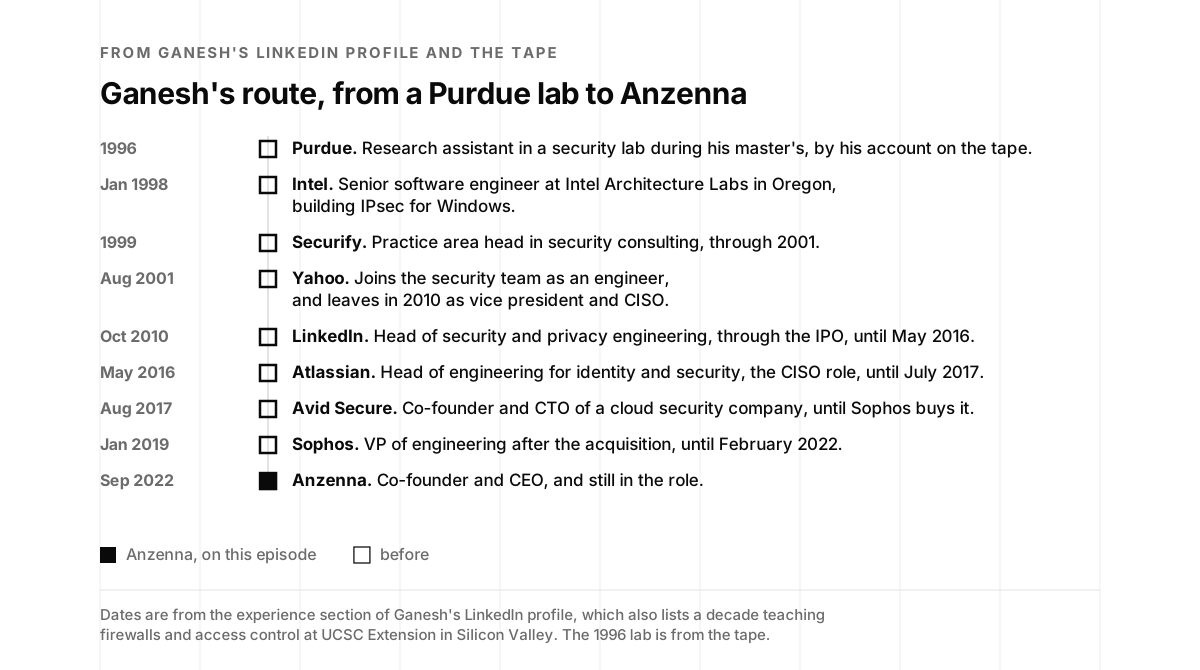
A timeline. 1996, Purdue, research assistant in a security lab during his master's, by his account on the tape. January 1998, Intel, senior software engineer at Intel Architecture Labs in Oregon, building IPsec for Windows. 1999, Securify, practice area head in security consulting, through 2001. August 2001, Yahoo, joins the security team as an engineer, and leaves in 2010 as vice president and CISO. October 2010, LinkedIn, head of security and privacy engineering, through the IPO, until May 2016. May 2016, Atlassian, head of engineering for identity and security, the CISO role, until July 2017. August 2017, Avid Secure, co-founder and CTO of a cloud security company, until Sophos buys it. January 2019, Sophos, VP of engineering after the acquisition, until February 2022. Filled, September 2022, Anzenna, co-founder and CEO, and still in the role.
Ganesh's route, from a Purdue security lab in 1996 to Anzenna in 2022, from his LinkedIn and the tape.

IPsec device drivers for Windows 95

After Purdue, Ganesh went to Intel Architecture Labs in Oregon. His first security job was in the network stack.

“writing IPsec device drivers for Windows 95 and Windows 98.”

Ganesh Krishnan, at 1:32

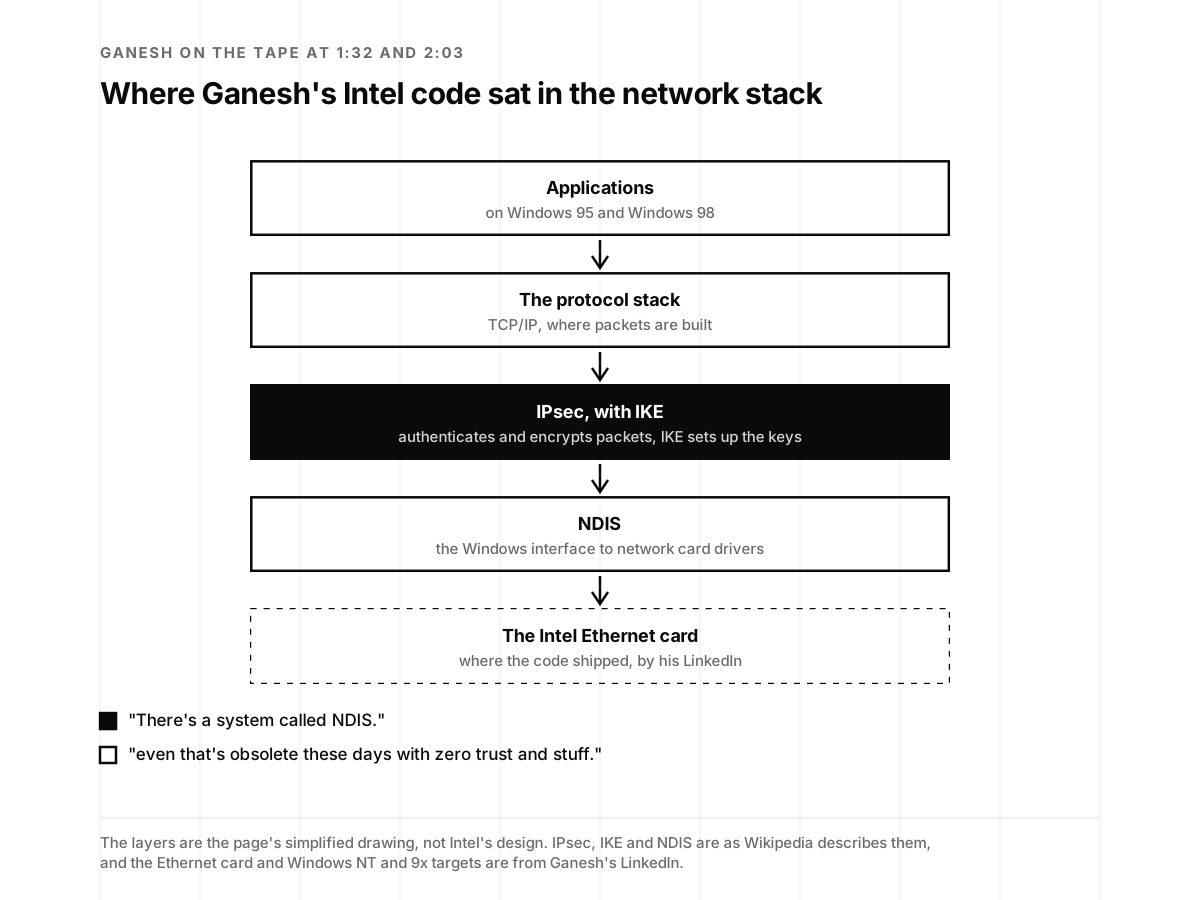
Internet Protocol Security, IPsec, is a secure network protocol suite that authenticates and encrypts packets of data between two computers over an Internet Protocol network, and it’s what virtual private networks use (Wikipedia). His LinkedIn describes the job as designing and building the IPsec protocol for Windows NT and 9x, shipped as part of Intel’s Ethernet cards, plus a security policy architecture for network traffic and a directory service using LDAP to store that policy (LinkedIn). Windows 95 reached retail on August 24, 1995, and Windows 98 on June 25, 1998 (Wikipedia, Wikipedia). Jon suggested where those systems live now, and Ganesh agreed.

“Those were rampant with security flaws back then. But now, if you had a Windows 95, you couldn’t use it and they would be in a museum.”

Ganesh Krishnan, at 1:47

“And writing device drivers for Windows back then was extremely challenging. There’s a system called NDIS.”

Ganesh Krishnan, at 1:55

The Network Driver Interface Specification, NDIS, is the application programming interface for network interface controllers in Windows (Wikipedia). Ganesh’s code sat at the protocol level, and he was frank about how much of it has aged.

“But anyway, I was writing, like, IPsec protocol level code and IKE protocol level code, even that’s obsolete these days with zero trust and stuff.”

Ganesh Krishnan, at 2:03

Internet Key Exchange, IKE, is the protocol that sets up a security association in the IPsec suite (Wikipedia). Zero trust architecture is the design principle that users and devices shouldn’t be trusted by default, even on a privileged network like a corporate LAN, and even if they were verified before (Wikipedia). A VPN’s job is to put a remote machine on the trusted network, and zero trust starts from the opposite assumption, that being on the network earns no trust by itself. Zero trust comes back later in this conversation, from a different direction, when Ganesh gets to what default protections can’t do.
Listen · Ganesh on episode 34, from 1:47
About 30 seconds: Ganesh on IPsec drivers, NDIS and IKE. The clip stops on its own. Read the full transcript.
Five stacked layers joined by arrows pointing down. Outlined, applications, on Windows 95 and Windows 98. Outlined, the protocol stack, TCP/IP, where packets are built. Filled, IPsec, with IKE, authenticates and encrypts packets, IKE sets up the keys. Outlined, NDIS, the Windows interface to network card drivers. Dashed, the Intel Ethernet card, where the code shipped, by his LinkedIn. Two quotes from Ganesh: There's a system called NDIS. Even that's obsolete these days with zero trust and stuff.
Where Ganesh's Intel code sat: IPsec and IKE between the protocol stack and the network card driver, on Windows 95 and 98.

Tired of the rain in Oregon

A few years into Intel, the weather decided the next job.

“And that’s when I was a few years in, I got tired of the rain in Oregon. It used to rain nine months.”

Ganesh Krishnan, at 2:19

“It rains all the time, though, doesn’t it?”

Jon McLachlan, at 2:25

He went looking for somewhere warmer and sunnier, and found a security company with an unusual founder.

“And that’s when I started talking to this company called Securify, which was started by Taher Elgamal, who’s the guy behind the ElGamal signature standard, which became DSA, the digital signature algorithm.”

Ganesh Krishnan, at 2:32

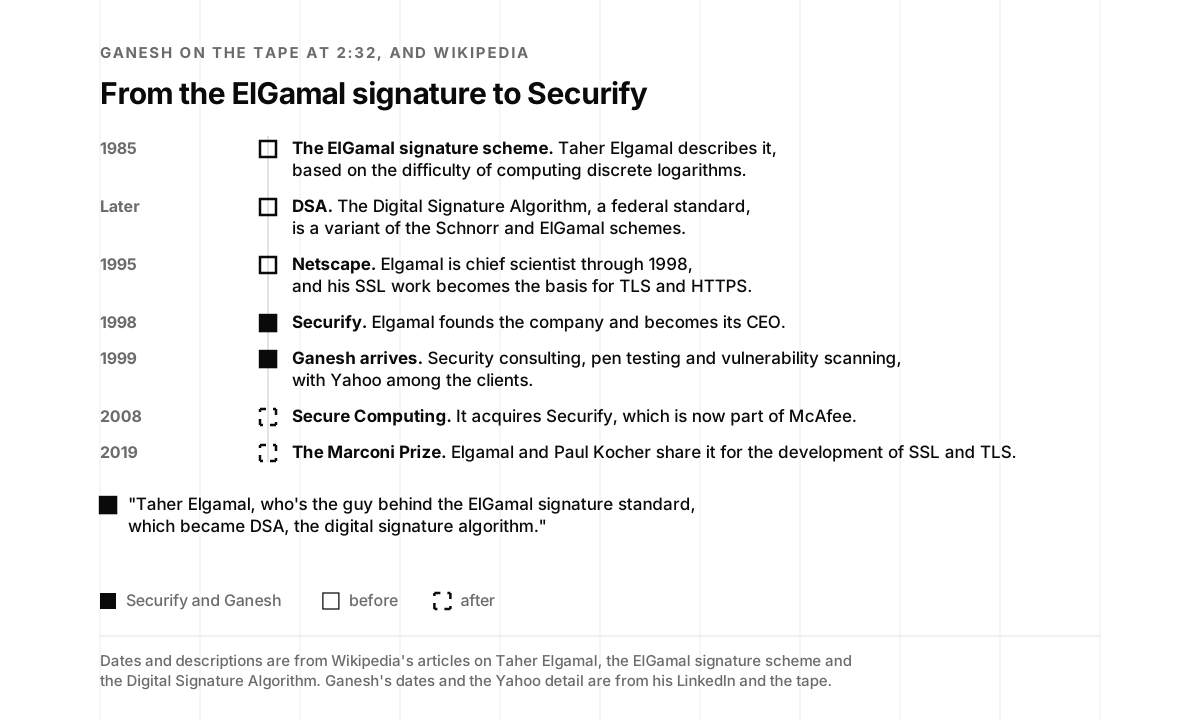
Taher Elgamal is an Egyptian-American cryptographer and tech executive who was founder and CEO of Securify, director of engineering at RSA Security, and chief scientist at Netscape Communications from 1995 to 1998 (Wikipedia). He described the ElGamal signature scheme, based on the difficulty of computing discrete logarithms, in 1985 (Wikipedia), and the Digital Signature Algorithm, a Federal Information Processing Standard for digital signatures, is a variant of the Schnorr and ElGamal schemes (Wikipedia). Ganesh also remembered him as “one of the early pioneers in Netscape.” Wikipedia credits Elgamal’s work on SSL at Netscape as the basis for TLS and HTTPS, and he shared the 2019 Marconi Prize with Paul Kocher for the development of SSL and TLS (Wikipedia). Elgamal founded Securify in 1998, and it was later acquired by Secure Computing in 2008 and is now part of McAfee (Wikipedia). Elgamal came on this show himself in episode 61, on SSL and why passwords are holding us back (episode 61).

“So it was actually a security consulting company, and had a stint with security consulting in 1999-ish, that time frame, and was working on security stuff with companies like Yahoo and others, and got to really learn about pen testing and vulnerability scanning, things like Nmap and things.”

Ganesh Krishnan, at 2:50

His LinkedIn has him as practice area head at Securify from 1999 to 2001, running consulting engagements for e-commerce, financial, wireless and healthcare clients (LinkedIn). A penetration test is an authorized simulated cyberattack on a computer system, performed live to evaluate its security (Wikipedia). A vulnerability scanner is a program that assesses computers, networks or applications for known weaknesses (Wikipedia). Nmap, the network scanner Gordon Lyon created, was first released in September 1997 in Phrack magazine (Wikipedia), so it was two years old when Ganesh was learning it.

“They’ve existed forever now. So that was a great experience, being a software engineer writing device drivers. It was a kind of a dramatic switch.”

Ganesh Krishnan, at 3:11
Listen · Ganesh on episode 34, from 2:32
About 40 seconds: Ganesh on Securify, Taher Elgamal and learning to pen test. The clip stops on its own. Read the full transcript.
A timeline. 1985, the ElGamal signature scheme, Taher Elgamal describes it, based on the difficulty of computing discrete logarithms. Later, DSA, the Digital Signature Algorithm, a federal standard, is a variant of the Schnorr and ElGamal schemes. 1995, Netscape, Elgamal is chief scientist through 1998, and his SSL work becomes the basis for TLS and HTTPS. Filled, 1998, Securify, Elgamal founds the company and becomes its CEO. Filled, 1999, Ganesh arrives, security consulting, pen testing and vulnerability scanning, with Yahoo among the clients. Dashed, 2008, Secure Computing acquires Securify, which is now part of McAfee. Dashed, 2019, the Marconi Prize, Elgamal and Paul Kocher share it for the development of SSL and TLS. A quote from Ganesh: Taher Elgamal, who's the guy behind the ElGamal signature standard, which became DSA, the digital signature algorithm.
From the ElGamal signature scheme in 1985 to DSA, SSL at Netscape, and Securify, where Ganesh learned consulting.

One of the early members of their security team

One of Securify’s clients became his next employer.

“And then one of the companies I worked for was Yahoo, and then joined Yahoo sometime in 2001 after the dot-com bust, which probably not many people remember. That was the biggest tech bust and slowdown ever.”

Ganesh Krishnan, at 3:19

The dot-com bubble was a stock market bubble of the late 1990s that peaked on March 10, 2000. Between 1995 and that peak, investments in the Nasdaq Composite index rose 600%, and by October 2002 they had fallen 78% from the peak, giving up all of the bubble’s gains (Wikipedia). Ganesh joined Yahoo in the middle of that fall.

“And joined as one of the early members of their security team, was doing software engineering security”

Ganesh Krishnan, at 3:35

Yahoo is the American web portal behind Yahoo Search, Yahoo Mail, Yahoo News and Yahoo Finance, and it’s now run by Yahoo! Inc., 90% owned by Apollo Global Management and 10% by Verizon (Wikipedia). Ganesh stayed nine years. His LinkedIn has him at Yahoo from August 2001 to October 2010, ending as vice president and CISO, and describes the arc in one line: he started as an engineer and grew to lead global information security, a role his profile calls Chief Paranoid (LinkedIn). A chief information security officer is the senior executive responsible for the strategy and program that keep an organization’s information assets and technologies protected (Wikipedia).

Listen · Ganesh on episode 34, from 3:34
About 30 seconds: Ganesh on nine years at Yahoo and the move to LinkedIn. The clip stops on its own. Read the full transcript.

Through the IPO

In 2010 the industry moved again, and he moved with it.

“Left in 2010 when companies like Facebook and LinkedIn and others were starting to expand their footprint.”

Ganesh Krishnan, at 3:46

“Joined LinkedIn to build their security program, their trust engineering, anti-abuse engineering program, and then spent several years at LinkedIn through the IPO”

Ganesh Krishnan, at 3:52

LinkedIn is the business and employment-oriented social network Reid Hoffman and Eric Ly launched on May 5, 2003 (Wikipedia). It filed for its initial public offering in January 2011 and traded its first shares on May 19, 2011, on the New York Stock Exchange under LNKD, at $45 a share (Wikipedia). Microsoft bought it for $26.2 billion, in a deal completed on December 8, 2016 (Wikipedia). Jon stopped him there.

“That’s big. A lot of people aim for that in their careers, and very elusive.”

Jon McLachlan, at 4:06

His LinkedIn adds the scale. As head of security and privacy engineering from October 2010 to May 2016, he led more than 100 data scientists, security experts and software engineers across information security, security infrastructure engineering, and anti-abuse and privacy engineering, which built abuse and fraud prevention on machine learning, login and authentication systems, and site privacy features (LinkedIn). From August 2011 to April 2013 he also ran LinkedIn’s India Technology Center in Bengaluru, which he set up “from nothing to about 50 engineers” (LinkedIn). Bengaluru, also known as Bangalore, is the capital of the southern Indian state of Karnataka (Wikipedia).

I’ll probably go native

Then came Atlassian, and a decision about what kind of career he wanted.

“And then moved to Atlassian to run their identity and security engineering programs as Atlassian was growing.”

Ganesh Krishnan, at 4:11

Atlassian is a multinational software company headquartered in Sydney, Australia, that makes collaboration tools mainly for software development and project management (Wikipedia). It was founded in 2002 and went public on the NASDAQ on December 10, 2015, under the symbol TEAM (Wikipedia). Ganesh’s LinkedIn has him there from May 2016 to July 2017 as head of engineering for identity and security, the CISO role, leading the global information security program and the identity engineering team that built shared authentication and authorization for all of Atlassian’s products (LinkedIn). One of those products is Jira, Atlassian’s bug tracking, issue tracking and agile project management tool (Wikipedia), and Jira comes back later in the conversation, in Ganesh’s list of what Anzenna helped employees fix.

“And that’s when I realized, hey, I’ve been doing this security practitioner CISO thing for a while. And if I continue doing this, I’ll probably go native.”

Ganesh Krishnan, at 4:18

“So I have to shake myself and see if I can do something that’s completely different.”

Ganesh Krishnan, at 4:27

Every problem looks 10x bigger

The something different was a startup of his own.

“So I ended up starting a company in the cloud security space in 2017 called Avid Secure, which was then acquired by Sophos in 2019.”

Ganesh Krishnan, at 4:34

Sophos announced the deal on January 8, 2019, describing Avid Secure as an artificial intelligence-based cloud security analytics, compliance and DevSecOps platform for public clouds such as AWS, Azure and Google, founded in 2017 and headquartered in San Francisco with engineering in Gurgaon, India (Sophos). Ganesh’s LinkedIn has him as Avid Secure’s co-founder and CTO from August 2017 to January 2019 (LinkedIn). The buyer was older than most of the industry.

“And was skeptical going into a 35-year-old security company. It’s probably one of the oldest security companies in existence that still does really good business.”

Ganesh Krishnan, at 4:44

Sophos is a British security software and hardware company, founded by Jan Hruska and Peter Lammer, which began producing its first antivirus and encryption products in 1985 (Wikipedia). It was listed on the London Stock Exchange until the American private equity firm Thoma Bravo acquired it in March 2020 (Wikipedia), during Ganesh’s time there. The culture surprised him.

“But I was pleasantly surprised working for Sophos. I had a great time. I spent three years there after the acquisition and got to work with really good people.”

Ganesh Krishnan, at 4:55

His LinkedIn has him as VP of engineering at Sophos from January 2019 to February 2022 (LinkedIn). Jon asked who he’d started Avid Secure with.

“It was a gentleman by the name Nikhil Gupta.”

Ganesh Krishnan, at 5:05

Nikhil Gupta was Avid Secure’s CEO and co-founder in Sophos’s announcement (Sophos), and ArmorCode, the application security startup he co-founded, launched in May 2021 with $3 million in funding (SiliconANGLE). Jon had met him from the other side of the table.

“He tried to sell ArmorCode to me at Pure Storage.”

Jon McLachlan, at 5:16

Jon was the product security lead at Pure Storage from May 2018 to January 2021 (LinkedIn). Pure Storage is the Santa Clara company that started with all-flash data storage, and it rebranded as Everpure in February 2026 (Wikipedia).

“So it’s a small world. This is a small community, guys.”

Jon McLachlan, at 5:22

Then Ganesh described what changes after the first company.

“And post Sophos, once you start a company, every problem looks 10x bigger, as you probably know.”

Ganesh Krishnan, at 5:28

“Yes, it does.”

Jon McLachlan, at 5:33

“And so basically, left Sophos early last year in 2022, and then started Anzenna towards the end of last year.”

Ganesh Krishnan, at 5:35

Listen · Ganesh on episode 34, from 4:18
About 25 seconds: Ganesh on going native at Atlassian and starting Avid Secure. The clip stops on its own. Read the full transcript.

We get employees to engage with cybersecurity

Jon asked the question every founder on the show gets: what does Anzenna do better than anyone else?

“Yeah, what we do is we figure out how to engage employees on cybersecurity.”

Ganesh Krishnan, at 6:07

He called it an age-old problem that keeps getting worse, and he gave two reasons that pull in opposite directions.

“primarily because the surface area of cybersecurity is expanding and IT itself is decentralizing.”

Ganesh Krishnan, at 6:18

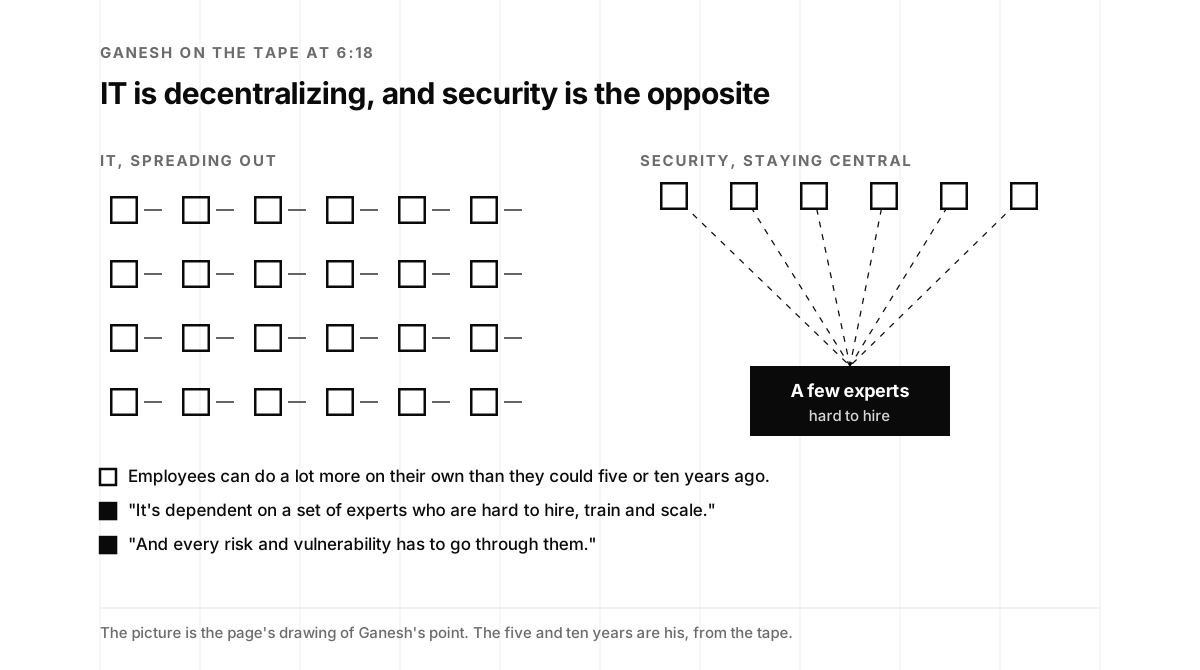
“And so when IT is decentralizing, security is the opposite. It’s dependent on a set of experts who are hard to hire, train and scale.”

Ganesh Krishnan, at 6:29

“And every risk and vulnerability has to go through them.”

Ganesh Krishnan, at 6:37

That’s a bottleneck. Employees can do more on their own than they could five or ten years ago, he said, and every one of those new powers creates risk that only a small team of experts is allowed to handle. His fix wasn’t a bigger team.

“We need a way for security teams instead to manage the process and the workflow and focus on high-value items versus being in the middle of every single alert and then mediating all of that.”

Ganesh Krishnan, at 6:44
Listen · Ganesh on episode 34, from 6:07
About 30 seconds: Ganesh on IT decentralizing while security stays centralized. The clip stops on its own. Read the full transcript.
Two panels. On the left, IT spreading out: a grid of 24 outlined squares, each employee with a tool beside it. On the right, security staying central: six outlined squares at the top, each a risk, with dashed lines converging on one filled box labeled a few experts, hard to hire. Below: employees can do a lot more on their own than they could five or ten years ago. Two quotes from Ganesh: It's dependent on a set of experts who are hard to hire, train and scale. And every risk and vulnerability has to go through them.
Ganesh's two directions: IT spreads out to every employee, while security stays with a few experts every risk has to pass through.

Security awareness training is broken

Then he described the loop Anzenna was built around.

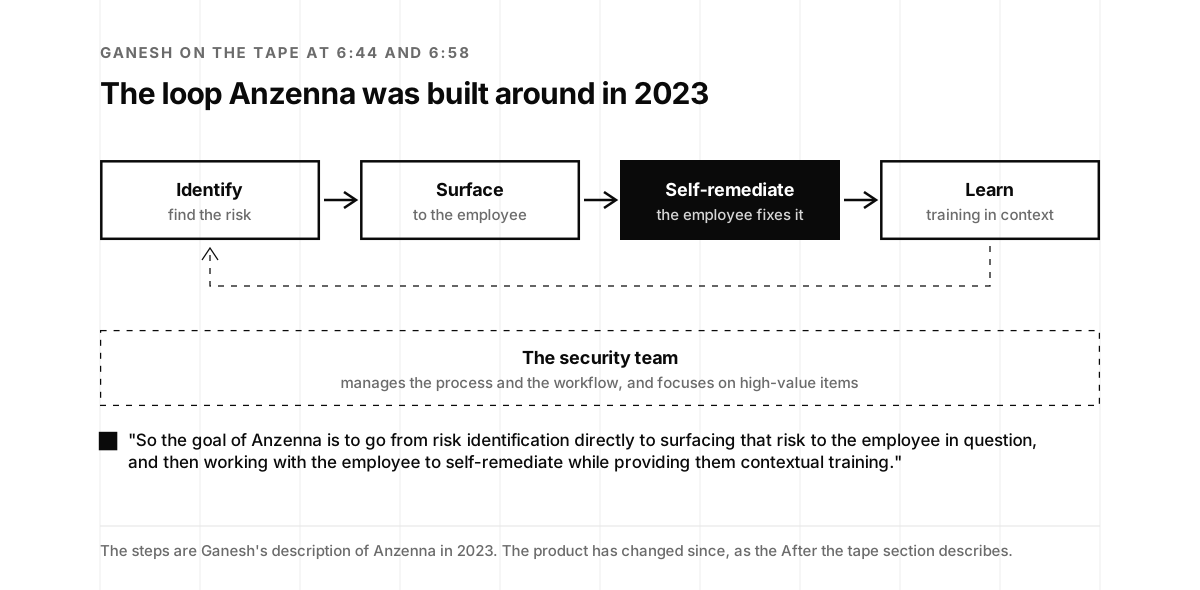
“So the goal of Anzenna is to go from risk identification directly to surfacing that risk to the employee in question, and then working with the employee to self-remediate while providing them contextual training.”

Ganesh Krishnan, at 6:58

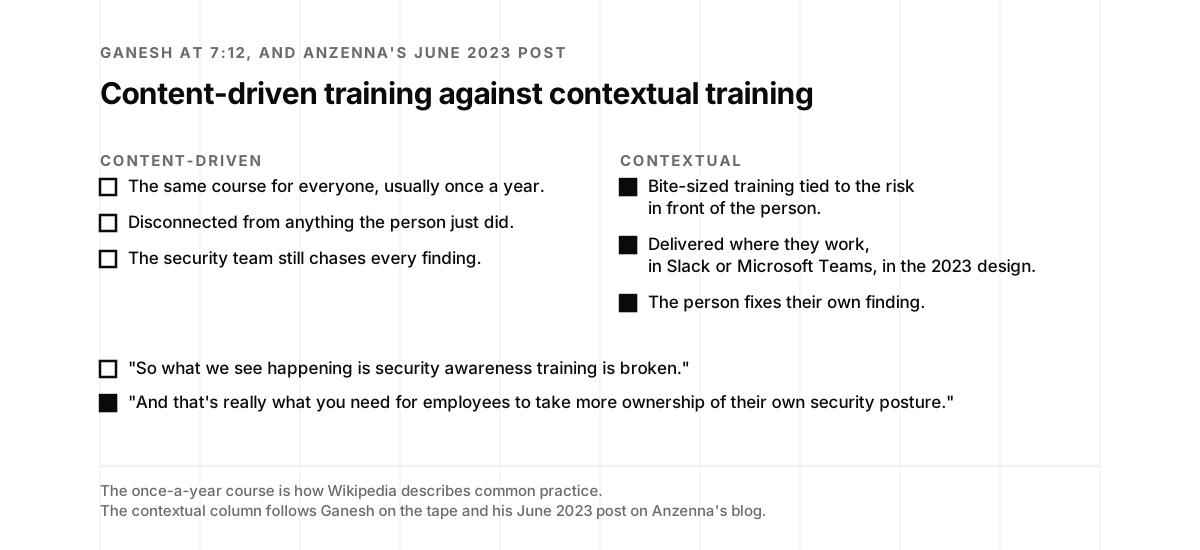
“So what we see happening is security awareness training is broken.”

Ganesh Krishnan, at 7:12

“That’s not a new thing, because it’s very, very content-driven.”

Ganesh Krishnan, at 7:16

Security awareness is the knowledge and attitude people in an organization have about protecting its physical and especially informational assets, and Wikipedia notes it’s tricky to build because organizations can’t impose it on employees directly (Wikipedia). Many organizations require formal awareness training when people join and periodically after, usually once a year (Wikipedia). Ganesh’s June 2023 post was blunter about it, calling annual awareness training ineffective and phishing simulations punitive (Anzenna). The Wikipedia article describes the newer approaches, from security nudges like password reminders and phishing warnings to gamification and phishing simulations (Wikipedia).

Ganesh’s answer was to make it contextual.

“And so this makes it contextual and, in the process, engages employees. And that’s really what you need for employees to take more ownership of their own security posture.”

Ganesh Krishnan, at 7:22

“So that’s what we do at Anzenna. We get employees to engage with cybersecurity.”

Ganesh Krishnan, at 7:32

The same post spelled out the alternative. It argued for moving from content-based, centralized awareness to context-based, employee-driven awareness, and listed three pillars: contextual engagement, with visibility, fixes and bite-sized training sent to each employee in Slack or Microsoft Teams, employee empowerment, and unified visibility across the company’s existing tools (Anzenna). And it describes the culture he’d tried to build as a CISO, one where “employees are seen as the strongest link in security, rather than the weakest” (Anzenna).
Listen · Ganesh on episode 34, from 6:58
About 40 seconds: Ganesh on why security awareness training is broken. The clip stops on its own. Read the full transcript.
Four boxes in a row joined by arrows, with a dashed line looping back from the last to the first. Outlined, identify, find the risk. Outlined, surface, to the employee. Filled, self-remediate, the employee fixes it. Outlined, learn, training in context. Below, a dashed box: the security team manages the process and the workflow, and focuses on high-value items. A quote from Ganesh: So the goal of Anzenna is to go from risk identification directly to surfacing that risk to the employee in question, and then working with the employee to self-remediate while providing them contextual training.
Anzenna's loop as Ganesh described it in 2023: find the risk, take it to the employee, the employee fixes it with training in context, and the security team manages the process.
Two columns. Content-driven, outlined: the same course for everyone, usually once a year, disconnected from anything the person just did, and the security team still chases every finding. Contextual, filled: bite-sized training tied to the risk in front of the person, delivered where they work, in Slack or Microsoft Teams, in the 2023 design, and the person fixes their own finding. Two quotes from Ganesh: So what we see happening is security awareness training is broken. And that's really what you need for employees to take more ownership of their own security posture.
Content-driven training against contextual training, from the tape and Anzenna's June 2023 post.

Two types of security professionals

Jon answered with something he’d always believed about the job.

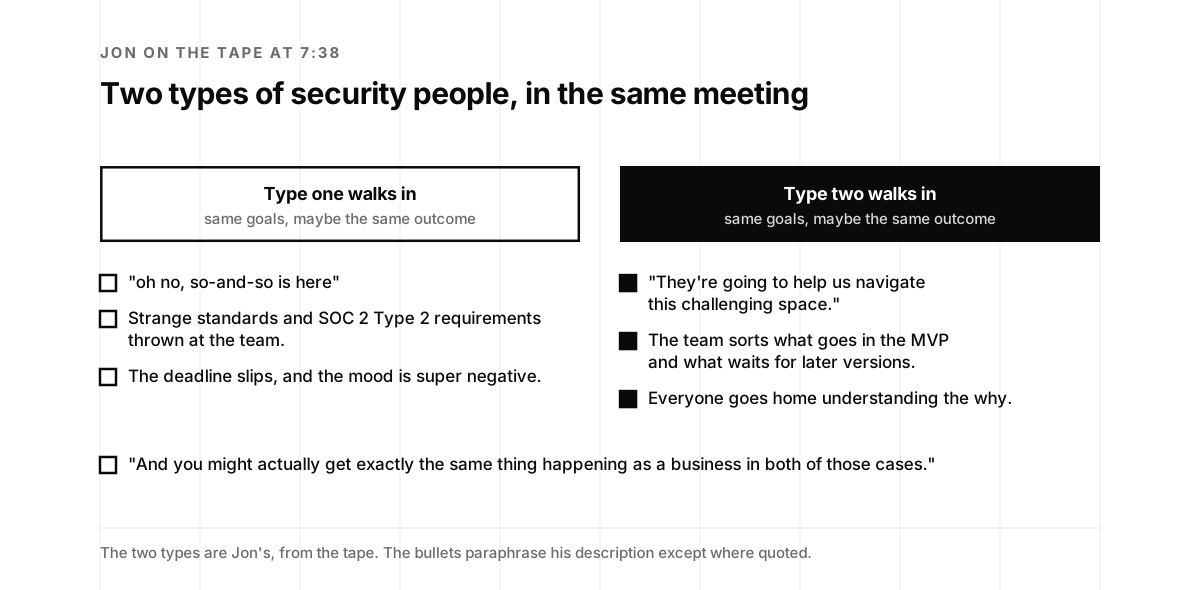
“I’ve always thought of, like, security as having two types of security people in the world. There’s two types of security professionals.”

Jon McLachlan, at 7:38

The first type walks into a meeting and the room deflates.

“There’s the type that will walk into a meeting room and everyone in the room will say something along the lines of, oh no, so-and-so is here”

Jon McLachlan, at 7:43

What follows, in Jon’s telling, is a list of strange standards, SOC 2 Type 2 requirements thrown in the team’s face, and a deadline that slips.

“and it’s like super negative.”

Jon McLachlan, at 8:07

The second type walks into the same room with the same goals, and the room changes.

“But everyone in that meeting room is like, oh, great. Like, so-and-so is here. They’re going to help us navigate this challenging space.”

Jon McLachlan, at 8:23

That person helps the team sort what has to be in the MVP from what can wait for later versions. A minimum viable product is a version with just enough features to be usable by early customers who can then give feedback for future development (Wikipedia). Jon’s point was that the outcome may not even differ.

“And you might actually get exactly the same thing happening as a business in both of those cases.”

Jon McLachlan, at 8:50

“You’re going to have a much better experience with that second type than the first type.”

Jon McLachlan, at 8:59

And he put Ganesh in the second group, and Anzenna with him.

“And this is really incredible, because it sounds like almost you built a company around that second type of security, where it’s collaborative, it’s learning, we’re in the same boat together.”

Jon McLachlan, at 9:16

The SOC 2 requirements Jon used as the first type’s weapon are the same ones a second-type security lead turns into a plan the team can ship against. That’s the approach behind our SOC 2 Type 2 work.
Listen · Jon on episode 34, from 7:41
About 30 seconds: Jon on the first type of security person. The clip stops on its own. Read the full transcript.
Listen · Jon on episode 34, from 8:09
About 25 seconds: Jon on the second type. The clip stops on its own. Read the full transcript.
Two columns. Outlined, type one walks in, same goals, maybe the same outcome: oh no, so-and-so is here, strange standards and SOC 2 Type 2 requirements thrown at the team, the deadline slips, and the mood is super negative. Filled, type two walks in, same goals, maybe the same outcome: they're going to help us navigate this challenging space, the team sorts what goes in the MVP and what waits for later versions, and everyone goes home understanding the why. A quote from Jon: And you might actually get exactly the same thing happening as a business in both of those cases.
Jon's two types of security people: the same meeting, the same goals, maybe even the same outcome, and two very different reactions.

Making them own the problem

Ganesh agreed, and described where his best results had come from.

“That’s correct. Yeah. And my best experiences have been when myself and my team have worked with the rest of the company in coming up with solutions to problems.”

Ganesh Krishnan, at 9:54

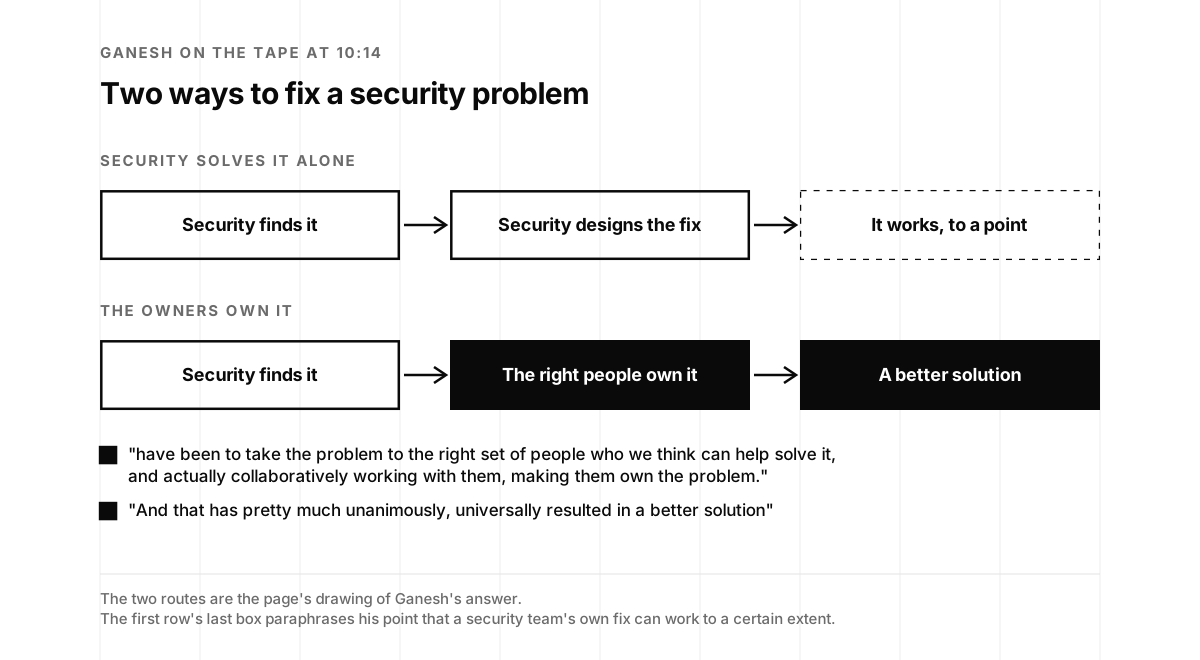
A security team can propose its own fix, he said, and that works to a point. The better way goes through the people who own the system.

“But my best experiences, like you said, have been to take the problem to the right set of people who we think can help solve it, and actually collaboratively working with them, making them own the problem.”

Ganesh Krishnan, at 10:14

“And that has pretty much unanimously, universally resulted in a better solution”

Ganesh Krishnan, at 10:28

Jon picked up the business case.

“And the right thing happens quickly for the business, because you have the expert in that area of the product focused and owning the problem and resolution.”

Jon McLachlan, at 10:44

“You get to learn a little bit about security. You get to engage with a new team. It’s like fun and dynamic.”

Jon McLachlan, at 10:52

This is the section the page is named for. The owner of the system knows it best, so the owner’s fix is usually the best fix, and the owner learns something about security on the way. The security team’s job becomes getting the problem to the right person with enough context to act.
Listen · Ganesh on episode 34, from 9:55
About 35 seconds: Ganesh on making the right people own the problem. The clip stops on its own. Read the full transcript.
Two rows of three boxes joined by arrows. Security solves it alone: outlined, security finds it, outlined, security designs the fix, dashed, it works, to a point. The owners own it: outlined, security finds it, filled, the right people own it, filled, a better solution. Two quotes from Ganesh: Have been to take the problem to the right set of people who we think can help solve it, and actually collaboratively working with them, making them own the problem. And that has pretty much unanimously, universally resulted in a better solution.
Two ways to fix a security problem: the security team solves it alone, or takes it to the people who own the system and makes them owners of the fix.

Gain credibility within the organization

Jon admitted the hard part.

“And I think everyone tries to approach security in this manner. I do have to admit, it can be very difficult sometimes.”

Jon McLachlan, at 11:13

Ganesh didn’t argue.

“these are challenging things to productize and take to market and get, like you said, people who are dealing with their day-to-day stuff, get them to use it and embrace it.”

Ganesh Krishnan, at 11:23

“There’s lots of tools that find new security challenges, new security problems, the new risk, right? But there’s very few tools that will say, okay, how do I help you effectively resolve it and gain credibility within the organization?”

Ganesh Krishnan, at 11:38

That last word is the one Jon repeated back: credible. A security team that only produces findings spends its credibility, and one that gets findings resolved earns it.

Listen · Ganesh on episode 34, from 11:23
About 25 seconds: Ganesh on tools that find problems and tools that resolve them. The clip stops on its own. Read the full transcript.

OAuth grants that employees keep doing

Jon asked how listeners could try it, and Ganesh walked through the 2023 version of the product.

“So what we have done is, if you can go and go to anzenna.ai, there’s a Try Now.”

Ganesh Krishnan, at 12:05

He described the range of use cases as running “all the way from basic awareness training to more contextual awareness,” and then got specific.

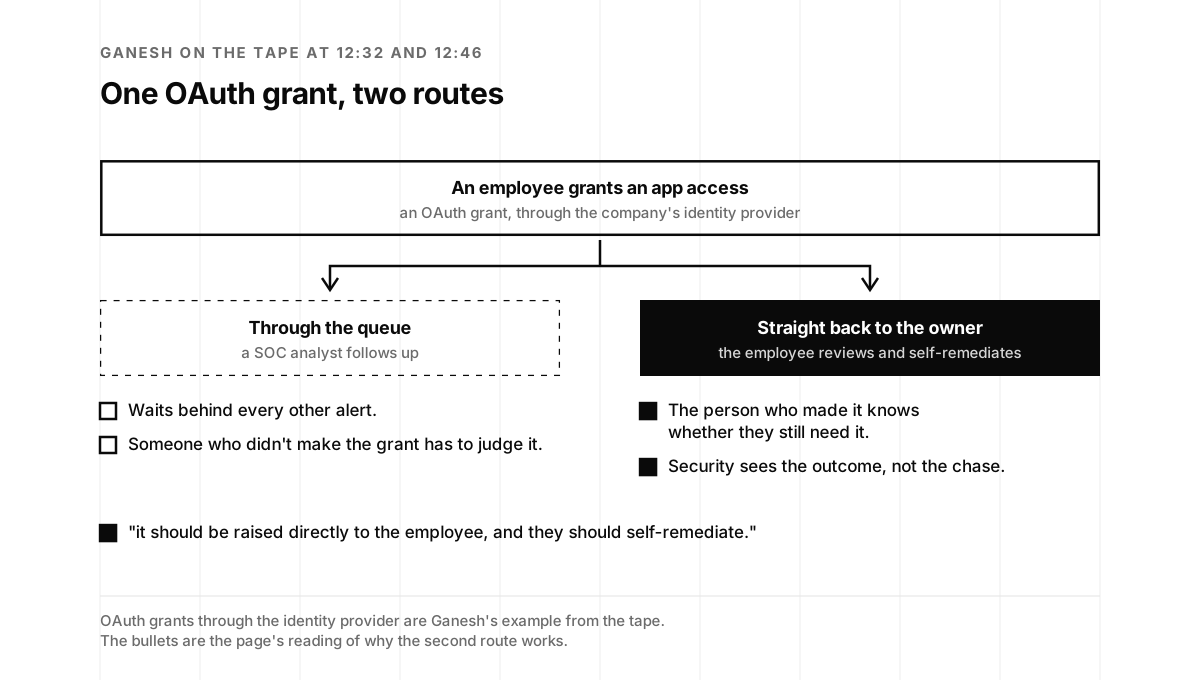
“Like, how do you get your employees to fix certain types of issues, like security tickets in Jira, vulnerability tickets in Jira, all the way to, hey, there’s these OAuth grants that employees keep doing through the IdP all the time.”

Ganesh Krishnan, at 12:32

“Those are things that the security team shouldn’t be following up, or a SOC shouldn’t be, like, it should be raised directly to the employee, and they should self-remediate.”

Ganesh Krishnan, at 12:46

OAuth is an open standard for access delegation, the way people grant websites or applications access to their information on other sites without handing over their passwords (Wikipedia). An identity provider creates and manages identity information and provides authentication to the applications that rely on it (Wikipedia). So each grant is an employee, signed in through the company’s identity provider, handing some app access to company data. A security operations center is the team responsible for protecting an organization against threats (Wikipedia), and Ganesh’s point was that a stale or risky grant shouldn’t wait in its queue. The person who made the grant can review it and revoke it, if someone tells them.

Connected apps are also how many AI tools reach company data now, and Anzenna’s own site lists OAuth-connected AI apps among the places data leaves a company (Anzenna). Finding those connections is part of our Corporate Shadow-AI Detection work.
Listen · Ganesh on episode 34, from 12:30
About 25 seconds: Ganesh on Jira tickets, OAuth grants and self-remediation. The clip stops on its own. Read the full transcript.
A box at the top, outlined: an employee grants an app access, an OAuth grant, through the company's identity provider. An arrow splits into two routes. Dashed, through the queue, a SOC analyst follows up: waits behind every other alert, and someone who didn't make the grant has to judge it. Filled, straight back to the owner, the employee reviews and self-remediates: the person who made it knows whether they still need it, and security sees the outcome, not the chase. A quote from Ganesh: It should be raised directly to the employee, and they should self-remediate.
One OAuth grant, two routes: through the security operations center's queue, or straight back to the employee who made it.

Talking to the second type

Jon asked for the best day so far.

“Talking to security practitioners and CISOs, saying, hey, we are thinking of this concept, this is what it means. Does this make sense? Is this solving the right thing? Is this right?”

Ganesh Krishnan, at 13:43

“Talking to the second type of security practitioner you mentioned earlier.”

Ganesh Krishnan, at 13:54

“The second type.”

Jon McLachlan, at 13:58

What those practitioners said back was the whole thesis in one sentence.

“hey, this is exactly how I want to run my security program, in an open, honest, transparent way, where I tell people why I’m doing something, why, and solicit their help and empower them to make it better, rather than dictate a set of policies.”

Ganesh Krishnan, at 14:03

Listen · Ganesh on episode 34, from 13:43
About 35 seconds: Ganesh on his best days, talking to the second type. The clip stops on its own. Read the full transcript.

We don’t really want to trust them

Jon asked for the hardest day too, and Ganesh’s came from the same kind of conversation.

“And unfortunately, one of the feedbacks that I heard is, hey, this is great, but you know what? Employees, you know, we don’t really want to trust them when it comes to security.”

Ganesh Krishnan, at 14:52

“And that was, I think, the worst part of my journey so far.”

Ganesh Krishnan, at 15:01

“hey, if we don’t trust our employees, we can’t run a business, let alone cybersecurity.”

Ganesh Krishnan, at 15:08

“So we have to change the mindset.”

Ganesh Krishnan, at 15:11

Jon played devil’s advocate for the skeptic.

“maybe they meant it from an insider trust perspective, or they just meant it from this, they didn’t trust them to do the right thing.”

Jon McLachlan, at 15:18

An insider threat is a threat that comes from people within the organization, such as employees, former employees, contractors or business associates, who know its security practices, data and systems, and it can involve fraud, theft of confidential information or intellectual property, or sabotage (Wikipedia). The skeptic had a point, and Ganesh granted it.

Listen · Ganesh on episode 34, from 14:45
About 30 seconds: Ganesh on his worst day as a founder. The clip stops on its own. Read the full transcript.

Absolutely necessary, but they’re not sufficient

“That’s right. And they might be justified in their statement. And I think that’s how we’ve been brought up in security.”

Ganesh Krishnan, at 15:25

“If you, like, 15, 20 years ago, I would probably say the same thing, right? Is, hey, we need to just build around these people, have technology controls and blocks and tackles.”

Ganesh Krishnan, at 15:33

Then he drew the line that holds the rest of the episode together.

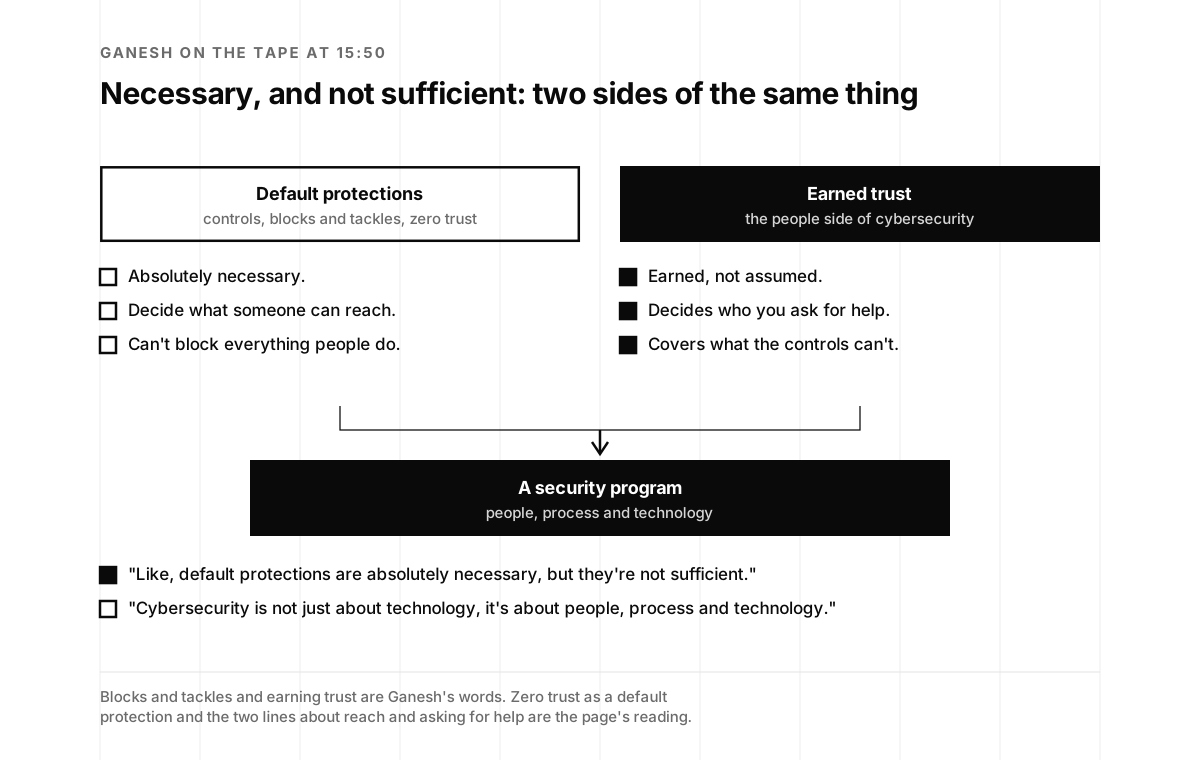
“Like, default protections are absolutely necessary, but they’re not sufficient.”

Ganesh Krishnan, at 15:50

“And you really have to earn the trust of their employees, because you can’t block everything that they’re doing.”

Ganesh Krishnan, at 15:54

“Cybersecurity is not just about technology, it’s about people, process and technology.”

Ganesh Krishnan, at 16:10

“And people are always first.”

Jon McLachlan, at 16:16

The two halves fit together. Zero trust, which Ganesh had mentioned at the start, is a default protection: users and devices aren’t trusted by default, even on the corporate network (Wikipedia). That doesn’t conflict with trusting employees to fix their own findings. The controls decide what someone can reach, and trust decides who you ask for help. The skeptic’s worry treats the two as alternatives. Ganesh was arguing for both.
Listen · Ganesh on episode 34, from 15:26
About 35 seconds: Ganesh on default protections that are necessary but not sufficient. The clip stops on its own. Read the full transcript.
Two columns joined below into one box. Outlined, default protections, controls, blocks and tackles, zero trust: absolutely necessary, decide what someone can reach, can't block everything people do. Filled, earned trust, the people side of cybersecurity: earned, not assumed, decides who you ask for help, covers what the controls can't. Both lead to a filled box: a security program, people, process and technology. Two quotes from Ganesh: Like, default protections are absolutely necessary, but they're not sufficient. Cybersecurity is not just about technology, it's about people, process and technology.
Ganesh's two sides of the same thing: default protections that block what they can, and earned trust for everything they can't, adding up to people, process and technology.

Security is way broader

Jon was making a point about money and health information when Ganesh jumped in, apologized, and was waved ahead.

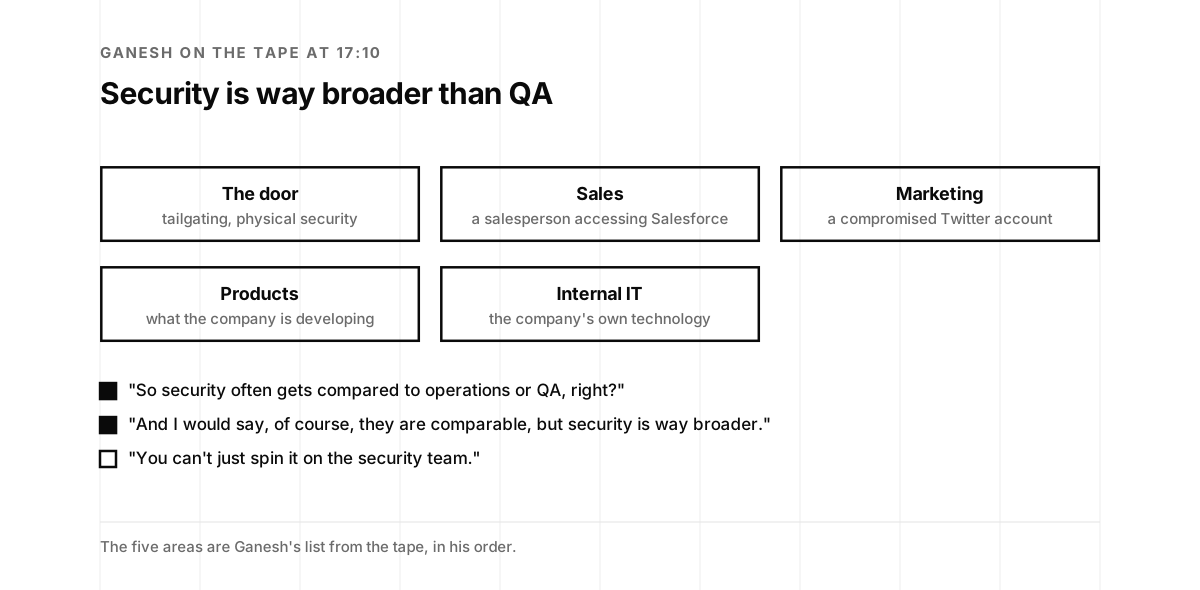
“So security often gets compared to operations or QA, right?”

Ganesh Krishnan, at 16:56

“And I would say, of course, they are comparable, but security is way broader.”

Ganesh Krishnan, at 17:06

“If you think about security, it affects every single thing that a company does, all the way from tailgating for the physical security world, to a salesperson accessing Salesforce”

Ganesh Krishnan, at 17:10

His list kept going: a marketing person’s tweets and a compromised company Twitter account, the products the company is building, and its internal IT. In security, tailgating or piggybacking is when someone tags along with an authorized person to get into a restricted area or past a checkpoint (Wikipedia). Salesforce is the San Francisco company best known for customer relationship management software (Wikipedia). Every item on the list is a person doing their normal job.

“You can’t just spin it on the security team.”

Ganesh Krishnan, at 17:40

“You have to democratize it”

Ganesh Krishnan, at 17:42
Listen · Ganesh on episode 34, from 16:56
About 30 seconds: Ganesh on why security is broader than QA. The clip stops on its own. Read the full transcript.
Five outlined boxes in two rows. The door, tailgating, physical security. Sales, a salesperson accessing Salesforce. Marketing, a compromised Twitter account. Products, what the company is developing. Internal IT, the company's own technology. Three quotes from Ganesh: So security often gets compared to operations or QA, right? And I would say, of course, they are comparable, but security is way broader. You can't just spin it on the security team.
Ganesh's list of where security shows up: the door, the sales tools, the marketing accounts, the products and internal IT, each one a person doing their normal job.

We’re all in the same boat together

Jon took the image he’d used earlier and ran with it.

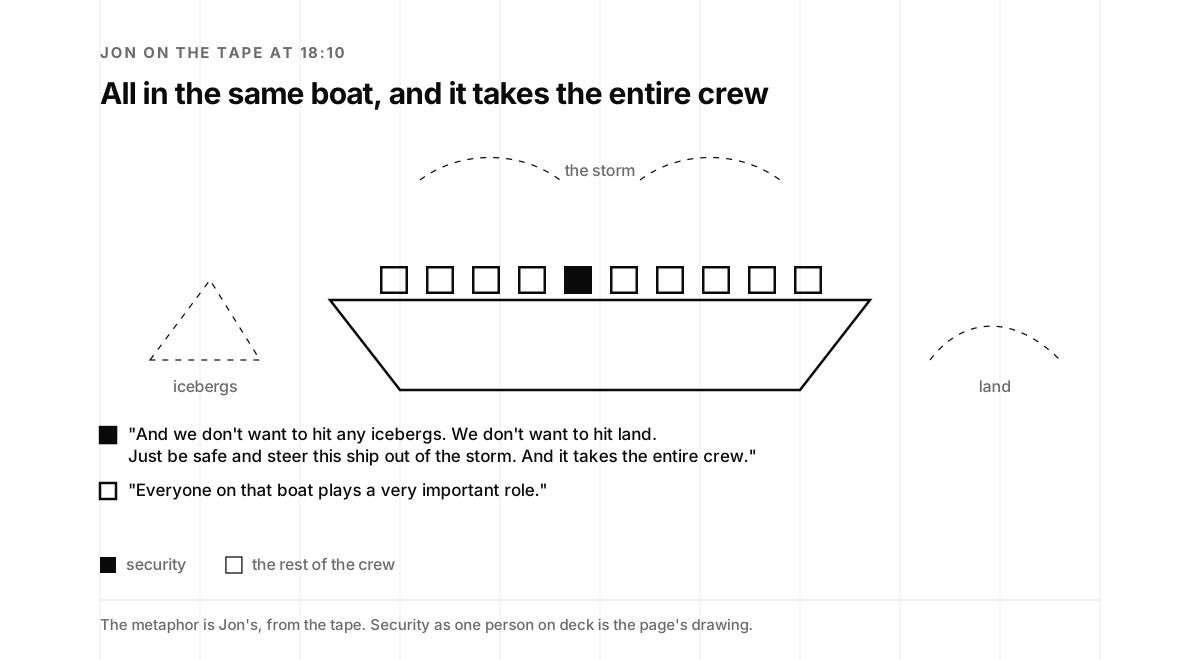
“Yeah. We’re all in the same boat together.”

Jon McLachlan, at 17:49

When security asks the rest of the company for help, he said, it should ask from that position: this is challenging, it’s a security thing, and we’re in it together.

“And we don’t want to hit any icebergs. We don’t want to hit land. Just be safe and steer this ship out of the storm. And it takes the entire crew.”

Jon McLachlan, at 18:10

“Everyone on that boat plays a very important role.”

Jon McLachlan, at 18:21
Listen · Jon on episode 34, from 17:49
About 35 seconds: Jon on the boat, the storm and the entire crew. The clip stops on its own. Read the full transcript.
A boat's hull with ten squares on deck, one filled for security and nine outlined for everyone else. A dashed iceberg on the left, dashed land on the right, and dashed storm clouds above. Two quotes from Jon: And we don't want to hit any icebergs. We don't want to hit land. Just be safe and steer this ship out of the storm. And it takes the entire crew. Everyone on that boat plays a very important role.
Jon's boat: icebergs, land and a storm to steer through, and a crew in which security is one of the people on deck.

Every single security team to type two

Jon asked what success would look like, as far into the future as Ganesh wanted to go. Ganesh went back to the beginning of the conversation.

“I think that all security teams are the type two.”

Ganesh Krishnan, at 18:38

“where the goal of security teams should be to help the company manage its risks, right? It’s cybersecurity and trust and privacy risks, right? Not to actually own all of it and drive resolution to all of it.”

Ganesh Krishnan, at 18:43

“And that’s the cognitive shift that’s needed.”

Ganesh Krishnan, at 18:56

Success, for him, would be the day every security team, and every practitioner, had made that shift to type two.

The shift he described is about ownership. The security team still owns the risk program, the process and the judgment calls. It stops owning every fix. That’s also the line between a security team that scales with the company and one that doesn’t, and it’s the program design our vCISO Services bring to companies that don’t have a security leader yet.

Listen · Ganesh on episode 34, from 18:37
About 20 seconds: Ganesh on what success looks like. The clip stops on its own. Read the full transcript.

It takes a great sense of humility

Jon said what the second type needs most.

“But it takes a great sense of humility to walk into a room filled with extremely smart people and admit that you don’t have all of the answers.”

Jon McLachlan, at 19:16

“We bring that security expertise to the table, but it’s not the end-all-be-all.”

Jon McLachlan, at 19:32

Ganesh added the part about parents.

“Yeah, we tell our kids all the time to ask for help, but we don’t tend to do it ourselves when we need it the most.”

Ganesh Krishnan, at 19:42

Jon pleaded “guilty as charged.”

Jon reached for a line he’d heard once, “I’m not young enough to know everything anymore,” and then turned it toward the people early in their careers. He said he was really happy with the interns and mentees he’d worked with, and excited about the future.

“It feels like when you’re close to the problem, it feels like very big and daunting. But when you step back and you really look at the bigger picture, and you realize that there are smart people and people with high EQ helping move the needle in big ways for everybody, that gets me excited.”

Jon McLachlan, at 20:29

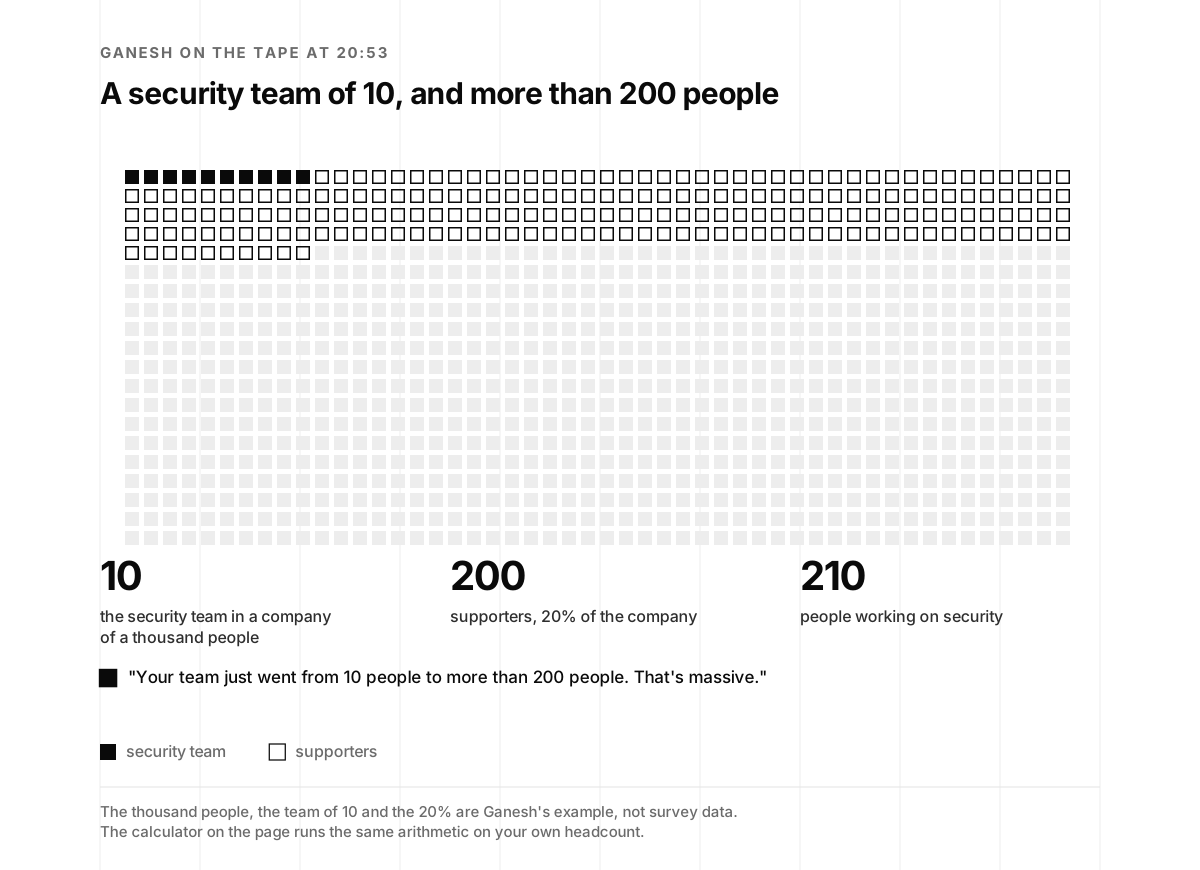
From 10 people to more than 200 people

Ganesh made the case for supporters with numbers.

“Let’s say you have a company of a thousand people, and the security team is probably going to be 10, just realistically, right?”

Ganesh Krishnan, at 20:53

“So 20% will actually be supporters.”

Ganesh Krishnan, at 21:03

“Your team just went from 10 people to more than 200 people. That’s massive.”

Ganesh Krishnan, at 21:11

The arithmetic is simple and the effect isn’t. Ten people can’t watch a thousand, but two hundred people inside the teams see problems the security team never would. He tied it to a practice many security leaders already run.

“And I know practitioners do this with security champions and others, where they see exponential returns if they can foster that program effectively, because people who are supporters are proactive.”

Ganesh Krishnan, at 21:31

A security champion is usually someone on an engineering or business team who takes on security as part of their job and is the security team’s first contact there. Ganesh’s description of what supporters do is the best argument for having them.

“They’ll say, oh, I’m seeing this problem that you may not even know about. And they will come to you and say, okay, let me help you fix it.”

Ganesh Krishnan, at 21:42

“A proactive program with a strong sense of ownership.”

Jon McLachlan, at 21:50

The calculator below runs Ganesh’s arithmetic on your own headcount.
Listen · Ganesh on episode 34, from 20:52
About 25 seconds: Ganesh on turning a security team of 10 into more than 200. The clip stops on its own. Read the full transcript.
A grid of a thousand small squares, 50 across and 20 down. The first 10 are filled for the security team, the next 200 are outlined for supporters, and the rest are light gray. Below, three numbers: 10, the security team in a company of a thousand people. 200, supporters, 20% of the company. 210, people working on security. A quote from Ganesh: Your team just went from 10 people to more than 200 people. That's massive.
Ganesh's example as a grid of a thousand people: 10 in security, and 200 supporters, 20% of the company, who make the team more than 200 strong.

Transparent about what an early stage company looks like

Jon asked about hiring, and whether Ganesh had a favorite interview question.

“I generally look for team dynamics, like how someone can actually work constructively with other people, and whether they will actually fit in with the rest of the team.”

Ganesh Krishnan, at 22:06

For a small company, he added a second rule, and it’s a warning to the candidate as much as a test. When he interviews, he said, he’s transparent about what an early stage company looks like.

“So a lot of folks want to work for early stage companies for the learning that it offers, but don’t necessarily fully understand what that comes with in terms of uncertainty and the need to embrace risk”

Ganesh Krishnan, at 22:33

“So it’s not like a stable company where you have a six-month roadmap or a one-year roadmap. You’re talking to customers all the time and you have to change.”

Ganesh Krishnan, at 22:53

Being transparent about that, he said, is how you find out whether the person is really a fit.

Listen · Ganesh on episode 34, from 22:27
About 35 seconds: Ganesh on being transparent with candidates about early stage life. The clip stops on its own. Read the full transcript.

Green flags

Jon turned the usual interview advice around.

“A lot of people talk about red flags and how they look for certain red flags, and if they see one, they will shut it down, basically. But not a lot of people talk about green flags”

Jon McLachlan, at 23:21

“I don’t call it a warm and fuzzy feeling, but you know it when you see it.”

Jon McLachlan, at 23:37

“Yeah, I think it’s hard to pinpoint, right?”

Ganesh Krishnan, at 23:48

For Ganesh, the signal is in how the conversation goes, and in whether the candidate cares about the work.

“And are they really interested in what we are doing?”

Ganesh Krishnan, at 24:11

“If you love what you do, you never really work a day in your life.”

Jon McLachlan, at 24:25

Think Like a Rocket Scientist

Jon asked for a book or a movie that changed how Ganesh sees the world.

“Yeah, recently I read a book, Think Like a Rocket Scientist, by Ozan Varol.”

Ganesh Krishnan, at 24:43

“It teaches you about first principles thinking, and just how to embrace uncertainty”

Ganesh Krishnan, at 24:51

Ozan Varol is a Turkish author and former tenured law professor at Lewis & Clark Law School (Wikipedia), and his Wikipedia article lists Think Like a Rocket Scientist: Simple Strategies You Can Use to Make Giant Leaps in Work and Life among his books. In philosophy and science, a first principle is a basic proposition or assumption that can’t be deduced from any other (Wikipedia). Jon called it philosophical, and Ganesh said it came with specifics.

“So the book provides specific examples on what happened in certain NASA launches and how they were successful, but they were really, like, scrambling in background, right?”

Ganesh Krishnan, at 25:13

The lesson he took from it fits a founder: even a successful launch was a scramble behind the scenes, so there’s no reason to be disappointed when yours is too.

Listen · Ganesh on episode 34, from 24:43
About 20 seconds: Ganesh on Think Like a Rocket Scientist. The clip stops on its own. Read the full transcript.

I played it too safe

Jon asked what Ganesh would tell his younger self, the grad student or the young engineer.

“Yeah, I wish I had taken more risks early on in my career.”

Ganesh Krishnan, at 26:12

“I think I played it too safe, like joined companies.”

Ganesh Krishnan, at 26:15

“I could have become an entrepreneur earlier.”

Ganesh Krishnan, at 26:22

“Again, like, hindsight’s 20/20. I have no regrets, but that’s what I would have done differently, is taken more risks.”

Ganesh Krishnan, at 26:35

It’s a striking answer from someone whose safe choices were Yahoo, LinkedIn through its IPO and Atlassian. He started his first company more than 20 years after the Purdue lab.

Listen · Ganesh on episode 34, from 26:11
About 30 seconds: Ganesh on what he'd tell his younger self. The clip stops on its own. Read the full transcript.

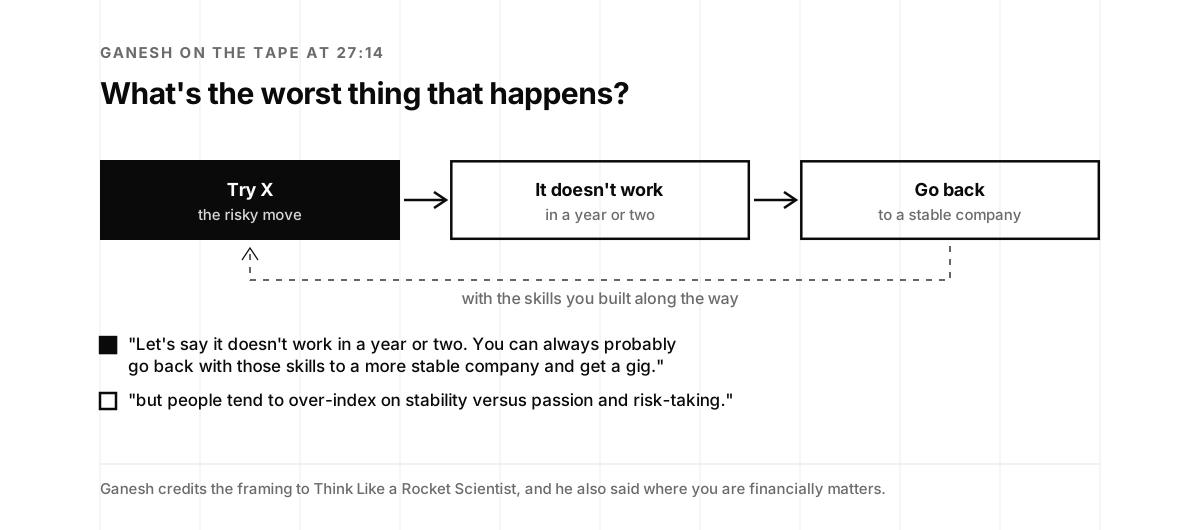
What’s the worst thing that happens?

Jon asked how people should think about risk when their life isn’t set up for it. Ganesh took the answer from the same book.

“The way to think about that is not necessarily just monetary or something, is to say, hey, what’s the worst thing that happens?”

Ganesh Krishnan, at 27:14

“Let’s say it doesn’t work in a year or two. You can always probably go back with those skills to a more stable company and get a gig.”

Ganesh Krishnan, at 27:25

He didn’t wave away the money question. He asked it directly, where are you financially, and said those things matter. His point was about the balance.

“but people tend to over-index on stability versus passion and risk-taking.”

Ganesh Krishnan, at 27:41
Listen · Ganesh on episode 34, from 27:14
About 35 seconds: Ganesh on the worst thing that can happen. The clip stops on its own. Read the full transcript.
Three boxes joined by arrows. Filled, try X, the risky move. Outlined, it doesn't work, in a year or two. Outlined, go back, to a stable company. A dashed line runs back to the start, labeled with the skills you built along the way. Two quotes from Ganesh: Let's say it doesn't work in a year or two. You can always probably go back with those skills to a more stable company and get a gig. But people tend to over-index on stability versus passion and risk-taking.
Ganesh's worst-case question for a risky move: try it for a year or two, and if it doesn't work, go back to a stable company with the skills you built.

Outside your comfort zone

Jon agreed, from his own experience.

“I think that we do tend to overvalue, like, comfort and stability.”

Jon McLachlan, at 27:49

“when I’m outside of my comfort zone, that’s where the good stuff always happens.”

Jon McLachlan, at 27:58

A comfort zone is a familiar psychological state where people are at ease and in control of their environment, with low anxiety and stress (Wikipedia). Jon added a caution about going too far, when a stretch doesn’t line up with your strengths.

“But I think a lot of us maybe worry about being too uncomfortable.”

Jon McLachlan, at 28:33

Ganesh named the force on the other side.

“Yeah, humans are programmed with inertia, right?”

Ganesh Krishnan, at 29:15

“There’s nothing wrong being in your own comfort zone. Don’t get me wrong.”

Ganesh Krishnan, at 29:37

And he widened it from a career choice to a society’s.

“And even in the last 10, 15 years, like, there’s been way more startups.”

Ganesh Krishnan, at 30:04

“Otherwise, if everybody’s in their comfort zone, it’s hard to make advancements.”

Ganesh Krishnan, at 30:14

Listen · Ganesh on episode 34, from 29:15
About 25 seconds: Ganesh on inertia and comfort zones. The clip stops on its own. Read the full transcript.

Help people fix problems, not just create new ones

Jon’s last question was for the entrepreneurs listening: what problem would Ganesh pay someone to solve?

“Oh, boy, I was not prepared.”

Ganesh Krishnan, at 30:44

Then he answered with his own company’s thesis, aimed at everyone else’s.

“So I think that more companies need to be looking at how to help people resolve issues, than to just identify new issues.”

Ganesh Krishnan, at 31:02

“think about how to help people fix problems, not just create new ones for them, because there’s so many problems already practitioners are dealing with.”

Ganesh Krishnan, at 31:15

His second answer was smaller and more personal.

“Simple things like, how do I manage my browser tabs more effectively?”

Ganesh Krishnan, at 31:27

“Like, I have three different windows with three different profiles with 30 different tabs on each open.”

Ganesh Krishnan, at 31:35

Jon had a design ready.

“I could just use something that, if it just expired the tab, like, after 20 minutes of not having the thing open, and just kept it in the history, that would be perfectly fine”

Jon McLachlan, at 31:56

“And each one of those things is a process on your CPU that is running and properly segmented for all of the good security reasons, but that still takes up resources.”

Jon McLachlan, at 32:12

Google Chrome launched in September 2008, and its tabs are the main component of its interface (Wikipedia). Chrome uses its own multi-process architecture (Wikipedia), and that’s the segmentation Jon was describing: isolation that’s good for security, paid for in resources and battery.

Listen · Ganesh on episode 34, from 31:02
About 20 seconds: Ganesh on helping people fix problems instead of finding new ones. The clip stops on its own. Read the full transcript.

After the tape

Anzenna kept Ganesh’s starting point and built a lot on top of it. In 2023 it was a security awareness and engagement platform, and its first blog post, by Ganesh in June 2023, was titled “Goodbye Security Awareness Tools, Hello Anzenna” (Anzenna). Its blog shows the next steps. It announced Microsoft 365 compliance in December 2023, SOC 2 Type II compliance in July 2024, and integrations and a browser extension later that year (Anzenna). In February 2025, a release described Anzenna as “the pioneer of Human-Centered Security,” focused on human behavior, with automated fixes for insider risk, intellectual property exfiltration and compliance violations through a company’s existing tools (PRWeb).

In 2026 the focus moved to AI. Its press page lists AI investigation agents for insider risk probes in March, access control for AI usage in June, and AI data loss prevention for prompts and agent activity in July (Anzenna). Data loss prevention is the set of strategies and technologies that stop the unauthorized transmission or disclosure of sensitive data (Wikipedia). Its LinkedIn page now calls it “intent-based AI DLP and insider risk management,” with headquarters in Redwood City and a 2022 founding date (LinkedIn). Ganesh is still co-founder and CEO, and his co-founder, Albert Yu, is CTO (Anzenna).

The thread from the tape survives in the company’s own words. Its company page says Anzenna was founded on the premise that “the people inside your company are not the adversary” (Anzenna), and one of its four stated virtues is trust as default, starting from the assumption that people mean well (Anzenna). That’s Ganesh’s answer to the skeptic who didn’t want to trust employees, written into the company.

The rest of the people in this story moved too. ArmorCode, Nikhil Gupta’s company after Avid Secure, launched in May 2021 (SiliconANGLE). Pure Storage, where Nikhil once pitched Jon, renamed itself Everpure in February 2026 (Wikipedia). And Taher Elgamal, who started Securify, sat down for episode 61 in January 2025 (episode 61).
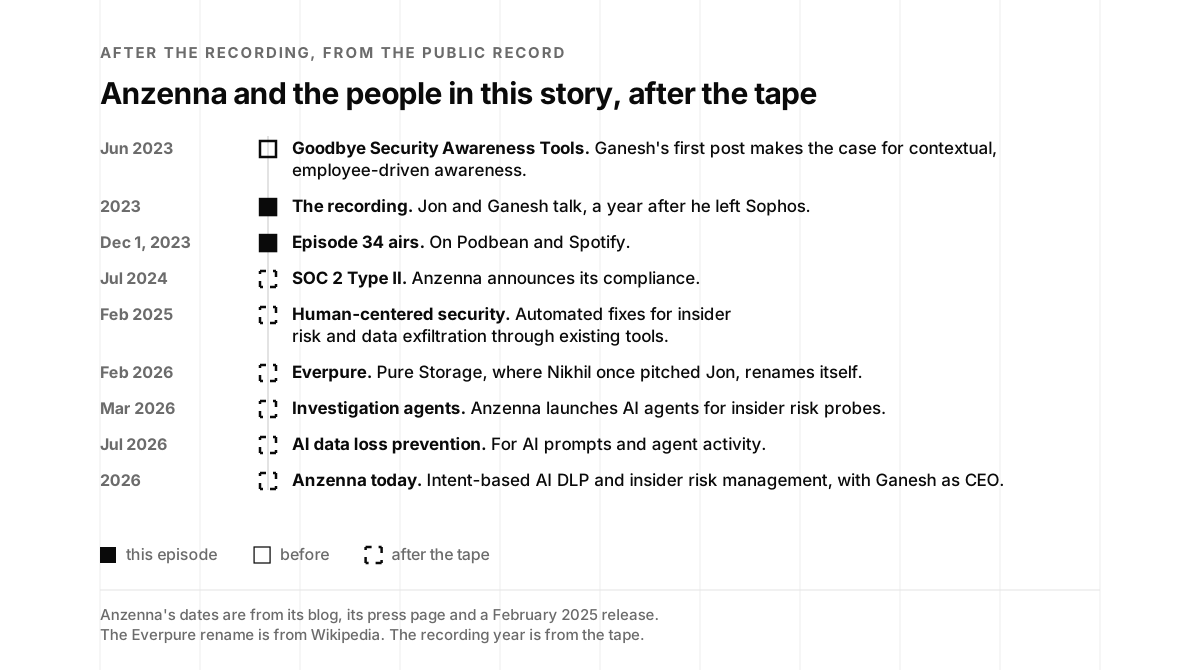
A timeline. June 2023, Goodbye Security Awareness Tools, Ganesh's first post makes the case for contextual, employee-driven awareness. Filled, 2023, the recording, Jon and Ganesh talk, a year after he left Sophos. Filled, December 1, 2023, episode 34 airs, on Podbean and Spotify. Dashed, July 2024, SOC 2 Type II, Anzenna announces its compliance. Dashed, February 2025, human-centered security, automated fixes for insider risk and data exfiltration through existing tools. Dashed, February 2026, Everpure, Pure Storage, where Nikhil once pitched Jon, renames itself. Dashed, March 2026, investigation agents, Anzenna launches AI agents for insider risk probes. Dashed, July 2026, AI data loss prevention, for AI prompts and agent activity. Dashed, 2026, Anzenna today, intent-based AI DLP and insider risk management, with Ganesh as CEO.
After the tape: Anzenna from a security awareness platform in 2023 to human-centered security in 2025 and AI data loss prevention and insider risk in 2026, with Pure Storage becoming Everpure along the way.

What aged best is the part about ownership. Tools that find problems are everywhere, and Ganesh’s bet was that the scarce thing is getting each problem to the person who can fix it, with the context to do it. That’s as true of an OAuth grant in 2023 as of an AI prompt in 2026. Keep the default protections. Then make the rest of the company owners of their part of the risk.

Did you catch it? A six-question quiz

Six questions from the episode. Each answer links the moment in the transcript.

Quiz · six questions

Did you catch it?

Pick an answer for each. The explanation shows once you choose.

  1. What did Ganesh say Anzenna means in Japanese?

    1. Safe
    2. Trust
    3. Calm

    a. "Safe." Transcript, 0:20.

  2. What did Ganesh write at Intel Architecture Labs?

    1. Firewall rules for Yahoo
    2. IPsec device drivers for Windows 95 and Windows 98
    3. A vulnerability scanner

    b. "writing IPsec device drivers for Windows 95 and Windows 98." Transcript, 1:32.

  3. What did Ganesh say about security awareness training?

    1. It's broken
    2. It's the best defense a company has
    3. It should happen once a year

    a. "So what we see happening is security awareness training is broken." Transcript, 7:12.

  4. What feedback made Ganesh's worst day as a founder?

    1. The product was too expensive
    2. Security teams didn't need another tool
    3. The company didn't want to trust employees with security

    c. "Employees, you know, we don't really want to trust them when it comes to security." Transcript, 14:58.

  5. What did Ganesh say about default protections?

    1. They're enough on their own
    2. They're necessary, but not sufficient
    3. They're obsolete with zero trust

    b. "Like, default protections are absolutely necessary, but they're not sufficient." Transcript, 15:50.

  6. In Ganesh's example, a company of a thousand people with a security team of 10 finds 20% supporters. How big does the team get?

    1. About 12 people
    2. About 50 people
    3. More than 200 people

    c. "Your team just went from 10 people to more than 200 people." Transcript, 21:11.

Is your security team type one or type two?

Jon’s two types of security people make a good mirror. Eight questions on which one your team is, from the way findings get fixed to the look on people’s faces when you walk into the room.

Scorecard · eight questions

Is your security team type one or type two?

Answer for how your team works today. If two answers fit, pick the lower one.

  1. When a security finding belongs to another team's system, who fixes it?

    • Security fixes it, or chases it until someone does
    • We file a ticket and follow up
    • The owner gets it with context and owns the fix

    "But my best experiences, like you said, have been to take the problem to the right set of people who we think can help solve it, and actually collaboratively working with them, making them own the problem." See Making them own the problem.

  2. When an employee creates a risk, like an OAuth grant to an unvetted app, how do they hear about it?

    • They don't, unless something breaks
    • Through their manager or a periodic report
    • Directly, in context, soon after, with a way to fix it themselves

    "it should be raised directly to the employee, and they should self-remediate." See OAuth grants that employees keep doing.

  3. How does security awareness training reach people?

    • An annual course
    • An annual course plus phishing simulations
    • Short, contextual lessons tied to what the person just did

    "So what we see happening is security awareness training is broken." See Security awareness training is broken.

  4. When security brings a requirement to another team, does it explain why and ask for help?

    • Rarely, we send the policy
    • When people ask
    • Always, and we ask them to make it better

    "where I tell people why I'm doing something, why, and solicit their help and empower them to make it better, rather than dictate a set of policies." See Talking to the second type.

  5. Do you have security supporters outside the security team?

    • No
    • A few, informally
    • A security champions program with people in most teams

    "Your team just went from 10 people to more than 200 people." See From 10 people to more than 200 people.

  6. Are your default protections in place, like single sign-on, multi-factor authentication and endpoint protection?

    • There are known gaps
    • Mostly
    • Yes, and reviewed on a schedule

    "Like, default protections are absolutely necessary, but they're not sufficient." See Absolutely necessary, but they're not sufficient.

  7. Does your security team measure itself on findings found or on risks resolved?

    • Findings found
    • Some of both
    • Risks resolved

    "think about how to help people fix problems, not just create new ones for them, because there's so many problems already practitioners are dealing with." See Help people fix problems, not just create new ones.

  8. When security joins a product meeting, what does the room say?

    • Oh no
    • Nothing, it's neutral
    • Oh, great, they'll help us

    "But everyone in that meeting room is like, oh, great. Like, so-and-so is here. They're going to help us navigate this challenging space." See Two types of security professionals.

Oh no, so-and-so is here

Security owns every fix and every alert, and the rest of the company experiences it as a deadline problem. Start with one recurring finding and send it to its owner with context and a fix, instead of fixing it for them.

Necessary, not sufficient

The controls are there, but people still hear about security once a year. Replace one annual module with feedback in the moment, explain the why in your next requirements review, and recruit your first supporters.

The entire crew

Security manages the risk program and the rest of the company owns its part of the fixes. Keep the default protections current, measure resolution instead of findings, and keep growing the supporters.

How big is your security team, really?

Ganesh’s example was a company of a thousand people, a security team of 10, and 20% of everyone as supporters. The calculator runs that on your own headcount and adds one number Ganesh didn’t give: how many hours a month each supporter puts in. We’ve set that to 2 as an example. Put in your own.

Calculator

How big is your security team, really?

Four numbers: everyone at the company, the people on the security team, the share of the company who'd be supporters, and the hours a month each supporter gives.

–supporters
–people working on security
–times the security team
–supporter hours a month
–full-time people, at 160 hours a month

With 1000 people and a security team of 10, 20% supporters is 200 people. That's 210 people working on security, 21 times the team. At 2 hours a month each, supporters add 400 hours a month, about 2.5 full-time people.

The thousand people, the team of 10 and the 20% are Ganesh's example from the episode, and the 2 hours a month is ours, not a benchmark. The bigger number is the first one. Supporters see problems in their own teams that a central security team never would, and that's worth more than the hours.

From a Purdue lab to Anzenna and after

Everything on this page sits on one timeline, from the ElGamal signature scheme in 1985 to Anzenna today. Filter it by thread.

Timeline · 1985 to 2026

From a Purdue lab to Anzenna and after

Filter by thread. Dates are from the public record except where marked as part of this show.

  1. The ElGamal signature scheme

    Taher Elgamal describes the scheme that DSA later builds on (Wikipedia, on this show).

  2. Sophos

    Jan Hruska and Peter Lammer's company begins producing its first antivirus and encryption products (Wikipedia, on this show).

  3. Windows 95

    Microsoft's consumer operating system reaches retail (Wikipedia, on this show).

  4. Elgamal at Netscape

    He becomes Netscape's chief scientist, through 1998, and his SSL work becomes the basis for TLS and HTTPS (Wikipedia, on this show).

  5. A Purdue security lab

    As a research assistant, Ganesh meets anomaly detection and patch management, by his account (on this show).

  6. Nmap

    Gordon Lyon's network scanner is first released, in Phrack magazine (Wikipedia, on this show).

  7. Intel

    Ganesh joins as a senior software engineer and builds IPsec for Windows NT and 9x (LinkedIn, on this show).

  8. Securify

    Taher Elgamal founds the company and becomes its CEO (Wikipedia, on this show).

  9. Windows 98

    The second Windows 9x release reaches retail (Wikipedia, on this show).

  10. Practice area head at Securify

    Ganesh runs security consulting engagements, through 2001 (LinkedIn, on this show).

  11. The dot-com peak

    The bubble peaks, and the Nasdaq falls 78% by October 2002 (Wikipedia, on this show).

  12. Yahoo

    Ganesh joins the security team, and leaves in October 2010 as vice president and CISO (LinkedIn, on this show).

  13. LinkedIn launches

    Reid Hoffman and Eric Ly launch the network (Wikipedia, on this show).

  14. Google Chrome

    The browser's first public release, as a beta (Wikipedia, on this show).

  15. LinkedIn

    Ganesh becomes head of security and privacy engineering, through May 2016 (LinkedIn, on this show).

  16. LinkedIn's IPO

    Its first shares trade on the New York Stock Exchange (Wikipedia, on this show).

  17. Bengaluru

    Ganesh sets up LinkedIn's India Technology Center, through April 2013 (LinkedIn, on this show).

  18. Atlassian's IPO

    The company lists on the NASDAQ as TEAM (Wikipedia, on this show).

  19. Atlassian

    Ganesh becomes head of engineering for identity and security, through July 2017 (LinkedIn, on this show).

  20. Microsoft buys LinkedIn

    The $26.2 billion deal is completed (Wikipedia, on this show).

  21. Avid Secure

    Ganesh co-founds the cloud security company as CTO (LinkedIn, on this show).

  22. Sophos buys Avid Secure

    Sophos announces the acquisition, and Ganesh becomes its VP of engineering (Sophos, on this show).

  23. Thoma Bravo buys Sophos

    The company leaves the London Stock Exchange (Wikipedia, on this show).

  24. ArmorCode launches

    Nikhil Gupta's application security startup comes out with $3 million (SiliconANGLE, on this show).

  25. Leaving Sophos

    Ganesh's three years after the acquisition end (LinkedIn, on this show).

  26. Anzenna

    Ganesh co-founds the company as CEO (LinkedIn, on this show).

  27. Goodbye Security Awareness Tools

    Ganesh's first post argues for contextual, employee-driven awareness (Anzenna, on this show).

  28. The recording

    Jon and Ganesh talk, a year after Ganesh left Sophos by his account (on this show).

  29. Episode 34 airs

    The episode goes out on Podbean and Spotify (Podbean, on this show).

  30. SOC 2 Type II

    Anzenna announces its SOC 2 Type II compliance (Anzenna, on this show).

  31. Episode 61

    Taher Elgamal, who founded Securify, comes on the show to talk about SSL and passwords (on this show).

  32. Human-centered security

    A release adds automated fixes for insider risk and data exfiltration through existing tools (PRWeb, on this show).

  33. Pure Storage becomes Everpure

    The storage company renames itself (Wikipedia, on this show).

  34. AI investigation agents

    Anzenna launches agents for insider risk probes (Anzenna, on this show).

  35. AI data loss prevention

    Anzenna brings data loss prevention to AI prompts and agent activity (Anzenna, on this show).

  36. Anzenna today

    Intent-based AI data loss prevention and insider risk management, from Redwood City (LinkedIn, on this show).

What to do this week

Five things, in the order the episode suggests.

  1. Send one finding to its owner. Pick a finding your team keeps fixing for other people, like stale OAuth grants or security tickets that sit in Jira, and send it to the person who owns it, with the context and the fix. Track how long it takes them.
  2. Replace one annual module. Take one topic from your yearly awareness course and turn it into a short note that reaches people right after they do the risky thing.
  3. Count your supporters. Run the calculator on your own headcount, then name your first five supporters outside security and tell them what you need from them.
  4. Score your team. Take the scorecard with someone from engineering, not just security, and see whether you agree on which type you are.
  5. Get help with the parts you can’t staff. Our vCISO Services can build the program and lead it until you hire, our Corporate Shadow-AI Detection work finds the AI tools and connected apps your people already use, our Counter Business Espionage & IP Protection team handles the insider risk side, and you can book 15 minutes with us.

Key takeaways

  1. Engage employees, don't just train them

    Anzenna's 2023 goal was to take each risk straight to the employee in question, have them fix it, and teach in that context, so the security team manages the process instead of sitting in the middle of every alert.

  2. Content-driven awareness training is broken

    Ganesh called security awareness training broken because it's very content-driven, and argued that contextual training is what gets employees to take ownership of their own security posture.

  3. IT is decentralizing, security isn't

    Employees can do far more on their own than five or ten years ago, while security still depends on a few experts who are hard to hire, train and scale, so every risk waits on them.

  4. Two types of security people

    Jon's distinction: one makes the room groan with standards and slipped deadlines, the other helps the team navigate, decide what goes in the MVP and ship a more secure product, and the business result can be the same.

  5. Make the owners own the problem

    Ganesh's best results came from taking problems to the right people and making them own the fix, which he said almost always produced a better solution than his own team's.

  6. Resolve, don't just find

    There are lots of tools that find new security problems and very few that help people resolve them, and resolving them is how a security team gains credibility.

  7. Send the finding to the person who made it

    For risks like OAuth grants made through the identity provider, Ganesh said the security team and the SOC shouldn't chase them. The employee should get the finding and self-remediate.

  8. No trust, no business

    One piece of feedback Ganesh heard was that a company didn't want to trust employees when it comes to security. His answer: if you don't trust your employees you can't run a business, let alone a security program.

  9. Necessary, but not sufficient

    Default protections, the controls and the blocks and tackles, are absolutely necessary, but they can't block everything people do, so a program also has to earn employees' trust.

  10. People, process and technology

    Cybersecurity isn't just about technology. Ganesh named people first, and Jon said people always come first.

  11. Security is broader than QA

    Security gets compared to operations or QA, but it touches every part of a company, from tailgating at the door to sales tools, marketing accounts, products and internal IT, so it has to be democratized.

  12. Every security team, type two

    Ganesh's picture of success: security teams help the company manage its cybersecurity, trust and privacy risks without owning all of it or driving every fix themselves.

  13. Supporters multiply a security team

    In a company of a thousand people with a security team of 10, if 20% become supporters the team is suddenly more than 200 people, which is what security champions programs set out to build.

  14. Hire with the uncertainty on the table

    Ganesh looks for team dynamics first, and at a small company he's transparent about the uncertainty and risk of early stage work so candidates can judge their own fit.

  15. Think Like a Rocket Scientist

    Ganesh's book pick, for first principles thinking and embracing uncertainty, with NASA launches that succeeded while the teams scrambled behind the scenes.

  16. Ask what the worst case is

    Ganesh wishes he'd taken more risks earlier. His test is to ask what the worst thing that happens is, usually going back to a stable company with new skills, because people over-index on stability.

  17. Fix problems instead of creating new ones

    Asked what he'd want someone to build, Ganesh said more companies should help people resolve security issues rather than find new ones, and added a wish for a better way to manage browser tabs.

Chapters

Tap a chapter to play from there.

Pull quotes

“I love the Japanese language.”

Jon McLachlan ·

“I have been in the cybersecurity field for the last 25 plus years, long time.”

Ganesh Krishnan ·

“And my start to security happened during my master's program at Purdue, where I was a research assistant at one of their cybersecurity labs.”

Ganesh Krishnan ·

“Very few people knew what security was back then.”

Ganesh Krishnan ·

“Those were rampant with security flaws back then.”

Ganesh Krishnan ·

“There's a system called NDIS.”

Ganesh Krishnan ·

“But anyway, I was writing, like, IPsec protocol level code and IKE protocol level code, even that's obsolete these days with zero trust and stuff.”

Ganesh Krishnan ·

“And that's when I was a few years in, I got tired of the rain in Oregon. It used to rain nine months.”

Ganesh Krishnan ·

“It rains all the time, though, doesn't it?”

Jon McLachlan ·

“And that's when I started talking to this company called Securify, which was started by Taher Elgamal, who's the guy behind the ElGamal signature standard, which became DSA, the digital signature algorithm.”

Ganesh Krishnan ·

“It was a kind of a dramatic switch.”

Ganesh Krishnan ·

“That was the biggest tech bust and slowdown ever.”

Ganesh Krishnan ·

“That's big. A lot of people aim for that in their careers, and very elusive.”

Jon McLachlan ·

“And if I continue doing this, I'll probably go native.”

Ganesh Krishnan ·

“So I have to shake myself and see if I can do something that's completely different.”

Ganesh Krishnan ·

“And was skeptical going into a 35-year-old security company.”

Ganesh Krishnan ·

“But I was pleasantly surprised working for Sophos.”

Ganesh Krishnan ·

“He tried to sell ArmorCode to me at Pure Storage.”

Jon McLachlan ·

“So it's a small world. This is a small community, guys.”

Jon McLachlan ·

“And post Sophos, once you start a company, every problem looks 10x bigger, as you probably know.”

Ganesh Krishnan ·

“Yeah, what we do is we figure out how to engage employees on cybersecurity.”

Ganesh Krishnan ·

“And so when IT is decentralizing, security is the opposite. It's dependent on a set of experts who are hard to hire, train and scale.”

Ganesh Krishnan ·

“And every risk and vulnerability has to go through them.”

Ganesh Krishnan ·

“So the goal of Anzenna is to go from risk identification directly to surfacing that risk to the employee in question, and then working with the employee to self-remediate while providing them contextual training.”

Ganesh Krishnan ·

“So what we see happening is security awareness training is broken.”

Ganesh Krishnan ·

“So that's what we do at Anzenna. We get employees to engage with cybersecurity.”

Ganesh Krishnan ·

“There's two types of security professionals.”

Jon McLachlan ·

“and it's like super negative.”

Jon McLachlan ·

“They're going to help us navigate this challenging space.”

Jon McLachlan ·

“And you might actually get exactly the same thing happening as a business in both of those cases.”

Jon McLachlan ·

“No, when you get to work with the security team, it is a joy.”

Jon McLachlan ·

“But my best experiences, like you said, have been to take the problem to the right set of people who we think can help solve it, and actually collaboratively working with them, making them own the problem.”

Ganesh Krishnan ·

“And the right thing happens quickly for the business, because you have the expert in that area of the product focused and owning the problem and resolution.”

Jon McLachlan ·

“I do have to admit, it can be very difficult sometimes.”

Jon McLachlan ·

“But there's very few tools that will say, okay, how do I help you effectively resolve it and gain credibility within the organization?”

Ganesh Krishnan ·

“Like, how do you get your employees to fix certain types of issues, like security tickets in Jira, vulnerability tickets in Jira, all the way to, hey, there's these OAuth grants that employees keep doing through the IdP all the time.”

Ganesh Krishnan ·

“it should be raised directly to the employee, and they should self-remediate.”

Ganesh Krishnan ·

“Talking to the second type of security practitioner you mentioned earlier.”

Ganesh Krishnan ·

“hey, this is exactly how I want to run my security program, in an open, honest, transparent way”

Ganesh Krishnan ·

“rather than dictate a set of policies.”

Ganesh Krishnan ·

“Employees, you know, we don't really want to trust them when it comes to security.”

Ganesh Krishnan ·

“And that was, I think, the worst part of my journey so far.”

Ganesh Krishnan ·

“hey, if we don't trust our employees, we can't run a business, let alone cybersecurity.”

Ganesh Krishnan ·

“So we have to change the mindset.”

Ganesh Krishnan ·

“That's right. And they might be justified in their statement.”

Ganesh Krishnan ·

“Like, default protections are absolutely necessary, but they're not sufficient.”

Ganesh Krishnan ·

“And you really have to earn the trust of their employees, because you can't block everything that they're doing.”

Ganesh Krishnan ·

“Cybersecurity is not just about technology, it's about people, process and technology.”

Ganesh Krishnan ·

“And people are always first.”

Jon McLachlan ·

“And I would say, of course, they are comparable, but security is way broader.”

Ganesh Krishnan ·

“You can't just spin it on the security team.”

Ganesh Krishnan ·

“Yeah. We're all in the same boat together.”

Jon McLachlan ·

“And it takes the entire crew.”

Jon McLachlan ·

“I think that all security teams are the type two.”

Ganesh Krishnan ·

“And that's the cognitive shift that's needed.”

Ganesh Krishnan ·

“But it takes a great sense of humility to walk into a room filled with extremely smart people and admit that you don't have all of the answers.”

Jon McLachlan ·

“We bring that security expertise to the table, but it's not the end-all-be-all.”

Jon McLachlan ·

“Yeah, we tell our kids all the time to ask for help, but we don't tend to do it ourselves when we need it the most.”

Ganesh Krishnan ·

“I'm not young enough to know everything anymore.”

Jon McLachlan ·

“Let's say you have a company of a thousand people, and the security team is probably going to be 10, just realistically, right?”

Ganesh Krishnan ·

“So 20% will actually be supporters.”

Ganesh Krishnan ·

“Your team just went from 10 people to more than 200 people. That's massive.”

Ganesh Krishnan ·

“because people who are supporters are proactive.”

Ganesh Krishnan ·

“A proactive program with a strong sense of ownership.”

Jon McLachlan ·

“I generally look for team dynamics, like how someone can actually work constructively with other people, and whether they will actually fit in with the rest of the team.”

Ganesh Krishnan ·

“So it's not like a stable company where you have a six-month roadmap or a one-year roadmap.”

Ganesh Krishnan ·

“I don't call it a warm and fuzzy feeling, but you know it when you see it.”

Jon McLachlan ·

“If you love what you do, you never really work a day in your life.”

Jon McLachlan ·

“Yeah, recently I read a book, Think Like a Rocket Scientist, by Ozan Varol.”

Ganesh Krishnan ·

“It teaches you about first principles thinking, and just how to embrace uncertainty”

Ganesh Krishnan ·

“Yeah, I wish I had taken more risks early on in my career.”

Ganesh Krishnan ·

“I think I played it too safe, like joined companies.”

Ganesh Krishnan ·

“The way to think about that is not necessarily just monetary or something, is to say, hey, what's the worst thing that happens?”

Ganesh Krishnan ·

“but people tend to over-index on stability versus passion and risk-taking.”

Ganesh Krishnan ·

“I think that we do tend to overvalue, like, comfort and stability.”

Jon McLachlan ·

“Yeah, humans are programmed with inertia, right?”

Ganesh Krishnan ·

“Otherwise, if everybody's in their comfort zone, it's hard to make advancements.”

Ganesh Krishnan ·

“think about how to help people fix problems, not just create new ones for them, because there's so many problems already practitioners are dealing with.”

Ganesh Krishnan ·

“Simple things like, how do I manage my browser tabs more effectively?”

Ganesh Krishnan ·

“And it's almost embarrassing how many tabs I have.”

Jon McLachlan ·

About the guest

Ganesh Krishnan, Co-Founder and CEO, Anzenna

Ganesh Krishnan is co-founder and CEO of Anzenna, which he started in September 2022. Before Anzenna he was VP of engineering at Sophos from January 2019 to February 2022, after co-founding the cloud security company Avid Secure as CTO in August 2017, which Sophos acquired in January 2019. He was head of engineering for identity and security at Atlassian from May 2016 to July 2017, head of security and privacy engineering at LinkedIn from October 2010 to May 2016, where he also set up LinkedIn's India Technology Center in Bengaluru, and at Yahoo from August 2001 to October 2010, where he started as an engineer and became vice president and CISO. He began as a senior software engineer at Intel building IPsec for Windows, was a practice area head at Securify from 1999 to 2001, taught firewalls and access control at UCSC Extension in Silicon Valley from 2000 to 2010, and studied at Purdue University.

About the host

Jon McLachlan is co-founder of YSecurity, the on-demand cybersecurity team for startups, and of Cyberbase.ai. The Security Podcast of Silicon Valley is hosted by Jon McLachlan and Sasha Sinkevich. Jon McLachlan on LinkedIn ↗

Context and sources

  • Ganesh Krishnan's LinkedIn experience: co-founder and CEO of Anzenna since September 2022, VP of engineering at Sophos from January 2019 to February 2022, co-founder and CTO of Avid Secure from August 2017 to January 2019, head of engineering for identity and security at Atlassian from May 2016 to July 2017, head of security and privacy engineering at LinkedIn from October 2010 to May 2016 and head of its India Technology Center from August 2011 to April 2013, vice president and CISO at Yahoo from August 2001 to October 2010, security instructor at UCSC Extension in Silicon Valley from 2000 to 2010, practice area head at Securify from 1999 to 2001, and senior software engineer at Intel from January 1998 to October 1999. Source ↗
  • Ganesh Krishnan's LinkedIn profile: co-founder and CEO at Anzenna, formerly at Yahoo, Atlassian, LinkedIn and Sophos, with Purdue University as his school. Source ↗
  • Anzenna's company page: founded on the premise that the people inside a company are not the adversary, named for the Japanese word for safety, with four virtues including trust as default, co-founders Ganesh Krishnan (CEO) and Albert Yu (CTO), and headquarters in Redwood City, California. Source ↗
  • Anzenna's home page: AI DLP and insider risk management without the alert fatigue, covering endpoints, the browser, MCP tool calls, coding agents, OAuth-connected AI apps and ordinary file movement. Source ↗
  • Anzenna on LinkedIn: intent-based AI DLP and insider risk management, Computer and Network Security, headquartered in Redwood City, California, founded in 2022, privately held. Source ↗
  • Ganesh Krishnan, Goodbye Security Awareness Tools, Hello Anzenna, June 21, 2023: Anzenna means safe in Japanese, annual awareness training and punitive phishing simulations fall short, and three pillars, contextual engagement through Slack or Microsoft Teams, employee empowerment and unified visibility, move awareness from content-based and centralized to context-based and employee-driven. Source ↗
  • Anzenna's blog, from its June 2023 launch post to Microsoft 365 compliance in December 2023, SOC 2 Type II compliance in July 2024 and the 2025 and 2026 posts on insider risk and AI. Source ↗
  • Anzenna's press page: AI investigation agents for insider risk probes (March 2026), access control for AI usage (June 2026), AI DLP for prompts and agent activity (July 2026), and AI DLP for Microsoft Purview (August 2026). Source ↗
  • PRWeb, February 18, 2025: Anzenna's winter release describes it as the pioneer of human-centered security, focused on human behavior, with automated remediation for insider risk, IP exfiltration and compliance violations through existing security tools. Source ↗
  • Sophos, January 8, 2019: Sophos acquires Avid Secure, an AI-based cloud security analytics, compliance and DevSecOps platform for AWS, Azure and Google, founded in 2017 and headquartered in San Francisco with engineering in Gurgaon, India. Nikhil Gupta is quoted as its CEO and co-founder. Source ↗
  • SiliconANGLE, May 13, 2021: application security startup ArmorCode launches with $3 million, co-founded by CEO Nikhil Gupta, best known as the founder of Avid Secure, which Sophos acquired in January 2019. Source ↗
  • Jon McLachlan's LinkedIn experience: product security lead at Pure Storage from May 2018 to January 2021. Source ↗
  • Episode 34 on Podbean, December 1, 2023, with show notes describing Anzenna as a cybersecurity engagement and collaboration platform. Source ↗
  • Purdue University is a public land-grant research university with its main campus in West Lafayette, Indiana, founded in 1869. Source ↗
  • Anomaly detection is the identification of rare items, events or observations that deviate significantly from the majority of the data and don't conform to a well-defined notion of normal behavior. Source ↗
  • A patch is data for modifying an existing software resource, often to fix bugs and security vulnerabilities. Source ↗
  • IPsec is a secure network protocol suite that authenticates and encrypts packets between two computers over an Internet Protocol network, used in virtual private networks. Source ↗
  • Internet Key Exchange is the protocol used to set up a security association in the IPsec protocol suite. Source ↗
  • The Network Driver Interface Specification is an application programming interface for network interface controllers. Source ↗
  • Windows 95 was released to manufacturing on July 14, 1995, and to retail on August 24, 1995, the first of the Windows 9x line. Source ↗
  • Windows 98, the second Windows 9x release, was released to manufacturing on May 15, 1998, and to retail on June 25, 1998. Source ↗
  • Zero trust architecture holds that users and devices should not be trusted by default, even on a privileged network such as a corporate LAN and even if previously verified. Source ↗
  • Taher Elgamal is an Egyptian-American cryptographer who founded Securify in 1998 and was its CEO, was chief scientist at Netscape from 1995 to 1998, developed SSL there as the basis for TLS and HTTPS, and shared the 2019 Marconi Prize with Paul Kocher. Securify was acquired by Secure Computing in late 2008 and is now part of McAfee. Source ↗
  • The ElGamal signature scheme is a digital signature scheme based on the difficulty of computing discrete logarithms, described by Taher Elgamal in 1985. Source ↗
  • The Digital Signature Algorithm is a public-key cryptosystem and Federal Information Processing Standard for digital signatures, a variant of the Schnorr and ElGamal signature schemes. Source ↗
  • Netscape Communications developed SSL for securing online communications, later renamed TLS. Source ↗
  • A penetration test is an authorized simulated cyberattack on a computer system, performed live to evaluate its security. Source ↗
  • A vulnerability scanner is a program that assesses computers, networks or applications for known weaknesses. Source ↗
  • Nmap is a network scanner created by Gordon Lyon, first released in September 1997 in Phrack magazine. Source ↗
  • The dot-com bubble peaked on March 10, 2000, after the Nasdaq Composite rose 600% from 1995, and fell 78% from its peak by October 2002. Source ↗
  • Yahoo is an American web portal based in Sunnyvale, California, operated by Yahoo! Inc., which is 90% owned by Apollo Global Management and 10% by Verizon. Source ↗
  • A chief information security officer is the senior executive responsible for the vision, strategy and program that keep an organization's information assets and technologies protected. Source ↗
  • LinkedIn launched on May 5, 2003, traded its first shares on the New York Stock Exchange on May 19, 2011, and was bought by Microsoft for $26.2 billion in a deal completed on December 8, 2016. Source ↗
  • Bengaluru, also known as Bangalore, is the capital and largest city of the Indian state of Karnataka. Source ↗
  • Atlassian, headquartered in Sydney, makes collaboration tools for software development and project management, was founded in 2002 and went public on the NASDAQ on December 10, 2015. Source ↗
  • Jira is Atlassian's product for bug tracking, issue tracking and agile project management. Source ↗
  • Sophos, the British security company founded by Jan Hruska and Peter Lammer, began producing its first antivirus and encryption products in 1985 and was acquired by Thoma Bravo in March 2020. Source ↗
  • Everpure, formerly Pure Storage, is a Santa Clara technology company that started with all-flash data storage and rebranded in February 2026. Source ↗
  • Security awareness is the knowledge and attitude members of an organization have about protecting its assets, and many organizations require formal awareness training when people join and periodically after, usually annually. Source ↗
  • A minimum viable product is a version of a product with just enough features to be usable by early customers who can then provide feedback. Source ↗
  • OAuth is an open standard for access delegation that lets people grant applications access to their information on other sites without giving them their passwords. Source ↗
  • An identity provider creates, maintains and manages identity information and provides authentication services to relying applications. Source ↗
  • A security operations center is responsible for protecting an organization against threats. Source ↗
  • An insider threat comes from people within the organization, such as employees, former employees, contractors or business associates, and can involve fraud, theft of confidential information or intellectual property, or sabotage. Source ↗
  • In security, piggybacking, similar to tailgating, is when someone tags along with an authorized person to get into a restricted area or past a checkpoint. Source ↗
  • Salesforce is a San Francisco enterprise software company best known for customer relationship management software. Source ↗
  • Ozan Varol is a Turkish author and former tenured law professor at Lewis & Clark Law School, whose books include Think Like a Rocket Scientist. Source ↗
  • A first principle is a basic proposition or assumption that cannot be deduced from any other proposition or assumption. Source ↗
  • A comfort zone is a familiar psychological state where people are at ease and in control of their environment, with low levels of anxiety and stress. Source ↗
  • Google Chrome was first publicly released as a beta on September 2, 2008. Tabs are the main component of its interface, and it uses its own multi-process architecture. Source ↗
  • Data loss prevention is a set of strategies and technologies that prevent the unauthorized transmission or disclosure of sensitive data. Source ↗

Transcript

Automatic transcription. Jon McLachlan hosts this episode alone with Ganesh Krishnan, co-founder and CEO of Anzenna. There is no diarization on the tape, so speaker labels were assigned from the content and checked against reference recordings of each voice from this episode, passage by passage and on the short turns by pitch, and a few short lines may sit with the wrong speaker. Names and product names were normalized where the recognizer misheard them (Jon McLachlan, Ganesh Krishnan, Anzenna, Purdue, Intel Architecture Labs, IPsec, NDIS, IKE, Securify, Taher Elgamal, ElGamal, DSA, Netscape, Nmap, Yahoo, LinkedIn, Atlassian, Avid Secure, Sophos, Nikhil Gupta, ArmorCode, Pure Storage, SOC 2, MVP, Jira, OAuth, IdP, SOC, QA, Salesforce, Twitter, EQ, Ozan Varol, NASA, Chrome). Words in [brackets] are best guesses where the audio is unclear, and [unclear] marks a phrase we couldn't make out. Answers are transcribed as spoken, with repeated words and false starts trimmed. Short backchannels such as "yeah" and "right" are left out where they overlap the other speaker.

Read the full transcript 5,911 words

Jon McLachlan

Hello, everyone, and welcome to another episode of the Security Podcast in Silicon Valley. I'm here today with a very special guest, Ganesh Krishnan, who is the founder-CEO of a security company, Anzenna, which I just learned a moment ago is Japanese for, what is it, Ganesh?

Ganesh Krishnan

Safe.

Jon McLachlan

Safe. Ah, that's such a good name. Such a good name. I love the Japanese language. You have a lot of really great experience that you bring to the table, but perhaps you would like to share with our audience just a bit about yourself and what has led you to where you are today with Anzenna.

Ganesh Krishnan

Yeah, yeah. Thanks, Jon. Great to be on the show. Thanks for having me on the show. I have been in the cybersecurity field for the last 25 plus years, long time. And my start to security happened during my master's program at Purdue, where I was a research assistant at one of their cybersecurity labs. That's when, believe it or not, in 1996, I think it was, I got introduced to things like anomaly detection and patch management and all the jargons you still hear 25 years plus later. And that's when I got hooked to it. I got really interested in the field. Very few people knew what security was back then. And then [post] my master's program, I went to work for Intel Architecture Labs in Oregon, where I started as a software, security software engineer, writing IPsec device drivers for Windows 95 and Windows 98. If you ever heard those, if you hear those terms, it's not often you hear about Windows.

Jon McLachlan

You mean not in the Museum of Computer History?

Ganesh Krishnan

In the Museum of Computer History. Yeah. Those were rampant with security flaws back then. But now, if you had a Windows 95, you couldn't use it and they would be in a museum. And writing device drivers for Windows back then was extremely challenging. There's a system called NDIS. But anyway, I was writing, like, IPsec protocol level code and IKE protocol level code, even that's obsolete these days with zero trust and stuff. So that's how I got my start into the professional career. I was in Oregon at Intel Architecture Labs. And that's when I was a few years in, I got tired of the rain in Oregon. It used to rain nine months.

Jon McLachlan

It rains all the time, though, doesn't it? Yeah.

Ganesh Krishnan

And said, hey, I need to move to somewhere where it's warmer and sunnier. And that's when I started talking to this company called Securify, which was started by Taher Elgamal, who's the guy behind the ElGamal signature standard, which became DSA, the digital signature algorithm. And he was one of the early pioneers in Netscape, part of the committee that started [SSL] back in the day. So it was actually a security consulting company, and had a stint with security consulting in 1999-ish, that time frame, and was working on security stuff with companies like Yahoo and others, and got to really learn about pen testing and vulnerability scanning, things like Nmap and things. They've existed forever now. So that was a great experience, being a software engineer writing device drivers. It was a kind of a dramatic switch. And then one of the companies I worked for was Yahoo, and then joined Yahoo sometime in 2001 after the dot-com bust, which probably not many people remember. That was the biggest tech bust and slowdown ever. And joined as one of the early members of their security team, was doing software engineering security, and then spent nine years [in charge], building the security program at Yahoo. Left in 2010 when companies like Facebook and LinkedIn and others were starting to expand their footprint. Joined LinkedIn to build their security program, their trust engineering, anti-abuse engineering program, and then spent several years at LinkedIn through the IPO, and then moved to Atlassian. Yeah, thank you.

Jon McLachlan

That's big. A lot of people aim for that in their careers, and very elusive.

Ganesh Krishnan

Thank you. Fortunate. And then moved to Atlassian to run their identity and security engineering programs as Atlassian was growing. And that's when I realized, hey, I've been doing this security practitioner CISO thing for a while. And if I continue doing this, I'll probably go native. So I have to shake myself and see if I can do something that's completely different. But I was still passionate about the security space. So I ended up starting a company in the cloud security space in 2017 called Avid Secure, which was then acquired by Sophos in 2019. And was skeptical going into a 35-year-old security company. It's probably one of the oldest security companies in existence that still does really good business. Just culturally, having worked in Silicon Valley and stuff. But I was pleasantly surprised working for Sophos. I had a great time. I spent three years there after the acquisition and got to work with really good people.

Jon McLachlan

Who's the co-founder with that?

Ganesh Krishnan

It was a gentleman by the name Nikhil Gupta. Nikhil Gupta. Yeah, who went on to co-found another company called ArmorCode.

Jon McLachlan

Yeah, that's right. Yeah, he and I know each other pretty well, actually. So that's great. He tried to sell ArmorCode to me at Pure Storage.

Ganesh Krishnan

Aha, okay, okay.

Jon McLachlan

Who knows? Yeah, okay. So it's a small world. This is a small community, guys. It's really incredible.

Ganesh Krishnan

Yeah. And post Sophos, once you start a company, every problem looks 10x bigger, as you probably know.

Jon McLachlan

Yes, it does.

Ganesh Krishnan

And so basically, left Sophos early last year in 2022, and then started Anzenna towards the end of last year. And as we were talking, yeah, so that is my story. That is what I've been doing, and fortunate to have the opportunities I had. Thankful. And thankful that I'm still able to contribute in some way to the industry.

Jon McLachlan

Yeah, absolutely. Not just in some way, but in a profound way. Help our listeners understand, like, what do you do better than anyone else at Anzenna?

Ganesh Krishnan

Yeah, what we do is we figure out how to engage employees on cybersecurity. And this is an age-old problem that has actually got, continues to get worse, primarily because the surface area of cybersecurity is expanding and IT itself is decentralizing. So if you look at IT, employees can do a lot more than what they could five years ago, of course, if not more than 10 years ago. And so when IT is decentralizing, security is the opposite. It's dependent on a set of experts who are hard to hire, train and scale. And every risk and vulnerability has to go through them. We need a different system in order to scale that much better. We need a way for security teams instead to manage the process and the workflow and focus on high-value items versus being in the middle of every single alert and then mediating all of that. So the goal of Anzenna is to go from risk identification directly to surfacing that risk to the employee in question, and then working with the employee to self-remediate while providing them contextual training. So what we see happening is security awareness training is broken. That's not a new thing, because it's very, very content-driven. And so this makes it contextual and, in the process, engages employees. And that's really what you need for employees to take more ownership of their own security posture. So that's what we do at Anzenna. We get employees to engage with cybersecurity.

Jon McLachlan

That's incredible. I've always thought of, like, security as having two types of security people in the world. There's two types of security professionals. There's the type that will walk into a meeting room and everyone in the room will say something along the lines of, oh no, so-and-so is here, and they're going to say, oh, we have to build all of these things, and throw all these strange standards at us and say, they throw SOC 2 Type 2 requirements in our face, and they're going to push the deadline of, we're not going to have our product shipped on time, all this stuff, and it's like super negative. And then there's another type of security person that I've noticed exists in the world, and I try very hard to be this type of security person, which is like, you step into exactly that same meeting room with exactly the same goals and exactly the same, maybe you even get exactly the same outcome. But everyone in that meeting room is like, oh, great. Like, so-and-so is here. They're going to help us navigate this challenging space. And we're going to ship a more secure product at the end of the day, even, and help us break down those complex pieces that, over what needs to be in the MVP versus, like, V1, V2, V3, and achieve our go-to-market strategy, because all of our customers need to have a strong sense of security baked into our product. And you might actually get exactly the same thing happening as a business in both of those cases. But you're going to have a much better time. You're going to have a much better experience with that second type than the first type. And at the same time, yeah, I'm sure that you've bumped into this, like, multiple times in your career, and you seem like the sort of guy who's that second type of security person. And this is really incredible, because it sounds like almost you built a company around that second type of security, where it's collaborative, it's learning, we're in the same boat together. Everyone is going to go home and feel good about themselves because we understand the why, and we feel like we're contributing towards something, like, greater than ourselves, greater than just the compliance team and some engineering org underneath some manager, some database team and some, like, corner of the company. No, when you get to work with the security team, it is a joy.

Ganesh Krishnan

That's correct. Yeah. And my best experiences have been when myself and my team have worked with the rest of the company in coming up with solutions to problems. So the security team can say, oh, there's a security problem, here's what we want to do to solve that. That could work, like you said, to a certain extent. But my best experiences, like you said, have been to take the problem to the right set of people who we think can help solve it, and actually collaboratively working with them, making them own the problem. And that has pretty much unanimously, universally resulted in a better solution than what me or my team could come. Absolutely. And that is the experience that we need to create for ourselves as security people and for the rest of the company. Everybody feels good that way, right? And the right thing happens.

Jon McLachlan

And the right thing happens. And the right thing happens quickly for the business, because you have the expert in that area of the product focused and owning the problem and resolution. You get to learn a little bit about security. You get to engage with a new team. It's like fun and dynamic. And I love that you built a company around this.

Ganesh Krishnan

Thank you.

Jon McLachlan

Yeah, no, thank you. You're helping not just myself, because I'm a security leader, but you're helping everyone in the security community just do the right thing. And I think everyone tries to approach security in this manner. I do have to admit, it can be very difficult sometimes.

Ganesh Krishnan

Yeah, it is. It is. And that is what, these are challenging things to productize and take to market and get, like you said, people who are dealing with their day-to-day stuff, get them to use it and embrace it. But that's the journey we are on. And I think the hard problems need to be solved, right? There's lots of tools that find new security challenges, new security problems, the new risk, right? But there's very few tools that will say, okay, how do I help you effectively resolve it and gain credibility within the organization?

Jon McLachlan

Credible. No, I love it. And I love that there's a product to help us with this. Okay, so if someone wants to, like, give this a shot, like someone wants to try it, like, you just go to your website, we Google you, we can sign up for a free trial. What's your go-to-market strategy look like?

Ganesh Krishnan

Yeah, yeah. So what we have done is, if you can go and go to anzenna.ai, there's a Try Now. You can sign up and try. You can try some of our simple, like one of our simple use cases, and then you can just ping us directly, and then we can basically give you access to the entire product. And we would love for people to use it and give us feedback and give us their perspective on the different workflows and use cases that we have built around this problem, all the way from basic awareness training to more contextual awareness. Like, how do you get your employees to fix certain types of issues, like security tickets in Jira, vulnerability tickets in Jira, all the way to, hey, there's these OAuth grants that employees keep doing through the IdP all the time. Those are things that the security team shouldn't be following up, or a SOC shouldn't be, like, it should be raised directly to the employee, and they should self-remediate. So we have use cases like that you can try. And we'd love for people listening to the show to go sign up and try the product and give us some feedback.

Jon McLachlan

As soon as our recording is all set here, I know what I'll be doing. And so I appreciate everything that has led up to this point. I feel the passion for security. I feel the love, like you have an authentic love, I think, for the problem itself. And I'm excited to see, like, what you've built and help us navigate that as a security community that has to work with, like, other stakeholders, the engineers, the support people, the lawyers, the C-level executives, that just need to get the product shipped at the end of the day. And to help navigate that space, as you've been building this thing to help all of us, like, what's been your best day so far?

Ganesh Krishnan

The best days [are], and I've had several, right? Talking to security practitioners and CISOs, saying, hey, we are thinking of this concept, this is what it means. Does this make sense? Is this solving the right thing? Is this right? Talking to the second type of security practitioner you mentioned earlier.

Jon McLachlan

The second type.

Ganesh Krishnan

Yeah. Are my best days, right? Because people just [right now] tell me, hey, this is exactly how I want to run my security program, in an open, honest, transparent way, where I tell people why I'm doing something, why, and solicit their help and empower them to make it better, rather than dictate a set of policies.

Jon McLachlan

Amazing. Spectacular. With all journeys, there's going to also be challenges. And maybe you'd be vulnerable enough and willing to share maybe one of the most challenging days that you've had in your journey as an entrepreneur.

Ganesh Krishnan

Yeah, as you probably know, and whoever is an entrepreneur listening, there are ups and downs all the time as an entrepreneur. You have some up days, some down days, that's constant. One of the things that stands out to me, again, is talking to customers and potential people who may have good feedback. And unfortunately, one of the feedbacks that I heard is, hey, this is great, but you know what? Employees, you know, we don't really want to trust them when it comes to security. And that was, I think, the worst part of my journey so far. And I think that leads me to question, hey, if we don't trust our employees, we can't run a business, let alone cybersecurity. So we have to change the mindset.

Jon McLachlan

But hey, I mean, to devil's advocate, maybe a little bit for this person, like, maybe they meant it from an insider trust perspective, or they just meant it from this, they didn't trust them to do the right thing.

Ganesh Krishnan

That's right. And they might be justified in their statement. And I think that's how we've been brought up in security. If you, like, 15, 20 years ago, I would probably say the same thing, right? Is, hey, we need to just build around these people, have technology controls and blocks and tackles. I have experienced over the years that those things are necessary to have default defense in security. Like, default protections are absolutely necessary, but they're not sufficient. And you really have to earn the trust of their employees, because you can't block everything that they're doing. You can't mistrust them. So that's the two sides to the same thing. And that's what people need to realize, and need to invest in the people side of cybersecurity to really build a program. Cybersecurity is not just about technology, it's about people, process and technology.

Jon McLachlan

That's right. That's right. And people are always first. And I like that you mentioned people first in your list of things. Yeah. What is the company except just a group of people who have gathered together to try to, like, change the world for the better, to solve a problem for other people that other people experience and are trying to, yeah. And I guess it's unfortunate that there's evil people that exist in the world, and security has become a necessity, especially when you're dealing with things like money, personal healthcare information, or all these sorts of things, like...

Ganesh Krishnan

Yeah, and security. Sorry.

Jon McLachlan

Oh, go ahead. Go ahead.

Ganesh Krishnan

So security often gets compared to operations or QA, right? Especially in the development world, right? If you're like a developer-first type of company. And I would say, of course, they are comparable, but security is way broader. If you think about security, it affects every single thing that a company does, all the way from tailgating for the physical security world, to a salesperson accessing Salesforce, to a marketing person tweeting and having their Twitter account, company Twitter account compromised or whatever, to everything that the company is developing, the products that they're thinking about, right? Their internal IT technology, right? All of that. So it's way broader, and it's not exactly the same thing, right? You can't just spin it on the security team. You have to democratize it, and you have to say, how can I actually push this out more and more to the people doing [it]?

Jon McLachlan

Yeah. We're all in the same boat together. And I think it's really important, when we think about security and we, as security professionals, we ask for help in achieving security goals from the rest of the org, that we do so from the position of, you know what? I know this is challenging, I know this is a security thing, but all in the same boat together. And we don't want to hit any icebergs. We don't want to hit land. Just be safe and steer this ship out of the storm. And it takes the entire crew. Everyone on that boat plays a very important role. So I think that's great. I love it. If you were to fast forward into the future, and I'll let you decide how far into the future you'd like to share a vision, but what does success really look like for [Anzenna]?

Ganesh Krishnan

I think that all security teams are the type two. I think you started out really well, where the goal of security teams should be to help the company manage its risks, right? It's cybersecurity and trust and privacy risks, right? Not to actually own all of it and drive resolution to all of it. And that's the cognitive shift that's needed. And you need the rest of the organization to be behind you to not do that. And so when we convert every single security team to, or practitioner, to type two, that's what I [call] success.

Jon McLachlan

That's amazing. I love that world. Let's get there as quickly as possible. You let me know if I can help in being awesome. But it takes a great sense of humility to walk into a room filled with extremely smart people and admit that you don't have all of the answers. And in fact, you have very few of them, and that you do need other people's help. And that you do bring something to the table as security practitioners. We bring that security expertise to the table, but it's not the end-all-be-all. It's a very small piece of the bigger picture. And it's a very important small piece of the bigger picture, but...

Ganesh Krishnan

Yeah, we tell our kids all the time to ask for help, but we don't tend to do it ourselves when we need it the most.

Jon McLachlan

Isn't that the truth? Isn't that the truth? All right, guilty as charged over here. It takes a long time to get, what was that saying? I heard it once. I'm not young enough to know everything anymore. It's in the journey. And maybe we have a few young listeners who, it's funny, because I don't actually get that energy from young folks. I don't. I'm actually really happy with all of the, sort of the interns and the mentors, the mentees that I've had the great opportunity to work with. I'm really excited for the future, I just have to say. And especially with, like, tools like Anzenna that you're helping to build, Ganesh. It feels like when you're close to the problem, it feels like very big and daunting. But when you step back and you really look at the bigger picture, and you realize that there are smart people and people with high EQ helping move the needle in big ways for everybody, that gets me excited.

Ganesh Krishnan

Yeah, yeah. I mean, you look at it, take an example, it's very specific, right? Let's say you have a company of a thousand people, and the security team is probably going to be 10, just realistically, right? Now, in any company, you'll find supporters, right? So 20% will actually be supporters. So imagine if you can leverage 20% of the company to help you with your security program. Your team just went from 10 people to more than 200 people. That's massive. Like, even getting part of your organization to contribute to security, as this hyperscale notion, right? Like, it takes you to a different level in terms of awareness, culture, and the kinds of things. And I know practitioners do this with security champions and others, where they see exponential returns if they can foster that program effectively, because people who are supporters are proactive. They'll say, oh, I'm seeing this problem that you may not even know about. And they will come to you and say, okay, let me help you fix it. And that's the best program, right?

Jon McLachlan

A proactive program with a strong sense of ownership. Incredible. So share with us, when you do your own team building, do you have a favorite interview question that you like to ask, or something that you like to look for?

Ganesh Krishnan

I generally look for team dynamics, like how someone can actually work constructively with other people, and whether they will actually fit in with the rest of the team. That's number one. The rest of it depends on what I'm hiring for, and whether it's a startup or not. For example, in the current, if I'm in my current, Anzenna, we are a small company. So when I do the interview, I'm usually transparent about what an early stage company looks like. So a lot of folks want to work for early stage companies for the learning that it offers, but don't necessarily fully understand what that comes with in terms of uncertainty and the need to embrace risk, and the need to embrace uncertainty with everything you got, right? Because every day, like you said, is up and down. So it's not like a stable company where you have a six-month roadmap or a one-year roadmap. You're talking to customers all the time and you have to change. And so that context really depends. So one is just be transparent about what you are getting them into, then that will help you gauge interest and whether they are really a fit. And second is the team dynamics. Yeah. I think the rest of it sorts itself out.

Jon McLachlan

Yeah, I think the rest of it sorts itself out too. And that's really interesting. A lot of people talk about red flags and how they look for certain red flags, and if they see one, they will shut it down, basically. But not a lot of people talk about green flags, where if you see something, or you see a quality, you see a characteristic, and it's like you get that, I don't call it a warm and fuzzy feeling, but you know it when you see it. And then sometimes you'll fight really hard to make it happen. Do you have any green flags for interviews?

Ganesh Krishnan

Yeah, I think it's hard to pinpoint, right? So when you have a conversation with someone, you get that feeling, like you said, that, hey, you know what? Like, this would actually work. And that comes with just how the conversation goes. A lot of times it's also about the [questions] that the other side is asking, which will allow you to gauge interest. And are they really interested in what we are doing? And that's really important, because if they're not, then if they really just want a job or something, then you have to expect that [mediocre] performance over time.

Jon McLachlan

No, that makes perfect sense. If you love what you do, you never really work a day in your life. That's right. Hey, if you think about maybe a book or a movie that you watched at some point in your life, or maybe something that you read, and it really just changed the way that you saw the world.

Ganesh Krishnan

Yeah, recently I read a book, Think Like a Rocket Scientist, by Ozan Varol. I would recommend all your listeners read that book. It teaches you about first principles thinking, and just how to embrace uncertainty, regardless of what you're doing in life, what your profession is, and just get better as a person and in your profession. I think it's a great book.

Jon McLachlan

That sounds amazing. That sounds very philosophical.

Ganesh Krishnan

Yeah, with specifics, right? So the book provides specific examples on what happened in certain NASA launches and how they were successful, but they were really, like, scrambling in background, right? Even happens when you're trying to launch a rocket. So you don't have to be, like, disappointed about embracing those types of things. There's a lot of good lessons in that book. I would recommend reading.

Jon McLachlan

Incredible. I'll have to put it on my list. And maybe this is a fun one. If you could go back in time and you could meet, like, the younger Ganesh, maybe like you were still in grad school, or maybe even before then, or maybe like you were, you're starting your career, launching your career, and you could share with your younger self, like, a piece of advice. Not like what stocks to play, like a real, something profound, a pearl of wisdom that maybe you wish you had known, or had heard from your older self.

Ganesh Krishnan

Yeah, I wish I had taken more risks early on in my career. I think I played it too safe, like joined companies. I did join some startups early in the career, but I felt like I could have, yeah, I could have become an entrepreneur earlier. It would have let me go explore and be more uncertain, venture out in the wild. And that's what I would advise my younger self. And the professional journey could have been better. Again, like, hindsight's 20/20. I have no regrets, but that's what I would have done differently, is taken more risks.

Jon McLachlan

May I ask? And we can cut this if you want, but are you married?

Ganesh Krishnan

Yes.

Jon McLachlan

And at the time, like, maybe you think back on your younger self. You were in a position to be able to take risks. Because I know, sometimes that will keep some people away, is they don't feel like their life is set up in a way where they could responsibly take risks a little bit.

Ganesh Krishnan

That's right. Yeah. So this is the thing that the book that I was talking about gives you some advice on, right? The way to think about that is not necessarily just monetary or something, is to say, hey, what's the worst thing that happens? So you try X because you're really [passionate] about X. Let's say it doesn't work in a year or two. You can always probably go back with those skills to a more stable company and get a gig. And so, are you comfortable with that approach in your life? Where are you financially? And I'm not saying that those things are not important, but people tend to over-index on stability versus passion and risk-taking.

Jon McLachlan

Yes. Yeah. I think that we do tend to overvalue, like, comfort and stability. Yeah. Both of those things. And I've always found, like, in my life, when I'm outside of my comfort zone, that's where the good stuff always happens. Like, I'm always learning. I'm always growing. It's uncomfortable by definition. You're outside your comfort zone. But that's where I've always grown the most. I've been in both, like, big companies and small companies, just like yourself. And there's just something really special about being pushed outside your comfort zone. And I think, like, what terrifies a lot of us is that when you step outside your comfort zone, you know that you're not going to be comfortable. But I think a lot of us maybe worry about being too uncomfortable. And sometimes, like, if you push too far outside your comfort zone, and you're not, like, aligning your strengths to how, the type of life that you're leading, you're not being effective. Maybe you crumble. That's right. Or don't feel like you're putting your strengths forward. But I've never found that being outside my comfort zone has led me into that type of space. So I'm totally understanding and sympathetic with that entire, very sensitive topic, because I've navigated it my entire life. But...

Ganesh Krishnan

Yeah, humans are programmed with inertia, right? It's a simple, like, there is deep resistance in all of us for change. Deep. And the people who come out of it, appreciate it more, will probably have better experiences in their professional and personal life than the ones who don't. And that's just been my experience. Like, different people may have different experiences. There's nothing wrong being in your own comfort zone. Don't get me wrong.

Jon McLachlan

Oh, there's nothing wrong with saying that. There's nothing at all wrong with it.

Ganesh Krishnan

Nothing wrong with it. I think it's your individual choice. But for me, like, whenever I've come out of that zone, it's when I've felt like, oh my God, this is crazy. But I feel like, I feel good about myself. I feel like I'm learning. I feel that I'm growing. And that's important to me. And if more people did that, I think there'll be a lot more advances. And even in the last 10, 15 years, like, there's been way more startups. And I think that's amazing for society, because new things get invented and new things get done. Otherwise, if everybody's in their comfort zone, it's hard to make advancements.

Jon McLachlan

That's so true. Speaking of startups, have you bumped into any problems that you just wish someone, like, would go out there and build a company to solve, and solve it the right way, and give it the time and the space that it deserves to be solved correctly? And we have a lot of entrepreneurs that listen to the show, so it's a little bit of a leading question, but you would definitely pay money to solve this problem.

Ganesh Krishnan

Oh, boy, I was not prepared. Like, I don't have anything that says, okay, do this and I will...

Jon McLachlan

No problem. You have no pain points.

Ganesh Krishnan

No, I do have a lot of pain points. I think one of the pain points I'm solving, if you just stick to security, there are problems across the board, right? So I think that more companies need to be looking at how to help people resolve issues, than to just identify new issues. I think that's a theme. So I would say, if you are trying to think about cybersecurity, think about how to help people fix problems, not just create new ones for them, because there's so many problems already practitioners are dealing with. So that's one. There is definitely others that I can think of. Simple things like, how do I manage my browser tabs more effectively? I wish Chrome had gone and solved that, and made it easier. Like, I have three different windows with three different profiles with 30 different tabs on each open. Sometimes I force myself to close them because I get misorganized. But I wish Chrome would give me an easy way to [manage] these things. Or somebody would try to plug it.

Jon McLachlan

So someone, just like a Chrome manager. Yeah, yeah, yeah. Tab manager. Tab manager. I could just use something that, if it just expired the tab, like, after 20 minutes of not having the thing open, and just kept it in the history, that would be perfectly fine, because that's what it turns into. It turns into the history of tabs, like, that's right. And it's almost embarrassing how many tabs I have. And each one of those things is a process on your CPU that is running and properly segmented for all of the good security reasons, but that still takes up resources. Indeed. Kills your battery on an airplane. Ganesh, thank you so much for joining me for an episode of the Security Podcast in Silicon Valley.

Ganesh Krishnan

Thank you so much, Jon, for giving me the opportunity.

Jon McLachlan

It's been an absolute pleasure. I look forward to having you back, like, when you're a unicorn and going to IPO and have all of that great success underneath your belt.

Ganesh Krishnan

Yeah, thank you. Thank you for all the good wishes. And I hope we can solve pressing problems for cybersecurity practitioners and teams. And if you want to try the product, www.anzenna.ai. Try it and give us some feedback.

Jon McLachlan

That's A-N-Z-E-N-A dot com.

Ganesh Krishnan

Dot AI.

Jon McLachlan

Dot AI. Okay, thank you for correcting me. Amazing. Okay, thank you, everyone, for tuning in for another episode, and stay tuned for another one.

Ganesh Krishnan

Thank you.

Jon McLachlan

Thank you.

FAQ

Questions this episode answers

Who is Ganesh Krishnan?
Ganesh Krishnan is co-founder and CEO of Anzenna, which he started in September 2022. Before that he was VP of engineering at Sophos, co-founder and CTO of Avid Secure, head of engineering for identity and security at Atlassian, head of security and privacy engineering at LinkedIn, and vice president and CISO at Yahoo, after starting in security in a Purdue lab and at Intel.
What does Anzenna mean?
Ganesh told Jon it's Japanese for safe, and Anzenna's company page describes 安全 as the Japanese word for safety.
What did Anzenna do when this episode was recorded?
In 2023 Ganesh described it as a way to engage employees on cybersecurity: identify a risk, surface it to the employee in question, and have them self-remediate with contextual training, instead of running every alert through the security team.
What does Anzenna do now?
By 2026 Anzenna describes itself as intent-based AI data loss prevention and insider risk management, covering AI prompts and agent activity as well as ordinary file movement, and it's still led by Ganesh as CEO.
Why does Ganesh say security awareness training is broken?
Because it's very content-driven. He argued for contextual training tied to the risk in front of the employee, which gets people to take ownership of their own security posture.
What are Jon's two types of security people?
The first walks into a meeting and everyone thinks oh no, here come the standards and the delayed deadline. The second walks into the same meeting and people are glad, because they'll help navigate the challenge and ship a more secure product. The business outcome can be the same, and the experience is very different.
What does making them own the problem mean?
Instead of the security team designing every fix, it takes the problem to the people who can solve it and makes them owners of the solution. Ganesh said that pretty much always produced a better result.
Should a security team trust employees?
Ganesh's answer is both. Default protections are absolutely necessary but not sufficient, and since you can't block everything people do, you have to earn their trust. Without trusting employees, he said, you can't run a business.
How do security supporters change the math?
Ganesh's example: a company of a thousand people has a security team of about 10, but if 20% of the company are supporters, the team effectively grows to more than 200 people. Security champions programs work the same way.
How should a company handle OAuth grants employees make?
Ganesh's view was that grants made through the identity provider shouldn't sit in the security team's or the SOC's queue. They should go straight to the employee who made them, who can self-remediate.
What did Ganesh do at Intel?
He wrote IPsec device drivers and IKE protocol code for Windows 95 and Windows 98 at Intel Architecture Labs in Oregon, work his LinkedIn says shipped with Intel's Ethernet cards.
What was Securify?
A security consulting company founded by Taher Elgamal, the cryptographer behind the ElGamal signature scheme. Ganesh joined around 1999 and learned pen testing and vulnerability scanning there, working with clients like Yahoo.
What happened to Avid Secure?
Ganesh co-founded the cloud security company in 2017, and Sophos acquired it in January 2019. He stayed three years at Sophos as VP of engineering.
Which book does Ganesh recommend?
Think Like a Rocket Scientist by Ozan Varol, for first principles thinking and how to embrace uncertainty.
What would Ganesh tell his younger self?
To take more risks and become an entrepreneur earlier. He has no regrets, but he thinks he played it too safe.
Is episode 34 on YouTube?
No. The channel's oldest upload is episode 94. Episode 34 is on Podbean and Spotify, and the full transcript is on this page.
When was episode 34 recorded and released?
It was recorded in 2023, a year after Ganesh left Sophos by his account, and released on December 1, 2023.
Keep reading on the YSecurity blog
Related episodes
New episodes every other Tuesday

Got a story like this one?

We're always looking for practitioners who've been in the room when it mattered.