
Podcast Episode 35

Episode 035 35 min

Aviv Grafi, Founder and Innovator at Votiro: from IDF 8200 to Cybersecurity Visionary

with Aviv Grafi · Votiro

0:00 / 35:00

Also on Spotify, Apple Podcasts, YouTube, Podbean, Player FM

Episode 35 of The Security Podcast of Silicon Valley, published January 8, 2024. Host Jon McLachlan talks with Aviv Grafi, then the founder and CTO of Votiro, about taking things apart as a teenager, being recruited by the intelligence forces and the IDF's 8200 unit, pen testing as hacking with a license, a Palm Pilot and a curiosity game, a weaponized PDF resume that worked on every client, the fine balance between security and productivity, delivering known good content in a safe template of the same file type (content disarm and reconstruction), Box, Dropbox, OneDrive, SharePoint and upload portals as new ways in, phishing training that blames the victim, why signatures and machine learning stay one step behind, an open API and bottom-up adoption, rescanning originals days later so the SOC doesn't panic, internal threats, the worst day for a founder, success as an approach the industry adopts, being the good guy as a CISO, Jon's two types of security people, the password-protected documents question, The Hard Thing About Hard Things, and the highs and the lows.

Episode notes

In this episode of The Security Podcast of Silicon Valley, your host Jon McLachlan of YSecurity.io welcomes Aviv Grafi, founder and Innovator of Votiro, who shares his journey from the IDF's prestigious 8200 unit to revolutionizing cybersecurity. Aviv's passion for hacking and reverse engineering in his youth led to his success in both military and civilian sectors. He discusses the inception of Votiro, a company that stands out for its unique approach to document security, prioritizing the extraction of safe content over traditional threat detection methods. Aviv emphasizes the importance of proactive and enabling security solutions in the digital era, particularly in response to the new challenges posed by widespread digital transformation. Offering insights into the entrepreneurial mindset, Aviv highlights the balance between embracing the highs and lows of the journey and maintaining a positive, enabling approach to security. Join us for an episode filled with invaluable experiences and forward-thinking perspectives in cybersecurity.

Hosted by Jon McLachlan — co-founder of YSecurity.

The deep dive

Take the good stuff

Aviv Grafi, then the founder and CTO of Votiro, with Jon on taking things apart as a teenager, Unit 8200, hacking with a license, a Palm Pilot, a resume that worked every time, the fine balance between security and productivity, flipping the problem on its head, upload portals, blaming the victim, why detection stays one step behind, an API anyone can call, rescanning files days later, the worst day for a founder, a North Star, the good guy and the bad cop, two types of security people, the password-protected question, The Hard Thing About Hard Things, and the highs and the lows.

Episode 35 of The Security Podcast of Silicon Valley aired on January 8, 2024, with Jon McLachlan hosting. The guest was Aviv Grafi, the founder and CTO of Votiro (Podbean, Apple Podcasts, Spotify). Menlo Security acquired Votiro on February 19, 2025 (Business Wire), and his LinkedIn now lists him as Menlo’s Field CTO since February 2026 (LinkedIn). The episode is called “Aviv Grafi, Founder and Innovator at Votiro: from IDF 8200 to Cybersecurity Visionary.” It has no video version.

The idea under the whole conversation came up eight minutes in, after Aviv told the story of how he used to break into his clients.

“Let’s deliver always good known content.”

Aviv Grafi, at 8:10

Listen · Aviv Grafi on episode 35, from 8:02
About 25 seconds: Aviv on the idea Votiro was built on. The clip stops on its own. Read the full transcript.

This page follows the conversation in order: a section for each part of it, seventeen figures, twelve clips from the tape, a LinkedIn post, the full transcript, and five tools: a quiz, a scorecard for whether your security enables or restricts, a calculator for what blocking password-protected files costs, a timeline, and a to-do list. Where the decodes of the tape disagree on a word, the transcript puts its best guess in brackets, and the page doesn’t quote those words.

Taking things apart

Jon opened with Aviv’s resume: founder and CTO of Votiro, research in low-level security before that, and time in the IDF’s 8200 unit. He asked Aviv to explain that last part. Aviv started a little earlier.

Since he was a teenager in high school, he said, he had “kind of a hobby to tear things apart.”

Then the internet came out, and he took things apart online. One thing led to another, he said, and he got interested in security, hacking and software.

Unit 8200

Before he finished high school, the next step was set for him. In Israel, he said, you do three years of military service.

“I was recruited by the intelligence forces”

Aviv Grafi, at 1:32

He described the work there as defense and offense security operations, done with a license. Wikipedia describes Unit 8200 as an Israeli Intelligence Corps unit of the Israel Defense Forces responsible for clandestine operations, signal intelligence and code decryption, counterintelligence, cyberwarfare, military intelligence and surveillance (Wikipedia). Jon said the specifics are hard to get into.

“but it sounds like you were reverse engineering.”

Jon McLachlan, at 1:51

Aviv said yes, and that it was a natural thing for him to do during his time in the military service.

His LinkedIn lists three roles in the IDF from October 2003 to October 2007: embedded real-time networking software engineer, senior high-performance networking software engineer, and security researcher. After that came three years as a kernel researcher at Neocleus, working on low-level parts of a virtualization product (LinkedIn). Gadi Bashvitz of Bright Security told his own path from the same unit on episode 67, and Or Eshed of LayerX told his path from the IDF to Check Point on episode 98.
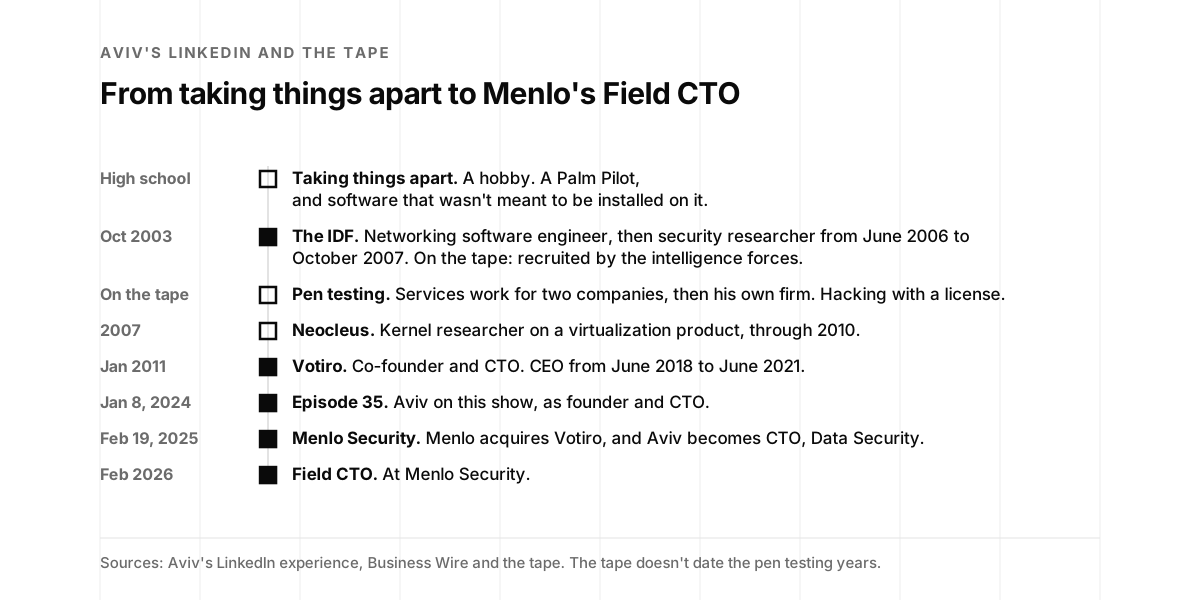
A timeline. High school: taking things apart, a hobby, a Palm Pilot, and software that wasn't meant to be installed on it. October 2003, filled: the IDF, networking software engineer, then security researcher from June 2006 to October 2007, and on the tape he was recruited by the intelligence forces. On the tape: pen testing, services work for two companies, then his own firm, hacking with a license. 2007: Neocleus, kernel researcher on a virtualization product, through 2010. January 2011, filled: Votiro, co-founder and CTO, and CEO from June 2018 to June 2021. January 8, 2024, filled: episode 35, Aviv on this show as founder and CTO. February 19, 2025, filled: Menlo acquires Votiro, and Aviv becomes CTO, Data Security. February 2026, filled: Field CTO at Menlo Security.
Aviv's path, from the tape and from his LinkedIn. Sources: the episode, LinkedIn and Business Wire.

Hacking with a license

After the army, he kept going on the attacking side.

“After I graduated from the army service, I was continuing to do some pen testing work, like services work, for a lot of companies.”

Aviv Grafi, at 2:05

He worked for two companies and then started his own services firm. He traveled to meet clients and interview their IT teams.

“And practically, that was a hacking with a license, showing them how vulnerable they are.”

Aviv Grafi, at 2:29

He said that’s where Votiro started to form. Wikipedia defines a penetration test as “an authorized simulated cyberattack on a computer system” (Wikipedia). Jon said a pen tester never has the same day twice, and creativity is front and center.

A Palm Pilot and a curiosity game

Aviv went back further, to how he first got under the hood. He asked whether Jon remembered the Palm Pilot.

“I do remember those things.”

Jon McLachlan, at 3:14

“There may be a few listeners that are googling what a Palm Pilot is.”

Jon McLachlan, at 3:21

For those listeners: the PalmPilot was a handheld electronic organizer from Palm, launched on March 10, 1997 (Wikipedia). Aviv had one as a teenager, and installed software on it that wasn’t meant to be installed on the device. He called it a curiosity game, and it led to security research.

“How do I get more stuff out of something?”

Aviv Grafi, at 3:51

He taught himself online in the early days of the internet, and he was the one who helped his friends, with computers and with getting things done. Jon had named creativity a minute earlier, and Aviv put curiosity next to it.

“the catalyst for a lot of the security research, at least I experienced.”

Aviv Grafi, at 4:15

“that’s actually what drives my passion.”

Aviv Grafi, at 4:20

The resume that worked every time

Jon asked what Votiro does, and what it does better than anyone else in the world. Aviv answered with a story from his pen testing years.

“And there was one thing that just worked for me”

Aviv Grafi, at 5:34

It worked every time.

He went to the client’s website. It could be a law firm, an insurance company or a utilities company. He looked at the open positions, and sent the recruiting department a PDF.

“something that looks like a resume, but actually that’s a weaponized PDF.”

Aviv Grafi, at 5:57

Listen · Aviv Grafi on episode 35, from 5:38
About 20 seconds: Aviv on the pen test trick that worked every time. The clip stops on its own. Read the full transcript.

The PDF went to the recruiting department with a short note about wanting to apply and knowing someone at the company. On the other side was a person whose job is to read resumes.

“they need to screen hundreds of those resumes a week.”

Aviv Grafi, at 6:18

“So when someone was opening that PDF, I was able to screen capture the screen, and that’s it.”

Aviv Grafi, at 6:21

In his February 2025 post on the acquisition, he told the same story about himself: a former pen tester who sent compromised resumes to HR departments (LinkedIn). On this site, Hiring Is Now an Attack Surface covers fake candidates, fake recruiters and laptop farms.
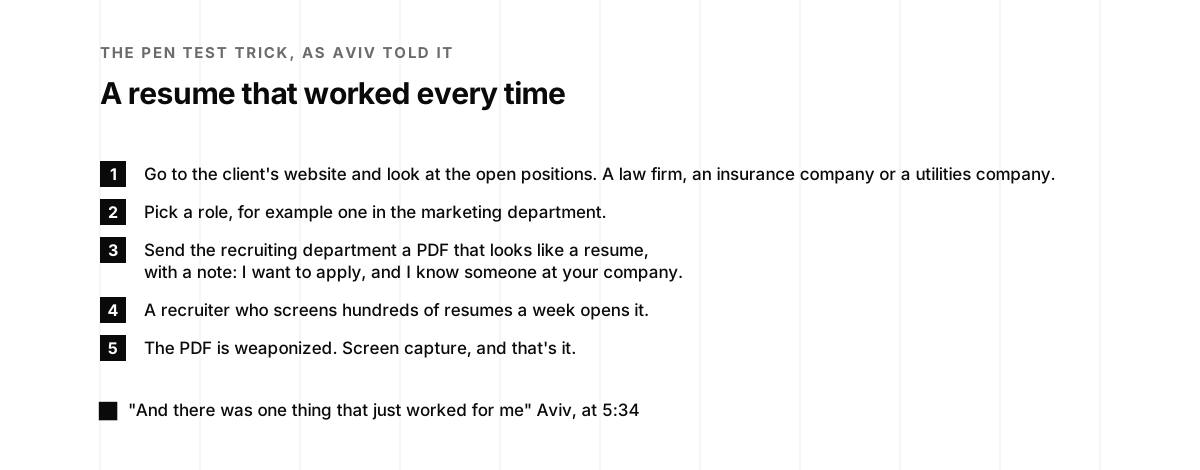
Five numbered steps. One: go to the client's website and look at the open positions, at a law firm, an insurance company or a utilities company. Two: pick a role, for example one in the marketing department. Three: send the recruiting department a PDF that looks like a resume, with a note saying I want to apply and I know someone at your company. Four: a recruiter who screens hundreds of resumes a week opens it. Five: the PDF is weaponized, a screen capture, and that's it. Below: "And there was one thing that just worked for me" Aviv, at 5:34
The pen test trick, step by step, as Aviv told it.

A fine balance

The trick taught him why it worked so well. There is, he said, a “fine balance between security and productivity.”

“you need to spot the phishing while you’re doing your job, which is, sometimes, it’s just impossible.”

Aviv Grafi, at 6:46

Wikipedia calls phishing “a form of social engineering and a scam,” in which attackers trick people into revealing sensitive information or installing malware (Wikipedia). Aviv said that 20 or 30 years of technology built to block malicious attachments still fails.

That’s when he understood there was room for something new.
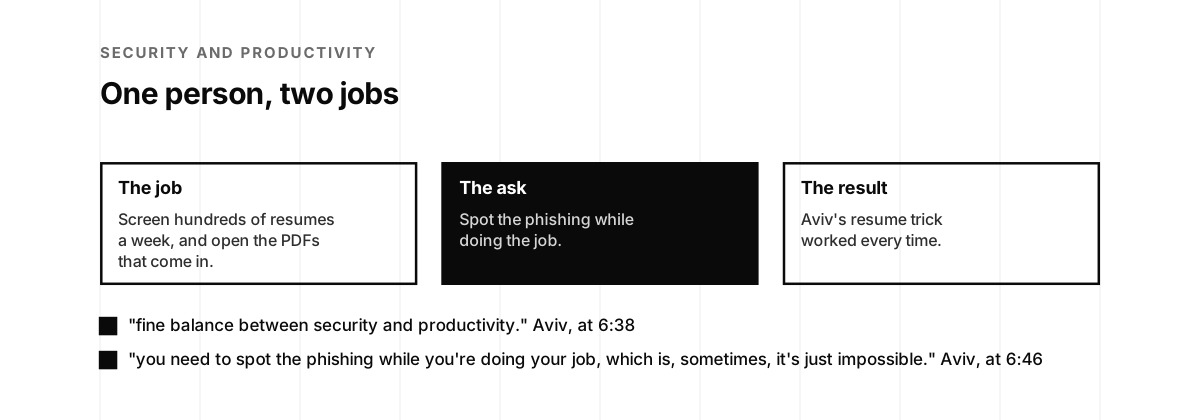
Three cards. The job: screen hundreds of resumes a week, and open the PDFs that come in. The ask, filled: spot the phishing while doing the job. The result: Aviv's resume trick worked every time. Below: "fine balance between security and productivity." Aviv, at 6:38. And: "you need to spot the phishing while you're doing your job, which is, sometimes, it's just impossible." Aviv, at 6:46
The job and the threat land on the same person. Source: the episode.

Flip the problem on its head

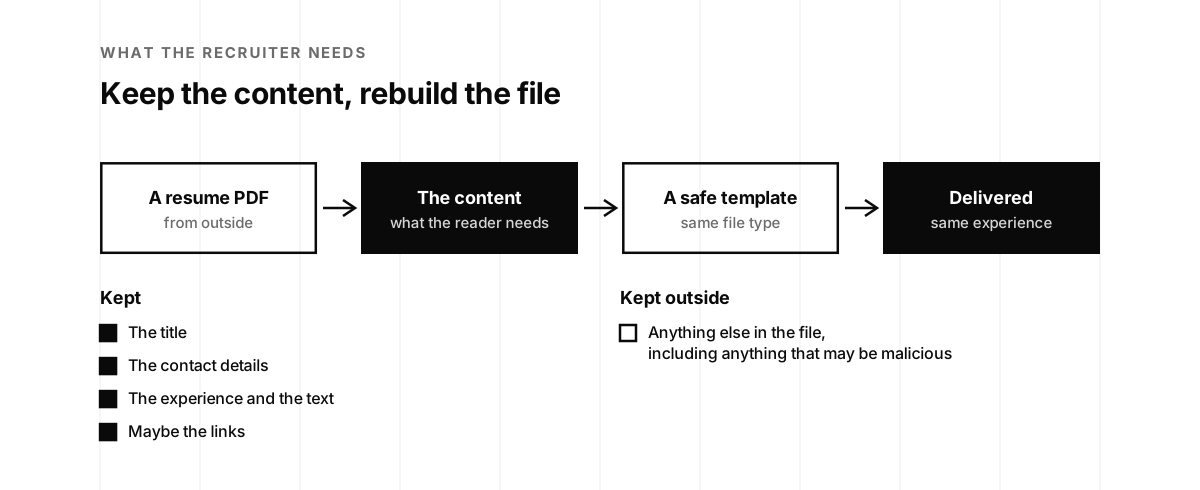
Here is where Votiro started. He didn’t want the recruiter deciding whether a PDF is suspicious. The recruiter, he said, is “interested in the content of that document.”

What the recruiter needs is the title, the contact details, the experience, the text and maybe the links.

“So if I’m taking all that content and just move that to a safe template of the exact same file type”

Aviv Grafi, at 7:48

Deliver that, and the recruiter gets the exact same experience, without anything that may be malicious in it.

Anything else in the file stays outside. Trying to find the bad stuff, he said, is impossible. He said that’s what Votiro does better than anyone else in the industry, because the rest of the industry relies on history to predict the future. Wikipedia calls the technique content disarm and reconstruction, “a computer security technology for removing potentially malicious code from files.” It doesn’t try to detect what malware does. It removes every part of a file that the policy doesn’t approve (Wikipedia). His LinkedIn names Votiro’s version Positive Selection, a patented technology that sanitizes every file before it reaches the user (LinkedIn).
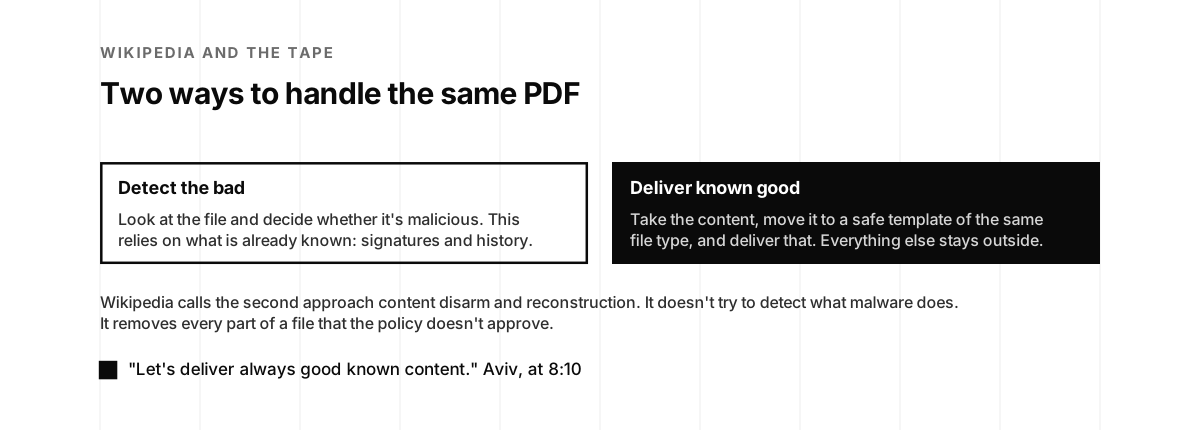
Two cards. Detect the bad: look at the file and decide whether it's malicious, which relies on what is already known, signatures and history. Deliver known good, filled: take the content, move it to a safe template of the same file type, and deliver that, and everything else stays outside. Below: Wikipedia calls the second approach content disarm and reconstruction. It doesn't try to detect what malware does. It removes every part of a file that the policy doesn't approve. Then: "Let's deliver always good known content." Aviv, at 8:10
Two ways to handle the same PDF. Sources: the episode and Wikipedia.
Four boxes joined by arrows. A resume PDF, from outside. The content, filled, what the reader needs. A safe template, same file type. Delivered, filled, same experience. Below, two lists. Kept: the title, the contact details, the experience and the text, and maybe the links. Kept outside: anything else in the file, including anything that may be malicious.
What the recruiter needs from a resume, and what stays outside. Source: the episode.

Take the good stuff

Jon liked how simple it is.

“You’re just going to take the good stuff and leave everything else, and you don’t have to worry about identifying specific patterns of malicious behavior or code or snippets or Metasploits or whatever.”

Jon McLachlan, at 8:30

When Votiro started, most files came in over email and web downloads. That changed. The list Aviv gave next included Box, Dropbox, OneDrive and SharePoint, and Votiro had to support every one of those sources. Then he said what he tells his own people.

“open any document you get from outside. Just open it.”

Aviv Grafi, at 9:16

“Even if you think that it’s malicious, just open it, because it’s completely safe.”

Aviv Grafi, at 9:19

Don’t blame the victim

Aviv guessed that Jon runs phishing training too.

“Oh, yeah.”

Jon McLachlan, at 9:46

Aviv described the email people get after they click.

“Oh, you clicked the wrong link. Now you need to do kind of a crash course on something.”

Aviv Grafi, at 9:52

“Yeah, it killed me to blame the victim.”

Jon McLachlan, at 9:57

Aviv agreed. You can’t “throw all that responsibility on the victim,” he said.

Listen · Aviv Grafi on episode 35, from 9:37
About 30 seconds: Aviv and Jon on phishing training that blames the person who clicked. The clip stops on its own. Read the full transcript.

Then he admitted he would fall for it himself. If an email said there was a problem wiring his paycheck this month, he would open the attached form and fill it in, because he wants his paycheck. Jon put it plainly: you want to get paid.

You can’t tell employees to think twice before they do their jobs, he said.

“And I think that’s what I would like to see more in the world, like more proactive protection rather than reactive.”

Aviv Grafi, at 10:37

Ganesh Krishnan of Anzenna, the guest the month before on episode 34, called security awareness training broken. His answer was training in context, sent to the employee.
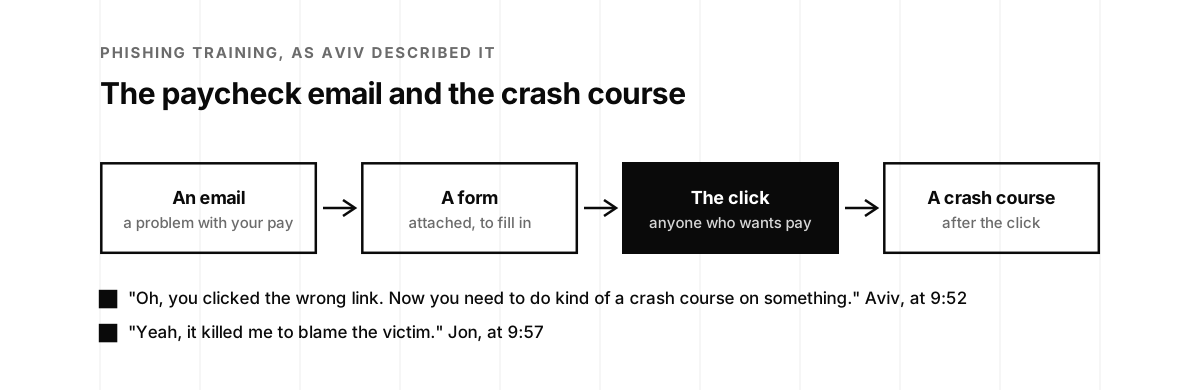
Four boxes joined by arrows. An email, a problem with your pay. A form, attached, to fill in. The click, filled, anyone who wants pay. A crash course, after the click. Below: "Oh, you clicked the wrong link. Now you need to do kind of a crash course on something." Aviv, at 9:52. And: "Yeah, it killed me to blame the victim." Jon, at 9:57
The paycheck email and the crash course that follows a click. Source: the episode.

One swoop

Jon came back to the idea. A rule that keeps only the content doesn’t care what the next exploit is.

“a very rich ecosystem of things that interpret documents.”

Jon McLachlan, at 11:08

“a nice way to cover all of that ground in one swoop.”

Jon McLachlan, at 11:16

Upload portals

Aviv added a source nobody planned for. After COVID, more companies went digital. Filing a health insurance claim now means uploading documents online.

“But now a lot of companies also now, you know, they might be attacked by those upload portals.”

Aviv Grafi, at 11:50

“And I was talking with pen testers. They said they love it, because that’s the easiest way to get in.”

Aviv Grafi, at 12:12

“Just send something through that upload portal of a company, and bam, you’re in, because no one suspects that.”

Aviv Grafi, at 12:18

Listen · Aviv Grafi on episode 35, from 12:11
About 30 seconds: Aviv on why pen testers love upload portals. The clip stops on its own. Read the full transcript.

“But no one told us, don’t open attachments or documents from the system that you’re working on every day, which doesn’t look like email.”

Aviv Grafi, at 12:30
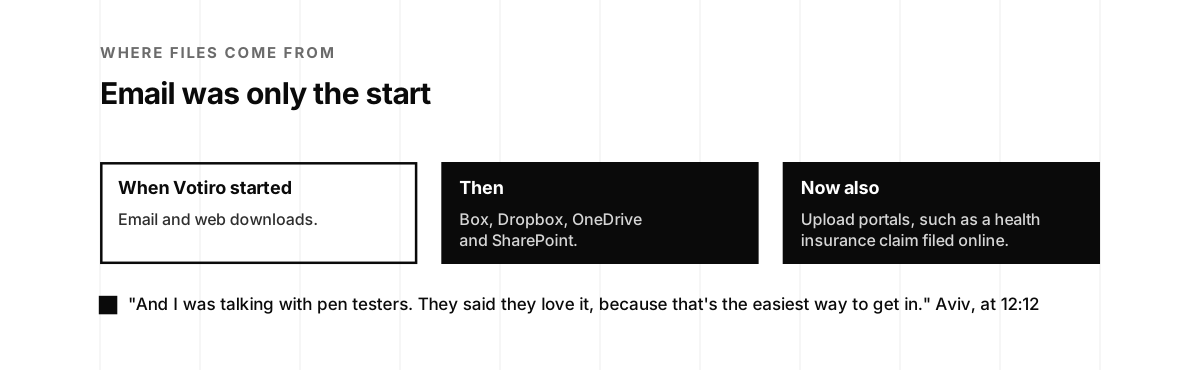
Three cards. When Votiro started: email and web downloads. Then, filled: Box, Dropbox, OneDrive and SharePoint. Now also, filled: upload portals, such as a health insurance claim filed online. Below: "And I was talking with pen testers. They said they love it, because that's the easiest way to get in." Aviv, at 12:12
Where files came from when Votiro started, and where they come from now. Source: the episode.

Always one step behind

Jon said he understood why Aviv started Votiro: he saw the opportunity, used it firsthand as a pen tester, and felt an obligation to solve it for everybody. Aviv said he couldn’t find a decent solution. The tools on the market look at what happened in the past and try to predict the future. They all rely on signatures, he said.

“What they know, that’s what they can detect.”

Aviv Grafi, at 13:15

Machine learning didn’t change that for him, because a model is only as good as the data it was trained on. He called that a problem, because “the bad guys would always be one step ahead.” So he chose not to “participate in that cat and mouse game.”

Listen · Aviv Grafi on episode 35, from 13:07
About 35 seconds: Aviv on why tools that learn from history stay behind. The clip stops on its own. Read the full transcript.

His answer was to turn the problem on its head.

“I want to get the good stuff.”

Aviv Grafi, at 13:49

Wikipedia describes antivirus software as “software intended to prevent, detect, and remove malware,” and notes a shift in the industry toward signature-less approaches, including behavioral detection, machine learning and cloud-based file detection (Wikipedia). A zero-day is a vulnerability unknown to its developers or anyone who could mitigate it (Wikipedia).
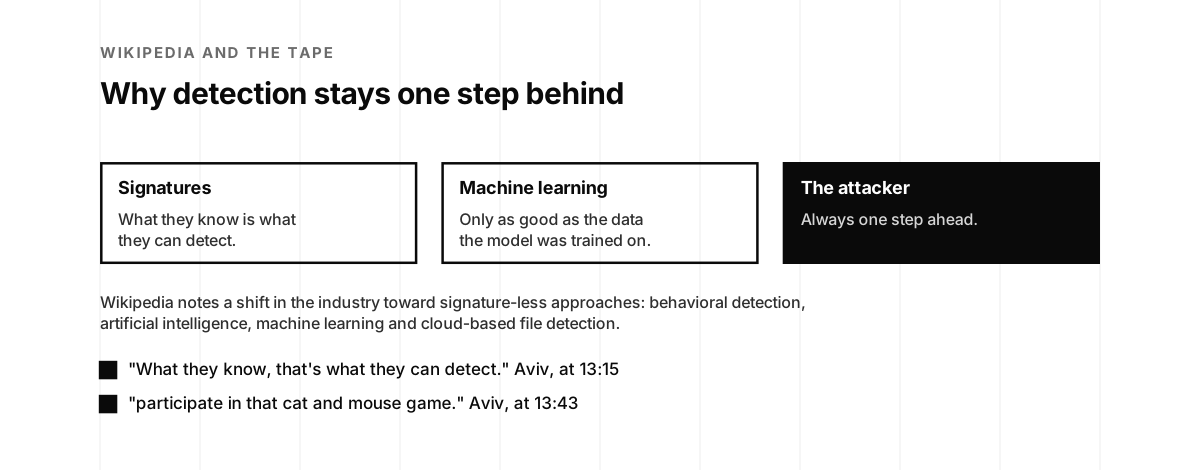
Three cards. Signatures: what they know is what they can detect. Machine learning: only as good as the data the model was trained on. The attacker, filled: always one step ahead. Below: Wikipedia notes a shift in the industry toward signature-less approaches: behavioral detection, artificial intelligence, machine learning and cloud-based file detection. Then: "What they know, that's what they can detect." Aviv, at 13:15. And: "participate in that cat and mouse game." Aviv, at 13:43
Detection learns from the past. Aviv's approach doesn't need to. Sources: the episode and Wikipedia.

An API in minutes

Jon asked about go-to-market. Top-down or bottom-up? Could he sign up and integrate it in one day? Aviv said Votiro started out tied to one or two sources, like email.

“a couple of years ago, when we moved to offer that as a cloud service, we opened that as an open API approach.”

Aviv Grafi, at 14:20

“So as long as you can code in any language, you can connect your business application”

Aviv Grafi, at 14:26

“So that’s pretty easy, like, in minutes to integrate if using the cloud service.”

Aviv Grafi, at 14:42

Listen · Aviv Grafi on episode 35, from 14:21
About 20 seconds: Aviv on Votiro's open API. The clip stops on its own. Read the full transcript.

Security-savvy organizations that want it on-prem could have that version. More and more customers were moving to the cloud API, and often a technical team or an architect found it first. So adoption usually ran bottom-up, he said.

Avery Pennarun described Tailscale’s bottom-up adoption on episode 42.
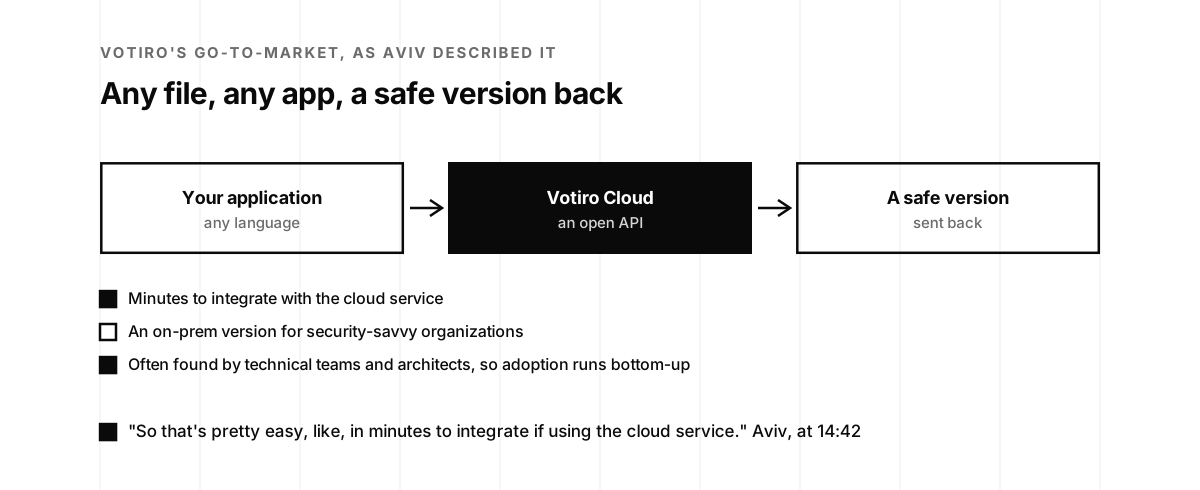
Three boxes joined by arrows. Your application, any language. Votiro Cloud, filled, an open API. A safe version, sent back. Below, a list: minutes to integrate with the cloud service, filled. An on-prem version for security-savvy organizations. Often found by technical teams and architects, so adoption runs bottom-up, filled. Then: "So that's pretty easy, like, in minutes to integrate if using the cloud service." Aviv, at 14:42
How a file moves through the cloud API, and the on-prem option. Source: the episode.

The best day

Jon asked for the best day so far. Aviv said there wasn’t one best day. There were a lot of great days, and a great day is when a customer or design partner says a feature, or the direction of the product, is exactly what they wanted.

Jon said none of the technology matters unless it improves people’s lives.

“Yeah, I am a firm believer that at the end of the day, we can build all of this technology and have all of these products out there and an ecosystem of stuff, but unless we’re actually improving and changing our fellow humans’ lives for the better”

Jon McLachlan, at 16:17

Aviv listed the feedback he likes to hear. Saving a customer money is fine. Better is a customer who says “You saved me a lot of time,” and best is this one:

“That’s exactly what I was looking for”

Aviv Grafi, at 17:00

Safe first, details later

Jon asked whether Votiro can tell a customer that a document had something malicious in it. Aviv said it couldn’t at first. Customers could open everything without thinking twice, and Votiro added analytics and threat intelligence on top.

“we actually scan those documents days or weeks after they’ve been delivered, with some best-in-class detection solutions in the market”

Aviv Grafi, at 17:40

Those detection tools take days to catch up. Because the safe version went out first, the original can wait for them. A week later, the customer can hear that a resume they got was malicious, and that they were safe.

Listen · Aviv Grafi on episode 35, from 17:40
About 35 seconds: Aviv on rescanning the originals after the safe version went out. The clip stops on its own. Read the full transcript.

“And the good thing is that we don’t need to panic the SOC team.”

Aviv Grafi, at 18:17

The SOC still wants to know, he said, and it can learn that a resume was malicious without a scramble to remediate.

Jon raised a question the rescan leaves open: was it intentional, or was there malware on the sender’s machine that slipped something into emails they sent?
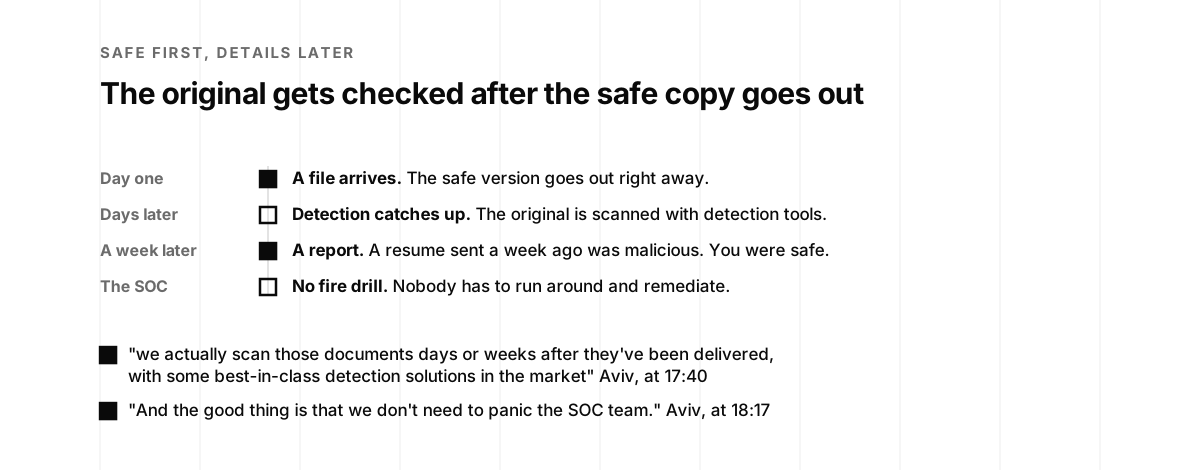
A timeline. Day one, filled: a file arrives, and the safe version goes out right away. Days later: detection catches up, and the original is scanned with detection tools. A week later, filled: a report, a resume sent a week ago was malicious, and you were safe. The SOC: no fire drill, nobody has to run around and remediate. Below: "we actually scan those documents days or weeks after they've been delivered, with some best-in-class detection solutions in the market" Aviv, at 17:40. And: "And the good thing is that we don't need to panic the SOC team." Aviv, at 18:17
The safe version goes out on day one. The original gets rescanned later. Source: the episode.

Inside and outside

Everything so far was about external documents coming in. Jon thought the same technology fit the internal threat. Aviv said customers use it that way, but less. Most internal threats, he said, are about information going out, not malicious files moving around. Jon pointed to rules that require it.

“a lot of verticals have regulatory requirements to handle certain types of insider threat.”

Jon McLachlan, at 19:29

Wikipedia defines an insider threat as one that comes “from people within the organization,” such as employees, former employees, contractors or business associates (Wikipedia). Business Wire describes Votiro’s data detection and response product as bringing simplicity to data loss prevention and data masking (Business Wire).

The worst day

Jon gave him a second to think about the worst day. Aviv said the worst day rarely looks that way weeks or months later. The tough days were about people.

“for example, I had the wrong hire”

Aviv Grafi, at 20:20

Or someone he thought would help make a change didn’t deliver, or there was a mismatch of values. Realizing he had to part ways with someone on the team was not a great day.

Listen · Aviv Grafi on episode 35, from 20:18
About 25 seconds: Aviv on the tough days as a founder. The clip stops on its own. Read the full transcript.

“Yeah, those can be challenging moments, a little bit of short-term pain, and maybe, for long-term, more happiness on both sides of the equation.”

Jon McLachlan, at 20:43

Aviv said he had learned the same thing.

“it’s happiness for both sides.”

Aviv Grafi, at 20:55

“I mean, customers and crises, there are always such things”

Aviv Grafi, at 21:04

Jon said he and Aviv share a focus on people, and that he tries to be intentional about long-term goals.

“And sometimes that requires a short term… not a compromise, but just overcoming the challenge.”

Jon McLachlan, at 21:58
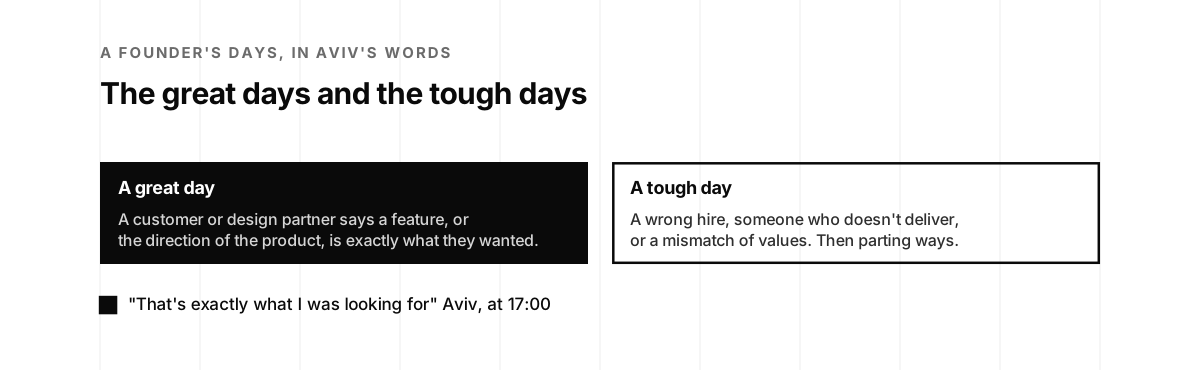
Two cards. A great day, filled: a customer or design partner says a feature, or the direction of the product, is exactly what they wanted. A tough day: a wrong hire, someone who doesn't deliver, or a mismatch of values, then parting ways. Below: "That's exactly what I was looking for" Aviv, at 17:00
The best days and the tough days, in Aviv's words. Source: the episode.

A North Star

Jon asked what success looks like. Aviv’s answer started with the approach. Success would be seeing this change spread across the industry:

“changing that paradigm of how we treat content”

Aviv Grafi, at 22:34

He named two forms success could take:

“either part of one of the big vendors or being the player actually designing that approach”

Aviv Grafi, at 22:49

Thirteen months after the episode aired, Menlo Security acquired Votiro. See What happened after the tape.

“success is all about adoption”

Jon McLachlan, at 23:08
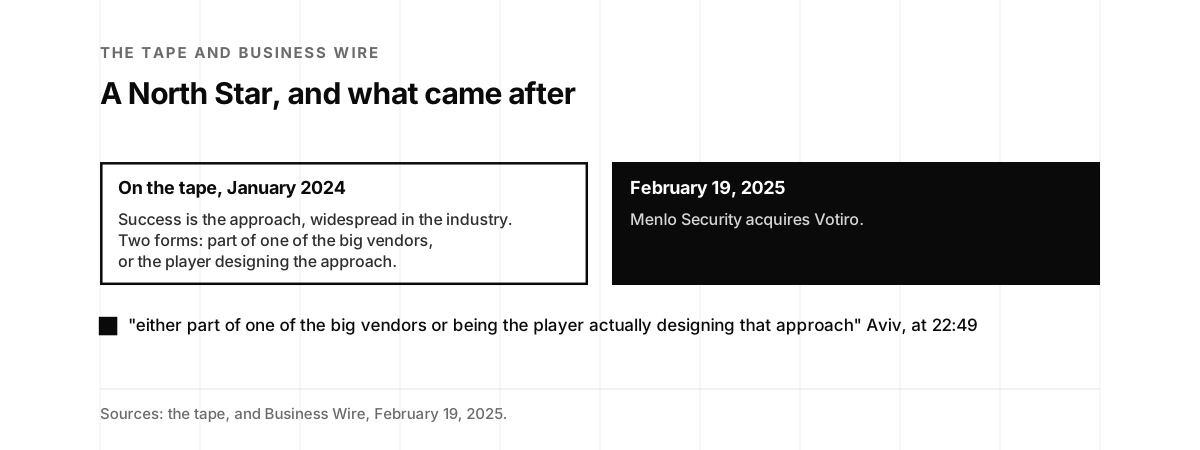
Two cards. On the tape, January 2024: success is the approach, widespread in the industry, in two forms, part of one of the big vendors, or the player designing the approach. February 19, 2025, filled: Menlo Security acquires Votiro. Below: "either part of one of the big vendors or being the player actually designing that approach" Aviv, at 22:49
Aviv's North Star on the tape, and what came after. Sources: the episode and Business Wire.

The good guy and the bad cop

Jon asked for a favorite interview question. Aviv heard it as a question he likes to be asked in interviews: the key takeaway for CISOs and security architects.

“as a CISO, you need to be the good guy”

Aviv Grafi, at 24:31

“And you need to think how you find solutions that enable the business”

Aviv Grafi, at 24:36

“I want to have enabling security and not restrictive security.”

Aviv Grafi, at 24:45

Listen · Aviv Grafi on episode 35, from 24:30
About 15 seconds: Aviv on the one thing he tells CISOs. The clip stops on its own. Read the full transcript.

He said he used to be the other kind himself.

“and I admit that I was part of that kind of approach”

Aviv Grafi, at 24:52

That meant stopping things, and policy that looks nice on paper and is a pain for the business. On this site, Stop Saying No covers the same habit for AI.
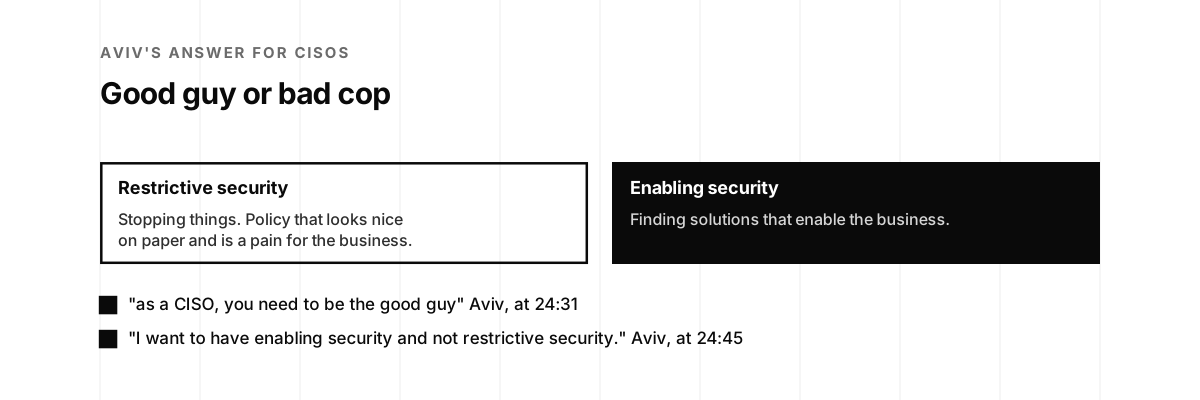
Two cards. Restrictive security: stopping things, and policy that looks nice on paper and is a pain for the business. Enabling security, filled: finding solutions that enable the business. Below: "as a CISO, you need to be the good guy" Aviv, at 24:31. And: "I want to have enabling security and not restrictive security." Aviv, at 24:45
Restrictive security and enabling security, side by side. Source: the episode.

Two types of security people

Jon said security done right is quiet and in the background, and getting there takes a lot of work behind the scenes.

“there’s really two types of security people in the world.”

Jon McLachlan, at 25:57

The first type walks into a meeting room and the room thinks “Oh, no.” They’ll be told what they can’t do, and handed strange new standards to implement.

“And then there’s another type of security person.”

Jon McLachlan, at 26:22

The second type walks into the same room with the same security goals, and is seen as an ally who helps the team ship on a tight deadline.

Listen · Jon McLachlan on episode 35, from 26:22
About 25 seconds: Jon on the security person the room is glad to see. The clip stops on its own. Read the full transcript.

“collaborative instead of prescriptive.”

Jon McLachlan, at 26:49

“That’s exactly right.”

Aviv Grafi, at 26:52

When security is collaborative, Jon said, people come and ask about it, in a playful and learning way. Jon told the same story a month earlier to Ganesh Krishnan on episode 34.
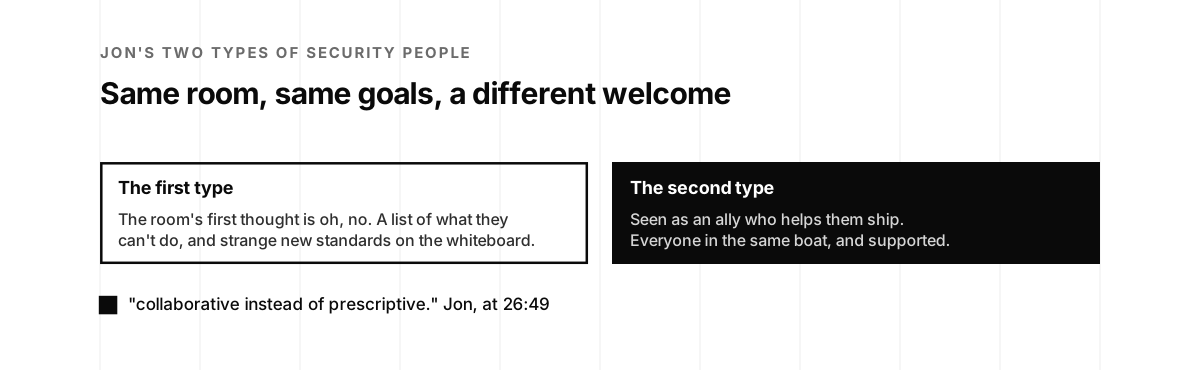
Two cards. The first type: the room's first thought is oh, no, a list of what they can't do, and strange new standards on the whiteboard. The second type, filled: seen as an ally who helps them ship, everyone in the same boat, and supported. Below: "collaborative instead of prescriptive." Jon, at 26:49
Jon's two types of security people. Source: the episode.

The password-protected question

Aviv has a question that tells him what kind of security leader he’s talking to.

“what is your security policy regarding password-protected documents on the way in?”

Aviv Grafi, at 27:40

“Are you blocking all those password-protected documents altogether, or are we just allowing them to go in, no matter what there is in them?”

Aviv Grafi, at 27:45

Listen · Aviv Grafi on episode 35, from 27:26
About 35 seconds: Aviv's one question for a security leader. The clip stops on its own. Read the full transcript.

Jon asked what the strict side says. The strict leader can’t be sure the file is safe, so he blocks every password-protected document. From a business view, Aviv said, that’s horrible: a lot of documents arrive password-protected today, even for privacy reasons, and his customers asked for a solution. The other side lets them all in, without knowing a solution exists.

“and I prefer not to impact the business”

Aviv Grafi, at 28:56

In May 2021, he posted that Positive Selection had stopped a zero-day attack delivered in a zipped, password-protected file (LinkedIn).
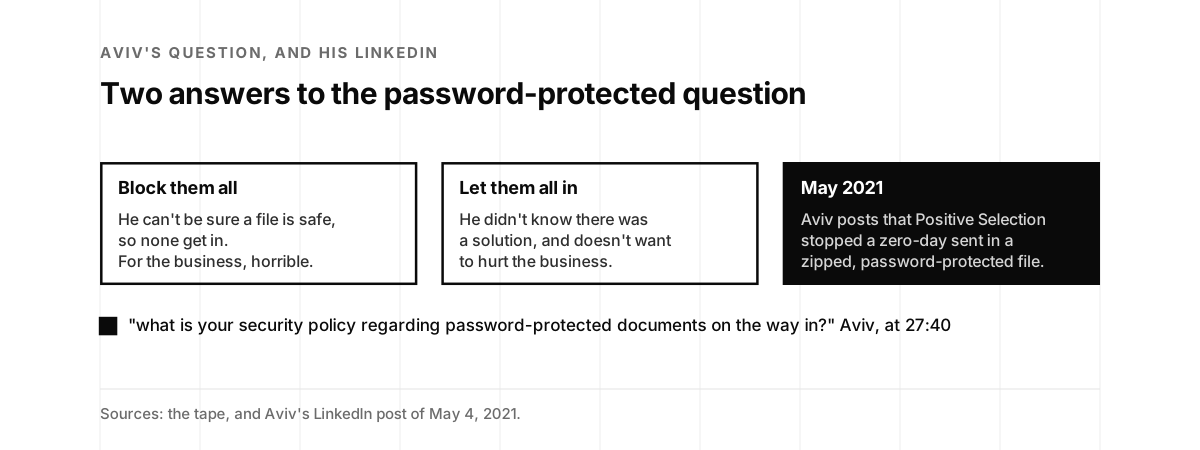
Three cards. Block them all: he can't be sure a file is safe, so none get in, and for the business, horrible. Let them all in: he didn't know there was a solution, and doesn't want to hurt the business. May 2021, filled: Aviv posts that Positive Selection stopped a zero-day sent in a zipped, password-protected file. Below: "what is your security policy regarding password-protected documents on the way in?" Aviv, at 27:40
Two answers to Aviv's question, and what each costs. Sources: the episode and his LinkedIn.

No business at all

Jon pulled the thread to money.

“At the end of the day, a business has to balance its books and enable growth and all of these things.”

Jon McLachlan, at 29:04

Jon said he believes security can be positioned as “an advocate and a top-end enabler of new growth for a business.”

“That’s right. I agree.”

Aviv Grafi, at 29:22

Aviv took the strict answer to its end.

“just let’s disconnect all systems from the internet”

Aviv Grafi, at 29:31

Then you would have no business at all.

Jon’s reply was a joke about the CIA. In security, the CIA triad is confidentiality, integrity and availability, and Wikipedia adds that information security protects them “without hampering organization productivity” (Wikipedia).

The hard thing about hard things

Jon asked what book or movie Aviv would hand his younger self.

“there is a book called The Hard Things About the Hard Things.”

Aviv Grafi, at 30:20

The book is The Hard Thing About Hard Things: Building a Business When There Are No Easy Answers, by Ben Horowitz, the co-founder of the venture capital firm Andreessen Horowitz and the former CEO of Opsware (Wikipedia).

“So I think what I liked about that book is that it’s really based on real experience.”

Aviv Grafi, at 30:26

“It’s not a model.”

Aviv Grafi, at 30:32

“because it’s based on real things that usually they’re not being described in those textbooks.”

Aviv Grafi, at 30:43

He liked that it reads like a series of short blog posts.

The highs and the lows

Then the advice for his younger self.

“I mean, the highs are not that high, and the lows are not that low.”

Aviv Grafi, at 30:58

Listen · Aviv Grafi on episode 35, from 30:52
About 25 seconds: Aviv's advice to his younger self. The clip stops on its own. Read the full transcript.

The rest of the advice was not to take any of it too seriously. He said that’s what experience teaches.

“I love that advice for your younger self.”

Jon McLachlan, at 31:20

Jon answered with a line he credits to Oscar Wilde, that life is too important to be taken so seriously all the time.

“when we’re at those peaks and those mountains, well, it’s like, yeah, it’s temporary.”

Jon McLachlan, at 31:53

The troughs, where it feels like everything is collapsing, are temporary too.
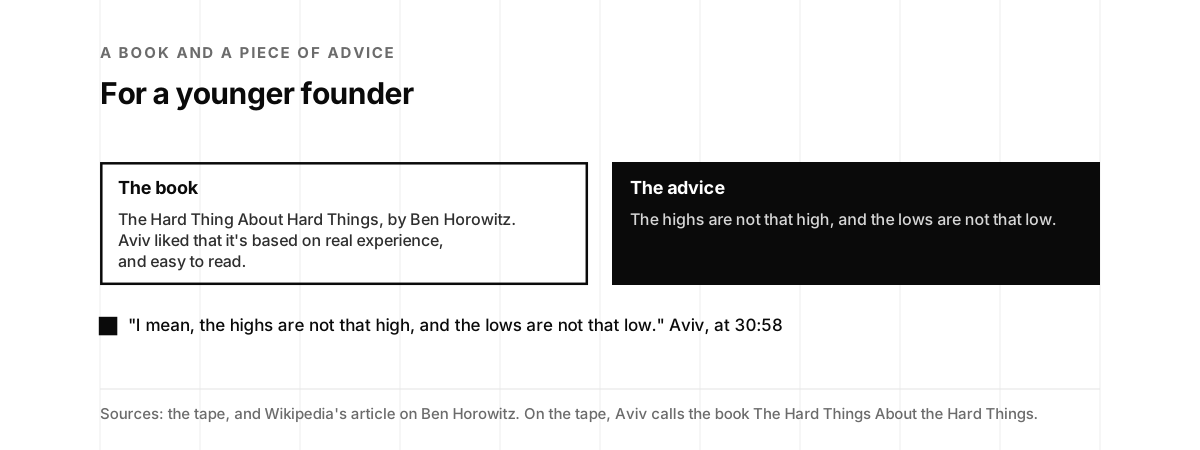
Two cards. The book: The Hard Thing About Hard Things, by Ben Horowitz, and Aviv liked that it's based on real experience, and easy to read. The advice, filled: the highs are not that high, and the lows are not that low. Below: "I mean, the highs are not that high, and the lows are not that low." Aviv, at 30:58
A book and a piece of advice for a younger founder. Sources: the episode and Wikipedia.

Reading minds remotely

Jon asked a playful question for the entrepreneurs listening: what problem does Aviv keep running into that someone else should go solve? Aviv’s first answer was an AI model he could chat with, and he said that already exists.

His real answer was a way to read people’s minds.

He would tap a button over Zoom, and that’s it.

“Okay, that’s a magical technology.”

Jon McLachlan, at 33:39

Jon guessed it would use AI to read our information leakage: facial expressions, the way we say things, and “the micro gaps between words.”

“That’s the new feature for a ChatGPT thing.”

Aviv Grafi, at 34:00

They both said they were joking.

“There must be, like, a Black Mirror episode on that.”

Jon McLachlan, at 34:15

Black Mirror is a British anthology television series created by Charlie Brooker, mostly set in near-future dystopias (Wikipedia).

Two final words

Jon asked for final words of wisdom. Aviv gave two. The first was to look for enabling security over restrictive security.

“And of course, don’t take life too seriously.”

Aviv Grafi, at 34:53

What happened after the tape

Menlo Security bought Votiro. On February 19, 2025, Menlo Security announced that it had acquired Votiro. Business Wire describes Votiro as specializing in “advanced Content Disarm & Reconstruction (CDR) and data loss prevention,” and Menlo as protecting organizations “from cyber threats that attack web browsers” (Business Wire). The two had partnered four years earlier, in February 2021, on safe downloads from the web (LinkedIn). On the tape, being part of one of the big vendors was one of the two forms of success Aviv named.

Aviv’s post. The same day, Aviv wrote that he had co-founded Votiro 14 years earlier “to make file security effortless and foolproof.” He told the resume story again, and wrote that Votiro had processed over 10 billion files.

Aviv on Menlo Security's acquisition of Votiro, 14 years after he co-founded it.

Aviv Grafi · February 19, 2025
His post on the acquisition, with Votiro's announcement under it. View on LinkedIn.

Inside Menlo. His LinkedIn lists him as CTO, Data Security at Menlo from February 2025 to January 2026, where he led the integration of Votiro into Menlo’s offerings. Since February 2026 he has been Menlo’s Field CTO, working between customers, field teams and product (LinkedIn).

More on this show. Browser security, Menlo’s business, comes up often on this show. Or Eshed of LayerX explained how browser security became the new battleground for enterprise AI on episode 98, and Vivek Ramachandran of SquareX argued that web security belongs in the browser on episode 49. On the blog, Enterprise Browser Security explains why the browser became the control point, and Pentest Once a Year? covers what enterprise buyers expect from a penetration test.
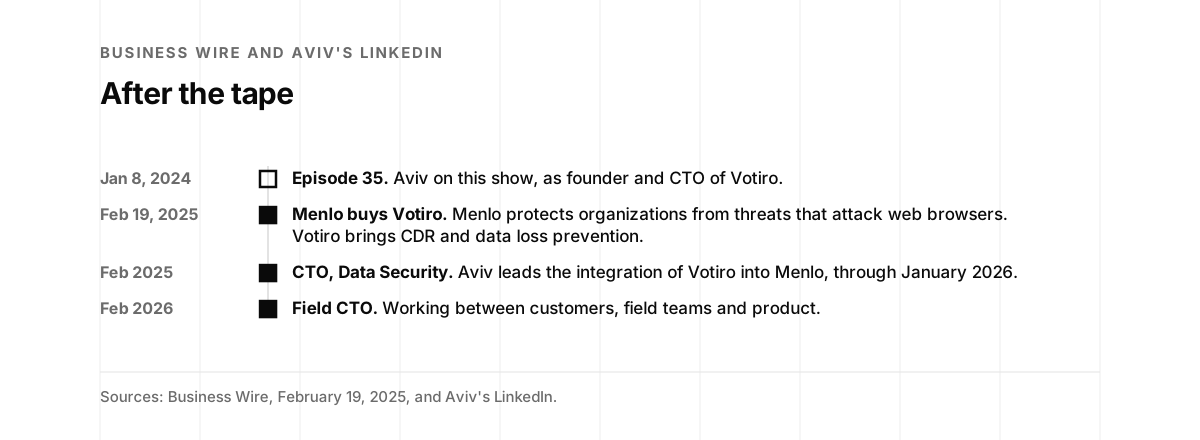
A timeline. January 8, 2024: episode 35, Aviv on this show as founder and CTO of Votiro. February 19, 2025, filled: Menlo buys Votiro, as Menlo protects organizations from threats that attack web browsers and Votiro brings CDR and data loss prevention. February 2025, filled: CTO, Data Security, as Aviv leads the integration of Votiro into Menlo, through January 2026. February 2026, filled: Field CTO, working between customers, field teams and product.
After the tape, from the acquisition to Field CTO. Sources: Business Wire and Aviv's LinkedIn.

Did you catch it? A seven-question quiz

Seven questions from the episode. Each answer links the moment in the transcript.

Quiz · seven questions

Did you catch it?

Pick an answer to see whether you caught it.

  1. What did Aviv send to recruiting departments in his pen tests?

    b. "something that looks like a resume, but actually that's a weaponized PDF." It worked every time. Transcript, 5:57.

  2. What does Votiro do with a file, in place of judging whether it's bad?

    a. "So if I'm taking all that content and just move that to a safe template of the exact same file type" Transcript, 7:48.

  3. Why do pen testers love upload portals, according to Aviv?

    c. "Just send something through that upload portal of a company, and bam, you're in, because no one suspects that." Transcript, 12:18.

  4. What does Aviv say the detection tools rely on?

    b. "What they know, that's what they can detect." Transcript, 13:15.

  5. What happens to the original file after Votiro delivers the safe version?

    a. "we actually scan those documents days or weeks after they've been delivered, with some best-in-class detection solutions in the market" Transcript, 17:40.

  6. What's the question Aviv asks to learn a security leader's approach?

    c. "what is your security policy regarding password-protected documents on the way in?" Transcript, 27:40.

  7. What does Aviv say a CISO needs to be?

    b. "as a CISO, you need to be the good guy" Transcript, 24:31.

Is your security enabling or restrictive?

Eight questions on how files from outside reach your people, and how the rest of the company sees your security team. Each tip quotes the tape or paraphrases it, and links its section.

Scorecard · eight questions

Is your security enabling or restrictive?

Answer for your company as it runs today. If two answers fit, pick the lower one.

  1. What happens to a file from outside before someone opens it?

    • Nothing. People decide whether it looks safe
    • It's scanned for known threats
    • Its content is rebuilt into a safe copy first

    "Let's deliver always good known content." See Flip the problem on its head.

  2. What do you do with password-protected files on the way in?

    • Block them all, or let them all in
    • Someone opens them by hand
    • We open them safely and deliver a safe copy

    Aviv asks this question to learn a leader's approach. See The password-protected question.

  3. Are your upload portals and forms that take customer files covered?

    • No
    • Some of them
    • All of them

    Pen testers told Aviv an upload portal is the easiest way in. See Upload portals.

  4. Which ways in do you cover: email, web downloads, file-sharing tools?

    • Email only
    • Email and web downloads
    • Every way files reach us

    Box, Dropbox, OneDrive and SharePoint came after email. See Take the good stuff.

  5. What happens after someone clicks in a phishing test?

    • A crash course and a warning
    • A short explainer
    • We also fix what let the email through

    "throw all that responsibility on the victim." See Don't blame the victim.

  6. Do you rescan delivered files once detection catches up?

    • No
    • Sometimes, by hand
    • Yes, and the SOC gets a report

    "And the good thing is that we don't need to panic the SOC team." See Safe first, details later.

  7. When security joins a planning meeting, what does the room expect?

    • A list of what they can't do
    • It depends on who comes
    • Help shipping on the deadline

    "collaborative instead of prescriptive." See Two types of security people.

  8. Do teams bring security questions to you before you ask?

    • Rarely
    • Some teams
    • Most teams

    When security is collaborative, Jon said, people come and ask. See Two types of security people.

The bad cop

Your people decide what's safe, and security says no. Start with what files from outside go through before anyone opens them, and ask Aviv's password-protected question about your own policy.

Halfway there

Email is covered. Next, cover upload portals and file-sharing tools, rescan what you delivered, and stop phishing training at the click.

The good guy

Your security enables the business. Keep checking new ways files get in, and keep the room glad to see you.

What does blocking password-protected files cost?

Aviv called blocking every password-protected file horrible for the business. This calculator puts hours on it.

Calculator

What does blocking password-protected files cost?

Three numbers: how many password-protected files you block in a week, the minutes of work each blocked file costs someone, and your working weeks in a year.

16.7hours lost a week
800hours lost a year
20.040-hour weeks a year

Blocking 50 files a week at 20 minutes each costs 16.7 hours a week, 800 hours a year, or 20.0 forty-hour weeks.

Every default here is a placeholder: put in your own numbers. The minutes are for whoever chases a blocked file: the person waiting on it, the sender asked to send it another way, and IT if a ticket gets opened. Letting them all in costs no hours on this calculator. That's the other answer Aviv hears, from leaders who didn't know there was a solution.

From 8200 to Menlo

Aviv’s path, Votiro’s, Menlo’s, and the episodes on this site that pick up the thread. Filter by topic.

Timeline

From 8200 to Menlo

  1. The PalmPilot

    Palm launches the handheld. Aviv had one as a teenager and installed software on it that wasn't meant for it (Wikipedia, on this page).

  2. The IDF

    Embedded real-time networking software engineer, then senior high-performance networking software engineer (LinkedIn, on this page).

  3. Security researcher

    In the IDF, through October 2007 (LinkedIn).

  4. Neocleus

    Kernel researcher on a virtualization product, through 2010 (LinkedIn).

  5. Votiro

    Aviv co-founds it and becomes CTO (LinkedIn, on this page).

  6. CEO

    Aviv runs Votiro through June 2021, with offices in the U.S., Australia, Israel and Singapore (LinkedIn).

  7. Entrepreneurs' Organization

    He joins as a member, and LinkedIn lists him as a board member. EO was founded in 1987 as the Young Entrepreneurs' Organization (Wikipedia, LinkedIn).

  8. A partnership

    Menlo Security and Votiro team up on safe downloads from the web (LinkedIn).

  9. Measuring invisibility

    Aviv shares a post by Votiro's head of product, Alon Blum, on measuring how invisible the product is (LinkedIn).

  10. Risky Business

    Aviv on the Risky Biz podcast, alongside GreyNoise and MergeBase (LinkedIn).

  11. A zero-day in a locked zip

    Positive Selection stops a zero-day attack sent in a zipped, password-protected file (LinkedIn, on this page).

  12. Secure File Gateway for Web Browser

    Votiro launches it, for downloading files from the web (LinkedIn).

  13. Capture the CISO

    Votiro and Aviv win the first season of the CISO Series show (LinkedIn).

  14. Defense in Depth

    Aviv on managing the onslaught of files, with Steve Zalewski and David Spark (LinkedIn).

  15. $11.5 million

    A Series A led by Harvest Lane Asset Management (SecurityWeek).

  16. Episode 34

    Ganesh Krishnan of Anzenna on why security awareness training is broken (episode page).

  17. Episode 35

    Aviv on the show (Podbean, transcript).

  18. Episode 42

    Avery Pennarun on Tailscale's bottom-up adoption (episode page).

  19. Episode 49

    Vivek Ramachandran on why web security belongs in the browser (episode page).

  20. Menlo buys Votiro

    Menlo Security acquires Votiro (Business Wire, on this page).

  21. CTO, Data Security

    Aviv leads the integration of Votiro into Menlo, through January 2026 (LinkedIn).

  22. Episode 67

    Gadi Bashvitz of Bright Security, another 8200 alumnus (episode page).

  23. Field CTO

    Aviv becomes Menlo's Field CTO (LinkedIn).

  24. Episode 98

    Or Eshed of LayerX on browser security (episode page).

What to do this week

Five things, in the order of the episode.

  1. Map every way files get in. List email, web downloads, file-sharing tools and every upload portal, as in Take the good stuff and Upload portals. Then take the scorecard.
  2. Fix what let the email through. If your phishing training ends with a crash course for the person who clicked, look at the system too, as in Don’t blame the victim.
  3. Rescan what you delivered. Run delivered files through detection again once it catches up, and decide how the SOC hears about it, as in Safe first, details later.
  4. Ask Aviv’s question. Ask your own team what happens to password-protected files on the way in, as in The password-protected question, and put hours on the answer with the calculator.
  5. Try the resume trick on yourself. Our Penetration Testing covers application, cloud, AI systems and physical access. Our 24/7 Monitoring & Response watches cloud, network, endpoints and mobile, with hands-on triage. If you want to talk it through, book 15 minutes with us.

Key takeaways

  1. Deliver known good content

    Votiro takes the content a reader needs from a file, moves it to a safe template of the same file type, and delivers that. Anything else in the file stays outside.

  2. A resume worked every time

    As a pen tester, Aviv sent recruiting departments a weaponized PDF that looked like a resume. Someone whose job is to read hundreds of resumes a week opened it.

  3. Security and productivity pull apart

    Asking people to spot phishing while they do their jobs is sometimes impossible, so the protection has to work without them.

  4. Don't blame the victim

    Phishing training that ends in a crash course puts the responsibility on the person who clicked. Aviv said he would open a paycheck form too.

  5. Detection stays one step behind

    Signatures and models trained on history detect what's already known, and attackers stay a step ahead.

  6. Upload portals are a way in

    Companies that take documents through upload portals open a channel nobody suspects. Pen testers told Aviv it's the easiest way in.

  7. Safe first, details later

    Votiro rescans the original files days or weeks after delivery, once detection catches up, so the SOC gets a report and no panic.

  8. Be the good guy

    Aviv's advice for CISOs is enabling security that finds solutions for the business. Restrictive security looks nice on paper and is a pain for the business.

  9. Ask about password-protected files

    Aviv asks leaders what happens to password-protected documents on the way in. Blocking them all is horrible for the business, and letting them all in skips the check.

Chapters

Tap a chapter to play from there.

Pull quotes

“Let's deliver always good known content.”

Aviv Grafi ·

“I was recruited by the intelligence forces”

Aviv Grafi ·

“And practically, that was a hacking with a license, showing them how vulnerable they are.”

Aviv Grafi ·

“How do I get more stuff out of something?”

Aviv Grafi ·

“And there was one thing that just worked for me”

Aviv Grafi ·

“something that looks like a resume, but actually that's a weaponized PDF.”

Aviv Grafi ·

“they need to screen hundreds of those resumes a week.”

Aviv Grafi ·

“fine balance between security and productivity.”

Aviv Grafi ·

“So if I'm taking all that content and just move that to a safe template of the exact same file type”

Aviv Grafi ·

“a very rich ecosystem of things that interpret documents.”

Jon McLachlan ·

“You're just going to take the good stuff and leave everything else”

Jon McLachlan ·

“Even if you think that it's malicious, just open it, because it's completely safe.”

Aviv Grafi ·

“Yeah, it killed me to blame the victim.”

Jon McLachlan ·

“throw all that responsibility on the victim.”

Aviv Grafi ·

“Just send something through that upload portal of a company, and bam, you're in, because no one suspects that.”

Aviv Grafi ·

“What they know, that's what they can detect.”

Aviv Grafi ·

“the bad guys would always be one step ahead.”

Aviv Grafi ·

“So that's pretty easy, like, in minutes to integrate if using the cloud service.”

Aviv Grafi ·

“That's exactly what I was looking for”

Aviv Grafi ·

“And the good thing is that we don't need to panic the SOC team.”

Aviv Grafi ·

“either part of one of the big vendors or being the player actually designing that approach”

Aviv Grafi ·

“as a CISO, you need to be the good guy”

Aviv Grafi ·

“I want to have enabling security and not restrictive security.”

Aviv Grafi ·

“collaborative instead of prescriptive.”

Jon McLachlan ·

“what is your security policy regarding password-protected documents on the way in?”

Aviv Grafi ·

“I mean, the highs are not that high, and the lows are not that low.”

Aviv Grafi ·

About the guest

Aviv Grafi, Founder and Chief Technology Officer, Votiro

Aviv Grafi is a security researcher and founder. His LinkedIn lists him in the Israel Defense Forces from October 2003 to October 2007, last as a security researcher, and as a kernel researcher at Neocleus from 2007 to 2010. On the episode, he said he was recruited by the intelligence forces during his military service, and did pen testing after the army. He co-founded Votiro in January 2011 and was its CTO, and its CEO from June 2018 to June 2021. He joined Jon McLachlan on episode 35, published January 8, 2024. Menlo Security acquired Votiro on February 19, 2025. His LinkedIn lists him as Menlo's CTO, Data Security, and as its Field CTO since February 2026.

About the host

Jon McLachlan is co-founder of YSecurity, the on-demand cybersecurity team for startups, and of Cyberbase.ai. The Security Podcast of Silicon Valley is hosted by Jon McLachlan and Sasha Sinkevich. Jon McLachlan on LinkedIn ↗

Context and sources

  • Episode 35 on Podbean, January 8, 2024, with show notes on Aviv's path from the IDF's 8200 unit, hacking and reverse engineering, and Votiro's approach to safe content. Source ↗
  • Aviv Grafi's LinkedIn experience: Field CTO at Menlo Security from February 2026, CTO, Data Security from February 2025, Votiro co-founder and CTO from January 2011 and CEO from June 2018 to June 2021, Neocleus from 2007 to 2010, and the IDF from October 2003 to October 2007. Source ↗
  • Aviv Grafi on LinkedIn, February 19, 2025: Menlo Security has acquired Votiro, founded 14 years earlier, and the resume story from his pen testing years. Source ↗
  • Business Wire, February 19, 2025: Menlo Security acquires Votiro, which specializes in content disarm and reconstruction and data loss prevention. Source ↗
  • Aviv Grafi on LinkedIn, February 22, 2021: Menlo Security and Votiro partner on safe downloads from the web. Source ↗
  • Aviv Grafi on LinkedIn, May 4, 2021: Positive Selection stopped a zero-day attack delivered in a zipped, password-protected file. Source ↗
  • SecurityWeek, March 31, 2023: Votiro raises an $11.5 million Series A led by Harvest Lane Asset Management. Source ↗
  • Wikipedia, Unit 8200: an Israeli Intelligence Corps unit of the Israel Defense Forces. Source ↗
  • Wikipedia, Content Disarm and Reconstruction: removing potentially malicious code from files, without detecting what the malware does. Source ↗
  • Wikipedia, Penetration test: an authorized simulated cyberattack on a computer system. Source ↗
  • Wikipedia, PalmPilot: a handheld electronic organizer from Palm, launched on March 10, 1997. Source ↗
  • Wikipedia, Phishing: a form of social engineering and a scam. Source ↗
  • Wikipedia, Antivirus software: software to prevent, detect and remove malware, and the shift toward signature-less approaches. Source ↗
  • Wikipedia, Zero-day vulnerability: a vulnerability unknown to its developers or anyone who could mitigate it. Source ↗
  • Wikipedia, Insider threat: a threat to an organization from people within it. Source ↗
  • Wikipedia, Information security: confidentiality, integrity and availability, the CIA triad. Source ↗
  • Wikipedia, Ben Horowitz: co-founder of Andreessen Horowitz and author of The Hard Thing About Hard Things. Source ↗
  • Wikipedia, Black Mirror: a British anthology television series created by Charlie Brooker. Source ↗
  • Wikipedia, Entrepreneurs' Organization: founded in 1987 as the Young Entrepreneurs' Organization. Source ↗

Transcript

Automatic transcription. Jon McLachlan hosts this episode with Aviv Grafi, founder and CTO of Votiro. There is no diarization on the tape, so speaker labels were assigned from the content and checked against reference recordings of each voice from this episode and by pitch, and a few short lines may sit with the wrong speaker. Names and terms were normalized where the recognizer misheard them (Jon McLachlan, Aviv Grafi, Votiro, IDF, Unit 8200, Palm Pilot, PDF, Metasploit, Box, Dropbox, OneDrive, SharePoint, API, CISO, SOC, ChatGPT). Words in [brackets] are best guesses where the audio is unclear. Answers are transcribed as spoken, with most repeated words and false starts kept. Short backchannels such as "yeah" and "right" are left out where they overlap the other speaker.

Read the full transcript 5,881 words

Jon McLachlan

Welcome, everyone, to another episode of the Security Podcast in Silicon Valley. I'm here today with a very [special] guest, Aviv Grafi, the founder and CTO of Votiro. Welcome to the show.

Aviv Grafi

Hey, Jon, thank you very much for having me here.

Jon McLachlan

It's a great pleasure to have you. You've been in security for a very long time. Before you were founder and CTO of Votiro, you did some research in very low-level security space. You also have experience as part of the IDF 8200 unit.

Aviv Grafi

That's right.

Jon McLachlan

Would you like to share with our listeners who maybe are less familiar with that, what that was?

Aviv Grafi

Yeah, so actually, let's start slightly before that, but I'm based in Tel Aviv, Israel. And one of the things that I was doing, probably since I was kind of a teenager in high school, probably, is I really, you know, have kind of a hobby to tear things apart. And when the internet came out, it was 19 something, 19 something, and I was trying to do that stuff online. And I mean, one thing led to another, and I was really interested in security and somewhere in hacking and in software. And I got to the point where I was a teenager in high school, and before graduating, there is, you know, kind of thing here in Israel: you need to do your three years' military service. And I was recruited, yeah, I was recruited by the intelligence forces to do some stuff with the license as part of the intelligence forces, mostly [the] defense and offense security operations. So that's mainly what [a] Unit 8200 is doing, actually, since then, on the last probably years.

Jon McLachlan

Amazing. So it's really difficult to get into the specifics, but it sounds like you were reverse engineering.

Aviv Grafi

Yeah, so I was doing a lot of [reverse] engineering when I was also in high school, and then it was a kind of natural thing for me to do right during my time in the military service. And actually, that's interesting. After I graduated from the army service, I was continuing to do some pen testing work, like services work, for a lot of companies. I worked for two companies, and then I did my own kind of services firm. And that was a really fun job for 20-something years old. You know, I was 24 years old, and I was traveling around the world, meeting clients and interviewing their IT teams. And practically, that was a hacking with a license, showing them how vulnerable they are. And for me, that was a pretty fun job. I think that was the point where I think I started to really form it, what today actually is called Votiro.

Jon McLachlan

That's spectacular. You know, as a pen tester, you never really have the same day twice. It's [thinking] on your feet, and creativity is front and center. I feel the passion and the love.

Aviv Grafi

Yeah. So, so as I mentioned, when I started to really get into understanding how things are really, you know, work under the hood, usually, even in computers, I had my own. Back then, I had my own, before it's called... Maybe I sound a bit old, but [did] we used to have a Palm Pilot? Remember those things?

Jon McLachlan

I do remember those things. That's... you're not old. We're not old yet. Okay, okay. There may be a few listeners that are googling what a Palm Pilot is.

Aviv Grafi

Yeah, so I had a Palm Pilot when I was a teenager, and I was starting to see how I can really, you know, use that hardware and software. And I installed some [indigenous] software that [is] not meant to be installed on those devices. That was purely kind of curiosity game. And really, I started to invest my time in doing some stuff, understanding how things are working. And that obviously led to security kind of research. How do I get more stuff out of something? Learning new stuff on my own, online, on the first days of the internet. Being kind of... I was the one helping my friends, and not just with, you know, with the computer, but also how to get things done. So I think that's where it all started. I think the curiosity thing, that's... and the creativity that you mentioned, I think that's the catalyst for a lot of the security research, at least I experienced. And that's actually what drives my passion. So this is a really good point.

Jon McLachlan

And today you're broadcasting from Tel Aviv as the founder and CTO of Votiro. And I'm really interested to learn more about Votiro, but I'm also kind of curious, did you grow up in that area?

Aviv Grafi

Yeah, I was born in Israel. I grew up around the Tel Aviv area. Spent most of my life here. Married with three kids, so we all live around here, yeah.

Jon McLachlan

And I know security is always front and center, maybe top of mind, because of the unfortunate situation that we're in, and [in] that part of the world. But I'm really interested. Tell me, what does Votiro do exactly, and what is the one thing or the couple of things that it does better than anyone else in the world?

Aviv Grafi

Yeah. So I think that, in terms of the story, maybe just to share the background, how I founded Votiro, and to understand what we're doing and why we're doing what we're doing. So when I was a pen tester, there was kind of a few techniques that I developed in order to get into a new organization, you know, interview the IT team, and then showing them what are the vulnerability points they have in the network. And usually I was demonstrating to them how I could hack them. And there was one thing that just worked for me 100% of the times. It was just logging to the website of that client. It can be a law firm, it can be an insurance company, it can be a utilities company, and seeing what the open positions are. And then I see, for example, they're recruiting for some position in the marketing department. So we're just sending a PDF, that... something that looks like a resume, but actually that's a weaponized PDF. Sending that to the recruiting department, say, "Hey, I want to apply to position in your company. I know John. And actually, if you want some references, I'd be happy to share that with you." And on the other side, there is a guy or lady that needs to do their job, right? And in order to do their job well, they need to screen hundreds of those resumes a week. So when someone was opening that PDF, I was able to screen capture the screen, and that's it. I was able to demonstrate that it's really easy to hack those organizations. And there's one thing that I realized. It's that easy because there is really fine balance between security and productivity. Because we are trying to tell our employees and our colleagues, you need to spot the phishing while you're doing your job, which is, sometimes, it's just impossible. And I think that was the moment where I realized that even 20, 30 years after we invented all those technologies that [are] supposed to block all those malicious attachments, it still fails, and we need to do our job. And that's the point where I understood that there is a room for a new thing. This is where what now is known, now it's called Votiro, started to form. And the idea is, instead of letting that recruiter try to find whether this is a suspicious PDF or suspicious email, we cannot really let him do that, right? So instead of looking at that PDF and saying, yeah, this is a bad PDF, we know that the recruiter is interested in the content of that document. He's interested in the title, [unclear], my contact details. He's interested in the experience, in the text, maybe the links. And practically, that's about it. So if I'm taking all that content and just move that to a safe template of the exact same file type, and delivering that, he will get the exact same experience without anything that may be malicious in it. It will just be kept outside. And that idea of flipping the problem on its head, saying, let's not try to find the bad stuff, because that's impossible. Let's deliver always good known content. I think that's what we do better than anyone else in the industry, because they're all relying on the same thing. We know the history, let's try to predict the future. And we're not trying to do that. Just delivering good known content, always, all the time.

Jon McLachlan

I love how simple it is. You're just going to take the good stuff and leave everything else, and you don't have to worry about identifying specific patterns of malicious behavior or code or snippets or Metasploits or whatever.

Aviv Grafi

Exactly. Exactly.

Jon McLachlan

[You're just] scraping what you need from the document. [Everything.]

Aviv Grafi

Exactly. And of course, when we started, most of the content was, you know, moved over emails and web downloads. But now, you know, you have [Slack] and Box and Dropbox and OneDrive and SharePoint. So we had, [in Votiro], to support all those kinds of sources of documents and content. So we're allowing our customers just to consume any document without the need to think twice. We're telling... in fact, I'm telling my employees and colleagues, open any document you get from outside. Just open it. Even if you think that it's malicious, just open it, because it's completely safe. And in that way, we're really, you know, avoiding what we used to do, like saying, you, as a poor employee, you would spot that phishing scheme, you would spot that attack, and which is obviously cannot really work. And I'm always giving that example that probably you, Jon, you're also doing those phishing campaigns training kind of things.

Jon McLachlan

Oh, yeah.

Aviv Grafi

Yeah. So probably you receive those emails saying, "Oh, you clicked the wrong link. Now you need to do kind of a crash course on something."

Jon McLachlan

Yeah, it killed me to blame the victim. But yeah.

Aviv Grafi

Exactly. Actually, that's blaming... that's blaming the victim. Exactly that. So we understand that we cannot really throw all that responsibility on the victim. And to be honest, if someone would send me an email saying, "Hey, there was a problem wiring your paycheck this month, and you need to fill the [attached] form," I would [fill]... I would open and fill that attached form, because I want to have my paycheck.

Jon McLachlan

[Because] you want to get paid, right?

Aviv Grafi

Of course. So that's the problem. We cannot really tell our employees to think twice before you do the job. And I think that's the idea. And I think that's what I would like to see more in the world, like more proactive protection rather than reactive.

Jon McLachlan

I love being proactive, and I love scraping what you need and ignoring the rest, and assuming that the rest is potentially malicious, because it's... it doesn't matter then what the next exploit is going to be in a document, or, you know, remote code execution and some random [PDF] viewer. There's just a very rich ecosystem of things that interpret documents. An entire economy are built around just documents. So it's a nice way to cover all of that ground in one swoop.

Aviv Grafi

Yeah. And you know, the interesting part, when we started, we didn't think about all those new sources of documents. If you think about even... I mean, today, I wanted to say post-COVID era, we see a lot of companies going digital even more than before. So if now I want to file, for example, a health insurance claim, okay, they would ask me to upload tons of documents online. We didn't have that probably ten years ago, fifteen years ago. But now a lot of companies also now, you know, they might be attacked by those upload portals. So, and even small companies, they want to be, you know, on the front line of the digital [era], right? So they are opening their system for uploads from clients. And all those are new ways to get stuff into the organization. And I was talking with pen testers. They said they love it, because that's the easiest way to get in. Just send something through that upload portal of a company, and bam, you're in, because no one suspects that. I mean, we're all being told, don't... don't open emails from someone you don't know. But no one told us, don't open attachments or documents from the system that you're working on every day, which doesn't look like email.

Jon McLachlan

No, thank you for sharing. I have a good understanding then of why you started Votiro. Like, you saw the opportunity, you used it firsthand as a pen tester, and it's almost like you felt an obligation.

Aviv Grafi

Yeah.

Jon McLachlan

To build this and solve this problem for everybody.

Aviv Grafi

Look, I couldn't really find any decent solution, because most of the solutions that exist today, they're all trying to, you know, to see, okay, what happened in the history, and let's try to predict the future, like [anti-malware] or antivirus. Like, they all rely on signatures. What they know, that's what they can detect. Even the machine learning kind of driven next-gen AVs, they just as good as the model that machine learning is trained on, with the data that they fed into that. So they all try to get some historical data and predict the future. And I think that's a problem, because, you know, the bad guys would always be one step ahead. So let's not try to participate in that cat and mouse game. Let's just be proactive and say, okay, let's turn the problem on its head. I want to get the good stuff. I don't care about anything that is not really useful for that employee, that colleague, you know, to open and consume that content.

Jon McLachlan

So here we are. We have [Votiro]. What's your go-to-market strategy? Is it top-down or maybe bottom-up? Is it something that I could sign up for and integrate into my ecosystem in one day?

Aviv Grafi

So that's a good question. When we started, we were mostly, like, tied to kind of one or two sources of documents, like email. But just recently, when we... a couple of years ago, when we moved to offer that as a cloud service, we opened that as an open API approach. So as long as you can code in any language, you can connect your business application, I know, almost any application out there, to Votiro. So any file can be... just any content can be sent to Votiro Cloud, and you can get the safe version back. So that's pretty easy, like, in minutes to integrate if using the cloud service. Of course, we have, for those security-savvy organizations that want to have that on-prem, we have that version for them as well. But we see more and more organizations and clients actually moving to consume that API over the cloud. And of course, a lot of technical teams, architects, they usually found that solution and say, "Hey, I want to introduce that into my organization." So usually we see that as a bottom-up kind of approach.

Jon McLachlan

Amazing. Spectacular. So bottom-up and easy to use, an API that just does what you need, exposed to the world. So maybe you could share with us, like, what's been the best day you've had so far at your journey with Votiro?

Aviv Grafi

That's a good question. I think I cannot say that there is the best day. I can say that there are a lot of great days in Votiro. But I think that if you need to outline what is a great day in Votiro, it's a great day that we're getting customer or design partner of ours getting us great feedback, or acknowledgement that a certain feature in the direction of the product that they've been using is exactly what they wanted. So getting that kind of feedback, that's a great day in Votiro. At least for me, that's actually [fulfilled] me and acknowledge that what I've been working in Votiro, in order to help real people, is actually the way.

Jon McLachlan

Yeah, I am a firm believer that at the end of the day, we can build all of this technology and have all of these products out there and an ecosystem of stuff, but unless we're actually improving and changing our fellow humans' lives for the better, like, what is it? What are we doing? You know, what is it worth? I think the worth and the meaning and the value that comes from having a positive impact on people's lives.

Aviv Grafi

Yeah. And I think that it can be, you know, "You saved me a lot of time. You allowed my organization to work." Those are really great, you know, feedback, that if I'm getting... hearing that from customers, that's a great day in Votiro. Of course, if I save money, that's okay. But probably the best kind of feedback is, "That's exactly what I was looking for, and you helped me to do my job even better."

Jon McLachlan

I'm just being curious now. Does Votiro have a way to detect that, "Yeah, actually, like, this one document had something malicious in it, and here's the clean version of it. Here you go"?

Aviv Grafi

Yeah. So, actually, that's a great question, because when we started, we didn't have that capability. But what we found, a lot of customers are saying, okay, so all the content and all the documents are now clean. They can open all those documents without, you know, the need to think twice. But what we're doing, in order to augment that with some more analytics and threat intelligence data, we actually scan those documents days or weeks after they've been delivered, with some best-in-class detection solutions in the market, and which the problem with [all] the detection solutions in the market takes them days to catch up, right? But if we deliver the safe content, there's no problem to scan those originals days after we deliver that, and say, "Oh, you know, a week ago, there was a resume sent out to you. Don't worry, you were safe. Now we can tell you that those were malicious documents sent out to you, and here are the details." So, yeah, we do that retrospectively. And the good thing is that we don't need to panic the SOC team. We don't need to tell them, now you need to run around and find how, you know, remediate that, because it was already delivered safe. But probably you need to know, you want to know, but by the way, this one resume was totally malicious.

Jon McLachlan

Exactly. And then there's an interesting question of, like, was that intentional, or was there a piece of, like, malware on that person's machine that injected something that... in emails that were sent, or something like that, right? It's like all of that stuff is, like, an external threat. So, like, external documents coming into your organization. But I'm super curious. I think the same technology lends itself really nicely also to the internal threat.

Aviv Grafi

Yeah, I think that we see some use cases of using that for internal threat, but less than an external threat. I think that a lot of the internal threats are mostly someone wants to [leak] some information out, not necessarily malicious stuff is being sent internally or getting outside the organization.

Jon McLachlan

It's nice to use the same techniques and products to solve both types of threats. I mean, if you have the requirement, a lot of verticals have regulatory requirements to handle certain types of insider threat.

Aviv Grafi

Insider threats, yeah.

Jon McLachlan

So that's nice. It's just a nice [option]. So how about a little bit of a tougher question? I'll let you think about it for a second. But what was the worst day so far in your journey at Votiro, its founder and CTO?

Aviv Grafi

Yeah. I think that as an entrepreneur, that's a [roller coaster]. I think that over time, I cannot really say that this was the worst, because, you know, weeks or months after that, what, you know, it looks like the worst day in Votiro, it doesn't look like the worst. So, so I think that... but tough days in Votiro, at least for me, would say personally for me, is that I realized that, for example, I had the wrong hire, or someone that I really thought that would help to do a change doesn't deliver, or maybe there is a mismatch of values. And for me, the realization that I need to part ways with someone that's part of that journey, I think that's not a great day, at least in my perspective.

Jon McLachlan

Yeah, those can be challenging moments, a little bit of short-term pain, and maybe, for long-term, more happiness on both sides of the equation.

Aviv Grafi

Yeah, that's something also I learned, exactly that, that for long term, it's happiness for both sides. So I wouldn't say it's not the worst day, but it's not [perfect]. Yeah, it's challenging. It's challenging. It's challenging. I think it's challenging. I mean, customers and crises, there are always such things, but the things with the human beings, I think that's the more challenging part in [Votiro].

Jon McLachlan

It is [funny]. It is, yeah. I understand what you mean. And I really feel, like, your value placed on the humans that are around us. And it's good to try to make the world a better place, and we want to contribute back, right? And it sounds like that you and I share this value of focusing on people. And so when there's a mismatch and it includes people, I definitely understand how that can be.

Aviv Grafi

Yeah.

Jon McLachlan

A challenging moment short term. But that's okay. Yeah, that's okay. And long term, like, always, I try to be very intentional and deliberate with my choices and focus on those long-term goals and payoffs. And sometimes that requires a short term... not a compromise, but just overcoming the challenge.

Aviv Grafi

So that's right. Yeah, I agree with that. Yeah, yeah. It takes time, it takes time to develop that. But yeah.

Jon McLachlan

Okay, so speaking about long-term goals and your vision, if we fast forward into the future, and I'll let you decide how fast, how much into that future we'd like to fast forward here, but what does success look like for Votiro? What is that North Star?

Aviv Grafi

So I think that that approach of kind of changing that paradigm of how we treat content, I think if I would see that kind of widespread in the industry, that would be a success. Obviously, [if Votiro] would be a significant part of that, either part of one of the big vendors or being the player actually designing that approach, I think that would be a success for [Votiro]. And personally for me, because I feel that I really think that this is the right approach, and see that happening in the market, I think that will be a success.

Jon McLachlan

Yeah, it's... the success is all about adoption and putting everyone in a position where they can realize value based on solving these challenging problems, moving forward together. So going back to people, just for a moment here, in interviews, and maybe your experiences have led you to change your views on this, but do you have a favorite interview question?

Aviv Grafi

I think that the favorite interview question, usually, I mean, I like to answer, is kind of on the key takeaways, and one probably tip for CISOs and security architects. I think probably that's something that I really want to kind of give my two cents of how I see the industry. So that's probably the best, or my favorite question, usually, of being asked in interviews. My favorite question, usually: what is the key takeaway that you would like to give the audience? And what are the things that you think that CISOs or architects would learn or benefit? What do you think that's the one thing that they should know or think about?

Jon McLachlan

So it's almost like asking what they think is the most important, like, the one most important.

Aviv Grafi

Yes. Yeah. And obviously, I think usually my answer is that as a CISO, you need to be the good guy, not a bad cop in the organization. And you need to think how you find solutions that enable the business, and not kind of being a restrictive security. I want to have enabling security and not restrictive security. I think this is extremely important, because for some security folks, and I admit that I was part of that kind of approach, you know, stopping things, and policy, and, you know, making sure that everything is being done according to something that, you know, is maybe nice in the, you know, on paper, but for business, that's sometimes really a pain in the ass. That's the truth. So I think, yeah, so I think that we need to have more kind of enabling security rather than restrictive security.

Jon McLachlan

Yeah, you know, it's funny you mentioned enabling security. I always believe that not only should security be connected to actual human beings and the quality of life, you know, and not interrupt people's flow of their day. Like, security done right is quiet, and it's in the background. But to get there is quite challenging. To get that high bar security, you know, often requires a lot of time and energy and dedication behind the scenes. And to drive that within an organization can be very challenging. And I've noticed that there's really two types of security people in the world. There's the type that will walk into a meeting room, and everyone else in the meeting room will be like, "Oh, no, it's here. They're going to tell us we can't do this, and they're going to [unclear] the deadline. This could be this." They're going to put all of these strange, like, new standards up on the whiteboard and ask us to implement these things. And then there's another type of security person. They'll walk into that same... this exactly the same room, with exactly the same set of security goals, but they'll be perceived as an ally to help them ship on a tight deadline and contribute towards solving all of these challenging security issues that need to be solved in order to ship a secure product. And everyone will feel like they're in the same boat together and supported. It's collaborative instead of prescriptive.

Aviv Grafi

That's exactly right.

Jon McLachlan

And, you know, just being perceived with that collaborative... from that collaborative space can make all of the difference for the human beings and the quality of life. And then oftentimes I'll find that people will engage you. Like, they'll ask, they'll want to learn about the security aspects of what's going on and why is that important, you know? And, but not in a challenging sort of way, but in a playful, learning and collaborative sort of approach.

Aviv Grafi

Yeah, that's exactly that. And you know, there is a question that I learned that works, at least for me, for some organizations, that I want to assess whether they... what kind of type or personal security kind of approach they are. And I usually ask them, what is your security policy regarding password-protected documents on the way in? Are you blocking all those password-protected documents altogether, or are we just allowing them to go in, no matter what there is in them? And usually I'm learning from the answer about what is the organization, or the leader, kind of approach. What's their approach?

Jon McLachlan

So, so what's the approach taken by the prescriptive, super strict, like, maybe a little bit on the combative side? Like, what is a typical answer?

Aviv Grafi

Yeah, so obviously, for the guy that said, I want to block everything that I cannot really, you know, be sure for 100% that it's safe, he would be blocking all password-protected documents coming into, for example, by email, saying, okay, if I cannot really assess what there's in it, I'm not allowing it. And of course, from a business perspective, that's horrible, because today we're all getting a lot of password-protected documents, even for privacy purposes. And a lot of customers and clients of ours said, okay, we need to find a solution for that. And of course, on the other side, there's a guy saying, okay, if that's password-protected, I'll be allowing those documents to go in, because I didn't realize there is a solution for that, and I prefer not to impact the business, you know, by the name of security. And I think that's the answer of the other side.

Jon McLachlan

At the end of the day, a business has to balance its books and enable growth and all of these things. I'm 100% a believer that security can be almost positioned as an advocate and a top-end enabler of new growth for a business.

Aviv Grafi

That's right. I agree.

Jon McLachlan

And if it [can't], what are we doing? You know, why?

Aviv Grafi

I agree. I agree. I mean, having a [100%] security, just let's disconnect all systems from the internet and from the network, and that will be [100%] security, but we'll have no business.

Jon McLachlan

Yeah, you might have the CIA, but you're not going to [have] business.

Aviv Grafi

Exactly.

Jon McLachlan

Okay, so you bring all of this great experience to the table, and you've gone through a lot of challenging moments, and you've clearly, like, overcome them and have achieved a very high bar of success. And if you could go back to your younger self and maybe share with your younger self a book or a movie that really, like, spoke to you and maybe shared a key insight.

Aviv Grafi

Yeah.

Jon McLachlan

Do you recommend anything?

Aviv Grafi

So two things I would say to my younger self. First, if there is a book that actually first influenced me in some way, and there is a book called The Hard Things About the Hard Things.

Jon McLachlan

Yes.

Aviv Grafi

So probably the audience heard about that. So I think what I liked about that book is that it's really based on real experience. It's not a model. It's really based on experience, and it's really easy to read it, because it's like a short kind of blog post kind of thing. And I think it's really interesting [to me] because it's based on real things that usually they're not being described in those textbooks. So this is one thing that I really liked about that book. Now, if I would need to say something to my younger self, I would say, don't... I mean, the highs are not that high, and the lows are not that low. Don't take anything that happened in that [roller coaster] kind of journey too seriously. I think that's probably what the experience actually teaches us. And that's what I would try at least to say to my younger self.

Jon McLachlan

That's amazing. I love that advice for your younger self. I think all of my life experiences kind of point to the same thing. And there's a quote that really just captures all of that beautifully. Oscar Wilde actually said, "Life is far too important thing to be taken so seriously all the time."

Aviv Grafi

Yeah.

Jon McLachlan

And so I feel like, okay, that's perfect, you know? That's amazing.

Aviv Grafi

That's really good.

Jon McLachlan

That's... no, yeah, it's just super healthy, and we can laugh at ourselves and remind ourselves, when we're at those peaks and those mountains, well, it's like, yeah, it's temporary. And then when we're in those troughs, and we're, like, sludging through, like, the grit, and it feels like everything is collapsing around us, yep, okay, temporary, fine.

Aviv Grafi

Yeah, exactly.

Jon McLachlan

It's very Buddhist. Are you Buddhist?

Aviv Grafi

No.

Jon McLachlan

No, okay. I mean, you could be. Yeah, very easily. It doesn't sound like you're too far off of it. So, yeah. All right. Very nice. All right, how about a playful question? If you fast forward into the future, do you just... would you like someone out there who is looking for a new idea to just go off and solve a particular problem that you keep bumping into over and over again, and you just don't have the time or the bandwidth or the expertise to solve it in the way that it should be solved? This is a little bit of a leading question for the entrepreneurs that listen.

Aviv Grafi

Yeah, that's a great question. So maybe if that interview would be recorded kind of six months ago, I would say an AI model that I would chat with, and it will spit all the answers. But they already invented that. Okay, so let's think about something else. So I think maybe something around tapping into reading people's mind. That probably would be something very cool, that a lot of things will be easy for us, and probably will be creating new kind of reality and situations. So that's probably what I would be happy to see. Be the mind-reading technology. But let's say, reading people's minds remotely. Remotely.

Jon McLachlan

Okay.

Aviv Grafi

Via Zoom. I would just tap in on a button, and that's it.

Jon McLachlan

Okay, that's a magical technology. I have no idea how it might work, but maybe something around AI and reading all of our information leakage that just, like, [seeps] right off of our bodies, facial expressions, and the way that you say things, the micro gaps between words. You could be like, "Ah, there's some processing there between those two words. I wonder what that was."

Aviv Grafi

That's the new feature for a ChatGPT thing. Yeah, maybe. Oh, really? I'm joking.

Jon McLachlan

Yeah, that's... I'm joking too. But if someone could pull that off, you know, my hat's off to you. It would change the world. I don't know what that world would look like. There must be, like, a Black Mirror episode on that.

Aviv Grafi

Yeah.

Jon McLachlan

Aviv, thank you so much for joining me on this episode of the Security Podcast in Silicon Valley. I would love it if you would like to leave our guests with any final words of wisdom.

Aviv Grafi

Yeah, so first, thank you very much, Jon, for having me here and inviting me to the podcast. It was really fun and a pleasure to have that chat with you today. And for the audience, I think two things. One, try to find enabling security and not restrictive security. This is one. And of course, don't take life too seriously. I think that's the second one.

Jon McLachlan

Thank you again, Aviv.

Aviv Grafi

Thank you very much, Jon.

Jon McLachlan

And thank you, everyone, for tuning in for another episode, and stay tuned for the next one. Take care, everyone. Bye-bye.

Aviv Grafi

Bye-bye.

FAQ

Questions this episode answers

Who is Aviv Grafi?
Aviv Grafi co-founded Votiro in 2011, was its CTO, and was its CEO from 2018 to 2021. On episode 35, aired January 8, 2024, he was Votiro's founder and CTO. After Menlo Security acquired Votiro in February 2025, he became Menlo's CTO, Data Security, and since February 2026 its Field CTO.
What is Unit 8200?
Wikipedia describes Unit 8200 as an Israeli Intelligence Corps unit of the Israel Defense Forces responsible for clandestine operations, signal intelligence and code decryption, counterintelligence, cyberwarfare, military intelligence and surveillance. Aviv said he was recruited by the intelligence forces during his military service, for defense and offense security operations.
What does Votiro do?
Votiro takes the content a person needs from a file from outside, moves it to a safe template of the same file type, and delivers that. Anything else in the file stays outside. Wikipedia calls this content disarm and reconstruction, and Votiro calls its version Positive Selection.
What is content disarm and reconstruction (CDR)?
Wikipedia describes CDR as a computer security technology for removing potentially malicious code from files. It doesn't try to detect what malware does. It removes every part of a file that the policy doesn't approve. Aviv described it as flipping the problem on its head.
How did Aviv Grafi get into companies as a pen tester?
He looked at a client's open positions and sent the recruiting department a weaponized PDF that looked like a resume. A recruiter who screens hundreds of resumes a week opened it. He said it worked every time.
Why does Aviv Grafi say phishing training blames the victim?
Training that tells people they clicked the wrong link and sends them to a crash course puts the responsibility on them. Aviv said he would open an attached form about a problem with his paycheck too, because he wants to get paid.
Why are upload portals a security risk?
Companies now take documents through upload portals, such as an online health insurance claim. Pen testers told Aviv it's the easiest way in, because nobody suspects documents from a system they use every day.
How does Votiro tell customers a file was malicious?
It delivers the safe version first, then scans the originals days or weeks later with detection tools, once they catch up. The customer learns that a resume from a week ago was malicious, and the SOC doesn't have to panic.
What is enabling security?
Aviv's advice to CISOs is to be the good guy in the organization and find solutions that enable the business. Restrictive security stops things, with policy that looks nice on paper and is a pain for the business.
What happened to Votiro?
Menlo Security acquired Votiro on February 19, 2025. Business Wire describes Votiro as specializing in content disarm and reconstruction and data loss prevention. On the tape, Aviv named being part of one of the big vendors as one form of success.
Keep reading on the YSecurity blog
New episodes every other Tuesday

Got a story like this one?

We're always looking for practitioners who've been in the room when it mattered.