
Podcast Episode 49

Episode 049 46 min

Vivek Ramachandran, Founder and CEO of SquareX, Pioneering Browser-Based Security Solutions

with Vivek Ramachandran · SquareX

0:00 / 46:00

Also on Spotify, Apple Podcasts, YouTube, Podbean, Player FM

Episode 49 of The Security Podcast of Silicon Valley, published July 13, 2024 and recorded in the summer of 2024. Hosts Jon McLachlan and Sasha Sinkevich, co-founders of YSecurity, talk with Vivek Ramachandran, founder and chief executive of SquareX, the browser security company Zscaler acquired in February 2026, about why protecting employees on the web has to happen in the browser. Vivek explains how red teams at Pentester Academy showed him that web proxies and secure web gateways were easy to bypass without application context, why the URL is too broad a security construct, and how one URL can hide a work and a personal identity. They cover encrypted ransomware zips on GitHub, why a browser extension beats a dedicated browser, three uses of AI from WebAssembly models to a plain-language policy interface, privacy-safe detection, giving first with a free extension that grew to close to 200,000 users, a go-to-market of bottoms-up adoption, CISOs and research, browser detection and response, three kinds of CISO, a SharePoint phishing attack stopped with a read-only policy, funding as responsibility, a trial lost in its first ten minutes, celebrating small wins, and the go-to-market tool he wishes someone would build. About 46 minutes.

Episode notes

Vivek Ramachandran, Founder and CEO of SquareX, shares his inspiring journey into the cybersecurity field, sparked by his fascination with the power of individual hackers and their impact on massive websites. He discusses the evolution of the security landscape over the past 25 years, emphasizing the shift from lone warriors to collaborative team efforts against sophisticated cyber threats.

Hosted by Jon McLachlan and Sasha Sinkevich — co-founders of YSecurity.

The deep dive

Solve it in the browser

Vivek Ramachandran, founder and chief executive of SquareX, started in security at 18 or 19 by downloading a denial-of-service tool he couldn't understand. On this episode he tells Jon and Sasha why the URL is too broad a security construct, why a browser extension beats a new browser, how a free tool turned into an enterprise pipeline, and what a CISO told him after a trial went wrong in the first ten minutes. Here is the conversation with the public record beside it.

Most companies still protect people on the web the way they did twenty years ago. Traffic leaves the laptop, passes through a proxy in the cloud, and the proxy decides from the address whether the page is safe. Vivek Ramachandran spent years helping red teams show their clients how easy that is to get around, and he came away convinced the decision has to be made somewhere else.

“because the rest of the industry is still looking at solving this in the cloud, while we are saying, solve this in the browser, run something browser-native entirely in the browser.”

Vivek Ramachandran, at 23:52

Listen · Vivek on episode 49, from 23:49
About 15 seconds: Why SquareX bet against the cloud proxy, and on the browser itself. The clip stops on its own. Read the full transcript.

Vivek founded SquareX in May 2023 and ran it as founder and chief executive until Zscaler acquired it in February 2026. Before that he founded Pentester Academy, the online security training company INE acquired in 2021, and the Binary Security Group under which he built his training, products and services for more than a decade (LinkedIn). His DEF CON 32 speaker bio adds the rest: he discovered the Caffe Latte attack, broke WEP cloaking, built Wi-Fi monitoring and firewall tools, and in an earlier job was one of the programmers of the 802.1x protocol and port security on Cisco’s Catalyst 6500 switches (DEF CON).
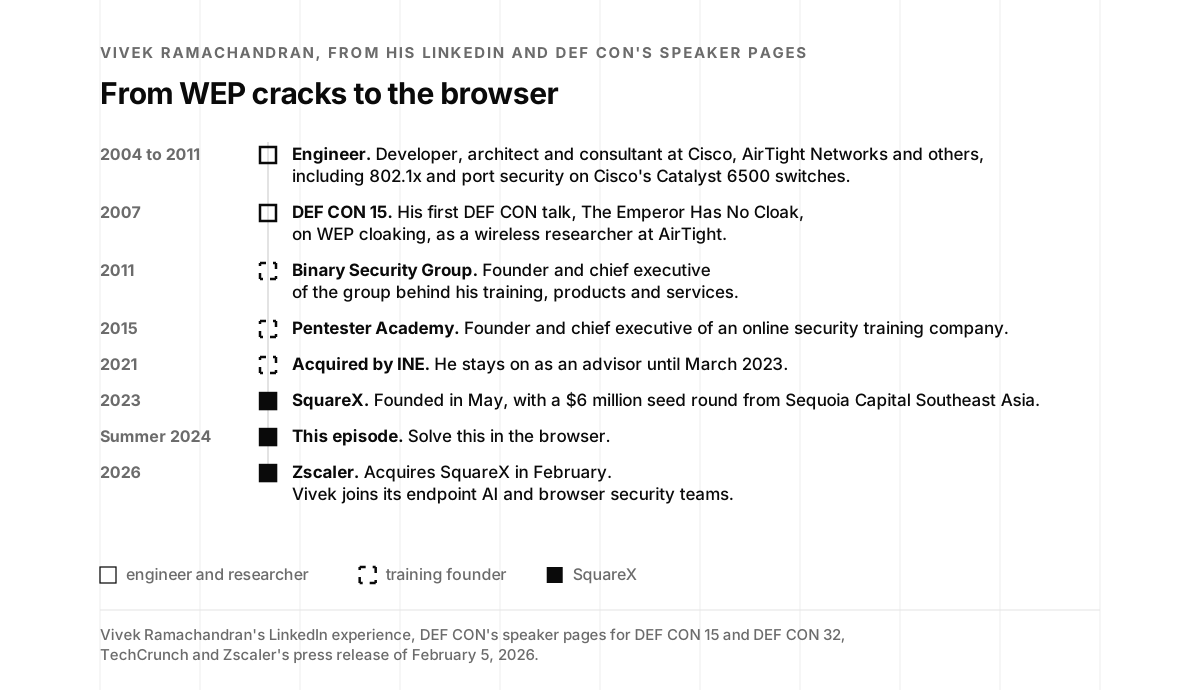
A timeline of eight entries. Open, 2004 to 2011, engineer, developer, architect and consultant at Cisco, AirTight Networks and others, including 802.1x and port security on Cisco's Catalyst 6500 switches. Open, 2007, DEF CON 15, his first DEF CON talk, The Emperor Has No Cloak, on WEP cloaking, as a wireless researcher at AirTight. Dashed, 2011, Binary Security Group, founder and chief executive of the group behind his training, products and services. Dashed, 2015, Pentester Academy, founder and chief executive of an online security training company. Dashed, 2021, acquired by INE, he stays on as an advisor until March 2023. Filled, 2023, SquareX, founded in May, with a $6 million seed round from Sequoia Capital Southeast Asia. Filled, summer 2024, this episode, solve this in the browser. Filled, 2026, Zscaler, acquires SquareX in February, Vivek joins its endpoint AI and browser security teams.
Vivek's path to SquareX, from his LinkedIn, DEF CON's speaker pages and Zscaler.

Where we sit, so you can weigh what follows: YSecurity helps startups pass the security reviews enterprise buyers run, and how employees reach SaaS apps and the web comes up in almost every one of them. Jon McLachlan and Sasha Sinkevich co-hosted this one. We recorded in the summer of 2024, in the weeks before Vivek’s DEF CON 32 talk, and the episode aired on July 13, 2024.

Down to his knees

Jon opened with the simplest question on the show, how Vivek got into security, and the answer starts in 2000. Vivek was preparing for his engineering exams when a wave of denial-of-service attacks took down some of the biggest sites on the web. He heard about a hacker called Mixter, who had written the tool the attackers were said to be using.

“Now, I was barely 18 or 19, and what really intrigued me was, hey, how does one person have so much power that he’s actually bringing in all these massive websites down to his knees?”

Vivek Ramachandran, at 1:18

So he went looking for the code.

“And that was when I started researching, downloaded the source code of Trinoo, understood nothing about it, and then slowly decided, like, hey, there’s so much for me to learn.”

Vivek Ramachandran, at 1:29

Listen · Vivek on episode 49, from 0:57
About 40 seconds: Vivek on the denial-of-service attacks of 2000 and the source code he couldn't read yet. The clip stops on its own. Read the full transcript.

The record backs the memory. Tribe Flood Network, the tool Vivek calls Tribal Flood Network on the tape, is a set of programs for distributed denial-of-service floods, and its 2K version was written by Mixter, a hacker based in Germany (Wikipedia). Trinoo is its cousin, and Wikipedia connects a trinoo network to the February 2000 attack on Yahoo (Wikipedia). Vivek peeled the onion from there, landed a few internships, and calls what followed a lifelong obsession.

Your relationship with power

Jon recognized the story. When he was a student at the University of Minnesota, he tried to explain to a professor why RSA and ElGamal fascinated him, and got a sharper answer than he expected.

“oh, so you’re into security because it changes your relationship with power.”

Jon McLachlan, at 2:15

Vivek added that these things tend to obsess you a lot more. You want to go out there and rule the world, he said, to look different and feel different. Then Jon turned to Sasha, whose story he had never heard on the show, and Sasha’s answer was about data rather than power.

“We as security professionals have the opportunity to uphold that statement.”

Sasha Sinkevich, at 3:05

The statement is that everyone has the right to privacy. Sasha came to security because data reveals so much about a person’s life, which turns out to be the thread of the whole conversation. Almost everything SquareX built is about seeing what happens on a page without shipping what’s on it somewhere else.

Listen · Jon on episode 49, from 1:53
About 25 seconds: Jon on the professor who told him why he really liked security. The clip stops on its own. Read the full transcript.

Lone warriors and team sports

Sasha asked how security has changed since the days when one person could take down a giant. Vivek started with the culture.

“I think 25 years back, I feel like you still had a lot of lone warriors building out tools, putting it out there.”

Vivek Ramachandran, at 3:37

He remembers his first DEF CON talk, in 2007, as a room of curious researchers trading notes. DEF CON’s archive lists it: “The Emperor Has No Cloak, WEP Cloaking Exposed,” given while he was a senior wireless security researcher at AirTight Networks (DEF CON). Back then, he said, you picked a research topic, published, and people found you. Now there’s a path of exams and certifications. And the job itself looked different.

“So if you ask somebody what is security, they would say, to me, security is learning how to configure a Check Point firewall or a Cisco PIX.”

Vivek Ramachandran, at 4:37

The attackers changed most. Nation states and organized crime sponsor hackers out of reach of any court, and defenders answered by banding together too.

“And that has actually made security more of a team sport, and not just like a solo lone wolf game.”

Vivek Ramachandran, at 5:13

Listen · Vivek on episode 49, from 3:37
About 70 seconds: Vivek on the lone researchers of 25 years ago, and the firewall configuration that used to pass for security. The clip stops on its own. Read the full transcript.

He pointed to DEF CON itself, where most of the talks that year came from companies and researchers working together. Sasha added that it’s no accident security now has a red team and a blue team.

Red teams asked for a bypass

The idea for SquareX came out of Pentester Academy. Its customers included Fortune 500 companies and government agencies, and their red teams kept asking for the same thing: something new to show that the enterprise’s defenses could still be bypassed. Vivek went looking where people actually work.

“And that was the time I figured, even though the web browser is the most used enterprise application, if you think about it, people spend 95% of their time on the browser, maybe 5% in applications like Outlook, there was very little happening on the browser itself to secure it.”

Vivek Ramachandran, at 6:20

What protected people on the web was the proxy, under whatever name it was sold: secure web gateway, SSE, SASE. All of them look at network traffic to stop attacks that happen at the application layer, inside the page. That mismatch is what the red teams exploited.

“So when I was doing my research to help the red teams out, I figured that it was very easy to bypass these proxies, because they didn’t have application context.”

Vivek Ramachandran, at 6:54

Listen · Vivek on episode 49, from 6:08
About 60 seconds: Vivek on the red team requests that led to SquareX, and why proxies were easy to get past. The clip stops on its own. Read the full transcript.

A proxy sees requests. It doesn’t see which tab made them, which account is signed in, what the user clicked, or what the page assembled from the pieces it downloaded. Attackers can split something malicious into innocent-looking parts and rebuild it in the browser, after the proxy has waved each part through.
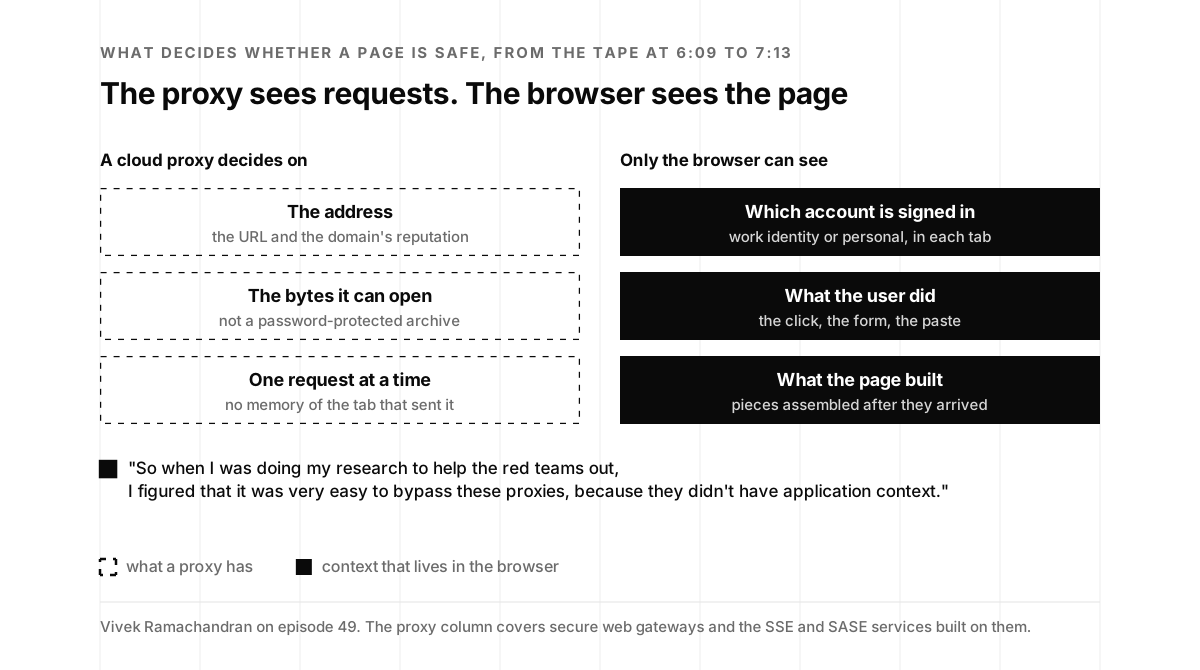
Two columns of three boxes. On the left, dashed, a cloud proxy decides on the address, the URL and the domain's reputation, the bytes it can open, not a password-protected archive, and one request at a time, no memory of the tab that sent it. On the right, filled, only the browser can see which account is signed in, work identity or personal, in each tab, what the user did, the click, the form, the paste, and what the page built, pieces assembled after they arrived. Below, a quote. So when I was doing my research to help the red teams out, I figured that it was very easy to bypass these proxies, because they didn't have application context.
What a proxy decides on, and what only the browser can see, as Vivek describes it.

It has one function

Putting security inside the browser sounds obvious. Vivek’s point was that it isn’t easy.

“It’s not a software platform to distribute new products. It has one function, and to show you web pages.”

Vivek Ramachandran, at 7:29

SquareX spent its first stretch, he said, researching and collecting tribal knowledge about how to run a security product inside something never designed to host one. The payoff he claimed for getting it right was large.

“then this could fundamentally protect your enterprise employees almost 10x better than cloud proxies.”

Vivek Ramachandran, at 7:46

Ten times is his estimate, not a measurement, and it’s the thesis the rest of the episode defends with examples.

Six million and 100,000 users

Jon paused to put the company’s numbers on the record for listeners: more than 100,000 IT and security users within five months of launch, a $6 million seed round from Sequoia Capital Southeast Asia in May 2023, and a major enterprise release in May 2024. TechCrunch covered the seed when it was announced, describing a Singapore-based startup whose browser extension opened links and files in disposable browsers running in SquareX’s data centers (TechCrunch). Vivek announced it on X within hours.

Vivek announcing SquareX's seed round. The post adds that Sequoia had backed Pentester Academy too, through its Surge program. View on X.

TechCrunch’s account of why he built it matches the tape. At Pentester Academy, Vivek said, customers kept disabling security products that got in the way of their work, like a Word document from a contact flagged as malware, so he set out to build one that didn’t block people (TechCrunch). Jon added a note for the founders who listen.

“And things don’t change unless people take risks, right?”

Jon McLachlan, at 8:40

The URL is too broad

Sasha asked what a prospect wants solved when they first call. Vivek’s answer was the weakness he’d been exploiting for red teams. Proxies were invented a decade back, as he put it, and the main thing they filter on is an address.

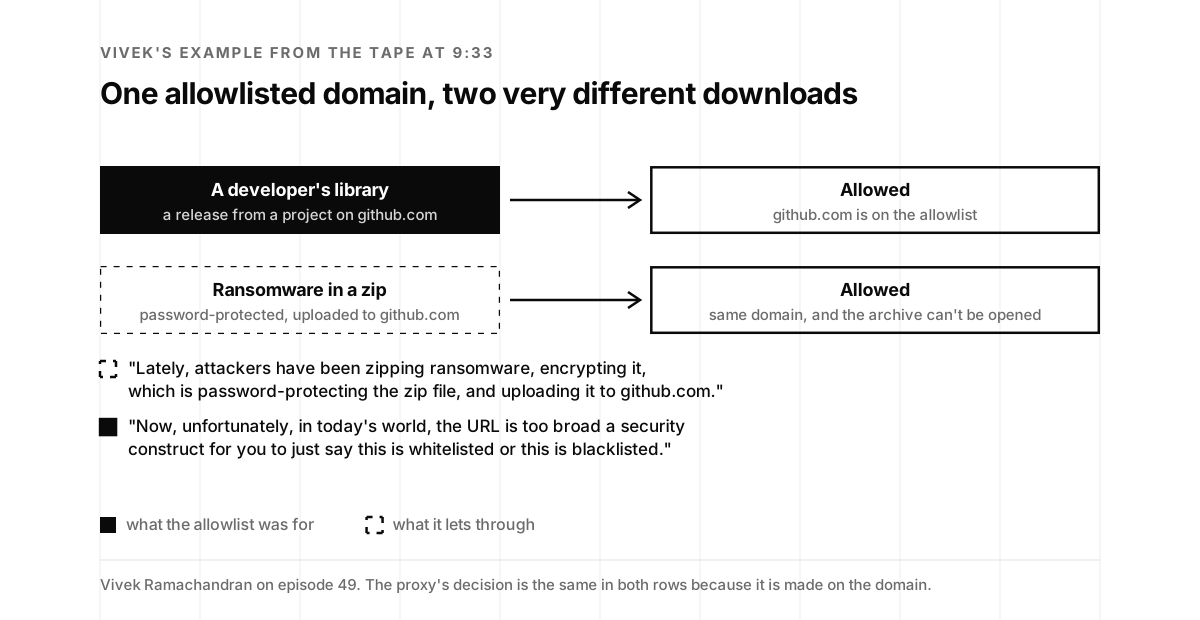
“Now, unfortunately, in today’s world, the URL is too broad a security construct for you to just say this is whitelisted or this is blacklisted.”

Vivek Ramachandran, at 9:21

His example is one any engineering company will recognize.

“Lately, attackers have been zipping ransomware, encrypting it, which is password-protecting the zip file, and uploading it to github.com.”

Vivek Ramachandran, at 9:32

The proxy can’t open a password-protected archive, and it can’t block github.com, because the developers need it. So the file goes through on the strength of the domain it came from.
Listen · Vivek on episode 49, from 9:07
About 60 seconds: Vivek on why a URL is too broad to decide on, with the GitHub example. The clip stops on its own. Read the full transcript.
Two rows. In the first, a filled box, a developer's library, a release from a project on github.com, with an arrow to allowed, github.com is on the allowlist. In the second, a dashed box, ransomware in a zip, password-protected, uploaded to github.com, with an arrow to allowed, same domain, and the archive can't be opened. Below, two quotes. Lately, attackers have been zipping ransomware, encrypting it, which is password-protecting the zip file, and uploading it to github.com. Now, unfortunately, in today's world, the URL is too broad a security construct for you to just say this is whitelisted or this is blacklisted.
One allowlisted domain, two very different downloads. The proxy's decision is the same for both.

SquareX’s answer was to look at everything loading on the page through a zero trust lens, with the address as only one of the signals. That’s the reason Vivek kept the decision in the browser rather than at the network edge.

Same URL, two identities

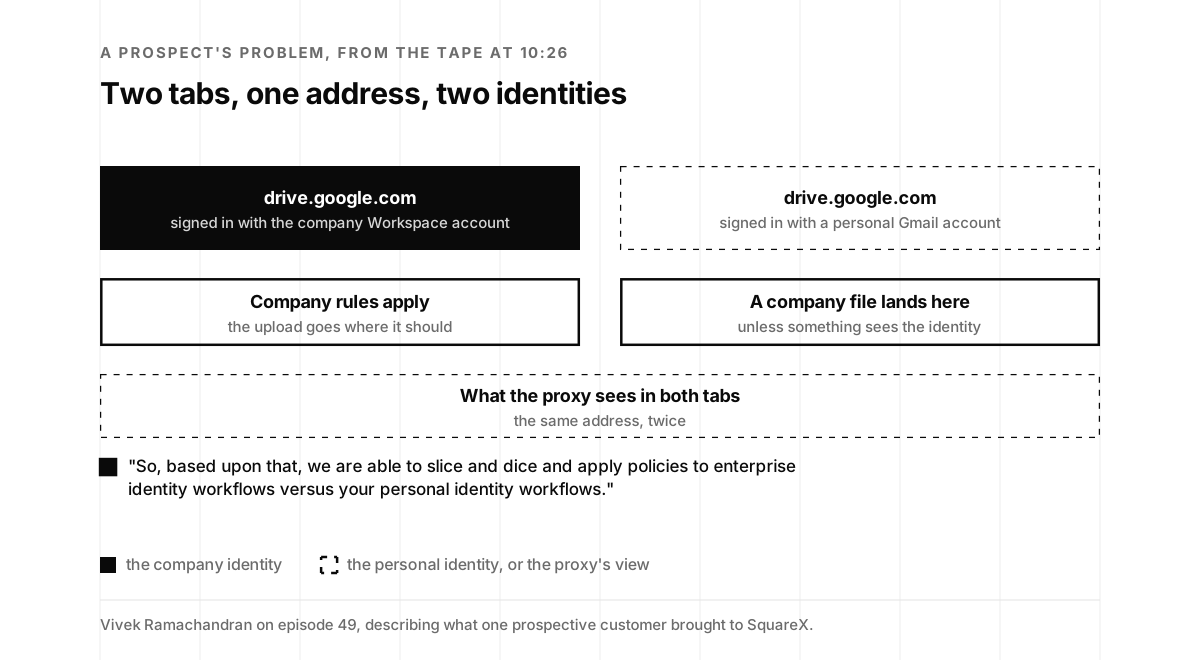
The second example came from a prospect, and it’s quieter than malware but more common. People keep a personal Gmail and the company’s Google Workspace open side by side. When they upload a file, it can land in the wrong drive.

“A lot of times, when you try to upload a file, you might inadvertently end up uploading it to your personal Google Drive, because the URL is the same, drive.google.com.”

Vivek Ramachandran, at 10:40

A proxy sees the same address both times. The browser knows which account each tab is signed in to, so it can apply company rules to the company identity and leave the personal one alone.

“So, based upon that, we are able to slice and dice and apply policies to enterprise identity workflows versus your personal identity workflows.”

Vivek Ramachandran, at 11:20
Listen · Vivek on episode 49, from 10:22
About 70 seconds: The personal Google Drive problem, and why only the browser can tell the two accounts apart. The clip stops on its own. Read the full transcript.
Two tabs side by side, both at drive.google.com. The filled one is signed in with the company Workspace account, and company rules apply, the upload goes where it should. The dashed one is signed in with a personal Gmail account, and a company file lands there unless something sees the identity. Below, a dashed box, what the proxy sees in both tabs, the same address, twice. Then a quote. So, based upon that, we are able to slice and dice and apply policies to enterprise identity workflows versus your personal identity workflows.
Two tabs, one address. The browser can tell which identity is signed in. The proxy can't.

This is a kind of data loss buyers worry about, because nobody meant to do it. For a startup preparing for a security review, it’s also a question the buyer’s team asks early: how do you keep company files out of personal accounts?

Dedicated browsers are a bad idea

Sasha asked the deployment question every buyer asks: is SquareX an extension or a whole new browser? Vivek didn’t hedge.

“I think dedicated browsers is a bad idea.”

Vivek Ramachandran, at 12:03

His evidence was Brave, a privacy-first browser that, the last time he checked, had only 40 to 50 million users. Asking every employee to switch browsers is a fight you don’t need to pick. Brave has grown since. It says it reached 100 million monthly active users and 42 million daily users in October 2025 (Wikipedia), so his figure sits closer to Brave’s daily count today. The point survives the correction. Even a browser with a loyal following took years to get there.

So SquareX ships as an extension on the browsers people already use, Chrome and Edge at the time, with Safari, Firefox and Opera on the way.

“Browser extensions have superpowers, in the sense that they can monitor browser events, page events, intercept, proxy, do a bunch of stuff,”

Vivek Ramachandran, at 12:41

Listen · Vivek on episode 49, from 12:01
About 65 seconds: Vivek on why SquareX is an extension and not a browser, and what an extension can see. The clip stops on its own. Read the full transcript.

Those powers cut both ways, which Vivek knew better than most. An extension that can watch every page can also be the attack. SquareX’s own research after the tape went straight at that, from extensions that bypass Chrome’s newer Manifest V3 rules to fake extensions that pass for password managers, covered in What happened after the tape.
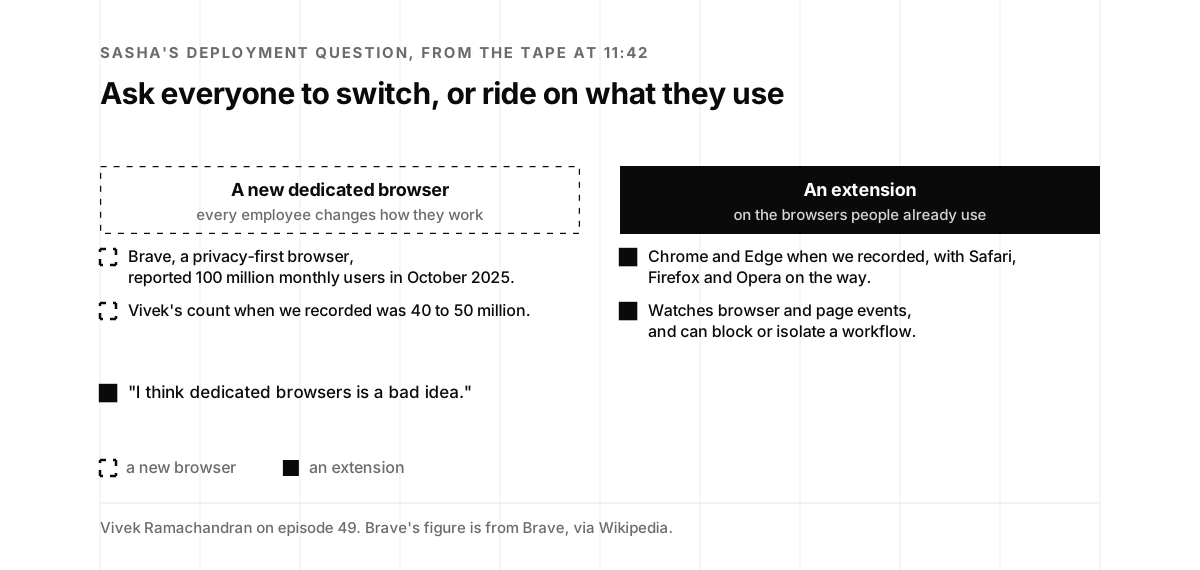
Two columns. On the left, dashed, a new dedicated browser, every employee changes how they work. Brave, a privacy-first browser, reported 100 million monthly users in October 2025. Vivek's count when we recorded was 40 to 50 million. On the right, filled, an extension, on the browsers people already use. Chrome and Edge when we recorded, with Safari, Firefox and Opera on the way. Watches browser and page events, and can block or isolate a workflow. Below, a quote. I think dedicated browsers is a bad idea.
A new browser asks everyone to switch. An extension rides on the browsers people already use.

Three ways to use AI

Sasha asked about AI, in a year when every pitch led with it. Vivek explained why his didn’t. The word is so keyword-stuffed, he said, it’s almost like Web3, or crypto, and people turn skeptical the moment they hear it. Then he got specific.

“How do we use AI? Well, three different ways.”

Vivek Ramachandran, at 13:54

The first is detection where the data lives. SquareX watches hundreds of thousands of events in the page, too many to ship anywhere, so the models run in the browser.

“And we have our own lightweight ML models, which are running in WebAssembly, which our browser extension ends up loading within the browser itself.”

Vivek Ramachandran, at 14:06

The second is the policy language. SquareX’s engine has hundreds of parameters, and Vivek was candid that a startup can’t ask administrators to take a certification course before they touch it.

“I think the greatest beauty of LLMs, in my humble view, is that now you have a language interface to interact with anything which is ultra-complex below it.”

Vivek Ramachandran, at 15:08

An administrator types the rule in plain language, and the product turns it into the parameters underneath. His example:

“hey, block all websites which are downloading encrypted zip files and which may be less than 90 days old.”

Vivek Ramachandran, at 15:52

Listen · Vivek on episode 49, from 15:04
About 70 seconds: Vivek on a policy language you can write in a sentence. The clip stops on its own. Read the full transcript.

The third is triage. Security, he said, is a needle in a haystack problem, so an AI copilot reads the events and summarizes them for the admin.
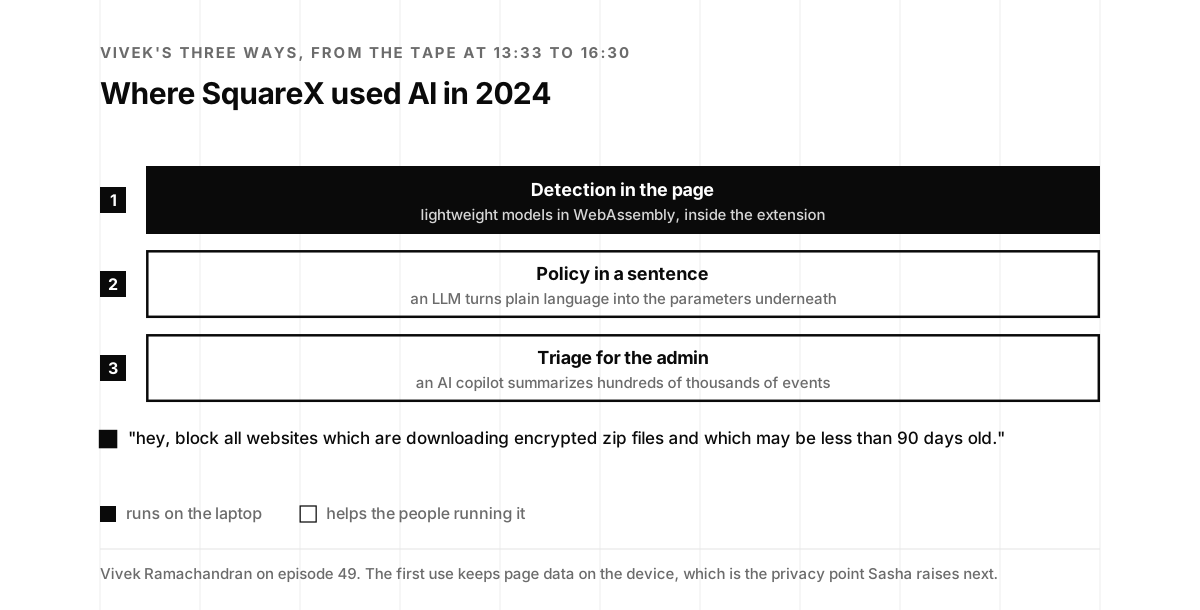
Three numbered boxes. One, filled, detection in the page, lightweight models in WebAssembly, inside the extension. Two, policy in a sentence, an LLM turns plain language into the parameters underneath. Three, triage for the admin, an AI copilot summarizes hundreds of thousands of events. Below, a quote, Vivek's example of a policy in plain language. Hey, block all websites which are downloading encrypted zip files and which may be less than 90 days old.
The three places SquareX used AI in 2024, as Vivek lists them.

Privacy-safe by default

Sasha picked up the first point and pushed it further. Shipping page data to a server isn’t only impractical. It creates a second problem.

“And then you have to worry about the data privacy of that set of data that you have shipped back to the server.”

Sasha Sinkevich, at 14:30

Every byte that leaves the laptop becomes data the vendor has to protect, and a question in the customer’s security review. Vivek agreed and made it a principle.

“we are firm believers that if something can be done in a privacy-safe way, that should probably be the de facto way to do it, because it safeguards people’s data.”

Vivek Ramachandran, at 14:47

It also puts less on SquareX’s own servers. For any startup selling security tooling, that’s a sales argument as much as an engineering one. The less customer data you hold, the shorter your own security questionnaire gets.

A four-year course in a product

Sasha’s next point was about complexity. The industry has built very complex products for a very complex space, and Sasha gave Vivek credit for hiding that complexity.

“So props to you for trying to elevate, or rather hide, the complexity associated with some of the problems that functions in the space.”

Sasha Sinkevich, at 16:46

Vivek has watched administrators miss most of what their tools can do.

“So product feature discovery and feature use is a real problem.”

Vivek Ramachandran, at 17:13

Sasha described the usual onboarding, a lot of integration, a lot of dashboards, and what feels like a four-year course in the product. Vivek’s answer for a startup was blunt.

“No one cares. Make it easy, make it fast, and probably you have an opportunity to do something here.”

Vivek Ramachandran, at 17:43

Giving first

Jon asked about go-to-market, the part of a startup technical founders tend to skip. Vivek’s playbook came from Pentester Academy, which had built a very large community before it sold.

“Pentester, at the time of sale, had over 150,000 people on LinkedIn following us, 200,000 people on Twitter, 250,000 people on Facebook.”

Vivek Ramachandran, at 18:36

The rule he took from that is short.

“It is about giving first, rather than taking.”

Vivek Ramachandran, at 18:55

Listen · Vivek on episode 49, from 18:29
About 30 seconds: Vivek on the community Pentester Academy built, and the rule he took from it. The clip stops on its own. Read the full transcript.

From 100,000 to 200,000

For SquareX, giving first meant releasing something useful before the enterprise product existed. Every security team gets suspicious links and files, and most open them in a virtual machine, buy expensive tools, or rely on isolation features that don’t show what’s happening.

“So what we did is, our isolation features, we put it out as a free extension.”

Vivek Ramachandran, at 19:46

The free extension did two jobs at once.

“That allowed us to test the stability of the extension.”

Vivek Ramachandran, at 19:58

The other job was the one he’d hoped for. Jon had cited 100,000 users. Vivek said they were now very close to 200,000, and security teams were writing in to ask for an enterprise version they could trial, because their people already used the free one.

Listen · Vivek on episode 49, from 18:59
About 70 seconds: How a free extension for opening suspicious files became SquareX's first channel. The clip stops on its own. Read the full transcript.

The CISO writes the final check

Bottoms-up adoption gets a product into the building. It doesn’t get it bought. Vivek described the second prong.

“For inline security products, the CISO has to write the final check, underwrite the risk, if this is an early stage startup.”

Vivek Ramachandran, at 20:51

So he went to RSA and the large conferences, and built an advisory board that could open doors. On the tape he names Jeff Moss, the founder of DEF CON and Black Hat, as an investor and advisor, along with the head of Black Hat and founders in Silicon Valley who had sold their companies (Wikipedia). The point was warm introductions, so he could talk to CISOs about their problems instead of cold-pitching them.

RSA was an amazing experience for SquareX and I will do a series of posts in the coming weeks. This one is around teamwork - our singular goal was to get massive coverage during the event.

Vivek Ramachandran · May 12, 2024
Vivek after RSA Conference 2024, where SquareX unveiled its enterprise product: a team that booked more than 11 live interviews and posted coverage within minutes. View on LinkedIn.

Bleeding-edge research

The third prong is the one Vivek said he absolutely enjoys, and it’s the one that defined SquareX afterward.

“Not just writing white papers, which are a summary of what you want the world to believe, but rather pushing the boundary and edges of how attackers are breaking products,”

Vivek Ramachandran, at 21:38

The research had a date on it as we recorded.

“So this year, literally, we are doing a main stage talk at DEF CON on how attackers could trivially bypass secure web gateways and sneak through even well-known malware and malicious websites.”

Vivek Ramachandran, at 21:55

Listen · Vivek on episode 49, from 20:25
About 65 seconds: Vivek's first two prongs: the practitioners who adopt it, and the CISOs who sign. The clip stops on its own. Read the full transcript.

Jon summed up the shape of it.

“You command the expertise with thought leadership. You have bottom-up adoption of users, but you have top-down monetization for your company.”

Jon McLachlan, at 22:28
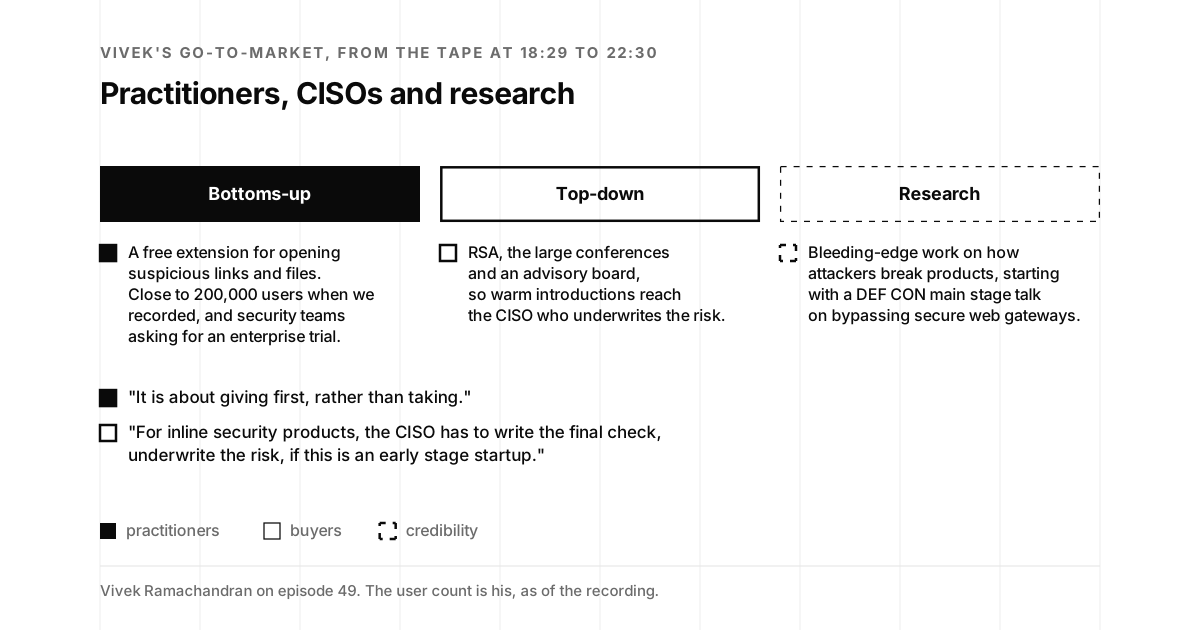
Three columns. Filled, bottoms-up, a free extension for opening suspicious links and files, close to 200,000 users when we recorded, and security teams asking for an enterprise trial. Open, top-down, RSA, the large conferences and an advisory board, so warm introductions reach the CISO who underwrites the risk. Dashed, research, bleeding-edge work on how attackers break products, starting with a DEF CON main stage talk on bypassing secure web gateways. Below, two quotes. It is about giving first, rather than taking. For inline security products, the CISO has to write the final check, underwrite the risk, if this is an early stage startup.
Vivek's three-pronged go-to-market, as he describes it on the tape.

For a security startup, the third prong is also the hardest to fake. A buyer can tell a white paper from a working exploit. Original research earns a CISO’s attention and gives the sales team something to talk about that competitors can’t copy.

On every browser on planet Earth

Jon asked what success looks like. Vivek measures it by impact, and he declined to borrow Steve Jobs’s line about a dent in the universe.

“I always measure success of a company based upon the impact that it can have.”

Vivek Ramachandran, at 23:15

For SquareX, impact meant the industry coming around to its contrarian view, that attacks have to be caught where they happen. He didn’t want to talk about total addressable market. Everyone has a browser, so the opportunity is to be on all of them, for SquareX or for others who share the thesis.

“have an opportunity to literally reside on every browser on planet Earth.”

Vivek Ramachandran, at 24:42

Listen · Vivek on episode 49, from 23:12
About 65 seconds: Vivek on measuring success by impact, and the contrarian view he wanted the industry to adopt. The clip stops on its own. Read the full transcript.

That’s why the free version existed, he said, and why SquareX planned a free web antivirus for anyone in the community.

From EDR to BDR

Sasha connected the idea to access control. Most of the traffic that reaches company systems comes through a browser, so oversight of what’s happening in the page is a layer of assurance whether someone clicked the wrong link or had a session stolen.

“And one of the biggest threats to the entire system is through access control.”

Sasha Sinkevich, at 25:24

Vivek answered with history. Fifteen or twenty years ago, work happened in desktop applications, and endpoint security grew up to protect them, from antivirus to endpoint detection and response and then extended detection and response. Now work happens in websites.

“Almost 15, 20 years back, I think all work was happening on the desktop.”

Vivek Ramachandran, at 26:13

He expects the browser to go through the same evolution, and he named the category.

“Something I like to call BDR, a stealing from EDR.”

Vivek Ramachandran, at 26:50

Listen · Vivek on episode 49, from 26:10
About 45 seconds: Vivek on browser detection and response, the browser's version of endpoint detection. The clip stops on its own. Read the full transcript.

Browser detection and response became SquareX’s category name. Its site still calls the product the industry’s first (SquareX), and Zscaler’s announcement frames the acquisition as extending zero trust into the browser (Zscaler).

Three kinds of CISO

Jon asked for the pitch. Is it certifications like ISO 27001 and SOC 2, or a conversation about real security? Vivek said it depends on who’s across the table, and he sorts CISOs into three buckets before the call or in its first few minutes.

“I try to understand what kind of CISO is this gentleman or lady. And I kind of put them in three buckets.”

Vivek Ramachandran, at 27:34

The first are hyper-technical, former researchers and engineers who interrupt the moment he says browser-native.

“There, I’m a quiet listener, and I get bombarded with super technical questions.”

Vivek Ramachandran, at 27:57

The second came up through risk and compliance and lean on analyst reports and vendor comparison charts. A new category doesn’t show up on those charts yet, so he asks about the gaps instead.

“hey, what are the use cases none of your vendors have solved, especially the web proxies that you use?”

Vivek Ramachandran, at 28:29

The third have already been burned. They walk in with the attack that hit them, a single sign-on identity hijacking attack in his example, and ask whether you stop it.

“And I think they want literally a pointed response, yes or no.”

Vivek Ramachandran, at 29:24
Listen · Vivek on episode 49, from 27:28
About 80 seconds: Vivek's first two kinds of CISO, and how the conversation changes for each. The clip stops on its own. Read the full transcript.
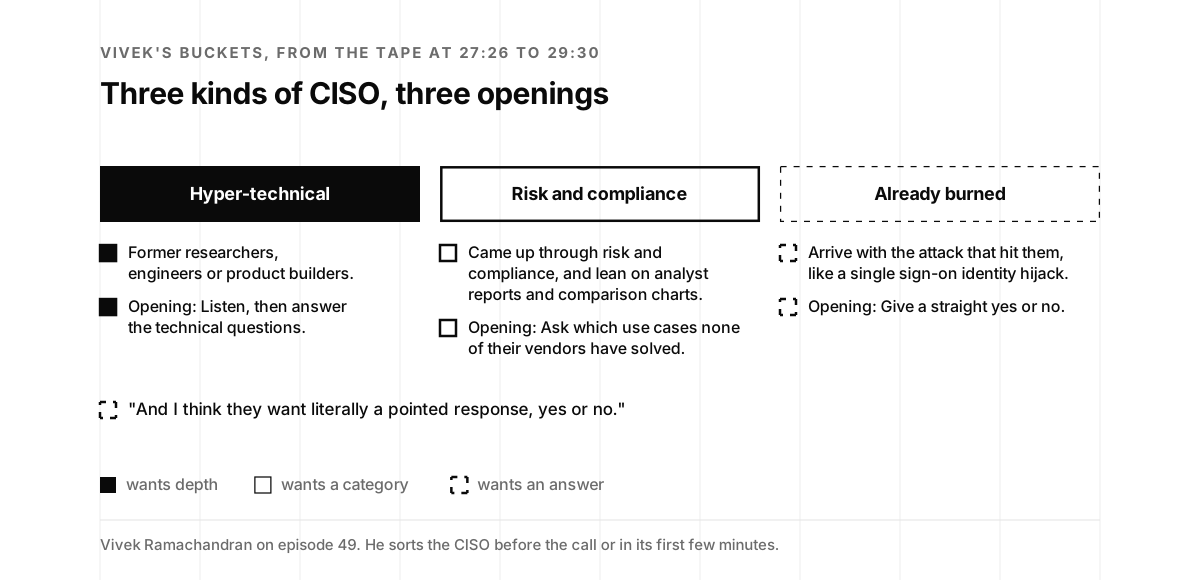
Three columns. Filled, hyper-technical, former researchers, engineers or product builders, opening, listen, then answer the technical questions. Open, risk and compliance, came up through risk and compliance, and lean on analyst reports and comparison charts, opening, ask which use cases none of their vendors have solved. Dashed, already burned, arrive with the attack that hit them, like a single sign-on identity hijack, opening, give a straight yes or no. Below, a quote. And I think they want literally a pointed response, yes or no.
Three kinds of CISO, and the opening Vivek uses with each.

Sasha’s aside fits founders in any category: when you create something new, there’s no concept of it in the buyer’s head yet. Use cases do the work a category name can’t.

Sasha asked for a public example, an attack SquareX could have stopped. Vivek picked the most common attack organizations worry about, spear phishing, and explained why it got harder to spot.

“And now what’s been happening is, with LLMs, the mails sound better, they’re more contextual, the websites look better, right?”

Vivek Ramachandran, at 30:04

The version he described starts with a link to SharePoint, on a private tenant the attacker created. The page asks you to fill in a form or download a document. Nobody’s proxy blocks SharePoint.

“Now, SharePoint, literally every web proxy is going to whitelist by default, right?”

Vivek Ramachandran, at 30:36

The SharePoint page opens a third-party site, the third-party site shows what looks like a Microsoft login, and because the journey started on a real Microsoft address, people sign in again without thinking about it.

“And that’s really where the keys to the kingdom are lost.”

Vivek Ramachandran, at 31:25

Listen · Vivek on episode 49, from 30:18
About 70 seconds: Vivek on a phishing chain that starts on a real SharePoint address. The clip stops on its own. Read the full transcript.

The proxy saw every step and couldn’t connect them.

“because web proxies are only looking at individual URL requests in a stateless way.”

Vivek Ramachandran, at 31:38
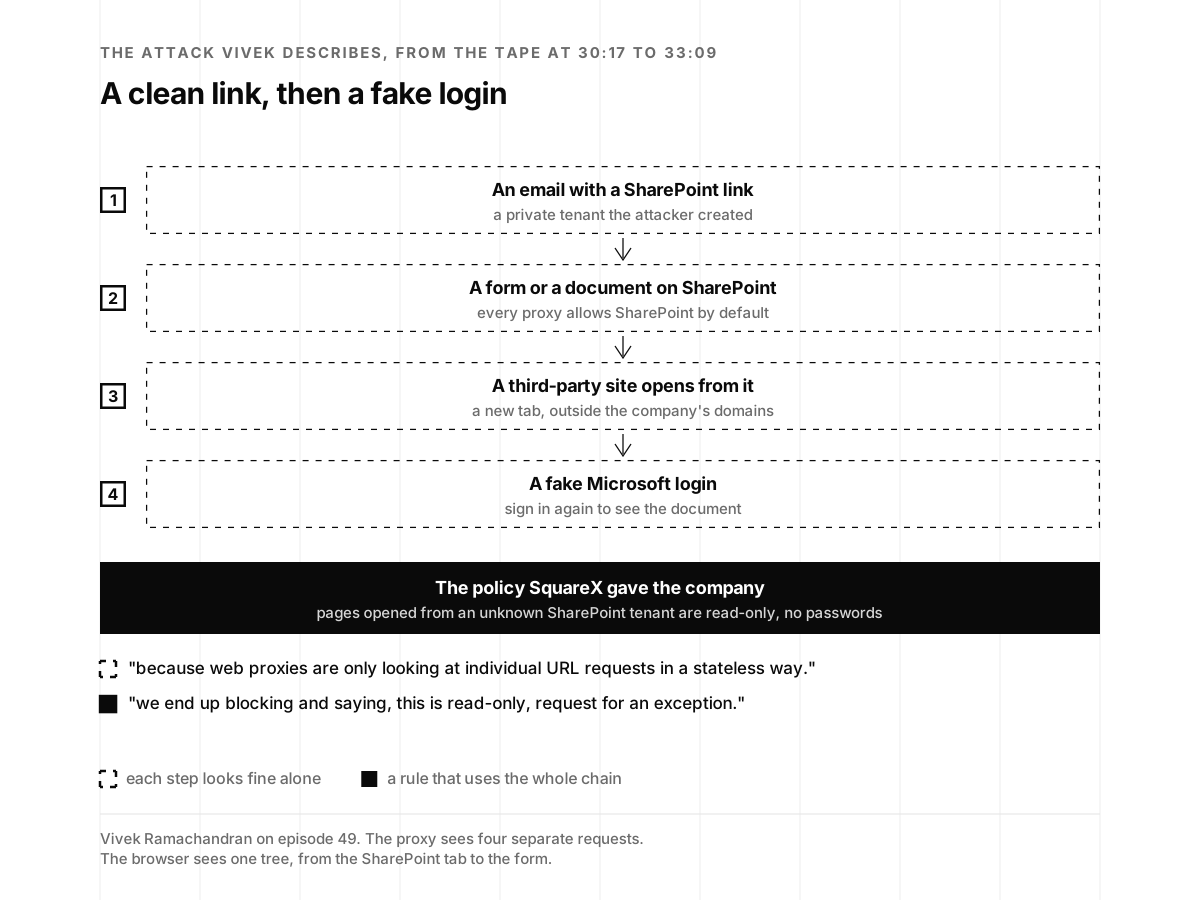
Four numbered dashed boxes joined by arrows. One, an email with a SharePoint link, a private tenant the attacker created. Two, a form or a document on SharePoint, every proxy allows SharePoint by default. Three, a third-party site opens from it, a new tab, outside the company's domains. Four, a fake Microsoft login, sign in again to see the document. Below, a filled box, the policy SquareX gave the company, pages opened from an unknown SharePoint tenant are read-only, no passwords. Then two quotes. Because web proxies are only looking at individual URL requests in a stateless way. We end up blocking and saying, this is read-only, request for an exception.
The SharePoint lure Vivek describes, and the policy that broke it.

Read-only, request an exception

The company that brought SquareX this attack wasn’t sure it could be solved. Inside the browser, SquareX could see the chain.

“And incredibly, because we sit in the browser, we can actually create a hierarchical tree,”

Vivek Ramachandran, at 32:00

The tree shows that a SharePoint tab opened a site outside the company’s known domains, and that the site is now asking for input. The fix was a policy rather than a detection. Pages opened from a SharePoint tenant that isn’t on the allowlist can be visited, but nothing can be typed into them, passwords included. Sasha named the pattern.

“And you are essentially a pre-hook into that logic. You block the action before it’s activated.”

Sasha Sinkevich, at 32:40

When someone tries to type, the field is blocked and the page explains why.

“we end up blocking and saying, this is read-only, request for an exception.”

Vivek Ramachandran, at 33:03

Listen · Vivek on episode 49, from 31:54
About 90 seconds: How SquareX used the tab history to block the login, and the exception path it left open. The clip stops on its own. Read the full transcript.

It’s a good model for any control a startup designs, browser or not. Don’t try to recognize every fake page. Use what you already know about how the user got there, and make the risky step need a reason.

Faces at RSA

Jon asked for the best day so far. Vivek picked RSA Conference 2024, where SquareX showed its enterprise product and people came up having already used the free extension. One visitor stood out, under NDA, so Vivek didn’t name the company.

“I personally use your disposable browsers and file viewers to detonate suspicious documents and links.”

Vivek Ramachandran, at 34:23

That was the head of cybersecurity at a Fortune 50 company, who said the tool was now being taught to the IT team too. SquareX’s recap video from the conference is still up on its channel (YouTube).

Listen · Vivek on episode 49, from 33:51
About 50 seconds: Vivek on the best day at SquareX, at RSA Conference 2024. The clip stops on its own. Read the full transcript.

Funding is responsibility

Vivek used the same answer to say what doesn’t count as a best day.

“I personally don’t think funding is a milestone to be super happy about. It’s nothing more than more responsibility.”

Vivek Ramachandran, at 34:45

Jon put it in founder terms.

“You’re selling a piece of the company for a fair value, and you’re giving up a little bit of control for a little bit of cash.”

Jon McLachlan, at 34:57

Hiring didn’t make Vivek’s list either, for the same reason. What he tells everyone at the company is simpler.

“measure an impact. That’s it. Has your work made impact?”

Vivek Ramachandran, at 35:17

The RSA day counted because it was the first time people told him so in person. Sasha suggested a bigger version of the same test.

“Today, if we want to search for something, we say, Google it.”

Sasha Sinkevich, at 35:54

The hope was that one day people would say the same about protecting their privacy in a browser, with SquareX as the verb.

The first ten minutes

Jon asked for the hardest day, and Vivek told a story without a happy ending. Through a warm introduction he met the CISO of one of the largest consumer electronics companies in the world. The demo went well, and the CISO asked to try it himself. SquareX set up a new tenant for the trial, and by mistake it shipped with experimental policies the team was still testing.

“Within the first seven or 10 minutes, some of those experimental policies ended up hitting, and there were some false positives, and he uninstalled it.”

Vivek Ramachandran, at 37:42

Jon’s aside will make every startup engineer wince.

“And doing great if those are actually separate environments, too.”

Jon McLachlan, at 37:20

They were, Vivek said. The trouble was in what got deployed where. The team rolled back, Vivek wrote to the CISO, and he heard nothing back. Eventually he ran into the CISO at a mixer, and the CISO explained.

“You need to make sure that you understand that someone like myself, if I give you time and if I give you opportunity, that is a privilege.”

Vivek Ramachandran, at 38:10

The next chance would be a year away.

“So come back to me exactly in a year.”

Vivek Ramachandran, at 38:31

Listen · Vivek on episode 49, from 36:33
About 80 seconds: The trial that went wrong in its first ten minutes. The clip stops on its own. Read the full transcript.
Listen · Vivek on episode 49, from 37:51
About 40 seconds: What the CISO told Vivek when they finally talked. The clip stops on its own. Read the full transcript.

What SquareX changed was its onboarding. Several people now check every new tenant, and Vivek does the final check himself, checking all the knobs before anyone outside sees it. He didn’t dress it up.

“Sometimes there is no comeback, and there’s no sweet story at the very end.”

Vivek Ramachandran, at 39:04

For a security startup, the lesson is concrete. A trial tenant is production for the person trying it. Treat its configuration like a release, with a checklist and a second pair of eyes.

Not a failure unless you give up

Sasha offered a saying for founders.

“If you’re not making mistakes, you’re not doing enough.”

Sasha Sinkevich, at 39:14

Jon added the other half.

“not a failure unless you give up.”

Jon McLachlan, at 39:40

Vivek’s practice after a mistake is about the team. Nobody plays the blame game, because the people who made the mistake already feel as bad as anyone.

“It’s very important as a leader to be supportive through mistakes, rather than purely point out mistakes.”

Vivek Ramachandran, at 39:52

He talks through the fix, tells everyone it’s fine, and takes the team to lunch somewhere with good desserts. Jon’s verdict was short.

“It’s just software, right? Life goes on.”

Jon McLachlan, at 40:24

Listen · Vivek on episode 49, from 39:42
About 40 seconds: Vivek on what he does after a mistake, starting with no blame. The clip stops on its own. Read the full transcript.

Start earlier, then be patient

Jon asked what Vivek would tell his younger self. The first answer was to start sooner.

“I would probably have told myself, start even earlier.”

Vivek Ramachandran, at 40:57

He explained why he hadn’t. Growing up in a middle-class family in India, with parents working hard to give him the best education they could, he absorbed a fear of not having a job, and it made him risk-averse. His parents supported him, he said, and still asked whether he should work a few more years first. The second answer was the harder one.

“I have now become the firmest believer in the power of slow compounding.”

Vivek Ramachandran, at 41:48

Compounding asks for patience, and patience was what his younger self lacked. Now, when a proof of concept takes four months to start and ten meetings with different people, he reminds himself what it is.

“hey, this is the process. So enjoy the process.”

Vivek Ramachandran, at 42:39

Listen · Vivek on episode 49, from 40:57
About 75 seconds: Vivek's advice to his younger self: start earlier, then be patient. The clip stops on its own. Read the full transcript.

Celebrate small wins

Vivek also disagreed with a piece of startup folklore, that nothing counts until the company is worth a billion dollars.

“My perspective is to celebrate every small win.”

Vivek Ramachandran, at 43:25

He doesn’t think it makes anyone complacent. Small wins give the team proof it’s moving, and that compounds too.

“Make sure your team feels that they are winning as well.”

Vivek Ramachandran, at 43:28

Listen · Vivek on episode 49, from 43:11
About 55 seconds: Vivek on celebrating small wins without losing the hunger. The clip stops on its own. Read the full transcript.

A force multiplier for go-to-market

Jon closed with a question for the founders listening: what tool do you wish someone would build? Vivek’s answer was for technical founders like him.

“GTM always is a blind side, right?”

Vivek Ramachandran, at 44:44

Founders who love building assume people will come. What he wanted was a way to make one piece of work go further.

“how can you take a piece of original content and then create different versions of it, which can be disseminated in an automated way across multiple platforms?”

Vivek Ramachandran, at 45:04

Take one video demo, he said, and turn it into a PDF report, a narrated podcast and other collateral, then publish it everywhere automatically. He was sure language models would get there, and admitted SquareX had tried to build it internally and hadn’t yet.

Listen · Vivek on episode 49, from 44:33
About 80 seconds: The tool Vivek wished someone would build, for founders who'd rather build product. The clip stops on its own. Read the full transcript.

It’s the same giving-first instinct he described earlier, applied to content: one piece of real work, offered in every format people read.

What happened after the tape

A few weeks after we recorded, Vivek and SquareX’s chief architect Jeswin Mathai gave the talk he’d promised, at DEF CON 32 on Friday, August 9, 2024. Its title was “Breaking Secure Web Gateways (SWG) for Fun and Profit,” and the abstract introduced a new class of attacks, Last Mile Reassembly, that the authors said could bypass every secure web gateway in the Gartner Magic Quadrant for SASE and SSE as of its writing (DEF CON). SquareX released a site where anyone could test the bypasses against their own gateway (browser.security), and its recap counted more than 30 methods (SquareX Labs).
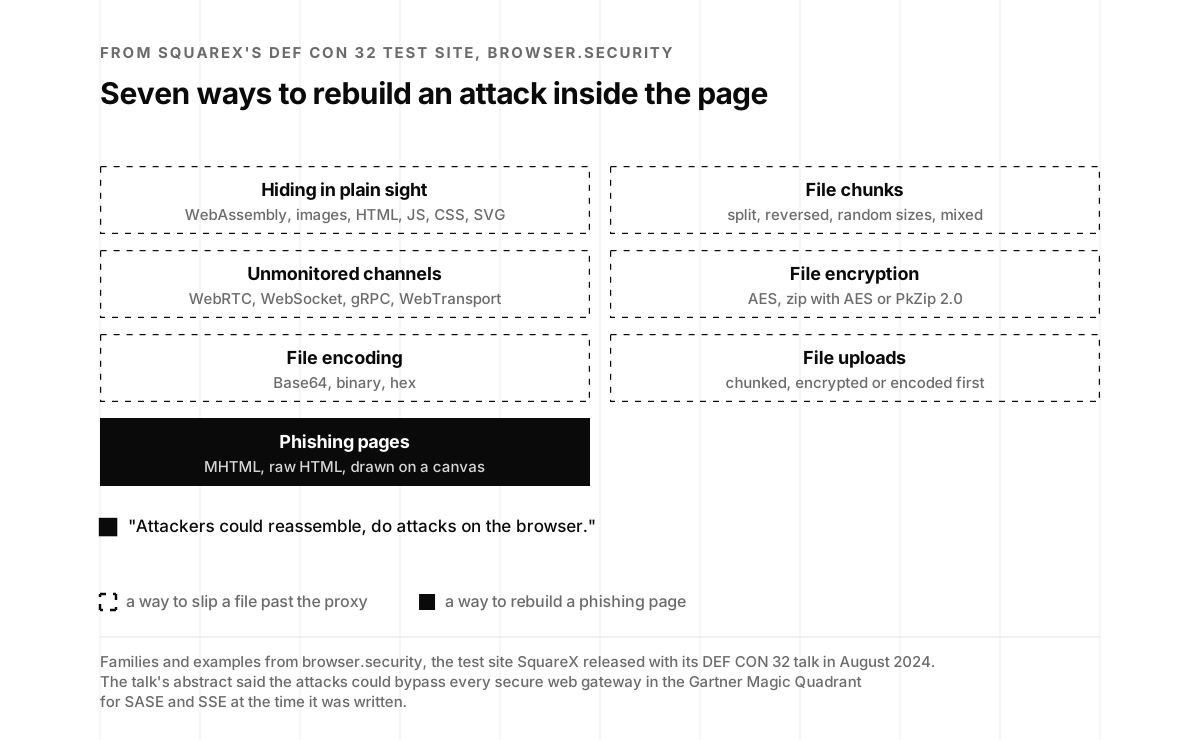
Seven boxes in two columns. Hiding in plain sight, WebAssembly, images, HTML, JS, CSS, SVG. File chunks, split, reversed, random sizes, mixed. Unmonitored channels, WebRTC, WebSocket, gRPC, WebTransport. File encryption, AES, zip with AES or PkZip 2.0. File encoding, Base64, binary, hex. File uploads, chunked, encrypted or encoded first. Phishing pages, MHTML, raw HTML, drawn on a canvas. Below, a quote. Attackers could reassemble, do attacks on the browser.
The families of Last Mile Reassembly attacks on SquareX's test site.

Two weeks later Vivek explained the research on Enterprise Security Weekly, in a segment SquareX sponsored.

Vivek on Enterprise Security Weekly, August 23, 2024: why a browser-native control sees what secure web gateways miss. The episode's show notes say the segment was sponsored by SquareX, and a second segment on another topic follows it. Watch on YouTube.

The research kept coming, and much of it went after the same blind spot from the tape, what happens inside the browser where nothing upstream can see it. In October 2024 SquareX showed extensions that still get past Chrome’s Manifest V3 rules. In December it warned about consent phishing aimed at extension developers, the technique behind the Cyberhaven breach, in which attackers took over Chrome Web Store accounts to push malicious updates (SquareX). Vivek’s post that week walks through it.

Can a Chrome Extension be taken over from the Chrome Store with just a few clicks? SquareX has uncovered targeted attacks on Chrome Extension developers aimed at taking over the chrome extension from the Chrome store

Vivek Ramachandran · December 21, 2024
Vivek on an identity attack whose whole life cycle is in the browser: a fake app asks an extension developer for access to the store account. View on LinkedIn.

In 2025 SquareX ran what it called the Year of Browser Bugs, a commitment to publish architectural vulnerabilities in the browser, modeled on the month-of-bugs projects of the 2000s. Its research page lists 11 pieces, including browser syncjacking in January, polymorphic extensions that impersonate password managers in February, browser-native ransomware in March, data splicing attacks on data loss prevention tools at BSides San Francisco in April, and Passkeys Pwned, a flaw in how passkey registration and sign-in can be abused, in August (SquareX). The later pieces turned to AI agents and AI browsers, the newest software to sit between a person and the web.

Then, on February 5, 2026, Zscaler announced that it had acquired SquareX and closed the deal the same day, with terms undisclosed. The release says SquareX will let organizations secure users inside the browsers they already use, Chrome and Edge, without a full agent or a separate third-party browser (Zscaler). That is the argument from Dedicated browsers are a bad idea, now in Zscaler’s own words. Vivek’s note on X that week thanked the investors who had backed the seed.

Vivek on the acquisition, remembering the seed pitch to Peak XV, previously Sequoia Capital Southeast Asia, with live attack demos in the browser. View on X.

Eight months later he described what came next inside Zscaler.

The past few months at Zscaler since the SquareX acquisition have been nothing short of exhilarating! We brought in our technology into Zscaler's Zero Trust Browser, which is now being deployed with some of Zscaler’s largest customers.

Vivek Ramachandran · October 14, 2026
Vivek on SquareX's technology inside Zscaler's Zero Trust Browser, and on building Zscaler's Endpoint AI Security product from scratch. View on LinkedIn.
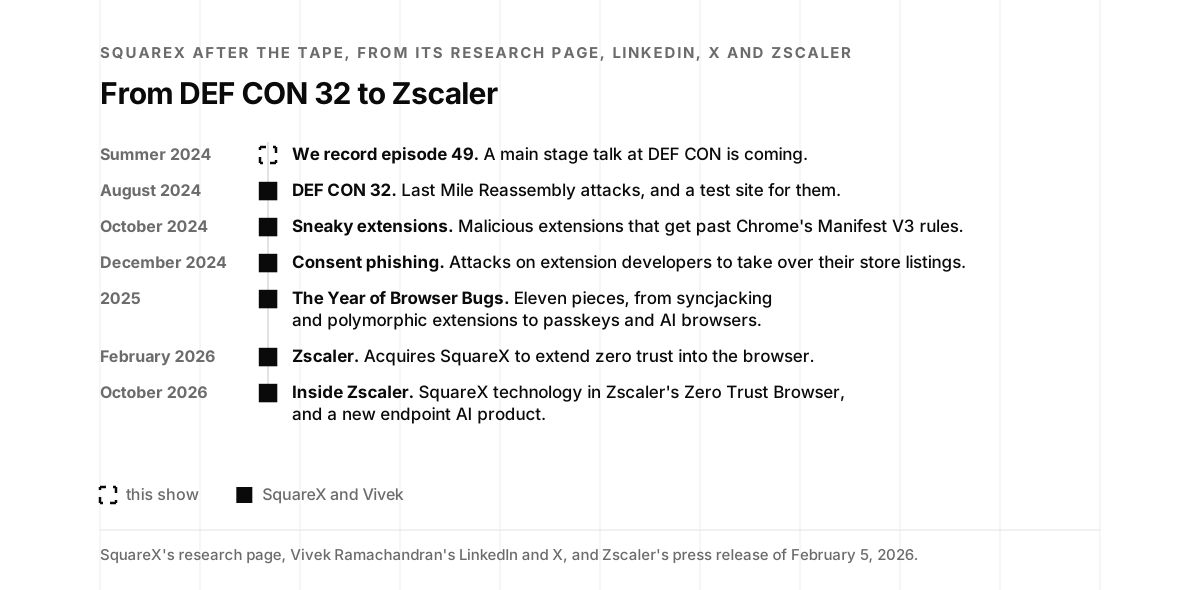
A timeline of seven entries. Dashed, summer 2024, we record episode 49, a main stage talk at DEF CON is coming. Filled, August 2024, DEF CON 32, Last Mile Reassembly attacks, and a test site for them. Filled, October 2024, sneaky extensions, malicious extensions that get past Chrome's Manifest V3 rules. Filled, December 2024, consent phishing, attacks on extension developers to take over their store listings. Filled, 2025, the Year of Browser Bugs, eleven pieces, from syncjacking and polymorphic extensions to passkeys and AI browsers. Filled, February 2026, Zscaler, acquires SquareX to extend zero trust into the browser. Filled, October 2026, inside Zscaler, SquareX technology in Zscaler's Zero Trust Browser, and a new endpoint AI product.
SquareX after the tape, from its research page, Vivek's posts and Zscaler.

The thesis from the tape held up. In 2024 the bet was that security had to move into the browser, through an extension rather than a new browser, and that research would make the case. By 2026 the browser had become a category the big platforms buy into, and one of them bought SquareX. On episode 98, Or Eshed of LayerX told the same story from another company in the category, which Akamai bought in 2026. For a startup, the takeaway is closer to home. If your people work in a browser, your security review will ask what happens there, and “we have a proxy” is only part of the answer.

Did you catch it? A six-question quiz

Interactive · six questions

Did you catch it?

Six questions on what Vivek, Jon and Sasha actually said, with the timestamp for each answer. The answers are under each question for anyone reading without JavaScript.

  1. Which tool's source code did Vivek download as a teenager?

    1. A port scanner
    2. Trinoo, a denial-of-service tool
    3. An early web browser

    b. "And that was when I started researching, downloaded the source code of Trinoo, understood nothing about it" Transcript, 1:29.

  2. What does Vivek call "too broad a security construct"?

    1. A password
    2. An IP address
    3. The URL

    c. "Now, unfortunately, in today's world, the URL is too broad a security construct" Transcript, 9:21.

  3. Why did SquareX ship as an extension instead of its own browser?

    1. Getting everyone to switch browsers is a losing fight
    2. Browsers can't run security code
    3. Extensions are cheaper to sell

    a. "I think dedicated browsers is a bad idea." Transcript, 12:03.

  4. Where do SquareX's lightweight detection models run?

    1. In a cloud proxy
    2. In WebAssembly, inside the browser
    3. On the email server

    b. "And we have our own lightweight ML models, which are running in WebAssembly" Transcript, 14:06.

  5. What did SquareX's policy do on pages opened from an unknown SharePoint tenant?

    1. Blocked SharePoint entirely
    2. Sent the page to a sandbox
    3. Made them read-only, with a way to request an exception

    c. "we end up blocking and saying, this is read-only, request for an exception." Transcript, 33:03.

  6. After the trial that failed, what did the CISO tell Vivek to do?

    1. Come back in exactly a year
    2. Send a new build next week
    3. Talk to procurement

    a. "So come back to me exactly in a year." Transcript, 38:31.

What does your proxy miss?

Vivek’s test for any web control is what it can see. This scorecard asks eight questions about where your people work online, from personal accounts to extensions to phishing chains. It takes about two minutes.

Scorecard · eight questions

What does your proxy miss?

Answer for the laptops and browsers your people use for company work, including contractors. If two answers fit, pick the lower one.

  1. Can your controls tell a company Google Drive or OneDrive from a personal one at the same address?

    • No, both are the same site to us
    • For some apps, through tenant or account restrictions
    • Yes, policy follows the signed-in identity in each tab

    "because the URL is the same, drive.google.com." See Same URL, two identities.

  2. What happens when someone opens a link from an unfamiliar SharePoint or OneDrive tenant and is asked to sign in again?

    • Nothing stops them typing a password
    • They see a warning
    • Pages reached that way are read-only, with an exception path

    "we end up blocking and saying, this is read-only, request for an exception." See Read-only, request an exception.

  3. What happens to a password-protected archive downloaded from a site you trust, like github.com?

    • It's allowed, because the site is
    • It's flagged for review
    • It's opened somewhere disposable, or blocked by policy

    "Lately, attackers have been zipping ransomware, encrypting it, which is password-protecting the zip file, and uploading it to github.com." See The URL is too broad.

  4. Do you know every browser extension installed on company browsers, and what each can read?

    • No
    • We have a list
    • An allowlist, enforced, with a review when an extension updates or asks for new permissions

    Extensions "have superpowers," in Vivek's words, so an unreviewed one can read what your people read. See Dedicated browsers are a bad idea.

  5. Where do people open suspicious links and attachments?

    • In their own browser, and hope
    • In a virtual machine, when someone remembers
    • In a disposable browser or file viewer, by default

    "I personally use your disposable browsers and file viewers to detonate suspicious documents and links." See Faces at RSA.

  6. Can your web controls see content the page assembles after it arrives, through WebAssembly, file chunks, or WebSocket and WebRTC channels?

    • They decide on the address
    • They inspect some downloads
    • Inspection happens in the browser, after the page is built

    "Attackers could reassemble, do attacks on the browser." See Red teams asked for a bypass.

  7. How do you know your web controls work?

    • We trust the vendor
    • A yearly penetration test
    • We test known bypasses against our own setup, regularly

    SquareX's test site lets anyone try the DEF CON 32 bypasses. See What happened after the tape.

  8. How easy is it for your admins to change a browser security policy?

    • Only one person knows how
    • A few people, with documentation
    • Anyone on the team can describe the rule and review the result

    "So product feature discovery and feature use is a real problem." See A four-year course in a product.

The proxy sees addresses

Your web protection decides on the URL, which leaves personal accounts, trusted domains and phishing chains to the people clicking. Start with the two cheapest wins: separate company and personal identities in the browser, and make pages reached from unfamiliar file-sharing links read-only.

Some context in the browser

You see part of what happens in the page. Close the gaps attackers reach next: unreviewed extension updates, archives from trusted sites, and content assembled after it arrives. Then test the bypasses against your own setup.

The browser is covered

Policy follows the user and the page, not just the address. Keep it that way as AI browsers and agents start doing the clicking: they inherit the same sessions and should cross the same checks.

How much of the work is in the browser?

Vivek’s estimate is that people spend 95% of their working time in a browser. Put in your own team to see how many hours that is, and how few happen anywhere else.

Calculator

How much of the work is in the browser?

Three estimates for your team: how many people, how many hours they work in a week, and the share of that time spent in a browser. Vivek's estimate on the tape is 95%.

–hours a week in the browser
–hours a day, per person
–hours a year, over 48 weeks
–hours a week outside it

A team of 50 working 40 hours a week spends about 1,900 hours a week in the browser, 7.6 hours a day each, or 91,200 hours a year. That's where the sign-ins, the uploads and the clicks happen, so that's where the checks need to be.

95% is Vivek's estimate on the tape, not a measurement. Use your own numbers.

From WEP cracks to Zscaler

Everything on this page sits on one timeline, from the denial-of-service attacks of 2000 to the Zscaler acquisition. Filter it by thread.

Timeline · 2000 to 2026

From WEP cracks to Zscaler

Filter by thread. Dates are from the public record except where marked as part of this show.

  1. The attacks that started it

    A wave of distributed denial-of-service attacks takes down Yahoo and other large sites. Wikipedia connects a trinoo network to the Yahoo attack (Wikipedia).

  2. Engineer

    Vivek starts as a developer, architect and consultant at companies including Cisco and AirTight Networks (LinkedIn).

  3. DEF CON 15

    His first DEF CON talk, The Emperor Has No Cloak, on WEP cloaking, as a senior wireless security researcher at AirTight Networks (DEF CON).

  4. Binary Security Group

    Founds the parent group for his security education, products and services (LinkedIn).

  5. Pentester Academy

    Founds an online, subscription security training company, with offices in the US, Singapore and India (LinkedIn).

  6. Microsoft Regional Director

    Microsoft names him a Regional Director of Cybersecurity for three years (DEF CON).

  7. Acquired by INE

    Pentester Academy joins INE, and its cloud lab infrastructure moves into the INE platform (LinkedIn).

  8. SquareX and a seed round

    Founded in May, with $6 million from Sequoia Capital Southeast Asia for disposable browsers delivered through an extension (TechCrunch).

  9. Email attachments

    SquareX research reports that top email providers failed to detect and block malicious attachments (SquareX).

  10. SquareX Enterprise

    Unveiled at RSA Conference 2024, the day Vivek calls his best at the company (YouTube).

  11. Black Hat Arsenal

    Joins the Black Hat Arsenal Review Board (DEF CON).

  12. We record episode 49

    "solve this in the browser, run something browser-native entirely in the browser." (Transcript).

  13. Episode 49 airs

    On Podbean, Apple Podcasts and Spotify (Apple Podcasts).

  14. DEF CON 32

    Vivek and Jeswin Mathai present Breaking Secure Web Gateways (SWG) for Fun and Profit, and the Last Mile Reassembly attacks (DEF CON).

  15. Sneaky extensions

    Malicious extensions that still get past Chrome's Manifest V3 controls (SquareX).

  16. Consent phishing

    Targeted attacks on extension developers to take over their Chrome Web Store accounts (LinkedIn).

  17. The Year of Browser Bugs

    A year of published browser research begins with browser syncjacking (SquareX).

  18. Polymorphic extensions

    Extensions that impersonate password managers and crypto wallets (SquareX).

  19. Browser-native ransomware

    Ransomware that works in the browser rather than on the endpoint (SquareX).

  20. Data splicing

    First shown at BSides San Francisco, techniques that slip data past data loss prevention tools (SquareX).

  21. Passkeys Pwned

    An attack on how passkey registration and sign-in are implemented (SquareX).

  22. Brave at 100 million

    The privacy-first browser Vivek used as his example reports 100 million monthly users (Wikipedia).

  23. Zscaler acquires SquareX

    To extend zero trust into standard browsers without a third-party browser (Zscaler).

  24. Thanks to the seed investors

    Vivek remembers the live browser attack demos in the seed pitch (X).

  25. Episode 98

    Or Eshed of LayerX on browser security from another startup in the category (episode 98).

  26. Inside Zscaler

    SquareX technology in Zscaler's Zero Trust Browser, and a new Endpoint AI Security product (LinkedIn).

What to do this week

Five things, in the order Vivek’s argument suggests.

  1. Separate the identities. Find out whether anyone can upload company files to a personal Google Drive or OneDrive from a company laptop. If they can, restrict sign-in to company accounts on managed browsers, or add a browser control that applies policy per identity. The scorecard above is a quick first pass.
  2. Inventory your extensions. List every browser extension on company browsers and what it can read. Move to an allowlist, and review an extension again when it updates or asks for new permissions.
  3. Make one risky step need a reason. Pick the riskiest action in your browser workflow, like typing a password on a page reached from an unfamiliar file-sharing link, and make it read-only with an exception path.
  4. Give suspicious files somewhere safe to go. Decide where people open the links and attachments they aren’t sure about, and make the safe place the easy one.
  5. Test your own web controls. Try known bypasses against your setup, or have someone do it for you. If you’d like a second pair of eyes, our penetration testing and product security teams do this work every week, and you can book 15 minutes with us.

Key takeaways

  1. The URL is too broad a security construct

    Web proxies decide from the address, and Vivek Ramachandran argues the address no longer says enough. Attackers put ransomware in password-protected zips on github.com, which every developer needs, and phishing pages start from real SharePoint links. The decision has to see what is on the page.

  2. One URL can hide two identities

    A company's Google Workspace and an employee's personal Gmail both live at drive.google.com, so a proxy sees one address. A control in the browser can tell which account is signed in to the tab and apply a policy to the work identity only.

  3. Red teams found the gap first

    At Pentester Academy, red teams kept asking for ways to show that their clients' defenses could still be bypassed. Vivek found web proxies easy to get around because they had no application context or view of user interaction, and attacks could be reassembled inside the browser.

  4. The browser is where the work is

    By Vivek's estimate people spend about 95% of their working time in the browser, yet little security ran there. Work that used to happen in desktop apps now happens on websites, so the browser needs what EDR gave the desktop. He calls it browser detection and response.

  5. An extension, not a new browser

    Vivek calls dedicated browsers a bad idea, since asking every employee to switch browsers is a hard sell, and he used Brave as his example. SquareX shipped an extension for the browsers companies already run, Chrome and Edge first, which can watch page events, inspect elements and block or isolate a workflow.

  6. AI in three places

    SquareX used AI in three ways: lightweight models in WebAssembly that detect attacks inside the browser, a plain-language interface that turns a sentence into policy rules, and a copilot that summarizes hundreds of thousands of events for administrators.

  7. Privacy-safe by default

    Detecting attacks in the browser means page data doesn't have to be shipped to a server, which protects users and spares the vendor from holding the data. If something can be done in a privacy-safe way, Vivek says, that should be the default.

  8. Make it easy, make it fast

    Most administrators never discover everything a product can do. A startup product that needs a four-year course before anyone can set it up won't see the light of day, so SquareX put a language interface on a policy engine with hundreds of parameters.

  9. Give first

    Pentester Academy built an audience of hundreds of thousands on LinkedIn, Twitter and Facebook by contributing first. SquareX did the same, releasing its isolation features as a free extension for detonating suspicious links and files, which grew to close to 200,000 users.

  10. Bottoms-up gets you in, the CISO signs

    Free users at enterprises wrote in asking for an enterprise version. But for inline security products the CISO writes the final check and underwrites the risk, so SquareX also went to RSA, built an advisory board that included DEF CON founder Jeff Moss, and asked for warm introductions.

  11. Research as go-to-market

    The third prong was bleeding-edge research rather than white papers, starting with a DEF CON main stage talk on how attackers could bypass secure web gateways. At DEF CON 32 in August 2024, that talk introduced Last Mile Reassembly attacks.

  12. Three kinds of CISO

    Vivek sorts CISOs into three groups. Hyper-technical ones fire questions. Risk and compliance leaders go by analyst reports and comparison charts and respond to unsolved use cases. Those who've been burned by an attack want a yes or a no.

  13. A clean link to a fake login

    Attackers send links to SharePoint tenants they control, which every proxy allows. The page opens a third-party form that mimics the Microsoft login, and because the trip started at a real Microsoft address, people sign in again and hand over their passwords.

  14. Context across tabs

    A proxy sees each request on its own. In the browser, SquareX could build a tree of which tab opened which page, so the customer's policy was simple. After a link from an unknown SharePoint tenant, pages are read-only and the user can request an exception.

  15. Measure impact

    Vivek doesn't count funding or hiring as milestones, since both add responsibility. His best day was at RSA, when people walked up to say they already used the free extension.

  16. A trial is a privilege

    A CISO at a large consumer electronics company tried SquareX on a new tenant that had shipped with experimental policies, hit false positives within ten minutes and uninstalled it. He told Vivek that a CISO's time is a privilege and to come back in a year. SquareX built an onboarding process with Vivek as the final check.

  17. No blame game

    When something goes wrong, the team already feels bad. Vivek talks through how to fix it, tells everyone it's fine, and takes the team out to lunch somewhere with good desserts.

  18. Start earlier, then be patient

    His advice to his younger self is to start even earlier and to be patient, trusting slow compounding. When a proof of concept takes four months and ten meetings to start, he treats that as the process and enjoys it.

  19. Celebrate small wins

    Instead of waiting for a billion-dollar outcome, celebrate each small win so the team can see progress. Vivek says it compounds the energy rather than making anyone complacent.

  20. Go-to-market is the blind side

    Technical founders would rather keep building. The tool Vivek wished existed would turn one piece of content, such as a video demo, into a report, a narrated podcast and other collateral, and publish it across platforms automatically.

Chapters

Tap a chapter to play from there.

Pull quotes

“Now, I was barely 18 or 19, and what really intrigued me was, hey, how does one person have so much power that he's actually bringing in all these massive websites down to his knees?”

Vivek Ramachandran ·

“And he kind of looked at me, and he said, oh, so you're into security because it changes your relationship with power.”

Jon McLachlan ·

“We as security professionals have the opportunity to uphold that statement.”

Sasha Sinkevich ·

“I think 25 years back, I feel like you still had a lot of lone warriors building out tools, putting it out there.”

Vivek Ramachandran ·

“And that has actually made security more of a team sport, and not just like a solo lone wolf game.”

Vivek Ramachandran ·

“And it's not an accident that you see there is a blue team and there is a red team, right?”

Sasha Sinkevich ·

“And at that point in time, mostly red teams would come to us and say, hey, we want to show that our enterprise defenses can still be bypassed.”

Vivek Ramachandran ·

“So when I was doing my research to help the red teams out, I figured that it was very easy to bypass these proxies, because they didn't have application context.”

Vivek Ramachandran ·

“Figured, if you had to protect your employees from web attacks while they're online, you need something sitting in the browser itself.”

Vivek Ramachandran ·

“It has one function, and to show you web pages.”

Vivek Ramachandran ·

“And that is really when SquareX was born, where I felt like if you could build a browser-native security product, then this could fundamentally protect your enterprise employees almost 10x better than cloud proxies.”

Vivek Ramachandran ·

“Now, unfortunately, in today's world, the URL is too broad a security construct for you to just say this is whitelisted or this is blacklisted.”

Vivek Ramachandran ·

“Lately, attackers have been zipping ransomware, encrypting it, which is password-protecting the zip file, and uploading it to github.com.”

Vivek Ramachandran ·

“A lot of times, when you try to upload a file, you might inadvertently end up uploading it to your personal Google Drive, because the URL is the same, drive.google.com.”

Vivek Ramachandran ·

“So you apply additional layers of security based on the context that you get from a unique web page.”

Sasha Sinkevich ·

“I think dedicated browsers is a bad idea.”

Vivek Ramachandran ·

“Browser extensions have superpowers, in the sense that they can monitor browser events, page events, intercept, proxy, do a bunch of stuff, which allows us to monitor every web workflow that is going through the user's browser”

Vivek Ramachandran ·

“And we have our own lightweight ML models, which are running in WebAssembly, which our browser extension ends up loading within the browser itself.”

Vivek Ramachandran ·

“And then you have to worry about the data privacy of that set of data that you have shipped back to the server.”

Sasha Sinkevich ·

“And to your point, we are firm believers that if something can be done in a privacy-safe way, that should probably be the de facto way to do it, because it safeguards people's data.”

Vivek Ramachandran ·

“I think the greatest beauty of LLMs, in my humble view, is that now you have a language interface to interact with anything which is ultra-complex below it.”

Vivek Ramachandran ·

“Third and final way is, security is a needle in a haystack problem.”

Vivek Ramachandran ·

“So product feature discovery and feature use is a real problem.”

Vivek Ramachandran ·

“Make it easy, make it fast, and probably you have an opportunity to do something here.”

Vivek Ramachandran ·

“It is about giving first, rather than taking.”

Vivek Ramachandran ·

“So what we did is, our isolation features, we put it out as a free extension.”

Vivek Ramachandran ·

“For inline security products, the CISO has to write the final check, underwrite the risk, if this is an early stage startup.”

Vivek Ramachandran ·

“Not just writing white papers, which are a summary of what you want the world to believe, but rather pushing the boundary and edges of how attackers are breaking products”

Vivek Ramachandran ·

“So this year, literally, we are doing a main stage talk at DEF CON on how attackers could trivially bypass secure web gateways and sneak through even well-known malware and malicious websites.”

Vivek Ramachandran ·

“You have bottom-up adoption of users, but you have top-down monetization for your company.”

Jon McLachlan ·

“So, I think, Jon, having built companies before, I always measure success of a company based upon the impact that it can have.”

Vivek Ramachandran ·

“And we have a very contrarian view to the rest of the industry, because the rest of the industry is still looking at solving this in the cloud, while we are saying, solve this in the browser, run something browser-native entirely in the browser.”

Vivek Ramachandran ·

“And exactly to your point, now all work happens within the browser.”

Vivek Ramachandran ·

“Something I like to call BDR, a stealing from EDR.”

Vivek Ramachandran ·

“So that gets them talking, because anytime, to your point, you position a disruptive product, people don't know about the category much.”

Vivek Ramachandran ·

“And the third bucket is, unfortunately, people who've already been burnt by attacks.”

Vivek Ramachandran ·

“So, unbelievably, even today, the most common attack which organizations worry about is spear phishing attacks.”

Vivek Ramachandran ·

“Now, SharePoint, literally every web proxy is going to whitelist by default, right?”

Vivek Ramachandran ·

“And that's really where the keys to the kingdom are lost.”

Vivek Ramachandran ·

“Now, the tricky part really is, a web proxy unfortunately cannot correlate where you were before and how you clicked and went, because web proxies are only looking at individual URL requests in a stateless way.”

Vivek Ramachandran ·

“The simplest solution we gave to the enterprise, and they happily agreed, is, all non-whitelisted SharePoint subdomains, if any link is clicked, then all web pages opening via that should not allow the user to enter any form of input, including a password field.”

Vivek Ramachandran ·

“You block the action before it's activated.”

Sasha Sinkevich ·

“And even though we allow the user to visit the next page, the moment he tries to enter something into an input field, like a password field, we end up blocking and saying, this is read-only, request for an exception.”

Vivek Ramachandran ·

“I personally don't think funding is a milestone to be super happy about.”

Vivek Ramachandran ·

“I think, in my view and the company view, all I tell everybody is, measure an impact.”

Vivek Ramachandran ·

“Sounds like very soon the SquareX word will become the verb.”

Sasha Sinkevich ·

“Within the first seven or 10 minutes, some of those experimental policies ended up hitting, and there were some false positives, and he uninstalled it.”

Vivek Ramachandran ·

“You need to make sure that you understand that someone like myself, if I give you time and if I give you opportunity, that is a privilege.”

Vivek Ramachandran ·

“So if you and your team didn't do the homework, that's on you.”

Vivek Ramachandran ·

“Sometimes there is no comeback, and there's no sweet story at the very end.”

Vivek Ramachandran ·

“If you're not making mistakes, you're not doing enough.”

Sasha Sinkevich ·

“Not a failure unless you give up.”

Jon McLachlan ·

“It's very important as a leader to be supportive through mistakes, rather than purely point out mistakes.”

Vivek Ramachandran ·

“I think, yeah, looking back, I would probably have told myself, start even earlier.”

Vivek Ramachandran ·

“I have now become the firmest believer in the power of slow compounding.”

Vivek Ramachandran ·

“My perspective is to celebrate every small win.”

Vivek Ramachandran ·

“On the contrary, I feel like having those small wins and celebrating them just compounds on the energy, because you feel like you're making progress, versus you drawing a goalpost a hundred miles away and saying, look, guys, we still need to get there, right?”

Vivek Ramachandran ·

“So I would say, for most technical entrepreneurs, what tends to happen is, GTM always is a blind side, right?”

Vivek Ramachandran ·

“I feel that could be amazing, because just like in technology we are looking for force multiplier, I think in GTM, something like that, well done, and could be a massive force multiplier.”

Vivek Ramachandran ·

About the guest

Vivek Ramachandran, Founder and Chief Executive Officer, SquareX

Vivek Ramachandran is the founder of SquareX, the browser security company he started in 2023 and led as chief executive until Zscaler acquired it in February 2026, when he moved to Zscaler's endpoint AI and browser security work. Before SquareX he founded Pentester Academy, an online security training company that INE acquired in 2021, and Binary Security Group. As a researcher he discovered the Caffe Latte attack and broke WEP cloaking, and as an engineer he was one of the programmers of 802.1x and port security on Cisco's Catalyst 6500 switches. He first spoke at DEF CON in 2007 and has also spoken at Black Hat. He won Microsoft's Security Shootout, served as a Microsoft Regional Director and served on the Black Hat Arsenal review board. He studied at the Indian Institute of Technology Guwahati.

About the host

Jon McLachlan and Sasha Sinkevich are co-founders of YSecurity, the on-demand cybersecurity team for startups, and of Cyberbase.ai. The Security Podcast of Silicon Valley is hosted by Jon McLachlan and Sasha Sinkevich. Jon McLachlan on LinkedIn ↗Sasha Sinkevich on LinkedIn ↗

Context and sources

  • Vivek Ramachandran on LinkedIn: endpoint AI and browser security at Zscaler, founder of SquareX, Pentester Academy and Binary Security, all acquired, a DEF CON and Black Hat speaker and book author, in San Jose, California, with the Indian Institute of Technology Guwahati. Source ↗
  • Vivek Ramachandran's LinkedIn experience: founder and chief executive of SquareX from May 2023, founder and chief executive of Pentester Academy from 2015 and an advisor after INE acquired it in 2021 until March 2023, founder and chief executive of Binary Security Group from 2011, and engineering, architecture and consulting roles at Cisco, AirTight Networks and others from 2004 to 2011. Source ↗
  • SquareX, About: browser detection and response, which SquareX calls the industry's first, with Vivek Ramachandran a Microsoft Regional Director and a member of the Black Hat Arsenal review board, Pentester Academy's more than 100,000 students, and Jeswin Mathai as chief architect. Source ↗
  • DEF CON 32 speakers: Breaking Secure Web Gateways (SWG) for Fun and Profit, by Vivek Ramachandran and Jeswin Mathai, on Friday, August 9, 2024, introducing Last Mile Reassembly attacks that bypass every secure web gateway in the Gartner Magic Quadrant for SASE and SSE as of its writing. Vivek's bio credits the Caffe Latte attack, WEP cloaking, the 802.1x and port security code on Cisco's Catalyst 6500, Pentester Academy's acquisition in 2021 and a win in Microsoft's Security Shootout. Source ↗
  • DEF CON 15 speakers, 2007: The Emperor Has No Cloak, WEP Cloaking Exposed, by Vivek Ramachandran, senior wireless security researcher at AirTight Networks. Source ↗
  • TechCrunch, May 9, 2023: SquareX, a Singapore-based startup, raises a $6 million seed round from Sequoia Capital Southeast Asia for a browser extension that opens links and files in disposable browsers in its data centers. Source ↗
  • Vivek Ramachandran on X, May 10, 2023: SquareX has raised a $6 million seed round from Sequoia Capital. Source ↗
  • Vivek Ramachandran on LinkedIn, May 12, 2024: RSA Conference 2024, where SquareX unveiled its enterprise product, and the teamwork behind its coverage. Source ↗
  • SquareX on YouTube: its recap of RSA Conference 2024, where it unveiled SquareX Enterprise. Source ↗
  • SquareX Labs, August 26, 2024: how the industry responded to the DEF CON 32 research, with more than 30 ways to bypass secure web gateways. Source ↗
  • browser.security: SquareX's site for testing Last Mile Reassembly attacks against your own secure web gateway. Source ↗
  • Enterprise Security Weekly 373 on YouTube, August 23, 2024: Vivek Ramachandran on why secure web gateways have failed, in a segment SquareX sponsored. Source ↗
  • Vivek Ramachandran on LinkedIn, December 21, 2024: targeted attacks on Chrome extension developers that take over their extensions in the Chrome Web Store. Source ↗
  • SquareX research: browser attacks published from 2024, including extensions that get past Manifest V3, consent phishing aimed at extension developers, and the 2025 Year of Browser Bugs, from browser syncjacking and polymorphic extensions to browser-native ransomware, data splicing and Passkeys Pwned. Source ↗
  • Zscaler, February 5, 2026: Zscaler acquires SquareX and closes the deal the same day, with terms undisclosed, to secure users inside the browsers they already use, such as Chrome and Edge, without a full agent or a separate browser. Source ↗
  • Vivek Ramachandran on X, February 8, 2026: Zscaler has acquired SquareX, remembering the seed pitch to Peak XV, previously Sequoia Capital Southeast Asia. Source ↗
  • Vivek Ramachandran on LinkedIn, October 14, 2026: SquareX's technology inside Zscaler's Zero Trust Browser, now deployed with some of Zscaler's largest customers, and building Zscaler's Endpoint AI Security product. Source ↗
  • Wikipedia, Tribe Flood Network: programs for distributed denial-of-service attacks, whose TFN2K version was written by Mixter, a hacker based in Germany. Source ↗
  • Wikipedia, Trinoo: a set of programs for distributed denial-of-service attacks, which the article connects to the February 2000 attack on Yahoo. Source ↗
  • Wikipedia, Brave: the privacy-focused browser reported 100 million monthly active users and 42 million daily active users in October 2025. Source ↗
  • Wikipedia, Jeff Moss: the founder of the Black Hat and DEF CON hacker conferences. Source ↗

Transcript

Automatic transcription. Jon McLachlan and Sasha Sinkevich co-host this episode. There is no diarization on the tape, so speaker labels were assigned from the content and checked passage by passage against reference recordings of each voice, and a few short lines may sit with the wrong speaker. Names and product names were normalized where the recognizer misheard them (Jon McLachlan, Sasha Sinkevich, Vivek Ramachandran, SquareX, YSecurity, Pentester Academy, Mixter, Trinoo, ElGamal, AltaVista, Sequoia Capital SEA, Jeff Moss, DEF CON, Black Hat, Check Point, Cisco PIX, Security+, SASE, SSE, Brave, Firefox, WebAssembly, Web3, Gartner, Forrester, SharePoint, Office 365, RSA). Words in [brackets] are best guesses where the audio is unclear. Answers are transcribed as spoken, with repeated words and false starts trimmed. Short backchannels such as "yes", "yeah", "exactly" and "absolutely" are left out where they overlap the other speaker.

Read the full transcript 8,035 words

Jon McLachlan

Hello, everyone, and welcome to another episode of The Security Podcast of Silicon Valley. I'm your host, your co-host, Jon McLachlan, and I'm joined with co-host Sasha Sinkevich. Today we have an amazing guest, Vivek Ramachandran, the founder and CEO of SquareX.

Vivek Ramachandran

Thanks, Jon. Thanks, Sasha. Thanks so much for having me on the show. Super excited.

Jon McLachlan

Welcome, [Vivek]. It's a great honor to have you, and I'm sure all of our listeners are very excited to hear your story as well. I guess our first question is pretty simple, pretty straightforward. You brand yourself as a security person, [yes]? How did you get into security? What does that story sound like for you?

Vivek Ramachandran

Yeah, I mean, I think this started almost 25 years back. So I've been in this space 20 years, and four years before, when I was at the university. So I started security, getting into security, literally the time when I was preparing for my engineering exams. And at that point, these were these very big attacks which happened against Yahoo, AltaVista. I mean, people don't even remember that name anymore, I'm guessing. These massive DDoS attacks. And at that time, I heard about this hacker called Mixter, who had written this tool called Tribal Flood Network, which is what attackers were using to bring down these very big websites. Now, I was barely 18 or 19, and what really intrigued me was, hey, how does one person have so much power that he's actually bringing in all these massive websites down to his knees? And that was when I started researching, downloaded the source code of Trinoo, understood nothing about it, and then slowly decided, like, hey, there's so much for me to learn. Slowly started uncovering, kind of peeling through the layers of the onion, and started getting more and more hooked to it. Was very lucky to get a few internships in cybersecurity. And I guess this was almost like a lifelong obsession for me since then. But that's how I got started.

Jon McLachlan

That's an amazing story. It reminds me a little bit of a conversation that I had with a professor when I was back in school at the University of Minnesota. And I was trying to explain to him, like, what I found interesting about security. And I was talking to him about RSA and ElGamal, and, oh, it's so interesting, all the problems. And he kind of looked at me, and he said, oh, so you're into security because it changes your relationship with power. And I'm just like, maybe a little bit.

Vivek Ramachandran

But these things tend to obsess you a lot more, because, hey, you want to go out there, rule the world, look different, feel different. So, yeah.

Jon McLachlan

Yeah, you just want to find your place. You know what? I've never actually heard, Sasha, what's your story of how did you get into security?

Sasha Sinkevich

I've always been [passionate] about data. I guess I'm very into the privacy in general, and just, data tends to reveal a lot of important details about one's life, and I've just grown to be very passionate about protecting the essentials of the privacy. Everyone has the right to privacy, and I believe everyone [has] the right to privacy. We as security professionals have the opportunity to uphold that statement. You mentioned that you got into security through passion that you acquired with one of the examples, this one person is capable of taking down this huge corporation. How do you see security change, then versus now? What do you see as your big [shift] in the security?

Vivek Ramachandran

Yeah, I mean, that's a great question. I think 25 years back, I feel like you still had a lot of lone warriors building out tools, putting it out there. And I mean, I still remember the very first DEF CON where I spoke at, in 2007. Primarily find, like, security researchers and people who are just genuinely curious, wanted to exchange notes, wanted to share experiences and all of that. But from there till now, I think security has become very mainstream. And this is really where, at this point in time, hey, getting into security is a process. Back in those days, pick up a research topic, just dive deep, learn more, publish it, and people would know about you, contact you and whatnot. But now I see that it is more structured, where go get these exams, do your Security+, do this, do that, eventually get in. So that's more about how people get in. The industry at large, I would say, back in those days, people were more obsessed with security tools per se, where what you would end up finding is in products. So if you ask somebody what is security, they would say, to me, security is learning how to configure a Check Point firewall or a Cisco PIX. So the approach was more from a defensive angle, and most administrators were really your security administrators. There weren't any pure security administrators, teams and all of that, at least back in the day, 25 years back. Now, what I feel is, attacks have gotten sophisticated. Attackers have banded together, whether it is nation states or organized crime, sponsoring hackers out of some attic somewhere in a country nobody can touch. And that has actually made security more of a team sport, and not just like a solo lone wolf game. I mean, at least from me, as a hacker's perspective, that's how things have changed in a very big way. We are speaking at DEF CON this year, and you would find that most talks are also companies and researchers banding together.

Sasha Sinkevich

And it's not an accident that you see there is a blue team and there is a red team, right? There is a reason for the [purple] team to be part of that conversation. As a founder at SquareX, what is your day-to-day function look like? And how did you come to the conclusion that you would like to start SquareX? And what problem are you solving?

Vivek Ramachandran

Yeah. When I was doing my last company, Pentester Academy, we were talking to red-blue teams around the world. So we had Fortune 500 customers, government agencies, enterprises and whatnot, right? And at that point in time, mostly red teams would come to us and say, hey, we want to show that our enterprise defenses can still be bypassed. Could you probably figure out what is it that we can show? And that was the time I figured, even though the web browser is the most used enterprise application, if you think about it, people spend 95% of their time on the browser, maybe 5% in applications like Outlook, there was very little happening on the browser itself to secure it. So most of web security, when it comes to securing your employees online, was actually web proxies. And this is SASE, SSE, secure web gateways and all of that, where you were primarily looking at network traffic to secure application layer attacks. So when I was doing my research to help the red teams out, I figured that it was very easy to bypass these proxies, because they didn't have application context. They didn't have user interactivity or understanding. Attackers could reassemble, do attacks on the browser. Figured, if you had to protect your employees from web attacks while they're online, you need something sitting in the browser itself. As simple as that statement sounds, the non-trivial part for us was, hey, the browser is not like a development platform. It's not a software platform to distribute new products. It has one function, and to show you web pages. So we spend a lot of time researching, figuring out a lot of tribal knowledge. And that is really when SquareX was born, where I felt like if you could build a browser-native security product, then this could fundamentally protect your enterprise employees almost 10x better than cloud proxies.

Jon McLachlan

Yeah, and just to share a little bit of your success with all of our listeners, you have over 100,000 IT and cybersecurity users within the first five months of your launch. You raised six million from Sequoia Capital SEA in May of 2023. And it looks like you had a major release for enterprises in May 2024. So congratulations. To be an entrepreneur and to be a [founder], especially in the security space, it does take a little bit of, really have to jump in and believe in the product, and believe and see the problem out there, and understand not just the problem, but how you can really be a positive influence in the world, and be the change that you would like to see. And things don't change unless people take risks, right? Yeah, we have a lot of entrepreneurs who listen to this show, and all the respect in the world.

Sasha Sinkevich

But when a potential prospect and a future customer reaches out, what is the biggest pain point that they would like to solve with SquareX?

Vivek Ramachandran

Yeah, that's a great question. And I'll give you some examples. Till now, most enterprises, when it comes to filtering their web traffic, have been dependent on proxies. Now, these proxies were invented a decade back. [The] primary construct that they use for any form of filtering is a URL. Now, unfortunately, in today's world, the URL is too broad a security construct for you to just say this is whitelisted or this is blacklisted. I'll give you a very simple example. Lately, attackers have been zipping ransomware, encrypting it, which is password-protecting the zip file, and uploading it to github.com. So now your enterprise web proxy policy says github.com is whitelisted, because you want your developers at [it]. When we speak to customers, I think the key pain point is, [they] find URL as a top-level security abstraction to be too broad, and attackers are actually squeezing in a lot of attacks via components loading up on pages. And that is really where SquareX, because we sit in the browser, we look at everything loading on the page from the lens of zero trust, from the lens of validating it from a security perspective, where the URL is just one other component. And I'll give you some simple examples. One prospective customer kind of came to us, and they basically said, hey, at this point in time, we find that people tend to upload files, but they have their personal Gmail and the office Google Workspace both open and logged into, right? Everybody has their personal email open. A lot of times, when you try to upload a file, you might inadvertently end up uploading it to your personal Google Drive, because the URL is the same, drive.google.com. Visually, unless you click on the right-hand side and figure out the identity you are using, it's very easy to make that mistake. So here is a simple example where web proxies can't help, because they apply at a URL level, while something sitting in the browser can immediately understand that, hey, you know what, this page is Sasha's work identity logged into the company drive.google, versus in this tab, this is Sasha's personal identity logged into his personal Gmail. So, based upon that, we are able to slice and dice and apply policies to enterprise identity workflows versus your personal identity workflows.

Sasha Sinkevich

So you apply additional layers of security based on the context that you get from a unique web page.

Vivek Ramachandran

Exactly. So because we sit in the, yeah, sorry, go ahead.

Sasha Sinkevich

How does the product work? Is it an extension, or is it a standalone browser? I imagine that one of the friction points to make the deployment of SquareX as simple as possible is how easy it is to deploy into the organization.

Vivek Ramachandran

Correct, absolutely. And you brought up a great point, right? I think dedicated browsers is a bad idea. If you look at the whole history of new dedicated browsers, and forget even what we are doing, Brave tried to create an alternate, I mean, you would appreciate that, a privacy-first browser. And even that today, the last time I checked, has only 40 to 50 million users. So we immediately figured that trying to chase that possibility is a bad idea. So what we did instead, Sasha, is we have a browser extension which can be deployed on any browser, Chrome, Edge. Now we also are about to support Safari, Firefox, Opera. So the best part really is, all you have to do is deploy a browser extension. Browser extensions have superpowers, in the sense that they can monitor browser events, page events, intercept, proxy, do a bunch of stuff, which allows us to monitor every web workflow that is going through the user's browser, inspect critical elements, allow enterprises to tap into those elements and apply granular policies, and based upon that, either block or isolate those workflows.

Sasha Sinkevich

We are in the world of AI. AI is everywhere. All of the keywords, LLM, SLMs, AI, gen AI. Are you guys using AI in any capability, or in any capacity, to accelerate the identification of the patterns that may be anti-patterns in the user's flow?

Vivek Ramachandran

Yes, yes. I think, great question. And we do it in three ways. The reason I never lead with the word AI is, I mean, to your point, that word is so keyword-stuffed at this point, it's almost like Web3. It's almost like crypto. The moment you use that as a prepend to any introduction, people's bullshit filters kind of get tuned to an all-time high. How do we use AI? Well, three different ways. One is, of course, because we run in the browser, at that point we are looking at hundreds of thousands of events which are happening in the DOM, in the browser. And we have our own lightweight ML models, which are running in WebAssembly, which our browser extension ends up loading within the browser itself. So that a lot of attack detection is happening right there at the place where you have the richest metrics, rather than having to ship all of those back to the cloud, which is not even practical, because imagine the sheer number of changes happening on a page at any given time.

Sasha Sinkevich

And then you have to worry about the data privacy of that set of data that you have shipped back to the server. And then you would answer more questions from your customers. Well, what type of data do you have to protect? Which is an overhead for you as an organization in the first place.

Vivek Ramachandran

Absolutely. And to your point, we are firm believers that if something can be done in a privacy-safe way, that should probably be the de facto way to do it, because it safeguards people's data. And at the very same time, to your point, puts very little onus on us to have to worry about what's really happening on our server. So that is the first place. The second place, what we've done is with LLMs. I think the greatest beauty of LLMs, in my humble view, is that now you have a language interface to interact with anything which is ultra-complex below it. So our policy language has hundreds of parameters, as a policy engine capable of creating arbitrary scripts. And of course, today, if we were a Palo Alto, there would be courses for administrators who would have to go through this and certify before they're allowed to touch the product. But SquareX as a startup, if we expect people to go through all of those tons of documentation before they can [use the] product, I think no one's ever going to use us. So what we did is, we created an LLM language interface where you could pretty much just go in and say, hey, block all websites which are downloading encrypted zip files and which may be less than 90 days old. And this is as high-level as our policy languages. And we then work on it and distill it down to smaller parameters and create all of these rules. And this is the second way that we apply AI. Third and final way is, security is a needle in a haystack problem. Hundreds of thousands of events. There is so much chaos. So we have an AI copilot which can look at all of these events and summarize them in a very simple way for admins, so that they understand what is really going on on their network.

Sasha Sinkevich

[The security space] is a very broad field. It's very complex. I think we as professionals have done an amazing job to build very complex solutions in a very complex space. So props to you for trying to elevate, or rather hide, the complexity associated with some of the problems that functions in the space.

Vivek Ramachandran

Correct, correct. Absolutely. And look, having been in this space, and I said 20 years professionally, 12 years as an entrepreneur, I've realized that most of the time, when you talk to administrators, they are unable to even fully uncover what a product is capable of. So product feature discovery and feature use is a real problem. Unfortunately, most people don't want to acknowledge [it]. And that was one of the biggest reasons we did this.

Sasha Sinkevich

Usually, well, usually it requires a lot of integration, a lot of dashboard setups, and you have to essentially take a four-year [course] in a product in order to understand it before you can properly set it up and take full advantage of it.

Vivek Ramachandran

Yes. And you can imagine, as a startup, if that's the barrier you're creating, I think your product is never going to see the light of day, right? No one cares. Make it easy, make it fast, and probably you have an opportunity to do something here.

Jon McLachlan

I love making it easy, make it fast, hide the complexity of a lot of these really intricate data overflow problems, and just cut right to the semantic meaning of what's going on inside the system, and do it in a privacy-preserving way, right there in a browser. To ask a question that's a little bit on the entrepreneurial side of the house, what sort of go-to-market strategy do you find is most effective? Because it is a problem of getting the word out, introducing [the] work, all of the blood, sweat and tears that have been poured into simplifying hard problems. How do you think about that?

Vivek Ramachandran

Yeah, no, that's a great question, Jon. And what I did is, of course, I derived a lot of inspiration from what we had done in Pentester Academy before. Pentester, at the time of sale, had over 150,000 people on LinkedIn following us, 200,000 people on Twitter, 250,000 people on Facebook. So I think I've always valued the power of the community going behind you. And to do that, of course, you have to begin with contributing to the community. It is about giving first, rather than taking.

Jon McLachlan

I love that.

Vivek Ramachandran

And that's really where, what we did very early on is, very consciously, we said, look, we need to create and put out a very early version which cybersecurity IT people can use and try. And of course, this does not need to be the fully featured enterprise one, but something they could end up using in their day-to-day environment. So one absolutely common case everybody faces in every enterprise is, you receive suspicious links and files. And at this point in time, for you to open it up, detonate, try to see what there is, people tend to create VMs, or they might have to buy extremely expensive products, or rely on browser isolation from one of their larger vendors, but that doesn't really allow them to inspect into what is happening. So what we did is, our isolation features, we put it out as a free extension. And we told folks, you know what, if you want to detonate websites, files, do some analysis, go use [it], more power to you. That allowed us to test the stability of the extension. But interestingly, what happened, and this is exactly what I was hoping for, is, I mean, you said 100,000. Now [we're] very close to 200,000, by the way, people using it.

Sasha Sinkevich

Wow, congratulations!

Vivek Ramachandran

And that led to a bottoms-up adoption. So we had security teams writing in and saying, hey, do you have an enterprise version? We would love to go ahead and trial it, try it. Many of us are already using the free version individually. Now, so in the GTM, I primarily looked at it from a three-pronged approach. The first is bottoms-up, practitioners who are finally going to be implementing. The sooner you can get something in their hands, the faster adoption can happen when, even top-down, somebody reaches out and says, hey, this is SquareX, have you heard of them? Do you want to go use it? Now, top-down is very important in security, right? For inline security products, the CISO has to write the final check, underwrite the risk, if this is an early stage startup. So there I figured, going to RSA, going to the large conferences, trying to get a very good advisory board. So we have the who's who. Jeff Moss, the founder of DEF CON and Black Hat, is an investor-advisor in the company. The head of Black Hat is an advisor to the company. A lot of founders in Silicon Valley who sold their company are all investors-advisors into SquareX. So that allowed us to go ahead and get those warm introductions, so that we can talk to CISOs, understand their problems and see if there was something in here. The third part, which I absolutely enjoy doing, is thought leadership, but doing bleeding-edge research in your field. Not just writing white papers, which are a summary of what you want the world to believe, but rather pushing the boundary and edges of how attackers are breaking products, [what the] next generation should look like. Speaking at DEF CON, speaking at other hacker conferences. So this year, literally, we are doing a main stage talk at DEF CON on how attackers could trivially bypass secure web gateways and sneak through even well-known malware and malicious websites. This way, we hope when we talk to any potential customer, we can give them the CISO view, we can give them testimonials from practitioners who are already trying it out, and also show that SquareX is trying to move the needle when it comes to what bleeding edge in this space looks like.

Jon McLachlan

Oh, no, that sounds perfect. You command the expertise with thought leadership. You have bottom-up adoption of users, but you have top-down monetization for your company. Because, of course, to build a company and to build it responsibly, there has to be some sort of monetization strategy. And I think you hinted to it just there with a top-down piece. That's perfect. If you were to, let's say we fast-forward into the future, and I'll let you decide exactly how far into the future you'd like to fast-forward, but we're fast-forwarding into the future, would you be willing to share with us what does success really look like for you and your team there at SquareX?

Vivek Ramachandran

So, I think, Jon, having built companies before, I always measure success of a company based upon the impact that it can have. And impact primarily is, hey, are you changing the space for good in some fundamental way? I wouldn't go all the way out and steal a quote from Steve Jobs and say, make a dent in the universe and all of that. I mean, those are very strong, too wide statements. So I would instead say, for us, what is going to be important is, we have a very unique point of view on the problem of web security when it comes to enterprise employees being online. And we have a very contrarian view to the rest of the industry, because the rest of the industry is still looking at solving this in the cloud, while we are saying, solve this in the browser, run something browser-native entirely in the browser. So I feel success for us is going to be that this point of view [is] starting to get adopted by the rest of the industry, and where people look at this and say, hey, you know what, these guys are right. If you had to detect attacks reliably, you have to do it [at] the place where it happens, which is in the browser. So at the very same time, I think we have an amazing opportunity here, right? Everyone in the world uses a browser. Every enterprise employee has a browser. So I wouldn't go in and jump and say that's a TAM, SAM and all of that, but basically, say the opportunity here is, literally, us, or eventually other players who might also believe in the same thesis, have an opportunity to literally reside on every browser on planet Earth. And that was one of the big reasons we gave out a free version as well. [We] plan to put out a free web AV, or web antivirus, version for anyone in the community to use, which can protect against attacks. That is our vision, that is our dream. [The] impact is, could we be on every browser in the world? And could our nuanced point of view, could our contrarian view be something which the industry ends up adopting at large?

Sasha Sinkevich

[Modern] systems are being dealt with a lot more security standards and security baselines in mind. And one of the biggest threats to the entire system is through access control. How do people communicate with the systems? You are 100% correct. Most of the traffic is through web. It's through your web browser. And it just makes sort of sense to have that oversight over what is going on within your DOM, what is going on within your object in the browser, to give that extra layer of assurance that whatever you do is properly protected, whether you've accidentally clicked on the link that then [sniffed your] credentials, or took session tokens away and sent it out [tomorrow].

Vivek Ramachandran

Correct, absolutely. And Sasha, if we kind of rewind, right? Almost 15, 20 years back, I think all work was happening on the desktop. And that is where we were downloading different applications to do different work. And that is when endpoint security came in, EDR, eventually XDR and all of that. And exactly to your point, now all work happens within the browser. And what you do when you want to do different kinds of work is, you go to different kinds of websites. And that is really where we hope that, similar to the whole antivirus to EDR to XDR kind of evolution and revolution, the same thing will happen in the browser, where you will have browser detection and response systems. Something I like to call BDR, a stealing from EDR. And hopefully that has its own little evolution as well.

Sasha Sinkevich

Yeah. That's nice. That's nice.

Jon McLachlan

So if you're having a conversation with a CISO, like you've had many times before, and you're explaining your vision, couch it in, what's the pitch? What's the hook for them to really pull the trigger? Is it, help them with certifications, with ISO 27001, or maybe like a SOC 2 Type 2? Or this is, we're cutting through all of the certifications and we're having a real conversation about real security?

Vivek Ramachandran

Yeah, yeah. I mean, Jon, that's a great question. So what I generally try to do is, either before the call or in the very first few minutes of the call, I try to understand what kind of CISO is this gentleman or lady. And I kind of put them in three buckets. One is CISOs who are hyper-technical. And what I mean is, they've kind of gone ahead and done security research, or been engineers, or built products. And these CISOs jump right in, right? The moment I say browser-[native], hey, hold on, do you do this? How do you solve this? There, I'm a quiet listener, and I get bombarded with super technical questions. And the moment we are able to answer this, people are interested, and they're like, okay, now show me how you do this. So the second category is where CISOs who primarily moved in via more of risk, compliance and management tracks. So generally, what tends to happen is, they go by Gartner and Forrester reports, they go by vendor comparison charts and all of that. And most of the time, in that case, what tends to happen is, I jump in and I say, hey, what are the use cases none of your vendors have solved, especially the web proxies that you use? And where do you feel this is important enough? So that gets them talking, because anytime, to your point, you position a disruptive product, people don't know about the category much. People don't even know how to visualize.

Sasha Sinkevich

Yeah, when I say, if you create something new, there's no concept, [no model of] it before, right?

Vivek Ramachandran

Exactly. So the way to attack it, in that point, I felt, is just pure use cases. Go in and say, hey, give me use cases which are unsolved. Give me use cases of where you feel your employees, on their browser, you would like to know more. And the third bucket is, unfortunately, people who've already been burnt by attacks. So they just walk in and basically say, hey, we had this single sign-on identity hijacking attack. Nothing solves it right now. Do you do it? And I think they want literally a pointed response, yes or no. And if you say no, they're like, hey, you know what, I'm out of this call. There's nothing else I want to talk about.

Sasha Sinkevich

Maybe this would be a great, maybe this is a great opportunity to remind of a recent attack. And I'm not asking about a privately disclosed vulnerability or a successful attack, but rather something that is public, an attack that could have been prevented by SquareX.

Vivek Ramachandran

So I'll give you an example where I'm trying to obfuscate. Yeah. So, unbelievably, even today, the most common attack which organizations worry about is spear phishing attacks. And now what's been happening is, with LLMs, the mails sound better, they're more contextual, the websites look better, right? Nothing looks broken and run down, the grammar is all good and all of that. So, this specific attack, what tends to happen is, employees get links in SharePoint, and these are private SharePoint tenants that attackers create. And literally, what tends to happen is, the link goes where it says, hey, can you please go ahead and fill up this form, or download this document? Now, SharePoint, literally every web proxy is going to whitelist by default, right? I mean, or else your entire Office 365 infrastructure might end up going [down]. And it's very difficult to even figure out this is a new versus an old tenant, because, hey, those subdomains are all created in very crazy, different ways. So what we found was, what was happening is that attackers would send this SharePoint link. And once you click on that, it would open up a third-party website where there would be a form, which would probably end up mimicking your Microsoft login, because, hey, this is all SharePoint. And because the starting point was a clean, good URL, which is actual Microsoft SharePoint, most users don't really worry much about it and think, oh, you know what, like, I'm on SharePoint, I want to access this document. Okay, I need to re-login once again. And that's really where the keys to the kingdom are lost. Now, the tricky part really is, a web proxy unfortunately cannot correlate where you were before and how you clicked and went, because web proxies are only looking at individual URL requests in a stateless way. So they can't reconstruct that this was one tab on the user's browser, page opened, a link was presented, you click on it, then another tab ended up opening, and all of these correlations. So when the company presented this to us, they said, hey, I don't even know if this can [be] solve[d]. And incredibly, because we sit in the browser, we can actually create a hierarchical tree, where we basically say, hey, this was SharePoint, then this next website was opened via it, but it is not belonging to one of your known domains, and now it is actually presenting you a form. The simplest solution we gave to the enterprise, and they happily agreed, is, all non-whitelisted SharePoint subdomains, if any link is clicked, then all web pages opening via that should not allow the user to enter any form of input, including a password field.

Sasha Sinkevich

And you are essentially a pre-hook into that logic. You block the action before it's activated.

Vivek Ramachandran

Exactly. Because what we do is, the moment we see that an unknown SharePoint was open and a link was clicked, the policy activates. And even though we allow the user to visit the next page, the moment he tries to enter something into an input field, like a password field, we end up blocking and saying, this is read-only, request for an exception. And unbelievably, that was such a big aha, eureka moment for that entire team, because there was no way for them to correlate this web workflow and figure out how you could use previous past context to apply a future policy.

Sasha Sinkevich

Beautiful and elegant. That's [delightful]. Thank you so much.

Jon McLachlan

All right. This is spectacular. I like all of the new things that we can solve by just going into the browser and being creative and getting those creative juices flowing. What's been the best day that you've had so far in your entrepreneurial journey at SquareX? You've only been doing this a little bit over a year, so you have lots to consider.

Vivek Ramachandran

Yeah, I think the best day really was that, when we were at RSA, and we had so many people walk in and say, hey, I've actually used the free extension you put out. I love it. And I was waiting for you guys to put out something for enterprises, and this is something we are so happy about, that you guys are here. And you won't believe, I mean, all under NDAs right now, so one of Fortune 50 companies, their main head of cybersecurity came in and said, I personally use your disposable browsers and file viewers to detonate suspicious documents and links. And, Vivek, this is amazing. I think it's so seamless, so helpful, that now I'm also teaching our IT folks to use it, not just security folks. I think in any journey, right, like, people might count, people might come in and say, hey, the funding. I personally don't think funding is a milestone to be super happy about. It's nothing more than more responsibility. You've taken people's money, and hope you're going to give them the return that they're hoping for, right?

Jon McLachlan

It's [a fair] trade, right? You're selling a piece of the company for a fair value, and you're giving up a little bit of control for a little bit of cash.

Vivek Ramachandran

Exactly. Exactly. So hiring and growing the team, even that I don't feel is a great event, because, again, more responsibility, more management. People are coming in, joining because they believe in your mission and vision. I think, in my view and the company view, all I tell everybody is, measure an impact. That's it. Has your work made impact? And so, to your point, that was fantastic, because first time, face to face and not online, people came and said, I've used this, I like it, where is this going?

Jon McLachlan

I imagine that's just an amazing feeling, to see the impact and to hear it firsthand from your users, from your go-to-market strategy, from the product, from blazing new trails in the security space just by going into the browser.

Sasha Sinkevich

Sounds like very soon the SquareX word will become the verb. Today, if we want to search for something, we say, Google it. And I truly hope that in the near future, we will be saying, if you want to protect your privacy in a browser, [SquareX it].

Vivek Ramachandran

Absolutely. I mean, I'm hoping for that day. And yeah, thank you so much.

Jon McLachlan

I'm sure it's not going to be [far] off at your current growth rate. Okay, but being an entrepreneur is always a roller coaster, and for all of the ups, there's also downs. Maybe you'd be willing to share a more vulnerable moment, and share with everyone perhaps the most challenging day that you had at SquareX in your journey so far, and how you overcame it.

Vivek Ramachandran

Yeah, yeah, yeah. I'll share a moment, unfortunately, from where we couldn't overcome it, but [it] taught us an important lesson. So we were pitching to one of the largest, I think, consumer electronics companies in the world. And I went, met the CISO through a very warm introduction, which means, again, massive burden on my shoulders, because, hey, this was just an introduction by somebody important. And I showed him the whole product, and [he] was pretty blown away, and was like, I'd love to use this right now. Could we set up a quick POC where I could try it myself? And what had happened was that we, because we are creating these new tenants, by mistake, it ended up shipping with a couple of policies which we were still internally testing. I mean, as a startup, you have dev environment, you have preview environment, you have production environment.

Jon McLachlan

And doing great if those are actually separate environments, too.

Vivek Ramachandran

Those are separate environments, but sometimes you're kind of steering between what you're deploying in each one of those. And what happened was that we ended up deploying a few experimental policies which weren't supposed to be deployed in that tenant, but, hey, mistakes happen. And the CISO tried the product. Within the first seven or 10 minutes, some of those experimental policies ended up hitting, and there were some false positives, and he uninstalled it. And after that, when I spoke to him, and then he immediately realized the issue, we rolled back on that. I wrote to him. I didn't get a response. I eventually bumped into him at a mixer. And then he said, look, I tried to use it, and it didn't work. And I explained to him, and he told me something which I agree. He was like, hey, Vivek, you are a startup. You need to make sure that you understand that someone like myself, if I give you time and if I give you opportunity, that is a privilege. So if you and your team didn't do the homework, that's on you. And I apologized. And he finally said, look, the next time that I will take a look at what you have, it's probably a year later. So come back to me exactly in a year. And at that point, hopefully these screw-ups don't happen. So I went back, and what we really did was create a very simple process [for] onboarding people. There are multiple folks checking everything, including me as the final check, where I go in and [emulate a] potential customer, check all the knobs and turn things and make sure everything is okay. So I feel, Jon, to your point, I think startup journey, ups and downs. I think a lot of times you get hit in the face. The important thing is just to learn. Sometimes there is no comeback, and there's no sweet story at the very end. But I think that's the thing that you have to get used to.

Sasha Sinkevich

There's a very important saying. If you're not making mistakes, you're not doing enough. And to be the entrepreneur and be the founder of a company, it's important that we get out of there every day and do things, do as much as we can. Mistakes will be made. There's just no way around it. It's about how we react to them.

Jon McLachlan

Yeah. No, I mean, just in addition to that, not a failure unless you give up.

Vivek Ramachandran

Absolutely. Absolutely. And one of the things I've seen is, when things go wrong, it's important to understand that, don't go into a blame game. You have to understand that your team feels just as bad. It's very important as a leader to be supportive through mistakes, rather than purely point out mistakes. So one of the things we do internally in the company is, when something like this happens, I quickly talk about how to remediate this in the future. And then I tell people, you know what, it's all good, all fine. I generally take everybody out for a team lunch if something bad has really happened, because that's the best way to cheer everybody up, with a little bit of sugar rush, [some] place with a lot of good desserts. And, hey, then move on and live another day to fight the good fight.

Jon McLachlan

Exactly. It's just software, right? Life goes on.

Sasha Sinkevich

No one died.

Jon McLachlan

No one died. I really appreciate your sharing the vulnerable moment, too. Yeah, we traveled into the future with a previous question. Maybe let's have an opportunity, Vivek, for you to potentially travel into the past. And if you could travel into the past and meet your younger self, two questions for you. The first one is, would you? And would you have any advice for your younger self?

Vivek Ramachandran

I think, yeah, looking back, I would probably have told myself, start even earlier. And I'll tell you why, right? I was born and brought up in India. And India, I mean, especially [a] middle-class family, with parents working super hard, getting me the best education that they could, [what] tends to happen is, there's always this concern of an existential crisis. And when that is ingrained early on, when you're growing up, then generally you start to become very risk-averse. So I had this itch of trying to go do something, for whatever I wanted to do, for a long time, but my younger self was always scared, right? My parents were big believers, big supporters, but they were always like, don't you think you should work a few more years, and maybe. And that was always because, if you didn't have a job, hey, you're on the streets and you're probably dead, right? So, younger self is, start early. The second thing I would say is, be patient. I have now become the firmest believer in the power of slow compounding. And unfortunately, the law of slow compounding, [the] greatest sacrifice it will extract from you is having massive amounts of patience, where you just need to tell yourself, look, this is the goal I've set, and maybe there is a couple of years away. This is the path I've chosen. Let's keep grinding. Let's keep going. I think my younger self, even when I was doing my previous companies, had a lot less patience. Anytime that things were going slowly, I used to get a lot more frustrated, a lot more perturbed. And I was like, ah, this isn't working, you know, something's going wrong and all of that. And I think now I tell myself, when something is slow, and a POC takes four months to kick off, 10 meetings with different people, I just tell myself, hey, this is the process. So enjoy the process. So once you enjoy the process, I think you aren't going to be getting frustrated with the wait, and patience is almost given, because you're enjoying the process. So now I just go into a call, and I say, I just want to enjoy talking to you as a potential customer, regardless of [whether it] never works out, or this is going to work out after a year.

Jon McLachlan

That's beautiful. You focus, it sounds like you do an excellent job staying present, and just enjoy the journey, enjoy the present moment.

Vivek Ramachandran

Yes, that's very important. That's very important. Celebrate small wins. I know there's a lot of antithesis around this, which basically says, oh, you know what, I should only stop [when I've] reached, like, a billion dollars, and that's when you say you made something. I absolutely have a very different thesis. My perspective is to celebrate every small win. Make sure your team feels that they are winning as well. And I don't feel doing that brings your hunger down in any way, makes you complacent in any way. On the contrary, I feel like having those small wins and celebrating them just compounds on the energy, because you feel like you're making progress, versus you drawing a goalpost a hundred miles away and saying, look, guys, we still need to get there, right? It's nothing. It's still day zero. And I understand the whole day zero, day one analogy is, hey, stay hungry, stay foolish, let's keep doing. But sometimes, taken out of context, it makes it look like you never made any progress.

Jon McLachlan

Awesome. Well, we have a lot of entrepreneurs that listen to this show. And so this next question is a little bit of a leading question, maybe, for some of them. But is there anything, is there a tool or a service or anything that comes to mind that you just wish someone would step up to the plate, build a nice solution and solve this pain point that you see and that you feel so [much]?

Vivek Ramachandran

Yeah, there are so many of them. I mean, so what I'm going to say is, [for] entrepreneurs. So I would say, for most technical entrepreneurs, what tends to happen is, GTM always is a blind side, right? Because, hey, we love so much building products that, given a choice, we just want to keep building the product and saying, you know what, people will come, because I'm building something so great. So I think on the GTM side, what I would figure is, one of the things that now, with LLMs and all of this, is, how can you take a piece of original content and then create different versions of it, which can be disseminated in an automated way across multiple platforms? So, as a simple example, if we did a video demo, could somebody build a tool which could take that video demo, convert that into a PDF report, convert that into a podcast with a narration around what is being seen on the screen, convert it into many other forms of collateral, and then just disseminate it automatically? I'm sure it's going to happen, [with] LLMs, but it isn't there today. I feel that could be amazing, because just like in technology we are looking for force multiplier, I think in GTM, something like that, well done, and could be a massive force multiplier. Internally, we try to do it ourselves, but we still haven't succeeded.

Jon McLachlan

Great suggestion. Yeah. Well, this has been absolutely amazing. Vivek, thank you so much for the time. I would also like to thank all of our listeners for tuning in to another episode of The Security Podcast of Silicon Valley. I'm your co-host, Jon McLachlan. I was joined today with co-host Sasha Sinkevich. This has been a YSecurity production. And thank you so much, everybody.

Vivek Ramachandran

Thanks, Jon. Thank you so much. I really appreciate it.

Sasha Sinkevich

And thank you for all of our listeners. This was a very good show.

Jon McLachlan

Yeah, this has been amazing.

FAQ

Questions this episode answers

Who is Vivek Ramachandran?
Vivek Ramachandran founded SquareX in 2023 and led it as chief executive until Zscaler acquired it in February 2026, when he joined Zscaler's endpoint AI and browser security work. He earlier founded Pentester Academy, which INE acquired in 2021, and Binary Security Group. As a researcher he discovered the Caffe Latte attack on Wi-Fi clients, and he first spoke at DEF CON in 2007.
What is SquareX?
SquareX is the browser security company Vivek Ramachandran founded in 2023. It protects employees with a browser extension instead of a separate browser or a cloud proxy, and calls its product browser detection and response. It raised a $6 million seed round from Sequoia Capital Southeast Asia in May 2023, and Zscaler acquired it on February 5, 2026.
Why does Vivek Ramachandran say the URL is too broad a security construct?
Because a web proxy decides from the address, and attackers hide behind addresses everyone allows. His examples are ransomware in password-protected zips uploaded to github.com, uploads that land in a personal Google Drive at the same drive.google.com address as the company's, and phishing that starts from a real SharePoint link. A control in the browser sees the page, the signed-in identity and the click path, not only the address.
What is the difference between a secure web gateway and browser security?
A secure web gateway, part of SASE and SSE, inspects network traffic in the cloud and filters mostly by URL. Browser security runs inside the browser, usually as an extension, where it can see what is on the page, which account is signed in and how the user got there, and can block an action such as typing into a password field.
Why did SquareX build a browser extension instead of a browser?
Vivek Ramachandran called dedicated browsers a bad idea. New browsers have a hard time winning users, he said, and he used Brave as the example. An extension deploys to the browsers employees already use, Chrome and Edge first, and can still monitor page events, inspect elements and block or isolate a workflow. Zscaler's announcement of the acquisition makes the same point about securing users in Chrome and Edge without a separate browser.
How does SquareX use AI?
In three ways, as Vivek described them in 2024. Lightweight machine learning models run in WebAssembly inside the extension to detect attacks on the page. A language interface turns a sentence, such as blocking encrypted zip downloads from sites less than 90 days old, into policy rules. And a copilot summarizes events for administrators.
What is browser detection and response?
It's Vivek Ramachandran's name, BDR, for the browser's version of endpoint detection and response. Endpoint security grew from antivirus to EDR and XDR when work happened in desktop applications. Now that work happens on websites, he expects the same evolution inside the browser.
How did the SharePoint phishing attack Vivek described work?
Employees received links to SharePoint tenants the attackers controlled. Web proxies allow SharePoint by default, and a new tenant is hard to tell from an old one. The link opened a third-party page with a form that mimicked the Microsoft login, and because the trip began at a real Microsoft address, people signed in and gave away their passwords.
How did SquareX stop the SharePoint phishing attack?
Because it runs in the browser, SquareX could track which tab opened which page. The customer's policy said that after a link from a SharePoint subdomain not on the allowlist, every page that opened from it would be read-only, including password fields, and the user could request an exception.
What was SquareX's go-to-market strategy?
Three prongs. Bottoms-up, a free extension for detonating suspicious links and files that reached close to 200,000 users and brought requests for an enterprise version. Top-down, conferences such as RSA, an advisory board including Jeff Moss, and warm introductions to CISOs, who write the final check for inline security products. And bleeding-edge research, such as the DEF CON 32 talk on bypassing secure web gateways.
What was Vivek Ramachandran's DEF CON 32 talk about?
Vivek and SquareX's chief architect Jeswin Mathai presented Breaking Secure Web Gateways for Fun and Profit on August 9, 2024. It introduced Last Mile Reassembly attacks, which split, encode or encrypt files and pages so a gateway can't recognize them, then reassemble them in the browser. SquareX published a test site, browser.security, and counted more than 30 bypass methods.
How does Vivek Ramachandran pitch a CISO?
He first works out which of three kinds of CISO he's talking to. Hyper-technical CISOs get technical answers. Risk and compliance leaders, who go by analyst reports and comparison charts, are asked which use cases none of their vendors solve. CISOs who have been burned by an attack want a straight yes or no on whether SquareX stops it.
What went wrong in SquareX's trial with a consumer electronics company?
A new tenant shipped with experimental policies that were still in internal testing. Within the first seven or ten minutes the CISO hit false positives and uninstalled the extension. He later told Vivek that a CISO's time is a privilege and to come back in a year, and SquareX built an onboarding process with Vivek as the final check.
What happened to SquareX after the episode?
SquareX presented Last Mile Reassembly at DEF CON 32 in August 2024, kept publishing browser research through its 2025 Year of Browser Bugs, and was acquired by Zscaler on February 5, 2026. By October 2026, Vivek wrote, SquareX's technology was in Zscaler's Zero Trust Browser and he was building Zscaler's Endpoint AI Security product.
What advice does Vivek Ramachandran give founders?
Start even earlier, be patient and trust slow compounding, enjoy the process when a deal moves slowly, celebrate small wins, support the team through mistakes instead of blaming, and remember that go-to-market is the blind side for technical founders.
Keep reading on the YSecurity blog
Related episodes
New episodes every other Tuesday

Got a story like this one?

We're always looking for practitioners who've been in the room when it mattered.