
Episode 54 of The Security Podcast of Silicon Valley aired on September 17, 2024, with Jon McLachlan and Sasha Sinkevich hosting. The guest was Simon Wijckmans, founder and CEO of cside, a client-side security startup that wrote its name c/side at the time (Podbean, LinkedIn). The episode is called “Simon Wijckmans, Founder and CEO of cside.dev, Revolutionizing Client-Side Security.” It has no video version.
“do you actually know what’s happening in the browser of your user?”
Simon Wijckmans, at 9:36
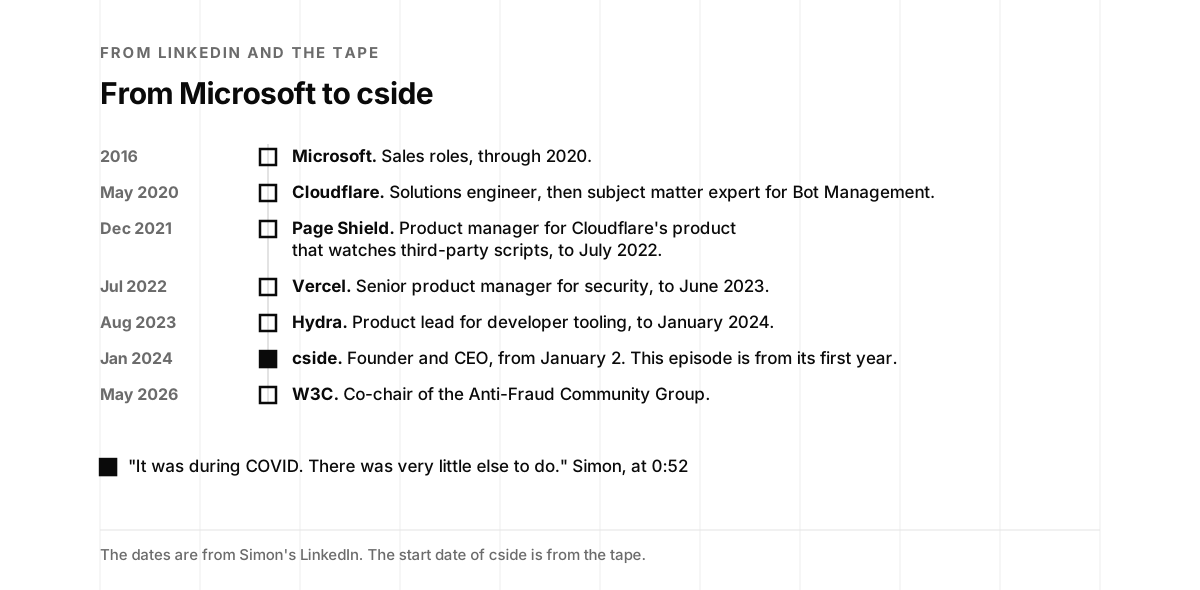
Simon founded cside in January 2024. Before that he was product lead for developer tooling at Hydra, from August 2023 to January 2024, and senior product manager for security at Vercel, from July 2022 to June 2023. At Cloudflare, from May 2020 to July 2022, he was a solutions engineer, a subject matter expert for Bot Management, and then the product manager for Page Shield, which watches the third-party scripts that load on a site. Before Cloudflare he worked in sales roles at Microsoft from 2016 to 2020 (LinkedIn).
The company dropped the slash in October 2025. It now writes its name cside and lives at cside.com (cside). This page uses cside, and quotes from the tape keep c/side.
The tape dates itself to the summer of 2024. Simon brings up the polyfill.io attack, which began on June 25, 2024, as a recent example, and he says a big announcement is coming in September. The episode aired a day after cside announced a $6 million seed round (cside).
This page follows the conversation in order: a section for each part of it with the sources beside it, fifteen figures, sixteen clips from the tape, the full transcript, and five tools: a quiz, a scorecard for the scripts on your site, a calculator for how many visitors a script that targets a few of them can reach, a timeline, and a to-do list. Where the decodes of the tape disagree on a word, the transcript puts its best guess in brackets, and the page doesn’t quote those words.
Side projects
Jon runs through Simon’s past at Hydra, Vercel and Cloudflare, and notes that he has been a founder before. Simon says those were little side projects.
“It was during COVID. There was very little else to do.”
Simon Wijckmans, at 0:52
He joined a Mozilla incubator program, made a small product, got some traction, and went back to work.
Swipe a credit card
Jon asks whether Simon calls himself a security person. Yes, Simon says, and he places himself where good developer experience meets security done in a modern way.
“I personally don’t find web security to be an enterprise problem only anymore.”
Simon Wijckmans, at 1:30
He says the security industry keeps doing the same things even when they stop working, because the big vendors sell to enterprises. His aim is to bring what he learned at Cloudflare and Vercel into a product people can sign up for and pay for with a credit card.
An old attack, new names
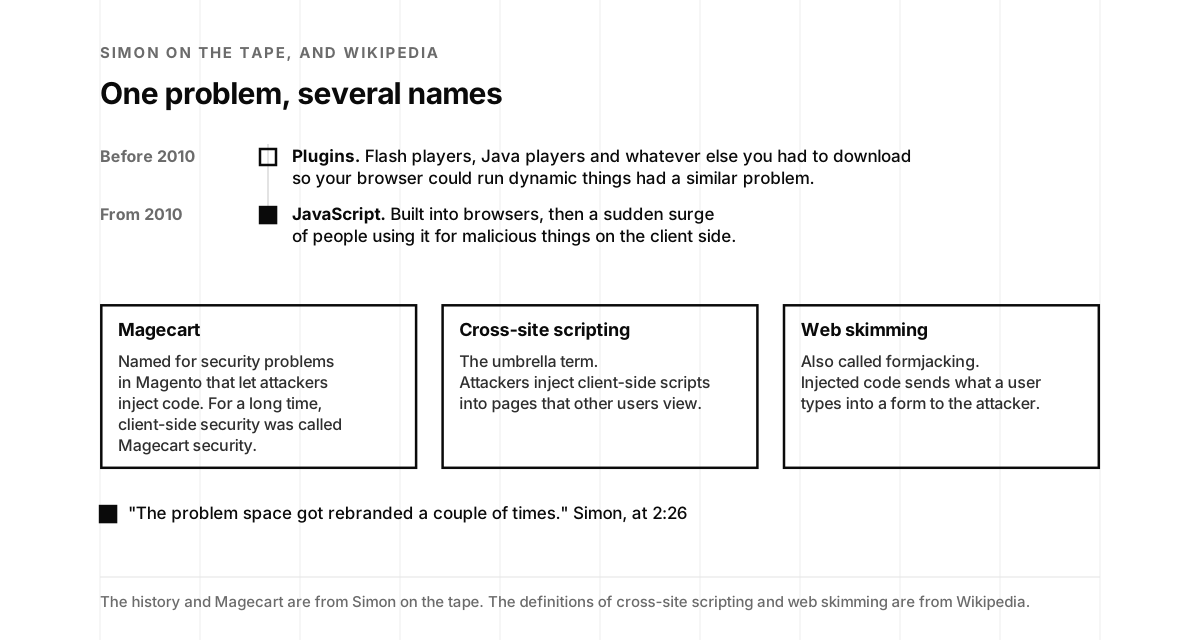
Sasha asks what problem cside solves. Simon’s answer starts with history. Around 2010, as JavaScript became a built-in part of browsers, attackers began using it to run malicious code in the browser. Before that, the Flash and Java players, and whatever else you had to download so your browser could run dynamic things, had a similar problem.
He says the problem has had several names. Magecart, he says, came from security problems in Magento that let attackers inject code, and cross-site scripting is the umbrella term. Web skimming, also called formjacking or a Magecart attack, injects code into a site and sends what a user types into a form to the attacker (Wikipedia). Cross-site scripting lets attackers inject client-side scripts into pages other users view (Wikipedia).
His reason the problem will grow: as teams protect their servers and their open source dependencies better, the browser becomes the way around all of that.
“Client-side security will only continue to become a bigger problem as we protect our infrastructure better, as we protect our open source dependencies that we use better”
Simon Wijckmans, at 2:49
The weird scripts you add
cside starts with third-party JavaScript. Simon’s examples run from a chat widget such as Intercom to a copy of jQuery that a junior engineer loaded from a CDN found online.
“So these weird scripts you got to add, like anything from tools like Intercom all the way to maybe jQuery being implemented using some CDN that you found online somewhere your junior engineer implemented at some point.”
Simon Wijckmans, at 3:20
The British Airways breach of 2018 shows what one changed script can do. The attacker modified JavaScript on the airline’s payment pages so that it copied the card data customers typed to an attacker’s site. The UK Information Commissioner’s Office found that data on about 429,612 people could have been accessed (Wikipedia). The same year, injected code on Ticketmaster’s payment pages affected 40,000 customers, and in November 2020 the ICO fined Ticketmaster UK £1.25 million for failing to secure a chatbot on its payment page (Wikipedia).
A proxy in front of every script
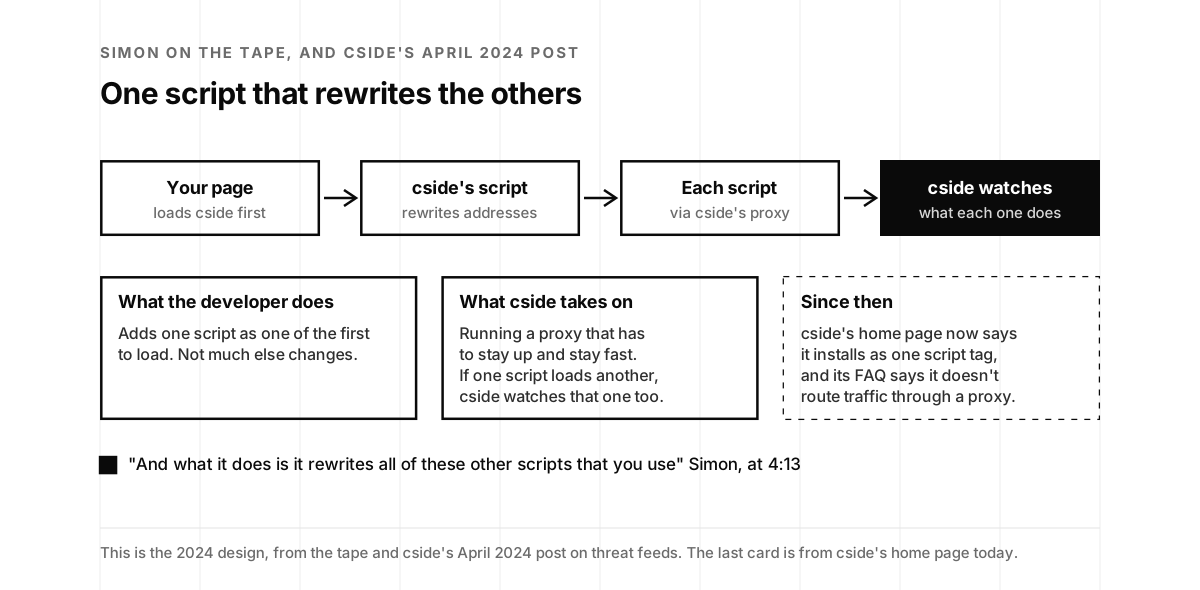
Sasha asks how cside fits into a site, since adoption depends on how easy that is. In 2024 the answer was a script that loads first and rewrites the addresses of every other script, so each one is fetched through cside’s own service.
“And what it does is it rewrites all of these other scripts that you use”
Simon Wijckmans, at 4:13
Simon says running a proxy is a burden for a security company. It has to stay up, and done badly it slows pages down. He says the team built it to make scripts load a little faster. The developer changes almost nothing, and if one script loads another, cside watches that one too.
cside’s April 2024 post on threat feeds describes the same design: rewrite script sources so cside fetches and analyzes them, which puts it in the path of every session (cside). The product has changed since. Its home page now says it installs as one script tag, and its FAQ says it doesn’t route traffic through a proxy or a reverse proxy (cside).
The polyfill.io attack
Jon asks for an example of an attack cside catches. Simon picks the one that had just happened. A polyfill is code that adds a newer browser feature to an older browser (Wikipedia). A site that still had to support Internet Explorer users could just add the polyfill.io script.
“And that got implemented on half a million people’s websites, all the way from large brands like The Verge and The Guardian and Hulu and you name it, massive websites, all the way to very small, little, like, e-commerce stores, WordPress sites, et cetera.”
Simon Wijckmans, at 5:45
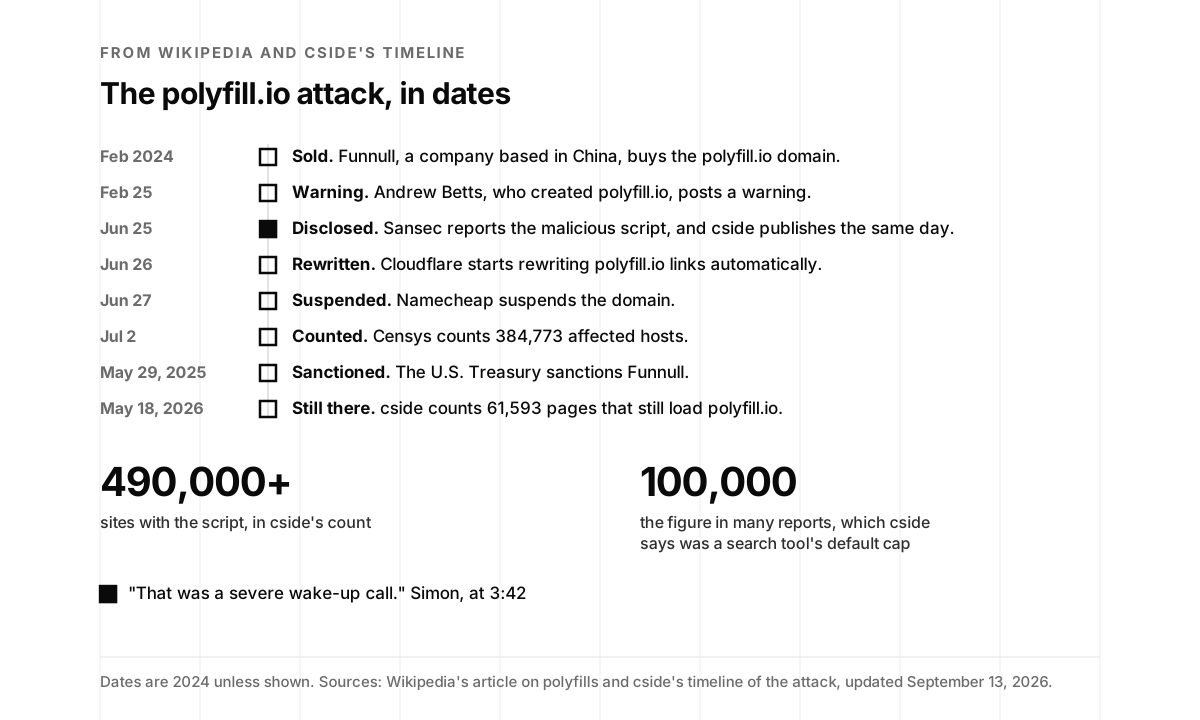
Polyfill.io was created by Andrew Betts. In February 2024 the domain was bought by Funnull, a company based in China, and within a few months it was part of a supply chain attack (Wikipedia). Simon says that from June 25, a small share of traffic got a different version of the script, which loaded another script from a domain built to look like Google Analytics.
cside’s timeline of the attack puts the reach at more than 490,000 sites. It says the figure of 100,000 in many reports was the default result cap of the search tool researchers used. It also records that Namecheap suspended the domain on June 27, 2024, and that Censys counted 384,773 affected hosts on July 2 (cside).
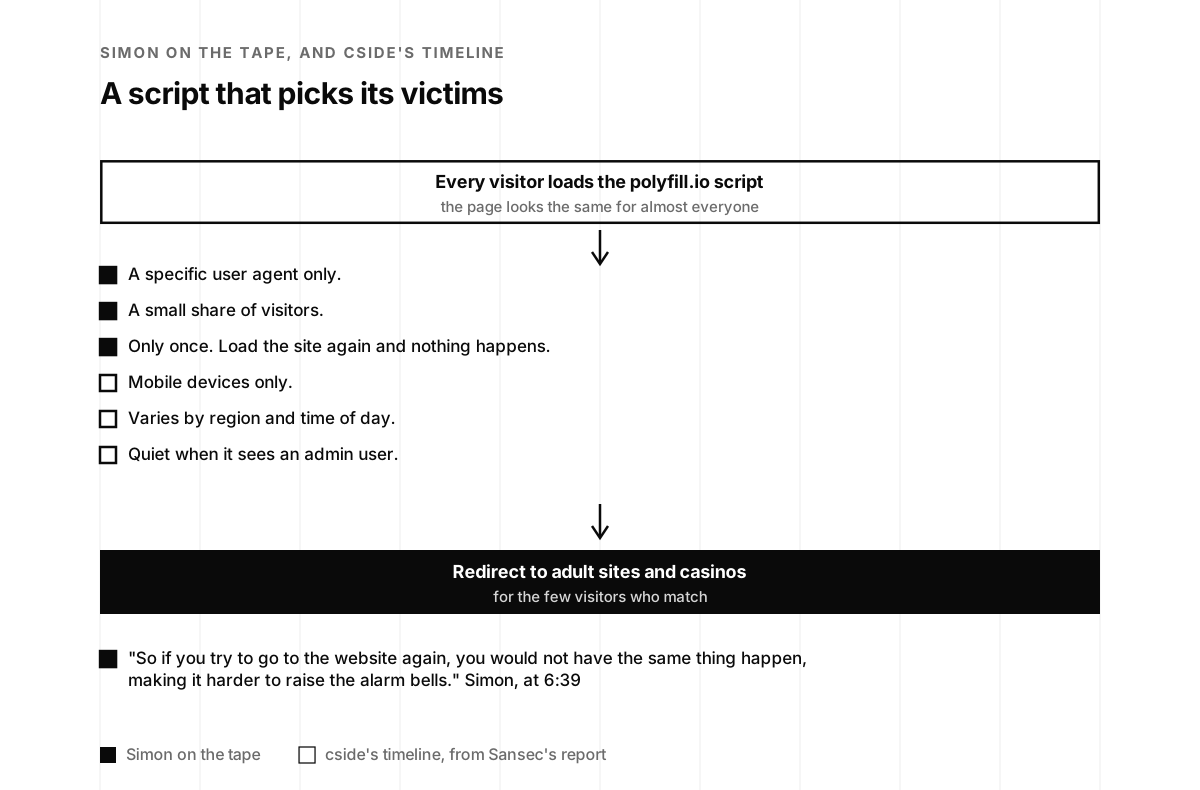
Only once, only some
The redirect was built to be hard to catch, Simon says. It sent a small share of visitors to adult sites and casinos, only once per visitor, and only for some user agents.
“So if you try to go to the website again, you would not have the same thing happen, making it harder to raise the alarm bells.”
Simon Wijckmans, at 6:39
cside’s timeline adds detail from Sansec’s report of June 25, 2024: the redirect fired only on mobile devices, varied by region and time of day, and went quiet when it saw an admin user (cside). The look-alike domain is a case of typosquatting, which relies on a name close enough to a real one to pass a glance (Wikipedia).
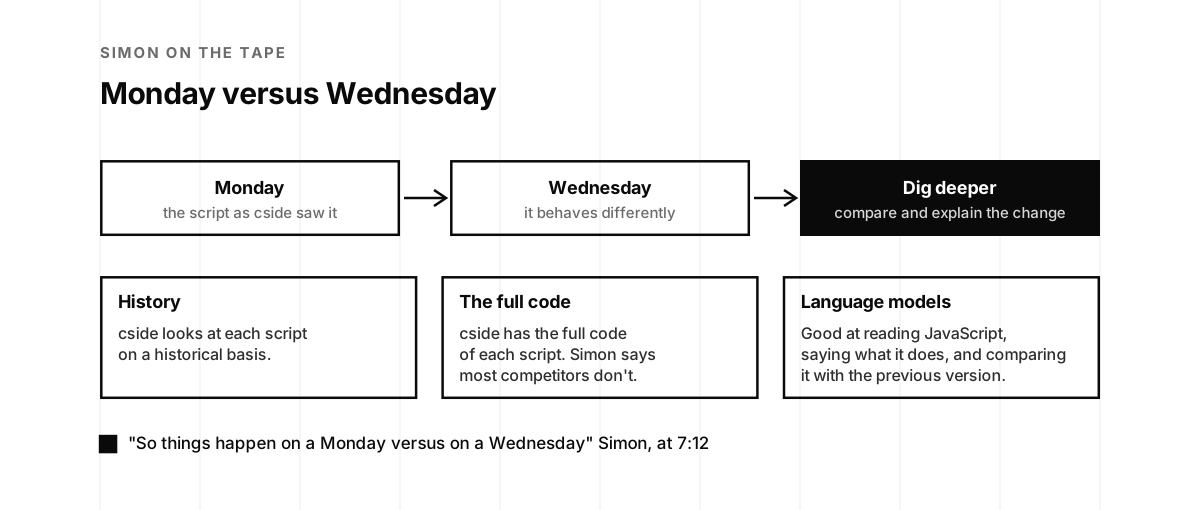
Monday versus Wednesday
Simon says cside looks at each script’s history, and digs deeper when a script starts to behave differently.
“So things happen on a Monday versus on a Wednesday”
Simon Wijckmans, at 7:12
Jon calls it AI-like. Simon says cside has the full code of each script, which most competitors don’t, and that large language models are good at reading JavaScript, saying what it does, and comparing it with the last version.
“And of course, LLMs are pretty decent at reading JavaScript, relaying what it does, and maybe, if you compare it to the previous state of it, how it is different and what it has changed and what that functionally means.”
Simon Wijckmans, at 7:32
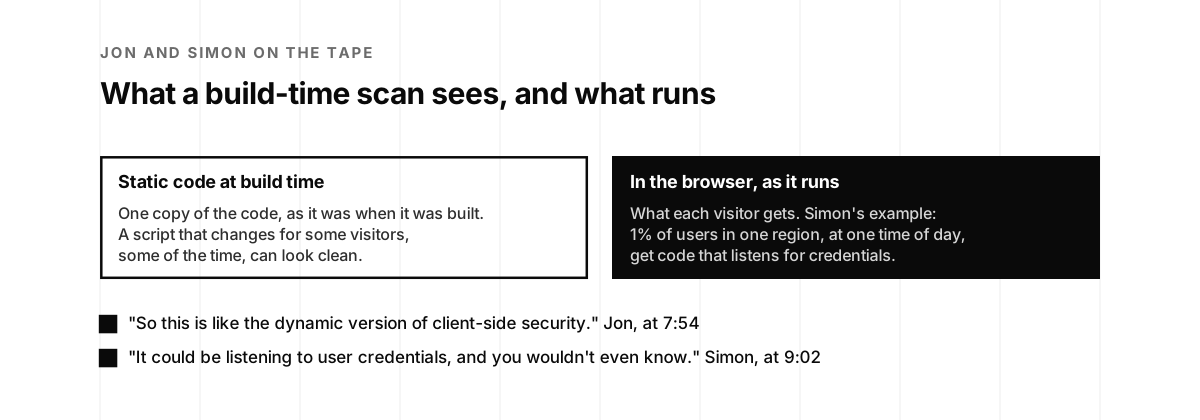
What a scan at build time misses
Jon spells out the difference.
“So this is like the dynamic version of client-side security.”
Jon McLachlan, at 7:54
cside sits where the code runs, he says. A scan of static code at build time would miss an attack that hits only a small share of visitors, some of the time.
Simon takes it further. An attacker could serve bad code to 1% of users in one region at one time of day. The code could be hidden and listen for credentials.
“It could be listening to user credentials, and you wouldn’t even know.”
Simon Wijckmans, at 9:02
The polyfill.io redirect was obvious, he says, and the attacker could have done much worse.
Dynamic supply chains
“Dynamic languages have dynamic supply chains. Surprise, surprise.”
Jon McLachlan, at 9:26
Simon adds that this is most true when scripts are fetched in the browser. He says the usual answer to his question about what runs in a user’s browser is a short silence and then no.
Web security people can reach
Jon asks what success looks like. Simon wants web security to be within reach of more people. He calls Cloudflare, in his opinion, the most successful company in the space, and says a buyer with a couple of hundred dollars for web security has no other good option.
“I would love to be in a position where we basically build web security to take into account more, deeper client-side behaviors, so we can protect web applications better against zero-day attacks, that we’re no longer relying on threat feeds”
Simon Wijckmans, at 10:37
He also names the NVD, which he says had a massive backlog. That was the slowdown at the National Vulnerability Database, run by NIST. It became visible in February 2024, and in May 2024 NIST said it had brought in outside help and aimed to clear the backlog by September 30, 2024 (Help Net Security).
Supply chain posture in real time
Sasha sums it up. Existing tools give a snapshot of the software as it was in the build pipeline. cside watches the logic that runs in the browser.
“Based on what I hear so far, it sounds like c/side is taking supply chain posture management into the real-time space”
Sasha Sinkevich, at 11:20
Sasha also guesses that cside could soon spot libraries that load but are never used. Simon says all of that is possible, because cside is itself a script and an npm package.
Every attack involves a client
Simon won’t talk about future products yet, but he explains the name.
“c/side stands for client-side.”
Simon Wijckmans, at 12:27
“Every attack involves a client.”
Simon Wijckmans, at 12:31
He wants to use what the client sees, along with whatever else cside can get, to stop attacks. He says large security companies oversell how they use data, and that good data isn’t being used to protect web apps.
Data that lands in the browser
Sasha calls it edge security moved one step further out, and points at data loss prevention tools that rely on access lists and on what a client is supposed to do. Data loss prevention covers the strategies and tools that stop sensitive data from leaving where it should stay (Wikipedia).
“There are a lot of legacy DLP solutions that rely on ACLs and on what your client is supposed to do, but you cannot really control the way data flows when it lands on a client, in your browser.”
Sasha Sinkevich, at 13:47
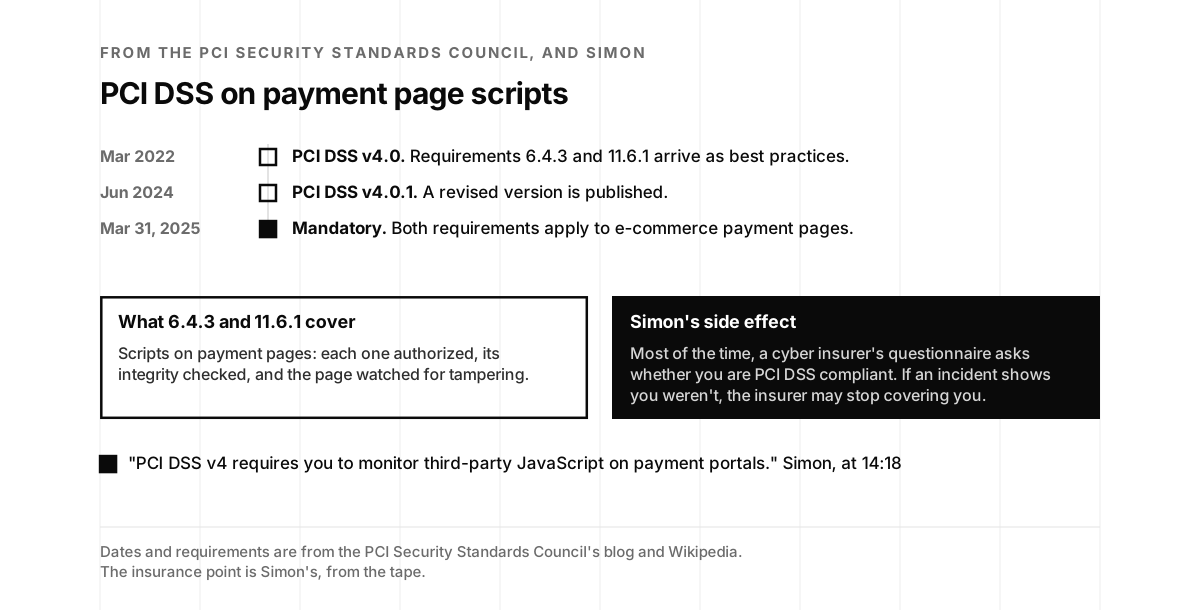
Simon agrees and names what pushes buyers: lawsuits, and compliance.
“PCI DSS v4 requires you to monitor third-party JavaScript on payment portals.”
Simon Wijckmans, at 14:18
The PCI Security Standards Council says requirements 6.4.3 and 11.6.1 cover scripts on e-commerce payment pages: each script has to be authorized, checked for changes and monitored for tampering. Both were best practices from March 2022 and became mandatory on March 31, 2025 (PCI SSC).
He describes a side effect. Most of the time, he says, cyber insurers ask in their questionnaires whether a company is PCI DSS compliant. If a company says yes and an incident shows it wasn’t, he says, the insurer may stop covering it.
A box in front of the infrastructure
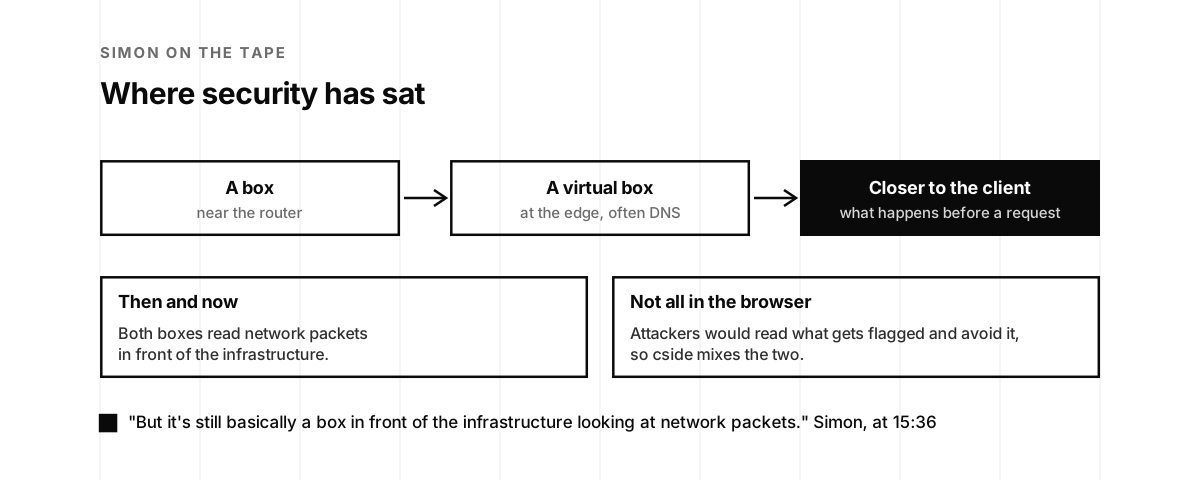
Simon says where security sits hasn’t changed much. It started as a box near the router. Now it’s a virtual box at the edge, often at the DNS level, still reading network packets.
“But it’s still basically a box in front of the infrastructure looking at network packets.”
Simon Wijckmans, at 15:36
He wants to use more data about what happens before a bad request is made, which moves detection toward the client. He doesn’t want all of it in the browser, because attackers would read the list of what gets flagged and avoid it, so cside mixes the two.
A lookup for weird domains
Sasha asks whether cside shares what it finds. Not yet, Simon says, and then a teaser: within a week there would be a site where you type in an unfamiliar domain and learn what it does, because many third-party scripts come from domains that a web search can’t explain. It would say who owns the domain and what the tool is for.
Thirty hours
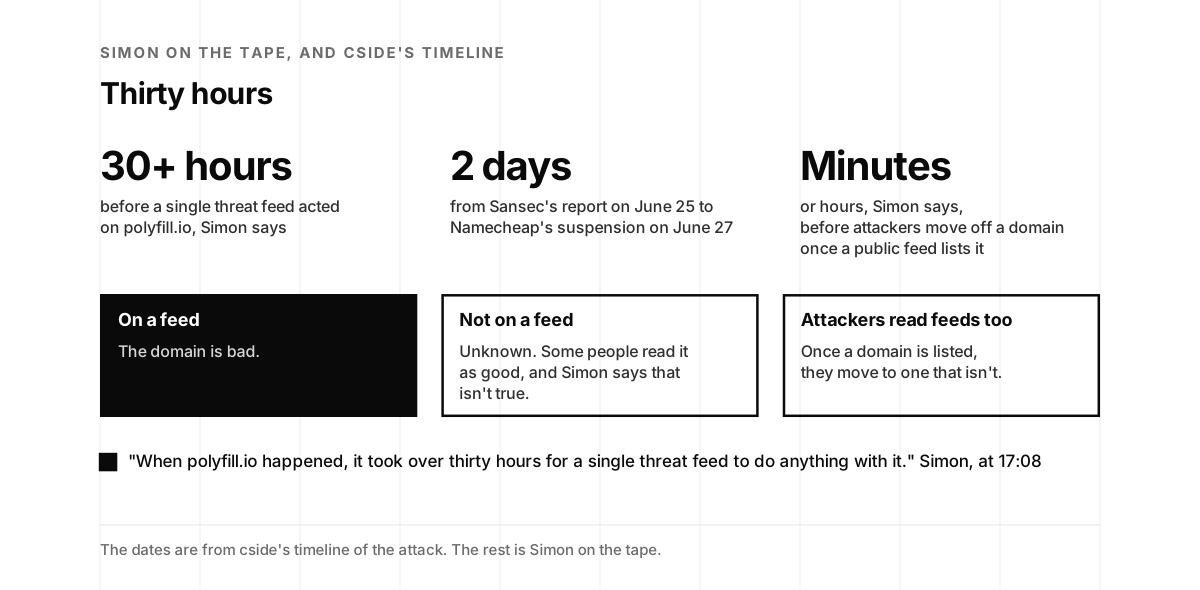
Simon doesn’t want to publish a threat feed. He says that after polyfill.io turned malicious, no feed acted on it for more than thirty hours.
“When polyfill.io happened, it took over thirty hours for a single threat feed to do anything with it.”
Simon Wijckmans, at 17:08
He says the registrar, Namecheap, moved faster than some feeds. cside’s timeline dates the suspension of the domain to June 27, 2024, two days after Sansec’s report (cside). Namecheap is an American domain registrar and hosting company (Wikipedia).
Sasha adds that security already has plenty of noise. The goal is context that applies to one environment.
A false sense of security
“I mean, I basically want to fight a false sense of security.”
Simon Wijckmans, at 17:36
A domain on a threat feed is bad. A domain missing from one isn’t proven good, he says, and security has taught people to read it that way. Attackers also read the feeds, and once a domain is listed, they move on within minutes or hours.
Cyber threat intelligence collects and shares information about threats so teams can predict and prevent attacks (Wikipedia). cside’s April 2024 post makes the same case as Simon: feeds are public, often list only domains, and attackers swap domains without rewriting their code (cside).
Don’t show the bots what you know
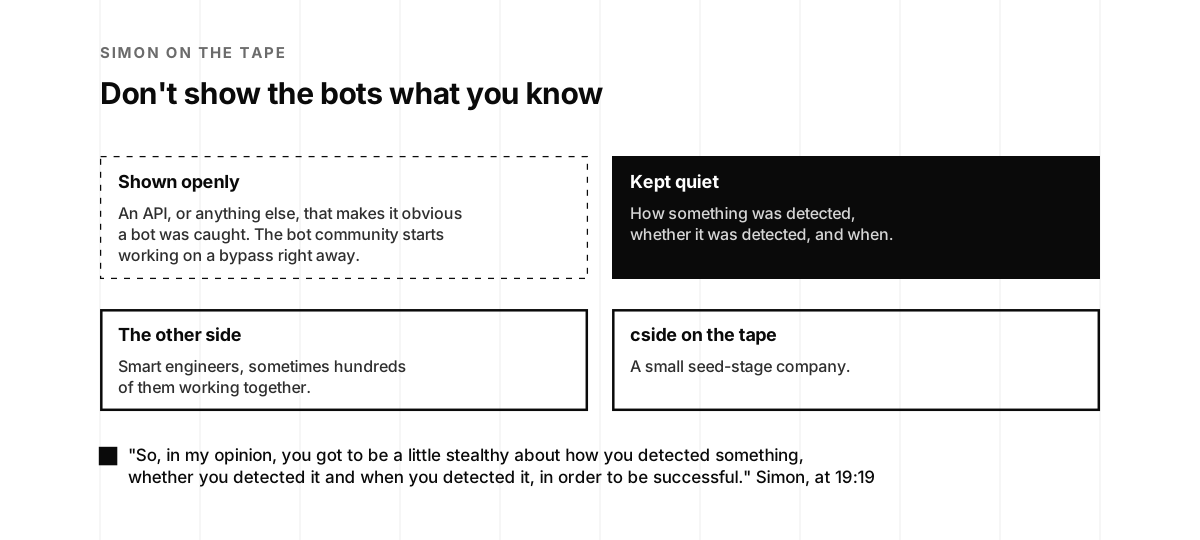
Jon asks whether Simon is the cat or the mouse. It depends on the day, Simon says, and he takes a lesson from bot detection. If customers get an API, or anything else that makes it obvious a bot was caught, the bot community starts working on a bypass right away.
“So, in my opinion, you got to be a little stealthy about how you detected something, whether you detected it and when you detected it, in order to be successful.”
Simon Wijckmans, at 19:19
He says attackers are smart engineers, sometimes hundreds of them working together, and cside was a small seed-stage company.
Five people and six contractors
Sasha asks how big the team is. At the time of the recording, five people worked full time, with six contractors, and six roles were open: principal and senior engineers, a business operations manager, and an account executive starting in September.
“So currently, there’s five of us full time and a bunch more contractors, six of those.”
Simon Wijckmans, at 19:52
The business operations role, he says, is because he is a solo founder.
Everyone with third-party JavaScript
Sasha asks about the typical customer. Simon says the range is wide: consumer brands, e-commerce platforms, online accountancy services and crypto exchanges.
“Basically, everybody has this issue if you use third-party JavaScript.”
Simon Wijckmans, at 20:34
He says most teams he talks to have already looked at supply chain security, and then realize the client side isn’t covered.
PCI DSS as a hook
Jon asks whether the PCI DSS requirement drives interest. Simon compares it with GDPR. A few months before GDPR took effect, a small share of companies cared. In the year after, regulators cracked down, nobody wanted to be the story, and many more cared. GDPR took effect on May 25, 2018 (Wikipedia).
“I do not think that c/side as a company, the success of our business, is going to rely on PCI DSS.”
Simon Wijckmans, at 21:44
He expects more rules like it, and he wants teams to keep an eye on the third-party domains they load without being told to. PCI DSS is a way to start a conversation with teams that work through compliance checklists. Most of his work, he says, is with engineers who understand the risk and don’t need a compliance reason.
Not a basic yet
Sasha says users care more about security and privacy, so companies need the basics covered to stay in business. Simon agrees, and says most teams haven’t counted client-side scripts among their basics yet.
“So in a way, I think we got very lucky that attack wasn’t worse or impacted people in a more stealthy way, because it acted as a good wake-up call to people without people actually getting harmed.”
Simon Wijckmans, at 23:25
A casino page pops up and you close it, he says. Stolen credentials or card numbers would be far worse. Jon pictures 1% of visitors redirected while another 1% have their data secretly scraped.
“You don’t know what you don’t know.”
Jon McLachlan, at 24:01
A fridge mining crypto
Simon says some past attacks used the user agent of IoT devices to decide who got the bad script, so a fridge or a car’s browser ended up mining cryptocurrency. Cryptojacking is mining cryptocurrency on someone’s device without their consent, often through a website (Wikipedia).
“Anything a good web developer can do with a browser, a bad actor can do with a third-party script.”
Simon Wijckmans, at 24:33
Browsers become more capable every day, he says, and attackers get the same new tools as front-end developers.
Bottom-up
Jon explains that the PCI DSS question was a test: does cside sell top-down or bottom-up? Jon hears both, with more weight on bottom-up, and Simon agrees.
“the bottom-up is where we get the most useful feedback from people”
Simon Wijckmans, at 25:23
At this stage, he says, the people who help cside most are individual developers who talk about it and send feedback.
A solo founder
Jon asks what a solo founder’s day looks like. Simon says that in his view the co-founder path holds more problems you can’t control. He asked a senior venture capitalist, a friend of a friend, whether he should go looking for a co-founder.
“And the response was, finding a co-founder that you haven’t worked with before, and that might result in, like, in a founder breakup, is a worse thing than just being a solo founder and knowing what you can do, and then surrounding yourself with other people to help you.”
Simon Wijckmans, at 26:29
Then, as soon as you can afford it, get someone to help on the operations side. cside had reached that stage at the time of the recording. His day covers a bit of everything: compliance, customers, engineering, product, the website and hiring. Some of the team are former colleagues, and others come from his wider network.
Plain language
Sasha says people outside tech and security often raise points the group missed. Simon agrees. Non-specialists ask the simple questions that specialists don’t ask themselves enough. cside made a basic video, in language anybody could follow, to explain the problem and why it was solving it.
“That’s how we should be talking about complex things, so that people actually are becoming more familiar with the security risks out there”
Simon Wijckmans, at 28:39
He wants people to know enough to press the companies they buy from. He says the public would be shocked to learn how threat feeds work: companies watch Twitter for complaints and add what they find to a list of naughty things to block.
“The security companies plus Santa Claus at the North Pole, both with naughty lists.”
Jon McLachlan, at 29:26
The best day
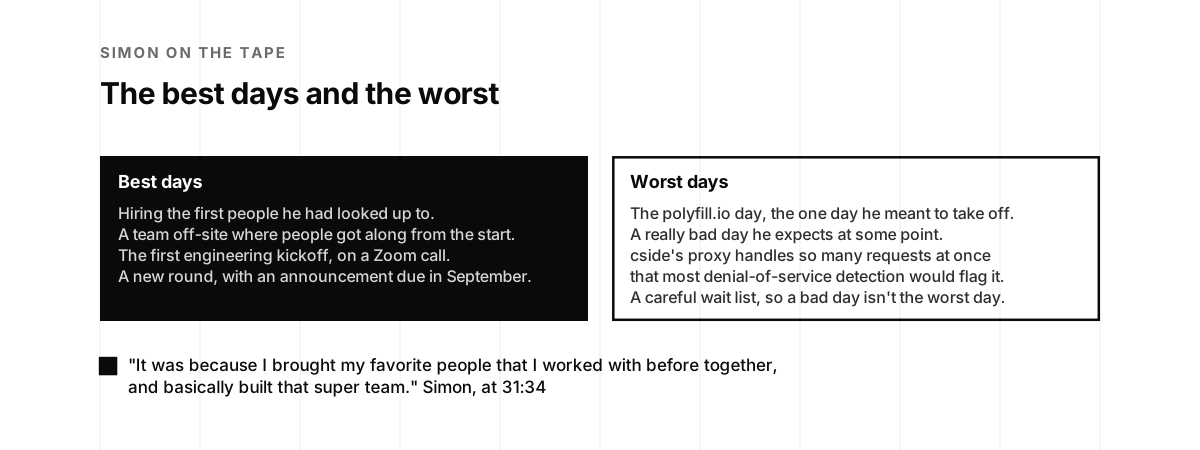
Jon asks for the best day so far. Simon says there have been many highs and few deep lows. Hiring the first people he had looked up to was one. A team off-site was another. The team is fully remote. People with ten years of experience, he says, will want to live where they have the space they need.
“So meet people where their life makes sense for them.”
Simon Wijckmans, at 31:04
He calls the first engineering kickoff, on a Zoom call, the best of his career, and later worked out why.
“It was because I brought my favorite people that I worked with before together, and basically built that super team.”
Simon Wijckmans, at 31:34
He also mentions a new round he can’t announce yet, with a big announcement in September (After the tape).
The worst day
Jon asks for the hardest moment. Simon says cside had a long wait list, enterprises included, and chose carefully who to let on and when, so that a bad day wouldn’t take down a major website. One of the worst days, he says, was the polyfill.io day. Looking back, it turned out well, because it got people talking about the risk.
“But that was literally the one day that I was going to take off to, yeah, take a break and relax, and literally Murphy’s law, something that very rarely happens, just then.”
Simon Wijckmans, at 33:24
Murphy’s law is usually stated as “Anything that can go wrong will go wrong” (Wikipedia). Simon expects a really bad day at some point. cside was building a proxy service, and he says most denial-of-service detection would flag it all the time because of how many requests it handles at once. The team’s experience from earlier jobs gives him confidence that cside could recover fast.
Jon jokes that the marketing plan could be for Simon to take more days off. Simon says he is bad at taking them.
Friction burns people out
Jon raises the other side of building: other people’s money and other people’s livelihoods. Simon says his biggest relief came when the new round’s terms were signed, with investors he had checked through back channels, and he could see years of runway for the people he had hired.
Simon says the friction around the work can do more harm than the amount of work. His example is someone in security who builds a thing to protect people, while the rest of the organization works against it because it isn’t their priority.
“when your job is to prevent bad things from happening, that’s incredibly exhausting on a personal level.”
Simon Wijckmans, at 36:15
That person, he says, knows they will be the one on the call explaining the incident. His answer is a low-friction place to work, with people who care about what they do and respect each other. His advice to founders: surround yourself with the best people you can find, and get investors who understand founder burnout.
Sasha says friction always gets in the way of action, and that cside takes friction out of client-side security.
Client Side Development Inc.
Sasha praises the name. Simon says it wasn’t his idea.
“I was calling the company Client Side Development Inc. as a legal name, and then someone told me, hey, Simon, you should consider calling it c/side.”
Simon Wijckmans, at 38:02
cside now says its name stands for client-side and is pronounced like seaside, and that the slash marked the line between what developers can and can’t control (cside). The company dropped the slash in October 2025 (cside).
Nobody owns the client side
Back on burnout, Simon points at who carries this risk.
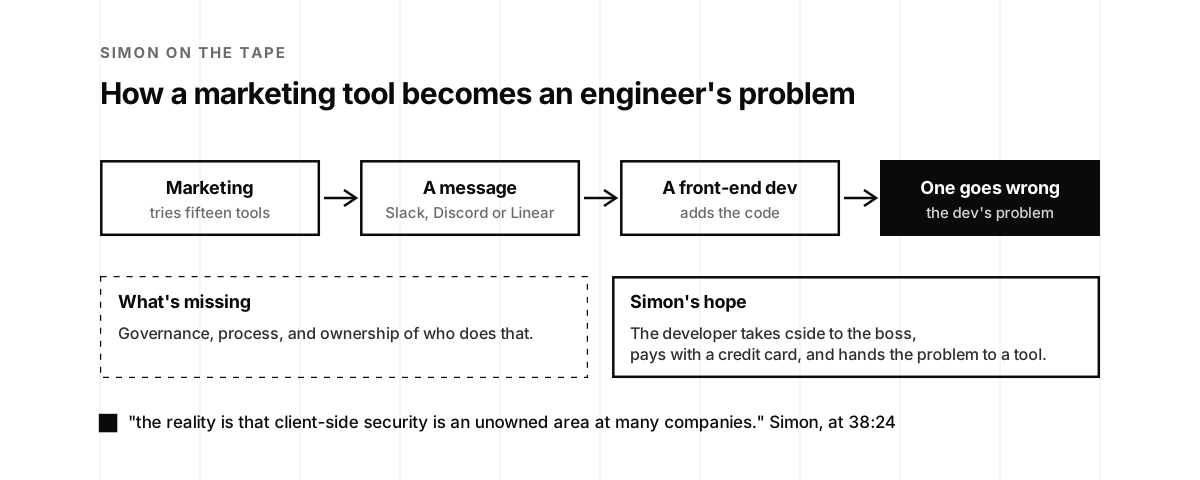
“the reality is that client-side security is an unowned area at many companies.”
Simon Wijckmans, at 38:24
It falls to the front-end engineer who added the code, even though someone else asked for it.
“So the marketing team is trying out fifteen different tools, and they all give them to a developer over Slack, Discord or Linear or whatever, and the front-end developer then implements it, and oh, one goes wrong, and it becomes their problem.”
Simon Wijckmans, at 38:35
He blames missing governance, process and ownership. His hope is that a developer takes cside to the boss, pays with a credit card, and hands the problem to a tool.
Scripts without version control
Sasha adds that a site loads tools such as Google Analytics without any version control over the script, so you don’t know what changed since the last load.
“It just loads the script, but you don’t really have the version control of that script.”
Sasha Sinkevich, at 39:25
Sasha notes that many frameworks and compliance rules speak to JavaScript that loads in the browser at run time.
Subresource Integrity lets a page give a cryptographic hash for a file, and the browser discards the file if the hashes differ (Wikipedia). Content Security Policy is a standard meant to prevent cross-site scripting, clickjacking and other code injection (Wikipedia). Wikipedia’s article on web skimming says both can help but don’t protect against supply chain attacks (Wikipedia).
Cameras on the coworking ceiling
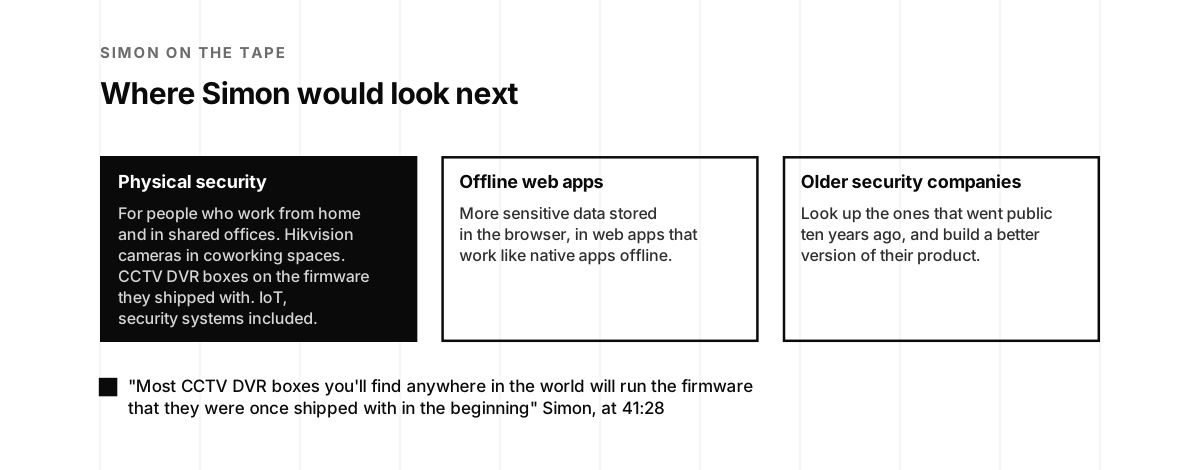
Sasha asks which other field is ready for new ideas. Simon goes to physical security for people who work from home and in shared offices. A former employer had strict physical security rules, he says, yet he worked under Hikvision cameras, because the coworking spaces it rented used that vendor. Hikvision is a partly state-owned Chinese maker of video surveillance equipment and is under U.S. and European sanctions (Wikipedia).
“Most CCTV DVR boxes you’ll find anywhere in the world will run the firmware that they were once shipped with in the beginning, some of which are just literally publicly known to be open to anybody to do bad things with.”
Simon Wijckmans, at 41:28
He also points at offline web apps, which store more sensitive data in the browser. His last suggestion is to look up security companies that went public ten years ago and build a better version of their product, since many have lost the people who pushed them to innovate.
“So you can actually just build better versions of their stuff and build a good business around it.”
Simon Wijckmans, at 42:39
Trust the process
Jon asks what Simon would tell his younger self. His answer is to trust the process: the most painful jobs and the most stressful times all made him better. He has advice for young people who want to start a company.
“I tend to tell people that if you really feel very deeply about a problem you’re going after, it’s probably not a bad thing to go work in that industry for two years, so you get the inside scoop of that space.”
Simon Wijckmans, at 44:48
Timing the jump
Jon takes that to mean cside started a year before the recording. Simon gives the start date as January 2. A year before the recording, he says, he weighed a more senior job against starting his own company. He took a more senior job at an early-stage startup, and six months later decided to build his own. His LinkedIn shows Hydra from August 2023 to January 2024 (LinkedIn).
“The investment space was also getting better, so investors were actually looking to invest in people again.”
Simon Wijckmans, at 46:03
cside raised a $1.7 million pre-seed about six months before its seed round (cside).
Use your skills, go do a thing
Sasha asks what listeners can do. Simon asks them to sign up and tell him what to improve. cside isn’t open source, he says, but he wants that kind of feedback culture. Jon sums up the setup as adding one script to the page, and Simon agrees.
“Add our thing and let the magic work.”
Simon Wijckmans, at 47:32
Jon asks for words of wisdom.
“So my little word of wisdom to people is, don’t be too harsh on yourself. That’s other people’s jobs.”
Simon Wijckmans, at 48:11
“Go build a better product. Go make a better internet. Use your skills. Go do a thing.”
Simon Wijckmans, at 48:19
After the tape
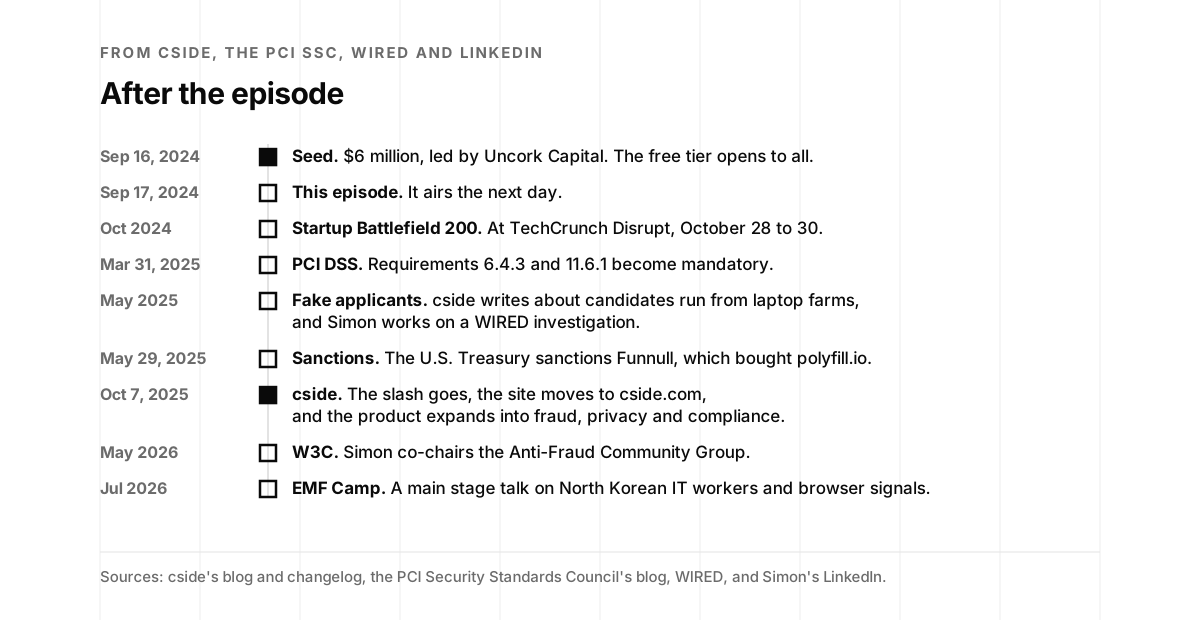
The seed round went public. On September 16, 2024, cside announced a $6 million seed round led by Uncork Capital, with Mantis and PrimeSet, and with Scribble VC and Roar Ventures back from the $1.7 million pre-seed. It opened its free tier to everyone at the same time (cside). The episode aired the next day.
A Startup Battlefield pick. TechCrunch Disrupt chose cside for its Startup Battlefield 200, held October 28 to 30, 2024, at Moscone West in San Francisco (cside).
The PCI DSS date arrived. Requirements 6.4.3 and 11.6.1 became mandatory on March 31, 2025 (PCI SSC).
Job applicants from laptop farms. In May 2025, cside wrote that it had interviewed near-identical candidates, run from laptop farms, who passed a third-party identity check. Simon worked with Bobbie Johnson on a WIRED investigation, and cside launched applicant fraud detection in closed beta (cside, WIRED). In July 2026, Simon gave a talk on the main stage at EMF Camp about North Korean IT workers getting into companies, and how browser signals exposed the operation (LinkedIn).
Simon Wijckmans on LinkedIn, July 20, 2026: his talk on the main stage at EMF Camp about North Korean IT workers getting into companies, and how browser signals exposed the operation.
Simon Wijckmans · July 20, 2026
The polyfill.io owner was sanctioned. On May 29, 2025, the U.S. Treasury’s Office of Foreign Assets Control sanctioned Funnull, the company that bought polyfill.io in February 2024. As of May 18, 2026, cside counted 61,593 pages that still loaded polyfill.io (cside).
c/side became cside. On October 7, 2025, the company dropped the slash, moved to cside.com, and expanded into chargeback evidence, applicant fraud, privacy and compliance (cside). Its home page now describes a platform that detects script attacks, AI agents, account takeover and fraud in the browser, installed with one script tag (cside).
A seat at the W3C. Since May 2026 Simon has co-chaired the W3C’s Anti-Fraud Community Group (LinkedIn).
More on this show. For browser security, listen to episode 49 with Vivek Ramachandran of SquareX and episode 98 with Or Eshed of LayerX. Episode 36 is with Feross Aboukhadijeh of Socket.dev, a startup improving security and privacy on the web. For threat intelligence, listen to episode 12 with Dan Sherry and Grace Chi of Pulsedive.
Did you catch it? A seven-question quiz
Seven questions from the episode. Each answer links the moment in the transcript.
Quiz · seven questions
Did you catch it?
Pick an answer to see whether you caught it, and where it is on the tape.
-
How did Simon describe setting up cside at the time of the recording?
- Add it as one of the first scripts to load on the site
- Put it in the site's web application firewall
- Run it in the build pipeline as a code scanner
a. "So the way that it works is you basically add c/side as one of your first scripts to load on your website." Transcript, 4:09.
-
When does Simon say the polyfill.io script started serving a different version?
- When the domain was sold in February
- On the 25th of June
- In September
b. "But then, on the 25th of June, you started noticing that a small amount of traffic got a different package" Transcript, 6:09.
-
Why was the polyfill.io redirect hard to report?
- It only ran on desktop computers
- It ran on every visit
- It happened only once per visitor
c. "So if you try to go to the website again, you would not have the same thing happen, making it harder to raise the alarm bells." Transcript, 6:39.
-
How long does Simon say it took a single threat feed to act on polyfill.io?
- Over thirty hours
- About ten minutes
- Two weeks
a. "When polyfill.io happened, it took over thirty hours for a single threat feed to do anything with it." Transcript, 17:08.
-
Which standard does Simon say requires monitoring third-party JavaScript on payment pages?
- GDPR
- PCI DSS v4
- SOC 2
b. "PCI DSS v4 requires you to monitor third-party JavaScript on payment portals." Transcript, 14:18.
-
Who usually ends up with the problem when a client-side script goes wrong, according to Simon?
- The security team
- The marketing team that asked for it
- The front-end engineer who added the code
c. "And usually that means it's going to come down to the front-end engineer that actually put the code there, even though they weren't the one that requested it." Transcript, 38:29.
-
What firmware does Simon say most CCTV DVR boxes run?
- The firmware they shipped with
- Firmware that updates itself every month
- Open source firmware the owner builds
a. "Most CCTV DVR boxes you'll find anywhere in the world will run the firmware that they were once shipped with in the beginning" Transcript, 41:28.
Do you know what runs in your users’ browsers?
Simon’s answers add up to a checklist for the scripts on your own pages. Eight questions on how much of it you can answer today.
Scorecard · eight questions
Do you know what runs in your users' browsers?
Answer for your login and payment pages. If two answers fit, pick the lower one.
-
Do you have a list of every third-party script on your login and payment pages?
- No
- Partly
- Yes, with an owner for each
"Basically, everybody has this issue if you use third-party JavaScript." See Everyone with third-party JavaScript.
-
Would you know today if one of those scripts started behaving differently?
- No
- At the next scan
- Yes, as it runs
"It could be listening to user credentials, and you wouldn't even know." See What a scan at build time misses.
-
Do you watch the scripts that your scripts load?
- No
- Some of them
- Yes
"if one of your scripts loads another script, that other script will also be monitored" See A proxy in front of every script.
-
Does any page still load polyfill.io, or a domain nobody on the team can explain?
- Yes
- Don't know
- No, we checked
"That was a severe wake-up call." See The polyfill.io attack.
-
Do your payment pages meet PCI DSS requirements 6.4.3 and 11.6.1?
- No
- In progress
- Yes, with evidence
"PCI DSS v4 requires you to monitor third-party JavaScript on payment portals." See Data that lands in the browser.
-
Does one named person own the scripts that marketing asks for?
- No
- Informally
- Yes, with a process
"the reality is that client-side security is an unowned area at many companies." See Nobody owns the client side.
-
Does your detection rely only on a threat feed?
- Only a feed
- A feed and scans
- Runtime monitoring too
"I mean, I basically want to fight a false sense of security." See A false sense of security.
-
Could you show your cyber insurer, with evidence, how you meet PCI DSS?
- No
- Roughly
- Yes
"That has an interesting side effect." See Data that lands in the browser.
You don't know yet what runs on your most sensitive pages. Start with a list of every script on login and payment pages, and remove what nobody can explain.
You know what loads. Next, watch how each script behaves as it runs, and give one person ownership of new scripts.
You can answer what Simon asks engineers. Keep the evidence current for PCI DSS and for your insurer.
How many visitors would a targeted script reach?
The polyfill.io script went after a small share of visitors, and Simon says no threat feed acted on it for more than thirty hours. This calculator shows how many of your visitors a script like that reaches before anyone acts.
Calculator
How many visitors would a targeted script reach?
Three numbers: visitors a day, the share a bad script targets, and the hours until someone acts.
With 50,000 visitors a day, 625 visitors get the bad code in the 30 hours before anyone acts, while 61,875 see a normal page.
The 1% and the thirty hours come from Simon on the tape. The 50,000 visitors a day is our example. Put in your own numbers.
From polyfills in 2009 to the W3C in 2026
Simon’s path, cside, the attacks and the rules around them. Filter by topic.
Timeline
From polyfills in 2009 to the W3C in 2026
- The word polyfill
Remy Sharp coins it for code that adds a missing browser feature (Wikipedia).
- Microsoft
Simon starts in sales roles at Microsoft, through 2020 (LinkedIn).
- British Airways
An attacker changes a script on the payment pages to copy card data (Wikipedia, on this show).
- GDPR
The EU's data protection regulation takes effect (Wikipedia, on this show).
- Cloudflare
Simon joins as a solutions engineer, then works on Bot Management (LinkedIn).
- Ticketmaster fine
The ICO fines Ticketmaster UK £1.25 million over a chatbot on its payment page (Wikipedia).
- Page Shield
Simon becomes product manager for Page Shield, which watches the third-party scripts on a site (LinkedIn).
- PCI DSS v4.0
Requirements 6.4.3 and 11.6.1 arrive as best practices for payment page scripts (PCI SSC).
- Script alerts
Simon writes up new Page Shield alerts for malicious code (Cloudflare).
- Vercel
Senior product manager for security, to June 2023 (LinkedIn).
- Hydra
Product lead for developer tooling, to January 2024 (LinkedIn, on this show).
- cside starts
Simon gives the date on the tape (on this show).
- Episode 36
Feross Aboukhadijeh of Socket.dev on the show (episode 36).
- polyfill.io changes hands
Funnull buys the domain (Wikipedia, on this show).
- The redirects
Sansec reports the malicious script, and cside publishes the same day (cside, on this show).
- Domain suspended
Namecheap suspends polyfill.io (cside, on this show).
- 384,773 hosts
Censys counts the affected hosts (cside).
- Episode 49
Vivek Ramachandran of SquareX on browser security (episode 49).
- Startup Battlefield
TechCrunch Disrupt picks cside for its Startup Battlefield 200 (cside).
- $6 million seed
Led by Uncork Capital, with the free tier opened to all (cside, on this show).
- Episode 54
Simon on the show (on this show).
- 6.4.3 and 11.6.1 required
The payment page script requirements become mandatory (PCI SSC, on this show).
- Laptop farm applicants
cside writes about fake job candidates run from laptop farms (cside, WIRED).
- Funnull sanctioned
The U.S. Treasury sanctions Funnull, which bought polyfill.io in 2024 (cside).
- c/side becomes cside
The slash goes, and the site moves to cside.com (cside, on this show).
- W3C
Simon becomes co-chair of the Anti-Fraud Community Group (LinkedIn).
- Still loading
cside counts 61,593 pages that still load polyfill.io (cside).
- Episode 98
Or Eshed of LayerX on browser security and AI (episode 98).
- EMF Camp
Simon talks on the main stage about North Korean IT workers and browser signals (LinkedIn).
What to do this week
Five things, in the order of the episode.
- List the scripts on your sensitive pages. Write down every third-party script on login and payment pages, who owns it, and why it’s there. Take the scorecard with your front-end lead.
- Remove polyfill.io and anything nobody can explain. Search your code and tag manager for polyfill.io and for domains no one recognizes. Our Product Security team can help you sort what stays.
- Watch scripts as they run. A scan at build time misses a script that changes for 1% of visitors. Run the calculator with your traffic, then decide who gets the alert. Monitoring and Response can take that on.
- Give the client side an owner. Name one person who approves new scripts, so marketing tools don’t land on whichever front-end engineer is free. A penetration test of your payment pages can show what an injected script could reach.
- Get a second pair of eyes. A vCISO can own the plan, and you can book 15 minutes with us.