
Episode 12 of The Security Podcast of Silicon Valley aired on January 20, 2022, with Jon McLachlan hosting. The guests were Dan Sherry, founder and CEO of Pulsedive, and Grace Chi, its cofounder and COO (Podbean, Apple Podcasts, Spotify). The episode is called “Founder Dan Sherry and Co-Founder Grace Chi deep dive into Pulsedive, Demystifying Threat Intelligence.”
Pulsedive is a bootstrapped cyber threat intelligence startup. The line that sums up the episode:
“every organization has threat intelligence, even if they don’t have threat intelligence.”
Grace Chi, at 16:19
This page follows the conversation in order: a section for each part of it, fourteen figures, eight clips from the tape, a talk of Grace’s on video, the full transcript, and five tools: a quiz, a scorecard for where your threat intelligence lives, a calculator for what false positives cost, a timeline, and a to-do list. Where the decodes of the tape disagree on a word, the transcript puts its best guess in brackets, and the page doesn’t quote or retell those words.
Two founders, two paths
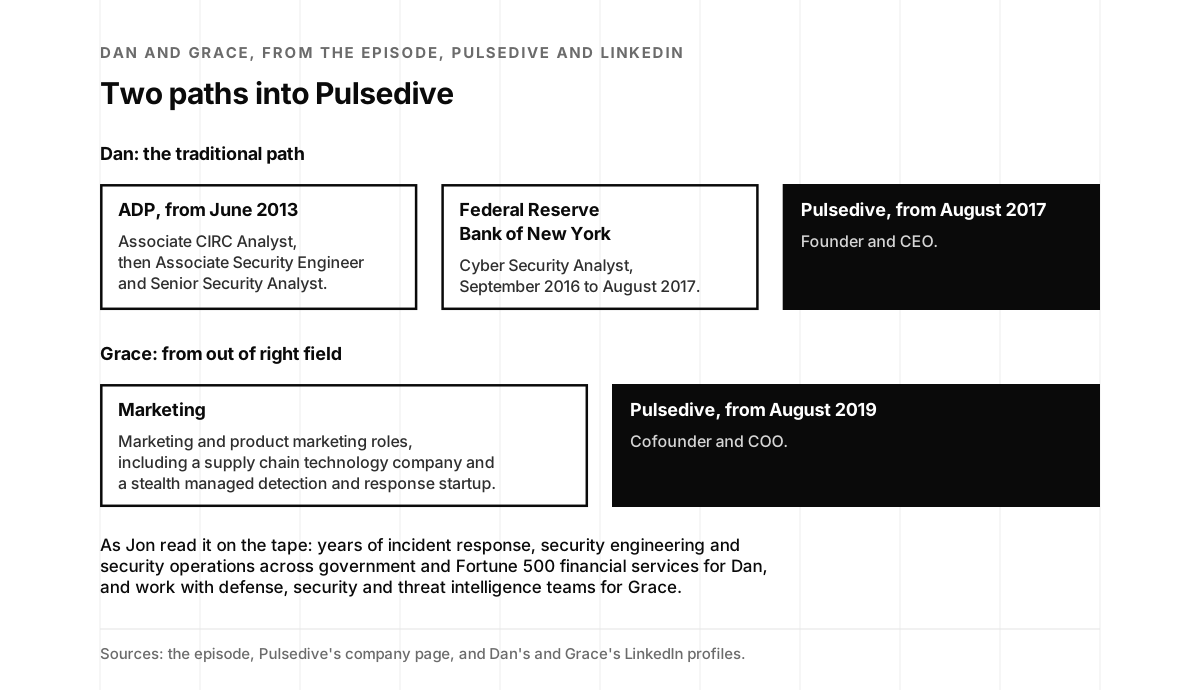
Jon opened with the founders’ bios. Dan has years of incident response, security engineering and security operations across government and Fortune 500 financial services, knows the struggle of filtering noise out of open source threat intelligence, and sees Pulsedive as the first step to solving that problem. Pulsedive’s company page describes Dan’s background in the same words (Pulsedive). Dan’s LinkedIn lists the path: security analyst and engineer roles at ADP from June 2013, a cyber security analyst role at the Federal Reserve Bank of New York from September 2016, and Pulsedive from August 2017 (LinkedIn).
Grace works closely with defense, security and cyber threat intelligence teams on integrated intelligence capabilities and programs, as Jon read it. Grace’s LinkedIn lists marketing and product marketing roles before Pulsedive, including product marketing for a supply chain technology company and a stealth managed detection and response startup, and the cofounder and COO role since August 2019 (LinkedIn).
Platform and data
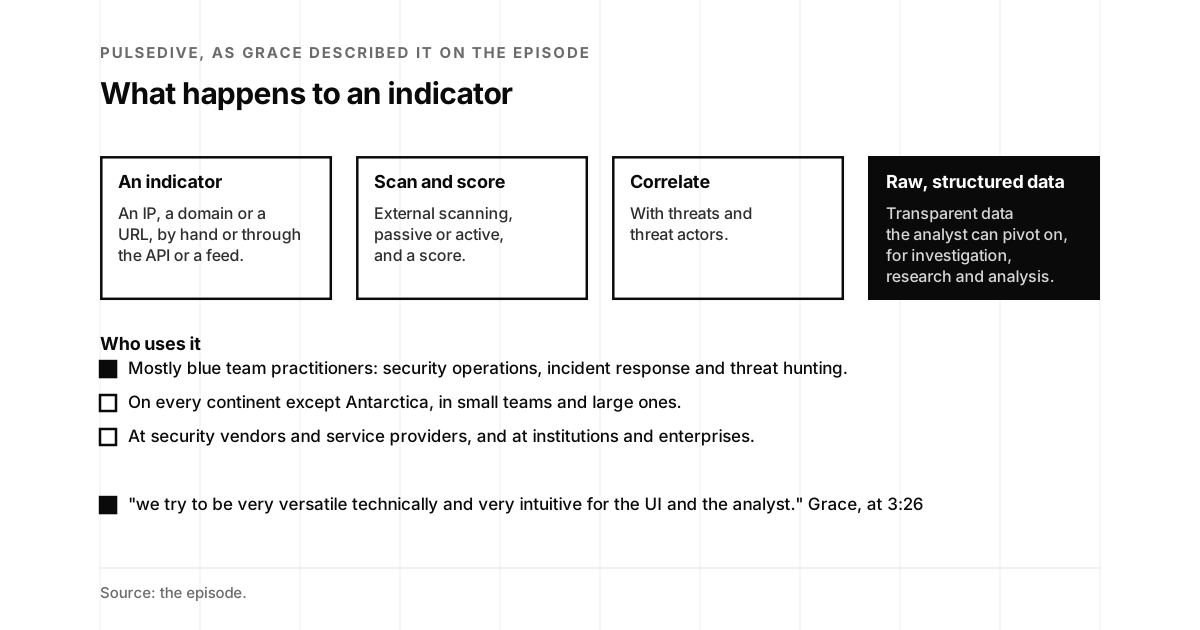
Grace’s short version: Pulsedive is a cyber threat intelligence startup that offers both a platform and data. Most of its users are blue team practitioners, in security operations centers, incident response and threat hunting. They work on every continent except Antarctica, in small and large teams, at security vendors and service providers as well as institutions and enterprises.
The product is enrichment: external scanning and scoring of indicators of compromise, correlated with threats and threat actors. Users get transparent, raw but structured data they can pivot on and bring into their own investigation, research and analysis.
“we try to be very versatile technically and very intuitive for the UI and the analyst.”
Grace Chi, at 3:26
An indicator of compromise is a technical artifact, such as a suspicious IP address, a hash of a malware file or a malicious domain, that suggests an attack is coming, under way or already happened (Wikipedia).
By hand, or by API
Some users work by hand, on research shaped by their own expertise and their own threat environment. Others automate. Because the security space changes all the time, Pulsedive plugs into other tools through an API or a feed, so its intelligence and enrichment go wherever a team needs them.
A ladder of products
Jon asked whether Pulsedive fingerprints or scans the network for traffic known to have bad intent. Grace liked the word mal-intent, and walked through the portfolio.
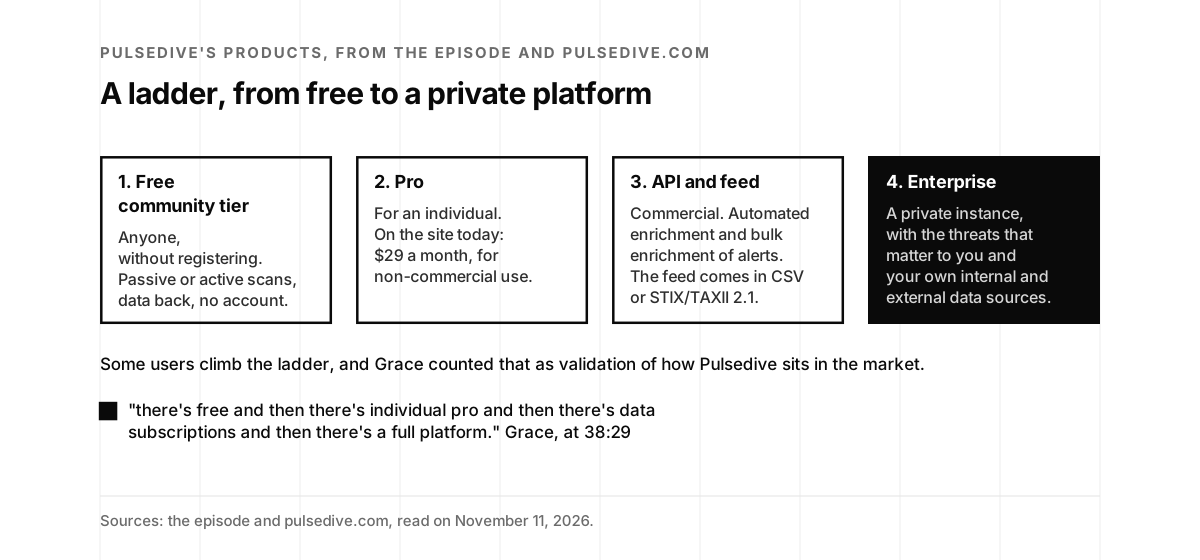
At the bottom is a freemium community tier. Anyone can use it without registering, run passive or active scans, pull back data and never make an account, and that’s on purpose. Those users are often getting started in threat intelligence, or work in IT and also wear the security hat, with no budget.
A step up, teams pay for the commercial API or a feed license. That’s where they automate enrichment: the IPs, domains and URLs coming through their tools go to Pulsedive for a scan, the data and a score come back, and incoming alerts get enriched in bulk. At the top, an enterprise tier gives an organization its own private instance of Pulsedive, where it picks the threats that matter to it and configures its own internal and external data sources.
Pulsedive’s site lists the same ladder today: search for anyone, a free account to submit and comment, Pro for non-commercial use at $29 a month, the API and Feed for commercial use, with the feed in CSV or STIX/TAXII 2.1, and a dedicated, cloud-hosted Enterprise TIP, or threat intelligence platform (Pulsedive).
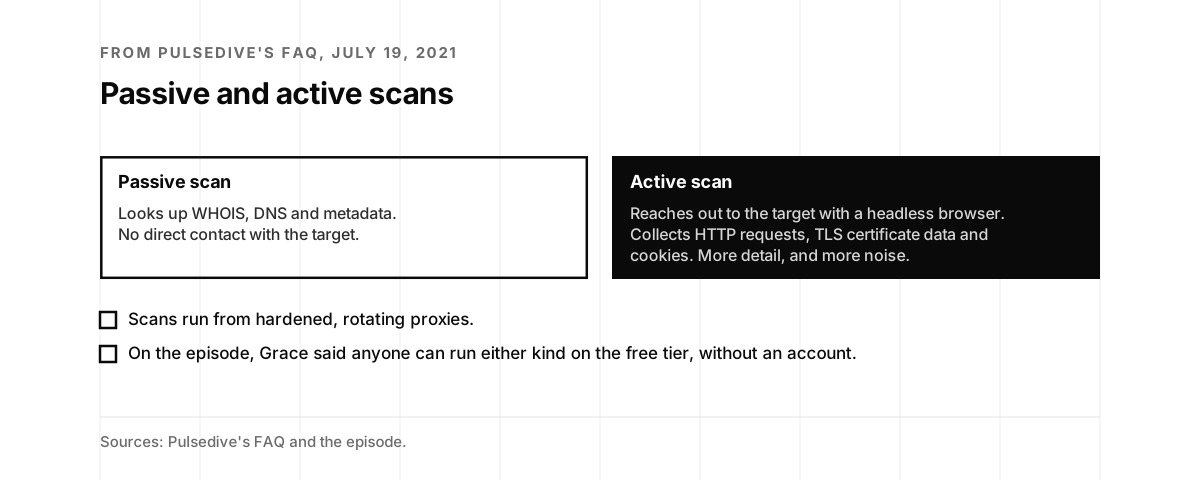
Pulsedive’s FAQ explains the two kinds of scan. Passive scans look up WHOIS, DNS and metadata without touching the target. Active scans reach out to the target with a headless browser and collect HTTP requests, TLS certificate data and cookies, which tells you more but makes more noise (Pulsedive).
A business that does important work
Jon asked what shaped the founders’ values. Dan’s story starts in college, around the time Facebook got huge and The Social Network came out. Dan wanted to start a company, and built apps in college to try to build a business around while studying cybersecurity. The 2010 film, about the founding of Facebook, opened in the U.S. on October 1, 2010 (Wikipedia).
The security job itself turned out to be fulfilling. Cybersecurity offered both a business to build and work that mattered, and the problem showed up on the job:
“we’re collecting a bunch of data. How do we leverage all that so we’re not hunting for the same things that people already know about?”
Dan Sherry, at 7:35
Dan started in the industry in 2013, as it began to grow exponentially. Threat hunting was still relatively new.
Out of right field
Grace described the pairing. Dan has the traditional path, years of security engineering, incident response and threat intelligence work, and built the product Dan wanted to use. Grace came in from completely out of right field. Marketing was a way to learn how businesses grow, working closely with a lot of leadership. Grace sees outside perspectives as a way to enrich the whole industry. In security, Grace has seen technology pushed without the operational work or the skilled staff to run it:
“Technology is so important, but it really fits within processes and people.”
Grace Chi, at 10:58
Jon said the two complement each other: a team of clones preaches to the choir, and a diverse team makes a startup more resilient.
Fix the foundation
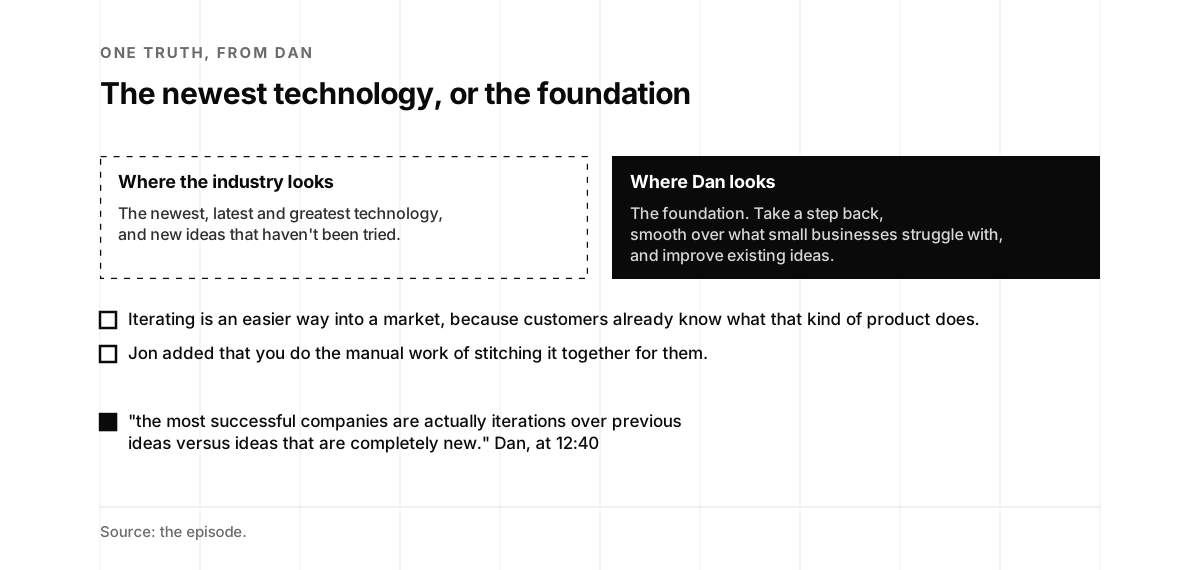
Jon asked for one truth most people miss. Dan’s answer: the industry keeps building the newest technology, but hasn’t nailed the foundation. There’s room to take a step back and smooth over what a lot of small businesses struggle with. The attention goes to new ideas that haven’t been tried, but there’s a lot to do in changing or improving existing ones. Dan remembered reading research that the most successful companies iterate on earlier ideas.
Jon put it as making existing ideas more accessible to a wider audience. Dan added that iterating is an easier way into a market, because customers already know what that kind of product does, and Jon added that you’re doing the manual work of stitching it together for them.
Problems that should be solved by now
The view came from meetups, talking with engineers and responders stuck on the same problems, the kind that make you ask why they haven’t been solved. New companies kept coming out, and Dan asked why more people weren’t addressing the problems of organizations that aren’t as mature or have smaller budgets. The frustration was shared by engineers trying to automate and support vendor solutions, and by responders trying to tell whether something is a false positive.
Jon tied it to the cloud. Everyone with a cloud environment is responsible for protecting it, and when security is priced out of reach or too complex for small businesses and startups, the gaps grow. A free tier invites everyone to the table.
Every organization has threat intelligence
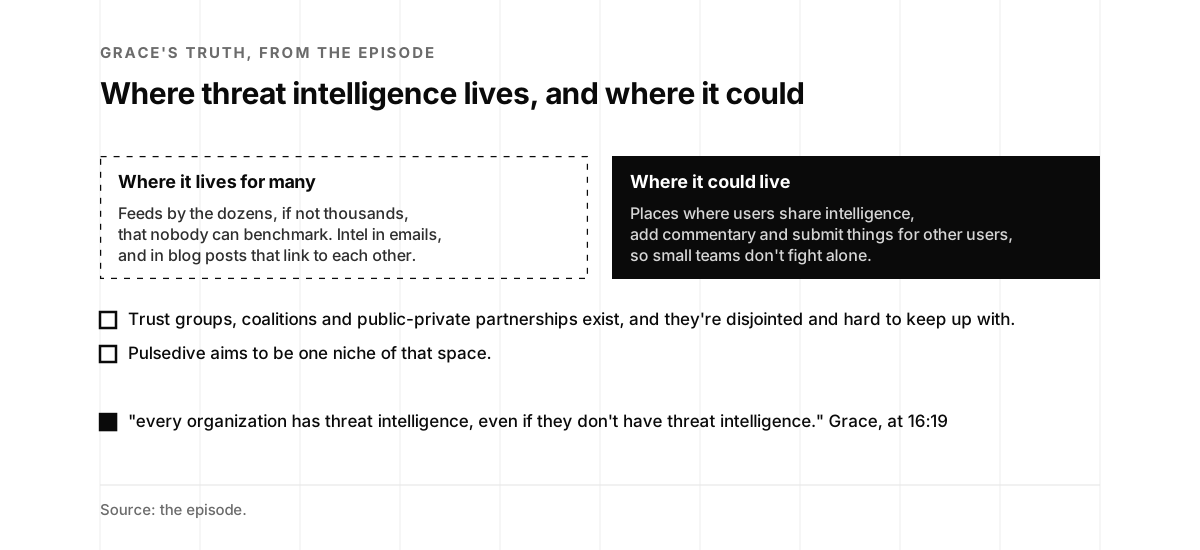
Grace’s truth was about sharing. When threat intelligence hit the market, everyone wanted feeds, and feeds came out by the dozens, if not thousands:
“no one can really truly benchmark the quality, the efficacy, the relevancy of various lists of IOCs.”
Grace Chi, at 16:09
The result is intelligence that lives in emails and in blog posts that link to each other, and that isn’t great. Places where users share intelligence, add commentary and submit things for other users mean that a small business with few resources isn’t fighting alone. Trust groups, coalitions and public-private partnerships exist, but they’re disjointed and hard to keep up with, and Pulsedive aims to be one niche of that space.
Cyber threat intelligence is the part of cybersecurity that collects, analyzes and shares information about potential or existing threats (Wikipedia).
Opt in, never forced
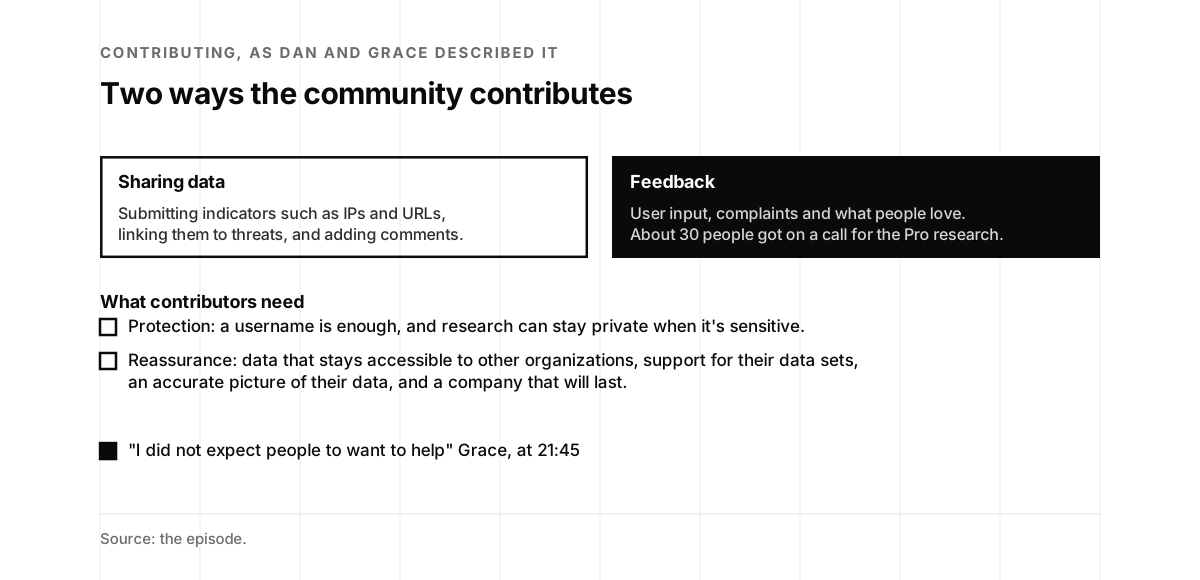
Jon asked how Pulsedive gets people to give back. Grace’s first answer was free things, giving value before asking for anything. Then Grace named a second challenge: you want people to contribute, and you also want to protect them. Contributors don’t have to say who they are, and a username is enough. Anyone can do research without submitting it to the community when the work is sensitive.
“you opt in to share”
Grace Chi, at 18:13
Free, without an account
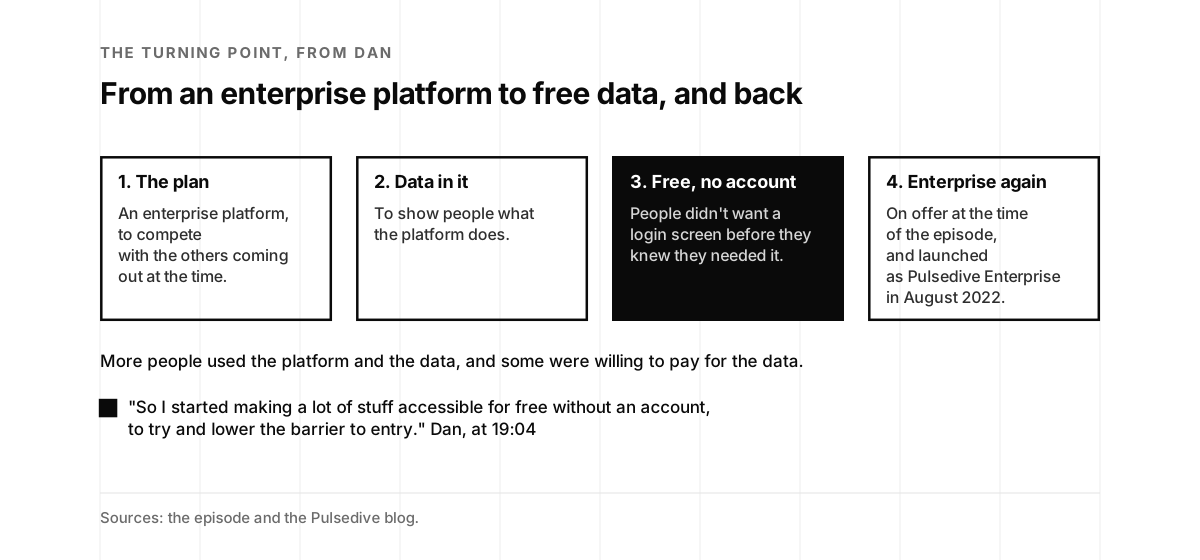
Grace asked Dan for the turning point. Pulsedive started out as an enterprise platform, built to compete with the other platforms coming out at the time. To show people what it did, Dan put data in it, and found that people didn’t want to go through a login screen to discover something they didn’t know they needed:
“So I started making a lot of stuff accessible for free without an account, to try and lower the barrier to entry.”
Dan Sherry, at 19:04
More people used the platform and the data, and some were willing to pay for the data. So Pulsedive discontinued the enterprise version for a while. By the time of the episode, the value had been proven, and people wanted that value within their own environment.
Contributors want you to stick around
Dan said people are surprisingly willing to help smaller organizations and put their data out there. There are so many open source projects, and a lot of it is pretty disjointed. Contributors want reassurance: that the data will be accessible to other organizations, that you can support their data sets, that the company will last, and that you’ll represent their data accurately, so it gets used the way it’s meant to be.
Feedback counts too
Grace widened what contributing means. Sharing data means submitting indicators such as IPs and URLs, linking them to threats and adding comments. Feedback counts too: user input, complaints, and what people love. The research for Pro, a paid product launched a year before the episode, surprised Grace:
“I did not expect people to want to help”
Grace Chi, at 21:45
Grace asked about 30 people, users and non-users, some known and some not, and all of them were willing to get on the phone. Even people who weren’t fans of the community platform supported the vision. The input made the product better, and Grace credited it for a great Black Friday. Pulsedive’s Black Friday 2021 deal took 50% off Pro and API plans for up to 12 months, through November 30, 2021 (Pulsedive).
Community, or commodity
Jon summed it up: if you give, the community gives back. Jon recalled hearing, probably from a venture capitalist, that without a community, you become commoditized, like any other product:
“a Kleenex is a Kleenex, no matter what the brand is.”
Jon McLachlan, at 22:39
With a community around the people struggling with the same problems, the brand lasts. Grace added that the founders take part in that community too, with a collateral benefit. The founders talk to thousands of threat intelligence teams, have helped people land jobs by knowing both who’s hiring and who’s looking, and advocate for diverse and new talent coming into the field. To build a great product you have to understand the market, and to understand the market you have to take part in it. Dan agreed: you need the community, and you need to be part of it.
Pulsedive signed the Respect in Security pledge in July 2021, a commitment to a workplace free from abuse and harassment (Pulsedive). On August 12, 2021, The Diana Initiative posted Grace’s talk on threat intelligence careers from its 2021 virtual conference. The talk introduces the basics of threat intelligence and how to get a first role and advance a career, and debunks a few myths about the job (Pulsedive).
Quarterly reviews and a first sale
Jon asked about the best day. Grace pointed to the quarterly business reviews: a grind of wading through data, but in a startup where every day is chaos and progress is hard to see, measuring the change quarter over quarter shows how far you’ve come. Who signs up, how they use the product, what worked and what surprised you. Taking the time to look back and plan forward keeps the founders aligned.
For Dan, it’s seeing the company grow from a vision worked on during nights and weekends. Grace noted that it’s nights and weekends now, and during the day too. Dan’s first sale took about a year, and it showed this was a viable business model. Building the product came first, then feedback, and making sure Pulsedive offered enough value that people could justify a line item in a budget for it.
The invoice nobody expected
During that first year, an unexpected buyer got in touch, interested in the feed. Dan assumed one of the lower tiers, and they wanted the highest one, with an invoice. Dan called that year a roller coaster.
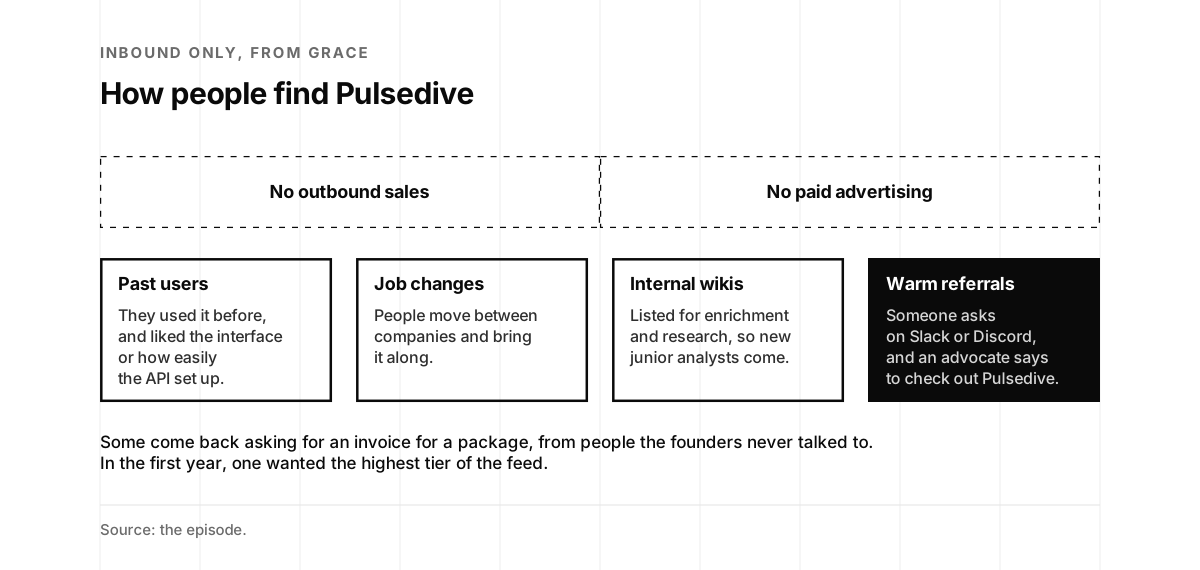
Grace said it happens all the time, because Pulsedive has no outbound sales process and does no paid advertising. People use what they want, and some come back asking for an invoice for a package. When Grace asks how they heard about Pulsedive, the answers are grassroots: they used it before and liked the interface or how easily the API set up, they changed jobs and brought it along, a team’s internal wiki lists it for enrichment and research, or someone asked in a Slack or Discord group and got a warm referral.
Integrations users build
Jon raised the investor question: would Pulsedive raise money and go for the hockey stick? Grace mentioned the hockey stick every startup says it can do, then added something the community gives Pulsedive:
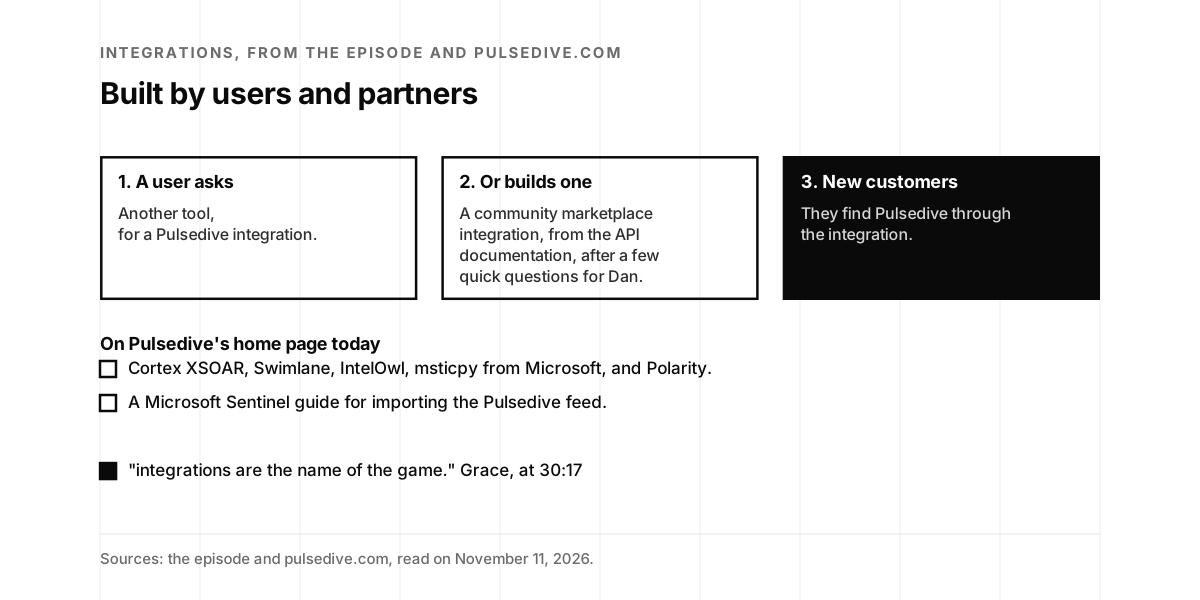
“integrations are the name of the game.”
Grace Chi, at 30:17
Users ask other tools for a Pulsedive integration, or build their own community marketplace integration. That gives Pulsedive development capability that didn’t come from its own team, and new customers find Pulsedive through those integrations. Pulsedive thanks the builders with deals and discounts. When Jon brought up an open source GitHub, Grace pointed to the API documentation: Dan answers a few quick questions, and an integration appears. The best ones, for Grace, are integrations nobody knew about until they were published and people showed up using them.
Pulsedive’s home page now lists integrations such as Cortex XSOAR, Swimlane, IntelOwl, Microsoft’s msticpy, Polarity and a Microsoft Sentinel guide for importing the feed (Pulsedive). A threat intelligence platform imports threat data from many sources and formats, correlates it, and exports it into an organization’s existing security systems (Wikipedia).
Funkiness, and users nobody planned for
Good days come from users too. After Pro launched, users came back saying they’d found funkiness and pivoted on it, like the single security person whose detection, made with Pulsedive’s help, protected the company. The team keeps a private channel in Slack for that kind of feedback, to stay motivated.
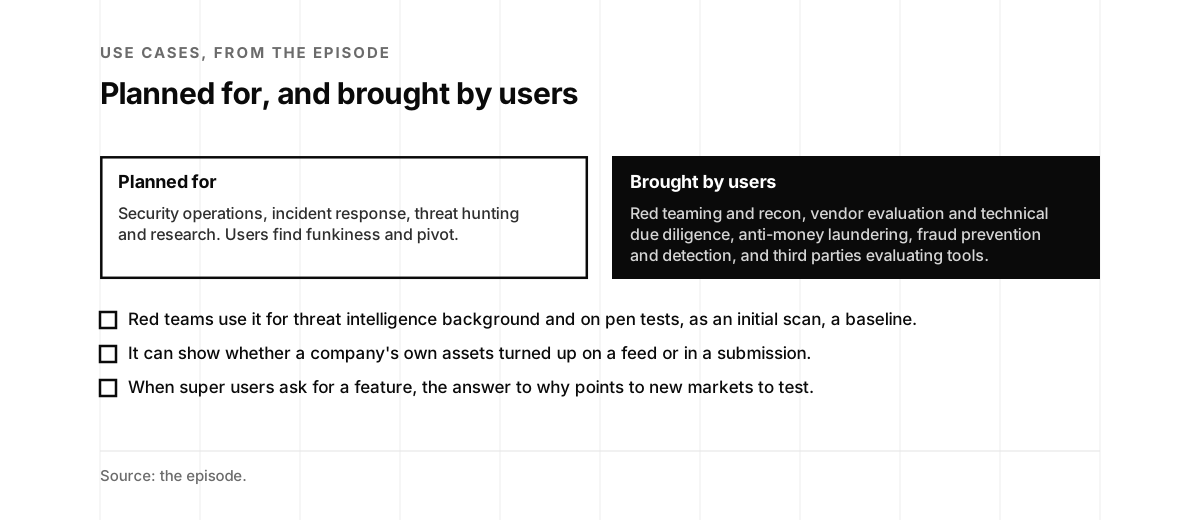
Then there are super users from outside the usual use cases: red teamers doing reconnaissance, people evaluating vendors, and technical due diligence. They ask for features, and their answers to why point Pulsedive toward new markets to test. Asked for the most surprising ask, Grace named users from anti-money laundering, fraud prevention and detection, and third parties evaluating tools.
Red teams use it too
Jon asked whether a red team user makes the founders suspicious, in case someone checks whether an attack will be detectable. Dan said a lot of red teams use Pulsedive for threat intelligence background and on penetration tests. The conversation called it an initial scan, a baseline of where they start. Dan added that Pulsedive can show whether a company’s assets have turned up as indicators, on its feeds or in submissions.
Six months of a bad day
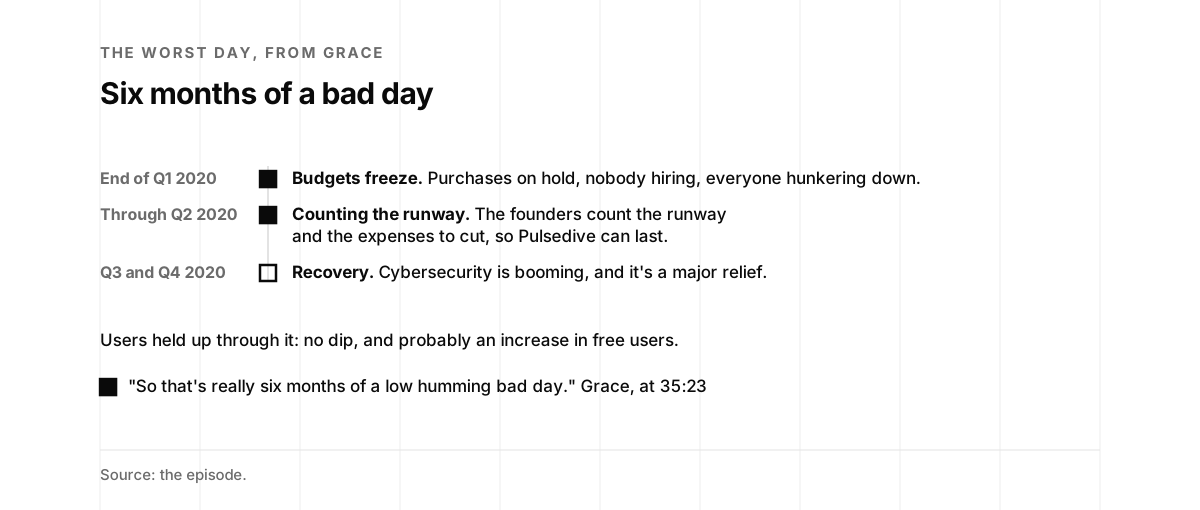
The worst day, for Grace, was a slow dread when the pandemic hit. Pulsedive saw no dip, and probably an increase in free users. But from the end of the first quarter of 2020 through the end of the second, budgets froze, nobody was hiring, and everyone hunkered down. The founders counted the runway and the expenses to cut. When it lifted, the third and fourth quarters recovered, cybersecurity was booming, and it was a major relief.
“So that’s really six months of a low humming bad day.”
Grace Chi, at 35:23
Jon heard the same from many startups about 2020. Dan named the same stretch, and the first year. Dan shared a line that resonated: failure is the default, and resilience, fighting that failure every day, is what gets you somewhere better.
The next rung
Jon asked what the next milestone looks like. In the short term, Grace said, it’s keeping customers, upselling them, and the referrals that follow. Users already climb the ladder:
“there’s free and then there’s individual pro and then there’s data subscriptions and then there’s a full platform.”
Grace Chi, at 38:29
Grace also wanted Pulsedive to use its research, data and communities to contribute to the industry more intentionally, with enterprise users, communities and programs. Further out, and not committed or scheduled, was a community function: sharing intelligence with specific user groups or trust groups. Dan added the hope that people would publish their research and their own feeds there, and contribute in a more automated way.
The elevator test
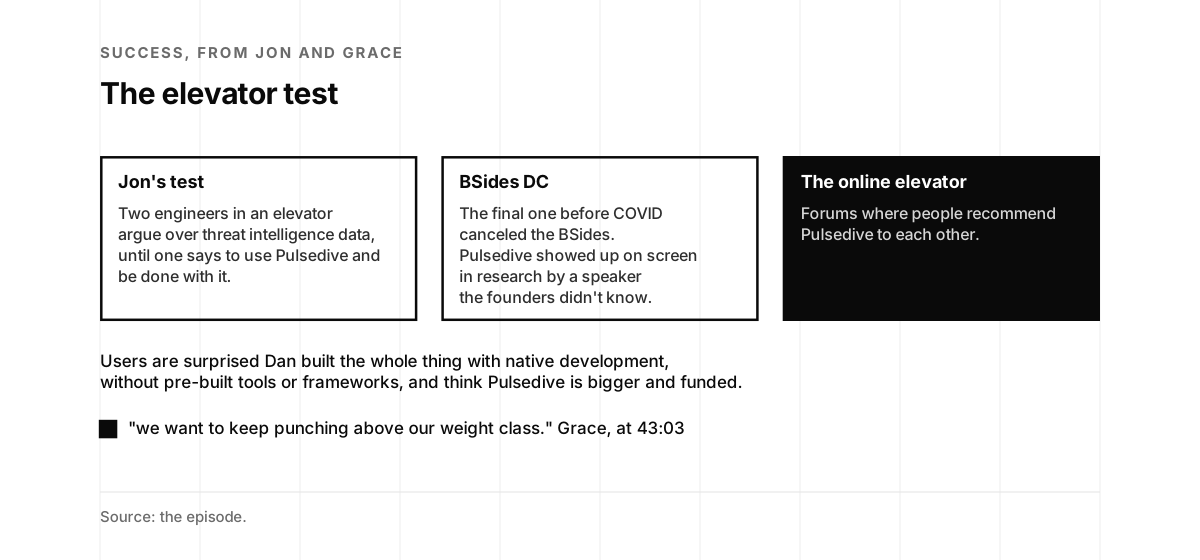
Jon offered a test of success: two engineers in an elevator arguing over the best threat intelligence data, until one says to use Pulsedive and be done with it. Grace promised to report back when it happens, and told a story that came close. At the final BSides DC before COVID canceled the BSides conferences, Pulsedive showed up on screen in research by a speaker the founders didn’t know. On forums, people recommend Pulsedive to each other: the online elevator.
Grace said Dan keeps a low profile and doesn’t always see how much people admire the work. Users are surprised Dan built the whole thing with native development, without pre-built tools or frameworks. They assume Pulsedive is bigger and funded:
“we want to keep punching above our weight class.”
Grace Chi, at 43:03
Dan, with no full marketing team behind the company, credited Grace for much of that impression. Grace said it’s not supposed to be an illusion.
Marketing that reflects reality
Grace’s last point was that marketing gets a bad rap. The discipline Grace enjoys is finding out what’s authentic about a product, why users like it and want to talk about it, and applying that without forcing it. Pulsedive’s sales approach is consultative: it puts itself out there, educates, and keeps a presence that reflects the reality. For Grace, doing that for a community that cheers Pulsedive on is a 180 from past jobs.
Jon closed with thanks and an invitation to come back. Grace’s idea for next time: bring on a user, and let someone other than the founders do the talking.
What happened after the tape
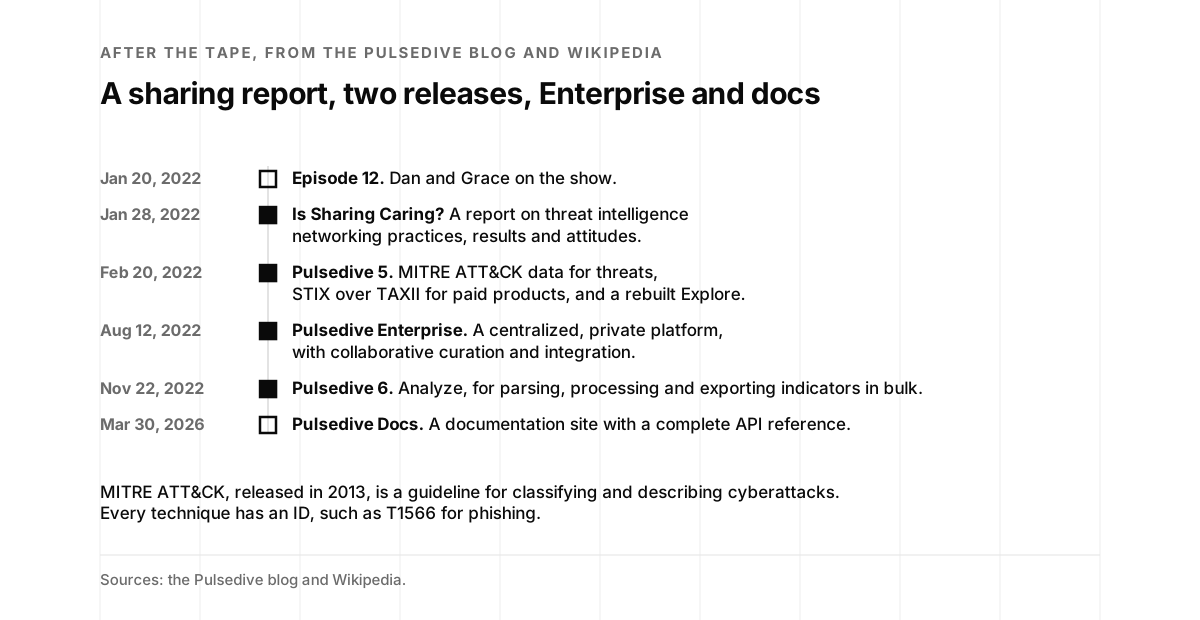
A sharing report, eight days later. On January 28, 2022, Pulsedive published “Is Sharing Caring?”, a report on current threat intelligence networking practices, results and attitudes. It asks how one-to-one messages compare with invite-only Discords, paid memberships and Twitter, which ones helped detect an attack or fix it, and about raw data versus finished intelligence (Pulsedive).
Pulsedive 5 added MITRE ATT&CK. On February 20, 2022, Pulsedive 5 brought ATT&CK data to its threats, STIX over TAXII for paid products, and a rebuilt Explore (Pulsedive). ATT&CK is a guideline for classifying and describing cyberattacks and intrusions, created by MITRE and released in 2013. Every technique has an ID, such as T1566 for phishing (Wikipedia).
Enterprise came back as a product. On August 12, 2022, Pulsedive launched Pulsedive Enterprise, a centralized, private platform with collaborative curation and integration. The announcement put it as a threat intelligence platform “that doesn’t break the bank,” and said tens of thousands of practitioners rely on Pulsedive each month (Pulsedive).
Pulsedive 6 added bulk analysis. On November 22, 2022, Pulsedive 6 added Analyze, for parsing, processing and exporting indicators in bulk (Pulsedive). The 2022 year in review counted Pulsedive 5.0, 5.1, 6.0 and the Enterprise TIP (Pulsedive).
Docs got their own site. On March 30, 2026, Pulsedive launched docs.pulsedive.com, with a complete API reference (Pulsedive).
Did you catch it? A seven-question quiz
Seven questions from the episode. Each answer links the moment in the transcript or its section.
Quiz · seven questions
Did you catch it?
Pick an answer to see whether you caught it.
-
What does Pulsedive offer, in Grace's short version?
b. Enrichment of indicators, correlated with threats. See Platform and data.
-
Who can use Pulsedive's free community tier?
a. You can run scans, pull back data and never make an account. See A ladder of products.
-
What did Grace say nobody can do with lists of IOCs?
c. "no one can really truly benchmark the quality, the efficacy, the relevancy of various lists of IOCs." Transcript, 16:09.
-
How does Pulsedive protect people who contribute?
c. You opt in to share. See Opt in, never forced.
-
What turned Pulsedive from an enterprise platform into a community?
a. "So I started making a lot of stuff accessible for free without an account, to try and lower the barrier to entry." Transcript, 19:04.
-
How do new customers tend to find Pulsedive?
b. There's no outbound sales process. See The invoice nobody expected.
-
How long did Grace's worst day last?
a. "So that's really six months of a low humming bad day." Transcript, 35:23.
Where does your threat intelligence live?
Eight questions on whether your threat intelligence is more than emails and blog posts, built from the episode. Each tip links the section behind it.
Scorecard · eight questions
Where does your threat intelligence live?
Answer for your team as it works today. If two answers fit, pick the lower one.
-
Where does your threat intelligence live today?
- In emails and bookmarked blog posts
- In a feed or a shared doc nobody vets
- In a platform or pipeline the team can query
Intelligence that lives in emails and blog posts isn't great. See Every organization has threat intelligence.
-
Before you act on an indicator from a feed, do you check whether it's a false positive?
- No, we act on the feed
- Sometimes, by hand
- Always, with enrichment and a score
Responders struggle to tell a false positive from a real threat. See Problems that should be solved by now.
-
Are alerts from your SIEM enriched before an analyst looks at them?
- No
- Some of them
- Yes, through an API or a SOAR workflow
Bulk enrichment is a step up the ladder. See A ladder of products.
-
Do you know which threats matter to your organization?
- No
- Roughly
- Yes, and we track them
At the top of the ladder, a team configures the threats that matter to it. See A ladder of products.
-
Do you share what you find with peers or a trust group?
- Never
- Informally, now and then
- Yes, through a trust group or a platform, on our terms
Sharing works when it's opt-in. See Opt in, never forced.
-
Can your analysts research a sensitive indicator without exposing it?
- No
- Not sure
- Yes
Research doesn't have to mean submitting. See Opt in, never forced.
-
Do your security tools pass data to each other?
- Rarely
- A few of them
- Yes, most of them
Integrations decide what a tool is worth. See Integrations users build.
-
Do you watch for your own assets turning up as indicators?
- No
- After an incident
- Yes, as a routine
Red teams check that baseline first. See Red teams use it too.
Your threat intelligence lives in email and bookmarks. Start by vetting the feeds you act on, and enrich alerts before anyone blocks.
The pieces exist, but they don't talk. Automate enrichment, and decide which threats matter to you.
Your intelligence is vetted, enriched and shared on your terms. Keep the integrations current, and watch for your own assets.
What do false positives cost?
Dan named a frustration responders share: working out whether something is a false positive. This calculator puts a monthly number on the time it takes.
Calculator
What do false positives cost?
Four numbers: alerts a day, the share that turn out to be false positives, minutes to dismiss one, and what an analyst hour costs you.
At 150 alerts a day with 40% false positives, dismissing them takes 8.0 hours a day, 240 hours a month. At $75 an hour, that's $18,000 a month, about 1.5 analysts' time.
The calculator counts 30 days a month, since alerts don't stop on weekends, and 160 working hours for an analyst's month. The default numbers are placeholders, yours to change. Dan and Grace gave no figures for these on the tape.
From freemium to Pulsedive Docs
Pulsedive’s history, the field around it, and this show. Filter by topic.
Timeline
From freemium to Pulsedive Docs
- Freemium gets a name
Coined in response to a blog post by venture capitalist Fred Wilson (Wikipedia).
- BSides
Community security conferences begin (Wikipedia).
- The Social Network
The film about Facebook's founding opens in the U.S. (Wikipedia, on this page).
- MITRE ATT&CK
Released, a guideline for classifying and describing cyberattacks (Wikipedia).
- Dan's first security role
Associate CIRC Analyst at ADP (LinkedIn).
- Pulsedive
Dan founds it (LinkedIn).
- What is Threat Intelligence?
Dan's first post on the Pulsedive blog (Pulsedive).
- Grace joins
As cofounder and COO (LinkedIn).
- Six months of a bad day
Budgets freeze from the end of the first quarter to the end of the second (on this page).
- Respect in Security
Pulsedive signs the pledge (Pulsedive).
- "See" TI
Grace's talk on threat intelligence careers goes up (YouTube, on this page).
- Black Friday
50% off Pro and API plans (Pulsedive, on this page).
- Episode 12
Dan and Grace on the show (Podbean, transcript).
- Is Sharing Caring?
A report on threat intelligence networking (Pulsedive, on this page).
- Pulsedive 5
MITRE ATT&CK data, and STIX over TAXII (Pulsedive).
- Episode 15
Benjamin Schmoker Scott of Salesforce on enrichment (episode page).
- Pulsedive Enterprise
A private platform, back as a product (Pulsedive).
- Episode 20
Benoit Chevallier-Mames of Zama on free to try (episode page).
- Pulsedive 6
Analyze, for indicators in bulk (Pulsedive).
- Episode 33
Elizabeth Nammour of Teleskope on freemium later (episode page).
- Episode 86
Trevor Hilligoss of SpyCloud on crime as a service (episode page).
- Pulsedive Docs
A documentation site with a complete API reference (Pulsedive).
What to do this week
Five things, in the order of the episode.
- Find where your intelligence lives. List the feeds, emails and blog posts your team acts on, as in Every organization has threat intelligence.
- Vet a feed before blocking. Check a sample for false positives, and run your numbers through the calculator.
- Enrich alerts before anyone looks. Wire enrichment into the tools your alerts come through, as in A ladder of products.
- Share on your terms. Join a trust group, and decide what stays private, as in Opt in, never forced. The scorecard shows where else to look.
- Get help with it. Our 24/7 Monitoring & Response team watches your alerts and sorts the real ones from the noise, and the AI-Accelerated Cloud Detection & Response Program investigates cloud alerts in minutes. Penetration Testing shows the baseline an attacker sees first, and vCISO Services gives you a security leader to set priorities. If you want to talk it through, book 15 minutes with us.