
Podcast Episode 20

Episode 020 58 min

Benoit Chevallier-Mames, Team Lead of Machine Learning at Zama, On Open Source Homomorphic Encryption

with Benoit Chevallier-Mames · Zama

0:00 / 58:00

Also on Spotify, Apple Podcasts, YouTube, Podbean, Player FM

Episode 20 of The Security Podcast of Silicon Valley, published September 2, 2022. Host Jon McLachlan talks with Benoit Chevallier-Mames, then team lead of machine learning at Zama, a cryptographer who worked with Jon on Apple's DRM team. Benoit explains why he joined Zama, how fully homomorphic encryption lets a server compute on data it can't read, a DNA test the lab never sees, Zama's founders and research team, the eight-bit limit on machine learning over encrypted data, slow speed and hardware accelerators, why Zama never trades security, quantization and quantization-aware training, keys that stay with the user, Concrete, Concrete Numpy and Concrete ML, open source that needs a license to ship, a bottom-up go-to-market, results that can wait an hour, servers versus devices, privacy laws, and why a bug nobody reports doesn't exist.

Episode notes

Dive into the world of cryptography with Benoit Chevallier-Mames in this episode of a YSecurity.io production, where he shares his remarkable journey through the realms of encryption, engineering, and leadership. From making significant contributions at Apple to his current role at Zama, Benoit's work has profoundly impacted data security for billions of users worldwide, all while maintaining a humble demeanor.

Benoit opens up about the valuable lessons learned during his tenure at Apple, offering insights into the challenges and breakthroughs that come with working on security for one of the most influential tech companies in the world. His transition to Zama marks a new chapter in his mission to enhance data protection, focusing on pioneering work in Fully Homomorphic Encryption (FHE) tailored for Machine Learning applications. Zama's open-source SDK represents a leap forward in making advanced cryptographic techniques accessible and practical for developers, underscoring Benoit's commitment to democratizing data security.

Throughout the conversation, Benoit delves into the technical intricacies behind Zama's approach to FHE, shedding light on how this cutting-edge technology can revolutionize privacy and security in the age of AI and big data. His explanations demystify complex concepts, making them understandable for both cryptography experts and enthusiasts alike.

The episode culminates in Benoit sharing profound words of wisdom, reflecting on his experiences and the philosophical underpinnings of his work. His perspective not only inspires but also offers guidance to those navigating the ever-evolving landscape of technology and security.

Join us in this YSecurity.io production for an enlightening discussion with Benoit Chevallier-Mames. Whether you're deeply embedded in the field of cryptography, fascinated by the intersection of security and technology, or seeking inspiration from those who've made a silent yet indelible impact on our digital lives, this episode promises a wealth of knowledge, insight, and inspiration.

Hosted by Jon McLachlan — co-founder of YSecurity.

The deep dive

Machine learning on encrypted data

Benoit Chevallier-Mames, then team lead of machine learning at Zama, on his first visit to the show: twelve years at Apple, a startup he couldn't say no to, a primitive cryptographers dreamed of for forty years, a DNA test the lab can't read, models limited to eight bits, a library written in Rust, open source that's free until you ship, results that can wait an hour, and why a bug nobody reports doesn't exist.

Episode 20 of The Security Podcast of Silicon Valley aired on September 2, 2022, with Jon McLachlan hosting. The guest was Benoit Chevallier-Mames, then team lead of machine learning at Zama (Podbean, Apple Podcasts, Spotify, LinkedIn). The episode is called “Benoit Chevallier-Mames, Team Lead of Machine Learning at Zama, On Open Source Homomorphic Encryption.” It was his first podcast. He came back in May 2024 for episode 44.

Jon and Benoit had worked on the same team at Apple. Jon couldn’t agree more about Benoit’s new field:

“this is the holy grail.”

Jon McLachlan, at 10:54

The holy grail is a server that computes on data it can’t read. Wikipedia describes homomorphic encryption as encryption that “allows computations to be performed on encrypted data without first having to decrypt it” (Wikipedia). In 2022, Benoit’s team built Concrete ML, an open source library that brings it to data scientists.

This page follows the conversation in order: a section for each part of it, sixteen figures, twenty clips from the tape, two talks by Benoit on YouTube, the full transcript, and five tools: a quiz, a scorecard for whether a model fits encrypted inference, a calculator for what eight bits does to a model’s size, a timeline, and a to-do list. Where the decodes of the tape disagree on a word, the transcript puts its best guess in brackets, and the page doesn’t quote or retell those words. Every pass of the recognizer hears Benoit’s “FHE” as other letters, so the page quotes none of his lines that say it.

Two engineers from the same team

Jon introduced Benoit as a cryptographer with a PhD in cryptography and a career built around it, at Gemplus and then at Apple for twelve years. Jon asked what he could share about Apple. Benoit said he couldn’t share much detail, then gave the outline: the two of them were on the same team, the DRM team, for about five years. The team protected content such as audio and video, with techniques like white-box cryptography and obfuscation.

DRM, or digital rights management, is “the management of legal access to digital content” (Wikipedia). In white-box cryptography, the attacker has full access to the code that does the encryption (Wikipedia). Obfuscation makes code hard to understand on purpose (Wikipedia). For Jon, Apple was his first real career job after graduate school. He added that their work shipped in iTunes, and from there it went into the iPhone, the iPad and the rest of that ecosystem. Benoit said billions of people use it

“without even noticing that we have done it”

Benoit Chevallier-Mames, at 4:00

Benoit’s LinkedIn lists eleven and a half years at Apple, on the DRM technology team and the crypto team, working on white-box cryptography and obfuscation, with about three dozen patents. Before Apple, he spent seven years at Gemplus on public key cryptography for smart cards and one year as a cryptologist at ANSSI (LinkedIn). Episode 44 covers the keys hidden inside programs in more depth.

Listen · Benoit Chevallier-Mames on episode 20, from 1:39
About 25 seconds: Benoit on the DRM team at Apple. The clip stops on its own. Read the full transcript.

Now or never

Jon asked why Benoit left a place he loved. Benoit had always wanted to try a startup, and he knew that one day he would jump. Then people he knew closely started a company. He had known its CTO for about 20 years, and the company worked in cryptography, which he knew well, on fully homomorphic encryption. Jon summed it up:

“It was that moment or never.”

Jon McLachlan, at 5:31

Benoit put it his own way: he didn’t leave Apple, he joined Zama. He doesn’t rule out going back one day, and he said this about the move:

“but I don’t regret it.”

Benoit Chevallier-Mames, at 5:38

Jon agreed that Apple was a great place to work:

“they make it incredibly nice to work there.”

Jon McLachlan, at 6:00

Jon’s own move away from Apple was similar:

“I was looking for something to really push the envelope”

Jon McLachlan, at 6:25

That took him to Symphony Communications.

Listen · Benoit Chevallier-Mames on episode 20, from 4:54
About 35 seconds: Benoit on leaving Apple to join a startup. The clip stops on its own. Read the full transcript.

A primitive cryptographers dreamed of

Benoit offered to explain homomorphic encryption, and Jon asked what problem it solves. Benoit called it

“a kind of a grand primitive that we have dreamed of in the cryptography research field”

Benoit Chevallier-Mames, at 7:06

He said cryptographers had chased it for about 40 years. The idea seemed so crazy that people thought it was impossible, until someone did it.

Wikipedia dates the question to 1978, within a year of the RSA scheme. For more than 30 years, no one knew whether a solution existed (Wikipedia).

Benoit started with ordinary encryption, which is built so that no one can change the ciphertext in a meaningful way. Jon put it in his own words:

“you can’t change it without destroying your encryption.”

Jon McLachlan, at 7:43

Change one bit of the ciphertext, Benoit said, and the change is one you can’t predict. Jon asked every listener, three times over, to put authentication on top, so you can detect when someone tampers with the ciphertext. Cryptographers call an encryption scheme malleable when someone can turn one ciphertext into another that decrypts to a related plaintext (Wikipedia). Fully homomorphic encryption makes that a feature, by design.
Listen · Benoit Chevallier-Mames on episode 20, from 7:06
About 20 seconds: Benoit on a primitive cryptographers dreamed of. The clip stops on its own. Read the full transcript.
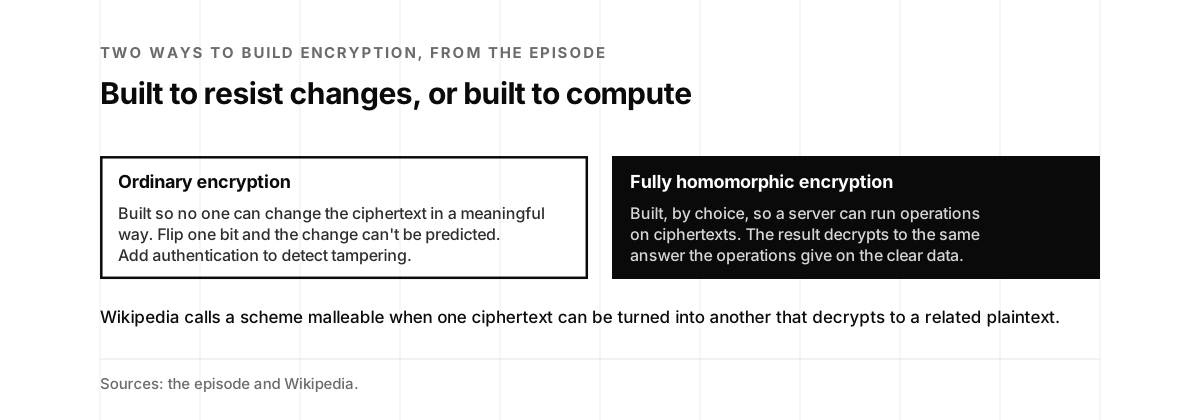
Two cards. Ordinary encryption: built so no one can change the ciphertext in a meaningful way, flip one bit and the change can't be predicted, add authentication to detect tampering. Fully homomorphic encryption, filled: built, by choice, so a server can run operations on ciphertexts, and the result decrypts to the same answer the operations give on the clear data. Below: Wikipedia calls a scheme malleable when one ciphertext can be turned into another that decrypts to a related plaintext.
Ordinary encryption is built so you can't change the ciphertext in a useful way. FHE is built so you can. Sources: the episode and Wikipedia.

Compute on what you can’t read

Benoit described what that buys you. You encrypt your data on a device you trust. Then you send it to

“a server that you don’t need to trust.”

Benoit Chevallier-Mames, at 8:40

The server runs whatever computation it needs using nothing secret, and it never learns what it’s working on. It sends back a result that only you can decrypt.

A solution came in 2009, Benoit said, from Craig Gentry, and better generations of schemes followed. Wikipedia credits Gentry, using lattice-based cryptography, with the first plausible construction of a fully homomorphic scheme in 2009. In 2014, the FHEW scheme showed that refreshing the ciphertext after every operation cuts bootstrapping to a fraction of a second, and TFHE followed in 2016 (Wikipedia). Jon thanked him

“for dumbing it down a little bit for those of us who are not cryptographers.”

Jon McLachlan, at 9:47

Listen · Benoit Chevallier-Mames on episode 20, from 8:38
About 25 seconds: Benoit on sending encrypted data to a server you don't trust. The clip stops on its own. Read the full transcript.

The holy grail for SaaS

Jon took it to the business side. FHE gives the people who build software a new tool to protect customer data: your personal information, or even a diary. Today a company wants to own that data and monetize it. If the data stays encrypted and you hold the only private key, a third party can still work on it:

“now we enable people to build third-party SaaS services that can perform meaningful operations, valuable operations”

Jon McLachlan, at 10:34

All of that happens without you sharing the data itself. Benoit brought up a slogan from an Apple ad: what happens on your iPhone stays on your iPhone. Because Apple cares about privacy, he said, some work stays on the phone and never goes to a server. With FHE, the phone could encrypt the data and send it to any server, and the privacy stays the same. You get both: privacy, and the big computations that need a server.

Listen · Jon McLachlan on episode 20, from 10:30
About 25 seconds: Jon on third-party services that never see your data. The clip stops on its own. Read the full transcript.

A DNA test the lab can’t read

Jon asked for an example of something that today means handing sensitive data to a third party. Benoit picked a test for a disease that needs your DNA. You send your DNA to a company you don’t know. You can’t tell whether it keeps the record or sells it for statistics. Then there’s the result:

“Are they going to share it with your employer, with your bank, with your insurance”

Benoit Chevallier-Mames, at 12:56

Lots of people want to know whether they have the disease, he said, and they accept sharing private information to find out. Once your DNA is on the web, there’s no way to erase it.

With FHE, you encrypt your DNA on a device you trust, and the lab runs the same test on the encrypted data:

“So they would not have an access to your DNA. They can’t share it. They can’t do anything with it.”

Benoit Chevallier-Mames, at 13:47

The lab gets an encrypted result back, which means

“they don’t know if you have the disease.”

Benoit Chevallier-Mames, at 13:58

So the lab has nothing to share.
Listen · Benoit Chevallier-Mames on episode 20, from 13:31
About 30 seconds: Benoit on a DNA test that runs on encrypted data. The clip stops on its own. Read the full transcript.
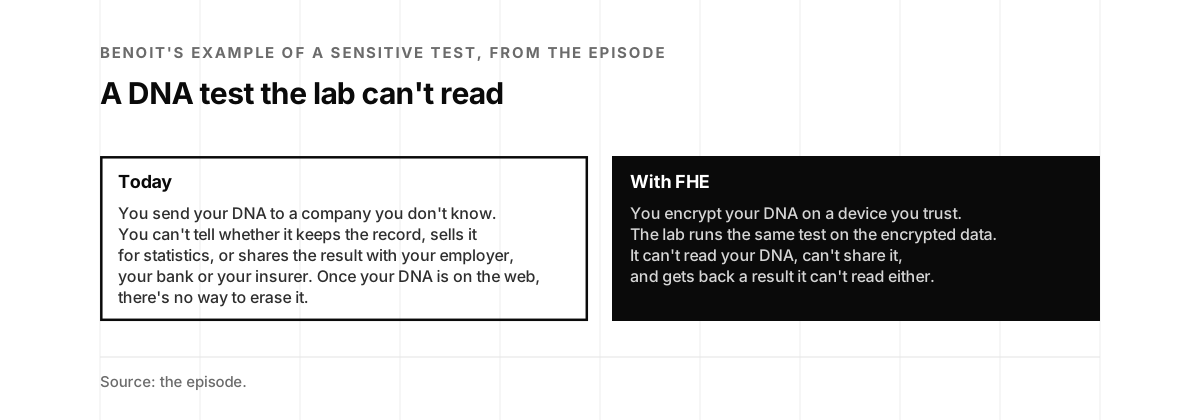
Two cards. Today: you send your DNA to a company you don't know, and you can't tell whether it keeps the record, sells it for statistics, or shares the result with your employer, your bank or your insurer. Once your DNA is on the web, there's no way to erase it. With FHE, filled: you encrypt your DNA on a device you trust, the lab runs the same test on the encrypted data, and it can't read your DNA, can't share it, and gets back a result it can't read either.
What you can't control when you send your DNA away, and what changes when the test runs on encrypted data. Source: the episode.

Founders he had known for twenty years

Jon asked whether a DNA testing company could do that with Zama then. Benoit said Zama was founded with that kind of use in mind. Its CTO, Pascal Paillier, had worked with Benoit at Gemplus about 22 years before. Benoit called him a well-known cryptographer, and

“one of the main specialists of homomorphic encryption.”

Benoit Chevallier-Mames, at 14:52

The Paillier cryptosystem, a public key algorithm from 1999, carries his name (Wikipedia). The other founder is the CEO, Rand Hindi, whom Benoit described as an AI scientist and a serial entrepreneur. Rand’s previous company, Snips, was acquired. TechCrunch later reported that the buyer was Sonos (TechCrunch). That track record mattered to Benoit:

“it was less risky to me to jump to Zama”

Benoit Chevallier-Mames, at 15:24

Jon named what made it work:

“you had the trust”

Jon McLachlan, at 15:36
Listen · Benoit Chevallier-Mames on episode 20, from 15:02
About 30 seconds: Benoit on Zama's CEO, and why the jump felt less risky. The clip stops on its own. Read the full transcript.
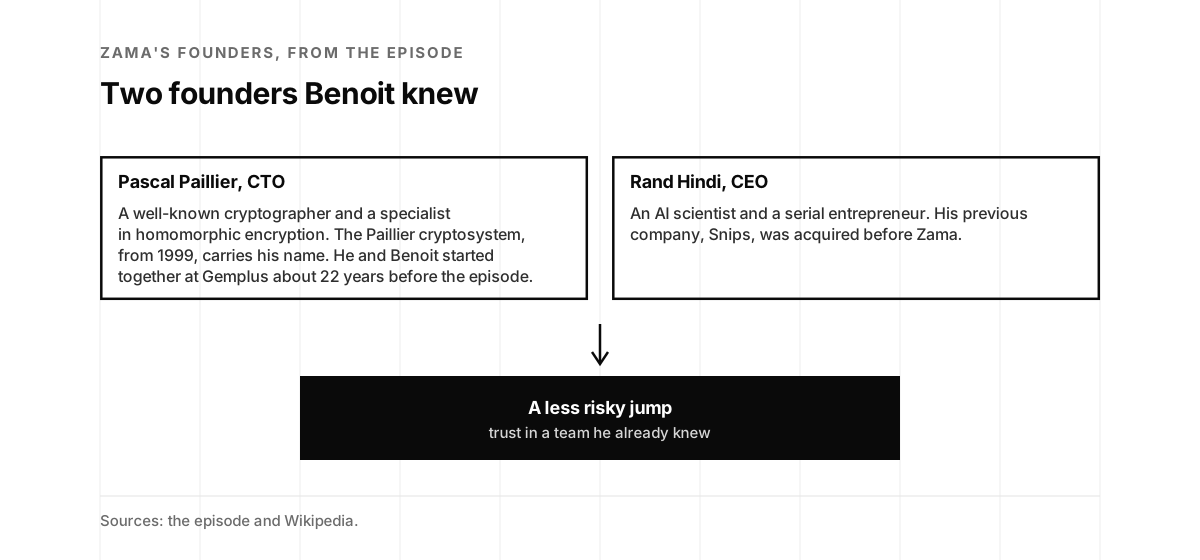
Two cards. Pascal Paillier, CTO: a well-known cryptographer and a specialist in homomorphic encryption, the Paillier cryptosystem from 1999 carries his name, and he and Benoit started together at Gemplus about 22 years before the episode. Rand Hindi, CEO: an AI scientist and a serial entrepreneur, whose previous company, Snips, was acquired before Zama. An arrow leads down to a filled box: a less risky jump, trust in a team he already knew.
Two founders Benoit knew, and why that made the jump less risky. Sources: the episode and Wikipedia.

Half the company has a PhD

Half of Zama’s people had a PhD, Benoit said, most of them in cryptography. He said Zama had raised 50 million from investors, in a Series A, and pointed to Crunchbase for the details. Jon saw a long road ahead:

“This is definitely a deep tech endeavor.”

Jon McLachlan, at 17:05

Benoit agreed that it’s a big investment. FHE doesn’t come for free, and Zama’s investors know that finding the fit for a product takes time and trial. Jon named the goal, product-market fit:

“That’s going to be the challenging piece.”

Jon McLachlan, at 17:36

On top of that, the technology is new and not widely adopted. Benoit went further. FHE isn’t even widely designed yet, and it’s still a field of research. That’s why the company has so many PhDs. Our post on what deep tech means covers why that kind of company needs patient capital.

Listen · Benoit Chevallier-Mames on episode 20, from 16:12
About 15 seconds: Benoit on the research behind Zama. The clip stops on its own. Read the full transcript.

Two markets for FHE

Jon asked whether Benoit ran a team. He did: the machine learning team. Zama saw two sorts of applications for FHE. The first is cloud applications, work you want to run on a server you don’t trust, like the remote DNA test. Machine learning is one of those. The second is blockchain, and a new division was starting on it. On a blockchain built this way, you don’t see the clear values.

Benoit’s team was building Concrete ML, a tool for data scientists who don’t know cryptography. He brought a lesson back from Apple:

“It should just work.”

Benoit Chevallier-Mames, at 20:05

There shouldn’t be much to set up or understand, and you shouldn’t need a PhD in crypto. Making things simple is one of the company’s goals, he said.

The day this episode aired, Zama’s YouTube channel posted a talk by Benoit for the Australian Institute for Machine Learning, “Concrete ML: A data-scientist-friendly toolkit for machine learning over encrypted data.” Its notes say the Python package was built to be usable “by any data scientist, even those without prior cryptography knowledge,” with APIs as close as possible to those of scikit-learn and torch (YouTube).
Benoit's Concrete ML talk, 65 minutes, posted on September 2, 2022. Watch on YouTube.
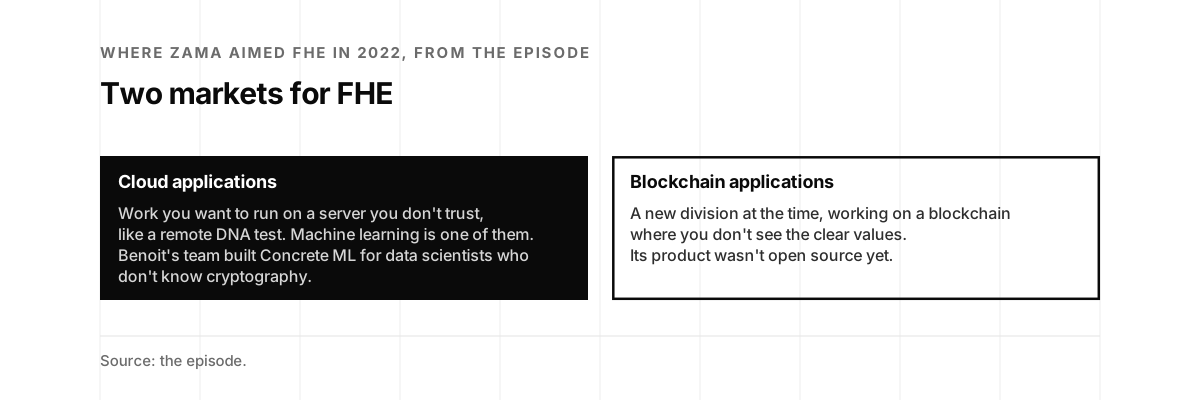
Two cards. Cloud applications, filled: work you want to run on a server you don't trust, like a remote DNA test. Machine learning is one of them, and Benoit's team built Concrete ML for data scientists who don't know cryptography. Blockchain applications: a new division at the time, working on a blockchain where you don't see the clear values, with a product that wasn't open source yet.
Two markets for FHE at Zama in 2022, and where Concrete ML fits. Source: the episode.

Eight bits, like forty years ago

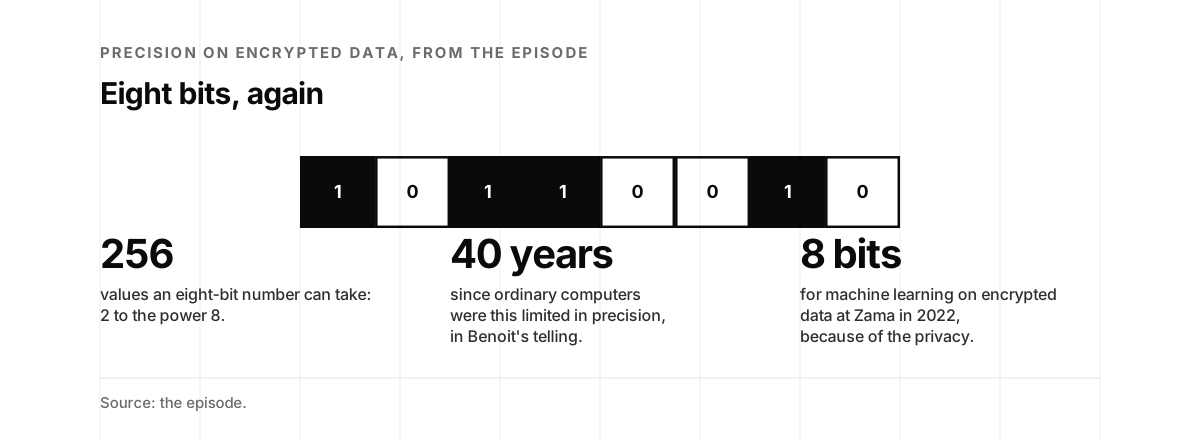
Then Benoit got to the hard parts. The machine learning his team ran on encrypted data was limited to eight bits. He found that a bit fun:

“40 years ago, computers were very limited in terms of precision”

Benoit Chevallier-Mames, at 20:36

With FHE, he said, the history repeats itself. You’re back to computing in eight bits, and this time privacy is the reason. The challenge is to run machine learning with such small values.
Listen · Benoit Chevallier-Mames on episode 20, from 20:19
About 40 seconds: Benoit on the eight-bit limit. The clip stops on its own. Read the full transcript.
A row of eight boxes for the bits of one number, some filled. Below, three numbers. 256: the values an eight-bit number can take, 2 to the power 8. 40 years: since ordinary computers were this limited in precision, in Benoit's telling. 8 bits: for machine learning on encrypted data at Zama in 2022, because of the privacy.
Eight bits gives 256 values. Computers started there, and FHE starts there again. Sources: the episode and Wikipedia.

Slow today, faster with hardware

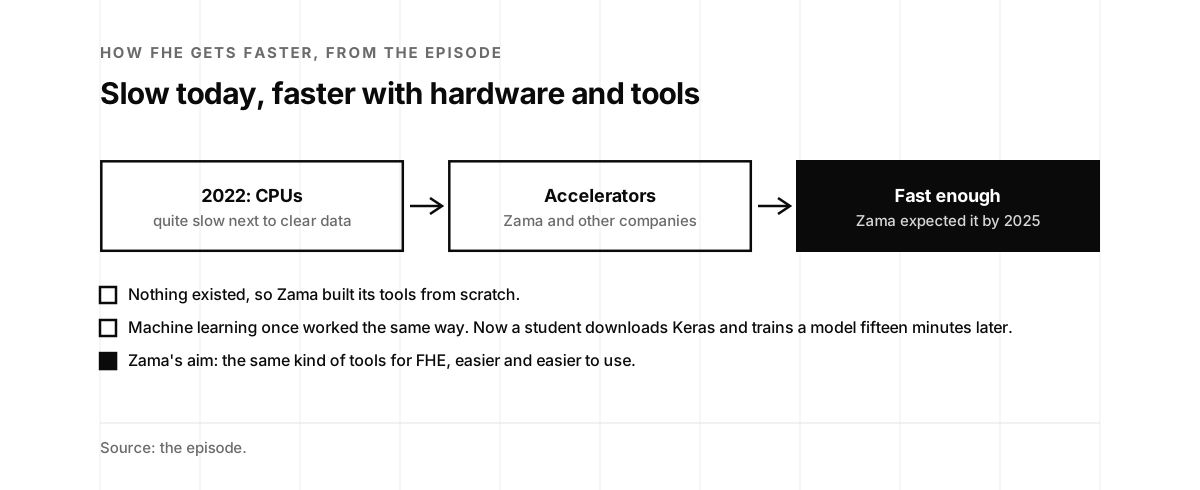
The second constraint was speed. Many things ran on CPUs, so it was quite slow next to the same computation in the clear. Zama was working on hardware accelerators, inside the company and with other companies. Benoit mentioned another company that works with optics, and Jon asked whether that meant fiber. Benoit kept it short:

“So don’t ask me how it works.”

Benoit Chevallier-Mames, at 21:51

With several companies building accelerators for FHE, he said, it will get faster and faster. Zama expected it to be sufficiently fast by 2025. Zama’s YouTube channel now has a tutorial on its own hardware accelerator for FHE, an HPU on an FPGA (YouTube).

The last challenge was that the tools didn’t exist yet:

“nothing exists. So we are just making things from scratch.”

Benoit Chevallier-Mames, at 22:28

He passed on a comparison someone at Zama likes to make. Fifteen or twenty years earlier, people in machine learning had to build everything themselves. Now a student downloads Keras and trains a model fifteen minutes later. Zama hoped to build the same kind of tools for FHE.
Listen · Benoit Chevallier-Mames on episode 20, from 22:29
About 40 seconds: Benoit on building FHE tools from scratch. The clip stops on its own. Read the full transcript.
Three boxes joined by arrows. 2022: CPUs, quite slow next to clear data. Accelerators, from Zama and other companies. Filled: fast enough, Zama expected it by 2025. Below, a list. Nothing existed, so Zama built its tools from scratch. Machine learning once worked the same way, and now a student downloads Keras and trains a model fifteen minutes later. Filled: Zama's aim, the same kind of tools for FHE, easier and easier to use.
Slow on CPUs in 2022, faster with accelerators, and easier with better tools. Source: the episode.

Security is never traded

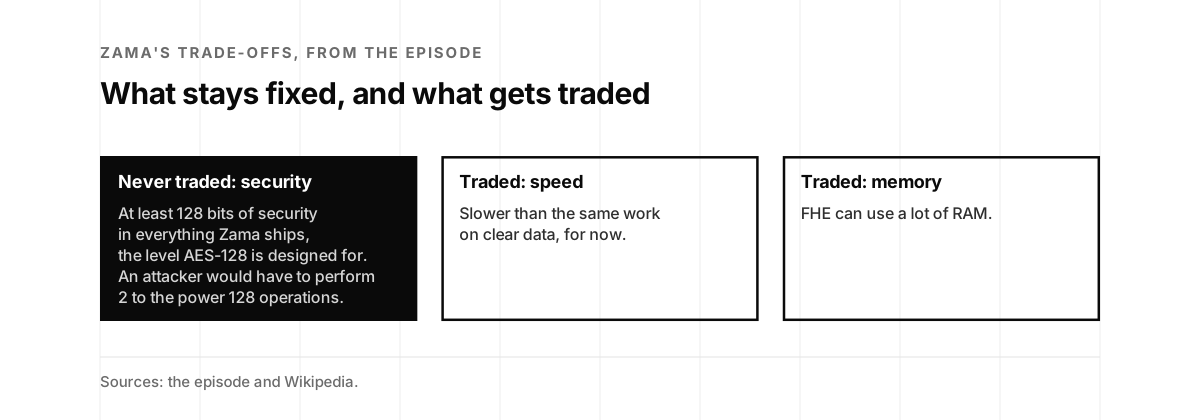
Jon wished for easier and easier, and more and more secure. Benoit drew a line: Zama never trades security. Anything Zama ships has at least 128 bits of security, he said, the security of AES. Wikipedia explains that n-bit security means an attacker would have to perform 2 to the power n operations to break it, and that AES-128 is designed to offer a 128-bit security level (Wikipedia). What Zama does trade is speed, and sometimes memory, since FHE can use a lot of RAM.
Listen · Benoit Chevallier-Mames on episode 20, from 23:14
About 25 seconds: Benoit on what Zama never trades. The clip stops on its own. Read the full transcript.
Three cards. Never traded, filled: security, at least 128 bits in everything Zama ships, the level AES-128 is designed for, so an attacker would have to perform 2 to the power 128 operations. Traded: speed, slower than the same work on clear data, for now. Traded: memory, FHE can use a lot of RAM.
What stays fixed, and what gets traded. Sources: the episode and Wikipedia.

What eight bits means for a model

Jon admitted he’s no machine learning expert and asked about the eight bits:

“I know that two raised to the power eight is 256, just like probably all engineers in this world”

Jon McLachlan, at 24:02

His question was whether that limits a model’s results:

“Does that mean that the ML results are limited to 256 different classification categories?”

Jon McLachlan, at 24:11

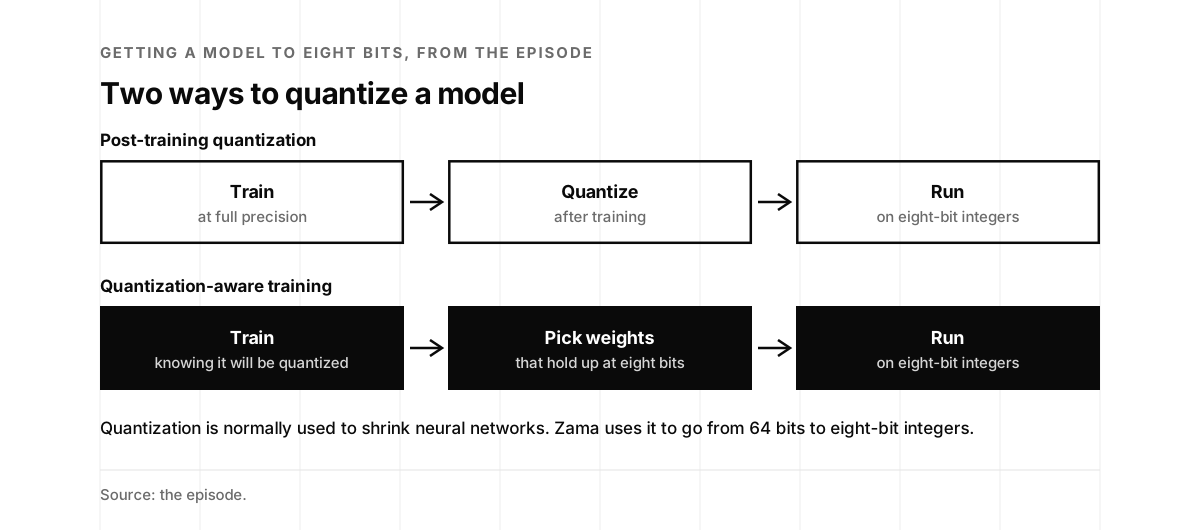
The answer is quantization. Benoit said people on his team know it better than he does. Quantization is normally used to compress neural networks, which get too large to send over the air. Companies try to run networks on integers of eight bits, which makes them eight times smaller. Zama uses it to go from 64 bits down to eight-bit integers. In signal processing, quantization maps values from a large set to a smaller set (Wikipedia).

One way is post-training quantization, in Benoit’s words:

“you do your training and then you quantize”

Benoit Chevallier-Mames, at 25:21

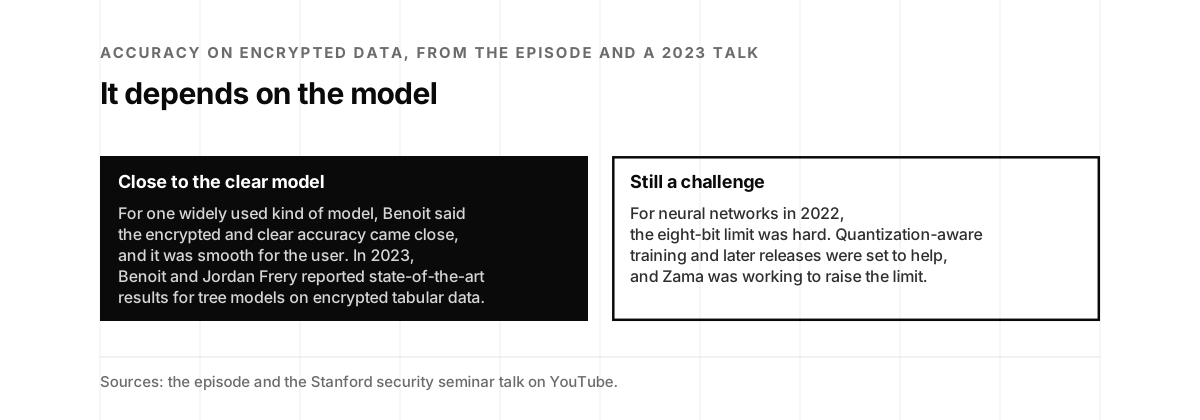
The other, which he called even more fascinating, is quantization-aware training. You tell the training that the model will be quantized, and it picks weights that hold up once it is. How well it works depends on the model. For one kind of model in wide use, Benoit said it’s smooth for the user, and comparing encrypted and clear results,

“the accuracy are very, very close.”

Benoit Chevallier-Mames, at 26:09

At the other end are neural networks, where the limit was still a challenge. Benoit said it would get better with later releases, and part of Zama’s work is to raise the limit. In June 2023, Benoit and Jordan Frery told a Stanford security seminar that for trees (decision trees, random forests and gradient boosted trees) they get “state-of-the-art solutions over encrypted tabular data,” with promising results for deep learning on some vision tasks (YouTube).
Listen · Benoit Chevallier-Mames on episode 20, from 25:07
About 35 seconds: Benoit on quantization. The clip stops on its own. Read the full transcript.
Two rows of three boxes joined by arrows. Post-training quantization: train at full precision, quantize after training, run on eight-bit integers. Quantization-aware training, filled: train knowing it will be quantized, pick weights that hold up at eight bits, run on eight-bit integers. Below: quantization is normally used to shrink neural networks, and Zama uses it to go from 64 bits to eight-bit integers.
Two ways to get a model down to eight bits. Source: the episode.
Two cards. Close to the clear model, filled: for one widely used kind of model, Benoit said the encrypted and clear accuracy came close, and it was smooth for the user, and in 2023, Benoit and Jordan Frery reported state-of-the-art results for tree models on encrypted tabular data. Still a challenge: for neural networks in 2022, the eight-bit limit was hard, quantization-aware training and later releases were set to help, and Zama was working to raise the limit.
How close the encrypted model gets depends on the model. Sources: the episode and the Stanford seminar.

Your key stays with you

Jon summed up what that makes possible. You encrypt your private data and hand it to a model that’s already trained, like a computer vision model:

“it can work now on our encrypted data instead of on the plain text.”

Jon McLachlan, at 27:14

Each user’s key stays on the device, Benoit said, and the server gets an equivalent of it. One compiled model serves many users, and only one part of it changes, depending on who the user is.
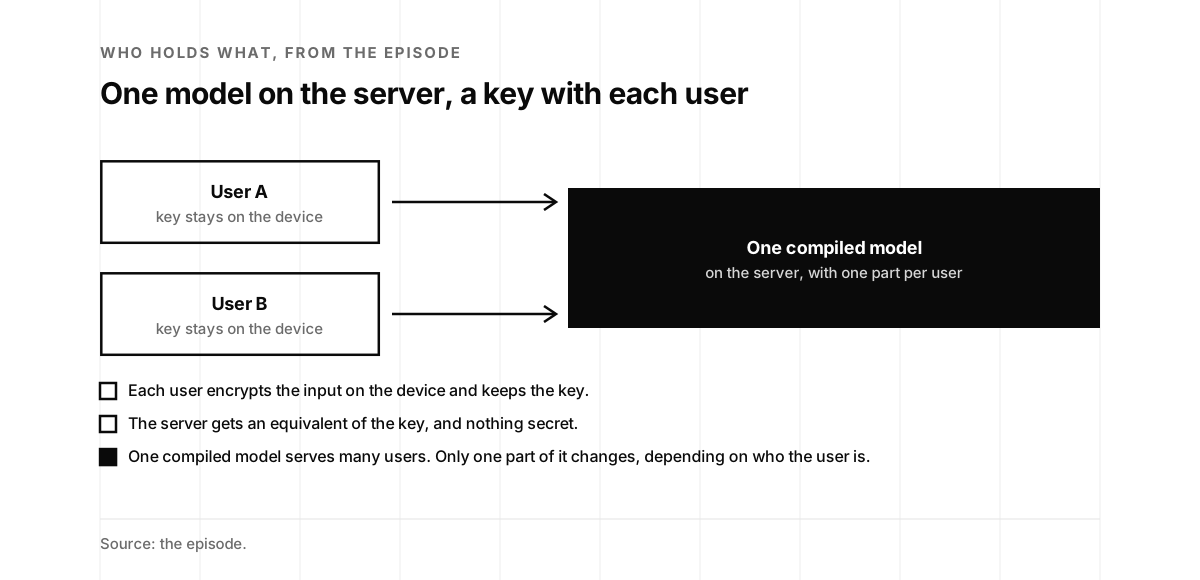
Two outlined boxes, User A and User B, each with its key on the device, with arrows to a filled box: one compiled model on the server, with one part per user. Below, a list. Each user encrypts the input on the device and keeps the key. The server gets an equivalent of the key, and nothing secret. Filled: one compiled model serves many users, and only one part of it changes, depending on who the user is.
One model on the server, and a key that stays with each user. Source: the episode.

Focus, and a second product

Jon liked the focus:

“One of the greatest tricks that entrepreneurs use is focus, right?”

Jon McLachlan, at 27:54

Zama was taking an open problem, fully homomorphic encryption, and pointing it at one application. Benoit agreed. Machine learning was the company’s focus within cloud computation, and if the company succeeds, it will extend from there. Meanwhile the other division was working on blockchain, so a second product was already on the way.

Listen · Jon McLachlan on episode 20, from 27:54
About 20 seconds: Jon on focus. The clip stops on its own. Read the full transcript.

Three lines of products, all open source

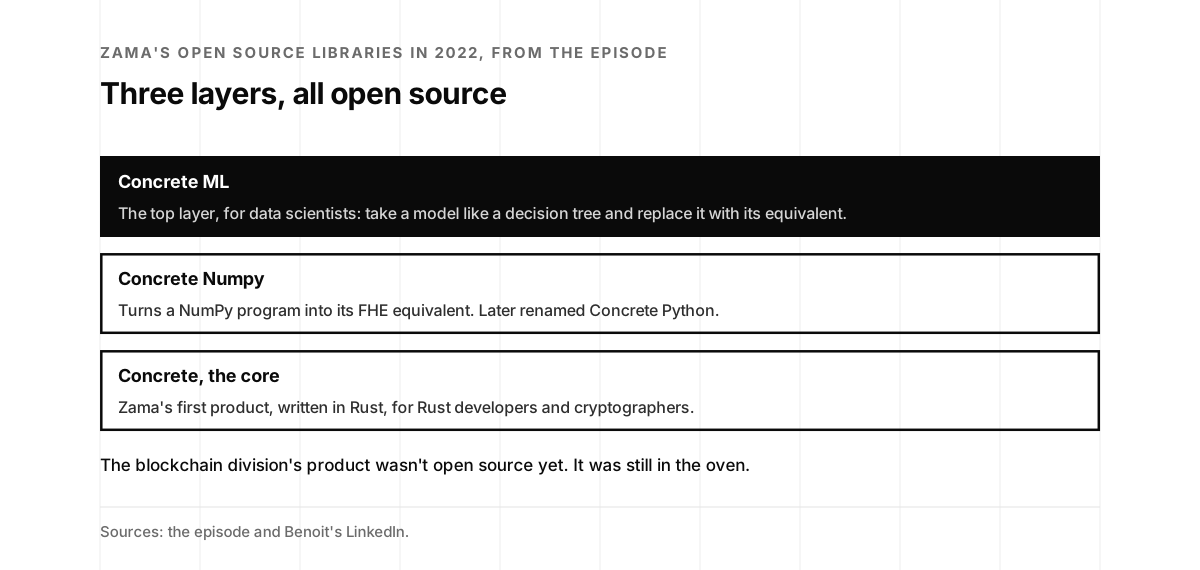
Benoit said the core is Zama’s first product. The company planned three lines of products, and the first was the Concrete library, the core, which can be used directly in Rust. Jon stopped him:

“wrote all of this in Rust?”

Jon McLachlan, at 29:04

All of it, and it’s open source. Rust is a general-purpose language built for performance and memory safety (Wikipedia). On top of the core sat two more lines. Concrete Numpy turns a NumPy program into its FHE equivalent. NumPy is the Python library for large arrays and the math on them (Wikipedia). Concrete ML works at a higher level: you take a model like a decision tree and replace it with its equivalent. Jon reacted:

“you just dropped a bomb on us.”

Jon McLachlan, at 29:41

The Rust library was created more than a year before, mainly for people who work in Rust and for cryptographers. The higher layers are for people who aren’t cryptographers and just want it to work. The blockchain division hadn’t opened its product yet. Jon finished the sentence:

“Still baking. Yeah. It’s still in the oven.”

Jon McLachlan, at 30:35

Benoit’s LinkedIn says Concrete Numpy was later renamed Concrete Python (LinkedIn). Wikipedia lists Concrete, with a Python front end, and TFHE-rs, in Rust, among homomorphic encryption libraries (Wikipedia). The code is on Zama’s GitHub.
Listen · Benoit Chevallier-Mames on episode 20, from 29:06
About 35 seconds: Benoit on Zama's three lines of products. The clip stops on its own. Read the full transcript.
Three stacked cards. Top, filled: Concrete ML, the top layer, for data scientists, take a model like a decision tree and replace it with its equivalent. Middle: Concrete Numpy, which turns a NumPy program into its FHE equivalent, later renamed Concrete Python. Bottom: Concrete, the core, Zama's first product, written in Rust, for Rust developers and cryptographers. Below: the blockchain division's product wasn't open source yet, it was still in the oven.
Three layers in 2022: a core in Rust, Concrete Numpy, and Concrete ML. Sources: the episode, LinkedIn and Wikipedia.

Free to try, a license to ship

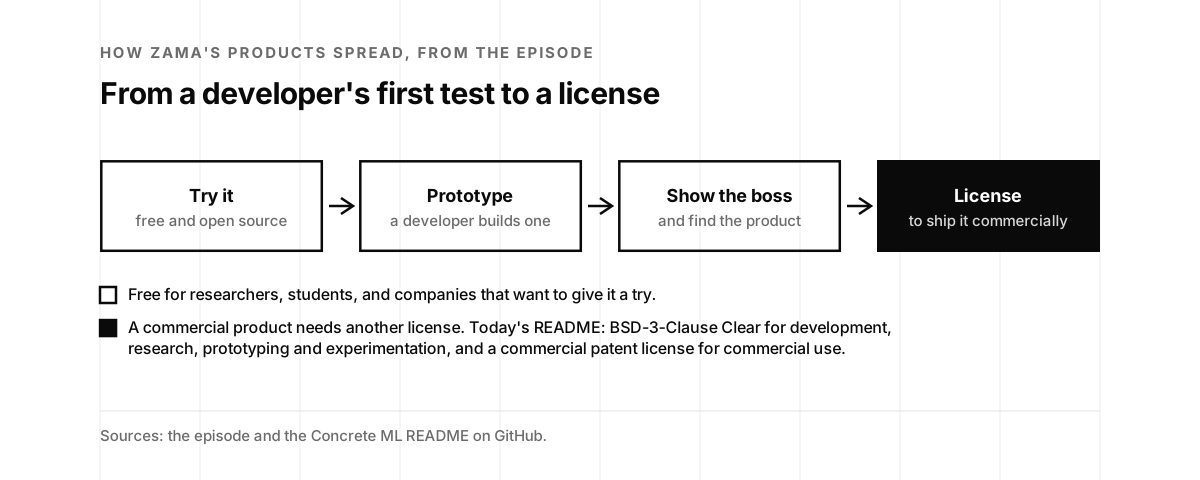
Everything at Zama is open source, Benoit said, by choice of the company:

“it’s free of use for researchers or for students”

Benoit Chevallier-Mames, at 30:46

Companies can also give it a try for free. To ship it in a commercial product, you need another license. People ask him all the time how an open source company makes a living, and the CEO had written a blog post on it. Jon read the strategy:

“I’m gathering that your go-to-market strategy is bottom-up.”

Jon McLachlan, at 31:44

Benoit agreed. The goal for now was as many users as possible:

“our users are the developers.”

Benoit Chevallier-Mames, at 32:02

The products should be so easy to use, and so appealing, that developers try them, build a prototype, and then

“show it to their boss.”

Benoit Chevallier-Mames, at 32:16

If the boss sees a product in it, the company comes back to Zama to change the license. Jon asked whether the target was machine learning engineers who care about privacy. For his team, yes, Benoit said, and

“it’s a niche of millions of developers.”

Benoit Chevallier-Mames, at 32:45

Jon meant it with respect: the aim is to be the biggest fish in the smallest pond, the best thing on offer to everyone in that market.

Wikipedia calls the practice of offering the same software under more than one set of terms multi-licensing (Wikipedia). Concrete ML’s README today puts it this way: the code is free under the BSD-3-Clause Clear license for development, research, prototyping and experimentation, and commercial use needs Zama’s commercial patent license (GitHub).
Listen · Benoit Chevallier-Mames on episode 20, from 31:54
About 30 seconds: Benoit on how developers find Zama's products. The clip stops on its own. Read the full transcript.
Four boxes joined by arrows. Try it, free and open source. Prototype, a developer builds one. Show the boss, and find the product. Filled: license, to ship it commercially. Below, a list. Free for researchers, students, and companies that want to give it a try. Filled: a commercial product needs another license, and today's README says BSD-3-Clause Clear for development, research, prototyping and experimentation, and a commercial patent license for commercial use.
From a developer's first test to a commercial license. Sources: the episode and the Concrete ML README.

Results that can wait an hour

Machine learning, Benoit said, is a good first example of the cloud applications Zama wants to serve. Once it works for machine learning, the company can extend to other kinds of applications. It also suits FHE while FHE is slow, because a lot of machine learning doesn’t have to run in real time. He went back to the health test. For a result like that,

“you can wait an hour”

Benoit Chevallier-Mames, at 33:49

and you keep the privacy.

Later, with hardware accelerators, Zama expected to take on more applications. Jon asked about self-driving cars, which keep uploading GPS, lidar and other sensitive data about what you do. Benoit said virtually yes.

Jon then set two business models side by side. One sells devices and protects the user’s privacy, and doesn’t own the data. The other gives services away for free, owns the data, and uses machine learning on it to sell ads. Benoit said FHE should let the second kind still show you an ad without learning where you’re going. He called it the best of both.

Listen · Benoit Chevallier-Mames on episode 20, from 33:33
About 35 seconds: Benoit on starting with work that doesn't need to run in real time. The clip stops on its own. Read the full transcript.

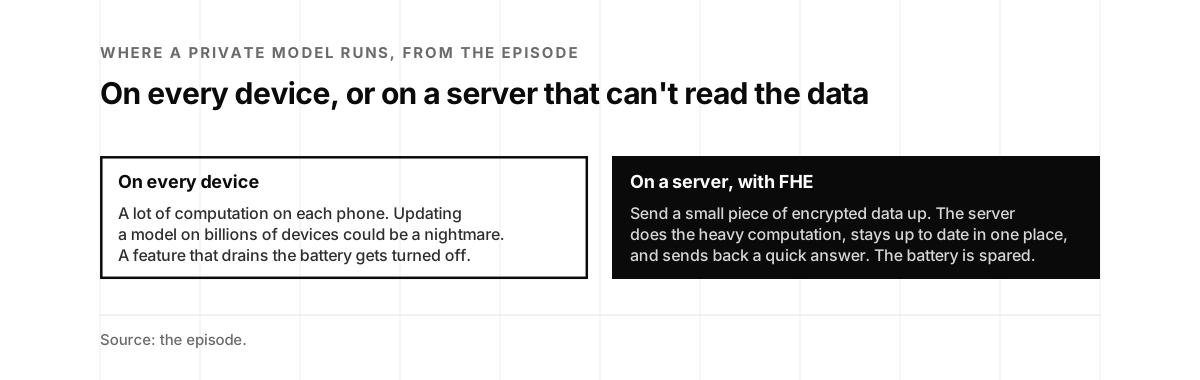
On the device or on a server

Jon raised the other way to keep data private: do all the work on the device. That takes a lot of computation, he said. Benoit’s concern was keeping models current. A model gets more accurate as you update it, because

“the data are changing from day to day.”

Benoit Chevallier-Mames, at 38:31

Updating a model on billions of devices could be a nightmare, he said. It’s much easier to update a few servers and still keep things private. Jon added the cost to the user. A feature that drains the battery in a few hours doesn’t last:

“I’m going to turn off that feature.”

Jon McLachlan, at 40:07

He needs his phone to last a full day on one charge, and to keep working for at least three years. That’s the case for a service in the cloud. You send up a small piece of data, the cloud does the expensive computation, and it sends back a quick answer. The service stays up to date in one place, and leaves your battery alone. Each application will have to weigh the pros and cons, Jon said.
Listen · Jon McLachlan on episode 20, from 39:55
About 20 seconds: Jon on what running everything on the device costs the user. The clip stops on its own. Read the full transcript.
Two cards. On every device: a lot of computation on each phone, updating a model on billions of devices could be a nightmare, and a feature that drains the battery gets turned off. On a server, with FHE, filled: send a small piece of encrypted data up, the server does the heavy computation, stays up to date in one place, and sends back a quick answer, and the battery is spared.
Running a model on every device, or on a server that never sees the data. Source: the episode.

Privacy as a selling point

Zama was working with early adopters. Benoit said some of them want to do things for the first time, like a DNA test on encrypted data, and the privacy helps their brand too. A company could promise:

“I can do your test very accurately, plus I will not see your data”

Benoit Chevallier-Mames, at 41:43

He expected more users to leave the bigger messaging apps because they care about privacy.

Jon agreed that privacy should be at the center for security professionals. He doesn’t buy the argument that you have nothing to hide:

“everyone does need some sense of privacy.”

Jon McLachlan, at 42:44

You might trust the first company that handles your data. But if it sells the data on and it gets passed around,

“you have absolutely no control”

Jon McLachlan, at 43:05

over who has it.

Benoit added that a company you trust can be bought later by another one, and then things change. Jon said companies do whatever is legal to stay profitable:

“That’s just what a company does, right?”

Jon McLachlan, at 43:35

Listen · Jon McLachlan on episode 20, from 42:19
About 25 seconds: Jon on why everyone needs privacy. The clip stops on its own. Read the full transcript.

More than the bare minimum

Then there are the laws. In Europe, Benoit said, the GDPR protects users’ privacy, and it holds some companies back. He pointed to FHE and other privacy-preserving techniques as the answer. Jon listed the American side: the CCPA in California, which he called a little harsher than the GDPR, HIPAA for healthcare, the SEC, and New York DFS, which regulates banks and other financial firms registered in the state. But he doesn’t want to stop at compliance:

“I don’t think that the right thing to do is to do the bare minimum, which is comply with the law.”

Jon McLachlan, at 45:16

You can’t know what will happen, he said, and a big part of security is reducing your exposure to risk. The GDPR is a European Union regulation on information privacy (Wikipedia). The CCPA, signed in June 2018, is a California law meant to strengthen privacy rights and consumer protection (Wikipedia).
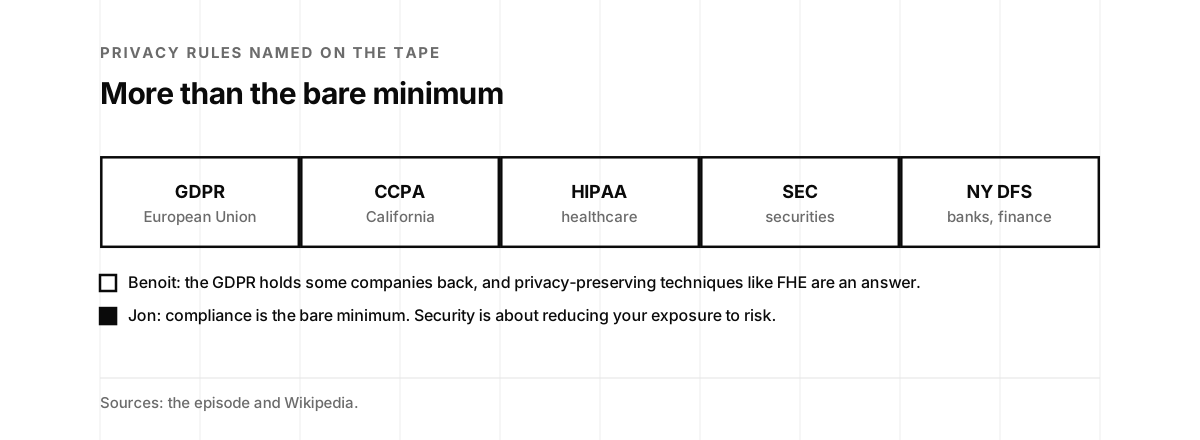
A row of five boxes: GDPR, European Union. CCPA, California. HIPAA, healthcare. SEC, securities. NY DFS, banks and finance. Below, a list. Benoit: the GDPR holds some companies back, and privacy-preserving techniques like FHE are an answer. Filled: Jon, compliance is the bare minimum, and security is about reducing your exposure to risk.
The privacy laws and regulators named on the tape. Sources: the episode and Wikipedia.

Try it, star it, file the bug

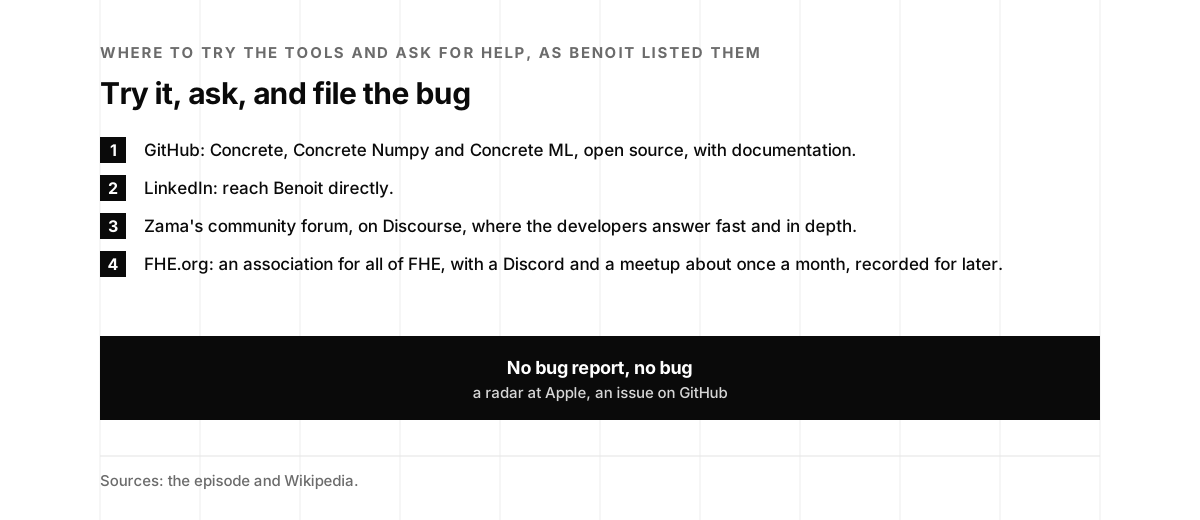
Jon sent listeners to Zama’s GitHub to try Concrete, Concrete Numpy and Concrete ML. Benoit wanted them to judge for themselves:

“Don’t take my word for truth.”

Benoit Chevallier-Mames, at 46:18

He brought one more Apple habit to his team: make things that work, that are easy to use, and that are tested. Anything not tested doesn’t work, he said.

For help, he listed the channels. You can reach him on LinkedIn. Zama runs a community forum on Discourse, and the team answers fast and in depth. There’s also FHE.org, an association for all of FHE, beyond Zama’s, with a Discord and a meetup about once a month, recorded for later. And he asked for bugs, because a bug report means someone is using the product. Apple taught him that too. A radar, at Apple, is the equivalent of an issue, and if there’s no radar,

“the bug doesn’t exist.”

Benoit Chevallier-Mames, at 49:01 Jon liked the deal for both sides:

“It’s like having an entire startup ready to go”

Jon McLachlan, at 49:17

Users get a free tool, and Zama gets closer to product-market fit. Benoit asked one small favor: a star on GitHub, which gives the projects exposure and shows people use them. He asked Jon for his star too.
Listen · Benoit Chevallier-Mames on episode 20, from 48:42
About 35 seconds: Benoit on why he wants bug reports. The clip stops on its own. Read the full transcript.
Four numbered items. One: GitHub, Concrete, Concrete Numpy and Concrete ML, open source, with documentation. Two: LinkedIn, reach Benoit directly. Three: Zama's community forum, on Discourse, where the developers answer fast and in depth. Four: FHE.org, an association for all of FHE, with a Discord and a meetup about once a month, recorded for later. Below, a filled box: no bug report, no bug, a radar at Apple, an issue on GitHub.
Where to try the tools and where to ask for help, as Benoit listed them. Sources: the episode and Wikipedia.

Building his own team

Jon asked the hard question: Apple or Zama? Benoit said they’re hard to compare, and he doesn’t regret the choice. He called it an ethical mission, and he likes the founders’ vision. At Zama he built his own team, and he tries to bring a bit of Apple’s culture into it. He wants the people on his team to be happy and to work on technology at the edge. Jon added the word bleeding. He also wants users to be happy. He was interviewing users at the time, and he’s proud when they tell him

“the documentation is very nice, it’s very clear”

Benoit Chevallier-Mames, at 52:03

One more thing he liked about Zama was talking about his work in public. After twelve years at Apple, this episode was a first:

“It’s the first time I have a podcast.”

Benoit Chevallier-Mames, at 52:36

At Zama, he can exchange directly with developers. Jon was glad Benoit could take part in the wider community now.

Listen · Benoit Chevallier-Mames on episode 20, from 51:45
About 30 seconds: Benoit on what makes him proud of his team. The clip stops on its own. Read the full transcript.

Hiring, and last words

Benoit had two recommendations for listeners: try Concrete ML, and ask Jon for an interview of their own, since this one had been so comfortable. Jon said he had learned a ton about cryptography and obfuscation from Benoit, and still has more to learn:

“I still consider myself a novice”

Jon McLachlan, at 55:48

Zama was hiring. Benoit said the goal was to hire 100 people by the end of 2023, and that you could apply even without a matching opening. He offered Jon a spot on his team. Jon said he wasn’t sure he was qualified.

What happened after the tape

Concrete ML grew up. Four days after the episode aired, on September 6, 2022, Concrete ML v0.3.0 let a model run on a remote machine, with encryption and decryption kept on the client. On April 13, 2023, v1.0.0 brought a stable API, better inference performance, tools to deploy models in the cloud, and support for Apple Silicon. The latest release on GitHub is v1.9.0, from April 2025 (GitHub).

Benoit moved up. His LinkedIn shows him as Concrete-ML team lead until April 2023, then VP of privacy-preserving machine learning, over Concrete, Concrete-Python and Concrete-ML. In October 2024 he became VP of product engineering, and in January 2026 SVP of product and engineering operations, a role across all of Zama’s product and engineering teams (LinkedIn).

Two talks. At RSA Conference on April 25, 2023, Benoit and Jordan Frery presented “Machine Learning over Encrypted Data with Fully Homomorphic Encryption,” on a library that lets data scientists use tools they already know (RSAC). On June 5, 2023, Zama posted their talk at Stanford’s security seminar (YouTube).

Benoit and Jordan Frery at the Stanford security seminar, 87 minutes, posted on June 5, 2023. Watch on YouTube.

Money for the long road. On March 7, 2024, Zama announced a $73 million Series A led by Multicoin Capital and Protocol Labs (SecurityWeek). On June 25, 2025, tech.eu reported a $57 million Series B co-led by Blockchange Ventures and Pantera Capital, at a valuation above a billion dollars (tech.eu).

A second visit. Benoit came back on episode 44, in May 2024, as VP of privacy-preserving cloud and machine learning. He talked about Hugging Face demos, models ready for production, and large language models.

More on this site. On episode 39, Steve Orrin of Intel described homomorphic encryption as an absolute dog on performance. On episode 70, it came up as right around the corner. And on episode 75, Jonathan Mortensen of Confident Security described a provably private AI inference service, where the provider can’t see the data.
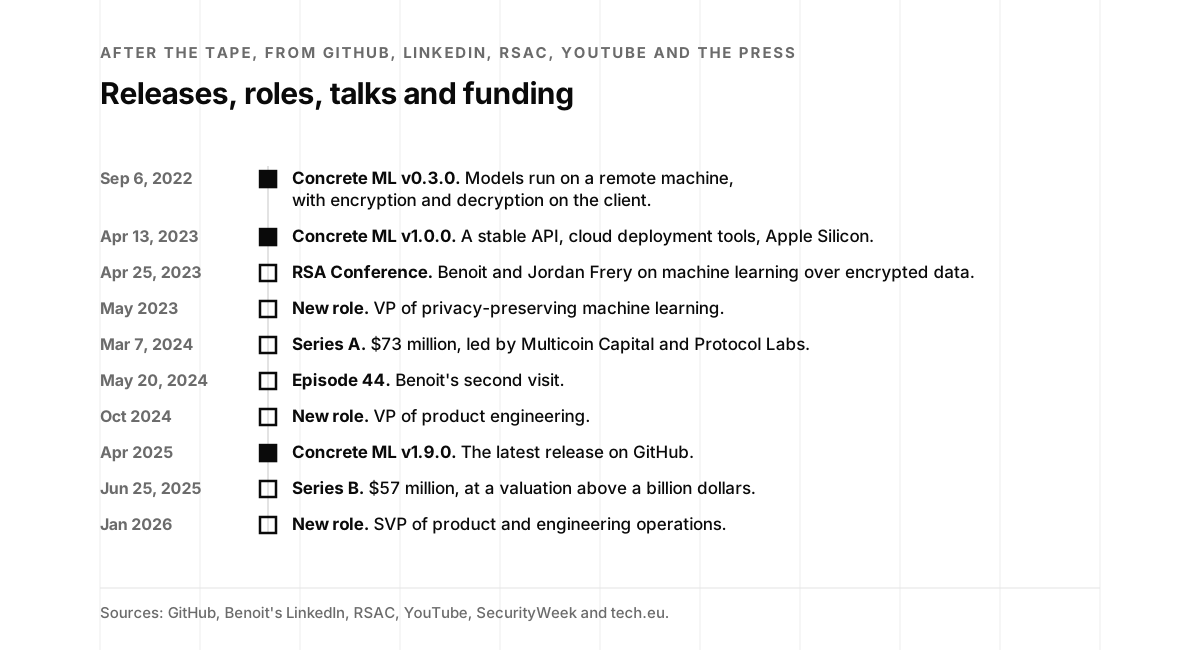
A timeline. September 6, 2022, filled: Concrete ML v0.3.0, models run on a remote machine, with encryption and decryption on the client. April 13, 2023, filled: Concrete ML v1.0.0, a stable API, cloud deployment tools, Apple Silicon. April 25, 2023: RSA Conference, Benoit and Jordan Frery on machine learning over encrypted data. May 2023: new role, VP of privacy-preserving machine learning. March 7, 2024: Series A, $73 million, led by Multicoin Capital and Protocol Labs. May 20, 2024: episode 44, Benoit's second visit. October 2024: new role, VP of product engineering. April 2025, filled: Concrete ML v1.9.0, the latest release on GitHub. June 25, 2025: Series B, $57 million, at a valuation above a billion dollars. January 2026: new role, SVP of product and engineering operations.
After the tape: releases, roles, talks and funding. Sources: GitHub, LinkedIn, RSAC, YouTube, SecurityWeek and tech.eu.

Did you catch it? A seven-question quiz

Seven questions from the episode. Each answer links the moment in the transcript or its section.

Quiz · seven questions

Did you catch it?

Pick an answer to see whether you caught it.

  1. What did Jon and Benoit work on together at Apple?

    b. They spent about five years on the same DRM team. See Two engineers from the same team.

  2. What made the jump to Zama less risky for Benoit?

    a. "it was less risky to me to jump to Zama" Transcript, 15:24.

  3. In Benoit's DNA test, what does the lab learn about your result?

    c. "they don't know if you have the disease." Transcript, 13:58.

  4. How many bits did machine learning on encrypted data run on at Zama in 2022?

    a. Eight bits, like computers 40 years earlier. See Eight bits, like forty years ago.

  5. What does Zama never trade away?

    b. Zama keeps at least 128 bits of security, and trades speed and memory. See Security is never traded.

  6. Which kind of quantization did Benoit call even more fascinating?

    c. The training knows the model will be quantized. See What eight bits means for a model.

  7. Who did Benoit say Zama's users are?

    a. "our users are the developers." Transcript, 32:02.

Is your model ready for encrypted inference?

Eight questions on whether a model fits machine learning on encrypted data today, built from the episode. Each tip links the section behind it.

Scorecard · eight questions

Is your model ready for encrypted inference?

Answer for one model you run today. If two answers fit, pick the lower one.

  1. How sensitive is the data the model takes in?

    • Public or low risk
    • Personal data
    • Health, genetic, financial or biometric data

    Benoit's example was a DNA test. See A DNA test the lab can't read.

  2. What kind of model is it?

    • A large neural network
    • A small neural network
    • A linear model or a tree model

    How close the encrypted model gets depends on the model. See What eight bits means for a model.

  3. How long can users wait for a result?

    • It has to be real time
    • A few seconds
    • Minutes or more

    A health test can wait an hour. See Results that can wait an hour.

  4. Have you tested the model at eight bits?

    • Not yet
    • Yes, with accuracy we haven't measured
    • Yes, with accuracy close to the full model

    Quantization-aware training trains for the eight bits. See What eight bits means for a model.

  5. Can the user's device hold a key and encrypt the input?

    • We don't control a client
    • A web client only
    • An app or SDK on the device

    The key stays with the user. See Your key stays with you.

  6. Where does the model run today?

    • On every user's device
    • Partly on devices, partly on servers
    • On servers you update in one place

    Updating a model on billions of devices is hard. See On the device or on a server.

  7. Has your team built a prototype with an open source FHE library?

    • No
    • We've read the documentation
    • Yes, a working prototype

    Start on GitHub and file what breaks. See Try it, star it, file the bug.

  8. Do you know the license terms for shipping it?

    • No
    • We know a commercial license is needed
    • Reviewed and budgeted

    Free to try is not free to ship. See Free to try, a license to ship.

Not yet

This model isn't a good first candidate. Pick one with sensitive inputs, a simpler model and users who can wait.

Prototype it

The fit is there in parts. Quantize a copy, measure the accuracy, and build a small prototype before you plan a launch.

A strong fit

Sensitive data, a model that holds up at eight bits, and users who can wait. Plan the keys, the latency and the license.

What does eight bits do to a model?

Benoit described going from 64 bits to eight-bit integers, eight times smaller. This calculator shows what that does to your model.

Calculator

What does eight bits do to a model?

Two numbers: how many millions of weights your model has, and how many bits each weight gets after quantization.

10.0MB after quantization
80.0MB as 64-bit numbers
8.0times smaller
256values each weight can take

At 8 bits, 10.0 million weights take 10.0 MB, down from 80.0 MB as 64-bit numbers, 8.0 times smaller. Each weight can take one of 256 values.

The calculator counts the weights alone, at eight bytes each as 64-bit numbers, and rounds the bits to a whole number. It doesn't count encryption. The 10 million weights is a placeholder: put in your own model's count.

The road to machine learning on encrypted data

The math behind FHE, Benoit’s roles, Concrete ML’s releases, Zama, and this show. Filter by topic.

Timeline

The road to machine learning on encrypted data

  1. The question

    Within a year of RSA, cryptographers ask for a fully homomorphic scheme (Wikipedia, on this page).

  2. The Paillier cryptosystem

    A public key scheme named after Zama's future CTO (Wikipedia).

  3. Gemplus

    Public key cryptography on smart cards, and protections against side-channel and fault attacks (LinkedIn).

  4. ANSSI

    Cryptologist, on Shabal, a hash function submitted to NIST's competition (LinkedIn).

  5. Apple

    The DRM technology team and the crypto team, on white-box cryptography and obfuscation (LinkedIn, on this page).

  6. Gentry's scheme

    The first plausible construction of fully homomorphic encryption (Wikipedia, on this page).

  7. FHEW

    Bootstrapping in a fraction of a second (Wikipedia).

  8. TFHE

    The scheme that Zama's libraries extend (Wikipedia).

  9. Zama

    Employee number seven, as compiler team lead (LinkedIn).

  10. Concrete Numpy

    Team lead, and the launch of version 0.2 (LinkedIn).

  11. Concrete ML team lead

    Open source machine learning on encrypted data (LinkedIn).

  12. Concrete ML v0.1.0

    The first release, published from Benoit's GitHub account (GitHub).

  13. Episode 20

    Benoit on the show, and his Concrete ML talk on YouTube (Podbean, transcript).

  14. Concrete ML v0.3.0

    Models run on a remote machine, with encryption and decryption on the client (GitHub).

  15. Concrete ML v1.0.0

    A stable API and tools to deploy in the cloud (GitHub).

  16. RSA Conference

    Benoit and Jordan Frery on machine learning over encrypted data (RSAC).

  17. VP of privacy-preserving machine learning

    Over Concrete, Concrete-Python and Concrete-ML (LinkedIn).

  18. Stanford

    The security seminar talk goes up on YouTube (YouTube, on this page).

  19. A $73 million Series A

    Led by Multicoin Capital and Protocol Labs (SecurityWeek).

  20. Episode 39

    Steve Orrin of Intel on data in use (episode page).

  21. Episode 44

    Benoit's second visit (episode page).

  22. VP of product engineering

    Over the division where Zama's user products are designed and built (LinkedIn).

  23. Concrete ML v1.9.0

    The latest release on GitHub (GitHub).

  24. Episode 70

    Abhi Sharma of Relyance AI on trusting AI (episode page).

  25. A $57 million Series B

    At a valuation above a billion dollars (tech.eu).

  26. Episode 75

    Jonathan Mortensen on private AI inference (episode page).

  27. SVP of product and engineering operations

    A role across all of Zama's product and engineering teams (LinkedIn).

What to do this week

Five things, in the order of the episode.

  1. Find where models read clear data. List each place a model reads personal data unencrypted, starting with health, genetic and financial data, as in A DNA test the lab can’t read.
  2. Test one model at eight bits. Quantize a copy and measure its accuracy against the full model, as in What eight bits means for a model. The calculator shows the size side.
  3. Start where users can wait. Pick a workload that doesn’t need an answer in real time, as in Results that can wait an hour.
  4. Prototype first, then read the license. Try the open source tools, file what breaks, and check the commercial terms before you ship, as in Free to try, a license to ship.
  5. Get help with it. Our Product Security team designs privacy into features like these, Training Data PII & Secret Scrubbing finds and removes personal information in the data you train on, and AI & HIPAA covers health data in AI products. Anti-Reverse Engineering protects the keys and models you ship to devices. If you want to talk it through, book 15 minutes with us.

Key takeaways

  1. FHE lets a server compute on data it can't read

    Ordinary encryption is built so no one can change the ciphertext in a meaningful way. Fully homomorphic encryption is built so a server can run operations on ciphertexts and send back a result only you can decrypt.

  2. Sensitive tests are the first use case

    Benoit's example was a DNA test. You encrypt your DNA on a device you trust, and the lab runs the same test without being able to read, keep, sell or share your DNA or the result.

  3. Trust in the founders lowered the risk

    Benoit had known Zama's CTO, Pascal Paillier, since Gemplus, about 22 years before, and its CEO, Rand Hindi, had built a company that was acquired. That made the jump from Apple less risky.

  4. Eight bits was the main limit

    In 2022, machine learning on encrypted data at Zama ran on eight-bit numbers, which Benoit compared to computers 40 years earlier. Speed was the other constraint, with hardware accelerators on the way.

  5. Security is never traded

    Zama keeps at least 128 bits of security, the level AES-128 is designed for. What it trades is speed and memory.

  6. Quantization makes models fit

    Post-training quantization or quantization-aware training takes a model from 64 bits down to eight-bit integers. How close the encrypted model gets depends on the kind of model, and neural networks were still the hard case.

  7. Open source to try, a license to ship

    Zama's libraries were open source and free for research, students and trials, with another license for commercial products. Developers try them, build a prototype and show their boss.

  8. Start where results can wait

    Machine learning that doesn't need an answer in real time, like a health test that can wait an hour, works on FHE today. Faster hardware will widen the range of applications.

Chapters

Tap a chapter to play from there.

Pull quotes

“this is the holy grail.”

Jon McLachlan ·

“a kind of a grand primitive that we have dreamed of in the cryptography research field”

Benoit Chevallier-Mames ·

“So they would not have an access to your DNA. They can't share it. They can't do anything with it.”

Benoit Chevallier-Mames ·

“they don't know if you have the disease.”

Benoit Chevallier-Mames ·

“This is definitely a deep tech endeavor.”

Jon McLachlan ·

“one of the main specialists of homomorphic encryption.”

Benoit Chevallier-Mames ·

“It should just work.”

Benoit Chevallier-Mames ·

“nothing exists. So we are just making things from scratch.”

Benoit Chevallier-Mames ·

“Does that mean that the ML results are limited to 256 different classification categories?”

Jon McLachlan ·

“One of the greatest tricks that entrepreneurs use is focus, right?”

Jon McLachlan ·

“Still baking. Yeah. It's still in the oven.”

Jon McLachlan ·

“I can do your test very accurately, plus I will not see your data”

Benoit Chevallier-Mames ·

“I don't think that the right thing to do is to do the bare minimum, which is comply with the law.”

Jon McLachlan ·

“the bug doesn't exist.”

Benoit Chevallier-Mames ·

“It's the first time I have a podcast.”

Benoit Chevallier-Mames ·

About the guest

Benoit Chevallier-Mames, Team Lead of Machine Learning, Zama

Benoit Chevallier-Mames is a cryptographer with a PhD in cryptography. He worked at Gemplus on public key cryptography for smart cards and protections against side-channel and fault attacks, then as a cryptologist at ANSSI, and then for about eleven and a half years at Apple, on the DRM technology team and the crypto team, where he worked on white-box cryptography and obfuscation. He joined Zama in April 2020 as employee number seven. At the time of this episode he led the Concrete ML team. He later became VP of privacy-preserving machine learning, then VP of product engineering, and in January 2026 SVP of product and engineering operations.

About the host

Jon McLachlan is co-founder of YSecurity, the on-demand cybersecurity team for startups, and of Cyberbase.ai. The Security Podcast of Silicon Valley is hosted by Jon McLachlan and Sasha Sinkevich. Jon McLachlan on LinkedIn ↗

Context and sources

  • Episode 20 on Podbean: Benoit Chevallier-Mames, Team Lead of Machine Learning at Zama, On Open Source Homomorphic Encryption. Source ↗
  • Benoit Chevallier-Mames's LinkedIn: Gemplus from September 2000, ANSSI from November 2007, Apple from November 2008, and Zama from April 2020, as compiler team lead, Concrete-Numpy team lead, Concrete-ML team lead, VP of privacy-preserving machine learning, VP of product engineering, and SVP of product and engineering operations. Source ↗
  • Concrete ML releases on GitHub: v0.1.0 on April 4, 2022, published from Benoit's account, v0.3.0 with client-server deployment on September 6, 2022, v1.0.0 on April 13, 2023, and v1.9.0 in April 2025. Source ↗
  • Concrete ML README: open source tools for privacy-preserving machine learning, free under BSD-3-Clause Clear for development, research, prototyping and experimentation, with a commercial patent license for commercial use. Source ↗
  • Zama on YouTube, September 2, 2022: Concrete ML, a data-scientist-friendly toolkit for machine learning over encrypted data, a talk by Benoit for the Australian Institute for Machine Learning. Source ↗
  • Zama on YouTube, June 5, 2023: Privacy Preserving Machine Learning With Fully Homomorphic Encryption, Benoit and Jordan Frery at the Stanford security seminar. Source ↗
  • RSA Conference, April 25, 2023: Machine Learning over Encrypted Data with Fully Homomorphic Encryption, with Benoit and Jordan Frery. Source ↗
  • SecurityWeek, March 7, 2024: Zama raises $73 million in a Series A led by Multicoin Capital and Protocol Labs. Source ↗
  • TechCrunch, March 7, 2024: Zama's $73 million Series A, and its CEO Rand Hindi's previous company, Snips, acquired by Sonos. Source ↗
  • tech.eu, June 25, 2025: Zama's $57 million Series B, co-led by Blockchange Ventures and Pantera Capital, at a valuation above a billion dollars. Source ↗
  • Wikipedia, Homomorphic encryption: computations on encrypted data without decrypting it, first proposed in 1978, Craig Gentry's scheme in 2009, FHEW in 2014 and TFHE in 2016. Source ↗
  • Wikipedia, Malleability (cryptography): an encryption algorithm is malleable if one ciphertext can be turned into another that decrypts to a related plaintext. Source ↗
  • Wikipedia, Paillier cryptosystem: invented by and named after Pascal Paillier in 1999. Source ↗
  • Wikipedia, Security level: n-bit security means an attacker would have to perform 2 to the power n operations, and AES-128 is designed for a 128-bit level. Source ↗
  • Wikipedia, Quantization (signal processing): mapping input values from a large set to a smaller set. Source ↗
  • Wikipedia, White-box cryptography: an attack model in which the adversary has full access to the cryptographic implementation. Source ↗
  • Wikipedia, Multi-licensing: distributing software under two or more sets of terms and conditions. Source ↗
  • FHE.org, the community for fully homomorphic encryption, with conferences, meetups and discussions. Source ↗

Transcript

Automatic transcription. Jon McLachlan hosts this episode with Benoit Chevallier-Mames, then team lead of machine learning at Zama. There is no diarization on the tape, so speaker labels were assigned from the content and checked against reference recordings of each voice from this episode and against voice pitch, and a few short lines may sit with the wrong speaker. Names and terms were normalized where the recognizer misheard them (Jon McLachlan, Benoit Chevallier-Mames, Zama, Gemplus, Pascal Paillier, Rand Hindi, Snips, Concrete ML, FHE). Every pass of the recognizer hears Benoit's FHE as other letters, and the transcript writes FHE. Words in [brackets] are best guesses where the audio is unclear, and [...] marks words no decode made out. Answers are transcribed as spoken, though many repeated words and false starts are left out. Short backchannels such as "yeah" and "right" are left out where they overlap the other speaker.

Read the full transcript 8,553 words

Jon McLachlan

Welcome, everyone, to the Security Podcast of Silicon Valley. I am here today with a very special guest, Benoit Chevallier-Mames. Thank you so much, Benoit. It is great to have you on the show and to see you again.

Benoit Chevallier-Mames

So, it's really my pleasure. So, yes, it has been some time that we haven't been together. So, yes, it's really also my pleasure to be there.

Jon McLachlan

So, to share with our listeners a little bit of background on Benoit, Benoit actually has a PhD in cryptography. He has built his entire career around being a cryptographer. He's worked for amazing companies throughout his career, including Gemplus, Apple. You were at Apple for 12 years. We were actually both at [Apple]. And now you're at Zama, sort of leading the charge down the road towards fully homomorphic encryption, privacy-preserving AI and machine learning. Welcome to the show, Benoit. A pleasure. So usually when people hear Apple, they get excited. So would you like to share with us, our listeners, a little bit about what you're up to in your [time] at Apple as a cryptographer?

Benoit Chevallier-Mames

[Yeah, sure]. So, yes, we start by, you know, a tricky question, but my pleasure to answer with what I can. You know, you've been in Apple, so you know that it's really [about] secrecy. So I'm not going to give your listeners any [creepy] detail, but more or less, we were together in the same team, in the DRM team, digital right management team, for like five years. And there we were working on protecting some contents, like, you know, audio, video or things like that, with various techniques like white-box cryptography or obfuscation.

Jon McLachlan

Yeah, those were the good old days, weren't they, Benoit? Like, I was there from what, 2009 to 2014, and we overlapped for my entire stint there. But you continued, and you were there for a total of like 12 years.

Benoit Chevallier-Mames

Yes, 12 years, and most of them were amazing years. Yeah, and, you know, Apple, I really love these companies. They are making a very nice product, and the company is also very, very well organized. And the people, I mean, the people, it was the people they have, they hire and they keep. Those people are, most of them are really amazing, both in term of personal people and technical skills. So I really learned a lot of things there, including organization, including technical stuff. And yeah, it was really a [pleasant] moment in my career.

Jon McLachlan

I couldn't agree more. It was an amazing place. For me, that was my first real career job after graduate school. And I couldn't agree more on every single point. So you mentioned protecting content, audio, video. You know, just to loop in our listeners, all of that stuff was in iTunes. So the software that [Benoit] worked on and that I worked on, we worked on together, it ended up in the iPhone, the iPad, the [iPods], the [Apple TV], that entire ecosystem, right?

Benoit Chevallier-Mames

Yes. And if we want to, you know, [boast] a bit about what we've done, we can say that we have actually billions of users of what we have been doing there. And most of them use our, what we've done, without even noticing that we have done it or that they are using [ourselves]. So it's really amazing.

Jon McLachlan

Absolutely. So one of, like, it sounds great at Apple. [Tell it], could you share with us why did you, why did you leave?

Benoit Chevallier-Mames

So yes, yes, it was really great. But, you know, in my mind, I always had the idea of wanting to start maybe a startup at the moment. And so I knew that at the time I would [have] to jump and go to the adventure. And then at the moment I had people in Paris starting a company, people that I know [really] closely. The CTO, I mean, I know him for like 20 years. And it was also in the [field] that I know quite well, I mean, the cryptography, which is [the] fully homomorphic encryption, we are certainly going to go into the details. And so it was the occasion of [now or] never. So I had to go there. So I would say I didn't left Apple. I don't leave Apple. I joined Zama.

Jon McLachlan

You couldn't say no. You were pulled into it. It was that moment or never.

Benoit Chevallier-Mames

Yes. And yes. And, okay, we are going to explain it, but I don't regret it. I mean, it's really a nice adventure. Of course, there were great things in Apple too. And I don't say, maybe you say the same thing, I don't say that I will never go back there, because it's a very nice company. But I had to try it once.

Jon McLachlan

What I always tell people about Apple is they make it incredibly nice to work there. It was, like you said, the people were spectacular. It's engineering driven. Well, you got to work on things that have billions of users out there.

Benoit Chevallier-Mames

Yeah. Yeah. Yeah. And it's so well done. I mean, well done.

Jon McLachlan

And when I left Apple, it was a very similar [pull], you know. And I, in particular, I was looking for something to really push the envelope, to really make, to explore an unsolved problem. So that's how I ended up at Symphony Communications. But it sounds like you are also pulled into an open [problem] with this fully homomorphic encryption.

Benoit Chevallier-Mames

So, can I say a few words about what is homomorphic encryption?

Jon McLachlan

Please. So what is homomorphic encryption? What problem does it solve?

Benoit Chevallier-Mames

So, homomorphic encryption, just to say a few words, I'm going to be, you know, to use a rough concept, I'm not going into the deep details, but roughly, homomorphic encryption is a kind of a grand primitive that we have dreamed of in the cryptography research field for like, I don't know, 40 years maybe. It is a primitive that we, they, they imagine, but it was so crazy that they thought that it could not be possible until they did it. So actually, the idea is to... So normally, an encryption scheme is such that it's not malleable. You can't modify the ciphertext in any meaningful way.

Jon McLachlan

So when you have, when you, so when you encrypt something, you can't change it without destroying your encryption.

Benoit Chevallier-Mames

Yeah. If you change a bit of the ciphertext, you modify it in a way that you have no idea of.

Jon McLachlan

And all of our listeners, please, please, please use some sort of authentication tool on top of that, so you can detect when someone tampers with your ciphertext.

Benoit Chevallier-Mames

Yes, yes, yes. Depending on the kind of encryption that you use, you can see that the ciphertext was modified. In FHE, it's completely different. By choice, you make a scheme so that it's possible to work with ciphertext, which means it's possible to do operations on ciphertext in a meaningful way. And it's really a great [primitive], because more or less what you can do is you can be on your device that you trust, and then you can encrypt things, and then you can send them to a server that you don't need to trust. And there, this server can do whatever computation it wants. So we are going to explain what I do in the team, maybe, regarding machine learning, but any computation they want, just using [public key] material, so nothing really secret, and not a, not, not being able to know what it is manipulating. At the end, it returns you the [encoded] results, and just you can get the final result. So really, it has been a very... For 40 years they have tried to find a solution. And just recently, which is, okay, in 2009, there was an American guy called Gentry who was able to find a solution. And then several new generations of FHE schemes were proposed, which are better and better.

Jon McLachlan

Amazing. I think that was really good. At the end of the day, most people do not understand this stuff. So thank you for sharing, Benoit, and for dumbing it down a little bit for those of us who are not cryptographers. The context is really all that matters. And so, from a security perspective, with this new tool [called] fully homomorphic encryption, we're giving entrepreneurs and companies and people that build software a new tool, and they can use this new tool to protect customer data, protect the confidentiality. For example, your PII, your personally identifiable information, or [sensitive data], or perhaps a person's diary, or it's just like all of your data that normally the company wants to own, and they try to monetize, and it can be sold. But if it's encrypted, and you're the only one with the private key, now we enable people to build third-party SaaS services that can perform meaningful operations, valuable operations, for me as a user, or for you as a user of these third-party SaaS services, without having to share the actual data. I think, like, that is it. I couldn't agree more that this is the holy grail.

Benoit Chevallier-Mames

Yeah. So you remember this advertisement that Apple had in, I think it was in Las Vegas at the moment, which was, or maybe it's still an actual ad, which is: what happens on your iPhone stays on your iPhone. So by choice, because they care about privacy, they have decided sometimes to keep things internal to the, to the iPhone, because it's so private that they don't want computation even on their server. With FHE, they can do differently. They can encrypt things in the iPhone, and send it anywhere, any untrusted server, there is no worries about it. Computations are going to be done in a way that they don't know. At the end, it's back to the iPhone. So it's, [instead of having limits] just because of the privacy, you can have privacy now, but still do the big things that you wanted to do, you know, on servers.

Jon McLachlan

Yeah. So tell [me], share with us, what's maybe an example of some of the big things that you could do in the servers that today requires you to share very sensitive information with some third party?

Benoit Chevallier-Mames

Yeah. Yeah, so, yeah. So, for example, imagine you want to do a test, whether you have or not some disease, but for this test, you need to send your DNA. So you are going to have your DNA and then to send it to a server somewhere. You don't know this company. You don't know if they are going to keep your record. You don't know if they are going to sell them to some other companies for some statistics or whatever. So that's for the input. And then they are going to [do] the test and to send you the results. But what are they going to do with the result itself? Are they going to share it with your employer, with your bank, with your insurance, with your [...]? Whoever, you don't know. And so it's really, you know, there are tons of people who want to know if they have the disease. So, yes, I understand. But at the same time, they agree to share. They have very private information. And once your DNA is on the web, there is no way to erase it. And you can't, I mean, [update] your DNA as you [update] your password. So we need... So it's really a case. And what [would FHE do] here? You would just encrypt the DNA in your trusted device, and then the server, the third party that runs this health check, would be doing the same test, but in FHE. So they would not have an access to your DNA. They can't share it. They can't do anything with it. Then at the end, they have the encrypted result, but that means they don't know if you have the disease. But they can't share the status. So it's really...

Jon McLachlan

It's really, it's really powerful. Yeah. So could they do that with Zama today? Could 23andMe and Ancestry [do that]?

Benoit Chevallier-Mames

Zama was really, really founded in this perspective. So it was founded by people, so Pascal Paillier, who is the CTO, who I know for like 20 years, because we were working together in [this]...

Jon McLachlan

This is your good friend.

Benoit Chevallier-Mames

This is, yeah.

Jon McLachlan

I would love to hear how you bumped into and how you became friends with Pascal.

Benoit Chevallier-Mames

Yeah, I mean, we started together in Gemplus, and then it was 22 years ago. So yeah, we had... And he is, I mean, okay, he's a very friend. He's also a very, very well-known cryptographer. I mean, he's, he is one of the main specialists of homomorphic encryption. So really, in terms of science, he is one of the big names. And then the second founder is our CEO, Rand Hindi. So [...]. Rand is an AI scientist and a serial entrepreneur. And notably, he has made a previous company just before Zama, which was Snips, which was acquired. So which was also one of the reasons I was less, you know, it was less risky to me to jump to Zama, because I knew that he was, you know, he knew what he was doing.

Jon McLachlan

Yeah, that's actually an amazing setup, because you had, you had the trust, you trusted the team. You knew them for 20 years. You've worked with them before.

Benoit Chevallier-Mames

I told you it was the best [configuration], but it was [now or never].

Jon McLachlan

You just walked right into this amazing opportunity, Benoit.

Benoit Chevallier-Mames

Yes. I'm happy for it. [Yeah, thanks.] And so, yes, Zama, we are in Paris. So mainly in Paris because we are [founded] by Parisians, but we have people from everywhere. So, for example, just to give you an example, we have someone in Brazil. So we start to be a bit everywhere on the planet. We are like [sixty] people, half of which are, you know, PhDs. So it's, research is in the DNA of the company. Our CEO, [CTO], have PhDs. Yeah, half of the people are PhDs. Most of them are PhD in crypto. And yes, and to finish with Zama, we raised some money, so 50 million by investors. So if you, I don't know the details, but if you go to Crunchbase, you will see the...

Jon McLachlan

We'll see. You can check it out. Yeah. Is that the, which series is that?

Benoit Chevallier-Mames

So, yes, we have a, so we have done a Series A. Series A, 50 million. Total, in total, [seed plus Series A] is 50.

Jon McLachlan

That's [incredible]. But you've got some strong backing. You've got some runway. This is definitely a deep tech endeavor.

Benoit Chevallier-Mames

Yes. And, you know, they know that. So it's a big investment, because FHE is great, but everything is to [be built], you know. And it's a big thing. It's, so it doesn't come for free. But there, I think the investors are great, because they know that it takes some time and, you know, some test and try, maybe sometimes, to have the good fit for the product.

Jon McLachlan

Product market fit. That's going to be the challenging piece. But you also face the extra challenging piece of exploring this new technology, which really is not widely adopted, as far as I know, anywhere yet.

Benoit Chevallier-Mames

So it's not widely adopted, and it's not even widely, let's say, designed. It's still a field of research. We are still looking for things which are faster, or best way [to do] things. So that's one of the reasons we have so many PhDs in the company.

Jon McLachlan

Because there's a lot of open problems. So would you like to share with some of our listeners what are the open challenges that you're, you grappled with or that you're still grappling with?

Benoit Chevallier-Mames

Yes. So, yes, my pleasure. So today in my team, we, so we are... But maybe I could start by telling what my team is doing, and then...

Jon McLachlan

Yeah. Do you run a team? Are you the manager of a team?

Benoit Chevallier-Mames

Yes, so now I am running a team which is the machine learning team of the company, because we have seen that actually in the company there are, for FHE, let's say there are two kinds of applications. There are, let's say, cloud applications, so applications, things that you want to run on the untrusted server, like, so, remote, the DNA test, third party. So basically the machine learning is one of this kind. And then you have a blockchain application. So it's another division that I'm, that is starting in Zama, [which is trying] to do things in the blockchain, but in a private way. You will not see what are the clear values of the, what, that are used in the blockchain. So yeah, so in terms of team, so for what I'm doing, I'm running the machine learning team, where I'm [going to] try to make a product which is called Concrete ML, which is a tool which is to be used by a data scientist without obviously needing to know the cryptography. So, you know, back to Apple once again. We try to make things which just work. So you don't, [right], you don't need to know how it works. Right. It just works. There are not a lot of things to set up or to understand, or you don't need to know the cryptography. You don't need to be, if, to be a PhD in crypto. It should just work. And it's really one of the goals of the company to make things which are very simple. And then, so yeah, in terms of challenges. So today we are running machine learning algorithms which are limited to eight bits. So actually, more or less, it's a bit fun. It's like, somehow, what we, where we were 40 years ago in the regular computers. 40 years ago, computers were very limited in terms of precision, and now with FHE, more or less, the history repeats itself. So you are back to having computation in eight bits, but here it's eight bits because you have, you know, the privacy. So the challenge is to run the machine learning algorithm with such small values. And then another constraint is a relative slow speed of FHE for now. So for now, many things are done on, you know, on CPUs. So it makes that your computations are quite slow as compared to the, with the clear equivalent. But we are working internally and with third-party companies to have, let's say, hardware accelerators. So if you go on the Zama blog, for example, you will have a [blog post] by another company which is called [Optalysys], and that's crazy, they are, so I'm not a specialist, but they are doing fast [computations] thanks to optics.

Jon McLachlan

Is [it] optics, like fiber?

Benoit Chevallier-Mames

Yes. So don't ask me how it works. But then, thanks to that kind of things, and we have several companies trying to make accelerators for FHE, we are going to have FHE faster and faster. And by 2025, Zama, we expect that FHE will be sufficiently fast, I mean, as compared to clear [computations]. Yes, yes. And yes, to finish, maybe one big challenge is that, you know, nothing exists. So we are just making things from scratch. So [Rand], for example, he likes to compare our status with how we were, how they were, at least 15 or 20 years ago, in terms of machine learning. Machine learning was starting, and they had to do everything by themselves somehow. And now you, you know, you just are a student, you download Keras, and 15 minutes later you have done your training. So we hope to be doing the same kind of tools, so that it becomes easier and easier for the people.

Jon McLachlan

Easier and easier, and more secure and more secure.

Benoit Chevallier-Mames

Oh, but the security, we never trade it. So anything in Zama, it is secure. It is at least 128 bits security, which is the security of AES. So it's really, I mean, very good security. That's the only trade we have sometimes, is about speed, because for now it's too [slow], or about, you know, it can be, it can use a lot of RAM or things like that. But security is never traded.

Jon McLachlan

So you mentioned the eight bits, and I am absolutely no ML expert. I have dabbled and played with things, but I am not, I've never deployed production ML. So help us understand, like, eight bits. I know that two raised to the power eight is 256, just like probably all engineers in this world, and they're kind of like probably nodding their head right now. Does that mean that the ML results are limited to 256 different classification categories? Or is there a, can you tease us a little bit about what...

Benoit Chevallier-Mames

Yes. So, yes, as you said, I'm mainly [a cryptographer]. So, [still], I know a bit more than you, but there are people in my team who are even more specialists than I am. So what we are doing in the team is that we are using what is called quantization, which is, let's say, a sub-part of machine learning, which is normally used to compress networks. So, you know, neural networks become bigger and bigger, when you have to send them over the air, it's too large. So companies try to make networks just on integers, which are like eight bits, eight times smaller. So normally quantization is used for this. In our case, we use quantization to come from 64 bits [floats] to eight bits of integers. And we use either what is called post-training quantization, which is, you do your training and then you quantize, or something which is even more fascinating, which is quantization-aware training, which means that you tell your training that you are going to be quantized, and so it selects the best weights such that the result after [quantization] is even better. So in terms of results, it means that, depending on the kind of models, I'm not going to tell you that it works 100%. So for [tree]-based models, which is a kind of machine learning model, it is a very used, [quantization] works very well. It's very smooth for the user. And the results, in term of, you know, you compare FHE and clear results, the accuracy are very, very close. And then, on the other side of the spectrum, let's say you have a, you have a neural networks, where for now the [eight-bit] limit is challenging. It's going to be better with the further release, by the fact that we would use the [quantization-aware] training, and also a part of the work in Zama is to increase this [eight bits]. The [eight-bit] limit is not the end. We are working [on it]. It's [a first step]. Yeah, I thought that it was, you know, the story [...]. Yes, yes, [...] larger.

Jon McLachlan

Very nice. And so we're taking all of this fully homomorphic encryption. We can encrypt our private data. We can hand it off now to an eight-bit computer vision or an AI model that's already been trained, and it can work now on our encrypted data instead of on the plain text. And I don't have to [share] my key that I use with anyone else that's also using that same service. So it's completely independent.

Benoit Chevallier-Mames

Your key remains on the device. You just have to send the equivalent of the key to the server.

Jon McLachlan

Ah, so it needs my public key.

Benoit Chevallier-Mames

Okay. Yeah. The compiled model can be used for [...] users. They just have to change the [key] part, depending on who the user is.

Jon McLachlan

No, that's incredible. And I loved the focus. One of the greatest tricks that entrepreneurs use is focus, right? So what do I mean by that? In this case, it really feels like you're taking an open problem, which is fully homomorphic encryption, and you're giving it focus in this very specific application of [ML].

Benoit Chevallier-Mames

Yes. Machine learning is exactly a kind of focus on what we call the cloud computation. So later, if the company, and the company is going to succeed, we are going to extend what we do in terms of cloud computation. And also, I told you, the other division is working on blockchain and the blockchain stuff. Yeah, yeah. So we have...

Jon McLachlan

So that whole, so you're already starting your second products. Oh, there you go. Yeah, and that's a great [thing]. You're going to use the same core technology that you're [putting] on.

Benoit Chevallier-Mames

Actually, the core is actually our first product. So roughly, in the company, we are going to have three lines of products. The Concrete library, which is the core, that can be used directly in Rust, because, you know, we have [tr], we have chosen Rust.

Jon McLachlan

Oh, wait a second. You, you wrote all of this in Rust?

Benoit Chevallier-Mames

So the Concrete library is completely written in Rust. And as the rest, by the way, as the rest of the product, it's open source, if you want to check it out. And then on top of this, we have two lines of products. We have Concrete Numpy and Concrete ML. So Concrete Numpy, if you want to turn your NumPy program, let's say, [to its] FHE equivalent, or Concrete ML, if you even want to be at an higher level, while you, I don't know, you just take your decision tree and you replace it by the equivalent in [FHE].

Jon McLachlan

Okay, you say, you just dropped a bomb on us. You said all of this is now open source.

Benoit Chevallier-Mames

Yes. So all of this, if you go to [zama-ai] on GitHub, you will have an access to Concrete Core and [Concrete libraries], which are, you know, the Rust [stuff], which is open source, and which was created, I think, more than one year ago. So it was our first product. So here it's mainly for people who want to work with Rust or for cryptographers. And then on top of this, you have [Concrete Numpy], Concrete ML, so people who [don't]... and we are not cryptographers, and we just want it to work and be easy. And so for now, the blockchain division hasn't open source its product, because it's still...

Jon McLachlan

Still baking. Yeah. It's still in the oven. Yeah.

Benoit Chevallier-Mames

Yes. But at the end, everything in the company is open source. And the choice of the company... It's, so it's free of use for researchers or for students or for, you know, companies who want just to give it a try. And then you just need to have another license if you want to use it in a commercial product.

Jon McLachlan

I see. I see. Okay. So that's the business model for Zama.

Benoit Chevallier-Mames

Yes. Yes. And if you are interested in reading a bit more about this, recently our CEO, Rand, wrote a blog post about how we monetize our stuff. He explains, because that's a returning question. I have, I imagine all of the time, they ask, oh, you are open source, but how can you live with it? And so he explained what are the ways, how other companies, especially in the US, were able to be in some open source model, but profitable at the end.

Jon McLachlan

And so, just to read into this a little bit, I'm gathering that your go-to-market strategy is bottom-up. And this is the zero-barrier entry point.

Benoit Chevallier-Mames

Exactly. So for now, we are trying to have as many users as possible. And our users are the developers. So what we try to do is to have products which are so easy to use and so sexy that the developers will just want to have a look and test it and make a prototype of it and then show it to their boss. And then, if they see that they can make a nice product of it, they come back to us, because just to change the license.

Jon McLachlan

And include it into the next big shipment of their SaaS release that needs to do a little bit of [...]. So, so do you target specifically ML engineers that are also excited about and passionate about privacy? Is that sort of like your niche?

Benoit Chevallier-Mames

So, in my team, yes. But it's a niche of millions of developers.

Jon McLachlan

So it's... Oh, no, I say that with all of the respect in the world. I think that in terms of the business, your aim is to be the biggest fish in this smallest pond, where the pond size is sort of your target market, and you want to be the best, the absolute best thing available to all of those people in that very specific market.

Benoit Chevallier-Mames

And really, ML in particular, [...], it's really for us a way, a good example of what the cloud application will be. So once we have [tackled] this, once we've done it for ML, we should be able to extend it to other kind of applications. But, you know, ML, it's really nice, because I told you that, for example, things were slow. In ML, often, that's things that you don't have to run in real time. So you can wait for, you know, you remember the health test, you can wait an hour, or it's fine, but you have the privacy. [So ML] is simply the use case that you can do today, even things are slow. And then later, when things are faster with the hardware accelerators, we are going to enlarge the possible applications.

Jon McLachlan

So would this library be applicable for self-driving cars that are constantly uploading data and GPS and LIDAR and all of this very sensitive information about what you do, for example, in your Tesla or your [Rivian] or your Kodiak truck?

Benoit Chevallier-Mames

I would say virtually yes. Yes. You mentioned Tesla. If somewhere someone in Tesla is listening to us, and I'm pretty sure that's the case, they can just try to download Concrete ML and do the equivalent of what they are doing in [clear] with our [stuff]. You will see in the README and the documentation that...

Jon McLachlan

I mean, I suppose this is a really interesting business angle to approach, because never before in the history of companies here at Silicon Valley have you been able to mix the business model that Google has with the business model that Apple has. Apple's business model is to protect privacy at all costs. Sell devices, make money on devices, but protect everyone's end-user privacy. Do not own the data. Google, on the other hand, had the business model of give everything away for free that you possibly can, but own the data, and then use that data to sell stuff. And in order to do that effectively, they do have to use ML, and they have to figure out what you like, where you live, when you go to work, what are the coffee shops on the way to work, so that when you use Google Maps, a pop-up says, oh, Starbucks, sponsored advertisement, on your way to work, right there.

Benoit Chevallier-Mames

Like, that's, normally, with our stuff, it should be possible to show advertisements, so as a user, you see the advertisement, so [Google] can be paid, right? But still, Apple doesn't know that you are reading this advertisement and doesn't know what's, where you are going or... Virtually, I can say easy, but virtually, it's possible to do kind of things like that, which is, yes, as you said, the best of both [worlds], right? And yes, also one thing I said before, but I like it. [Apple], instead of avoiding to do machine learning algorithms because they care about privacy, they could stop to limit themselves. They could just run it on servers, just by using FHE. Or they could avoid to spend, I don't know, billions of dollars to, to make and to, to build, you know, neural engines. They could replace this piece of, sort of, hardware, which is long to design, and, I mean, it's one in every iPhone they sell, by just software, which is more or less free, and server, which is, okay, not free, but it's not the same price. So, yes, that's also kind of things that happen, could be, also, this kind of company could be interested in.

Jon McLachlan

Yeah. So for fully homomorphic encryption, I see it as opening up a lot of possibilities. But I also see, like, there's some other approaches here. And one, one is like, just do everything on the device. Now, I've heard this before. And when I hear that, I think to myself, oh my goodness, but there's so much computation needed to get your ML [trained] and to actually execute against your neural nets. And maybe that's a direction that Apple has been thinking about, because you can control the experience and the performance, and it's related to the chips, and they're good at making chips and making things fast. Are you, you're not worried at all about any, anything like that?

Benoit Chevallier-Mames

That they do things on the [device]? I mean, of course, they can do whatever they want. But, well, you know, when in machine learning, often they like to update their model. They [do], you know, it becomes more accurate because, you know, the data are changing from day to day. But if you have to update a model on billions of devices, as they have in Apple, it could be a nightmare. Forget it. It's so much easier if you are Apple to update something on a single or few servers that they have, and still expect things to be private.

Jon McLachlan

Yeah. Well, remember when we were at Apple, remember one of the absolute critical showstopping metrics that we looked at, it was always the battery life. Like, what are we doing with the battery life? Like, oh, we do all of this encryption, decryption, we're protecting the data. And we would stop a release if we didn't meet our goals, right? And if it took longer, you know, to decrypt the movie, then what we...

Benoit Chevallier-Mames

You know, we were not in the sales team, but I'm pretty sure that also the number of hardware pieces that they have on the iPhone is important. If they have to add a new neural network [chip] per iPhone, it's like, I don't know, $1, $5. It's expensive. And then you [multiply] by the billions of iPhones that they have, it's a lot of money.

Jon McLachlan

Well, I mean, not only that. That's a very real upfront cost that they have to pay, but there's also a cost in terms of the user experience. If you put everything on a device, and then it kills your battery in an hour, two hours, or whatever, and even in three hours, like, guess what? I'm going to turn off that feature. I'm not going to enjoy it, because I need my phone to work at least on one charge for the entire day. And I would like to have my phone last at least three years. Like, this is just me. I don't know if there's more people.

Benoit Chevallier-Mames

[...] Yes, tell [me] about it.

Jon McLachlan

So if we start doing everything on device, and devices become more and more mobile, like, this is not going to fly. This is one of the big benefits of having the SaaS service. So if you beam a small piece of data up to the cloud, the cloud does all the expense of computation and just gives you a quick answer when it's done. You centralize all of that. So not only is your stuff always up to date, because it's running on the server instead of a bunch of little itty-bitty devices scattered across your entire ecosystem of users, it's also going to chew away, it's, it's not going to chew away at your battery [life]. So, interesting. These are all, like, very good considerations. And I'm sure, like, each application is going to have to sit down and think through their pros and cons.

Benoit Chevallier-Mames

[...]. Yeah. So things become easier and easier, but still. So we are working with the early adopters, and so, you know, people who want to, okay, we are going to say big words, make the history. So, you know, they want to make, for the first time, some, I don't know, DNA tests. Even for the branding of these companies, I mean, if you can say, I can do your test very accurately, plus I will not see your data, I mean, it's really nice. We will see more and more users escaping some bigger, for example, bigger messaging apps, because they care about their privacy. If companies like that use our stuff, or stuff of other companies, they [can] explain that the privacy is at the center of their [minds].

Jon McLachlan

Amazing. And I do believe that privacy should be the center of our focus as security professionals. Like, yeah, you know, there's a whole, like, philosophical discussion there of, like, well, you don't have anything to hide, why do you care? And I don't buy into any of those types of, like, rhetoric at all, because I think in order to do great things, everyone does need some sense of privacy. Yeah. And you need that private space always. And just because you don't know. Like, as soon as you put something out there, maybe you do trust that first line, you know, to handle your data within their own systems. But if they turn around and they sell it, and it gets trickled down and it's passed around, you have absolutely no control of who has [their] data.

Benoit Chevallier-Mames

Yeah. Well, we have examples of companies who you trust, but who are bought later by other companies, and then you don't know. At that time, you trusted them, but then you don't know, and then things change.

Jon McLachlan

And they, the companies are just entities that have to be profitable, and they will do whatever is, like, legal to become profitable. And if it's legal to sell your data to shady other companies, like, they're going to do that. That's just what a company does, right? They become profitable, the end of the day. And as consumers, we don't have a lot of options. And so that's the philosophical approach. But there's also very strong legal and compliance requirements for specific industries to protect data.

Benoit Chevallier-Mames

Oh, yeah. Oh, yes, that's a good point. Because in Europe, I don't know how it is exactly in the US, but there are GDPR laws to protect the privacy of the users. So it makes that, I'm not a specialist, but more or less, it makes that somehow companies are preventing from do, doing something because [...] the data are badly manipulated. So thanks to FHE in particular, or to other privacy-preserving techniques in general, [they can] do it now, even with the restrictions. And certainly in the US, we are going to... [Are] you already...

Jon McLachlan

In the US, we have the CCPA here in California, the California Consumer Privacy Act, which is a little bit harsher than GDPR, I would say. There are regulatory agencies. There's HIPAA for the healthcare space. There's the SEC for the regulatory, Securities and Exchange Commission. There's also New York DFS, which regulates financial transactions if you're registered in the state of New York, essentially for banks and the financial verticals. And so there's lots of markets for these things, for privacy in general. And I don't think that the right thing to do is to do the bare minimum, which is comply with the law. I think, as security professionals, we should always strive for securing data, because we just, there's a lot of things in this world that you just don't know if they're going to happen or they're not. And huge piece of security is protecting against and reducing your risk exposure. So I think this is all great work, and it all elaborates or reinforces a future that is much better than what we've had so far in terms of data breaches, and being able to take advantage of new services but still preserve our privacy, right? So in that spirit, people can try Concrete and Concrete Numpy and Concrete ML if you go to github.com/zama-ai, right?

Benoit Chevallier-Mames

So, so yes. So yes, it would be my pleasure that they try it. Don't take my word for truth. Just try it, [check] the documentation. And normally, I, I've really tried. So if I took something from Apple, to make things which just work, which are easy to use, which are tested, you know, if it is not tested, it doesn't work. [...] It was my pleasure, my proudness, to do that, to try to do that in the team. So, yes, try it. And then, if ever you have issues with our stuff, you have several ways to communicate.

Jon McLachlan

[...] Like, we'll put his LinkedIn in the description of the podcast. [...]

Benoit Chevallier-Mames

Yeah, so yes, yes, that's a way, you can ping me on LinkedIn, for example. Yeah, you can go to community.zama.ai, where, you know, it's a Discourse. So there are several categories, and then you discuss directly with the developers. So we have a [strong] policy of answering very fast to questions, and we try to, you know, make extensive answers such that we really help the users. You also have FHE.org. FHE.org is actually an association, let's say, which is about FHE, so not only Zama's FHE, but all the FHEs. And then you can discuss with others. So there is a Discord, and you can discuss with others users of FHE, to discuss what you are doing, if you want to collaborate with other people or so on. And finally, in the FHE.org, we organize a meetup, so very regularly, like, I think it's once a month, where we invite, so sometimes it's people by Zama, sometimes it's also people outside, and we invite someone to speak about FHE. So if you are interested in FHE in general, just [signing] to the meetup, and you will see that we have amazing speakers, and we also have recording the previous sessions, if you want to have a look to what happened. So yes, it would be really my pleasure to have a lot of users, to have a lot of [bugs]. If I have bugs, it means that I have users trying to make it work. And if I have bugs, I will make sure that we will fix them. One thing that we said in Apple is that if you don't have a radar, which is, you know, the equivalent of issues, if you don't have a radar, the bug doesn't exist. No one knows that it exists. If you have something that [doesn't] work, if you have something which is missing, just come to one of those channels and tell us what we can do for you, and we will do it.

Jon McLachlan

Amazing. It's like having an entire startup ready to go, for free, just by joining the community. Yeah. Working as users or as researchers. And, well, you guys get value from it because you're getting product market fit. So, amazing.

Benoit Chevallier-Mames

And just, if I can mention, so we are open source. So if I can ask something, a small thing, something which is, you know, not expensive, just a bit of help from the community, is that if you can GitHub star us, it helps us to get some exposure and to show, more or less, that people are using it, are amazed by what it does.

Jon McLachlan

And GitHub star those repositories. All right.

Benoit Chevallier-Mames

Yes. I am waiting for your GitHub star, Jon.

Jon McLachlan

Oh, oh, oh, yes. Okay. I'm so sorry. I have to get on.

Benoit Chevallier-Mames

You will, you will add it.

Jon McLachlan

I definitely will. So, share with us. You were at Apple for almost 12 years. You've been with Zama for almost three years. Which one's better?

Benoit Chevallier-Mames

So it's hard to compare. But really, I don't regret having done this choice. I had made my way to Apple, let's say, and now I'm doing a very nice mission in Zama. So, I mean, the privacy of the users, we are doing something which is really nice for users. It's really very ethical mission, and I really like the vision of the founders. It's really great. Also, one thing which is really nice for me in Zama is that I've built my own team, and I try, I think I conveyed it during the talk, I try to recreate a bit of the culture we had in Apple in my team. And [it's] my pleasure, my proudness, if things are working smoothly. So for the people in my team, I want them to be happy and so on. I want them to work on, you know, edge, edge technologies, and...

Jon McLachlan

Yeah, bleeding edge.

Benoit Chevallier-Mames

Yeah. Yes. But I also want the users to be happy with what we do. That they, I'm, you know, currently I'm doing some interviews with the users, and I'm very proud when they told me, and it's quite often, when they tell me that the documentation is very nice, it's very clear, they can use it without really knowing how it works under the hood. That's the kind of things I like. And yes, maybe to finish about what is nice in Zama is that, you know, in Apple, we were in a very nice place, but we were in a [closed] place.

Jon McLachlan

It was so secretive. We had no idea what we were working on, and these boards would just show up, and we'd like, what is this? And we had to get [...].

Benoit Chevallier-Mames

You know, it's really my pleasure. It's the first time I have a podcast. So it's really my pleasure, after 12 years of Apple, to be able to speak a bit about what we are doing outside. It's more restricted, you know, to Tim Cook or the big VPs of the companies. I can, I can try to exchange with the developers. And so it's also one thing which is really nice in the company.

Jon McLachlan

That's amazing. I love that they are all about the development and sharing and being part of the community, and really looking after the people that work for the company and giving them opportunities to advance their careers and do talks and engage with those open source communities. Even though we used a ton of open source stuff at Apple, we were never allowed to go to conferences or talk about things. It's a very secretive company. And we were on a secretive team in a secretive company. And we were not even allowed to say, like, really what we worked on, ever. So it just didn't. And you had to be okay with secrecy in order to get those experiences, which, you know, were amazing experiences. I agree with you 100%. But I wouldn't trade them for anything in the world. I'm happy that you get the opportunity now at Zama to participate a little bit more in the bigger picture, and to feel that sense of connectedness with the community, and derive some meaning from that. Thank you so much, Benoit, for joining the Security Podcast of Silicon Valley. It was an absolute pleasure to discuss the future of cryptography and fully homomorphic encryption, and for you to share, you know, what Zama's been up to and what you've been up to. I'm excited about the future. But it's shows like this that really give me optimism for what we can end up building and sort of get out of the security [pickle] that we seem to have put ourselves in. Would you like to leave any of our listeners with some final words of wisdom?

Benoit Chevallier-Mames

I would like to thank you for this amazing moment. You know, it was my first podcast, and it was me a great experience. So if I [had] two things to recommend to your listeners, the first one would be to try Concrete ML and [GitHub star it] and so on. And the second one would be to ask you if they can have an equivalent interview with you, because it's really an amazing moment. I mean, it has been very smooth. I was very comfortable.

Jon McLachlan

I'm super happy to hear that, [Benoit]. Like, that's important to me.

Benoit Chevallier-Mames

I'm glad that you are, I mean, you make people very comfortable and easy by asking very interesting questions, and it's very smooth. So thanks a lot for that.

Jon McLachlan

No, thank you, Benoit, for jumping on. And I know it was your first podcast. I've always respected and enjoyed working with you 100%. And I've learned a ton about cryptography and obfuscation and that entire space. And I still consider myself a novice, even though I've had experience and a great teacher.

Benoit Chevallier-Mames

Everyone is learning in security.

Jon McLachlan

So, [...], share with our listeners, is Zama hiring at the moment?

Benoit Chevallier-Mames

Yes, yes. [...] So with the 50 million that we raised by investors, so we have a goal of hiring [...]. So I told you it's everywhere. So it can be in Paris, but it's remote, remote-first. So San Francisco people... For now, we don't have [American] people. It's not because we don't want, maybe we [will]. And, you know, there is also some, you know, the, the prices of salaries in the Valley, where, I don't understand what's going on here in the Valley, but, I mean, it would be possible. So we are hiring 100 people by, I think it's by the end of 2023. So you can come to jobs.zama.ai, and you could see the open positions here. And if you don't see something which is, you know, for you, you can still apply as a spontaneous candidate, and dropping a mail, or drop, you know, there is a way on zama.ai to speak to the company. So you can say, hey, I'm very excited about what you are doing, I want to apply.

Jon McLachlan

Thank you so much for all of that information. We will keep our eyes out, and all the candidates will be flooding it.

Benoit Chevallier-Mames

You know, I would be very happy to have you in my team.

Jon McLachlan

I'm flattered, and I'm very honored. Well, I'm not sure I'm qualified to be on your team, but thank you. There are probably some cryptographers out there that are getting very excited right now about hearing all this stuff, but I'll let them have first [dibs] on your team, of course. Benoit, it's been an absolute pleasure. Thank you so much again. Stay tuned. Thank you to our listeners, too, for tuning in for another episode of the Security Podcast in Silicon Valley. And stay tuned for another episode. Thank you, everyone.

FAQ

Questions this episode answers

Who is Benoit Chevallier-Mames?
Benoit Chevallier-Mames is a cryptographer with a PhD in cryptography. He worked at Gemplus on public key cryptography for smart cards, spent a year as a cryptologist at ANSSI, and spent about eleven and a half years at Apple, on the DRM technology team and the crypto team. He joined Zama in April 2020 as employee number seven, led the Concrete ML team at the time of this episode, and became SVP of product and engineering operations in January 2026.
What is fully homomorphic encryption?
Encryption that lets a server run computations on encrypted data without decrypting it. In the episode, Benoit described encrypting data on a device you trust, sending it to a server you don't need to trust, and getting back a result only you can decrypt. Wikipedia credits Craig Gentry with the first plausible scheme, in 2009.
What is Concrete ML?
An open source library from Zama for machine learning on encrypted data, built for data scientists who don't know cryptography. In the episode, Benoit's team was building it on top of Concrete, Zama's core library, written in Rust. Its first release, v0.1.0, came out on April 4, 2022.
Why was machine learning on FHE limited to eight bits?
In 2022, machine learning on encrypted data at Zama ran on eight-bit integers. Zama used quantization to bring models from 64 bits down to eight, either after training or during training with quantization-aware training. Raising the limit was part of Zama's work.
Does FHE give up security for speed?
No. Benoit said Zama never trades security: everything has at least 128 bits of security, the level AES-128 is designed for. The trade-offs are speed and memory.
Is Zama's software free to use?
At the time of the episode, everything was open source and free for researchers, students and companies trying it, with another license for commercial products. Today, the Concrete ML README says the code is free under BSD-3-Clause Clear for development, research, prototyping and experimentation, and commercial use needs Zama's commercial patent license.
What are good first uses for machine learning on encrypted data?
Work that doesn't need an answer in real time, on sensitive data. Benoit's example was a health test on encrypted DNA that can wait an hour. He expected faster hardware to open up more applications.
Should a private model run on a server or on the phone?
Benoit said models need regular updates, and updating billions of devices could be a nightmare, while a few servers are easy to update and the data can stay private with FHE. Jon added that heavy work on a phone drains the battery, so users turn the feature off.
Keep reading on the YSecurity blog
New episodes every other Tuesday

Got a story like this one?

We're always looking for practitioners who've been in the room when it mattered.