
Podcast Episode 15

Episode 015 34 min

Salesforce Security Engineer, Benjamin Schmoker Scott, Navigating the Cyber Security Landscape

with Benjamin Schmoker Scott · Salesforce

0:00 / 34:00

Also on Spotify, Apple Podcasts, YouTube, Podbean, Player FM

Episode 15 of The Security Podcast of Silicon Valley, published April 2, 2022. Host Jon McLachlan talks with Benjamin Schmoker Scott, then a security engineer on the threat intelligence team at Salesforce. They cover a path from a railroad internship and Sandia National Laboratories to threat intelligence, information versus intelligence, where threat data comes from, feeds and false positives, enrichment with PassiveTotal and VirusTotal, blocking without breaking customer integrations, machine learning and a second step at login when valid credentials aren't proof, abuse engineering and why any useful product will be abused, login choices for startups, IP allow listing and opt-in 2FA in a product people have used for 20 years, free compute on Heroku and sales exceptions as abuse models, Netflix's paved road and Spinnaker, the best and worst days, a favorite interview question about typing google.com, trust as the number one value, security as growth, cyber insurance that's hard to collect, and why threat intelligence has to automate. About 34 minutes.

Episode notes

In this enlightening episode of a YSecurity.io production, we're joined by Ben, a versatile software engineer with a rich background in computer security. Having navigated a diverse career path that spans startups, major tech companies, research labs, and intelligence agencies, Ben brings a unique perspective to the table. He shares his journey into the world of security, recounting the experiences, challenges, and milestones that have shaped his career.

Ben delves into how he discovered his passion for security and the pivotal moments that guided his path through the industry's various sectors. His insights into the evolution of his roles offer listeners a glimpse into the dynamic and multifaceted nature of working in cyber security and threat intelligence.

Throughout the conversation, Ben discusses the obstacles he's encountered, both technical and personal, and how overcoming these has informed his approach to security. His stories highlight the importance of adaptability, continuous learning, and the value of diverse experiences in forging a successful career in cyber security.

Looking to the future, Ben shares his thoughts on the direction of Threat Intelligence and Cyber Security. He discusses emerging trends, the increasing significance of proactive defense mechanisms, and how the industry can evolve to address the growing sophistication of cyber threats.

Listeners will come away with a deeper understanding of the cyber security field from someone who has witnessed its evolution firsthand and contributed to its development. Ben's experiences underscore the importance of diversity in thought and background in enriching the security domain and driving innovation.

Tune into this YSecurity.io production for a compelling journey through the cyber security landscape with Ben. Whether you're an aspiring security professional, a seasoned expert, or simply intrigued by the complexities of protecting digital assets in an ever-changing threat environment, this episode promises valuable insights into the challenges and opportunities that lie ahead in the realm of cyber security and threat intelligence.

Hosted by Jon McLachlan — co-founder of YSecurity.

The deep dive

Any useful product will be abused

Benjamin Schmoker Scott, then a security engineer on Salesforce's threat intelligence team: information versus intelligence, enrichment with VirusTotal and PassiveTotal, blocking without breaking things, step-up authentication when a valid password isn't proof, abuse engineering for startups, free compute on Heroku, Netflix's paved road, a favorite interview question, trust as the number one value, cyber insurance that's hard to collect, and why threat intelligence needs engineers.

Episode 15 of The Security Podcast of Silicon Valley aired on April 2, 2022, with Jon McLachlan hosting. The guest was Benjamin Schmoker Scott, then a security engineer on the threat intelligence team at Salesforce (Podbean, Apple Podcasts, Spotify). The episode is called “Salesforce Security Engineer, Benjamin Schmoker Scott, Navigating the Cyber Security Landscape.”

Ben worked where security meets abuse: phishing, stolen logins and free accounts put to bad use. The line that sums up the episode:

“any useful product will be abused”

Benjamin Schmoker Scott, at 14:54

This page follows the conversation in order: a section for each part of it, seventeen figures, thirteen clips from the tape, the full transcript, and five tools: a quiz, a scorecard for how ready your product is for abuse, a calculator for the analyst hours that enrichment takes, a timeline, and a to-do list. Where the decodes of the tape disagree on a word, the transcript puts its best guess in brackets, and the page doesn’t quote or retell those words.

From a railroad internship to threat intelligence

Jon opened by reading Ben’s career from LinkedIn. It started with an internship at Union Pacific Railroad, in security operations, and went on to cyber defense at Sandia National Laboratories, security engineering, and work as a technical investigator. Then came ThreatConnect, security at Tile, and security at Yahoo, with advising through RavenFlight on the side. At the time of the episode, Ben was a security engineer on Salesforce’s threat intelligence team.

Sandia is one of three research and development laboratories of the National Nuclear Security Administration, part of the U.S. Department of Energy. It was established in 1949 to advance national security through science-based technology (Wikipedia). RavenFlight’s LinkedIn page lists incident response, threat detection and virtual CISO work, and the company was founded in 2016 (LinkedIn).
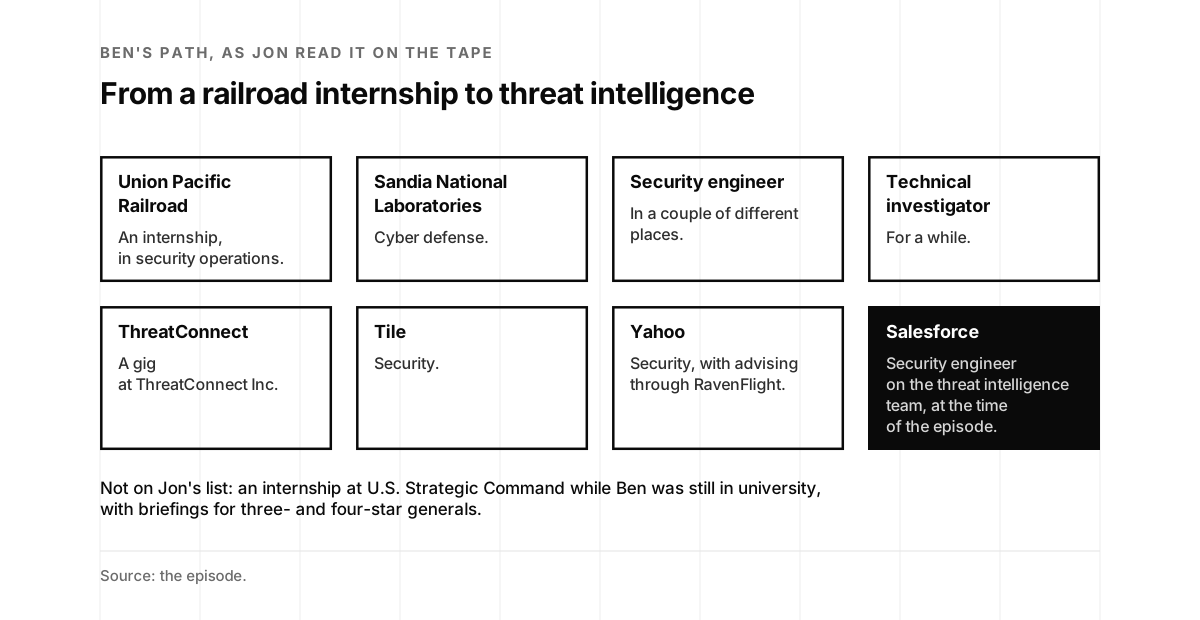
Two rows of four cards. Union Pacific Railroad: an internship, in security operations. Sandia National Laboratories: cyber defense. Security engineer, in a couple of different places. Technical investigator, for a while. Then ThreatConnect: a gig at ThreatConnect Inc. Tile: security. Yahoo: security, with advising through RavenFlight. Filled, Salesforce: security engineer on the threat intelligence team, at the time of the episode. Below: not on Jon's list, an internship at U.S. Strategic Command while Ben was still in university, with briefings for three- and four-star generals.
Ben's path, as Jon read it on the tape. Source: the episode.

Graduate-level classes as an undergraduate

Ben’s university had a strong security program, and some of its classes were being tested at a graduate level while Ben was still an undergraduate:

“So I got to do reverse engineering, physical security, rewritable card, like the NFC card.”

Benjamin Schmoker Scott, at 1:29

Operating system internals were on the list too. Friends from the same program went through the same internship program at Sandia and, in Ben’s words, did some amazing things.

Listen · Benjamin Schmoker Scott on episode 15, from 1:20
About 30 seconds: Ben on testing graduate-level security classes as an undergraduate. The clip stops on its own. Read the full transcript.

Hex editing and game mods

Ben started early. Video game modifications were popular, and they led to hex editing and to working out how hardware and drivers behave:

“You just figure out how to make things work, like weird driver things, weird hardware things.”

Benjamin Schmoker Scott, at 2:21

During and after a computer science degree, the focus moved to defense: how to handle vulnerabilities, and how to deal with bad actors on platforms.

From Flash bugs to no-click exploits

The field changed a lot in that time. Ben put the old targets in one line:

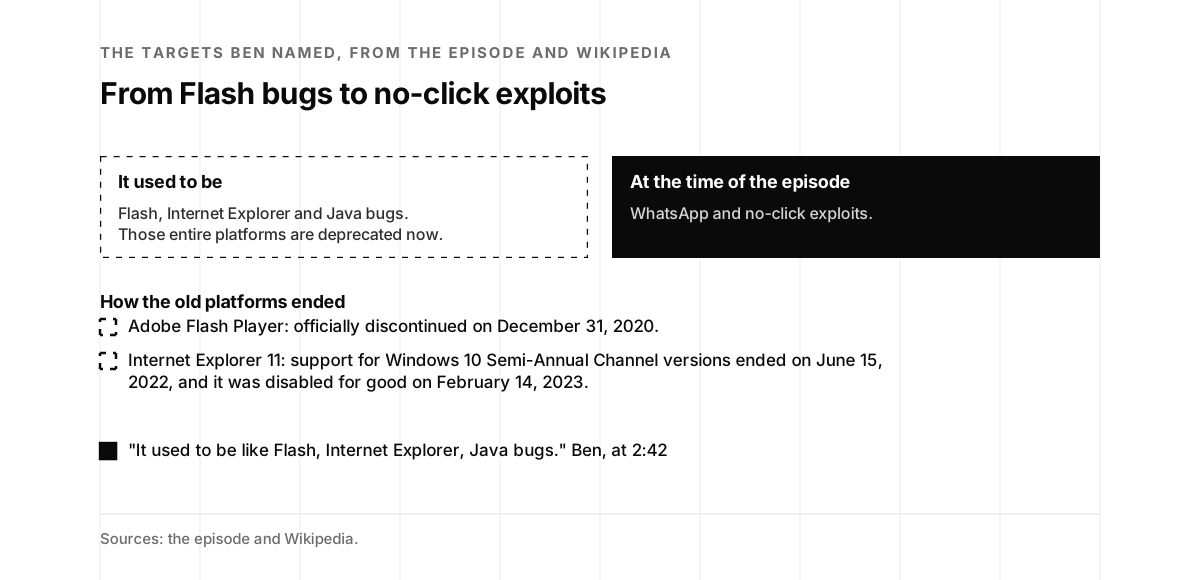
“It used to be like Flash, Internet Explorer, Java bugs.”

Benjamin Schmoker Scott, at 2:42

Those platforms are deprecated now, and the work had moved to things like no-click exploits in WhatsApp. Adobe officially discontinued Flash Player on December 31, 2020 (Wikipedia). Internet Explorer 11 lasted a little longer, as What happened after the tape shows.
Listen · Benjamin Schmoker Scott on episode 15, from 2:28
About 25 seconds: Ben on how the targets changed, from Flash to no-click exploits. The clip stops on its own. Read the full transcript.
Two cards. Dashed, it used to be: Flash, Internet Explorer and Java bugs, and those entire platforms are deprecated now. Filled, at the time of the episode: WhatsApp and no-click exploits. Then how the old platforms ended. Adobe Flash Player: officially discontinued on December 31, 2020. Internet Explorer 11: support for Windows 10 Semi-Annual Channel versions ended on June 15, 2022, and it was disabled for good on February 14, 2023. Then: "It used to be like Flash, Internet Explorer, Java bugs." Ben, at 2:42
The targets Ben named, then and at the time of the episode. Sources: the episode and Wikipedia.

Briefing generals as an intern

As an intern at U.S. Strategic Command, Ben worked on projects and write-ups, and briefed senior officers:

“got to present to three and four star generals.”

Benjamin Schmoker Scott, at 3:24

Strategic Command is one of the Defense Department’s unified combatant commands, responsible for strategic deterrence, global strike, and running the department’s Global Information Grid (Wikipedia). The lesson Ben took from it was that experience doesn’t depend on age. Because the field was so new, it was possible to become an expert in something early.

Lunch at BSides

Jon and Ben first met at BSides, over lunch. Jon remembered leaving inspired. Ben was sure the two had talked about cryptography and Jon’s company. BSides is a series of community-run security conferences, organized by local groups, that began in 2009 with talks Black Hat had turned down (Wikipedia).

Information, and intelligence

Jon asked what threat intelligence is. Ben’s answer:

“I see it as applied knowledge.”

Benjamin Schmoker Scott, at 4:46

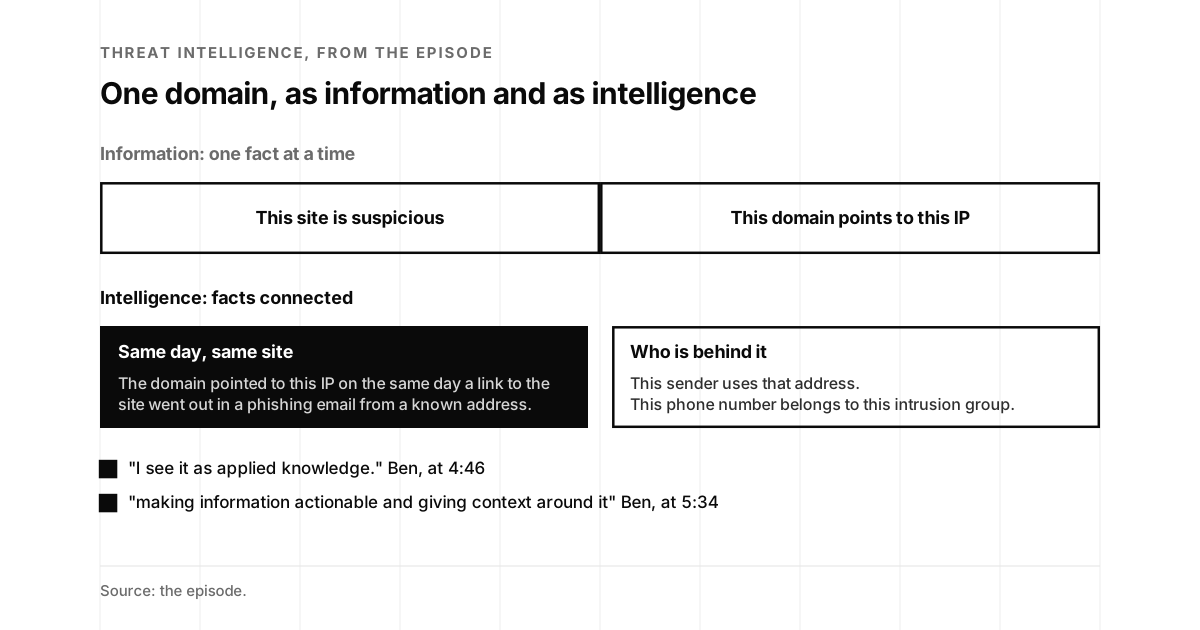
It works the way military intelligence does. Information is a single fact: this site is suspicious, or this domain points to this IP. Intelligence connects facts: the domain pointed to that IP on the same day a link to the site went out in a phishing email from a known address. It can go further, to who sends those emails, or which intrusion group a phone number belongs to.

“making information actionable and giving context around it”

Benjamin Schmoker Scott, at 5:34

It also helps the organization through high-impact incidents.
Listen · Benjamin Schmoker Scott on episode 15, from 5:04
About 35 seconds: Ben on the difference between information and intelligence. The clip stops on its own. Read the full transcript.
Information, one fact at a time, two compartments: this site is suspicious, and this domain points to this IP. Intelligence, facts connected, two cards. Filled, same day, same site: the domain pointed to this IP on the same day a link to the site went out in a phishing email from a known address. Who is behind it: this sender uses that address, and this phone number belongs to this intrusion group. Then: "I see it as applied knowledge." Ben, at 4:46 And: "making information actionable and giving context around it" Ben, at 5:34
One domain, as information and as intelligence. Source: the episode.

From analyst to engineer

Ben has experience as an analyst, and as a computer scientist Ben also writes code. The day job was security engineering: scripts, tools and platforms, built on AWS and a lot of serverless, and integrated with platforms that Salesforce’s large security engineering team builds. It included database design and other software engineering work. Ben was moving from security operations and intelligence analysis toward building:

“frankly, it has more legs as a career.”

Benjamin Schmoker Scott, at 7:04

Listen · Benjamin Schmoker Scott on episode 15, from 6:41
About 25 seconds: Ben on moving from analysis to engineering. The clip stops on its own. Read the full transcript.

Corporate security, and a hand for product teams

Jon asked whether the work was closer to product security or to stitching logs into action. Mostly the second. The team covered employees and corporate security, with some overlap with product and user security, which each product team owns. When the team saw bad actors abusing a product, or a wave of phishing reports about a platform, it stepped in. Product teams are busy with their own jobs, and they don’t always have that context.

Where the data comes from

Jon asked whether the team read hacker magazines like 2600. Ben’s answer was a collections function: the part of the team that gathers the data it turns into intelligence. Sources include vendors such as FireEye and CrowdStrike, private and public publications, government output, and other people in the community who share what they see. The work is knowing how to read a large amount of it.
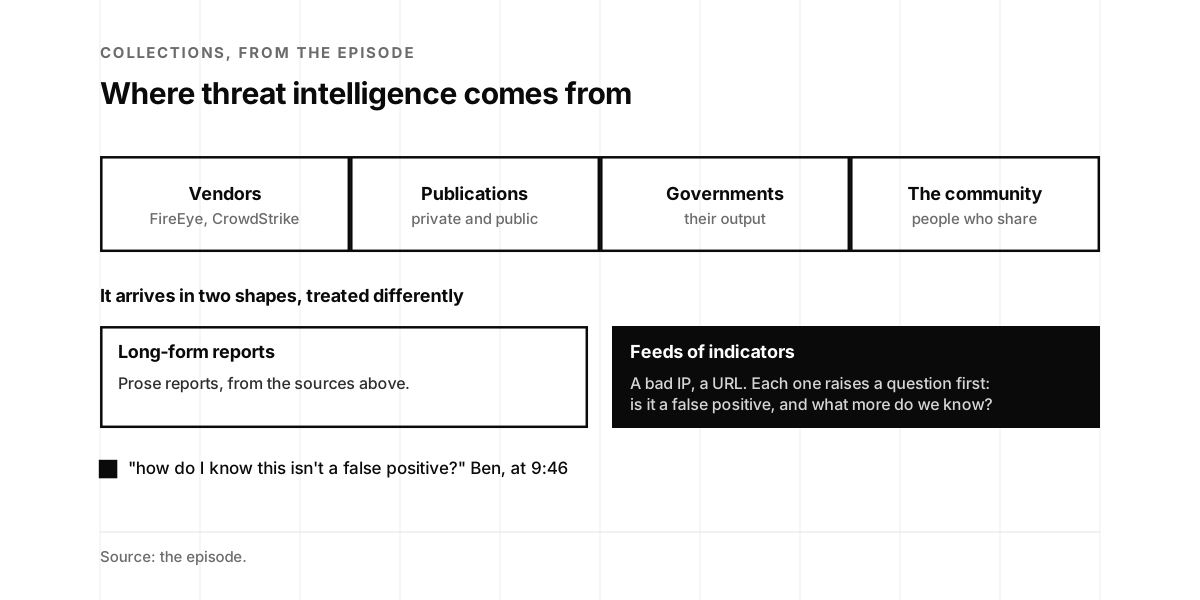
Four compartments: vendors, such as FireEye and CrowdStrike. Publications, private and public. Governments, their output. The community, people who share. Then it arrives in two shapes, treated differently. Long-form reports: prose reports, from the sources above. Filled, feeds of indicators: a bad IP, a URL, and each one raises a question first, whether it's a false positive and what more we know. Then: "how do I know this isn't a false positive?" Ben, at 9:46
Where threat intelligence comes from, and the two shapes it arrives in. Source: the episode.

Feeds, reports and false positives

Some sources are long-form prose reports. Others are feeds of indicators, such as bad IPs and URLs, and they’re treated differently. A feed raises a question first:

“how do I know this isn’t a false positive?”

Benjamin Schmoker Scott, at 9:46

Ben’s work included adding context: whether other places have reported the same indicator, and what VirusTotal or PassiveTotal say about it. VirusTotal pools many antivirus products and online scan engines. It launched in June 2004, and Google bought it in September 2012 (Wikipedia).

On episode 12, which aired about ten weeks earlier, Pulsedive founder Dan Sherry and co-founder Grace Chi talked about demystifying threat intelligence.

Enrichment

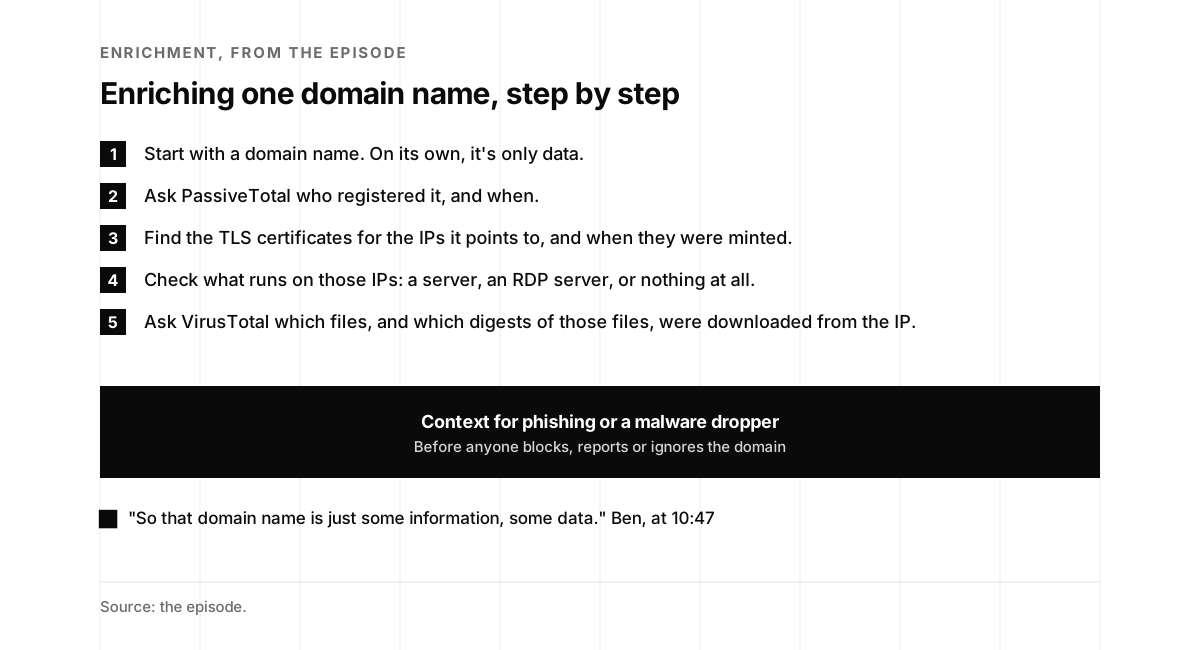
Jon called it context building, and remembered Ben’s word for it, enrichment. Ben walked through a domain name, which on its own is only data. PassiveTotal can say who registered it and when, which TLS certificates go with the IPs it points to, when those certificates were minted, and whether anything is running there, such as a server or an RDP service. VirusTotal can say which files, and which digests of those files, were downloaded from that IP. For phishing or a malware dropper, that tells you a lot.
Listen · Benjamin Schmoker Scott on episode 15, from 10:51
About 40 seconds: Ben on enriching a single domain name. The clip stops on its own. Read the full transcript.
Five numbered steps. One, start with a domain name, which on its own is only data. Two, ask PassiveTotal who registered it, and when. Three, find the TLS certificates for the IPs it points to, and when they were minted. Four, check what runs on those IPs: a server, an RDP server, or nothing at all. Five, ask VirusTotal which files, and which digests of those files, were downloaded from the IP. Below, filled: context for phishing or a malware dropper, before anyone blocks, reports or ignores the domain. Then: "So that domain name is just some information, some data." Ben, at 10:47
Enriching one domain name, step by step. Source: the episode.

Block it, or break it

Context decides what you can block. A VPS somewhere is fine to blacklist, since nobody knows what’s coming out of it. A big hosting provider is different:

“it’s probably going to break something if we just block it.”

Benjamin Schmoker Scott, at 10:26

Ben’s examples were an IP at GoDaddy or AWS. It may be doing something bad, but blocking it outright would probably break something. Jon added the same tension from the customer side: you can block employees from reaching a bad IP over the VPN, or drop all outside traffic from it, but dropping traffic can break customer integrations. Keeping customers working and keeping day-to-day operations running is the whole game.
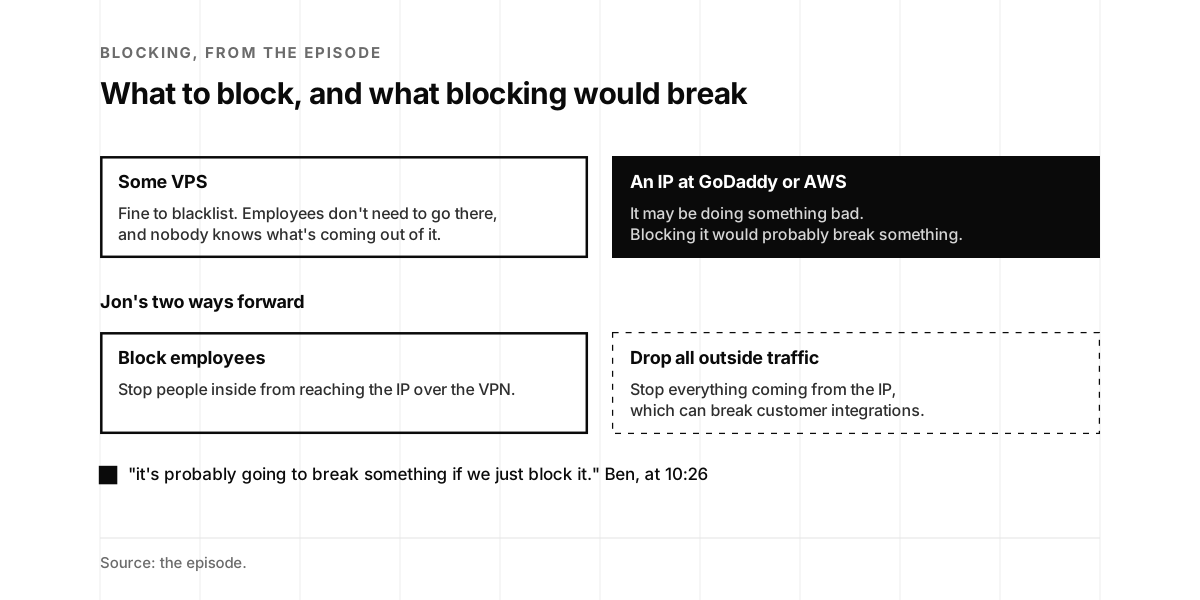
Two cards. Some VPS: fine to blacklist, since employees don't need to go there, and nobody knows what's coming out of it. Filled, an IP at GoDaddy or AWS: it may be doing something bad, and blocking it would probably break something. Then Jon's two ways forward. Block employees: stop people inside from reaching the IP over the VPN. Dashed, drop all outside traffic: stop everything coming from the IP, which can break customer integrations. Then: "it's probably going to break something if we just block it." Ben, at 10:26
What to block, and what blocking would break. Source: the episode.

Machine learning, and a second step at login

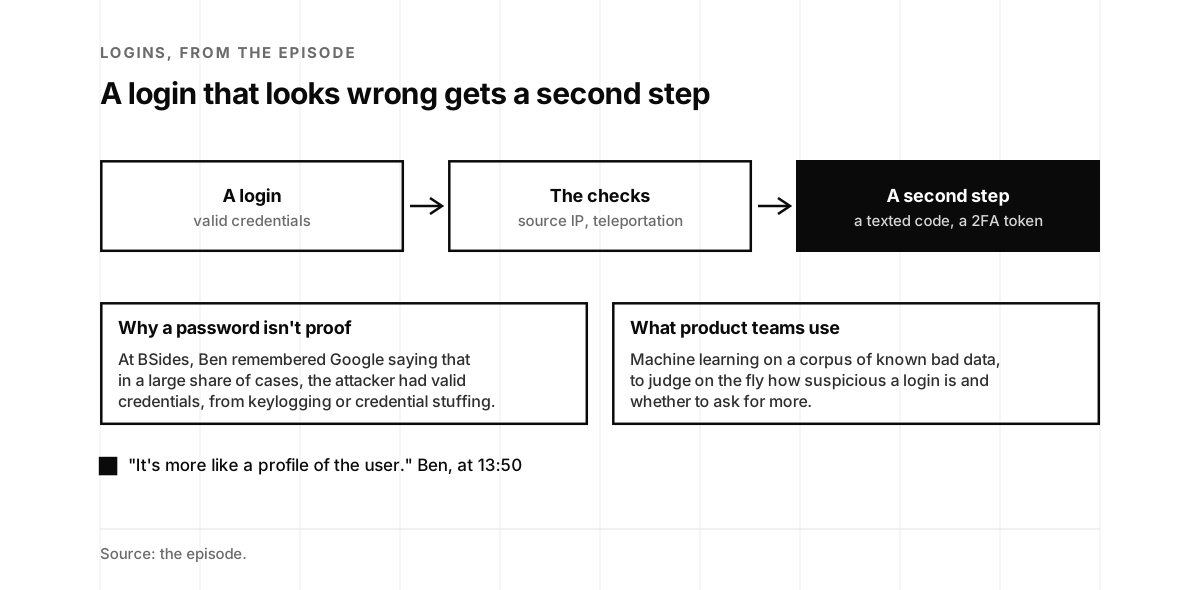
The team could add indicators to Salesforce’s corporate firewalls. Product teams decide what they filter, and the threat intelligence team influenced them with example data. Those teams mostly worked from a corpus of known bad data with machine learning, to judge on the fly how suspicious a login is and whether to ask for more authentication. Jon summed it up as raising the bar one step at a time, such as asking for a 2FA token when a login comes from a suspicious IP.

Ben said Google does something similar. It checks the source IP, and it checks for teleportation: a login from Seattle and then one from overseas may not be legitimate, even with valid credentials. Ben remembered Google saying at BSides that in a large share of cases, the attacker had valid credentials, from keylogging or credential stuffing. Credential stuffing takes usernames and passwords stolen in one breach and tries them on other sites, with large-scale automated logins (Wikipedia). So a password no longer proves who someone is. What counts is a profile of the user.

On episode 5, Leigh Honeywell of Tall Poppy described harassment that starts the same way, with an old leaked password tried on other sites.

On episode 86, Trevor Hilligoss of SpyCloud described phishing kits that pass a real password and MFA through to the real site and keep a copy of the session cookie.
Listen · Benjamin Schmoker Scott on episode 15, from 13:21
About 35 seconds: Ben on why valid credentials don't prove who the user is. The clip stops on its own. Read the full transcript.
Three boxes joined by arrows. A login, with valid credentials. The checks: source IP and teleportation. Filled, a second step: a texted code or a 2FA token. Below, two cards. Why a password isn't proof: at BSides, Ben remembered Google saying that in a large share of cases, the attacker had valid credentials, from keylogging or credential stuffing. What product teams use: machine learning on a corpus of known bad data, to judge on the fly how suspicious a login is and whether to ask for more. Then: "It's more like a profile of the user." Ben, at 13:50
A login that looks wrong gets a second step, even with the right password. Source: the episode.

Any useful product will be abused

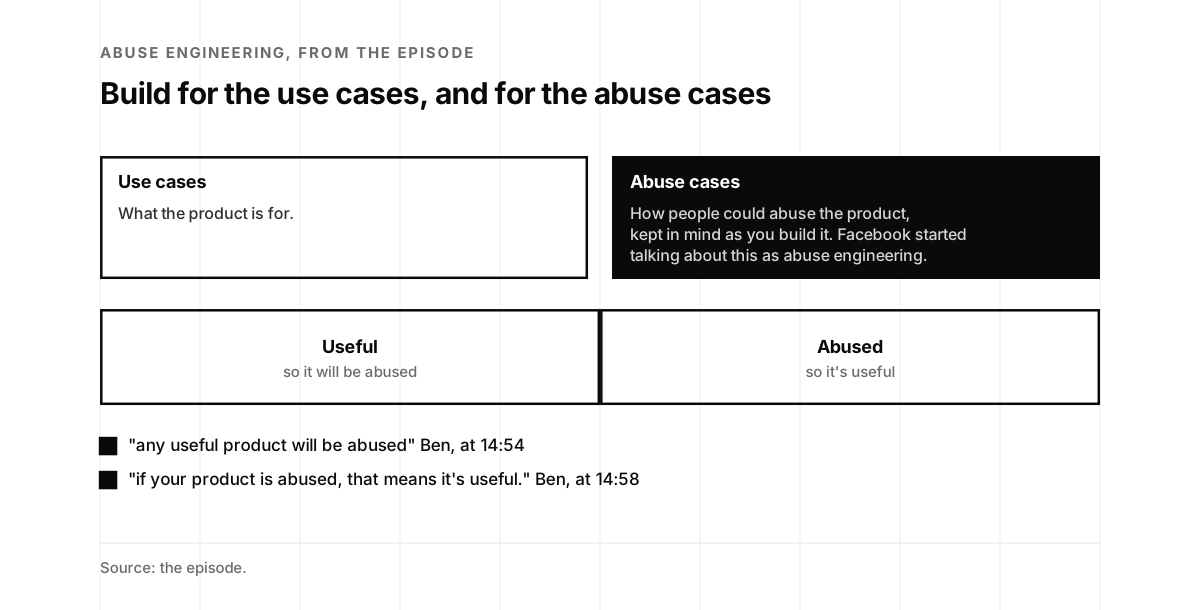
Jon asked when a company should start caring about all this. Ben pointed to an idea from Facebook, abuse engineering: build the product with the abuse cases in mind. And Ben’s own rule has a corollary:

“if your product is abused, that means it’s useful.”

Benjamin Schmoker Scott, at 14:58

Jon agreed: you get hacked, or abused, once you’re big enough to matter.
Listen · Benjamin Schmoker Scott on episode 15, from 14:39
About 25 seconds: Ben on abuse engineering, and why abuse is a sign of a useful product. The clip stops on its own. Read the full transcript.
Two cards. Use cases: what the product is for. Filled, abuse cases: how people could abuse the product, kept in mind as you build it, which Facebook started talking about as abuse engineering. Below, two compartments: useful, so it will be abused, and abused, so it's useful. Then: "any useful product will be abused" Ben, at 14:54 And: "if your product is abused, that means it's useful." Ben, at 14:58
Use cases, abuse cases, and the corollary. Source: the episode.

What a startup can do

Startups have to move fast, and Ben’s advice kept it simple. Use a login platform people understand, such as Google authentication with SAML. For break-glass moments, when a user wants to do something major on their account, a phone number to text them is a good workaround. Ben didn’t think every account needs 2FA for every use case. For a bank, Ben said:

“you should probably have that.”

Benjamin Schmoker Scott, at 15:49

A bank can ask for a code before a wire transfer, even after login. For an everyday SaaS tool, Ben called that overkill, and Jon added that when little is at stake, it’s a barrier to entry and extra friction. One middle path Ben had seen: ask for a phone number after people start using the product, and gate some features behind it, such as messaging other users. Jon called it a fair trade. You give a phone number, and you get more features.
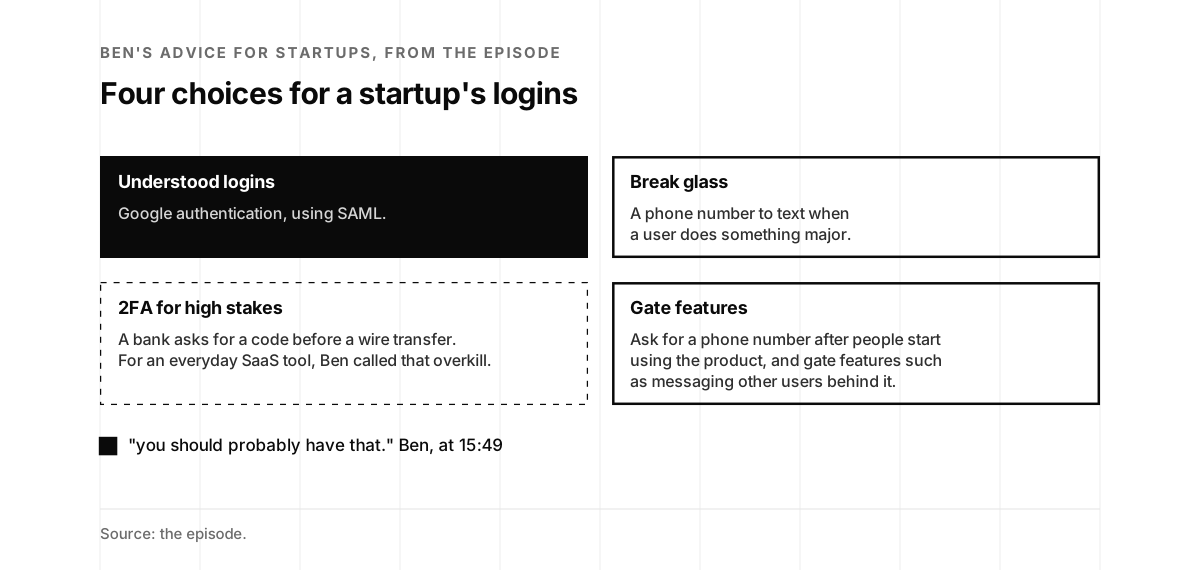
Four cards. Filled, understood logins: Google authentication, using SAML. Break glass: a phone number to text when a user does something major. Dashed, 2FA for high stakes: a bank asks for a code before a wire transfer, and for an everyday SaaS tool, Ben called that overkill. Gate features: ask for a phone number after people start using the product, and gate features such as messaging other users behind it. Then, on a bank: "you should probably have that." Ben, at 15:49
Four choices for a startup's logins, from Ben's advice. Source: the episode.

Trust in a 20-year-old product

Jon asked about the business case at a company as big as Salesforce, and answered it himself: trust with the end customer. Ben gave an example from the core CRM. Customers can set up IP allow listing, so their account only accepts logins from their own VPN egress range. Salesforce can’t make every customer use it, because it doesn’t know their ranges, and forcing it would add friction. So it tells security-conscious customers about the feature and tries to make it easy to set up.

Ben said 2FA in the core CRM was opt-in, for a similar reason. People had used the product for 20 years:

“now I’m going to move your cheese around.”

Benjamin Schmoker Scott, at 18:06

Jon agreed: what has worked should keep working unless there’s a serious security need to change it.

Heroku and free compute

Salesforce also runs products that work almost like separate companies, with their own code bases, workflows, authentication and abuse models. Ben named Heroku, and Marketing Cloud with Pardot, which started as two companies. Ben called Heroku a huge abuse model:

“for the price of a free email address, you can get some compute”

Benjamin Schmoker Scott, at 18:44

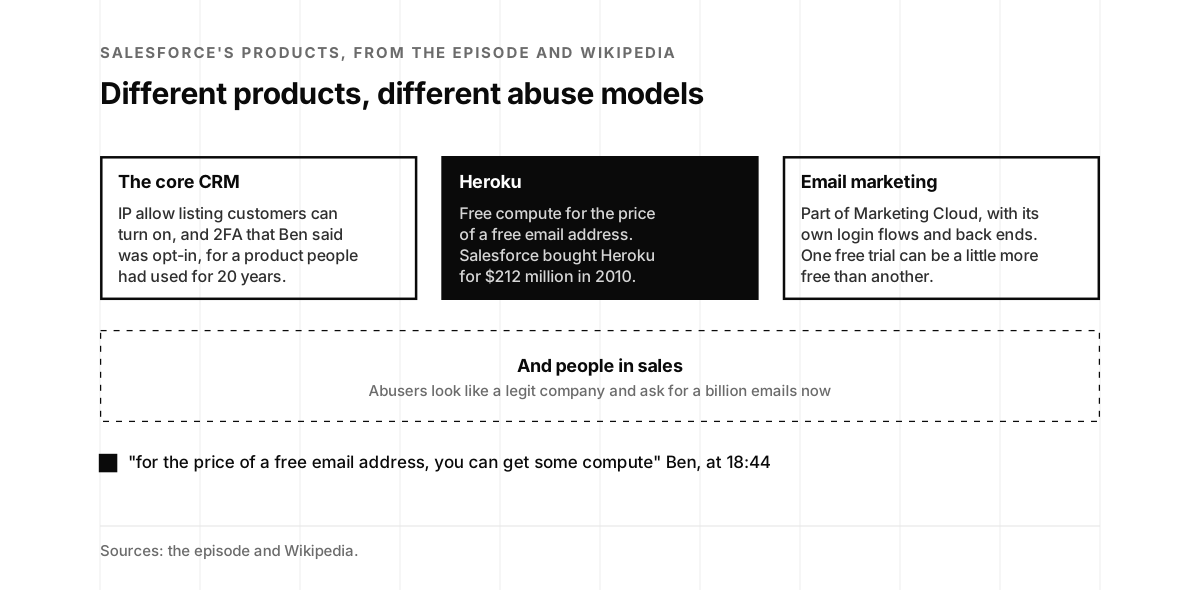
Salesforce bought Heroku in 2010 for $212 million, and ExactTarget, an email marketer, for $2.5 billion in 2013 (Wikipedia). The email marketing platforms have their own login flows and back ends. One product’s free trial may be a little more free than another’s. Someone might talk a customer success representative into an exception: they’ll pay next month, but they need to send a billion emails now. Ben’s point was that salespeople want to close deals and do right by customers, which is the opposite incentive from security’s.

Jon had negotiated with SaaS sales teams himself, and guessed that malicious users have the same conversation with them. Ben added that the abusers look like a legitimate company, with a website and a phone number.
Listen · Benjamin Schmoker Scott on episode 15, from 19:14
About 35 seconds: Ben on free trials, social engineering and sales incentives. The clip stops on its own. Read the full transcript.
Three cards. The core CRM: IP allow listing customers can turn on, and 2FA that Ben said was opt-in, for a product people had used for 20 years. Filled, Heroku: free compute for the price of a free email address, and Salesforce bought Heroku for $212 million in 2010. Email marketing: part of Marketing Cloud, with its own login flows and back ends, where one free trial can be a little more free than another. Below, dashed: and people in sales, where abusers look like a legit company and ask for a billion emails now. Then: "for the price of a free email address, you can get some compute" Ben, at 18:44
Different products, different abuse models. Sources: the episode and Wikipedia.

Talks worth finding

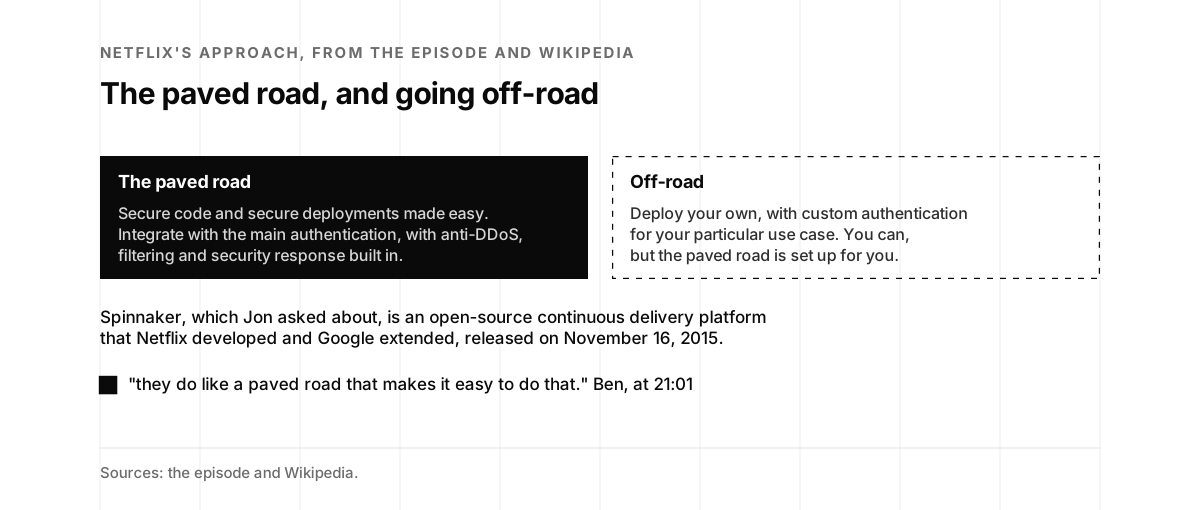
Jon asked for resources on preventing platform abuse. Ben named Facebook’s abuse engineering presentations, talks at ShmooCon on dealing with abuse, and Netflix’s approach. In Ben’s telling, Netflix starts from the developer side and makes it easy to write secure code and deploy it securely:

“they do like a paved road that makes it easy to do that.”

Benjamin Schmoker Scott, at 21:01

A developer can still go off-road, but Netflix wants teams on the paved road, where everything is set up for them.

Jon asked about Spinnaker, and Ben agreed Netflix is behind it. On the paved road, a team skips custom authentication and integrates with the main service, plus anti-DDoS, filtering and security response. Spinnaker is an open-source continuous delivery platform that Netflix originally developed and Google extended, released on November 16, 2015 (Wikipedia). Ben recommended Netflix’s talks on SlideShare and the BSides talks on YouTube.
Listen · Benjamin Schmoker Scott on episode 15, from 20:47
About 30 seconds: Ben on Netflix's paved road. The clip stops on its own. Read the full transcript.
Two cards. Filled, the paved road: secure code and secure deployments made easy, integrating with the main authentication, with anti-DDoS, filtering and security response built in. Dashed, off-road: deploy your own, with custom authentication for your particular use case, which you can do, but the paved road is set up for you. Below: Spinnaker, which Jon asked about, is an open-source continuous delivery platform that Netflix developed and Google extended, released on November 16, 2015. Then: "they do like a paved road that makes it easy to do that." Ben, at 21:01
The paved road, and going off-road. Sources: the episode and Wikipedia.

The best day: stable code and real people

Ben’s best day:

“any day that I can push out production code and it’s stable is a good day”

Benjamin Schmoker Scott, at 22:05

Another came from helping investigate large-scale phishing. Stopping bad behavior means people don’t get compromised, don’t lose money, and maybe don’t lose their freedom. Jon put it this way: so much of our lives runs through computers that protecting them touches people’s lives. Making compilers slightly faster doesn’t matter as much to Ben. The same was true at Yahoo, working on phishing and e-crime in Yahoo Mail, where one click could hurt a real person.

Listen · Benjamin Schmoker Scott on episode 15, from 22:18
About 25 seconds: Ben on the best days in threat intelligence. The clip stops on its own. Read the full transcript.

The worst day: five hours for one header

Ben had no bad day to report, and said Salesforce wasn’t too bad a place to work. The frustrating days come from vendor tools that break, or APIs that don’t work as you expect, when the fix turns out to be a small change to some header that better documentation would have saved. Jon knew the feeling: around hour four, you start to suspect it’s a config.
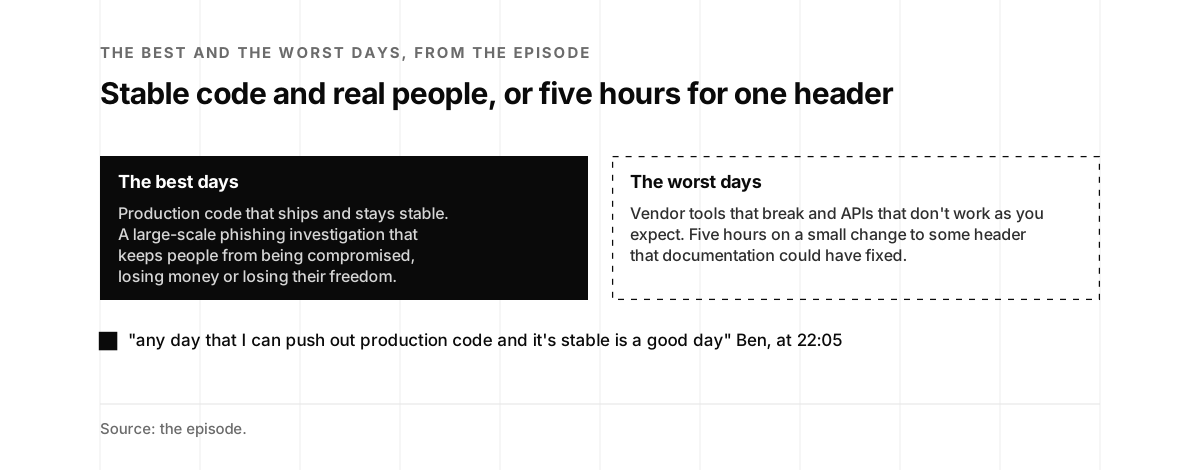
Two cards. Filled, the best days: production code that ships and stays stable, and a large-scale phishing investigation that keeps people from being compromised, losing money or losing their freedom. Dashed, the worst days: vendor tools that break and APIs that don't work as you expect, and five hours on a small change to some header that documentation could have fixed. Then: "any day that I can push out production code and it's stable is a good day" Ben, at 22:05
The best and the worst days, side by side. Source: the episode.

What happens when you type google.com

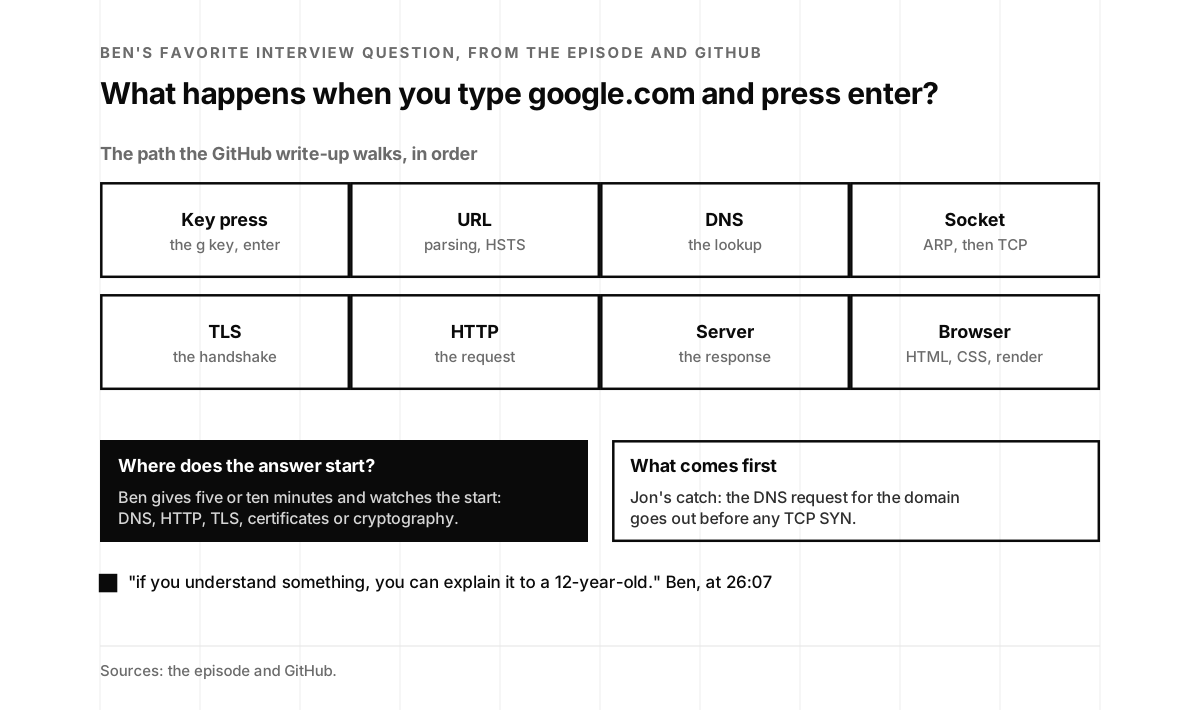
Ben’s favorite interview question comes from a GitHub repository called What Happens When. It answers what happens when you type google.com into a browser and press enter, in detail (GitHub). Ben gives a candidate five or ten minutes and watches where they start: DNS, HTTP, TLS, certificates or cryptography. Jon pointed out that a TCP SYN isn’t the first packet. It’s the DNS request for the domain.

The question also shows how a person explains things. Ben cited a line attributed to Richard Feynman:

“if you understand something, you can explain it to a 12-year-old.”

Benjamin Schmoker Scott, at 26:07

Ben tries to explain without buzzwords and without skipping steps. Jon called that the mark of a great communicator. Even experts forget the layers, Ben said, and at this point JSON parsing is probably one of them.
Listen · Benjamin Schmoker Scott on episode 15, from 24:52
About 35 seconds: Ben on the interview question, and where candidates start. The clip stops on its own. Read the full transcript.
The path the GitHub write-up walks, in order, as eight compartments in two rows: key press, the g key and enter. URL, parsing and HSTS. DNS, the lookup. Socket, ARP then TCP. TLS, the handshake. HTTP, the request. Server, the response. Browser, HTML, CSS and render. Below, two cards. Filled, where does the answer start: Ben gives five or ten minutes and watches the start, whether DNS, HTTP, TLS, certificates or cryptography. What comes first: Jon's catch, that the DNS request for the domain goes out before any TCP SYN. Then: "if you understand something, you can explain it to a 12-year-old." Ben, at 26:07
Where an answer to the interview question can start, from the GitHub write-up. Sources: the episode and GitHub.

Trust as the number one value

Ben went back to the business case. Salesforce had made a point of it:

“trust is our number one value.”

Benjamin Schmoker Scott, at 27:09

Drilling that in, inside and outside the company, showed customers that Salesforce takes security seriously and spends real money on it. In Ben’s view, big companies now treat security as a bottom-line risk, after events like SolarWinds, IP theft and espionage. The SolarWinds attack began with a supply chain compromise of its Orion software, used widely in government and industry (Wikipedia). For a small company, the stakes are higher:

“If you’re a small company, it’s just existential.”

Benjamin Schmoker Scott, at 27:41

If people lose confidence in your site because it was compromised, that’s the end.

Top line or bottom line

Jon loved that Salesforce uses trust for growth. It’s part of how the company sets itself apart. Jon often meets people who treat security as a way to limit losses, amortizing the cost of a rare, expensive event and budgeting against it. Jon’s view: use security to attract growth, and you flip that calculation.

Ben said it used to be more about the bottom line. Big banks treated card fraud as a cost of business, reversed transactions, and moved liability around, to a customer who turned out to be a money mule, for example. Ransomware changed that. When you’re ransomed, you can’t move the liability anywhere.
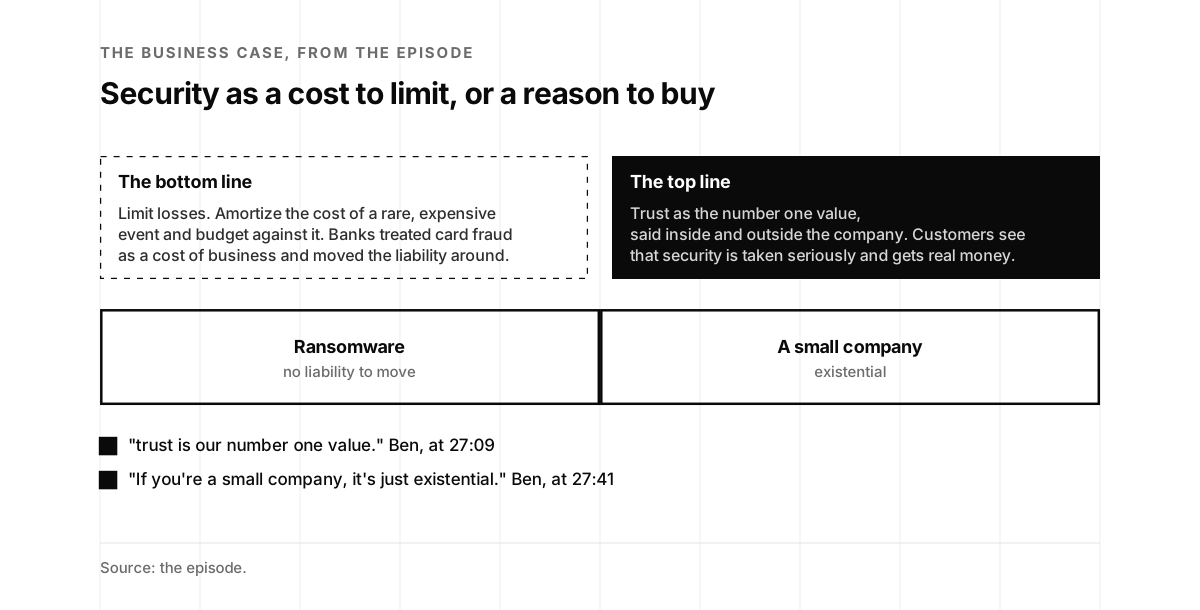
Two cards. Dashed, the bottom line: limit losses, amortize the cost of a rare, expensive event and budget against it, the way banks treated card fraud as a cost of business and moved the liability around. Filled, the top line: trust as the number one value, said inside and outside the company, so customers see that security is taken seriously and gets real money. Below, two compartments: ransomware, with no liability to move, and a small company, for which it's existential. Then: "trust is our number one value." Ben, at 27:09 And: "If you're a small company, it's just existential." Ben, at 27:41
Security as a cost to limit, and security as a reason to buy. Source: the episode.

Cyber insurance that’s hard to collect

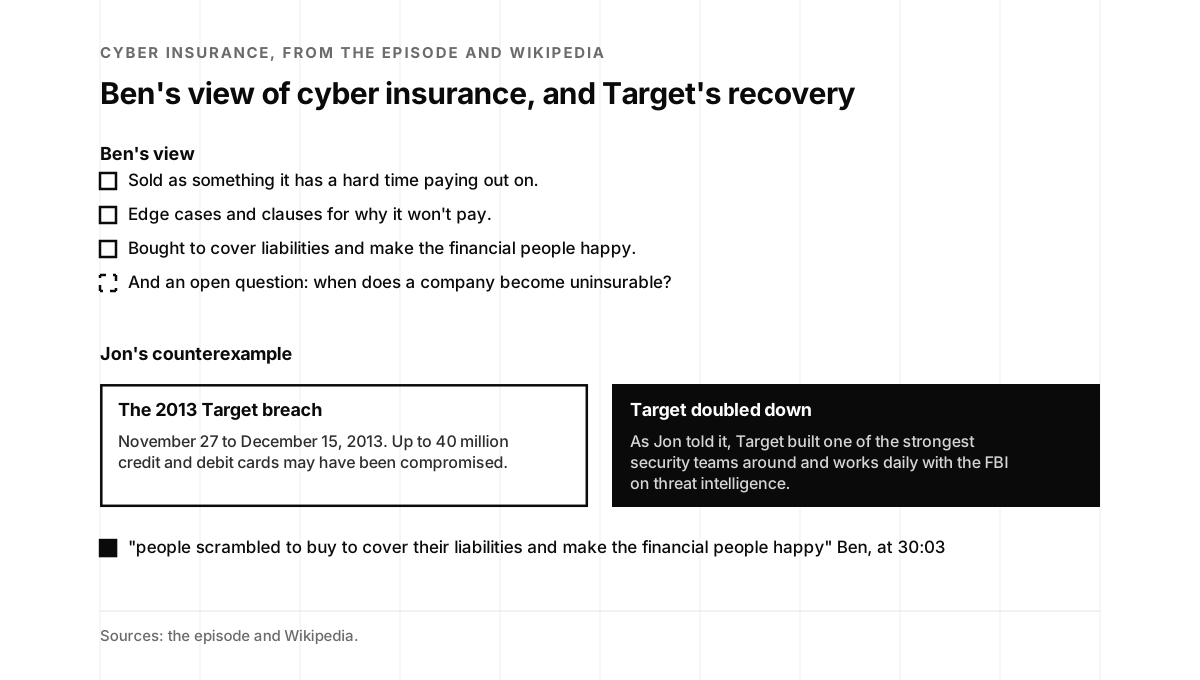
Ben had opinions on cyber risk insurance, and they weren’t good. It was sold as something it has a hard time paying out on, with edge cases and clauses for why it won’t pay:

“people scrambled to buy to cover their liabilities and make the financial people happy”

Benjamin Schmoker Scott, at 30:03

Ben also raised the problem of becoming uninsurable. Jon pointed to Target, which was hacked and lost card data, then doubled down and built one of the strongest security teams around, working with the FBI on threat intelligence. Ben added that outside security circles, people forget. The Target breach ran from November 27 to December 15, 2013, and up to 40 million credit and debit cards may have been compromised (Wikipedia).

On episode 2, Andrew Gontarczyk, then CISO of Pure Storage, took the other side and called cyber insurance a no-brainer.
Listen · Benjamin Schmoker Scott on episode 15, from 29:47
About 30 seconds: Ben on cyber insurance. The clip stops on its own. Read the full transcript.
Ben's view, four points: sold as something it has a hard time paying out on. Edge cases and clauses for why it won't pay. Bought to cover liabilities and make the financial people happy. Dashed, and an open question: when does a company become uninsurable? Then Jon's counterexample, two cards. The 2013 Target breach: November 27 to December 15, 2013, when up to 40 million credit and debit cards may have been compromised. Filled, Target doubled down: as Jon told it, Target built one of the strongest security teams around and works daily with the FBI on threat intelligence. Then: "people scrambled to buy to cover their liabilities and make the financial people happy" Ben, at 30:03
Ben's view of cyber insurance, and Target's recovery. Sources: the episode and Wikipedia.

Automate it, or buy it as a service

Jon saw more automation and self-service tools coming. Ben agreed, and said it’s why the focus was on engineering over analysis:

“having rooms full of people staring at the news and clicking buttons is not going to scale”

Benjamin Schmoker Scott, at 31:47

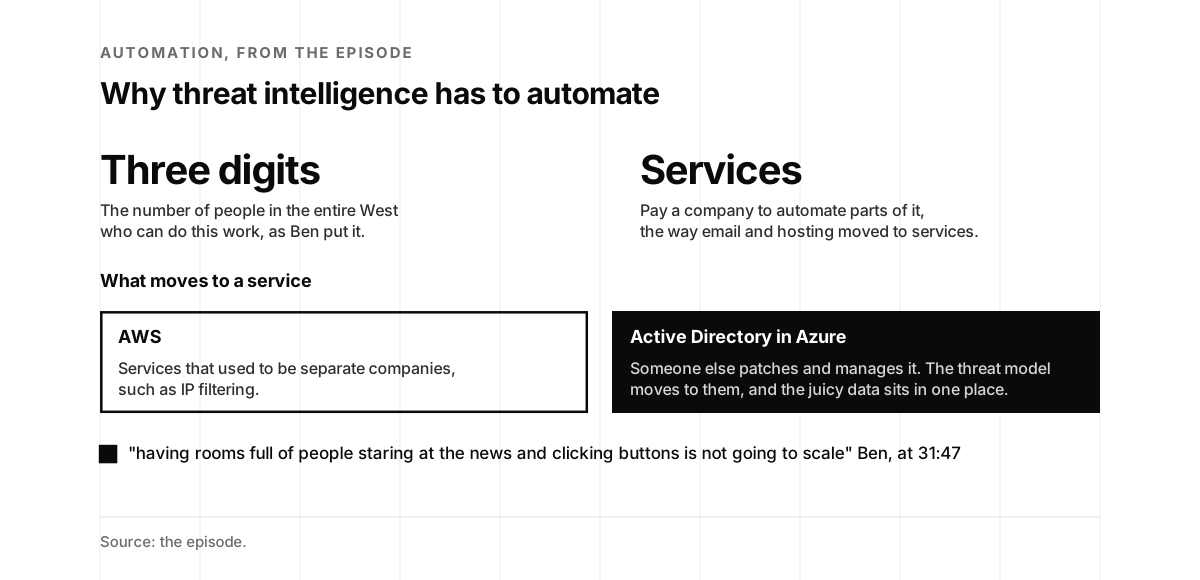
Outside big government security operations centers, that model won’t last, and there aren’t enough people to hire. Ben put the number of people in the entire West who can do this work at three digits. Paying a company to automate parts of it is like handing off email or hosting. Jon agreed: as these things become services, security can scale.

Ben’s examples were AWS offering as a service what used to take separate companies, and running Active Directory as a managed service in Azure. That doesn’t remove the threat model, but it moves it to someone else, who patches and manages it. It also puts all the juicy data in one place, and Azure had seen recent break-ins. Ben still came down on the side of the service, with more trust in Microsoft than in doing it yourself.

Jon’s closing line was the same idea: let the folks who wrote the software run the software.
Listen · Benjamin Schmoker Scott on episode 15, from 31:41
About 40 seconds: Ben on why threat intelligence needs automation. The clip stops on its own. Read the full transcript.
Two figures. Three digits: the number of people in the entire West who can do this work, as Ben put it. Services: pay a company to automate parts of it, the way email and hosting moved to services. Then what moves to a service, two cards. AWS: services that used to be separate companies, such as IP filtering. Filled, Active Directory in Azure: someone else patches and manages it, the threat model moves to them, and the juicy data sits in one place. Then: "having rooms full of people staring at the news and clicking buttons is not going to scale" Ben, at 31:47
Why threat intelligence has to automate, and what moves to a service. Source: the episode.

What happened after the tape

Heroku was breached five days later. On April 7, 2022, attackers got an access token for a Heroku account used for automation. In May, Heroku confirmed that the attack reached OAuth tokens used for its GitHub integration, and salted and hashed customer passwords. The tokens were then used in targeted attacks on GitHub repositories, with npm the main target GitHub named (Wikipedia).

Heroku ended its free plans. In August 2022, Heroku announced that its free plans would be discontinued, and cited fraud and abuse as reasons (Wikipedia). Ben had described that abuse model on the tape: compute for the price of a free email address.

Internet Explorer 11 reached its end. For Windows 10 Semi-Annual Channel versions, support ended on June 15, 2022, about ten weeks after the episode, and it was disabled for good on February 14, 2023 (Wikipedia).

ShmooCon ran its last year. The convention, organized by The Shmoo Group since 2005, held its last year in 2025 (Wikipedia).

Heroku changed course again. In March 2024, Heroku announced it was moving onto Kubernetes. On February 6, 2026, it announced a new engineering model that puts security, reliability, support and stability ahead of new features (Wikipedia).
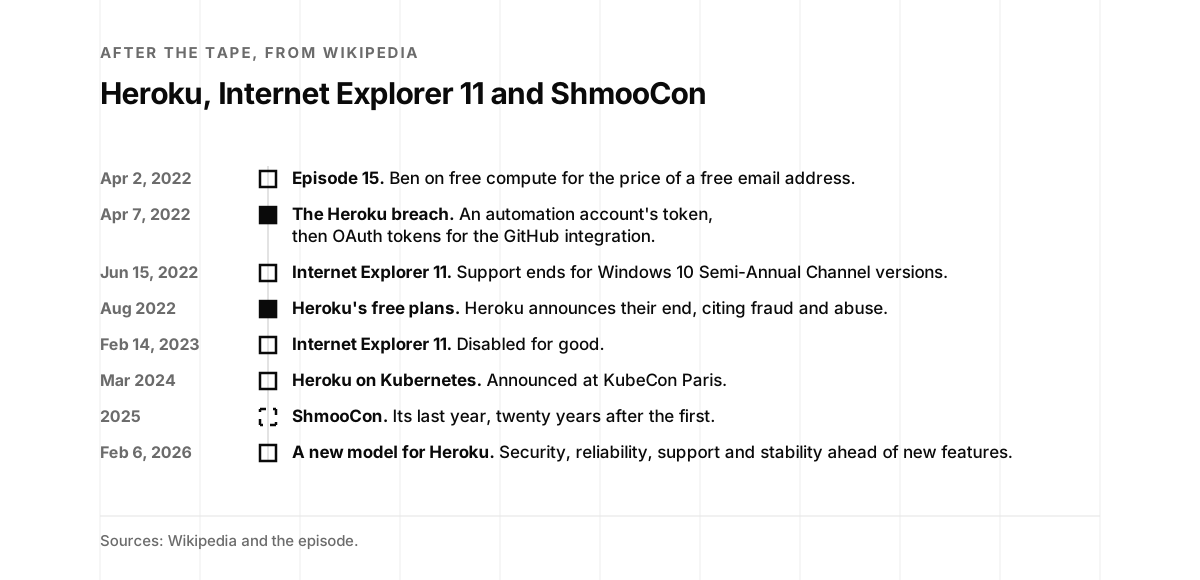
A timeline. April 2, 2022: episode 15, Ben on free compute for the price of a free email address. April 7, 2022, filled: the Heroku breach, an automation account's token, then OAuth tokens for the GitHub integration. June 15, 2022: Internet Explorer 11 support ends for Windows 10 Semi-Annual Channel versions. August 2022, filled: Heroku announces the end of its free plans, citing fraud and abuse. February 14, 2023: Internet Explorer 11 is disabled for good. March 2024: Heroku on Kubernetes, announced at KubeCon Paris. 2025, dashed: ShmooCon's last year, twenty years after the first. February 6, 2026: a new model for Heroku, with security, reliability, support and stability ahead of new features.
After the tape: Heroku's breach and free plans, the end of Internet Explorer 11, and ShmooCon's last year. Source: Wikipedia.

Did you catch it? A seven-question quiz

Seven questions from the episode. Each answer links the moment in the transcript or its section.

Quiz · seven questions

Did you catch it?

Pick an answer to see whether you caught it.

  1. How did Ben describe threat intelligence?

    a. "I see it as applied knowledge." Transcript, 4:46.

  2. What does enrichment add to a domain name?

    b. From sources such as PassiveTotal and VirusTotal. See Enrichment.

  3. Why not block a suspicious IP at a big hosting provider?

    c. "it's probably going to break something if we just block it." Transcript, 10:26.

  4. What's the corollary of "any useful product will be abused"?

    a. "if your product is abused, that means it's useful." Transcript, 14:58.

  5. What did Ben suggest a startup use for logins?

    c. With a phone number for break-glass moments. See What a startup can do.

  6. What could you get on Heroku for the price of a free email address?

    b. "for the price of a free email address, you can get some compute" Transcript, 18:44.

  7. What is Ben's favorite interview question?

    a. Five or ten minutes, and Ben watches where the answer starts. See What happens when you type google.com.

Is your product ready to be abused?

Eight questions on how ready your product is for abuse, built from the episode. Each tip links the section behind it.

Scorecard · eight questions

Is your product ready to be abused?

Answer for the product you ship today. If two answers fit, pick the lower one.

  1. Do you write down abuse cases when you design a feature?

    • No
    • For big features
    • For every feature, next to the use cases

    Build the product with the abuse cases in mind. See Any useful product will be abused.

  2. What does a login from a suspicious place trigger?

    • Nothing, a valid password is enough
    • An alert someone reviews later
    • A second step, such as a code or a 2FA token

    A valid password doesn't prove who the user is. See Machine learning, and a second step at login.

  3. How do people sign in to your product?

    • A login system we wrote ourselves
    • Our own, with some hardening
    • A platform people understand, such as Google or SAML

    Use understood login platforms. See What a startup can do.

  4. What can a brand-new free account do?

    • Everything a paying account can
    • Most things, with soft limits
    • The basics, with more after a phone number or payment

    Free compute for the price of an email address invites abuse. See Heroku and free compute.

  5. Before you block an IP or a domain, do you add context first?

    • We block what the feed says
    • Sometimes
    • Always, so we don't break a hosting provider

    A block can break more than it stops. See Block it, or break it.

  6. Can sales grant exceptions, such as bigger free trials, without a security check?

    • Yes, anytime
    • With a manager's sign-off
    • No, abuse checks come first

    Abusers talk to sales too. See Heroku and free compute.

  7. Do product teams see what security sees about abuse of their product?

    • No
    • After an incident
    • Yes, with example data they can use

    Product teams are busy and often lack the context. See Corporate security, and a hand for product teams.

  8. How much of your indicator enrichment is automated?

    • None
    • Some
    • Most of it, with people on the hard cases

    Rooms full of people clicking buttons won't scale. See Automate it, or buy it as a service.

Open season

A useful product with no abuse controls gets found. Start with a second step on suspicious logins and limits on new free accounts.

Getting there

The basics exist, but gaps remain. Write abuse cases into design, and add context before you block.

Ready to be abused

Abuse is part of the design. Keep feeding product teams example data, and automate the enrichment.

How many analyst hours does enrichment take?

Ben’s point was that people clicking buttons won’t scale. This calculator shows the hours that hand enrichment takes, and what automation saves.

Calculator

How many analyst hours does enrichment take?

Four numbers: indicators a day that need context, minutes to enrich one by hand, the share you can automate, and hours an analyst works a week.

20.0hours a day by hand
6.0hours a day with automation
2.5analysts it takes by hand
0.8analysts it takes with automation

At 200 indicators a day, enriching each one by hand takes 20.0 hours a day, about 2.5 analysts' time. With 70% automated, it takes 6.0 hours, about 0.8 analysts.

The calculator counts five working days a week and only the enrichment itself. The default numbers are placeholders, yours to change. Ben gave no figures for these on the tape.

From Sandia to Heroku’s new model

Salesforce and Heroku, the tools and conferences on the tape, the incidents it named, and this show. Filter by topic.

Timeline

From Sandia to Heroku's new model

  1. Sandia National Laboratories

    Established, to advance U.S. national security through science-based technology (Wikipedia).

  2. Salesforce founded

    A customer relationship management company, sold as software as a service (Wikipedia).

  3. VirusTotal

    Launched by Hispasec Sistemas (Wikipedia).

  4. ShmooCon

    The first event (Wikipedia).

  5. Heroku

    In development, as a cloud platform as a service (Wikipedia).

  6. BSides

    Begins with talks Black Hat turned down (Wikipedia).

  7. Salesforce buys Heroku

    For $212 million (Wikipedia).

  8. Google buys VirusTotal

    The scanner joins Google (Wikipedia).

  9. Salesforce buys ExactTarget

    An email marketer, for $2.5 billion (Wikipedia).

  10. The Target breach

    Through December 15, with up to 40 million cards at risk (Wikipedia, on this page).

  11. Spinnaker

    Netflix's continuous delivery platform goes open source (Wikipedia, on this page).

  12. RavenFlight

    Founded, per its LinkedIn page (LinkedIn).

  13. SolarWinds

    A supply chain attack through the Orion software (Wikipedia, on this page).

  14. Flash Player discontinued

    Adobe ends the plugin (Wikipedia, on this page).

  15. Episode 2

    Andrew Gontarczyk on building a security team (episode page).

  16. Episode 5

    Leigh Honeywell on online harassment (episode page).

  17. Episode 12

    Dan Sherry and Grace Chi of Pulsedive on threat intelligence (episode page).

  18. Episode 15

    Ben on the show (Podbean, transcript).

  19. The Heroku breach

    An automation account's token, then OAuth tokens for GitHub (Wikipedia, on this page).

  20. Internet Explorer 11

    Support ends for Windows 10 Semi-Annual Channel (Wikipedia).

  21. The end of Heroku's free plans

    Announced, citing fraud and abuse (Wikipedia, on this page).

  22. Heroku on Kubernetes

    Announced at KubeCon Paris (Wikipedia).

  23. ShmooCon's last year

    Twenty years after the first one (Wikipedia).

  24. Episode 86

    Trevor Hilligoss of SpyCloud on crime as a service (episode page).

  25. A new model for Heroku

    Security, reliability, support and stability first (Wikipedia).

What to do this week

Five things, in the order of the episode.

  1. Add context before you block. Pick one feed you act on, and check what blocking its top IPs would break, as in Block it, or break it.
  2. Put a second step on suspicious logins. Ask for a code or a 2FA token when a login comes from a new or unlikely place, as in Machine learning, and a second step at login. Why Passwords Still Get Stolen covers credentials that keep the private key in hardware.
  3. Write abuse cases into design. For the next feature, list how it could be abused next to how it will be used, as in Any useful product will be abused.
  4. Limit what a free account can do. Gate the features that cost you money or reach other users, as in Heroku and free compute. The scorecard shows where else to look.
  5. Get help with it. Our Product Security team builds abuse controls into your product, and 24/7 Monitoring & Response watches for the logins and traffic that get past them. Penetration Testing finds the abuse paths before someone else does, and vCISO Services gives you a security leader to set priorities. If you want to talk it through, book 15 minutes with us.

Key takeaways

  1. Threat intelligence is applied knowledge

    Information is one fact, like a domain that points to an IP. Intelligence connects facts, such as a phishing email that linked to the site the same day, and makes them actionable for the organization.

  2. Enrich before you act

    A feed of IPs and URLs raises a question first: is this a false positive? PassiveTotal and VirusTotal add who registered a domain, its certificates, what runs there and which files were downloaded from it.

  3. Blocking can break more than it stops

    A VPS somewhere is fine to block. An IP at GoDaddy or AWS may be doing something bad, but blocking it would probably break something, including customer integrations.

  4. A valid password isn't proof

    Attackers often log in with valid credentials, from keylogging or credential stuffing. Check the source IP and teleportation, and ask for a second step when a login looks wrong.

  5. Any useful product will be abused

    Design with the abuse cases in mind, as Facebook's idea of abuse engineering puts it. The corollary: if your product is abused, it's useful.

  6. Match the friction to the stakes

    A startup can use understood login platforms and a phone number for break-glass moments. A bank should ask for a code before a wire transfer. Gating some features behind a phone number is a fair trade.

  7. Free compute invites abuse

    On Heroku, compute cost the price of a free email address. Free trials, sales exceptions and abusers who look like legit companies give each product its own abuse model.

  8. Automate it, or buy it as a service

    Rooms full of people clicking buttons won't scale, and few people can do the work. Pay a company to automate parts of it, the way email and hosting moved to services.

Chapters

Tap a chapter to play from there.

Pull quotes

“I see it as applied knowledge.”

Benjamin Schmoker Scott ·

“making information actionable and giving context around it”

Benjamin Schmoker Scott ·

“how do I know this isn't a false positive?”

Benjamin Schmoker Scott ·

“it's probably going to break something if we just block it.”

Benjamin Schmoker Scott ·

“It's more like a profile of the user.”

Benjamin Schmoker Scott ·

“any useful product will be abused”

Benjamin Schmoker Scott ·

“if your product is abused, that means it's useful.”

Benjamin Schmoker Scott ·

“now I'm going to move your cheese around.”

Benjamin Schmoker Scott ·

“for the price of a free email address, you can get some compute”

Benjamin Schmoker Scott ·

“they do like a paved road that makes it easy to do that.”

Benjamin Schmoker Scott ·

“any day that I can push out production code and it's stable is a good day”

Benjamin Schmoker Scott ·

“if you understand something, you can explain it to a 12-year-old.”

Benjamin Schmoker Scott ·

“trust is our number one value.”

Benjamin Schmoker Scott ·

“If you're a small company, it's just existential.”

Benjamin Schmoker Scott ·

“having rooms full of people staring at the news and clicking buttons is not going to scale”

Benjamin Schmoker Scott ·

“Let the folks who wrote the software run the software.”

Jon McLachlan ·

About the guest

Benjamin Schmoker Scott, Security Engineer, Threat Intelligence, Salesforce

At the time of this episode, Benjamin Schmoker Scott was a security engineer on the threat intelligence team at Salesforce, building scripts, tools and platforms on AWS. As Jon read it on the episode, the path there ran from an internship in security operations at Union Pacific Railroad through cyber defense at Sandia National Laboratories, security engineering, work as a technical investigator, ThreatConnect, and security at Tile and at Yahoo, with advising through RavenFlight. An internship at U.S. Strategic Command included briefings for three- and four-star generals.

About the host

Jon McLachlan is co-founder of YSecurity, the on-demand cybersecurity team for startups, and of Cyberbase.ai. The Security Podcast of Silicon Valley is hosted by Jon McLachlan and Sasha Sinkevich. Jon McLachlan on LinkedIn ↗

Context and sources

  • Episode 15 on Podbean: Salesforce Security Engineer, Benjamin Schmoker Scott, Navigating the Cyber Security Landscape. Source ↗
  • Wikipedia, Heroku: bought by Salesforce in 2010, an April 7, 2022 attack that reached OAuth tokens for its GitHub integration, free plans discontinued as announced in August 2022 citing fraud and abuse, and a new engineering model on February 6, 2026. Source ↗
  • Wikipedia, Salesforce: founded in March 1999, it bought Heroku for $212 million in 2010 and ExactTarget, an email marketer, for $2.5 billion in 2013. Source ↗
  • Wikipedia, Sandia National Laboratories: one of three research and development laboratories of the National Nuclear Security Administration, established in 1949. Source ↗
  • Wikipedia, United States Strategic Command: a unified combatant command responsible for strategic deterrence, global strike and the Global Information Grid. Source ↗
  • Wikipedia, VirusTotal: launched in June 2004 by Hispasec Sistemas and bought by Google in September 2012, it pools many antivirus products and online scan engines. Source ↗
  • Wikipedia, Credential stuffing: stolen usernames and passwords tried on other sites with large-scale automated logins. Source ↗
  • Wikipedia, Security BSides: community-run security conferences that began in 2009 with talks Black Hat turned down. Source ↗
  • Wikipedia, ShmooCon: a hacker convention organized by The Shmoo Group from 2005, with its last year in 2025. Source ↗
  • Wikipedia, Spinnaker: an open-source continuous delivery platform that Netflix developed and Google extended, released on November 16, 2015. Source ↗
  • Wikipedia, Adobe Flash Player: officially discontinued on December 31, 2020. Source ↗
  • Wikipedia, Internet Explorer 11: support for Windows 10 Semi-Annual Channel versions ended on June 15, 2022, and it was disabled for good on February 14, 2023. Source ↗
  • Wikipedia, 2020 United States federal government data breach: a supply chain attack on SolarWinds' Orion software. Source ↗
  • Wikipedia, the 2013 Target data breach: November 27 to December 15, 2013, with up to 40 million credit and debit cards at risk. Source ↗
  • GitHub, What Happens When: an answer to the interview question of what happens when you type google.com into a browser and press enter. Source ↗
  • RavenFlight on LinkedIn: incident response, threat detection and virtual CISO work, founded in 2016. Source ↗

Transcript

Automatic transcription. Jon McLachlan hosts this episode with Benjamin Schmoker Scott, then a security engineer on the threat intelligence team at Salesforce. There is no diarization on the tape, so speaker labels were assigned from the content and checked against reference recordings of each voice from this episode, and a few short lines may sit with the wrong speaker. Names and terms were normalized where the recognizer misheard them (Jon McLachlan, ThreatConnect, RavenFlight, VirusTotal, PassiveTotal, BSides, ShmooCon). Words in [brackets] are best guesses where the audio is unclear, and [...] marks words no decode made out. Speech is transcribed as spoken, though many repeated words and false starts are left out, and so are short backchannels such as "yeah" where they overlap the other speaker.

Read the full transcript 6,008 words

Jon McLachlan

Welcome to the Security Podcast of Silicon Valley. I'm here with a very special guest today, Benjamin Scott, who focuses on threat intelligence at Salesforce. Welcome to the show, Ben.

Benjamin Schmoker Scott

Thanks for having me, Jon.

Jon McLachlan

I was just looking at your LinkedIn, and you've made a hell of a career out of all things security. I can really feel the passion, just going all the way back even to your internship with Union Pacific Railroad. You were involved with security operations and then cyber defense, Sandia National Laboratories. You were a security engineer out in Washington, D.C., a couple of different places. You were a technical investigator in Virginia for a while. And then you had a gig at ThreatConnect Inc. You helped with security at Tile back in the Bay Area. Then security at Yahoo, where you also were advising companies, it looks like, through RavenFlight. But now your day job is as a security engineer in the threat intelligence team at Salesforce. So I love the focus. I love the drive, the passion on security. Welcome to the show.

Benjamin Schmoker Scott

Yeah, thanks absolutely for having me, Jon. And just to provide a little bit of color on that, I'm from Omaha, Nebraska originally. So I was able to go to University of Nebraska at Omaha, which has a really great security program. And I was able to take some classes at the essentially graduate level when I was an undergrad, and they were testing out the new classes. So I got to do reverse engineering, physical security, rewritable card, like the NFC card. Got to do a lot of operating system internals, and I really liked that program. And some of my buddies have come through there, come through Sandia, that same internship program, and really done some really amazing things.

Jon McLachlan

So even in school, you were focused on security. That's great. I did the same sort of thing, University of Minnesota. It sounds like you really love it.

Benjamin Schmoker Scott

Yeah, I think security for me, I started pretty early. My dad helped me build some computers about age 11, so I had like full access to the hardware, software, everything. And at the time, there was a lot of like video game type modifications that were popular. Got into that for things like hex editing, [reverse] engineering. You just figure out how to make things work, like weird driver things, weird hardware things. So I got that experience pretty early. And then during and after the CS degree, focused more on like, how do you defend against issues like vulnerabilities? How do you deal with bad guys that are doing things on platforms? The field really evolved since I got into it. It used to be like Flash, Internet Explorer, Java bugs. Now that stuff is like, you know, those entire platforms are deprecated. Now we're dealing with WhatsApp, no-click exploits. It's been pretty interesting. And I think that one of the things for me, I think, growing up in the Midwest and having a good access to education, Omaha has a lot of military intelligence connections, so I was able to make that transition to DC a bit easier, I think.

Jon McLachlan

Was that any of the military connections in your family?

Benjamin Schmoker Scott

[No, no,] more the university also. So there's a huge base there called Strategic Command. So I worked for Strategic Command as an intern, did some really cool projects like write-ups, and got to present to three and four star generals. So that was a really unique and exciting experience, and really showed me, hey, it doesn't matter. At the time, I was like 20. It was like, it doesn't matter how old you are, like something unique, even if you are still in university. And that really helped, I think, going forward, because I felt that I could become like a quote unquote expert in something, because it was such an emerging field.

Jon McLachlan

Yeah, yeah, definitely. And I remember we bumped into each other at BSides, and you brought that same drive and spirit to the table when we ate lunch together. I forget what we had, what our conversation was over that table, but I just remember feeling inspired.

Benjamin Schmoker Scott

Yeah, absolutely. I'm sure we, sure we talked about cryptography and your company and things going on at the day.

Jon McLachlan

Yup, yup. And so fast forward a little bit. Thank you for sharing a little bit about your childhood and where you came from, and adding that color that I had missed just skimming your LinkedIn profile. But at Salesforce, you focus on threat intelligence, and it looks like your title is Security Engineer for Threat Intelligence. So what is that? For our listeners who are interested in security, maybe less familiar with what threat intelligence is, how would you describe it?

Benjamin Schmoker Scott

Sure. So threat intel is a field. I see it as applied knowledge. So it's something that's very connected to the way that military intelligence looks at things, right? Like you have information, which is just, hey, this site, information is this site is suspicious, and then information is like this domain points to this IP. And intelligence is like, this domain pointed to this IP on the same day that a URL to that site was attached to a phishing email sent by this address. And then intelligence might also be like, we know that this particular guy sends emails through that, or we know that this phone number is attached to this particular intrusion group or something. So it's all about bringing for the organization that sense of making information actionable and giving context around it, and helping them with these really high impact incidents, [like we act as the] escalation point sometimes for incidents. And there's, our team is mostly in DC, actually, at this point. So there's a lot of that [ex-mil] experience that I think you have to buy yourself some of that. Like every tech company, I think, has done this, like Facebook, Google, like they all have these big presence on the East Coast and the DC area, because they have to have people that understand that content. I have experience with that area as an analyst. I also, as a CS guy, do programming. So I do security engineering in my day job, where we want to build scripts, we want to build tools, we want to build platforms. I use a lot of AWS. I use a lot of serverless at this point. We have other internal platforms built by other teams. Like we have a huge security engineering team that just builds like larger things. So integrating with those. And I've done at this point database design, a lot of these other kinds of more [SWE] things, like software engineer type design tasks. So that's been really cool to pivot from [pure] security operations, intel analysts, now we're reversing more into kind of this programming building role, 'cause I think, frankly, it has more legs as a career.

Jon McLachlan

Yeah. Yeah. So you're more, so you're getting more into the product security side of the house, where you're building security features that either end up protecting parts of the infrastructure or stitching together the actionable items that can come out of like threat intelligence, like all of those logs. They tell a story about what's happening out there on the internet and how it relates to your internal systems. And that, yeah, I would imagine that requires a lot of engineering work to stitch together some actionable items out of all of the logs. Or are you more on like the product security, where you build security features that end up inside CRM systems?

Benjamin Schmoker Scott

More the first one. We have a bunch of logs, like you said, that come from. So our team focuses on both employees and security, corporate security, and then we also have some overlap with like product and user security, although that one is a bit more each dedicated product team. And we do jump in and help them when we see something. Like if we see, hey, a bunch of bad guys are abusing this product, or we got a bunch of phishing reports on this platform, like sometimes they don't have the context, and like they're busy doing their actual job. They're not reading blogs or whatever.

Jon McLachlan

What does that look like when there's platform abuse? So where do you get that in? You read blogs and stuff you mentioned, or you just read like hacker magazines like 2600, maybe?

Benjamin Schmoker Scott

No, it's, maybe that one might be a little bit more technically in-depth, right? But no, I think that a big part of our team, so we have part of our team for collections. So that's just getting the data that we turn into intelligence. And that might come from vendors like FireEye, CrowdStrike, doing private publications. Might come from public publications, government output, other people in the community saying, hey, like we're seeing a lot of abuse coming from X place, or hey, by the way, FYI, we want to help you guys, so here's something we're seeing. So having those connections and knowing how to parse that data, because it is like a really large amount [...].

Jon McLachlan

Are those data sources, are some of them like open source? And then it sounds like some of them are just proprietary, you have to pay for them, and they're just streams of data.

Benjamin Schmoker Scott

Yes, both. So we have these, both these long-form kind of prose reports, as well as indicators, like just here's a bad IP or whatever. And we treat those differently. If it's just a feed of, we have a bunch of things that are just feeds of like, you know, URLs or IPs, and you have to sometimes say, okay, how do I know this isn't a false positive? Or I need some more context around this. So that's part of what I work on, is adding context from, have other places reported on this? What, you know, if I enrich this using like VirusTotal or PassiveTotal, what does that tell me? Is this a hosting provider where we probably don't want to blacklist their IP, because it's just a hosting provider? Or is this some VPS in the Netherlands that we're fine with blacklisting? Because, like,

Jon McLachlan

Because, you know, who knows what's coming out of the VPS, right?

Benjamin Schmoker Scott

Yeah, users are not going to, we're not worried about our employees going there. But if it's like some GoDaddy IP or AWS IP, yeah, maybe it's doing something bad, but we, it's probably going to break something if we just block it.

Jon McLachlan

And so it sounds like at least gathering up all of those different data sources and stitching things together, you could automate a lot of the context building, if that's what you would call it, like the context. You called it enrichment.

Benjamin Schmoker Scott

Yeah, if, so let's say you just have a domain name. So that domain name is just some information, some data. So if you want to get some context on it, you might ask PassiveTotal about who registered it. When was it registered? The TLS certificates are associated with the IPs that it points to. When were those minted? Has this been seen? Is there anything running on that IP? Is there a server? Is there just nothing? Is there like a RDP server running? And there's all these kinds of different things you can add to it. And you might ask VirusTotal, hey, what files and what digests of those files were downloaded from that IP, because they know that info. So in the context of like phishing or some kind of like malware dropper, that's helpful to know.

Jon McLachlan

And then when it comes time to take action, is that generally, is the, I guess I imagine a couple different ways forward. You could block internal employees from hitting that from within your own VPN, or you could just drop all external traffic that's coming from those bad IPs, including things that may involve potential customer integrations, or, because you don't want to break customer experiences. That's the whole name of the game, along with like your operational flow of just day-to-day operations in Salesforce.

Benjamin Schmoker Scott

Yeah, and we can do a couple of things. We have our corporate firewalls we can add things to. There's different teams, like product teams, that handle whether or not they filter different IPs, but we do influence that process on their side, because they trust us to tell them, hey, here's some example data. A lot of the time, they're not working with like specific indicators. They're working with more of a machine learning type thing, where they're saying, here is known bad data, here's like a corpus of data. Can we use some ML to like figure it out on the fly, like how suspicious this is, and whether we need to escalate like other authentication methods? Like Google does something very similar to that. I'm sure they do a lot more complicated stuff too.

Jon McLachlan

Oh, that's interesting. So you could detect traffic, inbound traffic, that may be legitimate, and just start raising the security bar one step at a time and require like a 2FA token be used if there's a 2FA token on the account coming from suspicious IP trying to log in.

Benjamin Schmoker Scott

Yeah, and that's something that a lot of companies do now. And using Google as an example, right? They check source IP, they check for teleportation. If you're logged in in Seattle and then you've teleported to Ukraine, like that might not be legit, even if your credentials are valid. Like something I remember from [a] BSides talk was Google saying that some huge proportion, they had valid credentials, and that might be from keylogging, credential stuffing. Like, so you basically can't really treat username and password as this is the user anymore. It's more like a profile of the user. And a lot of places, I think, when you log in from a new IP, you will say, hey, I've texted you a code. Will you put that in to validate this IP? Like places that really care about your user security. Like, I say really care, meaning like it's worth like a million dollars to you, like Coinbase or something.

Jon McLachlan

You have to, yes, yes. This is getting back to a business case, which is, this sounds like some really heavy-duty security. It makes a lot of sense for the largest SaaS service in the Bay Area, which is Salesforce, to care about these things, and I'm super happy that they do. And same for Google, you're mentioning the BSides talk from Google. When do you think is the right time to start caring about these things?

Benjamin Schmoker Scott

I think if you're like, if you're a startup or smaller company, so there's this idea that Facebook started talking about called abuse engineering, where you build your product with the abuse cases in mind, which I think is a really cool way to think about it, right? Like I've started thinking of it that any useful product will be abused, and there's a corollary there that if your product is abused, that means it's useful. And I think that both of those are true.

Jon McLachlan

It's absolutely true. You will get hacked only until you're big enough to matter to get hacked, right? Or abused, just use your language.

Benjamin Schmoker Scott

Yes. Yeah, I think, I think that startups have to move fast and break things. And I think that if you can use a built-in, what I would do if I was doing a startup, I think, would be use like understood login platforms. I'd probably just use Google authentication, like using SAML. And I think that if I had some break glass, like the user needs to do something major on their account, I think that having their phone number is a good workaround right now, so you can text them. I don't necessarily think that requiring 2FA for every account for every use case is necessarily a good idea. If you're a bank, like you should probably have that. Before you can do a wire transfer, you have to put in like a 2FA code, even if you've already logged in. But if, but I don't want to do that for my random, you know, just some SaaS company that I'm using. You know, I think that's a little overkill.

Jon McLachlan

But right, some consumer thing and [doodads] and trinkets, and nothing really is at stake, and it's a barrier to entry perhaps, or additional friction sometimes.

Benjamin Schmoker Scott

Yeah, I think you have to look at exactly what's, is there something that keeps the users from coming back, or looking at your data and saying, are they bouncing, because I asked them for their, can I ask them for their phone number after they log in, after they use the system? Maybe I can gate features. I've seen places start doing that, where they gate, hey, you can send messages to other users if you validate a phone number, or you can do these other parts of the features of the platform. So I think that's something you can also get around it, because like people using that as part of the freemium [service].

Jon McLachlan

They get it. It's a trade. It's maybe a fair trade. You put your phone number in, you get more features. You don't put your phone number in, well, okay, that's okay. You just don't get those features. Yeah. That's very creative. I guess it's Salesforce. What is the business case in the huge company to do this, of course? Reinforcing the trust with the end customer.

Benjamin Schmoker Scott

Yeah, I was going to mention, because you mentioned CRM. So you can have IP allow listing set up for your account to say you can only log in from such and such IP. Point that to your VPN egress range or whatever. I think that is something that we can't really mandate places use, because we don't know what their ranges are, and it would be some friction to like just push it on them. But that's something where, if it is a security conscious organization, we can tell them about that feature. We can make it easy to use. Maybe we can pre-fill things. Maybe we can like support other integrations. So I think that's something that the core CRM does. 2FA, similar, but it's opt-in. We, at least for that product, because it's a very like historically used product, and it's hard to tell people, hey, you've been using this for 20 years, like now I'm going to move your cheese around. Hopefully that's fine with you.

Jon McLachlan

Exactly. What has worked in the past should probably continue working, especially if there's a lot of people using it, unless there's a serious security need to stop using it.

Benjamin Schmoker Scott

I was going to mention, we have these other products that kind of operate as other companies to a large extent, right? We have Heroku, we have Marketing Cloud slash Pardot, which was two different companies that merged into one. And so there's kind of, you can imagine these different legacy code bases, workflows, different authentication, different abuse models. Like, oh yeah, Heroku is a, Heroku is a huge abuse model, because for the price of a free email address, you can get some compute, is the way that they talk about it.

Jon McLachlan

So trying to deal with that. That's a very challenging one, isn't it?

Benjamin Schmoker Scott

Yeah. And we have email marketing platforms, and that's part of Marketing Cloud. And those have subtly different kind of login flows, backends, because they are different products at the end of the day. Maybe you can have a free trial on one of them that is a little bit more free than the other. Maybe one of them does more validation. Maybe you can convince the customer success representative you're talking to that you're really going to pay them a month from now, but you just need to send like a billion emails now. So there's some social engineering and some kind of human aspects, right? Where the sales, salespeople, like, they want to close deals. They want to do right by customers. And so they're incentivized to give out things. They have the exact opposite incentive of security guys, where they want to keep, make it harder to use. Yes, please use our platform. Reduce the amount of abuse on the platform.

Jon McLachlan

Yep. No, I've done that. I've tried to get good deals and negotiate with sales folks on certain SaaS services, and they're usually willing to accommodate, at least at some point. So just having been on the flip side, I can sympathize with those, with the legitimate group of customers. It's the same conversation, I'm sure, that the malicious users are sharing with those same sales folks, though, too.

Benjamin Schmoker Scott

And they'll set up like, yeah, and they'll look like a legit company. They'll set up a website and they'll do whatever, but they don't look any different. Have a phone number.

Jon McLachlan

Yup. Yeah, I'm sure they do, especially if they want access to the emails or the free compute. So for anyone that's listening to the podcast and is specifically interested in learning more about these sorts of things, these sorts of tools and techniques to prevent or mitigate platform abuse, would you recommend any resources?

Benjamin Schmoker Scott

Yeah. So I would say, like I mentioned, Facebook's abuse engineering presentations. I think that there were some talks also at ShmooCon about similar topics, like dealing with abuse. Netflix has a really interesting way of thinking about it as well, where they, I think, they approach it from a developer side, and they say, let's make it easy to write secure code or have secure deployments. And they do like a paved road that makes it easy to do that. And then if you want to deploy your own, if you want to go off-road, you can, but as a developer to build something, but they want you to take the nice paved road that has everything set up for you.

Jon McLachlan

Guided path through. I think, don't they use Spinnaker? That's where Spinnaker has come from, Netflix, isn't it? Like they're one of the major contributors.

Benjamin Schmoker Scott

Yeah, for sure. And so suddenly, instead of using like some custom authentication for your particular use case, you're just like, okay, I'm going to integrate with the main one that we have, or things like anti-DDoS or filtering or security response, things like that.

Jon McLachlan

Nice, prepackaged solutions. And they do a great service for the security community too. They open source a lot of those things.

Benjamin Schmoker Scott

Yeah. And they have some talks. That's also what I'd recommend, is some of their talks there on SlideShare, and BSides YouTube talks and stuff like that.

Jon McLachlan

Okay, so what's the best day that you've had at Salesforce so far in your journey?

Benjamin Schmoker Scott

Yeah, any day that I can push out production code and it's stable is a good day, I think.

Jon McLachlan

Oh, I know that feeling.

Benjamin Schmoker Scott

Doing, but I'm doing something exciting and helping mitigate bad guys and keep users safe. I remember we had a case where I was dealing, I was helping investigate some large-scale phishing, and that was just nice because I like feeling like I have an impact on real people, which actually is unique in the security space, because you can have that and you can feel that way. You can say, oh, like I, by whacking this bad behavior, I've probably prevented some people from getting compromised, losing money, potentially losing their freedom. There's like some big impacts. So we're trying to look at that.

Jon McLachlan

So much of our lives are handled by computers and the information inside of them that protecting that stuff, you are having, you're touching people's lives.

Benjamin Schmoker Scott

Like I could make some compilers slightly faster, but I don't necessarily care about that so much at this point. And I think that was something I really enjoyed about Yahoo as well, was I wasn't necessarily given the context of the overall company, like there were some issues, but I think that helping with Yahoo Mail and dealing with phishing, dealing with e-crime, like that was really exciting, because you would see things happen and be like, oh yeah, okay, this is going to be really impactful on this person if they click on this or they interact with this. And then going through and helping mitigate that was really nice.

Jon McLachlan

Okay, so how about, have you had a worse day in your journey at Salesforce so far that you might be willing to share with us?

Benjamin Schmoker Scott

I don't know. It's not really like too bad of a place to work, honestly. There's a whole building next to us, receding and tilting thing.

Jon McLachlan

Oh, that's right. The leaning tower of San Francisco, or Millennium Tower.

Benjamin Schmoker Scott

Yeah, Millennium Tower, yeah, that's right, yeah. But I think always, like when you had a couple notes on here around, I think, vendor tools and stuff like that, when vendor tools break or their APIs kind of don't work as you expect, and then it's some like small thing that you just need to change happy to glad [in] some header, you're like, oh, I just spent five hours on that, some documentation could have fixed or something.

Jon McLachlan

Yeah. Yeah, I know. I know those feelings. And you can smell it when it's going to be something like that, before, like right around hour number four, you start scratching your head and you're like, oh, I know this should work. And what is it? This turns out to be some little thing, some config.

Benjamin Schmoker Scott

Configs are my favorite.

Jon McLachlan

Yeah, absolutely. Okay, so how about a juicy question here? How about, what's your favorite interview question, and why?

Benjamin Schmoker Scott

Sure. So there's a great one that's on GitHub. It's called What Happens When. And it has a really comprehensive write-up of all the different aspects of what happens when you type google.com in your web browser and hit enter. And I like people, and you give them a limit. You say, okay, spend five, 10 minutes telling me what happens. It's not like a free-form hour-long thing. So I like to look at, where do they start? Or do they start at DNS? Do they start at HTTP? Or do they talk about TLS? Do they talk about certificates? Do they talk about cryptography? If they're a front-end developer, what's up?

Jon McLachlan

Or maybe even the, I was going to say the SYN, but a TCP is not the first thing that goes out, is it? It's the DNS request for the domain.

Benjamin Schmoker Scott

Yeah, yeah. I even skipped that, because I think in terms of, nope, I was thinking [HTTP] wrapped on there. But yeah, sure.

Jon McLachlan

Yeah. There's so many other places you could take that, because that's a really deep, you could go so deep.

Benjamin Schmoker Scott

Yeah, or you can go broad too, and be like, okay, site loads and some HTML is rendered and some JavaScript is loaded by an interpreter. I think that it really helps to figure out also how they explain things. And there's a Feynman quote that's, if you understand something, you can explain it to a 12-year-old. And I think that I try to do that, where I'm like, okay, how do I make this basic enough to explain it? Can I explain it without buzzwords and without kind of jumping over parts of it?

Jon McLachlan

Yes, this is the mark of a great communicator. They take complex ideas and simplify them, and use analogies, and help folks that are smart, but maybe not necessarily experts, get a solid handle on what's going on.

Benjamin Schmoker Scott

Yeah, and even experts, you forget about things, right? I probably couldn't recite like the whole OS, what's the, what's that called, the OS stack?

Jon McLachlan

It's because in practice, you know, because what do you, how often do we have to like know, okay, what's a layer four or five or whatever?

Benjamin Schmoker Scott

So yeah, at this point, JSON parsing is one of those layers, probably. Yeah. And I was going to mention something I skipped over. We talked about business cases a bit, so I just wanted to say that I think that something at Salesforce that we really got in front of was saying like, trust is our number one value. And so I think drilling that into people's heads, both internally and then user-wise, really helped them look at it and go, oh, you guys take it seriously, you're spending a lot of money on it. I think big companies are looking at security more as a bottom-line issue now, where it's like a significant risk, especially like when you see SolarWinds, like the pervasive IP theft intrusions as well, and like espionage-related intrusions. Ask, what if it was me? If you're a small company, it's just existential. If people lose confidence in your site because it's compromised, like, that's it. Done. So I think, yes.

Jon McLachlan

Yep. No, I love how Salesforce uses it as a top-end growth proposition. They put it out there. It's part of their market distinguisher. It's part of their identity as a company, to be secure, or to be trusted. And I agree so much with you. So often I bump into folks, their view of security is the bottom end. Go, how do I protect myself from losses? How do you think about amortized loss over the likelihood of a very expensive event happening? So they want to amortize it over time. And then there's your budget for how much you should be spending on the mitigation mechanism to come out ahead in terms of the business. Just very complicated formulas and questions. If you just embrace it and you put it out there and you use it to attract top-end growth, then you really flip the whole thing on its head and position yourself in the company, not just to do the right thing for your customers, but really put a significant dent in the war against cyber terror.

Benjamin Schmoker Scott

Yeah, I think it used to be a little more based on the bottom line. Like big banks would just kind of take carding, card fraud, as a bottom line cost. Like, yeah, it'll cost X million dollars to reverse transactions, and some of them will fly out the door, and moved around liability when they were like, okay, bank fraud, we'll reimburse you. If we can find out that you were actually like a willing money mule, or a different company that, say, wired money out, can we move the liability to you? It was kind of more of that. I think in the modern day with ransomware and stuff, like they're not able to do that anymore. I got ransomed. Can't move that liability around. But we're finding out cyber risk insurance. We're testing cyber risk insurance. I have some opinions on it.

Jon McLachlan

Oh my goodness. What are your opinions on cyber risk insurance?

Benjamin Schmoker Scott

[...] I think it's not great. It's, I think it was sold as something, it has a hard time paying out for. And I think it has a lot of edge cases and clauses in there for reasons why it shouldn't pay out or why it won't pay out. So I think that it's something I think people scrambled to buy to cover their liabilities and make the financial people happy, but I don't think in practice it's really that great. I think it's hard because when you become uninsurable also, like if you've been [ransomwared], are you now just uninsurable?

Jon McLachlan

That's a great question. I remember back to when Target got hacked and they lost all that credit card information. And it was, it basically was an embarrassment for the company. And they just doubled down. And now they have one of the strongest security teams of all of the companies out there. They work daily with the FBI to grab threat intel. They're a very strong team at Target. And so they recovered. I guess companies can change.

Benjamin Schmoker Scott

Yeah, I think there is some kind of pervasive [brand] damage, but maybe it just takes time for that to go away. I think outside of, maybe outside of security wonks, like nobody remembers that. If you ask people on the street, maybe they're like, what? I don't care. But then at the time, it would have been on all the news outlets, and so they would have been like, oh my God.

Jon McLachlan

Yeah. Yeah, there are buckets of folks out there that think that maybe it's okay to buy the insurance to cover the gaps for the resources, because they don't have the resources to pull the trigger on a lot of the internal projects that they would like to. And when I look into the future, I see much more automation and self-service tools and really full-stack solutions that can help with a lot of these things. With your perspective and all of your experience, Ben, in the threat intelligence space, do you see a lot of that being automated, or do we got a long way to go before

Benjamin Schmoker Scott

Oh yeah. Oh yeah. And that's why I'm focusing on engineering instead of analysis as well, is that I see the writing on the wall of having rooms full of people staring at the news and clicking buttons is not going to scale, and something that's going to, something that's not going to exist outside of like big government SOCs. I think you have to automate a lot of this too. How many people can you hire? Also, there's a three-digit number of people that can actually do this work in like the entire West. And I think that if you can pay some company to automate parts of this away, you know, that's nice. Kind of the same way as you've automated away parts of like your email infrastructure and hosting infrastructure, you know.

Jon McLachlan

Exactly, exactly. As these things become services, then we can start talking about scale. Then we can put a real dent in a lot of these security problems that everyone faces. But as you put it so elegantly, like there's just not enough security folks to go around at the end of the day.

Benjamin Schmoker Scott

Yeah. And I think that you'll see like AWS do a lot of things as a service now that previously were individual companies and things like that, around data security. They have the Snowflake use case clone. They have IP filtering. They have, you can now run your AD infrastructure in Azure. So that's just an entire threat model, not necessarily mitigated, but pushed off to someone else. Someone else can patch your AD, someone else can manage it. Or maybe that's not perfect. We've seen like, now that moves all the nice juicy data to one place in Azure. Like there was recent Azure break-ins, but maybe that's better. Maybe it's better to accrete that in a pool rather than having a bunch of easily accessible pools in each company. I probably trust Microsoft [to run that] more than I do myself.

Jon McLachlan

I'm with you on that one. That's why services are great from a security perspective. Let the folks who wrote the software run the software. They know what needs to be updated. They know how to run that stuff. Let them run it. They're the experts. Thank you so much for tuning in to this episode of the Security Podcast of Silicon Valley. Ben, it was a pleasure.

Benjamin Schmoker Scott

Sure. Yeah, absolutely. Thank you, Jon. And glad to do it whenever you want to.

Jon McLachlan

Awesome. We'll have you on again. All right. Have a good one, guys. Thanks.

Benjamin Schmoker Scott

See you.

FAQ

Questions this episode answers

What is threat intelligence?
On this episode, Benjamin Schmoker Scott of Salesforce called it applied knowledge. Information is a single fact, like a domain that points to an IP. Intelligence connects facts, such as a phishing email that linked to that site the same day, and makes them actionable for the organization.
What is enrichment in threat intelligence?
Adding context to an indicator before you act on it. For a domain name, PassiveTotal can show who registered it and when, the TLS certificates for its IPs and what runs there. VirusTotal can show which files, and which digests of them, were downloaded from that IP.
Should you block every IP a threat feed flags?
Not in Ben's view. A VPS somewhere is fine to block. An IP at a big hosting provider such as GoDaddy or AWS may be doing something bad, but blocking it would probably break something, including customer integrations.
Why isn't a valid password enough to prove who a user is?
Ben remembered Google saying at BSides that in a large share of cases, attackers had valid credentials, from keylogging or credential stuffing. So providers build a profile of the user, check the source IP and teleportation, and send a code when a login comes from a new IP.
What is abuse engineering?
An idea Facebook started talking about: build your product with the abuse cases in mind. Ben's rule is that any useful product will be abused, and the corollary is that if your product is abused, it's useful.
Should a startup require 2FA on every account?
Ben didn't think so. Use understood login platforms, such as Google authentication with SAML, and a phone number for break-glass moments. A bank should ask for a 2FA code before a wire transfer. For an everyday SaaS tool, Ben called that overkill.
Why did Heroku end its free plans?
In August 2022, Heroku announced that its free plans would be discontinued, and cited fraud and abuse. On this episode, which aired four months earlier, Ben called Heroku a huge abuse model, because for the price of a free email address, you can get some compute.
Is cyber insurance worth buying?
Ben was skeptical. It was sold as something it has a hard time paying out on, with edge cases and clauses for why it won't pay, and people bought it to cover their liabilities and make the financial people happy. On episode 2, Andrew Gontarczyk, then CISO of Pure Storage, called it a no-brainer.
Keep reading on the YSecurity blog
New episodes every other Tuesday

Got a story like this one?

We're always looking for practitioners who've been in the room when it mattered.