Podcast Episode 98

Episode 098 42 min

How Browser Security Became the New Battleground for Enterprise AI

with Or Eshed · LayerX

0:00 / 42:00

Watch on YouTube Listen on Spotify, Apple Podcasts, Podbean, Player FM

Episode 98 of The Security Podcast of Silicon Valley, published June 30, 2026. Host Jon McLachlan, co-founder of YSecurity, talks with Or Eshed, co-founder and chief executive of LayerX Security, the agentless browser security company Akamai acquired in July 2026 and now sells as Akamai Workforce Protector. Or explains why security has to go where users are, the Fireball takedown and incident response work that showed him breaches end in the browser, and the two shifts, Internet Explorer's deprecation and Office 365 on SaaS, that let LayerX solve 90% of the problem with 10% of the effort. They cover two kinds of sells, why fear selling fails, the Cyberhaven extension hijack as LayerX's wedge, a market where startups can reach about 10%, investors who understand the buyer, moving to the US for skin in the game, Federer and the bad days, why agents are someone else's problem, prompts in place of dashboards, and why objections sharpen your knife. About 42 minutes.

Episode notes

What if 80% of your security budget is protecting the wrong thing? Or Eshed built LayerX after realizing that firewalls and network tools were blind to exactly where breaches actually happen, in the browser. In this episode, Or breaks down how to build a future-proof security strategy around where employees actually work. Tune in.

Hosted by Jon McLachlan — co-founder of YSecurity.

The deep dive

Go where the users are

Or Eshed led the takedown of what he calls the largest browser hijacker operation in history, then built LayerX on one idea: security has to sit where people actually work. Here is our conversation with the public record beside it: why the browser, two kinds of sells, the Cyberhaven wedge, a market where startups can reach about 10%, why agents are someone else's problem, and how LayerX became part of Akamai a few months after we spoke.

Most of a working day now happens in a browser tab. The email, the CRM, the code review, the chatbot someone pastes a customer list into. Or Eshed spent his early career watching attacks land in that tab while the security budget guarded the network around it, and on this episode he put the company he built in one line.

“LayerX is basically around the vision of going where users are. We provide browser security, now we expand to AI applications as well, with the purpose of spending most time where users are, or adjacent to the SASE space.”

Or Eshed, at 1:56

Listen · Or on episode 98, from 1:42
About 43 seconds: users live outside the corporate perimeter, LayerX goes where they are, and the benefit is data security, identity security and governance across web, SaaS and AI. The clip stops on its own. Read the full transcript.

Or is the co-founder and chief executive of LayerX Security, which his LinkedIn dates to August 2020 and which lists its headquarters in New York and its tagline as “The All-in-One AI & Browser Security Platform.” Before LayerX he was a military intelligence officer and an operational intelligence and OPSEC expert in the Israel Defense Forces, a threat intelligence analyst at Check Point, where his LinkedIn says his work exposed the company behind the Fireball botnet, and a cyber threat intelligence analyst and team leader at OTORIO and a specialist at ABN AMRO (LinkedIn). On May 14, 2026, Akamai announced it would acquire LayerX for about US$205 million (Akamai), the deal closed on July 2 (Akamai), and the product is now Akamai Workforce Protector. On this episode Or tells me why he left the network for the browser, how a startup sells into a market where most of the budget never moves, where his company found its wedge, and why the AI part of the business that runs on its own belongs to somebody else.

Where we sit, so you can weigh what follows: YSecurity helps startups pass the security and compliance reviews enterprise buyers run, from the first questionnaire to SOC 2 and ISO 42001. In Or’s terms that puts us with the founders on the buying side, the companies whose first enterprise customer asks how they govern employee AI use and which browser extensions can read their data. I hosted this one on my own. We recorded in early 2026, in the winter, with Or in New Jersey and saying “we’re in 2026,” and the episode aired on June 30, 2026, seven weeks after Akamai’s announcement.

Going where the users are

Or opened with the problem rather than the product. Users spend most of their day outside the corporate perimeter, in SaaS applications and AI tools, “and it’s pretty much impossible to maintain a traditional perimeter security approach.” When I summed LayerX up as the all-in-one AI and browser security platform, the same words its LinkedIn page uses, he took it: “Something like that, yes.”

Then I asked the question a buyer would ask. If I’m a CISO responsible for a large organization, with all of these users browsing outside the security domain, what is this thing? He answered from the CISO’s chair.

“First of all, what do you get out of it? If you’re a CISO, you need to think what you get out of it. And what you get out of it is full last-mile security across web, SaaS and AI. If you want a strategy for safe enablement of AI, that’s your way to go.”

Or Eshed, at 2:50

Listen · Or on episode 98, from 2:50
About 32 seconds: last-mile security across web, SaaS and AI, agentless, delivered as an enterprise extension in any browser, with no changes to architecture. The clip stops on its own. Read the full transcript.

The delivery model is what made it easy to say yes to. “The way it’s run, it’s agentless. It’s working in the application layer.” LayerX deploys as a browser extension built for enterprises, across any browser, and the pitch to the security team is that “you get the benefits you wanted, but you don’t make any changes to architecture.” Agentless here means no separate endpoint software. Application layer means the extension sees the session the way the user does, as the page renders, which is where a paste, an upload or a login actually happens.

Akamai’s page for the product today describes the same bet in its own words, a way to secure AI, SaaS, web and private applications “without replacing browsers or altering network architecture” (Akamai). A week after the episode aired, Or put the point more sharply on LinkedIn: the browser itself is nearly perfect, and what you secure is what people do in it.

I joined The Security Podcast of Silicon Valley with Jon McLachlan to talk about browser security, GenAI security, and why the browser is becoming the enterprise risk surface.

Or Eshed · July 7, 2026
Or's own summary of this episode: from the network every upload looks different, from the browser an upload is an upload, a login is a login and a prompt is a prompt. View on LinkedIn.

For the controls a startup can turn on before it buys anything, from allow-listing extensions to managed browser policies, our guide to enterprise browser security walks the ladder rung by rung.

A thousand CISOs

Before he said a word about technology, Or did the arithmetic every security founder eventually does. “I think, you know, there are a million startups out there. I always laugh at that. In the Fortune 1000, you still got only 1,000 CISOs, and the number of startups and security vendors is growing.”

“When 80% of the budget is going to the GSIs and the hyperscalers, actually very little goes to solve risk.”

Or Eshed, at 3:33

GSIs are the global systems integrators, the large consultancies that implement security programs. Or’s hyperscalers are the biggest security vendors, and later in the conversation he names Microsoft, CrowdStrike, Palo Alto and Fortinet. With that much of the money spoken for, he said a startup faces two questions. The first is “which problems are good problems to solve?” His answer was AI and data, “because they’re very meaty and they’re very much meeting the organization.” The second is what kind of technology a buyer can make a big bet on, “because unfortunately you won’t be able to buy features endlessly. You need to buy something that can scale and expand to additional use cases.”

That second question is where he made his most future-facing claim of the hour.

“Maybe two years from now, AI will be boring. It will be yesterday’s news, and everything will be around identity. Guess what? Identity is happening online, in the browser, as well.”

Or Eshed, at 4:11

I agreed that AI becomes the norm, something people just expect everywhere, and that identity will always be with us. The bet underneath his answer is that a control point in the browser survives whichever of those becomes the headline. Jasson Casey of Beyond Identity made the identity half of that case on episode 92.

From the IDF to Fireball

I asked what inspired him, and Or started with the practitioner years. “I felt a need. I’m a former practitioner.” He spent a couple of years in the IDF working on web security, and “it was always clear to me that application intrusion, identities and applicative layers are the most interesting ones.” Then he went to Check Point.

“Then when I left to the, you know, to the market, I led the takedown of the largest browser hijacker operation in history while I was working at Check Point. And at the time, everyone was ransomware, ransomware, ransomware.”

Or Eshed, at 5:04

The public record on that operation is Check Point’s own. On June 1, 2017, its research team described Fireball, a browser hijacker that could also run any code on a victim’s computer, as a Chinese operation that “has infected over 250 million computers worldwide, and 20% of corporate networks,” run by Rafotech, a large digital marketing agency based in Beijing (Check Point). Wikipedia notes that Microsoft said it had been tracking the malware since 2015 (Wikipedia). Or’s LinkedIn credits his work there with the arrests of at least 15 threat actors.

Listen · Or on episode 98, from 5:04
About 49 seconds: the Fireball takedown, a firewall stretched with IPS and IDS signatures, and incident response where every investigation ended in the browser. The clip stops on its own. Read the full transcript.

What he took from Check Point was a mismatch. The best place to do both defense and offense is where employees spend their time, and the activity in the browser “was just scaling.” Yet a decade ago he was working at Check Point “while using a firewall and stretching that ineffectively with IPS and IDS signatures to try and catch web traffic,” when the alternative was to sit inside the session itself. Then came incident response for financial services, and his LinkedIn lists a 2019 project at ABN AMRO, the Dutch bank. That made it personal.

“And guess what? Every IR investigation would end up with a user downloading something or browsing somewhere or doing something online. And it just, you know, bugged me.”

Or Eshed, at 5:44
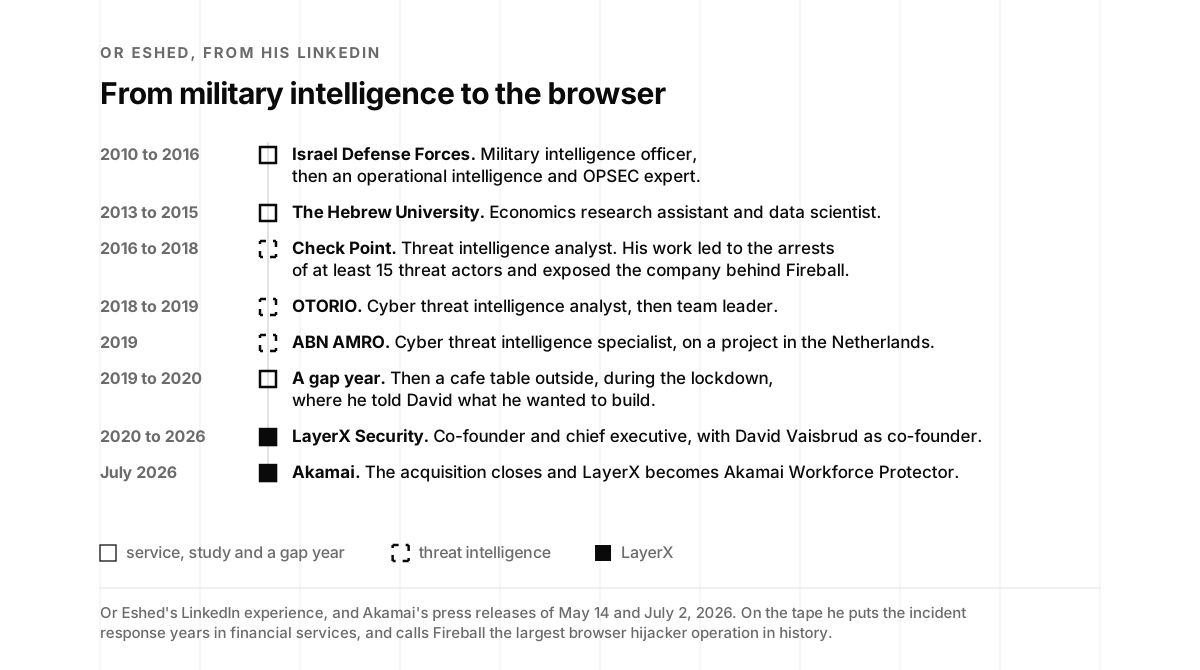
A timeline of eight entries. Open, 2010 to 2016, Israel Defense Forces, military intelligence officer, then an operational intelligence and OPSEC expert. Open, 2013 to 2015, The Hebrew University, economics research assistant and data scientist. Dashed, 2016 to 2018, Check Point, threat intelligence analyst, whose work led to the arrests of at least 15 threat actors and exposed the company behind Fireball. Dashed, 2018 to 2019, OTORIO, cyber threat intelligence analyst, then team leader. Dashed, 2019, ABN AMRO, cyber threat intelligence specialist, on a project in the Netherlands. Open, 2019 to 2020, a gap year, then a cafe table outside during the lockdown, where he told David what he wanted to build. Filled, 2020 to 2026, LayerX Security, co-founder and chief executive, with David Vaisbrud as co-founder. Filled, July 2026, Akamai, the acquisition closes and LayerX becomes Akamai Workforce Protector.
Or's path, from his LinkedIn and Akamai's press releases. The tape covers the IDF, Check Point and the IR years in financial services.

Ten percent of the effort

Plenty of people saw that attacks end in the browser. The question was when you could do something about it, and Or named two things that happened at the same time. “One is that Microsoft deprecated Explorer, and all the browsers became supportable browsers in terms of browser extensions, so you actually had a technological path that allows doing that.” The second was “a point in time in which Office 365 became accessible and something you can deploy on SaaS, and suddenly you don’t actually need the operating system.”

Listen · Or on episode 98, from 6:00
About 45 seconds: Explorer deprecated, Office 365 on SaaS, the operating system no longer significant, and the moment he decided he must do this. The clip stops on its own. Read the full transcript.

“At that point in time, I was like, okay, you can, in 10% of the effort, solve 90% of the problem and do way more. I must do this.”

Or Eshed, at 6:26

The public timeline fits his account. Office 365 reached general availability on June 28, 2011 (Wikipedia). Microsoft released Edge in 2015 to succeed Internet Explorer 11, stopped new feature development for Internet Explorer the following year, and ended support for IE 11 on Windows 10’s semi-annual channel on June 15, 2022 (Wikipedia). By 2020, when LayerX started, Explorer was on its way out and the work had moved into SaaS applications that run in a browser.

Then the timing turned into something better than good. “Luckily, it was a good time,” he said, with the company doing well and “great CISO adoption.” And then AI arrived, which he called “a huge gift for us, because it just landed exactly where we are.” I told him he hadn’t just skated to where the puck was going to be. He was already there, and the puck arrived.
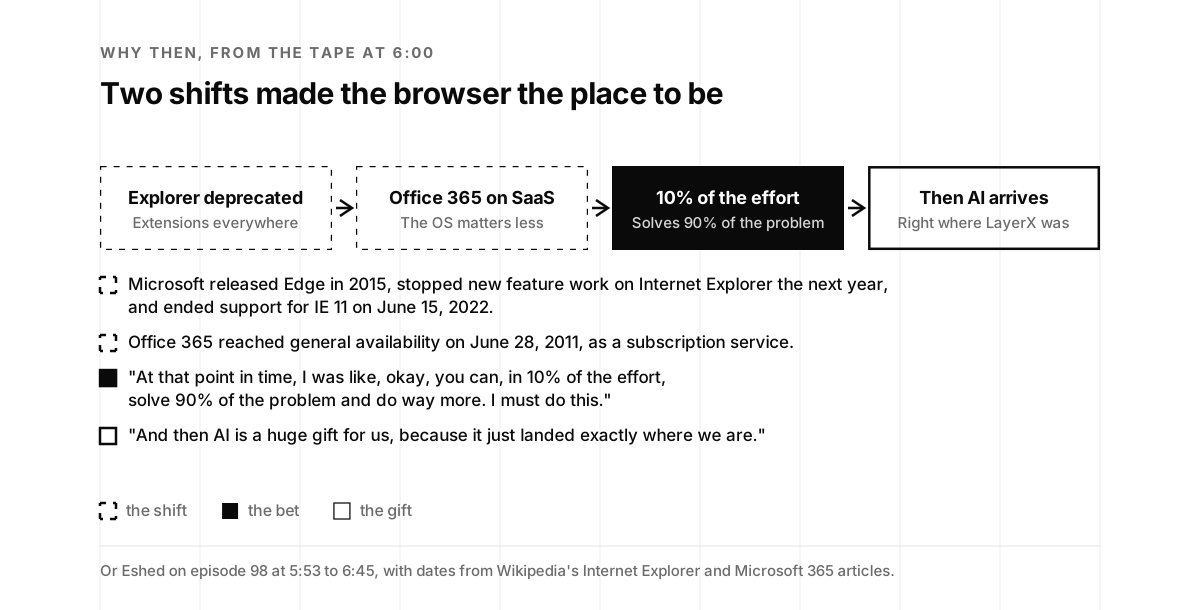
Four boxes joined by arrows. Dashed, Explorer deprecated, extensions everywhere. Dashed, Office 365 on SaaS, the OS matters less. Filled, 10% of the effort, solves 90% of the problem. Open, then AI arrives, right where LayerX was. Below, four lines. Microsoft released Edge in 2015, stopped new feature work on Internet Explorer the next year, and ended support for IE 11 on June 15, 2022. Office 365 reached general availability on June 28, 2011, as a subscription service. At that point in time, I was like, okay, you can, in 10% of the effort, solve 90% of the problem and do way more. I must do this. And then AI is a huge gift for us, because it just landed exactly where we are.
The two shifts Or named at 6:00, with the dates from Wikipedia.

Luck or wisdom

Or didn’t claim the credit. “So it’s a good question. You know, is it luck or is it wisdom?” His answer was a trend he treats as permanent, that “it’s easier to deploy and deliver capabilities and services as SaaS. It’s an always true statement.” He pointed at AI companies building browsers of their own as the latest proof, “a discussion we’ll probably keep for later,” and gave the rule underneath it: “you just want to be where the crowd is.”

In April, Or made the same argument at length on Brave’s podcast, The Brave Technologist, with Luke Mulks: account takeover still the top outcome, cookies and extensions as the soft spot, and AI sidebars and agents turning one prompt into a full session.

The browser has become the fundamental corporate user interface - and AI is amplifying that risk surface.

Or Eshed · April 15, 2026
Or on what most security stacks miss after access is granted: prompts, uploads, session actions and extension behavior. View on LinkedIn.
Or on The Brave Technologist, episode 115, April 2026, 35 minutes: phishing, cookie theft, compromised extensions and data exfiltration, and why AI raises the urgency. On Brave's channel, with show notes on brave.com. Watch on YouTube.

Vivek Ramachandran, founder and CEO of SquareX, told the story of building browser-based security on episode 49.

Two kinds of sells

I said his background gave him the credentials to be a thought leader, since he had felt the pain directly. Or turned that into a theory of selling.

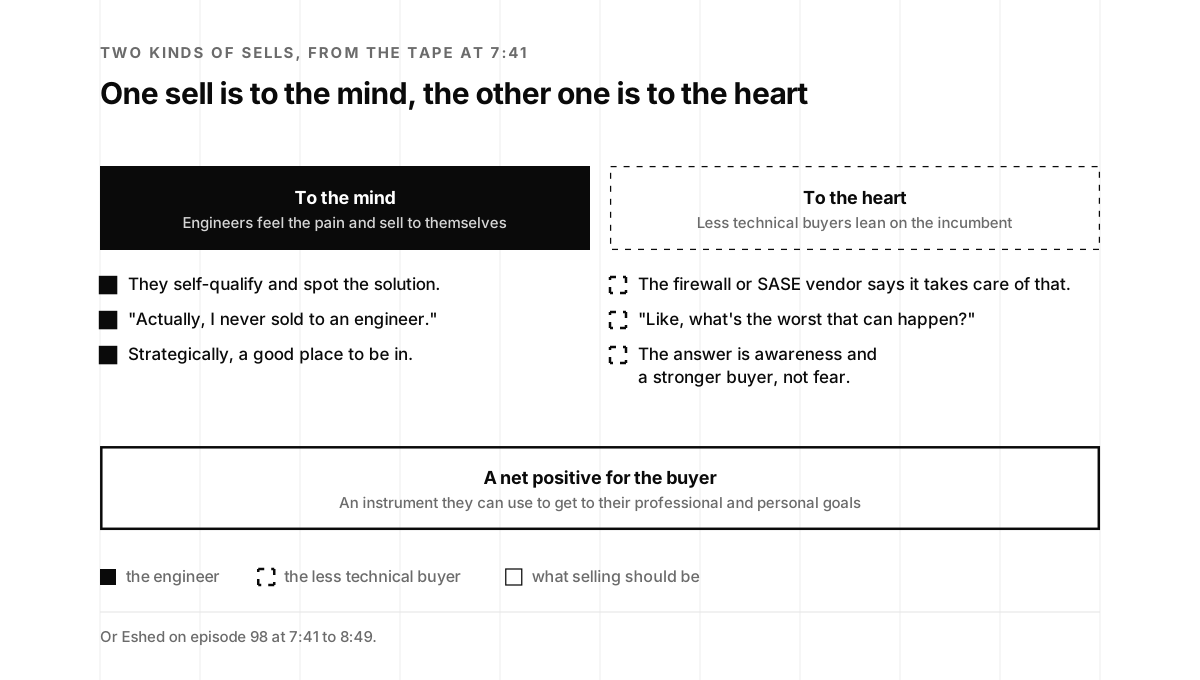
“I think there are two kinds of sells. One of them is to the mind, the other one is to the heart. And within our space, selling to engineers is actually pretty easy, because they feel the pain. Actually, I never sold to an engineer.”

Or Eshed, at 7:41

Engineers, he said, “sell to themselves, they self-qualify, and they spot us as a good solution.” The harder sale is to people who are less technical, who hear that whatever vendor runs their firewall or SASE already takes care of it, and who reason that the vendor is a great company and a startup is not. “I think I’ll go with them. I’ll stick to them. Like, what’s the worst that can happen?”

Listen · Or on episode 98, from 7:41
About 40 seconds: a sell to the mind and a sell to the heart, engineers who sell to themselves, and the buyer who sticks with the incumbent. The clip stops on its own. Read the full transcript.

His answer to that buyer was not fear. It was awareness and making the buyer stronger, and then a line I keep coming back to.

“Eventually, cybersecurity is not that significantly different than selling ceviche or falafel. It’s just a commodity. It’s supposed to be a net positive for the buyer. You’re not supposed to stress or fear sell to anyone.”

Or Eshed, at 8:30

You’re supposed to be, in his words, “an instrument they can use to get to their professional and personal goals.” In April he wrote a post that reads like the long version, aimed at vendors who answer every public breach with an “if they only used my solution” post.

Security folks are incredibly sharp. They don't ignore risks for ideological reasons or lack of knowledge.

Or Eshed · April 21, 2026
Or on vendor trash talk after a breach: security teams do the best they can with limited resources, and ambulance chasing won't make buyers trust you more. View on LinkedIn.
Two boxes side by side. Filled, to the mind, engineers feel the pain and sell to themselves. Under it, three lines. They self-qualify and spot the solution. Actually, I never sold to an engineer. Strategically, a good place to be in. Dashed, to the heart, less technical buyers lean on the incumbent. Under it, three lines. The firewall or SASE vendor says it takes care of that. Like, what's the worst that can happen? The answer is awareness and a stronger buyer, not fear. Below, an open box across the width: a net positive for the buyer, an instrument they can use to get to their professional and personal goals.
Two kinds of sells, from the tape at 7:41 to 8:49.

Find a place to hook to

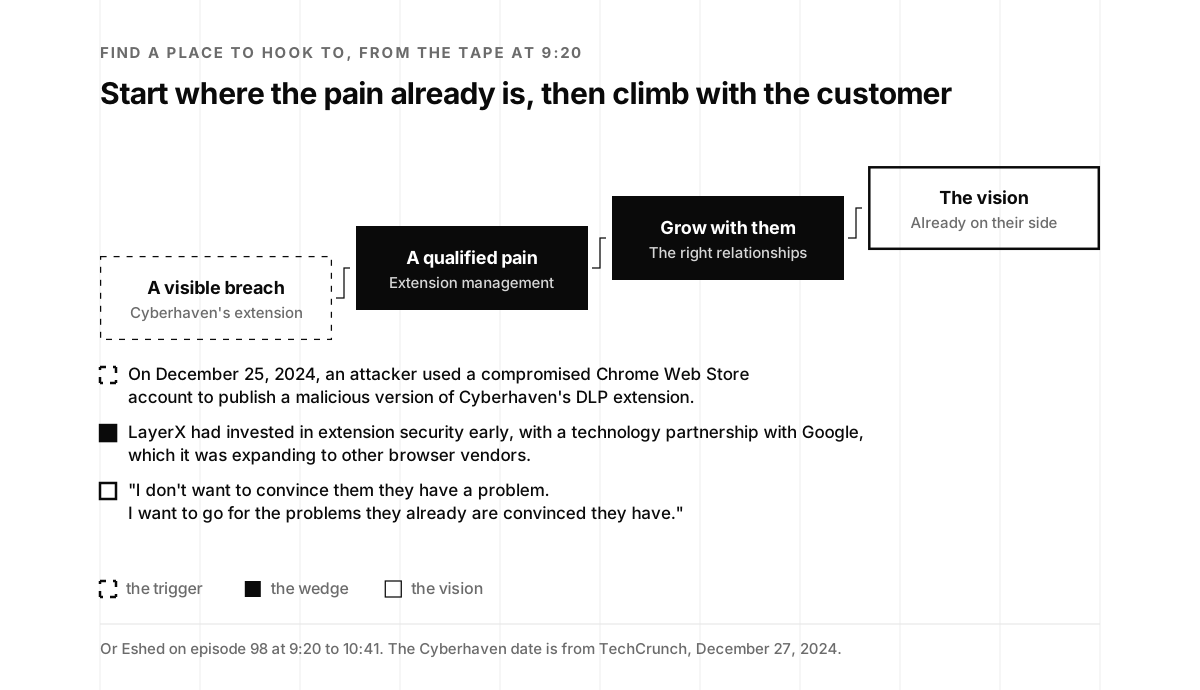
Or framed the founder’s central tension as long-term vision against “what you do tomorrow morning.” If he had a time machine, he said, the conversation he would have with his younger self is the one he’d have with any founder now. You start with a picture where everything runs smoothly and you grow until you’re bigger than Palo Alto. “In reality, it doesn’t work that way. You see a tall mountain, you need a strategy on how to start the incline. You need to find places to hook to and find areas in which there is demand.” Then he gave the example that became LayerX’s wedge.

“A bit over a year ago, there has been a huge breach. A DLP vendor called Cyberhaven got compromised. [An] attacker took over their admin account in the Google Chrome Store, replacing their browser extension used for DLP with malware. Suddenly, it raised awareness to browser extensions as an offensive vector.”

Or Eshed, at 9:33

Listen · Or on episode 98, from 9:33
About 43 seconds: the Cyberhaven extension hijack, an early investment in extension security, a technology partnership with Google, and the qualified pain CISOs already have. The clip stops on its own. Read the full transcript.

The public record matches his account and adds the mechanics. Early on December 25, 2024, an attacker used a compromised Chrome Web Store account to publish a malicious version of Cyberhaven’s extension, which had roughly 400,000 corporate users, and the company pulled it the same day (TechCrunch). Follow-up reporting found Cyberhaven was one of at least 35 extensions hijacked in the same campaign, with a phishing email and a rogue OAuth grant as the entry point (BleepingComputer). We walked through that campaign step by step in our enterprise browser security guide.

LayerX had invested in the extension problem before it was news. “We were very fortunate to invest in that early on. We have a technology partnership with Google. We’re now expanding it to other browser vendors.” Or claims the largest data lake in the world for browser extension sandboxing, a vendor claim rather than an audited figure, but the lesson he drew is the one any founder can use.

“That’s what CISOs want today. They have a qualified pain. They tell me, I don’t have that. I don’t want to convince them they have a problem. I want to go for the problems they already are convinced they have, and then grow with them and build the right relationships.”

Or Eshed, at 10:06

The vision comes back at the end, on the customer’s side. “So in my vision, once I’m a unicorn, I’m already there with them, and they’re on my side, so we can grow together.” He leans toward what people will pay for tomorrow morning, “because if you do that, that’s an enabler to go and fulfill your dreams and everything.” LayerX kept publishing extension research after the tape, including a May 2026 report on TikTok downloader extensions that turned into tracking tools.

LayerX's StealTok research, as covered by SC Media: extensions that look legitimate, some featured in the store, then change behavior after install. The update path is the risk. View on X.
Four boxes rising left to right like steps, joined by lines. Dashed, a visible breach, Cyberhaven's extension. Filled, a qualified pain, extension management. Filled, grow with them, the right relationships. Open, the vision, already on their side. Below, three lines. On December 25, 2024, an attacker used a compromised Chrome Web Store account to publish a malicious version of Cyberhaven's DLP extension. LayerX had invested in extension security early, with a technology partnership with Google, which it was expanding to other browser vendors. I don't want to convince them they have a problem. I want to go for the problems they already are convinced they have.
Start where the pain already is, from the tape at 9:20 to 10:41, with the Cyberhaven dates from TechCrunch.

Nobody likes to be sold to

I said founders dream of a better world, and the path there isn’t a straight line. You find a wedge into the market, use a small amount of resources to solve a pain point today, and when the pain point is in your crosshairs and solved, it sells itself. Or agreed, and made it about the buyer’s side of the table.

“People don’t want to be sold to. Everyone loves to buy. If I have 10 minutes, and I’m busy, I guess you’re busier than me, if I have 10 minutes to scroll through Amazon and find a cute coat for my dog, even though he likes the cold winter here in New Jersey, I’ll enjoy that.”

Or Eshed, at 11:20

Listen · Or on episode 98, from 11:19
About 24 seconds: everyone loves to buy, nobody likes the experience of being sold to, and a coat for a dog in a New Jersey winter. The clip stops on its own. Read the full transcript.

The dog has a name on LinkedIn. Before RSAC 2026, Or posted that Freddie would be staying home to vibe-code a next-gen agentic EDR, by Or’s reading of the barking.

Big announcement! 📣 Many of you have asked me - "will Freddie will be at RSAC?" 🐶

Or Eshed · March 20, 2026
Freddie skips RSAC 2026. Or goes, to talk about AI and interaction security. View on LinkedIn.

The patience is the other half of his point. Browser security today is “considered a very hot category, with M&As and other stuff and companies going in,” but five years ago the conversations were split. The more technical CISOs understood why they needed it and where it was going and still found it hard to justify a budget. Others said they didn’t understand what it was. “So it takes time. The market maturity takes time.” You enjoy the early adopters on the bell curve, pick the right ones to grow with, and become powerful with them, because there are always negative surprises down the road. His summary got a laugh out of me: “And sales, you know, sales cures everything.”

A glove to a hand

LayerX has two founders, and they knew each other long before the company. Or’s co-founder, David Vaisbrud, served with him in the military, in the same split of roles they have now.

“My co-founder David and I actually served together during our military service. Actually, we had the same relationship back then, when I was the one identifying whatever we want to build, and David was running technology operations, which is engineering, tech operations, maintenance, research, everything. So it was like a glove to a hand.”

Or Eshed, at 13:04

Listen · Or on episode 98, from 13:03
About 20 seconds: two founders who served together, one finding what to build and one running technology operations. The clip stops on its own. Read the full transcript.

The pitch happened at a cafe table outside, during the pandemic, “because of the lockdown.” Or told David this is what he wanted to build, and he named the trap every founder walks into at that moment: “Looking backwards, every idea seems like a great idea, but at the point in time when you launch, every idea seems like a bad idea. Even Facebook, even Google, everything seems like a bad idea at the time when it actually happens.” David understood the technical need and, in Or’s telling, saw himself being successful as the CTO of such a company. Or gives the technology the credit. “Now, I’m not a famous founder. It’s my first startup. And we got to amazing outcomes. It’s all thanks to great technology and great products.”

I said I couldn’t imagine serving with someone and not trusting them. Or explained where that trust comes from: white nights when the lights don’t go off, an operation or a catastrophe to handle, and seeing how people perform under pressure. When he hears about a startup with a founders’ conflict, his reaction is strong. “It’s like marriage. It’s actually bigger than marriage.”

Customers who sell for you

I asked about his proudest day, and Or wouldn’t pick one. “I wouldn’t say superstitious, but, like, you can’t celebrate half a marathon out of a marathon.” Hitting the numbers is tactical, he said. The two things that make him proud are both about customers.

“One is a logo retention rate of 99% and great NRR. Like, customers sell to themselves, which is amazing.”

Or Eshed, at 16:06

Listen · Or on episode 98, from 16:05
About 32 seconds: 99% logo retention, the inbound that starts with a customer's recommendation, and customers who sell LayerX better than he does. The clip stops on its own. Read the full transcript.

Logo retention counts the customers who stay. NRR, net revenue retention, counts what they spend a year later, including expansion. The second source of pride is the inbound call that starts with someone saying “that guy who is your customer spoke so highly of you, I had to take a look,” from a buyer who had never heard of LayerX. “A customer testimonial is worth a thousand efforts I can do indirectly in other frontiers to get traction,” Or said, and “they always sell me better than I do.” One of his former workplaces is a customer, and he called it amazing to see the technology move the needle on pains he saw firsthand when he worked there.

I guessed his NPS must be through the roof. “I hope so,” he said, and turned referrals into a definition of sales.

“And it goes to what actually sales means, which is real qualification of the positive outcome for a customer to have your product or services, and what would be the negative implication of not having it. The true qualification means that you improve their life. You don’t get money from them. They enjoy a service from you.”

Or Eshed, at 17:23

When you do that continuously and manage to scale it, he said, that shows you’re ready for scale. And when a customer is so happy with your solution that they sell it to someone else: “It’s kind of, the proof is in the pudding.”

Investors who understand the buyer

I asked whether LayerX took venture money. “Yes, of course. You must.” The sequence he described is a common one for security startups.

“Our seed funder is Glilot Capital Partners, together with the angels from the cybersecurity industry. The A round was also led by Glilot, together with Dell Technologies Capital, later joined by Jump Capital.”

Or Eshed, at 18:24

Listen · Or on episode 98, from 18:07
About 35 seconds: a small pre-seed, a seed two months later, Glilot Capital Partners leading the seed and the A round with Dell Technologies Capital, and Jump Capital joining later. The clip stops on its own. Read the full transcript.

The pre-seed came first, and the seed closed two months later, which made the pre-seed look cheap in hindsight. “But it’s always the case,” Or said. He chose Glilot Capital, which he called “probably the first vertical cybersecurity VC in the world,” and he was clear that it wasn’t for lack of options or for valuation alone. The one thing Glilot offered was “true deep understanding of the cybersecurity market,” and he extended the same credit to his investors from Dell Technologies Capital and Jump Capital.

“And it’s critical, because for every company, things will change. Technology cycles are so short. You need a partner that really understands the buyer mindset.”

Or Eshed, at 19:10

What that buys a founder, in his account, is signal in a noisy world and protection from the wrong advice. “And then, when your investors don’t understand cybersecurity, you can get bad advice, such as, everyone is doing AI, let’s do whatever AI. And I’ve seen so many companies fail that way.” You need someone you trust enough to fight the world with and swim against the stream, which is hard, “because when you swim against the stream, most signals say that you’re wrong. But those are the best possible investments.”

I said a great founder has to share that vision confidently even when it feels like swimming upstream. Or added the limit. “If you’re at consensus, you’re not doing something right. Consensus is really bad in entrepreneurship. Being entirely against everyone is also not the greatest.” The specialist investors help with that balance, because “the vertical cybersecurity VCs talk to CISOs daily,” and in his words “eventually it’s a force multiplier that’s unbeaten.”
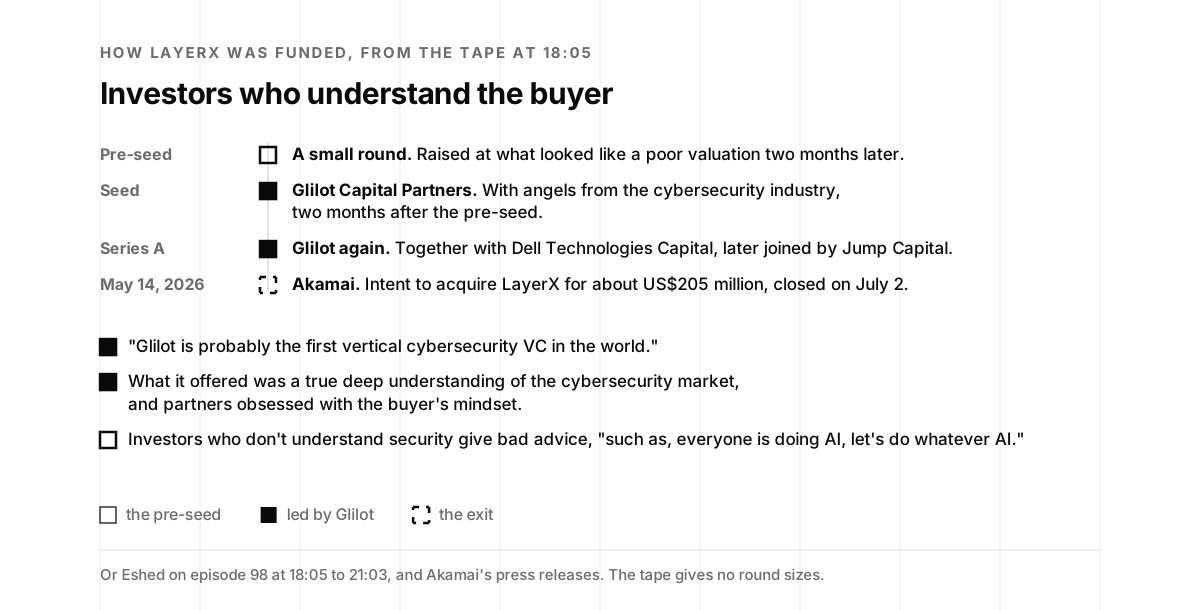
A timeline of four entries. Open, pre-seed, a small round, raised at what looked like a poor valuation two months later. Filled, seed, Glilot Capital Partners, with angels from the cybersecurity industry, two months after the pre-seed. Filled, Series A, Glilot again, together with Dell Technologies Capital, later joined by Jump Capital. Dashed, May 14, 2026, Akamai, intent to acquire LayerX for about US$205 million, closed on July 2. Below, three lines. Glilot is probably the first vertical cybersecurity VC in the world. What it offered was a true deep understanding of the cybersecurity market, and partners obsessed with the buyer's mindset. Investors who don't understand security give bad advice, such as, everyone is doing AI, let's do whatever AI.
How LayerX was funded, as Or told it at 18:05, with the exit from Akamai's press releases.

Where startups can sell

Inside that answer about investors was the sharpest piece of market analysis on the tape. Only a small subset of the market is ever exposed to a startup, Or said, and he walked through the math.

“You know, half of the cybersecurity market is GSIs. That’s untouched. 80% is the hyperscalers. It’s Microsoft, CrowdStrike, Palo Alto, Fortinet, a few others. Just untouched. Like, 20% of half, which is pretty much 10% of the cybersecurity market, could be utilized by startups.”

Or Eshed, at 19:54

Listen · Or on episode 98, from 19:54
About 21 seconds: half the market to the integrators, most of the rest to the largest vendors, and about 10% open to startups, not all of it in market in any year. The clip stops on its own. Read the full transcript.

And not all of that 10% moves every year. “So not everyone in your ICP is in the market,” he said, meaning the ideal customer profile a startup sells to. That shapes what success looks like early. “So actually, in the first couple of years, you’re supposed to get a couple of millions, and then you’re a great company. Not tens of millions, not hundreds of millions.” The discipline that follows is knowing your ideal customer, how you reach them, and how you avoid scope creep outside them and lose traction. These are Or’s estimates from experience, not market data, and the calculator further down lets you put your own numbers in their place.
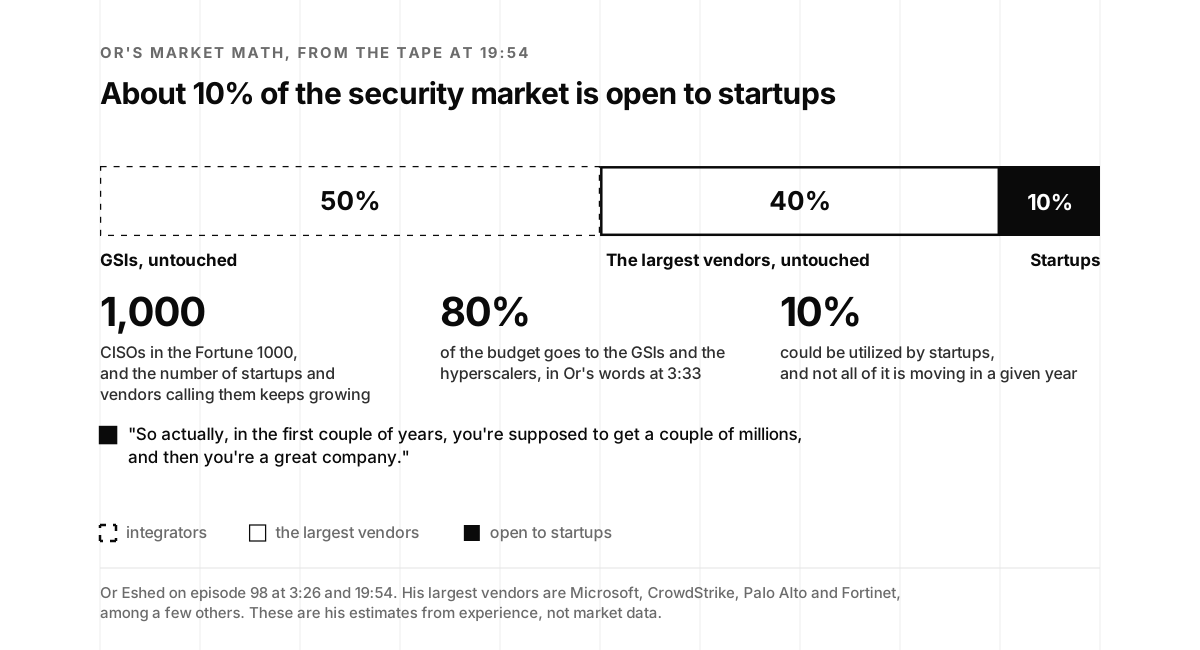
A bar across the width split into three parts. Dashed, 50%, GSIs, untouched. Open, 40%, the largest vendors, untouched. Filled, 10%, startups. Below, three numbers. 1,000 CISOs in the Fortune 1000, and the number of startups and vendors calling them keeps growing. 80% of the budget goes to the GSIs and the hyperscalers, in Or's words at 3:33. 10% could be utilized by startups, and not all of it is moving in a given year. Then one line. So actually, in the first couple of years, you're supposed to get a couple of millions, and then you're a great company.
Or's market math, from the tape at 3:26 and 19:54. His estimates, not market data.

Skin in the game

Or picked a hypothetical to explain how early-stage companies actually unfold. “Let’s say you have an idea. Jon, you came up with an idea for a time machine. That’s a great idea. Not that easy to build.” I agreed it would be very difficult to build. His point was that people assume the journey ends with the idea.

“People assume in early stage it ends with your idea, then you get to execution, and then you get to build the product. Then there are always nasty surprises when you do that.”

Or Eshed, at 22:23

After the first couple of sales you need to show efficient selling, a low CAC (what it costs to acquire a customer) and a high ACV (annual contract value), and you need to build a sales organization. “Good sellers for early stage are like unicorns. If you find one, catch it.” Good sellers ask two questions before they join, he said: who invested in you, and does that voice mean something, and how much skin in the game do the founders have.

“You know, one of the reasons I moved to the US was because of that. I wanted to show my sellers I have skin in the game.”

Or Eshed, at 23:00

Listen · Or on episode 98, from 23:00
About 17 seconds: moving to the US to show his sellers skin in the game, and being there day and night when they ask. The clip stops on its own. Read the full transcript.

Whenever they ask him to join a meeting, “day and night, 24/7, I’ll be there, because they need this confidence.” Make good sellers want to work for you and any seller will, “and that’s actually when the race actually begins.” I said that for an entrepreneur it begins again every morning. “100%. And you dream about it at night.” In September he wrote about the move itself, to the US at the beginning of 2025, and the sun rising over Manhattan.

My journey with LayerX Security led me to relocate to the US at the beginning of 2025.

Or Eshed · September 15, 2026
Or on moving to the US for LayerX, and the way the country lets startups from all over the world thrive. View on LinkedIn.

The bad days

I asked about his most difficult day. Or’s first answer was that he assumes the hardest one is still ahead, because things can always get worse. Then he drew a distinction that I think every founder should write down. Missing a huge deal “on points, on inches” is annoying, but you did the best you could.

“And then if you just put in the meat grinder, like, 10 of those, you’ll close five, and that’s a great company. So don’t think about that one. Think about the next one.”

Or Eshed, at 24:21

The bad days are the other kind, “when you get into a reality in which you actually had enough information to take a different decision, and you went consciously to the wrong path.” Those cost cash and other people’s time, and worse, “it makes me question my own decision-making process.” Luckily, he said, it happens very rarely. Then he reached for tennis.

“On the other hand, you know, Federer, the tennis player, was on a VC event once, said that he, you know, he only wins, like, a bit over half of the matches, but he wins those that matter.”

Or Eshed, at 24:54

Listen · Or on episode 98, from 24:55
About 17 seconds: Federer, winning the moments that matter, and catching the balls that matter the most. The clip stops on its own. Read the full transcript.

The version Federer tells is about points rather than matches, and it makes Or’s lesson stronger. In his commencement address at Dartmouth on June 9, 2024, Federer said that in the 1,526 singles matches of his career he won almost 80%, yet he won only 54% of the points he played (Dartmouth). Nearly half the points lost, and still one of the best records in the sport. Or’s conclusion holds either way: “You don’t have to catch every ball, but you need to catch the balls that matter the most.” It’s never perfect, and I agreed it never is.
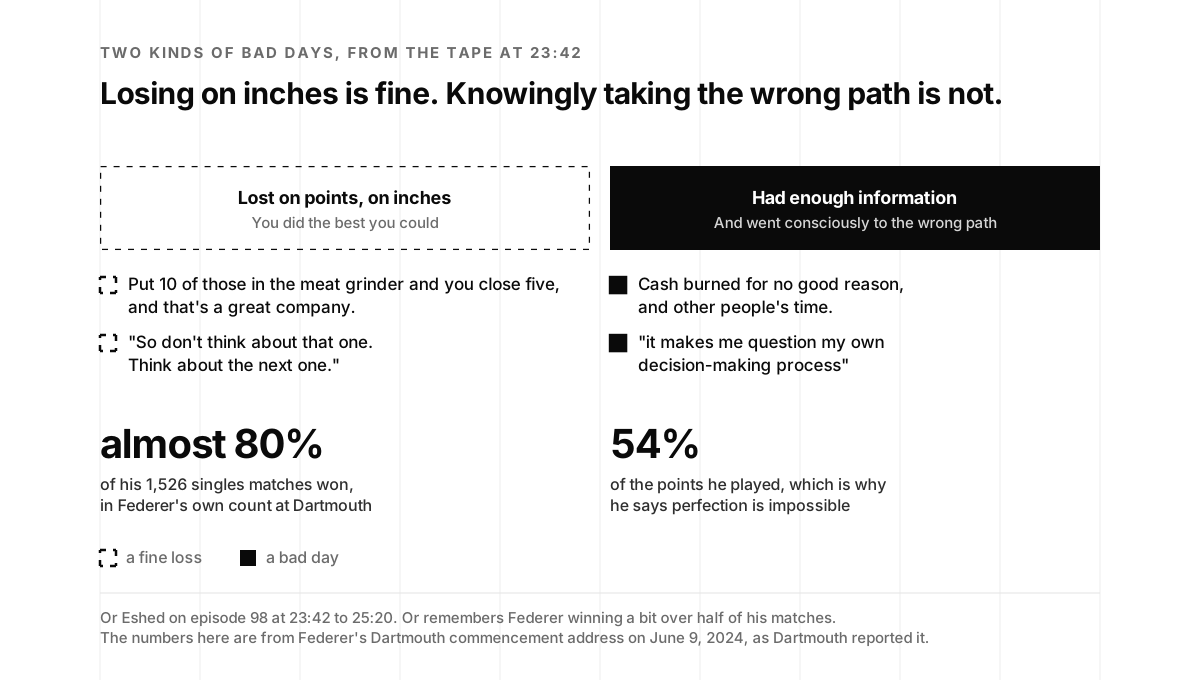
Two boxes side by side. Dashed, lost on points, on inches, you did the best you could. Under it, two lines. Put 10 of those in the meat grinder and you close five, and that's a great company. So don't think about that one. Think about the next one. Filled, had enough information, and went consciously to the wrong path. Under it, two lines. Cash burned for no good reason, and other people's time. It makes me question my own decision-making process. Below, two numbers. Almost 80% of his 1,526 singles matches won, in Federer's own count at Dartmouth. 54% of the points he played, which is why he says perfection is impossible.
Two kinds of bad days, from the tape at 23:42 to 25:20, with Federer's numbers from Dartmouth.

Invest in problems, not solutions

I asked what LayerX looks like as a smashing success, and Or answered with a rule. “We basically invest in problems. We don’t invest in solutions. We invest in problems.” The test is whether the problem space is growing, and he reminded me that every reality is good for someone: “global warming, I guess there is an ice cream shop that’s cheering out there.” Then he named the trends he sees.

“One of them is consolidation, which means, pardon my French, that every big hyperscaler becomes like Walmart. You can’t really find what you need. It doesn’t really work.”

Or Eshed, at 26:12

With some of those vendors, he said, “customers say, I get for cheap a lot of bad products,” and the return on the spend becomes very questionable. The second trend is a mindset: “the understanding that you can’t secure everything will be a part of the status quo.” The third is technical. Application delivery is getting more complex, with more encryption and more sophistication, “so I think the network security players are destined to become VPNs, glorified VPNs.”

Listen · Or on episode 98, from 26:43
About 40 seconds: more encryption, network players as glorified VPNs, and a next-generation security service edge with no proxies and no inline data centers. The clip stops on its own. Read the full transcript.

That’s where he sees the opening. “I think there is a once-in-a-generation opportunity to build a next-generation approach to security service edge that does not require dependence on proxies and inline data centers.” Security service edge is the cloud-delivered bundle of secure web gateway, cloud access security broker and zero trust network access that many enterprises route their traffic through. Or’s version moves it to the user and the device, “in a lightweight manner.” He described LayerX a couple of years out as “a billion-dollar company selling things outside of browser security, but on the same paradigm, which is device-centric user governance,” expanding into DLP, network security and zero trust. He named the failure mode too. “What shouldn’t be happening is becoming another tiny Walmart, where you’re trying to do too many things.”

He came back to crowded categories in September, after dozens of next-gen EDR startups pitched him in a couple of months.

In the last couple of months I was approached by dozens of "next-gen EDR" companies (more than I can count).

Or Eshed · September 16, 2026
Or on crowded categories: a party where some guests turn out to be the piñata, and why a startup must be first, be best or pivot. View on LinkedIn.

Andrew Rubin made the long-game version of the same argument from Illumio’s side, that you can’t keep everything out and have to limit what gets reached, on episode 88, and Taher Elgamal, the father of SSL, the encryption behind the traffic a network tool can no longer read, told its origin story on episode 61.
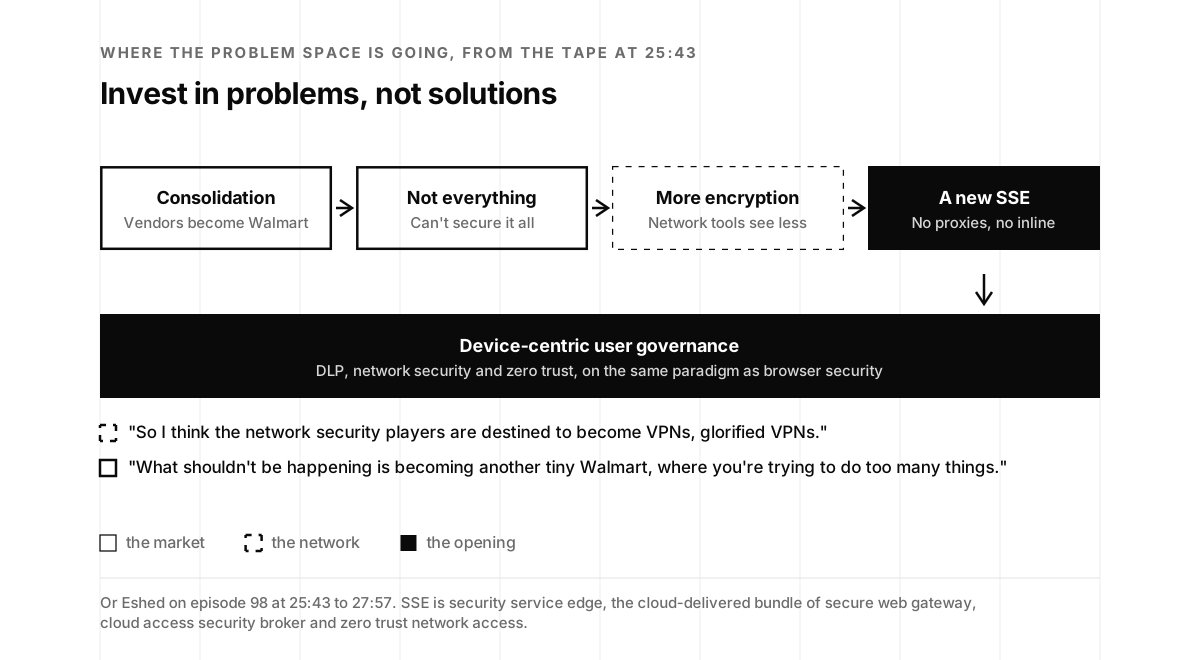
Four boxes joined by arrows. Open, consolidation, vendors become Walmart. Open, not everything, can't secure it all. Dashed, more encryption, network tools see less. Filled, a new SSE, no proxies, no inline data centers. An arrow down to a filled box across the width: device-centric user governance, DLP, network security and zero trust, on the same paradigm as browser security. Below, two lines. So I think the network security players are destined to become VPNs, glorified VPNs. What shouldn't be happening is becoming another tiny Walmart, where you're trying to do too many things.
Where the problem space is going, from the tape at 25:43 to 27:57.

Agents are someone else’s problem

Or ended his look ahead with a line that made me laugh and then made me think. “Aside from that, we’ll see other crazy things happening with non-humans, agents, stuff like that. But that’s someone else’s problem.” I had been about to ask how AI shifts the security landscape, and I told him I loved that ruthless sense of focus. He explained it the way he explains it to CISOs, by splitting AI in two.

“And then I tell them, you know, we talk about AI, and then you have users to AI, which is natural stupidity to artificial intelligence sort of thing.”

Or Eshed, at 28:18

Then there are agents roaming the web, which he called “an application security problem. It’s a bit different.” You can try to do everything, he said, and then he gave the line of the episode.

“But then, you know, I tell them, you know, the same cow looks very different to the butcher and the veterinarian. Like, you can’t assume that everything AI should be handled by the same vendor.”

Or Eshed, at 28:35

Listen · Or on episode 98, from 28:33
About 44 seconds: the butcher and the veterinarian, the poison pill of being the AI security vendor, and forty years of vendors that never tried to do everything. The clip stops on its own. Read the full transcript.

Trying to be the AI security vendor, he said, is “a poison pill,” because “if AI is everywhere, you have to be the everywhere security vendor.” He backed it with history.

“Newsflash, we’re in 2026, 40 years after the first security vendors came to the market. Some offerings are like 30, 35 years old, and they’re actually downsizing. They’re starting to minimize what they do. None of them tries to do everything everywhere.”

Or Eshed, at 28:55

“You can’t be everything for everyone. You need to just be in love with an amazing problem that’s growing.” For LayerX that problem is the people. “So we’ve taken the user to AI interaction. As long as you have employees, you’ll have the same mistakes happening time and time again, and we can be the strategy that you can go to battle with.” The robotic part of the business, the agents, belongs to other companies, and he expects specialized vendors to do amazingly well while the all-in-one players fail to keep up. Trevor Hilligoss of SpyCloud made the human half of that case, from reused credentials up, on episode 86, and Xia Hua of Traceforce covered the AI tools employees love on episode 100.

Or took the same split on the road after we recorded. He announced a keynote at The Official Cybersecurity Summit in Boston titled “The world is not about to end,” and a talk at Gartner’s security and risk summit arguing that firewalls make binary decisions on network traffic while AI risk lives inside browser sessions.

The world is not about to end.

Or Eshed · May 4, 2026
Or's Boston keynote on May 6, 2026: AI isn't a security apocalypse, the gaps show up in everyday use, and lightweight controls teams can actually deploy. View on LinkedIn.

"Don't Bring a Firewall to an LLM Fight."

Or Eshed · May 27, 2026
Or's Gartner Security and Risk Management Summit talk on June 1, 2026: the threat model changed, and most security architectures didn't. View on LinkedIn.
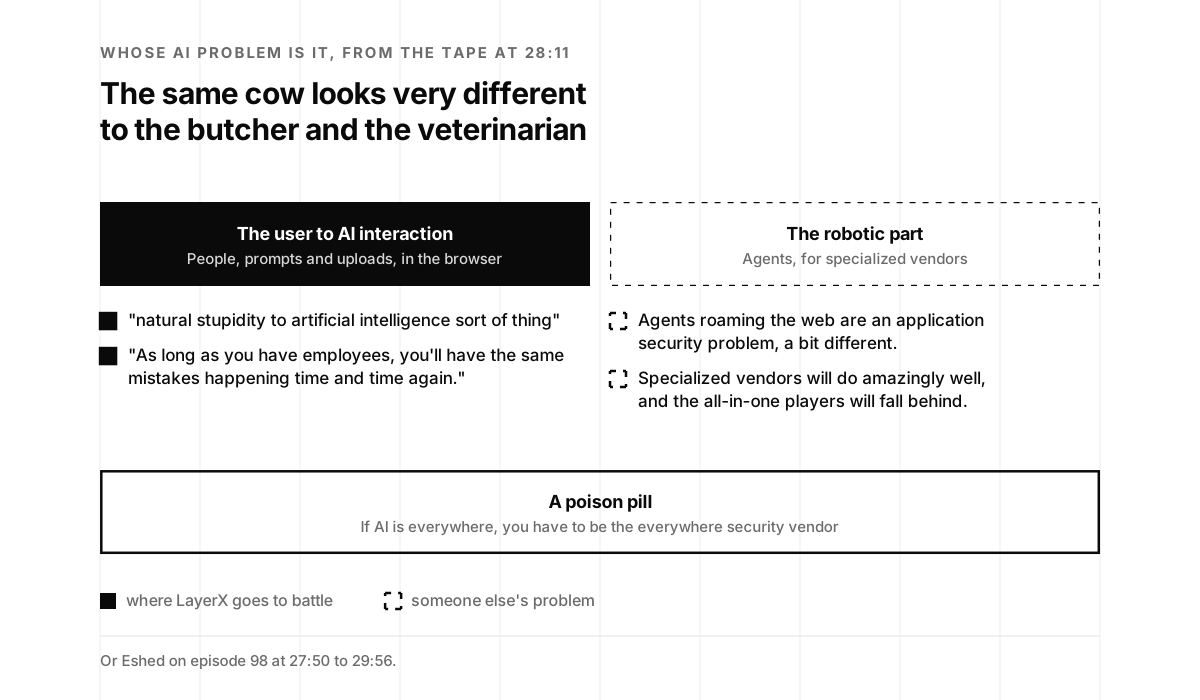
Two boxes side by side. Filled, the user to AI interaction, people, prompts and uploads, in the browser. Under it, two lines. Natural stupidity to artificial intelligence sort of thing. As long as you have employees, you'll have the same mistakes happening time and time again. Dashed, the robotic part, agents, for specialized vendors. Under it, two lines. Agents roaming the web are an application security problem, a bit different. Specialized vendors will do amazingly well, and the all-in-one players will fall behind. Below, an open box across the width: a poison pill, if AI is everywhere, you have to be the everywhere security vendor.
Whose AI problem is it, from the tape at 27:50 to 29:56.

Do I actually need a dashboard?

The second half of Or’s AI answer was about building, not buying. “Another thing is, with AI, you can ship quality products faster. It takes a mind shift to do that. Two mind shifts, actually.” The first is that buyers stopped caring about the algorithm.

“So, like, a decade ago, if you had, like, we have the best detection engine, we have like 140% true positive rate, all kinds of BS that no one believes in. Nowadays, it doesn’t interest anyone. You can take a naive model and do a good enough job.”

Or Eshed, at 30:10

Buyers look for impact and intuitive added value instead: what data you process and what context you have. The second shift is about your own product.

“Do I actually need a dashboard? Or can I just have a prompt, when you can ask it, show me trends over the last five days? Actually, you can deploy solutions much, much faster, more reliable.”

Or Eshed, at 30:38

Listen · Or on episode 98, from 30:38
About 19 seconds: a prompt in place of a dashboard, and why the faster you learn to build with AI, the more likely you are to survive. The clip stops on its own. Read the full transcript.

“The faster you understand how to build with AI, the more likely you are to survive.” I summed it up as using AI inside the products and services we build, not just to build them faster, after we fall in love with the problem. “We’re falling in love with problems, not with solutions,” I said, and the problem will still be there when the solution changes.

Fall in love with their problem

Or put a number on why that matters for security in particular. “The cybersecurity market is not gigantic. You have two companies over a hundred billion, and then you have a couple in the tens of billions, and then the rest are pretty small.” It’s smaller than retail or finance, so “you can build a name easier, but it’s harder to get attention as well,” because everyone wants the same buyers.

“And eventually, if you don’t have a path towards being a great business, why bother? Like, you should really start with that. And the way to do that, you won’t convince people to love your technology.”

Or Eshed, at 31:59

You offer them a strategy for a problem they really care about. “So you need to fall in love with their problem.” I tied it back to buying versus being sold: when you feel a pain point you look for the Tylenol, and advertising by itself doesn’t work so well. Or added the piece I’d missed. “A bit more modesty as well, because there needs to be trust.” A buyer can believe the problem is real and the technology is good and still not trust you, because you’re a small startup without a name. “There are so many reasons why not to buy from you.” So you learn the buyer’s decision-making process, build toward it so you’re more credible and more reliable, “and don’t try to preach to them, because they hate that.”

How a startup earns trust

I asked how LayerX broke through and became a trusted player. Or gave three answers, in order. The first was a huge investment in customer success and professional services, which he says is the best in its space, so that every customer, small or large, gets the best possible service, “because they are ambassadors to the market.”

“Second thing, don’t lie to prospects. Be candid. It’s better to miss opportunities than to misdeliver. Not everyone would agree, but I think you need to make sure that you’re trusted.”

Or Eshed, at 33:45

The third is qualification. People appreciate being asked about their tech stack and how they work, “even doing a prior analysis. It shows that you care and you really want to have a conversation.” I added what good investors bring beyond capital: credibility, a couple of intros, warm leads and the confidence of someone backing you. Or explained why that works so well in security in particular.

“In the cybersecurity market, there are quite a lot of CISOs that invest weekly in learning and educating themselves by meeting startups, to learn what’s going on in the industry. Those are people that, if they would open up a consultancy service, they should charge like a couple of thousand dollars an hour.”

Or Eshed, at 34:53

Those CISOs burn their own time on startup calls, so they want someone to filter for them, and the specialized VCs do that pre-qualifying. I compared it to hiring someone with Apple or a successful startup on the résumé. Or agreed and went further: “everyone is looking for external validation for everything. And even your buyers want external validation.” His picture of it was a restaurant in a foreign country where you don’t speak the language. You go to the place with the longest queue outside, “even though I’ll stand longer in line.” I said it’s worth the wait, and it always is. The buyer’s side of the same question is the subject of our list of AI security questions enterprise buyers will ask, and credibility in a questionnaire is earned the way Or describes, candidly.

Objections sharpen your knife

I asked what tool or service he wishes someone would build for entrepreneurs. Or answered with a habit instead. “Listen more than talking, and ask questions, and listen.” LayerX, he said, “could have been a faster company, launching earlier, if we processed feedback better.”

“Objections are not insulting you. That’s what I say to the young entrepreneurs that are listening. When you get objections, someone is offering to sharpen your knife for you.”

Or Eshed, at 37:18

Listen · Or on episode 98, from 37:22
About 18 seconds: objections as someone sharpening your knife, and the faster you address them, the crisper the idea and the company. The clip stops on its own. Read the full transcript.

They highlight the vulnerabilities and weaknesses in your idea, and the faster you address them, “the better and more crisp your idea will be, and eventually your company will be as well.” Get the feedback from the right sources, he said, and it’s free: walk into a company you can learn from, or stand outside and bump into someone on the street. “You just need the courage, and you need to be willing to listen.”

I called it a growth mindset, not throwing up defenses, being open to being wrong. Or jumped in: “It’s amazing to find that you’re wrong.” Then he told me how he runs his own team.

“I always tell my employees, you know, if you prove me wrong, the faster you do, you give me back time, which is the one resource I have very limited.”

Or Eshed, at 38:30

Listen · Or on episode 98, from 38:29
About 17 seconds: prove me wrong fast, you give me back time, and learning to be in love with being wrong. The clip stops on its own. Read the full transcript.

“I learned to be in love with being wrong. I wasn’t always like that.” It took getting “spanked by reality once or twice,” he said, and the regret of thinking that if he had only learned he was wrong earlier and faster, it could have been great. “When you learn how to do that, you just become a better entrepreneur.” I put it the way I think about it: you don’t have to, you get to.

Hiring, AI browsers and the DBIR

For his plugs, Or spoke to three audiences. If you buy network and endpoint security and care what your employees do online, “that’s the best strategy to go.” If you’re a security practitioner, “we’re constantly hiring great technicians and non-technicians in the US as we scale the business.” And if you just want to learn, follow LayerX, because “we’re expecting quite a few announcements on our support and integration into AI browsers, which is becoming a really hot topic in 2026.”

He closed on research. “By the way, we’re contributors to a lot of research entities, Verizon’s Data Breach Investigations Report. We were the only AI security contributor in 2025.” That’s his claim about the contributor list. What the report itself says on the subject is worth knowing: Verizon’s 2025 DBIR found 15% of employees routinely accessing GenAI systems on their corporate devices, and 72% of those used non-corporate emails as the identifiers of their accounts (Verizon). Those are exactly the user to AI interactions Or built LayerX to see, and our guide to shadow AI covers what a startup can do about them this quarter.

What happened after the tape

The months after we recorded were the busiest in LayerX’s history. In April, Or took the browser argument to Brave’s podcast and, in a LinkedIn post, to vendors who chase breaches. In early May he announced his Boston keynote, and on May 14 Akamai announced it would acquire LayerX for about US$205 million for all of its outstanding equity, with closing expected in the third quarter (Akamai). The announcement described LayerX’s technology as browser-based AI usage control that works with the browsers people already use, put LayerX at about US$10 million in annual recurring revenue by the end of the year, and said Or and David Vaisbrud would join Akamai’s Zero Trust organization. It was Akamai’s fourth Tel Aviv-based cybersecurity acquisition in five years. Or’s statement called securing human and agentic AI usage “one of the defining challenges in enterprise security.”

Today is a special day for LayerX Security! 🦄

Or Eshed · May 14, 2026
Or on the day of Akamai's announcement, thanking David Vaisbrud and the investors from Glilot Capital, Dell Technologies Capital and Jump Capital, and introducing employee number one. View on LinkedIn.

Or’s talk at Gartner’s security and risk summit was set for June 1, and on June 29 LayerX posted that The Hacker News had named it Best AI Usage Control Platform (X). This episode aired the next day, on June 30, on Podbean and on our YouTube channel. On July 2 Akamai completed the acquisition, calling LayerX a secure enterprise browser provider and AI usage control leader (Akamai). The product became Akamai Workforce Protector, and its page now lists the AI browser support Or said was coming, naming Atlas, Comet and Dia next to Chrome, Edge, Firefox and Safari, along with a public extension database called ExtensionPedia (Akamai). A few days later, LayerX shared this conversation on X.

LayerX, by then part of Akamai, sharing episode 98 with a clip of the conversation. View on X.

On July 15 the team presented Akamai Workforce Protector at CISO XC in Chicago (X). In September Or wrote about the move to the US and about the next-gen EDR crowd, both embedded above, and in October he spent a week in Japan with Akamai’s local team, writing that the Japanese market is at the front of AI security adoption (LinkedIn).
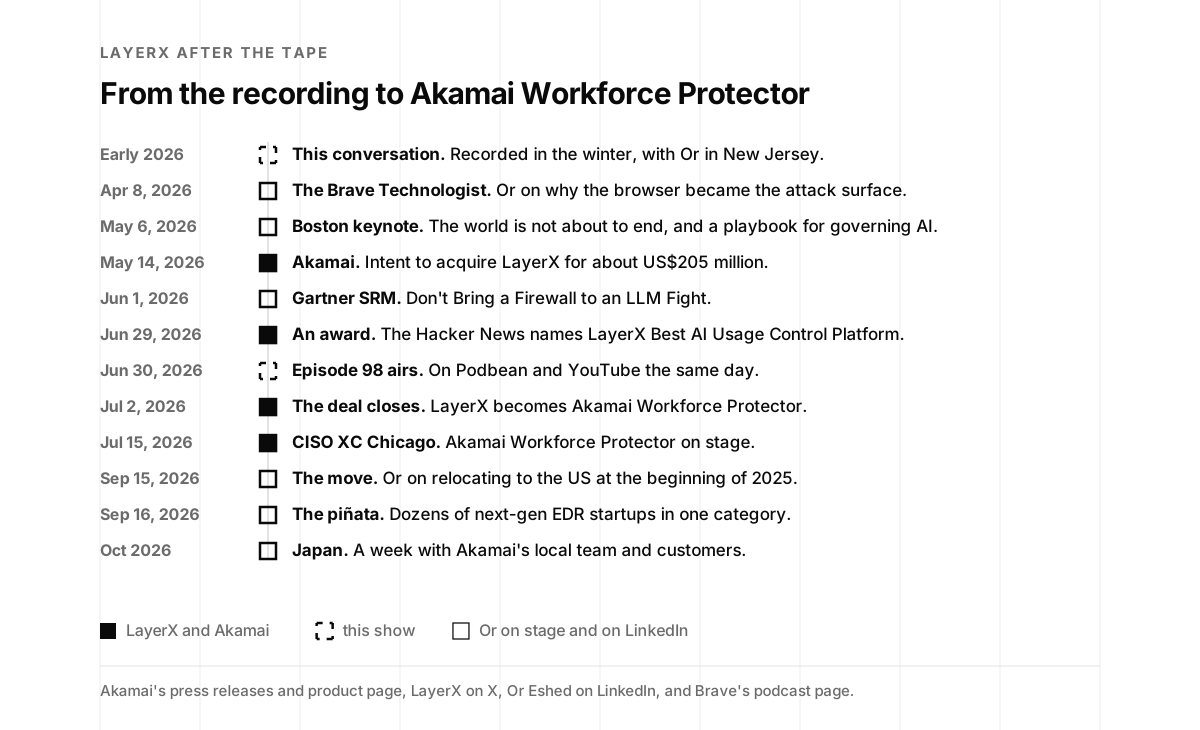
A timeline of twelve entries. Dashed, early 2026, this conversation, recorded in the winter, with Or in New Jersey. Open, April 8, 2026, The Brave Technologist, Or on why the browser became the attack surface. Open, May 6, 2026, Boston keynote, the world is not about to end, and a playbook for governing AI. Filled, May 14, 2026, Akamai, intent to acquire LayerX for about US$205 million. Open, June 1, 2026, Gartner SRM, Don't Bring a Firewall to an LLM Fight. Filled, June 29, 2026, an award, The Hacker News names LayerX Best AI Usage Control Platform. Dashed, June 30, 2026, episode 98 airs, on Podbean and YouTube the same day. Filled, July 2, 2026, the deal closes, LayerX becomes Akamai Workforce Protector. Filled, July 15, 2026, CISO XC Chicago, Akamai Workforce Protector on stage. Open, September 15, 2026, the move, Or on relocating to the US at the beginning of 2025. Open, September 16, 2026, the piñata, dozens of next-gen EDR startups in one category. Open, October 2026, Japan, a week with Akamai's local team and customers.
LayerX after the tape, from Akamai's press releases and product page, LayerX on X, Or Eshed on LinkedIn and Brave's podcast page.

The bet Or described is the one the deal priced in. People do their work in a browser tab, the data leaves through the same tab, and AI made both of those more true at once. For a startup the useful part is smaller than an acquisition and easier to start on: know which AI tools and extensions touch your data, put your rules where the paste and the upload happen, and be able to show a buyer that you did.

Did you catch it? A six-question quiz

Interactive · six questions

Did you catch it?

Six questions on what Or and I actually said, with the timestamp for each answer. The answers are under each question for anyone reading without JavaScript.

  1. What does Or say a CISO gets out of LayerX?

    1. A replacement for the firewall
    2. Full last-mile security across web, SaaS and AI
    3. A new browser for every employee

    b. "And what you get out of it is full last-mile security across web, SaaS and AI." Transcript, 2:54.

  2. Which two things happening at the same time told Or he must build LayerX?

    1. Ransomware and remote work
    2. Cloud budgets and a hot funding market
    3. Microsoft deprecating Explorer, and Office 365 on SaaS

    c. "One is that Microsoft deprecated Explorer, and all the browsers became supportable browsers in terms of browser extensions, so you actually had a technological path that allows doing that." Transcript, 6:00.

  3. Which breach raised awareness of browser extensions as an offensive vector, in Or's telling?

    1. The compromise of the DLP vendor Cyberhaven
    2. Fireball
    3. A Chrome zero-day

    a. "A DLP vendor called Cyberhaven got compromised." Transcript, 9:36.

  4. By Or's math, how much of the cybersecurity market could be utilized by startups?

    1. About half
    2. Pretty much 10%
    3. About 80%

    b. "Like, 20% of half, which is pretty much 10% of the cybersecurity market, could be utilized by startups." Transcript, 20:05.

  5. What was one of the reasons Or moved to the US?

    1. To be closer to his investors
    2. To open an office in New York
    3. To show his sellers he has skin in the game

    c. "I wanted to show my sellers I have skin in the game." Transcript, 23:03.

  6. How does Or explain why one vendor shouldn't handle everything AI?

    1. The same cow looks very different to the butcher and the veterinarian
    2. AI will be boring in two years
    3. Agents are too expensive to secure

    a. "But then, you know, I tell them, you know, the same cow looks very different to the butcher and the veterinarian." Transcript, 28:36.

Is the browser your control point?

Or’s case is that the user to AI interaction happens in the browser, so that is where a company can see it and govern it. This scorecard asks eight questions about your own company. It takes about two minutes.

Scorecard · eight questions

Is the browser your control point?

Answer for the laptops and accounts your people use for work today, contractors included. If two answers fit, pick the lower one.

  1. Do you know which AI tools your people use for work, and on which accounts?

    • No, we'd be guessing
    • We know the tools we approved, not the rest
    • We have an inventory by application, with corporate and personal accounts told apart

    "As long as you have employees, you'll have the same mistakes happening time and time again." See Agents are someone else's problem.

  2. Do you know every browser extension running on company devices?

    • No
    • We allow-list some by policy
    • We inventory every extension, block broad permissions and review new versions before they spread

    The Cyberhaven hijack arrived as an update. See Find a place to hook to.

  3. What happens when customer data or source code heads into a prompt or an upload?

    • Nothing we would see
    • A written policy and training
    • The browser warns, redacts or blocks it at the point of use, and logs it

    "Full last-mile security across web, SaaS and AI." See Going where the users are.

  4. Can contractors and people on personal devices reach company SaaS?

    • Yes, with no session rules
    • Only through a VPN
    • Yes, with the same session policies as a managed laptop

    "The operating system is not very significant." See Ten percent of the effort.

  5. How do your people sign in to the tools they use in the browser?

    • Passwords, with MFA where an app offers it
    • Single sign-on for most apps
    • Single sign-on everywhere, with phishing-resistant sign-in and session revocation

    "Identity is happening online, in the browser, as well." See A thousand CISOs.

  6. If a buyer asks how you govern employee AI use, what do you send?

    • A reassuring email
    • A policy document
    • The policy, plus logs or screenshots that show it working

    "Don't lie to prospects. Be candid." See How a startup earns trust.

  7. Have you decided which AI browsers and in-browser assistants your people may use?

    • We haven't looked
    • We banned them on paper
    • We decided which are allowed, and they follow the same session rules as a person

    AI browsers were "becoming a really hot topic in 2026." See Hiring, AI browsers and the DBIR.

  8. Who owns the security of the AI features and agents you ship to customers?

    • Nobody in particular
    • The same tool we use for employee AI use
    • An application security owner, with its own review and testing

    "The same cow looks very different to the butcher and the veterinarian." See Agents are someone else's problem.

Your control point is still the network

Most of what your people do with AI and SaaS happens where nothing of yours can see it, and that's fixable in weeks. Start with an inventory of AI tools and extensions, allow-list the extensions you need, block broad permissions, and write a one-page rule for which data may go into which tools.

Halfway to the browser

You know what's installed and you have rules on paper. Now put the rules where the paste happens, give contractors and personal devices the same session policies as everyone else, and keep the logs a buyer will ask to see.

The browser is your control point

Your people's AI use is visible and governed at the point of use, and you can show it. Keep the extension inventory current, decide on AI browsers on purpose, and give the AI you ship its own application security owner.

How much of the market can you reach?

Or’s market math says half of security spending goes to integrators, most of the rest to the largest vendors, and about 10% is open to startups, not all of it in market in a given year. This calculator runs the same math on your category.

Calculator

How much of the market can you reach?

The yearly security spend in your category, the share that goes to integrators, the share of the rest held by the largest vendors, the share of buyers in market this year, and the share of those deals a startup like yours could win.

–of the category open to startups
–a year open to startups
–in market this year
–a year you could win

10% of this category is open to startups, about $200,000,000 a year. With 20% of buyers in market this year, $40,000,000 is up for grabs, and winning 5% of that is $2,000,000 a year.

The 50% to integrators and 80% of the rest to the largest vendors are Or's estimates from the tape, not market data. The category size, the share in market and the win rate are placeholders to replace with your own. Or's benchmark for the first couple of years is a couple of millions, "and then you're a great company."

From Fireball to Akamai

Everything on this page sits on one timeline, from Or’s first intelligence role to Akamai Workforce Protector. Filter it by thread.

Timeline · 2010 to 2026

From Fireball to Akamai

Filter by thread. Dates are from the public record except where marked as part of this show.

  1. Military intelligence

    Or becomes a military intelligence officer in the Israel Defense Forces (LinkedIn).

  2. Office 365

    Microsoft's subscription suite reaches general availability (Wikipedia).

  3. Operational intelligence

    Or becomes an operational intelligence and OPSEC expert, until 2016 (LinkedIn).

  4. Edge

    Microsoft releases Edge to succeed Internet Explorer 11, and stops new feature work on Explorer the next year (Wikipedia).

  5. Check Point

    Or joins as a threat intelligence analyst (LinkedIn).

  6. Fireball

    Check Point reports a browser hijacker on over 250 million computers and 20% of corporate networks (Check Point).

  7. OTORIO

    Cyber threat intelligence analyst, then team leader (LinkedIn).

  8. ABN AMRO

    Cyber threat intelligence specialist on a project in the Netherlands (LinkedIn).

  9. LayerX

    Or starts the company with David Vaisbrud, and becomes its chief executive (LinkedIn).

  10. Explorer retired

    Support for Internet Explorer 11 ends on Windows 10's semi-annual channel (Wikipedia).

  11. Episode 49

    Vivek Ramachandran of SquareX on browser-based security (episode 49).

  12. Cyberhaven

    A malicious version of Cyberhaven's extension is published from a compromised store account (TechCrunch).

  13. 35 extensions

    The same campaign hijacked at least 35 Chrome extensions with about 2.6 million users (BleepingComputer).

  14. To the US

    Or relocates for LayerX (LinkedIn).

  15. The DBIR on GenAI

    Verizon finds 15% of employees routinely using GenAI on corporate devices, most of them on non-corporate accounts (Verizon).

  16. We record episode 98

    "Newsflash, we're in 2026, 40 years after the first security vendors came to the market."

  17. Intel

    LayerX and Intel announce AI security that runs locally on the endpoint (X).

  18. The Brave Technologist

    Or on why the browser became the attack surface (YouTube).

  19. No ambulance chasing

    Or on vendors who answer a breach with a sales pitch (LinkedIn).

  20. The world is not about to end

    Or's keynote at The Official Cybersecurity Summit in Boston (LinkedIn).

  21. Akamai's announcement

    Intent to acquire LayerX for about US$205 million (Akamai).

  22. Episode 95

    Pranava Adduri and George Gerchow of Bedrock Data on enabling AI instead of blocking it (episode 95).

  23. Gartner SRM

    "Don't Bring a Firewall to an LLM Fight" (LinkedIn).

  24. An award

    The Hacker News names LayerX Best AI Usage Control Platform (X).

  25. Episode 98 airs

    This conversation, on Podbean and YouTube (YouTube).

  26. Akamai Workforce Protector

    The acquisition closes, and LayerX takes Akamai's name (Akamai).

  27. LayerX shares the episode

    With a clip of the conversation (X).

  28. CISO XC Chicago

    A session on AI security as work moves across GenAI, SaaS and the browser (X).

  29. Episode 100

    Xia Hua of Traceforce on the AI tools employees love and the data they leak (episode 100).

  30. Sunrise over Manhattan

    Or on the move to the US (LinkedIn).

  31. The piñata

    Dozens of next-gen EDR startups in one category (LinkedIn).

  32. Japan

    A week with Akamai's local team and customers (LinkedIn).

What to do this week

Five things, in the order Or’s argument suggests.

  1. Inventory the AI tools and the accounts behind them. Which applications your people use for work, and whether each one is signed into with a company account or a personal one.
  2. Inventory and allow-list your browser extensions. Block anything that asks to read and change data on all websites unless you need it, and treat new versions as changes to review.
  3. Put your data rules where the paste happens. A one-page rule for which data may go into which tools, enforced in the browser at the point of use, not only in a policy document.
  4. Give every session the same rules. Contractors and personal devices reach the same SaaS as your managed laptops, so the session policies should follow them there.
  5. Split your AI security the way Or does. Govern how your people use AI in the browser, and give the AI features and agents you ship their own application security owner.

Key takeaways

  1. Go where the users are

    Or Eshed built LayerX on the observation that users spend most of their time outside the corporate perimeter, in SaaS applications and AI tools, where a traditional perimeter approach can't follow. LayerX runs as an agentless enterprise extension in any browser, which gives a CISO last-mile security across web, SaaS and AI without changing the architecture.

  2. A thousand CISOs and a crowded market

    In the Fortune 1000 there are still only 1,000 CISOs, and the number of startups and vendors calling them keeps growing. With 80% of the budget going to integrators and the largest vendors, Or says a startup has to answer two questions: which problems are worth solving, and what technology a buyer can make a big bet on.

  3. The breach always ended in the browser

    At Check Point, Or led what he calls the takedown of the largest browser hijacker operation in history, Fireball. In incident response for financial services, every investigation ended with a user downloading something, browsing somewhere or doing something online, while the defenses were firewalls stretched with IPS and IDS signatures.

  4. Ten percent of the effort

    Two shifts at the same time made LayerX possible. Microsoft deprecated Internet Explorer, so every browser that mattered supported extensions, and Office 365 moved work to SaaS, so the operating system stopped mattering much. In Or's words, you could solve 90% of the problem with 10% of the effort.

  5. AI landed where LayerX already was

    Or calls AI a huge gift, because it arrived exactly where LayerX already sat. His reading is that delivering capabilities as SaaS is always easier, and AI companies building their own browsers is the latest proof that you want to be where the crowd is.

  6. Two kinds of sells

    Or separates a sell to the mind from a sell to the heart. Engineers feel the pain, self-qualify and sell to themselves. Less technical buyers lean on the vendor that already runs their firewall or SASE, and the job is to raise awareness and make the buyer stronger, not to frighten them.

  7. Never fear sell

    In Or's view cybersecurity is not that different from selling ceviche or falafel. It should be a net positive for the buyer and an instrument for their professional and personal goals, and you're not supposed to stress or fear sell to anyone.

  8. Start with a qualified pain

    When an attacker took over Cyberhaven's Chrome Web Store account and replaced its extension with malware, browser extensions became a visible risk. LayerX had invested in extension security early, with a technology partnership with Google, and went for the problem CISOs already knew they had instead of convincing them of a new one.

  9. Nobody likes to be sold to

    People enjoy buying and hate being sold to. Or's point is to understand where the market is going and be there, and to give it time, because browser security went from a hard budget conversation five years ago to a hot category with acquisitions.

  10. Customers who sell for you

    Or's proudest numbers are 99% logo retention and strong net revenue retention, and the inbound call that starts with a customer's recommendation. In his view real qualification means improving the customer's life, and a customer who sells you to someone else is the proof.

  11. Pick investors who understand the buyer

    Glilot Capital Partners led LayerX's seed and A rounds, with Dell Technologies Capital in the A and Jump Capital joining later. Or picked them for a deep understanding of the cybersecurity market, because technology cycles are short and investors who don't understand security give bad advice, such as doing AI because everyone is.

  12. About 10% of the market is open to startups

    By Or's estimate half of the cybersecurity market goes to integrators and 80% of the rest to the largest vendors, which leaves about 10% for startups, and not all of it moves in a given year. A couple of millions in the first couple of years makes a great company.

  13. Show your sellers skin in the game

    Good early-stage sellers are like unicorns, and before they join they ask who invested in you and how much skin in the game the founders have. One of the reasons Or moved to the US was to show his sellers exactly that.

  14. Separate bad luck from bad decisions

    Losing a deal on points is fine, because ten of those close five. The bad days are when you had enough information and took the wrong path anyway. Or's Federer line is that you don't have to catch every ball, only the ones that matter, and Federer's own numbers, about 80% of matches on 54% of points, make the same point.

  15. Invest in problems, not solutions

    Or reads the market as consolidating vendors that become like Walmart, a status quo where you can't secure everything, and more encryption that turns network security players into glorified VPNs. The opening is a next-generation security service edge with no proxies or inline data centers, built around the user and the device.

  16. Users to AI, and agents to someone else

    Or splits AI into the people using it, natural stupidity to artificial intelligence in his phrase, and agents roaming the web, which he calls an application security problem. The same cow looks very different to the butcher and the veterinarian, and trying to be the AI security vendor means trying to be the everywhere security vendor.

  17. A prompt instead of a dashboard

    Buyers no longer care about the quality of an algorithm, and a naive model can do a good enough job. Or asks builders whether they need a dashboard at all, or just a prompt that can show the trends over the last five days, because the faster you learn to build with AI, the more likely you are to survive.

  18. Earn trust by being candid

    LayerX became a trusted player through customer success and professional services, honesty with prospects and proper qualification. It's better to miss opportunities than to misdeliver, and asking about a buyer's tech stack shows that you care.

  19. Objections sharpen your knife

    Or's advice for founders is to listen more than you talk. Objections highlight the weaknesses in an idea, being proved wrong fast gives you back time, and he learned to be in love with being wrong after reality spanked him once or twice.

Chapters

Tap a chapter to play from there. The play icon beside it opens that moment on YouTube.

Pull quotes

“LayerX is basically around the vision of going where users are.”

Or Eshed ·

“And what you get out of it is full last-mile security across web, SaaS and AI.”

Or Eshed ·

“If you want a strategy for safe enablement of AI, that's your way to go.”

Or Eshed ·

“What it means for you as a CISO is you get the benefits you wanted, but you don't make any changes to architecture.”

Or Eshed ·

“In the Fortune 1000, you still got only 1,000 CISOs, and the number of startups and security vendors is growing.”

Or Eshed ·

“When 80% of the budget is going to the GSIs and the hyperscalers, actually very little goes to solve risk.”

Or Eshed ·

“Maybe two years from now, AI will be boring. It will be yesterday's news, and everything will be around identity.”

Or Eshed ·

“Guess what? Identity is happening online, in the browser, as well.”

Or Eshed ·

“I led the takedown of the largest browser hijacker operation in history while I was working at Check Point.”

Or Eshed ·

“And at the time, everyone was ransomware, ransomware, ransomware.”

Or Eshed ·

“Every IR investigation would end up with a user downloading something or browsing somewhere or doing something online.”

Or Eshed ·

“At that point in time, I was like, okay, you can, in 10% of the effort, solve 90% of the problem and do way more.”

Or Eshed ·

“And then AI is a huge gift for us, because it just landed exactly where we are.”

Or Eshed ·

“So you were at the... you weren't just skating to where the puck was going to be, you were already there, and the puck just sort of arrived.”

Jon McLachlan ·

“I think there are two kinds of sells. One of them is to the mind, the other one is to the heart.”

Or Eshed ·

“Actually, I never sold to an engineer. They sell to themselves, they self-qualify, and they spot us as a good solution.”

Or Eshed ·

“Eventually, cybersecurity is not that significantly different than selling ceviche or falafel.”

Or Eshed ·

“You're not supposed to stress or fear sell to anyone.”

Or Eshed ·

“You see a tall mountain, you need a strategy on how to start the incline.”

Or Eshed ·

“A DLP vendor called Cyberhaven got compromised.”

Or Eshed ·

“Suddenly, it raised awareness to browser extensions as an offensive vector.”

Or Eshed ·

“That's what CISOs want today. They have a qualified pain.”

Or Eshed ·

“I don't want to convince them they have a problem. I want to go for the problems they already are convinced they have, and then grow with them and build the right relationships.”

Or Eshed ·

“People don't want to be sold to. Everyone loves to buy.”

Or Eshed ·

“And sales, you know, sales cures everything.”

Or Eshed ·

“So it was like a glove to a hand.”

Or Eshed ·

“Looking backwards, every idea seems like a great idea, but at the point in time when you launch, every idea seems like a bad idea.”

Or Eshed ·

“It's like marriage. It's actually bigger than marriage.”

Or Eshed ·

“One is a logo retention rate of 99% and great NRR.”

Or Eshed ·

“A customer testimonial is worth a thousand efforts I can do indirectly in other frontiers to get traction.”

Or Eshed ·

“The true qualification means that you improve their life. You don't get money from them. They enjoy a service from you.”

Or Eshed ·

“Glilot is probably the first vertical cybersecurity VC in the world.”

Or Eshed ·

“You need a partner that really understands the buyer mindset.”

Or Eshed ·

“Like, 20% of half, which is pretty much 10% of the cybersecurity market, could be utilized by startups.”

Or Eshed ·

“So not everyone in your ICP is in the market.”

Or Eshed ·

“If you're at consensus, you're not doing something right. Consensus is really bad in entrepreneurship.”

Or Eshed ·

“Good sellers for early stage are like unicorns. If you find one, catch it.”

Or Eshed ·

“I wanted to show my sellers I have skin in the game.”

Or Eshed ·

“So don't think about that one. Think about the next one.”

Or Eshed ·

“You don't have to catch every ball, but you need to catch the balls that matter the most.”

Or Eshed ·

“We basically invest in problems. We don't invest in solutions. We invest in problems.”

Or Eshed ·

“So I think the network security players are destined to become VPNs, glorified VPNs.”

Or Eshed ·

“What shouldn't be happening is becoming another tiny Walmart, where you're trying to do too many things.”

Or Eshed ·

“But that's someone else's problem.”

Or Eshed ·

“Because if AI is everywhere, you have to be the everywhere security vendor.”

Or Eshed ·

“Newsflash, we're in 2026, 40 years after the first security vendors came to the market.”

Or Eshed ·

“You can't be everything for everyone. You need to just be in love with an amazing problem that's growing.”

Or Eshed ·

“As long as you have employees, you'll have the same mistakes happening time and time again”

Or Eshed ·

“You can take a naive model and do a good enough job.”

Or Eshed ·

“Do I actually need a dashboard? Or can I just have a prompt, when you can ask it, show me trends over the last five days?”

Or Eshed ·

“The faster you understand how to build with AI, the more likely you are to survive.”

Or Eshed ·

“We're falling in love with problems, not with solutions.”

Jon McLachlan ·

“So you need to fall in love with their problem.”

Or Eshed ·

“It's better to miss opportunities than to misdeliver.”

Or Eshed ·

“When you get objections, someone is offering to sharpen your knife for you.”

Or Eshed ·

“I learned to be in love with being wrong. I wasn't always like that.”

Or Eshed ·

“You get to. You don't have to, you get to.”

Jon McLachlan ·

About the guest

Or Eshed, Co-Founder and Chief Executive Officer, LayerX Security

Or Eshed is the co-founder and chief executive of LayerX Security, which he started in August 2020 with David Vaisbrud and which Akamai acquired in July 2026, when the product became Akamai Workforce Protector. He served in the Israel Defense Forces as a military intelligence officer and then an operational intelligence and OPSEC expert, worked as an economics research assistant and data scientist at the Hebrew University of Jerusalem, and was a threat intelligence analyst at Check Point, where his LinkedIn says his work exposed the company behind the Fireball botnet and led to the arrests of at least 15 threat actors. He then did cyber threat intelligence work at OTORIO and on a project at ABN AMRO in the Netherlands. He moved to the US at the beginning of 2025.

About the host

Jon McLachlan is co-founder of YSecurity, the on-demand cybersecurity team for startups, and of Cyberbase.ai. The Security Podcast of Silicon Valley is hosted by Jon McLachlan and Sasha Sinkevich. Jon McLachlan on LinkedIn ↗

Context and sources

  • Or Eshed's LinkedIn experience: military intelligence officer in the Israel Defense Forces from November 2010 and operational intelligence and OPSEC expert from July 2012 to October 2016, economics research assistant and data scientist at the Hebrew University of Jerusalem from October 2013 to December 2015, threat intelligence analyst at Check Point from October 2016 to April 2018, cyber threat intelligence analyst and team leader at OTORIO from May 2018 to March 2019, cyber threat intelligence specialist on a project at ABN AMRO from March to August 2019, a gap year, and chief executive of LayerX Security since August 2020. Source ↗
  • Or Eshed on LinkedIn: co-founder and CEO at LayerX Security, in the United States, educated at The Hebrew University. Source ↗
  • LayerX Security on LinkedIn: The All-in-One AI and Browser Security Platform, headquartered in New York, 51 to 200 employees, acquired by Akamai Technologies. Source ↗
  • Akamai press release, May 14, 2026: intent to acquire LayerX for about US$205 million, closing expected in the third quarter, Or Eshed and David Vaisbrud to join Akamai's Zero Trust organization, LayerX at about US$10 million in annual recurring revenue by year end, and Akamai's fourth Tel Aviv-based cybersecurity acquisition in five years. Source ↗
  • Akamai press release, July 2, 2026: Akamai completes its acquisition of LayerX, a secure enterprise browser provider and AI usage control leader. Source ↗
  • Akamai Workforce Protector, formerly LayerX: a lightweight browser extension that secures AI, SaaS, web and private applications without replacing browsers or altering network architecture, with AI usage control, extension security and the ExtensionPedia database, DLP and identity attribution, across Chrome, Edge, Firefox, Safari and agentic browsers. Source ↗
  • Check Point, June 1, 2017: Fireball, a browser hijacker run by Rafotech of Beijing, on over 250 million computers worldwide and 20% of corporate networks. Source ↗
  • Wikipedia, Fireball: discovered by Check Point in 2017, tracked by Microsoft since 2015, about 250 million infected computers. Source ↗
  • Wikipedia, Internet Explorer: Edge released in 2015 to succeed IE 11, new feature development stopped the following year, and support ended on June 15, 2022, for Windows 10's semi-annual channel. Source ↗
  • Wikipedia, Microsoft 365: Office 365 announced on October 19, 2010, and generally available on June 28, 2011. Source ↗
  • TechCrunch, December 27, 2024: an attacker used a compromised Chrome Web Store admin account to publish a malicious version, 24.10.4, of Cyberhaven's extension early on December 25, with about 400,000 corporate users, removed after Cyberhaven detected it that afternoon. Source ↗
  • BleepingComputer, December 31, 2024: at least 35 Chrome extensions hijacked in the same campaign, about 2.6 million users, through a phishing email and a rogue OAuth app named Privacy Policy Extension. Source ↗
  • Dartmouth, June 2024: Roger Federer's commencement address, almost 80% of his 1,526 singles matches won but only 54% of the points. Source ↗
  • Verizon 2025 Data Breach Investigations Report: 15% of employees routinely accessing GenAI systems on corporate devices, 72% of them with non-corporate emails as account identifiers. Source ↗
  • The Brave Technologist, episode 115: Cybersecurity Is Moving to the Browser and Becoming the Attack Surface, with Or Eshed. Source ↗
  • Brave on YouTube, April 8, 2026: Or Eshed on The Brave Technologist. Source ↗
  • Or Eshed on LinkedIn, March 20, 2026: Freddie stays home from RSAC. Source ↗
  • Or Eshed on LinkedIn, April 15, 2026: the browser has become the fundamental corporate user interface, and The Brave Technologist. Source ↗
  • Or Eshed on LinkedIn, April 21, 2026: on vendors who chase breaches, and why ambulance chasing won't earn a buyer's trust. Source ↗
  • Or Eshed on LinkedIn, May 4, 2026: The world is not about to end, his keynote at The Official Cybersecurity Summit in Boston on May 6. Source ↗
  • Or Eshed on LinkedIn, May 14, 2026: LayerX joins Akamai, with thanks to Glilot Capital, Dell Technologies Capital and Jump Capital. Source ↗
  • Or Eshed on LinkedIn, May 27, 2026: Don't Bring a Firewall to an LLM Fight, at Gartner SRM 2026 on June 1. Source ↗
  • Or Eshed on LinkedIn, July 7, 2026: his share of this episode, on securing the usage of the browser rather than the browser itself. Source ↗
  • Or Eshed on LinkedIn, September 15, 2026: relocating to the US at the beginning of 2025. Source ↗
  • Or Eshed on LinkedIn, September 16, 2026: dozens of next-gen EDR companies, and the piñata. Source ↗
  • Or Eshed on LinkedIn, October 2026: a week in Japan with Akamai's local team. Source ↗
  • LayerX on X, March 30, 2026: LayerX and Intel bring AI security to the endpoint. Source ↗
  • LayerX on X, May 11, 2026: the StealTok research on TikTok downloader extensions, as covered by SC Media. Source ↗
  • LayerX on X, June 29, 2026: named Best AI Usage Control Platform by The Hacker News. Source ↗
  • LayerX on X, July 6, 2026: sharing this episode. Source ↗
  • LayerX on X, July 15, 2026: Akamai Workforce Protector at CISO XC Chicago. Source ↗

Transcript

Automatic transcription. There is no diarization on the tape, so speaker labels were assigned from the content and checked against the recording session's own speaker labels, and a few short lines may sit with the wrong speaker. Names and product names were normalized where the recognizer misheard them (Jon McLachlan, Or Eshed, LayerX, Check Point, SASE, Cyberhaven, Google Chrome Store, Glilot Capital Partners, Dell Technologies Capital, Jump Capital, CrowdStrike, Fortinet, Walmart, Verizon's Data Breach Investigations Report). Words in [brackets] are best guesses where the audio is unclear, and the two sponsor reads are summarized in brackets. Answers are transcribed as spoken, with repeated words and false starts trimmed. Short backchannels such as "yeah", "exactly" and "definitely" are left out.

Read the full transcript 7,278 words

[Sponsor read: YSecurity, the sponsor of the show. Forty-plus security engineers from Apple, Uber, Microsoft, Robinhood and Brex, rented by the hour with a monthly cap, for SOC 2, ISO and HIPAA. Book a free strategy call, and the first eight hours are free at ysecurity.io/startups.]

Jon McLachlan

Hello, everyone, and welcome to another episode of The Security Podcast of Silicon Valley. I'm your host, Jon McLachlan, and I'm joined today with a very special guest, Or Eshed, the co-founder and CEO of LayerX Security. Welcome to the show.

Or Eshed

Thank you for having me, Jon.

Jon McLachlan

It's great to have you. So, would you like to share with our listeners a little bit about what's LayerX Security?

Or Eshed

Yeah, sure. So, again, thank you for having me. LayerX is an interesting concept, where we're in a world in which users spend most of their time outside of a corporate perimeter, using SaaS applications, AI tools, and it's pretty much impossible to maintain a traditional perimeter security approach. LayerX is basically around the vision of going where users are. We provide browser security, now we expand to AI applications as well, with the purpose of spending most time where users are, or adjacent to the SASE space. When eventually, when you really want to detect interactions and provide interaction security effectively, you need to be really baked into the application layer where people spend most of their time. The benefit of using LayerX is having a true data security, identity security and governance across anything users do on web, SaaS and AI.

Jon McLachlan

Wow. So it's like the all-in-one AI and browser security platform.

Or Eshed

Something like that, yes.

Jon McLachlan

And if I'm a CISO and I'm responsible for the security of a large organization, I have all of these users, and we're browsing things, and we're outside that perimeter, that domain, that security domain. This is a browser extension that's really geared towards enterprise security, or in compliance?

Or Eshed

First of all, what do you get out of it? If you're a CISO, you need to think what you get out of it. And what you get out of it is full last-mile security across web, SaaS and AI. If you want a strategy for safe enablement of AI, that's your way to go. The way it's run, it's agentless. It's working in the application layer. We deploy as a browser extension built for enterprises, across any browser. We're now expanding to additional applications as well, with the purpose to provide the most fine-grained last-mile control. What it means for you as a CISO is you get the benefits you wanted, but you don't make any changes to architecture. I think, you know, there are a million startups out there. I always laugh at that. In the Fortune 1000, you still got only 1,000 CISOs, and the number of startups and security vendors is growing. When 80% of the budget is going to the GSIs and the hyperscalers, actually very little goes to solve risk. And then there are two questions. A, which problems are good problems to solve? And I think AI and data are great problems to solve, because they're very meaty and they're very much meeting the organization. The other question is, what kind of technology can make a big bet? Because unfortunately you won't be able to buy features endlessly. You need to buy something that can scale and expand to additional use cases. I think that's what makes LayerX very unique, because we solve really big problems, but we also sit in an intersection in the organization that can scale to other things. Maybe two years from now, AI will be boring. It will be yesterday's news, and everything will be around identity. Guess what? Identity is happening online, in the browser, as well. So that provides a future-proof technology.

Jon McLachlan

Yeah, I really appreciate all of that. I do see, like, a future where AI just becomes, like, the norm. People just expect it will be everywhere. You know, I think identity will always be with us. So what inspired you to take this on? Like, you've been doing this for a while now. How long has LayerX been around? More than five years?

Or Eshed

I felt a need. I'm a former practitioner. So during my career, I spent a couple of years in the IDF. Many Israeli founders come from military cybersecurity background, and I was working on web security. And it was always clear to me that application intrusion, identities and applicative layers are the most interesting ones. Then when I left to the, you know, to the market, I led the takedown of the largest browser hijacker operation in history while I was working at Check Point. And at the time, everyone was ransomware, ransomware, ransomware. But for me, it was pretty clear that actually the best place to do both defense and offense is where employees spend their time, and the amount of activity happening in the browser was just scaling. Actually, a decade ago, it was pretty clear to me that I was working at Check Point while using a firewall and stretching that ineffectively with IPS and IDS signatures to try and catch web traffic, if you can just be embedded into the session. And it was always there. And then I was working for financial services and I was doing IR. And guess what? Every IR investigation would end up with a user downloading something or browsing somewhere or doing something online. And it just, you know, bugged me. I think the point in time in which it was clear I must do something was when two things happened at the same time. One is that Microsoft deprecated Explorer, and all the browsers became supportable browsers in terms of browser extensions, so you actually had a technological path that allows doing that. The second thing is a point in time in which Office 365 became accessible and something you can deploy on SaaS, and suddenly you don't actually need the operating system. The operating system is not very significant. At that point in time, I was like, okay, you can, in 10% of the effort, solve 90% of the problem and do way more. I must do this. Luckily, it was a good time. You know, the company is doing very well. I'm very fortunate to have great CISO adoption. And then AI is a huge gift for us, because it just landed exactly where we are.

Jon McLachlan

So you were at the... you weren't just skating to where the puck was going to be, you were already there, and the puck just sort of arrived.

Or Eshed

So it's a good question. You know, is it luck or is it wisdom? I think that the overall understanding that the main trend is that it's easier to deploy and deliver capabilities and services as SaaS. It's an always true statement. And now you really see that with the AI companies develop their own browsers, which is a discussion we'll probably keep for later. And then when you understand that, you just want to be where the crowd is.

Jon McLachlan

It sounds like you have a very strong go-to-market engine supporting your journey and connecting with the CISOs. And maybe it's part of your background. It's absolutely your credentials. You felt the pain point directly. All of that puts you in a position to be a thought leader in this space.

Or Eshed

Right. But you know, Galileo Galilei said that the earth was round, and when he was too much, you know, ahead of the curve, it's not always great. I think there are two kinds of sells. One of them is to the mind, the other one is to the heart. And within our space, selling to engineers is actually pretty easy, because they feel the pain. Actually, I never sold to an engineer. They sell to themselves, they self-qualify, and they spot us as a good solution. We don't actually sell. In that regard, I'm not selling. Strategically, it's a good place to be in. And then you have people that are less technical, and they say, well, you know what? Whatever vendor is operating my firewall or SASE said they take care of that, and they are a great company. You are not a great company, you're a startup. I think I'll go with them. I'll stick to them. Like, what's the worst that can happen? So I think it's also outlining and picturing where, you know, what raises awareness and what empowers the buyer. Eventually, cybersecurity is not that significantly different than selling ceviche or falafel. It's just a commodity. It's supposed to be a net positive for the buyer. You're not supposed to stress or fear sell to anyone. You're supposed to be an instrument they can use to get to their professional and personal goals. With that regard, there is some sort of a tension between the long-term vision and what you do tomorrow morning. If I had a time machine, and I would have, you know, had the pleasure to go and talk to myself, then I would have had the conversation that I would have had with any other founder right now. When you start a company, you have this picture that if everything runs smoothly, once you grow and grow and grow, you can tackle the entire world's problems. Like, I'll start with this, and then I do that and that and that, and suddenly I'm bigger than Palo Alto. In reality, it doesn't work that way. You see a tall mountain, you need a strategy on how to start the incline. You need to find places to hook to and find areas in which there is demand. And that's something that I really enjoy in our space. I'll give you an example. A bit over a year ago, there has been a huge breach. A DLP vendor called Cyberhaven got compromised. [An] attacker took over their admin account in the Google Chrome Store, replacing their browser extension used for DLP with malware. Suddenly, it raised awareness to browser extensions as an offensive vector. We put a lot of effort. Actually, we were very fortunate to invest in that early on. We have a technology partnership with Google. We're now expanding it to other browser vendors. We have the largest data lake in the world for browser extension sandboxing, the most hits. We win every [bake-off] on browser extension management. That's what CISOs want today. They have a qualified pain. They tell me, I don't have that. I don't want to convince them they have a problem. I want to go for the problems they already are convinced they have, and then grow with them and build the right relationships. So in my vision, once I'm a unicorn, I'm already there with them, and they're on my side, so we can grow together. So it's always a tension between how do you, do you go for your vision, all in on your dream, or do you go for what people are willing to pay tomorrow morning? And I'm actually leaning towards the latter, because if you do that, that's an enabler to go and fulfill your dreams and everything.

Jon McLachlan

I think it's fair to say, like, founders dream. Yes, they dream of, like, a changed, a better future, you know, a changed world. And the path to get there, you know, it's not a straight line, I think, is what you're pointing out. Like, you have to have wedges into the market. You have to break into, you know, you have to use a small amount of resources to solve that pain point today. But then when you actually have that pain point in your crosshairs and it's solved, it sells itself, right? It's not the sort of thing that you have to push. It's not the sort of thing that you have to push hard, right? And this is your experience, right? So...

Or Eshed

People don't want to be sold to. Everyone loves to buy. If I have 10 minutes, and I'm busy, I guess you're busier than me, if I have 10 minutes to scroll through Amazon and find a cute coat for my dog, even though he likes the cold winter here in New Jersey, I'll enjoy that. I enjoy buying. I enjoy shopping. Who doesn't? But no one likes to be sold to. No one likes the experience that they are being sold to. So I think just understanding where the market goes to and being there is just a huge enabler for, like, actually, you know what, you can't bet someone will buy you. So the one true thing you're supposed to do is build a good business, and build a good business [that's committed] to be a good business over time. And I think just understanding what drives it is significant. Nowadays, browser security is considered a very hot category, with M&As and other stuff and companies going in, and still we have the best tech, and it's amazing. Five years ago, not all conversations I had were the same conversations. There were obviously the more technical CISOs saying, I understand why I need this, I understand where it goes. It's hard to justify a budget. Let's work on this together. And there were a bunch of people saying, well, look, I don't understand what it is. I can't get it. So it takes time. The market maturity takes time. You want to enjoy, on the bell curve, you have like the time before the slope. You want to enjoy the early adopters and pick the right ones to grow with them, become powerful with them, so you can grow better later on. Because eventually there are always, you know, negative surprises down the road. And sales, you know, sales cures everything.

Jon McLachlan

It does. I mean, when the company is growing and the sales are coming in, like, everyone's happy, right? So, and you're a co-founder, so you have someone that you're building the business with.

Or Eshed

My co-founder David and I actually served together during our military service. Actually, we had the same relationship back then, when I was the one identifying whatever we want to build, and David was running technology operations, which is engineering, tech operations, maintenance, research, everything. So it was like a glove to a hand. And also, we're both very passionate for security. So I actually remember sitting during the pandemic, sitting in a cafe outside because of the lockdown, saying, look, this is what I want to build. I'm very passionate about that. Looking backwards, every idea seems like a great idea, but at the point in time when you launch, every idea seems like a bad idea. Even Facebook, even Google, everything seems like a bad idea at the time when it actually happens. Looking backwards, everything seems great. And David said, okay, I understand. I understand the technical need. I understand the technological need. He said about himself that he envisioned himself being successful, being a CTO of such a company. I was very fortunate, because everything good that we have is due to great technology. Now, I'm not a famous founder. It's my first startup. And we got to amazing outcomes. It's all thanks to great technology and great products.

Jon McLachlan

Yeah, and congratulations on all the success. It sounds like you met your founder and you guys bonded, and there's a deep seed of, like, trust at the center of all of that. I can't imagine you would serve with someone and not trust them. You have to trust those people that are right there with you.

Or Eshed

After spending, you know, white nights in which the lights don't go off, and you do some sort of an operation, or you have some sort of a catastrophe to handle, you see people performing under pressure. And once that happens, you know how they will behave under pressure. That trust exists in today's world. So it's great to have a founder you can trust. Whenever I hear about a startup in which there is some sort of a founders conflict, and something like, yeah, I should have picked a different founder. Holy, holy, holy. Like, it's like marriage. It's actually bigger than marriage. Like, you just pick someone from the street and start a startup with. It doesn't work that way. You need to really, really trust the other person.

Jon McLachlan

Yeah, that has to be there. That foundation has to be there. That's why it's kind of an interesting thing to hear about how people have met their co-founders, and what did they do before, you know, in the previous life, to get to where they are today, which is like building amazing companies together. So what's been your proudest day as an entrepreneur? You mentioned this is your first startup, so congratulations on all the success there. You've been at it for a long time now, so you have probably a lot of options to choose from.

Or Eshed

The proudest moments I have as a founder. I'm very... I wouldn't say superstitious, but, like, you can't celebrate half a marathon out of a marathon. Like, you need to get to a milestone and then, you know, wrap it up and summarize. So what's actually something that, you know, gives me [pleasure]? [Crushing] your numbers, that's tactical. It's not something, you know, strategic. Two things are actually related to our customers. One is a logo retention rate of 99% and great NRR. Like, customers sell to themselves, which is amazing. The other one, when they get an inbound, and someone says, that guy who is your customer spoke so highly of you, I had to take a look. Even though I never heard of you, I must take a look. A customer testimonial is worth a thousand efforts I can do indirectly in other frontiers to get traction. So whenever I see a customer selling me, they always sell me better than I do. And that's what makes me really proud. It means that I really managed to empower them and strategically grow them. I even have a former workplace. It was a customer. And knowing that they managed to build the technology that moved the needle for them, for pains that I saw when I was there, for me it's amazing.

Jon McLachlan

That's spectacular. Everyone is going after social confirmation, like, hey, what's your NPS score? Your NPS score must be through the roof. Net promoter score.

Or Eshed

I hope so.

Jon McLachlan

Well, I'm sure it is. It sounds like it is. You know, referrals, I think they speak the most to a company and what's going on. Because in order to leave, like, such a positive mark, you really have to not just get it right, but you have to surprise and delight along that journey to be so memorable.

Or Eshed

And it goes to what actually sales means, which is real qualification of the positive outcome for a customer to have your product or services, and what would be the negative implication of not having it. The true qualification means that you improve their life. You don't get money from them. They enjoy a service from you. And when you do that continuously, and you manage to scale it, that shows that you're ready for scale and you have the right machine. So it's kind of like qualitative indicators. When the customer is so happy with your solution, they are selling it to someone else. It's kind of, the proof is in the pudding.

Jon McLachlan

I'm curious, you mentioned scale. Did you take VC money?

Or Eshed

Yes, of course. You must. So we had actually small pre-seed investment, and two months afterwards we closed our seed funding. So in a mathematical frame, the pre-seed money was at poor valuation, because we just raised two months afterwards. But it's always the case. Our seed funder is Glilot Capital Partners, together with the angels from the cybersecurity industry. The A round was also led by Glilot, together with Dell Technologies Capital, later joined by Jump Capital. Glilot is probably the first vertical cybersecurity VC in the world. They have a great record. The thing I really enjoyed, and I really enjoyed working with them. I actually had, it's not that I was lacking options, I'll put it this way. And if I was only looking for valuation and whatever, it's not like I was out of options. The one thing Glilot offered that others wouldn't offer at the time in which we raised: true deep understanding of the cybersecurity market. And it's critical, because for every company, things will change. Technology cycles are so short. You need a partner that really understands the buyer mindset. I think with Glilot, and also my investors that came from Dell and from Jump, that are really specialized in cybersecurity, we share the same vision. Sometimes they even get things before I do. They are obsessed with understanding the buyer's mindset. I was privileged many times to get signals coming in from them, because the world is so noisy. You know, the world is super noisy. You want to build a business, you try to understand what kind of signals to process. And, you know, how do you understand? You know, eventually, as a startup, only a very small subset of the market is exposed to you. You know, half of the cybersecurity market is GSIs. That's untouched. 80% is the hyperscalers. It's Microsoft, CrowdStrike, Palo Alto, Fortinet, a few others. Just untouched. Like, 20% of half, which is pretty much 10% of the cybersecurity market, could be utilized by startups. And not all of it is moving yearly. So not everyone in your ICP is in the market. So actually, in the first couple of years, you're supposed to get a couple of millions, and then you're a great company. Not tens of millions, not hundreds of millions. And understanding what's my ICP, how do I reach my ICP? How do I make sure that I don't leak or have a scope creep to outside my ICP and lose traction? That's great. That's important. And then, when your investors don't understand cybersecurity, you can get bad advice, such as, everyone is doing AI, let's do whatever AI. And I've seen so many companies fail that way. You need to have someone that you have confidence to fight the world with and swim against the stream. And it's hard, because when you swim against the stream, most signals say that you're wrong. But those are the best possible investments. So you need to understand how to filter out the noise, and that's what you get from great investors.

Jon McLachlan

Amazing. And as a founder, as a great founder, like, you have to be able to see that vision. You have to be able to share that vision confidently, even though it feels like you're swimming upstream, even though you believe something is wrong and can be improved and is different about the world.

Or Eshed

If you're at consensus, you're not doing something right. Consensus is really bad in entrepreneurship. Being entirely against everyone is also not the greatest. So you need to really be the hypothesis on the market, by finding signals that validate it. And, you know, the vertical cybersecurity VCs talk to CISOs daily. They have on the radar everything. They know things before you know them on your space. And eventually it's a force multiplier that's unbeaten.

Jon McLachlan

And you can actually use that vision and that passion and that drive. When you share it with others, you're not just sharing it with the VCs and the customers, but you can use it to attract an amazing team that shares that vision and wants to be part of that journey too, right?

Or Eshed

Exactly. So let's say you have a great idea. Let's say you have an idea. Jon, you came up with an idea for a time machine. That's a great idea. Not that easy to build.

Jon McLachlan

No, very difficult to build a time machine, yes.

Or Eshed

People assume in early stage it ends with your idea, then you get to execution, and then you get to build the product. Then there are always nasty surprises when you do that. Let's say you get the product, you get the first couple of sales. You now need to show great [sales efficiency], low CAC, high ACV. You need to build a sales organization. Good sellers for early stage are like unicorns. If you find one, catch it. And then they ask themselves, why should I go with this company? And they will ask themselves, who invested in them? Do I think whoever invested in them's voice means something? That's one. Second thing, they'll ask, how much skin in the game do they have? You know, one of the reasons I moved to the US was because of that. I wanted to show my sellers I have skin in the game. And whenever they ask me to join them on a meeting, day and night, 24/7, I'll be there, because they need this confidence. If you make good sellers want to work for you, any seller would want to work for you, and then you become a good company to be in. And that's actually when the race actually begins. It doesn't end at that point. It only begins at that point.

Jon McLachlan

It begins. It begins, yeah. It's almost like every day for an entrepreneur, that morning, it begins again.

Or Eshed

100%. And you dream about it at night.

Jon McLachlan

Yes, it is. You live and breathe it. What's been your most difficult day along your entrepreneurial journey?

Or Eshed

The most difficult day? I always assume, by the way, I don't know, it kind of sounds depressed. I always assume that [that day] is ahead of me. Like, I always believe, you know, just try to avoid a day. Like, I mean, like, probably it can always get worse. I think that, you know, you take decisions, not all of them are perfect. I think the ones, the bad days, are those that you fail, but looking backwards, you had enough information to take a different decision. When you fail when you had enough information, let's say you miss a huge deal on points, on inches, that's so annoying, but you've done the best you could. And then if you just put in the meat grinder, like, 10 of those, you'll close five, and that's a great company. So don't think about that one. Think about the next one. However, when you get into a reality in which you actually had enough information to take a different decision, and you went consciously to the wrong path, I think those are the places in which I feel really bad. Because I feel, first of all, like I burn cash for no good reason, like, waste other people's time. But also, it makes me question my own decision-making process. And that's when, you know, I have a small depression. Luckily, it happens very rarely. On the other hand, you know, Federer, the tennis player, was on a VC event once, said that he, you know, he only wins, like, a bit over half of the matches, but he wins those that matter. So eventually he became number one. You don't have to catch every ball, but you need to catch the balls that matter the most. So you also need to understand that, like, where it's good to be depressed and where, you know, just keep on, move on, because it's never perfect.

Jon McLachlan

It's never perfect. No, no, it never is. You know, focusing on the pieces that matter and being able to discern those pieces, that's critical for a lot of the success, for a lot of the game. Curious, when you look into the future and you see LayerX Security as a smashing success as it continues to grow, what does that future really look like?

Or Eshed

Yeah. So the question is, like, are you invested in a problem space? We basically invest in problems. We don't invest in solutions. We invest in problems. Is the problem space I'm investing in, is it a growing problem space or not? You know, every reality can be good and beneficial for someone and be bad for someone else. You know, global warming, I guess there is an ice cream shop that's cheering out there. You know, you need to really be conscious of how you interpret the reality. And when I look into that, I see a couple of trends. One of them is consolidation, which means, pardon my French, that every big hyperscaler becomes like Walmart. You can't really find what you need. It doesn't really work. Eventually, the impact, the ROI is becoming very questionable. And with some of those hyperscalers, customers say, I get for cheap a lot of bad products. So we'll see a couple more of those, more hyperscalers and more hyperscaler dollars. The problem space is becoming to shift more and more. So the understanding that you can't secure everything will be a part of the status quo. Application delivery on our space is becoming more complex. More encryption, more sophistication. So I think the network security players are destined to become VPNs, glorified VPNs. Sorry for being a bit technical. When I think of all of that, it means that we need to expand out of the browser, but we need to be very, very focused on interaction security. I think there is a once-in-a-generation opportunity to build a next-generation approach to security service edge that does not require dependence on proxies and inline data centers, no complex infrastructure, that really is around the user and around the corporate assets. It's possible to do that in a lightweight manner now, and be more future-proof. And LayerX of a couple of years from now will be, you know, a billion-dollar company selling things outside of browser security, but on the same paradigm, which is device-centric user governance, and expand to other areas, probably DLP, network security, zero trust, so on and so forth. What shouldn't be happening is becoming another tiny Walmart, where you're trying to do too many things. Aside from that, we'll see other crazy things happening with non-humans, agents, stuff like that. But that's someone else's problem.

Jon McLachlan

Yeah, I was going to ask you, like, how do you think, like, AI has shifted the future of the security landscape? But I love that ruthless sense of focus that you have. So, you know, mentioning, like, it's someone else's problem.

Or Eshed

Eventually you have [to]. Otherwise, like, why shouldn't I? I tell the CISOs, I tell them when they ask me, what about, you know, this other problem? And then I tell them, you know, we talk about AI, and then you have users to AI, which is natural stupidity to artificial intelligence sort of thing. And then you have agents roaming the web, or your customer [store's] AI. And that's an application security problem. It's a bit different. You can try and do everything. But then, you know, I tell them, you know, the same cow looks very different to the butcher and the veterinarian. Like, you can't assume that everything AI should be handled by the same vendor. Eventually, if AI will be everywhere, it's a poison pill to try and be the AI security vendor. Because if AI is everywhere, you have to be the everywhere security vendor. Newsflash, we're in 2026, 40 years after the first security vendors came to the market. Some offerings are like 30, 35 years old, and they're actually downsizing. They're starting to minimize what they do. None of them tries to do everything everywhere. You can't be everything for everyone. You need to just be in love with an amazing problem that's growing. So we've taken the user to AI interaction. As long as you have employees, you'll have the same mistakes happening time and time again, and we can be the strategy that you can go to battle with. And then there should be other companies that take care of the robotic part, the AI part of the business, which is agents. And you have great companies out there. I have no doubt that you'll see some of those specialized vendors doing amazingly well. And actually the, you know, the all-in-one, we do AI here, AI there, AI everywhere, those [are] failing, because they won't be able to keep up with competition, and eventually the world will be more specialized. Another thing is, with AI, you can ship quality products faster. It takes a mind shift to do that. Two mind shifts, actually. One of them is understanding that buyers are not impressed by the quality of your algorithm. So, like, a decade ago, if you had, like, we have the best detection engine, we have like 140% true positive rate, all kinds of BS that no one believes in. Nowadays, it doesn't interest anyone. You can take a naive model and do a good enough job. They look for impact and they look for intuitive added value. What kind of data do you process? What kind of context do you have? On that [regard], when you develop your own solution, take a step backwards. Do I actually need a dashboard? Or can I just have a prompt, when you can ask it, show me trends over the last five days? Actually, you can deploy solutions much, much faster, more reliable. And that's where the world is going. The faster you understand how to build with AI, the more likely you are to survive.

Jon McLachlan

So not just using AI to build more quickly, but using AI into the products and the services and the solutions that we're building, after we fall in love with the problem. I love that ruthless sense of focus. We're falling in love with problems, not with solutions. I think that will always keep, keep everyone, like, hungry for something better, right? Because the problem will be there. And it gives us the ability to shift and be dynamic around the what. How do we solve it? Like, what are we building? What are we doing about the problem?

Or Eshed

Eventually you need, you know, the cybersecurity market is not gigantic. You have two companies over a hundred billion, and then you have a couple in the tens of billions, and then the rest are pretty small. The cybersecurity market is not that, it's big, but it's not like retail or finance. It's smaller than that. You can build a name easier, but it's harder to get attention as well, because of the fact it's a small market. Everyone wants to get to the same buyers. And eventually, if you don't have a path towards being a great business, why bother? Like, you should really start with that. And the way to do that, you won't convince people to love your technology. You can offer them a strategy to solve a problem they really care [about]. So you need to fall in love with their problem. Once you do that, you'll get the attention, and they would want to learn from you, and they would want to hear [from you].

Jon McLachlan

Yeah, I love that. And that goes back to our initial part of our discussion about not being sold to, but buying. I think, like, when you feel a pain point, you do look for the Tylenol. But, like, advertising, advertising, like, hey, I'm selling this, hey, I'm pushing that, like, by itself doesn't work so well, right? And I think also a bit of the bonding point...

Or Eshed

A bit more modesty as well, because there needs to be trust. There is a chance that the problem is a good problem, and there is a chance that your technology is good, but they don't trust you, because you don't have a name, you're a small startup. There are so many reasons why not to buy from you. You just really need to understand the buyer's decision-making process and build yourself towards that direction, so you're more credible, you're more reliable, your technology seems like a good fit. And don't try to preach to them, because they hate that.

Jon McLachlan

How did you establish yourself as a trusted player? You broke through that yourself at LayerX.

Or Eshed

So we've done a couple of things. First of all, we've invested, huge investment in customer success and professional services in the company. Yeah, so the way to do that, we have the best customer success in our space by far. And we make sure that the smaller or larger customer will get the best possible service, because they are ambassadors to the market. That's the first thing. Second thing, don't lie to prospects. Be candid. It's better to miss opportunities than to misdeliver. Not everyone would agree, but I think you need to make sure that you're trusted. The last thing is qualification. I think people appreciate when you do proper qualification around their environment. They do appreciate being asked about what's their tech stack, how do they work on things, even doing a prior analysis. It shows that you care and you really want to have a conversation. I think those things help with credibility.

Jon McLachlan

Yeah, that's spectacular. I couldn't agree more. Those are all great ways to land your first couple of customers and establish yourself as a trusted player. And really good work, like, identifying investors that bring, I guess sometimes people call them non-tangibles, but bringing things besides capital to the table, bringing credibility, and maybe a couple intros, and warm leads, and a sense of confidence, because they're backing you, and they're backing the company, and they're backing the idea. So that helps.

Or Eshed

So it's interesting. In the cybersecurity market, there are quite a lot of CISOs that invest weekly in learning and educating themselves by meeting startups, to learn what's going on in the industry. Those are people that, if they would open up a consultancy service, they should charge like a couple of thousand dollars an hour. So they spend, in a way, they burn their own cash by taking calls with startups, to learn what's going on in the market. And then they want someone to filter for them what are good ideas. So with the specialized VCs, that's something which is good, because those CISOs know that VCs are actually pre-qualifying ideas for them, so they're more likely to get on calls.

Jon McLachlan

Yeah, that's spectacular. It's almost like using, like, Apple or past experience in a successful startup as a signal to hire an amazing IC who can help execute and build the vision. It just filters and signals.

Or Eshed

I agree. And actually, probably in reality, it's even more important than I think, because everyone is looking for external validation for everything. And even your buyers want external validation. You know that when you travel to a foreign country in which you don't speak the language, and you want to choose where to eat your lunch, you'll go toward the place that has the longest queue of people standing outside. Because if others pick that solution, I should go there as well, even though I'll stand longer in line.

Jon McLachlan

And it's worth the wait, too. Always is. Well, you know, we have a lot of entrepreneurs who listen to the show, and this might be a little bit of a leading question, but I'll see maybe what's on your mind in this space. But if there was just one tool or one service that you wish someone out there with the entrepreneurial spirit would just latch onto, and fall in love with this problem, and build an amazing solution around it, and you maybe even would do it yourself, but you just don't have the time right now to do that, does anything come to mind?

Or Eshed

Listen more than talking, and ask questions, and listen. If you listen, you'll get all the information you need, because eventually LayerX could have been a faster company, launching earlier, if we processed feedback better. So one of the most beautiful things in building something or selling something is objections. Objections are not insulting you. That's what I say to the young entrepreneurs that are listening. When you get objections, someone is offering to sharpen your knife for you. They highlight what are the vulnerabilities and weaknesses with your idea. The faster you solve those questions or address them, the better and more crisp your idea will be, and eventually your company will be as well. So once you process that, just listen, enjoy, consume feedback. Make sure that you get the feedback from the right sources. That's the only service you need. You can get it anywhere. Just get to a company that you think you can learn from, someone, stand outside, bump into someone on the street. Like, it's actually pretty easy to do that. You just need the courage, and you need to be willing to listen.

Jon McLachlan

Growth mindset. To not throw up defenses and defend the idea, but actually listen to what they're saying, and be open-minded about maybe being wrong about something, right? So, just a little bit.

Or Eshed

It's amazing to find that you're wrong.

Jon McLachlan

It's an amazing experience. I love being wrong, 'cause you're learning and you're growing. As uncomfortable as that might be. That's where that comes from.

Or Eshed

I always tell my employees, you know, if you prove me wrong, the faster you do, you give me back time, which is the one resource I have very limited. The faster I find out I'm wrong, the better it is for me. I, you know, I learned to be in love with being wrong. I wasn't always like that. But after you get spanked by reality once or twice, understanding not always your hypotheses are perfect. You learn, man, if I only learned I was wrong earlier and faster, it could have been great. When you learn how to do that, you just become a better entrepreneur.

Jon McLachlan

You get to. You don't have to, you get to. Yeah, exactly. That's very profound. That's very deep. I really appreciate you coming on the show and sharing your experiences, your journey, all of the moments along the way. LayerX will have lots of information about everything that we discussed. Would you like to have any shameless plugs?

Or Eshed

So if you're in cybersecurity market and what you do is network and endpoint security, you care about what your employees do online, that's the best strategy to go. We have the most robust technology that can get you anywhere you want to be. If you are a cybersecurity practitioner, we're constantly hiring great technicians and non-technicians in the US as we scale the business. If you're just interested to learn, follow LayerX. We're expecting quite a few announcements on our support and integration into AI browsers, which is becoming a really hot topic in 2026. And we're always happy to share information. By the way, we're contributors to a lot of research entities, Verizon's Data Breach Investigations Report. We were the only AI security contributor in 2025. And we are always happy to be part of the ecosystem and share information.

Jon McLachlan

There we have it, everyone. The co-founder and CEO of LayerX. Thank you so much for joining. Thank you so much for sharing all of this insight, friendly discussion around not just security, but what it means and feels like to be an entrepreneur as well. We'll have all of the links in the show description. And thank you to all of our listeners for tuning in to another episode of The Security Podcast of Silicon Valley.

Or Eshed

Thank you very much, Jon.

[Sponsor read: YSecurity. SOC 2 and ISO as keys to enterprise deals and regulated industries, done right the first time, a referral program for founders who need it, and the first eight hours free at ysecurity.io/startups.]

FAQ

Questions this episode answers

Who is Or Eshed?
Or Eshed is the co-founder and chief executive of LayerX Security, which he started in August 2020 with David Vaisbrud and which Akamai acquired in July 2026. Before LayerX he was a military intelligence officer and an operational intelligence and OPSEC expert in the Israel Defense Forces, a threat intelligence analyst at Check Point, where his work exposed the company behind the Fireball botnet, and then held cyber threat intelligence roles at OTORIO and on a project at ABN AMRO.
What is LayerX Security?
LayerX Security is an agentless AI and browser security company. It deploys as an enterprise browser extension in any browser and gives security teams data security, identity security and governance across everything users do on web, SaaS and AI. Akamai acquired it in July 2026 and sells it as Akamai Workforce Protector.
What does a CISO get out of browser security, according to Or Eshed?
Full last-mile security across web, SaaS and AI, and a strategy for the safe enablement of AI. Because LayerX is agentless and runs in the application layer as an enterprise extension, Or says a CISO gets those benefits without making any changes to the architecture.
Why did Or Eshed build security into the browser?
Because that is where breaches ended. At Check Point he led the takedown of Fireball, a browser hijacker, and in incident response for financial services every investigation ended with a user downloading something, browsing somewhere or doing something online, while the defenses sat on the network.
What made a browser security company possible around 2020?
Two shifts at once. Microsoft deprecated Internet Explorer, so the browsers people used all supported extensions, and Office 365 moved work to SaaS, so the operating system mattered much less. Or concluded that you could solve 90% of the problem with 10% of the effort.
What was Fireball?
Fireball was a browser hijacker that Check Point reported on June 1, 2017, as a Chinese operation run by Rafotech, a Beijing digital marketing agency, that had infected over 250 million computers and 20% of corporate networks. Or says he led its takedown while he worked at Check Point.
How did the Cyberhaven breach shape LayerX?
When an attacker took over Cyberhaven's Chrome Web Store admin account and replaced its DLP extension with malware, on December 25, 2024, browser extensions became a visible risk. LayerX had already invested in extension security, with a technology partnership with Google, and extension management became the qualified pain it sold to first.
How much of the cybersecurity market can startups reach?
By Or Eshed's estimate, about 10%. Half of the market goes to integrators, 80% of the rest to the largest vendors such as Microsoft, CrowdStrike, Palo Alto and Fortinet, and not all of the remaining 10% is in market in a given year. These are his estimates, not market data.
Who funded LayerX?
After a small pre-seed, Glilot Capital Partners led the seed round with angels from the cybersecurity industry and led the A round with Dell Technologies Capital, and Jump Capital joined later. Or chose them for their understanding of the security buyer.
Why did Or Eshed move to the US?
Partly to show his sellers he has skin in the game. Good early-stage sellers ask who invested in a company and how committed its founders are, and Or wanted to be available day and night when they asked him to join a meeting. His LinkedIn says he relocated at the beginning of 2025.
Should one vendor secure all of AI?
Or Eshed says no. People using AI is a browser problem, agents roaming the web are an application security problem, and the same cow looks very different to the butcher and the veterinarian. If AI is everywhere, the AI security vendor would have to be the everywhere security vendor, and none of the 40-year-old security vendors tries to do everything.
What did Roger Federer actually say about winning?
Or remembered Federer saying he wins a bit over half of his matches, but the ones that matter. In his Dartmouth commencement address on June 9, 2024, Federer said he won almost 80% of his 1,526 singles matches but only 54% of the points he played, which makes the same lesson stronger.
Will network security keep up with encrypted SaaS and AI traffic?
Or Eshed expects application delivery to keep getting more complex and more encrypted, and the network security players to become glorified VPNs. He sees a once-in-a-generation opening for a next-generation security service edge that doesn't depend on proxies and inline data centers.
How does a security startup earn a buyer's trust?
Or Eshed's three answers are heavy investment in customer success and professional services, candor with prospects, because it's better to miss opportunities than to misdeliver, and proper qualification of the buyer's environment. Specialized investors help too, because CISOs know those firms pre-qualify the ideas.
What is Akamai Workforce Protector?
It is LayerX's product under Akamai's name since the acquisition closed on July 2, 2026. Akamai describes it as a lightweight browser extension that secures AI, SaaS, web and private applications without replacing browsers or changing the network architecture, with AI usage control, extension security, DLP and identity attribution, including in agentic browsers.
Keep reading on the YSecurity blog
Related episodes
New episodes every other Tuesday

Got a story like this one?

We're always looking for practitioners who've been in the room when it mattered.