
Podcast Episode 67

Episode 067 28 min

Gadi Bashvitz: How Bright Security Is Redefining AppSec for Developers

with Gadi Bashvitz · Bright Security

0:00 / 28:00

Also on Spotify, Apple Podcasts, YouTube, Podbean, Player FM

Episode 67 of The Security Podcast of Silicon Valley, published April 22, 2025 and recorded in early 2025. Hosts Jon McLachlan and Sasha Sinkevich talk with Gadi Bashvitz, co-founder and CEO of Bright Security, about application security built for developers. Gadi describes his start in the 8200 unit, the AI-driven fuzzer NeuraLegion built in 2018 for a market that wasn't ready, the 2020 pivot to dynamic testing for developers, three problems with AppSec tools (too late, too noisy and too few people), why a vulnerability fixed in production takes sixty times as long by his estimate, one AppSec person for 200 or 300 developers, treating security as an engineering problem, scans that get fifteen minutes instead of four days, proof of vulnerability, narrowing 120 static findings to the 11 that mattered, technical and business logic vulnerabilities, LLM vulnerabilities and the OWASP Top 10, who pays for AppSec and who uses it, AI-generated code and security unit tests, testing the fix, why enterprises adopted first, hearing no 500 times a week, a fourth startup, and an ounce of prevention. Sasha compares the AppSec bottleneck to the old handoff from developers to SRE. About 28 minutes.

Episode notes

What if your security tools are actually slowing you down? Bright Security co-founder and CEO Gadi Bashvitz shares how their team went from AI fuzzing to reshaping the way developers tackle vulnerabilities—without drowning in false positives or compliance theater.

  • Why AppSec hasn’t kept up with how engineering works today

  • The 60x cost of fixing bugs in production

  • What dev-first security actually looks like in the real world

  • How Bright is helping teams fix the right issues—faster

Listen to learn how Bright Security is shifting security left—without slowing teams down.

Hosted by Jon McLachlan and Sasha Sinkevich — co-founders of YSecurity.

The deep dive

While the developer is still in the code

Gadi Bashvitz, co-founder and CEO of Bright Security, with Jon and Sasha on an AI fuzzer built in 2018 for a market that wasn't there yet, the pivot to testing for developers, why a bug fixed in production takes sixty times as long, one AppSec engineer for two hundred developers, scans that get fifteen minutes instead of four days, proof of vulnerability, 120 static findings narrowed to the 11 that mattered, business logic and LLM vulnerabilities, who pays and who uses AppSec, AI-generated code, security unit tests, fixing the fix, five hundred noes a week, a fourth startup, and an ounce of prevention.

Episode 67 of The Security Podcast of Silicon Valley aired on April 22, 2025, with Jon McLachlan and Sasha Sinkevich hosting. The guest was Gadi Bashvitz, co-founder and CEO of Bright Security, the company that started in 2018 as NeuraLegion and builds dynamic security testing for developers. He came dressed for the name.

“If this is a formal recording, then we have to be in our formal bright attire.”

Gadi Bashvitz, at 0:24

The conversation was recorded in early 2025. The tape places it: Gadi talks about launching a new product “in the first half of this year,” calls its auto-remediation “just in some pilot customers right now,” and says Bright is sponsoring RSA. Bright launched that product, Bright STAR, at RSA Conference 2025 on April 28, six days after the episode aired. Since then Bright has won a startup competition run by Google at HumanX, been picked for GitHub’s AgentHQ program, and brought back the AI fuzzer it started with in 2018. The last section below covers that.

This page is the rest of it: a section for each part of the conversation with the sources beside it, thirteen figures, fourteen clips from the tape, a LinkedIn card, the full transcript, and four tools: a quiz, a scorecard for how early your team fixes what it finds, a calculator that runs Gadi’s 120 findings through his numbers, and a timeline from the 1988 class project that named fuzzing to Bright’s fuzzer coming back.

A note on the numbers before the sections. Gadi gave several figures on the tape: sixty times the effort to fix a bug in production, one AppSec person for 200 or 300 developers, AI-generated code four times as prone to vulnerabilities. Those are his, from his work with customers, and each is labeled that way below, with what the public record says beside it where it says anything.

From the 8200 unit to a fourth startup

Sasha asked what inspired Bright Security, and Gadi started further back than the company.

“Started my way in cyber many, many moons ago when I was in the Israeli military.”

Gadi Bashvitz, at 0:49

“But I was in the 8200 unit, dealing with all sorts of fun stuff around encryption and decryption of voice over network, if those of you who are old enough to remember, the predecessor of voice over IP.”

Gadi Bashvitz, at 1:00

Unit 8200 is the Israeli Intelligence Corps unit of the Israel Defense Forces responsible for signal intelligence and code decryption, among other work (Wikipedia). Voice over IP is the set of technologies that carry voice calls as data over IP networks (Wikipedia), and it had ancestors. The Network Voice Protocol, for one, was a pioneering protocol for carrying human speech over packet networks, an early example of the same idea (Wikipedia). Gadi didn’t say which system he worked on, and the page doesn’t guess.

He summed up the decades after that in one line, and his LinkedIn fills them in (LinkedIn). He spent six years at Verint from December 2001, managing product managers and then pre-sales and post-sales work with large enterprises on workforce optimization, speech analytics and data mining. He ran business development and then the Asia Pacific and Latin America business at Merced Systems from 2008 to 2011, and was vice president of solution marketing at NICE Systems. In August 2012 he founded OLSET, a big data company that personalized travel booking, and went through the 500 Startups accelerator with it from October 2013. 500 Startups, now 500 Global, is an early-stage venture fund and seed accelerator founded in 2010 by Dave McClure and Christine Tsai (Wikipedia). He ran Deem’s car service business from 2016, and in April 2018 he became chief revenue officer at Stitch Labs, which made inventory software for growing brands.

That was the job he had when the next company started.

“But I was the CRO of another company at the time. We were just about to sell that company, and I started discussions with my two co-founders, Shoham and Bar, who had an idea.”

Gadi Bashvitz, at 1:34

His LinkedIn has him as president and chief customer officer of NeuraLegion from November 2019, the month his Stitch Labs role ended, and as CEO of Bright from January 2022. Later in the episode he put a number on the habit.

“I actually tell my co-founders this all the time, I must be much dumber than you guys, because this is my fourth startup, and I keep on doing it again and again and again, despite how hard it is.”

Gadi Bashvitz, at 22:33
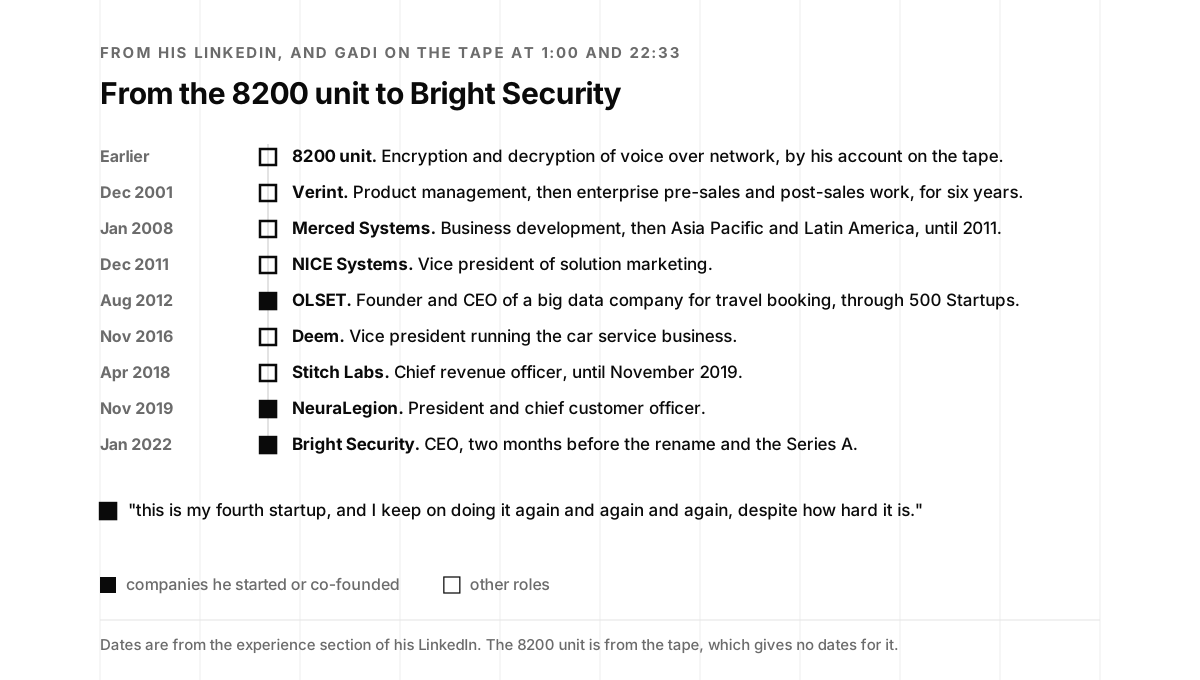
A timeline of nine entries. Earlier, the 8200 unit: encryption and decryption of voice over network, by his account on the tape. December 2001, Verint: product management, then enterprise pre-sales and post-sales work, for six years. January 2008, Merced Systems: business development, then Asia Pacific and Latin America, until 2011. December 2011, NICE Systems: vice president of solution marketing. Filled, August 2012, OLSET: founder and CEO of a big data company for travel booking, through 500 Startups. November 2016, Deem: vice president running the car service business. April 2018, Stitch Labs: chief revenue officer, until November 2019. Filled, November 2019, NeuraLegion: president and chief customer officer. Filled, January 2022, Bright Security: CEO, two months before the rename and the Series A. His line underneath: this is my fourth startup, and I keep on doing it again and again and again, despite how hard it is.
From the 8200 unit to Bright: the roles on Gadi's LinkedIn, and the ones he named on the tape.

An AI fuzzer in 2018

The idea wasn’t Gadi’s, and he said so first.

“So the idea actually came from Bar, who’s our CTO, an experienced both CTO and CISO.”

Gadi Bashvitz, at 1:47

“And he was seeing the writing on the wall that AI is going to start becoming a very interesting thing, way back in 2018.”

Gadi Bashvitz, at 1:53

“And the original idea was, can we create an AI-driven fuzzer that will use biological evolution techniques in order to find zero-day vulnerabilities?”

Gadi Bashvitz, at 2:02

Listen · Gadi on episode 67, from 1:46
About 30 seconds: Gadi on Bar's idea, an AI-driven fuzzer that borrows from biological evolution. The clip stops on its own. Read the full transcript.

Each piece of that sentence has a plain meaning. Fuzzing is an automated testing technique that feeds a program invalid, unexpected or random inputs and watches for crashes and failing assertions (Wikipedia). The name goes back to a 1988 class project in Barton Miller’s graduate operating systems course at the University of Wisconsin, which fed random input to UNIX utilities. Borrowing from biology is an old move in computing too. Evolutionary algorithms reproduce essential elements of biological evolution to solve hard problems (Wikipedia), and a genetic algorithm is one kind, a method inspired by natural selection (Wikipedia). A zero-day is a vulnerability unknown to the people who could fix it (Wikipedia).

Bar Hofesh wrote the company’s own version of this in October 2026. After about a year of research into what he calls bio-mimicry and evolutionary behavior, NeuraLegion released “an AI guided fuzzer way before AI was cool,” a structural fuzzer that needed no dictionary and used an evolutionary algorithm to home in on hard-to-find bugs (Bright Security). The product, NexPloit, won first place as the most interesting technology at Israel’s CyberTech conference in 2019, by Bright’s account. TechCrunch’s account of the company’s start matches: NeuraLegion launched in 2018 with an AI-powered fuzzer that helped developers find and fix potential exploits (TechCrunch).
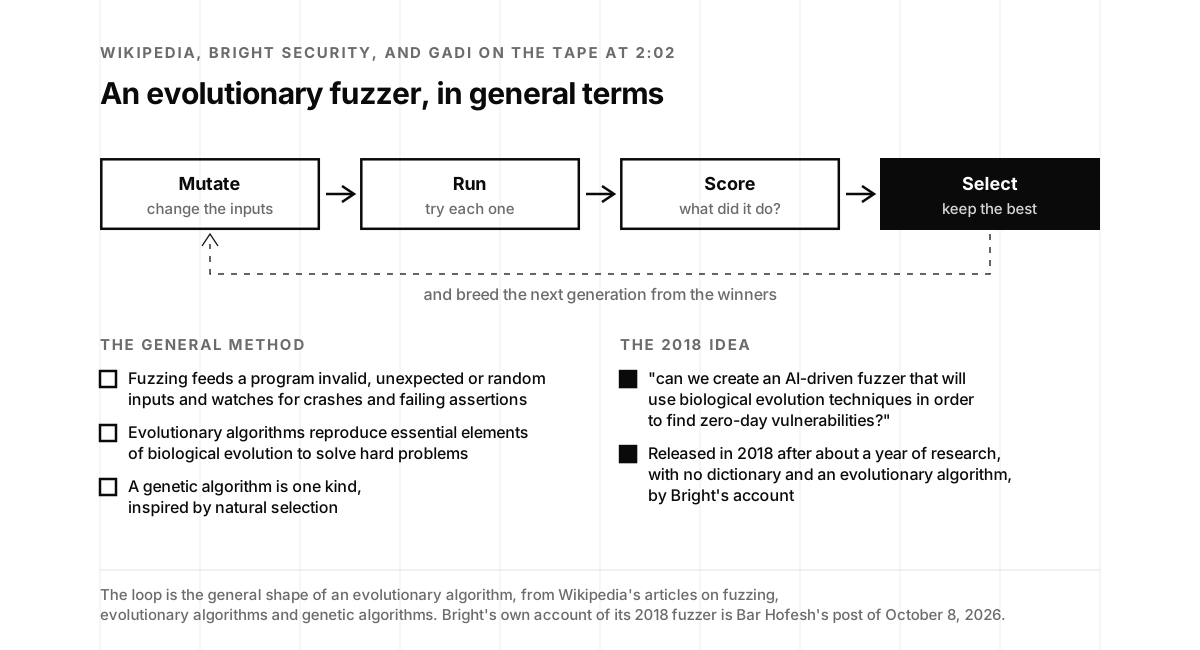
A loop of four boxes: mutate, change the inputs. Run, try each one. Score, what did it do. Filled, select, keep the best. A dashed line returns from select to mutate: and breed the next generation from the winners. Under the general method: fuzzing feeds a program invalid, unexpected or random inputs and watches for crashes and failing assertions. Evolutionary algorithms reproduce essential elements of biological evolution to solve hard problems. A genetic algorithm is one kind, inspired by natural selection. Under the 2018 idea, Gadi's question: can we create an AI-driven fuzzer that will use biological evolution techniques in order to find zero-day vulnerabilities? And: released in 2018 after about a year of research, with no dictionary and an evolutionary algorithm, by Bright's account.
How an evolutionary fuzzer works, in general terms, beside the 2018 idea as Gadi and Bar describe it.

How the founders met got its own moment. Gadi met Bar through Shoham Cohen, the third co-founder and COO.

“And Shoham and I go back to kindergarten.”

Gadi Bashvitz, at 2:23

“That’s awesome. I’ve heard a lot of different ways the founders have met their co-founders, and I think that might be a first.”

Jon McLachlan, at 3:58

Bright’s About Us page lists the three today as co-founder and CEO, co-founder and CTO, and co-founder and COO (Bright Security). When the company renamed itself in 2022, Gadi’s own post named a fourth founder, Art Linkov, alongside them (Bright Security).

Cool technology, no market

The fuzzer was good, and it didn’t sell. Gadi didn’t soften it.

“What we learned in the first couple of years is that, well, we were building really cool technology, that it was cool technology. And unfortunately, the market wasn’t really there, but it was a very small team of people, the fanatics in the positive way, that were very passionate about working together and solving real problems.”

Gadi Bashvitz, at 2:45

He told TechCrunch in 2022 what the problem was. The people who used the original product loved it, he said, but it “crashes any target that it runs against,” so few customers could run it against anything close to production without a lot of coordination (TechCrunch). Bar’s 2026 post adds the other half: the tool drew security agencies and offensive security firms, while the founders wanted to build for enterprise teams. “The only problem was, the world was not yet ready,” he wrote (Bright Security).

So in 2020 they changed direction, toward what customers kept saying. Gadi gave it in the customer’s voice.

“And that was, I’ve been deploying application and API security solutions for many, many years, and yet I’ve not been able to reduce the number of vulnerabilities in my applications, and I’m still getting data breaches, et cetera, et cetera.”

Gadi Bashvitz, at 3:14

“It would be great if there was a solution that could run much earlier in the development lifecycle and have fewer false positives and enabled me to find these vulnerabilities and remediate them before we got into production.”

Gadi Bashvitz, at 3:29

That’s three asks in one sentence: earlier, quieter and fixed before production. The rest of the episode is how Bright went after each one. TechCrunch dates the shift to the company’s 2020 seed round of $4.7 million, by which point it had moved to dynamic application security testing. Bar’s version is shorter: “So we listened to our customers and shifted toward developer-centric DAST.”
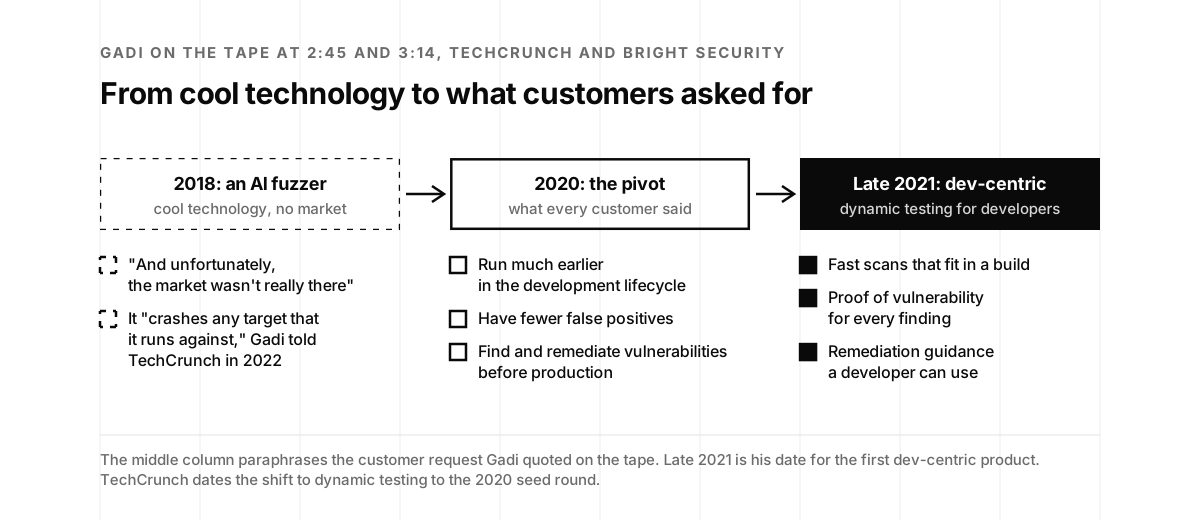
Three boxes joined by arrows. Dashed, 2018: an AI fuzzer, cool technology, no market. Under it: And unfortunately, the market wasn't really there. And: it crashes any target that it runs against, Gadi told TechCrunch in 2022. Outlined, 2020: the pivot, what every customer said. Under it: run much earlier in the development lifecycle, have fewer false positives, find and remediate vulnerabilities before production. Filled, late 2021: dev-centric dynamic testing for developers. Under it: fast scans that fit in a build, proof of vulnerability for every finding, remediation guidance a developer can use.
From cool technology to what customers asked for: the pivot as Gadi and Bright's own posts tell it.

Three problems

Jon asked for the magic sauce, and Gadi answered with the problems first. There were three, and the first was timing.

“by the time I found vulnerabilities with the tools that I have in place, which were either dynamic scanning or real-time protection, et cetera, it was too late.”

Gadi Bashvitz, at 4:59

“The vulnerabilities were already in production. And now I’m playing a defense game instead of an offense game, trying to find them and fix them early on.”

Gadi Bashvitz, at 5:10

The second was noise, from tools that read code before it runs.

“Problem number two was that they were deploying other tools like static analysis, and those had a lot of false positives because they’re looking at the code itself.”

Gadi Bashvitz, at 5:45

“They’re not looking at the compiled code. So you’re not looking at true vulnerabilities that exist in a production environment.”

Gadi Bashvitz, at 5:55

Static application security testing reviews source code to find vulnerabilities (Wikipedia). Dynamic application security testing is a process for finding security weaknesses and vulnerabilities in an application (Wikipedia), and TechCrunch’s 2022 story on Bright spells out the dynamic part: finding vulnerabilities in web apps and APIs “by simulating attacks by outside users” (TechCrunch). A false positive, in any test, is a result that says a condition is present when it isn’t (Wikipedia). For a developer, it’s a ticket for a bug that can’t happen.

The third problem was people, and Gadi said the arrival of AI had made it worse. More on that below.

“But the third problem was really around the fact that engineering practices had changed and application security had not kept up.”

Gadi Bashvitz, at 6:12
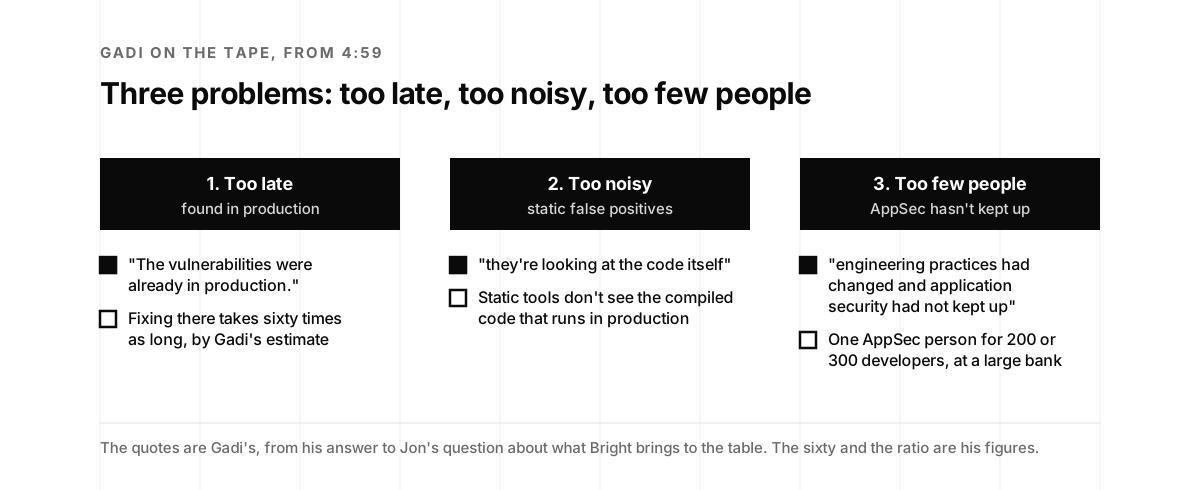
Three filled boxes. One, too late: found in production. Under it: The vulnerabilities were already in production. And: fixing there takes sixty times as long, by Gadi's estimate. Two, too noisy: static false positives. Under it: they're looking at the code itself. And: static tools don't see the compiled code that runs in production. Three, too few people: AppSec hasn't kept up. Under it: engineering practices had changed and application security had not kept up. And: one AppSec person for 200 or 300 developers, at a large bank.
Gadi's three problems, in his words: too late, too noisy, and too few people.

Sixty times longer

The first problem came with a number, and it’s the number the episode is known for.

“There’s also a fact that if you’re finding a vulnerability in production and you’re trying to fix it, it will take you 60x the amount of time to fix it in production, because the developer is no longer in the code.”

Gadi Bashvitz, at 5:19

“They’ve forgotten what’s in there. Sometimes you don’t even know who wrote that code, et cetera.”

Gadi Bashvitz, at 5:30

Listen · Gadi on episode 67, from 5:19
About 25 seconds: Gadi on why a vulnerability found in production takes sixty times as long to fix. The clip stops on its own. Read the full transcript.

Sixty is Gadi’s figure, from his work with customers, and he didn’t cite a study for it. The reason he gave is the part worth keeping, because it doesn’t depend on the multiplier. A fix is fast while the person who wrote the code still has it in their head. Weeks later, someone has to find the code, learn it again and change it without breaking what grew on top of it, and sometimes nobody knows who wrote it.

The practice of moving tests earlier has a name. Shift-left testing means testing earlier in the lifecycle, the first half of the maxim “test early and often,” and Wikipedia credits the term to Larry Smith in 2001 (Wikipedia). Gadi used the idea in 2022 when Bright raised its Series A. For security to shift left, he said in the announcement, “developers need to be comfortable with such tools” (Dark Reading).
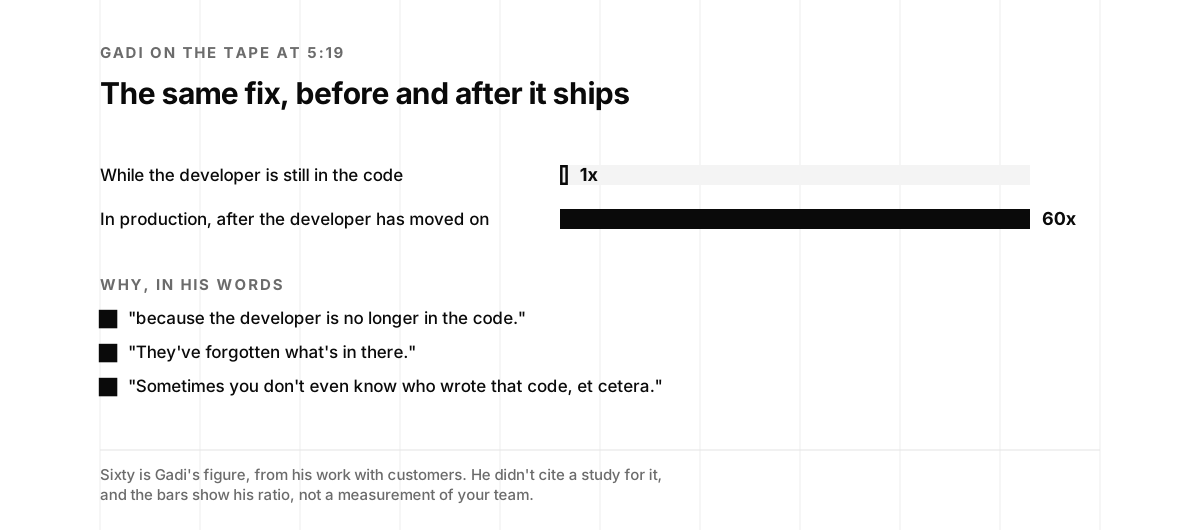
Two bars. While the developer is still in the code: 1x, a short outlined bar. In production, after the developer has moved on: 60x, a full filled bar. Underneath, why, in his words: because the developer is no longer in the code. They've forgotten what's in there. Sometimes you don't even know who wrote that code, et cetera.
The same fix at two points in the lifecycle, using Gadi's multiplier.

One person for two hundred developers

The third problem was arithmetic.

“if you look at a very large financial institution, the ratio between AppSec people and developers is 1 to 200, 1 to 300.”

Gadi Bashvitz, at 6:22

That ratio is Gadi’s, from the banks he sells to. Picture it as a queue. Every developer who needs help with a finding is waiting on the same person, and that person can’t review everything that ships. Gadi said the fix began with a change in how Bright thought about the problem.

“And the big change in our mindset came when we realized that, yes, this is a security concern, but it needs to be addressed as an engineering problem.”

Gadi Bashvitz, at 6:40

“And if you can fix it and address it as an engineering problem, you’ll be able to actually fix it in a much more comprehensive way.”

Gadi Bashvitz, at 6:51

Listen · Gadi on episode 67, from 6:26
About 35 seconds: Gadi on one AppSec person for hundreds of developers, and treating security as an engineering problem. The clip stops on its own. Read the full transcript.

An engineering problem gets engineering answers: put the check where the work happens, make it fast enough that nobody routes around it, and make its output something the person doing the work can act on. The next section is what that meant for a scanner.
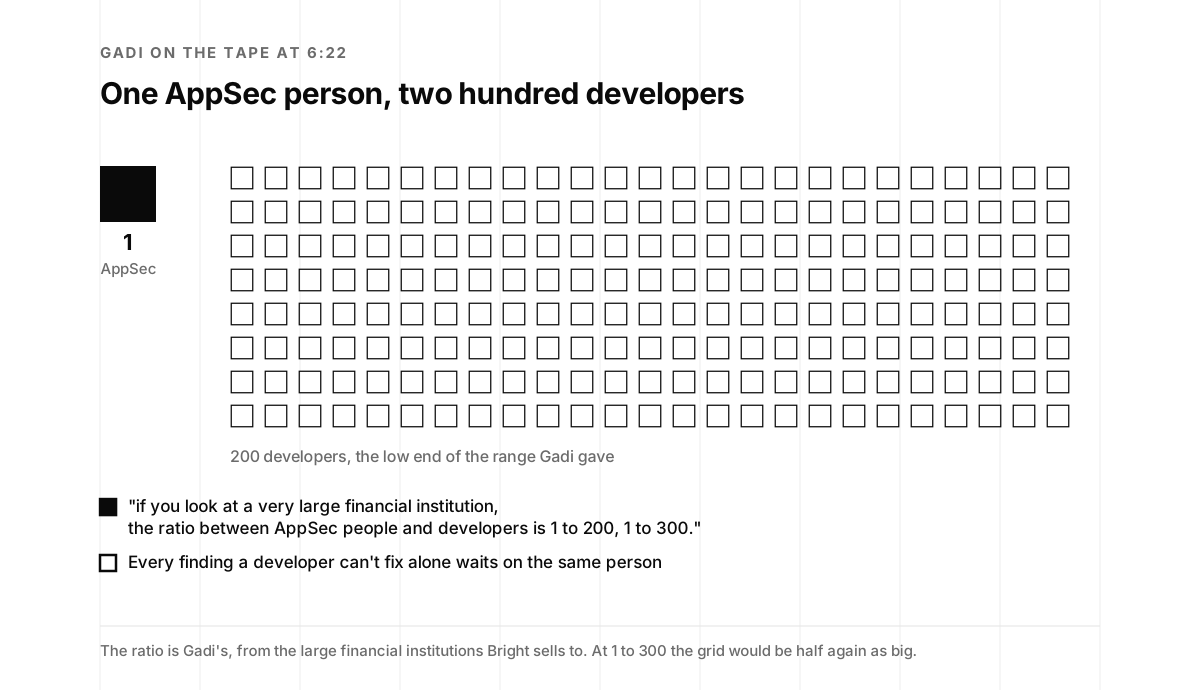
One filled square labeled 1 AppSec, beside a grid of 200 small outlined squares, 25 across and 8 down, labeled 200 developers, the low end of the range Gadi gave. Underneath: if you look at a very large financial institution, the ratio between AppSec people and developers is 1 to 200, 1 to 300. And: every finding a developer can't fix alone waits on the same person.
One AppSec person for every 200 developers, the low end of Gadi's ratio, drawn to scale.

Fifteen minutes, not four days

Doing it as engineering meant breaking rules customers still defend, Gadi said. Bright had to take “a completely new approach that nobody had taken before, ignore all of the rules that existed,” and the argument hasn’t ended.

“And they say, no, it’s impossible. In the last 20 years, it was impossible to do it.”

Gadi Bashvitz, at 7:16

“And that means that instead of running scans to find vulnerabilities that will take three days or four days, no, those scans can only run for 15 minutes. That’s the whole time you have.”

Gadi Bashvitz, at 7:23

Fifteen minutes is about what a step in a build pipeline can take before developers start skipping it. Gadi listed what it takes to fit a dynamic scan into that window.

“You have to separate your discovery from your scanning and make sure that you’re discovering continuously in the background and just running incremental or delta scans.”

Gadi Bashvitz, at 7:36

“You have to only scan for the vulnerabilities that could actually manifest based on the technology.”

Gadi Bashvitz, at 7:46

Listen · Gadi on episode 67, from 7:23
About 25 seconds: Gadi on scans that get fifteen minutes instead of four days. The clip stops on its own. Read the full transcript.

Then he got to the part developers see.

“You have to provide proof of vulnerability for every vulnerability, because, guess what? A developer is not an AppSec specialist.”

Gadi Bashvitz, at 7:54

“They don’t know what it is if you tell them it’s an XSS, right? So you have to give them proof of vulnerability. You have to give them remediation guidelines and really work with them.”

Gadi Bashvitz, at 8:00

XSS is cross-site scripting, a vulnerability that lets an attacker inject scripts into pages other users see (Wikipedia). A proof of vulnerability shows the request that worked and what came back, which turns a label into something a developer can reproduce. Gadi described the same goal when Bright raised its Series A in 2022: “We created a tool that caters to developers as well as AppSec teams” (Dark Reading).

“And that was the initial solution that we launched in late 2021, was really that dev-centric dynamic solution.”

Gadi Bashvitz, at 8:09
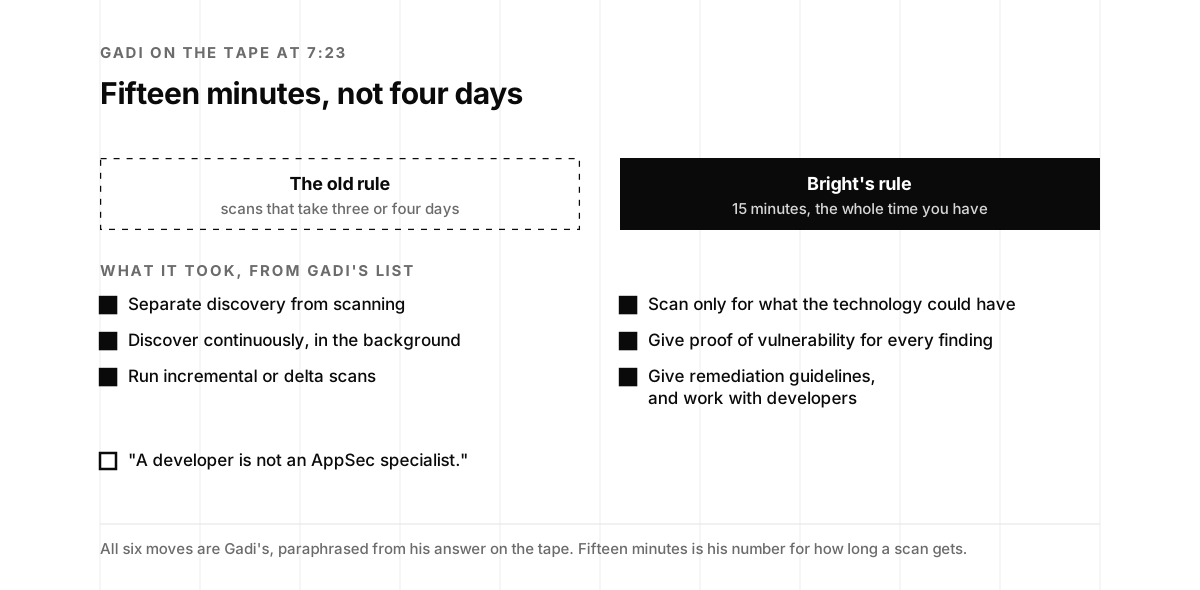
Two boxes. Dashed, the old rule: scans that take three or four days. Filled, Bright's rule: 15 minutes, the whole time you have. What it took, from Gadi's list: separate discovery from scanning. Discover continuously, in the background. Run incremental or delta scans. Scan only for what the technology could have. Give proof of vulnerability for every finding. Give remediation guidelines, and work with developers. Underneath: A developer is not an AppSec specialist.
What fits a dynamic scan into fifteen minutes, from Gadi's list on the tape.

From SRE to DevOps

Sasha answered with a pattern from the operations side of engineering.

“Back in the days, we had the entire organization dedicated to SRE. That used to be the name for the infrastructure engineers, but it turns out it doesn’t really scale, and it doesn’t work for many different reasons.”

Sasha Sinkevich, at 8:23

“Now it’s called DevOps organization, and then you expect that organization to totally support without understanding how the core logic of the application is supposed to function under normal and extreme conditions.”

Sasha Sinkevich, at 8:43

Listen · Sasha on episode 67, from 8:23
About 35 seconds: Sasha on handing applications over the wall to operations, and the same pattern in security. The clip stops on its own. Read the full transcript.

Site reliability engineering is the discipline that monitors and improves the availability and performance of deployed software (Wikipedia), and DevOps is the integration and automation of software development and IT operations (Wikipedia). Sasha’s point was the handoff. The people who run the application don’t know how its core logic is supposed to behave, and security has the same shape.

“There is a very similar pattern in the security space, where you have a bottleneck often.”

Sasha Sinkevich, at 8:59

Sasha described that bottleneck as one engineer reviewing everyone’s source code, and then the dependencies on top of it: “And then, if we talk about the supply chain vulnerabilities, that makes the job of a single engineer extremely difficult.” A supply chain attack goes after the less secure parts of what an organization depends on (Wikipedia). Sasha ended with the line Gadi picked up.

“A lot of tools in the market fail to identify what is actually exploitable, remove the noise, and suggest the appropriate steps based on the good security standards, how to remediate it.”

Sasha Sinkevich, at 9:48
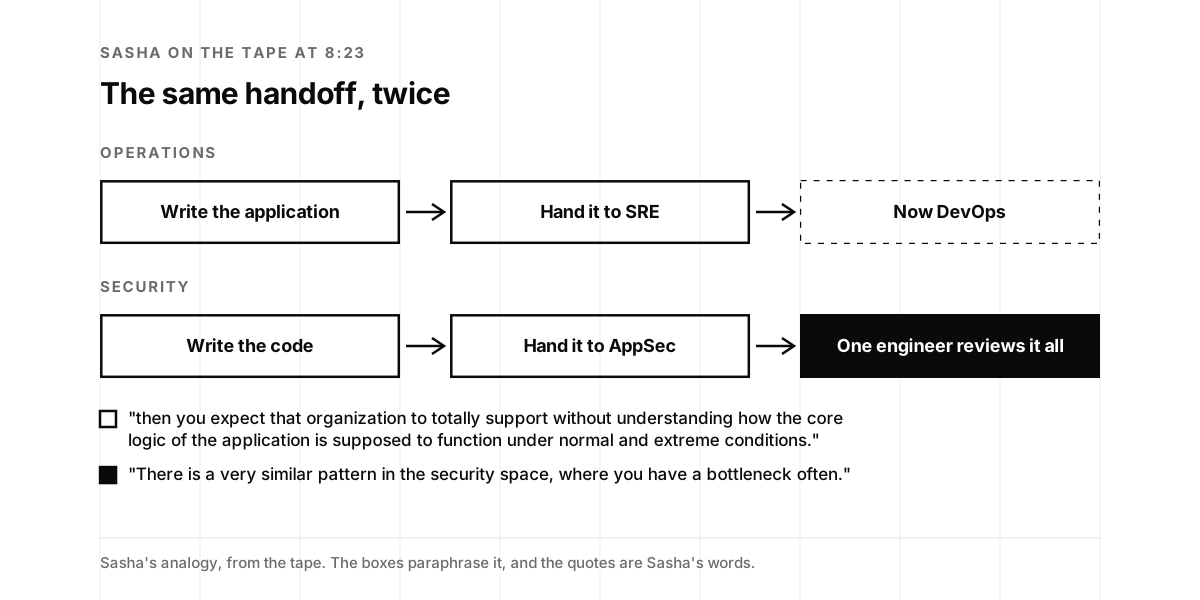
Two rows of three boxes. Operations: write the application, hand it to SRE, now DevOps, dashed. Security: write the code, hand it to AppSec, and filled, one engineer reviews it all. Underneath, Sasha: then you expect that organization to totally support without understanding how the core logic of the application is supposed to function under normal and extreme conditions. And: There is a very similar pattern in the security space, where you have a bottleneck often.
Sasha's analogy: the operations handoff that DevOps fixed, and the security handoff that looks the same.

Listening to what they’re not saying

Gadi said the pivot left the company with a rule.

“When we decided to make the pivot in 2020, we said one of the core values of us as a company that we learned from our failure is we have to make sure that we’re continuously listening to what our customers are saying, in many cases listening to what they’re not saying, but what they really need, and double-click on that and understand that.”

Gadi Bashvitz, at 10:08

His example was a capability Bright released in 2023, aimed at the static analysis tools its customers already owned.

“We have customers that have deployed static analysis tools, whether it’s Checkmarx or Snyk or whatever it is.”

Gadi Bashvitz, at 10:45

“And we realized that one of the biggest problems they have is all the false positives that they’re getting from those static solutions.”

Gadi Bashvitz, at 10:52

Checkmarx is an application security testing company headquartered in Atlanta (Wikipedia), and Snyk is a developer-oriented security company founded in 2015 out of Tel Aviv and London (Wikipedia). Gadi named them as examples of what customers run, not as targets. Bright pulled the results from those tools through an API and tried to reproduce each finding with a dynamic scan. Then he gave the numbers.

“You found 120 vulnerabilities in this application. We were able to run a dynamic scan just looking to correlate those 120. We found 80 of those. By the way, these numbers are from a real customer.”

Gadi Bashvitz, at 11:13

“Out of those 80, we were able to provide proof of vulnerability for 20. And out of those 20, 11 were critical, high, medium.”

Gadi Bashvitz, at 11:30

“So within a couple of hours of getting a result of a static scan, we were able to tell a developer, look, there’s 120 here. These are the 11 you should fix right now.”

Gadi Bashvitz, at 11:39

Listen · Gadi on episode 67, from 11:23
About 35 seconds: Gadi on 120 static findings, 80 confirmed, 20 proven and the 11 to fix right now. The clip stops on its own. Read the full transcript.

Run the arithmetic and the point is plain. Of 120 findings, 11 are about 9%. The other 109, Gadi said, “can go into a different cycle, and they can be dealt with in the longer term.” That doesn’t make them false. It means the 11 with a working exploit and a real severity go first, and the developer gets a list short enough to finish. Bright wrote up the approach in June 2024 as a bridge between static and dynamic testing, in which organizations “harness their existing SAST solutions in tandem with Bright’s DAST” (Bright Security). The post calls it IASTless IAST, after interactive application security testing, a third approach that detects vulnerabilities by interacting with a program, coupled with observation and sensors (Wikipedia).
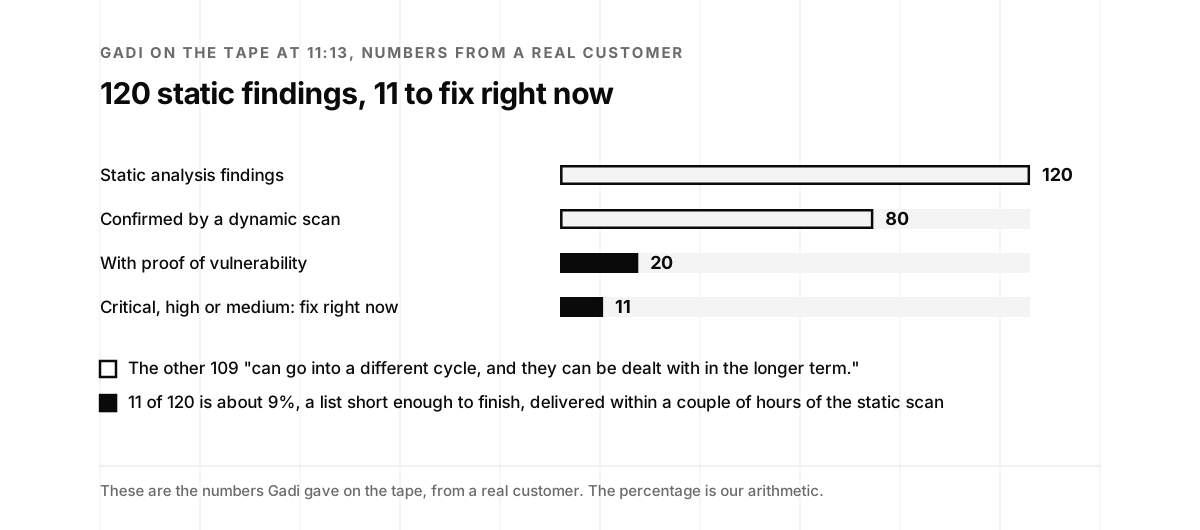
Four bars on one scale. Static analysis findings: 120, outlined. Confirmed by a dynamic scan: 80, outlined. With proof of vulnerability: 20, filled. Critical, high or medium, fix right now: 11, filled. Underneath: the other 109 can go into a different cycle, and they can be dealt with in the longer term. And: 11 of 120 is about 9%, a list short enough to finish, delivered within a couple of hours of the static scan.
Gadi's real-customer numbers: 120 static findings, 80 confirmed, 20 proven, 11 to fix now.

The calculator below runs your own numbers through the same steps.

Technical bugs and business logic

Gadi split the vulnerabilities Bright looks for into two kinds.

“The first part are technical vulnerabilities. So that can be SQL injection and XSS and file upload and file inclusion and all sorts of, like, a very broad set of the OWASP Top 10, whether for APIs or for applications.”

Gadi Bashvitz, at 12:08

“But there’s a whole different set of vulnerabilities that are business logic vulnerabilities, like privilege escalation, that are not technical vulnerabilities.”

Gadi Bashvitz, at 12:23

The first kind has textbook entries. SQL injection slips database commands into an input field (Wikipedia). A file inclusion vulnerability lets an attacker control which file an application executes (Wikipedia). OWASP, the Open Worldwide Application Security Project, is an online community, founded in 2001, that publishes open resources on application security, the Top 10 list among them (Wikipedia).

The second kind lives in the rules of the application. Business logic is the part of a program that encodes the real-world rules for how data can be created, stored and changed (Wikipedia). Privilege escalation is using a bug, a design flaw or a configuration oversight to get access you shouldn’t have (Wikipedia). Nothing in the request looks malformed. A user just reaches a record, a refund or an admin action that the business never meant them to reach. Bright’s 2022 announcement already promised coverage for “both technical and Business Logic Vulnerabilities” (Dark Reading), and Gadi tied that to where the company came from.

“And because of our fuzzing history, we included business logic vulnerabilities very early on in what we deployed, which became the basis of very quickly being able to add LLM vulnerabilities.”

Gadi Bashvitz, at 12:44

OWASP started its Gen AI Security Project in 2023 to extend its Top 10 to the most critical risks of large language models (Wikipedia). The risks are new kinds of input. Prompt injection, for one, uses inputs designed to cause unintended behavior in a large language model (Wikipedia). Gadi expected that list to keep moving.

“And then there’s a debate, are those the right top 10? Are they not? And that’s going to change.”

Gadi Bashvitz, at 13:07

Listen · Gadi on episode 67, from 13:05
About 30 seconds: Gadi on the OWASP Top 10 for LLMs, and why business logic testing made LLM tests quick to add. The clip stops on its own. Read the full transcript.

He tied it back to Sasha’s point: the tests that matter aren’t only technical, and the job isn’t finished when a finding is found. The question, Gadi said, was also “how do you enable organizations to remediate those as well.”
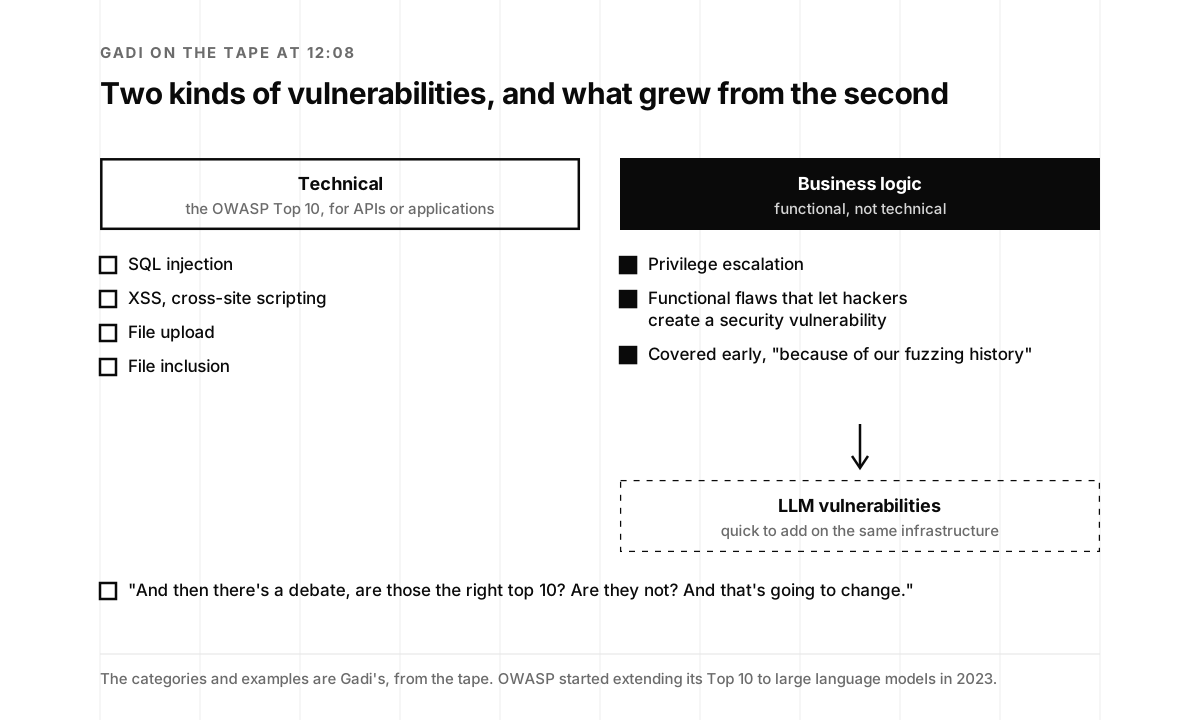
Two boxes. Outlined, technical: the OWASP Top 10, for APIs or applications, with SQL injection, XSS or cross-site scripting, file upload and file inclusion. Filled, business logic: functional, not technical, with privilege escalation, functional flaws that let hackers create a security vulnerability, and covered early, because of our fuzzing history. An arrow leads down from business logic to a dashed box: LLM vulnerabilities, quick to add on the same infrastructure. Underneath: And then there's a debate, are those the right top 10? Are they not? And that's going to change.
Two kinds of vulnerabilities, in Gadi's words, and the LLM tests that grew out of the second.

Who pays and who uses it

Sasha asked who the customer was. Gadi said the answer was moving.

“The answer to your question is a shifting answer, and I’ll explain why.”

Gadi Bashvitz, at 13:55

“Realistically, the budgets are coming from the security world.”

Gadi Bashvitz, at 14:00

“However, more and more we’re seeing that the actual users are the developers.”

Gadi Bashvitz, at 14:14

“So we’re looking at it, and we’re seeing that the AppSec team becomes basically the bookends. They’re the ones that define the strategy. They’re the ones that do the validation and the reporting later.”

Gadi Bashvitz, at 14:19

“But the actual work is being done more and more by developers. It’s integrating into their unit tests, it’s integrating into their CI, and they’re the ones taking action to remediate and fix vulnerabilities.”

Gadi Bashvitz, at 14:30

Listen · Gadi on episode 67, from 14:13
About 30 seconds: Gadi on the AppSec team as the bookends, and developers doing the work. The clip stops on its own. Read the full transcript.

A unit test checks one isolated piece of code against the behavior it should have (Wikipedia), and continuous integration merges changes often and checks the result automatically (Wikipedia). Those are the places developers already look. A security check that lives there gets seen, and one that lives in a separate dashboard waits for the AppSec team. Gadi added that the money was starting to follow the work.

“We’re starting to see a shift in that trend, where, in some cases, the budget starts coming from the CTO office and not from the CISO office, or the chief security officer office.”

Gadi Bashvitz, at 14:42
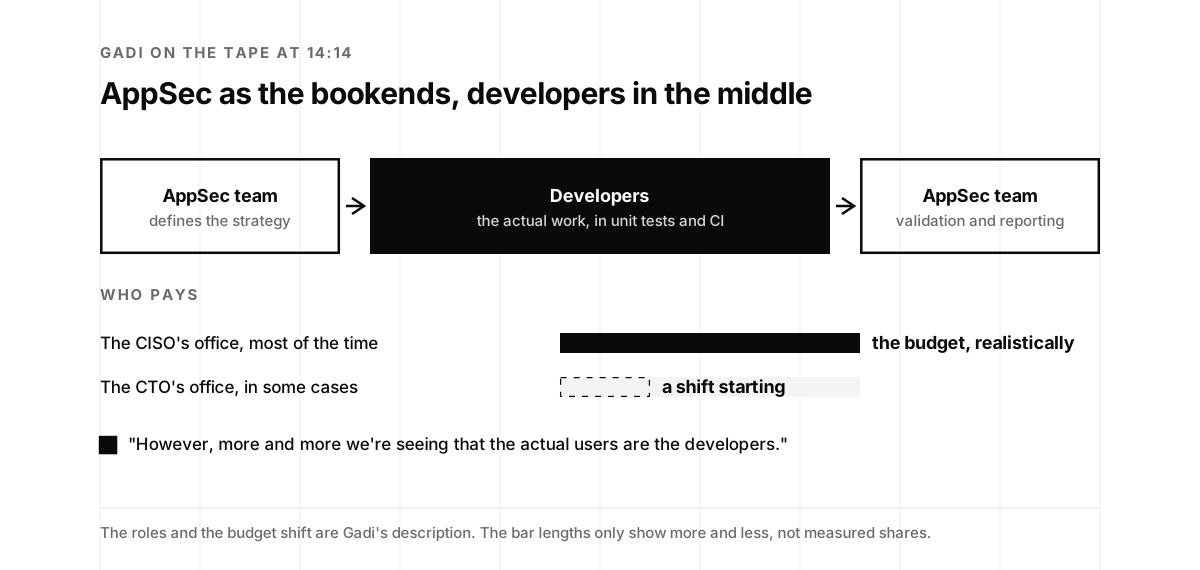
Three boxes in a row. Outlined, AppSec team: defines the strategy. Filled, developers: the actual work, in unit tests and CI. Outlined, AppSec team: validation and reporting. Under who pays: the CISO's office, most of the time, the budget, realistically, a full filled bar. The CTO's office, in some cases, a shift starting, a short dashed bar. Underneath: However, more and more we're seeing that the actual users are the developers.
The AppSec team as the bookends, developers in the middle, and where the budget comes from.

Code nobody wrote

Then he came to the change he’d promised earlier, the one he said had taken the third problem to a new level.

“So if you start looking at tools like GitHub Copilot and Augment AI, right, and other tools like that that are code generation tools, they introduce a whole new challenge into the world that we operate in”

Gadi Bashvitz, at 15:25

GitHub Copilot is the code completion assistant GitHub first announced on June 29, 2021 (Wikipedia). One disclosure here: YSecurity ran Augment’s SOC 2 Type 2 and ISO 42001 programs, and people from Augment have told its story on this show twice, on episode 43 and episode 74. The example was Gadi’s, not ours. His reasoning was about where these tools learned to code.

“And that open source content is not aware of security, which means the code that is being generated by these AI tools is vulnerable. And it’s actually 4x more prone to vulnerabilities than human-generated code.”

Gadi Bashvitz, at 15:55

Listen · Gadi on episode 67, from 15:44
About 25 seconds: Gadi on AI coding tools trained on open source, and why their code needs testing. The clip stops on its own. Read the full transcript.

The 4x figure appears in a Bright blog post from June 2024, which attributes it to Gartner: “AI-generated code is 4X more prone to security vulnerabilities, according to Gartner” (Bright Security). We couldn’t find the Gartner research itself, so read it as Bright’s citation of an analyst number, not as a measurement anyone published in the open. Gartner is a research and advisory firm (Wikipedia). The mechanism Gadi described doesn’t depend on the multiplier: a model learns from the code it was trained on, and much of that code was never written with security in mind.

Unit tests for code you didn’t write

Bright’s answer started with a partnership, by Gadi’s account.

“We started by having an agreement or a partnership with Microsoft in May last year to be able to test AI-generated code that was generated with Copilot.”

Gadi Bashvitz, at 16:13

“we have this component called SecTester in our products that can generate security unit tests, because we realize that developers don’t really understand security, so we need to give them the tool to do that.”

Gadi Bashvitz, at 16:29

The public record has the product side of this. In June 2024 Bright described “Bright for Copilot,” an LLM-powered security unit testing extension for GitHub Copilot that “puts DAST in the hands of developers at the IDE and unit testing levels” (Bright Security). The month before, on May 21, 2024, Microsoft had introduced Copilot Extensions, third-party add-ons for GitHub Copilot, at its Build developer conference (InfoWorld). InfoWorld’s list of launch partners doesn’t include Bright, so the agreement Gadi dated to that May is his account. Microsoft Build is the company’s annual conference for developers, first held in 2011 (Wikipedia).

The pitch to a developer is short.

“You don’t know what’s in that code. It was AI generated, but trust us, we already know what’s in that code.”

Gadi Bashvitz, at 16:59

Bright reads the generated code, tells the developer which security unit tests to run and with which payloads, and the developer runs them. Then they noticed it didn’t have to stop at generated code.

“It’s not just for AI-generated code. It’s for human-generated code as well.”

Gadi Bashvitz, at 17:23

As long as the AI tool sits in the developer’s environment, Gadi said, Bright can guide it on which tests to write for code a person wrote too. Bright’s February 2025 post describes SecTester as its security unit testing library, with support for Go, JavaScript, TypeScript and .NET among other languages (Bright Security).

Fix it, then prove the fix

The last step was the one Gadi called new.

“Let’s be honest. Developers don’t want to sit there and fix vulnerabilities, right?”

Gadi Bashvitz, at 17:47

So Bright goes back to the AI tool and guides it on how to fix what was found. Then it checks.

“But much more importantly, because we’re a dynamic solution, we can then test that that fix actually remediated the security risk.”

Gadi Bashvitz, at 17:59

Listen · Gadi on episode 67, from 17:47
About 30 seconds: Gadi on letting the AI tool write the fix, then testing that the fix worked. The clip stops on its own. Read the full transcript.

That closes the loop the episode started with. A static tool can suggest a fix, but it can’t run the application to see whether the attack still works. A dynamic test can run the same attack again. Gadi was careful about where it stood.

“That last part of auto-remediation and testing it, that’s very, very new. That’s just in some pilot customers right now. Again, it’s planned to be released by the middle of the year.”

Gadi Bashvitz, at 18:19

He started to call it a game changer and said game tester first, then fixed it, and the slip fit the product. “We’re getting into the automated testing and remediation realm, which is super exciting to us,” he said.

It shipped ahead of that schedule. Bright introduced the platform as Bright STAR on February 11, 2025, short for “Security Testing & Automated Remediation” in that post, which lists four steps: generate security unit tests for a codebase, run them, generate fixes with AI, and validate the fixes with the same tests (Bright Security). Bright launched it at RSA Conference 2025 on April 28, where the release spelled the name out as “Autonomous Security Testing and Remediation” (Bright Security). In that release Gadi said customers using it were seeing “automatic remediation rates of approximately 85% of vulnerabilities found.” That’s the company’s own number. The product page now describes a platform that “finds, fixes, and validates real vulnerabilities early in the SDLC” (Bright Security).
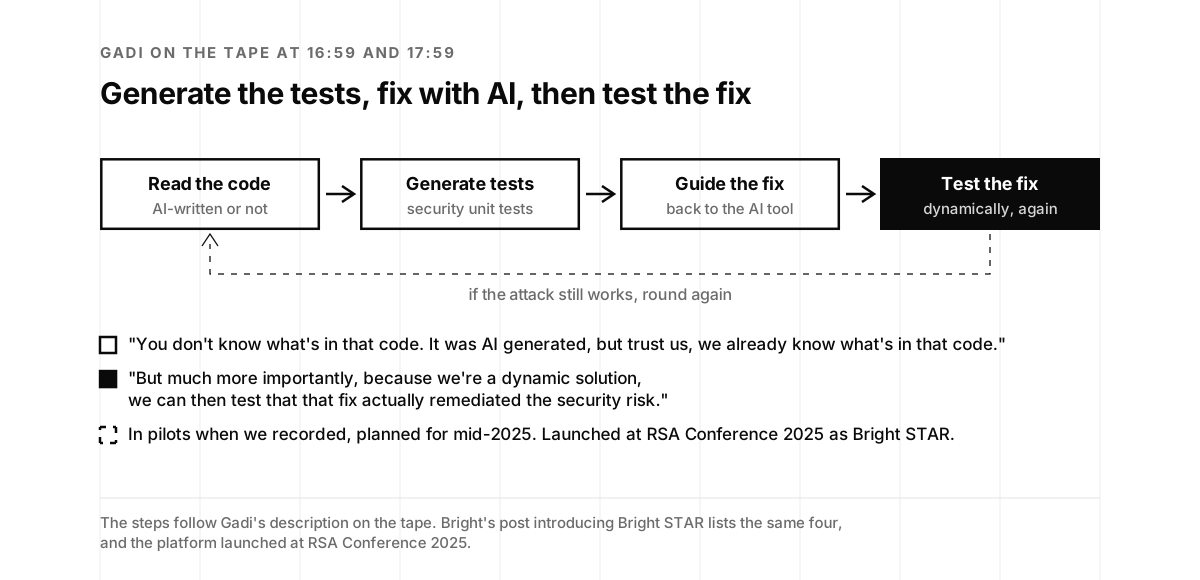
A loop of four boxes: read the code, AI-written or not. Generate tests, security unit tests. Guide the fix, back to the AI tool. Filled, test the fix, dynamically, again. A dashed line returns to the start: if the attack still works, round again. Underneath: You don't know what's in that code. It was AI generated, but trust us, we already know what's in that code. And: But much more importantly, because we're a dynamic solution, we can then test that that fix actually remediated the security risk. And: in pilots when we recorded, planned for mid-2025. Launched at RSA Conference 2025 as Bright STAR.
The loop Gadi described: generate tests, run them, fix with the AI tool, and test the fix.

Enterprises first

Sasha asked whether the traction was with small companies or large ones.

“What do you see the main customer from the SMB or enterprise point of view? What is your biggest traction point in this market?”

Sasha Sinkevich, at 18:44

“So far, it’s definitely been enterprise. So large banks, large financial institutions, leading insurance companies, technology companies”

Gadi Bashvitz, at 18:56

He gave two reasons. Large companies have the most to lose, “understanding that their reputation is so critical to them, that it’s important to find these vulnerabilities early and prevent them from actually manifesting.” And dynamic testing takes setup.

“The other side of it, honestly, is that deploying a dynamic solution is not an easy thing. You need to have the right authentication and the right credentials. You need to be able to get to all of your targets.”

Gadi Bashvitz, at 19:30

A scanner that can’t log in sees the login page and nothing else, and one that can’t reach a service can’t test it. Big organizations have teams to arrange both. Gadi expected the automated version to change who could buy.

“Saying that, I think that as we launch this auto-detect and auto-remediate solution, it’s going to open up the aperture to a lot more organizations to adopt it.”

Gadi Bashvitz, at 19:48

Bright’s 2022 announcement counted developers at more than 4,000 organizations signed up to its cloud service and more than 50 large enterprise customers (Dark Reading). Those numbers are from three years before the recording.

Not yet the proudest moment

Jon thanked Gadi for bringing new technology to old problems, then asked for his proudest moment.

“And I’m super grateful that there are amazingly gifted and talented and smart entrepreneurs willing to take the risk, explore this application of new technology onto some very old problems.”

Jon McLachlan, at 20:02

“I don’t think I’ve gotten to the proudest moment yet. I think we’re still on the journey itself.”

Gadi Bashvitz, at 20:27

He listed the proud moments along the way instead, and the first one wasn’t a signature.

“It’s not landing the customer, that’s the fun, but it’s getting that positive review from that customer is a very proud moment.”

Gadi Bashvitz, at 20:49

Listen · Gadi on episode 67, from 20:35
About 20 seconds: Gadi on a first large customer, and the review that came after it. The clip stops on its own. Read the full transcript.

The reviews he meant were on G2 and Gartner Peer Insights. G2 is a Chicago company that runs an online marketplace and review site for business software (Wikipedia), and Gartner Peer Insights is the review site run by Gartner, the research and advisory firm (Wikipedia). The rest of his list was people: a partner who said the integration made their own product better, and good words from an investor or a team member.

“Getting really good feedback from a partner that we’ve implemented and integrated with, and they said, like, wow, your product really made our solution better with our customers.”

Gadi Bashvitz, at 20:57

Jon liked the answer.

“You feel the hunger to drive and to move forward and to make the world a better place. It’s always in front of us as entrepreneurs.”

Jon McLachlan, at 21:20

Five hundred noes a week

Jon asked for the hardest thing Gadi had done as a founder. The answer wasn’t one event.

“The hardest thing is staying positive and staying consistent no matter what happens, and constantly being tenacious and not giving up.”

Gadi Bashvitz, at 21:43

“And you will hear no 500 times a week, and you just can’t let it affect you.”

Gadi Bashvitz, at 21:53

Listen · Gadi on episode 67, from 21:42
About 40 seconds: Gadi on hearing no all week, and why co-founders you trust matter. The clip stops on its own. Read the full transcript.

He said that’s where co-founders earn their place. Alone it’s much harder, he said, and with co-founders you trust, someone is up when you’re down. The kindergarten friendship from the first section is the long version of that.

“And as long as you can talk about it and support each other, that’s a critical, critical thing that a lot of people underestimate.”

Gadi Bashvitz, at 22:16

Know what you’re getting into

Jon asked what Gadi would tell his younger self. Gadi said he was the wrong person to ask, because he’d done this three times before and knew what he was signing up for. That’s the fourth-startup line from the first section. So his advice went to everyone else.

“Understand that there are no weekends, there are no vacations, there is nothing like that.”

Gadi Bashvitz, at 23:14

“And you’re still concerned about, how do I make payroll tomorrow? Or how do I make payroll next month? Or how do I make payroll in three months?”

Gadi Bashvitz, at 23:40

Listen · Gadi on episode 67, from 23:14
About 35 seconds: Gadi on no weekends, no vacations, and payroll three months out. The clip stops on its own. Read the full transcript.

His bar for being done was specific: “because until you’re a large, profitable company, you haven’t made it.” And he closed the answer the way he opened it.

“I think the advice I would give myself and any other entrepreneur is just know what you’re getting into, because you’re saying goodbye to your weekends and your vacations and anything else like that until you’re on the other side of this journey.”

Gadi Bashvitz, at 23:50

Jon took it from there.

“So speaking of making it worth it, what legacy would you like Bright Security to leave?”

Jon McLachlan, at 24:08

An ounce of prevention

Gadi’s answer started with what hasn’t worked.

“In the end, it’s the understanding of the way we have been doing things just doesn’t work.”

Gadi Bashvitz, at 24:25

He gave the industry credit for real progress, then said the problem isn’t solved, and named the goal he knows is out of reach.

“And I’d like to get to the point where, and I know it’s a utopia because we’re not going to get there”

Gadi Bashvitz, at 24:47

The point he meant is one where vulnerabilities in applications and APIs are a thing of the past.

“That ounce of prevention versus the pound of cure that we have to deploy later.”

Gadi Bashvitz, at 25:00

Listen · Gadi on episode 67, from 24:47
About 25 seconds: Gadi on the ounce of prevention and the pound of cure. The clip stops on its own. Read the full transcript.

It’s the old proverb, and it’s the whole episode in a line. The ounce is a test that runs while the developer is still in the code. The pound is the sixty-times fix, the breach, the incident review. Gadi added Sasha’s point about what tools can’t do by themselves.

“There’s the age-old people, process, technology.”

Gadi Bashvitz, at 25:29

It’s not just the right solutions, Gadi said. Train the people correctly, and have the right processes in place to make sure the work actually gets done. And the legacy he wanted was a measurable one: “we made a dent, right? A lot more organizations are now deploying secure applications and APIs before they get to production.”

Two hundred and fifty Slack messages

Jon asked what tool Gadi wished someone would build, for the founders who listen to the show.

“is there any, like, tool or service that you just wish existed, and someone could just go off and build, like, right now, and you would absolutely be the first customer?”

Jon McLachlan, at 26:03

His first answer was more hours.

“So I would say if somebody was able to find me more time in the day and free up more time somehow, that would be the best tool possible.”

Gadi Bashvitz, at 26:23

His second was a better way to distill what the company says to itself, across sales, marketing, development, product, customer success and the CISO’s team, much of it on Slack and tools like it.

“So understand what is actually important to me from the 250 Slack messages that I get a day and highlight those to me in an effective way.”

Gadi Bashvitz, at 27:11

It’s the same idea as the 120 findings, pointed at a CEO’s inbox: out of everything that arrives, show me the few that matter today.

RSA, BSides and brightsec.com

Sasha asked where listeners could meet Gadi.

“So we were just talking before we started recording on the fact that we are presenting at RSA. We’re sponsoring RSA. We’re sponsoring BSides San Francisco.”

Gadi Bashvitz, at 27:30

RSAC Conference, formerly the RSA Conference, began in 1991 as a small cryptography conference (Wikipedia), and BSides is a series of loosely affiliated security conferences (Wikipedia). He also had regional events in Orlando and Denver on his calendar, and he pointed people to brightsec.com, where Bright posts its events.

What happened after the tape

On air. The episode aired on April 22, 2025 (Podbean), and it’s also on Apple Podcasts and Spotify.

Bright STAR. Six days later, on April 28, 2025, Bright launched Bright STAR at RSA Conference 2025, at booth N-4227 (Bright Security). It was the auto-detect and auto-remediate product Gadi described on the tape, and it arrived ahead of the mid-year date he gave.

A competition and an award. On April 23, 2026, Bright was named the winner of the Google Cloud and Google for Startups AI Competition at HumanX, “outperforming 1,420 AI startups worldwide” by the release’s count, and received the “Next Gen AI Security” award at the Global InfoSec Awards 2026 (PR Newswire). “As AI accelerates development, security must move beyond assumptions,” Gadi said.

GitHub AgentHQ. On June 3, 2026, Bright announced that its agent had been chosen for GitHub AgentHQ (Bright Security), which puts it inside the developer workflow Gadi said the work was moving into.

The fuzzer comes back. On October 8, 2026, Bar Hofesh wrote that “technology has caught up to our original vision” and that Bright was reintroducing the 2018 fuzzer as the Bright STAR Fuzzer (Bright Security). Later that month he posted one of its finds.

One more Bright fuzzer finding, and this one was really cool! 38 bytes turn into a multi-gigabyte memory allocation on the attacked server. taking down a while enterprise site with a tiny picture.

38 bytes. 33 million array entries.

Bar Hofesh · October 25, 2026

Gadi reshared it with a line of his own: it’s important to take an approach that finds unknown vulnerabilities, he wrote, and not just rely on LLMs (LinkedIn). The idea from 2018 that the market wasn’t ready for is back in the product, eight years and one pivot later.
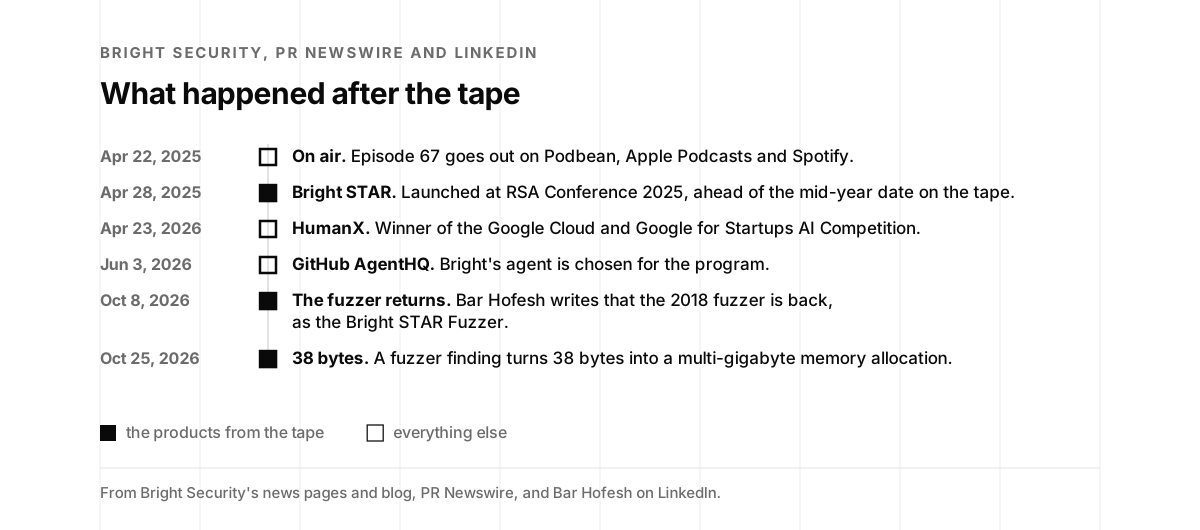
A timeline of six entries. April 22, 2025, on air: episode 67 goes out on Podbean, Apple Podcasts and Spotify. Filled, April 28, 2025, Bright STAR: launched at RSA Conference 2025, ahead of the mid-year date on the tape. April 23, 2026, HumanX: winner of the Google Cloud and Google for Startups AI Competition. June 3, 2026, GitHub AgentHQ: Bright's agent is chosen for the program. Filled, October 8, 2026, the fuzzer returns: Bar Hofesh writes that the 2018 fuzzer is back, as the Bright STAR Fuzzer. Filled, October 25, 2026, 38 bytes: a fuzzer finding turns 38 bytes into a multi-gigabyte memory allocation.
What happened after the tape, from the STAR launch at RSA to the fuzzer's return.

The part of the conversation that aged best is the plainest. Find the bug while the person who wrote it still remembers writing it. Prove it’s real before you ask anyone to fix it. Rank what’s left by whether it can be exploited, not by how many tools flagged it. And when something fixes it for you, a person or an AI tool, run the attack again before you believe it.

Did you catch it? A six-question quiz

Six questions from the episode. Each answer links the moment in the transcript.

Quiz · six questions

Did you catch it?

Pick an answer for each. The explanation shows once you choose.

  1. How much longer did Gadi say it takes to fix a vulnerability found in production?

    1. Twice as long
    2. Sixty times as long
    3. Ten times as long

    b. "it will take you 60x the amount of time to fix it in production" Transcript, 5:25.

  2. What ratio of AppSec people to developers did Gadi describe at a very large financial institution?

    1. 1 to 200, or 1 to 300
    2. 1 to 20
    3. 1 to 2,000

    a. "the ratio between AppSec people and developers is 1 to 200, 1 to 300." Transcript, 6:26.

  3. How long did Gadi say a dynamic scan can run?

    1. Three or four days
    2. An hour
    3. Fifteen minutes

    c. "no, those scans can only run for 15 minutes." Transcript, 7:30.

  4. Of the 120 static findings in Gadi's example, how many did he tell the developer to fix right now?

    1. 80
    2. 11
    3. 20

    b. "These are the 11 you should fix right now." Transcript, 11:46.

  5. Who did Gadi say were becoming the actual users of AppSec tools?

    1. Developers
    2. Auditors
    3. The board

    a. "However, more and more we're seeing that the actual users are the developers." Transcript, 14:14.

  6. What did Gadi say about his proudest moment?

    1. It was closing the Series A
    2. It was the company's rename
    3. He hasn't had it yet

    c. "I don't think I've gotten to the proudest moment yet." Transcript, 20:27.

Still in the code?

Gadi’s test for an AppSec program was when and how it fixes what it finds. Eight questions on how early your team gets there.

Scorecard · eight questions

Still in the code?

Answer for your teams as they work today. If two answers fit, pick the lower one.

  1. Where does your team find most of its vulnerabilities?

    • In production, from a pentest, a bug report or an incident
    • In staging, from a scan before release
    • In the pull request or the build, while the author still has the code open

    "it will take you 60x the amount of time to fix it in production, because the developer is no longer in the code." See Sixty times longer.

  2. What does a developer get along with a security finding?

    • A label and a severity
    • A description and a link to a guide
    • Proof the vulnerability works, plus remediation guidance for their stack

    "So you have to give them proof of vulnerability." See Fifteen minutes, not four days.

  3. How long does the security check in your pipeline take?

    • Hours or days, so it runs outside the pipeline
    • Under an hour, on some builds
    • Minutes, on every build, with incremental scans

    "those scans can only run for 15 minutes. That's the whole time you have." See Fifteen minutes, not four days.

  4. What happens to the findings from your static analysis tool?

    • They pile up in a backlog nobody trusts
    • Someone triages them by hand
    • Each is checked for whether it can be exploited, and the confirmed ones go first

    "These are the 11 you should fix right now." See Listening to what they're not saying.

  5. Do you test for business logic flaws, like one user reaching another user's data?

    • No, only technical bugs
    • In a yearly pentest
    • In automated tests that run with the build

    "But there's a whole different set of vulnerabilities that are business logic vulnerabilities, like privilege escalation, that are not technical vulnerabilities." See Technical bugs and business logic.

  6. How do you test code that AI coding tools write?

    • The same as everything else, or not at all
    • It gets a human code review
    • Security tests are generated for it and run before merge

    "You don't know what's in that code." See Unit tests for code you didn't write.

  7. After a fix, how do you know it worked?

    • We close the ticket
    • A reviewer reads the change
    • The same test or attack runs again and no longer works

    "we can then test that that fix actually remediated the security risk." See Fix it, then prove the fix.

  8. Who does the security work in your engineering teams?

    • Only the security team
    • Security, with developers pulled in for fixes
    • Developers do the work, and security sets the strategy and checks the results

    "So we're looking at it, and we're seeing that the AppSec team becomes basically the bookends." See Who pays and who uses it.

Fixing it in production

Most of what you find, you find late, when it costs the most to fix. Start with one check that runs on every pull request and comes with proof, and route the confirmed findings to the person who wrote the code.

Partly shifted left

Some of your testing runs early and some still waits for staging or a yearly test. Cut the slow scans down to what fits in a build, check static findings for whether they can be exploited, and test the fixes.

Still in the code

Your team finds and fixes most issues while the code is fresh. Keep the checks fast, cover business logic and AI-written code, and make sure every fix gets tested again.

Which of your findings need fixing today?

Gadi’s example came from a real customer: 120 static findings, 80 a dynamic scan could confirm, 20 with proof of vulnerability, 11 critical, high or medium. The defaults below are those numbers as rates. Put in your own, and the hours show what Gadi’s sixty times means for the ones that matter.

Calculator

Which of your findings need fixing today?

Six numbers: your static findings, the share a dynamic scan confirms, the share of those with proof, the share of proven ones that are critical, high or medium, the hours one fix takes while the code is fresh, and the production multiplier.

–confirmed by a dynamic scan
–with proof of vulnerability
–to fix right now
–for a later cycle
–hours to fix them now
–hours if they reach production first

Of 120 static findings, a dynamic scan confirms 80, 20 come with proof, and 11 are critical, high or medium. Fixing those 11 now takes about 22 hours. If they reach production first, the same fixes take about 1,320 hours, and the other 109 can wait for a later cycle.

The first four defaults are Gadi's real-customer example from Listening to what they're not saying, written as rates: 80 of 120 is 67%, 20 of 80 is 25%, 11 of 20 is 55%. The sixty is his multiplier from Sixty times longer. The two hours per fix is an example, not a figure from the episode. Each step rounds to a whole finding.

From a 1988 class project to the STAR Fuzzer

Everything on this page sits on one timeline, from the class project that named fuzzing to Bright bringing its own fuzzer back. Filter it by thread.

Timeline · 1988 to 2026

From a 1988 class project to the STAR Fuzzer

Filter by thread. Dates are from the public record except where marked as part of this show.

  1. Fuzz

    Barton Miller's graduate class at the University of Wisconsin feeds random input to UNIX utilities, the project that gave fuzzing its name (Wikipedia, on this show).

  2. OWASP

    The Open Worldwide Application Security Project is founded (Wikipedia, on this show).

  3. Shift left

    Larry Smith coins the term shift-left testing (Wikipedia, on this show).

  4. Verint

    Gadi starts six years in product management and enterprise engagements (LinkedIn, on this show).

  5. Merced Systems

    He runs business development, then Asia Pacific and Latin America, until 2011 (LinkedIn, on this show).

  6. OLSET

    He founds a big data company for travel booking, and takes it through 500 Startups from October 2013 (LinkedIn, on this show).

  7. NeuraLegion

    The company launches with an AI-guided fuzzer built on an evolutionary algorithm (Bright Security, on this show).

  8. Stitch Labs

    Gadi becomes chief revenue officer, until November 2019 (LinkedIn, on this show).

  9. CyberTech

    The fuzzer, NexPloit, wins first place as the most interesting technology at Israel's CyberTech conference, by Bright's account (Bright Security, on this show).

  10. President and chief customer officer

    Gadi joins NeuraLegion full time (LinkedIn, on this show).

  11. The pivot

    A $4.7 million seed round, and a shift to dynamic testing for developers, with the first dev-centric product out in late 2021 by Gadi's account (TechCrunch, on this show).

  12. GitHub Copilot

    GitHub first announces its AI coding assistant (Wikipedia, on this show).

  13. CEO

    Gadi becomes CEO (LinkedIn, on this show).

  14. Bright Security

    NeuraLegion renames itself and raises a $20 million Series A led by Evolution Equity Partners (Dark Reading, on this show).

  15. OWASP and LLMs

    OWASP starts its Gen AI Security Project to extend the Top 10 to large language models (Wikipedia, on this show).

  16. Checking static findings

    Bright releases its correlation of static findings with dynamic scans, by Gadi's account, written up in June 2024 (Bright Security, on this show).

  17. Copilot Extensions

    Microsoft introduces third-party extensions for GitHub Copilot at Build (InfoWorld, on this show).

  18. Bright for Copilot

    Bright describes its security unit testing extension for GitHub Copilot (Bright Security, on this show).

  19. Fortune Cyber 60

    Bright is named to the 2025 list in the early-stage category (Bright Security, on this show).

  20. The recording

    Jon and Sasha talk with Gadi while auto-remediation is in pilots (on this show).

  21. Bright STAR

    Bright introduces the platform, short for Security Testing and Automated Remediation (Bright Security, on this show).

  22. Episode 67 airs

    The episode goes out on Podbean, Apple Podcasts and Spotify (Podbean, on this show).

  23. STAR at RSA

    Bright launches Bright STAR at RSA Conference 2025 (Bright Security, on this show).

  24. HumanX

    Bright wins the Google Cloud and Google for Startups AI Competition at HumanX (PR Newswire, on this show).

  25. GitHub AgentHQ

    Bright's agent is chosen for GitHub AgentHQ (Bright Security, on this show).

  26. The STAR Fuzzer

    Bar Hofesh writes that the 2018 fuzzer is coming back (Bright Security, on this show).

  27. 38 bytes

    He posts a fuzzer finding that turns 38 bytes into a multi-gigabyte memory allocation (LinkedIn, on this show).

What to do this week

Five things, in the order Gadi’s argument suggests.

  1. Find out where you find things. Pull the last quarter’s security findings and mark where each was found: pull request, build, staging or production. The production share is the one Gadi’s sixty times applies to.
  2. Make the pipeline check fast enough to keep. If a scan takes longer than a build step can, split discovery from scanning and run incremental scans, so it fits in the fifteen minutes Gadi described and nobody turns it off.
  3. Check static findings before you assign them. Take the open findings from your static analysis tool, confirm which ones can be exploited, and send developers the short list with proof. The calculator above shows how short it might be.
  4. Test what AI writes, and test the fix. Add security tests for code from AI coding tools before it merges, and after any fix, run the test or the attack again before you close the ticket. The scorecard covers the rest.
  5. Get help with the parts you can’t staff. One AppSec person can’t cover two hundred developers. Our Secure AI SDLC & Engineering team can build the checks into your pipeline, our AI-Accelerated Vulnerability Remediation Program can burn down the backlog, and you can book 15 minutes with us.

Key takeaways

  1. Find it while the developer is still in the code

    Gadi said a vulnerability found in production takes sixty times as long to fix, by his estimate, because the developer is no longer in the code, has forgotten what's in it, or is gone. The multiplier is his. The reason holds whatever the number is.

  2. Treat AppSec as an engineering problem

    With one AppSec person for 200 or 300 developers at a large bank, by Gadi's count, review doesn't scale. Bright's change of mindset was to treat security as an engineering problem and put the checks where developers already work.

  3. A scan gets fifteen minutes

    Customers told Bright a dynamic scan takes three or four days. Gadi's rule was fifteen minutes, made possible by separating discovery from scanning, discovering continuously and running incremental scans for only what the technology could have.

  4. Every finding needs proof

    A developer isn't an AppSec specialist and doesn't know what an XSS label means. Gadi said every finding needs proof of vulnerability and remediation guidance, so the person fixing it can see it work.

  5. Check static findings before you assign them

    In Gadi's real-customer example, 120 static findings became 80 confirmed by a dynamic scan, 20 with proof and 11 critical, high or medium, within a couple of hours. The other 109 can wait for a later cycle.

  6. Business logic is a second kind of vulnerability

    Technical bugs like SQL injection and XSS are one kind. Business logic flaws like privilege escalation are functional, and Gadi said Bright's fuzzing history made it test for them early, which then made LLM tests quick to add.

  7. The bug list isn't settled

    OWASP has published a Top 10 for large language models, and Gadi expected a debate about whether it's the right ten and expected it to change.

  8. Budgets come from security, users are developers

    Gadi said the budget for AppSec still mostly comes from the CISO's side, while the actual users are developers, and in some cases the budget is starting to come from the CTO's office.

  9. AppSec as the bookends

    The AppSec team defines the strategy and does the validation and reporting, Gadi said. The work in between happens in developers' unit tests and CI.

  10. AI-written code needs its own tests

    Gadi said AI coding tools learned mostly from open source that isn't aware of security, and called their code four times as prone to vulnerabilities. Bright's own blog attributes that figure to Gartner.

  11. Generate the security tests too

    Bright's SecTester generates security unit tests for code a developer didn't write, telling them which tests to run and with which payloads, and the same approach works for code people wrote.

  12. Test the fix, not just the finding

    Developers don't want to fix vulnerabilities, Gadi said, so the AI tool can propose the fix. Because Bright's testing is dynamic, it can run the attack again and show whether the fix remediated the risk.

  13. Dynamic testing takes setup

    Enterprises adopted first, Gadi said, partly because deploying dynamic testing needs authentication, credentials and access to every target, which large organizations can arrange.

  14. Founding is a long run of noes

    The hardest part, Gadi said, is staying positive and consistent while you hear no 500 times a week, and co-founders you trust carry you through the down days.

  15. An ounce of prevention

    Gadi's legacy goal is fewer vulnerabilities reaching production at all, an ounce of prevention instead of a pound of cure, with people, process and technology all in place.

Chapters

Tap a chapter to play from there.

Pull quotes

“If this is a formal recording, then we have to be in our formal bright attire.”

Gadi Bashvitz ·

“Started my way in cyber many, many moons ago when I was in the Israeli military.”

Gadi Bashvitz ·

“But I was the CRO of another company at the time.”

Gadi Bashvitz ·

“So the idea actually came from Bar, who's our CTO, an experienced both CTO and CISO.”

Gadi Bashvitz ·

“And he was seeing the writing on the wall that AI is going to start becoming a very interesting thing, way back in 2018.”

Gadi Bashvitz ·

“And the original idea was, can we create an AI-driven fuzzer that will use biological evolution techniques in order to find zero-day vulnerabilities?”

Gadi Bashvitz ·

“And Shoham and I go back to kindergarten.”

Gadi Bashvitz ·

“And unfortunately, the market wasn't really there, but it was a very small team of people, the fanatics in the positive way, that were very passionate about working together and solving real problems.”

Gadi Bashvitz ·

“It would be great if there was a solution that could run much earlier in the development lifecycle and have fewer false positives and enabled me to find these vulnerabilities and remediate them before we got into production.”

Gadi Bashvitz ·

“That's awesome. I've heard a lot of different ways the founders have met their co-founders, and I think that might be a first.”

Jon McLachlan ·

“And so what's the magic sauce that Bright brings to the table?”

Jon McLachlan ·

“The vulnerabilities were already in production. And now I'm playing a defense game instead of an offense game, trying to find them and fix them early on.”

Gadi Bashvitz ·

“There's also a fact that if you're finding a vulnerability in production and you're trying to fix it, it will take you 60x the amount of time to fix it in production, because the developer is no longer in the code.”

Gadi Bashvitz ·

“They've forgotten what's in there. Sometimes you don't even know who wrote that code, et cetera.”

Gadi Bashvitz ·

“Problem number two was that they were deploying other tools like static analysis, and those had a lot of false positives because they're looking at the code itself.”

Gadi Bashvitz ·

“But the third problem was really around the fact that engineering practices had changed and application security had not kept up.”

Gadi Bashvitz ·

“And the big change in our mindset came when we realized that, yes, this is a security concern, but it needs to be addressed as an engineering problem.”

Gadi Bashvitz ·

“And that means that instead of running scans to find vulnerabilities that will take three days or four days, no, those scans can only run for 15 minutes. That's the whole time you have.”

Gadi Bashvitz ·

“You have to separate your discovery from your scanning and make sure that you're discovering continuously in the background and just running incremental or delta scans.”

Gadi Bashvitz ·

“You have to provide proof of vulnerability for every vulnerability, because, guess what? A developer is not an AppSec specialist.”

Gadi Bashvitz ·

“They don't know what it is if you tell them it's an XSS, right? So you have to give them proof of vulnerability. You have to give them remediation guidelines and really work with them.”

Gadi Bashvitz ·

“Back in the days, we had the entire organization dedicated to SRE.”

Sasha Sinkevich ·

“There is a very similar pattern in the security space, where you have a bottleneck often.”

Sasha Sinkevich ·

“A lot of tools in the market fail to identify what is actually exploitable, remove the noise, and suggest the appropriate steps based on the good security standards, how to remediate it.”

Sasha Sinkevich ·

“Yeah, I think you're touching on a critical point, and it's really interesting how we learned along the way, right?”

Gadi Bashvitz ·

“And we realized that one of the biggest problems they have is all the false positives that they're getting from those static solutions.”

Gadi Bashvitz ·

“You found 120 vulnerabilities in this application. We were able to run a dynamic scan just looking to correlate those 120. We found 80 of those. By the way, these numbers are from a real customer.”

Gadi Bashvitz ·

“Out of those 80, we were able to provide proof of vulnerability for 20. And out of those 20, 11 were critical, high, medium.”

Gadi Bashvitz ·

“These are the 11 you should fix right now.”

Gadi Bashvitz ·

“The other 109 can go into a different cycle, and they can be dealt with in the longer term.”

Gadi Bashvitz ·

“But there's a whole different set of vulnerabilities that are business logic vulnerabilities, like privilege escalation, that are not technical vulnerabilities.”

Gadi Bashvitz ·

“And because of our fuzzing history, we included business logic vulnerabilities very early on in what we deployed, which became the basis of very quickly being able to add LLM vulnerabilities.”

Gadi Bashvitz ·

“And then there's a debate, are those the right top 10? Are they not? And that's going to change.”

Gadi Bashvitz ·

“Who do you see as your main customer for this product?”

Sasha Sinkevich ·

“Realistically, the budgets are coming from the security world.”

Gadi Bashvitz ·

“However, more and more we're seeing that the actual users are the developers.”

Gadi Bashvitz ·

“So we're looking at it, and we're seeing that the AppSec team becomes basically the bookends.”

Gadi Bashvitz ·

“We're starting to see a shift in that trend, where, in some cases, the budget starts coming from the CTO office and not from the CISO office, or the chief security officer office.”

Gadi Bashvitz ·

“And that open source content is not aware of security, which means the code that is being generated by these AI tools is vulnerable.”

Gadi Bashvitz ·

“And it's actually 4x more prone to vulnerabilities than human-generated code.”

Gadi Bashvitz ·

“You don't know what's in that code. It was AI generated, but trust us, we already know what's in that code.”

Gadi Bashvitz ·

“It's not just for AI-generated code. It's for human-generated code as well.”

Gadi Bashvitz ·

“Let's be honest. Developers don't want to sit there and fix vulnerabilities, right?”

Gadi Bashvitz ·

“But much more importantly, because we're a dynamic solution, we can then test that that fix actually remediated the security risk.”

Gadi Bashvitz ·

“That last part of auto-remediation and testing it, that's very, very new. That's just in some pilot customers right now.”

Gadi Bashvitz ·

“So far, it's definitely been enterprise.”

Gadi Bashvitz ·

“The other side of it, honestly, is that deploying a dynamic solution is not an easy thing.”

Gadi Bashvitz ·

“Saying that, I think that as we launch this auto-detect and auto-remediate solution, it's going to open up the aperture to a lot more organizations to adopt it.”

Gadi Bashvitz ·

“I'm curious, though, Gadi, would you pick out a moment as your proudest moment along your journey?”

Jon McLachlan ·

“I don't think I've gotten to the proudest moment yet. I think we're still on the journey itself.”

Gadi Bashvitz ·

“It's not landing the customer, that's the fun, but it's getting that positive review from that customer is a very proud moment.”

Gadi Bashvitz ·

“The hardest thing is staying positive and staying consistent no matter what happens, and constantly being tenacious and not giving up.”

Gadi Bashvitz ·

“And you will hear no 500 times a week, and you just can't let it affect you.”

Gadi Bashvitz ·

“Understand that there are no weekends, there are no vacations, there is nothing like that.”

Gadi Bashvitz ·

“Or how do I make payroll in three months?”

Gadi Bashvitz ·

“So speaking of making it worth it, what legacy would you like Bright Security to leave?”

Jon McLachlan ·

“That ounce of prevention versus the pound of cure that we have to deploy later.”

Gadi Bashvitz ·

“There's the age-old people, process, technology.”

Gadi Bashvitz ·

“So I would say if somebody was able to find me more time in the day and free up more time somehow, that would be the best tool possible.”

Gadi Bashvitz ·

“So understand what is actually important to me from the 250 Slack messages that I get a day and highlight those to me in an effective way.”

Gadi Bashvitz ·

“We have a lot of awesome audience. Where can people meet you in person soon?”

Sasha Sinkevich ·

About the guest

Gadi Bashvitz, Co-founder and Chief Executive Officer, Bright Security

Gadi Bashvitz is the co-founder and CEO of Bright Security, which makes dynamic application security testing for developers. He started in the Israeli military's 8200 unit, by his account on the tape, then spent six years in product management and enterprise work at Verint, ran business development and then Asia Pacific and Latin America at Merced Systems, and was vice president of solution marketing at NICE Systems. He founded OLSET, a big data company for travel booking, in 2012 and took it through 500 Startups, ran Deem's car service business, and was chief revenue officer of Stitch Labs from 2018 to 2019. He joined NeuraLegion as president and chief customer officer in November 2019 and became CEO in January 2022, two months before the company renamed itself Bright Security and raised a $20 million Series A. On the episode he explains why fixing a vulnerability in production costs sixty times as much by his estimate, proof of vulnerability, fifteen-minute scans, checking static findings with dynamic tests, AI-generated code and testing the fix.

About the host

Jon McLachlan and Sasha Sinkevich are co-founders of YSecurity, the on-demand cybersecurity team for startups, and of Cyberbase.ai. The Security Podcast of Silicon Valley is hosted by Jon McLachlan and Sasha Sinkevich. Jon McLachlan on LinkedIn ↗Sasha Sinkevich on LinkedIn ↗

Context and sources

  • Gadi Bashvitz on LinkedIn: CEO of Bright Security from January 2022, president and chief customer officer of NeuraLegion from November 2019 to March 2022, chief revenue officer of Stitch Labs from April 2018 to November 2019, Deem from November 2016, founder and CEO of OLSET from August 2012 (500 Startups from October 2013), NICE Systems from December 2011, Merced Systems from January 2008 and Verint from December 2001. Source ↗
  • Bright Security, About Us: Gadi Bashvitz co-founder and CEO, Bar Hofesh co-founder and CTO, Shoham Cohen co-founder and COO, and the board. Source ↗
  • Gadi Bashvitz, The Future is Bright, March 1, 2022: the rename from NeuraLegion to Bright Security, founders Shoham Cohen, Bar Hofesh, Art Linkov and Gadi, a $20 million round led by Evolution Equity Partners that brought total funding to a bit over $25 million, and a developer-first DAST tool. Source ↗
  • Dark Reading (a PR Newswire release), NeuraLegion Rebrands as Bright Security, March 2, 2022: the $20 million Series A led by Evolution Equity Partners with DNX Ventures, J-ventures, Fusion Fund and Incubate Fund, Gadi CEO from January, developers at more than 4,000 organizations and more than 50 large enterprise customers. Source ↗
  • TechCrunch, NeuraLegion becomes Bright Security and raises $20M Series A, March 2, 2022: launched in 2018 with an AI-powered fuzzer that crashed any target it ran against, a $4.7 million seed round in 2020 by which time it had shifted to dynamic application security testing. Source ↗
  • Bar Hofesh, Back to the Fuzzer: The Future of Vulnerability Discovery Was Built in 2018, October 8, 2026: the 2018 AI-guided fuzzer built on an evolutionary algorithm, first place at CyberTech 2019, the shift to developer-centric DAST, and the Bright STAR Fuzzer. Source ↗
  • Bar Hofesh, IASTless IAST: The SAST to DAST Bridge, June 19, 2024: using customers' existing SAST results with Bright's DAST. Source ↗
  • Bar Hofesh, Bringing DAST Security to AI Generated Code, June 10, 2024: Bright for Copilot, a security unit testing extension for GitHub Copilot, and the 4X figure the post attributes to Gartner. Source ↗
  • InfoWorld, Microsoft unveils third-party extensions for GitHub Copilot, May 21, 2024: Copilot Extensions introduced at Build 2024. Source ↗
  • Bar Hofesh, Bright Introduces Bright STAR: The Future of AppSec, February 11, 2025: Security Testing and Automated Remediation, built on the SecTester security unit testing library. Source ↗
  • Bright Security, Bright Security Unveils Bright STAR at RSA Conference 2025, April 28, 2025. Source ↗
  • Bright Security, Bright STAR product page. Source ↗
  • Bright Security, Bright Security Named to Fortune Cyber 60 2025, October 30, 2024. Source ↗
  • PR Newswire, Bright Security Wins Google for Startups AI Competition and Secures Next Gen AI Security Award, April 23, 2026. Source ↗
  • Bright Security, Bright Agent has been chosen for GitHub AgentHQ, June 3, 2026. Source ↗
  • Bar Hofesh on LinkedIn, October 25, 2026: a Bright fuzzer finding that turns 38 bytes into a multi-gigabyte memory allocation. Source ↗
  • Source ↗
  • Source ↗
  • Source ↗
  • Source ↗
  • Source ↗
  • Source ↗
  • Source ↗
  • Source ↗
  • Source ↗
  • Source ↗
  • Source ↗
  • Source ↗
  • Source ↗
  • Source ↗
  • Source ↗
  • Source ↗
  • Source ↗
  • Source ↗
  • Source ↗
  • Source ↗
  • Source ↗
  • Source ↗
  • Source ↗
  • Source ↗
  • Source ↗
  • Source ↗
  • Source ↗
  • Source ↗
  • Source ↗
  • Source ↗
  • Source ↗
  • Source ↗
  • Source ↗

Transcript

Automatic transcription. Jon McLachlan and Sasha Sinkevich host this episode with Gadi Bashvitz. There is no diarization on the tape, so speaker labels were assigned from the content and checked passage by passage against reference recordings of each voice from this episode and by pitch, and a few short lines may sit with the wrong speaker. Names and terms were normalized where the recognizer misheard them (Jon McLachlan, Sasha Sinkevich, Gadi Bashvitz, NeuraLegion, Shoham, Bar, SecTester, Checkmarx, Snyk, OWASP, XSS, DAST, AppSec). Words in [brackets] are best guesses where the audio is unclear. Answers are transcribed as spoken, with repeated words and false starts trimmed. Short backchannels such as "yeah", "right" and "mm-hmm" are left out where they overlap the other speaker.

Read the full transcript 4,640 words

Jon McLachlan

Hello, everyone, and welcome to another episode of The Security Podcast of Silicon Valley. I'm one of the hosts, Jon McLachlan. I'm joined with our other hosts, Sasha Sinkevich. And today we have a very special guest, Gadi Bashvitz, the co-founder and CEO of Bright Security.

Gadi Bashvitz

Hey Jon, hey Sasha, thanks for having me.

Jon McLachlan

I love the jacket. It's very bright.

Gadi Bashvitz

[That's what] we said. If this is a formal recording, then we have to be in our formal bright attire.

Jon McLachlan

Thank you so much for joining us on the show. And to share a little bit with our listeners about your background, maybe you'd like to share with us your story of what inspired you to start Bright Security.

Gadi Bashvitz

Perfect. So I'll go back into just a bit of history. Started my way in cyber many, many moons ago when I was in the Israeli military. I grew up in a bunch of different countries and moved to the US more than 20 years ago. But I was in the 8200 unit, dealing with all sorts of fun stuff around encryption and decryption of voice over network, if those of you who are old enough to remember, the predecessor of voice over IP. And that's really where I started my career, and have held many different roles since then. But in 2018, when we started NeuraLegion, which was the predecessor of Bright, we changed our name, we changed our focus, we made a major pivot in 2020. But I was the CRO of another company at the time. We were just about to sell that company, and I started discussions with my two co-founders, Shoham and Bar, who had an idea. So the idea actually came from Bar, who's our CTO, an experienced both CTO and CISO. And he was seeing the writing on the wall that AI is going to start becoming a very interesting thing, way back in 2018. And the original idea was, can we create an AI-driven fuzzer that will use biological evolution techniques in order to find zero-day vulnerabilities? Really cool idea. We all jumped in. So I met Bar through Shoham. Shoham is our third co-founder. He's our COO. And Shoham and I go back to kindergarten. So we've known each other for 40x years. So it's been a while. And they came up with this initial idea. We said, yep, sounds good. Let's partner on this. And that was the original reason for starting the company. What we learned in the first couple of years is that, well, we were building really cool technology, that it was cool technology. And unfortunately, the market wasn't really there, but it was a very small team of people, the fanatics in the positive way, that were very passionate about working together and solving real problems. And we decided to make a pivot in 2020 and address a very significant problem that we were hearing from every customer that we spoke with, basically. And that was, I've been deploying application and API security solutions for many, many years, and yet I've not been able to reduce the number of vulnerabilities in my applications, and I'm still getting data breaches, et cetera, et cetera. It would be great if there was a solution that could run much earlier in the development lifecycle and have fewer false positives and enabled me to find these vulnerabilities and remediate them before we got into production. And that's what we decided to pivot to in 2020, and the whole journey has evolved from there. That's to your question, how did we get here? That's the origin story. The origin story that goes all the way back to kindergarten.

Jon McLachlan

That's awesome. I've heard a lot of different ways the founders have met their co-founders, and I think that might be a first.

Gadi Bashvitz

We started, yeah, it took a few years to get there.

Jon McLachlan

Amazing. So during that pivot, you mentioned that you pivoted in 2020, and you really, it sounded like you moved from a place where you focused on amazing technology, super hard problem, and you focus a little bit more on what was being asked in the marketplace. And what was being asked in the marketplace, what I, if I heard correctly, was, hey, I've got all these false positives, I do all of this hard work, I can't really seem to reap a benefit from all of this investment that I'm just pouring into the product and the life cycles. And so what's the magic sauce that Bright brings to the table?

Gadi Bashvitz

Yeah, I think the problem itself was an interesting one, right? The problems they were seeing were, one, by the time I found vulnerabilities with the tools that I have in place, which were either dynamic scanning or real-time protection, et cetera, it was too late. The vulnerabilities were already in production. And now I'm playing a defense game instead of an offense game, trying to find them and fix them early on. There's also a fact that if you're finding a vulnerability in production and you're trying to fix it, it will take you 60x the amount of time to fix it in production, because the developer is no longer in the code. They've forgotten what's in there. Sometimes you don't even know who wrote that code, et cetera. It'll take you 60x longer to fix it in production versus fixing it while you're developing and in the development lifecycle. So that was problem number one. Problem number two was that they were deploying other tools like static analysis, and those had a lot of false positives because they're looking at the code itself. They're not looking at the compiled code. So you're not looking at true vulnerabilities that exist in a production environment. And the third problem was that we changed, and by the way, this problem has taken on a completely new level to it with the advent of AI, so we'll talk about that in a second. But the third problem was really around the fact that engineering practices had changed and application security had not kept up. And what you end up having in these organizations, if you look at a very large financial institution, the ratio between AppSec people and developers is 1 to 200, 1 to 300. But there are 200 other people that are waiting for them to help and help them remediate that. And the big change in our mindset came when we realized that, yes, this is a security concern, but it needs to be addressed as an engineering problem. And if you can fix it and address it as an engineering problem, you'll be able to actually fix it in a much more comprehensive way. And in order to do that, we had to take a completely new approach that nobody had taken before, ignore all of the rules that existed. And this is still a discussion we're having with customers. A lot of times we'll talk to organizations, to prospect customers, and tell them, no, this is how you should do it. And they say, no, it's impossible. In the last 20 years, it was impossible to do it. And we said, no, that's why we thought about it differently. And that means that instead of running scans to find vulnerabilities that will take three days or four days, no, those scans can only run for 15 minutes. That's the whole time you have. So how do you get there? You have to separate your discovery from your scanning and make sure that you're discovering continuously in the background and just running incremental or delta scans. You have to only scan for the vulnerabilities that could actually manifest based on the technology. So there's a lot of changes that you need to make. You have to provide proof of vulnerability for every vulnerability, because, guess what? A developer is not an AppSec specialist. They don't know what it is if you tell them it's an XSS, right? So you have to give them proof of vulnerability. You have to give them remediation guidelines and really work with them. And that was the initial solution that we launched in late 2021, was really that dev-centric dynamic solution. And we built a whole platform on top of that. So it was taking a very different approach than what people had taken before.

Sasha Sinkevich

Back in the days, we had the entire organization dedicated to SRE. That used to be the name for the infrastructure engineers, but it turns out it doesn't really scale, and it doesn't work for many different reasons. It's an organization, you write an application and you hand it over to the SRE. Now it's called DevOps organization, and then you expect that organization to totally support without understanding how the core logic of the application is supposed to function under normal and extreme conditions. There is a very similar pattern in the security space, where you have a bottleneck often. And I think you mentioned that in your earliest statement, that you have a single engineer who might be dedicated to the application security, and you have this huge overload of reviewing the source code and trying to find security vulnerabilities in the source code. And then, if we talk about the supply chain vulnerabilities, that makes the job of a single engineer extremely difficult, because in order to be extremely fluent and educated in your research, you have to understand the logic of that source code, and then you can do your investigation. That's how ideally it should work. But you're absolutely right. A lot of tools in the market fail to identify what is actually exploitable, remove the noise, and suggest the appropriate steps based on the good security standards, how to remediate it.

Gadi Bashvitz

Yeah, I think you're touching on a critical point, and it's really interesting how we learned along the way, right? When we decided to make the pivot in 2020, we said one of the core values of us as a company that we learned from our failure is we have to make sure that we're continuously listening to what our customers are saying, in many cases listening to what they're not saying, but what they really need, and double-click on that and understand that. I'll give you an example. One of the capabilities we released in 2023 was exactly to the point that you're mentioning. And that is, we have customers that are using our solution for dynamic analysis. We have customers that have deployed static analysis tools, whether it's Checkmarx or Snyk or whatever it is. And we realized that one of the biggest problems they have is all the false positives that they're getting from those static solutions. So we integrated with those tools. We get an API from them where they give us all the results from a scan that they ran, and we try to correlate all of those findings. And we say, okay, great. You found 120 vulnerabilities in this application. We were able to run a dynamic scan just looking to correlate those 120. We found 80 of those. By the way, these numbers are from a real customer. So we found 80 and were able to correlate those 80. Out of those 80, we were able to provide proof of vulnerability for 20. And out of those 20, 11 were critical, high, medium. So within a couple of hours of getting a result of a static scan, we were able to tell a developer, look, there's 120 here. These are the 11 you should fix right now. The other 109 can go into a different cycle, and they can be dealt with in the longer term. But these are the 11 that are medium, high, critical, and they exist in your production environment. Go fix them right now. When you're looking at the set of vulnerabilities that you can find, those vulnerabilities really divide into two key parts. The first part are technical vulnerabilities. So that can be SQL injection and XSS and file upload and file inclusion and all sorts of, like, a very broad set of the OWASP Top 10, whether for APIs or for applications. But there's a whole different set of vulnerabilities that are business logic vulnerabilities, like privilege escalation, that are not technical vulnerabilities. They are functional vulnerabilities, but they enable hackers to, or unlawful actors to create a security vulnerability because of them. And because of our fuzzing history, we included business logic vulnerabilities very early on in what we deployed, which became the basis of very quickly being able to add LLM vulnerabilities. So there are unique sets of LLM vulnerabilities that, and OWASP has now released the Top 10 for LLMs. And then there's a debate, are those the right top 10? Are they not? And that's going to change. So the key thing is that because we had these abilities, or we had already built all the infrastructure to run scans for business logic vulnerabilities, we were very quickly able to add all of the LLM vulnerability tests that are relevant for the application and API layer, which was really, really cool. So we were able to very quickly release a solution. But it touches on that broader set that you brought up, Sasha, which is not just technical, but also the business logic vulnerabilities, and how do you find them, and how do you enable organizations to remediate those as well.

Sasha Sinkevich

Who do you see as your main customer for this product?

Gadi Bashvitz

The answer to your question is a shifting answer, and I'll explain why. Realistically, the budgets are coming from the security world. So it's people who roll up to the CISO and the people who are responsible for application security or API security. That's where the budgets are coming from. However, more and more we're seeing that the actual users are the developers. So we're looking at it, and we're seeing that the AppSec team becomes basically the bookends. They're the ones that define the strategy. They're the ones that do the validation and the reporting later. But the actual work is being done more and more by developers. It's integrating into their unit tests, it's integrating into their CI, and they're the ones taking action to remediate and fix vulnerabilities. We're starting to see a shift in that trend, where, in some cases, the budget starts coming from the CTO office and not from the CISO office, or the chief security officer office. I will add another thing that is just starting now, and we're already working on this with a few design partners, and with the intent of launching a solution in the first half of this year. And then Jon and I have talked about this in the past. But the big change that's happened, and again, this is based on listening to customers, seeing what they're actually doing, whether they tell us or they don't tell us, and trying to make sure that that is addressed. So if you start looking at tools like GitHub Copilot and Augment AI, right, and other tools like that that are code generation tools, they introduce a whole new challenge into the world that we operate in, because it's a whole new opportunity, but it's a whole new challenge, because that code that is AI generated, all the content that goes into training it, or the majority of the content goes into training it, is open source. And that open source content is not aware of security, which means the code that is being generated by these AI tools is vulnerable. And it's actually 4x more prone to vulnerabilities than human-generated code. What we saw, it was, again, it's all a journey, right? We started by having an agreement or a partnership with Microsoft in May last year to be able to test AI-generated code that was generated with Copilot. And the way we realized that we need to do that is we have this component called SecTester in our products that can generate security unit tests, because we realize that developers don't really understand security, so we need to give them the tool to do that. Once we integrated SecTester with Copilot, or hopefully Augment AI and other tools like that, we automatically understand what is actually in that code and can tell the developer, look, these are the unit tests you need to run. You don't know what's in that code. It was AI generated, but trust us, we already know what's in that code. These are the unit tests you need to run to find vulnerabilities. So, A, we tell them what they need to do in order to run the scans. Then they can run those scans with the correct payloads that they're testing for, find the vulnerabilities. But then we realized, you know what? It's not just for AI-generated code. It's for human-generated code as well. As long as that AI tool exists in your environment, we can guide you on what unit tests to create for the human-generated code. So now we're covering both aspects. And then, and this is the new stuff that is just coming. Great, we found the vulnerabilities. Now, we've been doing dev-centric DAST since 2021. Let's be honest. Developers don't want to sit there and fix vulnerabilities, right? We can go back to the AI tool and guide it on how to fix the vulnerabilities that were found. But much more importantly, because we're a dynamic solution, we can then test that that fix actually remediated the security risk. So it goes back to the point that you raised, Sasha, around the broader context, because we can test the broader context and make sure that that fix was actually deployed. That last part of auto-remediation and testing it, that's very, very new. That's just in some pilot customers right now. Again, it's planned to be released by the middle of the year. And that's a huge game tester, because now we're, or game changer, because we're moving out of the testing realm. We're getting into the automated testing and remediation realm, which is super exciting to us.

Sasha Sinkevich

What do you see the main customer from the SMB or enterprise point of view? What is your biggest traction point in this market?

Gadi Bashvitz

So far, it's definitely been enterprise. So large banks, large financial institutions, leading insurance companies, technology companies, but larger organizations are definitely the primary adopters, because I think that for them, understanding that their reputation is so critical to them, that it's important to find these vulnerabilities early and prevent them from actually manifesting. And that's why they've been the first to adopt. The other side of it, honestly, is that deploying a dynamic solution is not an easy thing. You need to have the right authentication and the right credentials. You need to be able to get to all of your targets. So it's a complex thing that is easier for large organizations to adopt. Saying that, I think that as we launch this auto-detect and auto-remediate solution, it's going to open up the aperture to a lot more organizations to adopt it.

Jon McLachlan

So that's an incredible journey and an awesome product. And I'm super grateful that there are amazingly gifted and talented and smart entrepreneurs willing to take the risk, explore this application of new technology onto some very old problems. I'm curious, though, Gadi, would you pick out a moment as your proudest moment along your journey?

Gadi Bashvitz

Wow. My proudest moment along the journey. I don't think I've gotten to the proudest moment yet. I think we're still on the journey itself. I think there are a lot of proud moments along the way, right? Landing the first large customer and implementing them successfully, and getting a very positive review from them on G2, or getting a very positive review from them in Gartner Peer Insights, that's a very proud... It's not landing the customer, that's the fun, but it's getting that positive review from that customer is a very proud moment. Getting really good feedback from a partner that we've implemented and integrated with, and they said, like, wow, your product really made our solution better with our customers. Actually, getting positive feedback from an investor or from a team member. Those are all proud moments. I don't know that I've had the proudest moment so far. I'm still waiting for that one. We're still on the journey.

Jon McLachlan

I love it. No, I love it. You feel the hunger to drive and to move forward and to make the world a better place. It's always in front of us as entrepreneurs. How about, what's the hardest thing that you've had to do along your entrepreneurial journey?

Gadi Bashvitz

It's funny, right? Because when you talk to investors, when you talk to other people, entrepreneurship is not an easy thing. It's not for the faint of heart. The hardest thing is staying positive and staying consistent no matter what happens, and constantly being tenacious and not giving up. And you will hear no 500 times a week, and you just can't let it affect you. And by the way, I think that that's where, if you were a single founder, it's much harder. If you have co-founders that you can collaborate with, and co-founders that you trust, and sometimes you're down and they're up, and sometimes it's the other way around. And as long as you can talk about it and support each other, that's a critical, critical thing that a lot of people underestimate.

Jon McLachlan

If you could go back in time, meet your younger self, would you? And what would you say?

Gadi Bashvitz

I think I'm in a unique position, and I actually tell my co-founders this all the time, I must be much dumber than you guys, because this is my fourth startup, and I keep on doing it again and again and again, despite how hard it is. This is not their fourth startup. So I think I would, I knew what I was getting into, unlike other people who start a company. So there wasn't much I would have to tell myself. But because I knew what I was getting into, I definitely think that overall, telling people that are going to get into an entrepreneurship path and start a company is just know what you're getting into. Understand that there are no weekends, there are no vacations, there is nothing like that. That's, as long as you're on this journey, you are giving up your life for this, and your co-founders are your partners, and you are always thinking, and you need to be obsessed with what's next, because until you're a large, profitable company, you haven't made it. And you're still concerned about, how do I make payroll tomorrow? Or how do I make payroll next month? Or how do I make payroll in three months? And how do I find the right partnerships, et cetera? I think the advice I would give myself and any other entrepreneur is just know what you're getting into, because you're saying goodbye to your weekends and your vacations and anything else like that until you're on the other side of this journey.

Jon McLachlan

Yeah, it must be worth it. 100%. So speaking of making it worth it, what legacy would you like Bright Security to leave?

Gadi Bashvitz

I think the thing that we are striving to do, and we have been striving since the beginning, is make applications and APIs more secure. In the end, it's the understanding of the way we have been doing things just doesn't work. And that's why we haven't seen significant improvement. And don't get me wrong, there have been some amazing steps along the way, right? And some companies have done amazing things along the way and deployed amazing solutions. But in the end, we haven't solved this problem yet. And I'd like to get to the point where, and I know it's a utopia because we're not going to get there, but to get to a point where vulnerabilities [in] applications and APIs are a thing of the past, right? That ounce of prevention versus the pound of cure that we have to deploy later. I'd like people to leverage that ounce much more effectively and reduce the need for the pound later, so organizations are more secure and our data is not constantly exposed and being stolen, et cetera. There are ways to do it. You just need to deploy the right solutions. And to Sasha's earlier point, it's not just the right solutions. There's the age-old people, process, technology. You need to train your people correctly. You need to have the right processes in place to make sure that these things are being implemented. And that's the legacy that we would love to leave behind, of saying, we made a dent, right? A lot more organizations are now deploying secure applications and APIs before they get to production. And we've reduced the amount of bad actors in the world based on that.

Jon McLachlan

We have a ton of entrepreneurs who listen to the show. So this is a little bit of a leading question, but is there any, like, tool or service that you just wish existed, and someone could just go off and build, like, right now, and you would absolutely be the first customer?

Gadi Bashvitz

Wow, there's so many. I think that as I look at each and every discipline, right, and a lot of these tools can actually be built with AI now, which is really cool, but you need more time. So I would say if somebody was able to find me more time in the day and free up more time somehow, that would be the best tool possible. But looking at the various disciplines, you know, when we look at the company and I'm saying, okay, there's the sales organization, there's the marketing organization, there is the development organization, the product organization, the customer success organization, our CISO organization, so all these different teams, I think that what would be really, really cool is, there's Slack, and we're constantly communicating on Slack and other tools like that, but a better way to distill communication within the organization, so we can communicate amongst ourselves and with our customers in a better way, that would be really, really cool. So understand what is actually important to me from the 250 Slack messages that I get a day and highlight those to me in an effective way.

Sasha Sinkevich

We have a lot of awesome audience. Where can people meet you in person soon?

Gadi Bashvitz

Oh, perfect. So, wow, we have a lot of stuff. So we were just talking before we started recording on the fact that we are presenting at RSA. We're sponsoring RSA. We're sponsoring BSides San Francisco. So we will be at both of those. There are a lot of regional events that we participate in. So I'm going to Orlando in a week and a half for an event. I'm going to Denver in a couple, like three weeks from now, for an event. Go to brightsec.com. So BrightSec, short for brightsecurity.com. We have all our events posted there. If you want to reach out to me directly, it's very simple, Gadi at BrightSec. So feel free to reach out. I can connect you with the right people, and would love to engage more and talk more.

Jon McLachlan

Gadi Bashvitz, everyone, the co-founder and CEO of Bright Security. Thank you so much for joining us for our show today. It's been an absolute pleasure.

Gadi Bashvitz

Thank you, Jon. Thanks, Sasha. Thanks, everybody. Really enjoyed being here.

FAQ

Questions this episode answers

Who is Gadi Bashvitz?
Gadi Bashvitz is the co-founder and CEO of Bright Security. His LinkedIn lists him as president and chief customer officer of NeuraLegion from November 2019 and as CEO from January 2022, after roles at Verint, Merced Systems, NICE Systems, OLSET, Deem and Stitch Labs. On the tape he says he served in the 8200 unit and calls Bright his fourth startup.
What is Bright Security?
Bright Security makes dynamic application security testing for developers. It started in 2018 as NeuraLegion with an AI-driven fuzzer, pivoted in 2020 to testing built for developers, renamed itself in 2022 with a $20 million Series A, and launched its Bright STAR platform at RSA Conference 2025.
What was NeuraLegion's original idea?
Bar Hofesh's idea, in 2018, was an AI-driven fuzzer that used biological evolution techniques to find zero-day vulnerabilities. Gadi said the technology was cool and the market wasn't there yet.
Why did Bright pivot in 2020?
Customers kept saying they had deployed application and API security tools for years and still had vulnerabilities and breaches. They wanted testing earlier in the lifecycle, with fewer false positives, that found and fixed vulnerabilities before production.
How much longer does it take to fix a vulnerability in production?
Gadi said sixty times as long, because the developer is no longer in the code and may have forgotten it or left. The figure is his, from his work with customers, and he didn't cite a study for it.
What is the ratio of AppSec people to developers?
At a very large financial institution, Gadi said, it's 1 to 200 or 1 to 300. That ratio is why he argues AppSec has to be treated as an engineering problem.
How long should a dynamic scan take?
Gadi said fifteen minutes, against the three or four days customers expected. Getting there takes continuous discovery separated from scanning, incremental scans and testing only for what the technology could have.
What is proof of vulnerability?
It's evidence that a finding can actually be exploited, given to the developer along with remediation guidance. Gadi said developers aren't AppSec specialists, so a label like XSS isn't enough.
How did Bright reduce false positives from static analysis?
It pulled results from customers' static analysis tools through an API and ran dynamic scans to confirm them. In one customer's case, 120 findings became 80 confirmed, 20 proven and 11 critical, high or medium to fix right away.
What are business logic vulnerabilities?
Gadi described them as functional flaws, like privilege escalation, that aren't technical bugs but still let attackers create a security vulnerability. Bright tested for them early because of its fuzzing history.
Who buys application security tools, and who uses them?
Gadi said the budget mostly comes from security leaders under the CISO, the users are increasingly developers, and the AppSec team acts as the bookends. In some cases the budget is starting to come from the CTO's office.
Is AI-generated code less secure?
Gadi said AI coding tools were trained mostly on open source that isn't aware of security, and called their code four times as prone to vulnerabilities as code people write. Bright's blog attributes the 4x figure to Gartner.
What is SecTester?
SecTester is Bright's security unit testing component. Gadi said it generates security unit tests for AI-generated code, and for code people write, so developers know which tests to run.
What is Bright STAR?
Bright STAR is the platform Gadi described as just reaching pilot customers: it generates security tests, has the AI tool fix what it finds and then tests the fix dynamically. Bright introduced it on February 11, 2025 and launched it at RSA Conference 2025 on April 28.
What was Gadi's advice for founders?
Know what you're getting into: no weekends, no vacations and payroll worries until you're a large, profitable company. And find co-founders you trust, because you'll hear no 500 times a week.
When was episode 67 recorded and released?
It aired on April 22, 2025. The tape places the recording in early 2025: Gadi talks about launching a product in the first half of the year and about sponsoring RSA, which Bright did at RSA Conference 2025 in late April.
Keep reading on the YSecurity blog
New episodes every other Tuesday

Got a story like this one?

We're always looking for practitioners who've been in the room when it mattered.