
Podcast Episode 51

Episode 051 45 min

Tony Thai, Founder and CEO of HyperDraft, Revolutionizing Legal Tech with Engineering Precision

with Tony Thai · HyperDraft

0:00 / 45:00

Also on Spotify, Apple Podcasts, YouTube, Podbean, Player FM

Episode 51 of The Security Podcast of Silicon Valley, published August 2, 2024 and recorded in April 2024, just after the tax deadline. Host Jon McLachlan, co-founder of YSecurity, talks with Tony Thai, founder, CEO and chief engineer of HyperDraft, who was once the Goodwin attorney for Jon's earlier startup, Peacemakr. Tony explains how frustration with lawyers who missed the business objectives sent an enterprise software engineer to law school, how HyperDraft started as a moonlight project coded from 11 p.m. to 2 a.m. after days at a big law firm, and why HyperDraft builds dev tooling for lawyers: document generation and digital workflows. They cover why legal and security both go unseen until something breaks, clients who want a silver bullet when they have no process, a client whose term sheets went from eight hours to 15 minutes, giving saved hours back to clients, contracts as the most proprietary data a business has, a first line of defense, AI as a feature and not a product, Copilot at 60 to 70%, senior and junior engineers, building APIs on LLMs and prompt injection, CliffsNotes and regression to the mean, never designing for delegation, shortcuts and the strength of cryptography, a note from Tony in the code, a dealership chatbot that agreed to sell a car, lawyers as counsel and not technicians, the letter O in a number field, listening more, and why accounting systems are next.

Episode notes

Join us on YSecurity Production as Jon McLachlan welcomes Tony Thai, the innovative Founder and CEO of HyperDraft. Discover how Tony’s journey from software engineering to a prominent law firm attorney inspired him to create groundbreaking legal tech solutions. In this episode, Tony shares insights into the intersection of cybersecurity and legal fields, the importance of client communication, and the impact of AI in legal services. Tune in for a deep dive into how HyperDraft transforms document generation and digital workflows, making legal services more efficient and secure.

Hosted by Jon McLachlan — co-founder of YSecurity.

The deep dive

Your job is to anticipate humans

Tony Thai, founder, CEO and chief engineer of HyperDraft, with Jon on going from enterprise software to law school and back, the startup lawyer who turned up one day with news, coding from 11 p.m. to 2 a.m. after a day at a big law firm, dev tooling for lawyers, why legal and security go unseen until something breaks, clients who want a silver bullet when they need a process, a term sheet cut from eight hours to 15 minutes, AI as a feature and not a product, Copilot at 60 to 70%, LLMs in front of APIs, CliffsNotes and regression to the mean, never designing for delegation, shortcuts and conservation of energy, a note from Tony in the code, a car for a hundred bucks, typing O instead of zero, counsel and not technicians, and why accounting is next.

Episode 51 of The Security Podcast of Silicon Valley aired on August 2, 2024, with Jon McLachlan hosting. The guest was Tony Thai, the founder of HyperDraft, which builds document generation and digital workflows for lawyers and the businesses they work with. HyperDraft calls him its CEO and chief engineer, and describes its work today as “document automation and compliance systems for institutions that demand precision” (HyperDraft). His path there is the first thing he told Jon.

“Like any self-respecting engineer, I thought I could do it better and just went to law school as a result.”

Tony Thai, at 0:46

The conversation was recorded in April 2024. The tape places it: near the end, Tony picks accounting as the next thing he’d fix “because we just passed tax, the tax deadline,” and Jon mentions an IRS trial that lets taxpayers file simple returns directly. Tax Day has fallen on or just after April 15 since 1955 (Wikipedia), and the IRS service Jon meant, Direct File, was introduced for the 2024 tax season (Wikipedia). The two go back further than the show. Tony was the lawyer at Goodwin who handled Jon’s earlier startup, Peacemakr, and the second section is that story.

This page is the rest of it: a section for each part of the conversation with the sources beside it, fifteen figures, nineteen clips from the tape, the full transcript, and five tools: a quiz, a scorecard for whether clients can trust you with their contracts, a calculator for drafting hours, a timeline from 1896 to 2026, and a to-do list.

A note on the numbers before the sections. The hours in the term sheet story are one client’s, as Tony told it, not a benchmark. The 60 to 70% is his own estimate of how often Copilot helps him. And the car in the chatbot story went for $1 in the public record, not the hundred dollars Tony remembered.

The most engineer thing you could have said

Jon opened with Tony’s background, which runs through more jobs than most guests bring. Tony started with the job before the law degree.

“You and I met when I was in that last phase as an attorney at a big law firm, but it all started actually as a software engineer developing enterprise B2B software in my early twenties.”

Tony Thai, at 0:23

Enterprise software is software built for the complex requirements of larger organizations (Wikipedia), and business-to-business means the customers are other businesses (Wikipedia). HyperDraft’s own profile of Tony says that before law he worked on enterprise systems involving automation and artificial intelligence (HyperDraft). The lawyers he met in that job are why he became one.

“And during that time, I was working with a lot of lawyers and, frankly, a little bit frustrated by the feeling that they didn’t understand what the business objectives were.”

Tony Thai, at 0:35

Listen · Tony on episode 51, from 0:35
About 15 seconds: Tony on the frustration with lawyers that sent an engineer to law school. The clip stops on its own. Read the full transcript.

He earned his law degree at the USC Gould School of Law in 2014, by the same HyperDraft profile. USC Gould is the law school of the University of Southern California, the oldest law school in the Southwestern United States, with beginnings in 1896 (Wikipedia). The engineers he tells this to, he said, all have the same reaction.

“like a lot of engineers, like, that’s the most engineering, like, engineer thing you could have said.”

Tony Thai, at 1:00

“There’s just not a lot of people that are wired to go and do something themselves.”

Tony Thai, at 1:04

His LinkedIn lists the law jobs after school: a corporate and intellectual property associate at Venable from 2014 to 2016, assistant general counsel at YP, The Real Yellow Pages, and then at Verifi, a corporate and IP attorney at Bryan Cave Leighton Paisner from October 2017, an associate at Nixon Peabody from December 2018, and an attorney at Goodwin from September 2019 to February 2021 (LinkedIn). He also taught at USC as an adjunct professor from 2018 to 2023. Private practice, representing startups, was the part he hadn’t planned on.

“And yeah, I mean, I went to law school, didn’t think I’d practice in private practice, like, representing clients like yourself.”

Tony Thai, at 1:09
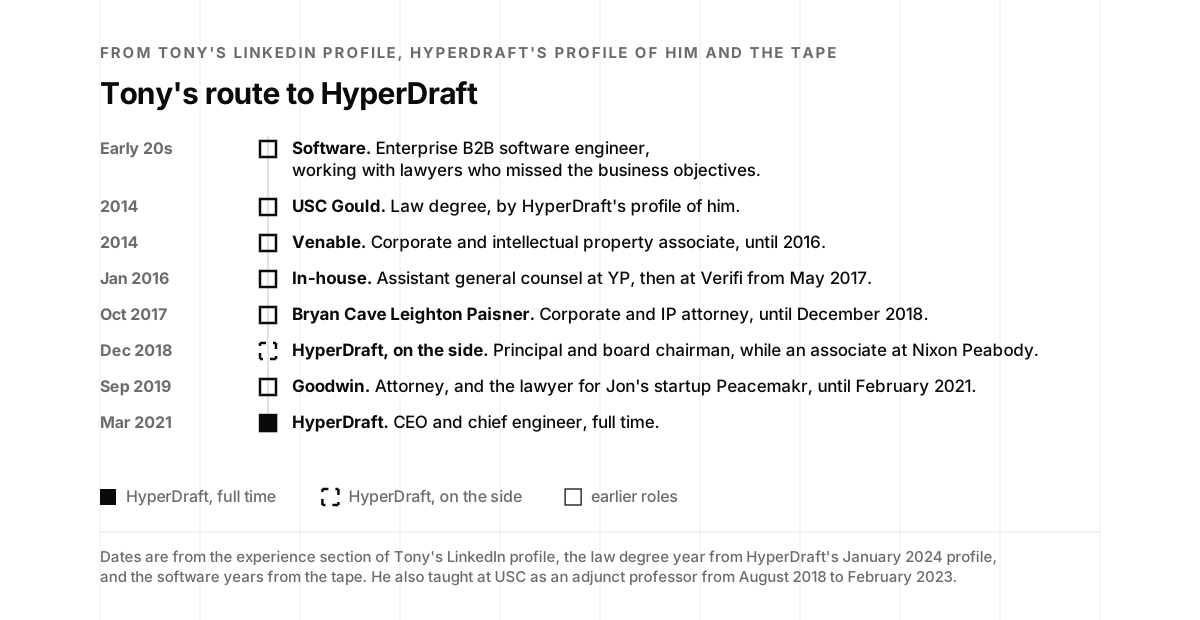
A timeline. Early 20s, software, enterprise B2B software engineer, working with lawyers who missed the business objectives. 2014, USC Gould, law degree, by HyperDraft's profile of him. 2014, Venable, corporate and intellectual property associate, until 2016. January 2016, in-house, assistant general counsel at YP, then at Verifi from May 2017. October 2017, Bryan Cave Leighton Paisner, corporate and IP attorney, until December 2018. Dashed, December 2018, HyperDraft on the side, principal and board chairman, while an associate at Nixon Peabody. September 2019, Goodwin, attorney, and the lawyer for Jon's startup Peacemakr, until February 2021. Filled, March 2021, HyperDraft, CEO and chief engineer, full time.
Tony's route: enterprise software, law school at USC, five firms and in-house roles, and HyperDraft, started on the side and full time from 2021.

Tony was always on the ball

Jon thanked him for the representation, and Tony said clients like Jon were one of the reasons he stayed in private practice.

“because I was like, oh, well, if I’m facing this problem, then there’s going to be a handful of folks like Jon who needed my help.”

Tony Thai, at 1:24

Then Jon told the listeners how they met.

“So, for all of our listeners, just for the context, back in the day when I was a founder at a company called Peacemakr, Tony worked at, where was it? It was Goodwin.”

Jon McLachlan, at 1:35

Jon’s LinkedIn has him as co-founder and CEO of Peacemakr from January 2019 to October 2023 (LinkedIn). Goodwin Procter is an American multinational law firm, one of the largest in the world by revenue, with more than 1,800 lawyers and offices that include Los Angeles, Silicon Valley and San Francisco (Wikipedia). Jon remembered the work as a lot of fixing.

“And it was just a spectacular back and forth. And we had to fix a whole bunch of things, but we messed up with our founding of the company, and then we did some patents, and Tony was always on the ball.”

Jon McLachlan, at 1:51

Tony’s view from the other side of the table was kinder.

“I think your guys’s was pretty routinized.”

Tony Thai, at 2:12

The part Jon remembered best was the day Tony left.

“But I remember one day you showed up and you’re like, oh, I have to share with you some news. I’m moving on. I’m going to do something new. And you made me guess, made me guess what you were doing next.”

Jon McLachlan, at 2:36

“I’m like, you’re way too excited to be doing anything except starting your own company.”

Jon McLachlan, at 2:59

Listen · Jon on episode 51, from 2:36
About 30 seconds: Jon on the day his startup lawyer came in with news. The clip stops on its own. Read the full transcript.

Jon had been a founder long enough to know what Tony was walking into, and his advice came after the fact.

“It’s the best thing and the worst thing, both at the same time.”

Jon McLachlan, at 3:11

“There’s never any, like, right time to do that. And you just got to pull the trigger. You just jump in.”

Jon McLachlan, at 3:15

Coding from 11 p.m. to 2 a.m.

Tony said watching Jon’s team was part of the pull, and that HyperDraft was older than the day he quit.

“Yeah, we started HyperDraft actually a few years prior. I started with a moonlight bootstrap project.”

Tony Thai, at 3:27

His LinkedIn dates him as principal and board chairman of HyperDraft from December 2018, and as its CEO and chief engineer from March 2021, the month after he left Goodwin. Bootstrapping meant fitting the company around a law firm’s hours.

“It was, and I don’t know if you remember my schedule, but like, working at a big law firm was not very conducive to those types of arrangements, where you’re grinding from 7 a.m. to 11 p.m. and coding from 11 p.m. to 2 a.m. It was a passion project, to say the least.”

Tony Thai, at 3:33
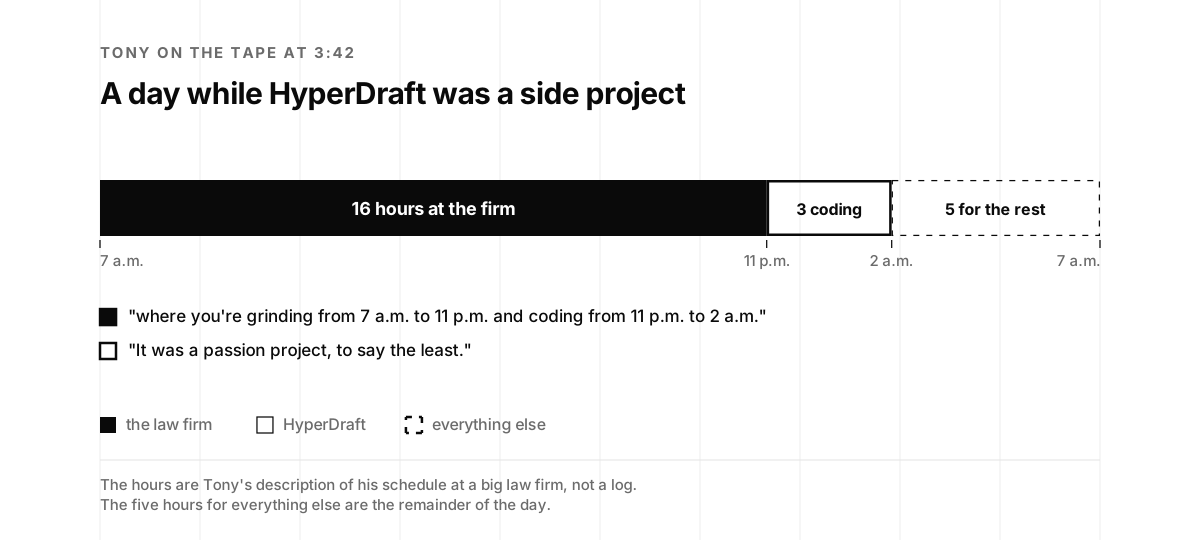
Listen · Tony on episode 51, from 3:27
About 20 seconds: Tony on building HyperDraft after a full day at a big law firm. The clip stops on its own. Read the full transcript.
A bar for one day, starting at 7 a.m. A filled segment of 16 hours at the firm, from 7 a.m. to 11 p.m. An outlined segment of 3 hours coding, from 11 p.m. to 2 a.m. A dashed segment of 5 hours for the rest, from 2 a.m. to 7 a.m. Two quotes from Tony: where you're grinding from 7 a.m. to 11 p.m. and coding from 11 p.m. to 2 a.m. It was a passion project, to say the least.
Tony's day while HyperDraft was a side project: 16 hours at the firm, three more coding, and about five left for everything else.

What held him at the firm wasn’t the hours. It was the training.

“one of the things you learn or are trained to do at the law firm is to be risk averse, right? They constantly tell you, because, like, our jobs are to help clients navigate risk and reduce risk as much as possible.”

Tony Thai, at 3:56

“And there’s really nothing riskier, especially in a professional, like, services vertical, than to start your own business.”

Tony Thai, at 4:14

The people who talked him into it were the clients the firm was protecting from risk.

“And it took a handful of my clients to convince me over the course of 12, 13 months that I should be doing this full time, not half time.”

Tony Thai, at 4:20

The same logical patterns

Jon called it a rare path, from software engineering into law. Tony said people doubt it can be done well.

“a lot of people look at me funny, because they’re like, there’s just no way you could be decent at both.”

Tony Thai, at 4:51

“it’s the same thing. It’s just, like, slightly different context, right? Depends on which hat I have to wear.”

Tony Thai, at 4:59

The overlap, in his telling, is logic: a contract is a program written for courts and counterparties instead of a compiler.

“So honestly, the coding background was really important for my development as an attorney, because having that ability to, or the need to craft logic through code, translated perfectly over to doing contracts and deal work and anything requiring legal documentation.”

Tony Thai, at 5:14

That same overlap is the company.

“So at HyperDraft, we build dev tooling for lawyers and business professionals. So what does that mean?”

Tony Thai, at 5:43

“we focus on document generation and digital workflows, because we found that the legal field was lacking tooling in that space.”

Tony Thai, at 5:51

Listen · Tony on episode 51, from 5:43
About 25 seconds: Tony on building the tools lawyers didn't have. The clip stops on its own. Read the full transcript.

Document automation is the design of systems and workflows that help create electronic documents, assembling new ones from pre-existing text and data, and it is increasingly used for legal documents, contracts and letters (Wikipedia). HyperDraft’s site lists the pieces today: Draft for document automation with smart templates, conditional logic, bulk generation and audit trails, Flows for workflow automation from matter intake to approvals, and a platform underneath both (HyperDraft). Legal technology as a field covers software that provides legal services or supports the legal industry (Wikipedia). Tony built it the way engineers build their own tools.

“And as an engineer, we built so many tools for ourselves.”

Tony Thai, at 6:00

Now lawyers have an IDE

Jon had seen an early version before the show.

“I remember you demoed it to me way back in the day, when it was an early version of your product. And I remember thinking to myself, wow, now lawyers have an IDE, an integrated development environment, and they could just sit down, and they could share snippets and auto-completion.”

Jon McLachlan, at 6:10

An integrated development environment is software that puts a comprehensive set of development features behind one consistent interface, instead of separate tools (Wikipedia). Autocomplete predicts the rest of what a user is typing (Wikipedia). Tony said lawyers’ reaction was not what outsiders would guess.

“But the reality of it was, these are tools that most people in the outside world assume that we have, which is funny, right?”

Tony Thai, at 6:38
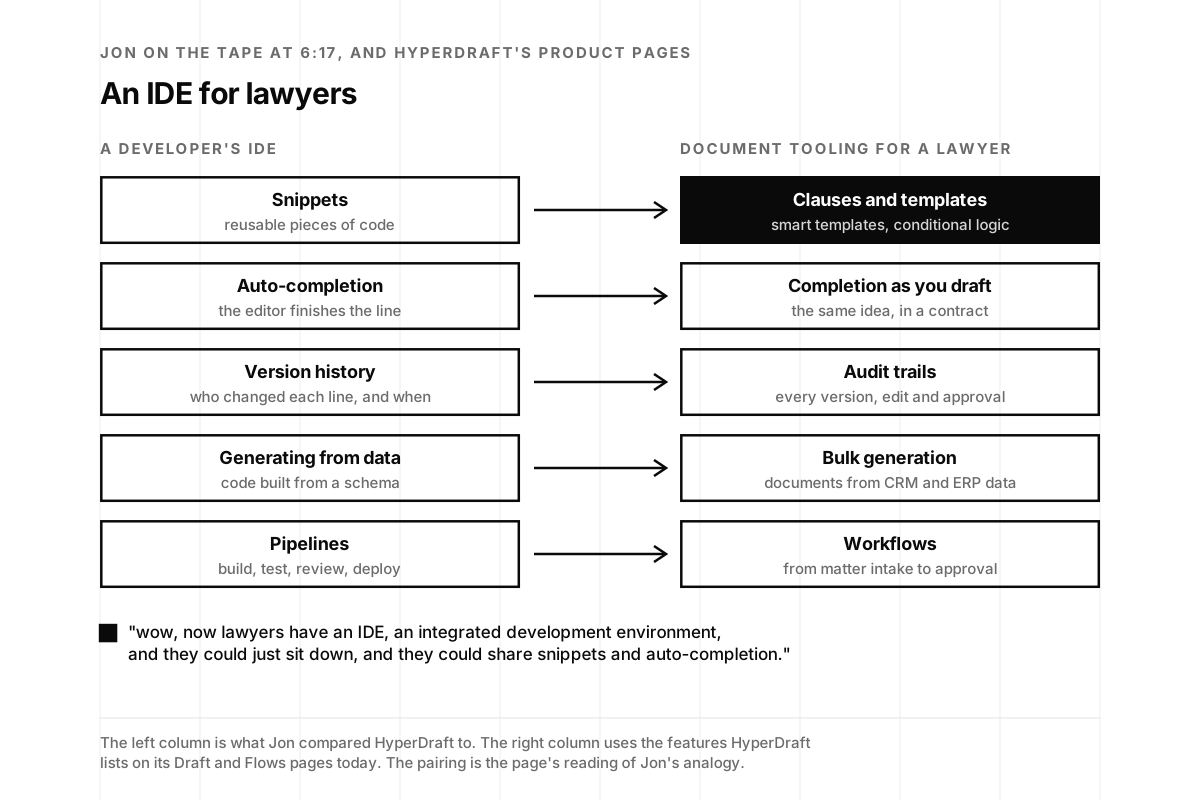
Two columns joined by arrows, row by row. A developer's IDE on the left, document tooling for a lawyer on the right. Snippets, reusable pieces of code, maps to clauses and templates, smart templates and conditional logic, filled. Auto-completion maps to completion as you draft. Version history, who changed each line and when, maps to audit trails for every version, edit and approval. Generating from data maps to bulk generation of documents from CRM and ERP data. Pipelines, build, test, review, deploy, map to workflows from matter intake to approval. Jon's quote: wow, now lawyers have an IDE, an integrated development environment, and they could just sit down, and they could share snippets and auto-completion.
The analogy Jon drew: what a developer's IDE gives a programmer, and what document tooling gives a lawyer.

The tools outsiders assume exist would answer the complaint they make most.

“Because you hear this common complaint that lawyers bill by the hour, and they take too long on stuff, and that they’re being fraudulent with their…”

Tony Thai, at 6:45

“No, the reality is we’re just that slow, right?”

Tony Thai, at 6:52

“It probably took longer than they billed you, frankly.”

Tony Thai, at 6:57

Listen · Tony on episode 51, from 6:45
About 20 seconds: Tony on why legal work takes as long as the bill says. The clip stops on its own. Read the full transcript.

Billable hours are hours worked that are billed to a client. Law firms often require a set number per month or year, and the practice has been criticized (Wikipedia). Tony’s point was that the hours are real, and that they go to the wrong things.

“these lawyers have such amazing raw compute, right? And not to objectify them, but they have such amazing raw compute”

Tony Thai, at 7:02

In his telling, that compute goes to small, tedious things that matter but don’t need a lawyer’s mind.

If we’re doing our jobs, you won’t hear about us

Jon asked what relationship Tony sees between cybersecurity and legal. Tony started with a friend and advisor to HyperDraft who was running information security at LegalZoom.

“He’s currently heading up LegalZoom’s InfoSec. We met when I was in-house at this private equity portfolio company, and we hit it off, like, immediately.”

Tony Thai, at 7:51

LegalZoom is an American online legal technology and services company launched in 2001 (Wikipedia). The overlap Tony and his friend found is that both jobs are measured by what doesn’t happen.

“As a corporate attorney in-house, one of the things that we’re taught is, and we like to remind people, is that if we’re doing our jobs, you’re not going to hear about us, right?”

Tony Thai, at 8:08

“Same goes for InfoSec, right? The same goes for cybersecurity. If the job’s being done correctly, then you’re not really going to hear about it.”

Tony Thai, at 8:29

Listen · Tony on episode 51, from 8:08
About 30 seconds: Tony on two jobs that are only noticed when they fail. The clip stops on its own. Read the full transcript.

Information security is the practice of protecting information by mitigating information risks (Wikipedia), and much of what it produces is an incident that never happens. That’s the problem Tony named next.

“And that causes a lot of issues, because that’s a surefire way for business units and certain stakeholders to take for granted the need to have those teams, the need to have the tooling, the need to think about the objectives for those teams, because they’re controlling for risk.”

Tony Thai, at 8:37

“So you don’t really need them until you absolutely need them, right? Whether you’ve got a security breach or you’ve breached some sort of agreement, right?”

Tony Thai, at 8:53

“So in that sense, just from a perspective of attack surface, like, we share a lot of the same kind of risk management and neglect from businesses, frankly.”

Tony Thai, at 9:10

An attack surface is the sum of the points where an unauthorized user can try to enter data, extract data or control a system (Wikipedia). Jon called both jobs thankless.

“Yeah, I get that. And it’s almost like one of those thankless roles.”

Jon McLachlan, at 9:21

“Until it goes wrong. And then when it goes wrong, like, it goes south, it goes very south.”

Jon McLachlan, at 9:44
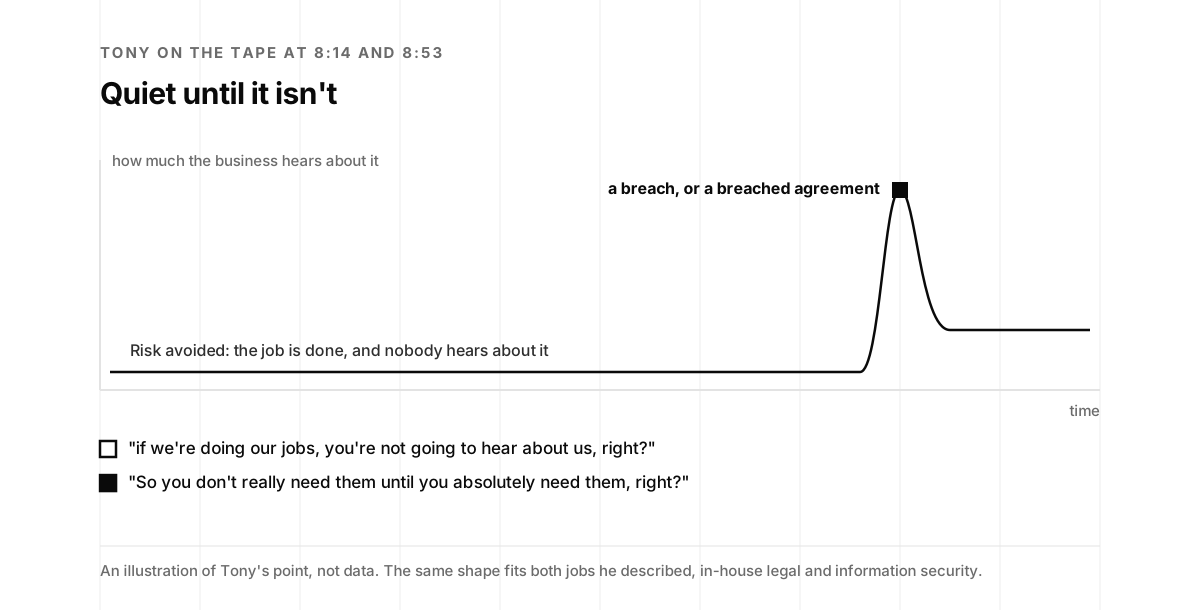
A line chart of how much the business hears about legal or security over time. The line stays flat near the bottom for most of the chart, labeled risk avoided: the job is done, and nobody hears about it. Near the right it spikes, marked a breach, or a breached agreement, then settles higher than before. Two quotes from Tony: if we're doing our jobs, you're not going to hear about us, right? So you don't really need them until you absolutely need them, right?
Legal and security in one picture: quiet while risk is avoided, and suddenly visible when a breach or a broken agreement lands.

Your problem is you have no process

Jon asked what Tony sees when things go south. Tony started with the paranoia that comes with both jobs.

“one of our jobs to be the paranoid people to say that, hey guys, like, we should really worry about this.”

Tony Thai, at 10:09

“But one of the things you pick up over time and with experience is that to avoid the cry wolf syndrome and to pick and choose when to say, hey, guys, now’s the time, right?”

Tony Thai, at 10:16

To cry wolf, from Aesop’s fable about the boy who did, is to give a false alarm, so that true claims are disbelieved later (Wikipedia). The harder lesson came from the people who buy HyperDraft.

“sometimes clients come to you and they don’t know what they want, and they don’t know what they need.”

Tony Thai, at 10:52

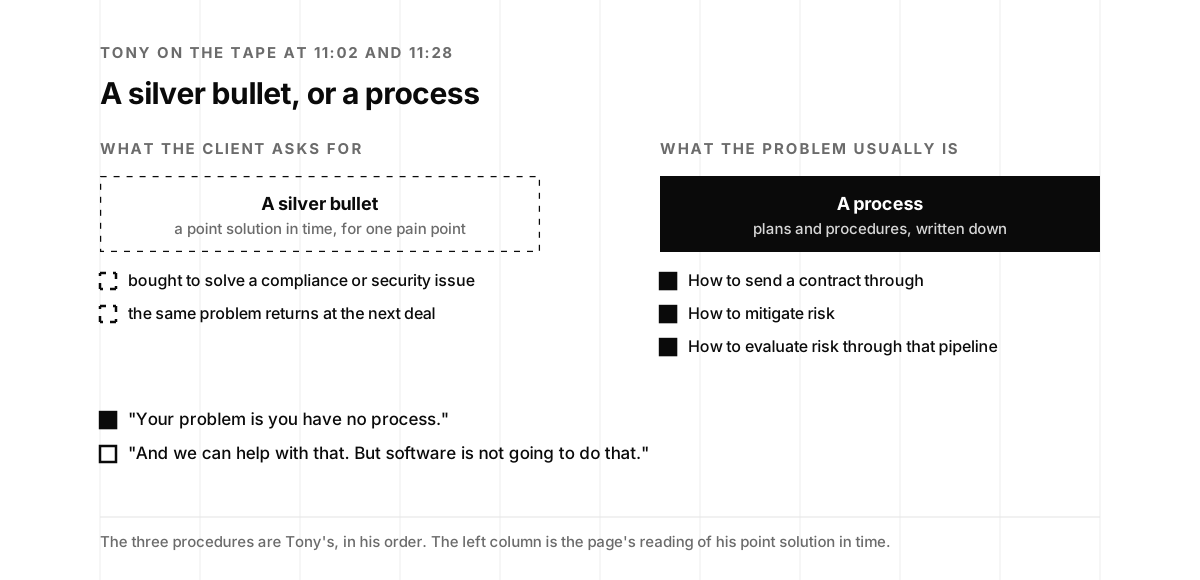
“So they think that they can purchase a solution that is going to be the silver bullet for solving their either compliance issue or security issue.”

Tony Thai, at 10:58

Software people know the phrase from Fred Brooks, whose 1986 paper No Silver Bullet argued that no single development in technology or management promises even a tenfold improvement within a decade (Wikipedia). Tony’s version is about what the buyer is missing.

“So with the HyperDraft tooling on the legal side, like, we’ll have folks come to us and say, hey, this is what we think our problem is. And then, as our team digs in deeper, we realize, actually, that’s not the problem, right? Your problem is you have no process.”

Tony Thai, at 11:16

“The problem is you lack the discipline to set in place all these plans and procedures for how to send a contract through, how to mitigate risk, how to evaluate risk through that pipeline. And we can help with that. But software is not going to do that.”

Tony Thai, at 11:35
Listen · Tony on episode 51, from 11:16
About 35 seconds: Tony on clients who ask for software when they need a process. The clip stops on its own. Read the full transcript.
Two columns. Left, what the client asks for: a dashed box, a silver bullet, a point solution in time for one pain point, bought to solve a compliance or security issue, and the same problem returns at the next deal. Right, what the problem usually is: a filled box, a process, plans and procedures written down: how to send a contract through, how to mitigate risk, how to evaluate risk through that pipeline. Two quotes from Tony: Your problem is you have no process. And we can help with that. But software is not going to do that.
A silver bullet against a process: the tool a client asks for, and the plans and procedures for moving a contract through and evaluating its risk that the tool assumes.

He named the kind of vendor he competes with by the antivirus brand everyone knows.

“But there are plenty of platforms that do claim to be the McAfee of contract generation and workflows.”

Tony Thai, at 11:50

McAfee is an American software company focused on online protection for consumers (Wikipedia). Tony’s advice for a buyer who insists on the box was patience.

“And what I’ve learned over time is just to tell them, like, give it a go.”

Tony Thai, at 12:00

“And so you wait for them to make that first mistake, and then hopefully it’s not fatal.”

Tony Thai, at 12:18

“Right. Hopefully it’s just a lesson learned, and you can move on with it.”

Jon McLachlan, at 12:23

The same pattern sinks AI projects, and we wrote it up as the scoping discipline that beats the odds: map the work and the process first, then pick the tool.

Finance, real estate and healthcare

Jon asked which industries use HyperDraft most. Tony said the company is mostly industry agnostic, with three exceptions.

“However, we have found many companies in finance, real estate, and healthcare have come to us because they have particular needs.”

Tony Thai, at 12:44

“they need something hyper-customized that’s very complex, but also needs to be secure and in a controlled environment. And for us, that’s our specialty, right?”

Tony Thai, at 12:58

HyperDraft turns away more work than it takes, he said, because many clients who ask don’t need it.

“they don’t really know their problem set, and there’s no use in the overkill of the HyperDraft platform for some folks.”

Tony Thai, at 13:31

“Many folks can just get away with mail merge, right? Like, just spend a few hours learning how to do that, and we don’t have to get involved.”

Tony Thai, at 13:38

Mail merge combines a form letter with a list of names and addresses for mass mailings (Wikipedia), and for a lot of documents it’s enough. HyperDraft’s site today leads with the heavier end: financial institutions managing large-scale lending, syndicated facilities and high-volume transactions, and government and regulated industries “where transparency and audit trails are non-negotiable” (HyperDraft).

Eight hours to 15 minutes

HyperDraft sells top down, Tony said, to a department with the authority to buy.

“It’s at that enterprise level. So you need purchasing power. Not only that, but you need purchasing decision-making power.”

Tony Thai, at 14:08

“So usually it’s a department that says, hey, we have X number of agreements or deal types. We’re too slow. Everything’s being done manually.”

Tony Thai, at 14:15

Then he gave the case at the far end.

“We had a client that came in. They did term sheets and these long-form agreements. Term sheets would take them eight hours, and then the long forms would take them anywhere from, like, 20 to 30 hours, everything done manually.”

Tony Thai, at 14:27

A term sheet is a bullet-point document of the material terms of a potential deal, the basis for the negotiation that follows (Wikipedia). Every day one sits in drafting, the deal doesn’t close.

“And for them, time is money, right? For every one of those contracts that’s not going through, they’re not making money.”

Tony Thai, at 14:39

“It doesn’t even need to be perfect. It just needs to be faster than what we currently do. And so we cut down the time from eight hours down to 15 minutes for that term sheet, which is insane, like an insane improvement, right?”

Tony Thai, at 14:49

Listen · Tony on episode 51, from 14:26
About 35 seconds: Tony on the client whose term sheets took eight hours. The clip stops on its own. Read the full transcript.

The long forms went from 20 to 30 hours to three, and the three were mostly people.

“Like, from the 20 to 30 hours it took for the long-form agreements, like, we cut that down to three hours.”

Tony Thai, at 15:07

“And this is where the lawyers that bring all of those superpowers to the table can focus on their superpowers”

Tony Thai, at 15:19
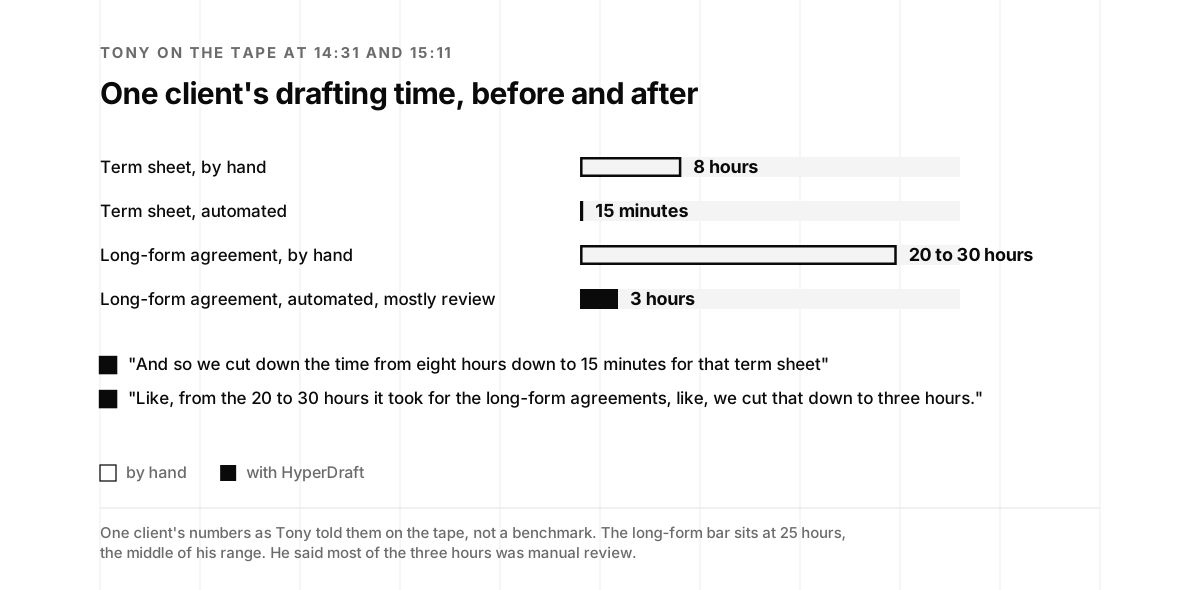
Four bars on a scale of 0 to 30 hours. Term sheet by hand, 8 hours, outlined. Term sheet automated, 15 minutes, filled. Long-form agreement by hand, 20 to 30 hours, outlined, drawn at 25. Long-form agreement automated, mostly review, 3 hours, filled. Two quotes from Tony: And so we cut down the time from eight hours down to 15 minutes for that term sheet. Like, from the 20 to 30 hours it took for the long-form agreements, like, we cut that down to three hours.
One client's numbers, as Tony told them: term sheets from eight hours to 15 minutes, and long-form agreements from 20 to 30 hours to three, mostly review.

The drafting time calculator below runs the same arithmetic on your own deal volume.

Stay up all night getting your deal docs done

Tony turned the question around and asked Jon about clients who never see the work. When you’re a lawyer, he said, clients don’t see most of the technical work you do.

“And I’m enough of a business person that I know, hey, this is what Jon wants to hear. And frankly, like, if I’m Jon, I don’t want to hear this and this, like, I’ll take care of it. Just controlling for that messaging. But I’d go back and stay up all night getting your deal docs done. You didn’t know that. You weren’t sitting there with me.”

Tony Thai, at 16:03

The time automation saves, he said, should go back to the client.

In his telling, those 20 to 30 hours should go to working with the client, understanding their needs, and talking through what comes next.

“Okay, so we’ve done these deal types. Like, how can we make this more streamlined? How can we anticipate risk? Where have we failed before?”

Tony Thai, at 16:34

Listen · Tony on episode 51, from 16:17
About 25 seconds: Tony on what lawyers should do with the hours automation gives back. The clip stops on its own. Read the full transcript.

Those are the questions of a postmortem, and Tony runs one with clients.

“all right, Jon, let’s do the postmortem on this last deal that we did. What did you think that we did well? And then what did you think that we did that you’d like us to change?”

Tony Thai, at 16:51

A project postmortem identifies the causes of a failure and how to prevent them, and a retrospective reviews what went well too (Wikipedia). Tony’s is the second kind, held with the client in the room.

From waterfall to postmortems

Jon said security went through the same change, by way of software.

“At first, in the beginning, it was very just, like, waterfall design model. You get into the grind, you just turn out code, and you, it’s very disconnected. But now, like, with agile development, everyone is talking to each other. We’re doing postmortems.”

Jon McLachlan, at 17:25

The waterfall model runs the phases of software development in strict sequence, and it is the earliest such methodology (Wikipedia). The Agile Manifesto of 2001, written by 17 practitioners, values among other things “customer collaboration over contract negotiation” (Wikipedia), which is close to what Tony wants from lawyers.

“And there’s much less time, I would say, banging on the keyboard and much more time spent engaging with each other.”

Jon McLachlan, at 17:49

“You want to surround yourself with incredible talent, but you want to help them understand the big picture, so that they can contribute to that mission without you having to be part of all of those little nitty-gritty.”

Jon McLachlan, at 18:29

The catch, in Jon’s view, is that slow work leaves no room for the talking.

“But one of the issues is, if, like, writing documents, writing code, in an engineering perspective, takes so long, there’s not a very good motive to move into that space where you talk to each other more.”

Jon McLachlan, at 18:50

What’s more proprietary than how they make money

Jon asked what makes HyperDraft’s approach to security different. Tony corrected his own vocabulary first, the way a lawyer would.

“Yeah, worked as a lawyer for so many different clients and seen the security breaches, or, sorry, security incidences.”

Tony Thai, at 19:16

The answer was about what’s in the documents.

“what’s more proprietary than, like, how they make money, right?”

Tony Thai, at 19:48

“So there needs to be a lot of trust in systems that they’re not sharing that data, leveraging that data, leaking that data.”

Tony Thai, at 19:58

Listen · Tony on episode 51, from 19:44
About 20 seconds: Tony on why contracts are the most sensitive data a business has. The clip stops on its own. Read the full transcript.

A company’s contracts hold its prices, its margins, its terms with every partner and its plans for the next deal. Tony said he learned how to protect them from security people.

“And one of the reasons why we’ve been successful is because I had people like yourself to look up to”

Tony Thai, at 20:10

“It’s only a first line of defense. Having a good, strong first line defense, that’s a good thing. But the rest of it is around communication, training, and trusting your colleagues and business units to do the right thing.”

Tony Thai, at 20:26
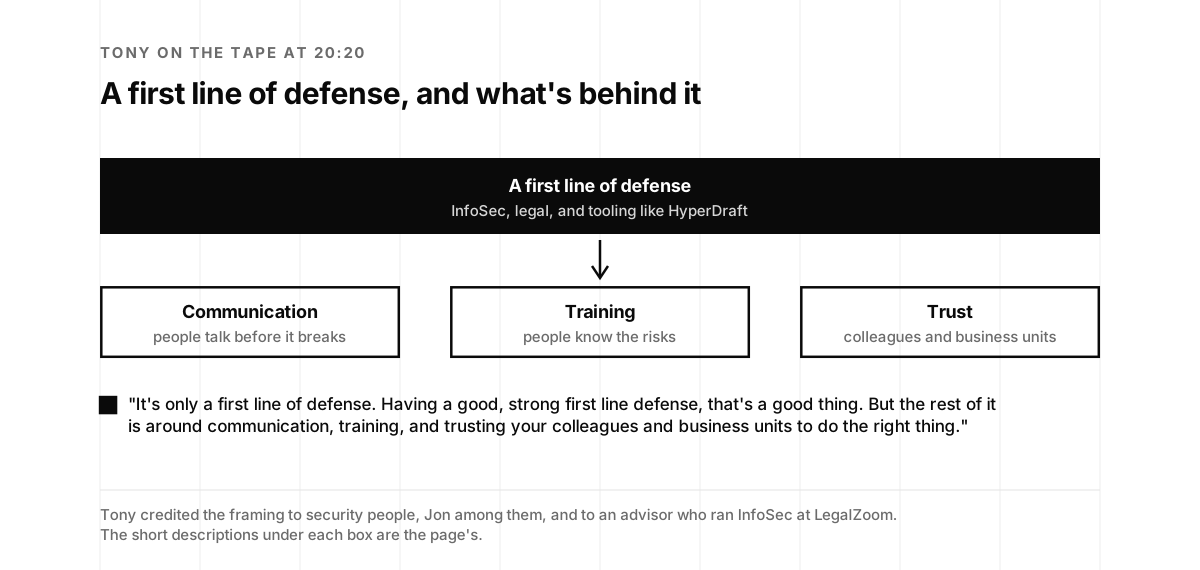
A filled bar across the top: a first line of defense, InfoSec, legal, and tooling like HyperDraft. An arrow down to three outlined boxes: communication, people talk before it breaks. Training, people know the risks. Trust, colleagues and business units. Tony's quote: It's only a first line of defense. Having a good, strong first line defense, that's a good thing. But the rest of it is around communication, training, and trusting your colleagues and business units to do the right thing.
A first line of defense and what's behind it: InfoSec, legal and the tooling up front, and communication, training and trust in colleagues and business units after.

He was less patient with contract management products.

“There are other solutions out there, plenty of other solutions out there, especially in the doc gen space, that claim to solve”

Tony Thai, at 20:53

He compared it to Jon pitching him a replacement for GitHub.

“I have 50 different replacements for GitHub repos. And you’re like, that’s cool. I don’t see the need for it, but sure.”

Tony Thai, at 21:11

Contract management covers negotiating terms, ensuring compliance with them and documenting changes, with the aim of better performance and less risk (Wikipedia). GitHub is the developer platform built on Git for storing, managing and sharing code (Wikipedia), and Tony’s point was that one well-built repository beats fifty replacements for it. We cover the contract side from a startup’s view in the security exhibit your startup signed.

It’s just a feature

Jon brought up AI, and Tony said HyperDraft had it before it was a selling point.

“Yeah. We have seen the kind of boom of AI features, as we’re one of the OGs, right? Like, we did this before the hype. You can testify to that part.”

Tony Thai, at 22:15

The features look like what engineers already use, and Tony was glad Jon raised the risk.

“I was actually hoping you’d transition to this, because the same security risk that is evident in AI-driven code is also a big issue in legal. So we are hesitant to push AI-heavy products.”

Tony Thai, at 22:37

“Something my CMO and I talk about all the time is, it’s often touted as a product. It’s just a feature, right?”

Tony Thai, at 22:53

Listen · Tony on episode 51, from 22:37
About 30 seconds: Tony on why AI in legal software is a feature, not a product. The clip stops on its own. Read the full transcript.

“And again, I would say that our customers come to us because we understand the data, and we understand the business practices and the legal models for how it works, not because we claim to be able to replace their headcount”

Tony Thai, at 23:08

GitHub Copilot, the code completion assistant Tony compared HyperDraft’s features to, was first announced by GitHub on June 29, 2021 (Wikipedia).
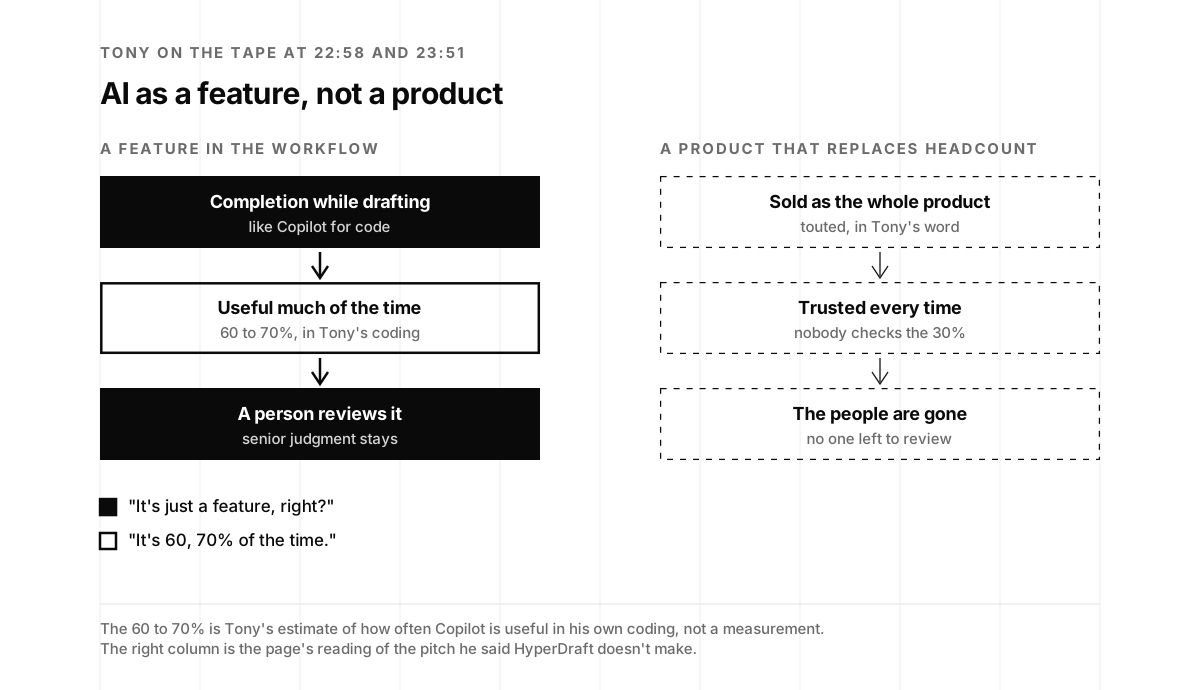
Two columns of three boxes. Left, a feature in the workflow: completion while drafting, like Copilot for code. Useful much of the time, 60 to 70% in Tony's coding. A person reviews it, senior judgment stays. Right, dashed, a product that replaces headcount: sold as the whole product, touted in Tony's word. Trusted every time, nobody checks the 30%. The people are gone, no one left to review. Two quotes from Tony: It's just a feature, right? It's 60, 70% of the time.
AI as a feature inside the workflow, with a person reviewing, against AI sold as a product that replaces headcount.

Sixty, seventy percent of the time

Jon asked whether AI would replace lawyers. Tony answered from the code he still writes.

“I think it’s still pretty early to tell. Let me tell you it from my perspective on the coding side, right? Like, I still code. I use Copilot. It’s incredibly useful much of the time. It’s 60, 70% of the time.”

Tony Thai, at 23:38

“But as I use it, and I see our junior engineers use it, I review their code, and I’m constantly reminded of the difference between a senior engineer and a junior engineer.”

Tony Thai, at 23:53

Listen · Tony on episode 51, from 23:40
About 30 seconds: Tony on Copilot, junior engineers and what review shows. The clip stops on its own. Read the full transcript.

The difference, he said, is time, and law has the same gap.

“And, fortunately or unfortunately for the legal profession, like, time still needs to be spent learning different mental models required for their practice.”

Tony Thai, at 24:10

“It can augment. It can help streamline people like myself who have over a decade of experience.”

Tony Thai, at 24:36

The only shortcut he could name was one that doesn’t exist yet. Neuralink is an American neurotechnology company developing implantable brain-computer interfaces, launched in 2016 (Wikipedia). What AI will do, he predicted, is show who was coasting.

“It’ll expose, probably, way more of the weaknesses for folks that have been able to hide behind just doing the”

Tony Thai, at 24:53

Jon agreed and put it in tool terms.

“Just like an IDE didn’t turn a junior developer into a senior developer. But it is a good tool to help save time, to help save some money, maybe ship some code faster, maybe find some bugs earlier in the process rather than later.”

Jon McLachlan, at 25:14

“Not here to replace people, it’s here to enhance.”

Jon McLachlan, at 25:36

The security side of AI-written code is in our post on vibe coding security.

Here’s some dice

Jon said he grew up as a hacker, in the old sense of the word, and still looks at systems that way. If he were a kid today, he said, the thing he’d go after is the people building APIs with LLMs.

“I think that is one of the dumbest things I’ve ever heard.”

Jon McLachlan, at 26:09

His reason was the oldest bug in security: input that becomes instructions.

“This is, like, basic stuff that you learn as a security professional, with command injection and stuff like that. Now they’re just opening it up for you and just saying, hey, actually, you can send any prompts.”

Jon McLachlan, at 26:24

Code injection is when a program fails to process external data correctly and runs it as commands (Wikipedia). Prompt injection is the same idea for language models, which can’t tell the developer’s instructions from a user’s input (Wikipedia). Jon’s picture for it came from physics.

The model reading the prompt decides what the API call should be, and in Jon’s words it is a model that guesses.

“which is a probabilistic model”

Jon McLachlan, at 26:36

“Here’s some dice.”

Jon McLachlan, at 26:41

Listen · Jon on episode 51, from 26:01
About 40 seconds: Jon on putting a language model between user input and an API call. The clip stops on its own. Read the full transcript.

Quantum mechanics describes matter and light at the scale of atoms, where outcomes are probabilities (Wikipedia), and classical mechanics describes the motion of everyday objects (Wikipedia). An API call should behave like the second. A model choosing it behaves like the first. When an agent’s tool call can be steered by a prompt, the fix is a check outside the model, which is what we wrote about as the gap between an agent’s refusal and the key it holds.
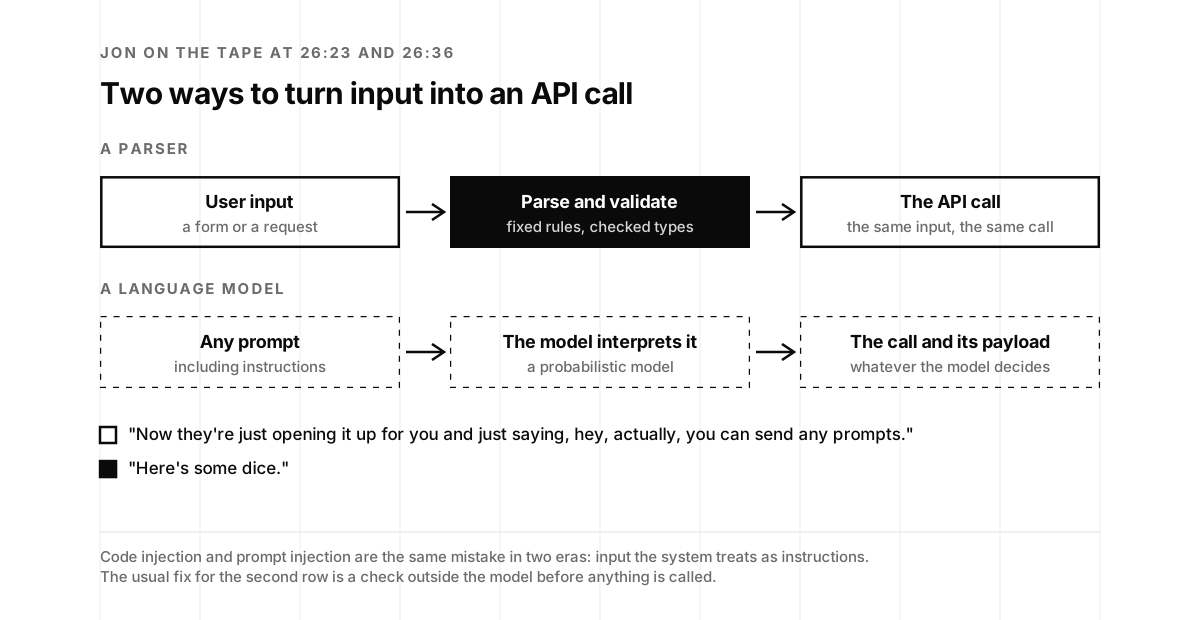
Two rows of three boxes. A parser: user input, a form or a request, goes to a filled box, parse and validate, fixed rules and checked types, then the API call, the same input, the same call. A language model, all dashed: any prompt, including instructions, goes to the model interprets it, a probabilistic model, then the call and its payload, whatever the model decides. Two quotes from Jon: Now they're just opening it up for you and just saying, hey, actually, you can send any prompts. Here's some dice.
Two ways to turn input into an API call: a parser that validates it, and a language model that interprets it, with the injection risk Jon described in the second.

CliffsNotes and the right side of the curve

Tony said his team tries the new tools and keeps finding the same thing.

“we experiment with a lot of these, you know, newfangled tools, only to realize, nope, we’re still going to have to do work. It’s a, it reminds me of being a kid and reading CliffsNotes.”

Tony Thai, at 27:02

CliffsNotes are student study guides, and their detractors say they let students skip the assigned reading (Wikipedia). Tony’s lesson from them was about abstraction.

“Now that I’m older and understand how this works a little bit better, like, there’s only so much information you can get from an abstraction layer, right?”

Tony Thai, at 27:19

“it doesn’t eliminate the need for someone to have reviewed the code or reviewed the contract thoroughly.”

Tony Thai, at 27:44

Then he took on the promise that AI makes everyone better.

“everybody thinks AI is going to drive everyone to the right side of a curve. That’s not how big data works.”

Tony Thai, at 27:59

“You’ve got the law of big numbers and regression to the mean, and most data is garbage, and most public code is, guess what? Garbage.”

Tony Thai, at 28:07

Listen · Tony on episode 51, from 27:59
About 35 seconds: Tony on why AI pulls work toward the average. The clip stops on its own. Read the full transcript.

Regression toward the mean is the tendency of an extreme sample to be followed by one closer to the average (Wikipedia), and the law of large numbers says the average of many samples converges to the true value (Wikipedia). A model trained on the public’s code learns the public’s average. Garbage in, garbage out is the older name for the rest (Wikipedia).

“It can’t be relied on for high-quality work. It just can’t. You still got to rely on people to understand that overall architecture, both in software and in legal work.”

Tony Thai, at 28:29
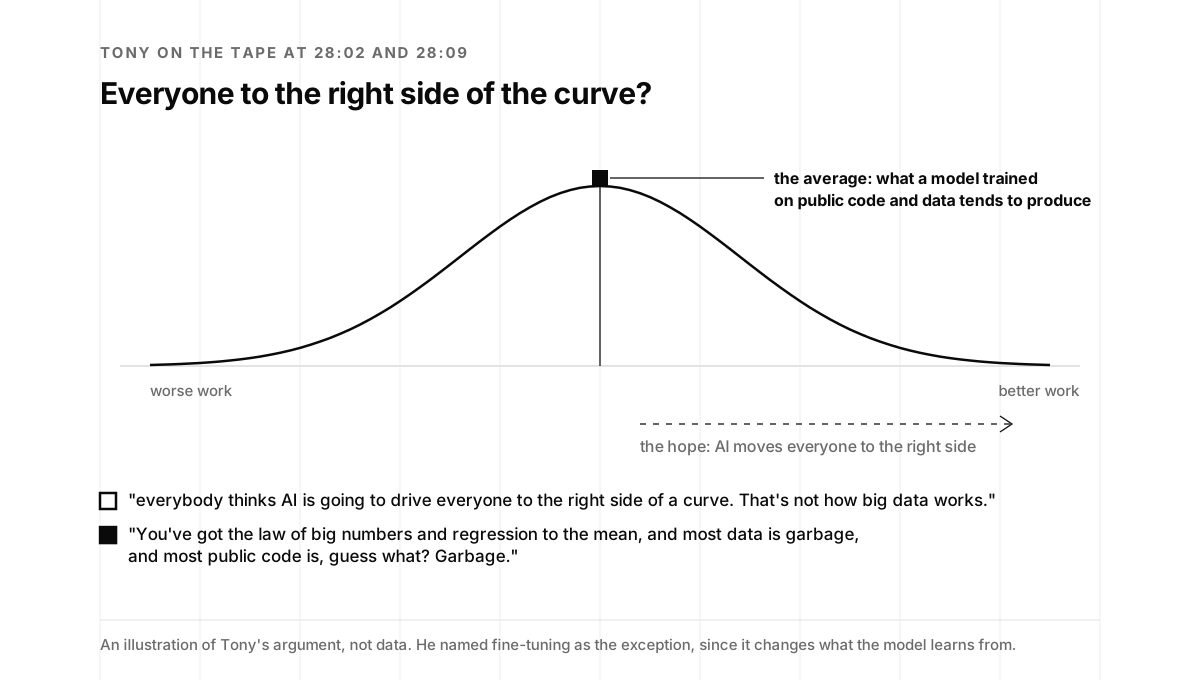
A bell curve of work quality, worse on the left and better on the right. A filled marker at the peak in the middle: the average, what a model trained on public code and data tends to produce. A dashed arrow below pointing right: the hope, AI moves everyone to the right side. Two quotes from Tony: everybody thinks AI is going to drive everyone to the right side of a curve. That's not how big data works. You've got the law of big numbers and regression to the mean, and most data is garbage, and most public code is, guess what? Garbage.
The curve Tony described: the hope that AI moves everyone to the right, and the model's pull toward the average of what it was trained on.

Never design with delegation in mind

Jon asked for the one big lesson from building HyperDraft. Tony picked a recent one.

“I learned this recently, like, embarrassingly.”

Tony Thai, at 28:56

“Like, architecting a solution with the intent that you can delegate certain portions, because somehow you would be able to scale faster, is such a mistake, because you end up paying for it, or somebody pays for it down the line, and you end up redoing the work twice.”

Tony Thai, at 29:10

“You have to understand from the ground up how the system works. And that will build a more robust product and more robust architecture than thinking, oh, somebody else is going to handle, like, the little gritty parts.”

Tony Thai, at 29:34

Listen · Tony on episode 51, from 29:09
About 35 seconds: Tony on the cost of designing for delegation. The clip stops on its own. Read the full transcript.

Jon had been bitten by the same thing, a black box that met its interface and failed at scale.

“why is there state flying around? You could have been stateless”

Jon McLachlan, at 30:27

A stateless protocol keeps no session state between requests, so each one can be understood on its own (Wikipedia), and scalability is a system’s ability to handle more work, often by adding resources (Wikipedia). Hidden state is what keeps a black box from scaling sideways.
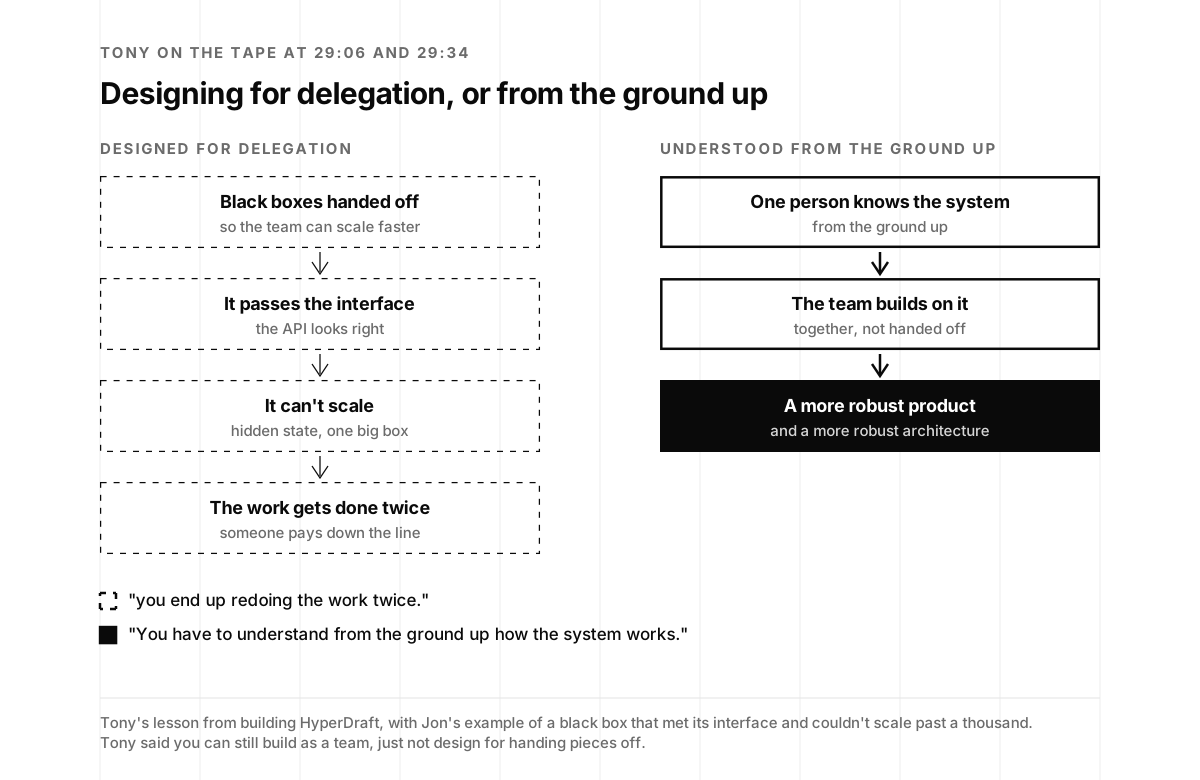
Two columns. Left, dashed, designed for delegation: black boxes handed off so the team can scale faster, it passes the interface, the API looks right, it can't scale, hidden state in one big box, the work gets done twice, someone pays down the line. Right, understood from the ground up: one person knows the system, the team builds on it together, and a filled box, a more robust product and a more robust architecture. Two quotes from Tony: you end up redoing the work twice. You have to understand from the ground up how the system works.
Designing for delegation against understanding from the ground up: the black box that passes its interface, and the rework that follows.

You’re paying the price somewhere

Tony picked up Jon’s physics and brought two laws of his own.

“One, you can’t create energy, right?”

Tony Thai, at 30:41

“And so if we’re taking shortcuts, we’re paying the price somewhere, somehow, right?”

Tony Thai, at 30:49

The law of conservation of energy says the total energy of an isolated system stays constant, so energy can be transformed but never created or destroyed (Wikipedia). The second law was from cryptography.

“And then, as I remind people with cryptography all the time, the strength of cryptography is directly proportional to the amount of energy put in, directly. So if it didn’t take that much compute, didn’t take that much time, then the security is lower.”

Tony Thai, at 30:55

Cryptographers state strength as a security level in bits, where n-bit security means an attacker would have to perform 2 to the power n operations to break it (Wikipedia). Each added bit doubles the work, which is Tony’s point in a number.

“So, if you think about that with any task in life, if you take a shortcut, you’re going to be paying for it somehow, some way.”

Tony Thai, at 31:15
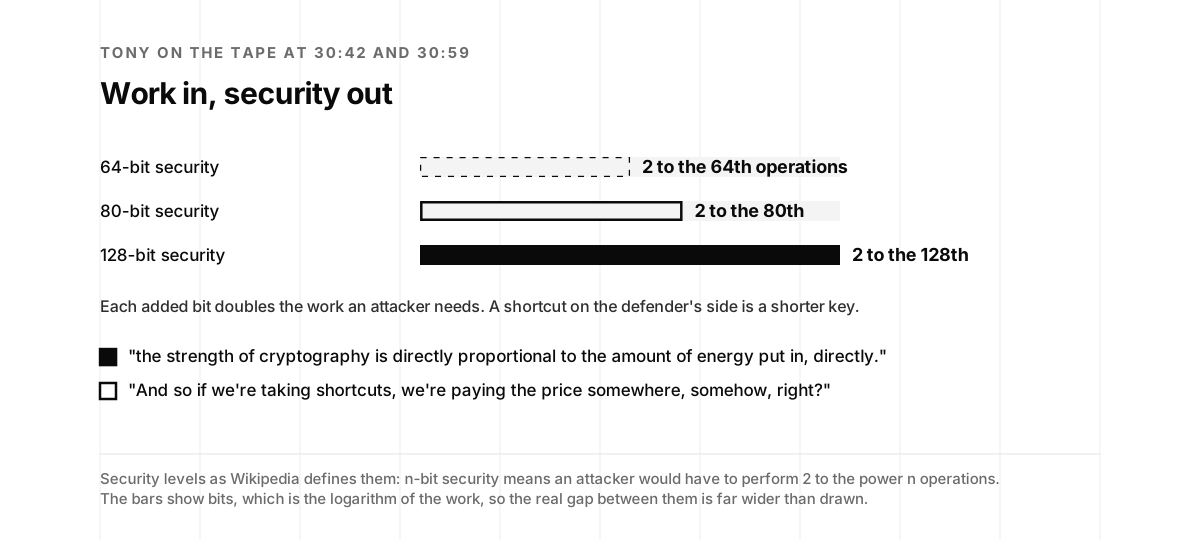
Three bars of security level. 64-bit security, dashed, 2 to the 64th operations to break. 80-bit security, outlined, 2 to the 80th. 128-bit security, filled, 2 to the 128th. A line of text: each added bit doubles the work an attacker needs, and a shortcut on the defender's side is a shorter key. Two quotes from Tony: the strength of cryptography is directly proportional to the amount of energy put in, directly. And so if we're taking shortcuts, we're paying the price somewhere, somehow, right?
Work in and security out: each added bit of security doubles the work an attacker needs, and a shortcut on the defender's side shows up as a shorter key.

Compassion for the decisions behind you

Jon added a caveat to the cost of shortcuts: some were right when they were made.

“That then you get to a huge success, and then all of a sudden, those decisions in the past look like horrible decisions. Why did we do that?”

Jon McLachlan, at 31:42

“And what I love to say is that the right decisions that we made in the past are not the right decisions to get us to the next 10x or the next 100x.”

Jon McLachlan, at 32:03

“So just having compassion for ourselves, I think, is, like, super important for mental health.”

Jon McLachlan, at 32:31

Tony laughed, because his code base is full of evidence.

“the funniest ones we run into are ones where I’m like, note from Tony, I know this is stupid, right?”

Tony Thai, at 32:55

“I was reading through the code, and I’m like, what piece of crap, dumb person wrote? And you click on it, and the git blame’s at Tony Thai, and it’s, ah, yes.”

Tony Thai, at 33:22

Git keeps a full history of every change, and its blame view shows who last changed each line and in which commit. Jon put it plainly.

“It’s right there. You can go back. You can even look at the commit message that showed up with it.”

Jon McLachlan, at 33:40

A hot take, brother

Tony said the empathy runs both ways, because he gets better every day he writes code. Jon drew the conclusion.

“Why LLMs are not going to replace humans. That’s a hot take, brother.”

Jon McLachlan, at 33:59

“Well, because you’re going against all of the grandiose visions that the bubble had. It’s the religion of the moment.”

Jon McLachlan, at 34:08

“You’re a heretic.”

Jon McLachlan, at 34:17

A car for a hundred bucks

Tony had a story from where hacking and legal meet.

“I saw one recently that really got me going. This is the intersect of the two. There was a car dealership. Have you seen this?”

Tony Thai, at 34:33

“A car dealership that had a chatbot.”

Tony Thai, at 34:42

“one of the users was able to get them to offer him a car for, like, a hundred bucks and agree to the deal.”

Tony Thai, at 34:48

Listen · Tony on episode 51, from 34:33
About 30 seconds: Tony on the dealership chatbot that agreed to a deal. The clip stops on its own. Read the full transcript.

The AI Incident Database records it as incident 622, on December 18, 2023: a Chevrolet dealer’s ChatGPT-powered chatbot agreed to sell a 2024 Tahoe for $1 after a user’s prompt got it to agree with anything (AI Incident Database). The dealership was Chevrolet of Watsonville (AI Incident Database). Tony remembered a hundred dollars, and the record says one. His worry was the next step.

“Imagine. Just imagine the possibilities of, like, how much access to a system you can get.”

Tony Thai, at 34:57

A chatbot that can say yes is one thing. One that can call an API or sign is another, and it needs an owner and an off switch before it ships, which is the subject of who signs for the agent.

Counsel, not technicians

Jon asked what Tony wants HyperDraft to change in the legal profession. Tony went back to the hours.

“One of the things I mentioned earlier was, I want lawyers to spend more time with their clients.”

Tony Thai, at 35:21

“There’s only really what I consider two really human practices, right? There’s the medical field, doesn’t get more human than that. We’re maintaining the body. We’re focused on the body. And then the law is social governance, figuring out what binds us, what responsibilities we have to go through”

Tony Thai, at 35:39

As the work got more grueling and more technical, he said, lawyers drifted from one role to another.

“what used to be referred to as the counsel, that’s why we refer to lawyers as your counsel”

Tony Thai, at 36:04

The word he used for what they became was technicians.

Listen · Tony on episode 51, from 35:39
About 30 seconds: Tony on lawyers as counsel, and how they became technicians. The clip stops on its own. Read the full transcript.

A counsel, or counsellor at law, is a person who gives advice, particularly in legal matters (Wikipedia). Tony’s whole product is a bet that time taken from drafting goes back to advising.
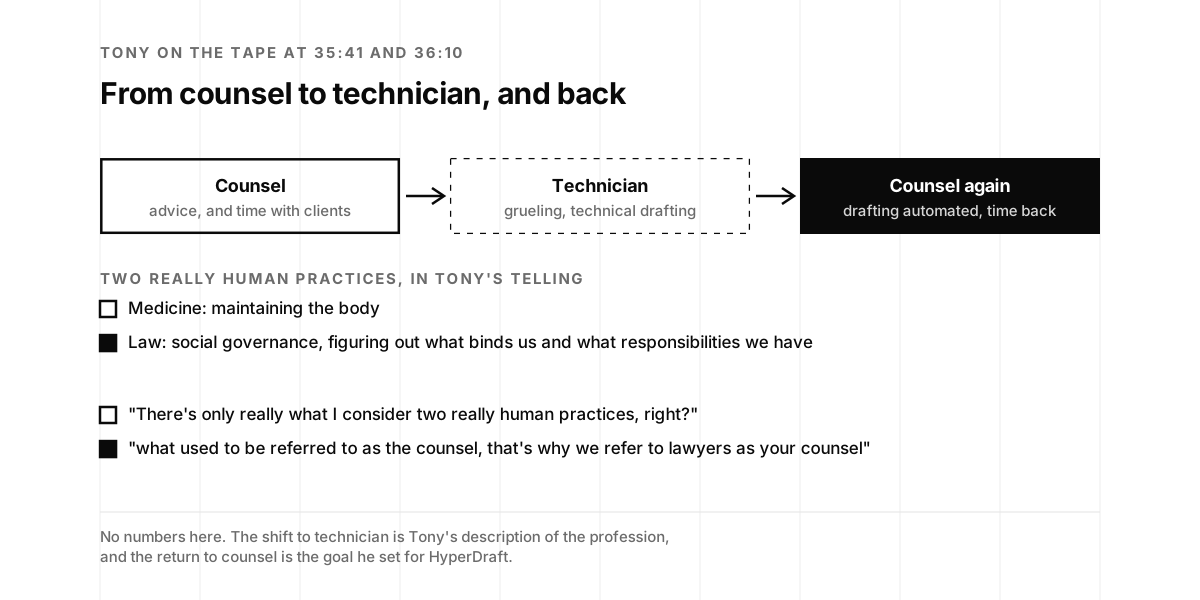
Three boxes in a row. Counsel, advice and time with clients, leads to a dashed box, technician, grueling technical drafting, which leads to a filled box, counsel again, drafting automated and time back. Below, two really human practices in Tony's telling: medicine, maintaining the body, and law, social governance, figuring out what binds us and what responsibilities we have. Two quotes from Tony: There's only really what I consider two really human practices, right? what used to be referred to as the counsel, that's why we refer to lawyers as your counsel.
Where a lawyer's hours go: from counsel to technician as drafting grew, and back toward counsel when the drafting is automated.

A litmus test

Jon said the same test applies to engineering.

“And that’s actually a litmus test that I use every once in a while. I find myself doing something, and I can’t very quickly articulate or convince myself that I’m improving the life of a fellow human being.”

Jon McLachlan, at 36:33

“you have to make a decision about, do you use a signed int or an unsigned int?”

Jon McLachlan, at 37:13

A signed integer can hold negative numbers, and an unsigned one can’t (Wikipedia). Pick wrong, and a balance that should go negative wraps around to a huge positive number. The person who reads that balance never sees the type, only the result.

Your job is to anticipate humans

Tony asked if he could tell a story about exactly that, from his first years as an engineer.

“those neural pathways aren’t really that embedded, because I’ve been warned about all this stuff.”

Tony Thai, at 37:49

“But I was working with a big accounting system.”

Tony Thai, at 38:08

“And immediately we started running into issues. Like, records were not going through, numbers weren’t adding up. And I was scrambling.”

Tony Thai, at 38:23

The volume made it worse.

“So the minute I’m going through records, there’s 10,000 records going in a minute. It’s not like I can just sit and go through all of it.”

Tony Thai, at 38:35

“Users are typing in O instead of zeros into these fields.”

Tony Thai, at 38:47

He took the find to his boss and got the lesson instead.

“And I’m looking at him like, dude, it’s the users that are stupid. Like, I’m not the idiot. And he’s just like, your job is to anticipate stupid. Your job is to anticipate humans.”

Tony Thai, at 38:59

Listen · Tony on episode 51, from 38:47
About 25 seconds: Tony on the bug that was a letter O, and the boss who blamed the developer. The clip stops on its own. Read the full transcript.

“Like, my job is to protect against ignorance, both on the legal side and on the software side.”

Tony Thai, at 39:33

A letter O and a zero look alike on a screen and mean nothing alike to a ledger. The fix is input validation, and the lesson is older than the code: a system for people has to expect what people actually type. It’s also the title of this page, because it’s the one sentence that covers both of Tony’s jobs.
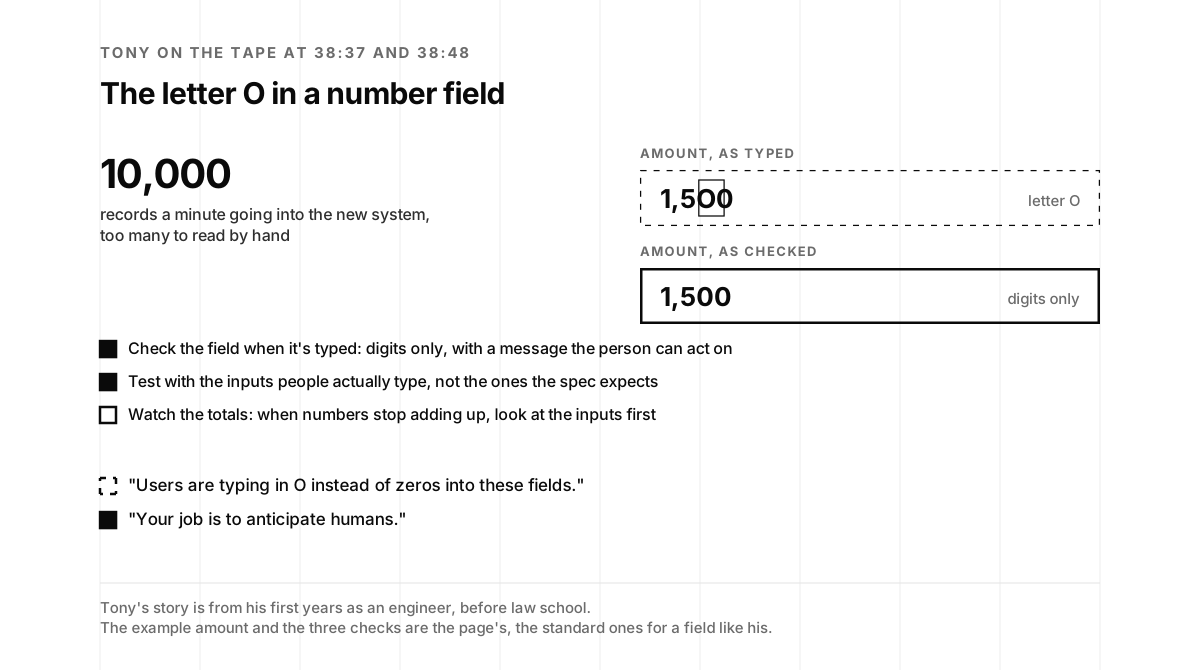
Left, a large number: 10,000 records a minute going into the new system, too many to read by hand. Right, two fields. Amount as typed, a dashed field with 1,5O0, the letter O boxed. Amount as checked, an outlined field with 1,500, digits only. Three checks below: check the field when it's typed, digits only, with a message the person can act on. Test with the inputs people actually type, not the ones the spec expects. Watch the totals: when numbers stop adding up, look at the inputs first. Two quotes from Tony: Users are typing in O instead of zeros into these fields. Your job is to anticipate humans.
Ten thousand records a minute, and one field where people typed the letter O instead of a zero: the check that would have caught it.

Listen more

Jon asked what Tony would tell his younger self. The first answer was a joke at his own expense.

“I would slap the crap out of myself.”

Tony Thai, at 40:00

The real answer came in two parts.

“And one thing I’ve always said is, listen more.”

Tony Thai, at 40:14

“If I’m going to give myself some other advice, it’d be something that I constantly still work on, which is, like, compassion”

Tony Thai, at 40:27

“Not everybody thinks the way that you do.”

Tony Thai, at 40:41

Listen · Tony on episode 51, from 40:14
About 35 seconds: Tony on the advice he'd give his younger self. The clip stops on its own. Read the full transcript.

It’s the same advice as the O and the zero, pointed at people: the user who types a letter and the client who wants something else are both thinking in a way you didn’t plan for.

From Garden Grove to USC

Jon asked where Tony grew up. The answer was Garden Grove, a city in northern Orange County (Wikipedia). The family later moved to the Inland Empire, the region inland from coastal Southern California around Riverside and San Bernardino (Wikipedia), and Tony counts Los Angeles as home.

“I went to UCLA for undergrad, which is in Westwood, part of LA. And then I went to USC for law school, which plenty of people give me crap about.”

Tony Thai, at 41:09

The University of California, Los Angeles is a public research university in the Westwood neighborhood (Wikipedia), and its rivalry with USC covers every sport the two schools play (Wikipedia).

“So we were called turncoats, right?”

Tony Thai, at 41:43

Jon compared it to another rivalry he knows. Minnesota and Wisconsin have the most-played rivalry in top-level college football, and the winner takes home Paul Bunyan’s Axe (Wikipedia).

“So I see. Kind of what happens between Minnesota and Wisconsin.”

Jon McLachlan, at 41:48

Accounting is next

Jon asked the question he puts to founders: what pain would you pay to make go away? Tony’s first answer was lawyers, which is why he went to law school. His second was the one he had just lived through.

“I would say, just because we just passed tax, the tax deadline, man, I think accounting systems are still broken.”

Tony Thai, at 42:46

Jon had just done his own taxes too.

“I tried to use, like, all of the standard solutions, I don’t even want to say their names, and nothing integrated with anything else, and I had to do it all manually again.”

Jon McLachlan, at 42:57

Then he mentioned the IRS trial.

“to allow taxpayers to submit simple taxes directly in, you know, digitally, directly to the IRS, instead of going through TurboTax or some third-party, like, service or something.”

Jon McLachlan, at 43:10

That was Direct File, a free IRS service for filing federal returns directly, introduced for the 2024 tax season and suspended in November 2025 (Wikipedia). TurboTax is Intuit’s tax preparation software, which competes with H&R Block and TaxAct (Wikipedia). Jon’s fix was a habit, not a product.

“I’m like, this should just be a monthly hygiene thing, right? Like, why can’t I just update something every month”

Jon McLachlan, at 43:41

Tony said that if HyperDraft solves legal, accounting could be next.

“It might be accounting, man.”

Tony Thai, at 44:20

“this should be way more binary in terms of decision making than legal. Like, why is it so difficult?”

Tony Thai, at 44:24

“Yes. Yes, please. Yes, please. I’ll second that one, actually.”

Jon McLachlan, at 44:30

What happened after the tape

HyperDraft kept building in the direction Tony described. Some of this came before the episode aired, and some since.

The profile. In January 2024, three months before the recording, HyperDraft published a profile of Tony titled “Meet Tony Thai: The Engineer Lawyer Building the Future of Legal Work,” with his law degree from USC Gould in 2014, his years in corporate and M&A practice, his recognition as a Fastcase 50 honoree and his teaching at USC Gould (HyperDraft).

On air. Episode 51 went out on August 2, 2024, on Podbean and Spotify (Spotify).

Direct File. The IRS trial Jon mentioned ran from the 2024 tax season until November 2025, when it was suspended (Wikipedia).

Legal infrastructure. HyperDraft’s site now calls the company legal infrastructure, built for financial institutions, government and regulated industries, and enterprises, with “precision automation for deals that can’t afford error” for lenders handling syndicated facilities (HyperDraft). Its sitemap lists Draft, Flows, a platform called Hyper OS, a consulting arm called Labs, No/Base for knowledge management and a privacy compliance tracker (HyperDraft). The Labs page has a line Tony could have said on the tape: “We don’t just digitize bad processes.”

Still coding. Tony’s LinkedIn still has him as CEO and chief engineer (LinkedIn). In 2026 he posted that after more than 1,200 hours of vibe coding, his lesson was that durable things take time, effort and attention, which is the CliffsNotes point from the tape, two years on.
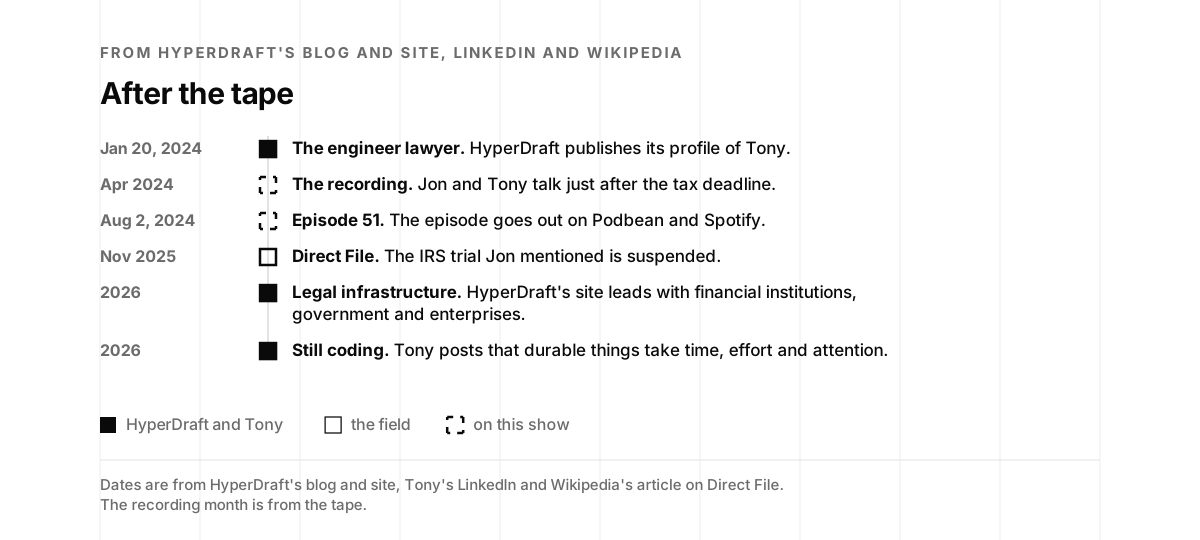
A timeline. Filled, January 20, 2024, the engineer lawyer, HyperDraft publishes its profile of Tony. Dashed, April 2024, the recording, Jon and Tony talk just after the tax deadline. Dashed, August 2, 2024, episode 51 goes out on Podbean and Spotify. Outlined, November 2025, Direct File, the IRS trial Jon mentioned is suspended. Filled, 2026, legal infrastructure, HyperDraft's site leads with financial institutions, government and enterprises. Filled, 2026, still coding, Tony posts that durable things take time, effort and attention.
What happened after the tape, from the profile in January 2024 to HyperDraft as legal infrastructure.

The part of the conversation that aged best is the plainest. Write the process down before you buy the tool. Put the hours that automation saves back into talking with the people you work for. And build every system, legal or software, for the humans who will actually use it, including the ones who type the letter O.

Did you catch it? A six-question quiz

Six questions from the episode. Each answer links the moment in the transcript.

Quiz · six questions

Did you catch it?

Pick an answer for each. The explanation shows once you choose.

  1. How did Tony describe what HyperDraft builds?

    1. A legal chatbot
    2. Dev tooling for lawyers and business professionals
    3. A contract marketplace

    b. "So at HyperDraft, we build dev tooling for lawyers and business professionals." Transcript, 5:43.

  2. What did Tony say is usually the real problem when a client asks for software?

    1. The wrong vendor
    2. Not enough AI
    3. No process

    c. "Your problem is you have no process." Transcript, 11:28.

  3. How long did the client's term sheets take before HyperDraft, and after?

    1. Eight hours, then 15 minutes
    2. Three days, then three hours
    3. Two hours, then one

    a. "And so we cut down the time from eight hours down to 15 minutes for that term sheet" Transcript, 14:53.

  4. What did Tony call AI in legal software?

    1. A replacement for associates
    2. A feature, not a product
    3. A passing fad

    b. "It's just a feature, right?" Transcript, 22:58.

  5. How often did Tony say Copilot is useful to him?

    1. Almost never
    2. Every time
    3. About 60 to 70% of the time

    c. "It's 60, 70% of the time." Transcript, 23:50.

  6. What were users typing that broke the accounting system Tony built in his first job?

    1. The letter O instead of zeros
    2. Commas in the amounts
    3. Dates in the wrong order

    a. "Users are typing in O instead of zeros into these fields." Transcript, 38:47.

Can clients trust you with their contracts?

Tony’s test for a legal tool was trust: that it isn’t “sharing that data, leveraging that data, leaking that data,” in his words. Eight questions on how close your product or team is, whether you build software that touches client documents or run the legal and security work yourself.

Scorecard · eight questions

Can clients trust you with their contracts?

Answer for how you work today. If two answers fit, pick the lower one.

  1. Do you know where every client document lives, and who can reach each one?

    • No, not with any confidence
    • For the main systems, not for copies and exports
    • Yes, from access records someone reviews

    "So there needs to be a lot of trust in systems that they're not sharing that data, leveraging that data, leaking that data." See What's more proprietary than how they make money.

  2. Is client data kept out of model training and out of other customers' workspaces, in writing and in the system?

    • We don't know
    • It's our policy, but not in the contract or enforced in code
    • Yes, in the contract and enforced by the system

    "what's more proprietary than, like, how they make money, right?" See What's more proprietary than how they make money.

  3. Does a qualified person review AI-generated work before it reaches a client?

    • No
    • Sometimes
    • Always, with a named reviewer

    "it doesn't eliminate the need for someone to have reviewed the code or reviewed the contract thoroughly." See CliffsNotes and the right side of the curve.

  4. If a language model sits between a user and an action, like an API call, a quote or a deal, can the user's input change what happens?

    • We haven't checked
    • We filter prompts
    • The model can't commit to anything or call anything without a check outside the model

    "Now they're just opening it up for you and just saying, hey, actually, you can send any prompts." See Here's some dice.

  5. Is the process written down before the tooling: how a contract moves through, and who evaluates its risk?

    • No
    • Informally, in people's heads
    • Written, followed, and the tools fit it

    "Your problem is you have no process." See Your problem is you have no process.

  6. Do your forms and fields anticipate the mistakes people actually make?

    • No, we trust the input
    • Some validation
    • Yes, tested with real inputs, letter O included

    "Your job is to anticipate humans." See Your job is to anticipate humans.

  7. How is AI described to your clients?

    • As a replacement for their people
    • Vaguely
    • As a feature inside a workflow, with review

    "It's just a feature, right?" See It's just a feature.

  8. After a deal or an incident, do you run a postmortem, and is the client in it?

    • No postmortem
    • Internal only
    • Yes, with the client

    "all right, Jon, let's do the postmortem on this last deal that we did." See Stay up all night getting your deal docs done.

Waiting for a silver bullet

Client documents are in places nobody has mapped, and the process lives in people's heads. Start by listing where client data goes and who can reach it, and write down how a contract moves through before you buy anything.

A first line of defense

The basics are there, but trust still rests on policy and good intentions. Put the training and isolation promises in the contract and in the system, put a named reviewer on AI output, and check what a prompt can make your system do.

Built for humans

You know where the data is, the model can't act on its own, and a person reviews what leaves. Keep the access reviews on a schedule, keep testing with real inputs, and keep the client in the postmortem.

How many hours come back?

Tony’s client cut a term sheet from eight hours to 15 minutes and a long-form agreement from 20 to 30 hours to three. The calculator runs that arithmetic on a month of your own documents. The defaults are his story’s numbers, with an example volume. Put in your own.

Calculator

How many hours come back?

Six numbers: how many short and long documents you draft a month, how long each takes by hand, and how long each takes with automation and review.

–drafting hours a month now
–hours a month with automation
–hours back each month
–% of drafting time saved
–hours a week for clients

By hand, your 10 short documents and 4 long-form agreements take about 180 hours a month. With automation and review, about 15. That's 165 hours back each month, 92% of the drafting time, or about 38 hours a week to spend with clients.

The defaults are one client's numbers from the episode, eight hours to 15 minutes for a term sheet and 20 to 30 hours to three for a long form, with 25 as the midpoint and an example volume. They aren't a benchmark. The automated time for a long form is mostly review, which is the part Tony said should stay with a lawyer. Weekly hours are the monthly figure times 12, divided by 52.

Everything on this page sits on one timeline, from the year USC’s law school traces its beginnings to HyperDraft today. Filter it by thread.

What to do this week

Five things, in the order the episode suggests.

  1. Write the process down first. Before you buy a contract tool, write how a document moves through your company, who drafts, who reviews and who signs, and where risk gets evaluated. Tony’s point was that the software assumes the process, so the process comes first.
  2. Map where client documents go. List every system, export and copy that holds client contracts, and who can reach each one. If AI touches them, put “no training on client data” in the contract and enforce it in the system, not just in policy.
  3. Keep a person on the output. AI drafts are a feature, and a named reviewer signs off before anything reaches a client. The scorecard above covers the rest.
  4. Test your inputs with real humans. Feed your forms the mistakes people make, the letter O in a number field included, and anything a model reads should be treated as input that can’t act on its own.
  5. Get help with the parts you can’t staff. Our AI User Access Control Audits check who and what can reach client data, our Secure AI SDLC & Engineering team builds the checks around a model, our Sales Support team answers the security review a law firm or bank will send, and you can book 15 minutes with us.

Key takeaways

  1. Engineers can make good lawyers

    Tony went from enterprise software to law school because the lawyers he worked with missed the business objectives, and he says the logic he learned writing code carried straight into contracts and deal work.

  2. A side project can take years to go full time

    HyperDraft started as a moonlight bootstrap project while Tony worked long days at big law firms, and it took a handful of his clients more than a year to convince him to run it full time.

  3. Lawyers needed an IDE

    HyperDraft builds what Tony calls dev tooling for lawyers: document generation and digital workflows, the kind of tooling engineers take for granted and outsiders assume lawyers already have.

  4. Legal and security share the same invisibility

    When either job is done well, nobody hears about it, which makes it easy for the business to take the team and its tooling for granted until a breach or a broken agreement.

  5. Pick when to raise the alarm

    Both jobs are paid to be paranoid. Experience teaches when to say now's the time, so warnings keep their weight and nobody tunes out a cry of wolf.

  6. Fix the process before you buy the tool

    Clients often ask for a silver bullet. Usually the real problem is that there's no process for how a contract moves through and how its risk gets evaluated, and software can't supply one.

  7. Some clients only need mail merge

    HyperDraft turns away more work than it takes, Tony said, because many requests don't need a platform, and a few hours learning mail merge will do.

  8. Automation pays back in hours

    One client's term sheets went from eight hours to 15 minutes, and its long-form agreements from 20 to 30 hours to three, mostly review. Those are one client's numbers, as Tony told them.

  9. Give the saved hours back to the client

    Tony wants lawyers to spend what automation saves on seeing around corners with clients: anticipating risk, asking where deals failed before, and holding postmortems with the client in the room.

  10. Contracts are the most sensitive data a business has

    Contracts say how a company makes money, so clients need to trust that a system isn't sharing, leveraging or leaking them.

  11. Tools are only the first line of defense

    Behind the tooling, InfoSec and legal, the rest is communication, training and trusting colleagues and business units to do the right thing.

  12. AI is a feature, not a product

    HyperDraft is hesitant to push AI-heavy products. It treats AI the way engineers treat Copilot, a feature inside the workflow, not a reason to cut headcount.

  13. Review is the job that doesn't go away

    Copilot helps Tony 60 to 70% of the time, and reviewing junior engineers' code shows what it can't replace. Because AI pulls toward the average of what it learned from, someone still has to review the work and understand why it's bad.

  14. Keep a check between a prompt and an action

    Jon called building APIs with LLMs one of the dumbest things he'd heard, because it lets any prompt steer an API call and its payload, the old injection problem with dice added.

  15. Never design for delegation

    Tony's recent lesson: architecting so pieces can be handed off to scale faster means someone redoes the work twice. Understand the system from the ground up, then build it as a team.

  16. Shortcuts get paid for somewhere

    Energy can't be created, and cryptography is only as strong as the work put into it. A shortcut shows up as a cost later, though Jon added that some old decisions were right for their time.

  17. Anticipate humans

    Users typed the letter O instead of zeros into Tony's first accounting system. His boss's lesson was that the job is to anticipate humans, and Tony applies it to software and to law.

Chapters

Tap a chapter to play from there.

Pull quotes

“Like any self-respecting engineer, I thought I could do it better and just went to law school as a result.”

Tony Thai ·

“And during that time, I was working with a lot of lawyers and, frankly, a little bit frustrated by the feeling that they didn't understand what the business objectives were.”

Tony Thai ·

“There's just not a lot of people that are wired to go and do something themselves.”

Tony Thai ·

“And it was just a spectacular back and forth.”

Jon McLachlan ·

“I'm like, you're way too excited to be doing anything except starting your own company.”

Jon McLachlan ·

“It's the best thing and the worst thing, both at the same time.”

Jon McLachlan ·

“Yeah, we started HyperDraft actually a few years prior. I started with a moonlight bootstrap project.”

Tony Thai ·

“where you're grinding from 7 a.m. to 11 p.m. and coding from 11 p.m. to 2 a.m.”

Tony Thai ·

“It was a passion project, to say the least.”

Tony Thai ·

“And there's really nothing riskier, especially in a professional, like, services vertical, than to start your own business.”

Tony Thai ·

“And it took a handful of my clients to convince me over the course of 12, 13 months that I should be doing this full time, not half time.”

Tony Thai ·

“So at HyperDraft, we build dev tooling for lawyers and business professionals.”

Tony Thai ·

“we focus on document generation and digital workflows, because we found that the legal field was lacking tooling in that space.”

Tony Thai ·

“And as an engineer, we built so many tools for ourselves.”

Tony Thai ·

“wow, now lawyers have an IDE, an integrated development environment, and they could just sit down, and they could share snippets and auto-completion.”

Jon McLachlan ·

“No, the reality is we're just that slow, right?”

Tony Thai ·

“It probably took longer than they billed you, frankly.”

Tony Thai ·

“if we're doing our jobs, you're not going to hear about us, right?”

Tony Thai ·

“Same goes for InfoSec, right? The same goes for cybersecurity. If the job's being done correctly, then you're not really going to hear about it.”

Tony Thai ·

“So you don't really need them until you absolutely need them, right?”

Tony Thai ·

“Yeah, I get that. And it's almost like one of those thankless roles.”

Jon McLachlan ·

“Until it goes wrong. And then when it goes wrong, like, it goes south, it goes very south.”

Jon McLachlan ·

“sometimes clients come to you and they don't know what they want, and they don't know what they need.”

Tony Thai ·

“So they think that they can purchase a solution that is going to be the silver bullet for solving their either compliance issue or security issue.”

Tony Thai ·

“Your problem is you have no process.”

Tony Thai ·

“And we can help with that. But software is not going to do that.”

Tony Thai ·

“But there are plenty of platforms that do claim to be the McAfee of contract generation and workflows.”

Tony Thai ·

“And so you wait for them to make that first mistake, and then hopefully it's not fatal.”

Tony Thai ·

“Many folks can just get away with mail merge, right?”

Tony Thai ·

“So usually it's a department that says, hey, we have X number of agreements or deal types. We're too slow. Everything's being done manually.”

Tony Thai ·

“Term sheets would take them eight hours, and then the long forms would take them anywhere from, like, 20 to 30 hours, everything done manually.”

Tony Thai ·

“And for them, time is money, right?”

Tony Thai ·

“It doesn't even need to be perfect. It just needs to be faster than what we currently do.”

Tony Thai ·

“And so we cut down the time from eight hours down to 15 minutes for that term sheet, which is insane, like an insane improvement, right?”

Tony Thai ·

“Like, from the 20 to 30 hours it took for the long-form agreements, like, we cut that down to three hours.”

Tony Thai ·

“But I'd go back and stay up all night getting your deal docs done. You didn't know that. You weren't sitting there with me.”

Tony Thai ·

“Okay, so we've done these deal types. Like, how can we make this more streamlined? How can we anticipate risk? Where have we failed before?”

Tony Thai ·

“And there's much less time, I would say, banging on the keyboard and much more time spent engaging with each other.”

Jon McLachlan ·

“what's more proprietary than, like, how they make money, right?”

Tony Thai ·

“So there needs to be a lot of trust in systems that they're not sharing that data, leveraging that data, leaking that data.”

Tony Thai ·

“It's only a first line of defense.”

Tony Thai ·

“I have 50 different replacements for GitHub repos. And you're like, that's cool. I don't see the need for it, but sure.”

Tony Thai ·

“Like, we did this before the hype.”

Tony Thai ·

“I was actually hoping you'd transition to this, because the same security risk that is evident in AI-driven code is also a big issue in legal. So we are hesitant to push AI-heavy products.”

Tony Thai ·

“It's just a feature, right?”

Tony Thai ·

“It is not a standalone product.”

Tony Thai ·

“I use Copilot. It's incredibly useful much of the time. It's 60, 70% of the time.”

Tony Thai ·

“But as I use it, and I see our junior engineers use it, I review their code, and I'm constantly reminded of the difference between a senior engineer and a junior engineer.”

Tony Thai ·

“It can augment. It can help streamline people like myself who have over a decade of experience.”

Tony Thai ·

“Just like an IDE didn't turn a junior developer into a senior developer.”

Jon McLachlan ·

“Not here to replace people, it's here to enhance.”

Jon McLachlan ·

“I think that is one of the dumbest things I've ever heard.”

Jon McLachlan ·

“Now they're just opening it up for you and just saying, hey, actually, you can send any prompts.”

Jon McLachlan ·

“Here's some dice.”

Jon McLachlan ·

“Now that I'm older and understand how this works a little bit better, like, there's only so much information you can get from an abstraction layer, right?”

Tony Thai ·

“everybody thinks AI is going to drive everyone to the right side of a curve. That's not how big data works.”

Tony Thai ·

“You've got the law of big numbers and regression to the mean, and most data is garbage, and most public code is, guess what? Garbage.”

Tony Thai ·

“It can't be relied on for high-quality work. It just can't.”

Tony Thai ·

“I learned this recently, like, embarrassingly.”

Tony Thai ·

“You have to understand from the ground up how the system works.”

Tony Thai ·

“why is there state flying around? You could have been stateless”

Jon McLachlan ·

“And so if we're taking shortcuts, we're paying the price somewhere, somehow, right?”

Tony Thai ·

“So if it didn't take that much compute, didn't take that much time, then the security is lower.”

Tony Thai ·

“And what I love to say is that the right decisions that we made in the past are not the right decisions to get us to the next 10x or the next 100x.”

Jon McLachlan ·

“So just having compassion for ourselves, I think, is, like, super important for mental health.”

Jon McLachlan ·

“the funniest ones we run into are ones where I'm like, note from Tony, I know this is stupid, right?”

Tony Thai ·

“Why LLMs are not going to replace humans. That's a hot take, brother.”

Jon McLachlan ·

“It's the religion of the moment.”

Jon McLachlan ·

“You're a heretic.”

Jon McLachlan ·

“I saw one recently that really got me going. This is the intersect of the two.”

Tony Thai ·

“Imagine. Just imagine the possibilities of, like, how much access to a system you can get.”

Tony Thai ·

“One of the things I mentioned earlier was, I want lawyers to spend more time with their clients.”

Tony Thai ·

“There's only really what I consider two really human practices, right?”

Tony Thai ·

“Yeah, I love it, because at the end of the day, it is always people.”

Jon McLachlan ·

“Users are typing in O instead of zeros into these fields.”

Tony Thai ·

“And he's just like, your job is to anticipate stupid. Your job is to anticipate humans.”

Tony Thai ·

“Like, my job is to protect against ignorance, both on the legal side and on the software side.”

Tony Thai ·

“I would slap the crap out of myself.”

Tony Thai ·

“And one thing I've always said is, listen more.”

Tony Thai ·

“Not everybody thinks the way that you do.”

Tony Thai ·

“So we were called turncoats, right?”

Tony Thai ·

“I would say, just because we just passed tax, the tax deadline, man, I think accounting systems are still broken.”

Tony Thai ·

“I'm like, this should just be a monthly hygiene thing, right?”

Jon McLachlan ·

“It might be accounting, man.”

Tony Thai ·

About the guest

Tony Thai, Founder, Chief Executive Officer and Chief Engineer, HyperDraft

Tony Thai is the founder, CEO and chief engineer of HyperDraft, which builds document automation and digital workflows for lawyers and the businesses they work with. He started his career as an enterprise software engineer, earned his law degree at the USC Gould School of Law in 2014, and practiced corporate and intellectual property law at Venable, as assistant general counsel at YP, The Real Yellow Pages, and at Verifi, and as an attorney at Bryan Cave Leighton Paisner, Nixon Peabody and Goodwin, where he was the lawyer for Jon McLachlan's startup Peacemakr. He has been HyperDraft's principal and board chairman since December 2018 and its CEO and chief engineer since March 2021, and he taught at USC as an adjunct professor from 2018 to 2023. HyperDraft's profile of him names him a Fastcase 50 honoree.

About the host

Jon McLachlan is co-founder of YSecurity, the on-demand cybersecurity team for startups, and of Cyberbase.ai. The Security Podcast of Silicon Valley is hosted by Jon McLachlan and Sasha Sinkevich. Jon McLachlan on LinkedIn ↗

Context and sources

  • Tony Thai's LinkedIn experience: CEO and chief engineer of HyperDraft, Inc. since March 2021 and its principal and board chairman since December 2018, adjunct professor at USC from August 2018 to February 2023, attorney at Goodwin from September 2019 to February 2021, associate at Nixon Peabody from December 2018 to August 2019, corporate and IP attorney at Bryan Cave Leighton Paisner from October 2017 to December 2018, assistant general counsel at Verifi in 2017 and at YP, The Real Yellow Pages, from January 2016 to May 2017, and corporate and IP associate at Venable from 2014 to 2016. Source ↗
  • HyperDraft, Meet Tony Thai: The Engineer Lawyer Building the Future of Legal Work, January 20, 2024: enterprise software development before law, a law degree from the USC Gould School of Law in 2014, corporate and M&A practice at law firms and technology companies, HyperDraft's mission to free lawyers from busywork, a Fastcase 50 honor, and teaching at USC Gould. Source ↗
  • HyperDraft, home page: legal infrastructure, document automation and compliance systems for institutions that demand precision, with pages for financial institutions, government and regulated industries, and enterprises. Source ↗
  • HyperDraft, Draft: document automation with smart templates and conditional logic, bulk generation from structured data, audit trails of every version, edit and approval, and data integration from CRM and ERP systems. Source ↗
  • HyperDraft, Flows: workflow automation for matter intake, contract review and approvals, with task orchestration and visibility. Source ↗
  • HyperDraft, Labs: a consulting arm for custom development, integrations and process re-engineering. Source ↗
  • Jon McLachlan's LinkedIn experience: co-founder and CEO of Peacemakr from January 2019 to October 2023, co-founder of YSecurity since January 2022, and host of The Security Podcast of Silicon Valley since March 2021. Source ↗
  • AI Incident Database, Incident 622: Chevrolet Dealer Chatbot Agrees to Sell Tahoe for $1, December 18, 2023, a ChatGPT-powered dealer chatbot manipulated by a user's prompt into agreeing to sell a 2024 Tahoe for $1. Source ↗
  • AI Incident Database, Chevrolet of Watsonville: the dealership listed as deployer and harmed party in incident 622. Source ↗
  • Wikipedia, Document automation: the design of systems and workflows that help create electronic documents, increasingly used to assemble legal documents, contracts and letters. Source ↗
  • Wikipedia, Legal technology: the use of technology and software to provide legal services and support the legal industry. Source ↗
  • Wikipedia, Contract management: negotiating contract terms, ensuring compliance with them and documenting changes, to improve performance and reduce risk. Source ↗
  • Wikipedia, USC Gould School of Law: the law school of the University of Southern California, the oldest law school in the Southwestern United States, with beginnings in 1896. Source ↗
  • Wikipedia, Goodwin Procter: an American multinational law firm, one of the largest in the world by revenue, with more than 1,800 lawyers. Source ↗
  • Wikipedia, LegalZoom: an American online legal technology and services company launched in 2001. Source ↗
  • Wikipedia, Enterprise software: software built for the complex requirements of larger organizations. Source ↗
  • Wikipedia, Integrated development environment: software that puts a comprehensive set of development features behind one consistent interface. Source ↗
  • Wikipedia, Autocomplete: an application predicts the rest of what a user is typing. Source ↗
  • Wikipedia, Billable hours: hours worked that are billed to a client, often required by law firms, and a practice that has been criticized. Source ↗
  • Wikipedia, Information security: protecting information by mitigating information risks. Source ↗
  • Wikipedia, Attack surface: the sum of the points where an unauthorized user can try to enter data, extract data or control a system. Source ↗
  • Wikipedia, The Boy Who Cried Wolf: Aesop's fable, source of the idiom to cry wolf, to give a false alarm. Source ↗
  • Wikipedia, No Silver Bullet: Fred Brooks's 1986 paper arguing that no single development promises even a tenfold improvement in software within a decade. Source ↗
  • Wikipedia, McAfee: an American software company focused on online protection for consumers. Source ↗
  • Wikipedia, Mail merge: combining a form letter with a list of names and addresses for mass mailings. Source ↗
  • Wikipedia, Term sheet: a bullet-point document of the material terms of a potential business agreement, the basis for later negotiation. Source ↗
  • Wikipedia, Postmortem documentation: a project post-mortem identifies the causes of a failure and how to prevent them, and a retrospective reviews the positives too. Source ↗
  • Wikipedia, Waterfall model: the phases of software development in strict sequence, the earliest such methodology. Source ↗
  • Wikipedia, Agile software development: the 2001 manifesto of 17 practitioners, which values customer collaboration over contract negotiation. Source ↗
  • Wikipedia, GitHub: a developer platform built on Git for storing, managing and sharing code. Source ↗
  • Wikipedia, GitHub Copilot: a code completion and programming assistant from GitHub and OpenAI, first announced on June 29, 2021. Source ↗
  • Wikipedia, Neuralink: an American neurotechnology company developing implantable brain-computer interfaces, launched in 2016. Source ↗
  • Wikipedia, Code injection: a program fails to process external data correctly and runs it as commands. Source ↗
  • Wikipedia, Prompt injection: inputs that make a large language model behave in unintended ways, because it can't tell developer instructions from user input. Source ↗
  • Wikipedia, Quantum mechanics: the theory of matter and light at and below the scale of atoms. Source ↗
  • Wikipedia, Classical mechanics: the motion of macroscopic objects under forces. Source ↗
  • Wikipedia, CliffsNotes: student study guides that detractors say let students skip the assigned reading. Source ↗
  • Wikipedia, Regression toward the mean: an extreme sample tends to be followed by one closer to the average. Source ↗
  • Wikipedia, Law of large numbers: the average of many independent samples converges to the true value. Source ↗
  • Wikipedia, Garbage in, garbage out: flawed input produces output of similar quality. Source ↗
  • Wikipedia, Stateless protocol: the receiver keeps no session state, so each request can be understood on its own. Source ↗
  • Wikipedia, Scalability: a system's ability to handle a growing amount of work, often by adding resources. Source ↗
  • Wikipedia, Conservation of energy: the total energy of an isolated system stays constant, so energy can be transformed but not created or destroyed. Source ↗
  • Wikipedia, Security level: cryptographic strength in bits, where n-bit security means an attacker would need 2 to the power n operations. Source ↗
  • Wikipedia, Counsel: a person who gives advice, particularly in legal matters. Source ↗
  • Wikipedia, Signedness: signed numbers can be negative, unsigned numbers can't. Source ↗
  • Wikipedia, Garden Grove, California: a city in northern Orange County. Source ↗
  • Wikipedia, Inland Empire: the region inland from coastal Southern California around Riverside and San Bernardino. Source ↗
  • Wikipedia, University of California, Los Angeles: a public research university in the Westwood neighborhood of Los Angeles. Source ↗
  • Wikipedia, UCLA-USC rivalry: the athletics rivalry between the UCLA Bruins and the USC Trojans. Source ↗
  • Wikipedia, Minnesota-Wisconsin football rivalry: the most-played rivalry in top-level college football, for Paul Bunyan's Axe. Source ↗
  • Wikipedia, Tax Day: the due date for US individual income tax returns, on or just after April 15 since 1955. Source ↗
  • Wikipedia, IRS Direct File: a free IRS service for filing federal returns directly, introduced for the 2024 tax season and suspended in November 2025. Source ↗
  • Wikipedia, TurboTax: Intuit's tax preparation software. Source ↗

Transcript

Automatic transcription. Jon McLachlan hosts this episode with Tony Thai of HyperDraft. There is no diarization on the tape, and Jon's and Tony's voices are very close, so speaker labels were assigned from the content and checked passage by passage against reference recordings of each voice from this episode, and a few short lines may sit with the wrong speaker. Names and product names were normalized where the recognizer misheard them (Jon McLachlan, Tony Thai, HyperDraft, Peacemakr, Goodwin, LegalZoom, InfoSec, Copilot, CliffsNotes, GitHub, GitLab, TurboTax, UCLA, YSecurity). Words in [brackets] are best guesses where the audio is unclear, and [unclear] marks a phrase we couldn't make out. Answers are transcribed as spoken, with repeated words and false starts trimmed. Short backchannels such as "yeah", "right" and "mm-hmm" are left out where they overlap the other speaker.

Read the full transcript 8,442 words

Jon McLachlan

Okay, welcome, everyone, to the Security Podcast of the Silicon Valley. I'm here today with a very special guest, Tony Thai, the founder and CEO of HyperDraft. Welcome to the show, Tony.

Tony Thai

Hey, Jon, thanks for having me, man.

Jon McLachlan

So, looking at your background, you've worked in many different jobs in many different industries. How did you end up where you are today as the founder of HyperDraft?

Tony Thai

Yeah. You and I met when I was in that last phase as an attorney at a big law firm, but it all started actually as a software engineer developing enterprise B2B software in my early twenties. And during that time, I was working with a lot of lawyers and, frankly, a little bit frustrated by the feeling that they didn't understand what the business objectives were. Like any self-respecting engineer, I thought I could do it better and just went to law school as a result. I think when I talk to engineers, like such as yourself and like other folks, like when I say, oh, wasn't happy with the legal service that I got, so I thought I could do it better, like a lot of engineers, like, that's the most engineering, like, engineer thing you could have said. There's just not a lot of people that are wired to go and do something themselves. And yeah, I mean, I went to law school, didn't think I'd practice in private practice, like, representing clients like yourself.

Jon McLachlan

But thank you very much for the representation.

Tony Thai

Yeah, I was most [appreciative]. No, people like you [were] one of the many reasons why I stuck around, because I was like, oh, well, if I'm facing this problem, then there's going to be a handful of folks like Jon who needed my help. Might as well help the community out instead of you having to go to law school.

Jon McLachlan

So, for all of our listeners, just for the context, back in the day when I was a founder at a company called Peacemakr, Tony worked at, where was it? It was Goodwin. And you got paired up with us, and you were our primary contact for all of our legal needs. And it was just a spectacular back and forth. And we had to fix a whole bunch of things, but we messed up with our founding of the company, and then we did some patents, and Tony was always on the ball. And then, you know, man, like, all in all, like,

Tony Thai

You guys were pretty okay case, if we're getting surgical with it, or medical with it. Like, come in with a lot of different cases. I think your guys's was pretty routinized. I want to say you came through [John Runyon] and [McCusker], but I can't remember. I don't remember what partner it was. Yeah. Do you know [John Runyon]?

Jon McLachlan

No. Okay. One of the co-founders [at] Peacemakr, he had worked with someone there before, had lots of good experiences, and that's how we ended up with...

Tony Thai

Gotcha. Very cool.

Jon McLachlan

But I remember one day you showed up and you're like, oh, I have to share with you some news. I'm moving on. I'm going to do something new. And you made me guess, made me guess what you were doing next. And I just remember thinking to myself, wow, he's so excited. Like, there's a little twinkle in his eye and everything, and like just all of this positive energy. I'm like, you're way too excited to be doing anything except starting your own company. Why didn't you warn me, man? You were already on the other side. You should have been like, what are you doing? Well, I thought, I thought you were getting into it. It's the best thing and the worst thing, both at the same time. There's never any, like, right time to do that. And you just got to pull the trigger. You just jump in. And now look at you. This is amazing.

Tony Thai

Yeah. I saw how much fun you guys were having, and I'm like, I [wanted in on] that action. Yeah, we started HyperDraft actually a few years prior. I started with a moonlight bootstrap project. It was, and I don't know if you remember my schedule, but like, working at a big law firm was not very conducive to those types of arrangements, where you're grinding from 7 a.m. to 11 p.m. and coding from 11 p.m. to 2 a.m. It was a passion project, to say the least. But yeah, we started a few years earlier. One of the things that you learn, a lot of [parallels] in security with this, but like, one of the things you learn or are trained to do at the law firm is to be risk averse, right? They constantly tell you, because, like, our jobs are to help clients navigate risk and reduce risk as much as possible. If I'm being honest with you, one of the reasons why I didn't leave was, like, I was so trained at that time to avoid risk. And there's really nothing riskier, especially in a professional, like, services vertical, than to start your own business. And it took a handful of my clients to convince me over the course of 12, 13 months that I should be doing this full time, not half time.

Jon McLachlan

[It's amazing] to have that type of support in your life and surround yourself with people that believed in you and saw the potential in you and in the company and in solving the problem that you're going after. And that's awesome, too, actually, that you came up through the ranks through a software engineering background and then got over into law a little bit.

Tony Thai

Yeah, a lot of people look at me funny, because they're like, there's just no way you could be decent at both. And it's funny because, for me, it's the same thing. It's just, like, slightly different context, right? Depends on which hat I have to wear. I'm still a lawyer. I still practice on occasion, and I had to put on a different hat, but you still try to use at least the same logical patterns when you think through stuff. So honestly, the coding background was really important for my development as an attorney, because having that ability to, or the need to craft logic through code, translated perfectly over to doing contracts and deal work and anything requiring legal documentation. So that was helpful. And it, I would say, it seeded concept around the business, right? I'm sure that folks listening to the podcast that still don't know what we do. So at HyperDraft, we build dev tooling for lawyers and business professionals. So what does that mean? Like, we focus on document generation and digital workflows, because we found that the legal field was lacking tooling in that space. And as an engineer, we built so many tools for ourselves. For me, the [natural] progression was, as a lawyer, like, I need to build [tooling] for myself and the other folks in this vertical.

Jon McLachlan

I remember you demoed it to me way back in the day, when it was an early version of your product. And I remember thinking to myself, wow, now lawyers have an IDE, an integrated development environment, and they could just sit down, and they could share snippets and auto-completion. And it was really, it looked really nice.

Tony Thai

Yeah.

Jon McLachlan

A big time saver.

Tony Thai

It was. When I built this software, when we started designing all that stuff, we did ask a lot of lawyers, like, their input. But the reality of it was, these are tools that most people in the outside world assume that we have, which is funny, right? Because you hear this common complaint that lawyers bill by the hour, and they take too long on stuff, and that they're being fraudulent with their... No, the reality is we're just that slow, right? If a contract took a long time, it actually took a long time. It probably took longer than they billed you, frankly. So I wanted to reduce that, because if we look at it, like, these lawyers have such amazing raw compute, right? And not to objectify them, but they have such amazing raw compute to spend their time on so many, like, small, tedious things. Not that it's not important, it's important, but to do it in a more streamlined manner, like, that's going to be key to apply that raw compute to stuff that matters, rather than just the mundane.

Jon McLachlan

Yeah, yeah, absolutely. And so, as you've built out this product, I'm sure you've gotten a much wider view of the legal community in general. And I'm really curious to hear your insight of what sort of relationship do you see that cybersecurity has with legal?

Tony Thai

Yeah, just before we started, like I was talking, I mentioned one of my good friends and former colleagues and an advisor to HyperDraft is a guy by the name of Steve Singer. He's currently heading up LegalZoom's InfoSec. We met when I was in-house at this private equity portfolio company, and we hit it off, like, immediately. And there's a ton of overlap, and I'll tell you the story with a few stories that he would tell me. As a corporate attorney in-house, one of the things that we're taught is, and we like to remind people, is that if we're doing our jobs, you're not going to hear about us, right? A corporate attorney should be not non-impactful, very impactful, but in the sense that if they're doing their job, then risk is being avoided. So you're not hearing about them and then the work that they're doing constantly. Same goes for InfoSec, right? The same goes for cybersecurity. If the job's being done correctly, then you're not really going to hear about it. And that causes a lot of issues, because that's a surefire way for business units and certain stakeholders to take for granted the need to have those teams, the need to have the tooling, the need to think about the objectives for those teams, because they're controlling for risk. So you don't really need them until you absolutely need them, right? Whether you've got a security breach or you've breached some sort of agreement, right? You don't need them until you realize, oh crap, I'm far out of my depth in terms of the potential downside for the risk that this may create. So in that sense, just from a perspective of attack surface, like, we share a lot of the same kind of risk management and neglect from businesses, frankly.

Jon McLachlan

Yeah, I get that. And it's almost like one of those thankless roles. If you're doing your job really well, and you're staying out of the news for all the wrong reasons, and no breaches in companies that you're servicing, or legal conundrums, then the legal space, very quiet. You're not a high visibility.

Tony Thai

Yeah. Like we said, until it goes wrong, right?

Jon McLachlan

Until it goes wrong. And then when it goes wrong, like, it goes south, it goes very south. So when it goes south, what sort of cars are you seeing drive down that road as things go south? Anything specific in the, right there, in HyperDraft space that you've noticed?

Tony Thai

I actually, a lot of woulda, shoulda, couldas, you know. And I'm sure, like, you're rolling your eyes, and plenty of people listening are rolling their eyes, because it's, in many respects, one of our jobs to be the paranoid people to say that, hey guys, like, we should really worry about this. But one of the things you pick up over time and with experience is that to avoid the cry wolf syndrome and to pick and choose when to say, hey, guys, now's the time, right? Like, that's a particular issue. For us in the HyperDraft world, I've learned a lot through the process as well. You mentioned us as an IDE, and we really do truly think of ourselves as the IDE and digital workflow systems for these large enterprises. But that's from the provider perspective, right? From the demand perspective, it's actually something that I've learned over the last few years running this company. It's like, sometimes clients come to you and they don't know what they want, and they don't know what they need. So they think that they can purchase a solution that is going to be the silver bullet for solving their either compliance issue or security issue. But in that respect, it's really just a point solution, in the sense that it's a point solution in time for a particular demand, like, pain point at that particular point. So with the HyperDraft tooling on the legal side, like, we'll have folks come to us and say, hey, this is what we think our problem is. And then, as our team digs in deeper, we realize, actually, that's not the problem, right? Your problem is you have no process. So lack of software, lack of productivity and streamlining, this is not necessarily the problem. The problem is you lack the discipline to set in place all these plans and procedures for how to send a contract through, how to mitigate risk, how to evaluate risk through that pipeline. And we can help with that. But software is not going to do that. But there are plenty of platforms that do claim to be the McAfee of contract generation and workflows. And what I've learned over time is just to tell them, like, give it a go. If somebody is going to argue with you over, like, using an out-of-the-box solution versus actually spending the time to evaluate the problem set and figure out different operating procedures, [they already have] their mindset. And so you wait for them to make that first mistake, and then hopefully it's not fatal.

Jon McLachlan

Right. Hopefully it's just a lesson learned, and you can move on with it.

Tony Thai

Exactly.

Jon McLachlan

So, in terms of folks that are using HyperDraft, what industries do you see are most common? [Is there] different types of law [that] attract a certain type of use case, maybe?

Tony Thai

Yeah, we serve, like, we're pretty industry agnostic for the most part. However, we have found many companies in finance, real estate, and healthcare have come to us because they have particular needs. And actually, this is where the great crossover for our industries, which is, they need something hyper-customized that's very complex, but also needs to be secure and in a controlled environment. And for us, that's our specialty, right? Just coming from an enterprise development background, like, I started this with enterprise in mind. And so those industries have those particular security and kind of complex deal needs. And so we found ourselves servicing a lot of those folks. And frankly, we turn away probably more work than we take, just because some clients come to us and, like I mentioned, they don't really know their problem set, and there's no use in the overkill of the HyperDraft platform for some folks. Many folks can just get away with mail merge, right? Like, just spend a few hours learning how to do that, and we don't have to get involved. And yeah, we get hit up by everyone. But yeah, I'd say that just three [focus verticals]: finance, real estate, and healthcare.

Jon McLachlan

Nice, nice. Your go-to-market strategy is, it sounds very bottom up, with people trying it out, maybe coming to you? Or is it a, what's your go-to-market strategy?

Tony Thai

Go-to-market strategy is actually more top down than anything, because, yeah, it's more top down. It's at that enterprise level. So you need purchasing power. Not only that, but you need purchasing decision-making power. So usually it's a department that says, hey, we have X number of agreements or deal types. We're too slow. Everything's being done manually. Great use case. And this is probably further on the, like, the edge case. We had a client that came in. They did term sheets and these long-form agreements. Term sheets would take them eight hours, and then the long forms would take them anywhere from, like, 20 to 30 hours, everything done manually. And for them, time is money, right? For every one of those contracts that's not going through, they're not making money. So the head of that department came to us and said, I'll pay you guys to make this faster. It doesn't even need to be perfect. It just needs to be faster than what we currently do. And so we cut down the time from eight hours down to 15 minutes for that term sheet, which is insane, like an insane improvement, right?

Jon McLachlan

Just from a [unclear] payback for every single [term sheet].

Tony Thai

Yeah, well, get a kick out of this, man. Like, from the 20 to 30 hours it took for the long-form agreements, like, we cut that down to three hours. And that three hours was mostly just manual review of the stuff that needed to be done, could be done in an automated fashion. And this is where the lawyers that bring all of those superpowers to the table can focus on their superpowers, instead of, like, [futz] around or putz around with their mundane bits that are important, but that software can help with, and that you can reuse, maybe. Jon, I'm actually curious about your experience here, because let me describe to you the lawyers' scenario, and I think the InfoSec, cybersecurity, is similar. I'm putting on my lawyer hat now. When you're a lawyer, your clients don't really appreciate the amount, like, technical work that you do. So, like, when you and I were talking, I could be wrong, but you probably appreciated me more, because, like, we would jump on a phone call and I'd talk you through it. And I'm enough of a business person that I know, hey, this is what Jon wants to hear. And frankly, like, if I'm Jon, I don't want to hear this and this, like, I'll take care of it. Just controlling for that messaging. But I'd go back and stay up all night getting your deal docs done. You didn't know that. You weren't sitting there with me. And what we're trying to get lawyers to do more of is, it's not that you're just losing all that time, that 20 to 30 hours that you're losing worth of quote-unquote billable work. [We want you to] spend that time now working with the client, understanding their needs, and talking through with them, like, how do we see around corners, right? Okay, so we've done these deal types. Like, how can we make this more streamlined? How can we anticipate risk? Where have we failed before? Those are statements that not a lot of lawyers are willing to have with their clients, right? Like, I'm very happy, like, not very happy, but willing to sit down with the client and be like, all right, Jon, let's do the postmortem on this last deal that we did. What did you think that we did well? And then what did you think that we did that you'd like us to change? And I'm not [telling] that we might change it, but I want to hear it. And that's not something that, like, a lot of lawyers want to do, but the reality is the value proposition and their skill set, the clients greatly benefit from those types of interaction. Yeah, I'm curious if that's the same on the cybersecurity side.

Jon McLachlan

No, it's definitely on the cybersecurity side. And it resonates a lot with the industry, in terms of the evolution I've seen and just how to write software, how to build software. At first, in the beginning, it was very just, like, waterfall design model. You get into the grind, you just turn out code, and you, it's very disconnected. But now, like, with agile development, everyone is talking to each other. We're doing postmortems. There's incidents that happen in the cloud or in your data center. You do, you want to go back and you want to revisit those things. And there's much less time, I would say, banging on the keyboard and much more time spent engaging with each other. And so there was a natural evolution, I would say, in engineering, that sounds like it's nudged in that same direction in the legal space. And I think that will result in better uses of folks' time, better products. It'll help folks see the bigger picture. And I'm a firm believer that when people [see] the bigger picture, that you can trust and you can delegate, and people can help you solve really hard problems, instead of having to get in there, having to micromanage everything, having to, quote unquote, like, not trust folks around you. You do want to trust folks. You want to surround yourself with incredible talent, but you want to help them understand the big picture, so that they can contribute to that mission without you having to be part of all of those little nitty-gritty. That's why I really enjoyed us working together, because I felt like you really got that. You saw that. And you didn't need the tools to help with that. But one of the issues is, if, like, writing documents, writing code, in an engineering perspective, takes so long, there's not a very good motive to move into that space where you talk to each other more. It's communication. Yeah. And speaking of the inner, the overlaps between the two worlds, maybe share with us a little bit about what makes HyperDraft approach to cybersecurity and the resulting legal issues unique.

Tony Thai

Yeah, worked as a lawyer for so many different clients and seen the security breaches, or, sorry, security incidences.

Jon McLachlan

Security, security incidents. Yeah, [alleged] things. Security incidents, yeah. [Possibly]. Yeah, yeah.

Tony Thai

Allegedly, some actor took our [information]. I understand the need for InfoSec's role in so many different deal points. And for us, when we're talking about proprietary information, if you're working with a business, what's more proprietary than, like, how they make money, right? Like, the contracts that are down to how they make money, and the strategy behind it, and what they need to do, and the negotiation. So there needs to be a lot of trust in systems that they're not sharing that data, leveraging that data, leaking that data. So I would say that, first and foremost, that's a main concern for a lot of our clients. And one of the reasons why we've been successful is because I had people like yourself to look up to, and Steve Singer, who I would [lean on for] a lot of these things, because their perspective is, InfoSec, like legal, like HyperDraft, is a first line of defense, right? It's only a first line of defense. Having a good, strong first line defense, that's a good thing. But the rest of it is around communication, training, and trusting your colleagues and business units to do the right thing. I would say a lot of our successes, in terms of winning over clients and having clients pick us over competitors, is our approach to solving the problem. It sounds so cheesy for me to say, that's really, truly in the team and the architecture. There are other solutions out there, plenty of other solutions out there, especially in the doc gen space, that claim to solve, especially in the contract management [space], which, I'll be honest with you, nobody's been able to explain to me, like, what makes their contract management special. That's like you telling me, hey, Tony, like, I have 50 different replacements for GitHub repos. And you're like, that's cool. I don't see the need for it, but sure. And so, like, we take it much more like GitHub and GitLab type approach to it, which is, let's look at the use case. Where are there problems? How do we solve it for them, so that they have an immediate value proposition to them? At the same time, look after them and figure out how they can control for security risks and legal risks. Yeah, I don't know if that's a good answer or response to your question.

Jon McLachlan

No, that's, no, that's perfect. You bring to heart what matters to your customers. And what matters to your customers, it sounds like a big chunk of it is cyber, cybersecurity, and the approach to actually solving problems and delivering value right away. Tony, you've noticed, no doubt, that AI is exploding right now. Bubbles, or new technologies, and things that, probably, people have thought they'd never see in their lifetimes are now possible. And it's accelerating at a rapid pace. What type of AI features do you guys offer to your customers?

Tony Thai

Yeah. We have seen the kind of boom of AI features, as we're one of the OGs, right? Like, we did this before the hype. You can testify to that part.

Jon McLachlan

Absolutely.

Tony Thai

Our AI features are similar to what's useful for the engineering space. Think of it like completion, Copilot.

Jon McLachlan

Auto-completion, yeah. Copilot, [text generation].

Tony Thai

I was actually hoping you'd transition to this, because the same security risk that is evident in AI-driven code is also a big issue in legal. So we are hesitant to push AI-heavy products. Something my CMO and I talk about all the time is, it's often touted as a product. It's just a feature, right? [They assist in] the ability to work in a more streamlined fashion, is a feature. It is not a standalone product. And again, I would say that our customers come to us because we understand the data, and we understand the business practices and the legal models for how it works, not because we claim to be able to replace their headcount with AI.

Jon McLachlan

I like that. That's, so that's a lead into my next question, is, what's the impact the AI advancements are having on the legal industry as you see it? Does not replace the headcount?

Tony Thai

I think it's still pretty early to tell. Let me tell you it from my perspective on the coding side, right? Like, I still code. I use Copilot. It's incredibly useful much of the time. It's 60, 70% of the time. But as I use it, and I see our junior engineers use it, I review their code, and I'm constantly reminded of the difference between a senior engineer and a junior engineer. The thing that it can't [replace] is the time and experience that it takes to learn what good architecture, what good patterns look like, thinking ahead. And, fortunately or unfortunately for the legal profession, like, time still needs to be spent learning different mental models required for their practice. There's just no surrogate from that, until Neuralink or one of these other startups can inject knowledge into our brains and basically train the neural pathways without us having to actually experience any of this stuff. It's just not going to happen, in the sense of, oh, we can completely replace it. It can augment. It can help streamline people like myself who have over a decade of experience. And so we already know where we're going with it. We already know how we're architecting this contract, this deal, whatever legal document that we're dealing with. But it's not going to make, my view of it is, it's not going to make that big of an impact. It'll expose, probably, way more of the weaknesses for folks that have been able to hide behind just doing the [rote] work, but I don't think it's going to really upend [that services arm].

Jon McLachlan

Yeah, I totally see that. I think that all of these LLMs and the code completion models that are out there, they're another tool in our toolbox. Just like an IDE didn't turn a junior developer into a senior developer. But it is a good tool to help save time, to help save some money, maybe ship some code faster, maybe find some bugs earlier in the process rather than later. And I see LLMs and all of these new models and the advancement as another tool. Not here to replace people, it's here to enhance. You used the word augment. I like that word. [It's a good point]. In the security space, I grew up as a hacker. And we've talked about this before. Like, hacker had a different term back then. Like, hacker is someone who likes to tinker. Like, these days, I think they're more like DIYers or stuff like that. But I do think about it from a, like a, how do I break a system type of perspective. If I was a kid, I would be [wetting] my chops seeing all these folks try to build APIs with LLMs. I think that is one of the dumbest things I've ever heard. And especially from a security perspective, like, I could think about so many different attack [surfaces] when we're introducing prompt engineering into API endpoint calling and payload formulation. This is, like, basic stuff that you learn as a security professional, with command injection and stuff like that. Now they're just opening it up for you and just saying, hey, actually, you can send any prompts. We're going to try to use our LLMs, which is a probabilistic model, to interpret what the API call is supposed to be. Here's some dice. It's, in physics, it's the difference between the probabilistic, super small particle science that's all probabilities, versus, like, the Newtonian stuff, which is [pretty set]. Both of those were like that perspective. Yeah, it's different.

Tony Thai

Yeah. From a, we see it too, in a sense that maybe you take it more on the development side, but like, at the end of the day, we experiment with a lot of these, you know, newfangled tools, only to realize, nope, we're still going to have to do work. It's a, it reminds me of being a kid and reading CliffsNotes. I don't know if you remember that.

Jon McLachlan

Oh, I remember that. Yeah. Yeah, I mean, like, ginormous, or read just a couple of pages.

Tony Thai

Yeah. Yeah. Now that I'm older and understand how this works a little bit better, like, there's only so much information you can get from an abstraction layer, right? There's only so much you can get, and to have utmost trust in coursework based on CliffsNotes. And maybe some people are listening to me, like, I did great with CliffsNotes, screw reading. You realize over time that even if it saves you time, like, it doesn't eliminate the need for someone to have reviewed the code or reviewed the contract thoroughly. And not only just review, not only just review, but understand why it's bad, right? If, something that I try to remind people of, this, everybody thinks AI is going to drive everyone to the right side of a curve. That's not how big data works. You've got the law of big numbers and regression to the mean, and most data is garbage, and most public code is, guess what? Garbage. And what's being pumped out to you, unless it's fine-tuned. And in many respects, like coding, much like legal work, it's subjective in many senses, right? Everyone's got a little bit of a different style, a little bit of a different pattern. It can't be relied on for high-quality work. It just can't. You still got to rely on people to understand that overall architecture, both in software and in legal work.

Jon McLachlan

Yes, yes. What have you learned from your experience from building HyperDraft?

Tony Thai

So many things.

Jon McLachlan

Like, just a top item, the one big one. Oh, you'll never do something again because you learned this, or you'll never do something the same again because you've learned this thing.

Tony Thai

I learned this recently, like, embarrassingly. It actually had to do with something we were architecting. We're proud on our, like, software architecture, but when I originally started the business, the thought was, like, delegate, scale, right? Boy, was that a mistake, man. Like, architecting a solution with the intent that you can delegate certain portions, because somehow you would be able to scale faster, is such a mistake, because you end up paying for it, or somebody pays for it down the line, and you end up redoing the work twice. And not to say that you can't architect stuff where you can build it as a team, work on it as a team, but you should never build or design with delegation in mind. You have to understand from the ground up how the system works. And that will build a more robust product and more robust architecture than thinking, oh, somebody else is going to handle, like, the little gritty parts. So that's a bit more abstract, but yeah, I don't know if that resonates with you or.

Jon McLachlan

No, it totally [does]. I've been bit by that once or twice. Thinking, like, oh, I'm just going to, here's a little thing, a black box that [I] can just push over here. And then the thing that comes back is not a, doesn't fit the bill. Maybe it did by the API, but how it did that underneath the hood, is no way it's going to possibly scale past a thousand, or can't scale it horizontally, or needs vertical scale, or all sorts of little [guys]. Or, like, the [instance], and you're like, no, why is there state flying around? You could have been stateless, like, if we'd approached it this other way. I've seen that once or twice.

Tony Thai

Now that you've brought up physics, which is one of my favorite topics, like, I'll bring in two concepts, right? One, you can't create energy, right? There's [the laws of] thermodynamics, right? Like, the preservation of it. And so if we're taking shortcuts, we're paying the price somewhere, somehow, right? That's it. And then, as I remind people with cryptography all the time, the strength of cryptography is directly proportional to the amount of energy put in, directly. So if it didn't take that much compute, didn't take that much time, then the security is lower. That's just how [hashing] algorithms work. That's just how it works. Yeah. So, if you think about that with any task in life, if you take a shortcut, you're going to be paying for it somehow, some way. And [some] things are okay with that, and some things aren't.

Jon McLachlan

Yeah. And I also, even with all of that in mind, keeping that top of mind, I also will always try to bring a sense of understanding, maybe even a sense of, like, compassion or empathy towards decisions that were made in the past that were maybe the right decision to make in the past. That then you get to a huge success, and then all of a sudden, those decisions in the past look like horrible decisions. Why did we do that? And actually, if you go back in time and you relive the context that you had back then, it was actually the right decision, even though it doesn't work. And so, when I bump into those things, those are, like, a class of their own. And what I love to say is that the right decisions that we made in the past are not the right decisions to get us to the next 10x or the next 100x. And then everyone feels warm and fuzzy about the success that you've had up from the point when that decision was made up to the point. Because it was, if you had made a different decision, the company could have gone into a different direction, because maybe you spent way too much time solving something that didn't really need to be solved yet. So just having compassion for ourselves, I think, is, like, super important for mental health.

Tony Thai

I laugh about it because so often, like, the engineers, when we go through the code, they'll see comments. I comment a lot. People ask me how engineering has influenced my legal skill set. Seldom do people ask how my legal background has influenced my engineering skill set. I write a lot of comments. And the funniest ones we run into are ones where I'm like, note from Tony, I know this is stupid, right? Like, guys, I know we're going to fix this. And if you're the one fixing it, I'm sorry, I owe you a coffee. There's plenty of those in the code base. I remember I saw one that I wrote. I wrote a line, like, three years ago. It was, like, a throwaway line. I didn't think we'd look at it. So I'm reading through the code, I think a lot of people can relate to this. I was reading through the code, and I'm like, what piece of crap, dumb person wrote? And you click on it, and the git blame's at Tony Thai, and it's, ah, yes.

Jon McLachlan

Yeah. It happens all the time, man. It's pretty funny. It's really funny. Yeah. And with Git, everything is accounted for. It's right there. You can go back. You can even look at the commit message that showed up with it. What was happening back in the day when that was, like, the thing.

Tony Thai

Listen, you said you give people kind of room and empathy for having made a decision at the time. Like, I do the same, and [I've grown], right? Every day that I'm writing code, I'm getting better.

Jon McLachlan

Why LLMs are not going to replace humans. That's a hot take, brother.

Tony Thai

I'm in agreement with you that it's a hot take, but apparently, I don't know why, but yeah.

Jon McLachlan

Well, because you're going against all of the grandiose visions that the bubble had. It's the religion of the moment. Again, I jump on board. You're a heretic. From a [hacker] perspective, there's so much in me that just wants to mess with all these, like, all these different systems, because I want to be the guy that [feeds] misinformation, right? Like, that would bring me so much joy.

Tony Thai

I saw one recently that really got me going. This is the intersect of the two. There was a car dealership. Have you seen this?

Jon McLachlan

No.

Tony Thai

A car dealership that had a chatbot. And with prompt engineering, one of the users was able to get them to offer him a car for, like, a hundred bucks and agree to the deal. And I'm thinking to myself, I'm like, he did it as a joke. Imagine. Just imagine the possibilities of, like, how much access to a system you can get. Could we do that with a house in California? [I'd] be down for that, man.

Jon McLachlan

Okay, okay. What do you think the impact, what would you like the impact of the technology that you're building in HyperDraft have on the greater, the bigger picture, and the legal community in general?

Tony Thai

One of the things I mentioned earlier was, I want lawyers to spend more time with their clients. I know it sounds weird, but one of the reasons why we want people to save the time is to spend more time in their community, talking to clients, talking to their network, community, whatever it is. Because I think that's where the real value is. There's only really what I consider two really human practices, right? There's the medical field, doesn't get more human than that. We're maintaining the body. We're focused on the body. And then the law is social governance, figuring out what binds us, what responsibilities we have to go through on the day to day. As the work has gotten more grueling, more technical, all that stuff, I feel, what I've seen is a detachment between the lawyer, what used to be referred to as the counsel, that's why we refer to lawyers as your counsel, and moved away from that to technicians. And we'd like to bring that back, because I think we can solve a lot of problems with that, the raw compute of a lot of these brilliant minds [who are] just stuck in the mire of doing the day to day, and not thinking about, nor should they be thinking about, how to remove those bits, so that they can spend more time with their clients and other people.

Jon McLachlan

Yeah, I love it, because at the end of the day, it is always people. And that's actually a litmus test that I use every once in a while. I find myself doing something, and I can't very quickly articulate or convince myself that I'm improving the life of a fellow human being. And it doesn't even matter if that's, like, a fellow engineer, a salesperson, a customer, or even my future self. I put myself as a human being, too. They're my future self. If I can't convince myself that someone [unclear].

Tony Thai

Yeah, yeah. Okay, I'll take that. I'll take that.

Jon McLachlan

Yeah, I stop. And you have to always make sure that the things that we do are connected back to a human, right? Even if you're in the code and you're engineering, and you have to make a decision about, do you use a signed int or an unsigned int? And our non-technical readers are not going to understand what that is, but it's just a very nitty-gritty technical thing that no one ever thinks is going to have an impact on someone's life, but you actually could, and you actually can. And if you can't see the connection between those two things as an engineer, just go down and see the bigger picture.

Tony Thai

Do you have a, can I tell you? I'll tell you just a quick anecdote on that.

Jon McLachlan

Please.

Tony Thai

Because we can be taught stuff all day long, but until you make mistakes, like, I truly believe that until you make mistakes, those neural pathways aren't really that embedded, because I've been warned about all this stuff.

Jon McLachlan

That's right.

Tony Thai

When I was a very junior engineer, I'm saying, like, very early twenties.

Jon McLachlan

[Working in this] finance system when you were eight years old.

Tony Thai

Yeah, yeah, yeah. Okay, all right.

Jon McLachlan

[unclear] more than eight years old.

Tony Thai

Yeah, yeah, yeah. [I'd be surprised if we] trusted an eight-year-old with the system. But I was working with a big accounting system. We were transitioning over from one system over to something that I was working on, and did all this testing. D-Day came, transferred over the primary interface to what I built. And immediately we started running into issues. Like, records were not going through, numbers weren't adding up. And I was scrambling. This is, like, one of my first jobs. I was so stressed out. And then I was going through the records. I'm like, this isn't, this is a financial system. So the minute I'm going through records, there's 10,000 records going in a minute. It's not like I can just sit and go through all of it. And this is way back in the day, right? Our compute's low. Stay up all night. I finally figure out what it is. Users are typing in O instead of zeros into these fields. So I'm excited that I feel like I've solved the problem. Go to my boss at the time, and he just chews me out. And I'm looking at him like, dude, it's the users that are stupid. Like, I'm not the idiot. And he's just like, your job is to anticipate stupid. Your job is to anticipate humans. Like, developing software is for humans, not for other robots who know the input. And I'm thinking to myself, [who] puts an O instead of a zero? Like, [what moron does that]? And he was right. And so, ever since that point, like, I took to heart, like, it's my job to protect against stupid. And, like, clients are, no, but it's really just ignorance, right? Like, my job is to protect against ignorance, both on the legal side and on the software side. So, yeah. Anyways, I forgot how we got on that point. Oh, you're talking about building for humans.

Jon McLachlan

Human and human, yeah. Yeah, humans are what matter, always. 100%. No, I like that. I like revisiting, like, old stories. And speaking of revisiting, [if you] could go back and visit your younger self, two questions. Would you? And if you would, you have any advice for your younger self?

Tony Thai

I would slap the crap out of myself.

Jon McLachlan

[Some room] for self-compassion?

Tony Thai

Oh, yeah. Well, not for myself. I'm the dumbass. I've said before, or I've been asked this question before in, like, smaller circles. And one thing I've always said is, listen more. Like, when you're young, like, you're always gung-ho. You always think of the right answer, all that stuff. And I like to think that I picked up on listening more earlier than most. If I'm going to give myself some other advice, it'd be something that I constantly still work on, which is, like, compassion, and having more empathy and compassion around, like, other people's perspectives. Not everybody thinks the way that you do. And I think, for me, growing up as a kid and also as a professional, like, I constantly thought that people wanted to operate the same way I did.

Jon McLachlan

Where did you grow up? Where did you grow up?

Tony Thai

I grew up in Garden Grove, Orange County, California, so in SoCal here. And then the family moved out into the Inland Empire, in [Corona]. And then from there, honestly, like, I would say home base for me feels like, and has been, LA, because I went to UCLA for undergrad, which is in Westwood, part of LA. And then I went to USC for law school, which plenty of people give me crap about.

Jon McLachlan

But why do they give you crap?

Tony Thai

Are you not familiar with the...

Jon McLachlan

I don't know. My stereotypes are not very good.

Tony Thai

[unclear]. Yeah, okay, great. That's one of the stereotypes. You see, [UCLA and] USC are like crosstown rivals, like, in a fun way.

Jon McLachlan

In a fun way.

Tony Thai

But yeah, back when both football programs were excellent, yeah, there's a lot of rivalry between the two. So we were called turncoats, right? There's a name for us, like, anyone that converted from UCLA to USC.

Jon McLachlan

So I see. Kind of what happens between Minnesota and Wisconsin. And as far as Minnesotans are concerned, anyone that lives in Wisconsin or identifies as a Wisconsinite is a [cheesehead]. So we say that with all of the love in the world. So I'm sure [you're] labeled turncoats with all the love in the world.

Tony Thai

I'm sure. I'm sure. Yeah. Yeah, exactly.

Jon McLachlan

So we had a lot of entrepreneurs, actually, that listened to this show. And this is a little bit of a leading question, but I'm super curious to hear, and I'm sure some other people might be. If there is one pain point that you just wish someone would step forward and solve, and knock it out of the park, and maybe build a company around, is there any pain points that you have, that you see over and over again, that you would definitely pay money to have just disappear?

Tony Thai

First off, [the lawyers]. That's why I went to law school, [unclear].

Jon McLachlan

Yeah, you're very engaged in solving [that one], yeah.

Tony Thai

I think we are solving for one of them. I would say, just because we just passed tax, the tax deadline, man, I think accounting systems are still broken. It's, oh, I hate [that].

Jon McLachlan

Like, it is. I tried to use, like, all of the standard solutions, I don't even want to say their names, and nothing integrated with anything else, and I had to do it all manually again. And then I heard the IRS is now [farting] around with some trial to allow taxpayers to submit simple taxes directly in, you know, digitally, directly to the IRS, instead of going through TurboTax or some third-party, like, service or something.

Tony Thai

Yeah, it's so broken.

Jon McLachlan

The fact, it's definitely a broken system. We know the rules. We got to play it. The thing that bugs me is that we wait until the end of the, we wait for this, like, climax point where all this stuff has to lead into filing the taxes. Like, I was literally thinking about this the other day. I'm like, this should just be a monthly hygiene thing, right? Like, why can't I just update something every month, and then April's just another month? Like, why does everyone wait for me to collect information? And our stuff is, obviously, a little bit more complicated than a simple filing. But I think a lot of founders feel that way, because, like, they've got their own investments, they have to worry about their taxes for their company. It's a complicated affair. And, like, also have another business to run on the op side. So I think a lot of founders can relate to accounting systems being, like, crap. That's all.

Tony Thai

If you ask me, like, okay, once you solve the legal one, where'd you go into next? It might be accounting, man. It might be the fact that, Jesus, this should be way more binary in terms of decision making than legal. Like, why is it so difficult?

Jon McLachlan

Yes. Yes, please. Yes, please. I'll second that one, actually. Tony, this has been an incredible conversation. Thank you so much for your time. Great discussion. I'm your host, Jon McLachlan. And thank you to all of our listeners as well for tuning in to another episode of The Security Podcast of Silicon Valley, a YSecurity production. And please stay tuned for another episode. Tony, been amazing.

Tony Thai

[unclear], brother. Thanks for having me.

Jon McLachlan

Thanks for joining. Thanks for joining. And thanks to all of our listeners again.

Tony Thai

Oh, and just a quick plug, if folks are curious what we do and are interested in learning more, they can check us out at hyperdraft.ai or any of our socials under HyperDraft.

Jon McLachlan

HyperDraft. You've heard it here first. Thanks, Tony.

Tony Thai

All right. Thank you.

Jon McLachlan

Thanks.

FAQ

Questions this episode answers

Who is Tony Thai?
Tony Thai is the founder, CEO and chief engineer of HyperDraft, which builds document automation and digital workflows for lawyers and businesses. He started as an enterprise software engineer, earned his law degree at the USC Gould School of Law in 2014, and practiced corporate and intellectual property law at Venable, YP, Verifi, Bryan Cave Leighton Paisner, Nixon Peabody and Goodwin before running HyperDraft full time from March 2021. He taught at USC as an adjunct professor from 2018 to 2023.
What is HyperDraft?
HyperDraft builds what Tony calls dev tooling for lawyers and business professionals: document generation and digital workflows. Its site describes document automation and compliance systems for financial institutions, government and enterprises, with products for document automation (Draft), workflow automation (Flows), knowledge management (No/Base) and privacy compliance, a platform called Hyper OS and a consulting arm called Labs.
How do Jon McLachlan and Tony Thai know each other?
Tony was the attorney at Goodwin who handled legal work for Jon's earlier startup, Peacemakr, including fixing its founding and filing patents. Jon remembers the day Tony came in, excited, to tell him he was leaving to run his own company.
Why did a software engineer become a lawyer?
Tony worked with lawyers as an enterprise software engineer and was frustrated that they didn't understand the business objectives. Like any self-respecting engineer, he said, he thought he could do it better and went to law school.
How is legal work like software engineering?
Tony says both use the same logical patterns: crafting logic in code translated directly into drafting contracts and deal work. Jon compared HyperDraft to an integrated development environment for lawyers, with snippets and auto-completion.
Why do legal and security teams get taken for granted?
If either team does its job, risk is avoided and nobody hears about it. That makes it easy for the business to take the team and its tooling for granted until a breach or a broken agreement shows how much it was needed.
Why isn't a contract tool a silver bullet?
Tony says clients often buy a point solution for one pain point when the real problem is that they have no process: no plans or procedures for how a contract moves through and how its risk is evaluated. Software can help with a process, but it can't create one.
How much time can document automation save?
For one HyperDraft client, term sheets went from eight hours to 15 minutes, and long-form agreements from 20 to 30 hours to three, mostly manual review. Those are one client's numbers as Tony told them, not a benchmark.
What should lawyers do with the time automation saves?
Spend it with clients, Tony says: understanding their needs, anticipating risk, asking where deals have failed before, and holding postmortems on past deals with the client in the room.
Why are contracts so sensitive?
Contracts describe how a business makes money, from its terms to its strategy and negotiations. Clients need to trust that a system isn't sharing, leveraging or leaking that data, and Tony says that trust is a main concern for HyperDraft's clients.
How does HyperDraft think about AI?
As a feature, not a product. HyperDraft had AI features like completion before the hype, but it is hesitant to push AI-heavy products, because the security risks of AI-written code apply to legal documents too, and because clients come for its understanding of their data and business, not to replace headcount.
Will AI replace lawyers?
Tony thinks it's too early to tell, and doubts it. Copilot helps him 60 to 70% of the time, but what it can't replace is the experience that separates senior from junior engineers, and law needs the same years of mental models. AI can augment experienced people, and it may expose those who only did rote work.
What's wrong with building APIs on top of LLMs?
Jon's concern is injection. Putting a probabilistic model between any prompt and an API call or its payload lets user input steer what the system does, the same class of bug as command injection. He compared it to rolling dice.
What happened with the car dealership chatbot?
Tony described a dealership chatbot that a user prompted into offering a car for about a hundred dollars and agreeing to the deal. The AI Incident Database records it as incident 622, on December 18, 2023: a Chevrolet dealer's ChatGPT-powered chatbot agreed to sell a 2024 Tahoe for $1.
What does anticipate humans mean?
In Tony's first job, a new accounting system failed because users typed the letter O instead of zeros. His boss told him the job is to anticipate humans, because software is built for people, not robots who know the right input. Tony applies the same idea to legal work, as protecting against ignorance.
What would Tony tell his younger self?
Listen more, and keep working on compassion and empathy for other people's perspectives, because not everybody thinks the way you do.
What problem would Tony solve after legal?
Accounting. Recorded just after the April 2024 tax deadline, the episode has Tony saying accounting systems are still broken and that taxes should be far more binary than legal work. Jon suggested making taxes a monthly habit, so April is just another month.
Keep reading on the YSecurity blog
New episodes every other Tuesday

Got a story like this one?

We're always looking for practitioners who've been in the room when it mattered.