
Podcast Episode 73

Episode 073 19 min

How Free AI Tools Become Expensive Mistakes

with Michael Moore · Glean

0:00 / 19:00

Also on Spotify, Apple Podcasts, YouTube, Podbean, Player FM

Episode 73 of The Security Podcast of Silicon Valley, published July 15, 2025. Hosts Jon McLachlan and Sasha Sinkevich, co-founders of YSecurity, talk with Michael Moore, then vice president and head of legal at Glean, the enterprise AI company, and now its general counsel. Michael, an applications engineer turned patent agent and technology lawyer, explains why a free AI tool is usually paid for with your data, the minimum bar he sets for any AI product as a buyer, from permissions around customer data to guardrails against training without consent, and why enterprise data belongs in enterprise tools, with the 2023 Samsung leak as the example. They talk about speaking both legal and engineering, standing in the buyer's shoes, why he chose Glean, protecting engineers' innovations at Glean:GO, why legal teams will have to embrace AI, answers grounded in their sources, what a chief executive should look for in an AI tool, why a security chief should have a lawyer on speed dial, and his advice to start speaking early. About 19 minutes.

Episode notes

Free AI tools promise speed—but they can quietly kill enterprise deals. In this episode, Michael Moore, VP and Head of Legal at Glean, unpacks the legal, privacy, and trust pitfalls that most AI startups overlook. He explains how to design AI products that survive legal scrutiny, earn buyer trust, and actually close.

Hosted by Jon McLachlan and Sasha Sinkevich — co-founders of YSecurity.

The deep dive

Nothing is really free

Michael Moore went from applications engineer to patent agent to head of legal at Glean, the enterprise AI company. Here is our conversation with the public record beside it: why a free AI tool is paid for with your data, the minimum bar he sets for any AI product, enterprise data in enterprise tools, why legal teams will have to embrace AI, answers you can trace to their sources, and why every security chief should have a lawyer on speed dial.

Every AI tool has a price, and the free ones are paid for in something other than dollars. Michael Moore has spent his career on both sides of that kind of trade, first as an engineer building products and then as the lawyer protecting them, and on this episode he put it in one sentence.

“And whenever the tool is free, that is, whenever there’s no dollar cost, your data and your personal information is usually the payment, because nothing is really free.”

Michael Moore, at 8:24

Listen · Michael on episode 73, from 8:13
About 37 seconds: guardrails against training on a user's data, and why a free tool is never free. The clip stops on its own. Read the full transcript.

Michael is the general counsel and company secretary of Glean, the enterprise AI company Arvind Jain founded in 2019 (Glean). When we recorded, his title was vice president and head of legal, and he described Glean as “an enterprise search and agentic AI company.” Before Glean he was chief privacy officer of Lacework, the cloud security company, which is where he was the first time he came on the show, on episode 41 in April 2024. This time he tells Sasha and me what he expects from any AI product, why the free tools turn out to be the expensive ones, what legal teams have to learn next, and why legal and security belong on each other’s speed dial.

Where we sit, so you can weigh what follows: YSecurity helps startups get through the security and AI reviews enterprise buyers run, from the first questionnaire to ISO 42001 certification. So we spend our days on the seller’s side of the table Michael describes, getting founders ready for buyers who think the way he does. Sasha and I hosted. We recorded in late May 2025, about a week after Glean held its first user conference, and the episode aired on July 15, 2025.

From engineer to lawyer

Sasha opened with the question his career raises: “At what point in time did you start thinking about tapping into the legal side of business ventures?” His answer starts with building. “So from my own just personal journey, I would say, as an engineer, I was very involved in building and developing new products.” And then, “I’ve always been a builder in whatever area I’ve worked in, be it technology or law.” As he built products, he kept asking how to protect them, and that question pulled him toward law.

“And that actually really brought up an interest in me in how do I blend the creativity of engineering with the protection of that creativity through legal.”

Michael Moore, at 1:18

Listen · Michael on episode 73, from 0:50
About 37 seconds: an engineer who kept asking how to protect what he built. The clip stops on its own. Read the full transcript.

His LinkedIn traces the path in order. He spent four summers as an applications co-op at Analog Devices from 1994, then joined Cypress Semiconductor as an applications engineer in 1998, working on data communications and programmable logic. In 2002 he became a patent agent at Cypress, preparing and prosecuting the company’s patents. Law firm work followed at Morgan Lewis & Bockius in Palo Alto from 2007, then in-house intellectual property roles at Symantec from 2009 and at Rambus from 2011, where he became vice president of IP and deputy general counsel. At Pure Storage, from 2016, he added privacy and sales compliance to products and patents, and his LinkedIn lists The Recorder’s Legal Department of the Year awards for the legal team there in 2017 and 2019. At Lacework, from 2021, he ran privacy and IP, became chief privacy officer, and led the privacy program through Fortinet’s acquisition of the company in August 2024 (LinkedIn). He studied law at Santa Clara University School of Law, and his LinkedIn headline lists the IAPP’s credentials in AI governance and privacy.

Every step on that list is a version of the same job: understand what engineers build well enough to protect it.
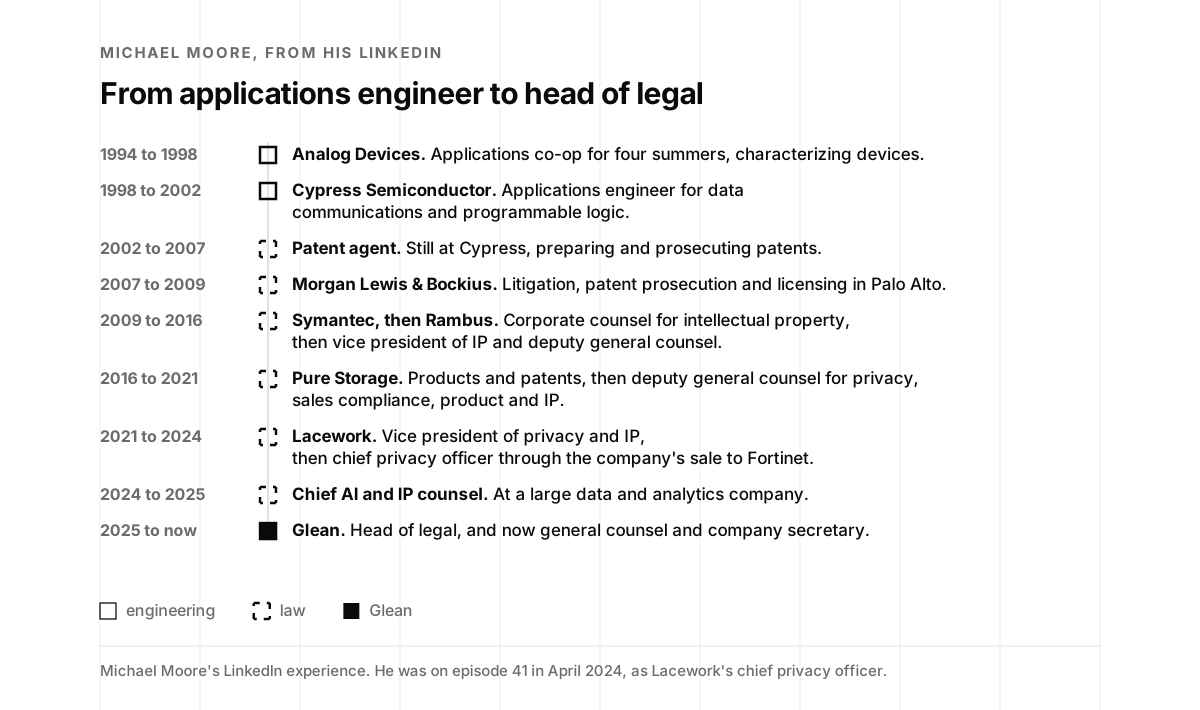
A timeline of nine entries. 1994 to 1998, Analog Devices, applications co-op for four summers, characterizing devices. 1998 to 2002, Cypress Semiconductor, applications engineer for data communications and programmable logic. Dashed, 2002 to 2007, patent agent, still at Cypress, preparing and prosecuting patents. Dashed, 2007 to 2009, Morgan Lewis & Bockius, litigation, patent prosecution and licensing in Palo Alto. Dashed, 2009 to 2016, Symantec, then Rambus, corporate counsel for intellectual property, then vice president of IP and deputy general counsel. Dashed, 2016 to 2021, Pure Storage, products and patents, then deputy general counsel for privacy, sales compliance, product and IP. Dashed, 2021 to 2024, Lacework, vice president of privacy and IP, then chief privacy officer through the company's sale to Fortinet. Dashed, 2024 to 2025, chief AI and IP counsel at a large data and analytics company. Filled, 2025 to now, Glean, head of legal, and now general counsel and company secretary.
Michael's path from applications engineer to Glean, from his LinkedIn experience. Outlined entries are engineering, dashed ones law, and the filled one Glean.

One problem, three protections

The questions he asked as an engineer line up with the three main kinds of intellectual property. “How do we protect the code via copyright? How do we protect engineering designs via patents? How do we protect our marketing and brands via trademarks?” To Michael they aren’t three separate fields.

“They’re all facets of the same problem we’re trying to solve.”

Michael Moore, at 1:41

The coder writing software, the engineer building chips or mechanical designs, the creator of copyrighted works of art, the musician: “all of these are different aspects of human creativity.” His conclusion is the thread through the rest of the episode. “And the creativity involved needs to be protected and rewarded.” The work he enjoys, he said, is helping creators “expand the market for their creativity and protect their creativity.”

For a startup, all three show up in the first year, usually before anyone thinks of them as legal questions. Does the company own the code its contractors wrote? Is the core invention worth a patent? Is the name on the website yours to use? None of it is security in the narrow sense, and all of it is what an acquirer’s lawyers, or an enterprise buyer’s, will eventually ask about.
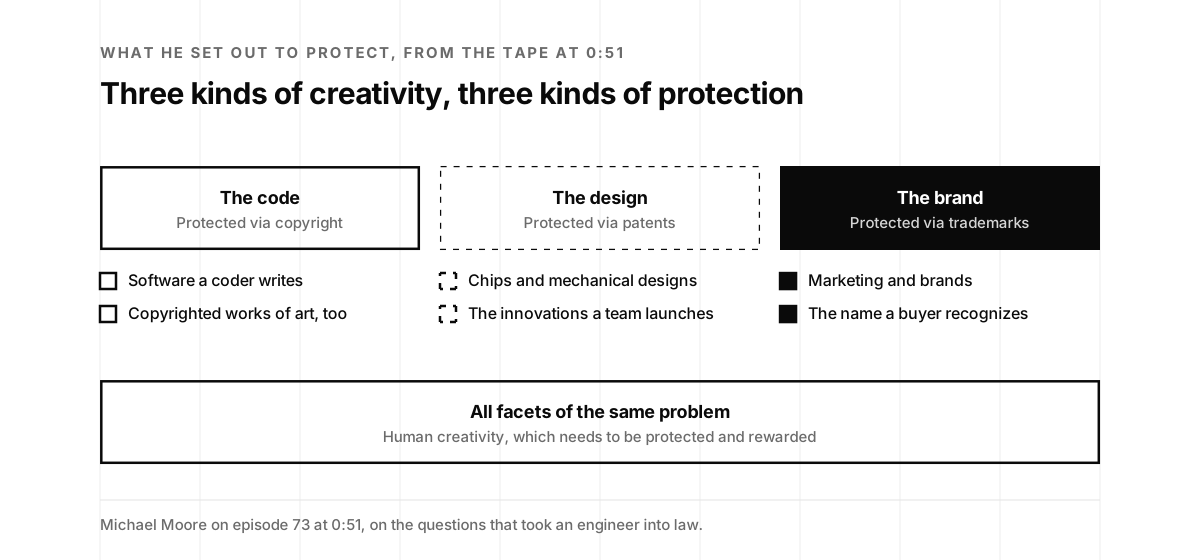
Three columns. Open, the code, protected via copyright: software a coder writes, and copyrighted works of art too. Dashed, the design, protected via patents: chips and mechanical designs, and the innovations a team launches. Filled, the brand, protected via trademarks: marketing and brands, and the name a buyer recognizes. Below, one box across all three: all facets of the same problem, human creativity, which needs to be protected and rewarded.
The three kinds of protection Michael named on the tape at 0:51, and the creativity behind all of them.

A common language

Sasha saw the advantage in that mix: “It puts you in a very interesting position, because you can speak both legal and engineering languages.” Michael agreed and named the problem. “So, for example, lawyers are well known for speaking legalese.” Engineers have their own jargon, “which can be off-putting to folks who are not of technical background.” His job, as he describes it, is translation, understanding “the tech and the business and the market and the concerns of users and any concerns of vendors, suppliers” and bringing them all “to a common platform we can all understand and communicate.”

“Because good communication and clarity really helps unblock many of the issues that slow down deals.”

Michael Moore, at 3:17

Sasha put it more simply: “Communication is the key. Whether it’s life, business, work, communication is the key.”

From where we sit, this is where a lot of startup deals actually stall. A buyer’s questionnaire asks about data subjects, subprocessors and retention, an engineer answers in services, buckets and queues, and the deal waits while somebody translates. The founder who can say what the product does with customer data, in the buyer’s words and with the evidence attached, gets through review faster. We wrote the playbook for that in what a DDQ is and how to answer one.

Both sides of the table

Michael’s next point came from his own procurement work. “I’ve been both on the buy side and the sell side of enterprise software.” He has done “a lot of buy side procurement work, vendor work,” and “a lot of enterprise sales side also.” On the buy side he learned what a buyer is protecting: “the privacy and security of their data” and “the confidentiality of their business.”

Listen · Michael on episode 73, from 3:37
About 50 seconds: the buy side and the sell side, and standing in the buyer's shoes. The clip stops on its own. Read the full transcript.

“So when you’re selling a product to an enterprise, you need to be able to put yourself clearly in the buyer’s shoes and understand what is important to the buyer.”

Michael Moore, at 4:04

Then the three questions he asks as the seller: “How can I make my product better for the buyer? How can I make my deal and transaction process better for the buyer? How do I reduce friction wherever possible, and get to a point where it’s easy and clean and smooth for us all to transact together?” And the whole job in three words: “Just unblocking the process.”
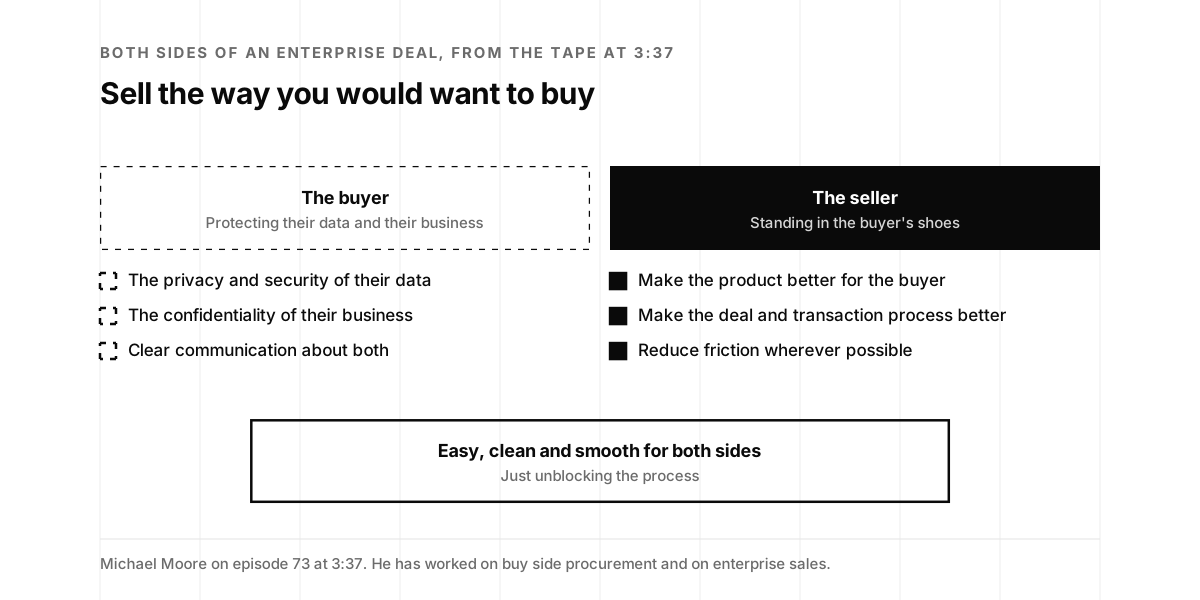
Two columns. Dashed, the buyer, protecting their data and their business: the privacy and security of their data, the confidentiality of their business, and clear communication about both. Filled, the seller, standing in the buyer's shoes: make the product better for the buyer, make the deal and transaction process better, and reduce friction wherever possible. Below, an open box: easy, clean and smooth for both sides, just unblocking the process.
What each side of an enterprise software deal is protecting, from the tape at 3:37.

A year later he put a number on one piece of that friction. In the second part of a Law.com series on legal AI, he wrote that the teams that deploy AI well start with high-volume, structured work like privacy and security questionnaires. They build agents that pull out the questions, query a curated bank of approved answers and draft fully cited responses for a person to review. By his account, that turns a questionnaire of more than 100 questions, hours of work, into roughly a 20-minute workflow.

In Part 2 of my Law.com ALM legal AI series with Glean, I focus less on which tool to buy and more on what actually works when you move from pilots to production: organizational readiness.

Michael Moore · April 23, 2026
Michael's summary of the second part of his Law.com series: start with workflows, measure from day one, lead the security conversation, decide which sources are authoritative, and build narrow agents. The calculator further down uses his 20-minute figure. View on LinkedIn.

Why Glean

I asked why he picked Glean. The first reason was people, team members “who are just awesome,” some of them folks he had worked with before. The second was the product: “I’ve personally used it.” The third is the one that matters for everyone else.

“And the key thing is it puts AI in the hands of employees.”

Michael Moore, at 5:01

Listen · Michael on episode 73, from 4:49
About 43 seconds: AI as a special toy, and an approach that hands it to everyone. The clip stops on its own. Read the full transcript.

He has seen the opposite approach, companies where “AI was sort of this sacred thing and guarded by a very limited number of people who wanted to keep control on it.” In his words, “It was almost like this was the new special toy, and some companies didn’t want regular users, regular staff, to have access to this toy.” Glean’s approach, he said, is “to make the tool available to all the users, and just make the jobs of everyday users so much more fun, productive and enjoyable.”

Then he described the problem from the inside. Before Glean he spent time at “a very large multinational company,” a very good company by his account, “But it was very, very siloed, and trying to find anything was almost impossible.” The cost is time and morale. “When you’re spending 20 or 30 percent of your time just trying to find the information you need to do your job, that tends to reduce productivity.” And when people “have to do sort of drudge work just to find the basic information they need to do the job and be productive, that is a demotivator.”

Listen · Michael on episode 73, from 5:32
About 47 seconds: a siloed company, and the cost of looking for things. The clip stops on its own. Read the full transcript.

The security side of putting AI in everyone’s hands is access. A tool that searches everything a company knows is safe when each person sees only what they could already open, which is why permissions come first on the minimum bar Michael sets below. Glean’s own security page goes a step further for agents, saying an agent “should not automatically access everything the user can” (Glean). Checking exactly that, before and after an AI rollout, is what our AI access control audits do.

The proudest day

Sasha asked about the proudest day so far. Michael picked Glean:GO, “our first ever user conference, which was a huge success.” It had happened “up in San Francisco about a week or so ago. Huge success, sellout.” Glean’s announcement put the conference at the Fort Mason Center on May 20, 2025 (Glean), which dates our recording to late May.

Listen · Michael on episode 73, from 6:26
About 41 seconds: Glean:GO, the marketing team, and protecting what the engineers launched. The clip stops on its own. Read the full transcript.

He worked with the marketing team on the content, the PR and the planning, “and the whole thing [ran] like clockwork.” And he worked with the engineers on the other side of the launch, “to protect the fantastic innovations they launched at the Glean:GO event.”

“And it’s personally very rewarding to me to see engineers, both seasoned and also early career engineers, get recognition for their amazing innovation through filing patents and other means to protect the IP.”

Michael Moore, at 7:13

He called it “a way of acknowledging and recognizing the very hard work that they’ve done to bring such an amazing product to market in quick time.” Decades after the applications engineer started asking how to protect what he built, he protects what other engineers build.

The minimum bar for an AI product

Sasha asked the procurement question every AI founder is living with: “Is there a minimum bar that every AI product should be hitting, or should have, in order to go through that procurement process quite easily?” Michael answered from the buyer’s chair.

“Any AI product that we are selling, I look at it from the perspective of, if I were the buyer, what would I be asking for?”

Michael Moore, at 7:48

His list, in his order. First, “very strong [controls or] permissions around the user or customer data put into the AI tool.” Second, “The key thing is protecting the personal data information of data subjects, of individuals, protecting confidential information, protecting trade secret information.” Third, “very clear guardrails against training using that user’s data without their knowledge or consent.” He also asks what kind of communication he would expect, which matters as much as the controls, because a buyer can only rely on what the seller writes down.
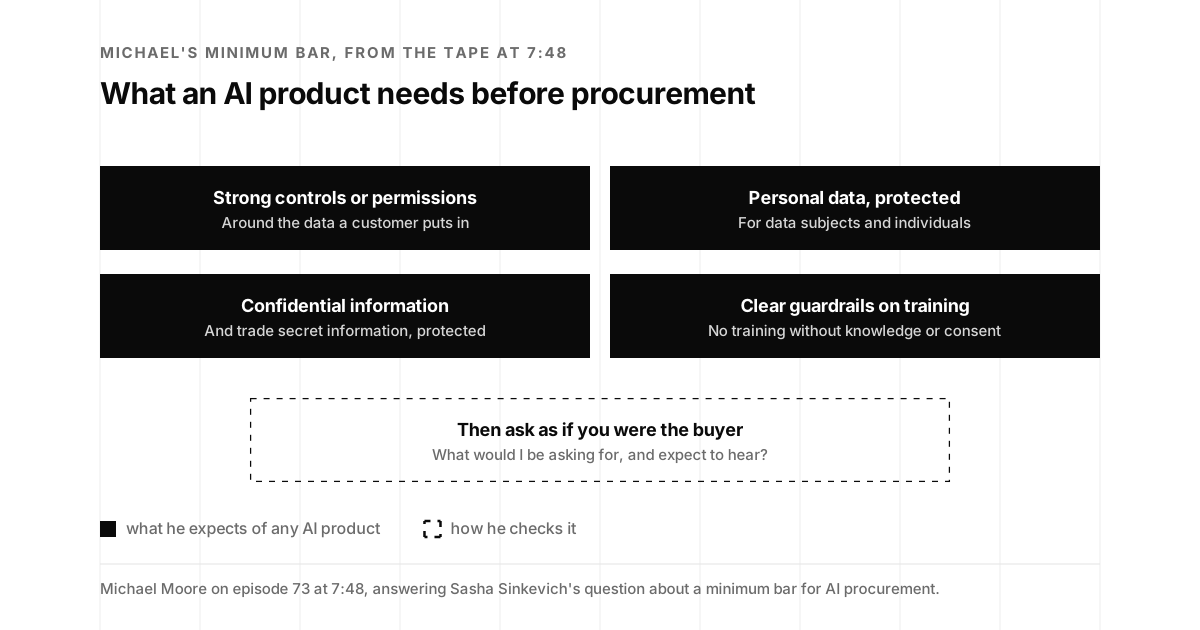
Four filled boxes in a grid. Strong controls or permissions around the data a customer puts in. Personal data, protected, for data subjects and individuals. Confidential information and trade secret information, protected. Clear guardrails on training, no training without knowledge or consent. Below, a dashed box: then ask as if you were the buyer, what would I be asking for, and expect to hear?
Michael's minimum bar for any AI product, from the tape at 7:48, with the question he asks first.

That list is close to the first page of the AI section our clients get from enterprise buyers. “Do you train on our data?” is question one in the AI security questions your first enterprise buyer will ask, and an answer a buyer can trust has three parts: a sentence in your terms, provider settings that match it, and access controls you can show. A management system certified to ISO 42001 is how a company shows the whole list is run on purpose, and Glean’s security page lists ISO 42001 next to SOC 2 Type II and ISO 27001 (Glean). Our ISO 42001 work builds that system for startups.

Michael made the same argument to law students at Santa Clara University in March 2026, calling ISO 42001 the “how” that turns principles and risk frameworks into practice an auditor can check.

Yesterday I had the privilege of speaking with Santa Clara University School of Law students about AI governance—what matters today and why it’s practical, not academic.

Michael Moore · March 31, 2026
Michael's takeaways from his talk the day before: ISO 42001 as the "how," governance filling the gap where law lags technology, an AI inventory for shadow AI, and legal's view across the business as an advantage. View on LinkedIn.

Nothing is really free

The third item on his list is the one this page is named for, and the clip at the top of the page.

“I would also expect very clear guardrails against training using that user’s data without their knowledge or consent.”

Michael Moore, at 8:13

Then the market reality: “There’s a lot of cheap or free AI tools out there on the market.” When there’s no dollar cost, the user’s data is the payment, and on the consumer side that data can be very personal. What gets used to train the product can include “the consumer’s personal information, habits, their preferences, even their appearance, or sometimes their thoughts and their emotions, depending on what they put into the tool.” He doesn’t hide his view of it: “That’s something I personally dislike.”

He said it as a parent, too.

“As a parent, I think that’s a scary concept, when the data of the individual users is being used to train the product.”

Michael Moore, at 8:52

His answer is education, “particularly younger users,” so they learn to “protect their personal information, protect their online activities, and avoid that being used as training material without their knowledge or consent.”
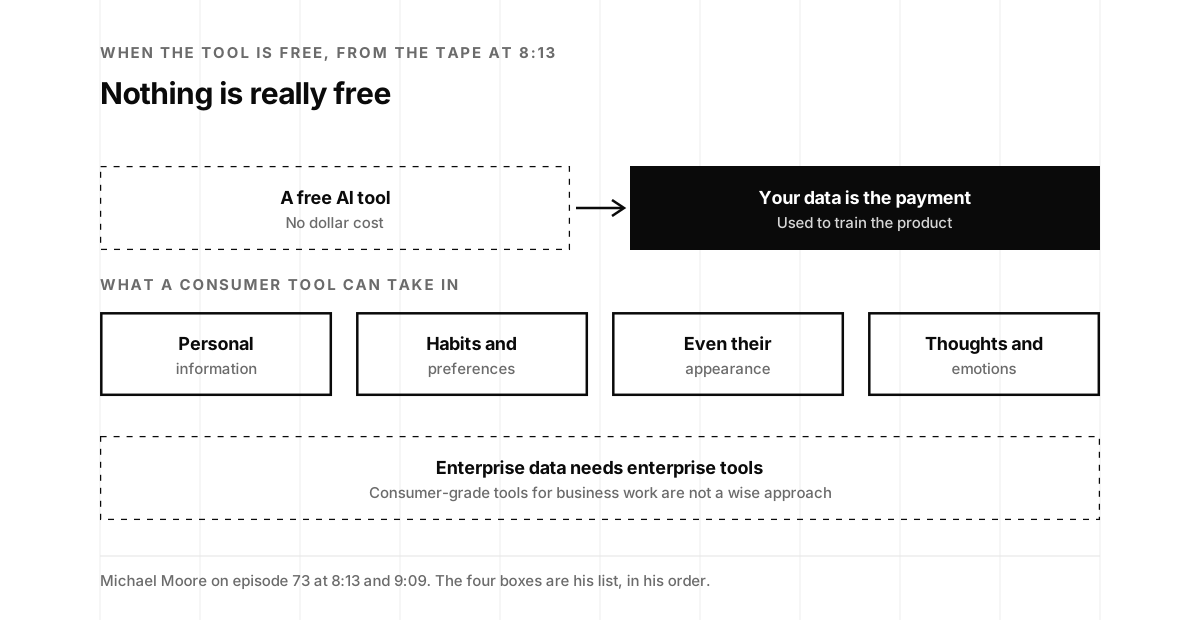
A dashed box, a free AI tool with no dollar cost, points to a filled box: your data is the payment, used to train the product. Below, four open boxes under the label what a consumer tool can take in: personal information, habits and preferences, even their appearance, and thoughts and emotions. At the bottom, a dashed box: enterprise data needs enterprise tools, because consumer-grade tools for business work are not a wise approach.
What a free AI tool costs, in Michael's words on the tape at 8:13 and 9:09.

For a founder selling AI, his rule cuts both ways. It’s the question your buyer’s legal team will ask you, and it’s the question to ask every model provider and tool your product depends on, because the terms on a free or consumer plan are often not the terms on a business plan. Read the terms for the plan you actually use, and make your settings match the sentence you send the buyer.

Enterprise data, enterprise tools

Then he moved from consumers to companies: “I know some businesses are trying to use consumer-grade tools for business applications, and that’s something I think is not a wise approach.” The risk he named first was to intellectual property, privacy and confidentiality.

“If you’re using enterprise data, you should be using enterprise tools.”

Michael Moore, at 9:23

Listen · Michael on episode 73, from 9:09
About 44 seconds: consumer tools at work, and the Samsung leak. The clip stops on its own. Read the full transcript.

His example was one most of the industry remembers: “We may remember in 2023, there was a Samsung ChatGPT code leak that was widely publicized.” In April 2023, Samsung employees put sensitive internal data into ChatGPT, and the company restricted generative AI tools on its devices soon after, concluding that data on an outside server is hard to retrieve and delete (TechCrunch). KED Global reported that the ban covered Samsung’s device division, after an engineer uploaded internal source code (KED Global). Michael’s reading is about how it happened.

“That’s an example of where individual employees bypassed company controls to go use consumer tools to put their company confidential information in, and with resulting negative PR for the company and probably negative consequences for the employees.”

Michael Moore, at 9:40

What he pushes for at Glean is the other column, “a secure platform that is intended for business use, with all the security and privacy structure and permission controls in place to satisfy the most discerning and security-aware business users.”
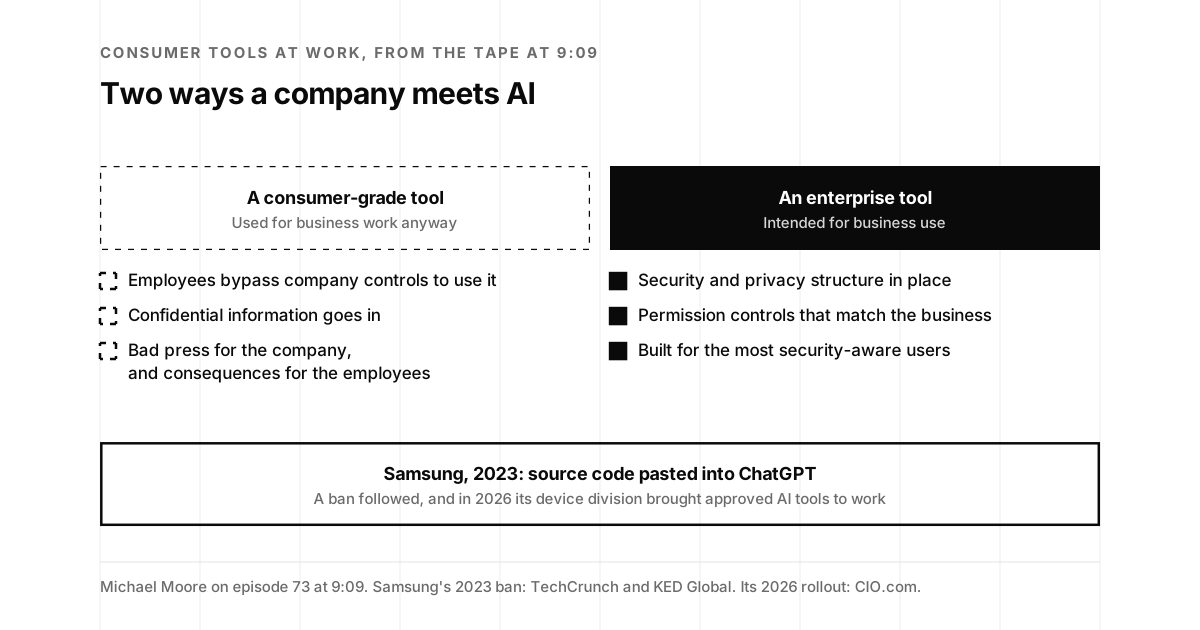
Two columns. Dashed, a consumer-grade tool used for business work anyway: employees bypass company controls to use it, confidential information goes in, and the result is bad press for the company and consequences for the employees. Filled, an enterprise tool intended for business use: security and privacy structure in place, permission controls that match the business, and built for the most security-aware users. Below, an open box: Samsung, 2023, source code pasted into ChatGPT, a ban followed, and in 2026 its device division brought approved AI tools to work.
Two ways a company meets AI, from the tape at 9:09. Samsung's 2023 ban is from TechCrunch and KED Global, and its 2026 rollout from CIO.com.

The rest of the Samsung story arrived three years later. In June 2026, Samsung Electronics said its device division would bring external generative AI services into everyday work, after testing the candidates with about 2,500 employees, and paired the rollout with a security framework meant to deliver both “expanded AI utilization” and “risk control” (CIO.com). The ban turned out to be a bridge to approved tools, which is the pattern in our shadow AI guide: give people a safe path that’s easier than the unsafe one.

Finding the consumer tools already in use comes first, and Michael has written about doing it without a survey. In February 2026 he described how Glean built its own AI inventory by joining records it already had, from finance and procurement, identity provider assignments and existing governance documents, then using search and AI to stitch them together.

You have 100+ SaaS tools. How many of them use AI?

Michael Moore · February 13, 2026
Michael on building an evidence-linked AI inventory in weeks from data a company already keeps, with a practical approach to shadow AI. View on LinkedIn.

That’s the same doorway our shadow AI detection work starts from: find every AI tool touching company data, keep the good ones, and give them a paved road.

I asked him to look five years out. He answered for legal teams, and he was candid that some of them are hesitant, “sometimes in regulated industries, sometimes they’re in markets that do not prefer to use the newest tools.”

“But regardless of that, legal teams will need to learn and embrace AI.”

Michael Moore, at 10:39

The pressure comes from whoever pays the bills. “So outside counsel law firms generally bill by the hour, and those hourly rates are expensive, and they’re generally only going up.” Then, dryly: “I’ve never seen them go down.” In-house legal teams are the law firms’ customers, and Michael expects them to “demand that their outside law firms use more efficient tools,” and to make sure “the billable hours are used as effectively and as efficiently as possible.”

Listen · Michael on episode 73, from 10:57
About 49 seconds: billable hours, and why any work billed by the hour gains from answers that cite their sources. The clip stops on its own. Read the full transcript.

The argument reaches past law. “Any professional services role, so think of any roles that traditionally have been hourly based, that involve information or knowledge processing, could greatly benefit from a tool that makes access to information easier.”

In 2026 he published what he had learned from more than 100 conversations with general counsel, chief legal officers and legal operations leaders. He expected accuracy to be the main barrier, and wrote that he was wrong: most legal teams are blocked by organizational readiness, not by technology.

After more than 100 conversations with GCs, CLOs, and legal ops leaders over the last several months, I expected to hear that accuracy was the main thing blocking legal AI. I was wrong.

Michael Moore · April 16, 2026
Part 1 of Michael's Law.com series names five barriers: visibility, a golden source of truth, a low tolerance for hallucinations, security approval, and measuring the return. View on LinkedIn.

A month later, at a session in San Francisco with David Ambler of Paul Hastings, he made the billable-hours point from the other side: legal’s core problem is capacity rather than tooling, and much of the routine, repeatable work is moving in-house with AI.

Yesterday in San Francisco, I had the chance to dig into a topic I care a lot about: how legal teams can use AI to solve structural capacity problems, not just “do email faster.”

Michael Moore · May 12, 2026
Michael's notes from the Paul Hastings session: capacity, context, legal as a data problem, the changing role of outside counsel, and training as the real bottleneck. View on LinkedIn.

Grounded in the source

The second half of his five-year answer is about trust in what an AI writes. The tool that helps knowledge workers is one that “makes the integrity of the information clearer by citing the source documents in every case.” For lawyers that part isn’t optional.

“being sure that the content that your system or LLM is creating is grounded in fact and truth, and being able to validate the source document very quickly and easily will help improve confidence and acceptance by users”

Michael Moore, at 11:50

He meant “users who really need to be sure that what they’re creating or stating is true,” and lawyers are the clearest case. Legal teams have learned it in public, from court filings that cited cases nobody could find, which is why “How do we know a citation is real?” is one of the legal questions in our list of what enterprise buyers ask AI vendors.
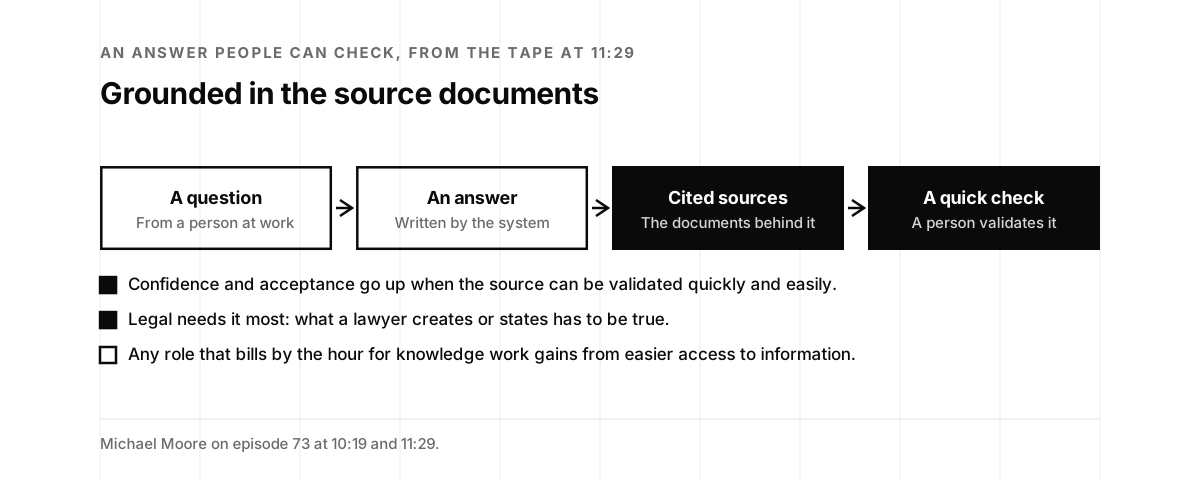
Four boxes joined by arrows. A question, from a person at work. An answer, written by the system. Filled, cited sources, the documents behind it. Filled, a quick check, a person validates it. Below, three lines. Confidence and acceptance go up when the source can be validated quickly and easily. Legal needs it most, because what a lawyer creates or states has to be true. Any role that bills by the hour for knowledge work gains from easier access to information.
An answer a person can check, from the tape at 10:19 and 11:29.

For a startup building AI features, citations are also the cheapest trust you can ship. A buyer who can click from an answer to its source doesn’t have to take the model’s word for anything, and a reviewer who can check an answer in seconds actually checks it.

What a CEO should look for

I asked him to picture me as the chief executive of a big company, or a founder, who knows AI is how to stay competitive and wants people focused on “the meaningful tasks that bring them the most joy and the delight.” My question: “How can I, as a leader in this imaginary space, best support a legal team through those challenges that you were talking about?”

“For CEOs and founders, if you’re picking a tool, make sure you’re picking a tool that has security and privacy built in from the get-go, has very strong access control and permissions for any LLM content generated, that is tied very clearly to the source documents and that can be validated by a human very easily.”

Michael Moore, at 12:46

Listen · Michael on episode 73, from 12:46
About 31 seconds: what a chief executive should look for in an AI tool. The clip stops on its own. Read the full transcript.

Then the fifth item, the one most security checklists leave out: “And frankly, it’s something that your employees enjoy using.” Adoption is the point. “There’s lots of tools out there that are kind of clunky and maybe somewhat effective, but if people don’t adopt or use them, it doesn’t quite get the results you need.” For a company trying to become AI-first, which he called “a buzzword or a hot topic,” his advice is to “start by making the tool easy to use, easy to enjoy, easy to access.”
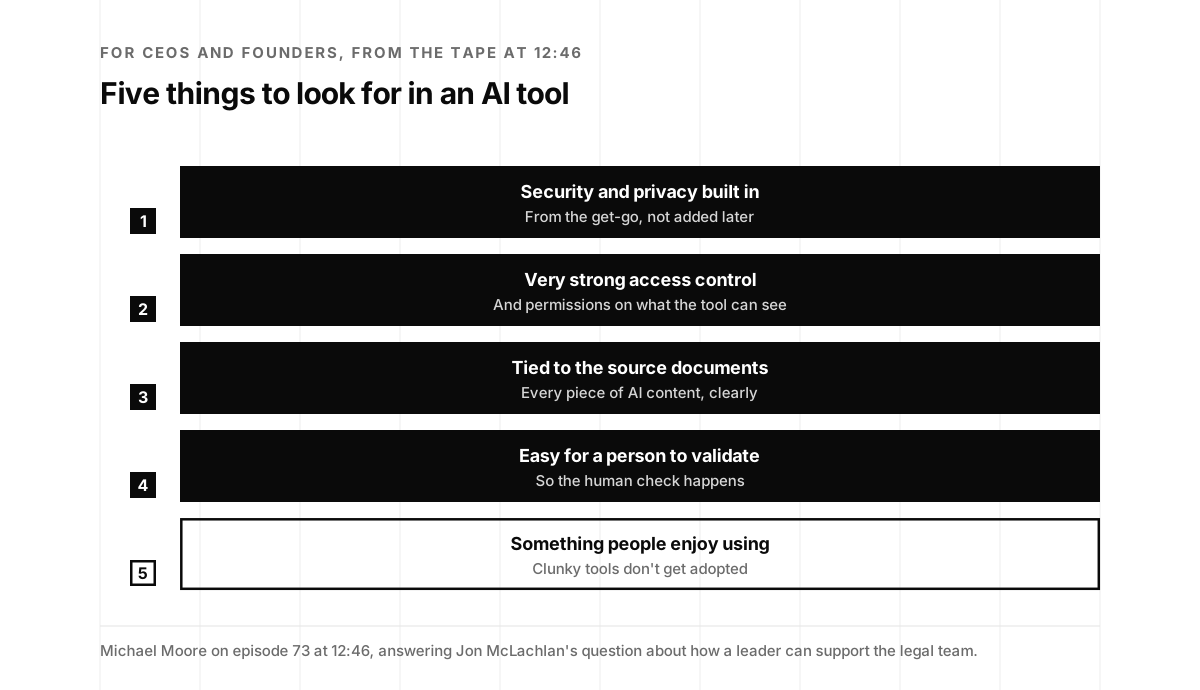
Five numbered rows. One, security and privacy built in, from the get-go, not added later. Two, very strong access control and permissions on what the tool can see. Three, tied to the source documents, every piece of AI content, clearly. Four, easy for a person to validate, so the human check happens. Open, five, something people enjoy using, because clunky tools don't get adopted.
Five things to look for in an AI tool, Michael's list from the tape at 12:46.

Turn the list around and it’s the buyer’s checklist for your product. Each line maps to evidence you can hand over: a note on how security and privacy are built in, a permissions test, an answer with its citations, the review step, and adoption numbers that show people use it. The scorecard below runs the list against your own product.

Your lawyer on speed dial

Sasha asked how security and compliance teams can support legal through the move to an AI-first company. Michael started with prevention: “I do think legal and security should and must partner closely to prevent issues from occurring.” That takes “a combination of technical controls and internal process controls,” and then detection and mitigation, “particularly in a ransomware type scenario.” In his words, “You want to prevent it from happening, but if it does happen, you want to detect it the instant it happens and mitigate it very, very quickly before it spreads.”

Then the rules that make it urgent. He pointed to “some of the regulations in place requiring companies to report security incidents in the US or in Europe,” and said they call for “a very, very tight coupling of the security org and the legal org.”

“I mean, you should always have your CISO on speed dial. The CISO should always have their lawyer on speed dial.”

Michael Moore, at 14:47

Listen · Michael on episode 73, from 14:34
About 31 seconds: reporting rules, speed dial, and a playbook before the stuff hits the fan. The clip stops on its own. Read the full transcript.

Two of those clocks are short. Under the SEC’s 2023 rules, a public company’s Form 8-K disclosure of a material incident is generally due “four business days after a registrant determines that a cybersecurity incident is material” (SEC). Under GDPR, a controller notifies its supervisory authority of a personal data breach, where feasible, “not later than 72 hours after having become aware of it” (GDPR Article 33). Neither clock waits for the two teams to be introduced.

His closing image is the one to remember: “So if the stuff hits the fan, you’re ready to go. You know each other, you have a plan, you have a playbook, and you’re ready to roll.”
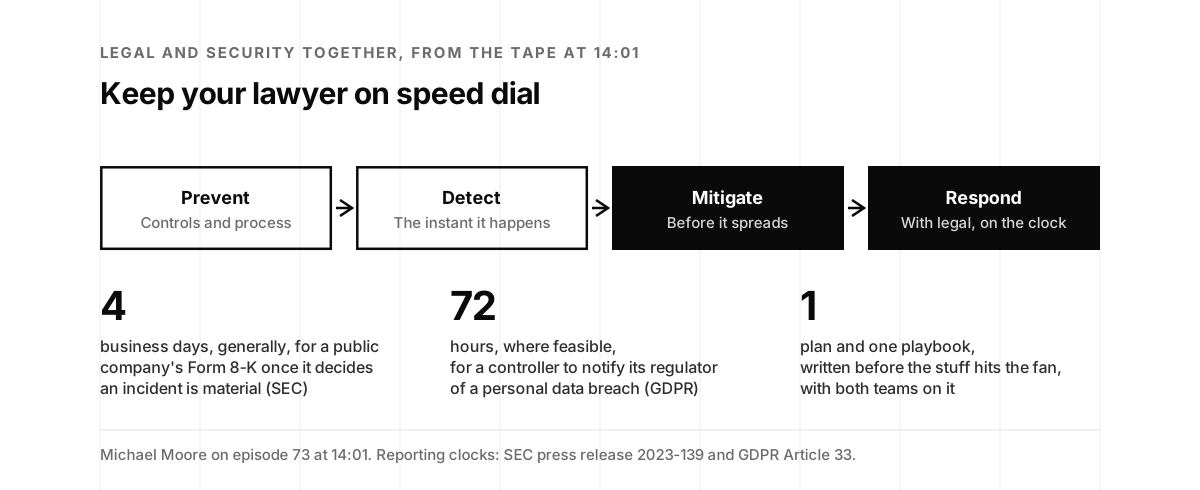
Four boxes joined by arrows. Prevent, with controls and process. Detect, the instant it happens. Filled, mitigate, before it spreads. Filled, respond, with legal, on the clock. Below, three numbers: 4 business days, generally, for a public company's Form 8-K once it decides an incident is material, under the SEC's rule. 72 hours, where feasible, for a controller to notify its regulator of a personal data breach, under GDPR. 1 plan and one playbook, written before the stuff hits the fan, with both teams on it.
Legal and security on one clock, from the tape at 14:01, with two of the reporting deadlines he had in mind: SEC press release 2023-139 and GDPR Article 33.

He had written about the ransomware case before. In March 2024, with Lea Kissner and Merritt Baer, then Lacework’s chief information security officer and field chief information security officer, he published an article for in-house counsel at the Association of Corporate Counsel on ransomware as a threat to reputation, privacy and compliance. It walks through double extortion, the privacy laws a leak can trigger, and why paying a ransom can expose the victim to US Treasury sanctions enforcement, and it lands on prevention: “an ounce of prevention is worth more than a pound of cure” (ACC).

Most startups meet this the day it happens, and it’s far cheaper to do beforehand. Write one page that says who calls whom, which clocks apply to you, which outside counsel you’d call and what you’d tell customers, then run it once with both teams in the room. Our 24/7 monitoring and response team works from that page when something fires, and the blast radius playbook covers the containment side.

An introvert who decided to speak

Sasha asked the question we ask everyone: “If you could meet younger self, would you? And if you would, would you give yourself an advice?” Michael started with who he is. “So, look, I’m an introvert by nature. Many of us who are of technical or engineering backgrounds often are.” Early in his career he “wasn’t as active in networking or getting out and speaking and publishing, and just wasn’t as comfortable getting in front of people.” Then he made a decision: “look, I’ve got to do this. I’ve got to get out in front of people and speak, and be comfortable speaking and putting my voice and opinions out there.”

Listen · Michael on episode 73, from 15:13
About 44 seconds: an introvert's decision to speak, and why to start early. The clip stops on its own. Read the full transcript.

“The sooner you can get out and speak and be noticed, publish and be recognized, get a viewpoint out there, sort of build a name for yourself, and make connections, the better.”

Michael Moore, at 15:48

It’s what he tells early career attorneys, and the reason is the business itself. “Because in this tech business, I do think your connections are everything, and the business is very much about who you know and how you are perceived by them.”

He took his own advice. The posts on this page are a sample of one year of it: a Law.com series, an IAPP article, a talk at his law school, a session with a law firm, a video series and a conference he co-chaired. His LinkedIn entry for Glean counts more than 30 speaking events and ten articles.

The safest ship is in the harbor

Sasha added the line we hear from founders all the time: “I often hear people saying that, hey, I’m afraid of making this mistake. And my response is usually, if you don’t want to make mistakes, you don’t do anything.” Michael: “Yep, don’t get out of bed in the morning.” And me:

“So the safest ship is still in the harbor, not going anywhere.”

Jon McLachlan, at 16:28

Michael took it seriously. “You have to take risks.” The skill is calibration: “you have to develop the appropriate gauge or calibration of what risk is appropriate for the stage of company that you’re at, and what are the things you don’t give up on.”

Listen · Michael on episode 73, from 17:08
About 44 seconds: what never gets traded, and what can bend. The clip stops on its own. Read the full transcript.

“So I would say in the business [we’re in], security and privacy is absolutely key.”

Michael Moore, at 17:08

Everything else can bend, “like pricing or terms or things like that.” What can’t: “you must, as a fundamental element, preserve your customer trust, protect your customer data, make sure they can trust you as a provider of services to their company.” His test is simple. “If you can do all of those, you’re probably on the right path.”

It’s the right frame for a startup, and the opposite of the safe harbor. Ship, take the commercial risks your stage calls for, and decide ahead of time which few things you’ll never trade. When those few things are security and privacy, a buyer’s legal team can tell.

Start their day in your tool

Sasha closed the loop on trust: “Trust is everything. People’s relationships are built on trust.” And on experience: “And user experience is something that often is not considered as the top priority, but often should be.” Michael agreed. “User experience can make or break a product, make or break a company.”

Listen · Michael on episode 73, from 18:13
About 19 seconds: build something people love using. The clip stops on its own. Read the full transcript.

“You want them to start their day every day in your tool.”

Michael Moore, at 18:28

It’s the fifth item on his list for chief executives again, and it’s a security point as much as a product one. A safe tool nobody wants to use sends people back to the free one. Ted Harrington made the same case on episode 80: the best security is the kind the user barely notices.

What happened after the tape

The episode aired on July 15, 2025. On June 10, between the recording and the release, Glean raised a $150 million Series F led by Wellington Management at a $7.2 billion valuation, and said it had passed $100 million in annual recurring revenue in its last fiscal year (Glean). Its story page now lists more than $350 million (Glean).

Michael’s title is now general counsel and company secretary, and his year in public reads like the episode, written down. In February 2026 came the AI inventory, in March the Santa Clara talk, and in April the two-part Law.com series and an IAPP article with Michael Bishop of Resmed on moving from shadow IT guesswork to data protection impact assessments a regulator can follow. May brought the Paul Hastings session. In September he sat down with Curtis Salinas, head of business technology at Harvey, for Glean’s Unprompted series, and co-chaired The L Suite’s LegalOps x GC Conference in San Francisco with Cindy Kaneshiro of Nutanix.

Proud to share a new IAPP piece I co-authored with Michael Bishop at Resmed on moving from shadow IT guesswork to demonstrable DPIAs.

Michael Moore · April 3, 2026
Michael and Michael Bishop on building visibility into a privacy program with connected SaaS discovery. Their thesis is that regulators expect visibility and evidence, not perfection. View on LinkedIn.
Michael with Curtis Salinas of Harvey, September 2026, 24 minutes, on how legal teams have adopted AI, how legal and IT can work together, first use cases and measuring the return. On Glean's channel. Watch on YouTube.

The law moved, too. On February 10, 2026, Judge Jed Rakoff of the Southern District of New York ruled in United States v. Heppner that documents a defendant generated with a consumer AI tool weren’t protected by attorney-client privilege or the work-product doctrine, pointing to terms that let the provider train on prompts and disclose user data. The court left open whether an enterprise product that keeps user data out of training and carries contractual confidentiality could come out differently (Proskauer). It’s one court and one set of facts, and it reads like Michael’s line from the tape in legal form: enterprise data belongs in enterprise tools. Our list of what law firms ask legal AI vendors starts from that ruling.

Samsung’s story found its second half in June 2026, with the device division bringing approved outside AI tools to work, as told above. And when Glean held its second user conference, security had its own stage. One session walks through Glean’s platform for enterprise AI, with context, an AI gateway, usage controls and data protection working together, and a short one covers the usage controls that set guardrails and manage access and spend.

Allan Livingston introduces Glean's platform for enterprise AI at Glean:GO 2026, 11 minutes. Watch on YouTube.
Glean's two-minute explainer on AI usage controls, guardrails, access and spend across models, tools and agents, from Glean:GO 2026. Watch on YouTube.

Michael’s minimum bar hasn’t changed in the year and a half since we recorded, and the buyers we work with ask about every line of it. If you sell AI to enterprises, write down what happens to their data, make your settings match the sentence, show where every answer came from, and put your lawyer and your security lead on each other’s speed dial. Nothing is really free, and the companies that act like it are the ones buyers trust.
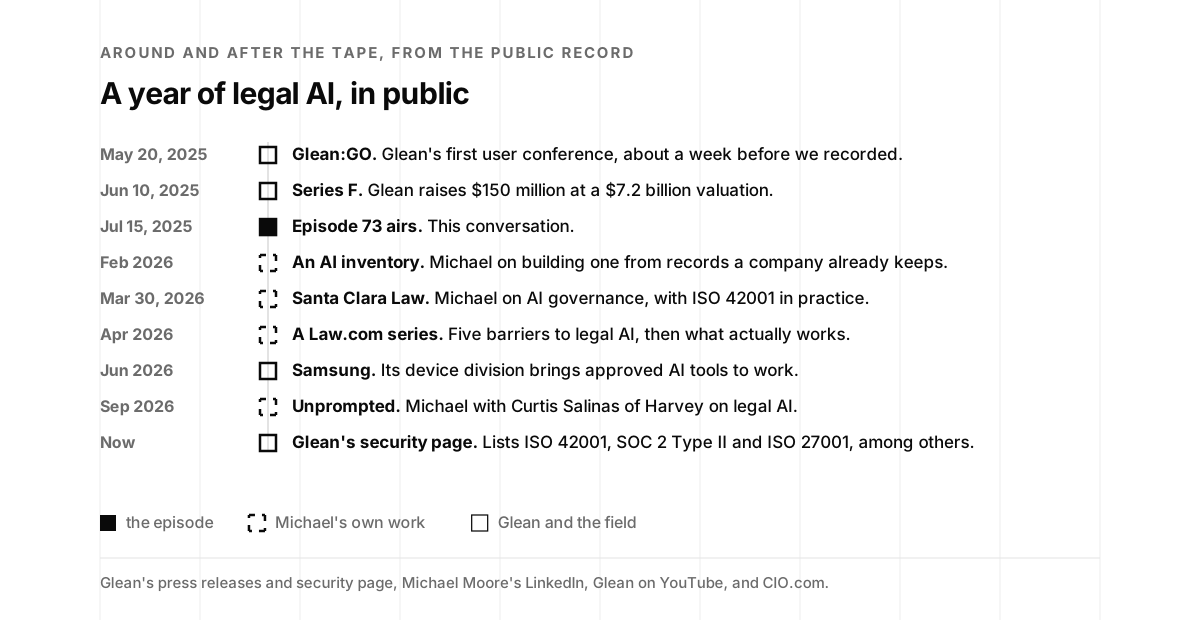
A timeline of nine entries. May 20, 2025, Glean:GO, Glean's first user conference, about a week before we recorded. June 10, 2025, Series F, Glean raises $150 million at a $7.2 billion valuation. Filled, July 15, 2025, episode 73 airs. Dashed, February 2026, an AI inventory, Michael on building one from records a company already keeps. Dashed, March 30, 2026, Santa Clara Law, Michael on AI governance, with ISO 42001 in practice. Dashed, April 2026, a Law.com series, five barriers to legal AI, then what actually works. June 2026, Samsung, its device division brings approved AI tools to work. Dashed, September 2026, Unprompted, Michael with Curtis Salinas of Harvey on legal AI. Now, Glean's security page lists ISO 42001, SOC 2 Type II and ISO 27001, among others.
The months around and after the tape, from Glean's press releases and security page, Michael's LinkedIn, Glean on YouTube and CIO.com.

Did you catch it? A six-question quiz

Interactive · six questions

Did you catch it?

Six questions on what Michael, Sasha and I actually said, with the timestamp for each answer. The answers are under each question for anyone reading without JavaScript.

  1. When an AI tool is free, what does Michael say is usually the payment?

    1. A paid upgrade later
    2. Your data and your personal information
    3. Advertising

    b. "And whenever the tool is free, that is, whenever there's no dollar cost, your data and your personal information is usually the payment, because nothing is really free." Transcript, 7:48.

  2. Who should always have their lawyer on speed dial?

    1. The chief information security officer
    2. The chief financial officer
    3. The head of sales

    a. "I mean, you should always have your CISO on speed dial. The CISO should always have their lawyer on speed dial." Transcript, 14:01.

  3. At a siloed company, how much of their time does Michael say people can spend just looking for information?

    1. About 5 percent
    2. 20 or 30 percent
    3. More than half

    b. "When you're spending 20 or 30 percent of your time just trying to find the information you need to do your job, that tends to reduce productivity." Transcript, 4:32.

  4. What's the first thing Michael tells chief executives and founders to look for in an AI tool?

    1. The lowest price
    2. The most features
    3. Security and privacy built in from the get-go

    c. The first item on his list is "a tool that has security and privacy built in from the get-go." Transcript, 12:46.

  5. Why does Michael expect customers to push their law firms toward AI?

    1. Firms bill by the hour, and the rates only go up
    2. A regulator requires it
    3. Associates asked for it

    a. "So outside counsel law firms generally bill by the hour, and those hourly rates are expensive, and they're generally only going up." Transcript, 10:19.

  6. What would Michael tell his younger self?

    1. Stay an engineer
    2. Start speaking, publishing and making connections early
    3. Avoid risks until you're established

    b. "The sooner you can get out and speak and be noticed, publish and be recognized, get a viewpoint out there, sort of build a name for yourself, and make connections, the better." Transcript, 15:14.

Does your AI product clear the minimum bar?

Michael answers every AI procurement question as the buyer would. This scorecard asks eight of those questions about your own product. It takes about two minutes.

Scorecard · eight questions

Does your AI product clear the minimum bar?

Answer for the AI features you sell to businesses. If two answers fit, pick the lower one.

  1. Can customer data that goes into your AI features train a model, yours or a provider's?

    • We haven't checked, or yes by default
    • No, but it isn't written anywhere a buyer can read
    • No, our terms say so and our provider settings match

    Michael expects "very clear guardrails against training." See Nothing is really free.

  2. Does your AI respect the permissions of the systems it reads?

    • It can see whatever we connected it to
    • Mostly, with a few shared service accounts
    • Yes, every answer is limited to what the person asking can already open

    Permissions come first on his list. See The minimum bar for an AI product.

  3. How do you protect personal data, confidential information and trade secrets in prompts and outputs?

    • The same way as any other data
    • We have a policy for it
    • We classify it, limit who and what can reach it, and log access

    The second item on his minimum bar. See The minimum bar for an AI product.

  4. Can a user see the source behind every answer?

    • No
    • Sometimes, with a link
    • Yes, every answer cites its sources and a person can check them in seconds

    Grounded in fact and quick to validate. See Grounded in the source.

  5. What does your own team use for AI at work?

    • Whatever each person signed up for
    • An approved list, loosely followed
    • Enterprise accounts for company data, and an easy way to ask for new tools

    "If you're using enterprise data, you should be using enterprise tools." See Enterprise data, enterprise tools.

  6. When something goes wrong, how do legal and security work together?

    • We'd figure it out at the time
    • We know who to call
    • One plan and one playbook with both teams on it, and the reporting clocks written down

    Lawyer and security chief on speed dial. See Your lawyer on speed dial.

  7. When a buyer asks for proof, what do you send?

    • A promise in an email
    • A security page and our questionnaire answers
    • Terms, settings and audit evidence, such as a SOC 2 report or an ISO 42001 certificate

    A buyer can only rely on what the seller writes down. See The minimum bar for an AI product.

  8. Would people choose your product if no one required it?

    • We're not sure
    • Some teams would
    • Yes, it's where they start their day

    Clunky tools don't get adopted. See Start their day in your tool.

Not yet ready for procurement

A buyer's legal team will find the gaps before you do, and that's fixable. Start with the training question: write down what happens to customer data, make your provider settings match, and put the sentence in your terms. Then check that every answer respects the permissions of the systems it reads.

Past the first questions

The basics are in place and the proof is thin. Make every answer traceable to a document, whether that's a clause, a setting or a log. Then put legal and security on one incident playbook, with the reporting clocks that apply to you written down.

Ready for the most discerning buyer

Your product meets the bar Michael describes, and you can show it. Keep the evidence current, and consider a certification such as ISO 42001 so the next AI committee can check your governance without a call.

How many hours do security questionnaires take?

Michael’s Law.com piece describes teams that turn a 100-question questionnaire into roughly a 20-minute workflow. This calculator compares that pace with answering by hand, using your own numbers.

Calculator

How many hours do security questionnaires take?

How many security and privacy questionnaires you answer, how long they are, how long a question takes by hand, and what an hour of the people answering costs.

–hours a month, answering by hand
–hours a year by hand
–hours a year at about 20 minutes each
–working weeks a year freed
–a year of those hours, at this rate

By hand, 4 questionnaires a month take about 160 hours a year. At about 20 minutes each, the pace Michael describes, they take 16 hours, which frees about 3.6 working weeks, worth $21,600 at this rate.

The 20-minute figure is Michael's, from the second part of his Law.com series as he summarized it on LinkedIn in April 2026: agents that pull out the questions, query a curated bank of approved answers and draft fully cited responses for a person to review. It assumes that answer bank already exists, so the first questionnaires take longer. The other defaults are placeholders, and two minutes a question puts a 100-question questionnaire at a little over three hours by hand. A working week here is 40 hours. For a fuller estimate by questionnaire type, see the DDQ estimator.

From Analog Devices to Glean

Everything on this page sits on one timeline, from Michael’s first engineering job to his year of writing about legal AI. Filter it by thread.

Timeline · 1994 to 2026

From Analog Devices to Glean

Filter by thread. Dates are from the public record except where marked as part of this show.

  1. Analog Devices

    Michael starts as an applications co-op (LinkedIn).

  2. Cypress Semiconductor

    Applications engineer for data communications and programmable logic (LinkedIn).

  3. Patent agent

    Still at Cypress, now preparing and prosecuting its patents (LinkedIn).

  4. Morgan Lewis & Bockius

    Litigation, patent prosecution and licensing in Palo Alto (LinkedIn).

  5. Symantec

    Corporate counsel for intellectual property (LinkedIn).

  6. Rambus

    Patent counsel, then vice president of IP and deputy general counsel from 2013 (LinkedIn).

  7. Pure Storage

    Products and patents, then deputy general counsel for privacy, sales compliance, product and IP from 2018 (LinkedIn).

  8. Glean is founded

    Arvind Jain starts the company (Glean).

  9. Lacework

    Vice president of privacy and IP, then chief privacy officer from December 2023 (LinkedIn).

  10. The Samsung leak

    Employees put sensitive internal data into ChatGPT, and a ban on generative AI tools follows (TechCrunch).

  11. SEC disclosure rules

    A material incident goes on Form 8-K, generally within four business days of the materiality decision (SEC).

  12. Ransomware for in-house counsel

    Michael, Lea Kissner and Merritt Baer on ransomware, reputation and sanctions risk (ACC).

  13. Episode 41

    Michael's first time on the show, as Lacework's chief privacy officer (episode 41).

  14. Fortinet buys Lacework

    Michael leads the privacy program through the acquisition (LinkedIn).

  15. Security partners

    BigID, Cisco, Palo Alto Networks, Rubrik and Virtue AI join Glean's security and governance partner program (Glean).

  16. Glean

    Michael joins as head of legal (LinkedIn).

  17. Glean:GO

    Glean's first user conference, at the Fort Mason Center in San Francisco (Glean).

  18. We record episode 73

    "It was up in San Francisco about a week or so ago."

  19. Series F

    $150 million at a $7.2 billion valuation, led by Wellington Management (Glean).

  20. Episode 73 airs

    This conversation.

  21. Episode 75

    Jonathan Mortensen of Confident Security on using AI without giving up your data (episode 75).

  22. United States v. Heppner

    One court finds a defendant's documents from a consumer AI tool weren't privileged (Proskauer).

  23. An AI inventory

    Built from records Glean already had (LinkedIn).

  24. Santa Clara Law

    A talk to law students on AI governance, with ISO 42001 as the "how" (LinkedIn).

  25. IAPP

    With Michael Bishop of Resmed, on data protection impact assessments built on visibility (LinkedIn).

  26. Law.com, part 1

    Five barriers to legal AI (LinkedIn).

  27. Law.com, part 2

    What works when legal AI moves to production (LinkedIn).

  28. Paul Hastings

    With David Ambler, on legal's capacity problem (LinkedIn).

  29. Samsung, three years on

    Its device division brings approved outside AI tools to work (CIO.com).

  30. Episode 100

    Xia Hua of Traceforce on the AI tools employees use without anyone tracking the data (episode 100).

  31. Glean:GO 2026

    Sessions on a secure platform for enterprise AI and on usage controls (YouTube).

  32. Unprompted

    Michael with Curtis Salinas of Harvey on legal AI (YouTube).

  33. The L Suite

    Michael co-chairs its LegalOps x GC Conference in San Francisco with Cindy Kaneshiro of Nutanix (LinkedIn).

What to do this week

Five things, in the order Michael would probably check them as a buyer.

  1. Read your AI terms the way a buyer will. Find the sentence about training on customer data, in your own terms and in each model provider’s terms for the plan you use. If it isn’t there, write it, and make the settings match.
  2. Test permissions as a user who shouldn’t see something. Ask your product about a document that user can’t open in the source system, and confirm it never shows up in an answer.
  3. Put a source behind every answer. If your product writes content, cite the documents it came from, so a person can check it in seconds.
  4. Find the consumer AI tools your own team uses for company data. Move that work to enterprise accounts, and make the approved path the easy one.
  5. Put legal and security on one playbook. One page with who calls whom, the reporting clocks that apply to you and the outside counsel you’d call, then one practice run before you need it.

Key takeaways

  1. A free tool is paid for with data

    Michael Moore's rule for AI tools is that whenever there is no dollar cost, your data and your personal information is usually the payment, because nothing is really free. On the consumer side he worries about personal information, habits, preferences, even appearance, thoughts and emotions being used to train a product without the user's knowledge or consent.

  2. The minimum bar is the buyer's list

    Asked whether every AI product should clear a minimum bar for procurement, Michael answers as the buyer would: very strong controls or permissions around the customer data put into the tool, protection for personal data, confidential and trade secret information, and clear guardrails against training on a user's data without their knowledge or consent.

  3. Enterprise data belongs in enterprise tools

    Some businesses use consumer-grade AI tools for business work, which Michael calls not a wise approach for intellectual property, privacy and confidentiality. His example is the 2023 Samsung leak, where employees bypassed company controls to put confidential information into a consumer tool.

  4. Put the source behind every answer

    Any role that bills by the hour for knowledge work gains from a tool that makes information easier to reach and cites the source documents in every case. In legal work especially, being able to validate the source quickly is what builds confidence and acceptance.

  5. Legal teams will have to embrace AI

    Outside counsel bill by the hour at rates that only go up, so in-house legal teams, the law firms' customers, will demand that firms use more efficient tools. Michael expects even hesitant legal teams to learn and embrace trusted AI.

  6. What a CEO should look for in an AI tool

    Security and privacy built in from the get-go, very strong access control and permissions for generated content, answers tied clearly to the source documents, easy validation by a person, and a tool employees enjoy, because clunky tools don't get adopted.

  7. Keep your lawyer on speed dial

    Legal and security should partner to prevent incidents, detect them the instant they happen, mitigate them before they spread and respond together. With incident reporting rules in the US and Europe, Michael says the security org and the legal org need a very tight coupling, with a plan and a playbook in place before anything happens.

  8. Stand in the buyer's shoes

    Having worked on buy side procurement and on enterprise sales, Michael says a seller has to understand what matters to the buyer, from the privacy and security of their data to the confidentiality of their business, and remove friction from the deal wherever possible.

  9. Start speaking early

    An introvert by nature, Michael decided partway through his career to get in front of people. His advice to early career attorneys is to start early, speak, publish, build a name and make connections, because in tech your connections are everything.

  10. Never compromise on security and privacy

    Startups have to take risks, and Michael says the skill is calibrating which risks suit the company's stage. Pricing and terms can be flexible. Security, privacy and customer trust are the things you don't give up on.

  11. User experience decides adoption

    User experience can make or break a product and a company, Michael says. Build something people love using, so they adopt it, bring their teammates and start their day in your tool.

Chapters

Tap a chapter to play from there.

Pull quotes

“And whenever the tool is free, that is, whenever there's no dollar cost, your data and your personal information is usually the payment, because nothing is really free.”

Michael Moore ·

“If you're using enterprise data, you should be using enterprise tools.”

Michael Moore ·

“I would also expect very clear guardrails against training using that user's data without their knowledge or consent.”

Michael Moore ·

“So personally, I expect very strong [controls or] permissions around the user or customer data put into the AI tool.”

Michael Moore ·

“The key thing is protecting the personal data information of data subjects, of individuals, protecting confidential information, protecting trade secret information.”

Michael Moore ·

“Any AI product that we are selling, I look at it from the perspective of, if I were the buyer, what would I be asking for?”

Michael Moore ·

“There's a lot of cheap or free AI tools out there on the market.”

Michael Moore ·

“As a parent, I think that's a scary concept, when the data of the individual users is being used to train the product.”

Michael Moore ·

“That's an example of where individual employees bypassed company controls to go use consumer tools to put their company confidential information in, and with resulting negative PR for the company and probably negative consequences for the employees.”

Michael Moore ·

“And that actually really brought up an interest in me in how do I blend the creativity of engineering with the protection of that creativity through legal.”

Michael Moore ·

“They're all facets of the same problem we're trying to solve.”

Michael Moore ·

“And the creativity involved needs to be protected and rewarded.”

Michael Moore ·

“Because good communication and clarity really helps unblock many of the issues that slow down deals.”

Michael Moore ·

“Communication is the key. Whether it's life, business, work, communication is the key.”

Sasha Sinkevich ·

“So when you're selling a product to an enterprise, you need to be able to put yourself clearly in the buyer's shoes and understand what is important to the buyer.”

Michael Moore ·

“Just unblocking the process.”

Michael Moore ·

“And the key thing is it puts AI in the hands of employees.”

Michael Moore ·

“When you're spending 20 or 30 percent of your time just trying to find the information you need to do your job, that tends to reduce productivity.”

Michael Moore ·

“And it's personally very rewarding to me to see engineers, both seasoned and also early career engineers, get recognition for their amazing innovation through filing patents and other means to protect the IP.”

Michael Moore ·

“But regardless of that, legal teams will need to learn and embrace AI.”

Michael Moore ·

“So outside counsel law firms generally bill by the hour, and those hourly rates are expensive, and they're generally only going up. I've never seen them go down.”

Michael Moore ·

“For CEOs and founders, if you're picking a tool, make sure you're picking a tool that has security and privacy built in from the get-go, has very strong access control and permissions for any LLM content generated, that is tied very clearly to the source documents and that can be validated by a human very easily.”

Michael Moore ·

“And frankly, it's something that your employees enjoy using.”

Michael Moore ·

“I do think legal and security should and must partner closely to prevent issues from occurring.”

Michael Moore ·

“I mean, you should always have your CISO on speed dial. The CISO should always have their lawyer on speed dial.”

Michael Moore ·

“So if the stuff hits the fan, you're ready to go. You know each other, you have a plan, you have a playbook, and you're ready to roll.”

Michael Moore ·

“So, look, I'm an introvert by nature.”

Michael Moore ·

“The sooner you can get out and speak and be noticed, publish and be recognized, get a viewpoint out there, sort of build a name for yourself, and make connections, the better.”

Michael Moore ·

“Because in this tech business, I do think your connections are everything, and the business is very much about who you know and how you are perceived by them.”

Michael Moore ·

“And my response is usually, if you don't want to make mistakes, you don't do anything.”

Sasha Sinkevich ·

“So the safest ship is still in the harbor, not going anywhere.”

Jon McLachlan ·

“You have to take risks.”

Michael Moore ·

“So I would say in the business [we're in], security and privacy is absolutely key.”

Michael Moore ·

“If you can do all of those, you're probably on the right path.”

Michael Moore ·

“Trust is everything.”

Sasha Sinkevich ·

“User experience can make or break a product, make or break a company.”

Michael Moore ·

“You want them to start their day every day in your tool.”

Michael Moore ·

About the guest

Michael Moore, General Counsel, Glean

Michael Moore is the general counsel and company secretary of Glean, the enterprise AI company, which he joined in 2025 as vice president and head of legal. He began as an applications engineer at Analog Devices and Cypress Semiconductor, where he became a patent agent, then practiced at Morgan Lewis & Bockius and held intellectual property roles at Symantec and Rambus, where he was vice president of IP and deputy general counsel. At Pure Storage he was deputy general counsel for privacy, sales compliance, product and IP, and at Lacework he was chief privacy officer through the company's acquisition by Fortinet in 2024. He studied law at Santa Clara University and writes and speaks often about AI governance, privacy and legal AI.

About the host

Jon McLachlan and Sasha Sinkevich are co-founders of YSecurity, the on-demand cybersecurity team for startups, and of Cyberbase.ai. The Security Podcast of Silicon Valley is hosted by Jon McLachlan and Sasha Sinkevich. Jon McLachlan on LinkedIn ↗Sasha Sinkevich on LinkedIn ↗

Context and sources

  • Michael Moore's LinkedIn experience: applications co-op at Analog Devices from 1994, applications engineer at Cypress Semiconductor from 1998 and patent agent there from 2002, Morgan Lewis & Bockius from 2007, Symantec from 2009, Rambus from 2011, Pure Storage from 2016, Lacework from 2021 (chief privacy officer from December 2023, through Fortinet's acquisition in August 2024), and Glean from April 2025. Source ↗
  • Michael Moore on LinkedIn: general counsel, AI governance and privacy, and company secretary at Glean. Source ↗
  • Glean, Our story: founded in 2019, more than $350 million in annual recurring revenue and a $7.2 billion valuation. Source ↗
  • Glean's security page: source-system permissions enforced on every read and write, sensitive content protection, and ISO 42001, HIPAA, TX-RAMP Level 2, SOC 2 Type II, ISO 27001 and GDPR. Source ↗
  • Glean, June 10, 2025: a $150 million Series F at a $7.2 billion valuation, led by Wellington Management, after passing $100 million in annual recurring revenue in its last fiscal year. Source ↗
  • Glean, April 22, 2025: the announcement of Glean:GO, its first user conference, on May 20, 2025, at the Fort Mason Center in San Francisco. Source ↗
  • Glean, February 12, 2025: a security and governance partner program with BigID, Cisco, Palo Alto Networks, Rubrik and Virtue AI. Source ↗
  • Michael Moore on LinkedIn, February 13, 2026: how Glean built an evidence-linked AI inventory from finance and procurement records, identity provider assignments and existing governance documents. Source ↗
  • Michael Moore on LinkedIn, March 31, 2026: takeaways from his talk on AI governance to Santa Clara University School of Law students, with ISO 42001 as the how. Source ↗
  • Michael Moore on LinkedIn, April 3, 2026: an IAPP article with Michael Bishop of Resmed on moving from shadow IT guesswork to demonstrable data protection impact assessments. Source ↗
  • Michael Moore on LinkedIn, April 16, 2026: part 1 of his Law.com series, five barriers blocking legal AI adoption. Source ↗
  • Michael Moore on LinkedIn, April 23, 2026: part 2 of his Law.com series, what works when legal AI moves from pilots to production, including questionnaires of more than 100 questions turned into roughly 20-minute workflows. Source ↗
  • Michael Moore on LinkedIn, May 12, 2026: a session in San Francisco with David Ambler of Paul Hastings on legal's capacity problem. Source ↗
  • Michael Moore on LinkedIn, September 18, 2026: co-chairing The L Suite's LegalOps x GC Conference in San Francisco with Cindy Kaneshiro of Nutanix. Source ↗
  • Glean on YouTube, September 14, 2026: Unprompted, Michael Moore with Curtis Salinas, head of business technology at Harvey. Source ↗
  • Glean on YouTube, September 2026: A secure enterprise AI platform, a Glean:GO 2026 session with Allan Livingston. Source ↗
  • Glean on YouTube, September 2026: AI usage controls, governing AI without slowing down, from Glean:GO 2026. Source ↗
  • Michael T. Moore, Lea Kissner and Merritt Baer, Don't Let Your Company's Reputation be Held for Ran$om, Association of Corporate Counsel, March 5, 2024. Source ↗
  • TechCrunch, May 2, 2023: Samsung bans the use of generative AI tools like ChatGPT after an April internal data leak. Source ↗
  • KED Global, May 2, 2023: Samsung's device division bans generative AI tools after an engineer uploaded internal source code. Source ↗
  • CIO.com, June 2026: Samsung's device division introduces external generative AI services to employees after testing them with about 2,500 employees, with a security framework for expanded use and risk control. Source ↗
  • SEC press release 2023-139, July 26, 2023: new cybersecurity disclosure rules, with a Form 8-K for a material incident generally due four business days after the materiality determination. Source ↗
  • GDPR Article 33: notifying the supervisory authority of a personal data breach without undue delay and, where feasible, within 72 hours. Source ↗
  • Proskauer, on United States v. Heppner (S.D.N.Y., February 10, 2026): documents a defendant generated with a consumer AI tool were not protected by attorney-client privilege or the work-product doctrine. Source ↗
  • Santa Clara University School of Law. Source ↗

Transcript

Automatic transcription. Speaker labels follow the recording's own speaker tracks and the content. Names and product names were normalized where the recognizer misheard them (Jon McLachlan, Sasha Sinkevich, Michael Moore, Glean, Glean:GO, Lacework, ChatGPT, LLM). Words in [brackets] are best guesses where the audio is unclear. Answers are transcribed as spoken, with repeated words and false starts trimmed. Short backchannels such as "mm-hmm", "yes" and "exactly" are left out.

Read the full transcript 3,562 words

Jon McLachlan

Hello, everyone, and welcome to another episode of The Security Podcast of Silicon Valley. I'm one of the hosts, Jon McLachlan. I'm joined with our other host, Sasha Sinkevich. And today we have the great honor of a very special guest who's actually been on the show before, I might add, Michael Moore, who is the head of legal over at Glean. Welcome to the show.

Michael Moore

Thank you, Jon, and thank you, Sasha. It's a pleasure to be here and be speaking with you both again.

Jon McLachlan

The last time you were on the show, where were you? Where were you working?

Michael Moore

At the time when [we] spoke, I was chief privacy officer over at Lacework, a cybersecurity company. Now I'm VP and head of legal at Glean, an enterprise search and agentic AI company.

Sasha Sinkevich

Michael, you mentioned you started as an engineer, or you have technical background. At what point in time did you start thinking about tapping into the legal side of business ventures?

Michael Moore

That's a great question, Sasha. So from my own just personal journey, I would say, as an engineer, I was very involved in building and developing new products. I've always been a builder in whatever area I've worked in, be it technology or law. And as I was building products as an engineer, I spent a lot of time thinking about, well, how do we protect the products? How do we protect the code via copyright? How do we protect engineering designs via patents? How do we protect our marketing and brands via trademarks? And so on. And that actually really brought up an interest in me in how do I blend the creativity of engineering with the protection of that creativity through legal. And that set me down a path where I'm mixing engineering, technological, legal, security and privacy aspects together. So it's a very interesting intellectual blend of technologies that are, in many ways, related. They're all facets of the same problem we're trying to solve. So, whether you are a coder writing software, whether you are an engineer building chips or mechanical designs or something else, whether you are a creator creating copyrighted works of art or otherwise, all of these are different aspects of human creativity. Same with musicians also, another aspect of creativity. And the creativity involved needs to be protected and rewarded. So from that aspect, I find it very interesting to be able to support creators, be they engineers or musicians or architects or artists, to help expand the market for their creativity and protect their creativity.

Sasha Sinkevich

It puts you in a very interesting position, because you can speak both legal and engineering languages. Do you find that skill to be very useful, when you are able to speak the engineering jargon and the legal jargon, depends on the teams that you are engaged with?

Michael Moore

That's a very good question, Sasha. I think each of these disciplines developed its own jargon. So, for example, lawyers are well known for speaking legalese. Engineers also have their own set of jargon, which [is a] technical jargon, which can be off-putting to folks who are not of technical background. One of the things I try to do is bring everybody to a common language that we all understand, simply so we can communicate effectively between us. I think one of the keys to being a good tech lawyer is being able to understand the tech and the business and the market and the concerns of users and any concerns of vendors, suppliers, and bring them all to a common platform we can all understand and communicate. Because good communication and clarity really helps unblock many of the issues that slow down deals.

Sasha Sinkevich

Exactly. Communication is the key. Whether it's life, business, work, communication is the key. And having that ability to speak to both parties that are very important is extremely useful and unique.

Michael Moore

I think another aspect that is very true also, which is related, is I've been both on the buy side and the sell side of enterprise software. I've done a lot of buy side procurement work, vendor work. I've done a lot of enterprise sales side also. And when you understand the concerns of the buyer and their interest in protecting the privacy and security of their data, their interest in protecting the confidentiality of their business, you really do develop an understanding as to why that matters to them. So when you're selling a product to an enterprise, you need to be able to put yourself clearly in the buyer's shoes and understand what is important to the buyer. How can I make my product better for the buyer? How can I make my deal and transaction process better for the buyer? How do I reduce friction wherever possible, and get to a point where it's easy and clean and smooth for us all to transact together? Just unblocking the process.

Jon McLachlan

I'm super curious, why did you choose Glean when you are looking for your next adventure?

Michael Moore

That's a great question, for a number of reasons. One of them is I knew some of the team members over here who are just awesome. They're folks I've worked with previously at a prior company, and people I just really enjoyed working with and found to be incredibly creative and talented. So when you know really good people are at a company, it makes it more appealing to go and join that company. I also picked Glean because the platform is awesome. I've personally used it. The utility in terms of productivity improvements and enablement for the user, just outstanding. The product market fit is spot on. And the key thing is it puts AI in the hands of employees. I've seen other companies in the past where AI was sort of this sacred thing and guarded by a very limited number of people who wanted to keep control on it. It was almost like this was the new special toy, and some companies didn't want regular users, regular staff, to have access to this toy. In Glean, we have a very different approach. Our approach is to make the tool available to all the users, and just make the jobs of everyday users so much more fun, productive and enjoyable. Prior to being at Glean, I spent some time at a very large multinational company. Very good company, huge in terms of scope and number of employees. But it was very, very siloed, and trying to find anything was almost impossible. And in particular, when you have hard separations between subsidiaries or between departments, the sort of resulting lack of information sharing made just the task of doing your daily job difficult and overly complicated. When you're spending 20 or 30 percent of your time just trying to find the information you need to do your job, that tends to reduce productivity. And also, for many employees, it tends to reduce their engagement for motivation. If they have to do sort of drudge work just to find the basic information they need to do the job and be productive, that is a demotivator.

Sasha Sinkevich

It's been quite some time that you joined Glean. What's been the proudest day so far?

Michael Moore

We recently held Glean:GO, which is our first ever user conference, which was a huge success. It was up in San Francisco about a week or so ago. Huge success, sellout. We had some amazing speakers, huge number of participants, both customers and prospects and partners. I will say our marketing team is just awesome. I worked very closely with them on the event content, on the PR and planning, and the whole thing [ran] like clockwork. So I was very closely engaged with the marketing team in terms of how do we prep for this, how do we get the content ready, how do we organize and run the event. And I also worked very closely with all the engineers to protect the fantastic innovations they launched at the Glean:GO event. Jon, you may know me as having done a lot of patent work and IP-related work in the past, which I still continue to do. We had a huge payload of innovation. I worked very closely with all of the engineers to protect that ahead of launch. And it's personally very rewarding to me to see engineers, both seasoned and also early career engineers, get recognition for their amazing innovation through filing patents and other means to protect the IP. So it's a way of acknowledging and recognizing the very hard work that they've done to bring such an amazing product to market in quick time, and help protect their innovation.

Sasha Sinkevich

What is your opinion from the AI vendor point of view? Is there a minimum bar that every AI product should be hitting, or should have, in order to go through that procurement process quite easily?

Michael Moore

Any AI product that we are selling, I look at it from the perspective of, if I were the buyer, what would I be asking for? What kind of solutions would I expect? What kind of communication would I expect? So personally, I expect very strong [controls or] permissions around the user or customer data put into the AI tool. The key thing is protecting the personal data information of data subjects, of individuals, protecting confidential information, protecting trade secret information. I would also expect very clear guardrails against training using that user's data without their knowledge or consent. There's a lot of cheap or free AI tools out there on the market. And whenever the tool is free, that is, whenever there's no dollar cost, your data and your personal information is usually the payment, because nothing is really free. And I think that is particularly true on the consumer side of AI, where often the consumer's personal information, habits, their preferences, even their appearance, or sometimes their thoughts and their emotions, depending on what they put into the tool, are used to train the product. That's something I personally dislike. I'm a parent of children. As a parent, I think that's a scary concept, when the data of the individual users is being used to train the product. And I think we need to educate users, particularly younger users, to protect their personal information, protect their online activities, and avoid that being used as training material without their knowledge or consent. And that's in the consumer space, but I know some businesses are trying to use consumer-grade tools for business applications, and that's something I think is not a wise approach, particularly speaking from the point of view of intellectual property protection and privacy [and] confidentiality protection. If you're using enterprise data, you should be using enterprise tools. And there have been many stories out there about what have happened when business employees have used consumer tools. But there was one, there was a scare in the past. We may remember in 2023, there was a Samsung ChatGPT code leak that was widely publicized. That's an example of where individual employees bypassed company controls to go use consumer tools to put their company confidential information in, and with resulting negative PR for the company and probably negative consequences for the employees. So one of the things I push for [at] Glean is that we provide a secure platform that is intended for business use, with all the security and privacy structure and permission controls in place to satisfy the most discerning and security-aware business users.

Jon McLachlan

If we look ahead five years from now, like, what do you think will be the most prominent challenge that we face in relation to this new AI space?

Michael Moore

I'll give you a perspective from the view of legal teams specifically. But I will say that legal teams will need to learn and embrace AI. Some legal teams out there are hesitant to do so, sometimes in regulated industries, sometimes they're in markets that do not prefer to use the newest tools. It just really depends on what their background is. But regardless of that, legal teams will need to learn and embrace AI. And in particular, customers of law firms will expect their outside counsel to learn and embrace trusted AI to boost productivity and boost individual user efficiency. And there's a reason for that. So outside counsel law firms generally bill by the hour, and those hourly rates are expensive, and they're generally only going up. I've never seen them go down. So customers, like, for example, I as in-house counsel would be a customer of outside law firms. So customers will demand that their outside law firms use more efficient tools, similar to those that Glean offers, and make sure that the outside law firms ensure that the billable hours are used as effectively and as efficiently as possible. Any professional services role, so think of any roles that traditionally have been hourly based, that involve information or knowledge processing, could greatly benefit from a tool that makes access to information easier, that makes the integrity of the information clearer by citing the source documents in every case. I do think that approach is important, particularly from a legal perspective, being sure that the content that your system or LLM is creating is grounded in fact and truth, and being able to validate the source document very quickly and easily will help improve confidence and acceptance by users, particularly users who really need to be sure that what they're creating or stating is true.

Jon McLachlan

Let's pretend for a moment I'm a CEO of a big company, or maybe I'm a founder. I see all of this stuff happening in the AI space. I know that I need to take advantage of this to stay competitive, to ensure that the people that work in the company are also, like, staying engaged and staying focused on the meaningful tasks that bring them the most joy and the delight. How can I, as a leader in this imaginary space, best support a legal team through those challenges that you were talking about?

Michael Moore

For CEOs and founders, if you're picking a tool, make sure you're picking a tool that has security and privacy built in from the get-go, has very strong access control and permissions for any LLM content generated, that is tied very clearly to the source documents and that can be validated by a human very easily. And frankly, it's something that your employees enjoy using. There's lots of tools out there that are kind of clunky and maybe somewhat effective, but if people don't adopt or use them, it doesn't quite get the results you need. My own perspective, having used the Glean tool, it's very easy to use, the UI is great, it's slick, it's fast, and I personally found it to be an immense productivity and satisfaction booster. If you're trying to evangelize AI across your company and trying to be an AI-first company in this market, which seems to be a buzzword or a hot topic, start by making the tool easy to use, easy to enjoy, easy to access, and things that then become a natural part of everybody's daily activity.

Sasha Sinkevich

Security and compliance teams historically have been working closely with legal teams. How can security and compliance teams support legal teams in this transition into the AI-first company?

Michael Moore

I do think legal and security should and must partner closely to prevent issues from occurring. That's a combination of technical controls and internal process controls, but also to detect incidents when they occur very quickly, and to mitigate those before they can spread, particularly in a ransomware type scenario. You want to prevent it from happening, but if it does happen, you want to detect it the instant it happens and mitigate it very, very quickly before it spreads. And sometimes if it does spread, then you need to be able to respond in very tight partnership with the security team when an issue occurs. And I think particularly with some of the regulations in place requiring companies to report security incidents in the US or in Europe, there needs to be a very, very tight coupling of the security org and the legal org. I mean, you should always have your CISO on speed dial. The CISO should always have their lawyer on speed dial. And just in case something happens, you want to have that very good rapport built up and a very tight connection. So if the stuff hits the fan, you're ready to go. You know each other, you have a plan, you have a playbook, and you're ready to roll.

Sasha Sinkevich

If you could meet younger self, would you? And if you would, would you give yourself an advice?

Michael Moore

So, look, I'm an introvert by nature. Many of us who are of technical or engineering backgrounds often are. So I am an introvert by the way I'm built. But when I was earlier in my career, I wasn't as active in networking or getting out and speaking and publishing, and just wasn't as comfortable getting in front of people. And at a certain point in my career, I made a decision: look, I've got to do this. I've got to get out in front of people and speak, and be comfortable speaking and putting my voice and opinions out there. And I just made a conscious decision to do so. What I would say, and what I often tell early career attorneys, is start that early. The sooner you can get out and speak and be noticed, publish and be recognized, get a viewpoint out there, sort of build a name for yourself, and make connections, the better. Because in this tech business, I do think your connections are everything, and the business is very much about who you know and how you are perceived by them. So getting out and building that brand reputation early is really important. Being able to network and connect with people regularly is very important too.

Sasha Sinkevich

I often hear people saying that, hey, I'm afraid of making this mistake. And my response is usually, if you don't want to make mistakes, you don't do anything. That's the easiest way not to make any mistakes.

Michael Moore

Yep, don't get out of bed in the morning.

Jon McLachlan

So the safest ship is still in the harbor, not going anywhere.

Michael Moore

That's exactly it. But look, we're all in the business of doing business, of pushing tech forward, of pushing the world forward. You have to take risks. I mean, there's some well-known personalities who are well famous for taking risks and driving science and progress forward, and you have to be willing to take some level of risk to do that. And I think it's key that when you're in business, if you want to grow your business rapidly, you have to develop the appropriate gauge or calibration of what risk is appropriate for the stage of company that you're at, and what are the things you don't give up on. So I would say in the business [we're in], security and privacy is absolutely key. That is a fundamental requirement to the business. You must preserve that at all times. So you have to understand what are the key necessary elements for your business that you absolutely must not compromise on, and what are other aspects that you're willing to be more flexible on, like pricing or terms or things like that. So there's many different aspects to consider. But ultimately, you must, as a fundamental element, preserve your customer trust, protect your customer data, make sure they can trust you as a provider of services to their company, and make it easy and fun to interact with, both from a contracting perspective but also from an end user perspective. If you can do all of those, you're probably on the right path.

Sasha Sinkevich

Yeah, this is spot on. Trust is everything. People's relationships are built on trust. Intercompany relationships are built on trust, especially when we talk about business to business or enterprise to enterprise type of relationships. And user experience is something that often is not considered as the top priority, but often should be.

Michael Moore

It should, absolutely. User experience can make or break a product, make or break a company. So I think you must always build a delightful and engaging experience for your users, because if you want them to adopt it and have their teammates adopt it, the tool has got to be something they love using. You want them to start their day every day in your tool.

Jon McLachlan

Thank you for all of the insights and the shares and the authenticity that you've shared with Sasha and myself. It's always a joy to have conversations together.

Michael Moore

Every time I speak with you both, I learn a lot more, and I find it a great discussion and very enjoyable. So thank you.

Sasha Sinkevich

It's great having you on the show, Michael.

Jon McLachlan

And thank you also to all of our listeners for tuning in to another episode of The Security Podcast of Silicon Valley. I'm Jon McLachlan, one of the hosts. I'm joined with Sasha Sinkevich, the other host, and Michael Moore, the head of legal at Glean.

Michael Moore

Thank you.

FAQ

Questions this episode answers

Who is Michael Moore?
Michael Moore is the general counsel and company secretary of Glean, the enterprise AI company. He started as an applications engineer at Analog Devices and Cypress Semiconductor, became a patent agent, and worked at Morgan Lewis & Bockius, Symantec, Rambus and Pure Storage before serving as chief privacy officer of Lacework. He joined Glean in 2025 and was its vice president and head of legal when this episode was recorded. He was first on the show on episode 41.
What is Glean?
Glean is an enterprise AI company founded in 2019 by Arvind Jain. On the episode Michael calls it an enterprise search and agentic AI company that puts AI in the hands of every employee. Its story page lists more than $350 million in annual recurring revenue and a $7.2 billion valuation, and its security page lists ISO 42001, SOC 2 Type II, ISO 27001, HIPAA and GDPR among its security and compliance credentials.
Why are free AI tools risky for businesses?
When a tool has no dollar cost, Michael says, your data and your personal information is usually the payment, because nothing is really free. Free and consumer tools can use what people put in to train the product, and for a business that can mean confidential information, trade secrets and personal data leaving its control.
What should every AI product offer before an enterprise buys it?
Michael's minimum bar, asked as a buyer: very strong controls or permissions around the customer data put into the tool, protection for the personal data of individuals, protection for confidential and trade secret information, clear guardrails against training on a user's data without knowledge or consent, and clear communication about all of it.
Should employees use consumer AI tools for work?
Michael calls it not a wise approach, particularly for intellectual property, privacy and confidentiality. If you're using enterprise data, you should be using enterprise tools, which means a platform built for business use with security, privacy and permission controls in place.
What happened in the Samsung ChatGPT leak?
In April 2023, Samsung employees put sensitive internal data, including source code, into ChatGPT, and the company restricted generative AI tools on company devices soon after. Michael uses it as the example of employees bypassing company controls to use consumer tools. In June 2026, Samsung's device division said it would bring external generative AI services to its employees, with a security framework around them.
How will AI change legal work?
Michael expects legal teams to have to learn and embrace AI, even where they hesitate today. Law firms bill by the hour at rates that keep rising, so in-house legal teams, their customers, will demand more efficient tools and want billable hours used as efficiently as possible. Any hourly knowledge work gains from tools that make information easier to find and cite their sources.
Why do citations matter in legal AI?
Because lawyers need to be sure that what they create or state is true. Michael says content an AI system creates should be grounded in fact and truth, and being able to validate the source document quickly and easily is what improves confidence and acceptance by users.
What should a CEO look for in an AI tool?
Security and privacy built in from the get-go, very strong access control and permissions for anything the AI generates, content tied clearly to the source documents, easy validation by a person, and something employees enjoy using. To become an AI-first company, Michael says, start by making the tool easy to use, easy to enjoy and easy to access.
How should legal and security teams work together on incidents?
They should partner to prevent incidents with technical and process controls, detect them the instant they happen, mitigate them before they spread, and respond together. Michael says the chief information security officer should always have their lawyer on speed dial, and both teams should share a plan and a playbook before anything happens.
How fast do companies have to report a cybersecurity incident?
It depends on the rule. Under the SEC's 2023 rules, a public company's Form 8-K for a material cybersecurity incident is generally due four business days after it determines the incident is material. Under GDPR Article 33, a controller notifies its supervisory authority of a personal data breach without undue delay and, where feasible, within 72 hours of becoming aware of it. Michael's point is that rules like these require a tight coupling of security and legal.
What advice does Michael Moore give early career attorneys?
Start early. Get out and speak, publish, get a viewpoint out there, build a name for yourself and make connections, because in the tech business your connections are everything. An introvert by nature, he made a conscious decision mid-career to get in front of people.
How should a startup balance risk with security?
You have to take risks to grow, Michael says, so the skill is calibrating which risks are right for your stage and knowing what you never give up. Pricing and terms can flex. Security, privacy, customer data and customer trust are the fundamentals you preserve at all times.
What does YSecurity do?
YSecurity helps startups pass enterprise security and AI reviews. We certify AI management systems under ISO 42001, find and secure the AI tools a company already uses, audit what AI features can access, and answer security questionnaires alongside your sales team. Your first 8 hours of chief information security officer work are free.
Keep reading on the YSecurity blog
Related episodes
New episodes every other Tuesday

Got a story like this one?

We're always looking for practitioners who've been in the room when it mattered.