
Podcast Episode 80

Episode 080 36 min

Think Like a Hacker: Why Curiosity Drives Innovation and Security

with Ted Harrington

0:00 / 36:00

Also on Spotify, Apple Podcasts, YouTube, Podbean, Player FM

Episode 80 of The Security Podcast of Silicon Valley, published October 21, 2025 and recorded in 2025, before Inner Hacker came out. Hosts Jon McLachlan and Sasha Sinkevich, co-founders of YSecurity, talk with Ted Harrington, executive partner at Independent Security Evaluators (ISE), co-founder of IoT Village and Start, and author of Hackable and Inner Hacker. Ted explains the hacker mindset as four traits every child already has, curious, non-conforming, committed and creative, and why entrepreneurs are hackers. He describes which rules to break and which to keep, rule bloat, why regulation helps security from zero to one and hurts from one to N, and how hackers know when to stop digging. The three talk about a gym mural that said there's no shortcut to sweat, a two-part code of conduct for shortcuts, security that works best when it's invisible, why blaming the user is an easy cop-out, The Matrix as a hacker movie, and what marathons and startups have in common. About 36 minutes.

Episode notes

Most people think hackers exploit systems. The best hackers improve them. In this episode, Ted Harrington explains how to unlock your “inner hacker”—the mindset that turns obstacles into innovation. From breaking outdated rules to building smarter, safer companies, this conversation reframes what it means to lead with curiosity.

Hosted by Jon McLachlan and Sasha Sinkevich — co-founders of YSecurity.

The deep dive

The hacker inside everyone

Ted Harrington leads a company of ethical hackers and wrote Hackable and Inner Hacker. Here is our 2025 conversation with the public record beside it: four traits every kid already has, which rules to break, rule bloat, regulation from zero to one, knowing when to stop digging, a gym mural with no shortcut to sweat, and why blaming the user is an easy cop-out.

Ted Harrington has spent more than a decade leading people who are paid to break things, and his conclusion is that the skill was never really about computers.

“And how I arrived at the title Inner Hacker is that I believe there’s a hacker inside everyone. And my job with that book is to help the reader find and then unleash their own inner hacker that already exists with inside them.”

Ted Harrington, at 1:06

Listen · Ted on episode 80, from 1:06
About 14 seconds: the title of the book, and the hacker inside everyone. The clip stops on its own. Read the full transcript.

Ted is the executive partner at Independent Security Evaluators, or ISE, the Baltimore firm of ethical hackers that Steve Bono founded in 2005 and Ted joined in February 2012 (ISE, LinkedIn). ISE grew out of an academic team doing security research, and it was the first, or among a small group of pioneers, to find exploits in medical devices, IoT devices, cars, phones, password managers and blockchain (ISE). Its clients include Google, Amazon and Netflix, and Ted has been featured in more than 100 media outlets, The Wall Street Journal, the Financial Times and Forbes among them (tedharrington.com). He co-founded IoT Village, the traveling hacking event whose contest has won the DEF CON Black Badge four times, and Start, a vendor risk management platform. He wrote Hackable: How to Do Application Security Right, which led to his TEDxFrankfurt talk, and a few months after we recorded this he published a second book, Inner Hacker: A New Way of Thinking (Amazon). He also hosts a podcast of his own, Tech Done Different.

We recorded this in 2025, when Ted expected Inner Hacker that summer, and it aired on October 21, 2025. Where we sit, so you can weigh what follows: YSecurity is in the same line of work as ISE, testing systems the way an attacker would, so I listened to Ted as a peer as much as a host. I opened with the question we ask ourselves on every engagement: what is the hacker actually doing differently?

“Is that about the inner journey of your hacking things and what is the internal motivation behind just breaking stuff?”

Jon McLachlan, at 0:40

His answer started with who the book is for. “What the book is about, it’s for everyone, for anyone, not just security professionals, but it teaches the hacker mindset.” Then the claim the whole conversation hangs on: “Because I think the hacker mindset is a superpower and I think it helps you find new ways, overlooked ways, to accomplish whatever you’re trying to accomplish.”

From event logistics to ethical hacking

Ted came to security from business, not the other way around, and it shows in how he talks about it. His LinkedIn lists a run of companies before ISE (LinkedIn). From 2001 to 2005 he founded and ran W.Harrington Ventures in Washington, D.C., a logistics platform for the entertainment events business with a mostly college-student customer base. From 2006 to 2012 he was a director and senior strategy executive at Wolfpack, a privately held manufacturer in Vista, California. Along the way he was president of y|GEN, a volunteer organization for young leaders in the building industry. In 2011 he became chief executive of NMG Technologies, a seed-stage water conservation startup whose patented technology cut irrigation water use, and which made it to the semi-finals of Shark Tank.

Then, in February 2012, he joined ISE as executive partner. ISE’s own page describes the job as working alongside Steve Bono, its founder and chief executive, to guide strategy and lead a team of ethical hackers, and translating what they learn into guidance for leaders through keynotes, writing and media (ISE). The same page adds that he holds a BA in psychology from Georgetown University and that, in his spare time, he skis without poles.
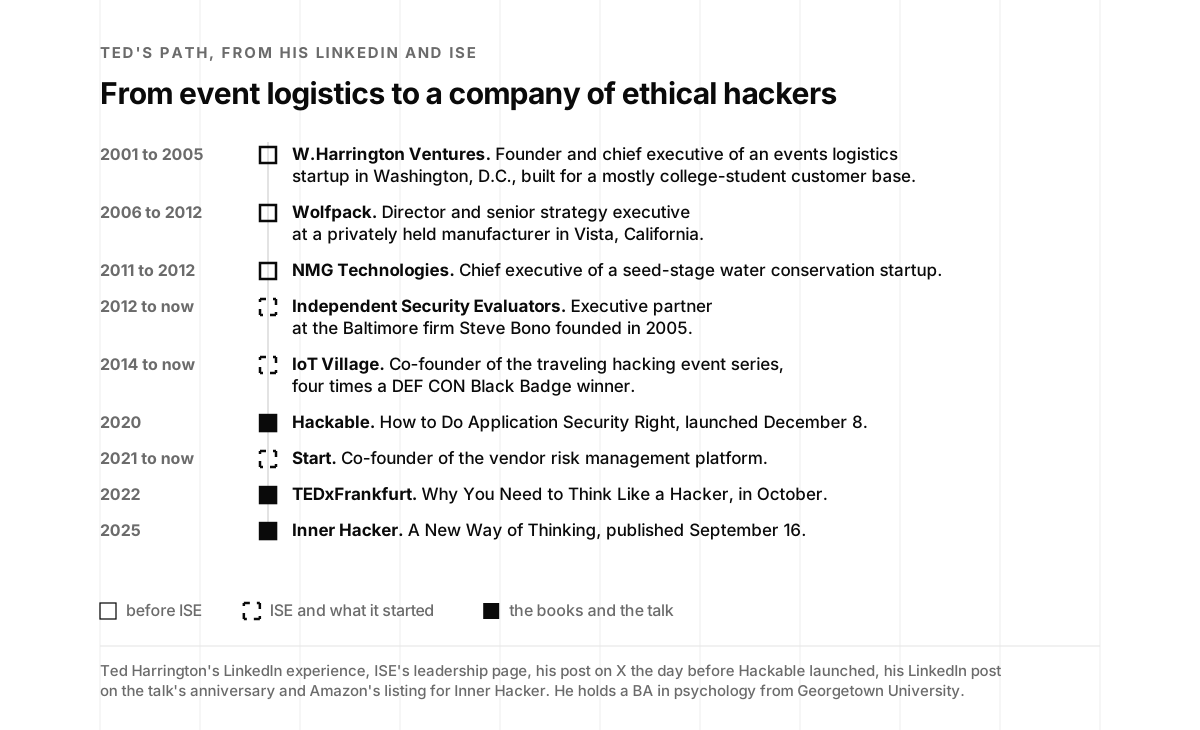
A timeline of nine entries. 2001 to 2005, W.Harrington Ventures, founder and chief executive of an events logistics startup in Washington, D.C., built for a mostly college-student customer base. 2006 to 2012, Wolfpack, director and senior strategy executive at a privately held manufacturer in Vista, California. 2011 to 2012, NMG Technologies, chief executive of a seed-stage water conservation startup. Dashed, 2012 to now, executive partner at Independent Security Evaluators, the Baltimore firm Steve Bono founded in 2005. Dashed, 2014 to now, co-founder of IoT Village, the traveling hacking event series, four times a DEF CON Black Badge winner. Filled, 2020, Hackable: How to Do Application Security Right, launched December 8. Dashed, 2021 to now, co-founder of Start, the vendor risk management platform. Filled, 2022, the TEDxFrankfurt talk Why You Need to Think Like a Hacker, in October. Filled, 2025, Inner Hacker: A New Way of Thinking, published September 16.
Ted's path, from his LinkedIn, ISE's leadership page, his posts and Amazon. IoT Village and Start both grew out of ISE.

IoT Village is the part of that resume most security people know. It’s a traveling hacking event with talks, hands-on labs, live bug hunting and hacking contests, run at DEF CON, RSA Conference and elsewhere, and organized by ISE (IoT Village). Over the years it has served as a platform to uncover hundreds of new vulnerabilities, by its own count. Start is the other: software that pulls vendor risk management out of spreadsheets and email (Start), which IoT Village’s site says is trusted by Fortune 100 companies and the biggest studios in media and entertainment.

What does it mean to think like a hacker?

I asked him the simplest version of the question. “So, what’s the spirit behind hacking?”

“Hacking is about looking at a scenario, a situation, a problem, a goal, whatever, and being willing to think differently about it than maybe what most people do.”

Ted Harrington, at 1:24

He had been working toward that sentence for years, in three steps. “I lead a team of ethical hackers. I wrote the best-selling book called Hackable, which talks about practical implementations of this mindset. I gave a TED talk called Why You Need to Think Like a Hacker.” Hackable launched on December 8, 2020, after, in his words on X the day before, decades of research and almost two years of writing.

The day before Hackable came out. His LinkedIn says it reached number one in nine categories on Amazon. View on X.

The talk came next. He gave it at TEDxFrankfurt in October 2022, and TEDx posted it on YouTube in January 2023, where it has been watched more than 37,000 times. The talk’s own description says he sees security as a competitive advantage rather than a cost, the pursuit of a good thing rather than the avoidance of a bad one.

Ted at TEDxFrankfurt, 15 minutes 38 seconds, posted by TEDx in January 2023. Inner Hacker is built on the ideas in this talk, he wrote four years later. Watch on YouTube.

The talk, he said, raised a question he then spent years on. “And that, of course, begs the question: like, well, what does that even mean? What does it mean to think like a hacker?”

Four traits every kid already has

His answer is short enough to remember.

“And so I’ve sought to answer that and I’ve distilled it down to four attributes that hackers possess. And they are that hackers are curious. Hackers are non-conforming. Hackers are committed and hackers are creative.”

Ted Harrington, at 2:02

Listen · Ted on episode 80, from 2:02
About 24 seconds: the four traits, and how he proves everyone has them. Read the full transcript.

The proof that everyone has a hacker inside, he said, is in any playground. “And the way that I can demonstrate that everyone has a hacker inside them is simply by looking at children.” Kids are curious, “always asking questions.” They’re committed: “They’re gonna pursue that thing that they want you to give them no matter how many times you say no.” They’re non-conforming: tell them to do something and “they’re gonna be like, well, maybe I will, maybe I won’t.” And they’re creative, “just wildly imaginative.”
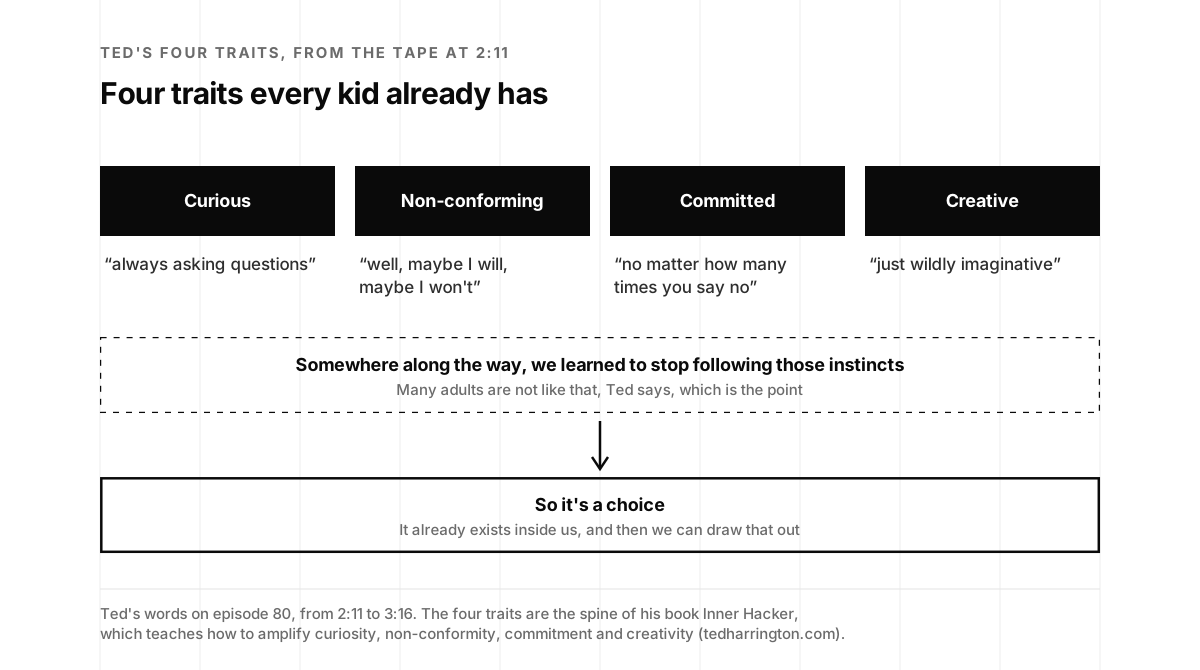
Four filled boxes, one for each trait Ted Harrington says hackers possess, with what he says children already do. Curious: always asking questions. Non-conforming: well, maybe I will, maybe I won't. Committed: no matter how many times you say no. Creative: just wildly imaginative. Below them, a dashed box: somewhere along the way, we learned to stop following those instincts, and many adults are not like that. An arrow leads to an open box: so it's a choice, because it already exists inside us and we can draw it out.
Ted's four traits and the children who already have them. The last box is the whole argument of Inner Hacker in four words.

What changes is us. “Many adults are not like that. So, somewhere along the way, we learned to stop following those instincts and those traits. So it’s a choice.” The payoff of choosing differently, in his telling, is that you see what the crowd walks past: “that reveals these overlooked pathways or these missed opportunities that other people are kind of blinded to, because they’re all following along. Like the herd’s all going in the one direction.”

He tells a version of this on stage with his niece in the starring role.

The Nieces Story, 1 minute 25 seconds from one of his keynotes, posted on his channel in January 2023: a story, in its own description, about how his niece is a hacker. Watch on YouTube.

Curiosity is table stakes

Sasha pulled on the first of the four threads. “It’s the curiosity, right? You have to be always curious about alternatives, about different paths to take.” Ted agreed, and told us what writing the book had turned up. He had been calling hackers he admired and asking each one what it means to think like a hacker.

“I think without exception, I’m pretty sure it was every single one of them, they said the first thing they said was that hackers are curious. And to me, that feels like table stakes.”

Ted Harrington, at 4:05

Listen · Ted on episode 80, from 4:05
About 14 seconds: every hacker he interviewed said curious first. Read the full transcript.

Table stakes inside security, that is. Step outside it and the trait gets rare. “But then you realize, in the grand scheme, the grand scope of the human population, a lot of people are not curious.” Hackers sit at the other end, asking “relentless, incessant questions,” and the same habit does two jobs: “That’s how you find these flaws, security flaws in systems, computer systems, but that’s also how you find these new ways of accomplishing whatever it is you’re trying to accomplish.”

That double use is the thing I’d underline for anyone hiring a tester. The person who asks why a login flow works the way it does is the same person who notices that a password reset skips a check. You can’t buy one without the other.

Entrepreneurs are hackers

Sasha took it one step further. “I was about to say that curiosity is also aligned with innovation.” Ted didn’t hesitate: “Absolutely, right? Like when you think about an entrepreneur, entrepreneurs are absolutely hackers, right?” People who aren’t entrepreneurs see the money and the business, he said, but “those are the byproducts of the curiosity.”

“What an entrepreneur does is they observe conditions, and they’re like, huh, I’ve heard people talk about this problem. Why isn’t that problem solved? Why do current or conventional approaches not solve that problem? Is there a better way? And then they start to explore that. And it’s through that curious exploration that you come up with a business that solves that problem for an audience. That’s innovation.”

Ted Harrington, at 5:26

Listen · Ted on episode 80, from 5:26
About 26 seconds: why isn't that problem solved, and is there a better way. Read the full transcript.

It’s an easy idea to agree with and a hard one to live by. His own LinkedIn reads like that loop run several times, from event logistics for college students to a startup cutting the water lost at irrigation risers. I added my own version later in the conversation: “Maybe being an entrepreneur is just realizing like there’s a shorter path to a similar outcome with less bloat, with less rules, with less things to complicate the journey.” We’ll get to the bloat.

Which rules should you break?

The phrase “break the rules” came up next, from me, and Ted lit up, because he had just written a whole chapter on it. “Yeah, it’s interesting you bring up rule breaking, actually, because in this book that I’m working on, there’s an entire chapter that I write about rule breaking.” He started where a security person should, with what rules are for. “And it’s really interesting because rules serve a great purpose. Like rules should exist. Rules govern how a system behaves. They create order out of what otherwise might be chaos.”

“And in fact, most rules exist for a good reason and probably should be followed. But what we’re looking at, what you’re looking for with the hacker mindset is there’s a subset of rules that are better if they are not followed. It’s better if you bend the rule or you break the rule or you just straight up bypass it entirely.”

Ted Harrington, at 6:41

Listen · Ted on episode 80, from 6:41
About 21 seconds: the subset of rules that are better if they are not followed. Read the full transcript.

“And the trick is figuring out: well, which rule is which?” His method is to check a rule against every kind of line it might be protecting: “There’s legal boundaries and there’s moral boundaries, there’s ethical boundaries, there’s safety boundaries, there’s reputational boundaries.” Some rules carry significant implications, and hackers know those without thinking. Others protect nothing but habit. “But maybe I don’t need to wait in line to get into, I don’t know, like the conference. Everyone lines up in a line because they see this line. It’s like, is there another way in?”
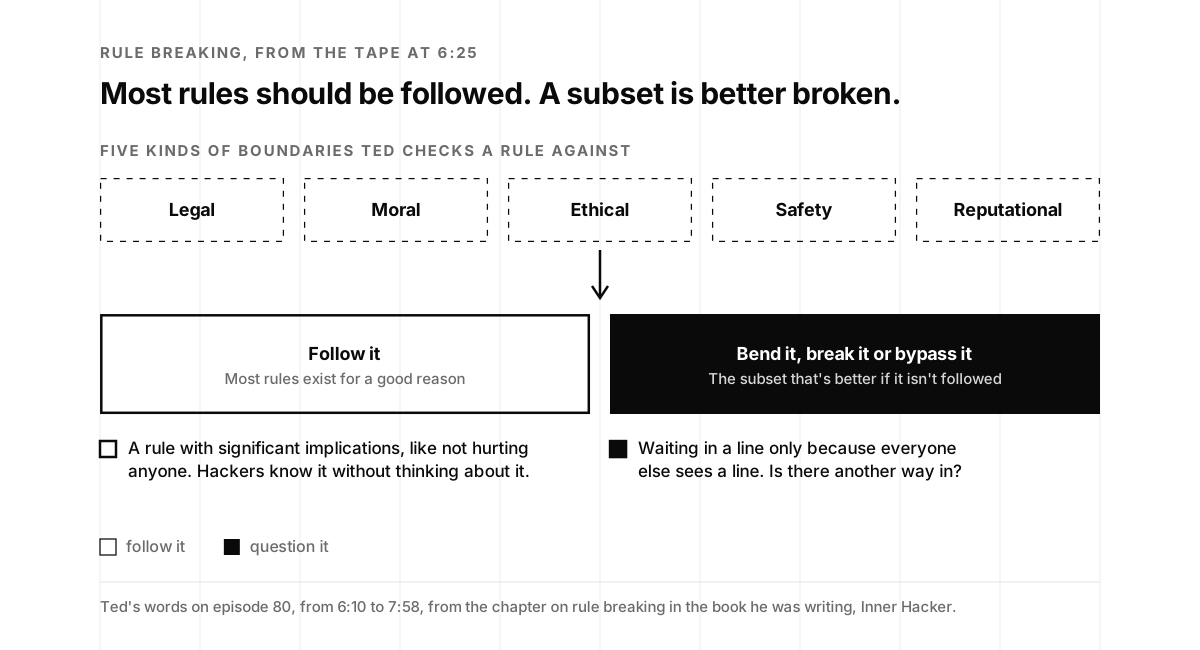
Five dashed boxes name the boundaries Ted Harrington checks a rule against: legal, moral, ethical, safety and reputational. An arrow leads to two boxes. Open: follow it, because most rules exist for a good reason. Filled: bend it, break it or bypass it, the subset that's better if it isn't followed. Under the open box, an example: a rule with significant implications, like not hurting anyone, which hackers know without thinking about it. Under the filled box: waiting in a line only because everyone else sees a line, and asking whether there's another way in.
Ted's test for a rule, from the chapter he was writing. Most rules pass it. The ones that don't are where a hacker looks for another way in.

This is, word for word, how a good penetration test is scoped. The rules of engagement are the boundaries you never cross: what’s out of scope, what could hurt someone, what the law forbids. Inside them, every assumption the system makes about how it will be used is fair game, and the most valuable findings are usually the line everyone waits in because everyone else does.

Rule bloat

Sasha brought an engineer’s word for the problem. “And maybe there is a concept of some rules are like technical debt. Things have changed. We’ve evolved. The laws have changed.” Layers of newer rules make some of the older ones meaningless, and they’re still followed “because they haven’t changed or they haven’t been removed.” Ted had a name for it.

“I refer to, there’s an associated idea called rule bloat, which is the idea that like rules get laid on top of rules because like now a new scenario happens and it’s like, oh, we didn’t think of that, so let’s add another rule for that.”

Ted Harrington, at 8:26

Listen · Ted on episode 80, from 8:23
About 21 seconds: rule bloat, and rules on top of rules. Read the full transcript.

The fix isn’t fewer rules, it’s rules that move. “Like the only constant in the human existence is that things will change. And so we have to realize that like rules need to be adaptable, they shift over time.” His example was the starkest one available: laws that once allowed discrimination by gender or ethnicity, which “not even that long ago” were “literally enshrined in law.” The rule was wrong even then, he said. “But by the letter of the law, it was the way that it was.”

Sasha turned it back to software. “It’s almost like a supply chain in software. You have this bloated supply chain that you have no idea what’s beyond 10 layers of dependencies, but there is something there that you should be careful [of], potentially.” Ted’s reply: “That’s a good correlation.” Anyone who has run a dependency audit knows the feeling: the package nobody chose, pulled in by a package nobody remembers choosing, still shipping in every build.

The taxi and the zero to one

I told the story of the taxis before Uber, with cameras everywhere, a plastic shield, no seat belts in the back and the driver surrounded by regulated gadgets. “I’m looking at that and I’m going like, why do we need all of this stuff? Like, what is that? We’re just going from point A to point B, [give] some money and like, that’s that.” Some of those rules might be coming back for Uber, I allowed. “But it felt like ripe for disruption.”

Ted didn’t take the easy side. “So regulation is an interesting one because in some contexts, regulation improves things. And in a lot of contexts, it does the opposite. Slows down innovation.” Its real job, he said, is narrower: “regulation is useful when it protects groups who the market forces on their own aren’t going to protect those groups.” His example was a taxi ride in another country, where you’re left wondering how badly you’re being ripped off. Then he brought it home to security.

“I think if we bring it to security, like a cybersecurity context, regulation has proven to be effective for things like IoT devices, medical devices, things where the market forces aren’t actually incentivizing security in those cases.”

Ted Harrington, at 11:50

Listen · Ted on episode 80, from 11:50
About 31 seconds: IoT devices, medical devices, and passwords you can't even change. Read the full transcript.

The early internet connected devices made the case for him. “It was like security is like hard, the passwords are hard-coded. You can’t even change the passwords, you know?” The market wasn’t going to fix that, so regulators did. And then he drew the line that makes this one of my favorite takes on the subject.

“And I’m not a proponent of regulation in almost all contexts, except for something like that, where it’s like it needs to take something from like zero to one in order to make that improvement. The problem comes from once you’re at one, and then it’s one to N is where all these layers of bureaucracy get added onto it.”

Ted Harrington, at 12:35

Past one, things become “less efficient, more expensive,” and “It no longer meets the spirit of the underlying purpose of the regulation.” Those are the rules worth breaking, he said, which ties the regulation back to the rule bloat.

The public record has three clean examples of the zero-to-one kind, all aimed at the problem he described. California’s SB-327, signed in September 2018 and in force from January 1, 2020, says that for a device you can log in to from outside the local network, security counts as reasonable if its preprogrammed password is unique to each device, or if the user must set a new one before first access (California Legislature). In the United States, the Consolidated Appropriations Act of 2023 added section 524B, Ensuring Cybersecurity of Devices, to the Food, Drug, and Cosmetic Act, effective March 29, 2023 (FDA). And the UK’s product security regime came into effect on April 29, 2024, requiring passwords that are unique per product or set by the user, and a published way to report security issues (GOV.UK).
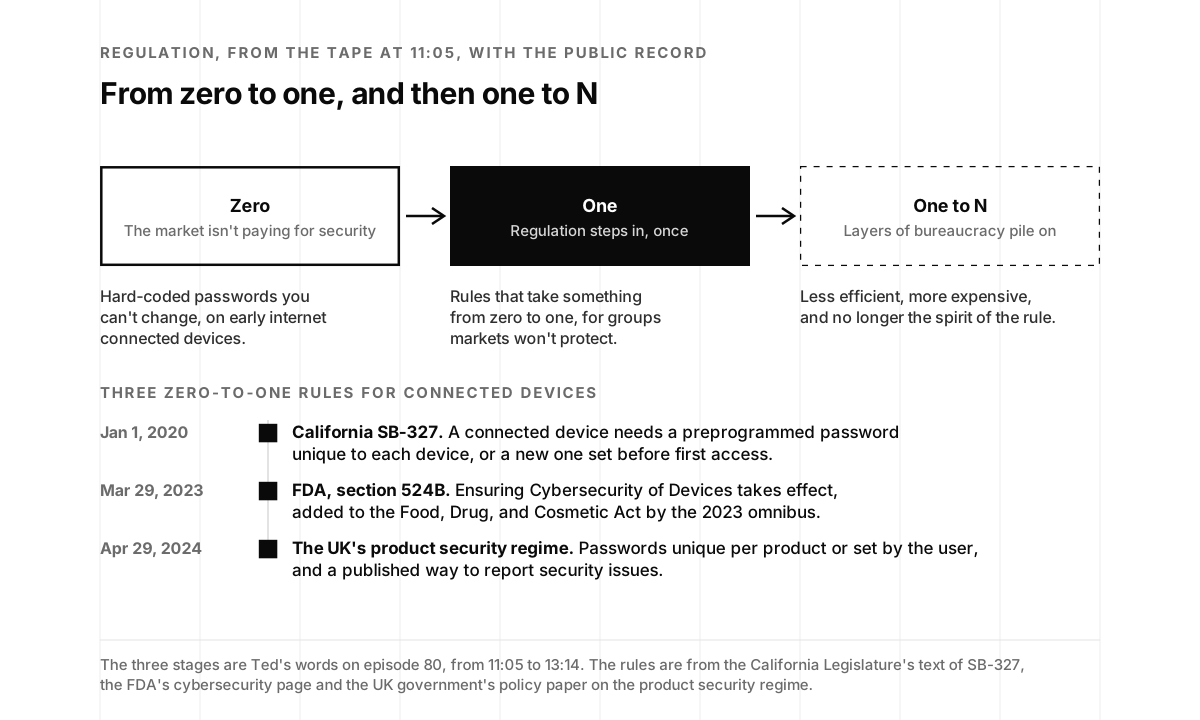
Three boxes joined by arrows. Open, zero: the market isn't paying for security, as with hard-coded passwords you can't change on early internet connected devices. Filled, one: regulation steps in, once, to take something from zero to one for groups markets won't protect. Dashed, one to N: layers of bureaucracy pile on, less efficient, more expensive, and no longer the spirit of the rule. Below, three zero-to-one rules for connected devices. January 1, 2020, California SB-327: a connected device needs a preprogrammed password unique to each device, or a new one set before first access. March 29, 2023, the FDA's section 524B, Ensuring Cybersecurity of Devices, takes effect, added to the Food, Drug, and Cosmetic Act by the 2023 omnibus. April 29, 2024, the UK's product security regime: passwords unique per product or set by the user, and a published way to report security issues.
Ted's zero to one and one to N, with three rules that took connected devices from zero to one. What happens at one to N is the part to watch.

ISE knows the medical device problem firsthand. In a segment for CBS News, Ted and his team demonstrated exploitable vulnerabilities in patient monitors, the kind that could harm a patient in the wrong hands.

Hacking Medical Devices on CBS News, 2 minutes 3 seconds, posted on his channel in February 2019: researchers showing exploitable vulnerabilities in patient monitors. Watch on YouTube.

For the devices nobody regulates yet, the forgotten printers, cameras and badge readers on a company network, our own guide to IoT device security walks through who should own them, and episode 94 is a whole hour on what one unsecured printer can reach.

Know when to stop digging

Sasha closed the regulation thread with a word that kept coming back. “Yeah, there is a healthy amount, just like there is a healthy amount of security in any business, there is a healthy amount of regulations in any space. And you just have to find the balance, hopefully.” I called it “a very Zen approach to security or to hacking or maybe just life in general,” and Ted, after allowing that all things are in balance, remembered a hacker angle on it after all.

The hackers he interviewed kept telling him stories they didn’t think were interesting. “They tell me, I’m like, that’s the most interesting story I’ve ever heard.” One of them, a colleague at ISE, gave him an idea about balance.

“he’s talking about this idea that hackers have to know when to stop [digging], because hacking is like, by nature, sort of uncertain, right? You look at a system and you’re like, I kind of think that there might be an exploitable security vulnerability in this area, so I’m gonna dig.”

Ted Harrington, at 14:06

Listen · Ted on episode 80, from 14:03
About 28 seconds: knowing when to stop digging, and the signals that say keep going. Read the full transcript.

A couple of findings that aren’t quite an exploit yet tell you that you may be on the right path. “But if you keep digging too far, like you only have so much time or energy or money or resources you can put into something, and if you burn them all on a dead end, then you kind of miss the other stuff that’s important.” At some point the right call is “all right, I’m butting my head against a wall. It’s time to divert and look towards something else.” Sasha summed it up in one line: “This is the effort versus the reward that you get in exchange for that effort.”

Every tester knows this one in their bones. A time-boxed engagement is a budget, and the best testers spend it the way a good investor does: enough on each lead to know if it’s real, and the rest on the leads that are.

Is it worth it?

I asked whether he had a tool for it, “a signal to be like, well, maybe I should start asking these questions about balance and pop the stack maybe sometime soon?” He did, from the same colleague: a sequence of questions. The first is the one that sorts everything else. “So I can’t remember exactly what all the questions are right now, but they were things like, is the path I’m going getting me closer to my goal? And the answers might be like, yes, maybe or no.”

Yes means keep going and no means divert. “But a lot of times it was that middle, like maybe.” That’s where the follow-ups come in: is it worth it, would the payoff be big enough, has something similar worked before, and if not, is this something never before seen that’s worth the effort anyway?
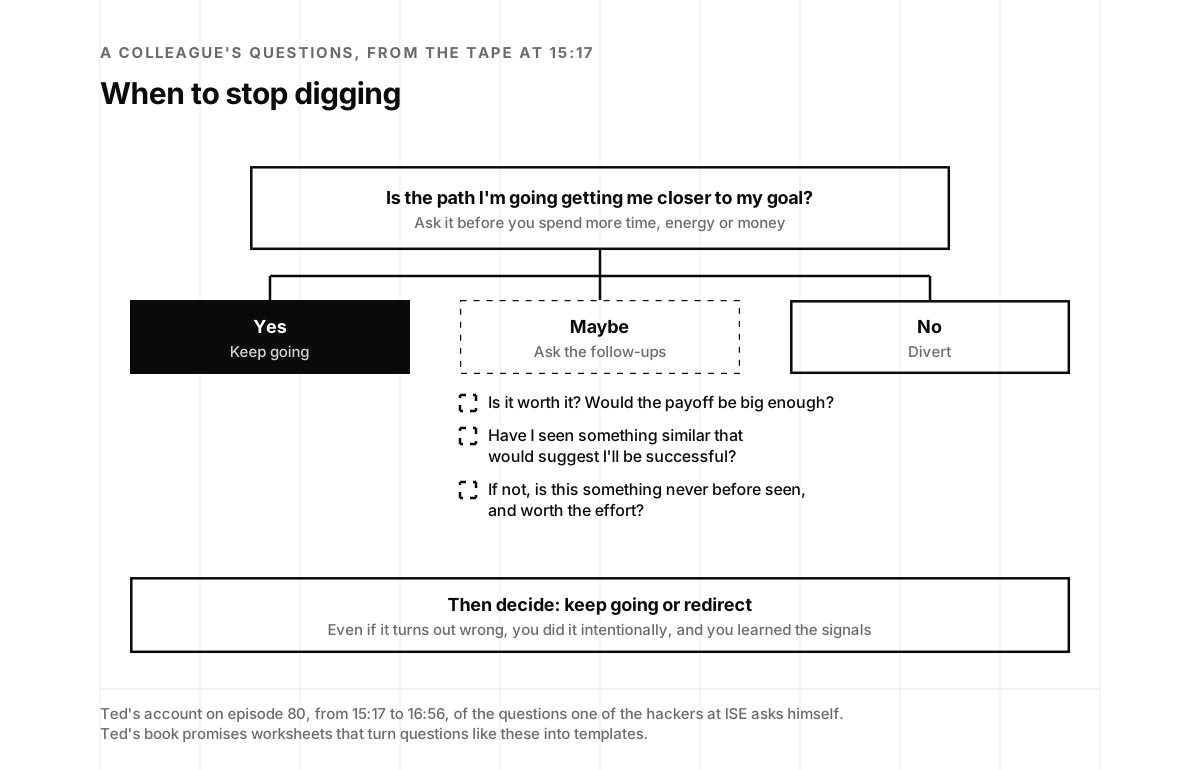
A decision tree. The top box asks: is the path I'm going getting me closer to my goal? Ask it before you spend more time, energy or money. Three branches. Filled, yes: keep going. Open, no: divert. Dashed, maybe: ask the follow-ups, listed below it. Is it worth it, and would the payoff be big enough? Have I seen something similar that would suggest I'll be successful? If not, is this something never before seen, and worth the effort? A box at the bottom: then decide, keep going or redirect. Even if it turns out wrong, you did it intentionally, and you learned the signals.
The questions Ted's colleague at ISE asks himself mid-engagement. The maybe branch is where most of the time goes.

The point isn’t to always be right. “So he has this whole like sequence of questions that, the purpose of it is to just take a minute and ask yourself some clarifying questions.” Even when the call turns out wrong two weeks later, “He still did it intentionally,” and the miss teaches him the signals for next time. Ted said Inner Hacker would come with templates and worksheets for exactly this kind of exercise. Sasha’s verdict: “It sounds like a great system that maybe everyone should occasionally follow.” I said I ask myself a version every day: “Every morning I wake myself up and I’m asking myself, oh, what is it today?”

Safety is in the herd

Ted explained why most people don’t. Humans want patterns, and they learned a long time ago where safety was.

“we learned along the way that safety is in the herd. Safety is not being out on your own. You’re safe in the herd.”

Ted Harrington, at 17:23

That instinct now runs knowledge work. People get a routine, the gym, the office, dinner, bed, and he doesn’t knock it. “And it’s easy. And that’s a beautiful thing, like being able to have that comfortable life. So it takes someone intentionally to step out of that every day and say, what am I going to do today? And will that thing bring me closer or farther away from my goals?” Sasha’s reply was the same instruction in six words, “You just have to stay curious,” followed by a reminder of how lucky that routine is: nobody has to source food from the fields or wood for the fire. “But staying curious is the challenge.”

I said there’s nothing wrong with optimizing for comfort, “For the consistency, for the security,” and that I use it the other way around. “And actually, I will use comfort as an indicator to start questioning things.” When things get too comfortable, I ask whether I’m still learning and growing. Ted pointed out that comfort is also the goal: enough money, companionship, love, community and a sense that your life mattered are “all things that are measurements of comfort.”

I went back to the simple version, “Do I have shelter? Do I have food? Do I have water? Do I have companions?”, and Ted noted that for parts of the world, that’s still where life is. “Like, I don’t think cavemen would be producing a podcast, right? But it might be an interesting one to listen to.” What the rest of us have is room to think, and that, he said, is where the mindset reaches past security.

“And that’s where I think this mindset, the hacker mindset, is so much bigger than just computers. I mean, yes, this is how you build better, more secure systems. But this is also how you live a better life that’s more efficient.”

Ted Harrington, at 20:31

There’s no shortcut to sweat

One of the ideas inside the mindset, Ted said, is about a particular kind of advantage: “the hacker mindset helps you identify and then capitalize on things like shortcuts and loopholes.” He was writing exactly that chapter while traveling, and walked into a gym he’d never been to before.

“And I walk in, I’d like check in or whatever, and on the wall is this like massive mural with one of these like inspirational things that’s like painted on there with you know like an athlete sweating or whatever. And it said in huge text, it said, there’s no shortcut to sweat.”

Ted Harrington, at 21:11

Listen · Ted on episode 80, from 21:04
About 25 seconds: the gym mural, in the middle of writing a chapter in praise of shortcuts. Read the full transcript.

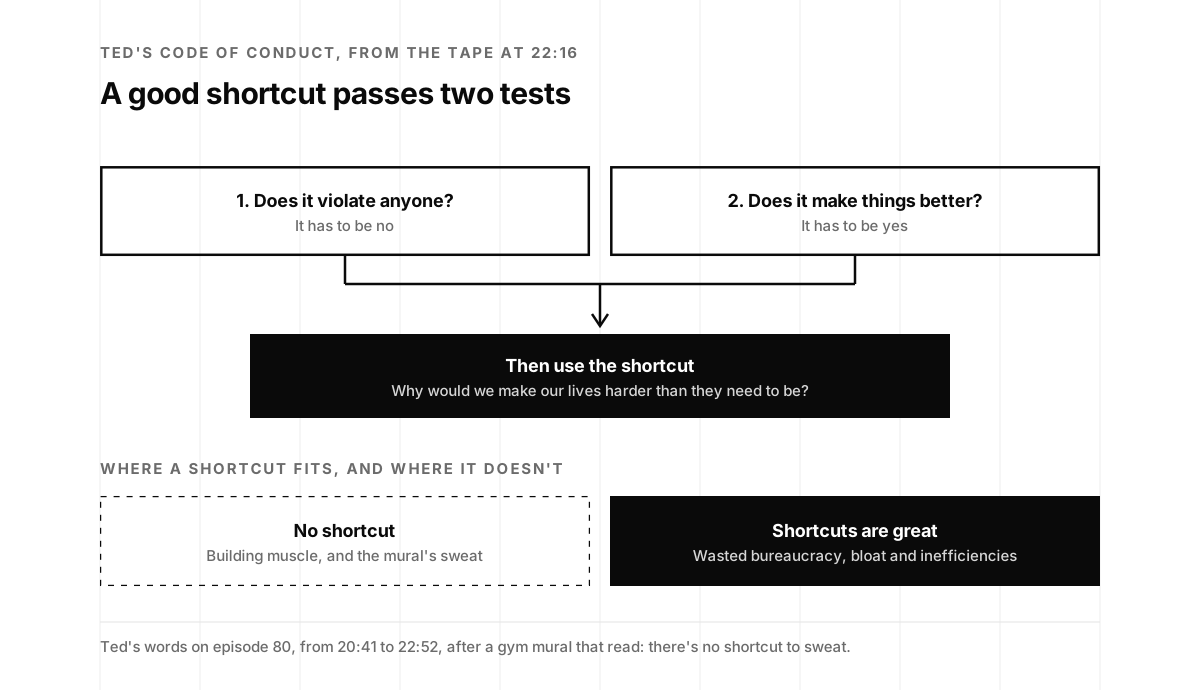
“And it kind of like stopped me in my tracks.” Here he was, arguing that the mindset is valuable because it finds shortcuts, in front of a painting that said shortcuts are the problem. He stood there and asked the curious person’s question, are shortcuts a bad thing, and came out with an answer that depends on context. “And I realized that context, of course, matters because there is no shortcut to build muscle. But the way we live our lives, the way we approach our careers, the way we just go about everything that we’re doing, there’s all this wasted bureaucracy and bloat and inefficiencies. And that’s where shortcuts are great.”

Then he gave the rule that keeps a shortcut honest.

“Like, there’s definitely a code of conduct that needs to be followed to utilize the hacker mindset. But it’s basically, don’t violate anyone and make things better. Like, if you do those two things, you can use the hacker mindset, and then we should totally be using shortcuts.”

Ted Harrington, at 22:18
Listen · Ted on episode 80, from 22:12
About 19 seconds: the code of conduct, in two tests. Read the full transcript.
Two open boxes, the two tests Ted Harrington gives for using the hacker mindset. Test one: does it violate anyone? It has to be no. Test two: does it make things better? It has to be yes. Both lead to a filled box: then use the shortcut, because why would we make our lives harder than they need to be? Below, where a shortcut fits and where it doesn't. Dashed, no shortcut: building muscle, and the sweat on the gym mural. Filled, shortcuts are great: wasted bureaucracy, bloat and inefficiencies.
Ted's two tests for a shortcut, and where one fits. A good exception request in a security program passes the same two.

Those two tests are the ethics of ethical hacking in miniature: you have permission, so nobody is violated, and the point is to leave the system better than you found it. They also make a good filter for the exception requests every security team gets. Does the shortcut put anyone at risk, and does it make the work better? If the answers are no and yes, the rule it skips is probably bloat.

The hot buzzwords

Sasha connected the mindset to the technology everyone was talking about. “The life is evolving. Today we have this hot buzzwords, LLMs, AIs, that also meant to remove a lot of inefficiencies, a lot of bureaucracies, a lot of noise, and make our lives more efficient.” The hacker move, in Sasha’s telling, is the one some people make with the models themselves.

“But there are a lot of open source models that people choose to deploy locally, not only to save money, but also for the privacy concerns, et cetera. That ties into the hacker mindset.”

Sasha Sinkevich, at 23:22

ISE has since written up exactly that move. In September 2026, ISE security analyst Benjamin Wolf published a guide to building a local agentic AI rig for security research, for the cost and for privacy, because “sending raw source code and context to cloud providers is often a dealbreaker” (ISE). The same month the firm published a post on LLM prompt attacks and how to prevent them, framed as “a risk-management discipline” with defense in depth (ISE, LinkedIn). Running models yourself is one way to keep data in. For the tools people already use at work, our guide to governing shadow AI without blocking it is the other half.

Security is best done when it’s invisible

Ted picked up the thread from the user’s side of the screen.

“Security is best done when it’s either invisible or not very visible to the user. Like everyone’s used to logging a password to get into something. But then all the stuff that’s happening behind the scenes, they don’t necessarily suffer from.”

Ted Harrington, at 23:38

Make them suffer from it, he said, and “they might be like, I’m just not going to use that particular system.” Sasha put a name on it. “These are the barriers of entry. The more barriers of entry you introduce, the more likely people will look for alternatives.” I said the part I believe most strongly about our own job: “And I know a lot of security people that would put that on the user, but I, as a security person, I feel like responsible to take care of like the adoption of the security mechanisms.” Those mechanisms have to fit the culture and the workflows already in place, or nothing changes. “And if you’re asking people to change too much too quickly, it’s just not going to happen. You’re not going to have a more secure company.”

“And then if you have to invoke like a power dynamic to get things to happen, I also count that as a failure, right?”

Jon McLachlan, at 24:43

Listen · Jon on episode 80, from 24:43
About 25 seconds: the power dynamic, and selling the idea instead. Read the full transcript.

The alternative is to sell it: “maybe there’s a place where you can actually sell that idea so that it’s a win for everybody, including the folks out there that you’re asking to change.” People adopt what they see the value in.
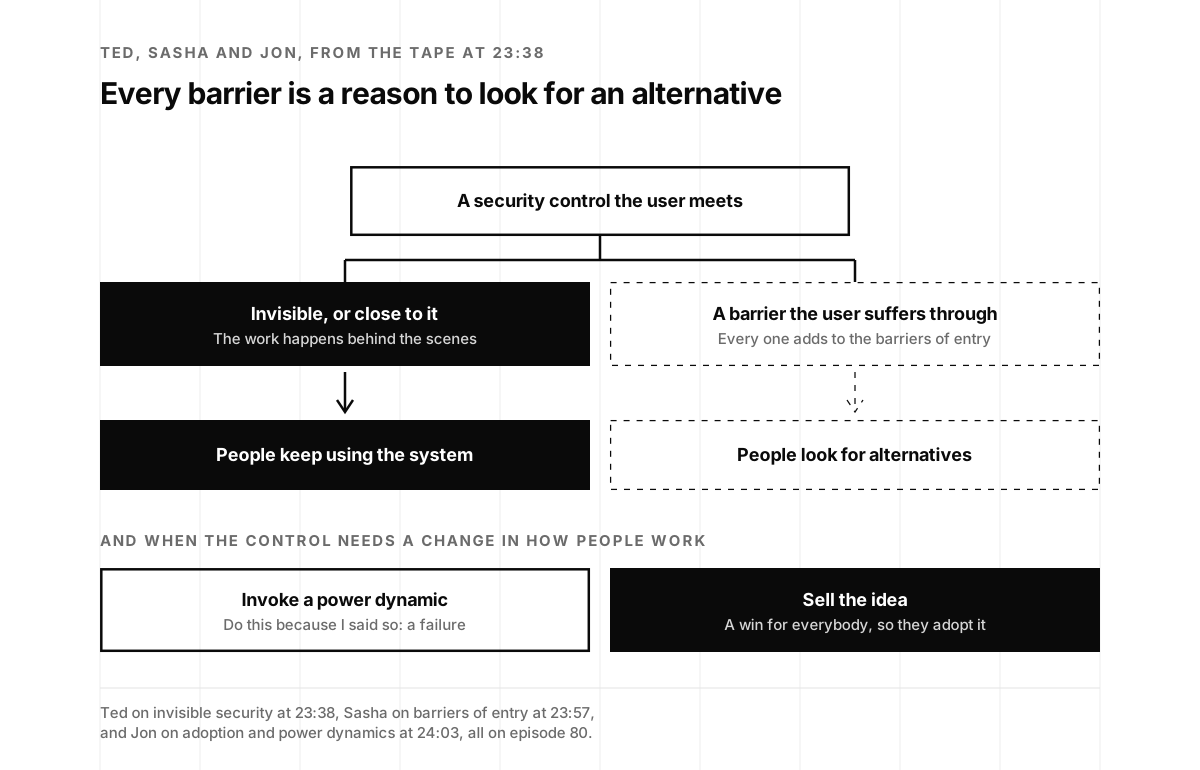
A security control the user meets branches two ways. Filled: invisible, or close to it, with the work happening behind the scenes, and people keep using the system. Dashed: a barrier the user suffers through, which adds to the barriers of entry, and people look for alternatives. Below, when the control needs a change in how people work. Open: invoke a power dynamic, do this because I said so, which Jon counts as a failure. Filled: sell the idea, a win for everybody, so they adopt it.
Ted on invisible security, Sasha on barriers of entry, and my rule about power dynamics. The left column is the one that scales.

Deepak Dutt made the same case for sign-in itself on episode 78, where authentication runs in the background instead of at a gate. A year after our recording, Ted posted the physical version from an airport: layers you barely notice, doing the work.

We love a good defense in depth. The Burbank airport abuts an active roadway so this layered approach to physical security is that much more important. It’s a great visual representation of how we should secure software too.

Ted Harrington · October 15, 2026
Defense in depth at the Burbank airport, as a picture of how to secure software. View on LinkedIn.

Ted answered my point by taking apart the most repeated line in security.

“Yeah, it’s an easy cop-out to say, like, oh, the user is the weakest link. And, you know, people say that kind of stuff all the time.”

Ted Harrington, at 25:08

Saying it, he said, doesn’t mean “that we should then just like give up and say, like, well, it’s on individual users to fix this problem.” His comparison was recycling.

“It’s like the way that recycling has been approached, at least in America, was rather than it being like we’re going to responsibly produce and recycle materials, there was this thing like maybe 20 years ago where it was like recycling programs, where now it’s like, it’s up to you, Mr. and Mrs. Consumer of products, to make sure you put your plastic bottles in the recycle bin.”

Ted Harrington, at 25:25

Listen · Ted on episode 80, from 25:25
About 35 seconds: recycling, and the moment the responsibility shifted. Read the full transcript.

“And all of a sudden, it’s like the responsibility was shifted. And that’s not how we want to think about security. Like, well, it would be secure if the users would just listen.” What works instead, he said, comes from the psychology of engagement. He remembered a study, without remembering who ran it or when, so I’ll leave it at his summary: “And what the research demonstrated is that simply by engaging people in the mission, they want to be part of it.” People help when they feel it’s part of their job, without it being the whole company’s safety on their shoulders. “It’s like we’re all in this together. That has proven to be very, very effective.”

Sasha added the condition that makes it work. “But the mission needs to be clearly stated, right? Because if you’re not sure why do I have to do these things a certain way, it might seem as an overhead.”
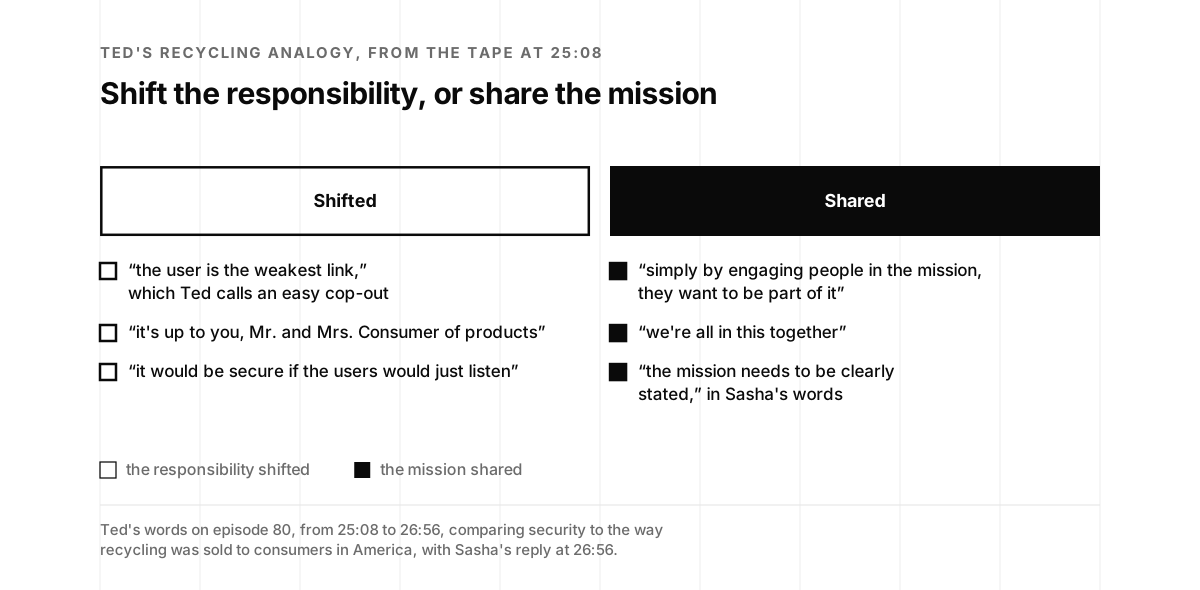
Two columns. Open, shifted: the user is the weakest link, which Ted Harrington calls an easy cop-out. It's up to you, Mr. and Mrs. Consumer of products. It would be secure if the users would just listen. Filled, shared: simply by engaging people in the mission, they want to be part of it. We're all in this together. And in Sasha's words, the mission needs to be clearly stated.
Ted's recycling analogy, and the alternative. The phrases on the left are the ones to retire from security training.

The producer side of his analogy has a name in policy now. CISA’s Secure by Design principles, published in April 2023, shift the burden of security from customers to the companies that make software, and CISA’s page says every technology provider “must take ownership at the executive level” (CISA). Jack Cable, who led that work at CISA as a senior technical advisor, walked us through it on episode 84, and default passwords, the problem Ted described in IoT devices, are one of the goals in its pledge.

Why is the question

Sasha’s word, why, sent Ted straight back to rule breaking.

""Why” is such an important part of rule breaking.”

Ted Harrington, at 27:07

Smart people, he said, are always asking why they have to do a thing a certain way, and it isn’t defiance. “And it’s not that it’s because they don’t want to follow that process. It’s because they want to make sure that they align with the beliefs of why that process is that way.” So ask the questions out loud: “Why is it that way? Why was it built that way? Who’s it built for? What was that person or group like trying to accomplish?” Then make a choice, follow the rule because it makes sense, or deviate on purpose.

That landed close to home for me.

“I am obsessed with respecting people’s autonomy. And I believe 100 percent that everyone is smart and everyone wants to do the right thing.”

Jon McLachlan, at 28:05

Accept that as true and it changes how you lead. Someone doing something out of line with the company’s interest usually isn’t being nefarious or lazy. “Maybe they’re just trying to do the right thing from their perspective, from their understanding. Like, they’re missing the context. They don’t feel like they’re part of the mission, right?” And respecting their autonomy has a second effect that a hacker would like: “you’re also inviting them to challenge the way that things are done, too.”

This is the cheapest fix in all of security, and the most skipped. A rule with its reason attached gets followed by people who agree with it, and challenged by people who can see where it’s wrong. Both are what you want.

Unplugged from the Matrix

Ted said he doesn’t only believe that most people want to do the right thing. He has watched it hold up, which surprises even him, given the job.

“So, like, all day, every day, what hackers do is they think about the bad in the world. Like, how could someone attack this thing? Why would they attack it? What do they want to accomplish? How do they victimize, all that kind of stuff?”

Ted Harrington, at 29:36

Listen · Ted on episode 80, from 29:36
About 27 seconds: thinking about the bad all day, and seeing the world for what it is. Read the full transcript.

“So you kind of, it’s like the classic movie The Matrix, right? Like we’re unplugged from the Matrix and we see the ugliness of the world, but like we at least see the world for what it is.” Most people stay plugged in and see the beauty. And still: “I still believe it to be true that most people, most of the time, want to behave ethically.” Self-preservation sometimes wins over treating someone else fairly, he allowed. “But for the most part, people given the choice would prefer to do the right thing.”

I offered the human footnote, “Yeah, yeah, there’s a lizard brain that sometimes will override things in the heat of a moment, perhaps. Welcome to being human, I guess,” and a guess about the movie: “Maybe we both saw that movie at a very impressionable age, and it stuck with us, the message of being able to challenge the way things are presented.” Ted said his reading of it has changed with time. “When I first saw The Matrix, I didn’t understand it as a hacker movie, but I now very much see it as a hacker movie.” It is one, literally: the 1999 film by the Wachowskis follows a disillusioned computer hacker named Neo (Wikipedia).

They both suck most of the time

Sasha picked the fourth trait, commitment, and asked about it the hard way. “You’ve built a lot of companies and you’ve also finished a Boston Marathon. What is the parallel between running a marathon and building a company?”

“They both suck most of the time. Like almost all the time it really sucks. But then you have these moments of just joy along the route.”

Ted Harrington, at 31:32

Listen · Ted on episode 80, from 31:32
About 20 seconds: the marathon, the company, and putting in the work anyway. Read the full transcript.

“You don’t know what the outcome’s gonna be, but you’re willing to put in the work anyway.” Sasha added the part about not quitting, and Ted turned it into gratitude: “Because you enjoy it, and because it’s the privilege that you get to do it.” Running, entrepreneurship and the hacker ethos are the same thing to him, “like the willingness to go do a thing over and over and over again, including a thing that’s physically uncomfortable, with no certainty of success, because it’s worth doing, because it’s hard to do.” Sasha’s verdict: “You have true grit.”

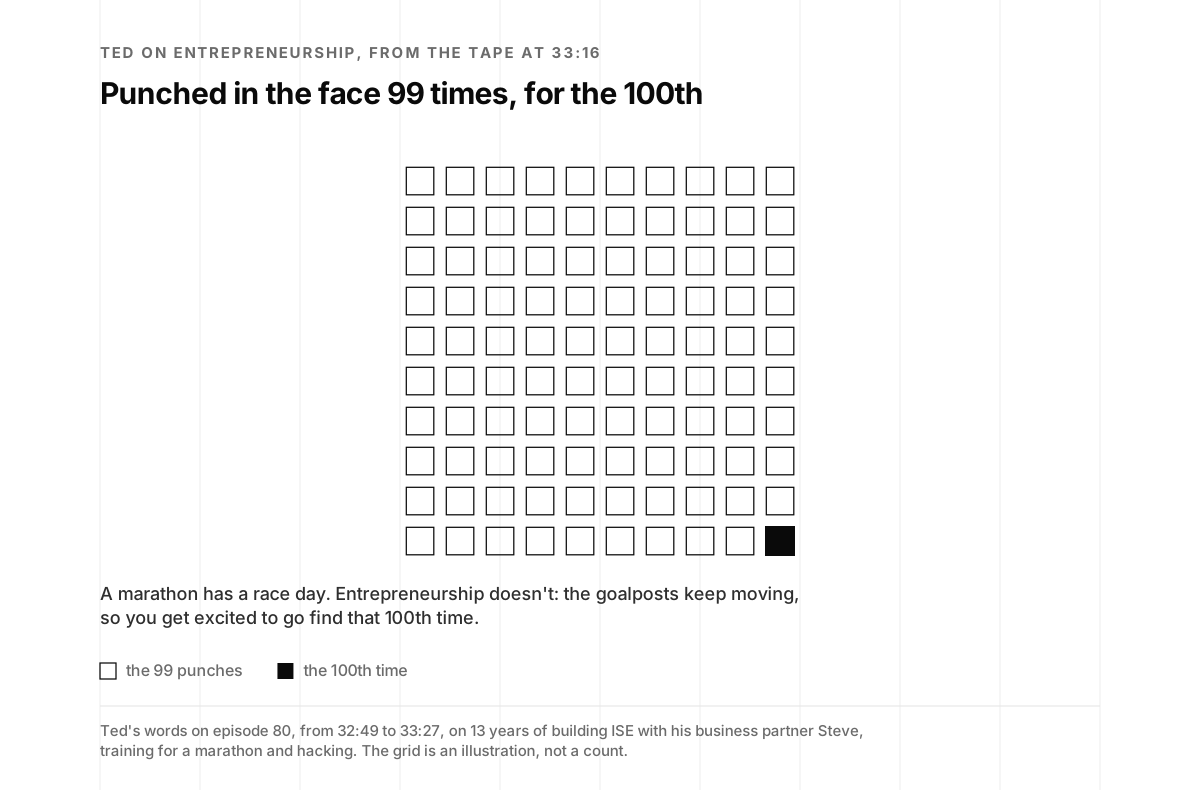
The difference between the two is the finish line. A marathon has a race day. “We’ve been doing this version of our hacking company, ISE, with my business partner Steve. He and I have been partnered up for like 13 years. There’s no proverbial race day in entrepreneurship.” The goalposts keep moving. Looking back over those years he sees “so much joy,” and he described the math of it like this.

“It’s like you get punched in the face 99 times and you’re like, there will be the 100th time that something good happens. And that’s what, you know, you get excited to go find that 100th time.”

Ted Harrington, at 33:16
Listen · Ted on episode 80, from 33:05
About 22 seconds: 13 years, 99 punches, and the 100th time. Read the full transcript.
A grid of 100 small squares, 99 open and one filled, for Ted Harrington's line that you get punched in the face 99 times and there will be the 100th time that something good happens. Below: a marathon has a race day. Entrepreneurship doesn't, the goalposts keep moving, so you get excited to go find that 100th time.
Ted's 99 and his 100th, drawn as a grid. It's an illustration of the line, not a count of anything.

Steve is Steve Bono, who formed ISE in 2005 and still runs it as chief executive (ISE). Sasha closed the loop on the trait: “And that’s the commitment, right? You commit to yourself that I’ve invested all of this time and effort. I’m curious to know what the outcome will be.” Commitment and curiosity, it turns out, are the same muscle pointed at different days.

Buy more Bitcoin

I asked my favorite closing question. “I mean, if you could, if you could travel back in time and meet your younger self, I’m super curious. Would you?” His first answer took about two seconds: “I would have told him to buy more Bitcoin.” I said that sounded like pretty good advice.

Then he took the question seriously, and talked himself out of it. Some opportunities he missed or fumbled might have gone better. “but all of those things, they also built me to where I am today, and I’m like just so grateful I get to live the experience I’m living right now.” The risk is the butterfly effect, “where like one little change changes everything and now maybe my life is different in a not as cool way?” He had never pondered it, he said. I told him he wouldn’t be the same person, and that the person he is today is worth keeping. If you want to find him, it’s simple. “It’s just my name, just tedharrington.com.”

What happened after the tape

Inner Hacker came out on September 16, 2025, a 278-page Kindle edition, a month before this episode aired (Amazon). Its own pitch is the line he gave us at the top of the episode, compressed: “There’s a hacker inside you. Unleash it.” The page for the book promises to teach “how to break the right rules to move forward” and how to amplify curiosity, non-conformity, commitment and creativity (tedharrington.com). The hard copy followed in December.

The print edition, about two and a half months after the Kindle one. View on X.

In June 2026 he sat down with John Hammond for a 25-minute conversation on how hackers think, which has passed 14,000 views. A few minutes in, he tells the story of a buyer who collects three penetration testing quotes and buys the wrong thing, which we quoted in our post on what enterprise buyers expect from a pentest.

A Hacker's Way of Thinking, with Ted Harrington, on John Hammond's channel, June 2, 2026, 25 minutes. Watch on YouTube.

At the end of September 2026 he marked the book’s first year, and the stories readers had sent him about using the mindset.

One year ago 🤩. Wild to think that it’s already the first anniversary of Inner Hacker! I wrote this book to share the revolutionary mindset of how hackers think, and do so in a way that anyone, anywhere, can apply it to any goal.

Ted Harrington · September 29, 2026
A year of Inner Hacker, and his question for readers: how has the hacker mindset improved your life? View on LinkedIn.

The talk keeps traveling too. In October 2026 he gave the keynote plenary at the National Association of Development Organizations’ annual training conference, under the same title as the TEDx talk, “Why You Need to Think Like a Hacker” (LinkedIn). Two days later he marked four years since TEDxFrankfurt.

Four years ago today I took the stage at TEDxFrankfurt to share a revolutionary new way of thinking: the hacker mindset. It’s been a life changing journey since, including another bestselling book based on the ideas of this very talk.

Ted Harrington · October 22, 2026
Four years from the TEDx stage to two books. View on LinkedIn.

And the hands-on work goes on alongside the stage. For the first week of November 2026, the Central Ohio chapter of ISSA scheduled a two-day threat modeling workshop led by Ted, from defining assets and threat actors to building threat models that change as the landscape does (LinkedIn).
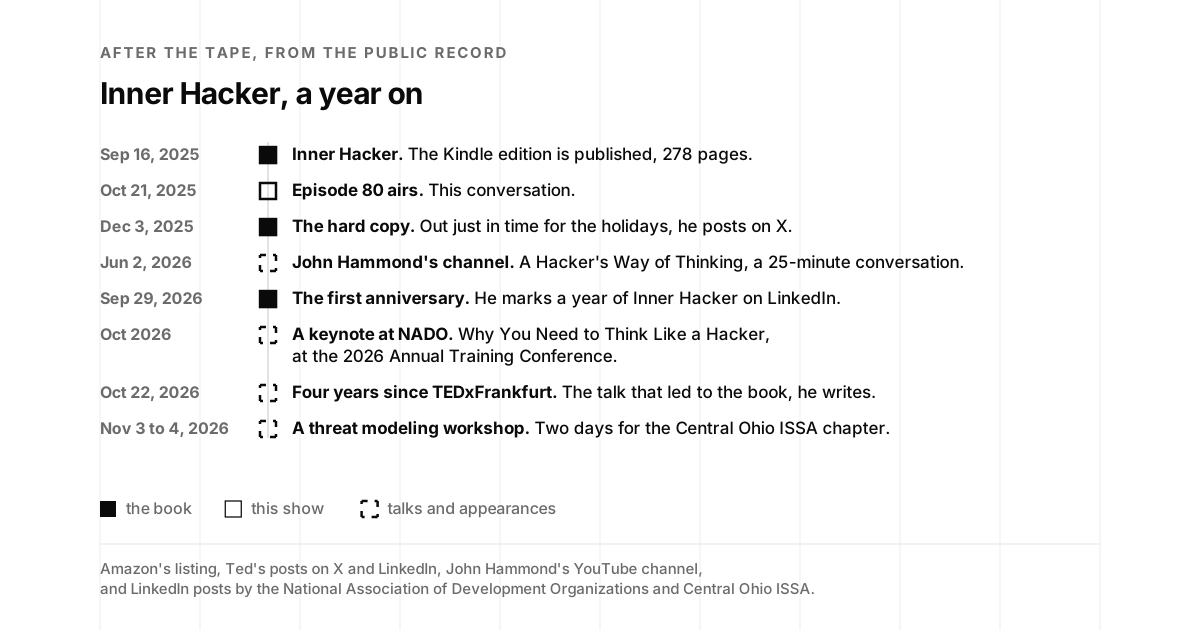
A timeline of eight entries. Filled, September 16, 2025: the Kindle edition of Inner Hacker is published, 278 pages. Open, October 21, 2025: episode 80 airs. Filled, December 3, 2025: the hard copy, out just in time for the holidays, he posts on X. Dashed, June 2, 2026: A Hacker's Way of Thinking, a 25-minute conversation on John Hammond's channel. Filled, September 29, 2026: he marks the first anniversary of Inner Hacker on LinkedIn. Dashed, October 2026: a keynote at NADO's 2026 Annual Training Conference, Why You Need to Think Like a Hacker. Dashed, October 22, 2026: four years since TEDxFrankfurt, the talk that led to the book, he writes. Dashed, November 3 to 4, 2026: a two-day threat modeling workshop for the Central Ohio ISSA chapter.
The year after the tape, from Amazon, X, YouTube and LinkedIn. The book, the talks and the workshops all run on the same four traits.

Did you catch it? A six-question quiz

Interactive · six questions

Did you catch it?

Six questions on what Ted, Sasha and I actually said, with the timestamp for each answer. The answers are under each question for anyone reading without JavaScript.

  1. What are the four traits Ted says hackers possess?

    1. Curious, non-conforming, committed and creative
    2. Technical, persistent, skeptical and fast
    3. Curious, careful, compliant and creative

    a. "And they are that hackers are curious. Hackers are non-conforming. Hackers are committed and hackers are creative." Transcript, 1:24.

  2. How does Ted show that everyone has a hacker inside them?

    1. By looking at criminals
    2. By looking at engineers
    3. By looking at children

    c. "And the way that I can demonstrate that everyone has a hacker inside them is simply by looking at children." Transcript, 1:24.

  3. What does Ted call it when rules get laid on top of rules?

    1. Rule creep
    2. Rule bloat
    3. Technical debt

    b. "there's an associated idea called rule bloat, which is the idea that like rules get laid on top of rules." Technical debt was Sasha's word for it. Transcript, 8:23.

  4. When is regulation useful, in Ted's view?

    1. When it protects groups the market won't protect on its own
    2. Whenever a new technology appears
    3. Only after a major breach

    a. "regulation is useful when it protects groups who the market forces on their own aren't going to protect those groups." Transcript, 11:05.

  5. What did the mural at the gym say?

    1. No pain, no gain
    2. There's no shortcut to sweat
    3. Think like a hacker

    b. "And it said in huge text, it said, there's no shortcut to sweat." Transcript, 19:56.

  6. What does Ted compare blaming the user to?

    1. Speed limits
    2. Airport security lines
    3. The way recycling has been approached

    c. "It's like the way that recycling has been approached, at least in America." Transcript, 25:08.

Does your security program win people over?

Ted, Sasha and I kept coming back to the same idea from different sides: security works when people are on the mission, and fails when it’s a rulebook handed down. This scorecard asks eight questions about your program, from how a new rule arrives to when you last retired one.

Scorecard · eight questions

Does your security program win people over?

Answer for the security program you run or work inside. If two answers fit, pick the lower one.

  1. When a new security rule arrives, how do people find out why?

    • They don't, it just appears
    • An announcement says what's changing
    • The reason comes with the rule, and someone answers questions

    "Why" is such an important part of rule breaking, in Ted's words, and of rule following. See Why is the question.

  2. How much of your security happens without the user noticing?

    • Most of it is a step they have to take
    • Some checks run in the background
    • The defaults do the work, and the visible steps are the ones that matter

    "Security is best done when it's either invisible or not very visible to the user." See Security is best done when it's invisible.

  3. When someone works around a control, what happens next?

    • They get blamed
    • The workaround gets blocked
    • Someone asks why, and fixes the control if it was the problem

    "The more barriers of entry you introduce, the more likely people will look for alternatives," in Sasha's words.

  4. How do new controls get adopted?

    • Because the security leader said so
    • A deadline and reminders
    • A pitch that shows each team what it gets out of the change

    If you have to invoke a power dynamic, I count that as a failure. Sell the idea instead.

  5. When did you last retire a security rule?

    • Never, rules only get added
    • When an audit forced it
    • On a schedule, with each rule checked against what it still protects

    Rules laid on top of rules are what Ted calls rule bloat. See Rule bloat.

  6. Who is responsible for security, as your training describes it?

    • The user, the weakest link
    • The security team
    • Everyone, with the mission stated plainly

    "It's like we're all in this together." See The user is not the weakest link.

  7. Can someone ask for an exception and get a straight answer?

    • There's no way to ask
    • A form that goes quiet
    • A named owner, a deadline, and two questions: does it put anyone at risk, does it make the work better

    Ted's code of conduct for shortcuts: don't violate anyone and make things better. See There's no shortcut to sweat.

  8. Do you test your own controls the way an attacker would?

    • No
    • A scan once a year
    • Curious, persistent people, with the time to dig and the questions to know when to stop

    The four traits, and the questions for when to stop digging. See Is it worth it?

Security as a rulebook

Rules arrive without reasons and leave never. Start with the cheapest fix there is: put the why next to every rule, ask the next person who works around a control what got in their way, and retire one rule this quarter that no longer protects anything.

Getting people on board

People can see the reasons, and the next wins are in the friction. Move one visible step into the background, give exception requests an owner and a deadline, and stop describing your colleagues as the weakest link in training.

Everyone's on the mission

Your program explains itself, stays out of the way and invites challenge. Now test it the way Ted's team would: give curious people time to dig into your own controls, and let them tell you which rules are better broken.

What does security friction cost?

Every visible security step is a few seconds of someone’s day, and Ted’s point is that the ones protecting nothing are worth finding. This calculator estimates the time your team spends on security steps a year, and the share you could give back.

Calculator

What does security friction cost?

How many people, how many security steps each takes a day (sign-ins, prompts, approvals, waits), how long a step takes, what an hour of their time costs, and the share of steps you think protect nothing.

–hours a year on security steps
–a year, at your hourly cost
–hours a year on steps that protect nothing
–a year you could give back

200 people taking 8 security steps a day, at 30 seconds each, spend about 3,067 hours a year on them, roughly $230,000 at $75 an hour. If 25% of those steps protect nothing, that's 767 hours and $57,500 a year you could give back.

Every default is a placeholder, not a number from the episode. A year here is 230 working days. The estimate counts only the seconds each step takes, not the context switch after it, which is usually the bigger cost, and it says nothing about which steps those are. Finding them is the work: ask the people who take them.

From Washington to Inner Hacker

Everything on this page sits on one timeline, from Ted’s first startup to the workshops of November 2026. Filter it by thread.

Timeline · 2001 to 2026

From Washington to Inner Hacker

Filter by thread. Dates are from the public record except where marked as part of this show.

  1. W.Harrington Ventures

    His first startup, events logistics for a mostly college-student customer base, in Washington, D.C. (LinkedIn).

  2. ISE

    Steve Bono forms Independent Security Evaluators in Baltimore (ISE).

  3. Wolfpack

    Director and senior strategy executive at a manufacturer in Vista, California (LinkedIn).

  4. NMG Technologies

    Chief executive of a seed-stage water conservation startup (LinkedIn).

  5. Executive partner

    Ted joins ISE (LinkedIn).

  6. IoT Village

    The traveling hacking event series, co-founded by Ted and organized by ISE (IoT Village).

  7. SB-327 signed

    California's connected device security law (California Legislature).

  8. Patient monitors on CBS News

    Ted and his team demonstrate exploitable vulnerabilities (YouTube).

  9. Unique passwords in California

    SB-327 takes effect (California Legislature).

  10. Hackable

    How to Do Application Security Right launches (X).

  11. Start

    Ted co-founds the vendor risk management platform (LinkedIn).

  12. TEDxFrankfurt

    Why You Need to Think Like a Hacker (LinkedIn).

  13. The 2023 omnibus

    Signed into law, adding section 524B to the Food, Drug, and Cosmetic Act (FDA).

  14. The talk on YouTube

    Posted by TEDx, now past 37,000 views (YouTube).

  15. Section 524B

    Ensuring Cybersecurity of Devices takes effect (FDA).

  16. The UK's product security regime

    Passwords unique per product or set by the user (GOV.UK).

  17. We record episode 80

    "I believe there's a hacker inside everyone."

  18. Inner Hacker

    A New Way of Thinking, the Kindle edition (Amazon).

  19. Episode 78

    Deepak Dutt on invisible security (episode 78).

  20. Episode 80 airs

    This conversation.

  21. The hard copy

    Inner Hacker in print (X).

  22. Episode 84

    Jack Cable on Secure by Design and the bugs that keep getting exploited (episode 84).

  23. Episode 94

    Jim LaRoe on what one unsecured printer can reach (episode 94).

  24. A Hacker's Way of Thinking

    A conversation on John Hammond's channel (YouTube).

  25. LLM prompt attacks

    ISE on defending AI deployments in depth (ISE).

  26. A local agentic AI rig

    Keeping security research off the cloud, on a budget (ISE).

  27. A year of Inner Hacker

    The first anniversary (LinkedIn).

  28. Defense in depth

    The Burbank airport, as a picture of how to secure software (LinkedIn).

  29. A NADO keynote

    Why You Need to Think Like a Hacker, at the 2026 annual training conference (LinkedIn).

  30. Four years since TEDxFrankfurt

    The talk that led to the second book (LinkedIn).

  31. A threat modeling workshop

    Two days with the Central Ohio ISSA chapter (LinkedIn).

What to do this week

Five things, in the order Ted’s four traits suggest.

  1. Write the reason next to your next rule. One sentence on what it protects and who it’s for. If you can’t write it, that’s your first candidate for rule bloat.
  2. Ask the next person who works around a control what got in their way. Then fix the control if it was the problem. Every barrier is a reason to look for an alternative.
  3. Retire one rule. Check it against the boundaries Ted named, legal, moral, ethical, safety and reputational, and if it protects none of them anymore, take it out.
  4. Give your testers a stop-digging question. Is this path getting me closer to my goal? Ask it at every checkpoint of a time-boxed test, and spend what’s left of the budget on the leads that answer yes.
  5. Run the two tests on your next exception request. Does it put anyone at risk, and does it make the work better? If the answers are no and yes, say yes faster.

Key takeaways

  1. There's a hacker inside everyone

    Ted's premise for Inner Hacker is that the hacker mindset is a superpower anyone can use, not just security professionals, because it finds new and overlooked ways to reach whatever goal you have. The book's job is to help readers find and unleash the hacker already inside them.

  2. Four traits, and every child has them

    Hackers are curious, non-conforming, committed and creative, and little kids show all four. Many adults learn to stop following those instincts along the way, which is why Ted calls thinking like a hacker a choice.

  3. Curiosity is table stakes in security, and rare outside it

    Every hacker Ted interviewed for the book named curiosity first. The same habit of asking how and why things work finds security flaws in systems and new ways to accomplish a goal.

  4. Entrepreneurs are hackers

    An entrepreneur notices a problem people talk about, asks why it isn't solved and whether there's a better way, and explores until a business comes out of it. Money and the company are byproducts of that curiosity.

  5. Most rules should be followed, and a subset is better broken

    Rules govern how a system behaves and create order, and most exist for a good reason. The hacker's job is to find the subset that's better bent, broken or bypassed, by checking each rule against legal, moral, ethical, safety and reputational boundaries.

  6. Rule bloat is technical debt for rules

    Rules get laid on top of rules every time a new scenario comes up, until older ones protect nothing but are still followed. Sasha compared it to technical debt and to a software supply chain ten layers deep. Rules need to change as everything else does.

  7. Regulation works best from zero to one

    Ted is not a proponent of regulation in most contexts, except where the market won't pay for security, as with hard-coded passwords on early IoT devices and with medical devices. Past that first step, one to N, layers of bureaucracy make rules less efficient and more expensive.

  8. Know when to stop digging

    Hacking is uncertain. A few findings can signal you're on the right path, but time, energy and money run out, and burning them on a dead end means missing what's important. Part of the skill is deciding when to divert.

  9. Ask whether the path gets you closer to the goal

    A colleague of Ted's asks himself a sequence of questions mid-test, starting with whether the path is getting him closer to his goal. Yes means keep going and no means divert. Maybe leads to follow-ups on the payoff and the effort, so the decision is made intentionally either way.

  10. A good shortcut passes two tests

    There is no shortcut to building muscle, but there is plenty of wasted bureaucracy, bloat and inefficiency in how people live and work. Ted's code of conduct for the hacker mindset is two tests: don't violate anyone, and make things better.

  11. Security is best done when it's invisible

    Users who suffer from security look for alternatives, and every visible step adds to what Sasha called the barriers of entry. Ted's rule is that security works best when it's invisible or close to it.

  12. Adoption is the security team's job

    Jon sees the adoption of security mechanisms as the security team's responsibility, not the user's. Controls have to fit the culture and workflows already in place, and if a change needs a power dynamic to happen, he counts that as a failure. Selling the idea as a win for everybody works better.

  13. Blaming the user is an easy cop-out

    Calling the user the weakest link shifts responsibility the way recycling programs shifted it onto consumers. Ted says engaging people in the mission works better, with everyone part of it and nobody carrying it alone, and Sasha adds that the mission has to be clearly stated.

  14. Give the why with the rule

    Smart people ask why a process works the way it does because they want to agree with it, not because they want to break it. Asking who a rule was built for and what it was trying to accomplish lets you follow it with conviction or deviate on purpose.

  15. Commitment means going after the 100th time

    Marathons, companies and hacking all mostly hurt, with moments of joy along the route and no certainty of success. Entrepreneurship has no race day, so the commitment is getting punched in the face 99 times and still getting excited to find the 100th.

Chapters

Tap a chapter to play from there.

Pull quotes

“I believe there's a hacker inside everyone.”

Ted Harrington ·

“Because I think the hacker mindset is a superpower and I think it helps you find new ways, overlooked ways, to accomplish whatever you're trying to accomplish.”

Ted Harrington ·

“Hacking is about looking at a scenario, a situation, a problem, a goal, whatever, and being willing to think differently about it than maybe what most people do.”

Ted Harrington ·

“And they are that hackers are curious. Hackers are non-conforming. Hackers are committed and hackers are creative.”

Ted Harrington ·

“So, somewhere along the way, we learned to stop following those instincts and those traits. So it's a choice.”

Ted Harrington ·

“It's the curiosity, right? You have to be always curious about alternatives, about different paths to take.”

Sasha Sinkevich ·

“They said the first thing they said was that hackers are curious. And to me, that feels like table stakes.”

Ted Harrington ·

“I was about to say that curiosity is also aligned with innovation.”

Sasha Sinkevich ·

“Why isn't that problem solved? Why do current or conventional approaches not solve that problem? Is there a better way?”

Ted Harrington ·

“But what we're looking at, what you're looking for with the hacker mindset is there's a subset of rules that are better if they are not followed.”

Ted Harrington ·

“And maybe there is a concept of some rules are like technical debt.”

Sasha Sinkevich ·

“There's a lot of rules on top of rules.”

Ted Harrington ·

“Maybe being an entrepreneur is just realizing like there's a shorter path to a similar outcome with less bloat, with less rules, with less things to complicate the journey.”

Jon McLachlan ·

“It was like security is like hard, the passwords are hard-coded. You can't even change the passwords, you know?”

Ted Harrington ·

“It no longer meets the spirit of the underlying purpose of the regulation.”

Ted Harrington ·

“And so having that, this is to the point of balance, like being able to figure out when to stop digging and when to say like, all right, I'm butting my head against a wall.”

Ted Harrington ·

“This is the effort versus the reward that you get in exchange for that effort.”

Sasha Sinkevich ·

“Safety is not being out on your own. You're safe in the herd.”

Ted Harrington ·

“But staying curious is the challenge.”

Sasha Sinkevich ·

“And actually, I will use comfort as an indicator to start questioning things.”

Jon McLachlan ·

“And it said in huge text, it said, there's no shortcut to sweat.”

Ted Harrington ·

“But it's basically, don't violate anyone and make things better.”

Ted Harrington ·

“Security is best done when it's either invisible or not very visible to the user.”

Ted Harrington ·

“The more barriers of entry you introduce, the more likely people will look for alternatives.”

Sasha Sinkevich ·

“And then if you have to invoke like a power dynamic to get things to happen, I also count that as a failure, right?”

Jon McLachlan ·

“Yeah, it's an easy cop-out to say, like, oh, the user is the weakest link.”

Ted Harrington ·

“And what the research demonstrated is that simply by engaging people in the mission, they want to be part of it.”

Ted Harrington ·

“But the mission needs to be clearly stated, right?”

Sasha Sinkevich ·

“And I believe 100 percent that everyone is smart and everyone wants to do the right thing.”

Jon McLachlan ·

“I still believe it to be true that most people, most of the time, want to behave ethically.”

Ted Harrington ·

“They both suck most of the time.”

Ted Harrington ·

“It's like you get punched in the face 99 times and you're like, there will be the 100th time that something good happens.”

Ted Harrington ·

About the guest

Ted Harrington, Executive Partner, Independent Security Evaluators

Ted Harrington is the executive partner at Independent Security Evaluators (ISE), the Baltimore firm of ethical hackers that Steve Bono founded in 2005, where he works alongside Bono on the firm's strategy and leads a team known for hacking cars, medical devices, web applications and password managers, for clients including Google, Amazon and Netflix. He joined ISE in 2012 after a run of startups, including an events logistics company he founded in Washington, D.C., and a water conservation startup he led as chief executive. He co-founded IoT Village, a traveling hacking event series whose contest has won the DEF CON Black Badge four times, and Start, a vendor risk management platform. He is the author of two number one bestselling books, Hackable: How to Do Application Security Right (2020) and Inner Hacker: A New Way of Thinking (2025), gave the TEDxFrankfurt talk Why You Need to Think Like a Hacker, hosts the Tech Done Different podcast and holds a BA in psychology from Georgetown University.

About the host

Jon McLachlan and Sasha Sinkevich are co-founders of YSecurity, the on-demand cybersecurity team for startups, and of Cyberbase.ai. The Security Podcast of Silicon Valley is hosted by Jon McLachlan and Sasha Sinkevich. Jon McLachlan on LinkedIn ↗Sasha Sinkevich on LinkedIn ↗

Context and sources

  • Ted Harrington's LinkedIn experience: executive partner at Independent Security Evaluators since February 2012, co-founder of Start Vendor Risk Management since March 2021, author of Hackable since December 2020 (number one bestseller in nine Amazon categories), co-founder of IoT Village since January 2014, chief executive of NMG Technologies 2011 to 2012, director at Wolfpack 2006 to 2012, president of y|GEN 2009 to 2011, and founder of W.Harrington Ventures 2001 to 2005. Source ↗
  • Independent Security Evaluators, Our Leadership: Steve Bono formed the Baltimore-based company in 2005, Ted works alongside chief executive Steve Bono, is the author of two number one bestselling books, co-founded IoT Village (four times awarded the DEF CON Black Badge) and StartVRM, and holds a BA in psychology from Georgetown University. Source ↗
  • Independent Security Evaluators: formed out of an academic team conducting security research, and first or among a small group of pioneers to find exploits in medical devices, IoT devices, cars, phones, password managers and blockchain. Source ↗
  • tedharrington.com, Headshot and Bio: Hackable led to his TED talk, ISE is known for hacking cars, medical devices and web apps, clients include Google, Amazon and Netflix, featured in more than 100 media outlets including The Wall Street Journal, the Financial Times and Forbes, IoT Village's contest is a four-time DEF CON Black Badge winner, and he hosts the Tech Done Different podcast. Source ↗
  • tedharrington.com, About: a company of ethical hackers that has helped hundreds of companies fix tens of thousands of security vulnerabilities. Source ↗
  • tedharrington.com, Inner Hacker: the method, including how to ask why, how to break the right rules to move forward, and how to amplify curiosity, non-conformity, commitment and creativity. Source ↗
  • Amazon, Inner Hacker: A New Way of Thinking, Kindle edition, published September 16, 2025, 278 pages. Source ↗
  • Ted Harrington on X, December 7, 2020: Hackable launches Tuesday, December 8. Source ↗
  • Ted Harrington on X, December 3, 2025: the hard copy of Inner Hacker is out. Source ↗
  • TEDx Talks on YouTube, Why you need to think like a hacker, Ted Harrington, TEDxFrankfurt, posted January 23, 2023, 15 minutes 38 seconds. Source ↗
  • Ted Harrington on LinkedIn, October 22, 2026: four years since TEDxFrankfurt, and another bestselling book based on the ideas of the talk. Source ↗
  • Ted Harrington on YouTube, The Nieces Story, a keynote snippet about how his niece is a hacker, posted January 16, 2023. Source ↗
  • Ted Harrington on YouTube, Hacking Medical Devices on CBS News, posted February 10, 2019: exploitable vulnerabilities in patient monitors that could result in patient harm. Source ↗
  • IoT Village, About: talks, hands-on hacking labs, live bug hunting and hacking contests, hundreds of new vulnerabilities uncovered, organized by ISE, and Start trusted by Fortune 100 companies and the biggest studios in media and entertainment. Source ↗
  • Start: vendor risk management software for a streamlined third-party risk program. Source ↗
  • California Legislature, SB-327 Information privacy: connected devices, approved September 28, 2018: from January 1, 2020, a connected device's security is reasonable if its preprogrammed password is unique to each device or the user must generate a new means of authentication before first access. Source ↗
  • U.S. Food and Drug Administration, Cybersecurity: the Consolidated Appropriations Act, 2023, signed December 29, 2022, added section 524B, Ensuring Cybersecurity of Devices, to the Federal Food, Drug, and Cosmetic Act, effective March 29, 2023. Source ↗
  • GOV.UK, The UK Product Security and Telecommunications Infrastructure (Product Security) regime: in effect since April 29, 2024, with passwords unique per product or defined by the user, and information on how to report security issues. Source ↗
  • CISA, Secure by Design: every technology provider must take ownership at the executive level to ensure its products are secure by design. Source ↗
  • Wikipedia, The Matrix: the 1999 film written and directed by the Wachowskis, which follows a disillusioned computer hacker named Neo. Source ↗
  • ISE blog, Building a Capable Local Agentic AI Security Rig on a Budget, by Benjamin Wolf, September 28, 2026: running models locally for cost and to keep code and findings private. Source ↗
  • ISE blog, LLM Prompt Attacks and Their Prevention. Source ↗
  • Independent Security Evaluators on LinkedIn, September 16, 2026: AI security is a risk-management discipline, and defense in depth limits the impact when one layer fails. Source ↗
  • John Hammond on YouTube, A Hacker's Way of Thinking (with Ted Harrington), June 2, 2026, 25 minutes. Source ↗
  • Ted Harrington on LinkedIn, September 29, 2026: the first anniversary of Inner Hacker. Source ↗
  • Ted Harrington on LinkedIn, October 15, 2026: defense in depth at the Burbank airport, as a picture of how to secure software. Source ↗
  • National Association of Development Organizations on LinkedIn, October 20, 2026: Ted's keynote plenary, Why You Need to Think Like a Hacker, at its 2026 annual training conference. Source ↗
  • Central Ohio ISSA on LinkedIn, September 28, 2026: a two-day threat modeling workshop led by Ted, November 3 to 4, 2026. Source ↗
  • Hackable: How to Do Application Security Right, the book's site. Source ↗

Transcript

Automatic transcription. There is no diarization on the tape, so speaker labels were assigned from the content with help from speaker-embedding labels and word-level pitch, and a few short lines may sit with the wrong speaker, most likely between the two hosts. Names and product names were normalized where the recognizer misheard them (Jon McLachlan, Sasha Sinkevich, Independent Security Evaluators, ISE, IoT, the Matrix, YSecurity). The recognizer heard ISE as ISC, and the title of Ted's TEDx talk as "Why I Need to Think Like a Hacker" (the talk is "Why you need to think like a hacker"). Short backchannels such as "mm-hmm" and "yeah" are left out. Words in [brackets] are best guesses where the audio is unclear.

Read the full transcript 6,879 words

Jon McLachlan

Hello everyone and welcome to another episode of the Security Podcast of Silicon Valley. I'm one of the hosts, Jon McLachlan. I'm joined with our other host, Sasha Sinkevich. And today we're sharing with everyone an amazing, spectacular guest, Ted Harrington. Welcome to the show, Ted.

Ted Harrington

Yeah, I'm excited to be here. Thanks for having me, guys.

Sasha Sinkevich

Welcome, Ted.

Jon McLachlan

So on LinkedIn, I can see that you're an executive partner with Independent Security Evaluators and you're a co-founder of Start Vendor Risk Management, as well as a best-selling author. Looks like you have a book released called Hackable: How to Do Application Security Right.

Ted Harrington

Yep. And I've got another one coming out this summer called Inner Hacker.

Jon McLachlan

Inner Hacker, I love it. Is that about the inner journey of your hacking things and what is the internal motivation behind just breaking stuff?

Ted Harrington

What the book is about, it's for everyone, for anyone, not just security professionals, but it teaches the hacker mindset. Because I think the hacker mindset is a superpower and I think it helps you find new ways, overlooked ways, to accomplish whatever you're trying to accomplish. And you can apply it to anything. It's not just about computers. And how I arrived at the title Inner Hacker is that I believe there's a hacker inside everyone. And my job with that book is to help the reader find and then unleash their own inner hacker that already exists with inside them.

Jon McLachlan

I love that. I love that. So, what's the spirit behind hacking?

Ted Harrington

Hacking is about looking at a scenario, a situation, a problem, a goal, whatever, and being willing to think differently about it than maybe what most people do. So, hackers are, as I've been researching this idea, working on it for many, many years. I lead a team of ethical hackers. I wrote the best-selling book called Hackable, which talks about practical implementations of this mindset. I gave a TED talk called Why You Need to Think Like a Hacker. And now I'm working on this book, and I've been advocating this idea for a really long time. Like, we, you need to think like a hacker. And that, of course, begs the question: like, well, what does that even mean? What does it mean to think like a hacker? And so I've sought to answer that and I've distilled it down to four attributes that hackers possess. And they are that hackers are curious. Hackers are non-conforming. Hackers are committed and hackers are creative. And the way that I can demonstrate that everyone has a hacker inside them is simply by looking at children. Because little kids exhibit all four of those traits, right? Like they're curious. They're always like sticking their fingers places and they're always asking questions and they're committed. They're gonna pursue that thing that they want you to give them no matter how many times you say no and they're non-conforming, right? You're gonna tell them do this or don't do that. And they're gonna be like, well, maybe I will, maybe I won't. And they're really creative, right? Kids are just funny and they like come up with all these, they're just wildly imaginative. And so all, well, I shouldn't say all, but like probably almost every child is like that. Many adults are not like that. So, somewhere along the way, we learned to stop following those instincts and those traits. So it's a choice. And so I think that we can, you know, it already exists with inside us and then we can draw that out. And then if you think like a hacker in whatever the situation is, that helps you think differently than everyone else. And once you start to think differently, that reveals these overlooked pathways or these missed opportunities that other people are kind of blinded to, because they're all following along. Like the herd's all going in the one direction. Until you step out of the herd and say, well, why are we going there? Then you start seeing these other pathways.

Sasha Sinkevich

It's the curiosity, right? You have to be always curious about alternatives, about different paths to take.

Ted Harrington

Yeah, I totally agree with that. So, like, as I've been working on this book, I've been interviewing, this has been a really cool byproduct of this, I get to interview all these hackers, right? So, I get to call up someone that I admire from the security community and ask them, you know, what does it mean to you to think like a hacker? And I think without exception, I'm pretty sure it was every single one of them, they said the first thing they said was that hackers are curious. And to me, that feels like table stakes. Like, if you're, if you're a security professional, you're probably a curious person. But then you realize, in the grand scheme, the grand scope of the human population, a lot of people are not curious. They just like, they just go about their days. It's kind of like, do whatever they're doing. And that's the way that they do it. And they don't stop and ask these questions. And hackers are maybe the other end of the spectrum where they're like, maybe they're too curious, you know, they're asking these like relentless, incessant questions. But yeah, it's that curiosity, trying to understand how things work and why they work that way. That's how you find these flaws, security flaws in systems, computer systems, but that's also how you find these new ways of accomplishing whatever it is you're trying to accomplish.

Sasha Sinkevich

I was about to say that curiosity is also aligned with innovation.

Ted Harrington

Absolutely, right? Like when you think about an entrepreneur, entrepreneurs are absolutely hackers, right? So what does an entrepreneur do? They, I think people who aren't entrepreneurs or aren't innovators, they maybe look at an entrepreneur and they're like, oh, they run business, they make money. It's like, those are the byproducts of the curiosity. What an entrepreneur does is they observe conditions, and they're like, huh, I've heard people talk about this problem. Why isn't that problem solved? Why do current or conventional approaches not solve that problem? Is there a better way? And then they start to explore that. And it's through that curious exploration that you come up with a business that solves that problem for an audience. That's innovation.

Jon McLachlan

Yeah, I love that. I love that. And I love this idea that you have to be willing to kind of like break the rules a little bit, but just like question them, you know, to get to the core of like what's really going on in a situation, and noticing those small details, just like insights, right?

Ted Harrington

Yeah, it's interesting you bring up rule breaking, actually, because in this book that I'm working on, there's an entire chapter that I write about rule breaking. How to think about rules and what are the purpose of rules and when should we break rules? And it's really interesting because rules serve a great purpose. Like rules should exist. Rules govern how a system behaves. They create order out of what otherwise might be chaos. So I wouldn't sit here and say we shouldn't have rules. And in fact, most rules exist for a good reason and probably should be followed. But what we're looking at, what you're looking for with the hacker mindset is there's a subset of rules that are better if they are not followed. It's better if you bend the rule or you break the rule or you just straight up bypass it entirely. And the trick is figuring out: well, which rule is which? And that was a really fun chapter to write. That's been a really exciting, interesting idea for me to explore, thinking about like all the elements to rules, right? There's legal boundaries and there's moral boundaries, there's ethical boundaries, there's safety boundaries, there's reputational boundaries. And thinking about all these things, and then figuring out, well, some of those rules should be broken, should be broken or [bent] or bypassed, which ones? And I just think that's a really, really cool exercise to go through. I think a lot of hackers almost inherently, just, they just know it without thinking about it. They're like, well, I'm not going to break, I'm not gonna kill someone, like that's a rule that I shouldn't break because there's significant implications. But maybe I don't need to wait in line to get into, I don't know, like the conference. Everyone lines up in a line because they see this line. It's like, is there another way in? And a hacker might say, okay, well, the consequences might be acceptable to maybe break that rule.

Sasha Sinkevich

You mentioned that there is a reason for rules, and I agree. And maybe there is a concept of some rules are like technical debt. Things have changed. We've evolved. The laws have changed. And you have these many layers of different laws that essentially deem some of the bottom layers of the rules not applicable, but we still have to follow them because they haven't changed or they haven't been removed.

Ted Harrington

Yeah, that's a very important observation, right? I refer to, there's an associated idea called rule bloat, which is the idea that like rules get laid on top of rules because like now a new scenario happens and it's like, oh, we didn't think of that, so let's add another rule for that. Much of the, like any sort of like legal systems, a lot of times are like that. There's a lot of rules on top of rules. But you brought up this really important observation that is that things change. Like the only constant in the human existence is that things will change. And so we have to realize that like rules need to be adaptable, they shift over time. Look at, I think a great example of that, if we think in a legal context, you think about like institutionalized discrimination as an example. Like today, it would be unlawful to make choices about someone based on like their gender or their ethnicity or whatever. Whereas, like, not even that long ago, like you could count it in the number of decades, that was literally enshrined in law. People of a certain gender or ethnic background were or were not allowed to do certain things. And that's an important shift societally that it's like that was wrong, even at that time, morally, was wrong. But by the letter of the law, it was the way that it was. And so these things need to change. We need to be able to see rules and laws change and evolve because just everything else changes, and so rules need to change along with them.

Sasha Sinkevich

It's almost like a supply chain in software. You have this bloated supply chain that you have no idea what's beyond 10 layers of dependencies, but there is something there that you should be careful [of], potentially.

Ted Harrington

Yeah, yeah, I'd agree with that. That's a good correlation.

Jon McLachlan

Maybe being an entrepreneur is just realizing like there's a shorter path to a similar outcome with less bloat, with less rules, with less things to complicate the journey. I remember before Uber came out, you get into a taxi and there's like cameras everywhere and there's a giant plastic, like, shield, and then there was no seat belts or anything even in the back. And you could see all of these like widgets and gadgets that just surrounded the driver, just like all of these things, electrical components, and it was all like regulated. I'm looking at that and I'm going like, why do we need all of this stuff? Like, what is that? We're just going from point A to point B, [give] some money and like, that's that. And I think like maybe in some very core sense, that's what Uber realized. Like, hey, just get in a car. You don't need all of that extra fancy stuff. It doesn't need all of that regulation, maybe. And maybe some of those regulations are actually a good thing and they're coming back and like touching Uber. But it felt like ripe for disruption.

Ted Harrington

Yeah, I think that, so regulation is an interesting one because in some contexts, regulation improves things. And in a lot of contexts, it does the opposite. Slows down innovation. Part of what it can do, though, is regulation is useful when it protects groups who the market forces on their own aren't going to protect those groups. So using that taxi example, like, have you gotten in a taxi in another country? You're almost certainly getting taken advantage of, right? You get in this taxi and you're like, how badly am I getting ripped off right now? And that's like regulation in America exists because it's like, well, maybe those individuals, you know, an individual, the person getting in a taxi shouldn't be getting ripped off. I think if we bring it to security, like a cybersecurity context, regulation has proven to be effective for things like IoT devices, medical devices, things where the market forces aren't actually incentivizing security in those cases. It's like, let's just go deploy these things, right? And think of the early editions of internet connected devices. It was like security is like hard, the passwords are hard-coded. You can't even change the passwords, you know? And so regulators needed to come in and say, okay, well, the market forces, like capitalism, isn't driving this improvement in the way that it needs to. And so regulation had to step in and say, okay, well, these changes have to happen. And I'm not a proponent of regulation in almost all contexts, except for something like that, where it's like it needs to take something from like zero to one in order to make that improvement. The problem comes from once you're at one, and then it's one to N is where all these layers of bureaucracy get added onto it. Things become less efficient, more expensive. It no longer meets the spirit of the underlying purpose of the regulation. So that's where the rules that should be broken. Tying it all back to the taxi cab example where it's like all of a sudden you've got all this regulated tech, and it's like, this isn't actually helping the rider experience.

Sasha Sinkevich

Yeah, there is a healthy amount, just like there is a healthy amount of security in any business, there is a healthy amount of regulations in any space. And you just have to find the balance, hopefully.

Jon McLachlan

So it's about finding the balance. I love that. It's a very Zen approach to security or to hacking or maybe just life in general.

Ted Harrington

Yeah, I mean, certainly all things, all things in balance. And I don't know if there's a hacker angle to balance, but there probably is. Like, just understanding where to, actually, one of, there, no, there is one thing that came out of this as I was interviewing all these different hackers and they're telling me their cool stories. And sometimes the story, they don't even think they're that cool. They're like, oh, well, this thing happened. It's like not that interesting. They tell me, I'm like, that's the most interesting story I've ever heard. And like, it happened all the time. And just the way that they, one of the insights that came out of this, like one of the guys I was interviewing who works at our company, he's talking about this idea that hackers have to know when to stop [digging], because hacking is like, by nature, sort of uncertain, right? You look at a system and you're like, I kind of think that there might be an exploitable security vulnerability in this area, so I'm gonna dig. And then you find a couple things that like maybe it's not quite the exploit yet, but it signals that like, hey, maybe you're on the right path. But if you keep digging too far, like you only have so much time or energy or money or resources you can put into something, and if you burn them all on a dead end, then you kind of miss the other stuff that's important. And so having that, this is to the point of balance, like being able to figure out when to stop digging and when to say like, all right, I'm butting my head against a wall. It's time to divert and look towards something else. So I think that's an example where balance comes into play.

Sasha Sinkevich

This is the effort versus the reward that you get in exchange for that effort.

Jon McLachlan

For sure. Do you have a favorite tool that you like to use that is kind of like maybe not a hard stop, but a signal to be like, well, maybe I should start asking these questions about balance and pop the stack maybe sometime soon?

Ted Harrington

Yeah, there were a few questions actually in this exact conversation that I was referencing with one of the guys who works for us, where what he will do is his exercise, I forget the exact question, I have them written down. Like one of the things that's gonna be a byproduct of this book is a whole bunch of like templates and worksheets that people can then download to go like implement these ideas on anything. So I can't remember exactly what all the questions are right now, but they were things like, is the path I'm going getting me closer to my goal? And the answers might be like, yes, maybe or no. And if the answer was no, obviously it's like, okay, divert. But he might not think of it unless he stopped and asked that question. If the answer is clearly yes, then like obviously keep going. But a lot of times it was that middle, like maybe. And so then there'd have to be like follow-up questions, like, is it worth it? Like, would the payoff be big enough based on where I'm going? Have I seen something similar in the past that would suggest I'm going to be successful there? Even if no, does that mean that maybe it's still worth going because this is maybe something never before seen? And is that worth investing the effort? So he has this whole like sequence of questions that, the purpose of it is to just take a minute and ask yourself some clarifying questions. And then, once you've answered them and you make a decision, which is either keep going or redirect, then you know, as you're pursuing that, you're doing it intentionally. Even if you [wind up being] wrong, even if like two weeks later, it's like, well, that turned out to not be a great result. The result wasn't worth it. He still did it intentionally. It wasn't like, I wish I had thought about that. You know, it was, all right, well, next time I now have learned these different signals that teach me something else for the future.

Sasha Sinkevich

It sounds like a great system that maybe everyone should occasionally follow. Like this question is universal, right?

Jon McLachlan

Every morning I wake myself up and I'm asking myself, oh, what is it today?

Ted Harrington

And a lot of people don't do that. A lot of people, and I actually understand why. So, as humans, we fall into these norms where we ignore patterns, we're looking for the interruption to patterns, but we want to fall into patterns and we want to, we learned along the way that safety is in the herd. Safety is not being out on your own. You're safe in the herd. And so that translates to like an information workforce that we have today where people are doing more, I mean, obviously there's beyond knowledge workers, but like a lot of the way the world works today is people like go to an office job and you know, they're doing knowledge work, where it's like, all right, we're only looking for interruptions to the pattern. We want to stay within the herd. And that is what produces these things where people wake up every day and they're like, I got my routine. I'm gonna go, I'm gonna drink my water, I'm gonna go to the gym, I'm gonna go to the office, I'm gonna come home and make dinner and go to bed. And it's easy. And that's a beautiful thing, like being able to have that comfortable life. So it takes someone intentionally to step out of that every day and say, what am I going to do today? And will that thing bring me closer or farther away from my goals?

Sasha Sinkevich

You just have to stay curious. It's a very comfortable and luxury life that we have in order to have that luxury of waking up, having a glass of water, going to the gym, going to the office, coming back, going to the grocery. You don't have to source your food out into the fields. You don't have to source the wood to keep the fire burning, have the heat. But staying curious is the challenge.

Jon McLachlan

There's also nothing wrong with like optimizing for those comforts, right? For the consistency, for the security. And I think that a lot of people do that very intentionally. Personally, I don't. And actually, I will use comfort as an indicator to start questioning things. When things get so comfortable, I will be like, oh, actually, am I learning and growing? Like, am I still challenging myself? And it sounds like that's very aligned with the hacker mentality.

Ted Harrington

Yeah, I mean, comfort is an interesting thing because, in one sense, isn't that ultimately what we're all trying to achieve, right? And how do you define comfort? It's like a lot of ways it's measured are the things that people are trying to achieve in life, right? Like, you're trying to have enough money, you're trying to have enough companionship, enough love, you're trying to have enough sense of community, you're trying to have enough sense of contribution, like your life mattered. These are all things that are measurements of comfort.

Jon McLachlan

I mean, in some sense, like modern society is very complex and complicated. It used to be very simple. Do I have shelter? Do I have food? Do I have water? Do I have companions? Am I, you know, I'm still here? Great. Let's do it again.

Ted Harrington

And for portions of the human population today, that is still where they are. We're all in the situation. Like, I don't think cavemen would be producing a podcast, right? But it might be an interesting one to listen to. But we're at a point where now we can have some of that more like intellectual realization and thinking about like, well, what are ideas? How can we, how can we have a better life? How can we help other people have a better life? I mean, that's really what a show like this tries to do, right? Like share ideas, help someone else solve their problems, live their life in some better way. That's kind of what we're talking about here. And that's where I think this mindset, the hacker mindset, is so much bigger than just computers. I mean, yes, this is how you build better, more secure systems. But this is also how you live a better life that's more efficient. And, like, one of the ideas here that's within this is the hacker mindset helps you identify and then capitalize on things like shortcuts and loopholes. And as I was writing about this idea, I remember pretty vividly, I'm like, I'm talking about this idea of shortcuts in particular. And I was traveling at the time, and I go to the gym in whatever city I was in. I've never been to this gym before. And I walk in, I'd like check in or whatever, and on the wall is this like massive mural with one of these like inspirational things that's like painted on there with you know like an athlete sweating or whatever. And it said in huge text, it said, there's no shortcut to sweat. And it kind of like stopped me in my tracks. I'm standing there, because here I am talking about why you want to use this mindset because it helps you find shortcuts. And then here's this painting illustrating that shortcuts are actually bad. And I kind of stopped for a minute. I was like, wait a minute. Are shortcuts a bad thing? And that was an interesting experience for a curious person to be like, what are we talking about here? And I realized that context, of course, matters because there is no shortcut to build muscle. But the way we live our lives, the way we approach our careers, the way we just go about everything that we're doing, there's all this wasted bureaucracy and bloat and inefficiencies. And that's where shortcuts are great. Like, why would we make our lives harder than they need to be? As long as we're not violating other people. Like, there's definitely a code of conduct that needs to be followed to utilize the hacker mindset. But it's basically, don't violate anyone and make things better. Like, if you do those two things, you can use the hacker mindset, and then we should totally be using shortcuts. So that's really what I think we're talking about here, is how do we live better lives, more efficient lives, more optimized lives, lives that allow us to accomplish our goals. Maybe we can accomplish them faster than we otherwise might be able to. Maybe we can accomplish them in ways that are bigger or more impactful. Maybe we couldn't even accomplish them at all if we didn't adopt a new mindset like this.

Sasha Sinkevich

The life is evolving. Today we have this hot buzzwords, LLMs, AIs, that also meant to remove a lot of inefficiencies, a lot of bureaucracies, a lot of noise, and make our lives more efficient. And to the mindset of hacker, the inner hacker, there are a lot of corporate or proprietary models out there that you can pay and use [as a] service. But there are a lot of open source models that people choose to deploy locally, not only to save money, but also for the privacy concerns, et cetera. That ties into the hacker mindset. Some people choose not to use the corporate models, but deploy something locally.

Ted Harrington

Security is best done when it's either invisible or not very visible to the user. Like everyone's used to logging a password to get into something. But then all the stuff that's happening behind the scenes, they don't necessarily suffer from. And if you make them suffer from it, they might be like, I'm just not going to use that particular system.

Sasha Sinkevich

These are the barriers of entry. The more barriers of entry you introduce, the more likely people will look for alternatives.

Jon McLachlan

And I know a lot of security people that would put that on the user, but I, as a security person, I feel like responsible to take care of like the adoption of the security mechanisms, of the security programs that we roll out in all of these companies that are all coming from a good place. They have to be balanced with culture, with what's acceptable, with the workflows that are already in place. And if you're asking people to change too much too quickly, it's just not going to happen. You're not going to have a more secure company. You know, you could be trying and trying, but you'd be very frustrating from a security perspective because you won't see the traction. And then if you have to invoke like a power dynamic to get things to happen, I also count that as a failure, right? 'Cause if you're like, oh, I'm the CSO and you have to do this because I said so. Okay, maybe there's a place where you can actually sell that idea so that it's a win for everybody, including the folks out there that you're asking to change. And they may actually adopt it because they see the value in it.

Ted Harrington

Yeah, it's an easy cop-out to say, like, oh, the user is the weakest link. And, you know, people say that kind of stuff all the time. But that doesn't mean that we should then just like give up and say, like, well, it's on individual users to fix this problem. It's like the way that recycling has been approached, at least in America, was rather than it being like we're going to responsibly produce and recycle materials, there was this thing like maybe 20 years ago where it was like recycling programs, where now it's like, it's up to you, Mr. and Mrs. Consumer of products, to make sure you put your plastic bottles in the recycle bin. And all of a sudden, it's like the responsibility was shifted. And that's not how we want to think about security. Like, well, it would be secure if the users would just listen. But one of the things that's been, I think, is really powerful and successful as we think about the psychology of how do you engage the user into the security mission. And there's this amazing study that some psychologists did. I don't know when they did it. Maybe like 20 years ago or something. And what the research demonstrated is that simply by engaging people in the mission, they want to be part of it. And that's why training programs, awareness programs, evangelizing the security mission, why approaching security as like, I love the way that you were describing it, that like it's your job as a security professional to get people engaged in this. People will want to be part of it if they feel like it's part of their job. It's not like, oh, that's the security people's job. I can click on whatever I want. But it's also not entirely my job to keep the whole company safe. It's like we're all in this together. That has proven to be very, very effective.

Sasha Sinkevich

But the mission needs to be clearly stated, right? Because if you're not sure why do I have to do these things a certain way, it might seem as an overhead.

Ted Harrington

"Why" is such an important part of rule breaking. Understanding the, well, you weren't talking about it in the context of rule breaking. I just made that pivot. But understanding why behind anything is important because people, especially smart people, which include the kind of people who listen to a podcast, like trying to learn new ideas, they're the kind of people who are always wondering, like, well, why do I have to do that? Why do we do it that way? And it's not that it's because they don't want to follow that process. It's because they want to make sure that they align with the beliefs of why that process is that way. And when you ask those why questions, like, why is it that way? Why was it built that way? Who's it built for? What was that person or group like trying to accomplish? Then you make a choice, which is either, okay, that makes sense to me. I get why it's like that. I'm gonna follow that rule. Or you make a choice to say, like, yeah, I'm not gonna follow that rule. I'm gonna deviate. I'm willing to not follow along. Or that I'm saying rule, but it could be process, anything like that.

Jon McLachlan

Yeah, no, I get it. I love that. I am obsessed with respecting people's autonomy. And I believe 100 percent that everyone is smart and everyone wants to do the right thing. And when you like accept those as just true, like it changes the way that you can interact with people, and it drives leaders, I think, to really try to respect people's autonomy. And so, if someone wants to do something that's not aligned with maybe the interest of the company, you know, it's not that they're being nefarious or lazy or whatever. Maybe they're just trying to do the right thing from their perspective, from their understanding. Like, they're missing the context. They don't feel like they're part of the mission, right? So, I love that. That's absolutely aligned with the hacker mindset. And like, when you respect people's autonomy, you're also inviting them to challenge the way that things are done, too. So you leave space for that hacker to deviate a little bit.

Ted Harrington

You brought up a really interesting point, right? Which is, I'm paraphrasing what you were saying, that like most people, they want to do the right thing. They don't want to violate other people. And I not only believe that to be true, but I've observed it to be true. And it even surprises me that I think that, because we haven't really talked about ethical hacking in much detail on this call yet, but I imagine that, you know, many people listening to this know what it is. But like, that's what ethical hacking, like, our purpose is to look at systems and to find how they could be exploited. So, like, all day, every day, what hackers do is they think about the bad in the world. Like, how could someone attack this thing? Why would they attack it? What do they want to accomplish? How do they victimize, all that kind of stuff? So you kind of, it's like the classic movie The Matrix, right? Like we're unplugged from the Matrix and we see the ugliness of the world, but like we at least see the world for what it is. But that's different for most people who are plugged in the Matrix. They don't have to see the ugliness, they see the beauty of the world. Even despite being unplugged from the world, unplugged from the Matrix and seeing the ugliness of the world, I still believe it to be true that most people, most of the time, want to behave ethically. They want to treat other people right. Sometimes there's a conflict between someone's sense of self-preservation and freedom. They're going to prioritize that over someone else's, like, being treated fairly or ethically. But for the most part, people given the choice would prefer to do the right thing.

Jon McLachlan

Yeah, yeah, there's a lizard brain that sometimes will override things in the heat of a moment, perhaps. Welcome to being human, I guess. I love the reference to The Matrix, too. Maybe we both saw that movie at a very impressionable age, and it stuck with us, the message of being able to challenge the way things are presented.

Ted Harrington

I think my understanding of that movie has even evolved over my lifespan. Like, which is crazy to think of. Like, there's no, how many movies do you really ever think about again after the fact? But just the idea of like, yeah, the metaphor we just talked about of unplugging from the Matrix and the idea of making a choice in your life about one path or another path. When I first saw The Matrix, I didn't understand it as a hacker movie, but I now very much see it as a hacker movie.

Jon McLachlan

Same, same.

Sasha Sinkevich

One of the traits of hacker that you mentioned is commitment. You've built a lot of companies and you've also finished a Boston Marathon. What is the parallel between running a marathon and building a company?

Ted Harrington

They both suck most of the time. Like almost all the time it really sucks. But then you have these moments of just joy along the route. I'm doing something that a lot of people would find really painful and challenging. You don't know what the outcome's gonna be, but you're willing to put in the work anyway.

Sasha Sinkevich

And you don't quit. You know, you have to wake up and you have to run because you enjoy it.

Ted Harrington

Because you enjoy it, and because it's the privilege that you get to do it. I get to get up, I get to push my body, I get to strengthen my mental resolve, and I get to go do this thing that's hard, and it's uncertain what the outcome will be. And that to me, running that race, entrepreneurship, and even just like the hacker ethos, they're all the same, like the willingness to go do a thing over and over and over again, including a thing that's physically uncomfortable, with no certainty of success, because it's worth doing, because it's hard to do. Like the kind of people who are attracted to those, they're my kind of people.

Sasha Sinkevich

You have true grit.

Ted Harrington

Thank you. It required that for sure to finish. And then, you know, then you arrive at race day and it's like a celebration. And just like, you know, here it is. We've been doing this version of our hacking company, ISE, with my business partner Steve. He and I have been partnered up for like 13 years. There's no proverbial race day in entrepreneurship. There's no like, and today you will now see it pay off. It's just like, it's just the goalposts keep moving. But I can look back on the past 13 years we've been doing this, and just see so much joy, even though it's like entrepreneurship, training for a marathon, hacking. It's like you get punched in the face 99 times and you're like, there will be the 100th time that something good happens. And that's what, you know, you get excited to go find that 100th time.

Sasha Sinkevich

And that's the commitment, right? You commit to yourself that I've invested all of this time and effort. I'm curious to know what the outcome will be.

Ted Harrington

Yeah, we get to. And we get to.

Jon McLachlan

It's a great privilege to be able to do that. To even just have the mindset to be able to do that, right? I mean, if you could, if you could travel back in time and meet your younger self, I'm super curious. Would you?

Ted Harrington

Oh, yeah, no, I think that'd be cool. I would have told him to buy more Bitcoin.

Jon McLachlan

That sounds like pretty good advice.

Ted Harrington

Yeah, that would have gone great at that time, and hold it. I don't know. I guess maybe inherent in your question is like, would I want to have like Back to the Future to myself and then maybe change the course of my life? Because then I gave myself a piece of advice that changed some things. I don't know. I mean, I think maybe there's some duality in that where it might be cool to be like, if I could have anticipated some of the opportunities that I missed or that I fumbled, like doing them differently. Like, yeah, there's probably things where it's like it would have been nicer if that went a different way, but all of those things, they also built me to where I am today, and I'm like just so grateful I get to live the experience I'm living right now. I don't know. Would I want to like have the butterfly effect where like one little change changes everything and now maybe my life is different in a not as cool way? So I never pondered that.

Jon McLachlan

You wouldn't be the same person if you went back and had a conversation with yourself. You'd be on a different track. You'd be a different person. And I think the person that you are today is an amazing, spectacular, very successful, love the deep thinking sort of guy, so.

Ted Harrington

You're too kind.

Jon McLachlan

No, it's just the truth. Just sharing, you know, a little conversation, friendly back and forth. I'm sure you share that energy with everyone that you bump into in this world. So all the gratitude in the world. Thank you so much for joining us for a show on the Security Podcast of Silicon Valley. Ted, it's been an absolute honor and a great pleasure.

Ted Harrington

Yeah, it's been awesome hanging out with you guys. And for anyone who's listening, if you want to learn more about like this book that's coming out or insights from ethical hacking, you just want to follow me on LinkedIn or get connected. Just about any question you might have, just hit me up. You can find me pretty easily. It's just my name, just tedharrington.com. That's my website.

Sasha Sinkevich

Awesome having you on the show, Ted.

Ted Harrington

Thank you guys for having me.

Jon McLachlan

No, thank you guys. And thank you to all of our listeners for tuning in to another episode of the Security Podcast of Silicon Valley. I'm Jon McLachlan, one of the hosts, joined with Sasha Sinkevich, the other host. And this is a YSecurity production. Thank you, everyone.

FAQ

Questions this episode answers

Who is Ted Harrington?
Ted Harrington is the executive partner at Independent Security Evaluators (ISE), a Baltimore firm of ethical hackers, which he joined in February 2012. He co-founded IoT Village, a traveling hacking event series whose contest has won the DEF CON Black Badge four times, and Start, a vendor risk management platform. He wrote Hackable: How to Do Application Security Right (2020) and Inner Hacker: A New Way of Thinking (2025), gave the TEDxFrankfurt talk Why You Need to Think Like a Hacker, and hosts the Tech Done Different podcast.
What is Independent Security Evaluators?
Independent Security Evaluators, or ISE, is a security consulting and research firm founded in Baltimore in 2005 by Steve Bono, who is still its chief executive. ISE grew out of an academic research team, was among the first to find exploits in medical devices, IoT devices, cars, phones, password managers and blockchain, and runs security assessments, penetration testing and security consulting. It also organizes IoT Village.
What is Ted Harrington's book Inner Hacker about?
Inner Hacker: A New Way of Thinking, published September 16, 2025, teaches the hacker mindset to anyone, not just security professionals. Ted's premise is that there's a hacker inside everyone, defined by four traits: curious, non-conforming, committed and creative. The book covers asking why, breaking the right rules and using things in unintended ways to reach goals.
What are the four traits of the hacker mindset?
Ted Harrington distills the hacker mindset into four traits: hackers are curious, non-conforming, committed and creative. He argues everyone has them, because little kids show all four, and that adults choose whether to keep using them.
Which rules should you break, according to Ted Harrington?
Most rules exist for a good reason and should be followed. The hacker mindset looks for the subset that's better bent, broken or bypassed. Ted checks a rule against legal, moral, ethical, safety and reputational boundaries, and never breaks the ones with significant implications.
What is rule bloat?
Rule bloat is Ted Harrington's name for rules piling on top of rules, as each new scenario gets a new rule and older ones are never removed. Sasha Sinkevich compared it to technical debt and to a software supply chain with ten layers of dependencies.
When does Ted Harrington think regulation helps security?
When it protects groups the market won't protect on its own, as with IoT devices that shipped with hard-coded passwords and with medical devices. He supports regulation that takes something from zero to one, and warns that the layers added from one to N make rules less efficient, more expensive and less true to their purpose.
How do hackers know when to stop digging?
One of Ted's colleagues at ISE asks himself a sequence of questions, starting with whether the path is getting him closer to his goal. Yes means keep going, no means divert, and maybe leads to questions about the payoff, past experience and whether the finding would be something never seen before, so the decision is intentional either way.
Is the user the weakest link in security?
Ted Harrington calls that line an easy cop-out. He compares it to recycling programs that shifted responsibility onto consumers, and says engaging people in the security mission works better, with security teams owning adoption and the mission clearly stated.
What is the code of conduct for the hacker mindset?
Ted Harrington's version has two parts: don't violate anyone, and make things better. If a shortcut passes both, he says, you should take it, because there's a lot of wasted bureaucracy, bloat and inefficiency in how people live and work.
How does YSecurity help with this?
YSecurity tests systems the way an attacker would, with penetration testing and AI red teaming, and runs security programs for startups as a virtual chief information security officer, including the work of retiring rules that no longer protect anything and moving security out of users' way. The episode and the deep dive on this page are editorial, with the public record cited beside the tape.
Keep reading on the YSecurity blog
Related episodes
New episodes every other Tuesday

Got a story like this one?

We're always looking for practitioners who've been in the room when it mattered.