
Podcast Episode 45

Episode 045 37 min

Craig Goodwin, Co-Founder and CEO of Bleach Cyber: Imagine Cybersecurity, but not Complicated

with Craig Goodwin · Bleach Cyber

0:00 / 37:00

Also on Spotify, Apple Podcasts, YouTube, Podbean, Player FM

Episode 45 of The Security Podcast of Silicon Valley, published May 26, 2024. Host Jon McLachlan talks with Craig Goodwin, then cofounder and CEO of Bleach Cyber, about security for small businesses: his path from British military intelligence to chief security officer roles at Monster Worldwide, CDK Global and Fujitsu, why he built for the smaller end of the market, the Asana analogy, the basics done right from the outset, when to start on security, a bad economy as a filter, AI as a differentiator, reaching small businesses through MSSPs and virtual CISOs, raising money for a small business play, feedback from 500 plus companies, his favorite interview question, The Psychopath Test, and this too shall pass.

Episode notes

Host Jon McLachlan sits down with Craig Goodwin, Co-Founder and CEO of Bleach Cyber. Craig shares his remarkable journey from military intelligence in the UK to leading cybersecurity roles at major corporations like Monster Worldwide, CDK Global, and Fujitsu, ultimately founding Bleach Cyber. Discover how Bleach Cyber aims to simplify cybersecurity for small businesses, making top-tier security accessible and manageable. Craig also dives into the human element of cybersecurity, the challenges of startup life, and the importance of resilience and simplicity in both business and life. Tune in for a compelling conversation filled with insights, practical advice, and Craig's vision for the future of cybersecurity.

Hosted by Jon McLachlan — co-founder of YSecurity.

The deep dive

How simple can we make it?

Craig Goodwin, then cofounder and CEO of Bleach Cyber, on episode 45: from military intelligence to chief security officer roles at Monster Worldwide, CDK Global and Fujitsu, a startup for the smaller end of the market, everything driven by people, Asana for security, make it simple, the basics right from the outset, the Marine Corps and the three services, sharks with freaking laser beams, the tech stack you already use, a bad economy as a filter, generative AI next to patching, a blue check mark, two routes to small businesses, a name from a Starbucks, investors who say SMB, no way, building the plane while you fly it, 500 companies of feedback, his hobby question, The Psychopath Test, this too shall pass, one platform to rule them all, and simplicity in the chaos.

Episode 45 of The Security Podcast of Silicon Valley aired on May 26, 2024. Jon McLachlan hosted alone. The guest was Craig Goodwin, then cofounder and CEO of Bleach Cyber, and the subject was security for small businesses: why a chief security officer of large companies left to build for them, what Bleach did, when a small company should start on security, and what he learned as a founder (Podbean).

“So started off in the military in England, in the intelligence side of the military.”

Craig Goodwin, at 0:36

Listen · Craig Goodwin on episode 45, from 0:36
About 20 seconds: Craig on his start in military intelligence, and the two roles he says that work had. The clip stops on its own. Read the full transcript.

Craig’s LinkedIn lists the roles behind his answers (LinkedIn). He was group head of technology at Working Links from February to July 2012, then vice president of global information security at Monster from July 2012 to October 2015. At CDK Global he was chief business security officer from October 2015 to November 2016, then vice president and global chief security officer from November 2016 to October 2019. At Fujitsu he was chief information security officer from November 2019 to April 2020 and chief trust and risk officer from April to September 2020. He was a venture advisor at YL Ventures from September 2018 to January 2023, and cofounder and chief operating officer of Cyvatar.ai from February 2020 to November 2022. His Bleach Cyber role, as CEO and cofounder, starts in January 2022.

Monster.com is a global employment website and job search engine. It moved its headquarters from Maynard to Weston, Massachusetts, in 2014, and Randstad, an HR and recruitment firm, bought it in August 2016 for $429 million in cash (Wikipedia). CDK Global is an American company based in Austin, Texas, that provides data and technology to the automotive, heavy truck, recreation and heavy equipment industries. ADP spun it off on October 1, 2014, and Brookfield completed its purchase of the company on July 6, 2022 (Wikipedia). Fujitsu is a Japanese information and communications technology company, founded on June 20, 1935, with its headquarters in Kawasaki (Wikipedia).

On Bleach Cyber’s site, the headline is “Cybersecurity, Simply!” and the pitch is a way for “any startup or small business to get secure & compliant” (Bleach Cyber). The site says the platform checks a company’s systems for weak spots, applies fixes on its own and keeps watch on cloud accounts. It lists no prices, and its footer is dated 2023.

The conversation was recorded in April 2024, about a month before it aired. Craig says Bleach started “a year and a half ago,” and later that the work is “two years in.” He also says he founded his first startup in 2019. The earliest startup on his LinkedIn is Cyvatar.ai, from February 2020.

The page has a section for each part of the conversation with its sources, nineteen figures, twenty clips from the tape, the full transcript, and five tools: a quiz, a scorecard for whether a small company has the basics in place, a calculator for the hours a spreadsheet assessment costs, a timeline from 2011 to 2026, and a to-do list.

The tape is from 2024. Where a fact has changed since, such as Craig’s company, the page gives the change and its date. Where the decodes of the tape disagree on a word, the transcript puts its best guess in brackets, and the page doesn’t quote those words.

Lean on the cyber security bit

Jon asked for Craig’s background. Craig started in the British military, on the intelligence side, and said that work came in two kinds.

“And when you’re doing that, there’s two roles: one’s running around deserts with guns, and the other one’s doing cyber security.”

Craig Goodwin, at 0:41

“And unfortunately, quickly realized that no one cares about the running around deserts with guns when you come out into civilian life.”

Craig Goodwin, at 0:47

He had to lean on the cyber security side to find his way.

Jon thanked him for his service. Craig said he appreciated it, and that it is something Americans say.

“Only Americans say that.”

Craig Goodwin, at 0:58

Later in the episode he names the part of intelligence he worked in, human intelligence, and says it shapes how he leads. Human intelligence, or HUMINT, is intelligence gathered from human sources and conversations with people. It is distinct from technical disciplines such as signals intelligence and imagery intelligence (Wikipedia).

“No, I joined the military straight out of school.”

Craig Goodwin, at 31:05

He went almost straight from school into human intelligence, and he told Jon he still believes in learning from experience.

“And you can get so much from experience.”

Craig Goodwin, at 31:19
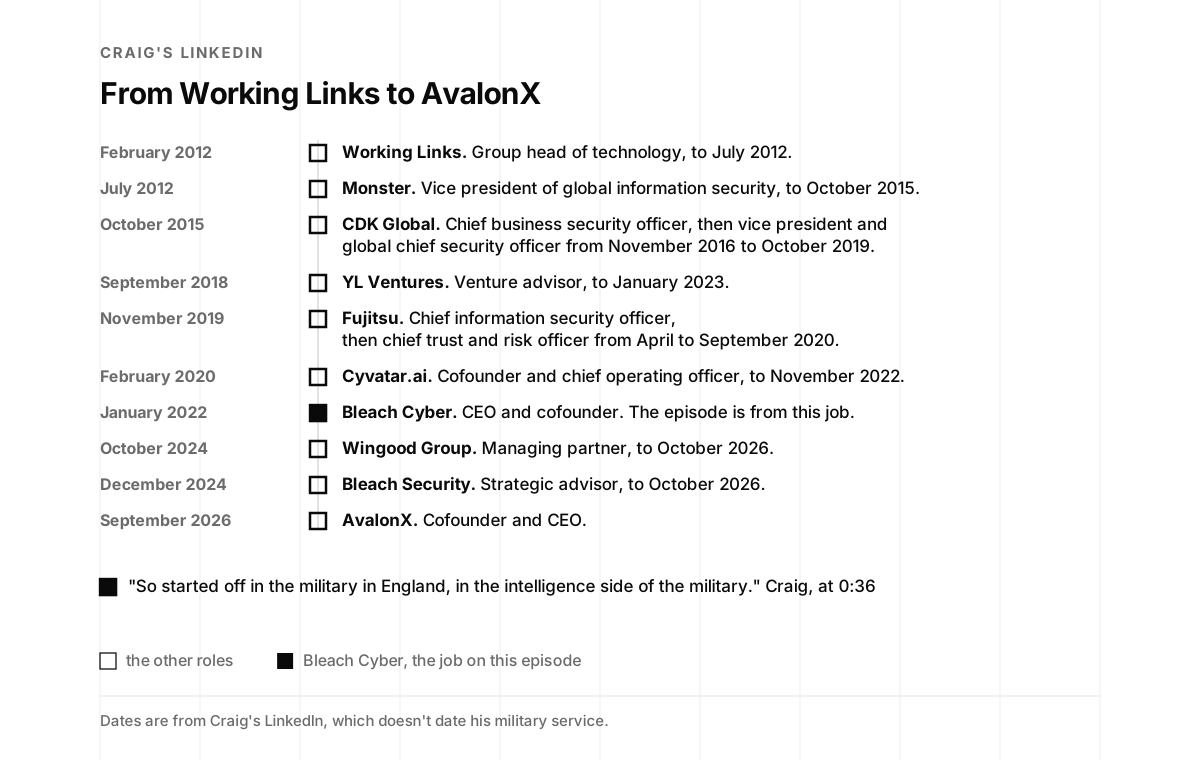
A timeline of Craig's career from his LinkedIn. February 2012: Working Links, group head of technology, to July 2012. July 2012: Monster, vice president of global information security, to October 2015. October 2015: CDK Global, chief business security officer, then vice president and global chief security officer from November 2016 to October 2019. September 2018: YL Ventures, venture advisor, to January 2023. November 2019: Fujitsu, chief information security officer, then chief trust and risk officer from April to September 2020. February 2020: Cyvatar.ai, cofounder and chief operating officer, to November 2022. January 2022, filled: Bleach Cyber, CEO and cofounder, the job this episode is from. October 2024: Wingood Group, managing partner, to October 2026. December 2024: Bleach Security, strategic advisor, to October 2026. September 2026: AvalonX, cofounder and CEO. Craig's line at 0:36: So started off in the military in England, in the intelligence side of the military.
Craig's career from his LinkedIn, from Working Links in 2012 to AvalonX in 2026.

Equal parts terrified, equal parts really excited

Craig left the military when the chief security officer job “was just becoming a thing,” in his words. He guessed at how long he spent in the job and said he always gets the number wrong.

“jumping between gradually larger chief security officer roles.”

Craig Goodwin, at 1:19

“So started with Monster Worldwide in Boston, went to CDK Global, which is a 12 billion automotive tech firm in Chicago, and then ended my corporate career at Fujitsu.”

Craig Goodwin, at 1:23

Listen · Craig Goodwin on episode 45, from 1:14
About 25 seconds: Craig on his chief security officer roles at Monster Worldwide, CDK Global and Fujitsu, and his first startup. The clip stops on its own. Read the full transcript.

His LinkedIn puts those three companies between July 2012 and September 2020. On the tape he says he always wanted to do startups, and that he founded his first one in 2019.

“That’s crazy and insane and fabulous and spectacular all at the same time.”

Jon McLachlan, at 1:41

Craig called it a mad life, and gave the mix of feelings that comes with it.

“I describe it now as like equal parts terrified, equal parts really excited.”

Craig Goodwin, at 1:47

“And that never really changes.”

Craig Goodwin, at 1:52

“So you’re comfortable being uncomfortable.”

Jon McLachlan, at 1:55

“I think you have to be.”

Craig Goodwin, at 1:57

On June 19, 2024, less than a month after this episode aired, a ransomware attack took most of CDK Global’s services offline, and by July 4 nearly all dealers had their access back (Wikipedia). Craig had left CDK in October 2019. Monster merged with CareerBuilder in September 2024, and CareerBuilder + Monster filed for Chapter 11 bankruptcy protection on June 24, 2025 (Wikipedia).

Always felt sorry for the supply chain

After a couple of years at his first startup, Craig founded Bleach. He said he had long wanted to help the smaller end of the market, because even the big companies he worked for found protection hard.

“We, as CISOs, we, even with our tens of millions of dollars, it’s really hard to protect our businesses.”

Craig Goodwin, at 2:12

“always felt sorry for those smaller businesses and just couldn’t get my head around how they were going to protect themselves.”

Craig Goodwin, at 2:21

He named the supply chain first. A supply chain attack is a cyberattack that targets the less secure elements of an organization’s supply chain (Wikipedia).

“So, always had that passion in the back of my mind.”

Craig Goodwin, at 2:26

The search he described had three requirements.

“started out on that journey to find a simple, easy, cost-effective way”

Craig Goodwin, at 2:31

Listen · Craig Goodwin on episode 45, from 2:04
About 35 seconds: Craig on why he built for small businesses: big companies with large budgets still find protection hard. The clip stops on its own. Read the full transcript.

Small and medium-sized enterprises are businesses below set limits on staff and revenue (Wikipedia). Bleach’s site says “any startup or small business” (Bleach Cyber).
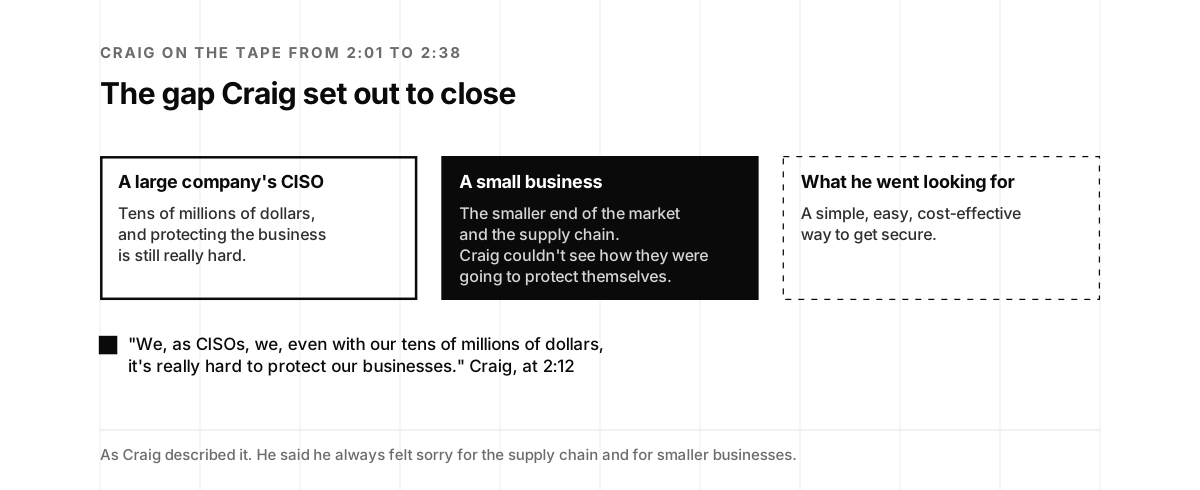
Three boxes. A large company's CISO: tens of millions of dollars, and protecting the business is still really hard. Filled, a small business: the smaller end of the market and the supply chain, and Craig couldn't see how they were going to protect themselves. Dashed, what he went looking for: a simple, easy, cost-effective way to get secure. Craig's line at 2:12: We, as CISOs, we, even with our tens of millions of dollars, it's really hard to protect our businesses.
The gap Craig describes: the security budget of a large company and that of a small one.

Everything is about people

Jon asked what pulled Craig into security. Craig said the thing that interests him most sounds like a cliche to him.

“The thing that interests me most about security is definitely, I don’t even like it because it sounds a bit of a cliche nowadays, but like the human part of security.”

Craig Goodwin, at 2:58

He tied it to his background in human intelligence.

“So I always just think everything’s driven by people.”

Craig Goodwin, at 3:09

“Everything is about people.”

Craig Goodwin, at 3:16

He said it applies to deep technical subjects too: the work still comes down to the people around you who are good at those things.

“So, I always take everything from a people-centric approach, no matter how technical the subject is.”

Craig Goodwin, at 3:41

Listen · Craig Goodwin on episode 45, from 3:09
About 35 seconds: Craig on the human part of security and a people-centric approach. The clip stops on its own. Read the full transcript.

“I love it, people are what matter at the end of the day.”

Jon McLachlan, at 3:45

Two other guests took up the human side. Leigh Honeywell of Tall Poppy talked about the human side of security on episode 5, and Trevor Hilligoss, a former FBI agent at SpyCloud, called the human behind the keyboard the biggest threat on episode 86.

Bleach is that for security

Jon asked what Craig does as cofounder and CEO. Craig said he and his cofounder, Steve, split the work down the middle.

“Yeah, so me and Steve, we split well down the middle.”

Craig Goodwin, at 3:56

“We grew up together, so we’ve known each other forever.”

Craig Goodwin, at 4:01

“And Steve leads product and development, which is all the techie bits that perhaps aren’t really my forte.”

Craig Goodwin, at 4:27

Craig leads the business side.

“And I go and just sell it.”

Craig Goodwin, at 4:46

Then he gave the mission, and the analogy he uses for it.

“we made it our absolute mission just 12 months ago to really make cybersecurity simple.”

Craig Goodwin, at 4:58

“Who goes and hires a product manager, project manager, to run Asana?”

Craig Goodwin, at 5:22

“Bleach is that for security.”

Craig Goodwin, at 5:32

Listen · Craig Goodwin on episode 45, from 5:16
About 25 seconds: Craig on the Asana analogy: a tool simple enough that a small business can run security without a full-time CISO. The clip stops on its own. Read the full transcript.

Asana is an American software company in San Francisco. Its service is a web and mobile work management platform for teams to organize, track and manage their work. Dustin Moskovitz and Justin Rosenstein founded it in 2008, the product launched in April 2012, and the company listed on the New York Stock Exchange in September 2020 (Wikipedia). Asana’s head of security, Sean Cassidy, was the guest on episode 17 in June 2022.

Craig limited the claim to small companies.

“I’m not talking about enterprises here”

Craig Goodwin, at 5:43
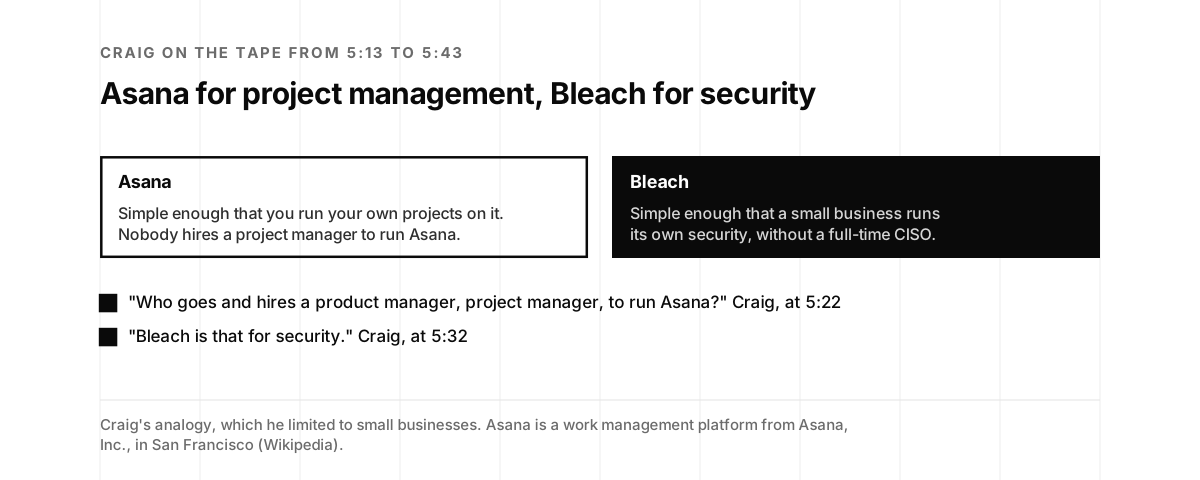
Two boxes side by side. Asana: simple enough that you run your own projects on it, and nobody hires a project manager to run Asana. Filled, Bleach: simple enough that a small business runs its own security, without a full-time CISO. Craig's lines: at 5:22, Who goes and hires a product manager, project manager, to run Asana? At 5:32, Bleach is that for security.
Craig's analogy: Asana for project management, and Bleach for security.

How simple can we make it?

Craig said the team repeats one rule, down to the small things.

“make it simple. How simple can we make it? Make it easier.”

Craig Goodwin, at 5:55

“And that’s our mantra.”

Craig Goodwin, at 5:59

Jon answered as a security operator. His day job, he said, is dashboards, tickets and incoming issues.

“and my day job is looking at dashboards, I’m looking at tickets, I’m looking at issues that come in, and there’s a lot of complexity there.”

Jon McLachlan, at 6:07

“I understand where the complexity is coming from, like all these great vendors who specialize in different things”

Jon McLachlan, at 6:16

He said startups and small businesses have to find a balance. Kabir Mathur of Leen made the case against adding tools on episode 63, and Phil Howie of Sidekick talked about making security doable for small companies on episode 83.
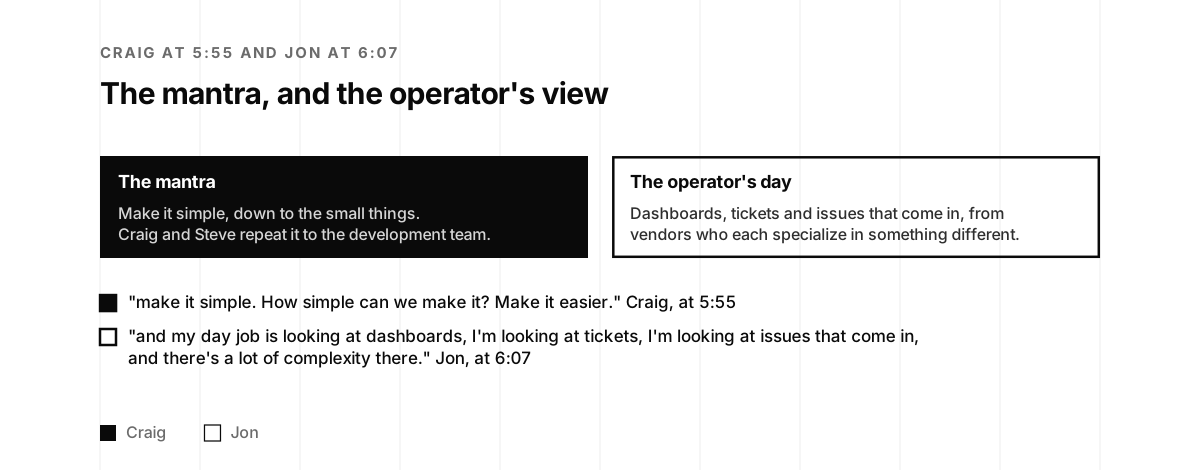
Two boxes. Filled, the mantra: make it simple, down to the small things, which Craig and Steve repeat to the development team. The operator's day: dashboards, tickets and issues that come in, from vendors who each specialize in something different. Craig's line at 5:55: make it simple. How simple can we make it? Make it easier. Jon's line at 6:07: and my day job is looking at dashboards, I'm looking at tickets, I'm looking at issues that come in, and there's a lot of complexity there.
The mantra, and the operator's view of complexity.

You can’t just reset

Craig said every security leader talks about security by design. Secure by design is the engineering concept that security is built into a system from the outset, in its architecture, and not retrofitted later through patches or outside controls (Wikipedia).

“We all talk about like security by design.”

Craig Goodwin, at 6:33

He said he knows from large companies that it is hard to apply to an old one.

“So I know it’s not as easy as resetting.”

Craig Goodwin, at 6:39

“But the reality is, you’ve got 30, 40, 50 years of history built up in a business and you can’t just reset.”

Craig Goodwin, at 6:46

A small company starts with none of that history.

“Whereas with a small business, the beauty of that environment is you can, you’ve got to start from scratch.”

Craig Goodwin, at 6:52

“You can build from the basics.”

Craig Goodwin, at 6:58

“You can do the basics right from the outset.”

Craig Goodwin, at 6:59

Listen · Craig Goodwin on episode 45, from 6:33
About 35 seconds: Craig on why a small business can do the basics right from the outset, and an old one can't just reset. The clip stops on its own. Read the full transcript.

Jon added a second goal next to the first.

“I like things that are secure by design and simple by design, and that’s actually very difficult to achieve.”

Jon McLachlan, at 7:15

Michael Nov of Prime Security made the case for the design stage on episode 76.
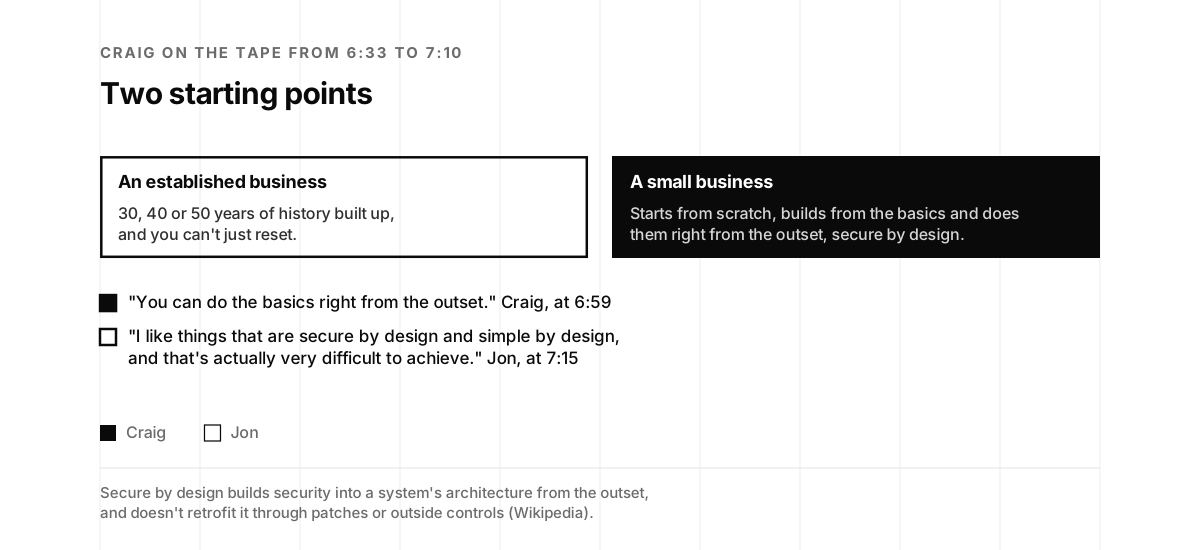
Two boxes. An established business: 30, 40 or 50 years of history built up, and you can't just reset. Filled, a small business: starts from scratch, builds from the basics and does them right from the outset, secure by design. Craig's line at 6:59: You can do the basics right from the outset. Jon's line at 7:15: I like things that are secure by design and simple by design, and that's actually very difficult to achieve.
Two starting points: a business with decades of history, and a small business that starts from scratch.

Someone will correct me on this

Jon asked about Steve. Craig said they met as boys and stayed together through two careers.

“So we went to school together when we were about eight years old and onwards.”

Craig Goodwin, at 7:56

“We served in the military together and we’ve worked in multiple large businesses together, with him as my 2IC.”

Craig Goodwin, at 8:01

A 2IC is a second-in-command, the second-highest authority in an organization. In the British Army and the Royal Marines, it is the deputy commander of a unit (Wikipedia). In the military the two served in different regiments, and Steve drove tanks.

“So we were in completely different regiments.”

Craig Goodwin, at 8:12

“So he was driving tanks around the battlefield while I was pretending to be a civilian and involved in human intelligence side.”

Craig Goodwin, at 8:20

“I had no idea that the army did human intelligence.”

Jon McLachlan, at 8:29

Craig said the British Army is small enough that parts of the whole army do human intelligence. Then he compared its size with one American service, and said someone would correct him on it.

“I’m pretty sure the United States Marine Corps is bigger than the entire three services, the Army, Air Force and Navy, in the UK.”

Craig Goodwin, at 8:56

Listen · Craig Goodwin on episode 45, from 8:34
About 30 seconds: Craig on human intelligence in the British Army, and the size of the Marine Corps next to the three British services. The clip stops on its own. Read the full transcript.

Wikipedia’s figures back him up on active personnel. The Marine Corps had 168,527 active personnel and 32,967 in reserve as of December 2024 (Wikipedia). The British Armed Forces had 137,970 regular personnel plus 4,460 Gurkhas, and 32,030 volunteer reserves, as of April 2026. The British forces are the Royal Navy, which includes the Royal Marines, the British Army and the Royal Air Force (Wikipedia). The two counts are from different dates.

Garrett Smith, a Marine Corps Reserve lieutenant colonel and founder of Reveal Technology, was the guest on episode 90, and Aviv Grafi went from the Israel Defense Forces’ Unit 8200 to found Votiro on episode 35.
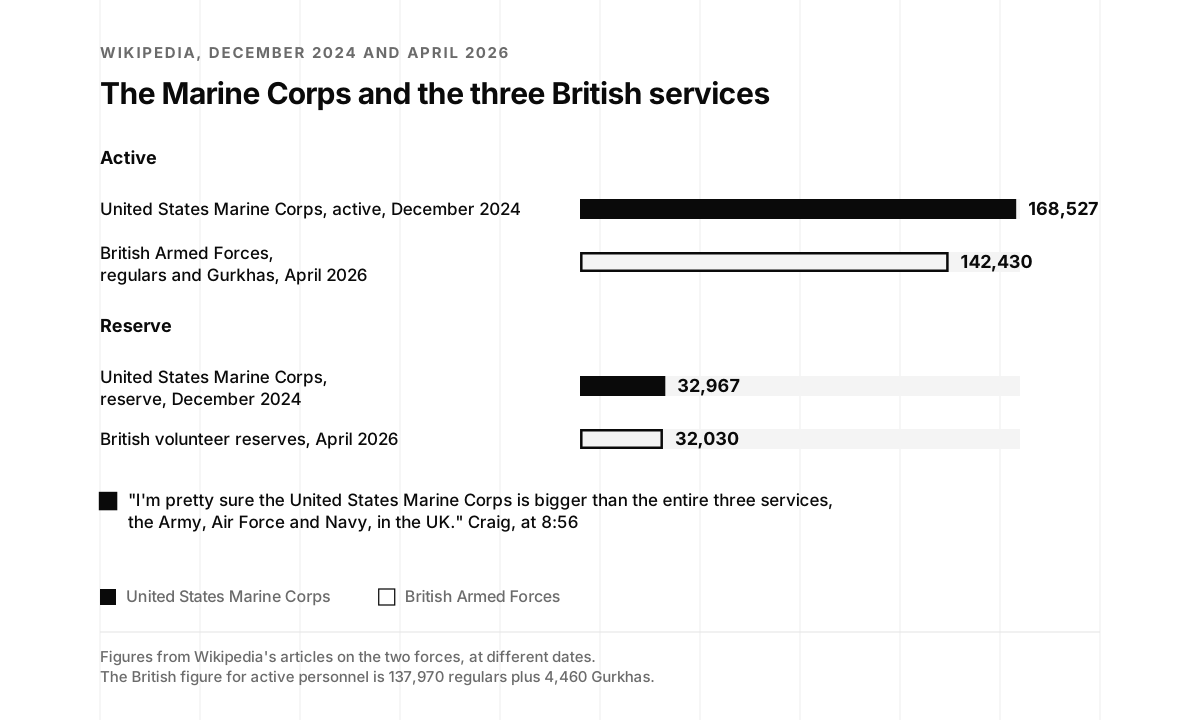
A bar chart in two groups. Active: the United States Marine Corps had 168,527 active personnel in December 2024, and the British Armed Forces had 142,430, which is 137,970 regulars plus 4,460 Gurkhas, in April 2026. Reserve: the Marine Corps had 32,967 in December 2024, and the British volunteer reserves numbered 32,030 in April 2026. Craig's line at 8:56: I'm pretty sure the United States Marine Corps is bigger than the entire three services, the Army, Air Force and Navy, in the UK.
Craig's claim against Wikipedia's figures: active personnel in the Marine Corps and in the British Armed Forces.

Always about taking the basics

Jon asked when the right time is to start on security, and whether there is a framework for deciding. He said security is a priority, and it competes with other things.

“when is the right time to start prioritizing security?”

Jon McLachlan, at 9:09

Craig said the question used to be harder, when security was more complex to do. He put himself on one side of his peers.

“I definitely sit on the realistic side of the CISO group.”

Craig Goodwin, at 9:44

“I would say you don’t have to have sharks with freaking laser beams when you’re early.”

Craig Goodwin, at 9:48

“But it’s always about taking the basics, right?”

Craig Goodwin, at 9:55

Listen · Craig Goodwin on episode 45, from 9:48
About 15 seconds: Craig on what an early company doesn't need yet: start with the basics. The clip stops on its own. Read the full transcript.

Craig’s next point was about the tools a company already pays for. He called it one of the theses Bleach was built on.

“that tech stack you’re already using, the Amazons, the Googles, the Microsofts of the world”

Craig Goodwin, at 10:13

“The one thing that they haven’t done necessarily is made it very easy to use.”

Craig Goodwin, at 10:24

“You can actually leverage what you already got to do security better.”

Craig Goodwin, at 10:35

Listen · Craig Goodwin on episode 45, from 10:07
About 35 seconds: Craig on the thesis behind Bleach: the big cloud and software companies spent heavily on security, and didn't make it easy to use. The clip stops on its own. Read the full transcript.

Amazon Web Services is the Amazon subsidiary that provides on-demand cloud computing, metered and pay-as-you-go (Wikipedia). Microsoft Azure is the cloud computing platform developed by Microsoft, and Google Cloud is Google’s suite of cloud computing services (Wikipedia, Wikipedia).

His answer to Jon’s question was now. He said the industry had made security part of the parlance, so few founders in technology don’t think about it at all.

“I would say now is the time.”

Craig Goodwin, at 10:40
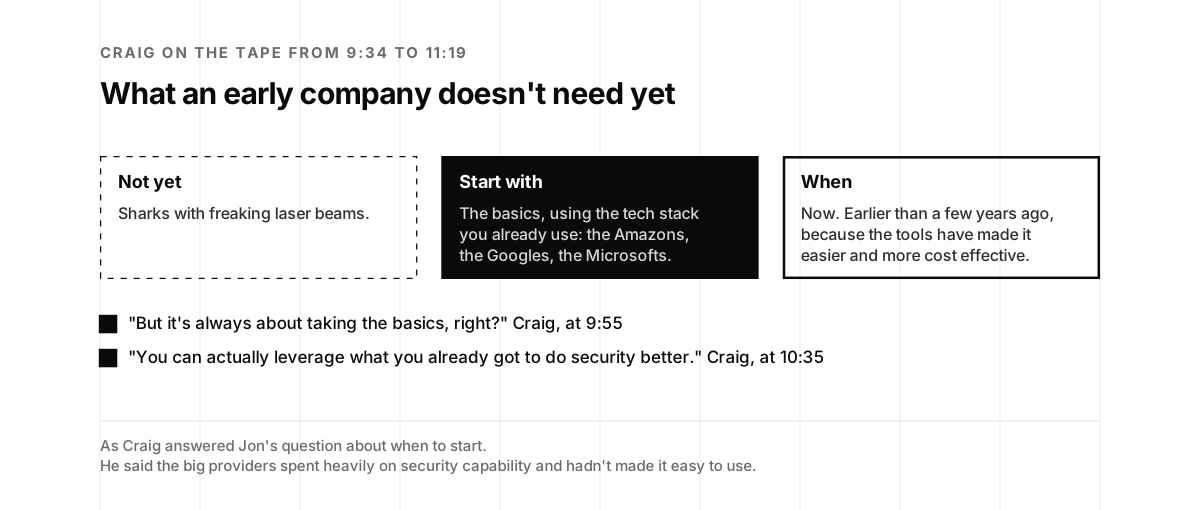
Three boxes. Dashed, not yet: sharks with freaking laser beams. Filled, start with: the basics, using the tech stack you already use, the Amazons, the Googles, the Microsofts. When: now, earlier than a few years ago, because the tools have made it easier and more cost effective. Craig's lines: at 9:55, But it's always about taking the basics, right? At 10:35, You can actually leverage what you already got to do security better.
What an early company doesn't need yet, and what Craig says to start with.

Positivity to come out of a bad economy

Jon asked whether security tools and vendors were being commoditized. Craig said he might get cancelled for his answer.

“maybe this will get me cancelled, but I think there’s a lot of positivity to come out of a bad economy, right?”

Craig Goodwin, at 11:31

“It’s a filter.”

Jon McLachlan, at 11:42

Craig said it had made the past year hard for him and for founders everywhere. He saw an effect on both ends.

“And I think that’s happened on both ends.”

Craig Goodwin, at 11:50

“Like I think on our startup side, it’s made the stronger businesses bubble to the top a lot and will continue to do that over the next year and two years.”

Craig Goodwin, at 12:04

“But then on the enterprise side, it’s definitely pushed people to be more frugal.”

Craig Goodwin, at 12:12

“It’s pushed people to think harder about those investments that they’re making and where they’re putting their dollars.”

Craig Goodwin, at 12:16

Listen · Craig Goodwin on episode 45, from 12:00
About 25 seconds: Craig on what a bad economy did to startups and to enterprise buyers. The clip stops on its own. Read the full transcript.

He said it had also pushed companies toward platforms that do everything, a trend he said would take a long time to play out, and he mentioned “the golden bullet” in the same breath. Jon said it was the first time he had heard that one, and they settled on silver bullet.

The usual phrase is silver bullet. In software, it goes back to Fred Brooks’s 1986 paper No Silver Bullet, which argued that no single development promises even a tenfold improvement in software within a decade (Wikipedia).

Craig said the most positive change was attention to the investment and to the basics. He said businesses further up the chain would benefit from the basics too, whether they admit it or not.

“I think there’s been a big reset, and I think that’s a relatively positive thing in general.”

Craig Goodwin, at 13:20
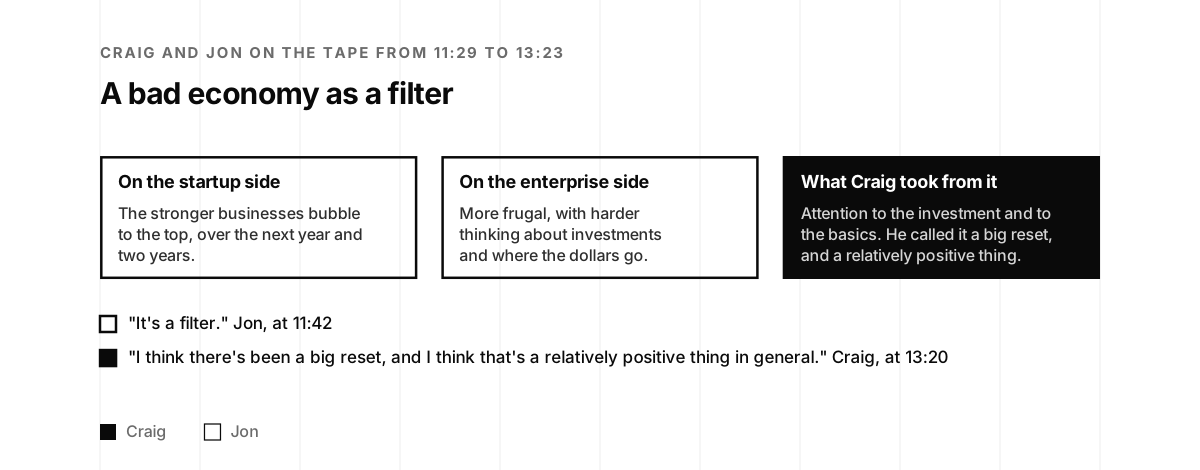
Three boxes. On the startup side: the stronger businesses bubble to the top, over the next year and two years. On the enterprise side: more frugal, with harder thinking about investments and where the dollars go. Filled, what Craig took from it: attention to the investment and to the basics, which he called a big reset and a relatively positive thing. Jon's line at 11:42: It's a filter. Craig's line at 13:20: I think there's been a big reset, and I think that's a relatively positive thing in general.
A bad economy as a filter, on the startup side and on the enterprise side.

If your only differentiator is that you’re AI

In the same answer, Craig named the conversation he expected to draw email: a CISO who calls generative AI the biggest risk while the patching is behind.

“the next CISO that says to me generative AI is my biggest risk in the organization when they’re not doing patching very well is, wait.”

Craig Goodwin, at 12:46

He said he would want to talk about priorities first.

A patch is data that modifies an existing piece of software, often to fix bugs and security vulnerabilities (Wikipedia).

He then gave his theory on startups and AI. He said every business should use AI, and Bleach used it for several things.

“I think every business should be using AI in some capacity.”

Craig Goodwin, at 13:50

“But if your only differentiator is that you’re AI, then I think over the next 12 to 24 months, you’re going to have to shift that, quite frankly, because I think everyone’s using it.”

Craig Goodwin, at 14:00

Listen · Craig Goodwin on episode 45, from 13:41
About 30 seconds: Craig on AI as a differentiator for a startup. The clip stops on its own. Read the full transcript.

“Yeah, I can see that.”

Jon McLachlan, at 14:15

The window he gave runs from about April 2025 to April 2026, counted from the recording.
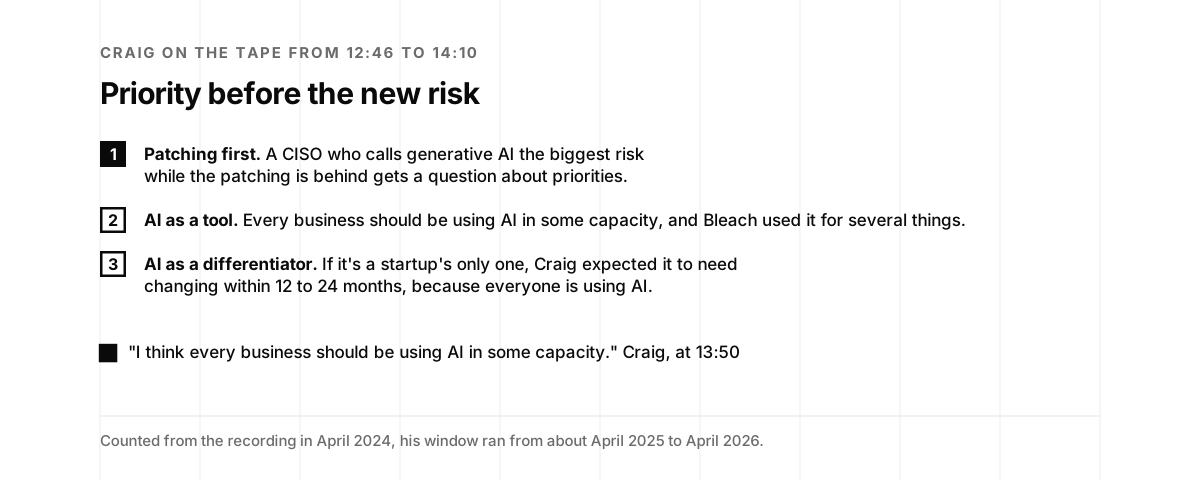
Three numbered points. One, filled: patching first, as a CISO who calls generative AI the biggest risk while the patching is behind gets a question about priorities. Two: AI as a tool, since every business should be using AI in some capacity, and Bleach used it for several things. Three: AI as a differentiator, which Craig expected a startup to need to change within 12 to 24 months if it's the only one, because everyone is using AI. Craig's line at 13:50: I think every business should be using AI in some capacity.
Priority before the new risk: patching first, and AI as a tool more than a differentiator.

That blue check mark

Jon asked Craig to time travel and describe success. Craig said he had said the same thing from the start.

“where we’d like to get to is that Bleach becomes the de facto cybersecurity solution for small businesses and startups.”

Craig Goodwin, at 14:33

He compared it to two things a founder signs up for early: a cloud provider and insurance.

“Bleach is just the vernacular or the verb for security, for securing a small business.”

Craig Goodwin, at 14:57

“They think, I’ve just bleached my business.”

Craig Goodwin, at 15:06

Jon asked how far into the future they had gone. Craig joked six months, then said three to five years. He said Bleach would become a mark that others check.

“It’s that blue check mark for cyber security that everyone looks for when they’re doing M&A, or when they’re investing, or when they’re going to grant insurance, or when they’re going to give a contract from a big enterprise by a CISO.”

Craig Goodwin, at 15:33

“Let me see your Bleach scorecard. Okay, you’re good.”

Craig Goodwin, at 15:48

Listen · Craig Goodwin on episode 45, from 15:30
About 20 seconds: Craig on the check mark buyers, investors and insurers would look for. The clip stops on its own. Read the full transcript.

Mergers and acquisitions, or M&A, are transactions in which the ownership of a company or one of its units passes to, or is combined with, another entity (Wikipedia). Cyber insurance is a specialty insurance product against risks related to information technology (Wikipedia).
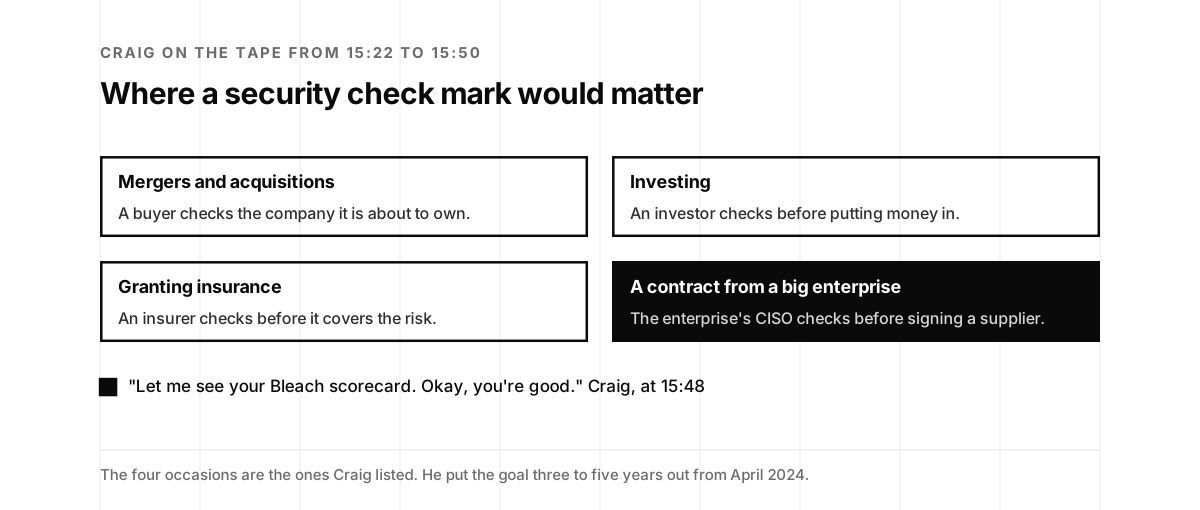
Four boxes in two rows, the places Craig said people look for a security check mark. Mergers and acquisitions: a buyer checks the company it is about to own. Investing: an investor checks before putting money in. Granting insurance: an insurer checks before it covers the risk. Filled, a contract from a big enterprise: the enterprise's CISO checks before signing a supplier. Craig's line at 15:48: Let me see your Bleach scorecard. Okay, you're good.
The four places Craig said a security check mark would matter.

A bit of flimsy script

Jon asked about the go-to-market strategy. Craig said Bleach reached small businesses two ways.

“Number one is direct B2B small businesses.”

Craig Goodwin, at 16:08

“So we’ve got 500 plus small businesses right now that are utilizing Bleach to monitor, control, assess, remediate security risks within their environment.”

Craig Goodwin, at 16:11

“Number two is through managed security service providers and security services businesses.”

Craig Goodwin, at 16:24

A managed security service provider, or MSSP, provides outsourced network security services (Wikipedia). Craig said the second route puts tools in the hands of virtual CISOs and security consultants. He described one consultancy he was talking to that week.

“Their consultants are using like a bit of flimsy script that they’ve used and an Excel spreadsheet that they walk into a customer”

Craig Goodwin, at 16:52

Listen · Craig Goodwin on episode 45, from 16:48
About 20 seconds: Craig on the consultant's script, the AWS environment and the messy Excel spreadsheet. The clip stops on its own. Read the full transcript.

The results end up in the spreadsheet, and the consultant spends hours on it. Craig described the alternative.

“Imagine a world where you’ve got a beautiful UI where you can go and hook up their cloud within minutes, get assessment results within seconds and deliver those results, help them to risk manage, help them to remediate.”

Craig Goodwin, at 17:07

Jon described what YSecurity does.

“Here at YSecurity, we offer an on-demand security team and we specialize in ambitious B2B companies that are trying to raise their operational and security maturity level.”

Jon McLachlan, at 17:32

“Oftentimes it’s business driven, for SOC 2, ISO, FedRAMP, or even just, oh, we’d like to prepare ourselves to go public.”

Jon McLachlan, at 17:43

“We’ve got all the standards built into Bleach.”

Craig Goodwin, at 17:52

SOC 2 is one of the AICPA’s system and organization controls reports (Wikipedia). ISO/IEC 27001 sets the requirements for an information security management system (Wikipedia). FedRAMP is the United States government-wide compliance program for cloud products and services (Wikipedia). Jon and Sasha Sinkevich walked through these standards on episode 37, and the calculator below puts a number on the consultant’s hours.
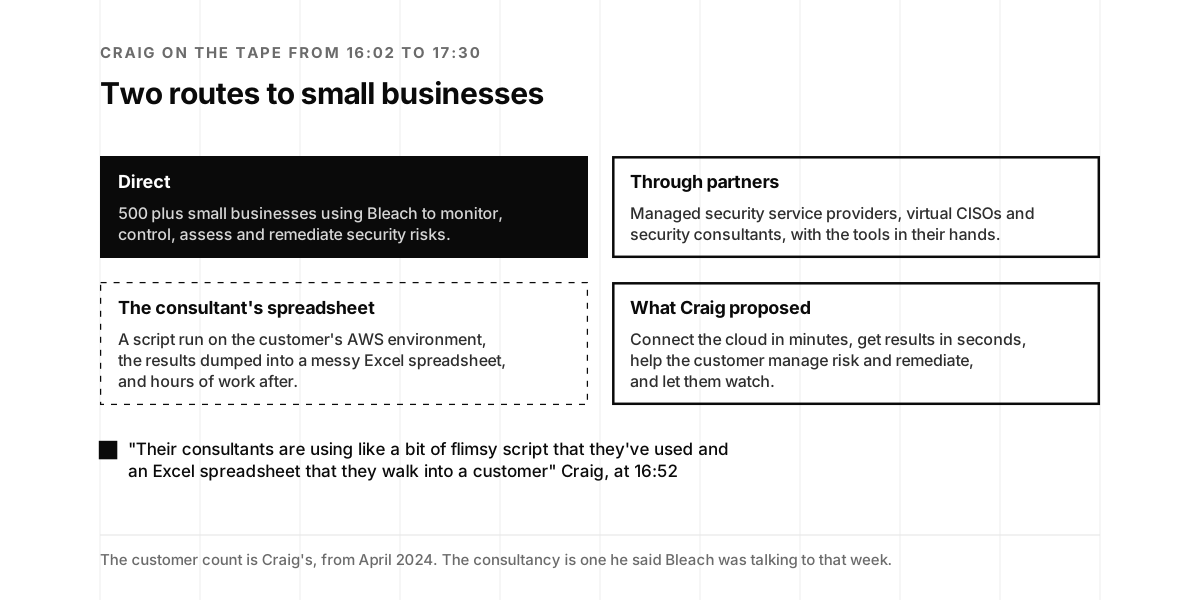
Four boxes in two rows. Filled, direct: 500 plus small businesses using Bleach to monitor, control, assess and remediate security risks. Through partners: managed security service providers, virtual CISOs and security consultants, with the tools in their hands. Dashed, the consultant's spreadsheet: a script run on the customer's AWS environment, the results dumped into a messy Excel spreadsheet, and hours of work after. What Craig proposed: connect the cloud in minutes, get results in seconds, help the customer manage risk and remediate, and let them watch. Craig's line at 16:52: Their consultants are using like a bit of flimsy script that they've used and an Excel spreadsheet that they walk into a customer.
Two routes to small businesses, and the consultant's spreadsheet next to an assessment in a browser.

Look what we can do

Jon asked for Craig’s best day at Bleach. Craig picked two early moments. The first was with Steve, whiteboarding on their own.

“I think it was super early, actually.”

Craig Goodwin, at 18:13

“just whiteboarding and just drawing things and going, look what we can do.”

Craig Goodwin, at 18:32

He said the excitement was still there two years in, and he hoped it would be there at five and ten. The second moment came in a Starbucks, right after he left his last startup, when he needed a name.

“But the trend at the moment is names that have got nothing to do with what they’re doing.”

Craig Goodwin, at 19:07

He told his wife what he wanted to build.

“It’s about keeping the business clean.”

Craig Goodwin, at 19:26

“It’s about sweeping things up and just making sure that your hygiene, your daily routine, is really good.”

Craig Goodwin, at 19:28

Listen · Craig Goodwin on episode 45, from 19:07
About 35 seconds: Craig on how Bleach got its name, in a Starbucks. The clip stops on its own. Read the full transcript.

She came up with the name. He registered the Bleach Corporation in the US and bought the domain, Bleach Cyber.

“this is going to be epic.”

Craig Goodwin, at 19:46

Jon asked whether he took a picture. He didn’t. Jon suggested generative AI could recreate the moment.
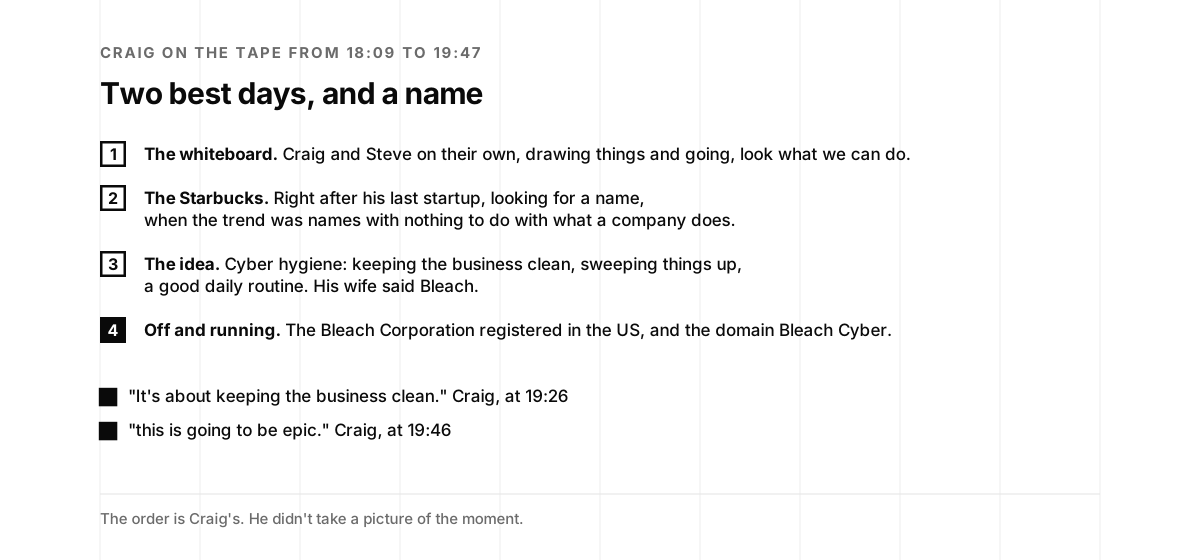
Four numbered steps. One: the whiteboard, Craig and Steve on their own, drawing things and going, look what we can do. Two: the Starbucks, right after his last startup, looking for a name, when the trend was names with nothing to do with what a company does. Three: the idea, cyber hygiene, keeping the business clean, sweeping things up, a good daily routine, and his wife said Bleach. Four, filled: off and running, with the Bleach Corporation registered in the US and the domain Bleach Cyber. Craig's lines: at 19:26, It's about keeping the business clean. At 19:46, this is going to be epic.
Craig's two best days: the whiteboard with Steve, and the name.

Sticking to your guns

Jon asked for the most challenging day. Craig said there had been a lot of them.

“It goes massively up and down.”

Craig Goodwin, at 20:25

“Resilience is absolutely key.”

Craig Goodwin, at 20:30

He put the hardest days early, around funding. He said you don’t always need funding, and most founders can’t fund a company themselves. Early on, he said, people didn’t believe what he was saying, and he named investors.

“VCs in general were always very reluctant to back SMB focused plays, right?”

Craig Goodwin, at 21:13

“The security market is so traditionally focused on the enterprise that the majority of investors, as soon as you say, I’m focused on SMBs or small businesses, they’re just immediately like, I’m not sure we can do that.”

Craig Goodwin, at 21:21

Listen · Craig Goodwin on episode 45, from 21:13
About 20 seconds: Craig on pitching a security company for small businesses to investors. The clip stops on its own. Read the full transcript.

Venture capital is private equity financing for startups with high growth potential, in exchange for equity (Wikipedia). Craig said attitudes were changing, and that competitors helped.

“I welcome some of the competitors that popped up.”

Craig Goodwin, at 21:45

“I think it adds validation to the cause.”

Craig Goodwin, at 21:48

“And I think hopefully gone are the days where everyone goes, SMB, no way.”

Craig Goodwin, at 22:01

He named the hardest thing.

“I think that’s the hardest thing, is just sticking to your guns and being resilient enough”

Craig Goodwin, at 22:11

He said a founder also has to take feedback and let the idea change, and called it a tricky balance.

“The balance between humility and confidence.”

Jon McLachlan, at 22:32
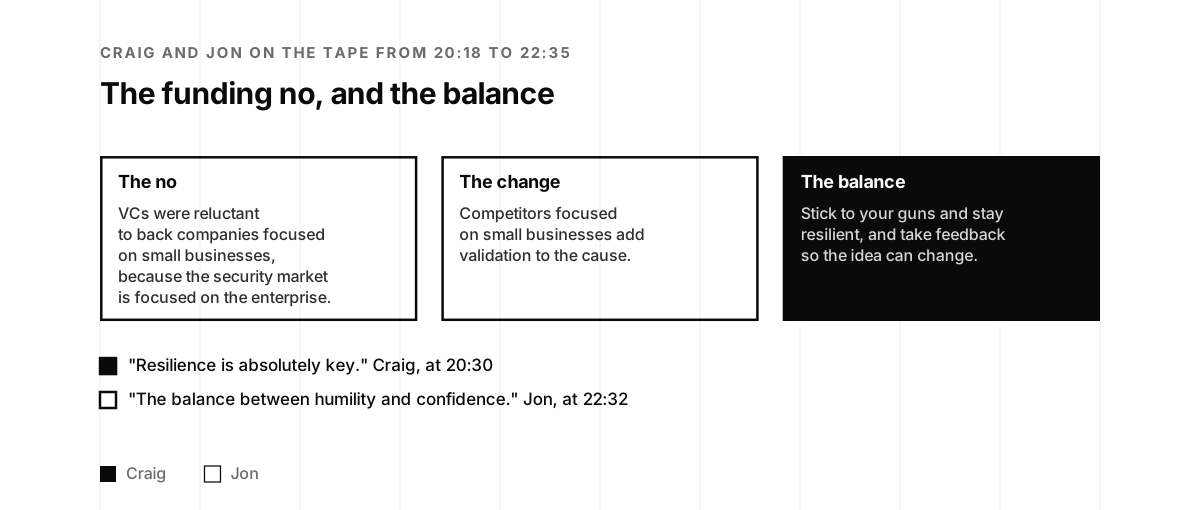
Three boxes. The no: VCs were reluctant to back companies focused on small businesses, because the security market is focused on the enterprise. The change: competitors focused on small businesses add validation to the cause. Filled, the balance: stick to your guns and stay resilient, and take feedback so the idea can change. Craig's line at 20:30: Resilience is absolutely key. Jon's line at 22:32: The balance between humility and confidence.
The funding no, and the balance Craig described between sticking to your guns and taking feedback.

Building the plane while you’re flying it

Jon asked how Bleach was funded at the start: angels, pre-seed, seed, friends and family, or bootstrapping. Craig said he was lucky, because people who knew his work backed him again.

“So I had a couple of really close mentors of mine, investors slash angels, that had seen me through the journey of my last startup.”

Craig Goodwin, at 22:48

“were almost blindly backing me into the next thing, which got us started.”

Craig Goodwin, at 23:11

An angel investor is an individual who provides capital to a business, often early, and a growing number are organized into angel groups or networks (Wikipedia). Craig said 2023 taught them frugality.

“I think 2023, back to the finance thing, has taught us about frugality and testing things and building things frugally.”

Craig Goodwin, at 23:20

“I think gone are the days where it’s like growth at all costs.”

Craig Goodwin, at 23:27

“And it now is about conservative growth and considered growth.”

Craig Goodwin, at 23:32

He said Bleach was the opposite of his last startup on one point. This time they had six months to build the product before selling it.

“And one of the lessons I learned last time was trying to build the plane while you’re flying it is really freaking difficult.”

Craig Goodwin, at 23:50

“So, if you can raise the money and raise the capital to give yourself the room to build at least an MVP that’s solid enough that people can use it, that’s a really important first step.”

Craig Goodwin, at 23:56

Listen · Craig Goodwin on episode 45, from 23:50
About 20 seconds: Craig on his last startup, and why Bleach took six months to build a product before it sold one. The clip stops on its own. Read the full transcript.

A minimum viable product, or MVP, is a version of a product with just enough features to be usable by early customers who can then give feedback (Wikipedia). Craig credited Steve with the foundation, so they didn’t have to sell and build at the same time. His LinkedIn also lists him as a venture advisor at YL Ventures from September 2018 to January 2023.
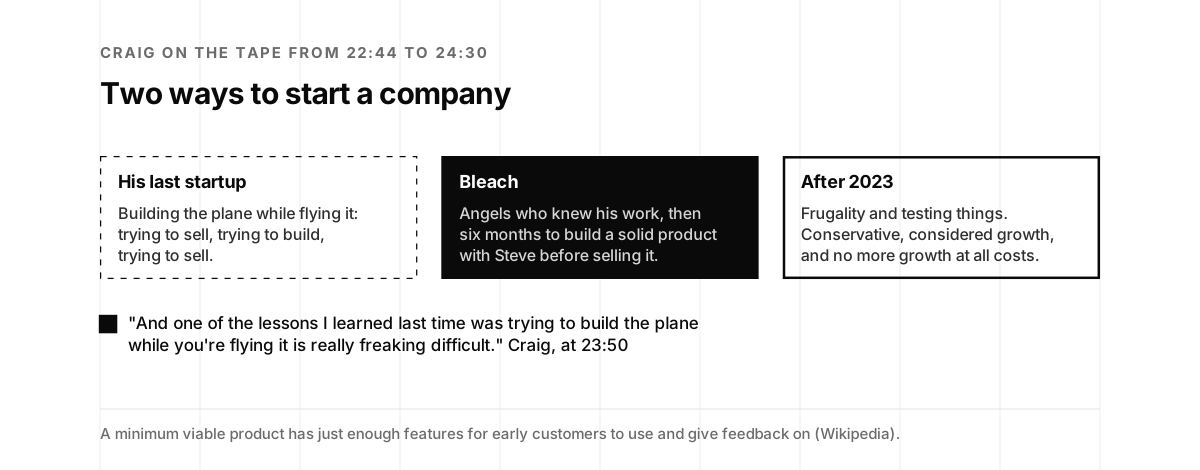
Three boxes. Dashed, his last startup: building the plane while flying it, trying to sell, trying to build, trying to sell. Filled, Bleach: angels who knew his work, then six months to build a solid product with Steve before selling it. After 2023: frugality and testing things, conservative, considered growth, and no more growth at all costs. Craig's line at 23:50: And one of the lessons I learned last time was trying to build the plane while you're flying it is really freaking difficult.
Two ways to start: building while selling, and six months to build first.

Built by 10,000 CISOs

Jon asked how big Bleach was. Craig said most of the development was outsourced.

“But then on top of that, it’s me and Steve and just a few others right now.”

Craig Goodwin, at 24:41

The few others were in customer success, support and internal development. Jon asked about the customer count he had mentioned.

“500 companies on the platform.”

Craig Goodwin, at 25:00

“and the great thing about being early is they’re giving us feedback every single day.”

Craig Goodwin, at 25:08

“And we’re in this amazing position where we’re getting that every single day.”

Craig Goodwin, at 25:24

He said he used to doubt that an early company could get enough feedback to steer by. Now it was shaping the plan.

“Like it’s genuinely influencing the roadmap, which is really exciting.”

Craig Goodwin, at 25:37

“Your suggestion box doesn’t feed into a paper eating machine”

Jon McLachlan, at 25:41

The feedback covered which integrations to build next, what to protect next and what the dashboard should look like. Craig said they were also building an advisory board of chief security officers.

“We’re building a kind of, like, CISO advisory board as well.”

Craig Goodwin, at 26:03

He said the CISOs on it were not customers, and their job was to shape the roadmap for small businesses.

“built by 10,000 CISOs or something to help your small business would be a great tagline.”

Craig Goodwin, at 26:31
Listen · Craig Goodwin on episode 45, from 26:03
About 35 seconds: Craig on an advisory board of chief security officers who shape the roadmap for small businesses. The clip stops on its own. Read the full transcript.
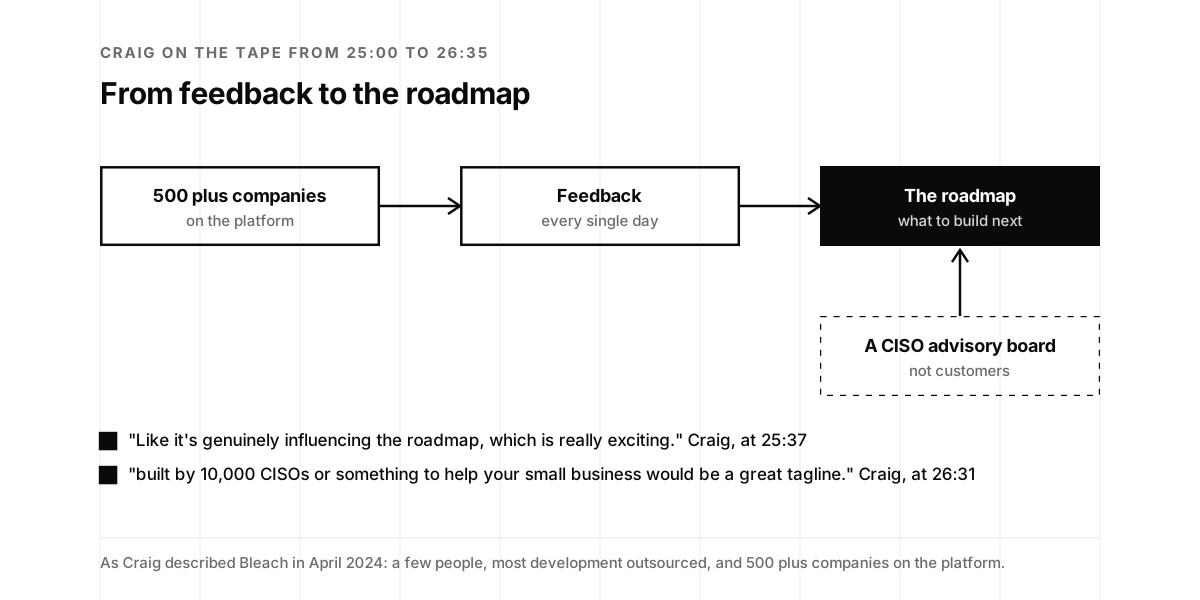
A flow. A box for 500 plus companies on the platform, an arrow to a box for feedback every single day, and an arrow to a filled box for the roadmap, what to build next. Below the roadmap, a dashed box for a CISO advisory board, whose members are not customers, with an arrow up into the roadmap. Craig's lines: at 25:37, Like it's genuinely influencing the roadmap, which is really exciting. At 26:31, built by 10,000 CISOs or something to help your small business would be a great tagline.
From 500 companies and a board of CISOs to the roadmap.

Why are you passionate about it?

Jon asked Craig for his favorite interview question. Craig said it has nothing to do with work.

“I think my favorite interview question would be nothing to do with work.”

Craig Goodwin, at 26:47

“what’s your favorite hobby and why are you passionate about it?”

Craig Goodwin, at 26:58

He said what people do in their spare time, why they found it and what it does for them matters to him. He answers it himself before he asks it.

“So I always would never ask someone to answer something that I wouldn’t answer myself.”

Craig Goodwin, at 27:11

His own answer is road cycling.

“road cycling is my meditation.”

Craig Goodwin, at 27:18

“It’s my thinking time.”

Craig Goodwin, at 27:25

“And I think what comes back from people when they answer that question says a lot about who they are and what’s important to them.”

Craig Goodwin, at 27:34

Listen · Craig Goodwin on episode 45, from 27:15
About 25 seconds: Craig on his favorite interview question, and his own answer. The clip stops on its own. Read the full transcript.

Jon cycles too, and the two compared rides. Jon said time away from screens matters for founders.

“It’s important, I think, to have a little bit of time to disconnect from all of the glowy screens and all of the intensity around building businesses”

Jon McLachlan, at 28:37

Craig said he calls Steve on Slack with ideas as soon as he gets back from a ride, before he has changed.

“That’s a really good question to ask folks.”

Jon McLachlan, at 29:03

Polina Morozov, a security recruiter at Grammarly, talked about careers and culture in cybersecurity on episode 46, the next episode.

The Psychopath Test

Jon asked for something Craig read or saw that changed how he sees the world. Craig picked a book he called a bit off-beat.

“He’s a fantastic author, a guy called Jon Ronson.”

Craig Goodwin, at 29:39

“and he wrote a book called The Psychopath Test.”

Craig Goodwin, at 29:46

The Psychopath Test: A Journey Through the Madness Industry is a 2011 book by Jon Ronson about psychopathy and the mental health industry, including mental health professionals and the mass media (Wikipedia). Ronson is a British-American journalist, author and filmmaker whose other books include Them: Adventures with Extremists and The Men Who Stare at Goats (Wikipedia).

Craig described the test at the center of the book from memory: created by psychologists in the seventies or eighties, with ten constituents. The test in the book is the Hare Psychopathy Checklist, which the Canadian psychologist Robert D. Hare developed in the 1970s. It has 20 items, a list of personality traits and recorded behaviors used to assess psychopathy (Wikipedia).

He said the book spoke to his own theories about people.

“And I come from a human intelligence background.”

Craig Goodwin, at 30:24

“So I’m just fascinated by the way people behave and how it can be influenced and how different people react in different situations.”

Craig Goodwin, at 30:26

“Like, how do you get psychologically conditioned to join a group and just follow them blindly?”

Craig Goodwin, at 30:52

He said the interest is in human psychology, and comes from his military background. Jon asked whether he studied it. He went into the military straight out of school, and learned it in practice.
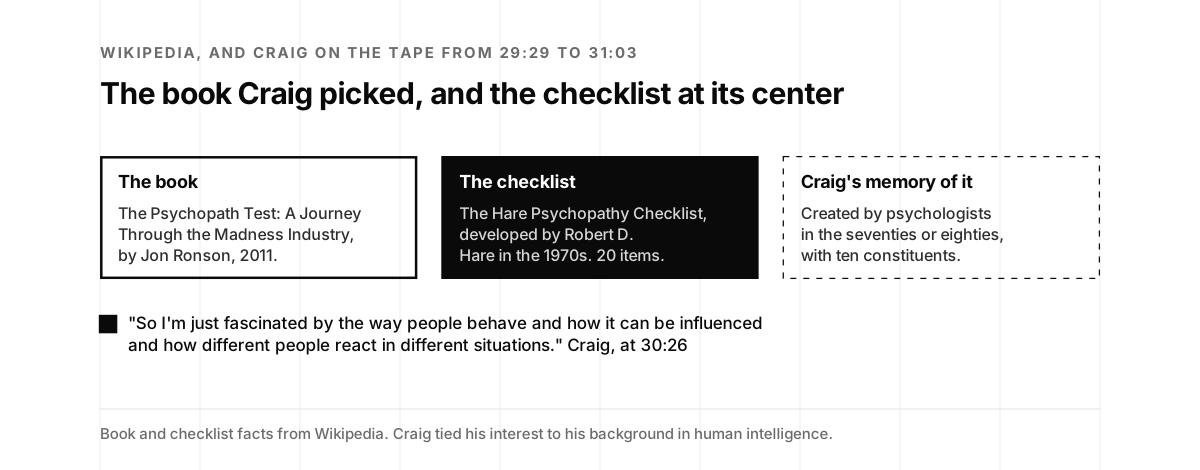
Three boxes. The book: The Psychopath Test: A Journey Through the Madness Industry, by Jon Ronson, 2011. Filled, the checklist: the Hare Psychopathy Checklist, developed by Robert D. Hare in the 1970s, with 20 items. Dashed, Craig's memory of it: created by psychologists in the seventies or eighties, with ten constituents. Craig's line at 30:26: So I'm just fascinated by the way people behave and how it can be influenced and how different people react in different situations.
The book Craig picked, and the checklist at its center.

This too shall pass

Jon asked whether Craig would want to meet his younger self, and what he would say. Craig said he would, out of fascination, and picked a quote.

“I think it’s Tom Hanks or someone that said, this too shall pass.”

Craig Goodwin, at 32:04

The phrase “this too shall pass” is an adage of Persian origin about impermanence. The phrase appears to come from medieval Persian Sufi poets, it is best known in the West from Edward FitzGerald’s 19th-century retelling of a Persian fable, and Abraham Lincoln told a version of the story in an 1859 address (Wikipedia).

He said it held for the financial problems at startups up to the year before.

“whether it’s good or whether it’s bad, it will pass.”

Craig Goodwin, at 32:19

“It just means that there will be an outcome to this and you will get through it and it will work out the way it’s supposed to work out.”

Craig Goodwin, at 32:31

Listen · Craig Goodwin on episode 45, from 32:04
About 35 seconds: Craig on the advice he would give his younger self. The clip stops on its own. Read the full transcript.

Looking back, he said the better response was to step back.

“When in reality, a better response to that was just step back and just take your time and think about it.”

Craig Goodwin, at 32:49

Jon offered a line he had heard with the same idea.

“the secret to life is that everything is temporary”

Jon McLachlan, at 33:42

Craig answered with a stock chart. Watched minute by minute, it goes up and down.

“But actually, over the course of a longer period of time, if the general trajectory is up, then you’re onto a winner.”

Craig Goodwin, at 34:07

“And that’s how I look at life.”

Craig Goodwin, at 34:13

“But ultimately, keep the eyes on the goal.”

Craig Goodwin, at 34:18
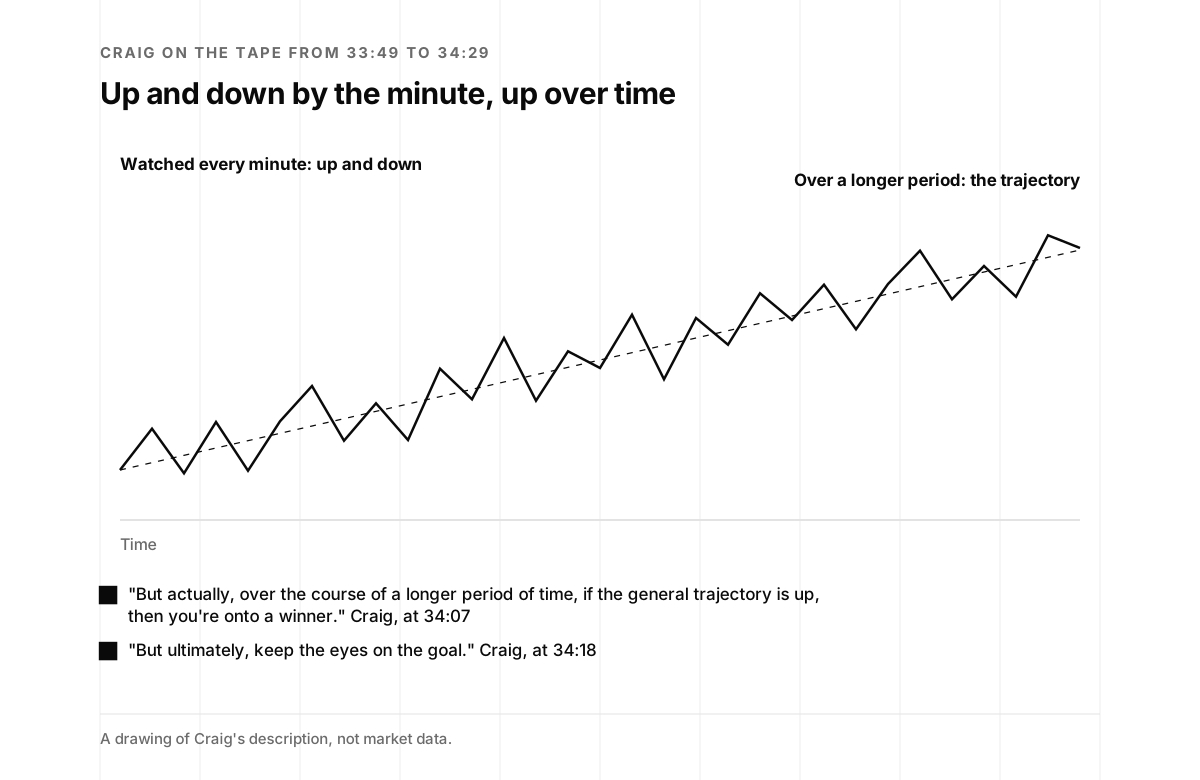
A line drawing of a stock chart that zigzags up and down from left to right while rising overall, with a dashed straight line under it from the low left to the high right. The zigzag is labeled watched every minute: up and down. The dashed line is labeled over a longer period: the trajectory. Craig's lines: at 34:07, But actually, over the course of a longer period of time, if the general trajectory is up, then you're onto a winner. At 34:18, But ultimately, keep the eyes on the goal.
The stock chart: up and down by the minute, up over time.

Simplicity in the chaos

Jon asked what problem Craig would pay someone to solve. Craig named a telecommunications platform that brings Zoom, Google Workspace and Microsoft Teams together.

“like something that centralizes all those things, so everyone could just join the same thing no matter what technology they’re using.”

Craig Goodwin, at 35:16

“one to rule them all but brings them all together, I would love that.”

Craig Goodwin, at 35:38

“There’s the next billion-dollar idea.”

Jon McLachlan, at 35:41

His second was the same for cyclists: one place for all the fitness data, from a Garmin on the bike to a Whoop and the rest.

“Like one source to rule them all would be really cool in that space as well.”

Craig Goodwin, at 36:06

Jon asked for final words. Craig said it was one of the most open conversations he had had in cyber, and went back to the mantra.

“I would say keep it simple is always my mantra.”

Craig Goodwin, at 36:44

“Like this stuff doesn’t have to be as complicated as you make it.”

Craig Goodwin, at 36:47

“So there’s always simplicity in the chaos.”

Craig Goodwin, at 36:53

Listen · Craig Goodwin on episode 45, from 36:44
About 20 seconds: Craig's last words on the episode: keep it simple. The clip stops on its own. Read the full transcript.

“The beauty is simplicity.”

Jon McLachlan, at 37:08
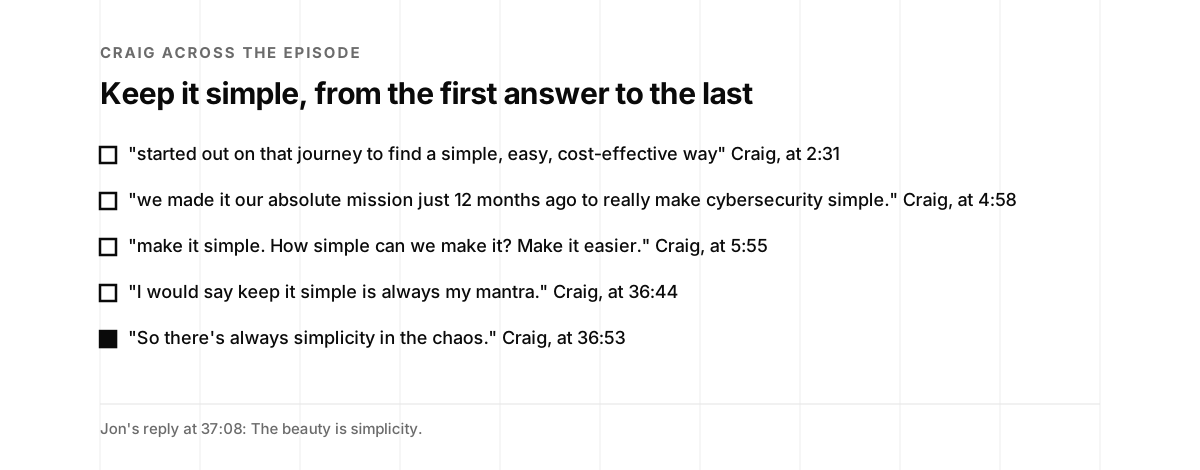
Five of Craig's lines about simplicity, in the order of the episode. At 2:31: started out on that journey to find a simple, easy, cost-effective way. At 4:58: we made it our absolute mission just 12 months ago to really make cybersecurity simple. At 5:55: make it simple. How simple can we make it? Make it easier. At 36:44: I would say keep it simple is always my mantra. Filled, at 36:53: So there's always simplicity in the chaos.
Craig's mantra across the episode, from the first answer to the last.

After the tape

Craig’s LinkedIn lists three roles after the tape (LinkedIn). From October 2024 to October 2026 he was managing partner of Wingood Group, a strategic advisory firm with offices in the United Kingdom and the United States. From December 2024 to October 2026 he was a strategic advisor to Bleach Security, whose listing reads “Instantly clean up your digital world with powerful, automated protection.” Since September 2026 he has been cofounder and CEO of AvalonX, which “continuously tests your external attack surface” and reports what to fix.

On October 30, 2026, he posted about the AvalonX launch in the United States (LinkedIn). He wrote that his CISO jobs at Fujitsu, Monster and CDK Global taught him one lesson: “you don’t really know your defenses until someone tries to break them.” He wrote that those companies had red teams, penetration testers and the budget to test all the time, and the owner of a 50-person firm faces the same attackers without that protection. The post promises small businesses “Plain-English fixes, no security team needed,” and a price built for them.

This week we launched AvalonX in the U.S.

Craig Goodwin · October 2026
Craig on why he started AvalonX: the testing large companies buy, and small businesses facing the same attackers without it. View on LinkedIn.

In April 2024 he said even companies with tens of millions of dollars find protection hard, and he wanted to help the smaller end of the market. In October 2026 he wrote about the gap between a CISO with a red team and a 50-person firm. Bleach Cyber’s site still reads “Cybersecurity, Simply!” (Bleach Cyber).

Chris Kirschke spent 27 years in security operations before a venture studio asked him to run a company, which he talks about on episode 102, “CISO does not spell CEO,” from August 2026.
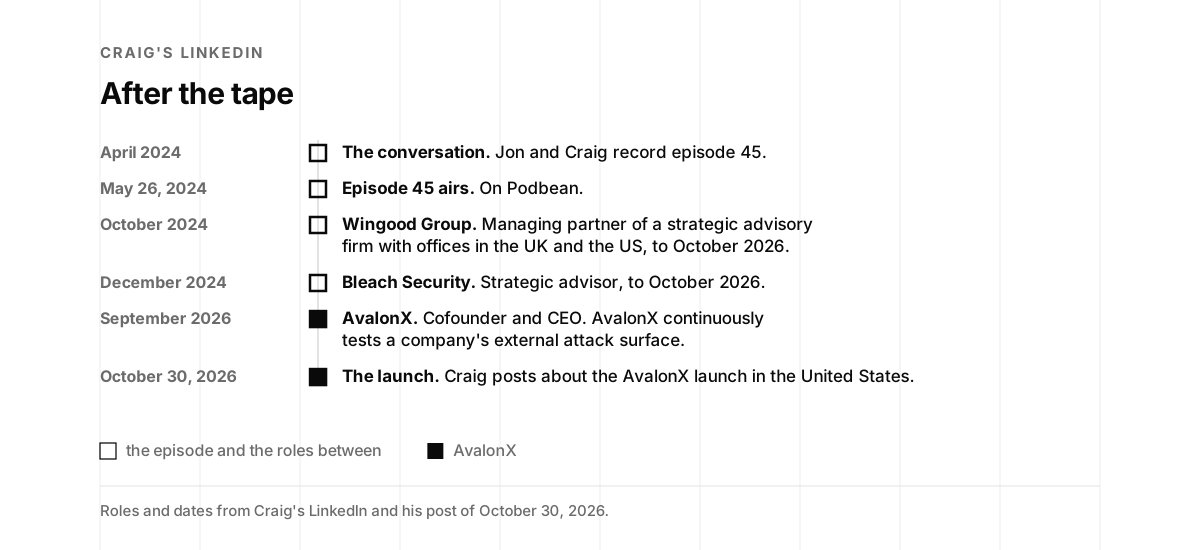
A timeline after the tape. April 2024: Jon and Craig record episode 45. May 26, 2024: episode 45 airs on Podbean. October 2024: Wingood Group, managing partner of a strategic advisory firm with offices in the UK and the US, to October 2026. December 2024: Bleach Security, strategic advisor, to October 2026. September 2026, filled: AvalonX, cofounder and CEO, a company that continuously tests a company's external attack surface. October 30, 2026, filled: Craig posts about the AvalonX launch in the United States.
After the tape: Wingood Group, Bleach Security and AvalonX.

Did you catch it? A seven-question quiz

Seven questions from the episode. Each answer links the moment in the transcript.

Quiz · seven questions

Did you catch it?

Pick an answer to see whether you caught it, and where it is on the tape.

  1. What two roles does Craig say intelligence work in the military had?

    1. Signals work and imagery work
    2. Running around deserts with guns, and cyber security
    3. Planning and logistics

    b. "And when you're doing that, there's two roles: one's running around deserts with guns, and the other one's doing cyber security." Transcript, 0:41.

  2. Which product does Craig compare Bleach to?

    1. Asana, for project management
    2. Slack, for chat
    3. Salesforce, for sales

    a. "the analogy that I love is like Asana for project management, right?" Transcript, 5:16.

  3. What does Craig say an early company doesn't have to have?

    1. A password manager
    2. Backups
    3. Sharks with freaking laser beams

    c. "I would say you don't have to have sharks with freaking laser beams when you're early." Transcript, 9:48.

  4. What does Jon call a bad economy?

    1. A filter
    2. A storm
    3. A cycle

    a. "It's a filter." Transcript, 11:42.

  5. What does Craig want people to think about their security?

    1. That they have a CISO now
    2. That they've just bleached their business
    3. That they passed the audit

    b. "They think, I've just bleached my business." Transcript, 15:06.

  6. What lesson did Craig take from his last startup?

    1. Raise money only after revenue
    2. Outsource nothing
    3. Building the plane while you fly it is hard

    c. "And one of the lessons I learned last time was trying to build the plane while you're flying it is really freaking difficult." Transcript, 23:50.

  7. Which saying does Craig pick for his younger self?

    1. This too shall pass
    2. Move fast and break things
    3. Fortune favors the bold

    a. "I think it's Tom Hanks or someone that said, this too shall pass." Transcript, 32:04.

Are the basics in place?

Craig’s advice to a small company is to start with the basics, and he said a small business can do them right from the outset. Eight questions on whether yours are in place.

Scorecard · eight questions

Are the basics in place?

Answer for the company as it works today. If two answers fit, pick the lower one.

  1. Do you have a list of every cloud account, laptop and SaaS tool the company uses?

    • No
    • Partly
    • Yes, and we keep it current

    "You can build from the basics." See You can't just reset.

  2. Do security updates go out on a schedule, and can you see which systems are behind?

    • No schedule
    • For some systems
    • Yes, and we can show it

    "when they're not doing patching very well." See If your only differentiator is that you're AI.

  3. Have you turned on the security settings that come with your cloud, email and office accounts?

    • No
    • Some of them
    • Yes, and someone checks them

    "You can actually leverage what you already got to do security better." See Always about taking the basics.

  4. Does someone check your systems for security problems every week, and fix what they find?

    • No
    • When something breaks
    • Yes, every week

    "to monitor, control, assess, remediate security risks within their environment." See A bit of flimsy script.

  5. Is security a named person's job, even part time?

    • No one owns it
    • Shared, unofficially
    • Yes, one named owner

    "Everything is about people." See Everything is about people.

  6. Do you know which standard your biggest customers will ask for, such as SOC 2, ISO 27001 or FedRAMP?

    • No
    • We know the name
    • Yes, and we map our controls to it

    "Oftentimes it's business driven, for SOC 2, ISO, FedRAMP." See A bit of flimsy script.

  7. When a buyer, insurer or investor asks how secure you are, can you show them something current?

    • No
    • Last year's questionnaire answers
    • Yes, a current report we can share

    "It's that blue check mark for cyber security that everyone looks for." See That blue check mark.

  8. Could someone outside security run your security tools without help?

    • No
    • With some help
    • Yes

    "make it simple. How simple can we make it?" See How simple can we make it?

Start from scratch

Most of the basics aren't in place yet. Start with a list of what you have, turn on the security settings your providers include, and name one owner.

Do the basics right

Some basics are in place. Next, patch on a schedule, check for problems every week and fix what you find, and keep evidence a buyer can read.

Secure by design

The basics are in place and someone owns them. Keep the evidence current for buyers, insurers and investors, and check again as the company grows.

What do the spreadsheet hours cost?

Craig described consultants who run a script, dump the results into an Excel spreadsheet and spend hours on it. This calculator puts a number on those hours. Every default is our example, not a benchmark.

Calculator

What do the spreadsheet hours cost?

Four numbers: the hours of spreadsheet work after each assessment, how many assessments a year, the hourly cost of the person doing it, and the share of that work a tool removes.

72hours of spreadsheet work a year
$10,800what those hours cost a year
54hours a tool frees a year
$8,100what the freed hours are worth a year

At 12 assessments a year and 6 hours of spreadsheet work each, that's 72 hours a year, or $10,800 at $150 an hour. If a tool removes 75% of that work, it frees 54 hours, or $8,100 a year.

The 6 hours, 12 assessments, $150 and 75% are our examples, not benchmarks. Put in your own. Craig didn't give numbers for the consultant's hours.

Everything on this page sits on one timeline, from 2011 to 2026. Filter it by thread.

What to do this week

Five things, in the order of the episode.

  1. Write down what you already have. List the cloud accounts, laptops and SaaS tools the company uses, and turn on the security settings your providers include. Take the scorecard with whoever handles IT today.
  2. Put patching ahead of the new risk. Find the systems that are behind on security updates and set a schedule before you buy anything new. Our Penetration Testing team can show you which gaps an attacker would use first.
  3. Name one owner. Make security a named person’s job, even part time. Our post on how startups should staff security compares hiring, a fractional leader and a service, and What Is a vCISO? covers what an on-demand security leader does.
  4. Keep evidence a buyer can read. Find out which standard your biggest customers ask for, and keep a current report you can share. Our plain-English guide to SOC 2 starts with what the report is, and our SOC 2 team runs the work.
  5. Get help with what you can’t staff. If consultants still hand you spreadsheets, run the calculator on their hours. A vCISO can own the program, and you can book 15 minutes with us.

Key takeaways

  1. Start with the basics

    Craig says an early company doesn't need sharks with freaking laser beams. It needs the basics, done right from the outset.

  2. A small company can start from scratch

    An established business carries 30 to 50 years of history and can't just reset. A small business can build from the basics and be secure by design.

  3. Use what you already pay for

    Craig's thesis for Bleach: the tech stack a company already uses, from Amazon, Google and Microsoft, has security capability that isn't easy to use.

  4. Now is the time

    Craig says security is easier and more cost effective to start than a few years ago, and few founders in technology don't think about it at all.

  5. Make it simple

    Bleach's mantra, repeated to the development team down to the small things: make it simple, and make it easier.

  6. Security a small team can run

    Craig's analogy is Asana: nobody hires a project manager to run it. He wanted security a small business could run without a full-time CISO.

  7. Everything is about people

    Craig's background in human intelligence shapes how he leads. Even the deepest technical subject comes down to the people around you.

  8. A bad economy filters

    Craig sees a positive side to a bad economy: the stronger startups rise, and enterprises think harder about where their dollars go.

  9. Patch before the new risk

    Craig pushes back on a CISO who calls generative AI the biggest risk while the patching is behind, and asks about priorities first.

  10. AI alone won't differentiate

    Every business should use AI, Craig says. A startup whose only differentiator is AI will need a new one within 12 to 24 months.

  11. Security as a check mark

    Craig's goal was a mark that buyers, investors, insurers and enterprise CISOs look for before a deal or a contract.

  12. Two routes to small businesses

    Bleach sold direct to 500 plus small businesses, and through MSSPs, virtual CISOs and security consultants.

  13. Replace the spreadsheet

    Consultants who run a script and spend hours on an Excel spreadsheet could connect a cloud in minutes and get results in seconds.

  14. Expect investors to doubt small business plays

    VCs were reluctant to back security companies focused on small businesses. Craig says competitors entering the space validate it.

  15. Build before you sell

    Craig's lesson from his last startup: building the plane while flying it is hard. Bleach took six months to build first.

  16. Let feedback drive the roadmap

    With 500 plus companies giving feedback every day, and a board of CISOs, the roadmap followed the users.

  17. This too shall pass

    Craig's advice to his younger self: step back, because good or bad, it passes. Watch the long-term trajectory, the way you'd watch a stock.

Chapters

Tap a chapter to play from there.

Pull quotes

“So started off in the military in England, in the intelligence side of the military.”

Craig Goodwin ·

“And when you're doing that, there's two roles: one's running around deserts with guns, and the other one's doing cyber security.”

Craig Goodwin ·

“Only Americans say that.”

Craig Goodwin ·

“So started with Monster Worldwide in Boston, went to CDK Global, which is a 12 billion automotive tech firm in Chicago, and then ended my corporate career at Fujitsu.”

Craig Goodwin ·

“I describe it now as like equal parts terrified, equal parts really excited.”

Craig Goodwin ·

“So you're comfortable being uncomfortable.”

Jon McLachlan ·

“We, as CISOs, we, even with our tens of millions of dollars, it's really hard to protect our businesses.”

Craig Goodwin ·

“Everything is about people.”

Craig Goodwin ·

“So, I always take everything from a people-centric approach, no matter how technical the subject is.”

Craig Goodwin ·

“I love it, people are what matter at the end of the day.”

Jon McLachlan ·

“Yeah, so me and Steve, we split well down the middle.”

Craig Goodwin ·

“And Steve leads product and development, which is all the techie bits that perhaps aren't really my forte.”

Craig Goodwin ·

“Who goes and hires a product manager, project manager, to run Asana?”

Craig Goodwin ·

“Bleach is that for security.”

Craig Goodwin ·

“And that's our mantra.”

Craig Goodwin ·

“I understand where the complexity is coming from, like all these great vendors who specialize in different things”

Jon McLachlan ·

“We all talk about like security by design.”

Craig Goodwin ·

“So I know it's not as easy as resetting.”

Craig Goodwin ·

“But the reality is, you've got 30, 40, 50 years of history built up in a business and you can't just reset.”

Craig Goodwin ·

“You can build from the basics.”

Craig Goodwin ·

“You can do the basics right from the outset.”

Craig Goodwin ·

“I like things that are secure by design and simple by design, and that's actually very difficult to achieve.”

Jon McLachlan ·

“So we went to school together when we were about eight years old and onwards.”

Craig Goodwin ·

“So he was driving tanks around the battlefield while I was pretending to be a civilian and involved in human intelligence side.”

Craig Goodwin ·

“I'm pretty sure the United States Marine Corps is bigger than the entire three services, the Army, Air Force and Navy, in the UK.”

Craig Goodwin ·

“I definitely sit on the realistic side of the CISO group.”

Craig Goodwin ·

“I would say you don't have to have sharks with freaking laser beams when you're early.”

Craig Goodwin ·

“But it's always about taking the basics, right?”

Craig Goodwin ·

“The one thing that they haven't done necessarily is made it very easy to use.”

Craig Goodwin ·

“You can actually leverage what you already got to do security better.”

Craig Goodwin ·

“I think there's a lot of positivity to come out of a bad economy, right?”

Craig Goodwin ·

“It's a filter.”

Jon McLachlan ·

“But then on the enterprise side, it's definitely pushed people to be more frugal.”

Craig Goodwin ·

“It's pushed people to think harder about those investments that they're making and where they're putting their dollars.”

Craig Goodwin ·

“I think there's been a big reset, and I think that's a relatively positive thing in general.”

Craig Goodwin ·

“I think every business should be using AI in some capacity.”

Craig Goodwin ·

“But if your only differentiator is that you're AI, then I think over the next 12 to 24 months, you're going to have to shift that, quite frankly, because I think everyone's using it.”

Craig Goodwin ·

“Bleach is just the vernacular or the verb for security, for securing a small business.”

Craig Goodwin ·

“They think, I've just bleached my business.”

Craig Goodwin ·

“It's that blue check mark for cyber security that everyone looks for when they're doing M&A, or when they're investing, or when they're going to grant insurance, or when they're going to give a contract from a big enterprise by a CISO.”

Craig Goodwin ·

“Yeah, they're all routes to the smaller businesses.”

Craig Goodwin ·

“Number two is through managed security service providers and security services businesses.”

Craig Goodwin ·

“Imagine a world where you've got a beautiful UI where you can go and hook up their cloud within minutes, get assessment results within seconds and deliver those results, help them to risk manage, help them to remediate.”

Craig Goodwin ·

“Here at YSecurity, we offer an on-demand security team and we specialize in ambitious B2B companies that are trying to raise their operational and security maturity level.”

Jon McLachlan ·

“We've got all the standards built into Bleach.”

Craig Goodwin ·

“It's about keeping the business clean.”

Craig Goodwin ·

“Resilience is absolutely key.”

Craig Goodwin ·

“VCs in general were always very reluctant to back SMB focused plays, right?”

Craig Goodwin ·

“I welcome some of the competitors that popped up.”

Craig Goodwin ·

“And I think hopefully gone are the days where everyone goes, SMB, no way.”

Craig Goodwin ·

“The balance between humility and confidence.”

Jon McLachlan ·

“I think gone are the days where it's like growth at all costs.”

Craig Goodwin ·

“And one of the lessons I learned last time was trying to build the plane while you're flying it is really freaking difficult.”

Craig Goodwin ·

“And we're in this amazing position where we're getting that every single day.”

Craig Goodwin ·

“Like it's genuinely influencing the roadmap, which is really exciting.”

Craig Goodwin ·

“We're building a kind of, like, CISO advisory board as well.”

Craig Goodwin ·

“I think my favorite interview question would be nothing to do with work.”

Craig Goodwin ·

“So I always would never ask someone to answer something that I wouldn't answer myself.”

Craig Goodwin ·

“It's my thinking time.”

Craig Goodwin ·

“So I'm just fascinated by the way people behave and how it can be influenced and how different people react in different situations.”

Craig Goodwin ·

“I think it's Tom Hanks or someone that said, this too shall pass.”

Craig Goodwin ·

“When in reality, a better response to that was just step back and just take your time and think about it.”

Craig Goodwin ·

“But ultimately, keep the eyes on the goal.”

Craig Goodwin ·

“I would say keep it simple is always my mantra.”

Craig Goodwin ·

“Like this stuff doesn't have to be as complicated as you make it.”

Craig Goodwin ·

“So there's always simplicity in the chaos.”

Craig Goodwin ·

“The beauty is simplicity.”

Jon McLachlan ·

About the guest

Craig Goodwin, Co-Founder and CEO, Bleach Cyber

Craig Goodwin was cofounder and CEO of Bleach Cyber, a security platform for startups and small businesses, when he joined Jon on episode 45, published May 26, 2024. He started in British military intelligence, then was vice president of global information security at Monster from 2012 to 2015, chief business security officer and then global chief security officer at CDK Global from 2015 to 2019, and chief information security officer and then chief trust and risk officer at Fujitsu from 2019 to 2020. He cofounded Cyvatar.ai, and from September 2018 to January 2023 he was a venture advisor at YL Ventures. Since September 2026 he has been cofounder and CEO of AvalonX.

About the host

Jon McLachlan is co-founder of YSecurity, the on-demand cybersecurity team for startups, and of Cyberbase.ai. The Security Podcast of Silicon Valley is hosted by Jon McLachlan and Sasha Sinkevich. Jon McLachlan on LinkedIn ↗

Context and sources

  • Craig Goodwin's LinkedIn: group head of technology at Working Links in 2012, vice president of global information security at Monster from July 2012 to October 2015, chief business security officer and then vice president and global chief security officer at CDK Global from October 2015 to October 2019, chief information security officer and then chief trust and risk officer at Fujitsu from November 2019 to September 2020, cofounder of Cyvatar.ai from February 2020 to November 2022, venture advisor at YL Ventures from September 2018 to January 2023, CEO and cofounder of Bleach Cyber from January 2022, managing partner of Wingood Group and strategic advisor to Bleach Security from late 2024 to October 2026, and cofounder and CEO of AvalonX since September 2026. Source ↗
  • Craig's LinkedIn post of October 30, 2026, on the AvalonX launch in the United States: the testing large companies buy, and small businesses facing the same attackers without it. Source ↗
  • Episode 45 on Podbean, May 26, 2024, with show notes on Craig's path from military intelligence to Monster Worldwide, CDK Global and Fujitsu, Bleach Cyber, the human element, startup life, resilience and simplicity. Source ↗
  • Bleach Cyber's site: Cybersecurity, Simply!, for any startup or small business to get secure and compliant, with continuous checks for weak spots, fixes applied automatically and managed cloud security. No prices listed, footer dated 2023. Source ↗
  • Wikipedia on Monster.com: a global employment website and job search engine that moved its headquarters to Weston, Massachusetts, in 2014, was bought by Randstad in August 2016 for $429 million in cash, merged with CareerBuilder in September 2024, and filed for Chapter 11 bankruptcy protection as CareerBuilder + Monster on June 24, 2025. Source ↗
  • Wikipedia on CDK Global: an American company based in Austin, Texas, that provides data and technology to the automotive, heavy truck, recreation and heavy equipment industries. ADP spun it off on October 1, 2014, Brookfield completed its purchase on July 6, 2022, and a ransomware attack on June 19, 2024 took most of its services offline until nearly all dealers had access again by July 4. Source ↗
  • Wikipedia on Fujitsu, the Japanese information and communications technology company founded on June 20, 1935, with its headquarters in Kawasaki. Source ↗
  • Wikipedia on human intelligence, or HUMINT: intelligence gathered from human sources and interpersonal communication, distinct from signals and imagery intelligence. Source ↗
  • Wikipedia on the supply chain attack, a cyberattack that targets the less secure elements of an organization's supply chain. Source ↗
  • Wikipedia on small and medium-sized enterprises, businesses below set limits on staff and revenue. Source ↗
  • Wikipedia on Asana, Inc.: a San Francisco software company whose work management platform helps teams organize, track and manage their work, founded in 2008 by Dustin Moskovitz and Justin Rosenstein, launched in April 2012 and listed in September 2020. Source ↗
  • Wikipedia on secure by design: security built into a system's architecture from the outset, not retrofitted through patches or outside controls. Source ↗
  • Wikipedia on second-in-command, or 2IC: the second-highest authority in an organization, and in the British Army the deputy commander of a unit. Source ↗
  • Wikipedia on the United States Marine Corps: 168,527 active and 32,967 reserve personnel as of December 2024. Source ↗
  • Wikipedia on the British Armed Forces: 137,970 regular personnel, 4,460 Gurkhas and 32,030 volunteer reserves as of April 2026, in the Royal Navy, the British Army and the Royal Air Force. Source ↗
  • Wikipedia, Amazon Web Services: the Amazon subsidiary that provides on-demand cloud computing, metered and pay-as-you-go. Source ↗
  • Wikipedia on Microsoft Azure, the cloud computing platform developed by Microsoft. Source ↗
  • Wikipedia on Google Cloud, Google's suite of cloud computing services. Source ↗
  • Wikipedia, No Silver Bullet: Fred Brooks's 1986 paper arguing that no single development promises even a tenfold improvement in software within a decade. Source ↗
  • A patch is data for modifying an existing software resource, often to fix bugs and security vulnerabilities. Source ↗
  • Wikipedia on mergers and acquisitions: transactions in which the ownership of a company or one of its units passes to, or is combined with, another entity. Source ↗
  • Wikipedia on cyber insurance, a specialty insurance product against risks related to information technology. Source ↗
  • Managed security service on Wikipedia: outsourced network security services, from a managed security service provider. Source ↗
  • Wikipedia on system and organization controls, the AICPA's suite of audit reports that includes SOC 2. Source ↗
  • Wikipedia, ISO/IEC 27001: the requirements for an information security management system. Source ↗
  • Wikipedia on FedRAMP: the government-wide compliance program for cloud products and services, which the government calls FISMA for the cloud. Source ↗
  • Venture capital on Wikipedia: private equity financing for startups with high growth potential, in exchange for equity, with high rates of failure. Source ↗
  • Angel investor on Wikipedia: an individual who provides capital to a business, often early, with a growing number organized into angel groups or networks. Source ↗
  • A minimum viable product is a version of a product with just enough features to be usable by early customers who can then provide feedback. Source ↗
  • Wikipedia on The Psychopath Test: A Journey Through the Madness Industry, Jon Ronson's 2011 book about psychopathy and the mental health industry. Source ↗
  • Wikipedia on the Psychopathy Checklist, a 20-item inventory of personality traits and recorded behaviors used to assess psychopathy, developed by Robert D. Hare in the 1970s. Source ↗
  • Wikipedia on Jon Ronson, a British-American journalist, author and filmmaker. Source ↗
  • Wikipedia on this too shall pass, an adage of Persian origin about impermanence, best known in the West from Edward FitzGerald's 19th-century retelling of a Persian fable. Source ↗
  • The episode on Apple Podcasts. Source ↗
  • The episode on Spotify. Source ↗

Transcript

Automatic transcription. Jon McLachlan hosts this episode alone with Craig Goodwin, then co-founder and CEO of Bleach Cyber. There is no diarization on the tape, so speaker labels were assigned from the content and checked against the pitch of each voice and reference recordings from this episode, passage by passage and on the short turns, and a few short lines may sit with the wrong speaker. Names and terms were normalized where the recognizer misheard them (Jon McLachlan, Craig Goodwin, Bleach, Monster Worldwide, CDK Global, Fujitsu, Asana, CISO, MDR, SaaS, AWS, Azure, MSSP, SOC 2, ISO, FedRAMP, M&A, B2B, SMB, MVP, Strava, Garmin, Whoop, Jon Ronson, YSecurity). Words in [brackets] are best guesses where the audio is unclear, and [unclear] marks a phrase we couldn't make out. Answers are transcribed as spoken, with some repeated words and false starts trimmed. Short backchannels such as "yeah" and "right" are left out where they overlap the other speaker.

Read the full transcript 7,287 words

Jon McLachlan

Hello everyone and welcome to another episode of the Security Podcast of Silicon Valley. This is a YSecurity production and I am your host, Jon McLachlan. I'm here today with a very spectacular guest, Craig Goodwin, the co-founder and CEO of Bleach Cybersecurity. Welcome to the show, Craig. Where are you calling in from?

Craig Goodwin

I'm in the UK. So south coast of the UK, by the beach, about 90 minutes from London for all you Americans.

Jon McLachlan

Thank you for the context for all of us Americans. It sounds beautiful, though. You bring a lot of great experience to the table. Would you like to share a little bit about your background with our listeners?

Craig Goodwin

Yeah, sure. So started off in the military in England, in the intelligence side of the military. And when you're doing that, there's two roles: one's running around deserts with guns, and the other one's doing cyber security. And unfortunately, quickly realized that no one cares about the running around deserts with guns when you come out into civilian life. So had to lean on the cyber security bit and found my way.

Jon McLachlan

Thank you for your service.

Craig Goodwin

Oh, thank you. I appreciate that. Only Americans say that. In England, everyone's too [cagey].

Jon McLachlan

Oh, well, that's unfortunate.

Craig Goodwin

Yeah, I love that. When I come over to America, you guys say that a lot. Thank you. I appreciate it. Yeah, so did that and then fell out of that when chief security officer was just becoming a thing really. And then spent the next, I don't know, I always get this wrong, I'm going to make it out 15 years or something, jumping between gradually larger chief security officer roles. So started with Monster Worldwide in Boston, went to CDK Global, which is a 12 billion automotive tech firm in Chicago, and then ended my corporate career at Fujitsu. And then always wanted to do startups. So founded my first startup in 2019. Did that [unclear].

Jon McLachlan

Congratulations. Congratulations. That's crazy and insane and fabulous and spectacular all at the same time.

Craig Goodwin

Mad life. Absolutely mad life. I describe it now as like equal parts terrified, equal parts really excited. And that never really changes. It's just a balance.

Jon McLachlan

So you're comfortable being uncomfortable.

Craig Goodwin

I think you have to be. There's no choice, is there, in this game?

Jon McLachlan

No, not at all.

Craig Goodwin

Yeah, and then [I] did that for a couple of years and then founded Bleach. So, like, Bleach was this adventure to, always been really passionate about trying to find a way to help the smaller end of the market. We, as CISOs, we, even with our tens of millions of dollars, it's really hard to protect our businesses. So, always felt sorry for the supply chain, always felt sorry for those smaller businesses and just couldn't get my head around how they were going to protect themselves. So, always had that passion in the back of my mind. And a year and a half ago now, so I'm like, it was crazy fast, started out on that journey to find a simple, easy, cost-effective way [for] small businesses to get secure, and here we are.

Jon McLachlan

Amazing. Well, thank you. Thank you for sharing. Thank you for all the contributions to the security community. You clearly are a security person. I'm curious: is there a story or something that pulled you into security?

Craig Goodwin

Yeah, well, I think my kind of unique, I don't know whether it's unique. The thing that interests me most about security is definitely, I don't even like it because it sounds a bit of a cliche nowadays, but like the human part of security. I think my background was on the human intelligence side. So I always just think everything's driven by people. I lead like that. I run my businesses like that. Everything is about people. And it doesn't matter how technical a subject is, ultimately [it] comes from the people. And that's what I'm passionate about. So I think that's what's got me through career. That's what continues to inspire me, is working with good people, finding good people. And no matter whether it's a really deep technical subject in security, it's still about finding the people that surround you that are good at those things. So, I always take everything from a people-centric approach, no matter how technical the subject is.

Jon McLachlan

I love it, people are what matter at the end of the day. So, at Bleach, what do you do exactly as co-founder or CEO? What's your [day] look like?

Craig Goodwin

Yeah, so me and Steve, we split well down the middle. I think we complement each other really well. We grew up together, so we've known each other forever. It was really super important to me coming into this business that I, and this again, maybe I shouldn't caveat this. I just sound really English, but I caveat everything with, this sounds really cliched, but I just want good people around me and I will work with good people. And Steve is one of those good people. I had some bad experiences in the past and I wanted someone I could trust who was just a great person to be around. And Steve leads product and development, which is all the techie bits that perhaps aren't really my forte. And I do everything else. So lead the kind of business side of Bleach. And together that makes a great partnership for us, 'cause he goes off and hides and puts his headphones on and does the development and leads the development team to build an incredible product. And I go and just sell it. [That's] how we've done that dual tag team role for the last year, and it's worked really well to this point. Yeah. And then, as a business, as I explained, like we're focused on small businesses. So, like, we made it our absolute mission just 12 months ago to really make cybersecurity simple. Like, how could we dumb this stuff down and make it as easy as possible for people to get secure without needing one of us constantly and telling them how to do things. I like, and the analogy that I love is like Asana for project management, right? You take Asana for project management. Who goes and hires a product manager, project manager, to run Asana? You don't need it, right? Because it's so simple to use that you can run your own projects on there. Now, imagine that in security. Bleach is that for security. You don't need [a] full-time CISO because you can run security without the need for that. I caveat this again with, when you're a small business, right? I'm not talking about enterprises here, but you want to find a way where you can make it simple, cost-effective, and really easy to use. And everything we do, down to the small things, me and Steve constantly remind ourselves in the development team: make it simple. How simple can we make it? Make it easier. And that's our mantra. And that's going to be our mantra for many years to come.

Jon McLachlan

That sounds so enticing. I'm just, I'm, as a security operator myself, and my day job is looking at dashboards, I'm looking at tickets, I'm looking at issues that come in, and there's a lot of complexity there. I understand where the complexity is coming from, like all these great vendors who specialize in different things, like contributing back to the security of an organization, but with startups, with small businesses. And you have to find that nice balance, right?

Craig Goodwin

Yeah, 100%. And I think you've got a real opportunity with those as well. We all talk about like security by design. And I've run security for some of the largest businesses in the world. So I know it's not as easy as resetting. So even if you're [the new] CISO, you're like, the last guy did it all wrong, here's what I'm going to do. But the reality is, you've got 30, 40, 50 years of history built up in a business and you can't just reset. Whereas with a small business, the beauty of that environment is you can, you've got to start from scratch. You can build from the basics. You can do the basics right from the outset. And that's always been the aspiration of Bleach: to do the basics right, do them proactively, and make everyone secure by design. If that's not too much of a cliche phrase.

Jon McLachlan

Now, I don't think it's cliche. I like things that are secure by design and simple by design, and that's actually very difficult to achieve. It's very easy to have something like unwieldy, complex, and just a giant plate of spaghetti, and very quick to come up with and [messy] around the edges. And beauty is when you can not remove anything from the picture, right? And without losing functionality. Like, [you pull] something down to its bare [components].

Craig Goodwin

Isn't there some kind of really cool quote, insert quote here, that I can't go and Google quick enough, but like something about, something like the most complex problems created simple or something. I don't know.

Jon McLachlan

Oh, your founder, your co-founder, your co-founder there, Bleach, is [he a childhood friend]?

Craig Goodwin

So we went to school together when we were about eight years old and onwards. We served in the military together and we've worked in multiple large businesses together, with him as my 2IC.

Jon McLachlan

Were you peers in the military, or one of you was the commander and one of you was...

Craig Goodwin

No. So we were in completely different regiments. Completely different.

Jon McLachlan

Oh, I see.

Craig Goodwin

We only knew each other from school. He was a tankie, actually, which he would love me to say. So he was driving tanks around the battlefield while I was pretending to be a civilian and involved in human intelligence side.

Jon McLachlan

I had no idea that the army did human intelligence.

Craig Goodwin

Yeah, it's only a branch does, yeah. But in fact, most of the British Army, we're so small in the British Army that there's bits of all the army do human intelligence now. Not like you guys who've got a hundred thousand people just dedicated to one job. We don't that luxury in the British Army, unfortunately.

Jon McLachlan

You mean you don't have that inefficiency?

Craig Goodwin

No. Yeah.

Jon McLachlan

Oh, I'm sorry. I'm sorry. We're not going to get political, or we don't need to get political.

Craig Goodwin

I'm pretty sure the, someone will correct me on this, but I'm pretty sure the United States Marine Corps is bigger than the entire three services, the Army, Air Force and Navy, in the UK.

Jon McLachlan

So if I'm a small [business owner], one of the questions that I might be grappling with is like, when is the right time to start prioritizing security? How do I know when is the right time to start moving forward and thinking about some of these like questions? Maybe I have a [SaaS]. Maybe I'm a service organization. Is there a framework to help me think about when to start taking these things secure, or when to start taking security a little bit more up the chain on my priority list? I know it's a priority, but it's in competition with other things, of course.

Craig Goodwin

Yeah, and I think that was a more difficult question previously. I think when it was really complex to get secure and to do these security things, and I think that was a much harder question. And even, I definitely sit on the realistic side of the CISO group. I would say you don't have to have sharks with freaking laser beams when you're early. You don't need [NDR] at day one, right? But it's always about taking the basics, right? And I think when you've got tools like Bleach that help you to do that, it makes it very cost effective and very straightforward. So I think with the opportunities like the Bleach platform and being able to integrate things. One of the things that we were, one of the thesises that we built up when we built Bleach was that actually that tech stack you're already using, the Amazons, the Googles, the Microsofts of the world, thankfully because they've spent [an] awful lot of money on security capability. The one thing that they haven't done necessarily is made it very easy to use. So that's what Bleach does, right? So you don't have to put a lot of investment in now. You don't have to put a lot of resources in now. You can actually leverage what you already got to do security better. So I would say now is the time to be able to do it much earlier than you perhaps you would have been able to a few years ago, five years ago, whatever the number is. But it's always worth considering. I think now, I think the great thing and the great job that the industry's done generally is it's become part of the parlance. I don't think there's many startup founders, particularly now in technology, that don't think about. So whether they do something or not is a different question. But I don't think many that don't think about it at all now. So actually then it's finding the right option for that. And people like Bleach and our competitors that are popping up are making it much easier to do that and much more cost effective to do that. So, yeah, I would say now is the time.

Jon McLachlan

Now is the time. Do you feel like the space is being commoditized? Yeah, security. Security tooling, security vendors.

Craig Goodwin

I think what, I think there's a lot of, maybe this will get me cancelled, but I think there's a lot of positivity to come out of a bad economy, right?

Jon McLachlan

I think, I couldn't agree more.

Craig Goodwin

Thank you. Thanks.

Jon McLachlan

Of course. It's a filter. You're just like, the economy goes down, things get tough, like all of the crap just...

Craig Goodwin

100%. And I think that's happened on both ends. Like, it's made my life difficult for the last year. Startup founders all over the place. It's really tough. So, it's not just, this is a personal thing. I've suffered through this as well. But I do ultimately think it's a good thing from both sides. Like I think on our startup side, it's made the stronger businesses bubble to the top a lot and will continue to do that over the next year and two years. But then on the enterprise side, it's definitely pushed people to be more frugal. It's pushed people to think harder about those investments that they're making and where they're putting their dollars. [That's] now led a lot to like platformatization and all businesses thinking about creating these platforms that do everything and the golden bullet and all this kind of stuff, which is going to take a long time to play out. But I think the most positive is thinking about the investment, focusing on those basics. You know how, again, let's talk about how many people are going to email me off the back of having this conversation, but the next CISO that says to me generative AI is my biggest risk in the organization when they're not doing patching very well is, wait. Let's talk about priority here for a second. And I think, and then where that money goes as a result of that prioritization, as a result of that risk. I think that's made us think hard about that. And that's why I believe we're getting so much interest in Bleach right now, is not just because it's suitable for small businesses, but I'm telling you now there's a lot of businesses further up that chain that will also benefit from the basic that we're doing, whether they admit it or not. I think there's been a big reset, and I think that's a relatively positive thing in general.

Jon McLachlan

It's funny you use the expression the golden bullet. That's the first, that's the first I've ever heard of that one.

Craig Goodwin

I'm still looking [at it]. I think it's [unclear] silver bullet.

Jon McLachlan

Silver bullet.

Craig Goodwin

Yeah. Oh, and the other thing is you don't want to jump on the AI, generative AI bandwagon. There's definitely a time and space for that. I think, so here's my theory on startups with AI. I think we're getting to the point now where, if that's your differentiation, then it's a worry. I think every business should be using AI in some capacity. We're using it at Bleach, everyone using it for multiple different use cases right now. But if your only differentiator is that you're AI, then I think over the next 12 to 24 months, you're going to have to shift that, quite frankly, because I think everyone's using it. Everyone's doing it. But you've got to have a different differentiation because of that. That's why.

Jon McLachlan

Yeah. Yeah, I can see that. I absolutely can see that. Let's fast forward into the future. And I will let you decide how far into the future we'd like to time travel here. But could you help us see what success looks like for you and your team at Bleach Cyber?

Craig Goodwin

Yeah. So I've said this from the beginning. And where we'd like to get to is that Bleach becomes the de facto cybersecurity solution for small businesses and startups. So a bit like when you're building a business and you look at one of the clouds and you're like, well, it's AWS or it's Azure to build my SaaS platform. You look at insurance providers and you go, I need to have this. I need to establish my business. So I'm going to do this. Bleach just becomes part of that. Bleach is just the vernacular or the verb for security, for securing a small business. And I think that's ultimately where we want to get. When people look at it, they don't think of cyber security. They think, I've just bleached my business. That's why it's clean. That's why cyber hygiene is included just as a fundamental part of building and running and operating any startup or small business.

Jon McLachlan

I love it. How far into the future did we travel, though?

Craig Goodwin

Six months.

Jon McLachlan

Ambition. I love it.

Craig Goodwin

I'm kidding. Let's be reasonable. Like three to five years. Let's say that. We were somewhere in there. And I think, it's three to five years. Yeah. I think we get to a point where Bleach is the health check mark. It's that blue check mark for cyber security that everyone looks for when they're doing M&A, or when they're investing, or when they're going to grant insurance, or when they're going to give a contract from a big enterprise by a CISO. They'll go, ah, you use Bleach. Let me see your Bleach scorecard. Okay, you're good.

Jon McLachlan

What's your go-to-market strategy there at Bleach? You got a couple of, you're mentioning investors, you're mentioning cyber insurance. Those are really interesting, maybe go-to-market partnerships.

Craig Goodwin

Yeah, they're all routes to the smaller businesses. I think what we've seen, so our predominant customer base sits in kind of two areas now. Number one is direct B2B small businesses. So we've got 500 plus small businesses right now that are utilizing Bleach to monitor, control, assess, remediate security risks within their environment. So that's number one, and we're servicing those customers every day. Number two is through managed security service providers and security services businesses. So effectively, what we're doing is empowering virtual CISOs, security consultants, to have in their hands a really powerful set of security tools that they can leverage to assess, operate and maintain those offerings for their customer base. So imagine a world, like we're talking to a consultancy this week. Their consultants are using like a bit of flimsy script that they've used and an Excel spreadsheet that they walk into a customer, they run the script on their AWS environment, and they get some results dumped out in a messy Excel spreadsheet that the consultant's got to spend hours then messing around [with]. Imagine a world where you've got a beautiful UI where you can go and hook up their cloud within minutes, get assessment results within seconds and deliver those results, help them to risk manage, help them to remediate. And your customer can see all this happening as well. Like MSSPs and security services businesses just see that this product is simple but really helps them to drive better quality outcomes for their security consulting.

Jon McLachlan

Amazing. Here at YSecurity, we offer an on-demand security team and we specialize in ambitious B2B companies that are trying to raise their operational and security maturity level. Oftentimes it's business driven, for SOC 2, ISO, FedRAMP, or even just, oh, we'd like to prepare ourselves to go public.

Craig Goodwin

We've got all the standards built into Bleach. We've got a nice scorecard functionality as now, where you can share that scorecard with any of those people you want to build trust with. So that's like, YSecurity should be powered by Bleach.

Jon McLachlan

So what's the best day that you've had so far in your journey at Bleach Cyber?

Craig Goodwin

Wow, that's a great question. The best day. I think it was super early, actually. I love it, and it's hard. I said at the [start], equal parts terrifying, equal parts super exciting. And that, yeah, [that's] everything I'm saying. But I think those really early days are just so exciting. Me and Steve sat on our own [in a Spaces] in the UK, just whiteboarding and just drawing things and going, look what we can do. Yeah. And I think just, and even now, like that's still continuing two years in. I hope it's still there five years in, 10 years in, whatever we're doing. But just that excitement about building that. And I remember that first day, sat in [Spaces], me and Steve sat there going, what's this going to look like? And then the second one would be sat in a Starbucks with my wife, right after I'd left my last startup. Sat there having a coffee and I was like, right, can't sit on my ass anymore. Got to go and do something. What's the next thing going to be? Sat in Starbucks. And I said to her, right, I need a name. But the trend at the moment is names that have got nothing to do with what they're doing. So, like, Toast, [for example], and all these.

Jon McLachlan

Yeah, what is Toast [for]?

Craig Goodwin

Okay, exactly. Right. And I loved that. And I said to my wife, I said, look, you're, you know, you couldn't care less about cyber security. Like, I want to build something that is, it's all about cyber hygiene. It's about keeping the business clean. It's about sweeping things up and just making sure that your hygiene, your daily routine, is really good. And she was like, Bleach. And I was like, so I registered the Bleach Corporation in the US, bought the domain Bleach Cyber, and we were off and running. And yeah, I think that was just one of those moments where I was like, this is going to be epic.

Jon McLachlan

You capture that moment with a little picture?

Craig Goodwin

Actually, no, which really [unclear] me now. So we might go and have to go and do it again.

Jon McLachlan

And we could use generative AI to recreate the moment.

Craig Goodwin

The moment Bleach was [unclear].

Jon McLachlan

In a Starbucks, as Craig was registering the domain.

Craig Goodwin

Domain, yeah, 100%.

Jon McLachlan

No, that's amazing. Now, thank you for sharing. That's really special. It's those little moments that [make] all the risk worth it. What about your most challenging day at Bleach Cyber?

Craig Goodwin

Wow, there's been a lot of those. It's been a lot.

Jon McLachlan

I understand completely. The roller coaster goes up and it goes down.

Craig Goodwin

It goes massively up and down. And I think that's true of any startup. Resilience is absolutely key. I think, let me try and think. I think probably early days again. Like, probably having an idea, [not] having funding is probably one of the worst things. Like, you don't always need funding. Most people aren't in the luxury position where they've got millions of dollars [unclear] that they can just go and do it themselves. So, [F-you] money.

Jon McLachlan

No, not many people have that [F-you] money.

Craig Goodwin

And you want it, but you haven't got it right now. So I think having that, I think generally speaking, it wouldn't be one day, but I think having those early days, and it's changed a lot now, where people don't believe in what you're saying and you have to be incredibly resilient to get through that. One of the things that we've faced, and there's definitely changing attitudes now, but from a funding perspective, VCs in general were always very reluctant to back SMB focused plays, right? The security market is so traditionally focused on the enterprise that the majority of investors, as soon as you say, I'm focused on SMBs or small businesses, they're just immediately like, I'm not sure we can do that.

Jon McLachlan

And [unclear].

Craig Goodwin

Yeah, exactly. Yeah. And I just face that a lot in the early days. And we continue to in some camps. But that being said, the market is so huge. I welcome some of the competitors that popped up. I think it adds validation to the cause. And we're seeing a lot of people pop up now that are focused on that smaller space and trying to do something relatively similar, which validates, and vindicates what it is that you're saying. And I think hopefully gone are the days where everyone goes, SMB, no way. And now actually the size and scale of that opportunity is definitely huge. So, yeah, I think that's the hardest thing, is just sticking to your guns and being resilient enough, but also, [say], not being egotistical enough that you think everything's right. There's that tricky balance of, I think my idea is right, but I'll some of that feedback and it'll change as it goes. But at the same time, sticking to your guns. I think that's a really important balance to strike.

Jon McLachlan

That's awesome. The balance between humility and confidence. 100%. Yeah. What was your early funding story? Did you have angels? Did you have pre-seed? Did you do seed? Did you do friends and family? Or did you just [self] bootstrap?

Craig Goodwin

Yeah, yeah. So like crazy founders, we, I was really lucky. So I had a couple of really close mentors of mine, investors slash angels, that had seen me through the journey of my last startup. And I was lucky enough to be in the position where, when we spun off, or when I started to build Bleach, they were like, well, what are you doing next? kind of thing. So we were lucky to have the support of a couple of early people who just saw the value and saw I'd been doing over my career and were almost blindly backing me into the next thing, which got us started. And then I think it's about, loads of lessons over the course of the last year. I think 2023, back to the finance thing, has taught us about frugality and testing things and building things frugally. I think gone are the days where it's like growth at all costs. It's not that anymore. And it now is about conservative growth and considered growth. So we were lucky enough, and I think this is a juxtaposition to my last startup, we were lucky enough to have the opportunity to take six months to actually build a really solid product in the background. And one of the lessons I learned last time was trying to build the plane while you're flying it is really freaking difficult. So, if you can raise the money and raise the capital to give yourself the room to build at least an MVP that's solid enough that people can use it, that's a really important first step. And doing it that way around just made our lives, I wouldn't say it was easy, but easier this time around, that we had like a solid product and a solid foundation, thanks to Steve, who's built that, which meant that we started from a really solid foundation and we didn't have that trying to sell, trying to build, trying to sell kind of thing that was going. We do have that. Wow, that's good. Not problem, but we have [a] foundation to build from.

Jon McLachlan

That's spectacular. So how big are you guys today?

Craig Goodwin

Yeah, still super, we're still in the [pre-seed]. So, yeah, so we've got an incredible outsourced development team. But then on top of that, it's me and Steve and just a few others right now. So a bit of customer success, a bit of support and some internal developers. And the rest is all outsourced. So we've grown to an incredible rate, in a very, keeping it relatively frugal.

Jon McLachlan

You mentioned 500 folks using your product, and 500 enterprises, SMB, using your platform.

Craig Goodwin

500 companies on the platform. Well, 500 plus. We're growing every single day. So yeah, 500 plus companies right now. And it's super exciting, they're giving, and the great thing about being early is they're giving us feedback every single day. So like the amount of data that Steve's getting and I'm getting about where we should go next and what we should build next. People used to say that to me and I used to be like, yeah, how'd you do that when you're early? You're never going to have enough feedback to do that. And we're in this amazing position where we're getting that every single day. And [we're] young and agile enough that we can actually do it.

Jon McLachlan

Execute against it, yeah.

Craig Goodwin

Not disappearing into some bucket of recommendations that we never look at. Like it's genuinely influencing the roadmap, which is really exciting.

Jon McLachlan

I love it. Your suggestion box doesn't feed into a paper eating machine and just [unclear].

Craig Goodwin

No, Steve's incredible at that. And we've been getting feedback from day one, but now it's just flooding in. So everything from like where our integration should go next, like what we should be protecting next, what the dashboard should look like, all that stuff is just coming from multiple different angles now. We've got incredible advisors. We're building a kind of, like, CISO advisory board as well. So, chief security officers, not, by the way, because, which is different from other cyber companies, not because they're our customers, but because we want to build the head of the CISOs into the platform. So they're effectively [de] facto advising our small businesses by helping to drive the roadmap of the platform, you know. So I don't know what the number will be in five years' time when we get to that blue health check mark, but, you know, built by 10,000 CISOs or something to help your small business would be a great tagline.

Jon McLachlan

When you're thinking about expanding the business and expanding the team, I know you mentioned some outsourcing, but do you have a favorite interview question?

Craig Goodwin

Wow. That's a great one. I think my favorite interview question would be nothing to do with work. It would be...

Jon McLachlan

I love these sorts of questions.

Craig Goodwin

Oh, I think mine would be somewhere along the lines of, what's your favorite hobby and why are you passionate about it? I think, to my philosophy on basics, I think what people do in their spare time and why they found that thing and what it does for them is so. So I always would never ask someone to answer something that I wouldn't answer myself. So for me, like road cycling, like I, road cycling is my meditation. It's my physical fitness. It's my [space]. It's my thinking time. It's not just a go ride your bike for me. It's everything to me on a daily basis. And that's why I'm so passionate about it. And I think what comes back from people when they answer that question says a lot about who they are and what's important to them.

Jon McLachlan

I would also add, [that's] therapy for me too. I'm also into road cycling. Yeah. Yeah. Absolutely. So do you race? Do you do distance, the road cycling? Like what sort of road cycling are you in?

Craig Goodwin

Race is loose. Like I did a [sportive] last weekend. So I'll do four or five [sportives] a year. So that was like 92 kilometers in the UK.

Jon McLachlan

[92] kilometers. I'm trying to convert that in my head. [unclear] That's really good. How fast can you do your 50?

Craig Goodwin

I did three hours, five minutes, I think.

Jon McLachlan

Wow, that's incredibly fast. Yeah, yeah, and that's incredibly fast.

Craig Goodwin

Yeah, for 50 miles. Yeah, [great]. Yeah, I did, and I just love that. And it's not so much, I like, I love competition with myself, so I'll go and do [those] because it's like a nice, organized long ride. But actually, I love my Strava. I love looking at my own numbers myself. I love, and just competing against [my] PR. I got a PR. Yes. [Whoops], great. Same, same here. Right here.

Jon McLachlan

That's spectacular. That's amazing. It's important, I think, to have a little bit of time to disconnect from all of the glowy screens and all of the intensity around building businesses and thinking about [unclear].

Craig Goodwin

Some of the little ideas that have been built into Bleach have come on a [ride]. Steve hates it because I'll get back from a ride, I won't have bothered changing, I'll just dive straight on my computer. I'll call him on Slack and I'll be like, guess what? [unclear] Oh my God, what's next? But yeah, it's good.

Jon McLachlan

No, that's awesome. That's spectacular. That's a really good question to ask folks. You can get to the heart of like, where's the passion? Where is the fire with somebody? It's important to have that. Have you, in terms of the next question, maybe you could share with our listeners [a book] or a movie, and you read it or you saw it, and it really changed the way that you see the world. Like it was profound in some sense, and it spoke very personally to you.

Craig Goodwin

Wow. I really struggle when you put me on the spot. That's, there's so many. I would say, so a little bit of an off-beat one. There's one called, I love him. He's a fantastic author, a guy called Jon Ronson. He's from the UK, but he's an investigative journalist, interviewer, and he wrote a book called The Psychopath Test. And it's all about, yeah, it's all about a test that was created by psychologists, I think in the eighties, seventies or eighties, that was how you assess someone as a psychologist, but sorry, as a psychopath. And it's different, ten different constituents of what a psychopath is. But actually it is about him meeting some prisoners, meeting a lot of people in all different walks of life, and essentially discussing who's a psychopath and who's not. And it just, it was just incredibly enjoyable, but also spoke a lot to a lot of my theories on psychology. And I come from a human intelligence background. So I'm just fascinated by the way people behave and how it can be influenced and how different people react in different situations. It's just an incredible passion of mine. And then anything, just because my military background, anything about the jihad or al-Qaeda or groups like that, not again because of any kind of fascination with war or any of that stuff, but more about the human psychology. Like, how did Nazi Germany happen? Like, how do you get psychologically conditioned to join a group and just follow them blindly? It just fascinates me, human psychology and how people interact and react in different situations.

Jon McLachlan

Is that what you studied in school?

Craig Goodwin

No, I joined the military straight out of school. So I went straight from early school into...

Jon McLachlan

Right into practice and practitioners.

Craig Goodwin

Right into experience and practitionership. Yeah, and even now I'm a big believer in that experience side. And you can get so much from experience. So yeah, I went almost straight into human intelligence. My parents had both been military. My mum was also human intelligence side. So he'd infiltrated some [unclear] groups back in the [seventies] and eighties, and that's where I drew my inspiration from.

Jon McLachlan

Oh, that's incredible. Now, thank you for sharing. If you could go back in time and meet your younger self, would you? Would you want to? And if you did, what would you say to yourself?

Craig Goodwin

So I think, would I? That's a great question. Yeah, I think I would, just out of fascination.

Jon McLachlan

Sure. Yeah, yeah, absolutely.

Craig Goodwin

Yeah, I would. It's cool. Look at that little [crank] here. Yeah, absolutely. I think, so I think number, I think I love that quote and I see it all over the place. So again, bit of a cliche, but I love that quote. I think it's Tom Hanks or someone that said, this too shall pass. Right. And I think it's just so powerful for me. And it was even up until last year when we had all like financial problems and startups, and just everything is just, whether it's good or whether it's bad, it will pass. And it doesn't mean that you'll stay with that startup. It doesn't mean that that relationship will work. It doesn't mean any of those things. It just means that there will be an outcome to this and you will get through it and it will work out the way it's supposed to work out. And I think probably younger, and I think this probably true of a lot of people, [I] spent too much time dwelling on trying to figure that one thing out in that moment and panicking about it and worrying about it. When in reality, a better response to that was just step back and just take your time and think about it. And it was going to pass one way or another. And I think I probably would have elongated my life when it, [if I] hadn't spent so much time panicking about things that ultimately were going to change or pass anyway.

Jon McLachlan

Yeah, that's true. But you know what? Sometimes our experiences are what shape us, and you seem like a pretty well-grounded, very successful, active member of society. Strong ethics, strong morals. So you turned out already, even without like your future self going back and delivering that message. But I totally understand the spirit of that. I would absolutely be kind. It's not me being kind. This is just an observation of the truth. Another way that I've heard that same sentiment shared was the very simple, very straightforward, the secret to life is that everything is temporary, and I'm like, oh, yeah, there's so much truth to that.

Craig Goodwin

Yeah. Well, I think so. My next door neighbor actually trades in currency, right? It's like stocks and shares. And the other way that I've always explained it to people is you look at a stock, right? And if you're watching it every single day on the minute detail, it does that, all up and down, up and down. But actually, over the course of a longer period of time, if the general trajectory is up, then you're onto a winner. And that's how I look at life. It's just every day, every minute, every hour, you have all of this stuff doing that. But ultimately, keep the eyes on the goal. Like over time, you deal with it as you go through. And as long as the upward trajectory is there over time, and however long, you're on the right track.

Jon McLachlan

Absolutely. Couldn't agree more. So, we got a lot of listeners that are entrepreneurs themselves, a lot of founders, a lot of aspiring founders. This is a little bit of a leading question, but I'm really curious. I'm sure a lot of our listeners are also very curious. Is there anything out there? Is there any problem that just is a splinter in your mind and you wish someone would just soak in and understand the depth and just build a solution, build something [solid] for you that you would be willing maybe even to pay money to use?

Craig Goodwin

Wow. That is a really good question. What am I struggling, let me try and think of things that I'm struggling with today. I've got one.

Jon McLachlan

Sure.

Craig Goodwin

A telecommunications platform [that] isn't Zoom, Google Workspace, Microsoft Teams, like something that centralizes all those things, so everyone could just join the same thing no matter what technology they're using. That would be incredible. 'Cause I am sick of having to fire up Teams for the first time in three weeks and having to update it every time, and then Google not being very good for sharing on your browser, because it annoys me. Other things. If there's just one central whatever it is, one to rule them all but brings them all together, I would love that.

Jon McLachlan

There's the next billion-dollar idea. One interconnected virtual workspace thing.

Craig Goodwin

Maybe we could just do that in Bleach. We're integrating everything. Why don't we just integrate the video?

Jon McLachlan

Well, [we're right there].

Craig Goodwin

For another one, like for us, us road cyclists, would be something that brings all the fitness data together. Like just everything. There's so many disparate types now, from your Garmin on your bike to your Whoop to everything else. Like one source to rule them all would be really cool in that space as well.

Jon McLachlan

And that would be very cool. Craig, it was an absolute pleasure. Thank you so much for joining on an episode of the Security Podcast of Silicon Valley. It was really interesting to hear about your story there at Bleach Cyber. Thanks for sharing vulnerable moments with us. Would you like to leave our listeners with any final words of wisdom?

Craig Goodwin

No, I would just say, look, thanks, Jon. Really appreciate your time. Absolutely loved it. It's one of the most open and honest conversations I've had in cyber, which is very cool. And I think we haven't known each other long, but I feel like we've got a bit of a bond and we're definitely like-minded. So I love what you're doing here. I would say keep it simple is always my mantra. Like this stuff doesn't have to be as complicated as you make it. I think we've done a lot of that in cyber over the years. So there's always simplicity in the chaos. And I think the beauty is in [finding] that. And that's what we're trying to do at Bleach. And that's what I'm trying to do just in my life in general, quite frankly.

Jon McLachlan

So amazing. Thank you so much for the shares. I couldn't agree more. The beauty is simplicity. And thank you so much to all our listeners for tuning in to another episode of the Security Podcast of Silicon Valley. This is a YSecurity production, and I am your host, Jon McLachlan. Thank you so much again, Craig Goodwin, co-founder and CEO of Bleach Cyber. Thanks so much, everyone.

FAQ

Questions this episode answers

Who is Craig Goodwin?
Craig Goodwin started in British military intelligence, then held chief security officer roles at Monster, CDK Global and Fujitsu. He cofounded Bleach Cyber, a security platform for small businesses, and was its CEO on this episode. Since September 2026 he has been cofounder and CEO of AvalonX.
What was Bleach Cyber?
A security platform for startups and small businesses. Craig said 500 plus small businesses used it to monitor, control, assess and remediate security risks, and its site's headline was Cybersecurity, Simply!
Why did Craig build for small businesses?
As a CISO at large companies with tens of millions of dollars, he still found protection hard, and he couldn't see how smaller businesses and the supply chain would protect themselves.
When should a small company start on security?
Now, in Craig's view. An early company doesn't need sharks with freaking laser beams. It needs the basics, done right from the outset, using the security in the tools it already uses.
What does secure by design mean for a small business?
A small business starts from scratch, so it can build security in from the basics. An established business has decades of history and can't just reset.
What is Craig's Asana analogy?
Nobody hires a project manager to run Asana, because it is simple enough to run your own projects. Craig wanted security a small business could run the same way, without a full-time CISO.
Is the security market being commoditized?
Craig said a bad economy has a positive side. It filters startups so the stronger ones rise, and pushes enterprises to be more frugal and to think harder about their investments and the basics.
Is generative AI the biggest risk?
Not before patching, in Craig's view. He wants a CISO who says it is, while the patching is behind, to talk about priorities first.
Should a startup differentiate on AI?
Craig says every business should use AI, but a startup whose only differentiator is AI will have to change it within 12 to 24 months, because everyone is using it.
How did Bleach reach small businesses?
Two ways: direct, to 500 plus small businesses, and through managed security service providers, virtual CISOs and security consultants who used Bleach with their own customers.
Where did the name Bleach come from?
From a coffee in a Starbucks after Craig left his last startup. He wanted something about cyber hygiene, keeping the business clean and sweeping things up, and his wife suggested Bleach.
Why were investors reluctant?
Craig said VCs were reluctant to back companies focused on small businesses, because the security market is traditionally focused on the enterprise. He said attitudes had started to change.
How was Bleach funded?
Mentors and angel investors who had seen Craig through his last startup backed him again. The team then took six months to build a solid product before selling it.
What is Craig's favorite interview question?
What's your favorite hobby, and why are you passionate about it? He answers it himself: road cycling is his meditation and his thinking time.
What book changed how Craig sees the world?
The Psychopath Test by Jon Ronson, a 2011 book about psychopathy and the mental health industry. Craig said it spoke to his interest in how people behave.
What would Craig tell his younger self?
This too shall pass. Good or bad, it passes, so step back and take your time, and watch the long-term trajectory the way you would a stock.
What is Craig doing now?
Since September 2026 he has been cofounder and CEO of AvalonX, which tests a company's external attack surface continuously. He was a strategic advisor to Bleach Security from December 2024 to October 2026.
Keep reading on the YSecurity blog
New episodes every other Tuesday

Got a story like this one?

We're always looking for practitioners who've been in the room when it mattered.