
Podcast Episode 17

Episode 017 41 min

Sean Cassidy: Head of Security at Asana, Crafting Security Excellence

with Sean Cassidy · Asana

0:00 / 41:00

Also on Spotify, Apple Podcasts, YouTube, Podbean, Player FM

Episode 17 of The Security Podcast of Silicon Valley, published June 3, 2022. Host Jon McLachlan talks with Sean Cassidy, then the first head of security at Asana, about teaching himself C, the PullThePlug wargames, starting a security company to break into security, years of incident response at DefenseStorm, hiring software engineers and teaching them security, a high-trust culture and the fear of crying wolf, the Log4Shell day engineering asked how it could help, focus time, feedback written down and then delivered in person, the COIN framework, a different set of problems every year, a red team inside detection and response, teams built around problems, humbleness, and the insider threat tool he wished someone would build.

Episode notes

In this episode of a YSecurity.io production, we're privileged to have Sean Cassidy, the Head of Security at Asana, share the wealth of knowledge and experience he's accumulated in building leading security teams and developing impactful security products. Sean takes us on a journey through his career, offering an insider's view on the challenges and triumphs of establishing a culture of security excellence within an organization.

Listeners will be treated to Sean's stories from the trenches—lessons learned from both successes and setbacks. He delves into the strategies that have enabled him to assemble outstanding security teams, emphasizing the importance of diversity, continuous learning, and fostering an environment where innovation thrives.

Beyond team building, Sean discusses the intricacies of creating security products that not only protect but also enhance user experience. He shares insights into the balance between security and usability, the role of security in product design, and how Asana approaches these challenges to deliver solutions that businesses trust.

This episode offers valuable lessons for anyone interested in the art and science of security leadership and product development. Whether you're a budding security professional, a seasoned expert, or simply fascinated by the behind-the-scenes work that goes into protecting digital spaces, Sean's experiences provide a roadmap for excellence in the security domain.

Join us on this YSecurity.io production for an engaging and enlightening conversation with Sean Cassidy. Explore the journey of building security teams that make a difference and the process of crafting products that stand the test of today's security challenges.

Hosted by Jon McLachlan — co-founder of YSecurity.

The deep dive

Can my team help?

Sean Cassidy, then the first head of security at Asana, with Jon on teaching himself C, the wargames that hooked him, starting a security company to break into security, years of incident response at a SIEM startup, hiring software engineers and teaching them security, a high-trust culture and the fear of crying wolf, the day Log4Shell turned engineering into allies, focus time, feedback written down and then said out loud, COIN, a different set of problems every year, red team findings that test the alerts, teams built around problems, humbleness, and the insider tool he wished someone would build.

Episode 17 of The Security Podcast of Silicon Valley aired on June 3, 2022, with Jon McLachlan hosting. The guest was Sean Cassidy, then head of security at Asana, where he had started about two and a half years earlier as the company’s first head of security (Podbean, Apple Podcasts, Spotify). The episode is called “Sean Cassidy: Head of Security at Asana, Crafting Security Excellence.” It has no video version.

The line that sums up the conversation comes from his best day at Asana, in the middle of Log4Shell.

“We were all in this together.”

Sean Cassidy, at 9:49

Listen · Sean Cassidy on episode 17, from 9:21
About 30 seconds: Sean on the day engineering asked how it could help. The clip stops on its own. Read the full transcript.

This page follows the conversation in order: a section for each part of it, fourteen figures, fifteen clips from the tape, two LinkedIn posts, a talk on YouTube, the full transcript, and five tools: a quiz, a scorecard for whether your security team earns trust, a calculator for the interview hours a hiring plan takes, a timeline, and a to-do list. Where the decodes of the tape disagree on a word, the transcript puts its best guess in brackets, and the page doesn’t quote or retell those words.

Self-taught from seventh grade

Jon asked what drew him into security.

“I built my family’s first computer when I was eight or nine years old”

Sean Cassidy, at 1:10

Programming came soon after. He started in seventh grade.

“buying a C programming book and learning C, which I was just completely self-taught.”

Sean Cassidy, at 1:21

In high school, a few of his friends were interested in hacking. In college he joined the Information Security Club and enjoyed vulnerability research and exploit development.

“I remember going through all the PullThePlug challenges, and now it’s called OverTheWire”

Sean Cassidy, at 1:50

The Vortex challenges were so much fun that he got hooked. His blog post “Hackers and engineering school,” from December 11, 2013, says, “I’m a hacker and a software engineer. You can be both.” It says he got to level 5 or 6 of pulltheplug.org, and that he later joined the Order of the Engineer, the American version of the Canadian Ritual of the Calling of an Engineer (seancassidy.me).

Listen · Sean Cassidy on episode 17, from 1:39
About 20 seconds: Sean on the wargames that hooked him. The clip stops on its own. Read the full transcript.

Make your own luck

After his first job, at Limelight, he found it a little hard to break into the security industry proper. A lot of companies wanted a security background, he said, and his expertise as a software engineer wasn’t enough.

“And so I actually started my own security company.”

Sean Cassidy, at 2:17

The company was his proof that he was a security person. Jon called it creating your own opportunities.

“I’ve always tried to think about how I can make my own luck in a way.”

Sean Cassidy, at 2:33

His LinkedIn lists him as a senior software engineer at Limelight Networks from July 2011 to May 2014, where his work included a distributed workflow system on MySQL for millions of video transcoding jobs. It lists him next as CTO of DefenseStorm, from June 2014 to July 2018 (LinkedIn).

Ten years in four and a half

DefenseStorm was building a SIEM, he said, so he took part in many companies’ incident response: alerts, detection, logging, security incidents and data breach response. He was there four and a half years.

“maybe the equivalent of 10 years of incident response experience”

Sean Cassidy, at 3:15

The pace taught him what makes good incident response, good detection and good prevention, from the blue team side. The customers were banks and credit unions. Their security programs were pretty mature, he said, but their security teams tend not to have many engineers, so they buy products like DefenseStorm’s: an all-in-one service where they send all their data and DefenseStorm detects the suspicious activity in it. His LinkedIn describes DefenseStorm as a co-managed SIEM for banks and credit unions and lists features from his time there: ThreatMatch, for indicator of compromise detection on years of historical IP data in under 100 milliseconds, Alert Derivatives, for customizable alert correlation, and PatternScout, for anomaly detection with machine learning (LinkedIn).
Listen · Sean Cassidy on episode 17, from 3:10
About 20 seconds: Sean on four and a half years at a SIEM startup. The clip stops on its own. Read the full transcript.
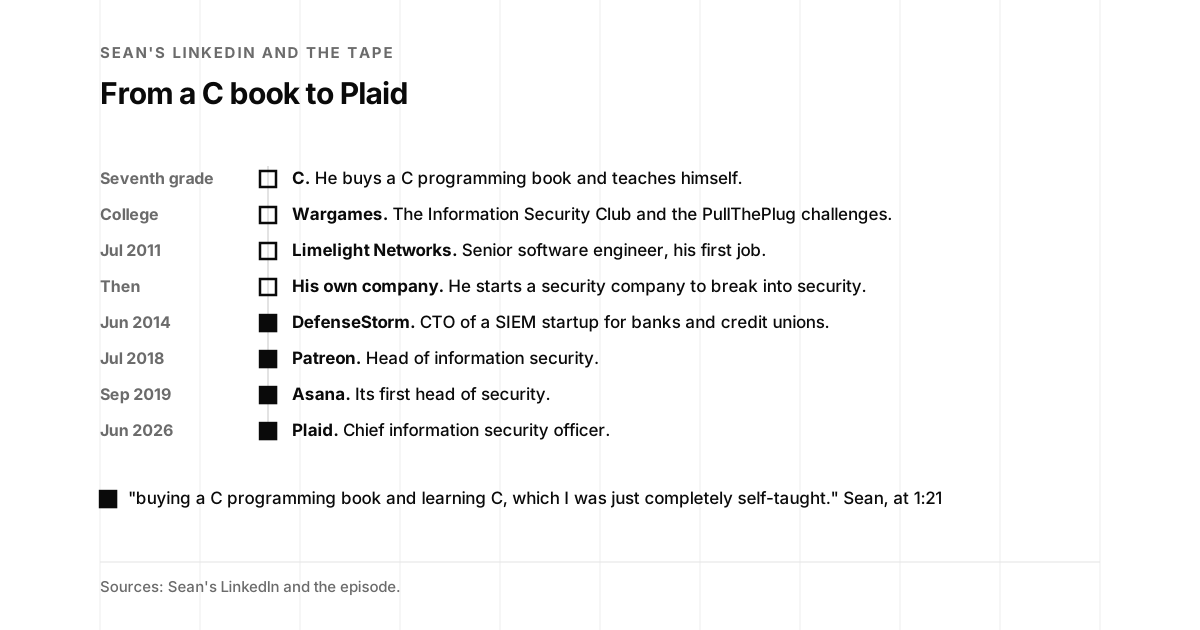
A timeline. Seventh grade: C, he buys a C programming book and teaches himself. College: wargames, the Information Security Club and the PullThePlug challenges. July 2011: Limelight Networks, senior software engineer, his first job. Then: his own company, he starts a security company to break into security. June 2014, filled: DefenseStorm, CTO of a SIEM startup for banks and credit unions. July 2018, filled: Patreon, head of information security. September 2019, filled: Asana, its first head of security. June 2026, filled: Plaid, chief information security officer. Then: "buying a C programming book and learning C, which I was just completely self-taught." Sean, at 1:21
Sean's path from a C book to Plaid. Sources: his LinkedIn, his blog and the episode.

The first head of security

“I joined Asana about two and a half years ago as their first head of security.”

Sean Cassidy, at 4:39

The security team grew a lot in that time, he said, and the program matured as the company grew. It had the teams you’d expect, such as application security, product security, and detection and response. Jon put the team at 25 people, up from zero, and Sean agreed.

“It was really fun to be able to build out this entire security organization”

Sean Cassidy, at 5:01

Most of his day went to interviewing and hiring, he said.

Asana’s service is a work management platform that helps teams organize, track and manage their work. Dustin Moskovitz and Justin Rosenstein founded the company in 2008, the product launched commercially in April 2012, and the company went public on the New York Stock Exchange through a direct listing in September 2020 (Wikipedia). On episode 45, Craig Goodwin used Asana as the model for his startup, Bleach: a tool nobody hires a project manager to run.

Hire for interest, teach the rest

Jon had heard there was a real shortage of security people. There was, Sean said, so the team tries to be opportunistic.

“So we’ll hire software engineers who are interested in security, and then put them through a boot camp”

Sean Cassidy, at 5:30

They do the same for security engineers who are lighter on software engineering. What they look for is good people who are interested in career growth. Internal transfers help too. The security team does a lot of good work, so it’s popular inside the company, and several people have moved onto it. Jon said a transfer brings context on how different services work. Sean added that transfers tell you things a feedback survey won’t, like this about the feature risk assessment his team asks people to fill out.

“Sometimes we don’t fill it out.”

Sean Cassidy, at 6:28
Listen · Sean Cassidy on episode 17, from 5:30
About 30 seconds: Sean on hiring for interest and teaching the rest. The clip stops on its own. Read the full transcript.
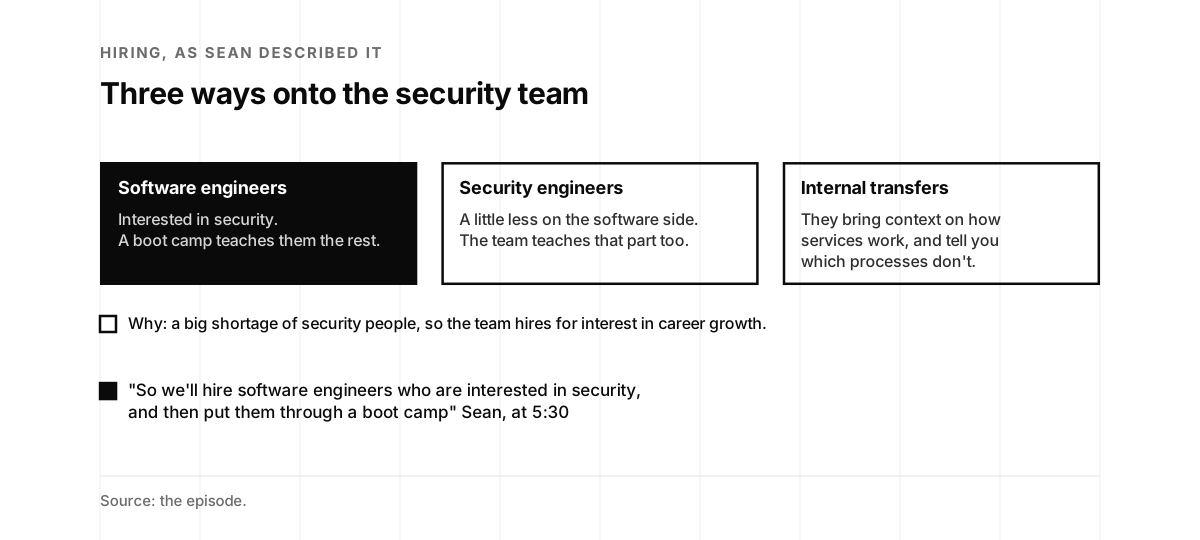
Three cards side by side. Software engineers, filled: interested in security, and a boot camp teaches them the rest. Security engineers: a little less on the software side, and the team teaches that part too. Internal transfers: they bring context on how services work, and tell you which processes don't. Below: why, a big shortage of security people, so the team hires for interest in career growth. Then: "So we'll hire software engineers who are interested in security, and then put them through a boot camp" Sean, at 5:30
Three ways onto the security team, as Sean described them. Source: the episode.

The calculator below counts the interview hours a hiring plan takes, with a share of the roles filled by internal transfers.

A high-trust culture

Jon heard a strong sense of honesty and trust at the core of the team. Asana’s culture was high-trust, Sean said, probably the most of any company he’d worked at.

“the way that works is by giving people lots of responsibility and autonomy.”

Sean Cassidy, at 7:07

People given responsibility and autonomy typically exceed your expectations, because they don’t want to lose the trust you’ve placed in them. The same goes for the security team. When it tells a product team to fix something, the answer is almost always yes. As a security practitioner, that worries him a little.

“what if we cry wolf a little bit?”

Sean Cassidy, at 7:43

So one question was on his mind.

“how do we maintain this high degree of trust as we scale our organization?”

Sean Cassidy, at 7:50

Jon called it a balancing act.
Listen · Sean Cassidy on episode 17, from 7:06
About 15 seconds: Sean on why trust makes people exceed expectations. The clip stops on its own. Read the full transcript.
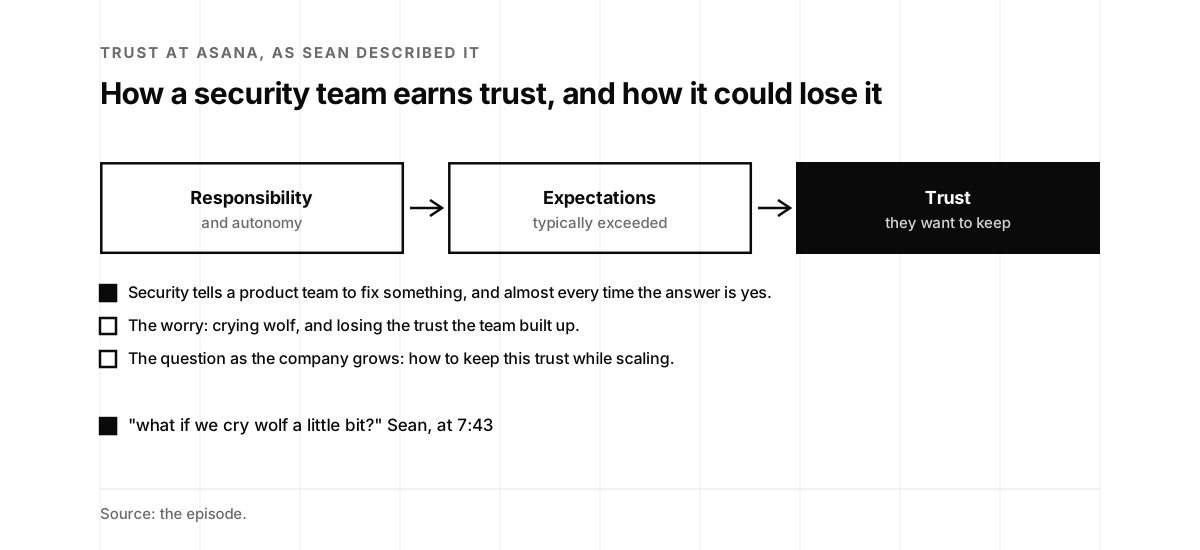
Three boxes joined by arrows. Responsibility and autonomy. Expectations, typically exceeded. Trust, filled, they want to keep. Below, a list. Filled: security tells a product team to fix something, and almost every time the answer is yes. The worry: crying wolf, and losing the trust the team built up. The question as the company grows: how to keep this trust while scaling. Then: "what if we cry wolf a little bit?" Sean, at 7:43
How a security team earns trust, and how it could lose it. Source: the episode.

Can my team help?

Jon asked about his best day at Asana. It was recent, Sean said, during Log4Shell. The team started work on it on a Thursday night, and by Friday they saw how big it was.

“this was going to be an industry-defining moment.”

Sean Cassidy, at 8:33

Asana itself barely used Log4j: one minor system that never touched customer data and had no access to the internet. But a lot of its vendors used it, so the team had to mobilize a lot of people. He sent engineering a quick message, asking for help whenever the security team needed it that day.

“please drop everything”

Sean Cassidy, at 8:59

A few fellow engineering leaders replied while he was busy in meetings. When he got back to the messages, he felt dread. He worried they’d say their teams had important work too.

“Sean, do you have everything you need?”

Sean Cassidy, at 9:23

They also asked whether their teams could help. It turned a stressful incident into a show of support, he said, and it made him feel the security team wasn’t up against the rest of the company. Log4Shell, CVE-2021-44228, was a flaw in Log4j, a popular Java logging framework, that allowed arbitrary code execution and was exploited as a zero-day. Alibaba Cloud’s security team disclosed it privately to the Apache Software Foundation on November 24, 2021. Apache gave it a CVSS score of 10, the highest, and fixes came out on December 6, three days before the flaw was published (Wikipedia). On episode 48, Georgianna Shea said the first question companies asked was whether they had Log4j.
Listen · Sean Cassidy on episode 17, from 8:53
About 25 seconds: Sean on the message he sent engineering. The clip stops on its own. Read the full transcript.
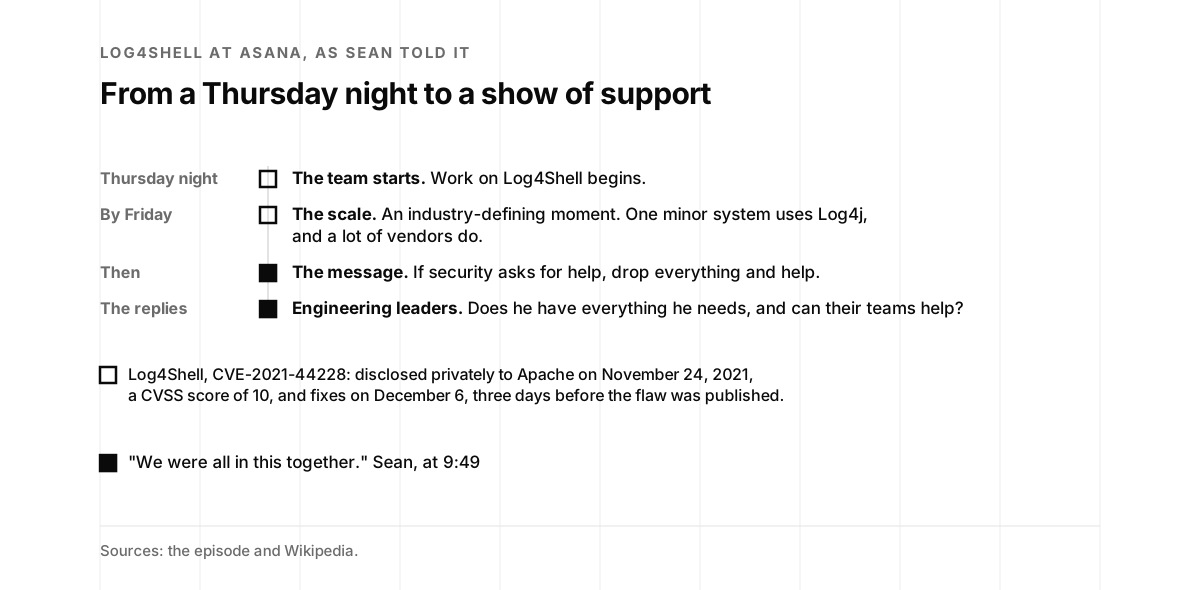
A timeline. Thursday night: the team starts, work on Log4Shell begins. By Friday: the scale, an industry-defining moment, one minor system uses Log4j, and a lot of vendors do. Then, filled: the message, if security asks for help, drop everything and help. The replies, filled: engineering leaders, does he have everything he needs, and can their teams help? Below: Log4Shell, CVE-2021-44228, disclosed privately to Apache on November 24, 2021, a CVSS score of 10, and fixes on December 6, three days before the flaw was published. Then: "We were all in this together." Sean, at 9:49
Log4Shell at Asana, as Sean told it. Sources: the episode and Wikipedia.

Focus time

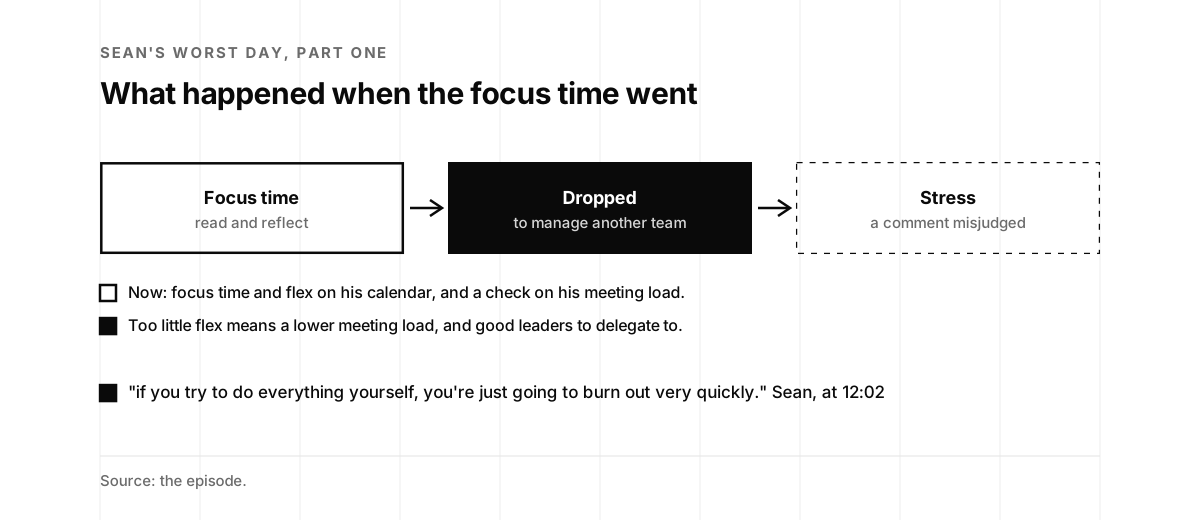
Jon asked about the worst day, one with hard lessons. Sean had two. In the first, he was on a tricky project with a peer, grew suspicious of the peer’s motives, and took a comment to mean something it didn’t. The peer was confused too. Sean stepped away to ask himself why he felt that way, and found he was stressed.

“I allocate time on my calendar for focus work.”

Sean Cassidy, at 10:55

He uses that time to keep up with the industry, read and reflect. He had stopped while he temporarily managed another team, and lost his stress relief and the flex in his day. Now he makes sure he has focus time and flex in his schedule, and he checks his meeting load in Google Calendar. If there’s not enough flex, he lowers the load. That’s one reason to hire good leaders onto your team and delegate work to them.

“if you try to do everything yourself, you’re just going to burn out very quickly.”

Sean Cassidy, at 12:02
Listen · Sean Cassidy on episode 17, from 10:52
About 25 seconds: Sean on the focus time he had dropped. The clip stops on its own. Read the full transcript.
Three boxes joined by arrows. Focus time, read and reflect. Dropped, filled, to manage another team. Stress, dashed, a comment misjudged. Below, a list. Now: focus time and flex on his calendar, and a check on his meeting load. Filled: too little flex means a lower meeting load, and good leaders to delegate to. Then: "if you try to do everything yourself, you're just going to burn out very quickly." Sean, at 12:02
What happened when the focus time went, and what he does now. Source: the episode.

Write it down, then say it

The second lesson came from feedback. He has a rule for it.

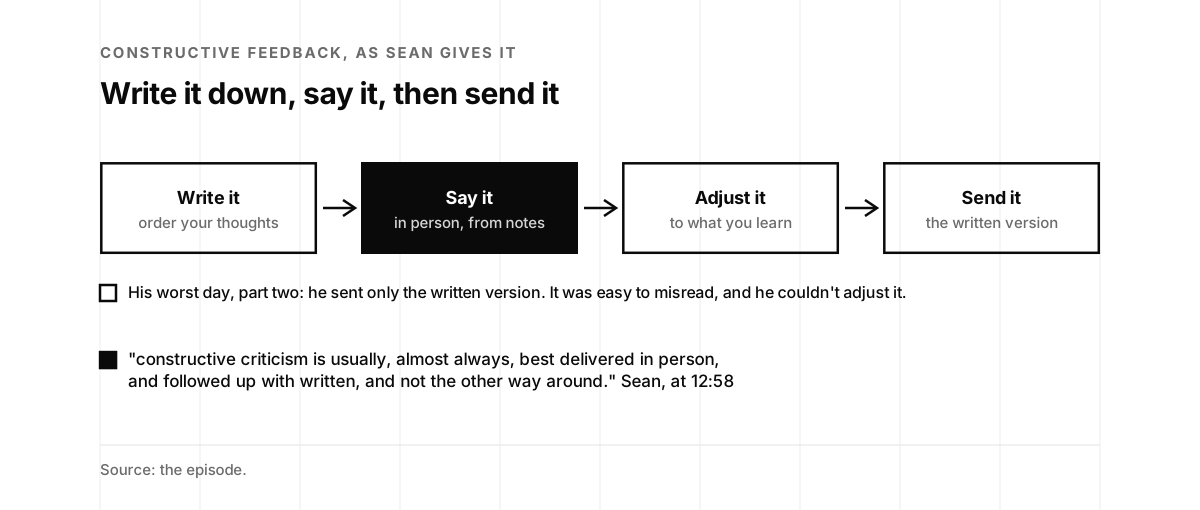
“if I’m ever going to give somebody constructive feedback, I write it down first, and then I deliver it verbally.”

Sean Cassidy, at 12:14

He broke it and sent only the written feedback. It was easy to misread, he couldn’t adjust it during a conversation, and it didn’t have the outcome he wanted. He had to apologize.

“constructive criticism is usually, almost always, best delivered in person, and followed up with written, and not the other way around.”

Sean Cassidy, at 12:58

With 12 things to do in a day, it’s tempting to write up feedback, send it and move on, he said. Done well, feedback can define someone’s career and improve your relationship with them. Done poorly, it could end the relationship. So he writes it first, delivers it verbally from his notes, and then sends the written version. He adjusts it as the other person talks, because they may know something he doesn’t, such as a requirement that kept them from doing it his way.
Listen · Sean Cassidy on episode 17, from 12:05
About 15 seconds: Sean on the feedback rule he broke. The clip stops on its own. Read the full transcript.
Four boxes joined by arrows. Write it, order your thoughts. Say it, filled, in person, from notes. Adjust it, to what you learn. Send it, the written version. Below: his worst day, part two, he sent only the written version, it was easy to misread, and he couldn't adjust it. Then: "constructive criticism is usually, almost always, best delivered in person, and followed up with written, and not the other way around." Sean, at 12:58
Sean's order for constructive feedback. Source: the episode.

COIN

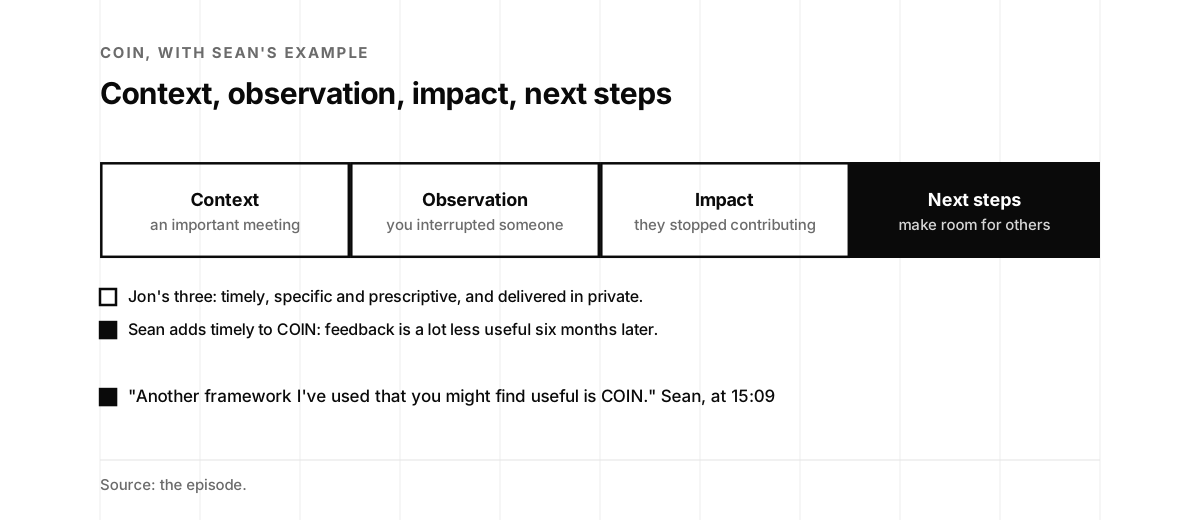
Jon gave his own rule of three for constructive feedback: timely, about a specific event, and prescriptive about how to handle it better, and always delivered in private. Miss any one, he said, and it’s a lost opportunity.

“Another framework I’ve used that you might find useful is COIN.”

Sean Cassidy, at 15:09

COIN stands for context, observation, impact and next steps. His example: we were in an important meeting together (context), you interrupted someone (observation), and that person didn’t contribute after that (impact). Next time, think about your place in the meeting and make sure you’re encouraging others to talk (next steps). Laid out that way, he said, it’s specific and actionable. Jon found COIN easier to remember than his three. Sean liked Jon’s timely, though.

“COIN is a lot less useful if you wait six months to deliver that feedback.”

Sean Cassidy, at 16:04
Listen · Sean Cassidy on episode 17, from 15:09
About 30 seconds: Sean on COIN, with his example. The clip stops on its own. Read the full transcript.
Four compartments in a row. Context, an important meeting. Observation, you interrupted someone. Impact, they stopped contributing. Next steps, filled, make room for others. Below, a list. Jon's three: timely, specific and prescriptive, and delivered in private. Filled: Sean adds timely to COIN, feedback is a lot less useful six months later. Then: "Another framework I've used that you might find useful is COIN." Sean, at 15:09
COIN, with Sean's example from the episode. Source: the episode.

The patterns you spot

Jon said feedback about ancient history is close to worthless, and performance reviews come every six months at most. Some managers take the idea that feedback shouldn’t be a surprise pretty far, Sean said, and he agrees with it.

“So sometimes what is surprising during performance reviews is the patterns you spot.”

Sean Cassidy, at 16:37

Point feedback over six months can add up to a pattern of behavior he only sees while preparing the review. So some surprises are fine. The review is a chance to step back and look at someone’s performance and feedback from a higher level.

You’ve come so far

Jon said one of the joys of leading people is seeing them progress in their careers.

“reminding folks of how much they’ve improved and grown over time is really important.”

Sean Cassidy, at 17:53

His example: two years ago you found it hard to lead a meeting, and now you led a complicated, stressful one. Seeing that growth is motivating, he said, and you can remind people they’ve come so far.

What would you say to a friend?

Jon suggested a pinch of self-compassion to shake off imposter syndrome, especially for newer team members.

“imposter syndrome is, like, a scourge in the human psyche.”

Sean Cassidy, at 18:35

We hold ourselves to impossible standards sometimes, Jon said. Sean remembered beating himself up over something, and a friend asking him a question.

“imagine if I had the same problem. What would you say to me?”

Sean Cassidy, at 19:02

He’d feel sorry for the friend, he said, and tell him it was a tough situation. The friend asked why he didn’t treat himself the same way. It was a mind-exploding moment for him.

“Self-compassion is extremely important.”

Sean Cassidy, at 19:38

Infrastructure for work

Jon asked what success looks like for Asana, and how security helps it get there. The goal is for people to run their company on Asana as their work management platform, Sean said.

“people need to trust that Asana is going to safeguard their data.”

Sean Cassidy, at 20:25

He compared it to AWS. If AWS had a reputation for not being secure, people would build their infrastructure somewhere else. Work management is almost the infrastructure for how people interact, assign each other work and get things done, he said, a foundational role that can’t be skipped.

“Security is the enabler of us getting there.”

Sean Cassidy, at 21:00

If they don’t do a good job on security, he said, Asana will be significantly less successful.

A different set of problems

He takes an incremental, cyclical view of improving security.

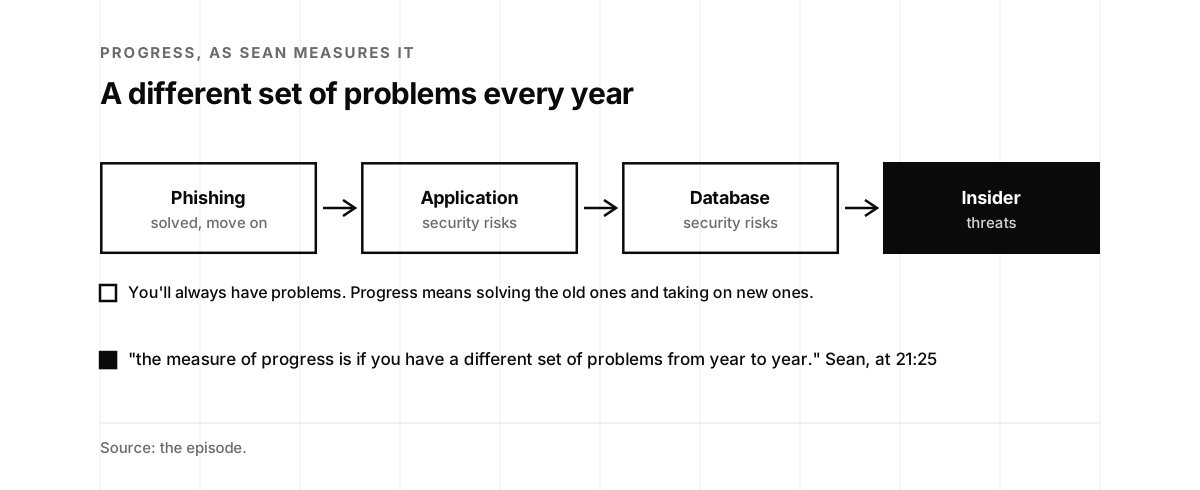
“the measure of progress is if you have a different set of problems from year to year.”

Sean Cassidy, at 21:25

It’s one of his favorite quotes, and he guessed John Foster Dulles said it. You’ll always have problems, he said, so the mark of progress is solving the old ones and moving to new ones. Say you’re convinced you’ve solved phishing. Then move on to application security risks, database security risks or insider threats. As long as the problems shift over time, he feels good about the program’s progress.

His blog post “Phishing simulations considered harmful,” from May 26, 2020, argues that phishing simulations are unrealistic, get past real controls through allowlists and breed resentment. It suggests easy reporting, single sign-on with phishing-resistant two-factor authentication, and approvals for wire transfers that don’t happen over email (seancassidy.me).
Listen · Sean Cassidy on episode 17, from 21:22
About 35 seconds: Sean on a different set of problems every year. The clip stops on its own. Read the full transcript.
Four boxes joined by arrows. Phishing, solved, move on. Application security risks. Database security risks. Insider threats, filled. Below: you'll always have problems, and progress means solving the old ones and taking on new ones. Then: "the measure of progress is if you have a different set of problems from year to year." Sean, at 21:25
Progress as a new set of problems each year, as Sean described it. Source: the episode.

Did the alert fire?

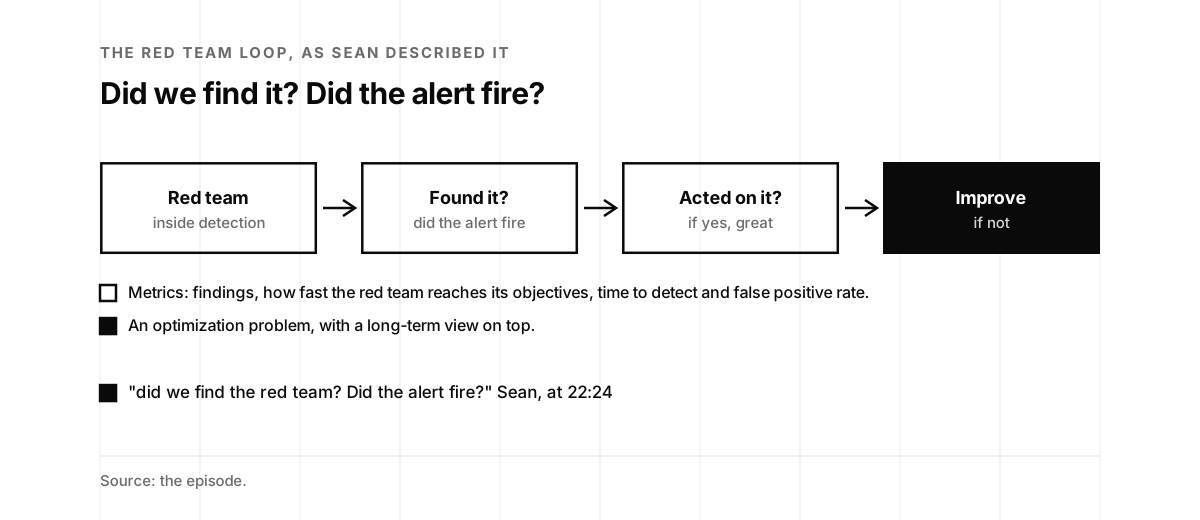
He also likes tactical measures: hiring red teams, counting their findings, and timing how fast they reach certain objectives. His new detection and response team would embed the red team, for a tight feedback loop.

“did we find the red team? Did the alert fire?”

Sean Cassidy, at 22:24

And did the team act on it? If yes, great. If not, improve. That gives the team metrics such as time to detect and false positive rate.

“we should also treat that as an optimization problem.”

Sean Cassidy, at 22:39

So he looks at both levels: a long-term view of the program, and whether specific metrics improve over time. Jon liked that the loop between the red team and detection and response produces the next step toward a better future. It was also the first time he’d heard this from anyone.

“rate of change of problems that you’re dealing with as a measure of success.”

Jon McLachlan, at 23:13
Listen · Sean Cassidy on episode 17, from 22:05
About 30 seconds: Sean on the red team inside detection and response. The clip stops on its own. Read the full transcript.
Four boxes joined by arrows. Red team, inside detection. Found it? Did the alert fire. Acted on it? If yes, great. Improve, filled, if not. Below, a list. Metrics: findings, how fast the red team reaches its objectives, time to detect and false positive rate. Filled: an optimization problem, with a long-term view on top. Then: "did we find the red team? Did the alert fire?" Sean, at 22:24
The red team feedback loop Sean described. Source: the episode.

There’s always an adversary

Some security people get down about the work, Sean said. There’s always tech debt, and there are always people saying no to fixing security problems. He understands that.

“security is unique in a way, if we have an adversary.”

Sean Cassidy, at 23:54

The adversary is always growing and evolving, so the work goes on.

“We’ll never have perfect security.”

Sean Cassidy, at 24:03

He finds that inspiring. An NFL team can’t become the best and be done, because the other teams are trying to get better too. It’s important not to fall into a cycle of despair, where you can’t fix everything, so you can’t fix anything. Incremental improvement is extremely important to success, he said.

Celebrate the wins

Jon has a phrase he catches himself saying.

“small, imperfect, good changes towards a North Star”

Jon McLachlan, at 24:52

You can admit there’s still work to do, he said, and celebrate the victories along the way. Sean’s team had held its end-of-year wrap-up celebration about two months earlier. Even one quarter later, he said, you sometimes forget all the work you’ve done.

“celebrating your wins is extremely important.”

Sean Cassidy, at 25:25

That includes successful incident response, and even tabletop exercises. It’s important work, he said, and extremely important to morale.

Tell me about a time something went wrong

Jon asked for his favorite interview question.

“tell me about your time something went wrong and what you did about it.”

Sean Cassidy, at 25:58

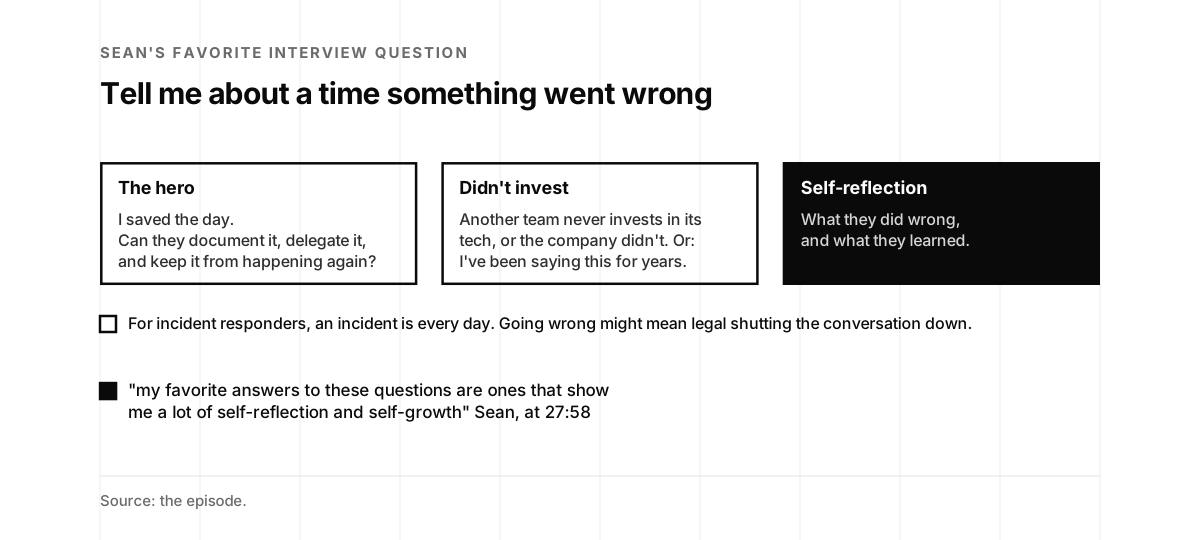
Engineers sometimes tell him about the time the site went down, and security people tell him about a good incident. The answers show how people view their role. Some take the hero path: I saved the day. That’s good, he said, since someone solved the problem.

“Heroing has a dark side”

Sean Cassidy, at 26:35

Heroes may not document what they did, or may always need to be in that role. He wants to know whether they can delegate and keep it from happening again, because he doesn’t want anyone to be the linchpin. Others say another team never invests in its tech, or the company didn’t, or that they’d been saying for years it should be fixed. The question is open-ended, so people also show what they think going wrong means. For incident responders, he said, an incident is every day. Going wrong might be the head of security coming in and interrupting with questions, or legal declaring everything privileged and shutting the conversation down.

“my favorite answers to these questions are ones that show me a lot of self-reflection and self-growth”

Sean Cassidy, at 27:58

It’s easy to be the hero, he said, and hard to say what you did wrong and what you learned. Jon tied it to mindset: whether you’re compassionate with yourself in a challenging situation, and whether you ask for help. Sean added self-awareness: knowing what you’re good at and what you’re not. The question can also go deep into technical detail, and it gets him to what he wants to know quickly.
Listen · Sean Cassidy on episode 17, from 25:53
About 25 seconds: Sean on his favorite interview question. The clip stops on its own. Read the full transcript.
Three cards side by side. The hero: I saved the day, can they document it, delegate it, and keep it from happening again? Didn't invest: another team never invests in its tech, or the company didn't, or I've been saying this for years. Self-reflection, filled: what they did wrong, and what they learned. Below: for incident responders, an incident is every day, and going wrong might mean legal shutting the conversation down. Then: "my favorite answers to these questions are ones that show me a lot of self-reflection and self-growth" Sean, at 27:58
The paths an answer to Sean's favorite question can take. Source: the episode.

Teams built around problems

Jon asked what kinds of teams he builds. Sean thinks of the team as the basic unit of work. He starts with the work he wants done, or a problem the company has, and builds a team around it. Some leaders build teams around skills or expertise. He prefers a team’s initiative: what it will fix, and the concrete problem the company will have without it.

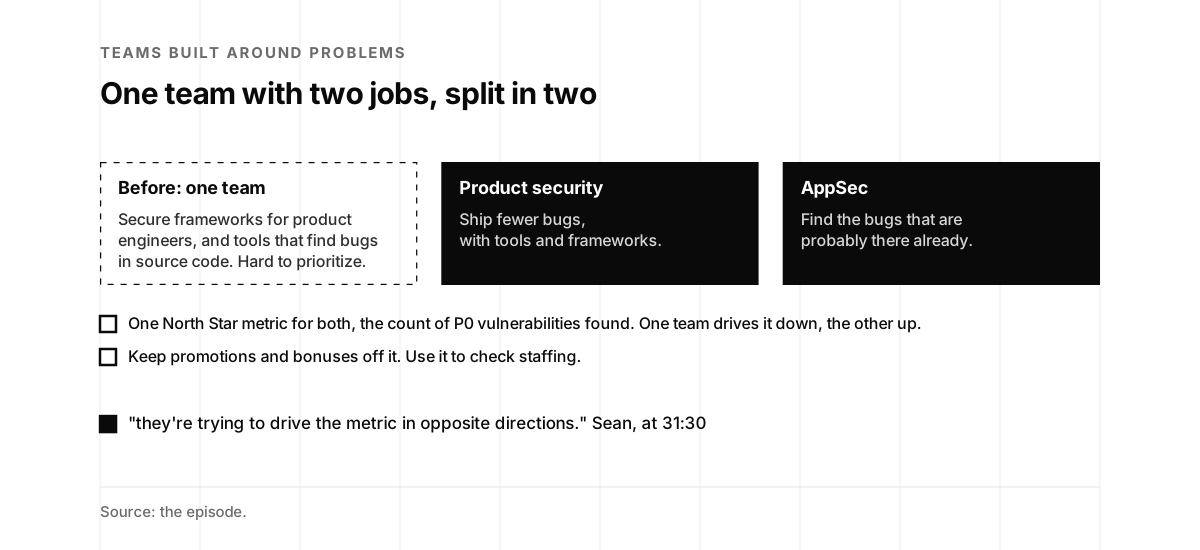
His example was one team with two distinct jobs. One was building frameworks that help product engineers work more securely. The open source framework it had used before was riddled with security bugs and hard to use, so the team built its own. The other job was finding and building tools that find bugs in the source code. The two jobs were hard to prioritize against each other, and they sat together only because they needed similar expertise. So he split the team in two. One team works on shipping fewer bugs, with tools and frameworks. The other finds the bugs that are probably there already. Each can now prioritize on its own, even though each is a little smaller.

Both teams share one North Star metric, the count of P0 vulnerabilities found.

“they’re trying to drive the metric in opposite directions.”

Sean Cassidy, at 31:30

Product security wants to ship fewer of them, and the AppSec team wants to find more. Don’t base promotions or bonuses on a metric that teams drive in opposite directions, he said. Treat it as a data point on staffing: is the AppSec side staffed too heavily, or the other way around? His blog post “Code as risk,” from February 11, 2015, argues that all code adds risk, beyond technical debt, and suggests asking how risky new code will be (seancassidy.me).
Listen · Sean Cassidy on episode 17, from 31:23
About 25 seconds: Sean on two teams with one metric. The clip stops on its own. Read the full transcript.
Three cards side by side. Before: one team, dashed, secure frameworks for product engineers, and tools that find bugs in source code, hard to prioritize. Product security, filled: ship fewer bugs, with tools and frameworks. AppSec, filled: find the bugs that are probably there already. Below, a list. One North Star metric for both, the count of P0 vulnerabilities found, and one team drives it down, the other up. Keep promotions and bonuses off it, and use it to check staffing. Then: "they're trying to drive the metric in opposite directions." Sean, at 31:30
One team with two jobs, split into two teams that share a metric. Source: the episode.

Humbleness

Jon asked what culture drives his top-performing security teams.

“Really, my favorite thing here to say is, really, it’s humbleness”

Sean Cassidy, at 32:37

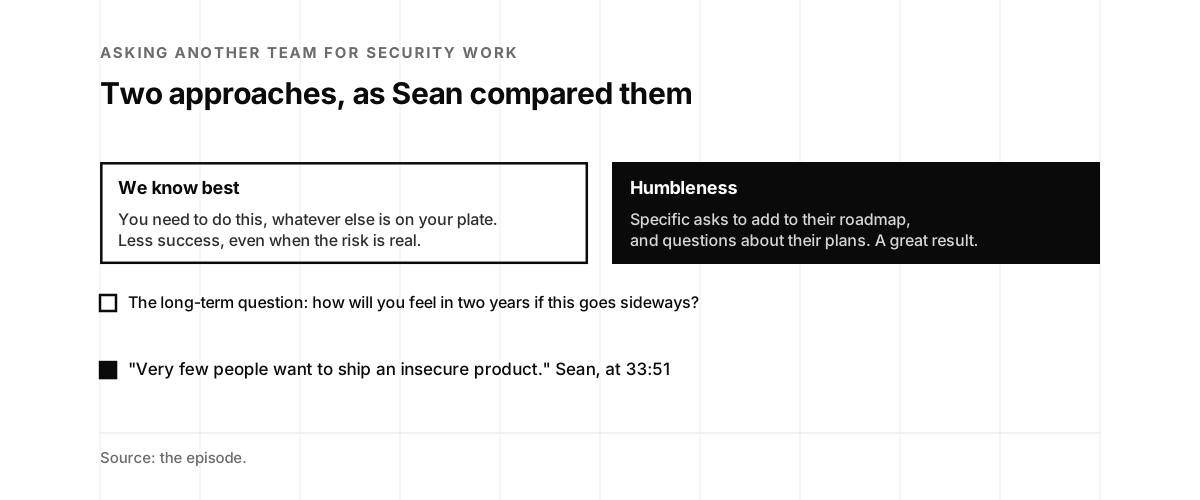
The team did best when it went to other teams with specific asks to add to their roadmap. When it came in knowing best and ignoring what else was on the other team’s plate, it had less success, even when it might have been right about a huge risk. He wants the best security outcomes for Asana, to make it a successful business, and that means approaching other teams the right way. Jon put it as letting the other team keep ownership of its projects, deliverables and services.

“Very few people want to ship an insecure product.”

Sean Cassidy, at 33:51

Give people the information and they tend to do the right thing, he said. The people in the edge cases are usually thinking short term. Asking how they’ll feel in two years if this goes sideways helps them think long term.

“You can drive an entire conversation just with humble questions.”

Jon McLachlan, at 34:24

That’s what he likes to do, Sean said. If a team doesn’t think a fix is the most important thing, he asks why. If a big marketing moment is coming up, he asks how they’ve prepared for it. Being open and curious, he learns a lot. Maybe the sprint after the launch is free, so they mitigate the risk in the meantime and do the work in that sprint. His blog post “On Being Nice,” from July 22, 2013, is subtitled “Or, why Linus is wrong about being a jerk.” It argues that being a jerk isn’t required and does harm, citing scientific studies over personal experience (seancassidy.me).
Listen · Sean Cassidy on episode 17, from 33:51
About 35 seconds: Sean on giving people the information. The clip stops on its own. Read the full transcript.
Two cards side by side. We know best: you need to do this, whatever else is on your plate, and less success, even when the risk is real. Humbleness, filled: specific asks to add to their roadmap, and questions about their plans, and a great result. Below: the long-term question, how will you feel in two years if this goes sideways? Then: "Very few people want to ship an insecure product." Sean, at 33:51
Two ways to ask another team for security work, as Sean compared them. Source: the episode.

Two kinds of security people

Jon told a story he likes to tell.

“I’ve noticed that there’s two types of security people in the world.”

Jon McLachlan, at 35:08

When the first kind walks into a meeting room, the people from engineering, legal or customer service think, oh no. This person will push out the dates, ask for all these things and put demands on the table. That’s a reputation, he said, and the mindset is an adversary’s. When the second kind walks in, the room is glad. This person will help the team build it securely and still move quickly, and think through what’s in and out of the threat model. Jon told the same story to Nick Sullivan on episode 38.

It reminded Sean of a quote that sets good security, which solves technical problems, against great security.

“great security is about solving business problems.”

Sean Cassidy, at 36:22

You could argue technical details, he said, but your business has problems, and great security helps solve them. Jon said he worked hard to be the second kind: a team player, on board with the business, helping it move fast and ship.

The tool he wished existed

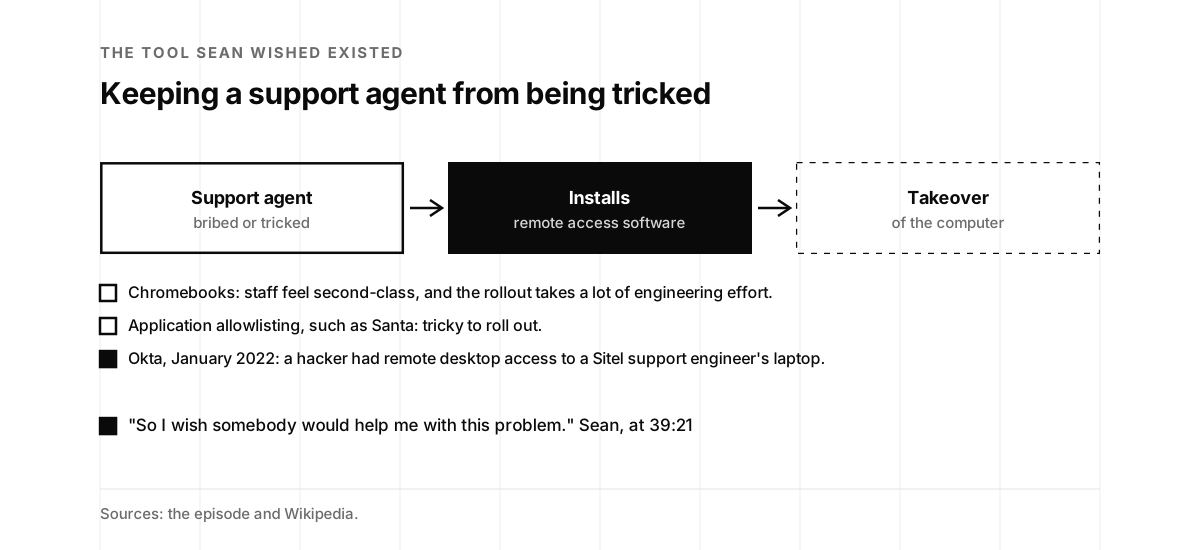
Jon asked, for the entrepreneurs who listen, what tool or service Sean wished someone would build. His answer was the insider problem: how easy it is for internal people to be bribed or tricked, or to be an insider threat, and use internal tools against the company. He named Okta and Twitter, and said Okta has a great security program.

One common answer is Chromebooks, and people tend to see them negatively. When he floated them to customer service, people said they’d feel second-class, with underpowered Chromebooks while everyone else had powerful MacBooks. But support people and contractors might install remote access software because someone pays them to, or because they’re tricked into it, and that had been happening recently. He wants it to be hard for customer support agents to be tricked into installing software that can take over their computer. Application allowlisting exists, and he named one tool, Santa, but rolling it out, or rolling out Chromebooks, would take a large amount of engineering effort.

“So I wish somebody would help me with this problem.”

Sean Cassidy, at 39:21

He didn’t have a great solution for it yet. The Okta case went through a third-party customer support engineer. Okta first said a Lapsus$ hacker had remote desktop access to a Sitel support engineer’s laptop for five days, January 16 to 21, 2022, and Okta’s final forensic report found two active customers affected. The group relied on social engineering, MFA fatigue and SIM swapping (Wikipedia). On episode 86, Trevor Hilligoss pointed at Lapsus$ as proof that the biggest threat is the human.
Listen · Sean Cassidy on episode 17, from 38:33
About 25 seconds: Sean on the problem he wants solved. The clip stops on its own. Read the full transcript.
Three boxes joined by arrows. Support agent, bribed or tricked. Installs, filled, remote access software. Takeover, dashed, of the computer. Below, a list. Chromebooks: staff feel second-class, and the rollout takes a lot of engineering effort. Application allowlisting, such as Santa: tricky to roll out. Filled: Okta, January 2022, a hacker had remote desktop access to a Sitel support engineer's laptop. Then: "So I wish somebody would help me with this problem." Sean, at 39:21
The insider problem Sean wants solved, and the fixes he weighed. Sources: the episode and Wikipedia.

Asana was hiring

Jon thanked Sean and asked for parting words. Sean said he would be remiss if he didn’t mention that Asana’s security team was hiring, and he pointed listeners to asana.com/jobs. Jon added that the team had openings for people long in the industry and for people looking to get into security.

What happened after the tape

Seven years at Asana. His LinkedIn says he led security at Asana until June 2026, almost seven years in all. He built and led a 30-person security organization across product security, infrastructure security, application security, and risk and compliance. It credits him with board-level security reporting, formal incident response, and the risk and compliance work that supported the direct listing in 2020. His team also took on compliance frameworks such as ISO 27001, SOC 2, HIPAA and FedRAMP, and he led Asana’s FedRAMP authorization. In 2025 his scope grew to Foundations, a 100-person engineering organization (LinkedIn).

Asana grew and changed leaders. Asana had 131,000 customers as of September 2022. Dan Rogers became CEO on July 21, 2025, and Dustin Moskovitz stayed on as chairman (Wikipedia).

The review board’s first report. The Cyber Safety Review Board’s first report, on July 11, 2022, covered Log4Shell (Wikipedia). Kayne McGladrey talked about the board on episode 56.

CISO at Plaid. In June 2026, he joined Plaid as chief information security officer. His post on the move says he spent nearly seven years building and leading security at Asana, and wanted a role where security is fundamental to the mission. Plaid builds a data transfer network that powers fintech and digital finance products, and its platform lets applications connect with users’ bank accounts (Wikipedia).

Sean on joining Plaid as CISO, after nearly seven years at Asana.

Sean Cassidy · June 16, 2026
His post on joining Plaid. View on LinkedIn.

Still hiring people early in their careers. On October 1, 2026, he posted that Plaid was hiring interns and new grads, and asked, “if no one hires juniors now, where do the engineers of 2031 come from?” On the tape, his team hired software engineers who were interested in security and taught them security.

Sean on why Plaid is hiring interns and new grads.

Sean Cassidy · October 1, 2026
His post on hiring interns and new grads. View on LinkedIn.

A talk on security best practices. On October 6, 2026, The TPRM Podcast posted Sean’s conversation with Nate Lee to YouTube. Its description asks what happens if some security best practices aren’t reducing risk. In a LinkedIn post about it, he asked, “when was the last time your third-party risk program prevented a breach?” and proposed treating third-party risk as a forecast of how likely a vendor breach is and what its impact would be, with an incident runbook for each vendor (LinkedIn). On the tape, Log4Shell mattered to Asana because a lot of its vendors used Log4j, as in Can my team help?

Sean with Nate Lee on The TPRM Podcast, 52 minutes, posted on October 6, 2026. Watch on YouTube.

More on this site. On the blog, What Is a vCISO? covers what an on-demand security leader does, Hiring a Fractional CISO? lists seven questions to ask before you sign one, and Hiring Is Now an Attack Surface covers fake candidates, fake recruiters and laptop farms.
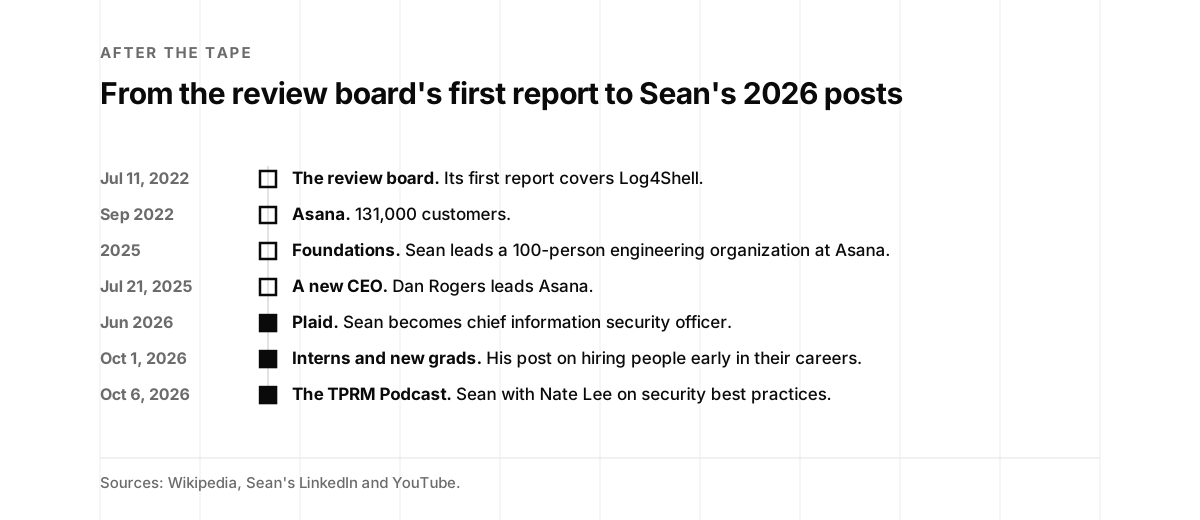
A timeline. July 11, 2022: the review board, its first report covers Log4Shell. September 2022: Asana, 131,000 customers. 2025: Foundations, Sean leads a 100-person engineering organization at Asana. July 21, 2025: a new CEO, Dan Rogers leads Asana. June 2026, filled: Plaid, Sean becomes chief information security officer. October 1, 2026, filled: interns and new grads, his post on hiring people early in their careers. October 6, 2026, filled: The TPRM Podcast, Sean with Nate Lee on security best practices.
After the tape, from the review board's first report to Sean's 2026 posts. Sources: LinkedIn, Wikipedia and YouTube.

Did you catch it? A seven-question quiz

Seven questions from the episode. Each answer links the moment in the transcript.

Quiz · seven questions

Did you catch it?

Pick an answer to see whether you caught it.

  1. How old was Sean when he built his family's first computer?

    a. "I built my family's first computer when I was eight or nine years old" Transcript, 1:10.

  2. Which challenges did Sean go through in college?

    b. "I remember going through all the PullThePlug challenges, and now it's called OverTheWire" Transcript, 1:50.

  3. Who were DefenseStorm's customers?

    c. "We were focused on banks and credit unions." Transcript, 3:42.

  4. What did Sean ask of engineering during Log4Shell?

    a. "please drop everything" Transcript, 8:59.

  5. What does the N in COIN stand for?

    c. Context, observation, impact and next steps. See COIN.

  6. Which metric did the two teams Sean split share?

    b. "they're trying to drive the metric in opposite directions." Transcript, 31:30.

  7. What is Sean's favorite interview question?

    a. "tell me about your time something went wrong and what you did about it." Transcript, 25:58.

Does your security team earn trust?

Eight questions on whether other teams trust your security team, and whether it keeps that trust as it grows. Each tip quotes the tape or paraphrases it, and links its section.

Scorecard · eight questions

Does your security team earn trust?

Answer for your company as it runs today. If two answers fit, pick the lower one.

  1. When security asks a product team to fix something, what happens?

    • It gets argued down or ignored
    • It gets done when there's time
    • Almost always yes, because our asks are rare and clear

    "what if we cry wolf a little bit?" See A high-trust culture.

  2. Do you track how often your alerts are false alarms?

    • No
    • We know it's high
    • We track the false positive rate and work to lower it

    Sean tracks time to detect and false positive rate. See Did the alert fire?

  3. If a problem the size of Log4Shell landed tonight, how would you get engineering's help?

    • A week of meetings first
    • Through the few managers we know
    • One message, and teams offer to help

    "Sean, do you have everything you need?" See Can my team help?

  4. What happens to a red team finding?

    • We don't run red team exercises
    • It goes into a report
    • We check whether the alert fired, and fix detection if it didn't

    "did we find the red team? Did the alert fire?" See Did the alert fire?

  5. How do your leaders give constructive feedback?

    • In writing, when there's time
    • In person, without notes
    • Written first, said in person, then sent

    Sean writes it down first, then delivers it verbally. See Write it down, then say it.

  6. Where do your security hires come from?

    • Only experienced security hires, and roles sit open
    • Some engineers we train
    • Engineers we train, plus internal transfers

    Sean's team hired software engineers and put them through a boot camp. See Hire for interest, teach the rest.

  7. How are your security teams organized?

    • By skill, with unrelated jobs on one team
    • A mix
    • Around problems, each with a metric

    "they're trying to drive the metric in opposite directions." See Teams built around problems.

  8. How does security ask other teams for work?

    • We tell them what to do
    • Tickets with deadlines
    • Specific asks, with questions about their roadmap

    "Very few people want to ship an insecure product." See Humbleness.

Security versus the rest

Asks get argued down, and help is slow to come. Start with specific asks, and track how often your alerts turn out to be false alarms.

A balancing act

The trust is there, and crying wolf could lose it. Next, put the red team's findings into detection, and write down the message you'd send engineering on a bad day.

All in this together

Other teams offer help when you need it. Keep the asks rare and clear, and celebrate the wins with them.

How many interview hours will your hiring plan take?

Most of Sean’s day went to interviewing and hiring, and some roles were filled by internal transfers. This calculator counts the interview hours behind a hiring plan.

Calculator

How many interview hours will your hiring plan take?

Four numbers: the people you'll hire, the share who'll come from internal transfers, the candidates you interview for each outside hire, and the interviewer hours each candidate takes.

200interviewer hours
40candidates to interview
5.040-hour weeks of interviewer time

Outside hires: 8. Internal transfers: 2. Candidates to interview: 40. Interviewer hours: 200, or 5.0 weeks at 40 hours.

The calculator counts interviews for outside hires only, and leaves transfers out. The defaults are placeholders: put in your own plan.

From PullThePlug to Plaid

Sean’s path, the companies and incidents he talked about, and the episodes on this site that pick up the thread. Filter by topic.

Timeline

From PullThePlug to Plaid

  1. Cisco Systems

    Software development engineer in test, June to August (LinkedIn).

  2. Leuze Electronic

    Embedded software engineer (LinkedIn).

  3. Limelight Networks

    Senior software engineer, his first job (LinkedIn, on this page).

  4. Asana launches

    The product launches commercially (Wikipedia).

  5. On Being Nice

    His post on why being a jerk isn't required (seancassidy.me, on this page).

  6. Hackers and engineering school

    His post on being a hacker and a software engineer (seancassidy.me, on this page).

  7. DefenseStorm

    CTO of a SIEM startup for banks and credit unions (LinkedIn, on this page).

  8. Code as risk

    His post on how all code adds risk (seancassidy.me, on this page).

  9. LostPass

    His write-up of a phishing attack against LastPass (seancassidy.me).

  10. Patreon

    Head of information security (LinkedIn).

  11. Asana

    Its first head of security (LinkedIn, on this page).

  12. Phishing simulations

    His post arguing that phishing simulations do harm (seancassidy.me, on this page).

  13. Asana goes public

    A direct listing on the New York Stock Exchange (Wikipedia).

  14. Log4Shell

    Alibaba Cloud's security team discloses the flaw privately to Apache (Wikipedia, on this page).

  15. Okta and Lapsus$

    A hacker reaches a support engineer's laptop (Wikipedia, on this page).

  16. Episode 17

    Sean on the show (Podbean, transcript).

  17. The review board's first report

    The Cyber Safety Review Board covers Log4Shell (Wikipedia).

  18. Episode 38

    Jon tells Nick Sullivan about the two kinds of security people (episode page).

  19. Episode 45

    Craig Goodwin uses Asana as the model for Bleach (episode page).

  20. Episode 48

    Georgianna Shea on the first Log4j question (episode page).

  21. Episode 56

    Kayne McGladrey on the review board (episode page).

  22. Foundations

    His scope grows to a 100-person engineering organization at Asana (LinkedIn, on this page).

  23. A new CEO

    Dan Rogers becomes Asana's CEO (Wikipedia).

  24. Episode 86

    Trevor Hilligoss on Lapsus$ and the human (episode page).

  25. Plaid

    Chief information security officer (LinkedIn, on this page).

  26. Interns and new grads

    His post on hiring people early in their careers (LinkedIn).

  27. The TPRM Podcast

    Sean with Nate Lee on security best practices (YouTube, on this page).

What to do this week

Five things, in the order of the episode.

  1. Take the scorecard. Ask whether other teams trust your security team, then take the scorecard.
  2. Draft the drop-everything message. Write the note you’d send engineering on a Log4Shell day, and agree with engineering leaders now on what it asks for, as in Can my team help?
  3. Give feedback in order. Write it down, say it in person, then send it, and use COIN to shape it, as in Write it down, then say it and COIN.
  4. Ask whether the alert fired. For each red team finding, check whether detection caught it, and track time to detect and false positive rate, as in Did the alert fire?
  5. Get help leading it. A vCISO can lead the program and its hiring, and our 24/7 Monitoring & Response team watches for the alerts that should fire. If you want to talk it through, book 15 minutes with us.

Key takeaways

  1. Make your own luck

    Companies wanted a security background that his software engineering couldn't show, so Sean started his own security company. He tries to make his own luck.

  2. Hire for interest and teach the rest

    With a shortage of security people, Sean's team hired software engineers interested in security and put them through a boot camp, hired security engineers to grow on the software side, and took internal transfers.

  3. Guard the trust you've earned

    When security asks a product team for a fix, the answer is almost always yes. Crying wolf could lose that trust, so keeping it as the company scales is a standing question.

  4. One message can rally engineering

    During Log4Shell, Sean asked engineering to drop everything if security asked for help. Engineering leaders wrote back asking whether he had everything he needed, and security felt it wasn't up against the rest of the company.

  5. Write feedback down, then say it

    Sean writes constructive feedback first, delivers it in person from his notes, adjusts it as the other person talks, and then sends the written version. Sending only the written version went badly.

  6. Use COIN for feedback

    Context, observation, impact and next steps make feedback specific and actionable. Deliver it soon, because COIN is a lot less useful six months later.

  7. Measure progress by new problems

    If your problems change from year to year, you're solving the old ones. Pair that long view with tactical metrics like time to detect and false positive rate.

  8. Put the red team inside detection

    For each red team action, ask whether the team found it, whether the alert fired and whether anyone acted on it. If not, improve, and treat it as an optimization problem.

  9. Build teams around problems

    Sean split a team with two unrelated jobs into one that ships fewer bugs and one that finds the bugs already there. Both track P0 vulnerabilities found, in opposite directions.

  10. Lead with humbleness

    Specific asks that respect another team's roadmap work better than telling them what to do. Almost nobody wants to ship an insecure product, so give them the information and ask questions.

Chapters

Tap a chapter to play from there.

Pull quotes

“I built my family's first computer when I was eight or nine years old”

Sean Cassidy ·

“maybe the equivalent of 10 years of incident response experience”

Sean Cassidy ·

“And so I actually started my own security company.”

Sean Cassidy ·

“I've always tried to think about how I can make my own luck in a way.”

Sean Cassidy ·

“I joined Asana about two and a half years ago as their first head of security.”

Sean Cassidy ·

“It was really fun to be able to build out this entire security organization”

Sean Cassidy ·

“So we'll hire software engineers who are interested in security, and then put them through a boot camp”

Sean Cassidy ·

“what if we cry wolf a little bit?”

Sean Cassidy ·

“please drop everything”

Sean Cassidy ·

“Sean, do you have everything you need?”

Sean Cassidy ·

“We were all in this together.”

Sean Cassidy ·

“if I'm ever going to give somebody constructive feedback, I write it down first, and then I deliver it verbally.”

Sean Cassidy ·

“Another framework I've used that you might find useful is COIN.”

Sean Cassidy ·

“imposter syndrome is, like, a scourge in the human psyche.”

Sean Cassidy ·

“Security is the enabler of us getting there.”

Sean Cassidy ·

“the measure of progress is if you have a different set of problems from year to year.”

Sean Cassidy ·

“did we find the red team? Did the alert fire?”

Sean Cassidy ·

“We'll never have perfect security.”

Sean Cassidy ·

“small, imperfect, good changes towards a North Star”

Jon McLachlan ·

“Heroing has a dark side”

Sean Cassidy ·

“Very few people want to ship an insecure product.”

Sean Cassidy ·

“You can drive an entire conversation just with humble questions.”

Jon McLachlan ·

“So I wish somebody would help me with this problem.”

Sean Cassidy ·

About the guest

Sean Cassidy, Head of Security, Asana

Sean Cassidy became Asana's first head of security in September 2019 and built and led a 30-person security organization there until June 2026, when he became chief information security officer at Plaid. Before Asana he was head of information security at Patreon and CTO of DefenseStorm, a co-managed SIEM for banks and credit unions. He started as a software engineer, at Cisco Systems, Leuze Electronic and Limelight Networks, and studied at the Rochester Institute of Technology. He writes at seancassidy.me.

About the host

Jon McLachlan is co-founder of YSecurity, the on-demand cybersecurity team for startups, and of Cyberbase.ai. The Security Podcast of Silicon Valley is hosted by Jon McLachlan and Sasha Sinkevich. Jon McLachlan on LinkedIn ↗

Context and sources

  • Episode 17 on Podbean, June 3, 2022: Sean Cassidy, Head of Security at Asana, on building security teams and security products. Source ↗
  • Sean Cassidy's LinkedIn profile: chief information security officer at Plaid, an engineering and security leader focused on building a security-done-right culture. Source ↗
  • Sean Cassidy's LinkedIn experience: Cisco Systems in 2008, Leuze Electronic in 2010, Limelight Networks from 2011, CTO of DefenseStorm from 2014, head of information security at Patreon from 2018, head of security at Asana from September 2019 to June 2026, and Plaid from June 2026. Source ↗
  • Sean Cassidy on LinkedIn, June 16, 2026: joining Plaid as CISO after nearly seven years building and leading security at Asana. Source ↗
  • Sean Cassidy on LinkedIn, October 1, 2026: Plaid is hiring interns and new grads. Source ↗
  • The TPRM Podcast on YouTube, October 6, 2026: Why Security “Best Practices” Are Broken, with Sean Cassidy and Nate Lee. Source ↗
  • Sean Cassidy, December 11, 2013: Hackers and engineering school, on being a hacker and a software engineer, PullThePlug, and the Order of the Engineer. Source ↗
  • Sean Cassidy, May 26, 2020: Phishing simulations considered harmful, with easy reporting, phishing-resistant two-factor authentication and approvals outside email in their place. Source ↗
  • Sean Cassidy, July 22, 2013: On Being Nice (Or, why Linus is wrong about being a jerk). Source ↗
  • Sean Cassidy, February 11, 2015: Code as risk, on how all code adds risk. Source ↗
  • Sean Cassidy, January 16, 2016: LostPass, a phishing attack against LastPass. Source ↗
  • Wikipedia, Asana, Inc.: a work management platform founded in 2008 by Dustin Moskovitz and Justin Rosenstein, launched in April 2012, listed directly on the New York Stock Exchange in September 2020, with Dan Rogers as CEO from July 21, 2025. Source ↗
  • Wikipedia, Plaid Inc.: a financial services company that builds a data transfer network powering fintech and digital finance products. Source ↗
  • Wikipedia, Log4Shell: CVE-2021-44228 in Log4j, disclosed privately to Apache by Alibaba Cloud's security team on November 24, 2021, with a CVSS score of 10 and fixes on December 6, 2021. Source ↗
  • Wikipedia, Lapsus$: social engineering, MFA fatigue and SIM swapping, and access to Okta through a third-party customer support engineer in January 2022. Source ↗
  • Wikipedia, Cyber Safety Review Board: established February 3, 2022, with a first report on Log4Shell on July 11, 2022. Source ↗

Transcript

Automatic transcription. Jon McLachlan hosts this episode with Sean Cassidy, then head of security at Asana. There is no diarization on the tape, so speaker labels were assigned from the content and checked against reference recordings of each voice from this episode and by pitch, and a few short lines may sit with the wrong speaker. Names and terms were normalized where the recognizer misheard them (Jon McLachlan, Sean Cassidy, Asana, Patreon, DefenseStorm, Limelight Networks, Leuze Electronic, SIEM, PullThePlug, OverTheWire, Log4Shell, Log4j, COIN, AppSec, Okta, AnyDesk, Santa). Words in [brackets] are best guesses where the audio is unclear. Answers are transcribed as spoken, with most repeated words and false starts kept. Short backchannels such as "yeah" and "right" are left out where they overlap the other speaker.

Read the full transcript 7,403 words

Jon McLachlan

Hey, everyone, and welcome to another episode of the Security Podcast in Silicon Valley. I'm here today with a very special guest, Sean Cassidy, the head of security at Asana. He brings with him a lot of great experience going back in time. He was previously the head of information security at Patreon. Before then, he was the CTO of DefenseStorm, and he actually came up through the engineering [ranks]. And so he was a senior software engineer at Limelight Networks. Before then, an embedded software engineer at, help me pronounce this one, Sean.

Sean Cassidy

Leuze. Leuze.

Jon McLachlan

Leuze Electronic.

Sean Cassidy

That's right.

Jon McLachlan

And before then, Cisco Systems, the software development engineer. Welcome to the show, Sean.

Sean Cassidy

Thanks for having me.

Jon McLachlan

A lot of our listeners love to hear stories from what drove us into security. Sometimes that goes back to something from our childhood. Sometimes it's something we noticed when we started off our professional career. Maybe you'd be willing to share how you got into security.

Sean Cassidy

So I was definitely interested in computers from a pretty young age. I built my family's first computer when I was eight or nine years old, and quickly got into programming soon after that. I remember in seventh grade buying a C programming book and learning C, which I was just completely self-taught. And then in high school, a few of my friends were very interested in hacking, like [HackThisSite]-type hacking, which was a great site to learn this kind of stuff on. And [I had] a bunch of friends that way. And then in college, kind of continued. I joined the Information Security Club, and I really enjoyed, like, vulnerability research, exploit development. And, like, I remember going through all the PullThePlug challenges, and now it's called OverTheWire, but just, like, all the Vortex challenges were just so much fun, and I really got hooked. But then it wasn't until after my first job at Limelight, I was like, I actually found it a little hard to break into, like, the security industry proper. I found that a lot of companies wanted, like, a [lot of] security background, and just my expertise as a software engineer wasn't enough. And so I actually started my own security company. And that's how I was like, no, I'm really actually a security person here. I have my own security company, [and] prove it.

Jon McLachlan

No, that's awesome. I love that. So you're like, no, it's going to give me the opportunities. I'm going to create my own opportunities.

Sean Cassidy

Yeah, and that's something I've really always tried to do. I've always tried to think about how I can make my own luck in a way.

Jon McLachlan

And you were there at DefenseStorm for four years?

Sean Cassidy

That's right. Yeah, and that was cool, because it was just a combination of software engineering, my educational background, plus good information security. And the best part about that is I got to be part of many companies' incident response, because we're building a SIEM, lots of alerts, detection, logging, and as a result, lots of incidents, security incidents, data breach response. And so I was there for four and a half years, but I got, I don't know, maybe the equivalent of 10 years of incident response experience, because it was just drastically accelerated, how many interesting incidents we were a part of. And so I learned very quickly about what makes good incident response, what makes good detection, what makes good prevention, from the blue team side. So it was really invaluable experience. I really couldn't have gotten in any other way.

Jon McLachlan

And so who did you, who was your primary customer, your target market, back in your startup days?

Sean Cassidy

We were focused on banks and credit unions. And so DefenseStorm's actually still a company, and they're still focused on this market. And they really are unique in a way, because they have pretty mature security programs, but they tend not to have lots of engineers in all their security teams, who like to buy solutions like DefenseStorm did. And we had a kind of an all-in-one, like, send us all of your data type thing, and we will detect the suspicious activity on your data. And it worked out quite well, actually. I'm [super] proud of [the product we built].

Jon McLachlan

That's amazing. I can hear the pride in your voice. And it's always a great sense of accomplishment, not only to create your own opportunities, [but] be smashingly successful in the process. So, well played. And now, today, your career has taken you all the way up as head of security at Asana.

Sean Cassidy

That's right. Yeah, so I joined Asana about two and a half years ago as their first head of security. And our security team just had a tremendous amount of growth in this time. And we've really matured our security program a whole lot as the company's grown. We have all the security teams you'd expect, like application security and product security, and our detection response team. It was really fun to be able to build out this entire security organization from the ground up.

Jon McLachlan

Yeah, I could imagine. You brought it all the way from zero all the way up to 25, huh?

Sean Cassidy

That's right. [Also, quite a lot of hiring.] Most of my day is spent interviewing and hiring people.

Jon McLachlan

It must be difficult to find good folks in this job market, too. I hear that there's a real shortage.

Sean Cassidy

There is a big shortage. And so we try to be opportunistic in some ways. So we'll hire software engineers who are interested in security, and then put them through a boot camp and teach them everything they need to know about security. We also will hire security engineers who are maybe a little less on the software engineering side and do the same thing, because we're just trying to be opportunistic and trying to get good people who are interested in career growth. And we've had great success on both fronts. Also, it's good to leverage internal transfers, because our security team does a lot of good work. And so our team's quite popular internally. So we've had several people successfully transfer onto our team, which has helped our hiring process.

Jon McLachlan

Yeah, I imagine. And then when you get internal folks, they bring with them all of the context around how different services work, and it can really accelerate some of the things.

Sean Cassidy

And they also tell you very interesting things, like, oh, did you know that feature risk assessment that you asked people to fill out? Sometimes we don't fill it out. It's, oh, wow, I'm glad you've told me this. And you get, like, that real talk that you don't get, that if you ask for feedback on a survey or something, you tend not to get that kind of thing. But when you have people join your team, there's a slightly different air to it. Oh, wow, this process wasn't working for us, and now we can change it and make it better.

Jon McLachlan

Yeah. And at the core of all that is a strong sense of honesty and trust that it sounds like you've built right into that security team.

Sean Cassidy

Yeah. In this way, I'm a little lucky about Asana's culture, which is a very high-trust culture, actually, probably the most of any company I've ever worked at. And really, the way that works is by giving people lots of responsibility and autonomy. And if you give somebody lots of responsibility and autonomy, what they end up doing is typically exceeding your expectations, because they don't want to lose the trust you've placed in them. And so the same thing is true of our security team. So, for example, if security team tells the product team, hey, you need to fix this, almost every single time it's, yes, let's just fix it, because if the security team's telling us to do it, it is there, it is important. But as a security practitioner, you have to be a little worried about that sometimes, because what if we cry wolf a little bit? What if we lose this trust that we've built up, because it's so valuable to us? So something that's on my mind: like, how do we maintain this high degree of trust as we scale our organization?

Jon McLachlan

I guess it, it's a balancing act a little bit. When you think about your time there at Asana, and you've been there for well over two years, over two and a half years, it looks like, can you think back to maybe, and put your finger on the best day that you've had in your journey there so far?

Sean Cassidy

Yeah. So I'd say my best day was actually somewhat recently. This happened around the Log4Shell vulnerability. We, Thursday night, we started working on the Log4Shell vulnerability. But by Friday, we realized that, like, this was going to be an industry-defining moment. And I [thought I] was very lucky in a way, [that] we didn't use Log4j very much at all. We used one minor system that never touched customer data, and it had no access to the internet. So we were very lucky. But still, we had a lot of vendors who used it, and we needed to mobilize a lot of people. And I just sent out a message that was very, very quick to engineering, like, saying, hey, if the security team asks for your help today, please drop everything and just help us. And I got a message from a few of my fellow engineering leaders. And I didn't read the messages, because I was sort of busy in meetings and whatnot. And when I came back to them, I had that dread of, oh, like, I'm worried that, like, what if they say, you know, we have important stuff too, and you can't just rip people from my projects, because that's, like, what I was worried about them saying. And what they ended up saying is, Sean, do you have everything you need? Can I, can my team help? And it was just such an amazing show of support and camaraderie that it took this very stressful incident at any company and just turned it into something that was very supportive and welcoming. And so I super appreciate the folks that sent me those messages. And it made me feel like it wasn't just the security team versus the rest of the company. We were all in this together.

Jon McLachlan

Yeah, that's a great feeling, that we're all in the same boat together at the end of the day, even if there's a little bit of tension sometimes between security teams and engineering teams, that when the stock goes up, everyone is a winner. And you don't [unclear], like, everyone is a winner. So how about the worst day? Was there a day at Asana that you felt had some hard lessons learned?

Sean Cassidy

Yeah, so I'm thinking of maybe two different ones. So one was, I, I was working with a peer of mine on a, on a tricky project, and I interpreted what he said in a very, I was very suspicious of his, like, motives. I'm like, why are you saying this to me? And I don't understand. And I took it to mean something that it didn't mean. And his feedback to me was, hey, I, he also was confused and didn't understand. And I ended up, like, needing to step away. And I was like, what? Like, why am I feeling this way? And it turned out I was just very stressed. And what I had done is, usually for work, I allocate time on my calendar for focus work. And it's very important to me to keep up on what the industry is doing, and to read, and have time to reflect. And I had stopped doing this. I had stopped doing this because I had to temporarily manage another team. And I realized I didn't have this kind of key stress relief and key bit of flex in my day. And as a result, I had built up a lot of this [interest]. I didn't realize. And so it was causing me to, like, misjudge things. Like, I misjudged this comment, [and now I realize it's a] totally innocent kind of comment. And so now I'm much better about making sure I have focus time, making sure I have, like, flex in my schedule. And when I see, I use my Google Calendar, like, meeting load, to determine this. And if I don't have enough flex in there, I'm like, oh, this is going to put my overall job success in jeopardy if I don't lower my meeting load, which is also why it's very important to hire good leaders onto your team and to delegate work to them, because if you try to do everything yourself, you're just going to burn out very quickly. And the other one was, I gave somebody feedback recently, and I broke a rule that I have, which is, if I'm ever going to give somebody constructive feedback, I write it down first, and then I deliver it verbally. And I didn't deliver it verbally. I just gave them the written feedback. And as a result, it was very easy to misinterpret what I had said. And I also did not have the opportunity to adjust the feedback based on the conversation I had. And it didn't have a great outcome. It didn't have the outcome I wanted. And I felt really bad about this, because it was such a good opportunity to give this person some feedback. It helps them grow. And instead, it just had the result of me needing to put my foot in my mouth and just be like, sorry about this. This isn't how I wanted it to come across. And it really reinforced the lesson that I had, honestly, already learned, which is, constructive criticism is usually, almost always, best delivered in person, and followed up with written, and not the other way around.

Jon McLachlan

Constructive feedback can be, it is one of those tough ones.

Sean Cassidy

Yeah, this is something that I've definitely had the chance of getting wrong before. This is, like, this is a lesson I've learned again and again, apparently. And it's very easy just to do, because you got a lot of stuff to do in your day, you got 12 different things to do. I'll just write up this feedback, send it to the person, on to the next thing. But it turns out feedback is one of those, like, really important things that, if done well, is career-enabling. It could be career-defining for somebody. It can also define your relationship, drastically improve it. And done poorly, it could be the end of your relationship. So you need to really treat it with the deference it deserves. And my process is the feedback. And if you can't write it down, you shouldn't ever just go off the, [go off the cuff], like, just [wing it]. You got to write it first, because if you can't order your thoughts in that way, you're probably going to be rambling, and [rambling] does not help. So instead, write it down, then deliver it verbally, read off your notes, and then deliver the written feedback. But it's also good to adjust it as the person is saying it, because oftentimes you won't have the full picture. Oh, I thought you should have handled this project differently. And then they're like, oh, did you know there was this requirement that made me not able to do that? And, oh, I actually didn't know. So my feedback is, I have to adjust it. So it's super important to modify your feedback too. And that's that. As long as I follow that process, that's worked out really well for me.

Jon McLachlan

Yeah, no, that sounds like a great process for that. When I have to give constructive feedback, and I use this rule of three, it's always, it has to be something that's timely, so you have to catch something quickly. It has to be specific, so it has to be about a specific incident or event. And then it also has to be prescriptive: how could they handle the situation better? And, of course, delivered in private. If it misses any one of those three pieces, then it's, you know, it's a lost opportunity, basically.

Sean Cassidy

I completely agree. Another framework I've used that you might find useful is COIN. So it's context: you got to give the context of the situation, like, we were in a meeting together and the meeting was important. Then the observation of, you interrupted so-and-so. The impact: that person then didn't contribute to the meeting. And then the N is next steps, where you're talking about, okay, I want you to think about your place in the meeting and make sure you're encouraging others to talk. And by laying it out in that way, too, it nails most of what you had said, which is, like, specific and actionable, because it's very about, here is what was going on, here's what you did, the impact that it had, and here's what you should do next time.

Jon McLachlan

COIN, I'm going to remember that, because that's a lot easier than timely, prescriptive, and specific.

Sean Cassidy

I like the timely. Like, how do I include timely into COIN? Because COIN is a lot less useful if you wait six months to deliver that feedback.

Jon McLachlan

Yeah, yeah, it's basically worthless if it's, you talk about the ancient history. People are like, oh, what are you bringing that up for? Or they won't remember it, like, just legitimately have forgotten. And that's sometimes, like, one of the frustrating points of a performance review, because they happen at most every six months or so.

Sean Cassidy

That's right. So it's, so something I think about performance reviews is sometimes managers go pretty far into the, oh, feedback shouldn't be a surprise, which I, of course, agree with. Agree. But, yeah. So sometimes what is surprising during performance reviews is the patterns you spot. It's, okay, I gave you this kind of point feedback over the past six months, but I didn't realize until preparing your performance review that this is actually kind of a pattern of behavior. And, you know, let's figure this out. And so it's okay to have some surprises on your performance review. It shouldn't be completely known in advance. It should instead be an opportunity to take a step back, look at a higher level of your performance and your feedback. And that's what I like to use those for.

Jon McLachlan

I've always had the pleasure of managing, or the privilege, I should say, I've always had the privilege to manage very strong product security teams or architecture teams, where the vast majority of all of that feedback is very positive. And actually, one of the great joys of being a manager, people leader, whatever you want to call it, is you get to see people progress in their careers.

Sean Cassidy

It's one of the absolutely most valuable, important parts of my job, is to see people do better. And so something that I feel is important, and I, this is another part, one lesson, is reminding folks of how much they've improved and grown over time is really important. Do you remember two years ago when you found it hard to lead a meeting, and we were talking about this? And now you led this really complicated, stressful meeting with just apparent [ease]. Like, it's so, this is such a great growth for you. And just to see how much they've grown is, it's both very valuable and very motivating. And you can remind people, like, hey, you've come so far.

Jon McLachlan

Definitely. And then mix that with just a pinch of self-compassion, and you can shake all of the imposter syndrome, especially from the newer team members.

Sean Cassidy

If I could convince people that they deserve to be here, and they're important and smart, I wish I could, because imposter syndrome is, like, a scourge in the human psyche. I wish it didn't exist.

Jon McLachlan

I mean, I think we're, at the end of the day, we hold ourselves to impossible standards sometimes. And just a little bit of self-compassion is all we really need.

Sean Cassidy

You're absolutely right. I remember a friend of mine saying to me, because I was sharing something that was going on in my life and then beating myself up a little bit for it, and he said to me, imagine if I had the same problem. What would you say to me? And I was like, oh,

Jon McLachlan

I love this sort of perspective.

Sean Cassidy

Right? Yeah. It's so good. What would you say to me? I'm like, oh, well, and he's like, how would you feel for me? I'm like, I feel bad for you. I feel sorry. This is a really tough situation. And he's like, why don't you, like, have some self-compassion? Like, why don't you treat yourself in the same way? Like, you're going through something that's really tough. So that's okay. It's okay that you feel this way. And I was like, I have, it was like a mind-exploding moment for me. Yeah. Wow. I had never even thought of doing this before. So, yeah, I totally agree. Self-compassion is extremely important.

Jon McLachlan

That sounds like you have some amazing friends in your life.

Sean Cassidy

I am very, I am very lucky to have a great many compassionate and kind friends.

Jon McLachlan

I'm very happy for you.

Sean Cassidy

This is important.

Jon McLachlan

But going back to Asana, real quick, if you fast-forward into the future, and you look at that future, what do you think success really looks like for Asana? And I guess the quick follow-up is, how do you see security playing a role, and how Asana will get there?

Sean Cassidy

So we want people to effectively run their company using Asana as their work management platform. And to do that, people need to trust that Asana is going to safeguard their data. I view it in a similar way of AWS, right? Imagine if AWS had a reputation for not being secure. People would build their infrastructure atop somewhere else. The same thing is true of this emerging category of work management. I think it's, like, almost the infrastructure for how people are interacting with each other and assigning each other work and doing things. So it's this absolutely foundational role that can't be skipped. It's extremely important. Security is the enabler of us getting there. If we don't do a good job, people won't run their businesses [on top of] Asana, and we will be less, significantly less successful. And specifically for our security program, I like to really take a kind of an incremental and cyclical view of how we should improve security. Like, we should, like, one of my favorite quotes is about how the measure of progress is if you have a different set of problems from year to year. Maybe John Foster Dulles said that. And I really like that idea. As long as we're getting new problems, we're solving old problems, and we'll always have problems, we'll always have new struggles to deal with. I think that's a very nice mark of progress, that we'll be really able to say, okay, you know what? It turns out, like, phishing, okay, good, we're pretty convinced we solved that problem. Moving on to the next one. What about application security risks? What about database security risks? What about insider threats? As long as we're shifting that over time, I feel pretty good about the progress of our security program. But I also really like just very tactical measures here, like hiring red teams, number of findings, how quickly they were to get to certain objectives, improving it. Like, our new detection and response team, we're going to embed the red team within that team. And we have a tight feedback loop here of, okay, did we find the red team? Did the alert fire? Did we action it? [No.] If yes, great. If not, no, improve. And we can get really great metrics around this, around time to detect, false positive rate. And that's really how I treat it. Like, we should also treat that as an optimization problem. So you have to look at it from the high level, okay, let's take a super long-term view, but also low level. Like, how are these specific metrics doing? Are we improving on them over time?

Jon McLachlan

No, I love that, how you've constructed feedback loops between your red team and your detection and response team. And it produces not just something that you can measure, but it produces literally the next step towards a better future. And you're always solving problems, like you mentioned. And that's the first time that I've heard anyone describe the rate of change of problems that you're dealing with as a measure of success. And I really see it, because there's always, you're right, there's always going to be something that needs a bit of love, that needs to be fixed, that needs to be addressed. Sometimes that can be a strategic thing, sometimes that's a tactical thing, but there's always going to be a thing in the security [world].

Sean Cassidy

Yeah. And sometimes security people get down about this. I talk to them, and they're like, there's just always tech debt to solve. There's just always people who are saying no to fixing security problems. And I just can't come to work and deal with that all day. And I'm like, sure. Like, I totally understand that perspective. But the way I think about it is, there's always [a next], because we, security is unique in a way, if we have an adversary. And because that adversary is always growing and evolving, we will always have to continue to do this. We'll never have perfect security. We'll always have problems being found by people trying to exploit those problems. But that's really inspiring to me. It's not like someone who's working for, like, an NFL team is like, oh, we just can't be the best football team and then be done with it. It's like, no, well, those teams are trying to get better too. And I look at that as inspiring, and a way to focus on self-improvement and team improvement. And it's important to not get into that cycle of despair where, oh, we can't fix anything, because we can't fix everything, we can't fix anything. Incremental improvement is extremely important to success here.

Jon McLachlan

So important. In fact, what I like to say all of the time, what I'm always catching myself saying, is, I always talk about small, imperfect, good changes towards a North Star, or a better future. We can acknowledge that there's still works to do, but we can acknowledge also, and celebrate, the victories that we take along the way to get there.

Sean Cassidy

That's right. That's, the celebration is really important. Like, we just did our, maybe two months ago, we did our end-of-year wrap-up celebration. And it was really good just to talk about, wow, we didn't have this the previous year, I [got] this new. And even one quarter later, sometimes you forget all of the work you've done. So celebrating your wins is extremely important. Celebrating all of your successful incident response actions, celebrating your tabletops, even. Hey, this is important work. Extremely important to morale and to your own [self-worth].

Jon McLachlan

Tell me about your favorite interview question. What about it makes it your favorite? And what do you look for in interviews when you're looking to build out your team?

Sean Cassidy

Yeah, so my favorite interview question is really just, tell me about your time something went wrong and what you did about it. And for managers, it's usually, they answer something like, oh, such person [unclear]. Engineers sometimes tell me about, like, the time the site went down, or security people tell me about a good incident. And usually, when you ask about things that have gone wrong, it's extremely interesting, because you get a good sense for how they view their role. And there's, like, multiple avenues somebody can go down. They can go down the hero path of, oh, I'm great, I solve the day, here, I'm the hero, which is good. I'm glad that people solve these things. Heroing has a dark side of, maybe you don't do a great job at documenting what you're doing, or you always need to be in this role, because that's [unclear]. Like, how do you delegate? Can you delegate this? Can you make sure this doesn't happen again? I don't want you to always be the linchpin in any single event, right? Or they might go on the kind of [blaming] side, like, oh, because such-and-such team, you know, never invests in their tech, this. Or they might go another route of, they think that their company didn't invest in this, or they might think of how they were the ones who are, I've been saying this for years, we should fix this, and finally, it came to pass. All those guys find a lot of very interesting things that people wouldn't normally tell you about. You can get to that question quite easily. And it's so open-ended, it allows them to show you what they, also what they think is, like, something going wrong. Because [for somebody who's an] incident responder, an incident is not something going wrong. It's literally every day, this is what we do. So, like, for them, what's something going wrong might be, like, the head of security coming in and interrupting and asking questions, or maybe the legal coming in saying, oh, everything is privileged, now we're going to shut this all down, you can't talk to each other. Those are very interesting. Yeah, those are very painful, interesting incidents when things went wrong. And so my favorite answers to these questions are ones that show me a lot of self-reflection and self-growth, because it's very easy for you to be the hero, or for you to always be right, but it's hard for you to be like, and here's what I did wrong, and here's what I learned, and this is a painful lesson for me, but I'm glad I learned it. And those are usually the people that end up doing very well [in] interviews, that [have] a lot of self-reflection, have a lot of, like, self-growth, and how do you think about that.

Jon McLachlan

Yeah, it goes back to mindset, right? Like, how do you face challenges? How do you see challenges? Are you compassionate with yourself when you're in a challenging situation? Do you ask for help?

Sean Cassidy

Are you self-aware enough to see your own limitations and to know what they are? Because if you can't see your own limitations, you can't [grow]. So you need to know what you're good at, what you're not good at. You need a clear sense of this. And that question gets at all of those things. And also, the question sometimes goes into a deeply technical area, too, which we can also explore, right? Like, oh, the databases are working well, and the indices are doing this. And so, cool, I'm interested to talk about this too. So it's a very flexible question, and it allows me to get to what I want to very quickly.

Jon McLachlan

Yeah, that's very nice. And it works across the board. It's a universal question. And so when you're building teams, what types of teams do you build?

Sean Cassidy

I think of a team as really, like, the fundamental unit of work is not a person, it's a team. So I think of what kind of work I want accomplished, and then think about how to build people around that. So sometimes I like to say, okay, let's start with a problem we have, and we can figure out what team to build around that. So sometimes people like to build teams around, like, skills or expertise, but I really like to build it around, like, a team's initiative, what we're going to fix and solve, and the concrete problem that we'll have if we don't build this team. So here's an example from [Asana]. We had one team that we called [product security], and this team had two very distinct jobs. One job was to build frameworks for product engineers to use in a more secure way, like, if they built our [OAuth] framework, for instance. And they built that because the previous [OAuth] framework that we used for open source was riddled with security bugs and very hard to use. We built our own, very secure. But also this team had another job, of finding and building solutions that found bugs in our source code. And these two things were very different from one another, and it was hard to prioritize against. And the problems that this team was solving was, like, two different problems. It's, let's prevent engineers from making these mistakes in the first place, but also, like, we need to surface these bugs and bug classes. And they were really just lumped together because of shared expertise, like, they're the similar expertise. But they found it really hard to prioritize this work one for another. So what we did is we split this team into two. And these two teams now are able to focus on this, their specific problem. One team's problem is, we need to ship fewer bugs, and they're going to build tools and frameworks to make that happen. And the other team is, we need to find the bugs that we're pretty sure are there already. How do we find these bugs? And now these two teams could prioritize independently. And even though they're, you know, a little smaller than the team was, they're able to focus on this. One thing I like about both of these teams is they have the same North Star metric, actually, which is number of P0 vulnerabilities found, and they're trying to drive the metric in opposite directions. And I think that's fun and clever, because what product security is trying to do is just reduce the [unclear], let's reduce this, let's ship fewer of them. And the other team, the AppSec team, is trying to find more of them and try to drive that number up. But it's cool seeing how these teams, and you have to make sure you're not, like, giving promos or bonuses based on a metric that teams are driving in opposite directions. It's really just an interesting data point of, where is this metric going? Are we staffed, are we staffed too heavily on the AppSec side, or vice versa? And I, I really like that way we've [played that].

Jon McLachlan

No, that's really nice. So how do you, it sounds like there's some strong metrics, and sort of gives you a bit of visibility into what's going on organizationally, but on the softer side of the house, like, culturally speaking, what sort of culture do you see driving your top-performing security teams? I guess they're all, like, very high-performance security teams, but what sort of culture do you associate with that high performance?

Sean Cassidy

Really, my favorite thing here to say is, really, it's humbleness, because when we've been the most successful, we've approached other teams with asks, and we've been very specific about, hey, [busy], you know, we are smart, capable people, we want to add this to your roadmap. And that's always had a really great result. And when we've come from a more, hey, we know best, you need to do this, we don't care what else is on your plate, we haven't had as much success, even though we might be right in that case, if we actually think this is a huge risk. But just that approach drastically has different outcomes. And that's really the thing I care about the most: [outcomes, full stop], right? I want the best security outcomes for Asana, to make us a successful business. Really focusing on the outcome is important. And to do that, I think you need to make sure you approach other teams the right way. You need to be humble, and you need to make sure [unclear].

Jon McLachlan

Yeah, I love that. So, not being prescriptive, letting the other team continue with a strong sense of ownership over their projects, over their deliverables, over their services.

Sean Cassidy

Very few people want to ship an insecure product. If you ask them, hey, hey, would you love to ship all these major security vulnerabilities? No, that doesn't sound like something I want to do. And so if you give them the information, they tend to do the right thing. Does it always happen? Sure, there are some edge cases where it doesn't happen. But usually those people are thinking very short term. And then if you ask them to reflect, like, okay, are you going to feel, like, how are you going to feel in two years about this, if this goes sideways? That's usually a good way to help them think long term.

Jon McLachlan

Right. You can drive an entire conversation just with humble questions.

Sean Cassidy

Right, exactly. And just that, that's exactly what I like to do. I like to ask questions like, oh, okay, you think this isn't the most important thing? Why? Tell me about your thinking. Oh, you have a big marketing moment coming up. Tell me about how much you prepared for it. Tell me about what's going on here. And just by being open and curious here, not only do you learn a lot, but usually you find something else out of [it]. Oh, okay, you have this big marketing moment, but literally the sprint after it is, you're free, and we're able to do something there. So maybe we can do something to mitigate this, but in the meantime, wait for that sprint, and then we can get it going.

Jon McLachlan

Yeah, I love it. It goes with, just generally, in my career, I've noticed that there's two types of security people in the world. There's a type where, if you walk into a meeting room, now that COVID is pretty much over, we can meet in person again. So you walk into a meeting room, and everyone else in the room, maybe they're from engineering, maybe if they're from legal, or from customer service side of the house, if they [sigh] and they go, oh, no, so-and-so is here, they're going to extend the dates, and they're going to ask us to do all of these things, and they're going to put all these demands on the table and tell us, no, we can't [build] it this way. You have a reputation, and it's not super productive. Like, the mindset is of an adversary, not as a team player. But then there's another type of security person, where they enter the room, and everyone that's already there is, oh, yes, oh, good, [so-and-so's] here. They can help us build it securely and still move quickly, and help us solve all of these challenges that we're going to be facing, and help us think through and understand, like, what's in the threat model, what's out of the threat model, so we can still ship quickly.

Sean Cassidy

Yeah, I like that. I like that way of framing it. So a quote that I'm reminded of is by [Geoff Belknap], [CSO at] LinkedIn. He phrased it this way, about, good security is solving technical problems, but great security is about solving business problems. And so that's what your business cares about. It's about, what are these business problems? And so, sure, you could argue about these technical details and how you have to get this fixed, but at the end of the day, you had, your business has these problems. How are you going to do it? And great security really solves and helps solve these business problems. I really like that way of thinking about it.

Jon McLachlan

Yeah, for sure. And I strived very hard to be that second type of security person, just to reinforce, like, those relationships, and be team player, someone that is on board with the business, to move fast, ship cool products, change the world while you're doing it.

Sean Cassidy

Absolutely.

Jon McLachlan

So I know that we have a lot of entrepreneurs that actually listen to this podcast. So I'm going to ask a question on their behalf, and feel free to take it wherever you'd like. But if there were one tool or service that you wish someone would just build already, what do you think that would be? And would you use it at Asana?

Sean Cassidy

Yeah, I'm just trying to think of the things that, the problems that we're faced with right now. So, like, one problem that I'm thinking about is how easy it is for internal folks to either be bribed, tricked, or some kind of insider threat, to use internal tools against the company. It's happened to Okta, [it's happened] to other companies recently. It's happened to Twitter.

Jon McLachlan

Yes, yes, it did just happen to Okta.

Sean Cassidy

Famously. And Okta has a great security program. So if, if, if Okta finds it challenging to deal with, other people will do it.

Jon McLachlan

Absolutely.

Sean Cassidy

And so the natural solutions to this of, oh, get Chromebooks or something. Like, Chromebooks have a pretty, like, negative, like, view among this. So I actually brought this up to our customer service people, like, hey, how would you all feel if we gave you all Chromebooks? And we're like, and we feel like second-class citizens, right? Everybody else in the company has these great MacBooks that are super powered, and I have an underpowered Chromebook. And I'm like, but at the same time, it's really tricky, because I don't know, will our support people or contractors install remote access things because somebody pays them to do it, or because they're tricked into doing it? I don't know. And it's been happening to several things recently. So here, okay, the problem I want solved is, I want it to be hard for my customer support agents to be tricked into installing things that can take over the computer. They [should] be able to download and install AnyDesk. So there's some things out there that do this, right? Application allowlisting is a thing. And, but, it's tricky to roll out. There's, there's Santa, but it's challenging. And so when we look at it, we're like, wow, like, the amount of engineering effort that we're going to have to spend is quite large to have this happen. And same with rolling out Chromebooks, like, it's quite large. So I wish somebody would help me with this problem. And I don't have a great solution for it yet. So if you are working on this problem, or [somebody who] is, I'd love to [talk to] them.

Jon McLachlan

All right. All you entrepreneurs out there looking for great ideas, there's a market opportunity right there. With that, I'm going to thank you, Sean, for joining me on an episode of the Security Podcast in Silicon Valley. It was a great pleasure to have you on the show.

Sean Cassidy

Yeah, thank you, [unclear].

Jon McLachlan

Would you like to leave any of our listeners with parting words of wisdom?

Sean Cassidy

I would be remiss if I didn't say Asana Security was hiring. asana.com/jobs. We're hiring. We're a great crew. Consider applying to one of our many open roles.

Jon McLachlan

There we go. So if you've been in the industry a long time, or if you're even just looking to get into security, it sounds like Sean and his security team there at Asana have great opportunities, open and available. So go check them out. And, go ahead, Sean.

Sean Cassidy

I was just going to say, thanks again for having me.

Jon McLachlan

No, thanks for joining, Sean. Until next time, I'm your host, Jon McLachlan, and stay tuned for another episode of the Security Podcast in Silicon Valley. Thanks, everyone.

FAQ

Questions this episode answers

Who is Sean Cassidy?
Sean Cassidy became Asana's first head of security in September 2019 and led security there until June 2026, when he became chief information security officer at Plaid. Before Asana he was head of information security at Patreon, CTO of DefenseStorm and a senior software engineer at Limelight Networks. He studied at the Rochester Institute of Technology.
What is the COIN feedback framework?
COIN stands for context, observation, impact and next steps. Sean's example: in an important meeting (context), you interrupted someone (observation), and that person didn't contribute after that (impact), so next time make sure you encourage others to talk (next steps).
How did Asana's security team handle Log4Shell?
Asana barely used Log4j, with one minor system that never touched customer data and had no internet access, but a lot of its vendors used it. Sean asked engineering to drop everything if security asked for help, and engineering leaders replied asking whether he had everything he needed.
What was Log4Shell?
Log4Shell, CVE-2021-44228, was a flaw in Log4j, a popular Java logging framework, that allowed arbitrary code execution and was exploited as a zero-day. Alibaba Cloud's security team disclosed it privately to Apache on November 24, 2021, and Apache gave it a CVSS score of 10, the highest.
How does Sean Cassidy hire for a security team?
His team hired software engineers interested in security and put them through a boot camp, hired security engineers who wanted to grow on the software side, and took internal transfers, who bring context on how services work and candid feedback.
What is Sean Cassidy's favorite interview question?
Tell me about a time something went wrong and what you did about it. His favorite answers show a lot of self-reflection and self-growth: what the person did wrong and what they learned.
How should a security team measure progress?
Sean measures progress by having a different set of problems each year, such as moving on from phishing to application security, database security and insider threats. He pairs that with tactical metrics from a red team inside detection and response, such as time to detect and false positive rate.
Why split a security team in two?
One of Sean's teams had two jobs, building secure frameworks for product engineers and finding bugs in source code, and they were hard to prioritize against each other. He split it into product security, which works on shipping fewer bugs, and AppSec, which finds the bugs already there.
What insider threat tool did Sean Cassidy want someone to build?
Something that makes it hard for customer support agents to be bribed or tricked into installing remote access software that can take over their computer. Chromebooks and application allowlisting tools such as Santa both took a lot of engineering effort.
What happened at Okta in January 2022?
The Lapsus$ group got into Okta through a third-party customer support engineer. Okta first said a hacker had remote desktop access to a Sitel support engineer's laptop from January 16 to 21, 2022, and its final forensic report found two active customers affected.
Where is Sean Cassidy now?
He became chief information security officer at Plaid in June 2026, after nearly seven years leading security at Asana.
Keep reading on the YSecurity blog
New episodes every other Tuesday

Got a story like this one?

We're always looking for practitioners who've been in the room when it mattered.